EP2870081B1 - Pad for use in a coffee maker, methods for its manufacture and for preparing a beverage - Google Patents
Pad for use in a coffee maker, methods for its manufacture and for preparing a beverage Download PDFInfo
- Publication number
- EP2870081B1 EP2870081B1 EP13739869.9A EP13739869A EP2870081B1 EP 2870081 B1 EP2870081 B1 EP 2870081B1 EP 13739869 A EP13739869 A EP 13739869A EP 2870081 B1 EP2870081 B1 EP 2870081B1
- Authority
- EP
- European Patent Office
- Prior art keywords
- sheet
- pad
- fluid
- beverage
- coffee
- Prior art date
- Legal status (The legal status is an assumption and is not a legal conclusion. Google has not performed a legal analysis and makes no representation as to the accuracy of the status listed.)
- Active
Links
Images





Classifications
-
- A—HUMAN NECESSITIES
- A47—FURNITURE; DOMESTIC ARTICLES OR APPLIANCES; COFFEE MILLS; SPICE MILLS; SUCTION CLEANERS IN GENERAL
- A47J—KITCHEN EQUIPMENT; COFFEE MILLS; SPICE MILLS; APPARATUS FOR MAKING BEVERAGES
- A47J31/00—Apparatus for making beverages
- A47J31/06—Filters or strainers for coffee or tea makers ; Holders therefor
- A47J31/0657—Filters or strainers for coffee or tea makers ; Holders therefor for brewing coffee under pressure, e.g. for espresso machines
- A47J31/0668—Filters or strainers for coffee or tea makers ; Holders therefor for brewing coffee under pressure, e.g. for espresso machines specially adapted for cartridges
-
- A—HUMAN NECESSITIES
- A47—FURNITURE; DOMESTIC ARTICLES OR APPLIANCES; COFFEE MILLS; SPICE MILLS; SUCTION CLEANERS IN GENERAL
- A47J—KITCHEN EQUIPMENT; COFFEE MILLS; SPICE MILLS; APPARATUS FOR MAKING BEVERAGES
- A47J31/00—Apparatus for making beverages
- A47J31/40—Beverage-making apparatus with dispensing means for adding a measured quantity of ingredients, e.g. coffee, water, sugar, cocoa, milk, tea
- A47J31/407—Beverage-making apparatus with dispensing means for adding a measured quantity of ingredients, e.g. coffee, water, sugar, cocoa, milk, tea with ingredient-containing cartridges; Cartridge-perforating means
-
- B—PERFORMING OPERATIONS; TRANSPORTING
- B65—CONVEYING; PACKING; STORING; HANDLING THIN OR FILAMENTARY MATERIAL
- B65D—CONTAINERS FOR STORAGE OR TRANSPORT OF ARTICLES OR MATERIALS, e.g. BAGS, BARRELS, BOTTLES, BOXES, CANS, CARTONS, CRATES, DRUMS, JARS, TANKS, HOPPERS, FORWARDING CONTAINERS; ACCESSORIES, CLOSURES, OR FITTINGS THEREFOR; PACKAGING ELEMENTS; PACKAGES
- B65D85/00—Containers, packaging elements or packages, specially adapted for particular articles or materials
- B65D85/70—Containers, packaging elements or packages, specially adapted for particular articles or materials for materials not otherwise provided for
- B65D85/804—Disposable containers or packages with contents which are mixed, infused or dissolved in situ, i.e. without having been previously removed from the package
- B65D85/8043—Packages adapted to allow liquid to pass through the contents
- B65D85/8046—Pods, i.e. closed containers made only of filter paper or similar material
-
- B—PERFORMING OPERATIONS; TRANSPORTING
- B65—CONVEYING; PACKING; STORING; HANDLING THIN OR FILAMENTARY MATERIAL
- B65D—CONTAINERS FOR STORAGE OR TRANSPORT OF ARTICLES OR MATERIALS, e.g. BAGS, BARRELS, BOTTLES, BOXES, CANS, CARTONS, CRATES, DRUMS, JARS, TANKS, HOPPERS, FORWARDING CONTAINERS; ACCESSORIES, CLOSURES, OR FITTINGS THEREFOR; PACKAGING ELEMENTS; PACKAGES
- B65D85/00—Containers, packaging elements or packages, specially adapted for particular articles or materials
- B65D85/70—Containers, packaging elements or packages, specially adapted for particular articles or materials for materials not otherwise provided for
- B65D85/804—Disposable containers or packages with contents which are mixed, infused or dissolved in situ, i.e. without having been previously removed from the package
- B65D85/8043—Packages adapted to allow liquid to pass through the contents
- B65D85/8061—Filters
Definitions
- the invention relates to a pad for use in a coffee-maker for preparing 1 or 2 cups of beverage, provided with an envelope with an inner space which is filled with a beverage preparation product for preparing the beverage, wherein the beverage preparation product comprises a product to be extracted with a fluid and/or a product soluble in a fluid, wherein the envelope is formed by a first disc-shaped sheet and a second disc-shaped sheet which are interconnected adjacent their edges, wherein the interconnected parts of the first sheet and the second sheet form a sealing seam and wherein the first sheet and the second sheet each form a filter which can pass the fluid and which forms a barrier to the beverage preparation product, wherein, in use, with the coffee-maker a fluid such as water is supplied, under pressure, to the pad so that the fluid is pressed through the pad for obtaining a beverage which thereupon leaves the pad.
- a fluid such as water is supplied, under pressure
- the invention further relates to a method for manufacturing such a pad.
- the invention furthermore relates to a system comprising a coffee maker provided with such a pad, wherein the coffee-maker is provided with a holder for receiving the pad, the holder and the pad being tailored to each other, so that the pad can be used in said coffee-maker, wherein the coffee-maker is further provided with, a cover for closing off the holder, and fluid means for generating a fluid flow under pressure, wherein the holder is provided with at least one beverage outflow opening and the cover is provided with at least one fluid inflow opening which are in fluid communication with the fluid means for supplying the fluid flow to the fluid inflow openings so that the fluid is supplied under pressure to the first sheet of the pad so that the fluid is pressed through the pad for the preparation of the beverage in the pad, wherein the beverage leaves the pad via the second sheet to proceed to leave the holder via the at least one beverage outflow opening.
- the invention relates a method for preparing a beverage with the pad.
- Such a pad such a system and such a method are known per se from EP 0 904 717 A1 .
- the beverage preparation product consists of ground coffee.
- the first sheet and the second sheet are each made of filtering paper.
- WO 2012/004878 discloses a coffee pad according to the pre-amble of claim 1.
- the invention contemplates the provision of an improved pad in accordance with claim 1, a system in accordance with claim 41, a method to prepare a beverage according to claim 48, and methods to manufacture the pad in accordance with claims 54 and 64.
- the second sheet is of form-retaining design.
- the invention is based on the insight that the known pad, when it has been placed in a holder of the coffee-maker by a user, may sometimes be slightly deformed. This can happen because the known pad is of flexible and supple design and, for instance, may be taken from its package in slightly deformed condition. If the known pad has been placed in the holder, a user should take care that the pad in the holder has its original shape so that the second sheet of the pad extends over a bottom of the holder up to the upstanding sidewall of the holder. If he doesn't, the risk of bypass is increased.
- Bypass means that the fluid being supplied under pressure to the first sheet of the pad will flow in part around the pad to a beverage outflow opening which is provided in a bottom of the holder on which the pad rests. All this has as a consequence that not the complete amount of fluid being supplied to the first sheet of the pad will flow to the beverage outflow opening of the holder via the pad. A consequence is that the beverage which is received in, for example, a cup, is diluted with the fluid.
- the invention contemplates facilitating the use of a pad.
- the second sheet is of form-retaining design, the pad can be placed in the holder without relevant deformation which increases the risk of bypass.
- the fluid being forced through the pad will choose the path of least resistance, the fluid will preferentially flow through the pad precisely in this area, with the result that fewer ingredients of the beverage preparation product will be incorporated in the finished beverage than if the thickness of the layer of the beverage preparation product extending between the first and second sheet were more uniform.
- an anti-drip effect occurs. That is, directly after use the pad can be taken from a machine while the chance that drops fall off the pad has been reduced.
- the second sheet also remains form-retaining when a fluid such as the beverage is flowing through it, while the fluid can have a temperature of at most 80 degrees Celsius, more particularly at most 90 degrees Celsius, and preferably at most 99 degrees Celsius.
- a fluid such as the beverage is flowing through it
- the fluid can have a temperature of at most 80 degrees Celsius, more particularly at most 90 degrees Celsius, and preferably at most 99 degrees Celsius.
- the pad can more easily be removed from the holder by the user in that the user has a better grip of the pad.
- the second sheet is made of a thermoplastic material.
- thermoplastic material is a material that becomes more plastic as the temperature rises. Preferably, it holds then that the second sheet also remains form-retaining when it comes into contact with a fluid having a temperature of 80 degrees Celsius, more particularly of 90 degrees Celsius and preferably of 99 degrees Celsius.
- the second sheet is made of a nonwoven material.
- the nonwoven material consists of a plastic for at least 50-70 percent by weight, excluding 70 percent by weight or for at least 70 percent by weight, while in particular the plastic consists of plastic fibers and/or plastic filaments.
- the nonwoven material consists of a plastic for at least 50 percent by weight, while in particular the plastic consists of plastic fibers and/or plastic filaments.
- the nonwoven material consists of a plastic for at least 60-70 percent by weight, excluding 70 percent by weight, or for at least 70 percent by weight, while the plastic consists of plastic fibers and/or plastic filaments.
- the nonwoven material consists of a plastic for at least 60 percent by weight, while in particular the plastic consists of plastic fibers and/or plastic filaments.
- the nonwoven material consists of a plastic for at least 70 percent by weight, preferably for at least 80 percent by weight, and more preferably for at least 90 percent by weight.
- the nonwoven material can here be present in a form of fibers and/or in a form of filaments.
- the second sheet consists of a plastic for at least 70 percent by weight. Further the plastic consists of plastic fibers and/or plastic filaments.
- the second sheet consists of a plastic for 70-100 percent by weight. More preferably, it holds that the second sheet consists of plastic for 75-95 percent by weight, and more in particular consists of plastic for 80-95 percent by weight.
- nonwoven material can form a good fluid sealing with the holder when the nonwoven material is moist as a result of the supply of the fluid.
- the nonwoven material is made of a plastic at least for a part, it may typically have been made form-retaining through a heat treatment.
- the plastic can consist, for example, of polymers which comprise PE, PET, PETP, coPET, LLDPE, CPP, PLA and/or PP.
- the plastic is present in the nonwoven material in the form of, for instance, plastic fibers and/or plastic filaments.
- the second sheet is furthermore provided with cellulose fibers and/or cellulose filaments. That is, the second sheet consists of the above-mentioned plastic fibers and/or plastic filaments and the cellulose fibers and/or cellulose filaments.
- the nonwoven material can thus consist of a combination of plastic fibers and/or plastic filaments and cellulose fibers and/or cellulose filaments. Also, it may be that the cellulose fibers are covered with a plastic coating.
- An advantage of the embodiments mentioned is that the second sheet has the optical properties of filtering paper more, while yet being form-retaining. This last may be so because, measured in percents by weight, more plastic or plastic fibers and/or plastic filaments are present than cellulose fibers and/or cellulose filaments, while, in particular, the nonwoven material has undergone a heat treatment to increase form retention.
- the density of the second sheet is in the range of 15-60 g/m2 or in the range of 60-200 g/m2 excluding 60 g/m2, preferably 70-150 g/m2 and more preferably 90-120 g/m2. At these densities, the form retention concerned can be realized well.
- the second sheet is made of a polyester fiber, in particular of Smash TM material.
- the second sheet is made of SMASH TM 150 g/m2.
- the second sheet is made of Polylactic Acid (PLA) fibers.
- PLA Polylactic Acid
- the second sheet is made of PLA 70-100 g/m2.
- the second material is made of 100% Polylactic Acid (PLA) fibers and possibly derivatives. Owing to this, the second sheet is at least substantially completely biodegradable after use.
- PLA Polylactic Acid
- a form retention is defined as follows.
- the form retention of the second sheet according to a test is expressed in a force, measured during the test, that is exerted on the second sheet, while the test is carried out on the second sheet as such, that is, on the pad without the first sheet and the beverage preparation product but with preservation of its shape such as when the second sheet forms part of the pad.
- the second sheet as such that is, the pad without the first sheet and the beverage preparation product, is laid on a horizontal surface, such that the second sheet is supported by its edge on the horizontal surface, the horizontal surface provided with an elongated groove having a width of 30 mm and the second sheet, symmetrically with respect to the groove, overlying the groove and supported on opposite sides of the groove on the horizontal surface, while in carrying out the test use is made of a knife having a length corresponding to the diameter of the pad, a cutting face of the knife having a thickness of 3 mm and a length direction of the cutting face extending in horizontal direction in a length direction of the groove, wherein for testing, the knife from a position above the pad is moved down in vertical direction with a constant speed of 100 mm/minute, a center of the cutting face situated, viewed in vertical direction, above a center of gravity of the second sheet, and wherein from the moment that the knife touches the second sheet the resistance in units Newton is measured that the knife experiences as a result of the deforming
- the highest resistance measured according to the test that is, the highest measured force in Newton, is in the range of 0.2-4 Newton, and/or the highest measured force in the test is greater than 1 Newton.
- the thickness of a sheet is defined according to NEN-EN-ISO 53-2011.
- the thickness of the second sheet is in the range of 50-400 or 400-500 micrometer ( ⁇ m) excluding 400 micrometer, hence on balance in the range of 50-500 micrometer, preferably in the range of 100-500 micrometer, preferably in the range of 110-350 micrometer, more preferably in the range of 150-300 micrometer.
- the second sheet is not too heavy and on the other hand also that the second sheet is well permeable to the fluid.
- a pressure drop across the beverage preparation product is greater than a pressure drop across the second sheet, in particular 10 times greater, more particularly 20 times greater.
- the thickness of the first sheet can be, for example, 1.4-10 times smaller than the thickness of the second sheet.
- the first sheet is of flexible design.
- the first sheet may be made of filtering paper known per se.
- the first sheet is provided with at least 70% of cellulose fibers and/or cellulose filaments, more preferably with at least 80% of cellulose fibers and/or cellulose filaments, still more preferably with at least 90% of cellulose fibers and/or cellulose filaments, while possibly for the rest the first sheet is made of plastic polymers of a kind as mentioned above, in particular in the form of plastic fibers and/or plastic filaments.
- the first sheet preferably comprises less than 30 percent of plastic polymers.
- the first sheet may also be made from PLA for 100%.
- the first sheet can consist of PLA and Paper, for example, 25% PLA and 75% Paper. These polymers may be of a same kind as has been discussed for the second sheet. It is also possible, however, that the first sheet is of form-retaining design and is preferably made of a same material as the second sheet.
- first sheet and the second sheet are manufactured from a same sheet or same sheets. If the first sheet and the second sheet have undergone a heat treatment for making the sheet form-retaining, in that case, preferably, the heat treatment will also be the same, so that the first sheet and the second sheet have the same properties.
- the part of the second sheet that is situated within the contours of the sealing seam is of dish-shaped design, while, in particular, the first sheet is of flat design.
- the system according to the invention is, to that end, is comprising a coffee maker provided with the pad described herein, wherein the coffee-maker is provided with a holder for receiving the pad, the holder and the pad being tailored to each other, so that the pad can be used in said coffee-maker, wherein the coffee-maker is further provided with, a cover for closing off the holder, and fluid means for generating a fluid flow under pressure, wherein the holder is provided with at least one beverage outflow opening and the cover is provided with at least one fluid inflow opening which are in fluid communication with the fluid means for supplying the fluid flow to the fluid openings so that the fluid is supplied under pressure to the first sheet of the pad so that the fluid is pressed through the pad for the preparation of the beverage in the pad, the beverage leaving the pad via the second sheet to proceed to leave the holder via the at least one beverage outflow opening.
- the holder is provided with a bowl-shaped inner space, which is bounded by the bottom and an upstanding sidewall of the holder, wherein the bottom consists of an outer horizontally directed ring-shaped bottom part which adjoins the sidewall and an inner dish-shaped bottom part, wherein the dish-shaped bottom part adjacent the ring-shaped bottom part slopes downwards in a direction directed away from the sidewall and wherein the at least one outflow opening is provided in the dish-shaped bottom part.
- the pad rests on the bottom, while the second sheet extends along the bottom to near the upstanding edge.
- the sealing seam of the pad then rests on the ring-shaped bottom part.
- grooves are provided which form a fluid path to the at least one beverage outflow opening, while the grooves extend exclusively under the beverage preparation product in the pad.
- the portion of the bottom that is not provided with grooves, more particularly the ring-shaped bottom part, can then form a fluid sealing with that portion of the second sheet that rests on said areas of the bottom when the pad becomes moist through the fluid.
- the at least one outflow opening is provided with a nozzle for generating a jet of the beverage.
- air can be beaten into the prepared beverage for obtaining a beverage with a fine-bubble foam layer when it has been received in, for example, a cup.
- the system may for instance be provided with an impact surface impacted by the jet for beating air into the beverage to obtain a beverage with a fine-bubble foam layer.
- the fluid is supplied to the first sheet with a pressure of 0.9 to 1.5 bar above atmospheric pressure.
- a beverage with a good fine-bubble foam layer can be obtained that is comparable to beverages that are prepared under high pressure, as is the case with a coffee bed through which hot water is caused to flow under a pressure in excess of 10 bar.
- the pad according to the invention is filled with a beverage preparation product for preparing beverage, the beverage preparation product comprising a product to be extracted with a fluid (and/or a product soluble in a fluid).
- the product to be extracted with a fluid can consist of, for example, ground coffee or tea-leaves.
- a product soluble in a fluid can consist of, for example, milk powder, chocolate milk powder and the like.
- the system is further provided with a further coffee pad (such as a prior art coffee pad as defined in EP 904 717 A1 ), the further coffee pad and the holder beeing tailored to each other such that the further coffee pad can be used in said coffee-maker, the further coffee pad being provided with an inner space which is filled with ground coffee, wherein the inner space is formed by a top sheet and a bottom sheet which are interconnected adjacent their edges, wherein the top sheet and the bottom sheet also form an outer side of the pad and are each made of flexible filtering paper and wherein the coffee pad and the holder are tailored to each other so that the coffee pad can be received in the holder for preparing coffee, such that, in use, the fluid is supplied under pressure to the top side of the pad and is pressed through the pad so that the fluid flows through the top sheet, whereby in the pad a coffee extract is formed which proceeds to leave the pad via the bottom sheet and wherein the coffee extract proceeds to flow out of the holder via the beverage outflow opening of the
- a pad for use in a coffee-maker is shown.
- the pad is of a type intended for preparing one or two cups of beverage.
- a cup of beverage can consist, for instance, of 20-200 ml of beverage, more particularly of 20-180 ml of beverage.
- the pad 1 is provided with an envelope 2A, 2B with an inner space 4 which is filled with a beverage preparation product 6 which is shown in hatched representation in the drawing. In this example, it holds that the envelope bounds the inner space.
- the beverage preparation product is intended for preparing a beverage.
- the beverage preparation product comprises a product to be extracted with a fluid and/or possibly a product soluble in a fluid.
- the beverage preparation product comprises exclusively a product to be extracted with a fluid, more particularly, this concerns ground coffee.
- the envelope is formed by a first disc-shaped sheet 2A and a second disc-shaped sheet 2B which are interconnected adjacent their edges 8.
- the interconnected parts of the first sheet 2A and the second sheet 2B form a sealing seam 10.
- the sealing seam therefore has the shape of a ring.
- the first sheet and the second sheet each form a filter which can pass a fluid and which forms a barrier to the beverage preparation product.
- the second sheet 2B is of form-retaining design.
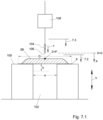
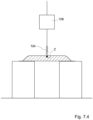
- the form retention of the second sheet, according to a test, is expressed in a force, measured during the test, which is exerted on the second sheet, while the test is carried out on the second sheet as such, that is, on the pad without the first sheet and the beverage preparation product; see Figs. 7.1-7.3 .
- the second sheet 2B as such that is, the pad without the first sheet and the beverage preparation product, but with preservation of its shape such as when the second sheet forms part of the pad, is laid on a horizontal surface 100, such that the second sheet is supported by its edge 8 on the horizontal surface, while the horizontal surface is provided with an elongated groove 102 which has a width a of 30 mm, and while the second sheet, symmetrically with respect to the groove, overlies the groove and on opposite sides of the groove is supported on the horizontal surface.
- a knife 104 having a length l which corresponds to the diameter D of the pad.
- a cutting face 106 of the knife has a thickness of 3 mm.
- a length direction L of the cutting face 106 extends in horizontal direction in a length direction L of the groove.
- the knife from a position above the pad, is moved down in vertical direction V with a constant speed v of 100 mm/minute, while a center M of the cutting face is situated, viewed in vertical direction, above a center of gravity Z of the second sheet. Because the second sheet has the shape of a disc with a center P, this center P corresponds to the center of gravity mentioned. Moving the knife down is carried out with a load cell 108. Prior to carrying out the test, the edge 8 lies wholly fittingly against the surface 100. From the moment that the knife touches the second sheet ( Fig.
- the resistance in units Newton is measured that the knife experiences as a result of the deforming of the pad by the knife as the knife moves down.
- the force is measured that the knife experiences from the second sheet as the knife moves down. Before the knife touches the second sheet, this force is zero. Thereupon this force starts to run up. Moving down is continued until the cutting face of the knife is in the groove at 12 mm depth b with respect to the horizontal surface (see Fig. 7.5 ).
- a highest resistance or force measured with the load cell 108 is the measure of the bending stiffness of the second sheet. This highest resistance Fmax is measured in Newton.
- the second sheet will first deform elastically. Thereafter, upon further downward movement, the second sheet is deformed.
- the measured greatest force typically corresponds with the moment just before which the second sheet buckles and hence yields under the load of the knife. After buckling the force can decrease again.
- the force is measured that the knife experiences as a result of the pad deforming.
- the measured greatest force is preferably in the range of 0.2-4 Newton, and/or is preferably greater than 1 Newton.
- the second sheet also remains form-retaining when a fluid such as the beverage and/or water is caused to flow through it, while the fluid can have a temperature of at most 80 degrees Celsius. In other words, when the fluid has a temperature that can run up to 80 degrees Celsius, the second sheet keeps the form-retaining properties mentioned.
- the second sheet remains form-retaining when a fluid is caused to flow through it, while the fluid can have a temperature of at most 90 degrees Celsius and preferably at most 99 degrees Celsius.
- the second sheet is made of a thermoplastic material.
- a thermoplastic material is a material that becomes more plastic as the temperature rises. Accordingly, it holds in this example that the second sheet also remains form-retaining when it comes into contact with a fluid such as a beverage and/or hot water that has a temperature of 80 degrees Celsius. Because a thermoplastic material is involved here, it will also hold that the sheet remains form-retaining when it comes into contact with a fluid having a temperature that is lower than 80 degrees Celsius.
- the second sheet also remains form-retaining when it comes into contact with a fluid of 90 degrees Celsius and preferably of 99 degrees Celsius.
- a fluid of 90 degrees Celsius and preferably of 99 degrees Celsius is a second sheet that is made of a thermoplastic material.
- the second sheet is made of a nonwoven material.
- This nonwoven material in this example, is made of a plastic for at least 50 percent by weight and preferably for at least 60 percent by weight, while in particular the plastic consists of plastic fibers and/or plastic filaments. More preferably, it holds that the nonwoven material is made from a plastic for at least 70 percent by weight. In particular, it holds that the nonwoven material consists of the plastic for at least 80 percent by weight, and more preferably for at least 90 percent by weight. On the other hand, it holds preferably that the nonwoven material consists of a plastic for 50-100 percent by weight, more preferably for 60-100 percent by weight. Still more preferably, it holds that the nonwoven material consists of the plastic for 70-100 percent by weight, in particular consists of a plastic for 75-95 percent by weight and still more in particular consists of plastic for 80-95 percent by weight.
- the plastic comprises polymers of PLA, PETP and/or LLDPE. More in general, it holds that plastics and combinations thereof are possible such as PE, PET, PETP, coPET, LLDPE, CPP, PLA and/or PP.
- the nonwoven material has been made form-retaining through a heat treatment.
- the sheet-form material that has been made of the respective plastic is brought into the required shape such as it is shown for the second sheet 2B, after which the second sheet undergoes a heat treatment so that the second sheet after cooling becomes form-retaining.
- the second sheet is provided with cellulose fibers and/or cellulose filaments.
- the second sheet comprises a combination of the above-mentioned plastics and cellulose fibers and/or filaments.
- the nonwoven material is provided with the cellulose fibers and/or the cellulose filaments.
- this nonwoven material consists of the plastic mentioned for at least 50 percent by weight, it will hold that the nonwoven material furthermore consists of cellulose for at most 50 percent by weight. If this nonwoven material, as discussed above, consists of the above-mentioned plastic for at least 60 or at least 70 percent by weight, it will hold that the nonwoven material furthermore consists of cellulose for at most 40 or 30 percent by weight, respectively.
- the nonwoven material therefore comprises preferably a combination of plastic and cellulose fibers and/or filaments.
- the plastic according to the invention, preferably consists of plastic fibers and/or filaments. In this example, these plastic fibers and/or plastic filaments are part of the nonwoven material.
- the plastic is present in the second sheet in the form of a coating on the cellulose fibers and/or the cellulose filaments.
- these plastic-coated fibers and/or plastic-coated filaments are then part of the nonwoven material.
- the nonwoven material consists for a greater proportion of percents by weight of the plastic mentioned than of cellulose fibers and/or filaments.
- the density of the second sheet is in the range of 15-60 g/m2 or in the range of 60-150 g/m2 excluding 60 g/m2, that is, on balance in the range of 15-150 g/m2.
- the density of the second sheet is in the range of 70-130 g/m2, more preferably in the range of 90-120 g/m2.
- the thickness of the second sheet in this example is in the range of 50-600 micrometer.
- the thickness is in the range of 100-500 micrometer, more particularly in the range of 150-300 micrometer.
- the thickness mentioned is schematically denoted in Fig. 1 with the letter h.
- the second sheet within the contours of the sealing seam is designed to be homogeneously permeable to a fluid such as water. Also, it holds in this example that the second sheet within the contours of the sealing seam comprises a smoothly running inner and outer surface.
- the first sheet is of flexible design.
- the first sheet is made of filtering paper known per se.
- the first sheet is provided with at least 70 percent of cellulose fibers and/or cellulose filaments.
- the residual portion of the first sheet may again be made of the plastics and/or plastic fibers and/or plastic filaments and/or plastic coatings mentioned in the context of the second sheet.
- the first sheet is provided with at least 80 percent by weight of cellulose, more preferably with at least 90 percent by weight of cellulose.
- the first sheet comprises less than 30 percent by weight of plastic polymers, preferably of a same kind as mentioned in the context of the second sheet.
- the thickness of the first sheet is, for example, 1.4-10 times smaller than the thickness of the second sheet.
- the thickness mentioned is schematically denoted in Fig. 1 with the letter h'.
- the part of the second sheet that is within the contours of the sealing seam is of dish-shaped design.
- the first sheet is of flat design.
- the part of the second sheet that is within the contours of the sealing seam has a diameter denoted with d.
- the diameter of the whole pad is denoted with D in Fig. 2 .
- the ring-shaped sealing seam 10 has a diameter of (D-d)/2.
- D is approximately 74.4 mm and d is approximately 61 mm.
- Other dimensions are conceivable for D.
- D can be, for instance, in the range of 45-90 mm, preferably 70-80 mm, more preferably 73-76 mm, in particular approximately 74.4 mm.
- the second sheet can comprise a film and/or consist of a film which is provided with a multiplicity of outflow openings and is made of a plastic, comprising plastic polymers.
- the plastic polymers can comprise PE, PET, PETP, coPET, LLDPE, CPP, PLA and/or PP.
- the second sheet can then comprise a first layer which consists at least substantially of PETP and a second layer which consists at least substantially of CPP.
- a system is shown in which the pad of Fig. 1 is used.
- the system is provided with a coffee-maker 14 which is provided with a holder 16 for receiving the pad 1. Further, the coffee-maker is provided with a cover 18 for closing off the holder 16.
- the coffee-maker is furthermore provided with fluid means 20, 22 for generating a fluid flow under pressure.
- these fluid means consist of a pump 20 and a storage vessel 22 which is filled with a fluid, in this example with hot water.
- the temperature of the water can be, for example, 70-98 degrees Celsius.
- the storage vessel 22 is provided with a heating element 24.
- the storage vessel 22 itself in turn may be filled from a larger storage vessel, which comprises cold water. This larger storage vessel is not shown in the drawing.
- the pump 20, in use, supplies hot water via a duct 26 to an inner space 28 of the cover 18.
- a bottom 30 of the cover is provided with a multiplicity of inflow openings 32.
- the holder 16 is provided with a bowl-shaped inner space 36 which is bounded by a bottom 34 of the holder and an upstanding sidewall 38 of the holder.
- the bottom consists of an outer horizontally directed ring-shaped bottom part 40 which adjoins the sidewall 38.
- the bottom comprises an inner dish-shaped bottom part 42, while the dish-shaped bottom part adjacent the ring-shaped bottom part slopes downwards in a direction directed away from the sidewall, to the inside of the holder.
- the ring-shaped bottom part is provided with an outer edge 41 which adjoins the sidewall 38 and an inner edge 43 which adjoins the dish-shaped bottom part 42.
- the bottom is provided with at least one outflow opening 44. This outflow opening in this example is located in the dish-shaped bottom part 42.
- the pad 1 rests on the bottom 34, with the second sheet extending along the bottom to near the upstanding sidewall 38.
- the sealing seam 10 of the pad then rests on the ring-shaped bottom part 40.
- the second sheet has a shape that corresponds to the shape of the bottom of the holder.
- the second sheet here has a smoothly running inner and outer surface within the sealing seam.
- grooves 46 are provided in the dish-shaped bottom part 42 .
- the grooves extend exclusively under the beverage preparation product 6 in the pad.
- the grooves 46 are formed by a multiplicity of projections 54 of the bottom. Between the upstanding projections 54, the respective grooves are formed.
- the grooves may also be differently formed, for instance as slots provided in the bottom and extending, for instance, in radial direction towards the outflow opening 44.
- the bottom is at least partly of smooth design and is made of a plastic and/or metal.
- the upper side of the tops are smooth, just like the rest of the bottom.
- the beverage preparation product is ground coffee. As can be properly seen, the ground coffee 6 forms a coffee bed.
- the grooves are under the coffee bed but also within the contours of the coffee bed, i.e., within the contours of the positions where the beverage preparation product is situated in the pad.
- the dish-shaped bottom part comprises an inner flat bottom part which is denoted with d' in Fig. 2 .
- the grooves extend exclusively in this inner bottom part d' which is flat.
- the at least one outflow opening 44 is provided with a nozzle 47 for generating a jet of the beverage as will be further elucidated hereinafter.
- the system is further provided with an impact member 50 which, in use, is impacted by a jet of the beverage made. The working of the system described up to this point is as follows.
- a user will first of all remove the cover 18 for placing the pad 1 of Fig. 1 in the holder 16 of Fig. 2 . Because the pad is provided with the second sheet 2B which is form-retaining, the pad will of itself slide into the right position as the pad is positioned in the bottom. The pad is, as it were, self-locating and ends up in the position as shown in Fig. 2 . After this, the holder can be closed off with the cover as shown in Fig. 2 . Thereupon a user operates the control unit 52 of the coffee-maker 14. The result is that the control unit 52 activates the pump 20. As a result, hot water is supplied from the storage vessel 22 via the duct 26 to the inner space 28 of the cover 18.
- This water will leave the cover 18 and flow into the holder via the inflow openings 32.
- the consequence is that the water is supplied under pressure from the upper side of the pad to the first sheet of the pad.
- the pressure in this example is 1.1 bar above atmospheric pressure.
- the hot water will then penetrate via the first sheet 2A into the inner space of the pad.
- the hot water comes into contact with the ground coffee so that the coffee beverage is formed.
- the coffee beverage leaves the coffee pad via the second sheet 2B.
- the second sheet 2B becoming moist, it will form a sealing with the bottom 34, there where there are no grooves. There where the grooves are, the beverage will leave the pad.
- bypass is avoided.
- the hot water forms channels extending in vertical direction through the coffee bed. Such channels would preclude an optimal and efficient extraction of the ground coffee. Since, in addition, the grooves extend in a flat part of the bottom, this enables the second sheet to properly abut the bottom, so that it's the grooves that determine where the beverage can flow out of the pad.
- the beverage proceeds to flow via the grooves to the outflow opening 44. Because the outflow opening 44 is provided with a nozzle 47, while moreover it holds that the fluid is supplied to the pad under pressure, the coffee beverage will be formed into a jet that impacts the impact surface 50. As a result, the beverage will be atomized in a chamber 62 of the holder which is open at its underside 64.
- the cover is provided with a sealing ring 60 which seals fluid-tightly against the upstanding sidewall 38 of the holder. It is also possible, however, that the upstanding sidewall 38 is provided with the sealing ring, this sealing ring then sealing against the cover 18.
- the second sheet is of form-retaining design. It is also possible, however, that the first sheet is also of form-retaining design. Preferably, it holds here that the first sheet is made of a same material as the second sheet. More particularly, it holds here that the first sheet and the second sheet are made from a same sheet or same sheets.
- the beverage preparation product consists of ground coffee. It is also conceivable, however, that the beverage preparation product consists of, for example, tea.
- the beverage preparation product consists of a product soluble in fluid or a product that forms a dispersion such as milk powder and/or cacao for preparing milk or chocolate milk.
- the beverage preparation product is provided with one of the extractable products mentioned or a different type of extractable product in combination with a fluid-soluble product.
- the fluid-soluble product in turn may consist of milk powder or a flavor enhancer.
- the pad is used in a different type of coffee-maker. Further, in the holder of the coffee-maker of Fig. 2 , also a coffee pad 1' according to Fig.
- the coffee pad 1' and the holder 16 are tailored to each other so that the coffee pad can be received in the holder for preparing coffee, such that, in use, the fluid is supplied under pressure to the upper side of the pad and is pressed through the pad so that the fluid flows through the top sheet whereby in the pad a coffee extract is formed which proceeds to leave the pad via the bottom sheet and wherein the coffee extract proceeds to flow out of the holder via the beverage outflow opening of the holder.
- the bottom sheet of the pad here extends over the bottom 34 of the holder up to the upstanding sidewall 38 of the holder, thereby also forming a sealing with the holder to prevent bypass.
- the beverage can leave the pad there where the grooves are.
- the invention also concerns a system provided with the coffee-maker, the pad 1 and the pad 1', allowing a user, as desired, to use the pad 1 or the pad 1' for preparing the beverage.
- Figs. 5a-5f schematically show a method for making the pad as discussed above.
- a fourth sheet 150 is placed above a mold 152 made of metal. Through, for instance, vacuum suction of the mold cavity 154, the fourth sheet takes the shape of the mold cavity ( Fig. 5b ). Also, alternatively, the fourth sheet may be mechanically pressed into the mold cavity with a stamp 56 (represented in broken lines). Then, in Fig. 5c , the fourth sheet is heated with a stamp 58. The fourth sheet is heated to, for example, 200-400 degrees Celsius. (The fourth sheet may also be heated in step c. to a temperature of 90-200 degrees Celsius, in particular when the second sheet is made of PLA.) The plastics in the sheet will thereby liquefy and/or soften.
- the stamp 58 is removed and the fourth sheet is cooled.
- the sheet has now become form-retaining.
- the second sheet in this example will now already have a smoothly running inner and outer surface within the sealing seam to be formed.
- the beverage preparation product 6 is positioned on the fourth sheet ( Fig. 5d ).
- a third sheet 160 is placed above the fourth sheet 150 and the beverage preparation product.
- the fourth sheet and the third sheet are welded together ( Fig. 5f ), whereby the sealing seam 10 is formed.
- the pad 1 is cut out.
- the cut-out part of the fourth sheet 150 then constitutes the second disc-shaped sheet 2B and the cut-out part of the third sheet 160 then constitutes the first disc-shaped sheet 2A. Accordingly, it holds that in a step a. a set-up of a third sheet, fourth sheet and the beverage preparation product is made, with the beverage preparation product situated between the third sheet and the fourth sheet ( Fig. 5e ), and then in a step b. the third sheet and the fourth sheet are joined together ( Fig. 5f ). Further, it holds that the fourth sheet is heated in a step c. ( Fig. 5c ) and then is cooled in a step d. for increasing the bending stiffness of the fourth sheet.
- step c. is heated in step c. to a temperature of 200-400 degrees Celsius or for instance 90-200 degrees Celsius.
- step e. the fourth sheet is placed in a mold so that the fourth sheet obtains a predetermined shape ( Fig. 5b ), while thereupon step c. ( Fig. 5c ) is carried out.
- step f. the beverage preparation product is placed on the fourth sheet, preferably while the fourth sheet is already in the mold ( Fig. 5d ), whereby step b. is carried out after step f.
- step c. Fig. 5c
- step Fig. 5d is carried out before step f. ( Fig. 5d ).
- the third sheet and/or the fourth sheet may during the execution of step b. be heated to 90-400 degrees Celsius, in particular 90-200 degrees Celsius. Also, it holds that the fourth sheet and possibly the third sheet is cooled after carrying out step b.
- step b. and step c. are carried out at the same time. This can be done by leaving out the step of Fig. 5c while in Fig. 5f the mold is heated for carrying out step c.
- step g. before the step according to Fig. 5a is carried out.
- the method can be continued as has been discussed with reference to Figs. 5a-5f .
- step g. is carried out before step a. and step b.
- step c. of heating and the step d. of cooling are then omitted.
- the second sheet can also comprise a film and/or consist of a film which is provided with a multiplicity of outflow openings and is made of a plastic.
- the outflow openings can for instance be circular and have a diameter of 0.15-0.6 mm.
- the plastic may be of a kind as discussed above.
- the second sheet comprises a first layer which consists at least substantially of PETP and a second layer which consists at least substantially of CPP.
- the second sheet may be composed from such a film and a layer of nonwoven material, such as, for example, filtering paper.
- This layer of nonwoven material can also consist of the nonwoven material which has been discussed above for the second sheet of the pad according to Fig. 1 .
- This layer may be bonded to the film by, for instance, heating.
- the beverage preparation product may be tamped down and/or condensed, and thereby contributes to the form retention of the pad. Such tamping down and/or compaction may be carried out, for instance, in the situation of Fig. 5d , after which the pad is closed with the first sheet as discussed for Figs. 5e and 5f .
- the beverage preparation product may be provided with ground coffee.
- the second sheet may also be designed of different materials.
- the second sheet may be made of a polyester fiber, in particular of Smash TM material.
- the second sheet is made of SMASH TM 150 g/m2.
- the thickness of the second sheet is 250-450 ⁇ m, preferably 300-400 ⁇ m, more preferably 350 ⁇ m.
- the second sheet is made of Polylactic Acid (PLA) fibers.
- PLA fibers are for instance described in WO 2012/027539 .
- the second sheet is made of PLA 60-120 g/m2, more preferably PLA 90 or 100 g/m2.
- the thickness of the sheet made of PLA is 100-600 ⁇ m (micrometer).
- the second sheet is made of 100% Polylactic Acid (PLA) fibers and derivatives so that the second sheet is completely biodegradable after use. It preferably holds here that the second sheet is made of PLA fibers having a melting point of 145-175 degrees Celsius and PLA fibers having a melting point of 105-165 degrees Celsius. A combination of these two types of fibers provides on the one hand form retention of the second sheet and on the other coherence between the fibers.
- PLA Polylactic Acid
- the second sheet consists for x% of Polylactic Acid (PLA) fibers and for (1-x)% of paper, with x being in the range of 50-80, preferably in the range of 60-70, more preferably approximately equal to 65.
- PLA fibers have a melting point of 105-165 degrees Celsius.
- the fibers can have a length of 2-90 mm. Also, the fibers may be 0.6-6.0 denier. In particular, it holds that the first sheet is of more transparent design than the second sheet. The first sheet can then have the properties of the top sheet as discussed in EP 2 424 794 . Also, it may hold that the second sheet is of at least substantially opaque design.
- the second sheet may have a smoothly running inner and outer surface within the sealing seam.
- the second sheet may also be so configured as to be provided with at least one groove or a multiplicity of grooves to increase form retention of the second sheet, with the grooves 80 extending, for instance, in radial direction of the pad and/or with the at least one groove 90 constituting a circumferential groove closed upon itself, extending around an axial axis of the pad, for example in the sealing seam (groove 90.1) or in the second sheet outside the sealing seam so that the groove (90.2) has a smaller diameter than the sealing seam.
- Fig. 6 a view of the second sheet is shown.
- the radial grooves 80 extend to near the sealing seam 10. It is also conceivable, however, that the radial grooves extend into the sealing seam 10 (indicated for one groove 80.1).
- the grooves in this example have a V-shaped cross section. Other shapes, such as a U-shaped cross section, are also possible.
Landscapes
- Engineering & Computer Science (AREA)
- Mechanical Engineering (AREA)
- Food Science & Technology (AREA)
- Apparatus For Making Beverages (AREA)
- Packages (AREA)
Applications Claiming Priority (2)
| Application Number | Priority Date | Filing Date | Title |
|---|---|---|---|
| NL2009133 | 2012-07-05 | ||
| PCT/NL2013/050510 WO2014007639A1 (en) | 2012-07-05 | 2013-07-05 | Pad for use in a coffee maker |
Publications (2)
| Publication Number | Publication Date |
|---|---|
| EP2870081A1 EP2870081A1 (en) | 2015-05-13 |
| EP2870081B1 true EP2870081B1 (en) | 2023-09-06 |
Family
ID=47045119
Family Applications (1)
| Application Number | Title | Priority Date | Filing Date |
|---|---|---|---|
| EP13739869.9A Active EP2870081B1 (en) | 2012-07-05 | 2013-07-05 | Pad for use in a coffee maker, methods for its manufacture and for preparing a beverage |
Country Status (11)
| Country | Link |
|---|---|
| US (1) | US11000146B2 (pl) |
| EP (1) | EP2870081B1 (pl) |
| JP (1) | JP2015525603A (pl) |
| CN (1) | CN104603028A (pl) |
| AU (1) | AU2013285654A1 (pl) |
| BR (1) | BR112014033063B1 (pl) |
| CA (1) | CA2877945C (pl) |
| MX (1) | MX2015000112A (pl) |
| PL (1) | PL2870081T3 (pl) |
| RU (1) | RU2015103753A (pl) |
| WO (1) | WO2014007639A1 (pl) |
Families Citing this family (16)
| Publication number | Priority date | Publication date | Assignee | Title |
|---|---|---|---|---|
| MX2015000112A (es) | 2012-07-05 | 2015-04-14 | Koninkl Douwe Egberts Bv | Almohadilla para uso en cafetera. |
| US9783361B2 (en) | 2013-03-14 | 2017-10-10 | Starbucks Corporation | Stretchable beverage cartridges and methods |
| NL2012064C2 (en) * | 2014-01-08 | 2015-07-09 | Koninkl Douwe Egberts Bv | Pad for use in a coffee maker. |
| US10442610B2 (en) | 2014-03-11 | 2019-10-15 | Starbucks Corporation | Pod-based restrictors and methods |
| BR112016029025B1 (pt) | 2014-06-12 | 2021-09-08 | K-Fee System Gmbh | Cápsula de porção individual para a produção de uma bebida e uso da referida cápsula |
| PL3220788T3 (pl) | 2014-11-20 | 2019-11-29 | Douwe Egberts Bv | Urządzenie do przyrządzania napoju kawowego, system zawierający takie urządzenie, użycie pojemnika z kawą w takim systemie lub urządzeniu oraz sposób przyrządzania napoju kawowego za pomocą takiego urządzenia lub systemu |
| US9877495B2 (en) | 2015-01-09 | 2018-01-30 | Starbucks Corporation | Method of making a sweetened soluble beverage product |
| JP6580714B2 (ja) | 2015-06-10 | 2019-09-25 | ケイ‐フィー システム ゲーエムベーハー | 3層不織布を用いたポーションカプセル |
| CN107848699A (zh) | 2015-07-13 | 2018-03-27 | K-Fee系统股份有限公司 | 具有切口的过滤元件 |
| US20170050799A1 (en) * | 2015-08-20 | 2017-02-23 | Novacart S.P.A. | Capsule and process for making the same |
| MX2018002991A (es) | 2015-09-18 | 2018-05-02 | K Fee System Gmbh | Adaptador para una capsula monodosis. |
| US12227323B2 (en) | 2018-07-27 | 2025-02-18 | Gcs German Capsule Solution Gmbh | Method for producing a portion capsule |
| US12459728B2 (en) | 2018-11-22 | 2025-11-04 | Gcs German Capsule Solution Gmbh | Seal for a single serve capsule |
| CA3201910A1 (en) * | 2020-12-11 | 2022-06-16 | Richard John ANDREWS | Beverage pad |
| CN116600685A (zh) * | 2020-12-11 | 2023-08-15 | 皇家戴维艾格伯茨有限公司 | 饮料包 |
| CA3225060A1 (en) | 2021-07-30 | 2023-02-02 | Hans WIPRAECHTIGER | Manufacturing line for manufacturing a compostable pod for brewing products and system for measuring and regulating the relative humidity of a biodegradable paper-based material |
Citations (1)
| Publication number | Priority date | Publication date | Assignee | Title |
|---|---|---|---|---|
| EP2594170A1 (en) * | 2010-07-08 | 2013-05-22 | UCC Ueshima Coffee Co., Ltd. | Beverage extraction filter |
Family Cites Families (35)
| Publication number | Priority date | Publication date | Assignee | Title |
|---|---|---|---|---|
| BE424251A (pl) | 1936-10-23 | |||
| US2382290A (en) | 1940-11-22 | 1945-08-14 | Marshall E Callander | Manufacture of mineral wool |
| US3445237A (en) * | 1966-06-28 | 1969-05-20 | Lester Gidge | Preshaped cartridge for,and method of packaging,percolator ground coffee |
| JPS63117439U (en) * | 1987-01-26 | 1988-07-29 | Lucky Coffee Machine Co.Ltd | Extraction vessel |
| ZA924490B (en) | 1991-07-05 | 1993-03-31 | Nestle Sa | A flexible package with a stiffening element and a process for its production |
| WO1994001344A1 (fr) | 1992-07-06 | 1994-01-20 | Societe Des Produits Nestle S.A. | Sachet souple ferme et son procede de fabrication |
| JPH0645606U (ja) * | 1992-11-30 | 1994-06-21 | 旭化成工業株式会社 | 成形容器状物 |
| GB9305460D0 (en) * | 1993-03-17 | 1993-05-05 | Gen Foods Ltd | Apparatus and method for beverage preparation |
| US5573841A (en) * | 1994-04-04 | 1996-11-12 | Kimberly-Clark Corporation | Hydraulically entangled, autogenous-bonding, nonwoven composite fabric |
| US6183814B1 (en) * | 1997-05-23 | 2001-02-06 | Cargill, Incorporated | Coating grade polylactide and coated paper, preparation and uses thereof, and articles prepared therefrom |
| NL1007171C2 (nl) | 1997-09-30 | 1999-03-31 | Sara Lee De Nv | Samenstel voor gebruik in een koffiemachine voor het bereiden van koffie, houder en pouch van dat samenstel. |
| FI112624B (fi) * | 1998-07-07 | 2003-12-31 | Enso Oyj | Kompostoituva pinnoitettu paperi tai kartonki, menetelmä sen valmistamiseksi sekä siitä saatuja tuotteita |
| IT1320945B1 (it) | 2000-02-07 | 2003-12-18 | Francesco Bonanno | Emulsionatore automatico con regolazione di scorrimento eammortizzatore di flusso. |
| US6777007B2 (en) * | 2002-07-06 | 2004-08-17 | Edward Z. Cai | Pod and method for making fluid comestible |
| WO2002070820A1 (fr) * | 2001-03-07 | 2002-09-12 | Nissin Shokuhin Kabushiki Kaisha | Materiau d'emballage et receptacle |
| ES2252113T3 (es) * | 2001-06-28 | 2006-05-16 | Societe Des Produits Nestle S.A. | Capsula flexible cerrada. |
| AU2005226884B2 (en) | 2004-03-26 | 2010-06-03 | Illycaffe's.P.A. | Integrated cartridge for extracting a beverage from a particulate substance |
| ES2299879T3 (es) | 2004-10-01 | 2008-06-01 | Hausbrandt Trieste 1892 Spa | Aparato y procedimiento para preparar y suministrar una bebida utilizando una materia prima contenida en un cartucho. |
| GB0423553D0 (en) * | 2004-10-22 | 2004-11-24 | Kraft Foods R & D Inc | Flexible pad for preparing a beverage |
| GB0423545D0 (en) * | 2004-10-22 | 2004-11-24 | Kraft Foods R & D Inc | Pod for preparing a beverage |
| DE602004023772D1 (de) * | 2004-12-21 | 2009-12-03 | Coval Art Tec Ltd | Vorrichtung zur zubereitung eines getränks |
| GB0704095D0 (en) * | 2007-03-02 | 2007-04-11 | Mars Inc | Beverage preparation material |
| PL2000063T5 (pl) * | 2007-06-05 | 2019-11-29 | Caffitaly System Spa | Sposób przygotowania napoju i urządzenie z kapsułą do zastosowania tego sposobu |
| JP5315776B2 (ja) * | 2008-04-30 | 2013-10-16 | 静岡県 | ドリップ式ティーバッグ |
| JP4278706B1 (ja) * | 2008-08-20 | 2009-06-17 | ユーシーシー上島珈琲株式会社 | 飲料用抽出フィルター及びその製造方法 |
| EP2239212B1 (en) * | 2009-04-09 | 2015-11-11 | Nestec S.A. | Capsule for preparation of a beverage with a delivery wall forming a confined flowpath |
| IT1393936B1 (it) * | 2009-04-09 | 2012-05-17 | I T A Ca S R L Ora Mitaca S R L | Cartuccia per caffe' e prodotti solubili per la preparazione di bevande |
| BRPI1016216B1 (pt) | 2009-04-27 | 2019-12-17 | Douwe Egberts Bv | cápsula, recipiente, aparelho e método para preparar uma bebida, e, método para fabricar uma cápsula |
| CN102573577B (zh) * | 2009-06-17 | 2014-11-05 | 皇家戴维艾格伯茨有限公司 | 用于制备饮料的系统、装置以及方法 |
| US20110185911A1 (en) * | 2009-10-21 | 2011-08-04 | Gino Rapparini | Filtering permeable thermoformed container for beverage-making products with a flat rim |
| BR112013000395A2 (pt) * | 2010-07-07 | 2016-05-17 | Nestec Sa | método para produção de uma cápsula de ingredienre de bebida para a preparação de uma bebida e aparelho |
| US8828895B2 (en) * | 2010-08-25 | 2014-09-09 | Nonwoven Network LLC | Webs of bi-component and mono-component Co-PLA fibers |
| US20120085661A1 (en) * | 2010-10-12 | 2012-04-12 | Cellcomb Ab | Pouch type food pad and food tray |
| US20130001289A1 (en) * | 2011-06-28 | 2013-01-03 | International Paper Company | Paperboard cup with moisture absorbing protection |
| MX2015000112A (es) | 2012-07-05 | 2015-04-14 | Koninkl Douwe Egberts Bv | Almohadilla para uso en cafetera. |
-
2013
- 2013-07-05 MX MX2015000112A patent/MX2015000112A/es unknown
- 2013-07-05 EP EP13739869.9A patent/EP2870081B1/en active Active
- 2013-07-05 AU AU2013285654A patent/AU2013285654A1/en not_active Abandoned
- 2013-07-05 BR BR112014033063-8A patent/BR112014033063B1/pt active IP Right Grant
- 2013-07-05 JP JP2015520096A patent/JP2015525603A/ja active Pending
- 2013-07-05 CN CN201380046153.3A patent/CN104603028A/zh active Pending
- 2013-07-05 CA CA2877945A patent/CA2877945C/en active Active
- 2013-07-05 RU RU2015103753A patent/RU2015103753A/ru not_active Application Discontinuation
- 2013-07-05 WO PCT/NL2013/050510 patent/WO2014007639A1/en not_active Ceased
- 2013-07-05 PL PL13739869.9T patent/PL2870081T3/pl unknown
-
2014
- 2014-12-30 US US14/586,159 patent/US11000146B2/en active Active
Patent Citations (1)
| Publication number | Priority date | Publication date | Assignee | Title |
|---|---|---|---|---|
| EP2594170A1 (en) * | 2010-07-08 | 2013-05-22 | UCC Ueshima Coffee Co., Ltd. | Beverage extraction filter |
Also Published As
| Publication number | Publication date |
|---|---|
| JP2015525603A (ja) | 2015-09-07 |
| US20150344220A1 (en) | 2015-12-03 |
| RU2015103753A (ru) | 2016-08-27 |
| PL2870081T3 (pl) | 2024-01-29 |
| WO2014007639A1 (en) | 2014-01-09 |
| MX2015000112A (es) | 2015-04-14 |
| BR112014033063B1 (pt) | 2020-11-10 |
| BR112014033063A2 (pt) | 2017-06-27 |
| EP2870081A1 (en) | 2015-05-13 |
| CA2877945A1 (en) | 2014-01-09 |
| AU2013285654A1 (en) | 2015-01-29 |
| CN104603028A (zh) | 2015-05-06 |
| US11000146B2 (en) | 2021-05-11 |
| CA2877945C (en) | 2021-11-02 |
Similar Documents
| Publication | Publication Date | Title |
|---|---|---|
| EP2870081B1 (en) | Pad for use in a coffee maker, methods for its manufacture and for preparing a beverage | |
| US20210354907A1 (en) | Form-retaining pad for use in a coffee maker | |
| RU2380999C2 (ru) | Система из кофеварки и порционной капсулы | |
| RU2526212C2 (ru) | Система, способ и капсула для приготовления напитка | |
| RU2453487C2 (ru) | Способ приготовления и размещения в кофе-картридже частиц молотого кофе и кофе-картридж | |
| EP1662952B1 (en) | Preparation of a beverage suitable for consumation | |
| KR101771759B1 (ko) | 음료 제조 기기에서 원심 분리에 의해 음료를 준비하는 캡슐 및 시스템 | |
| US20090145988A1 (en) | Bi-Modal Roller Grinder | |
| WO2014163497A1 (en) | Adapter for use in a coffee machine | |
| NL2012061C2 (en) | Form-retaining pad for use in a coffee maker. | |
| US20060032380A1 (en) | Filter for extraction device | |
| EP3091880B1 (en) | Pad for use in a coffee maker | |
| WO2015105412A1 (en) | Form retaining pad for use in a coffee maker | |
| KR20250160943A (ko) | 음료 추출 시스템 | |
| WO2026021988A1 (en) | Beverage capsule with elevated dome shaped needle penetration region | |
| CA2674767C (en) | Pad, pad holder, assembly, and method for producing a beverage | |
| HK1137311B (en) | Preparation of a beverage suitable for consumption |
Legal Events
| Date | Code | Title | Description |
|---|---|---|---|
| PUAI | Public reference made under article 153(3) epc to a published international application that has entered the european phase |
Free format text: ORIGINAL CODE: 0009012 |
|
| 17P | Request for examination filed |
Effective date: 20150126 |
|
| AK | Designated contracting states |
Kind code of ref document: A1 Designated state(s): AL AT BE BG CH CY CZ DE DK EE ES FI FR GB GR HR HU IE IS IT LI LT LU LV MC MK MT NL NO PL PT RO RS SE SI SK SM TR |
|
| AX | Request for extension of the european patent |
Extension state: BA ME |
|
| DAX | Request for extension of the european patent (deleted) | ||
| STAA | Information on the status of an ep patent application or granted ep patent |
Free format text: STATUS: EXAMINATION IS IN PROGRESS |
|
| 17Q | First examination report despatched |
Effective date: 20170918 |
|
| GRAP | Despatch of communication of intention to grant a patent |
Free format text: ORIGINAL CODE: EPIDOSNIGR1 |
|
| STAA | Information on the status of an ep patent application or granted ep patent |
Free format text: STATUS: GRANT OF PATENT IS INTENDED |
|
| INTG | Intention to grant announced |
Effective date: 20211124 |
|
| GRAJ | Information related to disapproval of communication of intention to grant by the applicant or resumption of examination proceedings by the epo deleted |
Free format text: ORIGINAL CODE: EPIDOSDIGR1 |
|
| STAA | Information on the status of an ep patent application or granted ep patent |
Free format text: STATUS: EXAMINATION IS IN PROGRESS |
|
| INTC | Intention to grant announced (deleted) | ||
| GRAP | Despatch of communication of intention to grant a patent |
Free format text: ORIGINAL CODE: EPIDOSNIGR1 |
|
| STAA | Information on the status of an ep patent application or granted ep patent |
Free format text: STATUS: GRANT OF PATENT IS INTENDED |
|
| INTG | Intention to grant announced |
Effective date: 20220622 |
|
| GRAJ | Information related to disapproval of communication of intention to grant by the applicant or resumption of examination proceedings by the epo deleted |
Free format text: ORIGINAL CODE: EPIDOSDIGR1 |
|
| STAA | Information on the status of an ep patent application or granted ep patent |
Free format text: STATUS: EXAMINATION IS IN PROGRESS |
|
| GRAP | Despatch of communication of intention to grant a patent |
Free format text: ORIGINAL CODE: EPIDOSNIGR1 |
|
| INTC | Intention to grant announced (deleted) | ||
| STAA | Information on the status of an ep patent application or granted ep patent |
Free format text: STATUS: GRANT OF PATENT IS INTENDED |
|
| INTG | Intention to grant announced |
Effective date: 20230316 |
|
| P01 | Opt-out of the competence of the unified patent court (upc) registered |
Effective date: 20230505 |
|
| GRAS | Grant fee paid |
Free format text: ORIGINAL CODE: EPIDOSNIGR3 |
|
| GRAA | (expected) grant |
Free format text: ORIGINAL CODE: 0009210 |
|
| STAA | Information on the status of an ep patent application or granted ep patent |
Free format text: STATUS: THE PATENT HAS BEEN GRANTED |
|
| AK | Designated contracting states |
Kind code of ref document: B1 Designated state(s): AL AT BE BG CH CY CZ DE DK EE ES FI FR GB GR HR HU IE IS IT LI LT LU LV MC MK MT NL NO PL PT RO RS SE SI SK SM TR |
|
| REG | Reference to a national code |
Ref country code: GB Ref legal event code: FG4D |
|
| REG | Reference to a national code |
Ref country code: CH Ref legal event code: EP |
|
| REG | Reference to a national code |
Ref country code: DE Ref legal event code: R096 Ref document number: 602013084594 Country of ref document: DE |
|
| REG | Reference to a national code |
Ref country code: IE Ref legal event code: FG4D |
|
| REG | Reference to a national code |
Ref country code: NL Ref legal event code: FP |
|
| REG | Reference to a national code |
Ref country code: LT Ref legal event code: MG9D |
|
| PG25 | Lapsed in a contracting state [announced via postgrant information from national office to epo] |
Ref country code: GR Free format text: LAPSE BECAUSE OF FAILURE TO SUBMIT A TRANSLATION OF THE DESCRIPTION OR TO PAY THE FEE WITHIN THE PRESCRIBED TIME-LIMIT Effective date: 20231207 |
|
| PG25 | Lapsed in a contracting state [announced via postgrant information from national office to epo] |
Ref country code: SE Free format text: LAPSE BECAUSE OF FAILURE TO SUBMIT A TRANSLATION OF THE DESCRIPTION OR TO PAY THE FEE WITHIN THE PRESCRIBED TIME-LIMIT Effective date: 20230906 Ref country code: RS Free format text: LAPSE BECAUSE OF FAILURE TO SUBMIT A TRANSLATION OF THE DESCRIPTION OR TO PAY THE FEE WITHIN THE PRESCRIBED TIME-LIMIT Effective date: 20230906 Ref country code: NO Free format text: LAPSE BECAUSE OF FAILURE TO SUBMIT A TRANSLATION OF THE DESCRIPTION OR TO PAY THE FEE WITHIN THE PRESCRIBED TIME-LIMIT Effective date: 20231206 Ref country code: LV Free format text: LAPSE BECAUSE OF FAILURE TO SUBMIT A TRANSLATION OF THE DESCRIPTION OR TO PAY THE FEE WITHIN THE PRESCRIBED TIME-LIMIT Effective date: 20230906 Ref country code: LT Free format text: LAPSE BECAUSE OF FAILURE TO SUBMIT A TRANSLATION OF THE DESCRIPTION OR TO PAY THE FEE WITHIN THE PRESCRIBED TIME-LIMIT Effective date: 20230906 Ref country code: HR Free format text: LAPSE BECAUSE OF FAILURE TO SUBMIT A TRANSLATION OF THE DESCRIPTION OR TO PAY THE FEE WITHIN THE PRESCRIBED TIME-LIMIT Effective date: 20230906 Ref country code: GR Free format text: LAPSE BECAUSE OF FAILURE TO SUBMIT A TRANSLATION OF THE DESCRIPTION OR TO PAY THE FEE WITHIN THE PRESCRIBED TIME-LIMIT Effective date: 20231207 Ref country code: FI Free format text: LAPSE BECAUSE OF FAILURE TO SUBMIT A TRANSLATION OF THE DESCRIPTION OR TO PAY THE FEE WITHIN THE PRESCRIBED TIME-LIMIT Effective date: 20230906 |
|
| REG | Reference to a national code |
Ref country code: AT Ref legal event code: UEP Ref document number: 1608290 Country of ref document: AT Kind code of ref document: T Effective date: 20230906 |
|
| PG25 | Lapsed in a contracting state [announced via postgrant information from national office to epo] |
Ref country code: IS Free format text: LAPSE BECAUSE OF FAILURE TO SUBMIT A TRANSLATION OF THE DESCRIPTION OR TO PAY THE FEE WITHIN THE PRESCRIBED TIME-LIMIT Effective date: 20240106 |
|
| PG25 | Lapsed in a contracting state [announced via postgrant information from national office to epo] |
Ref country code: ES Free format text: LAPSE BECAUSE OF FAILURE TO SUBMIT A TRANSLATION OF THE DESCRIPTION OR TO PAY THE FEE WITHIN THE PRESCRIBED TIME-LIMIT Effective date: 20230906 |
|
| PG25 | Lapsed in a contracting state [announced via postgrant information from national office to epo] |
Ref country code: SM Free format text: LAPSE BECAUSE OF FAILURE TO SUBMIT A TRANSLATION OF THE DESCRIPTION OR TO PAY THE FEE WITHIN THE PRESCRIBED TIME-LIMIT Effective date: 20230906 Ref country code: RO Free format text: LAPSE BECAUSE OF FAILURE TO SUBMIT A TRANSLATION OF THE DESCRIPTION OR TO PAY THE FEE WITHIN THE PRESCRIBED TIME-LIMIT Effective date: 20230906 Ref country code: IS Free format text: LAPSE BECAUSE OF FAILURE TO SUBMIT A TRANSLATION OF THE DESCRIPTION OR TO PAY THE FEE WITHIN THE PRESCRIBED TIME-LIMIT Effective date: 20240106 Ref country code: ES Free format text: LAPSE BECAUSE OF FAILURE TO SUBMIT A TRANSLATION OF THE DESCRIPTION OR TO PAY THE FEE WITHIN THE PRESCRIBED TIME-LIMIT Effective date: 20230906 Ref country code: EE Free format text: LAPSE BECAUSE OF FAILURE TO SUBMIT A TRANSLATION OF THE DESCRIPTION OR TO PAY THE FEE WITHIN THE PRESCRIBED TIME-LIMIT Effective date: 20230906 Ref country code: CZ Free format text: LAPSE BECAUSE OF FAILURE TO SUBMIT A TRANSLATION OF THE DESCRIPTION OR TO PAY THE FEE WITHIN THE PRESCRIBED TIME-LIMIT Effective date: 20230906 Ref country code: SK Free format text: LAPSE BECAUSE OF FAILURE TO SUBMIT A TRANSLATION OF THE DESCRIPTION OR TO PAY THE FEE WITHIN THE PRESCRIBED TIME-LIMIT Effective date: 20230906 Ref country code: PT Free format text: LAPSE BECAUSE OF FAILURE TO SUBMIT A TRANSLATION OF THE DESCRIPTION OR TO PAY THE FEE WITHIN THE PRESCRIBED TIME-LIMIT Effective date: 20240108 |
|
| REG | Reference to a national code |
Ref country code: DE Ref legal event code: R097 Ref document number: 602013084594 Country of ref document: DE |
|
| PG25 | Lapsed in a contracting state [announced via postgrant information from national office to epo] |
Ref country code: DK Free format text: LAPSE BECAUSE OF FAILURE TO SUBMIT A TRANSLATION OF THE DESCRIPTION OR TO PAY THE FEE WITHIN THE PRESCRIBED TIME-LIMIT Effective date: 20230906 |
|
| PLBE | No opposition filed within time limit |
Free format text: ORIGINAL CODE: 0009261 |
|
| STAA | Information on the status of an ep patent application or granted ep patent |
Free format text: STATUS: NO OPPOSITION FILED WITHIN TIME LIMIT |
|
| PG25 | Lapsed in a contracting state [announced via postgrant information from national office to epo] |
Ref country code: DK Free format text: LAPSE BECAUSE OF FAILURE TO SUBMIT A TRANSLATION OF THE DESCRIPTION OR TO PAY THE FEE WITHIN THE PRESCRIBED TIME-LIMIT Effective date: 20230906 Ref country code: SI Free format text: LAPSE BECAUSE OF FAILURE TO SUBMIT A TRANSLATION OF THE DESCRIPTION OR TO PAY THE FEE WITHIN THE PRESCRIBED TIME-LIMIT Effective date: 20230906 |
|
| 26N | No opposition filed |
Effective date: 20240607 |
|
| PG25 | Lapsed in a contracting state [announced via postgrant information from national office to epo] |
Ref country code: BG Free format text: LAPSE BECAUSE OF FAILURE TO SUBMIT A TRANSLATION OF THE DESCRIPTION OR TO PAY THE FEE WITHIN THE PRESCRIBED TIME-LIMIT Effective date: 20230906 |
|
| PG25 | Lapsed in a contracting state [announced via postgrant information from national office to epo] |
Ref country code: BG Free format text: LAPSE BECAUSE OF FAILURE TO SUBMIT A TRANSLATION OF THE DESCRIPTION OR TO PAY THE FEE WITHIN THE PRESCRIBED TIME-LIMIT Effective date: 20230906 |
|
| PG25 | Lapsed in a contracting state [announced via postgrant information from national office to epo] |
Ref country code: MC Free format text: LAPSE BECAUSE OF FAILURE TO SUBMIT A TRANSLATION OF THE DESCRIPTION OR TO PAY THE FEE WITHIN THE PRESCRIBED TIME-LIMIT Effective date: 20230906 |
|
| PG25 | Lapsed in a contracting state [announced via postgrant information from national office to epo] |
Ref country code: LU Free format text: LAPSE BECAUSE OF NON-PAYMENT OF DUE FEES Effective date: 20240705 |
|
| GBPC | Gb: european patent ceased through non-payment of renewal fee |
Effective date: 20240705 |
|
| PG25 | Lapsed in a contracting state [announced via postgrant information from national office to epo] |
Ref country code: LU Free format text: LAPSE BECAUSE OF NON-PAYMENT OF DUE FEES Effective date: 20240705 |
|
| PG25 | Lapsed in a contracting state [announced via postgrant information from national office to epo] |
Ref country code: GB Free format text: LAPSE BECAUSE OF NON-PAYMENT OF DUE FEES Effective date: 20240705 |
|
| PGFP | Annual fee paid to national office [announced via postgrant information from national office to epo] |
Ref country code: PL Payment date: 20250618 Year of fee payment: 13 |
|
| PG25 | Lapsed in a contracting state [announced via postgrant information from national office to epo] |
Ref country code: IE Free format text: LAPSE BECAUSE OF NON-PAYMENT OF DUE FEES Effective date: 20240705 |
|
| PGFP | Annual fee paid to national office [announced via postgrant information from national office to epo] |
Ref country code: NL Payment date: 20250726 Year of fee payment: 13 |
|
| PGFP | Annual fee paid to national office [announced via postgrant information from national office to epo] |
Ref country code: DE Payment date: 20250729 Year of fee payment: 13 |
|
| PGFP | Annual fee paid to national office [announced via postgrant information from national office to epo] |
Ref country code: IT Payment date: 20250721 Year of fee payment: 13 |
|
| PGFP | Annual fee paid to national office [announced via postgrant information from national office to epo] |
Ref country code: BE Payment date: 20250728 Year of fee payment: 13 |
|
| PGFP | Annual fee paid to national office [announced via postgrant information from national office to epo] |
Ref country code: AT Payment date: 20250620 Year of fee payment: 13 Ref country code: FR Payment date: 20250725 Year of fee payment: 13 |
|
| PGFP | Annual fee paid to national office [announced via postgrant information from national office to epo] |
Ref country code: CH Payment date: 20250801 Year of fee payment: 13 |
|
| PG25 | Lapsed in a contracting state [announced via postgrant information from national office to epo] |
Ref country code: CY Free format text: LAPSE BECAUSE OF FAILURE TO SUBMIT A TRANSLATION OF THE DESCRIPTION OR TO PAY THE FEE WITHIN THE PRESCRIBED TIME-LIMIT; INVALID AB INITIO Effective date: 20130705 |
|
| PG25 | Lapsed in a contracting state [announced via postgrant information from national office to epo] |
Ref country code: HU Free format text: LAPSE BECAUSE OF FAILURE TO SUBMIT A TRANSLATION OF THE DESCRIPTION OR TO PAY THE FEE WITHIN THE PRESCRIBED TIME-LIMIT; INVALID AB INITIO Effective date: 20130705 |