EP2872480B1 - Épaississant stable aux lipases - Google Patents
Épaississant stable aux lipases Download PDFInfo
- Publication number
- EP2872480B1 EP2872480B1 EP13707664.2A EP13707664A EP2872480B1 EP 2872480 B1 EP2872480 B1 EP 2872480B1 EP 13707664 A EP13707664 A EP 13707664A EP 2872480 B1 EP2872480 B1 EP 2872480B1
- Authority
- EP
- European Patent Office
- Prior art keywords
- inci
- aminoethyl
- ethyl
- hydroxyethyl
- weight
- Prior art date
- Legal status (The legal status is an assumption and is not a legal conclusion. Google has not performed a legal analysis and makes no representation as to the accuracy of the status listed.)
- Active
Links
- 0 CC(C)(C)CC(C)(C)C(C(C)(C)CC(C)(C)C(N(*)*)=O)O Chemical compound CC(C)(C)CC(C)(C)C(C(C)(C)CC(C)(C)C(N(*)*)=O)O 0.000 description 3
Images




Classifications
-
- C—CHEMISTRY; METALLURGY
- C07—ORGANIC CHEMISTRY
- C07C—ACYCLIC OR CARBOCYCLIC COMPOUNDS
- C07C235/00—Carboxylic acid amides, the carbon skeleton of the acid part being further substituted by oxygen atoms
- C07C235/02—Carboxylic acid amides, the carbon skeleton of the acid part being further substituted by oxygen atoms having carbon atoms of carboxamide groups bound to acyclic carbon atoms and singly-bound oxygen atoms bound to the same carbon skeleton
- C07C235/04—Carboxylic acid amides, the carbon skeleton of the acid part being further substituted by oxygen atoms having carbon atoms of carboxamide groups bound to acyclic carbon atoms and singly-bound oxygen atoms bound to the same carbon skeleton the carbon skeleton being acyclic and saturated
- C07C235/08—Carboxylic acid amides, the carbon skeleton of the acid part being further substituted by oxygen atoms having carbon atoms of carboxamide groups bound to acyclic carbon atoms and singly-bound oxygen atoms bound to the same carbon skeleton the carbon skeleton being acyclic and saturated having the nitrogen atom of at least one of the carboxamide groups bound to an acyclic carbon atom of a hydrocarbon radical substituted by singly-bound oxygen atoms
-
- A—HUMAN NECESSITIES
- A61—MEDICAL OR VETERINARY SCIENCE; HYGIENE
- A61K—PREPARATIONS FOR MEDICAL, DENTAL OR TOILETRY PURPOSES
- A61K8/00—Cosmetics or similar toiletry preparations
- A61K8/18—Cosmetics or similar toiletry preparations characterised by the composition
- A61K8/30—Cosmetics or similar toiletry preparations characterised by the composition containing organic compounds
- A61K8/40—Cosmetics or similar toiletry preparations characterised by the composition containing organic compounds containing nitrogen
- A61K8/42—Amides
-
- A—HUMAN NECESSITIES
- A61—MEDICAL OR VETERINARY SCIENCE; HYGIENE
- A61K—PREPARATIONS FOR MEDICAL, DENTAL OR TOILETRY PURPOSES
- A61K8/00—Cosmetics or similar toiletry preparations
- A61K8/18—Cosmetics or similar toiletry preparations characterised by the composition
- A61K8/30—Cosmetics or similar toiletry preparations characterised by the composition containing organic compounds
- A61K8/64—Proteins; Peptides; Derivatives or degradation products thereof
- A61K8/66—Enzymes
-
- A—HUMAN NECESSITIES
- A61—MEDICAL OR VETERINARY SCIENCE; HYGIENE
- A61Q—SPECIFIC USE OF COSMETICS OR SIMILAR TOILETRY PREPARATIONS
- A61Q19/00—Preparations for care of the skin
- A61Q19/10—Washing or bathing preparations
-
- A—HUMAN NECESSITIES
- A61—MEDICAL OR VETERINARY SCIENCE; HYGIENE
- A61Q—SPECIFIC USE OF COSMETICS OR SIMILAR TOILETRY PREPARATIONS
- A61Q5/00—Preparations for care of the hair
- A61Q5/006—Antidandruff preparations
-
- A—HUMAN NECESSITIES
- A61—MEDICAL OR VETERINARY SCIENCE; HYGIENE
- A61Q—SPECIFIC USE OF COSMETICS OR SIMILAR TOILETRY PREPARATIONS
- A61Q5/00—Preparations for care of the hair
- A61Q5/02—Preparations for cleaning the hair
-
- A—HUMAN NECESSITIES
- A61—MEDICAL OR VETERINARY SCIENCE; HYGIENE
- A61Q—SPECIFIC USE OF COSMETICS OR SIMILAR TOILETRY PREPARATIONS
- A61Q5/00—Preparations for care of the hair
- A61Q5/12—Preparations containing hair conditioners
-
- C—CHEMISTRY; METALLURGY
- C07—ORGANIC CHEMISTRY
- C07C—ACYCLIC OR CARBOCYCLIC COMPOUNDS
- C07C235/00—Carboxylic acid amides, the carbon skeleton of the acid part being further substituted by oxygen atoms
- C07C235/02—Carboxylic acid amides, the carbon skeleton of the acid part being further substituted by oxygen atoms having carbon atoms of carboxamide groups bound to acyclic carbon atoms and singly-bound oxygen atoms bound to the same carbon skeleton
- C07C235/04—Carboxylic acid amides, the carbon skeleton of the acid part being further substituted by oxygen atoms having carbon atoms of carboxamide groups bound to acyclic carbon atoms and singly-bound oxygen atoms bound to the same carbon skeleton the carbon skeleton being acyclic and saturated
- C07C235/10—Carboxylic acid amides, the carbon skeleton of the acid part being further substituted by oxygen atoms having carbon atoms of carboxamide groups bound to acyclic carbon atoms and singly-bound oxygen atoms bound to the same carbon skeleton the carbon skeleton being acyclic and saturated having the nitrogen atom of at least one of the carboxamide groups bound to an acyclic carbon atom of a hydrocarbon radical substituted by nitrogen atoms not being part of nitro or nitroso groups
-
- C—CHEMISTRY; METALLURGY
- C11—ANIMAL OR VEGETABLE OILS, FATS, FATTY SUBSTANCES OR WAXES; FATTY ACIDS THEREFROM; DETERGENTS; CANDLES
- C11D—DETERGENT COMPOSITIONS; USE OF SINGLE SUBSTANCES AS DETERGENTS; SOAP OR SOAP-MAKING; RESIN SOAPS; RECOVERY OF GLYCEROL
- C11D1/00—Detergent compositions based essentially on surface-active compounds; Use of these compounds as a detergent
- C11D1/38—Cationic compounds
- C11D1/52—Carboxylic amides, alkylolamides or imides or their condensation products with alkylene oxides
- C11D1/523—Carboxylic alkylolamides, or dialkylolamides, or hydroxycarboxylic amides (R1-CO-NR2R3), where R1, R2 or R3 contain one hydroxy group per alkyl group
-
- C—CHEMISTRY; METALLURGY
- C11—ANIMAL OR VEGETABLE OILS, FATS, FATTY SUBSTANCES OR WAXES; FATTY ACIDS THEREFROM; DETERGENTS; CANDLES
- C11D—DETERGENT COMPOSITIONS; USE OF SINGLE SUBSTANCES AS DETERGENTS; SOAP OR SOAP-MAKING; RESIN SOAPS; RECOVERY OF GLYCEROL
- C11D17/00—Detergent materials or soaps characterised by their shape or physical properties
- C11D17/0008—Detergent materials or soaps characterised by their shape or physical properties aqueous liquid non soap compositions
- C11D17/003—Colloidal solutions, e.g. gels; Thixotropic solutions or pastes
-
- A—HUMAN NECESSITIES
- A61—MEDICAL OR VETERINARY SCIENCE; HYGIENE
- A61K—PREPARATIONS FOR MEDICAL, DENTAL OR TOILETRY PURPOSES
- A61K2800/00—Properties of cosmetic compositions or active ingredients thereof or formulation aids used therein and process related aspects
- A61K2800/20—Chemical, physico-chemical or functional or structural properties of the composition as a whole
- A61K2800/30—Characterized by the absence of a particular group of ingredients
-
- A—HUMAN NECESSITIES
- A61—MEDICAL OR VETERINARY SCIENCE; HYGIENE
- A61K—PREPARATIONS FOR MEDICAL, DENTAL OR TOILETRY PURPOSES
- A61K2800/00—Properties of cosmetic compositions or active ingredients thereof or formulation aids used therein and process related aspects
- A61K2800/40—Chemical, physico-chemical or functional or structural properties of particular ingredients
- A61K2800/48—Thickener, Thickening system
-
- A—HUMAN NECESSITIES
- A61—MEDICAL OR VETERINARY SCIENCE; HYGIENE
- A61K—PREPARATIONS FOR MEDICAL, DENTAL OR TOILETRY PURPOSES
- A61K2800/00—Properties of cosmetic compositions or active ingredients thereof or formulation aids used therein and process related aspects
- A61K2800/40—Chemical, physico-chemical or functional or structural properties of particular ingredients
- A61K2800/59—Mixtures
-
- A—HUMAN NECESSITIES
- A61—MEDICAL OR VETERINARY SCIENCE; HYGIENE
- A61K—PREPARATIONS FOR MEDICAL, DENTAL OR TOILETRY PURPOSES
- A61K2800/00—Properties of cosmetic compositions or active ingredients thereof or formulation aids used therein and process related aspects
- A61K2800/40—Chemical, physico-chemical or functional or structural properties of particular ingredients
- A61K2800/59—Mixtures
- A61K2800/596—Mixtures of surface active compounds
Definitions
- the invention relates to novel compounds, aqueous, in particular surfactant-containing, formulations containing the novel compounds and to the use of the novel compounds as thickeners of aqueous, in particular surfactant-containing formulations.
- a classic thickener for surfactant systems such as liquid detergents is hydrogenated castor oil. From the EP0596209 Crosslinked castor oil derivatives are known which also find application as thickeners. In today's detergents lipases, esterases and / or proteases are often used as a cleaning enhancer. As in EP2365050 However, the use of the hydrogenated castor oil in combination with lipases is not possible because it is cleaved by the enzyme and thus the thickening property is lost.
- the US2773852 describes N- (2-hydroxypropyl) -12-hydroxystearamide as an antistatic additive in plastics.
- the use of N- (2-hydroxyethyl) -12-hydroxystearamide in various applications has been reported in a number of patents. So this substance is for example in WO 2010056270 as an additive in polymer composites, in US 6211139 as surfactant additive in aqueous Polyquatformultechniken or in DE 2434147 described as rheological additive in non-aqueous formulations. So far, however, the use of N- (2-hydroxyethyl) -12-hydroxystearamide as thickener for aqueous formulations has not been described so far.
- N- (N, N-dimethyl-3-aminopropyl) -12-hydroxystearamide and N- (N, N-diethyl-2-aminoethyl) -12-hydroxystearamide are described as conditioning agents in hair care applications.
- N- (2-aminoethyl) -12-hydroxystearamide as an additive for organomodified, clay mineral-based thickeners for non-polar, non-aqueous systems.
- the WO 01/46373 moreover discloses the product of the reaction of hydrogenated castor oil with ethylenediamine and its use as an oil phase thickener.
- US2011 / 251294 discloses low molecular weight thickeners.
- the object of the invention was to provide a thickener with shear-thinning properties, which is also lipase-stable.
- the 12-hydroxystearic acid-based amides described below are excellent thickeners for aqueous, in particular surfactant-containing, formulations and, moreover, are not degraded by lipases.
- the present invention therefore provides certain amides of 12-hydroxystearic acid.
- Another object is aqueous formulations containing certain amides of 12-hydroxystearic acid.
- Another object of the invention is the use of certain amides of 12-hydroxystearic acid as thickener of aqueous formulations.
- An advantage of the present invention is that it can be used to set a shear-thinning rheological behavior of the medium to be thickened. Another advantage of the present invention is that they are characterized by complete stability to lipases.
- a particular advantage of amino-functionalized amides of 12-hydroxystearic acid is that their thickening properties can be regulated by adjusting the pH.
- Yet another advantage of the present invention is the high thickening effect. All percentages (%) are by mass unless otherwise specified.
- Compounds of the general formula (I) can be prepared, for example, by amidating hydrogenated castor oil with a substituted alkylamine under acidic or alkaline catalysis; a corresponding process is described, for example, in US Pat DE 19827304 described.
- the resulting glycerol may remain in the product or may be at least partially removed by distillation.
- an alkyl ester of the hydrogenated castor oil may also be used as the fat component, it being possible for the alkyl alcohol liberated during the amidation to be removed by distillation.
- Another possible synthetic route is the direct amidation of 12-hydroxystearic acid with substituted alkylamines optionally under acid catalysis, the resulting condensate being separated by distillation; Such methods are in the EP 2108036 and EP 0574277 described.
- At least one compound of the general formula (I) is used in an amount of from 0.1% by weight to 50% by weight, particularly preferably from 0.5% by weight to 25% by weight, wherein the wt.% refers to the total formulation contained in the aqueous formulation.
- aqueous, washing and cleaning formulations e.g. Liquid detergents or cosmetic formulations such as liquid soap shower gels or shampoos, which in addition to the compound of general formula (I) preferably contain at least one surfactant, wherein anionic, nonionic, cationic and / or amphoteric surfactants can be used. From an application point of view, preference is given to mixtures of anionic and nonionic surfactants.
- the total surfactant content of the aqueous formulation is preferably from 5 to 60% by weight and more preferably from 15 to 40% by weight, based on the total formulation.
- the nonionic surfactants used are preferably alkoxylated, advantageously ethoxylated, in particular primary, alcohols having preferably 8 to 18 carbon atoms and on average 1 to 12 moles of ethylene oxide (EO) per mole of alcohol, in which the alcohol radical can be linear or preferably methyl-branched in the 2-position or linear and methyl-branched radicals in the mixture can contain, as they are usually present in Oxoalkoholresten.
- alcohol ethoxylates with linear radicals of alcohols of native origin having 12 to 18 carbon atoms, for example of coconut, palm, tallow or oleyl alcohol, and on average 2 to 8 EO per mole of alcohol are preferred.
- the preferred ethoxylated alcohols include, for example, C12-C14 alcohols with 3 EO, 4 EO or 7 EO, C9-C11 alcohol with 7 EO, C13-C15 alcohols with 3 EO, 5 EO, 7 EO or 8 EO, C12 C18 alcohols with 3 EO, 5 EO or 7 EO and mixtures of these, such as mixtures of C12-C14 alcohol with 3 EO and C12-C18 alcohol with 7 EO.
- the degrees of ethoxylation given represent statistical means which, for a particular product, may be an integer or a fractional number.
- Preferred alcohol ethoxylates have a narrow homolog distribution.
- fatty alcohols with more than 12 EO can also be used. Examples include tallow fatty alcohol with 14 EO, 25 EO, 30 EO or 40 EO.
- Nonionic surfactants containing EO and PO (propylene oxide) groups together in the molecule can also be used.
- block copolymers with EO-PO block units or PO-EO block units can be used, but also EO-PO-EO copolymers or PO-EO-PO copolymers.
- mixed alkoxylated nonionic surfactants in which EO and PO units are not distributed in blocks, but randomly.
- Such products are available by the simultaneous action of ethylene and propylene oxide on fatty alcohols.
- alkyl glycosides can also be used as further nonionic surfactants.
- nonionic surfactants used either as the sole nonionic surfactant or in combination with other nonionic surfactants are alkoxylated, preferably ethoxylated or ethoxylated and propoxylated fatty acid alkyl esters, preferably having from 1 to 4 carbon atoms in the alkyl chain, especially fatty acid methyl esters as they are
- alkoxylated preferably ethoxylated or ethoxylated and propoxylated fatty acid alkyl esters, preferably having from 1 to 4 carbon atoms in the alkyl chain, especially fatty acid methyl esters as they are
- JP 58/217598 are described or preferably according to the in the international patent application WO 90/13533 be prepared described methods.
- Nonionic surfactants of the amine oxide type for example N-cocoalkyl-N, N-dimethylamine oxide and N-tallowalkyl-N, N-dihydroxyethylamine oxide, and the fatty acid alkanolamides may also be suitable.
- the amount of these nonionic surfactants is preferably not more than that of the ethoxylated fatty alcohols, especially not more than half thereof.
- polyhydroxy fatty acid amides are substances which can usually be obtained by reductive amination of a reducing sugar with ammonia, an alkylamine or an alkanolamine and subsequent acylation with a fatty acid, a fatty acid alkyl ester or a fatty acid chloride.
- anionic surfactants for example, those of the sulfonate type and sulfates are used.
- surfactants of the sulfonate type are preferably C9-C13 alkylbenzenesulfonates, Olefinsulfonate, i. Mixtures of alkene and hydroxyalkanesulfonates and disulfonates, as obtained for example from C12-C18 monoolefins with terminal or internal double bond by sulfonation with gaseous sulfur trioxide and subsequent alkaline or acidic hydrolysis of the sulfonation, into consideration.
- alkanesulfonates which are obtained from C 12 -C 18 alkanes, for example by sulfochlorination or sulfoxidation with subsequent hydrolysis or neutralization.
- esters of ⁇ -sulfo fatty acids esters of ⁇ -sulfo fatty acids (ester sulfonates), for example the ⁇ -sulfonated methyl esters of hydrogenated coconut, palm kernel or tallow fatty acids.
- sulfated fatty acid glycerol esters are to be understood as meaning the mono-, di- and triesters and mixtures thereof, as obtained in the preparation by esterification of a monoglycerol with 1 to 3 moles of fatty acid or in the transesterification of triglycerides with 0.3 to 2 moles of glycerol.
- Preferred sulfated fatty acid glycerol esters are the Sulfur products of saturated fatty acids having 6 to 22 carbon atoms, for example, caproic acid, caprylic acid, capric acid, myristic acid, lauric acid, palmitic acid, stearic acid or behenic acid.
- Alk (en) ylsulfates are the alkali metal salts and in particular the sodium salts of the sulfuric monoesters of C12-C18 fatty alcohols, for example coconut fatty alcohol, tallow fatty alcohol, lauryl, myristyl, cetyl or stearyl alcohol or the C10-C20 oxo alcohols and those half esters secondary Alcohols of these chain lengths are preferred.
- alk (en) are ylsulfate said chain length, which contain a synthetic, prepared on a petrochemical basis straight-chain alkyl radical having an analogous degradation behavior as the adequate compounds based on oleochemical raw materials.
- C12-C16 alkyl sulfates and C12-C18 alkyl sulfates and C14-C18 alkyl sulfates are preferred.
- 2,3-alkyl sulfates which, for example, according to the U.S. Patents 3,234,258 or 5,075,041 and can be obtained as commercial products of the Shell Oil Company under the name DAN®, are suitable anionic surfactants.
- sulfuric monoesters of ethoxylated with 1 to 6 moles of ethylene oxide straight or branched C7-C20 alcohols such as 2-methyl-branched C9-C11 alcohols having an average of 3.5 moles of ethylene oxide (EO) or C12-C18 fatty alcohols with 1 up to 4 EO, are suitable. Due to their high foaming behavior, they are only used in detergents in relatively small amounts, for example in amounts of from 1 to 5% by weight.
- Suitable anionic surfactants are also the salts of alkylsulfosuccinic acid, which are also referred to as sulfosuccinates or as sulfosuccinic esters and the monoesters and / or diesters of sulfosuccinic acid with alcohols, preferably fatty alcohols and in particular ethoxylated fatty alcohols.
- alcohols preferably fatty alcohols and in particular ethoxylated fatty alcohols.
- Preferred sulfosuccinates contain C8-C18 fatty alcohol residues or mixtures of these.
- Particularly preferred sulfosuccinates contain a fatty alcohol residue derived from ethoxylated fatty alcohols.
- Sulfosuccinates whose fatty alcohol residues are derived from ethoxylated fatty alcohols with a narrow homolog distribution, are again particularly preferred.
- alk (en) ylsuccinic acid having preferably 8 to 18 carbon atoms in the alk (en) yl chain or salts thereof.
- Particularly preferred anionic surfactants are soaps. Suitable are saturated and unsaturated fatty acid soaps, such as the salts of lauric acid, myristic acid, palmitic acid, stearic acid, (hydrogenated) erucic acid and behenic acid and in particular from natural fatty acids, for example coconut, palm kernel, olive oil or tallow fatty acids, derived soap mixtures.
- the anionic surfactants may be in the form of their sodium, potassium or ammonium salts and as soluble salts of organic bases, such as mono-, di- or triethanolamine.
- the anionic surfactants are preferably present in the form of their sodium or potassium salts, in particular in the form of the sodium salts.
- amhpotere surfactants such surface-active compounds can be used which carry in the molecule at least one quaternary ammonium group and at least one -COO-- or -SO3- group.
- amphoteric surfactants in this context are betaine surfactants such as alkyl or alkylamidopropyl betaines.
- betaines such as the N-alkyl-N, N-dimethylammonium glycinate, z.
- Kokosalkyldimethylammoniumglycinat N-acyl-aminopropyl-N, N-dimethylammoniumglycinate, z.
- Cocoacylaminopropyldimethylammonium glycinate C12-C18-alkyl-dimethyl-acetobetaine, cocoamidopropyl-dimethyl-acetobetaine, 2-alkyl-3-carboxymethyl-3-hydroxyethyl-imidazolines and sulfobetaines each having 8 to 18 carbon atoms in the alkyl or acyl group, as well as cocoacylaminoethylhydroxyethylcarboxymethylglycinate.
- a particularly preferred zwitterionic surfactant is the N, N-dimethyl-N- (lauroylamidopropyl) ammonium acetobetaine known by the INCI name Cocamidopropyl Betaine.
- amphoteric surfactants are the group of amphoacetates and amphodiacetates, in particular coconut or laurylamphoacetates or diacetates, the group of amphopropionates and amphodipropionates and the group of amino acid-based surfactants such as acylglutamates, in particular disodium cocoyl glutamates and sodium cocoyl glutamates, acylglycinates, in particular cocoyl glycinates, and acyl sarcosinates, especially ammonium lauroyl sarcosinates and sodium cocoyl sarcosinates.
- acylglutamates in particular disodium cocoyl glutamates and sodium cocoyl glutamates
- acylglycinates in particular cocoyl glycinates
- acyl sarcosinates especially ammonium lauroyl sarcosinates and sodium cocoyl sarcosinates.
- the surfactant is biosurfactants, in particular glycolipids, with rhamnolipids, sophorolipids, trehalose and other mycolic acid-containing glycolipids and cellobiose and mannosylerythritol lipids being preferred, sophorolipids and rhamnolipids being particularly preferred, and sophorolipids being particularly preferred.
- the Formulation additionally contains a surfactant of the group of linear alkylbenzenesulfonates (LAS), in particular selected from benzenesulfonic acid, Dodecylbenzenesulfonic acid, benzenesulfonic acid C10-13-alkyl derivatives, n-alkyl (C10-C13) benzenesulfonates, dodecyl benzenesulfonate, and the sodium salts of the aforementioned acids, more preferably sodium n-C10-13-alkyl benzenesulfonate.
- LAS linear alkylbenzenesulfonates
- the aqueous formulations may comprise further ingredients which further improve the performance and / or aesthetic properties of the aqueous formulations.
- preferred formulations in addition to the at least one compound of the general formula (I) and to the at least one surfactant comprise one or more substances selected from the groups of builders, bleaches, bleach activators, enzymes, electrolytes, nonaqueous solvents, pH adjusters, Perfumes, in particular encapsulated fragrances, perfume carriers, fluorescers, dyes, hydrotopes, foam inhibitors, silicone oils, modified siloxanes, such as organomodified siloxanes, amino- and polyether-functional and cationic siloxanes, antiredeposition agents, optical brighteners, grayness inhibitors, anti-shrinkage agents, anti-crease agents, color transfer inhibitors, antimicrobial agents, germicides , Fungicides, antioxidants, corrosion inhibitors, antistatic agents,
- Cosmetic care and cleaning formulations according to the invention may contain, for example, at least one additional component selected from the group of emollients, emulsifiers, Thickeners / viscosity regulators / stabilizers, antioxidants Hydrotropes (or polyols), Solids and fillers, pearlescent, Deodorant and antiperspirant active ingredients, insect repellents, Self, Preservatives, conditioners, perfumes, dyes, cosmetic agents, Care additives, superfatting agents, Solvent.
- Substances which can be used as exemplary representatives of the individual groups are known to the person skilled in the art and may, for example, be EP2273966A1 be removed. This patent application is hereby incorporated by reference and thus forms part of the disclosure.
- the formulation according to the invention contains at least one enzyme in addition to the at least one compound of the general formula (I).
- Suitable enzymes are, in particular, those from the classes of the hydrolases, preferably proteases, esterases, lipases, lipolytic enzymes, amylases, cellulases and other glycosyl hydrolases and mixtures of said enzymes. All of these hydrolases carry in the laundry to remove stains such as proteinaceous, fatty or starchy stains and graying.
- cellulases and other glycosyl hydrolases may contribute to color retention and to enhancing the softness of the fabric by removing pilling and microfibrils.
- Oxireductases can also be used for bleaching or inhibiting color transfer. Particularly suitable are from bacterial strains or fungi such as Bacillus subtilis, Bacillus licheniformis, Streptomyces griseus and Humicola insolens obtained enzymatic agents. Preferably, subtilisin-type proteases and in particular proteases derived from Bacillus lentus are used.
- enzyme mixtures for example from protease and amylase or protease and lipase or lipolytic enzymes or protease and cellulase or from cellulase and lipase or lipolytic enzymes or from protease, amylase and lipase or lipolytic enzymes or protease, lipase or lipolytic enzymes and cellulase, but in particular protease and / or lipase-containing mixtures or mixtures with lipolytic enzymes of particular interest.
- lipolytic enzymes are the known cutinases. Peroxidases or oxidases have also proved suitable in some cases.
- Suitable amylases include, in particular, alpha-amylases, iso-amylases, pullulanases and pectinases.
- Cellulases used are preferably celobiohydrolases, endoglucanases and .beta.-glucosidases, which are also cellobiases, or mixtures thereof. Since different cellulase types differ by their CMCase and avicelase activities, the desired activities can be set by targeted mixtures of the cellulases.
- the enzymes may be adsorbed to carriers to protect against premature degradation.
- the proportion of enzymes, enzyme mixtures or enzyme granules may be, for example, about 0.1 to 5 wt .-%, preferably 0.12 to about 2.5 wt .-%.
- Thickened formulations can be prepared by the process according to the invention, the term "thickened” in connection with the process according to the invention being understood to mean that the viscosity, measured in each case at 25 ° C., of the aqueous formulation of process step C) after carrying out the process according to the invention is increased.
- surfactant-containing formulation is to be understood as meaning formulations which contain surfactants, in particular the surfactants mentioned above in connection with the formulations according to the invention, preferably in a concentration of from 5 to 60% by weight and more preferably from 15 to 40 wt .-%, based on the total formulation.
- ⁇ X1] [characterized in that in process step A) a compound of general formula (I) in the form of a composition having a pH of 0 to 4, in particular from 0.5 to 2, particularly preferably from 0.8 to 1 , 5,tientzetzr, wherein at least one of the radicals R 1 or R 2 is a substituted amino group having at least one alkyl group having 1 to 6 carbon atoms, and in one Process step D) the pH of the mixture of C) is increased to a pH range of 5 to 12, particularly preferably to a pH range of 7 to 10.
- the pH at 25 ° C with a calibrated pH electrode according to ISO 4319 (1977) to measure In the context of the present invention, the pH at 25 ° C with a calibrated pH electrode according to ISO 4319 (1977) to measure.
- composition containing the compound of general formula (I) provided in process step A) is especially an aqueous composition.
- the pH is increased by adding a base.
- bases are selected from NaOH, KOH, ammonia, monoethanolamine, diethanolamine and triethanolamine, with monoethanolamine being particularly preferred.
- surfactant-containing formulation is to be understood as meaning formulations which contain in particular the surfactants mentioned above in connection with the formulations according to the invention, preferably in a concentration of from 5 to 60% by weight and more preferably from 15 to 40 wt .-%, based on the total formulation.
- At least one of R 1 or R 2 is an alkyl radical having from 1 to 6 substituted by at least one amino group Carbon atoms, wherein the inventive use a pH change of the aqueous formulation, in particular a pH increase, preferably to a pH range of 5 to 12, particularly preferably to a pH range of 7 to 10, comprises.
- the use according to the invention comprises lowering the temperature of the aqueous formulation, preferably to a temperature range of 0 to 60 ° C, more preferably to a temperature range of 5 to 45 ° C.
- aqueous composition of 3 wt .-% N- (2-hydroxyethyl) -12-hydroxystearamide and 10 wt .-% of a neutralized with monoethanolamine linear alkylbenzenesulfonate was prepared and heated with stirring (magnetic stirrer core) to 80 ° C until a homogeneous solution present. It was then slowly cooled to room temperature with stirring (cooling rate ⁇ 2 ° C per minute).
- N- (2-hydroxypropyl) -12-hydroxystearamide was incorporated directly into the example formulation according to Table 1 until a final concentration of 1.00 wt% was established.
- the formulation was heated with stirring (magnetic stirrer core) to 80 ° C and slowly cooled to room temperature with stirring (cooling rate ⁇ 2 ° C per minute).
- Example 14 Lipase stability of N- (2-hydroxypropyl) -12-hydroxystearamide
- Example 2 To the first example formulation of Example 2, 1% by weight of lipase (Lypozyme) was added.
- the comparison formulation used was the formulation described in the comparative example, to which likewise 1% by weight of lipase was added.
- the rheology behavior of the formulations was recorded one hour and six days after incorporation; as in Figure 8a and b As shown, the thickening property of the hydrogenated castor oil completely collapses after six days, whereas N- (2-hydroxypropyl) -12-hydroxystearamide retains its overall activity.
- Example 15 Thickening of a biosurfactant formulation
- the preparation of the formulation requires the separate preparation or mixture of formulation ingredients beforehand, this is referred to as a multiphase preparation.
Landscapes
- Chemical & Material Sciences (AREA)
- Health & Medical Sciences (AREA)
- Life Sciences & Earth Sciences (AREA)
- Organic Chemistry (AREA)
- Public Health (AREA)
- Animal Behavior & Ethology (AREA)
- General Health & Medical Sciences (AREA)
- Veterinary Medicine (AREA)
- Dermatology (AREA)
- Epidemiology (AREA)
- Birds (AREA)
- Engineering & Computer Science (AREA)
- Wood Science & Technology (AREA)
- Oil, Petroleum & Natural Gas (AREA)
- Chemical Kinetics & Catalysis (AREA)
- Dispersion Chemistry (AREA)
- Detergent Compositions (AREA)
- Cosmetics (AREA)
- Organic Low-Molecular-Weight Compounds And Preparation Thereof (AREA)
Claims (10)
- Composé de formule générale (I)
 R1 = N-(2-hydroxyéthyl)-aminoéthyle et R2 = N-(2-hydroxyéthyl)-aminoéthyle,R1 = 2-(2-hydroxyéthoxy)éthyle et R2 = 2-(2-hydroxyéthoxy)éthyle,R1 = méthyle ou 2,3,4,5,6-pentahydroxyhexyle et R2 = 2,3,4,5,6-pentahydroxyhexyle, R1 représentant de préférence méthyle etR1 = H ou 2-(1-pipérazinyl)éthyle et R2 2-(1-pipérazinyl)éthyle, R1 représentant de préférence H.
 - Formulation aqueuse présentant une teneur en eau d'au moins 20% en poids par rapport à la formulation totale, contenant au moins un composé de formule générale (I)
 R1 = H ou 2-hydroxypropyle et R2 = 2-hydroxypropyle, R1 représentant de préférence H,R1 = H ou 2-aminoéthyle et R2 = 2-aminoéthyle, R1 représentant de préférence H,R1 = H ou N-(2-hydroxyéthyl)-aminoéthyle et R2 = N-(2-hydroxyéthyl)-aminoéthyle, R1 représentant de préférence H,R1 = H ou 2-(2-hydroxyéthoxy)éthyle et R2 = 2-(2-hydroxyéthoxy)éthyle, R1 représentant de préférence H,R1 = méthyle ou 2,3,4,5,6-pentahydroxyhexyle et R2 = 2,3,4,5,6-pentahydroxyhexyle, R1 représentant de préférence méthyle etR1 = H ou 2-(1-pipérazinyl)éthyle et R2 = 2-(1-pipérazinyl)éthyle, R1 représentant de préférence H.
 - Formulation aqueuse selon la revendication 2, caractérisée en ce qu'elle contient au moins un tensioactif, de préférence en une quantité de 5% en poids à 60% en poids, de manière particulièrement préférée de 15% en poids à 40% en poids, les % en poids se rapportant à la formulation totale.
- Formulation aqueuse selon la revendication 3, caractérisée en ce qu'au moins un tensioactif est un mélange d'au moins un tensioactif anionique et d'au moins un tensioactif non ionique.
- Formulation aqueuse selon la revendication 3, caractérisée en ce qu'au moins un tensioactif est un biotensioactif choisi parmi les rhamnolipides, les sophorolipides, les glycolipides contenant du tréhalose et autres acides mycoliques ainsi que les lipides de type cellobiose et de mannosylérythritol.
- Formulation aqueuse selon au moins l'une quelconque des revendications 2 à 5, caractérisée en ce qu'elle contient au moins une enzyme, en particulier choisie dans la classe des hydrolases.
- Formulation aqueuse selon au moins l'une quelconque des revendications 2 à 6, caractérisée en ce qu'elle contient au moins un composé de formule générale (I) en une quantité de 0,1% en poids à 50% en poids, de manière particulièrement préférée de 0,5% en poids à 25% en poids, les % en poids se rapportant à la formulation totale.
- Procédé pour la préparation de formulations aqueuses épaissies, comprenant les étapes de procédéA) préparation d'un composé de formule générale (I)
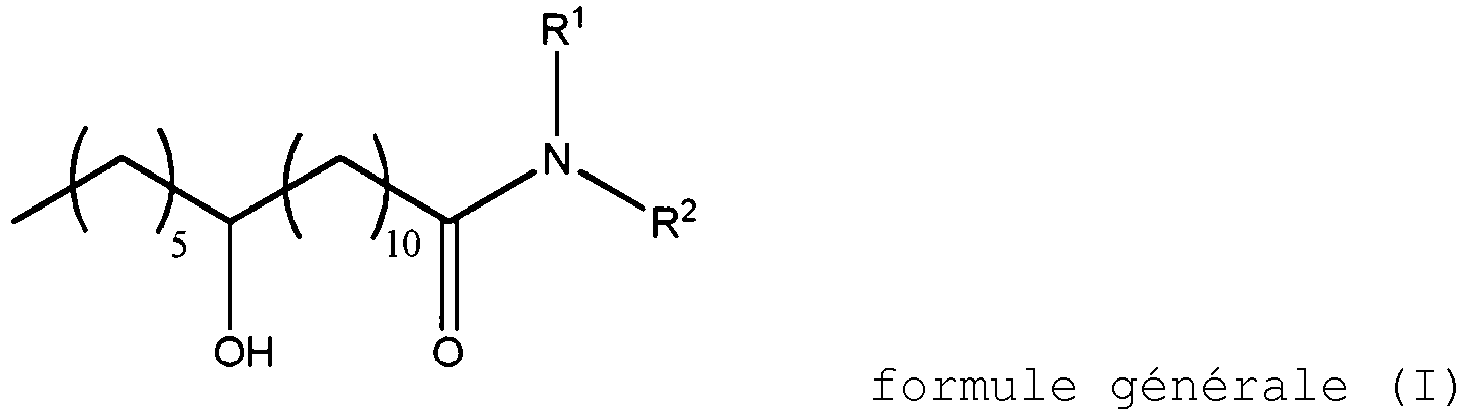 dans laquelle R1 est choisi parmi H ou un radical alkyle, le cas échéant substitué par OH ou des groupes amino et/ou interrompu par oxygène ou des groupes amino, comprenant 1 à 6 atomes de carbone etdans laquelle R2 est choisi parmi H ou un radical alkyle, le cas échéant substitué par OH ou des groupes amino et/ou interrompu par oxygène ou des groupes amino, comprenant 1 à 6 atomes de carbone,B) préparation d'une formulation aqueuse etC) mélange du composé de formule générale (I) avec la formulation aqueuse, caractérisé
en ce que dans l'étape de procédé A), un composé de formule générale (I) est utilisé sous forme d'une composition présentant un pH de 0 à 4, en particulier de 0,5 à 2, de manière particulièrement préférée de 0,8 à 1,5, au moins un des radicaux R1 ou R2 étant un radical alkyle, substitué par au moins un groupe amino, comprenant 1 à 6 atomes de carbone, et, dans une étape de procédé D), le pH du mélange provenant de C) est augmenté à une plage de pH de 5 à 12, de manière particulièrement préférée à une plage de pH de 7 à 10. - Procédé selon la revendication 8, caractérisé en ce que, dans l'étape de procédé B), le mélange est réalisé dans une plage de température de 65°C à 100°C, de préférence de 75°C à 85°C et, dans une étape de procédé E), le mélange provenant de C) est abaissé à une plage de température de 0°C à 60°C, de manière particulièrement préférée à une plage de température de 5°C à 45°C.
- Utilisation d'un composé de formule générale (I)
 dans laquelle R1 est choisi parmi H ou un radical alkyle, le cas échéant substitué par OH ou des groupes amino et/ou interrompu par oxygène ou des groupes amino, comprenant 1 à 6 atomes de carbone etdans laquelle R2 est choisi parmi H ou un radical alkyle, le cas échéant substitué par OH ou des groupes amino et/ou interrompu par oxygène ou des groupes amino, comprenant 1 à 6 atomes de carbone,pour l'épaississement de formulations aqueuses, caractérisé en ce que le composé de formule générale (I) est choisi parmi ceux dans lesquelsR1 = H ou 2-hydroxypropyle et R2 = 2-hydroxypropyle, R1 représentant de préférence H,R1 = H ou 2-hydroxyéthyle et R2 = 2-hydroxyéthyle, R1 représentant de préférence H,R1 = H ou 2-aminoéthyle et R2 = 2-aminoéthyle, R1 représentant de préférence H,R1 = H ou N-(2-hydroxyéthyl)-aminoéthyle et R2 = N-(2-hydroxyéthyl)-aminoéthyle, R1 représentant de préférence H,R1 = H ou 2-(2-hydroxyéthoxy)éthyle et R2 = 2-2-(2-hydroxyéthoxy)éthyle, R1 représentant de préférence H,R1 = méthyle ou 2,3,4,5,6-pentahydroxyhexyle et R2 = 2,3,4,5,6-pentahydroxyhexyle, R1 représentant de préférence méthyle,R1 = H ou 2-(1-pipérazinyl)éthyle et R2 = 2-(1-pipérazinyl)éthyl-, R1 représentant de préférence H etR1 = H ou N,N-diméthyl-3-aminopropyle et R2 = N,N-diméthyl-3-aminopropyle, R1 représentant de préférence H.
Applications Claiming Priority (2)
| Application Number | Priority Date | Filing Date | Title |
|---|---|---|---|
| DE102012212085.8A DE102012212085A1 (de) | 2012-07-11 | 2012-07-11 | Lipase stabiler Verdicker |
| PCT/EP2013/054568 WO2014009027A1 (fr) | 2012-07-11 | 2013-03-07 | Epaississant stable aux lipases |
Publications (2)
| Publication Number | Publication Date |
|---|---|
| EP2872480A1 EP2872480A1 (fr) | 2015-05-20 |
| EP2872480B1 true EP2872480B1 (fr) | 2018-09-26 |
Family
ID=47827234
Family Applications (1)
| Application Number | Title | Priority Date | Filing Date |
|---|---|---|---|
| EP13707664.2A Active EP2872480B1 (fr) | 2012-07-11 | 2013-03-07 | Épaississant stable aux lipases |
Country Status (7)
| Country | Link |
|---|---|
| US (1) | US9745251B2 (fr) |
| EP (1) | EP2872480B1 (fr) |
| JP (1) | JP2015527991A (fr) |
| CN (1) | CN104428281A (fr) |
| BR (1) | BR112015000520B1 (fr) |
| DE (1) | DE102012212085A1 (fr) |
| WO (1) | WO2014009027A1 (fr) |
Families Citing this family (19)
| Publication number | Priority date | Publication date | Assignee | Title |
|---|---|---|---|---|
| EP2949214A1 (fr) | 2014-05-26 | 2015-12-02 | Evonik Degussa GmbH | Procédés de production de rhamnolipides |
| ES2864951T3 (es) | 2014-09-22 | 2021-10-14 | Evonik Degussa Gmbh | Emulsión que contiene esterquats líquidos y espesantes poliméricos |
| EP2997959B1 (fr) | 2014-09-22 | 2019-12-25 | Evonik Operations GmbH | Formulation contenant des esterquats a base d'isopropanolamine et de tetrahydroxypropylethylenediamine |
| DE102014221889B4 (de) * | 2014-10-28 | 2023-12-21 | Henkel Ag & Co. Kgaa | Waschmittel mit Mannosylerythritollipid, Verstärkung der Reinigungsleistung von Waschmitteln durch Mannosylerythritollipid, und Waschverfahren unter Einsatz von Mannosylerythritollipid |
| US11680228B2 (en) | 2016-02-26 | 2023-06-20 | Evonik Operations Gmbh | Amides of aliphatic polyamines and 12-hydroxyoctadecanoic acid and lipase stable thickener compositions |
| JP2019506516A (ja) | 2016-02-26 | 2019-03-07 | ザ プロクター アンド ギャンブル カンパニー | 増粘又は構造化された液体洗剤組成物 |
| EP3487945B1 (fr) | 2016-07-19 | 2020-05-13 | Evonik Operations GmbH | Utilisation d'esters de polyols destines a la production de revetements plastiques poreux |
| WO2018163512A1 (fr) * | 2017-03-07 | 2018-09-13 | サラヤ株式会社 | Composition d'agent de lavage |
| CN111051485A (zh) | 2017-09-06 | 2020-04-21 | 赢创运营有限公司 | 特别用于生产织物柔软剂配制物的包含季铵化合物的微乳剂 |
| US11312926B2 (en) | 2017-09-25 | 2022-04-26 | Evonik Operations Gmbh | Polysiloxane-containing concentrates with improved storage stability and use thereof in textile care compositions |
| CA3102812C (fr) | 2018-06-07 | 2024-01-09 | Ecolab Usa Inc. | Detergent enzymatique pour pots et casseroles |
| CN112334443B (zh) | 2018-06-26 | 2023-08-22 | 赢创运营有限公司 | 基于油的酯基季铵盐的制备方法 |
| ES2936215T3 (es) | 2018-07-05 | 2023-03-15 | Evonik Operations Gmbh | Sustancias activas para formulaciones de lavado y de limpieza altamente viscosas |
| CN109179373B (zh) * | 2018-11-29 | 2020-09-01 | 航天特种材料及工艺技术研究所 | 一种抗氧化炭气凝胶材料及其制备方法 |
| EP3984628A4 (fr) | 2019-06-11 | 2023-07-12 | Saraya Co., Ltd. | Composition contenant un sophorolipide de type acide dont le brunissement est supprimé |
| WO2022010893A1 (fr) | 2020-07-06 | 2022-01-13 | Ecolab Usa Inc. | Compositions d'alcool/eau mélangées moussantes comprenant une combinaison d'alkylsiloxane et d'un hydrotrope/solubilisant |
| WO2022010906A1 (fr) | 2020-07-06 | 2022-01-13 | Ecolab Usa Inc. | Compositions à base d'huile de ricin modifiée par peg pour la microémulsification et l'élimination de multiples salissures grasses |
| CA3185062A1 (fr) | 2020-07-06 | 2022-01-13 | Gang Pu | Compositions d'alcool/eau mixtes moussantes comprenant un siloxane alcoxyle structure |
| EP3940049A1 (fr) | 2020-07-13 | 2022-01-19 | Dalli-Werke GmbH & Co. KG | Lipide de mannosylérythritol comprenant des agents de rinçage liquides |
Citations (1)
| Publication number | Priority date | Publication date | Assignee | Title |
|---|---|---|---|---|
| US20060047046A1 (en) * | 2004-08-30 | 2006-03-02 | Illinois Tool Works, Inc. | Thixotropic anaerobic adhesive |
Family Cites Families (29)
| Publication number | Priority date | Publication date | Assignee | Title |
|---|---|---|---|---|
| BE507688A (fr) | 1950-12-09 | |||
| US2986517A (en) | 1958-02-06 | 1961-05-30 | Texaco Inc | Solids thickened lubricating greases containing formamide |
| US3264281A (en) * | 1963-04-23 | 1966-08-02 | Thomas H Applewhite | Preparation of amides |
| US3234258A (en) | 1963-06-20 | 1966-02-08 | Procter & Gamble | Sulfation of alpha olefins |
| US3977894A (en) | 1975-09-19 | 1976-08-31 | Nl Industries, Inc. | Rheological agent for non-aqueous fluid systems |
| JPS58217598A (ja) | 1982-06-10 | 1983-12-17 | 日本油脂株式会社 | 洗剤組成物 |
| DE3914131A1 (de) | 1989-04-28 | 1990-10-31 | Henkel Kgaa | Verwendung von calcinierten hydrotalciten als katalysatoren fuer die ethoxylierung bzw. propoxylierung von fettsaeureestern |
| US5075041A (en) | 1990-06-28 | 1991-12-24 | Shell Oil Company | Process for the preparation of secondary alcohol sulfate-containing surfactant compositions |
| JP3254725B2 (ja) * | 1992-04-08 | 2002-02-12 | 新日本理化株式会社 | 新しい有機性ゲル化剤 |
| FR2691472B1 (fr) | 1992-05-22 | 1994-08-19 | Witco | Utilisation d'un amide comme agent épaississant, agent épaississant correspondant et composition le contenant. |
| DE4236912A1 (de) | 1992-10-31 | 1994-05-05 | Huels Chemische Werke Ag | Vernetzte Ricinusöl-Derivate |
| EP0691327B1 (fr) | 1993-03-17 | 1999-07-21 | Kao Corporation | Derive amine et preparation dermatologique renfermant ce derive |
| JP3215534B2 (ja) * | 1993-03-18 | 2001-10-09 | 花王株式会社 | 皮膚外用剤 |
| US5552136A (en) * | 1994-05-25 | 1996-09-03 | The Procter & Gamble Company | Gel stick compositions comprising optically enriched gellants |
| DE19616339A1 (de) * | 1996-04-24 | 1997-10-30 | Hoechst Ag | Neue Acetale von Hydroxycarbonsäuren und deren Derivaten und Verfahren zu ihrer Herstellung |
| US6211139B1 (en) | 1996-04-26 | 2001-04-03 | Goldschmidt Chemical Corporation | Polyester polyquaternary compounds, compositions containing them, and use thereof |
| US5747051A (en) * | 1996-09-27 | 1998-05-05 | Elizabeth Arden Co., Division Of Conopco, Inc. | Skin care compositions containing an amide of a hydroxy fatty acid and a retinoid |
| DE19827304A1 (de) | 1997-07-28 | 1999-02-25 | Henkel Kgaa | Verfahren zur Herstellung von Fettsäurealkanolamiden |
| AR030176A1 (es) | 1999-12-22 | 2003-08-13 | Procter & Gamble | Composicion de lavar ropa y/o de limpiar y/o para el cuidado de las telas y metodos para proveer una deposicion aumentada y una liberacion retardada del agente de beneficio sobre superficies tratadas |
| JP2004026781A (ja) | 2002-06-28 | 2004-01-29 | Nikko Chemical Co Ltd | ヒドロキシ脂肪酸ジアルキルアミノアルキルアミドの毛髪処理剤としての利用 |
| US20060091578A1 (en) | 2004-11-02 | 2006-05-04 | Bravo Juan M | Wood-polymer composites and additive systems therefor |
| JP4473755B2 (ja) * | 2005-03-17 | 2010-06-02 | 関西ペイント株式会社 | 電着塗料及び塗装方法と塗装物品 |
| EP2108036B1 (fr) | 2006-11-06 | 2012-08-22 | Croda Uniqema Inc | Procédé de production d'alcanolamide |
| DE102008001788A1 (de) | 2008-05-15 | 2009-11-26 | Evonik Goldschmidt Gmbh | Verwendung organomodifizierter Siloxanblockcopolymere zur Herstellung kosmetischer oder pharmazeutischer Zusammensetzungen |
| US8389117B2 (en) | 2008-10-30 | 2013-03-05 | Eastman Chemical Company | Hot melt adhesives for roll-applied labels |
| JP5602383B2 (ja) * | 2009-04-13 | 2014-10-08 | 株式会社パイロットコーポレーション | 固形描画材およびそれを用いた描画方法 |
| US9109150B2 (en) * | 2010-03-08 | 2015-08-18 | Georgetown University | Fast recovery of thixotropy by organogels with low molecular weight gelators |
| MX2012010572A (es) | 2010-03-12 | 2012-10-09 | Procter & Gamble | Gelificante diamido para utilizar en composiciones de productos de consumo. |
| US20110256080A1 (en) * | 2010-04-14 | 2011-10-20 | Mycone Dental Corporation | Easily appliable, storage stable, radiation-curable, pigmented, artificial nail gel coatings |
-
2012
- 2012-07-11 DE DE102012212085.8A patent/DE102012212085A1/de not_active Withdrawn
-
2013
- 2013-03-07 BR BR112015000520-9A patent/BR112015000520B1/pt active IP Right Grant
- 2013-03-07 US US14/413,875 patent/US9745251B2/en active Active
- 2013-03-07 JP JP2015520853A patent/JP2015527991A/ja active Pending
- 2013-03-07 EP EP13707664.2A patent/EP2872480B1/fr active Active
- 2013-03-07 CN CN201380036849.8A patent/CN104428281A/zh active Pending
- 2013-03-07 WO PCT/EP2013/054568 patent/WO2014009027A1/fr not_active Ceased
Patent Citations (1)
| Publication number | Priority date | Publication date | Assignee | Title |
|---|---|---|---|---|
| US20060047046A1 (en) * | 2004-08-30 | 2006-03-02 | Illinois Tool Works, Inc. | Thixotropic anaerobic adhesive |
Also Published As
| Publication number | Publication date |
|---|---|
| CN104428281A (zh) | 2015-03-18 |
| US20150203443A1 (en) | 2015-07-23 |
| EP2872480A1 (fr) | 2015-05-20 |
| JP2015527991A (ja) | 2015-09-24 |
| US9745251B2 (en) | 2017-08-29 |
| BR112015000520B1 (pt) | 2021-01-26 |
| DE102012212085A1 (de) | 2014-01-16 |
| WO2014009027A1 (fr) | 2014-01-16 |
| BR112015000520A2 (pt) | 2017-06-27 |
Similar Documents
| Publication | Publication Date | Title |
|---|---|---|
| EP2872480B1 (fr) | Épaississant stable aux lipases | |
| EP3419985B1 (fr) | Esters de rhamnolipides en tant que tensioactifs non ioniques a usage cosmetique | |
| EP3419986B1 (fr) | Rhamnolipidamides pour la retention des parfums pour les cheveux | |
| EP3350160B1 (fr) | Mélanges de composés de bétaïne amphotère et un procédé enzymatique pour leur production | |
| EP1659109B1 (fr) | Procédé pour la préparation de solutions fluides à haute concentration aqueuse de betaines | |
| EP3201302B1 (fr) | Formule contenant des bio-tenseurs | |
| EP0781319B1 (fr) | Melanges detergents doux | |
| US8642528B2 (en) | Alkyl lactyllactates and processes of making the same | |
| DE4400632C1 (de) | Tensidgemische und diese enthaltende Mittel | |
| EP1148868A1 (fr) | Melanges detergents | |
| US20040136940A1 (en) | Cleaner compositions | |
| US20100080767A1 (en) | Compounds | |
| US6172035B1 (en) | Preparation of thickening agents based on fatty acid monoisopropanolamide, use thereof and preparations containing same | |
| WO2000072952A1 (fr) | Utilisation d'un tensioactif alkylpolyglycoside carboxyle pour augmenter la mousse d'autres tensioactifs anioniques | |
| DE19529590A1 (de) | Milde Detergensgemische | |
| EP0777714B1 (fr) | Shampooings pour les cheveux | |
| EP4632053A1 (fr) | Procédé de traitement d'une surface métallique | |
| AU2007269005B2 (en) | Alkyl lactyllactates and processes of making the same | |
| WO1996002620A1 (fr) | Melanges detergents a pouvoir ameliore de lavage | |
| DE4424823A1 (de) | Starkschäumende Detergensgemische | |
| US20050265952A1 (en) | Thickener for personal care compositions |
Legal Events
| Date | Code | Title | Description |
|---|---|---|---|
| PUAI | Public reference made under article 153(3) epc to a published international application that has entered the european phase |
Free format text: ORIGINAL CODE: 0009012 |
|
| 17P | Request for examination filed |
Effective date: 20141222 |
|
| AK | Designated contracting states |
Kind code of ref document: A1 Designated state(s): AL AT BE BG CH CY CZ DE DK EE ES FI FR GB GR HR HU IE IS IT LI LT LU LV MC MK MT NL NO PL PT RO RS SE SI SK SM TR |
|
| AX | Request for extension of the european patent |
Extension state: BA ME |
|
| RAP1 | Party data changed (applicant data changed or rights of an application transferred) |
Owner name: EVONIK DEGUSSA GMBH |
|
| DAX | Request for extension of the european patent (deleted) | ||
| STAA | Information on the status of an ep patent application or granted ep patent |
Free format text: STATUS: EXAMINATION IS IN PROGRESS |
|
| 17Q | First examination report despatched |
Effective date: 20170214 |
|
| GRAJ | Information related to disapproval of communication of intention to grant by the applicant or resumption of examination proceedings by the epo deleted |
Free format text: ORIGINAL CODE: EPIDOSDIGR1 |
|
| STAA | Information on the status of an ep patent application or granted ep patent |
Free format text: STATUS: GRANT OF PATENT IS INTENDED |
|
| GRAP | Despatch of communication of intention to grant a patent |
Free format text: ORIGINAL CODE: EPIDOSNIGR1 |
|
| INTG | Intention to grant announced |
Effective date: 20180608 |
|
| GRAS | Grant fee paid |
Free format text: ORIGINAL CODE: EPIDOSNIGR3 |
|
| GRAA | (expected) grant |
Free format text: ORIGINAL CODE: 0009210 |
|
| STAA | Information on the status of an ep patent application or granted ep patent |
Free format text: STATUS: THE PATENT HAS BEEN GRANTED |
|
| AK | Designated contracting states |
Kind code of ref document: B1 Designated state(s): AL AT BE BG CH CY CZ DE DK EE ES FI FR GB GR HR HU IE IS IT LI LT LU LV MC MK MT NL NO PL PT RO RS SE SI SK SM TR |
|
| REG | Reference to a national code |
Ref country code: GB Ref legal event code: FG4D Free format text: NOT ENGLISH |
|
| REG | Reference to a national code |
Ref country code: CH Ref legal event code: EP |
|
| REG | Reference to a national code |
Ref country code: AT Ref legal event code: REF Ref document number: 1045845 Country of ref document: AT Kind code of ref document: T Effective date: 20181015 |
|
| REG | Reference to a national code |
Ref country code: IE Ref legal event code: FG4D Free format text: LANGUAGE OF EP DOCUMENT: GERMAN |
|
| REG | Reference to a national code |
Ref country code: DE Ref legal event code: R096 Ref document number: 502013011170 Country of ref document: DE |
|
| REG | Reference to a national code |
Ref country code: NL Ref legal event code: MP Effective date: 20180926 |
|
| PG25 | Lapsed in a contracting state [announced via postgrant information from national office to epo] |
Ref country code: FI Free format text: LAPSE BECAUSE OF FAILURE TO SUBMIT A TRANSLATION OF THE DESCRIPTION OR TO PAY THE FEE WITHIN THE PRESCRIBED TIME-LIMIT Effective date: 20180926 Ref country code: GR Free format text: LAPSE BECAUSE OF FAILURE TO SUBMIT A TRANSLATION OF THE DESCRIPTION OR TO PAY THE FEE WITHIN THE PRESCRIBED TIME-LIMIT Effective date: 20181227 Ref country code: SE Free format text: LAPSE BECAUSE OF FAILURE TO SUBMIT A TRANSLATION OF THE DESCRIPTION OR TO PAY THE FEE WITHIN THE PRESCRIBED TIME-LIMIT Effective date: 20180926 Ref country code: RS Free format text: LAPSE BECAUSE OF FAILURE TO SUBMIT A TRANSLATION OF THE DESCRIPTION OR TO PAY THE FEE WITHIN THE PRESCRIBED TIME-LIMIT Effective date: 20180926 Ref country code: LT Free format text: LAPSE BECAUSE OF FAILURE TO SUBMIT A TRANSLATION OF THE DESCRIPTION OR TO PAY THE FEE WITHIN THE PRESCRIBED TIME-LIMIT Effective date: 20180926 Ref country code: NO Free format text: LAPSE BECAUSE OF FAILURE TO SUBMIT A TRANSLATION OF THE DESCRIPTION OR TO PAY THE FEE WITHIN THE PRESCRIBED TIME-LIMIT Effective date: 20181226 Ref country code: BG Free format text: LAPSE BECAUSE OF FAILURE TO SUBMIT A TRANSLATION OF THE DESCRIPTION OR TO PAY THE FEE WITHIN THE PRESCRIBED TIME-LIMIT Effective date: 20181226 |
|
| REG | Reference to a national code |
Ref country code: LT Ref legal event code: MG4D |
|
| PG25 | Lapsed in a contracting state [announced via postgrant information from national office to epo] |
Ref country code: AL Free format text: LAPSE BECAUSE OF FAILURE TO SUBMIT A TRANSLATION OF THE DESCRIPTION OR TO PAY THE FEE WITHIN THE PRESCRIBED TIME-LIMIT Effective date: 20180926 Ref country code: HR Free format text: LAPSE BECAUSE OF FAILURE TO SUBMIT A TRANSLATION OF THE DESCRIPTION OR TO PAY THE FEE WITHIN THE PRESCRIBED TIME-LIMIT Effective date: 20180926 Ref country code: LV Free format text: LAPSE BECAUSE OF FAILURE TO SUBMIT A TRANSLATION OF THE DESCRIPTION OR TO PAY THE FEE WITHIN THE PRESCRIBED TIME-LIMIT Effective date: 20180926 |
|
| PG25 | Lapsed in a contracting state [announced via postgrant information from national office to epo] |
Ref country code: PL Free format text: LAPSE BECAUSE OF FAILURE TO SUBMIT A TRANSLATION OF THE DESCRIPTION OR TO PAY THE FEE WITHIN THE PRESCRIBED TIME-LIMIT Effective date: 20180926 Ref country code: EE Free format text: LAPSE BECAUSE OF FAILURE TO SUBMIT A TRANSLATION OF THE DESCRIPTION OR TO PAY THE FEE WITHIN THE PRESCRIBED TIME-LIMIT Effective date: 20180926 Ref country code: IS Free format text: LAPSE BECAUSE OF FAILURE TO SUBMIT A TRANSLATION OF THE DESCRIPTION OR TO PAY THE FEE WITHIN THE PRESCRIBED TIME-LIMIT Effective date: 20190126 Ref country code: ES Free format text: LAPSE BECAUSE OF FAILURE TO SUBMIT A TRANSLATION OF THE DESCRIPTION OR TO PAY THE FEE WITHIN THE PRESCRIBED TIME-LIMIT Effective date: 20180926 Ref country code: NL Free format text: LAPSE BECAUSE OF FAILURE TO SUBMIT A TRANSLATION OF THE DESCRIPTION OR TO PAY THE FEE WITHIN THE PRESCRIBED TIME-LIMIT Effective date: 20180926 Ref country code: CZ Free format text: LAPSE BECAUSE OF FAILURE TO SUBMIT A TRANSLATION OF THE DESCRIPTION OR TO PAY THE FEE WITHIN THE PRESCRIBED TIME-LIMIT Effective date: 20180926 Ref country code: RO Free format text: LAPSE BECAUSE OF FAILURE TO SUBMIT A TRANSLATION OF THE DESCRIPTION OR TO PAY THE FEE WITHIN THE PRESCRIBED TIME-LIMIT Effective date: 20180926 |
|
| PGFP | Annual fee paid to national office [announced via postgrant information from national office to epo] |
Ref country code: CH Payment date: 20190304 Year of fee payment: 7 Ref country code: IT Payment date: 20190325 Year of fee payment: 7 |
|
| PG25 | Lapsed in a contracting state [announced via postgrant information from national office to epo] |
Ref country code: SM Free format text: LAPSE BECAUSE OF FAILURE TO SUBMIT A TRANSLATION OF THE DESCRIPTION OR TO PAY THE FEE WITHIN THE PRESCRIBED TIME-LIMIT Effective date: 20180926 Ref country code: PT Free format text: LAPSE BECAUSE OF FAILURE TO SUBMIT A TRANSLATION OF THE DESCRIPTION OR TO PAY THE FEE WITHIN THE PRESCRIBED TIME-LIMIT Effective date: 20190126 Ref country code: SK Free format text: LAPSE BECAUSE OF FAILURE TO SUBMIT A TRANSLATION OF THE DESCRIPTION OR TO PAY THE FEE WITHIN THE PRESCRIBED TIME-LIMIT Effective date: 20180926 |
|
| PGFP | Annual fee paid to national office [announced via postgrant information from national office to epo] |
Ref country code: BE Payment date: 20190320 Year of fee payment: 7 |
|
| REG | Reference to a national code |
Ref country code: DE Ref legal event code: R097 Ref document number: 502013011170 Country of ref document: DE |
|
| PG25 | Lapsed in a contracting state [announced via postgrant information from national office to epo] |
Ref country code: DK Free format text: LAPSE BECAUSE OF FAILURE TO SUBMIT A TRANSLATION OF THE DESCRIPTION OR TO PAY THE FEE WITHIN THE PRESCRIBED TIME-LIMIT Effective date: 20180926 |
|
| PLBE | No opposition filed within time limit |
Free format text: ORIGINAL CODE: 0009261 |
|
| STAA | Information on the status of an ep patent application or granted ep patent |
Free format text: STATUS: NO OPPOSITION FILED WITHIN TIME LIMIT |
|
| 26N | No opposition filed |
Effective date: 20190627 |
|
| PG25 | Lapsed in a contracting state [announced via postgrant information from national office to epo] |
Ref country code: SI Free format text: LAPSE BECAUSE OF FAILURE TO SUBMIT A TRANSLATION OF THE DESCRIPTION OR TO PAY THE FEE WITHIN THE PRESCRIBED TIME-LIMIT Effective date: 20180926 Ref country code: MC Free format text: LAPSE BECAUSE OF FAILURE TO SUBMIT A TRANSLATION OF THE DESCRIPTION OR TO PAY THE FEE WITHIN THE PRESCRIBED TIME-LIMIT Effective date: 20180926 |
|
| REG | Reference to a national code |
Ref country code: CH Ref legal event code: PL |
|
| PG25 | Lapsed in a contracting state [announced via postgrant information from national office to epo] |
Ref country code: LU Free format text: LAPSE BECAUSE OF NON-PAYMENT OF DUE FEES Effective date: 20190307 |
|
| REG | Reference to a national code |
Ref country code: DE Ref legal event code: R081 Ref document number: 502013011170 Country of ref document: DE Owner name: EVONIK OPERATIONS GMBH, DE Free format text: FORMER OWNER: EVONIK DEGUSSA GMBH, 45128 ESSEN, DE |
|
| PG25 | Lapsed in a contracting state [announced via postgrant information from national office to epo] |
Ref country code: LI Free format text: LAPSE BECAUSE OF NON-PAYMENT OF DUE FEES Effective date: 20190331 Ref country code: CH Free format text: LAPSE BECAUSE OF NON-PAYMENT OF DUE FEES Effective date: 20190331 Ref country code: IE Free format text: LAPSE BECAUSE OF NON-PAYMENT OF DUE FEES Effective date: 20190307 |
|
| PG25 | Lapsed in a contracting state [announced via postgrant information from national office to epo] |
Ref country code: TR Free format text: LAPSE BECAUSE OF FAILURE TO SUBMIT A TRANSLATION OF THE DESCRIPTION OR TO PAY THE FEE WITHIN THE PRESCRIBED TIME-LIMIT Effective date: 20180926 |
|
| PG25 | Lapsed in a contracting state [announced via postgrant information from national office to epo] |
Ref country code: MT Free format text: LAPSE BECAUSE OF FAILURE TO SUBMIT A TRANSLATION OF THE DESCRIPTION OR TO PAY THE FEE WITHIN THE PRESCRIBED TIME-LIMIT Effective date: 20180926 |
|
| REG | Reference to a national code |
Ref country code: AT Ref legal event code: MM01 Ref document number: 1045845 Country of ref document: AT Kind code of ref document: T Effective date: 20190307 |
|
| PG25 | Lapsed in a contracting state [announced via postgrant information from national office to epo] |
Ref country code: AT Free format text: LAPSE BECAUSE OF NON-PAYMENT OF DUE FEES Effective date: 20190307 |
|
| REG | Reference to a national code |
Ref country code: BE Ref legal event code: MM Effective date: 20200331 |
|
| PG25 | Lapsed in a contracting state [announced via postgrant information from national office to epo] |
Ref country code: BE Free format text: LAPSE BECAUSE OF NON-PAYMENT OF DUE FEES Effective date: 20200331 |
|
| GBPC | Gb: european patent ceased through non-payment of renewal fee |
Effective date: 20200307 |
|
| PG25 | Lapsed in a contracting state [announced via postgrant information from national office to epo] |
Ref country code: GB Free format text: LAPSE BECAUSE OF NON-PAYMENT OF DUE FEES Effective date: 20200307 |
|
| PG25 | Lapsed in a contracting state [announced via postgrant information from national office to epo] |
Ref country code: CY Free format text: LAPSE BECAUSE OF FAILURE TO SUBMIT A TRANSLATION OF THE DESCRIPTION OR TO PAY THE FEE WITHIN THE PRESCRIBED TIME-LIMIT Effective date: 20180926 |
|
| PG25 | Lapsed in a contracting state [announced via postgrant information from national office to epo] |
Ref country code: HU Free format text: LAPSE BECAUSE OF FAILURE TO SUBMIT A TRANSLATION OF THE DESCRIPTION OR TO PAY THE FEE WITHIN THE PRESCRIBED TIME-LIMIT; INVALID AB INITIO Effective date: 20130307 |
|
| PG25 | Lapsed in a contracting state [announced via postgrant information from national office to epo] |
Ref country code: IT Free format text: LAPSE BECAUSE OF NON-PAYMENT OF DUE FEES Effective date: 20200307 |
|
| PG25 | Lapsed in a contracting state [announced via postgrant information from national office to epo] |
Ref country code: MK Free format text: LAPSE BECAUSE OF FAILURE TO SUBMIT A TRANSLATION OF THE DESCRIPTION OR TO PAY THE FEE WITHIN THE PRESCRIBED TIME-LIMIT Effective date: 20180926 |
|
| P01 | Opt-out of the competence of the unified patent court (upc) registered |
Effective date: 20230526 |
|
| PGFP | Annual fee paid to national office [announced via postgrant information from national office to epo] |
Ref country code: DE Payment date: 20260319 Year of fee payment: 14 |
|
| PGFP | Annual fee paid to national office [announced via postgrant information from national office to epo] |
Ref country code: FR Payment date: 20260320 Year of fee payment: 14 |