EP2873197B1 - Codage déterministe de réseau distribué - Google Patents
Codage déterministe de réseau distribué Download PDFInfo
- Publication number
- EP2873197B1 EP2873197B1 EP13819210.9A EP13819210A EP2873197B1 EP 2873197 B1 EP2873197 B1 EP 2873197B1 EP 13819210 A EP13819210 A EP 13819210A EP 2873197 B1 EP2873197 B1 EP 2873197B1
- Authority
- EP
- European Patent Office
- Prior art keywords
- coding
- nodes
- node
- coefficients
- network
- Prior art date
- Legal status (The legal status is an assumption and is not a legal conclusion. Google has not performed a legal analysis and makes no representation as to the accuracy of the status listed.)
- Active
Links
Images

Classifications
-
- H—ELECTRICITY
- H04—ELECTRIC COMMUNICATION TECHNIQUE
- H04L—TRANSMISSION OF DIGITAL INFORMATION, e.g. TELEGRAPHIC COMMUNICATION
- H04L47/00—Traffic control in data switching networks
- H04L47/10—Flow control; Congestion control
- H04L47/38—Flow control; Congestion control by adapting coding or compression rate
-
- H—ELECTRICITY
- H04—ELECTRIC COMMUNICATION TECHNIQUE
- H04L—TRANSMISSION OF DIGITAL INFORMATION, e.g. TELEGRAPHIC COMMUNICATION
- H04L1/00—Arrangements for detecting or preventing errors in the information received
- H04L1/004—Arrangements for detecting or preventing errors in the information received by using forward error control
- H04L1/0076—Distributed coding, e.g. network coding, involving channel coding
-
- H—ELECTRICITY
- H04—ELECTRIC COMMUNICATION TECHNIQUE
- H04L—TRANSMISSION OF DIGITAL INFORMATION, e.g. TELEGRAPHIC COMMUNICATION
- H04L1/00—Arrangements for detecting or preventing errors in the information received
- H04L1/004—Arrangements for detecting or preventing errors in the information received by using forward error control
- H04L1/0041—Arrangements at the transmitter end
-
- H—ELECTRICITY
- H04—ELECTRIC COMMUNICATION TECHNIQUE
- H04W—WIRELESS COMMUNICATION NETWORKS
- H04W4/00—Services specially adapted for wireless communication networks; Facilities therefor
- H04W4/30—Services specially adapted for particular environments, situations or purposes
- H04W4/38—Services specially adapted for particular environments, situations or purposes for collecting sensor information
-
- H—ELECTRICITY
- H04—ELECTRIC COMMUNICATION TECHNIQUE
- H04L—TRANSMISSION OF DIGITAL INFORMATION, e.g. TELEGRAPHIC COMMUNICATION
- H04L1/00—Arrangements for detecting or preventing errors in the information received
- H04L2001/0092—Error control systems characterised by the topology of the transmission link
- H04L2001/0097—Relays
Definitions
- Nodes in a computer network can also function as encoders.
- a node operating as encoder does not just forward (i.e. relay or replicate) information received from an input link, it also encodes such information. Coding at a node in a network is known as network coding.
- Networks can be modeled as graphs with unit capacity directed links, one or more discrete sources, and one or more receivers, as shown in R. Koetter and M. Medard, "An algebraic approach to network coding," IEEE/ACM Transactions on Networking, Vol 11 Issue 5, October 2003 ,.
- a common communication problem on networks is the multicast connection problem, where all source processes have to be transmitted to each of the receiver nodes.
- Network coding enables connections that are not possible if limited to forwarding.
- it has been shown in R. Ahlswede, N. Cai, S.- Y. R. Li, and R. W. Yeung, "Network Information Flow", IEEE Transactions on Information Theory and vol. 46, pp. 1204-1216 (2000 ), that it is, in general, not optimal to simply route or replicate the information to be multicast. Rather, by employing coding at the nodes, bandwidth can generally be saved.
- a network can be represented as a directed graph, as shown in R. Koetter and M. Medard, "Beyond Routing: An Algebraic Approach to Network Coding", Proceedings of the 2002 IEEE Infocom (2002 ).
- the graph comprises source nodes and receiver nodes, where discrete independent random processes (source processes) are observable at one or more of the source nodes and output processes are observable at the receiver nodes.
- source processes discrete independent random processes
- Determination of node behavior in a distributed manner is based on information available locally at each node and/or minimal control signaling, without requiring centralized coordination or knowledge of the overall network topology.
- EP2264930 upon the teaching of which the preamble of claim 1 is drafted, discloses a method for generating network coding coefficients to be distributed in a network, having a centralized node carrying out the determination of the network coding coefficients.
- EP1612982 discloses a content distribution mechanism that allows at least one intermediate network node, placed between a source and a client, to generate and send packets that contain a linear combination of content available at the node.
- the present invention relates to a network according to independent claim 1 and a method according to claim 9. Preferred embodiments are stipulated in dependent claims.
- the coefficients can be adjusted using feedback from the receiver nodes to improve the rate of information delivery.
- the embodiments of the present disclosure achieve complexity and delay that scales only polynomially in the number of network nodes, by allowing for some possibility of error in the initial deterministic choice of coefficients and using feedback to improve the choice of coefficients.
- prior deterministic network code designs are complex since they restrict their choice of coding coefficients to cases that guarantee success in delivering the information at maximum rate to its intended receivers.
- making such a guarantee without centralized knowledge of the network topology entails high complexity.
- the embodiments according to the present disclosure differ from these prior designs by removing the a priori guarantee of maximum rate information delivery.
- coefficient choice is greatly simplified.
- feedback can be used to improve the rate through the use of bidirectional or reverse links.
- the approach according to the embodiments of the present disclosure does not depend on the network topology, it can be operated in a distributed fashion, and is robust to changes in network topology, including addition or removal of links, nodes, sources or receivers.
- the approach according to the present disclosure is useful in environments where networks are adopted, such as computer communications networks (especially overlay networks, ad hoc networks, or sensor networks), and distributed computer systems.
- networks such as computer communications networks (especially overlay networks, ad hoc networks, or sensor networks), and distributed computer systems.
- a first embodiment of the present disclosure concerns network coding over acyclic subgraphs of networks.
- acyclic subgraphs can be constructed using, for example, the techniques in D. S. Lun, N. Ratnakar, M. Medard, R. Koetter, D. R. Karger, T. Ho, and E. Ahmed, "Minimum-Cost Multicast over Coded Packet Networks," IEEE Transactions on Information Theory, 52 (6), pp. 2608-2623, June 2006 .
- Data from the sources is transmitted over the acyclic subgraph to the receivers. If the network has bidirectional links or additional links in the reverse direction from the receiver nodes to intermediate nodes in the subgraph, feedback from the receivers can be used to improve the rate of information delivery.
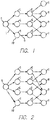
- Figures 1 and 2 show two examples of acyclic networks having source nodes S and receiver nodes R, and a plurality of intermediate nodes C.
- the intermediate nodes allow communication of source processes to each receiver node R.
- the intermediate nodes (see node 10, for example) have input links I and output links 0.
- the input links I communicate input signals to the node 10, while the output links O communicate or transmit output signals from the intermediate nodes.
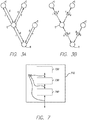
- Figures 3A and 3B show a further example of network, where reverse ( Fig. 3A ) or bidirectional ( Fig. 3B ) links are shown.
- Figs. 3A and 3B show exemplary links carrying data (labeled "d") to a receiver node R, and feedback (labeled "f') being transmitted in the reverse direction.
- Fig. 3A illustrates forward and reverse links
- Fig. 3B illustrates bidirectional links.
- the present disclosure considers approaches in which network nodes deterministically choose coding coefficients in a distributed fashion and transmit on each outgoing link a linear combination of incoming signals, specified by a vector of coding coefficients.
- the resulting signal is a linear combination of the source processes, so reference will be made to signals and vectors interchangeably in the following.
- the deterministic coefficient choices are designed to achieve optimal rates in some network topologies. Suboptimal coefficient choices can subsequently be identified and improved using feedback, if desired, through the presence of reverse and/or bidirectional links in the network.
- any deterministic choice of coefficients can be used to obtain a suboptimal solution, not necessarily based on characteristics of nodes and/or links (e.g. using the same deterministic mapping for nodes and/or links and then possibly using feedback to improve the mapping), some properties are generally beneficial in obtaining better rates over a broader range of network types and topologies. This can help to reduce the amount of feedback, or the amount of rate loss when feedback is not used.
- each outgoing packet from a node it is generally beneficial for each outgoing packet from a node to have coding coefficients which are linearly independent over time from coding coefficients of a subsequent outgoing packet from the same node.
- Example embodiments are given in the following two paragraphs.
- each node is associated with a node number, which can be obtained from some physical characteristics associated to the node (e.g., its location coordinates, IP address, hardware address or serial number) or any arbitrary deterministic numbering of nodes (e.g., if there are N nodes, each node can be assigned an index number from 1 to N in any arbitrary deterministic order).
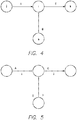
- the node numbers can be used as inputs to a deterministic mapping from local node numbers to coding coefficients. Reference can be made, for example, to FIG.
- node i receives links from nodes h and j, while node k receives a link from node i.
- node j transmits a packet A to node i
- node h transmits a packet B to node i.
- Node i will transmit a packet C to node k, where C is a linear combination of A and B.
- C c ijk A + c ihk B , where c ijk and c ihk are deterministically chosen coefficients.
- c ijk i + aj + bk mod q
- c ihk i + ah + bk mod q
- a and b are arbitrary deterministic constant elements from the code alphabet and q is the alphabet size (for a finite alphabet), or a suitably large constant.
- (2) and (3) are deterministic mappings from local node numbers i, h, j, k to coding coefficients.
- each link is associated with a link number, which can be obtained from some physical characteristics associated to the link or any arbitrary deterministic numbering of links (analogous to the node numbers described in the paragraph above).
- the link index numbers can be used as inputs to deterministic functions that map local link numbers to coding coefficients.
- FIG. 5 shows exemplary links with indexes h, i, j of a network, which will be called links h, i, j respectively, for brevity.
- link i is used transmit packet A
- link h is used to transmit packet B
- link j is used to transmit packet C, where packet C is a linear combination of packets A and B.
- C c ij A + c hj B , where c ij and c hj are deterministically chosen coefficients.
- c ij i + aj mod q
- (5) and (6) are deterministic mappings from local link numbers i, h, j to coding coefficients. Additionally, if the network experiences packet losses, equations (5) and (6) can be modified similarly to what done with equations (2) and (3) above.
- the deterministic functions mapping node or link numbers onto coding coefficients can be influenced by feedback from receiver nodes, if bidirectional or reverse links are available.
- a number of different deterministic mappings are applied sequentially, and for each, the receiver nodes feed back their received rates to upstream network nodes. The network nodes then choose the mapping with the highest rates.
- feedback from each receiver node indicates the span (or nullspace) of vectors received on different inputs, providing guidance to network nodes on whether to adjust their mappings, based on whether they are receiving/sending vectors outside this span.
- not all nodes employ coding.
- a node if a node has enough available capacity to forward all its received information to each of its next hop neighbors, it does not need to do coding.
- a network may comprise some nodes that are equipped with coding capability and others that are not; the latter nodes just do forwarding.
- a standard routing algorithm such as I. Kou, G. Markowsky and L. Berman, "A Fast Algorithm for Steiner Trees," Acta Informatica, volume 15, number 2, 1981 , is used to choose coefficients corresponding to a non-coded (routing) solution.
- Network coding is then introduced at a limited number of network nodes based on feedback from receiver nodes on their received rates. An example of such a scheme is given in the following paragraph. Such embodiments can reduce coding overhead in situations where coding is of no or limited benefit.
- the network nodes initially employ the approach of FIG.4 or FIG.5 to deterministically choose one or two sets of coefficients (step S1).
- the network nodes then deterministically choose another set of coefficients corresponding to a non-coded solution (step S2), using for example a standard routing algorithm like the one mentioned in the above paragraph.
- Each receiver node compares the rank of its received vectors under each of the sets of coefficients (step S3). If the non-coded solution results in lower rank than one of the coded solutions, the receiver node feeds back on each of its input links a vector orthogonal to the space spanned by the vectors received on the other input links (steps S4 and S5).
- Each coding node receiving such feedback checks to see if any of its input vectors has a nonzero inner product with the feedback vector (steps S6 and S7). If so, it changes the coding coefficient multiplying that input to a nonzero value corresponding to one of the initial sets of deterministic coefficients (step S8). If not, it forwards the feedback on its input links (step S9).
- nodes only some nodes employ deterministic coding while other nodes may employ existing randomized coding techniques (such as those shown in the above mentioned US Pat. No. 7,706,365 ) or no coding.
- the management information comprised of the various linear combinations can be maintained and sent through the network, for each signal in the network, as a vector of scalar coefficients for each of the source processes, and updated at each coding node by applying the same linear combinations or mappings to the coefficient vectors as to the data or information signals.
- the above embodiments can be generalized to vector linear coding, by considering each link as multiple parallel links of smaller capacity, and considering each source as multiple co-located sources of lower rate.
- the above embodiments can also be generalized to convolutional network coding over subgraphs with cycles, by considering coding coefficients as polynomials in a delay variable.
- the above embodiments can also be generalized to network codes in which different portions of the subgraph from source to sink employ linear network coding over different alphabets.
- the alphabet becomes larger with the distance from the source.
- one or more intermediate nodes decode messages and re-encode using a different field.
- the methods and systems described in the present disclosure may be implemented in hardware, software, firmware or combination thereof.
- Features described as blocks, modules or components may be implemented together (e.g., in a logic device such as an integrated logic device) or separately (e.g., as separate connected logic devices).
- the software portion of the methods of the present disclosure may comprise a computer-readable medium which comprises instructions that, when executed, perform, at least in part, the described methods.
- the computer-readable medium may comprise, for example, a random access memory (RAM) and/or a read-only memory (ROM).
- the instructions may be executed by a processor (e.g., a digital signal processor (DSP), an application specific integrated circuit (ASIC), or a field programmable logic array (FPGA))
- a processor e.g., a digital signal processor (DSP), an application specific integrated circuit (ASIC), or a field programmable logic array (FPGA)
- DSP digital signal processor
- ASIC application specific integrated circuit
- FPGA field programmable logic array
- FIG. 7 the present disclosure may be implemented in a computer system (710) comprising a memory (720), a processor (730), a communications interface (740) and an interconnection arrangement (750) coupling the memory, processor and the communications interface, wherein the memory is encoded with instructions utilizing network coding in accordance with the methods of the present disclosure.
Landscapes
- Engineering & Computer Science (AREA)
- Computer Networks & Wireless Communication (AREA)
- Signal Processing (AREA)
- Data Exchanges In Wide-Area Networks (AREA)
Claims (16)
- Réseau comprenant :un ou plusieurs nœuds de source ;un ou plusieurs nœuds de récepteur ; etdes nœuds de codage, permettant la communication de processus de source à chaque nœud de récepteur, les nœuds de codage étant connectés avec des liaisons d'entrée pour la communication de signaux d'entrée vers les nœuds de codage et des liaisons de sortie pour la communication de signaux de sortie depuis les nœuds de codage,dans lequel les signaux de sortie depuis les nœuds de codage sont une combinaison linéaire des signaux d'entrée,caractérisé en ce qu'une pluralité desdits nœuds de codage sont configurés pour générer des coefficients de la combinaison linéaire en utilisant des numéros de nœud local ou sinon des numéros de liaison locale comme entrées vers un mappage déterministe depuis les numéros de nœud local ou sinon depuis des numéros de liaison locale vers les coefficients de la combinaison linéaire,
dans lequella combinaison linéaire de processus transmis depuis les un ou plusieurs nœuds de source présents dans chaque signal dans le réseau est spécifiée comme un vecteur des coefficients, chaque coefficient correspondant à un processus devant être transmis depuis un ou plusieurs nœuds de source, etdans lequel lesdits nœuds de codage sont configurés pour mettre à jour et transmettre le vecteur de coefficients en appliquant au vecteur de coefficients des combinaisons linéaires, où les combinaisons linéaires appliquées au vecteur de coefficients sont les mêmes que les combinaisons linéaires appliquées à des données transmises par l'intermédiaire du réseau. - Réseau selon la revendication 1, dans lequel ladite pluralité de nœuds de codage sont en outre configurés pour générer de manière déterministe des coefficients de la combinaison linéaire également sur un compteur local ou un signal d'horloge.
- Réseau selon la revendication 1, dans lequel lesdits numéros de code et/ou numéros de liaison sont obtenus à partir de caractéristiques physiques associées aux nœuds de codage ou les numéros de code et/ou les numéros de liaison sont assignés dans n'importe quel ordre déterministe.
- Réseau selon l'une quelconque des revendications 1 à 3, dans lequel le réseau comprend en outre des liaisons bidirectionnelles et/ou retour et dans lequel le mappage est ajustable par l'intermédiaire d'une rétroaction depuis les nœuds de récepteur.
- Réseau selon l'une quelconque des revendications 1 à 4, comprenant en outre des nœuds de routage, les nœuds de routage étant connectés avec des liaisons d'entrée pour la communication de signaux d'entrée vers les nœuds de routage et des liaisons de sortie pour la communication de signaux de sortie depuis les nœuds de routage, où les signaux de sortie depuis un nœud de routage sont obtenus par l'intermédiaire d'un routage sans codage des signaux d'entrée vers le nœud de routage.
- Réseau selon l'une quelconque des revendications 1 à 5, dans lequel au moins certains coefficients choisis de manière déterministe d'un signal de sortie d'un premier nœud de codage le long d'une première liaison sortante du premier nœud de codage sont linéairement indépendants de coefficients choisis de manière déterministe d'un signal de sortie du premier nœud de codage le long d'une seconde liaison sortante du premier nœud de codage.
- Réseau selon l'une quelconque des revendications 1 à 5, dans lequel au moins certains coefficients choisis de manière déterministe d'un signal de sortie d'un premier nœud de codage le long d'une liaison sortante du premier nœud de codage sont linéairement indépendants de coefficients choisis de manière déterministe d'un signal de sortie d'un second nœud de codage le long d'une liaison sortante du second nœud de codage.
- Réseau selon l'une quelconque des revendications 1 à 5, dans lequel au moins certains coefficients choisis de manière déterministe à partir d'un premier signal de sortie d'un premier nœud de codage le long d'une liaison sortante du premier nœud de codage à un premier temps sont linéairement indépendants d'un coefficient choisi de manière déterministe à partir d'un second signal de sortie du premier nœud de codage le long de la liaison sortante du premier nœud de codage à un second temps.
- Procédé pour transmettre des processus d'une ou plusieurs sources à chaque récepteur d'un ou plusieurs récepteurs dans un réseau, le procédé comprenant :la fourniture de nœuds de codage entre les une ou plusieurs sources et les un ou plusieurs récepteurs ;la fourniture, pour chaque nœud de codage, de liaisons d'entrée pour transmettre des signaux d'entrée vers le nœud de codage, et de liaisons de sortie pour transmettre des signaux de sortie depuis le nœud de codage, les signaux de sortie des nœuds de codage étant une combinaison linéaire des signaux d'entrée ;caractérisé en ce que le procédé comprend les étapes consistant à :générer au niveau d'une pluralité desdits nœuds de codage des coefficients de la combinaison linéaire en utilisant des numéros de nœud local ou sinon des numéros de liaison locale comme entrées vers un mappage déterministe depuis les numéros de nœud local ou sinon depuis des numéros de liaison locale vers les coefficients de la combinaison linéaire,dans lequel la combinaison linéaire de processus transmis depuis les un ou plusieurs nœuds de source présents dans chaque signal dans le réseau est spécifiée comme un vecteur des coefficients, chaque coefficient correspondant à un processus devant être transmis depuis les un ou plusieurs nœuds de source, etdans lequel le vecteur de coefficients est transmis par l'intermédiaire du réseau et mis à jour au niveau desdits nœuds de codage en appliquant au vecteur de coefficients des combinaisons linéaires, où les combinaisons linéaires appliquées au vecteur de coefficients sont les mêmes que les combinaisons linéaires appliquées à des données transmises par l'intermédiaire du réseau.
- Procédé selon la revendication 9, comprenant l'étape consistant à générer de manière déterministe, au niveau de ladite pluralité de nœuds de codage, des coefficients de la combinaison linéaire également sur un compteur local ou un signal d'horloge.
- Procédé selon la revendication 9, dans lequel lesdits numéros de code et/ou numéros de liaison sont obtenus à partir de caractéristiques physiques associées au nœud de codage ou les numéros de code et/ou les numéros de liaison sont assignés dans n'importe quel ordre déterministe.
- Réseau selon l'une des revendications 9 à 11, dans lequel le réseau comprend en outre des liaisons bidirectionnelles et/ou retour et dans lequel le mappage est ajustable par l'intermédiaire d'une rétroaction depuis les nœuds de récepteur.
- Procédé selon l'une quelconque des revendications 9 à 11, comprenant en outre la fourniture de nœuds de routage, les nœuds de routage étant connectés avec des liaisons d'entrée pour la communication de signaux d'entrée vers les nœuds de routage et des liaisons de sortie pour la communication de signaux de sortie depuis les nœuds de routage, où les signaux de sortie depuis un nœud de routage sont obtenus par l'intermédiaire d'un routage sans codage des signaux d'entrée vers le nœud de routage.
- Procédé selon l'une quelconque des revendications 9 à 11, dans lequel au moins certains coefficients générés localement de manière déterministe d'un signal de sortie d'un premier nœud de codage le long d'une première liaison sortante du premier nœud de codage sont linéairement indépendants de coefficients générés localement de manière déterministe d'un signal de sortie du premier nœud de codage le long d'une seconde liaison sortante du premier nœud de codage.
- Procédé selon l'une quelconque des revendications 9 à 11, dans lequel au moins certains coefficients générés localement de manière déterministe d'un signal de sortie d'un premier nœud de codage le long d'une liaison sortante du premier nœud de codage sont linéairement indépendants de coefficients générés localement de manière déterministe d'un signal de sortie d'un second nœud de codage le long d'une liaison sortante du second nœud de codage.
- Procédé selon l'une quelconque des revendications 9 à 11, dans lequel au moins certains coefficients générés localement de manière déterministe à partir d'un premier signal de sortie d'un premier nœud de codage le long d'une liaison sortante du premier nœud de codage à un premier temps sont linéairement indépendants d'un coefficient généré localement de manière déterministe à partir d'un second signal de sortie du premier nœud de codage le long de la liaison sortante du premier nœud de codage à un second temps.
Applications Claiming Priority (2)
| Application Number | Priority Date | Filing Date | Title |
|---|---|---|---|
| US201261672208P | 2012-07-16 | 2012-07-16 | |
| PCT/US2013/050229 WO2014014761A1 (fr) | 2012-07-16 | 2013-07-12 | Codage déterministe de réseau distribué |
Publications (3)
| Publication Number | Publication Date |
|---|---|
| EP2873197A1 EP2873197A1 (fr) | 2015-05-20 |
| EP2873197A4 EP2873197A4 (fr) | 2015-06-17 |
| EP2873197B1 true EP2873197B1 (fr) | 2020-09-02 |
Family
ID=49913906
Family Applications (1)
| Application Number | Title | Priority Date | Filing Date |
|---|---|---|---|
| EP13819210.9A Active EP2873197B1 (fr) | 2012-07-16 | 2013-07-12 | Codage déterministe de réseau distribué |
Country Status (4)
| Country | Link |
|---|---|
| US (4) | US9699104B2 (fr) |
| EP (1) | EP2873197B1 (fr) |
| ES (1) | ES2834108T3 (fr) |
| WO (1) | WO2014014761A1 (fr) |
Families Citing this family (43)
| Publication number | Priority date | Publication date | Assignee | Title |
|---|---|---|---|---|
| ES2834108T3 (es) * | 2012-07-16 | 2021-06-16 | Code On Network Coding Llc | Codificación de red distribuida determinista |
| US9939529B2 (en) | 2012-08-27 | 2018-04-10 | Aktiebolaget Electrolux | Robot positioning system |
| EP2918032A4 (fr) | 2012-11-08 | 2016-05-11 | Factor Comm Corp Q | Procédé & appareil d'amélioration de la performance de tcp et d'autres protocoles de réseau dans un réseau de communications utilisant des serveurs mandataires |
| US9515775B2 (en) | 2012-11-08 | 2016-12-06 | Instart Logic, Inc. | Method and apparatus for improving the performance of TCP and other network protocols in a communication network |
| US10219665B2 (en) | 2013-04-15 | 2019-03-05 | Aktiebolaget Electrolux | Robotic vacuum cleaner with protruding sidebrush |
| CN110448222A (zh) | 2013-04-15 | 2019-11-15 | 伊莱克斯公司 | 机器人真空吸尘器 |
| EP3082544B1 (fr) | 2013-12-19 | 2020-10-07 | Aktiebolaget Electrolux | Aspirateur robot avec un balai latéral que se déplace en spiral |
| US10433697B2 (en) | 2013-12-19 | 2019-10-08 | Aktiebolaget Electrolux | Adaptive speed control of rotating side brush |
| CN105829985B (zh) | 2013-12-19 | 2020-04-07 | 伊莱克斯公司 | 具有周边记录功能的机器人清洁设备 |
| JP2017502371A (ja) | 2013-12-19 | 2017-01-19 | アクチエボラゲット エレクトロルックス | 掃除領域の優先順位付け |
| KR102130190B1 (ko) | 2013-12-19 | 2020-07-03 | 에이비 엘렉트로룩스 | 로봇 청소 장치 |
| EP3082542B1 (fr) | 2013-12-19 | 2018-11-28 | Aktiebolaget Electrolux | Détection de gravissement d'obstacle d'un dispositif de nettoyage robotisé |
| WO2015090399A1 (fr) | 2013-12-19 | 2015-06-25 | Aktiebolaget Electrolux | Dispositif de nettoyage robotisé et procédé de reconnaissance de point de repère |
| KR102116595B1 (ko) | 2013-12-20 | 2020-06-05 | 에이비 엘렉트로룩스 | 먼지통 |
| EP3134999B1 (fr) * | 2014-04-23 | 2018-06-06 | Telefonaktiebolaget LM Ericsson (publ) | Tomographie de réseau par sélection de chemins de sondage |
| US10518416B2 (en) | 2014-07-10 | 2019-12-31 | Aktiebolaget Electrolux | Method for detecting a measurement error in a robotic cleaning device |
| US10729297B2 (en) | 2014-09-08 | 2020-08-04 | Aktiebolaget Electrolux | Robotic vacuum cleaner |
| JP6443897B2 (ja) | 2014-09-08 | 2018-12-26 | アクチエボラゲット エレクトロルックス | ロボット真空掃除機 |
| WO2016091291A1 (fr) | 2014-12-10 | 2016-06-16 | Aktiebolaget Electrolux | Utilisation d'un capteur laser pour la détection d'un type de sol |
| CN107072454A (zh) | 2014-12-12 | 2017-08-18 | 伊莱克斯公司 | 侧刷和机器人吸尘器 |
| JP6532530B2 (ja) | 2014-12-16 | 2019-06-19 | アクチエボラゲット エレクトロルックス | ロボット掃除機の掃除方法 |
| CN107003669B (zh) | 2014-12-16 | 2023-01-31 | 伊莱克斯公司 | 用于机器人清洁设备的基于经验的路标 |
| KR102343513B1 (ko) | 2015-04-17 | 2021-12-28 | 에이비 엘렉트로룩스 | 로봇 청소 장치 및 로봇 청소 장치의 제어 방법 |
| WO2017036532A1 (fr) | 2015-09-03 | 2017-03-09 | Aktiebolaget Electrolux | Système de dispositifs de nettoyage robotisés |
| US9942934B2 (en) * | 2015-11-04 | 2018-04-10 | Motorola Mobility Llc | Wireless ad hoc network assembly using network coding |
| US9967909B2 (en) * | 2015-11-04 | 2018-05-08 | Motorola Mobility Llc | Wireless ad hoc network assembly using network coding |
| US9936052B2 (en) * | 2015-11-04 | 2018-04-03 | Motorola Mobility Llc | Wireless ad hoc network assembly using network coding |
| EP3384619A1 (fr) * | 2015-12-02 | 2018-10-10 | Telefonaktiebolaget LM Ericsson (publ) | Procédés et agencements pour mettre en oeuvre un codage de réseau amélioré |
| US11169533B2 (en) | 2016-03-15 | 2021-11-09 | Aktiebolaget Electrolux | Robotic cleaning device and a method at the robotic cleaning device of performing cliff detection |
| US11122953B2 (en) | 2016-05-11 | 2021-09-21 | Aktiebolaget Electrolux | Robotic cleaning device |
| US10325097B2 (en) * | 2016-07-19 | 2019-06-18 | Oracle International Corporation | Static detection of context-sensitive cross-site scripting vulnerabilities |
| JP7243967B2 (ja) | 2017-06-02 | 2023-03-22 | アクチエボラゲット エレクトロルックス | ロボット清掃デバイスの前方の表面のレベル差を検出する方法 |
| US10491719B2 (en) * | 2017-07-24 | 2019-11-26 | Cisco Technology, Inc. | Insertion of management packet into a wired deterministic path |
| CN111093447B (zh) | 2017-09-26 | 2022-09-02 | 伊莱克斯公司 | 机器人清洁设备的移动控制 |
| US11025600B1 (en) * | 2017-11-08 | 2021-06-01 | Massachusetts Institute Of Technology | System for de-duplicating network coded distributed storage and related techniques |
| CN108008728B (zh) * | 2017-12-12 | 2020-01-17 | 深圳市银星智能科技股份有限公司 | 清洁机器人以及基于清洁机器人的最短路径规划方法 |
| GB201804479D0 (en) * | 2018-03-21 | 2018-05-02 | Nchain Holdings Ltd | Computer-implemented system and method |
| US11108705B2 (en) | 2019-04-30 | 2021-08-31 | Code On Network Coding, Llc | Linear network coding with pre-determined coefficient generation through parameter initialization and reuse |
| US11863319B2 (en) * | 2020-03-20 | 2024-01-02 | Qualcomm Incorporated | Multicast network coding |
| CN116261839A (zh) * | 2020-09-30 | 2023-06-13 | 迪菲尼蒂基金会 | 分布式确定性网络的操作 |
| WO2022108614A1 (fr) * | 2020-11-20 | 2022-05-27 | Flow Dynamics, Llc | Soupape à réglage hydrostatique et système associé |
| US12526141B1 (en) * | 2021-04-16 | 2026-01-13 | Tybalt, Llc | Polynomial network coding |
| US12513012B1 (en) | 2021-12-30 | 2025-12-30 | Tybalt, Llc | Linear network coding for blockchains |
Family Cites Families (27)
| Publication number | Priority date | Publication date | Assignee | Title |
|---|---|---|---|---|
| US6885653B2 (en) | 2000-01-17 | 2005-04-26 | Samsung Electronics Co., Ltd. | Apparatus and method for allocating channel using OVSF code for uplink synchronous transmission scheme in a W-CDMA communication system |
| US9819449B2 (en) * | 2002-05-14 | 2017-11-14 | Genghiscomm Holdings, LLC | Cooperative subspace demultiplexing in content delivery networks |
| US7574518B2 (en) | 2003-06-23 | 2009-08-11 | Microsoft Corporation | System and method for computing low complexity algebraic network codes for a multicast network |
| US7408938B1 (en) | 2003-10-15 | 2008-08-05 | Microsoft Coporation | System and method for efficient broadcast of information over a network |
| US7349440B1 (en) | 2003-10-15 | 2008-03-25 | Microsoft Corporation | System and method for broadcasting information over a network |
| US7706365B2 (en) * | 2003-11-25 | 2010-04-27 | California Institute Of Technology | Randomized distributed network coding |
| US7756051B2 (en) * | 2004-07-02 | 2010-07-13 | Microsoft Corporation | Content distribution using network coding |
| US7529198B2 (en) | 2005-04-07 | 2009-05-05 | Microsoft Corporation | Scalable overlay network |
| CA2562202C (fr) * | 2005-10-05 | 2013-06-18 | Lg Electronics Inc. | Methode de traiter de l'information de trafic et systeme de radiodiffusion numerique |
| EP1801979B1 (fr) | 2005-12-22 | 2010-06-09 | Microsoft Corporation | Optimisations de codage de réseau et de décodage de réseau |
| US8233558B2 (en) | 2006-05-31 | 2012-07-31 | Cornell University | Methods and systems for space-time coding for distributed cooperative communicaton |
| US8705345B2 (en) | 2007-11-26 | 2014-04-22 | Iowa State University Research Foundation, Inc. | Network protection using network coding |
| US8260952B2 (en) | 2008-01-31 | 2012-09-04 | Microsoft Corporation | Multi-rate peer-assisted data streaming |
| US7916665B2 (en) | 2008-03-18 | 2011-03-29 | Canon Kabushiki Kaisha | Method and device for building of a network coding scheme for data transmission, corresponding computer program product and storage means |
| DE602008002147D1 (de) | 2008-03-28 | 2010-09-23 | Ntt Docomo Inc | Verfahren und Vorrichtung zur Erhöhung des Datendurchsatzes in einem Kommunikationsnetzwerk |
| US8204086B2 (en) | 2008-05-19 | 2012-06-19 | Microsoft Corporation | Natural network coding for multi-hop wireless network |
| US8509288B2 (en) | 2008-06-04 | 2013-08-13 | Polytechnic Institute Of New York University | Spatial multiplexing gain for a distributed cooperative communications system using randomized coding |
| US8245107B2 (en) * | 2009-02-05 | 2012-08-14 | Wilocity, Ltd. | Techniques for enabling simplified LDPC encoding and decoding |
| EP2264930B1 (fr) | 2009-06-15 | 2014-05-14 | Canon Kabushiki Kaisha | Procédé de génération de code distribué et dispositif |
| EP2360863B1 (fr) | 2010-02-12 | 2014-04-09 | Canon Kabushiki Kaisha | Procédé et dispositif pour transmettre des symboles de données |
| US8824470B2 (en) | 2010-06-02 | 2014-09-02 | Microsoft Corporation | Multiparty real time content delivery |
| KR101751497B1 (ko) * | 2010-06-11 | 2017-06-27 | 삼성전자주식회사 | 행렬 네트워크 코딩을 사용하는 장치 및 방법 |
| US8693501B2 (en) | 2010-11-23 | 2014-04-08 | The Chinese University Of Hong Kong | Subset coding for communication systems |
| US8995464B2 (en) * | 2012-05-18 | 2015-03-31 | Chinese University Of Hong Kong | Superposition coding for network communication |
| US9209943B1 (en) * | 2012-06-06 | 2015-12-08 | Bae Systems Information And Electronic Systems Integration Inc. | Control over network coding for enhanced radio transport optimization |
| ES2834108T3 (es) * | 2012-07-16 | 2021-06-16 | Code On Network Coding Llc | Codificación de red distribuida determinista |
| US9515775B2 (en) * | 2012-11-08 | 2016-12-06 | Instart Logic, Inc. | Method and apparatus for improving the performance of TCP and other network protocols in a communication network |
-
2013
- 2013-07-12 ES ES13819210T patent/ES2834108T3/es active Active
- 2013-07-12 WO PCT/US2013/050229 patent/WO2014014761A1/fr not_active Ceased
- 2013-07-12 EP EP13819210.9A patent/EP2873197B1/fr active Active
- 2013-07-12 US US13/940,703 patent/US9699104B2/en active Active
-
2017
- 2017-05-31 US US15/609,856 patent/US9979666B2/en active Active
-
2018
- 2018-04-20 US US15/958,178 patent/US10554569B2/en active Active
-
2019
- 2019-12-23 US US16/726,001 patent/US11063878B2/en active Active
Non-Patent Citations (1)
| Title |
|---|
| None * |
Also Published As
| Publication number | Publication date |
|---|---|
| ES2834108T3 (es) | 2021-06-16 |
| US20180302332A1 (en) | 2018-10-18 |
| EP2873197A1 (fr) | 2015-05-20 |
| US20170264561A1 (en) | 2017-09-14 |
| WO2014014761A1 (fr) | 2014-01-23 |
| US11063878B2 (en) | 2021-07-13 |
| US9979666B2 (en) | 2018-05-22 |
| US20200136984A1 (en) | 2020-04-30 |
| EP2873197A4 (fr) | 2015-06-17 |
| US9699104B2 (en) | 2017-07-04 |
| US20140016469A1 (en) | 2014-01-16 |
| US10554569B2 (en) | 2020-02-04 |
Similar Documents
| Publication | Publication Date | Title |
|---|---|---|
| US11063878B2 (en) | Deterministic distributed network coding | |
| US7706365B2 (en) | Randomized distributed network coding | |
| US20200275306A1 (en) | Modular traffic control functions in a telecommunication network | |
| CN108270478B (zh) | 卫星路由建立方法及装置 | |
| US11095553B2 (en) | Method, apparatus and system for controlling routing information advertising | |
| KR20160000226A (ko) | 멀티캐스트 네트워크에서의 릴레이 방법 및 장치 | |
| JP5004869B2 (ja) | ネットワーク経路選択方法および通信システム | |
| CN106789661A (zh) | 一种信息转发方法及天基信息网络系统 | |
| US10250477B2 (en) | Method and controller for announcing bandwidth of cluster system | |
| Sharma et al. | Network tomography via network coding | |
| CN103731486A (zh) | 一种集群系统中的数据转发的方法、装置及系统 | |
| KR101524825B1 (ko) | 무선 메쉬 네트워크에서의 패킷 라우팅 방법, 패킷 라우팅 제어 장치 및 패킷 라우팅 시스템 | |
| Effros | On dependence and delay: Capacity bounds for wireless networks | |
| US10412000B2 (en) | Wireless mesh communications networks | |
| Wu et al. | A practical network coding and routing scheme based on maximum flow combination | |
| JP2019176289A (ja) | 無線通信装置、無線通信システムおよび無線通信方法 | |
| Cui et al. | A linear network code construction for general integer connections based on the constraint satisfaction problem | |
| Wong et al. | On a capacity equivalence between multiple multicast and multiple unicast | |
| Ameziane et al. | The potentials of network coding for improvement of round trip time in wireless narrowband RF communications | |
| Chen et al. | On the tradeoffs of implementing randomized network coding in multicast networks | |
| Krouk et al. | Transmission of priority messages with the help of transport coding | |
| Tarnoi et al. | On the decodability of random linear network coding in acyclic networks | |
| JP5835178B2 (ja) | 通信システム | |
| Xu et al. | Multi-source erasure networks with source precoding and random linear network coding | |
| Cai et al. | The Singleton bound for network error-correcting codes |
Legal Events
| Date | Code | Title | Description |
|---|---|---|---|
| PUAI | Public reference made under article 153(3) epc to a published international application that has entered the european phase |
Free format text: ORIGINAL CODE: 0009012 |
|
| 17P | Request for examination filed |
Effective date: 20150209 |
|
| AK | Designated contracting states |
Kind code of ref document: A1 Designated state(s): AL AT BE BG CH CY CZ DE DK EE ES FI FR GB GR HR HU IE IS IT LI LT LU LV MC MK MT NL NO PL PT RO RS SE SI SK SM TR |
|
| AX | Request for extension of the european patent |
Extension state: BA ME |
|
| RA4 | Supplementary search report drawn up and despatched (corrected) |
Effective date: 20150518 |
|
| RIC1 | Information provided on ipc code assigned before grant |
Ipc: H04L 1/00 20060101AFI20150511BHEP |
|
| DAX | Request for extension of the european patent (deleted) | ||
| 17Q | First examination report despatched |
Effective date: 20160321 |
|
| APBK | Appeal reference recorded |
Free format text: ORIGINAL CODE: EPIDOSNREFNE |
|
| APBN | Date of receipt of notice of appeal recorded |
Free format text: ORIGINAL CODE: EPIDOSNNOA2E |
|
| APBR | Date of receipt of statement of grounds of appeal recorded |
Free format text: ORIGINAL CODE: EPIDOSNNOA3E |
|
| APAF | Appeal reference modified |
Free format text: ORIGINAL CODE: EPIDOSCREFNE |
|
| APBT | Appeal procedure closed |
Free format text: ORIGINAL CODE: EPIDOSNNOA9E |
|
| GRAP | Despatch of communication of intention to grant a patent |
Free format text: ORIGINAL CODE: EPIDOSNIGR1 |
|
| STAA | Information on the status of an ep patent application or granted ep patent |
Free format text: STATUS: GRANT OF PATENT IS INTENDED |
|
| INTG | Intention to grant announced |
Effective date: 20200128 |
|
| GRAS | Grant fee paid |
Free format text: ORIGINAL CODE: EPIDOSNIGR3 |
|
| GRAA | (expected) grant |
Free format text: ORIGINAL CODE: 0009210 |
|
| STAA | Information on the status of an ep patent application or granted ep patent |
Free format text: STATUS: THE PATENT HAS BEEN GRANTED |
|
| AK | Designated contracting states |
Kind code of ref document: B1 Designated state(s): AL AT BE BG CH CY CZ DE DK EE ES FI FR GB GR HR HU IE IS IT LI LT LU LV MC MK MT NL NO PL PT RO RS SE SI SK SM TR |
|
| REG | Reference to a national code |
Ref country code: GB Ref legal event code: FG4D |
|
| REG | Reference to a national code |
Ref country code: AT Ref legal event code: REF Ref document number: 1310028 Country of ref document: AT Kind code of ref document: T Effective date: 20200915 Ref country code: CH Ref legal event code: EP |
|
| REG | Reference to a national code |
Ref country code: DE Ref legal event code: R096 Ref document number: 602013072210 Country of ref document: DE |
|
| REG | Reference to a national code |
Ref country code: IE Ref legal event code: FG4D |
|
| REG | Reference to a national code |
Ref country code: NL Ref legal event code: FP |
|
| REG | Reference to a national code |
Ref country code: LT Ref legal event code: MG4D |
|
| PG25 | Lapsed in a contracting state [announced via postgrant information from national office to epo] |
Ref country code: BG Free format text: LAPSE BECAUSE OF FAILURE TO SUBMIT A TRANSLATION OF THE DESCRIPTION OR TO PAY THE FEE WITHIN THE PRESCRIBED TIME-LIMIT Effective date: 20201202 Ref country code: LT Free format text: LAPSE BECAUSE OF FAILURE TO SUBMIT A TRANSLATION OF THE DESCRIPTION OR TO PAY THE FEE WITHIN THE PRESCRIBED TIME-LIMIT Effective date: 20200902 Ref country code: FI Free format text: LAPSE BECAUSE OF FAILURE TO SUBMIT A TRANSLATION OF THE DESCRIPTION OR TO PAY THE FEE WITHIN THE PRESCRIBED TIME-LIMIT Effective date: 20200902 Ref country code: SE Free format text: LAPSE BECAUSE OF FAILURE TO SUBMIT A TRANSLATION OF THE DESCRIPTION OR TO PAY THE FEE WITHIN THE PRESCRIBED TIME-LIMIT Effective date: 20200902 Ref country code: NO Free format text: LAPSE BECAUSE OF FAILURE TO SUBMIT A TRANSLATION OF THE DESCRIPTION OR TO PAY THE FEE WITHIN THE PRESCRIBED TIME-LIMIT Effective date: 20201202 Ref country code: HR Free format text: LAPSE BECAUSE OF FAILURE TO SUBMIT A TRANSLATION OF THE DESCRIPTION OR TO PAY THE FEE WITHIN THE PRESCRIBED TIME-LIMIT Effective date: 20200902 Ref country code: GR Free format text: LAPSE BECAUSE OF FAILURE TO SUBMIT A TRANSLATION OF THE DESCRIPTION OR TO PAY THE FEE WITHIN THE PRESCRIBED TIME-LIMIT Effective date: 20201203 |
|
| REG | Reference to a national code |
Ref country code: AT Ref legal event code: MK05 Ref document number: 1310028 Country of ref document: AT Kind code of ref document: T Effective date: 20200902 |
|
| PG25 | Lapsed in a contracting state [announced via postgrant information from national office to epo] |
Ref country code: RS Free format text: LAPSE BECAUSE OF FAILURE TO SUBMIT A TRANSLATION OF THE DESCRIPTION OR TO PAY THE FEE WITHIN THE PRESCRIBED TIME-LIMIT Effective date: 20200902 Ref country code: PL Free format text: LAPSE BECAUSE OF FAILURE TO SUBMIT A TRANSLATION OF THE DESCRIPTION OR TO PAY THE FEE WITHIN THE PRESCRIBED TIME-LIMIT Effective date: 20200902 Ref country code: LV Free format text: LAPSE BECAUSE OF FAILURE TO SUBMIT A TRANSLATION OF THE DESCRIPTION OR TO PAY THE FEE WITHIN THE PRESCRIBED TIME-LIMIT Effective date: 20200902 |
|
| PG25 | Lapsed in a contracting state [announced via postgrant information from national office to epo] |
Ref country code: PT Free format text: LAPSE BECAUSE OF FAILURE TO SUBMIT A TRANSLATION OF THE DESCRIPTION OR TO PAY THE FEE WITHIN THE PRESCRIBED TIME-LIMIT Effective date: 20210104 Ref country code: SM Free format text: LAPSE BECAUSE OF FAILURE TO SUBMIT A TRANSLATION OF THE DESCRIPTION OR TO PAY THE FEE WITHIN THE PRESCRIBED TIME-LIMIT Effective date: 20200902 Ref country code: RO Free format text: LAPSE BECAUSE OF FAILURE TO SUBMIT A TRANSLATION OF THE DESCRIPTION OR TO PAY THE FEE WITHIN THE PRESCRIBED TIME-LIMIT Effective date: 20200902 Ref country code: EE Free format text: LAPSE BECAUSE OF FAILURE TO SUBMIT A TRANSLATION OF THE DESCRIPTION OR TO PAY THE FEE WITHIN THE PRESCRIBED TIME-LIMIT Effective date: 20200902 Ref country code: CZ Free format text: LAPSE BECAUSE OF FAILURE TO SUBMIT A TRANSLATION OF THE DESCRIPTION OR TO PAY THE FEE WITHIN THE PRESCRIBED TIME-LIMIT Effective date: 20200902 |
|
| PG25 | Lapsed in a contracting state [announced via postgrant information from national office to epo] |
Ref country code: AT Free format text: LAPSE BECAUSE OF FAILURE TO SUBMIT A TRANSLATION OF THE DESCRIPTION OR TO PAY THE FEE WITHIN THE PRESCRIBED TIME-LIMIT Effective date: 20200902 Ref country code: AL Free format text: LAPSE BECAUSE OF FAILURE TO SUBMIT A TRANSLATION OF THE DESCRIPTION OR TO PAY THE FEE WITHIN THE PRESCRIBED TIME-LIMIT Effective date: 20200902 Ref country code: IS Free format text: LAPSE BECAUSE OF FAILURE TO SUBMIT A TRANSLATION OF THE DESCRIPTION OR TO PAY THE FEE WITHIN THE PRESCRIBED TIME-LIMIT Effective date: 20210102 |
|
| REG | Reference to a national code |
Ref country code: DE Ref legal event code: R097 Ref document number: 602013072210 Country of ref document: DE |
|
| REG | Reference to a national code |
Ref country code: ES Ref legal event code: FG2A Ref document number: 2834108 Country of ref document: ES Kind code of ref document: T3 Effective date: 20210616 |
|
| PG25 | Lapsed in a contracting state [announced via postgrant information from national office to epo] |
Ref country code: SK Free format text: LAPSE BECAUSE OF FAILURE TO SUBMIT A TRANSLATION OF THE DESCRIPTION OR TO PAY THE FEE WITHIN THE PRESCRIBED TIME-LIMIT Effective date: 20200902 |
|
| PLBE | No opposition filed within time limit |
Free format text: ORIGINAL CODE: 0009261 |
|
| STAA | Information on the status of an ep patent application or granted ep patent |
Free format text: STATUS: NO OPPOSITION FILED WITHIN TIME LIMIT |
|
| 26N | No opposition filed |
Effective date: 20210603 |
|
| PG25 | Lapsed in a contracting state [announced via postgrant information from national office to epo] |
Ref country code: SI Free format text: LAPSE BECAUSE OF FAILURE TO SUBMIT A TRANSLATION OF THE DESCRIPTION OR TO PAY THE FEE WITHIN THE PRESCRIBED TIME-LIMIT Effective date: 20200902 Ref country code: DK Free format text: LAPSE BECAUSE OF FAILURE TO SUBMIT A TRANSLATION OF THE DESCRIPTION OR TO PAY THE FEE WITHIN THE PRESCRIBED TIME-LIMIT Effective date: 20200902 |
|
| PG25 | Lapsed in a contracting state [announced via postgrant information from national office to epo] |
Ref country code: IT Free format text: LAPSE BECAUSE OF FAILURE TO SUBMIT A TRANSLATION OF THE DESCRIPTION OR TO PAY THE FEE WITHIN THE PRESCRIBED TIME-LIMIT Effective date: 20200902 |
|
| REG | Reference to a national code |
Ref country code: CH Ref legal event code: PL |
|
| PG25 | Lapsed in a contracting state [announced via postgrant information from national office to epo] |
Ref country code: MC Free format text: LAPSE BECAUSE OF FAILURE TO SUBMIT A TRANSLATION OF THE DESCRIPTION OR TO PAY THE FEE WITHIN THE PRESCRIBED TIME-LIMIT Effective date: 20200902 |
|
| REG | Reference to a national code |
Ref country code: BE Ref legal event code: MM Effective date: 20210731 |
|
| PG25 | Lapsed in a contracting state [announced via postgrant information from national office to epo] |
Ref country code: LI Free format text: LAPSE BECAUSE OF NON-PAYMENT OF DUE FEES Effective date: 20210731 Ref country code: CH Free format text: LAPSE BECAUSE OF NON-PAYMENT OF DUE FEES Effective date: 20210731 |
|
| PG25 | Lapsed in a contracting state [announced via postgrant information from national office to epo] |
Ref country code: LU Free format text: LAPSE BECAUSE OF NON-PAYMENT OF DUE FEES Effective date: 20210712 |
|
| PG25 | Lapsed in a contracting state [announced via postgrant information from national office to epo] |
Ref country code: IE Free format text: LAPSE BECAUSE OF NON-PAYMENT OF DUE FEES Effective date: 20210712 Ref country code: BE Free format text: LAPSE BECAUSE OF NON-PAYMENT OF DUE FEES Effective date: 20210731 |
|
| PG25 | Lapsed in a contracting state [announced via postgrant information from national office to epo] |
Ref country code: HU Free format text: LAPSE BECAUSE OF FAILURE TO SUBMIT A TRANSLATION OF THE DESCRIPTION OR TO PAY THE FEE WITHIN THE PRESCRIBED TIME-LIMIT; INVALID AB INITIO Effective date: 20130712 |
|
| P01 | Opt-out of the competence of the unified patent court (upc) registered |
Effective date: 20230524 |
|
| PG25 | Lapsed in a contracting state [announced via postgrant information from national office to epo] |
Ref country code: CY Free format text: LAPSE BECAUSE OF FAILURE TO SUBMIT A TRANSLATION OF THE DESCRIPTION OR TO PAY THE FEE WITHIN THE PRESCRIBED TIME-LIMIT Effective date: 20200902 |
|
| PG25 | Lapsed in a contracting state [announced via postgrant information from national office to epo] |
Ref country code: MK Free format text: LAPSE BECAUSE OF FAILURE TO SUBMIT A TRANSLATION OF THE DESCRIPTION OR TO PAY THE FEE WITHIN THE PRESCRIBED TIME-LIMIT Effective date: 20200902 |
|
| PG25 | Lapsed in a contracting state [announced via postgrant information from national office to epo] |
Ref country code: MT Free format text: LAPSE BECAUSE OF FAILURE TO SUBMIT A TRANSLATION OF THE DESCRIPTION OR TO PAY THE FEE WITHIN THE PRESCRIBED TIME-LIMIT Effective date: 20200902 |
|
| PGFP | Annual fee paid to national office [announced via postgrant information from national office to epo] |
Ref country code: NL Payment date: 20250725 Year of fee payment: 13 |
|
| PGFP | Annual fee paid to national office [announced via postgrant information from national office to epo] |
Ref country code: ES Payment date: 20250813 Year of fee payment: 13 |
|
| PGFP | Annual fee paid to national office [announced via postgrant information from national office to epo] |
Ref country code: DE Payment date: 20250730 Year of fee payment: 13 |
|
| PGFP | Annual fee paid to national office [announced via postgrant information from national office to epo] |
Ref country code: GB Payment date: 20250730 Year of fee payment: 13 |
|
| PGFP | Annual fee paid to national office [announced via postgrant information from national office to epo] |
Ref country code: FR Payment date: 20250725 Year of fee payment: 13 |
|
| PG25 | Lapsed in a contracting state [announced via postgrant information from national office to epo] |
Ref country code: TR Free format text: LAPSE BECAUSE OF FAILURE TO SUBMIT A TRANSLATION OF THE DESCRIPTION OR TO PAY THE FEE WITHIN THE PRESCRIBED TIME-LIMIT Effective date: 20200902 |