EP2873457B1 - Catalyseur pour la préparation de nanotubes de carbone monofeuillets sélectivement chiraux et sélectivement conducteurs, son procédé de préparation et son application - Google Patents
Catalyseur pour la préparation de nanotubes de carbone monofeuillets sélectivement chiraux et sélectivement conducteurs, son procédé de préparation et son application Download PDFInfo
- Publication number
- EP2873457B1 EP2873457B1 EP13816443.9A EP13816443A EP2873457B1 EP 2873457 B1 EP2873457 B1 EP 2873457B1 EP 13816443 A EP13816443 A EP 13816443A EP 2873457 B1 EP2873457 B1 EP 2873457B1
- Authority
- EP
- European Patent Office
- Prior art keywords
- selective
- catalysts
- swnts
- chirality
- walled carbon
- Prior art date
- Legal status (The legal status is an assumption and is not a legal conclusion. Google has not performed a legal analysis and makes no representation as to the accuracy of the status listed.)
- Active
Links
Images


Classifications
-
- B—PERFORMING OPERATIONS; TRANSPORTING
- B01—PHYSICAL OR CHEMICAL PROCESSES OR APPARATUS IN GENERAL
- B01J—CHEMICAL OR PHYSICAL PROCESSES, e.g. CATALYSIS OR COLLOID CHEMISTRY; THEIR RELEVANT APPARATUS
- B01J23/00—Catalysts comprising metals or metal oxides or hydroxides, not provided for in group B01J21/00
- B01J23/70—Catalysts comprising metals or metal oxides or hydroxides, not provided for in group B01J21/00 of the iron group metals or copper
- B01J23/76—Catalysts comprising metals or metal oxides or hydroxides, not provided for in group B01J21/00 of the iron group metals or copper combined with metals, oxides or hydroxides provided for in groups B01J23/02 - B01J23/36
- B01J23/84—Catalysts comprising metals or metal oxides or hydroxides, not provided for in group B01J21/00 of the iron group metals or copper combined with metals, oxides or hydroxides provided for in groups B01J23/02 - B01J23/36 with arsenic, antimony, bismuth, vanadium, niobium, tantalum, polonium, chromium, molybdenum, tungsten, manganese, technetium or rhenium
- B01J23/85—Chromium, molybdenum or tungsten
- B01J23/888—Tungsten
-
- B—PERFORMING OPERATIONS; TRANSPORTING
- B01—PHYSICAL OR CHEMICAL PROCESSES OR APPARATUS IN GENERAL
- B01J—CHEMICAL OR PHYSICAL PROCESSES, e.g. CATALYSIS OR COLLOID CHEMISTRY; THEIR RELEVANT APPARATUS
- B01J23/00—Catalysts comprising metals or metal oxides or hydroxides, not provided for in group B01J21/00
- B01J23/16—Catalysts comprising metals or metal oxides or hydroxides, not provided for in group B01J21/00 of arsenic, antimony, bismuth, vanadium, niobium, tantalum, polonium, chromium, molybdenum, tungsten, manganese, technetium or rhenium
- B01J23/24—Chromium, molybdenum or tungsten
- B01J23/30—Tungsten
-
- B—PERFORMING OPERATIONS; TRANSPORTING
- B01—PHYSICAL OR CHEMICAL PROCESSES OR APPARATUS IN GENERAL
- B01J—CHEMICAL OR PHYSICAL PROCESSES, e.g. CATALYSIS OR COLLOID CHEMISTRY; THEIR RELEVANT APPARATUS
- B01J23/00—Catalysts comprising metals or metal oxides or hydroxides, not provided for in group B01J21/00
- B01J23/16—Catalysts comprising metals or metal oxides or hydroxides, not provided for in group B01J21/00 of arsenic, antimony, bismuth, vanadium, niobium, tantalum, polonium, chromium, molybdenum, tungsten, manganese, technetium or rhenium
- B01J23/32—Manganese, technetium or rhenium
- B01J23/36—Rhenium
-
- B—PERFORMING OPERATIONS; TRANSPORTING
- B01—PHYSICAL OR CHEMICAL PROCESSES OR APPARATUS IN GENERAL
- B01J—CHEMICAL OR PHYSICAL PROCESSES, e.g. CATALYSIS OR COLLOID CHEMISTRY; THEIR RELEVANT APPARATUS
- B01J23/00—Catalysts comprising metals or metal oxides or hydroxides, not provided for in group B01J21/00
- B01J23/38—Catalysts comprising metals or metal oxides or hydroxides, not provided for in group B01J21/00 of noble metals
- B01J23/54—Catalysts comprising metals or metal oxides or hydroxides, not provided for in group B01J21/00 of noble metals combined with metals, oxides or hydroxides provided for in groups B01J23/02 - B01J23/36
- B01J23/56—Platinum group metals
- B01J23/64—Platinum group metals with arsenic, antimony, bismuth, vanadium, niobium, tantalum, polonium, chromium, molybdenum, tungsten, manganese, technetium or rhenium
- B01J23/652—Chromium, molybdenum or tungsten
- B01J23/6527—Tungsten
-
- B—PERFORMING OPERATIONS; TRANSPORTING
- B01—PHYSICAL OR CHEMICAL PROCESSES OR APPARATUS IN GENERAL
- B01J—CHEMICAL OR PHYSICAL PROCESSES, e.g. CATALYSIS OR COLLOID CHEMISTRY; THEIR RELEVANT APPARATUS
- B01J23/00—Catalysts comprising metals or metal oxides or hydroxides, not provided for in group B01J21/00
- B01J23/70—Catalysts comprising metals or metal oxides or hydroxides, not provided for in group B01J21/00 of the iron group metals or copper
- B01J23/76—Catalysts comprising metals or metal oxides or hydroxides, not provided for in group B01J21/00 of the iron group metals or copper combined with metals, oxides or hydroxides provided for in groups B01J23/02 - B01J23/36
- B01J23/84—Catalysts comprising metals or metal oxides or hydroxides, not provided for in group B01J21/00 of the iron group metals or copper combined with metals, oxides or hydroxides provided for in groups B01J23/02 - B01J23/36 with arsenic, antimony, bismuth, vanadium, niobium, tantalum, polonium, chromium, molybdenum, tungsten, manganese, technetium or rhenium
- B01J23/889—Manganese, technetium or rhenium
- B01J23/8892—Manganese
-
- B—PERFORMING OPERATIONS; TRANSPORTING
- B01—PHYSICAL OR CHEMICAL PROCESSES OR APPARATUS IN GENERAL
- B01J—CHEMICAL OR PHYSICAL PROCESSES, e.g. CATALYSIS OR COLLOID CHEMISTRY; THEIR RELEVANT APPARATUS
- B01J23/00—Catalysts comprising metals or metal oxides or hydroxides, not provided for in group B01J21/00
- B01J23/70—Catalysts comprising metals or metal oxides or hydroxides, not provided for in group B01J21/00 of the iron group metals or copper
- B01J23/89—Catalysts comprising metals or metal oxides or hydroxides, not provided for in group B01J21/00 of the iron group metals or copper combined with noble metals
- B01J23/8933—Catalysts comprising metals or metal oxides or hydroxides, not provided for in group B01J21/00 of the iron group metals or copper combined with noble metals also combined with metals, or metal oxides or hydroxides provided for in groups B01J23/02 - B01J23/36
- B01J23/8993—Catalysts comprising metals or metal oxides or hydroxides, not provided for in group B01J21/00 of the iron group metals or copper combined with noble metals also combined with metals, or metal oxides or hydroxides provided for in groups B01J23/02 - B01J23/36 with chromium, molybdenum or tungsten
-
- B—PERFORMING OPERATIONS; TRANSPORTING
- B01—PHYSICAL OR CHEMICAL PROCESSES OR APPARATUS IN GENERAL
- B01J—CHEMICAL OR PHYSICAL PROCESSES, e.g. CATALYSIS OR COLLOID CHEMISTRY; THEIR RELEVANT APPARATUS
- B01J37/00—Processes, in general, for preparing catalysts; Processes, in general, for activation of catalysts
- B01J37/08—Heat treatment
-
- B—PERFORMING OPERATIONS; TRANSPORTING
- B01—PHYSICAL OR CHEMICAL PROCESSES OR APPARATUS IN GENERAL
- B01J—CHEMICAL OR PHYSICAL PROCESSES, e.g. CATALYSIS OR COLLOID CHEMISTRY; THEIR RELEVANT APPARATUS
- B01J37/00—Processes, in general, for preparing catalysts; Processes, in general, for activation of catalysts
- B01J37/16—Reducing
- B01J37/18—Reducing with gases containing free hydrogen
-
- C—CHEMISTRY; METALLURGY
- C01—INORGANIC CHEMISTRY
- C01B—NON-METALLIC ELEMENTS; COMPOUNDS THEREOF; METALLOIDS OR COMPOUNDS THEREOF NOT COVERED BY SUBCLASS C01C
- C01B32/00—Carbon; Compounds thereof
- C01B32/15—Nano-sized carbon materials
- C01B32/158—Carbon nanotubes
- C01B32/16—Preparation
- C01B32/162—Preparation characterised by catalysts
-
- B—PERFORMING OPERATIONS; TRANSPORTING
- B82—NANOTECHNOLOGY
- B82Y—SPECIFIC USES OR APPLICATIONS OF NANOSTRUCTURES; MEASUREMENT OR ANALYSIS OF NANOSTRUCTURES; MANUFACTURE OR TREATMENT OF NANOSTRUCTURES
- B82Y40/00—Manufacture or treatment of nanostructures
-
- C—CHEMISTRY; METALLURGY
- C01—INORGANIC CHEMISTRY
- C01B—NON-METALLIC ELEMENTS; COMPOUNDS THEREOF; METALLOIDS OR COMPOUNDS THEREOF NOT COVERED BY SUBCLASS C01C
- C01B2202/00—Structure or properties of carbon nanotubes
- C01B2202/02—Single-walled nanotubes
-
- C—CHEMISTRY; METALLURGY
- C01—INORGANIC CHEMISTRY
- C01B—NON-METALLIC ELEMENTS; COMPOUNDS THEREOF; METALLOIDS OR COMPOUNDS THEREOF NOT COVERED BY SUBCLASS C01C
- C01B2202/00—Structure or properties of carbon nanotubes
- C01B2202/20—Nanotubes characterized by their properties
- C01B2202/22—Electronic properties
Definitions
- the present invention relates to single-walled carbon nanotubes, more particularly, to catalysts for preparation of chirality-selective and conductivity-selective single-walled carbon nanotubes, preparation methods and applications thereof.
- carbon nanotubes especially single-walled carbon nanotubes, (SWNTs) are the focus of current research due to the remarkable properties.
- SWNTs single-walled carbon nanotubes
- SWNT is a typical one-dimensional nanomaterial with high length-to-diameter ratio.
- the special cylindrical structure with high length-to-diameter ratio rolling up from a single layer graphene determines the superior physical, chemical, electrical, and mechanical properties of single-walled carbon nanotubes, such as, very high Young's modulus, tensile strength and thermal conductivity, ideal performance as one-dimensional quantum wire and direct bandgap semiconductor, easy functionalization with other molecules, as well as good biocompatibility.
- carbon nanotubes possess broader application prospects in many areas such as nanoelectronic devices, optical devices, chemical and biological sensors, and multi-functional composite materials, etc.
- SWNT The chiralities of SWNTs, which are denoted by a pair of chiral indices (n,m) as shown in Figure 1 , are determined by the rolling up direction from the single layer graphene.
- SWNT can be viewed as projections of two-dimensional graphene on a cylindrical surface, which can be made only when the circumference of the cylinder matches perfectly with a certain lattice vector R in the Brillouin zone of the graphene layer.
- SWNTs with chiral angles ( ⁇ ) 0o and 30o correspond to (n,0) and (n,n), respectively, both possessing a symmetry plane and thus being achiral.
- the (n,0) nanotubes are termed as zigzag and (n,n) nanotubes are termed as armchair. All other single-walled carbon nanotubes except these two types are chiral.
- SWNTs semiconductor-based nanoelectronics
- Semiconducting SWNTs can be used as fundamental units in nanoscale logic circuit, such as field effect transistors, p-n junction diode, memory devices, etc.
- Metallic SWNTs have superior performance such as high current density tolerance, small diameter, high chemical stability, high thermal stability, etc. and are the best connecting wires in logic circuits and molecular devices.
- those applications depend to a large extent on the properties of SWNTs, such as diameter, chirality, metallicity, etc. Therefore, selective growth of SWNTs is very important.
- US 6333016 discloses a method for growing single-walled carbon nanotubes by using a catalyst comprising Co and W in a molar ratio of 1.0.
- the catalyst is prepared by reducing an oxide 3 of the two metals with hydrogen gas at a temperature of 450°C flowing at 80 cm /min and by using a temperature heating rate of 20°C/min.
- the reduced catalyst is then used to prepare the nanotubes by contacting it with CO at a flow rate of 100 ml/min at 600-700°C
- composition (alloy) catalysts composed of tungsten and other metals, which are reduced by hydrogen gas from compounds formed by high boilting point tungsten metal and other metals.
- the first purpose of the present invention is to provide catalysts for preparation of chirality-selective and metallicity-selective SWNTs. as disclosed in claim 1.
- the second purpose of the present invention is to provide a preparation method of the catalysts to grow chirality-selective and metallicity-selective SWNTs as defined in claim 2.
- a is the oxidation number in A;
- b is the oxidation number in B;
- y is in the range of 0.01-20.0.
- the third purpose of the present invention is to provide applications of the catalysts described above for preparation of chirality-selective and metallicity-selective SWNTs.
- the fourth purpose of the present invention is to provide a preparation method of chirality-selective and metallicity-selective SWNTs, said method comprises the following steps: Growing SWNTs on substrates loaded with the catalysts described above by introducing carbon sources gas with a flow rate of 10-1000 ml/min at 600-1500 °C, and by chemical vapor deposition.
- the catalysts provided in the present invention show various advantages including nonvolatile metal components, fixed metal composition, controllable particle size, dual/multiple metal synergistic effect, etc.
- the facility requirement and cost are low.
- the selective growth of SWNTs with desired chirality and metallicity can be achieved using the catalysts provided in the present invention.
- catalysts for preparation of chirality-selective and metallicity-selective SWNTs are provided, said catalysts have chemical compositions as disclosed in claim 1.
- a preparation method of the catalysts to grow chirality-selective and metallicity-selective SWNTs as defined in claim 2 is provided.
- the inventors find out by research that the preparation method is very important for the performance of the prepared catalysts. If using other preparation methods, the prepared catalysts show no specific chirality-selectivity and metallicity selectivity, and the reason for this is not clear at this stage.
- hydrogen as a reductive gas is used to reduce the metal oxides in formula (II).
- metals A and B are reduced continuously and the compositions (alloys) with special structures, morphology and sizes are formed.
- the alloys with uniform structures and sizes are good catalysts in selective growth of SWNTs, and can catalyze the growth of SWNTs with desired chirality-selectivity and metallicity-selectivity.
- the flow rate of hydrogen is in the range of 10-1000 ml/min, preferably, 20-600 ml/min, more preferably, 100-200 ml/min, most preferably, about 200 ml/min. If the flow rate of hydrogen is higher than 1000 ml/min, the reduction reaction will proceed unevenly due to the high flow rate of hydrogen, and the prepared compositions (alloys) show low catalytic selectivity. Contrariwise, if the flow rate of hydrogen is lower than 10 ml/min, the reduction reaction will proceed not thoroughly due to the low flow rate of hydrogen, and the slow reaction rate causes aggregations of the alloy particles, large size of the prepared alloys, and consequently poor catalytic selectivity.
- the reduction temperature is in the range of 300-1500 °C. If the reduction temperature is lower than 300 °C, part of the metals will not be reduced due to low reduction temperature and will form single metal element particles with poor catalytic selectivity, and the intermetallic compounds (alloys) will not form. Contrariwise, if the reduction temperature is higher than 1500 °C, the metals formed after reduction will vaporize (or melt) due to high temperature, and the element composition, structure and morphology of the alloys are not fixed, lowing the synergetic catalytic effects of different metals. In addition, if the reduction temperature is very high, the composition of the alloys will change, resulting in the existence of partial single metal elements and consequently lowing the catalytic performance. In the preferred embodiments, the reduction temperature is in the range of 900-1100 °C, more preferably, about 1000-1100 °C.
- temperature programmed heating is a key factor in achieving good performance of the prepared catalysts.
- the terminology "temperature programmed heating” refers to heating at a temperature programmed heating rate.
- the entire heating process it may comprise one or more temperature programmed heating stages, preferably, the entire heating process only contains one temperature programmed heating stage, i.e., the heating rate in the entire heating process is constant. If the entire heating process comprises multiple temperature programmed heating stages, the heating rates are different in each temperature programmed heating stages.
- the heating rate is in the range of 10-100 °C/min, preferably, 10-80 °C/min, more preferably, 10-60 °C/min, most preferably, 40-60 °C/min.
- the metal oxides with chemical compositions represented by formula (II) can be obtained by calcination of the solutions containing element A and element B, preferably, at 200-900 °C, more preferably, at 500-700 °C.
- the calcination is done in oxygen-present conditions, such as in air or in oxygen.
- oxygen-present conditions such as in air or in oxygen.
- references include Dalton Trans., 2010, 39, 3884 ; Chem. Mater., 2005, 17, 1367 ; Appl. Catal. A: Gen., 1998, 172, 265 ; Inorg. Chem., 2010, 49, 4949 ; Chem. Eur. J., 2008, 14, 1186 ; Inorg. Chem., 2009, 48, 6452 ; Dalton Trans., 2010, 39, 6460 ; Angew. Chem. Int. Ed. Engl. 1997, 36, 1445 ; J. Am. Chem. Soc. 2010, 132, 11410 ; Chem. Asian. J. 2006, 1, 352 ; Chem. Commun. 2007, (41), 4254 ; Chem. Eur. J.
- the possible reason why the catalysts provided in the present invention can catalyze the selective growth of SWNTs with desired chirality-selectivity and metallicity-selectivity is that: for the binary or multiple metal alloys formed by tungsten and other transition metals, precious metals, or lanthanide rare earth metals, due to the very high melting point and boiling point of the metal tungsten, the melting point and boiling point of the alloys increase consequently, with the metal compositions of the alloys becoming nonvolatile and fixed, and the prepared alloy particles showing specific size, composition, and structure, therefore, the synergetic effects of tungsten and other metals play a key role in catalyzing the selective growth of SWNTs.
- the applications of the catalysts for preparation of chirality-selective and metallicity-selective SWNTs are provided. Many experiments and researches are carried out by the present inventors and it is found out that direct growth of SWNTs with desired chirality and metallicity can be achieved when the alloys with chemical compositions as disclosed in claim 1 prepared by methods in the present invention are used as catalysts.
- the present invention also provides a method for preparation of chirality-selective and metallicity-selective SWNTs, said method comprises the following steps: Growing SWNTs on substrates loaded with the catalysts described above by introducing carbon sources with a flow rate of 10-1000 ml/min of the carbon sources with the carrier gas at 600-1500 °C, and by chemical vapor deposition.
- the temperature for growing SWNTs by chemical vapor deposition is in the range of 600-1500 °C, preferably, 800-1300 °C, more preferably, 900-1100 °C. In the above temperature range, desired SWNTs can be prepared. If the temperature is lower than 600 °C, the carbon sources will decompose into amorphous carbon or form multi-walled carbon nanotubes due to the low growth temperatures.
- the activity of the catalysts will decrease due to the high growth temperatures, consequently affecting the catalytic effect, lowering the chirality and metallicity selectivity, and furthermore, causing rapid decomposition of the carbon sources under high temperatures, and poisoning the catalysts, which is beneficial for the nucleation and growth of carbon nanotubes.
- the flow rate for the carbon sources is in the range of 10-1000 ml/min, preferably, 10-800 ml/min, more preferably, 50-200 ml/min. If the flow rate of the carbon sources is within this range, SWNTs with desired chirality-selectivity and metallicity-selectivity can be prepared. If the flow rate of the carbon sources is higher than 1000 ml/min, the high carbon feeding rate will cause catalyst poisoning by the formed amorphous carbon. Contrariwise, if the flow rate of the carbon sources is lower than 10 ml/min, the low carbon feeding rate will not satisfy the growth of carbon nanotubes with specific chirality and metallicity.
- carbon sources there are no special limits for the carbon sources. It can be common carbon source gases in the art, such as organics with low molecular weights including methanol, ethanol, methane, ethane, acetylene, etc.
- the carbon sources gases can be introduced by carrier gases.
- carrier gases There are no special limits for the carrier gases. It can be common carrier gases for carbon source gases in the art, such as inert gases including nitrogen, noble gases (helium, neon, argon, etc.), which being not described herein.
- the flow rate of the carrier gases can be chosen as needed, such as in the range of 50-200 ml/min. As replacement, the carrier gases can be unnecessary and the carbon source gases can be introduced directly.
- the substrates can be common flat, high temperature-resisting metal substrates or nonmetal substrates in the art.
- the growth time is preferably in the range of 5-30 min, more preferably, 15-25 min. This is because the growth of SWNTs is not finished if the growth time is too short, and the reaction materials and time are wasted if the growth time is too long.
- reaction container for the chemical vapor deposition there are no special limits for the reaction container for the chemical vapor deposition. It can be common reaction container in the art, such as quartz tubes.
- post-reaction treatments are performed, such as cooling in the atmosphere of reductive gases including hydrogen and/or inert gases. Those post-reaction treatments are well known in the art and thus are not listed herein.
- SWNTs with desired chirality-selectivity and metallicity-selectivity on substrates can be grown directly utilizing the above described methods, and can be used as desired surface electronic devices as needed.
- Brown block crystals of (Na 18 [ ⁇ CO II (H 2 O) 4 ⁇ 6 ⁇ W IV O(H 2 O) ⁇ 3 (P 2 W IV 12 O 40 ) 3 ] ⁇ xH 2 O) is obtained through filteration and washing after two weeks, which is donated as ⁇ W 39 Co 6 ⁇ .
- the ⁇ W 39 Co 6 ⁇ is dissolved in a mixture of 10 ml water and 40 ml ethanol at a concentration of 0.1 mmol ⁇ dm -3 .
- the precursor solution is dropped onto the monocrystalline silicon substrate in a quartz tube furnace, and the solvent is spread and volatilized quickly.
- the substrate is calcined at 700 °C in air for 2 min and then the tungsten-cobalt metal oxides are formed.
- Hydrogen is introduced to reduce the calcined catalyst precursors at temperatures of 950 °C with a temperature programmed heating rate of 50 °C/min and then the WCo 0.15 catalyst is formed.
- a flow of hydrogen (100 cm 3 /min) through an ethanol bubbler is introduced into the reactor to grow SWNTs for 15 min at temperatures of 950 °C at the centre of the furnace.
- the system is cooled under the atmosphere of 100 ml/min hydrogen and 300 ml/min argon and then the SWNTs are formed.
- SEM scanning electron microscope
- the Raman spectra of the as-grown SWNTs are shown in Figures 4a (excitation wavelength: 532 nm) and 4b (excitation wavelength: 633 nm). It shows high selectivity of semiconducting SWNTs from Figures 4a and 4b .
- SWNTs The growth of SWNTs is similar as the methods described in Example 1. The difference is that a flow of argon (200 cm 3 /min) through an ethanol bubbler mixed with 150 cm 3 /min hydrogen instead of a flow of hydrogen (100 cm 3 /min) through an ethanol bubbler is introduced into the system to grow SWNTs at 1050 °C instead of 950 °C.
- SEM scanning electron microscope
- the radical breathing mode (RBM) of SWNTs can be detected from Raman spectrum, which usually locates in the range of 100-400 cm -1 .
- Each RBM frequency corresponds to a specific diameter and chirality of SWNTs.
- the uniform RBM frequency at 197 cm -1 (excitation wavelength: 633 nm) can be assigned to (12,6) nanotube. Only very few other RBM frequencies (chiralities) coexist in this sample. This demonstrates a high abundance of (12,6) SWNTs in this sample.
- SWNTs The growth of SWNTs is similar as the methods described in Example 1. The difference is that a flow of hydrogen (50 cm 3 /min) through an ethanol bubbler instead of a flow of hydrogen (100 cm 3 /min) through an ethanol bubbler is introduced into the system to grow SWNTs at 1200 °C instead of 950 °C.
- 0.0029 g Na 2 WO 4 and 0.0018 g Ni(NO 3 ) 2 are weighted as solid and dissolved in a mixed solution of 10 ml water and 40 ml ethanol at a concentration of 0.2 mmol ⁇ dm -3 , which is calculated on the basis of nickel.
- the precursor solution is dropped onto the monocrystalline silicon substrate in a quartz tube furace, and the solvent is spread and volatilized quickly.
- the substrate is calcined at 900 °C in air for 3 min and then the tungsten-nickel metal oxides are formed.
- Hydrogen is introduced to reduce the calcined catalyst precursors at temperatures of 1000 °C with a temperature programmed heating rate of 10 °C/min, and then the WNi catalysts are formed.
- a flow of hydrogen (200 cm 3 /min) through an ethanol bubbler is introduced into the reactor to grow SWNTs for 15 min at temperatures of 1000 °C at the centre of the furnace.
- the system is cooled under the atmosphere of 100 ml/min hydrogen and 300 ml/min argon, and then the SWNTs are formed.
- 0.0058 g Na 2 WO 4 , 0.0052 g Mn(Ac) 2 , and 0.0023 g Na 3 VO 4 are weighted as solid and dissolved in a mixed solution of 10 ml water and 40 ml ethanol at a concentration of 0.4 mmol ⁇ dm -3 , which is calculated on the basis of tungsten.
- the precursor solution is dropped onto the monocrystalline silicon substrate in a quartz tube funace, and the solvent is spread and volatilized quickly.
- the substrate is calcined at 800 °C in air for 5 min and then the tungsten-manganese-vanadium metal oxides are formed.
- Hydrogen is introduced to reduce the calcined catalyst precursors at temperatures of 1400 °C with a temperature programmed heating rate of 50 °C/min, and then the WMn 1.5 V 0.63 catalysts are formed.
- the tube furnace is coolted to 800 °C.
- a flow of argon (500 cm 3 /min) through an ethanol bubbler mixed with hydrogen (300 cm 3 /min) is introduced into the reactor to grow SWNTs for 15 min at temperatures of 800 °C at the centre of the furnace.
- the system is cooled under the atmosphere of 100 ml/min hydrogen and 300 ml/min argon, and then the SWNTs are formed.
- 0.029 g Na 2 WO 4 , 0.033 g La(NO 3 ) 3 , and 0.048 g FeCl 3 are weighted as solid and dissolved in a mixed solution of 10 ml water and 40 ml ethanol at a concentration of 2.0 mmol ⁇ dm -3 , which is calculated on the basis of tungsten.
- the precursor solution is dropped onto the quartz substrate ((110) crystal orientation) in a quartz tube furnace, and the solvent is spread and volatilized quickly.
- the substrate is calcined at 900 °C in air for 5 min then the tungsten-lanthanum-iron metal oxides are formed.
- Hydrogen was introduced to reduce the calcined catalyst precursors at temperatures of 1500 °C with a temperature programmed heating rate of 100 °C/min, and then the WLaFe 3 catalysts are formed.
- the tube furnace is cooled to 650 °C.
- a flow of argon (800 cm 3 /min) through an ethanol bubbler mixed with hydrogen (800 cm 3 /min) is introduced into the reactor to grow SWNTs for 30 min at temperatures of 650 °C at the centre of the furnace.
- the system is cooled under the atmosphere of 100 ml/min hydrogen and 300 ml/min argon, and then the SWNTs are formed.
- SEM scanning electron microscope
- the tungsten-cobalt WCo 1.17 and WCo 3 alloys which are prepared based on the reference Z. Anorg. Chem. 1938, 238, 270 , are deposited on monocrystalline silicon substrate, respectively.
- the catalysts are put into the centre of the quartz tube furnace.
- a flow of hydrogen (100 cm 3 /min) through an ethanol bubbler is introduced into the reactor to grow SWNTs for 15 min at temperatures of 950 °C at the centre of the furnace.
- the system is cooled under the atmosphere of 100 ml/min hydrogen and 300 ml/min argon, and then the SWNTs are formed.
- the tungsten-nickel WNi 4 alloy which is prepared based on the reference J. Met. 1949, 1, 267 , is deposited on the monocrystalline silicon substrate.
- the catalysts are put into the centre of the quartz tube furnace.
- a flow of hydrogen (200 cm 3 /min) through an ethanol bubbler is introduced into the reactor to grow SWNTs for 15 min at temperatures of 1000 °C at the centre of the furnace.
- the system is cooled under the atmosphere of 100 ml/min hydrogen and 300 ml/min argon, and then the SWNTs are formed.
- the tungsten-cobalt catalyst powder prepared from example 1 is supported on SiO 2 microspheres by incipient wetness impregnation at a weight content of 10 wt.%.
- the powder is dispersed in a mixed solution of 10 ml water and 40 ml ethanol.
- the catalyst solution is dropped onto the monocrystalline silicon substrate in a quartz tube funace, and the solvent is spread and volatilized quickly.
- the substrate is calcined at 700 °C in air for 3 min then the tungsten-cobalt metal oxides are formed.
- Hydrogen is introduced to reduce the calcined catalyst precursors at temperatures of 1030 °C with a temperature programmed heating rate of 50 °C/min, and then the WCo catalysts supported on the SiO 2 microspheres are formed.
- the as-prepared tungsten-cobalt catalysts supported on the SiO 2 microspheres are measured by the XRD, which is performed from 10° to 80°, and the result is shown in Figure 9 .
- the precursor ⁇ W 39 Co 6 ⁇ in example 1 is dissolved in a mixed solution of 10 ml water and 40 ml ethanol at a concentration of 0.1 mmol ⁇ dm -3 .
- the precursor solution is dropped onto the Si 3 N 4 substrate (thickness: 200 nm), and the solvent is volatilized.
- the substrate is calcined at 700 °C in air for 2 min, and then the tungsten-cobalt metal oxides are formed.
- Hydrogen is introduced to reduce the calcined catalyst precursors at temperatures of 1050 °C with a temperature programmed heating rate of50 °C/min, and then the WCo catalysts are formed.
- the electron dispersed x-ray (EDX) analysis of the nanoparticles of WCo binary metal catalysts after reduction is shown in Figure 10 .
- the EDX analysis shows that both tungsten and cobalt elements coexist in the catalyst nanoparticles.
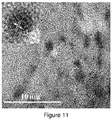
- the HRTEM image is shown in Figure 11 . It is observed from Figure 11 that the nanoparticle's lattice fringe of 0.23 nm in the HRTEM image is in well accordance with the (1 1 0) plane distance (0.235 nm) of alloy WCo 1.17 in standard card database (Reference: Z. Anorg. Chem. 1938, 238, 272 ), which matches well with the (1 1 0) diffraction peak of catalysts in the XRD pattern of Figure 6 . It shows that WCo alloy is formed after the reduction by hydrogen in 1050 °C.
Landscapes
- Chemical & Material Sciences (AREA)
- Engineering & Computer Science (AREA)
- Materials Engineering (AREA)
- Organic Chemistry (AREA)
- Chemical Kinetics & Catalysis (AREA)
- Nanotechnology (AREA)
- Physics & Mathematics (AREA)
- Thermal Sciences (AREA)
- Inorganic Chemistry (AREA)
- Catalysts (AREA)
- Carbon And Carbon Compounds (AREA)
Claims (5)
- Catalyseurs destinés à la préparation de nanotubes de carbone à paroi unique de chiralité sélective et de métallicité sélective, lesdits catalyseurs sont représentés comme suit : WFe1.17, WFe2, WFe, WCo1.17, WCo3, WCo0.15, WCu0.67, WCu5.25, WRe, WRe3, WRe0.25, WRe10.11, W13Re7, WRu0.18, WRu1.5, WMn3Fe, WRu2Fe5, WCu2Fe12, WFeV4, WRe0.125Ni0.125, WRu3Cu12, WPtCu10, WMn1.5V0.63, WLaFe3;
dans lesquels ledit catalyseur est préparé par la méthode suivante :
Réduction des oxydes métalliques avec des compositions chimiques représentées par la formule (II) comme suit pour obtenir lesdits catalyseurs dans l'atmosphère d'hydrogène avec un taux d'écoulement compris entre 10 et 1000 ml/min entre 300 et 1500 °C avec un taux de chauffage programmé de température compris entre 10 et 100 ° C/min :
AByO(a+by)/2, formule (II)
dans laquelle, A représente le tungstène métallique (W) ;B représente un ou plusieurs métaux choisis parmi un groupe constitué des métaux de transition suivants vanadium (V), manganèse (Mn), fer (Fe), cobalt (Co), nickel (Ni), cuivre (Cu), ruthénium (Ru), platine (Pt), rhénium (Re), et des métaux des terres rares de la série des lanthanides ;a représente le nombre d'oxydation dans A ;b représente le nombre d'oxydation dans B ;y est compris dans la plage allant de 0,01 à 20,0. - Procédé de préparation d'un catalyseur selon la revendication 1 pour des nanotubes de carbone à paroi unique de chiralité sélective et de métallicité sélective, ledit procédé comprend les étapes suivantes :
Réduction des oxydes métalliques avec des compositions chimiques représentées par la formule (II) comme suit pour obtenir les catalyseurs avec des compositions chimiques représentées par la formule (I) comme suit dans l'atmosphère d'hydrogène entre 900 et 1100 °C avec un taux de chauffage programmé de température compris entre 40 et 60 °C/min :
ABy, formule (I)
AByO(a+by)/2, formule (II)
dans lesquelles, A représente le tungstène métallique (W) ;B représente un ou plusieurs métaux choisis parmi un groupe constitué des métaux de transition suivants vanadium (V), manganèse (Mn), fer (Fe), cobalt (Co), nickel (Ni), cuivre (Cu), ruthénium (Ru), platine (Pt), rhénium (Re), et des métaux des terres rares de la série des lanthanides ;a représente le nombre d'oxydation dans A ;b représente le nombre d'oxydation dans B ;y est compris dans la plage allant de 0,01 à 20,0. - Utilisation des catalyseurs selon la revendication 1 destinée à la préparation de nanotubes de carbone à paroi unique de chiralité sélective et de métallicité sélective.
- Procédé de préparation destinée à une croissance de nanotubes de carbone à paroi unique de chiralité sélective et de métallicité sélective, ledit procédé comprend les étapes suivantes :
Croissance de nanotubes de carbone à paroi unique sur des substrats chargés avec le catalyseur selon la revendication 1 par introduction de sources carbonées gazeuses avec un taux d'écoulement compris entre 10 et 1000 ml/min entre 600 et 1500 °C, et par dépôt chimique en phase vapeur. - Procédé selon la revendication 4, dans lequel :la température pour la croissance de nanotubes de carbone à paroi unique par dépôt chimique en phase vapeur est compris dans la gamme allant de 600 à 1300 °C, de préférence, dans la gamme allant de 900 à 1100 °C ;le taux d'écoulement pour les sources carbonées gazeuses est compris dans la gamme allant de 10 à 800 ml/min, de préférence, dans la gamme allant de 50 à 200 ml/min ;les substrats sont des substrats métalliques résistants à de hautes températures, plats ou des substrats non métalliques ; etle temps de croissance est compris dans la gamme allant de 5 à 30 min.
Applications Claiming Priority (2)
| Application Number | Priority Date | Filing Date | Title |
|---|---|---|---|
| CN201210241640.2A CN103537293B (zh) | 2012-07-12 | 2012-07-12 | 用于制备手性选择性和导电性选择性单壁碳纳米管的催化剂及其制备方法和应用 |
| PCT/CN2013/000830 WO2014008756A1 (fr) | 2012-07-12 | 2013-07-10 | Catalyseur pour la préparation de nanotubes de carbone monofeuillets sélectivement chiraux et sélectivement conducteurs, son procédé de préparation et son application |
Publications (3)
| Publication Number | Publication Date |
|---|---|
| EP2873457A1 EP2873457A1 (fr) | 2015-05-20 |
| EP2873457A4 EP2873457A4 (fr) | 2015-07-22 |
| EP2873457B1 true EP2873457B1 (fr) | 2018-05-16 |
Family
ID=49915362
Family Applications (1)
| Application Number | Title | Priority Date | Filing Date |
|---|---|---|---|
| EP13816443.9A Active EP2873457B1 (fr) | 2012-07-12 | 2013-07-10 | Catalyseur pour la préparation de nanotubes de carbone monofeuillets sélectivement chiraux et sélectivement conducteurs, son procédé de préparation et son application |
Country Status (5)
| Country | Link |
|---|---|
| US (1) | US9468911B2 (fr) |
| EP (1) | EP2873457B1 (fr) |
| JP (1) | JP5990329B2 (fr) |
| CN (1) | CN103537293B (fr) |
| WO (1) | WO2014008756A1 (fr) |
Families Citing this family (11)
| Publication number | Priority date | Publication date | Assignee | Title |
|---|---|---|---|---|
| TWI686239B (zh) | 2014-09-23 | 2020-03-01 | 德商巴斯夫歐洲公司 | 使用聚鎢酸鹽分離半導性與金屬性單層壁奈米碳管 |
| CN105565292B (zh) * | 2014-10-29 | 2018-04-06 | 北京大学 | 一种超高密度单壁碳纳米管水平阵列及其可控制备方法 |
| CN107601458B (zh) * | 2017-09-12 | 2020-07-28 | 刘云芳 | 一种单壁碳纳米管的制备方法 |
| DE112019005300T5 (de) * | 2018-10-23 | 2021-07-22 | Carbon Technology, Inc. | Angereicherte Synthese von halbleitenden Nanoröhren |
| CN111112596B (zh) * | 2018-11-01 | 2021-12-28 | 国家纳米科学中心 | 一种手性贵金属纳米颗粒及其制备方法和用途 |
| GB201917638D0 (en) * | 2019-12-03 | 2020-01-15 | Cambridge Entpr Ltd | Method |
| CN111841561A (zh) * | 2020-07-09 | 2020-10-30 | 江西铜业技术研究院有限公司 | 一种生长碳纳米管的高效催化剂及其制备和使用方法 |
| CN112760677B (zh) * | 2020-12-28 | 2021-12-10 | 中国科学技术大学 | 铱钨合金纳米材料、其制备方法及作为酸性析氧反应电催化剂的应用 |
| CN114797864B (zh) * | 2021-01-21 | 2024-02-02 | 北京大学深圳研究院 | 用于小直径体相单壁碳纳米管生长催化剂的制备方法 |
| CN116159566A (zh) * | 2022-11-18 | 2023-05-26 | 常州国重新材料科技有限公司 | 一种用于制备单壁碳纳米管的催化剂及其制备方法 |
| WO2024190472A1 (fr) * | 2023-03-10 | 2024-09-19 | 住友電気工業株式会社 | Matériau carboné |
Family Cites Families (13)
| Publication number | Priority date | Publication date | Assignee | Title |
|---|---|---|---|---|
| JP3363759B2 (ja) * | 1997-11-07 | 2003-01-08 | キヤノン株式会社 | カーボンナノチューブデバイスおよびその製造方法 |
| CA2344180C (fr) * | 1998-09-18 | 2008-04-29 | William Marsh Rice University | Croissance catalytique de nanotubes en carbone a paroi unique a partir de particules metalliques |
| US6333016B1 (en) * | 1999-06-02 | 2001-12-25 | The Board Of Regents Of The University Of Oklahoma | Method of producing carbon nanotubes |
| WO2003037792A1 (fr) * | 2001-10-31 | 2003-05-08 | National University Of Singapore | Synthese a grande echelle de nanotubes de carbone a paroi unique effectuee avec des catalyseurs du groupe viiib potentialises par des metaux du groupe vib |
| JP2004292231A (ja) * | 2003-03-26 | 2004-10-21 | Canon Inc | ナノカーボン材料の製造方法 |
| WO2005025734A2 (fr) * | 2003-09-17 | 2005-03-24 | Molecular Nanosystems, Inc. | Procedes de production et d'utilisation de substrats catalytiques pour la croissance de nanotubes de carbone |
| US7981396B2 (en) * | 2003-12-03 | 2011-07-19 | Honda Motor Co., Ltd. | Methods for production of carbon nanostructures |
| US20070189953A1 (en) * | 2004-01-30 | 2007-08-16 | Centre National De La Recherche Scientifique (Cnrs) | Method for obtaining carbon nanotubes on supports and composites comprising same |
| US7485600B2 (en) * | 2004-11-17 | 2009-02-03 | Honda Motor Co., Ltd. | Catalyst for synthesis of carbon single-walled nanotubes |
| CN1673073A (zh) * | 2005-03-11 | 2005-09-28 | 北京大学 | 一种合成单壁碳纳米管的方法 |
| US20080274036A1 (en) * | 2005-06-28 | 2008-11-06 | Resasco Daniel E | Microstructured catalysts and methods of use for producing carbon nanotubes |
| JP4197729B2 (ja) * | 2006-12-21 | 2008-12-17 | 昭和電工株式会社 | 炭素繊維および炭素繊維製造用触媒 |
| CN101582381B (zh) * | 2008-05-14 | 2011-01-26 | 鸿富锦精密工业(深圳)有限公司 | 薄膜晶体管及其阵列的制备方法 |
-
2012
- 2012-07-12 CN CN201210241640.2A patent/CN103537293B/zh active Active
-
2013
- 2013-07-10 EP EP13816443.9A patent/EP2873457B1/fr active Active
- 2013-07-10 US US14/414,098 patent/US9468911B2/en active Active
- 2013-07-10 JP JP2015520794A patent/JP5990329B2/ja not_active Expired - Fee Related
- 2013-07-10 WO PCT/CN2013/000830 patent/WO2014008756A1/fr not_active Ceased
Non-Patent Citations (1)
| Title |
|---|
| None * |
Also Published As
| Publication number | Publication date |
|---|---|
| US9468911B2 (en) | 2016-10-18 |
| CN103537293A (zh) | 2014-01-29 |
| EP2873457A4 (fr) | 2015-07-22 |
| JP2015525670A (ja) | 2015-09-07 |
| CN103537293B (zh) | 2015-12-16 |
| JP5990329B2 (ja) | 2016-09-14 |
| EP2873457A1 (fr) | 2015-05-20 |
| US20150209763A1 (en) | 2015-07-30 |
| WO2014008756A1 (fr) | 2014-01-16 |
Similar Documents
| Publication | Publication Date | Title |
|---|---|---|
| EP2873457B1 (fr) | Catalyseur pour la préparation de nanotubes de carbone monofeuillets sélectivement chiraux et sélectivement conducteurs, son procédé de préparation et son application | |
| Li et al. | Metallic catalysts for structure-controlled growth of single-walled carbon nanotubes | |
| Lobiak et al. | Ni–Mo and Co–Mo alloy nanoparticles for catalytic chemical vapor deposition synthesis of carbon nanotubes | |
| Kumar et al. | Chemical vapor deposition of carbon nanotubes: a review on growth mechanism and mass production | |
| CN101189371B (zh) | 单壁碳纳米管催化剂 | |
| Cheng et al. | Carbon nanotube synthesis and parametric study using CaCO3 nanocrystals as catalyst support by CVD | |
| Rashidi et al. | Single-wall carbon nanotubes synthesized using organic additives to Co–Mo catalysts supported on nanoporous MgO | |
| Awasthi et al. | Synthesis of carbon nanotubes | |
| Terrones et al. | Pure and doped boron nitride nanotubes | |
| JP5102633B2 (ja) | 長いカーボン単層ナノチューブを成長させるための方法 | |
| JP4004502B2 (ja) | 極細繊維状ナノ炭素製造方法 | |
| JP5634543B2 (ja) | 超低嵩密度のバンドル部分を有する高伝導性カーボンナノチューブ及びその製造方法 | |
| JP5831966B2 (ja) | 単層カーボンナノチューブと二層カーボンナノチューブが任意比率で混合してなるカーボンナノチューブ集合体の製造方法 | |
| US20250100885A1 (en) | Long and Narrow Diameter Carbon Nanotubes and Catalysts for Producing Same | |
| Zhao et al. | Graphene oxide-supported cobalt tungstate as catalyst precursor for selective growth of single-walled carbon nanotubes | |
| US7556788B2 (en) | Process for preparing boron carbon nanorods | |
| CN113101981B (zh) | 碳纳米管制备用催化剂的制备方法 | |
| CN102020264A (zh) | 一种磷掺杂多壁碳纳米管的制备方法 | |
| Wu et al. | Growth of single-walled carbon nanotubes from solid supported heterogeneous catalysts: Achievements and challenges | |
| Chen et al. | Catalytic synthesis of carbon nanotubes from the decomposition of methane over a Ni–Co/La2O3 catalyst | |
| KR20110032464A (ko) | 탄소나노튜브의 제조방법 | |
| US20120128565A1 (en) | Boron carbon nanorods | |
| Panchakarla | Chemical Investigations of Nanomaterials | |
| Chents et al. | A Review of Three Major Factors Controlling Carbon Nanotubes Synthesis from the Floating Catalyst | |
| HK40105929A (zh) | 长且窄直径碳纳米管及用於制备其的催化剂 |
Legal Events
| Date | Code | Title | Description |
|---|---|---|---|
| PUAI | Public reference made under article 153(3) epc to a published international application that has entered the european phase |
Free format text: ORIGINAL CODE: 0009012 |
|
| 17P | Request for examination filed |
Effective date: 20150210 |
|
| AK | Designated contracting states |
Kind code of ref document: A1 Designated state(s): AL AT BE BG CH CY CZ DE DK EE ES FI FR GB GR HR HU IE IS IT LI LT LU LV MC MK MT NL NO PL PT RO RS SE SI SK SM TR |
|
| AX | Request for extension of the european patent |
Extension state: BA ME |
|
| RA4 | Supplementary search report drawn up and despatched (corrected) |
Effective date: 20150618 |
|
| DAX | Request for extension of the european patent (deleted) | ||
| 17Q | First examination report despatched |
Effective date: 20160412 |
|
| GRAP | Despatch of communication of intention to grant a patent |
Free format text: ORIGINAL CODE: EPIDOSNIGR1 |
|
| RIC1 | Information provided on ipc code assigned before grant |
Ipc: B01J 37/08 20060101ALI20171026BHEP Ipc: B01J 23/36 20060101ALI20171026BHEP Ipc: B01J 37/18 20060101ALI20171026BHEP Ipc: B01J 23/889 20060101ALI20171026BHEP Ipc: B01J 23/89 20060101ALI20171026BHEP Ipc: B01J 23/652 20060101ALI20171026BHEP Ipc: C01B 32/162 20170101ALI20171026BHEP Ipc: B82Y 40/00 20110101ALI20171026BHEP Ipc: B01J 23/30 20060101AFI20171026BHEP Ipc: B01J 23/888 20060101ALI20171026BHEP |
|
| INTG | Intention to grant announced |
Effective date: 20171127 |
|
| GRAS | Grant fee paid |
Free format text: ORIGINAL CODE: EPIDOSNIGR3 |
|
| GRAA | (expected) grant |
Free format text: ORIGINAL CODE: 0009210 |
|
| AK | Designated contracting states |
Kind code of ref document: B1 Designated state(s): AL AT BE BG CH CY CZ DE DK EE ES FI FR GB GR HR HU IE IS IT LI LT LU LV MC MK MT NL NO PL PT RO RS SE SI SK SM TR |
|
| REG | Reference to a national code |
Ref country code: GB Ref legal event code: FG4D |
|
| REG | Reference to a national code |
Ref country code: CH Ref legal event code: EP |
|
| REG | Reference to a national code |
Ref country code: IE Ref legal event code: FG4D |
|
| REG | Reference to a national code |
Ref country code: DE Ref legal event code: R096 Ref document number: 602013037618 Country of ref document: DE |
|
| REG | Reference to a national code |
Ref country code: AT Ref legal event code: REF Ref document number: 999032 Country of ref document: AT Kind code of ref document: T Effective date: 20180615 |
|
| REG | Reference to a national code |
Ref country code: FR Ref legal event code: PLFP Year of fee payment: 6 |
|
| REG | Reference to a national code |
Ref country code: NL Ref legal event code: MP Effective date: 20180516 |
|
| REG | Reference to a national code |
Ref country code: LT Ref legal event code: MG4D |
|
| PG25 | Lapsed in a contracting state [announced via postgrant information from national office to epo] |
Ref country code: FI Free format text: LAPSE BECAUSE OF FAILURE TO SUBMIT A TRANSLATION OF THE DESCRIPTION OR TO PAY THE FEE WITHIN THE PRESCRIBED TIME-LIMIT Effective date: 20180516 Ref country code: LT Free format text: LAPSE BECAUSE OF FAILURE TO SUBMIT A TRANSLATION OF THE DESCRIPTION OR TO PAY THE FEE WITHIN THE PRESCRIBED TIME-LIMIT Effective date: 20180516 Ref country code: BG Free format text: LAPSE BECAUSE OF FAILURE TO SUBMIT A TRANSLATION OF THE DESCRIPTION OR TO PAY THE FEE WITHIN THE PRESCRIBED TIME-LIMIT Effective date: 20180816 Ref country code: ES Free format text: LAPSE BECAUSE OF FAILURE TO SUBMIT A TRANSLATION OF THE DESCRIPTION OR TO PAY THE FEE WITHIN THE PRESCRIBED TIME-LIMIT Effective date: 20180516 Ref country code: SE Free format text: LAPSE BECAUSE OF FAILURE TO SUBMIT A TRANSLATION OF THE DESCRIPTION OR TO PAY THE FEE WITHIN THE PRESCRIBED TIME-LIMIT Effective date: 20180516 Ref country code: NO Free format text: LAPSE BECAUSE OF FAILURE TO SUBMIT A TRANSLATION OF THE DESCRIPTION OR TO PAY THE FEE WITHIN THE PRESCRIBED TIME-LIMIT Effective date: 20180816 |
|
| PG25 | Lapsed in a contracting state [announced via postgrant information from national office to epo] |
Ref country code: HR Free format text: LAPSE BECAUSE OF FAILURE TO SUBMIT A TRANSLATION OF THE DESCRIPTION OR TO PAY THE FEE WITHIN THE PRESCRIBED TIME-LIMIT Effective date: 20180516 Ref country code: RS Free format text: LAPSE BECAUSE OF FAILURE TO SUBMIT A TRANSLATION OF THE DESCRIPTION OR TO PAY THE FEE WITHIN THE PRESCRIBED TIME-LIMIT Effective date: 20180516 Ref country code: LV Free format text: LAPSE BECAUSE OF FAILURE TO SUBMIT A TRANSLATION OF THE DESCRIPTION OR TO PAY THE FEE WITHIN THE PRESCRIBED TIME-LIMIT Effective date: 20180516 Ref country code: GR Free format text: LAPSE BECAUSE OF FAILURE TO SUBMIT A TRANSLATION OF THE DESCRIPTION OR TO PAY THE FEE WITHIN THE PRESCRIBED TIME-LIMIT Effective date: 20180817 Ref country code: NL Free format text: LAPSE BECAUSE OF FAILURE TO SUBMIT A TRANSLATION OF THE DESCRIPTION OR TO PAY THE FEE WITHIN THE PRESCRIBED TIME-LIMIT Effective date: 20180516 |
|
| REG | Reference to a national code |
Ref country code: AT Ref legal event code: MK05 Ref document number: 999032 Country of ref document: AT Kind code of ref document: T Effective date: 20180516 |
|
| PG25 | Lapsed in a contracting state [announced via postgrant information from national office to epo] |
Ref country code: DK Free format text: LAPSE BECAUSE OF FAILURE TO SUBMIT A TRANSLATION OF THE DESCRIPTION OR TO PAY THE FEE WITHIN THE PRESCRIBED TIME-LIMIT Effective date: 20180516 Ref country code: AT Free format text: LAPSE BECAUSE OF FAILURE TO SUBMIT A TRANSLATION OF THE DESCRIPTION OR TO PAY THE FEE WITHIN THE PRESCRIBED TIME-LIMIT Effective date: 20180516 Ref country code: PL Free format text: LAPSE BECAUSE OF FAILURE TO SUBMIT A TRANSLATION OF THE DESCRIPTION OR TO PAY THE FEE WITHIN THE PRESCRIBED TIME-LIMIT Effective date: 20180516 Ref country code: CZ Free format text: LAPSE BECAUSE OF FAILURE TO SUBMIT A TRANSLATION OF THE DESCRIPTION OR TO PAY THE FEE WITHIN THE PRESCRIBED TIME-LIMIT Effective date: 20180516 Ref country code: SK Free format text: LAPSE BECAUSE OF FAILURE TO SUBMIT A TRANSLATION OF THE DESCRIPTION OR TO PAY THE FEE WITHIN THE PRESCRIBED TIME-LIMIT Effective date: 20180516 Ref country code: RO Free format text: LAPSE BECAUSE OF FAILURE TO SUBMIT A TRANSLATION OF THE DESCRIPTION OR TO PAY THE FEE WITHIN THE PRESCRIBED TIME-LIMIT Effective date: 20180516 Ref country code: EE Free format text: LAPSE BECAUSE OF FAILURE TO SUBMIT A TRANSLATION OF THE DESCRIPTION OR TO PAY THE FEE WITHIN THE PRESCRIBED TIME-LIMIT Effective date: 20180516 |
|
| REG | Reference to a national code |
Ref country code: DE Ref legal event code: R097 Ref document number: 602013037618 Country of ref document: DE |
|
| PG25 | Lapsed in a contracting state [announced via postgrant information from national office to epo] |
Ref country code: SM Free format text: LAPSE BECAUSE OF FAILURE TO SUBMIT A TRANSLATION OF THE DESCRIPTION OR TO PAY THE FEE WITHIN THE PRESCRIBED TIME-LIMIT Effective date: 20180516 Ref country code: IT Free format text: LAPSE BECAUSE OF FAILURE TO SUBMIT A TRANSLATION OF THE DESCRIPTION OR TO PAY THE FEE WITHIN THE PRESCRIBED TIME-LIMIT Effective date: 20180516 |
|
| REG | Reference to a national code |
Ref country code: CH Ref legal event code: PL |
|
| PLBE | No opposition filed within time limit |
Free format text: ORIGINAL CODE: 0009261 |
|
| STAA | Information on the status of an ep patent application or granted ep patent |
Free format text: STATUS: NO OPPOSITION FILED WITHIN TIME LIMIT |
|
| PG25 | Lapsed in a contracting state [announced via postgrant information from national office to epo] |
Ref country code: MC Free format text: LAPSE BECAUSE OF FAILURE TO SUBMIT A TRANSLATION OF THE DESCRIPTION OR TO PAY THE FEE WITHIN THE PRESCRIBED TIME-LIMIT Effective date: 20180516 Ref country code: LU Free format text: LAPSE BECAUSE OF NON-PAYMENT OF DUE FEES Effective date: 20180710 |
|
| REG | Reference to a national code |
Ref country code: BE Ref legal event code: MM Effective date: 20180731 |
|
| REG | Reference to a national code |
Ref country code: IE Ref legal event code: MM4A |
|
| 26N | No opposition filed |
Effective date: 20190219 |
|
| PG25 | Lapsed in a contracting state [announced via postgrant information from national office to epo] |
Ref country code: IE Free format text: LAPSE BECAUSE OF NON-PAYMENT OF DUE FEES Effective date: 20180710 Ref country code: CH Free format text: LAPSE BECAUSE OF NON-PAYMENT OF DUE FEES Effective date: 20180731 Ref country code: LI Free format text: LAPSE BECAUSE OF NON-PAYMENT OF DUE FEES Effective date: 20180731 |
|
| PG25 | Lapsed in a contracting state [announced via postgrant information from national office to epo] |
Ref country code: SI Free format text: LAPSE BECAUSE OF FAILURE TO SUBMIT A TRANSLATION OF THE DESCRIPTION OR TO PAY THE FEE WITHIN THE PRESCRIBED TIME-LIMIT Effective date: 20180516 Ref country code: BE Free format text: LAPSE BECAUSE OF NON-PAYMENT OF DUE FEES Effective date: 20180731 |
|
| PG25 | Lapsed in a contracting state [announced via postgrant information from national office to epo] |
Ref country code: AL Free format text: LAPSE BECAUSE OF FAILURE TO SUBMIT A TRANSLATION OF THE DESCRIPTION OR TO PAY THE FEE WITHIN THE PRESCRIBED TIME-LIMIT Effective date: 20180516 |
|
| PG25 | Lapsed in a contracting state [announced via postgrant information from national office to epo] |
Ref country code: MT Free format text: LAPSE BECAUSE OF NON-PAYMENT OF DUE FEES Effective date: 20180710 |
|
| PG25 | Lapsed in a contracting state [announced via postgrant information from national office to epo] |
Ref country code: TR Free format text: LAPSE BECAUSE OF FAILURE TO SUBMIT A TRANSLATION OF THE DESCRIPTION OR TO PAY THE FEE WITHIN THE PRESCRIBED TIME-LIMIT Effective date: 20180516 |
|
| PG25 | Lapsed in a contracting state [announced via postgrant information from national office to epo] |
Ref country code: HU Free format text: LAPSE BECAUSE OF FAILURE TO SUBMIT A TRANSLATION OF THE DESCRIPTION OR TO PAY THE FEE WITHIN THE PRESCRIBED TIME-LIMIT; INVALID AB INITIO Effective date: 20130710 Ref country code: PT Free format text: LAPSE BECAUSE OF FAILURE TO SUBMIT A TRANSLATION OF THE DESCRIPTION OR TO PAY THE FEE WITHIN THE PRESCRIBED TIME-LIMIT Effective date: 20180516 |
|
| PG25 | Lapsed in a contracting state [announced via postgrant information from national office to epo] |
Ref country code: MK Free format text: LAPSE BECAUSE OF NON-PAYMENT OF DUE FEES Effective date: 20180516 Ref country code: CY Free format text: LAPSE BECAUSE OF FAILURE TO SUBMIT A TRANSLATION OF THE DESCRIPTION OR TO PAY THE FEE WITHIN THE PRESCRIBED TIME-LIMIT Effective date: 20180516 |
|
| PG25 | Lapsed in a contracting state [announced via postgrant information from national office to epo] |
Ref country code: IS Free format text: LAPSE BECAUSE OF FAILURE TO SUBMIT A TRANSLATION OF THE DESCRIPTION OR TO PAY THE FEE WITHIN THE PRESCRIBED TIME-LIMIT Effective date: 20180916 |
|
| REG | Reference to a national code |
Ref country code: DE Ref legal event code: R082 Ref document number: 602013037618 Country of ref document: DE Representative=s name: SUN, YIMING, M.SC. DIPL. SC. POL. UNIV., DE |
|
| PGFP | Annual fee paid to national office [announced via postgrant information from national office to epo] |
Ref country code: DE Payment date: 20250710 Year of fee payment: 13 |
|
| PGFP | Annual fee paid to national office [announced via postgrant information from national office to epo] |
Ref country code: GB Payment date: 20250724 Year of fee payment: 13 |
|
| PGFP | Annual fee paid to national office [announced via postgrant information from national office to epo] |
Ref country code: FR Payment date: 20250723 Year of fee payment: 13 |