EP2874210A1 - Übergangsmetall-metaphosphat- anodenaktivmaterial, herstellungsverfahren dafür und lithium-sekundärbatterie oder hybridkondensator damit - Google Patents
Übergangsmetall-metaphosphat- anodenaktivmaterial, herstellungsverfahren dafür und lithium-sekundärbatterie oder hybridkondensator damit Download PDFInfo
- Publication number
- EP2874210A1 EP2874210A1 EP14814681.4A EP14814681A EP2874210A1 EP 2874210 A1 EP2874210 A1 EP 2874210A1 EP 14814681 A EP14814681 A EP 14814681A EP 2874210 A1 EP2874210 A1 EP 2874210A1
- Authority
- EP
- European Patent Office
- Prior art keywords
- transition metal
- metaphosphate
- active material
- anode active
- group
- Prior art date
- Legal status (The legal status is an assumption and is not a legal conclusion. Google has not performed a legal analysis and makes no representation as to the accuracy of the status listed.)
- Granted
Links
Images
Classifications
-
- H—ELECTRICITY
- H01—ELECTRIC ELEMENTS
- H01M—PROCESSES OR MEANS, e.g. BATTERIES, FOR THE DIRECT CONVERSION OF CHEMICAL ENERGY INTO ELECTRICAL ENERGY
- H01M4/00—Electrodes
- H01M4/02—Electrodes composed of, or comprising, active material
- H01M4/36—Selection of substances as active materials, active masses, active liquids
- H01M4/58—Selection of substances as active materials, active masses, active liquids of inorganic compounds other than oxides or hydroxides, e.g. sulfides, selenides, tellurides, halogenides or LiCoFy; of polyanionic structures, e.g. phosphates, silicates or borates
-
- H—ELECTRICITY
- H01—ELECTRIC ELEMENTS
- H01M—PROCESSES OR MEANS, e.g. BATTERIES, FOR THE DIRECT CONVERSION OF CHEMICAL ENERGY INTO ELECTRICAL ENERGY
- H01M4/00—Electrodes
- H01M4/02—Electrodes composed of, or comprising, active material
- H01M4/36—Selection of substances as active materials, active masses, active liquids
- H01M4/58—Selection of substances as active materials, active masses, active liquids of inorganic compounds other than oxides or hydroxides, e.g. sulfides, selenides, tellurides, halogenides or LiCoFy; of polyanionic structures, e.g. phosphates, silicates or borates
- H01M4/5825—Oxygenated metallic salts or polyanionic structures, e.g. borates, phosphates, silicates, olivines
-
- H—ELECTRICITY
- H01—ELECTRIC ELEMENTS
- H01M—PROCESSES OR MEANS, e.g. BATTERIES, FOR THE DIRECT CONVERSION OF CHEMICAL ENERGY INTO ELECTRICAL ENERGY
- H01M4/00—Electrodes
- H01M4/02—Electrodes composed of, or comprising, active material
- H01M4/36—Selection of substances as active materials, active masses, active liquids
- H01M4/362—Composites
-
- C—CHEMISTRY; METALLURGY
- C01—INORGANIC CHEMISTRY
- C01B—NON-METALLIC ELEMENTS; COMPOUNDS THEREOF; METALLOIDS OR COMPOUNDS THEREOF NOT COVERED BY SUBCLASS C01C
- C01B25/00—Phosphorus; Compounds thereof
- C01B25/16—Oxyacids of phosphorus; Salts thereof
- C01B25/26—Phosphates
- C01B25/38—Condensed phosphates
- C01B25/44—Metaphosphates
-
- C—CHEMISTRY; METALLURGY
- C01—INORGANIC CHEMISTRY
- C01B—NON-METALLIC ELEMENTS; COMPOUNDS THEREOF; METALLOIDS OR COMPOUNDS THEREOF NOT COVERED BY SUBCLASS C01C
- C01B25/00—Phosphorus; Compounds thereof
- C01B25/16—Oxyacids of phosphorus; Salts thereof
- C01B25/26—Phosphates
- C01B25/45—Phosphates containing plural metal, or metal and ammonium
-
- H—ELECTRICITY
- H01—ELECTRIC ELEMENTS
- H01G—CAPACITORS; CAPACITORS, RECTIFIERS, DETECTORS, SWITCHING DEVICES, LIGHT-SENSITIVE OR TEMPERATURE-SENSITIVE DEVICES OF THE ELECTROLYTIC TYPE
- H01G11/00—Hybrid capacitors, i.e. capacitors having different positive and negative electrodes; Electric double-layer [EDL] capacitors; Processes for the manufacture thereof or of parts thereof
- H01G11/22—Electrodes
-
- H—ELECTRICITY
- H01—ELECTRIC ELEMENTS
- H01G—CAPACITORS; CAPACITORS, RECTIFIERS, DETECTORS, SWITCHING DEVICES, LIGHT-SENSITIVE OR TEMPERATURE-SENSITIVE DEVICES OF THE ELECTROLYTIC TYPE
- H01G11/00—Hybrid capacitors, i.e. capacitors having different positive and negative electrodes; Electric double-layer [EDL] capacitors; Processes for the manufacture thereof or of parts thereof
- H01G11/22—Electrodes
- H01G11/30—Electrodes characterised by their material
-
- H—ELECTRICITY
- H01—ELECTRIC ELEMENTS
- H01G—CAPACITORS; CAPACITORS, RECTIFIERS, DETECTORS, SWITCHING DEVICES, LIGHT-SENSITIVE OR TEMPERATURE-SENSITIVE DEVICES OF THE ELECTROLYTIC TYPE
- H01G11/00—Hybrid capacitors, i.e. capacitors having different positive and negative electrodes; Electric double-layer [EDL] capacitors; Processes for the manufacture thereof or of parts thereof
- H01G11/84—Processes for the manufacture of hybrid or EDL capacitors, or components thereof
- H01G11/86—Processes for the manufacture of hybrid or EDL capacitors, or components thereof specially adapted for electrodes
-
- H—ELECTRICITY
- H01—ELECTRIC ELEMENTS
- H01M—PROCESSES OR MEANS, e.g. BATTERIES, FOR THE DIRECT CONVERSION OF CHEMICAL ENERGY INTO ELECTRICAL ENERGY
- H01M10/00—Secondary cells; Manufacture thereof
- H01M10/05—Accumulators with non-aqueous electrolyte
- H01M10/052—Li-accumulators
- H01M10/0525—Rocking-chair batteries, i.e. batteries with lithium insertion or intercalation in both electrodes; Lithium-ion batteries
-
- H—ELECTRICITY
- H01—ELECTRIC ELEMENTS
- H01M—PROCESSES OR MEANS, e.g. BATTERIES, FOR THE DIRECT CONVERSION OF CHEMICAL ENERGY INTO ELECTRICAL ENERGY
- H01M4/00—Electrodes
- H01M4/02—Electrodes composed of, or comprising, active material
- H01M4/13—Electrodes for accumulators with non-aqueous electrolyte, e.g. for lithium-accumulators; Processes of manufacture thereof
- H01M4/136—Electrodes based on inorganic compounds other than oxides or hydroxides, e.g. sulfides, selenides, tellurides, halogenides or LiCoFy
-
- H—ELECTRICITY
- H01—ELECTRIC ELEMENTS
- H01M—PROCESSES OR MEANS, e.g. BATTERIES, FOR THE DIRECT CONVERSION OF CHEMICAL ENERGY INTO ELECTRICAL ENERGY
- H01M4/00—Electrodes
- H01M4/02—Electrodes composed of, or comprising, active material
- H01M4/13—Electrodes for accumulators with non-aqueous electrolyte, e.g. for lithium-accumulators; Processes of manufacture thereof
- H01M4/139—Processes of manufacture
-
- H—ELECTRICITY
- H01—ELECTRIC ELEMENTS
- H01M—PROCESSES OR MEANS, e.g. BATTERIES, FOR THE DIRECT CONVERSION OF CHEMICAL ENERGY INTO ELECTRICAL ENERGY
- H01M4/00—Electrodes
- H01M4/02—Electrodes composed of, or comprising, active material
- H01M4/13—Electrodes for accumulators with non-aqueous electrolyte, e.g. for lithium-accumulators; Processes of manufacture thereof
- H01M4/139—Processes of manufacture
- H01M4/1397—Processes of manufacture of electrodes based on inorganic compounds other than oxides or hydroxides, e.g. sulfides, selenides, tellurides, halogenides or LiCoFy
-
- H—ELECTRICITY
- H01—ELECTRIC ELEMENTS
- H01M—PROCESSES OR MEANS, e.g. BATTERIES, FOR THE DIRECT CONVERSION OF CHEMICAL ENERGY INTO ELECTRICAL ENERGY
- H01M4/00—Electrodes
- H01M4/02—Electrodes composed of, or comprising, active material
- H01M4/36—Selection of substances as active materials, active masses, active liquids
- H01M4/362—Composites
- H01M4/366—Composites as layered products
-
- H—ELECTRICITY
- H01—ELECTRIC ELEMENTS
- H01M—PROCESSES OR MEANS, e.g. BATTERIES, FOR THE DIRECT CONVERSION OF CHEMICAL ENERGY INTO ELECTRICAL ENERGY
- H01M4/00—Electrodes
- H01M4/02—Electrodes composed of, or comprising, active material
- H01M4/62—Selection of inactive substances as ingredients for active masses, e.g. binders, fillers
- H01M4/624—Electric conductive fillers
- H01M4/625—Carbon or graphite
-
- H—ELECTRICITY
- H01—ELECTRIC ELEMENTS
- H01M—PROCESSES OR MEANS, e.g. BATTERIES, FOR THE DIRECT CONVERSION OF CHEMICAL ENERGY INTO ELECTRICAL ENERGY
- H01M10/00—Secondary cells; Manufacture thereof
- H01M10/05—Accumulators with non-aqueous electrolyte
- H01M10/052—Li-accumulators
-
- H—ELECTRICITY
- H01—ELECTRIC ELEMENTS
- H01M—PROCESSES OR MEANS, e.g. BATTERIES, FOR THE DIRECT CONVERSION OF CHEMICAL ENERGY INTO ELECTRICAL ENERGY
- H01M4/00—Electrodes
- H01M4/02—Electrodes composed of, or comprising, active material
- H01M2004/026—Electrodes composed of, or comprising, active material characterised by the polarity
- H01M2004/027—Negative electrodes
-
- Y—GENERAL TAGGING OF NEW TECHNOLOGICAL DEVELOPMENTS; GENERAL TAGGING OF CROSS-SECTIONAL TECHNOLOGIES SPANNING OVER SEVERAL SECTIONS OF THE IPC; TECHNICAL SUBJECTS COVERED BY FORMER USPC CROSS-REFERENCE ART COLLECTIONS [XRACs] AND DIGESTS
- Y02—TECHNOLOGIES OR APPLICATIONS FOR MITIGATION OR ADAPTATION AGAINST CLIMATE CHANGE
- Y02E—REDUCTION OF GREENHOUSE GAS [GHG] EMISSIONS, RELATED TO ENERGY GENERATION, TRANSMISSION OR DISTRIBUTION
- Y02E60/00—Enabling technologies; Technologies with a potential or indirect contribution to GHG emissions mitigation
- Y02E60/10—Energy storage using batteries
-
- Y—GENERAL TAGGING OF NEW TECHNOLOGICAL DEVELOPMENTS; GENERAL TAGGING OF CROSS-SECTIONAL TECHNOLOGIES SPANNING OVER SEVERAL SECTIONS OF THE IPC; TECHNICAL SUBJECTS COVERED BY FORMER USPC CROSS-REFERENCE ART COLLECTIONS [XRACs] AND DIGESTS
- Y02—TECHNOLOGIES OR APPLICATIONS FOR MITIGATION OR ADAPTATION AGAINST CLIMATE CHANGE
- Y02E—REDUCTION OF GREENHOUSE GAS [GHG] EMISSIONS, RELATED TO ENERGY GENERATION, TRANSMISSION OR DISTRIBUTION
- Y02E60/00—Enabling technologies; Technologies with a potential or indirect contribution to GHG emissions mitigation
- Y02E60/13—Energy storage using capacitors
Definitions
- the present invention relates to a transition metal-metaphosphate anode active material, a method of preparing the same, and a lithium secondary battery or hybrid capacitor including the transition metal-metaphosphate anode active material.
- a carbon-based material has been widely used as an anode active material of a typical secondary battery.
- development of new materials has been actively conducted due to the growth of the secondary battery market and the demand on power sources for various applications.
- lithium manganese phosphate (LiMnO 4 ) on the basis of Mn as a lithium transition metal oxide has been actively conducted.
- Mn since Mn may be synthesized in air while the price of a raw material is low, it may be considered as a composition that may satisfy both raw material costs and processing costs.
- LiMnPO 4 has a higher density than a graphite-based material while a theoretical capacity of LiMnPO 4 (342 mAh/g) is comparable to that of the graphite-based material (372 mAh/g), LiMnPO 4 may have a higher energy density per volume.
- LiMnPO 4 has limitations in that its initial efficiency is low and simultaneously, since Mn has low activity, Mn may not easily react with lithium. In the case that charge and discharge are performed by using an electrode formed of LiMnPO 4 , capacity may not be fully manifested in a typical operating environment and the reaction may proceed only in the case in which charge and discharge are performed at very low current.
- a reaction voltage of LiMnPO 4 with respect to lithium may be high, a voltage of a battery may be low. Also, since there are limitations in the long-term life of the battery due to volume changes during charge and discharge and the reaction with lithium is slow, the output of the battery may be low.
- the present invention provides an anode active material including a transition metal-metaphosphate which may exhibit excellent capacity characteristics due to the fact that the anode active material is stable and has good conversion reactivity while including only transition metal and phosphate without using lithium in which the price thereof is continuously increased.
- the present invention also provides a method of preparing the transition metal-metaphosphate.
- the present invention also provides an anode including the transition metal-metaphosphate
- the present invention also provides a lithium secondary battery or hybrid capacitor including the anode.
- an anode active material including a transition metal-metaphosphate of Chemical Formula 1: ⁇ Chemical Formula 1> M(PO 3 ) 2 where M is any one selected from the group consisting of titanium (Ti), chromium (Cr), manganese (Mn), iron (Fe), cobalt (Co), nickel (Ni), ruthenium (Ru), palladium (Pd), and silver (Ag), or two or more elements thereof.
- M is any one selected from the group consisting of titanium (Ti), chromium (Cr), manganese (Mn), iron (Fe), cobalt (Co), nickel (Ni), ruthenium (Ru), palladium (Pd), and silver (Ag), or two or more elements thereof.
- a method of preparing a transition metal-metaphosphate of Chemical Formula 1 including the steps of: (i) obtaining a precursor including a transition metal oxide and a phosphate; and (ii) performing a heat treatment on the precursor obtained in step (i).
- an anode including the transition metal-metaphosphate.
- a lithium secondary battery or hybrid capacitor including the anode.
- an anode active material including a transition metal-metaphosphate is stable and has excellent conversion reactivity while including only transition metal and phosphate without using lithium, the anode active material including a transition metal-metaphosphate may improve capacity characteristics.
- a carbon coating layer is further included on the transition metal-metaphosphate.
- SEI solid electrolyte interface
- a lithium secondary battery or hybrid capacitor including the anode active material has a linear slope within a discharge voltage range of 0 V to 3 V
- the lithium secondary battery or hybrid capacitor including the anode active material may have a lower average voltage than the case of using a typical lithium transition metal oxide-based anode active material.
- a voltage of the battery may be increased.
- SOC state of charge
- An anode active material includes a transition metal-metaphosphate of Chemical Formula 1 below: ⁇ Chemical Formula 1> M(PO 3 ) 2 where M is any one selected from the group consisting of titanium (Ti), chromium (Cr), manganese (Mn), iron (Fe), cobalt (Co), nickel (Ni), ruthenium (Ru), palladium (Pd), and silver (Ag), or two or more elements thereof.
- M is any one selected from the group consisting of titanium (Ti), chromium (Cr), manganese (Mn), iron (Fe), cobalt (Co), nickel (Ni), ruthenium (Ru), palladium (Pd), and silver (Ag), or two or more elements thereof.
- the anode active material according to the embodiment of the present invention is stable and has excellent conversion reactivity while including only transition metal and phosphate without using lithium in which the price thereof is continuously increased, the anode active material may improve capacity characteristics.
- a reaction may be performed on the basis of a conversion reaction such as the following reaction formula 1: ⁇ Reaction Formula 1> M(PO 3 ) 2 + 2Li + + 2e - --> 2M + 2LiPO 3 where M is any one selected from the group consisting of Ti, Cr, Mn, Fe, Co, Ni, Ru, Pd, and Ag, or two or more elements thereof.
- a transition metal phosphate has a structure of MPO 4 . Since the structure by itself is unstable, a hydrate may be formed by the absorption of crystallization water. Thus, there are limitations in using the transition metal phosphate as an electrode material.
- the transition metal-metaphosphate of Chemical Formula 1 and Reaction Formula 1 of the present invention may realize high capacity when used as an anode active material.
- M representing a transition metal may be any one selected from the group consisting of Mn, Ni, Co, and Fe, or two or more elements thereof.
- M since the raw material price of Co may be high, M, for example, may be at least one element of Mn, Ni, and Fe.
- the transition metal-metaphosphate may include any one selected from the group consisting of Mn(PO 3 ) 2 , Ni(PO 3 ) 2 , and Fe(PO 3 ) 2 , or a mixture of two or more thereof.
- Fe since an Fe phase may not be well synthesized in air, the preparation of the Fe phase may be possible only in an inert atmosphere.
- M for example, may include Mn(PO 3 ) 2 , Ni(PO 3 ) 2 , or a mixture thereof.
- the transition metal-metaphosphate may be crystalline or semi-crystalline.
- the crystalline or semi-crystalline transition metal-metaphosphate may be converted to an amorphous structure during lithium intercalation after first charge and discharge.
- crystallinity of the crystalline or semi-crystalline transition metal-metaphosphate all disappears, the crystalline or semi-crystalline transition metal-metaphosphate is converted to an amorphous structure when the secondary battery is subjected to the first charge and discharge, and the crystalline or semi-crystalline transition metal-metaphosphate may be in a form in which lithium is stored or released in the amorphous structure during subsequent charge and discharge process.
- a full width at half-maximum (FWHM) of a diffraction peak having the highest intensity observed in a diffraction angle 2 ⁇ range of 20 degrees to 40 degrees for example, a diffraction peak having the highest intensity observed near 28 degrees to 32 degrees, is in a range of 0.01 degrees to 0.6 degrees, may be in a range of 0.01 degrees to 0.4 degrees, and for example, may be in a range of 0.15 degrees to 0.3 degrees.
- applied voltage and applied current were respectively set as 40 KV and 40 mA.
- a measurement range of 28 was between 10° and 60°, and the XRD measurement was performed by step scanning at an interval of 0.05°.
- the FWHM quantifies a peak width at a half position of the intensity of the diffraction peak having the highest intensity, e.g., (222) peak, which is obtained by the X-ray diffraction of the transition metal-metaphosphate.
- the FWHM may be represented as degrees (°), i.e., the unit of 2 ⁇ , and the higher the crystallinity of the anode active material is, the lower the value of the FWHM is.
- the expression "amorphous structure converted after first charge and discharge” may denote that it exhibits a broad characteristic peak and has a value greater than the range of the FWHM of the crystalline or semi-crystalline transition metal-metaphosphate when measurement is performed under the above X-ray diffraction conditions.
- An average particle diameter (D 50 ) of the transition metal-metaphosphate according to an embodiment of the present invention may be in a range of 10 nm to 1 ⁇ m.
- the average particle diameter (D 50 ) of the transition metal-metaphosphate according to the embodiment of the present invention may be measured by using a laser diffraction method.
- the laser diffraction method may generally measure a particle diameter ranging from a submicron level to a few mm, and may obtain highly repeatable and high resolution results.
- the average particle diameter (D 50 ) of the transition metal-metaphosphate may be defined as a particle diameter at 50% in a cumulative particle diameter distribution.
- a method of measuring the average particle diameter (D 50 ) of the transition metal-metaphosphate according to an embodiment of the present invention may be performed in such a manner that the transition metal-metaphosphate is dispersed in a solution, the solution is introduced into a commercial laser diffraction particle size measurement instrument (e.g., Microtrac MT 3000) and irradiated with ultrasonic waves having a frequency of about 28 kHz and an output of 60 W, and the average particle diameter (D 50 ) at 50% in a cumulative particle diameter distribution of the measurement instrument may then be calculated.
- a commercial laser diffraction particle size measurement instrument e.g., Microtrac MT 3000
- the average particle diameter (D 50 ) of the transition metal-metaphosphate according to the embodiment of the present invention is less than 10 nm, since an initial efficiency of the secondary battery may be decreased due to an increase in specific surface area, battery performance may degrade. In the case in which that the average particle diameter (D 50 ) is greater than 1 ⁇ m, since packing density is low, a capacity retention ratio may be low.
- the anode active material according to the embodiment of the present invention may further include a carbon coating layer on the transition metal-metaphosphate.
- a carbon coating layer is further included on the transition metal-metaphosphate, and thus, there may be an effect of reducing electrode resistance and the formation of a solid electrolyte interface (SEI) due to a decomposition reaction between a solution of an electrolyte solution and an electrolyte salt during charge and discharge of a battery.
- SEI solid electrolyte interface
- mechanical properties are further improved to stably maintain a particle shape without breaking the particles during rolling.
- electrical conductivity may be further improved by including the carbon coating layer having excellent conductivity on outer surfaces of the transition metal-metaphosphate.
- a thickness of the carbon coating layer is in a range of 5 nm to 100 nm and may be in a range of 5 nm to 50 nm.
- the thickness of the carbon coating layer is less than 5 nm, an effect of increasing electrical conductivity due to the carbon coating layer may be insignificant and the reactivity with the electrolyte solution during the application of the anode active material may be high. Thus, the initial efficiency may be reduced.
- the thickness of the carbon coating layer is greater than 100 nm, since the thickness of the amorphous carbon coating layer may be excessively increased to act as a barrier to the mobility of lithium ions, resistance may increase and there may be difficulties in electrode processing due to the hard surface.
- the transition metal-metaphosphate may be in a form of a composite including carbon.
- the present invention provides a method of preparing the transition metal-metaphosphate of Chemical Formula 1 including the steps of: (i) obtaining a precursor including a transition metal-containing compound and a phosphate; and (ii) performing a heat treatment on the precursor obtained in step (i).
- the method of preparing the transition metal-metaphosphate according to the embodiment of the present invention may include obtaining a precursor including a transition metal-containing compound and a phosphate (step (i)).
- the precursor may be obtained by mixing the transition metal-containing compound and the phosphate so as to satisfy an equivalent ratio.
- the precursor for example, may be uniformly mixed by using a typical milling method such as planetary milling.
- a typically used transition metal-containing compound may be used to prepare the transition metal-metaphosphate.
- any one selected from the group consisting of a manganese-containing compound, an iron-containing compound, and a nickel-containing compound, or a mixture of two or more thereof may be used.
- any one selected from the group consisting of MnO 2 , MnCO 3 , Mn 3 O 4 , and Mn 2 O 3 , or a mixture of two or more thereof may be used as the manganese-containing compound.
- the iron-containing compound may include any one selected from the group consisting of FeSO 4 , Fe 3 O 4 , FeCO 3 , and FeO, or a mixture of two or more thereof.
- the phosphate may include any one selected from the group consisting of (NH 4 )H 2 PO 4 , (NH 4 ) 2 HPO 4 , (NH 4 ) 3 PO 4 , H 3 PO 4 , P 2 O 5 , P 4 O 10 , Li 3 PO 4 , and FePO 4 ⁇ nH 2 O, or a mixture of two or more thereof.
- the preparation method of the present invention may include performing a heat treatment on the precursor obtained in step (i) (step (ii)).
- the crystalline or semi-crystalline transition metal-metaphosphate may be obtained by performing a heat treatment on the precursor obtained in step (i) at a temperature of about 300°C to about 1300°C, more preferably 500°C to 900°C, and most preferably 600°C to 800°C.
- the heat treatment may be performed in an inert atmosphere, and the inert atmosphere, for example, may be obtained by flowing argon (Ar), nitrogen (N 2 ), or N 2 +hydrogen (H 2 ) gas in a sintering furnace.
- Ar argon
- N 2 nitrogen
- H 2 hydrogen
- the method may further include coating the crystalline or semi-crystalline transition metal-metaphosphate with carbon by mixing the crystalline or semi-crystalline transition metal-metaphosphate obtained after the heat treatment with a carbon precursor and performing a heat treatment.
- a saccharide solution for example, may be used as the carbon precursor according to an embodiment of the present invention, and any saccharide solution may be used so long as a reaction may proceed by hydrolysis using hydrothermal synthesis.
- the saccharide solution may be a solution including any one selected from the group consisting of glucose, fructose, galactose, sucrose, maltose, and lactose, or a mixture of two or more thereof, and sucrose may be used.
- the saccharide solution may be prepared at a concentration of 0.05 M to 0.5 M. Since the concentration of the saccharide solution is a parameter controlling the thickness of the carbon coating layer, the concentration of the saccharide solution may be adjusted in consideration of an amount of the transition metal-metaphosphate added.
- mixing the saccharide solution with the transition metal-metaphosphate may be performed.
- the mixing of the saccharide solution with the transition metal-metaphosphate may be performed by a typical mixing method, for example, by dispersing and stirring the transition metal-metaphosphate in the saccharide solution.
- a uniform carbon coating reaction may be possible only by sufficiently wetting the surface of the transition metal-metaphosphate with the saccharide solution through uniform dispersion.
- the saccharide solution may be used in an amount of 30 wt% to 80 wt%, for example, 50 wt% to 80 wt% based on a total weight of the transition metal-metaphosphate.
- the transition metal-metaphosphate When the transition metal-metaphosphate is uniformly dispersed in the saccharide solution, heat treating the saccharide solution including the metal oxide powder, for example, by microwave is performed.
- the heat treatment may be performed in a temperature range of 160°C to 300°C, for example, 200°C to 270°C.
- the heat treatment temperature is less than 160°C, since the formation of the carbon precursor is not easy, the carbon coating layer may be difficult to be formed.
- the heat treatment temperature is greater than 300°C, it is not desirable because the crystal structure of the desired compound may be changed due to excessively high temperature.
- the present invention may provide an anode which includes an anode active material including the transition metal-metaphosphate.
- the crystallinity of the crystalline or semi-crystalline transition metal-metaphosphate all disappears, the crystalline or semi-crystalline transition metal-metaphosphate is converted to an amorphous structure when the secondary battery is subjected to the first charge and discharge, and the crystalline or semi-crystalline transition metal-metaphosphate may be in a form in which lithium is stored or released in the amorphous structure during subsequent charge and discharge process.
- the voltage curve is represented as a straight line with a slope.
- the anode since the voltage curve during charge and discharge process has a linear slope, prediction of state of charge (SOC) may be possible.
- SOC state of charge
- the anode active material according to an embodiment of the present invention may be used in the anode by mixing the transition metal-metaphosphate with a typically used anode active material.
- the typically used anode active material may further include any one selected from the group consisting of a carbon-based material, a transition metal oxide, a silicon (Si)-based material, and a tin (Sn)-based material, or two or more active materials thereof, but the present invention is not limited thereto.
- the present invention provides a lithium secondary battery or hybrid capacitor including the anode.
- the lithium battery or hybrid capacitor includes a cathode, an anode, a separator disposed between the cathode and the anode, and an electrolyte.
- the anode active material is mixed with a binder, a solvent, and a conductive agent and a dispersant if necessary, and stirred to prepare a slurry. Then, the anode according to the embodiment of the present invention may be prepared by coating a current collector with the slurry and pressing the coated current collector.
- binder polymers such as a polyvinylidene fluoride-hexafluoropropylene copolymer (PVDF-co-HEP), polyvinylidene fluoride, polyacrylonitrile, polymethylmethacrylate, polyvinyl alcohol, carboxymethyl cellulose (CMC), starch, hydroxypropyl cellulose, regenerated cellulose, polyvinylpyrrolidone, tetrafluoroethylene, polyethylene, polypropylene, an ethylene-propylene-diene monomer (EPDM), a sulfonated EPDM, a styrene-butadiene rubber (SBR), a fluorine rubber, poly acrylic acid, and a polymer having hydrogen thereof substituted with lithium (Li), sodium (Na), and calcium (Ca), or various copolymers, may be used as the binder.
- N-methyl pyrrolidone, acetone, or water may be used as the solvent.
- the conductive agent may include a conductive material such as: graphite such as natural graphite and artificial graphite; carbon black such as acetylene black, Ketjen black, channel black, furnace black, lamp black, and thermal black; conductive fibers such as carbon fibers and metal fibers; conductive tubes such as carbon nanotubes; metal powder such as fluorocarbon powder, aluminum powder, and nickel powder; conductive whiskers such as zinc oxide whiskers and potassium titanate whiskers; conductive metal oxide such as titanium oxide; or polyphenylene derivatives.
- a conductive material such as: graphite such as natural graphite and artificial graphite; carbon black such as acetylene black, Ketjen black, channel black, furnace black, lamp black, and thermal black; conductive fibers such as carbon fibers and metal fibers; conductive tubes such as carbon nanotubes; metal powder such as fluorocarbon powder, aluminum powder, and nickel powder; conductive whiskers such as zinc oxide whiskers and potassium titanate whiskers; conductive metal oxide such as titanium
- An aqueous-based dispersant or an organic dispersant, such as N-methyl-2-pyrrolidone, may be used as the dispersant.
- a cathode active material, a conductive agent, a binder, and a solvent are mixed to prepare a slurry, and a cathode may then be prepared by directly coating a metal current collector with the slurry or by casting the slurry on a separate support and laminating a cathode active material film separated from the support on a metal current collector.
- a high voltage cathode may be used, and specific examples of the cathode active material may be lithium nickel oxide (LiNiO 2 ), lithium manganese oxides such as the chemical formula Li 1+y Mn 2-y O 4 (where y ranges from 0 to 0.33), LiMnO 3 , LiMn 2 O 3 , and LiMnO 2 ; Ni-site type lithium nickel oxide expressed by the chemical formula LiNi 1-y M y O 2 (where M is Co, Mn, Al, Cu, Fe, Mg, B, or Ga, and y ranges from 0.01 to 0.3); lithium manganese complex oxide expressed by the chemical formula LiMn 2-y M y O 2 (where M is Co, Ni, Fe, Cr, Zn, or Ta, and y ranges from 0.01 to 0.1)
- a typical porous polymer film used as a typical separator for example, a porous polymer film prepared from a polyolefin-based polymer, such as an ethylene homopolymer, a propylene homopolymer, an ethylene/butene copolymer, an ethylene/hexene copolymer, and an ethylene/methacrylate copolymer, may be used alone or in a lamination therewith as the separator.
- a typical porous nonwoven fabric for example, a nonwoven fabric formed of high melting point glass fibers or polyethylene terephthalate fibers, and a polymer separator base material having at least one surface thereof coated with ceramic may be used.
- the present invention is not limited thereto.
- a lithium salt which may be included as the electrolyte, may be used without limitation so long as it is typically used in an electrolyte solution for a secondary battery.
- a lithium salt which may be included as the electrolyte, may be used without limitation so long as it is typically used in an electrolyte solution for a secondary battery.
- an organic solvent included in the electrolyte solution may be used without limitation so long as it is typically used.
- ethylene carbonate and propylene carbonate, ring-type carbonates among the carbonate-based organic solvents, well dissociate the lithium salt in the electrolyte due to high dielectric constants as high-viscosity organic solvents, and thus, the ring-type carbonate may be used. Since an electrolyte having high electrical conductivity may be prepared when the ring-type carbonate is mixed with low-viscosity, low-dielectric constant linear carbonate, such as dimethyl carbonate and diethyl carbonate, in an appropriate ratio, the ring-type carbonate, for example, may be used.
- the electrolyte stored according to the present invention may further include an additive, such as an overcharge inhibitor, included in a typical electrolyte.
- an additive such as an overcharge inhibitor
- a capacity change rate with respect to a voltage in an entire region during discharge is less than 0.3 Ah/V.
- a value of differential capacity (dQ/dV) may be less than 0.3 Ah/V
- the present invention provides an electrochemical cell including the lithium secondary battery or hybrid capacitor as a unit cell.
- the lithium secondary battery or hybrid capacitor including the anode active material may have a very low average discharge voltage and a small voltage difference during charge and discharge in comparison to the case of using a typical lithium transition metal oxide-based anode active material, the applicability thereof may be high. Also, since the voltage curve during charge and discharge is linear with a constant slope, the prediction of state of charge (SOC) may be possible. Thus, since the lithium secondary battery or hybrid capacitor including the anode active material may be advantageous in terms of the prediction of residual capacity, the lithium secondary battery or hybrid capacitor including the anode active material may have great advantages in the application to batteries for electric vehicles or power storage.
- the lithium secondary battery or hybrid capacitor according to the present invention may not only be used in an electrochemical cell that is used as a power source of a small device, but may also be used as a unit cell in a medium and large sized battery module including a plurality of electrochemical cells.
- Preferred examples of the medium and large sized device may be an electric vehicle, a hybrid electric vehicle, a plug-in hybrid electric vehicle, or a power storage system, but the medium and large sized device is not limited thereto.
- Synthesis of Mn(PO 3 ) 2 was performed according to a typical solid reaction method in which precursors were mixed so as to satisfy an equivalent ratio and were heat treated.
- MnO 2 and NH 4 H 2 PO 4 were weighed in an equivalent ratio of 1:2, and a planetary mill was then used to mix the MnO 2 and NH 4 H 2 PO 4 as well as possible.
- Alumina balls and ethanol as a dispersion medium were added, and milling was then performed at a rate of 350 rpm for 1 hour to obtain a precursor in which raw materials were uniformly mixed.
- Mn(PO 3 ) 2 was obtained by heat treating the precursor at 700°C for 12 hours in air.
- the Mn(PO 3 ) 2 prepared in Example 1 was dispersed in a sucrose solution, and a carbon coating layer was then formed on the Mn(PO 3 ) 2 by microwave heating.
- the sucrose solution was first prepared in an amount of about 60 wt% based on a total weight of the Mn(PO 3 ) 2 .
- the Mn(PO 3 ) 2 was dispersed in the prepared sucrose solution and stirred for 30 minutes or more.
- hydrolysis using microwave heating was performed at 200°C.
- the heat treatment was performed in an argon inert atmosphere.
- Mn(PO 3 ) 2 coated with a carbon layer through the hydrolysis was washed several times with water and ethanol, and then dried to obtain Mn(PO 3 ) 2 coated with a carbon layer.
- Ni(PO 3 ) 2 was obtained in the same manner as in Example 1 except that NiO was used instead of MnO 2 .
- Carbon layer coated Ni(PO 3 ) 2 was obtained in the same manner as in Example 2 except that Ni(PO 3 ) 2 obtained in Example 3 was used instead of MnO 2 obtained in Example 1.
- Example 1 The Mn(PO 3 ) 2 prepared in Example 1 as an anode active material, carbon as a conductive agent, and polyvinylidene fluoride (PVdF) as a binder were mixed at a weight ratio of 80:10:10, and the mixture was mixed with a N-methyl-2-pyrrolidone solvent to prepare a slurry.
- One surface of a copper current collector was coated with the prepared slurry to a thickness of 30 ⁇ m, dried, and rolled. Then, an anode was prepared by drying at 120°C in a vacuum oven for 12 hours or more.
- the anode thus prepared was used to prepare an electrochemical cell.
- a lithium foil was used as a counter electrode.
- 1.3 M LiPF 6 /ethylene carbonate (EC): ethylmethyl carbonate (EMC) (volume ratio 3:7) was used as an electrolyte to prepare a coin-type half cell in an argon atmosphere glove box.
- Coin-type half cells were prepared in the same manner as in Example 5 except that the transition metal-metaphosphates prepared in Examples 2 to 4 were used instead of using the Mn(PO 3 ) 2 prepared in Example 1.
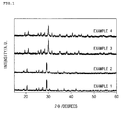
- Examples 1 to 4 of the present invention had the same crystalline or semi-crystalline structure. However, since the sizes of the transition metals were different although Examples 1 to 4 had the same structure, it may be confirmed that a slight peak shift occurred.
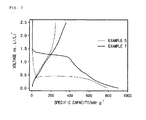
- FIG. 3 is a graph illustrating voltage curves with respect to specific capacity from charge and discharge experiments of Examples 5 and 7.
- Examples 5 and 7 had advantages in that average discharge voltages had low values ranging from 0 V to 2.5 V (vs. Li/Li+), which were very low levels among transition metal compounds, and the voltage curves were almost linear with a constant slope. Thus, it may be understood that Examples 5 and 7 may be very advantageous in terms of the prediction of residual capacity.
- a lithium secondary battery or hybrid capacitor including an anode active material of the present invention has a linear slope within a discharge voltage range of 0 V to 3 V
- the lithium secondary battery or hybrid capacitor may have a lower average voltage than the case of using a typical lithium transition metal oxide-based anode active material.
- a voltage of the battery may be increased.
- SOC state of charge
Landscapes
- Chemical & Material Sciences (AREA)
- Engineering & Computer Science (AREA)
- General Chemical & Material Sciences (AREA)
- Chemical Kinetics & Catalysis (AREA)
- Electrochemistry (AREA)
- Power Engineering (AREA)
- Inorganic Chemistry (AREA)
- Manufacturing & Machinery (AREA)
- Materials Engineering (AREA)
- Organic Chemistry (AREA)
- Microelectronics & Electronic Packaging (AREA)
- Composite Materials (AREA)
- Crystallography & Structural Chemistry (AREA)
- Battery Electrode And Active Subsutance (AREA)
- Secondary Cells (AREA)
- Electric Double-Layer Capacitors Or The Like (AREA)
- Dispersion Chemistry (AREA)
Applications Claiming Priority (2)
| Application Number | Priority Date | Filing Date | Title |
|---|---|---|---|
| KR1020130106324A KR101661798B1 (ko) | 2013-09-04 | 2013-09-04 | 전이금속-메타인산화물 음극 활물질, 이의 제조 방법, 및 이를 포함하는 리튬 이차전지 또는 하이브리드 캐패시터 |
| PCT/KR2014/008161 WO2015034230A1 (ko) | 2013-09-04 | 2014-09-01 | 전이금속-메타인산화물 음극 활물질, 이의 제조 방법, 및 이를 포함하는 리튬 이차전지 또는 하이브리드 캐패시터 |
Publications (3)
| Publication Number | Publication Date |
|---|---|
| EP2874210A1 true EP2874210A1 (de) | 2015-05-20 |
| EP2874210A4 EP2874210A4 (de) | 2015-08-12 |
| EP2874210B1 EP2874210B1 (de) | 2018-12-05 |
Family
ID=52628634
Family Applications (1)
| Application Number | Title | Priority Date | Filing Date |
|---|---|---|---|
| EP14814681.4A Active EP2874210B1 (de) | 2013-09-04 | 2014-09-01 | Übergangsmetall-metaphosphat- anodenaktivmaterial, herstellungsverfahren dafür und lithium-sekundärbatterie oder hybridkondensator damit |
Country Status (7)
| Country | Link |
|---|---|
| US (1) | US9997781B2 (de) |
| EP (1) | EP2874210B1 (de) |
| JP (1) | JP6098907B2 (de) |
| KR (1) | KR101661798B1 (de) |
| CN (1) | CN104641498B (de) |
| TW (1) | TWI509868B (de) |
| WO (1) | WO2015034230A1 (de) |
Families Citing this family (9)
| Publication number | Priority date | Publication date | Assignee | Title |
|---|---|---|---|---|
| US11271193B2 (en) * | 2017-03-13 | 2022-03-08 | University Of Houston System | Synthesis of metal metaphosphate for catalysts for oxygen evolution reactions |
| KR102253781B1 (ko) * | 2017-04-28 | 2021-05-20 | 주식회사 엘지화학 | 방전 제어 장치 및 방법 |
| CN107675206B (zh) * | 2017-09-15 | 2019-04-05 | 电子科技大学 | 氮掺杂偏磷酸镍纳米颗粒及其制备方法和应用 |
| CN107651656B (zh) * | 2017-09-15 | 2020-01-14 | 电子科技大学 | 一种Ni2P4O12纳米颗粒材料及其制备方法和应用 |
| KR102120071B1 (ko) * | 2018-09-21 | 2020-06-08 | 세종대학교산학협력단 | 코팅층을 구비하는 양극활물질 제조방법, 이를 포함하여 제조된 양극 및 이를 포함하는 나트륨이온 이차전지 |
| CN110092365B (zh) * | 2019-05-13 | 2020-09-25 | 承德莹科精细化工股份有限公司 | 一种高纯度光学玻璃添加剂偏磷酸钕的制备方法 |
| CN112614703B (zh) * | 2020-11-30 | 2022-10-14 | 上海应用技术大学 | 一种离子电容器负极材料及其制备方法和应用 |
| CN113629240B (zh) * | 2021-07-30 | 2022-07-15 | 江苏翔鹰新能源科技有限公司 | 一种单晶镍钴锰酸锂正极材料及其制备方法和应用 |
| CN114335693B (zh) * | 2021-12-28 | 2023-09-12 | 盐城工学院 | 一种高安全性铁基磷酸盐钠离子全电池及其制备方法 |
Family Cites Families (10)
| Publication number | Priority date | Publication date | Assignee | Title |
|---|---|---|---|---|
| JP3390327B2 (ja) * | 1996-12-20 | 2003-03-24 | 松下電器産業株式会社 | 非水電解質二次電池 |
| DE19906485A1 (de) * | 1999-02-17 | 2000-08-24 | Metallgesellschaft Ag | Anorganische Korrosionsschutz-Kombinationspigmente und Verfahren zu deren Herstellung |
| KR100463189B1 (ko) * | 2002-07-15 | 2004-12-23 | 삼성에스디아이 주식회사 | 리튬 이차 전지 및 그 제조방법 |
| KR100511420B1 (ko) * | 2003-07-23 | 2005-08-30 | 주식회사 엘지화학 | 신규한 리튬 코발트 메타포스페이트 및 그 제조방법 |
| CN101901900B (zh) * | 2010-07-09 | 2012-07-04 | 南开大学 | 一种锂离子电池负极用碳包覆磷酸盐复合材料的制备方法 |
| JP5391337B2 (ja) * | 2010-09-27 | 2014-01-15 | パナソニック株式会社 | リチウムイオン二次電池用正極活物質粒子、その正極活物質粒子を用いた正極およびリチウムイオン二次電池 |
| KR101462821B1 (ko) * | 2011-02-02 | 2014-11-20 | 후루카와 덴키 고교 가부시키가이샤 | 미립자 혼합물, 정극 활물질 재료, 정극, 2차전지 및 이들의 제조방법 |
| KR101485943B1 (ko) * | 2011-12-06 | 2015-01-26 | 주식회사 엘지화학 | 리튬 이차전지용 음극 활물질 및 이의 제조방법 |
| KR101368366B1 (ko) * | 2012-02-22 | 2014-03-03 | 한국기술교육대학교 산학협력단 | 리튬이차전지용 비정질 탄소계 음극활물질, 이를 포함하는 리튬이차전지용 음극 및 리튬이차전지 |
| US20130244100A1 (en) * | 2012-03-15 | 2013-09-19 | Imra America, Inc. | Iron phosphates: negative electrode materials for aqueous rechargeable sodium ion energy storage devices |
-
2013
- 2013-09-04 KR KR1020130106324A patent/KR101661798B1/ko active Active
-
2014
- 2014-09-01 JP JP2015540624A patent/JP6098907B2/ja active Active
- 2014-09-01 CN CN201480002462.5A patent/CN104641498B/zh active Active
- 2014-09-01 WO PCT/KR2014/008161 patent/WO2015034230A1/ko not_active Ceased
- 2014-09-01 EP EP14814681.4A patent/EP2874210B1/de active Active
- 2014-09-03 TW TW103130409A patent/TWI509868B/zh active
- 2014-11-13 US US14/540,321 patent/US9997781B2/en active Active
Also Published As
| Publication number | Publication date |
|---|---|
| EP2874210A4 (de) | 2015-08-12 |
| WO2015034230A1 (ko) | 2015-03-12 |
| JP6098907B2 (ja) | 2017-03-22 |
| KR101661798B1 (ko) | 2016-09-30 |
| US9997781B2 (en) | 2018-06-12 |
| CN104641498B (zh) | 2018-01-05 |
| CN104641498A (zh) | 2015-05-20 |
| TW201530878A (zh) | 2015-08-01 |
| US20150072237A1 (en) | 2015-03-12 |
| TWI509868B (zh) | 2015-11-21 |
| EP2874210B1 (de) | 2018-12-05 |
| KR20150027642A (ko) | 2015-03-12 |
| JP2016504708A (ja) | 2016-02-12 |
Similar Documents
| Publication | Publication Date | Title |
|---|---|---|
| EP2874211B1 (de) | Übergangsmetall-pyrophosphat- anodenaktivmaterial, herstellungsverfahren dafür und lithium-sekundärbatterie oder hybridkondensator damit | |
| US11362329B2 (en) | Negative electrode active particle and method for manufacturing the same | |
| US9997781B2 (en) | Transition metal-metaphosphate anode active material, method of preparing the same, and lithium secondary battery or hybrid capacitor including the anode active material | |
| EP2905832B1 (de) | Negatives aktives elektrodenmaterial für eine lithiumsekundärbatterie und verfahren zur herstellung davon | |
| KR20190093176A (ko) | 음극 활물질, 이를 포함하는 음극 및 리튬 이차전지 | |
| KR20170080104A (ko) | 양극 활물질 및 상기 양극 활물질을 채용한 양극과 리튬 전지 | |
| US10164255B2 (en) | Silicon material and negative electrode of secondary battery | |
| KR101166281B1 (ko) | 표면이 피복된 리튬티탄산화물 분말, 이를 구비한 전극, 및이차전지 | |
| EP2762448B1 (de) | Verfahren zur herstellung von siliziumoxid | |
| KR20210036869A (ko) | Li 및 Mn 기반의 플루오르화 산화물 | |
| KR101278832B1 (ko) | 표면이 피복된 리튬티탄산화물 분말, 이를 구비한 전극, 및 이차전지 | |
| US10217990B2 (en) | Silicon material and negative electrode of secondary battery |
Legal Events
| Date | Code | Title | Description |
|---|---|---|---|
| PUAI | Public reference made under article 153(3) epc to a published international application that has entered the european phase |
Free format text: ORIGINAL CODE: 0009012 |
|
| 17P | Request for examination filed |
Effective date: 20150105 |
|
| AK | Designated contracting states |
Kind code of ref document: A1 Designated state(s): AL AT BE BG CH CY CZ DE DK EE ES FI FR GB GR HR HU IE IS IT LI LT LU LV MC MK MT NL NO PL PT RO RS SE SI SK SM TR |
|
| AX | Request for extension of the european patent |
Extension state: BA ME |
|
| RA4 | Supplementary search report drawn up and despatched (corrected) |
Effective date: 20150715 |
|
| RIC1 | Information provided on ipc code assigned before grant |
Ipc: H01M 10/052 20100101ALN20150709BHEP Ipc: H01G 11/22 20130101ALN20150709BHEP Ipc: H01M 4/58 20100101AFI20150709BHEP Ipc: H01M 4/136 20100101ALI20150709BHEP Ipc: C01B 25/45 20060101ALI20150709BHEP Ipc: H01M 4/36 20060101ALI20150709BHEP Ipc: H01M 4/62 20060101ALI20150709BHEP |
|
| DAX | Request for extension of the european patent (deleted) | ||
| STAA | Information on the status of an ep patent application or granted ep patent |
Free format text: STATUS: EXAMINATION IS IN PROGRESS |
|
| 17Q | First examination report despatched |
Effective date: 20170403 |
|
| GRAP | Despatch of communication of intention to grant a patent |
Free format text: ORIGINAL CODE: EPIDOSNIGR1 |
|
| STAA | Information on the status of an ep patent application or granted ep patent |
Free format text: STATUS: GRANT OF PATENT IS INTENDED |
|
| RIC1 | Information provided on ipc code assigned before grant |
Ipc: H01M 4/58 20100101AFI20180822BHEP Ipc: H01G 11/22 20130101ALN20180822BHEP Ipc: C01B 25/45 20060101ALI20180822BHEP Ipc: C01B 25/44 20060101ALI20180822BHEP Ipc: H01M 4/136 20100101ALI20180822BHEP Ipc: H01G 11/30 20130101ALI20180822BHEP Ipc: H01M 4/36 20060101ALI20180822BHEP Ipc: H01M 10/052 20100101ALN20180822BHEP Ipc: H01M 4/62 20060101ALI20180822BHEP Ipc: H01G 11/86 20130101ALI20180822BHEP |
|
| INTG | Intention to grant announced |
Effective date: 20180913 |
|
| RIN1 | Information on inventor provided before grant (corrected) |
Inventor name: KIM, EUN KYUNG Inventor name: HONG, MIN YOUNG Inventor name: AN, SANG JO Inventor name: RYU, JI HEON Inventor name: WOO, SANG WOOK Inventor name: KIM, JE YOUNG |
|
| GRAS | Grant fee paid |
Free format text: ORIGINAL CODE: EPIDOSNIGR3 |
|
| GRAA | (expected) grant |
Free format text: ORIGINAL CODE: 0009210 |
|
| STAA | Information on the status of an ep patent application or granted ep patent |
Free format text: STATUS: THE PATENT HAS BEEN GRANTED |
|
| AK | Designated contracting states |
Kind code of ref document: B1 Designated state(s): AL AT BE BG CH CY CZ DE DK EE ES FI FR GB GR HR HU IE IS IT LI LT LU LV MC MK MT NL NO PL PT RO RS SE SI SK SM TR |
|
| REG | Reference to a national code |
Ref country code: GB Ref legal event code: FG4D |
|
| REG | Reference to a national code |
Ref country code: CH Ref legal event code: EP |
|
| REG | Reference to a national code |
Ref country code: AT Ref legal event code: REF Ref document number: 1074180 Country of ref document: AT Kind code of ref document: T Effective date: 20181215 |
|
| REG | Reference to a national code |
Ref country code: IE Ref legal event code: FG4D |
|
| REG | Reference to a national code |
Ref country code: DE Ref legal event code: R096 Ref document number: 602014037544 Country of ref document: DE |
|
| REG | Reference to a national code |
Ref country code: NL Ref legal event code: MP Effective date: 20181205 |
|
| REG | Reference to a national code |
Ref country code: AT Ref legal event code: MK05 Ref document number: 1074180 Country of ref document: AT Kind code of ref document: T Effective date: 20181205 |
|
| REG | Reference to a national code |
Ref country code: LT Ref legal event code: MG4D |
|
| PG25 | Lapsed in a contracting state [announced via postgrant information from national office to epo] |
Ref country code: HR Free format text: LAPSE BECAUSE OF FAILURE TO SUBMIT A TRANSLATION OF THE DESCRIPTION OR TO PAY THE FEE WITHIN THE PRESCRIBED TIME-LIMIT Effective date: 20181205 Ref country code: AT Free format text: LAPSE BECAUSE OF FAILURE TO SUBMIT A TRANSLATION OF THE DESCRIPTION OR TO PAY THE FEE WITHIN THE PRESCRIBED TIME-LIMIT Effective date: 20181205 Ref country code: LT Free format text: LAPSE BECAUSE OF FAILURE TO SUBMIT A TRANSLATION OF THE DESCRIPTION OR TO PAY THE FEE WITHIN THE PRESCRIBED TIME-LIMIT Effective date: 20181205 Ref country code: NO Free format text: LAPSE BECAUSE OF FAILURE TO SUBMIT A TRANSLATION OF THE DESCRIPTION OR TO PAY THE FEE WITHIN THE PRESCRIBED TIME-LIMIT Effective date: 20190305 Ref country code: LV Free format text: LAPSE BECAUSE OF FAILURE TO SUBMIT A TRANSLATION OF THE DESCRIPTION OR TO PAY THE FEE WITHIN THE PRESCRIBED TIME-LIMIT Effective date: 20181205 Ref country code: ES Free format text: LAPSE BECAUSE OF FAILURE TO SUBMIT A TRANSLATION OF THE DESCRIPTION OR TO PAY THE FEE WITHIN THE PRESCRIBED TIME-LIMIT Effective date: 20181205 Ref country code: BG Free format text: LAPSE BECAUSE OF FAILURE TO SUBMIT A TRANSLATION OF THE DESCRIPTION OR TO PAY THE FEE WITHIN THE PRESCRIBED TIME-LIMIT Effective date: 20190305 Ref country code: FI Free format text: LAPSE BECAUSE OF FAILURE TO SUBMIT A TRANSLATION OF THE DESCRIPTION OR TO PAY THE FEE WITHIN THE PRESCRIBED TIME-LIMIT Effective date: 20181205 |
|
| PG25 | Lapsed in a contracting state [announced via postgrant information from national office to epo] |
Ref country code: GR Free format text: LAPSE BECAUSE OF FAILURE TO SUBMIT A TRANSLATION OF THE DESCRIPTION OR TO PAY THE FEE WITHIN THE PRESCRIBED TIME-LIMIT Effective date: 20190306 Ref country code: RS Free format text: LAPSE BECAUSE OF FAILURE TO SUBMIT A TRANSLATION OF THE DESCRIPTION OR TO PAY THE FEE WITHIN THE PRESCRIBED TIME-LIMIT Effective date: 20181205 Ref country code: AL Free format text: LAPSE BECAUSE OF FAILURE TO SUBMIT A TRANSLATION OF THE DESCRIPTION OR TO PAY THE FEE WITHIN THE PRESCRIBED TIME-LIMIT Effective date: 20181205 Ref country code: SE Free format text: LAPSE BECAUSE OF FAILURE TO SUBMIT A TRANSLATION OF THE DESCRIPTION OR TO PAY THE FEE WITHIN THE PRESCRIBED TIME-LIMIT Effective date: 20181205 |
|
| PG25 | Lapsed in a contracting state [announced via postgrant information from national office to epo] |
Ref country code: NL Free format text: LAPSE BECAUSE OF FAILURE TO SUBMIT A TRANSLATION OF THE DESCRIPTION OR TO PAY THE FEE WITHIN THE PRESCRIBED TIME-LIMIT Effective date: 20181205 |
|
| PG25 | Lapsed in a contracting state [announced via postgrant information from national office to epo] |
Ref country code: IT Free format text: LAPSE BECAUSE OF FAILURE TO SUBMIT A TRANSLATION OF THE DESCRIPTION OR TO PAY THE FEE WITHIN THE PRESCRIBED TIME-LIMIT Effective date: 20181205 Ref country code: CZ Free format text: LAPSE BECAUSE OF FAILURE TO SUBMIT A TRANSLATION OF THE DESCRIPTION OR TO PAY THE FEE WITHIN THE PRESCRIBED TIME-LIMIT Effective date: 20181205 Ref country code: PT Free format text: LAPSE BECAUSE OF FAILURE TO SUBMIT A TRANSLATION OF THE DESCRIPTION OR TO PAY THE FEE WITHIN THE PRESCRIBED TIME-LIMIT Effective date: 20190405 Ref country code: PL Free format text: LAPSE BECAUSE OF FAILURE TO SUBMIT A TRANSLATION OF THE DESCRIPTION OR TO PAY THE FEE WITHIN THE PRESCRIBED TIME-LIMIT Effective date: 20181205 |
|
| PG25 | Lapsed in a contracting state [announced via postgrant information from national office to epo] |
Ref country code: RO Free format text: LAPSE BECAUSE OF FAILURE TO SUBMIT A TRANSLATION OF THE DESCRIPTION OR TO PAY THE FEE WITHIN THE PRESCRIBED TIME-LIMIT Effective date: 20181205 Ref country code: SK Free format text: LAPSE BECAUSE OF FAILURE TO SUBMIT A TRANSLATION OF THE DESCRIPTION OR TO PAY THE FEE WITHIN THE PRESCRIBED TIME-LIMIT Effective date: 20181205 Ref country code: EE Free format text: LAPSE BECAUSE OF FAILURE TO SUBMIT A TRANSLATION OF THE DESCRIPTION OR TO PAY THE FEE WITHIN THE PRESCRIBED TIME-LIMIT Effective date: 20181205 Ref country code: IS Free format text: LAPSE BECAUSE OF FAILURE TO SUBMIT A TRANSLATION OF THE DESCRIPTION OR TO PAY THE FEE WITHIN THE PRESCRIBED TIME-LIMIT Effective date: 20190405 Ref country code: SM Free format text: LAPSE BECAUSE OF FAILURE TO SUBMIT A TRANSLATION OF THE DESCRIPTION OR TO PAY THE FEE WITHIN THE PRESCRIBED TIME-LIMIT Effective date: 20181205 |
|
| REG | Reference to a national code |
Ref country code: DE Ref legal event code: R097 Ref document number: 602014037544 Country of ref document: DE |
|
| PLBE | No opposition filed within time limit |
Free format text: ORIGINAL CODE: 0009261 |
|
| STAA | Information on the status of an ep patent application or granted ep patent |
Free format text: STATUS: NO OPPOSITION FILED WITHIN TIME LIMIT |
|
| PG25 | Lapsed in a contracting state [announced via postgrant information from national office to epo] |
Ref country code: SI Free format text: LAPSE BECAUSE OF FAILURE TO SUBMIT A TRANSLATION OF THE DESCRIPTION OR TO PAY THE FEE WITHIN THE PRESCRIBED TIME-LIMIT Effective date: 20181205 Ref country code: DK Free format text: LAPSE BECAUSE OF FAILURE TO SUBMIT A TRANSLATION OF THE DESCRIPTION OR TO PAY THE FEE WITHIN THE PRESCRIBED TIME-LIMIT Effective date: 20181205 |
|
| 26N | No opposition filed |
Effective date: 20190906 |
|
| PG25 | Lapsed in a contracting state [announced via postgrant information from national office to epo] |
Ref country code: TR Free format text: LAPSE BECAUSE OF FAILURE TO SUBMIT A TRANSLATION OF THE DESCRIPTION OR TO PAY THE FEE WITHIN THE PRESCRIBED TIME-LIMIT Effective date: 20181205 |
|
| PG25 | Lapsed in a contracting state [announced via postgrant information from national office to epo] |
Ref country code: MC Free format text: LAPSE BECAUSE OF FAILURE TO SUBMIT A TRANSLATION OF THE DESCRIPTION OR TO PAY THE FEE WITHIN THE PRESCRIBED TIME-LIMIT Effective date: 20181205 |
|
| REG | Reference to a national code |
Ref country code: CH Ref legal event code: PL |
|
| PG25 | Lapsed in a contracting state [announced via postgrant information from national office to epo] |
Ref country code: LI Free format text: LAPSE BECAUSE OF NON-PAYMENT OF DUE FEES Effective date: 20190930 Ref country code: IE Free format text: LAPSE BECAUSE OF NON-PAYMENT OF DUE FEES Effective date: 20190901 Ref country code: CH Free format text: LAPSE BECAUSE OF NON-PAYMENT OF DUE FEES Effective date: 20190930 Ref country code: LU Free format text: LAPSE BECAUSE OF NON-PAYMENT OF DUE FEES Effective date: 20190901 |
|
| REG | Reference to a national code |
Ref country code: BE Ref legal event code: MM Effective date: 20190930 |
|
| PG25 | Lapsed in a contracting state [announced via postgrant information from national office to epo] |
Ref country code: BE Free format text: LAPSE BECAUSE OF NON-PAYMENT OF DUE FEES Effective date: 20190930 |
|
| PG25 | Lapsed in a contracting state [announced via postgrant information from national office to epo] |
Ref country code: CY Free format text: LAPSE BECAUSE OF FAILURE TO SUBMIT A TRANSLATION OF THE DESCRIPTION OR TO PAY THE FEE WITHIN THE PRESCRIBED TIME-LIMIT Effective date: 20181205 |
|
| PG25 | Lapsed in a contracting state [announced via postgrant information from national office to epo] |
Ref country code: MT Free format text: LAPSE BECAUSE OF FAILURE TO SUBMIT A TRANSLATION OF THE DESCRIPTION OR TO PAY THE FEE WITHIN THE PRESCRIBED TIME-LIMIT Effective date: 20181205 Ref country code: HU Free format text: LAPSE BECAUSE OF FAILURE TO SUBMIT A TRANSLATION OF THE DESCRIPTION OR TO PAY THE FEE WITHIN THE PRESCRIBED TIME-LIMIT; INVALID AB INITIO Effective date: 20140901 |
|
| PG25 | Lapsed in a contracting state [announced via postgrant information from national office to epo] |
Ref country code: MK Free format text: LAPSE BECAUSE OF FAILURE TO SUBMIT A TRANSLATION OF THE DESCRIPTION OR TO PAY THE FEE WITHIN THE PRESCRIBED TIME-LIMIT Effective date: 20181205 |
|
| P01 | Opt-out of the competence of the unified patent court (upc) registered |
Effective date: 20230408 |
|
| REG | Reference to a national code |
Ref country code: DE Ref legal event code: R081 Ref document number: 602014037544 Country of ref document: DE Owner name: LG ENERGY SOLUTION, LTD., KR Free format text: FORMER OWNER: LG CHEM. LTD., SEOUL, KR |
|
| REG | Reference to a national code |
Ref country code: GB Ref legal event code: 732E Free format text: REGISTERED BETWEEN 20230824 AND 20230831 |
|
| PGFP | Annual fee paid to national office [announced via postgrant information from national office to epo] |
Ref country code: DE Payment date: 20250820 Year of fee payment: 12 |
|
| PGFP | Annual fee paid to national office [announced via postgrant information from national office to epo] |
Ref country code: GB Payment date: 20250820 Year of fee payment: 12 |
|
| PGFP | Annual fee paid to national office [announced via postgrant information from national office to epo] |
Ref country code: FR Payment date: 20250821 Year of fee payment: 12 |