EP2876133A2 - Faserhaltige Prepregs und Verfahren und Systeme zur Herstellung - Google Patents
Faserhaltige Prepregs und Verfahren und Systeme zur Herstellung Download PDFInfo
- Publication number
- EP2876133A2 EP2876133A2 EP14193602.1A EP14193602A EP2876133A2 EP 2876133 A2 EP2876133 A2 EP 2876133A2 EP 14193602 A EP14193602 A EP 14193602A EP 2876133 A2 EP2876133 A2 EP 2876133A2
- Authority
- EP
- European Patent Office
- Prior art keywords
- fiber
- fibers
- resin composition
- reactive resin
- polymerization
- Prior art date
- Legal status (The legal status is an assumption and is not a legal conclusion. Google has not performed a legal analysis and makes no representation as to the accuracy of the status listed.)
- Granted
Links
Images




Classifications
-
- B—PERFORMING OPERATIONS; TRANSPORTING
- B29—WORKING OF PLASTICS; WORKING OF SUBSTANCES IN A PLASTIC STATE IN GENERAL
- B29B—PREPARATION OR PRETREATMENT OF THE MATERIAL TO BE SHAPED; MAKING GRANULES OR PREFORMS; RECOVERY OF PLASTICS OR OTHER CONSTITUENTS OF WASTE MATERIAL CONTAINING PLASTICS
- B29B15/00—Pretreatment of the material to be shaped, not covered by groups B29B7/00 - B29B13/00
- B29B15/08—Pretreatment of the material to be shaped, not covered by groups B29B7/00 - B29B13/00 of reinforcements or fillers
- B29B15/10—Coating or impregnating independently of the moulding or shaping step
- B29B15/12—Coating or impregnating independently of the moulding or shaping step of reinforcements of indefinite length
- B29B15/122—Coating or impregnating independently of the moulding or shaping step of reinforcements of indefinite length with a matrix in liquid form, e.g. as melt, solution or latex
-
- B—PERFORMING OPERATIONS; TRANSPORTING
- B29—WORKING OF PLASTICS; WORKING OF SUBSTANCES IN A PLASTIC STATE IN GENERAL
- B29C—SHAPING OR JOINING OF PLASTICS; SHAPING OF MATERIAL IN A PLASTIC STATE, NOT OTHERWISE PROVIDED FOR; AFTER-TREATMENT OF THE SHAPED PRODUCTS, e.g. REPAIRING
- B29C48/00—Extrusion moulding, i.e. expressing the moulding material through a die or nozzle which imparts the desired form; Apparatus therefor
- B29C48/25—Component parts, details or accessories; Auxiliary operations
- B29C48/285—Feeding the extrusion material to the extruder
-
- B—PERFORMING OPERATIONS; TRANSPORTING
- B29—WORKING OF PLASTICS; WORKING OF SUBSTANCES IN A PLASTIC STATE IN GENERAL
- B29C—SHAPING OR JOINING OF PLASTICS; SHAPING OF MATERIAL IN A PLASTIC STATE, NOT OTHERWISE PROVIDED FOR; AFTER-TREATMENT OF THE SHAPED PRODUCTS, e.g. REPAIRING
- B29C70/00—Shaping composites, i.e. plastics material comprising reinforcements, fillers or preformed parts, e.g. inserts
- B29C70/04—Shaping composites, i.e. plastics material comprising reinforcements, fillers or preformed parts, e.g. inserts comprising reinforcements only, e.g. self-reinforcing plastics
- B29C70/28—Shaping operations therefor
- B29C70/40—Shaping or impregnating by compression not applied
- B29C70/50—Shaping or impregnating by compression not applied for producing articles of indefinite length, e.g. prepregs, sheet moulding compounds [SMC] or cross moulding compounds [XMC]
-
- B—PERFORMING OPERATIONS; TRANSPORTING
- B29—WORKING OF PLASTICS; WORKING OF SUBSTANCES IN A PLASTIC STATE IN GENERAL
- B29C—SHAPING OR JOINING OF PLASTICS; SHAPING OF MATERIAL IN A PLASTIC STATE, NOT OTHERWISE PROVIDED FOR; AFTER-TREATMENT OF THE SHAPED PRODUCTS, e.g. REPAIRING
- B29C70/00—Shaping composites, i.e. plastics material comprising reinforcements, fillers or preformed parts, e.g. inserts
- B29C70/04—Shaping composites, i.e. plastics material comprising reinforcements, fillers or preformed parts, e.g. inserts comprising reinforcements only, e.g. self-reinforcing plastics
- B29C70/28—Shaping operations therefor
- B29C70/40—Shaping or impregnating by compression not applied
- B29C70/50—Shaping or impregnating by compression not applied for producing articles of indefinite length, e.g. prepregs, sheet moulding compounds [SMC] or cross moulding compounds [XMC]
- B29C70/52—Pultrusion, i.e. forming and compressing by continuously pulling through a die
-
- B—PERFORMING OPERATIONS; TRANSPORTING
- B32—LAYERED PRODUCTS
- B32B—LAYERED PRODUCTS, i.e. PRODUCTS BUILT-UP OF STRATA OF FLAT OR NON-FLAT, e.g. CELLULAR OR HONEYCOMB, FORM
- B32B5/00—Layered products characterised by the non- homogeneity or physical structure, i.e. comprising a fibrous, filamentary, particulate or foam layer; Layered products characterised by having a layer differing constitutionally or physically in different parts
- B32B5/22—Layered products characterised by the non- homogeneity or physical structure, i.e. comprising a fibrous, filamentary, particulate or foam layer; Layered products characterised by having a layer differing constitutionally or physically in different parts characterised by the presence of two or more layers which are next to each other and are fibrous, filamentary, formed of particles or foamed
- B32B5/32—Layered products characterised by the non- homogeneity or physical structure, i.e. comprising a fibrous, filamentary, particulate or foam layer; Layered products characterised by having a layer differing constitutionally or physically in different parts characterised by the presence of two or more layers which are next to each other and are fibrous, filamentary, formed of particles or foamed at least two layers being foamed and next to each other
-
- C—CHEMISTRY; METALLURGY
- C08—ORGANIC MACROMOLECULAR COMPOUNDS; THEIR PREPARATION OR CHEMICAL WORKING-UP; COMPOSITIONS BASED THEREON
- C08J—WORKING-UP; GENERAL PROCESSES OF COMPOUNDING; AFTER-TREATMENT NOT COVERED BY SUBCLASSES C08B, C08C, C08F, C08G or C08H
- C08J5/00—Manufacture of articles or shaped materials containing macromolecular substances
- C08J5/04—Reinforcing macromolecular compounds with loose or coherent fibrous material
-
- C—CHEMISTRY; METALLURGY
- C08—ORGANIC MACROMOLECULAR COMPOUNDS; THEIR PREPARATION OR CHEMICAL WORKING-UP; COMPOSITIONS BASED THEREON
- C08J—WORKING-UP; GENERAL PROCESSES OF COMPOUNDING; AFTER-TREATMENT NOT COVERED BY SUBCLASSES C08B, C08C, C08F, C08G or C08H
- C08J5/00—Manufacture of articles or shaped materials containing macromolecular substances
- C08J5/04—Reinforcing macromolecular compounds with loose or coherent fibrous material
- C08J5/06—Reinforcing macromolecular compounds with loose or coherent fibrous material using pretreated fibrous materials
-
- C—CHEMISTRY; METALLURGY
- C08—ORGANIC MACROMOLECULAR COMPOUNDS; THEIR PREPARATION OR CHEMICAL WORKING-UP; COMPOSITIONS BASED THEREON
- C08J—WORKING-UP; GENERAL PROCESSES OF COMPOUNDING; AFTER-TREATMENT NOT COVERED BY SUBCLASSES C08B, C08C, C08F, C08G or C08H
- C08J5/00—Manufacture of articles or shaped materials containing macromolecular substances
- C08J5/24—Impregnating materials with prepolymers which can be polymerised in situ, e.g. manufacture of prepregs
- C08J5/248—Impregnating materials with prepolymers which can be polymerised in situ, e.g. manufacture of prepregs using pre-treated fibres
-
- B—PERFORMING OPERATIONS; TRANSPORTING
- B29—WORKING OF PLASTICS; WORKING OF SUBSTANCES IN A PLASTIC STATE IN GENERAL
- B29L—INDEXING SCHEME ASSOCIATED WITH SUBCLASS B29C, RELATING TO PARTICULAR ARTICLES
- B29L2009/00—Layered products
-
- B—PERFORMING OPERATIONS; TRANSPORTING
- B32—LAYERED PRODUCTS
- B32B—LAYERED PRODUCTS, i.e. PRODUCTS BUILT-UP OF STRATA OF FLAT OR NON-FLAT, e.g. CELLULAR OR HONEYCOMB, FORM
- B32B2262/00—Composition or structural features of fibres which form a fibrous or filamentary layer or are present as additives
- B32B2262/02—Synthetic macromolecular fibres
-
- B—PERFORMING OPERATIONS; TRANSPORTING
- B32—LAYERED PRODUCTS
- B32B—LAYERED PRODUCTS, i.e. PRODUCTS BUILT-UP OF STRATA OF FLAT OR NON-FLAT, e.g. CELLULAR OR HONEYCOMB, FORM
- B32B2262/00—Composition or structural features of fibres which form a fibrous or filamentary layer or are present as additives
- B32B2262/10—Inorganic fibres
-
- B—PERFORMING OPERATIONS; TRANSPORTING
- B32—LAYERED PRODUCTS
- B32B—LAYERED PRODUCTS, i.e. PRODUCTS BUILT-UP OF STRATA OF FLAT OR NON-FLAT, e.g. CELLULAR OR HONEYCOMB, FORM
- B32B2262/00—Composition or structural features of fibres which form a fibrous or filamentary layer or are present as additives
- B32B2262/10—Inorganic fibres
- B32B2262/101—Glass fibres
-
- B—PERFORMING OPERATIONS; TRANSPORTING
- B32—LAYERED PRODUCTS
- B32B—LAYERED PRODUCTS, i.e. PRODUCTS BUILT-UP OF STRATA OF FLAT OR NON-FLAT, e.g. CELLULAR OR HONEYCOMB, FORM
- B32B2262/00—Composition or structural features of fibres which form a fibrous or filamentary layer or are present as additives
- B32B2262/10—Inorganic fibres
- B32B2262/103—Metal fibres
-
- B—PERFORMING OPERATIONS; TRANSPORTING
- B32—LAYERED PRODUCTS
- B32B—LAYERED PRODUCTS, i.e. PRODUCTS BUILT-UP OF STRATA OF FLAT OR NON-FLAT, e.g. CELLULAR OR HONEYCOMB, FORM
- B32B2262/00—Composition or structural features of fibres which form a fibrous or filamentary layer or are present as additives
- B32B2262/10—Inorganic fibres
- B32B2262/106—Carbon fibres, e.g. graphite fibres
-
- B—PERFORMING OPERATIONS; TRANSPORTING
- B32—LAYERED PRODUCTS
- B32B—LAYERED PRODUCTS, i.e. PRODUCTS BUILT-UP OF STRATA OF FLAT OR NON-FLAT, e.g. CELLULAR OR HONEYCOMB, FORM
- B32B2305/00—Condition, form or state of the layers or laminate
- B32B2305/07—Parts immersed or impregnated in a matrix
- B32B2305/076—Prepregs
-
- C—CHEMISTRY; METALLURGY
- C08—ORGANIC MACROMOLECULAR COMPOUNDS; THEIR PREPARATION OR CHEMICAL WORKING-UP; COMPOSITIONS BASED THEREON
- C08J—WORKING-UP; GENERAL PROCESSES OF COMPOUNDING; AFTER-TREATMENT NOT COVERED BY SUBCLASSES C08B, C08C, C08F, C08G or C08H
- C08J2367/00—Characterised by the use of polyesters obtained by reactions forming a carboxylic ester link in the main chain; Derivatives of such polymers
- C08J2367/02—Polyesters derived from dicarboxylic acids and dihydroxy compounds
- C08J2367/03—Polyesters derived from dicarboxylic acids and dihydroxy compounds the dicarboxylic acids and dihydroxy compounds having the hydroxy and the carboxyl groups directly linked to aromatic rings
-
- C—CHEMISTRY; METALLURGY
- C08—ORGANIC MACROMOLECULAR COMPOUNDS; THEIR PREPARATION OR CHEMICAL WORKING-UP; COMPOSITIONS BASED THEREON
- C08J—WORKING-UP; GENERAL PROCESSES OF COMPOUNDING; AFTER-TREATMENT NOT COVERED BY SUBCLASSES C08B, C08C, C08F, C08G or C08H
- C08J2377/00—Characterised by the use of polyamides obtained by reactions forming a carboxylic amide link in the main chain; Derivatives of such polymers
- C08J2377/02—Polyamides derived from omega-amino carboxylic acids or from lactams thereof
Definitions
- Conventional methods of making fiber-reinforced composites include bringing together a plurality of fibers with a resin composition and shaping the amalgam of fibers and resin composition into the final composite article.
- the fibers may include glass fibers that are organized into a woven pattern or randomly assembled into a nonwoven collection or mat.
- the resin composition applied to the fibers may be a powder, a suspension in a liquid medium, or a melt of thermoplastic polymer.
- liquid resin compositions there are also challenges applying liquid resin compositions to fibers. If the liquid resin composition is a melt of thermoplastic polymer, it often has a viscosity significantly higher than water. A high viscosity melt makes the resin material difficult to impregnate into the bulk of the fibers. Increasing the temperature of the melt to reduce its viscosity can cause unwanted reactions or decomposition in the resin material, making this viscosity-reduction technique of limited value. Another technique increases the pressure on the amalgam using a double belt press in order to drive the high-viscosity melt into the fibers. However, this technique is prone to damaging and distorting the fibers, especially fibers that have been fashioned into a woven fabric.
- the resin material can be mixed or dissolved in a solvent to reduce its viscosity and make it easier to wet the fibers.
- a solvent e.g., water
- Similar problems can occur for resin compositions made of a suspension of particles in a liquid carrier medium such as water.
- additional steps are often needed to remove the solvent from the amalgam.
- the present application includes the making and use of prepregs that have a resin material dispersed in a plurality of fibers.
- the prepregs may be used in fiber-containing composite articles, and reduce or eliminate the number of time-consuming process steps needed to combine resin compositions with the fibers.
- the reactive fibers may include one or more agents that facilitate the polymerization of the reactive resin composition and/or bond the polymerized resin to the fibers.
- the reactive resin composition may include monomers and/or oligomers having a low melt viscosity before they are polymerized. After the reactive fibers and reactive resin composition are combined, they may be cured to polymerize the resin and form the fiber-reinforced prepreg.
- the polymerized prepregs may be incorporated into a fiber-reinforced composite article, where the prepregs may be heated, pressed or otherwise processed to make the article.
- the fiber-reinforced prepregs may include sheets, particles (e.g., pellets), and tapes of glass fibers held together by the resin matrix.
- the prepregs may be shaped, stacked, assembled, incorporated into a mold, or otherwise processed to form a fiber-reinforced composite article. Using the prepregs may eliminate time-consuming process steps for applying and dispersing resin materials through the fibers during the formation of the fiber-reinforced composite article.
- Embodiments may include methods of making a fiber-containing prepreg.
- the methods may include the steps of providing a plurality of fibers, and applying a reactive resin composition to the plurality of fibers to make a mixture of the plurality of fibers and the resin composition.
- the reactive resin composition may include at least one of monomers and oligomers capable of polymerizing into a polymerized resin matrix.
- the mixture may be heated to a polymerization temperature where the monomers, oligomers, or both polymerize to form a fiber-resin amalgam that includes the polymerized resin matrix.
- the fiber-resin amalgam may be formed into the fiber-containing prepreg.
- Embodiments may further include methods of forming a fiber-reinforced composite article.
- the methods may include providing a plurality of fibers, and applying a reactive resin composition to the fibers in order to make a mixture of the fibers and the resin composition.
- the reactive resin composition may include monomers and/or oligomers capable of polymerizing into a polymerized resin matrix.
- the methods may further include heating the mixture to a polymerization temperature in order to polymerize monomers and/or oligomers and form a fiber-resin amalgam and includes the polymerized resin matrix.
- the fiber-resin amalgam may be formed into at least one fiber-containing prepreg, and the prepreg may be integrated into the fiber-reinforced composite.
- Embodiments may still further include fiber-containing prepregs.
- the prepregs may include a plurality of fibers, and a polymerized resin matrix.
- the polymerized resin matrix is formed by applying a reactive resin composition to the plurality of fibers, and polymerizing the reactive resin composition into the polymerized resin matrix.
- the reactive resin composition may include monomers and/or oligomers capable of polymerizing into the polymerized resin matrix
- Embodiments may yet further include fiber-reinforced composite articles made with the fiber-containing prepregs. At least a portion of the articles include fibers held together in a resin matrix that is supplied by the fiber-containing prepregs.
- the prepregs themselves include a plurality of fibers and a polymerized resin matrix.
- Embodiments may also include methods of making a fiber-containing prepreg.
- the method may include drawing unsized fibers from a batch of molten glass.
- the method may also include applying a sizing composition to the unsized fibers to form a plurality of sized fibers, where the sizing composition includes a first polymerization agent for polymerizing caprolactam.
- the method may further include weaving the plurality of sized fibers into a fabric.
- Another step may include melting a reactive resin composition to form a melted reactive resin composition, where the reactive resin composition may include caprolactam. The melted reactive resin composition may be applied to the fabric.
- the method may further include heating the fabric and the melted reactive resin composition to a polymerization temperature, where the caprolactam polymerizes to form a fiber-resin amalgam including a polyamide. Another step may be to form the fiber-resin amalgam into the fiber-containing prepreg.
- Embodiments may further include a method of making a fiber-containing prepreg.
- the method may include applying a reactive resin powder onto a woven fabric.
- the reactive resin powder may include caprolactam.
- the woven fabric may include fibers that have been treated with a sizing composition.
- the sizing composition may include a polymerization agent for polymerizing caprolactam.
- the method may also include heating the reactive resin powder to a polymerization temperature, where, for instance, the caprolactam polymerizes to form a fiber-resin amalgam.
- the fiber-resin amalgam may include a polyamide.
- Another step may include forming the fiber-resin amalgam into the fiber-containing prepreg.
- Embodiments may include a method of making a fiber-reinforced composite as well.
- the method may include drawing an unsized fiber from a batch of molten glass.
- Sizing composition may be applied to the unsized fiber, where the sizing composition may include at least one polymerization agent for polymerizing caprolactam.
- a reactive resin composition may be applied to the sized fiber.
- the reactive resin composition may, for example, include caprolactam.
- the reactive resin composition may be heated to a polymerization temperature. If the reactive resin composition includes caprolactam, the caprolactam may polymerize to form a fiber-resin amalgam including a polyamide.
- the present application includes methods of making prepregs having a polymerized resin matrix made from a reactive resin composition that includes monomers and/or oligomers that can polymerize to form the resin matrix.
- exemplary prepregs may include a plurality woven or nonwoven glass fibers combined with the reactive resin composition that may include a polyalkylene terephthalate precursor such as cyclic butylene terephthalate (CBT), or a polyamide precursor such as caprolactam.
- the plurality of fibers may include reactive glass fibers that contain a polymerization agent to facilitate the polymerization of the reactive resin composition.
- the polymerization agent may include a coupling moiety that covalently bonds the polymerization agent to the glass fiber, and an initiator moiety that initiates the polymerization of the reactive resin composition.
- exemplary prepregs may include sheets that either lay flat or get wound into a cylindrical roll for packaging and transport, and particles (e.g., pellets) that are packaged and shipped as fiber-reinforced thermoplastic starting materials to be cut, shaped, pressed, molded, etc., into a fiber-reinforced composite article.
- Fig. 1 is a flowchart showing an exemplary method 100 of making the fiber-containing prepregs.
- the method 100 may include providing a plurality of fibers 102 that become the fiber component of the prepreg.
- a reactive resin composition may be applied to the plurality of fibers 104.
- the reactive resin composition may be heated to a melting temperature so that it can be applied as a liquid to the plurality of fibers.
- the melting temperature may be below a polymerization temperature for the reactive resin composition, so that the composition may be applied in a low-viscosity, unpolymerized state that makes it easier to wet and impregnate the plurality of fibers.
- the reactive resin composition When the reactive resin composition is added to the plurality of fibers, they form a mixture that may be heated to a polymerization temperature for the monomers and/or oligomers 106. Polymerizing the resin composition forms a fiber-resin amalgam with the plurality of fibers, and the amalgam may be formed into the fiber-containing prepreg 108.
- the fiber-resin amalgam may be cooled from the polymerization temperature to a solidification temperature where the resin composition solidifies into the polymerized resin matrix.
- the solid amalgam of fibers and the polymerized resin matrix may then be cut, chopped, crushed, comminuted, etc., into the fiber-containing prepreg. Additional details of the exemplary method 100 are provided below.
- the fibers may be one or more types of fibers chosen from glass fibers, inorganic fibers, carbon fibers, metal fibers, organic polymer fibers, and mineral fibers, among other kinds of fibers.
- Exemplary glass fibers may include "E-glass', "A-glass”, “C-glass”, “S-glass”, “ECR-glass” (corrosion resistant glass), "T-glass”, and fluorine and/or boron-free derivatives thereof.
- Exemplary inorganic fibers may include aluminum oxide, silicon carbide, silicon nitride, silicon carbide, and basalt fibers, among others.
- Exemplary carbon fibers may include graphite, semi-crystalline carbon, and carbon nano tubes, among other types of carbon fibers.
- Exemplary metal fibers may include aluminum, steel, and tungsten, among other types of metal fibers.
- Exemplary organic polymer fibers may include poly aramid fibers, polyester fibers, and polyamide fibers, among other types of organic polymer fibers.
- the fiber length may range from short-to-intermediate chopped fibers (1 to 100 mm in length) to long fibers, including continuous fibers, rovings, and wound fibers, among others.
- the plurality of fibers may have an orderly arrangement, such as a woven fiber mat, or may have a non-ordered arrangement such as a nonwoven mat.
- the fibers may be arranged as a mono-axial and/or multi-axial, woven and/or non-woven, continuous and/or chopped strand mat.
- the mats may have multiple sections with different weave styles, as well as combinations of woven and non-woven sections.
- the mats may have regions where fibers are incorporated, for example to allow better wet out and resin penetration.
- the plurality of fibers may be treated with a sizing composition that can enhance the fibers' physical characteristics in a number of ways including increased hardness, increased mechanical strength, greater wettability, and increased adhesion between the fibers and resin.
- the sizing composition may also enhance the chemical reactivity of the fibers by providing them with reactive agents that initiate and/or promote the polymerization of the resin composition that come in contact with the "reactive" fibers.
- the reactive agents may include coupler-initiator compounds that include a silicon-containing moiety that forms a covalent bond with an exposed surface of the glass fiber, and an initiator moiety that initiates a polymerization reaction in the resin composition that comes in contact with the coupler-initiator compound bound to the glass fiber.
- this initiator moiety is a caprolactam blocked isocyanate moiety that initiates a ring-opening polymerization reaction of caprolactam when the reactive fibers come in contact with caprolactam monomers in the resin composition.
- exemplary reactive glass fibers are described in co-assigned U.S. Patent App. Nos. 13/335,690 ; 13/335,761 ; 13/335,793 ; and 13/335,813 , all filed December 22, 2011, and U.S. Pat. App. No. 13/788,857, filed March 7, 2013 . The entire contents of all the applications are herein incorporated by reference for all purposes.
- a polymerization agent may be found exclusively in the reactive fibers, or may be shared between the fibers and the reactive resin composition. Conversely, a polymerization agent may be found exclusively in the reactive resin composition while not being present on the reactive fibers. When multiple polymerization agents are used, some may be present exclusively on the reactive fibers while others are present exclusively in the reactive resin composition. In additional examples, all of the polymerization agents may be shared between the reactive fibers and reactive resin composition.
- the method 100 may include applying a reactive resin composition to the plurality of fibers 104.
- the reactive resin composition may include monomers and/or oligomers capable of polymerizing into a polymerized resin matrix that binds the plurality of fibers.
- Exemplary reactive resin compositions may include caprolactam.
- Caprolactam is a cyclic amide of caproic acid with an empirical formula (CH 2 ) 5 C(O)NH, which may be represented by the structural formula:
- Caprolactam has a low melting point of approximately 68°C and a melted viscosity (4-8 cP) that is close to water, making it well suited for wetting and impregnating glass fibers.
- the caprolactam-containing reactive resin composition may be introduced to the plurality of fibers as a liquid melt, but may also be introduced as a dry powder that is subsequently melted and polymerized around the fibers.
- Caprolactam-containing reactive resin compositions may also include polymerization agents such as a caprolactam polymerization catalyst.
- exemplary catalysts may include a salt of a lactam, and the salt may be an alkali metal salt, an alkali-earth metal salt, and/or a Grignard salt of the caprolactam.
- the polymerization catalyst may be an alkali metal salt of caprolactam, such as sodium caprolactam.
- the polymerization catalyst may be a Grignard salt of the caprolactam, such as a magnesium bromide salt of the caprolactam.
- polymerization agents may also be present on the fibers, and in some instances a polymerization agent may be present in both the reactive resin composition and on the fibers. Incorporating a polymerization agent on the reactive glass fibers can reduce or eliminate its presence in the reactive resin composition, which may increase the pot-life of the reactive resin composition prior to being applied to the fibers.
- Exemplary reactive resin compositions may include oligomers of a cyclic alkylene terephthalate, such as cyclic butylene terephthalate (CBT).
- CBT cyclic butylene terephthalate
- CBT may include additional butyl and/or terephthalate groups incorporated into the ring. It should also be appreciated that some exemplary CBT may have other moieties coupled to the CBT ring. CBT may comprise a plurality of dimers, trimers, tetramers, etc., of butylene terephthalate.
- CBT resins are typically solids at room temperature (e.g., about 20°C), and begin to melt at around 120°C. At around 160°C, CBTs are generally fully melted with a liquid viscosity of about 150 centipoise (cP). As the molten CBTs are heated further, the viscosity may continue to drop, and in some instances may reach about 30 cP at about 190°C.
- the CBT monomers and/or oligomers may be selected to have a melting temperature range of, for example, 120-190°C.
- CBT-containing reactive resin compositions may be introduced to the plurality of fibers as a melt or a dry powder of CBT particles.
- the reactive resin composition may include additional compounds such as polymerization catalysts, polymerization promoters, colorants, flame retardants, ultraviolet stabilizers, and fillers including inorganic particles and carbon nanotubes, among other additional compounds.
- the polymerization catalyst is selected to drive the polymerization of these types of macrocyclic oligoesters.
- Exemplary polymerization catalysts may include organometallic compounds such as organo-tin compounds and/or organo-titanate compounds.
- One specific polymerization catalyst for the CBT monomers and oligomers may be butyltin chloride dihydroxide.
- the CBT-containing reactive resin composition may also include a polymerization promoter that accelerates the polymerization rate of the monomers and/or oligomers.
- the polymerization promoter may by an alcohol and/or epoxide compound.
- Exemplary alcohols may include one or more hydroxyl groups, such as mono-alcohols (e.g., butanol), diols (e.g., ethylene glycol, 2-ethyl-1,3-hexanediol, bis(4-hydroxybutyl)terephthalate), triols, and other polyols.
- Exemplary epoxides may include one or more epoxide groups such as monoepoxide, diepoxide, and higher epoxides, such as bisphenol A diglycidylether. They may also include polyol and polyepoxides, such as poly(ethylene glycol).
- the reactive resin compositions may include a single type of monomer and/or oligomer such as caprolactam or CBT, or alternatively may include two or more types of monomers and/or oligomers.
- the reactive resin composition may include both caprolactam and CBT.
- the combination of monomers/oligomers may be selected to form a melt suspension of higher melting point monomers/oligomers in a liquid medium made from a lower melting point monomer/oligomer.
- a combination of caprolactam and CBT may be selected with CBT monomer/oligomers having melting points significantly above the melting point of caprolactam. When this reactive resin combination is heated above the melting point of the caprolactam it forms a liquid medium in which the CBT particles are suspended.
- this reactive resin suspension on a glass fiber substrate can create a inhomogeneous distribution of the two types of monomers/oligomers in the resin-fiber mixture. This can be beneficial for prepreg designs where a higher resin density is desired on or near the surface of the prepreg.
- Additional reactive resin compositions include combinations of first and second resin systems having different polymerization temperatures. This may allow the formation of a semi-reactive prepreg that contains a polymerized resin matrix of the first resin system having a lower polymerization temperature, while also containing unpolymerized monomers/oligomers of the second resin system having a higher polymerization temperature.
- a reactive resin combination of caprolactam and CBT may be selected such that the CBT has a higher polymerization temperature than the caprolactam.
- a reactive resin combination can be formulated of two different types of cyclic alkylene terephthalates and/or a bimodal molecular weight distribution of CBT oligomers having different polymerization temperatures.
- a bimodal or multi-modal distribution of oligomer/polymer melting points in the prepreg can be advantageous to the final molded product that incorporates the prepreg.
- the low molecular weight (low melting temperature) component of the prepreg may melt and flow easily in the interstitial spaces between the plurality of fibers, while the high molecular weight (high melting temperature) component(s) may hold tighter to the fibers preventing an inhomogeneous distribution of resin across the fiber-reinforced article.
- the reactive resin composition may be added to the plurality of fibers using a variety of application techniques depending on whether the reactive resin composition is a melt or powder.
- the resin composition when the resin composition is a melt of monomers and/or oligomers, they may be applied to the fibers by spraying, curtain coating, kiss rolling, doctor blade coating, sheet die coating, and dip and squeeze coating, among other techniques.
- the resin composition is a dry powder, techniques for applying the powders to the plurality of fibers may include fluidized bed applications, powder scattering, and powder spraying, among others.
- the fiber-resin mixture may be heated to a polymerization temperature at which the monomers and/or oligomers start to polymerize.
- a polymerization temperature may be about 120°C or more (e.g., about 120°C to about 220°).
- a reactive resin composition that includes CBT may have a more variable threshold polymerization temperature depending on the CBT oligomers present. Typically, threshold polymerization temperature for reactive resin compositions including CBT range from about 170-190°C.
- an upper limit on the polymerization temperature for the monomers and/or oligomers may be the melting temperature of the polymer.
- a reactive resin composition that includes caprolactam may have a upper limit of a polymerization temperature that is the melting temperature of the PA-6 polymer formed by the caprolactam (i.e., ⁇ 220°C).
- a reactive resin composition that includes CBT may have an upper limit of a polymerization temperature that is the melting temperature of the PBT polymers it forms (e.g., about 225°C).
- the heating temperature of the resin-fiber mixture may be chosen to be above a threshold polymerization temperature of one type of monomer/oligomer but below a threshold polymerization temperature of the other type of monomer/oligomer.
- a reactive resin composition that includes both caprolactam and CBT monomers and/or oligomers may be heated to 120-170°C, which may polymerize the caprolactam to PA-6 without significantly polymerizing the CBT to PBT.
- the resulting fiber-resin amalgam will include a polymerized resin matrix of PA-6 combined with a polymerizable resin of CBT.
- the fiber-resin amalgam may be processed into a reactive prepreg that includes a polymerized resin matrix of PA-6 and pre-polymerized CBT.
- the reactive prepreg may be incorporated into a fiber-reinforced article, where the processing conditions may include polymerizing the CBT into PBT.
- the heat curing of the monomers and/or oligomers form a fiber-resin amalgam of the plurality of fibers and the polymerized resin matrix.
- the polymerized resin matrix may be close to or above the polymer melting temperature, and the fibers and matrix may be blended, pressed, and/or extruded into the rough shape of the fiber-containing prepreg.
- the fiber-resin amalgam may be cooled below the melting temperature of the polymerized resin matrix causing the amalgam to solidify.
- the solidification of the fiber-resin amalgam does not necessarily create an inflexible and brittle prepreg.
- the polymerized resin matrix may be selected to form a flexible layer of the prepreg material that can be flexed or bent without cracking, fracturing, or flaking.
- Fig. 2 is a flowchart showing an exemplary method 200 of making the fiber-reinforced composite articles.
- the method 200 may include providing a plurality of fibers 202 that become the fiber component of a prepreg that is incorporated into the article.
- a reactive resin composition may be applied to the plurality of fibers 204.
- the reactive resin composition may include monomers and/or oligomers capable of polymerizing into a resin matrix under the appropriate curing conditions.
- the addition of the reactive resin composition to the plurality of fibers forms a fiber-resin mixture that is heated to a polymerization temperature of the resin composition 206.
- the heating facilitates the polymerization of the monomers and/or oligomers in the reactive resin composition, and creates a fiber-resin amalgam from the plurality of fibers held by the polymerized resin matrix.
- the amalgam may then be processed into the fiber-containing prepregs 208, and the prepregs may then be formed into the fiber-reinforced composite article 210 by incorporating them into the article.
- Exemplary techniques for forming the prepregs into the fiber-reinforced composite articles may include compression molding of a single prepreg layer, multiple prepreg layers, and/or pellets of prepreg material into the fiber-reinforced article.
- the compression molding process may include a heating step (e.g., hot pressing) to fully polymerize the resin. Heat may also be used in the compression molding of fully-polymerized prepregs to melt and mold the prepreg into the shape of the final article.
- the prepregs may also be used to in conjunction with other fibers and resin materials to make the final composite article.
- the prepreg may be placed in selected sections of a tool or mold to reinforce the article and/or provide material in places that are difficult to reach for thermoset and/or thermoplastic resins.
- the prepregs may be applied to sharp corners and other highly structured areas of a mold or layup used in reactive injection molding processes (RIM), structural reactive injective molding processes (SRIM), resin transfer molding processes (RTM), vacuum-assisted resin transfer molding processes (VARTM), spray-up forming processes, filament winding processes, long-fiber injection molding processes, and pultrusion, among others.
- RIM reactive injection molding processes
- SRIM structural reactive injective molding processes
- RTM resin transfer molding processes
- VARTM vacuum-assisted resin transfer molding processes
- spray-up forming processes filament winding processes, long-fiber injection molding processes, and pultrusion, among others.
- examples of the present prepregs may include a resin matrix of polymerized PA-6 and unpolymerized or partially polymerized CBT.
- the pre-polymerized or partially polymerized CBT can be converted to PBT and form a fully-polymerized fiber-reinforced article under isothermal processing conditions.
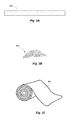
- Figs. 3A-C show some exemplary prepregs made using the present methods.
- Fig. 3A shows a sheet 302 of woven glass fabric and polymerized resin.
- a plurality of prepreg sheets 302 may be stacked directly on top of each other, or sandwiched between other layers of materials. Additional details about arranging a plurality of prepreg layers in a layup for the fiber-reinforced composite article can be found in co-assigned U.S. Pat. App. No. 13/915,023, filed June 11, 2013 , the entire contents of which are herein incorporated by reference for all purposes.
- Fig. 3B shows a pile of prepreg pellets 304 that may be formed by chopping, grinding, milling, crushing, or otherwise comminuting the heated fiber-resin amalgam.
- the heated fiber-resin amalgam may be cooled to a comminuting temperature, which may be a temperature at or below the glass transition temperature for the resin materials in the prepreg.
- the prepreg pellets 304 may be added as a dry powder or as a component of a liquid suspension to the final fiber-reinforced composite article.
- Fig. 3C shows a roll 308 of prepreg material that may be used as sheet molding compound (SMC), among other applications.
- the prepreg material may be sandwiched between film layers that prevent contamination of the prepreg as well as the bonding of adjacent layers on the roll.
- the film layers are selected to easily peel away from the prepreg when it is ready to be used in making fiber-reinforced articles.
- the film layers may be compatible with the prepreg, and incorporated in the composite part after molding.
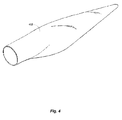
- Fig. 4 shows an exemplary fiber-reinforced composite wind turbine blade 502 formed by the present prepregs.
- the blade 402 is one of many types of articles that can be formed by the present prepregs. Other articles may include vehicle parts (e.g., aircraft parts, automotive parts, etc.), appliance parts, containers, etc.
- Fig. 5 is a flowchart showing an exemplary method 500 of making a fiber-containing prepreg.
- Method 500 may include drawing unsized fibers 502 through bushing from a batch of molten glass. The unsized fibers may be cooled by a mist of water.
- Method 500 may also include applying a sizing composition to the unsized fibers 504 to form a plurality of sized fibers, where the sizing composition includes a first polymerization agent for polymerizing caprolactam.
- the first polymerization agent may also include a coupling moiety that covalently bonds the polymerization agent to the unsized fibers.
- the polymerization agent may include a silane moiety.
- the first polymerization agent may include a polymerization initiator or catalyst.
- the polymerization agent may further include an initiator moiety that initiates polymerization of the reactive resin composition.
- the initiator moiety may initiate the polymerization of caprolactam.
- applying the sizing composition to the unsized fibers 504 may include covalently bonding the first polymerization agent to the unsized fibers. Steps 502, 504, and 506 may occur at the same facility.
- Applying a polymerization agent, such as an initiator, to the fibers as they are being formed may provide advantages over applying the polymerization agent to fibers that have already been sized.
- Sizing compositions often may be applied to fibers in order to minimize abrasion between fibers. These sizing compositions often include a lubricant and/or a film former and may coat the surface of the glass fibers. An already sized fiber may then inhibit or prevent adhesion between the polymerization agent and the surface of the glass fibers.
- the sizing composition if applied before the polymerization agent, may coat the glass fibers and compromise the surface of the glass fibers so that a polymerization agent may not readily adhere to the surface. Applying the sizing composition containing a polymerization agent directly to the fibers as they are being formed also may decrease the number of processing steps and may decrease costs.
- the plurality of sized fibers may be woven into a fabric as in step 506.
- Another step may include melting a reactive resin composition as in step 508 to form a melted reactive resin composition, where the reactive resin composition may include caprolactam.
- the reactive resin composition may include a second polymerization agent. This second polymerization agent may assist in polymerizing caprolactam.
- the second polymerization agent may include an initiator or catalyst. The initiator in the second polymerization agent may be different from the initiator in the first polymerization agent. An initiator that may be present in the first polymerization agent may not be present in the second polymerization agent. Similarly, an initiator that may be present in the second polymerization agent may not be present in the first polymerization agent.
- the plurality of fibers may be continuous and not chopped.
- the melted reactive resin composition may be applied to the fabric 510. This may result in a fabric impregnated with the resin composition.
- Method 500 may further include heating the fabric and melted reactive resin composition 512 to a polymerization temperature, where the caprolactam polymerizes to form a fiber-resin amalgam including a polyamide. Another step may be to form the fiber-resin amalgam into the fiber-containing prepreg 514.
- Fig. 6 is a flowchart showing an exemplary method 600 of making a fiber-containing prepreg.
- Method 600 may include applying reactive resin powder onto a woven fabric 602.
- the reactive resin powder may include caprolactam
- the woven fabric may include fibers that have been treated with a sizing composition.
- the sizing composition may be any sizing composition previously discussed.
- the woven fabric may be formed by drawing unsized fibers from a batch of molten glass, then applying the sizing composition to the unsized fibers to form a plurality of sized fibers, and weaving the plurality of sized fibers into the woven fabric.
- the plurality of fibers may be produced by a direct roving process.
- the sizing composition may include a polymerization agent.
- the reactive resin powder may include caprolactam.
- the reactive resin powder may include an initiator or catalyst. The reactive resin powder may then be melted.
- Method 600 may also include heating the reactive resin powder 604 to a polymerization temperature, where, for instance, the caprolactam polymerizes to form a fiber-resin amalgam.
- the fiber-resin amalgam may include a polyamide.
- Another step may include forming the fiber-resin amalgam into the fiber-containing prepreg 606.
- Fig. 7 is a flowchart showing an exemplary method 700 of making a fiber-reinforced composite.
- Method 700 may include drawing an unsized fiber 702 through bushing from a batch of molten glass.
- Sizing composition may be applied to the unsized fiber 704, where the sizing composition may include at least one polymerization agent for polymerizing caprolactam.
- the at least one polymerization agent may be any polymerization agent previously described.
- a reactive resin composition may be applied 706 to the sized fiber.
- the reactive resin composition may be applied to several sized fibers simultaneously or nearly simultaneously. These sized fibers may be in a tow, which may include thousands of fibers.
- the fibers may be the same or different in material or diameter.
- the reactive resin composition may, for example, include caprolactam.
- the reactive resin may also include a polymerization initiator or a polymerization catalyst or both an initiator and a catalyst.
- the reactive resin when applied to the sized fiber, may be in a powder form. Or the reactive resin may be melted when applied to the sized fiber.
- the reactive resin composition may be applied to the sized fiber in a pultrusion process.
- the reactive resin composition may be heated 708 to a polymerization temperature. If the reactive resin composition includes caprolactam, the caprolactam may polymerize to form a fiber-resin amalgam including a polyamide.
Landscapes
- Chemical & Material Sciences (AREA)
- Engineering & Computer Science (AREA)
- Materials Engineering (AREA)
- Mechanical Engineering (AREA)
- Medicinal Chemistry (AREA)
- Chemical Kinetics & Catalysis (AREA)
- Health & Medical Sciences (AREA)
- Polymers & Plastics (AREA)
- Organic Chemistry (AREA)
- Manufacturing & Machinery (AREA)
- Composite Materials (AREA)
- Reinforced Plastic Materials (AREA)
- Woven Fabrics (AREA)
Applications Claiming Priority (2)
| Application Number | Priority Date | Filing Date | Title |
|---|---|---|---|
| US14/088,034 US11548245B2 (en) | 2013-11-22 | 2013-11-22 | Fiber-containing prepregs and methods and systems of making |
| US14/278,484 US9186852B2 (en) | 2013-11-22 | 2014-05-15 | Fiber-containing prepregs and methods and systems of making |
Publications (3)
| Publication Number | Publication Date |
|---|---|
| EP2876133A2 true EP2876133A2 (de) | 2015-05-27 |
| EP2876133A3 EP2876133A3 (de) | 2015-07-29 |
| EP2876133B1 EP2876133B1 (de) | 2021-02-17 |
Family
ID=51900336
Family Applications (1)
| Application Number | Title | Priority Date | Filing Date |
|---|---|---|---|
| EP14193602.1A Active EP2876133B1 (de) | 2013-11-22 | 2014-11-18 | Faserhaltige Prepregs und Verfahren und Systeme zur Herstellung |
Country Status (4)
| Country | Link |
|---|---|
| US (2) | US9186852B2 (de) |
| EP (1) | EP2876133B1 (de) |
| CA (1) | CA2871831C (de) |
| ES (1) | ES2863731T3 (de) |
Cited By (1)
| Publication number | Priority date | Publication date | Assignee | Title |
|---|---|---|---|---|
| DE102018201347A1 (de) * | 2018-01-30 | 2019-08-01 | Bayerische Motoren Werke Aktiengesellschaft | Verfahren und Vorrichtung zum Herstellen von thermoplastischen faserverstärkten Halbzeugen mit konstanter Querschnittsfläche |
Families Citing this family (11)
| Publication number | Priority date | Publication date | Assignee | Title |
|---|---|---|---|---|
| US9340454B2 (en) * | 2011-12-22 | 2016-05-17 | Johns Manville | Methods for making reinforced thermoset composites with sized fibers |
| DE102015002106A1 (de) * | 2015-02-23 | 2016-08-25 | Basf Se | Prozessanordnung sowie Verfahren zur Herstellung eines faserverstärkten Kunststoffbauteils |
| CN107548339B (zh) * | 2015-02-23 | 2020-08-07 | 大众汽车股份有限公司 | 纤维增强构件或半成品的制备方法 |
| DE102015002107A1 (de) * | 2015-02-23 | 2016-08-25 | Basf Se | Prozessanordnung sowie Verfahren zur Herstellung eines faserverstärkten Kunststoffbauteils |
| US10343351B2 (en) | 2015-09-08 | 2019-07-09 | Johns Manville | Fiber-reinforced composites made with multi-part thermoplastic polymers |
| US10442115B2 (en) | 2016-05-25 | 2019-10-15 | Johns Manville | Manufacturing thermoplastic composites and articles |
| US10625486B2 (en) | 2016-06-20 | 2020-04-21 | Johns Manville | Methods of producing thermoplastic composites using fabric-based thermoplastic prepregs |
| US10252450B2 (en) | 2016-08-03 | 2019-04-09 | Johns Manville | Reinforced thermoplastic products and methods of making the same |
| US10857744B2 (en) | 2018-04-03 | 2020-12-08 | Johns Manville | System for producing a fully impregnated thermoplastic prepreg |
| US10717245B2 (en) | 2018-04-03 | 2020-07-21 | Johns Manville | System for producing a fully impregnated thermoplastic prepreg |
| US12220879B2 (en) | 2021-02-11 | 2025-02-11 | Johns Manville | Lightweight thermoplastic composite products and methods of making same |
Family Cites Families (44)
| Publication number | Priority date | Publication date | Assignee | Title |
|---|---|---|---|---|
| BE634609A (de) | 1962-07-17 | |||
| DE1900541C3 (de) | 1969-01-07 | 1982-05-27 | Bayer Ag, 5090 Leverkusen | Verfahren zur kontinuierlichen Herstellung von homogenen faserverstärkten Polyamidformmassen |
| JPS5777336A (en) * | 1980-10-27 | 1982-05-14 | Hitachi Ltd | Composite fiber product |
| DE3244984A1 (de) | 1982-12-04 | 1984-06-07 | Basf Ag, 6700 Ludwigshafen | Verfahren zur herstellung von formkoerpern aus faserverstaerktem polyamid |
| JPS59199863A (ja) | 1983-04-26 | 1984-11-13 | 株式会社新和製作所 | 表面の改質された物質を生産する方法 |
| DE3325554A1 (de) | 1983-07-15 | 1985-01-24 | Basf Ag | Verfahren zur herstellung von flaechigen formteilen aus faserverstaerktem polyamid |
| DE3344682A1 (de) | 1983-12-10 | 1985-06-20 | Efka-Werke Fritz Kiehn Gmbh, 7218 Trossingen | Handstopfvorrichtung fuer zigarettenhuelsen |
| EP0237326A3 (de) * | 1986-03-11 | 1990-03-21 | Raychem Limited | Gebogener Gegenstand aus Verbundwerkstoff |
| CA1336483C (en) | 1989-01-30 | 1995-08-01 | Hatsuo Ishida | Process for preparing composites |
| DE69130172T2 (de) | 1991-11-28 | 1999-05-12 | Solutia Europe N.V./S.A., Bruessel/Bruxelles | Nylon Pultrusionsverfahren |
| EP0589640A1 (de) | 1992-09-24 | 1994-03-30 | General Electric Company | Makrocyklische Formmassen |
| US5424388A (en) | 1993-06-24 | 1995-06-13 | Industrial Technology Research Institute | Pultrusion process for long fiber-reinforced nylon composites |
| EP0655476A1 (de) | 1993-11-29 | 1995-05-31 | General Electric Company | Faservorformlinge enthaltende zyklische Polyesteroligomere |
| RU2133672C1 (ru) | 1994-08-01 | 1999-07-27 | Г. Швартц ГмбХ + Ко. КГ | Способ получения формованных изделий путем полимеризации лактамов в формах |
| EP0752306A1 (de) | 1995-07-05 | 1997-01-08 | Monsanto Europe S.A./N.V. | Verfahren zur Herstellung von pultrudierten Gegenständen |
| DE19527154C2 (de) | 1995-07-25 | 2001-06-07 | Inventa Ag | Thermoplastisch verformbare Verbundwerkstoffe |
| DE19602638A1 (de) | 1996-01-25 | 1997-08-07 | Inventa Ag | Verfahren zur Herstellung von thermisch nachverformbaren Verbundwerkstoffen mit Polylactam-Matrix |
| EP0985756B1 (de) * | 1998-02-10 | 2008-04-23 | Nitto Boseki Co., Ltd. | Glasgewebe und laminate für leiterplatte |
| US6369157B1 (en) | 2000-01-21 | 2002-04-09 | Cyclics Corporation | Blend material including macrocyclic polyester oligomers and processes for polymerizing the same |
| US7151143B2 (en) | 2000-01-21 | 2006-12-19 | Cyclics Corporation | Blends containing macrocyclic polyester oligomer and high molecular weight polymer |
| US6436548B1 (en) | 2000-09-12 | 2002-08-20 | Cyclics Corporation | Species modification in macrocyclic polyester oligomers, and compositions prepared thereby |
| US20050214465A1 (en) | 2001-12-20 | 2005-09-29 | Peter Maskus | Method for producing composite materials using a thermoplastic matrix |
| JP3747258B2 (ja) * | 2002-09-26 | 2006-02-22 | 広島県 | Frpリサイクレートを配合した熱可塑性樹脂複合材料の製造方法 |
| US20040188883A1 (en) | 2002-12-20 | 2004-09-30 | Barron James H. | Near net shape prepreg |
| JP5048307B2 (ja) * | 2006-11-13 | 2012-10-17 | 信越石英株式会社 | 複合織物及びプリント配線基板 |
| EP2138530B1 (de) | 2007-03-20 | 2017-03-29 | Toray Industries, Inc. | Formmasse, prepreg, faserverstärkter verbundwerkstoff und verfahren zur herstellung von faserverstärkter formbasismasse |
| DE602008004514D1 (de) | 2007-06-20 | 2011-02-24 | Rhodia Operations | Polyamid-verbundartikel |
| DE102007031467A1 (de) | 2007-07-05 | 2009-01-08 | Polymer-Chemie Gmbh | Verfahren zur Herstellung eines faserverstärkten Verbundstoffs und Verbundstoff |
| US8378094B2 (en) * | 2008-01-08 | 2013-02-19 | Johns Manville | Polymerization initiators for fiber-reinforced polymer composites and materials made from the composites |
| US20100286343A1 (en) | 2008-01-08 | 2010-11-11 | Thomas Burghardt | Surfaces containing coupling activator compounds and reinforced composites produced therefrom |
| US20110045275A1 (en) * | 2008-01-08 | 2011-02-24 | Rajappa Tadepalli | Fibers treated with polymerization compounds and fiber reinforced composites made therefrom |
| JP2011516654A (ja) | 2008-03-30 | 2011-05-26 | アイキュー テック スウィツァランド ゲーエムベーハー | 反応性ポリマープリプレグを作成するための装置及び方法 |
| US7790284B2 (en) | 2008-09-24 | 2010-09-07 | Davies Robert M | Flexible composite prepreg materials |
| US8883908B2 (en) | 2009-06-02 | 2014-11-11 | Johns Manville | Methods for making reinforced thermoplastic composites using reactive fibers and/or reactive flakes |
| BR112012000399A2 (pt) | 2009-07-08 | 2016-04-05 | Basf Se | método para produzir materiais compósitos reforçados com fibras |
| US9290611B2 (en) | 2009-07-17 | 2016-03-22 | Basf Se | Production and use of polymers comprising hydroxyl groups and acrylate groups |
| US20110039470A1 (en) * | 2009-07-30 | 2011-02-17 | E.I. Du Pont De Nemours And Company | Overmolded heat resistant polyamide composite structures and processes for their preparation |
| FR2953847B1 (fr) | 2009-12-14 | 2012-12-14 | Rhodia Operations | Article composite a base de resines polyamides de faibles masses moleculaires |
| DE102010040027C5 (de) | 2010-08-31 | 2016-04-07 | Basf Se | Verfahren zur Herstellung von faserverstärkten Gusspolyamid-Formkörpern |
| KR101958498B1 (ko) | 2011-03-03 | 2019-03-14 | 바스프 에스이 | 폴리아미드 매트릭스를 함유하는 섬유 강화 플랫 반제품의 제조 방법 |
| WO2013050074A1 (de) | 2011-10-05 | 2013-04-11 | Basf Se | Verfahren zur herstellung von faserverstärkten verbundwerkstoffen |
| DE102011055263A1 (de) | 2011-11-11 | 2013-05-16 | Institut Für Verbundwerkstoffe Gmbh | Verfahren zur Herstellung eines Faserverbundhalbzeuges, ein nach dem Verfahren hergestelltes Faserverbundhalbzeug, ein Verfahren zur Herstellung eines Faserverbundbauteiles sowie ein nach dem Verfahren hergestelltes Faserverbundbauteil |
| US8962735B2 (en) | 2011-12-22 | 2015-02-24 | Johns Manville | Methods of making reactive fiber/flake prepregs and reactive prepregs |
| US9387626B2 (en) | 2013-03-07 | 2016-07-12 | Johns Manville | Fiber reinforced composites made with coupling-activator treated fibers and activator containing reactive resin |
-
2014
- 2014-05-15 US US14/278,484 patent/US9186852B2/en active Active
- 2014-11-18 EP EP14193602.1A patent/EP2876133B1/de active Active
- 2014-11-18 ES ES14193602T patent/ES2863731T3/es active Active
- 2014-11-19 CA CA2871831A patent/CA2871831C/en active Active
-
2015
- 2015-10-06 US US14/875,874 patent/US20160024266A1/en not_active Abandoned
Cited By (1)
| Publication number | Priority date | Publication date | Assignee | Title |
|---|---|---|---|---|
| DE102018201347A1 (de) * | 2018-01-30 | 2019-08-01 | Bayerische Motoren Werke Aktiengesellschaft | Verfahren und Vorrichtung zum Herstellen von thermoplastischen faserverstärkten Halbzeugen mit konstanter Querschnittsfläche |
Also Published As
| Publication number | Publication date |
|---|---|
| EP2876133B1 (de) | 2021-02-17 |
| ES2863731T3 (es) | 2021-10-11 |
| US20160024266A1 (en) | 2016-01-28 |
| US20150144253A1 (en) | 2015-05-28 |
| CA2871831A1 (en) | 2015-05-22 |
| US9186852B2 (en) | 2015-11-17 |
| CA2871831C (en) | 2022-05-10 |
| EP2876133A3 (de) | 2015-07-29 |
Similar Documents
| Publication | Publication Date | Title |
|---|---|---|
| US11548245B2 (en) | Fiber-containing prepregs and methods and systems of making | |
| EP2876133B1 (de) | Faserhaltige Prepregs und Verfahren und Systeme zur Herstellung | |
| US10343351B2 (en) | Fiber-reinforced composites made with multi-part thermoplastic polymers | |
| US10730271B2 (en) | Sized glass fibers for fiber-containing composite articles and methods of making them | |
| US10780609B2 (en) | Fiber-reinforced composite articles and methods of making them | |
| JP2006511366A (ja) | ニアネットシェイププリプレグ | |
| EP2876135B1 (de) | Verfahren zur Herstellung einer faserverstärkten Zusammensetzung und eines faserverstärkten Artikels | |
| US11231906B2 (en) | Manufacturing thermoplastic composites and articles | |
| EP2813538B1 (de) | Verfahren zur Herstellung eines Prepregs und Faserverstärkte Verbundartikels | |
| CA2965432C (en) | Manufacturing thermoplastic composites and articles |
Legal Events
| Date | Code | Title | Description |
|---|---|---|---|
| PUAI | Public reference made under article 153(3) epc to a published international application that has entered the european phase |
Free format text: ORIGINAL CODE: 0009012 |
|
| 17P | Request for examination filed |
Effective date: 20141118 |
|
| AK | Designated contracting states |
Kind code of ref document: A2 Designated state(s): AL AT BE BG CH CY CZ DE DK EE ES FI FR GB GR HR HU IE IS IT LI LT LU LV MC MK MT NL NO PL PT RO RS SE SI SK SM TR |
|
| AX | Request for extension of the european patent |
Extension state: BA ME |
|
| PUAL | Search report despatched |
Free format text: ORIGINAL CODE: 0009013 |
|
| AK | Designated contracting states |
Kind code of ref document: A3 Designated state(s): AL AT BE BG CH CY CZ DE DK EE ES FI FR GB GR HR HU IE IS IT LI LT LU LV MC MK MT NL NO PL PT RO RS SE SI SK SM TR |
|
| AX | Request for extension of the european patent |
Extension state: BA ME |
|
| RIC1 | Information provided on ipc code assigned before grant |
Ipc: B29B 15/12 20060101ALI20150622BHEP Ipc: C08J 5/06 20060101ALI20150622BHEP Ipc: C08J 5/24 20060101AFI20150622BHEP |
|
| R17P | Request for examination filed (corrected) |
Effective date: 20160118 |
|
| RBV | Designated contracting states (corrected) |
Designated state(s): AL AT BE BG CH CY CZ DE DK EE ES FI FR GB GR HR HU IE IS IT LI LT LU LV MC MK MT NL NO PL PT RO RS SE SI SK SM TR |
|
| STAA | Information on the status of an ep patent application or granted ep patent |
Free format text: STATUS: EXAMINATION IS IN PROGRESS |
|
| 17Q | First examination report despatched |
Effective date: 20180720 |
|
| REG | Reference to a national code |
Ref country code: DE Ref legal event code: R079 Ref document number: 602014074787 Country of ref document: DE Free format text: PREVIOUS MAIN CLASS: C08J0005040000 Ipc: B29C0070500000 |
|
| RIC1 | Information provided on ipc code assigned before grant |
Ipc: C08J 5/04 20060101ALI20200721BHEP Ipc: B29B 15/12 20060101ALI20200721BHEP Ipc: B29C 70/50 20060101AFI20200721BHEP Ipc: C08J 5/24 20060101ALI20200721BHEP Ipc: B29C 70/52 20060101ALI20200721BHEP Ipc: C08J 5/06 20060101ALI20200721BHEP |
|
| GRAP | Despatch of communication of intention to grant a patent |
Free format text: ORIGINAL CODE: EPIDOSNIGR1 |
|
| STAA | Information on the status of an ep patent application or granted ep patent |
Free format text: STATUS: GRANT OF PATENT IS INTENDED |
|
| INTG | Intention to grant announced |
Effective date: 20200828 |
|
| RIN1 | Information on inventor provided before grant (corrected) |
Inventor name: YOHANNES, ASHEBER Inventor name: ZHANG, MINGFU Inventor name: ASRAR, JAWED Inventor name: GLEICH, KLAUS FRIEDRICH Inventor name: BLOCK, MICHAEL J. |
|
| GRAS | Grant fee paid |
Free format text: ORIGINAL CODE: EPIDOSNIGR3 |
|
| GRAA | (expected) grant |
Free format text: ORIGINAL CODE: 0009210 |
|
| STAA | Information on the status of an ep patent application or granted ep patent |
Free format text: STATUS: THE PATENT HAS BEEN GRANTED |
|
| AK | Designated contracting states |
Kind code of ref document: B1 Designated state(s): AL AT BE BG CH CY CZ DE DK EE ES FI FR GB GR HR HU IE IS IT LI LT LU LV MC MK MT NL NO PL PT RO RS SE SI SK SM TR |
|
| REG | Reference to a national code |
Ref country code: GB Ref legal event code: FG4D |
|
| REG | Reference to a national code |
Ref country code: CH Ref legal event code: EP |
|
| REG | Reference to a national code |
Ref country code: DE Ref legal event code: R096 Ref document number: 602014074787 Country of ref document: DE |
|
| REG | Reference to a national code |
Ref country code: AT Ref legal event code: REF Ref document number: 1360940 Country of ref document: AT Kind code of ref document: T Effective date: 20210315 |
|
| REG | Reference to a national code |
Ref country code: IE Ref legal event code: FG4D |
|
| REG | Reference to a national code |
Ref country code: NL Ref legal event code: FP |
|
| REG | Reference to a national code |
Ref country code: SK Ref legal event code: T3 Ref document number: E 37084 Country of ref document: SK |
|
| REG | Reference to a national code |
Ref country code: LT Ref legal event code: MG9D |
|
| PG25 | Lapsed in a contracting state [announced via postgrant information from national office to epo] |
Ref country code: NO Free format text: LAPSE BECAUSE OF FAILURE TO SUBMIT A TRANSLATION OF THE DESCRIPTION OR TO PAY THE FEE WITHIN THE PRESCRIBED TIME-LIMIT Effective date: 20210517 Ref country code: BG Free format text: LAPSE BECAUSE OF FAILURE TO SUBMIT A TRANSLATION OF THE DESCRIPTION OR TO PAY THE FEE WITHIN THE PRESCRIBED TIME-LIMIT Effective date: 20210517 Ref country code: FI Free format text: LAPSE BECAUSE OF FAILURE TO SUBMIT A TRANSLATION OF THE DESCRIPTION OR TO PAY THE FEE WITHIN THE PRESCRIBED TIME-LIMIT Effective date: 20210217 Ref country code: GR Free format text: LAPSE BECAUSE OF FAILURE TO SUBMIT A TRANSLATION OF THE DESCRIPTION OR TO PAY THE FEE WITHIN THE PRESCRIBED TIME-LIMIT Effective date: 20210518 Ref country code: HR Free format text: LAPSE BECAUSE OF FAILURE TO SUBMIT A TRANSLATION OF THE DESCRIPTION OR TO PAY THE FEE WITHIN THE PRESCRIBED TIME-LIMIT Effective date: 20210217 Ref country code: PT Free format text: LAPSE BECAUSE OF FAILURE TO SUBMIT A TRANSLATION OF THE DESCRIPTION OR TO PAY THE FEE WITHIN THE PRESCRIBED TIME-LIMIT Effective date: 20210617 Ref country code: LT Free format text: LAPSE BECAUSE OF FAILURE TO SUBMIT A TRANSLATION OF THE DESCRIPTION OR TO PAY THE FEE WITHIN THE PRESCRIBED TIME-LIMIT Effective date: 20210217 |
|
| REG | Reference to a national code |
Ref country code: AT Ref legal event code: MK05 Ref document number: 1360940 Country of ref document: AT Kind code of ref document: T Effective date: 20210217 |
|
| PG25 | Lapsed in a contracting state [announced via postgrant information from national office to epo] |
Ref country code: PL Free format text: LAPSE BECAUSE OF FAILURE TO SUBMIT A TRANSLATION OF THE DESCRIPTION OR TO PAY THE FEE WITHIN THE PRESCRIBED TIME-LIMIT Effective date: 20210217 Ref country code: RS Free format text: LAPSE BECAUSE OF FAILURE TO SUBMIT A TRANSLATION OF THE DESCRIPTION OR TO PAY THE FEE WITHIN THE PRESCRIBED TIME-LIMIT Effective date: 20210217 Ref country code: LV Free format text: LAPSE BECAUSE OF FAILURE TO SUBMIT A TRANSLATION OF THE DESCRIPTION OR TO PAY THE FEE WITHIN THE PRESCRIBED TIME-LIMIT Effective date: 20210217 Ref country code: SE Free format text: LAPSE BECAUSE OF FAILURE TO SUBMIT A TRANSLATION OF THE DESCRIPTION OR TO PAY THE FEE WITHIN THE PRESCRIBED TIME-LIMIT Effective date: 20210217 |
|
| PG25 | Lapsed in a contracting state [announced via postgrant information from national office to epo] |
Ref country code: IS Free format text: LAPSE BECAUSE OF FAILURE TO SUBMIT A TRANSLATION OF THE DESCRIPTION OR TO PAY THE FEE WITHIN THE PRESCRIBED TIME-LIMIT Effective date: 20210617 |
|
| REG | Reference to a national code |
Ref country code: ES Ref legal event code: FG2A Ref document number: 2863731 Country of ref document: ES Kind code of ref document: T3 Effective date: 20211011 |
|
| PG25 | Lapsed in a contracting state [announced via postgrant information from national office to epo] |
Ref country code: SM Free format text: LAPSE BECAUSE OF FAILURE TO SUBMIT A TRANSLATION OF THE DESCRIPTION OR TO PAY THE FEE WITHIN THE PRESCRIBED TIME-LIMIT Effective date: 20210217 Ref country code: AT Free format text: LAPSE BECAUSE OF FAILURE TO SUBMIT A TRANSLATION OF THE DESCRIPTION OR TO PAY THE FEE WITHIN THE PRESCRIBED TIME-LIMIT Effective date: 20210217 Ref country code: EE Free format text: LAPSE BECAUSE OF FAILURE TO SUBMIT A TRANSLATION OF THE DESCRIPTION OR TO PAY THE FEE WITHIN THE PRESCRIBED TIME-LIMIT Effective date: 20210217 Ref country code: CZ Free format text: LAPSE BECAUSE OF FAILURE TO SUBMIT A TRANSLATION OF THE DESCRIPTION OR TO PAY THE FEE WITHIN THE PRESCRIBED TIME-LIMIT Effective date: 20210217 |
|
| REG | Reference to a national code |
Ref country code: DE Ref legal event code: R097 Ref document number: 602014074787 Country of ref document: DE |
|
| PG25 | Lapsed in a contracting state [announced via postgrant information from national office to epo] |
Ref country code: RO Free format text: LAPSE BECAUSE OF FAILURE TO SUBMIT A TRANSLATION OF THE DESCRIPTION OR TO PAY THE FEE WITHIN THE PRESCRIBED TIME-LIMIT Effective date: 20210217 Ref country code: DK Free format text: LAPSE BECAUSE OF FAILURE TO SUBMIT A TRANSLATION OF THE DESCRIPTION OR TO PAY THE FEE WITHIN THE PRESCRIBED TIME-LIMIT Effective date: 20210217 |
|
| PLBE | No opposition filed within time limit |
Free format text: ORIGINAL CODE: 0009261 |
|
| STAA | Information on the status of an ep patent application or granted ep patent |
Free format text: STATUS: NO OPPOSITION FILED WITHIN TIME LIMIT |
|
| 26N | No opposition filed |
Effective date: 20211118 |
|
| PG25 | Lapsed in a contracting state [announced via postgrant information from national office to epo] |
Ref country code: AL Free format text: LAPSE BECAUSE OF FAILURE TO SUBMIT A TRANSLATION OF THE DESCRIPTION OR TO PAY THE FEE WITHIN THE PRESCRIBED TIME-LIMIT Effective date: 20210217 |
|
| PG25 | Lapsed in a contracting state [announced via postgrant information from national office to epo] |
Ref country code: SI Free format text: LAPSE BECAUSE OF FAILURE TO SUBMIT A TRANSLATION OF THE DESCRIPTION OR TO PAY THE FEE WITHIN THE PRESCRIBED TIME-LIMIT Effective date: 20210217 |
|
| PG25 | Lapsed in a contracting state [announced via postgrant information from national office to epo] |
Ref country code: IS Free format text: LAPSE BECAUSE OF FAILURE TO SUBMIT A TRANSLATION OF THE DESCRIPTION OR TO PAY THE FEE WITHIN THE PRESCRIBED TIME-LIMIT Effective date: 20210617 |
|
| PG25 | Lapsed in a contracting state [announced via postgrant information from national office to epo] |
Ref country code: MC Free format text: LAPSE BECAUSE OF FAILURE TO SUBMIT A TRANSLATION OF THE DESCRIPTION OR TO PAY THE FEE WITHIN THE PRESCRIBED TIME-LIMIT Effective date: 20210217 |
|
| REG | Reference to a national code |
Ref country code: CH Ref legal event code: PL |
|
| PG25 | Lapsed in a contracting state [announced via postgrant information from national office to epo] |
Ref country code: LU Free format text: LAPSE BECAUSE OF NON-PAYMENT OF DUE FEES Effective date: 20211118 |
|
| PG25 | Lapsed in a contracting state [announced via postgrant information from national office to epo] |
Ref country code: IE Free format text: LAPSE BECAUSE OF NON-PAYMENT OF DUE FEES Effective date: 20211118 |
|
| PG25 | Lapsed in a contracting state [announced via postgrant information from national office to epo] |
Ref country code: HU Free format text: LAPSE BECAUSE OF FAILURE TO SUBMIT A TRANSLATION OF THE DESCRIPTION OR TO PAY THE FEE WITHIN THE PRESCRIBED TIME-LIMIT; INVALID AB INITIO Effective date: 20141118 |
|
| PG25 | Lapsed in a contracting state [announced via postgrant information from national office to epo] |
Ref country code: CY Free format text: LAPSE BECAUSE OF FAILURE TO SUBMIT A TRANSLATION OF THE DESCRIPTION OR TO PAY THE FEE WITHIN THE PRESCRIBED TIME-LIMIT Effective date: 20210217 |
|
| PG25 | Lapsed in a contracting state [announced via postgrant information from national office to epo] |
Ref country code: LI Free format text: LAPSE BECAUSE OF NON-PAYMENT OF DUE FEES Effective date: 20220630 Ref country code: CH Free format text: LAPSE BECAUSE OF NON-PAYMENT OF DUE FEES Effective date: 20220630 |
|
| PG25 | Lapsed in a contracting state [announced via postgrant information from national office to epo] |
Ref country code: MK Free format text: LAPSE BECAUSE OF FAILURE TO SUBMIT A TRANSLATION OF THE DESCRIPTION OR TO PAY THE FEE WITHIN THE PRESCRIBED TIME-LIMIT Effective date: 20210217 |
|
| PG25 | Lapsed in a contracting state [announced via postgrant information from national office to epo] |
Ref country code: MT Free format text: LAPSE BECAUSE OF FAILURE TO SUBMIT A TRANSLATION OF THE DESCRIPTION OR TO PAY THE FEE WITHIN THE PRESCRIBED TIME-LIMIT Effective date: 20210217 |
|
| PGFP | Annual fee paid to national office [announced via postgrant information from national office to epo] |
Ref country code: NL Payment date: 20241126 Year of fee payment: 11 |
|
| PGFP | Annual fee paid to national office [announced via postgrant information from national office to epo] |
Ref country code: DE Payment date: 20241127 Year of fee payment: 11 |
|
| PGFP | Annual fee paid to national office [announced via postgrant information from national office to epo] |
Ref country code: BE Payment date: 20241127 Year of fee payment: 11 |
|
| PGFP | Annual fee paid to national office [announced via postgrant information from national office to epo] |
Ref country code: GB Payment date: 20241127 Year of fee payment: 11 |
|
| PGFP | Annual fee paid to national office [announced via postgrant information from national office to epo] |
Ref country code: FR Payment date: 20241128 Year of fee payment: 11 |
|
| PGFP | Annual fee paid to national office [announced via postgrant information from national office to epo] |
Ref country code: ES Payment date: 20241202 Year of fee payment: 11 |
|
| PG25 | Lapsed in a contracting state [announced via postgrant information from national office to epo] |
Ref country code: TR Free format text: LAPSE BECAUSE OF FAILURE TO SUBMIT A TRANSLATION OF THE DESCRIPTION OR TO PAY THE FEE WITHIN THE PRESCRIBED TIME-LIMIT Effective date: 20210217 |
|
| PGFP | Annual fee paid to national office [announced via postgrant information from national office to epo] |
Ref country code: IT Payment date: 20251119 Year of fee payment: 12 |
|
| PGFP | Annual fee paid to national office [announced via postgrant information from national office to epo] |
Ref country code: SK Payment date: 20251031 Year of fee payment: 12 |