EP2876419A1 - Corps creux en élastomère, en particulier flexible en élastomère, doté d'élément de capteur destiné à détecter une température et procédé associé - Google Patents
Corps creux en élastomère, en particulier flexible en élastomère, doté d'élément de capteur destiné à détecter une température et procédé associé Download PDFInfo
- Publication number
- EP2876419A1 EP2876419A1 EP14181895.5A EP14181895A EP2876419A1 EP 2876419 A1 EP2876419 A1 EP 2876419A1 EP 14181895 A EP14181895 A EP 14181895A EP 2876419 A1 EP2876419 A1 EP 2876419A1
- Authority
- EP
- European Patent Office
- Prior art keywords
- hollow body
- elastomeric
- temperature
- sensor element
- medium
- Prior art date
- Legal status (The legal status is an assumption and is not a legal conclusion. Google has not performed a legal analysis and makes no representation as to the accuracy of the status listed.)
- Granted
Links
Images


Classifications
-
- G—PHYSICS
- G01—MEASURING; TESTING
- G01K—MEASURING TEMPERATURE; MEASURING QUANTITY OF HEAT; THERMALLY-SENSITIVE ELEMENTS NOT OTHERWISE PROVIDED FOR
- G01K1/00—Details of thermometers not specially adapted for particular types of thermometer
- G01K1/14—Supports; Fastening devices; Arrangements for mounting thermometers in particular locations
-
- G—PHYSICS
- G01—MEASURING; TESTING
- G01K—MEASURING TEMPERATURE; MEASURING QUANTITY OF HEAT; THERMALLY-SENSITIVE ELEMENTS NOT OTHERWISE PROVIDED FOR
- G01K13/00—Thermometers specially adapted for specific purposes
- G01K13/02—Thermometers specially adapted for specific purposes for measuring temperature of moving fluids or granular materials capable of flow
-
- G—PHYSICS
- G01—MEASURING; TESTING
- G01K—MEASURING TEMPERATURE; MEASURING QUANTITY OF HEAT; THERMALLY-SENSITIVE ELEMENTS NOT OTHERWISE PROVIDED FOR
- G01K7/00—Measuring temperature based on the use of electric or magnetic elements directly sensitive to heat ; Power supply therefor, e.g. using thermoelectric elements
- G01K7/16—Measuring temperature based on the use of electric or magnetic elements directly sensitive to heat ; Power supply therefor, e.g. using thermoelectric elements using resistive elements
-
- H—ELECTRICITY
- H01—ELECTRIC ELEMENTS
- H01C—RESISTORS
- H01C7/00—Non-adjustable resistors formed as one or more layers or coatings; Non-adjustable resistors made from powdered conducting material or powdered semi-conducting material with or without insulating material
- H01C7/02—Non-adjustable resistors formed as one or more layers or coatings; Non-adjustable resistors made from powdered conducting material or powdered semi-conducting material with or without insulating material having positive temperature coefficient
- H01C7/028—Non-adjustable resistors formed as one or more layers or coatings; Non-adjustable resistors made from powdered conducting material or powdered semi-conducting material with or without insulating material having positive temperature coefficient consisting of organic substances
Definitions
- the invention relates to an elastomeric hollow body, in particular an elastomeric hose, for conducting and / or receiving liquid, gaseous and / or pasty media with a sensor element for detecting a temperature according to the preamble of claim 1 and a method for temperature detection of such an elastomeric hollow body according to claim 9.
- the temperature of a medium may e.g. in a memory such as a tank or e.g. be relevant in a tubing for transporting the medium to operate a process in response to this temperature or to monitor the temperature of the medium.
- a memory such as a tank
- the temperature of the cooling water of an internal combustion engine is monitored in order to prevent overheating of the internal combustion engine.
- temperature controls are used in compressor hoses.
- thermocouples are currently commonly used for such temperature measurements, eg in hoses.
- a thermocouple converts heat into electrical energy through thermoelectricity. In principle, it is a component of two different ones Metals that are connected at one end. Due to the heat flow, a temperature difference generates an electrical voltage which can be picked up from outside, for example via two electrodes, and evaluated by means of measuring electronics, for example by reading from a comparison table. In this way, a change in the temperature of the thermocouple via the correspondingly generated electrical voltage leads to a detectable from outside the tube temperature difference.
- This type of temperature detection is basically non-linear, with the highest possible linearity is desired.
- thermocouples may be external to the object to be detected, e.g. be applied to a tank or a hose. This is easy and also possible later, but the temperature of the object and much more that of the medium contained therein is detected only very delayed and possibly inaccurate. To avoid this, thermocouples can also be integrated into the structure. However, this is very expensive and can lead to leakage of e.g. Tanks or hose or at least lead to an impairment of stability.
- An object of the present invention is to provide an elastomeric hollow body, in particular an elastomeric tube of the type described above, so that its temperature or that of the medium therein can be detected continuously and more simply, more directly and / or more accurately.
- elastomeric hollow bodies in particular an elastomeric tube of the type described above.
- the invention is based on the finding that conductive elastomeric materials are easier to use in elastomeric hollow bodies and in particular integrated into them can be used as eg thermocouples.
- the elastomeric material can be designed so that it can be used as a temperature sensor due to an electrical property such as its electrical conductivity or its electrical resistance or a dielectric property such as its electrical capacitance or its dielectric permeability.
- an electrical property such as its electrical conductivity or its electrical resistance or a dielectric property such as its electrical capacitance or its dielectric permeability.
- the size of an electrical or dielectric property is detected and evaluated via the elastomeric material.
- the sensor element or its elastomeric material may be configured as a whole temperature-sensitive layer or as a temperature-sensitive portion of a layer or as a temperature-sensitive measuring pad, which is arranged on a layer or between two layers.
- the senor element or its elastomeric material is preferably geometrically designed so that it or he can be integrated as possible in the layer structure of the elastomeric hollow body, that its geometric nature does not change or as little as possible.
- the integration preferably takes place in such a way that, in spite of the sensor element, the smallest possible tube geometries can be realized.
- the magnitude of the electrical / dielectric property, preferably the magnitude of the electrical resistance, of the elastomeric material increases with increasing temperature and / or the electrical resistance of the elastomeric material is non-linear, preferably at least partially discontinuous, especially preferably abruptly at about 120 ° C, from the temperature.
- the sensor element is integrated in a first layer of the elastomeric hollow body, which preferably is in direct contact with the medium.
- the structure of the elastomeric hollow body is not changed in its thickness.
- the layer itself does not hinder the heat transfer to the sensor element, so that the temperature can be detected more directly and thus more accurately and faster by means of the sensor element than with an arrangement of the sensor element on the side of the layer facing away from the medium to be detected.
- the temperature detection is further favored if the sensor element having the layer is in direct contact with the medium to be detected, because in this way, the sensor element is directly in contact with the medium and thus detect its temperature directly and directly and thus without time delay can.
- the sensor element is arranged on a side facing the medium of a first layer of the elastomeric hollow body, which preferably is in direct contact with the medium.
- the sensor element can be arranged on this layer inside, ie facing the medium, in order to be able to detect its temperature more quickly and more directly. This is particularly aided if this layer is the innermost layer of the elastomeric hollow body, which is in direct contact with the medium, because then the sensor element with the medium has a direct contact or even immersed in this.
- the sensor element can be subsequently provided on this layer, which facilitates assembly and retrofitting existing applications allows.
- the sensor element is arranged on a side facing away from the medium of a first layer of the elastomeric hollow body, which preferably is in direct contact with the medium.
- the sensor element can be protected from the medium, e.g. because the medium and the material of the sensor element are incompatible with each other, e.g. because the medium must not be contaminated by the material of the sensor element or the medium can damage the sensor element or even destroy it.
- retrofitting of the sensor element from the outside is easier than possible inside the layer. If this layer is in direct contact with the medium, a comparatively direct and timely detection of the temperature of the medium is still possible.
- the elastomeric hollow body further comprises a second layer, which has a strength carrier and which is preferably arranged on a side facing away from the medium of the first layer.
- strength members knitted fabrics, knits of e.g. textile materials are used.
- the stability of the elastomeric hollow body can be increased. If the reinforcement is arranged on a side of the first layer facing away from the medium, then the first layer also remains in direct contact with the medium and a sensor element arranged on the inside or inside the first layer. If the sensor element is arranged on a side of the first layer facing away from the medium, the sensor element is located between the two layers, i. provided within the strength member to continue to make the most direct contact with the medium to be detected.
- the elastomeric material has two opposing contact points, which are preferably spaced apart in the direction of the largest extent of the elastomeric material.
- about these contact points can be a tap of the size of the electrical or dielectric property of the elastomeric material such as an electrical voltage.
- the contact points preferably arranged so that between them as large a distance as possible over the surface of the elastomeric material.
- the elastomeric material comprises a vulcanized conductive rubber composition containing at least one polar or non-polar rubber and at least one conductive filler and / or at least one conductive additive and at least one thermoplastic and other additives. It is advantageous here that result from the combination of conductive filler or additive, rubber and thermoplastics rubber mixtures in which the resistance of the vulcanizate can be set defined by the temperature by the choice of the thermoplastic. Surprisingly, a sudden change in the conductivity takes place in the desired temperature range, so that the rubber mixture according to the invention can be used as a resistance temperature sensor. The function of the resistance over the temperature is not linear.
- the vulcanized rubber composition contains at least one polar or nonpolar rubber.
- rubber and elastomer are used synonymously in this document.
- Nonpolar elastomers are pure hydrocarbon systems whose macromolecules consist only of carbon and hydrogen atoms. They are not resistant to mineral oil.
- Polar elastomers are resistant to mineral oils and have other atoms in the macromolecule besides carbon and hydrogen atoms, for example chlorine, fluorine, or atomic groups, for example nitrile or ester groups, which cause a polarity in the macromolecule.
- the polar or non-polar rubber is selected from the group consisting of natural polyisoprene and / or synthetic polyisoprene and / or butadiene rubber and / or styrene butadiene rubber and / or liquid rubbers and / or halobutyl rubber and / or polynorbornene and or or isoprene-isobutylene copolymer and / or ethylene-propylene-diene rubber and / or nitrile rubber and / or chloroprene rubber and / or acrylate rubber and / or fluororubber and / or silicone rubber and / or Epichlorohydrin rubber and / or styrene-isoprene-butadiene terpolymer and / or hydrogenated acrylonitrile-butadiene rubber and / or isoprene-butadiene copolymer and / or ethylene-propylene copolymer and / or ethylene-prop
- the elastomer is preferably present in amounts of at least 50 php in the rubber composition of the present invention. It is also possible that a combination of at least two elastomers is used. The above quantity in this case then refers to the total amount of elastomers.
- the rubber mixture contains at least one conductive filler and / or at least one conductive additive.
- This is preferably at least one conductive carbon black as a filler or at least one ionic liquid as a conductive additive.
- the conductive filler is used in a preferred embodiment in amounts of from 5 to 100 php, particularly preferably in amounts of from 10 to 80 php, very particularly preferably in amounts of from 20 to 60 php.
- the term php (parts per hundred parts of polymer by weight) used in this document is the quantity used in the rubber industry for mixture formulations. The dosage of the parts by weight of the individual substances is always based on 100 parts by weight of the total mass of all polymers present in the mixture.
- polymers here includes rubbers, elastomers, thermoplastic elastomers (TPE) and thermoplastics (TP).
- a conductive carbon black having an oil absorption number (OAN) according to ISO 4656 between 90 to 150 ml / 100g, preferably between 110 and 150 ml / 100g and / or a BET number according to ISO 4652 between 20 to 200 m2 / g, preferably between 30 and 180 m2 / g.
- OAN oil absorption number
- BET number the specific surface area of the carbon black can be given.
- Alternative conductive fillers may include carbon nanotubes, metallic particles or carbon fibers.
- the rubber mixture may also contain further fillers, such as nonconductive carbon blacks, silica, aluminum hydroxide, phyllosilicates, lime, chalk, starch, magnesium oxide, titanium dioxide, rubber gels, short fibers, etc. in any desired combinations.
- the vulcanized rubber mixture is free of further fillers and contains only the abovementioned conductive fillers.
- the rubber composition contains no conductive fillers, but only at least one conductive additive, such as e.g. at least one ionic liquid, and at least one of the other fillers listed above.
- thermoplastic in the rubber mixture at least one thermoplastic (TP) is included.
- thermoplastics such as, for example, PE, in particular HDPE, LDPE, LLDPE; UHMWPE, PS, PP. PVC, PC, PBT, PET, PA, POM, PC / ABS, PPO / PS, SAN, ABS, PMMA, PEEK, PPS, PES, PAI, PEI, PSU or APE.
- PE in particular LLDPE, PPE and / or PPO. The mentioned can be used alone or in combination.
- thermoplastics The nomenclature of the thermoplastics is carried out according to DIN EN ISO 1042-1 2002-06 ,
- the total amount of the thermoplastic or thermoplastics is preferably from 20 to 150 php, particularly preferably from 30 to 150 php and very particularly preferably from 50 to 100 php.
- the resistance of the vulcanized rubber mixture is strongly linked to the melting temperature of the thermoplastic.
- the resistance of the vulcanizate increases significantly at the melting temperature of the PE.
- the melting point of the thermoplastic is preferably between 30 and 250 ° C, more preferably between 100 and 200 ° C.
- the indication of the melting point refers to the TP mixture.
- thermocouples also an electrical voltage via two contacts from the outside is tapped and evaluated. This simplifies the application of the sensor element described above to existing applications and measuring devices.
- the limit temperature depends on the application. From this comparison, for example, in a measuring device or in a control reactions to exceeding the limit temperature can be derived such as the termination of a process or Issuing a warning, so that a further increase in the temperature can be prevented.
- Fig. 1 shows a perspective schematic representation of an elastomeric hollow body 1 with a sensor element 10 according to a first embodiment of the present invention.
- the elastomeric hollow body 1 is formed as an elastomeric tube 1 having a first innermost layer 13, a second middle layer 14 and a third outermost layer 15.
- the second layer 14 has a reinforcement 14a.
- a sensor element 10 is arranged on the inner side 13a of the first layer, which faces the medium, which can be transported in the interior of the hose 1.
- the sensor element 10 has an elastomeric material 11, which is provided at two opposite in the longitudinal direction L sides with contact points 12a, 12b.
- an electrical or dielectric size which has a temperature dependence, tapped on the elastomeric material 11 by means of the contact points 12a, 12b and for the purpose of determining the temperature of the sensor element 10 and thus its surroundings, here with the elastomeric material 11 directly in contact Medium, to be evaluated.
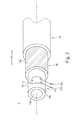
- Fig. 2 shows a perspective schematic representation of an elastomeric hollow body 1 with a sensor element 10 according to a second embodiment of the present invention.
- the sensor element 10 is integrated in the first layer 13.
- Fig. 3 shows a perspective schematic representation of an elastomeric hollow body 1 with a sensor element 10 according to a third embodiment of the present invention.
- the sensor element 11 is arranged on the side 13b of the first layer 13 facing away from the medium.
Landscapes
- Physics & Mathematics (AREA)
- General Physics & Mathematics (AREA)
- Measuring Temperature Or Quantity Of Heat (AREA)
Applications Claiming Priority (1)
| Application Number | Priority Date | Filing Date | Title |
|---|---|---|---|
| DE102013224024.4A DE102013224024A1 (de) | 2013-11-25 | 2013-11-25 | Elastomerer Hohlkörper, insbesondere elastomerer Schlauch, mit Sensorelement zur Erfassung einer Temperatur sowie Verfahren hierzu |
Publications (2)
| Publication Number | Publication Date |
|---|---|
| EP2876419A1 true EP2876419A1 (fr) | 2015-05-27 |
| EP2876419B1 EP2876419B1 (fr) | 2017-05-31 |
Family
ID=51417159
Family Applications (1)
| Application Number | Title | Priority Date | Filing Date |
|---|---|---|---|
| EP14181895.5A Active EP2876419B1 (fr) | 2013-11-25 | 2014-08-22 | Corps creux en élastomère, en particulier flexible en élastomère, doté d'un capteur destiné à détecter une température et procédé associé |
Country Status (2)
| Country | Link |
|---|---|
| EP (1) | EP2876419B1 (fr) |
| DE (1) | DE102013224024A1 (fr) |
Cited By (1)
| Publication number | Priority date | Publication date | Assignee | Title |
|---|---|---|---|---|
| DE102017001054A1 (de) | 2017-02-03 | 2018-08-09 | Hannes Nordmann | Messanordnung und Verfahren für ortsaufgelöste Mehrfach-Temperaturmessung entlang eines Pfades. |
Families Citing this family (1)
| Publication number | Priority date | Publication date | Assignee | Title |
|---|---|---|---|---|
| DE102018203809B3 (de) | 2018-03-13 | 2019-06-19 | Leoni Kabel Gmbh | Sensorleitung, Messanordnung sowie Verfahren zur Herstellung einer Sensorleitung |
Citations (6)
| Publication number | Priority date | Publication date | Assignee | Title |
|---|---|---|---|---|
| EP0862191A1 (fr) * | 1996-09-13 | 1998-09-02 | TDK Corporation | Materiau pour thermistor a ctp |
| DE29817221U1 (de) * | 1998-09-29 | 2000-02-10 | Taprogge GmbH, 58300 Wetter | Meßrohr, insbesondere für Wärmetauscher, mit mindestens einem Thermoelement |
| WO2002080200A1 (fr) * | 2001-03-29 | 2002-10-10 | Shinwha Intertek Corp. | Composition a coefficient de temperature positif et dispositif a coefficient de temperature positif contenant celle-ci |
| DE102006060784A1 (de) * | 2005-12-28 | 2007-07-05 | Tdk Corp. | PTC Element |
| WO2009038821A1 (fr) * | 2007-09-18 | 2009-03-26 | Cooper-Standard Automotive Inc. | Conduit fluidique comportant un capteur intégré |
| DE102008009817A1 (de) * | 2008-02-19 | 2009-08-27 | Epcos Ag | Verbundwerkstoff zur Temperaturmessung, Temperatursensor aufweisend den Verbundwerkstoff und Verfahren zur Herstellung des Verbundwerkstoffs und des Temperatursensors |
Family Cites Families (3)
| Publication number | Priority date | Publication date | Assignee | Title |
|---|---|---|---|---|
| US6397661B1 (en) * | 1998-12-30 | 2002-06-04 | University Of Kentucky Research Foundation | Remote magneto-elastic analyte, viscosity and temperature sensing apparatus and associated methods of sensing |
| US9027230B2 (en) * | 2009-03-02 | 2015-05-12 | Xerox Corporation | Thermally responsive composite member, related devices, and applications including structural applications |
| US20120027045A1 (en) * | 2010-02-01 | 2012-02-02 | Nano Terra Inc. | Passive thermal monitoring systems and methods of making and using the same |
-
2013
- 2013-11-25 DE DE102013224024.4A patent/DE102013224024A1/de not_active Withdrawn
-
2014
- 2014-08-22 EP EP14181895.5A patent/EP2876419B1/fr active Active
Patent Citations (6)
| Publication number | Priority date | Publication date | Assignee | Title |
|---|---|---|---|---|
| EP0862191A1 (fr) * | 1996-09-13 | 1998-09-02 | TDK Corporation | Materiau pour thermistor a ctp |
| DE29817221U1 (de) * | 1998-09-29 | 2000-02-10 | Taprogge GmbH, 58300 Wetter | Meßrohr, insbesondere für Wärmetauscher, mit mindestens einem Thermoelement |
| WO2002080200A1 (fr) * | 2001-03-29 | 2002-10-10 | Shinwha Intertek Corp. | Composition a coefficient de temperature positif et dispositif a coefficient de temperature positif contenant celle-ci |
| DE102006060784A1 (de) * | 2005-12-28 | 2007-07-05 | Tdk Corp. | PTC Element |
| WO2009038821A1 (fr) * | 2007-09-18 | 2009-03-26 | Cooper-Standard Automotive Inc. | Conduit fluidique comportant un capteur intégré |
| DE102008009817A1 (de) * | 2008-02-19 | 2009-08-27 | Epcos Ag | Verbundwerkstoff zur Temperaturmessung, Temperatursensor aufweisend den Verbundwerkstoff und Verfahren zur Herstellung des Verbundwerkstoffs und des Temperatursensors |
Cited By (1)
| Publication number | Priority date | Publication date | Assignee | Title |
|---|---|---|---|---|
| DE102017001054A1 (de) | 2017-02-03 | 2018-08-09 | Hannes Nordmann | Messanordnung und Verfahren für ortsaufgelöste Mehrfach-Temperaturmessung entlang eines Pfades. |
Also Published As
| Publication number | Publication date |
|---|---|
| DE102013224024A1 (de) | 2015-05-28 |
| EP2876419B1 (fr) | 2017-05-31 |
Similar Documents
| Publication | Publication Date | Title |
|---|---|---|
| EP2160581A2 (fr) | Capteur de dilation et dispositif de détection correspondant | |
| EP2876421B1 (fr) | Corps creux en élastomère, en particulier tuyau en élastomère, doté d'un élément de capteur destiné à détecter une pression et procédé associé | |
| DE102014001001A1 (de) | Molch und Molchscheibe für einen Molch | |
| EP2876419B1 (fr) | Corps creux en élastomère, en particulier flexible en élastomère, doté d'un capteur destiné à détecter une température et procédé associé | |
| DE102007056544A1 (de) | Sensoranordnung zur Bestimmung eines Tankfüllstands und Verfahren zur Herstellung hierzu | |
| EP2163298B1 (fr) | Agencement de fenêtre sur un tube de pression | |
| EP4028735B1 (fr) | Thermomètre non invasif | |
| DE102010007428A1 (de) | Überspannungsschutzelement | |
| EP2215436B1 (fr) | Ensemble capteur pour déterminer le niveau dans un réservoir et réservoir muni d'un tel ensemble capteur | |
| DE102013217159B3 (de) | Vorrichtung zum Transport eines Mediums | |
| DE102013224020A1 (de) | Vulkanisierte Kautschukmischung | |
| DE102013015377A1 (de) | Hochtemperatursensor und Verfahren zur Herstellung einer Schutzkappe für einen Hochtemperatursensor | |
| EP3819604B1 (fr) | Récipient de médias souple | |
| DE102014102054A1 (de) | Füllstandsensor mit Elektrodenüberwachung | |
| EP4409187A1 (fr) | Système de guidage de milieu comportant un guide de milieu et doté d'un capteur de température | |
| DE102017221510A1 (de) | Verfahren zur Messung der Größe eines Leckagestromes einer Dichtung | |
| DE102011001245A1 (de) | Verfahren zur Messung der Leitfähigkeitsänderung eines viskoelastischen Materials während seiner Herstellung durch Kombination von rheologischer mit elektrischer Prüfmethode | |
| DE102014001640A1 (de) | Druck- und Temperatursensor-Element | |
| DE102018212875A1 (de) | PTC-Plastik-Heizstruktur für Schlauchapplikationen | |
| AT516331B1 (de) | Halterung für Sensoren | |
| EP2995917B1 (fr) | Dispositif d'enregistrement des temperatures pour un appareil de chauffage pour vehicule | |
| DE102012107663B3 (de) | Gleitkontaktelement sowie ein Verfahren zur Bestimmung der Temperatur im Bereich des Gleitkontaktes eines ungeschmierten Gleitkontaktelementes in dessen Betriebszustand | |
| DE102022204045A1 (de) | Sensoranordnung zur Verwendung mit einem Artikel, vorzugsweise mit einer Medienführung | |
| DE102017222510A1 (de) | Temperaturfühler | |
| DE102022119086A1 (de) | Vorrichtung für eine Armatur der Prozessfluidtechnik |
Legal Events
| Date | Code | Title | Description |
|---|---|---|---|
| PUAI | Public reference made under article 153(3) epc to a published international application that has entered the european phase |
Free format text: ORIGINAL CODE: 0009012 |
|
| 17P | Request for examination filed |
Effective date: 20140822 |
|
| AK | Designated contracting states |
Kind code of ref document: A1 Designated state(s): AL AT BE BG CH CY CZ DE DK EE ES FI FR GB GR HR HU IE IS IT LI LT LU LV MC MK MT NL NO PL PT RO RS SE SI SK SM TR |
|
| AX | Request for extension of the european patent |
Extension state: BA ME |
|
| R17P | Request for examination filed (corrected) |
Effective date: 20151127 |
|
| RBV | Designated contracting states (corrected) |
Designated state(s): AL AT BE BG CH CY CZ DE DK EE ES FI FR GB GR HR HU IE IS IT LI LT LU LV MC MK MT NL NO PL PT RO RS SE SI SK SM TR |
|
| 17Q | First examination report despatched |
Effective date: 20160401 |
|
| GRAP | Despatch of communication of intention to grant a patent |
Free format text: ORIGINAL CODE: EPIDOSNIGR1 |
|
| STAA | Information on the status of an ep patent application or granted ep patent |
Free format text: STATUS: GRANT OF PATENT IS INTENDED |
|
| INTG | Intention to grant announced |
Effective date: 20170214 |
|
| GRAS | Grant fee paid |
Free format text: ORIGINAL CODE: EPIDOSNIGR3 |
|
| GRAA | (expected) grant |
Free format text: ORIGINAL CODE: 0009210 |
|
| STAA | Information on the status of an ep patent application or granted ep patent |
Free format text: STATUS: THE PATENT HAS BEEN GRANTED |
|
| AK | Designated contracting states |
Kind code of ref document: B1 Designated state(s): AL AT BE BG CH CY CZ DE DK EE ES FI FR GB GR HR HU IE IS IT LI LT LU LV MC MK MT NL NO PL PT RO RS SE SI SK SM TR |
|
| REG | Reference to a national code |
Ref country code: CH Ref legal event code: EP Ref country code: GB Ref legal event code: FG4D Free format text: NOT ENGLISH |
|
| REG | Reference to a national code |
Ref country code: AT Ref legal event code: REF Ref document number: 897913 Country of ref document: AT Kind code of ref document: T Effective date: 20170615 |
|
| REG | Reference to a national code |
Ref country code: IE Ref legal event code: FG4D Free format text: LANGUAGE OF EP DOCUMENT: GERMAN |
|
| REG | Reference to a national code |
Ref country code: DE Ref legal event code: R096 Ref document number: 502014003986 Country of ref document: DE |
|
| REG | Reference to a national code |
Ref country code: FR Ref legal event code: PLFP Year of fee payment: 4 |
|
| REG | Reference to a national code |
Ref country code: NL Ref legal event code: MP Effective date: 20170531 |
|
| REG | Reference to a national code |
Ref country code: LT Ref legal event code: MG4D |
|
| PG25 | Lapsed in a contracting state [announced via postgrant information from national office to epo] |
Ref country code: LT Free format text: LAPSE BECAUSE OF FAILURE TO SUBMIT A TRANSLATION OF THE DESCRIPTION OR TO PAY THE FEE WITHIN THE PRESCRIBED TIME-LIMIT Effective date: 20170531 Ref country code: ES Free format text: LAPSE BECAUSE OF FAILURE TO SUBMIT A TRANSLATION OF THE DESCRIPTION OR TO PAY THE FEE WITHIN THE PRESCRIBED TIME-LIMIT Effective date: 20170531 Ref country code: NO Free format text: LAPSE BECAUSE OF FAILURE TO SUBMIT A TRANSLATION OF THE DESCRIPTION OR TO PAY THE FEE WITHIN THE PRESCRIBED TIME-LIMIT Effective date: 20170831 Ref country code: FI Free format text: LAPSE BECAUSE OF FAILURE TO SUBMIT A TRANSLATION OF THE DESCRIPTION OR TO PAY THE FEE WITHIN THE PRESCRIBED TIME-LIMIT Effective date: 20170531 Ref country code: HR Free format text: LAPSE BECAUSE OF FAILURE TO SUBMIT A TRANSLATION OF THE DESCRIPTION OR TO PAY THE FEE WITHIN THE PRESCRIBED TIME-LIMIT Effective date: 20170531 Ref country code: GR Free format text: LAPSE BECAUSE OF FAILURE TO SUBMIT A TRANSLATION OF THE DESCRIPTION OR TO PAY THE FEE WITHIN THE PRESCRIBED TIME-LIMIT Effective date: 20170901 |
|
| PG25 | Lapsed in a contracting state [announced via postgrant information from national office to epo] |
Ref country code: RS Free format text: LAPSE BECAUSE OF FAILURE TO SUBMIT A TRANSLATION OF THE DESCRIPTION OR TO PAY THE FEE WITHIN THE PRESCRIBED TIME-LIMIT Effective date: 20170531 Ref country code: SE Free format text: LAPSE BECAUSE OF FAILURE TO SUBMIT A TRANSLATION OF THE DESCRIPTION OR TO PAY THE FEE WITHIN THE PRESCRIBED TIME-LIMIT Effective date: 20170531 Ref country code: NL Free format text: LAPSE BECAUSE OF FAILURE TO SUBMIT A TRANSLATION OF THE DESCRIPTION OR TO PAY THE FEE WITHIN THE PRESCRIBED TIME-LIMIT Effective date: 20170531 Ref country code: BG Free format text: LAPSE BECAUSE OF FAILURE TO SUBMIT A TRANSLATION OF THE DESCRIPTION OR TO PAY THE FEE WITHIN THE PRESCRIBED TIME-LIMIT Effective date: 20170831 Ref country code: IS Free format text: LAPSE BECAUSE OF FAILURE TO SUBMIT A TRANSLATION OF THE DESCRIPTION OR TO PAY THE FEE WITHIN THE PRESCRIBED TIME-LIMIT Effective date: 20170930 Ref country code: LV Free format text: LAPSE BECAUSE OF FAILURE TO SUBMIT A TRANSLATION OF THE DESCRIPTION OR TO PAY THE FEE WITHIN THE PRESCRIBED TIME-LIMIT Effective date: 20170531 |
|
| PG25 | Lapsed in a contracting state [announced via postgrant information from national office to epo] |
Ref country code: CZ Free format text: LAPSE BECAUSE OF FAILURE TO SUBMIT A TRANSLATION OF THE DESCRIPTION OR TO PAY THE FEE WITHIN THE PRESCRIBED TIME-LIMIT Effective date: 20170531 Ref country code: SK Free format text: LAPSE BECAUSE OF FAILURE TO SUBMIT A TRANSLATION OF THE DESCRIPTION OR TO PAY THE FEE WITHIN THE PRESCRIBED TIME-LIMIT Effective date: 20170531 Ref country code: EE Free format text: LAPSE BECAUSE OF FAILURE TO SUBMIT A TRANSLATION OF THE DESCRIPTION OR TO PAY THE FEE WITHIN THE PRESCRIBED TIME-LIMIT Effective date: 20170531 Ref country code: RO Free format text: LAPSE BECAUSE OF FAILURE TO SUBMIT A TRANSLATION OF THE DESCRIPTION OR TO PAY THE FEE WITHIN THE PRESCRIBED TIME-LIMIT Effective date: 20170531 Ref country code: DK Free format text: LAPSE BECAUSE OF FAILURE TO SUBMIT A TRANSLATION OF THE DESCRIPTION OR TO PAY THE FEE WITHIN THE PRESCRIBED TIME-LIMIT Effective date: 20170531 |
|
| PG25 | Lapsed in a contracting state [announced via postgrant information from national office to epo] |
Ref country code: SM Free format text: LAPSE BECAUSE OF FAILURE TO SUBMIT A TRANSLATION OF THE DESCRIPTION OR TO PAY THE FEE WITHIN THE PRESCRIBED TIME-LIMIT Effective date: 20170531 Ref country code: PL Free format text: LAPSE BECAUSE OF FAILURE TO SUBMIT A TRANSLATION OF THE DESCRIPTION OR TO PAY THE FEE WITHIN THE PRESCRIBED TIME-LIMIT Effective date: 20170531 Ref country code: IT Free format text: LAPSE BECAUSE OF FAILURE TO SUBMIT A TRANSLATION OF THE DESCRIPTION OR TO PAY THE FEE WITHIN THE PRESCRIBED TIME-LIMIT Effective date: 20170531 |
|
| REG | Reference to a national code |
Ref country code: DE Ref legal event code: R097 Ref document number: 502014003986 Country of ref document: DE |
|
| REG | Reference to a national code |
Ref country code: CH Ref legal event code: PL |
|
| PG25 | Lapsed in a contracting state [announced via postgrant information from national office to epo] |
Ref country code: MC Free format text: LAPSE BECAUSE OF FAILURE TO SUBMIT A TRANSLATION OF THE DESCRIPTION OR TO PAY THE FEE WITHIN THE PRESCRIBED TIME-LIMIT Effective date: 20170531 |
|
| PLBE | No opposition filed within time limit |
Free format text: ORIGINAL CODE: 0009261 |
|
| STAA | Information on the status of an ep patent application or granted ep patent |
Free format text: STATUS: NO OPPOSITION FILED WITHIN TIME LIMIT |
|
| PG25 | Lapsed in a contracting state [announced via postgrant information from national office to epo] |
Ref country code: LI Free format text: LAPSE BECAUSE OF NON-PAYMENT OF DUE FEES Effective date: 20170831 Ref country code: CH Free format text: LAPSE BECAUSE OF NON-PAYMENT OF DUE FEES Effective date: 20170831 |
|
| REG | Reference to a national code |
Ref country code: BE Ref legal event code: MM Effective date: 20170831 |
|
| 26N | No opposition filed |
Effective date: 20180301 |
|
| REG | Reference to a national code |
Ref country code: IE Ref legal event code: MM4A |
|
| PG25 | Lapsed in a contracting state [announced via postgrant information from national office to epo] |
Ref country code: SI Free format text: LAPSE BECAUSE OF FAILURE TO SUBMIT A TRANSLATION OF THE DESCRIPTION OR TO PAY THE FEE WITHIN THE PRESCRIBED TIME-LIMIT Effective date: 20170531 |
|
| PG25 | Lapsed in a contracting state [announced via postgrant information from national office to epo] |
Ref country code: LU Free format text: LAPSE BECAUSE OF NON-PAYMENT OF DUE FEES Effective date: 20170822 |
|
| PG25 | Lapsed in a contracting state [announced via postgrant information from national office to epo] |
Ref country code: IE Free format text: LAPSE BECAUSE OF NON-PAYMENT OF DUE FEES Effective date: 20170822 |
|
| REG | Reference to a national code |
Ref country code: FR Ref legal event code: PLFP Year of fee payment: 5 |
|
| PG25 | Lapsed in a contracting state [announced via postgrant information from national office to epo] |
Ref country code: BE Free format text: LAPSE BECAUSE OF NON-PAYMENT OF DUE FEES Effective date: 20170831 |
|
| PG25 | Lapsed in a contracting state [announced via postgrant information from national office to epo] |
Ref country code: MT Free format text: LAPSE BECAUSE OF FAILURE TO SUBMIT A TRANSLATION OF THE DESCRIPTION OR TO PAY THE FEE WITHIN THE PRESCRIBED TIME-LIMIT Effective date: 20170531 |
|
| PG25 | Lapsed in a contracting state [announced via postgrant information from national office to epo] |
Ref country code: HU Free format text: LAPSE BECAUSE OF FAILURE TO SUBMIT A TRANSLATION OF THE DESCRIPTION OR TO PAY THE FEE WITHIN THE PRESCRIBED TIME-LIMIT; INVALID AB INITIO Effective date: 20140822 |
|
| PG25 | Lapsed in a contracting state [announced via postgrant information from national office to epo] |
Ref country code: CY Free format text: LAPSE BECAUSE OF FAILURE TO SUBMIT A TRANSLATION OF THE DESCRIPTION OR TO PAY THE FEE WITHIN THE PRESCRIBED TIME-LIMIT Effective date: 20170531 |
|
| PG25 | Lapsed in a contracting state [announced via postgrant information from national office to epo] |
Ref country code: MK Free format text: LAPSE BECAUSE OF FAILURE TO SUBMIT A TRANSLATION OF THE DESCRIPTION OR TO PAY THE FEE WITHIN THE PRESCRIBED TIME-LIMIT Effective date: 20170531 |
|
| PG25 | Lapsed in a contracting state [announced via postgrant information from national office to epo] |
Ref country code: TR Free format text: LAPSE BECAUSE OF FAILURE TO SUBMIT A TRANSLATION OF THE DESCRIPTION OR TO PAY THE FEE WITHIN THE PRESCRIBED TIME-LIMIT Effective date: 20170531 |
|
| PG25 | Lapsed in a contracting state [announced via postgrant information from national office to epo] |
Ref country code: PT Free format text: LAPSE BECAUSE OF FAILURE TO SUBMIT A TRANSLATION OF THE DESCRIPTION OR TO PAY THE FEE WITHIN THE PRESCRIBED TIME-LIMIT Effective date: 20170531 |
|
| PG25 | Lapsed in a contracting state [announced via postgrant information from national office to epo] |
Ref country code: AL Free format text: LAPSE BECAUSE OF FAILURE TO SUBMIT A TRANSLATION OF THE DESCRIPTION OR TO PAY THE FEE WITHIN THE PRESCRIBED TIME-LIMIT Effective date: 20170531 |
|
| REG | Reference to a national code |
Ref country code: AT Ref legal event code: MM01 Ref document number: 897913 Country of ref document: AT Kind code of ref document: T Effective date: 20190822 |
|
| PG25 | Lapsed in a contracting state [announced via postgrant information from national office to epo] |
Ref country code: AT Free format text: LAPSE BECAUSE OF NON-PAYMENT OF DUE FEES Effective date: 20190822 |
|
| REG | Reference to a national code |
Ref country code: DE Ref legal event code: R081 Ref document number: 502014003986 Country of ref document: DE Owner name: CONTITECH DEUTSCHLAND GMBH, DE Free format text: FORMER OWNER: CONTITECH AG, 30165 HANNOVER, DE |
|
| PGFP | Annual fee paid to national office [announced via postgrant information from national office to epo] |
Ref country code: DE Payment date: 20250831 Year of fee payment: 12 |
|
| PGFP | Annual fee paid to national office [announced via postgrant information from national office to epo] |
Ref country code: GB Payment date: 20250820 Year of fee payment: 12 |
|
| PGFP | Annual fee paid to national office [announced via postgrant information from national office to epo] |
Ref country code: FR Payment date: 20250829 Year of fee payment: 12 |