EP2876691A1 - Réseau de cellules solaires - Google Patents
Réseau de cellules solaires Download PDFInfo
- Publication number
- EP2876691A1 EP2876691A1 EP14187983.3A EP14187983A EP2876691A1 EP 2876691 A1 EP2876691 A1 EP 2876691A1 EP 14187983 A EP14187983 A EP 14187983A EP 2876691 A1 EP2876691 A1 EP 2876691A1
- Authority
- EP
- European Patent Office
- Prior art keywords
- electrodes
- electrode
- solar cell
- cell array
- substrate
- Prior art date
- Legal status (The legal status is an assumption and is not a legal conclusion. Google has not performed a legal analysis and makes no representation as to the accuracy of the status listed.)
- Withdrawn
Links
Images



Classifications
-
- H—ELECTRICITY
- H10—SEMICONDUCTOR DEVICES; ELECTRIC SOLID-STATE DEVICES NOT OTHERWISE PROVIDED FOR
- H10F—INORGANIC SEMICONDUCTOR DEVICES SENSITIVE TO INFRARED RADIATION, LIGHT, ELECTROMAGNETIC RADIATION OF SHORTER WAVELENGTH OR CORPUSCULAR RADIATION
- H10F19/00—Integrated devices, or assemblies of multiple devices, comprising at least one photovoltaic cell covered by group H10F10/00, e.g. photovoltaic modules
-
- H—ELECTRICITY
- H10—SEMICONDUCTOR DEVICES; ELECTRIC SOLID-STATE DEVICES NOT OTHERWISE PROVIDED FOR
- H10F—INORGANIC SEMICONDUCTOR DEVICES SENSITIVE TO INFRARED RADIATION, LIGHT, ELECTROMAGNETIC RADIATION OF SHORTER WAVELENGTH OR CORPUSCULAR RADIATION
- H10F19/00—Integrated devices, or assemblies of multiple devices, comprising at least one photovoltaic cell covered by group H10F10/00, e.g. photovoltaic modules
- H10F19/30—Integrated devices, or assemblies of multiple devices, comprising at least one photovoltaic cell covered by group H10F10/00, e.g. photovoltaic modules comprising thin-film photovoltaic cells
- H10F19/31—Integrated devices, or assemblies of multiple devices, comprising at least one photovoltaic cell covered by group H10F10/00, e.g. photovoltaic modules comprising thin-film photovoltaic cells having multiple laterally adjacent thin-film photovoltaic cells deposited on the same substrate
-
- Y—GENERAL TAGGING OF NEW TECHNOLOGICAL DEVELOPMENTS; GENERAL TAGGING OF CROSS-SECTIONAL TECHNOLOGIES SPANNING OVER SEVERAL SECTIONS OF THE IPC; TECHNICAL SUBJECTS COVERED BY FORMER USPC CROSS-REFERENCE ART COLLECTIONS [XRACs] AND DIGESTS
- Y02—TECHNOLOGIES OR APPLICATIONS FOR MITIGATION OR ADAPTATION AGAINST CLIMATE CHANGE
- Y02E—REDUCTION OF GREENHOUSE GAS [GHG] EMISSIONS, RELATED TO ENERGY GENERATION, TRANSMISSION OR DISTRIBUTION
- Y02E10/00—Energy generation through renewable energy sources
- Y02E10/50—Photovoltaic [PV] energy
Definitions
- the present invention relates to a solar cell array.
- a solar cell array includes a photovoltaic element that converts solar energy to electrical energy, and the solar cell array is gaining interest as an unlimited and non-polluting next generation energy source.
- a solar cell array includes a p-type semiconductor and an n-type semiconductor, and when solar energy is absorbed by a photoactive layer, electron-hole pairs (EHPs) are generated in the semiconductor. Then, the generated electrons and holes move to the n-type semiconductor and the p-type semiconductor, respectively, and are collected by electrodes, and can then be used as electrical energy.
- EHPs electron-hole pairs
- the photoactive layer may include a compound semiconductor including group I-III-VI elements.
- the compound semiconductor may realize a high efficiency solar cell array with a high light absorption coefficient and high optical stability.
- Such a solar cell array is formed of unit cells that are substantially equal in size and electrically coupled (e.g., electrically connected) to each other on a substrate.
- the unit cells may be formed as a continuous thin film on the substrate and then separated from each other through a scribing process.
- a current generated in each unit cell may be different.
- the current generated in each of the unit cells is different, the current generated in each of the unit cells is lowered to the minimum or lowest current generated in one of the unit cells.
- aspects of the present invention are directed toward a solar cell array including a CIGS semiconductor. Aspects of the present invention are also directed toward a solar cell array having unit cells respectively generating substantially the same amount of current regardless of a characteristic of a thin film.
- a solar cell array includes: a substrate; a plurality of first electrodes on the substrate and separated from each other; a photoactive layer on each of the first electrodes, the photoactive layer having a gap exposing a neighbouring one of the first electrodes; and a second electrode on each of the photoactive layers, the second electrode being electrically coupled to the neighbouring one of the first electrodes at the gap, wherein at least two of the plurality of first electrodes have sizes different from each other.
- a difference between respective areas of the at least two first electrodes may be within about 3%.
- Each of the plurality of first electrodes may have a rectangular shape having a pair of short sides extending in a direction that crosses the gap (e.g., substantially perpendicular to a direction in which the gap extends), and lengths of the short sides of the respective first electrodes may be different from each other.
- the length of each of the short sides of each of the plurality of first electrodes may be in a range of about 3.5 mm to about 6 mm.
- the second electrodes may have thicknesses that are different from each other.
- a thickness of a second electrode on one of the first electrodes having a relatively large area may be less than a thickness of a second electrode on another of the first electrodes having a relatively small area.
- a solar cell array includes: a substrate; a plurality of first electrodes on the substrate and separated from each other; a photoactive layer on each of the first electrodes, the photoactive layer having a gap exposing a neighbouring one of the first electrodes; and a second electrode on each of the photoactive layers, the second electrode being electrically coupled to the neighbouring one of the electrodes at the gap. At least two of the second electrodes have thicknesses that are different from each other.
- a difference between thicknesses of the at least two second electrodes may be within about 3%, and the thickness of each second electrode may be in a range of about 0.9 ⁇ m to about 1.25 ⁇ m.
- Each of the first electrodes may include an opaque metal, and the second electrode may include a transparent conductive material.
- Each photoactive layer may include a CIGS-based material.
- a solar cell array includes a substrate and a plurality of solar cells on the substrate and electrically coupled to each other.
- First electrodes of at least two solar cells from among the plurality of solar cells may have areas different in size from each other, and the plurality of solar cells may have substantially the same short-circuit current as each other.
- the first electrode may have a rectangular shape, and a length of each of a pair of shorter sides among sides of the first electrode may be in a range of about 3.5 mm to about 6 mm.
- a solar cell array includes a substrate, and a plurality of solar cells on the substrate and electrically coupled to each other. Second electrodes of at least two of the solar cells from among the plurality of solar cells have thicknesses different from each other, and short-circuit currents of the solar cells may be substantially the same as (e.g., substantially equivalent to) each other.
- each of the second electrodes may be in a range of about 0.9 ⁇ m to about 1.25 ⁇ m.
- a method of manufacturing a solar cell array that comprises a plurality of solar cells, each of the solar cells comprising a first electrode, a photoactive layer on the first electrode extending to the first electrode of the neighbouring solar cell, the photoactive layer having a gap exposing the first electrode of the neighbouring solar cell, and a second electrode on the photoactive layer, the second electrode being electrically connected to the first electrode of the neighbouring solar cell at the gap, the method comprising varying the size of the first electrodes and/or the thickness of the second electrodes of one or more of the solar cells so that the currents generated in each of the solar cells are substantially the same as one another.
- the method may comprise varying the size of the first electrodes and/or the thickness of the second electrodes based on information about currents generated by cells at a predetermined location on the substrate.
- the method may comprise fabricating a first solar cell array on a first substrate, determining currents generated by solar cells in the first solar array, adjusting the fabrication process to vary the size of the first electrodes and/or the thickness of the second electrodes to be fabricated as a second solar cell array on a second substrate and fabricating the second solar cell array on the second substrate using the adjusted fabrication process.
- the current generated in the respective unit cells may be substantially the same or the same (e.g., substantially uniform) regardless of a characteristic of a thin film used to form a solar cell array, thereby increasing efficiency of the solar cell array.
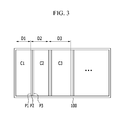
- a solar cell array includes a plurality of solar cells C1 to Cn formed on a substrate 100.
- Each solar cell includes a first electrode 120, a photoactive layer 140 formed on the first electrode 120, a buffer layer 160 formed on the photoactive layer 140, and a second electrode 180 formed on the buffer layer 160, and neighbouring cells (e.g., adjacent cells) are electrically coupled (e.g., electrically connected) to each other.
- neighbouring cells e.g., adjacent cells
- the first electrodes 120 of adjacent cells are arranged with a substantially constant gap P1 therebetween.
- a width of the gap P1 may be in a range of about 20 ⁇ m to about 100 ⁇ m.
- the first electrode 120 may have a rectangular shape of which long sides are parallel with (e.g., extend parallel to) the gap P1, and at least two of the first electrodes 120 may have sizes different from each other.
- sides that are parallel with the gap P1 from among sides of each first electrode 120 e.g., the long sides of each first electrode 120
- lengths D1 and D2 hereinafter referred to as widths of the first electrodes 120
- widths of the first electrodes 120 of short sides from among sides of each first electrode 120 that are perpendicular to the gap P1 (e.g., that extend substantially perpendicular to the long sides of each first electrode 120) may be different from each other.
- the width of the first electrode 120 may be in a range from about 3.5 mm to about 6 mm.
- the width D1 of the first electrode 120 of the first cell C1 and the width D2 of the first electrode 120 of the second cell C2 are different from each other, but the width of first electrodes 120 of cells that are located at a distance from each other (e.g., cells that are not directly adjacent to each other) may also be different from each other, for example, the first cell C1 and the third cell C3 and/or the second cell C2 and an n-th cell Cn.
- the number of first electrodes 120 respectively having widths D1, D2, and D3 different from each other may be three or more, and such cells may be sequentially arranged or randomly arranged.
- a deviation of currents generated in each of the solar cells can be prevented or reduced by differentiating or varying the widths of the respective first electrodes.
- the current generated in the first and second cells C1 and C2 can be made to be substantially the same or the same (e.g., can become equivalent to each other) by reducing the width D1 of the first electrode 120 of the first cell C1 or by increasing the width D2 of the first electrode 120 of the second cell C2.
- the amount of current generated in each cell may be affected by (e.g., changed or varied according to) a temperature and/or a deposition condition of a process that forms the photoactive layer in each cell.
- the same act (process) is iteratively performed on each substrate, the amount of current generated in a respective cell may tend to be consistent according to the location on the substrate. Therefore, widths of first electrodes of cells formed on a subsequent (e.g., next) substrate are made to be different from each other with reference to (according to) the amount of current generated in the respective cells formed on the previous substrate.
- the substrate 100 may be made of an insulating transparent material, for example, soda-lime glass.
- the first electrode 120 may be made of a metal having an excellent heat resistive characteristic, an excellent electrical contact characteristic with respect to a material that forms the photoactive layer 140, excellent electric conductivity, and excellent interface adherence with the substrate 100.
- the first electrode 120 may be made of molybdenum (Mo).
- the photoactive layer 140 and the buffer layer 160 are formed on the first electrode 120.
- the photoactive layer 140 fills the gap P1 between neighbouring (e.g., adjacent) first electrodes 120.
- the photoactive layer 140 may include selenium (Se) and/or sulfur (S).
- the photoactive layer 140 may include Cu(In 1-x ,Ga x )(Se 1-x ,S x ) as a group I-III-VI-based semiconductor compound and may be a compound semiconductor having a composition of 0 ⁇ x ⁇ 1.
- the photoactive layer 140 may have a single phase of which a composition in the compound semiconductor is substantially uniform.
- the photoactive layer 140 may be CuInSe 2 , CuInS 2 , Cu(In,Ga)Se 2 , (Ag,Cu) (In,Ga)Se 2 , (Ag,Cu) (In,Ga) (Se,S) 2 , Cu(In,Ga) (Se,S) 2 , or Cu(In,Ga)S 2 .
- the photoactive layer 140 may include sodium (Na), which is diffused from the substrate 100.
- the buffer layer 160 reduces an energy gap difference between the photoactive layer 140 and the second electrode 180.
- the buffer layer 160 may be made of an n-type semiconductor material having high light transmittance, for example, cadmium sulfide (CdS), zinc sulfide (ZnS), or indium sulfide (InS).
- the buffer layer 160 and the photoactive layer 140 include a gap (e.g., an opening or through-hole) P2 that exposes the first electrode 120 (e.g., exposes a portion of the first electrode 120).
- the gap P2 exposes the first electrode 120 of neighbouring solar cells.
- the gap P2 is linearly formed in parallel with (e.g., is formed to extend parallel to) the gap P1.
- Second electrodes 180 of neighbouring cells are separated by a separation groove P3.
- the separation groove P3 exposes the first electrode 120 (e.g., exposes a portion of the first electrode 120).
- the separation groove P3 exposes the first electrode 120 of neighbouring solar cells, and the width of the separation groove P3 may be in a range of about 20 ⁇ m to about 100 ⁇ m.
- the second electrodes 180 may respectively have thicknesses different from each other depending on the amount of current to be generated in a solar cell. That is, the thickness of a second electrode 180 of a solar cell generating a relatively small amount of current is formed to be relatively thin so as to increase a transmission amount therethrough, and the thickness of a second electrode 180 of a solar cell generating a relatively large amount of current is formed to be relatively thick so as to reduce the transmission amount therethrough.
- a solar cell including a first electrode 120 having a relatively large width further includes a second electrode that is thinner than a second electrode 180 of an other solar cell including a first electrode 120 that is relatively narrow (e.g., has a relatively small width).
- the thickness of the second electrode 180 may be in a range of about 0.9 ⁇ m to about 1.25 ⁇ m.
- a correspondence between the width of the first electrode 120 and the thickness of the second electrode 180 (e.g., a relationship between the width of the first electrode 120 and the thickness of the second electrode 180) in each cell can be determined from Equation 1.
- Y 1 + X ⁇ 1 * 1 + A * X ⁇ 2
- Y denotes a relative rate of a short-circuit current Jsc
- X1 denotes a ratio of a change of widths of different first electrodes
- X2 denotes a ratio of a change of widths of different second electrodes
- a solar cell array shown in FIG. 4 includes a first cell C1, a second cell C2, and a third cell C3 respectively having substantially the same or the same width.
- the amount of current generated in the first to third cells C1 to C3 are 1, 2, and 3, respectively, is different, that is, each cell generates a different amount of current.
- the amount of current generated in each of the cells is made to be the same or substantially the same (e.g., made to be equivalent to) the amount of current generated in the second cell.
- Y of the first cell C1 with respect to the second cell C2 is 0.5.
- X1 of the first cell C1 can be 0.5 from Equation 1. Because the amount of current generated in a cell is proportional to the width of the first electrode thereof, the width D1 of the first electrode of the first cell C1 is increased to have a ratio of 0.5 with respect to the width D2 of the first electrode of the second cell C2.
- the width of the first electrode of the first cell C1 is increased to increase the amount of current generated in the first cell C1 so that it becomes the same or substantially the same as (e.g., equivalent to) the amount of current generated in the second cell C2.
- Equation 1 The amount of current generated in a cell is proportional to the width of the first electrode thereof, and therefore, the width D3 of the first electrode of the third cell C3 is reduced to have a ratio of 0.5 with respect to the width D2 of the first electrode of the second cell C2.
- the amount of current generated in the third cell C3 is greater than the amount of current generated in the second cell C2 having the same area, and therefore, the amount of current generated in the third cell C3 is reduced by reducing the width of the first electrode of the third cell C3 so as to make the amount of current generated in the third cell C3 equal to the amount of current generated in the second cell C2.
- X2 becomes 0.5/A of X from Equation 1.
- A is a constant that depends on transmittance and conductivity of the second electrode, and therefore, A may be in a range of -0.12 ⁇ A ⁇ -0.06.
- A is less than -0.12 or greater than -0.06, the transmittance and the conductivity of the second electrode are deteriorated, thereby causing current leakage.
- the thickness of the second electrode of the first cell C1 generating a relatively small amount of current is decreased to have a ratio of 0.5/A to increase the amount of current generated therein, and the thickness of the second electrode of the third cell C3 generating a relatively large amount of current is reduced to have a ratio of 0.5/A to make the amount of current generated in each of the first to third cells C1 to C3 the same or substantially the same (e.g., to equalize the amount of current generated in each of the first to third cells C1 to C3).
- the above description is based on the amount of current generated in the second cell C2 as an example, but the amount of current generated in the first cell and/or the amount of current generated in the third cell C3 may be a reference current in the described embodiments.
- the amount of current generated in each cell of the solar cells can be made the same or substantially the same (e.g., can be made uniform or equalized) by changing or varying the width of the first electrode and/or the thickness of the second electrode according to the amount of current generated in each cell.
- the width of the first electrode and/or the thickness of the second electrode may be changed with reference to the amount of current measured in the fabrication of a previous substrate, for example the amount of current generated in the reference cell of a previous substrate.
- the generated current is measured and the fabrication process for the subsequent substrate is adjusted to achieve equivalent currents across all of the solar cells in the substrate being presently fabricated.
- the second electrode 180 may be made of a material having high light transmittance and excellent electrical conductivity and, for example, may be formed as a single layer or a multilayer including indium tin oxide (ITO), indium zinc oxide (IZO), and/or zinc oxide (ZnO).
- ITO indium tin oxide
- IZO indium zinc oxide
- ZnO zinc oxide
- the light transmittance of the second electrode 180 may be greater than about 80 %.
- the ZnO layer has a low resistance value by being doped with aluminum (Al) and/or boron (B).
- the ITO layer having an excellent electro-optical characteristic may be layered on the ZnO layer or an n-type ZnO layer having a low resistance value may be layered on an i-type undoped ZnO layer.
- the second electrode 180 is an n-type semiconductor and forms a p-n junction with the photoactive layer 140, which is a p-type semiconductor.
Landscapes
- Photovoltaic Devices (AREA)
Applications Claiming Priority (1)
| Application Number | Priority Date | Filing Date | Title |
|---|---|---|---|
| KR1020130141706A KR20150057853A (ko) | 2013-11-20 | 2013-11-20 | 태양 전지 |
Publications (1)
| Publication Number | Publication Date |
|---|---|
| EP2876691A1 true EP2876691A1 (fr) | 2015-05-27 |
Family
ID=51659590
Family Applications (1)
| Application Number | Title | Priority Date | Filing Date |
|---|---|---|---|
| EP14187983.3A Withdrawn EP2876691A1 (fr) | 2013-11-20 | 2014-10-07 | Réseau de cellules solaires |
Country Status (3)
| Country | Link |
|---|---|
| US (1) | US20150136197A1 (fr) |
| EP (1) | EP2876691A1 (fr) |
| KR (1) | KR20150057853A (fr) |
Cited By (1)
| Publication number | Priority date | Publication date | Assignee | Title |
|---|---|---|---|---|
| EP4383311A4 (fr) * | 2021-12-27 | 2025-02-12 | Contemporary Amperex Technology (Hong Kong) Limited | Cellule solaire, composant photovoltaïque et appareil électrique |
Families Citing this family (1)
| Publication number | Priority date | Publication date | Assignee | Title |
|---|---|---|---|---|
| DE102020131742A1 (de) * | 2020-11-30 | 2022-06-02 | Heliatek Gmbh | Feldbreitenanpassung von Zellen in einem photovoltaischen Element |
Citations (8)
| Publication number | Priority date | Publication date | Assignee | Title |
|---|---|---|---|---|
| JPS6266684A (ja) * | 1985-09-19 | 1987-03-26 | Sanyo Electric Co Ltd | 光起電力装置の製造方法 |
| JP2005302819A (ja) * | 2004-04-07 | 2005-10-27 | Toyota Motor Corp | 熱光発電装置 |
| US20080083448A1 (en) * | 2006-09-29 | 2008-04-10 | Borden Peter G | Interconnect for thin film photovoltaic modules |
| US20080121264A1 (en) * | 2006-11-28 | 2008-05-29 | Industrial Technology Research Institute | Thin film solar module and method of fabricating the same |
| US20080216886A1 (en) * | 2005-07-01 | 2008-09-11 | Tadashi Iwakura | Solar Cell Module |
| KR20100133623A (ko) * | 2009-06-12 | 2010-12-22 | 엘지이노텍 주식회사 | 태양광 발전장치 |
| US20110061706A1 (en) * | 2009-09-16 | 2011-03-17 | Jusung Engineering Co., Ltd. | Thin film type solar cell and method for manufacturing the same, and thin film type solar cell module and power generation system using the same |
| US20110100414A1 (en) * | 2009-10-30 | 2011-05-05 | Taeho Moon | Thin film solar cell module |
Family Cites Families (1)
| Publication number | Priority date | Publication date | Assignee | Title |
|---|---|---|---|---|
| US20080105293A1 (en) * | 2006-11-02 | 2008-05-08 | Guardian Industries Corp. | Front electrode for use in photovoltaic device and method of making same |
-
2013
- 2013-11-20 KR KR1020130141706A patent/KR20150057853A/ko not_active Withdrawn
-
2014
- 2014-05-08 US US14/273,515 patent/US20150136197A1/en not_active Abandoned
- 2014-10-07 EP EP14187983.3A patent/EP2876691A1/fr not_active Withdrawn
Patent Citations (8)
| Publication number | Priority date | Publication date | Assignee | Title |
|---|---|---|---|---|
| JPS6266684A (ja) * | 1985-09-19 | 1987-03-26 | Sanyo Electric Co Ltd | 光起電力装置の製造方法 |
| JP2005302819A (ja) * | 2004-04-07 | 2005-10-27 | Toyota Motor Corp | 熱光発電装置 |
| US20080216886A1 (en) * | 2005-07-01 | 2008-09-11 | Tadashi Iwakura | Solar Cell Module |
| US20080083448A1 (en) * | 2006-09-29 | 2008-04-10 | Borden Peter G | Interconnect for thin film photovoltaic modules |
| US20080121264A1 (en) * | 2006-11-28 | 2008-05-29 | Industrial Technology Research Institute | Thin film solar module and method of fabricating the same |
| KR20100133623A (ko) * | 2009-06-12 | 2010-12-22 | 엘지이노텍 주식회사 | 태양광 발전장치 |
| US20110061706A1 (en) * | 2009-09-16 | 2011-03-17 | Jusung Engineering Co., Ltd. | Thin film type solar cell and method for manufacturing the same, and thin film type solar cell module and power generation system using the same |
| US20110100414A1 (en) * | 2009-10-30 | 2011-05-05 | Taeho Moon | Thin film solar cell module |
Cited By (2)
| Publication number | Priority date | Publication date | Assignee | Title |
|---|---|---|---|---|
| EP4383311A4 (fr) * | 2021-12-27 | 2025-02-12 | Contemporary Amperex Technology (Hong Kong) Limited | Cellule solaire, composant photovoltaïque et appareil électrique |
| US12538606B2 (en) | 2021-12-27 | 2026-01-27 | Contemporary Amperex Technology (Hong Kong) Limited | Solar cell, photovoltaic module, and electrical device |
Also Published As
| Publication number | Publication date |
|---|---|
| KR20150057853A (ko) | 2015-05-28 |
| US20150136197A1 (en) | 2015-05-21 |
Similar Documents
| Publication | Publication Date | Title |
|---|---|---|
| KR20150031889A (ko) | 테양전지 | |
| KR102623599B1 (ko) | 개선된 션트 저항(shunt resistance)을 갖는 박막 태양광 모듈 | |
| KR20150045309A (ko) | 태양전지 모듈 | |
| JP4994061B2 (ja) | 集積構造の透光性cis系薄膜太陽電池モジュール及びその製造方法 | |
| EP2876693A1 (fr) | Cellule solaire | |
| EP2876691A1 (fr) | Réseau de cellules solaires | |
| US20120285512A1 (en) | Solar cell array and thin-film solar module and production method therefor | |
| KR20120119807A (ko) | 태양 전지 | |
| KR101189415B1 (ko) | 태양전지 및 이의 제조방법 | |
| KR20200048960A (ko) | 확장성을 가진 유연 박막 태양전지 및 그 제조 방법 | |
| KR20150071553A (ko) | 전도성 산화물을 포함하는 확산방지막을 갖는 플렉서블 태양전지 | |
| KR101592582B1 (ko) | 태양전지 및 이의 제조방법 | |
| KR101072073B1 (ko) | 태양광 발전장치 | |
| EP3799134A1 (fr) | Module solaire | |
| KR101349429B1 (ko) | 태양광 발전장치 | |
| KR20130036642A (ko) | 태양광 발전장치 및 이의 제조방법 | |
| KR101154663B1 (ko) | 태양광 발전장치 | |
| EP2876694A1 (fr) | Cellule solaire | |
| CN103069574A (zh) | 光伏发电设备及其制造方法 | |
| EP2876695A1 (fr) | Cellule solaire | |
| EP2876692A1 (fr) | Cellule solaire et son procédé de fabrication | |
| JP2011091224A (ja) | 集積型光発電素子及び集積型光発電素子の製造方法 | |
| KR101220015B1 (ko) | 태양전지 및 이의 제조방법 | |
| KR101765922B1 (ko) | 태양전지 및 이의 제조방법 | |
| KR101762958B1 (ko) | 태양전지 및 이의 제조방법 |
Legal Events
| Date | Code | Title | Description |
|---|---|---|---|
| PUAI | Public reference made under article 153(3) epc to a published international application that has entered the european phase |
Free format text: ORIGINAL CODE: 0009012 |
|
| 17P | Request for examination filed |
Effective date: 20141007 |
|
| AK | Designated contracting states |
Kind code of ref document: A1 Designated state(s): AL AT BE BG CH CY CZ DE DK EE ES FI FR GB GR HR HU IE IS IT LI LT LU LV MC MK MT NL NO PL PT RO RS SE SI SK SM TR |
|
| AX | Request for extension of the european patent |
Extension state: BA ME |
|
| STAA | Information on the status of an ep patent application or granted ep patent |
Free format text: STATUS: THE APPLICATION IS DEEMED TO BE WITHDRAWN |
|
| 18D | Application deemed to be withdrawn |
Effective date: 20151128 |