EP2876884A1 - Bewegungskompensation mit beweglichem Fenster - Google Patents
Bewegungskompensation mit beweglichem Fenster Download PDFInfo
- Publication number
- EP2876884A1 EP2876884A1 EP14191000.0A EP14191000A EP2876884A1 EP 2876884 A1 EP2876884 A1 EP 2876884A1 EP 14191000 A EP14191000 A EP 14191000A EP 2876884 A1 EP2876884 A1 EP 2876884A1
- Authority
- EP
- European Patent Office
- Prior art keywords
- subset
- reference picture
- motion
- cache
- pixels
- Prior art date
- Legal status (The legal status is an assumption and is not a legal conclusion. Google has not performed a legal analysis and makes no representation as to the accuracy of the status listed.)
- Ceased
Links
Images


Classifications
-
- H—ELECTRICITY
- H04—ELECTRIC COMMUNICATION TECHNIQUE
- H04N—PICTORIAL COMMUNICATION, e.g. TELEVISION
- H04N19/00—Methods or arrangements for coding, decoding, compressing or decompressing digital video signals
- H04N19/50—Methods or arrangements for coding, decoding, compressing or decompressing digital video signals using predictive coding
- H04N19/503—Methods or arrangements for coding, decoding, compressing or decompressing digital video signals using predictive coding involving temporal prediction
- H04N19/51—Motion estimation or motion compensation
-
- H—ELECTRICITY
- H04—ELECTRIC COMMUNICATION TECHNIQUE
- H04N—PICTORIAL COMMUNICATION, e.g. TELEVISION
- H04N19/00—Methods or arrangements for coding, decoding, compressing or decompressing digital video signals
- H04N19/42—Methods or arrangements for coding, decoding, compressing or decompressing digital video signals characterised by implementation details or hardware specially adapted for video compression or decompression, e.g. dedicated software implementation
- H04N19/43—Hardware specially adapted for motion estimation or compensation
- H04N19/433—Hardware specially adapted for motion estimation or compensation characterised by techniques for memory access
Definitions
- the present disclosure relates generally to encoding of video signals and more particularly to motion compensation for encoding of video signals.
- video information is encoded to reduce the size of the information and thus reducing the resources required to communicate or store the video information.
- the encoded video information is typically decoded before it is displayed.
- standards have been promulgated for many encoding methods including the H.264 standard that is also referred to as MPEG-4, part 10 or Advanced Video Coding (AVC).
- AVC Advanced Video Coding
- a method comprising selecting, based on a first set of motion vectors, a first subset of pixels of a reference picture; and transferring the first subset of pixels from a memory to a cache to identify a second set of motion vectors.
- the method may further comprise selecting, based on the second set of motion vectors, a second subset of pixels of the reference picture; and transferring the second subset of pixels from the memory to the cache to identify a third set of motion vectors.
- Selecting the first subset of pixels may comprise calculating an offset value based on components of the set of motion vectors for a first direction; and selecting the first subset of the reference picture based on the offset value.
- Calculating the offset value may comprise averaging the components of the set of motion vectors.
- Calculating the offset value may comprise performing a regression analysis based on the components of the set of motion vectors.
- FIGs. 1-4 disclose techniques for employing a cache to store a reference picture for motion compensation in video processing, wherein the cache is sized to store only a subset of the full reference picture.
- a motion search module selects an initial subset of the full reference picture and has it transferred to the cache. For a first set of blocks of a current picture, the motion search module calculates a set of motion vectors using the reference picture subset stored at the cache. Based on the set of motion vectors, the motion search module identifies an offset that indicates a predicted direction of motion. Based on the offset, the motion search module identifies another subset of the reference picture and transfers the identified subset to the cache for calculation of the next set of motion vectors.
- the motion search module continues to transfer to the cache subsets of the reference picture, selected based on a previously calculated set of motion vectors, for calculation of the next set of motion vectors. This ensures that the most likely subset of the reference picture that will result in a useful set of motion vectors is transferred to the cache, while allowing the cache to be of a relatively smaller size, conserving circuit area.
- FIG. 1 presents a block diagram representation of a video encoder 100 in accordance with an embodiment of the present invention.
- video encoder 100 can be a video codec that operates in accordance with many of the functions and features set forth in the H.264 standard, the MPEG-4 standard, VC-1 (SMPTE standard 421M) or other standard, to encode, decode or transcode a video signal 160 to produce a processed video signal 161.
- the video encoder 100 includes a signal interface 104 for receiving and conditioning the video signal 160 so that the signal is ready for processing.
- the signal interface 104 can include one or more amplifiers, filters, clock synchronization modules, and the like to ensure that the video signal 160 is in a specified condition so that it can be processed by other modules of the video encoder 100, as described below.
- the signal interface 104 is configured to receive the resulting processed video information, and condition the information to produce the processed video signal 161, so that the processed video signal 161 complies with a specified format for communication to another module or device.
- the video encoder 102 includes a processing module 106 that can be implemented using a single processing device or a plurality of processing devices.
- a processing device may be a microprocessor, processor core, set of co-processors, a micro-controller, digital signal processor, microcomputer, central processing unit, field programmable gate array, programmable logic device, state machine, logic circuitry, analog circuitry, digital circuitry, or any combination thereof, and/or any device that manipulates signals (analog and/or digital) based on operational instructions that are stored in a memory, such as memory module 122.
- Memory module 122 may be a single memory device or a plurality of memory devices. Such a memory device can include a hard disk drive or other disk drive, read-only memory, random access memory, volatile memory, non-volatile memory, static memory, dynamic memory, flash memory, cache memory, or any combination thereof, and/or any device that stores digital information. Note that when the processing module implements one or more of its functions via a state machine, analog circuitry, digital circuitry, and/or logic circuitry, the memory storing the corresponding operational instructions may be embedded within, or external to, the circuitry comprising the state machine, analog circuitry, digital circuitry, and/or logic circuitry.
- Processing module 106 and memory module 122 are coupled, via bus 101, to the signal interface 104 and a plurality of other modules, such as motion search module 108, motion refinement module 110, direct mode module 112, intra-prediction module 128, mode decision module 130, reconstruction module 132, entropy coding/reorder module 124, forward transform and quantization module 126, deblocking filter module 123, and a reference picture cache 107.
- the modules of video encoder 102 can be implemented in software or firmware and be structured as operations performed by processing module 106.
- one or more of these modules can be implemented using a hardware engine that includes a state machine, analog circuitry, digital circuitry, and/or logic circuitry, and that operates either independently or under the control and/or direction of processing module 106 or one or more of the other modules, depending on the particular implementation.
- a hardware engine that includes a state machine, analog circuitry, digital circuitry, and/or logic circuitry, and that operates either independently or under the control and/or direction of processing module 106 or one or more of the other modules, depending on the particular implementation.
- the software implementations of the present invention can be stored on a tangible storage medium such as a magnetic or optical disk, read-only memory or random access memory and also be produced as an article of manufacture. While a particular bus architecture is shown, alternative architectures using direct connectivity between one or more modules and/or additional busses can likewise be implemented in accordance with the present invention.
- Video encoder 100 can operate in various modes of operation that include an encoding mode and a decoding mode that is set by the value of a mode selection signal (not shown) that may be a user defined parameter, user input, register value, memory value or other signal.
- a mode selection signal (not shown) that may be a user defined parameter, user input, register value, memory value or other signal.
- the particular standard used by the encoding or decoding mode to encode or decode the input signal can be determined by a standard selection signal that also may be a user defined parameter, user input, register value, memory value or other signal.
- the operation of the encoding mode utilizes a plurality of modules that each perform a specific encoding function.
- the operation of decoding also utilizes at least one of these plurality of modules to perform a similar function in decoding.
- modules such as the motion refinement module 110 and more particularly an interpolation filter used therein, and intra-prediction module 128 can be used in both the encoding and decoding process to save on architectural real estate when video encoder 100 is implemented on an integrated circuit or to achieve other efficiencies.
- some or all of the components of the direct mode module 112, mode decision module 130, reconstruction module 132, transformation and quantization module 126, deblocking filter module 123 or other function specific modules can be used in both the encoding and decoding process for similar purposes.
- the motion search module 108 processes pictures from the video signal 160 based on a segmentation of each picture into blocks (e.g. macroblocks) of pixel values, such as a macroblock of 16 pixels by 16 pixels, from the columns and rows of a frame and/or field of the video signal 160.
- the processing module 106 stores reference pictures received via the video signal 160 at the memory module 122 (e.g. a frame buffer).
- the motion search module 108 transfers subsets of each reference picture to the reference picture cache 107 to perform motion search for motion compensation.
- a subset pixels of a reference picture refers to a less than all of the pixels of the reference picture, and is sometimes referred to as a subset of the reference picture.
- a subset of the reference picture includes some, but not all of these pixels.
- a subset of pixels of the reference picture can be 1024 by 200 pixels, 512 by 800 pixels, 512 by 400 pixels, or other size.
- the reference picture cache 107 is a memory structure that can be accessed by the motion search module 108 more quickly than the memory module 122, allowing for motion search to be performed more quickly.
- the reference picture cache 107 is sized such that it cannot store an entire reference picture, but instead can only store a subset of the pixels of the reference picture. That is, the reference picture cache 107 is a smaller size than the reference picture.
- the reference picture cache 107 is constructed such that it does not have sufficient bit cells to store pixel data for the entire reference picture.
- the reference picture cache 107 is a portion of a larger memory structure that may be able to store the entire reference picture, but space in the larger memory structure is allotted such that only a subset of the reference picture can be stored at the memory structure for motion search. For example, only a subset of memory addresses at the larger memory structure may be assigned to the motion search module 108 for storage of reference picture information for motion search.
- the motion search module 108 accesses, at the memory module 122 the next non-reference picture (the next picture to be encoded), referred to for purposes of description as the "current picture" to be encoded.
- the motion search module 108 then divides the current picture into blocks, and selects a set of the blocks for encoding. For purposes of description, it is assumed that the motion search module 108 selects the set of blocks along a horizontal direction (x-axis) of the current picture, and the set of blocks is therefore referred to as a "block row".
- a different set of blocks can be selected by the motion search module without departing from the scope of the present disclosure.
- the motion search module 108 selects a predefined subset of the reference picture stored at the memory module 122 and transfers it to the reference picture cache 107.
- the motion search module 108 subdivides each block of the first block row into sub-blocks, and identifies one or more motion vectors that represent displacement of sub-blocks of the received picture from a corresponding block of the reference picture subset stored at the reference picture cache 107.
- the motion search module 108 operates within a search range to locate a subblock in the current picture to an integer pixel level accuracy such as to a resolution of 1-pixel.
- Candidate locations are evaluated based on a cost formulation to determine the location and corresponding motion vector that have a most favorable (such as lowest) cost.
- a cost formulation for each motion vector is based on the Sum of Absolute Difference (SAD) between the reference macroblock and candidate macroblock pixel values and a weighted rate term that represents the number of bits required to be spent on coding the difference between the candidate motion vector and a predicted motion vector (PMV).
- SAD Sum of Absolute Difference
- PMV predicted motion vector
- the motion search module 108 uses the set of motion vectors for the first block row to identify the subset of the reference picture to be used to identify the set of motion vectors for the next block row.
- each motion vector in the set indicates a displacement of a macroblock of the reference picture.
- the motion search module aggregates the set of motion vectors to identify an offset value that gives a general characterization of the overall displacement for the first block row relative to the reference picture. Because it is likely that other nearby portions of the reference picture are similarly displaced relative to the current picture, the offset value can be used to identify the subset of the reference picture that is most likely to include blocks corresponding to the next block row of the current picture.
- the offset value may indicate that, on average, the blocks of the first block row of the current picture are offset by +2 pixels, in the vertical direction (along the y-axis) relative to the blocks of the reference picture, the blocks of the second block row are also likely offset by 2 pixels in the vertical direction. Accordingly, for encoding the second block row, the motion search module 108 selects the subset of the reference picture that includes the pixels of the second block row offset by -2.
- the pixels of the second block row may be defined by the rectangle having the following pixels at the corners: (0, 8), (599, 8), (0, 15), and (599, 15).
- the motion search module 108 selects the subset of the reference block to ensure that it includes the pixels in the rectangle having the following pixels at the corners: (0,6), (599, 6), (0, 13), and (599, 13). This ensures that, if the displacement of the blocks of the second block row, relative to the reference picture, are similar to that of the general displacement for the first block row, the selected subset of the reference picture includes blocks that are likely to match blocks of the second block row, thus enhancing the likelihood of locating useful motion vectors.
- the reference picture cache 107 is sized such that its width matches the width of the reference picture, but its height is smaller than that of the reference picture.
- the subset of the reference picture to be used for motion search is dependent only upon displacement in the vertical direction. Accordingly, to calculate the offset value the motion search module uses only the y-component of each motion vector in the set of motion vectors.
- the reference picture cache is sized such that only the x-component of each motion vector is used to identify the offset value. For purposes of description, it is assumed that only the y-components of the motion vectors are used.
- the offset value can be calculated in any of a variety of ways.
- the offset value is identified by calculating an average of the motion vectors in the set.
- the motion search module 108 calculates the offset by performing a linear regression analysis of the motion vectors in the set. Once the offset has been calculated, the motion search module 108 identifies the subset of the reference picture that is to be employed for motion search of the next block row. In at least one embodiment the motion search module 108 identifies the subset by subtracting the offset value from the corresponding components of the pixels that define the corners of the next block row, in similar fashion as described above. The resulting values define the corners of the identified subset of the reference picture.
- the motion search module adds a tolerance value to the offset, and then subtracts the resulting value from the corresponding components of the pixels that define the corners of the next block row.
- the resulting values identify the corners of the identified subset of the reference picture.
- the motion search module 108 then transfers the identified subset of the reference picture to the reference picture cache 107 for determination of the set of motion vectors for the next block row of the current picture.
- the motion search module 108 identifies, for each block row of the current picture, a set of motion vectors based on the block row and a subset of the reference picture selected based on an offset identified from the set of motion vectors for the previous block row, in similar fashion to that described above.
- the motion search module 108 thus identifies, for each block of the reference picture, a corresponding motion vector.
- the motion refinement module 110 generates a refined motion vector for each block of the plurality blocks of the current picture, based on the corresponding motion search motion vector.
- the motion refinement module determines, for each block or block pair of a field and/or frame of the video signal 160, a refined motion vector that represents the displacement of the macroblock from a reference picture or reference field of the video signal to a current frame or field.
- the motion refinement module 110 refines the location of the block in the current frame or field to a greater pixel level accuracy such as to a resolution of 1/4-pixel or other sub-pixel resolution.
- Candidate locations are also evaluated based on a cost formulation to determine the location and refined motion vector that have a most favorable (such as lowest) cost.
- a cost formulation can be based on the a sum of the Sum of Absolute Difference (SAD) between the reference block and candidate block pixel values and a weighted rate term that represents the number of bits required to be spent on coding the difference between the candidate motion vector and either a predicted motion vector (PMV).
- SAD Sum of Absolute Difference
- PMV predicted motion vector
- the cost formulation avoids the use of motion vectors from the current row and both the motion search module 108 and the motion refinement module 110 can operate in parallel on an entire row of video signal 160, to contemporaneously determine the refined motion vector for each block in the row.
- the direct mode module 112 generates a direct mode motion vector for each block, based on blocks that neighbor the block.
- the direct mode module 112 operates to determine the direct mode motion vector and the cost associated with the direct mode motion vector based on the cost for candidate direct mode motion vectors for the B slices of video signal 160, such as in a fashion defined by the H.264 standard.
- intra-prediction module 128 While the prior modules have focused on inter-prediction of the motion vector, intra-prediction module 128 generates a best intra-prediction mode for each block of the plurality of blocks.
- intra-prediction module 128 operates as defined by the H.264 standard, however, other intra-prediction techniques can likewise be employed.
- intra-prediction module 128 operates to evaluate a plurality of intra prediction modes such as an Intra-4X4 or Intra-16X16, which are luma prediction modes, chroma prediction (8X8) or other intra coding, based on motion vectors determined from neighboring blocks to determine the best intra prediction mode and the associated cost.
- the mode decision module 130 determines a final block cost for each block of the plurality of blocks based on costs associated with the refined motion vector, the direct mode motion vector, and the best intra prediction mode, and in particular, the method that yields the most favorable (e.g., lowest) cost, or an otherwise acceptable cost.
- the reconstruction module 132 completes the motion compensation by generating residual luma and/or chroma pixel values for each block of the plurality of blocks.
- the forward transform and quantization module 126 generates the processed video signal 161 by coding and quantizing the residual pixel values into quantized transformed coefficients that can be further coded, such as by entropy coding in entropy coding module 124 and filtered by de-blocking filter module 222. In at least one embodiment, further formatting and/or buffering can optionally be performed by signal interface 104.
- video encoder 102 can include a memory cache, shared memory, a memory management module, a comb filter or other video filter, and/or other module to support the encoding of video signal 160 into processed video signal 161.
- FIG. 2 illustrates a block diagram depicting the transfer of a selected subset of a reference picture 201 to the reference picture cache 107 in accordance with at least one embodiment.
- the reference picture 201 is sized at 32X16 pixels.
- the reference picture cache 107 is sized such that it can only store a maximum of 32X8 pixels. Accordingly, to calculate motion vectors for a current picture, the motion search module 108 selects subsets of the reference picture 207, each sized at 32X8 pixels, for transfer to the reference picture cache 107. The motion search module 108 accesses the subset at the reference picture cache 107 to calculate the motion vectors for the next block row of the current picture. In the illustrated example of FIG.
- the motion search module 108 has identified a subset 202 of the reference picture 201 based on a set of motion vectors (not shown) calculated based on a previous block row of the current picture.
- the motion search module 108 transfers the subset 202 to the reference picture cache 107 and accessed the subset 202 to calculate the motion vectors for the next block row of the current picture.
- FIG. 3 illustrates a block diagram depicting the selection of different subsets of the reference picture 201 to perform motion compensation in accordance with at least one embodiment.
- the motion search module 108 identifies sets of motion vectors for block rows of a current picture 335.
- the motion search module 108 identifies a subset 320 of the reference picture 201, and transfers the subset 320 to the reference picture cache 107.
- the subset 320 is based on an offset from another subset used to perform motion search on a downscaled representation of the reference picture 201, wherein the offset is calculated based on a combination of motion vectors as described further herein.
- the subset 320 is based on an offset calculated using motion vectors used to encode a previous received picture.
- the motion search module 108 identifies block row 336 of the current picture 335 as the first row for which motion search is to be performed. Accordingly, the motion search module 108 divides the block row 336 into blocks (e.g. macroblocks), and performs motion search for the blocks. In particular, the motion search module 108 accesses the subset 320 at the cache 107 to compare blocks of the subset 320 to sub-blocks of block row 336, as described above with respect to FIG. 1 . Based on these comparisons, the motion search module 108 generates a set of motion vectors 311, each motion vector indicating the displacement of one of the blocks of block row 336 from a corresponding block of the subset 320.
- blocks e.g. macroblocks
- the motion search module 108 selects the y-component of each of the motion vectors 311 and performs a linear regression on the y-components to generate an offset value 315.
- the offset value 315 is -3 pixels indicating that the blocks of block row 336 are offset by an average of 3 pixels in the vertical direction (i.e. "upward") relative to their corresponding blocks in the reference picture 201. This indicates that the displacement of blocks of the next block row, block row 337, is likely to be at or around -3 pixels as well. Accordingly, the motion search module 108 uses the offset value 315 to select a subset 321 of the reference picture 201.
- the motion search module 108 selects the subset 320 by subtracting the offset value 315 from the y-component of the corners of the next block row to be encoded, i.e. block row 337, then selecting the corners of the subset 321 so that in includes the resulting values.
- the corners of block row 337 are defined by the pixels at locations (0, 4), (31, 4), (0, 7), (31, 7). Accordingly, by subtracting the offset value 315 of (0,-3) from each of these values, the motion search module 108 identifies the values as (0,7), (31, 7), (0, 10), (31, 10). Accordingly, the motion search module 108 selects the subset 321 because it includes those values.
- the motion search module 108 transfers the selected subset 321 to the reference picture cache 107. Subsequently, the motion search module accesses the subset 321 at the reference picture cache 107 to identify a set of motion vectors 312 for the block row 337. The motion search module 108 can then use the motion vectors 312 to select a subset of the reference picture 201 for the next block row of the current picture 335, transfer the selected subset to the reference picture cache 107, use the transferred subset to identify the set of motion vectors for the next block row, and so on until sets of motion vectors have been identified for all block rows of the current picture 335.
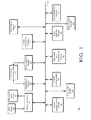
- FIG. 4 illustrates a flow diagram of a method 400 of performing motion search for processing video in accordance with some embodiments.
- the method 400 is described with respect to an example implementation at the video encoder 100 of FIG. 1 .
- the video encoder 100 receives a reference picture via the video signal 160 and stores it at the memory module 122.
- the processing module 106 selects an initial selected subset of the reference picture to the reference picture cache 107.
- the initial selected subset is selected by performing motion search on a downscaled current picture as compared to a downscaled reference picture, wherein the motion search results in a set of motion vectors.
- the set of motion vectors based on the downscaled pictures are used to calculate an offset in similar fashion to other offsets described herein.
- the offset can be calculated by averaging or performing a linear regression on the Y components of the set of motion vectors.
- the motion search module then adds the offset to a predefined set of pixel locations to select the initial subset of the reference picture 201.
- the initial selected subset is a subset having as one of its corners the pixel at (0, 0) of the reference picture and consisting of a rectangle of contiguous pixels that will fill the reference picture cache 107.
- the initial selected subset of the reference picture is the subset composed of the pixels in the rectangle having corners at (0, 0), (1599, 0), (0, 399), and (1599,399).
- the motion search module 108 receives a current picture to be encoded and selects a first block row of the current picture for motion search.
- the motion search module 108 divides the selected block row into blocks.
- the motion search module 108 determines a set of motion vectors for the blocks of the selected block row using the selected subset of the reference picture that is stored at the reference picture cache 107.
- the motion search module 108 identifies whether a set of motion vectors has been determined for each and every block row of the current picture. If so, the method flow returns to block 406 and the motion search module 108 begins determining motion vectors for the next picture of the video signal 160.
- the method flow moves to block 414 and the motion search module calculates an offset value based on the previously determined set of motion vectors.
- the motion search module 108 selects a subset of the reference picture based on the offset value and, at block 418 the motion search module 108 transfers the selected subset of the reference picture to the reference picture cache 107.
- the motion search module 108 selects the next block row for the current picture, and the method flow returns to block 408 for determination of the set of motion vectors for the newly selected block row.
- certain aspects of the techniques described above may implemented by one or more processors of a processing system executing software.
- the software comprises one or more sets of executable instructions stored or otherwise tangibly embodied on a non-transitory computer readable storage medium.
- the software can include the instructions and certain data that, when executed by the one or more processors, manipulate the one or more processors to perform one or more aspects of the techniques described above.
- the non-transitory computer readable storage medium can include, for example, a magnetic or optical disk storage device, solid state storage devices such as Flash memory, a cache, random access memory (RAM) or other non-volatile memory device or devices, and the like.
- the executable instructions stored on the non-transitory computer readable storage medium may be in source code, assembly language code, object code, or other instruction format that is interpreted or otherwise executable by one or more processors.
Landscapes
- Engineering & Computer Science (AREA)
- Multimedia (AREA)
- Signal Processing (AREA)
- Compression Or Coding Systems Of Tv Signals (AREA)
Applications Claiming Priority (1)
| Application Number | Priority Date | Filing Date | Title |
|---|---|---|---|
| US14/089,902 US20150146784A1 (en) | 2013-11-26 | 2013-11-26 | Motion compensation with moving window |
Publications (1)
| Publication Number | Publication Date |
|---|---|
| EP2876884A1 true EP2876884A1 (de) | 2015-05-27 |
Family
ID=51868795
Family Applications (1)
| Application Number | Title | Priority Date | Filing Date |
|---|---|---|---|
| EP14191000.0A Ceased EP2876884A1 (de) | 2013-11-26 | 2014-10-30 | Bewegungskompensation mit beweglichem Fenster |
Country Status (3)
| Country | Link |
|---|---|
| US (1) | US20150146784A1 (de) |
| EP (1) | EP2876884A1 (de) |
| CN (1) | CN104683816A (de) |
Families Citing this family (3)
| Publication number | Priority date | Publication date | Assignee | Title |
|---|---|---|---|---|
| WO2019234676A1 (en) * | 2018-06-07 | 2019-12-12 | Beijing Bytedance Network Technology Co., Ltd. | Mv precision refine |
| CN110800301A (zh) * | 2018-09-30 | 2020-02-14 | 深圳市大疆创新科技有限公司 | 编码设备的控制方法、装置及存储介质 |
| US20210227173A1 (en) * | 2019-01-04 | 2021-07-22 | Beijing Boe Optoelectronics Technology Co., Ltd. | Image data processing method, data transmission apparatus, image display method and storage medium |
Citations (3)
| Publication number | Priority date | Publication date | Assignee | Title |
|---|---|---|---|---|
| WO2006029382A2 (en) * | 2004-09-09 | 2006-03-16 | Qualcomm Incorporated | Caching method and apparatus for video motion compensation |
| WO2010124736A1 (en) * | 2009-04-30 | 2010-11-04 | Telefonaktiebolaget Lm Ericsson (Publ) | Efficient internal cache for hardware motion estimation |
| US20110069751A1 (en) * | 2009-09-23 | 2011-03-24 | Texas Instruments Incorporated | Method and Apparatus for Determination of Motion Estimation Search Window Area Utilizing Adaptive Sliding Window Algorithm |
Family Cites Families (10)
| Publication number | Priority date | Publication date | Assignee | Title |
|---|---|---|---|---|
| DE4322343C2 (de) * | 1992-07-06 | 1996-10-02 | Mitsubishi Electric Corp | Mittel zum Erfassen eines Bewegungsvektors und Verfahren zum Bestimmen eines Bewegungsvektors |
| KR0148154B1 (ko) * | 1994-06-15 | 1998-09-15 | 김광호 | 움직임크기에 따른 동영상데이타의 부호화방법 및 장치 |
| JP3019787B2 (ja) * | 1996-09-20 | 2000-03-13 | 日本電気株式会社 | 動きベクトル検出装置 |
| JPH10327415A (ja) * | 1997-05-22 | 1998-12-08 | Mitsubishi Electric Corp | 動きベクトル検出装置 |
| JP3226020B2 (ja) * | 1997-05-28 | 2001-11-05 | 日本電気株式会社 | 動きベクトル検出装置 |
| US7126991B1 (en) * | 2003-02-03 | 2006-10-24 | Tibet MIMAR | Method for programmable motion estimation in a SIMD processor |
| KR20060037352A (ko) * | 2003-07-15 | 2006-05-03 | 톰슨 라이센싱 | 고속 검색 블록 매칭에 의한 움직임 추정 |
| EP1917812B1 (de) * | 2005-08-17 | 2009-11-11 | Nxp B.V. | Videocodierung und -decodierung unter berücksichtigung von positionen im cache |
| TWI277010B (en) * | 2005-09-08 | 2007-03-21 | Quanta Comp Inc | Motion vector estimation system and method |
| US20100215104A1 (en) * | 2009-02-26 | 2010-08-26 | Akira Osamoto | Method and System for Motion Estimation |
-
2013
- 2013-11-26 US US14/089,902 patent/US20150146784A1/en not_active Abandoned
-
2014
- 2014-10-30 EP EP14191000.0A patent/EP2876884A1/de not_active Ceased
- 2014-11-20 CN CN201410670862.5A patent/CN104683816A/zh active Pending
Patent Citations (3)
| Publication number | Priority date | Publication date | Assignee | Title |
|---|---|---|---|---|
| WO2006029382A2 (en) * | 2004-09-09 | 2006-03-16 | Qualcomm Incorporated | Caching method and apparatus for video motion compensation |
| WO2010124736A1 (en) * | 2009-04-30 | 2010-11-04 | Telefonaktiebolaget Lm Ericsson (Publ) | Efficient internal cache for hardware motion estimation |
| US20110069751A1 (en) * | 2009-09-23 | 2011-03-24 | Texas Instruments Incorporated | Method and Apparatus for Determination of Motion Estimation Search Window Area Utilizing Adaptive Sliding Window Algorithm |
Non-Patent Citations (1)
| Title |
|---|
| MOSCHETTI F: "A Statistical Approach to Motion Estimation", THESE PRESENTEE A LA SECTION D'ELECTRICITE ECOLE POLYTECHNIQUEFEDERALE DE LAUSANNE POUR OBTENTION DU GRADE DE DOCTEUR ÈSSCIENCES TECHNIQUES, XX, XX, 31 January 2001 (2001-01-31), pages 1 - 156, XP002346537 * |
Also Published As
| Publication number | Publication date |
|---|---|
| CN104683816A (zh) | 2015-06-03 |
| US20150146784A1 (en) | 2015-05-28 |
Similar Documents
| Publication | Publication Date | Title |
|---|---|---|
| JP6835448B2 (ja) | 画像符号化装置、画像復号装置、画像符号化方法、画像復号方法及び符号化ビットストリームを記録した記録媒体 | |
| US10917658B2 (en) | Method, device, and computer program for optimizing transmission of motion vector related information when transmitting a video stream from an encoder to a decoder | |
| KR101651595B1 (ko) | 영상 복호화 방법 및 컴퓨터로 읽을 수 있는 기록 매체 | |
| WO2019210829A1 (en) | Signaling for illumination compensation | |
| KR102706608B1 (ko) | 비디오 코딩에서 장기 참조 픽처에 대한 제한받는 움직임 벡터 도출 | |
| US20190058896A1 (en) | Method and apparatus of video coding with affine motion compensation | |
| US10785475B2 (en) | Method and apparatus of video coding with prediction offset | |
| EP2684363A1 (de) | Videokodierung und -dekodierung | |
| US8599921B2 (en) | Adaptive partition subset selection module and method for use therewith | |
| US9420308B2 (en) | Scaled motion search section with parallel processing and method for use therewith | |
| US9706221B2 (en) | Motion search with scaled and unscaled pictures | |
| CN108605144A (zh) | 一种去除块效应的滤波方法及装置 | |
| EP2876884A1 (de) | Bewegungskompensation mit beweglichem Fenster | |
| KR102813427B1 (ko) | 구축된 아핀 병합 후보들을 도출하기 위한 방법 | |
| JP2026009292A (ja) | ビデオコーディングにおけるテンプレートマッチングの適用 | |
| WO2023048646A9 (en) | Methods and systems for performing combined inter and intra prediction | |
| US10805611B2 (en) | Method and apparatus of constrained sequence header | |
| US9077996B2 (en) | Predicted motion vectors | |
| US20100246682A1 (en) | Scaled motion search section with downscaling and method for use therewith | |
| WO2017036422A1 (en) | Method and apparatus of prediction offset derived based on neighbouring area in video coding | |
| CN110771166A (zh) | 用于视频编码的装置和方法 | |
| US20140105305A1 (en) | Memory cache for use in video processing and methods for use therewith | |
| CN112204986A (zh) | 视频编解码的方法和装置 |
Legal Events
| Date | Code | Title | Description |
|---|---|---|---|
| PUAI | Public reference made under article 153(3) epc to a published international application that has entered the european phase |
Free format text: ORIGINAL CODE: 0009012 |
|
| 17P | Request for examination filed |
Effective date: 20141030 |
|
| AK | Designated contracting states |
Kind code of ref document: A1 Designated state(s): AL AT BE BG CH CY CZ DE DK EE ES FI FR GB GR HR HU IE IS IT LI LT LU LV MC MK MT NL NO PL PT RO RS SE SI SK SM TR |
|
| AX | Request for extension of the european patent |
Extension state: BA ME |
|
| 17Q | First examination report despatched |
Effective date: 20170104 |
|
| 18R | Application refused |
Effective date: 20180412 |