EP2878676A2 - Procédé utilisant des microalgues pour la production d'astaxanthine à rendement élevé - Google Patents
Procédé utilisant des microalgues pour la production d'astaxanthine à rendement élevé Download PDFInfo
- Publication number
- EP2878676A2 EP2878676A2 EP13823422.4A EP13823422A EP2878676A2 EP 2878676 A2 EP2878676 A2 EP 2878676A2 EP 13823422 A EP13823422 A EP 13823422A EP 2878676 A2 EP2878676 A2 EP 2878676A2
- Authority
- EP
- European Patent Office
- Prior art keywords
- microalgae
- photo
- astaxanthin
- heterotrophic
- induction
- Prior art date
- Legal status (The legal status is an assumption and is not a legal conclusion. Google has not performed a legal analysis and makes no representation as to the accuracy of the status listed.)
- Withdrawn
Links
Images
Classifications
-
- C—CHEMISTRY; METALLURGY
- C12—BIOCHEMISTRY; BEER; SPIRITS; WINE; VINEGAR; MICROBIOLOGY; ENZYMOLOGY; MUTATION OR GENETIC ENGINEERING
- C12P—FERMENTATION OR ENZYME-USING PROCESSES TO SYNTHESISE A DESIRED CHEMICAL COMPOUND OR COMPOSITION OR TO SEPARATE OPTICAL ISOMERS FROM A RACEMIC MIXTURE
- C12P7/00—Preparation of oxygen-containing organic compounds
- C12P7/24—Preparation of oxygen-containing organic compounds containing a carbonyl group
- C12P7/26—Ketones
-
- C—CHEMISTRY; METALLURGY
- C12—BIOCHEMISTRY; BEER; SPIRITS; WINE; VINEGAR; MICROBIOLOGY; ENZYMOLOGY; MUTATION OR GENETIC ENGINEERING
- C12P—FERMENTATION OR ENZYME-USING PROCESSES TO SYNTHESISE A DESIRED CHEMICAL COMPOUND OR COMPOSITION OR TO SEPARATE OPTICAL ISOMERS FROM A RACEMIC MIXTURE
- C12P23/00—Preparation of compounds containing a cyclohexene ring having an unsaturated side chain containing at least ten carbon atoms bound by conjugated double bonds, e.g. carotenes
-
- C—CHEMISTRY; METALLURGY
- C12—BIOCHEMISTRY; BEER; SPIRITS; WINE; VINEGAR; MICROBIOLOGY; ENZYMOLOGY; MUTATION OR GENETIC ENGINEERING
- C12N—MICROORGANISMS OR ENZYMES; COMPOSITIONS THEREOF; PROPAGATING, PRESERVING, OR MAINTAINING MICROORGANISMS; MUTATION OR GENETIC ENGINEERING; CULTURE MEDIA
- C12N1/00—Microorganisms; Compositions thereof; Processes of propagating, maintaining or preserving microorganisms or compositions thereof; Processes of preparing or isolating a composition containing a microorganism; Culture media therefor
- C12N1/12—Unicellular algae; Culture media therefor
Definitions
- Astaxanthin is one kind of carotenoids and is also the highest level product in the carotenoid synthesis. Beta-carotene, lutein, Angle flavin, and lycopene are intermediate products in the carotenoid synthesis. Therefore, in nature, astaxanthin has the strongest antioxidant activity. So far the natural astaxanthin has been the strongest antioxidant compared to other existing antioxidants in nature, and thus the natural astaxanthin is well-known as "super antioxidant”. Astaxanthin has an extensive application value not only for aquaculture feed additives and human food additives but also for medical, cosmetic, and health care products etc.
- Haematococcus which contains about 1-5% astaxanthin, based on cell dry weight, is the species with the highest astaxanthin content in nature.
- astaxanthin in microalgae is mainly in the form of monoester and has a trans structure, the bioavailability of which is higher than chemically-synthesized astaxanthin which has a cis structure;
- microalgae growth life cycle is short, its production equipment cover a small area, and its production is relatively stable in product quality and output;
- microalga (such as Haematococcus) is a product with high value, and contains a lot of protein, fat, polysaccharides and other active ingredients, and thus the comprehensive utilization of microalgae biomass can be realized by extracting and separating these active ingredients.
- Semi-continuous culture refers to microalgae cultivation wherein a portion of microalgae culture is transferred to stress environment every day after reaching a certain concentration, while the same amount of new culture is added for further cultivation.
- the second stage (astaxanthin accumulation stage) is to prompt the Haematococcus pluvialis to form cyst, subsequently to achieve the purpose of astaxanthin accumulation by the control means such as high light, high temperature, high salt, nutrient starvation and a series of stress.
- the nutrition and environmental conditions are different.
- the current studies of interest here and aboard are mainly concentrated on selection and control of the conditions, and influences of the environmental factors etc. in the two stages.
- the growth rate of Haematococcus pluvialis is low, Haematococcus pluvialis is vulnerable to pollution, and the suitable growth temperature of Haematococcus pluvialis is low. These characteristics limit the high-density and large-scale cultivation of Haematococcus pluvialis.
- closed photo-bioreactors are widely used. It has been reported that closed bioreactors are used for the growth of Haematococcus pluvialis .
- the cell production rate was 0.3 g/L/d
- the production rate of astaxanthin was low (only 4.4mg/L/d)
- the astaxanthin content can be 1.85% after 8-day photo induction.
- the heterotrophic cultivation was carried out in a 2.3L fermenter, while the photoautotrophic cultivation was carried out in a glass vessel indoors (diameter: 16 cm, liquid loaded: 900 ml, depth: 5.5 cm).
- the light was set on the top of the vessel, and the light intensity on the liquid surface was 950 ⁇ mol m -2 s -1 .
- the temperature was maintained at 30 °C.
- the stirring was realized by a magnetic stirrer (100rpm), and air containing 5% CO 2 was aerated into the culture.
- the maximum cell dry weight reported in literatures was 7 g/L, the cell average growth rate was 0.3 g/L/d; the astaxanthin production rate was low (4.4 mg/L/d), the astaxanthin content was not high (after 8-day photo-induction, the astaxanthin content was only 1.85%).
- the method has no advantages compared to the traditional photoautotrophic two-stage cultivation for astaxanthin production. Therefore, it is necessary to find an efficient cultivation method for astaxanthin production by using microalgae.
- the pH and the content of carbon, nitrogen, and phosphorus is controlled, by feeding, within a given range during the heterotrophic cultivation, and the content of carbon, nitrogen and phosphorus is very low or even depleted after the heterotrophic cultivation.
- the content of carbon, nitrogen and phosphorus in a heterotrophic medium is completely depleted after the heterotrophic cultivation.
- the content of carbon, nitrogen, and phosphorus is controlled, by feeding, within a given range.
- the carbon content in the culture is controlled within the range between 0.5 and 50 mM
- the nitrogen content in the culture is controlled within the range between 0.5 and 10 mM
- the phosphorus content in the culture is controlled within the range between 0.01 and 0.5 mM.
- the magnesium content is controlled within the range between 0.00001 and 0.001 mM by feeding.
- the heterotrophic medium contains nitrogen source, organic carbon source, a small amount of inorganic salt, plant growth hormone, trace elements and water, or consists thereof;
- the photo-induction medium contains plant growth hormone, nitrogen source, inorganic salts and water, or consists thereof.
- the heterotrophic medium used herein substantially consists of the following components: sodium acetate 0.1-5.0 g/L, NaNO 3 0.05-1.5 g/L, CaCl 2 • 7H 2 O 0.05-1.5 g/L, KH 2 PO 4 0.01-1.5 g/L, MgSO 4 • 7 H 2 O 0.01-1.0 g/L, FeSO 4 • 7 H 2 O 0.01-0.05 g/L, plant growth hormone 0.001-35 mg/L, trace element 0.5-4 mL and water.
- the microalgae is heterotrophically cultivated in a shake flask, or an agitator, airlift or bubbling bioreactor.
- the photo-induction is carried out in a shake flask, an open raceway or circle pond, a closed flat plate type, a pipeline type, a column type photo-bioreactor, a film bag, a hanging bag, or any other photoautotrophic cultivation devices.
- the light source for the photo-induction can be natural daylight or artificial light.
- the astaxanthin is extracted by supercritical CO 2 extraction method, organic solvent extraction method, or ultrasonic-assisted solvent extraction method.
- the method according to the present invention further comprises: solid/liquid separating the photo-induced microalgal cells (i.e. for collection) and then drying the microalgal cells to obtain powders containing the astaxanthin.
- the method according to the present invention further comprises: mixing the microalgae after astaxanthin extraction and other pigments to form dry powders, or extracting other bioactive substances from the microalgal cells.
- the other pigments include chlorophyll.
- the bioactive substances include protein, lipids, chlorophyll and polysaccharide.
- Microalgae used in the method according to the present invention includes those suitable for synthesis of astaxanthin and heterotrophic cultivation, including but not limited to Haematococcus pluvialis, Chlorella ( Chlorella zofingiensis ), etc.
- this present invention uses Haematococcus pluvialis to produce astaxanthin.
- the plant growth hormone contains, if any, 2, 4-dichlorobenzene oxygen ethanoic acid 0.001-5 mg/L, benzyl amino purine 0.001-5 mg/L, exogenous gibberellin 0.001-5 mg/L, 3-indolebutyric acid 0.001-5 mg/L, naphthalene acetic acid 0.001-5 mg/L, canola 0.001-5 mg/L.
- their concentrations respectively are 0.01-4 mg/L, 0.1-4 mg/L, 0.3-4 mg/L, 0.3-3 mg/L, 0.5-2.5 mg/L.
- the heterotrophic medium according to the present invention contains nitrogen source, organic carbon source, plant growth hormone, a small amount of inorganic salt, trace elements and water.
- This medium includes C medium ( Ichimura, T. 1971 Sexual cell division and conjugation-papilla formation in sexual reproduction of Closterium strigosum. In Proceedings of the Seventh International Seaweed Symposium, University of Tokyo Press, Tokyo, p. 208-214 .), MCM medium (Borowitzka et al., 1991), BG-11 medium (Boussiba and Vonshak, 1991), BBM medium (Nichols and Bold, 1969), BAR medium (Barbera et al., 1993), KM medium (Kobayashi et al., 1991), Z8 medium (Renstrom et al., 1981), A9 medium (Lee and Pirt, 1981), OHM medium (Fa'bregas et al., 2000), KM1 medium (Usha et al., 1999, Garc'ia-Malea et al., 2005), HK2 medium (Chen et al., 1997), HK3 medium (Gong and Chen, 1998) etc.
- C medium
- C medium used in the present invention substantially consists of KNO 3 , CaNO 3 , sodium acetate, a small amount of inorganic salt, trace elements and water, in addition to some plant growth hormones.
- substantially consists of « means that besides the main components e.g. KNO 3 , CaNO 3 , sodium acetate, a small amount of inorganic salt, trace elements, and water, there are also other elements which have no substantial effects on the basic or new features of the composition (namely, to maintain microalgae at a high cell density in a short cultivation cycle and greatly improve the content of active substances compared to the conventional heterotrophic cultivation).
- the term “consists of «" means that the composition only includes the specific components without other components, except impurities with an acceptable content.
- the components in the medium may vary within a certain range but without substantially affecting the microalgal cell density and the microalgal cell quality. Accordingly, the amount of these components should not be restricted by the examples.
- a small amount of inorganic salts e.g. magnesium sulfate, calcium chloride, ferrous sulfate and phosphate, etc.
- trace elements e.g. Mn, Zn, B, I, M, Cu, Co etc.
- plant growth hormones including single hormone or combination of various hormones can be added to the medium,.
- the trace element is selected from one or more than one of H 3 BO 3 , ZnSO 4 • 7 H 2 O, MnCl 2 • H 2 O, (NH 4 ) 6 Mo 7 O 24 • 4 H 2 O, CuSO 4 • 5 H 2 O and Co(NO 3 ) 2 • 6 H 2 O.
- the dosage of inorganic salts and trace elements can be determined according to the common knowledge.
- the heterotrophic medium according to the present invention substantially consists of the following components:
- the heterotrophic medium used herein substantially consists of the following components: sodium acetate 0.1-5.0 g/L, NaNO 3 0.05-1.5 g/L, CaCl 2 • 7H 2 O 0.05-1.5 g/L, KH 2 PO 4 0.01-1.5 g/L, MgSO 4 • 7 H 2 O 0.01-1.0 g/L, FeSO 4 • 7 H 2 O 0.01-0.05 g/L, plant growth hormone 0.001-35 mg/L, trace element 0.5-4 mL and water.
- the plant growth hormone in the heterotrophic medium contains 2, 4-dichlorobenzene oxygen ethanoic acid 0.001-5 mg/L, benzyl amino purine 0.001-5 mg/L, exogenous gibberellin 0.001-5 mg/L, 3-indolebutyric acid 0.001-5 mg/L, naphthalene acetic acid 0.001-5 mg/L, canola 0.001-5 mg/L.
- the plant growth hormone in heterotrophic medium contains benzyl amino purine 0.001-5 mg/L and 3-indolebutyric acid 0.001-5 mg/L.
- the bioreactor When the feed-batch is carried out in the heterotrophic cultivation, the bioreactor is filled with the prepared medium and water is added to the work volume, usually with a load coefficient of 0.6-0.8. The medium is then sterilized at 121 °C for about 20 minutes. When the temperature decreases to 20-35 °C, microalgal seeds of 0.1-50% working volume is added for the heterotrophic cultivation.
- the pH value is maintained within a given range, such as between 7.0 and 8.0, by controlling the continuous flow rate of feeding medium.
- the pH is controlled at 7.5.
- the feeding medium includes nutritive salts, such as organic carbon source (e.g. sodium acetate), nitrogen source (e.g. CaNO 3 , KNO 3 ), plant growth hormone and inorganic salt. These added nutritive salts are concentrated in the above-mentioned corresponding medium to prompt the growth of microalgae.
- Organic carbon source, nitrogen source, plant growth hormone and inorganic salt are added into the feeding medium in the way that the concentrations of the corresponding components in the culture are equivalent or similar to the initial concentrations when the heterotrophic cultivation is started so as to promote the growth of microalgae.
- One skilled in the art can also adjust the corresponding components according to the actual growing condition of microalgae, for example, by increasing or decreasing the concentration of some components so as to promote the growth of microalgae.
- the content of carbon, nitrogen and/or phosphorus should be timely monitored in order to adjust the content of these materials in the feeding medium appropriately.
- the carbon content is controlled within the range of 0.5-50 mM (normally 1.0-40 mM, 1.0-30 mM, 1.0-20 mM, 1.0-10 mM)
- the nitrogen content is controlled within the range of 0.5-10 mM (normally 0.5-8 mM, 0.5-6 mM, 1.0-6 mM, 1.0-5.0 mM)
- the phosphorus content is controlled within the range of 0.01-0.5 mM (normally 0.01-0.4 mM, 0.05-0.3 mM, 0.05-0.2 mM, 0.05-0.1 mM) so as to ensure the concentration stability of these materials.
- the magnesium content in the culture of the microalgae is monitored and controlled within the range of 0.00001-0.001 mM by feeding (normally 0.00001-0.0008 mM, 0.00003-0.0005 mM
- the control conditions are adjusted to substantially deplete carbon, nitrogen and/or phosphorus.
- the heterotrophic cultivation stage concludes. Normally, when heterotrophic cultivation stage concludes, the contents of carbon, nitrogen and/or phosphorus are very low in the culture. For example, the contents of carbon and nitrogen are lower than 0.1 mM, 0.05 mM, 0.01 mM or lower, or even are 0; the phosphorus content is lower than 0.005 mM, 0.003 mM, 0.001 mM or lower, or even are 0.
- the cultivation conditions must be strictly controlled for the normal growth of microalgae during the cultivation.
- the temperature is controlled at 20-35 °C, for example, 25-30 °C
- the dissolved oxygen is controlled not less than 5% of air saturation concentration by adjusting the aeration and agitation
- the pH value is controlled not higher than 9.0.
- the dissolved oxygen is not less than 10% but not more than 30% of air saturation concentration
- the pH value is constantly controlled at 7.5-8.0
- the aeration amount is less than 0.3 VVM
- the agitation rate is less than 200 rpm.
- the heterotrophic cultivation can be conducted in bioreactors e.g. shake flask, mechanical agitator, air lift and bubbling bioreactors.
- bioreactors e.g. shake flask, mechanical agitator, air lift and bubbling bioreactors.
- This step is aimed to reduce the microalgal cell density so as to enable the microalgae for production of astaxanthin to absorb light energy efficiently during the photo-induction and improve the utilization efficiency of light energy.
- This step is also aimed to adjust the nutrients in the photo-induction medium for nutritional stress so as to rapidly accumulate the astaxanthin.
- the culture of the microalgae with high density acquired from the heterotrophic cultivation should be diluted by using a dilution medium to maintain the cell density at 0.1-20g/L and maintain the PH value at 4.0-10.0 (when the induction is carried out in an open reactor, it is better not to contain organic carbon source so as to avoid mixed bacteria during the photo-induction stage. However, when the induction is carried out in a closed reactor, the organic carbon source can be contained to increase the cells).
- the culture of the microalgae with high density is diluted by water and the medium without organic carbon source to maintain the cell density at 0.1-10g/L and adjust the pH value at 5.0-8.0.
- the culture of the microalgae is diluted to maintain the cell density at 1-8g/L and adjust the pH value at 5.0-8.0.
- the cell density is maintained at 1.0-5.0g/L and the pH value is adjusted at 5.0-8.0 by adding CO 2 .
- the photo-induction medium contains nitrogen source, plant growth hormone, inorganic salt, and water, or consists thereof. Compared to the heterotrophic medium, the photo-induction medium contains no or few organic carbon source. CO 2 can be added during the cultivation.
- the microalgal cells with high density acquired from the heterotrophic cultivation is diluted by an initial medium without organic carbon source and lacking of nitrogen and phosphorus.
- the dilution medium i.e. photo-induction medium
- the plant growth hormone in the dilution medium contains: 2, 4-dichlorobenzene oxygen ethanoic acid 0.001-5 mg/L, benzyl amino purine 0.001-5 mg/L, exogenous gibberellin 0.001-5 mg/L, 3-indolebutyric acid 0.001-5 mg/L, naphthalene acetic acid 0.001-5 mg/L and/or canola 0.001-5 mg/L.
- the plant growth hormone in the dilution medium i.e. photo-induction medium
- the dilution medium needs no autoclave sterilization and can be used after its pH value is adjusted to 5.0-9.0.
- the microalgal cells acquired by from the heterotrophic cultivation can be directly photo-induced without dilution. This depends on the rational matching among the heterotrophic cultivation density, the components of the heterotrophic medium and the actual induction conditions (such as light intensity, temperature, etc.).
- This step is aimed to expose the microalgae which can produce astaxanthin to sufficient lights, rapidly synthesize and accumulate a large amount of astaxanthin by photo-induction, and appropriately increase the microalgal cell density in the culture.
- the culture is transferred into a photo-induction device for photo-induction or the microalgal cells are photo-induced on a solid membrane surface by using a semisolid adherent method, at photo-induction temperature of 5-50 °C, with continuous or intermittent light intensity of 0.1-150 klx for 1-480 hours, and with ventilation capacity of 0.1- 2.0 vvm.
- the photo-bioreactor includes all closed photo-bioreactor (shake flask, pipeline type, plate type, column type, film bag and hanging bag etc.) and all open photo-bioreactor (raceway pond, circle pond, and bubbling basin etc.).
- the cultivation temperature is controlled within the range of 15-35 °C, e.g. 18-35 °C, 20-35 °C and 20-30 °C etc.
- the light intensity is controlled within the range of 1-70 klx, e.g. 1-60 klx, 1-50 klx, 1-40 klx, 1-30 klx, 1-20 klx, 1-10 klx etc, which can depend on the specific production conditions.
- the ventilation capacity can be controlled within the range of 0.1-2.0 vvm, e.g.
- the cultivation temperature is controlled within the range of 10 ⁇ 50 °C
- the light intensity is controlled within the range of 1-10 klx
- the ventilation capacity is controlled within the range of 0.05-2.0 wm.
- the photo-induction period is 8-480 hours.
- the photo-induction period can be 8-240 hours, 8-120 hours, 8-72 hours, 8-48 hours, 8-24 hours; or the photo-induction period can be 12-72 hours, 12-60 hours, 12-48 hours, 12-36 hours, 12-24 hours or 24-60 hours, 24-48 hours.
- the photo-induction medium is selected from modified and improved photoautotrophic medium, including the above mentioned dilution medium.
- photo-induction period includes the whole photo-induction process.
- the photo-induction period for outdoor cultivation includes the night time without sunlight.
- illumination time in the present invention refers to the photo-induction time for microalgae with the above mentioned light intensity, which means the illumination time excludes the night time without sunlight.
- the illumination time in the photo-induction step can be 8-120 hours, e.g. 8-72 hours, 8-36 hours, 8-24 hours, 8-18 hours, 8-12 hours, 12-36 hours, 12-24 hours, and any length of time in the above mentioned ranges.
- the photo-induction step in the present invention also includes photo-induction with illumination time of 8-120 hours.
- the photo-induction can be conducted by both artificial light and natural daylight.
- the photo-induction concludes. Then, the astaxanthin is extracted from the obtained microalgal cells or the microalgal cells are directly collected for the preparation of powders.
- wet microalgal cells are collected through sedimentation or centrifugation.
- the methods for collecting microalgal cells include but not limited to sedimentation, high-speed centrifugation, flocculation, flotation and filtration etc.
- the methods for wall-breaking microalgal cells include but are not limited to the wet wall-breaking methods, e.g. cell autolysis, high pressure homogenization, enzymatic hydrolysis, aqueous phase pyrolysis.
- the astaxanthin is extracted from the microalgae by the traditional organic solvent extraction method.
- the organic solvent is added to microalgal slime for extraction.
- supernatant and microalgal sediment are acquired by stirring and centrifuging.
- astaxanthin crystals are obtained by concentrating, reducing pressure, stirring and adding water and filtering the supernatant.
- ingredients in the supernatant e.g. fatty acid and lutein
- all ingredients in the supernatant are directly mixed with the microalgal sediment and the mixture is spray-dried to obtain microalgal powders.
- the astaxanthin is extracted from the microalgae by supercritical CO 2 extraction method.
- the obtained culture of the microalgae is concentrated and then spray-dried to acquire microalgal powders.
- the microalgae obtained from the cultivation can be comprehensively utilized to extract polyunsaturated fatty acids, protein, chlorophyll, polysaccharide and other active ingredients. Extraction sequence of active ingredients does not have any special limitation. However, the early extraction step shall not cause the loss of ingredients in the later extraction step.
- Microalgal cell dry weight and astaxanthin content in the present invention are determined as follows:
- microalgal cell dry weight during the cultivation of microalgae, taking V ml culture, centrifuging the culture for 10 minutes at 8000rpm, washing the microalgal cells with deionized water for three times, transferring the microalgal cells into a weighing bottle (W 1 (g)), and drying the microalgal cells to a constant weight of W 2 (g) in an oven at 105 °C.
- heterotrophic medium and water of are added into a 5 L bioreactor to a volume of 2.5 L, and then sterilized by steam.
- temperature is reduced to 25 °C, Haematococcus pluvialis seeds are inoculated for heterotrophic cultivation.
- the dissolved oxygen is controlled to have not less than 5% of air saturation concentration by adjusting aeration and agitation.
- the content of carbon, nitrogen and/or phosphorus should be timely monitored in order to adjust the content of these materials in the feeding medium appropriately (carbon: 0.5-50 mM, nitrogen: 0.5-10 mM, phosphorus: 0.01-0.5 mM, magnesium: 0.00001-0.001 mM), so as to ensure the concentration stability of these materials.
- the control conditions are adjusted to substantially deplete carbon, nitrogen and/or phosphorus.
- the heterotrophic cultivation stage concludes.
- other operations and experimental conditions are the same, except plant growth hormone in the medium.
- the pH value is monitored in the fermented liquid and maintained at 7-8 by using the feeding medium.
- the content of other materials such as carbon, nitrogen, phosphorus and magnesium is not controlled, and hormonal material also is not added.
- Other experimental conditions and operations are the same.
- the cell dry weight is 26 g/L when the pH value and the feeding are controlled and plant growth hormone is added; the cell dry weight is 8.7 g/L when the pH value and the feeding are controlled but without adding the plant hormone; the cell dry weight was only about 4.2 g/L when the pH value and the feeding are not controlled and the plant growth hormone is not added. Accordingly, the cell density is increased by 6.2 times compared to the case that the pH value is controlled, the feeding is not controlled controlled and the plant hormone is not added, and is increased by 2.1 times compared to the case that the pH value and the feeding are controlled but without adding the plant hormone.
- 1L culture of the microalgal obtained from the heterotrophic cultivation is diluted from the density of 8.5 g/L to the density of 1.3 g/L with the photo-induction medium and then photo-induced in an outdoor 2 L column photo-bioreactor at temperature of 28-38 °C, air flow rate of 1 VVM, natural light intensity of about 75 klx each side.
- Figure 2 shows the photo-induction process of Haematococcus pluvialis in an outdoor 2 L column bioreactor when the carbon, nitrogen, phosphorus nutrients are completely depleted.
- the cell dry weight reaches 1.92 g/L
- astaxanthin content increases from 2.67 mg/gDcw at the beginning of induction stage to 22.56 mg/gDcw at the end (astaxanthin content has increased by about 8.5 times).
- the astaxanthin production rate is 82.24 mg/L/d (which is 3.57 times of the reported highest production rate of 23.04mg/L/d the in photoautotrophic cultivation) (please refer to Figure 2 ).
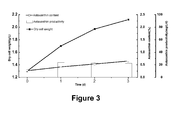
- Figure 3 shows the photo-induction process of Haematococcus pluvialis in an outdoor 2 L column bioreactor when the carbon, nitrogen, phosphorus nutrients are not depleted.
- the cell dry weight reaches 2.12 g/L
- astaxanthin content increases from 2.67 mg/gDcw at the beginning of induction stage to 6.51 mg/gDcw at the end (astaxanthin content has increased by about 2.4 times).
- the astaxanthin production rate is 22.51 mg/L/d (only 27% of the astaxanthin production rate in the case that 3 nutrients i.e. carbon, nitrogen, phosphorus have been totally depleted).
- the heterotrophic medium and the feeding medium contain:
- the photo-induction medium contains:
Landscapes
- Chemical & Material Sciences (AREA)
- Engineering & Computer Science (AREA)
- Life Sciences & Earth Sciences (AREA)
- Organic Chemistry (AREA)
- Wood Science & Technology (AREA)
- Zoology (AREA)
- Health & Medical Sciences (AREA)
- Biotechnology (AREA)
- Genetics & Genomics (AREA)
- Bioinformatics & Cheminformatics (AREA)
- Microbiology (AREA)
- Biochemistry (AREA)
- General Engineering & Computer Science (AREA)
- General Health & Medical Sciences (AREA)
- General Chemical & Material Sciences (AREA)
- Chemical Kinetics & Catalysis (AREA)
- Cell Biology (AREA)
- Botany (AREA)
- Medicinal Chemistry (AREA)
- Tropical Medicine & Parasitology (AREA)
- Virology (AREA)
- Biomedical Technology (AREA)
- Preparation Of Compounds By Using Micro-Organisms (AREA)
- Micro-Organisms Or Cultivation Processes Thereof (AREA)
Applications Claiming Priority (2)
| Application Number | Priority Date | Filing Date | Title |
|---|---|---|---|
| CN201210264946.XA CN103571906B (zh) | 2012-07-27 | 2012-07-27 | 一种利用微藻高效生产虾青素的新方法 |
| PCT/CN2013/084262 WO2014015841A2 (fr) | 2012-07-27 | 2013-09-26 | Procédé utilisant des microalgues pour la production d'astaxanthine à rendement élevé |
Publications (2)
| Publication Number | Publication Date |
|---|---|
| EP2878676A2 true EP2878676A2 (fr) | 2015-06-03 |
| EP2878676A4 EP2878676A4 (fr) | 2016-05-25 |
Family
ID=49997905
Family Applications (1)
| Application Number | Title | Priority Date | Filing Date |
|---|---|---|---|
| EP13823422.4A Withdrawn EP2878676A4 (fr) | 2012-07-27 | 2013-09-26 | Procédé utilisant des microalgues pour la production d'astaxanthine à rendement élevé |
Country Status (7)
| Country | Link |
|---|---|
| US (1) | US20150252391A1 (fr) |
| EP (1) | EP2878676A4 (fr) |
| CN (1) | CN103571906B (fr) |
| AU (1) | AU2013295436A1 (fr) |
| BR (1) | BR112015001637A2 (fr) |
| IN (1) | IN2015DN01606A (fr) |
| WO (1) | WO2014015841A2 (fr) |
Cited By (5)
| Publication number | Priority date | Publication date | Assignee | Title |
|---|---|---|---|---|
| WO2016146803A1 (fr) * | 2015-03-19 | 2016-09-22 | Basf Se | Compositions d'astaxanthine (iii) |
| WO2016146801A1 (fr) * | 2015-03-19 | 2016-09-22 | Basf Se | Compositions d'astaxanthine (i) |
| WO2018006068A1 (fr) | 2016-06-30 | 2018-01-04 | Kuehnle Agrosystems, Inc. | Procédés améliorés de production hétérotrophe pour biomasse microbienne et bioproduits |
| CN112239727A (zh) * | 2020-10-15 | 2021-01-19 | 大连理工大学 | 一种基于人工智能微藻混合系统培养微藻的方法 |
| US12180526B2 (en) | 2019-01-16 | 2024-12-31 | Kuehnle Agrosystems, Inc. | Subterranean microalgae for production of microbial biomass, substances, and compositions |
Families Citing this family (40)
| Publication number | Priority date | Publication date | Assignee | Title |
|---|---|---|---|---|
| KR101725976B1 (ko) * | 2014-04-17 | 2017-04-26 | 고려대학교 산학협력단 | 고온에서 성숙포자 접종 및 철이온매개 하버-바이스 반응에 의한 해마토코쿠스 플루비알리스 내 아스타잔틴 생산량 증진방법 |
| CN103966103A (zh) * | 2014-05-26 | 2014-08-06 | 临沂大学 | 利用啤酒厂废水培养雨生红球藻的培养基及培养方法 |
| CN104263649A (zh) * | 2014-09-15 | 2015-01-07 | 李健 | 一种大规模微藻培养的方法 |
| CN105420332A (zh) * | 2015-12-10 | 2016-03-23 | 天津科技大学 | 一种雨生红球藻高产虾青素的方法 |
| CN105462844B (zh) * | 2015-12-16 | 2019-05-03 | 中国科学院青岛生物能源与过程研究所 | 一种雨生红球藻细胞周期同步化的调控方法及其应用 |
| CN107189946B (zh) * | 2016-03-15 | 2022-07-01 | 嘉兴泽元生物制品有限责任公司 | 一种避免微藻光抑制以提高虾青素产量的方法 |
| CN106316847B (zh) * | 2016-08-16 | 2019-01-15 | 集美大学 | 一种虾青素亚油酸单酯的制备方法 |
| CN109642246A (zh) * | 2016-09-21 | 2019-04-16 | 日本水产株式会社 | 虾青素的生产方法 |
| CN106434817B (zh) * | 2016-09-29 | 2020-03-10 | 山东金晶生物技术有限公司 | 一种利用碱预处理技术提升雨生红球藻生产虾青素的方法 |
| EP3519555A1 (fr) * | 2016-09-30 | 2019-08-07 | Heliae Development LLC | Procédés d'application de toxicité d'acétate et d'induction d'absorption d'acétate dans des cultures de microalgues |
| CN110267948B (zh) | 2016-12-09 | 2023-12-08 | 弗特克斯药品有限公司 | 囊性纤维化跨膜传导调控剂的调节剂、药物组合物、治疗方法和制备所述调节剂的方法 |
| AU2018279646B2 (en) | 2017-06-08 | 2023-04-06 | Vertex Pharmaceuticals Incorporated | Methods of treatment for cystic fibrosis |
| CA3068609A1 (fr) | 2017-07-01 | 2019-01-10 | Vertex Pharmaceuticals Incorporated | Compositions et methodes de traitement de la fibrose kystique |
| CN107384907A (zh) * | 2017-07-13 | 2017-11-24 | 荆楚理工学院 | 一种富硒虾青素小球藻粉的制备方法 |
| US20200171015A1 (en) | 2017-07-17 | 2020-06-04 | Vertex Pharmaceuticals Incorporated | Methods of treatment for cystic fibrosis |
| MA49631A (fr) | 2017-07-17 | 2020-05-27 | Vertex Pharma | Méthodes de traitement de la fibrose kystique |
| US10654829B2 (en) | 2017-10-19 | 2020-05-19 | Vertex Pharmaceuticals Incorporated | Crystalline forms and compositions of CFTR modulators |
| WO2019113089A1 (fr) | 2017-12-04 | 2019-06-13 | Vertex Pharmaceuticals Incorporated | Compositions pour le traitement de la mucoviscidose |
| TWI810243B (zh) | 2018-02-05 | 2023-08-01 | 美商維泰克斯製藥公司 | 用於治療囊腫纖化症之醫藥組合物 |
| AU2019222758B2 (en) | 2018-02-15 | 2022-07-07 | Vertex Pharmaceuticals Incorporated | Macrocycles as modulators of cystic fibrosis transmembrane conductance regulator, pharmaceutical compositions thereof, their use in the treatment of cystic fibrosis, and process for making them |
| US20210139514A1 (en) | 2018-04-05 | 2021-05-13 | Vertex Pharmaceuticals Incorporated | Modulators of cystic fibrosis transmembrane conductance regulator |
| EP3774825A1 (fr) | 2018-04-13 | 2021-02-17 | Vertex Pharmaceuticals Incorporated | Modulateurs du régulateur de la conductance transmembranaire de la fibrose kystique, compositions pharmaceutiques, procédés de traitement et procédé de fabrication du modulateur |
| CN108504619B (zh) * | 2018-06-06 | 2021-06-01 | 中国科学院海洋研究所 | 一种缓解雨生红球藻光抑制的方法 |
| IT201800006555A1 (it) * | 2018-06-21 | 2019-12-21 | Procedimento per la coltivazione di alghe, preferibilmente di microalghe | |
| CN109566393A (zh) * | 2018-12-14 | 2019-04-05 | 浙江海洋大学 | 用于提取多糖的海藻的培养方法 |
| CN114286856B (zh) * | 2019-09-23 | 2024-05-24 | 山东拜昂生物技术有限公司 | 一种培养雨生红球藻生产虾青素的方法 |
| WO2021057711A1 (fr) * | 2019-09-23 | 2021-04-01 | 山东拜昂生物技术有限公司 | Procédé de production d'astaxanthine par culture hétérotrophe d'haematococcus pluvialis |
| WO2022194399A1 (fr) | 2020-07-13 | 2022-09-22 | Idorsia Pharmaceuticals Ltd | Macrocycles en tant que modulateurs de cftr |
| CN111979097A (zh) * | 2020-09-04 | 2020-11-24 | 清华大学 | 一种微藻培养用光生物反应器 |
| KR102535358B1 (ko) * | 2021-03-30 | 2023-05-26 | 고려대학교 산학협력단 | 초음파 자극의 도입을 통한 미세조류 유래 고부가 가치 물질 생합성 증대법 |
| CN113717917A (zh) * | 2021-06-30 | 2021-11-30 | 中国海洋大学 | 一种雨生红球藻纯种培养的联合抗生素施用方法 |
| CN113817793A (zh) * | 2021-09-14 | 2021-12-21 | 国青(浙江)科学研究有限公司 | 一种叶黄素提高雨生红球藻中虾青素含量的生产工艺 |
| CN114214386A (zh) * | 2021-12-13 | 2022-03-22 | 广东百睿盈科生物科技有限公司 | 一种异养培养小球藻生产虾青素的方法 |
| CN114214202B (zh) * | 2021-12-27 | 2024-02-13 | 广西源藻生物科技有限公司 | 异养-光诱导串联培养微藻联产叶黄素和蛋白质的方法 |
| JP7633682B2 (ja) * | 2022-04-13 | 2025-02-20 | 学校法人 創価大学 | 微生物培養方法 |
| TW202421102A (zh) | 2022-09-15 | 2024-06-01 | 瑞士商愛杜西亞製藥有限公司 | 巨環cftr調節劑與cftr校正子及/或cftr增效劑之組合 |
| CA3267791A1 (fr) | 2022-09-15 | 2024-03-21 | Idorsia Pharmaceuticals Ltd | Forme cristalline de (3s,7s,10r,13r)-13-benzyl-20-fluoro-7-isobutyl-n-(2-(3-méthoxy-1,2,4-oxadiazol-5-yl)éthyl)-6,9-diméthyl-1,5,8,11-tétraoxo-10-(2,2,2-trifluoroéthyl)-1,2,3,4,5,6,7,8,9,10,11,12,13,14-tétradecahydro-[1]oxa[4,7,10,14]tétraazacycloheptadécino [16,17-f]quinoléine-3-carboxamide |
| KR20250084132A (ko) | 2022-09-15 | 2025-06-10 | 이도르시아 파마슈티컬스 리미티드 | 마크로시클릭 cftr 조절제 |
| WO2025186214A1 (fr) | 2024-03-05 | 2025-09-12 | Idorsia Pharmaceuticals Ltd | Modulateurs de cftr macrocycliques |
| CN120945134B (zh) * | 2025-10-20 | 2025-12-30 | 爱尔发生物科技(嘉兴)有限公司 | 用于耐腐蚀光反应器的红球藻培养溶氧耦合调控方法 |
Family Cites Families (5)
| Publication number | Priority date | Publication date | Assignee | Title |
|---|---|---|---|---|
| CN100410362C (zh) * | 2006-04-12 | 2008-08-13 | 华东理工大学 | 高密度高品质培养小球藻的方法 |
| CN102094061B (zh) * | 2010-12-01 | 2015-07-01 | 华东理工大学 | 一种利用微藻生产叶黄素的方法 |
| CN102021208A (zh) * | 2010-11-16 | 2011-04-20 | 华东理工大学 | 一种快速积累微藻胞内油脂的方法 |
| CN101979498B (zh) * | 2010-12-01 | 2016-05-04 | 华东理工大学 | 一种微藻高产率异养培养的方法 |
| CN102154110B (zh) * | 2011-01-27 | 2016-03-02 | 华东理工大学 | 一种高产率的微藻培养方法 |
-
2012
- 2012-07-27 CN CN201210264946.XA patent/CN103571906B/zh active Active
-
2013
- 2013-09-26 US US14/417,166 patent/US20150252391A1/en not_active Abandoned
- 2013-09-26 BR BR112015001637A patent/BR112015001637A2/pt not_active IP Right Cessation
- 2013-09-26 EP EP13823422.4A patent/EP2878676A4/fr not_active Withdrawn
- 2013-09-26 WO PCT/CN2013/084262 patent/WO2014015841A2/fr not_active Ceased
- 2013-09-26 AU AU2013295436A patent/AU2013295436A1/en not_active Abandoned
- 2013-09-26 IN IN1606DEN2015 patent/IN2015DN01606A/en unknown
Cited By (6)
| Publication number | Priority date | Publication date | Assignee | Title |
|---|---|---|---|---|
| WO2016146803A1 (fr) * | 2015-03-19 | 2016-09-22 | Basf Se | Compositions d'astaxanthine (iii) |
| WO2016146801A1 (fr) * | 2015-03-19 | 2016-09-22 | Basf Se | Compositions d'astaxanthine (i) |
| WO2018006068A1 (fr) | 2016-06-30 | 2018-01-04 | Kuehnle Agrosystems, Inc. | Procédés améliorés de production hétérotrophe pour biomasse microbienne et bioproduits |
| US11034968B2 (en) | 2016-06-30 | 2021-06-15 | Kuehnle Agrosystems, Inc. | Heterotrophic production methods for microbial biomass and bioproducts |
| US12180526B2 (en) | 2019-01-16 | 2024-12-31 | Kuehnle Agrosystems, Inc. | Subterranean microalgae for production of microbial biomass, substances, and compositions |
| CN112239727A (zh) * | 2020-10-15 | 2021-01-19 | 大连理工大学 | 一种基于人工智能微藻混合系统培养微藻的方法 |
Also Published As
| Publication number | Publication date |
|---|---|
| AU2013295436A1 (en) | 2015-03-19 |
| US20150252391A1 (en) | 2015-09-10 |
| CN103571906B (zh) | 2018-12-11 |
| IN2015DN01606A (fr) | 2015-07-03 |
| WO2014015841A3 (fr) | 2014-03-20 |
| CN103571906A (zh) | 2014-02-12 |
| EP2878676A4 (fr) | 2016-05-25 |
| BR112015001637A2 (pt) | 2017-07-04 |
| WO2014015841A2 (fr) | 2014-01-30 |
Similar Documents
| Publication | Publication Date | Title |
|---|---|---|
| EP2878676A2 (fr) | Procédé utilisant des microalgues pour la production d'astaxanthine à rendement élevé | |
| Barghbani et al. | Investigating the effects of several parameters on the growth of Chlorella vulgaris using Taguchi's experimental approach | |
| CN102094061B (zh) | 一种利用微藻生产叶黄素的方法 | |
| WO2012071983A1 (fr) | Procédé de culture hétérotrophe à hauts rendements pour des microalgues | |
| CN106190853B (zh) | 一种高产藻蓝蛋白的红藻培养方法 | |
| JP2018520636A (ja) | ω−7脂肪酸合成物、及び黄緑色藻を培養して該合成物を生産する方法と応用 | |
| Grubišić et al. | Potential of microalgae for the production of different biotechnological products | |
| CN116179356B (zh) | 高密度异养培养莱茵衣藻的方法及其应用 | |
| Borowitzka | Algae as food | |
| CN106566775B (zh) | 含高活力雨生红球藻细胞制备方法 | |
| WO2015085631A1 (fr) | Procédé de culture de botryococcus spp. à un rendement élevé | |
| CN106520559A (zh) | 一种小球藻高效率光自养培养方法 | |
| WO2013088407A1 (fr) | Procédé de production de biomasse algale | |
| CN105483014A (zh) | 发酵法高密度培养小球藻生产工艺 | |
| CN115612647A (zh) | 一种富硒生物絮团的制备方法 | |
| CN107189946B (zh) | 一种避免微藻光抑制以提高虾青素产量的方法 | |
| CN118755578B (zh) | 一种微藻沉降剂及其应用 | |
| WO2012065545A1 (fr) | Procédé de culture de microalgues pour l'accumulation rapide d'huile et de lutéine | |
| CN105925486B (zh) | 小球藻立体管道光生物反应器的发酵方法及其制得的小球藻的使用方法 | |
| US20240400973A1 (en) | Method and system for producing euglena biomass with controlled biomass compositions | |
| CN114058514B (zh) | 一种利用海洋绿藻青岛大扁藻积累淀粉的方法 | |
| CN104662162A (zh) | 一种利用微藻高效生产虾青素的新方法 | |
| CN113667606B (zh) | 一种以碎米糖化液为碳源高效同化氨制备蛋白质的方法 | |
| CN117551726A (zh) | 一种避光或弱光条件下微藻细胞快速积累虾青素的方法 | |
| Benavente-Valdés et al. | Microbial Technology: Microalgae |
Legal Events
| Date | Code | Title | Description |
|---|---|---|---|
| PUAI | Public reference made under article 153(3) epc to a published international application that has entered the european phase |
Free format text: ORIGINAL CODE: 0009012 |
|
| 17P | Request for examination filed |
Effective date: 20150226 |
|
| AK | Designated contracting states |
Kind code of ref document: A2 Designated state(s): AL AT BE BG CH CY CZ DE DK EE ES FI FR GB GR HR HU IE IS IT LI LT LU LV MC MK MT NL NO PL PT RO RS SE SI SK SM TR |
|
| AX | Request for extension of the european patent |
Extension state: BA ME |
|
| DAX | Request for extension of the european patent (deleted) | ||
| A4 | Supplementary search report drawn up and despatched |
Effective date: 20160426 |
|
| RIC1 | Information provided on ipc code assigned before grant |
Ipc: C12N 1/12 20060101ALI20160418BHEP Ipc: C12P 23/00 20060101AFI20160418BHEP Ipc: C12P 7/26 20060101ALI20160418BHEP |
|
| 17Q | First examination report despatched |
Effective date: 20170331 |
|
| STAA | Information on the status of an ep patent application or granted ep patent |
Free format text: STATUS: THE APPLICATION IS DEEMED TO BE WITHDRAWN |
|
| 18D | Application deemed to be withdrawn |
Effective date: 20171011 |