EP2879209B1 - Matériau actif positif pour batterie au lithium rechargeable, procédé de préparation de celui-ci et batterie au lithium rechargeable comprenant celui-ci - Google Patents
Matériau actif positif pour batterie au lithium rechargeable, procédé de préparation de celui-ci et batterie au lithium rechargeable comprenant celui-ci Download PDFInfo
- Publication number
- EP2879209B1 EP2879209B1 EP14176431.6A EP14176431A EP2879209B1 EP 2879209 B1 EP2879209 B1 EP 2879209B1 EP 14176431 A EP14176431 A EP 14176431A EP 2879209 B1 EP2879209 B1 EP 2879209B1
- Authority
- EP
- European Patent Office
- Prior art keywords
- active material
- positive active
- lithium battery
- chemical formula
- rechargeable lithium
- Prior art date
- Legal status (The legal status is an assumption and is not a legal conclusion. Google has not performed a legal analysis and makes no representation as to the accuracy of the status listed.)
- Active
Links
Images



Classifications
-
- H—ELECTRICITY
- H01—ELECTRIC ELEMENTS
- H01M—PROCESSES OR MEANS, e.g. BATTERIES, FOR THE DIRECT CONVERSION OF CHEMICAL ENERGY INTO ELECTRICAL ENERGY
- H01M4/00—Electrodes
- H01M4/02—Electrodes composed of, or comprising, active material
- H01M4/36—Selection of substances as active materials, active masses, active liquids
- H01M4/362—Composites
- H01M4/366—Composites as layered products
-
- C—CHEMISTRY; METALLURGY
- C01—INORGANIC CHEMISTRY
- C01G—COMPOUNDS CONTAINING METALS NOT COVERED BY SUBCLASSES C01D OR C01F
- C01G53/00—Compounds of nickel
- C01G53/40—Complex oxides containing nickel and at least one other metal element
- C01G53/42—Complex oxides containing nickel and at least one other metal element containing alkali metals, e.g. LiNiO2
- C01G53/44—Complex oxides containing nickel and at least one other metal element containing alkali metals, e.g. LiNiO2 containing manganese
- C01G53/50—Complex oxides containing nickel and at least one other metal element containing alkali metals, e.g. LiNiO2 containing manganese of the type (MnO2)n-, e.g. Li(NixMn1-x)O2 or Li(MyNixMn1-x-y)O2
-
- H—ELECTRICITY
- H01—ELECTRIC ELEMENTS
- H01M—PROCESSES OR MEANS, e.g. BATTERIES, FOR THE DIRECT CONVERSION OF CHEMICAL ENERGY INTO ELECTRICAL ENERGY
- H01M10/00—Secondary cells; Manufacture thereof
- H01M10/05—Accumulators with non-aqueous electrolyte
- H01M10/052—Li-accumulators
-
- H—ELECTRICITY
- H01—ELECTRIC ELEMENTS
- H01M—PROCESSES OR MEANS, e.g. BATTERIES, FOR THE DIRECT CONVERSION OF CHEMICAL ENERGY INTO ELECTRICAL ENERGY
- H01M10/00—Secondary cells; Manufacture thereof
- H01M10/05—Accumulators with non-aqueous electrolyte
- H01M10/052—Li-accumulators
- H01M10/0525—Rocking-chair batteries, i.e. batteries with lithium insertion or intercalation in both electrodes; Lithium-ion batteries
-
- H—ELECTRICITY
- H01—ELECTRIC ELEMENTS
- H01M—PROCESSES OR MEANS, e.g. BATTERIES, FOR THE DIRECT CONVERSION OF CHEMICAL ENERGY INTO ELECTRICAL ENERGY
- H01M4/00—Electrodes
- H01M4/02—Electrodes composed of, or comprising, active material
- H01M4/04—Processes of manufacture in general
- H01M4/0402—Methods of deposition of the material
- H01M4/0416—Methods of deposition of the material involving impregnation with a solution, dispersion, paste or dry powder
-
- H—ELECTRICITY
- H01—ELECTRIC ELEMENTS
- H01M—PROCESSES OR MEANS, e.g. BATTERIES, FOR THE DIRECT CONVERSION OF CHEMICAL ENERGY INTO ELECTRICAL ENERGY
- H01M4/00—Electrodes
- H01M4/02—Electrodes composed of, or comprising, active material
- H01M4/04—Processes of manufacture in general
- H01M4/0471—Processes of manufacture in general involving thermal treatment, e.g. firing, sintering, backing particulate active material, thermal decomposition, pyrolysis
-
- H—ELECTRICITY
- H01—ELECTRIC ELEMENTS
- H01M—PROCESSES OR MEANS, e.g. BATTERIES, FOR THE DIRECT CONVERSION OF CHEMICAL ENERGY INTO ELECTRICAL ENERGY
- H01M4/00—Electrodes
- H01M4/02—Electrodes composed of, or comprising, active material
- H01M4/13—Electrodes for accumulators with non-aqueous electrolyte, e.g. for lithium-accumulators; Processes of manufacture thereof
- H01M4/131—Electrodes based on mixed oxides or hydroxides, or on mixtures of oxides or hydroxides, e.g. LiCoOx
-
- H—ELECTRICITY
- H01—ELECTRIC ELEMENTS
- H01M—PROCESSES OR MEANS, e.g. BATTERIES, FOR THE DIRECT CONVERSION OF CHEMICAL ENERGY INTO ELECTRICAL ENERGY
- H01M4/00—Electrodes
- H01M4/02—Electrodes composed of, or comprising, active material
- H01M4/13—Electrodes for accumulators with non-aqueous electrolyte, e.g. for lithium-accumulators; Processes of manufacture thereof
- H01M4/139—Processes of manufacture
- H01M4/1391—Processes of manufacture of electrodes based on mixed oxides or hydroxides, or on mixtures of oxides or hydroxides, e.g. LiCoOx
-
- H—ELECTRICITY
- H01—ELECTRIC ELEMENTS
- H01M—PROCESSES OR MEANS, e.g. BATTERIES, FOR THE DIRECT CONVERSION OF CHEMICAL ENERGY INTO ELECTRICAL ENERGY
- H01M4/00—Electrodes
- H01M4/02—Electrodes composed of, or comprising, active material
- H01M4/36—Selection of substances as active materials, active masses, active liquids
- H01M4/362—Composites
- H01M4/364—Composites as mixtures
-
- H—ELECTRICITY
- H01—ELECTRIC ELEMENTS
- H01M—PROCESSES OR MEANS, e.g. BATTERIES, FOR THE DIRECT CONVERSION OF CHEMICAL ENERGY INTO ELECTRICAL ENERGY
- H01M4/00—Electrodes
- H01M4/02—Electrodes composed of, or comprising, active material
- H01M4/36—Selection of substances as active materials, active masses, active liquids
- H01M4/38—Selection of substances as active materials, active masses, active liquids of elements or alloys
- H01M4/40—Alloys based on alkali metals
- H01M4/405—Alloys based on lithium
-
- H—ELECTRICITY
- H01—ELECTRIC ELEMENTS
- H01M—PROCESSES OR MEANS, e.g. BATTERIES, FOR THE DIRECT CONVERSION OF CHEMICAL ENERGY INTO ELECTRICAL ENERGY
- H01M4/00—Electrodes
- H01M4/02—Electrodes composed of, or comprising, active material
- H01M4/36—Selection of substances as active materials, active masses, active liquids
- H01M4/48—Selection of substances as active materials, active masses, active liquids of inorganic oxides or hydroxides
- H01M4/485—Selection of substances as active materials, active masses, active liquids of inorganic oxides or hydroxides of mixed oxides or hydroxides for inserting or intercalating light metals, e.g. LiTi2O4 or LiTi2OxFy
-
- H—ELECTRICITY
- H01—ELECTRIC ELEMENTS
- H01M—PROCESSES OR MEANS, e.g. BATTERIES, FOR THE DIRECT CONVERSION OF CHEMICAL ENERGY INTO ELECTRICAL ENERGY
- H01M4/00—Electrodes
- H01M4/02—Electrodes composed of, or comprising, active material
- H01M4/36—Selection of substances as active materials, active masses, active liquids
- H01M4/48—Selection of substances as active materials, active masses, active liquids of inorganic oxides or hydroxides
- H01M4/50—Selection of substances as active materials, active masses, active liquids of inorganic oxides or hydroxides of manganese
- H01M4/505—Selection of substances as active materials, active masses, active liquids of inorganic oxides or hydroxides of manganese of mixed oxides or hydroxides containing manganese for inserting or intercalating light metals, e.g. LiMn2O4 or LiMn2OxFy
-
- H—ELECTRICITY
- H01—ELECTRIC ELEMENTS
- H01M—PROCESSES OR MEANS, e.g. BATTERIES, FOR THE DIRECT CONVERSION OF CHEMICAL ENERGY INTO ELECTRICAL ENERGY
- H01M4/00—Electrodes
- H01M4/02—Electrodes composed of, or comprising, active material
- H01M4/36—Selection of substances as active materials, active masses, active liquids
- H01M4/48—Selection of substances as active materials, active masses, active liquids of inorganic oxides or hydroxides
- H01M4/52—Selection of substances as active materials, active masses, active liquids of inorganic oxides or hydroxides of nickel, cobalt or iron
- H01M4/525—Selection of substances as active materials, active masses, active liquids of inorganic oxides or hydroxides of nickel, cobalt or iron of mixed oxides or hydroxides containing iron, cobalt or nickel for inserting or intercalating light metals, e.g. LiNiO2, LiCoO2 or LiCoOxFy
-
- Y—GENERAL TAGGING OF NEW TECHNOLOGICAL DEVELOPMENTS; GENERAL TAGGING OF CROSS-SECTIONAL TECHNOLOGIES SPANNING OVER SEVERAL SECTIONS OF THE IPC; TECHNICAL SUBJECTS COVERED BY FORMER USPC CROSS-REFERENCE ART COLLECTIONS [XRACs] AND DIGESTS
- Y02—TECHNOLOGIES OR APPLICATIONS FOR MITIGATION OR ADAPTATION AGAINST CLIMATE CHANGE
- Y02E—REDUCTION OF GREENHOUSE GAS [GHG] EMISSIONS, RELATED TO ENERGY GENERATION, TRANSMISSION OR DISTRIBUTION
- Y02E60/00—Enabling technologies; Technologies with a potential or indirect contribution to GHG emissions mitigation
- Y02E60/10—Energy storage using batteries
Definitions
- the present invention refers to a method of preparing a positive active material for a rechargeable lithium battery.
- a rechargeable lithium battery has drawn attention as a power source for small, portable electronic devices.
- the rechargeable lithium battery includes an organic electrolyte solution and has a high discharge voltage that is two times or more greater than that of a conventional battery that includes an alkali aqueous solution. Accordingly, such a battery has a high energy density.
- Such a rechargeable lithium battery can be manufactured by injecting an electrolyte into an electrode assembly, which includes a positive electrode including a positive active material capable of intercalating/deintercalating lithium ions and a negative electrode including a negative active material capable of intercalating/deintercalating lithium ions.
- LiCoO 2 is widely used as a positive active material, other materials are actively being researched as replacements for LiCoO 2 due to the limits of capacity and safety problems thereof.
- LiCoO 2 has stable electrochemical characteristics
- LiNiO 2 has a high capacity
- LiMn 2 O 4 has excellent thermal stability and low price
- a Co-Ni-Mn ternary lithium metal composite oxide has been investigated in an effort to combine the foregoing merits.
- JP 2006 202702 A discloses a positive active material for a rechargeable lithium battery comprising a core of Li 0.99 Mn 0.34 Ni 0.34 Co 0.32 O 2 and a coating layer directly formed on a surface of the core of Li 2 ZrO 3 .
- US 2011/033749 A1 discloses a method of preparing a positive active material for a rechargeable lithium battery comprising (i) forming a coating solution by mixing a salt comprising Ti and a first solvent such as water to form a salt solution; adding a second solvent such as ethanol or methanol, a chelating agent such as citric acid and an homogenizer such as ethylene glycol, (ii) impregnating the lithium-containing composite oxide with the coating solution, and (iii) heat-treating at a temperature form 400 to 1000 °C in an oxygen-containing atmosphere the mixture to coat a surface of the core material with a lithium metal oxide such as Li 2 TiO 3 .
- a rechargeable lithium battery having high capacity, and improved thermal safety and cycle-life characteristics may be realized.
- a positive active material for a rechargeable lithium battery includes a core and a coating layer at (e.g., positioned at and directly formed on) a surface of the core.
- the core includes at least one selected from a nickel-based composite oxide represented by the following Chemical Formula 1 or a lithium manganese oxide represented by the following Chemical Formula 2.
- the coating layer includes a lithium metal oxide represented by the following Chemical Formula 3. Chemical Formula 1 LiNi x CO y Mn 1-x-y O 2
- M is Zr or a combination thereof.
- the nickel-based composite oxide represented by the above Chemical Formula 1 When the nickel-based composite oxide represented by the above Chemical Formula 1 is included in a core, a Co-Ni-Mn three component-based oxide or a Co-Ni two component-based oxide, having high capacity is obtained.
- the lithium metal oxide represented by the above Chemical Formula 3 is coated on the surface of the foregoing three component-based oxide (e.g., on the surface of the core including the nickel-based composite oxide represented by the above Chemical Formula 1).
- the coated three component-based oxide may be included in a rechargeable lithium battery to achieve excellent thermal safety and cycle-life characteristics, as well as high capacity.
- lithium manganese oxide represented by the above Chemical Formula 2 When a lithium manganese oxide represented by the above Chemical Formula 2 is included in a core, high performance is obtained.
- the lithium metal oxide represented by the above Chemical Formula 3 is coated on a surface of the lithium manganese oxide (e.g., on the surface of the core including the lithium manganese oxide represented by the above Chemical Formula 2).
- the coated lithium manganese oxide may be included in a rechargeable lithium battery to achieve excellent thermal safety and cycle-life characteristics, as well as high capacity.
- the core may preferably include the nickel-based composite oxide and the lithium manganese oxide together.
- the core is coated with the lithium metal oxide represented by the above Chemical Formula 3 on the surface of the core and thus storage characteristics, thermal safety, and cycle-life characteristics of a rechargeable lithium battery are improved.
- the positive active material having the core coated with the lithium metal oxide represented by the above Chemical Formula 3 on the surface may have a peak at a 2 ⁇ value in the range of 19° to 22° and another peak at a 2 ⁇ value in the range of 40° to 45° in a XRD pattern using a CuK ⁇ ray.
- the peak may be at a 2 ⁇ value in the range of 20° to 21° and the other peak may be at a 2 ⁇ value in the range of 42° to 43°.
- the peaks at the respective 2 ⁇ values indicate (or show) that a phase of the lithium metal oxide represented by the above Chemical Formula 3 is present, and the XRD pattern corresponds to (or shows) a structure in which the lithium metal oxide is coated on the surface of the core.
- the positive active material obtained by coating the lithium metal oxide represented by the above Chemical Formula 3 on the surface of the core may have an intensity ratio of the peak at a 2 ⁇ value in the range of 19° to 22° to the other peak at a 2 ⁇ value in the range of 40° to 45° of 2.0 to 3.0 and, preferably, 2.0 to 2.5.
- the positive active material has a peak intensity ratio according to either of the foregoing ranges, a rechargeable lithium battery having high capacity and excellent thermal safety and cycle-life characteristic may be realized.
- the positive active material may include 90 wt% to 99.9 wt% of the core and 0.1 wt% to 10 wt% of the coating layer, and specifically 95 wt% to 99 wt% of the core and 1 wt% to 5 wt% of the coating layer.
- the rechargeable lithium battery may have high capacity and excellent thermal safety and cycle-life characteristics.
- the positive active material may be prepared according to the two following methods.
- a first method not falling under the present invention includes adding at least one core material selected from a nickel-based composite oxide represented by the above Chemical Formula 1 or a lithium manganese oxide represented by the above Chemical Formula 2 to a solution including a salt including Zr thereof to obtain a mixture, and then heat-treating the mixture to coat the surface of the core material with the lithium metal oxide represented by the above Chemical Formula 3.
- a second method includes a sol-gel method using (utilizing) a salt including Zr.
- the method includes coating a surface of at least one core material selected from a nickel-based composite oxide represented by the above Chemical Formula 1 or a lithium manganese oxide represented by the above Chemical Formula 2 with the tetravalent element, and then heat-treating the core material coated with the tetravalent element to coat the surface of the core material with the lithium metal oxide represented by the above Chemical Formula 3.
- the second method may be illustrated as follows.
- a salt solution is obtained by mixing a salt including Zr and a first solvent to form a mixture, and agitating the mixture at room temperature.
- a chelating agent solution is obtained by mixing a chelating agent and a second solvent to form a mixture and agitating the mixture.
- the first and second solvents may each be at least one selected from water or alcohol.
- the alcohol may be methanol, ethanol, propanol, butanol, or a combination thereof.
- a ratio of moles of the chelating agent to moles of the salt including the tetravalent element may be 0.5 to 5.
- the salt solution is mixed with the chelating agent solution to form a mixture, and the mixture is agitated for about 10 minutes to about 30 minutes to obtain a first mixed solution.
- the first mixed solution is mixed with a homogenizer to obtain a second mixed solution.
- the mixing with the homogenizer may be performed for 5 minutes to 30 minutes, and the amount of the homogenizer may be 0.5 time to 5 times based on the moles of an ion of the tetravalent element.
- the chelating agent is a material forming a chelating compound by coordinating a metal ion, and may be citric acid, EDTA (ethylenediamine tetraacetic acid), EGTA (ethylene glycol tetraacetic acid), ethylene diamine, auxine, or o-phenanthroline.
- the homogenizer polymerizes with the chelating agent during a heat-treatment, thereby preventing agglomeration of metal ions chelated.
- An example of the homogenizer may include polyols such as ethylene glycol.
- At least one core material selected from a nickel-based composite oxide represented by the above Chemical Formula 1 or a lithium manganese oxide represented by the above Chemical Formula 2 are added to the second mixed solution to form a mixture, and the obtained mixture is agitated at a temperature greater than or equal to about 80°C, for example, a temperature of 80°C to 100°C, until moisture of the resultant mixture is completely (or substantially completely) evaporated.
- the resultant mixture is heat-treated to obtain a positive active material including the core material and the lithium metal oxide represented by the above Chemical Formula 3 coated on the surface of the core material.
- the salt including the tetravalent element may include at least one selected from ZrO(NO 3 ) 2 • rH 2 O(0 ⁇ r ⁇ 5), ZrO(NO 3 ) 2 , Zr(SO 4 ) 2 , or Zr(SO 4 ) 2 • 4H 2 O.
- the salt including the tetravalent element may be included in the salt solution in an amount of 0.001 part by mole to 10 parts by mole, and, for example, 1 part by mole to 5 parts by mole based on 100 parts by mole of the core material.
- the salt including a tetravalent element is included within either of the foregoing ranges, capacity, thermal stability, and cycle-life characteristics may be improved.
- the salt solution including the salt including the tetravalent element may be an aqueous solution or an alcohol solution.
- the alcohol solution may include a solvent including a C1 to C5 alkanol.
- the heat-treating may be performed at a temperature of 350°C to 1000°C, and, for example, 600°C to 800°C, for 5 hours to 10 hours.
- the heat-treating may be performed under an air atmosphere or an oxygen atmosphere.
- a product including the core material coated with the lithium metal oxide represented by the above Chemical Formula 3 on the surface may be obtained. Accordingly, a rechargeable lithium battery having high capacity and excellent thermal safety and cycle-life characteristic may be realized.
- FIG. 1 a rechargeable lithium battery including the positive active material is illustrated with reference to FIG. 1 .
- FIG. 1 is a schematic perspective view showing the rechargeable lithium battery according to one embodiment.
- a rechargeable lithium battery 100 includes a positive electrode 114, a negative electrode 112 facing the positive electrode 114, a separator 113 between the negative electrode 112 and the positive electrode 114, an electrolyte impregnating the separator 113, a battery case 120, and a sealing member 140 sealing the battery case 120.
- the positive electrode 114 includes a current collector, and a positive active material layer on the current collector.
- the positive active material layer includes a positive active material, a binder, and, optionally, a conductive material.
- the current collector may include Al.
- the positive active material is the same as described above.
- generation of oxygen gas during charge and discharge, and a reaction of the positive active material with an electrolyte may be suppressed (or reduced) and thus, a rechargeable lithium battery having high capacity and excellent thermal stability and performance may be realized.
- the binder improves binding properties of positive active material particles with one another and with a current collector and examples of the binder may include polyvinyl alcohol, carboxylmethyl cellulose, hydroxypropyl cellulose, diacetyl cellulose, polyvinylchloride, carboxylated polyvinylchloride, polyvinylfluoride, an ethylene oxide-containing polymer, polyvinylpyrrolidone, polyurethane, polytetrafluoroethylene, polyvinylidene fluoride, polyethylene, polypropylene, a styrene-butadiene rubber, an acrylated styrene-butadiene rubber, an epoxy resin, nylon, and the like.
- the conductive material improves conductivity of an electrode.
- Any suitable electrically conductive material may be used as a conductive material, unless it causes a chemical change in the rechargeable lithium battery. Examples thereof may include one or more of natural graphite, artificial graphite, carbon black, acetylene black, ketjen black, a carbon fiber, a metal powder, a metal fiber, and the like of copper, nickel, aluminum, silver, and the like, a conductive polymer such as a polyphenylene derivative and the like.
- the negative electrode 112 includes a negative current collector and a negative active material layer on the negative current collector.
- the negative current collector may include a copper foil.
- the negative active material layer may include a negative active material, a binder, and, optionally, a conductive material.
- the negative active material may include a material that reversibly intercalates/deintercalates lithium ions, a lithium metal, a lithium metal alloy, a material capable of doping/dedoping lithium, a transition metal oxide, or a combination thereof.
- the material that reversibly intercalates/deintercalates lithium ions may be a carbon material.
- the carbon material may be any suitable carbon-based negative active material generally used in a lithium ion rechargeable battery. Examples of the carbon material include crystalline carbon, amorphous carbon, and mixtures thereof.
- the crystalline carbon may be non-shaped, or sheet, flake, spherical, or fiber shaped natural graphite or artificial graphite.
- the amorphous carbon may be a soft carbon, a hard carbon, a mesophase pitch carbonized product, fired coke, and the like.
- lithium metal alloy examples include lithium and a metal selected from Na, K, Rb, Cs, Fr, Be, Mg, Ca, Sr, Si, Sb, Pb, In, Zn, Ba, Ra, Ge, Al, or Sn.
- Examples of the material capable of doping/dedoping lithium include a Si-based compound such as Si, SiO x (0 ⁇ x ⁇ 2), a Si-C composite, a Si-Q alloy (wherein Q is an alkali metal, an alkaline-earth metal, Group 13 to 16 elements, a transition element, a rare earth element, or a combination thereof, and not Si), or a combination thereof; a Sn-based compound such as Sn, SnO 2 , a Sn-C composite, a Sn-R alloy (wherein R is an alkali metal, an alkaline-earth metal, Group 13 to 16 elements, a transition element, a rare earth element, or a combination thereof, and not Sn), or a combination thereof; or a combination thereof.
- a Si-based compound such as Si, SiO x (0 ⁇ x ⁇ 2), a Si-C composite, a Si-Q alloy (wherein Q is an alkali metal, an alkaline-earth metal
- the elements Q and R may be selected from Mg, Ca, Sr, Ba, Ra, Sc, Y, Ti, Zr, Hf, Rf, V, Nb, Ta, Db, Cr, Mo, W, Sg, Tc, Re, Bh, Fe, Pb, Ru, Os, Hs, Rh, Ir, Pd, Pt, Cu, Ag, Au, Zn, Cd, B, Al, Ga, Sn, In, TI, Ge, P, As, Sb, Bi, S, Se, Te, Po, or a combination thereof.
- transition metal oxide examples include vanadium oxide, lithium vanadium oxide, and the like.
- the binder improves binding properties of negative active material particles with one another and with a current collector, and examples thereof may include polyvinyl alcohol, carboxylmethyl cellulose, hydroxypropyl cellulose, polyvinylchloride, carboxylated polyvinylchloride, polyvinylfluoride, an ethylene oxide-containing polymer, polyvinylpyrrolidone, polyurethane, polytetrafluoroethylene, polyvinylidene fluoride, polyethylene, polypropylene, a styrene-butadiene rubber, an acrylated styrene-butadiene rubber, an epoxy resin, nylon, and the like.
- the conductive material improves conductivity of an electrode.
- Any suitable electrically conductive material may be used as a conductive material, unless it causes a chemical change in the rechargeable lithium battery. Examples thereof may include a carbon-based material such as natural graphite, artificial graphite, carbon black, acetylene black, ketjen black, a carbon fiber and the like; a metal-based material such as a metal powder or a metal fiber and the like of copper, nickel, aluminum, silver, and the like; a conductive polymer such as a polyphenylene derivative and the like; or a mixture thereof.
- the negative electrode 112 and the positive electrode 114 may each be manufactured by mixing the respective active material, conductive material and binder in a solvent to prepare an active material composition, and coating a current collector with the composition.
- the electrode manufacturing method should be apparent to those of skill in the art, and thus, the method is not described in more detail here.
- the solvent can include N-methylpyrrolidone and the like.
- the electrolyte includes a non-aqueous organic solvent and a lithium salt.
- the non-aqueous organic solvent serves as a medium for transmitting ions taking part in the electrochemical reaction of the rechargeable lithium battery.
- the non-aqueous organic solvent may be selected from a carbonate-based, ester-based, ether-based, ketone-based, alcohol-based, or aprotic solvent.
- the carbonate-based solvent may include, for example, dimethyl carbonate (DMC), diethyl carbonate (DEC), dipropyl carbonate (DPC), methylpropyl carbonate (MPC), ethylpropyl carbonate (EPC), ethylmethyl carbonate (EMC), ethylene carbonate (EC), propylene carbonate (PC), butylene carbonate (BC), and the like.
- DMC dimethyl carbonate
- DEC diethyl carbonate
- DPC dipropyl carbonate
- MPC methylpropyl carbonate
- EPC ethylpropyl carbonate
- EMC ethylmethyl carbonate
- EMC ethylmethyl carbonate
- EC ethylene carbonate
- PC propylene carbonate
- BC butylene carbonate
- an organic solvent having high dielectric constant and low viscosity may be provided.
- the cyclic carbonate and the linear carbonate are mixed together in a volume ratio of about 1:1 to about 1:9.
- ester-based solvent may include n-methylacetate, n-ethylacetate, n-propylacetate, dimethylacetate, methylpropionate, ethylpropionate, ⁇ -butyrolactone, decanolide, valerolactone, mevalonolactone, caprolactone, or the like.
- ether-based solvent examples include dibutyl ether, tetraglyme, diglyme, dimethoxyethane, 2-methyltetrahydrofuran, tetrahydrofuran, and the like
- examples of the ketone-based solvent include cyclohexanone, or the like.
- the alcohol-based solvent include ethyl alcohol, isopropyl alcohol, or the like.
- the non-aqueous organic solvent may be used singularly or in a mixture.
- the mixture ratio may be controlled in accordance with a suitable (or desirable) battery performance.
- the non-aqueous electrolyte may further include an overcharge inhibitor additive such as ethylenecarbonate, pyrocarbonate, or the like.
- the lithium salt is dissolved in the organic solvent, supplies lithium ions in the battery, generally facilitates operation of the rechargeable lithium battery, and improves lithium ion transportation between positive and negative electrodes therein.
- lithium salt may include LiPF 6 , LiBF 4 , LiSbF 6 , LiAsF 6 , LiN(SO 3 C 2 F 5 ) 2 , LiC 4 F 9 SO 3 , LiClO 4 , LiAlO 2 , LiAlCl 4 , LiN(C x F 2x+1 SO 2 )(C y F 2y+1 SO 2 ), (where x and y are natural numbers), LiCI, Lil, LiB(C 2 O 4 ) 2 (lithium bis(oxalato) borate, LiBOB), or a combination thereof, as a supporting electrolytic salt.
- LiPF 6 LiBF 4 , LiSbF 6 , LiAsF 6 , LiN(SO 3 C 2 F 5 ) 2 , LiC 4 F 9 SO 3 , LiClO 4 , LiAlO 2 , LiAlCl 4 , LiN(C x F 2x+1 SO 2 )(C y F 2y+1 SO 2 ), (
- the lithium salt may be used (or be present) in a concentration of about 0.1 M to about 2.0 M.
- an electrolyte may have excellent performance and lithium ion mobility due to suitable (or optimal) electrolyte conductivity and viscosity.
- the separator 113 may include any suitable materials generally used in a lithium battery as long as the materials are capable of separating a negative electrode 112 from a positive electrode 114 and capable of providing a transporting passage for lithium ions.
- the separator 113 may be made of a material having a low resistance to ion transportation and an excellent impregnation with respect to an electrolyte.
- the material may be selected from a glass fiber, polyester, tetrafluoroethylene, polyethylene, polypropylene, polytetrafluoroethylene (PTFE), or a combination thereof.
- the separator may have a form of a non-woven fabric or a woven fabric.
- a polyolefin-based polymer separator such as polyethylene, polypropylene or the like is mainly used for a lithium ion battery.
- a coated separator including a ceramic component or a polymer material may be used.
- the separator may have a mono-layered or multilayered structure.
- An aqueous solution including NiSO 4 with a concentration of 2.4M, an aqueous solution including CoSO 4 with a concentration of 2.4M and an aqueous solution including MnSO 4 with a concentration of 2.4M were mixed in order to obtain a mole ratio of Ni:Co:Mn of 56:22:22 in a resulting mixture.
- An NaOH aqueous solution having a concentration of about 7.5 M and an NH 4 OH aqueous solution having a concentration of about 15 M were added thereto to form a mixture, and the mixture was continuously mixed in a co-precipitator.
- the mixture was co-precipitated at a pH of 11 for 8 hours at 40°C and at a mixing speed of about 700 rpm to obtain a (Ni 0.56 Co 0.22 Mn 0.22 )(OH) 2 precursor.
- the precursor was washed with water, dried in a 120°C oven, filtered, and then, mixed with Li 2 CO 3 in a mole ratio of about 1:1 by using a mixer.
- the obtained mixture was put in a firing container, and fired at a rate of 2 °C/min to 890°C for about 10 hours to prepare a nickel-based composite oxide including LiNi 0.56 Co 0.22 Mn 0.22 O 2 .
- a Zr salt aqueous solution was prepared by adding 0.01 mol of ZrO(NO 3 ) 2 ⁇ 5H 2 O to 50g of distilled water to form a mixture and agitating the mixture at room temperature.
- a citric acid solution was prepared by adding a number of moles of citric acid that is twice that of the Zr salt to distilled water to form a mixture and agitating the mixture.
- the Zr salt aqueous solution and the citric acid solution were mixed and agitated for 20 minutes to prepare a first mixed solution.
- a number of moles of ethylene glycol that are the same (or substantially the same) as the number of moles of the Zr salt was added to the first mixed solution, and the resultant mixture was agitated for 20 minutes to prepare a second mixed solution.
- the above LiNi 0.56 Co 0.22 Mn 0.22 O 2 was added to the second mixed solution including the Zr salt to form a mixture, and the mixture was agitated at a temperature of 80°C until moisture therein was completely (or substantially completely) evaporated.
- 1 part by mole of the ZrO(NO 3 ) 2 • 5H 2 O was added to the mixture, based on 100 parts by mole of the LiNi 0.56 Co 0.22 Mn 0.22 O 2 .
- the resultant mixture was heat-treated at 700°C for 10 hours under an air atmosphere to prepare LiNi 0.56 Co 0.22 Mn 0.22 O 2 coated with Li 2 ZrO 3 on a surface thereof as a positive active material.
- the positive active material included 99 wt% of LiNi 0.56 Co 0.22 Mn 0.22 O 2 as a core and 1 wt% of Li 2 ZrO 3 as a coating layer.
- a positive active material was prepared as in Example 1 except for using 5 parts by mole of the ZrO(NO 3 ) 2 • 5H 2 O, based on 100 parts by mole of the LiNi 0.56 Co 0.22 Mn 0.22 O 2 .
- the positive active material included 95 wt% of LiNi 0.56 Co 0.22 Mn 0.22 O 2 as a core and 5 wt% of Li 2 ZrO 3 as a coating layer.
- a positive active material was prepared as in Example 1 except for using ethanol instead of distilled water as a solvent during preparation of the Zr salt aqueous solution and citric acid solution.
- the positive active material included 99 wt% of LiNi 0.56 Co 0.22 Mn 0.22 O 2 as a core and 1 wt% of Li 2 ZrO 3 as a coating layer.
- a positive active material was prepared as in Example 3 except for using 5 parts by mole of the ZrO(NO 3 ) 2 ⁇ 5H 2 O, based on 100 parts by mole of the LiNi 0.56 Co 0.22 Mn 0.22 O 2 .
- the positive active material included 95 wt% of LiNi 0.56 Co 0.22 Mn 0.22 O 2 as a core and 5 wt% of Li 2 ZrO 3 as a coating layer.
- a positive active material was prepared as in Example 1 except for using 0.5 parts by mole of the ZrO(NO 3 ) 2 ⁇ 5H 2 O, based on 100 parts by mole of the LiNi 0.56 Co 0.22 Mn 0.22 O 2 .
- the positive active material included 99.5 wt% of LiNi 0.56 Co 0.22 Mn 0.22 O 2 as a core and 0.5 wt% of Li 2 ZrO 3 as a coating layer.
- a positive active material was prepared as in Example 1 except for using 1.5 parts by mole of the ZrO(NO 3 ) 2 ⁇ 5H 2 O, based on 100 parts by mole of the LiNi 0.56 Co 0.22 Mn 0.22 O 2 .
- the positive active material included 98.5 wt% of LiNi 0.56 Co 0.22 Mn 0.22 O 2 as a core and 1.5 wt% of Li 2 ZrO 3 as a coating layer.
- a positive active material was prepared as in Example 1 except for using LiMn 2 O 4 instead of the LiNi 0.56 Co 0.22 Mn 0.22 O 2 .
- the positive active material included 99 wt% of LiMn 2 O 4 as a core and 1 wt% of Li 2 ZrO 3 as a coating layer.
- a positive active material was prepared by heat-treating the LiNi 0.56 Co 0.22 Mn 0.22 O 2 according to Example 1 at 700°C for 10 hours under an air atmosphere.
- An aqueous solution including NiSO 4 , CoSO 4 and MnSO 4 at a total concentration of about 2.4 M and a mole ratio of Ni:Co:Mn of 56:22:22 was prepared.
- An NaOH aqueous solution having a concentration of about 7.5 M and an NH 4 OH aqueous solution having a concentration of about 15 M were added thereto to form a mixture, and the mixture was continually mixed in a co-precipitator.
- the mixture was co-precipitated at a pH of 11 for 8 hours at 40 °C and at a mixing speed of about 700 rpm to obtain a (Ni 0.56 Co 0.22 Mn 0.22 )(OH) 2 precursor.
- the precursor was washed with water, dried in a 120 °C oven, filtered, and then, mixed with Li 2 CO 3 in a mole ratio of about 1:1 by using a mixer.
- the obtained mixture was put in a firing container and fired at a rate of 2 °C/min to 890 °C for about 30 hours to prepare a nickel-based composite oxide including LiNi 0.56 Co 0.22 Mn 0.22 O 2 .
- the prepared LiNi 0.56 Co 0.22 Mn 0.22 O 2 was used as a positive active material.
- LiMn 2 O 4 was used as a positive active material.
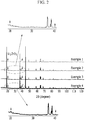
- X-ray diffraction analysis of the positive active materials according to Examples 1 to 4 was measured, and the results are provided in the following FIG. 2 .
- FIG. 2 is a graph showing X-ray diffraction analysis (XRD) of the positive active materials according to Examples 1 to 4.
- XRD X-ray diffraction analysis
- the positive active materials according to Examples 2 and 4 showed an intensity ratio of a peak at a 2 ⁇ value of about 20.3° to another peak at a 2 ⁇ value of about 42.5° of 2.17 when the ratio was calculated from the XRD graph shown in FIG. 2 .
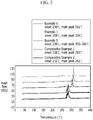
- FIG. 3 is a graph showing DSC curves of the positive active materials according to Examples 1, 5, and 6 and Comparative Examples 1 to 2.
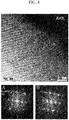
- FIG. 4 is a series of transmission electron microscope (TEM) photographs showing the positive active material according to Example 5.
- Li 2 ZrO 3 was identified in the TEM photographs of the positive active material according to Example 5.
- B in FIG. 4 indicates (or corresponds to) a core part
- a in FIG. 4 indicates (or corresponds to) a boundary between the core and a coating layer.
- a structural analysis of A and B using a FFT identifies a Li 2 ZrO 3 phase, as shown in A, and a layered structure in which atoms were arranged in a straight line, as shown in B.
- the positive electrode and lithium metal as a counter electrode were used to manufacture a coin-type half-cell.
- an electrolyte was prepared by dissolving 1.3M LiPF 6 in a mixed solution of ethylene carbonate (EC)/ethylmethyl carbonate (EMC)/diethyl carbonate (DEC) (at a volume ratio of 3:3:4).
- the rechargeable lithium battery cells were charged and discharged at 0.1C of current density in the first cycle.
- a cut-off voltage was 4.3 V during the charge, and a cut-off voltage was 3.0 V during the discharge of the first cycle.
- the rechargeable lithium battery cells were charged and discharged by sequentially applying current density of 0.2C, 0.5C, and 1C thereto from the second cycle.
- a cut-off voltage was 4.3 V during the charge, and a cut-off voltage was 3.0 V during the discharge.
- the cells were charged and discharged at 1C, and a cycle-life curved line of the cells was examined.
- FIG. 5 is a graph showing cycle-life characteristics of the rechargeable lithium battery cells according to Examples 1, 5, and 6 and Comparative Example 1.
- FIG. 6 is a graph showing cycle-life characteristics of the rechargeable lithium battery cells according to Example 7 and Comparative Example 3.
- Example 7 which included a lithium manganese oxide coated with Li 2 ZrO 3 as a positive active material, showed excellent cycle-life characteristic as compared with Comparative Example 3, which included a lithium manganese oxide that was not coated with Li 2 ZrO 3 .
Landscapes
- Chemical & Material Sciences (AREA)
- Chemical Kinetics & Catalysis (AREA)
- Electrochemistry (AREA)
- General Chemical & Material Sciences (AREA)
- Inorganic Chemistry (AREA)
- Engineering & Computer Science (AREA)
- Composite Materials (AREA)
- Manufacturing & Machinery (AREA)
- Materials Engineering (AREA)
- Organic Chemistry (AREA)
- Dispersion Chemistry (AREA)
- Battery Electrode And Active Subsutance (AREA)
- Secondary Cells (AREA)
Claims (6)
- Procédé de préparation d'un matériau actif positif pour une batterie au lithium rechargeable, le procédé comprenant les étapes consistant à :mélanger un sel de Zr et un premier solvant pour former une solution saline ;mélanger un agent chélateur et un second solvant pour former une solution d'agent chélateur ;mélanger la solution saline et la solution d'agent chélateur pour former une première solution mélangée ;mélanger la première solution mélangée et un homogénéisateur pour former une seconde solution mélangée ;mélanger au moins un matériau principal sélectionné parmi un oxyde composite à base de nickel représenté par la Formule chimique 1 ou un oxyde de manganèse de lithium représenté par la Formule chimique 2 et la seconde solution mélangée pour former un mélange ; ettraiter thermiquement le mélange pour recouvrir une surface du matériau principal avec un oxyde métallique de lithium représenté par la Formule chimique 3 :
Formule chimique 1 LiNixCOyMn1-x-yO2
où 0,1 ≤ x ≤ 0,8, et 0,1 ≤ y ≤ 0,8,
Formule chimique 2 LiaMnbOc
où 1 ≤ a ≤ 2, 1 ≤ b ≤ 2, et 2 ≤ c ≤ 4, et
Formule chimique 3 Li2MO3
où M est un Zr tétravalent. - Procédé selon la revendication 1, dans lequel le sel comprenant l'élément tétravalent est au moins l'un sélectionné parmi ZrO(NO3)2 · rH2O(0 ≤ r ≤ 5), Zr(NO3)2 · 5H2O, Zr (SO4)2 et Zr (SO4)2 · 4H2O.
- Procédé selon la revendication 1, dans lequel le sel est présent dans la solution saline en une quantité de 0,001 à 10 parties par mole, sur la base de 100 parties par mole du matériau principal.
- Procédé selon la revendication 1, dans lequel le premier solvant et le second solvant comprennent chacun de l'eau, de l'alcool ou une combinaison de ceux-ci.
- Procédé selon la revendication 1, dans lequel le traitement thermique est réalisé à une température de 350 à 1000°C.
- Procédé selon la revendication 1, dans lequel le traitement thermique est réalisé sous une atmosphère d'air ou une atmosphère d'oxygène.
Applications Claiming Priority (1)
| Application Number | Priority Date | Filing Date | Title |
|---|---|---|---|
| KR1020130145667A KR101904896B1 (ko) | 2013-11-27 | 2013-11-27 | 리튬 이차 전지용 양극 활물질, 이의 제조 방법 및 이를 포함하는 리튬 이차 전지 |
Publications (2)
| Publication Number | Publication Date |
|---|---|
| EP2879209A1 EP2879209A1 (fr) | 2015-06-03 |
| EP2879209B1 true EP2879209B1 (fr) | 2020-01-08 |
Family
ID=51162562
Family Applications (1)
| Application Number | Title | Priority Date | Filing Date |
|---|---|---|---|
| EP14176431.6A Active EP2879209B1 (fr) | 2013-11-27 | 2014-07-10 | Matériau actif positif pour batterie au lithium rechargeable, procédé de préparation de celui-ci et batterie au lithium rechargeable comprenant celui-ci |
Country Status (4)
| Country | Link |
|---|---|
| US (1) | US10868300B2 (fr) |
| EP (1) | EP2879209B1 (fr) |
| KR (1) | KR101904896B1 (fr) |
| CN (1) | CN104681818B (fr) |
Families Citing this family (13)
| Publication number | Priority date | Publication date | Assignee | Title |
|---|---|---|---|---|
| EP2824074B1 (fr) | 2013-07-11 | 2019-02-20 | Samsung SDI Co., Ltd. | Matériau actif positif pour batterie au lithium rechargeable et batterie au lithium rechargeable comprenant celui-ci |
| KR20170108310A (ko) * | 2016-03-17 | 2017-09-27 | 주식회사 엘지화학 | 양극 활물질 및 이의 제조방법, 이를 포함하는 리튬 이차 전지 |
| US10249873B2 (en) | 2016-08-03 | 2019-04-02 | Samsung Electronics Co. Ltd. | Composite positive active material, positive electrode including the same, and lithium battery including the positive electrode |
| KR102537227B1 (ko) * | 2017-10-25 | 2023-05-26 | 삼성에스디아이 주식회사 | 복합양극활물질, 그 제조방법 및 이를 포함한 리튬이차전지 |
| KR20190085356A (ko) | 2018-01-10 | 2019-07-18 | 삼성에스디아이 주식회사 | 리튬 이차 전지용 양극 활물질 및 이를 포함하는 리튬 이차 전지 |
| CN109119611B (zh) * | 2018-08-22 | 2021-12-24 | 广东工业大学 | 一种一步法实现离子掺杂和表面包覆共同修饰三元正极材料的方法 |
| US11495796B2 (en) | 2018-11-14 | 2022-11-08 | Samsung Sdi Co., Ltd. | Positive active material for rechargeable lithium battery, method of preparing the same and rechargeable lithium battery including the same |
| US11757092B2 (en) | 2018-11-15 | 2023-09-12 | Samsung Sdi Co., Ltd. | Positive active material for rechargeable lithium battery, method of preparing the same and rechargeable lithium battery including the same |
| KR102363371B1 (ko) | 2019-02-01 | 2022-02-14 | 삼성에스디아이 주식회사 | 리튬 이차 전지용 양극 활물질, 이의 제조방법 및 이를 포함하는 리튬 이차 전지 |
| EP3733610A1 (fr) * | 2019-04-26 | 2020-11-04 | Samsung SDI Co., Ltd. | Matériau actif positif pour batterie au lithium rechargeable, son procédé de préparation et batterie au lithium rechargeable le comprenant |
| US20200343550A1 (en) * | 2019-04-26 | 2020-10-29 | Samsung Sdi Co., Ltd. | Positive active material for rechargeable lithium battery, method of preparing the same, and rechargeable lithium battery including the same |
| KR102756173B1 (ko) * | 2019-12-30 | 2025-01-15 | 코오롱인더스트리 주식회사 | 고내구성을 갖는 연료전지용 전극, 그 제조방법, 및 그것을 포함하는 막-전극 어셈블리 |
| CN112791691B (zh) * | 2020-12-23 | 2023-07-25 | 礼思(上海)材料科技有限公司 | 一种包覆型锂离子筛及其制备方法 |
Citations (1)
| Publication number | Priority date | Publication date | Assignee | Title |
|---|---|---|---|---|
| EP1463132A2 (fr) * | 2003-03-25 | 2004-09-29 | Nichia Corporation | Matière active d'électrode positive pour batterie secondaire à électrolyte non aqueux et batterie secondaire à électrolyte non aqueux |
Family Cites Families (19)
| Publication number | Priority date | Publication date | Assignee | Title |
|---|---|---|---|---|
| JP2002289261A (ja) * | 2001-01-16 | 2002-10-04 | Matsushita Electric Ind Co Ltd | 非水電解質二次電池 |
| JPH07320785A (ja) * | 1994-05-26 | 1995-12-08 | Sony Corp | 非水電解液二次電池 |
| JP5034136B2 (ja) * | 2000-11-14 | 2012-09-26 | 株式会社Gsユアサ | 非水電解質二次電池用正極活物質およびそれを用いた非水電解質二次電池 |
| KR100778961B1 (ko) | 2002-11-06 | 2007-11-28 | 가부시끼가이샤 도시바 | 비수전해질 이차 전지 |
| US7455933B2 (en) * | 2002-11-06 | 2008-11-25 | Kabushiki Kaisha Toshiba | Nonaqueous electrolyte secondary battery |
| JP4061648B2 (ja) | 2003-04-11 | 2008-03-19 | ソニー株式会社 | 非水電解質二次電池用正極活物質及びそれを用いた非水電解質二次電池 |
| US7566479B2 (en) | 2003-06-23 | 2009-07-28 | Lg Chem, Ltd. | Method for the synthesis of surface-modified materials |
| JP4897223B2 (ja) | 2005-01-24 | 2012-03-14 | 日立マクセルエナジー株式会社 | 非水電解質二次電池 |
| KR100734225B1 (ko) | 2005-12-09 | 2007-07-02 | 제일모직주식회사 | 비수계 전해질 리튬 이차전지용 양극활물질, 그 제조방법및 이를 포함하는 리튬 이차전지 |
| KR100743982B1 (ko) | 2006-04-11 | 2007-08-01 | 한국전기연구원 | 활물질. 그 제조방법 및 이를 구비한 리튬 이차 전지 |
| CN101675547B (zh) | 2007-11-01 | 2013-05-08 | Agc清美化学股份有限公司 | 锂离子二次电池用正极活性物质的制造方法 |
| KR101430616B1 (ko) | 2007-12-18 | 2014-08-14 | 삼성에스디아이 주식회사 | 캐소드 및 이를 채용한 리튬 전지 |
| JP5434278B2 (ja) | 2009-05-29 | 2014-03-05 | Tdk株式会社 | 活物質及び電極の製造方法、活物質及び電極 |
| KR101264364B1 (ko) | 2009-12-03 | 2013-05-14 | 주식회사 엘앤에프신소재 | 리튬 이차 전지용 양극 활물질 및 이를 이용한 리튬 이차 전지 |
| JP5349427B2 (ja) | 2010-08-26 | 2013-11-20 | トヨタ自動車株式会社 | 硫化物固体電解質材料、正極体およびリチウム固体電池 |
| JP5784961B2 (ja) * | 2011-04-28 | 2015-09-24 | 国立大学法人高知大学 | 被覆活物質の製造方法 |
| WO2012160698A1 (fr) * | 2011-05-26 | 2012-11-29 | トヨタ自動車株式会社 | Matériau actif enrobé, et batterie à l'état solide au lithium |
| CN103247797B (zh) | 2013-05-20 | 2015-10-28 | 深圳市贝特瑞新能源材料股份有限公司 | 一种锂离子电池正极材料及其制备方法 |
| CN104505500A (zh) * | 2014-12-24 | 2015-04-08 | 湖南杉杉新能源有限公司 | 纳米熔融复合包覆改性锂离子电池正极材料及其制备方法 |
-
2013
- 2013-11-27 KR KR1020130145667A patent/KR101904896B1/ko active Active
-
2014
- 2014-05-19 US US14/281,678 patent/US10868300B2/en active Active
- 2014-07-10 EP EP14176431.6A patent/EP2879209B1/fr active Active
- 2014-09-19 CN CN201410483552.2A patent/CN104681818B/zh active Active
Patent Citations (1)
| Publication number | Priority date | Publication date | Assignee | Title |
|---|---|---|---|---|
| EP1463132A2 (fr) * | 2003-03-25 | 2004-09-29 | Nichia Corporation | Matière active d'électrode positive pour batterie secondaire à électrolyte non aqueux et batterie secondaire à électrolyte non aqueux |
Also Published As
| Publication number | Publication date |
|---|---|
| CN104681818A (zh) | 2015-06-03 |
| US20150147651A1 (en) | 2015-05-28 |
| KR101904896B1 (ko) | 2018-10-05 |
| EP2879209A1 (fr) | 2015-06-03 |
| US10868300B2 (en) | 2020-12-15 |
| CN104681818B (zh) | 2020-03-17 |
| KR20150061474A (ko) | 2015-06-04 |
Similar Documents
| Publication | Publication Date | Title |
|---|---|---|
| US10868300B2 (en) | Positive active material for rechargeable lithium battery, method of preparing same, and rechargeable lithium battery including the same | |
| US10629902B2 (en) | Positive active material for rechargeable lithium battery, method of preparing the same, and positive electrode for rechargeable lithium battery and rechargeable lithium battery including the same | |
| US9236609B2 (en) | Positive active material for rechargeable lithium battery, method of preparing same, and rechargeable lithium battery including same | |
| KR101309150B1 (ko) | 리튬 이차 전지용 양극 활물질, 이의 제조 방법 및 이를 포함하는 리튬 이차 전지 | |
| US10665861B2 (en) | Positive active material including lithium nickel-based metal oxide, method of preparing the same, and rechargeable lithium battery including the same | |
| US10930934B2 (en) | Positive active material for rechargeable lithium battery and rechargeable lithium battery including same | |
| US9722241B2 (en) | Positive active material for rechargeable lithium battery, method of preparing same, and rechargeable lithium battery including same | |
| EP2395582A1 (fr) | Matériau actif positif pour batterie au lithium rechargeable, procédé de préparation de celui-ci, et batterie au lithium rechargeable comprenant celui-ci | |
| EP2985823B1 (fr) | Matériau actif positif pour batterie au lithium rechargeable, procédé de fabrication correspondant et batterie au lithium rechargeable utilisant celui-ci | |
| KR20110136000A (ko) | 리튬 이차 전지용 양극 활물질, 이의 제조 방법 및 이를 포함하는 리튬 이차 전지 | |
| KR20150115531A (ko) | 복합양극활물질 제조방법, 복합양극활물질 및 이를 채용한 양극과 리튬전지 | |
| US11894554B2 (en) | Cathode active material for lithium secondary battery, method for preparing same, and lithium secondary battery comprising same | |
| US20140287312A1 (en) | Positive active material for a rechargeable lithium battery and rechargeable lithium battery including the same | |
| US9716273B2 (en) | Positive active material for rechargeable lithium battery, method of preparing the same, and rechargeable lithium battery including the same | |
| US9466836B2 (en) | Positive active material for rechargeable lithium battery, method of preparing same, and rechargeable lithium battery including same | |
| US10224543B2 (en) | Positive active material for rechargeable lithium battery, method of preparing the same and rechargeable lithium battery including the same |
Legal Events
| Date | Code | Title | Description |
|---|---|---|---|
| PUAI | Public reference made under article 153(3) epc to a published international application that has entered the european phase |
Free format text: ORIGINAL CODE: 0009012 |
|
| 17P | Request for examination filed |
Effective date: 20140710 |
|
| AK | Designated contracting states |
Kind code of ref document: A1 Designated state(s): AL AT BE BG CH CY CZ DE DK EE ES FI FR GB GR HR HU IE IS IT LI LT LU LV MC MK MT NL NO PL PT RO RS SE SI SK SM TR |
|
| AX | Request for extension of the european patent |
Extension state: BA ME |
|
| R17P | Request for examination filed (corrected) |
Effective date: 20151203 |
|
| RBV | Designated contracting states (corrected) |
Designated state(s): AL AT BE BG CH CY CZ DE DK EE ES FI FR GB GR HR HU IE IS IT LI LT LU LV MC MK MT NL NO PL PT RO RS SE SI SK SM TR |
|
| 17Q | First examination report despatched |
Effective date: 20161007 |
|
| STAA | Information on the status of an ep patent application or granted ep patent |
Free format text: STATUS: EXAMINATION IS IN PROGRESS |
|
| GRAP | Despatch of communication of intention to grant a patent |
Free format text: ORIGINAL CODE: EPIDOSNIGR1 |
|
| STAA | Information on the status of an ep patent application or granted ep patent |
Free format text: STATUS: GRANT OF PATENT IS INTENDED |
|
| RIC1 | Information provided on ipc code assigned before grant |
Ipc: H01M 4/505 20100101ALI20190826BHEP Ipc: H01M 4/36 20060101AFI20190826BHEP Ipc: H01M 4/04 20060101ALI20190826BHEP Ipc: H01M 4/525 20100101ALI20190826BHEP Ipc: H01M 4/485 20100101ALI20190826BHEP |
|
| INTG | Intention to grant announced |
Effective date: 20190912 |
|
| GRAS | Grant fee paid |
Free format text: ORIGINAL CODE: EPIDOSNIGR3 |
|
| GRAA | (expected) grant |
Free format text: ORIGINAL CODE: 0009210 |
|
| STAA | Information on the status of an ep patent application or granted ep patent |
Free format text: STATUS: THE PATENT HAS BEEN GRANTED |
|
| AK | Designated contracting states |
Kind code of ref document: B1 Designated state(s): AL AT BE BG CH CY CZ DE DK EE ES FI FR GB GR HR HU IE IS IT LI LT LU LV MC MK MT NL NO PL PT RO RS SE SI SK SM TR |
|
| REG | Reference to a national code |
Ref country code: GB Ref legal event code: FG4D |
|
| REG | Reference to a national code |
Ref country code: CH Ref legal event code: EP |
|
| REG | Reference to a national code |
Ref country code: DE Ref legal event code: R096 Ref document number: 602014059596 Country of ref document: DE |
|
| REG | Reference to a national code |
Ref country code: IE Ref legal event code: FG4D |
|
| REG | Reference to a national code |
Ref country code: AT Ref legal event code: REF Ref document number: 1223813 Country of ref document: AT Kind code of ref document: T Effective date: 20200215 |
|
| REG | Reference to a national code |
Ref country code: NL Ref legal event code: MP Effective date: 20200108 |
|
| REG | Reference to a national code |
Ref country code: LT Ref legal event code: MG4D |
|
| PG25 | Lapsed in a contracting state [announced via postgrant information from national office to epo] |
Ref country code: FI Free format text: LAPSE BECAUSE OF FAILURE TO SUBMIT A TRANSLATION OF THE DESCRIPTION OR TO PAY THE FEE WITHIN THE PRESCRIBED TIME-LIMIT Effective date: 20200108 Ref country code: LT Free format text: LAPSE BECAUSE OF FAILURE TO SUBMIT A TRANSLATION OF THE DESCRIPTION OR TO PAY THE FEE WITHIN THE PRESCRIBED TIME-LIMIT Effective date: 20200108 Ref country code: NO Free format text: LAPSE BECAUSE OF FAILURE TO SUBMIT A TRANSLATION OF THE DESCRIPTION OR TO PAY THE FEE WITHIN THE PRESCRIBED TIME-LIMIT Effective date: 20200408 Ref country code: RS Free format text: LAPSE BECAUSE OF FAILURE TO SUBMIT A TRANSLATION OF THE DESCRIPTION OR TO PAY THE FEE WITHIN THE PRESCRIBED TIME-LIMIT Effective date: 20200108 Ref country code: NL Free format text: LAPSE BECAUSE OF FAILURE TO SUBMIT A TRANSLATION OF THE DESCRIPTION OR TO PAY THE FEE WITHIN THE PRESCRIBED TIME-LIMIT Effective date: 20200108 Ref country code: PT Free format text: LAPSE BECAUSE OF FAILURE TO SUBMIT A TRANSLATION OF THE DESCRIPTION OR TO PAY THE FEE WITHIN THE PRESCRIBED TIME-LIMIT Effective date: 20200531 |
|
| PG25 | Lapsed in a contracting state [announced via postgrant information from national office to epo] |
Ref country code: HR Free format text: LAPSE BECAUSE OF FAILURE TO SUBMIT A TRANSLATION OF THE DESCRIPTION OR TO PAY THE FEE WITHIN THE PRESCRIBED TIME-LIMIT Effective date: 20200108 Ref country code: GR Free format text: LAPSE BECAUSE OF FAILURE TO SUBMIT A TRANSLATION OF THE DESCRIPTION OR TO PAY THE FEE WITHIN THE PRESCRIBED TIME-LIMIT Effective date: 20200409 Ref country code: SE Free format text: LAPSE BECAUSE OF FAILURE TO SUBMIT A TRANSLATION OF THE DESCRIPTION OR TO PAY THE FEE WITHIN THE PRESCRIBED TIME-LIMIT Effective date: 20200108 Ref country code: IS Free format text: LAPSE BECAUSE OF FAILURE TO SUBMIT A TRANSLATION OF THE DESCRIPTION OR TO PAY THE FEE WITHIN THE PRESCRIBED TIME-LIMIT Effective date: 20200508 Ref country code: LV Free format text: LAPSE BECAUSE OF FAILURE TO SUBMIT A TRANSLATION OF THE DESCRIPTION OR TO PAY THE FEE WITHIN THE PRESCRIBED TIME-LIMIT Effective date: 20200108 Ref country code: BG Free format text: LAPSE BECAUSE OF FAILURE TO SUBMIT A TRANSLATION OF THE DESCRIPTION OR TO PAY THE FEE WITHIN THE PRESCRIBED TIME-LIMIT Effective date: 20200408 |
|
| REG | Reference to a national code |
Ref country code: DE Ref legal event code: R097 Ref document number: 602014059596 Country of ref document: DE |
|
| PG25 | Lapsed in a contracting state [announced via postgrant information from national office to epo] |
Ref country code: ES Free format text: LAPSE BECAUSE OF FAILURE TO SUBMIT A TRANSLATION OF THE DESCRIPTION OR TO PAY THE FEE WITHIN THE PRESCRIBED TIME-LIMIT Effective date: 20200108 Ref country code: CZ Free format text: LAPSE BECAUSE OF FAILURE TO SUBMIT A TRANSLATION OF THE DESCRIPTION OR TO PAY THE FEE WITHIN THE PRESCRIBED TIME-LIMIT Effective date: 20200108 Ref country code: RO Free format text: LAPSE BECAUSE OF FAILURE TO SUBMIT A TRANSLATION OF THE DESCRIPTION OR TO PAY THE FEE WITHIN THE PRESCRIBED TIME-LIMIT Effective date: 20200108 Ref country code: DK Free format text: LAPSE BECAUSE OF FAILURE TO SUBMIT A TRANSLATION OF THE DESCRIPTION OR TO PAY THE FEE WITHIN THE PRESCRIBED TIME-LIMIT Effective date: 20200108 Ref country code: SK Free format text: LAPSE BECAUSE OF FAILURE TO SUBMIT A TRANSLATION OF THE DESCRIPTION OR TO PAY THE FEE WITHIN THE PRESCRIBED TIME-LIMIT Effective date: 20200108 Ref country code: SM Free format text: LAPSE BECAUSE OF FAILURE TO SUBMIT A TRANSLATION OF THE DESCRIPTION OR TO PAY THE FEE WITHIN THE PRESCRIBED TIME-LIMIT Effective date: 20200108 Ref country code: EE Free format text: LAPSE BECAUSE OF FAILURE TO SUBMIT A TRANSLATION OF THE DESCRIPTION OR TO PAY THE FEE WITHIN THE PRESCRIBED TIME-LIMIT Effective date: 20200108 |
|
| PLBE | No opposition filed within time limit |
Free format text: ORIGINAL CODE: 0009261 |
|
| STAA | Information on the status of an ep patent application or granted ep patent |
Free format text: STATUS: NO OPPOSITION FILED WITHIN TIME LIMIT |
|
| REG | Reference to a national code |
Ref country code: AT Ref legal event code: MK05 Ref document number: 1223813 Country of ref document: AT Kind code of ref document: T Effective date: 20200108 |
|
| 26N | No opposition filed |
Effective date: 20201009 |
|
| PG25 | Lapsed in a contracting state [announced via postgrant information from national office to epo] |
Ref country code: IT Free format text: LAPSE BECAUSE OF FAILURE TO SUBMIT A TRANSLATION OF THE DESCRIPTION OR TO PAY THE FEE WITHIN THE PRESCRIBED TIME-LIMIT Effective date: 20200108 Ref country code: AT Free format text: LAPSE BECAUSE OF FAILURE TO SUBMIT A TRANSLATION OF THE DESCRIPTION OR TO PAY THE FEE WITHIN THE PRESCRIBED TIME-LIMIT Effective date: 20200108 |
|
| PG25 | Lapsed in a contracting state [announced via postgrant information from national office to epo] |
Ref country code: PL Free format text: LAPSE BECAUSE OF FAILURE TO SUBMIT A TRANSLATION OF THE DESCRIPTION OR TO PAY THE FEE WITHIN THE PRESCRIBED TIME-LIMIT Effective date: 20200108 Ref country code: MC Free format text: LAPSE BECAUSE OF FAILURE TO SUBMIT A TRANSLATION OF THE DESCRIPTION OR TO PAY THE FEE WITHIN THE PRESCRIBED TIME-LIMIT Effective date: 20200108 Ref country code: SI Free format text: LAPSE BECAUSE OF FAILURE TO SUBMIT A TRANSLATION OF THE DESCRIPTION OR TO PAY THE FEE WITHIN THE PRESCRIBED TIME-LIMIT Effective date: 20200108 |
|
| REG | Reference to a national code |
Ref country code: CH Ref legal event code: PL |
|
| REG | Reference to a national code |
Ref country code: BE Ref legal event code: MM Effective date: 20200731 |
|
| PG25 | Lapsed in a contracting state [announced via postgrant information from national office to epo] |
Ref country code: LU Free format text: LAPSE BECAUSE OF NON-PAYMENT OF DUE FEES Effective date: 20200710 Ref country code: LI Free format text: LAPSE BECAUSE OF NON-PAYMENT OF DUE FEES Effective date: 20200731 Ref country code: CH Free format text: LAPSE BECAUSE OF NON-PAYMENT OF DUE FEES Effective date: 20200731 |
|
| PG25 | Lapsed in a contracting state [announced via postgrant information from national office to epo] |
Ref country code: BE Free format text: LAPSE BECAUSE OF NON-PAYMENT OF DUE FEES Effective date: 20200731 |
|
| PG25 | Lapsed in a contracting state [announced via postgrant information from national office to epo] |
Ref country code: IE Free format text: LAPSE BECAUSE OF NON-PAYMENT OF DUE FEES Effective date: 20200710 |
|
| PG25 | Lapsed in a contracting state [announced via postgrant information from national office to epo] |
Ref country code: TR Free format text: LAPSE BECAUSE OF FAILURE TO SUBMIT A TRANSLATION OF THE DESCRIPTION OR TO PAY THE FEE WITHIN THE PRESCRIBED TIME-LIMIT Effective date: 20200108 Ref country code: MT Free format text: LAPSE BECAUSE OF FAILURE TO SUBMIT A TRANSLATION OF THE DESCRIPTION OR TO PAY THE FEE WITHIN THE PRESCRIBED TIME-LIMIT Effective date: 20200108 Ref country code: CY Free format text: LAPSE BECAUSE OF FAILURE TO SUBMIT A TRANSLATION OF THE DESCRIPTION OR TO PAY THE FEE WITHIN THE PRESCRIBED TIME-LIMIT Effective date: 20200108 |
|
| PG25 | Lapsed in a contracting state [announced via postgrant information from national office to epo] |
Ref country code: MK Free format text: LAPSE BECAUSE OF FAILURE TO SUBMIT A TRANSLATION OF THE DESCRIPTION OR TO PAY THE FEE WITHIN THE PRESCRIBED TIME-LIMIT Effective date: 20200108 Ref country code: AL Free format text: LAPSE BECAUSE OF FAILURE TO SUBMIT A TRANSLATION OF THE DESCRIPTION OR TO PAY THE FEE WITHIN THE PRESCRIBED TIME-LIMIT Effective date: 20200108 |
|
| P01 | Opt-out of the competence of the unified patent court (upc) registered |
Effective date: 20230528 |
|
| PGFP | Annual fee paid to national office [announced via postgrant information from national office to epo] |
Ref country code: GB Payment date: 20250626 Year of fee payment: 12 |
|
| PGFP | Annual fee paid to national office [announced via postgrant information from national office to epo] |
Ref country code: FR Payment date: 20250623 Year of fee payment: 12 |
|
| PGFP | Annual fee paid to national office [announced via postgrant information from national office to epo] |
Ref country code: DE Payment date: 20250624 Year of fee payment: 12 |