EP2879324B1 - Système de partage de secrets, appareil de distribution de données, appareil de transformation de données distribuées, procédé de partage de secrets et programme - Google Patents
Système de partage de secrets, appareil de distribution de données, appareil de transformation de données distribuées, procédé de partage de secrets et programme Download PDFInfo
- Publication number
- EP2879324B1 EP2879324B1 EP13813379.8A EP13813379A EP2879324B1 EP 2879324 B1 EP2879324 B1 EP 2879324B1 EP 13813379 A EP13813379 A EP 13813379A EP 2879324 B1 EP2879324 B1 EP 2879324B1
- Authority
- EP
- European Patent Office
- Prior art keywords
- shares
- secret sharing
- sharing scheme
- ciphertext
- equal
- Prior art date
- Legal status (The legal status is an assumption and is not a legal conclusion. Google has not performed a legal analysis and makes no representation as to the accuracy of the status listed.)
- Active
Links
Images




Classifications
-
- H—ELECTRICITY
- H04—ELECTRIC COMMUNICATION TECHNIQUE
- H04L—TRANSMISSION OF DIGITAL INFORMATION, e.g. TELEGRAPHIC COMMUNICATION
- H04L9/00—Cryptographic mechanisms or cryptographic arrangements for secret or secure communications; Network security protocols
- H04L9/08—Key distribution or management, e.g. generation, sharing or updating, of cryptographic keys or passwords
- H04L9/0861—Generation of secret information including derivation or calculation of cryptographic keys or passwords
- H04L9/0869—Generation of secret information including derivation or calculation of cryptographic keys or passwords involving random numbers or seeds
-
- G—PHYSICS
- G06—COMPUTING OR CALCULATING; COUNTING
- G06F—ELECTRIC DIGITAL DATA PROCESSING
- G06F21/00—Security arrangements for protecting computers, components thereof, programs or data against unauthorised activity
- G06F21/60—Protecting data
- G06F21/606—Protecting data by securing the transmission between two devices or processes
-
- H—ELECTRICITY
- H04—ELECTRIC COMMUNICATION TECHNIQUE
- H04L—TRANSMISSION OF DIGITAL INFORMATION, e.g. TELEGRAPHIC COMMUNICATION
- H04L9/00—Cryptographic mechanisms or cryptographic arrangements for secret or secure communications; Network security protocols
- H04L9/008—Cryptographic mechanisms or cryptographic arrangements for secret or secure communications; Network security protocols involving homomorphic encryption
-
- H—ELECTRICITY
- H04—ELECTRIC COMMUNICATION TECHNIQUE
- H04L—TRANSMISSION OF DIGITAL INFORMATION, e.g. TELEGRAPHIC COMMUNICATION
- H04L9/00—Cryptographic mechanisms or cryptographic arrangements for secret or secure communications; Network security protocols
- H04L9/08—Key distribution or management, e.g. generation, sharing or updating, of cryptographic keys or passwords
- H04L9/0816—Key establishment, i.e. cryptographic processes or cryptographic protocols whereby a shared secret becomes available to two or more parties, for subsequent use
- H04L9/085—Secret sharing or secret splitting, e.g. threshold schemes
Definitions
- the present invention relates to a computational secret sharing technique and a multiparty computation technique.
- Secret sharing is a technique by which data is transformed into multiple shares so that the original data can be reconstructed by using a certain number of shares or more but none of the original data can be reconstructed by using any number of shares less than the certain number.
- Some secret sharing schemes impose restrictions on the total number N of shares and the smallest number K ( ⁇ N) of shares required for reconstruction and others not.
- a typical secret sharing scheme is Shamir's secret sharing scheme (see Non-patent literature 1, for example).
- n 1 , ..., n K are different integers greater than or equal to 1 and less than or equal to N.
- One type of secret sharing is a computational secret sharing scheme in which, based on computational safety, no part of original data can be reconstructed from any number of shares less than a certain value (see Non-patent literature 2, for example).
- a secret sharing scheme such as Shamir's secret sharing scheme.
- shares S i (a+b) of a + b and shares S i (ab) of ab can be obtained from shares S i (a), S i (b) of information a, b ⁇ GF(p) without revealing inputs into the computing entities (see Non-patent literature 3).
- linear secret sharing schemes Another type of secret sharing is linear secret sharing schemes.
- the linear secret schemes can be defined as secret sharing in which all of the shares of original data a ⁇ GF(p) can be represented by a ⁇ GF(p) and a linear combination of random numbers on GF(p), It is known that any linear secret sharing scheme can be extended to multiparty computation (see Non-patent literature 4). (see Non-patent literature 4). Reference is also made to Non-patent literatures 5 and 6.
- the total data amount of shares is approximately N times the data amount of each piece of information a, given that the data amount of information a and the data amount of each share of the information a are constant.
- the total data amount of shares required for reconstructing each piece of information a is approximately K times the data amount of the piece of information a. It is desirable to minimize the data amount of shares because an increase in the data amount of shares leads to increases in communication time and the amount of stored data.
- computational secret sharing schemes In computational secret sharing schemes, generally T i (a) + T i (b) ⁇ T i (a + b). Accordingly, in computational secret sharing schemes, unlike in Shamir's secret sharing scheme, a method of multiparty computation of addition of inputs are not self-evident. However, the computational secret sharing schemes are advantageous in that the total data amount of shares and the total data amount of shares required for reconstruction are smaller than in those in Shamir's secret sharing scheme.
- the present invention has been made in light of these circumstances and an object of the present invention is to provide a secret sharing technique capable of using shares according to a computational secret sharing scheme to perform multiparty computation,
- a secret sharing system in one mode of the present invention includes a data distribution apparatus and N distributed data transform apparatuses.
- N and K are integers greater than or equal to 2.
- the data distribution apparatus in this mode includes a key selecting part, a pseudorandom number generation part, an encryption part, a key division part and a ciphertext division part.
- the key selecting part selects K-1 keys s 1 , ..., s K-1 ⁇ S.
- the encryption part uses the pseudorandom numbers r 1 , ..., r K-1 to generate a ciphertext c from information a ⁇ R.
- the key division part divides each of the keys s 1 , ..., s K-1 into N shares f s1 (n), ..., f sK-1 (n) by using an arbitrary secret sharing scheme S1.
- the ciphertext division part divides the ciphertext c into N shares f c (n) by using an arbitrary secret sharing scheme S0.
- Each of the distributed data transform apparatuses in this mode includes a reconstruction part, a redivision part, and a transform part.
- the redivision part divides the reconstructed value U j into N shares f uj (n) by using an arbitrary homomorphic secret sharing scheme S2.
- the transform part generates a share g a (j) of information a from K shares f U1 (i), ..., f UK (i).
- a secret sharing system in another mode of the present invention includes a data distribution apparatus and N distributed data transform apparatuses.
- the data distribution apparatus in this mode includes a key selecting part, a pseudorandom number generation part, an encryption part, a key division part, and a ciphertext division part.
- the key selecting part selects K'-1 keys s 1 , ..., s K'-1 ⁇ S.
- the encryption part uses the pseudorandom numbers r 1 , ..., r K'-1 to generate a ciphertext c from information a ⁇ R.
- the key division part divides each of the keys s 1 , ..., s K'-1 into N shares f s1 (n), ..., f sK'-1 (n) by using an arbitrary secret sharing scheme S1.
- the ciphertext division part divides the ciphertext c into N shares f c (n) by using an arbitrary sharing scheme S0.
- Each of the distributed data transform apparatuses in this mode includes a reconstruction part, a redivision part, and a transform part.
- the redivision part divides the reconstructed value U j into N shares f uj (n) by using an arbitrary homomorphic secret sharing scheme S2.
- the transform part generates a share g a (j) of information a from K' shares f U1 (i), ..., f UK' (i).
- shares generated by a computational secret sharing scheme can be transformed into shares in an arbitrary homomorphic secret sharing scheme.
- many of the existing linear secret sharing schemes such as Shamir's secret sharing scheme are homomorphic secret sharing schemes, and therefore multiparty computation methods using shares according to existing linear secret sharing schemes such as Shamir's secret sharing scheme are known. Therefore, choosing an existing linear secret sharing such as Shamir's secret sharing scheme as a homomorphic secret sharing scheme enables multiparty computation using shares according to a computational secret sharing scheme.
- a computational secret sharing scheme that is efficient in encoding as a secret sharing scheme S0 for dividing a ciphertext c reduces the size of shares and therefore can reduce the total data amount of shares to store and the total data amount of shares required for reconstruction.
- a secret sharing system transforms shares according to a computational secret sharing scheme into shares according to any given homomorphic secret sharing scheme.
- the secret sharing system 1 includes a data distribution apparatus 10, at least N distributed data transform apparatuses 20 1 - 20 N , and a network 90.
- the data distribution apparatus 10 and the distributed data transform apparatuses 20 1 - 20 N are connected to the network 90.
- the network 90 only needs to be configured to allow the data distribution apparatus 10 and the distributed data transform apparatuses 20 1 - 20 N to communicate with each other and may be, for example, the Internet, a LAN, a WAN or the like.
- the data distribution apparatus 10 and the distributed data transform apparatuses 201 - 20N are not necessarily able to communicate online through a network.
- information output from the data distribution apparatus 10 may be stored on a portable recording medium such as a USB memory and may be input offline from the portable recording medium into the distributed data transform apparatuses 20 1 - 20 N .
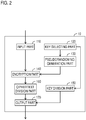
- the data distribution apparatus 10 includes an input part 110, a key selecting part 120, a pseudorandom number generation part 130, an encryption part 140, a key division part 150, a ciphertext division part 160, and an output part 170.
- the distributed data transform apparatus 20 includes an input part 210, a reconstruction part 220, a redivision part 230, a transform part 240, an output part 250 and a storage 290.
- the storage 290 may be a main memory such as a RAM (Random Access Memory), an auxiliary storage device such as a hard disk, an optical disc, or a semiconductor memory device such as a flash memory, or middleware such as a relational database or a key value store.
- RAM Random Access Memory
- auxiliary storage device such as a hard disk, an optical disc, or a semiconductor memory device such as a flash memory
- middleware such as a relational database or a key value store.
- N and K are integers greater than or equal to 2
- N ⁇ K, n 1, ..., N
- ⁇ represents K different integers greater than or equal to 1 and less than or equal to N
- i is an integer
- fx(n) represents N shares of x
- R is a ring
- S is a key space
- P(x) is a mapping that maps x ⁇ S to the ring R.
- the mapping P(x) outputs the elements of a ring R for input x ⁇ S.
- the same P(x) corresponds to the same input x.
- the mapping P(x) is a definite mapping that outputs the same value for the same input.
- Input x may or may not be in one-to-one correspondence.
- the mapping P(x) may be a pseudorandom number generator function that uses x as a seed and returns the elements of a ring R.
- the mapping P(x) may be a common key encryption function that outputs a ciphertext that belongs to the ring R for a fixed plaintext by using x as an encryption key.
- the mapping P(x) may be a function or an algorithm.
- information a is input into the input part 110.
- the information a is values included in the ring R. Accordingly, the information can be expressed as a ⁇ R.
- Examples of the information a include a video file, an audio file, a text file, and a table file.
- the data amount of the information a may be greater than or equal to 1 megabytes, for example.
- the key selecting part 120 selects K-1 keys s 1 , ..., s K-1 ⁇ S.
- the key selecting part 120 may randomly select K-1 keys s 1 , ..., s K-1 one by one or may select K-1 keys s 1 , ..., s K-1 according to a predetermined rule from among a plurality of values generated and stored beforehand in a memory.
- the keys s 1 , ..., s K-1 are set to a length that can ensure required safety and acceptable throughput. For example, the length is typically set to a length of 128 to 256 bits but is not limited to this range.
- the information a and the pseudorandom numbers r 1 , ..., r K-1 are input into the encryption part 140.
- Keys s 1 , ..., s K-1 are also input into the key distribution part 150.
- the secret sharing scheme S1 may be any secret sharing scheme, it is desirable to use a secure secret sharing scheme because the keys used for decrypting the information a is distributed. For example, Shamir's secret sharing scheme can be used.
- Shamir's secret sharing scheme is a secure secret sharing scheme because original data can be reconstructed from K or more shares among N shares into which the original data has been divided but no information about the original data can be obtained from fewer than K shares, where N and K are integers greater than or equal to 2 and N ⁇ K.
- the ciphertext c is input into the ciphertext division part 160.
- the secret sharing scheme S0 may be any secret sharing scheme
- the scheme described in Non-patent literature 2 for example, may be used.
- a value c on the ring R needs to be transformed to a K-dimensional vector on GF(p).
- K shares f sj (i) (i ⁇ ⁇ ) or K shares f c (i) output from the data distribution apparatus 10 are input into the input part 210.
- the shares f sj (i) or f c (i) may be stored in the storages 290 and the subsequent process may be performed at a given timing. Alternatively, the subsequent process may be executed immediately after the shares f sj (i) or f c (i) are input without storing the shares f sj (i) or f c (i) in the storages 290.
- each of the reconstruction parts 220 generates a reconstructed value U j from the input shares f sj (i) or shares f c (i).
- the shares f sj (i) are input, the shares f sj (i) are reconstructed by using an arbitrary secret sharing scheme S1 to generate a value u j .
- U j P(u j ) is calculated to obtain a reconstructed value U j .
- the mapping P(x) is the same as that in the pseudorandom number generation part 130 of the data distribution apparatus 10.
- the secret sharing scheme S1 may be any secret sharing scheme but needs to be the same as the same secret sharing scheme S1 used by the key division part 150 of the data distribution apparatus 10.
- the secret sharing scheme S0 may be any secret sharing scheme but needs to be the same as the same secret sharing scheme S0 used by the ciphertext division part 160 of the data distribution apparatus 10.
- the reconstructed values U j are input into the redivision parts 230.
- the secret sharing scheme S2 may be any secret sharing scheme that is homomorphic.
- an existing linear secret sharing scheme such as Shamir's secret sharing scheme may be used.
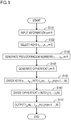
- step S211 to step S230 in Fig. 5 does not need to be performed by all of the N distributed data transform apparatuses 20 1 - 20 N ; the process has to be performed by only at least K distributed data transform apparatuses 20 1 - 20 N selected arbitrarily.
- K shares f U1 (i), ..., f UK (i) generated by the redivision parts 230 of the K distributed data transform apparatuses 20 i (i ⁇ ⁇ ) are input into the input parts 210.
- the shares f U1 (i), ..., f UK (i) may be stored in the storages 290 and the subsequent process may be executed at any given timing. Alternatively, the subsequent process may be executed immediately after the shares f U1 (i), ..., f UK (i) are input without storing the shares f U1 (i), ..., f UK (i) in the storages 290.
- the shares f U1 (i), ..., f UK (i) are input into the transform parts 240.
- f UK (i) is a share generated by dividing a ciphertext c by using the homomorphic secret sharing scheme S2 and f U1 (i), ..., f UK-1 (i) are shares generated by dividing each of pseudorandom numbers r 1 , ..., r K-1 by using homomorphic secret sharing scheme S2. Because of the homomorphism, the sum of f U1 (i), ..., f UK (i) is equal to a share generated by dividing the sum of the ciphertext c and the sum of the pseudorandom numbers r 1 , ..., r K-1 by using the secret sharing scheme S2.
- the share g a (i) is equal to a share generated by dividing the information a by using the secret sharing scheme S2.
- each output part 250 outputs the share g a (i).
- the share g a (i) may be stored in the storage 290 and may be read and output from the storage 290 in response to an external request.
- step S212 to step S250 in Fig. 5 is performed by all of the N distributed data transform apparatuses 20 1 - 20 N .
- Information about the information a obtained by the distributed data transform apparatuses 20 1 - 20 N is shares in a homomorphic secret sharing scheme S2 and the confidentiality provided by this embodiment is determined by the confidentiality provided by the homomorphic secret sharing scheme S2 used, on condition that the random numbers used for generating the shares are independent of each other.
- Each of the K distributed data transform apparatuses 20i obtains one of reconstructed values U j , which are shares of the information a, but cannot obtain the information a unless all of the K reconstructed values U 1 , ..., U K can be obtained. Therefore confidentiality provided by this embodiment is ultimately determined by the confidentiality provided by the secret sharing scheme S2 used.
- the secret sharing system is capable of transforming shares f a (1), ..., f a (N) of information a according to a computational secret sharing scheme to shares g a (1), ..., g a (N) according to an arbitrary homomorphic secret sharing scheme S2.
- homomorphic secret sharing scheme examples include an existing linear secret sharing scheme such as Shamir's secret sharing scheme. Since methods for performing multiparty computation using an existing linear secret sharing scheme such as Shamir's secret sharing scheme are known, multiparty computation can be performed using shares according to a computational secret sharing scheme by choosing any of existing linear secret sharing schemes, such as Shamir's secret sharing scheme, as the secret sharing scheme S2.
- the lower limit of the size of each share is 1/K of original data. Accordingly, using the computational secret sharing scheme described in Non-patent literature 2 as the secret sharing scheme S0 for dividing a ciphertext c can reduce the storage capacity required for storing shares as compared with Shamir's secret sharing scheme in which the size of each share is substantially equal to the size of original data.
- a secret sharing system transforms shares according to a computational secret sharing scheme into shares according to any given homomorphic secret sharing scheme. While the number of keys generated is equal to the threshold for reconstruction using secret sharing schemes in the first embodiment, the number of keys does not need to be equal to the threshold for reconstruction. In the second embodiment, an example is given in which the number of keys differs from the reconstruction threshold.
- the secret sharing system 2 includes a data distribution apparatus 12, at least N distributed data transform apparatuses 20 1 - 20 N , and a network 90.
- the data distribution apparatus 12 and the distributed data transform apparatuses 20 1 - 20 N are connected to the network 90.
- the network 90 only needs to be configured to allow the data distribution apparatus 12 and the distributed data transform apparatuses 20 1 - 20 N to communicate with each other and may be, for example, the Internet, a LAN, a WAN or the like.
- the data distribution apparatus 12 and the distributed data transform apparatuses 20 1 - 20 N are not necessarily able to communicate online through a network.
- information output from the data distribution apparatus 12 may be stored on a portable recording medium such as a USB memory and may be input offline from the portable recording medium into the distributed data transform apparatuses 20 1 - 20 N .
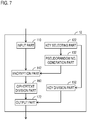
- the data distribution apparatus 12 includes an input part 110, a key selecting part 122, a pseudorandom number generation part 132, an encryption part 142, a key division part 152, a ciphertext division part 160, and an output part 172.
- the distributed data transform apparatus 22 includes an input part 212, a reconstruction part 220, a redivision part 230, a transform part 242, an output part 250 and a storage 290.
- the storage 290 may be a main memory such as a RAM (Random Access Memory), an auxiliary storage device such as a hard disk, an optical disc, or a semiconductor memory device such as a flash memory, or middleware such as a relational database or a key value store.
- RAM Random Access Memory
- auxiliary storage device such as a hard disk, an optical disc, or a semiconductor memory device such as a flash memory
- middleware such as a relational database or a key value store.
- N, K and K' are integers greater than or equal to 2
- N ⁇ K, n 1, ..., N
- ⁇ represents K different integers greater than or equal to 1 and less than or equal to N
- i is an integer
- f x (n) represents N shares of x
- R is a ring
- S is a key space
- P(x) is a mapping that maps x ⁇ S to the ring R.
- the mapping P(x) outputs the elements of a ring R for input x ⁇ S.
- the same P(x) corresponds to the same input x.
- the mapping P(x) is a definite mapping that outputs the same value for the same input.
- Input x may or may not be in one-to-one correspondence.
- the mapping P(x) may be a pseudorandom number generator function that uses x as a seed and returns the elements of a ring R.
- the mapping P(x) may be a common key encryption function that outputs a ciphertext that belongs to the ring R for a fixed plaintext by using x as an encryption key.
- the mapping P(x) may be a function or an algorithm.
- information a is input into the input part 110.
- the information a is values included in the ring R. Accordingly, the information can be expressed as a ⁇ R.
- Examples of the information a include a video file, an audio file, a text file, and a table file.
- the data amount of the information a may be greater than or equal to 1 megabytes, for example.
- the key selecting part 122 selects K'-1 keys s 1 , ..., s K'-1 ⁇ S.
- the key selecting part 120 may randomly select K'-1 keys s 1 , ..., s K'-1 one by one or may select K'-1 keys s 1 , ..., s K'-1 according to a predetermined rule from among a plurality of values generated and stored beforehand in a memory.
- the keys s 1 , ..., s K'-1 are set to a length that can ensure required safety and acceptable throughput. For example, the length is typically set to a length of 128 to 256 bits but is not limited to this range.
- the information a and the pseudorandom numbers r 1 , ..., r K'-1 are input into the encryption part 142.
- Keys s 1 , ..., s K'-1 are also input into the key distribution part 152.
- the secret sharing scheme S1 may be any secret sharing scheme, it is desirable to use a secure secret sharing scheme because the keys used for decrypting the information a is distributed. For example, Shamir's secret sharing scheme can be used.
- Shamir's secret sharing scheme is a secure secret sharing scheme because original data can be reconstructed from K or more shares among N shares into which the original data has been divided but no information about the original data can be obtained from fewer than K shares, where N and K are integers greater than or equal to 2 and N ⁇ K.
- the ciphertext c is input into the ciphertext division part 160.
- the secret sharing scheme S0 may be any secret sharing method and may be a sharing scheme, called an information dispersal algorithm (IDA), that does not take secrecy into consideration.
- the sharing scheme S0 may be the scheme described in Non-patent literature 2, for example. However, when the scheme described in Non-patent literature 2 is used, a value c on the ring R needs to be transformed to a K-dimensional vector on GF(p).
- K shares f sj (i) (i ⁇ ⁇ ) or K shares f c (i) output from the data distribution apparatus 12 are input into the input part 212.
- the shares f gj (i) or f c (i) may be stored in the storages 290 and the subsequent process may be performed at a given timing. Alternatively, the subsequent process may be executed immediately after the shares f sj (i) or f c (i) are input without storing the shares f gj (i) or f c (i) in the storages 290.
- the K shares f sj (i) or K shares f c (i) are input into the reconstruction part 220.
- each of the reconstruction parts 220 generates a reconstructed value U j from the input shares f sj (i) or shares f c (i).
- the shares f sj (i) are input, the shares f sj (i) are reconstructed using an arbitrary secret sharing scheme S1 to generate a value u j .
- U j P(u j ) is calculated to obtain a reconstructed value U j .
- the mapping P(x) is the same as that in the pseudorandom number generation part 130 of the data distribution apparatus 12.
- the reconstructed value U j to which the key s j is mapped by the same mapping is equal to pseudorandom number r j .
- the secret sharing scheme S1 needs to be the same as the same secret sharing scheme S1 used by the key division part 150 of the data distribution apparatus 12.
- the sharing scheme S0 needs to be the same as the same secret sharing scheme S0 used by the ciphertext division part 160 of the data distribution apparatus 12.
- the reconstructed values U j are input into the redivision parts 230.
- the secret sharing scheme S2 may be any secret sharing scheme that is homomorphic.
- an existing linear secret sharing scheme such as Shamir's secret sharing scheme may be used.
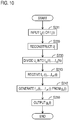
- step S211 to step S230 in Fig. 10 does not need to be performed by all of the N distributed data transform apparatuses 20 1 - 20 N ; the process has to be performed by only at least K distributed data transform apparatuses 20 1 - 20 N selected arbitrarily.
- K' shares f U1 (i), ..., f UK' (i) generated by the redivision parts 230 of the K' distributed data transform apparatuses 20 i (i ⁇ ⁇ ) are input into the input parts 212.
- the shares f U1 (i), ..., f UK' (i) may be stored in the storages 290 and the subsequent process may be executed at any given timing. Alternatively, the subsequent process may be executed immediately after the shares f U1 (i), ..., f UK' (i) are input without storing the shares f U1 (i), ..., f UK' (i) in the storages 290.
- the shares f U1 (i), ..., f UK' (i) are input into the transform parts 242.
- f UK' (i) is a share generated by dividing a ciphertext c by using the homomorphic secret sharing scheme S2 and f U1 (i), ..., f UK'-1 (i) are shares generated by dividing each of pseudorandom numbers r 1 , ..., r K-1 by using the homomorphic secret sharing scheme S2. Because of the homomorphism, the sum of F U1 (i), ..., f UK' (i) is equal to a share generated by dividing the sum of the ciphertext c and the sum of the pseudorandom numbers r 1 , ..., r K'-1 by using the secret sharing scheme S2.
- the share g a (i) is equal to a share generated by dividing the information a by using the secret sharing scheme S2.
- each output part 250 outputs the share g a (i).
- the share g a (i) may be stored in the storage 290 and may be read and output from the storage 290 in response to an external request.
- step S213 to step S250 in Fig. 10 is performed by all of the N distributed data transform apparatuses 22 1 - 22 N .
- Information about the information a obtained by the distributed data transform apparatuses 22 1 - 22 N is shares in a homomorphic secret sharing scheme S2 and the confidentiality provided by this embodiment is determined by the confidentiality provided by the homomorphic secret sharing scheme S2 used, on condition that the random numbers used for generating the shares are independent of each other.
- Each of the K' distributed data transform apparatuses 22i obtains one of reconstructed values U j , which are shares of the information a, but cannot obtain the information a unless all of the K' reconstructed values U 1 , ..., U K' can be obtained. However, secrecy cannot be ensured for U K' because sharing has been performed using an arbitrary sharing scheme. Confidentiality provided by this embodiment is ultimately determined by the confidentiality provided by the secret sharing scheme S2 used when K' > K.
- the secret sharing system is capable of transforming shares f a (1), ..., f a (N) of information a according to a computational secret sharing scheme to shares g a (1), ..., g a (N) according to an arbitrary homomorphic secret sharing scheme S2.
- homomorphic secret sharing scheme examples include an existing linear secret sharing scheme such as Shamir's secret sharing scheme. Since methods for performing multiparty computation using an existing linear secret sharing scheme such as Shamir's secret sharing scheme are known, multiparty computation can be performed using shares according to a computational secret sharing scheme by choosing any of existing linear secret sharing schemes, such as Shamir's secret sharing scheme, as the secret sharing scheme S2.
- the lower limit of the size of each share is 1/K of original data. Accordingly, using the computational secret sharing scheme described in Non-patent literature 2 as the sharing scheme S0 for dividing a ciphertext c can reduce the storage capacity required for storing shares as compared with Shamir's secret sharing scheme in which the size of each share is substantially equal to the size of original data.
- processing functions of any of the apparatuses described in the embodiments are implemented by a computer, the processing of the functions that the apparatuses should include is described in a program.
- the program is executed on the computer to implement the processing functions of the apparatus on the computer.
- the programs describing the processing can be recorded on a computer-readable recording medium.
- the computer-readable recording medium may be any recording medium such as a magnetic recording device, an optical disc, a magneto-optical recording medium, and a semiconductor memory.
- the program is distributed by selling, transferring, or lending a portable recording medium on which the program is recorded, such as a DVD or a CD-ROM.
- the program may be stored on a storage device of a server computer and transferred from the server computer to other computers over a network, thereby distributing the program.
- a computer that executes the program first stores the program recorded on a portable recording medium or transferred from a server computer into a storage device of the computer.
- the computer reads the program stored on the recording medium of the computer and executes the processes according to the read program.
- the computer may read the program directly from a portable recording medium and execute the processes according to the program or may execute the processes according to the program each time the program is transferred from the server computer to the computer.
- the processes may be executed using a so-called ASP (Application Service Provider) service in which the program is not transferred from a server computer to the computer but process functions are implemented by instructions to execute the program and acquisition of the results of the execution.
- ASP Application Service Provider
- the program in this mode encompasses information that is provided for processing by an electronic computer and is equivalent to the program (such as data that is not direct commands to a computer but has the nature that defines processing of the computer).
- apparatuses are configured by causing a computer to execute a predetermined program in the embodiments described above, at least some of the processes may be implemented by hardware.
Landscapes
- Engineering & Computer Science (AREA)
- Computer Security & Cryptography (AREA)
- Computer Networks & Wireless Communication (AREA)
- Signal Processing (AREA)
- Theoretical Computer Science (AREA)
- General Health & Medical Sciences (AREA)
- Bioethics (AREA)
- Computer Hardware Design (AREA)
- Software Systems (AREA)
- Physics & Mathematics (AREA)
- General Engineering & Computer Science (AREA)
- General Physics & Mathematics (AREA)
- Health & Medical Sciences (AREA)
- Storage Device Security (AREA)
Claims (7)
- Système de partage de secret (2) comprenant un appareil de distribution de données (12) et N appareils de transformation de données distribuées (22),
l'appareil de distribution de données (12) comprenant :une partie de sélection de clé (122) sélectionnant K'-1 clés s1, ..., SK'-1 ∈ S ;une partie de génération de nombres pseudo-aléatoires (132) calculant rj = P(sj) à partir des clés s1, ..., sK'-1 pour générer des nombres pseudo-aléatoires r1, ..., rK'-1, où j = 1, ..., K'-1 ;une partie de chiffrement (142) générant un texte chiffré c en soustrayant la somme des nombres pseudo-aléatoires r1, ..., rK'-1 d'informations a ∈ R ;une partie de division de clé (152) divisant chacune des clés s1, ..., sK'-1 en N parts fs1(n), ..., fsK'-1(n) en utilisant un schéma de partage de secret arbitraire S1 ; etune partie de division de texte chiffré (160) divisant le texte chiffré c en N parts fc(n) en utilisant un schéma de partage arbitraire S0 ;chacun des appareils de transformation de données distribuées (22) comprenant :une partie de reconstruction (220) calculant une valeur reconstruite Uj = P(uj) à partir d'une valeur uj générée par la reconstruction de parts fsj(i) en utilisant le schéma de partage de secret S1 lorsque K parts fsj(i) sont entrées dans les appareils de transformation de données distribuées (22), et générant la valeur reconstruite Uj (j = K') par la reconstruction de parts fc(i) en utilisant le schéma de partage de secret S0 lorsque K parts fc(i) sont entrées dans les appareils de transformation de données distribuées (22) ;une partie de redivision (230) divisant la valeur reconstruite Uj en N parts fUj(n) en utilisant un schéma de partage de secret homomorphe arbitraire S2 ; etune partie de transformation (242) générant une part ga(i) des informations a en calculant la somme de K' parts fU1(i), ..., fUK'(i) ; où N, K et K' sont des entiers supérieurs ou égaux à 2, N ≥ K, n = 1, ..., N, λ représente K entiers différents supérieurs ou égaux à 1 et inférieurs ou égaux à N, i est un entier, i ∈ λ, fx(n) représente N parts de x, R est un anneau, S est un espace de clé, et P(x) est un mappage qui mappe x ∈ S à l'anneau R. - Système de partage de secret (2) selon la revendication 1,
dans lequel le schéma de partage de secret S2 est le schéma de partage de secret de Shamir. - Appareil de distribution de données (12) inclus dans le système de partage de secret (2) selon l'une quelconque des revendications 1 à 2 comprenant :une partie de sélection de clé (122) sélectionnant K'-1 clés s1, ..., sK'-1 ∈ S ;une partie de génération de nombres pseudo-aléatoires (132) calculant rj = P(sj) à partir des clés s1, ..., SK'-1 pour générer des nombres pseudo-aléatoires r1, ..., rK'-1, où j = 1, ..., K'-1 ;une partie de chiffrement (142) générant un texte chiffré c en soustrayant la somme des nombres pseudo-aléatoires r1, ..., rK'-1 d'informations a ∈ R ;une partie de division de clé (152) divisant chacune des clés s1, ..., sK'-1 en N parts fs1(n), ..., fsK'-1(n) en utilisant un schéma de partage de secret arbitraire S1 ; etune partie de division de texte chiffré (160) divisant le texte chiffré c en N parts fc(n) en utilisant un schéma de partage arbitraire S0 ;où N, K et K' sont des entiers supérieurs ou égaux à 2, N ≥ K, n = 1, ..., N, λ représente K entiers différents supérieurs ou égaux à 1 et inférieurs ou égaux à N, i est un entier , i ∈ λ, fx(n) représente N parts de x, R est un anneau, S est un espace de clé, et P(x) est un mappage qui mappe x ∈ S à l'anneau R.
- Appareil de transformation de données distribuées (22) comprenant :une partie de reconstruction (220) calculant une valeur reconstruite Uj = P(uj) à partir d'une valeur uj générée par la reconstruction de parts fsj(i) en utilisant le schéma de partage de secret S1 lorsque K parts fsj(i) sont entrées, et générant la valeur reconstruite Uj (j = K') par la reconstruction de parts fc(i) en utilisant le schéma de partage de secret S0 lorsque K parts fc(i) sont entrées ;dans lequel les parts fsj(i) sont incluses dans N parts fs1 (n), ..., fsK'-1(n) en lesquelles chacune des K' clés s1, ..., sK'-1 ∈ S est divisée en utilisant le schéma de partage de secret S1 ; etles parts fc(i) sont incluses dans N parts fc(n) en lesquelles un texte chiffré c est divisé en utilisant le schéma de partage de secret S0, le texte chiffré c étant généré en soustrayant la somme de nombres pseudo-aléatoires r1, ..., rK'-1 d'informations a ∈ R, les nombres pseudo-aléatoires r1, ..., rK'-1 étant générés en calculant rj = P(sj), des clés s1, ..., sK'-1, où j = 1, ..., K'-1 ;une partie de redivision (230) divisant la valeur reconstruite Uj en N parts fUj(n) en utilisant un schéma de partage de secret homomorphe arbitraire S2 ; etune partie de transformation (242) générant une part ga(i) des informations a en calculant la somme de K' parts fU1(i), ..., fUK'(i) ; où N, K et K' sont des entiers supérieurs ou égaux à 2, N ≥ K, n = 1, ..., N, λ représente K entiers différents supérieurs ou égaux à 1 et inférieurs ou égaux à N, i est un entier, i ∈ λ, fx(n) représente N parts de x, R est un anneau, S est un espace de clé, et P(x) est un mappage qui mappe x ∈ S à l'anneau R.
- Procédé de partage de secret comprenant :une étape de sélection de clé consistant à sélectionner, par un appareil de distribution de données (12), K'-1 clés s1, ..., sK'-1 ∈ S ;une étape de génération de nombres pseudo-aléatoires consistant à calculer, par l'appareil de distribution de données (12), rj = P(sj) à partir des clés s1, ..., SK'-1 pour générer des nombres pseudo-aléatoires r1, ..., rK'-1, où j = 1, ..., K'-1 ;une étape de chiffrement consistant à générer, par l'appareil de distribution de données (12), un texte chiffré c en soustrayant la somme des nombres pseudo-aléatoires r1, ..., rK'-1 d'informations a ∈ R ;une étape de division de clé consistant à diviser, par l'appareil de distribution de données (12), chacune des clés s1, ..., sK'-1 en N parts fs1(n), ..., fsK'-1(n) en utilisant un schéma de partage de secret arbitraire S1 ;une étape de division de texte chiffré consistant à diviser, par l'appareil de distribution de données (12), le texte chiffré c en N parts fc(n) en utilisant un schéma de partage arbitraire S0 ; etune étape de reconstruction consistant à calculer, par des appareils de transformation de données distribuées (22), des valeurs reconstruites Uj = P(uj) à partir de valeurs uj générées par la reconstruction de parts fsj(i) en utilisant le schéma de partage de secret S1 lorsque K parts fsj(i) sont entrées, et générer les valeurs reconstruites Uj (j = K') par la reconstruction de parts fc(i) en utilisant le schéma de partage de secret S0 lorsque K parts fc(i) sont entrées ;une étape de redivision consistant à diviser, par les appareils de transformation de données distribuées (22), les valeurs reconstruites Uj en N parts fUj(n) en utilisant un schéma de partage de secret homomorphe arbitraire S2 ; etune étape de transformation consistant à générer, par les appareils de transformation de données distribuées (22), des parts ga(i) des informations a en calculant la somme de K' parts fU1(i), ..., fUK'(i) ; où N, K et K' sont des entiers supérieurs ou égaux à 2, N ≥ K, n = 1, ..., N, λ représente K entiers différents supérieurs ou égaux à 1 et inférieurs ou égaux à N, i est un entier , i ∈ λ, fx(n) représente N parts de x, R est un anneau, S est un espace de clé, et P(x) est un mappage qui mappe x ∈ S à l'anneau R.
- Support lisible par ordinateur incluant des instructions exécutables par ordinateur qui amènent un ordinateur à fonctionner comme un appareil de distribution de données selon la revendication 3.
- Support lisible par ordinateur incluant des instructions exécutables par ordinateur qui amènent un ordinateur à fonctionner comme un appareil de transformation de données distribuées selon la revendication 4.
Applications Claiming Priority (2)
| Application Number | Priority Date | Filing Date | Title |
|---|---|---|---|
| JP2012151140 | 2012-07-05 | ||
| PCT/JP2013/068328 WO2014007310A1 (fr) | 2012-07-05 | 2013-07-04 | Système de partage de secrets, dispositif de distribution de données, dispositif de conversion de données distribuées, procédé de partage de secrets et programme |
Publications (3)
| Publication Number | Publication Date |
|---|---|
| EP2879324A1 EP2879324A1 (fr) | 2015-06-03 |
| EP2879324A4 EP2879324A4 (fr) | 2016-05-04 |
| EP2879324B1 true EP2879324B1 (fr) | 2018-05-16 |
Family
ID=49882061
Family Applications (1)
| Application Number | Title | Priority Date | Filing Date |
|---|---|---|---|
| EP13813379.8A Active EP2879324B1 (fr) | 2012-07-05 | 2013-07-04 | Système de partage de secrets, appareil de distribution de données, appareil de transformation de données distribuées, procédé de partage de secrets et programme |
Country Status (5)
| Country | Link |
|---|---|
| US (1) | US9432188B2 (fr) |
| EP (1) | EP2879324B1 (fr) |
| JP (1) | JP5885840B2 (fr) |
| CN (1) | CN104429019B (fr) |
| WO (1) | WO2014007310A1 (fr) |
Families Citing this family (32)
| Publication number | Priority date | Publication date | Assignee | Title |
|---|---|---|---|---|
| WO2014007311A1 (fr) * | 2012-07-05 | 2014-01-09 | 日本電信電話株式会社 | Système de partage de secrets, dispositif de distribution de données, dispositif de conversion de données distribuées, procédé de partage de secrets et programme |
| JP6059159B2 (ja) * | 2014-01-16 | 2017-01-11 | 日本電信電話株式会社 | シェア変換システム、シェア変換方法、プログラム |
| JP6059160B2 (ja) * | 2014-01-16 | 2017-01-11 | 日本電信電話株式会社 | シェア変換システム、シェア変換方法、プログラム |
| JP2015170057A (ja) * | 2014-03-05 | 2015-09-28 | 富士通株式会社 | 秘匿検索装置、秘匿検索方法および秘匿検索プログラム |
| US10432409B2 (en) | 2014-05-05 | 2019-10-01 | Analog Devices, Inc. | Authentication system and device including physical unclonable function and threshold cryptography |
| JP6034927B1 (ja) * | 2015-07-27 | 2016-11-30 | 日本電信電話株式会社 | 秘密計算システム、秘密計算装置、およびプログラム |
| US9680809B2 (en) * | 2015-10-12 | 2017-06-13 | International Business Machines Corporation | Secure data storage on a cloud environment |
| CN105204782B (zh) * | 2015-10-13 | 2018-12-11 | 中国联合网络通信集团有限公司 | 一种实现数据存储的方法及装置 |
| EP3364398B1 (fr) * | 2015-10-13 | 2020-05-06 | Nippon Telegraph And Telephone Corporation | Dispositif de combinaison de nombres aléatoires secrets, procédé de combinaison de nombres aléatoires secrets, et programme |
| CN105357004B (zh) * | 2015-12-03 | 2018-10-16 | 万达信息股份有限公司 | 一种医疗隐私数据自加密及解密的方法 |
| JP6585846B2 (ja) * | 2016-07-06 | 2019-10-02 | 日本電信電話株式会社 | 秘密計算システム、秘密計算装置、秘密計算方法、およびプログラム |
| JP6974461B2 (ja) * | 2016-08-02 | 2021-12-01 | エックス−ロゴス、エルエルシー | 幾何代数を用いた高度データ中心型暗号化システムのための方法およびシステム |
| CN106453285B (zh) * | 2016-09-27 | 2019-07-23 | 中国农业大学 | 一种秘密数据共享的验证方法及装置 |
| US10958452B2 (en) | 2017-06-06 | 2021-03-23 | Analog Devices, Inc. | System and device including reconfigurable physical unclonable functions and threshold cryptography |
| US11818254B2 (en) * | 2017-08-22 | 2023-11-14 | Nippon Telegraph And Telephone Corporation | Share generating device, reconstructing device, secure computation system, share generation method, reconstruction method, program, and recording medium |
| US11374743B2 (en) | 2017-08-22 | 2022-06-28 | Nippon Telegraph And Telephone Corporation | Share generating device, share converting device, secure computation system, share generation method, share conversion method, program, and recording medium |
| GB201713800D0 (en) * | 2017-08-29 | 2017-10-11 | Nchain Holdings Ltd | Computer-implemented system and method |
| CN112313728B (zh) * | 2018-06-20 | 2024-04-19 | 日本电信电话株式会社 | 秘密结合系统、方法、秘密计算装置以及记录介质 |
| US12079363B2 (en) * | 2018-08-13 | 2024-09-03 | Nippon Telegraph And Telephone Corporation | Secure joining information generation system, secure joining system, methods therefor, secure computing apparatus and program |
| EP3839922B1 (fr) * | 2018-08-13 | 2023-06-14 | Nippon Telegraph And Telephone Corporation | Système de jointure sécurisé, procédé, dispositif de calcul sécurisé et programme |
| EP3839923B1 (fr) * | 2018-08-13 | 2023-11-22 | Nippon Telegraph And Telephone Corporation | Système de calcul de mappage fort de secrets, procédé associé, dispositif de calcul de secrets et programme |
| CN109241016B (zh) * | 2018-08-14 | 2020-07-07 | 阿里巴巴集团控股有限公司 | 多方安全计算方法及装置、电子设备 |
| CN111914264A (zh) * | 2019-05-08 | 2020-11-10 | 华控清交信息科技(北京)有限公司 | 索引创建方法及装置、数据验证方法及装置 |
| CN112000978B (zh) * | 2019-06-19 | 2023-12-19 | 华控清交信息科技(北京)有限公司 | 隐私数据的输出方法、数据处理系统及存储介质 |
| US11943350B2 (en) * | 2019-10-16 | 2024-03-26 | Coinbase, Inc. | Systems and methods for re-using cold storage keys |
| US20230004356A1 (en) * | 2019-12-19 | 2023-01-05 | Nippon Telegraph And Telephone Corporation | Secure random number generation system, secure computation apparatus, secure random number generation method, and program |
| US12099997B1 (en) | 2020-01-31 | 2024-09-24 | Steven Mark Hoffberg | Tokenized fungible liabilities |
| CN111428276B (zh) * | 2020-03-19 | 2022-08-02 | 腾讯科技(深圳)有限公司 | 一种数据处理的方法、装置、设备和介质 |
| US20220271933A1 (en) * | 2021-02-19 | 2022-08-25 | Samsung Electronics Co., Ltd. | System and method for device to device secret backup and recovery |
| US20220385453A1 (en) * | 2021-05-28 | 2022-12-01 | Atakama LLC | Secure file transfer |
| GB2620988B (en) * | 2022-07-29 | 2024-12-11 | Pqshield Ltd | Method and apparatus for storing/recovering a plurality of secret shares |
| CN116506852B (zh) * | 2023-03-16 | 2024-03-22 | 暨南大学 | 一种节点易损坏环境下的分布式物联网密钥安全分发方法及系统 |
Family Cites Families (6)
| Publication number | Priority date | Publication date | Assignee | Title |
|---|---|---|---|---|
| CN1207868C (zh) * | 2001-09-28 | 2005-06-22 | 中国科学院研究生院 | 一种安全的数字签名方法与系统 |
| JP4292835B2 (ja) * | 2003-03-13 | 2009-07-08 | 沖電気工業株式会社 | 秘密再構成方法、分散秘密再構成装置、及び秘密再構成システム |
| JP2007124610A (ja) * | 2005-09-20 | 2007-05-17 | Nippon Telegr & Teleph Corp <Ntt> | 秘密情報分散装置及び秘密情報復元装置及び方法及びプログラム |
| FR2925736B1 (fr) * | 2007-12-21 | 2010-09-24 | Eads Secure Networks | Procede de production d'une preuve de presence ou de fonctionnement d'une entite dans une zone identifiee pendant une duree superieure a un seuil donne, et systeme de surveillance |
| CN101217728B (zh) * | 2007-12-29 | 2013-01-30 | 北京握奇数据系统有限公司 | 用于无线写卡的空卡、无线写卡服务器及无线写卡方法 |
| CN102396012B (zh) * | 2009-04-24 | 2014-05-07 | 日本电信电话株式会社 | 秘密分散系统、分散装置、分散管理装置、取得装置、其处理方法、秘密分散方法 |
-
2013
- 2013-07-04 WO PCT/JP2013/068328 patent/WO2014007310A1/fr not_active Ceased
- 2013-07-04 EP EP13813379.8A patent/EP2879324B1/fr active Active
- 2013-07-04 US US14/408,426 patent/US9432188B2/en active Active
- 2013-07-04 JP JP2014523777A patent/JP5885840B2/ja active Active
- 2013-07-04 CN CN201380035818.0A patent/CN104429019B/zh active Active
Non-Patent Citations (1)
| Title |
|---|
| None * |
Also Published As
| Publication number | Publication date |
|---|---|
| JPWO2014007310A1 (ja) | 2016-06-02 |
| CN104429019B (zh) | 2017-06-20 |
| EP2879324A1 (fr) | 2015-06-03 |
| WO2014007310A1 (fr) | 2014-01-09 |
| CN104429019A (zh) | 2015-03-18 |
| US20150172049A1 (en) | 2015-06-18 |
| US9432188B2 (en) | 2016-08-30 |
| EP2879324A4 (fr) | 2016-05-04 |
| JP5885840B2 (ja) | 2016-03-16 |
Similar Documents
| Publication | Publication Date | Title |
|---|---|---|
| EP2879324B1 (fr) | Système de partage de secrets, appareil de distribution de données, appareil de transformation de données distribuées, procédé de partage de secrets et programme | |
| EP2858297B1 (fr) | Système de partage de secrets, dispositif de distribution de données, dispositif de conversion de données distribuées, procédé de partage de secrets et programme | |
| US9438423B2 (en) | Encryption device, encryption method, and information processing device | |
| EP3528233B1 (fr) | Dispositif de décomposition de bits secrets, procédé de décomposition de bits secrets et programme associé | |
| JP6934963B2 (ja) | データを暗号化する方法およびシステム | |
| US9374220B2 (en) | System and method for providing compressed encryption and decryption in homomorphic encryption based on integers | |
| JP5944841B2 (ja) | 秘密分散システム、データ分散装置、分散データ保有装置、秘密分散方法、およびプログラム | |
| EP2947814B1 (fr) | Dispositif de détection de falsification, procédé de détection de falsification et programme | |
| JP5762232B2 (ja) | プライバシを保護したまま暗号化された要素の順序を選択するための方法およびシステム | |
| EP3001401A1 (fr) | Dispositif de décodage, dispositif de fourniture de capacité de décodage, procédé associé, et programme | |
| EP3767874B1 (fr) | Dispositif de déchiffrement, dispositif de chiffrement et système de chiffrement | |
| Wang et al. | Proxy re-encryption schemes with key privacy from LWE | |
| JP5732429B2 (ja) | 秘密分散システム、データ分散装置、データ復元装置、秘密分散方法、およびプログラム | |
| CN114830210B (zh) | 秘密随机数生成系统及其方法、秘密计算装置、程序产品 | |
| CN117318918A (zh) | 数据同态加密方法及装置 | |
| US11811741B2 (en) | Information processing system and information processing method | |
| EP3675088B1 (fr) | Dispositif de génération de parts, dispositif de conversion de parts, système de calcul sécurisé, procédé de génération de parts, procédé, programme et support d'enregistrement de conversion de parts. | |
| US10116439B2 (en) | Encrypted data computation system, device, and program | |
| JP2013105065A (ja) | セキュリティシステム、暗号化装置、復号装置、再暗号化装置、難読化装置、それらの方法、及びプログラム | |
| Easttom | Lattice-Based Cryptography | |
| JP7786593B2 (ja) | 暗号システム、方法及びプログラム | |
| HK40102533A (zh) | 同态加密方法以及关联设备和系统 |
Legal Events
| Date | Code | Title | Description |
|---|---|---|---|
| PUAI | Public reference made under article 153(3) epc to a published international application that has entered the european phase |
Free format text: ORIGINAL CODE: 0009012 |
|
| 17P | Request for examination filed |
Effective date: 20141216 |
|
| AK | Designated contracting states |
Kind code of ref document: A1 Designated state(s): AL AT BE BG CH CY CZ DE DK EE ES FI FR GB GR HR HU IE IS IT LI LT LU LV MC MK MT NL NO PL PT RO RS SE SI SK SM TR |
|
| AX | Request for extension of the european patent |
Extension state: BA ME |
|
| DAX | Request for extension of the european patent (deleted) | ||
| REG | Reference to a national code |
Ref country code: DE Ref legal event code: R079 Ref document number: 602013037615 Country of ref document: DE Free format text: PREVIOUS MAIN CLASS: H04L0009080000 Ipc: H04L0009000000 |
|
| RA4 | Supplementary search report drawn up and despatched (corrected) |
Effective date: 20160406 |
|
| RIC1 | Information provided on ipc code assigned before grant |
Ipc: H04L 9/00 20060101AFI20160331BHEP Ipc: G06F 21/62 20130101ALI20160331BHEP Ipc: G06F 21/60 20130101ALI20160331BHEP Ipc: H04L 9/08 20060101ALI20160331BHEP |
|
| STAA | Information on the status of an ep patent application or granted ep patent |
Free format text: STATUS: EXAMINATION IS IN PROGRESS |
|
| 17Q | First examination report despatched |
Effective date: 20170203 |
|
| GRAP | Despatch of communication of intention to grant a patent |
Free format text: ORIGINAL CODE: EPIDOSNIGR1 |
|
| STAA | Information on the status of an ep patent application or granted ep patent |
Free format text: STATUS: GRANT OF PATENT IS INTENDED |
|
| INTG | Intention to grant announced |
Effective date: 20170831 |
|
| GRAJ | Information related to disapproval of communication of intention to grant by the applicant or resumption of examination proceedings by the epo deleted |
Free format text: ORIGINAL CODE: EPIDOSDIGR1 |
|
| STAA | Information on the status of an ep patent application or granted ep patent |
Free format text: STATUS: EXAMINATION IS IN PROGRESS |
|
| GRAP | Despatch of communication of intention to grant a patent |
Free format text: ORIGINAL CODE: EPIDOSNIGR1 |
|
| STAA | Information on the status of an ep patent application or granted ep patent |
Free format text: STATUS: GRANT OF PATENT IS INTENDED |
|
| INTC | Intention to grant announced (deleted) | ||
| INTG | Intention to grant announced |
Effective date: 20180122 |
|
| GRAS | Grant fee paid |
Free format text: ORIGINAL CODE: EPIDOSNIGR3 |
|
| GRAA | (expected) grant |
Free format text: ORIGINAL CODE: 0009210 |
|
| STAA | Information on the status of an ep patent application or granted ep patent |
Free format text: STATUS: THE PATENT HAS BEEN GRANTED |
|
| AK | Designated contracting states |
Kind code of ref document: B1 Designated state(s): AL AT BE BG CH CY CZ DE DK EE ES FI FR GB GR HR HU IE IS IT LI LT LU LV MC MK MT NL NO PL PT RO RS SE SI SK SM TR |
|
| REG | Reference to a national code |
Ref country code: GB Ref legal event code: FG4D |
|
| REG | Reference to a national code |
Ref country code: CH Ref legal event code: EP |
|
| REG | Reference to a national code |
Ref country code: DE Ref legal event code: R096 Ref document number: 602013037615 Country of ref document: DE |
|
| REG | Reference to a national code |
Ref country code: FR Ref legal event code: PLFP Year of fee payment: 6 |
|
| REG | Reference to a national code |
Ref country code: IE Ref legal event code: FG4D |
|
| REG | Reference to a national code |
Ref country code: AT Ref legal event code: REF Ref document number: 1000507 Country of ref document: AT Kind code of ref document: T Effective date: 20180615 |
|
| REG | Reference to a national code |
Ref country code: NL Ref legal event code: MP Effective date: 20180516 |
|
| REG | Reference to a national code |
Ref country code: LT Ref legal event code: MG4D |
|
| PG25 | Lapsed in a contracting state [announced via postgrant information from national office to epo] |
Ref country code: FI Free format text: LAPSE BECAUSE OF FAILURE TO SUBMIT A TRANSLATION OF THE DESCRIPTION OR TO PAY THE FEE WITHIN THE PRESCRIBED TIME-LIMIT Effective date: 20180516 Ref country code: BG Free format text: LAPSE BECAUSE OF FAILURE TO SUBMIT A TRANSLATION OF THE DESCRIPTION OR TO PAY THE FEE WITHIN THE PRESCRIBED TIME-LIMIT Effective date: 20180816 Ref country code: LT Free format text: LAPSE BECAUSE OF FAILURE TO SUBMIT A TRANSLATION OF THE DESCRIPTION OR TO PAY THE FEE WITHIN THE PRESCRIBED TIME-LIMIT Effective date: 20180516 Ref country code: SE Free format text: LAPSE BECAUSE OF FAILURE TO SUBMIT A TRANSLATION OF THE DESCRIPTION OR TO PAY THE FEE WITHIN THE PRESCRIBED TIME-LIMIT Effective date: 20180516 Ref country code: NO Free format text: LAPSE BECAUSE OF FAILURE TO SUBMIT A TRANSLATION OF THE DESCRIPTION OR TO PAY THE FEE WITHIN THE PRESCRIBED TIME-LIMIT Effective date: 20180816 Ref country code: ES Free format text: LAPSE BECAUSE OF FAILURE TO SUBMIT A TRANSLATION OF THE DESCRIPTION OR TO PAY THE FEE WITHIN THE PRESCRIBED TIME-LIMIT Effective date: 20180516 |
|
| PG25 | Lapsed in a contracting state [announced via postgrant information from national office to epo] |
Ref country code: NL Free format text: LAPSE BECAUSE OF FAILURE TO SUBMIT A TRANSLATION OF THE DESCRIPTION OR TO PAY THE FEE WITHIN THE PRESCRIBED TIME-LIMIT Effective date: 20180516 Ref country code: GR Free format text: LAPSE BECAUSE OF FAILURE TO SUBMIT A TRANSLATION OF THE DESCRIPTION OR TO PAY THE FEE WITHIN THE PRESCRIBED TIME-LIMIT Effective date: 20180817 Ref country code: RS Free format text: LAPSE BECAUSE OF FAILURE TO SUBMIT A TRANSLATION OF THE DESCRIPTION OR TO PAY THE FEE WITHIN THE PRESCRIBED TIME-LIMIT Effective date: 20180516 Ref country code: HR Free format text: LAPSE BECAUSE OF FAILURE TO SUBMIT A TRANSLATION OF THE DESCRIPTION OR TO PAY THE FEE WITHIN THE PRESCRIBED TIME-LIMIT Effective date: 20180516 Ref country code: LV Free format text: LAPSE BECAUSE OF FAILURE TO SUBMIT A TRANSLATION OF THE DESCRIPTION OR TO PAY THE FEE WITHIN THE PRESCRIBED TIME-LIMIT Effective date: 20180516 |
|
| REG | Reference to a national code |
Ref country code: AT Ref legal event code: MK05 Ref document number: 1000507 Country of ref document: AT Kind code of ref document: T Effective date: 20180516 |
|
| PG25 | Lapsed in a contracting state [announced via postgrant information from national office to epo] |
Ref country code: AT Free format text: LAPSE BECAUSE OF FAILURE TO SUBMIT A TRANSLATION OF THE DESCRIPTION OR TO PAY THE FEE WITHIN THE PRESCRIBED TIME-LIMIT Effective date: 20180516 Ref country code: EE Free format text: LAPSE BECAUSE OF FAILURE TO SUBMIT A TRANSLATION OF THE DESCRIPTION OR TO PAY THE FEE WITHIN THE PRESCRIBED TIME-LIMIT Effective date: 20180516 Ref country code: DK Free format text: LAPSE BECAUSE OF FAILURE TO SUBMIT A TRANSLATION OF THE DESCRIPTION OR TO PAY THE FEE WITHIN THE PRESCRIBED TIME-LIMIT Effective date: 20180516 Ref country code: RO Free format text: LAPSE BECAUSE OF FAILURE TO SUBMIT A TRANSLATION OF THE DESCRIPTION OR TO PAY THE FEE WITHIN THE PRESCRIBED TIME-LIMIT Effective date: 20180516 Ref country code: CZ Free format text: LAPSE BECAUSE OF FAILURE TO SUBMIT A TRANSLATION OF THE DESCRIPTION OR TO PAY THE FEE WITHIN THE PRESCRIBED TIME-LIMIT Effective date: 20180516 Ref country code: SK Free format text: LAPSE BECAUSE OF FAILURE TO SUBMIT A TRANSLATION OF THE DESCRIPTION OR TO PAY THE FEE WITHIN THE PRESCRIBED TIME-LIMIT Effective date: 20180516 Ref country code: PL Free format text: LAPSE BECAUSE OF FAILURE TO SUBMIT A TRANSLATION OF THE DESCRIPTION OR TO PAY THE FEE WITHIN THE PRESCRIBED TIME-LIMIT Effective date: 20180516 |
|
| REG | Reference to a national code |
Ref country code: DE Ref legal event code: R097 Ref document number: 602013037615 Country of ref document: DE |
|
| PG25 | Lapsed in a contracting state [announced via postgrant information from national office to epo] |
Ref country code: IT Free format text: LAPSE BECAUSE OF FAILURE TO SUBMIT A TRANSLATION OF THE DESCRIPTION OR TO PAY THE FEE WITHIN THE PRESCRIBED TIME-LIMIT Effective date: 20180516 Ref country code: SM Free format text: LAPSE BECAUSE OF FAILURE TO SUBMIT A TRANSLATION OF THE DESCRIPTION OR TO PAY THE FEE WITHIN THE PRESCRIBED TIME-LIMIT Effective date: 20180516 |
|
| REG | Reference to a national code |
Ref country code: CH Ref legal event code: PL |
|
| PLBE | No opposition filed within time limit |
Free format text: ORIGINAL CODE: 0009261 |
|
| STAA | Information on the status of an ep patent application or granted ep patent |
Free format text: STATUS: NO OPPOSITION FILED WITHIN TIME LIMIT |
|
| PG25 | Lapsed in a contracting state [announced via postgrant information from national office to epo] |
Ref country code: LU Free format text: LAPSE BECAUSE OF NON-PAYMENT OF DUE FEES Effective date: 20180704 Ref country code: MC Free format text: LAPSE BECAUSE OF FAILURE TO SUBMIT A TRANSLATION OF THE DESCRIPTION OR TO PAY THE FEE WITHIN THE PRESCRIBED TIME-LIMIT Effective date: 20180516 |
|
| REG | Reference to a national code |
Ref country code: BE Ref legal event code: MM Effective date: 20180731 |
|
| REG | Reference to a national code |
Ref country code: IE Ref legal event code: MM4A |
|
| 26N | No opposition filed |
Effective date: 20190219 |
|
| PG25 | Lapsed in a contracting state [announced via postgrant information from national office to epo] |
Ref country code: LI Free format text: LAPSE BECAUSE OF NON-PAYMENT OF DUE FEES Effective date: 20180731 Ref country code: CH Free format text: LAPSE BECAUSE OF NON-PAYMENT OF DUE FEES Effective date: 20180731 Ref country code: IE Free format text: LAPSE BECAUSE OF NON-PAYMENT OF DUE FEES Effective date: 20180704 |
|
| PG25 | Lapsed in a contracting state [announced via postgrant information from national office to epo] |
Ref country code: SI Free format text: LAPSE BECAUSE OF FAILURE TO SUBMIT A TRANSLATION OF THE DESCRIPTION OR TO PAY THE FEE WITHIN THE PRESCRIBED TIME-LIMIT Effective date: 20180516 Ref country code: BE Free format text: LAPSE BECAUSE OF NON-PAYMENT OF DUE FEES Effective date: 20180731 |
|
| PG25 | Lapsed in a contracting state [announced via postgrant information from national office to epo] |
Ref country code: AL Free format text: LAPSE BECAUSE OF FAILURE TO SUBMIT A TRANSLATION OF THE DESCRIPTION OR TO PAY THE FEE WITHIN THE PRESCRIBED TIME-LIMIT Effective date: 20180516 |
|
| PG25 | Lapsed in a contracting state [announced via postgrant information from national office to epo] |
Ref country code: MT Free format text: LAPSE BECAUSE OF NON-PAYMENT OF DUE FEES Effective date: 20180704 |
|
| PG25 | Lapsed in a contracting state [announced via postgrant information from national office to epo] |
Ref country code: TR Free format text: LAPSE BECAUSE OF FAILURE TO SUBMIT A TRANSLATION OF THE DESCRIPTION OR TO PAY THE FEE WITHIN THE PRESCRIBED TIME-LIMIT Effective date: 20180516 |
|
| PG25 | Lapsed in a contracting state [announced via postgrant information from national office to epo] |
Ref country code: PT Free format text: LAPSE BECAUSE OF FAILURE TO SUBMIT A TRANSLATION OF THE DESCRIPTION OR TO PAY THE FEE WITHIN THE PRESCRIBED TIME-LIMIT Effective date: 20180516 Ref country code: HU Free format text: LAPSE BECAUSE OF FAILURE TO SUBMIT A TRANSLATION OF THE DESCRIPTION OR TO PAY THE FEE WITHIN THE PRESCRIBED TIME-LIMIT; INVALID AB INITIO Effective date: 20130704 |
|
| PG25 | Lapsed in a contracting state [announced via postgrant information from national office to epo] |
Ref country code: CY Free format text: LAPSE BECAUSE OF FAILURE TO SUBMIT A TRANSLATION OF THE DESCRIPTION OR TO PAY THE FEE WITHIN THE PRESCRIBED TIME-LIMIT Effective date: 20180516 Ref country code: MK Free format text: LAPSE BECAUSE OF NON-PAYMENT OF DUE FEES Effective date: 20180516 |
|
| PG25 | Lapsed in a contracting state [announced via postgrant information from national office to epo] |
Ref country code: IS Free format text: LAPSE BECAUSE OF FAILURE TO SUBMIT A TRANSLATION OF THE DESCRIPTION OR TO PAY THE FEE WITHIN THE PRESCRIBED TIME-LIMIT Effective date: 20180916 |
|
| PGFP | Annual fee paid to national office [announced via postgrant information from national office to epo] |
Ref country code: DE Payment date: 20250722 Year of fee payment: 13 |
|
| PGFP | Annual fee paid to national office [announced via postgrant information from national office to epo] |
Ref country code: GB Payment date: 20250722 Year of fee payment: 13 |
|
| PGFP | Annual fee paid to national office [announced via postgrant information from national office to epo] |
Ref country code: FR Payment date: 20250725 Year of fee payment: 13 |
|
| REG | Reference to a national code |
Ref country code: DE Ref legal event code: R081 Ref document number: 602013037615 Country of ref document: DE Owner name: NTT, INC., JP Free format text: FORMER OWNER: NIPPON TELEGRAPH AND TELEPHONE CORP., TOKIO/TOKYO, JP Ref country code: DE Ref legal event code: R082 Ref document number: 602013037615 Country of ref document: DE Representative=s name: DENNEMEYER & ASSOCIATES RECHTSANWALTSGESELLSCH, DE |