EP2880886B1 - Direct mode lawful interception in a wireless telecommunications network - Google Patents
Direct mode lawful interception in a wireless telecommunications network Download PDFInfo
- Publication number
- EP2880886B1 EP2880886B1 EP13744564.9A EP13744564A EP2880886B1 EP 2880886 B1 EP2880886 B1 EP 2880886B1 EP 13744564 A EP13744564 A EP 13744564A EP 2880886 B1 EP2880886 B1 EP 2880886B1
- Authority
- EP
- European Patent Office
- Prior art keywords
- user equipment
- base transceiver
- transceiver station
- transmission power
- device communication
- Prior art date
- Legal status (The legal status is an assumption and is not a legal conclusion. Google has not performed a legal analysis and makes no representation as to the accuracy of the status listed.)
- Active
Links
Images

Classifications
-
- H—ELECTRICITY
- H04—ELECTRIC COMMUNICATION TECHNIQUE
- H04W—WIRELESS COMMUNICATION NETWORKS
- H04W12/00—Security arrangements; Authentication; Protecting privacy or anonymity
- H04W12/02—Protecting privacy or anonymity, e.g. protecting personally identifiable information [PII]
-
- H—ELECTRICITY
- H04—ELECTRIC COMMUNICATION TECHNIQUE
- H04W—WIRELESS COMMUNICATION NETWORKS
- H04W52/00—Power management, e.g. Transmission Power Control [TPC] or power classes
- H04W52/04—Transmission power control [TPC]
- H04W52/38—TPC being performed in particular situations
- H04W52/383—TPC being performed in particular situations power control in peer-to-peer links
-
- H—ELECTRICITY
- H04—ELECTRIC COMMUNICATION TECHNIQUE
- H04L—TRANSMISSION OF DIGITAL INFORMATION, e.g. TELEGRAPHIC COMMUNICATION
- H04L63/00—Network architectures or network communication protocols for network security
- H04L63/30—Network architectures or network communication protocols for network security for supporting lawful interception, monitoring or retaining of communications or communication related information
- H04L63/306—Network architectures or network communication protocols for network security for supporting lawful interception, monitoring or retaining of communications or communication related information intercepting packet switched data communications, e.g. Web, Internet or IMS communications
-
- H—ELECTRICITY
- H04—ELECTRIC COMMUNICATION TECHNIQUE
- H04W—WIRELESS COMMUNICATION NETWORKS
- H04W12/00—Security arrangements; Authentication; Protecting privacy or anonymity
- H04W12/80—Arrangements enabling lawful interception [LI]
-
- H—ELECTRICITY
- H04—ELECTRIC COMMUNICATION TECHNIQUE
- H04W—WIRELESS COMMUNICATION NETWORKS
- H04W52/00—Power management, e.g. Transmission Power Control [TPC] or power classes
- H04W52/04—Transmission power control [TPC]
- H04W52/38—TPC being performed in particular situations
- H04W52/386—TPC being performed in particular situations centralized, e.g. when the radio network controller or equivalent takes part in the power control
-
- H—ELECTRICITY
- H04—ELECTRIC COMMUNICATION TECHNIQUE
- H04W—WIRELESS COMMUNICATION NETWORKS
- H04W76/00—Connection management
- H04W76/10—Connection setup
- H04W76/14—Direct-mode setup
-
- H—ELECTRICITY
- H04—ELECTRIC COMMUNICATION TECHNIQUE
- H04W—WIRELESS COMMUNICATION NETWORKS
- H04W88/00—Devices specially adapted for wireless communication networks, e.g. terminals, base stations or access point devices
- H04W88/02—Terminal devices
-
- Y—GENERAL TAGGING OF NEW TECHNOLOGICAL DEVELOPMENTS; GENERAL TAGGING OF CROSS-SECTIONAL TECHNOLOGIES SPANNING OVER SEVERAL SECTIONS OF THE IPC; TECHNICAL SUBJECTS COVERED BY FORMER USPC CROSS-REFERENCE ART COLLECTIONS [XRACs] AND DIGESTS
- Y04—INFORMATION OR COMMUNICATION TECHNOLOGIES HAVING AN IMPACT ON OTHER TECHNOLOGY AREAS
- Y04S—SYSTEMS INTEGRATING TECHNOLOGIES RELATED TO POWER NETWORK OPERATION, COMMUNICATION OR INFORMATION TECHNOLOGIES FOR IMPROVING THE ELECTRICAL POWER GENERATION, TRANSMISSION, DISTRIBUTION, MANAGEMENT OR USAGE, i.e. SMART GRIDS
- Y04S40/00—Systems for electrical power generation, transmission, distribution or end-user application management characterised by the use of communication or information technologies, or communication or information technology specific aspects supporting them
- Y04S40/20—Information technology specific aspects, e.g. CAD, simulation, modelling, system security
Definitions
- the present invention relates a method for enabling lawful interception in a telecommunications network, especially a public land mobile network.
- the present invention further relates to a user equipment for enabling lawful interception in a telecommunications network, and to a base transceiver station for enabling lawful interception in a telecommunications network.
- the network provides a special lawful interception interface which allows breaking out traffic towards and from terminal devices which are subject to lawful interception.
- the details of the lawful interception requirements, lawful interception architecture and lawful interception interfaces are defined by 3GPP in TS 33.106, TS 33.107 & TS 33.108.
- the interface is called "Handover interface for lawful interception".
- the interfaces proving for traffic being forwarded to the lawful interception interface originate in the MSC (Mobile Switching Center), e.g. for CS voice traffic, or in the GGSN (GPRS (Global Packet Radio System) Gateway Support Node), e.g. for packet data services.
- MSC Mobile Switching Center
- GGSN GPRS (Global Packet Radio System) Gateway Support Node
- control means have to be provided which grant a particular user equipment (or terminal) to transmit in a broadcast like way allowing reception by a multitude of terminal devices in proximity range.
- the realization of device to device communication means that situations can occur where neither the radio access network, nor the core network are part of the device to device user data communication path.
- Document US-A-2004/203582 discloses communication interception in an ad-hoc wireless network without requiring direct interception by a law enforcement agency and without requiring real-time involvement of the network infrastructure.
- the terminals capture call information about calls and store it inside the terminal so that it can be gathered later by the network provider when an MS contacts a base station again.
- the network provider will then forward the gathered information to the lawful intercept entity.
- An object of the present invention is to provide a technically simple, effective and especially cost effective solution for enabling lawful interception in a telecommunications network, especially a public land mobile network, where the telecommunications network provides (or provides at least partly, e.g. within a part of the access network of the telecommunications network) device to device communication services and wherein user equipments that are camping on the telecommunications network and that are requesting and using such device to device communications services are behaving such that lawful interception can be realized as commonly known with cellular radio communication networks such as public land mobile networks.
- the object of the present invention is achieved by a method for enabling lawful interception in a telecommunications network, the telecommunications network comprising a core network and an access network, wherein a user equipment, camping on the telecommunications network, is enabled for device to device communication, wherein the access network of the telecommunications network comprises a base transceiver station, wherein the user equipment is connected to the base transceiver station and the base transceiver station is enabled for allowing the user equipment to conduct device to device communication, wherein a minimum transmission power level corresponds to the smallest transmission power the user equipment uses when transmitting a radio signal, wherein in case that
- the object of the present invention is achieved by a method for enabling lawful interception in a telecommunications network, the telecommunications network comprising a core network and an access network, wherein a user equipment, camping on the telecommunications network, is enabled for device to device communication, wherein the access network of the telecommunications network comprises a base transceiver station, wherein the user equipment is connected to the base transceiver station and the base transceiver station is enabled for allowing the user equipment to conduct device to device communication, wherein a minimum transmission power level corresponds to the smallest transmission power the user equipment uses when transmitting a radio signal, wherein in case that
- data traffic - which is exchanged between user equipments that are enabled for device to device communication - is captured for lawful interception purposes, especially such data traffic that is transmitted directly between two user equipments (or terminals) that are enabled for device to device communication (or directly between more than two, e.g. three, four or even more user equipments (or terminals) that are enabled for device to device communication purposes), such data traffic being transmitted on the direct path (between the user equipments) either in a broadcast like way, or in a dedicated communication (direct mode) between the two device to device enabled user equipments (or the multitude of device to device enabled user equipments/terminal devices.
- the present invention it is advantageously possible that lawful interception is possible even for situations that two or more user equipments communicate directly with each other according to device to device communication procedures. It has to be assured that the user traffic data transmitted to or from a user equipment that has to be monitored according to a lawful interception observation is accessible to the access network of the telecommunications network, i.e. at least a base transceiver station. According to the present invention, it is proposed to impose an increased transmission power level to such a user equipment subjected to a lawful interception monitoring as well as to such user equipments that are communicating with the user equipment to be monitored, especially in a direct mode device to device communication situation.
- the increased transmission power level to be used by the user equipment subjected to a lawful interception observation is defined by setting a minimum transmission power level corresponding to the smallest transmission power that the user equipment uses when transmitting radio signals.
- device to device communication cannot be initiated by a user equipment camping on a telecommunications network, especially a cellular public land mobile network, without the user equipment receiving a message comprising the consent of a component of the telecommunications network, especially a component of the access network, typically a base transceiver station, that the device to device communication is granted for that specific user equipment.
- the user equipment receives a message (hereinafter also called "first message") having at least the content (perhaps inter alia) to grant the possibility to conduct a device to device communication.
- the minimum transmission power level is communicated to the user equipment. This is done by means of the transmission of transmission power information, wherein the transmission power information indicates the value of the minimum transmission power of the user equipment when conducting device to device communication.
- the minimum transmission power level should be chosen such that a reliable reception, by the respective base transceiver station, of the radio signals transmitted by the user equipment subjected to a lawful interception observation is possible when conducting a device to device communication.
- the minimum transmission power level can, e.g., be indicated by means of the transmission power information in the form of a coded information, e.g. a binary value using three bits for 8 different minimum transmission power levels, or using four bits for 16 different minimum transmission power levels or the like.
- the request to conduct a device to device communication is a request to send a proximity transmission or a request to establish a direct mode transmission.
- a further user equipment is camping on the telecommunications network, the further user equipment being enabled for device to device communication, wherein the further user equipment is connected to the base transceiver station and the base transceiver station is enabled for allowing the further user equipment to conduct device to device communication, wherein in case that the further user equipment is sending a further request, to the base transceiver station, to conduct a direct mode device to device communication with the user equipment while the user equipment being subjected to a lawful interception observation, a further first message is sent from the base transceiver station to the further user equipment, wherein the further first message comprises the indication of a permission to conduct a device to device communication, by the further user equipment, with the user equipment, wherein
- the present invention relates to a user equipment for enabling lawful interception in a telecommunications network, the telecommunications network comprising a core network and an access network, wherein the user equipment, camping on the telecommunications network, is enabled for device to device communication, wherein the user equipment is connected to a base transceiver station of the access network of the telecommunications network, wherein the base transceiver station is enabled for allowing the user equipment to conduct device to device communication, wherein the user equipment is configured such that
- the present invention relates furthermore also to a user equipment for enabling lawful interception in a telecommunications network, the telecommunications network comprising a core network and an access network, wherein the user equipment, camping on the telecommunications network, is enabled for device to device communication, wherein the user equipment is connected to a base transceiver station of the access network of the telecommunications network, wherein the base transceiver station is enabled for allowing the user equipment to conduct device to device communication, wherein the user equipment is configured such that -- in case that the user equipment is subjected to a lawful interception observation, and the user equipment is sending a request, to the base transceiver station, to conduct a device to device communication, a first message is received by the user equipment from the base transceiver station, wherein the first message comprises the indication of a permission to conduct a device to device communication by the user equipment, wherein the user equipment is configured such that a minimum transmission power level corresponds to the smallest transmission power the user equipment uses when transmitting
- the user equipment being subjected to a lawful interception observation, is able to conduct device to device communication and the data traffic can nevertheless be intercepted.
- the request to conduct a device to device communication is a request to send a proximity transmission or a request to establish a direct mode transmission.
- the present invention relates to a base transceiver station for enabling lawful interception in a telecommunications network, the telecommunications network comprising a core network and an access network, wherein a user equipment, camping on the telecommunications network, is enabled for device to device communication, wherein the user equipment is connected to the base transceiver station of the access network of the telecommunications network, wherein the base transceiver station is enabled for allowing the user equipment to conduct device to device communication, wherein a minimum transmission power level corresponds to the smallest transmission power the user equipment uses when transmitting a radio signal, wherein the base transceiver station is configured such that
- the present invention relates additionally also to a base transceiver station for enabling lawful interception in a telecommunications network, the telecommunications network comprising a core network and an access network, wherein a user equipment, camping on the telecommunications network, is enabled for device to device communication, wherein the user equipment is connected to the base transceiver station of the access network of the telecommunications network, wherein the base transceiver station is enabled for allowing the user equipment to conduct device to device communication, wherein a minimum transmission power level corresponds to the smallest transmission power the user equipment uses when transmitting a radio signal, wherein the base transceiver station is configured such that
- the base transceiver station advantageously provides the possibility that a user equipment, being subjected to a lawful interception observation, can use device to device communication services and communication traffic can nevertheless be intercepted.
- the present invention relates to a program comprising a computer readable program code which, when executed on a computer or on a user equipment or on a base transceiver station, causes the computer or the user equipment or the base transceiver station to perform the inventive method.
- the present invention relates to computer program product for using a user equipment with a base transceiver station, the computer program product comprising a computer program stored on a storage medium, the computer program comprising program code which, when executed on a computer or on the user equipment or on the base transceiver station, causes the computer or the user equipment or the base transceiver station to perform the inventive method.
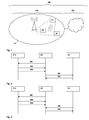
- a telecommunications network 100 is schematically shown, the telecommunications network 100 comprising an access network 110 and a core network 120.
- the telecommunications network 100 is preferably a cellular telecommunications network comprising typically a plurality of network cells, one of which is represented in Figure 1 by means of a drawnthrough line and reference sign 10.
- typically a plurality of user equipments 20, 21, 22 are camping on the telecommunications network 100 within the network cell 10, i.e. the user equipments 20, 21, 22 are connected or are camping on a base transceiver station 111 serving the cell 10.
- the base transceiver station 111 is typically a base station, e.g. a NodeB or an eNodeB base transceiver station.
- the telecommunications network 100 allows at least in parts of the telecommunications network 100 that user equipments 20, 21, 22 use device to device communication services.
- the base transceiver station 111 is enabled for allowing the user equipments 20, 21, 22 to conduct device to device communication services.
- the user equipments 20, 21, 22 are also enabled for device to device communication.
- the core network 120 is only schematically shown by means of a cloud representation.
- the public land mobile network 100 (especially the core network 120) comprises typically various network elements such as an MSC (Mobile Switching Center), a SGSN (Serving GPRS Support Node), a MME (Mobility Management Entity), preferably a plurality of network element thereof. These network elements are hierarchically higher network elements than the base transceiver station 111.
- MSC Mobile Switching Center
- SGSN Serving GPRS Support Node
- MME Mobility Management Entity
- the user equipment designated by reference sign 20 is a user equipment that is subjected to a lawful interception observation and is also called a first user equipment 20.
- the user equipment designated by reference sign 21 is a so-called further user equipment (also called second user equipment 21) that is not subjected to a 10 lawful interception observation but is communicating with the user equipment 20 (or first user equipment 20).
- the premise is that the user equipment 20 and the further user equipment 21 are camping on the radio cell 10 served by the base transceiver station 111.
- the base transceiver station 111 is a controlling base station of any cellular radio technology.
- the purpose of the base transceiver station 111 (or base station) (and optionally the connected network elements of the core network 120) is to authenticate the user equipments 20, 21, 22 (or the corresponding subscriber) of the service or services using device to device communication and grant a data transmission for this device or these devices (i.e. user equipment or user equipments).
- the base transceiver station 111 furthermore controls the channel allocation (i.e.
- the base transceiver station 111 informs the user equipment 20 or the plurality of user equipments 20, 21, 22 about transmission parameters to be used, such as, e.g., scrambling codes, modulation and coding schemes, possibly a radio identifier and transmission parameters like data rate, maximum allowed transmission power, etc.
- the controlling base transceiver station 111 might grant an access authentication attempt of a device to device user equipment 20, 21, 22 and in turn assigns parameters required to define the transmission resource. These parameters may be (partly) predefined, or valid for multiple transmissions.
- device to device communication can occur in different communication contexts or according to different communication situations, which need to be distinguished for the grant of a device to device communication transmission:
- the present invention is, however, focused on the handling - especially with respect to lawful interception purposes - of the two other device to device communication modes, i.e. device to device proximity transmission and device to device direct mode transmission.
- device to device communication occurs between the user equipment 20 and the further user equipment 21 (or between the first user equipment 20 and the second user equipment 21) using the device to device proximity transmission.
- a device to device proximity transmission 301 is initiated by the user equipment 20 (or first user equipment 20).
- This device to device proximity transmission 301 of the user equipment 20 is answered by the further user equipment 21 (or second user equipment 21) by means of a proximity transmission answer 302 to the proximity transmission 301.
- a further device to device proximity transmission 303 is initiated by the further user equipment 21 (or second user equipment 21).
- This further device to device proximity transmission 303 of the further user equipment 21 is answered by the user equipment 20 (or first user equipment 20) by means of a further proximity transmission answer 304 to the further proximity transmission 303.
- the user equipment 20 sends a request 201 to the base transceiver station 111 requesting to be allowed to use device to device services, and the base transceiver station 111 sends a first message 202 granting access to device to device communication services to the (first) user equipment 20.
- the base transceiver station 111 furthermore indicates a minimum transmission power to be used for the device to device communication services, i.e. for the device to device proximity transmission 301 (in the communication situation of Figure 2 ) and for the device to device proximity transmission answer 304 (in the communication situation of Figure 3 ).
- device to device communication occurs between the user equipment 20 and the further user equipment 21 (or between the first user equipment 20 and the second user equipment 21) using the device to device direct mode transmission.
- a device to device direct mode transmission 305 towards the further (or second) user equipment 21 is initiated by the user equipment 20 (or first user equipment 20). This request by the user equipment 20 is answered by the further user equipment 21 (or second user equipment 21) and a device to device direct mode transmission 306 initiated.
- a device to device direct mode transmission 307 towards the (first) user equipment 20 is initiated by the further user equipment 21 (or second user equipment 21). This request by the further user equipment 21 (or second user equipment 21) is answered by the user equipment 20 (or first user equipment 20) and a device to device direct mode transmission 308 initiated.
- the user equipment initiating the device to device direct mode transmission i.e. the first user equipment 20 for the case illustrated in Figure 4 , and the second user equipment 21 for the case illustrated in Figure 5
- This request corresponds, for the case illustrated in Figure 4 , to the request 201 of the (first) user equipment 20 towards the base transceiver station 111 indicating that a direct mode device to device transmission towards the further (or second) user equipment 21 is requested; for the case illustrated in Figure 5 , this request corresponds, to a request 211 of the further (or second) user equipment 21 towards the base transceiver station 111 indicating that a direct mode device to device transmission towards the (first) user equipment 20 is requested.
- the base transceiver station 111 sends the first message 202 granting access to device to device communication services to the (first) user equipment 20.
- the base transceiver station 111 furthermore indicates a minimum transmission power to be used for the device to device communication services, i.e. for the device to device direct mode transmission 305.
- the base transceiver station 111 sends a further first message 212 granting access to device to device communication services to the further (or second) user equipment 21.
- the base transceiver station 111 furthermore indicates a minimum transmission power to be used for the device to device communication services, i.e. for the device to device direct mode transmission 307.
- the controlling basestation would control the transmission power of the respective user equipments within the radio cell or in proximity of each other in a way that a number of device to device communication enabled devices in the proximity range of the transmitting device to device enabled user equipment are able to receive the broadcast transmission of that user equipment.
- This is mainly in order to ensure that a transmission can be received within a defined range of the transmitting device to device user equipment, and limit interference problems with respect to other transmissions that could occur in case that the transmission power used by the device to device enabled user equipment is exceedingly high.
- Such a control of the transmission power of the respective user equipments within the radio cell or in proximity of each other can, e.g.,
- the controlling network i.e. the base transceiver station
- the controlling network configures the grant for the requested device to device proximity transmission in such a way that it is ensured that the base transceiver station 111 can also receive the proximity transmission 301.
- this is done by setting the transmission power of the user equipment 20 to be used to a value high enough so that the base transceiver station 111 can also receive this proximity transmission.
- the controlling base transceiver station 111 is in charge of controlling all the radio resource utilisation under its coverage area (e.g. the radio cell), it can also allocate dedicated transmission resources for the actual device to device direct mode (or direct path) transmission for the user equipment 20 under observation, thereby minimising interference problems.
- the user equipment 20 being subject for lawful interception observation is not the user equipment 21 originating the device to device proximity transmission 303.
- the user equipment 20 subjected to lawful interception observation is just receiving the device to device proximity transmission 303 (from the further user equipment 21, i.e. the originator) and is joining the originator (further user equipment 21), e.g. for further device to device direct communication.
- the receiver of the device to device proximity transmission 303 i.e. the first user equipment 20
- a device to device enabled user equipment requires the setup of a device to device direct mode transmission (or direct mode path) to another device to device enabled user equipment
- the controlling base transceiver station 111 can either set the configuration of the transmission for both terminals in a way that the base transceiver station 111 can receive the transmissions of both of the terminals (e.g. by setting the transmission power of both user equipments 20, 21 to higher values as normally required for the direct data transmission between the user equipments 20, 21) or to set up the "default data path transmission" or the "locally routed data path” in order to ensure that the data traffic is exchanged via the base transceiver station 111 or even the core network 120 and classic lawful interception can be used.
- the present invention also refers to the situation where a lawful interception of all terminals (or user equipments) in a given area (e.g. a radio cell 10 of the telecommunications network 100) is required, especially by intercepting device to device proximity transmissions and/or device to device direct mode transmissions.
- the device to device proximity transmission of any terminal in the respective area is set to a transmission power which is high enough to allow reception of the device to device messages at the controlling base transceiver station.
- This can be useful for authorities in case of group gatherings of persons under special legal observation or an area requiring specific observation of device to device communication (e.g. prisons).
- user equipments can be used for relaying purposes of data path data transmitted between device to device enabled user equipments using device to device communication. This means that in a situation such that
Landscapes
- Engineering & Computer Science (AREA)
- Computer Networks & Wireless Communication (AREA)
- Signal Processing (AREA)
- Computer Security & Cryptography (AREA)
- Technology Law (AREA)
- Computer Hardware Design (AREA)
- Computing Systems (AREA)
- General Engineering & Computer Science (AREA)
- Mobile Radio Communication Systems (AREA)
- Telephonic Communication Services (AREA)
Priority Applications (2)
| Application Number | Priority Date | Filing Date | Title |
|---|---|---|---|
| EP13744564.9A EP2880886B1 (en) | 2012-08-02 | 2013-08-01 | Direct mode lawful interception in a wireless telecommunications network |
| PL13744564T PL2880886T3 (pl) | 2012-08-02 | 2013-08-01 | Legalne przechwytywanie komunikacji w trybie bezpośrednim w bezprzewodowej sieci telekomunikacyjnej |
Applications Claiming Priority (3)
| Application Number | Priority Date | Filing Date | Title |
|---|---|---|---|
| EP12005625 | 2012-08-02 | ||
| PCT/EP2013/066222 WO2014020125A1 (en) | 2012-08-02 | 2013-08-01 | Method for enabling lawful interception in a telecommunications network, user equipment for enabling lawful interception in a telecommunications network, base transceiver station for enabling lawful interception in a telecommunications network, program and computer program product |
| EP13744564.9A EP2880886B1 (en) | 2012-08-02 | 2013-08-01 | Direct mode lawful interception in a wireless telecommunications network |
Publications (2)
| Publication Number | Publication Date |
|---|---|
| EP2880886A1 EP2880886A1 (en) | 2015-06-10 |
| EP2880886B1 true EP2880886B1 (en) | 2016-10-12 |
Family
ID=48914303
Family Applications (1)
| Application Number | Title | Priority Date | Filing Date |
|---|---|---|---|
| EP13744564.9A Active EP2880886B1 (en) | 2012-08-02 | 2013-08-01 | Direct mode lawful interception in a wireless telecommunications network |
Country Status (13)
| Country | Link |
|---|---|
| US (1) | US10694476B2 (pl) |
| EP (1) | EP2880886B1 (pl) |
| JP (1) | JP5883544B2 (pl) |
| KR (1) | KR101560188B1 (pl) |
| CN (1) | CN104521261B (pl) |
| BR (1) | BR112015001948B1 (pl) |
| ES (1) | ES2610220T3 (pl) |
| HU (1) | HUE032340T2 (pl) |
| IN (1) | IN2015DN00664A (pl) |
| MX (1) | MX343287B (pl) |
| PL (1) | PL2880886T3 (pl) |
| PT (1) | PT2880886T (pl) |
| WO (1) | WO2014020125A1 (pl) |
Families Citing this family (4)
| Publication number | Priority date | Publication date | Assignee | Title |
|---|---|---|---|---|
| US10756804B2 (en) | 2014-05-08 | 2020-08-25 | Apple Inc. | Lawful intercept reporting in wireless networks using public safety relays |
| EP3101930B1 (en) * | 2015-06-04 | 2018-11-07 | BlackBerry Limited | Capturing data from a mobile device through group communication |
| TWI618424B (zh) * | 2016-07-29 | 2018-03-11 | 財團法人資訊工業策進會 | 用於3gpp直接模式通訊之使用者監聽設備及其合法監聽方法 |
| US10798635B2 (en) * | 2018-12-03 | 2020-10-06 | At&T Intellectual Property I, L.P. | Mobile edge computing for data network traffic |
Family Cites Families (13)
| Publication number | Priority date | Publication date | Assignee | Title |
|---|---|---|---|---|
| US5913161A (en) | 1996-04-09 | 1999-06-15 | Adc Telecommunications, Inc. | Apparatus and methods for the lawful intercept of cellular communications |
| US6963739B2 (en) | 2002-10-21 | 2005-11-08 | Motorola, Inc. | Method and apparatus for providing information intercept in an ad-hoc wireless network |
| EP2056617A1 (en) | 2006-08-24 | 2009-05-06 | Panasonic Corporation | Communication system, communication method, radio terminal, radio relay device, and control device |
| EP2070354B1 (en) * | 2006-12-05 | 2018-07-25 | Telefonaktiebolaget LM Ericsson (publ) | System, apparatus and method for location related data interception |
| KR101498968B1 (ko) | 2007-07-05 | 2015-03-12 | 삼성전자주식회사 | 통신시스템에서 피어 투 피어 통신을 위한 자원 결정 방법및 장치 |
| JP4612729B1 (ja) * | 2009-07-03 | 2011-01-12 | パナソニック株式会社 | 無線端末、情報生成方法、および情報記録方法 |
| WO2011109941A1 (en) * | 2010-03-11 | 2011-09-15 | Nokia Corporation | Method and apparatus for device-to-device communication setup |
| WO2012173443A2 (ko) * | 2011-06-17 | 2012-12-20 | 엘지전자 주식회사 | 무선 접속 시스템에서 무선 자원 할당 방법 및 이를 위한 장치 |
| CN102548014B (zh) | 2011-12-07 | 2014-11-05 | 北京邮电大学 | 机器与机器的通信终端接入网络的方法 |
| GB2500720A (en) | 2012-03-30 | 2013-10-02 | Nec Corp | Providing security information to establish secure communications over a device-to-device (D2D) communication link |
| US9240881B2 (en) * | 2012-04-30 | 2016-01-19 | Alcatel Lucent | Secure communications for computing devices utilizing proximity services |
| WO2013170482A1 (en) * | 2012-05-18 | 2013-11-21 | Nokia Corporation | Method and apparatus for switch |
| US8948107B2 (en) * | 2012-05-31 | 2015-02-03 | Alcatel Lucent | Method and apparatus for resource allocation for device-to-device communication |
-
2013
- 2013-08-01 PL PL13744564T patent/PL2880886T3/pl unknown
- 2013-08-01 KR KR1020157005373A patent/KR101560188B1/ko active Active
- 2013-08-01 PT PT137445649T patent/PT2880886T/pt unknown
- 2013-08-01 HU HUE13744564A patent/HUE032340T2/en unknown
- 2013-08-01 EP EP13744564.9A patent/EP2880886B1/en active Active
- 2013-08-01 WO PCT/EP2013/066222 patent/WO2014020125A1/en not_active Ceased
- 2013-08-01 US US14/418,479 patent/US10694476B2/en active Active
- 2013-08-01 IN IN664DEN2015 patent/IN2015DN00664A/en unknown
- 2013-08-01 BR BR112015001948-0A patent/BR112015001948B1/pt active IP Right Grant
- 2013-08-01 JP JP2015524794A patent/JP5883544B2/ja active Active
- 2013-08-01 MX MX2015001256A patent/MX343287B/es active IP Right Grant
- 2013-08-01 ES ES13744564.9T patent/ES2610220T3/es active Active
- 2013-08-01 CN CN201380041136.0A patent/CN104521261B/zh active Active
Also Published As
| Publication number | Publication date |
|---|---|
| PL2880886T3 (pl) | 2017-07-31 |
| MX2015001256A (es) | 2015-04-10 |
| KR20150032345A (ko) | 2015-03-25 |
| US10694476B2 (en) | 2020-06-23 |
| EP2880886A1 (en) | 2015-06-10 |
| PT2880886T (pt) | 2016-12-19 |
| BR112015001948B1 (pt) | 2023-01-24 |
| MX343287B (es) | 2016-11-01 |
| JP5883544B2 (ja) | 2016-03-15 |
| JP2015529054A (ja) | 2015-10-01 |
| CN104521261A (zh) | 2015-04-15 |
| BR112015001948A2 (pt) | 2017-07-04 |
| IN2015DN00664A (pl) | 2015-06-26 |
| KR101560188B1 (ko) | 2015-10-14 |
| ES2610220T3 (es) | 2017-04-26 |
| HUE032340T2 (en) | 2017-09-28 |
| US20150304970A1 (en) | 2015-10-22 |
| CN104521261B (zh) | 2016-04-06 |
| WO2014020125A1 (en) | 2014-02-06 |
Similar Documents
| Publication | Publication Date | Title |
|---|---|---|
| EP3466121B1 (en) | Method and apparatus for specified attach procedure and mobility and paging support in data communication network | |
| CN113613216B (zh) | 用户装备之间的时间要求严格的通信 | |
| US9386480B2 (en) | Systems and methods for providing LTE-based backhaul | |
| US10027821B2 (en) | Billing system, billing apparatus, and billing method | |
| EP2936872B1 (en) | Method and apparatus for configuring aggregate maximum bit rate | |
| CA2655603C (en) | Network selection | |
| EP3338485B1 (en) | User equipment, base station and associated methods | |
| US20130155903A1 (en) | System and Method of Radio Bearer Management for Multiple Point Transmission | |
| CN111247846B (zh) | 将来自远程sidelink控制服务器的用户面信令转换为控制面信令的设备和方法 | |
| US10004029B2 (en) | Mobile station, base station, restriction control method, and broadcast information transmission method | |
| KR101739666B1 (ko) | 디바이스-투-디바이스 통신의 인터셉팅 | |
| EP2880886B1 (en) | Direct mode lawful interception in a wireless telecommunications network | |
| KR101651962B1 (ko) | 셀룰러 원격통신 네트워크에서 사용자 장비에 의한 강화된 액세스 선택을 위한 방법, 원격통신 네트워크, 및 사용자 장비의 강화된 액세스 선택을 위한 시스템 | |
| CN104935375A (zh) | 为第一制式终端进行业务中继的方法和系统以及设备 | |
| KR20150005272A (ko) | 무선 단말의 채널 운용 방법 및 장치 | |
| CN113873454A (zh) | 一种通信方法及装置 | |
| CN104812017B (zh) | 感知无线接入模式的方法、系统和移动性管理实体 | |
| KR102158329B1 (ko) | 서비스 품질 정보 갱신 방법 | |
| US20160308600A1 (en) | Base station apparatus, terminal apparatus, and wireless access system | |
| KR102130656B1 (ko) | 서비스 품질 정보 갱신 방법 | |
| KR102277007B1 (ko) | 단말 정보 전송 방법 및 장치 | |
| US20170318552A1 (en) | Method of attaching a user equipment to a base station of a telecommunications system | |
| WO2017135973A9 (en) | Making international mobile subscriber identity available at base station |
Legal Events
| Date | Code | Title | Description |
|---|---|---|---|
| PUAI | Public reference made under article 153(3) epc to a published international application that has entered the european phase |
Free format text: ORIGINAL CODE: 0009012 |
|
| 17P | Request for examination filed |
Effective date: 20150302 |
|
| AK | Designated contracting states |
Kind code of ref document: A1 Designated state(s): AL AT BE BG CH CY CZ DE DK EE ES FI FR GB GR HR HU IE IS IT LI LT LU LV MC MK MT NL NO PL PT RO RS SE SI SK SM TR |
|
| AX | Request for extension of the european patent |
Extension state: BA ME |
|
| RIN1 | Information on inventor provided before grant (corrected) |
Inventor name: KLATT, AXEL Inventor name: VAN BUSSEL, HAN |
|
| DAX | Request for extension of the european patent (deleted) | ||
| RIC1 | Information provided on ipc code assigned before grant |
Ipc: H04W 76/02 20090101ALI20160229BHEP Ipc: H04W 52/38 20090101ALI20160229BHEP Ipc: H04W 12/02 20090101AFI20160229BHEP Ipc: H04L 29/06 20060101ALN20160229BHEP Ipc: H04W 88/02 20090101ALI20160229BHEP |
|
| RIC1 | Information provided on ipc code assigned before grant |
Ipc: H04W 76/02 20090101ALI20160309BHEP Ipc: H04L 29/06 20060101ALN20160309BHEP Ipc: H04W 12/02 20090101AFI20160309BHEP Ipc: H04W 52/38 20090101ALI20160309BHEP Ipc: H04W 88/02 20090101ALI20160309BHEP |
|
| RIC1 | Information provided on ipc code assigned before grant |
Ipc: H04W 52/38 20090101ALI20160323BHEP Ipc: H04W 12/02 20090101AFI20160323BHEP Ipc: H04W 76/02 20090101ALI20160323BHEP Ipc: H04L 29/06 20060101ALN20160323BHEP Ipc: H04W 88/02 20090101ALI20160323BHEP |
|
| GRAP | Despatch of communication of intention to grant a patent |
Free format text: ORIGINAL CODE: EPIDOSNIGR1 |
|
| INTG | Intention to grant announced |
Effective date: 20160502 |
|
| RIC1 | Information provided on ipc code assigned before grant |
Ipc: H04W 76/02 20090101ALI20160418BHEP Ipc: H04W 52/38 20090101ALI20160418BHEP Ipc: H04L 29/06 20060101ALN20160418BHEP Ipc: H04W 88/02 20090101ALI20160418BHEP Ipc: H04W 12/02 20090101AFI20160418BHEP |
|
| GRAS | Grant fee paid |
Free format text: ORIGINAL CODE: EPIDOSNIGR3 |
|
| GRAA | (expected) grant |
Free format text: ORIGINAL CODE: 0009210 |
|
| AK | Designated contracting states |
Kind code of ref document: B1 Designated state(s): AL AT BE BG CH CY CZ DE DK EE ES FI FR GB GR HR HU IE IS IT LI LT LU LV MC MK MT NL NO PL PT RO RS SE SI SK SM TR |
|
| REG | Reference to a national code |
Ref country code: GB Ref legal event code: FG4D |
|
| REG | Reference to a national code |
Ref country code: CH Ref legal event code: EP |
|
| REG | Reference to a national code |
Ref country code: AT Ref legal event code: REF Ref document number: 837437 Country of ref document: AT Kind code of ref document: T Effective date: 20161015 |
|
| REG | Reference to a national code |
Ref country code: IE Ref legal event code: FG4D |
|
| REG | Reference to a national code |
Ref country code: DE Ref legal event code: R096 Ref document number: 602013012725 Country of ref document: DE |
|
| REG | Reference to a national code |
Ref country code: RO Ref legal event code: EPE |
|
| REG | Reference to a national code |
Ref country code: PT Ref legal event code: SC4A Ref document number: 2880886 Country of ref document: PT Date of ref document: 20161219 Kind code of ref document: T Free format text: AVAILABILITY OF NATIONAL TRANSLATION Effective date: 20161212 |
|
| REG | Reference to a national code |
Ref country code: NL Ref legal event code: FP |
|
| REG | Reference to a national code |
Ref country code: CH Ref legal event code: NV Representative=s name: MICHELI AND CIE SA, CH |
|
| REG | Reference to a national code |
Ref country code: LT Ref legal event code: MG4D |
|
| PG25 | Lapsed in a contracting state [announced via postgrant information from national office to epo] |
Ref country code: LV Free format text: LAPSE BECAUSE OF FAILURE TO SUBMIT A TRANSLATION OF THE DESCRIPTION OR TO PAY THE FEE WITHIN THE PRESCRIBED TIME-LIMIT Effective date: 20161012 |
|
| REG | Reference to a national code |
Ref country code: ES Ref legal event code: FG2A Ref document number: 2610220 Country of ref document: ES Kind code of ref document: T3 Effective date: 20170426 |
|
| PG25 | Lapsed in a contracting state [announced via postgrant information from national office to epo] |
Ref country code: LT Free format text: LAPSE BECAUSE OF FAILURE TO SUBMIT A TRANSLATION OF THE DESCRIPTION OR TO PAY THE FEE WITHIN THE PRESCRIBED TIME-LIMIT Effective date: 20161012 Ref country code: NO Free format text: LAPSE BECAUSE OF FAILURE TO SUBMIT A TRANSLATION OF THE DESCRIPTION OR TO PAY THE FEE WITHIN THE PRESCRIBED TIME-LIMIT Effective date: 20170112 Ref country code: SE Free format text: LAPSE BECAUSE OF FAILURE TO SUBMIT A TRANSLATION OF THE DESCRIPTION OR TO PAY THE FEE WITHIN THE PRESCRIBED TIME-LIMIT Effective date: 20161012 |
|
| PG25 | Lapsed in a contracting state [announced via postgrant information from national office to epo] |
Ref country code: FI Free format text: LAPSE BECAUSE OF FAILURE TO SUBMIT A TRANSLATION OF THE DESCRIPTION OR TO PAY THE FEE WITHIN THE PRESCRIBED TIME-LIMIT Effective date: 20161012 Ref country code: HR Free format text: LAPSE BECAUSE OF FAILURE TO SUBMIT A TRANSLATION OF THE DESCRIPTION OR TO PAY THE FEE WITHIN THE PRESCRIBED TIME-LIMIT Effective date: 20161012 Ref country code: IS Free format text: LAPSE BECAUSE OF FAILURE TO SUBMIT A TRANSLATION OF THE DESCRIPTION OR TO PAY THE FEE WITHIN THE PRESCRIBED TIME-LIMIT Effective date: 20170212 Ref country code: RS Free format text: LAPSE BECAUSE OF FAILURE TO SUBMIT A TRANSLATION OF THE DESCRIPTION OR TO PAY THE FEE WITHIN THE PRESCRIBED TIME-LIMIT Effective date: 20161012 |
|
| REG | Reference to a national code |
Ref country code: SK Ref legal event code: T3 Ref document number: E 23166 Country of ref document: SK |
|
| REG | Reference to a national code |
Ref country code: DE Ref legal event code: R097 Ref document number: 602013012725 Country of ref document: DE |
|
| PG25 | Lapsed in a contracting state [announced via postgrant information from national office to epo] |
Ref country code: DK Free format text: LAPSE BECAUSE OF FAILURE TO SUBMIT A TRANSLATION OF THE DESCRIPTION OR TO PAY THE FEE WITHIN THE PRESCRIBED TIME-LIMIT Effective date: 20161012 Ref country code: EE Free format text: LAPSE BECAUSE OF FAILURE TO SUBMIT A TRANSLATION OF THE DESCRIPTION OR TO PAY THE FEE WITHIN THE PRESCRIBED TIME-LIMIT Effective date: 20161012 |
|
| PLBE | No opposition filed within time limit |
Free format text: ORIGINAL CODE: 0009261 |
|
| STAA | Information on the status of an ep patent application or granted ep patent |
Free format text: STATUS: NO OPPOSITION FILED WITHIN TIME LIMIT |
|
| REG | Reference to a national code |
Ref country code: FR Ref legal event code: PLFP Year of fee payment: 5 |
|
| PG25 | Lapsed in a contracting state [announced via postgrant information from national office to epo] |
Ref country code: SM Free format text: LAPSE BECAUSE OF FAILURE TO SUBMIT A TRANSLATION OF THE DESCRIPTION OR TO PAY THE FEE WITHIN THE PRESCRIBED TIME-LIMIT Effective date: 20161012 |
|
| 26N | No opposition filed |
Effective date: 20170713 |
|
| REG | Reference to a national code |
Ref country code: HU Ref legal event code: AG4A Ref document number: E032340 Country of ref document: HU |
|
| PG25 | Lapsed in a contracting state [announced via postgrant information from national office to epo] |
Ref country code: SI Free format text: LAPSE BECAUSE OF FAILURE TO SUBMIT A TRANSLATION OF THE DESCRIPTION OR TO PAY THE FEE WITHIN THE PRESCRIBED TIME-LIMIT Effective date: 20161012 |
|
| PG25 | Lapsed in a contracting state [announced via postgrant information from national office to epo] |
Ref country code: MC Free format text: LAPSE BECAUSE OF FAILURE TO SUBMIT A TRANSLATION OF THE DESCRIPTION OR TO PAY THE FEE WITHIN THE PRESCRIBED TIME-LIMIT Effective date: 20161012 |
|
| REG | Reference to a national code |
Ref country code: IE Ref legal event code: MM4A |
|
| PG25 | Lapsed in a contracting state [announced via postgrant information from national office to epo] |
Ref country code: LU Free format text: LAPSE BECAUSE OF NON-PAYMENT OF DUE FEES Effective date: 20170801 |
|
| PG25 | Lapsed in a contracting state [announced via postgrant information from national office to epo] |
Ref country code: IE Free format text: LAPSE BECAUSE OF NON-PAYMENT OF DUE FEES Effective date: 20170801 |
|
| REG | Reference to a national code |
Ref country code: FR Ref legal event code: PLFP Year of fee payment: 6 |
|
| PG25 | Lapsed in a contracting state [announced via postgrant information from national office to epo] |
Ref country code: MT Free format text: LAPSE BECAUSE OF NON-PAYMENT OF DUE FEES Effective date: 20170801 |
|
| REG | Reference to a national code |
Ref country code: AT Ref legal event code: UEP Ref document number: 837437 Country of ref document: AT Kind code of ref document: T Effective date: 20161012 |
|
| PG25 | Lapsed in a contracting state [announced via postgrant information from national office to epo] |
Ref country code: CY Free format text: LAPSE BECAUSE OF FAILURE TO SUBMIT A TRANSLATION OF THE DESCRIPTION OR TO PAY THE FEE WITHIN THE PRESCRIBED TIME-LIMIT Effective date: 20161012 |
|
| PG25 | Lapsed in a contracting state [announced via postgrant information from national office to epo] |
Ref country code: MK Free format text: LAPSE BECAUSE OF FAILURE TO SUBMIT A TRANSLATION OF THE DESCRIPTION OR TO PAY THE FEE WITHIN THE PRESCRIBED TIME-LIMIT Effective date: 20161012 |
|
| PG25 | Lapsed in a contracting state [announced via postgrant information from national office to epo] |
Ref country code: AL Free format text: LAPSE BECAUSE OF FAILURE TO SUBMIT A TRANSLATION OF THE DESCRIPTION OR TO PAY THE FEE WITHIN THE PRESCRIBED TIME-LIMIT Effective date: 20161012 |
|
| PGFP | Annual fee paid to national office [announced via postgrant information from national office to epo] |
Ref country code: NL Payment date: 20250821 Year of fee payment: 13 |
|
| PGFP | Annual fee paid to national office [announced via postgrant information from national office to epo] |
Ref country code: HU Payment date: 20250730 Year of fee payment: 13 |
|
| PGFP | Annual fee paid to national office [announced via postgrant information from national office to epo] |
Ref country code: PT Payment date: 20250722 Year of fee payment: 13 Ref country code: ES Payment date: 20250917 Year of fee payment: 13 |
|
| PGFP | Annual fee paid to national office [announced via postgrant information from national office to epo] |
Ref country code: DE Payment date: 20250819 Year of fee payment: 13 |
|
| PGFP | Annual fee paid to national office [announced via postgrant information from national office to epo] |
Ref country code: GR Payment date: 20250819 Year of fee payment: 13 |
|
| PGFP | Annual fee paid to national office [announced via postgrant information from national office to epo] |
Ref country code: TR Payment date: 20250728 Year of fee payment: 13 Ref country code: IT Payment date: 20250829 Year of fee payment: 13 Ref country code: PL Payment date: 20250718 Year of fee payment: 13 |
|
| PGFP | Annual fee paid to national office [announced via postgrant information from national office to epo] |
Ref country code: BG Payment date: 20250821 Year of fee payment: 13 Ref country code: GB Payment date: 20250818 Year of fee payment: 13 Ref country code: BE Payment date: 20250820 Year of fee payment: 13 |
|
| PGFP | Annual fee paid to national office [announced via postgrant information from national office to epo] |
Ref country code: FR Payment date: 20250821 Year of fee payment: 13 Ref country code: AT Payment date: 20250819 Year of fee payment: 13 |
|
| PGFP | Annual fee paid to national office [announced via postgrant information from national office to epo] |
Ref country code: CH Payment date: 20250901 Year of fee payment: 13 |
|
| PGFP | Annual fee paid to national office [announced via postgrant information from national office to epo] |
Ref country code: CZ Payment date: 20250722 Year of fee payment: 13 |
|
| PGFP | Annual fee paid to national office [announced via postgrant information from national office to epo] |
Ref country code: RO Payment date: 20250724 Year of fee payment: 13 |
|
| PGFP | Annual fee paid to national office [announced via postgrant information from national office to epo] |
Ref country code: SK Payment date: 20250724 Year of fee payment: 13 |