EP2880955B1 - Procédé pour permettre des communications de dispositif à dispositif - Google Patents
Procédé pour permettre des communications de dispositif à dispositif Download PDFInfo
- Publication number
- EP2880955B1 EP2880955B1 EP13826192.0A EP13826192A EP2880955B1 EP 2880955 B1 EP2880955 B1 EP 2880955B1 EP 13826192 A EP13826192 A EP 13826192A EP 2880955 B1 EP2880955 B1 EP 2880955B1
- Authority
- EP
- European Patent Office
- Prior art keywords
- message
- enb
- storage medium
- readable storage
- transitory computer
- Prior art date
- Legal status (The legal status is an assumption and is not a legal conclusion. Google has not performed a legal analysis and makes no representation as to the accuracy of the status listed.)
- Active
Links
Images


Classifications
-
- H—ELECTRICITY
- H04—ELECTRIC COMMUNICATION TECHNIQUE
- H04W—WIRELESS COMMUNICATION NETWORKS
- H04W40/00—Communication routing or communication path finding
-
- H—ELECTRICITY
- H04—ELECTRIC COMMUNICATION TECHNIQUE
- H04W—WIRELESS COMMUNICATION NETWORKS
- H04W52/00—Power management, e.g. Transmission Power Control [TPC] or power classes
- H04W52/02—Power saving arrangements
- H04W52/0209—Power saving arrangements in terminal devices
- H04W52/0212—Power saving arrangements in terminal devices managed by the network, e.g. network or access point is leader and terminal is follower
- H04W52/0216—Power saving arrangements in terminal devices managed by the network, e.g. network or access point is leader and terminal is follower using a pre-established activity schedule, e.g. traffic indication frame
-
- H—ELECTRICITY
- H04—ELECTRIC COMMUNICATION TECHNIQUE
- H04B—TRANSMISSION
- H04B7/00—Radio transmission systems, i.e. using radiation field
- H04B7/24—Radio transmission systems, i.e. using radiation field for communication between two or more posts
- H04B7/26—Radio transmission systems, i.e. using radiation field for communication between two or more posts at least one of which is mobile
-
- H—ELECTRICITY
- H04—ELECTRIC COMMUNICATION TECHNIQUE
- H04W—WIRELESS COMMUNICATION NETWORKS
- H04W16/00—Network planning, e.g. coverage or traffic planning tools; Network deployment, e.g. resource partitioning or cells structures
- H04W16/18—Network planning tools
-
- G—PHYSICS
- G06—COMPUTING OR CALCULATING; COUNTING
- G06F—ELECTRIC DIGITAL DATA PROCESSING
- G06F16/00—Information retrieval; Database structures therefor; File system structures therefor
- G06F16/90—Details of database functions independent of the retrieved data types
- G06F16/95—Retrieval from the web
- G06F16/953—Querying, e.g. by the use of web search engines
- G06F16/9535—Search customisation based on user profiles and personalisation
-
- G—PHYSICS
- G06—COMPUTING OR CALCULATING; COUNTING
- G06F—ELECTRIC DIGITAL DATA PROCESSING
- G06F16/00—Information retrieval; Database structures therefor; File system structures therefor
- G06F16/90—Details of database functions independent of the retrieved data types
- G06F16/95—Retrieval from the web
- G06F16/953—Querying, e.g. by the use of web search engines
- G06F16/9537—Spatial or temporal dependent retrieval, e.g. spatiotemporal queries
-
- H—ELECTRICITY
- H04—ELECTRIC COMMUNICATION TECHNIQUE
- H04B—TRANSMISSION
- H04B17/00—Monitoring; Testing
- H04B17/20—Monitoring; Testing of receivers
- H04B17/27—Monitoring; Testing of receivers for locating or positioning the transmitter
-
- H—ELECTRICITY
- H04—ELECTRIC COMMUNICATION TECHNIQUE
- H04B—TRANSMISSION
- H04B7/00—Radio transmission systems, i.e. using radiation field
- H04B7/24—Radio transmission systems, i.e. using radiation field for communication between two or more posts
- H04B7/26—Radio transmission systems, i.e. using radiation field for communication between two or more posts at least one of which is mobile
- H04B7/2612—Arrangements for wireless medium access control, e.g. by allocating physical layer transmission capacity
-
- H—ELECTRICITY
- H04—ELECTRIC COMMUNICATION TECHNIQUE
- H04J—MULTIPLEX COMMUNICATION
- H04J11/00—Orthogonal multiplex systems, e.g. using WALSH codes
-
- H—ELECTRICITY
- H04—ELECTRIC COMMUNICATION TECHNIQUE
- H04L—TRANSMISSION OF DIGITAL INFORMATION, e.g. TELEGRAPHIC COMMUNICATION
- H04L1/00—Arrangements for detecting or preventing errors in the information received
- H04L1/0001—Systems modifying transmission characteristics according to link quality, e.g. power backoff
- H04L1/0009—Systems modifying transmission characteristics according to link quality, e.g. power backoff by adapting the channel coding
- H04L1/0013—Rate matching, e.g. puncturing or repetition of code symbols
-
- H—ELECTRICITY
- H04—ELECTRIC COMMUNICATION TECHNIQUE
- H04L—TRANSMISSION OF DIGITAL INFORMATION, e.g. TELEGRAPHIC COMMUNICATION
- H04L1/00—Arrangements for detecting or preventing errors in the information received
- H04L1/12—Arrangements for detecting or preventing errors in the information received by using return channel
- H04L1/16—Arrangements for detecting or preventing errors in the information received by using return channel in which the return channel carries supervisory signals, e.g. repetition request signals
- H04L1/18—Automatic repetition systems, e.g. Van Duuren systems
- H04L1/1829—Arrangements specially adapted for the receiver end
- H04L1/1861—Physical mapping arrangements
-
- H—ELECTRICITY
- H04—ELECTRIC COMMUNICATION TECHNIQUE
- H04L—TRANSMISSION OF DIGITAL INFORMATION, e.g. TELEGRAPHIC COMMUNICATION
- H04L41/00—Arrangements for maintenance, administration or management of data switching networks, e.g. of packet switching networks
- H04L41/06—Management of faults, events, alarms or notifications
- H04L41/0654—Management of faults, events, alarms or notifications using network fault recovery
- H04L41/0659—Management of faults, events, alarms or notifications using network fault recovery by isolating or reconfiguring faulty entities
-
- H—ELECTRICITY
- H04—ELECTRIC COMMUNICATION TECHNIQUE
- H04L—TRANSMISSION OF DIGITAL INFORMATION, e.g. TELEGRAPHIC COMMUNICATION
- H04L41/00—Arrangements for maintenance, administration or management of data switching networks, e.g. of packet switching networks
- H04L41/08—Configuration management of networks or network elements
-
- H—ELECTRICITY
- H04—ELECTRIC COMMUNICATION TECHNIQUE
- H04L—TRANSMISSION OF DIGITAL INFORMATION, e.g. TELEGRAPHIC COMMUNICATION
- H04L41/00—Arrangements for maintenance, administration or management of data switching networks, e.g. of packet switching networks
- H04L41/08—Configuration management of networks or network elements
- H04L41/0803—Configuration setting
- H04L41/0813—Configuration setting characterised by the conditions triggering a change of settings
- H04L41/082—Configuration setting characterised by the conditions triggering a change of settings the condition being updates or upgrades of network functionality
-
- H—ELECTRICITY
- H04—ELECTRIC COMMUNICATION TECHNIQUE
- H04L—TRANSMISSION OF DIGITAL INFORMATION, e.g. TELEGRAPHIC COMMUNICATION
- H04L41/00—Arrangements for maintenance, administration or management of data switching networks, e.g. of packet switching networks
- H04L41/08—Configuration management of networks or network elements
- H04L41/0803—Configuration setting
- H04L41/0823—Configuration setting characterised by the purposes of a change of settings, e.g. optimising configuration for enhancing reliability
- H04L41/0836—Configuration setting characterised by the purposes of a change of settings, e.g. optimising configuration for enhancing reliability to enhance reliability, e.g. reduce downtime
-
- H—ELECTRICITY
- H04—ELECTRIC COMMUNICATION TECHNIQUE
- H04L—TRANSMISSION OF DIGITAL INFORMATION, e.g. TELEGRAPHIC COMMUNICATION
- H04L43/00—Arrangements for monitoring or testing data switching networks
- H04L43/08—Monitoring or testing based on specific metrics, e.g. QoS, energy consumption or environmental parameters
- H04L43/0805—Monitoring or testing based on specific metrics, e.g. QoS, energy consumption or environmental parameters by checking availability
- H04L43/0811—Monitoring or testing based on specific metrics, e.g. QoS, energy consumption or environmental parameters by checking availability by checking connectivity
-
- H—ELECTRICITY
- H04—ELECTRIC COMMUNICATION TECHNIQUE
- H04L—TRANSMISSION OF DIGITAL INFORMATION, e.g. TELEGRAPHIC COMMUNICATION
- H04L45/00—Routing or path finding of packets in data switching networks
- H04L45/28—Routing or path finding of packets in data switching networks using route fault recovery
-
- H—ELECTRICITY
- H04—ELECTRIC COMMUNICATION TECHNIQUE
- H04L—TRANSMISSION OF DIGITAL INFORMATION, e.g. TELEGRAPHIC COMMUNICATION
- H04L45/00—Routing or path finding of packets in data switching networks
- H04L45/302—Route determination based on requested QoS
- H04L45/306—Route determination based on the nature of the carried application
-
- H—ELECTRICITY
- H04—ELECTRIC COMMUNICATION TECHNIQUE
- H04L—TRANSMISSION OF DIGITAL INFORMATION, e.g. TELEGRAPHIC COMMUNICATION
- H04L45/00—Routing or path finding of packets in data switching networks
- H04L45/302—Route determination based on requested QoS
- H04L45/308—Route determination based on user's profile, e.g. premium users
-
- H—ELECTRICITY
- H04—ELECTRIC COMMUNICATION TECHNIQUE
- H04L—TRANSMISSION OF DIGITAL INFORMATION, e.g. TELEGRAPHIC COMMUNICATION
- H04L45/00—Routing or path finding of packets in data switching networks
- H04L45/38—Flow based routing
-
- H—ELECTRICITY
- H04—ELECTRIC COMMUNICATION TECHNIQUE
- H04L—TRANSMISSION OF DIGITAL INFORMATION, e.g. TELEGRAPHIC COMMUNICATION
- H04L47/00—Traffic control in data switching networks
- H04L47/10—Flow control; Congestion control
- H04L47/27—Evaluation or update of window size, e.g. using information derived from acknowledged [ACK] packets
-
- H—ELECTRICITY
- H04—ELECTRIC COMMUNICATION TECHNIQUE
- H04L—TRANSMISSION OF DIGITAL INFORMATION, e.g. TELEGRAPHIC COMMUNICATION
- H04L5/00—Arrangements affording multiple use of the transmission path
-
- H—ELECTRICITY
- H04—ELECTRIC COMMUNICATION TECHNIQUE
- H04L—TRANSMISSION OF DIGITAL INFORMATION, e.g. TELEGRAPHIC COMMUNICATION
- H04L5/00—Arrangements affording multiple use of the transmission path
- H04L5/003—Arrangements for allocating sub-channels of the transmission path
- H04L5/0032—Distributed allocation, i.e. involving a plurality of allocating devices, each making partial allocation
- H04L5/0035—Resource allocation in a cooperative multipoint environment
-
- H—ELECTRICITY
- H04—ELECTRIC COMMUNICATION TECHNIQUE
- H04L—TRANSMISSION OF DIGITAL INFORMATION, e.g. TELEGRAPHIC COMMUNICATION
- H04L5/00—Arrangements affording multiple use of the transmission path
- H04L5/003—Arrangements for allocating sub-channels of the transmission path
- H04L5/0053—Allocation of signalling, i.e. of overhead other than pilot signals
- H04L5/0057—Physical resource allocation for CQI
-
- H—ELECTRICITY
- H04—ELECTRIC COMMUNICATION TECHNIQUE
- H04L—TRANSMISSION OF DIGITAL INFORMATION, e.g. TELEGRAPHIC COMMUNICATION
- H04L65/00—Network arrangements, protocols or services for supporting real-time applications in data packet communication
- H04L65/1066—Session management
- H04L65/1101—Session protocols
- H04L65/1104—Session initiation protocol [SIP]
-
- H—ELECTRICITY
- H04—ELECTRIC COMMUNICATION TECHNIQUE
- H04L—TRANSMISSION OF DIGITAL INFORMATION, e.g. TELEGRAPHIC COMMUNICATION
- H04L65/00—Network arrangements, protocols or services for supporting real-time applications in data packet communication
- H04L65/40—Support for services or applications
-
- H—ELECTRICITY
- H04—ELECTRIC COMMUNICATION TECHNIQUE
- H04L—TRANSMISSION OF DIGITAL INFORMATION, e.g. TELEGRAPHIC COMMUNICATION
- H04L65/00—Network arrangements, protocols or services for supporting real-time applications in data packet communication
- H04L65/60—Network streaming of media packets
- H04L65/61—Network streaming of media packets for supporting one-way streaming services, e.g. Internet radio
- H04L65/613—Network streaming of media packets for supporting one-way streaming services, e.g. Internet radio for the control of the source by the destination
-
- H—ELECTRICITY
- H04—ELECTRIC COMMUNICATION TECHNIQUE
- H04L—TRANSMISSION OF DIGITAL INFORMATION, e.g. TELEGRAPHIC COMMUNICATION
- H04L65/00—Network arrangements, protocols or services for supporting real-time applications in data packet communication
- H04L65/80—Responding to QoS
-
- H—ELECTRICITY
- H04—ELECTRIC COMMUNICATION TECHNIQUE
- H04L—TRANSMISSION OF DIGITAL INFORMATION, e.g. TELEGRAPHIC COMMUNICATION
- H04L67/00—Network arrangements or protocols for supporting network services or applications
- H04L67/01—Protocols
- H04L67/02—Protocols based on web technology, e.g. hypertext transfer protocol [HTTP]
-
- H—ELECTRICITY
- H04—ELECTRIC COMMUNICATION TECHNIQUE
- H04L—TRANSMISSION OF DIGITAL INFORMATION, e.g. TELEGRAPHIC COMMUNICATION
- H04L67/00—Network arrangements or protocols for supporting network services or applications
- H04L67/2866—Architectures; Arrangements
- H04L67/30—Profiles
- H04L67/303—Terminal profiles
-
- H—ELECTRICITY
- H04—ELECTRIC COMMUNICATION TECHNIQUE
- H04L—TRANSMISSION OF DIGITAL INFORMATION, e.g. TELEGRAPHIC COMMUNICATION
- H04L67/00—Network arrangements or protocols for supporting network services or applications
- H04L67/2866—Architectures; Arrangements
- H04L67/30—Profiles
- H04L67/306—User profiles
-
- H—ELECTRICITY
- H04—ELECTRIC COMMUNICATION TECHNIQUE
- H04L—TRANSMISSION OF DIGITAL INFORMATION, e.g. TELEGRAPHIC COMMUNICATION
- H04L67/00—Network arrangements or protocols for supporting network services or applications
- H04L67/50—Network services
- H04L67/51—Discovery or management thereof, e.g. service location protocol [SLP] or web services
-
- H—ELECTRICITY
- H04—ELECTRIC COMMUNICATION TECHNIQUE
- H04L—TRANSMISSION OF DIGITAL INFORMATION, e.g. TELEGRAPHIC COMMUNICATION
- H04L67/00—Network arrangements or protocols for supporting network services or applications
- H04L67/50—Network services
- H04L67/52—Network services specially adapted for the location of the user terminal
-
- H—ELECTRICITY
- H04—ELECTRIC COMMUNICATION TECHNIQUE
- H04L—TRANSMISSION OF DIGITAL INFORMATION, e.g. TELEGRAPHIC COMMUNICATION
- H04L67/00—Network arrangements or protocols for supporting network services or applications
- H04L67/50—Network services
- H04L67/75—Indicating network or usage conditions on the user display
-
- H—ELECTRICITY
- H04—ELECTRIC COMMUNICATION TECHNIQUE
- H04N—PICTORIAL COMMUNICATION, e.g. TELEVISION
- H04N21/00—Selective content distribution, e.g. interactive television or video on demand [VOD]
- H04N21/20—Servers specifically adapted for the distribution of content, e.g. VOD servers; Operations thereof
- H04N21/23—Processing of content or additional data; Elementary server operations; Server middleware
- H04N21/234—Processing of video elementary streams, e.g. splicing of video streams or manipulating encoded video stream scene graphs
- H04N21/2343—Processing of video elementary streams, e.g. splicing of video streams or manipulating encoded video stream scene graphs involving reformatting operations of video signals for distribution or compliance with end-user requests or end-user device requirements
- H04N21/23439—Processing of video elementary streams, e.g. splicing of video streams or manipulating encoded video stream scene graphs involving reformatting operations of video signals for distribution or compliance with end-user requests or end-user device requirements for generating different versions
-
- H—ELECTRICITY
- H04—ELECTRIC COMMUNICATION TECHNIQUE
- H04N—PICTORIAL COMMUNICATION, e.g. TELEVISION
- H04N21/00—Selective content distribution, e.g. interactive television or video on demand [VOD]
- H04N21/20—Servers specifically adapted for the distribution of content, e.g. VOD servers; Operations thereof
- H04N21/25—Management operations performed by the server for facilitating the content distribution or administrating data related to end-users or client devices, e.g. end-user or client device authentication, learning user preferences for recommending movies
- H04N21/258—Client or end-user data management, e.g. managing client capabilities, user preferences or demographics, processing of multiple end-users preferences to derive collaborative data
- H04N21/25808—Management of client data
- H04N21/25825—Management of client data involving client display capabilities, e.g. screen resolution of a mobile phone
-
- H—ELECTRICITY
- H04—ELECTRIC COMMUNICATION TECHNIQUE
- H04W—WIRELESS COMMUNICATION NETWORKS
- H04W12/00—Security arrangements; Authentication; Protecting privacy or anonymity
- H04W12/06—Authentication
-
- H—ELECTRICITY
- H04—ELECTRIC COMMUNICATION TECHNIQUE
- H04W—WIRELESS COMMUNICATION NETWORKS
- H04W16/00—Network planning, e.g. coverage or traffic planning tools; Network deployment, e.g. resource partitioning or cells structures
- H04W16/24—Cell structures
- H04W16/28—Cell structures using beam steering
-
- H—ELECTRICITY
- H04—ELECTRIC COMMUNICATION TECHNIQUE
- H04W—WIRELESS COMMUNICATION NETWORKS
- H04W24/00—Supervisory, monitoring or testing arrangements
- H04W24/02—Arrangements for optimising operational condition
-
- H—ELECTRICITY
- H04—ELECTRIC COMMUNICATION TECHNIQUE
- H04W—WIRELESS COMMUNICATION NETWORKS
- H04W24/00—Supervisory, monitoring or testing arrangements
- H04W24/04—Arrangements for maintaining operational condition
-
- H—ELECTRICITY
- H04—ELECTRIC COMMUNICATION TECHNIQUE
- H04W—WIRELESS COMMUNICATION NETWORKS
- H04W24/00—Supervisory, monitoring or testing arrangements
- H04W24/10—Scheduling measurement reports ; Arrangements for measurement reports
-
- H—ELECTRICITY
- H04—ELECTRIC COMMUNICATION TECHNIQUE
- H04W—WIRELESS COMMUNICATION NETWORKS
- H04W28/00—Network traffic management; Network resource management
- H04W28/02—Traffic management, e.g. flow control or congestion control
- H04W28/0205—Traffic management, e.g. flow control or congestion control at the air interface
-
- H—ELECTRICITY
- H04—ELECTRIC COMMUNICATION TECHNIQUE
- H04W—WIRELESS COMMUNICATION NETWORKS
- H04W28/00—Network traffic management; Network resource management
- H04W28/02—Traffic management, e.g. flow control or congestion control
- H04W28/0247—Traffic management, e.g. flow control or congestion control based on conditions of the access network or the infrastructure network
-
- H—ELECTRICITY
- H04—ELECTRIC COMMUNICATION TECHNIQUE
- H04W—WIRELESS COMMUNICATION NETWORKS
- H04W28/00—Network traffic management; Network resource management
- H04W28/02—Traffic management, e.g. flow control or congestion control
- H04W28/08—Load balancing or load distribution
- H04W28/086—Load balancing or load distribution among access entities
- H04W28/0861—Load balancing or load distribution among access entities between base stations
- H04W28/0865—Load balancing or load distribution among access entities between base stations of different Radio Access Technologies [RATs], e.g. LTE® or Wi-Fi®
-
- H—ELECTRICITY
- H04—ELECTRIC COMMUNICATION TECHNIQUE
- H04W—WIRELESS COMMUNICATION NETWORKS
- H04W4/00—Services specially adapted for wireless communication networks; Facilities therefor
- H04W4/02—Services making use of location information
-
- H—ELECTRICITY
- H04—ELECTRIC COMMUNICATION TECHNIQUE
- H04W—WIRELESS COMMUNICATION NETWORKS
- H04W4/00—Services specially adapted for wireless communication networks; Facilities therefor
- H04W4/02—Services making use of location information
- H04W4/023—Services making use of location information using mutual or relative location information between multiple location based services [LBS] targets or of distance thresholds
-
- H—ELECTRICITY
- H04—ELECTRIC COMMUNICATION TECHNIQUE
- H04W—WIRELESS COMMUNICATION NETWORKS
- H04W4/00—Services specially adapted for wireless communication networks; Facilities therefor
- H04W4/70—Services for machine-to-machine communication [M2M] or machine type communication [MTC]
-
- H—ELECTRICITY
- H04—ELECTRIC COMMUNICATION TECHNIQUE
- H04W—WIRELESS COMMUNICATION NETWORKS
- H04W40/00—Communication routing or communication path finding
- H04W40/02—Communication route or path selection, e.g. power-based or shortest path routing
-
- H—ELECTRICITY
- H04—ELECTRIC COMMUNICATION TECHNIQUE
- H04W—WIRELESS COMMUNICATION NETWORKS
- H04W40/00—Communication routing or communication path finding
- H04W40/02—Communication route or path selection, e.g. power-based or shortest path routing
- H04W40/20—Communication route or path selection, e.g. power-based or shortest path routing based on geographic position or location
-
- H—ELECTRICITY
- H04—ELECTRIC COMMUNICATION TECHNIQUE
- H04W—WIRELESS COMMUNICATION NETWORKS
- H04W40/00—Communication routing or communication path finding
- H04W40/24—Connectivity information management, e.g. connectivity discovery or connectivity update
- H04W40/246—Connectivity information discovery
-
- H—ELECTRICITY
- H04—ELECTRIC COMMUNICATION TECHNIQUE
- H04W—WIRELESS COMMUNICATION NETWORKS
- H04W40/00—Communication routing or communication path finding
- H04W40/34—Modification of an existing route
-
- H—ELECTRICITY
- H04—ELECTRIC COMMUNICATION TECHNIQUE
- H04W—WIRELESS COMMUNICATION NETWORKS
- H04W48/00—Access restriction; Network selection; Access point selection
- H04W48/02—Access restriction performed under specific conditions
- H04W48/06—Access restriction performed under specific conditions based on traffic conditions
-
- H—ELECTRICITY
- H04—ELECTRIC COMMUNICATION TECHNIQUE
- H04W—WIRELESS COMMUNICATION NETWORKS
- H04W48/00—Access restriction; Network selection; Access point selection
- H04W48/08—Access restriction or access information delivery, e.g. discovery data delivery
- H04W48/14—Access restriction or access information delivery, e.g. discovery data delivery using user query or user detection
-
- H—ELECTRICITY
- H04—ELECTRIC COMMUNICATION TECHNIQUE
- H04W—WIRELESS COMMUNICATION NETWORKS
- H04W52/00—Power management, e.g. Transmission Power Control [TPC] or power classes
-
- H—ELECTRICITY
- H04—ELECTRIC COMMUNICATION TECHNIQUE
- H04W—WIRELESS COMMUNICATION NETWORKS
- H04W52/00—Power management, e.g. Transmission Power Control [TPC] or power classes
- H04W52/02—Power saving arrangements
-
- H—ELECTRICITY
- H04—ELECTRIC COMMUNICATION TECHNIQUE
- H04W—WIRELESS COMMUNICATION NETWORKS
- H04W52/00—Power management, e.g. Transmission Power Control [TPC] or power classes
- H04W52/02—Power saving arrangements
- H04W52/0209—Power saving arrangements in terminal devices
-
- H—ELECTRICITY
- H04—ELECTRIC COMMUNICATION TECHNIQUE
- H04W—WIRELESS COMMUNICATION NETWORKS
- H04W52/00—Power management, e.g. Transmission Power Control [TPC] or power classes
- H04W52/02—Power saving arrangements
- H04W52/0209—Power saving arrangements in terminal devices
- H04W52/0212—Power saving arrangements in terminal devices managed by the network, e.g. network or access point is leader and terminal is follower
-
- H—ELECTRICITY
- H04—ELECTRIC COMMUNICATION TECHNIQUE
- H04W—WIRELESS COMMUNICATION NETWORKS
- H04W52/00—Power management, e.g. Transmission Power Control [TPC] or power classes
- H04W52/02—Power saving arrangements
- H04W52/0209—Power saving arrangements in terminal devices
- H04W52/0225—Power saving arrangements in terminal devices using monitoring of external events, e.g. the presence of a signal
- H04W52/0229—Power saving arrangements in terminal devices using monitoring of external events, e.g. the presence of a signal where the received signal is a wanted signal
-
- H—ELECTRICITY
- H04—ELECTRIC COMMUNICATION TECHNIQUE
- H04W—WIRELESS COMMUNICATION NETWORKS
- H04W52/00—Power management, e.g. Transmission Power Control [TPC] or power classes
- H04W52/02—Power saving arrangements
- H04W52/0209—Power saving arrangements in terminal devices
- H04W52/0225—Power saving arrangements in terminal devices using monitoring of external events, e.g. the presence of a signal
- H04W52/0229—Power saving arrangements in terminal devices using monitoring of external events, e.g. the presence of a signal where the received signal is a wanted signal
- H04W52/0235—Power saving arrangements in terminal devices using monitoring of external events, e.g. the presence of a signal where the received signal is a wanted signal where the received signal is a power saving command
-
- H—ELECTRICITY
- H04—ELECTRIC COMMUNICATION TECHNIQUE
- H04W—WIRELESS COMMUNICATION NETWORKS
- H04W52/00—Power management, e.g. Transmission Power Control [TPC] or power classes
- H04W52/02—Power saving arrangements
- H04W52/0209—Power saving arrangements in terminal devices
- H04W52/0261—Power saving arrangements in terminal devices managing power supply demand, e.g. depending on battery level
- H04W52/0274—Power saving arrangements in terminal devices managing power supply demand, e.g. depending on battery level by switching on or off the equipment or parts thereof
-
- H—ELECTRICITY
- H04—ELECTRIC COMMUNICATION TECHNIQUE
- H04W—WIRELESS COMMUNICATION NETWORKS
- H04W72/00—Local resource management
- H04W72/04—Wireless resource allocation
-
- H—ELECTRICITY
- H04—ELECTRIC COMMUNICATION TECHNIQUE
- H04W—WIRELESS COMMUNICATION NETWORKS
- H04W72/00—Local resource management
- H04W72/20—Control channels or signalling for resource management
-
- H—ELECTRICITY
- H04—ELECTRIC COMMUNICATION TECHNIQUE
- H04W—WIRELESS COMMUNICATION NETWORKS
- H04W74/00—Wireless channel access
- H04W74/02—Hybrid access
-
- H—ELECTRICITY
- H04—ELECTRIC COMMUNICATION TECHNIQUE
- H04W—WIRELESS COMMUNICATION NETWORKS
- H04W74/00—Wireless channel access
- H04W74/08—Non-scheduled access, e.g. ALOHA
-
- H—ELECTRICITY
- H04—ELECTRIC COMMUNICATION TECHNIQUE
- H04W—WIRELESS COMMUNICATION NETWORKS
- H04W74/00—Wireless channel access
- H04W74/08—Non-scheduled access, e.g. ALOHA
- H04W74/0808—Non-scheduled access, e.g. ALOHA using carrier sensing, e.g. carrier sense multiple access [CSMA]
- H04W74/0816—Non-scheduled access, e.g. ALOHA using carrier sensing, e.g. carrier sense multiple access [CSMA] with collision avoidance
-
- H—ELECTRICITY
- H04—ELECTRIC COMMUNICATION TECHNIQUE
- H04W—WIRELESS COMMUNICATION NETWORKS
- H04W74/00—Wireless channel access
- H04W74/08—Non-scheduled access, e.g. ALOHA
- H04W74/0833—Random access procedures, e.g. with 4-step access
-
- H—ELECTRICITY
- H04—ELECTRIC COMMUNICATION TECHNIQUE
- H04W—WIRELESS COMMUNICATION NETWORKS
- H04W76/00—Connection management
- H04W76/10—Connection setup
-
- H—ELECTRICITY
- H04—ELECTRIC COMMUNICATION TECHNIQUE
- H04W—WIRELESS COMMUNICATION NETWORKS
- H04W76/00—Connection management
- H04W76/10—Connection setup
- H04W76/11—Allocation or use of connection identifiers
-
- H—ELECTRICITY
- H04—ELECTRIC COMMUNICATION TECHNIQUE
- H04W—WIRELESS COMMUNICATION NETWORKS
- H04W76/00—Connection management
- H04W76/10—Connection setup
- H04W76/14—Direct-mode setup
-
- H—ELECTRICITY
- H04—ELECTRIC COMMUNICATION TECHNIQUE
- H04W—WIRELESS COMMUNICATION NETWORKS
- H04W76/00—Connection management
- H04W76/10—Connection setup
- H04W76/15—Setup of multiple wireless link connections
-
- H—ELECTRICITY
- H04—ELECTRIC COMMUNICATION TECHNIQUE
- H04W—WIRELESS COMMUNICATION NETWORKS
- H04W76/00—Connection management
- H04W76/10—Connection setup
- H04W76/15—Setup of multiple wireless link connections
- H04W76/16—Involving different core network technologies, e.g. a packet-switched [PS] bearer in combination with a circuit-switched [CS] bearer
-
- H—ELECTRICITY
- H04—ELECTRIC COMMUNICATION TECHNIQUE
- H04W—WIRELESS COMMUNICATION NETWORKS
- H04W76/00—Connection management
- H04W76/20—Manipulation of established connections
- H04W76/28—Discontinuous transmission [DTX]; Discontinuous reception [DRX]
-
- H—ELECTRICITY
- H04—ELECTRIC COMMUNICATION TECHNIQUE
- H04W—WIRELESS COMMUNICATION NETWORKS
- H04W8/00—Network data management
- H04W8/005—Discovery of network devices, e.g. terminals
-
- H—ELECTRICITY
- H04—ELECTRIC COMMUNICATION TECHNIQUE
- H04W—WIRELESS COMMUNICATION NETWORKS
- H04W8/00—Network data management
- H04W8/22—Processing or transfer of terminal data, e.g. status or physical capabilities
- H04W8/24—Transfer of terminal data
-
- H—ELECTRICITY
- H04—ELECTRIC COMMUNICATION TECHNIQUE
- H04W—WIRELESS COMMUNICATION NETWORKS
- H04W80/00—Wireless network protocols or protocol adaptations to wireless operation
- H04W80/02—Data link layer protocols
-
- H—ELECTRICITY
- H04—ELECTRIC COMMUNICATION TECHNIQUE
- H04W—WIRELESS COMMUNICATION NETWORKS
- H04W80/00—Wireless network protocols or protocol adaptations to wireless operation
- H04W80/08—Upper layer protocols
-
- H—ELECTRICITY
- H04—ELECTRIC COMMUNICATION TECHNIQUE
- H04L—TRANSMISSION OF DIGITAL INFORMATION, e.g. TELEGRAPHIC COMMUNICATION
- H04L65/00—Network arrangements, protocols or services for supporting real-time applications in data packet communication
- H04L65/10—Architectures or entities
- H04L65/1016—IP multimedia subsystem [IMS]
-
- H—ELECTRICITY
- H04—ELECTRIC COMMUNICATION TECHNIQUE
- H04L—TRANSMISSION OF DIGITAL INFORMATION, e.g. TELEGRAPHIC COMMUNICATION
- H04L65/00—Network arrangements, protocols or services for supporting real-time applications in data packet communication
- H04L65/60—Network streaming of media packets
- H04L65/75—Media network packet handling
-
- H—ELECTRICITY
- H04—ELECTRIC COMMUNICATION TECHNIQUE
- H04W—WIRELESS COMMUNICATION NETWORKS
- H04W28/00—Network traffic management; Network resource management
- H04W28/02—Traffic management, e.g. flow control or congestion control
- H04W28/08—Load balancing or load distribution
- H04W28/0827—Triggering entity
- H04W28/0831—Core entity
-
- H—ELECTRICITY
- H04—ELECTRIC COMMUNICATION TECHNIQUE
- H04W—WIRELESS COMMUNICATION NETWORKS
- H04W28/00—Network traffic management; Network resource management
- H04W28/02—Traffic management, e.g. flow control or congestion control
- H04W28/08—Load balancing or load distribution
- H04W28/09—Management thereof
- H04W28/0925—Management thereof using policies
-
- H—ELECTRICITY
- H04—ELECTRIC COMMUNICATION TECHNIQUE
- H04W—WIRELESS COMMUNICATION NETWORKS
- H04W48/00—Access restriction; Network selection; Access point selection
- H04W48/18—Selecting a network or a communication service
-
- H—ELECTRICITY
- H04—ELECTRIC COMMUNICATION TECHNIQUE
- H04W—WIRELESS COMMUNICATION NETWORKS
- H04W52/00—Power management, e.g. Transmission Power Control [TPC] or power classes
- H04W52/02—Power saving arrangements
- H04W52/0209—Power saving arrangements in terminal devices
- H04W52/0251—Power saving arrangements in terminal devices using monitoring of local events, e.g. events related to user activity
- H04W52/0258—Power saving arrangements in terminal devices using monitoring of local events, e.g. events related to user activity controlling an operation mode according to history or models of usage information, e.g. activity schedule or time of day
-
- H—ELECTRICITY
- H04—ELECTRIC COMMUNICATION TECHNIQUE
- H04W—WIRELESS COMMUNICATION NETWORKS
- H04W88/00—Devices specially adapted for wireless communication networks, e.g. terminals, base stations or access point devices
- H04W88/02—Terminal devices
- H04W88/06—Terminal devices adapted for operation in multiple networks or having at least two operational modes, e.g. multi-mode terminals
-
- Y—GENERAL TAGGING OF NEW TECHNOLOGICAL DEVELOPMENTS; GENERAL TAGGING OF CROSS-SECTIONAL TECHNOLOGIES SPANNING OVER SEVERAL SECTIONS OF THE IPC; TECHNICAL SUBJECTS COVERED BY FORMER USPC CROSS-REFERENCE ART COLLECTIONS [XRACs] AND DIGESTS
- Y02—TECHNOLOGIES OR APPLICATIONS FOR MITIGATION OR ADAPTATION AGAINST CLIMATE CHANGE
- Y02D—CLIMATE CHANGE MITIGATION TECHNOLOGIES IN INFORMATION AND COMMUNICATION TECHNOLOGIES [ICT], I.E. INFORMATION AND COMMUNICATION TECHNOLOGIES AIMING AT THE REDUCTION OF THEIR OWN ENERGY USE
- Y02D30/00—Reducing energy consumption in communication networks
- Y02D30/70—Reducing energy consumption in communication networks in wireless communication networks
Definitions
- Embodiments pertain to electronics. More particularly, some embodiments pertain to mobile electronic devices.
- Proximity-based applications and services represent a fast growing social and technological trend that may have a major impact on the evolution of cellular wireless/mobile broadband technologies. These services are based on the awareness that two devices or two users are close to each other and, thus, may be able to directly communicate with each other in a device-to-device (D2D) configuration (also known as LTE Direct).
- D2D device-to-device
- Proximity-based applications include social networking, mobile commerce, advertisement, gaming, etc.
- D2D communication may also be important to public safety first responders, who could be able to use D2D to communicate without overloading a base station or evolved Node B (eNB).
- eNB evolved Node B
- the use of D2D communication can result in offloading some traffic from a cellular network. It is desirable to have a more efficient method of establishing a D2D communication session between two or more D2D-capable devices.
- WO 2010/028690 A1 discloses a session initiation process for device-to-device communication.
- the terms “plurality” and “a plurality” as used herein may include, for example, “multiple” or “two or more.”
- the terms “plurality” or “a plurality” may be used throughout the specification to describe two or more components, devices, elements, units, parameters, and the like.
- a plurality of devices may include two or more devices.
- the 3rd Generation Partnership Project (3GPP) is a collaboration agreement established in December 1998 to bring together a number of telecommunications standards bodies, known as "Organizational Partners," that currently include the Association of Radio Industries and Business (ARIB), the Alliance for Telecommunications Industry Solutions (ATIS), the China Communications Standards Association (CCSA), the European Telecommunications Standards Institute (ETSI), , the Telecommunications Technology Association (TTA), and the Telecommunication Technology Committee (TTC).
- ARIB Association of Radio Industries and Business
- ATIS the Alliance for Telecommunications Industry Solutions
- CCSA China Communications Standards Association
- ETSI European Telecommunications Standards Institute
- TTA Telecommunications Technology Association
- TTC Telecommunication Technology Committee
- 3GPP provides globally applicable standards as Technical Specifications and Technical Reports for a 3rd Generation Mobile System based on evolved GSM core networks and radio access technologies that they support (e.g., Universal Terrestrial Radio Access (UTRA) for both Frequency Division Duplex (FDD) and Time Division Duplex (TDD) modes).
- UTRA Universal Terrestrial Radio Access
- 3GPP also provides standards for the maintenance and development of the Global System for Mobile communication (GSM) as Technical Specifications and Technical Reports including evolved radio access technologies (e.g., General Packet Radio Service (GPRS) and Enhanced Data rates for GSM Evolution (EDGE)).
- GSM Global System for Mobile communication
- GPRS General Packet Radio Service
- EDGE Enhanced Data rates for GSM Evolution
- 3GPP is currently studying the evolution of the 3G Mobile System and considers contributions (views and proposals) directed toward the evolution of the UTRA Network (UTRAN).
- a set of high-level requirements was identified by 3GPP workshops including: reduced cost per bit; increased service provisioning (i.e., more services at lower cost with better quality); flexibility of use of existing and new frequency bands; simplified architecture with open interfaces; and reduced/reasonable terminal power consumption.
- UTRA & UTRAN Long Term Evolution (UTRAN-LTE, also known as 3GPP-LTE and E-UTRA and sometimes simply LTE) was started in December 2004 with the objective to develop a framework for the evolution of the 3GPP radio-access technology towards a high-data-rate, low-latency and packet-optimized radio-access technology.
- the study considered modifications to the radio-interface physical layer (downlink and uplink) such as means to support flexible transmission bandwidth up to 20 MHz, introduction of new transmission schemes, and advanced multi-antenna technologies.
- 3GPP is also currently developing the LTE Advanced standard as an evolutionary advancement of LTE to provide even higher throughput.
- 3GPP-LTE is based on a radio-interface incorporating orthogonal frequency division multiplex (OFDM) techniques.
- OFDM is a digital multicarrier modulation format that uses a large number of closely-spaced orthogonal sub-carriers to carry respective user data channels.
- SC-FDMA Single-Carrier Frequency Division Multiple Access
- Each sub-carrier is modulated with a conventional modulation scheme, such as quadrature amplitude modulation (QAM), at a (relatively) low symbol rate when compared to the radio frequency (RF) transmission rate.
- QAM quadrature amplitude modulation
- LTE and LTE Advanced Mobile devices with the ability to communicate via cellular technologies, such as LTE and LTE Advanced, have become very prevalent in many countries. These devices may include smart phones, tablets, e-readers, mobile hotspots, and the like. Traditionally, such devices communicate to other devices via the core network. For example, data may travel from a mobile device through an evolved Node B (eNB) before being routed to its eventual destination.
- eNB evolved Node B
- eNB evolved Node B
- a user with a mobile device, or user equipment (UEO) becomes physically close to another mobile device, UE1.
- a user may wish to transfer files, play a game, or otherwise communicate to UE1 from UEO.
- the connection between UEO and UE1 may be automatically initiated by an application, or may be initiated by a user. It may be desirable, by both the underlying network and by the devices themselves, for UEO to communicate directly to UE1.
- Such a connection has several benefits. For example, less traffic would pass through the eNB, allowing the eNB to service more devices.
- UEO and UE1 may be able to use a lower-power mode to make such communications, resulting in power savings and longer battery life.
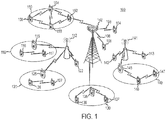
- FIG. 1 illustrates an exemplary system that combines a Device-to-Device ("D2D") network with a wireless access network, such as an LTE or LTE Advanced network.
- Mobile broadband network 100 includes a central coordinator, illustrated here as eNB 102.
- eNB 102 User equipment (UE) 104 and 106 communicate with eNB 102 via LTE communications channel 108.
- UE User equipment
- D2D clusters 110, 120, 130, 140, and 150 are D2D clusters 110, 120, 130, 140, and 150.
- Each one of D2D clusters 110, 120, 130, 140, and 150 comprises a plurality of UEs that are capable of communicating directly with each other, without the need to communicate through eNB 102.
- This application may refer to a UE that has D2D capability as a dUE, to stand for D2D capable User Equipment.
- FIG. 1 several different layouts of D2D clusters are shown. It should be understood that other configurations of D2D clusters are also possible. It should also be understood that a single eNB can support many more D2D clusters than are shown in FIG. 1 .
- Pico eNB 112 is coupled to eNB 102. Coupled to pico eNB 112 are D2D clusters 110 and 120. Within D2D cluster 110 is a D2D coordinator 115 and dUEs 116 and 117. D2D coordinator 115 serves to manage the communications between dUEs 116/117 and pico eNB 112. Within D2D cluster 120 is a D2D coordinator 125 and dUEs 126 and 127. Also coupled to pico eNB 112 is a UE 122. UE 122 is not coupled to D2D clusters 110 or 120. UE 122 may or may not have D2D capabilities.
- dUEs 116 and 117 have a D2D connection with each other, where communications between dUE 116 and dUE 117 need not involve either pico eNB 112 or eNB 102. Instead, information is transmitted directly between dUE 116 and dUE 117.
- This set-up provides a variety of advantages. For example, because dUE 116 and dUE 117 are in close proximity to each other, they do not have to transmit data all the way to eNB 102-therefore, one or both devices may use a low-power transceiver mode, prolonging the battery life of dUE 116 and dUE 117.
- eNB 112 and eNB 102 are not involved in transmissions between dUE 116 and dUE 117, the finite bandwidth capabilities of eNB 102 and pico eNB 112 are not used. If either dUE116 or dUE 117 needs to communicate to eNB 102 or pico eNB 112, such a communication may occur through D2D coordinator 115.
- FIG. 1 illustrates several scenarios that involve the use of a D2D coordinator, it should be understood that communication between devices might be performed without any D2D coordinator, directly under the control of an eNB, such as eNB 102 or pico eNB 112.
- D2D cluster 120 A similar configuration is present in D2D cluster 120, between dUE 126 and dUE 127, except there is no D2D coordinator in D2D cluster 120. It should be understood that there is a connection between D2D coordinator 115 and dUEs 116 and 117, it is merely omitted from Figure 1 .
- D2D cluster 130 comprises D2D coordinator 135, dUE 136, and dUE 137.
- dUEs 136 and 137 may communicate directly with each other and with D2D controller 135.
- D2D coordinator 135 serves to control the D2D connection between dUE 136 and dUE 137.
- D2D 135 may also organize multicast/broadcast transmissions with dUE 136 or dUE 137. As above, dUEs 136 and 137 and D2D coordinator 135 free up the bandwidth of eNB 102 by using the same space as a single traditional UE.
- D2D cluster 140 comprises pico eNB 141, dUEs 142 and 143; D2D controller 145; and dUEs 146 and 147.
- dUEs 142 and 143 are coupled to pico eNB 141, but are not coupled to any other UEs.
- D2D coordinator 145 is also coupled to pico eNB 142.
- dUEs 146 and 147 are in a multi-hop configuration-only dUE 146 is coupled to D2D controller 145. If pico eNB wants to send data to dUE 146 it can send the data through D2D coordinator/controller dUE 145. If D2D controller needs to send a signal to dUE 147, the signal is transmitted first to dUE 146.
- D2D cluster 150 comprises dUEs 152, 154, 156, and 158 coupled to each other in a mesh configuration, with each of the dUEs 152, 154, 156, and 158 coupled to each other as illustrated. If a dUE needs to send data to a dUE it is not directly coupled to (e.g., dUEs 152 and 156), it can send the data through a dUE that it is connected to (e.g., dUE 154). As with all connections illustrated in FIG. 1 , a D2D controller is not necessary.
- D2D communication One of the benefits of D2D communication is the ability of move or offload some traffic that would normally be carried by the eNB to a D2D connection.
- One way to offload even more traffic to the D2D connection is to move some of the set up and maintenance of the D2D connection from the eNB to the UEs.
- a D2D connection is not limited to two UEs; the principles discussed below may be extended to support more than two D2D UEs in a D2D communication group.
- one of the UEs may be used to establish the D2D connection.
- Using one of the UEs to establish a connection may result in several benefits. For example, it uses a certain amount of control overhead to monitor the status of various UEs.
- Using a UE to establish a connection uses the overhead of the UE, instead of the overhead of the eNB, freeing the eNB to perform other tasks.
- a UE when it connects to a network, it may send information about its D2D abilities to the eNB. This information may include its D2D profile and any D2D restrictions. In the alternative, the D2D profile and D2D restriction information may be configured through other means, such as a user's subscription profile that may be contained in a Home Location Register (HLR) or some other network entity. Additionally, a network may be configured with network-specific D2D policies/restrictions. These policies/restrictions may include limitations such as geographical restrictions, roaming restrictions, bandwidth policies, and the like.
- a connection is to be established between two UEs we will call UEO (250) and UE1 (252).
- Other actors in this method may include an eNB 254 and a Mobility Management Entity (MME) 256 and a D2D management entity (DCME) 258.
- MME Mobility Management Entity
- DCME D2D management entity
- UEO 250 initiates the setup procedure by sending a message to MME 256 (202).
- This message may be a D2D setup/pairing request NAS (Non-Access Stratum) message.
- the message may contain an identifier of the target UE (in this case, UE1).
- the identifier may be any identifier that uniquely identifies UE1, such as a D2D ID or UE ID.
- the D2D ID may be a newly defined identifier that is allocated for each D2D UE after the UE reports its ability for D2D communication during an attach procedure.
- the identifier may also be another unique identifier, such as a Mobile Subscriber Integrated Services Digital Network Number (MSISDN), a globally unique temporary identifier (GUTI), a temporary mobile subscriber identifier (TMSI), an international mobile subscriber identifier (IMSI), or the like.
- MSISDN Mobile Subscriber Integrated Services Digital Network Number
- GUI globally unique temporary identifier
- TMSI temporary mobile subscriber identifier
- IMSI international mobile subscriber identifier
- UEO may have become aware of the D2D ID or UE ID during the discovery stage. Alternatively, UEO may become aware of the target UE's D2D ID or UE ID via a D2D UE list provided by the eNB. The eNB may have compiled the D2D UE list via messages sent by each UE as they connect to the eNB. This message may be forwarded from MME 256 to DCME 258.
- the MME or the DCME checks with the policy charging and rules function (PCRF) for policy authorization before enabling the D2D mode (not shown in FIG. 2 ). If a D2D connection between UEO and UE1 is not allowed, the request is rejected and the connection is not made (206). There may be a D2DConnection Reject message sent by a D2D Communication Management Entity (DCME) to UEO. This message may be based on the profile/restriction information.
- PCRF policy charging and rules function
- the targeted UE (UE1 in this case) can decide whether to accept the D2D setup request from UEO.
- the MME forwards the D2D setup/pairing request message to UE1 (208).
- the setup/pairing request message may contain the D2D ID, the UE ID, or other identifier of UEO.
- UE1 sends an Acknowledge message to the MME that either accepts or rejects the D2D communication setup request (210). In other words, at this point, UE1 also has the option to reject the D2D connection.
- a user may configure UE1 so as to only accept requests from certain UEs, to reject all D2D connection requests, or the like.
- the Acknowledge message may be a D2DConnectionReject message.
- the D2DConnectionReject message is forwarded to UE0, and the setup process terminates (212).
- the MME sends one or more messages to the eNB to inform the eNB of the establishment of a D2D connection between UEO and UE1 (214).
- the messages may include a D2DSetupRequest message sent via S1 application protocol (AP).
- the messages may also include the D2D ID, UE ID, or other identifier of both UEO and UE1, the buffer status report (BSR) of UEO and UE1, the Quality of Service (QoS) requirements of the D2D connection, and the like.
- the eNB After receiving the D2DSetupRequest message from the MME, the eNB sends a D2DUEStatusInformationRequest message via RRC to both UEO and UE1 (216). This message triggers UEO and UE1 to report the various information used for subsequent D2D resource allocation by the eNB.
- D2DUEStatusInformationReport message 218
- D2D related information such as a buffer status report (BSR), antenna configuration, device-to-device link quality measurement report, QoS requirements, and the like.
- the eNB then sends a D2DResourceConfiguration message to both UEO and UE1 (220).
- This message allocates resources for the D2D communication and may be sent via either radio resource control (RRC) signaling or by dynamic physical downlink control channel (PDCCH) signaling.
- RRC radio resource control
- PDCCH dynamic physical downlink control channel
- the resources may be allocated based on information contained in the BSR from UEO and UE1, D2D link quality measurement, the requested QoS level, and the like.
- the D2DResourceConfiguration message may also contain: Resource Block (RB) assignment, which indicates the RB index to be used in D2D communication; D2DResourceIntervalUL, which indicates the time interval between two successive D2D subframes; and D2DResourceConfigDuration, which indicates the duration of D2D resources to be allocated to UEO and UE1.
- the D2DResourceConfiguration message may also assign one of UEO or UE1 as the master UE (M-UE). Thereafter, D2D communication between UEO and UE1 begins (222).
- the RB assignment indicates the RB index, in frequency domain for D2D communication, which is commonly used for D2D communication by the UEs in the D2D pair.
- the resources may be orthogonal to minimize potential inter-UE interference to other UEs communicating with the eNB via the cellular link.
- the D2DResourceIntervalUL refers to the time interval between two successive D2D subframes. This may be denoted in terms of the number of subframes. In LTE, frames are typically 10 milliseconds (ms) in length and are each divided into ten subframes of 1 ms in length. Thus, a resource allocation for a D2DResourceIntervalUL of 6 may correspond to 6 subframes, or 6 ms.
- the D2DResourceConfigDuration message indicates the duration (in milliseconds) of D2D resources allocated for a D2D pair.
- resources may be dynamically re-allocated within the D2D pair by one of the UEs, called the Master-UE (M-UE), e.g., in response to changing traffic load of the D2D pair.
- M-UE Master-UE
- the D2D resources configuration for the transmission/reception of the slave UE (S-UE) could be changed by the M-UE. This process is detailed below, with reference to FIGs. 3A through 3D .
- the M-UE could decide to dynamically change the modulation and coding scheme (MCS) for UEs in the D2D pair based on the D2D link quality between UEO and UE1.
- MCS modulation and coding scheme
- the MCS may be used to determine the modulation and coding rate of data transmission, based on the quality of the connection between UEO and UE1.
- the M-UE may be designated by the eNB in the D2D Resource Configuration message, as described above.
- the initiating UE (UEO in this example) may become the M-UE by default.
- D-DL refers to the link from the M-UE to the S-UE.
- D2D uplink refers to the link from the S-UE to the M-UE.
- a D2D transmission window 315 comprises a number of consecutive D-DL subframes 310 sent by M-UE and D-UL subframes 320 sent by S-UE.
- FIG. 3A there are four D-DL subframes followed by four D-UL subframes.
- the subframes labeled M are D-DL subframes (those sent by the M-UE).
- the subframes labeled S are D-UL subframes (those sent by the S-UE).
- TA Timeslot Assignment
- transmission window 325 has three D-DL frames, then switching point 320 occurs, changing TA from 0 to 1, indicating that the UEs switch from D-DL to D-UL.
- transmission window 335 has five D-DL frames, then switching point 330 occurs, changing TA from 0 to 1, indicating that the UEs switch from D-DL to D-UL.
- FIG. 3D there may be a variable transmission window size.
- the embodiment of FIGs. 3A through 3C show eight subframes per transmission window (though it should be understood that, in the fixed transmission window size embodiment of FIGs. 3A through 3C , the number of subframes may be either greater than or less than eight.)
- the embodiment of FIG. 3D shows a variable transmission window size.
- the transmission window may comprise two, three, or four subframes (although not illustrated in FIG. 3D , it should be understood that more than four subframes may also be used), with the transition from D-DL to D-UL being triggered by TA switching from 0 to 1.
- the TA may also be arranged to indicate the size of the transmission window. For example, after indicating that the transition from D-DL to D-UL should occur, TA may also indicate the number of D-UL frames to be sent.
- transmission window 350 contains two subframes, a D-DL subframe and a D-UL subframe.
- Transmission windows 360 and 365 show two alternate transmission window configurations containing three subframes. In transmission window 360, there are two D-DL subframes followed by one D-UL subframe. In transmission window 365, there is one D-DL subframe followed by two D-UL subframes.
- Transmission windows 370 and 375 show two alternate transmission window configurations containing four subframes. Transmission window 370 has three D-DL subframes followed by one D-UL subframe. Transmission window 375 has one D-DL subframe followed by three D-UL subframes. It should be understood that other combinations of one or more consecutive D-DL subframes followed by one or more consecutive D-UL subframes may also be used, even if they are not illustrated in FIG. 3D
- the M-UE may directly request resources from the eNB (224). This request may be made based on the BSR of the D2D pair. In order to know the BSR of S-UE, the S-UE may periodically report its BSR to M-UE. There may be several other reasons for making the request to dynamically change the resources allocated to the D2D connection. For example, as discussed above, the traffic between UEO and UE1 may not be symmetrical. That is, UEO may be sending more data to UE1 than UE1 does to UEO. In such a situation, UEO may want the transmission windows between UEO and UE1 to be resized to reflect such an asymmetrical data pattern.
- the eNB may either reject this request or accept the request by sending new D2D resource allocation to UEO and UE1 (226). In such a manner, the eNB does not have to monitor the D2D connection between UEO and UE1, yet is still able to change the resource allocation as needed. In addition, the eNB may re-allocate resources to a D2D pair on its own, without a request for additional resources, based on the D2D link quality feedback periodically received from the M-UE.
- the M-UE When it is desired to terminate the D2D connection, the M-UE sends a D2DConnectionRelease message to the eNB (228).
- the eNB receives the D2D connection release message, releases the D2D connection, and sends a D2DConnectionReleaseComplete message to both UEO and UE1 (230). Thereafter, the resources formerly used for the D2D connection are free for use by other devices.
- Examples, as described herein, may include, or may operate on, logic or a number of components, modules, or mechanisms.
- Modules are tangible entities (e.g., hardware) capable of performing specified operations and may be configured or arranged in a certain manner.
- circuits may be arranged (e.g., internally or with respect to external entities such as other circuits) in a specified manner as a module.
- the whole or part of one or more computer systems e.g., a standalone, client or server computer system
- one or more hardware processors may be configured by firmware or software (e.g., instructions, an application portion, or an application) as a module that operates to perform specified operations.
- the software may reside on a machine-readable medium.
- the software when executed by the underlying hardware of the module, causes the hardware to perform the specified operations.
- module is understood to encompass a tangible entity, be that an entity that is physically constructed, specifically configured (e.g., hardwired), or temporarily (e.g., transitorily) configured (e.g., programmed) to operate in a specified manner or to perform part or all of any operation described herein.
- each of the modules need not be instantiated at any one moment in time.
- the modules comprise a general-purpose hardware processor configured using software
- the general-purpose hardware processor may be configured as respective different modules at different times.
- Software may accordingly configure a hardware processor, for example, to constitute a particular module at one instance of time and to constitute a different module at a different instance of time.
- FIG. 4 is a block diagram illustrating an example machine 500 upon which any one or more of the techniques (e.g., methodologies) discussed herein may perform.
- the machine 500 may operate as a standalone device or may be connected (e.g., networked) to other machines.
- the machine 500 may operate in the capacity of a server machine, a client machine, or both in server-client network environments.
- the machine 500 may act as a peer machine in peer-to-peer (P2P) (or other distributed) network environment.
- P2P peer-to-peer
- the machine 500 may be a personal computer (PC), a tablet PC, a set-top box (STB), a Personal Digital Assistant (PDA), a smartphone, a web appliance, a network router, switch or bridge, a dedicated navigation device, laptop computers, a television, or any machine capable of executing instructions (sequential or otherwise) that specify actions to be taken by that machine.
- PC personal computer
- PDA Personal Digital Assistant
- smartphone a web appliance
- network router switch or bridge
- dedicated navigation device laptop computers
- television or any machine capable of executing instructions (sequential or otherwise) that specify actions to be taken by that machine.
- machine shall also be taken to include any collection of machines that individually or jointly execute a set (or multiple sets) of instructions to perform any one or more of the methodologies discussed herein, such as cloud computing, software as a service (SaaS), other computer cluster configurations.
- SaaS software as a service
- the machine 500 may include a hardware processor 502 (e.g., a central processing unit (CPU), a graphics processing unit (GPU), a hardware processor core, or any combination thereof), a main memory 504, and a static memory 506, some or all of which may communicate with each other via an interlink (e.g., bus) 508.
- the machine 500 may further include a display device 510, an alphanumeric input device 512 (e.g., a keyboard), and a user interface (UI) navigation device 514 (e.g., a mouse or track pad).
- the display device 510, input device 512 and UI navigation device 514 may be a touch screen display that accomplishes all three tasks.
- the machine 500 may additionally include a mass storage device (e.g., drive unit) 516, a signal generation device 518 (e.g., a speaker), a network interface device 520, and one or more sensors 521, such as a global positioning system (GPS) sensor, compass, accelerometer, or other sensor.
- the machine 500 may include an output controller 528, such as a serial (e.g., universal serial bus (USB), parallel, or other wired or wireless (e.g., infrared (IR)) connection to communicate or control one or more peripheral devices (e.g., a printer, card reader, etc.).
- a serial e.g., universal serial bus (USB), parallel, or other wired or wireless (e.g., infrared (IR)) connection to communicate or control one or more peripheral devices (e.g., a printer, card reader, etc.).
- USB universal serial bus
- IR infrared
- the mass storage device 526 may include a machine-readable medium 522 on which is stored one or more sets of data structures or instructions 524 (e.g., software) embodying or utilized by any one or more of the techniques or functions described herein.
- the instructions 524 may also reside, completely or at least partially, within the main memory 504, within static memory 506, or within the hardware processor 502 during execution thereof by the machine 500.
- one or any combination of the hardware processor 502, the main memory 504, the static memory 506, or the mass storage device 516 may constitute machine-readable media.
- machine-readable medium 522 is illustrated as a single medium, the term “machine-readable medium” may include a single medium or multiple media (e.g., a centralized or distributed database, and/or associated caches and servers) that is arranged to store the one or more instructions 524.
- machine-readable medium may include a single medium or multiple media (e.g., a centralized or distributed database, and/or associated caches and servers) that is arranged to store the one or more instructions 524.
- machine-readable medium may include any medium that is capable of storing, encoding, or carrying instructions for execution by the machine 500 and that cause the machine 500 to perform any one or more of the techniques of the present disclosure, or that is capable of storing, encoding, or carrying data structures used by or associated with such instructions.
- Nonlimiting machine-readable medium examples may include solid-state memories, and optical and magnetic media.
- a massed machine-readable medium comprises a machine-readable medium with a plurality of particles having resting mass.
- massed machine-readable media may include: non-volatile memory, such as semiconductor memory devices (e.g., Electrically Programmable Read-Only Memory (EPROM), Electrically Erasable Programmable Read-Only Memory (EEPROM)) and flash memory devices; magnetic disks, such as internal hard disks and removable disks; magneto-optical disks; and CD-ROM, DVD-ROM, and Blu-Ray disks.
- non-volatile memory such as semiconductor memory devices (e.g., Electrically Programmable Read-Only Memory (EPROM), Electrically Erasable Programmable Read-Only Memory (EEPROM)) and flash memory devices
- EPROM Electrically Programmable Read-Only Memory
- EEPROM Electrically Erasable Programmable Read-Only Memory
- flash memory devices e.g., Electrically Erasable Programmable Read-Only Memory (EEPROM)
- EPROM Electrically Programmable Read-Only Memory
- EEPROM Electrically Erasable Programmable Read-Only Memory
- flash memory devices e
- the instructions 524 may further be transmitted or received over a communications network 526 using a transmission medium via the network interface device 520 utilizing any one of a number of transfer protocols (e.g., frame relay, internet protocol (IP), transmission control protocol (TCP), user datagram protocol (UDP), hypertext transfer protocol (HTTP), etc.).
- transfer protocols e.g., frame relay, internet protocol (IP), transmission control protocol (TCP), user datagram protocol (UDP), hypertext transfer protocol (HTTP), etc.
- Example communication networks may include a local area network (LAN), a wide area network (WAN), a packet data network (e.g., the Internet), mobile telephone networks (e.g., cellular networks), Plain Old Telephone (POTS) networks, and wireless data networks (e.g., Institute of Electrical and Electronics Engineers (IEEE) 802.11 family of standards known as Wi-Fi®, IEEE 802.16 family of standards known as WiMAX®), peer-to-peer (P2P) networks, among others.
- the network interface device 520 may include one or more physical jacks (e.g., Ethernet, coaxial, or phone jacks) or one or more antennas to connect to the communications network 526.
- the network interface device 520 may include a plurality of antennas to wirelessly communicate using at least one of single-input multiple-output (SIMO), multiple-input multiple-output
- SIMO single-input multiple-output
- transmission medium shall be taken to include any intangible medium that is capable of storing, encoding or carrying instructions for execution by the machine 500, and includes digital or analog communications signals or other intangible medium to facilitate communication of such software.
- Example 1 includes a method performed by a D2D communication management entity (DCME) for establishing a device-to-device (D2D) communication session between a first user equipment (UE) and a second UE, the method comprising: receiving a request from the first UE to establish the D2D communication session; sending a pairing request message to the second UE; and after receiving an acknowledgement from the second UE, sending a D2DSetupRequest message to an evolved Node B (eNB).
- DCME D2D communication management entity
- UE user equipment
- eNB evolved Node B
- example 2 the subject matter of example 1 may optionally further comprise: checking a policy charging and rules function to determine if a D2D communication between the first UE and the second UE is forbidden; and if a D2D communication between the first UE and the second UE is forbidden, sending a D2DConnectionReject message arranged to inform the first UE that the request is denied.
- example 3 the subject matter of example 1 may optionally further comprise: sending a D2DConnectionReject message to the first UE if the second UE refuses the connection request.
- Example 4 is a method performed by an evolved Node B (eNB) for establishing a device-to-device (D2D) communication session between a first user equipment (UE) and a second UE, the method comprising: receiving a D2DSetupRequest message from a D2D communication management entity (DCME) arranged to indicate that the eNB is to establish the D2D communication session; sending a D2DUEStatusInformationRequest message to the first UE and the second UE; receiving a D2DUeStatusInformationReport message from the first UE and from the second UE; allocating resources to the D2D communication session; and sending a D2DResourceConfiguration message to the first UE and to the second UE, detailing the allocated resources.
- eNB evolved Node B
- example 5 the subject matter of example 4 may optionally include the additional feature wherein the D2DUEStatusInformationRequest message is arranged to request information from the first UE and from the second UE, the information chosen from the group comprising: a buffer status report, antenna configuration, link quality measurement reports, Quality of Service requirements.
- the D2DUEStatusInformationRequest message is arranged to request information from the first UE and from the second UE, the information chosen from the group comprising: a buffer status report, antenna configuration, link quality measurement reports, Quality of Service requirements.
- example 6 the subject matter of example 5 may optionally include the additional feature wherein the D2DUeStatusInformationReport message is arranged to send information to the eNB, the information chosen from the group comprising: a buffer status report, antenna configuration, link quality measurement reports, Quality of Service requirements.
- example 7 the subject matter of example 4 may optionally include the additional feature wherein the D2DResourceConfiguration message is sent via either radio resource control (RRC) signaling or via dynamic physical downlink control channel (PDCCH) signaling.
- RRC radio resource control
- PDCCH dynamic physical downlink control channel
- the subject matter of example 4 may optionally include the additional feature wherein the D2DResourceConfiguration message further comprises one or more of the following: a resource block assignment arranged to indicate a resource block index to be used for the D2D communication session; a D2DResourceIntervalUL message arranged to indicate a time interval between successive D2D subframes; and a D2DResourceConfigDuration message arranged to indicate a duration of D2D resources to be allocated to the D2D communication session.
- example 9 the subject matter of example 8 may optionally include the additional feature wherein the D2DResourceConfiguration message is further arranged to designate one of the first UE or the second UE as a Master UE.
- example 10 the subject matter of example 9 may optionally further comprise: receiving a D2DResourceRequest message from the Master UE, wherein the D2DResourceRequest message is arranged to request a re-allocation of resources to the D2D connection; and re-allocating resources to the D2D connection based on the D2DResourceRequest message.
- example 11 the subject matter of example 4 may optionally further comprise receiving a D2DConnectionRelease message from the first UE; re-allocating resources that were used by the D2D connection; and sending a D2DConnectionRelease message to the first UE and to the second UE.
- Example 12 is a method performed by a first user equipment (UE) for modifying a device-to-device (D2D) communication session with a second UE, the method comprising: determining that a resource allocation between the first user equipment and the second user equipment should be changed; sending one or more D2D uplink frames; sending a timeslot assignment (TA) message arranged to indicate to the second UE to start sending D2D frames; and receiving one or more D2D downlink frames from the second UE; and sending a TA message from the first UE to the second UE to dynamically re-allocate the number of D2D frames between the first UE and the second UE.
- UE user equipment
- D2D device-to-device
- example 13 the subject matter of example 12 may optionally include the additional feature wherein the timeslot assignment message is further arranged to indicate a size of a transmission window, wherein the size of the transmission window is equal to the sum of the number of D2D uplink frames from the first UE to the second UE and the number of D2D frames from the second UE to the first UE.
- example 14 the subject matter of example 13 may optionally include the additional feature wherein: the size of the transmission window is variable; and further wherein the timeslot assignment message is further arranged to indicate the size of the transmission window.
- example 15 the subject matter of example 13 may optionally include the additional feature wherein the size of the transmission window is fixed.
- example 16 the subject matter of example 12 may optionally further comprise changing a modulation and coding scheme (MCS) for the D2D communication session.
- MCS modulation and coding scheme
- Example 17 is a user equipment (UE) arranged to communicate via a device to device (D2D) communication session between the UE and a second UE, the user equipment comprising: a processor; a transceiver coupled to the processor and arranged to transmit and receive signals via an antenna assembly; wherein the processor is arranged to: determine that a resource allocation between the UE and the second UE should be changed; send one or more D2D uplink frames to the second UE; send a timeslot assignment (TA) message arranged to indicate to the second UE to start sending D2D frames; receive one or more D2D downlink frames from the second UE; and send a TA message from the UE to the second UE to dynamically re-allocate the number of D2D frames between the UE and the second UE.
- D2D device to device
- example 18 the subject matter of example 17 may optionally include the additional feature wherein the timeslot assignment message is further arranged to indicate a size of a transmission window, wherein the size of the transmission window is equal to the sum of the number of D2D uplink frames from the first UE to the second UE and the number of D2D frames from the second UE to the first UE.
- example 19 the subject matter of example 17 may optionally include the additional feature wherein: the size of the transmission window is variable; and further wherein the timeslot assignment message is further arranged to indicate the size of the transmission window.
- example 20 the subject matter of example 17 may optionally include the additional feature wherein the size of the transmission window is fixed.
- example 21 the subject matter of example 17 may optionally include the additional feature wherein the processor is further arranged to: change a modulation and coding scheme (MCS) for the D2D communication session.
- MCS modulation and coding scheme
- Example 22 is a machine-readable medium including instructions for modifying a device-to-device (D2D) communication session between a first user equipment (UE) and a second UE, which when executed by a first computing device, cause the first computing device to: determine that a resource allocation between the first user equipment and the second user equipment should be changed; send one or more D2D uplink frames; send a timeslot assignment (TA) message arranged to indicate to the second UE to start sending D2D frames; receive one or more D2D downlink frames from the second UE; and send a timeslot assignment (TA) message from the first UE to the second UE to dynamically re-allocate the number of D2D frames between the first UE and the second UE.
- D2D device-to-device
- example 23 the subject matter of example 22 may optionally include the additional feature wherein the timeslot assignment message is further arranged to indicate a size of a transmission window, wherein the size of the transmission window is equal to the sum of the number of D2D uplink frames from the first UE to the second UE and the number of D2D frames from the second UE to the first UE.
Landscapes
- Engineering & Computer Science (AREA)
- Signal Processing (AREA)
- Computer Networks & Wireless Communication (AREA)
- Multimedia (AREA)
- Databases & Information Systems (AREA)
- Computer Security & Cryptography (AREA)
- Physics & Mathematics (AREA)
- Theoretical Computer Science (AREA)
- Environmental & Geological Engineering (AREA)
- Computer Graphics (AREA)
- Electromagnetism (AREA)
- Business, Economics & Management (AREA)
- General Business, Economics & Management (AREA)
- Data Mining & Analysis (AREA)
- General Engineering & Computer Science (AREA)
- General Physics & Mathematics (AREA)
- Quality & Reliability (AREA)
- Mobile Radio Communication Systems (AREA)
Claims (11)
- Un procédé pour établir une session de communication de dispositif à dispositif, D2D, entre un premier équipement utilisateur, UE (250), et un second UE (252), le procédé comprenant :la compilation, par un nœud B évolué, eNB (254), d'une liste d'UE D2D en utilisant des messages envoyés par chaque UE lorsqu'il se connecte à l'eNB (254), dans lequel la liste d'UE D2D inclut un identifiant du second UE (252) ;la fourniture, par l'eNB (254), de la liste d'UE D2D au premier UE (250) ;la réception, au niveau d'une entité de gestion de communication D2D, DCME (258), d'une requête en provenance du premier UE (250) pour établir la session de communication D2D, ladite requête contenant l'identifiant du second UE (252) ;l'envoi, par la DCME (258), d'un message de requête d'appariement au second UE (252) ; etaprès la réception d'un accusé de réception en provenance du second UE, l'envoi, par la DCME (258), d'un message D2DSetupRequest à l'eNB (254) pour indiquer que l'eNB (254) doit établir la session de communication D2D, ledit message D2DSetupRequest incluant l'identifiant du second UE.
- Le procédé selon la revendication 1, comprenant en outre :la vérification, par la DCME (258), d'une fonction de règles de politique et de facturation pour déterminer si une communication D2D entre le premier UE et le second UE est interdite ; etsi une communication D2D entre le premier UE et le second UE est interdite, l'envoi, par la DCME (258), d'un message D2DConnectionReject agencé pour informer le premier UE que la requête est refusée.
- Le procédé selon la revendication 1, comprenant en outre :
l'envoi, par la DCME (258), d'un message D2DConnectionReject au premier UE si le second UE refuse la requête d'appariement. - Un support de stockage non transitoire lisible par ordinateur d'un nœud B évolué, eNB (254), le support de stockage non transitoire lisible par ordinateur incluant des instructions qui, lorsqu'elles sont exécutées par un ordinateur de l'eNB (254), amènent l'eNB (254) à :compiler une liste d'UE D2D en utilisant des messages envoyés par chaque équipement utilisateur, UE, lorsqu'il se connecte à l'eNB (254), dans lequel la liste d'UE D2D inclut un identifiant d'un second UE (252) ;fournir la liste d'UE D2D à un premier UE (250) ;recevoir un message D2DSetupRequest en provenance d'une entité de gestion de communication D2D (DCME), (258), agencé pour indiquer que l'eNB (254) doit établir la session de communication D2D, ledit message D2DSetupRequest incluant l'identifiant du second UE (252) ;envoyer un message D2DUEStatusInformationRequest au premier UE (250) et au second UE (252) ;recevoir un message D2DUEStatusInformationReport en provenance du premier UE (250) et en provenance du second UE (252) ;allouer des ressources à la session de communication D2D ; etenvoyer un message D2DResourceConfiguration au premier UE (250) et au second UE (252), détaillant les ressources allouées.
- Le support de stockage non transitoire lisible par ordinateur selon la revendication 4, dans lequel le message D2DUEStatusInformationRequest est agencé pour demander une information au premier UE (250) et au second UE (52), l'information étant choisie dans le groupe comprenant : un rapport d'état de tampon, une configuration d'antenne, des rapports de mesure de qualité de liaison, et des exigences de qualité de service.
- Le support de stockage non transitoire lisible par ordinateur selon la revendication 5, dans lequel le message D2DUEStatusInformationReport est agencé pour envoyer une information à l'eNB (254), l'information étant choisie dans le groupe comprenant : un rapport d'état de tampon, une configuration d'antenne, des rapports de mesure de qualité de liaison, et des exigences de qualité de service.
- Le support de stockage non transitoire lisible par ordinateur selon la revendication 4, dans lequel le message D2DResourceConfiguration est envoyé soit via une signalisation de contrôle de ressource radio (RRC) soit via une signalisation de canal de contrôle de liaison descendante physique (PDCCH) dynamique.
- Le support de stockage non transitoire lisible par ordinateur selon la revendication 4, dans lequel le message D2DResourceConfiguration comprend un ou plusieurs de ce qui suit :une assignation de bloc de ressources agencée pour indiquer un indice de bloc de ressources à utiliser pour la session de communication D2D ;un message D2DResourceIntervalUL agencé pour indiquer un intervalle de temps entre des sous-trames D2D successives ; etun message D2DResourceConfigDuration agencé pour indiquer une durée de ressources D2D à allouer à la session de communication D2D.
- Le support de stockage non transitoire lisible par ordinateur selon la revendication 8, dans lequel le message D2DResourceConfiguration est en outre agencé pour désigner l'un du premier UE (250) ou du second UE (252) comme un UE maître.
- Le support de stockage non transitoire lisible par ordinateur selon la revendication 9, le support de stockage non transitoire lisible par ordinateur incluant des instructions supplémentaires qui, lorsqu'elles sont exécutées par l'ordinateur, amènent l'eNB (254) à :recevoir un message D2DResourceRequest en provenance de l'UE maître, dans lequel le message D2DResourceRequest est agencé pour demander une réallocation de ressources à la connexion D2D ; etréallouer des ressources à la connexion D2D sur la base du message D2DResourceRequest.
- Le support de stockage non transitoire lisible par ordinateur selon la revendication 4, le support de stockage non transitoire lisible par ordinateur incluant des instructions supplémentaires qui, lorsqu'elles sont exécutées par l'ordinateur, amènent l'eNB (254) à :recevoir un message D2DConnectionRelease en provenance du premier UE (250) ;réallouer les ressources qui ont été utilisées par la connexion D2D ; etenvoyer un message D2DConnectionRelease au premier UE (250) et au second UE (252).
Applications Claiming Priority (2)
| Application Number | Priority Date | Filing Date | Title |
|---|---|---|---|
| US201261679627P | 2012-08-03 | 2012-08-03 | |
| PCT/US2013/053428 WO2014022776A1 (fr) | 2012-08-03 | 2013-08-02 | Procédé et système pour permettre des communications de dispositif à dispositif |
Publications (3)
| Publication Number | Publication Date |
|---|---|
| EP2880955A1 EP2880955A1 (fr) | 2015-06-10 |
| EP2880955A4 EP2880955A4 (fr) | 2016-07-20 |
| EP2880955B1 true EP2880955B1 (fr) | 2021-03-31 |
Family
ID=74556434
Family Applications (1)
| Application Number | Title | Priority Date | Filing Date |
|---|---|---|---|
| EP13826192.0A Active EP2880955B1 (fr) | 2012-08-03 | 2013-08-02 | Procédé pour permettre des communications de dispositif à dispositif |
Country Status (4)
| Country | Link |
|---|---|
| US (1) | US9363702B2 (fr) |
| EP (1) | EP2880955B1 (fr) |
| CN (1) | CN104429150A (fr) |
| WO (1) | WO2014022776A1 (fr) |
Families Citing this family (61)
| Publication number | Priority date | Publication date | Assignee | Title |
|---|---|---|---|---|
| US9526022B2 (en) | 2012-08-03 | 2016-12-20 | Intel Corporation | Establishing operating system and application-based routing policies in multi-mode user equipment |
| WO2014022769A1 (fr) | 2012-08-03 | 2014-02-06 | Intel Corporation | Signalisation et modèles de voie pour des communications d2d |
| US9191828B2 (en) | 2012-08-03 | 2015-11-17 | Intel Corporation | High efficiency distributed device-to-device (D2D) channel access |
| EP2880955B1 (fr) | 2012-08-03 | 2021-03-31 | Apple Inc. | Procédé pour permettre des communications de dispositif à dispositif |
| EP2880782B8 (fr) | 2012-08-03 | 2021-01-13 | Apple Inc. | Fonction de rappel/remplacement de déclencheur de dispositif pour des systèmes 3gpp/m2m |
| US8913518B2 (en) | 2012-08-03 | 2014-12-16 | Intel Corporation | Enhanced node B, user equipment and methods for discontinuous reception in inter-ENB carrier aggregation |
| US9036603B2 (en) | 2012-08-03 | 2015-05-19 | Intel Corporation | Network assistance for device-to-device discovery |
| US9100160B2 (en) | 2012-08-03 | 2015-08-04 | Intel Corporation | Apparatus and method for small data transmission in 3GPP-LTE systems |
| GB2509534B (en) * | 2013-01-07 | 2015-03-18 | Broadcom Corp | Proximity service |
| US9609144B2 (en) * | 2013-05-03 | 2017-03-28 | Qualcomm Incorporated | Method for policy control and charging for D2D services |
| US9467277B2 (en) * | 2013-05-16 | 2016-10-11 | Htc Corporation | Method and related communication device for handling communication between time division duplex devices |
| CN104185183A (zh) * | 2013-05-20 | 2014-12-03 | 中兴通讯股份有限公司 | 一种实现d2d通信的方法及系统 |
| CN108282588B (zh) * | 2013-06-07 | 2021-01-29 | 华为技术有限公司 | 业务处理方法、终端设备和业务漫游网络 |
| WO2015021185A1 (fr) * | 2013-08-07 | 2015-02-12 | Interdigital Patent Holdings, Inc. | Planification distribuée pour une communication de dispositif à dispositif |
| WO2015020736A1 (fr) | 2013-08-08 | 2015-02-12 | Intel IP Corporation | Procédé, appareil et système d'ajustement d'inclinaison électrique vers le bas dans un système multientrée multisortie |
| US9681354B2 (en) | 2013-08-08 | 2017-06-13 | Intel IP Corporation | Signaling radio bearer optimizations and other techniques for supporting small data transmissions |
| US9326122B2 (en) | 2013-08-08 | 2016-04-26 | Intel IP Corporation | User equipment and method for packet based device-to-device (D2D) discovery in an LTE network |
| US9756452B2 (en) * | 2013-09-16 | 2017-09-05 | Qualcomm Incorporated | Presence and on-device proxying |
| US20150092656A1 (en) * | 2013-09-27 | 2015-04-02 | Nokia Corporation | Apparatus and method for resource allocation to support device to device broadcast and groupcast |
| CN104904282B (zh) | 2013-09-27 | 2018-11-30 | 华为终端(东莞)有限公司 | 用户设备直连通信的信号传输方法和用户设备 |
| TWI612837B (zh) * | 2014-03-11 | 2018-01-21 | 財團法人資訊工業策進會 | 直接通訊系統及其通訊資源排程方法 |
| CN111641998B (zh) * | 2014-03-14 | 2022-09-27 | 北京三星通信技术研究有限公司 | 一种支持ue接入控制的方法 |
| EP3122152B1 (fr) * | 2014-03-20 | 2019-02-13 | Sharp Kabushiki Kaisha | Dispositif de terminal, circuit intégré et procédé de radiocommunications |
| CN107071889B (zh) * | 2014-03-21 | 2020-10-09 | 华为终端有限公司 | 检测设备对设备信号的方法和用户设备 |
| JP6527529B2 (ja) * | 2014-05-02 | 2019-06-05 | シャープ株式会社 | デバイス・ツー・デバイス通信に対するリソースプール構成のメカニズム |
| EP2942993B1 (fr) | 2014-05-09 | 2020-03-25 | Sun Patent Trust | Affectation de ressources pour transmission de découverte d2d |
| US9907056B2 (en) | 2014-08-06 | 2018-02-27 | Futurewei Technologies, Inc. | System and method for allocating resources for device-to-device communications |
| US9668194B2 (en) | 2015-01-30 | 2017-05-30 | Huawei Technologies Co., Ltd. | System and method for coordinating device-to-device communications |
| CN107534877B (zh) * | 2015-04-28 | 2021-06-15 | 瑞典爱立信有限公司 | 用于控制波束网格的设备和方法 |
| EP3398365B1 (fr) | 2015-12-28 | 2019-11-20 | Telecom Italia S.p.A. | Procédés et systèmes pour la connexion opportuniste de dispositifs à un réseau de communication |
| CN108702244B (zh) * | 2016-04-01 | 2022-04-29 | 英特尔公司 | 用于低复杂度设备到设备(d2d)通信的链路适配 |
| JP6987073B2 (ja) | 2016-05-11 | 2021-12-22 | オッポ広東移動通信有限公司Guangdong Oppo Mobile Telecommunications Corp., Ltd. | 通信方法、端末装置及びネットワーク装置 |
| CN107734501A (zh) * | 2016-08-11 | 2018-02-23 | 株式会社Ntt都科摩 | 发送方法、接收方法、中继设备、基站及移动台 |
| US10178531B2 (en) * | 2016-09-15 | 2019-01-08 | Qualcomm Incorporated | Methods and apparatus for efficient sensor data sharing in a vehicle-to-vehicle (V2V) network |
| US10505697B2 (en) | 2016-11-03 | 2019-12-10 | At&T Intellectual Property I, L.P. | Facilitating a mobile device specific physical downlink shared channel resource element mapping indicator |
| WO2018091080A1 (fr) * | 2016-11-16 | 2018-05-24 | Sony Mobile Communications Inc. | Utilisation de ressources conditionnelles pour une communication de dispositif à dispositif |
| EP3563540B1 (fr) | 2016-12-27 | 2024-02-28 | Telecom Italia S.p.A. | Procédé et système permettant de fournir des services vidéo en continu de qualité variable dans des réseaux de communication mobile |
| US11632186B2 (en) | 2016-12-29 | 2023-04-18 | Motorola Solutions, Inc. | Methods and systems for capturing signals in accordance with allocated resources |
| EP3590301B1 (fr) | 2017-03-01 | 2021-07-21 | Telefonaktiebolaget LM Ericsson (Publ) | Communications d2d dans un réseau cellulaire |
| US10091777B1 (en) * | 2017-03-31 | 2018-10-02 | At&T Intellectual Property I, L.P. | Facilitating physical downlink shared channel resource element mapping indicator |
| GB2571250B (en) * | 2018-01-17 | 2021-11-03 | Canon Kk | Method and apparatus for reporting quantity of data for direct-link transmission in a wireless network |
| US11291059B2 (en) * | 2018-08-03 | 2022-03-29 | Telefonaktiebolaget LM Ericsson (Publ) Stockholm, Sweden | Methods, user equipment and base station for sidelink identification |
| US12136967B2 (en) | 2018-12-28 | 2024-11-05 | Google Llc | User-equipment-coordination set for a wireless network |
| CN113243125B (zh) | 2019-01-02 | 2024-05-07 | 谷歌有限责任公司 | 用于移动性管理的多活动协调集聚合的方法和装置 |
| US12177821B2 (en) | 2019-01-28 | 2024-12-24 | Google Llc | Dynamic carrier subband operation for active coordination sets |
| WO2020165846A1 (fr) * | 2019-02-14 | 2020-08-20 | Telefonaktiebolaget Lm Ericsson (Publ) | Mesures d'établissement de connectivité double/d'agrégation de porteuses |
| US12114173B2 (en) | 2019-02-21 | 2024-10-08 | Google Llc | User-equipment-coordination set for a wireless network using an unlicensed frequency band |
| CN113519130B (zh) | 2019-03-12 | 2024-03-08 | 谷歌有限责任公司 | 用户设备协调集合波束扫描 |
| US10893572B2 (en) | 2019-05-22 | 2021-01-12 | Google Llc | User-equipment-coordination set for disengaged mode |
| EP3791678B1 (fr) | 2019-07-25 | 2023-06-07 | Google LLC | Regroupement d'ensembles de coordination d'équipement utilisateur |
| US11350439B2 (en) | 2019-08-13 | 2022-05-31 | Google Llc | User-equipment-coordination-set control aggregation |
| US11804877B2 (en) | 2019-09-19 | 2023-10-31 | Google Llc | Enhanced beam searching for active coordination sets |
| WO2021054964A1 (fr) | 2019-09-19 | 2021-03-25 | Google Llc | Participation sélective d'un ensemble de coordination d'équipements utilisateur |
| CN115804240A (zh) * | 2020-07-13 | 2023-03-14 | 联想(新加坡)私人有限公司 | 侧链路非连续接收配置 |
| US11659372B2 (en) * | 2020-07-30 | 2023-05-23 | Toyota Motor Engineering & Manufacturing North America, Inc. | Adaptive sensor data sharing for a connected vehicle |
| EP4190110A1 (fr) * | 2020-08-03 | 2023-06-07 | Lenovo (Singapore) Pte. Ltd. | Occupation de canal basée sur une priorité |
| CN116097670B (zh) * | 2020-08-11 | 2025-12-05 | 苹果公司 | 应用服务器、网络部件和用户装备 |
| US11589195B2 (en) | 2020-08-20 | 2023-02-21 | Ip Co, Llc | Asset tracking systems and methods |
| CN115412888A (zh) * | 2021-05-27 | 2022-11-29 | 华为技术有限公司 | 发送、接收数据的方法、资源指示方法、装置及系统 |
| US12143836B2 (en) * | 2022-05-10 | 2024-11-12 | T-Mobile Innovations Llc | Optimization of device configuration relating to wireless access technologies |
| WO2024015498A1 (fr) * | 2022-07-14 | 2024-01-18 | Innopeak Technology, Inc. | Procédé d'établissement de sécurité et équipement utilisateur |
Family Cites Families (128)
| Publication number | Priority date | Publication date | Assignee | Title |
|---|---|---|---|---|
| JPH08321882A (ja) | 1995-05-24 | 1996-12-03 | Fujitsu Ltd | 複数呼同時転送システム |
| US6625227B1 (en) | 1999-09-30 | 2003-09-23 | Ericsson Inc. | Artificial ramping of transmit power for burst transmissions |
| WO2001063946A1 (fr) | 2000-02-23 | 2001-08-30 | Nexterna, Inc. | Systeme et procede d'acheminement dynamique de messages transmis de plateformes mobiles |
| AU2001253740A1 (en) | 2000-04-22 | 2001-11-07 | Atheros Communications, Inc. | Methods for controlling shared access to wireless transmission systems and increasing throughput of the same |
| US8564661B2 (en) | 2000-10-24 | 2013-10-22 | Objectvideo, Inc. | Video analytic rule detection system and method |
| US7734752B2 (en) | 2002-02-08 | 2010-06-08 | Juniper Networks, Inc. | Intelligent integrated network security device for high-availability applications |
| US7474686B2 (en) | 2003-02-28 | 2009-01-06 | Texas Instruments Incorporated | Wireless personal area networks with rotation of frequency hopping sequences |
| WO2004109476A2 (fr) | 2003-06-05 | 2004-12-16 | Meshnetworks, Inc. | Systeme et procede permettant d'optimiser l'utilisation des canaux dans un reseau de communication sans fil multicanaux |
| US20050043045A1 (en) | 2003-08-18 | 2005-02-24 | Lucent Technologies, Inc. | Uplink timing in a wireless communications system |
| US9179474B2 (en) | 2005-08-22 | 2015-11-03 | Telefonaktiebolaget L M Ericsson (Publ) | Combined contention and scheduling based uplink for S3g |
| US7734292B2 (en) | 2005-12-07 | 2010-06-08 | Electronics And Telecommunications Research Institute | Terminal supporting peer-to-peer communication, and communication and billing methods based on the same |
| JP2007295541A (ja) | 2006-03-28 | 2007-11-08 | Matsushita Electric Ind Co Ltd | 無線通信システム |
| US7720490B2 (en) | 2006-07-17 | 2010-05-18 | Intel Corporation | Location update operations for idle mode terminals with a plurality of wireless communication interfaces |
| US7924742B2 (en) | 2006-09-27 | 2011-04-12 | Hewlett-Packard Development Company, L.P. | Network device discovery system and method |
| ES2733007T3 (es) | 2007-02-05 | 2019-11-27 | Nec Corp | Método de traspaso entre estaciones base, sistema de radiocomunicación, método de control de DRX, estación base y terminal de comunicación |
| US8775944B2 (en) | 2008-06-26 | 2014-07-08 | Citrix Systems, Inc. | Methods and systems for interactive evaluation of policies |
| KR101466897B1 (ko) * | 2007-07-09 | 2014-12-02 | 삼성전자주식회사 | 이동통신 시스템에서 피어투피어 통신의 연속성을 제공하기위한 방법 및 장치 |
| JP2009141756A (ja) | 2007-12-07 | 2009-06-25 | Ntt Docomo Inc | 位置情報取得システム及び位置情報取得方法 |
| CN101505212B (zh) | 2008-02-04 | 2012-11-07 | 上海贝尔股份有限公司 | 操作harq缓冲器的方法 |
| EP2421306B1 (fr) | 2008-02-15 | 2013-05-01 | Research In Motion Limited | Acheminement de données basé sur une politique pour dispositif multimodal |
| US8825109B2 (en) | 2008-02-15 | 2014-09-02 | Blackberry Limited | Policy-based data routing for a multi-mode device |
| JP2009272951A (ja) | 2008-05-08 | 2009-11-19 | Ntt Docomo Inc | グルーピングシステム、管理装置 |
| US8204505B2 (en) | 2008-06-17 | 2012-06-19 | Qualcomm Incorporated | Managing network-initiated quality of service setup in mobile device and network |
| US8577363B2 (en) * | 2008-07-14 | 2013-11-05 | Nokia Corporation | Setup of device-to-device connection |
| US8078111B2 (en) | 2008-07-29 | 2011-12-13 | Qualcomm Incorporated | Methods and apparatus for using multiple frequency bands for communication |
| EP2324616A1 (fr) * | 2008-09-12 | 2011-05-25 | Nokia Corporation | Lancement de session pour la communication entre dispositifs |
| US8554200B2 (en) | 2008-09-12 | 2013-10-08 | Nokia Corporation | Method and apparatus for providing interference measurements for device to-device communication |
| WO2010049801A1 (fr) | 2008-10-29 | 2010-05-06 | Nokia Corporation | Appareil et procédé destinés à une allocation dynamique de ressources de communication pour des communications de dispositif à dispositif dans un système de communication sans fil |
| KR101642309B1 (ko) | 2008-11-06 | 2016-07-25 | 엘지전자 주식회사 | 단말의 하향링크 제어채널 모니터링 방법 |
| US9084283B2 (en) | 2008-11-19 | 2015-07-14 | Qualcomm Incorporated | Peer-to-peer communication using a wide area network air interface |
| KR101158279B1 (ko) | 2008-12-11 | 2012-06-19 | 한국전자통신연구원 | 캐리어 집적 기반 이동 통신 시스템의 단말 장치 및 그것의버퍼 상태 보고 방법 |
| EP2394465A1 (fr) | 2009-01-09 | 2011-12-14 | Interdigital Patent Holdings, Inc. | Mobilité de flux de données |
| US8761099B2 (en) * | 2009-01-16 | 2014-06-24 | Nokia Corporation | Apparatus and method of scheduling resources for device-to-device communications |
| WO2010082114A1 (fr) | 2009-01-16 | 2010-07-22 | Nokia Corporation | Communication dispositif à dispositif dans des réseaux cellulaires |
| JP2010199871A (ja) | 2009-02-24 | 2010-09-09 | Ntt Docomo Inc | リンク情報提供装置、リンク情報提供システム及びリンク情報提供方法 |
| EP2409444A2 (fr) | 2009-03-20 | 2012-01-25 | Telefonaktiebolaget LM Ericsson (publ) | Mécanisme arq hybride pour une coopération de stations de base sur la liaison montante |
| US20100265904A1 (en) | 2009-04-21 | 2010-10-21 | Industrial Technology Research Institute | Method, apparatus and computer program product for interference avoidance in uplink coordinated multi-point reception |
| US8213360B2 (en) | 2009-04-29 | 2012-07-03 | Nokia Corporation | Apparatus and method for flexible switching between device-to-device communication mode and cellular communication mode |
| US20100293555A1 (en) | 2009-05-14 | 2010-11-18 | Nokia Corporation | Method and apparatus of message routing |
| ES2440391B2 (es) | 2009-06-29 | 2015-05-11 | Ormat Technologies Inc. | Método para operar una central eléctrica con múltiples fuentes térmicas y dispositivo empleado |
| CN101730172B (zh) | 2009-06-30 | 2012-07-04 | 中兴通讯股份有限公司 | 基于接入网选择的切换方法与装置 |
| US20120134344A1 (en) | 2009-08-07 | 2012-05-31 | Ling Yu | Scheduling In Radio Telecommunication System |
| KR20110020005A (ko) | 2009-08-21 | 2011-03-02 | 주식회사 팬택 | 무선통신시스템에서 데이터 송수신 방법 |
| CN102036348B (zh) | 2009-09-30 | 2014-01-01 | 中兴通讯股份有限公司 | 一种不连续接收配置方法及系统 |
| US8666403B2 (en) | 2009-10-23 | 2014-03-04 | Nokia Solutions And Networks Oy | Systems, methods, and apparatuses for facilitating device-to-device connection establishment |
| CN102640553B (zh) | 2009-10-30 | 2015-06-24 | 诺基亚公司 | 调度直接对直接通信 |
| KR20110049622A (ko) | 2009-11-04 | 2011-05-12 | 삼성전자주식회사 | 무선 통신 네트워크 시스템에서 데이터 전송 방법 및 장치 |
| KR20110052418A (ko) | 2009-11-11 | 2011-05-18 | 삼성전자주식회사 | 이동통신 시스템에서 불연속 수신을 수행하는 방법 및 장치 |
| KR101818693B1 (ko) | 2009-11-19 | 2018-01-16 | 인터디지탈 패튼 홀딩스, 인크 | 다중-반송파 시스템에서의 요소 반송파 활성화/비활성화 |
| EP3413679A1 (fr) | 2010-01-08 | 2018-12-12 | Interdigital Patent Holdings, Inc. | Procédé et appareil pour effectuer une réception discontinue et/ou une transmission discontinue pour une opération multiporteuse/multicellulaire |
| WO2011082833A1 (fr) | 2010-01-11 | 2011-07-14 | Nokia Siemens Networks Oy | Mécanismes de sélection de réseau |
| US9749152B2 (en) | 2010-01-15 | 2017-08-29 | Qualcomm Incorporated | Apparatus and method for allocating data flows based on indication of selection criteria |
| US9167517B2 (en) | 2010-01-29 | 2015-10-20 | Interdigital Patent Holdings, Inc. | Group-based machine to machine communication |
| KR101674222B1 (ko) | 2010-02-09 | 2016-11-09 | 엘지전자 주식회사 | 무선 통신 시스템에서 로그된 측정 보고 방법 및 장치 |
| CN103155605B (zh) | 2010-03-23 | 2016-08-17 | 交互数字专利控股公司 | 用于机器类型通信的有效信令 |
| US8615241B2 (en) | 2010-04-09 | 2013-12-24 | Qualcomm Incorporated | Methods and apparatus for facilitating robust forward handover in long term evolution (LTE) communication systems |
| US20110256894A1 (en) | 2010-04-15 | 2011-10-20 | Samsung Electronics Co., Ltd. | User equipment and server system for updating data relating to fixed wireless nodes |
| US8812657B2 (en) | 2010-04-15 | 2014-08-19 | Qualcomm Incorporated | Network-assisted peer discovery |
| US9198210B2 (en) | 2010-04-20 | 2015-11-24 | Nokia Solutions And Networks Oy | D2D communications considering different network operators |
| CN102238520B (zh) | 2010-04-26 | 2014-12-31 | 中兴通讯股份有限公司 | 一种小数据包传输的方法和系统 |
| US8867458B2 (en) | 2010-04-30 | 2014-10-21 | Nokia Corporation | Network controlled device to device / machine to machine cluster operation |
| KR101449823B1 (ko) | 2010-05-02 | 2014-10-08 | 엘지전자 주식회사 | 무선 통신 시스템에서 랜덤접속 절차를 수행하는 방법 및 장치 |
| CN102907060B (zh) | 2010-05-25 | 2015-10-21 | 交互数字专利控股公司 | 在不连续接收中重调谐间隙以及调度间隙 |
| US8447315B2 (en) | 2010-06-03 | 2013-05-21 | Nokia Corporation | Method and apparatus for facilitating device-to-device communication |
| US8359038B2 (en) | 2010-06-15 | 2013-01-22 | Nokia Corporation | Channel access for local heterogeneous communication in a cellular network |
| US8588803B2 (en) | 2010-06-18 | 2013-11-19 | Nokia Corporation | Method and apparatus for resource scheduling for network controlled D2D communications |
| EP2586248B1 (fr) | 2010-06-22 | 2014-03-12 | Telefonaktiebolaget LM Ericsson (publ) | Commutation préemptive entre réseaux d'accès |
| US8897134B2 (en) | 2010-06-25 | 2014-11-25 | Telefonaktiebolaget L M Ericsson (Publ) | Notifying a controller of a change to a packet forwarding configuration of a network element over a communication channel |
| GB201010821D0 (en) | 2010-06-28 | 2011-03-30 | Nokia Oyj | Mehtod and apparatus for communicating via a gateway |
| US10250678B2 (en) | 2010-07-07 | 2019-04-02 | Qualcomm Incorporated | Hybrid modes for peer discovery |
| WO2012016378A1 (fr) | 2010-08-04 | 2012-02-09 | Nokia Corporation | Procédé et appareil adaptés pour résoudre un conflit lors d'opérations simultanées de transmission et de réception dans un système de communication de dispositif à dispositif avec réutilisation de cellules |
| CN102387495A (zh) | 2010-08-30 | 2012-03-21 | 电信科学技术研究院 | 一种机器类通信设备的数据传输处理方法及设备 |
| US8416741B2 (en) | 2010-09-07 | 2013-04-09 | Verizon Patent And Licensing Inc. | Machine-to-machine communications over fixed wireless networks |
| KR101684999B1 (ko) | 2010-09-27 | 2016-12-09 | 삼성전자 주식회사 | 휴대 단말기의 네트워크 연결 방법 및 장치 |
| US8548483B2 (en) | 2010-10-04 | 2013-10-01 | Nokia Corporation | Feedback mapping for D2D control signals |
| KR101868180B1 (ko) | 2010-10-22 | 2018-06-15 | 어펌드 네트웍스, 인크. | 다수의 기능들을 단일 플랫폼으로 취합하는 방법 |
| GB2484921B (en) | 2010-10-25 | 2014-10-08 | Sca Ipla Holdings Inc | Communications device and method |
| US8649359B2 (en) | 2010-11-19 | 2014-02-11 | Nokia Corporation | Apparatus and method for selection of a gateway of a local area network |
| US9320047B2 (en) * | 2010-11-25 | 2016-04-19 | Nokia Technologies Oy | Network assisted sensing on a shared band for local communications |
| KR102033176B1 (ko) | 2010-12-03 | 2019-10-17 | 인터디지탈 패튼 홀딩스, 인크 | 멀티 무선 액세스 기술 캐리어 결합을 수행하는 방법, 장치 및 시스템 |
| US9066296B2 (en) | 2010-12-07 | 2015-06-23 | Lg Electronics Inc. | Method for operation in idle mode for M2M communication, and device using same |
| KR101746668B1 (ko) | 2010-12-21 | 2017-06-13 | 한국전자통신연구원 | 접속해제 상태의 사물통신 디바이스를 위한 데이터 전송 방법 및 이를 이용하는 이동통신 시스템 |
| WO2012087009A2 (fr) | 2010-12-22 | 2012-06-28 | 엘지전자 주식회사 | Procédé de signalisation montante et appareil de signalisation montante dans un système de communication sans fil |
| KR101561474B1 (ko) | 2010-12-23 | 2015-10-20 | 한국전자통신연구원 | 소량의 상향 링크 데이터 전송 방법 및 소량의 상향 링크 데이터 수신 방법 |
| US9014062B2 (en) | 2010-12-27 | 2015-04-21 | Electronics And Telecommunications Research Institute | Method for HARQ and link adaptation of device to device link in direct communication between user equipments and relaying by user equipment |
| KR20120074254A (ko) | 2010-12-27 | 2012-07-05 | 한국전자통신연구원 | 단말간 직접 연결 통신 및 단말 릴레잉을 위한 디바이스 대 디바이스 링크의 연결 설정 및 스케쥴링 방법 |
| WO2012091418A2 (fr) | 2010-12-27 | 2012-07-05 | 한국전자통신연구원 | Procédé pour une communication de dispositif à dispositif et pour relayer un terminal |
| US8705486B2 (en) | 2011-01-19 | 2014-04-22 | Qualcomm Incorporated | Methods and apparatus for scheduling peer to peer traffic in cellular networks |
| US20120188949A1 (en) | 2011-01-20 | 2012-07-26 | Motorola-Mobility, Inc. | Wireless communication device, wireless communication system, and method of routing data in a wireless communication system |
| US9467959B2 (en) | 2011-04-01 | 2016-10-11 | Mediatek, Inc. | Method of maintaining multiple timing advance |
| KR101417256B1 (ko) | 2011-04-05 | 2014-07-08 | 엘지전자 주식회사 | 데이터 전송 방법 및 사용자 장치 |
| FR2973976B1 (fr) | 2011-04-11 | 2013-08-30 | Alcatel Lucent | Protocole pour routage de flots par interrogation d'un serveur distant |
| US8848640B2 (en) | 2011-05-06 | 2014-09-30 | Interdigital Patent Holdings, Inc. | Method and apparatus for bandwidth aggregation for IP flow |
| US8973088B1 (en) | 2011-05-24 | 2015-03-03 | Palo Alto Networks, Inc. | Policy enforcement using host information profile |
| US8155102B1 (en) * | 2011-05-24 | 2012-04-10 | Renesas Mobile Corporation | Channel access control |
| CN102395160B (zh) | 2011-06-28 | 2017-04-12 | 中兴通讯股份有限公司 | 用户设备传输数据的控制方法和系统 |
| TWI608717B (zh) | 2011-06-28 | 2017-12-11 | 內數位專利控股公司 | 資料管理行動性政策 |
| US8755316B2 (en) | 2011-08-15 | 2014-06-17 | Broadcom Corporation | Coordination of DRX and eICIC |
| CN102300331B (zh) | 2011-08-19 | 2013-11-27 | 电信科学技术研究院 | 数据传输方法和设备 |
| GB2494460B (en) | 2011-09-12 | 2013-10-23 | Renesas Mobile Corp | Methods and apparatus for controlling device-to-device discovery procedure |
| CN102333293B (zh) | 2011-09-21 | 2014-07-09 | 电信科学技术研究院 | 一种小数据的传输方法和设备 |
| CN102333343A (zh) | 2011-11-02 | 2012-01-25 | 电信科学技术研究院 | 一种拥塞信息的通知方法和设备 |
| GB2497916B (en) | 2011-11-11 | 2014-06-25 | Broadcom Corp | Methods, apparatus and computer programs for monitoring for discovery signals |
| GB2497745B (en) | 2011-12-19 | 2014-11-05 | Broadcom Corp | Improvements to wireless communication systems and methods |
| US9769857B2 (en) * | 2012-02-27 | 2017-09-19 | Futurewei Technologies, Inc. | System and method for allocating network resources |
| US9185690B2 (en) * | 2012-02-29 | 2015-11-10 | Sharp Kabushiki Kaisha | Allocating and determining resources for a device-to-device link |
| CN102612067A (zh) | 2012-03-13 | 2012-07-25 | 华为技术有限公司 | 数据分流控制方法及设备、用户设备 |
| US9526091B2 (en) | 2012-03-16 | 2016-12-20 | Intel Corporation | Method and apparatus for coordination of self-optimization functions in a wireless network |
| WO2013141560A1 (fr) | 2012-03-19 | 2013-09-26 | 엘지전자 주식회사 | Procédé et appareil de sélection d'accès sans fil à l'aide d'informations d'identification d'application dans un système de communication sans fil |
| EP3541005A1 (fr) | 2012-03-23 | 2019-09-18 | HFI Innovation Inc. | Procédés de configuration d'agrégation de porteuses multipoint et de transfert de données |
| JP6122951B2 (ja) | 2012-06-15 | 2017-04-26 | ノキア ソリューションズ アンド ネットワークス オサケユキチュア | ネットワーク選択の動的制御 |
| US8885752B2 (en) | 2012-07-27 | 2014-11-11 | Intel Corporation | Method and apparatus for feedback in 3D MIMO wireless systems |
| US9100160B2 (en) | 2012-08-03 | 2015-08-04 | Intel Corporation | Apparatus and method for small data transmission in 3GPP-LTE systems |
| EP2880782B8 (fr) | 2012-08-03 | 2021-01-13 | Apple Inc. | Fonction de rappel/remplacement de déclencheur de dispositif pour des systèmes 3gpp/m2m |
| US9036603B2 (en) | 2012-08-03 | 2015-05-19 | Intel Corporation | Network assistance for device-to-device discovery |
| US9526022B2 (en) | 2012-08-03 | 2016-12-20 | Intel Corporation | Establishing operating system and application-based routing policies in multi-mode user equipment |
| US9191828B2 (en) | 2012-08-03 | 2015-11-17 | Intel Corporation | High efficiency distributed device-to-device (D2D) channel access |
| EP2880955B1 (fr) | 2012-08-03 | 2021-03-31 | Apple Inc. | Procédé pour permettre des communications de dispositif à dispositif |
| US8913518B2 (en) | 2012-08-03 | 2014-12-16 | Intel Corporation | Enhanced node B, user equipment and methods for discontinuous reception in inter-ENB carrier aggregation |
| WO2014022769A1 (fr) | 2012-08-03 | 2014-02-06 | Intel Corporation | Signalisation et modèles de voie pour des communications d2d |
| US9832717B2 (en) | 2012-12-19 | 2017-11-28 | Blackberry Limited | Method and apparatus for layer 3 configuration in a heterogeneous network |
| ES2512965B2 (es) | 2013-02-13 | 2015-11-24 | Universitat Politècnica De Catalunya | Sistema y método para escanear una superficie y programa de ordenador que implementa el método |
| ES2510290B2 (es) | 2013-03-20 | 2015-04-30 | Emilio PALOMO PINTO | Sistema de refrigeración autónomo, portátil y autorefrigerante, basado en la utilización de un depósito estanco, conteniente de un gas licuado a presión, empleado como vaporizador, como consecuencia de la evaporación controlada de dicho GLP |
| ES2508390B2 (es) | 2013-04-16 | 2015-05-06 | Agro Sevilla Aceitunas, S. Coop. And | Procedimiento de envasado y esterilización de aceitunas negras en ausencia de salmuera |
| ES2523474B2 (es) | 2013-04-24 | 2015-04-24 | Universidad De Alicante | Procedimiento para el recubrimiento de capilares con nanotubos mediante depósito electroasistido y microrreactor configurado para ejecutar dicho procedimiento |
| ES2523417B2 (es) | 2014-03-26 | 2015-05-12 | Universidad De La Rioja | Dispositivo fusible recargable |
| ES2507465B2 (es) | 2014-04-03 | 2015-12-23 | Universidad Politécnica de Madrid | Sistema de localización del tramo con falta a tierra en líneas de alimentación eléctrica ferroviarias bifásicas con autotransformadores |
| ES2525773B2 (es) | 2014-10-20 | 2015-04-28 | Universidad Politécnica de Madrid | Robot submarino modular |
-
2013
- 2013-08-02 EP EP13826192.0A patent/EP2880955B1/fr active Active
- 2013-08-02 US US14/126,983 patent/US9363702B2/en active Active
- 2013-08-02 WO PCT/US2013/053428 patent/WO2014022776A1/fr not_active Ceased
- 2013-08-02 CN CN201380035348.8A patent/CN104429150A/zh active Pending
Non-Patent Citations (1)
| Title |
|---|
| None * |
Also Published As
| Publication number | Publication date |
|---|---|
| EP2880955A1 (fr) | 2015-06-10 |
| WO2014022776A1 (fr) | 2014-02-06 |
| US20150139197A1 (en) | 2015-05-21 |
| US9363702B2 (en) | 2016-06-07 |
| CN104429150A (zh) | 2015-03-18 |
| EP2880955A4 (fr) | 2016-07-20 |
Similar Documents
| Publication | Publication Date | Title |
|---|---|---|
| EP2880955B1 (fr) | Procédé pour permettre des communications de dispositif à dispositif | |
| US8934437B2 (en) | Apparatus and method to establish a device-to-device (D2D) connection in a 3GPP-LTE network using a distributed channel scan | |
| US9432818B2 (en) | Controlling communication devices | |
| CN107534482B (zh) | 移动通信系统、通信终端和方法 | |
| JP6629450B2 (ja) | 複数のサービスのためのユーザ機器状態構成のシステムおよび方法 | |
| JP6562127B2 (ja) | UE、eNB、方法、及びプログラム | |
| CN104202821B (zh) | 设备到设备通信干扰避免方法和装置 | |
| KR102713519B1 (ko) | D2d 통신을 지원하는 무선 통신 시스템에서 중계 트래픽 제어 방법 및 장치 | |
| CN103002594B (zh) | 直接通信信道建立方法、装置及系统 | |
| US20130148637A1 (en) | Device-to-device communication control method | |
| CN107371193B (zh) | 一种带宽受限设备及其通信方法 | |
| WO2014070359A1 (fr) | Découverte de dispositif à dispositif en évolution à long terme à l'aide d'un canal de commande | |
| KR20180114149A (ko) | 사용자 장비 상태 구성들의 시스템 및 방법 | |
| CN105794294B (zh) | 广播信道管理 | |
| JP2017528983A (ja) | D2d検出および通信のためのアクセス制御メカニズム | |
| CN109328479B (zh) | 分配无线电资源的方法、中继装置和无线通信系统 | |
| CN103999526B (zh) | 上行资源分配方法及装置 | |
| CN105247926A (zh) | 分层的移动性 | |
| CN117716749A (zh) | 向用户装备供应静态网际协议(ip)地址的应用功能(af) | |
| WO2020221199A1 (fr) | Procédé et dispositif d'attribution de ressources | |
| JP2024513208A (ja) | 電子機器、及び通信方法 | |
| JPWO2015046272A1 (ja) | ユーザ端末、ネットワーク装置及びプロセッサ | |
| WO2020003531A1 (fr) | Dispositif de communication | |
| JP6394348B2 (ja) | 通信制御装置、無線通信装置、通信制御方法、無線通信方法及びプログラム | |
| CN103888963A (zh) | 无线网络临时标识的配置方法、站点和用户设备 |
Legal Events
| Date | Code | Title | Description |
|---|---|---|---|
| PUAI | Public reference made under article 153(3) epc to a published international application that has entered the european phase |
Free format text: ORIGINAL CODE: 0009012 |
|
| 17P | Request for examination filed |
Effective date: 20150123 |
|
| AK | Designated contracting states |
Kind code of ref document: A1 Designated state(s): AL AT BE BG CH CY CZ DE DK EE ES FI FR GB GR HR HU IE IS IT LI LT LU LV MC MK MT NL NO PL PT RO RS SE SI SK SM TR |
|
| AX | Request for extension of the european patent |
Extension state: BA ME |
|
| DAX | Request for extension of the european patent (deleted) | ||
| RIC1 | Information provided on ipc code assigned before grant |
Ipc: H04W 76/02 20090101AFI20160202BHEP |
|
| RA4 | Supplementary search report drawn up and despatched (corrected) |
Effective date: 20160622 |
|
| RIC1 | Information provided on ipc code assigned before grant |
Ipc: H04W 76/02 20090101AFI20160616BHEP |
|
| STAA | Information on the status of an ep patent application or granted ep patent |
Free format text: STATUS: EXAMINATION IS IN PROGRESS |
|
| 17Q | First examination report despatched |
Effective date: 20191114 |
|
| REG | Reference to a national code |
Ref country code: DE Ref legal event code: R079 Ref document number: 602013076630 Country of ref document: DE Free format text: PREVIOUS MAIN CLASS: H04W0076020000 Ipc: H04N0021234300 |
|
| GRAP | Despatch of communication of intention to grant a patent |
Free format text: ORIGINAL CODE: EPIDOSNIGR1 |
|
| STAA | Information on the status of an ep patent application or granted ep patent |
Free format text: STATUS: GRANT OF PATENT IS INTENDED |
|
| RIC1 | Information provided on ipc code assigned before grant |
Ipc: H04W 16/28 20090101ALN20201005BHEP Ipc: H04N 21/2343 20110101AFI20201005BHEP Ipc: H04W 40/24 20090101ALI20201005BHEP Ipc: H04W 12/06 20090101ALI20201005BHEP Ipc: H04W 4/70 20180101ALI20201005BHEP Ipc: H04W 40/20 20090101ALI20201005BHEP Ipc: H04B 17/27 20150101ALI20201005BHEP Ipc: H04W 48/18 20090101ALN20201005BHEP Ipc: H04N 21/258 20110101ALI20201005BHEP Ipc: H04W 48/14 20090101ALI20201005BHEP Ipc: H04W 24/04 20090101ALI20201005BHEP Ipc: H04W 88/06 20090101ALI20201005BHEP Ipc: H04W 36/14 20090101ALN20201005BHEP Ipc: H04L 12/725 20130101ALI20201005BHEP Ipc: H04W 24/02 20090101ALI20201005BHEP Ipc: H04W 16/18 20090101ALI20201005BHEP |
|
| RIN1 | Information on inventor provided before grant (corrected) |
Inventor name: HEO, YOUN HYOUNG Inventor name: FONG, MO-HAN Inventor name: HE, HONG Inventor name: HAN, SEUNGHEE Inventor name: FWU, JONG-KAE |
|
| INTG | Intention to grant announced |
Effective date: 20201019 |
|
| RAP1 | Party data changed (applicant data changed or rights of an application transferred) |
Owner name: APPLE INC. |
|
| GRAS | Grant fee paid |
Free format text: ORIGINAL CODE: EPIDOSNIGR3 |
|
| GRAA | (expected) grant |
Free format text: ORIGINAL CODE: 0009210 |
|
| STAA | Information on the status of an ep patent application or granted ep patent |
Free format text: STATUS: THE PATENT HAS BEEN GRANTED |
|
| AK | Designated contracting states |
Kind code of ref document: B1 Designated state(s): AL AT BE BG CH CY CZ DE DK EE ES FI FR GB GR HR HU IE IS IT LI LT LU LV MC MK MT NL NO PL PT RO RS SE SI SK SM TR |
|
| REG | Reference to a national code |
Ref country code: GB Ref legal event code: FG4D Ref country code: CH Ref legal event code: EP |
|
| REG | Reference to a national code |
Ref country code: AT Ref legal event code: REF Ref document number: 1378298 Country of ref document: AT Kind code of ref document: T Effective date: 20210415 |
|
| REG | Reference to a national code |
Ref country code: DE Ref legal event code: R096 Ref document number: 602013076630 Country of ref document: DE |
|
| REG | Reference to a national code |
Ref country code: IE Ref legal event code: FG4D |
|
| REG | Reference to a national code |
Ref country code: LT Ref legal event code: MG9D |
|
| PG25 | Lapsed in a contracting state [announced via postgrant information from national office to epo] |
Ref country code: FI Free format text: LAPSE BECAUSE OF FAILURE TO SUBMIT A TRANSLATION OF THE DESCRIPTION OR TO PAY THE FEE WITHIN THE PRESCRIBED TIME-LIMIT Effective date: 20210331 Ref country code: HR Free format text: LAPSE BECAUSE OF FAILURE TO SUBMIT A TRANSLATION OF THE DESCRIPTION OR TO PAY THE FEE WITHIN THE PRESCRIBED TIME-LIMIT Effective date: 20210331 Ref country code: BG Free format text: LAPSE BECAUSE OF FAILURE TO SUBMIT A TRANSLATION OF THE DESCRIPTION OR TO PAY THE FEE WITHIN THE PRESCRIBED TIME-LIMIT Effective date: 20210630 Ref country code: NO Free format text: LAPSE BECAUSE OF FAILURE TO SUBMIT A TRANSLATION OF THE DESCRIPTION OR TO PAY THE FEE WITHIN THE PRESCRIBED TIME-LIMIT Effective date: 20210630 |
|
| PG25 | Lapsed in a contracting state [announced via postgrant information from national office to epo] |
Ref country code: SE Free format text: LAPSE BECAUSE OF FAILURE TO SUBMIT A TRANSLATION OF THE DESCRIPTION OR TO PAY THE FEE WITHIN THE PRESCRIBED TIME-LIMIT Effective date: 20210331 Ref country code: LV Free format text: LAPSE BECAUSE OF FAILURE TO SUBMIT A TRANSLATION OF THE DESCRIPTION OR TO PAY THE FEE WITHIN THE PRESCRIBED TIME-LIMIT Effective date: 20210331 Ref country code: RS Free format text: LAPSE BECAUSE OF FAILURE TO SUBMIT A TRANSLATION OF THE DESCRIPTION OR TO PAY THE FEE WITHIN THE PRESCRIBED TIME-LIMIT Effective date: 20210331 |
|
| REG | Reference to a national code |
Ref country code: NL Ref legal event code: MP Effective date: 20210331 |
|
| REG | Reference to a national code |
Ref country code: AT Ref legal event code: MK05 Ref document number: 1378298 Country of ref document: AT Kind code of ref document: T Effective date: 20210331 |
|
| PG25 | Lapsed in a contracting state [announced via postgrant information from national office to epo] |
Ref country code: CZ Free format text: LAPSE BECAUSE OF FAILURE TO SUBMIT A TRANSLATION OF THE DESCRIPTION OR TO PAY THE FEE WITHIN THE PRESCRIBED TIME-LIMIT Effective date: 20210331 Ref country code: EE Free format text: LAPSE BECAUSE OF FAILURE TO SUBMIT A TRANSLATION OF THE DESCRIPTION OR TO PAY THE FEE WITHIN THE PRESCRIBED TIME-LIMIT Effective date: 20210331 Ref country code: LT Free format text: LAPSE BECAUSE OF FAILURE TO SUBMIT A TRANSLATION OF THE DESCRIPTION OR TO PAY THE FEE WITHIN THE PRESCRIBED TIME-LIMIT Effective date: 20210331 Ref country code: NL Free format text: LAPSE BECAUSE OF FAILURE TO SUBMIT A TRANSLATION OF THE DESCRIPTION OR TO PAY THE FEE WITHIN THE PRESCRIBED TIME-LIMIT Effective date: 20210331 Ref country code: AT Free format text: LAPSE BECAUSE OF FAILURE TO SUBMIT A TRANSLATION OF THE DESCRIPTION OR TO PAY THE FEE WITHIN THE PRESCRIBED TIME-LIMIT Effective date: 20210331 Ref country code: SM Free format text: LAPSE BECAUSE OF FAILURE TO SUBMIT A TRANSLATION OF THE DESCRIPTION OR TO PAY THE FEE WITHIN THE PRESCRIBED TIME-LIMIT Effective date: 20210331 |
|
| PG25 | Lapsed in a contracting state [announced via postgrant information from national office to epo] |
Ref country code: PL Free format text: LAPSE BECAUSE OF FAILURE TO SUBMIT A TRANSLATION OF THE DESCRIPTION OR TO PAY THE FEE WITHIN THE PRESCRIBED TIME-LIMIT Effective date: 20210331 Ref country code: PT Free format text: LAPSE BECAUSE OF FAILURE TO SUBMIT A TRANSLATION OF THE DESCRIPTION OR TO PAY THE FEE WITHIN THE PRESCRIBED TIME-LIMIT Effective date: 20210802 Ref country code: ES Free format text: LAPSE BECAUSE OF FAILURE TO SUBMIT A TRANSLATION OF THE DESCRIPTION OR TO PAY THE FEE WITHIN THE PRESCRIBED TIME-LIMIT Effective date: 20210331 Ref country code: RO Free format text: LAPSE BECAUSE OF FAILURE TO SUBMIT A TRANSLATION OF THE DESCRIPTION OR TO PAY THE FEE WITHIN THE PRESCRIBED TIME-LIMIT Effective date: 20210331 Ref country code: SK Free format text: LAPSE BECAUSE OF FAILURE TO SUBMIT A TRANSLATION OF THE DESCRIPTION OR TO PAY THE FEE WITHIN THE PRESCRIBED TIME-LIMIT Effective date: 20210331 Ref country code: IS Free format text: LAPSE BECAUSE OF FAILURE TO SUBMIT A TRANSLATION OF THE DESCRIPTION OR TO PAY THE FEE WITHIN THE PRESCRIBED TIME-LIMIT Effective date: 20210731 |
|
| PGFP | Annual fee paid to national office [announced via postgrant information from national office to epo] |
Ref country code: DE Payment date: 20210819 Year of fee payment: 9 |
|
| REG | Reference to a national code |
Ref country code: DE Ref legal event code: R097 Ref document number: 602013076630 Country of ref document: DE |
|
| PG25 | Lapsed in a contracting state [announced via postgrant information from national office to epo] |
Ref country code: DK Free format text: LAPSE BECAUSE OF FAILURE TO SUBMIT A TRANSLATION OF THE DESCRIPTION OR TO PAY THE FEE WITHIN THE PRESCRIBED TIME-LIMIT Effective date: 20210331 Ref country code: AL Free format text: LAPSE BECAUSE OF FAILURE TO SUBMIT A TRANSLATION OF THE DESCRIPTION OR TO PAY THE FEE WITHIN THE PRESCRIBED TIME-LIMIT Effective date: 20210331 |
|
| PLBE | No opposition filed within time limit |
Free format text: ORIGINAL CODE: 0009261 |
|
| STAA | Information on the status of an ep patent application or granted ep patent |
Free format text: STATUS: NO OPPOSITION FILED WITHIN TIME LIMIT |
|
| 26N | No opposition filed |
Effective date: 20220104 |
|
| REG | Reference to a national code |
Ref country code: CH Ref legal event code: PL |
|
| PG25 | Lapsed in a contracting state [announced via postgrant information from national office to epo] |
Ref country code: MC Free format text: LAPSE BECAUSE OF FAILURE TO SUBMIT A TRANSLATION OF THE DESCRIPTION OR TO PAY THE FEE WITHIN THE PRESCRIBED TIME-LIMIT Effective date: 20210331 |
|
| REG | Reference to a national code |
Ref country code: BE Ref legal event code: MM Effective date: 20210831 |
|
| GBPC | Gb: european patent ceased through non-payment of renewal fee |
Effective date: 20210802 |
|
| PG25 | Lapsed in a contracting state [announced via postgrant information from national office to epo] |
Ref country code: LI Free format text: LAPSE BECAUSE OF NON-PAYMENT OF DUE FEES Effective date: 20210831 Ref country code: CH Free format text: LAPSE BECAUSE OF NON-PAYMENT OF DUE FEES Effective date: 20210831 |
|
| PG25 | Lapsed in a contracting state [announced via postgrant information from national office to epo] |
Ref country code: IS Free format text: LAPSE BECAUSE OF FAILURE TO SUBMIT A TRANSLATION OF THE DESCRIPTION OR TO PAY THE FEE WITHIN THE PRESCRIBED TIME-LIMIT Effective date: 20210731 Ref country code: LU Free format text: LAPSE BECAUSE OF NON-PAYMENT OF DUE FEES Effective date: 20210802 |
|
| PG25 | Lapsed in a contracting state [announced via postgrant information from national office to epo] |
Ref country code: IT Free format text: LAPSE BECAUSE OF FAILURE TO SUBMIT A TRANSLATION OF THE DESCRIPTION OR TO PAY THE FEE WITHIN THE PRESCRIBED TIME-LIMIT Effective date: 20210331 Ref country code: IE Free format text: LAPSE BECAUSE OF NON-PAYMENT OF DUE FEES Effective date: 20210802 Ref country code: GB Free format text: LAPSE BECAUSE OF NON-PAYMENT OF DUE FEES Effective date: 20210802 Ref country code: FR Free format text: LAPSE BECAUSE OF NON-PAYMENT OF DUE FEES Effective date: 20210831 Ref country code: BE Free format text: LAPSE BECAUSE OF NON-PAYMENT OF DUE FEES Effective date: 20210831 |
|
| REG | Reference to a national code |
Ref country code: DE Ref legal event code: R119 Ref document number: 602013076630 Country of ref document: DE |
|
| PG25 | Lapsed in a contracting state [announced via postgrant information from national office to epo] |
Ref country code: HU Free format text: LAPSE BECAUSE OF FAILURE TO SUBMIT A TRANSLATION OF THE DESCRIPTION OR TO PAY THE FEE WITHIN THE PRESCRIBED TIME-LIMIT; INVALID AB INITIO Effective date: 20130802 |
|
| PG25 | Lapsed in a contracting state [announced via postgrant information from national office to epo] |
Ref country code: CY Free format text: LAPSE BECAUSE OF FAILURE TO SUBMIT A TRANSLATION OF THE DESCRIPTION OR TO PAY THE FEE WITHIN THE PRESCRIBED TIME-LIMIT Effective date: 20210331 |
|
| PG25 | Lapsed in a contracting state [announced via postgrant information from national office to epo] |
Ref country code: GR Free format text: LAPSE BECAUSE OF FAILURE TO SUBMIT A TRANSLATION OF THE DESCRIPTION OR TO PAY THE FEE WITHIN THE PRESCRIBED TIME-LIMIT Effective date: 20210331 Ref country code: DE Free format text: LAPSE BECAUSE OF NON-PAYMENT OF DUE FEES Effective date: 20230301 |
|
| PG25 | Lapsed in a contracting state [announced via postgrant information from national office to epo] |
Ref country code: MK Free format text: LAPSE BECAUSE OF FAILURE TO SUBMIT A TRANSLATION OF THE DESCRIPTION OR TO PAY THE FEE WITHIN THE PRESCRIBED TIME-LIMIT Effective date: 20210331 |
|
| PG25 | Lapsed in a contracting state [announced via postgrant information from national office to epo] |
Ref country code: MT Free format text: LAPSE BECAUSE OF FAILURE TO SUBMIT A TRANSLATION OF THE DESCRIPTION OR TO PAY THE FEE WITHIN THE PRESCRIBED TIME-LIMIT Effective date: 20210331 |
|
| PG25 | Lapsed in a contracting state [announced via postgrant information from national office to epo] |
Ref country code: TR Free format text: LAPSE BECAUSE OF FAILURE TO SUBMIT A TRANSLATION OF THE DESCRIPTION OR TO PAY THE FEE WITHIN THE PRESCRIBED TIME-LIMIT Effective date: 20210331 |