EP2881879A1 - Verfahren zum Authentifizieren einer Person - Google Patents
Verfahren zum Authentifizieren einer Person Download PDFInfo
- Publication number
- EP2881879A1 EP2881879A1 EP14196348.8A EP14196348A EP2881879A1 EP 2881879 A1 EP2881879 A1 EP 2881879A1 EP 14196348 A EP14196348 A EP 14196348A EP 2881879 A1 EP2881879 A1 EP 2881879A1
- Authority
- EP
- European Patent Office
- Prior art keywords
- identification
- communication
- server
- document
- vehicle
- Prior art date
- Legal status (The legal status is an assumption and is not a legal conclusion. Google has not performed a legal analysis and makes no representation as to the accuracy of the status listed.)
- Granted
Links
Images



Classifications
-
- G—PHYSICS
- G06—COMPUTING OR CALCULATING; COUNTING
- G06F—ELECTRIC DIGITAL DATA PROCESSING
- G06F21/00—Security arrangements for protecting computers, components thereof, programs or data against unauthorised activity
- G06F21/30—Authentication, i.e. establishing the identity or authorisation of security principals
- G06F21/31—User authentication
- G06F21/33—User authentication using certificates
-
- G—PHYSICS
- G06—COMPUTING OR CALCULATING; COUNTING
- G06F—ELECTRIC DIGITAL DATA PROCESSING
- G06F21/00—Security arrangements for protecting computers, components thereof, programs or data against unauthorised activity
- G06F21/30—Authentication, i.e. establishing the identity or authorisation of security principals
- G06F21/31—User authentication
- G06F21/34—User authentication involving the use of external additional devices, e.g. dongles or smart cards
-
- G—PHYSICS
- G06—COMPUTING OR CALCULATING; COUNTING
- G06Q—INFORMATION AND COMMUNICATION TECHNOLOGY [ICT] SPECIALLY ADAPTED FOR ADMINISTRATIVE, COMMERCIAL, FINANCIAL, MANAGERIAL OR SUPERVISORY PURPOSES; SYSTEMS OR METHODS SPECIALLY ADAPTED FOR ADMINISTRATIVE, COMMERCIAL, FINANCIAL, MANAGERIAL OR SUPERVISORY PURPOSES, NOT OTHERWISE PROVIDED FOR
- G06Q30/00—Commerce
- G06Q30/06—Buying, selling or leasing transactions
- G06Q30/0645—Rental transactions; Leasing transactions
-
- H—ELECTRICITY
- H04—ELECTRIC COMMUNICATION TECHNIQUE
- H04L—TRANSMISSION OF DIGITAL INFORMATION, e.g. TELEGRAPHIC COMMUNICATION
- H04L9/00—Cryptographic mechanisms or cryptographic arrangements for secret or secure communications; Network security protocols
- H04L9/32—Cryptographic mechanisms or cryptographic arrangements for secret or secure communications; Network security protocols including means for verifying the identity or authority of a user of the system or for message authentication, e.g. authorization, entity authentication, data integrity or data verification, non-repudiation, key authentication or verification of credentials
- H04L9/3226—Cryptographic mechanisms or cryptographic arrangements for secret or secure communications; Network security protocols including means for verifying the identity or authority of a user of the system or for message authentication, e.g. authorization, entity authentication, data integrity or data verification, non-repudiation, key authentication or verification of credentials using a predetermined code, e.g. password, passphrase or PIN
Definitions
- the present invention relates to the field of authenticating a person.
- Methods for authenticating a person are commonly used to give a restricted and predefined group of persons a right to use a system or to grant access to a system.
- Authentication of the person can be done for example by means of an authentication card of the person and / or by means of a password of the person.
- To read the authentication card and / or to enter the password usually terminals are used, which may have a reader and / or a keypad.
- Corresponding terminals are usually stationary installed or fixed. In addition, such terminals usually prove to be large and unwieldy. The use of these terminals is therefore limited to a few specific applications.
- the invention is based on the finding that the above object can be achieved by the use of an electronically readable identification document.
- the invention relates to a method for authenticating a person using an electronically readable identification document, comprising: establishing a first communication connection between a communication device and the identification document; Establishing a second communication connection between an identification server and the communication device; Reading out an electronic identification from the identification document by the identification server via the first communication connection and the second communication connection; and compare the read electronic identification with a pre-stored electronic identification to authenticate the person.
- the identification document may be one of the following identification documents: identity document, such as identity card, passport, access control card, authorization card, company card, tax stamp or ticket, birth certificate, driver's license or vehicle pass, means of payment, for example a bank card or credit card.
- identity document such as identity card, passport, access control card, authorization card, company card, tax stamp or ticket, birth certificate, driver's license or vehicle pass, means of payment, for example a bank card or credit card.
- the identification document may further comprise an electronically readable integrated circuit, for example a Radio Frequency Identification (RFID) chip.
- RFID Radio Frequency Identification
- the identification document can be single-layered or multi-layered or paper and / or plastic-based.
- the identification document can be constructed from plastic-based films which are joined together to form a card body by means of gluing and / or lamination, the films preferably having similar material properties.
- the electronic identification may be formed by a sequence of letters, numbers, bytes and / or symbols.
- the electronic identification may include a personal information about a person, for example a name, and / or an identifier of the identification document, for example a serial number.
- the electronic identification can also be generated and / or stored by the identification document.
- the identification server can be designed to read out the electronic identification from the identification document.
- the identification server can also be designed to verify the authenticity of the identification document.
- the identification server can be an eID server or an electronic identification server.
- the communication device may be configured to set up the first communication connection to the identification document and to set up the second communication connection to the identification server.
- the communication device may be portable or mobile.
- the communication device may further be configured to forward the electronic identification from the identification document to the identification server via the first communication connection and the second communication connection.
- the first communication link may be wired and / or wireless.
- the first communication connection may further be established via a communication network.
- the first communication connection may further be authenticated and / or encrypted.
- the second communication link may be wired and / or wireless.
- the second communication connection can also be constructed via a communication network.
- the second communication connection may further be authenticated and / or encrypted.
- the communication network may be formed by an arrangement of a plurality of servers, clients and / or computers in the form of a Local Area Network (LAN), a Wireless Local Area Network (WLAN) or the Internet.
- LAN Local Area Network
- WLAN Wireless Local Area Network
- Establishing the first communication connection may include exchanging and / or transmitting cryptographic keys and / or cryptographic certificates between the communication device and the identification document.
- Establishing the second communication connection may include exchanging and / or transmitting cryptographic keys and / or cryptographic certificates between the identification server and the communication device.
- the reading of the electronic identification from the identification document by the identification server via the first communication connection and the second communication connection may include an exchange and / or a transmission of cryptographic keys and / or cryptographic certificates between the identification document and the identification server. Furthermore, the reading of the electronic identification may include a verification of the authenticity of the identification document and / or the electronic identification.
- the comparison of the read electronic identification with a prestored electronic identification may include determining a match of the read electronic identification with a prestored electronic identification. A match of the read electronic identification with a prestored electronic identification may be present if the read electronic identification and the pre-stored electronic identification are identical.
- the comparison of the read electronic identification with a prestored electronic identification may further comprise comparing the read electronic identification with a plurality of prestored electronic identifications, which may be stored in a memory and / or in a database.
- a successful authentication of the person can be present if there is a match between the read electronic identification and a pre-stored electronic identification.
- the establishment of the first communication connection between the communication device and the identification document is performed by means of a password-authenticated connection setup protocol, for example a Password Authenticated Connection Establishment protocol.
- a password-authenticated connection setup protocol for example a Password Authenticated Connection Establishment protocol.
- the password-authenticated connection setup protocol may include entering a password, and exchanging and / or transmitting cryptographic keys and / or cryptographic certificates.
- the password-authenticated connection setup protocol may be based on a Diffie-Hellman key exchange method.
- the password can be entered, for example, by means of a keypad of the communication device. Furthermore, the password can be displayed by means of a screen of the communication device.
- the Password Authenticated Connection Establishment (PACE) protocol can be implemented in accordance with the technical guideline BSI TR-03110.
- the establishment of the first communication connection between the communication device and the identification document is carried out via a wireless radio communication connection, for example a wireless local area network radio connection or a near field communication radio connection or a Bluetooth radio connection.
- a wireless radio communication connection for example a wireless local area network radio connection or a near field communication radio connection or a Bluetooth radio connection.
- the wireless radio communication link may be configured to exchange and / or transmit analog and / or digital information.
- the wireless radio communication link may include broadcast, transmit, and receive electromagnetic waves.
- the wireless radio communication connection can be established, for example, by means of a radio communication interface of the communication device.
- the Wireless Local Area Network (WLAN) wireless connection may be based on the IEEE 802.11 wireless communication standard.
- the Near Field Communication (NFC) radio connection can be based, for example, on the ISO / IEC 18092 or ECMA-340 and / or ISO / IEC 21481 or ECMA-352 radio communication standards.
- the Bluetooth (BT) radio connection may be based on the IEEE 802.15.1 radio communication standard, for example.
- the establishment of the second communication connection between the identification server and the communication device is performed by means of a transport layer security protocol, for example a transport layer security protocol.
- a transport layer security protocol for example a transport layer security protocol.
- the transport layer security protocol may include an exchange and / or a transfer of cryptographic keys and / or cryptographic certificates.
- the transport layer security protocol may be based on a Diffie-Hellman key exchange method.
- Transport Layer Security (TLS) protocol can be based on the IETF RFC 5246 and / or IETF RFC 6176 standards.
- the establishment of the second communication connection between the identification server and the communication device is performed via a wireless radio communication connection, for example a Global System for Mobile Communications mobile connection or a Universal Mobile Telecommunications System mobile connection or a Long Term Evolution mobile connection.
- a wireless radio communication connection for example a Global System for Mobile Communications mobile connection or a Universal Mobile Telecommunications System mobile connection or a Long Term Evolution mobile connection.
- the wireless radio communication link may be configured to exchange and / or transmit analog and / or digital information.
- the wireless radio communication link may include broadcast, transmit, and receive electromagnetic waves.
- the wireless radio communication connection can be established, for example, by means of a radio communication interface of the communication device.
- the Global System for Mobile Communications (GSM) cellular connection may be based on the ETSI / 3GPP cellular standards.
- the Universal Mobile Telecommunications System (UMTS) cellular connection may be based on the ETSI / 3GPP cellular standards.
- the Long Term Evolution (LTE) cellular connection can be based on the ETSI / 3GPP cellular standards.
- the electronically readable identification document comprises an integrated circuit, the reading of the electronic identification comprising performing a chip authentication method, for example a chip authentication method, for authenticating the integrated circuit of the identification document.
- a chip authentication method for example a chip authentication method
- the integrated circuit can be electronically readable.
- the integrated circuit may be, for example, a Radio Frequency Identification (RFID) chip.
- RFID Radio Frequency Identification
- the chip authentication method may include exchanging and / or transmitting cryptographic keys and / or cryptographic certificates.
- the chip authentication method may be configured to verify the authenticity of the integrated circuit.
- the chip authentication (CA) method can be realized, for example, according to the technical guideline BSI TR-03110.
- the first communication connection to the electronically readable identification document is established via a terminal for communication with the electronically readable identification document, the reading of the electronic identification comprising performing a terminal authentication method, for example a terminal authentication method, for authenticating the terminal or the identification server ,
- a terminal authentication method for example a terminal authentication method
- the terminal may include a reader and / or a keypad for communicating with the electronically-readable identification document.
- the terminal may, according to one embodiment, comprise a vehicle-mounted card reader.
- the terminal authentication method may include exchanging and / or transmitting cryptographic keys and / or cryptographic certificates.
- the terminal authentication method may be configured to verify the authenticity of the terminal or the authentication server.
- the Terminal Authentication (TA) method can be implemented, for example, according to the technical guideline BSI TR-03110.
- the method further comprises transmitting the read-out electronic identification by the identification server to an authentication server, wherein the comparison of the read-out electronic identification with a prestored electronic identification is performed by the authentication server.
- the authentication server can be configured to receive the read-out electronic identification of the identification document from the identification server and to compare the read-out electronic identification with a prestored electronic identification.
- the comparison of the read electronic identification with a prestored electronic identification can determine a
- Match the read electronic identification with a prestored electronic identification include.
- a match of the read electronic identification with a pre-stored electronic identification may be present if the read electronic identification and the pre-stored electronic identification are identical.
- Comparing the read electronic identification with a pre-stored electronic identification may further comprise comparing the read electronic identification with a plurality of prestored electronic identifications, which may be stored in a memory of the authentication server and / or in a database of the authentication server.
- the transmission of the read-out electronic identification by the identification server to an authentication server can be carried out via a communication network.
- the method comprises reading out a public cryptographic key from a memory of the identification server or transmitting a public cryptographic key to the identification server; and transmitting the public cryptographic key from the identification server to the identification document.
- the public cryptographic key may be part of a cryptographic key pair and generated according to a public key infrastructure.
- the public cryptographic key may for example be associated with an authentication server.
- the memory of the identification server can be realized by a database.
- the memory of the identification server may further be configured to store a plurality of different public cryptographic keys.
- the reading of the public cryptographic key from the memory of the identification server may include access to the memory of the identification server.
- the reading of the public cryptographic key from the Memory of the identification server may further comprise a search in the memory as well as an extraction of the public cryptographic key from the memory.
- the transmission of the public cryptographic key to the identification server can be carried out, for example, by an authentication server.
- the transmission of the public cryptographic key to the identification server may be performed over a communication network.
- the transmission of the public cryptographic key from the identification server to the identification document can be carried out, for example, via the first communication connection and the second communication connection.
- the electronic identification is generated by the identification document by linking a private cryptographic key of the identification document and the transmitted public cryptographic key. This provides the advantage that the electronic identification is characteristic of the private cryptographic key pair of the identification document and the transmitted public cryptographic key.
- the private cryptographic key of the identification document may be part of a cryptographic key pair and generated according to a public-key infrastructure.
- the public cryptographic key may be part of a cryptographic key pair and generated according to a public key infrastructure.
- the public cryptographic key may for example be associated with an authentication server.
- the linking of the private cryptographic key of the identification document and the public cryptographic key by the identification document may comprise, for example, binary links, for example an exclusive-or.
- the linking may also be performed by applying cryptographic algorithms, such as Advanced Encryption Standard (AES), and / or by applying hash value generation algorithms, such as Secure Hash Algorithm (SHA).
- AES Advanced Encryption Standard
- SHA Secure Hash Algorithm
- the link may further include computation of checksums of the private cryptographic key of the identification document and / or the public cryptographic key.
- the method comprises transmitting a public cryptographic key by the identification server to the identification document; generating an electronic identification by linking a private cryptographic key of the identification document and the transmitted public cryptographic key by the identification document; and storing the generated electronic identification to obtain the prestored electronic identification.
- the private cryptographic key of the identification document may be part of a cryptographic key pair and generated according to a public-key infrastructure.
- the public cryptographic key may be part of a cryptographic key pair and generated according to a public key infrastructure.
- the public cryptographic key may for example be associated with an authentication server.
- the transmission of the public cryptographic key by the identification server to the identification document can be carried out, for example, via the first communication connection and the second communication connection.
- the generating of the electronic identification by the linking of the private cryptographic key of the identification document and the transmitted public cryptographic key by the identification document may comprise providing the electronic identification.
- the linking of the private cryptographic key of the identification document and the public cryptographic key by the identification document may comprise, for example, binary links, for example an exclusive-or.
- the link can also be realized by applying cryptographic algorithms, such as Advanced Encryption Standard (AES), and / or by applying algorithms for hashing, such as Secure Hash Algorithm (SHA).
- AES Advanced Encryption Standard
- SHA Secure Hash Algorithm
- the link may further include computation of checksums of the private cryptographic key of the identification document and / or the public cryptographic key.
- Storing the generated electronic identification may include transmitting the generated electronic identification from the identification document to the identification server or to an authentication server. Storing the generated electronic identification may further include storing the generated transmitted electronic identification into a memory of the identification server or an authentication server. Thus, a pre-stored electronic identification can be provided.
- the electronic identification is a restricted identification of the identification document.
- the advantage is achieved that a pseudonymous electronic identification of the identification document can be used.
- the restricted identification can be generated on the basis of a Diffie-Hellman method and / or a Diffie-Hellman key exchange by the identification document.
- the Restricted Identification can, for example, be realized in accordance with the technical guideline BSI TR-03110.
- the communication device is a mobile communication device, for example a mobile computer, a mobile phone or a smartphone.
- a mobile communication device for example a mobile computer, a mobile phone or a smartphone.
- the mobile computer, mobile phone or smartphone may be portable or mobile and may be uniquely associated with a person.
- the communication device is a stationary communication device that may be located in the vehicle.
- the communication device can be detachably or permanently connected to a vehicle communication interface.
- the identification server is an eID server. This provides the advantage that a standardized identification server can be used.
- the eID server can, for example, be realized in accordance with the technical guideline BSI TR-03130 and interact with the identification document.
- the invention relates to a method for unlocking a vehicle locking system using an electronically readable identification document, comprising: authenticating a person according to the method for authenticating a person; and unlocking the vehicle interlock system in accordance with the read electronic identification and the pre-stored electronic identification.
- the vehicle locking system may allow or deny access to a vehicle, such as a passenger car or a lorry.
- the vehicle locking system may further include a barrier for a vehicle door.
- Unlocking the vehicle locking system may include, for example, a release of the vehicle locking system.
- the authentication of the person may be performed according to the above method for authenticating a person.
- the unlocking of the vehicle locking system can be carried out in case of correspondence between the read electronic identification and the pre-stored electronic identification.
- a match between the read electronic identification and the pre-stored electronic identification may be present if the read electronic identification and the pre-stored electronic identification are identical.
- the vehicle locking system is arranged in a vehicle, wherein the authentication of the person is performed by means of a communication device which is rigidly connected to the vehicle.
- the communication device can be installed, for example, in the vehicle.
- the communication device can be arranged, for example, on or behind a pane and / or on a pillar of the vehicle.
- the communication device may be connected to a communication interface of a vehicle safety system of the vehicle.
- the vehicle may be, for example, a passenger car or a truck.
- the communication device may also be part of a vehicle communication system and / or a vehicle multimedia system.
- the vehicle interlock system is disposed in a vehicle, the vehicle including a communication interface for communicating with the communication device, the method further comprising communicating a vehicle identification through the communication interface to the communication device to identify the vehicle, and wherein the first communication link is built to the identified by the vehicle identification vehicle.
- the communication interface may be configured to communicate with the communication device.
- the communication between the communication interface and the communication device may be performed over a communication network.
- the communication between the communication interface and the communication device can furthermore be carried out by means of a wireless radio communication connection, for example a Near Field Communication (NFC) radio connection.
- NFC Near Field Communication
- the vehicle identification may be formed by a sequence of letters, numbers, bytes and / or symbols.
- the vehicle identification may include an indication of the vehicle, such as a vehicle registration number or a vehicle serial number.
- the vehicle may be, for example, a passenger car or a truck.
- the invention relates to a communication device which is designed to establish a first communication connection to an identification document; establish a second communication connection to an identification server; and forward an electronic identification from the identification document to the identification server via the first communication connection and the second communication connection.
- the identification document may be one of the following identification documents: identity document, such as identity card, passport, access control card, authorization card, company card, tax stamp or ticket, birth certificate, driver's license or vehicle pass, means of payment, for example a bank card or credit card.
- identity document such as identity card, passport, access control card, authorization card, company card, tax stamp or ticket, birth certificate, driver's license or vehicle pass, means of payment, for example a bank card or credit card.
- the identification document may further comprise an electronically readable integrated circuit, for example a Radio Frequency Identification (RFID) chip.
- RFID Radio Frequency Identification
- the identification document can be single-layered or multi-layered or paper and / or plastic-based.
- the identification document can be constructed from plastic-based films which are joined together to form a card body by means of gluing and / or lamination, the films preferably having similar material properties.
- the electronic identification may be formed by a sequence of letters, numbers, bytes and / or symbols.
- the electronic identification may include a personal information about a person, for example a name, and / or an identifier of the identification document, for example a serial number.
- the electronic identification can also be generated and / or stored by the identification document.
- the identification server can be designed to read out the electronic identification from the identification document.
- the identification server may be further formed be to verify the authenticity of the identification document.
- the identification server can be an eID server or an electronic identification server.
- the first communication link may be wired and / or wireless.
- the first communication connection may further be established via a communication network.
- the first communication connection may further be authenticated and / or encrypted.
- the second communication link may be wired and / or wireless.
- the second communication connection can also be constructed via a communication network.
- the second communication connection may further be authenticated and / or encrypted.
- the communication network may be formed by an arrangement of a plurality of servers, clients and / or computers in the form of a Local Area Network (LAN), a Wireless Local Area Network (WLAN) or the Internet.
- LAN Local Area Network
- WLAN Wireless Local Area Network
- the forwarding of the electronic identification of the identification document via the first communication connection and the second communication connection to the identification server may include a temporary storage of the electronic identification in a memory of the communication device.
- the forwarding of the electronic identification of the identification document via the first communication connection and the second communication connection to the identification server may further include an exchange and / or a transmission of cryptographic keys and / or cryptographic certificates between the communication device and the identification document, between the communication device and the identification server and / or between the identification document and the identification server.
- the memory of the communication device can be realized by an electronic memory module, for example a random access memory (RAM).
- the method for authenticating a person and / or the method for unlocking a vehicle locking system can be carried out by means of the communication device.
- the communication device is configured to set up the first communication connection between the communication device and the identification document by means of a password-authenticated connection setup protocol, for example a Password Authenticated Connection Establishment protocol, and / or the second communication connection between the identification server and the communication device by means of a transport layer security protocol, for example a transport Layer Security Protocols, build.
- a password-authenticated connection setup protocol for example a Password Authenticated Connection Establishment protocol
- a transport layer security protocol for example a transport Layer Security Protocols
- the password-authenticated connection setup protocol may include entering a password, and exchanging and / or transmitting cryptographic keys and / or cryptographic certificates.
- the password-authenticated connection setup protocol may be based on a Diffie-Hellman key exchange method.
- the password can be entered, for example, by means of a keypad of the communication device. Furthermore, the password can be displayed by means of a screen of the communication device.
- the Password Authenticated Connection Establishment (PACE) protocol can be implemented in accordance with the technical guideline BSI TR-03110.
- the transport layer security protocol may include an exchange and / or a transfer of cryptographic keys and / or cryptographic certificates.
- the transport layer security protocol may be based on a Diffie-Hellman key exchange method.
- Transport Layer Security (TLS) protocol can be based on the IETF RFC 5246 and / or IETF RFC 6176 standards.
- the invention relates to a vehicle safety system which can be deactivated by means of an electronically readable identification document of a person, comprising: a terminal which is designed to be an electronic safety device To read identification from the electronically readable identification document; a communication interface configured to transmit the read-out electronic identification for authentication of the person via a communication link, and to receive an authentication signal; a controllable vehicle locking system; and a controller configured to unlock the vehicle interlock system in response to the reception of the authentication signal.
- Deactivating the vehicle security system may include unlocking the vehicle locking system.
- the identification document may be one of the following identification documents: identity document, such as identity card, passport, access control card, authorization card, company card, tax stamp or ticket, birth certificate, driver's license or vehicle pass, means of payment, for example a bank card or credit card.
- identity document such as identity card, passport, access control card, authorization card, company card, tax stamp or ticket, birth certificate, driver's license or vehicle pass, means of payment, for example a bank card or credit card.
- the identification document may further comprise an electronically readable integrated circuit, for example a Radio Frequency Identification (RFID) chip.
- RFID Radio Frequency Identification
- the identification document can be single-layered or multi-layered or paper and / or plastic-based.
- the identification document can be constructed from plastic-based films which are joined together to form a card body by means of gluing and / or lamination, the films preferably having similar material properties.
- the electronic identification may be formed by a sequence of letters, numbers, bytes and / or symbols.
- the electronic identification may include a personal information about a person, for example a name, and / or an identifier of the identification document, for example a serial number.
- the electronic identification can also be generated and / or stored by the identification document.
- the terminal can be designed to read out the electronic identification from the electronically readable identification document.
- the terminal may include a reader and / or a keypad for communicating with the electronically-readable identification document.
- the communication interface may be configured to transmit the read electronic identification for authentication of the person via a communication link, and to receive an authentication signal.
- the read electronic identification can for example be sent to an identification server through the communication interface.
- the authentication signal may be received, for example, from an identification server or from an authentication server through the communication interface.
- the communication connection may include a first communication connection to a communication device.
- the communication connection may further comprise a first communication connection and a second communication connection to an identification server.
- the first communication link may be wired and / or wireless.
- the first communication connection may further be established via a communication network.
- the first communication connection may further be authenticated and / or encrypted.
- the second communication link may be wired and / or wireless.
- the second communication connection can also be constructed via a communication network.
- the second communication connection may further be authenticated and / or encrypted.
- the communication network may be formed by an arrangement of a plurality of servers, clients and / or computers in the form of a Local Area Network (LAN), a Wireless Local Area Network (WLAN) or the Internet.
- LAN Local Area Network
- WLAN Wireless Local Area Network
- the communication device may be configured to set up the first communication connection via the terminal to the identification document and to set up the second communication connection to the identification server.
- the communication device may be portable or mobile.
- the communication device may further be configured to forward the electronic identification from the identification document to the identification server via the first communication connection and the second communication connection.
- the identification server can be designed to read out the electronic identification from the identification document.
- the identification server can also be designed to verify the authenticity of the identification document.
- the identification server can be an eID server or an electronic identification server.
- the authentication signal may be formed by an electronic message, a command, a command and / or a process.
- the authentication signal may be generated and transmitted by an identification server or by an authentication server.
- the authentication server can be configured to receive the read-out electronic identification of the identification document from the identification server and to compare the read-out electronic identification with a prestored electronic identification.
- the reception of the authentication signal can be performed via the communication connection.
- the controllable vehicle locking system may allow or deny access to a vehicle, such as a passenger car or a lorry.
- the controllable vehicle locking system may further comprise a barrier for a vehicle door.
- the controllable vehicle locking system can also be controlled by the control device.
- the controller may be configured to unlock the vehicle interlock system in response to receipt of the authentication signal.
- Unlocking the vehicle locking system may include, for example, a release of the vehicle locking system.
- the method of unlocking a vehicle locking system may be performed by the vehicle safety system.
- the invention relates to a computer program with a program code for carrying out the method for authenticating a person or the method for unlocking a vehicle locking system when the program code is executed on a computer. This provides the advantage that the processes can be automated and repeatable.
- the computer may include a processor for executing the program code.
- the computer may further include a memory as well as an input and output interface.
- the program code may be in machine-readable form.
- the method for authenticating a person and / or the method for unlocking a vehicle locking system can be carried out by means of the computer program.
- the invention can be implemented in hardware and / or software.
- FIG. 12 shows a schematic flow diagram of a method 100 for authenticating a person using an electronically readable identification document.
- the method 100 comprises establishing 101 a first communication connection between a communication device and the identification document, establishing 103 a second communication connection between an identification server and the communication device, reading out 105 an electronic identification from the identification document by the identification server via the first communication connection and the second communication connection , and comparing 107 the read electronic identification with a pre-stored electronic identification to authenticate the person.
- Establishing 101 the first communication connection may include exchanging and / or transmitting cryptographic keys and / or cryptographic certificates between the communication device and the identification document.
- Establishing 103 of the second communication connection may include exchanging and / or transmitting cryptographic keys and / or cryptographic certificates between the identification server and the communication device.
- the readout 105 of the electronic identification from the identification document by the identification server via the first communication connection and the second communication connection may include an exchange and / or a transmission of cryptographic keys and / or cryptographic certificates between the identification document and the identification server. Furthermore, the reading of the electronic identification may include a verification of the authenticity of the identification document and / or the electronic identification.
- the comparison 107 of the read electronic identification with a prestored electronic identification may include determining a match of the read electronic identification with a pre-stored electronic identification. A match of the read electronic identification with a pre-stored electronic identification may be present if the read electronic identification and the pre-stored electronic identification are identical.
- the comparison of the read electronic identification with a prestored electronic identification may further comprise comparing the read electronic identification with a plurality of prestored electronic identifications, which may be stored in a memory and / or in a database.
- a successful authentication of the person can be present if there is a match between the read electronic identification and a pre-stored electronic identification.
- FIG. 12 shows a schematic flow diagram of a method 200 for unlocking a vehicle locking system using an electronically readable identification document.
- the method 200 includes authenticating 201 a person according to the method 100 for authenticating a person and unlocking 203 the vehicle locking system in accordance with the read electronic identification and the prestored electronic identification.
- the authentication 201 of the person may be performed according to the method 100 for authenticating a person.
- the unlocking 203 of the vehicle locking system can be carried out in case of correspondence between the read electronic identification and the pre-stored electronic identification.
- a match between the read electronic identification and the pre-stored electronic identification may be present if the read electronic identification and the pre-stored electronic identification are identical.
- Fig. 3 shows a schematic representation of an arrangement 300 for authenticating a person.
- the arrangement 300 comprises a communication device 301, an identification document 303, an identification server 305, a first communication connection 307 and a second communication connection 309.
- the communication device 301 may be configured to set up the first communication connection 307 to the identification document 303, to set up the second communication connection 309 to the identification server 305, and to forward the electronic identification from the identification document 303 to the identification server 305 via the first communication connection 307 and the second communication connection 309 ,
- the communication device 301 may be portable.
- the identification document 303 may be one of the following identification documents: identity document, such as identity card, passport, access control card, authorization card, company card, tax stamp or ticket, birth certificate, driving license or motor vehicle pass, means of payment, for example a bank card or credit card.
- identity document such as identity card, passport, access control card, authorization card, company card, tax stamp or ticket, birth certificate, driving license or motor vehicle pass, means of payment, for example a bank card or credit card.
- the identification document 303 may further comprise an electronically readable integrated circuit, such as a Radio Frequency Identification (RFID) chip.
- RFID Radio Frequency Identification
- the identification document 303 may be single-layered or multi-layered or paper and / or plastic-based.
- the identification document 303 can be constructed from plastic-based films which are joined together to form a card body by means of gluing and / or lamination, the films preferably having similar material properties.
- the identification server 305 may be configured to read the electronic identification from the identification document 303.
- the identification server 305 may further be configured to verify the authenticity of the identification document 303.
- the identification server 305 may be an eID server or an electronic identification server.
- the first communication link 307 may be wired and / or wireless.
- the first communication link 307 may further be configured via a communication network.
- the first communication link 307 may further be authenticated and / or encrypted.
- the second communication link 309 may be wired and / or wireless.
- the second communication link 309 may further be configured via a communication network.
- the second communication link 309 may further be authenticated and / or encrypted.
- the communication network may be formed by an arrangement of a plurality of servers, clients and / or computers in the form of a Local Area Network (LAN), a Wireless Local Area Network (WLAN) or the Internet.
- LAN Local Area Network
- WLAN Wireless Local Area Network
- Authentication of a person may be performed, for example, as follows.
- the communication device 301 may construct the first communication connection 307 to the identification document 303 and set up the second communication connection 309 to the identification server 305.
- the identification server 305 may read out the electronic identification from the identification document 303 via the first communication connection 307 and the second communication connection 309. The electronic identification can be forwarded by the communication device 301.
- the identification server 305 may then compare the read electronic identification with a pre-stored electronic identification to authenticate the person.
- the electronic identification may be transmitted from the identification server 305 to an authentication server, which may compare the read electronic identification with a pre-stored electronic identification to authenticate the person.
- the transmission of the read-out electronic identification by the identification server 305 to the authentication server can be carried out via a communication network.
- the authentication server is in Fig. 3 not shown.
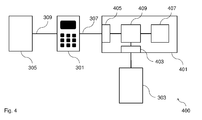
- Fig. 4 shows a schematic representation of an arrangement 400 for unlocking a vehicle locking system.
- the arrangement 400 comprises a communication device 301, an identification document 303, an identification server 305, a first communication connection 307 and a second communication connection 309.
- the arrangement 400 further comprises a vehicle security system 401 with a terminal 403, a communication interface 405, a controllable vehicle locking system 407 and a control device 409th
- the communication device 301 may be configured to set up the first communication connection 307 to the identification document 303, to set up the second communication connection 309 to the identification server 305, and to electronically identify the identification document 303 via the first communication connection 307 and the second communication connection 309 Forward identification server 305.
- the communication device 301 may be portable.
- the identification document 303 may be one of the following identification documents: identity document, such as identity card, passport, access control card, authorization card, company card, tax stamp or ticket, birth certificate, driving license or motor vehicle pass, means of payment, for example a bank card or credit card.
- identity document such as identity card, passport, access control card, authorization card, company card, tax stamp or ticket, birth certificate, driving license or motor vehicle pass, means of payment, for example a bank card or credit card.
- the identification document 303 may further comprise an electronically readable integrated circuit, such as a Radio Frequency Identification (RFID) chip.
- RFID Radio Frequency Identification
- the identification document 303 may be single-layered or multi-layered or paper and / or plastic-based.
- the identification document 303 can be constructed from plastic-based films which are joined together to form a card body by means of gluing and / or lamination, the films preferably having similar material properties.
- the identification server 305 may be configured to read the electronic identification from the identification document 303.
- the identification server 305 may further be configured to verify the authenticity of the identification document 303.
- the identification server 305 may be an eID server or an electronic identification server.
- the first communication link 307 may be wired and / or wireless.
- the first communication link 307 may further be configured via a communication network.
- the first communication link 307 may further be authenticated and / or encrypted.
- the second communication link 309 may be wired and / or wireless.
- the second communication link 309 may further be configured via a communication network.
- the second communication link 309 may further be authenticated and / or encrypted.
- the communication network may be formed by an arrangement of a plurality of servers, clients and / or computers in the form of a Local Area Network (LAN), a Wireless Local Area Network (WLAN) or the Internet.
- LAN Local Area Network
- WLAN Wireless Local Area Network
- the vehicle security system 401 may be deactivatable. Deactivating the vehicle security system 401 may include unlocking the vehicle locking system 407.
- the terminal 403 may be configured to read the electronic identification from the electronically readable identification document 303.
- the terminal 403 may include a reader and / or a keypad for communicating with the electronically-readable identification document 303.
- the communication interface 405 may be configured to transmit the read electronic identification for authentication of the person via a communication link, and to receive an authentication signal.
- the read-out electronic identification can be sent out, for example, to the identification server 305 through the communication interface 405.
- the authentication signal may also be received by the identification server 305 or by an authentication server through the communication interface 405, for example.
- the communication link may include the first communication link 307 to the communication device 301.
- the communication connection may further include the first communication connection 307 and the second communication connection 309 to the identification server 305.
- the authentication signal may be formed by an electronic message, a command, a command and / or a process.
- the authentication signal may be generated and transmitted by the identification server 305 or by an authentication server.
- the authentication server can be configured to receive the read-out electronic identification of the identification document 303 from the identification server 305 and to compare the read-out electronic identification with a prestored electronic identification.
- the reception of the authentication signal can be performed via the communication connection.
- the controllable vehicle locking system 407 may allow or deny access to a vehicle, such as a passenger car or a lorry.
- the controllable vehicle locking system 407 may further include a barrier for a vehicle door.
- the controllable vehicle locking system 407 may be further controlled by the controller 409.
- the controller 409 may be configured to unlock the vehicle interlock system 407 in response to the receipt of the authentication signal.
- the unlocking of the vehicle locking system 407 may include, for example, a release of the vehicle locking system 407.
- the unlocking of the vehicle locking system 407 can be carried out, for example, as follows.
- the communication device 301 may construct the first communication connection 307 to the identification document 303 via the communication interface 405, the control device 409 and the terminal 403, and set up the second communication connection 309 to the identification server 305.
- the identification server 305 may read out the electronic identification from the identification document 303 via the first communication connection 307 and the second communication connection 309. The electronic identification can be transmitted from the communication interface 405 to the identification server 305 and forwarded by the communication device 301.
- the identification server 305 may then compare the read electronic identification with a pre-stored electronic identification to authenticate the person.
- the electronic identification may be transmitted from the identification server 305 to an authentication server, which may compare the read electronic identification with a pre-stored electronic identification to authenticate the person.
- the transmission of the read-out electronic identification by the identification server 305 to the authentication server can be carried out via a communication network.
- the authentication server is in Fig. 4 not shown.
- the identification server 305 or the authentication server may thereupon match the read electronic identification and the pre-stored electronic identification generate an authentication signal and send out to the vehicle security system 401.
- the authentication signal may be received by the communication interface 405 and forwarded to the controller 409. In response to receiving the authentication signal, the controller 409 may unlock the vehicle interlock system 407.
- Fig. 5 1 shows a schematic illustration of an arrangement 500 for unlocking a vehicle locking system 407.
- the arrangement 500 comprises a communication device 301, an identification document 303, an identification server 305, a first communication connection 307 and a second communication connection 309.
- the arrangement 500 further comprises a vehicle security system 401 with a terminal 403, a communication interface 405, a vehicle locking system 407, a control device 409 and a further communication interface 501.
- the arrangement 500 further comprises a communication network 503.
- the communication device 301 may be configured to set up the first communication connection 307 to the identification document 303, to set up the second communication connection 309 to the identification server 305, and to forward the electronic identification from the identification document 303 to the identification server 305 via the first communication connection 307 and the second communication connection 309 ,
- the communication device 301 may be portable.
- the communication device 301 comprises a mobile communication device, for example a smartphone. According to one embodiment, the communication device 301 is rigidly connected to a vehicle.
- the identification document 303 may be one of the following identification documents: identity document, such as identity card, passport, access control card, authorization card, company card, tax stamp or ticket, birth certificate, driver's license or vehicle pass, means of payment, for example a bank card or credit card.
- identity document such as identity card, passport, access control card, authorization card, company card, tax stamp or ticket, birth certificate, driver's license or vehicle pass, means of payment, for example a bank card or credit card.
- the identification document 303 may further comprise an electronically readable integrated circuit, such as a Radio Frequency Identification (RFID) chip.
- RFID Radio Frequency Identification
- the identification document 303 may be single-layered or multi-layered or paper and / or plastic-based.
- the identification document 303 can be constructed of plastic-based films, which are joined together to form a card body by means of gluing and / or lamination, wherein the films preferably have similar material properties.
- the identification document 303 comprises a new identity card or nPA.
- the identification server 305 may be configured to read the electronic identification from the identification document 303.
- the identification server 305 may further be configured to verify the authenticity of the identification document 303.
- the identification server 305 may be an eID server or an electronic identification server.
- the first communication link 307 may be wired and / or wireless.
- the first communication link 307 may be further configured via the communication network 503.
- the first communication link 307 may further be authenticated and / or encrypted.
- the second communication link 309 may be wired and / or wireless.
- the second communication link 309 may be further configured via the communication network 503.
- the second communication link 309 may further be authenticated and / or encrypted.
- the vehicle security system 401 may be deactivatable. Deactivating the vehicle security system 401 may include unlocking the vehicle locking system 407. In one embodiment, the vehicle security system 401 is disposed in a vehicle.
- the terminal 403 may be configured to read the electronic identification from the electronically readable identification document 303.
- the terminal 403 may include a reader and / or a keypad for communicating with the electronically-readable identification document 303.
- the terminal 403 comprises a card reader.
- the communication interface 405 may be configured to transmit the read electronic identification for authentication of the person via a communication link, and to receive an authentication signal.
- the read electronic identification for example, to the Identification server 305 are sent through the communication interface 405.
- the authentication signal may also be received by the identification server 305 or by an authentication server through the communication interface 405, for example.
- the communication interface 405 comprises a second endpoint or endpoint 2.
- the communication link may include the first communication link 307 to the communication device 301.
- the communication connection may further include the first communication connection 307 and the second communication connection 309 to the identification server 305.
- the authentication signal may be formed by an electronic message, a command, a command and / or a process.
- the authentication signal may be generated and transmitted by the identification server 305 or by an authentication server.
- the authentication server can be configured to receive the read-out electronic identification of the identification document 303 from the identification server 305 and to compare the read-out electronic identification with a prestored electronic identification.
- the reception of the authentication signal can be performed via the communication connection.
- the controllable vehicle locking system 407 may allow or deny access to a vehicle, such as a passenger car or a lorry.
- the controllable vehicle locking system 407 may further include a barrier for a vehicle door.
- the controllable vehicle locking system 407 may be further controlled by the controller 409.
- the controllable vehicle locking system 407 comprises a central locking or ZV of a vehicle.
- the controller 409 may be configured to unlock the vehicle interlock system 407 in response to the receipt of the authentication signal.
- the control device 409 comprises a card unit or card unit.
- the unlocking of the vehicle locking system 407 may include, for example, a release of the vehicle locking system 407.
- the further communication interface 501 may be designed for communication with the communication device 301.
- the further communication interface 501 may further be configured to transmit a vehicle identification to the communication device 301 in order to identify the vehicle.
- the communication between the further communication interface 501 and the communication device 301 can furthermore be carried out via a communication network, for example via the communication network 503.
- the further communication interface 501 comprises a first end point or end point 1.
- the vehicle may be, for example, a passenger car or a truck.
- the vehicle identification may be formed by a sequence of letters, numbers, bytes and / or symbols.
- the vehicle identification may include an indication of the vehicle, such as a vehicle registration number or a vehicle serial number.
- the communication interface 405 comprises the further communication interface 501.
- the communication network 503 may be formed by an arrangement of a plurality of servers, clients and / or computers in the form of a Local Area Network (LAN), a Wireless Local Area Network (WLAN) or the Internet. According to one embodiment, the communication network 503 includes a backend.
- LAN Local Area Network
- WLAN Wireless Local Area Network
- the communication network 503 includes a backend.
- the unlocking of the vehicle locking system 407 can be carried out, for example, as follows.
- the further communication interface 501 may transmit a vehicle identification to the communication device 301 to identify the vehicle. Thereafter, the communication device 301 may establish the first communication link 307 to the vehicle identified by the vehicle identification or to the identification document 303 via the communication interface 405, the controller 409, and the terminal 403.
- the communication device 301 may further construct the second communication link 309 to the identification server 305.
- the identification server 305 may read out the electronic identification from the identification document 303 via the first communication connection 307 and the second communication connection 309.
- the electronic identification can be transmitted from the communication interface 405 to the identification server 305 and forwarded by the communication device 301.
- the identification server 305 may then compare the read electronic identification with a pre-stored electronic identification to authenticate the person.
- the electronic identification may be transmitted from the identification server 305 to an authentication server, which may compare the read electronic identification with a pre-stored electronic identification to authenticate the person.
- the transmission of the read-out electronic identification by the identification server 305 to the authentication server can be carried out via a communication network, for example via the communication network 503.
- the authentication server is in Fig. 5 not shown.
- the identification server 305 or the authentication server can then generate an authentication signal and send it out to the vehicle security system 401 if the electronic identification read out and the pre-stored electronic identification match.
- the authentication signal may be received by the communication interface 405 and forwarded to the controller 409.
- the controller 409 may unlock the vehicle interlock system 407.
- the identification server 305 and / or an authentication server are located inside the vehicle.
- an authorization certificate for reading out the identification document or the ID card within the vehicle.
- an external or extra identification server can be dispensed with in order to read out the electronic identification or the attributes from the identification document or the ID card.
- a comparison or a check of the read electronic identification or the read identifier can then for example, at an authentication server or, to achieve a further increase in speed, be performed or made directly in the vehicle.
- the invention relates to a vehicle locking system or a Monshamrieglung for vehicles, such as passenger cars or cars, which can be unlocked by means of an identification document, such as a new identity card or nPA.
- an identification document such as a new identity card or nPA.
- an electronic identification function or eID function of an identification document for example a new identity card, is used for unlocking a vehicle locking system or for unlocking a car.
- a Password Authenticated Connection Establishment (PACE) protocol can be performed with an identification document, for example a new identity card or nPA, and a communication device, for example a smartphone.
- PACE Password Authenticated Connection Establishment
- the unlocking of the vehicle locking system takes place as follows.
- the user uses a communication device, for example a smartphone, which can call up a vehicle identification or identification (ID) of the vehicle via a communication connection, for example a first channel.
- a communication connection for example a first channel.
- This can be done, for example, by means of a quick response (QR) code or near field communication (NFC).
- QR quick response
- NFC near field communication
- the communication device By means of the vehicle identification or identification (ID) of the vehicle, the communication device, for example the smartphone, can establish a communication connection, for example a second channel or a further connection, to the vehicle or the vehicle security system.
- This connection can be direct, for example by means of a Bluetooth radio connection or a Wireless Local Area Network (WLAN) or WiFi radio connection, or indirectly via a communication network or a server.
- the vehicle may have a connection to a communication network and / or to an identification server or background system.
- the user may place an identification document, for example a new identity card or nPA, on a terminal or card reader of the vehicle or vehicle security system.
- the communication device for example the smartphone, can now communicate via the previously established connection and via the terminal or the card reader with the identification document, for example the new identity card or nPA.
- the user can enter a personal identification number (PIN) or a passport ID of the identification document into the communication device, for example the smartphone, whereupon a password authenticated connection establishment (PACE) tunnel between the communication device, for example the smartphone, and the identification document, for example the new identity card or nPA.
- PIN personal identification number
- PACE password authenticated connection establishment
- the identification server or the background system and the identification document can perform a terminal authentication (TA) and / or a chip authentication (CA) via the communication device, for example the smartphone.
- TA terminal authentication
- CA chip authentication
- the identification server or the background system can read the requested data, for example the electronic identification, from the identification document or identity card, authenticate the user and send an authentication signal or an open signal to the vehicle or the vehicle security system.
- the invention enables a use of a two-factor authentication of the user and / or a usage of a widely available ID token.
- the communication interface is configured to communicate wirelessly with the communication device.
- the communication interface is electrically and wired connectable or connected to the communication device.
- the vehicle itself can be used as a communication device.
- the communication device rigidly connected to the vehicle is a mobile communication device due to the mobility of the vehicle to be unlocked or unlocked.
- the vehicle to be unlocked or unlocked is rigidly connected to the communication device.
Landscapes
- Engineering & Computer Science (AREA)
- Computer Security & Cryptography (AREA)
- Theoretical Computer Science (AREA)
- Business, Economics & Management (AREA)
- General Physics & Mathematics (AREA)
- Accounting & Taxation (AREA)
- Physics & Mathematics (AREA)
- Computer Hardware Design (AREA)
- General Engineering & Computer Science (AREA)
- Software Systems (AREA)
- Finance (AREA)
- Signal Processing (AREA)
- Computer Networks & Wireless Communication (AREA)
- Development Economics (AREA)
- Economics (AREA)
- Marketing (AREA)
- Strategic Management (AREA)
- General Business, Economics & Management (AREA)
- Lock And Its Accessories (AREA)
Abstract
Description
- Die vorliegende Erfindung betrifft das Gebiet des Authentifizierens einer Person.
- Verfahren zum Authentifizieren einer Person werden üblicherweise eingesetzt, um einem eingeschränkten und vordefinierten Personenkreis eine Nutzungsberechtigung für ein System oder eine Zugangsberechtigung für ein System einzuräumen.
- Das Authentifizieren der Person kann dabei beispielsweise mittels einer Authentifizierungskarte der Person und/oder mittels eines Passwortes der Person erfolgen. Zum Auslesen der Authentifizierungskarte und/oder zur Eingabe des Passwortes werden üblicherweise Terminals eingesetzt, welche über ein Lesegerät und/oder ein Tastenfeld verfügen können.
- Entsprechende Terminals sind dabei zumeist ortsfest installiert bzw. ortsfest eingerichtet. Zudem erweisen sich entsprechende Terminals zumeist als groß und unhandlich. Der Einsatz dieser Terminals ist daher auf wenige spezielle Anwendungen beschränkt.
- Es ist daher die Aufgabe der vorliegenden Erfindung, ein effizientes und flexibles Konzept zum Authentifizieren einer Person zu schaffen.
- Diese Aufgabe wird durch die Merkmale der unabhängigen Ansprüche gelöst. Vorteilhafte Weiterbildungsformen sind Gegenstand der abhängigen Patentansprüche, der Beschreibung sowie der Zeichnungen.
- Die Erfindung basiert auf der Erkenntnis, dass die obige Aufgabe durch die Verwendung eines elektronisch auslesbaren Identifikationsdokumentes gelöst werden kann.
- Gemäß einem ersten Aspekt betrifft die Erfindung ein Verfahren zum Authentifizieren einer Person unter Verwendung eines elektronisch auslesbaren Identifikationsdokumentes, mit: Aufbauen einer ersten Kommunikationsverbindung zwischen einem Kommunikationsgerät und dem Identifikationsdokument; Aufbauen einer zweiten Kommunikationsverbindung zwischen einem Identifizierungsserver und dem Kommunikationsgerät; Auslesen einer elektronischen Identifikation aus dem Identifikationsdokument durch den Identifizierungsserver über die erste Kommunikationsverbindung und die zweite Kommunikationsverbindung; und Vergleichen der ausgelesenen elektronischen Identifikation mit einer vorgespeicherten elektronischen Identifikation, um die Person zu authentifizieren. Dadurch wird der Vorteil erreicht, dass das Authentifizieren der Person effizient durchgeführt werden kann.
- Das Identifikationsdokument kann eines der folgenden Identifikationsdokumente sein: Identitätsdokument, wie Personalausweis, Reisepass, Zugangskontrollausweis, Berechtigungsausweis, Unternehmensausweis, Steuerzeichen oder Ticket, Geburtsurkunde, Führerschein oder Kraftfahrzeugausweis, Zahlungsmittel, beispielsweise eine Bankkarte oder Kreditkarte. Das Identifikationsdokument kann ferner einen elektronisch auslesbaren integrierten Schaltkreis, beispielsweise einen Radio Frequency Identification (RFID) Chip, umfassen. Das Identifikationsdokument kann ein- oder mehrlagig bzw. papier- und/oder kunststoffbasiert sein. Das Identifikationsdokument kann aus kunststoffbasierten Folien aufgebaut sein, welche zu einem Kartenkörper mittels Verkleben und/oder Laminieren zusammengefügt werden, wobei die Folien bevorzugt ähnliche stoffliche Eigenschaften aufweisen.
- Die elektronische Identifikation kann durch eine Folge von Buchstaben, Ziffern, Bytes und/oder Symbolen gebildet sein. Die elektronische Identifikation kann eine persönliche Angabe über eine Person, beispielsweise einen Namen, und/oder eine Kennung des Identifikationsdokumentes, beispielsweise eine Seriennummer, umfassen. Die elektronische Identifikation kann ferner durch das Identifikationsdokument erzeugt und/oder gespeichert werden.
- Der Identifizierungsserver kann ausgebildet sein, die elektronische Identifikation aus dem Identifikationsdokument auszulesen. Der Identifizierungsserver kann ferner ausgebildet sein, die Echtheit des Identifikationsdokumentes zu verifizieren. Der Identifizierungsserver kann ein eID-Server bzw. ein elektronischer Identifizierungsserver sein.
- Das Kommunikationsgerät kann ausgebildet sein, die erste Kommunikationsverbindung zu dem Identifikationsdokument aufzubauen und die zweite Kommunikationsverbindung zu dem Identifizierungsserver aufzubauen. Das Kommunikationsgerät kann tragbar bzw. mobil sein. Das Kommunikationsgerät kann ferner ausgebildet sein, die elektronische Identifikation von dem Identifikationsdokument über die erste Kommunikationsverbindung und die zweite Kommunikationsverbindung an den Identifizierungsserver weiterzuleiten. Die erste Kommunikationsverbindung kann drahtgebunden und/oder drahtlos sein. Die erste Kommunikationsverbindung kann ferner über ein Kommunikationsnetzwerk aufgebaut sein. Die erste Kommunikationsverbindung kann ferner authentifiziert und/oder verschlüsselt sein.
- Die zweite Kommunikationsverbindung kann drahtgebunden und/oder drahtlos sein. Die zweite Kommunikationsverbindung kann ferner über ein Kommunikationsnetzwerk aufgebaut sein. Die zweite Kommunikationsverbindung kann ferner authentifiziert und/oder verschlüsselt sein.
- Das Kommunikationsnetzwerk kann durch eine Anordnung einer Mehrzahl von Servern, Clients und/oder Computern in Form eines Local Area Network (LAN), eines Wireless Local Area Network (WLAN) oder des Internet gebildet sein.
- Das Aufbauen der ersten Kommunikationsverbindung kann einen Austausch und/oder eine Übertragung kryptographischer Schlüssel und/oder kryptographischer Zertifikate zwischen dem Kommunikationsgerät und dem Identifikationsdokument umfassen.
- Das Aufbauen der zweiten Kommunikationsverbindung kann einen Austausch und/oder eine Übertragung kryptographischer Schlüssel und/oder kryptographischer Zertifikate zwischen dem Identifizierungsserver und dem Kommunikationsgerät umfassen.
- Das Auslesen der elektronischen Identifikation aus dem Identifikationsdokument durch den Identifizierungsserver über die erste Kommunikationsverbindung und die zweite Kommunikationsverbindung kann einen Austausch und/oder eine Übertragung von kryptographischen Schlüsseln und/oder kryptographischen Zertifikaten zwischen dem Identifikationsdokument und dem Identifizierungsserver umfassen. Ferner kann das Auslesen der elektronischen Identifikation eine Verifikation der Echtheit des Identifikationsdokumentes und/oder der elektronischen Identifikation umfassen.
- Das Vergleichen der ausgelesenen elektronischen Identifikation mit einer vorgespeicherten elektronischen Identifikation kann ein Bestimmen einer Übereinstimmung der ausgelesenen elektronischen Identifikation mit einer vorgespeicherten elektronischen Identifikation umfassen. Eine Übereinstimmung der ausgelesenen elektronischen Identifikation mit einer vorgespeicherten elektronischen Identifikation kann vorliegen, wenn die ausgelesene elektronische Identifikation und die vorgespeicherte elektronische Identifikation identisch sind. Das Vergleichen der ausgelesenen elektronischen Identifikation mit einer vorgespeicherten elektronischen Identifikation kann ferner ein Vergleichen der ausgelesenen elektronischen Identifikation mit einer Mehrzahl vorgespeicherter elektronischer Identifikationen umfassen, welche in einem Speicher und/oder in einer Datenbank abgelegt sein können.
- Eine erfolgreiche Authentifizierung der Person kann bei Übereinstimmung zwischen der ausgelesenen elektronischen Identifikation und einer vorgespeicherten elektronischen Identifikation vorliegen.
- Gemäß einer Ausführungsform wird das Aufbauen der ersten Kommunikationsverbindung zwischen dem Kommunikationsgerät und dem Identifikationsdokument mittels eines passwortauthentifizierten Verbindungsaufbauprotokolls, beispielsweise eines Password Authenticated Connection Establishment Protokolls, durchgeführt. Dadurch wird der Vorteil erreicht, dass eine authentifizierte und/oder verschlüsselte Kommunikationsverbindung aufgebaut werden kann.
- Das passwortauthentifizierte Verbindungsaufbauprotokoll kann eine Eingabe eines Passwortes sowie einen Austausch und/oder eine Übertragung kryptographischer Schlüssel und/oder kryptographischer Zertifikate umfassen. Das passwortauthentifizierte Verbindungsaufbauprotokoll kann auf einem Diffie-Hellman-Schlüsselaustauschverfahren basieren. Das Passwort kann beispielsweise mittels eines Tastenfeldes des Kommunikationsgerätes eingegeben werden. Ferner kann das Passwort mittels eines Bildschirmes des Kommunikationsgerätes angezeigt werden.
- Das Password Authenticated Connection Establishment (PACE) Protokoll kann beispielsweise gemäß der technischen Richtlinie BSI TR-03110 realisiert werden.
- Gemäß einer Ausführungsform wird das Aufbauen der ersten Kommunikationsverbindung zwischen dem Kommunikationsgerät und dem Identifikationsdokument über eine drahtlose Funkkommunikationsverbindung, beispielsweise eine Wireless Local Area Network Funkverbindung oder eine Near Field Communication Funkverbindung oder eine Bluetooth Funkverbindung, durchgeführt. Dadurch wird der Vorteil erreicht, dass etablierte drahtlose Funkkommunikationsstandards für die erste Kommunikationsverbindung eingesetzt werden können.
- Die drahtlose Funkkommunikationsverbindung kann für einen Austausch und/oder eine Übertragung analoger und/oder digitaler Informationen ausgebildet sein. Die drahtlose Funkkommunikationsverbindung kann ein Aussenden, ein Übertragen, sowie ein Empfangen elektromagnetischer Wellen umfassen. Die drahtlose Funkkommunikationsverbindung kann beispielsweise mittels einer Funkkommunikationsschnittstelle des Kommunikationsgerätes aufgebaut werden.
- Die Wireless Local Area Network (WLAN) Funkverbindung kann beispielsweise auf dem IEEE 802.11 Funkkommunikationsstandard basieren. Die Near Field Communication (NFC) Funkverbindung kann beispielsweise auf den ISO/IEC 18092 bzw. ECMA-340 und/oder ISO/IEC 21481 bzw. ECMA-352 Funkkommunikationsstandards basieren. Die Bluetooth (BT) Funkverbindung kann beispielsweise auf dem IEEE 802.15.1 Funkkommunikationsstandard basieren.
- Gemäß einer Ausführungsform wird das Aufbauen der zweiten Kommunikationsverbindung zwischen dem Identifizierungsserver und dem Kommunikationsgerät mittels eines Transportschichtsicherheitsprotokolls, beispielsweise eines Transport Layer Security Protokolls, durchgeführt. Dadurch wird der Vorteil erreicht, dass eine authentifizierte und/oder verschlüsselte Kommunikationsverbindung aufgebaut werden kann.
- Das Transportschichtsicherheitsprotokoll kann einen Austausch und/oder eine Übertragung kryptographischer Schlüssel und/oder kryptographischer Zertifikate umfassen. Das Transportschichtsicherheitsprotokoll kann auf einem Diffie-Hellman-Schlüsselaustauschverfahren basieren.
- Das Transport Layer Security (TLS) Protokoll kann beispielsweise auf den Standards IETF RFC 5246 und/oder IETF RFC 6176 basieren.
- Gemäß einer Ausführungsform wird das Aufbauen der zweiten Kommunikationsverbindung zwischen dem Identifizierungsserver und dem Kommunikationsgerät über eine drahtlose Funkkommunikationsverbindung, beispielsweise eine Global System for Mobile Communications Mobilfunkverbindung oder eine Universal Mobile Telecommunications System Mobilfunkverbindung oder eine Long Term Evolution Mobilfunkverbindung, durchgeführt. Dadurch wird der Vorteil erreicht, dass etablierte drahtlose Funkkommunikationsstandards für die zweite Kommunikationsverbindung eingesetzt werden können.
- Die drahtlose Funkkommunikationsverbindung kann für einen Austausch und/oder eine Übertragung analoger und/oder digitaler Informationen ausgebildet sein. Die drahtlose Funkkommunikationsverbindung kann ein Aussenden, ein Übertragen, sowie ein Empfangen elektromagnetischer Wellen umfassen. Die drahtlose Funkkommunikationsverbindung kann beispielsweise mittels einer Funkkommunikationsschnittstelle des Kommunikationsgerätes aufgebaut werden.
- Die Global System for Mobile Communications (GSM) Mobilfunkverbindung kann beispielsweise auf den ETSI/3GPP Mobilfunkstandards basieren. Die Universal Mobile Telecommunications System (UMTS) Mobilfunkverbindung kann beispielsweise auf den ETSI/3GPP Mobilfunkstandards basieren. Die Long Term Evolution (LTE) Mobilfunkverbindung kann beispielsweise auf den ETSI/3GPP Mobilfunkstandards basieren.
- Gemäß einer Ausführungsform umfasst das elektronisch auslesbare Identifikationsdokument einen integrierten Schaltkreis, wobei das Auslesen der elektronischen Identifikation das Durchführen eines Chipauthentifizierungsverfahrens, beispielsweise eines Chip Authentication Verfahrens, zur Authentifizierung des integrierten Schaltkreises des Identifikationsdokumentes umfasst. Dadurch wird der Vorteil erreicht, dass die Authentizität bzw. Echtheit des integrierten Schaltkreises des Identifikationsdokumentes verifiziert werden kann.
- Der integrierte Schaltkreis kann elektronisch auslesbar sein. Der integrierte Schaltkreis kann beispielsweise ein Radio Frequency Identification (RFID) Chip sein.
- Das Chipauthentifizierungsverfahren kann einen Austausch und/oder eine Übertragung kryptographischer Schlüssel und/oder kryptographischer Zertifikate umfassen. Das Chipauthentifizierungsverfahren kann ausgebildet sein, die Authentizität bzw. Echtheit des integrierten Schaltkreises zu verifizieren.
- Das Chip Authentication (CA) Verfahren kann beispielsweise gemäß der technischen Richtlinie BSI TR-03110 realisiert werden.
- Gemäß einer Ausführungsform wird die erste Kommunikationsverbindung zu dem elektronisch auslesbaren Identifikationsdokument über ein Terminal für eine Kommunikation mit dem elektronisch auslesbaren Identifikationsdokument aufgebaut, wobei das Auslesen der elektronischen Identifikation das Durchführen eines Terminalauthentifizierungsverfahrens, beispielsweise eines Terminal Authentication Verfahrens, zur Authentifizierung des Terminals oder des Identifizierungsservers umfasst. Dadurch wird der Vorteil erreicht, dass die Authentizität bzw. Echtheit des Terminals oder des Identifizierungsservers verifiziert werden kann.
- Das Terminal kann ein Lesegerät und/oder ein Tastenfeld für eine Kommunikation mit dem elektronisch auslesbaren Identifikationsdokument umfassen. Das Terminal kann, gemäß einer Ausführungsform, einen an einem Fahrzeug befestigten Kartenleser umfassen.
- Das Terminalauthentifizierungsverfahren kann einen Austausch und/oder eine Übertragung kryptographischer Schlüssel und/oder kryptographischer Zertifikate umfassen. Das Terminalauthentifizierungsverfahren kann ausgebildet sein, die Authentizität bzw. Echtheit des Terminals oder des Identifizierungsservers zu verifizieren.
- Das Terminal Authentication (TA) Verfahren kann beispielsweise gemäß der technischen Richtlinie BSI TR-03110 realisiert werden.
- Gemäß einer Ausführungsform umfasst das Verfahren ferner ein Übertragen der ausgelesenen elektronischen Identifikation durch den Identifizierungsserver an einen Authentifizierungsserver, wobei das Vergleichen der ausgelesenen elektronischen Identifikation mit einer vorgespeicherten elektronischen Identifikation durch den Authentifizierungsserver durchgeführt wird. Dadurch wird der Vorteil erreicht, dass der Identifizierungsserver effizient implementiert werden kann.
- Der Authentifizierungsserver kann ausgebildet sein, die ausgelesene elektronische Identifikation des Identifikationsdokumentes von dem Identifizierungsserver zu empfangen und die ausgelesene elektronische Identifikation mit einer vorgespeicherten elektronischen Identifikation zu vergleichen.
- Das Vergleichen der ausgelesenen elektronischen Identifikation mit einer vorgespeicherten elektronischen Identifikation kann ein Bestimmen einer
- Übereinstimmung der ausgelesenen elektronischen Identifikation mit einer vorgespeicherten elektronischen Identifikation umfassen. Eine Übereinstimmung der ausgelesenen elektronischen Identifikation mit einer vorgespeicherten elektronischen Identifikation kann vorliegen, wenn die ausgelesene elektronische Identifikation und die vorgespeicherte elektronische Identifikation identisch sind. Das Vergleichen der ausgelesenen elektronischen Identifikation mit einer vorgespeicherten elektronischen Identifikation kann ferner ein Vergleichen der ausgelesenen elektronischen Identifikation mit einer Mehrzahl vorgespeicherter elektronischer Identifikationen umfassen, welche in einem Speicher des Authentifizierungsservers und/oder in einer Datenbank des Authentifizierungsservers abgelegt sein können.
- Das Übertragen der ausgelesenen elektronischen Identifikation durch den Identifizierungsserver an einen Authentifizierungsserver kann über ein Kommunikationsnetzwerk durchgeführt werden.
- Gemäß einer Ausführungsform umfasst das Verfahren ein Auslesen eines öffentlichen kryptographischen Schlüssels aus einem Speicher des Identifizierungsservers oder ein Übertragen eines öffentlichen kryptographischen Schlüssels zu dem Identifizierungsserver; und ein Übertragen des öffentlichen kryptographischen Schlüssels von dem Identifizierungsserver zu dem Identifikationsdokument. Dadurch wird der Vorteil erreicht, dass der öffentliche kryptographische Schlüssel durch das Identifikationsdokument verarbeitet und/oder ausgewertet werden kann.
- Der öffentliche kryptographische Schlüssel kann Teil eines kryptographischen Schlüsselpaares sein und gemäß einer Public-Key-Infrastruktur erzeugt worden sein. Der öffentliche kryptographische Schlüssel kann beispielsweise einem Authentifizierungsserver zugeordnet sein.
- Der Speicher des Identifizierungsservers kann durch eine Datenbank realisiert sein. Der Speicher des Identifizierungsservers kann ferner ausgebildet sein, eine Mehrzahl unterschiedlicher öffentlicher kryptographischer Schlüssel zu speichern.
- Das Auslesen des öffentlichen kryptographischen Schlüssels aus dem Speicher des Identifizierungsservers kann einen Zugriff auf den Speicher des Identifizierungsservers umfassen. Das Auslesen des öffentlichen kryptographischen Schlüssels aus dem Speicher des Identifizierungsservers kann ferner eine Suche in dem Speicher sowie eine Extraktion des öffentlichen kryptographischen Schlüssels aus dem Speicher umfassen.
- Das Übertragen des öffentlichen kryptographischen Schlüssels zu dem Identifizierungsserver kann beispielsweise von einem Authentifizierungsserver durchgeführt werden. Das Übertragen des öffentlichen kryptographischen Schlüssels zu dem Identifizierungsserver kann über ein Kommunikationsnetzwerk durchgeführt werden.
- Das Übertragen des öffentlichen kryptographischen Schlüssels von dem Identifizierungsserver zu dem Identifikationsdokument kann beispielsweise über die erste Kommunikationsverbindung und die zweite Kommunikationsverbindung durchgeführt werden.
- Gemäß einer Ausführungsform wird die elektronische Identifikation durch das Identifikationsdokument durch eine Verknüpfung eines privaten kryptographischen Schlüssels des Identifikationsdokumentes und des übertragenen öffentlichen kryptographischen Schlüssels erzeugt. Dadurch wird der Vorteil erreicht, dass die elektronische Identifikation charakteristisch für das Paar aus privatem kryptographischen Schlüssel des Identifikationsdokumentes und übertragenem öffentlichen kryptographischen Schlüssel ist.
- Der private kryptographische Schlüssel des Identifikationsdokumentes kann Teil eines kryptographischen Schlüsselpaares sein und gemäß einer Public-Key-Infrastruktur erzeugt worden sein.
- Der öffentliche kryptographische Schlüssel kann Teil eines kryptographischen Schlüsselpaares sein und gemäß einer Public-Key-Infrastruktur erzeugt worden sein. Der öffentliche kryptographische Schlüssel kann beispielsweise einem Authentifizierungsserver zugeordnet sein.
- Die Verknüpfung des privaten kryptographischen Schlüssels des Identifikationsdokumentes und des öffentlichen kryptographischen Schlüssels durch das Identifikationsdokument kann beispielsweise binäre Verknüpfungen, beispielsweise ein Exklusiv-Oder, umfassen. Die Verknüpfung kann ferner durch Anwenden von kryptographischen Algorithmen, wie beispielsweise Advanced Encryption Standard (AES), und/oder durch Anwenden von Algorithmen zur Hashwertbildung, wie beispielsweise Secure Hash Algorithm (SHA), realisiert werden. Die Verknüpfung kann ferner eine Berechnung von Prüfsummen des privaten kryptographischen Schlüssels des Identifikationsdokumentes und/oder des öffentlichen kryptographischen Schlüssels umfassen.
- Gemäß einer Ausführungsform umfasst das Verfahren ein Übertragen eines öffentlichen kryptographischen Schlüssels durch den Identifizierungsserver zu dem Identifikationsdokument; ein Erzeugen einer elektronischen Identifikation durch eine Verknüpfung eines privaten kryptographischen Schlüssels des Identifikationsdokumentes und des übertragenen öffentlichen kryptographischen Schlüssels durch das Identifikationsdokument; und ein Speichern der erzeugten elektronischen Identifikation, um die vorgespeicherte elektronische Identifikation zu erhalten. Dadurch wird der Vorteil erreicht, dass eine vorgespeicherte elektronische Identifikation bereitgestellt werden kann, welche dem Identifikationsdokument zugeordnet sein kann.
- Der private kryptographische Schlüssel des Identifikationsdokumentes kann Teil eines kryptographischen Schlüsselpaares sein und gemäß einer Public-Key-Infrastruktur erzeugt worden sein.
- Der öffentliche kryptographische Schlüssel kann Teil eines kryptographischen Schlüsselpaares sein und gemäß einer Public-Key-Infrastruktur erzeugt worden sein. Der öffentliche kryptographische Schlüssel kann beispielsweise einem Authentifizierungsserver zugeordnet sein.
- Das Übertragen des öffentlichen kryptographischen Schlüssels durch den Identifizierungsserver zu dem Identifikationsdokument kann beispielsweise über die erste Kommunikationsverbindung und die zweite Kommunikationsverbindung durchgeführt werden.
- Das Erzeugen der elektronischen Identifikation durch die Verknüpfung des privaten kryptographischen Schlüssels des Identifikationsdokumentes und des übertragenen öffentlichen kryptographischen Schlüssels durch das Identifikationsdokument kann ein Bereitstellen der elektronischen Identifikation umfassen. Die Verknüpfung des privaten kryptographischen Schlüssels des Identifikationsdokumentes und des öffentlichen kryptographischen Schlüssels durch das Identifikationsdokument kann beispielsweise binäre Verknüpfungen, beispielsweise ein Exklusiv-Oder, umfassen. Die Verknüpfung kann ferner durch Anwenden von kryptographischen Algorithmen, wie beispielsweise Advanced Encryption Standard (AES), und/oder durch Anwenden von Algorithmen zur Hashwertbildung, wie beispielsweise Secure Hash Algorithm (SHA), realisiert werden. Die Verknüpfung kann ferner eine Berechnung von Prüfsummen des privaten kryptographischen Schlüssels des Identifikationsdokumentes und/oder des öffentlichen kryptographischen Schlüssels umfassen.
- Das Speichern der erzeugten elektronischen Identifikation kann ein Übertragen der erzeugten elektronischen Identifikation von dem Identifikationsdokument zu dem Identifizierungsserver oder zu einem Authentifizierungsserver umfassen. Das Speichern der erzeugten elektronischen Identifikation kann ferner ein Ablegen der erzeugten übertragenen elektronischen Identifikation in einen Speicher des Identifizierungsservers oder eines Authentifizierungsservers umfassen. Somit kann eine vorgespeicherte elektronische Identifikation bereitgestellt werden.
- Gemäß einer Ausführungsform ist die elektronische Identifikation eine Restricted Identification des Identifikationsdokumentes. Dadurch wird der Vorteil erreicht, dass eine pseudonyme elektronische Identifikation des Identifikationsdokumentes eingesetzt werden kann.
- Die Restricted Identification kann auf Grundlage eines Diffie-Hellman-Verfahrens und/oder eines Diffie-Hellman-Schlüsselaustausches durch das Identifikationsdokument erzeugt werden. Die Restricted Identification kann beispielsweise gemäß der technischen Richtlinie BSI TR-03110 realisiert werden.
- Gemäß einer Ausführungsform ist das Kommunikationsgerät ein mobiles Kommunikationsgerät, beispielsweise ein Mobilcomputer, ein Mobiltelefon oder ein Smartphone. Dadurch wird der Vorteil erreicht, dass etablierte mobile Kommunikationsgeräte eingesetzt werden können. Der Mobilcomputer, das Mobiltelefon oder das Smartphone können tragbar bzw. mobil sein und können einer Person eindeutig zugeordnet sein.
- Gemäß einer Ausführungsform ist das Kommunikationsgerät ein stationäres Kommunikationsgerät, das in dem Fahrzeug angeordnet sein kann. Hierbei kann das Kommunikationsgerät lösbar oder unlösbar mit einer Fahrzeugkommunikationsschnittstelle elektrisch verbunden sein.
- Gemäß einer Ausführungsform ist der Identifizierungsserver ein eID-Server. Dadurch wird der Vorteil erreicht, dass ein standardisierter Identifizierungsserver eingesetzt werden kann.
- Der eID-Server kann beispielsweise gemäß der technischen Richtlinie BSI TR-03130 realisiert sein und mit dem Identifikationsdokument wechselwirken.
- Gemäß einem zweiten Aspekt betrifft die Erfindung ein Verfahren zum Entriegeln einer Fahrzeugverriegelungsanlage unter Verwendung eines elektronisch auslesbaren Identifikationsdokumentes, mit: Authentifizieren einer Person gemäß des Verfahrens zum Authentifizieren einer Person; und Entriegeln der Fahrzeugverriegelungsanlage bei Übereinstimmung zwischen der ausgelesenen elektronischen Identifikation und der vorgespeicherten elektronischen Identifikation. Dadurch wird der Vorteil erreicht, dass das Entriegeln einer Fahrzeugverriegelungsanlage mittels eines elektronisch auslesbaren Identifikationsdokumentes ermöglicht wird.
- Die Fahrzeugverriegelungsanlage kann einen Zutritt zu einem Fahrzeug, beispielsweise einem Personenkraftwagen oder einem Lastkraftwagen, ermöglichen oder verwehren. Die Fahrzeugverriegelungsanlage kann ferner eine Sperranlage für eine Fahrzeugtür umfassen.
- Das Entriegeln der Fahrzeugverriegelungsanlage kann beispielsweise eine Freigabe der Fahrzeugverriegelungsanlage umfassen.
- Das Authentifizieren der Person kann gemäß des vorstehenden Verfahrens zum Authentifizieren einer Person durchgeführt werden.
- Das Entriegeln der Fahrzeugverriegelungsanlage kann bei Übereinstimmung zwischen der ausgelesenen elektronischen Identifikation und der vorgespeicherten elektronischen Identifikation durchgeführt werden. Eine Übereinstimmung zwischen der ausgelesenen elektronischen Identifikation und der vorgespeicherten elektronischen Identifikation kann vorliegen, wenn die ausgelesene elektronische Identifikation und die vorgespeicherte elektronische Identifikation identisch sind.
- Weitere Merkmale des Verfahrens zum Entriegeln einer Fahrzeugverriegelungsanlage ergeben sich unmittelbar aus der Funktionalität des Verfahrens zum Authentifizieren einer Person.
- Gemäß einer Ausführungsform ist die Fahrzeugverriegelungsanlage in einem Fahrzeug angeordnet, wobei das Authentifizieren der Person mittels eines Kommunikationsgerätes durchgeführt wird, welches starr mit dem Fahrzeug verbunden ist. Dadurch wird der Vorteil erreicht, dass das Kommunikationsgerät dem Fahrzeug eindeutig zugeordnet werden kann.
- Das Kommunikationsgerät kann beispielsweise in das Fahrzeug eingebaut sein. Das Kommunikationsgerät kann beispielsweise an oder hinter einer Scheibe und/oder an einer Säule des Fahrzeugs angeordnet sein. Das Kommunikationsgerät kann mit einer Kommunikationsschnittstelle eines Fahrzeugsicherheitssystems des Fahrzeugs verbunden sein. Das Fahrzeug kann beispielsweise ein Personenkraftwagen oder ein Lastkraftwagen sein. Das Kommunikationsgerät kann ferner ein Bestandteil einer Fahrzeug-Kommunikationsanlage und/oder einer Fahrzeug-Multimediaanlage sein.
- Gemäß einer Ausführungsform ist die Fahrzeugverriegelungsanlage in einem Fahrzeug angeordnet, wobei das Fahrzeug eine Kommunikationsschnittstelle zur Kommunikation mit dem Kommunikationsgerät umfasst, wobei das Verfahren ferner ein Übermitteln einer Fahrzeugidentifikation durch die Kommunikationsschnittstelle an das Kommunikationsgerät umfasst, um das Fahrzeug zu identifizieren, und wobei die erste Kommunikationsverbindung zu dem durch die Fahrzeugidentifikation identifizierten Fahrzeug aufgebaut wird. Dadurch wird der Vorteil erreicht, dass die erste Kommunikationsverbindung effizient über das identifizierte Fahrzeug zu dem Identifikationsdokument aufgebaut werden kann.
- Die Kommunikationsschnittstelle kann ausgebildet sein, mit dem Kommunikationsgerät zu kommunizieren. Die Kommunikation zwischen der Kommunikationsschnittstelle und dem Kommunikationsgerät kann über ein Kommunikationsnetzwerk durchgeführt werden. Die Kommunikation zwischen der Kommunikationsschnittstelle und dem Kommunikationsgerät kann ferner mittels einer drahtlosen Funkkommunikationsverbindung, beispielsweise einer Near Field Communication (NFC) Funkverbindung, durchgeführt werden.
- Die Fahrzeugidentifikation kann durch eine Folge von Buchstaben, Ziffern, Bytes und/oder Symbolen gebildet sein. Die Fahrzeugidentifikation kann eine Angabe über das Fahrzeug, beispielsweise ein Fahrzeugkennzeichen oder eine Fahrzeugseriennummer, umfassen. Das Fahrzeug kann beispielsweise ein Personenkraftwagen oder ein Lastkraftwagen sein.
- Gemäß einem dritten Aspekt betrifft die Erfindung ein Kommunikationsgerät, welches ausgebildet ist, eine erste Kommunikationsverbindung zu einem Identifikationsdokument aufzubauen; eine zweite Kommunikationsverbindung zu einem Identifizierungsserver aufzubauen; und eine elektronische Identifikation von dem Identifikationsdokument über die erste Kommunikationsverbindung und die zweite Kommunikationsverbindung an den Identifizierungsserver weiterzuleiten. Dadurch wird der Vorteil erreicht, dass das Verfahren zum Authentifizieren einer Person und das Verfahren zum Entriegeln einer Fahrzeugverriegelungsanlage effizient durchgeführt werden können.
- Das Identifikationsdokument kann eines der folgenden Identifikationsdokumente sein: Identitätsdokument, wie Personalausweis, Reisepass, Zugangskontrollausweis, Berechtigungsausweis, Unternehmensausweis, Steuerzeichen oder Ticket, Geburtsurkunde, Führerschein oder Kraftfahrzeugausweis, Zahlungsmittel, beispielsweise eine Bankkarte oder Kreditkarte. Das Identifikationsdokument kann ferner einen elektronisch auslesbaren integrierten Schaltkreis, beispielsweise einen Radio Frequency Identification (RFID) Chip, umfassen. Das Identifikationsdokument kann ein- oder mehrlagig bzw. papier- und/oder kunststoffbasiert sein. Das Identifikationsdokument kann aus kunststoffbasierten Folien aufgebaut sein, welche zu einem Kartenkörper mittels Verkleben und/oder Laminieren zusammengefügt werden, wobei die Folien bevorzugt ähnliche stoffliche Eigenschaften aufweisen.
- Die elektronische Identifikation kann durch eine Folge von Buchstaben, Ziffern, Bytes und/oder Symbolen gebildet sein. Die elektronische Identifikation kann eine persönliche Angabe über eine Person, beispielsweise einen Namen, und/oder eine Kennung des Identifikationsdokumentes, beispielsweise eine Seriennummer, umfassen. Die elektronische Identifikation kann ferner durch das Identifikationsdokument erzeugt und/oder gespeichert werden.
- Der Identifizierungsserver kann ausgebildet sein, die elektronische Identifikation aus dem Identifikationsdokument auszulesen. Der Identifizierungsserver kann ferner ausgebildet sein, die Echtheit des Identifikationsdokumentes zu verifizieren. Der Identifizierungsserver kann ein eID-Server bzw. ein elektronischer Identifizierungsserver sein.
- Die erste Kommunikationsverbindung kann drahtgebunden und/oder drahtlos sein. Die erste Kommunikationsverbindung kann ferner über ein Kommunikationsnetzwerk aufgebaut sein. Die erste Kommunikationsverbindung kann ferner authentifiziert und/oder verschlüsselt sein.
- Die zweite Kommunikationsverbindung kann drahtgebunden und/oder drahtlos sein. Die zweite Kommunikationsverbindung kann ferner über ein Kommunikationsnetzwerk aufgebaut sein. Die zweite Kommunikationsverbindung kann ferner authentifiziert und/oder verschlüsselt sein.
- Das Kommunikationsnetzwerk kann durch eine Anordnung einer Mehrzahl von Servern, Clients und/oder Computern in Form eines Local Area Network (LAN), eines Wireless Local Area Network (WLAN) oder des Internet gebildet sein.
- Das Weiterleiten der elektronischen Identifikation von dem Identifikationsdokument über die erste Kommunikationsverbindung und die zweite Kommunikationsverbindung an den Identifizierungsserver kann ein Zwischenspeichern der elektronischen Identifikation in einem Speicher des Kommunikationsgerätes umfassen. Das Weiterleiten der elektronischen Identifikation von dem Identifikationsdokument über die erste Kommunikationsverbindung und die zweite Kommunikationsverbindung an den Identifizierungsserver kann ferner einen Austausch und/oder eine Übertragung kryptographischer Schlüssel und/oder kryptographischer Zertifikate zwischen dem Kommunikationsgerät und dem Identifikationsdokument, zwischen dem Kommunikationsgerät und dem Identifizierungsserver und/oder zwischen dem Identifikationsdokument und dem Identifizierungsserver umfassen. Der Speicher des Kommunikationsgerätes kann durch eine elektronische Speicherbaugruppe, beispielsweise ein Random-Access-Memory (RAM), realisiert sein.
- Das Verfahren zum Authentifizieren einer Person und/oder das Verfahren zum Entriegeln einer Fahrzeugverriegelungsanlage können mittels des Kommunikationsgerätes ausgeführt werden.
- Weitere Merkmale des Kommunikationsgerätes ergeben sich unmittelbar aus der Funktionalität des Verfahrens zum Authentifizieren einer Person und/oder des Verfahrens zum Entriegeln einer Fahrzeugverriegelungsanlage.
- Gemäß einer Ausführungsform ist das Kommunikationsgerät ausgebildet, die erste Kommunikationsverbindung zwischen dem Kommunikationsgerät und dem Identifikationsdokument mittels eines passwortauthentifizierten Verbindungsaufbauprotokolls, beispielsweise eines Password Authenticated Connection Establishment Protokolls, aufzubauen und/oder die zweite Kommunikationsverbindung zwischen dem Identifizierungsserver und dem Kommunikationsgerät mittels eines Transportschichtsicherheitsprotokolls, beispielsweise eines Transport Layer Security Protokolls, aufzubauen. Dadurch wird der Vorteil erreicht, dass authentifizierte und/oder verschlüsselte Kommunikationsverbindungen aufgebaut werden können.
- Das passwortauthentifizierte Verbindungsaufbauprotokoll kann eine Eingabe eines Passwortes sowie einen Austausch und/oder eine Übertragung kryptographischer Schlüssel und/oder kryptographischer Zertifikate umfassen. Das passwortauthentifizierte Verbindungsaufbauprotokoll kann auf einem Diffie-Hellman-Schlüsselaustauschverfahren basieren. Das Passwort kann beispielsweise mittels eines Tastenfeldes des Kommunikationsgerätes eingegeben werden. Ferner kann das Passwort mittels eines Bildschirmes des Kommunikationsgerätes angezeigt werden.
- Das Password Authenticated Connection Establishment (PACE) Protokoll kann beispielsweise gemäß der technischen Richtlinie BSI TR-03110 realisiert werden.
- Das Transportschichtsicherheitsprotokoll kann einen Austausch und/oder eine Übertragung kryptographischer Schlüssel und/oder kryptographischer Zertifikate umfassen. Das Transportschichtsicherheitsprotokoll kann auf einem Diffie-Hellman-Schlüsselaustauschverfahren basieren.
- Das Transport Layer Security (TLS) Protokoll kann beispielsweise auf den Standards IETF RFC 5246 und/oder IETF RFC 6176 basieren.
- Gemäß einem vierten Aspekt betrifft die Erfindung ein Fahrzeugsicherheitssystem, das mittels eines elektronisch auslesbaren Identifikationsdokumentes einer Person deaktivierbar ist, mit: einem Terminal, welches ausgebildet ist, eine elektronische Identifikation aus dem elektronisch auslesbaren Identifikationsdokument auszulesen; einer Kommunikationsschnittstelle, welche ausgebildet ist, die ausgelesene elektronische Identifikation zur Authentifizierung der Person über eine Kommunikationsverbindung auszusenden, und ein Authentifizierungssignal zu empfangen; einer steuerbaren Fahrzeugverriegelungsanlage; und einer Steuereinrichtung, welche ausgebildet ist, die Fahrzeugverriegelungsanlage ansprechend auf den Empfang des Authentifizierungssignals zu entriegeln. Dadurch wird der Vorteil erreicht, dass das Verfahren zum Entriegeln einer Fahrzeugverriegelungsanlage effizient durchgeführt werden kann.
- Das Deaktivieren des Fahrzeugsicherheitssystems kann das Entriegeln der Fahrzeugverriegelungsanlage umfassen.
- Das Identifikationsdokument kann eines der folgenden Identifikationsdokumente sein: Identitätsdokument, wie Personalausweis, Reisepass, Zugangskontrollausweis, Berechtigungsausweis, Unternehmensausweis, Steuerzeichen oder Ticket, Geburtsurkunde, Führerschein oder Kraftfahrzeugausweis, Zahlungsmittel, beispielsweise eine Bankkarte oder Kreditkarte. Das Identifikationsdokument kann ferner einen elektronisch auslesbaren integrierten Schaltkreis, beispielsweise einen Radio Frequency Identification (RFID) Chip, umfassen. Das Identifikationsdokument kann ein- oder mehrlagig bzw. papier- und/oder kunststoffbasiert sein. Das Identifikationsdokument kann aus kunststoffbasierten Folien aufgebaut sein, welche zu einem Kartenkörper mittels Verkleben und/oder Laminieren zusammengefügt werden, wobei die Folien bevorzugt ähnliche stoffliche Eigenschaften aufweisen.
- Die elektronische Identifikation kann durch eine Folge von Buchstaben, Ziffern, Bytes und/oder Symbolen gebildet sein. Die elektronische Identifikation kann eine persönliche Angabe über eine Person, beispielsweise einen Namen, und/oder eine Kennung des Identifikationsdokumentes, beispielsweise eine Seriennummer, umfassen. Die elektronische Identifikation kann ferner durch das Identifikationsdokument erzeugt und/oder gespeichert werden.
- Das Terminal kann ausgebildet sein, die elektronische Identifikation aus dem elektronisch auslesbaren Identifikationsdokument auszulesen. Das Terminal kann ein Lesegerät und/oder ein Tastenfeld für eine Kommunikation mit dem elektronisch auslesbaren Identifikationsdokument umfassen.
- Die Kommunikationsschnittstelle kann ausgebildet sein, die ausgelesene elektronische Identifikation zur Authentifizierung der Person über eine Kommunikationsverbindung auszusenden, und ein Authentifizierungssignal zu empfangen. Die ausgelesene elektronische Identifikation kann beispielsweise zu einem Identifizierungsserver durch die Kommunikationsschnittstelle ausgesendet werden. Das Authentifizierungssignal kann beispielsweise von einem Identifizierungsserver oder von einem Authentifizierungsserver durch die Kommunikationsschnittstelle empfangen werden.
- Die Kommunikationsverbindung kann eine erste Kommunikationsverbindung zu einem Kommunikationsgerät umfassen. Die Kommunikationsverbindung kann ferner eine erste Kommunikationsverbindung und eine zweite Kommunikationsverbindung zu einem Identifizierungsserver umfassen.
- Die erste Kommunikationsverbindung kann drahtgebunden und/oder drahtlos sein. Die erste Kommunikationsverbindung kann ferner über ein Kommunikationsnetzwerk aufgebaut sein. Die erste Kommunikationsverbindung kann ferner authentifiziert und/oder verschlüsselt sein.
- Die zweite Kommunikationsverbindung kann drahtgebunden und/oder drahtlos sein. Die zweite Kommunikationsverbindung kann ferner über ein Kommunikationsnetzwerk aufgebaut sein. Die zweite Kommunikationsverbindung kann ferner authentifiziert und/oder verschlüsselt sein.
- Das Kommunikationsnetzwerk kann durch eine Anordnung einer Mehrzahl von Servern, Clients und/oder Computern in Form eines Local Area Network (LAN), eines Wireless Local Area Network (WLAN) oder des Internet gebildet sein.
- Das Kommunikationsgerät kann ausgebildet sein, die erste Kommunikationsverbindung über das Terminal zu dem Identifikationsdokument aufzubauen und die zweite Kommunikationsverbindung zu dem Identifizierungsserver aufzubauen. Das Kommunikationsgerät kann tragbar bzw. mobil sein. Das Kommunikationsgerät kann ferner ausgebildet sein, die elektronische Identifikation von dem Identifikationsdokument über die erste Kommunikationsverbindung und die zweite Kommunikationsverbindung an den Identifizierungsserver weiterzuleiten.
- Der Identifizierungsserver kann ausgebildet sein, die elektronische Identifikation aus dem Identifikationsdokument auszulesen. Der Identifizierungsserver kann ferner ausgebildet sein, die Echtheit des Identifikationsdokumentes zu verifizieren. Der Identifizierungsserver kann ein eID-Server bzw. ein elektronischer Identifizierungsserver sein.
- Das Authentifizierungssignal kann durch eine elektronische Nachricht, einen Befehl, ein Kommando und/oder einen Prozess gebildet sein. Das Authentifizierungssignal kann von einem Identifizierungsserver oder von einem Authentifizierungsserver erzeugt und übertragen werden.
- Der Authentifizierungsserver kann ausgebildet sein, die ausgelesene elektronische Identifikation des Identifikationsdokumentes von dem Identifizierungsserver zu empfangen und die ausgelesene elektronische Identifikation mit einer vorgespeicherten elektronischen Identifikation zu vergleichen.
- Das Empfangen des Authentifizierungssignals kann über die Kommunikationsverbindung durchgeführt werden.
- Die steuerbare Fahrzeugverriegelungsanlage kann einen Zutritt zu einem Fahrzeug, beispielsweise einem Personenkraftwagen oder einem Lastkraftwagen, ermöglichen oder verwehren. Die steuerbare Fahrzeugverriegelungsanlage kann ferner eine Sperranlage für eine Fahrzeugtür umfassen. Die steuerbare Fahrzeugverriegelungsanlage kann ferner durch die Steuereinrichtung gesteuert werden.
- Die Steuereinrichtung kann ausgebildet sein, die Fahrzeugverriegelungsanlage ansprechend auf den Empfang des Authentifizierungssignals zu entriegeln.
- Das Entriegeln der Fahrzeugverriegelungsanlage kann beispielsweise eine Freigabe der Fahrzeugverriegelungsanlage umfassen.
- Das Verfahren zum Entriegeln einer Fahrzeugverriegelungsanlage kann mittels des Fahrzeugsicherheitssystems ausgeführt werden.
- Weitere Merkmale des Fahrzeugsicherheitssystems ergeben sich unmittelbar aus der Funktionalität des Verfahrens zum Entriegeln einer Fahrzeugverriegelungsanlage. Gemäß einem fünften Aspekt betrifft die Erfindung ein Computerprogramm mit einem Programmcode zum Ausführen des Verfahrens zum Authentifizieren einer Person oder des Verfahrens zum Entriegeln einer Fahrzeugverriegelungsanlage, wenn der Programmcode auf einem Computer ausgeführt wird. Dadurch wird der Vorteil erreicht, dass die Verfahren automatisiert und wiederholbar ausgeführt werden können.
- Der Computer kann einen Prozessor zum Ausführen des Programmcodes umfassen. Der Computer kann ferner einen Speicher sowie eine Eingabe- und Ausgabeschnittstelle umfassen. Der Programmcode kann in maschinenlesbarer Form vorliegen.
- Das Verfahren zum Authentifizieren einer Person und/oder das Verfahren zum Entriegeln einer Fahrzeugverriegelungsanlage können mittels des Computerprogramms ausgeführt werden.
- Weitere Merkmale des Computerprogramms ergeben sich unmittelbar aus der Funktionalität des Verfahrens zum Authentifizieren einer Person und/oder des Verfahrens zum Entriegeln einer Fahrzeugverriegelungsanlage.
- Die Erfindung kann in Hardware und/oder Software realisiert werden.
- Weitere Ausführungsbeispiele werden Bezug nehmend auf die beiliegenden Zeichnungen näher erläutert. Es zeigen:
- Fig. 1
- ein schematisches Ablaufdiagramm eines Verfahrens zum Authentifizieren einer Person unter Verwendung eines elektronisch auslesbaren Identifikationsdokumentes;
- Fig. 2
- ein schematisches Ablaufdiagramm eines Verfahrens zum Entriegeln einer Fahrzeugverriegelungsanlage unter Verwendung eines elektronisch auslesbaren Identifikationsdokumentes;
- Fig. 3
- eine schematische Darstellung einer Anordnung zum Authentifizieren einer Person;
- Fig. 4
- eine schematische Darstellung einer Anordnung zum Entriegeln einer Fahrzeugverriegelungsanlage; und
- Fig. 5
- eine schematische Darstellung einer Anordnung zum Entriegeln einer Fahrzeugverriegelungsanlage.
-
Fig. 1 zeigt ein schematisches Ablaufdiagramm eines Verfahrens 100 zum Authentifizieren einer Person unter Verwendung eines elektronisch auslesbaren Identifikationsdokumentes. Das Verfahren 100 umfasst ein Aufbauen 101 einer ersten Kommunikationsverbindung zwischen einem Kommunikationsgerät und dem Identifikationsdokument, ein Aufbauen 103 einer zweiten Kommunikationsverbindung zwischen einem Identifizierungsserver und dem Kommunikationsgerät, ein Auslesen 105 einer elektronischen Identifikation aus dem Identifikationsdokument durch den Identifizierungsserver über die erste Kommunikationsverbindung und die zweite Kommunikationsverbindung, und ein Vergleichen 107 der ausgelesenen elektronischen Identifikation mit einer vorgespeicherten elektronischen Identifikation, um die Person zu authentifizieren. - Das Aufbauen 101 der ersten Kommunikationsverbindung kann einen Austausch und/oder eine Übertragung kryptographischer Schlüssel und/oder kryptographischer Zertifikate zwischen dem Kommunikationsgerät und dem Identifikationsdokument umfassen.
- Das Aufbauen 103 der zweiten Kommunikationsverbindung kann einen Austausch und/oder eine Übertragung kryptographischer Schlüssel und/oder kryptographischer Zertifikate zwischen dem Identifizierungsserver und dem Kommunikationsgerät umfassen.
- Das Auslesen 105 der elektronischen Identifikation aus dem Identifikationsdokument durch den Identifizierungsserver über die erste Kommunikationsverbindung und die zweite Kommunikationsverbindung kann einen Austausch und/oder eine Übertragung von kryptographischen Schlüsseln und/oder kryptographischen Zertifikaten zwischen dem Identifikationsdokument und dem Identifizierungsserver umfassen. Ferner kann das Auslesen der elektronischen Identifikation eine Verifikation der Echtheit des Identifikationsdokumentes und/oder der elektronischen Identifikation umfassen.
- Das Vergleichen 107 der ausgelesenen elektronischen Identifikation mit einer vorgespeicherten elektronischen Identifikation kann ein Bestimmen einer Übereinstimmung der ausgelesenen elektronischen Identifikation mit einer vorgespeicherten elektronischen Identifikation umfassen. Eine Übereinstimmung der ausgelesenen elektronischen Identifikation mit einer vorgespeicherten elektronischen Identifikation kann vorliegen, wenn die ausgelesene elektronische Identifikation und die vorgespeicherte elektronische Identifikation identisch sind. Das Vergleichen der ausgelesenen elektronischen Identifikation mit einer vorgespeicherten elektronischen Identifikation kann ferner ein Vergleichen der ausgelesenen elektronischen Identifikation mit einer Mehrzahl vorgespeicherter elektronischer Identifikationen umfassen, welche in einem Speicher und/oder in einer Datenbank abgelegt sein können.
- Eine erfolgreiche Authentifizierung der Person kann bei Übereinstimmung zwischen der ausgelesenen elektronischen Identifikation und einer vorgespeicherten elektronischen Identifikation vorliegen.
-
Fig. 2 zeigt ein schematisches Ablaufdiagramm eines Verfahrens 200 zum Entriegeln einer Fahrzeugverriegelungsanlage unter Verwendung eines elektronisch auslesbaren Identifikationsdokumentes. Das Verfahren 200 umfasst ein Authentifizieren 201 einer Person gemäß des Verfahrens 100 zum Authentifizieren einer Person und ein Entriegeln 203 der Fahrzeugverriegelungsanlage bei Übereinstimmung zwischen der ausgelesenen elektronischen Identifikation und der vorgespeicherten elektronischen Identifikation. - Das Authentifizieren 201 der Person kann gemäß des Verfahrens 100 zum Authentifizieren einer Person durchgeführt werden.
- Das Entriegeln 203 der Fahrzeugverriegelungsanlage kann bei Übereinstimmung zwischen der ausgelesenen elektronischen Identifikation und der vorgespeicherten elektronischen Identifikation durchgeführt werden. Eine Übereinstimmung zwischen der ausgelesenen elektronischen Identifikation und der vorgespeicherten elektronischen Identifikation kann vorliegen, wenn die ausgelesene elektronische Identifikation und die vorgespeicherte elektronische Identifikation identisch sind.
-
Fig. 3 zeigt eine schematische Darstellung einer Anordnung 300 zum Authentifizieren einer Person. Die Anordnung 300 umfasst ein Kommunikationsgerät 301, ein Identifikationsdokument 303, einen Identifizierungsserver 305, eine erste Kommunikationsverbindung 307 und eine zweite Kommunikationsverbindung 309. - Das Kommunikationsgerät 301 kann ausgebildet sein, die erste Kommunikationsverbindung 307 zu dem Identifikationsdokument 303 aufzubauen, die zweite Kommunikationsverbindung 309 zu dem Identifizierungsserver 305 aufzubauen, und die elektronische Identifikation von dem Identifikationsdokument 303 über die erste Kommunikationsverbindung 307 und die zweite Kommunikationsverbindung 309 an den Identifizierungsserver 305 weiterzuleiten. Das Kommunikationsgerät 301 kann tragbar bzw. mobil sein.
- Das Identifikationsdokument 303 kann eines der folgenden Identifikationsdokumente sein: Identitätsdokument, wie Personalausweis, Reisepass, Zugangskontrollausweis, Berechtigungsausweis, Unternehmensausweis, Steuerzeichen oder Ticket, Geburtsurkunde, Führerschein oder Kraftfahrzeugausweis, Zahlungsmittel, beispielsweise eine Bankkarte oder Kreditkarte. Das Identifikationsdokument 303 kann ferner einen elektronisch auslesbaren integrierten Schaltkreis, beispielsweise einen Radio Frequency Identification (RFID) Chip, umfassen. Das Identifikationsdokument 303 kann ein- oder mehrlagig bzw. papier- und/oder kunststoffbasiert sein. Das Identifikationsdokument 303 kann aus kunststoffbasierten Folien aufgebaut sein, welche zu einem Kartenkörper mittels Verkleben und/oder Laminieren zusammengefügt werden, wobei die Folien bevorzugt ähnliche stoffliche Eigenschaften aufweisen.
- Der Identifizierungsserver 305 kann ausgebildet sein, die elektronische Identifikation aus dem Identifikationsdokument 303 auszulesen. Der Identifizierungsserver 305 kann ferner ausgebildet sein, die Echtheit des Identifikationsdokumentes 303 zu verifizieren. Der Identifizierungsserver 305 kann ein eID-Server bzw. ein elektronischer Identifizierungsserver sein.
- Die erste Kommunikationsverbindung 307 kann drahtgebunden und/oder drahtlos sein. Die erste Kommunikationsverbindung 307 kann ferner über ein Kommunikationsnetzwerk aufgebaut sein. Die erste Kommunikationsverbindung 307 kann ferner authentifiziert und/oder verschlüsselt sein.
- Die zweite Kommunikationsverbindung 309 kann drahtgebunden und/oder drahtlos sein. Die zweite Kommunikationsverbindung 309 kann ferner über ein Kommunikationsnetzwerk aufgebaut sein. Die zweite Kommunikationsverbindung 309 kann ferner authentifiziert und/oder verschlüsselt sein.
- Das Kommunikationsnetzwerk kann durch eine Anordnung einer Mehrzahl von Servern, Clients und/oder Computern in Form eines Local Area Network (LAN), eines Wireless Local Area Network (WLAN) oder des Internet gebildet sein.
- Das Authentifizieren einer Person kann beispielsweise folgendermaßen durchgeführt werden. Das Kommunikationsgerät 301 kann die erste Kommunikationsverbindung 307 zu dem Identifikationsdokument 303 aufbauen und die zweite Kommunikationsverbindung 309 zu dem Identifizierungsserver 305 aufbauen. Der Identifizierungsserver 305 kann die elektronische Identifikation aus dem Identifikationsdokument 303 über die erste Kommunikationsverbindung 307 und die zweite Kommunikationsverbindung 309 auslesen. Die elektronische Identifikation kann von dem Kommunikationsgerät 301 weitergeleitet werden. Der Identifizierungsserver 305 kann anschließend die ausgelesene elektronische Identifikation mit einer vorgespeicherten elektronischen Identifikation vergleichen, um die Person zu authentifizieren. Die elektronische Identifikation kann alternativ von dem Identifizierungsserver 305 an einen Authentifizierungsserver übertragen werden, welcher die ausgelesene elektronische Identifikation mit einer vorgespeicherten elektronischen Identifikation vergleichen kann, um die Person zu authentifizieren. Das Übertragen der ausgelesenen elektronischen Identifikation durch den Identifizierungsserver 305 an den Authentifizierungsserver kann über ein Kommunikationsnetzwerk durchgeführt werden. Der Authentifizierungsserver ist in
Fig. 3 nicht dargestellt. -
Fig. 4 zeigt eine schematische Darstellung einer Anordnung 400 zum Entriegeln einer Fahrzeugverriegelungsanlage. Die Anordnung 400 umfasst ein Kommunikationsgerät 301, ein Identifikationsdokument 303, einen Identifizierungsserver 305, eine erste Kommunikationsverbindung 307 und eine zweite Kommunikationsverbindung 309. Die Anordnung 400 umfasst ferner ein Fahrzeugsicherheitssystem 401 mit einem Terminal 403, einer Kommunikationsschnittstelle 405, einer steuerbaren Fahrzeugverriegelungsanlage 407 und einer Steuereinrichtung 409. - Das Kommunikationsgerät 301 kann ausgebildet sein, die erste Kommunikationsverbindung 307 zu dem Identifikationsdokument 303 aufzubauen, die zweite Kommunikationsverbindung 309 zu dem Identifizierungsserver 305 aufzubauen, und die elektronische Identifikation von dem Identifikationsdokument 303 über die erste Kommunikationsverbindung 307 und die zweite Kommunikationsverbindung 309 an den Identifizierungsserver 305 weiterzuleiten. Das Kommunikationsgerät 301 kann tragbar bzw. mobil sein.
- Das Identifikationsdokument 303 kann eines der folgenden Identifikationsdokumente sein: Identitätsdokument, wie Personalausweis, Reisepass, Zugangskontrollausweis, Berechtigungsausweis, Unternehmensausweis, Steuerzeichen oder Ticket, Geburtsurkunde, Führerschein oder Kraftfahrzeugausweis, Zahlungsmittel, beispielsweise eine Bankkarte oder Kreditkarte. Das Identifikationsdokument 303 kann ferner einen elektronisch auslesbaren integrierten Schaltkreis, beispielsweise einen Radio Frequency Identification (RFID) Chip, umfassen. Das Identifikationsdokument 303 kann ein- oder mehrlagig bzw. papier- und/oder kunststoffbasiert sein. Das Identifikationsdokument 303 kann aus kunststoffbasierten Folien aufgebaut sein, welche zu einem Kartenkörper mittels Verkleben und/oder Laminieren zusammengefügt werden, wobei die Folien bevorzugt ähnliche stoffliche Eigenschaften aufweisen.
- Der Identifizierungsserver 305 kann ausgebildet sein, die elektronische Identifikation aus dem Identifikationsdokument 303 auszulesen. Der Identifizierungsserver 305 kann ferner ausgebildet sein, die Echtheit des Identifikationsdokumentes 303 zu verifizieren. Der Identifizierungsserver 305 kann ein eID-Server bzw. ein elektronischer Identifizierungsserver sein.
- Die erste Kommunikationsverbindung 307 kann drahtgebunden und/oder drahtlos sein. Die erste Kommunikationsverbindung 307 kann ferner über ein Kommunikationsnetzwerk aufgebaut sein. Die erste Kommunikationsverbindung 307 kann ferner authentifiziert und/oder verschlüsselt sein.
- Die zweite Kommunikationsverbindung 309 kann drahtgebunden und/oder drahtlos sein. Die zweite Kommunikationsverbindung 309 kann ferner über ein Kommunikationsnetzwerk aufgebaut sein. Die zweite Kommunikationsverbindung 309 kann ferner authentifiziert und/oder verschlüsselt sein.
- Das Kommunikationsnetzwerk kann durch eine Anordnung einer Mehrzahl von Servern, Clients und/oder Computern in Form eines Local Area Network (LAN), eines Wireless Local Area Network (WLAN) oder des Internet gebildet sein.
- Das Fahrzeugsicherheitssystem 401 kann deaktivierbar sein. Das Deaktivieren des Fahrzeugsicherheitssystems 401 kann das Entriegeln der Fahrzeugverriegelungsanlage 407 umfassen.
- Das Terminal 403 kann ausgebildet sein, die elektronische Identifikation aus dem elektronisch auslesbaren Identifikationsdokument 303 auszulesen. Das Terminal 403 kann ein Lesegerät und/oder ein Tastenfeld für eine Kommunikation mit dem elektronisch auslesbaren Identifikationsdokument 303 umfassen.
- Die Kommunikationsschnittstelle 405 kann ausgebildet sein, die ausgelesene elektronische Identifikation zur Authentifizierung der Person über eine Kommunikationsverbindung auszusenden, und ein Authentifizierungssignal zu empfangen. Die ausgelesene elektronische Identifikation kann beispielsweise zu dem Identifizierungsserver 305 durch die Kommunikationsschnittstelle 405 ausgesendet werden. Das Authentifizierungssignal kann ferner beispielsweise von dem Identifizierungsserver 305 oder von einem Authentifizierungsserver durch die Kommunikationsschnittstelle 405 empfangen werden.
- Die Kommunikationsverbindung kann die erste Kommunikationsverbindung 307 zu dem Kommunikationsgerät 301 umfassen. Die Kommunikationsverbindung kann ferner die erste Kommunikationsverbindung 307 und die zweite Kommunikationsverbindung 309 zu dem Identifizierungsserver 305 umfassen.
- Das Authentifizierungssignal kann durch eine elektronische Nachricht, einen Befehl, ein Kommando und/oder einen Prozess gebildet sein. Das Authentifizierungssignal kann von dem Identifizierungsserver 305 oder von einem Authentifizierungsserver erzeugt und übertragen werden.
- Der Authentifizierungsserver kann ausgebildet sein, die ausgelesene elektronische Identifikation des Identifikationsdokumentes 303 von dem Identifizierungsserver 305 zu empfangen und die ausgelesene elektronische Identifikation mit einer vorgespeicherten elektronischen Identifikation zu vergleichen.
- Das Empfangen des Authentifizierungssignals kann über die Kommunikationsverbindung durchgeführt werden.
- Die steuerbare Fahrzeugverriegelungsanlage 407 kann einen Zutritt zu einem Fahrzeug, beispielsweise einem Personenkraftwagen oder einem Lastkraftwagen, ermöglichen oder verwehren. Die steuerbare Fahrzeugverriegelungsanlage 407 kann ferner eine Sperranlage für eine Fahrzeugtür umfassen. Die steuerbare Fahrzeugverriegelungsanlage 407 kann ferner durch die Steuereinrichtung 409 gesteuert werden.
- Die Steuereinrichtung 409 kann ausgebildet sein, die Fahrzeugverriegelungsanlage 407 ansprechend auf den Empfang des Authentifizierungssignals zu entriegeln.
- Das Entriegeln der Fahrzeugverriegelungsanlage 407 kann beispielsweise eine Freigabe der Fahrzeugverriegelungsanlage 407 umfassen.
- Das Entriegeln der Fahrzeugverriegelungsanlage 407 kann beispielsweise folgendermaßen durchgeführt werden. Das Kommunikationsgerät 301 kann die erste Kommunikationsverbindung 307 zu dem Identifikationsdokument 303 über die Kommunikationsschnittstelle 405, die Steuereinrichtung 409 und das Terminal 403 aufbauen und die zweite Kommunikationsverbindung 309 zu dem Identifizierungsserver 305 aufbauen. Der Identifizierungsserver 305 kann die elektronische Identifikation aus dem Identifikationsdokument 303 über die erste Kommunikationsverbindung 307 und die zweite Kommunikationsverbindung 309 auslesen. Die elektronische Identifikation kann dabei von der Kommunikationsschnittstelle 405 an den Identifizierungsserver 305 ausgesendet werden und von dem Kommunikationsgerät 301 weitergeleitet werden.
- Der Identifizierungsserver 305 kann anschließend die ausgelesene elektronische Identifikation mit einer vorgespeicherten elektronischen Identifikation vergleichen, um die Person zu authentifizieren. Die elektronische Identifikation kann alternativ von dem Identifizierungsserver 305 an einen Authentifizierungsserver übertragen werden, welcher die ausgelesene elektronische Identifikation mit einer vorgespeicherten elektronischen Identifikation vergleichen kann, um die Person zu authentifizieren. Das Übertragen der ausgelesenen elektronischen Identifikation durch den Identifizierungsserver 305 an den Authentifizierungsserver kann über ein Kommunikationsnetzwerk durchgeführt werden. Der Authentifizierungsserver ist in
Fig. 4 nicht dargestellt. - Der Identifizierungsserver 305 oder der Authentifizierungsserver kann daraufhin bei Übereinstimmung zwischen der ausgelesenen elektronischen Identifikation und der vorgespeicherten elektronischen Identifikation ein Authentifizierungssignal erzeugen und an das Fahrzeugsicherheitssystem 401 aussenden. Das Authentifizierungssignal kann von der Kommunikationsschnittstelle 405 empfangen werden und an die Steuereinrichtung 409 weitergeleitet werden. Ansprechend auf den Empfang des Authentifizierungssignals kann die Steuereinrichtung 409 die Fahrzeugverriegelungsanlage 407 entriegeln.
-
Fig. 5 zeigt eine schematische Darstellung einer Anordnung 500 zum Entriegeln einer Fahrzeugverriegelungsanlage 407. Die Anordnung 500 umfasst ein Kommunikationsgerät 301, ein Identifikationsdokument 303, einen Identifizierungsserver 305, eine erste Kommunikationsverbindung 307 und eine zweite Kommunikationsverbindung 309. Die Anordnung 500 umfasst ferner ein Fahrzeugsicherheitssystem 401 mit einem Terminal 403, einer Kommunikationsschnittstelle 405, einer Fahrzeugverriegelungsanlage 407, einer Steuereinrichtung 409 und einer weiteren Kommunikationsschnittstelle 501. Die Anordnung 500 umfasst ferner ein Kommunikationsnetzwerk 503. - Das Kommunikationsgerät 301 kann ausgebildet sein, die erste Kommunikationsverbindung 307 zu dem Identifikationsdokument 303 aufzubauen, die zweite Kommunikationsverbindung 309 zu dem Identifizierungsserver 305 aufzubauen, und die elektronische Identifikation von dem Identifikationsdokument 303 über die erste Kommunikationsverbindung 307 und die zweite Kommunikationsverbindung 309 an den Identifizierungsserver 305 weiterzuleiten. Das Kommunikationsgerät 301 kann tragbar bzw. mobil sein.
- Gemäß einer Ausführungsform umfasst das Kommunikationsgerät 301 ein mobiles Kommunikationsgerät, beispielsweise ein Smartphone. Gemäß einer Ausführungsform ist das Kommunikationsgerät 301 mit einem Fahrzeug starr verbunden.
- Das Identifikationsdokument 303 kann eines der folgenden Identifikationsdokumente sein: Identitätsdokument, wie Personalausweis, Reisepass, Zugangskontrollausweis, Berechtigungsausweis, Unternehmensausweis, Steuerzeichen oder Ticket, Geburtsurkunde, Führerschein oder Kraftfahrzeugausweis, Zahlungsmittel, beispielsweise eine Bankkarte oder Kreditkarte. Das Identifikationsdokument 303 kann ferner einen elektronisch auslesbaren integrierten Schaltkreis, beispielsweise einen Radio Frequency Identification (RFID) Chip, umfassen. Das Identifikationsdokument 303 kann ein- oder mehrlagig bzw. papier- und/oder kunststoffbasiert sein. Das Identifikationsdokument 303 kann aus kunststoffbasierten Folien aufgebaut sein, welche zu einem Kartenkörper mittels Verkleben und/oder Laminieren zusammengefügt werden, wobei die Folien bevorzugt ähnliche stoffliche Eigenschaften aufweisen. Gemäß einer Ausführungsform umfasst das Identifikationsdokument 303 einen neuen Personalausweis bzw. nPA.
- Der Identifizierungsserver 305 kann ausgebildet sein, die elektronische Identifikation aus dem Identifikationsdokument 303 auszulesen. Der Identifizierungsserver 305 kann ferner ausgebildet sein, die Echtheit des Identifikationsdokumentes 303 zu verifizieren. Der Identifizierungsserver 305 kann ein eID-Server bzw. ein elektronischer Identifizierungsserver sein.
- Die erste Kommunikationsverbindung 307 kann drahtgebunden und/oder drahtlos sein. Die erste Kommunikationsverbindung 307 kann ferner über das Kommunikationsnetzwerk 503 aufgebaut sein. Die erste Kommunikationsverbindung 307 kann ferner authentifiziert und/oder verschlüsselt sein.
- Die zweite Kommunikationsverbindung 309 kann drahtgebunden und/oder drahtlos sein. Die zweite Kommunikationsverbindung 309 kann ferner über das Kommunikationsnetzwerk 503 aufgebaut sein. Die zweite Kommunikationsverbindung 309 kann ferner authentifiziert und/oder verschlüsselt sein.
- Das Fahrzeugsicherheitssystem 401 kann deaktivierbar sein. Das Deaktivieren des Fahrzeugsicherheitssystems 401 kann das Entriegeln der Fahrzeugverriegelungsanlage 407 umfassen. Gemäß einer Ausführungsform ist das Fahrzeugsicherheitssystem 401 in einem Fahrzeug angeordnet.
- Das Terminal 403 kann ausgebildet sein, die elektronische Identifikation aus dem elektronisch auslesbaren Identifikationsdokument 303 auszulesen. Das Terminal 403 kann ein Lesegerät und/oder ein Tastenfeld für eine Kommunikation mit dem elektronisch auslesbaren Identifikationsdokument 303 umfassen. Gemäß einer Ausführungsform umfasst das Terminal 403 einen Kartenleser.
- Die Kommunikationsschnittstelle 405 kann ausgebildet sein, die ausgelesene elektronische Identifikation zur Authentifizierung der Person über eine Kommunikationsverbindung auszusenden, und ein Authentifizierungssignal zu empfangen. Die ausgelesene elektronische Identifikation kann beispielsweise zu dem Identifizierungsserver 305 durch die Kommunikationsschnittstelle 405 ausgesendet werden. Das Authentifizierungssignal kann ferner beispielsweise von dem Identifizierungsserver 305 oder von einem Authentifizierungsserver durch die Kommunikationsschnittstelle 405 empfangen werden. Gemäß einer Ausführungsform umfasst die Kommunikationsschnittstelle 405 einen zweiten Endpunkt bzw. Endpunkt 2.
- Die Kommunikationsverbindung kann die erste Kommunikationsverbindung 307 zu dem Kommunikationsgerät 301 umfassen. Die Kommunikationsverbindung kann ferner die erste Kommunikationsverbindung 307 und die zweite Kommunikationsverbindung 309 zu dem Identifizierungsserver 305 umfassen.
- Das Authentifizierungssignal kann durch eine elektronische Nachricht, einen Befehl, ein Kommando und/oder einen Prozess gebildet sein. Das Authentifizierungssignal kann von dem Identifizierungsserver 305 oder von einem Authentifizierungsserver erzeugt und übertragen werden.
- Der Authentifizierungsserver kann ausgebildet sein, die ausgelesene elektronische Identifikation des Identifikationsdokumentes 303 von dem Identifizierungsserver 305 zu empfangen und die ausgelesene elektronische Identifikation mit einer vorgespeicherten elektronischen Identifikation zu vergleichen.
- Das Empfangen des Authentifizierungssignals kann über die Kommunikationsverbindung durchgeführt werden.
- Die steuerbare Fahrzeugverriegelungsanlage 407 kann einen Zutritt zu einem Fahrzeug, beispielsweise einem Personenkraftwagen oder einem Lastkraftwagen, ermöglichen oder verwehren. Die steuerbare Fahrzeugverriegelungsanlage 407 kann ferner eine Sperranlage für eine Fahrzeugtür umfassen. Die steuerbare Fahrzeugverriegelungsanlage 407 kann ferner durch die Steuereinrichtung 409 gesteuert werden. Gemäß einer Ausführungsform umfasst die steuerbare Fahrzeugverriegelungsanlage 407 eine Zentralverriegelung bzw. ZV eines Fahrzeugs.
- Die Steuereinrichtung 409 kann ausgebildet sein, die Fahrzeugverriegelungsanlage 407 ansprechend auf den Empfang des Authentifizierungssignals zu entriegeln. Gemäß einer Ausführungsform umfasst die Steuereinrichtung 409 eine Karteneinheit bzw. Card-Unit. Das Entriegeln der Fahrzeugverriegelungsanlage 407 kann beispielsweise eine Freigabe der Fahrzeugverriegelungsanlage 407 umfassen.
- Die weitere Kommunikationsschnittstelle 501 kann zur Kommunikation mit dem Kommunikationsgerät 301 ausgebildet sein. Die weitere Kommunikationsschnittstelle 501 kann ferner ausgebildet sein, eine Fahrzeugidentifikation an das Kommunikationsgerät 301 auszusenden, um das Fahrzeug zu identifizieren. Die Kommunikation zwischen der weiteren Kommunikationsschnittstelle 501 und dem Kommunikationsgerät 301 kann ferner über ein Kommunikationsnetzwerk, beispielsweise über das Kommunikationsnetzwerk 503, durchgeführt werden. Gemäß einer Ausführungsform umfasst die weitere Kommunikationsschnittstelle 501 einen ersten Endpunkt bzw. Endpunkt 1.
- Das Fahrzeug kann beispielsweise ein Personenkraftwagen oder ein Lastkraftwagen sein.
- Die Fahrzeugidentifikation kann durch eine Folge von Buchstaben, Ziffern, Bytes und/oder Symbolen gebildet sein. Die Fahrzeugidentifikation kann eine Angabe über das Fahrzeug, beispielsweise ein Fahrzeugkennzeichen oder eine Fahrzeugseriennummer, umfassen.
- Gemäß einer Ausführungsform umfasst die Kommunikationsschnittstelle 405 die weitere Kommunikationsschnittstelle 501.
- Das Kommunikationsnetzwerk 503 kann durch eine Anordnung einer Mehrzahl von Servern, Clients und/oder Computern in Form eines Local Area Network (LAN), eines Wireless Local Area Network (WLAN) oder des Internet gebildet sein. Gemäß einer Ausführungsform umfasst das Kommunikationsnetzwerk 503 ein Backend.
- Das Entriegeln der Fahrzeugverriegelungsanlage 407 kann beispielsweise folgendermaßen durchgeführt werden. Die weitere Kommunikationsschnittstelle 501 kann eine Fahrzeugidentifikation an das Kommunikationsgerät 301 übertragen, um das Fahrzeug zu identifizieren. Daraufhin kann das Kommunikationsgerät 301 die erste Kommunikationsverbindung 307 zu dem durch die Fahrzeugidentifikation identifizierten Fahrzeug bzw. zu dem Identifikationsdokument 303 über die Kommunikationsschnittstelle 405, die Steuereinrichtung 409 und das Terminal 403 aufbauen. Das Kommunikationsgerät 301 kann ferner die zweite Kommunikationsverbindung 309 zu dem Identifizierungsserver 305 aufbauen.
- Der Identifizierungsserver 305 kann die elektronische Identifikation aus dem Identifikationsdokument 303 über die erste Kommunikationsverbindung 307 und die zweite Kommunikationsverbindung 309 auslesen. Die elektronische Identifikation kann dabei von der Kommunikationsschnittstelle 405 an den Identifizierungsserver 305 ausgesendet werden und von dem Kommunikationsgerät 301 weitergeleitet werden.
- Der Identifizierungsserver 305 kann anschließend die ausgelesene elektronische Identifikation mit einer vorgespeicherten elektronischen Identifikation vergleichen, um die Person zu authentifizieren. Die elektronische Identifikation kann alternativ von dem Identifizierungsserver 305 an einen Authentifizierungsserver übertragen werden, welcher die ausgelesene elektronische Identifikation mit einer vorgespeicherten elektronischen Identifikation vergleichen kann, um die Person zu authentifizieren. Das Übertragen der ausgelesenen elektronischen Identifikation durch den Identifizierungsserver 305 an den Authentifizierungsserver kann über ein Kommunikationsnetzwerk, beispielsweise über das Kommunikationsnetzwerk 503, durchgeführt werden. Der Authentifizierungsserver ist in
Fig. 5 nicht dargestellt. - Der Identifizierungsserver 305 oder der Authentifizierungsserver kann daraufhin bei Übereinstimmung zwischen der ausgelesenen elektronischen Identifikation und der vorgespeicherten elektronischen Identifikation ein Authentifizierungssignal erzeugen und an das Fahrzeugsicherheitssystem 401 aussenden. Das Authentifizierungssignal kann von der Kommunikationsschnittstelle 405 empfangen werden und an die Steuereinrichtung 409 weitergeleitet werden. Ansprechend auf den Empfang des Authentifizierungssignals kann die Steuereinrichtung 409 die Fahrzeugverriegelungsanlage 407 entriegeln.
- Gemäß einer Ausführungsform sind der Identifizierungsserver 305 und/oder ein Authentifizierungsserver innerhalb des Fahrzeugs angeordnet.
- Gemäß einer Ausführungsform befindet sich ein Berechtigungszertifikat zum Auslesen des Identifikationsdokumentes oder des Ausweises innerhalb des Fahrzeugs. Somit kann auf einen externen oder extra Identifizierungsserver verzichtet werden, um die elektronische Identifikation oder die Attribute aus dem Identifikationsdokument oder dem Ausweis auszulesen. Ein Vergleichen oder eine Überprüfung der ausgelesenen elektronischen Identifikation oder des ausgelesenen Identifizierers kann dann beispielsweise bei einem Authentifizierungsserver oder, um eine weitere Geschwindigkeitssteigerung zu erzielen, direkt im Fahrzeug durchgeführt oder vorgenommen werden.
- Gemäß einer Ausführungsform betrifft die Erfindung eine Fahrzeugverriegelungsanlage bzw. eine Zentralverrieglung für Fahrzeuge, beispielsweise Personenkraftwagen bzw. PKW, welche mittels eines Identifikationsdokumentes, beispielweise eines neuen Personalausweises bzw. nPA, entriegelt werden kann.
- Gemäß einer Ausführungsform wird eine elektronische Identifikationsfunktion bzw. eID-Funktion eines Identifikationsdokumentes, beispielsweise eines neuen Personalausweises, zum Entriegeln einer Fahrzeugverriegelungsanlage bzw. zum Aufschließen eines Autos verwendet.
- Gemäß einer Ausführungsform kann ein Password Authenticated Connection Establishment (PACE) Protokoll mit einem Identifikationsdokument, beispielsweise einem neuen Personalausweis bzw. nPA, und einem Kommunikationsgerät, beispielsweise einem Smartphone, durchgeführt werden.
- Gemäß einer Ausführungsform erfolgt das Entriegeln der Fahrzeugverriegelungsanlage folgendermaßen. Der Benutzer verwendet ein Kommunikationsgerät, beispielsweise ein Smartphone, welches über eine Kommunikationsverbindung, beispielsweise einen ersten Kanal, eine Fahrzeugidentifikation bzw. Identifikation (ID) des Fahrzeugs abrufen kann. Dies kann beispielsweise mittels eines Quick-Response (QR) Codes oder Near Field Communication (NFC) erfolgen.
- Mittels der Fahrzeugidentifikation bzw. Identifikation (ID) des Fahrzeugs kann das Kommunikationsgerät, beispielsweise das Smartphone, eine Kommunikationsverbindung, beispielsweise einen zweiten Kanal oder eine weitere Verbindung, zu dem Fahrzeug oder dem Fahrzeugsicherheitssystem herstellen. Diese Verbindung kann direkt, beispielsweise mittels einer Bluetooth Funkverbindung oder einer Wireless Local Area Network (WLAN) bzw. WiFi Funkverbindung, oder indirekt über ein Kommunikationsnetzwerk oder einen Server bestehen. Das Fahrzeug kann eine Verbindung zu einem Kommunikationsnetzwerk und/oder zu einem Identifizierungsserver bzw. Hintergrundsystem besitzen.
- Der Benutzer kann ein Identifikationsdokument, beispielsweise einen neuen Personalausweis bzw. nPA, auf ein Terminal bzw. einen Kartenleser des Fahrzeugs oder Fahrzeugsicherheitssystems legen. Das Kommunikationsgerät, beispielsweise das Smartphone, kann nun über die zuvor aufgebaute Verbindung und über das Terminal bzw. den Kartenleser mit dem Identifikationsdokument, beispielsweise dem neuen Personalausweis bzw. nPA, kommunizieren.
- Der Benutzter kann eine persönliche Identifikationsnummer (PIN) bzw. eine Ausweis-PIN des Identifikationsdokumentes in das Kommunikationsgerät, beispielsweise das Smartphone, eingeben, woraufhin ein Password Authenticated Connection Establishment (PACE) Tunnel zwischen dem Kommunikationsgerät, beispielsweise dem Smartphone, und dem Identifikationsdokument, beispielsweise dem neuen Personalausweis bzw. nPA, aufgebaut werden kann.
- Anschließend können der Identifizierungsserver bzw. das Hintergrundsystem und das Identifikationsdokument, beispielsweise der neue Personalausweis bzw. nPA, über das Kommunikationsgerät, beispielsweise das Smartphone, eine Terminal Authentication (TA) und/oder eine Chip Authentication (CA) durchführen.
- Der Identifizierungsserver bzw. das Hintergrundsystem kann die angeforderten Daten, beispielsweise die elektronische Identifikation, aus dem Identifikationsdokument bzw. Ausweis auslesen, den Benutzer authentifizieren und ein Authentifizierungssignal bzw. ein Öffnen-Signal an das Fahrzeug bzw. das Fahrzeugsicherheitssystem senden.
- Gemäß einer Ausführungsform ermöglicht die Erfindung eine Nutzung einer Zweifaktor-Authentisierung des Benutzers und/oder eine Nutzung eines breit verfügbaren ID-Tokens.
- Gemäß einer Ausführungsform ist die Kommunikationsschnittstelle ausgebildet, mit dem Kommunikationsgerät drahtlos zu kommunizieren.
- Gemäß einer Ausführungsform ist die Kommunikationsschnittstelle elektrisch und drahtgebunden mit dem Kommunikationsgerät verbindbar oder verbunden. In diesem Fall kann das Fahrzeug selbst als Kommunikationsgerät verwendet werden. Hierbei kann eine induktive und/oder kapazitive Tastatur, eine RFID-Spule sowie ein Display bzw. Bildschirm des Kommunikationsgerätes an oder hinter einer Scheibe des Fahrzeugs, beispielsweise zwischen einer B-Säule und einer C-Säule des Fahrzeugs, im Fahrzeug vorgesehen sein.
- Gemäß einer Ausführungsform ist das mit dem Fahrzeug starr verbundene Kommunikationsgerät aufgrund der Mobilität des freizuschaltenden oder zu entriegelnden Fahrzeugs ein mobiles Kommunikationsgerät.
- Gemäß einer Ausführungsform ist das freizuschaltende oder zu entriegelnde Fahrzeug mit dem Kommunikationsgerät starr verbunden.
-
- 100
- Verfahren zum Authentifizieren einer Person
- 101
- Aufbauen einer ersten Kommunikationsverbindung
- 103
- Aufbauen einer zweiten Kommunikationsverbindung
- 105
- Auslesen einer elektronischen Identifikation
- 107
- Vergleichen der ausgelesenen elektronischen Identifikation
- 200
- Verfahren zum Entriegeln einer Fahrzeugverriegelungsanlage
- 201
- Authentifizieren einer Person
- 203
- Entriegeln der Fahrzeugverriegelungsanlage
- 300
- Anordnung zum Authentifizieren einer Person
- 301
- Kommunikationsgerät
- 303
- Identifikationsdokument
- 305
- Identifizierungsserver
- 307
- Erste Kommunikationsverbindung
- 309
- Zweite Kommunikationsverbindung
- 400
- Anordnung zum Entriegeln einer Fahrzeugverriegelungsanlage
- 401
- Fahrzeugsicherheitssystem
- 403
- Terminal
- 405
- Kommunikationsschnittstelle
- 407
- Fahrzeugverriegelungsanlage
- 409
- Steuereinrichtung
- 500
- Anordnung zum Entriegeln einer Fahrzeugverriegelungsanlage
- 501
- Weitere Kommunikationsschnittstelle
- 503
- Kommunikationsnetzwerk
Claims (15)
- Verfahren (100) zum Authentifizieren einer Person unter Verwendung eines elektronisch auslesbaren Identifikationsdokumentes (303), mit:Aufbauen (101) einer ersten Kommunikationsverbindung (307) zwischen einem Kommunikationsgerät (301) und dem Identifikationsdokument (303);Aufbauen (103) einer zweiten Kommunikationsverbindung (309) zwischen einem Identifizierungsserver (305) und dem Kommunikationsgerät (301);Auslesen (105) einer elektronischen Identifikation aus dem Identifikationsdokument (303) durch den Identifizierungsserver (305) über die erste Kommunikationsverbindung (307) und die zweite Kommunikationsverbindung (309); undVergleichen (107) der ausgelesenen elektronischen Identifikation mit einer vorgespeicherten elektronischen Identifikation, um die Person zu authentifizieren.
- Verfahren (100) nach Anspruch 1, wobei das Aufbauen (101) der ersten Kommunikationsverbindung (307) zwischen dem Kommunikationsgerät (301) und dem Identifikationsdokument (303) mittels eines passwortauthentifizierten Verbindungsaufbauprotokolls, insbesondere eines Password Authenticated Connection Establishment Protokolls, durchgeführt wird.
- Verfahren nach einem der vorstehenden Ansprüche, wobei das Aufbauen (103) der zweiten Kommunikationsverbindung (309) zwischen dem Identifizierungsserver (305) und dem Kommunikationsgerät (301) über eine drahtlose Funkkommunikationsverbindung, insbesondere eine Global System for Mobile Communications Mobilfunkverbindung oder eine Universal Mobile Telecommunications System Mobilfunkverbindung oder eine Long Term Evolution Mobilfunkverbindung, durchgeführt wird.
- Verfahren (100) nach einem der vorstehenden Ansprüche, wobei das elektronisch auslesbare Identifikationsdokument (303) einen integrierten Schaltkreis umfasst, und wobei das Auslesen (105) der elektronischen Identifikation das Durchführen eines Chipauthentifizierungsverfahrens, insbesondere eines Chip Authentication Verfahrens, zur Authentifizierung des integrierten Schaltkreises des Identifikationsdokumentes (303) umfasst.
- Verfahren (100) nach einem der vorstehenden Ansprüche, wobei die erste Kommunikationsverbindung (307) zu dem elektronisch auslesbaren Identifikationsdokument (303) über ein Terminal (403) für eine Kommunikation mit dem elektronisch auslesbaren Identifikationsdokument (303) aufgebaut wird, und wobei das Auslesen (105) der elektronischen Identifikation das Durchführen eines Terminalauthentifizierungsverfahrens, insbesondere eines Terminal Authentication Verfahrens, zur Authentifizierung des Terminals (403) oder des Identifizierungsservers (305) umfasst.
- Verfahren (100) nach einem der vorstehenden Ansprüche, wobei das Verfahren (100) ferner ein Übertragen der ausgelesenen elektronischen Identifikation durch den Identifizierungsserver (305) an einen Authentifizierungsserver umfasst und wobei das Vergleichen (107) der ausgelesenen elektronischen Identifikation mit einer vorgespeicherten elektronischen Identifikation durch den Authentifizierungsserver durchgeführt wird.
- Verfahren (100) nach einem der vorstehenden Ansprüche, mit:Übertragen eines öffentlichen kryptographischen Schlüssels durch den Identifizierungsserver (305) zu dem Identifikationsdokument (303);Erzeugen einer elektronischen Identifikation durch eine Verknüpfung eines privaten kryptographischen Schlüssels des Identifikationsdokumentes (303) unddes übertragenen öffentlichen kryptographischen Schlüssels durch das Identifikationsdokument (303); undSpeichern der erzeugten elektronischen Identifikation, um die vorgespeicherte elektronische Identifikation zu erhalten.
- Verfahren (100) nach einem der vorstehenden Ansprüche, wobei die elektronische Identifikation eine Restricted Identification des Identifikationsdokumentes (303) ist.
- Verfahren (100) nach einem der vorstehenden Ansprüche, wobei das Kommunikationsgerät (301) ein mobiles Kommunikationsgerät oder ein stationäres Kommunikationsgerät ist.
- Verfahren (100) nach einem der vorstehenden Ansprüche, wobei der Identifizierungsserver (305) ein eID-Server ist.
- Verfahren (200) zum Entriegeln (203) einer Fahrzeugverriegelungsanlage (407) unter Verwendung eines elektronisch auslesbaren Identifikationsdokumentes (303), mit:Authentifizieren (201) einer Person gemäß des Verfahrens (100) nach Anspruch 1 bis 10; undEntriegeln (203) der Fahrzeugverriegelungsanlage (407) bei Übereinstimmung zwischen der ausgelesenen elektronischen Identifikation und der vorgespeicherten elektronischen Identifikation.
- Verfahren (200) nach Anspruch 11, wobei die Fahrzeugverriegelungsanlage (407) in einem Fahrzeug angeordnet ist, und wobei das Authentifizieren (201) der Person mittels eines Kommunikationsgerätes (301) durchgeführt wird, welches starr mit dem Fahrzeug verbunden ist.
- Kommunikationsgerät (301), welches ausgebildet ist,
eine erste Kommunikationsverbindung (307) zu einem Identifikationsdokument (303) aufzubauen;
eine zweite Kommunikationsverbindung (309) zu einem Identifizierungsserver (305) aufzubauen; und
eine elektronische Identifikation von dem Identifikationsdokument (303) über die erste Kommunikationsverbindung (307) und die zweite Kommunikationsverbindung (309) an den Identifizierungsserver (305) weiterzuleiten. - Fahrzeugsicherheitssystem (401), das mittels eines elektronisch auslesbaren Identifikationsdokumentes (303) einer Person deaktivierbar ist, mit:einem Terminal (403), welches ausgebildet ist, eine elektronische Identifikation aus dem elektronisch auslesbaren Identifikationsdokument (303) auszulesen;einer Kommunikationsschnittstelle (405), welche ausgebildet ist, die ausgelesene elektronische Identifikation zur Authentifizierung der Person über eine Kommunikationsverbindung auszusenden, und ein Authentifizierungssignal zu empfangen;einer steuerbaren Fahrzeugverriegelungsanlage (407); undeiner Steuereinrichtung (409), welche ausgebildet ist, die Fahrzeugverriegelungsanlage (407) ansprechend auf den Empfang des Authentifizierungssignals zu entriegeln.
- Computerprogramm mit einem Programmcode zum Ausführen des Verfahrens (100, 200) nach einem der Ansprüche 1 bis 12, wenn der Programmcode auf einem Computer ausgeführt wird.
Applications Claiming Priority (1)
| Application Number | Priority Date | Filing Date | Title |
|---|---|---|---|
| DE102013113666.4A DE102013113666A1 (de) | 2013-12-06 | 2013-12-06 | Verfahren zum Authentifizieren einer Person |
Publications (2)
| Publication Number | Publication Date |
|---|---|
| EP2881879A1 true EP2881879A1 (de) | 2015-06-10 |
| EP2881879B1 EP2881879B1 (de) | 2019-02-13 |
Family
ID=52015921
Family Applications (1)
| Application Number | Title | Priority Date | Filing Date |
|---|---|---|---|
| EP14196348.8A Active EP2881879B1 (de) | 2013-12-06 | 2014-12-04 | Verfahren zum Authentifizieren einer Person |
Country Status (2)
| Country | Link |
|---|---|
| EP (1) | EP2881879B1 (de) |
| DE (1) | DE102013113666A1 (de) |
Cited By (4)
| Publication number | Priority date | Publication date | Assignee | Title |
|---|---|---|---|---|
| GB2541013A (en) * | 2015-08-06 | 2017-02-08 | De La Rue Int Ltd | User identification system and method |
| CN109910898A (zh) * | 2018-10-10 | 2019-06-21 | 深圳龙图腾创新设计有限公司 | 一种车辆管理方法及系统 |
| CN115019419A (zh) * | 2022-04-26 | 2022-09-06 | 上海银基信息安全技术股份有限公司 | 一种车辆开锁方法、装置、设备和存储介质 |
| US12615253B2 (en) | 2022-03-10 | 2026-04-28 | Honeywell International Inc. | System and method of sharing user credentials |
Families Citing this family (1)
| Publication number | Priority date | Publication date | Assignee | Title |
|---|---|---|---|---|
| DE102022000857B3 (de) | 2022-03-11 | 2023-05-25 | Veridos Gmbh | Verfahren zur sicheren Identifizierung einer Person durch eine Verifikationsinstanz |
Citations (1)
| Publication number | Priority date | Publication date | Assignee | Title |
|---|---|---|---|---|
| EP2631836A1 (de) * | 2012-02-23 | 2013-08-28 | Bundesdruckerei GmbH | Computerimplementiertes Verfahren für eine Nutzungskontrolle, Computerprogrammprodukt, Datenverarbeitungssystem und Transportsystem |
-
2013
- 2013-12-06 DE DE102013113666.4A patent/DE102013113666A1/de not_active Withdrawn
-
2014
- 2014-12-04 EP EP14196348.8A patent/EP2881879B1/de active Active
Patent Citations (1)
| Publication number | Priority date | Publication date | Assignee | Title |
|---|---|---|---|---|
| EP2631836A1 (de) * | 2012-02-23 | 2013-08-28 | Bundesdruckerei GmbH | Computerimplementiertes Verfahren für eine Nutzungskontrolle, Computerprogrammprodukt, Datenverarbeitungssystem und Transportsystem |
Non-Patent Citations (5)
| Title |
|---|
| "Architektur elektronischer Personalausweis und elektroni-scher Aufenthaltstitel", 27 May 2011 (2011-05-27), Bonn, Germany, XP055059591, Retrieved from the Internet <URL:https://www.bsi.bund.de/DE/Publikationen/TechnischeRichtlinien/tr03127/tr-03127.html> [retrieved on 20130415] * |
| "Technical Guideline TR-03112-7 eCard-API-Framework - Protocols", 7 October 2011 (2011-10-07), pages 1 - 94, XP055059410, Retrieved from the Internet <URL:ttps://www.bsi.bund.de/DE/Publikationen/TechnischeRichtlinien/technischerichtlinien_node.html> [retrieved on 20130412] * |
| ANONYMOUS: "Was Polizisten bei Kontrollen gar nicht mögen | law blog", 19 April 2011 (2011-04-19), XP055184364, Retrieved from the Internet <URL:https://www.lawblog.de/index.php/archives/2011/04/19/was-polizisten-bei-kontrollen-gar-nicht-mgen/> [retrieved on 20150420] * |
| DETLEF BORCHERS: "Grobkonzept des elektronischen Personalausweises steht [Update] | heise online", 3 July 2008 (2008-07-03), XP055184467, Retrieved from the Internet <URL:http://www.heise.de/newsticker/meldung/Grobkonzept-des-elektronischen-Personalausweises-steht-Update-183592.html> [retrieved on 20150421] * |
| MICHAEL KRÖGER: "Carsharing im Alltagstest - SPIEGEL ONLINE", 31 January 2013 (2013-01-31), XP055184363, Retrieved from the Internet <URL:http://www.spiegel.de/auto/fahrkultur/carsharing-im-alltagstest-a-861884.html> [retrieved on 20150420] * |
Cited By (5)
| Publication number | Priority date | Publication date | Assignee | Title |
|---|---|---|---|---|
| GB2541013A (en) * | 2015-08-06 | 2017-02-08 | De La Rue Int Ltd | User identification system and method |
| CN109910898A (zh) * | 2018-10-10 | 2019-06-21 | 深圳龙图腾创新设计有限公司 | 一种车辆管理方法及系统 |
| US12615253B2 (en) | 2022-03-10 | 2026-04-28 | Honeywell International Inc. | System and method of sharing user credentials |
| CN115019419A (zh) * | 2022-04-26 | 2022-09-06 | 上海银基信息安全技术股份有限公司 | 一种车辆开锁方法、装置、设备和存储介质 |
| CN115019419B (zh) * | 2022-04-26 | 2024-12-31 | 上海银基科技股份有限公司 | 一种车辆开锁方法、装置、设备和存储介质 |
Also Published As
| Publication number | Publication date |
|---|---|
| EP2881879B1 (de) | 2019-02-13 |
| DE102013113666A1 (de) | 2015-06-11 |
Similar Documents
| Publication | Publication Date | Title |
|---|---|---|
| DE102016123276B4 (de) | Verfahren zur kommunikation über eine bluetooth low energy (ble)-verbindung in einem fahrzeug | |
| DE102017102388B4 (de) | Verfahren zum regeln des zugangs zu einem fahrzeug | |
| EP2881879B1 (de) | Verfahren zum Authentifizieren einer Person | |
| DE102012012565A1 (de) | Verfahren zum Eintragen von Kennungsdaten eines Fahrzeugs in eine Benutzerdatenbank einer Internet-Servereinrichtung | |
| DE102017112273A1 (de) | Schlüsselloser car-sharing-mechanismus unter verwendung von smartphones und eingebauten wlan/wi-fi-systemen zur authentifizierung | |
| EP3135546B1 (de) | Autoschlüssel, kommunikationssystem sowie verfahren hierzu | |
| DE102020122975A1 (de) | Bandexternes teilen eines schlüssels unter verwendung von nahfeldkommunikation | |
| DE102006042358B4 (de) | Verfahren und Servicezentrale zum Aktualisieren von Berechtigungsdaten in einer Zugangsanordnung | |
| DE102014204231A1 (de) | Verfahren und Vorrichtung für vom Fahrzeug zugängliche ATM-Transaktionen | |
| DE102013202234A1 (de) | Vereinfachte Authentifizierung und Autorisierung für eine Energieübertragung mittels initialer Bindung | |
| DE102018207161A1 (de) | Kommunikation in einem Mobilfunknetz | |
| DE102022122289A1 (de) | Verwaltung der kommunikation zwischen einem fahrzeug und einer benutzervorrichtung | |
| EP2881289B1 (de) | Verfahren zum Entriegeln einer Fahrzeugverriegelungsanlage | |
| EP3300406B1 (de) | Aufbau einer verbindung zwischen einem mobilen gerät und einer telematikeinheit eines nutzfahrzeugs | |
| EP2606473A1 (de) | Schlüssel mit funkfernbedienung, insbesondere für kraftfahrzeuge, und anordnung mit einem solchen schlüssel | |
| DE112020000635T5 (de) | Authentifizierungssystem und Authentifizierungsverfahren | |
| EP3005317B1 (de) | Verfahren zum deaktivieren einer sicherheitsanlage | |
| DE102005038471A1 (de) | Verfahren und Vorrichtung zur Sicherung von Fahrzeugen vor unbefugter Nutzung | |
| DE102013202426A1 (de) | Verfahren zum Ermöglichen einer Datenkommunikation zwischen einer Kommunikationseinrichtung eines Kraftfahrzeugs und einem Internetserver und entsprechendes System | |
| DE102017215806B3 (de) | Sicheres Authentifizierungsverfahren für ein Fahrzeug | |
| DE102018210274B4 (de) | Autorisierungsverfahren und Autorisierungssystem zum Betreiben eines Fahrzeugs | |
| EP2381712B1 (de) | Sicheres Auslesen von Daten aus einem Funkgerät mit festintegriertem TPM | |
| AT504633B1 (de) | Verfahren zur authentifizierung eines mobilfunkendgerätes | |
| DE102010050195A1 (de) | Lesegerät als elektronischer Ausweis | |
| EP3739554A1 (de) | Verfahren zum betreiben eines zutrittskontrollsystems sowie zutrittskontrollsystem |
Legal Events
| Date | Code | Title | Description |
|---|---|---|---|
| PUAI | Public reference made under article 153(3) epc to a published international application that has entered the european phase |
Free format text: ORIGINAL CODE: 0009012 |
|
| 17P | Request for examination filed |
Effective date: 20141204 |
|
| AK | Designated contracting states |
Kind code of ref document: A1 Designated state(s): AL AT BE BG CH CY CZ DE DK EE ES FI FR GB GR HR HU IE IS IT LI LT LU LV MC MK MT NL NO PL PT RO RS SE SI SK SM TR |
|
| AX | Request for extension of the european patent |
Extension state: BA ME |
|
| R17P | Request for examination filed (corrected) |
Effective date: 20151210 |
|
| RBV | Designated contracting states (corrected) |
Designated state(s): AL AT BE BG CH CY CZ DE DK EE ES FI FR GB GR HR HU IE IS IT LI LT LU LV MC MK MT NL NO PL PT RO RS SE SI SK SM TR |
|
| STAA | Information on the status of an ep patent application or granted ep patent |
Free format text: STATUS: EXAMINATION IS IN PROGRESS |
|
| 17Q | First examination report despatched |
Effective date: 20161213 |
|
| GRAP | Despatch of communication of intention to grant a patent |
Free format text: ORIGINAL CODE: EPIDOSNIGR1 |
|
| STAA | Information on the status of an ep patent application or granted ep patent |
Free format text: STATUS: GRANT OF PATENT IS INTENDED |
|
| INTG | Intention to grant announced |
Effective date: 20180731 |
|
| GRAS | Grant fee paid |
Free format text: ORIGINAL CODE: EPIDOSNIGR3 |
|
| GRAA | (expected) grant |
Free format text: ORIGINAL CODE: 0009210 |
|
| STAA | Information on the status of an ep patent application or granted ep patent |
Free format text: STATUS: THE PATENT HAS BEEN GRANTED |
|
| AK | Designated contracting states |
Kind code of ref document: B1 Designated state(s): AL AT BE BG CH CY CZ DE DK EE ES FI FR GB GR HR HU IE IS IT LI LT LU LV MC MK MT NL NO PL PT RO RS SE SI SK SM TR |
|
| REG | Reference to a national code |
Ref country code: GB Ref legal event code: FG4D Free format text: NOT ENGLISH |
|
| REG | Reference to a national code |
Ref country code: CH Ref legal event code: EP Ref country code: AT Ref legal event code: REF Ref document number: 1096619 Country of ref document: AT Kind code of ref document: T Effective date: 20190215 |
|
| REG | Reference to a national code |
Ref country code: IE Ref legal event code: FG4D Free format text: LANGUAGE OF EP DOCUMENT: GERMAN |
|
| REG | Reference to a national code |
Ref country code: DE Ref legal event code: R096 Ref document number: 502014010798 Country of ref document: DE |
|
| REG | Reference to a national code |
Ref country code: LT Ref legal event code: MG4D |
|
| REG | Reference to a national code |
Ref country code: NL Ref legal event code: MP Effective date: 20190213 |
|
| PG25 | Lapsed in a contracting state [announced via postgrant information from national office to epo] |
Ref country code: SE Free format text: LAPSE BECAUSE OF FAILURE TO SUBMIT A TRANSLATION OF THE DESCRIPTION OR TO PAY THE FEE WITHIN THE PRESCRIBED TIME-LIMIT Effective date: 20190213 Ref country code: NL Free format text: LAPSE BECAUSE OF FAILURE TO SUBMIT A TRANSLATION OF THE DESCRIPTION OR TO PAY THE FEE WITHIN THE PRESCRIBED TIME-LIMIT Effective date: 20190213 Ref country code: PT Free format text: LAPSE BECAUSE OF FAILURE TO SUBMIT A TRANSLATION OF THE DESCRIPTION OR TO PAY THE FEE WITHIN THE PRESCRIBED TIME-LIMIT Effective date: 20190613 Ref country code: LT Free format text: LAPSE BECAUSE OF FAILURE TO SUBMIT A TRANSLATION OF THE DESCRIPTION OR TO PAY THE FEE WITHIN THE PRESCRIBED TIME-LIMIT Effective date: 20190213 Ref country code: NO Free format text: LAPSE BECAUSE OF FAILURE TO SUBMIT A TRANSLATION OF THE DESCRIPTION OR TO PAY THE FEE WITHIN THE PRESCRIBED TIME-LIMIT Effective date: 20190513 Ref country code: FI Free format text: LAPSE BECAUSE OF FAILURE TO SUBMIT A TRANSLATION OF THE DESCRIPTION OR TO PAY THE FEE WITHIN THE PRESCRIBED TIME-LIMIT Effective date: 20190213 |
|
| PG25 | Lapsed in a contracting state [announced via postgrant information from national office to epo] |
Ref country code: IS Free format text: LAPSE BECAUSE OF FAILURE TO SUBMIT A TRANSLATION OF THE DESCRIPTION OR TO PAY THE FEE WITHIN THE PRESCRIBED TIME-LIMIT Effective date: 20190613 Ref country code: BG Free format text: LAPSE BECAUSE OF FAILURE TO SUBMIT A TRANSLATION OF THE DESCRIPTION OR TO PAY THE FEE WITHIN THE PRESCRIBED TIME-LIMIT Effective date: 20190513 Ref country code: RS Free format text: LAPSE BECAUSE OF FAILURE TO SUBMIT A TRANSLATION OF THE DESCRIPTION OR TO PAY THE FEE WITHIN THE PRESCRIBED TIME-LIMIT Effective date: 20190213 Ref country code: HR Free format text: LAPSE BECAUSE OF FAILURE TO SUBMIT A TRANSLATION OF THE DESCRIPTION OR TO PAY THE FEE WITHIN THE PRESCRIBED TIME-LIMIT Effective date: 20190213 Ref country code: LV Free format text: LAPSE BECAUSE OF FAILURE TO SUBMIT A TRANSLATION OF THE DESCRIPTION OR TO PAY THE FEE WITHIN THE PRESCRIBED TIME-LIMIT Effective date: 20190213 Ref country code: GR Free format text: LAPSE BECAUSE OF FAILURE TO SUBMIT A TRANSLATION OF THE DESCRIPTION OR TO PAY THE FEE WITHIN THE PRESCRIBED TIME-LIMIT Effective date: 20190514 |
|
| PG25 | Lapsed in a contracting state [announced via postgrant information from national office to epo] |
Ref country code: CZ Free format text: LAPSE BECAUSE OF FAILURE TO SUBMIT A TRANSLATION OF THE DESCRIPTION OR TO PAY THE FEE WITHIN THE PRESCRIBED TIME-LIMIT Effective date: 20190213 Ref country code: IT Free format text: LAPSE BECAUSE OF FAILURE TO SUBMIT A TRANSLATION OF THE DESCRIPTION OR TO PAY THE FEE WITHIN THE PRESCRIBED TIME-LIMIT Effective date: 20190213 Ref country code: AL Free format text: LAPSE BECAUSE OF FAILURE TO SUBMIT A TRANSLATION OF THE DESCRIPTION OR TO PAY THE FEE WITHIN THE PRESCRIBED TIME-LIMIT Effective date: 20190213 Ref country code: SK Free format text: LAPSE BECAUSE OF FAILURE TO SUBMIT A TRANSLATION OF THE DESCRIPTION OR TO PAY THE FEE WITHIN THE PRESCRIBED TIME-LIMIT Effective date: 20190213 Ref country code: EE Free format text: LAPSE BECAUSE OF FAILURE TO SUBMIT A TRANSLATION OF THE DESCRIPTION OR TO PAY THE FEE WITHIN THE PRESCRIBED TIME-LIMIT Effective date: 20190213 Ref country code: DK Free format text: LAPSE BECAUSE OF FAILURE TO SUBMIT A TRANSLATION OF THE DESCRIPTION OR TO PAY THE FEE WITHIN THE PRESCRIBED TIME-LIMIT Effective date: 20190213 Ref country code: ES Free format text: LAPSE BECAUSE OF FAILURE TO SUBMIT A TRANSLATION OF THE DESCRIPTION OR TO PAY THE FEE WITHIN THE PRESCRIBED TIME-LIMIT Effective date: 20190213 Ref country code: RO Free format text: LAPSE BECAUSE OF FAILURE TO SUBMIT A TRANSLATION OF THE DESCRIPTION OR TO PAY THE FEE WITHIN THE PRESCRIBED TIME-LIMIT Effective date: 20190213 |
|
| REG | Reference to a national code |
Ref country code: DE Ref legal event code: R097 Ref document number: 502014010798 Country of ref document: DE |
|
| PG25 | Lapsed in a contracting state [announced via postgrant information from national office to epo] |
Ref country code: SM Free format text: LAPSE BECAUSE OF FAILURE TO SUBMIT A TRANSLATION OF THE DESCRIPTION OR TO PAY THE FEE WITHIN THE PRESCRIBED TIME-LIMIT Effective date: 20190213 Ref country code: PL Free format text: LAPSE BECAUSE OF FAILURE TO SUBMIT A TRANSLATION OF THE DESCRIPTION OR TO PAY THE FEE WITHIN THE PRESCRIBED TIME-LIMIT Effective date: 20190213 |
|
| PLBE | No opposition filed within time limit |
Free format text: ORIGINAL CODE: 0009261 |
|
| STAA | Information on the status of an ep patent application or granted ep patent |
Free format text: STATUS: NO OPPOSITION FILED WITHIN TIME LIMIT |
|
| 26N | No opposition filed |
Effective date: 20191114 |
|
| PG25 | Lapsed in a contracting state [announced via postgrant information from national office to epo] |
Ref country code: SI Free format text: LAPSE BECAUSE OF FAILURE TO SUBMIT A TRANSLATION OF THE DESCRIPTION OR TO PAY THE FEE WITHIN THE PRESCRIBED TIME-LIMIT Effective date: 20190213 |
|
| PG25 | Lapsed in a contracting state [announced via postgrant information from national office to epo] |
Ref country code: TR Free format text: LAPSE BECAUSE OF FAILURE TO SUBMIT A TRANSLATION OF THE DESCRIPTION OR TO PAY THE FEE WITHIN THE PRESCRIBED TIME-LIMIT Effective date: 20190213 |
|
| REG | Reference to a national code |
Ref country code: CH Ref legal event code: PL |
|
| REG | Reference to a national code |
Ref country code: BE Ref legal event code: MM Effective date: 20191231 |
|
| PG25 | Lapsed in a contracting state [announced via postgrant information from national office to epo] |
Ref country code: MC Free format text: LAPSE BECAUSE OF FAILURE TO SUBMIT A TRANSLATION OF THE DESCRIPTION OR TO PAY THE FEE WITHIN THE PRESCRIBED TIME-LIMIT Effective date: 20190213 |
|
| PG25 | Lapsed in a contracting state [announced via postgrant information from national office to epo] |
Ref country code: LU Free format text: LAPSE BECAUSE OF NON-PAYMENT OF DUE FEES Effective date: 20191204 Ref country code: IE Free format text: LAPSE BECAUSE OF NON-PAYMENT OF DUE FEES Effective date: 20191204 |
|
| PG25 | Lapsed in a contracting state [announced via postgrant information from national office to epo] |
Ref country code: BE Free format text: LAPSE BECAUSE OF NON-PAYMENT OF DUE FEES Effective date: 20191231 Ref country code: CH Free format text: LAPSE BECAUSE OF NON-PAYMENT OF DUE FEES Effective date: 20191231 Ref country code: LI Free format text: LAPSE BECAUSE OF NON-PAYMENT OF DUE FEES Effective date: 20191231 |
|
| REG | Reference to a national code |
Ref country code: AT Ref legal event code: MM01 Ref document number: 1096619 Country of ref document: AT Kind code of ref document: T Effective date: 20191204 |
|
| PG25 | Lapsed in a contracting state [announced via postgrant information from national office to epo] |
Ref country code: CY Free format text: LAPSE BECAUSE OF FAILURE TO SUBMIT A TRANSLATION OF THE DESCRIPTION OR TO PAY THE FEE WITHIN THE PRESCRIBED TIME-LIMIT Effective date: 20190213 Ref country code: AT Free format text: LAPSE BECAUSE OF NON-PAYMENT OF DUE FEES Effective date: 20191204 |
|
| PG25 | Lapsed in a contracting state [announced via postgrant information from national office to epo] |
Ref country code: MT Free format text: LAPSE BECAUSE OF FAILURE TO SUBMIT A TRANSLATION OF THE DESCRIPTION OR TO PAY THE FEE WITHIN THE PRESCRIBED TIME-LIMIT Effective date: 20190213 Ref country code: HU Free format text: LAPSE BECAUSE OF FAILURE TO SUBMIT A TRANSLATION OF THE DESCRIPTION OR TO PAY THE FEE WITHIN THE PRESCRIBED TIME-LIMIT; INVALID AB INITIO Effective date: 20141204 |
|
| PG25 | Lapsed in a contracting state [announced via postgrant information from national office to epo] |
Ref country code: MK Free format text: LAPSE BECAUSE OF FAILURE TO SUBMIT A TRANSLATION OF THE DESCRIPTION OR TO PAY THE FEE WITHIN THE PRESCRIBED TIME-LIMIT Effective date: 20190213 |
|
| P01 | Opt-out of the competence of the unified patent court (upc) registered |
Effective date: 20230526 |
|
| PGFP | Annual fee paid to national office [announced via postgrant information from national office to epo] |
Ref country code: GB Payment date: 20251218 Year of fee payment: 12 |
|
| PGFP | Annual fee paid to national office [announced via postgrant information from national office to epo] |
Ref country code: FR Payment date: 20251217 Year of fee payment: 12 |
|
| PGFP | Annual fee paid to national office [announced via postgrant information from national office to epo] |
Ref country code: DE Payment date: 20251222 Year of fee payment: 12 |