EP2883473B1 - Pièce décorative dotée de deux parties reliées pivotant entre elles pour modifier son aspect extérieur - Google Patents
Pièce décorative dotée de deux parties reliées pivotant entre elles pour modifier son aspect extérieur Download PDFInfo
- Publication number
- EP2883473B1 EP2883473B1 EP14004170.8A EP14004170A EP2883473B1 EP 2883473 B1 EP2883473 B1 EP 2883473B1 EP 14004170 A EP14004170 A EP 14004170A EP 2883473 B1 EP2883473 B1 EP 2883473B1
- Authority
- EP
- European Patent Office
- Prior art keywords
- piece
- jewellery
- outer parts
- parts
- spring
- Prior art date
- Legal status (The legal status is an assumption and is not a legal conclusion. Google has not performed a legal analysis and makes no representation as to the accuracy of the status listed.)
- Not-in-force
Links
- 230000002093 peripheral effect Effects 0.000 claims description 5
- 239000010437 gem Substances 0.000 description 12
- 229910001751 gemstone Inorganic materials 0.000 description 12
- 239000004575 stone Substances 0.000 description 8
- 230000000875 corresponding effect Effects 0.000 description 4
- 238000011161 development Methods 0.000 description 2
- 230000018109 developmental process Effects 0.000 description 2
- 230000015572 biosynthetic process Effects 0.000 description 1
- 238000010276 construction Methods 0.000 description 1
- 230000002596 correlated effect Effects 0.000 description 1
- 230000001419 dependent effect Effects 0.000 description 1
- 229910052751 metal Inorganic materials 0.000 description 1
- 239000002184 metal Substances 0.000 description 1
- 150000002739 metals Chemical class 0.000 description 1
- 230000003287 optical effect Effects 0.000 description 1
- 238000007142 ring opening reaction Methods 0.000 description 1
Images




Classifications
-
- A—HUMAN NECESSITIES
- A44—HABERDASHERY; JEWELLERY
- A44C—PERSONAL ADORNMENTS, e.g. JEWELLERY; COINS
- A44C9/00—Finger-rings
- A44C9/0007—Finger-rings made of several rings
- A44C9/0015—Finger-rings made of several rings connected or interlinked to each other
- A44C9/003—Finger-rings made of several rings connected or interlinked to each other in a rotatable way
-
- A—HUMAN NECESSITIES
- A44—HABERDASHERY; JEWELLERY
- A44C—PERSONAL ADORNMENTS, e.g. JEWELLERY; COINS
- A44C5/00—Bracelets; Wrist-watch straps; Fastenings for bracelets or wrist-watch straps
- A44C5/0084—Bracelets in the form of a ring, band or tube of rigid material
Definitions
- the invention generally relates to a ring-shaped piece of jewelry with a variable appearance, in particular a finger ring.
- the invention relates in particular to a jewelery ring with two interconnected annular outer parts which surround the passage opening and, while changing the appearance of the jewelery ring, are pivotable relative to one another about a pivot axis crossing the passage openings between two end positions.
- Ring-shaped jewelery or jewelery rings with two interconnected annular parts which surround a passage opening for a finger or an arm of a wearer and are pivotable with respect to each other by changing the appearance of the jewelery or jewelery rings about a passage axis crossing the pivot axis are, for example FR 2679111 , of the DE 71 43 314 U1 , of the US 1,830,929 B or the US 1,936,604 B known.
- the two parts have different diameters therein, wherein the outer diameter of an inner part is smaller than the inner diameter of an outer part, so that the two parts with respect to each other are pivotable in a position in which the outer part completely covers the inner part.
- the parts can be pivoted in relation to each other in order to expose the inner part.
- the parts move apart on both sides of the pivot axis, wherein they cross over in the region of the pivot axis and wherein on both sides of the jewelry or jewelry ring, a lenticular gap opens, through which the inner part is visible.
- a similar ring-shaped piece of jewelry or jewelry ring of the type mentioned is from the EP 1 875 826 A1 known where the two parts can be fixed in relation to each other in two end positions.
- the finger ring since when these jewelery rings are used as the finger ring, only the inner part abuts on the finger so as not to change its position with respect to the finger when the outer part is swung out of the covering position, the finger ring receives upon pivoting of the outer part the finger also has a shape which is asymmetrical to a median plane perpendicular to the longitudinal axis of the finger. This is not considered aesthetically pleasing by many customers.
- FR 2 715 806 A a piece of jewelry in the form of a finger ring with an annular central part, at its axially opposite sides two bügetförmige side panels are pivotally mounted.
- the two side parts can be pivoted to change the appearance of the finger ring between two end positions, wherein in one of the end position of the two parts, one half of the middle part is covered by the side parts, while it is exposed in the other end position of the two side parts.
- the US 5,682,768 B discloses a similar jewelry ring in which the two bow-shaped side panels can be pivoted to change the appearance by 180 degrees, so that on one side either only the central part or the middle part and one or both bow-shaped side panels are visible.
- the invention Since in the field of jewelery also constantly new products are desired, the invention has for its object to provide a piece of jewelry of the type mentioned with a novel and aesthetically pleasing appearance, in which the cross section of the generally circular passage opening in the two end positions of the same parts is.
- the pivot axis preferably runs along an interface between the two outer parts diametrically through the piece of jewelry or over the passage opening, through which extends a body member of the wearer when wearing the piece of jewelry.
- pivot axis does not run diametrically through the passage opening but is displaced slightly to one side within the center plane. This ensures that the piece of jewelery opens at different distances on its opposite sides.
- a preferred embodiment of the invention provides that between the two outer parts, an inner ring is arranged, which is covered in each of the two end positions on one side of the piece of jewelry, the closed side, at least partially, preferably completely or almost completely, of the two parts, and on the other side of the jewel, the open side, at least partially, but preferably completely or almost completely exposed.
- the piece of jewelry is a finger ring or a bangle and two halves of the inner ring according to an advantageous embodiment of the invention on opposite sides of the finger ring, which are at least hidden or at least exposed during pivoting of the two parts
- the finger-mounted finger-ring depending on which of the two sides of the finger-ring has been aligned towards the back of the hand and whether the two parts are open or closed on the visible side.
- the different design of the opposite sides of the inner ring or the two outer parts can be done for example with the help of different numbers, differently arranged and / or differently colored gemstones, different surface textures and / or different colored metals. It is also possible to make the contours of the outer parts differently.
- the two outer parts are movable in relation to the inner ring, so that they move during pivoting between the two end positions with respect to the inner ring.
- the piece of jewelry can be made narrower either at the same width of the lens-shaped gap at its open side or at the same width of the jewelry ring lenticular gap on its open side wider, without thereby the symmetry of the jewelry in relation to a pivot axis vertical median plane is lost.
- the inner ring is at least partially or completely concealed on the closed side of the two outer parts and extends through a cavity, which is surrounded on the closed side by the two parts.
- the two outer parts each have an open towards the other part channel-shaped cross-section, the boundary walls surround the cavity on the closed side of the piece of jewelry.
- the inner ring and the cavities are shaped so that the inner ring is fixed to the closed side of the jewel between the two outer parts, suitably in a position in which its center plane coincides with a median plane of the jewel. It is also possible to use for this determination of the inner ring alternatively or additionally thereto stop elements in at least one of the two outer parts and / or on the inner ring.
- the two outer parts on both sides of the pivot axis opposite flat stop surfaces, which bear against each other on the closed side of the piece of jewelry.
- the opposing abutment surfaces of the two outer parts extend on each side of the piece of jewelry over a circumferential angle of preferably 180 ° and span a plane passing through the pivot axis, whereby a compact closed appearance is produced on the closed side. Contributing to such an appearance also when the two parts on both sides of the pivot axis have outer peripheral surfaces which adjoin each other in each of the two end positions on the closed side of the jewelry ring without offset.
- a further preferred embodiment of the invention provides that the two outer parts are held by at least one spring in at least one of the two end positions so that they can not move without a manual force against the spring force from its end position.
- a single, arranged between the outer parts spring may be provided, which is partially tensioned in at least one, but preferably in both end positions and is further tensioned when the two outer parts are moved away in relation to each other from this end position in the direction of its center position.
- the spring is advantageously arranged radially inwardly from the inner ring on one side of the jewelery ring, on which the two parts move apart when pivoting or together.
- the spring is preferably a curved, meandering flat spring extending approximately in the circumferential direction when the side of the jewel in which the spring is located is closed, and which is inclined from the circumferential direction when the side of the jewel is open with the spring is.
- the opposite ends of the spring articulate against each of the two outer parts.
- two springs can be provided, which suitably have non-linear spring characteristics, so that the parts are held bistable in each of the two end positions of the springs and by compressing the two outer parts on the respective open side with respect to each other in the other Let the end position swing.
- a further advantageous development of the invention provides that the at least one spring is arranged in a recess of the inner ring.
- the recess penetrates in the axial direction the inner ring at least over a peripheral region, which is correlated with the projections of the outer rings on which the spring acts.
- the recess is dimensioned such that the two acted upon by one end of the spring projections of the two outer parts can pass through the recess of the inner ring during the pivoting operation of the outer parts.
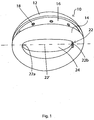
- a piece of jewelry 10 shown in the drawing, it is - by way of example - a finger ring whose appearance can be changed.
- the piece of jewelry 10 comprises two outer annular parts 12, 14 and an inner ring 16.
- the two outer parts 12, 14 are movably connected to each other so that they relative to each other by a limited amount between a first end position ( Fig. 1 to 6 ) and a second end position ( Fig. 7 to 10 ) are pivotable.
- each of the two end positions cover the two outer parts 12, 14, the inner ring 16 on one side of the jewelry ring 10, in the FIGS. 1 to 6 at the bottom of the jewelry ring, while the inner ring 16 is exposed on the opposite side of the jewelry ring 10 between the outer parts 12, 14, so here at the top of the jewelry ring 10 (FIG. Fig. 7 to 10 ).
- the inner ring 16 is preferably designed differently on its opposite sides, which are concealed or exposed during the pivoting of the two outer parts 12, 14.
- the inner ring 16 is occupied on one side with a series of smaller stones 18 which are arranged in the circumferential direction at equal intervals next to each other, while on the opposite side with a single larger stone 20 (FIG. Fig. 8 ) is busy.
- both outer parts 12, 14 By moving the two outer parts 12, 14 in one or the other end position, either the smaller stones 18 are exposed and the larger stone 20 is hidden, as in the FIGS. 1 to 6 shown, or the larger stone 20 exposed and the smaller stones 18 covered, as in the FIGS. 7 to 10 shown.
- both outer parts 12, 14 about a joint 22, which is formed by two hinge elements 22a, 22b, through which a pivot axis 22 'extends, which the jewel 10 or a piece of jewelry 10 enclosed generally circular finger opening 24 passes through diametrically pivotable.
- a piece of jewelry 10 designed as a finger ring is slipped onto a finger or turned around the finger so that the "open" side, on which the inner ring 16 is exposed, faces the back of the hand, while the "closed” side, on which the inner ring 16 is completely covered by the outer parts 12, 14, towards the palm faces. If required, however, the jewelry ring 10 can also be rotated to a position in which the closed side to the back of the hand.
- the two outer parts 12, 14 are arranged in the axial direction of the finger opening 24 side by side on opposite sides of a median plane 26 of the jewelry ring 10, wherein they are preferably arranged mirror-symmetrically in each of the two end positions to the median plane 26.
- each of the two outer parts 12, 14 has an outer surface 28, which preferably leads to a plane 30 (FIG. Fig. 5 ) is mirror symmetric
- each of the two outer parts 12, 14 on two flat stop surfaces 32, 34 which extend along the inner and outer circumference of the two outer parts 12, 14 each over an angle of preferably 180 °.
- the abutment surfaces 32, 34 of each of the two outer parts 12, 14 span two planes that intersect along the pivot axis 22 and together form an obtuse angle of - in the embodiment described here - 162 °.
- the other of the two stop surfaces 32, 34 with the opposite stop surface 32, 34 of the respective other outer part 14, 12 delimits a lens-shaped gap 40 in plan view.
- lens-shaped gap 40 on the outer circumference of the two outer parts 12, 14 of the outer circumference of the inner ring 16 is visible, facing away from the pivot axis 22, occupied with the stone 20 and the stones 18 peripheral portions are preferably slightly widened, so that they themselves extend radially inwardly from an outer boundary wall 42 of the outer parts 12, 14 over the entire width of the lens-shaped gap 40.
- the two outer parts 12, 14 have along their circumference a channel-shaped cross-section which is open to the other outer part 14, 12 and after the assembly of the jewelry ring 10 together with the channel-shaped cross-section of the other outer part 14, 12 defines a cavity 44 in which the inner ring 16 is housed.
- the outer diameter of the inner ring 16 is slightly smaller than the inner diameter of the outer boundary walls 42 (see FIGS. 11 to 13 ) of the two hollow outer parts 12, 14, so that they can move during pivoting to the mutual abutment of the stop surfaces 32 and 34 over the outer circumference of the inner ring 16 of time.
- the width of the cavity 44 and the inner ring 16 are adapted to each other in the axial direction of the finger opening 24, so that the inner ring 16 fits into the cavity 44 on the closed side.
- the outer boundary walls 42 of the two outer parts 12, 14 preferably have the same outer diameter, so that their outer peripheral surfaces on the closed side of the jewelry ring 10 adjoin each other steplessly and there is a compact, preferably paragraph-free appearance.
- each of the two joint elements 22a, 22b forming the joint 22 has two projections 50a, 50b which extend from the outer boundary wall 42 or the inner boundary wall 46 of the first outer part 12 and have a passage opening 51, by a bolt 52 is pushed through.
- the distance between the two projections 50a, 50b of each hinge element 22a, 22b is dimensioned such that a projection 50c of the second outer part 14, which extends from the bottom of the channel-shaped cross section, between the projections 50a, 50b is inserted.
- the projection 50c has a passage opening 51 for the bolt 52.
- the inner ring 16 has on opposite sides in each case a recess 53a or 53b, in which the projections 50a, 50b of each hinge element 22a, 22b are rotatably receivable.
- each hinge element 22a, 22b are first introduced into their associated recess 53a, 53b. Then, between these protrusions 50a, 50b of each hinge member 22a, 22b, the corresponding protrusion 50c of the second outer member 14 is inserted, and a bolt 52 is inserted through the aligned through holes 51 of the protrusions 50a, 50b and 50c and the inner ring 16 to form the pivot axis of the hinge 22 introduced.
- the thus formed jewelry ring 10 is thus of his in the FIGS. 1 to 6 shown in the first end position in which its top is open and its underside - preferably completely closed - in which in the FIGS. 6 to 10 shown second end position in which its top - preferably completely - closed and the bottom is open, pivotable.
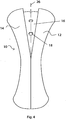
- the "automatic" fixation of the jewel 10 described below be realized in each of its two settings: in addition to the inner ring 16 and radially inwardly thereof, the cavity 44 bounded by the two outer parts 12, 14 houses a spring 62 which the two outer parts 12, 14 connects with each other.
- the spring 62 has for this purpose two ends 62 ', 62 "with recesses 62a' and 62b ', wherein the first end 62' of the spring 62 on the first outer part 12 and the second end 62" is articulated on the second outer part 14.
- both the first outer part 12 and the second outer part 14 each have a projection 60a or 60b whose end 60a 'or 60b' is shaped in such a way that one end 62 'or 62 "of the one here designed as meandering Flat spring trained spring 62 can attack mobile.
- the spring 62 is designed such that it is partially tensioned when the piece of jewelry 10 is in its first or in its second end position. Its greatest stress has it when the two outer parts 12, 14 are each in the middle of their Verschwenkweges from the first to the second end position. In this way it is achieved, on the one hand, that in each of the two end positions of the outer parts 12, 14 of the piece of jewelry 10, these are adequately fixed in the respective end position. For pivoting these two outer parts 12, 14 in their respective other end position of the support of the jewelry ring 10, a certain force must be applied to this, in order to compress the spring 62, so that by this measure in an advantageous manner inadvertent pivoting of the Exterior parts 12, 14 is counteracted.
- the spring 62 Since the spring 62 is also partially clamped in its two end positions, it is achieved that the spring 62 is held between the two projections 60a, 60b of the outer parts 12, 14 by their spring force which can be acted upon by these projections 60a, 60b, without the need for further devices for this purpose , This simplifies the construction of this device, which is particularly important for small pieces of jewelry such as finger rings, because in these only a limited space is available.
- the inner ring 16 for receiving the spring 62 has a recess 65 which extends in the circumferential direction of the inner ring 16.
- the center of the recess 65 has an angular distance of about 90 ° from the pivot axis 22 '.
- the length of the recess in the circumferential direction is dimensioned such that the spring 62 together with the acted upon by her ends 60a ', 60b' of the projections 60a, 60b of the outer parts 12, 14 can pass through this recess 65: As from FIG. 5 can be seen, located in the FIGS.
- the configuration of the recess 65 must be such that it the movement these components with a pivoting of the Au ⁇ enmaschine 12, 14 allowed.
- the spring 62 is inserted into the recess 65 and its end 62 "is seated on the end 60b 'of the projection 60b, then the end 62' of the spring 62 is placed on the end 60a 'of the projection 60a of the first outer part 12, the projections 50c of the second outer member 14 are inserted between the protrusions 50a, 50b, and the bolt 52 is pushed through the through-holes 51 of the protrusions 50a, 50b and 50c and the inner ring 16.
- the outer part 12 has two diametrically opposite centering elements 66a, 66b, which cooperate with corresponding centering elements 66a ', 66b' of the second outer part 14.
- the centering elements 66a, 66a ' are arranged in an angular range of approximately 90 ° to the pivot axis 22', the same applies to the located on the opposite side of the outer parts 12, 14 centering elements 66b, 66b '.
- These centering elements 66a, 66a 'and 66b, 66b' serve to fix the inner ring 16 in a central position by the centering elements located on the closed side of the jewelry piece 10 act on the inner ring 16.
- the centering elements 66b, 66b ' act upon the inner ring 16, while in the second end position the inner ring 16 is acted upon by the centering elements 66a, 66a'.
Landscapes
- Adornments (AREA)
Claims (15)
- Pièce décorative (10) comprenant deux parties extérieures (12, 14) de forme annulaire reliées entre elles, lesquelles entourent une ouverture de passage (24) et peuvent être pivotées entre deux positions finales l'une par rapport à l'autre autour d'un axe de pivotement (22') traversant l'ouverture de passage (24) en modifiant l'apparence extérieure de la pièce décorative (10), caractérisée en ce que les deux parties (12, 14) se déplacent, lors du pivotement dans chacune des deux positions finales, de manière à s'écarter l'une de l'autre au niveau d'un côté de la pièce décorative (10) et conjointement au niveau d'un côté opposé.
- Pièce décorative selon la revendication 1, caractérisée en ce que les deux parties extérieures (12, 14) sont disposées de manière juxtaposée dans deux positions finales et sur des côtés opposés d'un plan médian (26), formé par l'axe de pivotement (22'), de la pièce décorative (10) sans se croiser.
- Pièce décorative selon la revendication 1 ou 2, caractérisée en ce que les deux parties extérieures (12, 14) sont mobiles autour d'une articulation (22) présentant deux éléments d'articulation (22a, 22b).
- Pièce décorative selon l'une quelconque des revendications 1 à 3, caractérisée par un anneau intérieur (16) disposé entre les deux parties extérieures (12, 14), lequel est caché au moins en partie dans chacune des deux positions finales au niveau d'un côté de la pièce décorative (10) par les deux parties extérieures (12, 14) et qui est dégagé au moins en partie au niveau de l'autre côté de la pièce décorative (10).
- Pièce décorative selon l'une quelconque des revendications 1 à 4, caractérisée en ce que l'anneau intérieur (16) est configuré différemment au niveau de deux côtés diamétralement opposés, qui sont cachés ou dégagés lors du pivotement des deux parties extérieures (12, 14).
- Pièce décorative selon l'une quelconque des revendications 3 à 5, caractérisée en ce que les deux parties extérieures (12, 14) présentent respectivement une section transversale de forme annulaire ouverte en direction de l'autre partie.
- Pièce décorative selon l'une quelconque des revendications précédentes, caractérisée en ce qu'au moins un élément d'articulation (22a, 22b) de l'articulation (22) reliant les deux parties extérieures (12, 14) présente deux parties faisant saillie (50a, 50b) disposées à distance l'une de l'autre au niveau de la première partie extérieure (12) et une partie faisant saillie (50c) disposée au niveau de l'autre partie extérieure (14), sachant que la partie faisant saillie (50c) de la deuxième partie extérieure (14) est enfilée entre les deux parties faisant saillie (50a, 50b) de la première partie extérieure (12) et sachant qu'un tourillon (52) traversant des ouvertures de passage (51) alignées les unes avec les autres des trois parties faisant saillie (50a, 50b, 50c) est prévu.
- Pièce décorative selon l'une quelconque des revendications précédentes, caractérisée en ce que l'anneau intérieur (16) présente au moins un évidement (53a, 53b), dans lequel un élément d'articulation (22a ou 22b) de l'articulation (22) peut être logé de manière à pouvoir tourner.
- Pièce décorative selon l'une quelconque des revendications précédentes, caractérisée en ce que les deux parties extérieures (12, 14) présentent des deux côtés de l'axe de pivotement (22') des surfaces de butée (32, 34) planes se faisant face par paire, lesquelles forment un plan s'étendant à travers l'axe de pivotement (22') et viennent buter l'une contre l'autre dans l'une des deux positions finales.
- Pièce décorative selon l'une quelconque des revendications précédentes, caractérisée en ce que les surfaces de butée (32 ou 34) se faisant face par paire s'étendent au niveau de chaque côté de la pièce décorative (10) sur un angle périphérique pouvant aller jusqu'à 180°.
- Pièce décorative selon l'une quelconque des revendications précédentes, caractérisée en ce que des surfaces périphériques extérieures des deux parties extérieures (12, 14) se jouxtent les unes les autres sans retrait dans chacune des deux positions finales au niveau d'un côté de la pièce décorative (10).
- Pièce décorative selon l'une quelconque des revendications précédentes, caractérisée par au moins un ressort (62), qui fixe les deux parties extérieures (12, 14) dans au moins une des deux positions finales, sachant que de préférence une première extrémité (62') du ressort (62) est articulée au niveau de la première partie extérieure (12) et qu'une deuxième extrémité (62") est articulée au niveau de la deuxième partie extérieure (14) de la pièce décorative (10).
- Pièce décorative selon la revendication 12, caractérisée en ce que le ressort (62) est réalisé de telle manière que sa force de ressort est inférieure dans au moins un des deux positions finales des parties extérieures (12, 14) à celle dans une position intermédiaire dans laquelle les deux parties extérieures (12, 14) se trouvent dans une position entre les deux positions finales.
- Pièce décorative selon l'une quelconque des revendications précédentes, caractérisée en ce qu'au moins une des deux parties extérieures (12, 14) présente une partie faisant saillie (60a, 60b), au niveau de laquelle une extrémité (62', 62") du ressort (62) commence de manière mobile.
- Pièce décorative selon l'une quelconque des revendications 12 à 14, caractérisée en ce que le ressort (62) est un ressort plat en zigzag, dont les extrémités (62', 62") opposées sont reliées respectivement de manière articulée à l'une des deux parties extérieures (12, 14).
Applications Claiming Priority (2)
| Application Number | Priority Date | Filing Date | Title |
|---|---|---|---|
| DE201320011632 DE202013011632U1 (de) | 2013-12-12 | 2013-12-12 | Schmuckstück mit zwei unter Veränderung des Erscheinungsbildes schwenkbar miteinander verbundenen Teilen |
| DE102013022205.2A DE102013022205A1 (de) | 2013-12-12 | 2013-12-12 | Schmuckstück mit zwei unter Veränderung des Erscheinungsbildes schwenkbar miteinander verbundenen Teilen |
Publications (2)
| Publication Number | Publication Date |
|---|---|
| EP2883473A1 EP2883473A1 (fr) | 2015-06-17 |
| EP2883473B1 true EP2883473B1 (fr) | 2016-04-13 |
Family
ID=52102357
Family Applications (1)
| Application Number | Title | Priority Date | Filing Date |
|---|---|---|---|
| EP14004170.8A Not-in-force EP2883473B1 (fr) | 2013-12-12 | 2014-12-11 | Pièce décorative dotée de deux parties reliées pivotant entre elles pour modifier son aspect extérieur |
Country Status (1)
| Country | Link |
|---|---|
| EP (1) | EP2883473B1 (fr) |
Family Cites Families (10)
| Publication number | Priority date | Publication date | Assignee | Title |
|---|---|---|---|---|
| US1565651A (en) * | 1924-04-30 | 1925-12-15 | Klass Martin | Changeable finger ring |
| US1830929A (en) | 1927-12-10 | 1931-11-10 | Cohen Michael | Wedding ring |
| US1936604A (en) | 1932-10-19 | 1933-11-28 | Moldenhauer Eric | Wedding ring |
| DE7143314U (de) | 1971-11-17 | 1972-02-17 | Robertz D | Arm- oder ringschmuckstueck mit verschwenkbaren teilen |
| FR2679111B1 (fr) * | 1991-07-17 | 1994-09-30 | Nahum Aimee | Bijou polyvalent formant attache pour foulard, echarpe et similaire. |
| FR2715806B1 (fr) | 1994-02-04 | 1996-06-07 | Diamant Applic | Bijoux transformables de forme courbe. |
| US5682768A (en) | 1996-04-01 | 1997-11-04 | Chaim Nissenbaum | Jewelry ring with hinged ring segments |
| US6032485A (en) * | 1998-03-10 | 2000-03-07 | Steinberg; Daniel R. | Modifiable jewelry |
| DE602006006168D1 (de) | 2006-07-04 | 2009-05-20 | Swatch Group Man Serv Ag | Schmuckstück mit eimem beweglichen Element |
| DE102009008409A1 (de) * | 2008-12-23 | 2010-12-09 | Jörg Heinz GmbH & Co. KG | Schmuckstück mit schwenkbaren Teilen |
-
2014
- 2014-12-11 EP EP14004170.8A patent/EP2883473B1/fr not_active Not-in-force
Also Published As
| Publication number | Publication date |
|---|---|
| EP2883473A1 (fr) | 2015-06-17 |
Similar Documents
| Publication | Publication Date | Title |
|---|---|---|
| EP2943087B1 (fr) | Bijou en forme d'anneau avec des éléments annulaires mobiles guidés coaxialement | |
| EP0999766B1 (fr) | Bracelet | |
| EP3602709B1 (fr) | Dispositif de guidage de lignes | |
| DE60111702T2 (de) | Kabelführungskette | |
| EP3746665B1 (fr) | Ferrure de meuble | |
| DE69821141T2 (de) | Steifes etui insbesondere für brillen oder ähnliches | |
| DE29711524U1 (de) | Chirurgisches Rohrschaftinstrument | |
| EP3779111A1 (fr) | Dispositif de synchronisation pour déplacer des parties d'un meuble | |
| EP3253993B1 (fr) | Maillon de chaîne et chaîne circulaire munie de maillons | |
| DE102020126201B3 (de) | Friktionsscharnier | |
| DE60000110T2 (de) | Verdecktes Federgelenk für Haarartikel | |
| WO2010072215A1 (fr) | Bijou doté d'éléments rotatifs | |
| EP2883473B1 (fr) | Pièce décorative dotée de deux parties reliées pivotant entre elles pour modifier son aspect extérieur | |
| EP1591034B1 (fr) | Elément de bijouterie ainsi qu'une chaîne formée de tels éléments | |
| EP1209308B1 (fr) | Element d'arret articulé | |
| EP1656512B1 (fr) | Eclisse pour chaine de guidage d'elements de transport d'energie et chaine de guidage d'elements de transport d'energie | |
| EP0906734B1 (fr) | Fermoir pour bijoux | |
| DE9419315U1 (de) | Drehgelenk für Geräteträger | |
| DE102013022205A1 (de) | Schmuckstück mit zwei unter Veränderung des Erscheinungsbildes schwenkbar miteinander verbundenen Teilen | |
| DE202013011632U1 (de) | Schmuckstück mit zwei unter Veränderung des Erscheinungsbildes schwenkbar miteinander verbundenen Teilen | |
| DE102013102662A1 (de) | Armbandschließe | |
| DE20305328U1 (de) | Fingerring | |
| DE102013000436B4 (de) | Ringförmiges Schmuckstück mit geführt beweglichen koaxialen Ringelementen | |
| WO1998054999A1 (fr) | Article de bijouterie | |
| DE202013000291U1 (de) | Ringförmiges Schmuckstück mit geführt beweglichen koaxialen Ringelementen |
Legal Events
| Date | Code | Title | Description |
|---|---|---|---|
| PUAI | Public reference made under article 153(3) epc to a published international application that has entered the european phase |
Free format text: ORIGINAL CODE: 0009012 |
|
| 17P | Request for examination filed |
Effective date: 20150428 |
|
| AK | Designated contracting states |
Kind code of ref document: A1 Designated state(s): AL AT BE BG CH CY CZ DE DK EE ES FI FR GB GR HR HU IE IS IT LI LT LU LV MC MK MT NL NO PL PT RO RS SE SI SK SM TR |
|
| AX | Request for extension of the european patent |
Extension state: BA ME |
|
| GRAP | Despatch of communication of intention to grant a patent |
Free format text: ORIGINAL CODE: EPIDOSNIGR1 |
|
| RIC1 | Information provided on ipc code assigned before grant |
Ipc: A44C 9/00 20060101ALI20150909BHEP Ipc: A44C 5/00 20060101AFI20150909BHEP |
|
| INTG | Intention to grant announced |
Effective date: 20151001 |
|
| GRAS | Grant fee paid |
Free format text: ORIGINAL CODE: EPIDOSNIGR3 |
|
| GRAA | (expected) grant |
Free format text: ORIGINAL CODE: 0009210 |
|
| INTG | Intention to grant announced |
Effective date: 20160218 |
|
| AK | Designated contracting states |
Kind code of ref document: B1 Designated state(s): AL AT BE BG CH CY CZ DE DK EE ES FI FR GB GR HR HU IE IS IT LI LT LU LV MC MK MT NL NO PL PT RO RS SE SI SK SM TR |
|
| REG | Reference to a national code |
Ref country code: GB Ref legal event code: FG4D Free format text: NOT ENGLISH |
|
| REG | Reference to a national code |
Ref country code: AT Ref legal event code: REF Ref document number: 789102 Country of ref document: AT Kind code of ref document: T Effective date: 20160415 Ref country code: CH Ref legal event code: EP |
|
| REG | Reference to a national code |
Ref country code: IE Ref legal event code: FG4D Free format text: LANGUAGE OF EP DOCUMENT: GERMAN |
|
| REG | Reference to a national code |
Ref country code: DE Ref legal event code: R096 Ref document number: 502014000592 Country of ref document: DE |
|
| REG | Reference to a national code |
Ref country code: LT Ref legal event code: MG4D |
|
| REG | Reference to a national code |
Ref country code: NL Ref legal event code: MP Effective date: 20160413 |
|
| PG25 | Lapsed in a contracting state [announced via postgrant information from national office to epo] |
Ref country code: LT Free format text: LAPSE BECAUSE OF FAILURE TO SUBMIT A TRANSLATION OF THE DESCRIPTION OR TO PAY THE FEE WITHIN THE PRESCRIBED TIME-LIMIT Effective date: 20160413 Ref country code: NO Free format text: LAPSE BECAUSE OF FAILURE TO SUBMIT A TRANSLATION OF THE DESCRIPTION OR TO PAY THE FEE WITHIN THE PRESCRIBED TIME-LIMIT Effective date: 20160713 Ref country code: NL Free format text: LAPSE BECAUSE OF FAILURE TO SUBMIT A TRANSLATION OF THE DESCRIPTION OR TO PAY THE FEE WITHIN THE PRESCRIBED TIME-LIMIT Effective date: 20160413 Ref country code: FI Free format text: LAPSE BECAUSE OF FAILURE TO SUBMIT A TRANSLATION OF THE DESCRIPTION OR TO PAY THE FEE WITHIN THE PRESCRIBED TIME-LIMIT Effective date: 20160413 Ref country code: PL Free format text: LAPSE BECAUSE OF FAILURE TO SUBMIT A TRANSLATION OF THE DESCRIPTION OR TO PAY THE FEE WITHIN THE PRESCRIBED TIME-LIMIT Effective date: 20160413 |
|
| PG25 | Lapsed in a contracting state [announced via postgrant information from national office to epo] |
Ref country code: ES Free format text: LAPSE BECAUSE OF FAILURE TO SUBMIT A TRANSLATION OF THE DESCRIPTION OR TO PAY THE FEE WITHIN THE PRESCRIBED TIME-LIMIT Effective date: 20160413 Ref country code: HR Free format text: LAPSE BECAUSE OF FAILURE TO SUBMIT A TRANSLATION OF THE DESCRIPTION OR TO PAY THE FEE WITHIN THE PRESCRIBED TIME-LIMIT Effective date: 20160413 Ref country code: SE Free format text: LAPSE BECAUSE OF FAILURE TO SUBMIT A TRANSLATION OF THE DESCRIPTION OR TO PAY THE FEE WITHIN THE PRESCRIBED TIME-LIMIT Effective date: 20160413 Ref country code: GR Free format text: LAPSE BECAUSE OF FAILURE TO SUBMIT A TRANSLATION OF THE DESCRIPTION OR TO PAY THE FEE WITHIN THE PRESCRIBED TIME-LIMIT Effective date: 20160714 Ref country code: PT Free format text: LAPSE BECAUSE OF FAILURE TO SUBMIT A TRANSLATION OF THE DESCRIPTION OR TO PAY THE FEE WITHIN THE PRESCRIBED TIME-LIMIT Effective date: 20160816 Ref country code: RS Free format text: LAPSE BECAUSE OF FAILURE TO SUBMIT A TRANSLATION OF THE DESCRIPTION OR TO PAY THE FEE WITHIN THE PRESCRIBED TIME-LIMIT Effective date: 20160413 Ref country code: LV Free format text: LAPSE BECAUSE OF FAILURE TO SUBMIT A TRANSLATION OF THE DESCRIPTION OR TO PAY THE FEE WITHIN THE PRESCRIBED TIME-LIMIT Effective date: 20160413 |
|
| REG | Reference to a national code |
Ref country code: FR Ref legal event code: PLFP Year of fee payment: 3 |
|
| PG25 | Lapsed in a contracting state [announced via postgrant information from national office to epo] |
Ref country code: IT Free format text: LAPSE BECAUSE OF FAILURE TO SUBMIT A TRANSLATION OF THE DESCRIPTION OR TO PAY THE FEE WITHIN THE PRESCRIBED TIME-LIMIT Effective date: 20160413 |
|
| REG | Reference to a national code |
Ref country code: DE Ref legal event code: R097 Ref document number: 502014000592 Country of ref document: DE |
|
| PG25 | Lapsed in a contracting state [announced via postgrant information from national office to epo] |
Ref country code: EE Free format text: LAPSE BECAUSE OF FAILURE TO SUBMIT A TRANSLATION OF THE DESCRIPTION OR TO PAY THE FEE WITHIN THE PRESCRIBED TIME-LIMIT Effective date: 20160413 Ref country code: SK Free format text: LAPSE BECAUSE OF FAILURE TO SUBMIT A TRANSLATION OF THE DESCRIPTION OR TO PAY THE FEE WITHIN THE PRESCRIBED TIME-LIMIT Effective date: 20160413 Ref country code: CZ Free format text: LAPSE BECAUSE OF FAILURE TO SUBMIT A TRANSLATION OF THE DESCRIPTION OR TO PAY THE FEE WITHIN THE PRESCRIBED TIME-LIMIT Effective date: 20160413 Ref country code: DK Free format text: LAPSE BECAUSE OF FAILURE TO SUBMIT A TRANSLATION OF THE DESCRIPTION OR TO PAY THE FEE WITHIN THE PRESCRIBED TIME-LIMIT Effective date: 20160413 Ref country code: RO Free format text: LAPSE BECAUSE OF FAILURE TO SUBMIT A TRANSLATION OF THE DESCRIPTION OR TO PAY THE FEE WITHIN THE PRESCRIBED TIME-LIMIT Effective date: 20160413 |
|
| PLBE | No opposition filed within time limit |
Free format text: ORIGINAL CODE: 0009261 |
|
| STAA | Information on the status of an ep patent application or granted ep patent |
Free format text: STATUS: NO OPPOSITION FILED WITHIN TIME LIMIT |
|
| PG25 | Lapsed in a contracting state [announced via postgrant information from national office to epo] |
Ref country code: SM Free format text: LAPSE BECAUSE OF FAILURE TO SUBMIT A TRANSLATION OF THE DESCRIPTION OR TO PAY THE FEE WITHIN THE PRESCRIBED TIME-LIMIT Effective date: 20160413 |
|
| 26N | No opposition filed |
Effective date: 20170116 |
|
| PG25 | Lapsed in a contracting state [announced via postgrant information from national office to epo] |
Ref country code: BE Free format text: LAPSE BECAUSE OF NON-PAYMENT OF DUE FEES Effective date: 20161231 Ref country code: SI Free format text: LAPSE BECAUSE OF FAILURE TO SUBMIT A TRANSLATION OF THE DESCRIPTION OR TO PAY THE FEE WITHIN THE PRESCRIBED TIME-LIMIT Effective date: 20160413 |
|
| REG | Reference to a national code |
Ref country code: IE Ref legal event code: MM4A |
|
| PG25 | Lapsed in a contracting state [announced via postgrant information from national office to epo] |
Ref country code: LU Free format text: LAPSE BECAUSE OF NON-PAYMENT OF DUE FEES Effective date: 20161211 |
|
| PG25 | Lapsed in a contracting state [announced via postgrant information from national office to epo] |
Ref country code: IE Free format text: LAPSE BECAUSE OF NON-PAYMENT OF DUE FEES Effective date: 20161211 |
|
| REG | Reference to a national code |
Ref country code: FR Ref legal event code: PLFP Year of fee payment: 4 |
|
| REG | Reference to a national code |
Ref country code: BE Ref legal event code: MM Effective date: 20161231 |
|
| PG25 | Lapsed in a contracting state [announced via postgrant information from national office to epo] |
Ref country code: HU Free format text: LAPSE BECAUSE OF FAILURE TO SUBMIT A TRANSLATION OF THE DESCRIPTION OR TO PAY THE FEE WITHIN THE PRESCRIBED TIME-LIMIT; INVALID AB INITIO Effective date: 20141211 |
|
| PG25 | Lapsed in a contracting state [announced via postgrant information from national office to epo] |
Ref country code: CY Free format text: LAPSE BECAUSE OF FAILURE TO SUBMIT A TRANSLATION OF THE DESCRIPTION OR TO PAY THE FEE WITHIN THE PRESCRIBED TIME-LIMIT Effective date: 20160413 Ref country code: IS Free format text: LAPSE BECAUSE OF FAILURE TO SUBMIT A TRANSLATION OF THE DESCRIPTION OR TO PAY THE FEE WITHIN THE PRESCRIBED TIME-LIMIT Effective date: 20160413 Ref country code: MK Free format text: LAPSE BECAUSE OF FAILURE TO SUBMIT A TRANSLATION OF THE DESCRIPTION OR TO PAY THE FEE WITHIN THE PRESCRIBED TIME-LIMIT Effective date: 20160413 |
|
| PG25 | Lapsed in a contracting state [announced via postgrant information from national office to epo] |
Ref country code: BG Free format text: LAPSE BECAUSE OF FAILURE TO SUBMIT A TRANSLATION OF THE DESCRIPTION OR TO PAY THE FEE WITHIN THE PRESCRIBED TIME-LIMIT Effective date: 20160413 |
|
| PG25 | Lapsed in a contracting state [announced via postgrant information from national office to epo] |
Ref country code: MT Free format text: LAPSE BECAUSE OF FAILURE TO SUBMIT A TRANSLATION OF THE DESCRIPTION OR TO PAY THE FEE WITHIN THE PRESCRIBED TIME-LIMIT Effective date: 20160413 |
|
| PG25 | Lapsed in a contracting state [announced via postgrant information from national office to epo] |
Ref country code: TR Free format text: LAPSE BECAUSE OF FAILURE TO SUBMIT A TRANSLATION OF THE DESCRIPTION OR TO PAY THE FEE WITHIN THE PRESCRIBED TIME-LIMIT Effective date: 20160413 Ref country code: AL Free format text: LAPSE BECAUSE OF FAILURE TO SUBMIT A TRANSLATION OF THE DESCRIPTION OR TO PAY THE FEE WITHIN THE PRESCRIBED TIME-LIMIT Effective date: 20160413 |
|
| PGFP | Annual fee paid to national office [announced via postgrant information from national office to epo] |
Ref country code: IT Payment date: 20190131 Year of fee payment: 7 |
|
| PGFP | Annual fee paid to national office [announced via postgrant information from national office to epo] |
Ref country code: GB Payment date: 20181211 Year of fee payment: 5 |
|
| PG25 | Lapsed in a contracting state [announced via postgrant information from national office to epo] |
Ref country code: MC Free format text: LAPSE BECAUSE OF NON-PAYMENT OF DUE FEES Effective date: 20200102 |
|
| GBPC | Gb: european patent ceased through non-payment of renewal fee |
Effective date: 20191211 |
|
| PG25 | Lapsed in a contracting state [announced via postgrant information from national office to epo] |
Ref country code: GB Free format text: LAPSE BECAUSE OF NON-PAYMENT OF DUE FEES Effective date: 20191211 |
|
| PGFP | Annual fee paid to national office [announced via postgrant information from national office to epo] |
Ref country code: FR Payment date: 20201218 Year of fee payment: 7 |
|
| REG | Reference to a national code |
Ref country code: AT Ref legal event code: MM01 Ref document number: 789102 Country of ref document: AT Kind code of ref document: T Effective date: 20191211 |
|
| PGFP | Annual fee paid to national office [announced via postgrant information from national office to epo] |
Ref country code: CH Payment date: 20210118 Year of fee payment: 7 |
|
| PG25 | Lapsed in a contracting state [announced via postgrant information from national office to epo] |
Ref country code: AT Free format text: LAPSE BECAUSE OF NON-PAYMENT OF DUE FEES Effective date: 20191211 |
|
| REG | Reference to a national code |
Ref country code: CH Ref legal event code: PL |
|
| PG25 | Lapsed in a contracting state [announced via postgrant information from national office to epo] |
Ref country code: FR Free format text: LAPSE BECAUSE OF NON-PAYMENT OF DUE FEES Effective date: 20211231 |
|
| PG25 | Lapsed in a contracting state [announced via postgrant information from national office to epo] |
Ref country code: LI Free format text: LAPSE BECAUSE OF NON-PAYMENT OF DUE FEES Effective date: 20211231 Ref country code: CH Free format text: LAPSE BECAUSE OF NON-PAYMENT OF DUE FEES Effective date: 20211231 |
|
| PGFP | Annual fee paid to national office [announced via postgrant information from national office to epo] |
Ref country code: DE Payment date: 20221130 Year of fee payment: 9 |
|
| REG | Reference to a national code |
Ref country code: DE Ref legal event code: R119 Ref document number: 502014000592 Country of ref document: DE |
|
| PG25 | Lapsed in a contracting state [announced via postgrant information from national office to epo] |
Ref country code: DE Free format text: LAPSE BECAUSE OF NON-PAYMENT OF DUE FEES Effective date: 20240702 |
|
| PG25 | Lapsed in a contracting state [announced via postgrant information from national office to epo] |
Ref country code: DE Free format text: LAPSE BECAUSE OF NON-PAYMENT OF DUE FEES Effective date: 20240702 |