EP2885294B1 - Synthèse d'un composé antiviral - Google Patents
Synthèse d'un composé antiviral Download PDFInfo
- Publication number
- EP2885294B1 EP2885294B1 EP13750249.8A EP13750249A EP2885294B1 EP 2885294 B1 EP2885294 B1 EP 2885294B1 EP 13750249 A EP13750249 A EP 13750249A EP 2885294 B1 EP2885294 B1 EP 2885294B1
- Authority
- EP
- European Patent Office
- Prior art keywords
- compound
- formula
- salt
- reaction conditions
- hydroxy
- Prior art date
- Legal status (The legal status is an assumption and is not a legal conclusion. Google has not performed a legal analysis and makes no representation as to the accuracy of the status listed.)
- Active
Links
- 0 CC(C)(C)C#Cc1cc(*)c[s]1 Chemical compound CC(C)(C)C#Cc1cc(*)c[s]1 0.000 description 3
- IWYDHOAUDWTVEP-ZETCQYMHSA-N O[C@H](C(O)=O)c1ccccc1 Chemical compound O[C@H](C(O)=O)c1ccccc1 IWYDHOAUDWTVEP-ZETCQYMHSA-N 0.000 description 3
- BNXOTSSBZYKIOR-NSHDSACASA-N OC(CO[C@@H]1COCC1)(CC1)CCC11OCCO1 Chemical compound OC(CO[C@@H]1COCC1)(CC1)CCC11OCCO1 BNXOTSSBZYKIOR-NSHDSACASA-N 0.000 description 2
- MUICUPWICXUNRS-UVXQUXCMSA-N CC(C)(C)C#Cc1cc(N(C(CC2)CCC2(CO[C@@H]2COCC2)O)C([C@H]2CC=C(C)CC2)=O)c(C(O)=O)[s]1 Chemical compound CC(C)(C)C#Cc1cc(N(C(CC2)CCC2(CO[C@@H]2COCC2)O)C([C@H]2CC=C(C)CC2)=O)c(C(O)=O)[s]1 MUICUPWICXUNRS-UVXQUXCMSA-N 0.000 description 1
- PBHDKTDQIWOYAN-HFYXNAFRSA-N CC(C)(C)C#Cc1cc(N([C@H](CC2)CC[C@@]2(CO[C@@H]2COCC2)O)C([C@H]2CC=C(C)CC2)=O)c[s]1 Chemical compound CC(C)(C)C#Cc1cc(N([C@H](CC2)CC[C@@]2(CO[C@@H]2COCC2)O)C([C@H]2CC=C(C)CC2)=O)c[s]1 PBHDKTDQIWOYAN-HFYXNAFRSA-N 0.000 description 1
- WQLRCPZVDGDNMG-DJPFJPOOSA-N CC(C)(C)C#Cc1cc(N[C@H](CC2)CC[C@@]2(CO[C@@H]2COCC2)O)c[s]1 Chemical compound CC(C)(C)C#Cc1cc(N[C@H](CC2)CC[C@@]2(CO[C@@H]2COCC2)O)c[s]1 WQLRCPZVDGDNMG-DJPFJPOOSA-N 0.000 description 1
- SBYIFZOVXWAWGW-DDAAKYIKSA-N CC(C)(C)C#Cc1cc(N[C@H]2CC[C@H](C/[O]=C/C3COCC3)CC2)c[s]1 Chemical compound CC(C)(C)C#Cc1cc(N[C@H]2CC[C@H](C/[O]=C/C3COCC3)CC2)c[s]1 SBYIFZOVXWAWGW-DDAAKYIKSA-N 0.000 description 1
- MCTWTZJPVLRJOU-UHFFFAOYSA-N C[n]1cncc1 Chemical compound C[n]1cncc1 MCTWTZJPVLRJOU-UHFFFAOYSA-N 0.000 description 1
- MSFVSBMMZSWLBY-GARJFASQSA-N N[C@H](CC1)CC[C@@]1(CO[C@@H]1COCC1)O Chemical compound N[C@H](CC1)CC[C@@]1(CO[C@@H]1COCC1)O MSFVSBMMZSWLBY-GARJFASQSA-N 0.000 description 1
- QKYYHZBBEIYCFD-JTQLQIEISA-N OC(CO[C@@H]1COCC1)(CC1)CCC1=O Chemical compound OC(CO[C@@H]1COCC1)(CC1)CCC1=O QKYYHZBBEIYCFD-JTQLQIEISA-N 0.000 description 1
- XDPCNPCKDGQBAN-BYPYZUCNSA-N O[C@@H]1COCC1 Chemical compound O[C@@H]1COCC1 XDPCNPCKDGQBAN-BYPYZUCNSA-N 0.000 description 1
- HCGAAOAATPPEBV-GARJFASQSA-N O[C@](CO[C@@H]1COCC1)(CC1)CC[C@H]1N=O Chemical compound O[C@](CO[C@@H]1COCC1)(CC1)CC[C@H]1N=O HCGAAOAATPPEBV-GARJFASQSA-N 0.000 description 1
- MCVBVAPTGGQOHY-OKZBNKHCSA-N O[C@](CO[C@@H]1COCC1)(CC1)CC[C@H]1NCc1ccccc1 Chemical compound O[C@](CO[C@@H]1COCC1)(CC1)CC[C@H]1NCc1ccccc1 MCVBVAPTGGQOHY-OKZBNKHCSA-N 0.000 description 1
- SJKXQFONCFQTTL-UHFFFAOYSA-N [O-]CC(CC1)(CCC1=O)C=O Chemical compound [O-]CC(CC1)(CCC1=O)C=O SJKXQFONCFQTTL-UHFFFAOYSA-N 0.000 description 1
- OHVWOEYERGPGCW-GARJFASQSA-N [O-][N+]([C@H](CC1)CC[C@@]1(CO[C@@H]1COCC1)O)=O Chemical compound [O-][N+]([C@H](CC1)CC[C@@]1(CO[C@@H]1COCC1)O)=O OHVWOEYERGPGCW-GARJFASQSA-N 0.000 description 1
Classifications
-
- C—CHEMISTRY; METALLURGY
- C07—ORGANIC CHEMISTRY
- C07D—HETEROCYCLIC COMPOUNDS
- C07D409/00—Heterocyclic compounds containing two or more hetero rings, at least one ring having sulfur atoms as the only ring hetero atoms
- C07D409/02—Heterocyclic compounds containing two or more hetero rings, at least one ring having sulfur atoms as the only ring hetero atoms containing two hetero rings
- C07D409/12—Heterocyclic compounds containing two or more hetero rings, at least one ring having sulfur atoms as the only ring hetero atoms containing two hetero rings linked by a chain containing hetero atoms as chain links
-
- C—CHEMISTRY; METALLURGY
- C07—ORGANIC CHEMISTRY
- C07D—HETEROCYCLIC COMPOUNDS
- C07D307/00—Heterocyclic compounds containing five-membered rings having one oxygen atom as the only ring hetero atom
- C07D307/02—Heterocyclic compounds containing five-membered rings having one oxygen atom as the only ring hetero atom not condensed with other rings
- C07D307/04—Heterocyclic compounds containing five-membered rings having one oxygen atom as the only ring hetero atom not condensed with other rings having no double bonds between ring members or between ring members and non-ring members
- C07D307/18—Heterocyclic compounds containing five-membered rings having one oxygen atom as the only ring hetero atom not condensed with other rings having no double bonds between ring members or between ring members and non-ring members with hetero atoms or with carbon atoms having three bonds to hetero atoms with at the most one bond to halogen, e.g. ester or nitrile radicals, directly attached to ring carbon atoms
- C07D307/20—Oxygen atoms
Definitions
- the present disclosure relates generally to the field of organic synthetic methodology for the preparation of Flaviviridae virus inhibitor compounds and their synthetic intermediates.
- Viruses comprising the Flaviviridae family include at least three distinguishable genera including pestiviruses , flaviviruses , and hepaciviruses ( Calisher, et al., J. Gen. Virol., 1993, 70, 37-43 ). While pestiviruses , such as bovine viral diarrhea virus (BVDV), classical swine fever virus (CSFV, hog cholera) and border disease virus (BDV), cause many economically important animal diseases, their importance in human disease is less well characterized ( Moennig, V., et al., Adv. Vir. Res. 1992, 48, 53-98 ).
- BVDV bovine viral diarrhea virus
- CSFV classical swine fever virus
- BDV border disease virus
- Flaviviruses are responsible for important human diseases such as dengue fever and yellow fever while hepaciviruses cause hepatitis C virus infections in humans.
- Other important viral infections caused by the Flaviviridae family include West Nile virus (WNV) Japanese encephalitis virus (JEV), tick-borne encephalitis virus, Junjin virus, Murray Valley encephalitis, St. Louis encephalitis, Omsk hemorrhagic fever virus and Zika virus.
- Flaviviridae virus infections cause significant mortality, morbidity and economic losses throughout the world.
- compounds with anti- Flaviviridae virus activity have been disclosed, none of these are currently clinically approved antiviral therapeutics. Therefore, there remains a need to develop effective treatments for Flaviviridae virus infections.
- Suitable compounds for the treatment of Flaviviridae virus infections are disclosed in WO 2011/088345 , including the compound of Formula I as described herein.
- the present disclosure provides in one embodiment a process for making a compound of Formula I: named 5-(3,3-dimethylbutyn-1-yl)-3-[(cis-4-hydroxy-4- ⁇ [(3S)-tetrahydrofuran-3-yloxy]methyl ⁇ cyclohexyl) ⁇ [(1R)-4-methylcyclohex-3-en-1-yl]carbonyl ⁇ amino]thiophene-2-carboxylic acid, or a pharmaceutically acceptable salt or ester thereof.
- the compound of Formula I is known to be effective in the treatment of Flaviviridae virus infections ( WO 2011/088345 ). Accordingly, a process suitable for its production of a large scale is disclosed herein. Specifically, the process disclosed herein provides the compound of Formula I without the use of protecting groups on the late stage intermediates and under mild reaction conditions such that the stereochemical integrity of the reagents and/or products is maintained.
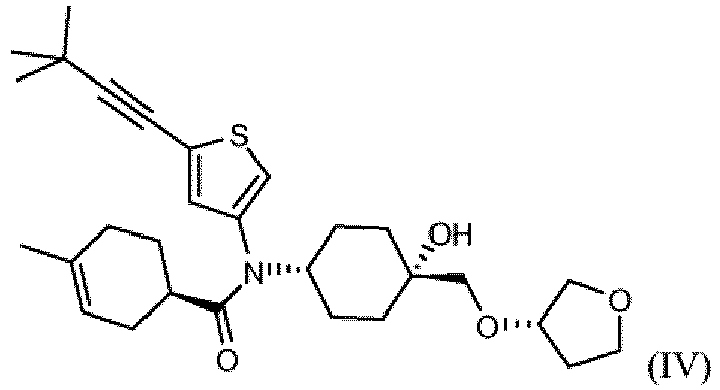
- the process disclosed herein comprises contacting a compound of Formula IV, named 5-(3,3-dimethylbutyn-1-yl)-3-[(cis-4-hydroxy-4- ⁇ [(3S)-tetrahydroiuran-3-yloxy]methyl ⁇ cyclohexyl) ⁇ [(1R)-4-methylcyclohex-3-en-1-yl]carbonyl ⁇ amino]thiophene, or a salt thereof: with a base in the presence of CO 2 under carboxylation reaction conditions to provide the compound of Formula I or a pharmaceutically acceptable salt or ester thereof.
- the present disclosure provides a process for making a compound of Formula IV: named 5-(3,3-dimethylbutyn-1-yl)-3-[(cis-4-hydroxy-4- ⁇ [(3S)-tetrahydrofuran-3-yloxy]methyl ⁇ cyclohexyl) ⁇ [(1R)-4-methylcyclohex-3-en-1-yl]carbonyl ⁇ amino]thiophene, or a salt thereof, comprising contacting a compound of Formula III, named 5-(3,3-dimethylbutyn-1-yl)-3-[(cis-4-hydroxy-4- ⁇ [(3S)-tetrahydrofuran-3-yloxy]methyl ⁇ cyclohexyl)amino]thiophene, or a salt thereof, with a compound of Formula XI: wherein:
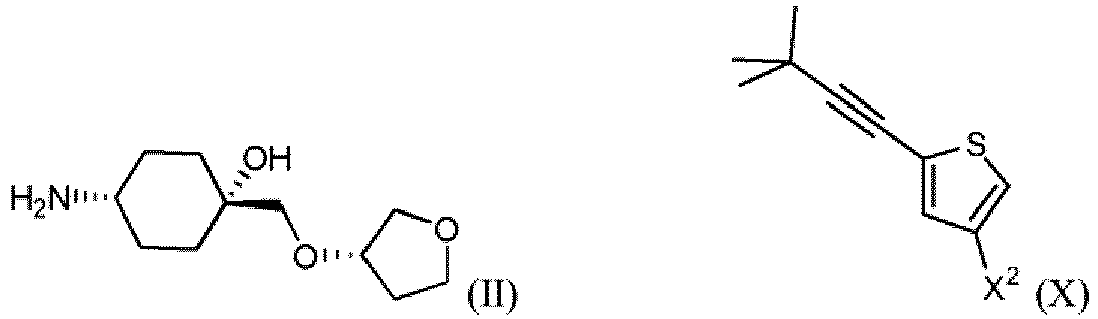
- the present disclosure provides a process for making a compound of Formula III: named 5-(3,3-dimethylbutyn-1-yl)-3-[(cis-4-hydroxy-4- ⁇ [(3S)-tetrahydrofuran-3-yloxy]methyl ⁇ cyclohexyl)amino]thiophene, or a salt thereof, comprising contacting a compound of Formula II, named (cis-4-hydroxy-4- ⁇ [(3S)-tetrahydrofuran-3-yloxy]methyl ⁇ cyclohexyl)amine, or a salt thereof, or a salt thereof with a compound of Formula X: wherein:
- the present disclosure provides a compound of Formula III: named 5-(3,3-dimethylbutyn-1-yl)-3-[(cis-4-hydroxy-4- ⁇ [(3S)-tetrahydrofuran-3-yloxy]methyl ⁇ cyclohexyl)amino]thiophene, or a salt thereof.
- the present disclosure provides a compound of Formula IV: named 5-(3,3-dimethylbutyn-1-yl)-3-[(cis-4-hydroxy-4- ⁇ [(3S)-tetrahydrofuran-3-yloxy]methyl ⁇ cyclohexyl) ⁇ [(1R)-4-methylcyclohex-3-en-1-yl]carbonyl ⁇ amino]thiophene, or a salt thereof.
- the present disclosure provides a compound of Formula V: named 5-(3,3-dimethylbutyn-1-yl)-3-[(cis-4-hydroxy-4- ⁇ [(3S)-tetrahydrofuran-3-yloxy]methyl ⁇ cyclohexyl) ⁇ [(1R)-4-methylcyclohex-3-en-1-yl]carbonyl ⁇ amino]thiophene metal salt, wherein each M is independently a metal.
- the present disclosure provides a compound of Formula II: named (cis-4-hydroxy-4- ⁇ [(3S)-tetrahydrofuran-3-yloxy]methyl ⁇ cyclohexyl)amine, or a salt thereof.
- alkyl refers to a straight or branched chain, saturated hydrocarbon having the indicated number of carbon atoms.
- (C 1 -C 8 )alkyl is meant to include, but is not limited to methyl, ethyl, propyl, isopropyl, butyl, sec -butyl, tert- butyl, pentyl, isopentyl, neopentyl, hexyl, isohexyl, and neohexyl.
- An alkyl group can be unsubstituted or optionally substituted with one or more substituents as described herein throughout.
- substituted alkyl refers to:
- alkylene refers to a diradical of a branched or unbranched saturated hydrocarbon chain, in some embodiments, having from 1 to 20 carbon atoms (e.g. 1-10 carbon atoms or 1, 2, 3, 4, 5 or 6 carbon atoms). This term is exemplified by groups such as methylene (-CH 2 -), ethylene (-CH 2 CH 2 -), the propylene isomers (e.g., -CH 2 CH 2 CH 2 - and -CH(CH 3 )CH 2 -), and the like.
- aralkyl refers to an aryl group covalently linked to an alkylene group, where aryl and alkylene are defined herein.
- Optionally substituted aralkyl refers to an optionally substituted aryl group covalently linked to an optionally substituted alkylene group.
- Such aralkyl groups are exemplified by benzyl, phenylethyl, 3-(4-methoxyphenyl)propyl, and the like.
- aralkyloxy refers to the group -O-aralkyl.
- Optionally substituted aralkyloxy refers to an optionally substituted aralkyl group covalently linked to an optionally substituted alkylene group.
- Such aralkyl groups are exemplified by benzyloxy, phenylethyloxy, and the like.
- alkenyl refers to a monoradical of a branched or unbranched unsaturated hydrocarbon group having from 2 to 20 carbon atoms (in some embodiments, from 2 to 10 carbon atoms, e.g. 2 to 6 carbon atoms) and having from 1 to 6 carbon-carbon double bonds, e.g. 1, 2 or 3 carbon-carbon double bonds.
- lower alkenyl refers to alkenyl as defined above having from 2 to 6 carbon atoms.
- substituted alkenyl refers to an alkenyl group as defined above having 1 to 5 substituents (in some embodiments, 1, 2 or 3 substituents) as defined for substituted alkyl.
- alkynyl refers to a monoradical of an unsaturated hydrocarbon, in some embodiments, having from 2 to 20 carbon atoms (in some embodiments, from 2 to 10 carbon atoms, e.g. 2 to 6 carbon atoms) and having from 1 to 6 carbon-carbon triple bonds e.g. 1, 2 or 3 carbon-carbon triple bonds.
- alkynyl groups include ethynyl (-C ⁇ CH), propargyl (or propynyl, i.e. -C ⁇ CCH 3 ), and the like.
- substituted alkynyl refers to an alkynyl group as defined above having 1 to 5 substituents (in some embodiments, 1,2 or 3 substituents) as defined for substituted alkyl.
- hydroxy or "hydroxyl” refers to a group -OH.
- alkoxy refers to the group -O-R, where R is alkyl or -Y-Z, in which Y is alkylene and Z is alkenyl or alkynyl, where alkyl, alkenyl and alkynyl are as defined herein.
- alkoxy groups are alkyl-O- and includes, by way of example, methoxy, ethoxy, n-propoxy, iso-propoxy, n-butoxy, tert-butoxy, sec-butoxy, n-pentoxy, n-hexyloxy, 1,2-dimethylbutoxy, and the like.
- cycloalkyl refers to cyclic alkyl groups of from 3 to 20 carbon atoms having a single cyclic ring or multiple condensed rings.
- Such cycloalkyl groups include, by way of example, single ring structures such as cyclopropyl, cyclobutyl, cyclopentyl, cyclooctyl and the like or multiple ring structures such as adamantanyl and bicyclo[2.2.1]heptanyl or cyclic alkyl groups to which is fused an aryl group, for example indanyl, and the like, provided that the point of attachment is through the cyclic alkyl group.
- cycloalkenyl refers to cyclic alkyl groups of from 3 to 20 carbon atoms having a single cyclic ring or multiple condensed rings and having at least one double bond and in some embodiments, from 1 to 2 double bonds.
- substituted cycloalkyl and “susbstituted cycloalkenyl” refer to cycloalkyl or cycloalkenyl groups having 1, 2, 3, 4 or 5 substituents (in some embodiments, 1, 2 or 3 substituents), selected from the group consisting of alkyl, alkenyl, alkynyl, alkoxy, cycloalkyl, cycloalkenyl, cycloalkoxy, cycloalkenyloxy, acyl, acylamino, acyloxy, amino, substituted amino, aminocarbonyl, alkoxycarbonylamino, azido, cyano, halogen, hydroxy, keto, thiocarbonyl, carboxy, carboxyalkyl, arylthio, heteroarylthio, heterocyclylthio, thiol, alkylthio, aryl, aryloxy, heteroaryl, aminosulfonyl, aminocarbonylamino
- substituents may optionally be further substituted by 1, 2 or 3 substituents chosen from alkyl, alkenyl, alkynyl, carboxy, carboxyalkyl, aminocarbonyl, hydroxy, alkoxy, halogen, CF 3 , amino, substituted amino, cyano, cycloalkyl, heterocyclyl, aryl, heteroaryl, and -S(O) n R a , in which R 3 is alkyl, aryl or heteroaryl and n is 0, 1 or 2.
- cycloalkoxy refers to the group -O-cycloalkyl.
- cycloalkenyloxy refers to the group -O-cycloalkenyl.
- aryl refers to an aromatic carbocyclic group of 6 to 20 carbon atoms having a single ring (e.g., phenyl) or multiple rings (e.g., biphenyl) or multiple condensed (fused) rings (e.g., naphthyl, fluorenyl and anthryl).
- aryls include phenyl, fluorenyl, naphthyl, anthryl, and the like.
- such aryl groups can optionally be substituted with 1, 2, 3, 4 or 5 substituents (in some embodiments, 1, 2 or 3 substituents), selected from the group consisting of alkyl, alkenyl, alkynyl, alkoxy, cycloalkyl, cycloalkenyl, cycloalkoxy, cycloalkenyloxy, acyl, acylamino, acyloxy, amino, substituted amino, aminocarbonyl, alkoxycarbonylamino, azido, cyano, halogen, hydroxy, keto, thiocarbonyl, carboxy, carboxyalkyl, arylthio, heteroarylthio, heterocyclylthio, thiol, alkylthio, aryl, aryloxy, heteroaryl, aminosulfonyl, aminocarbonylamino, heteroaryloxy, heterocyclyl, heterocyclooxy, hydroxyamino,
- substituents may optionally be further substituted by 1, 2 or 3 substituents chosen from alkyl, alkenyl, alkynyl, carboxy, carboxyalkyl, aminocarbonyl, hydroxy, alkoxy, halogen, CF 3 , amino, substituted amino, cyano, cycloalkyl, heterocyclyl, aryl, heteroaryl, and -S(O) n R a , in which R 3 is alkyl, aryl or heteroaryl and n is 0, 1 or 2.
- aryloxy refers to the group -O-aryl wherein the aryl group is as defined above, and includes optionally substituted aryl groups as also defined above.
- arylthio refers to the group R-S-, where R is as defined for aryl.
- arylene herein refers to a diradical of "aryl” as defined above that is divalent by virtue of formal removal of a hydrogen atom from the aryl.
- heterocyclyl refers to a monoradical saturated group having a single ring or multiple condensed rings, having from 1 to 40 carbon atoms and from 1 to 10 hetero atoms, and from 1 to 4 heteroatoms, selected from nitrogen, sulfur, phosphorus, and/or oxygen within the ring.
- heterocyclic groups can be optionally substituted with 1 to 5 substituents (in some embodiments, 1, 2 or 3 substituents), selected from the group consisting of alkyl, alkenyl, alkynyl, alkoxy, cycloalkyl, cycloalkenyl, cycloalkoxy, cycloalkenyloxy, acyl, acylamino, acyloxy, amino, substituted amino, aminocarbonyl, alkoxycarbonylamino, azido, cyano, halogen, hydroxy, keto, thiocarbonyl, carboxy, carboxyalkyl, arylthio, heteroarylthio, heterocyclylthio, thiol, alkylthio, aryl, aryloxy, heteroaryl, aminosulfonyl, aminocarbonylamino, heteroaryloxy, heterocyclyl, heterocyclooxy, hydroxyamino, alkoxy
- substituents may optionally be further substituted by 1, 2 or 3 substituents chosen from alkyl, alkenyl, alkynyl, carboxy, carboxyalkyl, aminocarbonyl, hydroxy, alkoxy, halogen, CF 3 , amino, substituted amino, cyano, cycloalkyl, heterocyclyl, aryl, heteroaryl, and -S(O) n R a , in which R 3 is alkyl, aryl or heteroaryl and n is 0, 1 or 2.
- heterocyclics include tetrahydrofuranyl, morpholino, piperidinyl, and the like.
- heterocyclooxy refers to the group -O-heterocyclyl.
- heteroaryl refers to a group comprising single or multiple rings comprising 1 to 15 carbon atoms and 1 to 4 heteroatoms selected from oxygen, nitrogen and sulfur within at least one ring.
- heteroaryl is generic to the terms “aromatic heteroaryl” and “partially saturated heteroaryl”.
- aromatic heteroaryl refers to a heteroaryl in which at least one ring is aromatic, regardless of the point of attachment. Examples of aromatic heteroaryls include pyrrole, thiophene, pyridine, quinoline, pteridine.
- partially saturated heteroaryl refers to a heteroaryl having a structure equivalent to an underlying aromatic heteroaryl which has had one or more double bonds in an aromatic ring of the underlying aromatic heteroaryl saturated.
- partially saturated heteroaryls include dihydropyrrole, dihydropyridine, chroman, 2-oxo-1,2-dihydropyridin-4-yl, and the like.
- heteroaryl groups can be optionally substituted with 1 to 5 substituents (in some embodiments, 1, 2 or 3 substituents) selected from the group consisting alkyl, alkenyl, alkynyl, alkoxy, cycloalkyl, cycloalkenyl, cycloalkoxy, cycloalkenyloxy, acyl, acylamino, acyloxy, amino, substituted amino, aminocarbonyl, alkoxycarbonylamino, azido, cyano, halogen, hydroxy, keto, thiocarbonyl, carboxy, carboxyalkyl, arylthio, heteroarylthio, heterocyclylthio, thiol, alkylthio, aryl, aryloxy, heteroaryl, aminosulfonyl, aminocarbonylamino, heteroaryloxy, heterocyclyl, heterocyclooxy, hydroxyamino, alkoxya
- substituents may optionally be further substituted by 1, 2 or 3 substituents chosen from alkyl, alkenyl, alkynyl, carboxy, carboxyalkyl, aminocarbonyl, hydroxy, alkoxy, halogen, CF 3 , amino, substituted amino, cyano, cycloalkyl, heterocyclyl, aryl, heteroaryl, and -S(O) n R a , in which R 3 is alkyl, aryl or heteroaryl and n is 0, 1 or 2.
- heteroaryl groups can have a single ring (e.g., pyridyl or furyl) or multiple condensed rings (e.g., indolizinyl, benzothiazole or benzothienyl).
- nitrogen heterocyclyls and heteroaryls include, but are not limited to, pyrrole, imidazole, pyrazole, pyridine, pyrazine, pyrimidine, pyridazine, indolizine, isoindole, indole, indazole, purine, quinolizine, isoquinoline, quinoline, phthalazine, naphthylpyridine, quinoxaline, quinazoline, cinnoline, pteridine, carbazole, carboline, phenanthridine, acridine, phenanthroline, isothiazole, phenazine, isoxazole, phenoxazine, phenothiazine
- heteroaryloxy refers to the group -O-heteroaryl.
- amino refers to the group -NH 2 .
- substituted amino refers to the group -NRR where each R is independently selected from the group consisting of hydrogen, alkyl, cycloalkyl, aryl, heteroaryl and heterocyclyl provided that both R groups are not hydrogen or a group -Y-Z, in which Y is optionally substituted alkylene and Z is alkenyl, cycloalkenyl or alkynyl.
- substituents may optionally be further substituted by 1, 2 or 3 substituents chosen from alkyl, alkenyl, alkynyl, carboxy, carboxyalkyl, aminocarbonyl, hydroxy, alkoxy, halogen, CF 3 , amino, substituted amino, cyano, cycloalkyl, heterocyclyl, aryl, heteroaryl, and -S(O) n R a , in which R 3 is alkyl, aryl or heteroaryl and n is 0, 1 or 2.
- alkyl amine refers to R-NH 2 in which R is optionally substituted alkyl.
- dialkyl amine refers to R-NHR in which each R is independently an optionally substituted alkyl.
- trialkyl amine refers to NR 3 in which each R is independently an optionally substituted alkyl.
- cyano refers to the group -CN.
- carboxy refers to a group -C(O)-OH.
- esters or “carboxyester” refers to the group -C(O)OR, where R is alkyl, cycloalkyl, aryl, heteroaryl or heterocyclyl, which may be optionally further substituted by alkyl, alkoxy, halogen, CF 3 , amino, substituted amino, cyano or -S(O) n R a , in which R a is alkyl, aryl or heteroaryl and n is 0, 1 or 2.
- acyl denotes a group -C(O)R, in which R is hydrogen, optionally substituted alkyl, optionally substituted cycloalkyl, optionally substituted cycloalkenyl, optionally substituted heterocyclyl, optionally substituted aryl or optionally substituted heteroaryl.
- Carboxyalkyl refers to the groups -C(O)O-alkyl or -C(O)O-cycloalkyl, where alkyl and cycloalkyl are as defined herein, and may be optionally further substituted by alkyl, alkenyl, alkynyl, carboxy, carboxyalkyl, aminocarbonyl, hydroxy, alkoxy, halogen, CF 3 , amino, substituted amino, cyano, cycloalkyl, heterocyclyl, aryl, heteroaryl, and -S(O) n R a , in which R a is alkyl, aryl or heteroaryl and n is 0, 1 or 2.
- aminocarbonyl refers to the group -C(O)NRR where each R is independently hydrogen, alkyl, cycloalkyl, aryl, heteroaryl, heterocyclyl or where both R groups are joined to form a heterocyclic group (e.g., morpholino).
- substituents may optionally be further substituted by 1, 2 or 3 substituents chosen from alkyl, alkenyl, alkynyl, carboxy, carboxyalkyl, aminocarbonyl, hydroxy, alkoxy, halogen, CF 3 , amino, substituted amino, cyano, cycloalkyl, heterocyclyl, aryl, heteroaryl, and -S(O) n R a , in which R a is alkyl, aryl or heteroaryl and n is 0, 1 or 2.
- acyloxy refers to the groups -OC(O)-alkyl, -OC(O)-cycloalkyl, -OC(O)-aryl, -OC(O)-heteroaryl and -OC(O)-heterocyclyl.
- substituents may optionally be further substituted by 1, 2 or 3 substituents chosen from alkyl, alkenyl, alkynyl, carboxy, carboxyalkyl, aminocarbonyl, hydroxy, alkoxy, halogen, CF 3 , amino, substituted amino, cyano, cycloalkyl, heterocyclyl, aryl, heteroaryl, and -S(O) n R a , in which R a is alkyl, aryl or heteroaryl and n is 0, 1 or 2.
- acylamino refers to the group -NRC(O)R where each R is independently hydrogen, alkyl, cycloalkyl, aryl, heteroaryl or heterocyclyl. All substituents may be optionally further substituted by alkyl, alkenyl, alkynyl, carboxy, carboxyalkyl, aminocarbonyl, hydroxy, alkoxy, halogen, CF 3 , amino, substituted amino, cyano, cycloalkyl, heterocyclyl, aryl, heteroaryl, and -S(O) n R a , in which R 3 is alkyl, aryl or heteroaryl and n is 0, 1 or 2.
- alkoxycarbonylamino refers to a group -N(R c )C(O)OR in which R is optionally substituted alkyl and R c is hydrogen or optionally substituted alkyl.
- aminocarbonylamino refers to the group -NR d C(O)NRR, wherein R d is hydrogen or optioally substituted alkyl and each R is independently selected from the group consisting of hydrogen, alkyl, cycloalkyl, aryl, heteroaryl and heterocyclyl.
- substituents may optionally be further substituted by 1, 2 or 3 substituents selected from the group consisting of alkyl, alkenyl, alkynyl, alkoxy, cycloalkyl, cycloalkenyl, cycloalkoxy, cycloalkenyloxy, acyl, acylamino, acyloxy, amino, substituted amino, aminocarbonyl, alkoxycarbonylamino, azido, cyano, halogen, hydroxy, keto, thiocarbonyl, carboxy, carboxyalkyl, arylthio, heteroarylthio, heterocyclylthio, thiol, alkylthio, aryl, aryloxy, heteroaryl, aminosulfonyl, aminocarbonylamino, heteroaryloxy, heterocyclyl, heterocyclooxy, hydroxyamino, alkoxyamino, nitro, -SO-alkyl, -SO-cycl
- thiol refers to the group -SH.
- alkylthio refers to the group -S-alkyl.
- substituted alkylthio refers to the group -S-substituted alkyl.
- heterocyclylthio refers to the group -S-heterocyclyl.
- arylthio refers to the group -S-aryl.
- heteroarylthiol refers to the group -S-heteroaryl wherein the heteroaryl group is as defined above including optionally substituted heteroaryl groups as also defined above.
- sulfoxide refers to a group -S(O)R, in which R is alkyl, cycloalkyl, heterocyclyl, aryl or heteroaryl.
- substituted sulfoxide refers to a group -S(O)R, in which R is substituted alkyl, substituted cycloalkyl, substituted heterocyclyl, substituted aryl or substituted heteroaryl, as defined herein.
- sulfone refers to a group -S(O) 2 in which R is alkyl, cycloalkyl, heterocyclyl, aryl or heteroaryl.
- substituted sulfone refers to a group -S(O) 2 in which R is substituted alkyl, substituted cycloalkyl, substituted heterocyclyl, substituted aryl or substituted heteroaryl, as defined herein.
- aminosulfonyl refers to the group -S(O) 2 NR wherein each R is independently selected from the group consisting of hydrogen, alkyl, cycloalkyl, aryl, heteroaryl and heterocyclyl.
- substituents may optionally be further substituted by 1, 2 or 3 substituents selected from the group consisting of alkyl, alkenyl, alkynyl, alkoxy, cycloalkyl, cycloalkenyl, cycloalkoxy, cycloalkenyloxy, acyl, acylamino, acyloxy, amino, substituted amino, aminocarbonyl, alkoxycarbonylamino, azido, cyano, halogen, hydroxy, keto, thiocarbonyl, carboxy, carboxyalkyl, arylthio, heteroarylthio, heterocyclylthio, thiol, alkylthio, aryl, aryloxy, heteroaryl, aminosulfonyl, aminocarbonylamino, heteroaryloxy, heterocyclyl, heterocyclooxy, hydroxyamino, alkoxyamino, nitro, -SO-alkyl, -SO-cycl
- hydroxyamino refers to the group -NHOH.
- alkoxyamino refers to the group -NHOR in which R is optionally substituted alkyl.
- halogen refers to fluoro, bromo, chloro and iodo.
- triflate refers to the trifluoromethanesulfonategroup (-OSO 2 -CF 3 ).
- a "substituted" group includes embodiments in which a monoradical substituent is bound to a single atom of the substituted group (e.g. forming a branch), and also includes embodiments in which the substituent may be a diradical bridging group bound to two adjacent atoms of the substituted group, thereby forming a fused ring on the substituted group.
- a given group (moiety) is described herein as being attached to a second group and the site of attachment is not explicit, the given group may be attached at any available site of the given group to any available site of the second group.
- a "alkyl-substituted phenyl" where the attachment sites are not explicit, may have any available site of the alkyl group attached to any available site of the phenyl group.
- an "available site” is a site of the group at which a hydrogen of the group may be replaced with a substituent.
- a compound of a given Formula is intended to encompass the compounds of the disclosure, and the salts (e.g., pharmaceutically acceptable salts), esters, isomers, tautomers, solvates, isotopes, hydrates, co-crystals, co-formers and/or prodrugs of such compounds. Additionally, the compounds of the disclosure may possess one or more asymmetric centers, and can be produced as a racemic mixture or as individual enantiomers or diastereoisomers. The number of stereoisomers present in any given compound of a given Formula depends upon the number of asymmetric centers present (there are 2 n stereoisomers possible where n is the number of asymmetric centers).
- the individual stereoisomers may be obtained by resolving a racemic or non-racemic mixture of an intermediate at some appropriate stage of the synthesis or by resolution of the compound by conventional means.
- the individual stereoisomers (including individual enantiomers and diastereoisomers) as well as racemic and non-racemic mixtures of stereoisomers are encompassed within the scope of the present disclosure, all of which are intended to be depicted by the structures of this specification unless otherwise specifically indicated.
- Isomers are different compounds that have the same molecular formula. Isomers include stereoisomers, enantiomers and diastereomers.
- Stepoisomers are isomers that contain stereogenic atoms which contain the same connectivity, but which differ only in the way the atoms are arranged in space.
- stereoisomers as used herein includes both “enantiomers” and “diastereomers”.
- Enantiomers are a pair of stereoisomers that are non-superimposable mirror images of each other and do not contain a plane of symmetry. A 1:1 mixture of a pair of enantiomers is a “racemic” mixture. The term “( ⁇ )” is used to designate a racemic mixture where appropriate.
- Diastereoisomers are stereoisomers that have at least two stereogenic atoms and may contain a plane of symmetry, but which are not mirror-images of each other in the absence of a plane of symmetry.
- the absolute stereochemistry is specified according to the Cahn Ingold Prelog R S system. When the compound is a pure enantiomer the stereochemistry at each chiral carbon may be specified by either R or S.
- Resolved compounds whose absolute configuration is unknown are designated (+) or (-) depending on the direction (dextro- or laevorotary) that they rotate the plane of polarized light at the wavelength of the sodium D line.
- the depicted structure controls.
- the stereochemistry of a structure or a portion of a structure is not indicated with, for example, bold, wedged, or dashed lines, the structure or portion of the structure is to be interpreted as encompassing all stereoisomers of it.
- solvate refers to a complex formed by the combining of a compound of Formula I, or any other Formula as disclosed herein, and a solvent.
- solvate includes a hydrate (i.e., a solvate when the solvent is water).
- hydrate refers to the complex formed by the combining of a compound of Formula I, or any Formula disclosed herein, and water.
- co-crystal refers to a crystalline material formed by combining a compound of Formula I, or any Formula disclosed herein and one or more co-crystal formers (i.e., a molecule, ion or atom). In certain instances, Co-crystals may have improved properties as compared to the parent form (i.e., the free molecule, zwitter ion, etc.) or a salt of the parent compound.
- Improved properties can be increased solubility, increased dissolution, increased bioavailability, increased dose response, decreased hygroscopicity, a crystalline form of a normally amorphous compound, a crystalline form of a difficult to salt or unsaltable compound, decreased form diversity, more desired morphology, and the like.
- Methods for making and characterizing co-crystals are known to those of skill in the art.
- co-former or "co-crystal former” refer to the non-ionic association of a compound of Formula I, or any Formula disclosed herein with one or more molecules, ions or atoms.
- Examplary co-formers can be provided with a compound and an inorganic or organic base and/or acid.
- any formula or structure given herein, including Formula I, or any Formula disclosed herein, is also intended to represent unlabeled forms as well as isotopically labeled forms of the compounds.
- Isotopically labeled compounds have structures depicted by the formulas given herein except that one or more atoms are replaced by an atom having a selected atomic mass or mass number.
- isotopes that can be incorporated into compounds of the disclosure include isotopes of hydrogen, carbon, nitrogen, oxygen, phosphorus, fluorine and chlorine, such as, but not limited to 2 H (deuterium, D), 3 H (tritium), 11 C, 13 C, 14 C, 15 N, 18 F, 31 P, 32 P, 35 S, 36 Cl and 125 I.
- isotopically labeled compounds of the present disclosure for example those into which radioactive isotopes such as 3 H, 13 C and 14 C are incorporated.
- isotopically labeled compounds may be useful in metabolic studies, reaction kinetic studies, detection or imaging techniques, such as positron emission tomography (PET) or single-photon emission computed tomography (SPECT) including drug or substrate tissue distribution assays or in radioactive treatment of patients.
- PET positron emission tomography
- SPECT single-photon emission computed tomography
- the disclosure also included compounds of Formula I, or any Formula disclosed herein, in which from 1 to "n" hydrogens attached to a carbon atom is/are replaced by deuterium, in which n is the number of hydrogens in the molecule.
- Such compounds exhibit increased resistance to metabolism and are thus useful for increasing the halflife of any compound of Formula I when administered to a mammal. See, for example, Foster, "Deuterium Isotope Effects in Studies of Drug Metabolism", Trends Pharmacol. Sci. 5(12):524-527 (1984 ).
- Such compounds are synthesized by means well known in the art, for example by employing starting materials in which one or more hydrogen atoms have been replaced by deuterium.
- Deuterium labeled or substituted therapeutic compounds of the disclosure may have improved DMPK (drug metabolism and pharmacokinetics) properties, relating to distribution, metabolism and excretion (ADME). Substitution with heavier isotopes such as deuterium may afford certain therapeutic advantages resulting from greater metabolic stability, for example increased in vivo half-life or reduced dosage requirements.
- An 18 F labeled compound may be useful for PET or SPECT studies.
- Isotopically labeled compounds of this disclosure and prodrugs thereof can generally be prepared by carrying out the procedures disclosed in the schemes or in the examples and preparations described below by substituting a readily available isotopically labeled reagent for a non-isotopically labeled reagent.
- deuterium i.e., 2 H or D
- substitution with heavier isotopes may afford certain therapeutic advantages resulting from greater metabolic stability, for example increased in vivo half-life or reduced dosage requirements or an improvement in therapeutic index.
- deuterium in this context is regarded as a substituent in the compound of the Formula I, or any Formula disclosed herein,.
- the concentration of such a heavier isotope, specifically deuterium may be defined by an isotopic enrichment factor.
- any atom not specifically designated as a particular isotope is meant to represent any stable isotope of that atom.
- a position is designated specifically as “H” or “hydrogen”, the position is understood to have hydrogen at its natural abundance isotopic composition.
- any atom specifically designated as a deuterium (D) is meant to represent deuterium.
- the compounds of this disclosure are capable of forming acid and/or base salts by virtue of the presence of amino and/or carboxyl groups or groups similar thereto.
- pharmaceutically acceptable salt of a given compound refers to salts that retain the biological effectiveness and properties of the given compound, and which are not biologically or otherwise undesirable. See: P. Heinrich Stahl and Camille G. Wermuth (Eds.) Pharmaceutical Salts: Properties, Selection, and Use (International Union of Pure and Applied Chemistry), Wiley-VCH; 2nd Revised Edition edition (May 16, 2011 ).
- Pharmaceutically acceptable base addition salts can be prepared from inorganic and organic bases.
- Pharmaceutically acceptable base addition salts may be salts prepared from inorganic and organic bases and pharmaceutically acceptable acid addition salts may be salts prepared from inorganic and organic acids.
- Salts of the compounds disclosed herein can be base addition salts or acid addition salts depending on the reactivity of the functional groups present on the specific compound.
- Base addition salts can be derived from inorganic or organic bases. Salts derived from inorganic bases include, by way of example only, sodium, potassium, lithium, ammonium, calcium and magnesium salts.
- Salts derived from organic bases include, but are not limited to, salts of primary, secondary and tertiary amines, such as alkyl amines, dialkyl amines, trialkyl amines, substituted alkyl amines, di(substituted alkyl) amines, tri(substituted alkyl) amines, alkenyl amines, dialkenyl amines, trialkenyl amines, substituted alkenyl amines, di(substituted alkenyl) amines, tri(substituted alkenyl) amines, cycloalkyl amines, di(cycloalkyl) amines, tri(cycloalkyl) amines, substituted cycloalkyl amines, disubstituted cycloalkyl amine, trisubstituted cycloalkyl amines, cycloalkenyl amines, di(cycloalkeny
- Amines are of general structure N(R 30 )(R 31 )(R 32 ), wherein mono-substituted amines have 2 of the three substituents on nitrogen (R 30 , R 31 and R 32 ) as hydrogen, di-substituted amines have 1 of the three substituents on nitrogen (R 30 , R 31 and R 32 ) as hydrogen, whereas tri-substituted amines have none of the three substituents on nitrogen (R 30 , R 31 and R 32 ) as hydrogen.
- R 30 , R 31 and R 32 are selected from a variety of substituents such as hydrogen, optionally substituted alkyl, aryl, heteroayl, cycloalkyl, cycloalkenyl, heterocyclyl and the like.
- the above-mentioned amines refer to the compounds wherein either one, two or three substituents on the nitrogen are as listed in the name.
- cycloalkenyl amine refers to cycloalkenyl-NH 2 , wherein “cycloalkenyl” is as defined herein.
- diheteroarylamine refers to NH(heteroaryl) 2 , wherein “heteroaryl” is as defined herein and so on.
- Suitable amines include, by way of example only, isopropylamine, trimethyl amine, diethyl amine, tri(iso-propyl) amine, tri(n-propyl) amine, ethanolamine, 2-dimethylaminoethanol, tromethamine, lysine, arginine, histidine, caffeine, procaine, hydrabamine, choline, betaine, ethylenediamine, glucosamine, N-alkylglucamines, theobromine, purines, piperazine, piperidine, morpholine, N-ethylpiperidine, and the like.
- Acid addition salts can be derived from inorganic or organic acids.
- Salts derived from inorganic acids include hydrochloric acid, hydrobromic acid, sulfuric acid, nitric acid, phosphoric acid, and the like.
- Salts derived from organic acids include acetic acid, propionic acid, glycolic acid, pyruvic acid, oxalic acid, malic acid, malonic acid, succinic acid, maleic acid, fumaric acid, tartaric acid, citric acid, benzoic acid, cinnamic acid, mandelic acid, methanesulfonic acid, ethanesulfonic acid, p-toluene-sulfonic acid, salicylic acid, and the like.
- any of the salts disclosed herein may be optionally pharmaceutically acceptable.
- acylation reaction conditions refers to the reaction conditions under which an acyl moiety is installed onto a suitable substrate, where the term “acyl” is as defined herein.
- acylation reaction conditions typically comprise an acylating agent, such as an acyl halide, and a suitable base, such as an amine base (e.g., N,N-diisopropylethylamine, or 2,2,6,6-tetramethylpiperidine).
- N-arylation reaction conditions refers to the reaction conditions under which an amine moiety is installed onto a suitable aromatic substrate, where the term “amine” is as defined herein.
- the "N-arylation reaction conditions” as disclosed herein typically comprise a catalyst, such as a palladium, platinum, or copper based catalyst, in the presence of a ligand, such as 5-(di-tert-butylphosphino)-1',3',5'-triphenyl-1'H-[1,4']bipyrazole, 2-(di-tert-butyl-phosphino)-1-phenyl-1H-pyrrole, 2-(di-tert-butylphosphino)-1-(2-methoxyphenyl)-1H-pyrrole, acetylacetone, acetylcyclohexanone, isobutyrylcyclohexanone, N 1 ,N 2 -dimethylcyclohexane-1,2-diamine, L-
- Carboxylation reaction conditions refers to the reaction conditions under which a carboxyl moiety is installed onto a suitable substrate, where the term “carboxyl” is as defined herein.
- Carboxylation reaction conditions typically comprise a base, which base is capable of deprotonating a carbon atom of the substrate (e.g., sodium hydride, potassium hydride, sodium hexamethyldisilazine, n-butyl lithium, n-hexyl lithium, phenyl lithium, ethyl lithium, lithium tetramethylpiperidide, or lithium diisopropylamide) and carbon dioxide.
- a base which base is capable of deprotonating a carbon atom of the substrate (e.g., sodium hydride, potassium hydride, sodium hexamethyldisilazine, n-butyl lithium, n-hexyl lithium, phenyl lithium, ethyl lithium, lithium tetramethylpiperidide, or lithium di
- the disclosure provides in some embodiments processes for making a compound of Formula I.
- the present disclosure provides for a process for the preparation of a compound of Formula I: named 5-(3,3-dimethylbutyn-1-yl)-3-[(cis-4-hydroxy-4- ⁇ [(3S)-tetrahydrofuran-3-yloxy]methyl ⁇ cyclohexyl) ⁇ [(1R)-4-methylcyclohex-3-en-1-yl]carbonyl ⁇ amino]thiophene-2-carboxylic acid, or a pharmaceutically acceptable salt or ester thereof, comprising the steps of:
- one embodiment of the present disclosure provides a process for making a compound of Formula I: named 5-(3,3-dimethylbutyn-1-yl)-3-[(cis-4-hydroxy-4- ⁇ [(3S)-tetrahydrofuran-3-yloxy]methyl ⁇ cyclohexyl) ⁇ [(1R)-4-methylcyclohex-3-en-1-yl]carbonyl ⁇ amino]thiophene-2-carboxylic acid, or a pharmaceutically acceptable salt or ester thereof, comprising contacting a compound of Formula IV, named 5-(3,3-dimethylbutyn-1-yl)-3-[(cis-4-hydroxy-4- ⁇ [(3S)-tetrahydrofuran-3-yloxy]methyl ⁇ cyclohexyl) ⁇ [(1R)-4-methylcyclohex-3-en-1-yl]carbonyl ⁇ amino]thiophene, or a salt thereof: with a base in the presence of CO 2 under carboxylation reaction
- the carboxylation reaction conditions of the disclosure comprise about a three-fold equivalent of the base.
- bases are suitable for use in the above reaction, provided the base is capable of deprotonating the thiophene.
- suitable bases include sodium hydride, potassium hydride, sodium hexamethyldisilazine, n-butyl lithium, n-hexyl lithium, phenyl lithium, ethyl lithium, lithium tetramethylpiperidide, and lithium diisopropylamide.
- a first base may be used to deprotonate only the hydroxyl group of Formula IV, followed by use of a stronger base capable of deprotonating the thiophene.
- one embodiment includes first treating a compound of Formula IV with a Grignard reagent (e.g., an alkyl- or aryl-magnesium halide), followed by a base as disclosed above (e.g., a lithium base).
- a Grignard reagent e.g., an alkyl- or aryl-magnesium halide
- a base e.g., a lithium base
- the carboxylation temperature is from about -78 °C to about 45 °C. In other embodiments, the carboxylation reaction temperature is from about -20 °C to about 20 °C.
- the present disclosure provides a process for making a compound of Formula IV: named 5-(3,3-dimethylbutyn-1-yl)-3-[(cis-4-hydroxy-4- ⁇ [(3S)-tetrahydrofuran-3-yloxy]methyl ⁇ cyclohexyl) ⁇ [(1R)-4-methylcyclohex-3-en-1-yl]carbonyl ⁇ amino]thiophene, or a salt thereof, which process comprises contacting a compound of Formula III, named 5-(3,3-dimethylbutyn-1-yl)-3-[(cis-4-hydroxy-4- ⁇ [(3S)-tetrahydrofuran-3-yloxy]methyl ⁇ cyclohexyl)amino]thiophene, or a salt thereof, with a compound of Formula XI: wherein:
- the acylation reaction conditions comprise a base.
- Suitable bases include substituted or unsubstituted tertiary amines, which includes amines where the three substituents, together with the amino nitrogen, form a heteroaryl group.
- the base is imidazole, pyridine, N,N-diisopropylethylamine or 2,2,6,6-tetramethylpiperidine.
- the acylation reaction conditions of the disclosure comprise a temperature from about -45 °C to about 100 °C, or from about -45 °C to about 45 °C, or in one embodiment, the acylation reaction conditions comprise a temperature from about 0 °C to about 20 °C.
- acylating agents e.g., carbodiimides, N-methylimidazoles, and the like
- other derivatives of Formula XI e.g., activated esters, mixed anhydrides, acyltriazines, activated phosphates, organophosphorous esters, and the like
- X 1 is halogen. In some embodiments, X 1 is chloro.
- the present disclosure provides a process for making a compound of Formula III: named 5-(3,3-dimethylbutyn-1-yl)-3-[(cis-4-hydroxy-4- ⁇ [(3S)-tetrahydrofuran-3-yloxy]methyl ⁇ cyclohexyl)amino]thiophene, or a salt thereof, comprising contacting a compound of Formula II, named (cis-4-hydroxy-4- ⁇ [(3S)-tetrahydrofuran-3-yloxy]methyl ⁇ cyclohexyl)amine, or a salt thereof, with a compound of Formula X: wherein:
- N-arylating agents are also suitable for use in the N-arylation reaction.
- Non-limiting examples include cyclic organoboron compounds such as boroxines, boronates, and the like.
- X 2 is halogen. In some embodiments, X 2 is bromo.
- the N-arylation reaction conditions of the disclosure comprise a catalyst.
- the catalyst is a palladium, platinum, or copper based catalyst.
- the catalyst is selected from the group consisting of copper(I) chloride, tris(dibenzylideneacetone)dipalladium(0), copper(II) chloride, copper(I) bromide, copper(II) bromide, copper(I) acetate, copper(II) acetate, copper(II) acetylacetonate, copper(I) trifluoromethanesulfonate, copper(II) trifluoromethanesulfonate, copper(I) thiophene-2-carboxylate, and copper(I) iodide.
- the N-arylation reaction conditions of the disclosure further comprise a ligand.
- the ligand is selected from the group consisting of 5-(di-tert-butylphosphino)-1',3',5'-triphenyl-1'H-[1,4']bipyrazole, 2-(di-tert-butyl-phosphino)-1-phenyl-1H-pyrrole, 2-(di-tert-butylphosphino)-1-(2-methoxyphenyl)-1H-pyrrole, acetylacetone, acetylcyclohexanone, isobutyrylcyclohexanone, N 1 ,N 2 -dimethylcyclohexane-1,2-diamine, L-proline, BINAP, and N,N -diethylsalicylamide.
- the N-arylation reaction conditions of the disclosure further comprise a base.
- bases include metal hydroxides, carbonates, alkoxides, and the like.
- the base is selected from the group consisting of potassium hydroxide, sodium hydroxide, sodium tert-amylate, cesium carbonate, cesium hydroxide, potassium phosphate tribasic, sodium tertbutoxide, sodium methoxide, and sodium ethoxide.
- the N-arylation reaction conditions of the disclosure further comprise a phase transfer catalyst.
- the phase transfer catalyst is cetyltrimethyl ammonium bromide.
- the compound of Formula II can be any form which includes the compound of Formula II, such as the free base or salt thereof. Accordingly, in some embodiments, the compound of Formula II is the free base. In another embodiment, the compound of Formula II is a salt. Non-limiting examples of salts of Formula II include such salts as the hydrochloric acid salt or the (S)-mandelic acid salt. Thus, in some embodiments, the compound of Formula II is the (S)-mandelic acid salt thereof.
- the intermediates in the process for the synthesis of Formula I can be used in the next step with or without purification.
- the conventional means of purification include recrystallization, chromatography (e.g., adsorbant, ion exchange and HPLC), and the like.
- the means of purification can include chiral resolution in order to increase the enantiomeric purity of one or more intermediates in the process for the synthesis of Formula I and/or Formula I.
- Such methods can include for example, crystallization, a chiral resolving agent, and/or chiral chromatography.
- compounds of Formula I can be further purified via crystallization with cinchonine alkaloids.
- one embodiment is a compound of Formula III: named 5-(3,3-dimethylbutyn-1-yl)-3-[(cis-4-hydroxy-4- ⁇ [(3S)-tetrahydrofuran-3-yloxy]methyl ⁇ cyclohexyl)amino]thiophene, or a salt thereof.
- the disclosure provides a compound of Formula IV: named 5-(3,3-dimethylbutyn-1-yl)-3-[(cis-4-hydroxy-4- ⁇ [(3S)-tetrahydrofuran-3-yloxy]methyl ⁇ cyclohexyl) ⁇ [(1R)-4-methylcyclohex-3-en-1-yl]carbonyl ⁇ amino]thiophene, or a salt thereof.
- the disclosure provides a compound of Formula V: named 5-(3,3-dimethylbutyn-1-yl)-3-[(cis-4-hydroxy-4- ⁇ [(3S)-tetrahydrofuran-3-yloxy]methyl ⁇ cyclohexyl) ⁇ [(1R)-4-methylcyclohex-3-en-1-yl]carbonyl ⁇ amino]thiophene metal salt, wherein each M is independently a metal.
- the metal is lithium, potassium, or sodium.
- the metal is lithium.
- each M represents the same metal.
- each M can represent a different metal.
- suitable metals include lithium, potassium, sodium, magnesium halides, zinc halides, etc.
- the disclosure provides a compound of Formula II: named (cis-4-hydroxy-4-1[(3S)-tetrahydrofuran-3-yloxy]methyl ⁇ cyclohexyl)amine, or a salt thereof.
- the compound of Formula II is the free base.
- the compound of Formula II is a salt.
- Various salts are contemplated herein, including but not limitied to the hydrochloric acid salt or the (S)-mandelic acid salt of Formula II.
- the compound of Formula II is the (S)-mandelic acid salt thereof, represented by Formula IIA: named (cis-4-hydroxy-4- ⁇ [(3S)-tetrahydrofuran-3-yloxy]methyl ⁇ cyclohexyl)ammonium (S)-mandelate salt, or a salt thereof.
- Co-formers and/or co-crystals of any one of the Formulas disclosed herein are also provided.
- the compound of Formula II may form a co-crystal, such as (cis-4-hydroxy-4- ⁇ [(3S)-tetrahydrofuran-3-yloxy]methyl ⁇ cyclohexyl)amine (S)-mandelic acid co-crystal.
- the compounds of the disclosure may be prepared using methods disclosed herein and routine modifications thereof which will be apparent given the disclosure herein and methods well known in the art. Conventional and well-known synthetic methods may be used in addition to the teachings herein.
- the synthesis of compounds described herein, may be accomplished as described in the following examples. If available, reagents may be purchased commercially, e.g. from Sigma Aldrich or other chemical suppliers. Unless otherwise noted, the starting materials for the following reactions may be obtained from commercial sources.
- Example 1 Preparation of 5 - (3 , 3 - Dimethylbutyn - 1 - yl) - 3 - [(cis - 4 - hydroxy - 4 - ⁇ [(3S)-tetrahydrofuran-3-yloxy]methyl ⁇ cyclohexyl) ⁇ [(1R)-4-methylcyclohex-3-en-1-yl]carbonyl ⁇ amino]thiophene-2-carboxylic acid (I)
- the epoxidation of 1 to provide 2 was performed using the following procedure. Charge lithium tert-butoxide (1.14 kg, 1.1 equiv) and trimethylsulfoxonium iodide (3.12 kg, 1.1 equiv) to an inerted 70 L reactor with the jacket temperature set to 23 °C. Charge DMSO (13.8 kg) and vigorously mix contents between 20 and 25 °C for one hour. Charge 1,4-cyclohexanedione monoethylene acetal ( 1 ) (2.02 kg, 1.0 equiv) to the reactor. Once reaction is complete, charge the reactor with brine (18 L, 15 wt%) at a rate to ensure the reaction temperature does not exceed 40 °C.
- the epoxidation reagent can be trimethylsulfoxonium chloride, trimethylsulfonium iodide, or trimethylsulfonium chloride;
- the base can be potassium tert-amylate, lithium tert-butoxide, sodium tert-butoxide, sodium hydride, potassium hydride, or potassium hydroxide;
- the solvent can be methyl tert-butyl ether, 2-methyltetrahydrofuran, dichloromethane, or DMF; and/or the temperature can be between about 0 to about 40 °C.
- the etherification of 2 to provide 3 was performed using the following procedure. Charge the solution of 2 in MTBE, (S)-tetrahydrofuran-3-ol (1.25 kg, 1.1 equiv), and potassium tert-butoxide (1.59 kg, 1.1 equiv) to an inerted 70 L reactor and heat contents to 55 to 60 °C. Upon reaction completion, cool the reactor contents to ambient to afford a solution of 3 in MTBE.
- alternative bases are suitable in the above reaction, such as potassium tert-amylate, lithium tert-butoxide, sodium tert-butoxide, sodium hydride, potassium hydride, potassium hydroxide, potassium and sodium metal, or cesium carbonate.
- Other solvents are also suitable, such as tetrahydrofuran, dimethylsulfoxide, dichloromethane, toluene, 2-methyltetrahydrofuran. Acceptable temperatures can range from about 10 to about 70 °C.
- the deketalization catalyst in addition to hydrochloric acid, can be sulfuric acid, trifluoroacetic acid, hydrobromic acid, triflic acid, p-toluenesulfonic acid, benzene sulfonic acid, methane sulfonic acid, pyridinium tosylate, or acetic acid.
- additional solvents and solvent combinations can also be employed. These include tetrahydrofuran, acetone, acetic acid, and dioxane. Acceptable temperatures can range from about 10 to about 45 °C.
- Intermediate 5 was prepared from 4 using benzylamine under the following reductive amination reagents and reaction conditions.
- alternative reductive amination reagents can be used, which includes but is not limited to, titanium tetraethoxide.
- sodium borohydride other reductants may also be employed, such as sodium cyanoborohydride, sodium triacetoxyborohydride, lithium borohydride, potassium borohydride, sodium bis(2-methoxyethoxy)aluminumhydride, lithium tri-tert-butoxyaluminum hydride, sodium tri-methoxyborohydride, and sodium tri-(2-ethylhexanoyloxy)borohydride.
- solvents and solvent combinations are suitable for the reductive amination.
- these include isopropanol, methanol, dichloromethane, dichloroethane, tetrahydrofuran, methyl tert-butyl ether, acetonitrile, toluene, and dimethyl acetamide.
- Acceptable temperatures can range from about -15 to about 25 °C, although are typically from -4 to about 5 °C.
- the deprotection of 5 to provide 6 was performed using the following procedure. Charge 5 (2.20 kg, 1 equiv) and Pd(OH) 2 /C (0.12 kg , 20 wt% dry basis, 0.02 equiv) to a 70 L reactor. Inert the reactor and charge MeOH (25.8 L, 10 vol) and ammonium formate (1.52 kg, 5.0 equiv). Warm the reactor contents to 48 - 50 °C under positive nitrogen pressure and agitate. When the reaction is complete, cool the reaction mixture to 18 to 25 °C, and filter the reaction mixture to remove the solids. Solvent exchange through distillation under reduced pressure to isopropanol (IPA) targeting a final volume of 12 L (5 vol). Filter the slurry and wash the cake with IPA (4 L, 2 vol). Dry the solid in vacuum oven at 40 °C to obtain 6 as white solid.
- IPA isopropanol
- any suitable palladium catalyst can be used (e.g., palladium hydroxide on carbon or palladium on carbon); any suitable hydrogen source can be used (e.g., ammonium formate, formic acid, hydrogen gas, triethylammonium formate, cyclohexene, etc.); temperatures can range from about 20 to about 50 °C; and the solvent can be any suitable solvent (e.g., methanol, ethanol, tetrahydrofuran, etc.).
- Thiophene was brominated to provide 7 according to the following procedure.
- a reactor was charged with a solution of aqueous hydrobromic acid (47.6%, 125.0 kg, 5 equiv).
- Thiophene (12.5 kg, purity 99%, 1 equiv) was added to it at 25-30°C.
- Tetrabutylammonium bromide (0.625 kg, 0.13 equiv) was added to the reaction mass.
- the reaction mass was heated to 50-55 °C.
- 50% Aqueous hydrogen peroxide solution (31.3 kg, 3.1 equiv) was added to the reaction mass over 10 h keeping the temperature in the range of 50-55 °C.
- the reaction mass was then heated to 70-75°C.
- reaction mass was cooled to 20-25 °C and washed with 20% sodium metabisulphite solution (17 L), 2 N sodium hydroxide solution (62 L) and the crude product was subjected to fractional distillation to afford 2,3,5-tribromothiophene.
- the spectral properties of this molecule are consistent with commercially available material.
- bromination reagents such as bromine, sodium bromate and sulfuric acid, or N-bromosuccinimide may be used.
- Alternative solvents include carbon tetrachloride, chloroform, acetic acid, dichloromethane, or DMF; and acceptable temperatures range from about -78 to 75 °C.
- reductants such as lithium borohydride, potassium borohydride, butyl lithium, zinc, magnesium, or lead (II) acetate can be utilized.
- Other solvents suitable for the de-bromination reaction include tetrahydrofuran, diethylether, acetic acid, water, or dichloromethane. Acceptable temperatures can range from about -78 to about 77 °C.
- the alkynylation of 8 to provide 9 was performed using the following procedure.
- a reactor was evacuated and flushed with nitrogen (extra pure).
- Dimethyl formamide (560 L) and 2,4-dibromothiophene (37.5kg, 1.0 equiv) were charged to the reactor.
- the reaction mass was cooled to 20-25°C.
- Palladium chloride bis triphenyl phosphine complex (3 kg, 0.03 equiv) was charged to the reaction mass followed cuprous iodide (1.6 kg, 0.06 equiv), t-butyl acetylene (13.0 kg, 1.1 equiv) and triethylamine (43 kg, 3.0 equiv).
- the reactor was again flushed with nitrogen and pressurized with 0.50 kg nitrogen (extra pure) pressure.
- the reaction mass was heated to 25-30 °C and agitated until reaction completion (ca. 6 h).
- the reaction mass was filtered and the filter cake was washed with dimethyl formamide (37.5 L).
- the filtrate was concentrated under reduced pressure at a temperature below 50 °C.
- the residue was dissolved in heptane (187.5 L) at 25 to 30 °C.
- the solids were filtered off and washed with heptane (3 x 56 L).
- the filtrate was washed successively with 5% ammonia solution and saturated NaCl solution.
- the organic layer was further dried over anhydrous sodium sulfate and concentrated under vacuum at a temperature below 70 °C.
- the crude oil was purified by fractional distillation to provide 9.
- reagents and reaction conditions to those disclosed above may also be employed in the alkynylation reaction.
- reagents such as morpholine, diisopropylamine, piperidine, or pyrollidine
- catalysts such as palladium (II) acetate and triphenylphosphine, or tetrakis(triphenylphosphine)palladium
- solvents such as benzene, tetrahydrofuran, N-methylpyrrolidinone, or pyrollidine, and temperatures ranging from about 20 to about 70 °C may be employed.
- Thiophene was acylated and brominated to provide 14 according to the following procedure.
- a reaction vessel was charged with AlCl 3 (36.7 g, 275 mmol, 2.2 eq.) and dichloromethane (DCM) (50 ml, 5 ml/g).
- DCM dichloromethane
- the resulting contents were cooled to -5 °C to 0 °C and a solution of 3,3-dimethylbutyryl chloride (19.1 ml, 138 mmol, 1.1 eq.) in DCM (50 ml, 5 ml/g) was added while maintaining content temperature below 10 °C.
- reaction mixture was transferred to a vessel containing ice water (200 ml; 20 ml/g), rinsed with with with DCM (25 ml, 2.5 ml/g) and water (25 ml, 2.5 ml/g), stirred for 1 hour and the layers separated.
- the organic layer was washed with 1M aq. NaOH (100 ml, 10 ml/g) and 15% aq.
- reagents such as N -butyl- N '-methylimidazolium hexafluorophosphate, 3,3-dimethylbutanoic anhydride, indium(III) chloride, 3,3-dimethylbutanoic acid, trifluoromethanesulfonic anhydride, phosphoric acid, tin(II) triflate, ytterbium(III) triflate, zinc triflate, trifluoroacetic acid, butyllithium, tin(IV) chloride, phosphorous pentoxide, tin(II) chloride, zinc(II) chloride, borontrifluoride etherate, lithium diisopropylamide, or titanium(IV) chloride, solvents such as carbon tetrachloride, tetrachloroethylene, nitromethane, trifluoroacetic acid
- reagents such as hydrobromic acid, sodium bromide, sodium bromate, sulfuric acid, N -bromosuccinimide, aluminum trichloride, potassium acetate, benzyltrimethylammonium bromate, zinc chloride, or 1,3-dibromo-5,5-dimethylhydantoin, solvents such as water, diethyl ether, chloroform, ethanol, dichloroethane, acetic acid, dimethylformamide, tetrahydrofuran, trifluoroacetic acid, carbon tetrachloride, or cyclohexane, and temperatures ranging from about 0 to about 100 °C may be employed.
- the solids were collected via filtration and the filter cake rinsed with the liquor and IPA (35 ml, 1 ml/g). The solids were dried at 35 °C in a vacuum oven to afford bromide 15 (18.3 g, 68% yield) as an off-white solid.
- reductants such as sodium borohydride, potassium borohydride, ethyl magnesium bromide, butyllithium, isopropyl magnesium chloride-lithium chloride complex, or isopropylmagnesium bromide
- reduction reagents such as tetrakis(triphenylphosphine)palladium(0), iodine, palladium(II) acetate, or triphenylphosphine
- solvents such as acetonitrile, diethyl ether, dimethylsulfoxide, hexane, tetrahydrofuran, or ethanol, and temperatures ranging from about -70 to about 100 °C may be employed.
- a reaction vessel was charged with 15 (1.31 g, 5 mmol) and THF (30 ml). The resulting solution was stirred for 10 minutes at ambient temperature and then sodium hydride (400 mg, 10 mmol, 60% oil dispersion) was added. The reaction mixture was heated to 50 °C and stirred at this temperature for 6 hours. The reaction mixture was cooled to -5 °C to 0 °C and p-toluenesulfonic anhydride (1.80 g, 5.5 mmol) was added. The reaction mixture was stirred at this temperature for 10 minutes and then warmed to ambient temperature.
- reaction mixture was stirred until completion as monitored by HPLC, at which time the reaction mixture was transferred into a vigorously stirring mixture of 0.25M phosphate buffer at pH 4 (100 mL) and ice (100 g), and extracted with ethyl acetate (100 mL). The layers were separated and the aqueous layer extracted with ethyl acetate (50 mL). The combined organic layers were washed with water (100 mL), brine (100 mL) and dried over anhydrous sodium sulfate. The solvent was removed in vacuo and the residue triturated in cold hexane (50 mL).
- reagents such as acetyl chloride, bis(trichloromethyl) carbonate, oxalyl chloride, phosphoryl chloride, zinc(II) chloride, or scandium(III) triflate, solvents such as dichloroethane, ethyl acetate, dichloromethane, or dimethylformamide, and temperatures ranging from about 20 to about 180 °C may be employed.
- the reaction mixture was transferred into a vigorously stirring mixture of 0.25M phosphate buffer at pH 4 (100 mL) and ice (100 g), extracted with ethyl acetate (100 mL), separated, and the aqueous layer was extracted with ethyl acetate (50 mL).
- the combined organic layers were washed with water (3 X 100 mL), brine (100 mL) and then dried over anhydrous sodium sulfate.
- the solvent was removed in vacuo to afford a liquid (2 g).
- the crude product was purified by column chromatography (SiO 2 , hexane as eluent) to afford 9 (710 mg, 78% yield) as a clear liquid.
- a flask was charged with 4-bromo-2-(1-chloro-3,3-dimethylbut-1-enyl)thiophene (831 mg, 2 mmol) and toluene (30 ml). The resulting solution was stirred at ambient temperature until a solution formed.
- the reaction mixture was cooled to -5 °C to 0 °C and a 1N solution of lithium bis(trimethylsilyl)amide (4 mL, 4 mmol) was added dropwise. The reaction mixture was stirred at this temperature for 10 minutes and warmed to ambient temperature.
- reaction was stirred until complete as monitored by HPLC, at which time the reaction mixture was poured into a vigorously stirring mixture of 0.25M phosphate buffer at pH 4 (100 mL) and ice (100 g), and extracted with toluene (100 mL). The layers were separated and the aqueous layer extracted with toluene (50 mL). The combined organic layers were washed with water (100 mL) and brine (100 mL) and dried over anhydrous sodium sulfate. The solvent was removed in vacuo and the residue purified by column chromatography (SiO 2 , hexane as eluent) to afford 9 (240 mg, 49%) as a clear liquid.
- reagents and reaction conditions to those disclosed above may also be employed to convert 16 to 9.
- reagents such as sodium amide, indium(0), zinc(0), sodium hydride, potassium carbonate, tetrabutylammonium fluoride, sodium hydroxide, potassium hydroxide, n-butyllithium, hexamethyldisilazane, cesium carbonate, tetrabutylammonium hydroxide, potassium tert -butoxide, lithium hexamethyldisilazide, 1,8-diazabicyclo[5.4.0]undec-7-ene, potassium fluoride, alumina, cesium acetate, 18-Crown-6, sodium bicarbonate, tetrabutylammonium bisulfate, sodium methoxide, lithium diisopropylamide, tetrakis(triphenylphosphine)palladium(0), or tetrabutylammonium chloride, solvents such as sodium
- the corresponding chloride and iodide analogs of 9 may be prepared and used in the reactions described herein.
- the chloride analog of 14 can be prepared using a suitable chlorination reagent, such as chlorine, N -chlorosuccinimide, or sodium hypochlorite
- the iodide analog of 14 can be prepared using a suitable iodination reagent, such as iodine, iodic acid, or N -iodosuccinimide.
- the vinyl bromide or vinyl iodide analogs of 16 may be prepared and used in the reactions described herein.
- the vinyl bromide can be provided using a suitable reagent, such as, phosphorous tribromide, dibromotriphenylphosphine, or dibromotriphenylphosphite.
- the vinyl iodide analogs of 16 may be provided from the corresponding hydrazone.
- the hydrazone can be prepared using a suitable regarent, such as 1,2-bis( tert -butyldimethylsilyl)-hydrazine, or hydrazine, tert -butylcarbazate. The hydrazone can then be converted to the vinyl iodide using iodine.
- enol sulfonate and phosphate analogs of 16 may be prepared and used in the reactions described herein.
- the enol sulfonate and phosphate analogs of 16 may be provided using a suitable base followed by an acylating agent.
- a base such as lithium diisopropylamide, lithium hexamethyldisilazide, triethylamine, or potassium tert -butoxide
- an acylating agent such as triflic anhydride, N-phenyl bis(trifluoromethane sulfonamide), methanesulfonyl chloride, diethyl chlorophosphate may be employed.
- C Diels-Alder, and saponification to provides intermediate 13:
- sodium hydroxide or potassium hydroxide may be used with any suitable solvent, such as aqueous mixtures of methanol, isopropanol, tetrahydrofuran, or CH 2 Cl 2 . Acceptable temperatures can range from ambient temperature to reflux temperature of the solvent used.
- the cyclization of (S)-malic acid to provide 10 was performed using the following procedure. To a stirred solution of (S)-malic acid (10.0 kg, 1.0 equiv) in toluene (50 L) was added methyl amine (30 wt% in EtOH, 11.3 L, 1.22 equiv) in a reactor. The mixture was heated to reflux and the EtOH was removed by atmospheric distillation. The distillation was continued to azeoptropically remove the water formed in the reaction. The toluene distillate was separated from the water and returned to the reaction. Upon reaction completion, the mixture was cooled and concentrated under vacuum to a final volume of 14 L.
- Alternative reagents and reaction conditions to those disclosed above may also be employed in the cyclization reaction.
- alternative reagents such as methylamine solution in water, or methylamine gas, dehydrating reagents such as acetyl chloride, or acetic anhydride, alternative solvents such as xylene, tetrahydrofuran, or dichloromethane, and temperatures ranging from about 0 to about 110 °C are to be included in the present disclosure.
- Acceptable alternatives for the acylation step include solvents, such as tetrahydrofuran, chloroform, or dimethyformamide, bases, such as disopropylethylamine, dimethylaminopyridine, or imidazole, and temperatures ranging from about -48 to about 35 °C.
- Acceptable alternatives for the Diels-Alder step includes catalysts, such as Et 2 AlCl, aluminum trichloride THF complex, tin tetrachloride, TiCl 2 (OiPr) 2 , and complexes of TiCl 4 with (R,R)-hydrobenzoin, and/or (S,S)-hydrobenzoin, solvents, such as toluene, mesitlyene, or xylenes, and temperatures ranging from about -48 to about 35 °C.
- catalysts such as Et 2 AlCl, aluminum trichloride THF complex, tin tetrachloride, TiCl 2 (OiPr) 2 , and complexes of TiCl 4 with (R,R)-hydrobenzoin, and/or (S,S)-hydrobenzoin
- solvents such as toluene, mesitlyene, or xylenes
- the saponification of 12 to provide 13 was performed using the following procedure. Charge a 12 (3.0 kg, 1.0 equiv) solution in tetrahydrofuran (THF, 34 L) to a 70 L reactor. Charge the reactor with water (27 L) and lithium hydroxide monohydrate (2.51 kg, 5 equiv) and stir the biphasic mixture at 20 to 27 °C until the reaction is complete. Concentrate the completed reaction to remove the THF and with stirring adjust the pH of the resulting aqueous mixture to 1-2 by adding 5 N HCl (40 L). Extract the acidic solution with a 98:2 mixture of hexanes:dichloromethane (25 L).
- the saponification reaction above can employ dehydrating reagents, such as acetyl chloride, or acetic anhydride, a solvent selected from xylenes, and methanol, and/or a temperature from about 0 to about 110 °C.
- dehydrating reagents such as acetyl chloride, or acetic anhydride
- solvent selected from xylenes such as xylenes, and methanol
- the enantiopurity of 13 can be increased by chiral resolution. Such methods are well known in the art.
- the N-arylation reaction to provide III was performed using the following procedure. Charge a 125-mL reaction vessel with Pd 2 (dba) 3 (57 mg, 0.3 mol %), t-Bu-BippyPhos (0.63 g, 7 mol %), and KOH (3.5 g, 3.0 equiv). Inert the vessel and charge t-amylalcohol (40 mL, 8 vol), water (2 mL, 0.4 vol), 6 (9.1 g, 1.2 equiv), and 9 (5.0 g, 1.0 equiv). Inert vessel and heat reactor contents to 90 °C until the reaction is complete. Cool reaction mixture to 23 °C and concentrate mixture under reduced pressure to give brown solids. Purify crude solids by silica gel chromatography in EtOAc to provide III as a tan solid (99.9:0.1 diastereomeric ratio by achiral HPLC).
- the N-arylation catalyst can be any suitable palladium, platinum, or copper based catalyst catalyst, such as copper(I) chloride, tris(dibenzylideneacetone)dipalladium(0), copper(II) chloride, copper(I) bromide, copper(II) bromide, copper(I) acetate, copper(II) acetate, copper(II) acetylacetonate, copper(I) trifluoromethanesulfonate, copper(II) trifluoromethanesulfonate, copper(I) thiophene-2-carboxylate, or copper(I) iodide.
- copper(I) chloride tris(dibenzylideneacetone)dipalladium(0)
- copper(II) chloride copper(I) bromide, copper(II) bromide, copper(I) acetate, copper(II) acetate, copper(II) acetylacetonate, copper(I)
- Any suitable ligand may be employed, such as 5-(di-tert-butylphosphino)-1',3',5'-triphenyl-1'H-[1,4']bipyrazole, 2-(di-tert-butyl-phosphino)-1-phenyl-1H-pyrrole, 2-(di-tert-butylphosphino)-1-(2-methoxyphenyl)-1H-pyrrole, acetylacetone, acetylcyclohexanone, isobutyrylcyclohexanone, N 1 ,N 2 -dimethylcyclohexane-1,2-diamine, L-proline, BINAP, or N,N-diethylsalicylamide.
- 5-(di-tert-butylphosphino)-1',3',5'-triphenyl-1'H-[1,4']bipyrazole 2-(di-tert-butyl-
- other suitable bases are used. These include potassium hydroxide, sodium hydroxide, sodium tert-amylate, cesium carbonate, cesium hydroxide, potassium phosphate tribasic, sodium tertbutoxide, sodium methoxide, or sodium ethoxide.
- Any suitable solvent may be employed, such as toluene, water, acetonitrile, dimethylformamide, N-methylpyrrolidinone, or 2-methyl-THF. Suitable temperatures for carrying out the reaction range from about 50 to about 110 °C.
- the halogenating reagent can be any suitable halogenating reagent, such as oxalyl chloride, thionyl chloride, phosphorous oxychloride, chlorotripyrrolidinophosphonium hexafluorophosphate, triethylamine, imidazole, or 1,8-bis(dimethylamino)naphthalene.
- the halogenation of 13 can be performed in situ, as described hereinabove, or in a separate vessel prior to reacting with III.
- Any suitable solvent can be employed, such as 2-methyl-THF, methyl tert-butyl ether, cyclopentyl methyl ether, or dichloromethane, and the temperature can range from about -45 to about 100 °C.
- the acylation reaction conditions can comprise any suitable base, such as imidazole, pyridine, N,N-diisopropylethylamine, or 2,2,6,6-tetramethylpiperidine.
- the acylation of III with 13 can be performed under standard peptide coupling conditions, which conditions are well known in the art.
- coupling reagents such as 1,1'-carbonyldiimidazole, dicyclohexylcarbodiimide, diisopropylcarbodiimide, 1-hydroxy-benzotriazole, 1-hydroxy-7-aza-benzotriazole, ethyl 2-cyano-2-(hydroxyimino)acetate, O-(7-azabenzotriazol-1-yl)-N,N,N',N'-tetramethyluronium hexafluorophosphate, benzotriazole-1-yl-oxy-tris-(dimethylamino)-phosphonium hexafluorophosphate, or benzotriazol-1-yl-oxytripyrrolidinophosphonium hexafluorophosphate can be used to activate 13 prior to contacting with III.
- the reaction mixture was aged at -10 °C for 1 h, quenched with 10 wt% aqueous citric acid (10 mL) and allowed to warm to 19 °C.
- the layers were separated and the organic solution was diluted with isopropyl acetate (50 mL). The solution was concentrated to ca. 5 mL under reduced pressure. To the solution was then added benzylamine (0.22 mL, 1 equiv).
- the slurry was aged for 30 min, and filtered.
- the filter cake was rinsed with iPAc (10 mL). In a 50 mL flask were added the wet cake of I , iPAc (10 mL) and 10 wt% aqueous citric acid (10 mL).
Landscapes
- Chemical & Material Sciences (AREA)
- Organic Chemistry (AREA)
- Pharmaceuticals Containing Other Organic And Inorganic Compounds (AREA)
- Plural Heterocyclic Compounds (AREA)
- Organic Low-Molecular-Weight Compounds And Preparation Thereof (AREA)
- Low-Molecular Organic Synthesis Reactions Using Catalysts (AREA)
- Heterocyclic Carbon Compounds Containing A Hetero Ring Having Oxygen Or Sulfur (AREA)
Claims (32)
- Procédé pour la préparation d'un composé de la Formule I:
 la mise en contact d'un composé de la Formule IV, appelé 5-(3,3-diméthylbutyn-1-yl)-3-[(cis-4-hydroxy-4-{[(3S)-tétrahydrofuran-3-yloxy]méthyl}cyclohexyl){[(1R)-4-méthylcyclohex-3-én-1-yl]carbonyl}amino]thiophène, ou d'un sel de celui-ci, avec une base en présence de CO2:dans des conditions de réaction de carboxylation pour donner le composé de la Formule I ou un sel ou ester pharmaceutiquement acceptable de celui-ci.
- Procédé pour la préparation d'un composé de la Formule IV:

 X1 est choisi dans le groupe constitué d'un halogène,dans des conditions de réaction d'acylation pour donner le composé de la Formule IV ou un sel de celui-ci.

- Procédé pour la préparation d'un composé de la Formule III:

 X2 est choisi dans le groupe constitué de: un halogène, un triflate et -B(OY)2, où chaque Y est indépendamment H ou un C1-4 alkyle, ou deux groupes Y accompagnés des atomes auxquels ils sont attachés forment un cycle de 5 à 6 membres,dans des conditions de réaction de N-arylation pour donner le composé de la Formule III ou un sel de celui-ci.
 - Procédé pour la préparation d'un composé de la Formule I:
 a) mise en contact d'un composé de la Formule II, appelé (cis-4-hydroxy-4-{[(3S)-tétrahydrofuran-3-yloxy]méthyl}cyclohexyl)amine, ou d'un sel de celui-ci, avec un composé de la Formule X:
 X2 est choisi dans le groupe constitué de: un halogène, un triflate et -B(OY)2, où chaque Y est indépendamment H ou un C1-4 alkyle, ou deux groupes Y accompagnés des atomes auxquels ils sont attachés forment un cycle de 5 à 6 membres,dans des conditions de réaction de N-arylation pour donner le composé de la Formule III, appelé 5-(3,3-diméthylbutyn-1-yl)-3-[(cis-4-hydroxy-4-{[(3S)-tétrahydrofuran-3-yloxy]méthyl}cyclohexyl)amino]-thiophène, ou un sel de celui-ci;
 b) mise en contact d'un composé de la Formule III, ou d'un sel de celui-ci, avec un composé de la Formule XI: dans lequel:
 X1 est choisi dans le groupe constitué d'un halogène,dans des conditions de réaction d'acylation pour donner le composé de la Formule IV, appelé 5-(3,3-diméthylbutyn-1-yl)-3-[(cis-4-hydroxy-4-{[(3S)-tétrahydrofuran-3-yloxy]méthyl}-cyclohexyl)[(1R)-4-méthylcyclohex-3-én-1-yl]carbonyl}amino]thiophène, ou un sel de celui-ci;

 c) mise en contact d'un composé de la Formule IV, ou d'un sel de celui-ci, avec une base en présence de CO2 dans des conditions de réaction de carboxylation pour donner le composé de la Formule I ou un sel ou ester pharmaceutiquement acceptable de celui-ci.
 - Procédé selon la revendication 3, dans lequel les conditions de réaction de N-arylation comprennent un catalyseur.
- Procédé selon la revendication 5, dans lequel le catalyseur est un catalyseur à base de palladium, de platine ou de cuivre.
- Procédé selon la revendication 6, dans lequel le catalyseur est choisi dans le groupe constitué de: tris(dibenzylidèneacétone)dipalladium(0), chlorure de cuivre(I), chlorure de cuivre(II), bromure de cuivre(I), bromure de cuivre(II), acétate de cuivre(I), acétate de cuivre(II), acétylacétonate de cuivre(II), trifluorométhanesulfonate de cuivre(I), trifluorométhanesulfonate de cuivre(II), thiophène-2-carboxylate de cuivre(I) et iodure de cuivre(I).
- Procédé selon la revendication 3, dans lequel les conditions de réaction de N-arylation comprennent en outre un ligand.
- Procédé selon la revendication 8, dans lequel le ligand est choisi dans le groupe constitué de: 5-(di-tert-butylphosphino)-1',3',5'-triphényl-1'H-[1,4']bipyrazole, 2-(di-tert-butyl-phosphino)-1-phényl-1H-pyrrole, 2-(di-tert-butylphosphino)-1-(2-méthoxyphényl)-1H-pyrrole, acétylacétone, acétylcyclohexanone, isobutyrylcyclohexanone, N1,N2-diméthylcyclohexane-1,2-diamine, L-proline, BINAP et N,N-diéthylsalicylamide.
- Procédé selon la revendication 3, dans lequel les conditions de réaction de N-arylation comprennent une base.
- Procédé selon la revendication 10, dans lequel la base est choisie dans le groupe constitué de: hydroxyde de potassium, hydroxyde de sodium, tert-amylate de sodium, carbonate de césium, hydroxyde de césium, phosphate de potassium tribasique, tertbutoxyde de sodium, méthoxyde de sodium et éthoxyde de sodium.
- Procédé selon la revendication 3, dans lequel les conditions de réaction de N-arylation comprennent un catalyseur de transfert de phase.
- Procédé selon la revendication 12, dans lequel le catalyseur de transfert de phase est le bromure de cétyltriméthylammonium.
- Procédé selon la revendication 3, dans lequel le composé de la Formule II est la base libre.
- Procédé selon la revendication 3, dans lequel le composé de la Formule II est le sel.
- Procédé selon la revendication 15, dans lequel le composé de la Formule II est le sel d'acide chlorhydrique ou le sel d'acide (S)-mandélique.
- Procédé selon la revendication 2, dans lequel les conditions de réaction d'acylation comprennent une base.
- Procédé selon la revendication 17, dans lequel la base est l'imidazole, la pyridine, la N,N-diisopropyléthylamine ou la 2,2,6,6-tétraméthylpipéridine.
- Procédé selon la revendication 2, dans lequel les conditions de réaction d'acylation comprennent une température d'environ -45°C à environ 45°C.
- Procédé selon la revendication 19, dans lequel les conditions de réaction d'acylation comprennent une température d'environ 0°C à environ 20°C.
- Procédé selon la revendication 1, dans lequel les conditions de réaction de carboxylation comprennent environ un équivalent de trois fois de la base.
- Procédé selon la revendication 21, dans lequel la base est choisie dans le groupe constitué de: hydrure de sodium, hydrure de potassium, hexaméthyldisilazine de sodium, n-butyllithium, n-hexyllithium, phényllithium, éthyllithium, tétraméthylpipéridure de lithium et diisopropylamide de lithium.
- Procédé selon la revendication 1, dans lequel les conditions de réaction de carboxylation comprennent une température d'environ -78°C à environ 45°C.
- Procédé selon la revendication 23, dans lequel les conditions de réaction de carboxylation comprennent une température d'environ -20°C à environ 20°C.
- Composé de la Formule III:

- Composé de la Formule IV:
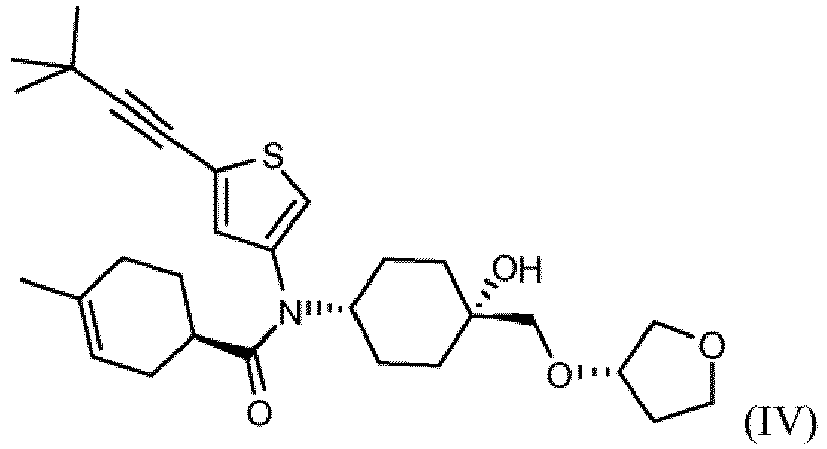
- Composé selon la revendication 26, qui est un composé de la Formule V:

- Composé selon la revendication 27, dans lequel M est un lithium.
- Composé de la Formule II:

- Composé selon la revendication 29, où le composé de la Formule II est une base libre.
- Composé selon la revendication 29, où le composé de la Formule II est un sel.
- Composé selon la revendication 31, où le composé de la Formule II est le sel d'acide chlorhydrique ou le sel d'acide (S)-mandélique.
Applications Claiming Priority (3)
| Application Number | Priority Date | Filing Date | Title |
|---|---|---|---|
| US201261684543P | 2012-08-17 | 2012-08-17 | |
| US13/801,039 US8759544B2 (en) | 2012-08-17 | 2013-03-13 | Synthesis of an antiviral compound |
| PCT/US2013/054405 WO2014028342A1 (fr) | 2012-08-17 | 2013-08-09 | Synthèse d'un composé antiviral |
Publications (2)
| Publication Number | Publication Date |
|---|---|
| EP2885294A1 EP2885294A1 (fr) | 2015-06-24 |
| EP2885294B1 true EP2885294B1 (fr) | 2016-11-30 |
Family
ID=50100499
Family Applications (1)
| Application Number | Title | Priority Date | Filing Date |
|---|---|---|---|
| EP13750249.8A Active EP2885294B1 (fr) | 2012-08-17 | 2013-08-09 | Synthèse d'un composé antiviral |
Country Status (9)
| Country | Link |
|---|---|
| US (2) | US8759544B2 (fr) |
| EP (1) | EP2885294B1 (fr) |
| JP (1) | JP6118412B2 (fr) |
| AU (1) | AU2013302913B2 (fr) |
| CA (1) | CA2882115A1 (fr) |
| ES (1) | ES2613552T3 (fr) |
| PT (1) | PT2885294T (fr) |
| TW (1) | TW201420587A (fr) |
| WO (1) | WO2014028342A1 (fr) |
Cited By (1)
| Publication number | Priority date | Publication date | Assignee | Title |
|---|---|---|---|---|
| US11724982B2 (en) | 2014-10-10 | 2023-08-15 | The Research Foundation For The State University Of New York | Trifluoromethoxylation of arenes via intramolecular trifluoromethoxy group migration |
Families Citing this family (6)
| Publication number | Priority date | Publication date | Assignee | Title |
|---|---|---|---|---|
| US8841340B2 (en) | 2012-08-17 | 2014-09-23 | Gilead Sciences, Inc. | Solid forms of an antiviral compound |
| CN109562107A (zh) | 2016-05-10 | 2019-04-02 | C4医药公司 | 用于靶蛋白降解的杂环降解决定子体 |
| EP4483875A3 (fr) | 2016-05-10 | 2025-04-02 | C4 Therapeutics, Inc. | Dégronimères spirocycliques pour la dégradation de protéines cibles |
| EP3455219A4 (fr) | 2016-05-10 | 2019-12-18 | C4 Therapeutics, Inc. | Dégronimères de c3-glutarimide liés à une amine pour la dégradation de protéines cibles |
| CN109641874A (zh) | 2016-05-10 | 2019-04-16 | C4医药公司 | 用于靶蛋白降解的c3-碳连接的戊二酰亚胺降解决定子体 |
| EP3641762B1 (fr) | 2017-06-20 | 2026-02-18 | C4 Therapeutics, Inc. | Dégrons et dégronimères à liaison n/o pour la dégradation de protéines |
Family Cites Families (28)
| Publication number | Priority date | Publication date | Assignee | Title |
|---|---|---|---|---|
| US5861421A (en) | 1995-12-21 | 1999-01-19 | Smithkline Beecham Corporation | 4,4-(disubstituted) cyclohexan-1-one monomers and related compounds |
| US20050119332A1 (en) | 1998-03-12 | 2005-06-02 | Lone Jeppesen | Substituted thiophene compounds as modulators of protein tyrosine phosphatases (PTPases) |
| US20020002199A1 (en) | 1998-03-12 | 2002-01-03 | Lone Jeppesen | Modulators of protein tyrosine phosphatases (ptpases) |
| AU2002344854B2 (en) | 2001-06-11 | 2008-11-06 | Vertex Pharmaceuticals (Canada) Incorporated | Thiophene derivatives as antiviral agents for flavivirus infection |
| CA2449999C (fr) | 2001-06-11 | 2012-07-31 | Shire Biochem Inc. | Composes et methodes de traitement ou de prevention d'infections a flavirus |
| CN100413861C (zh) | 2002-12-10 | 2008-08-27 | 维勒凯姆制药股份有限公司 | 用于治疗或预防黄病毒感染的化合物 |
| MXPA05006196A (es) | 2002-12-10 | 2006-01-27 | Virochem Pharma Inc | Compuestos y metodos para el tratamiento o prevencion de infecciones por flavivirus. |
| DE10359791A1 (de) | 2003-12-19 | 2005-07-21 | Bayer Healthcare Ag | Substituierte Thiophene |
| AR047894A1 (es) | 2004-02-25 | 2006-03-01 | Wyeth Corp | Derivados de tiofeno como inhibidores de la proteina tirosina fosfatasa 1b (ptpasa 1b); metodos para su preparacion, composiciones farmaceuticas que los contienen y su uso en el tratamiento de enfermedades mediadas por ptpasa 1b |
| CN1989131A (zh) | 2004-03-30 | 2007-06-27 | 希龙公司 | 取代的噻吩衍生物用作抗癌药 |
| DE102005028077A1 (de) | 2004-12-22 | 2006-07-13 | Aicuris Gmbh & Co. Kg | Alkinyl-substituierte Thiophene |
| DE102004061746A1 (de) | 2004-12-22 | 2006-07-06 | Bayer Healthcare Ag | Alkinyl-substituierte Thiophene |
| CN101218224B (zh) | 2005-05-13 | 2013-05-08 | Viro化学制药公司 | 治疗或预防黄病毒感染的组合物和方法 |
| CN101384605A (zh) | 2006-02-15 | 2009-03-11 | 塞诺菲-安万特股份有限公司 | 新的氨基醇取代的芳基噻吩并嘧啶酮、其制备方法以及其作为药物的用途 |
| PT2104674E (pt) | 2006-11-15 | 2013-07-26 | Virochem Pharma Inc | Análogos de tiofeno para o tratamento ou prevenção de infeções por flavivírus |
| WO2008059042A1 (fr) | 2006-11-17 | 2008-05-22 | Smithkline Beecham Corporation | Dérivés du 2-carboxy thiophène en tant qu'agents anti-viraux |
| EP2774927A1 (fr) | 2008-12-03 | 2014-09-10 | Presidio Pharmaceuticals, Inc. | Inhibiteurs du virus de l'hépatite C de type NS5A |
| TW201116525A (en) | 2009-07-21 | 2011-05-16 | Gilead Sciences Inc | Inhibitors of flaviviridae viruses |
| KR20120081123A (ko) | 2009-09-09 | 2012-07-18 | 길리애드 사이언시즈, 인코포레이티드 | 플라비비리대 바이러스의 억제제 |
| JP2013512247A (ja) | 2009-11-25 | 2013-04-11 | バーテックス ファーマシューティカルズ インコーポレイテッド | フラビウイルス感染症の治療または予防のための5−アルキニル−チオフェン−2−カルボン酸誘導体およびそれらの使用 |
| PE20130281A1 (es) | 2010-01-15 | 2013-03-08 | Gilead Sciences Inc | Derivados de acido 5-alquinil-3-amida-2-tiofeno-carboxilico como inhibidores del virus flaviviridae |
| KR20120123678A (ko) | 2010-01-15 | 2012-11-09 | 길리애드 사이언시즈, 인코포레이티드 | 플라비비리다에 바이러스의 억제제 |
| EP2585447A2 (fr) | 2010-06-28 | 2013-05-01 | Vertex Pharmaceuticals Incorporated | Composés et méthodes pour le traitement ou la prévention d'infections par flavivirus |
| WO2012006070A1 (fr) * | 2010-06-28 | 2012-01-12 | Vertex Pharmaceuticals Incorporated | Composés et méthodes de traitement ou de prévention d'infections à flavivirus |
| AU2011349844B2 (en) | 2010-12-20 | 2017-06-01 | Gilead Sciences, Inc. | Combinations for treating HCV |
| EP2734515B1 (fr) | 2011-07-13 | 2015-11-04 | Gilead Sciences, Inc. | Dérivés de l'acide thiophène-2-carboxylique utiles en tant qu'inhibiteurs des virus flaviviridae |
| US8927741B2 (en) | 2012-08-17 | 2015-01-06 | Gilead Sciences, Inc. | Synthesis of an antiviral compound |
| US8841340B2 (en) | 2012-08-17 | 2014-09-23 | Gilead Sciences, Inc. | Solid forms of an antiviral compound |
-
2013
- 2013-03-13 US US13/801,039 patent/US8759544B2/en active Active
- 2013-08-09 AU AU2013302913A patent/AU2013302913B2/en not_active Ceased
- 2013-08-09 WO PCT/US2013/054405 patent/WO2014028342A1/fr not_active Ceased
- 2013-08-09 EP EP13750249.8A patent/EP2885294B1/fr active Active
- 2013-08-09 ES ES13750249.8T patent/ES2613552T3/es active Active
- 2013-08-09 CA CA2882115A patent/CA2882115A1/fr not_active Abandoned
- 2013-08-09 PT PT137502498T patent/PT2885294T/pt unknown
- 2013-08-09 JP JP2015527505A patent/JP6118412B2/ja active Active
- 2013-08-13 TW TW102128977A patent/TW201420587A/zh unknown
-
2014
- 2014-05-06 US US14/271,216 patent/US9045462B2/en active Active
Cited By (1)
| Publication number | Priority date | Publication date | Assignee | Title |
|---|---|---|---|---|
| US11724982B2 (en) | 2014-10-10 | 2023-08-15 | The Research Foundation For The State University Of New York | Trifluoromethoxylation of arenes via intramolecular trifluoromethoxy group migration |
Also Published As
| Publication number | Publication date |
|---|---|
| US9045462B2 (en) | 2015-06-02 |
| JP2015530993A (ja) | 2015-10-29 |
| AU2013302913B2 (en) | 2017-03-16 |
| US8759544B2 (en) | 2014-06-24 |
| US20140051867A1 (en) | 2014-02-20 |
| CA2882115A1 (fr) | 2014-02-20 |
| EP2885294A1 (fr) | 2015-06-24 |
| WO2014028342A1 (fr) | 2014-02-20 |
| AU2013302913A1 (en) | 2015-02-05 |
| JP6118412B2 (ja) | 2017-04-19 |
| ES2613552T3 (es) | 2017-05-24 |
| TW201420587A (zh) | 2014-06-01 |
| HK1211919A1 (en) | 2016-06-03 |
| PT2885294T (pt) | 2017-02-09 |
| US20140275570A1 (en) | 2014-09-18 |
Similar Documents
| Publication | Publication Date | Title |
|---|---|---|
| US9045462B2 (en) | Synthesis of an antiviral compound | |
| EP2855454B1 (fr) | Preparation de composés antiviraux | |
| JP2023068137A (ja) | (S)-(2R,3R,11bR)-3-イソブチル-9,10-ジメトキシ-2,3,4,6,7,11b-ヘキサヒドロ-1H-ピリド[2,1-a]イソキノリン-2-イル2-アミノ-3-メチルブタノエートジ(4-メチルベンゼンスルホネート)の調製のための合成方法 | |
| TW202332434A (zh) | 可用作抗癌劑的吡唑基衍生物之合成方法 | |
| ES2724460T3 (es) | Síntesis de un tripéptido que inhíbe el NS3 del virus de VHC macrocíclico | |
| AU2013302914C1 (en) | Solid forms of an antiviral compound | |
| US8927741B2 (en) | Synthesis of an antiviral compound | |
| HK1225388A1 (zh) | 通过环化2-(氨基乙氧基)苯甲酸衍生物制备3,4-二氢-1,4-苯并氧氮杂环庚三烯-5(2h)-酮衍生物 | |
| HK1211919B (en) | Synthesis of an antiviral compound | |
| HK40066086A (zh) | 多环氨基甲醯基吡啶酮化合物的合成 | |
| HK1208670B (en) | Synthesis of antiviral compound | |
| HK40043126A (en) | Methods and intermediates for preparing a therapeutic compound useful in the treatment of retroviridae viral infection | |
| HK40043126B (en) | Methods and intermediates for preparing a therapeutic compound useful in the treatment of retroviridae viral infection |
Legal Events
| Date | Code | Title | Description |
|---|---|---|---|
| PUAI | Public reference made under article 153(3) epc to a published international application that has entered the european phase |
Free format text: ORIGINAL CODE: 0009012 |
|
| 17P | Request for examination filed |
Effective date: 20150204 |
|
| AK | Designated contracting states |
Kind code of ref document: A1 Designated state(s): AL AT BE BG CH CY CZ DE DK EE ES FI FR GB GR HR HU IE IS IT LI LT LU LV MC MK MT NL NO PL PT RO RS SE SI SK SM TR |
|
| AX | Request for extension of the european patent |
Extension state: BA ME |
|
| DAX | Request for extension of the european patent (deleted) | ||
| 17Q | First examination report despatched |
Effective date: 20160211 |
|
| REG | Reference to a national code |
Ref country code: HK Ref legal event code: DE Ref document number: 1211919 Country of ref document: HK |
|
| GRAP | Despatch of communication of intention to grant a patent |
Free format text: ORIGINAL CODE: EPIDOSNIGR1 |
|
| INTG | Intention to grant announced |
Effective date: 20160610 |
|
| GRAS | Grant fee paid |
Free format text: ORIGINAL CODE: EPIDOSNIGR3 |
|
| GRAA | (expected) grant |
Free format text: ORIGINAL CODE: 0009210 |
|
| AK | Designated contracting states |
Kind code of ref document: B1 Designated state(s): AL AT BE BG CH CY CZ DE DK EE ES FI FR GB GR HR HU IE IS IT LI LT LU LV MC MK MT NL NO PL PT RO RS SE SI SK SM TR |
|
| REG | Reference to a national code |
Ref country code: CH Ref legal event code: EP Ref country code: GB Ref legal event code: FG4D |
|
| REG | Reference to a national code |
Ref country code: CH Ref legal event code: NV Representative=s name: SERVOPATENT GMBH, CH Ref country code: AT Ref legal event code: REF Ref document number: 849678 Country of ref document: AT Kind code of ref document: T Effective date: 20161215 |
|
| REG | Reference to a national code |
Ref country code: IE Ref legal event code: FG4D |
|
| REG | Reference to a national code |
Ref country code: DE Ref legal event code: R096 Ref document number: 602013014772 Country of ref document: DE |
|
| REG | Reference to a national code |
Ref country code: PT Ref legal event code: SC4A Ref document number: 2885294 Country of ref document: PT Date of ref document: 20170209 Kind code of ref document: T Free format text: AVAILABILITY OF NATIONAL TRANSLATION Effective date: 20170130 |
|
| PG25 | Lapsed in a contracting state [announced via postgrant information from national office to epo] |
Ref country code: LV Free format text: LAPSE BECAUSE OF FAILURE TO SUBMIT A TRANSLATION OF THE DESCRIPTION OR TO PAY THE FEE WITHIN THE PRESCRIBED TIME-LIMIT Effective date: 20161130 |
|
| REG | Reference to a national code |
Ref country code: NL Ref legal event code: FP |
|
| REG | Reference to a national code |
Ref country code: LT Ref legal event code: MG4D |
|
| PG25 | Lapsed in a contracting state [announced via postgrant information from national office to epo] |
Ref country code: NO Free format text: LAPSE BECAUSE OF FAILURE TO SUBMIT A TRANSLATION OF THE DESCRIPTION OR TO PAY THE FEE WITHIN THE PRESCRIBED TIME-LIMIT Effective date: 20170228 Ref country code: GR Free format text: LAPSE BECAUSE OF FAILURE TO SUBMIT A TRANSLATION OF THE DESCRIPTION OR TO PAY THE FEE WITHIN THE PRESCRIBED TIME-LIMIT Effective date: 20170301 Ref country code: LT Free format text: LAPSE BECAUSE OF FAILURE TO SUBMIT A TRANSLATION OF THE DESCRIPTION OR TO PAY THE FEE WITHIN THE PRESCRIBED TIME-LIMIT Effective date: 20161130 Ref country code: SE Free format text: LAPSE BECAUSE OF FAILURE TO SUBMIT A TRANSLATION OF THE DESCRIPTION OR TO PAY THE FEE WITHIN THE PRESCRIBED TIME-LIMIT Effective date: 20161130 |
|
| REG | Reference to a national code |
Ref country code: ES Ref legal event code: FG2A Ref document number: 2613552 Country of ref document: ES Kind code of ref document: T3 Effective date: 20170524 |
|
| PG25 | Lapsed in a contracting state [announced via postgrant information from national office to epo] |
Ref country code: PL Free format text: LAPSE BECAUSE OF FAILURE TO SUBMIT A TRANSLATION OF THE DESCRIPTION OR TO PAY THE FEE WITHIN THE PRESCRIBED TIME-LIMIT Effective date: 20161130 Ref country code: RS Free format text: LAPSE BECAUSE OF FAILURE TO SUBMIT A TRANSLATION OF THE DESCRIPTION OR TO PAY THE FEE WITHIN THE PRESCRIBED TIME-LIMIT Effective date: 20161130 Ref country code: FI Free format text: LAPSE BECAUSE OF FAILURE TO SUBMIT A TRANSLATION OF THE DESCRIPTION OR TO PAY THE FEE WITHIN THE PRESCRIBED TIME-LIMIT Effective date: 20161130 Ref country code: HR Free format text: LAPSE BECAUSE OF FAILURE TO SUBMIT A TRANSLATION OF THE DESCRIPTION OR TO PAY THE FEE WITHIN THE PRESCRIBED TIME-LIMIT Effective date: 20161130 |
|
| PG25 | Lapsed in a contracting state [announced via postgrant information from national office to epo] |
Ref country code: RO Free format text: LAPSE BECAUSE OF FAILURE TO SUBMIT A TRANSLATION OF THE DESCRIPTION OR TO PAY THE FEE WITHIN THE PRESCRIBED TIME-LIMIT Effective date: 20161130 Ref country code: EE Free format text: LAPSE BECAUSE OF FAILURE TO SUBMIT A TRANSLATION OF THE DESCRIPTION OR TO PAY THE FEE WITHIN THE PRESCRIBED TIME-LIMIT Effective date: 20161130 Ref country code: CZ Free format text: LAPSE BECAUSE OF FAILURE TO SUBMIT A TRANSLATION OF THE DESCRIPTION OR TO PAY THE FEE WITHIN THE PRESCRIBED TIME-LIMIT Effective date: 20161130 Ref country code: SK Free format text: LAPSE BECAUSE OF FAILURE TO SUBMIT A TRANSLATION OF THE DESCRIPTION OR TO PAY THE FEE WITHIN THE PRESCRIBED TIME-LIMIT Effective date: 20161130 Ref country code: DK Free format text: LAPSE BECAUSE OF FAILURE TO SUBMIT A TRANSLATION OF THE DESCRIPTION OR TO PAY THE FEE WITHIN THE PRESCRIBED TIME-LIMIT Effective date: 20161130 |
|
| REG | Reference to a national code |
Ref country code: FR Ref legal event code: PLFP Year of fee payment: 5 |
|
| PG25 | Lapsed in a contracting state [announced via postgrant information from national office to epo] |
Ref country code: BG Free format text: LAPSE BECAUSE OF FAILURE TO SUBMIT A TRANSLATION OF THE DESCRIPTION OR TO PAY THE FEE WITHIN THE PRESCRIBED TIME-LIMIT Effective date: 20170228 Ref country code: SM Free format text: LAPSE BECAUSE OF FAILURE TO SUBMIT A TRANSLATION OF THE DESCRIPTION OR TO PAY THE FEE WITHIN THE PRESCRIBED TIME-LIMIT Effective date: 20161130 |
|
| REG | Reference to a national code |
Ref country code: DE Ref legal event code: R097 Ref document number: 602013014772 Country of ref document: DE |
|
| PLBE | No opposition filed within time limit |
Free format text: ORIGINAL CODE: 0009261 |
|
| STAA | Information on the status of an ep patent application or granted ep patent |
Free format text: STATUS: NO OPPOSITION FILED WITHIN TIME LIMIT |
|
| 26N | No opposition filed |
Effective date: 20170831 |
|
| PG25 | Lapsed in a contracting state [announced via postgrant information from national office to epo] |
Ref country code: SI Free format text: LAPSE BECAUSE OF FAILURE TO SUBMIT A TRANSLATION OF THE DESCRIPTION OR TO PAY THE FEE WITHIN THE PRESCRIBED TIME-LIMIT Effective date: 20161130 |
|
| REG | Reference to a national code |
Ref country code: HK Ref legal event code: GR Ref document number: 1211919 Country of ref document: HK |
|
| PG25 | Lapsed in a contracting state [announced via postgrant information from national office to epo] |
Ref country code: MC Free format text: LAPSE BECAUSE OF FAILURE TO SUBMIT A TRANSLATION OF THE DESCRIPTION OR TO PAY THE FEE WITHIN THE PRESCRIBED TIME-LIMIT Effective date: 20161130 |
|
| PG25 | Lapsed in a contracting state [announced via postgrant information from national office to epo] |
Ref country code: LU Free format text: LAPSE BECAUSE OF NON-PAYMENT OF DUE FEES Effective date: 20170809 |
|
| REG | Reference to a national code |
Ref country code: FR Ref legal event code: PLFP Year of fee payment: 6 |
|
| PG25 | Lapsed in a contracting state [announced via postgrant information from national office to epo] |
Ref country code: MT Free format text: LAPSE BECAUSE OF NON-PAYMENT OF DUE FEES Effective date: 20170809 |
|
| PGFP | Annual fee paid to national office [announced via postgrant information from national office to epo] |
Ref country code: NL Payment date: 20180826 Year of fee payment: 6 |
|
| PGFP | Annual fee paid to national office [announced via postgrant information from national office to epo] |
Ref country code: TR Payment date: 20180702 Year of fee payment: 6 Ref country code: AT Payment date: 20180719 Year of fee payment: 6 Ref country code: BE Payment date: 20180827 Year of fee payment: 6 |
|
| PGFP | Annual fee paid to national office [announced via postgrant information from national office to epo] |
Ref country code: PT Payment date: 20180726 Year of fee payment: 6 |
|
| REG | Reference to a national code |
Ref country code: AT Ref legal event code: UEP Ref document number: 849678 Country of ref document: AT Kind code of ref document: T Effective date: 20161130 |
|
| PG25 | Lapsed in a contracting state [announced via postgrant information from national office to epo] |
Ref country code: HU Free format text: LAPSE BECAUSE OF FAILURE TO SUBMIT A TRANSLATION OF THE DESCRIPTION OR TO PAY THE FEE WITHIN THE PRESCRIBED TIME-LIMIT; INVALID AB INITIO Effective date: 20130809 |
|
| PG25 | Lapsed in a contracting state [announced via postgrant information from national office to epo] |
Ref country code: CY Free format text: LAPSE BECAUSE OF FAILURE TO SUBMIT A TRANSLATION OF THE DESCRIPTION OR TO PAY THE FEE WITHIN THE PRESCRIBED TIME-LIMIT Effective date: 20161130 |
|
| PG25 | Lapsed in a contracting state [announced via postgrant information from national office to epo] |
Ref country code: MK Free format text: LAPSE BECAUSE OF FAILURE TO SUBMIT A TRANSLATION OF THE DESCRIPTION OR TO PAY THE FEE WITHIN THE PRESCRIBED TIME-LIMIT Effective date: 20161130 |
|
| PG25 | Lapsed in a contracting state [announced via postgrant information from national office to epo] |
Ref country code: TR Free format text: LAPSE BECAUSE OF FAILURE TO SUBMIT A TRANSLATION OF THE DESCRIPTION OR TO PAY THE FEE WITHIN THE PRESCRIBED TIME-LIMIT Effective date: 20161130 |
|
| REG | Reference to a national code |
Ref country code: NL Ref legal event code: MM Effective date: 20190901 |
|
| REG | Reference to a national code |
Ref country code: AT Ref legal event code: MM01 Ref document number: 849678 Country of ref document: AT Kind code of ref document: T Effective date: 20190809 |
|
| PG25 | Lapsed in a contracting state [announced via postgrant information from national office to epo] |
Ref country code: AT Free format text: LAPSE BECAUSE OF NON-PAYMENT OF DUE FEES Effective date: 20190809 Ref country code: PT Free format text: LAPSE BECAUSE OF NON-PAYMENT OF DUE FEES Effective date: 20200210 |
|
| PG25 | Lapsed in a contracting state [announced via postgrant information from national office to epo] |
Ref country code: CH Free format text: LAPSE BECAUSE OF NON-PAYMENT OF DUE FEES Effective date: 20190831 Ref country code: LI Free format text: LAPSE BECAUSE OF NON-PAYMENT OF DUE FEES Effective date: 20190831 |
|
| REG | Reference to a national code |
Ref country code: BE Ref legal event code: MM Effective date: 20190831 |
|
| PG25 | Lapsed in a contracting state [announced via postgrant information from national office to epo] |
Ref country code: NL Free format text: LAPSE BECAUSE OF NON-PAYMENT OF DUE FEES Effective date: 20190901 Ref country code: AL Free format text: LAPSE BECAUSE OF FAILURE TO SUBMIT A TRANSLATION OF THE DESCRIPTION OR TO PAY THE FEE WITHIN THE PRESCRIBED TIME-LIMIT Effective date: 20161130 Ref country code: IS Free format text: LAPSE BECAUSE OF FAILURE TO SUBMIT A TRANSLATION OF THE DESCRIPTION OR TO PAY THE FEE WITHIN THE PRESCRIBED TIME-LIMIT Effective date: 20170330 |
|
| PG25 | Lapsed in a contracting state [announced via postgrant information from national office to epo] |
Ref country code: BE Free format text: LAPSE BECAUSE OF NON-PAYMENT OF DUE FEES Effective date: 20190831 |
|
| PGFP | Annual fee paid to national office [announced via postgrant information from national office to epo] |
Ref country code: GB Payment date: 20250619 Year of fee payment: 13 |
|
| PGFP | Annual fee paid to national office [announced via postgrant information from national office to epo] |
Ref country code: FR Payment date: 20250610 Year of fee payment: 13 |
|
| PGFP | Annual fee paid to national office [announced via postgrant information from national office to epo] |
Ref country code: IE Payment date: 20250610 Year of fee payment: 13 |
|
| PGFP | Annual fee paid to national office [announced via postgrant information from national office to epo] |
Ref country code: ES Payment date: 20250903 Year of fee payment: 13 |
|
| PGFP | Annual fee paid to national office [announced via postgrant information from national office to epo] |
Ref country code: DE Payment date: 20250618 Year of fee payment: 13 |
|
| PGFP | Annual fee paid to national office [announced via postgrant information from national office to epo] |
Ref country code: IT Payment date: 20250722 Year of fee payment: 13 |