EP2885304B1 - Pyrrolopyrazoles comme bloqueurs du canal calcique de type n - Google Patents
Pyrrolopyrazoles comme bloqueurs du canal calcique de type n Download PDFInfo
- Publication number
- EP2885304B1 EP2885304B1 EP13762619.8A EP13762619A EP2885304B1 EP 2885304 B1 EP2885304 B1 EP 2885304B1 EP 13762619 A EP13762619 A EP 13762619A EP 2885304 B1 EP2885304 B1 EP 2885304B1
- Authority
- EP
- European Patent Office
- Prior art keywords
- chlorophenyl
- sulfonyl
- alkyl
- pyrazole
- tetrahydropyrrolo
- Prior art date
- Legal status (The legal status is an assumption and is not a legal conclusion. Google has not performed a legal analysis and makes no representation as to the accuracy of the status listed.)
- Not-in-force
Links
- 0 *=*CC1CCCC1 Chemical compound *=*CC1CCCC1 0.000 description 14
- SVNCRRZKBNSMIV-UHFFFAOYSA-N Nc1cc(cccc2)c2nc1 Chemical compound Nc1cc(cccc2)c2nc1 SVNCRRZKBNSMIV-UHFFFAOYSA-N 0.000 description 1
Classifications
-
- C—CHEMISTRY; METALLURGY
- C07—ORGANIC CHEMISTRY
- C07D—HETEROCYCLIC COMPOUNDS
- C07D487/00—Heterocyclic compounds containing nitrogen atoms as the only ring hetero atoms in the condensed system, not provided for by groups C07D451/00 - C07D477/00
- C07D487/02—Heterocyclic compounds containing nitrogen atoms as the only ring hetero atoms in the condensed system, not provided for by groups C07D451/00 - C07D477/00 in which the condensed system contains two hetero rings
- C07D487/04—Ortho-condensed systems
-
- A—HUMAN NECESSITIES
- A61—MEDICAL OR VETERINARY SCIENCE; HYGIENE
- A61K—PREPARATIONS FOR MEDICAL, DENTAL OR TOILETRY PURPOSES
- A61K31/00—Medicinal preparations containing organic active ingredients
- A61K31/33—Heterocyclic compounds
- A61K31/395—Heterocyclic compounds having nitrogen as a ring hetero atom, e.g. guanethidine or rifamycins
- A61K31/41—Heterocyclic compounds having nitrogen as a ring hetero atom, e.g. guanethidine or rifamycins having five-membered rings with two or more ring hetero atoms, at least one of which being nitrogen, e.g. tetrazole
- A61K31/415—1,2-Diazoles
- A61K31/4162—1,2-Diazoles condensed with heterocyclic ring systems
-
- A—HUMAN NECESSITIES
- A61—MEDICAL OR VETERINARY SCIENCE; HYGIENE
- A61P—SPECIFIC THERAPEUTIC ACTIVITY OF CHEMICAL COMPOUNDS OR MEDICINAL PREPARATIONS
- A61P25/00—Drugs for disorders of the nervous system
- A61P25/04—Centrally acting analgesics, e.g. opioids
-
- A—HUMAN NECESSITIES
- A61—MEDICAL OR VETERINARY SCIENCE; HYGIENE
- A61P—SPECIFIC THERAPEUTIC ACTIVITY OF CHEMICAL COMPOUNDS OR MEDICINAL PREPARATIONS
- A61P25/00—Drugs for disorders of the nervous system
- A61P25/06—Antimigraine agents
-
- A—HUMAN NECESSITIES
- A61—MEDICAL OR VETERINARY SCIENCE; HYGIENE
- A61P—SPECIFIC THERAPEUTIC ACTIVITY OF CHEMICAL COMPOUNDS OR MEDICINAL PREPARATIONS
- A61P29/00—Non-central analgesic, antipyretic or antiinflammatory agents, e.g. antirheumatic agents; Non-steroidal antiinflammatory drugs [NSAID]
Definitions
- Ion channels are classified by gating, or what opens and closes the channel to the flux of ions. Voltage-gated ion channels open or close depending on the voltage gradient across the plasma membrane, whereas ligand-gated ion channels open or close depending on the binding of ligands to the channel.
- voltage-gated calcium channels divides them into three groups: (i) high voltage-activated channels, which include L-, N-, P- and Q-type channels; (ii) intermediate voltage-activated R-type channels; and (iii) low voltage-activated T-type channels.
- the N-type calcium channel is distributed mainly in central and peripheral neurons, being localized primarily to presynaptic nerve terminals. This channel regulates the calcium flux required for depolarization-evoked release of neurotransmitters from synaptic endings.
- the transmission of pain signals from the periphery to the central nervous system (CNS) is mediated, inter alia, by N-type calcium channels located in the spinal cord. Inhibition of the N-type calcium channel in the superficial dorsal horn leads to a decrease in membrane excitability and neurotransmitter release, resulting in pain relief.
- knock-out mice lacking the N-type calcium channel exhibit reduced nociceptive behaviors in animal models of pain.
- N-type calcium channels have been shown to mediate the development and maintenance of the neuronal sensitization processes associated with neuropathic pain and therefore provide attractive targets for the development of analgesic drugs.
- Three N-type calcium channel modulators are currently approved for the treatment of pain: ⁇ -conotoxin MVIIA (ziconotide), marketed as Prialt®, potently and selectively blocks the N-type calcium channel and is indicated for the management of severe chronic pain; gabapentin, marketed as Neurontin®, and pregabalin, marketed as Lyrica®, bind with high affinity to the 2 subunit of the N-type calcium channel and are indicated for the treatment of fibromyalgia, diabetic nerve pain and/or post-herpetic neuralgia pain.
- ⁇ -conotoxin MVIIA ziconotide
- Prialt® potently and selectively blocks the N-type calcium channel and is indicated for the management of severe chronic pain
- gabapentin marketed as Neurontin®
- N-Type calcium channel blockers It is an object of the present invention to provide N-Type calcium channel blockers. It is also an object of the invention to provide a method of treating, ameliorating or preventing pain by the administration of a compound of Formula (I). And, it is an object of the invention to provide a pharmaceutical composition comprising a compound of Formula (I), useful for treating, ameliorating or preventing pain.
- the present invention is directed to a compound of Formula (I) wherein
- the present invention also provides, inter alia , a pharmaceutical composition
- a pharmaceutical composition comprising, consisting of and/or consisting essentially of a pharmaceutically acceptable carrier, a pharmaceutically acceptable excipient, and/or a pharmaceutically acceptable diluent, and a compound of Formula (I), or a pharmaceutically acceptable salt form thereof.
- Also provided are processes for making a pharmaceutical composition comprising, consisting of, and/or consisting essentially of admixing a compound of Formula (I) and a pharmaceutically acceptable carrier, a pharmaceutically acceptable excipient, and/or a pharmaceutically acceptable diluent.
- the present invention further provides, inter alia, methods for treating or ameliorating a N-Type calcium channel-modulated disorder in a subject, including a human or other mammal in which the disease, syndrome, or condition is affected by the modulation of the N-Type calcium channel, such as pain and the diseases that lead to such pain, using a compound of Formula (I).
- the present invention also provides, inter alia, methods for producing the instant compounds and pharmaceutical compositions and medicaments thereof.
- alkyl refers to straight and branched carbon chains having 1 to 8 carbon atoms. Therefore, designated numbers of carbon atoms (e.g. C 1-8 ) refer independently to the number of carbon atoms in an alkyl moiety or to the alkyl portion of a larger alkyl-containing substituent. In substituent groups with multiple alkyl groups such as (C 1-6 alkyl) 2 amino-, the C 1-6 alkyl groups of the dialkylamino may be the same or different.
- alkoxy refers to an -O-alkyl group, wherein the term “alkyl” is as defined above.
- cycloalkyl refers to saturated or partially saturated, monocyclic or polycyclic hydrocarbon rings of 3 to 14 carbon atoms. Examples of such rings include cyclopropyl, cyclobutyl, cyclopentyl, cyclohexyl, cycloheptyl and adamantyl.
- aryl refers to an unsaturated, aromatic monocyclic or bicyclic ring of 6 to 10 carbon members. Examples of aryl rings include phenyl and naphthalenyl.
- halogen refers to fluorine, chlorine, bromine and iodine.
- alkyl or aryl or either of their prefix roots appear in a name of a substituent (e . g ., arylalkyl, alkylamino) the name is to be interpreted as including those limitations given above for "alkyl'' and "aryl.”
- Designated numbers of carbon atoms e.g., C 1 -C 6 ) refer independently to the number of carbon atoms in an alkyl moiety, an aryl moiety, or in the alkyl portion of a larger substituent in which alkyl appears as its prefix root.
- the designated number of carbon atoms includes all of the independent members included within a given range specified.
- C 1-6 alkyl would include methyl, ethyl, propyl, butyl, pentyl and hexyl individually as well as sub-combinations thereof (e.g., C 1-2 , C 1-3 , C 1-4 , C 1-5 , C 2-6 , C 3-6 , C 4-6 , C 5-6 , C 2-5 , etc.).
- C 1 -C 6 alkylcarbonyl refers to a group of the Formula:
- R at a stereocenter designates that the stereocenter is purely of the R- configuration as defined in the art; likewise, the term “S” means that the stereocenter is purely of the S -configuration.
- S means that the stereocenter is purely of the S -configuration.
- the terms “*R” or “*S” at a stereocenter are used to designate that the stereocenter is of pure but unknown configuration.
- RS refers to a stereocenter that exists as a mixture of the R - and S- configurations.
- *RS or “*SR” refer to a stereocenter that exists as a mixture of the R - and S -configurations and is of unknown configuration relative to another stereocenter within the molecule.
- Compounds containing one stereocenter drawn without a stereo bond designation are a mixture of 2 enantiomers.
- Compounds containing 2 stereocenters both drawn without stereo bond designations are a mixture of 4 diastereomers.
- Compounds with 2 stereocenters both labeled "RS" and drawn with stereo bond designations are a 2-component mixture with relative stereochemistry as drawn.
- Compounds with 2 stereocenters both labeled "*RS" and drawn with stereo bond designations are a 2-component mixture with relative stereochemistry unknown.
- Unlabeled stereocenter drawn without stereo bond designations are a mixture of the R - and S -configurations. For unlabeled stereocenters drawn with stereo bond designations, the absolute stereochemistry is as depicted.
- subject refers to an animal, preferably a mammal, most preferably a human, who has been the object of treatment, observation or experiment.
- terapéuticaally effective amount refers to an amount of an active compound or pharmaceutical agent, including a compound of the present invention, which elicits the biological or medicinal response in a tissue system, animal or human that is being sought by a researcher, veterinarian, medical doctor or other clinician, which includes alleviation or partial alleviation of the symptoms of the disease, syndrome, condition, or disorder being treated.
- composition refers to a product that includes the specified ingredients in therapeutically effective amounts, as well as any product that results, directly, or indirectly, from combinations of the specified ingredients in the specified amounts.
- N-Type calcium channel blocker is intended to encompass a compound that interacts with the N-Type calcium channel to substantially reduce or eliminate its functional activity, thereby decreasing the flow of calcium ions through the channel and the rise of intracellular calcium concentrations.
- N-Type calcium channel-modulated is used to refer to the condition of being affected by the modulation of the N-Type calcium channel, including the condition of being affected by the inhibition of the N-Type calcium channel, such as, for example, pain, the diseases that lead to such pain and treatments that lead to the reduction of such pain.
- the term "affect" or "affected” when referring to a disease, syndrome, condition or disorder that is affected by the inhibition of N-Type calcium channel shall include a reduction in the frequency and / or severity of one or more symptoms or manifestations of said disease, syndrome, condition or disorder and / or include the prevention of the development of one or more symptoms or manifestations of said disease, syndrome, condition or disorder or the development of the disease, condition, syndrome or disorder.
- the compounds of Formula (I) are useful in methods for treating, ameliorating and/ or preventing a disease, a syndrome, a condition or a disorder that is affected by the inhibition of N-Type calcium channel. Such methods comprise, consist of and/or consist essentially of administering to a subject, including an animal, a mammal, and a human in need of such treatment, amelioration and / or prevention, a therapeutically effective amount of a compound of Formula (I), or an enantiomer, diastereomer, solvate or pharmaceutically acceptable salt form thereof.
- the compounds of Formula (I) are useful for treating, ameliorating and / or preventing pain as well as diseases, syndromes, conditions or disorders causing such pain.
- the compounds of Formula (I) are useful for treating, ameliorating and / or preventing acute pain, inflammatory pain and / or neuropathic pain, comprising administering to a subject in need thereof a therapeutically effective amount of a compound of Formula (I), as herein defined.
- Acute pain refers to pain that comes on quickly, can be of varying severity but is self-limiting and of relatively short duration.
- Examples of acute pain include, but are not limited to, post-operative pain, post-surgical pain, toothache, burn, sunburn, insect/animal bites and stings, headache and/or any pain associated with acute trauma or injury.
- Inflammatory pain refers to pain arising from an inflammatory disease, condition, syndrome or disorder, including but not limited to inflammatory bowel disease, irritable bowel syndrome, visceral pain, migraine, post-operative pain, osteoarthritis, rheumatoid arthritis, back pain, low back pain, joint pain, abdominal pain, chest pain, labor pain, musculoskeletal diseases, skin diseases, toothache, pyresis, burn, sunburn, snake bite, venomous snake bite, spider bite, insect sting, neurogenic or overactive bladder, interstitial cystitis, urinary tract infection, rhinitis, contact dermatitis/hypersensitivity, itch, eczema, pharyngitis, mucositis, enteritis, irritable bowel syndrome, cholecystitis, pancreatitis, post-mastectomy pain syndrome, menstrual pain, endometriosis, pain due to physical trauma, headache, sinus headache, tension headache or arachnoiditis.
- Neuropathic pain refers to a disease, syndrome, condition and/or disorder involving damage to the peripheral or central nervous system, including cancer pain, neurological disorders, spine and peripheral nerve surgery, brain tumor, traumatic brain injury (TBI), chemotherapy-induced pain, pain chronification, radicular pain, HIV pain, spinal cord trauma, chronic pain syndrome, fibromyalgia, chronic fatigue syndrome, lupus, sarcoidosis, peripheral neuropathy, bilateral peripheral neuropathy, diabetic neuropathy, central pain, neuropathies associated with spinal cord injury, stroke, amyotrophic lateral sclerosis (ALS), Parkinson's disease, multiple sclerosis, sciatic neuritis, mandibular joint neuralgia, peripheral neuritis, polyneuritis, stump pain, phantom limb pain, bony fractures, oral neuropathic pain, Charcot's pain, complex regional pain syndrome I and II (CRPS I/
- Embodiments of the present invention include a compound of Formula (I) wherein
- An embodiment of the present invention is directed to a compound of Formula (I) wherein
- An embodiment of the present invention is directed to a compound of Formula (I) wherein
- An embodiment of the present invention is directed to a compound of Formula (I) wherein
- An embodiment of the present invention is directed to a compound of Formula (I) wherein
- salts of compounds of Formula (I) refer to non-toxic "pharmaceutically acceptable salts," Other salts may, however, be useful in the preparation of compounds of Formula (I) or of their pharmaceutically acceptable salts thereof.
- Suitable pharmaceutically acceptable salts of compounds of Formula (I) include acid addition salts which can, for example, be formed by mixing a solution of the compound with a solution of a pharmaceutically acceptable acid such as hydrochloric acid, sulfuric acid, fumaric acid, maleic acid, succinic acid, acetic acid, benzoic acid, citric acid, tartaric acid, carbonic acid or phosphoric acid.
- suitable pharmaceutically acceptable salts thereof may include alkali metal salts, such as sodium or potassium salts; alkaline earth metal salts, such as calcium or magnesium salts; and salts formed with suitable organic ligands, such as quaternary ammonium salts.
- representative pharmaceutically acceptable salts include acetate, benzenesulfonate, benzoate, bicarbonate, bisulfate, bitartrate, borate, bromide, calcium edetate, camsylate, carbonate, chloride, clavulanate, citrate, dihydrochloride, edetate, edisylate, estolate, esylate, fumarate, gluceptate, gluconate, glutamate, glycollylarsanilate, hexylresorcinate, hydrabamine, hydrobromide, hydrochloride, hydroxynaphthoate, iodide, isothionate, lactate, lactobionate, laurate, malate, maleate, mandelate, mesylate, methylbromide, methylnitrate, methylsulfate, mucate, napsylate, nitrate, N-methylglucamine ammonium salt, oleate, pamo
- prodrugs of compounds of Formula (I) are also mentioned.
- such prodrugs will be functional derivatives of the compounds that are readily convertible in vivo into the required compound.
- the term “administering” encompasses the treatment or prevention of the various diseases, conditions, syndromes and disorders described with the compound specifically disclosed or with a compound that may not be specifically disclosed, but which converts to the specified compound in vivo after administration to a patient.
- Conventional procedures for the selection and preparation of suitable prodrug derivatives are described, for example, in " Design of Prodrugs", ed. H. Bundgaard, Elsevier, 1985 .
- the compounds according to embodiments of this invention may accordingly exist as enantiomers. Where the compounds possess two or more chiral centers, they may additionally exist as diastereomers. It is to be understood that all such isomers and mixtures thereof are encompassed within the scope of the present invention. Furthermore, some of the crystalline forms for the compounds may exist as polymorphs and as such are intended to be included in the present invention. In addition, some of the compounds may form solvates with water (i.e., hydrates) or common organic solvents, and such solvates are also intended to be encompassed within the scope of this invention. The skilled artisan will understand that the term compound as used herein, is meant to include solvated compounds of Formula (I).
- the processes for the preparation of the compounds according to certain embodiments of the invention give rise to mixture of stereoisomers
- these isomers may be separated by conventional techniques such as preparative chromatography.
- the compounds may be prepared in racemic form, or individual enantiomers may be prepared either by enantiospecific synthesis or by resolution.
- the compounds may, for example, be resolved into their component enantiomers by standard techniques, such as the formation of diastereomeric pairs by salt formation with an optically active acid, such as (-)-di-p-toluoyl-d-tartaric acid and/or (+)-di-p-toluoyl-1-tartaric acid followed by fractional crystallization and regeneration of the free base.
- the compounds may also be resolved by formation of diastereomeric esters or amides, followed by chromatographic separation and removal of the chiral auxiliary. Alternatively, the compounds may be resolved using a chiral HPLC column.
- One embodiment of the present invention is directed to a composition, including a pharmaceutical composition, comprising, consisting of, and/or consisting essentially of the (+)-enantiomer of a compound of Formula (I) wherein said composition is substantially free from the (-)-isomer of said compound.
- substantially free means less than about 25 %, preferably less than about 10 %, more preferably less than about 5 %, even more preferably less than about 2 % and even more preferably less than about 1 % of the (-)-isomer calculated as.
- % + ⁇ enantiomer mass + ⁇ enantiomer mass + ⁇ enantiomer + mass ⁇ ⁇ enantiomer ⁇ 100.
- compositions including a pharmaceutical composition, comprising, consisting of, and consisting essentially of the (-)-enantiomer of a compound of Formula (I) wherein said composition is substantially free from the (+)-isomer of said compound.
- any of the processes for preparation of the compounds of the various embodiments of the present invention it may be necessary and/or desirable to protect sensitive or reactive groups on any of the molecules concerned. This may be achieved by means of conventional protecting groups, such as those described in Protective Groups in Organic Chemistry, Second Edition, J.F.W. McOmie, Plenum Press, 1973 ; T.W. Greene & P.G.M. Wuts, Protective Groups in Organic Synthesis, John Wiley & Sons, 1991 ; and T.W. Green & P.G.M. Wuts, Protective Groups in Organic Synthesis, Third Edition, John Wiley & Sons, 1999 .
- the protecting groups may be removed at a convenient subsequent stage using methods known from the art.
- compositions comprising compounds of Formula (I) and at least one pharmaceutically acceptable carrier, pharmaceutically acceptable excipient, and/or pharmaceutically acceptable diluent.
- the compounds of Formula (I) may be admixed with any suitable binder(s), lubricant(s), suspending agent(s), coating agent(s), solubilizing agent(s), and combinations thereof.
- Solid oral dosage forms, such as tablets or capsules, containing the compounds of the present invention may be administered in at least one dosage form at a time, as appropriate. It is also possible to administer the compounds in sustained release formulations. Additional oral forms in which the present inventive compounds may be administered include elixirs, solutions, syrups, and suspensions; each optionally containing flavoring agents and coloring agents.
- compounds of Formula (I) can be administered by inhalation (intratracheal or intranasal) or in the form of a suppository or pessary, or they may be applied topically in the form of a lotion, solution, cream, ointment or dusting powder.
- inhalation intratracheal or intranasal
- a suppository or pessary or they may be applied topically in the form of a lotion, solution, cream, ointment or dusting powder.
- they can be incorporated into a cream comprising, consisting of, and/or consisting essentially of an aqueous emulsion of polyethylene glycols or liquid paraffin.
- an alternative means of administration includes transdermal administration by using a skin or transdermal patch.
- compositions of the present invention can also be injected parenterally, for example intracavernosally, intravenously, intramuscularly, subcutaneously, intradermally or intrathecally.
- the compositions will also include at least one of a suitable carrier, a suitable excipient, and a suitable diluent.
- compositions of the present invention are best used in the form of a sterile aqueous solution that may contain other substances, for example, enough salts and monosaccharides to make the solution isotonic with blood.
- compositions of the present invention may be administered in the form of tablets or lozenges, which can be formulated in a conventional manner.
- compositions containing at least one of the compounds of Formula (I) as the active ingredient can be prepared by mixing the compound(s) with a pharmaceutically acceptable carrier, a pharmaceutically acceptable diluent, and/or a pharmaceutically acceptable excipient according to conventional pharmaceutical compounding techniques.
- a pharmaceutically acceptable carrier e.g., benzyl alcohol, benzyl ether, benzyl ether, benzyl ether, benzyl, sulfonyl, sulfonyl, adiluent, and/or a pharmaceutically acceptable excipient according to conventional pharmaceutical compounding techniques.
- the carrier, excipient, and diluent may take a wide variety of forms depending upon the desired route of administration (e.g., oral, parenteral, etc.).
- suitable carriers, excipients and diluents include water, glycols, oils, alcohols, flavoring agents, preservatives, stabilizers, coloring agents and the like;
- suitable carriers, excipients and diluents include starches, sugars, diluents, granulating agents, lubricants, binders, disintegrating agents and the like.
- Solid oral preparations also may be optionally coated with substances, such as, sugars, or be enterically-coated so as to modulate the major site of absorption and disintegration.
- the carrier, excipient and diluent will usually include sterile water, and other ingredients may be added to increase solubility and preservation of the composition.
- injectable suspensions or solutions may also be prepared utilizing aqueous carriers along with appropriate additives, such as solubilizers and preservatives.
- a therapeutically effective amount of a compound of Formula (I) or a pharmaceutical composition thereof includes a dose range from about 0.1 mg to about 3000 mg, or any particular amount or range therein, in particular from about 1 mg to about 1000 mg, or any particular amount or range therein; or, more particularly, from about 10 mg to about 500 mg, or any particular amount or range therein, of active ingredient in a regimen of about 1 to about 4 times per day for an average (70 kg) human; although, it is apparent to one skilled in the art that the therapeutically effective amount for a compound of Formula (I) will vary as will the diseases, syndromes, conditions, and disorders being treated.
- a pharmaceutical composition is preferably provided in the form of tablets containing about 0.01, about 10, about 50, about 100, about 150, about 200, about 250, and about 500 milligrams of a compound of Formula (I).
- a compound of Formula (I) may be administered in a single daily dose, or the total daily dosage may be administered in divided doses of two, three and four times daily.
- Optimal dosages of a compound of Formula (I) to be administered may be readily determined and will vary with the particular compound used, the mode of administration, the strength of the preparation and the advancement of the disease, syndrome, condition or disorder.
- factors associated with the particular subject being treated including subject gender, age, weight, diet and time of administration, will result in the need to adjust the dose to achieve an appropriate therapeutic level and desired therapeutic effect.
- the above dosages are thus exemplary of the average case. There can be, of course, individual instances wherein higher or lower dosage ranges are merited, and such are within the scope of this invention.
- Compounds of Formula (I) may be administered in any of the foregoing compositions and dosage regimens or by means of those compositions and dosage regimens established in the art whenever use of a compound of Formula (I) is required for a subject in need thereof.
- the compounds of Formula (I) are useful in methods for treating and/or preventing a disease, a syndrome, a condition or a disorder in a subject, including an animal, a mammal and a human in which the disease, the syndrome, the condition or the disorder is affected by the modulation of the N-Type calcium channel.
- Such methods comprise, consist of and/or consist essentially of administering to a subject, including an animal, a mammal, and a human in need of such treatment or prevention a therapeutically effective amount of a compound, salt or solvate of Formula (I).
- the compounds of Formula (I) are useful for preventing or treating pain, such as inflammatory pain or neuropathic pain, or diseases, syndromes, conditions or disorders causing such pain.
- Scheme A illustrates a route for the synthesis of compounds of Formula (I)-A and intermediate A9, wherein Q, R 1 , R 2 , and R 3 are as defined herein, and G is t-butoxycarbonyl group.
- Compound A1 is either commercially available or may be prepared by methods known in the scientific literature.
- the compound A1 may be alkylated with propargyl bromide in the presence of a strong base, such as sodium hydride, to afford compound A3,
- a strong base such as sodium hydride
- Compound A3 may be cross-coupled with an aryl or heteroaryl iodide of formula A4 (wherein Q is as defined herein) in the presence of a palladium catalyst, appropriate ligands, appropriate coupling reagents such as copper iodide, and in the presence of a tertiary amine base such as triethylamine, to afford a compound of formula A5.
- the compound of formula A5 may be coupled with a substituted hydrazine of formula A6, in the presence of an appropriate amide-type coupling reagents such as EDC and HOBt, or with DCC, to afford a compound of formula A7.
- an appropriate amide-type coupling reagents such as EDC and HOBt, or with DCC
- EDC and HOBt an appropriate amide-type coupling reagents
- DCC dimethylation-N
- Scheme B illustrates a route for the synthesis of compounds of Formula (I)-B, wherein Q, R 1 , R 2 , and R 3 are as defined herein, and G is a sulfonyl group, wherein R B is a substituent as defined by the present invention, including, but not limited to, C 1-6 alkyl, C 6-10 aryl(C 1-4 )alkyl, C 6-10 aryloxy(C 1-4 )alkyl, 3,5-dimethylisoxazol-4-yl, C 1-4 alkoxycarbonyl(C 1-4 )alkyl, trifluoromethyl, C 3-7 cycloalkyl, 2,2,2-trifluoroethyl, di(C 1-4 alkyl)amino, di(C 1-4 alkyl)aminosulfonylamino(C 1-4 )alkyl, C 1-4 alkylsulfonylamino(C 1-4 )alkyl, and 2,5-dione-
- Scheme C illustrates a route for the synthesis of compounds of Formula (I)-C, wherein Q, R 1 , R 2 , and R 3 are as defined herein, and G is a carbonyl group, wherein R C is a substituent as defined by the present invention, including, but not limited to, methoxymethyl, trifluoromethyl, C 1-4 alkoxycarbonylamino(C 2-4 )alkyl, C 1-4 alkoxycarbonylaminomethyl, C 1-4 alkylsulfonylaminomethyl, C 1-4 alkoxy, di(C 1-4 alkyl)amino, and pyridinyl.
- the compound of formula A9 may be coupled with an R C -substituted carboxylic acid of formula C1 in the presence of an appropriate amide-type coupling agent such as polystyrene-supported CDI, and in the presence of a coupling activating agent such as HOBt, to afford a compound of formula (I)-C.
- an appropriate amide-type coupling agent such as polystyrene-supported CDI
- a coupling activating agent such as HOBt
- Scheme D illustrates a route for the synthesis of compounds of Formula (I)-D, wherein Q, R 1 , R 2 , and R 3 are as defined herein, and G is a heteroaryl or aryl ring (Ar D ) as defined by G of the present invention.
- the compound of formula A9 may be coupled with an aryl or heteroaryl (Ar D ) iodide of formula D1 in the presence of a transition metal catalyst such as palladium (II), appropriate ligands, and an inorganic base such as potassium or cesium carbonate, to afford a compound of formula (I)-D.
- a transition metal catalyst such as palladium (II)
- appropriate ligands such as potassium or cesium carbonate
- Scheme E illustrates a route for the synthesis of compounds of Formula (I)-E, wherein Q, R 1 , R 2 , and R 3 , and G is as defined herein.
- the compound A3 may be brominated in the presence of a brominating reagent such as bromine, to afford compound E1.
- the compound E1 may be coupled as with a compound of formula A6, using the methods described in Scheme A, to afford a compound of formula E2.
- a compound of formula E2 may be converted to a compound of formula E3 using the methods described herein, and, upon heating to about 100°C in the presence of a base, the compound of formula E3 may be cyclized to a compound of formula E4.
- a G-group of the present invention may be introduced by one of the methods described in the schemes hereinabove to afford a compound of formula E6.
- a compound of formula E6 may be cross-coupled with an aryl or heteroaryl boronic acid of formula E7, in the presence of a transition metal catalyst such as palladium (II) acetate, appropriate ligands, and an inorganic base such as sodium carbonate, to afford a compound of formula (I)-E.
- a transition metal catalyst such as palladium (II) acetate, appropriate ligands, and an inorganic base such as sodium carbonate
- Calcium mobilization responses to KCl depolarization were evaluated by measuring the intensity of calcium-mediated fluorescent signal in the presence of BD Calcium Assay Dye (BD Biosciences, Franklin Lakes, NJ, U.S.A.), utilizing a Functional Drug Screening System (FDSS) by Hamamatsu Corporation (Bridgewater, NJ U.S.A.).
- BD Calcium Assay Dye BD Biosciences, Franklin Lakes, NJ, U.S.A.
- FDSS Functional Drug Screening System
- IC 50 values for representative compounds of Formula (I) were determined from six-point concentration-response experiments and represent the concentration of said compound required to inhibit 50% of the maximal response.
- Maximal fluorescence intensity (FI) achieved upon addition of mum KCl was exported from the FDSS software and further analyzed using GraphPad Prism 3.02 (Graph Pad Software Inc., San Diego, CA, U.S.A.). Data were normalized to the maximum average counts from quadruplicate wells for each condition in the presence of 50 mM KCl and to the minimum average counts in the presence of buffer.
- Cells were grown in T175 flasks to 50%-90% confluence. At the time of use, cells were enzymatically treated with Detachin (Genlantis, San Diego, CA USA), centrifuged, rinsed, and resuspended in 293 SFM II media (Life Technologies, Grand Island, NY U.S.A.) supplemented with 25 mM HEPES (Sigma-Aldrich, St. Louis, MO U.S.A.) to a concentration of 2-3 x 10 6 cells/mL. Cells were added to the automated cell preparation station on the QPatch-HT (Sophion Biosciences, North Brunswick, NJ U.S.A.), and following a 10- to 30-min recovery period with gentle stirring, the assay protocol was initiated.
- Detachin Genelantis, San Diego, CA USA
- 293 SFM II media Life Technologies, Grand Island, NY U.S.A.
- HEPES Sigma-Aldrich, St. Louis, MO U.S.A.
- High (40 mM) BaCl concentrations were made with adjustments to TEA-Cl (90 mM) to maintain the osmolarity.
- ⁇ -Conotoxin MVIIA (Sigma-Aldrich) was prepared as a 0.3 mg/mL stock solution in water, with 0.1% bovine serum albumin V (Life Technologies).
- Compounds of Formula (I) were diluted first into dimethyl sulfoxide and then into 10% pluronic F-127 in water (Life Technologies), sonicated for 1 min and diluted into EC buffer. Vehicle controls were run in parallel in all experiments.
Landscapes
- Chemical & Material Sciences (AREA)
- Organic Chemistry (AREA)
- Health & Medical Sciences (AREA)
- General Health & Medical Sciences (AREA)
- Veterinary Medicine (AREA)
- Public Health (AREA)
- Medicinal Chemistry (AREA)
- Animal Behavior & Ethology (AREA)
- Life Sciences & Earth Sciences (AREA)
- Pharmacology & Pharmacy (AREA)
- Chemical Kinetics & Catalysis (AREA)
- Nuclear Medicine, Radiotherapy & Molecular Imaging (AREA)
- Pain & Pain Management (AREA)
- General Chemical & Material Sciences (AREA)
- Neurology (AREA)
- Engineering & Computer Science (AREA)
- Bioinformatics & Cheminformatics (AREA)
- Biomedical Technology (AREA)
- Neurosurgery (AREA)
- Rheumatology (AREA)
- Epidemiology (AREA)
- Pharmaceuticals Containing Other Organic And Inorganic Compounds (AREA)
- Plural Heterocyclic Compounds (AREA)
- Nitrogen Condensed Heterocyclic Rings (AREA)
- Medicinal Preparation (AREA)
- Medicines That Contain Protein Lipid Enzymes And Other Medicines (AREA)
Claims (15)
- Composé de formule (I)
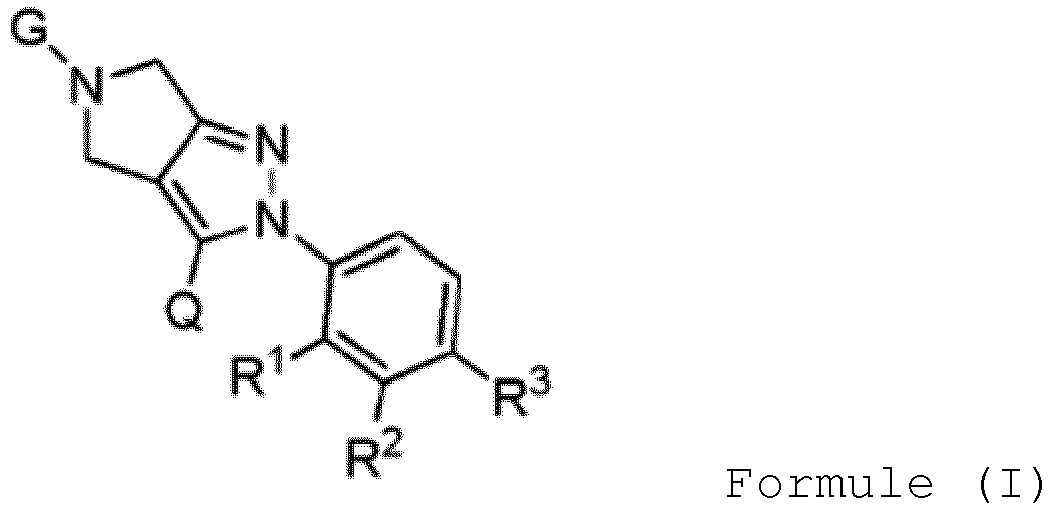 R1 est choisi dans le groupe constitué de C1-4-alkyle, C1-4-alcoxy, 2, 2-difluoroéthoxy, di (C1-4-alkyl)amino, trifluorométhoxy, fluoro et trifluorométhyle ;R2 est un hydrogène ; ou R2 peut être pris ensemble avec R1 et le cycle phényle auquel R1 et R2 sont tous les deux attachés pour former un 2,3-dihydrobenzofuran-7-yle ou un 1,3-benzodioxol-4-yle ;R3 est un hydrogène, méthyle, méthoxy, chloro ou fluoro ;Q est choisi dans le groupe constitué de Q1, Q2 et Q3
 R4 est choisi dans le groupe constitué de hydrogène, alkyle C1-4, alcoxy C1-4, cyano, fluoro et chloro ;R5 est choisi indépendamment dans le groupe constitué de hydrogène, alkyle C1-4, alcoxy C1-4, cyano, chloro et di(C1-4-alkyl)amino ;G est choisi dans le groupe constitué de 4-méthylphényle, 3-cyanophényle, 4-cyanophényle, 4-méthoxycarbonylphényle, 2-chloroquinolin-6-yle, morpholin-4-ylsulfonyle, morpholin-4-yl(C1-4-alkyl)aminosulfonyle, 2,6-diméthylmorpholin-4-ylsulfonyle, C6-10-aryl-C1-4-alkylsulfonyle, C6-10-aryloxy-C1-4-alkylsulfonyle, 3,5-diméthylisoxazol-4-yl-sulfonyle, C1-4-alcoxycarbonyl-C1-4-alkylsulfonyle, trifluorométhylsulfonyle, C3-7-cycloalkylsulfonyle, 2,2,2-trifluoroéthylsulfonyle, di(C1-4-alkyl)aminosulfonyle, di(C1-4-alkyl)aminosulfonylamino(C1-4-alkyl)sulfonyle, C1-4-alkylsulfonylamino(C1-4-alkyl)sulfonyle, 2,5-dione-pyrrolidin-1-yl(C1-4-alkyl)sulfonyle, (2H)-1,3-dione-1H-isoindol-1-yl(C1-4-alkyl)sulfonyle, 1,1-dioxytétrahydrothiophèn-3-ylsulfonyle, C1-6-alkylsulfonyle, di(C1-4-alkyl)aminosulfonyle, pyrrolidin-1-ylsulfonyle, pipéridin-1-ylsulfonyle, 4-(R6) -pipéridin-1-ylsulfonyle où R6 est C1-4-alcoxycarbonyle ou C1-4-alkyle ; azépan-1-ylsulfonyle, méthoxyméthylcarbonyle, trifluorométhylcarbonyle, C1-4-alcoxycarbonylamino-C2-4-alkyl-carbonyle, C1-4-alcoxycarbonylaminométhylcarbonyle, trifluorométhylsulfonylaminométhylcarbonyle, trifluorométhoxycarbonyle, C1-4-alkylsulfonylaminométhylcarbonyle, C1-4-alcoxycarbonyle, di(C1-4-alkyl)aminocarbonyle, C1-4-alcoxycarbonyle, pyridinylcarbonyle, furanylcarbonyle et 5-méthylisoxazol-3-ylcarbonyle ;et leurs énantiomères, diastéréoisomères et sels pharmaceutiquement acceptables.
 - Composé selon la revendication 1, dans lequel R1 est choisi dans le groupe constitué de C1-4-alkyle, C1-4-alcoxy, 2,2-difluoroéthoxy, di(C1-4-alkyl)amino et trifluorométhoxy.
- Composé selon la revendication 2, dans lequel R1 est choisi dans le groupe constitué d'éthyle, méthoxy, éthoxy, isopropyloxy, difluoroéthoxy, diméthylamino et trifluorométhoxy.
- Composé selon la revendication 1, dans lequel R3 est hydrogène, méthyle, chloro ou fluoro.
- Composé selon la revendication 1, dans lequel Q est choisi dans le groupe constitué de Q1, Q2 et Q3 ;
 R4 est chloro ;R5 est choisi indépendamment dans le groupe constitué de C1-4-alkyle, C1-4-alcoxy et chloro.
 - Composé selon la revendication 5, dans lequel Q est choisi dans le groupe constitué de Q1, Q2 et Q3 ;
 R4 est chloro ;R5 est choisi indépendamment dans le groupe constitué de C1-4-alcoxy et chloro.
 - Composé selon la revendication 1, dans lequel G est choisi dans le groupe constitué de 4-méthylphényle, 2-chloro-quinolin-6-yle, C6-10-aryl-C1-4-alkylsulfonyle, C6-10-aryloxy-C1-4-alkylsulfonyle, 3, 5-diméthylisoxazol-4-yl-sulfonyle, trifluorométhylsulfonyle, C1-4-alcoxycarbonyl-C1-4-alkylsulfonyle, C3-7-cycloalkylsulfonyle, 2,2,2-trifluoroéthylsulfonyle, di(C1-4-alkyl)aminosulfonyle, di(C1-4-alkyl)aminosulfonylamino(C1-4-alkyl)sulfonyle, C1-4-alkylsulfonylamino(C1-4-alkyl)sulfonyle, 2,5-dione-pyrrolidin-1-yl(C1-4-alkyl)sulfonyle, (2H)-1,3-dione-1H-isoindol-1-yl(C1-4-alkyl)sulfonyle, 1,1-dioxytétrahydrothiophèn-3-ylsulfonyle, C1-6-alkylsulfonyle, di(C1-4-alkyl)aminosulfonyle, pyrrolidin-1-ylsulfonyle, pipéridin-1-ylsulfonyle, 4-(R6) -pipéridin-1-ylsulfonyle où R6 est C1-4-alcoxycarbonyle ou C1-4-alkyle ; azépan-1-ylsulfonyle, morpholin-4-ylsulfonyle, 2,6-diméthylmorpholin-4-ylsulfonyle, méthoxyméthylcarbonyle, trifluorométhylcarbonyle, C1-4-alcoxycarbonylamino-C2-4-alkyl-carbonyle, C1-4-alcoxycarbonylaminométhylcarbonyle, C1-4-alcoxysulfonylaminométhylcarbonyle, C1-4-alcoxycarbonyle, di(C1-4-alkyl)aminocarbonyle, C1-4-alcoxycarbonyle, pyridinylcarbonyle et furanylcarbonyle.
- Composé selon la revendication 7, dans lequel G est choisi dans le groupe constitué de méthylphényle, 2-chloroquinolin-6-yle, C6-10-aryl-C1-4-alkylsulfonyle, C6-10-aryloxy-C1-4-alkylsulfonyle, 3, 5-diméthylisoxazol-4-yl-sulfonyle, 4-C1-4-alcoxycarbonyl-C1-4-alkylsulfonyle, trifluorométhylsulfonyle, C3-7-cycloalkylsulfonyle, 2,2,2-trifluoroéthylsulfonyle, di(C1-4-alkyl)aminosulfonyle, di(C1-4-alkyl)aminosulfonylamino(C1-4-alkyl)sulfonyle, C1-4-alkylsulfonylamino(C1-4-alkyl)sulfonyle, 2,5-dione-pyrrolidin-1-yl(C1-4-alkyl)sulfonyle, (2H)-1,3-dione-1H-isoindol-1-yl(C1-4-alkyl)sulfonyle, 1,1-dioxytétrahydrothiophèn-3-ylsulfonyle, C1-6-alkylsulfonyle, di(C1-4-alkyl)aminosulfonyle, pyrrolidin-1-ylsulfonyle, pipéridin-1-ylsulfonyle, 4-(R6) -pipéridin-1-ylsulfonyle où R6 est C1-4-alcoxycarbonyle ou C1-4-alkyle ; azépan-1-ylsulfonyle, morpholin-4-ylsulfonyle, 2,6-diméthylmorpholin-4-ylsulfonyle, méthoxyméthylcarbonyle, trifluorométhylcarbonyle, C1-4-alcoxycarbonylamino-C2-4-alkyl-carbonyle, C1-4-alcoxycarbonylaminométhylcarbonyle, C1-4-alcoxycarbonyle, di(C1-4-alkyl)aminocarbonyle, C1-4-alcoxycarbonyle et pyridinylcarbonyle.
- Composé selon la revendication 8, dans lequel G est choisi dans le groupe constitué de 2-chloroquinolin-6-yle, C6-10-aryl-C1-4-alkylsulfonyle, C6-10-aryloxy-C1-4-alkylsulfonyle, 3,5-diméthylisoxazol-4-yl-sulfonyle, C1-4-alcoxycarbonyl-C1-4-alkylsulfonyle, C3-7-cycloalkylsulfonyle, 2,2,2-trifluoroéthylsulfonyle, di(C1-4-alkyl)aminosulfonyle, di(C1-4-alkyl)aminosulfonylamino(C1-4-alkyl)sulfonyle, C1-4-alkylsulfonylamino(C1-4-alkyl)sulfonyle, 2,5-dione-pyrrolidin-1-yl(C1-4-alkyl)sulfonyle, (2H)-1,3-dione-1H-isoindol-1-yl(C1-4-alkyl)sulfonyle, 1,1-dioxytétrahydrothiophèn-3-ylsulfonyle, C1-6-alkylsulfonyle, di(C1-4-alkyl)aminosulfonyle, pyrrolidin-1-ylsulfonyle, pipéridin-1-ylsulfonyle, 4-(R6) -pipéridin-1-ylsulfonyle où R6 est C1-4-alcoxycarbonyle ou C1-4-alkyle ; azépan-1-ylsulfonyle, morpholin-4-ylsulfonyle, 2,6-diméthylmorpholin-4-ylsulfonyle, C1-4-alcoxycarbonylamino-C2-4-alkyl-carbonyle et C1-4-alcoxycarbonyle.
- Composé de formule (I) selon la revendication 1
 R1 est choisi dans le groupe constitué de C1-4-alkyle, C1-4-alcoxy, 2, 2-difluoroéthoxy, di(C1-4-alkyl)amino, trifluorométhoxy, fluoro et trifluorométhyle ;R2 est un hydrogène ; ou R2 peut être pris ensemble avec R1 et le cycle phényle auquel R1 et R2 sont tous les deux attachés pour former un 2,3-dihydrobenzofuran-7-yle ou un 1,3-benzodioxol-4-yle ;R3 est un hydrogène, méthyle, méthoxy, chloro ou fluoro ;Q est choisi dans le groupe constitué de Q1, Q2 et Q3
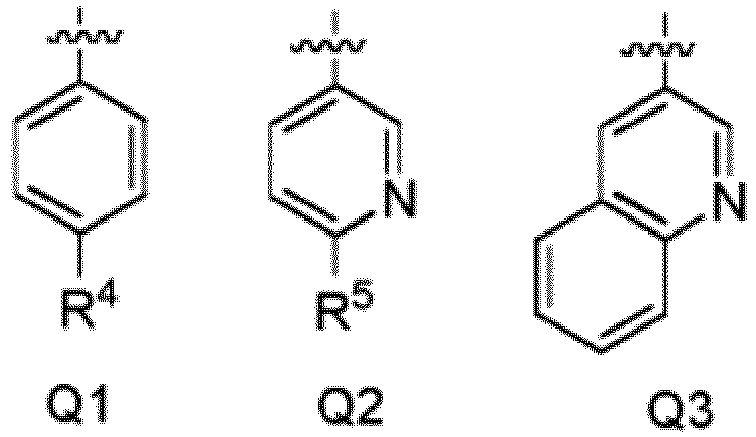 R4 est choisi dans le groupe constitué de chloro ;R5 est choisi indépendamment dans le groupe constitué de C1-4-alcoxy et chloro ;G est choisi dans le groupe constitué de 4-méthylphényle, 2-chloroquinolin-6-yle, C6-10-aryl-C1-4-alkylsulfonyle, C6-10-aryloxy-C1-4-alkylsulfonyle, 3,5-diméthylisoxazol-4-yl-sulfonyle, trifluorométhylsulfonyle, C1-4-alcoxycarbonyl-C1-4-alkylsulfonyle, C3-7-cycloalkylsulfonyle, 2,2,2-trifluoroéthylsulfonyle, di(C1-4-alkyl)aminosulfonyle, di(C1-4-alkyl)aminosulfonylamino(C1-4-alkyl)sulfonyle, C1-4-alkylsulfonylamino(C1-4-alkyl)sulfonyle, 2,5-dione-pyrrolidin-1-yl(C1-4-alkyl)sulfonyle, (2H)-1,3-dione-1H-isoindol-1-yl(C1-4-alkyl)sulfonyle, 1,1-dioxytétrahydrothiophèn-3-ylsulfonyle, C1-6-alkylsulfonyle, di(C1-4-alkyl)aminosulfonyle, pyrrolidin-1-ylsulfonyle, pipéridin-1-ylsulfonyle, 4-(R6) -pipéridin-1-ylsulfonyle où R6 est C1-4-alcoxycarbonyle ou C1-4-alkyle ; azépan-1-ylsulfonyle, morpholin-4-ylsulfonyle, 2,6-diméthylmorpholin-4-ylsulfonyle, méthoxyméthylcarbonyle, trifluorométhylcarbonyle, C1-4-alcoxycarbonylamino-C2-4-alkyl-carbonyle, C1-4-alcoxycarbonylaminométhylcarbonyle, C1-4-alkylsulfonylaminométhylcarbonyle, C1-4-alcoxycarbonyle, di(C1-4-alkyl)aminocarbonyle, C1-4-alcoxycarbonyle, pyridinylcarbonyle et furanylcarbonyle ;et leurs énantiomères, diastéréoisomères et sels pharmaceutiquement acceptables.
 - Composé de formule (I) selon la revendication 1
 R1 est choisi dans le groupe constitué de C1-4-alkyle, C1-4-alcoxy, 2, 2-difluoroéthoxy, di(C1-4-alkyl)amino, trifluorométhoxy, fluoro et trifluorométhyle ;R2 est un hydrogène ; ou R2 peut être pris ensemble avec R1 et le cycle phényle auquel R1 et R2 sont tous les deux attachés pour former un 2,3-dihydrobenzofuran-7-yle ou un 1,3-benzodioxol-4-yle ;R3 est un hydrogène, méthyle, méthoxy, chloro ou fluoro ;Q est choisi dans le groupe constitué de Q1, Q2 et Q3
 R4 est chloro ;R5 est choisi indépendamment dans le groupe constitué de C1-4-alcoxy et chloro ;G est choisi dans le groupe constitué de méthylphényle, 2-chloroquinolin-6-yle, C6-10-aryl-C1-4-alkylsulfonyle, C6-10-aryloxy-C1-4-alkylsulfonyle, 3,5-diméthylisoxazol-4-yl-sulfonyle, 4-C1-4-alcoxycarbonyl-C1-4-alkylsulfonyle, trifluorométhylsulfonyle, C3-7-cycloalkylsulfonyle, 2,2,2-trifluoroéthylsulfonyle, di(C1-4-alkyl)aminosulfonyle, di(C1-4-alkyl)aminosulfonylamino(C1-4-alkyl)sulfonyle, C1-4-alkylsulfonylamino(C1-4-alkyl)sulfonyle, 2,5-dione-pyrrolidin-1-yl(C1-4-alkyl)sulfonyle, (2H)-1,3-dione-1H-isoindol-1-yl(C1-4-alkyl)sulfonyle, 1,1-dioxytétrahydrothiophèn-3-ylsulfonyle, C1-6-alkylsulfonyle, di(C1-4-alkyl)aminosulfonyle, pyrrolidin-1-ylsulfonyle, pipéridin-1-ylsulfonyle, 4-(R6) -pipéridin-1-ylsulfonyle où R6 est C1-4-alcoxycarbonyle ou C1-4-alkyle ; azépan-1-ylsulfonyle, morpholin-4-ylsulfonyle, 2,6-diméthylmorpholin-4-ylsulfonyle, méthoxyméthylcarbonyle, trifluorométhylcarbonyle, C1-4-alcoxycarbonylamino-C2-4-alkyl-carbonyle, C1-4-alcoxycarbonylaminométhylcarbonyle, C1-4-alcoxycarbonyle, di(C1-4-alkyl)aminocarbonyle, C1-4-alcoxycarbonyle et pyridinylcarbonyle ;et leurs énantiomères, diastéréoisomères et sels pharmaceutiquement acceptables.
 - Composé de formule (I) selon la revendication 1
 R1 est choisi dans le groupe constitué d'éthyle, méthoxy, éthoxy, isopropyloxy, difluoroéthoxy, diméthylamino et trifluorométhoxy ;R2 est un hydrogène ; ou R2 peut être pris ensemble avec R1 et le cycle phényle auquel R1 et R2 sont tous les deux attachés pour former un 2,3-dihydrobenzofuran-7-yle ou un 1,3-benzodioxol-4-yle ;R3 est un hydrogène, méthyle, chloro ou fluoro ;Q est choisi dans le groupe constitué de Q1, Q2 et Q3
 R4 est chloro ;R5 est choisi indépendamment dans le groupe constitué de C1-4-alcoxy et chloro ;G est choisi dans le groupe constitué de 2-chloroquinolin-6-yle, C6-10-aryl-C1-4-alkylsulfonyle, C6-10-aryloxy-C1-4-alkylsulfonyle, 3,5-diméthylisoxazol-4-yl-sulfonyle, C1-4-alcoxycarbonyl-C1-4-alkylsulfonyle, C3-7-cycloalkylsulfonyle, 2,2,2-trifluoroéthylsulfonyle, di(C1-4-alkyl)aminosulfonyle, di(C1-4-alkyl)aminosulfonylamino(C1-4-alkyl)sulfonyle, C1-4-alkylsulfonylamino(C1-4-alkyl)sulfonyle, 2,5-dione-pyrrolidin-1-yl(C1-4-alkyl)sulfonyle, (2H)-1,3-dione-1H-isoindol-1-yl(C1-4-alkyl)sulfonyle, 1,1-dioxytétrahydrothiophèn-3-ylsulfonyle, C1-6-alkylsulfonyle, di(C1-4-alkyl)aminosulfonyle, pyrrolidin-1-ylsulfonyle, pipéridin-1-ylsulfonyle, 4-(R6) -pipéridin-1-ylsulfonyle où R6 est C1-4-alcoxycarbonyle ou C1-4-alkyle ; azépan-1-ylsulfonyle, morpholin-4-ylsulfonyle, 2,6-diméthylmorpholin-4-ylsulfonyle, C1-4-alcoxycarbonylamino-C2-4-alkyl-carbonyle et C1-4-alcoxycarbonyle ;et leurs énantiomères, diastéréoisomères et sels pharmaceutiquement acceptables.
 - Composé de formule (I) selon la revendication 1
 R1 est choisi dans le groupe constitué d'éthyle, méthoxy, éthoxy, isopropyloxy, difluoroéthoxy, diméthylamino et trifluorométhoxy ;R2 est un hydrogène ;R3 est un hydrogène, méthyle, chloro ou fluoro ;Q est choisi dans le groupe constitué de Q1, Q2 et Q3
 R4 est chloro ;R5 est choisi indépendamment dans le groupe constitué de C1-4-alcoxy et chloro ;G est choisi dans le groupe constitué de 2-chloroquinolin-6-yle, C6-10-aryl-C1-4-alkylsulfonyle, C6-10-aryloxy-C1-4-alkylsulfonyle, 3,5-diméthylisoxazol-4-yl-sulfonyle, C1-4-alcoxycarbonyl-C1-4-alkylsulfonyle, C3-7-cycloalkylsulfonyle, 2,2,2-trifluoroéthylsulfonyle, di(C1-4-alkyl)aminosulfonyle, di(C1-4-alkyl)aminosulfonylamino(C1-4-alkyl)sulfonyle, C1-4-alkylsulfonylamino(C1-4-alkyl)sulfonyle, 2,5-dione-pyrrolidin-1-yl(C1-4-alkyl)sulfonyle, (2H)-1,3-dione-1H-isoindol-1-yl(C1-4-alkyl)sulfonyle, 1,1-dioxytétrahydrothiophèn-3-ylsulfonyle, C1-6-alkylsulfonyle, di(C1-4-alkyl)aminosulfonyle, pyrrolidin-1-ylsulfonyle, pipéridin-1-ylsulfonyle, 4-(R6) -pipéridin-1-ylsulfonyle où R6 est C1-4-alcoxycarbonyle ou C1-4-alkyle ; azépan-1-ylsulfonyle, morpholin-4-ylsulfonyle, 2,6-diméthylmorpholin-4-ylsulfonyle, C1-4-alcoxycarbonylamino-C2-4-alkyl-carbonyle et C1-4-alcoxycarbonyle ;et leurs énantiomères, diastéréoisomères et sels pharmaceutiquement acceptables.
 - Composé de formule (I) selon la revendication 1
 tertiobutyl-3-(4-chlorophényl)-2-(2-éthylphényl)-2,6-dihydropyrrolo[3,4-c]pyrazol-5(4H)-carboxylate ;3-(4-chlorophényl)-2-(2-éthylphényl)-5-(méthylsulfonyl)-2,4,5,6-tétrahydropyrrolo[3,4-c]pyrazole ;3-(4-chlorophényl)-2-(2-éthylphényl)-5-[(trifluorométhyl)sulfonyl)]-2,4,5,6-tétrahydropyrrolo[3,4-c]pyrazole ;3-(4-chlorophényl)-2-(2-éthylphényl)-5-(pyridin-3-ylcarbonyl)-2,4,5,6-tétrahydropyrrolo[3,4-c]pyrazole ;3-(4-chlorophényl)-2-(2-éthylphényl)-5-(pyridin-4-ylcarbonyl)-2,4,5,6-tétrahydropyrrolo[3,4-c]pyrazole ;3-(4-chlorophényl)-2-(2-éthylphényl)-5-(trifluoroacétyl)-2,4,5,6-tétrahydropyrrolo[3,4-c]pyrazole ;3-(4-chlorophényl)-2-(2-éthylphényl)-5-(pyridin-2-ylcarbonyl)-2,4,5,6-tétrahydropyrrolo[3,4-c]pyrazole ;3-(4-chlorophényl)-2-(2-éthylphényl)-5-(furan-2-ylcarbonyl)-2,4,5,6-tétrahydropyrrolo[3,4-c]pyrazole ;3-(4-chlorophényl)-2-(2-éthylphényl)-5-[(5-méthylisoxazol-3-yl)carbonyl]-2,4,5,6-tétrahydropyrrolo[3,4-c]pyrazole ;3-(4-chlorophényl)-2-(2-éthylphényl)-5-(méthoxyacétyl)-2,4,5,6-tétrahydropyrrolo[3,4-c]pyrazole ;tertiobutyl-{2-[3-(4-chlorophényl)-2-(2-éthylphényl)-2,6-dihydropyrrolo[3,4-c]pyrazol-5(4H)-yl]-2-oxoéthyl}carbamate ;N-{2-[3-(4-chlorophényl)-2-(2-éthylphényl)-2,6-dihydropyrrolo[3,4-c]pyrazol-5(4H)-yl]-2-oxoéthyl}méthanesulfonamide ;N-{2-[3-(4-chlorophényl)-2-(2-éthylphényl)-2,6-dihydropyrrolo[3,4-c]pyrazol-5(4H)-yl]-2-oxoéthyl}-1,1,1-trifluorométhanesulfonamide ;tertiobutyl-3-(4-chlorophényl)-2-[2-(trifluorométhyl)phényl]-2,6-dihydropyrrolo[3,4-c]pyrazol-5(4H)-carboxylate ;3-(4-chlorophényl)-5-(méthylsulfonyl)-2-[2-trifluorométhyl)phényl]-2,4,5,6-tétrahydropyrrolo[3,4-c]pyrazole ;3-(4-chlorophényl)-5-[(1-méthyléthyl)sulfonyl)-2-[2-trifluorométhyl)phényl]-2,4,5,6-tétrahydropyrrolo[3,4-c]pyrazole ;3-(4-chlorophényl)-5-[(4-méthylphényl)sulfonyl]-2-[2-(trifluorométhyl)phényl]-2,4,5,6-tétrahydropyrrolo[3,4-c]pyrazole ;tertiobutyl-{2-[3-(4-chlorophényl)-2-[2-(trifluorométhyl)phényl]-2,6-dihydropyrrolo[3,4-c]pyrazol-5(4H)-yl]2-oxoéthyl}carbamate ;tertiobutyl-3-(4-chlorophényl)-2-[2-(trifluorométhoxy)phényl]-2,6-dihydropyrrolo[3,4-c]pyrazol-5(4H)-carboxylate ;3-(4-chlorophényl)-5-(méthylsulfonyl)-2-[2-(trifluorométhoxy)phényl]-2,4,5,6-tétrahydropyrrolo[3,4-c]pyrazole ;3-(4-chlorophényl)-5-(trifluoroacétyl)-2-[2-(trifluorométhoxy)phényl]-2,4,5,6-tétrahydropyrrolo[3,4-c]pyrazole ;tertiobutyl-{2-[3-(4-chlorophényl)-2-[2-(trifluorométhoxy)phényl]-2,6-dihydropyrrolo[3,4-c]pyrazol-5(4H)-yl]2-oxoéthyl}carbamate ;3-[3-(4-chlorophényl)-2-[2-(trifluorométhoxy)phényl]-2,6-dihydropyrrolo[3,4-c]pyrazol-5(4H)-yl]benzonitrile ;méthyl-4-[3-(4-chlorophényl)-2-[2-(trifluorométhoxy)phényl]-2,6-dihydropyrrolo[3,4-c]pyrazol-5(4H)-yl]benzoate ;4-[3-(4-chlorophényl)-2-[2-(trifluorométhoxy)phényl]-2,6-dihydropyrrolo[3,4-c]pyrazol-5(4H)-yl]benzonitrile ;4-[3-(4-chlorophényl)-2-[2-(trifluorométhoxy)phényl]-2,6-dihydropyrrolo[3,4-c]pyrazol-5(4H)-yl]-N-(2-morpholin-4-yléthyl)benzènesulfonamide ;2-chloro-6-[3-(4-chlorophényl)-2-[2-(trifluorométhoxy)phényl]-2,6-dihydropyrrolo[3,4-c]pyrazol-5(4H)-yl]quinoline ;tertiobutyl-3-(4-chlorophényl)-2-(2-méthoxyphényl)-2,6-dihydropyrrolo[3,4-c]pyrazol-5(4H)-carboxylate ; tertiobutyl-{2-[3-(4-chlorophényl)-2-(2-méthoxyphényl)-2,6-dihydropyrrolo[3,4-c]pyrazol-5(4H)-yl]-2-oxoéthyl}-carbamate ;3-(4-chlorophényl)-2-(2-méthoxyphényl)-5-(méthylsulfonyl)-2,4,5,6-tétrahydropyrrolo[3,4-c]pyrazole ;3-(4-chlorophényl)-2-(2-méthoxyphényl)-5-[(1-méthyléthyl)sulfonyl]-2,4,5,6-tétrahydropyrrolo[3,4-c]pyrazole ;3-(4-chlorophényl)-5-(cyclopropylsulfonyl)-2-(2-méthoxyphényl)-2,4,5,6-tétrahydropyrrolo[3,4-c]pyrazole ;3-(4-chlorophényl)-2-(2-méthoxyphényl)-N,N-diméthyl-2,6-dihydropyrrolo[3,4-c]pyrazol-5(4H)-sulfonamide ;3-(4-chlorophényl)-2-(2-méthoxyphényl)-N,N-diméthyl-2,6-dihydropyrrolo[3,4-c]pyrazol-5(4H)-carboxamide ;3-(4-chlorophényl)-5-[(1-méthyléthyl)sulfonyl]-2-[2-(trifluorométhoxy)phényl]-2,4,5,6-tétrahydropyrrolo[3,4-c]pyrazole ;3-(4-chlorophényl)-2-(2-méthoxyphényl)-5-[(2,2,2-trifluoroéthyl)sulfonyl]-2,4,5,6-tétrahydropyrrolo[3,4-c]pyrazole ;3-(4-chlorophényl)-5-(cyclohexylsulfonyl)-2-(2-méthoxyphényl)-2,4,5,6-tétrahydropyrrolo[3,4-c]pyrazole ;2-(2-{[3-(4-chlorophényl)-2-(2-méthoxyphényl)-2,6-dihydropyrrolo[3,4-c]pyrazol-5(4H)-yl]sulfonyl}éthyl)-1H-isoindol-1,3(2H)-dione ;5-(benzylsulfonyl)-3-(4-chlorophényl)-2-(2-méthoxyphényl)-2,4,5,6-tétrahydropyrrolo[3,4-c]pyrazole ;3-(4-chlorophényl)-5-(cyclopentylsulfonyl)-2-(2-méthoxyphényl)-2,4,5,6-tétrahydropyrrolo[3,4-c]pyrazole ;3-(4-chlorophényl)-2-(2-méthoxyphényl)-5-[(1-méthylbutyl)sulfonyl]-2,4,5,6-tétrahydropyrrolo[3,4-c]pyrazole ;1-(2-{[3-(4-chlorophényl)-2-(2-méthoxyphényl)-2,6-dihydropyrrolo[3,4-c]pyrazol-5(4H)-yl]sulfonyl}éthyl)pyrrolidine-2,5-dione ;3-(4-chlorophényl)-2-(2-méthoxyphényl)-5-[(2-phénoxyéthyl)sulfonyl]-2,4,5,6-tétrahydropyrrolo[3,4-c]pyrazole ;N-(2-{[3-(4-chlorophényl)-2-(2-méthoxyphényl)-2,6-dihydropyrrolo[3,4-c]pyrazol-5(4H)-yl]sulfonyl}éthyl)méthanesulfonamide ;N-(2-{[3-(4-chlorophényl)-2-(2-méthoxyphényl)-2,6-dihydropyrrolo[3,4-c]pyrazol-5(4H)-yl]sulfonyl}éthyl)-propan-2-sulfonamide ;N'-(2-{[3-(4-chlorophényl)-2-(2-méthoxyphényl)-2,6-dihydropyrrolo[3,4-c]pyrazol-5(4H)-yl]sulfonyl}éthyl)-N,N-diméthylsulfamide ;méthyl-3-{[3-(4-chlorophényl)-2-[2-trifluorométhoxy)-phényl]-2,6-dihydropyrrolo[3,4-c]pyrazol-5(4H)-yl]sulfonyl}propanoate ;3-(4-chlorophényl)-5-[(1,1-dioxytétrahydrothiophén-3-yl)sulfonyl]-2-[2-(trifluorométhoxy)phényl]-2,4,5,6-tétrahydropyrrolo[3,4-c]pyrazole ;3-(4-chlorophényl)-2-(2-éthoxyphényl)-5-(méthylsulfonyl)-2,4,5,6-tétrahydropyrrolo[3,4-c]pyrazole ;3-(4-chlorophényl)-2-(2-éthoxyphényl)-5-[(1-méthyléthyl)sulfonyl]-2,4,5,6-tétrahydropyrrolo[3,4-c]pyrazole ;3-(4-chlorophényl)-5-(cyclopentylsulfonyl)-2-(2-éthoxyphényl)-2,4,5,6-tétrahydropyrrolo[3,4-c]pyrazole ;3-(4-chlorophényl)-5-(cyclohexylsulfonyl)-2-(2-éthoxyphényl)-2,4,5,6-tétrahydropyrrolo[3,4-c]pyrazole ;5-(benzylsulfonyl)-3-(4-chlorophényl)-2-(2-éthoxyphényl)-2,4,5,6-tétrahydropyrrolo[3,4-c]pyrazole ;3-(4-chlorophényl)-2-(2-éthoxyphényl)-N,N-diméthyl-2,6-dihydropyrrolo[3,4-c]pyrazol-5(4H)-sulfonamide ;5-(azépan-1-ylsulfonyl)-3-(4-chlorophényl)-2-(2-méthoxyphényl)-2,4,5,6-tétrahydropyrrolo[3,4-c]pyrazole ;3-(4-chlorophényl)-N,N-diéthyl-2-(2-méthoxyphényl)-2,6-dihydropyrrolo[3,4-c]pyrazol-5(4H)-sulfonamide ;3-(4-chlorophényl)-2-(2-méthoxyphényl)-5-[(4-méthylpipéridin-1-yl)sulfonyl]-2,4,5,6-tétrahydropyrrolo[3,4-c]pyrazole ;méthyl-1-{[3-(4-chlorophényl)-2-(2-méthoxyphényl)-2,6-dihydropyrrolo[3,4-c]pyrazol-5(4H)-sulfonyl}-pipéridine-4-carboxylate ;3-(4-chlorophényl)-2-(2-méthoxyphényl)-5-(morpholin-4-ylsulfonyl)-2,4,5,6-tétrahydropyrrolo[3,4-c]pyrazole ;3-(4-chlorophényl)-2-(2-méthoxyphényl)-5-(pyrrolidin-1-ylsulfonyl)-2,4,5,6-tétrahydropyrrolo[3,4-c]pyrazole ;3-(4-chlorophényl)-5-{[(2S,6S)-2,6-diméthylmorpholin-4-yl]sulfonyl}-2-(2-méthoxyphényl)-2,4,5,6-tétrahydropyrrolo[3,4-c]pyrazole ;3-(4-chlorophényl)-2-(2-méthoxyphényl)-5-(pipéridin-1-ylsulfonyl)-2,4,5,6-tétrahydropyrrolo[3,4-c]pyrazole ;3-(4-chlorophényl)-N,N-diméthyl-2-[2-(1-méthyléthoxy)phényl]-2,6-dihydropyrrolo[3,4-c]pyrazol-5(4H)-sulfonamide ;2-(4-chloro-2-méthoxyphényl)-3-(4-chlorophényl)-5-[(1-méthyléthyl)sulfonyl]-2,4,5,6-tétrahydropyrrolo[3,4-c]pyrazole ;2-(4-chloro-2-méthoxyphényl)-3-(4-chlorophényl)-N,N-diméthyl-2,6-dihydropyrrolo[3,4-c]pyrazol-5(4H)-sulfonamide ;3-(4-chlorophényl)-2-(4-méthoxy-2-méthylphényl)-5-(méthylsulfonyl)-2,4,5,6-tétrahydropyrrolo[3,4-c]pyrazole ;3-(4-chlorophényl)-2-(4-méthoxy-2-méthylphényl)-5-[(1-méthyléthyl)sulfonyl]-2,4,5,6-tétrahydropyrrolo[3,4-c]pyrazole ;3-(4-chlorophényl)-5-(cyclohexylsulfonyl)-2-(4-méthoxy-2-méthylphényl)-2,4,5,6-tétrahydropyrrolo[3,4-c]pyrazole ;3-(4-chlorophényl)-2-(4-méthoxy-2-méthylphényl)-N,N-diméthyl-2,6-dihydropyrrolo[3,4-c]pyrazol-5(4H)-sulfonamide ;3-(4-chlorophényl)-2-(4-fluoro-2-méthoxyphényl)-5-(méthylsulfonyl)-2,4,5,6-tétrahydropyrrolo[3,4-c]pyrazole ;3-(4-chlorophényl)-2-(4-fluoro-2-méthoxyphényl)-5-[(1-méthyléthyl)sulfonyl]-2,4,5,6-tétrahydropyrrolo[3,4-c]pyrazole ;3-(4-chlorophényl)-5-(cyclohexylsulfonyl)-2-(4-fluoro-2-méthoxyphényl)-2,4,5,6-tétrahydropyrrolo[3,4-c]pyrazole ;3-(4-chlorophényl)-2-(4-fluoro-2-méthoxyphényl)-5-[(4-méthylpipéridin-1-yl)sulfonyl]-2,4,5,6-tétrahydropyrrolo[3,4-c]pyrazole ;3-(4-chlorophényl)-2-(2-méthoxy-4-méthylphényl)-5-(méthylsulfonyl)-2,4,5,6-tétrahydropyrrolo[3,4-c]pyrazole ;3-(4-chlorophényl)-2-(2-méthoxy-4-méthylphényl)-5-[(1-méthyléthyl)sulfonyl]-2,4,5,6-tétrahydropyrrolo[3,4-c]pyrazole ;3-(4-chlorophényl)-2-(2-méthoxy-4-méthylphényl)-5-[(1-méthylbutyl)sulfonyl]-2,4,5,6-tétrahydropyrrolo[3,4-c]pyrazole ;3-(4-chlorophényl)-2-(2-méthoxy-4-méthylphényl)-5-[(4-méthylpipéridin-1-yl)sulfonyl]-2,4,5,6-tétrahydropyrrolo[3,4-c]pyrazole ;3-(4-chlorophényl)-2-(2-fluoro-4-méthoxyphényl)-5-(méthylsulfonyl)-2,4,5,6-tétrahydropyrrolo[3,4-c]pyrazole ;3-(4-chlorophényl)-2-(2-fluoro-4-méthoxyphényl)-5-[(1-méthyléthyl)sulfonyl]-2,4,5,6-tétrahydropyrrolo[3,4-c]pyrazole ;3-(4-chlorophényl)-2-(2-fluoro-4-méthoxyphényl)-5-[(4-méthylpipéridin-1-yl)sulfonyl]-2,4,5,6-tétrahydropyrrolo[3,4-c]pyrazole ;2-(1,3-benzodioxol-4-yl)-3-(4-chlorophényl)-5-[(1-méthyléthyl)sulfonyl]-2,4,5,6-tétrahydropyrrolo[3,4-c]pyrazole ;2-(1,3-benzodioxol-4-yl)-3-(4-chlorophényl)-5-[(2-méthylpropyl)sulfonyl]-2,4,5,6-tétrahydropyrrolo[3,4-c]pyrazole ;2-(1,3-benzodioxol-4-yl)-3-(4-chlorophényl)-5-[(4-méthylpipéridin-1-yl)sulfonyl]-2,4,5,6-tétrahydropyrrolo[3,4-c]pyrazole ;3-(4-chlorophényl)-2-(2,3-dihydro-1-benzofuran-7-yl)-5-[(1-méthyléthyl)sulfonyl]-2,4,5,6-tétrahydropyrrolo[3,4-c]pyrazole ;3-(4-chlorophényl)-2-(2,3-dihydro-1-benzofuran-7-yl)-5-[(2-méthylpropyl)sulfonyl]-2,4,5,6-tétrahydropyrrolo[3,4-c]pyrazole ;3-(4-chlorophényl)-2-(2,3-dihydro-1-benzofuran-7-yl)-5-[(4-méthylpipéridin-1-yl)sulfonyl]-2,4,5,6-tétrahydropyrrolo[3,4-c]pyrazole ;3-(4-chlorophényl)-5-[(3,5-diméthylisoxazol-4-yl)sulfonyl]-2-(2-méthoxyphényl)-2,4,5,6-tétrahydropyrrolo[3,4-c]pyrazole ;2-[3-(4-chlorophényl)-5-[1-méthyléthyl)sulfonyl]-5,6-dihydropyrrolo[3,4-c]pyrazol-2(4H)-yl]-N,N-diméthylaniline ;2-[3-(4-chlorophényl)-5-(éthylsulfonyl)-5,6-dihydropyrrolo[3,4-c]pyrazol-2(4H)-yl]-N,N-diméthylaniline ;3-(4-chlorophényl)-N,N-diméthyl-2-[2-(2,2,2-trifluoroéthoxy)phényl]-2,6-dihydropyrrolo[3,4-c]pyrazol-5(4H)-sulfonamide ;2-(2-tertiobutylphényl)-3-(4-chlorophényl)-N,N-diméthyl-2,6-dihydropyrrolo[3,4-c]pyrazol-5(4H)-sulfonamide ;3-(6-chloropyridin-3-yl)-2-(2-méthoxyphényl)-5-[(1-méthyléthyl)sulfonyl]-2,4,5,6-tétrahydropyrrolo[3,4-c]pyrazole ;3-{2-(2-méthoxyphényl)-5-[(1-méthyléthyl)sulfonyl]-2,4,5,6-tétrahydropyrrolo[3,4-c]pyrazol-3-yl}quinoline ;2-(2-méthoxyphényl)-5-[(1-méthyléthyl)sulfonyl]-3-(6-méthylpyridin-3-yl)-2,4,5,6-tétrahydropyrrolo[3,4-c]pyrazole ;3-(4-chlorophényl)-2-[2-(2,2-difluoroéthoxy)phényl]-N,N-diméthyl-2,6-dihydropyrrolo[3,4-c]pyrazol-5(4H)-sulfonamide ;2-(2-méthoxyphényl)-3-[6-(1-méthyléthoxy)pyridin-3-yl]-5-[(1-méthyléthyl)sulfonyl]-2,4,5,6-tétrahydropyrrolo[3,4-c]pyrazole ;2-(2-méthoxyphényl)-3-(6-méthoxypyridin-3-yl)-5-[(1-méthyléthyl)sulfonyl]-2,4,5,6-tétrahydropyrrolo[3,4-c]pyrazole ;et leurs sels pharmaceutiquement acceptables.
 - Composition pharmaceutique contenant un composé selon la revendication 1 ou 14 et au moins un parmi un vecteur pharmaceutiquement acceptable, un excipient pharmaceutiquement acceptable et un diluant pharmaceutiquement acceptable.
Applications Claiming Priority (2)
| Application Number | Priority Date | Filing Date | Title |
|---|---|---|---|
| US201261683780P | 2012-08-16 | 2012-08-16 | |
| PCT/US2013/055275 WO2014028805A1 (fr) | 2012-08-16 | 2013-08-16 | Pyrrolopyrazoles comme bloqueurs de canal calcique de type n |
Publications (3)
| Publication Number | Publication Date |
|---|---|
| EP2885304A1 EP2885304A1 (fr) | 2015-06-24 |
| EP2885304B1 true EP2885304B1 (fr) | 2016-09-21 |
| EP2885304B8 EP2885304B8 (fr) | 2016-12-07 |
Family
ID=49170857
Family Applications (1)
| Application Number | Title | Priority Date | Filing Date |
|---|---|---|---|
| EP13762619.8A Not-in-force EP2885304B8 (fr) | 2012-08-16 | 2013-08-16 | Pyrrolopyrazoles comme bloqueurs du canal calcique de type n |
Country Status (19)
| Country | Link |
|---|---|
| US (1) | US8846949B2 (fr) |
| EP (1) | EP2885304B8 (fr) |
| JP (1) | JP6250674B2 (fr) |
| KR (1) | KR20150042271A (fr) |
| CN (1) | CN104936960B (fr) |
| AU (1) | AU2013302473B2 (fr) |
| BR (1) | BR112015003359A2 (fr) |
| CA (1) | CA2882127A1 (fr) |
| CL (1) | CL2015000359A1 (fr) |
| CR (1) | CR20150070A (fr) |
| EA (1) | EA201590379A1 (fr) |
| ES (1) | ES2607839T3 (fr) |
| IL (1) | IL237192A0 (fr) |
| IN (1) | IN2015DN01230A (fr) |
| MX (1) | MX2015002039A (fr) |
| PE (1) | PE20151139A1 (fr) |
| PH (1) | PH12015500310A1 (fr) |
| SG (1) | SG11201501133WA (fr) |
| WO (1) | WO2014028805A1 (fr) |
Cited By (1)
| Publication number | Priority date | Publication date | Assignee | Title |
|---|---|---|---|---|
| US9974775B2 (en) | 2013-08-16 | 2018-05-22 | Janssen Pharmaceutica Nv | Substituted imidazoles as N-type calcium channel blockers |
Families Citing this family (7)
| Publication number | Priority date | Publication date | Assignee | Title |
|---|---|---|---|---|
| CA2882038A1 (fr) | 2012-08-16 | 2014-02-20 | Janssen Pharmaceutica Nv | Pyrazoles substitues comme bloqueurs de canal calcique de type n |
| US10562896B2 (en) | 2017-05-31 | 2020-02-18 | Chemocentryx, Inc. | 6-5 fused rings as C5a inhibitors |
| WO2018222601A1 (fr) * | 2017-05-31 | 2018-12-06 | Chemocentryx, Inc. | Cycles 5-5 fusionnés utilisés en tant qu'inhibiteurs de c5a |
| WO2019126424A1 (fr) | 2017-12-22 | 2019-06-27 | Chemocentryx, Inc. | Composés cycliques condensés 6,5 à substitution diaryle, utilisés en tant qu'inhibiteurs du c5ar |
| MX2020006460A (es) * | 2017-12-22 | 2020-11-06 | Chemocentryx Inc | Compuestos de anillo 5,5 fusionado sustituido con diarilo como inhibidores de c5ar. |
| BR112020019822A2 (pt) | 2018-04-02 | 2021-03-16 | Chemocentryx, Inc. | Profármacos de antagonistas bicíclicos fundidos de c5ar |
| CN112300169B (zh) * | 2019-07-26 | 2022-03-04 | 上海美迪西生物医药股份有限公司 | 吡咯并吡唑类衍生物、其制备方法及其在医药上的应用 |
Family Cites Families (7)
| Publication number | Priority date | Publication date | Assignee | Title |
|---|---|---|---|---|
| IT1287174B1 (it) | 1996-11-15 | 1998-08-04 | Angelini Ricerche Spa | Diaril-ciclometilenpirazoli farmacologicamente attivi,procedimento per prepararli e composizioni farmaceutiche che li contengono |
| US7589116B2 (en) * | 2003-04-03 | 2009-09-15 | Merck & Co. Inc. | Biaryl substituted pyrazoles as sodium channel blockers |
| US7145012B2 (en) * | 2003-04-23 | 2006-12-05 | Pfizer Inc. | Cannabinoid receptor ligands and uses thereof |
| ES2319539T3 (es) * | 2003-09-17 | 2009-05-08 | Janssen Pharmaceutica Nv | Compuestos heterociclicos condensados como moduladores del receptor de serotonina. |
| FR2864958B1 (fr) | 2004-01-12 | 2006-02-24 | Sanofi Synthelabo | Derive de n-[(1,5-diphenyl-1h-pyrazol-3-yl)methyl] sulfonamide, leur preparation et leur application en therapeutique. |
| EP1723123A4 (fr) * | 2004-03-08 | 2009-12-02 | Wyeth Corp | Modulateurs de canaux ioniques |
| US20070191448A1 (en) * | 2004-03-08 | 2007-08-16 | Robert Zelle | Ion channel modulators |
-
2013
- 2013-08-16 KR KR20157006353A patent/KR20150042271A/ko not_active Withdrawn
- 2013-08-16 EP EP13762619.8A patent/EP2885304B8/fr not_active Not-in-force
- 2013-08-16 BR BR112015003359A patent/BR112015003359A2/pt not_active IP Right Cessation
- 2013-08-16 US US13/968,476 patent/US8846949B2/en active Active
- 2013-08-16 AU AU2013302473A patent/AU2013302473B2/en not_active Ceased
- 2013-08-16 JP JP2015527653A patent/JP6250674B2/ja not_active Expired - Fee Related
- 2013-08-16 EA EA201590379A patent/EA201590379A1/ru unknown
- 2013-08-16 SG SG11201501133WA patent/SG11201501133WA/en unknown
- 2013-08-16 CA CA2882127A patent/CA2882127A1/fr not_active Abandoned
- 2013-08-16 WO PCT/US2013/055275 patent/WO2014028805A1/fr not_active Ceased
- 2013-08-16 ES ES13762619.8T patent/ES2607839T3/es active Active
- 2013-08-16 PE PE2015000207A patent/PE20151139A1/es not_active Application Discontinuation
- 2013-08-16 MX MX2015002039A patent/MX2015002039A/es not_active Application Discontinuation
- 2013-08-16 CN CN201380054116.7A patent/CN104936960B/zh not_active Expired - Fee Related
-
2015
- 2015-02-10 CR CR20150070A patent/CR20150070A/es unknown
- 2015-02-11 IL IL237192A patent/IL237192A0/en unknown
- 2015-02-12 PH PH12015500310A patent/PH12015500310A1/en unknown
- 2015-02-16 IN IN1230/DELNP/2015A patent/IN2015DN01230A/en unknown
- 2015-02-16 CL CL2015000359A patent/CL2015000359A1/es unknown
Cited By (1)
| Publication number | Priority date | Publication date | Assignee | Title |
|---|---|---|---|---|
| US9974775B2 (en) | 2013-08-16 | 2018-05-22 | Janssen Pharmaceutica Nv | Substituted imidazoles as N-type calcium channel blockers |
Also Published As
| Publication number | Publication date |
|---|---|
| US8846949B2 (en) | 2014-09-30 |
| MX2015002039A (es) | 2016-01-22 |
| WO2014028805A1 (fr) | 2014-02-20 |
| EP2885304A1 (fr) | 2015-06-24 |
| CL2015000359A1 (es) | 2015-04-24 |
| SG11201501133WA (en) | 2015-04-29 |
| CR20150070A (es) | 2015-05-18 |
| CA2882127A1 (fr) | 2014-02-20 |
| EP2885304B8 (fr) | 2016-12-07 |
| CN104936960A (zh) | 2015-09-23 |
| AU2013302473B2 (en) | 2017-08-10 |
| AU2013302473A1 (en) | 2015-02-26 |
| EA201590379A1 (ru) | 2015-06-30 |
| CN104936960B (zh) | 2016-12-28 |
| JP6250674B2 (ja) | 2017-12-20 |
| IL237192A0 (en) | 2015-04-30 |
| KR20150042271A (ko) | 2015-04-20 |
| US20140051688A1 (en) | 2014-02-20 |
| ES2607839T3 (es) | 2017-04-04 |
| JP2015524853A (ja) | 2015-08-27 |
| PE20151139A1 (es) | 2015-08-07 |
| PH12015500310A1 (en) | 2015-04-20 |
| BR112015003359A2 (pt) | 2017-07-04 |
| IN2015DN01230A (en) | 2015-06-26 |
Similar Documents
| Publication | Publication Date | Title |
|---|---|---|
| EP2885304B1 (fr) | Pyrrolopyrazoles comme bloqueurs du canal calcique de type n | |
| EP2885278B1 (fr) | Pyrazoles substitués comme bloqueurs de canal calcique de type n | |
| CA3232128A1 (fr) | Derive de pyridine et son utilisation | |
| EP2927231B1 (fr) | Composés imidazopyridine | |
| JP5608655B2 (ja) | P2x3受容体活性のモジュレーター | |
| US9974775B2 (en) | Substituted imidazoles as N-type calcium channel blockers | |
| ES2959097T3 (es) | Espiropirrolidinas como inhibidores de MDM2 | |
| JP7287952B2 (ja) | アデノシン受容体アンタゴニストとしてのベンズイミダゾール誘導体 | |
| TW201305136A (zh) | 作為單醯基甘油脂酶抑制劑之哌啶-4-基-四氫吖唉二醯胺 | |
| JP7287951B2 (ja) | アデノシン受容体アンタゴニストとしてのキノキサリン誘導体 | |
| TW202134229A (zh) | 環烷基尿素衍生物 | |
| WO2014128591A1 (fr) | Dérivés de pyrrolo[2,3-d]pyrimidine en tant qu'inhibiteurs de janus kinases (jak) | |
| CN117440955A (zh) | 具有食欲素-2受体激动剂活性的取代的酰胺大环化合物 | |
| TW202122382A (zh) | 乙內醯脲衍生物 | |
| JP2024520395A (ja) | 置換される縮合二環式大環状化合物および関連のある治療方法 | |
| TW202233620A (zh) | Cftr調節劑化合物、組合物及其用途 | |
| ES2665995T3 (es) | Imidazoles sustituidos como bloqueadores de canales de calcio de tipo N | |
| CN105189464B (zh) | 作为n型钙通道阻滞剂的环戊基吡唑 |
Legal Events
| Date | Code | Title | Description |
|---|---|---|---|
| PUAI | Public reference made under article 153(3) epc to a published international application that has entered the european phase |
Free format text: ORIGINAL CODE: 0009012 |
|
| 17P | Request for examination filed |
Effective date: 20150316 |
|
| AK | Designated contracting states |
Kind code of ref document: A1 Designated state(s): AL AT BE BG CH CY CZ DE DK EE ES FI FR GB GR HR HU IE IS IT LI LT LU LV MC MK MT NL NO PL PT RO RS SE SI SK SM TR |
|
| AX | Request for extension of the european patent |
Extension state: BA ME |
|
| DAX | Request for extension of the european patent (deleted) | ||
| GRAP | Despatch of communication of intention to grant a patent |
Free format text: ORIGINAL CODE: EPIDOSNIGR1 |
|
| INTG | Intention to grant announced |
Effective date: 20160323 |
|
| GRAS | Grant fee paid |
Free format text: ORIGINAL CODE: EPIDOSNIGR3 |
|
| GRAA | (expected) grant |
Free format text: ORIGINAL CODE: 0009210 |
|
| GRAT | Correction requested after decision to grant or after decision to maintain patent in amended form |
Free format text: ORIGINAL CODE: EPIDOSNCDEC |
|
| AK | Designated contracting states |
Kind code of ref document: B1 Designated state(s): AL AT BE BG CH CY CZ DE DK EE ES FI FR GB GR HR HU IE IS IT LI LT LU LV MC MK MT NL NO PL PT RO RS SE SI SK SM TR |
|
| REG | Reference to a national code |
Ref country code: GB Ref legal event code: FG4D |
|
| REG | Reference to a national code |
Ref country code: CH Ref legal event code: EP |
|
| REG | Reference to a national code |
Ref country code: AT Ref legal event code: REF Ref document number: 830964 Country of ref document: AT Kind code of ref document: T Effective date: 20161015 |
|
| RAP2 | Party data changed (patent owner data changed or rights of a patent transferred) |
Owner name: JANSSEN PHARMACEUTICA NV |
|
| REG | Reference to a national code |
Ref country code: IE Ref legal event code: FG4D |
|
| REG | Reference to a national code |
Ref country code: DE Ref legal event code: R096 Ref document number: 602013011907 Country of ref document: DE |
|
| REG | Reference to a national code |
Ref country code: DE Ref legal event code: R081 Ref document number: 602013011907 Country of ref document: DE Owner name: JANSSEN PHARMACEUTICA NV, BE Free format text: FORMER OWNER: JANSSEN PHARMACEUTICA N.V., BEERSE, BE |
|
| REG | Reference to a national code |
Ref country code: LT Ref legal event code: MG4D Ref country code: NL Ref legal event code: MP Effective date: 20160921 |
|
| PG25 | Lapsed in a contracting state [announced via postgrant information from national office to epo] |
Ref country code: RS Free format text: LAPSE BECAUSE OF FAILURE TO SUBMIT A TRANSLATION OF THE DESCRIPTION OR TO PAY THE FEE WITHIN THE PRESCRIBED TIME-LIMIT Effective date: 20160921 Ref country code: FI Free format text: LAPSE BECAUSE OF FAILURE TO SUBMIT A TRANSLATION OF THE DESCRIPTION OR TO PAY THE FEE WITHIN THE PRESCRIBED TIME-LIMIT Effective date: 20160921 Ref country code: HR Free format text: LAPSE BECAUSE OF FAILURE TO SUBMIT A TRANSLATION OF THE DESCRIPTION OR TO PAY THE FEE WITHIN THE PRESCRIBED TIME-LIMIT Effective date: 20160921 Ref country code: LT Free format text: LAPSE BECAUSE OF FAILURE TO SUBMIT A TRANSLATION OF THE DESCRIPTION OR TO PAY THE FEE WITHIN THE PRESCRIBED TIME-LIMIT Effective date: 20160921 Ref country code: NO Free format text: LAPSE BECAUSE OF FAILURE TO SUBMIT A TRANSLATION OF THE DESCRIPTION OR TO PAY THE FEE WITHIN THE PRESCRIBED TIME-LIMIT Effective date: 20161221 |
|
| REG | Reference to a national code |
Ref country code: AT Ref legal event code: MK05 Ref document number: 830964 Country of ref document: AT Kind code of ref document: T Effective date: 20160921 |
|
| PG25 | Lapsed in a contracting state [announced via postgrant information from national office to epo] |
Ref country code: NL Free format text: LAPSE BECAUSE OF FAILURE TO SUBMIT A TRANSLATION OF THE DESCRIPTION OR TO PAY THE FEE WITHIN THE PRESCRIBED TIME-LIMIT Effective date: 20160921 Ref country code: GR Free format text: LAPSE BECAUSE OF FAILURE TO SUBMIT A TRANSLATION OF THE DESCRIPTION OR TO PAY THE FEE WITHIN THE PRESCRIBED TIME-LIMIT Effective date: 20161222 Ref country code: SE Free format text: LAPSE BECAUSE OF FAILURE TO SUBMIT A TRANSLATION OF THE DESCRIPTION OR TO PAY THE FEE WITHIN THE PRESCRIBED TIME-LIMIT Effective date: 20160921 Ref country code: LV Free format text: LAPSE BECAUSE OF FAILURE TO SUBMIT A TRANSLATION OF THE DESCRIPTION OR TO PAY THE FEE WITHIN THE PRESCRIBED TIME-LIMIT Effective date: 20160921 |
|
| PG25 | Lapsed in a contracting state [announced via postgrant information from national office to epo] |
Ref country code: EE Free format text: LAPSE BECAUSE OF FAILURE TO SUBMIT A TRANSLATION OF THE DESCRIPTION OR TO PAY THE FEE WITHIN THE PRESCRIBED TIME-LIMIT Effective date: 20160921 Ref country code: RO Free format text: LAPSE BECAUSE OF FAILURE TO SUBMIT A TRANSLATION OF THE DESCRIPTION OR TO PAY THE FEE WITHIN THE PRESCRIBED TIME-LIMIT Effective date: 20160921 |
|
| PG25 | Lapsed in a contracting state [announced via postgrant information from national office to epo] |
Ref country code: BG Free format text: LAPSE BECAUSE OF FAILURE TO SUBMIT A TRANSLATION OF THE DESCRIPTION OR TO PAY THE FEE WITHIN THE PRESCRIBED TIME-LIMIT Effective date: 20161221 Ref country code: AT Free format text: LAPSE BECAUSE OF FAILURE TO SUBMIT A TRANSLATION OF THE DESCRIPTION OR TO PAY THE FEE WITHIN THE PRESCRIBED TIME-LIMIT Effective date: 20160921 Ref country code: PT Free format text: LAPSE BECAUSE OF FAILURE TO SUBMIT A TRANSLATION OF THE DESCRIPTION OR TO PAY THE FEE WITHIN THE PRESCRIBED TIME-LIMIT Effective date: 20170123 Ref country code: PL Free format text: LAPSE BECAUSE OF FAILURE TO SUBMIT A TRANSLATION OF THE DESCRIPTION OR TO PAY THE FEE WITHIN THE PRESCRIBED TIME-LIMIT Effective date: 20160921 Ref country code: SM Free format text: LAPSE BECAUSE OF FAILURE TO SUBMIT A TRANSLATION OF THE DESCRIPTION OR TO PAY THE FEE WITHIN THE PRESCRIBED TIME-LIMIT Effective date: 20160921 Ref country code: IS Free format text: LAPSE BECAUSE OF FAILURE TO SUBMIT A TRANSLATION OF THE DESCRIPTION OR TO PAY THE FEE WITHIN THE PRESCRIBED TIME-LIMIT Effective date: 20170121 Ref country code: CZ Free format text: LAPSE BECAUSE OF FAILURE TO SUBMIT A TRANSLATION OF THE DESCRIPTION OR TO PAY THE FEE WITHIN THE PRESCRIBED TIME-LIMIT Effective date: 20160921 Ref country code: SK Free format text: LAPSE BECAUSE OF FAILURE TO SUBMIT A TRANSLATION OF THE DESCRIPTION OR TO PAY THE FEE WITHIN THE PRESCRIBED TIME-LIMIT Effective date: 20160921 |
|
| REG | Reference to a national code |
Ref country code: DE Ref legal event code: R097 Ref document number: 602013011907 Country of ref document: DE |
|
| REG | Reference to a national code |
Ref country code: FR Ref legal event code: PLFP Year of fee payment: 5 |
|
| PLBE | No opposition filed within time limit |
Free format text: ORIGINAL CODE: 0009261 |
|
| PG25 | Lapsed in a contracting state [announced via postgrant information from national office to epo] |
Ref country code: DK Free format text: LAPSE BECAUSE OF FAILURE TO SUBMIT A TRANSLATION OF THE DESCRIPTION OR TO PAY THE FEE WITHIN THE PRESCRIBED TIME-LIMIT Effective date: 20160921 |
|
| 26N | No opposition filed |
Effective date: 20170622 |
|
| PG25 | Lapsed in a contracting state [announced via postgrant information from national office to epo] |
Ref country code: SI Free format text: LAPSE BECAUSE OF FAILURE TO SUBMIT A TRANSLATION OF THE DESCRIPTION OR TO PAY THE FEE WITHIN THE PRESCRIBED TIME-LIMIT Effective date: 20160921 |
|
| PGFP | Annual fee paid to national office [announced via postgrant information from national office to epo] |
Ref country code: BE Payment date: 20170713 Year of fee payment: 5 |
|
| PLAA | Information modified related to event that no opposition was filed |
Free format text: ORIGINAL CODE: 0009299DELT |
|
| PLBE | No opposition filed within time limit |
Free format text: ORIGINAL CODE: 0009261 |
|
| REG | Reference to a national code |
Ref country code: CH Ref legal event code: PL |
|
| PG25 | Lapsed in a contracting state [announced via postgrant information from national office to epo] |
Ref country code: MC Free format text: LAPSE BECAUSE OF FAILURE TO SUBMIT A TRANSLATION OF THE DESCRIPTION OR TO PAY THE FEE WITHIN THE PRESCRIBED TIME-LIMIT Effective date: 20160921 |
|
| R26N | No opposition filed (corrected) |
Effective date: 20170622 |
|
| RIN2 | Information on inventor provided after grant (corrected) |
Inventor name: WINTERS, MICHAEL, P. Inventor name: SUI, ZHIHUA Inventor name: FLORES, CHRISTOPHER |
|
| PG25 | Lapsed in a contracting state [announced via postgrant information from national office to epo] |
Ref country code: LI Free format text: LAPSE BECAUSE OF NON-PAYMENT OF DUE FEES Effective date: 20170831 Ref country code: CH Free format text: LAPSE BECAUSE OF NON-PAYMENT OF DUE FEES Effective date: 20170831 |
|
| REG | Reference to a national code |
Ref country code: IE Ref legal event code: MM4A |
|
| PG25 | Lapsed in a contracting state [announced via postgrant information from national office to epo] |
Ref country code: LU Free format text: LAPSE BECAUSE OF NON-PAYMENT OF DUE FEES Effective date: 20170816 |
|
| REG | Reference to a national code |
Ref country code: FR Ref legal event code: PLFP Year of fee payment: 6 |
|
| PG25 | Lapsed in a contracting state [announced via postgrant information from national office to epo] |
Ref country code: IE Free format text: LAPSE BECAUSE OF NON-PAYMENT OF DUE FEES Effective date: 20170816 |
|
| PG25 | Lapsed in a contracting state [announced via postgrant information from national office to epo] |
Ref country code: MT Free format text: LAPSE BECAUSE OF NON-PAYMENT OF DUE FEES Effective date: 20170816 |
|
| PG25 | Lapsed in a contracting state [announced via postgrant information from national office to epo] |
Ref country code: AL Free format text: LAPSE BECAUSE OF FAILURE TO SUBMIT A TRANSLATION OF THE DESCRIPTION OR TO PAY THE FEE WITHIN THE PRESCRIBED TIME-LIMIT Effective date: 20160921 |
|
| PGFP | Annual fee paid to national office [announced via postgrant information from national office to epo] |
Ref country code: FR Payment date: 20180712 Year of fee payment: 6 Ref country code: DE Payment date: 20180731 Year of fee payment: 6 Ref country code: IT Payment date: 20180823 Year of fee payment: 6 Ref country code: ES Payment date: 20180903 Year of fee payment: 6 |
|
| PGFP | Annual fee paid to national office [announced via postgrant information from national office to epo] |
Ref country code: GB Payment date: 20180815 Year of fee payment: 6 |
|
| REG | Reference to a national code |
Ref country code: BE Ref legal event code: FP Effective date: 20161202 Ref country code: BE Ref legal event code: MM Effective date: 20180831 |
|
| PG25 | Lapsed in a contracting state [announced via postgrant information from national office to epo] |
Ref country code: HU Free format text: LAPSE BECAUSE OF FAILURE TO SUBMIT A TRANSLATION OF THE DESCRIPTION OR TO PAY THE FEE WITHIN THE PRESCRIBED TIME-LIMIT; INVALID AB INITIO Effective date: 20130816 |
|
| PG25 | Lapsed in a contracting state [announced via postgrant information from national office to epo] |
Ref country code: BE Free format text: LAPSE BECAUSE OF NON-PAYMENT OF DUE FEES Effective date: 20180831 |
|
| PG25 | Lapsed in a contracting state [announced via postgrant information from national office to epo] |
Ref country code: CY Free format text: LAPSE BECAUSE OF FAILURE TO SUBMIT A TRANSLATION OF THE DESCRIPTION OR TO PAY THE FEE WITHIN THE PRESCRIBED TIME-LIMIT Effective date: 20160921 |
|
| PG25 | Lapsed in a contracting state [announced via postgrant information from national office to epo] |
Ref country code: MK Free format text: LAPSE BECAUSE OF FAILURE TO SUBMIT A TRANSLATION OF THE DESCRIPTION OR TO PAY THE FEE WITHIN THE PRESCRIBED TIME-LIMIT Effective date: 20160921 |
|
| REG | Reference to a national code |
Ref country code: DE Ref legal event code: R119 Ref document number: 602013011907 Country of ref document: DE |
|
| PG25 | Lapsed in a contracting state [announced via postgrant information from national office to epo] |
Ref country code: TR Free format text: LAPSE BECAUSE OF FAILURE TO SUBMIT A TRANSLATION OF THE DESCRIPTION OR TO PAY THE FEE WITHIN THE PRESCRIBED TIME-LIMIT Effective date: 20160921 |
|
| GBPC | Gb: european patent ceased through non-payment of renewal fee |
Effective date: 20190816 |
|
| PG25 | Lapsed in a contracting state [announced via postgrant information from national office to epo] |
Ref country code: FR Free format text: LAPSE BECAUSE OF NON-PAYMENT OF DUE FEES Effective date: 20190831 Ref country code: DE Free format text: LAPSE BECAUSE OF NON-PAYMENT OF DUE FEES Effective date: 20200303 |
|
| PG25 | Lapsed in a contracting state [announced via postgrant information from national office to epo] |
Ref country code: IT Free format text: LAPSE BECAUSE OF NON-PAYMENT OF DUE FEES Effective date: 20190816 Ref country code: GB Free format text: LAPSE BECAUSE OF NON-PAYMENT OF DUE FEES Effective date: 20190816 |
|
| REG | Reference to a national code |
Ref country code: ES Ref legal event code: FD2A Effective date: 20210107 |
|
| PG25 | Lapsed in a contracting state [announced via postgrant information from national office to epo] |
Ref country code: ES Free format text: LAPSE BECAUSE OF NON-PAYMENT OF DUE FEES Effective date: 20190817 |