EP2886558A1 - Antikörper zur Anwendung bei der Behandlung von spezifischen PCSK9 Varianten bezüglich Erkrankungen bei spezifischen Patientengruppen - Google Patents
Antikörper zur Anwendung bei der Behandlung von spezifischen PCSK9 Varianten bezüglich Erkrankungen bei spezifischen Patientengruppen Download PDFInfo
- Publication number
- EP2886558A1 EP2886558A1 EP14172579.6A EP14172579A EP2886558A1 EP 2886558 A1 EP2886558 A1 EP 2886558A1 EP 14172579 A EP14172579 A EP 14172579A EP 2886558 A1 EP2886558 A1 EP 2886558A1
- Authority
- EP
- European Patent Office
- Prior art keywords
- seq
- human
- antibody
- pcsk9
- ligand
- Prior art date
- Legal status (The legal status is an assumption and is not a legal conclusion. Google has not performed a legal analysis and makes no representation as to the accuracy of the status listed.)
- Withdrawn
Links
Images




Classifications
-
- C—CHEMISTRY; METALLURGY
- C07—ORGANIC CHEMISTRY
- C07K—PEPTIDES
- C07K16/00—Immunoglobulins [IG], e.g. monoclonal or polyclonal antibodies
- C07K16/40—Immunoglobulins [IG], e.g. monoclonal or polyclonal antibodies against enzymes
-
- C—CHEMISTRY; METALLURGY
- C07—ORGANIC CHEMISTRY
- C07K—PEPTIDES
- C07K2317/00—Immunoglobulins specific features
- C07K2317/50—Immunoglobulins specific features characterized by immunoglobulin fragments
- C07K2317/56—Immunoglobulins specific features characterized by immunoglobulin fragments variable (Fv) region, i.e. VH and/or VL
- C07K2317/567—Framework region [FR]
Definitions
- the inventor's analysis of large numbers of naturally-occurring genomic human PCSK9 sequences reveals that there is significant variation across diverse human populations and provides for the ability for correlation between individual human patients and tailored medical and diagnostic approaches addressing the target.
- the technical applications of these findings, as per the present invention thus contribute to better treatment, prophylaxis and diagnosis in humans and provides for patient benefit by enabling personalized medicines and therapies. This provides advantages of better prescribing, less wastage of medications and improved chances of drug efficacy and better diagnosis in patients.
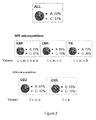
- Figure 2 shows the cumulative allele frequency distribution across the 1000 Genomes Project databse of human VH3-23 alleles comprising SNP rs56069819 (such alleles denonted “C” and the most frequent allele (which does not comprise this SNP) denoted "A").
- the figure shows that VH3-23 alleles comprising SNP rs56069819 are present at a cumulative frequency of 11% across all human ethnic populations taken as a whole, whereas in certain specific human ethnic sub-populations (ASW, LWK, YRI, CEU and GBR) such alleles are present at an above-average cumulative frequency.
- Indicated in the figure are those human PCSK9 variant forms (marked "Variants") that are found in the various sub-populations with above-average occurrence of human VH3-23 alleles comprising SNP rs56069819.
- each human population is selected from a population marked "(a)" above.
- the nucleotide sequence is SEQ ID NO: 31.
- amino acid sequence is SEQ ID NO: 11.
- amino acid sequence is SEQ ID NO: 22.
- nucleotide sequence is SEQ ID NO: 37.
- nucleotide sequence is SEQ ID NO: 29.
- the nucleotide sequence is SEQ ID NO: 31.
- nucleotide sequence is SEQ ID NO: 29.
- nucleotide sequence is SEQ ID NO: 35.
- nucleotide sequence is SEQ ID NO: 37.
- nucleotide sequence selected from the group consisting of SEQ ID NOs: 31 and 37, that encode 670G which is a marker for severity of coronary atherosclerosis (Chen et al 2005).
- nucleotide sequence is SEQ ID NO: 29.
- the binding is specific binding.
- the ligand binds (or has been determined as binding) to the PCSK9 with an affinity (Kd) of 1mM, 100nM, 10nM or 1nM or less.
- Kd affinity
- the affinity is no less than 10, 100 or 1000 fM.
- binding or affinity is determined by SPR or ELISA.
- amino acid sequence is SEQ ID NO: 7.
- amino acid sequence is SEQ ID NO: 8.
- amino acid sequence is SEQ ID NO: 11.
- the ligand is SAR236553/REGN727 (Sanofi Aventis/Regeneron) or a PCSK9-binding derivative thereof.
- the method of aspect 21 or 22, comprising the step of obtaining a nucleic acid encoding the antibody, fragment, derivative or binding site and optionally inserting the nucleic acid in an expression vector.
- an anti-PCSK9 ligand that binds a human PCSK9 selected from the group consisting of forms f , c, r, p, m, e, h, aj and q in the manufacture of a medicament for treating and/or preventing a PCSK9-mediated disease or condition in a human whose genome comprises a nucleotide sequence selected from the group consisting of SEQ ID NOs: 29-37, optionally for treating and/or preventing a PCSK9-mediated disease or condition in a human as recited in aspect 18 or 19.
- nucleotide sequence is SEQ ID NO: 34.
- the ligand can be any anti-PCSK9 ligand disclosed herein.
- the nucleotide sequence is SEQ ID NO: 32.
- said forms are the mature forms.
- any one of aspects 29 to 38 comprises genotyping the human for a nucleotide sequence selected from the group consisting of SEQ ID NOs: 29-37 or the catalytic- or C-terminal domain-encoding sequence thereof before administering the ligand to the human, wherein the ligand is determined to be capable of binding to a PCSK9 encoded by said selected sequence.
- said forms are the pro-forms.
- a diagnostic, therapeutic or prophylactic kit comprising a ligand that is capable of binding to or has been or is determined as capable of binding to an amino acid sequence selected from SEQ ID NOs: 4-27 and instructions for carrying out the method of any one of aspects 46 to 49 and/or a label or instructions indicating or covering administration of the ligand to a human as defined in any one of aspects 1 to 19.
- the SPR is carried out at a physiological salt level, eg, 150mM NaCl.
- the SPR is carried out at a detergent level of no greater than 0.05% by volume, eg, in the presence of P20 (polysorbate 20; eg, Tween-20TM) at 0.05% and EDTA at 3mM.
- P20 polysorbate 20; eg, Tween-20TM
- EDTA EDTA
- IgG2 heavy chain constant domain of an anti-PCSK9 antibody of the present invention has the amino acid sequence as shown in SEQ ID NO: 154,
- IgG4 heavy chain constant domain of an anti-PCSK9 antibody of the present invention has the amino acid sequence as shown in SEQ ID NO: 155,
- the ligand specifically binds to the catalytic domain of form h PCSK9, wherein the epitope comprises at least one amino acid that is not found in form a. In an embodiment, the ligand specifically binds to the catalytic domain of form aj PCSK9, wherein the epitope comprises at least one amino acid that is not found in form a. In an embodiment, the ligand specifically binds to the catalytic domain of form q PCSK9, wherein the epitope comprises at least one amino acid that is not found in form a.
- the PCSK9-targeting or binding ligand comprises or consists of AMG145 or 31H4, 16F12, 11F1, 8A3 or 21B12 disclosed in US20120093818A1 (Amgen, Inc) or an antibody comprising the variable domains of AMG145, 31H4, 16F12, 11F1, 8A3 or 21B12, the disclosures of which (including sequences) are incorporated herein by reference as though explicitly recited herein and for possible inclusion in one or more claims or for use in the present invention.
- the PCSK9-targeting or binding ligand comprises or consists of AMG145.
- Specific populations treatable by the therapeutic methods of the invention include patients indicated for LDL apheresis, subjects with PCSK9-activating (GOF) mutations, heterozygous Familial Hypercholesterolemia (heFH); subjects with primary hypercholesterolemia who are statin intolerant or statin uncontrolled; and subjects at risk for developing hypercholesterolemia who may be preventably treated.
- GAF PCSK9-activating
- HeFH heterozygous Familial Hypercholesterolemia
- subjects with primary hypercholesterolemia who are statin intolerant or statin uncontrolled subjects at risk for developing hypercholesterolemia who may be preventably treated.
- Methods of introduction include, but are not limited to, intradermal, intramuscular, intraperitoneal, intravenous, subcutaneous, intranasal, epidural, and oral routes.
- the composition may be administered by any convenient route, for example by infusion or bolus injection, by absorption through epithelial or mucocutaneous linings (e.g., oral mucosa, rectal and intestinal mucosa, etc.) and may be administered together with other biologically active agents. Administration can be systemic or local.
- Combination therapies may include the anti-PCSK9 ligand of the invention with, for example, one or more of any agent that (1) induces a cellular depletion of cholesterol synthesis by inhibiting 3-hydroxy-3-methylglutaryl (HMG)-coenzyme A (CoA) reductase, such as cerivastatin, atorvastatin, simvastatin, pitavastatin, rosuvastatin, fluvastatin, lovastatin, pravastatin; (2) inhibits cholesterol uptake and or bile acid re-absorption; (3) increase lipoprotein catabolism (such as niacin); and activators of the LXR transcription factor that plays a role in cholesterol elimination such as 22-hydroxycholesterol or fixed combinations such as ezetimibe plus simvastatin; a statin with a bile resin (e.g., cholestyramine, colestipol, colesevelam), a fixed combination of niacin plus a statin (e.
- nucleic acid or “nucleic acid sequence” refers to any molecule, preferably a polymeric molecule, incorporating units of ribonucleic acid, deoxyribonucleic acid.
- the nucleic acid can be either single-stranded or double-stranded.
- a single-stranded nucleic acid can be one nucleic acid strand of a denatured double- stranded DNA. Alternatively, it can be a single-stranded nucleic acid not derived from any double-stranded DNA.
- the nucleic acid can be DNA.
- nucleic acid can be RNA.
- Suitable nucleic acid molecules are DNA, including genomic DNA or cDNA. Other suitable nucleic acid molecules are RNA, including mRNA. In some aspects one can also use analogs of nucleic acids.
- compositions, methods, and respective component(s) thereof are used in reference to compositions, methods, and respective component(s) thereof, that are essential to the method or composition, yet open to the inclusion of unspecified elements, whether essential or not.
- compositions and/or methods disclosed and claimed herein can be made and executed without undue experimentation in light of the present disclosure. While the compositions and methods of this invention have been described in terms of preferred embodiments, it will be apparent to those of skill in the art that variations may be applied to the compositions and/or methods and in the steps or in the sequence of steps of the method described herein without departing from the concept, spirit and scope of the invention. All such similar substitutes and modifications apparent to those skilled in the art are deemed to be within the spirit, scope and concept of the invention as defined by the appended claims.
- the antibody or antibody fragment specifically binds said PCSK9 amino acid sequence.
- the antibody or antibody fragment binds a second PCSK9 protein comprising an amino acid sequence encoded by (i) a nucleotide sequence selected from the group consisting of SEQ ID NOs: 29-37; and/or (ii) a nucleotide sequence thereof encoding the catalytic domain or C-terminal domain of a PCSK9 protein.
- the antibody comprises a VH domain derived from the recombination of a human VH gene segment, human D gene segments and a human JH segment, the VH gene segment comprising a nucleotide sequence that comprises a single nucleotide polymorphism with nucleotide C as indicated in rs56069819 (CTGTACCAAGCCTCCCCCAGACTCCA[A/C]CAGCTGCACCTCACACTGGACACC).
- the VH gene segment is VH3-23*04 (SEQ ID NO: 38) encoded by a sequence comprising SEQ ID NO: 39.
- the antibody comprises a VH domain, wherein the VH domain comprises the framework 1 sequence of SEQ ID No. 40.
Landscapes
- Chemical & Material Sciences (AREA)
- Organic Chemistry (AREA)
- Health & Medical Sciences (AREA)
- General Health & Medical Sciences (AREA)
- Biochemistry (AREA)
- Biophysics (AREA)
- Life Sciences & Earth Sciences (AREA)
- Genetics & Genomics (AREA)
- Medicinal Chemistry (AREA)
- Molecular Biology (AREA)
- Proteomics, Peptides & Aminoacids (AREA)
- Immunology (AREA)
- Peptides Or Proteins (AREA)
Priority Applications (13)
| Application Number | Priority Date | Filing Date | Title |
|---|---|---|---|
| IES20140280A IES86602B2 (en) | 2013-12-17 | 2014-11-07 | An injectable antibody preparation for use in reducing or maintaining previously reduced cholesterol level |
| IES20140279A IES86601B2 (en) | 2013-12-17 | 2014-11-07 | An injectable antibody preparation for use in reducing or maintaining previously reduced cholesterol level |
| DE202014010499.9U DE202014010499U1 (de) | 2013-12-17 | 2014-12-14 | Targeting von humaner PCSK9 zur Cholesterinbehandlung |
| JP2016541434A JP6720079B2 (ja) | 2013-12-17 | 2014-12-17 | 対象とするヒト標的に特異的に結合するリガンド |
| DE112014005975.7T DE112014005975T5 (de) | 2013-12-17 | 2014-12-17 | Menschliche Ziele |
| PCT/GB2014/053730 WO2015092394A1 (en) | 2013-12-17 | 2014-12-17 | Antibodies for use in treating conditions related to specific pcsk9 variants in specific patients populations |
| CN201480075772.XA CN106062004A (zh) | 2013-12-17 | 2014-12-17 | 人靶标 |
| TW103144043A TWI713444B (zh) | 2013-12-17 | 2014-12-17 | 人類標靶 |
| PCT/GB2014/053729 WO2015092393A2 (en) | 2013-12-17 | 2014-12-17 | Human targets |
| DE112014005747.9T DE112014005747T5 (de) | 2013-12-17 | 2014-12-17 | Antikörper zur Verwendung bei der Behandlung von Zuständen, die mit spezifischen PCSK9 Varianten in spezifischen Patientenpopulationen in Beziehung stehen |
| DE202014010421.2U DE202014010421U1 (de) | 2013-12-17 | 2014-12-17 | Menschliche Ziele |
| JP2020104523A JP2020152729A (ja) | 2013-12-17 | 2020-06-17 | 対象とするヒト標的に特異的に結合するリガンド |
| JP2021155708A JP7202431B2 (ja) | 2013-12-17 | 2021-09-24 | 対象とするヒト標的に特異的に結合するリガンド |
Applications Claiming Priority (7)
| Application Number | Priority Date | Filing Date | Title |
|---|---|---|---|
| US201361916862P | 2013-12-17 | 2013-12-17 | |
| US201361916866P | 2013-12-17 | 2013-12-17 | |
| FR1362814A FR3014695A1 (de) | 2013-12-17 | 2013-12-17 | |
| GB1322253.4A GB2521356B (en) | 2013-12-17 | 2013-12-17 | Antibodies for use in treating conditions related to specific PCKS9 variants and associated diagnostic methods |
| GB1322250.0A GB2521355A (en) | 2013-12-17 | 2013-12-17 | Human targets I |
| US14/138,446 US8883157B1 (en) | 2013-12-17 | 2013-12-23 | Targeting rare human PCSK9 variants for cholesterol treatment |
| US14/228,760 US8951523B1 (en) | 2013-12-17 | 2014-03-28 | Targeting rare human PCSK9 variants for cholesterol treatment |
Publications (1)
| Publication Number | Publication Date |
|---|---|
| EP2886558A1 true EP2886558A1 (de) | 2015-06-24 |
Family
ID=53174732
Family Applications (2)
| Application Number | Title | Priority Date | Filing Date |
|---|---|---|---|
| EP14172579.6A Withdrawn EP2886558A1 (de) | 2013-12-17 | 2014-06-16 | Antikörper zur Anwendung bei der Behandlung von spezifischen PCSK9 Varianten bezüglich Erkrankungen bei spezifischen Patientengruppen |
| EP14172578.8A Withdrawn EP2886557A1 (de) | 2013-12-17 | 2014-06-16 | Antikörper zur Anwendung bei der Behandlung von spezifischen PCSK9 Varianten bezüglich Erkrankungen bei spezifischen Patientengruppen |
Family Applications After (1)
| Application Number | Title | Priority Date | Filing Date |
|---|---|---|---|
| EP14172578.8A Withdrawn EP2886557A1 (de) | 2013-12-17 | 2014-06-16 | Antikörper zur Anwendung bei der Behandlung von spezifischen PCSK9 Varianten bezüglich Erkrankungen bei spezifischen Patientengruppen |
Country Status (1)
| Country | Link |
|---|---|
| EP (2) | EP2886558A1 (de) |
Cited By (1)
| Publication number | Priority date | Publication date | Assignee | Title |
|---|---|---|---|---|
| US9920123B2 (en) | 2008-12-09 | 2018-03-20 | Genentech, Inc. | Anti-PD-L1 antibodies, compositions and articles of manufacture |
Families Citing this family (2)
| Publication number | Priority date | Publication date | Assignee | Title |
|---|---|---|---|---|
| EP3197492A1 (de) * | 2014-09-23 | 2017-08-02 | Pfizer Inc | Behandlung mit anti-pcsk9- antikörpern |
| CN121015868B (zh) * | 2025-10-29 | 2026-03-20 | 核工业四一六医院 | Pcsk9抑制剂在制备用于治疗甲减伴高脂血症的药物中的应用 |
Citations (4)
| Publication number | Priority date | Publication date | Assignee | Title |
|---|---|---|---|---|
| WO2004097047A1 (en) * | 2003-04-25 | 2004-11-11 | Institut National de la Santé et de la Recherche Médicale | Mutations in the human pcsk9 gene associated to hypercholesterolemia |
| WO2009026558A1 (en) * | 2007-08-23 | 2009-02-26 | Amgen Inc. | Antigen binding proteins to proprotein convertase subtilisin kexin type 9 (pcsk9) |
| WO2012154999A1 (en) * | 2011-05-10 | 2012-11-15 | Amgen Inc. | Methods of treating or preventing cholesterol related disorders |
| WO2013041844A2 (en) * | 2011-09-19 | 2013-03-28 | Kymab Limited | Antibodies, variable domains & chains tailored for human use |
-
2014
- 2014-06-16 EP EP14172579.6A patent/EP2886558A1/de not_active Withdrawn
- 2014-06-16 EP EP14172578.8A patent/EP2886557A1/de not_active Withdrawn
Patent Citations (4)
| Publication number | Priority date | Publication date | Assignee | Title |
|---|---|---|---|---|
| WO2004097047A1 (en) * | 2003-04-25 | 2004-11-11 | Institut National de la Santé et de la Recherche Médicale | Mutations in the human pcsk9 gene associated to hypercholesterolemia |
| WO2009026558A1 (en) * | 2007-08-23 | 2009-02-26 | Amgen Inc. | Antigen binding proteins to proprotein convertase subtilisin kexin type 9 (pcsk9) |
| WO2012154999A1 (en) * | 2011-05-10 | 2012-11-15 | Amgen Inc. | Methods of treating or preventing cholesterol related disorders |
| WO2013041844A2 (en) * | 2011-09-19 | 2013-03-28 | Kymab Limited | Antibodies, variable domains & chains tailored for human use |
Non-Patent Citations (2)
| Title |
|---|
| JANICE MAYNE ET AL: "Differential effects of PCSK9 loss of function variants on serum lipid and PCSK9 levels in Caucasian and African Canadian populations", LIPIDS IN HEALTH AND DISEASE, BIOMED CENTRAL, LONDON, GB, vol. 12, no. 1, 10 May 2013 (2013-05-10), pages 70, XP021151113, ISSN: 1476-511X, DOI: 10.1186/1476-511X-12-70 * |
| RICHARD M. DURBIN ET AL: "A map of human genome variation from population-scale sequencing", NATURE, vol. 467, no. 7319, 28 October 2010 (2010-10-28), pages 1061 - 1073, XP055048531, ISSN: 0028-0836, DOI: 10.1038/nature09534 * |
Cited By (1)
| Publication number | Priority date | Publication date | Assignee | Title |
|---|---|---|---|---|
| US9920123B2 (en) | 2008-12-09 | 2018-03-20 | Genentech, Inc. | Anti-PD-L1 antibodies, compositions and articles of manufacture |
Also Published As
| Publication number | Publication date |
|---|---|
| EP2886557A1 (de) | 2015-06-24 |
Similar Documents
| Publication | Publication Date | Title |
|---|---|---|
| US20230109430A1 (en) | Human targets | |
| US9034332B1 (en) | Precision medicine by targeting rare human PCSK9 variants for cholesterol treatment | |
| WO2015092394A1 (en) | Antibodies for use in treating conditions related to specific pcsk9 variants in specific patients populations | |
| US8999341B1 (en) | Targeting rare human PCSK9 variants for cholesterol treatment | |
| TWI465249B (zh) | 針對pcsk9之高親和性人類抗體 | |
| DE112014005747T5 (de) | Antikörper zur Verwendung bei der Behandlung von Zuständen, die mit spezifischen PCSK9 Varianten in spezifischen Patientenpopulationen in Beziehung stehen | |
| US9045548B1 (en) | Precision Medicine by targeting rare human PCSK9 variants for cholesterol treatment | |
| US9051378B1 (en) | Targeting rare human PCSK9 variants for cholesterol treatment | |
| CN107261139A (zh) | 治疗或预防胆固醇相关疾病的方法 | |
| EP2886557A1 (de) | Antikörper zur Anwendung bei der Behandlung von spezifischen PCSK9 Varianten bezüglich Erkrankungen bei spezifischen Patientengruppen | |
| EP4328245A2 (de) | Antikörper zur verwendung bei der behandlung von erkrankungen im zusammenhang mit spezifischen pcsk9-varianten in bestimmten patientenpopulationen | |
| EP3332790A1 (de) | Antikörper zur verwendung bei der behandlung von erkrankungen im zusammenhang mit spezifischen pcsk9-varianten in bestimmten patientenpopulationen | |
| EP2975058A1 (de) | Antikörper zur Anwendung bei der Behandlung von spezifischen PCSK9 Varianten bezüglich Erkrankungen bei spezifischen Patientengruppen | |
| HK40107372A (en) | Antibodies for use in treating conditions related to specific pcsk9 variants in specific patients populations | |
| GB2558442A (en) | Human targets II | |
| IES20140279A2 (en) | Human targets II | |
| IES86600B2 (en) | An injectable antibody preparation for use in reducing or maintaining previously reduced cholesterol level | |
| TW201525005A (zh) | 用於膽固醇治療之標靶人類第9型前蛋白轉換酶枯草桿菌蛋白酶(pcsk9)之技術 | |
| FR3033703A1 (de) | ||
| IES20140321A2 (en) | An injectable antibody preparation for use in reducing or maintaining previously reduced cholesterol level | |
| DE202015009002U1 (de) | Targeting von humaner PCSK9 zur Cholesterinbehandlung | |
| DE202014010499U1 (de) | Targeting von humaner PCSK9 zur Cholesterinbehandlung | |
| GB2521355A (en) | Human targets I |
Legal Events
| Date | Code | Title | Description |
|---|---|---|---|
| PUAI | Public reference made under article 153(3) epc to a published international application that has entered the european phase |
Free format text: ORIGINAL CODE: 0009012 |
|
| 17P | Request for examination filed |
Effective date: 20140616 |
|
| AK | Designated contracting states |
Kind code of ref document: A1 Designated state(s): AL AT BE BG CH CY CZ DE DK EE ES FI FR GB GR HR HU IE IS IT LI LT LU LV MC MK MT NL NO PL PT RO RS SE SI SK SM TR |
|
| AX | Request for extension of the european patent |
Extension state: BA ME |
|
| STAA | Information on the status of an ep patent application or granted ep patent |
Free format text: STATUS: THE APPLICATION IS DEEMED TO BE WITHDRAWN |
|
| 18D | Application deemed to be withdrawn |
Effective date: 20151215 |