EP2886575A1 - Utilisation d'une composition adhésive a base de polymères silyles pour applications cryogéniques - Google Patents
Utilisation d'une composition adhésive a base de polymères silyles pour applications cryogéniques Download PDFInfo
- Publication number
- EP2886575A1 EP2886575A1 EP14197282.8A EP14197282A EP2886575A1 EP 2886575 A1 EP2886575 A1 EP 2886575A1 EP 14197282 A EP14197282 A EP 14197282A EP 2886575 A1 EP2886575 A1 EP 2886575A1
- Authority
- EP
- European Patent Office
- Prior art keywords
- adhesive composition
- use according
- equal
- polymer
- mol
- Prior art date
- Legal status (The legal status is an assumption and is not a legal conclusion. Google has not performed a legal analysis and makes no representation as to the accuracy of the status listed.)
- Granted
Links
Images
Classifications
-
- C—CHEMISTRY; METALLURGY
- C08—ORGANIC MACROMOLECULAR COMPOUNDS; THEIR PREPARATION OR CHEMICAL WORKING-UP; COMPOSITIONS BASED THEREON
- C08G—MACROMOLECULAR COMPOUNDS OBTAINED OTHERWISE THAN BY REACTIONS ONLY INVOLVING UNSATURATED CARBON-TO-CARBON BONDS
- C08G18/00—Polymeric products of isocyanates or isothiocyanates
- C08G18/06—Polymeric products of isocyanates or isothiocyanates with compounds having active hydrogen
- C08G18/70—Polymeric products of isocyanates or isothiocyanates with compounds having active hydrogen characterised by the isocyanates or isothiocyanates used
- C08G18/72—Polyisocyanates or polyisothiocyanates
- C08G18/74—Polyisocyanates or polyisothiocyanates cyclic
- C08G18/75—Polyisocyanates or polyisothiocyanates cyclic cycloaliphatic
- C08G18/751—Polyisocyanates or polyisothiocyanates cyclic cycloaliphatic containing only one cycloaliphatic ring
- C08G18/752—Polyisocyanates or polyisothiocyanates cyclic cycloaliphatic containing only one cycloaliphatic ring containing at least one isocyanate or isothiocyanate group linked to the cycloaliphatic ring by means of an aliphatic group
- C08G18/753—Polyisocyanates or polyisothiocyanates cyclic cycloaliphatic containing only one cycloaliphatic ring containing at least one isocyanate or isothiocyanate group linked to the cycloaliphatic ring by means of an aliphatic group containing one isocyanate or isothiocyanate group linked to the cycloaliphatic ring by means of an aliphatic group having a primary carbon atom next to the isocyanate or isothiocyanate group
- C08G18/755—Polyisocyanates or polyisothiocyanates cyclic cycloaliphatic containing only one cycloaliphatic ring containing at least one isocyanate or isothiocyanate group linked to the cycloaliphatic ring by means of an aliphatic group containing one isocyanate or isothiocyanate group linked to the cycloaliphatic ring by means of an aliphatic group having a primary carbon atom next to the isocyanate or isothiocyanate group and at least one isocyanate or isothiocyanate group linked to a secondary carbon atom of the cycloaliphatic ring, e.g. isophorone diisocyanate
-
- C—CHEMISTRY; METALLURGY
- C09—DYES; PAINTS; POLISHES; NATURAL RESINS; ADHESIVES; COMPOSITIONS NOT OTHERWISE PROVIDED FOR; APPLICATIONS OF MATERIALS NOT OTHERWISE PROVIDED FOR
- C09J—ADHESIVES; NON-MECHANICAL ASPECTS OF ADHESIVE PROCESSES IN GENERAL; ADHESIVE PROCESSES NOT PROVIDED FOR ELSEWHERE; USE OF MATERIALS AS ADHESIVES
- C09J183/00—Adhesives based on macromolecular compounds obtained by reactions forming in the main chain of the macromolecule a linkage containing silicon, with or without sulfur, nitrogen, oxygen, or carbon only; Adhesives based on derivatives of such polymers
- C09J183/04—Polysiloxanes
-
- C—CHEMISTRY; METALLURGY
- C08—ORGANIC MACROMOLECULAR COMPOUNDS; THEIR PREPARATION OR CHEMICAL WORKING-UP; COMPOSITIONS BASED THEREON
- C08G—MACROMOLECULAR COMPOUNDS OBTAINED OTHERWISE THAN BY REACTIONS ONLY INVOLVING UNSATURATED CARBON-TO-CARBON BONDS
- C08G18/00—Polymeric products of isocyanates or isothiocyanates
- C08G18/06—Polymeric products of isocyanates or isothiocyanates with compounds having active hydrogen
- C08G18/08—Processes
-
- C—CHEMISTRY; METALLURGY
- C08—ORGANIC MACROMOLECULAR COMPOUNDS; THEIR PREPARATION OR CHEMICAL WORKING-UP; COMPOSITIONS BASED THEREON
- C08G—MACROMOLECULAR COMPOUNDS OBTAINED OTHERWISE THAN BY REACTIONS ONLY INVOLVING UNSATURATED CARBON-TO-CARBON BONDS
- C08G18/00—Polymeric products of isocyanates or isothiocyanates
- C08G18/06—Polymeric products of isocyanates or isothiocyanates with compounds having active hydrogen
- C08G18/08—Processes
- C08G18/10—Prepolymer processes involving reaction of isocyanates or isothiocyanates with compounds having active hydrogen in a first reaction step
-
- C—CHEMISTRY; METALLURGY
- C08—ORGANIC MACROMOLECULAR COMPOUNDS; THEIR PREPARATION OR CHEMICAL WORKING-UP; COMPOSITIONS BASED THEREON
- C08G—MACROMOLECULAR COMPOUNDS OBTAINED OTHERWISE THAN BY REACTIONS ONLY INVOLVING UNSATURATED CARBON-TO-CARBON BONDS
- C08G18/00—Polymeric products of isocyanates or isothiocyanates
- C08G18/06—Polymeric products of isocyanates or isothiocyanates with compounds having active hydrogen
- C08G18/08—Processes
- C08G18/16—Catalysts
- C08G18/22—Catalysts containing metal compounds
- C08G18/227—Catalysts containing metal compounds of antimony, bismuth or arsenic
-
- C—CHEMISTRY; METALLURGY
- C08—ORGANIC MACROMOLECULAR COMPOUNDS; THEIR PREPARATION OR CHEMICAL WORKING-UP; COMPOSITIONS BASED THEREON
- C08G—MACROMOLECULAR COMPOUNDS OBTAINED OTHERWISE THAN BY REACTIONS ONLY INVOLVING UNSATURATED CARBON-TO-CARBON BONDS
- C08G18/00—Polymeric products of isocyanates or isothiocyanates
- C08G18/06—Polymeric products of isocyanates or isothiocyanates with compounds having active hydrogen
- C08G18/28—Polymeric products of isocyanates or isothiocyanates with compounds having active hydrogen characterised by the compounds used containing active hydrogen
- C08G18/2805—Compounds having only one group containing active hydrogen
- C08G18/288—Compounds containing at least one heteroatom other than oxygen or nitrogen
- C08G18/289—Compounds containing at least one heteroatom other than oxygen or nitrogen containing silicon
-
- C—CHEMISTRY; METALLURGY
- C08—ORGANIC MACROMOLECULAR COMPOUNDS; THEIR PREPARATION OR CHEMICAL WORKING-UP; COMPOSITIONS BASED THEREON
- C08G—MACROMOLECULAR COMPOUNDS OBTAINED OTHERWISE THAN BY REACTIONS ONLY INVOLVING UNSATURATED CARBON-TO-CARBON BONDS
- C08G18/00—Polymeric products of isocyanates or isothiocyanates
- C08G18/06—Polymeric products of isocyanates or isothiocyanates with compounds having active hydrogen
- C08G18/28—Polymeric products of isocyanates or isothiocyanates with compounds having active hydrogen characterised by the compounds used containing active hydrogen
- C08G18/30—Low-molecular-weight compounds
- C08G18/38—Low-molecular-weight compounds having heteroatoms other than oxygen
- C08G18/3893—Low-molecular-weight compounds having heteroatoms other than oxygen containing silicon
-
- C—CHEMISTRY; METALLURGY
- C08—ORGANIC MACROMOLECULAR COMPOUNDS; THEIR PREPARATION OR CHEMICAL WORKING-UP; COMPOSITIONS BASED THEREON
- C08G—MACROMOLECULAR COMPOUNDS OBTAINED OTHERWISE THAN BY REACTIONS ONLY INVOLVING UNSATURATED CARBON-TO-CARBON BONDS
- C08G18/00—Polymeric products of isocyanates or isothiocyanates
- C08G18/06—Polymeric products of isocyanates or isothiocyanates with compounds having active hydrogen
- C08G18/70—Polymeric products of isocyanates or isothiocyanates with compounds having active hydrogen characterised by the isocyanates or isothiocyanates used
- C08G18/71—Monoisocyanates or monoisothiocyanates
- C08G18/718—Monoisocyanates or monoisothiocyanates containing silicon
-
- C—CHEMISTRY; METALLURGY
- C08—ORGANIC MACROMOLECULAR COMPOUNDS; THEIR PREPARATION OR CHEMICAL WORKING-UP; COMPOSITIONS BASED THEREON
- C08G—MACROMOLECULAR COMPOUNDS OBTAINED OTHERWISE THAN BY REACTIONS ONLY INVOLVING UNSATURATED CARBON-TO-CARBON BONDS
- C08G18/00—Polymeric products of isocyanates or isothiocyanates
- C08G18/06—Polymeric products of isocyanates or isothiocyanates with compounds having active hydrogen
- C08G18/70—Polymeric products of isocyanates or isothiocyanates with compounds having active hydrogen characterised by the isocyanates or isothiocyanates used
- C08G18/72—Polyisocyanates or polyisothiocyanates
- C08G18/80—Masked polyisocyanates
- C08G18/8061—Masked polyisocyanates masked with compounds having only one group containing active hydrogen
- C08G18/8083—Masked polyisocyanates masked with compounds having only one group containing active hydrogen with compounds containing at least one heteroatom other than oxygen or nitrogen
- C08G18/809—Masked polyisocyanates masked with compounds having only one group containing active hydrogen with compounds containing at least one heteroatom other than oxygen or nitrogen containing silicon
-
- C—CHEMISTRY; METALLURGY
- C08—ORGANIC MACROMOLECULAR COMPOUNDS; THEIR PREPARATION OR CHEMICAL WORKING-UP; COMPOSITIONS BASED THEREON
- C08K—Use of inorganic or non-macromolecular organic substances as compounding ingredients
- C08K3/00—Use of inorganic substances as compounding ingredients
- C08K3/01—Use of inorganic substances as compounding ingredients characterized by their specific function
- C08K3/013—Fillers, pigments or reinforcing additives
-
- C—CHEMISTRY; METALLURGY
- C08—ORGANIC MACROMOLECULAR COMPOUNDS; THEIR PREPARATION OR CHEMICAL WORKING-UP; COMPOSITIONS BASED THEREON
- C08L—COMPOSITIONS OF MACROMOLECULAR COMPOUNDS
- C08L71/00—Compositions of polyethers obtained by reactions forming an ether link in the main chain; Compositions of derivatives of such polymers
- C08L71/02—Polyalkylene oxides
-
- C—CHEMISTRY; METALLURGY
- C08—ORGANIC MACROMOLECULAR COMPOUNDS; THEIR PREPARATION OR CHEMICAL WORKING-UP; COMPOSITIONS BASED THEREON
- C08L—COMPOSITIONS OF MACROMOLECULAR COMPOUNDS
- C08L75/00—Compositions of polyureas or polyurethanes; Compositions of derivatives of such polymers
- C08L75/04—Polyurethanes
- C08L75/08—Polyurethanes from polyethers
-
- C—CHEMISTRY; METALLURGY
- C09—DYES; PAINTS; POLISHES; NATURAL RESINS; ADHESIVES; COMPOSITIONS NOT OTHERWISE PROVIDED FOR; APPLICATIONS OF MATERIALS NOT OTHERWISE PROVIDED FOR
- C09J—ADHESIVES; NON-MECHANICAL ASPECTS OF ADHESIVE PROCESSES IN GENERAL; ADHESIVE PROCESSES NOT PROVIDED FOR ELSEWHERE; USE OF MATERIALS AS ADHESIVES
- C09J11/00—Features of adhesives not provided for in group C09J9/00, e.g. additives
- C09J11/02—Non-macromolecular additives
- C09J11/04—Non-macromolecular additives inorganic
-
- C—CHEMISTRY; METALLURGY
- C09—DYES; PAINTS; POLISHES; NATURAL RESINS; ADHESIVES; COMPOSITIONS NOT OTHERWISE PROVIDED FOR; APPLICATIONS OF MATERIALS NOT OTHERWISE PROVIDED FOR
- C09J—ADHESIVES; NON-MECHANICAL ASPECTS OF ADHESIVE PROCESSES IN GENERAL; ADHESIVE PROCESSES NOT PROVIDED FOR ELSEWHERE; USE OF MATERIALS AS ADHESIVES
- C09J11/00—Features of adhesives not provided for in group C09J9/00, e.g. additives
- C09J11/02—Non-macromolecular additives
- C09J11/06—Non-macromolecular additives organic
-
- C—CHEMISTRY; METALLURGY
- C09—DYES; PAINTS; POLISHES; NATURAL RESINS; ADHESIVES; COMPOSITIONS NOT OTHERWISE PROVIDED FOR; APPLICATIONS OF MATERIALS NOT OTHERWISE PROVIDED FOR
- C09J—ADHESIVES; NON-MECHANICAL ASPECTS OF ADHESIVE PROCESSES IN GENERAL; ADHESIVE PROCESSES NOT PROVIDED FOR ELSEWHERE; USE OF MATERIALS AS ADHESIVES
- C09J171/00—Adhesives based on polyethers obtained by reactions forming an ether link in the main chain; Adhesives based on derivatives of such polymers
- C09J171/02—Polyalkylene oxides
-
- C—CHEMISTRY; METALLURGY
- C09—DYES; PAINTS; POLISHES; NATURAL RESINS; ADHESIVES; COMPOSITIONS NOT OTHERWISE PROVIDED FOR; APPLICATIONS OF MATERIALS NOT OTHERWISE PROVIDED FOR
- C09J—ADHESIVES; NON-MECHANICAL ASPECTS OF ADHESIVE PROCESSES IN GENERAL; ADHESIVE PROCESSES NOT PROVIDED FOR ELSEWHERE; USE OF MATERIALS AS ADHESIVES
- C09J175/00—Adhesives based on polyureas or polyurethanes; Adhesives based on derivatives of such polymers
- C09J175/04—Polyurethanes
- C09J175/08—Polyurethanes from polyethers
-
- F—MECHANICAL ENGINEERING; LIGHTING; HEATING; WEAPONS; BLASTING
- F17—STORING OR DISTRIBUTING GASES OR LIQUIDS
- F17C—VESSELS FOR CONTAINING OR STORING COMPRESSED, LIQUEFIED OR SOLIDIFIED GASES; FIXED-CAPACITY GAS-HOLDERS; FILLING VESSELS WITH, OR DISCHARGING FROM VESSELS, COMPRESSED, LIQUEFIED, OR SOLIDIFIED GASES
- F17C3/00—Vessels not under pressure
-
- C—CHEMISTRY; METALLURGY
- C08—ORGANIC MACROMOLECULAR COMPOUNDS; THEIR PREPARATION OR CHEMICAL WORKING-UP; COMPOSITIONS BASED THEREON
- C08K—Use of inorganic or non-macromolecular organic substances as compounding ingredients
- C08K3/00—Use of inorganic substances as compounding ingredients
- C08K3/18—Oxygen-containing compounds, e.g. metal carbonyls
- C08K3/20—Oxides; Hydroxides
- C08K3/22—Oxides; Hydroxides of metals
- C08K2003/2227—Oxides; Hydroxides of metals of aluminium
-
- C—CHEMISTRY; METALLURGY
- C08—ORGANIC MACROMOLECULAR COMPOUNDS; THEIR PREPARATION OR CHEMICAL WORKING-UP; COMPOSITIONS BASED THEREON
- C08K—Use of inorganic or non-macromolecular organic substances as compounding ingredients
- C08K3/00—Use of inorganic substances as compounding ingredients
- C08K3/18—Oxygen-containing compounds, e.g. metal carbonyls
- C08K3/24—Acids; Salts thereof
- C08K3/26—Carbonates; Bicarbonates
- C08K2003/265—Calcium, strontium or barium carbonate
-
- C—CHEMISTRY; METALLURGY
- C08—ORGANIC MACROMOLECULAR COMPOUNDS; THEIR PREPARATION OR CHEMICAL WORKING-UP; COMPOSITIONS BASED THEREON
- C08L—COMPOSITIONS OF MACROMOLECULAR COMPOUNDS
- C08L2205/00—Polymer mixtures characterised by other features
- C08L2205/02—Polymer mixtures characterised by other features containing two or more polymers of the same C08L -group
- C08L2205/025—Polymer mixtures characterised by other features containing two or more polymers of the same C08L -group containing two or more polymers of the same hierarchy C08L, and differing only in parameters such as density, comonomer content, molecular weight, structure
-
- C—CHEMISTRY; METALLURGY
- C08—ORGANIC MACROMOLECULAR COMPOUNDS; THEIR PREPARATION OR CHEMICAL WORKING-UP; COMPOSITIONS BASED THEREON
- C08L—COMPOSITIONS OF MACROMOLECULAR COMPOUNDS
- C08L2205/00—Polymer mixtures characterised by other features
- C08L2205/03—Polymer mixtures characterised by other features containing three or more polymers in a blend
-
- F—MECHANICAL ENGINEERING; LIGHTING; HEATING; WEAPONS; BLASTING
- F17—STORING OR DISTRIBUTING GASES OR LIQUIDS
- F17C—VESSELS FOR CONTAINING OR STORING COMPRESSED, LIQUEFIED OR SOLIDIFIED GASES; FIXED-CAPACITY GAS-HOLDERS; FILLING VESSELS WITH, OR DISCHARGING FROM VESSELS, COMPRESSED, LIQUEFIED, OR SOLIDIFIED GASES
- F17C2201/00—Vessel construction, in particular geometry, arrangement or size
- F17C2201/05—Size
- F17C2201/052—Size large (>1000 m3)
-
- F—MECHANICAL ENGINEERING; LIGHTING; HEATING; WEAPONS; BLASTING
- F17—STORING OR DISTRIBUTING GASES OR LIQUIDS
- F17C—VESSELS FOR CONTAINING OR STORING COMPRESSED, LIQUEFIED OR SOLIDIFIED GASES; FIXED-CAPACITY GAS-HOLDERS; FILLING VESSELS WITH, OR DISCHARGING FROM VESSELS, COMPRESSED, LIQUEFIED, OR SOLIDIFIED GASES
- F17C2203/00—Vessel construction, in particular walls or details thereof
- F17C2203/03—Thermal insulations
- F17C2203/0304—Thermal insulations by solid means
- F17C2203/0354—Wood
-
- F—MECHANICAL ENGINEERING; LIGHTING; HEATING; WEAPONS; BLASTING
- F17—STORING OR DISTRIBUTING GASES OR LIQUIDS
- F17C—VESSELS FOR CONTAINING OR STORING COMPRESSED, LIQUEFIED OR SOLIDIFIED GASES; FIXED-CAPACITY GAS-HOLDERS; FILLING VESSELS WITH, OR DISCHARGING FROM VESSELS, COMPRESSED, LIQUEFIED, OR SOLIDIFIED GASES
- F17C2203/00—Vessel construction, in particular walls or details thereof
- F17C2203/03—Thermal insulations
- F17C2203/0304—Thermal insulations by solid means
- F17C2203/0358—Thermal insulations by solid means in form of panels
-
- F—MECHANICAL ENGINEERING; LIGHTING; HEATING; WEAPONS; BLASTING
- F17—STORING OR DISTRIBUTING GASES OR LIQUIDS
- F17C—VESSELS FOR CONTAINING OR STORING COMPRESSED, LIQUEFIED OR SOLIDIFIED GASES; FIXED-CAPACITY GAS-HOLDERS; FILLING VESSELS WITH, OR DISCHARGING FROM VESSELS, COMPRESSED, LIQUEFIED, OR SOLIDIFIED GASES
- F17C2203/00—Vessel construction, in particular walls or details thereof
- F17C2203/06—Materials for walls or layers thereof; Properties or structures of walls or their materials
- F17C2203/0602—Wall structures; Special features thereof
- F17C2203/0604—Liners
-
- F—MECHANICAL ENGINEERING; LIGHTING; HEATING; WEAPONS; BLASTING
- F17—STORING OR DISTRIBUTING GASES OR LIQUIDS
- F17C—VESSELS FOR CONTAINING OR STORING COMPRESSED, LIQUEFIED OR SOLIDIFIED GASES; FIXED-CAPACITY GAS-HOLDERS; FILLING VESSELS WITH, OR DISCHARGING FROM VESSELS, COMPRESSED, LIQUEFIED, OR SOLIDIFIED GASES
- F17C2203/00—Vessel construction, in particular walls or details thereof
- F17C2203/06—Materials for walls or layers thereof; Properties or structures of walls or their materials
- F17C2203/0602—Wall structures; Special features thereof
- F17C2203/0612—Wall structures
- F17C2203/0614—Single wall
- F17C2203/0619—Single wall with two layers
-
- F—MECHANICAL ENGINEERING; LIGHTING; HEATING; WEAPONS; BLASTING
- F17—STORING OR DISTRIBUTING GASES OR LIQUIDS
- F17C—VESSELS FOR CONTAINING OR STORING COMPRESSED, LIQUEFIED OR SOLIDIFIED GASES; FIXED-CAPACITY GAS-HOLDERS; FILLING VESSELS WITH, OR DISCHARGING FROM VESSELS, COMPRESSED, LIQUEFIED, OR SOLIDIFIED GASES
- F17C2205/00—Vessel construction, in particular mounting arrangements, attachments or identifications means
- F17C2205/01—Mounting arrangements
- F17C2205/0103—Exterior arrangements
- F17C2205/0119—Vessel walls form part of another structure
-
- F—MECHANICAL ENGINEERING; LIGHTING; HEATING; WEAPONS; BLASTING
- F17—STORING OR DISTRIBUTING GASES OR LIQUIDS
- F17C—VESSELS FOR CONTAINING OR STORING COMPRESSED, LIQUEFIED OR SOLIDIFIED GASES; FIXED-CAPACITY GAS-HOLDERS; FILLING VESSELS WITH, OR DISCHARGING FROM VESSELS, COMPRESSED, LIQUEFIED, OR SOLIDIFIED GASES
- F17C2209/00—Vessel construction, in particular methods of manufacturing
- F17C2209/22—Assembling processes
- F17C2209/227—Assembling processes by adhesive means
-
- F—MECHANICAL ENGINEERING; LIGHTING; HEATING; WEAPONS; BLASTING
- F17—STORING OR DISTRIBUTING GASES OR LIQUIDS
- F17C—VESSELS FOR CONTAINING OR STORING COMPRESSED, LIQUEFIED OR SOLIDIFIED GASES; FIXED-CAPACITY GAS-HOLDERS; FILLING VESSELS WITH, OR DISCHARGING FROM VESSELS, COMPRESSED, LIQUEFIED, OR SOLIDIFIED GASES
- F17C2221/00—Handled fluid, in particular type of fluid
- F17C2221/03—Mixtures
- F17C2221/032—Hydrocarbons
- F17C2221/033—Methane, e.g. natural gas, CNG, LNG, GNL, GNC, PLNG
-
- F—MECHANICAL ENGINEERING; LIGHTING; HEATING; WEAPONS; BLASTING
- F17—STORING OR DISTRIBUTING GASES OR LIQUIDS
- F17C—VESSELS FOR CONTAINING OR STORING COMPRESSED, LIQUEFIED OR SOLIDIFIED GASES; FIXED-CAPACITY GAS-HOLDERS; FILLING VESSELS WITH, OR DISCHARGING FROM VESSELS, COMPRESSED, LIQUEFIED, OR SOLIDIFIED GASES
- F17C2223/00—Handled fluid before transfer, i.e. state of fluid when stored in the vessel or before transfer from the vessel
- F17C2223/01—Handled fluid before transfer, i.e. state of fluid when stored in the vessel or before transfer from the vessel characterised by the phase
- F17C2223/0146—Two-phase
- F17C2223/0153—Liquefied gas, e.g. LPG, GPL
- F17C2223/0161—Liquefied gas, e.g. LPG, GPL cryogenic, e.g. LNG, GNL, PLNG
-
- F—MECHANICAL ENGINEERING; LIGHTING; HEATING; WEAPONS; BLASTING
- F17—STORING OR DISTRIBUTING GASES OR LIQUIDS
- F17C—VESSELS FOR CONTAINING OR STORING COMPRESSED, LIQUEFIED OR SOLIDIFIED GASES; FIXED-CAPACITY GAS-HOLDERS; FILLING VESSELS WITH, OR DISCHARGING FROM VESSELS, COMPRESSED, LIQUEFIED, OR SOLIDIFIED GASES
- F17C2223/00—Handled fluid before transfer, i.e. state of fluid when stored in the vessel or before transfer from the vessel
- F17C2223/03—Handled fluid before transfer, i.e. state of fluid when stored in the vessel or before transfer from the vessel characterised by the pressure level
- F17C2223/033—Small pressure, e.g. for liquefied gas
-
- F—MECHANICAL ENGINEERING; LIGHTING; HEATING; WEAPONS; BLASTING
- F17—STORING OR DISTRIBUTING GASES OR LIQUIDS
- F17C—VESSELS FOR CONTAINING OR STORING COMPRESSED, LIQUEFIED OR SOLIDIFIED GASES; FIXED-CAPACITY GAS-HOLDERS; FILLING VESSELS WITH, OR DISCHARGING FROM VESSELS, COMPRESSED, LIQUEFIED, OR SOLIDIFIED GASES
- F17C2270/00—Applications
- F17C2270/01—Applications for fluid transport or storage
- F17C2270/0102—Applications for fluid transport or storage on or in the water
- F17C2270/0105—Ships
- F17C2270/0107—Wall panels
-
- F—MECHANICAL ENGINEERING; LIGHTING; HEATING; WEAPONS; BLASTING
- F17—STORING OR DISTRIBUTING GASES OR LIQUIDS
- F17C—VESSELS FOR CONTAINING OR STORING COMPRESSED, LIQUEFIED OR SOLIDIFIED GASES; FIXED-CAPACITY GAS-HOLDERS; FILLING VESSELS WITH, OR DISCHARGING FROM VESSELS, COMPRESSED, LIQUEFIED, OR SOLIDIFIED GASES
- F17C2270/00—Applications
- F17C2270/01—Applications for fluid transport or storage
- F17C2270/0134—Applications for fluid transport or storage placed above the ground
- F17C2270/0136—Terminals
Definitions
- the present invention relates to the use of an adhesive composition comprising at least one silylated polymer and at least one filler for assembling a sealed tank comprising a fluid at a temperature of less than or equal to -100.degree. carrier structure selected from the hull of a ship, the cabin of an aircraft and a container.
- the tanks in which the liquid methane is stored are made of different materials and barriers that ensure sealing.
- Storage pressure is usually close to atmospheric pressure.
- the very slight overpressure created by the evaporation is regulated, the vent ("boil out" in English) can be re-compressed and liquefied, or simply burned to produce energy.
- the sealed and insulating tanks integrated in a carrying structure, in particular of ship comprise two successive sealing barriers, a primary barrier in contact with the product contained in the tank and another barrier, called secondary, disposed between the primary barrier and the carrier structure, these two sealing barriers being alternated with two thermally insulating barriers.
- the secondary insulating barrier is fixed on the supporting structure constituted by the internal hull of a ship by means of various methods known to those skilled in the art.
- the carrier structure may be a container whose structure is generally made of concrete.
- the supporting structure may be the cabin of an aircraft.
- the primary and secondary insulating barriers are constituted by a succession of insulating blocks which are either caissons closed parallelepipeds filled with insulation, or consist of blocks of insulating foam bonded to a load-bearing panel.
- the material used to make the panels of boxes or load-bearing panels is generally plywood, for a question of cost and its insulating qualities.
- the insulating blocks of the secondary barrier may be mechanically fixed to the supporting structure or may be bonded through their outer panel to said structure.
- the materials generally used for bonding are epoxy resins in two-component form.
- the epoxy resin mastics traditionally used have a high compression modulus, generally greater than 1000 MPa, at low temperatures (temperatures ranging from -20 ° C to -50 ° C), offering almost no shock absorbing capacity and absorb the deformations.
- the document WO 2010/052671 relates to the use of a two-component adhesive composition based on polyurethane (PU2K) for bonding between the primary barrier and the secondary barrier of a storage tank and / or liquefied gas transport.
- the polyurethane-based two-component adhesive compositions do not exhibit a satisfactory compression modulus at low temperature, a PU2K composition generally has a compression modulus greater than 1000 MPa at temperatures below 0 ° C.
- the document FR 2109153 proposes a system for fixing a thermal insulation layer for tanks using mechanical means and a bonding by means of a silicone adhesive.
- the polymers of the silicone or polysiloxane or polydimethylsiloxane type have very low compression moduli; they are very flexible.
- the breaking stress is only of the order of 2 MPa.
- the object of the present invention is to provide a solution adapted to pressure and tensile stresses in cryogenic industrial applications, such as the constraints associated with the assembly, maintenance and setting of a sealed tank, such as a tank for storing and / or transporting liquefied gas, and a supporting structure.
- the compression modulus of the crosslinked adhesive composition ranges from 15 to 600 MPa at 20 ° C.
- the compression modulus of the crosslinked adhesive composition is less than or equal to 1000 MPa at -30 ° C.
- the crosslinked adhesive composition has a breaking stress greater than or equal to 3 MPa.
- the fluid at a temperature of less than or equal to -100 ° C is liquefied natural gas.
- the supporting structure is the hull of a ship.
- the adhesive composition comprises at least two different charges.
- the adhesive composition comprises at least one inorganic filler and at least one organic filler.
- the adhesive composition further comprises at least one catalyst.
- the silylated polymer is chosen from silylated polyethers and silylated polyurethanes, alone or as a mixture.
- the adhesive composition comprises at least one polymer of formula (II), (IIbis) or (III) and at least one polymer of formula (IV).
- a third object of the present invention relates to the assembly of a vessel comprising a fluid at a temperature less than or equal to -100 ° C and a carrier structure selected from the hull of a ship, the cabin of an airplane and a container characterized in that the assembly is carried out using an adhesive composition as defined in the present invention.
- the present invention makes it possible to provide an adhesive composition which, after crosslinking, withstands the pressures, compressions and strokes applied thereto.
- the present invention makes it possible to compensate for the surface irregularities of the carrier structure by means of an adhesive composition that can be adapted to the shapes of the insulating blocks and the supporting structure.
- the present invention makes it possible to provide an assembly which is capable of absorbing part of the deformations of the hull of the vessel and / or of the tank, due for example to the movement of the liquefied gas inside the vessel generated by the swell, and thus helps prevent damaging damage.
- the present invention allows a simplified application of the adhesive composition, as a single component.
- the adhesive composition defined above is particularly well suited to cryogenic applications, especially over the entire temperature range from -50 ° C to + 40 ° C. Indeed, the crosslinked adhesive composition retains a compression modulus less than or equal to 1000 MPa at -30 ° C.
- the crosslinked adhesive composition can therefore be subjected to temperatures ranging from -50 ° C. to + 40 ° C. and will resist, that is to say that the assembly will not undergo any detachment, decohesion or major displacement of the vessel relative to the carrier surface.
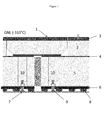
- the figure 1 represents a sectional diagram of a part of the sealed tank, intended for the sea transport of liquefied gas, with the bonding zone represented by the adhesive composition cords 8 for the assembly of the vessel and the supporting structure 7, such as the hull of a ship.
- the present invention relates to the use of an adhesive composition comprising at least one silylated polymer and at least one filler for assembling a vessel comprising a fluid at a temperature of less than or equal to -100 ° C. and a structure carrier chosen from the hull of a ship, the cabin of an airplane and a container.
- the adhesive composition defined in the present invention has, after crosslinking, a compression modulus at + 20 ° C. ranging from 15 to 600 MPa, preferably ranging from 20 to 500 MPa, more preferably ranging from 25 to 400 MPa, and a compression modulus at -30 ° C of less than or equal to 1000 MPa, preferably less than or equal to 750 MPa, more preferably less than or equal to 500 MPa.
- the compression modulus is measured according to ASTM D695.
- Compression specimens in the form of studs of size 20mm x 10mm x 10mm are produced by applying the composition to be tested in a Teflon mold. After 15 days of crosslinking at + 23 ° C. and 50% relative humidity, the test pieces are removed from the mold, placed at the temperature desired for the measurement (for example + 20 ° C. and -30 ° C.) and compressed at room temperature. using a dynamometer at a speed of 1 mm / min.
- Elongation and breaking stress are measured according to ISO 527-2.
- Dumbbell specimens of type h2 are produced by applying the composition to be tested in a teflon mold. After 15 days of crosslinking at 23 ° C. and 50% Relative humidity, the test pieces are removed from the mold and pulled with a dynamometer at a speed of 100 mm / min.
- the density is measured on a reticulated mastic according to ISO 2811-1 using a picnometer.
- the open time TO of an adhesive is defined as the time not to be exceeded before assembling the elements. Outside the TO, the desired properties are no longer assured: the sealant has a skin on the surface which no longer ensures a good wetting of the support to be tacked.
- the silylated polymer as defined above comprises at least one crosslinkable alkoxysilyl group.
- the adhesive composition is not crosslinked before it is applied to the substrate to be bonded.
- the adhesive composition is applied under conditions permitting its crosslinking.
- the crosslinking of the adhesive composition has the effect of creating, between the polymer chains of the silylated polymer described above and under the action of atmospheric moisture, siloxane-type bonds which lead to the formation of a polymeric network. -dimensional.
- the crosslinked adhesive composition has good thermomechanical properties, in particular a compression modulus as defined above.
- the silylated polymers are chosen from silylated polyurethanes, silylated polyethers, and mixtures thereof.
- the silylated polymer or polymers have an average molar mass ranging from 500 to 50000 g / mol, more preferably ranging from 700 to 20000 g / mol.
- the molar mass of the polymers can be measured by methods well known to those skilled in the art, for example by steric exclusion chromatography using polyethylene glycol type standards.
- the silylated polymer corresponds to one of formulas (II), (IIbis), (III) or (IV): (R 5 O) 3-p (R 4 ) p Si - R 3 - [OR 2 ] n - O - R 3 - Si (R 4 ) p (OR 5 ) 3-p 5III)
- the adhesive composition comprises at least one silylated polymer of formula (II), (IIbis) or (III) and at least one silylated polymer of formula (IV).
- polymers corresponding to formula (III) mention may be made of the polymer MS Polymer® S203H (available from Kaneka) corresponding to a polyether comprising two groups (I) of dimethoxy type (p equal to 1 and R 4 represents a grouping methyl) having a molar mass of 16000 g / mol.
- polymers corresponding to formula (IV) mention may be made of the polymer GENIOSIL® XB502 (available from Wacker) corresponding to a mixture of two polymers having molar masses of 800 g / mol and 14000 g / mol in which p is equal to 0 and R 4 is a methyl group.
- the polymers present in the adhesive composition are chosen from silylated polymers as defined above.
- the fillers may be chosen from inorganic fillers, organic fillers and mixtures thereof.
- the inorganic fillers may be chosen from calcium carbonates, calcium polycarbonates, aluminum hydroxide, talcs, kaolins, carbon black, silica and fumed silica, quartz. These include SOCAL® 312 (available from Solvay) and MARTINAL® OL104 (available from Martinwerk).
- the organic fillers may be chosen from polyvinyl chloride, polyethylene, polyamide, styrene-butadiene resins, or any other organic polymer in the form of a powder.
- Solvay's Solvin® 373 TM can be cited in particular.
- the adhesive composition comprises at least one mineral filler and at least one organic filler.
- the fillers have a particle size ranging from 0.010 to 20 ⁇ m, preferably ranging from 0.020 to 15 ⁇ m, more preferably ranging from 0.030 to 5 ⁇ m.
- the fillers present in the adhesive composition can provide different functions within the composition, for example a rheological agent function.
- the adhesive composition further comprises from 0.1 to 10% by weight of other additives, relative to the total weight of the adhesive composition.
- additives which are not silylated polymers or fillers.
- the other additive (s) may be chosen from catalysts, adhesion promoters, plasticizers and rheological agents, insofar as they are not in the form of a powder (fillers).
- Additives may be provided to adjust the rheology of the adhesive composition according to the application requirements. For example, an additive increasing the flow threshold (rheological agent) may be added to prevent sagging during application of the composition, particularly when the surface receiving the adhesive composition layer is not horizontal.
- rheological agent rheological agent
- the adhesive composition comprises from 0.1 to 5% by weight of rheological agent (s), in addition to the fillers present in the composition, and different from these fillers.
- rheological agent s
- the adhesive composition further comprises at least one catalyst.
- the adhesive composition comprises from 0.01 to 5% by weight of catalyst (s), preferably from 0.05 to 3% by weight of catalyst (s), more preferably from 0.08 to 2% by weight. catalyst weight (s).
- moisture sensors such as vinyltrimethoxysilane.
- the adhesive composition may be prepared by mixing the silylated polymer (s) and the filler (s) at a temperature of from 10 ° C to 40 ° C and a relative humidity of from 0.1% to 50%.
- a catalyst When a catalyst is present, it is preferably added in a second step after mixing the silylated polymers and fillers.
- the other additives are introduced according to the usual practice.
- assembly means the result of the actions of sticking, wedging, fixing, holding, bringing into contact, ...
- the assembly obtained corresponds to the succession of an element of the tank, a layer of adhesive composition and the supporting structure.
- the tank is a sealed tank comprising two alternating successive sealing barriers with two thermal insulation layers called insulating barriers.
- the first so-called primary sealing barrier is in contact with the fluid, for example liquefied gas, while a second barrier, said secondary or confinement, is disposed between the two insulating barriers.
- the different barriers can be assembled to each other and the secondary insulating barrier is then fixed to the supporting structure mechanically and by gluing.
- the attachment (or assembly) of the secondary insulating barrier to the carrier structure is carried out using the adhesive composition as defined above.
- sealed tank is intended to mean a vessel which is impervious to fluids, in particular liquids, such as liquefied natural gas or seawater.
- the primary barrier of the tank can be stainless steel or Invar.
- the secondary barrier of the tank can be Invar or composite (TRIPLEX ® ). A description of these barriers is given for example in the document WO 2010/052671 .
- the tank is a tank for storing and / or transporting liquefied gas.
- the primary and secondary insulating barriers are made by juxtaposition of several insulating blocks, for example closed parallelepipedic boxes filled with a heat-insulating material, the thickness of which can vary according to the desired insulating power.
- the primary and secondary insulating barriers are made by juxtaposing blocks of insulating foam bonded to a carrier panel.
- the material used to make the panels of the caissons or the load-bearing panels is plywood.
- the assembly of the secondary insulating barrier and the supporting structure is then performed via the outer panel of said secondary insulating barrier.
- the adhesive composition as defined above is preferably applied to the outer panel of the secondary insulating barrier in the form of one or more cords of adhesive composition.
- the adhesive composition is applied to the outer panel, then the glued panel is then displayed on the carrier surface.
- the glued panel is positioned (laminated) on the carrier structure and the characteristics of the adhesive composition as defined above allow the panel to adapt perfectly to the shape of the supporting structure. This allows in particular to compensate for any irregularities, the panel and / or the carrier structure. Some constructions exploit only this property, the supporting structure being protected by a non-stick film and the primary insulating barrier being mechanically fixed to the supporting structure.
- the fluid contained in the tank is at a temperature of less than or equal to -100 ° C., preferably less than or equal to -125 ° C., more preferably less than or equal to -150 ° C.
- the fluid is a liquid, preferably liquefied gas, in particular liquefied natural gas (LNG).
- LNG liquefied natural gas
- Liquefied natural gas is usually stored and transported at a temperature of -163 ° C.
- the support structure designates the hull of a ship, the cabin of an airplane and a container.
- the supporting structure is intended to contain the tank.
- the adhesive composition defined above is particularly useful in the manufacture of tanks integrated in a load-bearing structure, in particular the hull of a vessel intended for the sea transport of liquefied gases and, in particular, for the transport of liquefied natural gas ( LNG) with high methane content.
- the integrated tanks are sealed and thermally insulating.
- the application of the adhesive composition is carried out at a temperature of from 15 ° C to 35 ° C and a relative humidity of from 20% to 70% to allow crosslinking of the adhesive composition.
- the outer surface of the vessel is the outer panel of the secondary insulating barrier.
- the adhesive composition is applied in the form of a bead of adhesive composition.
- Each outer panel of the tank can thus receive one or more beads of adhesive composition.
- these cords are substantially parallel to each other.
- the adhesive composition as defined in the present invention is first applied to the surface of the supporting structure and then the outer surface of the vessel is applied to the structural surface. carrier coated with the adhesive composition.
- the present invention also relates to an assembly of a sealed tank comprising a fluid at a temperature of less than or equal to -100 ° C. and of a carrying structure chosen from the hull of a ship, the cabin of an airplane and a container , said assembly being characterized in that it is carried out using an adhesive composition as defined in the present invention.
- the assembly according to the invention then comprises a glue joint obtained after crosslinking the adhesive composition according to the invention.
- the assembly according to the invention is the assembly of a sealed tank as defined above and a bearing structure.
- the supporting structure is the hull of a ship.
- the fluid is a liquid, preferably liquefied gas, in particular liquefied natural gas (LNG).
- LNG liquefied natural gas
- the figure 1 represents a sectional diagram of the assembly according to one embodiment of the invention.
- the primary membranes 1 and secondary 4 as well as the primary insulating barriers 2 and secondary 5 of the sealed tank.
- Said insulating barriers 2 and 5 comprise a layer of plywood respectively 3 and 6.
- the figure 1 also represents the adhesive composition beads 8 located between the plywood 6 of the secondary insulating barrier 5 and the supporting structure 7.
- Adjusting and fixing studs 9 are also shown to the supporting structure 7. The access orifices to these studs are then closed by insulating plugs 10 to prevent thermal bridges. Similarly, the space between the panels 11 is filled with glass wool.
- the secondary membrane 4 has a temperature of about -110 ° C.
- the plywood layer 6 of the secondary insulating barrier 5 has a temperature of about -25 ° C and the carrier structure may have a temperature ranging from + 4 ° C to + 30 ° C.
- 0.5 mg of a bismuth / zinc carboxylate catalyst (Borchi® Kat VP0244 from Borchers GmbH) are then introduced into the reactor maintained at atmospheric pressure and brought to a temperature of 90 ° C. and 8.79 g. isophorone diisocyanate IPDI (titrating 37.6% w / w in -NCO group), the amounts introduced thus corresponding to an NCO / OH ratio equal to 1.9.
- the polyaddition reaction is continued for 4 hours until 91.83 g of a polyurethane having a content of -NCO (followed by potentiometric titration with an amine) equal to 0.406 mmol / g is obtained, which corresponds to the complete consumption of the hydroxyl functions of the polyether polyol.
- the reactor is then maintained under an inert atmosphere at 100 ° C. for 1 hour until complete reaction (detected by the disappearance of the -NCO band at Infra-red analysis).
- melt viscosity measured by a Brookfield RVT viscometer (at 23 ° C for a rotation speed of 20 rpm and a needle 7) is 85,000 mPa.s.
- Its number-average molecular weight is 22500 Da measured by steric exclusion chromatography or GPC (for "Gel Permeation Chromatography”).
- compositions 1 to 13 were prepared according to the following procedure: the constituents of each formulation (except the catalyst) are introduced into a mixer of 5 kg capacity and then stirred at 1500 rpm for 30 minutes under vacuum. A circulation of water makes it possible to regulate the temperature of the mixture at 30 ° C maximum. The optional catalyst (s), adhesion promoters, moisture sensors and antioxidants are then added and the mixture is stirred for a further 10 minutes. The adhesive composition is extracted from the mixer and stored in sealed cartridges.
- Table 1 indicates the proportions by weight percentage of each of the constituents relative to the total weight of each adhesive composition.
- Table 1 Adhesive compositions (% by weight) 1 2 3 4 5 6 7 8 9 10 11 12 13 PS1 39.2 49 68.6 29.4 29.4 28.8 29.4 29.4 - 24.5 34.3 29.4 29.4 PS2 - - - 19.6 - - - - - 24.5 14.7 19.6 19.6 PS3 - - - - 19.6 - - - - - - PS4 - - - - - 19.2 - - - - - - - SP5 - - - - - - - - - SP5 - - - - - - - - - - PS6 - - - - - - - 19.6 - - - - - - PS7 - - - - -
- thermomechanical properties were measured. The results are shown in Table 2 below.
- Table 2 Thermomechanical Properties of Crosslinked Adhesive Compositions 1 2 3 4 5 6 7 8 9 10 11 12 13 Compression module at 30 ° C (MPa) 440 124 74 76 22 9 97 67 90 42 97 - - Compression module at 20 ° C (MPa) 500 150 97 84 26 25 108 80 102 46 99 60 58 Compression module at 0 ° C (MPa) 675 210 160 98 37 42 130 120 115 56 118 66 77 Compression module at -30 ° C (MPa) 1000 455 380 165 89 102 215 200 213 99 214 230 - Stress at 23 ° C (MPa) 8.9 8.5 6.1 8 6.6 3.8 7.5 4.5 6.9 7 8.5 9.1 8.3 Elongation at break at 23 ° C (%) 4 9 6 38 66 32 23 110 28 57 17 35 35 Density - 1.65
- the compression modulus is measured according to ASTM D695. Compression specimens in the form of studs of 20 mm ⁇ 10 mm ⁇ 10 mm are produced by applying the composition to be tested in a Teflon mold. After 10 days of crosslinking at + 23 ° C. and 50% relative humidity, the test pieces are removed from the mold, placed in an enclosure maintained at the temperature indicated in Table 2 and compressed using a dynamometer.
- Elongation and breaking stress are measured according to ISO 527-2.
- Dumbbell specimens of type h2 are produced by applying the composition to be tested in a teflon mold. After 15 days of crosslinking at 23 ° C. and 50% relative humidity, the test pieces are removed from the mold, placed in an enclosure maintained at the temperature indicated in Table 2 and pulled with a dynamometer.
- the density is measured according to the ISO2811-1 standard using a picnometer.
- the compression modulus increases slightly when the temperature decreases but is less than or equal to 1000 MPa at -30 ° C.
- the two-component epoxy polymers are generally used for setting the liquefied gas transport tanks on a supporting structure.
- Table 3 Thermomechanical Properties of Different Sealants Compression module Elongation at break at 23 ° C + 20 ° C 0 ° C -30 ° C
- Example 11 60 MPa 66 MPa 230 MPa 35% PU 2K 130 MPa 2500 MPa 4000 MPa 130% 2K epoxy 1800 MPa - - 1%
- the two-component polyurethane has a compression modulus which increases very strongly when the temperature decreases. Its compression modulus is 2500 MPa at 0 ° C and 4000 MPa at -30 ° C.
- composition comprising the bicomponent epoxy polymer has a very high compression modulus of 1800 MPa at a temperature of 20 ° C.
- composition of Example 11 comprising the PS1 and PS2 polymers included in the adhesive composition defined in the present invention has a compression modulus of 60 MPa at 20 ° C to 230 MPa at -30 ° C.
Landscapes
- Chemical & Material Sciences (AREA)
- Organic Chemistry (AREA)
- Chemical Kinetics & Catalysis (AREA)
- Health & Medical Sciences (AREA)
- Medicinal Chemistry (AREA)
- Polymers & Plastics (AREA)
- Engineering & Computer Science (AREA)
- Mechanical Engineering (AREA)
- General Engineering & Computer Science (AREA)
- Inorganic Chemistry (AREA)
- Adhesives Or Adhesive Processes (AREA)
- Sealing Material Composition (AREA)
Abstract
Description
- La présente invention concerne l'utilisation d'une composition adhésive comprenant au moins un polymère silylé et au moins une charge pour l'assemblage d'une cuve étanche comprenant un fluide à une température inférieure ou égale à -100°C et d'une structure porteuse choisie parmi la coque d'un navire, la carlingue d'un avion et un conteneur.
- Dans un méthanier, les cuves dans lesquelles le méthane liquide est stocké, sont constituées de différents matériaux et barrières qui permettent d'assurer l'étanchéité.
- Pour le stockage et le transport de méthane liquide à une température de -163°C, une excellente isolation est indispensable. De plus une réduction de l'épaisseur d'isolant est souhaitée pour maximiser le volume transporté ou stocké.
- La pression de stockage est généralement proche de la pression atmosphérique. La très légère surpression crée par l'évaporation est régulée, l'évent (« boil out » en anglais) peut être re-comprimé et liquéfié, ou simplement brûlé pour produire de l'énergie.
- Dans les nouvelles générations de méthaniers, les cuves étanches et isolantes intégrées dans une structure porteuse, notamment de navire, comportent deux barrières d'étanchéité successives, une barrière primaire au contact avec le produit contenu dans la cuve et une autre barrière, dite secondaire, disposée entre la barrière primaire et la structure porteuse, ces deux barrières d'étanchéité étant alternées avec deux barrières thermiquement isolantes.
- La barrière isolante secondaire est fixée sur la structure porteuse constituée par la coque interne d'un navire au moyen de divers procédés connus de l'homme du métier.
- Cela s'applique également aux cuves terrestres pour le stockage de gaz liquéfié. Ces cuves terrestres présentent également deux barrières d'étanchéité successives alternées avec deux couches d'isolation thermique. Dans ce cas, la structure porteuse peut être un conteneur dont la structure est généralement réalisée en béton.
- On peut également imaginer le transport aérien de fluides à basse température. Dans ce cas, la structure porteuse peut être la carlingue d'un avion.
- Dans ces trois réalisations, les barrières isolantes primaire et secondaire sont constituées par une succession de blocs isolants qui, soit sont des caissons parallélépipédiques fermés remplis d'un calorifuge, soit sont constitués de blocs de mousse isolante collés sur un panneau porteur.
- Le matériau utilisé pour réaliser les panneaux des caissons ou les panneaux porteurs est généralement du bois contreplaqué, pour une question de coût de revient et pour ses qualités isolantes.
- Les blocs isolants de la barrière secondaire peuvent être fixés mécaniquement sur la structure porteuse ou peuvent être collés par l'intermédiaire de leur panneau externe sur ladite structure.
- Dans le cas où les blocs isolants sont collés sur la structure porteuse, les matériaux généralement utilisés pour le collage sont des résines époxy se présentant sous forme bicomposante. Les mastics en résine époxy traditionnellement utilisés présentent un module de compression élevé, généralement supérieur à 1000 MPa, à basse température (températures allant de -20°C à -50°C), n'offrant quasiment aucune capacité à amortir les chocs et à absorber les déformations.
- Le document
WO 2010/052671 concerne l'utilisation d'une composition adhésive bicomposante à base de polyuréthane (PU2K) pour assurer le collage entre la barrière primaire et la barrière secondaire d'une cuve de stockage et/ou de transport de gaz liquéfié. Les compositions adhésives bicomposantes à base de polyuréthane ne présentent pas un module de compression satisfaisant à basse température, une composition PU2K présente généralement un module de compression supérieur à 1000 MPa à des températures inférieures à 0°C. - Le document
FR 2109153 - Le but de la présente invention est de fournir une solution adaptée aux contraintes de pressions et de tractions dans des applications industrielles cryogéniques, telles que les contraintes liées à l'assemblage, au maintien et au calage d'une cuve étanche, telle qu'une cuve de stockage et/ou de transport de gaz liquéfié, et d'une structure porteuse.
- Un premier objet de la présente invention concerne l'utilisation d'une composition adhésive comprenant au moins un polymère silylé et au moins une charge pour l'assemblage d'une cuve comprenant un fluide à une température inférieure ou égale à -100°C et d'une structure porteuse choisie parmi la coque d'un navire, la carlingue d'un avion et un conteneur, ledit polymère silylé comprenant au moins un groupement de formule (I) :
-Si(R4)p(OR5)3-p (I)
dans laquelle : - R4 et R5, identiques ou différents, représentent chacun un radical alkyl linéaire ou ramifié comprenant de 1 à 4 atomes de carbone, avec la possibilité que quand il y a plusieurs radicaux R4 (ou R5), ces derniers soient identiques ou différents ;
- p est un nombre entier égal à 0, 1 ou 2.
- De préférence, le module de compression de la composition adhésive réticulée va de 15 à 600 MPa à 20°C.
- De préférence, le module de compression de la composition adhésive réticulée est inférieur ou égal à 1000 MPa à -30°C.
- De préférence, la composition adhésive réticulée présente une contrainte à la rupture supérieure ou égale à 3MPa.
- Selon un mode de réalisation, le fluide à une température inférieure ou égale à -100°C est du gaz naturel liquéfié.
- De préférence, la structure porteuse est la coque d'un navire.
- De préférence, la composition adhésive comprend :
- de 30 à 80% en poids d'au moins un polymère silylé, et
- de 20 à 70% en poids d'au moins une charge,
par rapport au poids total de la composition adhésive. - Selon un mode de réalisation de l'invention, la composition adhésive comprend au moins deux charges différentes.
- De préférence, la composition adhésive comprend au moins une charge inorganique et au moins une charge organique.
- Selon un mode de réalisation de l'invention, la composition adhésive comprend en outre au moins un catalyseur.
- Selon un mode de réalisation de l'invention, le polymère silylé est choisi parmi les polyéthers silylés et les polyuréthanes silylés, seuls ou en mélange.
- De préférence, la composition adhésive comprend au moins un polymère silylé choisi parmi les polymères de formules (II), (IIbis), (III) ou (IV) ci-dessous :


- R1 représente un radical divalent hydrocarboné comprenant de 5 à 15 atomes de carbone qui peut être aromatique ou aliphatique, linéaire, ramifié ou cyclique,
- R3 représente un radical divalent alkylène linéaire ou ramifié comprenant de 1 à 6 atomes de carbone,
- R2 représente un radical divalent alkylène linéaire ou ramifié comprenant de 2 à 4 atomes de carbone,
- R4 et R5, identiques ou différents, représentent chacun un radical alkyl linéaire ou ramifié comprenant de 1 à 4 atomes de carbone,
- R6 représente un atome d'hydrogène, un radical phényle ou un radical alkyle linéaire, ramifié ou cyclique comprenant de 1 à 6 atomes de carbone,
- n est un nombre entier tel que la masse molaire moyenne du bloc polyéther de formule -[OR2]n- va de 300 g/mole à 40000 g/mole,
- m1 est zéro ou un nombre entier tel que la masse molaire moyenne du polymère va de 500 g/mole à 50000 g/mole,
- m2 est un nombre entier différent de zéro tel que la masse molaire moyenne du polymère va de 500 g/mole à 50000 g/mole,
- p est un nombre entier égal à 0, 1 ou 2.
- De préférence, la composition adhésive comprend au moins un polymère de formule (II), (IIbis) ou (III) et au moins un polymère de formule (IV).
- Un second objet de la présente invention concerne un procédé d'assemblage d'une cuve comprenant un fluide à une température inférieure ou égale à -100°C et d'une structure porteuse choisie parmi la coque d'un navire, la carlingue d'un avion et un conteneur, ledit procédé comprenant :
- a) l'application d'une composition adhésive telle que définie dans la présente invention sur la surface externe de la cuve à une température allant de 15°C à 35°C et une humidité relative allant de 20% à 70%, et
- b) le contre-collage de la surface externe de la cuve sur la surface de la structure porteuse.
- Un troisième objet de la présente invention concerne l'assemblage d'une cuve comprenant un fluide à une température inférieure ou égale à -100°C et d'une structure porteuse choisie parmi la coque d'un navire, la carlingue d'un avion et un conteneur caractérisé en ce que l'assemblage est réalisé à l'aide d'une composition adhésive telle que définie dans la présente invention.
- La présente invention permet de fournir une composition adhésive qui après réticulation résiste aux pressions, compressions et aux tractions qui lui sont appliquées.
- La présente invention permet de compenser les irrégularités de surface de la structure porteuse grâce à une composition adhésive qui peut s'adapter aux formes des blocs isolants et de la structure porteuse.
- La présente invention permet de fournir un assemblage qui est capable d'absorber une partie des déformations de la coque du navire et/ou de la cuve, dues par exemple au mouvement du gaz liquéfié à l'intérieur de la cuve engendré par la houle, et permet ainsi de prévenir des avaries dommageables.
- La présente invention permet une application simplifiée de la composition adhésive, en mono-composant.
- La composition adhésive définie ci-dessus est particulièrement bien adaptée aux applications cryogéniques, notamment sur toute la gamme de températures allant de -50°C à +40°C. En effet, la composition adhésive réticulée conserve un module de compression inférieur ou égal à 1000 MPa à -30°C.
- La composition adhésive réticulée peut donc être soumise à des températures allant de -50°C à +40°C et résistera, c'est-à-dire que l'assemblage ne subira pas de décollement, ni de décohésion, ni de déplacement majeur de la cuve par rapport à la surface porteuse.
- La
figure 1 représente un schéma en coupe d'une partie de la cuve étanche, destinée au transport par mer de gaz liquéfié, avec la zone de collage représentée par les cordons de composition adhésive 8 pour l'assemblage de la cuve et de la structure porteuse 7, telle que la coque d'un navire. - La présente invention concerne l'utilisation d'une composition adhésive comprenant au moins un polymère silylé et au moins une charge pour l'assemblage d'une cuve comprenant un fluide à une température inférieure ou égale à -100°C et d'une structure porteuse choisie parmi la coque d'un navire, la carlingue d'un avion et un conteneur.
- De préférence, la composition adhésive définie dans la présente invention comprend :
- de 30 à 80% en poids, de préférence de 35 à 75% en poids, de préférence encore de 40 à 70% en poids, d'au moins un polymère silylé,
- de 20 à 70% en poids, de préférence de 25 à 65% en poids, de préférence encore de 30 à 60% en poids, d'au moins une charge,
par rapport au poids total de la composition adhésive. - Selon un mode de réalisation, la composition adhésive comprend :
- de 30 à 80% en poids, de préférence de 35 à 75% en poids, de préférence encore de 40 à 70% en poids, d'au moins un polymère silylé,
- de 20 à 70% en poids, de préférence de 25 à 65% en poids, de préférence encore de 30 à 60% en poids, d'au moins une charge,
- de 0,1 à 10% en poids d'au moins un additif choisi parmi un agent rhéologique, un catalyseur et un antioxydant,
par rapport au poids total de la composition adhésive. - Selon un mode de réalisation, la composition adhésive consiste essentiellement en :
- de 30 à 80% en poids, de préférence de 35 à 75% en poids, de préférence encore de 40 à 70% en poids, d'au moins un polymère silylé,
- de 20 à 70% en poids, de préférence de 25 à 65% en poids, de préférence encore de 30 à 60% en poids, d'au moins une charge,
- de 0,1 à 10% en poids d'au moins un autre additif choisi parmi un agent rhéologique, un catalyseur, un antioxydant, un promoteur d'adhésion, un plastifiant,
par rapport au poids total de la composition adhésive. - De préférence, la composition adhésive définie dans la présente invention présente après réticulation un module de compression à +20°C allant de 15 à 600 MPa, de préférence allant de 20 à 500 MPa, de préférence encore allant de 25 à 400 MPa, et un module de compression à -30°C inférieur ou égal à 1000 MPa, de préférence inférieur ou égal à 750 MPa, de préférence encore inférieur ou égal à 500 MPa.
- Le module de compression est mesuré selon la norme ASTM D695. Des éprouvettes de compression en forme de plots de dimension 20mm x 10mm x 10mm sont réalisées en appliquant la composition à tester dans un moule en téflon. Après 15 jours de réticulation à +23°C et 50% d'humidité relative, les éprouvettes sont retirées du moule, placées à la température désirée pour la mesure (par exemple +20°C et -30°C) et compressées à l'aide d'un dynamomètre à une vitesse de 1 mm/min.
- De préférence, la composition adhésive présente en outre les caractéristiques suivantes :
- une élongation à la rupture à +23°C supérieure ou égale à 4%, de préférence supérieure ou égale à 10%, de préférence encore supérieure ou égale à 15%, et/ou
- une contrainte à la rupture à +23°C supérieure ou égale à 3 MPa, de préférence supérieure ou égale à 3,5 MPa, et/ou
- une densité allant de 1,2 à 1,7, de préférence allant de 1,3 à 1,5, et/ou
- un temps ouvert supérieur ou égal à 10 minutes, de préférence allant de 10 à 150 minutes, de préférence encore de 30 à 90 minutes.
- L'élongation et la contrainte à la rupture sont mesurées selon la norme ISO 527-2. Des éprouvettes haltères de type h2 sont réalisées en appliquant la composition à tester dans un moule en téflon. Après 15 jours de réticulation à 23°C et 50% d'humidité relative, les éprouvettes sont retirées du moule et tractionnées à l'aide d'un dynamomètre à une vitesse de 100 mm/min.
- La densité est mesurée sur un mastic réticulé selon la norme ISO 2811-1 à l'aide d'un picnomètre.
- Le temps ouvert TO d'une colle est défini comme le temps à ne pas dépasser avant l'assemblage des éléments. En dehors du TO, les propriétés recherchées ne sont plus assurées: le mastic présente une peau en surface ce qui n'assure plus un bon mouillage du support à contrecoller.
- Il est influencé par les conditions climatiques ambiantes d'application (humidité, température).
- Dans le cas des produits mono-composants, il est défini par le temps de formation de peau en surface du joint.
- Au sens de la présente invention, on entend par polymère silylé, un polymère comprenant au moins un groupement de formule (I) :
-Si(R4)p(OR5)3-p (I)
dans laquelle : - R4 et R5, identiques ou différents, représentent chacun un radical alkyl linéaire ou ramifié comprenant de 1 à 4 atomes de carbone, avec la possibilité que quand il y a plusieurs radicaux R4 (ou R5), ces derniers soient identiques ou différents ;
- p est un nombre entier égal à 0, 1 ou 2.
- Le polymère silylé tel que défini ci-dessus comprend au moins un groupement alkoxysilyle réticulable. La composition adhésive n'est pas réticulée avant son application sur le substrat à coller. La composition adhésive est appliquée dans des conditions permettant sa réticulation. La réticulation de la composition adhésive a pour effet la création, entre les chaines polymériques du polymère silylé décrit ci-dessus et sous l'action de l'humidité atmosphérique, de liaisons de type siloxane qui conduisent à la formation d'un réseau polymérique tri-dimensionnel. La composition adhésive réticulée possède de bonnes propriétés thermomécaniques, en particulier un module de compression tel que défini ci-dessus.
- De préférence, les polymères silylés sont choisis parmi les polyuréthanes silylés, les polyéthers silylés, et leurs mélanges.
- De préférence, le ou les polymères silylés présentent une masse molaire moyenne allant de 500 à 50000 g/mol, de préférence encore allant de 700 à 20000 g/mol.
- La masse molaire des polymères peut être mesurée par des méthodes bien connues de l'homme du métier, par exemple par chromatographie d'exclusion stérique en utilisant des étalons de type polyéthylène glycol.
- Selon un mode de réalisation, le polymère silylé répond à l'une des formules (II), (IIbis), (III) ou (IV) :


(R5O)3-p(R4)pSi - R3 - [OR2]n - O - R3 - Si(R4)p(OR5)3-p 5III)

- Dans les formules (II), (IIbis), (III), et (IV) :
- R1 représente un radical divalent hydrocarboné comprenant de 5 à 15 atomes de carbone qui peut être aromatique ou aliphatique, linéaire, ramifié ou cyclique,
- R3 représente un radical divalent alkylène linéaire ou ramifié comprenant de 1 à 6 atomes de carbone,
- R2 représente un radical divalent alkylène linéaire ou ramifié comprenant de 2 à 4 atomes de carbone,
- R4 et R5, identiques ou différents, représentent chacun un radical alkyl linéaire ou ramifié comprenant de 1 à 4 atomes de carbone,
- R6 représente un atome d'hydrogène, un radical phényle ou un radical alkyle linéaire, ramifié ou cyclique comprenant de 1 à 6 atomes de carbone,
- n est un nombre entier tel que la masse molaire moyenne du bloc polyéther de formule -[OR2]n- va de 300 g/mole à 40000 g/mole,
- m1 est zéro ou un nombre entier tel que la masse molaire moyenne du polymère va de 500 g/mole à 50000 g/mole,
- m2 est un nombre entier différent de zéro tel que la masse molaire moyenne du polymère va de 500 g/mole à 50000 g/mole,
- p est un nombre entier égal à 0, 1 ou 2.
- De préférence, R1 est choisi parmi l'un des radicaux divalents suivants dont les formules ci-dessous font apparaître les 2 valences libres :
- a) le radical divalent dérivé de l'isophorone :


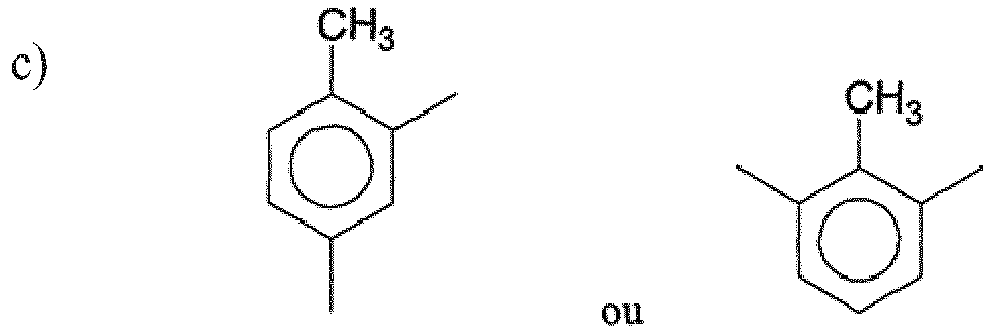

- e) -(CH2)6- (ou radical hexaméthylène).
- Selon un mode de réalisation de l'invention, la composition adhésive comprend au moins un polymère silylé de formule (II), (IIbis) ou (III) et au moins un polymère silylé de formule (IV).
- Parmi les polymères répondant à la formule (II), on peut citer :
- GENIOSIL® STP-E15 (disponible auprès de Wacker) : polyéther comprenant deux groupements (I) de type triméthoxy (m1 égal à 0, p égal à 0 et R4 représente un groupement méthyle) présentant une masse molaire moyenne en nombre de 15000 g/mol;
- GENIOSIL® STP-E10 (disponible auprès de Wacker) : polyéther comprenant deux groupements (I) de type diméthoxy (m1 égal à 0, p égal à 1 et R4 représente un groupement méthyle) présentant une masse molaire moyenne en nombre de 15000 g/mol :
- SPUR+® 1050MM (disponible auprès de Momentive) : polyuréthane comprenant deux groupements (I) de type triméthoxy (m1 différent de 0, p égal à 0 et R4 représente un groupement méthyle) présentant une masse molaire de 16393 g/mol.
- Parmi les polymères répondant à la formule (IIbis), on peut citer :
- Polymère PS7 tel que décrit dans la partie expérimentale ci-dessous :
- polyuréthane comprenant deux groupements (I) de type triméthoxy (p égal à 0 et R4 représente un groupement méthyle) présentant une masse molaire de 22500 g/mol.
- Parmi les polymères répondant à la formule (III), on peut citer le polymère MS Polymer® S203H (disponible auprès de Kaneka) correspondant à un polyéther comprenant deux groupements (I) de type diméthoxy (p égal à 1 et R4 représente un groupement méthyle) ayant une masse molaire de 16000 g/mol.
- Parmi les polymères répondant à la formule (IV), on peut citer le polymère GENIOSIL® XB502 (disponible auprès de Wacker) correspondant à un mélange de deux polymères présentant des masses molaires de 800 g/mole et 14000 g/mol dans lesquelles p est égal à 0 et R4 est un groupement méthyle.
- Selon un mode de réalisation de l'invention, les polymères présents dans la composition adhésive sont choisis parmi les polymères silylés tels que définis ci-dessus.
- Les charges peuvent être choisies parmi les charges inorganiques, les charges organiques et leurs mélanges.
- Les charges inorganiques peuvent être choisies parmi les carbonates de calcium, les polycarbonates de calcium, l'hydroxyde d'aluminium, les talcs, les kaolins, le noir de carbone, les silices et fumée de silice, le quartz. On peut citer notamment la SOCAL® 312 (disponible auprès de Solvay) et la MARTINAL® OL104 (disponible auprès de Martinwerk).
- Les charges organiques peuvent être choisies parmi le polychlorure de vinyle, le polyéthylène, le polyamide, des résines de styrène-butadiène, ou tout autre polymère organique sous forme de poudre. On peut citer notamment le Solvin® 373 MC de chez Solvay.
- Selon un mode de réalisation, la composition adhésive comprend au moins une charge minérale et au moins une charge organique.
- De préférence, les charges présentent une granulométrie allant de 0,010 à 20 µm, de préférence allant de 0,020 à 15 µm, de préférence encore allant de 0,030 à 5 µm.
- Les charges présentes dans la composition adhésive peuvent assurer différentes fonctions au sein de la composition, par exemple une fonction d'agent rhéologique.
- Selon un mode de réalisation, la composition adhésive comprend en outre de 0,1 à 10% en poids d'autres additifs, par rapport au poids total de la composition adhésive.
- Par « autres additifs », on entend des additifs qui ne sont pas ni des polymères silylés ni des charges.
- Le ou les autres additifs peuvent être choisis parmi les catalyseurs, les promoteurs d'adhésion, les plastifiants, les agents rhéologiques, dans la mesure où ils ne se présentent pas sous la forme d'une poudre (charges).
- Des additifs peuvent être prévus pour ajuster la rhéologie de la composition adhésive selon les contraintes d'application. Par exemple, un additif augmentant le seuil d'écoulement (agent rhéologique) peut être ajouté afin d'éviter les coulures lors de l'application de la composition, en particulier lorsque la surface recevant la couche de composition adhésive n'est pas horizontale.
- Selon un mode de réalisation de l'invention, la composition adhésive comprend de 0,1 à 5% en poids d'agent(s) rhéologique(s), en plus des charges présentes dans la composition, et différents de ces charges.
- Selon un mode de réalisation, la composition adhésive comprend en outre au moins un catalyseur.
- De préférence, la composition adhésive comprend de 0,01 à 5% en poids de catalyseur(s), de préférence de 0,05 à 3% en poids de catalyseur(s), de préférence encore de 0,08 à 2% en poids de catalyseur(s).
- D'autres additifs peuvent être prévus pour améliorer la stabilité de la composition adhésive lors de son stockage. On peut citer des capteurs d'humidité comme le vinyltriméthoxysilane.
- La composition adhésive peut être préparée par mélange du ou des polymères silylés et de la ou des charges à une température allant de 10°C à 40°C et à une humidité relative allant de 0,1% à 50%. Lorsqu'un catalyseur est présent, il est de préférence ajouté dans une seconde étape, après le mélange des polymères silylés et des charges. Les autres additifs sont introduits conformément aux usages habituels.
- Au sens de la présente invention, on entend par assemblage, le résultat des actions de coller, caler, fixer, maintenir, mettre en contact, ...
- L'assemblage obtenu correspond à la succession d'un élément de la cuve, d'une couche de composition adhésive et de la structure porteuse.
- Selon un mode de réalisation, la cuve est une cuve étanche comprenant deux barrières d'étanchéité successives alternées avec deux couches d'isolation thermique appelées barrières isolantes. De préférence, la première barrière d'étanchéité, dite primaire, est au contact du fluide, par exemple du gaz liquéfié, tandis qu'une deuxième barrière, dite secondaire ou de confinement, est disposée entre les deux barrières isolantes. Les différentes barrières peuvent être assemblées les unes aux autres et la barrière isolante secondaire est alors fixée sur la structure porteuse mécaniquement et par collage.
- Dans la présente invention, la fixation (ou l'assemblage) de la barrière isolante secondaire à la structure porteuse est effectuée à l'aide de la composition adhésive telle que définie ci-dessus.
- Par « cuve étanche », au sens de la présente invention, on entend une cuve qui est imperméable aux fluides, en particulier aux liquides, tels que le gaz naturel liquéfié ou bien l'eau de mer.
- La barrière primaire de la cuve peut être en Inox ou en Invar. La barrière secondaire de la cuve peut être en Invar ou composite (TRIPLEX®). Une description de ces barrières est donnée par exemple dans le document
WO 2010/052671 . - Pour la fabrication et la description plus générale de ces cuves, on pourra se référer à l'enseignement fourni par les documents
FR 2822814 FR 2887010 FR 2781557 - De préférence, la cuve est une cuve de stockage et/ou de transport de gaz liquéfié.
- Selon un mode de réalisation, les barrières isolantes primaire et secondaire sont réalisées par juxtaposition de plusieurs blocs isolants, par exemple des caissons parallélépipédiques fermés remplis d'un calorifuge, dont l'épaisseur peut varier selon le pouvoir isolant recherché.
- Selon un autre mode de réalisation, les barrières isolantes primaire et secondaire sont réalisées par juxtaposition de blocs de mousse isolante collés sur un panneau porteur.
- De préférence, le matériau utilisé pour réaliser les panneaux des caissons ou les panneaux porteurs est du bois contreplaqué.
- L'assemblage de la barrière isolante secondaire et de la structure porteuse est alors effectué par l'intermédiaire du panneau externe de ladite barrière isolante secondaire.
- La composition adhésive telle que définie ci-dessus est de préférence appliquée sur le panneau externe de la barrière isolante secondaire sous la forme d'un ou plusieurs cordons de composition adhésive.
- Lorsque la barrière isolante se présente sous la forme d'une juxtaposition de plusieurs panneaux, la composition adhésive est appliquée sur le panneau externe, puis le panneau encollé est ensuite affiché sur la surface porteuse.
- Lors de l'assemblage, de préférence, le panneau encollé est positionné (contrecollé) sur la structure porteuse et les caractéristiques de la composition adhésive telle que définie ci-dessus permettent au panneau de s'adapter parfaitement à la forme de la structure porteuse. Ce qui permet notamment de compenser les irrégularités éventuelles, du panneau et/ou de la structure porteuse. Certaines constructions n'exploitent d'ailleurs que cette propriété, la structure porteuse étant protégée par un film antiadhésif et la barrière isolante primaire étant fixée mécaniquement à la structure porteuse.
- Les autres barrières constituant la cuve étanche sont ensuite assemblées selon des procédés connus de l'homme du métier.
- Le fluide contenu dans la cuve se trouve à une température inférieure ou égale à -100°C, de préférence inférieure ou égale à -125°C, de préférence encore inférieure ou égale à -150°C.
- De préférence, le fluide est un liquide, de préférence du gaz liquéfié, en particulier du gaz naturel liquéfié (GNL).
- Le gaz naturel liquéfié est généralement stocké et transporté à une température de -163°C.
- Au sens de la présente invention, la structure porteuse désigne la coque d'un navire, la carlingue d'un avion et un conteneur.
- La structure porteuse est destinée à contenir la cuve.
- La composition adhésive définie ci-dessus trouve plus particulièrement son utilité dans la fabrication des cuves intégrées dans une structure porteuse, notamment la coque d'un navire destiné au transport par mer des gaz liquéfiés et, en particulier, au transport des gaz naturels liquéfiés (GNL) à forte teneur en méthane.
- De préférence, les cuves intégrées sont étanches et thermiquement isolantes.
- La présente invention concerne également un procédé d'assemblage d'une cuve, de préférence une cuve étanche, comprenant un fluide à une température inférieure ou égale à -100°C et d'une structure porteuse choisie parmi la coque d'un navire, la carlingue d'un avion et un conteneur, ledit procédé comprenant :
- a) l'application d'une composition adhésive telle que définie dans la présente invention sur la surface externe de la cuve étanche à une température allant de 15°C à 35°C et une humidité relative allant de 20% à 70%, et
- b) le contre-collage de la surface externe de la cuve étanche sur la surface de la structure porteuse.
- L'application de la composition adhésive est effectuée à une température allant de 15°C à 35°C et une humidité relative allant de 20% à 70% pour permettre la réticulation de la composition adhésive.
- Selon un mode de réalisation, la surface externe de la cuve est le panneau externe de la barrière isolante secondaire.
- Selon un mode de réalisation de l'invention, la composition adhésive est appliquée sous la forme d'un cordon de composition adhésive. Chaque panneau externe de la cuve peut ainsi recevoir un ou plusieurs cordons de composition adhésive. De préférence, lorsque plusieurs cordons sont appliqués sur un même panneau, ces cordons sont sensiblement parallèles les uns par rapport aux autres.
- Selon une variante du procédé d'assemblage de l'invention, la composition adhésive telle que définie dans la présente invention est d'abord appliquée sur la surface de la structure porteuse puis, la surface externe de la cuve est appliquée sur la surface de structure porteuse revêtue de la composition adhésive.
- La présente invention concerne également un assemblage d'une cuve étanche comprenant un fluide à une température inférieure ou égale à -100°C et d'une structure porteuse choisie parmi la coque d'un navire, la carlingue d'un avion et un conteneur, ledit assemblage étant caractérisé en ce qu'il est réalisé à l'aide d'une composition adhésive telle que définie dans la présente invention.
- L'assemblage selon l'invention comprend alors un joint de colle obtenu après réticulation de la composition adhésive selon l'invention.
- De préférence, l'assemblage selon l'invention est l'assemblage d'une cuve étanche telle que définie ci-dessus et d'une structure porteuse. De préférence, la structure porteuse est la coque d'un navire.
- De préférence, le fluide est un liquide, de préférence du gaz liquéfié, en particulier du gaz naturel liquéfié (GNL).
- La
figure 1 représente un schéma en coupe de l'assemblage selon un mode de réalisation de l'invention. Sur lafigure 1 sont représentées les membranes primaire 1 et secondaire 4 ainsi que les barrières isolantes primaire 2 et secondaire 5 de la cuve étanche. Lesdites barrières isolantes 2 et 5 comprennent une couche de contreplaqué respectivement 3 et 6. Lafigure 1 représente également les cordons de composition de colle 8 situés entre le contreplaqué 6 de la barrière isolante secondaire 5 et la structure porteuse 7. Sur lafigure 1 sont également représentés des goujons de réglage et de fixation 9 à la structure porteuse 7. Les orifices d'accès à ces goujons sont ensuite refermés par des bouchons isolants 10 pour éviter les ponts thermiques. De même, l'espace entre les panneaux 11 est comblé par de la laine de verre. Dans le cas du transport et/ou stockage de gaz naturel liquéfié à -163°C, la membrane secondaire 4 présente une température d'environ -110°C, la couche de contreplaqué 6 de la barrière isolante secondaire 5 présente une température d'environ -25°C et la structure porteuse peut présenter une température allant de +4°C à +30°C. - Plusieurs compositions adhésives selon l'invention ont été préparées et testées.
- Les produits suivants ont été utilisés :
- PS1 : GENIOSIL® XB502 (Wacker) ;
- PS2 : GENIOSIL® STP-E15 (Wacker) ;
- PS3 : GENIOSIL® STP-E10 (Wacker) ;
- PS4 : MS Polymer® S303H (Kaneka) ;
- PS5 : SPUR+® 1050MM (Momentive) ;
- PS6 : Polymère A tel que décrit dans la demande internationale WO2009/106699 (polymère répondant à la formule (II) telle que définie ci-dessus, dans laquelle R1 représente l'isophorone diisocyanate IPDI) ;
- PS7 : Polymère répondant à la formule (IIbis) telle que définie ci-dessus ;
- CM1 : carbonate de calcium précipité Socal® 312 (Solvay) ayant une granulométrie de 0,05 µm ;
- CM2 : hydroxyde d'aluminium Martical® OL104 (Martinwerk) ayant une granulométrie de 3 µm ;
- CO1 : polychlorure de vinyle Solvin® 373 (Solvay) ;
- AO : Antioxydant Irganox® 1010 (BASF) ;
- CH : capteur d'humidité VTMO® XL10 (Wacker) ;
- PA : promoteur d'adhésion GENIOSIL® GF9 (Wacker) ;
- Kta1 : catalyseur diazabicycloundécène (DBU, Sigma) ;
- Kta2 : catalyseur TIBKAT® 422 (Tib Chemicals).
- Dans un réacteur fermé de 250 ml, équipé d'une agitation, de moyens de chauffe, d'un thermomètre et relié à une pompe à vide, on introduit 83,04 g de polyéther polyol Desmophen® 4028 BD (diol de type polypropylène glycol, de masse molaire de 4000 g/mol, disponible auprès de Bayer) ayant un nombre hydroxyle de 28 mgKOH par g (correspondant à un nombre équivalent de fonction -OH égal à 0,499 mmol/g). L'ensemble est chauffé à 80 °C et maintenu à pression réduite de 20 mbar pendant 1 heure pour déshydrater le polyol polyéther.
- On introduit alors dans le réacteur maintenu à pression atmosphérique et porté à une température de 90°C, 0,5 mg d'un catalyseur de carboxylate de bismuth/zinc (Borchi® Kat VP0244 de la société Borchers GmbH) et 8,79 g d'isophorone diisocyanate IPDI (titrant 37,6 % poids/poids en groupe -NCO), les quantités introduites correspondant ainsi à un ratio NCO/OH égal à 1,9. La réaction de polyaddition est poursuivie pendant 4 heures jusqu'à l'obtention de 91,83 g d'un polyuréthane ayant une teneur en -NCO (suivie par titrage potentiométrique avec une amine) égale à 0,406 mmol/g, ce qui correspond à la consommation complète des fonctions hydroxyle du polyéther polyol.
- On introduit dans le réacteur en fin de l'étape (i) 8,23 g de gamma-amino-n-propyl-triéthoxysilane (M=221 g/mol), correspondant à un ratio NCO/NH2 égal à 1.
- Le réacteur est alors maintenu sous atmosphère inerte à 100 °C pendant 1 heure jusqu'à réaction complète (détectée par la disparition de la bande -NCO à l'analyse Infra-rouge).
- On obtient 100,06 grammes d'un produit translucide.
- Sa viscosité à l'état fondu mesurée par un viscosimètre Brookfield RVT (à 23 °C pour une vitesse de rotation de 20 tour/minute et une aiguille 7) est de 85 000 mPa.s.
- Sa masse moléculaire en nombre est de 22500 Da mesurée par chromatographie d'exclusion stérique ou GPC (pour « Gel Permeation Chromatography »).
- Les compositions 1 à 13 ont été préparées selon le mode opératoire suivant : les constituants de chaque formulation (excepté le catalyseur) sont introduits dans un mélangeur de contenance 5 kg puis sont agités à 1500 tr/min pendant 30 minutes sous vide. Une circulation d'eau permet de réguler la température du mélange à 30°C maximum. Le ou les éventuelles catalyseurs, promoteurs d'adhésion, capteurs d'humidité et antioxydants sont ensuite ajoutés et le mélange est placé sous agitation pendant encore 10 minutes. La composition adhésive est extraite du mélangeur et stockée dans des cartouches hermétiques.
- Le tableau 1 indique les proportions en pourcentage massique de chacun des constituants par rapport au poids total de chaque composition adhésive.
Tableau 1 : compositions adhésives (% en poids) 1 2 3 4 5 6 7 8 9 10 11 12 13 PS1 39,2 49 68,6 29,4 29,4 28,8 29,4 29,4 - 24,5 34,3 29,4 29,4 PS2 - - - 19,6 - - - - - 24,5 14,7 19,6 19,6 PS3 - - - - 19,6 - - - - - - - - PS4 - - - - - 19,2 - - - - - - - PS5 - - - - - - 19,6 - - - - - - PS6 - - - - - - - 19,6 - - - - - PS7 - - - - - - - - 19,6 - - - - CM1 60 50 30 50 50 50 50 50 50 50 50 - - CM2 - - - - - - - - - - - 42 20 CO1 - - - - - - - - - - - 5 27 AO - - - - - - - - - - - 1 1 CH - - - - - - - - - - - 2 2 PA 0,8 1 1,4 0,8 1 1 0,8 0,8 0,8 0,8 0,8 0,8 0,8 Kta - - - - - 1 - - - - - - - Kta - - - 0,2 - - 0,2 0,2 0,2 0,2 0,2 0,2 0,2 - Pour les compositions ci-dessus, les propriétés thermomécaniques ont été mesurées. Les résultats sont présentés dans le tableau 2 ci-dessous.
Tableau 2 : propriétés thermomécaniques des compositions adhésives réticulées 1 2 3 4 5 6 7 8 9 10 11 12 13 Module de compression à 30°C (MPa) 440 124 74 76 22 9 97 67 90 42 97 - - Module de compression à 20°C (MPa) 500 150 97 84 26 25 108 80 102 46 99 60 58 Module de compression à 0°C (MPa) 675 210 160 98 37 42 130 120 115 56 118 66 77 Module de compression à -30°C (MPa) 1000 455 380 165 89 102 215 200 213 99 214 230 - Contrainte à la rupture à 23°C (MPa) 8,9 8,5 6,1 8 6,6 3,8 7,5 4,5 6,9 7 8,5 9,1 8,3 Elongation à la rupture à 23°C (%) 4 9 6 38 66 32 23 110 28 57 17 35 35 Densité - 1,65 - - - - - - - - - 1,44 1,33 - Le module de compression est mesuré selon la norme ASTM D695. Des éprouvettes de compression en forme de plots de dimension 20mmx10mmx10mm sont réalisées en appliquant la composition à tester dans un moule en téflon. Après 15 10 jours de réticulation à +23°C et 50% d'humidité relative, les éprouvettes sont retirées du moule, placées dans une enceinte maintenue à la température indiquée dans le tableau 2 et compressées à l'aide d'un dynamomètre.
- L'élongation et la contrainte à la rupture sont mesurées selon la norme ISO 527-2. Des éprouvettes haltères de type h2 sont réalisées en appliquant la composition à tester dans un moule en téflon. Après 15 jours de réticulation à 23°C et 50% d'humidité relative, les éprouvettes sont retirées du moule, placées dans une enceinte maintenue à la température indiquée dans le tableau 2 et tractionnées à l'aide d'un dynamomètre.
- La densité est mesurée selon la norme ISO2811-1 à l'aide d'un picnomètre.
- Pour chacune des compositions adhésives, on observe que le module de compression augmente légèrement lorsque la température diminue mais il est inférieur ou égal à 1000 MPa à -30°C.
- Les mastics suivants ont été testés :
- composition de l'exemple 11 ci-dessus selon l'invention ;
- PU 2K : Mastic polyuréthane bi-composants tel que décrit dans l'exemple C9 du document
WO 2010/052671 (mélange de la résine R9 et du durcisseur D9). Après mélange des deux composants R9 et D9, les proportions respectives de polymères et de charges dans la composition PU2K sont 50% en poids du polyuréthane bi-composants et 50% en poids de charge ; - Epoxy 2K : mastic époxy bi-composant décrit ci-dessous. Les proportions respectives de polymères et de charges dans la composition Epoxy 2k sont 67% en poids d'époxy bi-composants et 33% en poids de charge.
- Les polymères époxy bi-composants sont généralement utilisés pour le calage des cuves de transport de gaz liquéfié sur une structure porteuse.
- Epoxy 2K testé dans la présente demande est obtenu en mélangeant les parties A et B définies ci-dessous dans un rapport A/B de 100/50 :
- Partie A :
- 280g de résine époxy DER® 331 (disponible auprès de Dow Chemicals) ;
- 280g de résine époxy DER® 351 (disponible auprès de Dow Chemicals) ;
- 4,5g de plastifiant BYK® 080A (disponible auprès de BYK) ;
- 112g de flexibilisant polyuréthane Desmocap® 11 (disponible auprès de Bayer) ;
- 28g de dioxyde de titane TIONA 595 (fournisseur Millenium Chemicals) ;
- 195g de carbonate de calcium précipité SOCAL® 312 (disponible auprès de Solvay) ;
- 56g de billes de verre SCOTCHLITE® S38HS (disponible auprès de 3M) ;
- 44,5g de fumée de silice CAB-O-SIL® EH5 (disponible auprès de Cabot).
- Partie B :
- 200g d'agent réticulant polyamide ANCAMIDE® 2353 (disponible auprès de Air Products) ;
- 233g d'agent réticulant polyamine JEFFAMINE® D400 (disponible auprès de Huntsman) ;
- 233g d'agent réticulant polyamine JEFFAMINE® T403 (disponible auprès de Huntsman) ;
- 5,3g de plastifiant BYK® 080A (disponible auprès de BYK) ;
- 13,3g de promoteur d'adhésion SILQUEST® A1110 (disponible auprès de Momentive) ;
- 132,3g de TALC POWDER HAICHENG® N°2 (disponible auprès de Sheng Teai) ;
- 100g de charge minérale OMYA® BL200 (disponible auprès de Omya) ;
- 13,3g de billes de verre SCOTCHLITE® S38HS (disponible auprès de 3M) ;
- 66,5g de fumée de silice CAB-O-SIL® EH5 (disponible auprès de Cabot).
- Le module de compression et l'élongation à la rupture ont été mesurés et les résultats sont indiqués dans le tableau 3 ci-dessous.
Tableau 3 : propriétés thermomécaniques de différents mastics Module de compression Elongation à la rupture à 23°C +20°C 0°C -30°C Exemple 11 60 MPa 66 MPa 230 MPa 35% PU 2K 130 MPa 2500 MPa 4000 MPa 130% Epoxy 2K 1800 MPa - - 1% - Le polyuréthane bicomposants présente un module de compression qui augmente très fortement lorsque la température diminue. Son module de compression est de 2500 MPa à 0°C et de 4000 MPa à -30°C.
- La composition comprenant le polymère époxy bicomposants présente un module de compression très élevé, de 1800 MPa, à une température de 20°C.
- Au contraire, la composition de l'exemple 11 comprenant les polymères PS1 et PS2 entrant dans la composition adhésive définie dans la présente invention présente un module de compression passant de 60 MPa à 20°C à 230 MPa à -30°C.
- Bien entendu, la présente invention n'est pas limitée aux exemples et au mode de réalisation décrits et représentés, mais elle est susceptible de nombreuses variantes accessibles à l'homme de l'art.
Claims (15)
- Utilisation d'une composition adhésive comprenant au moins un polymère silylé et au moins une charge pour l'assemblage d'une cuve comprenant un fluide à une température inférieure ou égale à -100°C et d'une structure porteuse choisie parmi la coque d'un navire, la carlingue d'un avion et un conteneur, ledit polymère silylé comprenant au moins un groupement de formule (I) :
-Si(R4)p(OR5)3-p (I)
dans laquelle :- R4 et R5, identiques ou différents, représentent chacun un radical alkyl linéaire ou ramifié comprenant de 1 à 4 atomes de carbone, avec la possibilité que quand il y a plusieurs radicaux R4 (ou R5), ces derniers soient identiques ou différents :- p est un nombre entier égal à 0, 1 ou 2. - Utilisation selon la revendication 1, dans laquelle le module de compression de la composition adhésive réticulée va de 15 à 600 MPa à 20°C.
- Utilisation selon la revendication 1 ou 2, dans laquelle le module de compression de la composition adhésive réticulée est inférieur ou égal à 1000 MPa à -30°C.
- Utilisation selon l'une des revendications 1 à 3, dans laquelle la composition adhésive réticulée présente une contrainte à la rupture à 23°C supérieure ou égale à 3MPa.
- Utilisation selon l'une des revendications 1 à 4, dans laquelle le fluide à une température inférieure ou égale à -100°C est du gaz naturel liquéfié.
- Utilisation selon l'une des revendications 1 à 5, dans laquelle la structure porteuse est la coque d'un navire.
- Utilisation selon l'une des revendications 1 à 6, dans laquelle la composition adhésive comprend :- de 30 à 80% en poids d'au moins un polymère silylé, et- de 20 à 70% en poids d'au moins une charge,
par rapport au poids total de la composition adhésive. - Utilisation selon l'une des revendications 1 à 7, dans laquelle la composition adhésive comprend au moins deux charges différentes.
- Utilisation selon la revendication 8, dans laquelle la composition adhésive comprend au moins une charge inorganique et au moins une charge organique.
- Utilisation selon l'une des revendications 1 à 9, dans laquelle la composition adhésive comprend en outre au moins un catalyseur.
- Utilisation selon l'une des revendications 1 à 10, dans laquelle le polymère silylé est choisi parmi les polyéthers silylés et les polyuréthanes silylés, seuls ou en mélange.
- Utilisation selon l'une des revendications 1 à 11, dans laquelle la composition adhésive comprend au moins un polymère silylé choisi parmi les polymères de formules (II), (IIbis), (III) ou (IV) ci-dessous :


(R5O)3-p(R 4)pSi - R3 - [OR2]n - O - R3 - Si(R4)p(OR5)3-p (III)
 - R1 représente un radical divalent hydrocarboné comprenant de 5 à 15 atomes de carbone qui peut être aromatique ou aliphatique, linéaire, ramifié ou cyclique,- R3 représente un radical divalent alkylène linéaire ou ramifié comprenant de 1 à 6 atomes de carbone,- R2 représente un radical divalent alkylène linéaire ou ramifié comprenant de 2 à 4 atomes de carbone,- R4 et R5, identiques ou différents, représentent chacun un radical alkyl linéaire ou ramifié comprenant de 1 à 4 atomes de carbone,- R6 représente un atome d'hydrogène, un radical phényle ou un radical alkyle linéaire, ramifié ou cyclique comprenant de 1 à 6 atomes de carbone,- n est un nombre entier tel que la masse molaire moyenne du bloc polyéther de formule -[OR2]n- va de 300 g/mole à 40000 g/mole,- m1 est zéro ou un nombre entier tel que la masse molaire moyenne du polymère va de 500 g/mole à 50000 g/mole,- m2 est un nombre entier différent de zéro tel que la masse molaire moyenne du polymère va de 500 g/mole à 50000 g/mole,- p est un nombre entier égal à 0, 1 ou 2.
 - Utilisation selon la revendication 12, dans laquelle la composition adhésive comprend au moins un polymère de formule (II), (IIbis) ou (III) et au moins un polymère de formule (IV).
- Procédé d'assemblage d'une cuve comprenant un fluide à une température inférieure ou égale à -100°C et d'une structure porteuse choisie parmi la coque d'un navire, la carlingue d'un avion et un conteneur, ledit procédé comprenant :a) l'application d'une composition adhésive telle que définie dans l'une des revendications 1 à 13 sur la surface externe de la cuve à une température allant de 15°C à 35°C et une humidité relative allant de 20% à 70%, etb) le contre-collage de la surface externe de la cuve sur la surface de la structure porteuse.
- Assemblage d'une cuve comprenant un fluide à une température inférieure ou égale à -100°C et d'une structure porteuse choisie parmi la coque d'un navire, la carlingue d'un avion et un conteneur caractérisé en ce que l'assemblage est réalisé à l'aide d'une composition adhésive telle que définie dans l'une des revendications 1 à 13.
Applications Claiming Priority (1)
| Application Number | Priority Date | Filing Date | Title |
|---|---|---|---|
| FR1362865A FR3014892B1 (fr) | 2013-12-18 | 2013-12-18 | Utilisation d'une composition adhesive a base de polymeres silyles pour applications cryogeniques |
Publications (2)
| Publication Number | Publication Date |
|---|---|
| EP2886575A1 true EP2886575A1 (fr) | 2015-06-24 |
| EP2886575B1 EP2886575B1 (fr) | 2016-09-21 |
Family
ID=50424488
Family Applications (1)
| Application Number | Title | Priority Date | Filing Date |
|---|---|---|---|
| EP14197282.8A Not-in-force EP2886575B1 (fr) | 2013-12-18 | 2014-12-11 | Utilisation d'une composition adhésive a base de polymères silyles pour applications cryogéniques |
Country Status (4)
| Country | Link |
|---|---|
| EP (1) | EP2886575B1 (fr) |
| KR (1) | KR102287124B1 (fr) |
| CN (1) | CN104804696B (fr) |
| FR (1) | FR3014892B1 (fr) |
Cited By (4)
| Publication number | Priority date | Publication date | Assignee | Title |
|---|---|---|---|---|
| WO2018215463A1 (fr) * | 2017-05-23 | 2018-11-29 | Bostik Sa | Composition de mastic silylé bas module |
| WO2019008258A1 (fr) * | 2017-07-04 | 2019-01-10 | Bostik Sa | Preparation d'une composition adhesive dans une extrudeuse |
| WO2020201364A1 (fr) * | 2019-04-04 | 2020-10-08 | Bostik Sa | Procede de preparation de composition reticulable |
| JP2023078736A (ja) * | 2021-11-26 | 2023-06-07 | キヤノン株式会社 | 光学素子、光学機器、撮像装置、及び光学素子の製造方法 |
Families Citing this family (4)
| Publication number | Priority date | Publication date | Assignee | Title |
|---|---|---|---|---|
| CN105885766B (zh) * | 2016-06-02 | 2019-07-02 | 广州集泰化工股份有限公司 | 一种不含有机锡的环保高强度免钉胶及其制备方法 |
| US20220227969A1 (en) * | 2019-05-15 | 2022-07-21 | Invento Industries | Room temperature curable composition |
| CN111691236B (zh) * | 2020-05-26 | 2021-12-31 | 仙鹤股份有限公司 | 一种速干型圣经纸的生产方法 |
| US20230168463A1 (en) * | 2021-11-26 | 2023-06-01 | Canon Kabushiki Kaisha | Optical element, optical device, and image pickup apparatus |
Citations (6)
| Publication number | Priority date | Publication date | Assignee | Title |
|---|---|---|---|---|
| FR2109153A5 (fr) | 1970-10-05 | 1972-05-26 | Hitachi Shipbuilding Eng Co | |
| FR2781557A1 (fr) | 1998-07-24 | 2000-01-28 | Gaz Transport & Technigaz | Perfectionnement pour une cuve etanche et thermiquement isolante a panneaux prefabriques |
| FR2822814A1 (fr) | 2001-03-27 | 2002-10-04 | Gaz Transport & Technigaz | Machine pour le collage d'une bande, procede de collage d'une bande pour la realisation d'une paroi isolante et etanche, et paroi isolante et etanche |
| FR2887010A1 (fr) | 2005-06-10 | 2006-12-15 | Gaz Transp Et Technigaz Soc Pa | Cuve etanche et thermiquement isolee |
| WO2009106699A2 (fr) | 2007-12-21 | 2009-09-03 | Bostik Sa | Adhesifs sensibles a la pression a pouvoir adhesif stable en temperature |
| WO2010052671A1 (fr) | 2008-11-07 | 2010-05-14 | Bostik Sa | Utilisation d'une composition adhesive a base de polyurethane pour applications cryogeniques |
-
2013
- 2013-12-18 FR FR1362865A patent/FR3014892B1/fr not_active Expired - Fee Related
-
2014
- 2014-12-11 EP EP14197282.8A patent/EP2886575B1/fr not_active Not-in-force
- 2014-12-17 KR KR1020140182540A patent/KR102287124B1/ko active Active
- 2014-12-18 CN CN201410857649.5A patent/CN104804696B/zh active Active
Patent Citations (6)
| Publication number | Priority date | Publication date | Assignee | Title |
|---|---|---|---|---|
| FR2109153A5 (fr) | 1970-10-05 | 1972-05-26 | Hitachi Shipbuilding Eng Co | |
| FR2781557A1 (fr) | 1998-07-24 | 2000-01-28 | Gaz Transport & Technigaz | Perfectionnement pour une cuve etanche et thermiquement isolante a panneaux prefabriques |
| FR2822814A1 (fr) | 2001-03-27 | 2002-10-04 | Gaz Transport & Technigaz | Machine pour le collage d'une bande, procede de collage d'une bande pour la realisation d'une paroi isolante et etanche, et paroi isolante et etanche |
| FR2887010A1 (fr) | 2005-06-10 | 2006-12-15 | Gaz Transp Et Technigaz Soc Pa | Cuve etanche et thermiquement isolee |
| WO2009106699A2 (fr) | 2007-12-21 | 2009-09-03 | Bostik Sa | Adhesifs sensibles a la pression a pouvoir adhesif stable en temperature |
| WO2010052671A1 (fr) | 2008-11-07 | 2010-05-14 | Bostik Sa | Utilisation d'une composition adhesive a base de polyurethane pour applications cryogeniques |
Non-Patent Citations (2)
| Title |
|---|
| ANASHKIN O P ET AL: "Cryogenic vacuum tight adhesive", CRYOGENICS, ELSEVIER, KIDLINGTON, GB, vol. 39, no. 9, 1 September 1999 (1999-09-01), pages 795 - 798, XP027214445, ISSN: 0011-2275, [retrieved on 19990901] * |
| WACKER CHEMI AG: "SILRES HP 2000", HTTP://WWW.WACKER.COM/CMS/MEDIA/PUBLICATIONS/DOWNLOADS/6870_EN.PDF, January 2012 (2012-01-01), XP002735877, Retrieved from the Internet <URL:internet> [retrieved on 20150212] * |
Cited By (11)
| Publication number | Priority date | Publication date | Assignee | Title |
|---|---|---|---|---|
| WO2018215463A1 (fr) * | 2017-05-23 | 2018-11-29 | Bostik Sa | Composition de mastic silylé bas module |
| FR3066765A1 (fr) * | 2017-05-23 | 2018-11-30 | Bostik Sa | Composition de mastic silyle bas module |
| CN110637051A (zh) * | 2017-05-23 | 2019-12-31 | 博斯蒂克股份公司 | 低模量甲硅烷基化胶合剂的组合物 |
| US11104803B2 (en) | 2017-05-23 | 2021-08-31 | Bostik Sa | Low modulus silylated mastic composition |
| CN110637051B (zh) * | 2017-05-23 | 2021-11-16 | 博斯蒂克股份公司 | 低模量甲硅烷基化胶合剂的组合物 |
| WO2019008258A1 (fr) * | 2017-07-04 | 2019-01-10 | Bostik Sa | Preparation d'une composition adhesive dans une extrudeuse |
| FR3068633A1 (fr) * | 2017-07-04 | 2019-01-11 | Bostik Sa | Preparation d'une composition adhesive dans une extrudeuse |
| WO2020201364A1 (fr) * | 2019-04-04 | 2020-10-08 | Bostik Sa | Procede de preparation de composition reticulable |
| FR3094717A1 (fr) * | 2019-04-04 | 2020-10-09 | Bostik Sa | Procédé de préparation de composition réticulable |
| US12331151B2 (en) | 2019-04-04 | 2025-06-17 | Bostik Sa | Method for preparing a cross-linkable composition |
| JP2023078736A (ja) * | 2021-11-26 | 2023-06-07 | キヤノン株式会社 | 光学素子、光学機器、撮像装置、及び光学素子の製造方法 |
Also Published As
| Publication number | Publication date |
|---|---|
| KR102287124B1 (ko) | 2021-08-05 |
| FR3014892B1 (fr) | 2017-03-10 |
| CN104804696A (zh) | 2015-07-29 |
| FR3014892A1 (fr) | 2015-06-19 |
| CN104804696B (zh) | 2019-12-10 |
| EP2886575B1 (fr) | 2016-09-21 |
| KR20150071672A (ko) | 2015-06-26 |
Similar Documents
| Publication | Publication Date | Title |
|---|---|---|
| EP2886575B1 (fr) | Utilisation d'une composition adhésive a base de polymères silyles pour applications cryogéniques | |
| EP2352775B1 (fr) | Utilisation d'une composition adhesive a base de polyurethane pour applications cryogeniques | |
| TWI437016B (zh) | 具有衍生自可固化之矽烷化聚胺基甲酸酯組成物之黏著樹脂組份的固態聚合型基材 | |
| CN103370389B (zh) | 粘合剂组合物以及叠层体 | |
| CN105331323B (zh) | 一种聚氨酯密封胶及其制备方法和应用 | |
| CN103897650A (zh) | 一种不易起泡的单组份聚氨酯密封胶 | |
| US20150307757A1 (en) | Cross-linkable compositions based on organyloxysilane-terminated polymers | |
| FR2938267A1 (fr) | Utilisation d'une composition adhesive a base de polyurethane pour applications cryogeniques | |
| US20240400830A1 (en) | Moisture curable compositions | |
| EP3436541B1 (fr) | Compositions adhésives sans solvant à deux composants et leurs procédés de fabrication | |
| US20240400829A1 (en) | Moisture curable compositions | |
| JP5266625B2 (ja) | イソシアネート基末端プレポリマーの製造方法、一液湿気硬化型ウレタン組成物、二液硬化型ウレタン組成物、およびポリウレタンの製造方法 | |
| CN111574950A (zh) | 一种具有缓冲性能的超软硅烷改性聚醚胶及其制备方法 | |
| EP4077458B1 (fr) | Systèmes de revêtement en polyurée pour l'étanchéité des constructions | |
| CN105238320B (zh) | 一种高弹性硅烷封端聚环氧丙烷密封胶及其制备方法 | |
| JP3987003B2 (ja) | 一液湿気硬化型の硬化性組成物及びシーリング材組成物 | |
| US20140190369A1 (en) | Polyurethane polymers | |
| CN104877614A (zh) | 室温快速熟化的双组分聚醚型复合粘合剂及其制备方法 | |
| US20240409696A1 (en) | Moisture curable compositions | |
| JP5365002B2 (ja) | 硬化性組成物 | |
| EP3596183A1 (fr) | Composition adhésive de mastic plastifiée sans phtalate | |
| WO2023074667A1 (fr) | Adhésif pour stratifiés | |
| PT2665790E (pt) | Cola de laminação isenta de nco de armazenamento estável | |
| EP4534625A1 (fr) | Composition adhésive et article | |
| WO2024162419A1 (fr) | Agent adhésif thermoconducteur durcissable |
Legal Events
| Date | Code | Title | Description |
|---|---|---|---|
| PUAI | Public reference made under article 153(3) epc to a published international application that has entered the european phase |
Free format text: ORIGINAL CODE: 0009012 |
|
| 17P | Request for examination filed |
Effective date: 20141211 |
|
| AK | Designated contracting states |
Kind code of ref document: A1 Designated state(s): AL AT BE BG CH CY CZ DE DK EE ES FI FR GB GR HR HU IE IS IT LI LT LU LV MC MK MT NL NO PL PT RO RS SE SI SK SM TR |
|
| AX | Request for extension of the european patent |
Extension state: BA ME |
|
| RIN1 | Information on inventor provided before grant (corrected) |
Inventor name: CHARTREL, JEAN-FRANCOIS Inventor name: BOYER, AURELIE |
|
| R17P | Request for examination filed (corrected) |
Effective date: 20151113 |
|
| RBV | Designated contracting states (corrected) |
Designated state(s): AL AT BE BG CH CY CZ DE DK EE ES FI FR GB GR HR HU IE IS IT LI LT LU LV MC MK MT NL NO PL PT RO RS SE SI SK SM TR |
|
| GRAP | Despatch of communication of intention to grant a patent |
Free format text: ORIGINAL CODE: EPIDOSNIGR1 |
|
| GRAJ | Information related to disapproval of communication of intention to grant by the applicant or resumption of examination proceedings by the epo deleted |
Free format text: ORIGINAL CODE: EPIDOSDIGR1 |
|
| INTG | Intention to grant announced |
Effective date: 20160226 |
|
| INTC | Intention to grant announced (deleted) | ||
| GRAP | Despatch of communication of intention to grant a patent |
Free format text: ORIGINAL CODE: EPIDOSNIGR1 |
|
| INTG | Intention to grant announced |
Effective date: 20160413 |
|
| GRAS | Grant fee paid |
Free format text: ORIGINAL CODE: EPIDOSNIGR3 |
|
| GRAA | (expected) grant |
Free format text: ORIGINAL CODE: 0009210 |
|
| AK | Designated contracting states |
Kind code of ref document: B1 Designated state(s): AL AT BE BG CH CY CZ DE DK EE ES FI FR GB GR HR HU IE IS IT LI LT LU LV MC MK MT NL NO PL PT RO RS SE SI SK SM TR |
|
| REG | Reference to a national code |
Ref country code: GB Ref legal event code: FG4D Free format text: NOT ENGLISH |
|
| REG | Reference to a national code |
Ref country code: CH Ref legal event code: EP |
|
| REG | Reference to a national code |
Ref country code: AT Ref legal event code: REF Ref document number: 831008 Country of ref document: AT Kind code of ref document: T Effective date: 20161015 |
|
| REG | Reference to a national code |
Ref country code: IE Ref legal event code: FG4D Free format text: LANGUAGE OF EP DOCUMENT: FRENCH |
|
| REG | Reference to a national code |
Ref country code: DE Ref legal event code: R096 Ref document number: 602014003832 Country of ref document: DE |
|
| REG | Reference to a national code |
Ref country code: FR Ref legal event code: PLFP Year of fee payment: 3 |
|
| REG | Reference to a national code |
Ref country code: LT Ref legal event code: MG4D Ref country code: NL Ref legal event code: MP Effective date: 20160921 |
|
| PG25 | Lapsed in a contracting state [announced via postgrant information from national office to epo] |
Ref country code: LT Free format text: LAPSE BECAUSE OF FAILURE TO SUBMIT A TRANSLATION OF THE DESCRIPTION OR TO PAY THE FEE WITHIN THE PRESCRIBED TIME-LIMIT Effective date: 20160921 Ref country code: RS Free format text: LAPSE BECAUSE OF FAILURE TO SUBMIT A TRANSLATION OF THE DESCRIPTION OR TO PAY THE FEE WITHIN THE PRESCRIBED TIME-LIMIT Effective date: 20160921 Ref country code: NO Free format text: LAPSE BECAUSE OF FAILURE TO SUBMIT A TRANSLATION OF THE DESCRIPTION OR TO PAY THE FEE WITHIN THE PRESCRIBED TIME-LIMIT Effective date: 20161221 Ref country code: FI Free format text: LAPSE BECAUSE OF FAILURE TO SUBMIT A TRANSLATION OF THE DESCRIPTION OR TO PAY THE FEE WITHIN THE PRESCRIBED TIME-LIMIT Effective date: 20160921 |
|
| REG | Reference to a national code |
Ref country code: AT Ref legal event code: MK05 Ref document number: 831008 Country of ref document: AT Kind code of ref document: T Effective date: 20160921 |
|
| PG25 | Lapsed in a contracting state [announced via postgrant information from national office to epo] |
Ref country code: LV Free format text: LAPSE BECAUSE OF FAILURE TO SUBMIT A TRANSLATION OF THE DESCRIPTION OR TO PAY THE FEE WITHIN THE PRESCRIBED TIME-LIMIT Effective date: 20160921 Ref country code: SE Free format text: LAPSE BECAUSE OF FAILURE TO SUBMIT A TRANSLATION OF THE DESCRIPTION OR TO PAY THE FEE WITHIN THE PRESCRIBED TIME-LIMIT Effective date: 20160921 Ref country code: GR Free format text: LAPSE BECAUSE OF FAILURE TO SUBMIT A TRANSLATION OF THE DESCRIPTION OR TO PAY THE FEE WITHIN THE PRESCRIBED TIME-LIMIT Effective date: 20161222 Ref country code: NL Free format text: LAPSE BECAUSE OF FAILURE TO SUBMIT A TRANSLATION OF THE DESCRIPTION OR TO PAY THE FEE WITHIN THE PRESCRIBED TIME-LIMIT Effective date: 20160921 |
|
| PG25 | Lapsed in a contracting state [announced via postgrant information from national office to epo] |
Ref country code: EE Free format text: LAPSE BECAUSE OF FAILURE TO SUBMIT A TRANSLATION OF THE DESCRIPTION OR TO PAY THE FEE WITHIN THE PRESCRIBED TIME-LIMIT Effective date: 20160921 Ref country code: RO Free format text: LAPSE BECAUSE OF FAILURE TO SUBMIT A TRANSLATION OF THE DESCRIPTION OR TO PAY THE FEE WITHIN THE PRESCRIBED TIME-LIMIT Effective date: 20160921 |
|
| PG25 | Lapsed in a contracting state [announced via postgrant information from national office to epo] |
Ref country code: ES Free format text: LAPSE BECAUSE OF FAILURE TO SUBMIT A TRANSLATION OF THE DESCRIPTION OR TO PAY THE FEE WITHIN THE PRESCRIBED TIME-LIMIT Effective date: 20160921 Ref country code: PL Free format text: LAPSE BECAUSE OF FAILURE TO SUBMIT A TRANSLATION OF THE DESCRIPTION OR TO PAY THE FEE WITHIN THE PRESCRIBED TIME-LIMIT Effective date: 20160921 Ref country code: CZ Free format text: LAPSE BECAUSE OF FAILURE TO SUBMIT A TRANSLATION OF THE DESCRIPTION OR TO PAY THE FEE WITHIN THE PRESCRIBED TIME-LIMIT Effective date: 20160921 Ref country code: IS Free format text: LAPSE BECAUSE OF FAILURE TO SUBMIT A TRANSLATION OF THE DESCRIPTION OR TO PAY THE FEE WITHIN THE PRESCRIBED TIME-LIMIT Effective date: 20170121 Ref country code: SK Free format text: LAPSE BECAUSE OF FAILURE TO SUBMIT A TRANSLATION OF THE DESCRIPTION OR TO PAY THE FEE WITHIN THE PRESCRIBED TIME-LIMIT Effective date: 20160921 Ref country code: BG Free format text: LAPSE BECAUSE OF FAILURE TO SUBMIT A TRANSLATION OF THE DESCRIPTION OR TO PAY THE FEE WITHIN THE PRESCRIBED TIME-LIMIT Effective date: 20161221 Ref country code: SM Free format text: LAPSE BECAUSE OF FAILURE TO SUBMIT A TRANSLATION OF THE DESCRIPTION OR TO PAY THE FEE WITHIN THE PRESCRIBED TIME-LIMIT Effective date: 20160921 Ref country code: AT Free format text: LAPSE BECAUSE OF FAILURE TO SUBMIT A TRANSLATION OF THE DESCRIPTION OR TO PAY THE FEE WITHIN THE PRESCRIBED TIME-LIMIT Effective date: 20160921 Ref country code: BE Free format text: LAPSE BECAUSE OF NON-PAYMENT OF DUE FEES Effective date: 20161231 Ref country code: PT Free format text: LAPSE BECAUSE OF FAILURE TO SUBMIT A TRANSLATION OF THE DESCRIPTION OR TO PAY THE FEE WITHIN THE PRESCRIBED TIME-LIMIT Effective date: 20170123 |
|
| REG | Reference to a national code |
Ref country code: DE Ref legal event code: R097 Ref document number: 602014003832 Country of ref document: DE |
|
| PG25 | Lapsed in a contracting state [announced via postgrant information from national office to epo] |
Ref country code: IT Free format text: LAPSE BECAUSE OF FAILURE TO SUBMIT A TRANSLATION OF THE DESCRIPTION OR TO PAY THE FEE WITHIN THE PRESCRIBED TIME-LIMIT Effective date: 20160921 |
|
| PLBE | No opposition filed within time limit |
Free format text: ORIGINAL CODE: 0009261 |
|
| STAA | Information on the status of an ep patent application or granted ep patent |
Free format text: STATUS: NO OPPOSITION FILED WITHIN TIME LIMIT |
|
| PG25 | Lapsed in a contracting state [announced via postgrant information from national office to epo] |
Ref country code: DK Free format text: LAPSE BECAUSE OF FAILURE TO SUBMIT A TRANSLATION OF THE DESCRIPTION OR TO PAY THE FEE WITHIN THE PRESCRIBED TIME-LIMIT Effective date: 20160921 |
|
| 26N | No opposition filed |
Effective date: 20170622 |
|
| PG25 | Lapsed in a contracting state [announced via postgrant information from national office to epo] |
Ref country code: MC Free format text: LAPSE BECAUSE OF FAILURE TO SUBMIT A TRANSLATION OF THE DESCRIPTION OR TO PAY THE FEE WITHIN THE PRESCRIBED TIME-LIMIT Effective date: 20160921 |
|
| REG | Reference to a national code |
Ref country code: IE Ref legal event code: MM4A |
|
| PG25 | Lapsed in a contracting state [announced via postgrant information from national office to epo] |
Ref country code: LU Free format text: LAPSE BECAUSE OF NON-PAYMENT OF DUE FEES Effective date: 20161211 |
|
| REG | Reference to a national code |
Ref country code: FR Ref legal event code: PLFP Year of fee payment: 4 |
|
| PG25 | Lapsed in a contracting state [announced via postgrant information from national office to epo] |
Ref country code: SI Free format text: LAPSE BECAUSE OF FAILURE TO SUBMIT A TRANSLATION OF THE DESCRIPTION OR TO PAY THE FEE WITHIN THE PRESCRIBED TIME-LIMIT Effective date: 20160921 Ref country code: IE Free format text: LAPSE BECAUSE OF NON-PAYMENT OF DUE FEES Effective date: 20161211 |
|
| REG | Reference to a national code |
Ref country code: BE Ref legal event code: MM Effective date: 20161231 |
|
| PG25 | Lapsed in a contracting state [announced via postgrant information from national office to epo] |
Ref country code: HU Free format text: LAPSE BECAUSE OF FAILURE TO SUBMIT A TRANSLATION OF THE DESCRIPTION OR TO PAY THE FEE WITHIN THE PRESCRIBED TIME-LIMIT; INVALID AB INITIO Effective date: 20141211 |
|
| PG25 | Lapsed in a contracting state [announced via postgrant information from national office to epo] |
Ref country code: MK Free format text: LAPSE BECAUSE OF FAILURE TO SUBMIT A TRANSLATION OF THE DESCRIPTION OR TO PAY THE FEE WITHIN THE PRESCRIBED TIME-LIMIT Effective date: 20160921 Ref country code: HR Free format text: LAPSE BECAUSE OF FAILURE TO SUBMIT A TRANSLATION OF THE DESCRIPTION OR TO PAY THE FEE WITHIN THE PRESCRIBED TIME-LIMIT Effective date: 20160921 Ref country code: CY Free format text: LAPSE BECAUSE OF FAILURE TO SUBMIT A TRANSLATION OF THE DESCRIPTION OR TO PAY THE FEE WITHIN THE PRESCRIBED TIME-LIMIT Effective date: 20160921 |
|
| REG | Reference to a national code |
Ref country code: CH Ref legal event code: PL |
|
| PG25 | Lapsed in a contracting state [announced via postgrant information from national office to epo] |
Ref country code: MT Free format text: LAPSE BECAUSE OF FAILURE TO SUBMIT A TRANSLATION OF THE DESCRIPTION OR TO PAY THE FEE WITHIN THE PRESCRIBED TIME-LIMIT Effective date: 20160921 |
|
| PG25 | Lapsed in a contracting state [announced via postgrant information from national office to epo] |
Ref country code: TR Free format text: LAPSE BECAUSE OF FAILURE TO SUBMIT A TRANSLATION OF THE DESCRIPTION OR TO PAY THE FEE WITHIN THE PRESCRIBED TIME-LIMIT Effective date: 20160921 Ref country code: AL Free format text: LAPSE BECAUSE OF FAILURE TO SUBMIT A TRANSLATION OF THE DESCRIPTION OR TO PAY THE FEE WITHIN THE PRESCRIBED TIME-LIMIT Effective date: 20160921 |
|
| PG25 | Lapsed in a contracting state [announced via postgrant information from national office to epo] |
Ref country code: LI Free format text: LAPSE BECAUSE OF NON-PAYMENT OF DUE FEES Effective date: 20171231 Ref country code: CH Free format text: LAPSE BECAUSE OF NON-PAYMENT OF DUE FEES Effective date: 20171231 |
|
| GBPC | Gb: european patent ceased through non-payment of renewal fee |
Effective date: 20181211 |
|
| PG25 | Lapsed in a contracting state [announced via postgrant information from national office to epo] |
Ref country code: GB Free format text: LAPSE BECAUSE OF NON-PAYMENT OF DUE FEES Effective date: 20181211 |
|
| REG | Reference to a national code |
Ref country code: DE Ref legal event code: R081 Ref document number: 602014003832 Country of ref document: DE Owner name: BOSTIK S.A., FR Free format text: FORMER OWNER: BOSTIK SA, LA PLAINE SAINT DENIS, FR |
|
| PGFP | Annual fee paid to national office [announced via postgrant information from national office to epo] |
Ref country code: FR Payment date: 20231108 Year of fee payment: 10 Ref country code: DE Payment date: 20231031 Year of fee payment: 10 |
|
| REG | Reference to a national code |
Ref country code: DE Ref legal event code: R119 Ref document number: 602014003832 Country of ref document: DE |
|
| PG25 | Lapsed in a contracting state [announced via postgrant information from national office to epo] |
Ref country code: DE Free format text: LAPSE BECAUSE OF NON-PAYMENT OF DUE FEES Effective date: 20250701 |
|
| PG25 | Lapsed in a contracting state [announced via postgrant information from national office to epo] |
Ref country code: FR Free format text: LAPSE BECAUSE OF NON-PAYMENT OF DUE FEES Effective date: 20241231 |