EP2889702A2 - Ankerplatte für die Bewegungshemmung einer Armbanduhr, und angepasstes Herstellungsverfahren - Google Patents
Ankerplatte für die Bewegungshemmung einer Armbanduhr, und angepasstes Herstellungsverfahren Download PDFInfo
- Publication number
- EP2889702A2 EP2889702A2 EP14196655.6A EP14196655A EP2889702A2 EP 2889702 A2 EP2889702 A2 EP 2889702A2 EP 14196655 A EP14196655 A EP 14196655A EP 2889702 A2 EP2889702 A2 EP 2889702A2
- Authority
- EP
- European Patent Office
- Prior art keywords
- diamond
- pallet
- monocrystalline
- plane
- anchor
- Prior art date
- Legal status (The legal status is an assumption and is not a legal conclusion. Google has not performed a legal analysis and makes no representation as to the accuracy of the status listed.)
- Granted
Links
Images


Classifications
-
- G—PHYSICS
- G04—HOROLOGY
- G04B—MECHANICALLY-DRIVEN CLOCKS OR WATCHES; MECHANICAL PARTS OF CLOCKS OR WATCHES IN GENERAL; TIME PIECES USING THE POSITION OF THE SUN, MOON OR STARS
- G04B15/00—Escapements
- G04B15/14—Component parts or constructional details, e.g. construction of the lever or the escape wheel
Definitions
- the present invention relates to an exhaust anchor pallet, in particular an anchor pallet made of diamond.
- the present invention also relates to a method of manufacturing such a pallet.
- Mechanical parts for mechanical watch movements are most often made of metal.
- the moving parts for example the axles, the wheels, the gears, the escape anchor, the escape wheel, the balance, the springs and the spiral are frequently made of steel, or steel elinvar for the spiral.
- the plate and bridges are usually made of brass or steel. Other materials are used more marginally, eg ruby for bearings or pallets, or ceramics for some bearings.
- EP732635A1 describes a micro-mechanical part, for example an anchor for a watch movement, cut in a silicon wafer by etching by means of a plasma gas around a mask formed previously on the face of the plate .
- Silicon has the advantage of being easy to machine, reproducibly, with technologies perfectly mastered for the manufacture of integrated circuits or MEMS in particular.
- it has certain disadvantages, including an insufficient tribological surface state and a relatively high coefficient of friction.
- CH669109A1 (The Swatch Group R & D Ltd) suggests improving this surface condition by depositing a layer of DLC ("Diamond Like Carbon") carbon on the silicon.
- DLC Diamond Like Carbon
- US2002 / 114225 (Damasko) describes in particular a steel exhaust anchor coated with a layer DLC ("Diamond Like Carbon”).
- US2012 / 0263909 (Diamaze Microtechnology SA et al.) Discloses another example of a diamond coated mechanical part or a DLC layer.
- DLC coatings have some of the properties of natural diamond, although their crystalline structure is very different. In general, these coatings are produced using a method of carbon deposition by plasma, filtered arcs, ion beams, cathode sputtering, and the like. These fast, high energy processes do not allow the carbon atoms to be arranged according to the typical sp3 cubic disposition of the diamond; the arrangement of the atoms is globally amorphous, with an entanglement of crystalline micro-structures oriented differently from each other.
- the known DLC coating deposition processes generate a material having large proportions, greater than 10%, of hydrogen, graphitic carbon or other components.
- a piece of steel or silicon coated with a DLC layer thus has tribological surface conditions which are certainly improved, but still far from perfect.
- the adhesion of the DLC coating to the substrate is also a weak point.
- the additional step required for the deposition of this DLC layer complicates the manufacture.
- the anchors in the escapement of the mechanical movements are in particular subjected to severe constraints. It is first of all desirable to reduce their mass and moment of inertia as much as possible in order to limit the energy required for the high frequency oscillation of these moving parts, and therefore increase the power reserve of the watch.
- the anchor, in particular the anchor pallet is subjected to repeated shocks at each alternation, or during shocks of the watch, and must therefore have sufficient strength.
- the anchor and in particular the pallets mounted on the anchor must both be able to receive a pulse of the escape wheel at each alternation, then to block the same escape wheel.
- a coefficient of friction as small as possible between the pallet impulse plane and the teeth of the escape wheel makes it possible to increase the energy efficiency of the exhaust and therefore increase the running of the watch.
- the tribological state of the pallet impulse plan must therefore be as good as possible.
- the pallets must also be sufficiently hard to absorb shocks transmitted by the anchor wheel without deformation.
- this anchor and / or in any case the pallets are made of diamond.
- micromechanical diamond parts we already know micromechanical diamond parts. So, WO2004 / 029733A2 (Fore Eagle Co Ltd) describes watch components made at least partially in this material. This document lists various advantages of diamond, including its hardness, a low coefficient of friction, good impact resistance, high mechanical strength, a module high elasticity, low coefficient of thermal expansion, transparency and the ability not to scratch.
- EP2407831A1 (Rolex SA) describes a watch oscillator hairspring that can be made of a low-density material such as silicon, diamond or quartz.
- the spiral can be made by a process of chemical etching using a plasma ("DRIE, Deep Reactive Ion Etching").
- CH701155B1 (Complitime SA) describes a balance for a timepiece including a board that can be diamond, quartz, silicon or corundum.
- WO2005 / 017631 (Fore Eagle Co Ltd) describes another pendulum made of diamond and obtained by chemical etching using a plasma.
- EP2107434A1 describes a mechanical part, in particular an anchor wheel for watchmaking, made of silicon or diamond.
- EP2233989 (Ulysse Nardin Le Locle SA) describes a diamond spiral spring obtained by deep engraving.
- CH701369 describes a diamond barrel spring.
- the type of diamond used for the above parts is generally not specified in these documents. In practice, it is always polycrystalline synthetic diamond whose cost is 10 to 50% lower than that of natural diamond, and which can be produced in forms suitable for the intended use.
- An object of the present invention is therefore to provide an anchor pallet for mechanical watch movement escapement which offers such a compromise between these different properties.
- a pallet for escaping watch movement comprising a pulse plane as an active surface, made integrally of monocrystalline diamond with a pulse plane substantially parallel to the crystalline plane ⁇ 001 ⁇ or preferably on the ⁇ 011 ⁇ plane of the diamond.
- the pallet is meant in this application the part at the interface between the regulating member and the exhaust, on the regulating member side, which receives from the exhaust energy intended to oscillate the regulating member and / or which makes it possible to block the escape with each alternation.
- the pallet can be embedded in an arm of the anchor, for example a Swiss anchor.
- the pallets often have a parallelepipedal shape, with an inclined plane on the side of the escape wheel and intended to receive the impulse of the escape wheel; other forms of pallets can however be imagined, including pallets with a curved face on the side of the escape wheel.
- the pallet can also be an integral part of the anchor or another part of the exhaust, which in this case can be made monolithically monocrystalline diamond.
- the pallet can be rigid or even flexible.
- a pallet is said to be "made entirely of diamond” if it consists of a single diamond crystal, without a substrate in another material, without surface coating and generally without assembly.
- Small quantities of impurities for example less than 3%, can at most be present, in particular in the case of natural diamonds, but also of synthetic diamonds.
- the impurities may for example be constituted by doping.
- a diamond is considered monocrystalline if it consists of a single crystal, or essentially a single crystal except for a limited number of distinct crystals, often smaller than the main crystal, which are unwanted but which result in example of the manufacturing process or imperfect crystallization around impurities or edges.
- the invention notably starts from the observation that monocrystalline diamond has many advantages over more widespread polycrystalline diamond, and even more so compared to DLC coatings.
- monocrystalline diamonds have the advantage over polycrystalline diamonds of being extremely strong; no split primer exists between the different grains. This strength allows to achieve with the same strength of the finer parts and therefore lighter.
- monocrystalline diamond parts such as, without limitation, anchor wheels or anchors with a thickness less than 120 microns, preferably less than 100 microns, for example between 20 and 60 microns.
- the thickness is advantageously between 100 and 400 microns, for example 320 microns, or between 100 and 160 microns, preferably between 100 and 120 microns.
- Such thicknesses would not be practically achievable with steel, silicon or polycrystalline diamond parts, because these parts would be too fragile and very difficult to mount without breaking them.
- monocrystalline diamonds generally have a smoother surface finish than polycrystalline diamonds or DLC coatings, whose grain structure does not provide an optimal tribological surface.
- the polycrystalline diamonds known in the prior art for the manufacture of mechanical parts are extremely hard, harder than the usual natural monocrystalline diamonds.
- a high degree of hardness is not always necessary or even advantageous for a watch component. This hardness results in a high polishing cost, and faster wear of the less hard parts in contact.
- the invention also starts from the observation that the plane of impulse parallel to the ⁇ 001 ⁇ or preferably ⁇ 011 ⁇ crystalline plane makes it possible to obtain a better tribological state after polishing than a crystalline plane parallel to the ⁇ 111 ⁇ or oblique plane compared to these plans.
- the pallet can be made by cutting from a flat plate.
- the plates can be cut by laser from a non-flat diamond.
- the laser can be tilted during cutting.
- the direction of the laser can be changed by means of a mirror during cutting. Cutting can be done from both ends of the piece.
- the cutting of the flat parts in a plate can be performed from a laser oriented perpendicularly to the plate.
- the cutting path can be defined by means of laser path control software.
- the trajectory can be optimized to minimize the risk of cracking in any direction other than the cutting direction.
- the trajectory can be optimized by taking into account the shape and size of the laser beam. Polishing thickness indicators can be cut to control the depth to which the part should be polished later.
- the pallet can be made of natural or synthetic monocrystalline diamond.
- Natural monocrystalline diamonds of a size compatible with the manufacture of mechanical parts have the reputation of being very expensive, so that there was a very important prejudice against their use for the manufacture of such parts.
- many natural monocrystalline diamonds are discovered each year with shapes that do not allow to cut them for use in jewelery, for example. Such diamonds are most often split to reduce them to usable smaller diamonds, or reduced to diamond powder for industrial applications. The value of such pieces is therefore much lower than that of diamonds usually used in watchmaking and jewelery.
- Synthetic diamonds are in the vast majority of polycrystalline cases; it is generally considered difficult to produce monocrystalline synthetic diamonds, especially large diamonds. It has, however, been observed more recently that the evolution of technologies makes it possible to manufacture monocrystalline synthetic diamonds of more than 1 carat at relatively low costs.
- monocrystalline synthetic diamonds can be obtained by growing carbon by CVD growth around a monocrystalline diamond primer.
- the monocrystalline diamond primer can be reused to successively grow several monocrystalline synthetic diamonds. It is important that the primer is monocrystalline diamond so that the structure that is deposited is itself monocrystalline.
- Carbon can be obtained from methane in a CVD reactor.
- Monocrystalline synthetic diamond can also be obtained by compression of carbon at high pressure and high temperature. This solution, however, results in higher costs, especially for the manufacture of monocrystalline diamonds of large dimensions.
- Polycrystalline diamonds are most often transparent or gray; because of the multiple interfaces between different crystal grains with different orientations, they produce little or no glare, and virtually no iridescence effects.
- monocrystalline diamonds especially natural monocrystalline diamonds, exist in a wide variety of colors, including transparent, black, blue, yellow, red and so on.
- the play of light that is reflected on different faces oriented in various ways produces very popular iridescence effects.
- the synthetic monocrystalline diamond can be doped. Natural monocrystalline diamond can be doped.
- the doped monocrystalline diamond is obtained by voluntarily introducing a doping element into the diamond, either during the growth of a synthetic diamond, or in a synthetic or natural diamond already formed.
- the doping operation thus produces a diamond different from the diamonds found in nature, and different from undoped synthetic monocrystalline diamonds. The difference comes from the type of impurities, their distribution and / or their concentration.
- the doping is chosen so as to modify the mechanical and tribological properties of the diamond piece.
- the doping of the synthetic monocrystalline diamond can be obtained during its manufacture by adding impurities in the gas of the CVD reactor. This doping can be carried out practically without additional cost during the growth of a monocrystalline synthetic diamond.
- the doping of synthetic or natural monocrystalline diamond can also be obtained by ion implantation using a high energy beam.
- the doping can be homogeneous throughout the volume of the room.
- Doping can be limited to the surface, or different in surface and depth. Doping may be chosen to control the hardness and / or color and / or elasticity and / or sensitivity of the Young's modulus to temperature. Different monocrystalline diamond pieces of the same movement can be doped differently.
- the invention also relates to a clockwork movement comprising one or more functional mechanical parts in monocrystalline diamond.
- Different mechanical parts of the same movement can be made in different varieties of monocrystalline diamond.
- different mechanical parts of the same movement can be made in different colors of monocrystalline diamond.
- the color of the monocrystalline diamond which is due to the impurities, influences its hardness.
- transparent monocrystalline diamond is less hard than black monocrystalline diamond doped with boron ions.
- the type or color of monocrystalline diamond chosen for different pieces of the same movement is therefore determined according to of the desired hardness, or depending on other mechanical properties depending on this color.
- the pallets of the exhaust anchor, or the anchor complete if the pallets are integrated are harder than the anchor wheel with which they collaborate; an anchor wheel lasts less than the pallets makes it possible to absorb shocks.
- the watch movement comprises, for example, an anchor or pallet of anchor in a hard monocrystalline diamond, and an anchor wheel in a less hard monocrystalline diamond.
- the anchor or the pallets may be, for example boron-doped black monocrystalline diamond while the anchor wheel may be transparent or yellow monocrystalline diamond.
- the impulse plane of the pallet is obtained by polishing the lateral surfaces of the pallet after its cutting in a monocrystalline diamond plate.
- the polishing can be performed mechanically, for example with a grinding wheel in a direction parallel to the direction of impulse.
- At least a portion of these lateral mechanical surfaces of the pallet may be polished or corrected, for example with a laser beam or an ion beam.
- at least a portion of these surfaces is corrected in order to have a better tribological state than before the correction.
- At least one portion may be corrected so that this portion is substantially perpendicular to the lower and upper faces of the part.
- the pallet can be held by vacuum during polishing. It can thus be positioned very precisely in height, and inaccuracies in the thickness of the part which result from an unmaintained thickness of glue in the methods of polishing glued parts used in the prior art are avoided.
- the pallet can be mounted in the anchor before polishing, the anchor then being used to hold the pallet during polishing.
- At least one of the surfaces of the pallet may be heat treated, for example by exposing it to a temperature between 600 ° and 750 ° C, preferably between 650 and 680 ° C, in order to burn the carbon in the form of graphite produced by diamond cutting and which eventually remains on the surface.
- This heat treatment also makes it possible to polish the diamond, by burning tips on the surface, without however degrading the surface state by a high temperature attack.
- At least one of the surfaces can be rectified with a laser.
- the state of at least one surface of the diamond is advantageously treated by both heat treatment, mechanical polishing and laser grinding.
- the workpiece can be polished until the surface is level with previously polished polishing marks.
- the workpiece can be ultrasonically polished. It can be cleaned with gasoline.
- FIGS. 1A to 1E illustrate different successive steps of a method of manufacturing an exhaust anchor incorporating pallets according to the invention.
- the figure 2 illustrates an exhaust anchor incorporating pallets according to the invention.
- FIGS. 3A to 3B schematically illustrate an operation of polishing or grinding at least a portion of the side flanks of a pallet according to the invention.
- the Figures 4A to 4C illustrate a method of laser cutting a flat surface in a diamond by means of a laser oriented in different directions.
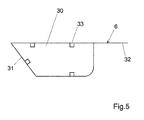
- the figure 5 illustrates a pallet made according to the method of the invention.
- FIGS. 1 to 3 schematically illustrate a method of manufacturing a pallet according to the invention, here integrated with an exhaust anchor. A similar method can be implemented to manufacture a discrete pallet and separated from the anchor.
- the Figure 1A illustrates an uncut monocrystalline diamond 1 used to manufacture one or more pieces according to the invention.
- the monocrystalline diamond may be a natural diamond or a synthetic diamond, with a weight advantageously greater than 1 carat, preferably greater than 3 carats.
- a natural diamond it may be a diamond having a shape or other properties rendering it unfit for recovery for use in jewelry.
- a synthetic monocrystalline diamond can be produced for example by means of a filtered arc to deposit carbon on a monocrystalline diamond primer, without the addition of hydrogen or other materials. Another possibility is to make a CVD deposit of carbon produced from a hydrocarbon such as methane on a monocrystalline diamond primer.
- the primer can be reused after cutting plates in the mass deposited above the primer.
- a third, less desirable, possibility is to produce a synthetic monocrystalline diamond by subjecting a carbon source to a high temperature and a high simultaneous pressure. Other methods may be used.
- the monocrystalline diamond thus formed can be doped.
- the doping product can be introduced during the formation of the synthetic diamond, for example by adding traces of dopant in the filtered arc respectively in the CVD reactor.
- the dopant is added after formation of the synthetic diamond, for example by means of a high energy ion beam.
- the doping can be carried out homogeneously throughout the mass of the diamond, and / or only at the surface. A first doping may be carried out in the mass and a different doping, for example with another doping product and / or with another concentration, may be carried out on the surface.
- Doping can be selected to modify the hardness of the pieces produced from this diamond; depending on the doping product, it is possible to increase or reduce this hardness. For example, the inclusion of nitrogen as a doping product makes it possible to reduce the hardness of a part, whereas the inclusion of boron ions makes it possible to increase it.
- the hardness of the pallet is increased by doping, for example by including boron ions, while a monocrystalline diamond anchor wheel intended to collaborate with this pallet in the exhaust is undoped, or doped so as to reduce its hardness, for example with nitrogen, in order to obtain a hardness lower than that of the pallet.
- a monocrystalline diamond anchor wheel intended to collaborate with this pallet in the exhaust is undoped, or doped so as to reduce its hardness, for example with nitrogen, in order to obtain a hardness lower than that of the pallet.
- the anchor wheel is doped with a relatively high concentration of nitrogen, while the pallet is doped with a lower concentration of nitrogen. The inclusion of nitrogen during diamond manufacturing synthetic monocrystalline CVD growth makes it possible to increase the speed of manufacture, and thus reduce the cost, while obtaining pallets that remain harder than conventional ruby pallets.
- Doping can also be selected to control the color of the diamond. Doping can be chosen to control the Young's modulus of the diamond. The doping can be chosen so as to reduce the sensitivity of the Young's modulus to the temperature, in order to produce parts whose rigidity is as independent as possible from the temperature. The doping can be chosen so as to reduce the coefficient of expansion of the diamond, in order to produce pieces whose dimensions are as independent as possible from the temperature.
- the doping product and the concentration of this product are further selected so as not to interfere with or minimize the interference of the diamond's single crystal structure.
- the diamond is doped with boron ions. Different diamonds used for the production of different pieces in the same watch can be doped differently depending on the desired properties.
- the boron doping carried out during the organic growth of the synthetic diamond has the advantage of producing a non-radioactive black diamond, unlike doping processes by introduction of high energy ions.
- the monocrystalline diamond 1 is then cut as shown in FIG. Figure 1B , for example by means of a diamond saw, or split with a hammer and a blade, an electric arc, an ion beam, or preferably cut by means of a laser to obtain a planar surface.
- the laser is advantageously a pulsed laser, for example a pulsed laser at a frequency of 5 to 40 GHz.
- the diamond is sliced from a first side by means of a first laser beam 20.
- the laser beam is rotated by means of a movable mirror, so as to emit in a cone with an opening angle of less than 5 °.
- the diamond is then attacked from the other side by means of another laser beam 21 rotated in a cone ( Figure 4B ).
- This cone machining allows the ablation zone to be enlarged and to avoid poor surface conditions and the destruction of the crystalline structure which may occur if the ablation is performed in a narrow channel, causing a rise in excessive temperature.
- the process is comparable, proportionately, to that of a lumberjack cutting a trunk by means of two notches sloping from each side of the trunk.
- the convex surface thus produced by this cutting is then rectified or flattened, as illustrated in FIG. figure 4C , by means of a laser beam oriented parallel to the surface of the plate that it is desired to produce.
- the pulsation frequency of this laser can be, for example, between 10 and 100 KHz, in order to obtain precise cutting without the problems of modifications of the crystalline structure caused by the high energy of the pulsed lasers more rapidly.
- the section plane is determined in order to obtain an active surface of the workpiece oriented along the ⁇ 111 ⁇ crystalline plane, which is generally the hardest.
- the plane of section is preferably distinct from the plane ⁇ 111 ⁇ and chosen so as to allow the cutting of pallets whose impulse surface, obtained in the slice of the cut plates, is parallel to the ⁇ 111 ⁇ crystalline orientation plane.
- the section plane is determined in order to obtain an active surface of the workpiece oriented substantially in the ⁇ 001 ⁇ crystalline plane or preferably in the plane ⁇ 011 ⁇ which is particularly hard; these planes are indeed less sensitive to deviations from the ideal surface.
- the cutting plane is preferably chosen so as to allow the cutting of pallets whose impulse surface, obtained in the edge of the cut plates, is substantially parallel to the ⁇ 001 ⁇ or preferably ⁇ 011 ⁇ crystalline orientation plane. Substantially parallel means here that the deflection after polishing is at most + 5 °.
- the rough face 10 obtained at the end of this cut is then ground and / or polished so as to obtain a polished flat face 11 as illustrated on FIG. figure 1C .
- the rectification of the face 11 can be performed, as indicated, by means of a laser, for example a pulsed laser between 10 and 100KHz.
- the polishing of the face 11 can be performed on a rotary grinding wheel covered with synthetic diamond powder, for example polycrystalline diamond powder.
- the roughness of the face 11 can also be reduced by means of a high energy ion beam parallel to the surface.
- the diamond is then cut into a new cut parallel to the first cut, so as to obtain a thin plate 2 as illustrated on the drawing. figure 1D .
- This delicate cut is advantageously performed by laser to avoid shocks that could break the plate.
- this cutting can be performed according to the method illustrated on the Figures 4a to 4c i.e., by means of one or two laser beams deflected by a mirror to produce a conical ablation zone.
- this process makes it possible to cut extremely thin plates in a monocrystalline diamond, for example plates with a thickness of less than 400 microns, for example plates with a thickness of between 100 and 400 microns, by 320 microns, or between 100 and 160 microns, ideally between 100 and 120 microns, in the case of plates for machining pallets, and plates with a thickness of between 20 and 120 microns, for example between 40 and 80 microns, for example 60 microns, in the case of manufacture of anchor wheels or anchors.
- This characteristic makes it possible to manufacture extremely light parts and thus to reduce the energy necessary to put them in displacement.
- the lower face 12 of the plate 2 is relatively crude. For many applications, especially in watchmaking, this aspect not perfectly polished is entirely satisfactory since this face is not visible. However, it is conceivable by producing a slightly thicker piece to also polish this face 12, for example by polishing mechanics on a grinding wheel and / or laser. In one embodiment, the part is held without glue during polishing, preferably by vacuum. It is thus possible to very precisely control the thickness of the piece after polishing, without this thickness depending on the thickness of the glue.
- the plate 2 produced can be visually inspected to remove plates that have too many impurities or a non-monocrystalline structure.
- this control is performed by illuminating the plate with a polarized light that highlights the imperfections.
- the control can be manual or done by means of a camera and an image analysis software.
- the pallet 3 (or an anchor integrating one or more pallets) is cut in the surface of the plate 2.
- This cut is for example obtained by means of a laser beam perpendicular to one of the surfaces 11, 12 or the plane 2.
- this cutting can be performed according to the method illustrated on the Figures 4a to 4c i.e., by means of one or two laser beams deflected by a mirror to produce a conical ablation zone.
- the figure 5 illustrates an example of a possible trajectory of the laser beam 6 during the machining of a pallet in a plate 11.
- the laser beam may have a relatively large dimension, for example a maximum diameter of the order of 20 microns.
- the shape of this beam 6 is generally non-circular, for example elliptical.
- the cutting trajectory is therefore advantageously determined by software designed to determine a trajectory of the light beam which takes into account the size, shape and orientation of this beam with respect to the piece to be cut, so as to obtain a piece after release whose dimensions correspond to the desired dimensions.
- the path is preferably initiated at a distance from the part to be produced, on a portion 32 which does not belong to the part produced. This avoids the deformations due to the initial drilling.
- the trajectory is further preferably optimized, taking into account the crystalline orientation of the diamond, so that any cracks that propagate from the point of ablation have a maximum chance of following the edge of the piece, or move away from this room. For example, on the figure 5 , the maximum risk of cracking occurs from the initial piercing point 32; the position of this point is therefore preferably chosen so that the most likely crack direction exactly follows the line followed by the beam.
- the workpiece is oriented on the diamond plate 11 so that the active surface of the workpiece is in the ⁇ 111 ⁇ crystal plane.
- the active surface 31 is constituted by the impulse surface (plane or non-plane) intended to be brought into contact with the anchor wheel. The pallet is thus cut in the plate 11 so that this surface 31 is precisely in the ⁇ 111 ⁇ plane.
- the elements 33 on the figure 5 are cutting indicators used during the subsequent polishing step to define the ideal polishing depth. The polishing will be done precisely until the moment when these marks disappear completely.
- the method of cutting into a plate 2 of the part 3 by means of a laser has the disadvantage of producing lateral flanks 13 that are not perpendicular to the faces 11, 12, as represented excessively on the figure 3A .
- the diamond being more or less transparent, the cut is in fact obtained by the attack of the plasma produced by the interaction between the laser light and the air. This results in non-perpendicular flanks and little smooth. This surface quality is problematic in particular for a pallet 3 whose impulse surface, intended to come into contact with the anchor wheel, is formed by a portion of this slice.
- an optional operation for grinding the flanks 13, or at least a portion of these flanks can be carried out by means of a grinding wheel so as to obtain flanks 14 which are smoother and perpendicular to the surfaces 11 , 12, as illustrated on the figure 3B .
- a grinding wheel In the case of a pallet, at least the impulse surface 31 can be ground to the depth of the mark 33 by means of a grinding wheel coated with polycrystalline diamond powder.
- the grinding is preferably carried out by orienting the grinding wheel with respect to the impulse surface so as to grind in a direction substantially parallel to the impulse direction, i.e. to the direction of travel of the impeller wheel. anchor in relation to the pallet.
- Polishing of the active surface 31 by sandblasting, ion beam, ultrasound, pulsed laser (eg femtolaser), etc. can also be considered, in addition to or in replacement of polishing by grinding.
- the surfaces of the piece 3 thus obtained are preferably not coated; the monocrystalline diamond has a surface state that is practically ideal both from an aesthetic point of view and with regard to the coefficient of friction or the impact resistance, for example.
- the surfaces 11, 12, 13 or 14 may be covered with traces of graphitized carbon resulting from the destruction of the diamond structure during cutting or polishing operations.
- the part 3 it is possible in the context of the invention to subject the part 3 to a heat treatment, for example by leaving it for a few seconds or a few minutes in a furnace between 600 ° and 750 ° C., preferably between 650 and 680 ° C, preferably with ambient air; this operation makes it possible to burn the residual graphite at the surface without affecting the carbon in the form of a diamond, and thus to improve the surface state of the part. It is also possible to use a lower temperature with a higher oxygen level, or to oxidize the non-crystalline carbon without attacking the diamond by using for example an oxygenated or fluorinated plasma.
- This operation also polishes the pallet by burning tips on the surface.
- the piece produced can also be polished by means of an ion beam ("ion etching"), for example an ion beam parallel to the surface to be polished, for example parallel to the pulse plane.
- ion etching an ion beam parallel to the surface to be polished, for example parallel to the pulse plane.
- this ionic polishing is performed after polishing by heat treatment.
- the part produced can also be polished by means of ultrasound. It can be cleaned with gasoline to improve the appearance of the diamond.
- a mechanical watch movement within the scope of the invention may comprise one or more monocrystalline diamond pieces. As mentioned, it is possible to choose the hardness of each piece 3 by selecting the diamond type and color.
Landscapes
- Physics & Mathematics (AREA)
- General Physics & Mathematics (AREA)
- Crystals, And After-Treatments Of Crystals (AREA)
- Compositions Of Oxide Ceramics (AREA)
Applications Claiming Priority (1)
| Application Number | Priority Date | Filing Date | Title |
|---|---|---|---|
| CH02009/13A CH708925A1 (fr) | 2013-12-05 | 2013-12-05 | Pièce mécanique en diamant pour mouvement de montre. |
Publications (3)
| Publication Number | Publication Date |
|---|---|
| EP2889702A2 true EP2889702A2 (de) | 2015-07-01 |
| EP2889702A3 EP2889702A3 (de) | 2015-10-07 |
| EP2889702B1 EP2889702B1 (de) | 2025-02-05 |
Family
ID=50068746
Family Applications (1)
| Application Number | Title | Priority Date | Filing Date |
|---|---|---|---|
| EP14196655.6A Active EP2889702B1 (de) | 2013-12-05 | 2014-12-05 | Ankerplatte für die Bewegungshemmung einer Armbanduhr, und angepasstes Herstellungsverfahren |
Country Status (2)
| Country | Link |
|---|---|
| EP (1) | EP2889702B1 (de) |
| CH (1) | CH708925A1 (de) |
Cited By (1)
| Publication number | Priority date | Publication date | Assignee | Title |
|---|---|---|---|---|
| CN111650826A (zh) * | 2020-03-23 | 2020-09-11 | 飞亚达精密科技股份有限公司 | 擒纵叉及其制造方法、擒纵组件及其制造方法 |
Citations (15)
| Publication number | Priority date | Publication date | Assignee | Title |
|---|---|---|---|---|
| CH669109A5 (fr) | 1985-07-24 | 1989-02-28 | Oreal | Composition cosmetique ou dermopharmaceutique contenant de la poudre de graines de lupin doux. |
| EP0732635A1 (de) | 1995-03-17 | 1996-09-18 | C.S.E.M. Centre Suisse D'electronique Et De Microtechnique Sa | Mikromechanischer Teil und Verfahren zur dessen Herstellung |
| US20020114225A1 (en) | 2001-02-15 | 2002-08-22 | Konrad Damasko | Clockwork |
| US20030205190A1 (en) | 1998-05-15 | 2003-11-06 | Linares Management Associates, Inc. | System and method for producing synthetic diamond |
| WO2004029733A2 (fr) | 2002-09-25 | 2004-04-08 | Fore Eagle Co Ltd | Pieces mecaniques |
| WO2005017631A1 (fr) | 2003-08-13 | 2005-02-24 | Fore Eagle Co Ltd | Balancier thermocompense |
| DE102008029429A1 (de) | 2007-10-18 | 2009-04-23 | Konrad Damasko | Verfahren zum Herstellen von mechanischen Funktionselementen für Uhrwerke sowie nach diesem Verfahren hergestelltes Funktionselement |
| EP2107434A1 (de) | 2008-04-02 | 2009-10-07 | Manufacture et fabrique de montres et chronomètres Ulysse Nardin Le Locle SA | Mechanisches Bauteil, insbesondere im Räderwerk eines mechanischen Zeitmessers |
| EP2189555A2 (de) | 2001-08-08 | 2010-05-26 | Apollo Diamond, Inc. | Verfahren und Anlage zur Herstellung von synthetischen Diamant |
| EP2233989A1 (de) | 2009-03-24 | 2010-09-29 | Manufacture et fabrique de montres et chronomètres Ulysse Nardin Le Locle SA | Spiralfeder und ihre Reguliereinrichtung |
| CH701155B1 (fr) | 2006-12-27 | 2010-12-15 | Complitime Sa | Oscillateur pour pièce d'horlogerie. |
| CH701369A2 (fr) | 2009-06-30 | 2010-12-31 | Manuf Et Fabrique De Montres Et Chronometres Ulysse Nardin Le Locle Sa | Procede de realisation d'un ressort de barillet. |
| US8088221B2 (en) | 2008-03-03 | 2012-01-03 | Shapiro Zalman M | Method and system for diamond deposition using a liquid-solvent carbon-tranfser mechanism |
| EP2407831A1 (de) | 2010-07-12 | 2012-01-18 | Rolex Sa | Spirale für Unruh-Oszillator einer Uhr, und ihr Herstellungsverfahren |
| US20120263909A1 (en) | 2011-04-12 | 2012-10-18 | Diamaze Microtechnology S.A. | Edge-reinforced micromechanical component |
Family Cites Families (5)
| Publication number | Priority date | Publication date | Assignee | Title |
|---|---|---|---|---|
| US4392476A (en) * | 1980-12-23 | 1983-07-12 | Lazare Kaplan & Sons, Inc. | Method and apparatus for placing identifying indicia on the surface of precious stones including diamonds |
| US6013191A (en) * | 1997-10-27 | 2000-01-11 | Advanced Refractory Technologies, Inc. | Method of polishing CVD diamond films by oxygen plasma |
| US6652763B1 (en) * | 2000-04-03 | 2003-11-25 | Hrl Laboratories, Llc | Method and apparatus for large-scale diamond polishing |
| DE10062933B4 (de) * | 2000-12-16 | 2004-12-23 | Lothar Schmidt | Ankerhemmung für eine Uhr |
| EP2581794A1 (de) * | 2011-10-14 | 2013-04-17 | The Swatch Group Research and Development Ltd. | Funktionelle Mikromechanikanordnung |
-
2013
- 2013-12-05 CH CH02009/13A patent/CH708925A1/fr unknown
-
2014
- 2014-12-05 EP EP14196655.6A patent/EP2889702B1/de active Active
Patent Citations (15)
| Publication number | Priority date | Publication date | Assignee | Title |
|---|---|---|---|---|
| CH669109A5 (fr) | 1985-07-24 | 1989-02-28 | Oreal | Composition cosmetique ou dermopharmaceutique contenant de la poudre de graines de lupin doux. |
| EP0732635A1 (de) | 1995-03-17 | 1996-09-18 | C.S.E.M. Centre Suisse D'electronique Et De Microtechnique Sa | Mikromechanischer Teil und Verfahren zur dessen Herstellung |
| US20030205190A1 (en) | 1998-05-15 | 2003-11-06 | Linares Management Associates, Inc. | System and method for producing synthetic diamond |
| US20020114225A1 (en) | 2001-02-15 | 2002-08-22 | Konrad Damasko | Clockwork |
| EP2189555A2 (de) | 2001-08-08 | 2010-05-26 | Apollo Diamond, Inc. | Verfahren und Anlage zur Herstellung von synthetischen Diamant |
| WO2004029733A2 (fr) | 2002-09-25 | 2004-04-08 | Fore Eagle Co Ltd | Pieces mecaniques |
| WO2005017631A1 (fr) | 2003-08-13 | 2005-02-24 | Fore Eagle Co Ltd | Balancier thermocompense |
| CH701155B1 (fr) | 2006-12-27 | 2010-12-15 | Complitime Sa | Oscillateur pour pièce d'horlogerie. |
| DE102008029429A1 (de) | 2007-10-18 | 2009-04-23 | Konrad Damasko | Verfahren zum Herstellen von mechanischen Funktionselementen für Uhrwerke sowie nach diesem Verfahren hergestelltes Funktionselement |
| US8088221B2 (en) | 2008-03-03 | 2012-01-03 | Shapiro Zalman M | Method and system for diamond deposition using a liquid-solvent carbon-tranfser mechanism |
| EP2107434A1 (de) | 2008-04-02 | 2009-10-07 | Manufacture et fabrique de montres et chronomètres Ulysse Nardin Le Locle SA | Mechanisches Bauteil, insbesondere im Räderwerk eines mechanischen Zeitmessers |
| EP2233989A1 (de) | 2009-03-24 | 2010-09-29 | Manufacture et fabrique de montres et chronomètres Ulysse Nardin Le Locle SA | Spiralfeder und ihre Reguliereinrichtung |
| CH701369A2 (fr) | 2009-06-30 | 2010-12-31 | Manuf Et Fabrique De Montres Et Chronometres Ulysse Nardin Le Locle Sa | Procede de realisation d'un ressort de barillet. |
| EP2407831A1 (de) | 2010-07-12 | 2012-01-18 | Rolex Sa | Spirale für Unruh-Oszillator einer Uhr, und ihr Herstellungsverfahren |
| US20120263909A1 (en) | 2011-04-12 | 2012-10-18 | Diamaze Microtechnology S.A. | Edge-reinforced micromechanical component |
Cited By (1)
| Publication number | Priority date | Publication date | Assignee | Title |
|---|---|---|---|---|
| CN111650826A (zh) * | 2020-03-23 | 2020-09-11 | 飞亚达精密科技股份有限公司 | 擒纵叉及其制造方法、擒纵组件及其制造方法 |
Also Published As
| Publication number | Publication date |
|---|---|
| EP2889702A3 (de) | 2015-10-07 |
| CH708925A1 (fr) | 2015-06-15 |
| EP2889702B1 (de) | 2025-02-05 |
Similar Documents
| Publication | Publication Date | Title |
|---|---|---|
| EP2791739B1 (de) | Stosssicheres lager für uhr | |
| EP3632839A1 (de) | Uhrkomponente | |
| CH699476A2 (fr) | Procédé de fabrication d'un composant horloger en silicium. | |
| EP3722887A1 (de) | Herstellungsverfahren einer rotationsfläche einer uhrwerkskomponente | |
| EP2889702B1 (de) | Ankerplatte für die Bewegungshemmung einer Armbanduhr, und angepasstes Herstellungsverfahren | |
| CH702431B1 (fr) | Procédé de fabrication d'une pièce micromécanique. | |
| EP2889703B1 (de) | Herstellungsverfahren eines mechanischen bauteils aus diamant für das uhrwerk einer armbanduhr, und nach diesem verfahren hergestelltes bauteil | |
| EP3112951B1 (de) | Herstellungsverfahren, das einen modifizierten bearbeitungsschritt umfasst | |
| EP2840059B1 (de) | Verfahren zur Herstellung eines mikromechanischen Teils und Teil hergestellt durch dieses Verfahren | |
| EP1984147B1 (de) | Verfahren zum satinieren eines harten materials | |
| EP4121821A1 (de) | Verfahren zur herstellung eines uhrenbauteils auf siliziumbasis | |
| EP3112950B1 (de) | Herstellungsverfahren, das einen modifizierten automatendreh-schritt umfasst | |
| CH708998A1 (fr) | Pièce d'horlogerie et procédé pour réduire le coefficient de frottement d'une pièce d'horlogerie. | |
| EP2472340A1 (de) | Bestandteil einer Uhr und sein Herstellungsverfahren | |
| EP3112955B1 (de) | Herstellungsverfahren eines werkstücks, das einen modifizierten polierschritt umfasst | |
| CH716071A2 (fr) | Procédé de réalisation d'une surface de révolution d'un composant horloger. | |
| EP4327164A1 (de) | Uhrkomponente und verfahren zur herstellung einer solchen uhrkomponente | |
| EP3825782A1 (de) | Verstärkte uhrenkomponente | |
| CH718233B1 (fr) | Composant de montre-bracelet, montre bracelet et procédé de fabrication d'un composant de montre-bracelet. | |
| CH710326B1 (fr) | Cadran de montre et montre équipée d'un tel cadran. | |
| CH718549A2 (fr) | Composant horloger et procédé de fabrication d'un tel composant horloger. | |
| EP2671676A1 (de) | System zur Fertigbearbeitung eines aus mehreren Materialien geformten Werkstücks | |
| CH716593B1 (fr) | Méthode de fabrication d'un composant en diament | |
| CH711215A2 (fr) | Procédé de fabrication comportant une étape d'usinage. | |
| CH711216A2 (fr) | Procédé de fabrication comportant une étape de décolletage. |
Legal Events
| Date | Code | Title | Description |
|---|---|---|---|
| PUAI | Public reference made under article 153(3) epc to a published international application that has entered the european phase |
Free format text: ORIGINAL CODE: 0009012 |
|
| 17P | Request for examination filed |
Effective date: 20141205 |
|
| AK | Designated contracting states |
Kind code of ref document: A2 Designated state(s): AL AT BE BG CH CY CZ DE DK EE ES FI FR GB GR HR HU IE IS IT LI LT LU LV MC MK MT NL NO PL PT RO RS SE SI SK SM TR |
|
| AX | Request for extension of the european patent |
Extension state: BA ME |
|
| PUAL | Search report despatched |
Free format text: ORIGINAL CODE: 0009013 |
|
| AK | Designated contracting states |
Kind code of ref document: A3 Designated state(s): AL AT BE BG CH CY CZ DE DK EE ES FI FR GB GR HR HU IE IS IT LI LT LU LV MC MK MT NL NO PL PT RO RS SE SI SK SM TR |
|
| AX | Request for extension of the european patent |
Extension state: BA ME |
|
| RIC1 | Information provided on ipc code assigned before grant |
Ipc: G04B 15/14 20060101AFI20150901BHEP |
|
| R17P | Request for examination filed (corrected) |
Effective date: 20160321 |
|
| RBV | Designated contracting states (corrected) |
Designated state(s): AL AT BE BG CH CY CZ DE DK EE ES FI FR GB GR HR HU IE IS IT LI LT LU LV MC MK MT NL NO PL PT RO RS SE SI SK SM TR |
|
| STAA | Information on the status of an ep patent application or granted ep patent |
Free format text: STATUS: EXAMINATION IS IN PROGRESS |
|
| 17Q | First examination report despatched |
Effective date: 20210415 |
|
| GRAP | Despatch of communication of intention to grant a patent |
Free format text: ORIGINAL CODE: EPIDOSNIGR1 |
|
| STAA | Information on the status of an ep patent application or granted ep patent |
Free format text: STATUS: GRANT OF PATENT IS INTENDED |
|
| INTG | Intention to grant announced |
Effective date: 20241025 |
|
| GRAS | Grant fee paid |
Free format text: ORIGINAL CODE: EPIDOSNIGR3 |
|
| GRAA | (expected) grant |
Free format text: ORIGINAL CODE: 0009210 |
|
| STAA | Information on the status of an ep patent application or granted ep patent |
Free format text: STATUS: THE PATENT HAS BEEN GRANTED |
|
| AK | Designated contracting states |
Kind code of ref document: B1 Designated state(s): AL AT BE BG CH CY CZ DE DK EE ES FI FR GB GR HR HU IE IS IT LI LT LU LV MC MK MT NL NO PL PT RO RS SE SI SK SM TR |
|
| REG | Reference to a national code |
Ref country code: GB Ref legal event code: FG4D Free format text: NOT ENGLISH |
|
| REG | Reference to a national code |
Ref country code: CH Ref legal event code: EP |
|
| REG | Reference to a national code |
Ref country code: IE Ref legal event code: FG4D Free format text: LANGUAGE OF EP DOCUMENT: FRENCH |
|
| REG | Reference to a national code |
Ref country code: DE Ref legal event code: R096 Ref document number: 602014091519 Country of ref document: DE |
|
| PG25 | Lapsed in a contracting state [announced via postgrant information from national office to epo] |
Ref country code: RS Free format text: LAPSE BECAUSE OF FAILURE TO SUBMIT A TRANSLATION OF THE DESCRIPTION OR TO PAY THE FEE WITHIN THE PRESCRIBED TIME-LIMIT Effective date: 20250505 |
|
| PG25 | Lapsed in a contracting state [announced via postgrant information from national office to epo] |
Ref country code: FI Free format text: LAPSE BECAUSE OF FAILURE TO SUBMIT A TRANSLATION OF THE DESCRIPTION OR TO PAY THE FEE WITHIN THE PRESCRIBED TIME-LIMIT Effective date: 20250205 |
|
| PG25 | Lapsed in a contracting state [announced via postgrant information from national office to epo] |
Ref country code: PL Free format text: LAPSE BECAUSE OF FAILURE TO SUBMIT A TRANSLATION OF THE DESCRIPTION OR TO PAY THE FEE WITHIN THE PRESCRIBED TIME-LIMIT Effective date: 20250205 |
|
| PG25 | Lapsed in a contracting state [announced via postgrant information from national office to epo] |
Ref country code: ES Free format text: LAPSE BECAUSE OF FAILURE TO SUBMIT A TRANSLATION OF THE DESCRIPTION OR TO PAY THE FEE WITHIN THE PRESCRIBED TIME-LIMIT Effective date: 20250205 |
|
| REG | Reference to a national code |
Ref country code: LT Ref legal event code: MG9D |
|
| PG25 | Lapsed in a contracting state [announced via postgrant information from national office to epo] |
Ref country code: NO Free format text: LAPSE BECAUSE OF FAILURE TO SUBMIT A TRANSLATION OF THE DESCRIPTION OR TO PAY THE FEE WITHIN THE PRESCRIBED TIME-LIMIT Effective date: 20250505 Ref country code: IS Free format text: LAPSE BECAUSE OF FAILURE TO SUBMIT A TRANSLATION OF THE DESCRIPTION OR TO PAY THE FEE WITHIN THE PRESCRIBED TIME-LIMIT Effective date: 20250605 |
|
| PG25 | Lapsed in a contracting state [announced via postgrant information from national office to epo] |
Ref country code: NL Free format text: LAPSE BECAUSE OF FAILURE TO SUBMIT A TRANSLATION OF THE DESCRIPTION OR TO PAY THE FEE WITHIN THE PRESCRIBED TIME-LIMIT Effective date: 20250205 |
|
| PG25 | Lapsed in a contracting state [announced via postgrant information from national office to epo] |
Ref country code: HR Free format text: LAPSE BECAUSE OF FAILURE TO SUBMIT A TRANSLATION OF THE DESCRIPTION OR TO PAY THE FEE WITHIN THE PRESCRIBED TIME-LIMIT Effective date: 20250205 |
|
| PG25 | Lapsed in a contracting state [announced via postgrant information from national office to epo] |
Ref country code: LV Free format text: LAPSE BECAUSE OF FAILURE TO SUBMIT A TRANSLATION OF THE DESCRIPTION OR TO PAY THE FEE WITHIN THE PRESCRIBED TIME-LIMIT Effective date: 20250205 Ref country code: PT Free format text: LAPSE BECAUSE OF FAILURE TO SUBMIT A TRANSLATION OF THE DESCRIPTION OR TO PAY THE FEE WITHIN THE PRESCRIBED TIME-LIMIT Effective date: 20250605 |
|
| PG25 | Lapsed in a contracting state [announced via postgrant information from national office to epo] |
Ref country code: BG Free format text: LAPSE BECAUSE OF FAILURE TO SUBMIT A TRANSLATION OF THE DESCRIPTION OR TO PAY THE FEE WITHIN THE PRESCRIBED TIME-LIMIT Effective date: 20250205 Ref country code: GR Free format text: LAPSE BECAUSE OF FAILURE TO SUBMIT A TRANSLATION OF THE DESCRIPTION OR TO PAY THE FEE WITHIN THE PRESCRIBED TIME-LIMIT Effective date: 20250506 |
|
| PG25 | Lapsed in a contracting state [announced via postgrant information from national office to epo] |
Ref country code: SE Free format text: LAPSE BECAUSE OF FAILURE TO SUBMIT A TRANSLATION OF THE DESCRIPTION OR TO PAY THE FEE WITHIN THE PRESCRIBED TIME-LIMIT Effective date: 20250205 |
|
| PG25 | Lapsed in a contracting state [announced via postgrant information from national office to epo] |
Ref country code: SM Free format text: LAPSE BECAUSE OF FAILURE TO SUBMIT A TRANSLATION OF THE DESCRIPTION OR TO PAY THE FEE WITHIN THE PRESCRIBED TIME-LIMIT Effective date: 20250205 |
|
| PG25 | Lapsed in a contracting state [announced via postgrant information from national office to epo] |
Ref country code: DK Free format text: LAPSE BECAUSE OF FAILURE TO SUBMIT A TRANSLATION OF THE DESCRIPTION OR TO PAY THE FEE WITHIN THE PRESCRIBED TIME-LIMIT Effective date: 20250205 |
|
| PG25 | Lapsed in a contracting state [announced via postgrant information from national office to epo] |
Ref country code: IT Free format text: LAPSE BECAUSE OF FAILURE TO SUBMIT A TRANSLATION OF THE DESCRIPTION OR TO PAY THE FEE WITHIN THE PRESCRIBED TIME-LIMIT Effective date: 20250205 |
|
| PG25 | Lapsed in a contracting state [announced via postgrant information from national office to epo] |
Ref country code: CZ Free format text: LAPSE BECAUSE OF FAILURE TO SUBMIT A TRANSLATION OF THE DESCRIPTION OR TO PAY THE FEE WITHIN THE PRESCRIBED TIME-LIMIT Effective date: 20250205 Ref country code: EE Free format text: LAPSE BECAUSE OF FAILURE TO SUBMIT A TRANSLATION OF THE DESCRIPTION OR TO PAY THE FEE WITHIN THE PRESCRIBED TIME-LIMIT Effective date: 20250205 |
|
| PG25 | Lapsed in a contracting state [announced via postgrant information from national office to epo] |
Ref country code: RO Free format text: LAPSE BECAUSE OF FAILURE TO SUBMIT A TRANSLATION OF THE DESCRIPTION OR TO PAY THE FEE WITHIN THE PRESCRIBED TIME-LIMIT Effective date: 20250205 |
|
| PG25 | Lapsed in a contracting state [announced via postgrant information from national office to epo] |
Ref country code: SK Free format text: LAPSE BECAUSE OF FAILURE TO SUBMIT A TRANSLATION OF THE DESCRIPTION OR TO PAY THE FEE WITHIN THE PRESCRIBED TIME-LIMIT Effective date: 20250205 |
|
| REG | Reference to a national code |
Ref country code: DE Ref legal event code: R097 Ref document number: 602014091519 Country of ref document: DE |
|
| PLBE | No opposition filed within time limit |
Free format text: ORIGINAL CODE: 0009261 |
|
| STAA | Information on the status of an ep patent application or granted ep patent |
Free format text: STATUS: NO OPPOSITION FILED WITHIN TIME LIMIT |
|
| REG | Reference to a national code |
Ref country code: CH Ref legal event code: L10 Free format text: ST27 STATUS EVENT CODE: U-0-0-L10-L00 (AS PROVIDED BY THE NATIONAL OFFICE) Effective date: 20251217 |
|
| REG | Reference to a national code |
Ref country code: CH Ref legal event code: U11 Free format text: ST27 STATUS EVENT CODE: U-0-0-U10-U11 (AS PROVIDED BY THE NATIONAL OFFICE) Effective date: 20260101 |
|
| PGFP | Annual fee paid to national office [announced via postgrant information from national office to epo] |
Ref country code: DE Payment date: 20251211 Year of fee payment: 12 |
|
| PGFP | Annual fee paid to national office [announced via postgrant information from national office to epo] |
Ref country code: AT Payment date: 20251222 Year of fee payment: 12 |
|
| 26N | No opposition filed |
Effective date: 20251106 |
|
| PGFP | Annual fee paid to national office [announced via postgrant information from national office to epo] |
Ref country code: FR Payment date: 20251223 Year of fee payment: 12 |
|
| PGFP | Annual fee paid to national office [announced via postgrant information from national office to epo] |
Ref country code: CH Payment date: 20260101 Year of fee payment: 12 |