EP2891987A1 - Système de traitement de demande, procédé de traitement de demande, programme et support de stockage d'information - Google Patents
Système de traitement de demande, procédé de traitement de demande, programme et support de stockage d'information Download PDFInfo
- Publication number
- EP2891987A1 EP2891987A1 EP13880323.4A EP13880323A EP2891987A1 EP 2891987 A1 EP2891987 A1 EP 2891987A1 EP 13880323 A EP13880323 A EP 13880323A EP 2891987 A1 EP2891987 A1 EP 2891987A1
- Authority
- EP
- European Patent Office
- Prior art keywords
- request
- processing
- order
- unit
- information
- Prior art date
- Legal status (The legal status is an assumption and is not a legal conclusion. Google has not performed a legal analysis and makes no representation as to the accuracy of the status listed.)
- Ceased
Links
Images







Classifications
-
- G—PHYSICS
- G06—COMPUTING OR CALCULATING; COUNTING
- G06Q—INFORMATION AND COMMUNICATION TECHNOLOGY [ICT] SPECIALLY ADAPTED FOR ADMINISTRATIVE, COMMERCIAL, FINANCIAL, MANAGERIAL OR SUPERVISORY PURPOSES; SYSTEMS OR METHODS SPECIALLY ADAPTED FOR ADMINISTRATIVE, COMMERCIAL, FINANCIAL, MANAGERIAL OR SUPERVISORY PURPOSES, NOT OTHERWISE PROVIDED FOR
- G06Q30/00—Commerce
- G06Q30/06—Buying, selling or leasing transactions
- G06Q30/0601—Electronic shopping [e-shopping]
- G06Q30/0633—Managing shopping lists, e.g. compiling or processing purchase lists
- G06Q30/0635—Managing shopping lists, e.g. compiling or processing purchase lists replenishment orders; recurring orders
-
- H—ELECTRICITY
- H04—ELECTRIC COMMUNICATION TECHNIQUE
- H04L—TRANSMISSION OF DIGITAL INFORMATION, e.g. TELEGRAPHIC COMMUNICATION
- H04L51/00—User-to-user messaging in packet-switching networks, transmitted according to store-and-forward or real-time protocols, e.g. e-mail
- H04L51/48—Message addressing, e.g. address format or anonymous messages, aliases
-
- H—ELECTRICITY
- H04—ELECTRIC COMMUNICATION TECHNIQUE
- H04L—TRANSMISSION OF DIGITAL INFORMATION, e.g. TELEGRAPHIC COMMUNICATION
- H04L67/00—Network arrangements or protocols for supporting network services or applications
- H04L67/01—Protocols
- H04L67/10—Protocols in which an application is distributed across nodes in the network
- H04L67/1001—Protocols in which an application is distributed across nodes in the network for accessing one among a plurality of replicated servers
- H04L67/1004—Server selection for load balancing
-
- H—ELECTRICITY
- H04—ELECTRIC COMMUNICATION TECHNIQUE
- H04L—TRANSMISSION OF DIGITAL INFORMATION, e.g. TELEGRAPHIC COMMUNICATION
- H04L67/00—Network arrangements or protocols for supporting network services or applications
- H04L67/01—Protocols
- H04L67/10—Protocols in which an application is distributed across nodes in the network
- H04L67/1001—Protocols in which an application is distributed across nodes in the network for accessing one among a plurality of replicated servers
- H04L67/1038—Load balancing arrangements to avoid a single path through a load balancer
Definitions
- the present invention relates to a request processing system, a request processing method, a program, and an information storage medium.
- Patent Literature 1 Japanese Patent Laid-open Publication No. 2002-342296
- preparation of resources in accordance with accesses at peak may not be readily achieved. This is because, for example, preparation of resources in accordance with accesses at peak results in a reduced rate of operation in normal time, which means deterioration in cost efficiency, and further because accurate estimation of the number of accesses at peak is difficult to be made.
- An object to be achieved by the invention is to execute necessary processing by way of a procedure different from a normal procedure, when response different from one in normal time should be conducted in executing processing in response to a request from a request sender.
- a request processing system includes a determination unit for determining, based on at least one of an internal factor and an external factor, to respond to a processing request in a manner different from a normal manner; and a leading unit for leading, when the determination unit makes the determination, so that the processing request sent from a request sender by way of a first method that requires an immediate response is sent by way of a second method that does not require an immediate response.
- a request processing method includes a determination step of for determining, based on at least one of an internal factor and an external factor, to respond to a processing request in a manner different from a normal manner; and a leading step for leading, when the determination is made at the determination step, so that the processing request sent from a request sender by way of a first method that requires an immediate response is sent by way of a second method that does not require an immediate response.
- a program according to the present invention causes a computer to execute processing for determining, based on at least one of an internal factor and an external factor, to respond to a processing request in a manner different from a normal manner, and leading, when it is determined to respond to the processing request in the manner different from the normal manner, so that the processing request sent from a request sender by way of a first method that requires an immediate response is sent by way of a second method that does not require an immediate response.
- a computer readable storage medium stores the above described program.
- the leading unit may lead so that the processing request is sent by way of the second method, the processing request following another processing request and making a series of requests with the another processing request sent from the request sender by way of the first method.
- the leading unit may inform the request sender of destination specifying information for specifying a destination to which the processing request is sent by the second method.
- the leading unit may send leading information including the destination specifying information to a destination designated by the request sender by way of the second method.
- the leading unit may send confirmation requesting information including required confirmation information which the request sender should confirm in connection with a transaction including the processing request to the destination separately from the leading information by way of the second method in order to lead so that the processing request is sent to a destination specified by the destination specifying information by way of the second method in reply to the required confirmation information.
- the request processing system may further include informing unit for reply that the confirmation requesting information is sent by the second method with respect to another request sent from the request sender by way of the first method immediately before the processing request.
- the request processing system may further include a generation unit for generating the destination specifying information for every transaction.
- the request processing system may further include an invalidating unit for invalidating, when a predetermined period of time elapses after the destination specifying information is generated by the generation unit, a destination specified by the destination specifying information.
- the transaction may be made to order a product or a service
- the request processing system may further include a stock allocation unit for tentatively allocating a stock of a product or a service that should be ordered in a transaction corresponding to the destination specifying information generated by the generation unit, so as to be correlated to the destination specifying information, and an allocation releasing unit for deallocating, when the invalidating unit invalidates the destination specifying information, a stock tentatively allocated so as to be correlated to the destination specifying information invalidated.
- the request processing system may further include a first processing unit for immediately executing predetermined processing in response to the processing request sent by the first method and responding to the request sender immediately after completion of the predetermined processing; and a second processing unit for executing, in sequence, alternative processing of the predetermined processing according to the processing request sent by the second method.
- the second processing unit may execute the alternative processing while considering a time of receiving the processing request sent by the second method as a received time of the processing request.
- the processing request may be a request of order receiving processing for receiving an order of a product or a service
- the second processing unit may sort a plurality of processing requests, based on an object of the order as a key, and collectively executes the order receiving processing for every object of the order.
- the second processing unit may execute preferentially the order receiving processing relevant to a product or a service of which order should be fixed earlier.
- the request processing system may further include a load obtaining unit for obtaining a value indicating a magnitude of a load on a system, wherein when the value obtained by the load obtaining unit is equal to or greater than a predetermined threshold, the determination unit may determine to respond to a processing request in a manner different from the normal manner.
- the request processing system may further include a rank obtaining unit for obtaining rank specifying information for specifying a rank of the request sender, wherein when the rank of the request sender specified by the rank specifying information obtained by the rank obtaining unit is within a predetermined range, the determination unit may determine to respond to a processing request in a manner different from the normal manner.
- FIG. 1 shows one example of a hardware structure of an electronic commerce system 1 according to an embodiment of the present invention.
- the electronic commerce system 1 is a system for processing a request for order, shipping, settlement (payment), or the like, of a product or a service sent from a user terminal 2 via a network 3.
- the following description is based on an assumption that the system is an electronic shopping mall system for providing a place for electronic commerce to a plurality of shops.
- the term "product” mentioned below includes a service unless otherwise stated.
- the electronic commerce system 1 includes a load balancing server 4, a plurality of normal web servers 5, a database server 6, a high load handling web server 7, a mail sending server 8, a mail receiving server 9, and a sequential processing server 10.
- the load balancing server 4 is a so-called load balancer, and transfers an http request from the user terminal 2 in a manner that a load on each normal web server 5 does not reach a limit.
- the load balancing server 4 regularly obtains information indicating a load on the electronic commerce system 1, and transfers an http request from the user terminal 2 to any of the plurality of normal web servers 5 or the high load handling web server 7, based on the information.
- the normal web server 5 processes various http requests from the user terminal 2 on a real time basis, and sends a result of processing back to the user terminal 2 as an http response to the http request.
- the high load handling web server 7, the mail sending server 8, the mail receiving server 9, and the sequential processing server 10 execute processing relevant to an http request when a value indicating a load on the electronic commerce system 1 exceeds an upper limit. Details on the processing of these servers will be described later.
- An http protocol is a communication protocol on the assumption that an http response to an http request is made within a predetermined period of time.
- a request made according to a communication method, such as the http protocol, on the assumption that a response is sent on a real time basis will be hereinafter referred to as an "immediate processing request".
- the database server 6 stores a product master, a client database, a database (an order database) for order information including a product order, settlement and shipping methods, and the like, sent from a user, and other databases.
- the database server 6 executes a so-called database management software to thereby store and manage these data.
- the order information is one type of so-called transaction data.
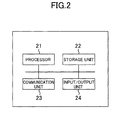
- FIG. 2 shows one example of a hardware structure of each server included in the electronic commerce system 1.
- Each of the load balancing server 4, the plurality of normal web servers 5, the database server 6, the high load handling web server 7, the mail sending server 8, the mail receiving server 9, and the sequential processing server 10 includes a processor 21, a storage unit 22, a communication unit 23, and an input/output unit 24.
- the processor 21 operates according to a program stored in the storage unit 22.
- the processor 21 controls the communication unit 23 and the input/output unit 24.
- the above mentioned program may be provided via the Internet or the like or as being stored in a computer readable storage medium, such as a flash memory, a DVD-ROM, or the like.
- the storage unit 22 is formed using a memory element, such as a RAM, a flash memory, or the like, or a hard disk drive.
- the above described program is stored in the storage unit 22. Further, information and operation results inputted from the respective units are also stored in the storage unit 22.
- the communication unit 23 implements a function for communicating with other devices, and is formed using, for example, an integrated circuit of a wireless LAN and an antenna. Under control by the processor 21, the communication unit 23 inputs information received from other devices to the processor 21 and the storage unit 22, and sends information to other devices.
- the input/output unit 24 is formed using a video controller or a controller for obtaining data from an input device, such as a keyboard, a mouse, or the like. Under control by the processor 21, the input/output unit 24 outputs display data to a display output device, and obtains data inputted by a user operating the input device.
- FIG. 3 is a functional block diagram showing functions implemented in the electronic commerce system 1 according to an embodiment of the present invention.
- the electronic commerce system 1 functionally includes a load obtaining unit 51, a dispatch unit 52, an immediate processing request receiving unit 53, an immediate processing unit 54, a tentative response unit 58, a transmission request unit 59, a mail address management unit 60, a mail receiving and storing unit 61, a sequential processing unit 62, and an deallocation unit 63.
- the immediate processing unit 54 includes a cart processing unit 55, an order confirmation unit 56, and an order immediate processing unit 57.
- the load balancing server 4 implements the load obtaining unit 51 and the dispatch unit 52.
- the normal web server 5 implements the immediate processing request receiving unit 53 and the immediate processing unit 54.
- the high load handling web server 7 implements the tentative response unit 58.
- the mail sending server 8 implements the transmission request unit 59.
- the mail receiving server 9 implements the mail receiving and storing unit 61 and the mail address management unit 60.
- the sequential processing server 10 implements the sequential processing unit 62 and the deallocation unit 63. More specifically, each of these functions is implemented by causing the processor 21 included in a server where the function is implemented to execute a program stored in the storage unit 22 and to control the communication unit 23 and the like.
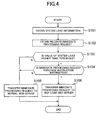
- FIG. 4 shows one example of a flow of processing of the load obtaining unit 51 and the dispatch unit 52.
- the processing shown in FIG. 4 is executed every receipt of an immediate processing request from the user terminal 2.
- the load obtaining unit 51 is implemented using mainly the processor 21, the storage unit 22, and the communication unit 23 of the load balancing server 4.
- the load obtaining unit 51 obtains information indicating a load on the system (step S101).
- Information indicating a load on a system may be the number of http sessions being processed by each of the normal web servers 5 or a value calculated based on the CPU usage rate or the memory usage rate of the normal web server 5 and the database server 6 or the like.
- the dispatch unit 52 is implemented mainly using the processor 21, the storage unit 22, and the communication unit 23 of the load balancing server 4.
- the dispatch unit 52 determines, based on at least one of an internal factor and an external factor, whether to respond to a processing request according to a normal communication method (a first communication method) or a communication method different from the normal communication method (a second communication method), and transfers an immediate processing request into either the normal web server 5 or the high load handling web server 7, based on the determination.
- a normal communication method a first communication method
- a communication method different from the normal communication method a second communication method
- the first communication method is a communication method, such as http, based on a protocol that requires an immediate response (for example, an http response) to be made to a request (for example, an http request), while the second communication method is a communication method, such as SMTP, based on a protocol that does not require an immediate response (for example, an electronic mail).
- the electronic commerce system 1 processes, on a real time basis, an immediate processing request that requires transmission of a response, and sends a response to the immediate processing request, based on the processing result.
- the electronic commerce system 1 stores a sequential processing request obtained based on an immediate processing request in a queue. One or more unprocessed sequential processing requests are stored in the queue, and the electronic commerce system 1 sequentially obtains and processes the sequential processing requests stored in the queue.
- the dispatch unit 52 obtains an immediate processing request received from the user terminal 2 (step S102).
- a value indicating a load on the electronic commerce system 1 is equal to or less than a threshold (N at step S103) or the immediate processing request is not purchase instruction information (N at step S104)
- the dispatch unit 52 transfers the immediate processing request to any normal web server 5 (step S105). This transfer corresponds to determination to respond to the processing request according to the first communication method.
- the dispatch unit 52 selects a normal web server 5 to which to transfer the immediate processing request such that the loads are balanced among the plurality of normal web servers 5.
- the dispatch unit 52 transfers the immediate processing request to the high load handling web server 7 (step S106). This transfer corresponds to determination to respond to the processing request according to the second communication method. Details on purchase instruction information or the like will be described later.
- FIG. 5 is a sequence diagram showing one example of a flow of processing that is executed when only the first communication method is used. This is substantially the same as the content of general processing executed in an electronic shopping mall site.
- Cart check instruction information, purchase instruction information, and order receiving instruction information in this diagram are information to be sent as immediate processing requests (that is, information to be sent together with an http request that requires an immediate response). Note that a request and a response including information for displaying a screen image for product selection is actually available, though not shown in this diagram.
- the cart check information, the order confirmation information, and the order result response are responses to the cart check instruction information, the purchase instruction information, and the order receiving instruction information, respectively, and included in, for example, HTML data or the like for displaying a screen image on a browser or the like of the user terminal 2 (that is, information to be sent together with an HTTP response, or an immediate response).
- a series of immediate processing requests namely, the cart check instruction information, the purchase instruction information, and the order receiving instruction information, constitutes a transaction of a flow of processing.
- An immediate processing request includes an ID for specifying a transaction to which the immediate processing request belongs (for example, a session ID for identifying an http session or a character string corresponding thereto (for example, a character string resulting from conversion of a session ID according to a predetermined rule)).
- a session ID is generated by the normal web server 5 at initial access from the user terminal 2, and stored as a cookie or the like in a browser of the user terminal 2 or the like.
- the immediate processing request receiving unit 53 is implemented mainly using the processor 21, the storage unit 22, and the communication unit 23 of the normal web server 5.
- the immediate processing request receiving unit 53 receives, via the communication unit 23, the immediate processing request sent from the dispatch unit 52, and transfers to the immediate processing unit 54.
- the immediate processing unit 54, and the cart processing unit 55, the order confirmation unit 56, and the order immediate processing unit 57 included in the immediate processing unit 54 are implemented mainly using the processor 21, the storage unit 22, and the communication unit 23 of the normal web server 5.
- the cart processing unit 55, the order confirmation unit 56, and the order immediate processing unit 57 process data on an order included in the cart check instruction information, the purchase instruction information, and the order receiving instruction information respectively, and send an http response including a result of processing to the user terminal 2.
- the cart processing unit 55 retrieves information on a shopping cart from the database server 6 or a cache in the storage unit 22, then generates cart check information for showing a shopping cart check screen image including retrieved information such as the name and price of a product added to the shopping cart, and sends the cart check information as an http response to the user terminal 2.
- the cart check instruction information is sent from the user terminal 2 when a user selects a product and adds the product to a shopping cart or presses a button for checking the shopping cart in electronic commerce transaction.
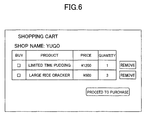
- FIG. 6 shows one example of the shopping cart check screen.
- the shopping cart check screen shows information on a shop that sells a product added to the shopping cart, information, such as a product name and a price, obtained from a product master in the database, and information, such as the quantity of the product, obtained from the cart information.
- the shopping cart check screen further includes, as to each product, a check box for designating whether or not to buy the product and a "remove" button for designating whether or not to remove the product from the shopping cart.
- the cart check information includes an information that indicates the product is to be removed from the shopping cart.
- a "proceed to purchase” button the user terminal 2 sends purchase instruction information to the electronic commerce system 1.
- the order confirmation unit 56 Based on the purchase instruction information, the order confirmation unit 56 obtains settlement information and shipping information for the user from the client database, and generates information on a payment amount. Then, the order confirmation unit 56 generates order confirmation information for showing an order confirmation screen including a payment amount, settlement information, and shipping information, and sends the order confirmation information as an http response to the user terminal 2. The order confirmation unit 56 stores order information on a product yet to be confirmed in the order database.
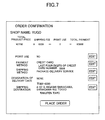
- FIG. 7 shows one example of the order confirmation screen.
- the order confirmation screen shows information on a payment method for use in paying of a product, whether or not to use points, a shipping method, and a shipping destination. These information items are stored in the client database with the user as a key. In the client database, information on a payment method and a shipping destination to be outputted to the order confirmation screen is stored.
- an "edit" button shown on the right side of each item, the user can edit the information.
- order receiving instruction information to indicate that the information is to be edited is sent from the user terminal 2, the order confirmation unit 56 sends order confirmation information for showing an edited order confirmation screen.
- the user terminal 2 sends order receiving instruction information to the electronic commerce system 1.
- the order immediate processing unit 57 executes processing for proceeding response to the order received. Specifically, the order immediate processing unit 57 executes processing, including settlement processing and stock allocation processing, with respect to an order from a user. More specifically, as to an order designated by the order receiving instruction information, the order immediate processing unit 57 executes payment processing in accordance with a payment type, then accesses a stock database of the shop to allocate a product stock, if any, and instructs an outside system to ship the product with an allocated stock. Payment processing is processing relevant to authorization and sales when the payment method is to use a credit card, for example, and is processing for an outside system to issue a transfer request form when the payment is made by bank transfer.
- the order immediate processing unit 57 handles the order as error or keeps the order as being reserved.
- the order immediate processing unit 57 instructs a batch processing system to execute shipping preparation processing or the like in accordance with a situation of stock allocation, a result of payment, or the like.
- the order immediate processing unit 57 updates information on the order, based on a payment status or the like. In the update, the order immediate processing unit 57 sets the time when this processing is being executed as an order time in the order information. Then, when the order is received through the above described processing, the order immediate processing unit 57 generates and sends an order result response for showing a screen image including information to that effect and an order number. Meanwhile, when the order ends in error, the order immediate processing unit 57 generates and sends an order result response for showing a screen image including information to that effect.
- the processing of the order immediate processing unit 57 may likely take time to be completed and impose much load on the system as the processing involves update of the order information and cooperation with an outside system.
- the processing of the order immediate processing unit 57 is important in that it is for receiving an order from a client, the processing is inevitable.
- a load imposed due to the processing of the order immediate processing unit 57 that should be completed within a very short period of time after receiving an order receiving instruction information before sending an order result response may become concerned.
- an electronic shopping mall takes place a campaign for giving special privilege to a user on condition that the user finishes a predetermined purchase within a predetermined period of time (that is, a type of campaign in which the receipt time of order information is critically important in determining whether or not to apply the campaign), and in such a case, many users often access the electronic shopping mall system at a time close to the end of the campaign period in order to get application in the limited time campaign. Accordingly, access congestion in view of the entire capacity of the electronic shopping mall system is likely caused at a time close to the end of the campaign period. In this case, dynamic reinforcement of the hardware, for example, is difficult to be employed.
- FIG. 8 is a sequence diagram showing one example of a flow of processing when the first communication method and the second communication method are both used.
- the cart check instruction information and the purchase instruction information in this diagram are immediate processing requests.
- the cart check instruction information and tentative response information are http responses to the cart check instruction information and the purchase instruction information, respectively, and are HTML data or the like for showing a screen image on a browser or the like of the user terminal 2.
- the dispatch unit 52 transfers the cart check instruction information to the normal web server 5.
- the content of this processing is similar to that which has been described with reference to FIG. 5 , and thus not described again here.
- a request and a response for displaying a screen image for product selection is processed by the normal web server 5.
- Processing up to the processing of the cart processing unit 55 is executed in the normal web server 5 because of some reasons.
- One of the reasons is that it is difficult to confirm an order unless an operation for product selection is executed. That is, although information on a payment method and a shipping method used in principle can be set in advance, real time processing using a web is highly required for product selection.
- the dispatch unit 52 transfers the purchase instruction information sent from a user to the high load handling web server 7.
- the tentative response unit 58 is implemented mainly using the processor 21, the storage unit 22, and the communication unit 23 of the high load handling web server 7. With respect to the immediate processing request that is transferred when it is determined to respond thereto according to the second communication method, the tentative response unit 58 sends to the user terminal 2 tentative response information as an http response for showing a screen to the effect that a procedure for the order is to be proceeded with a sequential processing request.
- the tentative response information does not include an element, such as a button or a link, to be shown in a screen image of the user terminal 2, for sending an immediate processing request.
- the first communication method http or the like
- the second communication method a mail or the like
- the tentative response unit 58 stores, in a mail transmission waiting queue for use by the mail sending server 8 to send information, information (referred also as a "sequential purchase request") for specifying the order included in the immediate processing request for causing a user to send a sequential processing request.
- information referred also as a "sequential purchase request" for specifying the order included in the immediate processing request for causing a user to send a sequential processing request.
- an immediate processing request subjected to the processing of the tentative response unit 58 is purchase instruction information.
- FIG. 9 shows one example of a flow of processing of the tentative response unit 58.
- the tentative response unit 58 obtains the immediate processing request transferred from the dispatch unit 52 (step S201), and then stores, in the mail transmission waiting queue, information (a sequential purchase request) for specifying the order (step S202). Then, tentative response unit 58 sends, as a response to the immediate processing request, tentative response information for showing a screen image showing that a mail to lead a user to send a sequential processing request is going to be sent to the mail address of the user (step S203).
- the transmission request unit 59 is implemented mainly using the processor 21, the storage unit 22, and the communication unit 23 of the mail sending server 8.
- the transmission request unit 59 sends, to a user having sent the immediate request that is a purchase instruction information, transmission request information for asking to send a sequential processing request by way of the second communication method (a communication protocol not requiring a response).
- the transmission request information is an order confirmation mail in the example shown in FIG. 8 .
- the transmission request unit 59 sequentially obtains the sequential purchase requests stored in the mail transmission waiting queue, and sends transmission request information to a user having made an order designated by the sequential purchase request obtained.
- the transmission request unit 59 leads the user to send a (sequential) processing request to the electronic commerce system 1 by way of the second communication method.
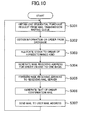
- FIG. 10 shows one example of a flow of processing of the transmission request unit 59.
- the transmission request unit 59 included in the mail sending server 8 obtains one sequential purchase request from the mail transmission waiting queue according to the order in which the sequential processing requests are stored therein (step S301).
- the transmission request unit 59 obtains information for specifying an order from the sequential purchase request and obtains information on the order and information such as a mail address of a client from the order database and a client database (step S302).
- the information on an order obtained by the transmission request unit 59 is the same as that obtained by the order confirmation unit 56.
- the transmission request unit 59 allocates a stock to the order (step S303).
- stock allocation made by the transmission request unit 59 is a type of reservation, or tentative stock allocation. That is, the allocated stock may be automatically cancelled in a subsequent process.
- the transmission request unit 59 generates a mail receiving address for this transaction on a one-to-one basis (step S304).
- a mail receiving address is used as an address at which the mail receiving server 9 receives an order receiving instruction mail that is a sequential processing request.
- the transmission request unit 59 generates a mail receiving address, using a hush function or the like.
- a mail receiving address is information for correlating an immediate processing request sent by the first communication method and a sequential processing request (an order receiving instruction mail here) to be sent from a terminal (the user terminal 2 or other terminals) operated by a user in response to transmission request information.
- a mail receiving address enables specification of a transaction and a session ID.
- a mail receiving address is generated using a hush function, and prevents a user from being specified based on a mail receiving address. Thereafter, the transmission request unit 59 forwards the mail receiving address to the mail address management unit 60 of the mail receiving server 9 (step S305), and also adds this mail address to the order information relevant to this transaction in the order database so as to store therein.
- the transmission request unit 59 generates the text of an order confirmation mail (the transmission request information) (step S306), and sends the generated order confirmation mail to the mail address of a user having made the order relevant to the sequential purchase request (step S307).
- the transmission request unit 59 sets the generated mail receiving address in an In-Replay-To field in sending the order confirmation mail.
- the transmission request unit 59 can have a user to send a reply (an order receiving instruction mail) to the order confirmation mail, as a sequential processing request correlated to the immediate processing request.
- FIG. 11 shows one example of the order confirmation mail.
- the order confirmation mail includes information such as a payment method for payment of a product, whether or not to use points, a shipping method, and a shipping destination. These information items are stored in the client database with the user as a key.
- the order confirmation mail includes a text which indicates that the order will be received upon the user's sending an order receiving instruction mail.
- a possibility of editing the payment method or the like is sufficiently smaller compared to that in an otherwise case.
- the processing of the transmission request unit 59 may be implemented in the high load handling web server 7.
- the transmission request unit 59 instead of the tentative response unit 58, may receive an immediate processing request, and send a transmission request information to the user terminal 2 as a response to the immediate processing request.
- the transmission request information is information for showing a screen including content corresponding to the order confirmation mail and an element for having a user to send a mail to the mail receiving address.
- This element is any of a text, an image, and a button having "mailto" linked thereto, for example, and activates a mail generation screen including necessary information, such as a transmission destination or the like, upon detection of a predetermined operation (for example, press, tap, or the like) relative to the element.
- This arrangement does not need a mail transmission waiting queue, different from an arrangement in which an order confirmation mail is sent, though processing of the transmission request unit 59 on a real time basis is necessary. As a result, it is possible to reduce the entire load on the system to some extent and also to level the load on the system when access peaks, though control of a load on the system becomes less easy.
- the mail receiving server 9 is a server for receiving a mail from a user.
- the mail receiving and storing unit 61 included in the mail receiving server 9 is implemented mainly using the processor 21, the storage unit 22, and the communication unit 23.
- the mail receiving and storing unit 61 receives order receiving instruction mails (sequential processing requests) sent from a plurality of users to the respective mail receiving addresses, and stores the mails in the mail receiving queue.
- the mail receiving and storing unit 61 stores a received time at which each order receiving instruction mail is received, together with the main body of the mail in the mail receiving queue, and sends a receipt acknowledge mail to the mail address of a sender.
- the mail receiving and storing unit 61 stores the mails sent to any mail receiving addresses in one mail receiving queue.
- the mail receiving and storing unit 61 may be a so-called mail server software.
- the mail address management unit 60 included in the mail receiving server 9 is implemented mainly using the processor 21, the storage unit 22, and the communication unit 23.
- the mail address management unit 60 manages the mail receiving address. Specifically, the mail address management unit 60 stores a plurality of mail receiving addresses together with respective generation times in the storage unit 22, and controls such that the mail receiving and storing unit 61 permits receiving at one or more mail receiving addresses stored in the storage unit 22.
- the mail address management unit 60 deletes a mail receiving address with a predetermined period of time (for example, thirty minutes, one hour, or the like) elapsed after the generation time thereof from the storage unit 22 so as to invalidate the address, and controls such that the mail receiving and storing unit 61 does not receive an order receiving instruction mail addressed to such a mail receiving address with a predetermined period of time elapsed but sends an error mail.
- a predetermined period of time for example, thirty minutes, one hour, or the like
- the sequential processing unit 62 included in the sequential processing server 10 is implemented mainly using the processor 21, the storage unit 22, and the communication unit 23.
- the sequential processing unit 62 sequentially obtains the sequential processing requests stored in the mail receiving and storing unit 61, and processes the data included in the sequential processing the obtained request.
- FIG. 12 shows one example of a flow of processing of the sequential processing unit 62.
- the sequential processing unit 62 obtains, from the mail receiving queue, one order receiving instruction mail (a sequential processing request) received earliest together with the mail receiving address and the received time thereof (step S401).
- the sequential processing unit 62 obtains an order receiving instruction mail received earliest, using POP3, for example, from the mail receiving queue, and deletes the obtained order receiving instruction mail from the mail receiving queue.
- the sequential processing unit 62 may not necessarily obtain the order receiving instruction mail according to the order of the received time.
- the sequential processing unit 62 may obtain an order receiving instruction mail, based on the attribute of the order relevant to the order receiving instruction mail.
- the mail receiving and storing unit 61 instead of storing in the mail receiving queue, the mail receiving and storing unit 61 performs an operation, with respect to order information having a mail receiving address at which the mail has been received among those stored in the order database stored in the database server 6, for storing a sequential processing flag that indicates that the mail has been received but not yet processed and the received time thereof.
- the sequential processing unit 62 sorts, by a predetermined condition, the order information items with the setted sequential processing flags so as to obtain one or more order information items according to the order of the sorted order information items sorted, and executes subsequent processing with respect to the obtained order information item/items.
- the sequential processing unit 62 may conduct sorting such that order information relevant to a product or a service, such as a limited time product or accommodation service (including one for today), a custom made product, and the like, which requires early processing are resulted in superior, and order information relevant to a product or a service of digital content, a product with stock allocated or much stocks available are resulted in subordinate. This makes it possible to execute preferentially order receiving processing relevant to a product or a service of which order should be fixed early.
- a type of a shop the number of required days for delivery, which is determined depending on the relationship between a sender and a shipping destination, a settlement method, a standard number of days from order receipt to delivery, and the like, may be also used as a sort key.
- the sequential processing unit 62 specifies an order, based on the mail receiving address (step S402). Specifically, the sequential processing unit 62 searches the order information database, for example, based on the mail receiving address, to specify an order relevant to the order receiving instruction mail.
- the sequential processing unit 62 executes processing for payment and stock allocation with respect to the order (step S403).
- This processing corresponds to the processing of the order immediate processing unit 57. More specifically, as to a specified order, the sequential processing unit 62 executes payment processing in accordance with the payment type, then accesses the stock database of a shop to allocate a product stock, if any, and instructs an outside system to ship the product with a stock allocated. Meanwhile, in the case where no product stock is available for allocation, the sequential processing unit 62 handles the order as error or puts the order in a reserved state. The sequential processing unit 62 updates order information, based on a payment status or the like.
- the sequential processing unit 62 sets, in the order information, the received time of the order receiving instruction mail (a sequential processing request) as a received time of the order information.
- the sequential processing unit 62 When the order is received as a result of the above described processing, the sequential processing unit 62 generates a processing result notifying mail including information to that effect and an order number, while when the order ends in error, the sequential processing unit 62 generates a processing result notifying mail including information to that effect (step S405).
- the generated processing result notifying mail is sent to the mail address of the user (step S406) before the processing at step S401 and thereafter is repeated.
- the immediate processing unit 54 executes processing in parallel, for example, in order to respond to the immediate processing requests from users on a real time basis. Therefore, access congestion increases a load on the electronic commerce system 1. Meanwhile, as the sequential processing unit 62 sequentially executes sequential processing requests stored in a queue (the mail receiving queue), the number of sequential processing requests being processing in parallel remains constant (one in the example in this embodiment). That is, as access congestion merely increases the sequential processing requests stored in the queue, increase of a load on the electronic commerce system 1 due to processing the sequential processing request is limited.
- the deallocation unit 63 included in the sequential processing server 10 is implemented mainly using the processor 21, the storage unit 22, the communication unit 23.
- the deallocation unit 63 cancels stock allocation when a predetermined period of time (for example, one hour) has elapsed since the transmission request unit 59 has made tentative stock allocation.
- a predetermined period of time for example, one hour
- tentative allocation is made with respect to a limited quantity product or the like. That is, when a user has ordered a limited quantity product but seems not to confirm the order, the deallocation unit 63 deallocates the tentative stock so that other users can buy the product with deallocated stock.
- the transmission request unit 59 may sent not only one transmission request information (an order confirmation mail) relative to one immediate processing request but also one or more additional transmission request information items correlated to the immediate processing request, and a description on product confirmation and a payment method may be included in each transmission request information.
- the sequential processing unit 62 may execute processing for payment, stock allocation, or the like when a plurality of order confirmation mails are all responded. This can reduce the amount of texts which a user reviews at one time and also prevent a possibility of erroneous fix of an order when an attack of sending to a random mail address be made from outside.
- the dispatch unit 52 determines whether to use the first communication method or the second communication method in order to handle access congestion in the above description, the determination may be made based on other criteria. For example, the dispatch unit 52 may determine to use the second communication method when there is hardware defect of the normal web server 5 or network defect between the normal web server 5 and the load balancing server 4. Alternatively, information including personal information or financial information may be sent according to the second communication method when the user terminal 2 is a shared terminal. Still alternatively, the dispatch unit 52 may determine to send an order confirmation mail according to the second communication method when there is a period with no access from a user lasting for a predetermined period of time or longer in a transaction (for example, after sending the shopping cart check screen information).
- the dispatch unit 52 may dispatch the immediate processing requests, based on the rank of a user. For example, rank specifying information for specifying a rank of each user may be stored in advance in the database server 6, and the dispatch unit 52 may determine whether to use the first communication method or the second communication method, based on the rank specifying information of a user having sent an immediate processing request. More specifically, the load balancing server 4 may have a rank obtaining unit for obtaining a user ID from which an immediate processing request and rank specifying information relevant to a user with the user ID, and the dispatch unit 52 may determine to give a reaction using the second communication method when the rank specified by the rank specifying information is within a predetermined range, such as being higher or lower than a threshold.
- the dispatch unit 52 may dispatch immediate processing requests, based on both of a load and the rank of a user.
- the range of a system load value is divided into a plurality of levels in advance, and the rank of a user is correlated to any level. A higher rank of a user is correlated to a larger level. That is, when the system load value is equal to or greater than a value representing the level correlated to the rank of a user and the immediate processing request is of a predetermined kind, the dispatch unit 52 determines to use the second communication method.
- a value representing the level may be a threshold indicating an upper or lower limit of the level.
- a plurality of thresholds each making a boundary for dividing the range of system load values into a plurality of levels are determined in advance, and the rank and the threshold are correlated to each other such that a higher rank is correlated to a larger threshold.
- Determination as to whether to use the first communication method or the second communication method may not be made with respect to all processing requests. For example, in the case where the second communication method is once used, subsequent communication between the user terminal 2 (any other terminal operated by the user) and the electronic commerce system 1 may be conducted using the second communication method.
- SMS short message service
- a messenger may be used in communication from the electronic commerce system 1 to the user terminal 2
- SMS short message service
- a messenger may be used for communication from the user terminal 2 to the electronic commerce system 1.
- 1 electronic commerce system 2 user terminal, 3 network, 4 load balancing server, 5 normal web server, 6 database server, 7 high load handling web server, 8 mail sending server, 9 mail receiving server, 10 sequential processing server, 21 processor, 22 storage unit, 23 communication unit, 24 input/output unit, 51 load obtaining unit, 52 dispatch unit, 53 immediate processing request receiving unit, 54 immediate processing unit, 55 cart processing unit, 56 order confirmation unit, 57 order immediate processing unit, 58 tentative response unit, 59 transmission request unit, 60 mail address management unit, 61 mail receiving and storing unit, 62 sequential processing unit, 63 deallocation unit.
Landscapes
- Engineering & Computer Science (AREA)
- Business, Economics & Management (AREA)
- Computer Networks & Wireless Communication (AREA)
- Signal Processing (AREA)
- Accounting & Taxation (AREA)
- Finance (AREA)
- Marketing (AREA)
- Economics (AREA)
- Development Economics (AREA)
- Strategic Management (AREA)
- Physics & Mathematics (AREA)
- General Business, Economics & Management (AREA)
- General Physics & Mathematics (AREA)
- Theoretical Computer Science (AREA)
- Information Transfer Between Computers (AREA)
- Management, Administration, Business Operations System, And Electronic Commerce (AREA)
Applications Claiming Priority (1)
| Application Number | Priority Date | Filing Date | Title |
|---|---|---|---|
| PCT/JP2013/059387 WO2014155629A1 (fr) | 2013-03-28 | 2013-03-28 | Système de traitement de demande, procédé de traitement de demande, programme et support de stockage d'information |
Publications (2)
| Publication Number | Publication Date |
|---|---|
| EP2891987A1 true EP2891987A1 (fr) | 2015-07-08 |
| EP2891987A4 EP2891987A4 (fr) | 2015-12-02 |
Family
ID=51031336
Family Applications (1)
| Application Number | Title | Priority Date | Filing Date |
|---|---|---|---|
| EP13880323.4A Ceased EP2891987A4 (fr) | 2013-03-28 | 2013-03-28 | Système de traitement de demande, procédé de traitement de demande, programme et support de stockage d'information |
Country Status (4)
| Country | Link |
|---|---|
| US (1) | US10269056B2 (fr) |
| EP (1) | EP2891987A4 (fr) |
| JP (1) | JP5519880B1 (fr) |
| WO (1) | WO2014155629A1 (fr) |
Families Citing this family (1)
| Publication number | Priority date | Publication date | Assignee | Title |
|---|---|---|---|---|
| KR101676653B1 (ko) * | 2016-04-20 | 2016-11-17 | 주식회사 티맥스 소프트 | Http 세션 정보 동적 유지 방법, 이를 사용한 웹 애플리케이션 서버 및 웹 서버 |
Family Cites Families (23)
| Publication number | Priority date | Publication date | Assignee | Title |
|---|---|---|---|---|
| GB2320112B (en) * | 1996-12-07 | 2001-07-25 | Ibm | High-availability computer server system |
| US6141759A (en) * | 1997-12-10 | 2000-10-31 | Bmc Software, Inc. | System and architecture for distributing, monitoring, and managing information requests on a computer network |
| AU2002239391A1 (en) * | 2000-11-30 | 2002-06-11 | Message Machines, Inc. | Systems and methods for routing messages to communications devices |
| US20020072980A1 (en) * | 2000-12-07 | 2002-06-13 | Rabindranath Dutta | System, method, and program for managing electronic shopping carts |
| US7505577B2 (en) * | 2001-03-31 | 2009-03-17 | Siebel Systems, Inc. | System and method for multi-channel communication queuing |
| JP2002342296A (ja) | 2001-05-17 | 2002-11-29 | Nec Corp | ネットワークシステム |
| JP2003141375A (ja) * | 2001-11-01 | 2003-05-16 | Casio Comput Co Ltd | 販売支援装置、オンラインショピングシステム、およびプログラム |
| US7124110B1 (en) * | 2002-07-15 | 2006-10-17 | Trading Technologies International Inc. | Method and apparatus for message flow and transaction queue management |
| US7836295B2 (en) * | 2002-07-29 | 2010-11-16 | International Business Machines Corporation | Method and apparatus for improving the resilience of content distribution networks to distributed denial of service attacks |
| JP2005184165A (ja) * | 2003-12-17 | 2005-07-07 | Hitachi Ltd | トラフィック制御装置およびそれを用いたサービスシステム |
| EP1751954B1 (fr) | 2004-05-14 | 2014-01-29 | Orderly Mind Limited | Système, procédé et produit-programme informatique de mise en fil d'attente pour la gestion de la fourniture de services dans un réseau de communication |
| JP4357391B2 (ja) * | 2004-09-02 | 2009-11-04 | 富士通株式会社 | 待ち行列管理装置 |
| JP2006259812A (ja) * | 2005-03-15 | 2006-09-28 | Hitachi Ltd | 動的キュー負荷分散方法、システム及びプログラム |
| US20070274496A1 (en) * | 2006-04-20 | 2007-11-29 | Ujjwal Singh | Method and system for multimodal communication using a phone number |
| JP2008015593A (ja) * | 2006-07-03 | 2008-01-24 | Hitachi Ltd | 中継装置、プログラム、中継方法及び通信システム |
| JP2010099144A (ja) | 2008-10-21 | 2010-05-06 | Nomura Research Institute Ltd | ゲーム結果情報管理システム |
| JP2011232893A (ja) | 2010-04-26 | 2011-11-17 | Canon Inc | 印刷データ作成サーバ及び印刷装置及び印刷システム |
| US9363312B2 (en) * | 2010-07-28 | 2016-06-07 | International Business Machines Corporation | Transparent header modification for reducing serving load based on current and projected usage |
| JP5757324B2 (ja) | 2011-03-31 | 2015-07-29 | 日本電気株式会社 | コンピュータシステム、及び通信方法 |
| US8520830B2 (en) * | 2011-06-30 | 2013-08-27 | Verizon Patent And Licensing Inc. | Guiding calls via graphical user interface |
| JP5810761B2 (ja) | 2011-09-01 | 2015-11-11 | セイコーエプソン株式会社 | 処理制御サーバーおよび処理制御方法 |
| US9195511B2 (en) * | 2012-03-05 | 2015-11-24 | Accenture Global Services Limited | Differentiated service-based graceful degradation layer |
| CN102783099B (zh) | 2012-05-15 | 2016-05-25 | 华为技术有限公司 | 控制业务传输的方法和装置 |
-
2013
- 2013-03-28 WO PCT/JP2013/059387 patent/WO2014155629A1/fr not_active Ceased
- 2013-03-28 EP EP13880323.4A patent/EP2891987A4/fr not_active Ceased
- 2013-03-28 JP JP2013558825A patent/JP5519880B1/ja active Active
- 2013-03-28 US US14/432,213 patent/US10269056B2/en active Active
Also Published As
| Publication number | Publication date |
|---|---|
| JP5519880B1 (ja) | 2014-06-11 |
| US20150288643A1 (en) | 2015-10-08 |
| JPWO2014155629A1 (ja) | 2017-02-16 |
| EP2891987A4 (fr) | 2015-12-02 |
| WO2014155629A1 (fr) | 2014-10-02 |
| US10269056B2 (en) | 2019-04-23 |
Similar Documents
| Publication | Publication Date | Title |
|---|---|---|
| CN107341050B (zh) | 基于动态线程池的服务处理方法和装置 | |
| TWI244030B (en) | Information processing system, information processing device, distributed information processing method and computer readable recording medium | |
| JP2012533824A (ja) | リアルタイムバッチ口座処理用のシステムおよび方式 | |
| JP2002189650A (ja) | 計算機制御方法及び装置並びにその処理プログラムを格納した記録媒体 | |
| US20240185225A1 (en) | System and method for processing bulk transfer of digital assets | |
| US12321979B2 (en) | System and method for optimized transfer of digital assets | |
| CN112184095A (zh) | 一种寄件方法和装置 | |
| CN107871221A (zh) | 用于获取可销售库存数量的方法和装置 | |
| US9146952B1 (en) | System and method for distributed back-off in a database-oriented environment | |
| CN114529287A (zh) | 一种业务处理方法、装置、电子设备及计算机可读介质 | |
| CN113765964A (zh) | 一种分布式系统服务分发的方法和装置 | |
| US10269056B2 (en) | Request processing system, request processing method, program, and information storage medium | |
| CN114663189A (zh) | 订单处理方法、装置和系统 | |
| CN113783917B (zh) | 高并发流量下抢购请求的处理方法、装置、设备及介质 | |
| CN111738468B (zh) | 数据处理方法、数据处理装置、计算机系统和介质 | |
| JP5653545B2 (ja) | 要求処理システム、要求処理方法、プログラムおよび情報記憶媒体 | |
| CN111833029A (zh) | 理赔数据审核方法及系统、计算机可读存储介质 | |
| CN110648232A (zh) | 处理节点的额度控制方法及装置、存储介质、终端 | |
| CN107609852B (zh) | 用于处理支付请求的方法和装置 | |
| CN115936703A (zh) | 支付渠道的展示方法、装置、计算机设备及可读存储介质 | |
| CN107770227A (zh) | 服务请求的分发处理方法和装置 | |
| CN113763101A (zh) | 一种业务请求处理方法和装置 | |
| CN113761077B (zh) | 一种处理单据任务的方法和装置 | |
| CN118095749A (zh) | 资源调配方法、装置、设备、介质和程序产品 | |
| CN115442432A (zh) | 一种控制方法、装置、设备及存储介质 |
Legal Events
| Date | Code | Title | Description |
|---|---|---|---|
| PUAI | Public reference made under article 153(3) epc to a published international application that has entered the european phase |
Free format text: ORIGINAL CODE: 0009012 |
|
| 17P | Request for examination filed |
Effective date: 20150330 |
|
| AK | Designated contracting states |
Kind code of ref document: A1 Designated state(s): AL AT BE BG CH CY CZ DE DK EE ES FI FR GB GR HR HU IE IS IT LI LT LU LV MC MK MT NL NO PL PT RO RS SE SI SK SM TR |
|
| AX | Request for extension of the european patent |
Extension state: BA ME |
|
| RAP1 | Party data changed (applicant data changed or rights of an application transferred) |
Owner name: RAKUTEN, INC. |
|
| RA4 | Supplementary search report drawn up and despatched (corrected) |
Effective date: 20151030 |
|
| RIC1 | Information provided on ipc code assigned before grant |
Ipc: H04L 29/08 20060101AFI20151026BHEP |
|
| DAX | Request for extension of the european patent (deleted) | ||
| 17Q | First examination report despatched |
Effective date: 20170310 |
|
| REG | Reference to a national code |
Ref country code: DE Ref legal event code: R003 |
|
| STAA | Information on the status of an ep patent application or granted ep patent |
Free format text: STATUS: THE APPLICATION HAS BEEN REFUSED |
|
| 18R | Application refused |
Effective date: 20181211 |