EP2894594A1 - Verfahren und Vorrichtung zur Bereitstellung des Zugriffs auf eine Aufgabe - Google Patents
Verfahren und Vorrichtung zur Bereitstellung des Zugriffs auf eine Aufgabe Download PDFInfo
- Publication number
- EP2894594A1 EP2894594A1 EP14305027.6A EP14305027A EP2894594A1 EP 2894594 A1 EP2894594 A1 EP 2894594A1 EP 14305027 A EP14305027 A EP 14305027A EP 2894594 A1 EP2894594 A1 EP 2894594A1
- Authority
- EP
- European Patent Office
- Prior art keywords
- server
- task
- user
- data
- user device
- Prior art date
- Legal status (The legal status is an assumption and is not a legal conclusion. Google has not performed a legal analysis and makes no representation as to the accuracy of the status listed.)
- Withdrawn
Links
Images

Classifications
-
- G—PHYSICS
- G06—COMPUTING OR CALCULATING; COUNTING
- G06F—ELECTRIC DIGITAL DATA PROCESSING
- G06F9/00—Arrangements for program control, e.g. control units
- G06F9/06—Arrangements for program control, e.g. control units using stored programs, i.e. using an internal store of processing equipment to receive or retain programs
- G06F9/46—Multiprogramming arrangements
- G06F9/50—Allocation of resources, e.g. of the central processing unit [CPU]
- G06F9/5005—Allocation of resources, e.g. of the central processing unit [CPU] to service a request
-
- G—PHYSICS
- G06—COMPUTING OR CALCULATING; COUNTING
- G06F—ELECTRIC DIGITAL DATA PROCESSING
- G06F9/00—Arrangements for program control, e.g. control units
- G06F9/06—Arrangements for program control, e.g. control units using stored programs, i.e. using an internal store of processing equipment to receive or retain programs
- G06F9/46—Multiprogramming arrangements
- G06F9/50—Allocation of resources, e.g. of the central processing unit [CPU]
- G06F9/5061—Partitioning or combining of resources
- G06F9/5072—Grid computing
-
- G—PHYSICS
- G06—COMPUTING OR CALCULATING; COUNTING
- G06Q—INFORMATION AND COMMUNICATION TECHNOLOGY [ICT] SPECIALLY ADAPTED FOR ADMINISTRATIVE, COMMERCIAL, FINANCIAL, MANAGERIAL OR SUPERVISORY PURPOSES; SYSTEMS OR METHODS SPECIALLY ADAPTED FOR ADMINISTRATIVE, COMMERCIAL, FINANCIAL, MANAGERIAL OR SUPERVISORY PURPOSES, NOT OTHERWISE PROVIDED FOR
- G06Q10/00—Administration; Management
- G06Q10/10—Office automation; Time management
Definitions
- the present invention relates generally to computer systems and in particular to security in systems for collaborative work environments.
- the invention is directed to a method for allowing a user access to a task.
- a first server sends a list of tasks to a user device, receives an identifier of a task chosen by a user from the user device, generates a virtual machine for the chosen task with a tool dedicated to the task and data to be processed by the task, instantiates the virtual machine on a second server, and sends to the user device information allowing connection to the virtual machine.
- the second server receives user actions from the user device, performs the user actions on the specified data to obtain modified data, and returns a representation of the modified data to the user device. It is preferred that the second server uses remote desktop techniques. It is advantageous that the user actions are received from a remote desktop client on the user device and the representation of the modified data is returned to the remote desktop client.
- the first server and the second server are implemented on a single device.
- the first server further protects at least some transmitted or received information using at least one security technique. It is preferred that the at least one security technique comprise encryption and watermarking.
- the user device receives user actions from the user, sends the user actions to the second server, receives a representation of the modified data from the second server, and displays the modified data to the user.
- the invention is directed to a server for allowing a user access to a task.
- the server comprises a processor configured to send a list of tasks to a user device, receive an identifier of a task chosen by a user from the user device, generate a virtual machine for the chosen task with a tool dedicated to the task and appropriate data to process by the task, instantiate the virtual machine on a second server, and send to the user device information allowing connection to the virtual machine.
- the server is embodied on a device that further embodies the second server. It is preferred that the processor is further configured to receive user actions from the user device, perform the user actions on the specified data to obtain modified data, and return a representation of the modified data to the user device. It is advantageous that
- the processor is configured to use remote desktop techniques to receive the user actions and to return the representation of the modified data.
- the processor is further configured to receive the user actions from a remote desktop client on the user device and to return the representation of the modified data to the browser.
- the processor is further configured to protect at least some transmitted or received information using at least one of encryption and watermarking.
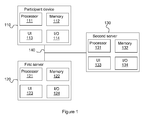
- Figure 1 illustrates an exemplary system in which the invention is implemented.
- the system comprises a first computing device (“participant device”) 110, a second computing device (“first server”) 120 and a third computing device (“second server”) 130.
- the first, second and third devices 110, 120, 130 can be any kind of suitable computer or device capable of performing calculations, such as a standard Personal Computer (PC), a workstation, a smartphone and a tablet.
- the first, second and third devices 110, 120, 130 each preferably comprise at least one processor 111, 121, 131, internal of external memory 112, 122, 132, a user interface 113, 123, 132 for interacting with a user (i.e.
- connection 140 such as the Internet
- connections may also be used as for instance a direct connection between the two servers.
- connection 140 such as the Internet
- a main inventive idea of the present invention is to create and enforce a strong relationship between the elements that constitute a task: the participant that performs the task, the tool used to perform the task and the data to be used and the resulting data.
- a participant selects a task from a list of tasks and informs a server of the selected task.
- the server configures a safe and secure environment with the appropriate data and application (i.e. tool), which prevents errors and, at least partly, malicious behaviour.
- safe is intended to mean that the right tool is used to process the right data
- secure is intended to mean that the data is protected (using for instance secure connections) against, for example theft and unauthorized copying.
- the participant takes part in a collaborative creation project through an online project environment in which a server stores project data and provides access to participants through a web site available to browsers running on distant devices.
- the web site organizes information and tasks.
- a given participant connects to the server, provides authentication and, in case of successful authentication, can access the information, which makes it possible to choose a task to perform.
- FIG. 2 illustrates a preferred embodiment of a method according to a preferred embodiment of the present invention.
- a task list is sent S21 from the first server 120 to the participant device 110. This can be done in response to a request, explicit or implicit, from the participant device 110.
- the task list can comprise tasks assigned to the participant, but it is also possible that it comprises other tasks, i.e. non-assigned tasks, or a combination thereof.
- the participant can then choose a task to perform.
- the identifier of the chosen task is sent S22 from the participant device 110 to the first server 120.
- the first server 120 creates S23 a Virtual Machine (VM) that is configured with a dedicated tool (i.e. dedicated to the task) and the appropriate data (i.e. the data that is to be treated by the task). It will be appreciated that this can ensure that the appropriate tool and data are used to perform the task; in other words, the safety requirement is satisfied.
- VM Virtual Machine
- the first server 120 then instantiates S24 the Virtual Machine on the second server 130. It will be appreciated that it is possible that the first server 120 and the second server 130 are embodied on the same device. The first server 120 then sends S25 connection information to the participant device 110.
- the participant device 110 connects to the Virtual Machine on the second server 130 and performs S26 the task by using the dedicated tool on the appropriate data.
- the servers 120, 130 communicate with a remote desktop client such as a browser (which is used as a non-limitative example) on the participant device 110.
- a remote desktop client such as a browser (which is used as a non-limitative example) on the participant device 110.
- a browser which is used as a non-limitative example
- This avoids the installation on the participant device 110 of the required tools to perform the task and to copy the data.
- no additional proprietary or dedicated software needs to be installed on the participant device 110.
- the use of this technology means that the browser sends indications about participant actions - e.g.
- HTTPS Hypertext Transfer Protocol Secure
- the servers To prevent leakage by the participant (e.g. by taking a picture of the browser screen with a camera or a mobile phone - the so-called “analog hole" which remains open even if all of the digital outlets from the participant device except the connection with the servers are blocked), it is preferred to have the possibility for the servers to embed an identifier of the task or of the user on the screen. Then the identifier would allow to tracing the origin of a leakage.
- a watermark comprising the identifier is embedded at the server side of the Virtual Machine Interface in the snapshot that is sent to the participant device. It will be understood that it is preferred that the watermark technique is resistant to attacks intending to remove or replace the watermark.
- this predefined location is the first server 120, but it may also for example be the second server 130 if this server transfers the processed data to the first server 120 when the Virtual Machine is terminated.
- security modules at the operating system level (e.g. AppArmor, SELinux).
- each participant works on one or more parts of the code.
- the task of programming can be seen as equivalent to editing a file using a text editor.
- the text editor and the file can be instantiated in a Virtual Machine as described hereinbefore.
- the proposed solution allows to split the different parts of the code to different programmers. This allows to restrict the edition of a critical part of the software to a reduced set of trusted (or experienced) programmers while the less critical parts can be subcontracted to less trusted (or experienced) programmers.
- Software programming involves other tasks such as compilation and testing. These tasks can be separated from the edition tasks using the proposed solution. According the invention the compilation task is isolated in a Virtual Machine. The testing can also be isolated similarly, using the result of the compilation. In this case, none of the users involved in these tasks have direct access to the software in its executable version.
- the present invention provides collaborative system that ensures greater control that a task is performed by a specified participant using a specified tool to work on specified content.
Landscapes
- Engineering & Computer Science (AREA)
- Theoretical Computer Science (AREA)
- Software Systems (AREA)
- Physics & Mathematics (AREA)
- General Physics & Mathematics (AREA)
- Business, Economics & Management (AREA)
- Human Resources & Organizations (AREA)
- Strategic Management (AREA)
- General Engineering & Computer Science (AREA)
- Entrepreneurship & Innovation (AREA)
- Data Mining & Analysis (AREA)
- Mathematical Physics (AREA)
- Economics (AREA)
- Marketing (AREA)
- Operations Research (AREA)
- Quality & Reliability (AREA)
- Tourism & Hospitality (AREA)
- General Business, Economics & Management (AREA)
- Information Transfer Between Computers (AREA)
Priority Applications (2)
| Application Number | Priority Date | Filing Date | Title |
|---|---|---|---|
| EP14305027.6A EP2894594A1 (de) | 2014-01-09 | 2014-01-09 | Verfahren und Vorrichtung zur Bereitstellung des Zugriffs auf eine Aufgabe |
| US14/490,635 US20150081760A1 (en) | 2013-09-19 | 2014-09-18 | Method and device for providing access to a task |
Applications Claiming Priority (1)
| Application Number | Priority Date | Filing Date | Title |
|---|---|---|---|
| EP14305027.6A EP2894594A1 (de) | 2014-01-09 | 2014-01-09 | Verfahren und Vorrichtung zur Bereitstellung des Zugriffs auf eine Aufgabe |
Publications (1)
| Publication Number | Publication Date |
|---|---|
| EP2894594A1 true EP2894594A1 (de) | 2015-07-15 |
Family
ID=50028960
Family Applications (1)
| Application Number | Title | Priority Date | Filing Date |
|---|---|---|---|
| EP14305027.6A Withdrawn EP2894594A1 (de) | 2013-09-19 | 2014-01-09 | Verfahren und Vorrichtung zur Bereitstellung des Zugriffs auf eine Aufgabe |
Country Status (1)
| Country | Link |
|---|---|
| EP (1) | EP2894594A1 (de) |
Citations (9)
| Publication number | Priority date | Publication date | Assignee | Title |
|---|---|---|---|---|
| US5960404A (en) * | 1997-08-28 | 1999-09-28 | International Business Machines Corp. | Mechanism for heterogeneous, peer-to-peer, and disconnected workflow operation |
| US20070260702A1 (en) * | 2006-05-03 | 2007-11-08 | University Of Washington | Web browser architecture for virtual machine access |
| US20100042636A1 (en) * | 2008-08-13 | 2010-02-18 | Inventec Corporation | Internet server system, method of creating virtual machine of the internet server and method of starting the same |
| US20110004680A1 (en) * | 2009-07-01 | 2011-01-06 | Paul Ryman | Systems and methods for unified management of desktop sessions |
| US20110153716A1 (en) * | 2009-12-21 | 2011-06-23 | Microsoft Corporation | Enabling virtual desktop connections to remote clients |
| US8108642B1 (en) * | 2006-11-09 | 2012-01-31 | TP Labs, Inc. | Method and system for play-only media player |
| US20120110576A1 (en) * | 2010-11-02 | 2012-05-03 | Institute For Information Industry | Resource sharing system and method thereof |
| US20130151598A1 (en) * | 2011-02-09 | 2013-06-13 | Cliqr Technologies Inc. | Apparatus, systems and methods for deployment of interactive desktop applications on distributed infrastructures |
| US20130159833A1 (en) * | 2000-01-25 | 2013-06-20 | Autodesk, Inc. | Method and apparatus for providing access to and working with architectural drawings on a personal digital assistant |
-
2014
- 2014-01-09 EP EP14305027.6A patent/EP2894594A1/de not_active Withdrawn
Patent Citations (9)
| Publication number | Priority date | Publication date | Assignee | Title |
|---|---|---|---|---|
| US5960404A (en) * | 1997-08-28 | 1999-09-28 | International Business Machines Corp. | Mechanism for heterogeneous, peer-to-peer, and disconnected workflow operation |
| US20130159833A1 (en) * | 2000-01-25 | 2013-06-20 | Autodesk, Inc. | Method and apparatus for providing access to and working with architectural drawings on a personal digital assistant |
| US20070260702A1 (en) * | 2006-05-03 | 2007-11-08 | University Of Washington | Web browser architecture for virtual machine access |
| US8108642B1 (en) * | 2006-11-09 | 2012-01-31 | TP Labs, Inc. | Method and system for play-only media player |
| US20100042636A1 (en) * | 2008-08-13 | 2010-02-18 | Inventec Corporation | Internet server system, method of creating virtual machine of the internet server and method of starting the same |
| US20110004680A1 (en) * | 2009-07-01 | 2011-01-06 | Paul Ryman | Systems and methods for unified management of desktop sessions |
| US20110153716A1 (en) * | 2009-12-21 | 2011-06-23 | Microsoft Corporation | Enabling virtual desktop connections to remote clients |
| US20120110576A1 (en) * | 2010-11-02 | 2012-05-03 | Institute For Information Industry | Resource sharing system and method thereof |
| US20130151598A1 (en) * | 2011-02-09 | 2013-06-13 | Cliqr Technologies Inc. | Apparatus, systems and methods for deployment of interactive desktop applications on distributed infrastructures |
Similar Documents
| Publication | Publication Date | Title |
|---|---|---|
| US9934375B2 (en) | Secured execution of a web application | |
| US10375111B2 (en) | Anonymous containers | |
| US8745755B2 (en) | Controlling device access to enterprise resources in an orchestration framework for connected devices | |
| US10454902B2 (en) | Techniques for secure data extraction in a virtual or cloud environment | |
| US9606809B2 (en) | Computer with flexible operating system | |
| US20160196449A1 (en) | Apparatus for and Method of Preventing Unsecured Data Access | |
| KR20190072554A (ko) | 스크린 공유 경험을 위한 공유 보호 | |
| US9177165B2 (en) | System and method for a secure environment that authenticates secure data handling to the user | |
| WO2002039222A3 (en) | System and method for managing trust between clients and servers | |
| US20230214481A1 (en) | Secure Display of Sensitive Content | |
| EP4078423A1 (de) | Kontextbewusste verschleierung und entdeckung von sensitivem inhalt | |
| US11310037B2 (en) | Cloud container security framework | |
| CN111538977A (zh) | 云api密钥的管理、云平台的访问方法、装置及服务器 | |
| JP2018527664A (ja) | アプリケーションのコードを保護するためのシステムおよび方法 | |
| US10846397B2 (en) | Segmented workstation with common desktop control and manual access control | |
| CN117063177A (zh) | 在数据处理系统的安全执行环境中提供要保护的数据 | |
| US20150081760A1 (en) | Method and device for providing access to a task | |
| EP2894594A1 (de) | Verfahren und Vorrichtung zur Bereitstellung des Zugriffs auf eine Aufgabe | |
| CN115883191A (zh) | 企业内网的通信方法、计算机可读存储介质和通信系统 | |
| Cerrudo et al. | Hacking robots before skynet: Technical appendix | |
| Ivanova | Internet Based Interface for Control of a Mobile Robot | |
| US20130039488A1 (en) | Device and method for providing portable and secure internet-based IT services | |
| KR20230086295A (ko) | 샌드박스 기술 기반 콘텐츠 보안 시스템 | |
| JP2010109955A (ja) | シンクライアントシステム | |
| US20230126304A1 (en) | Method for developing secure and reliable augmented reality applications |
Legal Events
| Date | Code | Title | Description |
|---|---|---|---|
| PUAI | Public reference made under article 153(3) epc to a published international application that has entered the european phase |
Free format text: ORIGINAL CODE: 0009012 |
|
| 17P | Request for examination filed |
Effective date: 20140109 |
|
| AK | Designated contracting states |
Kind code of ref document: A1 Designated state(s): AL AT BE BG CH CY CZ DE DK EE ES FI FR GB GR HR HU IE IS IT LI LT LU LV MC MK MT NL NO PL PT RO RS SE SI SK SM TR |
|
| AX | Request for extension of the european patent |
Extension state: BA ME |
|
| R17P | Request for examination filed (corrected) |
Effective date: 20151202 |
|
| RBV | Designated contracting states (corrected) |
Designated state(s): AL AT BE BG CH CY CZ DE DK EE ES FI FR GB GR HR HU IE IS IT LI LT LU LV MC MK MT NL NO PL PT RO RS SE SI SK SM TR |
|
| 17Q | First examination report despatched |
Effective date: 20180221 |
|
| STAA | Information on the status of an ep patent application or granted ep patent |
Free format text: STATUS: THE APPLICATION IS DEEMED TO BE WITHDRAWN |
|
| 18D | Application deemed to be withdrawn |
Effective date: 20190801 |