EP2896384B1 - Procédé de production d'un indice parodontal, dispositif de production associé, programme de production associé, support d'enregistrement l'enregistrant, procédé de diagnostic de parodontite, dispositif de diagnostic associé, programme de diagnostic associé, et support d'enregistrement l'enregistrant - Google Patents
Procédé de production d'un indice parodontal, dispositif de production associé, programme de production associé, support d'enregistrement l'enregistrant, procédé de diagnostic de parodontite, dispositif de diagnostic associé, programme de diagnostic associé, et support d'enregistrement l'enregistrant Download PDFInfo
- Publication number
- EP2896384B1 EP2896384B1 EP13880696.3A EP13880696A EP2896384B1 EP 2896384 B1 EP2896384 B1 EP 2896384B1 EP 13880696 A EP13880696 A EP 13880696A EP 2896384 B1 EP2896384 B1 EP 2896384B1
- Authority
- EP
- European Patent Office
- Prior art keywords
- periodontal
- tooth
- membrane area
- index
- root
- Prior art date
- Legal status (The legal status is an assumption and is not a legal conclusion. Google has not performed a legal analysis and makes no representation as to the accuracy of the status listed.)
- Active
Links
Images


Classifications
-
- A—HUMAN NECESSITIES
- A61—MEDICAL OR VETERINARY SCIENCE; HYGIENE
- A61B—DIAGNOSIS; SURGERY; IDENTIFICATION
- A61B5/00—Measuring for diagnostic purposes; Identification of persons
- A61B5/45—For evaluating or diagnosing the musculoskeletal system or teeth
- A61B5/4538—Evaluating a particular part of the muscoloskeletal system or a particular medical condition
- A61B5/4542—Evaluating the mouth, e.g. the jaw
-
- A—HUMAN NECESSITIES
- A61—MEDICAL OR VETERINARY SCIENCE; HYGIENE
- A61C—DENTISTRY; APPARATUS OR METHODS FOR ORAL OR DENTAL HYGIENE
- A61C19/00—Dental auxiliary appliances
- A61C19/04—Measuring instruments specially adapted for dentistry
-
- A—HUMAN NECESSITIES
- A61—MEDICAL OR VETERINARY SCIENCE; HYGIENE
- A61B—DIAGNOSIS; SURGERY; IDENTIFICATION
- A61B10/00—Instruments for taking body samples for diagnostic purposes; Other methods or instruments for diagnosis, e.g. for vaccination diagnosis, sex determination or ovulation-period determination; Throat striking implements
-
- A—HUMAN NECESSITIES
- A61—MEDICAL OR VETERINARY SCIENCE; HYGIENE
- A61B—DIAGNOSIS; SURGERY; IDENTIFICATION
- A61B10/00—Instruments for taking body samples for diagnostic purposes; Other methods or instruments for diagnosis, e.g. for vaccination diagnosis, sex determination or ovulation-period determination; Throat striking implements
- A61B10/02—Instruments for taking cell samples or for biopsy
-
- A—HUMAN NECESSITIES
- A61—MEDICAL OR VETERINARY SCIENCE; HYGIENE
- A61B—DIAGNOSIS; SURGERY; IDENTIFICATION
- A61B5/00—Measuring for diagnostic purposes; Identification of persons
- A61B5/103—Measuring devices for testing the shape, pattern, colour, size or movement of the body or parts thereof, for diagnostic purposes
- A61B5/107—Measuring physical dimensions, e.g. size of the entire body or parts thereof
-
- A—HUMAN NECESSITIES
- A61—MEDICAL OR VETERINARY SCIENCE; HYGIENE
- A61B—DIAGNOSIS; SURGERY; IDENTIFICATION
- A61B5/00—Measuring for diagnostic purposes; Identification of persons
- A61B5/45—For evaluating or diagnosing the musculoskeletal system or teeth
- A61B5/4538—Evaluating a particular part of the muscoloskeletal system or a particular medical condition
- A61B5/4542—Evaluating the mouth, e.g. the jaw
- A61B5/4547—Evaluating teeth
-
- A—HUMAN NECESSITIES
- A61—MEDICAL OR VETERINARY SCIENCE; HYGIENE
- A61B—DIAGNOSIS; SURGERY; IDENTIFICATION
- A61B5/00—Measuring for diagnostic purposes; Identification of persons
- A61B5/72—Signal processing specially adapted for physiological signals or for diagnostic purposes
- A61B5/7271—Specific aspects of physiological measurement analysis
- A61B5/7278—Artificial waveform generation or derivation, e.g. synthesizing signals from measured signals
-
- A—HUMAN NECESSITIES
- A61—MEDICAL OR VETERINARY SCIENCE; HYGIENE
- A61B—DIAGNOSIS; SURGERY; IDENTIFICATION
- A61B5/00—Measuring for diagnostic purposes; Identification of persons
- A61B5/72—Signal processing specially adapted for physiological signals or for diagnostic purposes
- A61B5/7271—Specific aspects of physiological measurement analysis
- A61B5/7282—Event detection, e.g. detecting unique waveforms indicative of a medical condition
-
- A—HUMAN NECESSITIES
- A61—MEDICAL OR VETERINARY SCIENCE; HYGIENE
- A61C—DENTISTRY; APPARATUS OR METHODS FOR ORAL OR DENTAL HYGIENE
- A61C19/00—Dental auxiliary appliances
- A61C19/04—Measuring instruments specially adapted for dentistry
- A61C19/05—Measuring instruments specially adapted for dentistry for determining occlusion
-
- A—HUMAN NECESSITIES
- A61—MEDICAL OR VETERINARY SCIENCE; HYGIENE
- A61C—DENTISTRY; APPARATUS OR METHODS FOR ORAL OR DENTAL HYGIENE
- A61C19/00—Dental auxiliary appliances
- A61C19/04—Measuring instruments specially adapted for dentistry
- A61C19/043—Depth measuring of periodontal pockets; Probes therefor
Definitions
- This invention relates to a periodontal index creation method, a periodontal index creation apparatus, a periodontal index creation program, and a recording medium having records of the periodontal index creation program, and a periodontitis diagnosis method, a periodontitis diagnosis apparatus, a periodontitis diagnosis program, and a recording medium having records of the periodontitis diagnosis program. More specifically, the invention relates to those useful for application to judgment of the necessity for tooth extraction associated with periodontal disease.
- An improvement in these problems is a method which comprises taking pictures from a plurality of directions using computed tomography (CT) to reproduce three-dimensional periodontal tissue by use of a computer, thereby measuring S S /S.
- CT computed tomography
- Periodontal disease screening generally done in periodontal treatment is performed dozens of times during a lifetime.
- this method is feasible as a method for experiments on a single subject such as human experimentation or animal experiments.
- this index itself does not serve as a figure, which singly presents objective criteria, like other diagnostic methods such as the depth of a pocket.
- the above method involves the inconvenience that a diagnosis has to be made globally in consideration of results obtained by other diagnostic methods.
- Patent Document 1 and Patent Document 2 are publicly known as prior art documents disclosing methods for examination of periodontal disease which comprise using a value, calculated as the ratio (S C /S) of the remaining root surface area (S C ) supporting the current tooth to the total root surface area (S) supporting the healthy tooth, as a root surface area index, and examining the state of progression of periodontal disease based on this index.
- JP-A-2001-61873 describes a system for anticipating a decrease rate of the total effective root surface area of persistent teeth.
- the root surface area index (S C /S) disclosed by Patent Documents 1 and 2 as the index cannot serve as a single index representing tooth extraction criteria as discussed earlier.
- the root surface area index (S C /S) is predicated on image processing which images a tooth by dental X-rays.
- the root surface area index (S C /S) poses no problems in the medical settings of advanced countries equipped with various instruments for medical examinations.
- the root surface area index (S C /S) arouses the problem that its application is difficult in developing countries, etc. which are not fully equipped with X-ray imaging devices.
- the present invention has been accomplished in the light of the above-mentioned problems with the conventional technologies. It is an object of the present invention to provide a method for creating a periodontal index capable of presenting highly reliable tooth extraction criteria by a simple examination, an apparatus for creating the periodontal index, a program for creating the periodontal index, and a recording medium having records of the periodontal index creation program; and a method for diagnosing periodontitis, an apparatus for diagnosing periodontitis, a program for diagnosing periodontitis, and a recording medium having records of the periodontitis diagnosis program.
- the root surface area index (S C /S) is of some help toward making a diagnosis, but an overall diagnosis has to be performed using various other diagnostic methods.
- 221 teeth had to be extracted because of a poor prognosis. These 221 teeth were classified by the type of the tooth on each of the right and left sides of the upper and lower jaws, and subjected to observation. The attachment level at the time of dental loss was not different between the upper jaw and the lower jaw, nor between the right side and the left side. The attachment level was found to be different according to the type of the tooth.
- the attachment level refers to the extent of the periodontal supporting tissue, and includes the level of the alveolar bone as an example.
- the mandibular first tooth in Fig. 1(a) will be taken as an example for observation.
- the attachment level M is taken as the distance from the cementoenamel junction CEJ, which is the boundary between the crown 1 having a surface composed of enamel and the root 2 having a surface composed of cementum, to the lowermost site with a loss of the periodontal membrane along the tooth surface.
- the periodontal membrane which has been lost is called the lost periodontal membrane 3A, and the area of the lost periodontal membrane 3A along its entire circumference in the root 2 is called the lost periodontal membrane area S L .
- the periodontal membrane remaining in the alveolar bone 4 is called the remaining periodontal membrane 3B, and the area of the remaining periodontal membrane 3B along its entire circumference in the root 2 is called the remaining periodontal membrane area S S .
- the periodontal membrane enclosing the circumference of the root is a connective tissue, which connects the cementum on the surface of the root and the surrounding alveolar bone, and supports and holds the tooth.
- the periodontal membrane was destroyed and lost owing to periodontal disease, its area on the surface of the root was found to parallel the bite force exerted when chewing or gritting the teeth. That is, the type of tooth, which is nearer the temporomandibular joint and undergoes stronger bite force, suffers from a greater loss in the area of the periodontal membrane because of periodontal disease.
- the present invention which obtains an index appropriately incorporating the action of bite force, has been arrived at, with the expectation that an index accurately reflecting the severity of periodontal disease may be obtainable by taking bite force into consideration.
- a first aspect of the present invention designed to attain the above object based on such an expectation, is a periodontal index creation method as defined claim 1.
- the periodontal membrane supports and holds the tooth, and it has been found that the area of the periodontal membrane on the root surface destroyed and lost by periodontal disease parallels the bite force exerted when chewing or gritting the teeth.
- the new concept, bite force coefficient is introduced according to the present aspect.
- This aspect also utilizes the findings that the lost periodontal membrane area at the time of loss of each tooth, which is found in association with the sample attachment level, has a strong correlation with the bite force coefficient, the correlation being expressed by a linear function, and that the lost periodontal membrane area at the time of tooth loss can be represented as incorporating the bite force coefficient.
- the periodontal index which is the proportion of the remaining periodontal membrane area taking the bite force coefficient into consideration, at the time of loss of each tooth, to the total periodontal membrane area.
- a second aspect of the present invention is the periodontal index creation method defined in claim 2.
- a third aspect of the present invention is the periodontal index creation method defined in claim 3.
- the preparation of the pseudo-root enables the total periodontal membrane area, the lost periodontal membrane area, and the remaining periodontal membrane area to be found easily and unerringly as areas based on the pseudo-root.
- a fourth aspect of the present invention is the periodontal index creation method defined in claim 4.
- a fifth aspect of the present invention is the periodontal index creation method defined in claim 5.
- a concrete and unerring bite force coefficient can be provided.
- a sixth aspect of the present invention is the periodontal index creation method defined in claim 6.
- a desired periodontal index taking bite force into consideration can be obtained utilizing the periodontal index curve, simply by specifying the remaining periodontal membrane area.
- the periodontal index at the time of loss of each tooth can be automatically obtained simply by inputting the sampling data on the sample attachment level to the computation unit.
- An eighth aspect of the present invention is the periodontal index creation apparatus defined in claim 8.
- the periodontal index which is an absolute index to the health of a tooth conformed highly accurately to the clinical status of periodontal disease, can be created automatically.
- a ninth aspect of the present invention is a periodontal index creation program as defined in claim 9.
- the periodontal index creation apparatus described in the seventh aspect can be allowed to execute the processings of the predetermined steps in the periodontal index creation method described in the first aspect.
- the data of the periodontal index creation program can be provided satisfactorily to the periodontal index creation apparatus even via a telecommunications line such as the Internet.
- the periodontal index creation program is downloaded from the Internet or the like to a personal computer, whereby the general-purpose personal computer can be allowed to function as a periodontal index creation apparatus for creating the above periodontal index BPI.
- a tenth aspect of the present invention is a periodontal index creation program as defined in claim 10.
- the processings of the predetermined steps in the periodontal index creation method described in the second or sixth aspect, including the processings of the periodontal index creation step, can be satisfactorily executed by the periodontal index creation apparatus described in the seventh aspect.
- An eleventh aspect of the present invention is a recording medium as defined in claim 11.
- the periodontal index creation program described in the ninth or tenth aspect can be carried out satisfactorily.
- hardware such as a personal computer, if any, is installed with the periodontal index creation program, whereby it can easily function anywhere as an apparatus for creating an at-time-of-loss periodontal index based on the lost periodontal membrane area at the time of loss of each tooth.
- the periodontal index creation program is installed on hardware such as a personal computer, if any, thereby enabling the hardware to perform the function of an apparatus for creating a periodontal index with ease and at any place.
- a twelfth aspect of the present invention is a periodontitis diagnosis method as defined in claim 12.
- a periodontitis diagnosis apparatus not according to the claimed invention, comprising:
- a periodontal index taking bite force different according to the type of tooth into consideration can be determined easily and automatically.
- unerring and objective tooth extraction criteria for periodontitis treatment can be easily obtained.
- appropriate treatment of periodontitis can be conducted easily and promptly.
- the diagnosis apparatus can be prepared suitably by a personal computer or the like. If data on the measured attachment level of the specific tooth are obtained, therefore, the resulting diagnosis apparatus can be used as an excellently versatile diagnostic apparatus which can convey the data easily to any place. Hence, it can be conducive to diagnosis providing objective tooth extraction criteria associated with periodontitis, as a compact and highly versatile apparatus.
- the apparatus can be dramatically downsized, is dramatically improved in portability, and is easy to handle. Furthermore, the amount of X-ray exposure associated with treatment or the like can be rendered as small as possible.
- a periodontitis diagnosis program not according to the claimed invention, comprising:
- a predetermined periodontal index can be automatically generated, and allowed to contribute to easy and prompt treatment of periodontitis.
- the data of the periodontitis diagnosis program can be provided satisfactorily to the periodontal index creation apparatus even via a telecommunications line such as the Internet.
- the periodontitis diagnosis program is downloaded from the Internet or the like to a personal computer, whereby the personal computer can be allowed to function as a diagnostic apparatus for periodontitis.
- a novel periodontal index is found by utilizing a bite force-lost periodontal membrane straight line obtained by an equation representing the relation between both parameters.
- This periodontal index is calculated under clinical rules on periodontal disease, and uses a corrected remaining periodontal membrane area or a corrected lost periodontal membrane area corrected in consideration of bite force.
- the periodontal index provides an absolute evaluation of the health of tooth conformed to the clinical status of periodontal disease. Because of the course of derivation of the periodontal index, in particular, it serves as a highly predictive index unerringly representing the severity of progression of periodontitis which shows in detail the situations around the time of loss of the tooth.
- the measurement of the attachment level at the predetermined site (lowermost site) of the diseased tooth in clinical practice on periodontal disease enables evaluation of periodontal disease to be made upon entry into BPI software, without adopting complicated instruments or procedures.
- the evaluation of periodontal disease can be made at the same level throughout the world and with the passage of time.
- the present invention can provide a useful method for evaluation of periodontal disease in clinical practice on patients with periodontal disease as well as in clinical trial of subjects with periodontal disease.
- a plurality of teeth (221 teeth in the present embodiment) extracted as unconservable teeth are selected as objects, and a plurality of samples are taken from them for each type of tooth (see Table 1).
- the attachment level which is a dimension ranging from the cementoenamel junction of each tooth or the crown margin of the tooth with a veneer crown to the lowermost site of a submarginal dental calculus deposited portion of the tooth, is measured in each of these samples.
- the measurements are performed in units of millimeters at six locations per tooth (i.e., buccomesial, buccomeso, buccodistal, linguomesial, linguomeso, and linguodistal).
- the measured attachment levels are taken as the sample attachment levels of the first to seventh teeth on each of the right and left sides of the upper jaw and the first to seventh teeth on each of the right and left sides of the lower jaw.
- sample attachment levels the greatest values obtained by the measurements of the attachment levels of the respective teeth are adopted.
- the values of the lowermost sites of the submarginal dental calculus deposited portions of the respective teeth were classified by the type of tooth (for the premolar portion, data on the fourth and fifth teeth were put together because of anatomical difficulty), and the average values were obtained (see Tables 1 and 2).
- the average values of the attachment levels (for the respective types of teeth on the right and left sides of the upper and lower jaws) were calculated from the measured values of the attachment levels obtained in the respective teeth.
- the resulting values were subjected to two-way factorial analysis of variance to find the sample attachment levels M.
- the following pseudo-root is prepared, and the following predetermined computations are performed based on the resulting pseudo-root to calculate the total periodontal membrane area S, the remaining periodontal membrane area S S , and the lost periodontal membrane area S L .
- a pseudo-root which enables the periodontal membrane area to be quantitatively calculated is prepared.
- the root of a single rooted tooth is regarded as a conical body
- the roots of a double rooted tooth are regarded as an aggregate of a plurality of conical bodies.
- the total periodontal membrane area S which is the entire surface area of the root is calculated from the lateral area of the conical body.
- the lost periodontal membrane area S L which is the surface area of the periodontal membrane lost by periodontitis
- the remaining periodontal membrane area S S which is the surface area of the unlost periodontal membrane are calculated from the lateral area of the conical body.
- Such a series of computing steps will be described in detail based on Figs. 3(a) to 3(d) .
- Equations (5), (7) and (8) The values of the root length H and the diameter R shown in Table 3, which differ according to the type of the tooth, are entered into the above Equations (5), (7) and (8). Further, the values of the sample attachment level classified by the type of the tooth at the time of loss of each tooth, which are shown in Table 1, are entered into Equations (5), (7) and (8) to calculate the total periodontal membrane area S, the remaining periodontal membrane area S S , and the lost periodontal membrane area S L of the root of each tooth type at the time of loss of the tooth. The results are shown in Table 4.
- the total periodontal membrane area S, the remaining periodontal membrane area S S , and the lost periodontal membrane area S L given by the aforementioned Equations (5), (7) and (8) are utilized as such, they are insufficient as indices representing the severity of progression of periodontal disease, as have been discussed earlier. In the present embodiment, therefore, influences ascribed to differences in bite force among the various teeth are investigated, and the results are reflected in the creation of a predetermined index. That is, we speculated that an index accurately reflecting the severity of progression of periodontitis for each tooth type might be obtained by correcting the remaining periodontal membrane area S S and the lost periodontal membrane area S L with bite force. Based on this speculation, the following investigation was conducted.
- Complicated bite force is presumed to act on each tooth as external force, and is corrected with the following two factors which can become predominant factors:
- a bite force coefficient B representing the relationship between the bite forces on the respective teeth is worked out.
- the bite force coefficient B is calculated in connection with each tooth based on the ratio between the distance T from the cusp of each tooth to the condyle of the temporomandibular joint, and the distance A from a specific reference tooth providing a reference position to the above condyle; and the ratio between the tooth length P of the reference tooth and the length Q of each tooth mentioned above, these data being preliminarily given as anatomical data.
- the cusp of each tooth mentioned above is taken as the point of action of a lever, and the above condyle is taken as the fulcrum of the lever.
- the lost periodontal membrane area S L at the time of loss of each tooth based on the sample attachment level M is different among the respective tooth types, as shown in the aforementioned Table 4. If the above parameter S L is rendered comparable among the different tooth types by undergoing corrections taking bite force into consideration, it can be said that "the cause of periodontal membrane loss is bite force".
- the corrected values were compared.
- the lost periodontal membrane area S L shown in Table 4 was multiplied by the bite force coefficient B shown in Table 5 to obtain the bite force-corrected value (S L ⁇ B) of the periodontal membrane area S L at the time of loss of the tooth of each tooth type.
- the resulting values are shown in Table 6.
- the straight line represented by the above Equation (10), namely, "bite force-lost periodontal membrane straight line”, indicates that the bite force coefficient B and the lost periodontal membrane area S L are in parallel correspondence.
- bite force-lost periodontal membrane straight line indicates that the bite force coefficient B and the lost periodontal membrane area S L are in parallel correspondence.
- the bite force coefficient B is an anatomical value, and a preliminarily given constant.
- the upper jaw and the lower jaw differ in the points of occlusion, so that their distances from the occlusion point to the condyle of the temporomandibular joint and their tooth lengths are also different.
- the bite force-lost periodontal membrane straight line can be said to be a universal equation showing the relation between the bite force coefficient B and the lost periodontal membrane area S L at the time of loss of tooth.
- This lost periodontal membrane area S L is a value representing the at-time-of-loss lost periodontal membrane area S LBO at the time of loss (extraction) of tooth, which takes into consideration the bite force coefficient B preliminarily given as an anatomical constant.
- the at-time-of-loss lost periodontal membrane area S LBO is uniquely determined if the bite force coefficient B as the anatomical constant is found.
- the at-time-of-loss lost periodontal membrane area S LBO is obtained by extending a straight line L Y in the vertical axis direction from a specific bite force coefficient B to bring the straight line L Y into contact with the bite force-lost periodontal membrane straight line, extending a straight line L X in the horizontal axis direction from the point of contact to bring the straight line L X into contact with the vertical axis, and taking the point of contact with the vertical axis as the value of the lost periodontal membrane area S L .
- the periodontal index BPI Periodontal Index Modified with Bite Force
- the remaining periodontal membrane area S S of a tooth if it is to be used as a variable, needs to be modified into the remaining periodontal membrane area S SB taking the bite force coefficient B into consideration. This is achievable by the following procedure, which will be explained based on Fig. 6 .
- the periodontal index BPI defined in the present embodiment is given as the point on the periodontal index curve corresponding to any remaining periodontal membrane area S S . As noted here, simply by specifying the remaining periodontal membrane area S S , a desired periodontal index BPI taking bite force into consideration can be obtained with the use of the periodontal index curve.
- Such a periodontal index BPI is an objective index appropriately reflecting the severity of progression of periodontitis.
- This index as an index presenting tooth extraction criteria objectively, can serve as an absolute index to the health of tooth conformed to the clinical status of periodontal disease more accurately.
- the periodontal index BPI in the present embodiment is defined, with concepts such as the pseudo-root and the bite force coefficient B being introduced. Explanations will be offered here for anatomical data for deriving the pseudo-root and the bite force coefficient B.
- the races in the world with different skeletons were broadly classified into two categories, the Oriental people and the Western People.
- the Oriental people data from Yasuhiko Kamijou, "Anatomy of Permanent Teeth in the Japanese (literally)", published by Anatome Co., Ltd. , indicating periodontitis and bite force, were used as representative data.
- Root width root length: Woelfel's Dental Anatomy Rickne c. Seheid Gadriela Weiss Wolters Kluwer Temporomandibular joint: Head and Neck Anatomy for Dental Medicine Edited by Eric W. Baker Thieme
- the anatomical data are shown in Table 8
- the total periodontal membrane areas and the bite force coefficients are shown in Table 9
- the at-time-of-loss remaining periodontal membrane area S SB0 and the at-time-of-loss lost periodontal membrane area S LBO at the time of loss of each tooth are shown in Table 10.
- Fig. 7 shows BPI curves classified by the type of tooth in the Oriental people and the Western people which were prepared using the above anatomical data.
- the periodontal index BPI of the desired tooth can be obtained arbitrarily, and can be used for diagnosing periodontitis.
- the attachment level of the tooth which is the object of diagnosis is measured to determine the measured attachment level M1.
- a measurement can be made preferably using a pocket probe, for example.
- the measurement is performed at six locations, i.e., the buccal root, the palatal root, the buccomesial root, the buccodistal root, the mesial root, and the distal root of the tooth, and the largest value is adopted as the measured attachment level M1.
- the remaining periodontal membrane area S S is found based on the measured attachment level M1 by a method as described earlier.
- the BPI curve w corresponding to the tooth as the object of diagnosis is selected, the point corresponding to the remaining periodontal membrane area S S is specified on its horizontal axis, the point on the BPI curve corresponding to this point is found, and the periodontal index BPI on the vertical axis corresponding to the found point is read.
- the severity of progression of periodontitis is diagnosed.
- the higher this value the healthier the tooth is.
- BPI of 40 to 60 in a precaution region BPI of less than 40 in a dangerous region
- BPI of more than 60 in a safety region BPI of more than 60 in a safety region
- the three points i.e., the one point giving the at-time-of-loss periodontal index BPI taking bite force into consideration, which is obtained based on Fig. 5 and, added thereto, the point where the periodontal index BPI is zero (all the periodontal membrane is lost, and the remaining periodontal membrane area S S is zero), and the point where the periodontal index BPI is 100 (all the periodontal membrane remains, and the remaining periodontal membrane area S S is equal to the total periodontal membrane area).
- a single periodontal index curve is uniquely established by the processings mentioned above.
- no particular restrictions are imposed on the method for preparation of the periodontal index curve, as long as it is a method utilizing the at-time-of-loss periodontal index BPI taking bite force into consideration which is obtained based on Fig. 5 .
- the periodontal index creation step is not necessarily needed.
- this parameter BPI may be usable, alone, as objective criteria for tooth extraction. If only the at-time-of-loss periodontal index BPI is determined, moreover, the periodontal index BPI, which is the ratio between the remaining periodontal membrane area S SB taking bite force into consideration and the total periodontal membrane area S, is considered to be obtainable using the at-time-of-loss periodontal index BPI by various methods.
- Fig. 8 is a block diagram showing a periodontal index creation apparatus according to the embodiment of the present invention.
- Fig. 9 is a block diagram showing the hardware configuration of a computation unit of this apparatus.
- a periodontal index creation apparatus I is composed of an input device 11, a computation unit 10 for receiving input of predetermined data via the input device 11 and performing predetermined information processings, and an output device 12 for outputting the results of the processings performed by the computation unit 10.
- the input device 11 supplies data necessary for computation, such as data representing the sample attachment level M which is basic data for creating the periodontal index BPI, and data representing the measured attachment level M1 measured in connection with the target tooth for making a diagnosis of periodontitis.
- the computation unit 10 includes a periodontal membrane area computing means 10A, a bite force coefficient computing means 10B, a straight line preparing means 10C, an at-time-of-loss lost periodontal membrane area detecting means 10D, an at-time-of-loss periodontal index computing means 10E, and a periodontal index creating means 10F.
- the periodontal membrane area computing means 10A calculates the lost periodontal membrane area S S of each tooth based on the total periodontal membrane area (S) of each tooth and the sample attachment level M of each tooth extracted. Simultaneously, the periodontal membrane area computing means 10A also calculates the remaining periodontal membrane area S S based on the measured attachment level M1 of a specific tooth as the object of diagnosis.
- the bite force coefficient computing means 10B calculates the bite force coefficient B in connection with each tooth based on the ratio between the distance T from the cusp of each tooth to the condyle of the temporomandibular joint, and the distance A from a specific reference tooth providing a reference position to the above condyle; and the ratio between the tooth length P of the preliminarily given reference tooth and the length Q of each tooth, these parameters T, A, P and Q being preliminarily given as anatomical data, such that bite force acts, with the cusp of each tooth serving as the point of action of a lever, and the condyle serving as the fulcrum of the lever.
- the periodontal index creating means 10F creates a periodontal index BPI which is the proportion of the remaining periodontal membrane area S S taking the bite force coefficient of each tooth into consideration to the total periodontal membrane area S, the index being represented by a periodontal index curve passing through three points representing a value of 100 being a periodontal index (BPI) when all of the periodontal membrane remains, a value of 0 being a periodontal index (BPI) when all of the periodontal membrane is lost, and a value being a periodontal index at the time of loss of each tooth (i.e., S SBO /S) as the at-time-of-loss periodontal index.
- BPI periodontal index
- the periodontal index creating means 10F obtains the periodontal index BPI corresponding to the remaining periodontal membrane area S S calculated based on the measured attachment level M1 of a specific tooth as the object of diagnosis, by reference to the periodontal index curve, thereby creating the periodontal index BPI of the specific tooth as the object of diagnosis.
- the output device 12 receives input of data representing the periodontal index BPI created by the periodontal index creating means 10F, and visualizes the contents of the data by printing, displaying or the like.
- the computation unit 10 shown in Fig. 9 is equipped with storage means such as CPU 21, RAM 22, ROM 23, and a hard disk 24.
- the input device 11 such as a keyboard or a recording medium reader, and the output device 12 such as a display or a printer are connected to the computation unit 10.
- the periodontal index BPI taking bite force into consideration can be obtained automatically with ease, simply by inputting sampling data on the sample attachment level M into the computation unit 10.
- an absolute index to the health of a tooth conformed to the clinical status of periodontal disease with higher accuracy can be provided easily.
- a periodontal index BPI taking bite force, different according to the type of tooth, into consideration can be determined easily and automatically.
- unerring and objective tooth extraction criteria for periodontitis treatment can be easily obtained.
- appropriate treatment of periodontitis can be conducted easily and promptly.
- periodontal index creating means 10F is not necessarily needed, for the same reasons as those mentioned in connection with the periodontal index creation method.
- the present embodiment is a program for allowing the periodontal index creation apparatus or the periodontitis diagnosis apparatus to execute the processings of the periodontal membrane area computation step, the bite force coefficient computation step, the lost periodontal membrane area detection step, the at-time-of-loss periodontal index computation step, and the periodontal index creation step in the periodontal index creation method described in the aforementioned embodiment.
- the periodontal index creation apparatus shown in Fig. 8 can be allowed to satisfactorily execute the processings of the predetermined steps in the periodontal index creation method according to the aforementioned embodiment.
- Another embodiment is a program which comprises: allowing the periodontitis diagnosis apparatus, shown in Fig. 8 , to perform processings for calculating the remaining periodontal membrane area S S of the tooth as the object of diagnosis based on the measured attachment level M1 in the periodontitis diagnosis method of the above-mentioned embodiment, and creating the periodontal index BPI of the specific tooth, as the object of diagnosis, corresponding to the remaining periodontal membrane area S S by the periodontal index creation step.
- the predetermined periodontal index can be generated automatically to contribute to the easy and prompt treatment of periodontitis.
- the above periodontal index creation program and the periodontitis diagnosis program can be recorded on a recording medium such as DVD.
- a recording medium enables distribution or the like of the program according to the present invention to be carried out satisfactorily.
- the hardware having the programs installed thereon via the recording medium can easily function anywhere as a periodontal index creation apparatus.
- the present invention can be utilized suitably in dental care fields, particularly, in industrial fields for providing objective tooth extraction criteria when performing treatment of periodontal disease.
Landscapes
- Health & Medical Sciences (AREA)
- Life Sciences & Earth Sciences (AREA)
- Engineering & Computer Science (AREA)
- Animal Behavior & Ethology (AREA)
- Public Health (AREA)
- General Health & Medical Sciences (AREA)
- Veterinary Medicine (AREA)
- Biomedical Technology (AREA)
- Biophysics (AREA)
- Molecular Biology (AREA)
- Surgery (AREA)
- Pathology (AREA)
- Heart & Thoracic Surgery (AREA)
- Medical Informatics (AREA)
- Dentistry (AREA)
- Oral & Maxillofacial Surgery (AREA)
- Physics & Mathematics (AREA)
- Epidemiology (AREA)
- Rheumatology (AREA)
- Orthopedic Medicine & Surgery (AREA)
- Physical Education & Sports Medicine (AREA)
- Physiology (AREA)
- Artificial Intelligence (AREA)
- Computer Vision & Pattern Recognition (AREA)
- Psychiatry (AREA)
- Signal Processing (AREA)
- Dental Tools And Instruments Or Auxiliary Dental Instruments (AREA)
- Measuring And Recording Apparatus For Diagnosis (AREA)
- Dental Preparations (AREA)
Claims (12)
- Procédé de création d'indice parodontal mis en oeuvre par ordinateur, comprenant :une étape de mesure pour utiliser une pluralité de dents extraites, parce qu'elles sont jugées être non conservables, comme objets, et mesurer un niveau (M) de fixation d'échantillon, qui est une dimension dans la plage depuis la jonction amélo-cémentaire (CEJ) de chaque dent (1) ou la marge de couronne de la dent (1) avec une couronne coulée jusqu'à un site le plus inférieur d'une partie submarginale avec dépôt de tartre dentaire de la dent (1) dans une pluralité d'échantillons pris pour chaque type de dents à partir des dents ;une étape de calcul de superficie de membrane parodontale pour trouver la superficie de membrane parodontale perdue (SL) de chaque dent (1) sur la base de la superficie de membrane parodontale totale (S) de chaque dent (1) et du niveau (M) de fixation d'échantillon ;une étape de calcul de coefficient de force masticatrice pour trouver un coefficient de force masticatrice pour chaque dent (1), avec la cuspide de chaque dent (1) étant prise comme le point d'action d'un levier et le condyle de l'articulation temporomandibulaire comme le point de pivot du levier, sur la base du rapport entre la distance de la cuspide au condyle et de la distance depuis une dent spécifique de référence donnant une position de référence jusqu'au condyle, et du rapport entre la longueur de la dent de référence et la longueur de chaque dent (1), les distances et les longueurs étant données préliminairement ;une étape de préparation de droite pour préparer une droite force masticatrice-membrane parodontale perdue qui est une équation linéaire montrant la relation entre le coefficient de force masticatrice et la superficie de membrane parodontale perdue (SL), en utilisant le fait qu'il y a une relation linéaire entre la valeur du coefficient de force masticatrice différente en fonction du type de dent seul et la valeur de la superficie de membrane parodontale perdue (SL) lors du traitement statistique de la relation entre le coefficient de force masticatrice et la superficie de membrane parodontale perdue (SL) pour chaque type de dent (1) ;une étape de détection de superficie de membrane parodontale perdue pour trouver une superficie de membrane parodontale perdue (SL) au moment de la perte, qui est une superficie de membrane parodontale perdue (SL) au moment de la perte de chaque dent (1), corrigée en prenant en compte le coefficient de force masticatrice, sur la base de la droite force masticatrice-membrane parodontale perdue obtenue à l'étape de préparation de droite ; etune étape de calcul d'indice parodontal au moment de la perte pour calculer (superficie de membrane parodontale restante au moment de la perte/superficie de membrane parodontale totale)x100 (%) comme un indice parodontal au moment de la perte de chaque dent (1), sur la base d'une superficie de membrane parodontale restante (Ss) au moment de la perte déterminée en soustrayant la superficie de membrane parodontale perdue (SL) au moment de la perte de la superficie de membrane parodontale totale (S).
- Procédé de création d'indice parodontal selon la revendication 1, comprenant en outre :
une étape de création d'indice parodontal pour créer un indice parodontal qui est la proportion d'une superficie de membrane parodontale restante (Ss) en prenant en compte le coefficient de force masticatrice de chaque dent (1) sur la superficie de membrane parodontale totale (S), l'indice parodontal étant représenté par une ligne passant par trois points représentant une valeur de 100 étant un indice parodontal lorsque la totalité de la membrane parodontale subsiste, une valeur de 0 étant un indice parodontal lorsque la totalité de la membrane parodontale est perdue, et une valeur étant l'indice parodontal au moment de la perte comme l'indice parodontal au moment de la perte de chaque dent (1). - Procédé de création d'indice parodontal selon la revendication 1 ou 2, dans lequel l'étape de calcul de superficie de membrane parodontale inclutune étape de préparation de pseudo-racine pour préparer une pseudo-racine à partir de laquelle la superficie de membrane parodontale totale (S) de chaque dent (1) peut être calculée quantitativement ;une étape de calcul de superficie de membrane parodontale totale pour calculer la superficie de membrane parodontale totale (S) sur la base de la pseudo-racine ; etune étape de calcul de superficie de membrane parodontale perdue pour calculer la superficie de membrane parodontale perdue (SL) de la dent (1) sur la base de la superficie de membrane parodontale totale (S) et du niveau (M) de fixation d'échantillon.
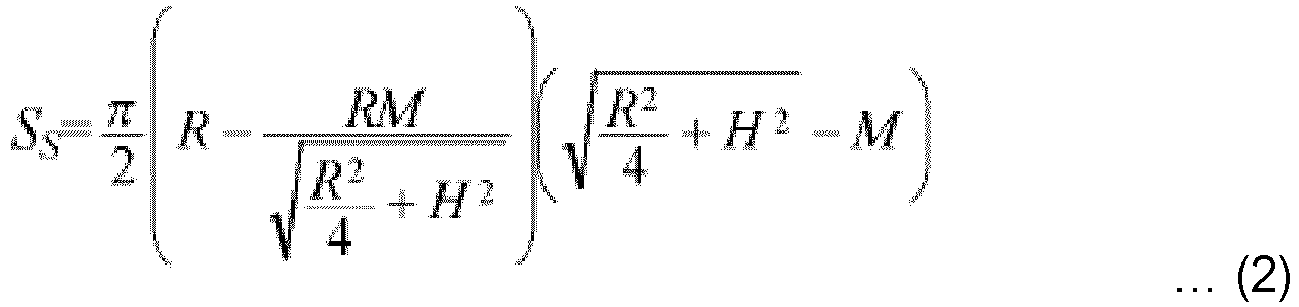
- Procédé de création d'indice parodontal selon la revendication 3, dans lequella pseudo-racine à l'étape de calcul de superficie de membrane parodontale est créée en considérant la racine (2) d'une dent (1) à racine unique comme un corps conique unique, en considérant les racines d'une dent à racine double comme un agrégat d'une pluralité de corps coniques, et en prenant le diamètre (R) du fond du corps conique comme le diamètre de la jonction amélo-cémentaire (CEJ) de la racine (2), la hauteur (H) du corps conique comme la longueur de la racine (2), et la longueur de ligne de crête (C) du cône du corps conique comme la longueur de ligne de crête de la racine (2),la superficie de membrane parodontale totale (S) est calculée sur la base de l'Équation (1), la superficie de membrane parodontale restante (Ss) est calculée sur la base de l'Équation (2), et la superficie de membrane parodontale perdue (SL) est trouvée en effectuant un calcul prédéterminé utilisant l'Équation (3) :
 H : longueur de racineC : longueur de ligne de crête de racineR : diamètre de CEJ de raciner : rayon de racine de CEJPuisque S=πrc,

 [Équation 2]
 [Équation 3]
- Procédé de création d'indice parodontal selon la revendication 1 ou 2, dans lequel
le coefficient de force masticatrice est calculé sur la base de l'Équation (4) :
[Équation 4] T : distance du site d'occlusion de chaque type de dent au condyle de l'articulation temporomandibulaireA : distance de la marge incisive de la première dent antérieure mandibulaire au condyle de l'articulation temporomandibulaire (valeur de référence)P : distance de l'angle de surface vestibulaire incisive de la première dent antérieure mandibulaire à l'apex de racine (valeur de référence)Q : longueur de dent (distance du site de contact occlusal à l'apex de racine le plus éloigné).
 - Procédé de création d'indice parodontal selon la revendication 2, dans lequel, lorsque la superficie de membrane parodontale restante (Ss) est définie pour un axe horizontal et l'indice parodontal est défini pour un axe vertical, l'étape de création d'indice parodontal comprend :le tracé d'une droite connectant deux points représentant 100 qui est l'indice parodontal lorsque la totalité de la membrane parodontale subsiste, et 0 qui est l'indice parodontal lorsque la totalité de la membrane parodontale est perdue ;la représentation graphique de l'indice parodontal au moment de la perte, et le déplacement de la droite en parallèle pour qu'elle devienne une droite passant par le point représenté graphiquement ;la préparation d'une courbe d'indice parodontal, qui passe par les deux points représentant les indices parodontaux de 0 et 100, et contacte la droite déplacée parallèlement uniquement au point représenté graphiquement, et l'utilisation d'un point sur la courbe d'indice parodontal correspondant à une superficie de membrane parodontale restante (Ss) spécifique comme un indice parodontal correspondant à la superficie de membrane parodontale restante (Ss) spécifique.
- Appareil (I) de création d'indice parodontal, comprenant une unité (10) de calcul adaptée àrecevoir une entrée de données d'échantillonnage représentant des valeurs mesurées d'une pluralité d'échantillons pour chaque type de dents parmi une pluralité de dents extraites parce qu'elles sont jugées être non conservables, les valeurs mesurées étant obtenues en mesurant un niveau (M) de fixation d'échantillon, qui est une dimension dans la plage depuis la jonction amélo-cémentaire (CEJ) de chaque dent (1) ou la marge de couronne de la dent (1) avec une couronne coulée jusqu'à un site le plus inférieur d'une partie submarginale avec dépôt de tartre dentaire de la dent (1) dans les échantillons, etexécuter les traitements de l'étape de calcul de superficie de membrane parodontale, de l'étape de calcul de coefficient de force masticatrice, de l'étape de préparation de droite, de l'étape de détection de superficie de membrane parodontale perdue, et de l'étape de calcul d'indice parodontal au moment de la perte dans le procédé de création d'indice parodontal selon la revendication 1, créant ainsi l'indice parodontal au moment de la perte de chaque dent (1).
- Appareil (I) de création d'indice parodontal selon la revendication 7, dans lequel l'unité (10) de calcul est adaptée à exécuter les traitements de l'étape de création d'indice parodontal dans le procédé de création d'indice parodontal selon la revendication 2 ou 6 pour créer un indice parodontal en outre.
- Programme informatique de création d'indice parodontal, comprenant :
des instructions qui, lorsque le programme est exécuté par un ordinateur, amènent l'ordinateur à permettre à ce que l'appareil (I) de création d'indice parodontal selon la revendication 7 reçoive l'entrée des données d'échantillonnage et exécute les traitements de l'étape de calcul de superficie de membrane parodontale, de l'étape de calcul de coefficient de force masticatrice, de l'étape de préparation de droite, de l'étape de détection de superficie de membrane parodontale perdue, et de l'étape de calcul d'indice parodontal au moment de la perte dans le procédé de création d'indice parodontal selon l'une quelconque des revendications 1 à 5. - Programme informatique de création d'indice parodontal selon la revendication 9, comprenant en outre :
des instructions qui, lorsque le programme est exécuté par un ordinateur, amènent l'ordinateur à permettre à ce que l'appareil (I) de création d'indice parodontal selon la revendication 8 exécute les traitements de l'étape de création d'indice parodontal dans le procédé de création d'indice parodontal selon la revendication 2 ou 6. - Support d'enregistrement ayant des enregistrements du programme informatique de création d'indice parodontal selon la revendication 9 ou 10 qui peuvent être lus par l'appareil (I) de création d'indice parodontal selon la revendication 7 ou 8.
- Procédé de création d'indice parodontal selon la revendication 2 ou 6 utilisé dans un procédé de diagnostic de parodontite, comprenant :la mesure du niveau de fixation d'une dent (1) spécifique extraite, comme un objet de diagnostic, détectant ainsi le niveau de fixation mesuré ;le calcul de la superficie de membrane parodontale restante (Ss) de la dent (1) extraite comme l'objet de diagnostic sur la base du niveau de fixation mesuré ; etla création de l'indice parodontal de la dent (1) spécifique correspondant à la superficie de membrane parodontale restante (Ss) par l'étape de création d'indice parodontal selon la revendication 2 ou 6.
Applications Claiming Priority (1)
| Application Number | Priority Date | Filing Date | Title |
|---|---|---|---|
| PCT/JP2013/070773 WO2015015602A1 (fr) | 2013-07-31 | 2013-07-31 | Procédé de production d'un indice parodontal, dispositif de production associé, programme de production associé, support d'enregistrement l'enregistrant, procédé de diagnostic de parodontite, dispositif de diagnostic associé, programme de diagnostic associé, et support d'enregistrement l'enregistrant |
Publications (3)
| Publication Number | Publication Date |
|---|---|
| EP2896384A1 EP2896384A1 (fr) | 2015-07-22 |
| EP2896384A4 EP2896384A4 (fr) | 2016-11-23 |
| EP2896384B1 true EP2896384B1 (fr) | 2023-11-29 |
Family
ID=50396760
Family Applications (1)
| Application Number | Title | Priority Date | Filing Date |
|---|---|---|---|
| EP13880696.3A Active EP2896384B1 (fr) | 2013-07-31 | 2013-07-31 | Procédé de production d'un indice parodontal, dispositif de production associé, programme de production associé, support d'enregistrement l'enregistrant, procédé de diagnostic de parodontite, dispositif de diagnostic associé, programme de diagnostic associé, et support d'enregistrement l'enregistrant |
Country Status (10)
| Country | Link |
|---|---|
| US (1) | US10285635B2 (fr) |
| EP (1) | EP2896384B1 (fr) |
| JP (1) | JP5441141B1 (fr) |
| KR (1) | KR101750663B1 (fr) |
| CN (1) | CN104507415B (fr) |
| DK (1) | DK2896384T3 (fr) |
| IN (1) | IN2014MN01921A (fr) |
| PH (1) | PH12015502686B1 (fr) |
| TW (1) | TWI589276B (fr) |
| WO (1) | WO2015015602A1 (fr) |
Families Citing this family (3)
| Publication number | Priority date | Publication date | Assignee | Title |
|---|---|---|---|---|
| WO2017175673A1 (fr) * | 2016-04-05 | 2017-10-12 | ライオン株式会社 | Procédé de détermination de stade de maladie parodontale |
| US11464466B2 (en) * | 2018-07-11 | 2022-10-11 | Novodynamics, Inc. | Methods and systems for periodontal disease screening |
| CN112347606A (zh) * | 2020-09-21 | 2021-02-09 | 宁波职业技术学院 | 一种牙周膜生物力学本构模型构建方法及系统 |
Family Cites Families (8)
| Publication number | Priority date | Publication date | Assignee | Title |
|---|---|---|---|---|
| US4823809A (en) * | 1987-08-21 | 1989-04-25 | Orincon Corporation | Periodontal probe system |
| WO1999038010A1 (fr) * | 1998-01-26 | 1999-07-29 | Biotech Australia Pty. Limited | Pai-2 et t-pa utiles comme marqueurs diagnostiques de la parodontopathie |
| JP2001061873A (ja) | 1999-08-27 | 2001-03-13 | Hidehiko Takizawa | 残存歯予測システム |
| JP2002224148A (ja) * | 2001-01-30 | 2002-08-13 | Hiromoto Namikawa | 口腔内状況判定補助方法、口腔内状況判定補助装置、及び口腔内状況判定補助用プログラム |
| JP2003319951A (ja) * | 2002-02-28 | 2003-11-11 | Lion Corp | 歯グキ年齢判定装置及び方法、歯グキ年齢判定プログラム、並びに歯グキ年齢判定図表 |
| WO2006055757A2 (fr) | 2004-11-18 | 2006-05-26 | Dental Medicine America, Llc | Procede pour decrire un etat de parodontopathie |
| JP2011072573A (ja) | 2009-09-30 | 2011-04-14 | Medeia Kk | デンタルx線による歯周病管理支援システム |
| JP5580572B2 (ja) | 2009-11-05 | 2014-08-27 | メディア株式会社 | 歯周病の進行状態の表示方法 |
-
2013
- 2013-07-31 CN CN201380020085.3A patent/CN104507415B/zh active Active
- 2013-07-31 DK DK13880696.3T patent/DK2896384T3/da active
- 2013-07-31 EP EP13880696.3A patent/EP2896384B1/fr active Active
- 2013-07-31 JP JP2013548652A patent/JP5441141B1/ja active Active
- 2013-07-31 KR KR1020167002631A patent/KR101750663B1/ko active Active
- 2013-07-31 US US14/389,199 patent/US10285635B2/en active Active
- 2013-07-31 WO PCT/JP2013/070773 patent/WO2015015602A1/fr not_active Ceased
-
2014
- 2014-07-11 TW TW103123902A patent/TWI589276B/zh active
- 2014-09-25 IN IN1921MUN2014 patent/IN2014MN01921A/en unknown
-
2015
- 2015-12-01 PH PH12015502686A patent/PH12015502686B1/en unknown
Also Published As
| Publication number | Publication date |
|---|---|
| JPWO2015015602A1 (ja) | 2017-03-02 |
| CN104507415B (zh) | 2017-02-22 |
| DK2896384T3 (da) | 2024-07-29 |
| PH12015502686A1 (en) | 2016-03-07 |
| KR20160048065A (ko) | 2016-05-03 |
| EP2896384A1 (fr) | 2015-07-22 |
| WO2015015602A1 (fr) | 2015-02-05 |
| CN104507415A (zh) | 2015-04-08 |
| PH12015502686B1 (en) | 2016-03-07 |
| EP2896384A4 (fr) | 2016-11-23 |
| TWI589276B (zh) | 2017-07-01 |
| IN2014MN01921A (fr) | 2015-07-10 |
| KR101750663B1 (ko) | 2017-06-23 |
| JP5441141B1 (ja) | 2014-03-12 |
| US10285635B2 (en) | 2019-05-14 |
| TW201509387A (zh) | 2015-03-16 |
| US20160206238A1 (en) | 2016-07-21 |
| HK1204906A1 (en) | 2015-12-11 |
Similar Documents
| Publication | Publication Date | Title |
|---|---|---|
| Sun et al. | Reproducibility of an intraoral scanner: A comparison between in-vivo and ex-vivo scans | |
| Garib et al. | Is there a consensus for CBCT use in Orthodontics? | |
| Wenzel | Radiographic display of carious lesions and cavitation in approximal surfaces: advantages and drawbacks of conventional and advanced modalities | |
| Ponder et al. | Quantification of external root resorption by low-vs high-resolution cone-beam computed tomography and periapical radiography: a volumetric and linear analysis | |
| Kang et al. | Effect of the presence of orthodontic brackets on intraoral scans | |
| Terry et al. | A clinical comparison of extraoral panoramic and intraoral radiographic modalities for detecting proximal caries and visualizing open posterior interproximal contacts | |
| Van Elslande et al. | Accuracy of mesiodistal root angulation projected by cone-beam computed tomographic panoramic-like images | |
| Alaraudanjoki et al. | Is a Basic Erosive Wear Examination (BEWE) reliable for recording erosive tooth wear on 3D models? | |
| Hajeer et al. | The accuracy and reproducibility of linear measurements made on CBCT-derived digital models | |
| Bodhe et al. | Design and development of deep learning approach for dental implant planning | |
| Zheng et al. | Automatic 3-dimensional quantification of orthodontically induced root resorption in cone-beam computed tomography images based on deep learning | |
| EP2896384B1 (fr) | Procédé de production d'un indice parodontal, dispositif de production associé, programme de production associé, support d'enregistrement l'enregistrant, procédé de diagnostic de parodontite, dispositif de diagnostic associé, programme de diagnostic associé, et support d'enregistrement l'enregistrant | |
| Miresmaeili et al. | Treatment decision analysis for palatally-displaced canines based on orthodontists’ opinion and CBCT | |
| Al-Tawachi et al. | Evaluation of maxillary canine root and maxillary bone thickness and density in patients with displaced maxillary canines: a cone-beam tomography study | |
| Iplinsky et al. | Radiographic evaluation of enamel thickness of permanent teeth: relevance and applicability | |
| Chatzopoulos et al. | Three-dimensional volumetric analysis of bone volume change in grade II mandibular furcation defects: A CBCT-based methodological study | |
| Al-Dhaher et al. | Determination of the vertical dimension by cranio-facial measurement using clinical and cephalometric analysis (comparative study) | |
| Park et al. | Predicting Orthodontic Root Movements with the Dental Monitoring System: A Preliminary Study | |
| Anistoroaei et al. | Cone-Beam Computed Tomography-a Useful Tool in Orthodontic Diagnosis | |
| Gómez et al. | Comparison of cross-sectional orthodontic analysis on digital models using Nemocast and CBCT software | |
| RU2784187C1 (ru) | Способ измерения толщины десны над альвеолярной костью челюсти | |
| Leitão et al. | Three-dimensional evaluation of impacted maxillary canines and repercussions on adjacent teeth | |
| Estrela et al. | Linear measurements of human permanent dental development stages using cone-beam computed tomography: a preliminary study | |
| Ezzat et al. | Cone beam computed tomography evaluation of alveolar bone thickness and its correlation with different mucogingival height: cross sectional study | |
| Vyzhenko et al. | COMPARATIVE ANALYSIS OF CEPHALOMETRIC MEASUREMENTS BASED ON 2D AND 3D IMAGING METHODS |
Legal Events
| Date | Code | Title | Description |
|---|---|---|---|
| PUAI | Public reference made under article 153(3) epc to a published international application that has entered the european phase |
Free format text: ORIGINAL CODE: 0009012 |
|
| 17P | Request for examination filed |
Effective date: 20141009 |
|
| AK | Designated contracting states |
Kind code of ref document: A1 Designated state(s): AL AT BE BG CH CY CZ DE DK EE ES FI FR GB GR HR HU IE IS IT LI LT LU LV MC MK MT NL NO PL PT RO RS SE SI SK SM TR |
|
| AX | Request for extension of the european patent |
Extension state: BA ME |
|
| RA4 | Supplementary search report drawn up and despatched (corrected) |
Effective date: 20161021 |
|
| RIC1 | Information provided on ipc code assigned before grant |
Ipc: A61B 5/107 20060101ALI20161017BHEP Ipc: A61B 10/00 20060101ALI20161017BHEP Ipc: A61C 19/04 20060101ALI20161017BHEP Ipc: A61B 5/00 20060101ALI20161017BHEP Ipc: A61C 19/00 20060101AFI20161017BHEP |
|
| STAA | Information on the status of an ep patent application or granted ep patent |
Free format text: STATUS: EXAMINATION IS IN PROGRESS |
|
| 17Q | First examination report despatched |
Effective date: 20181129 |
|
| GRAP | Despatch of communication of intention to grant a patent |
Free format text: ORIGINAL CODE: EPIDOSNIGR1 |
|
| STAA | Information on the status of an ep patent application or granted ep patent |
Free format text: STATUS: GRANT OF PATENT IS INTENDED |
|
| INTG | Intention to grant announced |
Effective date: 20230712 |
|
| GRAS | Grant fee paid |
Free format text: ORIGINAL CODE: EPIDOSNIGR3 |
|
| GRAA | (expected) grant |
Free format text: ORIGINAL CODE: 0009210 |
|
| STAA | Information on the status of an ep patent application or granted ep patent |
Free format text: STATUS: THE PATENT HAS BEEN GRANTED |
|
| AK | Designated contracting states |
Kind code of ref document: B1 Designated state(s): AL AT BE BG CH CY CZ DE DK EE ES FI FR GB GR HR HU IE IS IT LI LT LU LV MC MK MT NL NO PL PT RO RS SE SI SK SM TR |
|
| REG | Reference to a national code |
Ref country code: GB Ref legal event code: FG4D |
|
| REG | Reference to a national code |
Ref country code: CH Ref legal event code: EP |
|
| REG | Reference to a national code |
Ref country code: DE Ref legal event code: R096 Ref document number: 602013085003 Country of ref document: DE |
|
| REG | Reference to a national code |
Ref country code: IE Ref legal event code: FG4D |
|
| REG | Reference to a national code |
Ref country code: SE Ref legal event code: TRGR |
|
| REG | Reference to a national code |
Ref country code: LT Ref legal event code: MG9D |
|
| REG | Reference to a national code |
Ref country code: NL Ref legal event code: MP Effective date: 20231129 |
|
| PG25 | Lapsed in a contracting state [announced via postgrant information from national office to epo] |
Ref country code: GR Free format text: LAPSE BECAUSE OF FAILURE TO SUBMIT A TRANSLATION OF THE DESCRIPTION OR TO PAY THE FEE WITHIN THE PRESCRIBED TIME-LIMIT Effective date: 20240301 |
|
| PG25 | Lapsed in a contracting state [announced via postgrant information from national office to epo] |
Ref country code: IS Free format text: LAPSE BECAUSE OF FAILURE TO SUBMIT A TRANSLATION OF THE DESCRIPTION OR TO PAY THE FEE WITHIN THE PRESCRIBED TIME-LIMIT Effective date: 20240329 |
|
| PG25 | Lapsed in a contracting state [announced via postgrant information from national office to epo] |
Ref country code: LT Free format text: LAPSE BECAUSE OF FAILURE TO SUBMIT A TRANSLATION OF THE DESCRIPTION OR TO PAY THE FEE WITHIN THE PRESCRIBED TIME-LIMIT Effective date: 20231129 |
|
| PG25 | Lapsed in a contracting state [announced via postgrant information from national office to epo] |
Ref country code: ES Free format text: LAPSE BECAUSE OF FAILURE TO SUBMIT A TRANSLATION OF THE DESCRIPTION OR TO PAY THE FEE WITHIN THE PRESCRIBED TIME-LIMIT Effective date: 20231129 |
|
| PG25 | Lapsed in a contracting state [announced via postgrant information from national office to epo] |
Ref country code: LT Free format text: LAPSE BECAUSE OF FAILURE TO SUBMIT A TRANSLATION OF THE DESCRIPTION OR TO PAY THE FEE WITHIN THE PRESCRIBED TIME-LIMIT Effective date: 20231129 Ref country code: IS Free format text: LAPSE BECAUSE OF FAILURE TO SUBMIT A TRANSLATION OF THE DESCRIPTION OR TO PAY THE FEE WITHIN THE PRESCRIBED TIME-LIMIT Effective date: 20240329 Ref country code: GR Free format text: LAPSE BECAUSE OF FAILURE TO SUBMIT A TRANSLATION OF THE DESCRIPTION OR TO PAY THE FEE WITHIN THE PRESCRIBED TIME-LIMIT Effective date: 20240301 Ref country code: ES Free format text: LAPSE BECAUSE OF FAILURE TO SUBMIT A TRANSLATION OF THE DESCRIPTION OR TO PAY THE FEE WITHIN THE PRESCRIBED TIME-LIMIT Effective date: 20231129 Ref country code: BG Free format text: LAPSE BECAUSE OF FAILURE TO SUBMIT A TRANSLATION OF THE DESCRIPTION OR TO PAY THE FEE WITHIN THE PRESCRIBED TIME-LIMIT Effective date: 20240229 |
|
| REG | Reference to a national code |
Ref country code: AT Ref legal event code: MK05 Ref document number: 1635323 Country of ref document: AT Kind code of ref document: T Effective date: 20231129 |
|
| PG25 | Lapsed in a contracting state [announced via postgrant information from national office to epo] |
Ref country code: NL Free format text: LAPSE BECAUSE OF FAILURE TO SUBMIT A TRANSLATION OF THE DESCRIPTION OR TO PAY THE FEE WITHIN THE PRESCRIBED TIME-LIMIT Effective date: 20231129 |
|
| PG25 | Lapsed in a contracting state [announced via postgrant information from national office to epo] |
Ref country code: RS Free format text: LAPSE BECAUSE OF FAILURE TO SUBMIT A TRANSLATION OF THE DESCRIPTION OR TO PAY THE FEE WITHIN THE PRESCRIBED TIME-LIMIT Effective date: 20231129 Ref country code: PL Free format text: LAPSE BECAUSE OF FAILURE TO SUBMIT A TRANSLATION OF THE DESCRIPTION OR TO PAY THE FEE WITHIN THE PRESCRIBED TIME-LIMIT Effective date: 20231129 Ref country code: NO Free format text: LAPSE BECAUSE OF FAILURE TO SUBMIT A TRANSLATION OF THE DESCRIPTION OR TO PAY THE FEE WITHIN THE PRESCRIBED TIME-LIMIT Effective date: 20240229 Ref country code: NL Free format text: LAPSE BECAUSE OF FAILURE TO SUBMIT A TRANSLATION OF THE DESCRIPTION OR TO PAY THE FEE WITHIN THE PRESCRIBED TIME-LIMIT Effective date: 20231129 Ref country code: LV Free format text: LAPSE BECAUSE OF FAILURE TO SUBMIT A TRANSLATION OF THE DESCRIPTION OR TO PAY THE FEE WITHIN THE PRESCRIBED TIME-LIMIT Effective date: 20231129 Ref country code: HR Free format text: LAPSE BECAUSE OF FAILURE TO SUBMIT A TRANSLATION OF THE DESCRIPTION OR TO PAY THE FEE WITHIN THE PRESCRIBED TIME-LIMIT Effective date: 20231129 |
|
| PG25 | Lapsed in a contracting state [announced via postgrant information from national office to epo] |
Ref country code: DK Free format text: LAPSE BECAUSE OF FAILURE TO SUBMIT A TRANSLATION OF THE DESCRIPTION OR TO PAY THE FEE WITHIN THE PRESCRIBED TIME-LIMIT Effective date: 20231129 |
|
| PG25 | Lapsed in a contracting state [announced via postgrant information from national office to epo] |
Ref country code: AT Free format text: LAPSE BECAUSE OF FAILURE TO SUBMIT A TRANSLATION OF THE DESCRIPTION OR TO PAY THE FEE WITHIN THE PRESCRIBED TIME-LIMIT Effective date: 20231129 Ref country code: CZ Free format text: LAPSE BECAUSE OF FAILURE TO SUBMIT A TRANSLATION OF THE DESCRIPTION OR TO PAY THE FEE WITHIN THE PRESCRIBED TIME-LIMIT Effective date: 20231129 |
|
| PG25 | Lapsed in a contracting state [announced via postgrant information from national office to epo] |
Ref country code: SK Free format text: LAPSE BECAUSE OF FAILURE TO SUBMIT A TRANSLATION OF THE DESCRIPTION OR TO PAY THE FEE WITHIN THE PRESCRIBED TIME-LIMIT Effective date: 20231129 |
|
| REG | Reference to a national code |
Ref country code: DK Ref legal event code: T3 Effective date: 20240726 |
|
| PG25 | Lapsed in a contracting state [announced via postgrant information from national office to epo] |
Ref country code: SM Free format text: LAPSE BECAUSE OF FAILURE TO SUBMIT A TRANSLATION OF THE DESCRIPTION OR TO PAY THE FEE WITHIN THE PRESCRIBED TIME-LIMIT Effective date: 20231129 Ref country code: SK Free format text: LAPSE BECAUSE OF FAILURE TO SUBMIT A TRANSLATION OF THE DESCRIPTION OR TO PAY THE FEE WITHIN THE PRESCRIBED TIME-LIMIT Effective date: 20231129 Ref country code: RO Free format text: LAPSE BECAUSE OF FAILURE TO SUBMIT A TRANSLATION OF THE DESCRIPTION OR TO PAY THE FEE WITHIN THE PRESCRIBED TIME-LIMIT Effective date: 20231129 Ref country code: EE Free format text: LAPSE BECAUSE OF FAILURE TO SUBMIT A TRANSLATION OF THE DESCRIPTION OR TO PAY THE FEE WITHIN THE PRESCRIBED TIME-LIMIT Effective date: 20231129 Ref country code: DK Free format text: LAPSE BECAUSE OF FAILURE TO SUBMIT A TRANSLATION OF THE DESCRIPTION OR TO PAY THE FEE WITHIN THE PRESCRIBED TIME-LIMIT Effective date: 20231129 Ref country code: CZ Free format text: LAPSE BECAUSE OF FAILURE TO SUBMIT A TRANSLATION OF THE DESCRIPTION OR TO PAY THE FEE WITHIN THE PRESCRIBED TIME-LIMIT Effective date: 20231129 Ref country code: AT Free format text: LAPSE BECAUSE OF FAILURE TO SUBMIT A TRANSLATION OF THE DESCRIPTION OR TO PAY THE FEE WITHIN THE PRESCRIBED TIME-LIMIT Effective date: 20231129 |
|
| PG25 | Lapsed in a contracting state [announced via postgrant information from national office to epo] |
Ref country code: PT Free format text: LAPSE BECAUSE OF FAILURE TO SUBMIT A TRANSLATION OF THE DESCRIPTION OR TO PAY THE FEE WITHIN THE PRESCRIBED TIME-LIMIT Effective date: 20240401 |
|
| PG25 | Lapsed in a contracting state [announced via postgrant information from national office to epo] |
Ref country code: PT Free format text: LAPSE BECAUSE OF FAILURE TO SUBMIT A TRANSLATION OF THE DESCRIPTION OR TO PAY THE FEE WITHIN THE PRESCRIBED TIME-LIMIT Effective date: 20240401 |
|
| REG | Reference to a national code |
Ref country code: DE Ref legal event code: R097 Ref document number: 602013085003 Country of ref document: DE |
|
| PLBE | No opposition filed within time limit |
Free format text: ORIGINAL CODE: 0009261 |
|
| STAA | Information on the status of an ep patent application or granted ep patent |
Free format text: STATUS: NO OPPOSITION FILED WITHIN TIME LIMIT |
|
| PG25 | Lapsed in a contracting state [announced via postgrant information from national office to epo] |
Ref country code: SI Free format text: LAPSE BECAUSE OF FAILURE TO SUBMIT A TRANSLATION OF THE DESCRIPTION OR TO PAY THE FEE WITHIN THE PRESCRIBED TIME-LIMIT Effective date: 20231129 |
|
| PG25 | Lapsed in a contracting state [announced via postgrant information from national office to epo] |
Ref country code: SI Free format text: LAPSE BECAUSE OF FAILURE TO SUBMIT A TRANSLATION OF THE DESCRIPTION OR TO PAY THE FEE WITHIN THE PRESCRIBED TIME-LIMIT Effective date: 20231129 |
|
| 26N | No opposition filed |
Effective date: 20240830 |
|
| PG2D | Information on lapse in contracting state deleted |
Ref country code: DK |
|
| PG25 | Lapsed in a contracting state [announced via postgrant information from national office to epo] |
Ref country code: MC Free format text: LAPSE BECAUSE OF FAILURE TO SUBMIT A TRANSLATION OF THE DESCRIPTION OR TO PAY THE FEE WITHIN THE PRESCRIBED TIME-LIMIT Effective date: 20231129 |
|
| REG | Reference to a national code |
Ref country code: CH Ref legal event code: PL |
|
| PG25 | Lapsed in a contracting state [announced via postgrant information from national office to epo] |
Ref country code: LU Free format text: LAPSE BECAUSE OF NON-PAYMENT OF DUE FEES Effective date: 20240731 |
|
| PG25 | Lapsed in a contracting state [announced via postgrant information from national office to epo] |
Ref country code: LU Free format text: LAPSE BECAUSE OF NON-PAYMENT OF DUE FEES Effective date: 20240731 |
|
| PG25 | Lapsed in a contracting state [announced via postgrant information from national office to epo] |
Ref country code: CH Free format text: LAPSE BECAUSE OF NON-PAYMENT OF DUE FEES Effective date: 20240731 Ref country code: BE Free format text: LAPSE BECAUSE OF NON-PAYMENT OF DUE FEES Effective date: 20240731 |
|
| REG | Reference to a national code |
Ref country code: BE Ref legal event code: MM Effective date: 20240731 |
|
| PG25 | Lapsed in a contracting state [announced via postgrant information from national office to epo] |
Ref country code: IE Free format text: LAPSE BECAUSE OF NON-PAYMENT OF DUE FEES Effective date: 20240731 |
|
| PG25 | Lapsed in a contracting state [announced via postgrant information from national office to epo] |
Ref country code: FI Free format text: LAPSE BECAUSE OF FAILURE TO SUBMIT A TRANSLATION OF THE DESCRIPTION OR TO PAY THE FEE WITHIN THE PRESCRIBED TIME-LIMIT Effective date: 20231129 |
|
| PGFP | Annual fee paid to national office [announced via postgrant information from national office to epo] |
Ref country code: DK Payment date: 20250731 Year of fee payment: 13 Ref country code: DE Payment date: 20250724 Year of fee payment: 13 |
|
| PGFP | Annual fee paid to national office [announced via postgrant information from national office to epo] |
Ref country code: IT Payment date: 20250729 Year of fee payment: 13 |
|
| PGFP | Annual fee paid to national office [announced via postgrant information from national office to epo] |
Ref country code: GB Payment date: 20250728 Year of fee payment: 13 |
|
| PGFP | Annual fee paid to national office [announced via postgrant information from national office to epo] |
Ref country code: FR Payment date: 20250728 Year of fee payment: 13 |
|
| PGFP | Annual fee paid to national office [announced via postgrant information from national office to epo] |
Ref country code: SE Payment date: 20250728 Year of fee payment: 13 |
|
| PG25 | Lapsed in a contracting state [announced via postgrant information from national office to epo] |
Ref country code: CY Free format text: LAPSE BECAUSE OF FAILURE TO SUBMIT A TRANSLATION OF THE DESCRIPTION OR TO PAY THE FEE WITHIN THE PRESCRIBED TIME-LIMIT; INVALID AB INITIO Effective date: 20130731 |
|
| PG25 | Lapsed in a contracting state [announced via postgrant information from national office to epo] |
Ref country code: HU Free format text: LAPSE BECAUSE OF FAILURE TO SUBMIT A TRANSLATION OF THE DESCRIPTION OR TO PAY THE FEE WITHIN THE PRESCRIBED TIME-LIMIT; INVALID AB INITIO Effective date: 20130731 |