EP2897393A2 - Mobile Verwaltungsnachrichtenverteilung und aktive On-Network-Bestimmung - Google Patents
Mobile Verwaltungsnachrichtenverteilung und aktive On-Network-Bestimmung Download PDFInfo
- Publication number
- EP2897393A2 EP2897393A2 EP15151837.0A EP15151837A EP2897393A2 EP 2897393 A2 EP2897393 A2 EP 2897393A2 EP 15151837 A EP15151837 A EP 15151837A EP 2897393 A2 EP2897393 A2 EP 2897393A2
- Authority
- EP
- European Patent Office
- Prior art keywords
- gateway
- mobile
- application
- mobile management
- database
- Prior art date
- Legal status (The legal status is an assumption and is not a legal conclusion. Google has not performed a legal analysis and makes no representation as to the accuracy of the status listed.)
- Withdrawn
Links
- 230000001413 cellular effect Effects 0.000 claims abstract description 25
- 238000000034 method Methods 0.000 claims abstract description 21
- 238000012384 transportation and delivery Methods 0.000 claims abstract description 7
- 238000004891 communication Methods 0.000 claims description 31
- 238000007726 management method Methods 0.000 claims description 29
- 230000005055 memory storage Effects 0.000 claims description 2
- 230000011664 signaling Effects 0.000 abstract description 23
- 230000008569 process Effects 0.000 abstract description 4
- 239000008186 active pharmaceutical agent Substances 0.000 abstract 1
- 238000005516 engineering process Methods 0.000 description 15
- 238000010586 diagram Methods 0.000 description 6
- 230000008901 benefit Effects 0.000 description 5
- 230000000694 effects Effects 0.000 description 3
- 230000001419 dependent effect Effects 0.000 description 2
- 230000004044 response Effects 0.000 description 2
- 101000632994 Homo sapiens Somatostatin Proteins 0.000 description 1
- 102100029563 Somatostatin Human genes 0.000 description 1
- 230000009471 action Effects 0.000 description 1
- 230000005540 biological transmission Effects 0.000 description 1
- 230000007812 deficiency Effects 0.000 description 1
- 230000006870 function Effects 0.000 description 1
- 238000007689 inspection Methods 0.000 description 1
- 238000012986 modification Methods 0.000 description 1
- 230000004048 modification Effects 0.000 description 1
- 238000011160 research Methods 0.000 description 1
- 238000012552 review Methods 0.000 description 1
- 238000013068 supply chain management Methods 0.000 description 1
Images
Classifications
-
- H—ELECTRICITY
- H04—ELECTRIC COMMUNICATION TECHNIQUE
- H04W—WIRELESS COMMUNICATION NETWORKS
- H04W8/00—Network data management
- H04W8/02—Processing of mobility data, e.g. registration information at HLR [Home Location Register] or VLR [Visitor Location Register]; Transfer of mobility data, e.g. between HLR, VLR or external networks
- H04W8/08—Mobility data transfer
- H04W8/10—Mobility data transfer between location register and external networks
-
- H—ELECTRICITY
- H04—ELECTRIC COMMUNICATION TECHNIQUE
- H04W—WIRELESS COMMUNICATION NETWORKS
- H04W4/00—Services specially adapted for wireless communication networks; Facilities therefor
- H04W4/12—Messaging; Mailboxes; Announcements
- H04W4/14—Short messaging services, e.g. short message services [SMS] or unstructured supplementary service data [USSD]
-
- H—ELECTRICITY
- H04—ELECTRIC COMMUNICATION TECHNIQUE
- H04W—WIRELESS COMMUNICATION NETWORKS
- H04W4/00—Services specially adapted for wireless communication networks; Facilities therefor
- H04W4/12—Messaging; Mailboxes; Announcements
-
- H—ELECTRICITY
- H04—ELECTRIC COMMUNICATION TECHNIQUE
- H04W—WIRELESS COMMUNICATION NETWORKS
- H04W88/00—Devices specially adapted for wireless communication networks, e.g. terminals, base stations or access point devices
- H04W88/18—Service support devices; Network management devices
- H04W88/184—Messaging devices, e.g. message centre
Definitions
- the present technology relates generally to communication signaling, and more specifically to a system and method for providing SS7 mobile management signaling messages for use by applications outside an SS7 network.
- Switched telephone network elements are typically networked together with a special purpose data communications network designated Signaling System 7 (SS7).
- the SS7 network communicates signaling information necessary to set up and manage telephony calls in a separate telecommunications network.
- SS7 uses what is called out-of band signaling, meaning that signaling (control) information travels on a separate channel, rather than within the same channel as the telephone call.
- SS7 is a global standard for telecommunications defined by the International Telecommunication Union (ITU) Telecommunication Standardization Sector (ITU-T). The standard specifies procedures and protocol by which network elements in the public switched telephone network (PSTN) exchange information over a digital signaling network to effect wireless (cellular) and wire line call setup, routing, and control.
- PSTN public switched telephone network
- the ITU definition of SS7 allows for national variants such as the American National Standards Institute (ANSI) and Bell Communications Research (Telcordia Technologies) standards used in North America and the European Telecommunications Standards Institute (ETSI) standard used in Europe.
- the Home Location Register (HLR) is a database element of a SS7 network that contains details of each mobile phone subscriber that is authorized to use the associated network.
- such a capability could support or enable a host of services that depend upon knowledge of the real-time status of subscribed mobile devices.
- HLR mobile management SS7 signaling can be integrated with an application interface to provide mobile management notification. This can be implemented by receiving a real-time feed from the HLR database containing mobile management registration messages (such as Update Location or Ready for SM) and translating the mobile management messages into application notification messages that are delivered to registered applications.
- mobile management registration messages such as Update Location or Ready for SM
- An application registration database can be utilized where applications designate the mobile devices that will be monitored. Registration can include specific devices or allow for all devices associated with the application. Additionally, the registration process can be integrated with a Short Message Service Center (SMSC), such that when the SMSC detects a specific Mobile Termination failure result for a registered application, the mobile device is automatically added to the registration database.
- SMSC Short Message Service Center
- Each mobile management message received from the HLR can be compared to registered devices. If a match occurs, the registration entry for the device can be removed, and the mobile management message translated into an application protocol message and transferred to the application. Thus, the translated message can have a protocol that is compatible with the application.
- the application can then perform appropriate functionality, for example generate an MT message to contact the device, update an application database, or some other appropriate action or function.
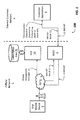
- FIG. 1 this figure illustrates a functional block diagram of a system 100 providing an example operating environment for an embodiment of the technology, with control messages and SMS messages flowing through a cellular network 1 in accordance with international standards.
- the system 100 comprises an external customer network 2 that supports customer applications 3 and that is linked to the cellular network 1.
- the cellular network 1 can comprise a telecommunications carrier network and/or a mobile network.
- the external customer network 2 provides a communication path at or to facilities of a customer.
- the external customer network 2 may comprise a proprietary network belonging to a customer, for example. More generally, the illustrated external customer network 2 can represent a facility or facilities that house one or more customer applications 3 and/or one or more associated communication paths.
- the customer application 3 may comprise a security application, a vehicle tracking application, or a supply chain management application, to mention a few representative examples without limitation.
- the customer application 3 may comprise an application that would need or benefit from a capability to send one or more command and control messages to one or more end mobile devices 8, for example.
- Such a message might comprise an alarm acknowledgement or a location request, for example.
- SMS Short Message Service
- SMS MT Mobile Terminate message
- SMPP Standard Short Message Peer-to-Peer
- the SMSC 5 submits the received SMS MT message 9 to the serving SS7 network 6 over interconnecting SS7 communications links.
- the serving SS7 network 6 attempts to deliver the message to the end mobile device 8 via a wireless telecommunications system 7.
- the SMST MT result 10 from the wireless telecommunications system 7 is delivered to the SMSC 5 over interconnecting SS7 communications links.
- the SMSC 5 sends the SMS MT result 12 of the SMS MT attempt 11 to the customer application 3.
- Mobile management messages 13 are constantly streamed to the serving HLR 14, independent of any other activity, to register presence and location and to authenticate mobile devices 8.
- the HLR 14 has an associated subscription database 76.
- the mobile management messages 13 (e.g., Location Updates) can be integral with the cellular network 1 , without interfacing with applications outside the wireless telecommunications system 7 and associated SS7 network elements.
- the system 100 can be upgraded to support enhanced signaling with the customer application 3.
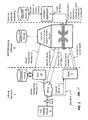
- FIG. 2 this figure illustrates a functional block diagram of another system 200 providing another example operating environment for an embodiment of the technology, wherein an example digital gateway, specifically a computer-based SMS Messaging Gateway 15, is located between a cellular network 1 and an external customer network 2 that comprises a customer application 3.
- an example digital gateway specifically a computer-based SMS Messaging Gateway 15
- a computer-based SMS Messaging Gateway 15 is located between a cellular network 1 and an external customer network 2 that comprises a customer application 3.
- SMS message flow and/or device registration on the system 200 can comprise one or more aspects of the disclosure or teaching provided in U.S. Patent Application No. 13/848,804 , entitled “Method and System for Efficiently Routing Messages," to Bryan Keith Tarleton, Michael J. Criscolo, Edward I. Comer, and William George Simitses.
- the entire contents of U.S. Patent Application No. 13/848,804 are hereby incorporated herein by reference.
- the customer application 3 in the customer network 2 submits an SMS Mobile Terminate message 11 to the SMS messaging gateway 15 via the communications channel 4, typically using standard SMPP protocol.
- the SMS messaging gateway 15 submits the MT message 16 to the SMSC 5 in the cellular network 1, typically using standard SMPP protocol.
- the SMS messaging gateway 15 submits the MT message 17 directly to the wireless telecommunications system 7 using the SS7 network 6.
- the cellular network 1 submits the MT message 17 to the wireless telecommunications system 7 using the SS7 network communications links.
- the wireless telecommunications system 7 attempts to deliver the MT message 17 to the mobile device 8.
- An MT result message 10 from the wireless telecommunications system 7 is delivered to the SMSC 5.
- An MT result message 18 is delivered to the SMS messaging gateway 15 via SS7 communications links.
- An MT result message 19 is delivered to the SMS messaging gateway 15 from the SMSC 5.
- the result of the MT result message 12 is sent to the customer application 3 in the external customer network 2.
- a failed MT queue 78 records devices for future attempts.
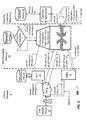
- FIG. 3 this figure illustrates a functional block diagram of an example system 300 in which the system 200 illustrated in Figure 2 has been enhanced to provide real-time SS7 mobile management signaling messages for use by customer applications 3 on the external customer network 2 in accordance with some embodiments of the technology.
- the system 300 illustrated in Figure 3 can be viewed as overlaying an improved signaling technology or process upon the system 200 illustrated in Figure 2 and upon the associated processes discussed above.
- the signaling messages are delivered to the customer application 3 immediately upon receipt from the HLR 14, that is, within approximately one second. If the customer application 3 responds within a few seconds of receipt of the unit ready message by sending an MT message to the mobile device 8 represented by the registration, the likelihood of successful transmission of the MT to the device 8 is high, such as about 90%. In comparison, MT messages sent randomly, without the unit ready notification, typically experience a far lower success ratio, such as about 50%.
- Machine-to-Machine (MTM) applications can use the signaling messages to better manage MT message submission to the wireless telecommunications system 7.
- the signaling messages may indicate that a mobile device 8 is registered and available on the cellular network 1, for example.
- the value of such signaling messages can diminish over time, especially for an MTM service mobile device as compared to a standard cellular mobile device used for cellular telephone service.
- the MTM device may have battery constraints and only power up occasionally and therefore not always be available. Additionally, cellular coverage may be lost as a device moves from one location to another.
- the SMS messaging gateway 15 receives the MT result 18, as discussed above with reference to Figure 2 .
- the SMS messaging gateway 15 inspects the MT result 18. If the result indicates a delivery failure for a registered customer application 3, a mobile device identifier for the associated end mobile device 8 is added to a registration database 22.
- Mobile management messages 13 can be constantly streamed to the HLR 14 independent of any other activity to register presence and location and to authenticate the end mobile devices 8.
- the HLR 14 may stream the mobile management messages 21 via Extensible Markup Language (XML) or other appropriate protocol to the SMS messaging gateway 15.
- the SMS messaging gateway 15 inspects the mobile identification for each of the mobile management messages 21 received from the HLR 14 .
- XML Extensible Markup Language
- the SMS messaging gateway 15 compares the received messages 21 with mobile identifications associated with the customer application 3 that were previously stored in the registration database 22. (See inquiry 77 .) If the SMS messaging gateway 15 matches a mobile identification received from the HLR 14 with a record of the registration database 22, then a unit ready notification message 23 is sent to the customer application 3. (See right "yes" branch from inquiry 77 .) The response of the customer application 3 to receipt of a unit ready notification message 23 can be application dependent. One potential response is that the customer application 3 may use the unit ready notification message 23 to reattempt a previous failed MT 11 message by retrieval from a failed MT queue 78. If the mobile identification is found in the registration database 22, then the record is removed from the registration database 22. (See upper "yes" branch from inquiry 77 .) If the mobile identification received from the HLR 14 does not match a registration record of database 22, then the next mobile management message 21 is retrieved.
- an exemplary SMS messaging gateway comprises a first communication interface for a first communication link to a Home Location Registry (HLR) for a cellular network; a second communication interface for a second communication link to a SS7 network for the cellular network; a third communication interface for a third communication link to a short message service center for the SS7 network; and a fourth communication interface to an external customer network.
- HLR Home Location Registry
- Instructions stored in a memory storage device and executable by a computer can determine if a mobile device is registered based on a mobile message received via the first communication interface. If the mobile device is determined to be registered, the computer can send a unit-ready notification over the fourth communication interface
Landscapes
- Engineering & Computer Science (AREA)
- Computer Networks & Wireless Communication (AREA)
- Signal Processing (AREA)
- Databases & Information Systems (AREA)
- Mobile Radio Communication Systems (AREA)
- Telephonic Communication Services (AREA)
Applications Claiming Priority (2)
| Application Number | Priority Date | Filing Date | Title |
|---|---|---|---|
| US201461929643P | 2014-01-21 | 2014-01-21 | |
| US14/272,709 US9510180B2 (en) | 2014-01-21 | 2014-05-08 | Mobile management message distribution and active on-network determination |
Publications (2)
| Publication Number | Publication Date |
|---|---|
| EP2897393A2 true EP2897393A2 (de) | 2015-07-22 |
| EP2897393A3 EP2897393A3 (de) | 2015-11-04 |
Family
ID=52434554
Family Applications (1)
| Application Number | Title | Priority Date | Filing Date |
|---|---|---|---|
| EP15151837.0A Withdrawn EP2897393A3 (de) | 2014-01-21 | 2015-01-20 | Mobile Verwaltungsnachrichtenverteilung und aktive On-Network-Bestimmung |
Country Status (3)
| Country | Link |
|---|---|
| US (1) | US9510180B2 (de) |
| EP (1) | EP2897393A3 (de) |
| CA (1) | CA2877661A1 (de) |
Cited By (3)
| Publication number | Priority date | Publication date | Assignee | Title |
|---|---|---|---|---|
| CN107148007A (zh) * | 2017-05-05 | 2017-09-08 | 四川长虹电器股份有限公司 | 兼容多运营商网关的短信服务统一调度方法 |
| CN107371127A (zh) * | 2017-08-22 | 2017-11-21 | 四川长虹电器股份有限公司 | 安卓系统不同运行模式下蓝牙设备同步管理实现方法 |
| CN109151800A (zh) * | 2017-06-15 | 2019-01-04 | 华为技术有限公司 | 通信方法和设备 |
Families Citing this family (1)
| Publication number | Priority date | Publication date | Assignee | Title |
|---|---|---|---|---|
| US9965525B2 (en) * | 2015-04-09 | 2018-05-08 | At&T Mobility Ii Llc | Protecting personal data |
Family Cites Families (9)
| Publication number | Priority date | Publication date | Assignee | Title |
|---|---|---|---|---|
| US7522911B2 (en) | 2000-04-11 | 2009-04-21 | Telecommunication Systems, Inc. | Wireless chat automatic status tracking |
| KR100501157B1 (ko) * | 2002-08-26 | 2005-07-18 | 에스케이 텔레콤주식회사 | Wcdma 망에서 단문 메시지 서비스 센터의 주소처리방법 |
| SG106670A1 (en) * | 2003-02-18 | 2004-10-29 | Chikka Pte Ltd | A messaging system and method therefor |
| US8738046B2 (en) * | 2008-06-19 | 2014-05-27 | Numerex Corp. | Intelligent short message delivery system and method |
| US8447335B2 (en) * | 2008-11-25 | 2013-05-21 | Tekelec Global, Inc. | Methods, systems, and computer program products for providing first delivery attempt service for short message peer-to-peer (SMPP) messages |
| US8325642B1 (en) * | 2009-05-14 | 2012-12-04 | Cellco Partnership | Redirection of message from mobile station based on identity of mobile station |
| US9241202B2 (en) * | 2009-10-09 | 2016-01-19 | Tekelec, Inc. | Methods, systems, and computer readable media for dynamically and conditionally setting service triggers in a communications network |
| US8549083B2 (en) * | 2010-01-06 | 2013-10-01 | Alcatel Lucent | Message waiting notification to external message centers |
| US8391899B2 (en) * | 2010-03-16 | 2013-03-05 | Alcatel Lucent | Text message delivery to a mobile device in a wireless communication network |
-
2014
- 2014-05-08 US US14/272,709 patent/US9510180B2/en active Active
-
2015
- 2015-01-13 CA CA2877661A patent/CA2877661A1/en not_active Abandoned
- 2015-01-20 EP EP15151837.0A patent/EP2897393A3/de not_active Withdrawn
Cited By (4)
| Publication number | Priority date | Publication date | Assignee | Title |
|---|---|---|---|---|
| CN107148007A (zh) * | 2017-05-05 | 2017-09-08 | 四川长虹电器股份有限公司 | 兼容多运营商网关的短信服务统一调度方法 |
| CN109151800A (zh) * | 2017-06-15 | 2019-01-04 | 华为技术有限公司 | 通信方法和设备 |
| CN107371127A (zh) * | 2017-08-22 | 2017-11-21 | 四川长虹电器股份有限公司 | 安卓系统不同运行模式下蓝牙设备同步管理实现方法 |
| CN107371127B (zh) * | 2017-08-22 | 2019-11-12 | 四川长虹电器股份有限公司 | 安卓系统不同运行模式下蓝牙设备同步管理实现方法 |
Also Published As
| Publication number | Publication date |
|---|---|
| US9510180B2 (en) | 2016-11-29 |
| EP2897393A3 (de) | 2015-11-04 |
| US20150208229A1 (en) | 2015-07-23 |
| CA2877661A1 (en) | 2015-07-21 |
Similar Documents
| Publication | Publication Date | Title |
|---|---|---|
| US7873345B1 (en) | Over-the-air service termination for a telematics device | |
| EP1142379B1 (de) | Voice mail meldungsdienst zwischen mobilkommunikationssystemen | |
| EP2454898B1 (de) | Verfahren und vorrichtung zur verifikation einer telefonnummer | |
| US7962160B2 (en) | Method, system and short message service center for getting user equipment information through short messages | |
| US8725107B2 (en) | Method for sending emergency messages to mobile terminals | |
| US20040005875A1 (en) | Method of furnishing illegal mobile equipment user information | |
| WO2008146097A1 (en) | A method for the forwarding of sms in a mobile communication system | |
| EP1707019A4 (de) | System und verfahren zur drahtlosen provisionierung eines mobilkommunikationsgeräts | |
| EP2897393A2 (de) | Mobile Verwaltungsnachrichtenverteilung und aktive On-Network-Bestimmung | |
| EP1350402A2 (de) | Verfahren zur kurznachrichtendienstweiterleitungsablieferung | |
| US8260314B2 (en) | Business hour notification delivery | |
| US20080153455A1 (en) | System, method and program for managing voip calls such as 911 calls from mobile devices | |
| CN102771107A (zh) | 呼叫尝试通知 | |
| US8229414B1 (en) | Release of temporarily allocated number triggered by voice disconnect at mobile switching center | |
| WO2005004453A1 (en) | Ring-back tone service system and the method | |
| US8615071B2 (en) | Message identification, correlation, recipient authentication, and reception confirmation in multi-event and multi-media environments | |
| US6615036B1 (en) | Method and apparatus for storing data within a communication system | |
| US20090037540A1 (en) | Notification of waiting voicemail messages between different types of communication networks | |
| CN114666752B (zh) | 一种ims域的短信管控系统及其管控方法 | |
| US20050186943A1 (en) | System and method for voicemail retrieval notification | |
| US20050239442A1 (en) | Method and system for handling wireless messaging errors | |
| FI113437B (fi) | Tilaajan liittymän voimassaolon tarkistus tietoliikennejärjestelmässä | |
| KR101051021B1 (ko) | 착신 이력 제공 방법 및 시스템 | |
| US11785573B2 (en) | Method for determining a geographical location of an access point in a wireless local access network | |
| US9763025B2 (en) | Radius accounting feed distribution and active on-network determination |
Legal Events
| Date | Code | Title | Description |
|---|---|---|---|
| PUAI | Public reference made under article 153(3) epc to a published international application that has entered the european phase |
Free format text: ORIGINAL CODE: 0009012 |
|
| 17P | Request for examination filed |
Effective date: 20150120 |
|
| AK | Designated contracting states |
Kind code of ref document: A2 Designated state(s): AL AT BE BG CH CY CZ DE DK EE ES FI FR GB GR HR HU IE IS IT LI LT LU LV MC MK MT NL NO PL PT RO RS SE SI SK SM TR |
|
| AX | Request for extension of the european patent |
Extension state: BA ME |
|
| PUAL | Search report despatched |
Free format text: ORIGINAL CODE: 0009013 |
|
| AK | Designated contracting states |
Kind code of ref document: A3 Designated state(s): AL AT BE BG CH CY CZ DE DK EE ES FI FR GB GR HR HU IE IS IT LI LT LU LV MC MK MT NL NO PL PT RO RS SE SI SK SM TR |
|
| AX | Request for extension of the european patent |
Extension state: BA ME |
|
| RIC1 | Information provided on ipc code assigned before grant |
Ipc: H04W 88/16 20090101ALN20150930BHEP Ipc: H04W 88/18 20090101ALI20150930BHEP Ipc: H04W 8/10 20090101AFI20150930BHEP Ipc: H04W 4/14 20090101ALI20150930BHEP Ipc: H04W 4/12 20090101ALN20150930BHEP |
|
| STAA | Information on the status of an ep patent application or granted ep patent |
Free format text: STATUS: THE APPLICATION IS DEEMED TO BE WITHDRAWN |
|
| 18D | Application deemed to be withdrawn |
Effective date: 20160505 |