EP2898932A1 - Schneeshuh mit Rahmen und wo die seitlichen Stänge mit Zähnen ausgestattet sind - Google Patents
Schneeshuh mit Rahmen und wo die seitlichen Stänge mit Zähnen ausgestattet sind Download PDFInfo
- Publication number
- EP2898932A1 EP2898932A1 EP15000134.5A EP15000134A EP2898932A1 EP 2898932 A1 EP2898932 A1 EP 2898932A1 EP 15000134 A EP15000134 A EP 15000134A EP 2898932 A1 EP2898932 A1 EP 2898932A1
- Authority
- EP
- European Patent Office
- Prior art keywords
- snowshoe
- lateral struts
- crampons
- lateral
- struts
- Prior art date
- Legal status (The legal status is an assumption and is not a legal conclusion. Google has not performed a legal analysis and makes no representation as to the accuracy of the status listed.)
- Withdrawn
Links
Images

Classifications
-
- A—HUMAN NECESSITIES
- A63—SPORTS; GAMES; AMUSEMENTS
- A63C—SKATES; SKIS; ROLLER SKATES; DESIGN OR LAYOUT OF COURTS, RINKS OR THE LIKE
- A63C13/00—Snow shoes
- A63C13/003—Means thereof for preventing slipping, e.g. crampons, e.g. on frame or shoe plate
-
- A—HUMAN NECESSITIES
- A63—SPORTS; GAMES; AMUSEMENTS
- A63C—SKATES; SKIS; ROLLER SKATES; DESIGN OR LAYOUT OF COURTS, RINKS OR THE LIKE
- A63C13/00—Snow shoes
- A63C13/005—Frames therefor
Definitions
- This invention relates to a snowshoe and its method of construction.
- the snowshoe is a tool that allows walking easily on fresh snow because it increases the surface tread upon and, thus, also the "floatation" typically used in activities of hiking on snow-covered environment.
- Snowshoes are also suitable for use on icy terrain because provided with crampons that increase their grip on the terrain.
- the first type involves the construction of a continuous perimeter frame, closed according to a substantially elliptical or oblong geometric shape that serves as an anchor for a central or internal structure for support and gripping the terrain.
- This central structure typically comprises a canvas made of various materials that has the function of increasing the contact surface and, thus, the floatation on the ground, as well as increasing the grip.
- the central structure may also be provided with a crampon with teeth for a better anchoring to the terrain.
- This first type of snowshoe does not excel in either floatation properties on the terrain or gripping properties.
- the canvas arranged in the central portion is subject to abrasion and does not allow a direct fixing of crampons or other gripping means.
- the second type of snowshoe involves the use of a body made of plastic material having a large support area which greatly increases the floatation of the snowshoe; in addition, the plastic body is used for fixing crampons of various types.
- This solution while being more resistant to abrasion compared to canvas, does not always ensure an optimal behaviour of the snowshoe with respect to the torsion stress along a main longitudinal axis of the snowshoe itself and/or flexion relative to a transverse axis, perpendicular to said longitudinal axis.
- the snowshoe in order to obtain a grip or secure grasp on the terrain, it is essential that the snowshoe not be excessively rigid, but be able to elastically deform under the weight of the user, in order to conform as much as possible to the shape of terrain. It is only through such elastic adaptation that the snowshoe is always able to ensure the optimum grip. In fact, a snowshoe that is too stiff would provide a poor grip in the case of uneven terrain, for example in the case of very rigid surfaces (for example frozen or partially supported by rocks). In such situations the proper pliability of the body of the snowshoe allows its adaptation to the terrain and increases the number of teeth or crampons actually gripping.
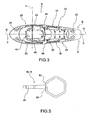
- snowshoe 4 globally indicates a snowshoe comprising an upper side 8, suitable to be fixed to a ski boot and a lower side 12, suitable to interface with the terrain.
- the snowshoe 4 comprises a frame provided with a pair of lateral struts 16,18, positioned on opposite sides A, B in relation to a centreline plane M-M of the frame, directed along a main longitudinal direction X-X.
- the lateral struts 16,18 each extend from a front end 20 to a rear end 24, each lateral strut 16,18 extending on only one of said opposite sides A,B in relation to the centreline plane M-M.
- the frame respectively comprises a front crossbeam 24 and a rear crossbeam 32 which mechanically connect said ends 20,24 to each other, the crossbeams 28,32 being positioned astride the centreline plane M-M.
- the lateral struts 16,18 and the front and rear ends 20,24 are made of different materials and/or have different shapes or thicknesses so that the lateral struts 16,18 have an increased rigidity compared to the ends 20,24.
- the snowshoe 4 comprises a central body 36, fitted with at least one central crampon 40 positioned on the lower side 12, the central body 36 being mechanically connected to the lateral struts 16,18.
- the central crampon 40 is not of the fixed type but is supported by a rocker base fixed to the boot, so as to follow the tilting movement of the associable boot during the walking phase.
- the lateral struts 16, 18) define the transversal dimensions of the snowshoe 4, along a transversal direction perpendicular to the main longitudinal direction X-X.
- the lateral struts 16,18 constitute perimetral elements that define at least partially the perimeter of the frame of the snowshoe 4.
- the lateral struts 16,18 have a tubular cross-section in relation to a cross-section plane perpendicular to said main longitudinal direction X-X.
- the lateral struts 16,18 have a hollow section.
- the lateral struts 16,18 are made of metallic material; it is also possible to make the lateral struts 16,18 of plastic material, preferably of the reinforced type, and/or at least partially of glass or carbon fibre.
- the lateral struts 16, 18 can be made in a single piece; according to a possible embodiment, at least one lateral strut 16,18 comprises a plurality of parts joined to each other by respective intermediate joints.
- the mechanical connection between the front and rear ends 24,24 of the lateral struts 16,18 and the respective front 28 and rear 32 crossbeams is made by means of mechanical connection means such as rivets, pins or screws.
- the mechanical connection between the front 20 and rear 24 ends of the lateral struts 16,18 and the respective front 28 and rear 32 crossbeams is made by over-injection of the crossbeams 28,32 on the ends of the lateral struts 16, 18.
- front and rear crossbeams 28,32 are moulded in plastic. It is also possible to make the front and rear crossbeams 28,32 of different materials, such as composite materials but also metal.
- At least one of said front and rear crossbeams 28,32 is made in one piece with the central body 36.
- Said central body 36 comprises at least a pair of appendages 44 that connect mechanically, on opposite sides of the centreline plane M-M, to the lateral struts 16, 18.
- the lateral struts 16,18 are provided with teeth or crampons 48, on the lower side 12 of the snowshoe 4.
- said crampons or teeth 48 are in one piece with the lateral struts 16,18.
- the crampons or teeth 48 are joined to the lateral struts 16,18 in such way that the lateral struts 16,18 have a closed circular section.
- Said closed tubular section may have different geometries.
- said closed tubular section of the lateral struts 16,18 is circular.
- the lateral struts 16,18 have a closed tubular section provided with a flat surface 52 resting on the terrain.
- the crampons or teeth 48 are attached to the lateral struts 16,18 at said flat support surface 52.
- said closed tubular section of the lateral struts 16,18 is hexagonal.
- the crampons or teeth 48 are fixed on one side of this hexagonal section, which constitutes said flat surface 52 resting on the terrain.
- the method comprises the steps of preparing a frame of the snowshoe 4 provided with a pair of lateral struts 16,18, arranged on opposite sides with respect to a centreline plane M-M of the frame, directed along a prevailing longitudinal direction X-X, in which the lateral struts 16,18 each extend from a front end 20 to a rear end 28, each lateral strut 16,18 extending on only one of said parts A,B, opposite with respect to the centreline plane M-M.
- One proceeds with the step of preparing a front crossbeam 28 and a rear crossbeam 32 and mechanically connecting the front crossbeam 28 to the front ends 20 of the lateral struts 16,18 and the rear crossbeam 32 to the rear ends 24 of the lateral struts 16, 18, said crossbeams 28,32 being positioned astride the centreline plane M-M.
- the lateral struts 16,18 and the ends 20,24 are made of different materials and/or have different shapes or thicknesses so that the lateral struts 16,18 have an increased rigidity compared to the ends 20, 24.
- one prepares a central body 36, fitted with at least one central crampon 40 positioned on a lower side 12 of the snowshoe 4 and mechanically connecting said central body 36 to the lateral struts 36.
- the step of connecting the front and rear crossbeams 28,32 to the front and rear ends 20,24 of the lateral struts 16,18 can be done either by interposing mechanical connections such as screws, rivets and the like or by over-moulding the front and rear crossbeams 28,32 directly on the front and rear ends 20,24 of the lateral struts 16,18.
- the method can comprise the step of providing the lateral struts 16,18 with teeth or crampons 48 on the lower side 12 of the snowshoe 4.
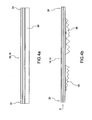
- the lateral struts 16,48 and the teeth or crampons 48 are made by means of an extrusion step in relation to an extrusion axis parallel to the main direction of the struts, in such way that the lateral struts 16,18 have a closed tubular section and are provided, in one piece, with a rib 56 ( Figure 4a ). Then, by machining on said rib 56 full, said teeth or crampons 48 ( Figure 4b ) are derived, for example by means of numerical control machining, such as, for example, with a numerical control milling machine, so as to set the desired tooth profile according to the needs of the user.
- the snowshoe according to the invention allows overcoming the drawbacks presented in the prior art.
- the snowshoe according to the invention has a higher tendency to floatation and, at the same time, a remarkable adaptability to the terrain by means of elastic torsional and/or flexural deformation.
- the lateral struts confer high rigidity to the snowshoe and also a solid support and anchorage for the crampons.
- the longitudinal connection ends increase the support surface and therefore the floatation of the snowshoe and, on the other hand, confer better torsional rigidity to the snowshoe by adapting the support surface of the snowshoe to uneven and rough terrain.
- the lateral struts constitute the rigid and resistant frame of the snowshoes and the longitudinal ends increase the support surface and allow a controlled deformability, of a torsional type, between the struts themselves.
- the lateral struts constitute solid and reliable supports for the side crampons that provide considerable additional grip with respect to that provided by central crampons of the known type.
- the snowshoes have a remarkable grip both in correspondence to the central portion, usually connected to the ski boot of the user, and in correspondence to the peripheral portion, which forms the skeleton of the racket.
- the positioning of the crampons on the lateral struts improves the grip of the snowshoe since there is no risk that projecting side portions of the body of the snowshoe can come into contact with the terrain before the side crampons, preventing them from gripping the terrain. In this case, the possible contact of the side body of the snowshoe with the terrain, would make the side crampons completely ineffective.
- This possibility is avoided in the snowshoes according to this invention thanks to the positioning of the side crampons precisely in correspondence to the lateral struts. In this way, there can be no contact between the body of the snowshoe and the terrain without having the grip of the side crampons since these latter constitute the body of the snowshoe and the maximum side dimensions of the snowshoe itself.
- the positioning of the crampons on the lateral struts involves a further technical problem: in fact, even a slight inclination or roll of the snowshoe with respect to an axis of inclination or roll passing through the longitudinal centreline plane of the frame involves the lowering and thus sinking of a longitudinal strut and, at the same time, the raising the opposite strut. So, even for small inclinations or rolls of the snowshoe, due for example to an uneven terrain, there is the risk that only the crampons arranged on the strut that lowers or sinks ensure a secure grip.
- the snowshoe according to the invention has a controlled torsional behaviour: thanks to the control of the torsion, the racket can twist with respect to a longitudinal axis passing through said centreline plane and, this way, also the longitudinal strut arranged on the side in the phase of lifting is able to sink into the terrain.
- the racket can twist with respect to a longitudinal axis passing through said centreline plane and, this way, also the longitudinal strut arranged on the side in the phase of lifting is able to sink into the terrain.
- the body of the snowshoe were a rigid board and undeformable by torsion, in the case of inclinations or rolls, there would always be a strut gripping the terrain and the other lifted and, therefore, without grip.
- the controlled torsion obtained from the particular architecture of the snowshoes according to the invention allows, instead, the twisting of the snowshoe so as to always bring the crampons of the lateral struts to grip the terrain.
- the snowshoe comprises a plurality of elements assembled and disassembled with each other: any breakage of a part of the body or of the plastic material of the ends does not necessarily imply replacement of the whole snowshoe. In fact, it is possible to replace the single damaged piece.
- the construction technique of the struts provided as a single piece with the crampons or teeth involves further advantages of both a structural and economic type. From the structural point of view, the construction of the piece improves both the mechanical flexural strength and, above all, the torsional strength of the strut.
- the crampons themselves are stronger; it is also possible to obtain the strut provided with a rib in one piece and without teeth by drawing. Subsequently, one can obtain the teeth or crampons by the removal of material from said solid rib.
- This operation is advantageous because, on one hand, the teeth are extremely strong and, on the other, it is possible to customize the profile of the teeth or crampons according to the user's requirements. In other words it is possible to change the phase of removal of material from the rib simply by reprogramming a numerical control machine in order to obtain the preferred profiles.
Landscapes
- Cleaning Of Streets, Tracks, Or Beaches (AREA)
- Tires In General (AREA)
Applications Claiming Priority (1)
| Application Number | Priority Date | Filing Date | Title |
|---|---|---|---|
| ITBS20140026 | 2014-01-23 |
Publications (1)
| Publication Number | Publication Date |
|---|---|
| EP2898932A1 true EP2898932A1 (de) | 2015-07-29 |
Family
ID=50391261
Family Applications (1)
| Application Number | Title | Priority Date | Filing Date |
|---|---|---|---|
| EP15000134.5A Withdrawn EP2898932A1 (de) | 2014-01-23 | 2015-01-19 | Schneeshuh mit Rahmen und wo die seitlichen Stänge mit Zähnen ausgestattet sind |
Country Status (2)
| Country | Link |
|---|---|
| US (1) | US20150202524A1 (de) |
| EP (1) | EP2898932A1 (de) |
Families Citing this family (1)
| Publication number | Priority date | Publication date | Assignee | Title |
|---|---|---|---|---|
| US10112104B2 (en) * | 2016-03-15 | 2018-10-30 | Cresent Moon Snowshoes, Inc. | Snowshoe with multi-density foam deck |
Citations (4)
| Publication number | Priority date | Publication date | Assignee | Title |
|---|---|---|---|---|
| WO1997028860A1 (fr) * | 1996-02-09 | 1997-08-14 | Folly's | Raquette a neige a couteaux d'accrochage |
| FR2747582A1 (fr) * | 1996-04-23 | 1997-10-24 | Bibollet Jean Claude | Raquette a neige |
| FR2792540A1 (fr) * | 1999-04-21 | 2000-10-27 | Jean Puygrenier | Raquette a neige |
| EP2452732A1 (de) * | 2010-11-12 | 2012-05-16 | K-2 Corporation | Schneeschuh mit Vorwärtsrahmenstütze |
Family Cites Families (11)
| Publication number | Priority date | Publication date | Assignee | Title |
|---|---|---|---|---|
| US4348823A (en) * | 1980-07-24 | 1982-09-14 | Knapp Frank H | Snow life shoes |
| US6006453A (en) * | 1997-01-23 | 1999-12-28 | Tubbs Snowshoe Company Llc | Snowshoe construction |
| CN1761505A (zh) * | 2003-01-30 | 2006-04-19 | 小瀑布设计公司 | 用于雪鞋的构架和扣拴以及相关系统和方法 |
| US7793439B2 (en) * | 2007-04-27 | 2010-09-14 | Easton Technical Products, Inc. | Snowshoe apparatus |
| US20090007456A1 (en) * | 2007-07-05 | 2009-01-08 | Louis Garneau | Snowshoe accessory |
| CH699411A2 (de) * | 2008-08-25 | 2010-02-26 | Clarissa Kessler | Schneeschuh. |
| US8302331B2 (en) * | 2010-01-21 | 2012-11-06 | Faber & Co., Inc. | Harness hinge member attachment for snowshoe |
| US8474158B2 (en) * | 2010-01-21 | 2013-07-02 | K-2 Corporation | Molded snowshoe with compound deck |
| DE202011051736U1 (de) * | 2011-10-24 | 2011-11-15 | Chao-ming Lin | Längenverstellbarer Schneeschuh |
| US20130205480A1 (en) * | 2012-02-09 | 2013-08-15 | Scott W. Nagely | Energy dissipating breakaway assembly for protective helmet |
| EP2898933B1 (de) * | 2014-01-23 | 2017-04-26 | OBER ALP S.p.A. | Schneeshuh mit Rahmen und wo die seitlichen Stänge mit zähne ausgestattet sind |
-
2015
- 2015-01-19 EP EP15000134.5A patent/EP2898932A1/de not_active Withdrawn
- 2015-01-23 US US14/604,072 patent/US20150202524A1/en not_active Abandoned
Patent Citations (4)
| Publication number | Priority date | Publication date | Assignee | Title |
|---|---|---|---|---|
| WO1997028860A1 (fr) * | 1996-02-09 | 1997-08-14 | Folly's | Raquette a neige a couteaux d'accrochage |
| FR2747582A1 (fr) * | 1996-04-23 | 1997-10-24 | Bibollet Jean Claude | Raquette a neige |
| FR2792540A1 (fr) * | 1999-04-21 | 2000-10-27 | Jean Puygrenier | Raquette a neige |
| EP2452732A1 (de) * | 2010-11-12 | 2012-05-16 | K-2 Corporation | Schneeschuh mit Vorwärtsrahmenstütze |
Also Published As
| Publication number | Publication date |
|---|---|
| US20150202524A1 (en) | 2015-07-23 |
Similar Documents
| Publication | Publication Date | Title |
|---|---|---|
| US4936028A (en) | Removable soles for shoes | |
| EP2898933B1 (de) | Schneeshuh mit Rahmen und wo die seitlichen Stänge mit zähne ausgestattet sind | |
| KR100377822B1 (ko) | 능동적으로 굴러가는 도보 장치 | |
| US20160045337A1 (en) | Base plate and blade design for a leg prosthetic | |
| AU2020104265A4 (en) | A vehicular ladder | |
| US6202326B1 (en) | Sole for a cross-country, trail or telemark ski-boot | |
| US9078496B2 (en) | Mobility assistive device | |
| WO2016025613A1 (en) | Base plate and blade design for a leg prosthetic | |
| WO2008079854A2 (en) | Backpack frame | |
| FR2823077A1 (fr) | Chaussure de marche comportant un renfort de tige amovible, et renfort pour une telle chaussure | |
| US20210337936A1 (en) | Crampon with embedded cleats | |
| US20150202524A1 (en) | Snowshoe and Its Method of Construction | |
| US20240298745A1 (en) | Sole with variable damping properties | |
| CA2786390C (en) | Molded snowshoe with compound deck | |
| KR101301306B1 (ko) | 보행용 지팡이 | |
| US20030234499A1 (en) | Skate | |
| US20140041258A1 (en) | Snowshoe with integrated articulating link | |
| KR200444077Y1 (ko) | 착탈 가능한 신발 보조장치 | |
| DK165218B (da) | Skobund, isaer til idraetsfodtoej | |
| US20160051887A1 (en) | Improved mesh for a snowshoe | |
| US7908773B2 (en) | Snowshoe of the type in which the decking includes a peripheral frame | |
| US8042827B2 (en) | Snowboard and ski | |
| US2097249A (en) | Snowshoe | |
| CN1712090B (zh) | 运动器械上的足或鞋的保持装置 | |
| SI21215A (sl) | V obliki podkve oblikovan ploščat podkvast okov iz umetne mase |
Legal Events
| Date | Code | Title | Description |
|---|---|---|---|
| PUAI | Public reference made under article 153(3) epc to a published international application that has entered the european phase |
Free format text: ORIGINAL CODE: 0009012 |
|
| 17P | Request for examination filed |
Effective date: 20150119 |
|
| AK | Designated contracting states |
Kind code of ref document: A1 Designated state(s): AL AT BE BG CH CY CZ DE DK EE ES FI FR GB GR HR HU IE IS IT LI LT LU LV MC MK MT NL NO PL PT RO RS SE SI SK SM TR |
|
| AX | Request for extension of the european patent |
Extension state: BA ME |
|
| 17P | Request for examination filed |
Effective date: 20160126 |
|
| RBV | Designated contracting states (corrected) |
Designated state(s): AL AT BE BG CH CY CZ DE DK EE ES FI FR GB GR HR HU IE IS IT LI LT LU LV MC MK MT NL NO PL PT RO RS SE SI SK SM TR |
|
| GRAP | Despatch of communication of intention to grant a patent |
Free format text: ORIGINAL CODE: EPIDOSNIGR1 |
|
| INTG | Intention to grant announced |
Effective date: 20161115 |
|
| RIN1 | Information on inventor provided before grant (corrected) |
Inventor name: NALESSO, ANDREA Inventor name: VINIERO, NICOLA |
|
| STAA | Information on the status of an ep patent application or granted ep patent |
Free format text: STATUS: THE APPLICATION IS DEEMED TO BE WITHDRAWN |
|
| 18D | Application deemed to be withdrawn |
Effective date: 20170328 |