EP2899018A1 - Matériau de feuille de renfort en résine thermoplastique et procédé de fabrication pour ce dernier - Google Patents
Matériau de feuille de renfort en résine thermoplastique et procédé de fabrication pour ce dernier Download PDFInfo
- Publication number
- EP2899018A1 EP2899018A1 EP14820724.4A EP14820724A EP2899018A1 EP 2899018 A1 EP2899018 A1 EP 2899018A1 EP 14820724 A EP14820724 A EP 14820724A EP 2899018 A1 EP2899018 A1 EP 2899018A1
- Authority
- EP
- European Patent Office
- Prior art keywords
- thermoplastic resin
- sheet material
- fabric
- reinforced
- fiber
- Prior art date
- Legal status (The legal status is an assumption and is not a legal conclusion. Google has not performed a legal analysis and makes no representation as to the accuracy of the status listed.)
- Granted
Links
- 239000000463 material Substances 0.000 title claims abstract description 302
- 229920005992 thermoplastic resin Polymers 0.000 title claims abstract description 187
- 238000004519 manufacturing process Methods 0.000 title claims abstract description 18
- 230000003014 reinforcing effect Effects 0.000 title 1
- 239000004744 fabric Substances 0.000 claims abstract description 172
- 239000000835 fiber Substances 0.000 claims abstract description 123
- 239000012783 reinforcing fiber Substances 0.000 claims abstract description 70
- 239000002657 fibrous material Substances 0.000 claims abstract description 30
- 238000002844 melting Methods 0.000 claims abstract description 26
- 230000008018 melting Effects 0.000 claims abstract description 26
- 238000000034 method Methods 0.000 claims abstract description 25
- 238000010438 heat treatment Methods 0.000 claims description 15
- 239000011148 porous material Substances 0.000 claims description 15
- 230000007246 mechanism Effects 0.000 description 39
- 229920005989 resin Polymers 0.000 description 21
- 239000011347 resin Substances 0.000 description 21
- 239000002759 woven fabric Substances 0.000 description 9
- 230000005484 gravity Effects 0.000 description 8
- 238000004804 winding Methods 0.000 description 8
- 229920000049 Carbon (fiber) Polymers 0.000 description 7
- 239000004917 carbon fiber Substances 0.000 description 7
- 239000011159 matrix material Substances 0.000 description 7
- VNWKTOKETHGBQD-UHFFFAOYSA-N methane Chemical compound C VNWKTOKETHGBQD-UHFFFAOYSA-N 0.000 description 7
- 239000010410 layer Substances 0.000 description 6
- 238000000465 moulding Methods 0.000 description 6
- -1 polyparaphenylene benzobisoxazole Polymers 0.000 description 6
- 239000000843 powder Substances 0.000 description 6
- 229920002292 Nylon 6 Polymers 0.000 description 5
- 238000001816 cooling Methods 0.000 description 5
- 229920002647 polyamide Polymers 0.000 description 5
- 238000005507 spraying Methods 0.000 description 5
- 239000004952 Polyamide Substances 0.000 description 4
- 238000005452 bending Methods 0.000 description 4
- 239000003795 chemical substances by application Substances 0.000 description 4
- 239000007788 liquid Substances 0.000 description 4
- 230000008569 process Effects 0.000 description 4
- 238000012545 processing Methods 0.000 description 4
- 230000009467 reduction Effects 0.000 description 4
- 238000004513 sizing Methods 0.000 description 4
- 238000009941 weaving Methods 0.000 description 4
- 229920002430 Fibre-reinforced plastic Polymers 0.000 description 3
- 229920002302 Nylon 6,6 Polymers 0.000 description 3
- 239000004734 Polyphenylene sulfide Substances 0.000 description 3
- 239000002131 composite material Substances 0.000 description 3
- 238000010586 diagram Methods 0.000 description 3
- 230000000694 effects Effects 0.000 description 3
- 230000005489 elastic deformation Effects 0.000 description 3
- 230000010354 integration Effects 0.000 description 3
- 238000009940 knitting Methods 0.000 description 3
- 229920000069 polyphenylene sulfide Polymers 0.000 description 3
- 206010003402 Arthropod sting Diseases 0.000 description 2
- 239000004698 Polyethylene Substances 0.000 description 2
- 208000027418 Wounds and injury Diseases 0.000 description 2
- XECAHXYUAAWDEL-UHFFFAOYSA-N acrylonitrile butadiene styrene Chemical compound C=CC=C.C=CC#N.C=CC1=CC=CC=C1 XECAHXYUAAWDEL-UHFFFAOYSA-N 0.000 description 2
- 239000004676 acrylonitrile butadiene styrene Substances 0.000 description 2
- 229920000122 acrylonitrile butadiene styrene Polymers 0.000 description 2
- 238000007334 copolymerization reaction Methods 0.000 description 2
- 238000005520 cutting process Methods 0.000 description 2
- 238000005516 engineering process Methods 0.000 description 2
- 239000003365 glass fiber Substances 0.000 description 2
- 238000005470 impregnation Methods 0.000 description 2
- 229920000573 polyethylene Polymers 0.000 description 2
- 239000002904 solvent Substances 0.000 description 2
- 229920002748 Basalt fiber Polymers 0.000 description 1
- 241000221931 Hypomyces rosellus Species 0.000 description 1
- JHWNWJKBPDFINM-UHFFFAOYSA-N Laurolactam Chemical compound O=C1CCCCCCCCCCCN1 JHWNWJKBPDFINM-UHFFFAOYSA-N 0.000 description 1
- 229920000299 Nylon 12 Polymers 0.000 description 1
- 239000004696 Poly ether ether ketone Substances 0.000 description 1
- 229930182556 Polyacetal Natural products 0.000 description 1
- 239000004695 Polyether sulfone Substances 0.000 description 1
- 239000004697 Polyetherimide Substances 0.000 description 1
- 239000004743 Polypropylene Substances 0.000 description 1
- 239000004793 Polystyrene Substances 0.000 description 1
- 239000000956 alloy Substances 0.000 description 1
- 229910045601 alloy Inorganic materials 0.000 description 1
- 229920006231 aramid fiber Polymers 0.000 description 1
- 239000000919 ceramic Substances 0.000 description 1
- 239000000805 composite resin Substances 0.000 description 1
- 238000010276 construction Methods 0.000 description 1
- 238000011161 development Methods 0.000 description 1
- 239000006185 dispersion Substances 0.000 description 1
- 238000009826 distribution Methods 0.000 description 1
- 238000011156 evaluation Methods 0.000 description 1
- 239000003733 fiber-reinforced composite Substances 0.000 description 1
- 239000011151 fibre-reinforced plastic Substances 0.000 description 1
- 239000012784 inorganic fiber Substances 0.000 description 1
- 238000003780 insertion Methods 0.000 description 1
- 230000037431 insertion Effects 0.000 description 1
- 239000011229 interlayer Substances 0.000 description 1
- 238000005304 joining Methods 0.000 description 1
- 239000002184 metal Substances 0.000 description 1
- 239000004745 nonwoven fabric Substances 0.000 description 1
- 229920001643 poly(ether ketone) Polymers 0.000 description 1
- 229920001707 polybutylene terephthalate Polymers 0.000 description 1
- 239000004417 polycarbonate Substances 0.000 description 1
- 229920000515 polycarbonate Polymers 0.000 description 1
- 229920001225 polyester resin Polymers 0.000 description 1
- 229920006393 polyether sulfone Polymers 0.000 description 1
- 229920002530 polyetherether ketone Polymers 0.000 description 1
- 229920001601 polyetherimide Polymers 0.000 description 1
- 229920000139 polyethylene terephthalate Polymers 0.000 description 1
- 239000005020 polyethylene terephthalate Substances 0.000 description 1
- 229920000642 polymer Polymers 0.000 description 1
- 229920005672 polyolefin resin Polymers 0.000 description 1
- 229920006324 polyoxymethylene Polymers 0.000 description 1
- 229920001155 polypropylene Polymers 0.000 description 1
- 229920002223 polystyrene Polymers 0.000 description 1
- 229920002635 polyurethane Polymers 0.000 description 1
- 239000004814 polyurethane Substances 0.000 description 1
- 238000010526 radical polymerization reaction Methods 0.000 description 1
- 230000002787 reinforcement Effects 0.000 description 1
- 239000012779 reinforcing material Substances 0.000 description 1
- 230000004044 response Effects 0.000 description 1
- 238000009958 sewing Methods 0.000 description 1
- 238000009987 spinning Methods 0.000 description 1
- 229920001187 thermosetting polymer Polymers 0.000 description 1
- 238000013519 translation Methods 0.000 description 1
- 239000011800 void material Substances 0.000 description 1
Images

Classifications
-
- B—PERFORMING OPERATIONS; TRANSPORTING
- B32—LAYERED PRODUCTS
- B32B—LAYERED PRODUCTS, i.e. PRODUCTS BUILT-UP OF STRATA OF FLAT OR NON-FLAT, e.g. CELLULAR OR HONEYCOMB, FORM
- B32B5/00—Layered products characterised by the non- homogeneity or physical structure, i.e. comprising a fibrous, filamentary, particulate or foam layer; Layered products characterised by having a layer differing constitutionally or physically in different parts
- B32B5/02—Layered products characterised by the non- homogeneity or physical structure, i.e. comprising a fibrous, filamentary, particulate or foam layer; Layered products characterised by having a layer differing constitutionally or physically in different parts characterised by structural features of a fibrous or filamentary layer
- B32B5/026—Knitted fabric
-
- B—PERFORMING OPERATIONS; TRANSPORTING
- B32—LAYERED PRODUCTS
- B32B—LAYERED PRODUCTS, i.e. PRODUCTS BUILT-UP OF STRATA OF FLAT OR NON-FLAT, e.g. CELLULAR OR HONEYCOMB, FORM
- B32B27/00—Layered products comprising a layer of synthetic resin
- B32B27/12—Layered products comprising a layer of synthetic resin next to a fibrous or filamentary layer
-
- B—PERFORMING OPERATIONS; TRANSPORTING
- B32—LAYERED PRODUCTS
- B32B—LAYERED PRODUCTS, i.e. PRODUCTS BUILT-UP OF STRATA OF FLAT OR NON-FLAT, e.g. CELLULAR OR HONEYCOMB, FORM
- B32B37/00—Methods or apparatus for laminating, e.g. by curing or by ultrasonic bonding
- B32B37/06—Methods or apparatus for laminating, e.g. by curing or by ultrasonic bonding characterised by the heating method
-
- B—PERFORMING OPERATIONS; TRANSPORTING
- B32—LAYERED PRODUCTS
- B32B—LAYERED PRODUCTS, i.e. PRODUCTS BUILT-UP OF STRATA OF FLAT OR NON-FLAT, e.g. CELLULAR OR HONEYCOMB, FORM
- B32B5/00—Layered products characterised by the non- homogeneity or physical structure, i.e. comprising a fibrous, filamentary, particulate or foam layer; Layered products characterised by having a layer differing constitutionally or physically in different parts
- B32B5/02—Layered products characterised by the non- homogeneity or physical structure, i.e. comprising a fibrous, filamentary, particulate or foam layer; Layered products characterised by having a layer differing constitutionally or physically in different parts characterised by structural features of a fibrous or filamentary layer
- B32B5/10—Layered products characterised by the non- homogeneity or physical structure, i.e. comprising a fibrous, filamentary, particulate or foam layer; Layered products characterised by having a layer differing constitutionally or physically in different parts characterised by structural features of a fibrous or filamentary layer characterised by a fibrous or filamentary layer reinforced with filaments
-
- B—PERFORMING OPERATIONS; TRANSPORTING
- B32—LAYERED PRODUCTS
- B32B—LAYERED PRODUCTS, i.e. PRODUCTS BUILT-UP OF STRATA OF FLAT OR NON-FLAT, e.g. CELLULAR OR HONEYCOMB, FORM
- B32B5/00—Layered products characterised by the non- homogeneity or physical structure, i.e. comprising a fibrous, filamentary, particulate or foam layer; Layered products characterised by having a layer differing constitutionally or physically in different parts
- B32B5/22—Layered products characterised by the non- homogeneity or physical structure, i.e. comprising a fibrous, filamentary, particulate or foam layer; Layered products characterised by having a layer differing constitutionally or physically in different parts characterised by the presence of two or more layers which are next to each other and are fibrous, filamentary, formed of particles or foamed
- B32B5/24—Layered products characterised by the non- homogeneity or physical structure, i.e. comprising a fibrous, filamentary, particulate or foam layer; Layered products characterised by having a layer differing constitutionally or physically in different parts characterised by the presence of two or more layers which are next to each other and are fibrous, filamentary, formed of particles or foamed one layer being a fibrous or filamentary layer
- B32B5/26—Layered products characterised by the non- homogeneity or physical structure, i.e. comprising a fibrous, filamentary, particulate or foam layer; Layered products characterised by having a layer differing constitutionally or physically in different parts characterised by the presence of two or more layers which are next to each other and are fibrous, filamentary, formed of particles or foamed one layer being a fibrous or filamentary layer another layer next to it also being fibrous or filamentary
-
- B—PERFORMING OPERATIONS; TRANSPORTING
- B32—LAYERED PRODUCTS
- B32B—LAYERED PRODUCTS, i.e. PRODUCTS BUILT-UP OF STRATA OF FLAT OR NON-FLAT, e.g. CELLULAR OR HONEYCOMB, FORM
- B32B7/00—Layered products characterised by the relation between layers; Layered products characterised by the relative orientation of features between layers, or by the relative values of a measurable parameter between layers, i.e. products comprising layers having different physical, chemical or physicochemical properties; Layered products characterised by the interconnection of layers
- B32B7/04—Interconnection of layers
- B32B7/12—Interconnection of layers using interposed adhesives or interposed materials with bonding properties
-
- B—PERFORMING OPERATIONS; TRANSPORTING
- B32—LAYERED PRODUCTS
- B32B—LAYERED PRODUCTS, i.e. PRODUCTS BUILT-UP OF STRATA OF FLAT OR NON-FLAT, e.g. CELLULAR OR HONEYCOMB, FORM
- B32B7/00—Layered products characterised by the relation between layers; Layered products characterised by the relative orientation of features between layers, or by the relative values of a measurable parameter between layers, i.e. products comprising layers having different physical, chemical or physicochemical properties; Layered products characterised by the interconnection of layers
- B32B7/04—Interconnection of layers
- B32B7/12—Interconnection of layers using interposed adhesives or interposed materials with bonding properties
- B32B7/14—Interconnection of layers using interposed adhesives or interposed materials with bonding properties applied in spaced arrangements, e.g. in stripes
-
- D—TEXTILES; PAPER
- D06—TREATMENT OF TEXTILES OR THE LIKE; LAUNDERING; FLEXIBLE MATERIALS NOT OTHERWISE PROVIDED FOR
- D06M—TREATMENT, NOT PROVIDED FOR ELSEWHERE IN CLASS D06, OF FIBRES, THREADS, YARNS, FABRICS, FEATHERS OR FIBROUS GOODS MADE FROM SUCH MATERIALS
- D06M15/00—Treating fibres, threads, yarns, fabrics, or fibrous goods made from such materials, with macromolecular compounds; Such treatment combined with mechanical treatment
- D06M15/19—Treating fibres, threads, yarns, fabrics, or fibrous goods made from such materials, with macromolecular compounds; Such treatment combined with mechanical treatment with synthetic macromolecular compounds
- D06M15/21—Macromolecular compounds obtained by reactions only involving carbon-to-carbon unsaturated bonds
- D06M15/263—Macromolecular compounds obtained by reactions only involving carbon-to-carbon unsaturated bonds of unsaturated carboxylic acids; Salts or esters thereof
-
- B—PERFORMING OPERATIONS; TRANSPORTING
- B32—LAYERED PRODUCTS
- B32B—LAYERED PRODUCTS, i.e. PRODUCTS BUILT-UP OF STRATA OF FLAT OR NON-FLAT, e.g. CELLULAR OR HONEYCOMB, FORM
- B32B2262/00—Composition or structural features of fibres which form a fibrous or filamentary layer or are present as additives
- B32B2262/02—Synthetic macromolecular fibres
-
- B—PERFORMING OPERATIONS; TRANSPORTING
- B32—LAYERED PRODUCTS
- B32B—LAYERED PRODUCTS, i.e. PRODUCTS BUILT-UP OF STRATA OF FLAT OR NON-FLAT, e.g. CELLULAR OR HONEYCOMB, FORM
- B32B2262/00—Composition or structural features of fibres which form a fibrous or filamentary layer or are present as additives
- B32B2262/02—Synthetic macromolecular fibres
- B32B2262/0261—Polyamide fibres
- B32B2262/0269—Aromatic polyamide fibres
-
- B—PERFORMING OPERATIONS; TRANSPORTING
- B32—LAYERED PRODUCTS
- B32B—LAYERED PRODUCTS, i.e. PRODUCTS BUILT-UP OF STRATA OF FLAT OR NON-FLAT, e.g. CELLULAR OR HONEYCOMB, FORM
- B32B2262/00—Composition or structural features of fibres which form a fibrous or filamentary layer or are present as additives
- B32B2262/02—Synthetic macromolecular fibres
- B32B2262/0276—Polyester fibres
-
- B—PERFORMING OPERATIONS; TRANSPORTING
- B32—LAYERED PRODUCTS
- B32B—LAYERED PRODUCTS, i.e. PRODUCTS BUILT-UP OF STRATA OF FLAT OR NON-FLAT, e.g. CELLULAR OR HONEYCOMB, FORM
- B32B2262/00—Composition or structural features of fibres which form a fibrous or filamentary layer or are present as additives
- B32B2262/10—Inorganic fibres
-
- B—PERFORMING OPERATIONS; TRANSPORTING
- B32—LAYERED PRODUCTS
- B32B—LAYERED PRODUCTS, i.e. PRODUCTS BUILT-UP OF STRATA OF FLAT OR NON-FLAT, e.g. CELLULAR OR HONEYCOMB, FORM
- B32B2307/00—Properties of the layers or laminate
- B32B2307/50—Properties of the layers or laminate having particular mechanical properties
- B32B2307/514—Oriented
- B32B2307/52—Oriented multi-axially
-
- B—PERFORMING OPERATIONS; TRANSPORTING
- B32—LAYERED PRODUCTS
- B32B—LAYERED PRODUCTS, i.e. PRODUCTS BUILT-UP OF STRATA OF FLAT OR NON-FLAT, e.g. CELLULAR OR HONEYCOMB, FORM
- B32B2307/00—Properties of the layers or laminate
- B32B2307/50—Properties of the layers or laminate having particular mechanical properties
- B32B2307/54—Yield strength; Tensile strength
-
- B—PERFORMING OPERATIONS; TRANSPORTING
- B32—LAYERED PRODUCTS
- B32B—LAYERED PRODUCTS, i.e. PRODUCTS BUILT-UP OF STRATA OF FLAT OR NON-FLAT, e.g. CELLULAR OR HONEYCOMB, FORM
- B32B2307/00—Properties of the layers or laminate
- B32B2307/50—Properties of the layers or laminate having particular mechanical properties
- B32B2307/546—Flexural strength; Flexion stiffness
-
- B—PERFORMING OPERATIONS; TRANSPORTING
- B32—LAYERED PRODUCTS
- B32B—LAYERED PRODUCTS, i.e. PRODUCTS BUILT-UP OF STRATA OF FLAT OR NON-FLAT, e.g. CELLULAR OR HONEYCOMB, FORM
- B32B2307/00—Properties of the layers or laminate
- B32B2307/70—Other properties
- B32B2307/718—Weight, e.g. weight per square meter
Definitions
- the present invention relates to a sheet material suitable for obtaining a thermoplastic resin composite material molded article having a three-dimensional shape, and more particularly relates to a thermoplastic resin reinforced sheet material in which a fabric formed of a thermoplastic resin material is caused to adhere to a reinforced fiber sheet material formed by drawing and aligning a reinforcing fiber such as a carbon fiber into the shape of a sheet and a method for manufacturing the same.
- a fiber reinforced composite material is a material which is obtained by combining a fiber material and a matrix material, which is lightweight and rigid, and which can be designed so as to have various functions, and is used in a wide range of fields such as an aerospace field, a transport field, a civil engineering and construction field and an exercise equipment field.
- a fiber reinforced plastic material obtained by combining a reinforcing fiber material such as a carbon fiber or a glass fiber with a thermosetting resin material is mainly used.
- a thermoplastic resin material as a matrix material
- a molded article and a molding method in which, in order to easily perform molding and reduce a molding cost in obtaining a molded article, a multiaxial reinforced sheet material stacked such that the direction of the reinforcement of a reinforcing fiber material is multiaxial. Therefore, there are expected a sheet material obtained by combining a reinforced fiber material and a thermoplastic resin material, in particular, a sheet material obtained by combining a multiaxial reinforced sheet material in which a reinforced fiber material is stacked so as to be multiaxial and a thermoplastic resin material, and the manufacturing of a molded article having a high quality in a short time and at a low cost, by using such a sheet material.
- Patent Literature 1 discloses a prepreg ribbon obtained by stacking the tow of a ribbon-shaped reinforcing fiber and a ribbon-shaped matrix resin layer having the same width as the tow and by joining them with a joint portion.
- the matrix resin layer is a ribbon-shaped layer formed of a resin serving as a matrix in a fiber reinforced thermoplastic resin material product, and examples of its form include a non-woven fabric, a woven fabric and a fiber bundle.
- Patent Literature 2 discloses that a thermoplastic resin multilayer reinforced sheet material is obtained by causing a thermoplastic resin reinforced sheet material to adhere to one surface of a reinforced fiber sheet material obtained by drawing and aligning, in a width direction, a plurality of reinforcing fiber bundles in which a plurality of reinforcing fibers is bundled with a sizing agent or the like into the form of a sheet through the use of a thermoplastic resin material for bonding that is molten or softened at a temperature lower than the melting temperature of the thermoplastic resin sheet material, by stacking the thermoplastic resin reinforced sheet material to thereby bond and integrate the layers of the thermoplastic resin reinforced sheet material through the use of the thermoplastic resin material for bonding.
- thermoplastic resin reinforced sheet material is constituted by stacking the reinforced fiber material and the thermoplastic resin sheet material.
- the reinforced fiber material is used by performing opening processing on the reinforcing fiber such as a carbon fiber to thereby form the fiber into the shape of a sheet, but due to the progress of opening processing technology, it becomes possible to form the opened sheet material so as to have a uniform and wide width and make its thickness equal to or less than ten times the diameter of a single yarn of the reinforcing fiber.
- the thickness of the reinforced fiber sheet material is equal to or less than 0.05 to 0.07 mm. Therefore, it is required that a thermoplastic resin reinforced sheet material is manufactured through the use of a reinforced fiber sheet material formed to be thin and wide.
- thermoplastic resin sheet material is formed to be thin and wide as the thickness of the reinforced fiber sheet material becomes smaller, it is difficult to mass-produce the thermoplastic resin sheet material so as to be formed to be equal to or less than 0.1 mm, and to be uniform, wide and thin.
- thermoplastic resin sheet material When the thermoplastic resin sheet material is caused to adhere to one surface of the reinforced fiber sheet material formed to be thin and wide, the thermoplastic resin sheet material easily expands and contracts although the reinforced fiber sheet material little expands and contracts, and thus the obtained thermoplastic resin sheet material is curled, with the result that it is difficult to carry out handling.
- an object of the present invention is to provide a thermoplastic resin reinforced sheet material that easily corresponds to the Vf value and that is free from curling, and a method for manufacturing such a thermoplastic resin reinforced sheet material.
- a thermoplastic resin reinforced sheet material includes: a reinforced fiber sheet material which is formed into a sheet shape by drawing and aligning a plurality of reinforcing fibers in a predetermined direction and whose basis weight per unit area is 80 g/m 2 or less; a fabric which is formed of a thermoplastic resin fiber material having a fineness of 5.6 decitex to 84 decitex and whose weight per unit area is 5 g/m 2 to 90 g/m 2 ; and a thermoplastic resin material for bonding which is melted or softened at a temperature lower than a melting temperature of the fabric and which discretely causes the reinforced fiber sheet material and the fabric to adhere. Furthermore, the fabric has a pore volume rate of 50 % or more.
- the fabric is a knitted fabric.
- the cross-sectional thickness of the reinforced fiber sheet material is set to be within 10 times a diameter of the reinforcing fiber.
- the adhesion amount of the thermoplastic resin material for bonding is 1 g/m 2 to 10 g/m 2 per unit area of the fabric.
- the thermoplastic resin multilayer reinforced sheet material is formed and integrated by stacking a plurality of sheets of the thermoplastic resin reinforced sheet material. Furthermore, the thermoplastic resin reinforced sheet material is stacked such that each direction in which the reinforced fiber sheet material is drawn and aligned is multiaxial.
- a method for manufacturing a thermoplastic resin reinforced sheet material according to the present invention includes: a temporary bonding step of heating a fabric which is formed of a thermoplastic resin fiber material having a fineness of 5.6 decitex to 84 decitex and whose weight per unit area is 5 g/m 2 to 90 g/m 2 and of discretely and temporarily bonding, to a surface of the fabric, a powder-shaped thermoplastic resin material for bonding which is melted or softened at a temperature lower than a melting temperature of the fabric; and an adherence step of causing the reinforced fiber sheet material and the fabric to adhere by bringing a reinforced fiber sheet material formed into a sheet shape through drawing and aligning a plurality of reinforcing fibers in a predetermined direction, into contact with the fabric and by melting the thermoplastic resin material for bonding heated and temporarily bonded at the lower temperature than the melting temperature of the fabric. Furthermore, in the temporary bonding step, 1 g/m 2 to 10 g/m 2 of the thermoplastic resin material for bonding is caused to adhere per unit
- thermoplastic resin fiber material in the present invention, through the use of the fabric of the thermoplastic resin fiber material, it is possible to form the thermoplastic resin fiber material so as to be wide and thin according to the reinforced fiber sheet material and to achieve the reduction in the weight of the thermoplastic resin material, with the result that, even when using the reinforced fiber sheet material formed to be thin and wide, it becomes possible to easily correspond to a Vf value. Furthermore, since the reinforced fiber sheet material adheres to the fabric that is flexible enough to be easily subjected to elastic deformation and bending deformation, the sheet material is maintained in a thin and wide form and in a state where straightness is kept and it is possible to obtain the thermoplastic resin reinforced sheet material free from deformation such as curl.
- the fabric which is formed of the thermoplastic resin fiber material having a fineness of 5.6 decitex to 84 decitex and whose weight per unit area is 5 g/m 2 to 90 g/m 2 it is possible to obtain a thin fabric having a large number of voids, and when stacking the thermoplastic resin reinforced sheet material to thereby form a molded article, it becomes possible to easily remove the air therewithin through the fabric, with the result that it is possible to manufacture a molded article having almost no voids.
- Fig. 1 is a plan view showing part of a thermoplastic resin reinforced sheet material according to the embodiment of the present invention.
- the thermoplastic resin reinforced sheet material 1 is constituted by causing a fabric 3 formed of a thermoplastic resin fiber material to adhere to one surface of a reinforced fiber sheet material 2 obtained by drawing and aligning, in a width direction, reinforcing fiber bundles in which a plurality of reinforcing fibers is bundled with a sizing agent or the like, into the form of a sheet.
- the fabric 3 is knitted with denbigh stitches
- Fig. 2 is a schematic cross-sectional view obtained by cutting the fabric 3 along a weft direction.
- the fabric 3 is constituted by being caused to adhere to the reinforced fiber sheet material 2 with a thermoplastic resin material for bonding 4 that is melt or softened at a temperature lower than the melting temperature of the thermoplastic resin fiber material constituting the fabric 3.
- the fabric 3 may be caused to adhere to both surfaces of the reinforced fiber sheet material 2.
- the fabric 3 may be constituted such that the reinforced fiber sheet material 2 may adhere to both surfaces of the fabric 3.
- the reinforced fiber sheet material 2 and the fabric 3 are bonded with the thermoplastic resin material for bonding 4, and are integrated so as not to be separated from each other, and thus the reinforced fiber sheet material 2 and the fabric 3 adhere to each other. Namely, since the reinforced fiber sheet material 2 and the fabric 3 adhere to each other without heating the fabric 3 up to the melting temperature, the form of the reinforced fiber sheet material 2 and the form of the fabric 3 are maintained.
- thermoplastic resin material for bonding 4 is discretely distributed on the fabric 3 having a large number of voids, and thus it becomes possible to suppress the adhesion amount of thermoplastic resin material for bonding 4, and the total amount of thermoplastic resin material is further reduced, with the result that it is possible to easily correspond to a high Vf value.
- thermoplastic resin fiber material Since in the case of the fabric having a large number of voids, the thermoplastic resin fiber material is uniformly distributed both in the warp direction and in the weft direction, the thermoplastic resin fiber material and the reinforced fiber sheet material 2 are bonded with the thermoplastic resin material for bonding 4, and thus it is possible to stably maintain the form of the sheet without the reinforced fiber sheet material 2 being separated. Then, since the fabric 3 can be flexibly deformed according to elastic deformation and bending deformation, and a curl or the like hardly occurs, it is possible to enhance handling characteristics while maintaining the form of the sheet. Therefore, it is possible to obtain the thermoplastic resin reinforced sheet material that is excellent in the drape property of the thermoplastic resin reinforced sheet material, the straight state and the uniformly dispersed state of the reinforcing fiber, and the like.
- the fabric used in the present invention is a material which has a large number of voids, which is capable of achieving low basis weight per unit area and which is so flexible as not to produce a curl or the like
- the fabric can be used.
- a woven fabric can also be used.
- the size of the void in the fabric is calculated from a pore volume rate.
- the pore volume rate is preferably set to be 50% or more, and is more preferably set to be 80% or more.
- the voids formed in the fabric are preferably distributed as uniformly as possible, and it becomes possible to obtain the fabric in which the voids are uniformly distributed by controllering the distribution of the voids in the fabric through a weaving structure or a knitting structure. Furthermore, since the weaving structure has elasticity, the weaving structure can expand and contract in a state of holding the voids in accordance with the shape when the thermoplastic resin reinforced sheet material is formed three-dimensionally. In particular, in a state where the fabric is partially bonded to the reinforced fiber sheet material by the thermoplastic resin material for bonding, the elasticity of the weaving structure is ensured, and thus it becomes possible to easily perform the molding of various three-dimensional shapes.
- the fabric in which the voids are uniformly distributed can be included in the case of, for example, knitted fabrics.
- thermoplastic resin multilayer reinforced sheet material When a thermoplastic resin multilayer reinforced sheet material is formed, it can be formed by stacking the thermoplastic resin reinforced sheet material. When the thermoplastic resin reinforced sheet material is stacked, the strength of the sheet material can have pseudo-isotropy by stacking the sheet material such that the direction in which the fibers of the reinforced fiber sheet material are drawn and aligned is multiaxial.
- thermoplastic resin reinforced sheet material When a plurality of sheets of the thermoplastic resin reinforced sheet material is stacked and integrated, the thermoplastic resin reinforced sheet material is heated at a temperature lower than the melting temperature of the fabric in a state where the sheets of the thermoplastic resin reinforced sheet material stacked are being in close contact, the thermoplastic resin material for bonding is melted and oozed to the adjacent thermoplastic resin reinforced sheet material to perform bonding, with the result that it is possible to easily integrate the sheets. Since the voids are formed in the fabric, the molten thermoplastic resin material for bonding easily flows to the adjacent thermoplastic resin reinforced sheet material, and thus it is possible to efficiently manufacture the thermoplastic resin multilayer reinforced sheet material. Furthermore, except the integration method described above, it is also possible to perform the integration by thermally fusing the fabric between the adjacent sheets of the thermoplastic resin reinforced sheet material or by performing sewing with an integration thermoplastic resin fiber bundle having the same material as the fabric.
- thermoplastic resin reinforced sheet material to which the fabric having a large number of voids is caused to adhere is also suitable as a material used for a vacuum resin impregnation manufacturing method (VaRTM method).
- VaRTM method vacuum resin impregnation manufacturing method
- a gap between stitch columns in a warp direction serves as the flow path of an impregnating liquid resin material, and thus the liquid resin material can be impregnated uniformly over the entire sheet material. Then, since the fabric and the reinforcing fiber are bonded with a bonding resin material, when the liquid resin material flows, the fiber orientation comes to be maintained without meandering of the reinforcing fiber.
- thermoplastic resin material of the thermoplastic resin reinforced sheet material forms a thin thermoplastic resin layer between the layers to thereby serve as an interlayer reinforcing material, with the result that the impact resistance can be expected to be enhanced.
- the reinforced fiber sheet material is formed by, for example, drawing and aligning, into the form of a sheet, a plurality of reinforcing fiber bundles where a plurality of reinforcing fibers is bundled with a sizing agent or the like so as not to be separated.
- the reinforcing fiber include inorganic fibers and organic fibers used in FRPs and having a high strength and a high elastic modulus, such as a carbon fiber, a glass fiber, a ceramic fiber, a Basalt fiber, an aramid fiber, a PBO (polyparaphenylene benzobisoxazole) fiber and a metal fiber.
- a plurality of fiber bundles in which these fibers is bundled may be combined.
- the basis weight per unit area is preferably 80 g/m 2 or less, more preferably 20 to 50 g/m 2 . As described above, the basis weight per unit area of the reinforced fiber sheet material is suppressed low, and thus it is possible not only to enhance the drape property of the thermoplastic resin reinforced sheet material but also to uniformly impregnate, when the fabric is melted, the fabric into the reinforced fiber sheet material.
- thermoplastic resin material In the fabric in which the pore volume rate is high and the basis weight per unit area is low, although the thermoplastic resin material is not uniformly and continuously distributed as with the film, it is distributed as a whole discretely and uniformly, and thus the distance over which the fabric melted and extended between the reinforcing fibers flows becomes short, with the result that the orientation disturbance of the reinforcing fiber caused by the flow of the resin comes to be suppressed.
- the thermoplastic resin fiber material constituting the fabric 3 serves as a base material (matrix) resin, and a material obtained by spinning the thermoplastic resin material into the form of a fiber can be used.
- the thermoplastic resin material include polypropylene, polyethylene, polystyrene, polyamides (such as nylon 6, nylon 66 and nylon 12), polyacetal, polycarbonate, acrylonitrile-butadiene-styrene copolymer (ABS), polyethylene terephthalate, polybutylene terephthalate, polyetherimide, polyethersulfone, polyphenylene sulfide (PPS), polyphenylene sulfide, polyether ketone, polyether etherketone and the like.
- thermoplastic resins may be used as the base material (matrix) resin by mixing them and forming them into a polymer alloy.
- the yarn of a known form such as a monofilament, a multifilament or a spun yarn can be used for the thermoplastic resin fiber material, and when the thermoplastic resin fiber material is used in the form of a multifilament, the melting rate when the fabric is melted can be increased.
- the fineness of the thermoplastic resin fiber material is preferably 5.6 decitex to 84 decitex.
- thermoplastic resin fiber material having such a low fineness it becomes possible to easily form the fabric having a large number of voids and having a low basis weight per unit area, and by achieving the reduction in the amount of the thermoplastic resin material, it becomes possible to easily performs an adjustment associated with the Vf value. Furthermore, through the use of the thermoplastic resin fiber material having a low fineness, it is possible to finely divide the voids formed in the fabric, with the result that it becomes possible to more uniformly disperse the thermoplastic resin fiber material and to enhance the bonding property of the reinforced fiber sheet material to the reinforcing fiber.
- the basis weight per unit area (the weight of the fiber per unit area) of the fabric 3 is determined by being associated with the basis weight per unit area of the reinforced fiber sheet material and the Vf value of the molded article.
- the basis weight per unit area of the fabric can easily be adjusted by the fineness, the structure and the like of the thermoplastic resin fiber material to be used. However, in order to prevent the occurrence of the orientation disturbance of the reinforcing fiber at the time of the flow between the reinforcing fibers, it becomes necessary to suppress the amount of resin flowing.
- the basis weight per unit area of the fabric is preferably set to be 5 g/m 2 to 90 g/m 2 .
- the basis weight per unit area of the fabric is set as low as 8 g/m 2 to 20 g/m 2 .
- a thin knitted fabric having a large number of voids In order to realize such a fabric having a low basis weight per unit area, it is possible to use a thin knitted fabric having a large number of voids. In such a thin knitted fabric having a low weight per unit area, warp stiches that hold the form in which voids are uniformly dispersed are preferable. Through the use of chain stitches as a part of a knitted structure constituting the warp stiches, it is possible to prevent the generation of a curl without producing easily misalignment, and to obtain a knitted fabric having a stable form suitable for the fabric according to the present invention.
- a woven fabric such as plain weave or leno weave whose pore volume rate can be set to be 50% or more can be used in the case of the woven fabric.
- thermoplastic resin fabric material forming the fabric Through the use of a plurality of different types of thermoplastic resin fabric materials as the thermoplastic resin fabric material forming the fabric, it is possible to constitute the fabric by thermoplastic resin materials of different properties, with the result that it becomes possible to obtain thermoplastic resin reinforced sheet materials of various properties. Furthermore, through the use as the thermoplastic resin fabric material constituting the fabric 3 of a material obtained by combining a thermoplastic resin having a high melting point in a core portion and a thermoplastic resin having a low melting point in a sheath portion, it is possible to bond the thermoplastic resin fabric material to the reinforced fiber sheet material without using a thermoplastic resin material for bonding while holding the form of the fabric 3.
- thermoplastic resin material for bonding 4 there is used a thermoplastic resin material that bonds the fabric 3 to the reinforced fiber sheet material 2 to thereby integrate them, that is melted or softened at a temperature lower than the melting point of the fabric 3, and that can bond the reinforced fiber sheet material 2 and the fabric 3.
- the thermoplastic resin material for bonding 4 is temporarily bonded to one surface of the fabric 3, and is made discrete uniformly. In this way, it is possible to reliably bond the reinforced fiber sheet material 2 and the fabric 3 to thereby put the fabric 3 in a state of adhering to the reinforced fiber sheet material 2.
- thermoplastic resin material for bonding 4 any of a powder shape, a short fiber shape and a perforated film shape (cobweb shape) may be used, and the thermoplastic resin material for bonding 4 is not particularly limited as long as it can be discretely and uniformly distributed on the one surface of the fabric 3 and can be temporarily bonded.
- thermoplastic resin material for bonding 4 a resin whose melting point falls within a range of 60 to 250°C is preferable, and for example, a polyolefin-based resin such as polyethylene, a polyester-based resin, a polyamide, a copolymerization polyamide, a polyurethane or the like is selected.
- a copolymerization polyamide has a low melting point and a satisfactory bonding property to the fabric 3 serving as the base material, it is preferably used as the thermoplastic resin material for bonding 4.
- thermoplastic resin material for bonding 4 a material having satisfactory compatibility with the fabric 3 constituted thereof is preferably selected. In this way, when the thermoplastic resin material for bonding is melted in the thermoplastic resin material serving as the base material, the thermoplastic resin material for bonding can be present so as to satisfactorily fit in the thermoplastic resin material serving as the base material.
- the adhesion amount of the thermoplastic resin material for bonding 4 is preferably set to be 1 g/m 2 to 10 g/m 2 per unit area of the fabric 3, and even in such a small adhesion amount of the thermoplastic resin material for bonding 4, it is possible to increase a bonding force by distributing the resin material discretely in the form of a dot as compared with a case where the resin material is distributed as a whole thinly and uniformly. In addition, by reduction in the use amount of thermoplastic resin material for bonding 4, it is possible to reduce effects given by the thermoplastic resin material for bonding 4 on the mechanical properties and the thermal properties of the obtained composite material molded article.
- thermoplastic resin material for bonding 4 is preferably discretely and uniformly distributed on one surface of the fabric 3, and the discretely distributed thermoplastic resin material for bonding 4 is more preferably uniform. In this way, even with a small adhesion amount of thermoplastic resin material for bonding 4, it is possible to cause the reinforced fiber sheet material 2 and the fabric 3 to uniformly adhere with an overall equal bonding force.
- the fabric 3 is bonded to the reinforcing fiber uniformly in a warp direction and a weft direction by adhesion of the fabric 3 to the reinforced fiber sheet material 2 even when a large number of voids are present in the fabric 3, it is possible to maintain the form of each fiber bundle constituting the reinforced fiber sheet material 2, that is, a state where the reinforcing fibers are drawn and aligned straightly, a state where the reinforcing fibers are uniformly dispersed, and the like.
- the fabric of the thermoplastic resin fiber material can easily be formed to be wide and thin according to the reinforced fiber sheet material, and the weight of the thermoplastic resin material can be reduced.
- the reinforced fiber sheet material adheres to the fabric that is easily subjected to elastic deformation and bending deformation, the reinforced fiber sheet material is maintained in a thin and wide form and in a state where straightness is kept, the form of a flat sheet without any deformation such as a curl is maintained and it is possible to obtain the thermoplastic resin reinforced sheet material excellent in handling characteristics.
- thermoplastic resin reinforced sheet material having a high Vf value even in the case of a thin and wide reinforced fiber sheet material.
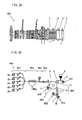
- Fig. 3A and 3B is an illustrative diagram concerning a process of manufacturing the thermoplastic resin reinforced sheet material.
- Fig. 3A and 3B is the illustrative diagram concerning the process of manufacturing the thermoplastic resin reinforced sheet material 1 as follow: the reinforced fiber sheet material 2 in which reinforcing-fiber opened yarns S in which reinforcing fiber bundles 2t are opened are drawn and aligned in a width direction is formed, the powder-shaped thermoplastic resin material for bonding 4 is distributed on one surface of the fabric 3 and is temporarily bonded, the temporarily bonded one surface of the fabric 3 is brought into contact with the one surface of the reinforced fiber sheet material 2 and is bonded with the thermoplastic resin material for bonding 4.
- Fig. 3A is a top view
- Fig. 3B is a front view.
- a thermoplastic resin reinforced fiber sheet material manufacturing device 600 of Fig. 3A and 3B is constituted of a multiple-fabric-bundle supply mechanism 601, a multiple-fabric-bundle opening mechanism 602, a vertical-direction-vibration provision mechanism 603, a width-direction-vibration provision mechanism provision mechanism 604, a heating mechanism 605, a cooling mechanism 606, a fabric supply mechanism 607, a mold-release-sheet-material supply mechanism 608, a mold-release-sheet-material winding mechanism 609 and a reinforced fiber sheet material winding mechanism 610.
- the supplied reinforcing fiber bundles 2t are opened in a state of being wide and thin by the multiple-fabric-bundle opening mechanism 602.
- the present opening mechanism adopts an air opening method for using a wind tunnel tube to thereby make a liquid (suction air current in Fig. 3A and 3B ) flowing from one direction act on each fiber bundle, that is, a known technology disclosed in Japanese Unexamined Patent Application Publication (Translation of PCT Application) No. 2007-518890 . Note that, as long as the method is to open each of the reinforcing fiber bundles 2t, any opening method may be adopted.
- each of the reinforcing fiber bundles 2t is alternately brought into a tension statue ⁇ a relaxed state ⁇ a tension state ⁇ a relaxed state ...
- the reinforcing fiber bundle 2t which travels in the lower portion of the roller is instantaneously bent in the direction in which the air flows when the reinforcing fiber bundles 2t are put into the relaxed state within the wind tunnel tube, and the respective fibers are moved in the width direction, with the result that the opening is performed.
- the reinforcing fiber bundles 2t are put into the tension state, the fibers are made straight with the opened width being maintained since the reinforcing fiber bundles 2t travel while being pressed in contact with the upper portion and the lower portion of the roller in the opened state.
- the reinforcing fiber bundles 2t travels while repeating this state, and they are put into a state of the reinforcing-fiber opened yarns S just after the wind tunnel tube.
- a plurality of reinforcing-fiber opened yarns S aligned in the width direction is vibrated in the width direction and are turned, by the width-direction-vibration provision mechanism provision mechanism 604, into an opened yarn sheet without any gap between the reinforcing-fiber opened yarns S, that is, the wide and thin reinforced fiber sheet material 2 in which the reinforcing fibers are dispersed.
- the fabric supply mechanism 607 feeds out, from the supply roller, the fabric 3 previously produced so as to have a predetermined basis weight per unit area, and preliminary heats the fabric 3 with an unillustrated heater.
- the heating temperature is set so as to be higher than the melting temperature of the powder-shaped thermoplastic resin material for bonding 4 and to be lower than the melting temperature of the fabric 3.
- the powder-shaped thermoplastic resin material for bonding 4 is sprayed by a powder spraying device 8 on the surface of the heated fabric 3, the thermoplastic resin material for bonding 4 adheres to the surface of the fabric 3 and a part thereof is melted, with the result that temporary bonding is performed. It is also possible to heat the fabric 3 and to perform the temporary bonding after the thermoplastic resin material for bonding 4 is sprayed on the feed-out fabric 3.
- the temporarily bonded one surface is stuck to one surface of the reinforced fiber sheet material 2, and the fabric 3 travels in close contact with a heating roller 9 of the heating mechanism 605.
- the heating temperature of the heating roller 9 is set so as to be higher than the melting temperature of the thermoplastic resin material for bonding 4 and to be lower than the melting temperature of the fabric 3, and the fabric 3 is put into a state of being bonded by the heating roller 9 with the thermoplastic resin material for bonding 4 to one surface of the reinforced fiber sheet material 2.
- a mold release sheet material 7 is supplied from the mold-release-sheet-material supply mechanism 608, between the reinforced fiber sheet material 2 and the heating roller 9.
- thermoplastic resin reinforced sheet material 1 in which the fabric 3 is caused to adhere to the one surface of the reinforced fiber sheet material 2 is obtained.
- the obtained thermoplastic resin reinforced sheet material 1 is wound by the reinforced fiber sheet material winding mechanism 610 around a thermoplastic resin reinforced-sheet-material winding member 1b.
- the mold release sheet material 7 is wound by the mold-release-sheet-material winding mechanism 609.
- thermoplastic resin material for bonding 4 there can be used, in addition to a method for uniformly spraying, with the powder spraying device 8, a predetermined amount on the surface of the fabric 3 and discretely causing the powder-shaped thermoplastic resin material for bonding to adhere, through the use of the resin material, for example, a method for melting the thermoplastic resin material for bonding with a solvent or the like into a solution state, applying the solution to the surface of the fabric 3, volatilizing the solvent and causing the thermoplastic resin material for bonding to adhere to the surface of the reinforced fiber sheet material or the thermoplastic resin sheet material.
- thermoplastic resin material for bonding 4 is preferably caused to adhere to the sheet material so as to be discretely and uniformly distributed, and furthermore, the adhesion amount of thermoplastic resin material for bonding is set to be 1 g/m 2 to 10 g/m 2 per unit area of the fabric.
- a step of bonding the fabric is performed subsequent to the step of opening the reinforced fiber sheet material, it is possible to temporarily wind, around a roller or the like, the reinforced fiber sheet material obtained by the opening, to feed out, in the bonding step, the reinforced fiber sheet material from the winding roller, and to cause it to adhere to the fabric.
- thermoplastic resin reinforced sheet material was manufactured through the use of the following materials.
- thermoplastic resin reinforced sheet material first, the respective reinforcing fibers constituting the reinforced fiber sheet material were uniformly dispersed in a straight state.
- the obtained thermoplastic resin reinforced sheet material maintained its planar shape without generating a curl, had flexibility even when being subjected to bending deformation and had a restoring force for returning to its original planar state, with the result that its handling characteristics were excellent.
- thermoplastic resin reinforced sheet material As it is, its Vf value is 50%, whereas even in the case of a reinforced fiber sheet material formed so as to be thin and wide, a high Vf value can be set.
- thermoplastic resin reinforced sheet material 1: thermoplastic resin reinforced sheet material
- 2: reinforced fiber sheet material 3: fabric
- 602 multiple-fabric-bundle opening mechanism
Landscapes
- Engineering & Computer Science (AREA)
- Textile Engineering (AREA)
- Chemical & Material Sciences (AREA)
- Chemical Kinetics & Catalysis (AREA)
- Laminated Bodies (AREA)
- Reinforced Plastic Materials (AREA)
- Moulding By Coating Moulds (AREA)
Applications Claiming Priority (3)
| Application Number | Priority Date | Filing Date | Title |
|---|---|---|---|
| JP2013236403 | 2013-11-15 | ||
| JP2014079179A JP5994060B2 (ja) | 2013-11-15 | 2014-04-08 | 熱可塑性樹脂補強シート材及びその製造方法 |
| PCT/JP2014/067492 WO2015072172A1 (fr) | 2013-11-15 | 2014-07-01 | Matériau de feuille de renfort en résine thermoplastique et procédé de fabrication pour ce dernier |
Publications (3)
| Publication Number | Publication Date |
|---|---|
| EP2899018A1 true EP2899018A1 (fr) | 2015-07-29 |
| EP2899018A4 EP2899018A4 (fr) | 2016-02-17 |
| EP2899018B1 EP2899018B1 (fr) | 2017-08-30 |
Family
ID=53057120
Family Applications (1)
| Application Number | Title | Priority Date | Filing Date |
|---|---|---|---|
| EP14820724.4A Not-in-force EP2899018B1 (fr) | 2013-11-15 | 2014-07-01 | Matériau de feuille de renfort en résine thermoplastique et procédé de fabrication pour ce dernier |
Country Status (7)
| Country | Link |
|---|---|
| US (1) | US20160279897A1 (fr) |
| EP (1) | EP2899018B1 (fr) |
| JP (1) | JP5994060B2 (fr) |
| KR (1) | KR101688717B1 (fr) |
| CN (1) | CN104781069B (fr) |
| TW (1) | TWI532594B (fr) |
| WO (1) | WO2015072172A1 (fr) |
Cited By (2)
| Publication number | Priority date | Publication date | Assignee | Title |
|---|---|---|---|---|
| RU178830U1 (ru) * | 2017-07-27 | 2018-04-19 | Акционерное общество "Препрег-Современные Композиционные Материалы" (АО "Препрег-СКМ") | Мультиаксиальная ткань |
| US10384400B2 (en) | 2015-12-16 | 2019-08-20 | Hyundai Motor Company | Thermoplastic resin composite and preparation method of thermoplastic resin composite |
Families Citing this family (7)
| Publication number | Priority date | Publication date | Assignee | Title |
|---|---|---|---|---|
| DE112015004743A5 (de) * | 2014-10-18 | 2017-06-29 | Oerlikon Textile Gmbh & Co. Kg | Verfahren und Vorrichtung zur Herstellung eines multifilen Fadens aus einer Polyamidschmelze |
| GB2571231B (en) * | 2016-11-09 | 2020-03-25 | Nike Innovate Cv | Textiles and articles, and processes for making the same |
| KR102402639B1 (ko) | 2017-11-24 | 2022-05-26 | 삼성전자주식회사 | 전자 장치 및 그의 통신 방법 |
| WO2020009125A1 (fr) * | 2018-07-03 | 2020-01-09 | フクビ化学工業株式会社 | Feuille de cfrp, corps stratifié utilisant une feuille de cfrp et procédé de production de feuille de cfrp |
| CN113811439B (zh) * | 2019-05-23 | 2024-05-14 | 东丽株式会社 | 纤维增强树脂基材、一体化成型品及纤维增强树脂基材的制造方法 |
| ES3037296T3 (en) | 2019-11-11 | 2025-09-30 | Toray Industries | Carbon fiber tape material, and reinforced fiber laminate and molded article using same |
| JP7661725B2 (ja) * | 2021-03-09 | 2025-04-15 | 東レ株式会社 | 炭素繊維テープ材 |
Family Cites Families (9)
| Publication number | Priority date | Publication date | Assignee | Title |
|---|---|---|---|---|
| JP2921327B2 (ja) * | 1993-05-14 | 1999-07-19 | ヤマハ株式会社 | 繊維強化熱可塑性樹脂用プリプレグリボンおよびプリプレグ |
| JP4078726B2 (ja) | 1998-09-16 | 2008-04-23 | 東レ株式会社 | 多層強化繊維シートおよび構造物の補修・補強方法 |
| JP4740131B2 (ja) | 2003-07-08 | 2011-08-03 | 福井県 | 繊維束の開繊方法と、その方法に使用する装置 |
| EP1885553A2 (fr) * | 2005-05-18 | 2008-02-13 | Composix Co. | Structure balistique stratifiee |
| JP2007182661A (ja) * | 2005-12-09 | 2007-07-19 | Toray Ind Inc | 多軸成形材料、プリフォーム、frpおよびそれらの製造方法 |
| WO2008062818A1 (fr) * | 2006-11-22 | 2008-05-29 | Fukui Prefectural Government | Matériau en feuille multicouche de résine thermoplastique renforcé, procédé de fabrication de celui-ci et procédé de façonnage d'un matériau composite de résine thermoplastique moulé |
| JP5223130B2 (ja) * | 2007-02-15 | 2013-06-26 | 福井県 | 熱可塑性樹脂補強シート材及びその製造方法、並びに熱可塑性樹脂多層補強シート材 |
| US11407199B2 (en) * | 2009-04-15 | 2022-08-09 | The Boeing Company | Metal-coated fabrics for fiber-metal laminates |
| JP5851714B2 (ja) * | 2011-05-11 | 2016-02-03 | 帝人株式会社 | 繊維強化樹脂成形用材料 |
-
2014
- 2014-04-08 JP JP2014079179A patent/JP5994060B2/ja active Active
- 2014-07-01 KR KR1020147036730A patent/KR101688717B1/ko not_active Expired - Fee Related
- 2014-07-01 CN CN201480001735.4A patent/CN104781069B/zh not_active Expired - Fee Related
- 2014-07-01 US US14/414,130 patent/US20160279897A1/en not_active Abandoned
- 2014-07-01 WO PCT/JP2014/067492 patent/WO2015072172A1/fr not_active Ceased
- 2014-07-01 EP EP14820724.4A patent/EP2899018B1/fr not_active Not-in-force
- 2014-09-25 TW TW103133172A patent/TWI532594B/zh not_active IP Right Cessation
Cited By (2)
| Publication number | Priority date | Publication date | Assignee | Title |
|---|---|---|---|---|
| US10384400B2 (en) | 2015-12-16 | 2019-08-20 | Hyundai Motor Company | Thermoplastic resin composite and preparation method of thermoplastic resin composite |
| RU178830U1 (ru) * | 2017-07-27 | 2018-04-19 | Акционерное общество "Препрег-Современные Композиционные Материалы" (АО "Препрег-СКМ") | Мультиаксиальная ткань |
Also Published As
| Publication number | Publication date |
|---|---|
| TWI532594B (zh) | 2016-05-11 |
| JP5994060B2 (ja) | 2016-09-21 |
| TW201524764A (zh) | 2015-07-01 |
| KR20150073884A (ko) | 2015-07-01 |
| EP2899018A4 (fr) | 2016-02-17 |
| US20160279897A1 (en) | 2016-09-29 |
| JP2015116806A (ja) | 2015-06-25 |
| WO2015072172A1 (fr) | 2015-05-21 |
| CN104781069A (zh) | 2015-07-15 |
| EP2899018B1 (fr) | 2017-08-30 |
| CN104781069B (zh) | 2016-11-09 |
| KR101688717B1 (ko) | 2016-12-21 |
Similar Documents
| Publication | Publication Date | Title |
|---|---|---|
| EP2899018B1 (fr) | Matériau de feuille de renfort en résine thermoplastique et procédé de fabrication pour ce dernier | |
| KR102466875B1 (ko) | 섬유 강화 수지 시트재의 제조 방법 | |
| JP6149123B2 (ja) | 連続炭素繊維強化熱可塑性プリプレグの製造方法 | |
| JP5135616B2 (ja) | 熱可塑性樹脂補強シート材、熱可塑性樹脂多層補強シート材及びその製造方法、並びに熱可塑性樹脂多層補強成型品 | |
| JP5223130B2 (ja) | 熱可塑性樹脂補強シート材及びその製造方法、並びに熱可塑性樹脂多層補強シート材 | |
| CA2967160C (fr) | Renfort fibreux sec de type bande | |
| WO2003046057A1 (fr) | Feuille de resine thermoplastique en fibres renforcees, materiau resistant comprenant le meme, et procede de fabrication de feuille de resine thermoplastique en fibres renforcees | |
| CN104487234B (zh) | 缝合单向或多轴向增强材料及其制备方法 | |
| CN104302465B (zh) | 纤维的横向铺设 | |
| CN116323129B (zh) | 纤维增强树脂拉拔成型体及其制造方法 | |
| CN111699210B (zh) | 纤维铺放用干式带材料及其制造方法、以及使用其的增强纤维层叠体及纤维增强树脂成型体 | |
| JP2002249984A (ja) | 補強繊維布帛巻物およびその製造方法ならびに製造装置 | |
| US20210316483A1 (en) | Reinforcing fiber tape material and production method thereof, reinforcing fiber layered body and fiber reinforced resin molded body using reinforcing fiber tape material | |
| CN106414822A (zh) | 混纤丝及其制造方法 | |
| US20220205157A1 (en) | Resin-integrated fiber reinforced sheet and production method therefor | |
| CN112689692A (zh) | 具有用于改进的织物浸入的缝合纱的多轴增强织物 | |
| JPH1120059A (ja) | 複合材用強化繊維基材及びその製造方法 | |
| JP2014227610A (ja) | Frp製織物、及びfrp製織物を用いた成形用材料 | |
| JP2022054847A (ja) | 繊維基材、炭素繊維強化複合材料、及び繊維基材の製造方法 | |
| JP2019112738A (ja) | 炭素繊維テープ材およびそれを用いた炭素繊維積層シート、ならびに炭素繊維強化プラスチック成形品 | |
| JP2018066074A (ja) | 一方向性強化繊維シート | |
| JP2021105234A (ja) | 繊維織物、及び炭素繊維強化複合材料 |
Legal Events
| Date | Code | Title | Description |
|---|---|---|---|
| PUAI | Public reference made under article 153(3) epc to a published international application that has entered the european phase |
Free format text: ORIGINAL CODE: 0009012 |
|
| 17P | Request for examination filed |
Effective date: 20150113 |
|
| AK | Designated contracting states |
Kind code of ref document: A1 Designated state(s): AL AT BE BG CH CY CZ DE DK EE ES FI FR GB GR HR HU IE IS IT LI LT LU LV MC MK MT NL NO PL PT RO RS SE SI SK SM TR |
|
| AX | Request for extension of the european patent |
Extension state: BA ME |
|
| RA4 | Supplementary search report drawn up and despatched (corrected) |
Effective date: 20160118 |
|
| RIC1 | Information provided on ipc code assigned before grant |
Ipc: B32B 5/26 20060101AFI20160112BHEP Ipc: B32B 5/10 20060101ALI20160112BHEP Ipc: B32B 7/12 20060101ALI20160112BHEP Ipc: B32B 7/14 20060101ALI20160112BHEP Ipc: D06M 17/08 20060101ALI20160112BHEP |
|
| DAX | Request for extension of the european patent (deleted) | ||
| RIN1 | Information on inventor provided before grant (corrected) |
Inventor name: IHARA, MAKOTO Inventor name: YOSHIMURA, DAIZO Inventor name: YAMAZAKI, HIROMI Inventor name: SASAYAMA, HIDEKI Inventor name: KAWABE, KAZUMASA Inventor name: YAMAMOTO, MASAO |
|
| GRAP | Despatch of communication of intention to grant a patent |
Free format text: ORIGINAL CODE: EPIDOSNIGR1 |
|
| INTG | Intention to grant announced |
Effective date: 20170310 |
|
| GRAS | Grant fee paid |
Free format text: ORIGINAL CODE: EPIDOSNIGR3 |
|
| GRAA | (expected) grant |
Free format text: ORIGINAL CODE: 0009210 |
|
| AK | Designated contracting states |
Kind code of ref document: B1 Designated state(s): AL AT BE BG CH CY CZ DE DK EE ES FI FR GB GR HR HU IE IS IT LI LT LU LV MC MK MT NL NO PL PT RO RS SE SI SK SM TR |
|
| REG | Reference to a national code |
Ref country code: GB Ref legal event code: FG4D |
|
| REG | Reference to a national code |
Ref country code: CH Ref legal event code: EP |
|
| REG | Reference to a national code |
Ref country code: AT Ref legal event code: REF Ref document number: 923121 Country of ref document: AT Kind code of ref document: T Effective date: 20170915 |
|
| REG | Reference to a national code |
Ref country code: IE Ref legal event code: FG4D |
|
| REG | Reference to a national code |
Ref country code: DE Ref legal event code: R096 Ref document number: 602014013991 Country of ref document: DE |
|
| REG | Reference to a national code |
Ref country code: SE Ref legal event code: TRGR |
|
| REG | Reference to a national code |
Ref country code: NL Ref legal event code: MP Effective date: 20170830 |
|
| REG | Reference to a national code |
Ref country code: LT Ref legal event code: MG4D |
|
| REG | Reference to a national code |
Ref country code: AT Ref legal event code: MK05 Ref document number: 923121 Country of ref document: AT Kind code of ref document: T Effective date: 20170830 |
|
| PG25 | Lapsed in a contracting state [announced via postgrant information from national office to epo] |
Ref country code: LT Free format text: LAPSE BECAUSE OF FAILURE TO SUBMIT A TRANSLATION OF THE DESCRIPTION OR TO PAY THE FEE WITHIN THE PRESCRIBED TIME-LIMIT Effective date: 20170830 Ref country code: FI Free format text: LAPSE BECAUSE OF FAILURE TO SUBMIT A TRANSLATION OF THE DESCRIPTION OR TO PAY THE FEE WITHIN THE PRESCRIBED TIME-LIMIT Effective date: 20170830 Ref country code: NO Free format text: LAPSE BECAUSE OF FAILURE TO SUBMIT A TRANSLATION OF THE DESCRIPTION OR TO PAY THE FEE WITHIN THE PRESCRIBED TIME-LIMIT Effective date: 20171130 Ref country code: AT Free format text: LAPSE BECAUSE OF FAILURE TO SUBMIT A TRANSLATION OF THE DESCRIPTION OR TO PAY THE FEE WITHIN THE PRESCRIBED TIME-LIMIT Effective date: 20170830 Ref country code: HR Free format text: LAPSE BECAUSE OF FAILURE TO SUBMIT A TRANSLATION OF THE DESCRIPTION OR TO PAY THE FEE WITHIN THE PRESCRIBED TIME-LIMIT Effective date: 20170830 |
|
| PG25 | Lapsed in a contracting state [announced via postgrant information from national office to epo] |
Ref country code: GR Free format text: LAPSE BECAUSE OF FAILURE TO SUBMIT A TRANSLATION OF THE DESCRIPTION OR TO PAY THE FEE WITHIN THE PRESCRIBED TIME-LIMIT Effective date: 20171201 Ref country code: BG Free format text: LAPSE BECAUSE OF FAILURE TO SUBMIT A TRANSLATION OF THE DESCRIPTION OR TO PAY THE FEE WITHIN THE PRESCRIBED TIME-LIMIT Effective date: 20171130 Ref country code: ES Free format text: LAPSE BECAUSE OF FAILURE TO SUBMIT A TRANSLATION OF THE DESCRIPTION OR TO PAY THE FEE WITHIN THE PRESCRIBED TIME-LIMIT Effective date: 20170830 Ref country code: RS Free format text: LAPSE BECAUSE OF FAILURE TO SUBMIT A TRANSLATION OF THE DESCRIPTION OR TO PAY THE FEE WITHIN THE PRESCRIBED TIME-LIMIT Effective date: 20170830 Ref country code: LV Free format text: LAPSE BECAUSE OF FAILURE TO SUBMIT A TRANSLATION OF THE DESCRIPTION OR TO PAY THE FEE WITHIN THE PRESCRIBED TIME-LIMIT Effective date: 20170830 Ref country code: IS Free format text: LAPSE BECAUSE OF FAILURE TO SUBMIT A TRANSLATION OF THE DESCRIPTION OR TO PAY THE FEE WITHIN THE PRESCRIBED TIME-LIMIT Effective date: 20171230 |
|
| PG25 | Lapsed in a contracting state [announced via postgrant information from national office to epo] |
Ref country code: NL Free format text: LAPSE BECAUSE OF FAILURE TO SUBMIT A TRANSLATION OF THE DESCRIPTION OR TO PAY THE FEE WITHIN THE PRESCRIBED TIME-LIMIT Effective date: 20170830 |
|
| PG25 | Lapsed in a contracting state [announced via postgrant information from national office to epo] |
Ref country code: PL Free format text: LAPSE BECAUSE OF FAILURE TO SUBMIT A TRANSLATION OF THE DESCRIPTION OR TO PAY THE FEE WITHIN THE PRESCRIBED TIME-LIMIT Effective date: 20170830 Ref country code: CZ Free format text: LAPSE BECAUSE OF FAILURE TO SUBMIT A TRANSLATION OF THE DESCRIPTION OR TO PAY THE FEE WITHIN THE PRESCRIBED TIME-LIMIT Effective date: 20170830 Ref country code: RO Free format text: LAPSE BECAUSE OF FAILURE TO SUBMIT A TRANSLATION OF THE DESCRIPTION OR TO PAY THE FEE WITHIN THE PRESCRIBED TIME-LIMIT Effective date: 20170830 Ref country code: DK Free format text: LAPSE BECAUSE OF FAILURE TO SUBMIT A TRANSLATION OF THE DESCRIPTION OR TO PAY THE FEE WITHIN THE PRESCRIBED TIME-LIMIT Effective date: 20170830 |
|
| PG25 | Lapsed in a contracting state [announced via postgrant information from national office to epo] |
Ref country code: EE Free format text: LAPSE BECAUSE OF FAILURE TO SUBMIT A TRANSLATION OF THE DESCRIPTION OR TO PAY THE FEE WITHIN THE PRESCRIBED TIME-LIMIT Effective date: 20170830 Ref country code: SM Free format text: LAPSE BECAUSE OF FAILURE TO SUBMIT A TRANSLATION OF THE DESCRIPTION OR TO PAY THE FEE WITHIN THE PRESCRIBED TIME-LIMIT Effective date: 20170830 Ref country code: SK Free format text: LAPSE BECAUSE OF FAILURE TO SUBMIT A TRANSLATION OF THE DESCRIPTION OR TO PAY THE FEE WITHIN THE PRESCRIBED TIME-LIMIT Effective date: 20170830 Ref country code: IT Free format text: LAPSE BECAUSE OF FAILURE TO SUBMIT A TRANSLATION OF THE DESCRIPTION OR TO PAY THE FEE WITHIN THE PRESCRIBED TIME-LIMIT Effective date: 20170830 |
|
| REG | Reference to a national code |
Ref country code: DE Ref legal event code: R097 Ref document number: 602014013991 Country of ref document: DE |
|
| PLBE | No opposition filed within time limit |
Free format text: ORIGINAL CODE: 0009261 |
|
| STAA | Information on the status of an ep patent application or granted ep patent |
Free format text: STATUS: NO OPPOSITION FILED WITHIN TIME LIMIT |
|
| REG | Reference to a national code |
Ref country code: FR Ref legal event code: PLFP Year of fee payment: 5 |
|
| 26N | No opposition filed |
Effective date: 20180531 |
|
| PG25 | Lapsed in a contracting state [announced via postgrant information from national office to epo] |
Ref country code: SI Free format text: LAPSE BECAUSE OF FAILURE TO SUBMIT A TRANSLATION OF THE DESCRIPTION OR TO PAY THE FEE WITHIN THE PRESCRIBED TIME-LIMIT Effective date: 20170830 |
|
| REG | Reference to a national code |
Ref country code: CH Ref legal event code: PL |
|
| PG25 | Lapsed in a contracting state [announced via postgrant information from national office to epo] |
Ref country code: LU Free format text: LAPSE BECAUSE OF NON-PAYMENT OF DUE FEES Effective date: 20180701 Ref country code: MC Free format text: LAPSE BECAUSE OF FAILURE TO SUBMIT A TRANSLATION OF THE DESCRIPTION OR TO PAY THE FEE WITHIN THE PRESCRIBED TIME-LIMIT Effective date: 20170830 |
|
| REG | Reference to a national code |
Ref country code: BE Ref legal event code: MM Effective date: 20180731 |
|
| REG | Reference to a national code |
Ref country code: IE Ref legal event code: MM4A |
|
| PG25 | Lapsed in a contracting state [announced via postgrant information from national office to epo] |
Ref country code: IE Free format text: LAPSE BECAUSE OF NON-PAYMENT OF DUE FEES Effective date: 20180701 Ref country code: CH Free format text: LAPSE BECAUSE OF NON-PAYMENT OF DUE FEES Effective date: 20180731 Ref country code: LI Free format text: LAPSE BECAUSE OF NON-PAYMENT OF DUE FEES Effective date: 20180731 |
|
| PG25 | Lapsed in a contracting state [announced via postgrant information from national office to epo] |
Ref country code: BE Free format text: LAPSE BECAUSE OF NON-PAYMENT OF DUE FEES Effective date: 20180731 |
|
| PG25 | Lapsed in a contracting state [announced via postgrant information from national office to epo] |
Ref country code: MT Free format text: LAPSE BECAUSE OF NON-PAYMENT OF DUE FEES Effective date: 20180701 |
|
| PG25 | Lapsed in a contracting state [announced via postgrant information from national office to epo] |
Ref country code: TR Free format text: LAPSE BECAUSE OF FAILURE TO SUBMIT A TRANSLATION OF THE DESCRIPTION OR TO PAY THE FEE WITHIN THE PRESCRIBED TIME-LIMIT Effective date: 20170830 |
|
| PG25 | Lapsed in a contracting state [announced via postgrant information from national office to epo] |
Ref country code: PT Free format text: LAPSE BECAUSE OF FAILURE TO SUBMIT A TRANSLATION OF THE DESCRIPTION OR TO PAY THE FEE WITHIN THE PRESCRIBED TIME-LIMIT Effective date: 20170830 |
|
| PG25 | Lapsed in a contracting state [announced via postgrant information from national office to epo] |
Ref country code: MK Free format text: LAPSE BECAUSE OF NON-PAYMENT OF DUE FEES Effective date: 20170830 Ref country code: CY Free format text: LAPSE BECAUSE OF FAILURE TO SUBMIT A TRANSLATION OF THE DESCRIPTION OR TO PAY THE FEE WITHIN THE PRESCRIBED TIME-LIMIT Effective date: 20170830 Ref country code: HU Free format text: LAPSE BECAUSE OF FAILURE TO SUBMIT A TRANSLATION OF THE DESCRIPTION OR TO PAY THE FEE WITHIN THE PRESCRIBED TIME-LIMIT; INVALID AB INITIO Effective date: 20140701 |
|
| PG25 | Lapsed in a contracting state [announced via postgrant information from national office to epo] |
Ref country code: AL Free format text: LAPSE BECAUSE OF FAILURE TO SUBMIT A TRANSLATION OF THE DESCRIPTION OR TO PAY THE FEE WITHIN THE PRESCRIBED TIME-LIMIT Effective date: 20170830 |
|
| PGFP | Annual fee paid to national office [announced via postgrant information from national office to epo] |
Ref country code: DE Payment date: 20200721 Year of fee payment: 7 Ref country code: FR Payment date: 20200723 Year of fee payment: 7 Ref country code: GB Payment date: 20200727 Year of fee payment: 7 |
|
| PGFP | Annual fee paid to national office [announced via postgrant information from national office to epo] |
Ref country code: SE Payment date: 20200727 Year of fee payment: 7 |
|
| REG | Reference to a national code |
Ref country code: DE Ref legal event code: R119 Ref document number: 602014013991 Country of ref document: DE |
|
| GBPC | Gb: european patent ceased through non-payment of renewal fee |
Effective date: 20210701 |
|
| PG25 | Lapsed in a contracting state [announced via postgrant information from national office to epo] |
Ref country code: GB Free format text: LAPSE BECAUSE OF NON-PAYMENT OF DUE FEES Effective date: 20210701 Ref country code: DE Free format text: LAPSE BECAUSE OF NON-PAYMENT OF DUE FEES Effective date: 20220201 |
|
| PG25 | Lapsed in a contracting state [announced via postgrant information from national office to epo] |
Ref country code: SE Free format text: LAPSE BECAUSE OF NON-PAYMENT OF DUE FEES Effective date: 20210702 Ref country code: FR Free format text: LAPSE BECAUSE OF NON-PAYMENT OF DUE FEES Effective date: 20210731 |