EP2899663A1 - Authentifizierungsserver, authentifizierungssystem, authentifizierungsverfahren und programm - Google Patents
Authentifizierungsserver, authentifizierungssystem, authentifizierungsverfahren und programm Download PDFInfo
- Publication number
- EP2899663A1 EP2899663A1 EP13888850.8A EP13888850A EP2899663A1 EP 2899663 A1 EP2899663 A1 EP 2899663A1 EP 13888850 A EP13888850 A EP 13888850A EP 2899663 A1 EP2899663 A1 EP 2899663A1
- Authority
- EP
- European Patent Office
- Prior art keywords
- correction
- information
- bit sequence
- dimensional code
- authentication
- Prior art date
- Legal status (The legal status is an assumption and is not a legal conclusion. Google has not performed a legal analysis and makes no representation as to the accuracy of the status listed.)
- Granted
Links
Images



Classifications
-
- H—ELECTRICITY
- H04—ELECTRIC COMMUNICATION TECHNIQUE
- H04L—TRANSMISSION OF DIGITAL INFORMATION, e.g. TELEGRAPHIC COMMUNICATION
- H04L9/00—Cryptographic mechanisms or cryptographic arrangements for secret or secure communications; Network security protocols
- H04L9/32—Cryptographic mechanisms or cryptographic arrangements for secret or secure communications; Network security protocols including means for verifying the identity or authority of a user of the system or for message authentication, e.g. authorization, entity authentication, data integrity or data verification, non-repudiation, key authentication or verification of credentials
- H04L9/3226—Cryptographic mechanisms or cryptographic arrangements for secret or secure communications; Network security protocols including means for verifying the identity or authority of a user of the system or for message authentication, e.g. authorization, entity authentication, data integrity or data verification, non-repudiation, key authentication or verification of credentials using a predetermined code, e.g. password, passphrase or PIN
-
- G—PHYSICS
- G06—COMPUTING OR CALCULATING; COUNTING
- G06F—ELECTRIC DIGITAL DATA PROCESSING
- G06F21/00—Security arrangements for protecting computers, components thereof, programs or data against unauthorised activity
- G06F21/30—Authentication, i.e. establishing the identity or authorisation of security principals
- G06F21/31—User authentication
-
- G—PHYSICS
- G06—COMPUTING OR CALCULATING; COUNTING
- G06F—ELECTRIC DIGITAL DATA PROCESSING
- G06F21/00—Security arrangements for protecting computers, components thereof, programs or data against unauthorised activity
- G06F21/30—Authentication, i.e. establishing the identity or authorisation of security principals
- G06F21/31—User authentication
- G06F21/33—User authentication using certificates
-
- G—PHYSICS
- G06—COMPUTING OR CALCULATING; COUNTING
- G06F—ELECTRIC DIGITAL DATA PROCESSING
- G06F21/00—Security arrangements for protecting computers, components thereof, programs or data against unauthorised activity
- G06F21/30—Authentication, i.e. establishing the identity or authorisation of security principals
- G06F21/44—Program or device authentication
-
- G—PHYSICS
- G09—EDUCATION; CRYPTOGRAPHY; DISPLAY; ADVERTISING; SEALS
- G09C—CIPHERING OR DECIPHERING APPARATUS FOR CRYPTOGRAPHIC OR OTHER PURPOSES INVOLVING THE NEED FOR SECRECY
- G09C1/00—Apparatus or methods whereby a given sequence of signs, e.g. an intelligible text, is transformed into an unintelligible sequence of signs by transposing the signs or groups of signs or by replacing them by others according to a predetermined system
-
- G—PHYSICS
- G09—EDUCATION; CRYPTOGRAPHY; DISPLAY; ADVERTISING; SEALS
- G09C—CIPHERING OR DECIPHERING APPARATUS FOR CRYPTOGRAPHIC OR OTHER PURPOSES INVOLVING THE NEED FOR SECRECY
- G09C5/00—Ciphering apparatus or methods not provided for in the preceding groups, e.g. involving the concealment or deformation of graphic data such as designs, written or printed messages
-
- H—ELECTRICITY
- H04—ELECTRIC COMMUNICATION TECHNIQUE
- H04L—TRANSMISSION OF DIGITAL INFORMATION, e.g. TELEGRAPHIC COMMUNICATION
- H04L63/00—Network architectures or network communication protocols for network security
- H04L63/08—Network architectures or network communication protocols for network security for authentication of entities
- H04L63/083—Network architectures or network communication protocols for network security for authentication of entities using passwords
-
- H—ELECTRICITY
- H04—ELECTRIC COMMUNICATION TECHNIQUE
- H04L—TRANSMISSION OF DIGITAL INFORMATION, e.g. TELEGRAPHIC COMMUNICATION
- H04L63/00—Network architectures or network communication protocols for network security
- H04L63/14—Network architectures or network communication protocols for network security for detecting or protecting against malicious traffic
- H04L63/1441—Countermeasures against malicious traffic
-
- H—ELECTRICITY
- H04—ELECTRIC COMMUNICATION TECHNIQUE
- H04L—TRANSMISSION OF DIGITAL INFORMATION, e.g. TELEGRAPHIC COMMUNICATION
- H04L63/00—Network architectures or network communication protocols for network security
- H04L63/04—Network architectures or network communication protocols for network security for providing a confidential data exchange among entities communicating through data packet networks
- H04L63/0428—Network architectures or network communication protocols for network security for providing a confidential data exchange among entities communicating through data packet networks wherein the data content is protected, e.g. by encrypting or encapsulating the payload
- H04L63/0442—Network architectures or network communication protocols for network security for providing a confidential data exchange among entities communicating through data packet networks wherein the data content is protected, e.g. by encrypting or encapsulating the payload wherein the sending and receiving network entities apply asymmetric encryption, i.e. different keys for encryption and decryption
Definitions
- the present invention relates to an authentication server, an authentication system, an authentication method, and a program, and more particularly, to an authentication server, an authentication system, an authentication method, and a program able to detect forgery of a two-dimensional code.
- Patent Literature 1 As a technology for easily acquiring designated information, two-dimensional codes such as Quick Response (QR) Codes (registered trademark) are being utilized in various fields. Particularly, the information delivery system disclosed in Patent Literature 1 below, for example, is known as a means of guiding a consumer using a mobile communication client such as a mobile phone or smartphone to a desired website, such as a website featuring commercial advertising. Note that the entirety of the specification, claims, and drawings of Patent Literature 1 are hereby incorporated by reference.
- QR Quick Response
- Patent Literature 1 Unexamined Japanese Patent Application Kokai Publication No. 2008-234530
- the mobile communication client will be connected to a website different from the desired website, unless there exists a method of checking whether or not the URL is safe.
- the mobile communication client is connected to a malicious website harboring a virus or malware or the like, there is a problem in that the mobile communication client may become infected with a virus or malware and become damaged.
- Such a problem is not limited to URLs.
- the present invention has been devised in order to solve the above problem, and an object thereof is to provide an authentication server, an authentication system, an authentication method, and a program able to detect forgery of a two-dimensional code.
- an authentication server is connected via a network to a communication client that generates a bit signal by capturing an image of a two-dimensional code, the two-dimensional code being provided with an information area that expresses designated information with a cell distribution pattern, and a correction area that expresses correction information for correcting errors with a cell distribution pattern, wherein one part of the correction area is substituted with the exclusive OR of a first correction bit sequence generated from the one part, and a second correction bit sequence generated from a part different from the one part of the correction area, the authentication server comprising:
- the above authentication server may also be configured such that the bit signal receiving means receives the bit signal of the two-dimensional code having one part of the correction area substituted with the exclusive OR of the first correction bit sequence and an encrypted bit sequence obtained by encrypting the second correction bit sequence, and the two-dimensional code authenticating means authenticates the two-dimensional code by determining whether or not a decrypted bit sequence, obtained by decrypting the exclusive OR of the first correction bit sequence included in the correction information and the error detected by the error detecting means according to a scheme corresponding to the encryption, matches the second correction bit sequence included in the correction information.
- the above authentication server may also be configured such that the bit signal receiving means receives the bit signal of the two-dimensional code having one part of the correction area substituted with the exclusive OR of the first correction bit sequence and an encrypted bit sequence obtained by encrypting the second correction bit sequence according to an asymmetrical encryption scheme, and the two-dimensional code authenticating means authenticates the two-dimensional code by determining whether or not a decrypted bit sequence, obtained by decrypting the exclusive OR of the first correction bit sequence included in the correction information and the error detected by the error detecting means according to a scheme corresponding to the asymmetrical encryption scheme, matches the second correction bit sequence included in the correction information.
- the above authentication server may also be configured such that the bit signal receiving means receives the bit signal of the two-dimensional code having one part of the correction area substituted with the exclusive OR of the first correction bit sequence and an encrypted bit sequence obtained by encrypting the second correction bit sequence according to an elliptic curve encryption scheme, and the two-dimensional code authenticating means authenticates the two-dimensional code by determining whether or not a decrypted bit sequence, obtained by decrypting the exclusive OR of the first correction bit sequence included in the correction information and the error detected by the error detecting means according to a scheme corresponding to the elliptic curve encryption scheme, matches the second correction bit sequence included in the correction information.
- the above authentication server may also additionally comprise:
- an authentication method is an authentication method conducted by an authentication server connected via a network to a communication client that generates a bit signal by capturing an image of a two-dimensional code, the two-dimensional code being provided with an information area that expresses designated information with a cell distribution pattern, and a correction area that expresses correction information for correcting errors with a cell distribution pattern, wherein one part of the correction area is substituted with the exclusive OR of a first correction bit sequence generated from the one part, and a second correction bit sequence generated from a part different from the one part of the correction area, the authentication method comprising:
- a program is for a computer of an authentication server connected via a network to a communication client that generates a bit signal by capturing an image of a two-dimensional code, the two-dimensional code being provided with an information area that expresses designated information with a cell distribution pattern, and a correction area that expresses correction information for correcting errors with a cell distribution pattern, wherein one part of the correction area is substituted with the exclusive OR of a first correction bit sequence generated from the one part, and a second correction bit sequence generated from a part different from the one part of the correction area, the program causing the computer to execute:
- an authentication server it is possible to provide an authentication server, an authentication system, an authentication method, and a program able to detect forgery of a two-dimensional code.
- FIG. 1 is a diagram illustrating an exemplary configuration of the authentication system according to the embodiment. As illustrated in FIG. 1 , an authentication system 1 is equipped with a virtual vending machine 10, a mobile communication client 20, and an authentication server 30.
- the virtual vending machine 10 comprises a poster, internally lighted panel or the like, and displays product information capable of specifying a product (such as the product A, the product B and the product C in the example illustrated in FIG. 1 ) in association with self-aware two-dimensional codes 200 having authentication information embedded into an embed target two-dimensional code 100 (the self-aware two-dimensional codes 200A, 200B and 200C in the example illustrated in FIG. 1 ).
- the virtual vending machine 10 is arbitrary insofar as product information and self-aware two-dimensional codes 200 are displayable in association with each other.
- the virtual vending machine 10 may also comprise a paper medium, metal, plastic, vinyl, rubber, cloth or the like.
- the virtual vending machine 10 is a poster comprising a paper medium, it is sufficient to print product information and self-aware two-dimensional codes 200 onto the paper medium.
- the virtual vending machine 10 comprises cloth, it is sufficient to display product information and self-aware two-dimensional codes 200 via stitching or the like.
- the virtual vending machine 10 comprises metal or plastic, it is sufficient to display product information and self-aware two-dimensional codes 200 by forming depressions, holes or the like pressed into the surface.
- the self-aware two-dimensional codes 200A, 200B, and 200C express the Uniform Resource Locator (URL) of a purchase site for a product A, a product B and a product C, respectively.
- URL Uniform Resource Locator
- FIG. 2 is a diagram illustrating an exemplary configuration of the embedded two-dimensional code according to the present embodiment.
- the two-dimensional code 100 satisfies the standard (JIS X 0510) for what are called Quick Response (QR) Codes (registered trademark. The same applies hereafter.). As illustrated in FIG. 2 , the two-dimensional code 100 is provided with three positioning symbols 104A, 104B and 104C, an information code recording area 106, timing cells 108, a format code 109 and the like.
- the three positioning symbols 104A, 104B and 104C are respectively positioned at three vertices among the four vertices of the square-shaped two-dimensional code 100.
- the timing cells 108 are arranged as a linear reference pattern combining alternating white and black cells between the positioning symbols 104A, 104B and 104C. These timing cells 108 are used as indicators of each data cell position.
- the format code 109 is placed near the positioning symbol 104A, and indicates predefined version information regarding the format of the information code recorded within the information code recording area 106.
- Version information in the two-dimensional code comprises versions from 1 to 40, with four error correction levels L, M, Q and H (increasing in order from L to H) for each version.
- the versions 1 to 40 primarily correspond to the total number of symbols comprising eight cells corresponding to 8 bits.
- the error correction levels (L, M, Q and H) correspond to how high is the allowed proportion of unreadable symbols from among all symbols, or in other words, how high is the allowed loss rate.
- the allowed loss rate for each level is approximately 30% for the error correction level H, approximately 25% for the error correction level Q, approximately 15% for the error correction level M, and approximately 7% for the error correction level L.
- the two-dimensional code 100 at version 5 with a total of 134 symbols at error correction level H is used, and this version information is expressed as "5-H".
- the version and error correction level of the two-dimensional code is arbitrary, and may be any of the versions from 1 to 40, while the error correction level may be any of L, M, Q and H.
- the information code recording area 106 comprises two types of cells with different optical characteristics (excepting a black and white pattern), and includes a code pair of an information code (information area) Cd and a corresponding Reed-Solomon (RS) code (correction area) Ce.
- the information code Cd is an encoding of designated information, and expresses designated information via a distribution pattern of cells included in the information code Cd (a cell pattern).
- the RS code Ce is an encoding of correction information in which the designated information is coded using Reed-Solomon (RS) codes, and expresses correction information for the purpose of correcting errors via a cell pattern included in the RS code.
- the present embodiment exemplifies coding using RS codes as an ideal example, the present invention is not limited thereto, and another coding scheme is also acceptable.
- BCH codes or the like are suitably applicable to the present invention.
- Golay code, Hadamard code, Reed-Muller code, low-density parity-check code, Goppa code, Fire code, convolutional codes, turbo codes, a concatenated RS code with a cyclic Hamming code and the like are also applicable to the present invention.
- the information code recording area 106 comprises 44 information symbols constituting the information code Cd and 90 RS symbols constituting the RS code Ce, for a total of 134 symbols.
- the information code recording area 106 is divided into four blocks B1 to B4. Of these, the two blocks B1 and B2 comprise 11 information symbols and the corresponding 22 RS symbols, for a total of 33 symbols.
- the remaining two blocks B3 and B4 comprise 11 information symbols and the corresponding 23 RS symbols, for a total of 34 symbols.
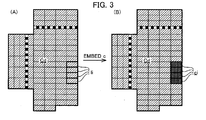
- FIG. 3 will be used to describe a method of embedding authentication information into the correction area of the two-dimensional code 100 illustrated in FIG. 2 , and generating the self-aware two-dimensional code 200.
- 12 RS symbols are extracted from predetermined positions in the RS bit sequence of each block. Subsequently, from among the 12 extracted RS symbols, 6 predetermined symbols are selected in all 4 blocks to acquire a bit sequence m with a bit length of 192 comprising a total of 24 RS symbols.
- bit sequence m is encrypted using Elliptic Curve Cryptography (ECC) to acquire a bit sequence c.
- ECC Elliptic Curve Cryptography
- Elliptic curve cryptography depends on the mathematical difficulty of the Elliptic Curve Discrete Logarithm Problem (ECDLP), and is cryptographically strong because an algorithm that efficiently solves the ECDLP does not exist at this time.
- ECDLP Elliptic Curve Discrete Logarithm Problem
- the cryptographic strength of a 1024-bit RSA key length may be realized with just 160 bits, and the processing time is also short. For this reason, encrypting using elliptic curve cryptography is most preferable.
- the present embodiment exemplifies encrypting a bit sequence using elliptic curve cryptography as an ideal example
- the present invention is not limited thereto, and another encryption scheme is also acceptable.
- asymmetric cryptography public key cryptography
- RSA Rivest-Shamir-Adleman
- ElGamal encryption is also suitably applicable to the present invention.
- encryption such as the Advanced Encryption Standard (AES), the Data Encryption Standard (DES) and the like are also applicable to the present invention.
- the bit sequence c is embedded as authentication information by substituting the bit sequences li with the respective bit sequences ci.
- the self-aware two-dimensional code 200 with authentication information embedded into the correction area is generated by placing the information bit sequence and the RS bit sequence with embedded authentication information according to the placement rule of the original two-dimensional code 100.
- the mobile communication client 20 becomes able to perform a digitizing process by installing the authentication application program to be discussed later onto a device such as a mobile phone or smartphone that has a camera function, for example.
- the mobile communication client 20 is a client configured as an optical information reader capable of optically reading the self-aware two-dimensional code 200.
- the mobile communication client 20 is equipped with a controller 21, an image capture device 22, storage 23, an operating interface 24, a display 25 and a communication device 26.
- the controller 21 is capable of ordinary communication processes as a mobile phone, and is additionally capable of processing image data captured on the basis of a pixel signal from the image capture device 22 that has a camera function.
- the controller 21 mainly comprises a microcontroller, and includes components such as a Central Processing Unit (CPU), a system bus and an input/output interface.
- CPU Central Processing Unit
- the storage 23 comprises established semiconductor memory or the like, such as Read Only Memory (ROM), Random Access Memory (RAM) and non-volatile memory. Designated programs for realizing the telephony functions and communication functions discussed earlier are stored in advance in the storage 23, and an authentication application program downloaded from the authentication server 30 is also stored. As a result, the mobile communication client 20 is configured as a device that digitizes the self-aware two-dimensional code 200 included in image data. In addition, a serial number of the authentication application program is stored in the storage 23.
- ROM Read Only Memory
- RAM Random Access Memory
- the operating interface 24 comprises multiple keys or the like.
- the operating interface 24 has a function of inputting information according to key operations into the controller 21.
- the display 25 comprises a liquid crystal display panel or the like.
- the display 25, under control by the controller 21, has a function of displaying information such as the URL of a product purchase site expressed by the self-aware two-dimensional code 200.
- the communication device 26, under control by the controller 21, has a function of communicating with the authentication server 30 or the like via a network N such as the Internet.
- the authentication server 30 is a device that functions as a server able to communicate with one or multiple mobile communication clients 20 via the network N.
- the authentication server 30 is primarily equipped with a controller 31, storage 32 and a communication device 33.
- the controller 31 centrally controls the storage 32 and the communication device 33.
- the controller 31 mainly comprises a microcontroller and includes components such as a CPU, a system bus and an input/output interface.
- the storage 32 comprises established semiconductor memory or the like, such as ROM, RAM and non-volatile memory.
- a database 32a and an application program for executing the authentication process discussed later are stored in advance in the storage 32. Download data for the authentication application program is also stored in the storage 32.
- serial numbers of the authentication application programs and personal information of the users of the mobile communication clients 20 that have downloaded the authentication application program are registered in association with each other.
- the personal information includes a user's name, address, email address and the like.
- the communication device 33 enables communication via the network N and the like.
- the communication device 33 under control by the controller 31, has a function of communicating with one or multiple mobile communication clients 20 via the network N.
- FIGS. 4 to 6 will be referenced to describe a registration process performed in order to register a user's personal information and an authentication process performed in order to authenticate the mobile communication client 20 and the self-aware two-dimensional code 200 in the authentication system 1 configured in this way.
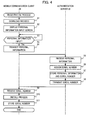
- FIG. 4 is a flowchart exemplifying a flow of the registration process in the authentication system according to the present embodiment.
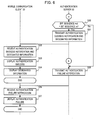
- FIGS. 5 and 6 are flowcharts exemplifying a flow of the authentication process in the authentication system according to the present embodiment.
- the mobile communication client 20 starts the registration process illustrated in FIG. 4 in response to instructions for downloading the authentication application program being given by a user via an operation on the operating interface 24.
- the controller 21 first executes a download process, and downloads the authentication application program from the authentication server 30 via the network N (step S1), and additionally displays a personal information input screen on the display 25 (step S2).
- the controller 21 determines whether or not personal information has been input into the personal information input screen and instructions for transmitting to the authentication server 30 have been given by the user via operations on the operating interface 24 (step S3), and waits by looping (step S3; No) until determining that personal information has been input and transmission instructions have been given.
- step S3 the controller 21 transmits the personal information that was input into the personal information input screen from the communication device 26 to the authentication server 30 via the network N (step S4).
- the controller 31 assigns a serial number to the authentication application program downloaded by the mobile communication client 20 (step S6).
- the controller 31 associates and stores the personal information received in step S5 and the serial number assigned in step S6 in the database 32a of the storage 32 (step S7), and additionally transmits the serial number assigned in step S6 from the communication device 33 to the mobile communication client 20 via the network N (step S8).
- the controller 21 executes an install process and installs the authentication program application downloaded in step S1 in the storage 23 (step S10), additionally stores the serial number received in step S9 in the storage 23 (step S11), and ends the registration process.
- the mobile communication client 20 starts the authentication process illustrated in FIGS. 5 and 6 in response to the image capture device 22 capturing the self-aware two-dimensional code 200.
- the controller 21 first generates a bit signal that includes an image capture bit sequence obtained as a result of the image capture device 22 capturing the self-aware two-dimensional code 200 and a number bit sequence indicating the serial number in the authentication application program being stored in the storage 23 (step S21 in FIG. 5 ), and transmits the generated bit signal from the communication device 26 to the authentication server 30 via the network N (step S22).
- the controller 31 extracts the image capture bit sequence and the number bit sequence from the bit signal (step S24). Subsequently, the controller 31 conducts a user authentication by determining whether or not information matching the serial number indicated by the number bit sequence extracted in step S24 is registered in the database 32a (step S25).
- step S25 the controller 31 decodes the image capture bit sequence extracted in step S24 in accordance with the code placement rule discussed earlier, and thereby acquires an information bit sequence comprising 11 information symbols and an RS bit sequence comprising 22 or 23 RS symbols from each block of the self-aware two-dimensional code 200 (step S26).
- the controller 31 computes the exclusive OR of the image capture bit sequence versus the information bit sequence and RS bit sequence, and thereby detects a bit sequence c' comprising 24 RS symbols as error (step S27).
- the controller 31 computes the exclusive OR of the bit sequence 1 included in the RS bit sequence and the bit sequence c ' detected as error, and thereby acquires an embedded bit sequence c' as authentication information (step S28).
- the controller 31 decrypts the bit sequence c' using a decryption key corresponding to the encryption, and thereby acquires a bit sequence md (step S29).
- the controller 31 determines whether or not the decrypted bit sequence md matches the bit sequence m included in the RS bit sequence, and thereby authenticates the self-aware two-dimensional code 200 (step S30 in FIG. 6 ).
- the controller 31 treats the user's personal information as registered and the self-aware two-dimensional code 200 as not falsified, and transmits, from the communication device 33 to the mobile communication client 20 via the network N, an authentication success notification indicating that the user and the self-aware two-dimensional code 200 were successfully authenticated, and additionally transmits designated information expressed by the information code Cd comprising a total of 44 information symbols that was acquired in step S26 (in the present embodiment, the URL of a product purchase site) (step S31).
- the controller 21 in response to receiving an authentication success notification and designated information transmitted from the authentication server 30 via the network N (step S32), the controller 21 presents a display on the display 25 indicating that the mobile communication client 20 and the self-aware two-dimensional code 200 were successfully authenticated (step S33), and additionally displays the designated information (in the present embodiment, the URL of a product purchase site) on the display 25 to enable access to the purchase site (step S34).
- the designated information in the present embodiment, the URL of a product purchase site
- step S25; No the controller 31 treats the user's personal information as not registered, and in addition, in the case of obtaining an authentication result in which both bit sequences match (step S30; No), the controller 31 treats the self-aware two-dimensional code 200 as falsified, and transmits, from the communication device 33 to the mobile communication client 20 via the network N, an authentication failure notification indicating that the user and/or the self-aware two-dimensional code 200 failed to authenticate (step S35).
- the controller 21 in response to receiving an authentication failure notification transmitted from the authentication server 30 via the network N (step S36), the controller 21 presents a display on the display 25 indicating only that the user and/or the self-aware two-dimensional code 200 failed to authenticate (step S37).
- the mobile communication client 20 transmits to the authentication server 30 a bit signal that includes an image capture bit sequence obtained by capturing an image of the self-aware two-dimensional code 200 with authentication information embedded in a correction area, and a number bit sequence that indicates a serial number of the authentication application program being stored in the storage 23.
- the authentication server 30 authenticates the user of the mobile communication client 20 and the self-aware two-dimensional code 200. Subsequently, the authentication server 30 transmits designated information expressed by the self-aware two-dimensional code 200 to the mobile communication client 20, on the condition that the user and the self-aware two-dimensional code 200 are successfully authenticated. Consequently, the mobile communication client 20 is able to acquire the designated information expressed by the self-aware two-dimensional code 200.
- the self-aware two-dimensional code 200 is generated by acquiring a bit sequence c obtained by computing the exclusive OR between a bit sequence c encrypting a bit sequence m generated from part of an RS code Ce, and a bit sequence 1 generated from a part of the RS code Ce that is different from the above part, and by substituting the bit sequence 1 with the bit sequence c , thereby embedding the bit sequence c into the RS code Ce as authentication information.
- the authentication server 30 is no longer able to detect the exclusive OR of the bit sequence c and the bit sequence 1 as error, and thus is able to detect forgery of the self-aware two-dimensional code 200.
- the mobile communication client 20 does not decode and authenticate the self-aware two-dimensional code 200, but rather transmits a bit signal including an image capture bit sequence obtained by capturing an image of the self-aware two-dimensional code 200, and a number bit sequence that indicates the serial number of the authentication application program being stored in the storage 23. For this reason, devices other than the authentication server 30 are unable to decode the bit signal and acquire the designated information, and thus security may be increased.
- the mobile communication client 20 is able to acquire the designated information expressed by the self-aware two-dimensional code 200 on the condition that the user and the self-aware two-dimensional code 200 are successfully authenticated on the authentication server 30, thus making it possible to prevent access to dangerous websites.
- the serial number of the authentication application assigned during the registration of the user's personal information is used, and since transmitting an Identity Document (ID), password or the like to the authentication server 30 is not necessary, it is possible to prevent divulging the ID, password or the like.
- ID Identity Document
- the present invention is not limited thereto, and the application thereof is arbitrary, such as for requesting a certificate of residence, certificate of a seal impression or the like at a government office.
- the self-aware two-dimensional code 200 is arbitrary, and may be any type of information, such as information indicating a request for a certificate of residence or a certificate of a seal impression at a government office.
- the foregoing embodiment describes that, in the case in which the user and the self-aware two-dimensional code 200 are successfully authenticated, an indication thereof is displayed on the display 25, and in addition, the designated information expressed by the self-aware two-dimensional code 200 is displayed.
- the present invention is not limited thereto, and the display in the case of successfully authenticating the user and the self-aware two-dimensional code 200 is arbitrary. For example, a display indicating that the user and the self-aware two-dimensional code 200 were successfully authenticated may be presented, whereas the designated information expressed by the self-aware two-dimensional code 200 may not be displayed.
- the foregoing embodiment describes authenticating both the user and the self-aware two-dimensional code 200, but the present invention is not limited thereto. For example, only the user may be authenticated, or only the self-aware two-dimensional code 20 may be authenticated.
- the foregoing embodiment describes using the serial number of the authentication application program to authenticate the user, but the present invention is not limited thereto.
- the identification number used to authenticate the user is arbitrary, and may also be an individual identification number of the mobile communication client 20, for example.
- serial number of the authentication application program as being assigned after the input of personal information, but before installing the authentication application program.
- present invention is not limited thereto.
- the assignment timing of the serial number of the authentication application program is arbitrary, and the serial number may be assigned when downloading the authentication application program, or after installing the authentication application program.
- the foregoing embodiment describes encrypting a bit sequence m to generate a bit sequence c, and computing the exclusive OR of the bit sequence c and the bit sequence 1.
- the present invention is not limited thereto, and the exclusive OR of the bit sequence m and the bit sequence 1 may also be computed, without encrypting the bit sequence m.
- the controller 31 uses the RS bit sequence to detect a bit sequence m' as error.
- the controller 31 computes the exclusive OR of the bit sequence 1 included in the RS bit sequence and the bit sequence m' detected as error to acquire a bit sequence m'.
- the self-aware two-dimensional code 200 may then be authenticated by determining whether or not the acquired bit sequence m' matches the bit sequence m included in the RS bit sequence.
- the foregoing embodiment describes the two-dimensional code 100 and the self-aware two-dimensional code 200 as comprising cells of white color and cells of black color.
- the present invention is not limited thereto, and any expression is arbitrarily applicable insofar as designated information is expressed using one or multiple colors with optical characteristics recognized as "0", and one or multiple colors with optical characteristics recognized as "1", by a general-purpose two-dimensional code reader.
- a combined logo/two-dimensional code in which a visible logotype is overlaid onto a two-dimensional code is also acceptable.
- cells of at least a designated luminosity may be overlaid onto a logotype of less than the designated luminosity (a luminosity recognized as "0" by a general-purpose two-dimensional code reader), such that designated information is expressed by the distribution pattern of the cells and the parts of the logotype not overlaid with cells (see Unexamined Japanese Patent Application Kokai Publication No. 2007-287004 , for example).
- cell dots of less than the designated luminosity may be overlaid onto parts of a logotype with at least the designated luminosity, while cell dots of at least the designated luminosity may be overlaid onto parts of a logotype with less than the designated luminosity, such that designated information is expressed by the distribution patterns of the cell dots of at least the designated luminosity and the parts of the logotype with at least the designated luminosity, and the cell dots of less than the designated luminosity and the parts of the logotype with less than the designated luminosity (see Unexamined Japanese Patent Application Kokai Publication No. 2008-15642 , for example). Note that the entirety of the specification, claims, and drawings of Unexamined Japanese Patent Application Kokai Publication No. 2007-287004 and Unexamined Japanese Patent Application Kokai Publication No. 2008-15642 are hereby incorporated by reference.
- the foregoing embodiment is described by taking a QR Code (registered trademark) as an example of a two-dimensional code, but the present invention is not limited thereto.
- the two-dimensional code may also be another matrix-type two-dimensional code, such as a Data Matrix, Aztec Code, Code 1, ArrayTag, box figure code, MaxiCode, Vericode, Softstrip, CP Code, Calra Code or UltraCode.
- a stacked two-dimensional code in which one-dimensional barcodes are vertically stacked, such as PDF417, Code 49 or Code 16K, is also acceptable.
- the foregoing embodiment describes a program executed by the CPU of the authentication server 30 as being stored in ROM or the like in advance, but the present invention is not limited thereto.
- the computer may be made to function as an authentication server 30 according to the foregoing embodiment.
- Such a program may be distributed by being stored on a computer-readable recording medium (such as a flexible disk, a Compact Disc - Read-Only Memory (CD-ROM) or a Digital Versatile Disc - ROM (DVD-ROM)), or the program may be stored in storage on a network such as the Internet, and be provided by being downloaded.
- a computer-readable recording medium such as a flexible disk, a Compact Disc - Read-Only Memory (CD-ROM) or a Digital Versatile Disc - ROM (DVD-ROM)
- CD-ROM Compact Disc - Read-Only Memory
- DVD-ROM Digital Versatile Disc - ROM
- the application program may be stored on a recording medium or in storage.
- the program may be multiplexed onto a carrier wave and delivered via a network.
- the above program may be posted on a Bulletin Board System (BBS) on a network, and the program may be delivered via the network.
- BBS Bulletin Board System
- a configuration enabling the execution of the above processes is possible by subsequently launching and executing this program under control by the OS, similarly to another application program.
Landscapes
- Engineering & Computer Science (AREA)
- Computer Security & Cryptography (AREA)
- Theoretical Computer Science (AREA)
- Physics & Mathematics (AREA)
- General Physics & Mathematics (AREA)
- Computer Hardware Design (AREA)
- General Engineering & Computer Science (AREA)
- Signal Processing (AREA)
- Computer Networks & Wireless Communication (AREA)
- Software Systems (AREA)
- Computing Systems (AREA)
- Information Transfer Between Computers (AREA)
- Telephonic Communication Services (AREA)
- Editing Of Facsimile Originals (AREA)
- Mobile Radio Communication Systems (AREA)
- Management, Administration, Business Operations System, And Electronic Commerce (AREA)
Applications Claiming Priority (1)
| Application Number | Priority Date | Filing Date | Title |
|---|---|---|---|
| PCT/JP2013/068295 WO2015001637A1 (ja) | 2013-07-03 | 2013-07-03 | 認証サーバ、認証システム、認証方法、及びプログラム |
Publications (3)
| Publication Number | Publication Date |
|---|---|
| EP2899663A1 true EP2899663A1 (de) | 2015-07-29 |
| EP2899663A4 EP2899663A4 (de) | 2015-11-11 |
| EP2899663B1 EP2899663B1 (de) | 2019-10-30 |
Family
ID=52143257
Family Applications (1)
| Application Number | Title | Priority Date | Filing Date |
|---|---|---|---|
| EP13888850.8A Active EP2899663B1 (de) | 2013-07-03 | 2013-07-03 | Authentifizierungsserver, authentifizierungssystem, authentifizierungsverfahren und programm |
Country Status (6)
| Country | Link |
|---|---|
| US (1) | US9654291B2 (de) |
| EP (1) | EP2899663B1 (de) |
| JP (1) | JP5869733B2 (de) |
| KR (1) | KR101608184B1 (de) |
| CN (1) | CN104854597B (de) |
| WO (1) | WO2015001637A1 (de) |
Families Citing this family (8)
| Publication number | Priority date | Publication date | Assignee | Title |
|---|---|---|---|---|
| EP2905718A1 (de) * | 2014-02-05 | 2015-08-12 | Thomson Licensing | Vorrichtung und Verfahrenszertifikaterzeugung |
| CN104378344B (zh) * | 2014-05-26 | 2016-03-09 | 腾讯科技(深圳)有限公司 | 登录信息传输方法、扫码方法及装置、后台服务器 |
| JP6488434B1 (ja) * | 2018-08-06 | 2019-03-20 | 藤光樹脂株式会社 | 認証対象発行装置、認証対象発行システム、認証対象発行方法、及びプログラム |
| CN109815465B (zh) * | 2018-12-19 | 2023-11-17 | 平安科技(深圳)有限公司 | 基于深度学习的海报生成方法、装置和计算机设备 |
| WO2020202454A1 (ja) | 2019-04-01 | 2020-10-08 | 佐鳥電機株式会社 | データ復元装置、データ管理サーバ、データ管理システム、データ復元方法、及びプログラム |
| JP6714303B1 (ja) * | 2019-11-12 | 2020-06-24 | 合同会社Ark | 二次元コード生成方法、二次元コード評価方法、二次元コードシステム、二次元コード生成装置、及び二次元コード評価装置 |
| US11080959B1 (en) * | 2020-05-20 | 2021-08-03 | Carlos Manuel Gonzalez | Secure voting system over the internet |
| KR102292595B1 (ko) * | 2021-05-14 | 2021-08-24 | (주)대원씨앤씨 | Qr 코드와 워터마크를 통합한 이미지를 이용한 워터마크 인식 장치 및 그 방법 |
Family Cites Families (17)
| Publication number | Priority date | Publication date | Assignee | Title |
|---|---|---|---|---|
| JP2938338B2 (ja) | 1994-03-14 | 1999-08-23 | 株式会社デンソー | 二次元コード |
| US5726435A (en) | 1994-03-14 | 1998-03-10 | Nippondenso Co., Ltd. | Optically readable two-dimensional code and method and apparatus using the same |
| JP4519963B2 (ja) * | 1999-06-21 | 2010-08-04 | 富士通株式会社 | 生体情報の暗号化・復号化方法および装置並びに、生体情報を利用した本人認証システム |
| EP2128790A3 (de) * | 2004-03-12 | 2011-01-26 | Ingenia Technology Limited | Verfahren und vorrichtungen zur erzeugung authentifizierbarer gedruckter artikel sowie zu deren späteren verifikation |
| JP4268575B2 (ja) | 2004-08-16 | 2009-05-27 | 株式会社野村総合研究所 | 二次元コードを用いた認証システム |
| JP4330601B2 (ja) | 2006-07-04 | 2009-09-16 | A・Tコミュニケーションズ株式会社 | ロゴ付き二次元コード |
| JP4781892B2 (ja) | 2006-04-19 | 2011-09-28 | A・Tコミュニケーションズ株式会社 | ロゴ付き二次元コード |
| CN1885311A (zh) | 2006-05-29 | 2006-12-27 | 深圳矽感科技有限公司 | 二维码及其编解码方法 |
| JP2010518468A (ja) * | 2007-01-16 | 2010-05-27 | アブソリュート ソフトウェア コーポレイション | ホストエージェントと協働する補助エージェントを備えたセキュリティモジュール |
| JP2008234530A (ja) | 2007-03-23 | 2008-10-02 | Xing Inc | 情報配信システム |
| US8162222B2 (en) * | 2008-01-25 | 2012-04-24 | Intermec Ip Corp. | System and method for identifying erasures in a 2D symbol |
| JP5120156B2 (ja) | 2008-03-27 | 2013-01-16 | 株式会社デンソーウェーブ | 二次元コード |
| JP5397062B2 (ja) | 2009-07-21 | 2014-01-22 | 富士通株式会社 | 割符ファイル生成プログラム及び方法、並びにデータ復元プログラム及び方法 |
| KR20110020694A (ko) * | 2009-08-24 | 2011-03-03 | 삼성전자주식회사 | 네트워크를 통한 기능 공유 방법 및 장치 |
| CN102163291B (zh) | 2010-02-22 | 2013-04-24 | 上海镭立激光科技有限公司 | 激光标刻多重加密二维码指纹防伪认证方法和系统 |
| JP5542075B2 (ja) * | 2011-03-01 | 2014-07-09 | 日本放送協会 | 認証サーバ、認証プログラムおよび認証システム |
| CN103049779B (zh) | 2012-12-31 | 2016-12-28 | 郑莹娜 | 食品安全责任险电子保单二维码凭证的生成和识别方法 |
-
2013
- 2013-07-03 JP JP2015518699A patent/JP5869733B2/ja not_active Expired - Fee Related
- 2013-07-03 EP EP13888850.8A patent/EP2899663B1/de active Active
- 2013-07-03 US US14/773,718 patent/US9654291B2/en not_active Expired - Fee Related
- 2013-07-03 KR KR1020157017083A patent/KR101608184B1/ko not_active Expired - Fee Related
- 2013-07-03 CN CN201380064599.9A patent/CN104854597B/zh not_active Expired - Fee Related
- 2013-07-03 WO PCT/JP2013/068295 patent/WO2015001637A1/ja not_active Ceased
Also Published As
| Publication number | Publication date |
|---|---|
| US20160036589A1 (en) | 2016-02-04 |
| CN104854597A (zh) | 2015-08-19 |
| EP2899663B1 (de) | 2019-10-30 |
| JP5869733B2 (ja) | 2016-02-24 |
| KR20150081456A (ko) | 2015-07-14 |
| WO2015001637A1 (ja) | 2015-01-08 |
| HK1212487A1 (en) | 2016-06-10 |
| KR101608184B1 (ko) | 2016-03-31 |
| CN104854597B (zh) | 2017-03-08 |
| EP2899663A4 (de) | 2015-11-11 |
| JPWO2015001637A1 (ja) | 2017-02-23 |
| US9654291B2 (en) | 2017-05-16 |
Similar Documents
| Publication | Publication Date | Title |
|---|---|---|
| EP2899663B1 (de) | Authentifizierungsserver, authentifizierungssystem, authentifizierungsverfahren und programm | |
| EP2765531B1 (de) | Vorrichtung zur authentifizierung zweidimensionaler codes, verfahren zur authentifizierung zweidimensionaler codes und programm | |
| ES2680152T3 (es) | Método y aparato de autenticación conveniente para el usuario usando una aplicación de autenticación móvil | |
| US9213930B2 (en) | Secure barcodes | |
| JP6020089B2 (ja) | 不正検知システム | |
| US20140227999A1 (en) | Method, server and system for authentication of a person | |
| CN106599964A (zh) | 一种二维码生成、验证方法及装置 | |
| CN103258265B (zh) | 一种基于条形码表示的id认证方法 | |
| CN112307503B (zh) | 签章管理方法、装置和电子设备 | |
| JP6031729B1 (ja) | Rfidタグコード生成装置およびその方法、認証装置およびその方法、ならびにプログラム | |
| GB2510156A (en) | A method for operating a remote financial transaction system | |
| HK1212487B (en) | Authentication server, authentication system, and authentication method | |
| EP3116159A1 (de) | Verfahren und vorrichtung zur sichern datenübertragung | |
| JP2015201022A (ja) | 不正検知システム | |
| Yin et al. | Redesigning qr code ecosystem with improved mobile security | |
| GB2635546A (en) | Visual integrity checks | |
| WO2022248726A1 (en) | A method, system and apparatus for approving electronic transactions | |
| CN111130792A (zh) | 一种静态同步数据运算的方法、装置 | |
| KR101634785B1 (ko) | Mitm 공격 방지 장치 및 방법 | |
| HK1208551B (en) | Two-dimensional code authenticating device, two-dimensional code generating device and two-dimensional code authenticating method |
Legal Events
| Date | Code | Title | Description |
|---|---|---|---|
| PUAI | Public reference made under article 153(3) epc to a published international application that has entered the european phase |
Free format text: ORIGINAL CODE: 0009012 |
|
| 17P | Request for examination filed |
Effective date: 20150420 |
|
| AK | Designated contracting states |
Kind code of ref document: A1 Designated state(s): AL AT BE BG CH CY CZ DE DK EE ES FI FR GB GR HR HU IE IS IT LI LT LU LV MC MK MT NL NO PL PT RO RS SE SI SK SM TR |
|
| AX | Request for extension of the european patent |
Extension state: BA ME |
|
| RA4 | Supplementary search report drawn up and despatched (corrected) |
Effective date: 20151012 |
|
| RIC1 | Information provided on ipc code assigned before grant |
Ipc: G06F 21/44 20130101AFI20151006BHEP Ipc: G09C 1/00 20060101ALI20151006BHEP Ipc: G06K 7/00 20060101ALI20151006BHEP Ipc: H04L 29/06 20060101ALI20151006BHEP |
|
| DAX | Request for extension of the european patent (deleted) | ||
| STAA | Information on the status of an ep patent application or granted ep patent |
Free format text: STATUS: EXAMINATION IS IN PROGRESS |
|
| 17Q | First examination report despatched |
Effective date: 20170217 |
|
| GRAP | Despatch of communication of intention to grant a patent |
Free format text: ORIGINAL CODE: EPIDOSNIGR1 |
|
| STAA | Information on the status of an ep patent application or granted ep patent |
Free format text: STATUS: GRANT OF PATENT IS INTENDED |
|
| INTG | Intention to grant announced |
Effective date: 20190523 |
|
| GRAS | Grant fee paid |
Free format text: ORIGINAL CODE: EPIDOSNIGR3 |
|
| GRAA | (expected) grant |
Free format text: ORIGINAL CODE: 0009210 |
|
| STAA | Information on the status of an ep patent application or granted ep patent |
Free format text: STATUS: THE PATENT HAS BEEN GRANTED |
|
| AK | Designated contracting states |
Kind code of ref document: B1 Designated state(s): AL AT BE BG CH CY CZ DE DK EE ES FI FR GB GR HR HU IE IS IT LI LT LU LV MC MK MT NL NO PL PT RO RS SE SI SK SM TR |
|
| REG | Reference to a national code |
Ref country code: GB Ref legal event code: FG4D |
|
| REG | Reference to a national code |
Ref country code: CH Ref legal event code: EP |
|
| REG | Reference to a national code |
Ref country code: AT Ref legal event code: REF Ref document number: 1196918 Country of ref document: AT Kind code of ref document: T Effective date: 20191115 |
|
| REG | Reference to a national code |
Ref country code: DE Ref legal event code: R096 Ref document number: 602013062379 Country of ref document: DE |
|
| REG | Reference to a national code |
Ref country code: IE Ref legal event code: FG4D |
|
| REG | Reference to a national code |
Ref country code: LT Ref legal event code: MG4D |
|
| PG25 | Lapsed in a contracting state [announced via postgrant information from national office to epo] |
Ref country code: PT Free format text: LAPSE BECAUSE OF FAILURE TO SUBMIT A TRANSLATION OF THE DESCRIPTION OR TO PAY THE FEE WITHIN THE PRESCRIBED TIME-LIMIT Effective date: 20200302 Ref country code: FI Free format text: LAPSE BECAUSE OF FAILURE TO SUBMIT A TRANSLATION OF THE DESCRIPTION OR TO PAY THE FEE WITHIN THE PRESCRIBED TIME-LIMIT Effective date: 20191030 Ref country code: LV Free format text: LAPSE BECAUSE OF FAILURE TO SUBMIT A TRANSLATION OF THE DESCRIPTION OR TO PAY THE FEE WITHIN THE PRESCRIBED TIME-LIMIT Effective date: 20191030 Ref country code: BG Free format text: LAPSE BECAUSE OF FAILURE TO SUBMIT A TRANSLATION OF THE DESCRIPTION OR TO PAY THE FEE WITHIN THE PRESCRIBED TIME-LIMIT Effective date: 20200130 Ref country code: SE Free format text: LAPSE BECAUSE OF FAILURE TO SUBMIT A TRANSLATION OF THE DESCRIPTION OR TO PAY THE FEE WITHIN THE PRESCRIBED TIME-LIMIT Effective date: 20191030 Ref country code: LT Free format text: LAPSE BECAUSE OF FAILURE TO SUBMIT A TRANSLATION OF THE DESCRIPTION OR TO PAY THE FEE WITHIN THE PRESCRIBED TIME-LIMIT Effective date: 20191030 Ref country code: NO Free format text: LAPSE BECAUSE OF FAILURE TO SUBMIT A TRANSLATION OF THE DESCRIPTION OR TO PAY THE FEE WITHIN THE PRESCRIBED TIME-LIMIT Effective date: 20200130 Ref country code: GR Free format text: LAPSE BECAUSE OF FAILURE TO SUBMIT A TRANSLATION OF THE DESCRIPTION OR TO PAY THE FEE WITHIN THE PRESCRIBED TIME-LIMIT Effective date: 20200131 Ref country code: PL Free format text: LAPSE BECAUSE OF FAILURE TO SUBMIT A TRANSLATION OF THE DESCRIPTION OR TO PAY THE FEE WITHIN THE PRESCRIBED TIME-LIMIT Effective date: 20191030 Ref country code: ES Free format text: LAPSE BECAUSE OF FAILURE TO SUBMIT A TRANSLATION OF THE DESCRIPTION OR TO PAY THE FEE WITHIN THE PRESCRIBED TIME-LIMIT Effective date: 20191030 Ref country code: NL Free format text: LAPSE BECAUSE OF FAILURE TO SUBMIT A TRANSLATION OF THE DESCRIPTION OR TO PAY THE FEE WITHIN THE PRESCRIBED TIME-LIMIT Effective date: 20191030 |
|
| REG | Reference to a national code |
Ref country code: NL Ref legal event code: MP Effective date: 20191030 |
|
| PG25 | Lapsed in a contracting state [announced via postgrant information from national office to epo] |
Ref country code: HR Free format text: LAPSE BECAUSE OF FAILURE TO SUBMIT A TRANSLATION OF THE DESCRIPTION OR TO PAY THE FEE WITHIN THE PRESCRIBED TIME-LIMIT Effective date: 20191030 Ref country code: IS Free format text: LAPSE BECAUSE OF FAILURE TO SUBMIT A TRANSLATION OF THE DESCRIPTION OR TO PAY THE FEE WITHIN THE PRESCRIBED TIME-LIMIT Effective date: 20200229 Ref country code: RS Free format text: LAPSE BECAUSE OF FAILURE TO SUBMIT A TRANSLATION OF THE DESCRIPTION OR TO PAY THE FEE WITHIN THE PRESCRIBED TIME-LIMIT Effective date: 20191030 |
|
| PG25 | Lapsed in a contracting state [announced via postgrant information from national office to epo] |
Ref country code: AL Free format text: LAPSE BECAUSE OF FAILURE TO SUBMIT A TRANSLATION OF THE DESCRIPTION OR TO PAY THE FEE WITHIN THE PRESCRIBED TIME-LIMIT Effective date: 20191030 |
|
| PG25 | Lapsed in a contracting state [announced via postgrant information from national office to epo] |
Ref country code: EE Free format text: LAPSE BECAUSE OF FAILURE TO SUBMIT A TRANSLATION OF THE DESCRIPTION OR TO PAY THE FEE WITHIN THE PRESCRIBED TIME-LIMIT Effective date: 20191030 Ref country code: DK Free format text: LAPSE BECAUSE OF FAILURE TO SUBMIT A TRANSLATION OF THE DESCRIPTION OR TO PAY THE FEE WITHIN THE PRESCRIBED TIME-LIMIT Effective date: 20191030 Ref country code: RO Free format text: LAPSE BECAUSE OF FAILURE TO SUBMIT A TRANSLATION OF THE DESCRIPTION OR TO PAY THE FEE WITHIN THE PRESCRIBED TIME-LIMIT Effective date: 20191030 Ref country code: CZ Free format text: LAPSE BECAUSE OF FAILURE TO SUBMIT A TRANSLATION OF THE DESCRIPTION OR TO PAY THE FEE WITHIN THE PRESCRIBED TIME-LIMIT Effective date: 20191030 |
|
| REG | Reference to a national code |
Ref country code: DE Ref legal event code: R097 Ref document number: 602013062379 Country of ref document: DE |
|
| REG | Reference to a national code |
Ref country code: AT Ref legal event code: MK05 Ref document number: 1196918 Country of ref document: AT Kind code of ref document: T Effective date: 20191030 |
|
| PG25 | Lapsed in a contracting state [announced via postgrant information from national office to epo] |
Ref country code: SM Free format text: LAPSE BECAUSE OF FAILURE TO SUBMIT A TRANSLATION OF THE DESCRIPTION OR TO PAY THE FEE WITHIN THE PRESCRIBED TIME-LIMIT Effective date: 20191030 Ref country code: IT Free format text: LAPSE BECAUSE OF FAILURE TO SUBMIT A TRANSLATION OF THE DESCRIPTION OR TO PAY THE FEE WITHIN THE PRESCRIBED TIME-LIMIT Effective date: 20191030 Ref country code: SK Free format text: LAPSE BECAUSE OF FAILURE TO SUBMIT A TRANSLATION OF THE DESCRIPTION OR TO PAY THE FEE WITHIN THE PRESCRIBED TIME-LIMIT Effective date: 20191030 |
|
| PLBE | No opposition filed within time limit |
Free format text: ORIGINAL CODE: 0009261 |
|
| STAA | Information on the status of an ep patent application or granted ep patent |
Free format text: STATUS: NO OPPOSITION FILED WITHIN TIME LIMIT |
|
| 26N | No opposition filed |
Effective date: 20200731 |
|
| PG25 | Lapsed in a contracting state [announced via postgrant information from national office to epo] |
Ref country code: AT Free format text: LAPSE BECAUSE OF FAILURE TO SUBMIT A TRANSLATION OF THE DESCRIPTION OR TO PAY THE FEE WITHIN THE PRESCRIBED TIME-LIMIT Effective date: 20191030 Ref country code: SI Free format text: LAPSE BECAUSE OF FAILURE TO SUBMIT A TRANSLATION OF THE DESCRIPTION OR TO PAY THE FEE WITHIN THE PRESCRIBED TIME-LIMIT Effective date: 20191030 |
|
| PG25 | Lapsed in a contracting state [announced via postgrant information from national office to epo] |
Ref country code: MC Free format text: LAPSE BECAUSE OF FAILURE TO SUBMIT A TRANSLATION OF THE DESCRIPTION OR TO PAY THE FEE WITHIN THE PRESCRIBED TIME-LIMIT Effective date: 20191030 |
|
| REG | Reference to a national code |
Ref country code: CH Ref legal event code: PL |
|
| GBPC | Gb: european patent ceased through non-payment of renewal fee |
Effective date: 20200703 |
|
| REG | Reference to a national code |
Ref country code: BE Ref legal event code: MM Effective date: 20200731 |
|
| PG25 | Lapsed in a contracting state [announced via postgrant information from national office to epo] |
Ref country code: GB Free format text: LAPSE BECAUSE OF NON-PAYMENT OF DUE FEES Effective date: 20200703 Ref country code: FR Free format text: LAPSE BECAUSE OF NON-PAYMENT OF DUE FEES Effective date: 20200731 Ref country code: LU Free format text: LAPSE BECAUSE OF NON-PAYMENT OF DUE FEES Effective date: 20200703 Ref country code: CH Free format text: LAPSE BECAUSE OF NON-PAYMENT OF DUE FEES Effective date: 20200731 Ref country code: LI Free format text: LAPSE BECAUSE OF NON-PAYMENT OF DUE FEES Effective date: 20200731 Ref country code: IE Free format text: LAPSE BECAUSE OF NON-PAYMENT OF DUE FEES Effective date: 20200703 |
|
| PG25 | Lapsed in a contracting state [announced via postgrant information from national office to epo] |
Ref country code: BE Free format text: LAPSE BECAUSE OF NON-PAYMENT OF DUE FEES Effective date: 20200731 |
|
| PG25 | Lapsed in a contracting state [announced via postgrant information from national office to epo] |
Ref country code: TR Free format text: LAPSE BECAUSE OF FAILURE TO SUBMIT A TRANSLATION OF THE DESCRIPTION OR TO PAY THE FEE WITHIN THE PRESCRIBED TIME-LIMIT Effective date: 20191030 Ref country code: MT Free format text: LAPSE BECAUSE OF FAILURE TO SUBMIT A TRANSLATION OF THE DESCRIPTION OR TO PAY THE FEE WITHIN THE PRESCRIBED TIME-LIMIT Effective date: 20191030 Ref country code: CY Free format text: LAPSE BECAUSE OF FAILURE TO SUBMIT A TRANSLATION OF THE DESCRIPTION OR TO PAY THE FEE WITHIN THE PRESCRIBED TIME-LIMIT Effective date: 20191030 |
|
| PG25 | Lapsed in a contracting state [announced via postgrant information from national office to epo] |
Ref country code: MK Free format text: LAPSE BECAUSE OF FAILURE TO SUBMIT A TRANSLATION OF THE DESCRIPTION OR TO PAY THE FEE WITHIN THE PRESCRIBED TIME-LIMIT Effective date: 20191030 |
|
| PGFP | Annual fee paid to national office [announced via postgrant information from national office to epo] |
Ref country code: DE Payment date: 20220719 Year of fee payment: 10 |
|
| REG | Reference to a national code |
Ref country code: DE Ref legal event code: R119 Ref document number: 602013062379 Country of ref document: DE |
|
| PG25 | Lapsed in a contracting state [announced via postgrant information from national office to epo] |
Ref country code: DE Free format text: LAPSE BECAUSE OF NON-PAYMENT OF DUE FEES Effective date: 20240201 |