EP2899794B1 - Lithium-zweitbatterie - Google Patents
Lithium-zweitbatterie Download PDFInfo
- Publication number
- EP2899794B1 EP2899794B1 EP14830490.0A EP14830490A EP2899794B1 EP 2899794 B1 EP2899794 B1 EP 2899794B1 EP 14830490 A EP14830490 A EP 14830490A EP 2899794 B1 EP2899794 B1 EP 2899794B1
- Authority
- EP
- European Patent Office
- Prior art keywords
- secondary battery
- ionomer
- anode
- cathode
- lithium secondary
- Prior art date
- Legal status (The legal status is an assumption and is not a legal conclusion. Google has not performed a legal analysis and makes no representation as to the accuracy of the status listed.)
- Active
Links
Images



Classifications
-
- H—ELECTRICITY
- H01—ELECTRIC ELEMENTS
- H01M—PROCESSES OR MEANS, e.g. BATTERIES, FOR THE DIRECT CONVERSION OF CHEMICAL ENERGY INTO ELECTRICAL ENERGY
- H01M10/00—Secondary cells; Manufacture thereof
- H01M10/42—Methods or arrangements for servicing or maintenance of secondary cells or secondary half-cells
- H01M10/4235—Safety or regulating additives or arrangements in electrodes, separators or electrolyte
-
- H—ELECTRICITY
- H01—ELECTRIC ELEMENTS
- H01M—PROCESSES OR MEANS, e.g. BATTERIES, FOR THE DIRECT CONVERSION OF CHEMICAL ENERGY INTO ELECTRICAL ENERGY
- H01M4/00—Electrodes
- H01M4/02—Electrodes composed of, or comprising, active material
- H01M4/62—Selection of inactive substances as ingredients for active masses, e.g. binders, fillers
-
- H—ELECTRICITY
- H01—ELECTRIC ELEMENTS
- H01M—PROCESSES OR MEANS, e.g. BATTERIES, FOR THE DIRECT CONVERSION OF CHEMICAL ENERGY INTO ELECTRICAL ENERGY
- H01M10/00—Secondary cells; Manufacture thereof
- H01M10/05—Accumulators with non-aqueous electrolyte
- H01M10/052—Li-accumulators
- H01M10/0525—Rocking-chair batteries, i.e. batteries with lithium insertion or intercalation in both electrodes; Lithium-ion batteries
-
- H—ELECTRICITY
- H01—ELECTRIC ELEMENTS
- H01M—PROCESSES OR MEANS, e.g. BATTERIES, FOR THE DIRECT CONVERSION OF CHEMICAL ENERGY INTO ELECTRICAL ENERGY
- H01M10/00—Secondary cells; Manufacture thereof
- H01M10/05—Accumulators with non-aqueous electrolyte
- H01M10/052—Li-accumulators
-
- H—ELECTRICITY
- H01—ELECTRIC ELEMENTS
- H01M—PROCESSES OR MEANS, e.g. BATTERIES, FOR THE DIRECT CONVERSION OF CHEMICAL ENERGY INTO ELECTRICAL ENERGY
- H01M10/00—Secondary cells; Manufacture thereof
- H01M10/05—Accumulators with non-aqueous electrolyte
- H01M10/056—Accumulators with non-aqueous electrolyte characterised by the materials used as electrolytes, e.g. mixed inorganic/organic electrolytes
-
- H—ELECTRICITY
- H01—ELECTRIC ELEMENTS
- H01M—PROCESSES OR MEANS, e.g. BATTERIES, FOR THE DIRECT CONVERSION OF CHEMICAL ENERGY INTO ELECTRICAL ENERGY
- H01M10/00—Secondary cells; Manufacture thereof
- H01M10/05—Accumulators with non-aqueous electrolyte
- H01M10/056—Accumulators with non-aqueous electrolyte characterised by the materials used as electrolytes, e.g. mixed inorganic/organic electrolytes
- H01M10/0564—Accumulators with non-aqueous electrolyte characterised by the materials used as electrolytes, e.g. mixed inorganic/organic electrolytes the electrolyte being constituted of organic materials only
- H01M10/0566—Liquid materials
- H01M10/0567—Liquid materials characterised by the additives
-
- H—ELECTRICITY
- H01—ELECTRIC ELEMENTS
- H01M—PROCESSES OR MEANS, e.g. BATTERIES, FOR THE DIRECT CONVERSION OF CHEMICAL ENERGY INTO ELECTRICAL ENERGY
- H01M10/00—Secondary cells; Manufacture thereof
- H01M10/05—Accumulators with non-aqueous electrolyte
- H01M10/056—Accumulators with non-aqueous electrolyte characterised by the materials used as electrolytes, e.g. mixed inorganic/organic electrolytes
- H01M10/0564—Accumulators with non-aqueous electrolyte characterised by the materials used as electrolytes, e.g. mixed inorganic/organic electrolytes the electrolyte being constituted of organic materials only
- H01M10/0566—Liquid materials
- H01M10/0568—Liquid materials characterised by the solutes
-
- H—ELECTRICITY
- H01—ELECTRIC ELEMENTS
- H01M—PROCESSES OR MEANS, e.g. BATTERIES, FOR THE DIRECT CONVERSION OF CHEMICAL ENERGY INTO ELECTRICAL ENERGY
- H01M10/00—Secondary cells; Manufacture thereof
- H01M10/05—Accumulators with non-aqueous electrolyte
- H01M10/056—Accumulators with non-aqueous electrolyte characterised by the materials used as electrolytes, e.g. mixed inorganic/organic electrolytes
- H01M10/0564—Accumulators with non-aqueous electrolyte characterised by the materials used as electrolytes, e.g. mixed inorganic/organic electrolytes the electrolyte being constituted of organic materials only
- H01M10/0566—Liquid materials
- H01M10/0569—Liquid materials characterised by the solvents
-
- H—ELECTRICITY
- H01—ELECTRIC ELEMENTS
- H01M—PROCESSES OR MEANS, e.g. BATTERIES, FOR THE DIRECT CONVERSION OF CHEMICAL ENERGY INTO ELECTRICAL ENERGY
- H01M4/00—Electrodes
- H01M4/02—Electrodes composed of, or comprising, active material
- H01M4/04—Processes of manufacture in general
- H01M4/0402—Methods of deposition of the material
- H01M4/0404—Methods of deposition of the material by coating on electrode collectors
-
- H—ELECTRICITY
- H01—ELECTRIC ELEMENTS
- H01M—PROCESSES OR MEANS, e.g. BATTERIES, FOR THE DIRECT CONVERSION OF CHEMICAL ENERGY INTO ELECTRICAL ENERGY
- H01M4/00—Electrodes
- H01M4/02—Electrodes composed of, or comprising, active material
- H01M4/13—Electrodes for accumulators with non-aqueous electrolyte, e.g. for lithium-accumulators; Processes of manufacture thereof
-
- H—ELECTRICITY
- H01—ELECTRIC ELEMENTS
- H01M—PROCESSES OR MEANS, e.g. BATTERIES, FOR THE DIRECT CONVERSION OF CHEMICAL ENERGY INTO ELECTRICAL ENERGY
- H01M50/00—Constructional details or processes of manufacture of the non-active parts of electrochemical cells other than fuel cells, e.g. hybrid cells
- H01M50/40—Separators; Membranes; Diaphragms; Spacing elements inside cells
- H01M50/409—Separators, membranes or diaphragms characterised by the material
- H01M50/411—Organic material
- H01M50/414—Synthetic resins, e.g. thermoplastics or thermosetting resins
- H01M50/417—Polyolefins
-
- H—ELECTRICITY
- H01—ELECTRIC ELEMENTS
- H01M—PROCESSES OR MEANS, e.g. BATTERIES, FOR THE DIRECT CONVERSION OF CHEMICAL ENERGY INTO ELECTRICAL ENERGY
- H01M50/00—Constructional details or processes of manufacture of the non-active parts of electrochemical cells other than fuel cells, e.g. hybrid cells
- H01M50/40—Separators; Membranes; Diaphragms; Spacing elements inside cells
- H01M50/409—Separators, membranes or diaphragms characterised by the material
- H01M50/449—Separators, membranes or diaphragms characterised by the material having a layered structure
-
- H—ELECTRICITY
- H01—ELECTRIC ELEMENTS
- H01M—PROCESSES OR MEANS, e.g. BATTERIES, FOR THE DIRECT CONVERSION OF CHEMICAL ENERGY INTO ELECTRICAL ENERGY
- H01M50/00—Constructional details or processes of manufacture of the non-active parts of electrochemical cells other than fuel cells, e.g. hybrid cells
- H01M50/40—Separators; Membranes; Diaphragms; Spacing elements inside cells
- H01M50/409—Separators, membranes or diaphragms characterised by the material
- H01M50/449—Separators, membranes or diaphragms characterised by the material having a layered structure
- H01M50/451—Separators, membranes or diaphragms characterised by the material having a layered structure comprising layers of only organic material and layers containing inorganic material
-
- H—ELECTRICITY
- H01—ELECTRIC ELEMENTS
- H01M—PROCESSES OR MEANS, e.g. BATTERIES, FOR THE DIRECT CONVERSION OF CHEMICAL ENERGY INTO ELECTRICAL ENERGY
- H01M50/00—Constructional details or processes of manufacture of the non-active parts of electrochemical cells other than fuel cells, e.g. hybrid cells
- H01M50/40—Separators; Membranes; Diaphragms; Spacing elements inside cells
- H01M50/409—Separators, membranes or diaphragms characterised by the material
- H01M50/449—Separators, membranes or diaphragms characterised by the material having a layered structure
- H01M50/454—Separators, membranes or diaphragms characterised by the material having a layered structure comprising a non-fibrous layer and a fibrous layer superimposed on one another
-
- H—ELECTRICITY
- H01—ELECTRIC ELEMENTS
- H01M—PROCESSES OR MEANS, e.g. BATTERIES, FOR THE DIRECT CONVERSION OF CHEMICAL ENERGY INTO ELECTRICAL ENERGY
- H01M50/00—Constructional details or processes of manufacture of the non-active parts of electrochemical cells other than fuel cells, e.g. hybrid cells
- H01M50/40—Separators; Membranes; Diaphragms; Spacing elements inside cells
- H01M50/489—Separators, membranes, diaphragms or spacing elements inside the cells, characterised by their physical properties, e.g. swelling degree, hydrophilicity or shut down properties
- H01M50/491—Porosity
-
- H—ELECTRICITY
- H01—ELECTRIC ELEMENTS
- H01M—PROCESSES OR MEANS, e.g. BATTERIES, FOR THE DIRECT CONVERSION OF CHEMICAL ENERGY INTO ELECTRICAL ENERGY
- H01M2300/00—Electrolytes
- H01M2300/0017—Non-aqueous electrolytes
- H01M2300/0025—Organic electrolyte
-
- H—ELECTRICITY
- H01—ELECTRIC ELEMENTS
- H01M—PROCESSES OR MEANS, e.g. BATTERIES, FOR THE DIRECT CONVERSION OF CHEMICAL ENERGY INTO ELECTRICAL ENERGY
- H01M4/00—Electrodes
- H01M4/02—Electrodes composed of, or comprising, active material
- H01M4/13—Electrodes for accumulators with non-aqueous electrolyte, e.g. for lithium-accumulators; Processes of manufacture thereof
- H01M4/131—Electrodes based on mixed oxides or hydroxides, or on mixtures of oxides or hydroxides, e.g. LiCoOx
-
- H—ELECTRICITY
- H01—ELECTRIC ELEMENTS
- H01M—PROCESSES OR MEANS, e.g. BATTERIES, FOR THE DIRECT CONVERSION OF CHEMICAL ENERGY INTO ELECTRICAL ENERGY
- H01M4/00—Electrodes
- H01M4/02—Electrodes composed of, or comprising, active material
- H01M4/13—Electrodes for accumulators with non-aqueous electrolyte, e.g. for lithium-accumulators; Processes of manufacture thereof
- H01M4/133—Electrodes based on carbonaceous material, e.g. graphite-intercalation compounds or CFx
-
- H—ELECTRICITY
- H01—ELECTRIC ELEMENTS
- H01M—PROCESSES OR MEANS, e.g. BATTERIES, FOR THE DIRECT CONVERSION OF CHEMICAL ENERGY INTO ELECTRICAL ENERGY
- H01M4/00—Electrodes
- H01M4/02—Electrodes composed of, or comprising, active material
- H01M4/13—Electrodes for accumulators with non-aqueous electrolyte, e.g. for lithium-accumulators; Processes of manufacture thereof
- H01M4/139—Processes of manufacture
-
- H—ELECTRICITY
- H01—ELECTRIC ELEMENTS
- H01M—PROCESSES OR MEANS, e.g. BATTERIES, FOR THE DIRECT CONVERSION OF CHEMICAL ENERGY INTO ELECTRICAL ENERGY
- H01M4/00—Electrodes
- H01M4/02—Electrodes composed of, or comprising, active material
- H01M4/13—Electrodes for accumulators with non-aqueous electrolyte, e.g. for lithium-accumulators; Processes of manufacture thereof
- H01M4/139—Processes of manufacture
- H01M4/1391—Processes of manufacture of electrodes based on mixed oxides or hydroxides, or on mixtures of oxides or hydroxides, e.g. LiCoOx
-
- H—ELECTRICITY
- H01—ELECTRIC ELEMENTS
- H01M—PROCESSES OR MEANS, e.g. BATTERIES, FOR THE DIRECT CONVERSION OF CHEMICAL ENERGY INTO ELECTRICAL ENERGY
- H01M4/00—Electrodes
- H01M4/02—Electrodes composed of, or comprising, active material
- H01M4/13—Electrodes for accumulators with non-aqueous electrolyte, e.g. for lithium-accumulators; Processes of manufacture thereof
- H01M4/139—Processes of manufacture
- H01M4/1393—Processes of manufacture of electrodes based on carbonaceous material, e.g. graphite-intercalation compounds or CFx
-
- H—ELECTRICITY
- H01—ELECTRIC ELEMENTS
- H01M—PROCESSES OR MEANS, e.g. BATTERIES, FOR THE DIRECT CONVERSION OF CHEMICAL ENERGY INTO ELECTRICAL ENERGY
- H01M4/00—Electrodes
- H01M4/02—Electrodes composed of, or comprising, active material
- H01M4/62—Selection of inactive substances as ingredients for active masses, e.g. binders, fillers
- H01M4/621—Binders
- H01M4/622—Binders being polymers
- H01M4/623—Binders being polymers fluorinated polymers
-
- H—ELECTRICITY
- H01—ELECTRIC ELEMENTS
- H01M—PROCESSES OR MEANS, e.g. BATTERIES, FOR THE DIRECT CONVERSION OF CHEMICAL ENERGY INTO ELECTRICAL ENERGY
- H01M50/00—Constructional details or processes of manufacture of the non-active parts of electrochemical cells other than fuel cells, e.g. hybrid cells
- H01M50/40—Separators; Membranes; Diaphragms; Spacing elements inside cells
- H01M50/489—Separators, membranes, diaphragms or spacing elements inside the cells, characterised by their physical properties, e.g. swelling degree, hydrophilicity or shut down properties
-
- Y—GENERAL TAGGING OF NEW TECHNOLOGICAL DEVELOPMENTS; GENERAL TAGGING OF CROSS-SECTIONAL TECHNOLOGIES SPANNING OVER SEVERAL SECTIONS OF THE IPC; TECHNICAL SUBJECTS COVERED BY FORMER USPC CROSS-REFERENCE ART COLLECTIONS [XRACs] AND DIGESTS
- Y02—TECHNOLOGIES OR APPLICATIONS FOR MITIGATION OR ADAPTATION AGAINST CLIMATE CHANGE
- Y02E—REDUCTION OF GREENHOUSE GAS [GHG] EMISSIONS, RELATED TO ENERGY GENERATION, TRANSMISSION OR DISTRIBUTION
- Y02E60/00—Enabling technologies; Technologies with a potential or indirect contribution to GHG emissions mitigation
- Y02E60/10—Energy storage using batteries
-
- Y—GENERAL TAGGING OF NEW TECHNOLOGICAL DEVELOPMENTS; GENERAL TAGGING OF CROSS-SECTIONAL TECHNOLOGIES SPANNING OVER SEVERAL SECTIONS OF THE IPC; TECHNICAL SUBJECTS COVERED BY FORMER USPC CROSS-REFERENCE ART COLLECTIONS [XRACs] AND DIGESTS
- Y02—TECHNOLOGIES OR APPLICATIONS FOR MITIGATION OR ADAPTATION AGAINST CLIMATE CHANGE
- Y02T—CLIMATE CHANGE MITIGATION TECHNOLOGIES RELATED TO TRANSPORTATION
- Y02T10/00—Road transport of goods or passengers
- Y02T10/60—Other road transportation technologies with climate change mitigation effect
- Y02T10/70—Energy storage systems for electromobility, e.g. batteries
Definitions
- the present invention relates to a lithium secondary battery having high temperature stability and high power by including an ionomer having a fluoroalkyl sulfonate substituent in at least one element of a cathode, an anode and a separator.
- the lithium secondary battery is composed of a cathode and an anode, which include an electrode active material that may intercalate and deintercalate lithium ions, a separator disposed therebetween and an electrolyte as a delivering medium of the lithium ions.
- a battery including an organic polymer including an ionic side group, for example, an 'ionomer' compound in at least one element constituting the lithium secondary battery is known to maintain good performance in a severe environment such as high temperature or low temperature environment (see Patent Document 1).
- an ion conductive layer may be formed on the surface of a constituting element or a gel type electrolyte may be formed, thereby realizing battery properties, which is normally difficult to obtain when using a liquid electrolyte.
- Patent Document 3 relates to a lithium-ion battery system incorporating a polymer electrolyte separator based upon Li-imide salts. It relates to (i) the synthesis of the Li-imide salts, (ii) polymer electrolyte films incorporating these lithium salts, and (iii) development of electrodes and cells.
- a lithium secondary battery is recognized to secure the battery properties thereof in high temperature or high voltage environment by including an ionomer having a fluoroalkyl sulfonate substituent during manufacturing at least one element selected from a cathode and an anode in a lithium secondary battery composed of the elements, and the present invention has been completed.
- the lithium secondary battery including an ionomer having a fluoroalkyl sulfonate substituent represented by formula 1 in at least one element selected from the group consisting of the cathode and the anode is provided.
- a lithium secondary battery including a cathode, an anode, a separator disposed between the cathode and the anode and a non-aqueous electrolyte, wherein an ionomer represented by the following Formula 1 is comprised in at least one element selected from the group consisting of the cathode and the anode.
- a and B are independently H, F, CH 3 , CF 3 or CF 2 H, a molar ratio of -CF-O-(CF 2 ) 2 -SO 3 - Li + : -CF 2 - is 10 to 100 : 0 to 90, and k is an integer of at least 1.
- a weight average molecular weight of the ionomer represented by the above Formula 1 may be from 240 to 200,000.
- the cathode may include the ionomer represented by the above Formula 1 in a composition of the cathode or a coating component of the cathode.
- the anode may include the ionomer represented by the above Formula 1 in a composition of the anode or a coating component of the anode.
- the secondary battery of the present invention may secure high ionic conductivity, improved mechanical properties, etc. by including an ionomer having a fluoroalkyl sulfonate substituent in at least one element constituting a secondary battery selected from the cathode and the anode, and further may realize the stability thereof by obtaining high power effects through solving the concentration polarization of the secondary battery and by improving life improving effects through preventing the elution of a transition metal in even high temperature or a high voltage environment.
- side reactions according to the decomposition of an electrolyte salt including the generation of gas, for example, a HF gas, inducing the corrosion of a battery may be induced through the reaction of water penetrated into a secondary battery with the anions of the electrolyte salt included in a non-aqueous electrolyte during the operation of the secondary battery in a high temperature and a high voltage.
- the side reactions may be induced further with the elevation of the temperature.
- the elution of the transition metal of a cathode material may be accelerated by the generated HF gas to be a factor of inhibiting the cycle life and stability of the secondary battery.
- Li substitution ratio with respect to weight may decrease even though introducing a polymer having the same structure.
- self-assembling properties for forming a micro channel affecting ion conduction may be deteriorated, and low ionic conductivity may be obtained.
- the structure of a repeating unit forming a main chain includes oxygen or is long, the movement of Li ions may be problematic.
- a lithium secondary battery obtaining high ionic conductivity and high power even though decreasing the amount of an electrolyte salt in a non-aqueous electrolyte through solving the concentration polarization of a secondary battery and securing cycle life properties and safety through preventing the elution of a transition metal in high temperature or high voltage environment.
- a lithium secondary battery including a cathode, an anode, a separator disposed between the cathode and the anode and a non-aqueous electrolyte, wherein an ionomer represented by the following Formula 1 is included in at least one element selected from the group consisting of the cathode and the anode.
- a and B are independently H, F, CH 3 , CF 3 or CF 2 H, a molar ratio of -CF-O-(CF 2 ) 2 -SO 3 - Li + : -CF 2 - is 10 to 100 : 0 to 90, and k is an integer of at least 1.
- a weight average molecular weight of the ionomer represented by the above Formula 1 may be from 240 to 200,000, and particularly, from 240 to 10,000.
- the ionomer represented by the above Formula 1 may include a main chain composed of carbons of which hydrogen atoms are completely or partially substituted with fluorine atoms and a side chain including a fluoroalkyl sulfonate substituent.
- the ionomer represented by the above Formula 1 is a single ion conductor and may play the role of a lithium source excluding anions instead of an electrolyte salt contained in an electrolyte. That is, in the case in which the ionomer represented by the above Formula 1 is introduced, only a lithium source may be provided with anions as a fixed phase in a battery, and the amount of an electrolyte salt included in a non-aqueous electrolyte, etc. may be decreased and at the same time, high power effects may be obtained through solving concentration polarization, and the degree of freedom of lithium ions in the electrolyte may be increased.
- the side reactions accompanied by the anions of the electrolyte salt may be restrained, and the cycle life properties and stability of a secondary battery in a high temperature and a high voltage may be realized.
- the ionomer represented by the above Formula 1 is included in the electrolyte, the molar ratio of -CF-O-(CF 2 ) 2 -SO 3 - Li + : -CF 2 - in the above Formula 1 may be 10 to 100 : 0 to 90, and may particularly be 10 to 90 : 10 to 90.
- the molar ratio of -CF-O-(CF 2 ) 2 -SO 3 - Li + : -CF 2 - in the above Formula 1 may preferably be 10 to 90 : 10 to 90.
- ionic conductivity may be high, and electrochemical stability may be improved because the structure of a repeating unit forming a main chain is a fluorinated structure.
- the amount of the ionomer represented by the above Formula 1 included in the elements constituting the secondary battery is not specifically limited and may be appropriately controlled according to the kind of the elements constituting the lithium secondary battery, for example, an electrode active material, an electrode and a separator within the range of realizing high power through the solving of the concentration polarization of the secondary battery, the cycle life and stability of the secondary battery in a high temperature and a high voltage. That is, the above-described effects may be obtained only if the ionomer is included in the element constituting the secondary battery regardless of the amount, use, position included, etc.
- the elements constituting the secondary battery and including the ionomer represented by the above Formula 1 may have the following embodiments, however the present invention is not limited thereto.
- an electrode including the ionomer represented by the above Formula 1 is provided in the present invention.
- the electrode of the present invention may include the ionomer represented by the above Formula 1 as a coating component of an electrode active material, or in a composition of an electrode or a coating component of the surface of an electrode.
- the electrode may be an anode or a cathode, and the application scope thereof is not specifically limited.
- the amount of the ionomer in the electrode is not specifically limited only if in an amount range possibly realizing the cycle life and stability of the secondary battery in a high temperature and a high voltage.
- the amount of the ionomer may be from about 0.01 to about 20 wt% with respect to the total amount of an electrode mixture.
- an electrode including an electrode active material and a coating layer including the ionomer represented by the above Formula 1 and formed on the surface of the electrode active material is provided in the present invention.
- the electrode may be a cathode or an anode.
- the electrode active material may be a common cathode active material used in a cathode for a common lithium secondary battery, without limitation.
- LiMn 2 O 4 lithium nickel oxide
- the electrode active material may be a common anode active material used in an anode of a common lithium secondary battery, without specific limitation.
- the anode active material used may include a lithium titanium oxide (LTO), and other materials, for example, carbon such as hard carbon, graphite, graphite-based carbon, etc.; a metal composite oxide such as Li x Fe 2 O 3 (0 ⁇ x ⁇ 1), Li x WO 2 (0 ⁇ x ⁇ 1), Sn x Me 1-x Me' y O z (Me: Mn, Fe, Pb, Ge; Me': Al, B, P, Si, elements in groups 1, 2 and 3, halogen; 0 ⁇ x ⁇ 1; 1 ⁇ y ⁇ 3; 1 ⁇ z ⁇ 8); a lithium metal; a lithium alloy; a silicon alloy; a tin alloy; a metal oxide such as SnO, SnO 2 , PbO, PbO 2 , Pb 2 O 3 , Pb 3
- a coating method of the electrode active material may be a common coating method used in this field, for example, a solvent evaporation method, a co-precipitation method, a precipitation method, a sol-gel method, a filtration after adsorption method, a sputtering method, a CVD method, etc.
- the coating method of the electrode active material is not specifically limited.
- a preferred embodiment may include (a) a preparing step of a coating solution containing the ionomer represented by the above Formula 1 by dispersing the ionomer represented by the above Formula 1 in a binder solution; (b) a coating step by adding the particles of an electrode active material in the coating solution and stirring; and (c) a step of heat treating of the electrode active material coated with the ionomer represented by the above Formula 1.
- an electrode including an electrode collector, and a composition coated on the electrode collector, wherein the composition of the electrode includes an electrode active material and the ionomer represented by the above Formula 1.
- composition of the electrode is not specifically limited, however may selectively include a binder, a conductive material and a solvent other than the electrode active material and the ionomer represented by the above Formula 1.
- the method of manufacturing the electrode is not specifically limited and may include (a) a step of preparing a binder solvent; (b) a step of preparing an electrode slurry by dispersing and mixing an electrode active material, the ionomer represented by the above Formula 1, and selectively a conductive material in the binder solvent; (c) a step of applying or coating the electrode slurry thus prepared on an electrode collector; and (d) a step of drying by heat treatment.
- a cathode collector may be aluminum, nickel or a foil formed by the combination thereof, without limitation, and an anode collector may be copper, gold, nickel, aluminum, a copper alloy, or a foil formed by the combination thereof, without limitation.
- the binder solvent may be prepared by inserting a binder (for example, polyvinylidene fluoride (PVDF)) in a solvent or a dispersing medium (for example, N-methyl pyrrolidone (NMP)).
- a binder for example, polyvinylidene fluoride (PVDF)
- PVDF polyvinylidene fluoride
- NMP N-methyl pyrrolidone
- the solvent or the dispersing medium may be all solvents commonly used in this field, and may typically include, for example, an organic solvent such as N-methyl-2-pyrrolidone, acetone, dimethylacetamide, dimethylformaldehyde, etc., an inorganic solvent such as water, or a mixture thereof.
- an amount capable of sufficiently dissolving and dispersing an active material, a conductive material, an electrode binder and an adhesiveness additive in consideration of the coated thickness of the electrode slurry and production yield. After coating the electrode slurry on the current collector, the solvents are removed by drying.
- a common bonding material may be used in an appropriate amount, and non-limiting examples thereof may include PVDF, a styrene butadiene rubber, Teflon, and a mixture thereof.
- the conductive material used for the preparation of the electrode slurry the kind and the amount of a common conductive material used in this field may be applied, without limitation.
- Non-limiting examples thereof may include acetylene black, carbon black or graphite.
- the applying or coating step of the electrode slurry, and the drying step of the electrode may also be any common methods known in this field.
- the drying step of the electrode may be, for example, a hot air drying.
- an electrode including a coating layer formed by using the ionomer represented by the above Formula 1 on the surface of an electrode formed in advance.
- a method of coating the ionomer represented by the above Formula 1 on the surface of the electrode formed in advance may also be a common method known in this field.
- the ionomer in the binder solution or solvent, the ionomer is dispersed to prepare a dispersion containing the ionomer, and the dispersion is coated on the surface of the electrode formed in advance and dried.
- a coating layer including the ionomer represented by the above Formula 1 may be formed entirely or partially.
- a separator including the ionomer represented by the above Formula 1 is provided in the present disclosure.
- the separator may be a freestanding separator of a membrane film type formed by using only the ionomer represented by the above Formula 1, or a composite porous separator including a coating layer including the ionomer represented by the above Formula 1 on a porous base.
- the amount of the ionomer in the separator according to this element of the present disclosure is not specifically limited only if in an amount range realizing the cycle life or stability of a secondary battery in high temperature and high voltage conditions. Particularly, the amount may be from 0.01 to 20 parts by weight based on 100 parts by weight of the total components of the separator.
- the freestanding separator according to this disclosure may be formed using a mixture of the ionomer represented by the above Formula 1 and a binder polymer.
- the ionomers represented by the above Formula 1 may be combined and connected to each other by the binder polymer to form the freestanding separator.
- a porous structure having a uniform size may be formed in the freestanding separator.
- the size and the porosity of pores formed in the independent type separator are not specifically limited, and particularly, the porosity may be from 5 to 95%, and the size of the pore (diameter) may be from 0.01 to 50 ⁇ m.
- a composite (porous) separator including a coating layer containing the ionomer represented by the above Formula 1 on the separator (porous separator) for a common secondary battery may be provided as another embodiment of the present disclosure.
- a separator including a coating layer containing the ionomer represented by the above Formula 1 formed on a porous base may be manufactured by dipping a polyolefin-based porous separator base in a coating solution including the ionomer represented by the above Formula 1, or by coating the coating solution by a common coating method and removing solvents.
- the coating layer containing the ionomer may be obtained as a coating layer mixed with an inorganic material according to conditions.
- the porous separator possibly introducing the ionomer represented by the above Formula 1 according to the present disclosure may be any porous materials blocking inner short of both electrodes and being impregnated with an electrolyte, without limitation.
- the pore diameter of the separator may be generally from 0.01 to 10 ⁇ m, and the thickness thereof may be generally in a range of 5 to 300 ⁇ m.
- the separator may include, for example, an olefin-based polymer such as chemical-resistant and hydrophobic polypropylene; a composite porous separator obtained by adding an inorganic material in a porous separator base; a sheet or a non-woven fabric formed by using a glass fiber or polyethylene, etc.
- an olefin-based polymer such as chemical-resistant and hydrophobic polypropylene
- a composite porous separator obtained by adding an inorganic material in a porous separator base
- a sheet or a non-woven fabric formed by using a glass fiber or polyethylene etc.
- an electrolyte including the ionomer represented by the above Formula 1 is provided in the present disclosure.
- a non-aqueous electrolyte including an electrolyte salt and a non-aqueous organic solvent and further including the ionomer represented by the above Formula 1 as an additive may be provided.
- the non-aqueous electrolyte of the present disclosure since the ionomer introduced in the element constituting the lithium secondary battery may play the role of a lithium source instead of the electrolyte salt included in the electrolyte, only the non-aqueous organic solvent may be included excluding the electrolyte salt, which has been included as an essential component.
- the non-aqueous organic solvent may be any organic solvents that may be used as a solvent of a common non-aqueous electrolyte, without limitation.
- Typical examples of the non-aqueous organic solvent may include at least one organic solvent selected from the group consisting of a cyclic carbonate compound, a linear carbonate compound, a lactone, an ether compound, an ester compound, a sulfoxide, a lactam and a ketone.
- the cyclic carbonate compound may include ethylene carbonate (EC), propylene carbonate (PC), butylenes carbonate (BC), fluoroethylene carbonate (FEC), etc.
- the linear carbonate compound may include diethyl carbonate (DEC), dimethyl carbonate (DMC), dipropyl carbonate (DPC), ethyl methyl carbonate (EMC), methyl propyl carbonate (MPC), etc.
- the lactone may include gamma butyrolactone (GBL)
- the ether compound may include dibutyl ether, tetrahydrofuran, 2-methyl tetrahydrofuran, 1,4-dioxane, 1,2-dimethoxyethane, 1,2-diethoxyethane, etc.
- the ester compound may include methyl formate, ethyl formate, propyl formate, methyl acetate, ethyl acetate, propyl acetate, methyl propionate, ethyl propionate, butyl propionate, methyl pivalate, etc.
- the sulfoxide may include dimethylsulfoxide, etc.
- the lactam may include N-methyl-2-pyrrolidone (NMP), etc.
- the ketone may include polymethyl vinyl ketone.
- a halogen derivative of the organic solvent may be used. These solvents may be used alone or as a mixture thereof.
- the electrolyte salt may be an electrolyte salt for a common electrochemical device, and may be a combination of (i) at least one cation selected from the group consisting of Li + , Na + and K + and (ii) at least one anion selected from the group consisting of PF 6 - , BF 4 - , Cl - , Br - , I - , ClO 4 - , AsF 6 - , CH 3 CO 2 - , CF 3 SO 3 - , N(CF 3 SO 2 ) 2 + and C(CF 2 SO 2 ) 3 - , without limitation.
- electrolyte salts may be used alone or as a mixture thereof.
- the amount of the electrolyte salt is not specifically limited, and may be less than or equal to 50 wt% with respect to the total amount of the non-aqueous electrolyte, and may particularly be from 0 to 30 wt%.
- the electrolyte salt may particularly include a lithium salt or a lithium imide salt.
- the amount of the ionomer represented by the above Formula 1 in the electrolyte of the present disclosure is not specifically limited only in an amount range by which the amount of the electrolyte salt may be decreased, the high power effect may be obtained through the solution of concentration polarization, the degree of freedom of lithium ions in the electrolyte may be increased, side reactions accompanied from the anions of the electrolyte salt may be restrained, and the cycle life and stability of the secondary battery in a high temperature and a high voltage may be realized.
- the amount may be 0.01 to 20 parts by weight based on 100 parts by weight of the total amount of the electrolyte.
- the lithium secondary battery may use various kinds of electrolyte compositions such as a polymer electrolyte, etc. as a mixture instead of the non-aqueous electrolyte, and the kind of the electrolyte composition is not specifically limited.
- electrolyte compositions such as a polymer electrolyte, etc. as a mixture instead of the non-aqueous electrolyte, and the kind of the electrolyte composition is not specifically limited.
- the lithium ion secondary battery according to the present invention may be manufactured by a common method known in this field and may be manufactured by disposing a separator between a cathode and an anode and assembling, and inserting non-aqueous electrolyte therein.
- the ionomer represented by the above Formula 1 is introduced in at least one of the electrodes.
- a LNMO spinel compound as a cathode active material 92 wt% of a LNMO spinel compound as a cathode active material, 4 wt% of carbon black as a conductive material, and 4 wt% of PVdF as a bonding material were added in an NMP solvent to prepare a cathode slurry.
- the cathode slurry was applied on an aluminum (Al) thin film of a cathode collector having a thickness of 20 ⁇ m and dried to manufacture a cathode.
- a high voltage full cell of a 5 V grade was manufactured by conducting the same procedure described in the above Example 1 except for including 6 wt% of PVdF as the binder and inserting a non-aqueous electrolyte of 0.5 M LiPF 6 during preparing an electrolyte, and excluding the ionomer of the above Formula 1 during manufacturing an anode.
- the lithium secondary battery of Example 1 and the lithium secondary battery of Comparative Example 1 were cycled with the charge and discharge rate of 1C/1C at 45°C, and the charge and discharge capacities thereof are illustrated in FIG. 1 .
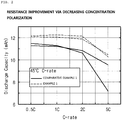
- the capacity change was observed by fixing the charge rate of each lithium secondary battery of Example 1 and Comparative Example 1 to 0.5 C at 45°C, and changing the discharge rate from 0.5 C to 5C, and rate properties were evaluated. The results are illustrated in FIG. 2 .
- 92 wt% of an LNMO spinel-based compound as a cathode active material, 4 wt% of carbon black as a conductive material, 2 wt% of PVdF as a bonding material, 2 wt% of the ionomer of the above Formula 1 (weight average molecular weight of about 308) were added in an NMP solvent to prepare a cathode slurry.
- the cathode slurry was applied on an Al thin film of a cathode collector having a thickness of 20 ⁇ m and dried to manufacture a cathode.
- a Li metal was used as an anode.
- a high voltage hall cell of a 5 V grade was manufactured by conducting the same procedure described in the above Example 2 except for including 4 wt% of PVdF as the binder and inserting a non-aqueous electrolyte of 0.5 M LiPF 6 during preparing an electrolyte, and excluding the ionomer of the above Formula 1 during manufacturing a cathode.
- the following was performed to observe the restraining properties of the polarization phenomenon of a lithium secondary battery including the ionomer of the present invention. That is, the lithium secondary battery of the above Example 2 and the lithium secondary battery of the above Comparative Example 2 were charged with 1 C at 23°C, and the discharge capacity and discharge curve thereof are illustrated in FIGS. 3 and 4 .
- the lithium secondary battery introducing the ionomer and including decreased amount of the electrolyte salt in the non-aqueous electrolyte according to Example 2 of the present invention has equal maintaining ratio of life and increased capacity when compared to those of the lithium secondary battery of Comparative Example 2.
- a Li metal was used as a cathode.
- a high voltage half cell of a 5 V grade was manufactured by conducting the same procedure described in the above Example 3 except for including 10 wt% of PVdF as the binder and inserting a non-aqueous electrolyte of 0.5 M LiPF 6 during preparing an electrolyte, and excluding the ionomer of the above Formula 1 during manufacturing an anode.
- the lithium secondary battery of the above Example 3 and the lithium secondary battery of the above Comparative Example 3 were charged with 1 C at 23°C, and the charge curves thereof are illustrated in FIG. 6 .
Landscapes
- Chemical & Material Sciences (AREA)
- Chemical Kinetics & Catalysis (AREA)
- Electrochemistry (AREA)
- General Chemical & Material Sciences (AREA)
- Engineering & Computer Science (AREA)
- Manufacturing & Machinery (AREA)
- Inorganic Chemistry (AREA)
- Condensed Matter Physics & Semiconductors (AREA)
- General Physics & Mathematics (AREA)
- Physics & Mathematics (AREA)
- Materials Engineering (AREA)
- Secondary Cells (AREA)
- Battery Electrode And Active Subsutance (AREA)
- Cell Separators (AREA)
Claims (6)
- Lithiumsekundärbatterie, die eine Kathode, eine Anode, einen Separator, der zwischen der Kathode und der Anode angeordnet ist, und einen nicht-wässrigen Elektrolyten umfasst,
wobei ein Ionomer mit der folgenden Formel 1 in mindestens einem Element, ausgewählt aus der Gruppe bestehend aus der Kathode und der Anode, umfasst ist: worin A und B unabhängig H, F, CH3, CF3 oder CF2H sind,ein Molverhältnis von -CF-O-(CF2)2-SO3 -Li+:-CF2- 10 bis 100 : 0 bis 90 beträgt, undk eine ganze Zahl von mindestens 1 ist.
 - Lithiumsekundärbatterie nach Anspruch 1, wobei ein gewichtsmittleres Molekulargewicht des Ionomers mit der obigen Formel 1 240 bis 200.000 beträgt.
- Lithiumsekundärbatterie nach Anspruch 1, wobei die Kathode das Ionomer mit der obigen Formel 1 in einer Zusammensetzung der Kathode, einer Beschichtungskomponente eines Kathodenaktivmaterials oder einer Beschichtungskomponente der Kathode umfasst.
- Lithiumsekundärbatterie nach Anspruch 3, wobei eine Menge des Ionomers mit der obigen Formel 1 0,01 bis 20 Gewichts-% beträgt, bezogen auf eine Gesamtmenge einer Mischung der Kathode.
- Lithiumsekundärbatterie nach Anspruch 1, wobei die Anode das Ionomer mit der obigen Formel 1 in einer Zusammensetzung der Anode, einer Beschichtungskomponente eines Anodenaktivmaterials oder einer Beschichtungskomponente der Anode umfasst.
- Lithiumsekundärbatterie nach Anspruch 5, wobei eine Menge des Ionomers mit der obigen Formel 1 0,01 bis 20 Gewichts-% beträgt, bezogen auf eine Gesamtmenge einer Mischung der Anode.
Applications Claiming Priority (2)
| Application Number | Priority Date | Filing Date | Title |
|---|---|---|---|
| KR20130131473 | 2013-10-31 | ||
| PCT/KR2014/010361 WO2015065102A1 (ko) | 2013-10-31 | 2014-10-31 | 리튬 이차전지 |
Publications (3)
| Publication Number | Publication Date |
|---|---|
| EP2899794A1 EP2899794A1 (de) | 2015-07-29 |
| EP2899794A4 EP2899794A4 (de) | 2015-09-30 |
| EP2899794B1 true EP2899794B1 (de) | 2020-10-21 |
Family
ID=53388274
Family Applications (1)
| Application Number | Title | Priority Date | Filing Date |
|---|---|---|---|
| EP14830490.0A Active EP2899794B1 (de) | 2013-10-31 | 2014-10-31 | Lithium-zweitbatterie |
Country Status (8)
| Country | Link |
|---|---|
| US (1) | US9553338B2 (de) |
| EP (1) | EP2899794B1 (de) |
| JP (1) | JP6128403B2 (de) |
| KR (1) | KR101607024B1 (de) |
| CN (1) | CN104798244B (de) |
| PL (1) | PL2899794T3 (de) |
| TW (1) | TWI552416B (de) |
| WO (1) | WO2015065102A1 (de) |
Families Citing this family (17)
| Publication number | Priority date | Publication date | Assignee | Title |
|---|---|---|---|---|
| KR102019838B1 (ko) * | 2015-09-30 | 2019-09-10 | 주식회사 엘지화학 | 비수성 전해액을 포함하는 리튬 이차 전지 |
| JP6777087B2 (ja) * | 2015-10-09 | 2020-10-28 | 宇部興産株式会社 | 非水電解液及びそれを用いた蓄電デバイス |
| KR102217106B1 (ko) | 2016-05-09 | 2021-02-22 | 주식회사 엘지화학 | 고분자 전해질용 조성물 및 이를 포함하는 리튬 이차전지 |
| WO2017196012A1 (ko) | 2016-05-09 | 2017-11-16 | 주식회사 엘지화학 | 고분자 전해질용 조성물 및 이를 포함하는 리튬 이차전지 |
| US10892523B2 (en) * | 2016-10-27 | 2021-01-12 | Toyota Motor Engineering & Manufacturing North America, Inc. | Aqueous electrolyte with carbonate and batteries using the same |
| WO2018216866A1 (ko) * | 2017-05-26 | 2018-11-29 | 주식회사 엘지화학 | 리튬-황 전지용 전해액 및 이를 포함하는 리튬-황 전지 |
| KR102183662B1 (ko) | 2017-05-26 | 2020-11-26 | 주식회사 엘지화학 | 리튬-황 전지용 전해액 및 이를 포함하는 리튬-황 전지 |
| US10581050B2 (en) * | 2017-06-07 | 2020-03-03 | Robert Bosch Gmbh | Battery having a low counter-ion permeability layer |
| CN109037622A (zh) * | 2017-07-17 | 2018-12-18 | 浙江林奈新能源有限公司 | 离子交联聚合物电极浆料 |
| KR102255538B1 (ko) | 2017-11-28 | 2021-05-25 | 주식회사 엘지에너지솔루션 | 이차전지용 폴리머 전해질 및 이를 포함하는 이차전지 |
| KR102274611B1 (ko) | 2018-04-06 | 2021-07-06 | 주식회사 엘지에너지솔루션 | 수명 성능이 향상된 리튬 금속 이차전지 |
| WO2020009435A1 (ko) * | 2018-07-04 | 2020-01-09 | 주식회사 엘지화학 | 리튬 금속 전지용 음극, 이의 제조 방법, 및 이를 포함하는 리튬 금속 전지 |
| KR102328648B1 (ko) * | 2018-07-04 | 2021-11-18 | 주식회사 엘지에너지솔루션 | 리튬 금속 전지용 음극, 이의 제조 방법, 및 이를 포함하는 리튬 금속 전지 |
| KR102876041B1 (ko) | 2021-08-17 | 2025-10-24 | 주식회사 엘지에너지솔루션 | 전고체전지용 양극 및 이를 포함하는 전고체전지 |
| KR102695943B1 (ko) * | 2022-03-17 | 2024-08-21 | 주식회사 엘지에너지솔루션 | 리튬 이차전지 |
| CN117136444A (zh) * | 2022-03-17 | 2023-11-28 | 株式会社Lg新能源 | 锂二次电池 |
| CA3216042A1 (en) * | 2022-03-17 | 2023-09-21 | Lg Energy Solution, Ltd. | Lithium secondary battery |
Family Cites Families (17)
| Publication number | Priority date | Publication date | Assignee | Title |
|---|---|---|---|---|
| EP0938755B1 (de) | 1996-11-01 | 2004-03-10 | E.I. Du Pont De Nemours And Company | Hochleitfähiges ionenaustauschpolymer und verfahren |
| JPH10284128A (ja) * | 1997-04-03 | 1998-10-23 | Asahi Glass Co Ltd | リチウム電池 |
| US6025092A (en) | 1998-02-13 | 2000-02-15 | E. I. Du Pont De Nemours And Company | Fluorinated ionomers and their uses |
| US6100324A (en) | 1998-04-16 | 2000-08-08 | E. I. Du Pont De Nemours And Company | Ionomers and ionically conductive compositions |
| MY135964A (en) * | 1998-10-26 | 2008-07-31 | Du Pont | Ionomers and polymers for electrochemical uses |
| US6743549B1 (en) * | 1999-07-02 | 2004-06-01 | E.I. Du Pont De Nemours And Company | Nonaqueous electrolyte lithium secondary batteries |
| US7307113B2 (en) * | 2001-05-14 | 2007-12-11 | E.I. Du Pont De Nemours And Company | Fluorosulfonic acid organic polymers |
| US7070632B1 (en) * | 2001-07-25 | 2006-07-04 | Polyplus Battery Company | Electrochemical device separator structures with barrier layer on non-swelling membrane |
| US7214740B2 (en) * | 2005-05-03 | 2007-05-08 | 3M Innovative Properties Company | Fluorinated ionomers with reduced amounts of carbonyl end groups |
| JP4379743B2 (ja) * | 2006-12-08 | 2009-12-09 | ソニー株式会社 | 電解液および二次電池 |
| JP5682153B2 (ja) * | 2010-02-01 | 2015-03-11 | ダイキン工業株式会社 | 含フッ素共重合体の製造方法、ポリマー電解質、リチウム電池用電極及びリチウム電池 |
| JP2011159503A (ja) | 2010-02-01 | 2011-08-18 | Daikin Industries Ltd | リチウムイオン伝導性ポリマー電解質及びリチウム電池 |
| JP2011243558A (ja) * | 2010-04-22 | 2011-12-01 | Hitachi Maxell Energy Ltd | リチウム二次電池用正極およびリチウム二次電池 |
| US9525165B2 (en) * | 2011-03-07 | 2016-12-20 | Samsung Sdi Co., Ltd. | Electrode for rechargeable lithium battery and rechargeable lithium battery including the same |
| US20130250485A1 (en) * | 2011-06-09 | 2013-09-26 | Wildcat Discovery Technologies, Inc. | Materials for electrolytes and methods for use |
| WO2013101299A1 (en) * | 2011-12-29 | 2013-07-04 | E. I. Du Pont De Nemours And Company | Flow battery comprising a composite polymer separator membrane |
| US20130181677A1 (en) * | 2012-01-18 | 2013-07-18 | E I Du Pont De Nemours And Company | Compositions, layerings, electrodes and methods for making |
-
2014
- 2014-10-31 WO PCT/KR2014/010361 patent/WO2015065102A1/ko not_active Ceased
- 2014-10-31 KR KR1020140150126A patent/KR101607024B1/ko active Active
- 2014-10-31 JP JP2015545406A patent/JP6128403B2/ja active Active
- 2014-10-31 EP EP14830490.0A patent/EP2899794B1/de active Active
- 2014-10-31 US US14/419,504 patent/US9553338B2/en active Active
- 2014-10-31 TW TW103138018A patent/TWI552416B/zh active
- 2014-10-31 PL PL14830490.0T patent/PL2899794T3/pl unknown
- 2014-10-31 CN CN201480003028.9A patent/CN104798244B/zh active Active
Non-Patent Citations (1)
| Title |
|---|
| None * |
Also Published As
| Publication number | Publication date |
|---|---|
| CN104798244A (zh) | 2015-07-22 |
| TWI552416B (zh) | 2016-10-01 |
| CN104798244B (zh) | 2017-07-28 |
| TW201530848A (zh) | 2015-08-01 |
| JP6128403B2 (ja) | 2017-05-17 |
| US20160028127A1 (en) | 2016-01-28 |
| JP2016502744A (ja) | 2016-01-28 |
| EP2899794A1 (de) | 2015-07-29 |
| EP2899794A4 (de) | 2015-09-30 |
| KR101607024B1 (ko) | 2016-03-28 |
| PL2899794T3 (pl) | 2021-02-22 |
| US9553338B2 (en) | 2017-01-24 |
| KR20150050507A (ko) | 2015-05-08 |
| WO2015065102A1 (ko) | 2015-05-07 |
Similar Documents
| Publication | Publication Date | Title |
|---|---|---|
| US9553338B2 (en) | Lithium secondary battery | |
| EP3540825B1 (de) | Lithiumsekundärbatterie | |
| KR102209828B1 (ko) | 리튬 전지용 전해질 첨가제, 이를 포함하는 전해질 및 상기 전해질을 채용한 리튬 전지 | |
| EP2410600B1 (de) | Positive Elektrode und wiederaufladbare Lithiumbatterie damit | |
| US10637097B2 (en) | Organic/inorganic composite electrolyte, electrode-electrolyte assembly and lithium secondary battery including the same, and manufacturing method of the electrode-electrolyte assembly | |
| KR102460957B1 (ko) | 리튬 이차 전지용 전해액 및 이를 포함하는 리튬 이차 전지 | |
| US10263286B2 (en) | Secondary battery electrolyte and secondary battery | |
| JP5277225B2 (ja) | リチウム電池用電解液、これを含むリチウム電池及びリチウム電池の作動方法 | |
| US20100297505A1 (en) | Method of producing nitrided li-ti compound oxide, nitrided li-ti compound oxide, and lithium-ion battery | |
| CN102290562A (zh) | 锂电池及其制造方法 | |
| EP3723180A1 (de) | Flüssigelektrolyt für wasserfreie elektrolytzelle und wasserfreie elektrolytzelle, in der der besagte flüssigelektrolyt für wasserfreie elektrolytzelle verwendet wird | |
| US20120021287A1 (en) | Positive electrode and lithium battery including the same | |
| CN114026729B (zh) | 锂电池和基于脲的添加剂作为其中的电解质添加剂的用途 | |
| KR102290959B1 (ko) | 리튬 이차 전지용 양극 활물질 및 리튬 이차 전지 | |
| KR101444992B1 (ko) | 비수계 이차전지용 전해질 및 이를 포함하는 이차전지 | |
| EP3506411A1 (de) | Organische elektrolytlösung und lithiumbatterie damit | |
| CN113906585A (zh) | 包含含有钾和金属的层状氧化物的电极材料、包含该材料的电极及其在电化学中的用途 | |
| KR102436421B1 (ko) | 리튬 이차전지용 전해액 및 이를 포함하는 리튬 이차전지 | |
| CN107925128B (zh) | 用于锂二次电池的电解质溶液和包括该电解质溶液的锂二次电池 | |
| KR102426254B1 (ko) | 리튬 이차전지용 전해질 첨가제를 포함하는 리튬 이차전지 | |
| KR20180042739A (ko) | 리튬이차전지 전해질용 첨가제, 및 이를 포함하는 리튬이차전지 전해질 및 리튬이차전지 | |
| EP4307406A1 (de) | Lithiumsekundärbatterie | |
| WO2020213268A1 (ja) | 非水電解液、不揮発性電解質、二次電池 | |
| WO2024184682A1 (en) | Electrolytes containing sulfonamide-type cyclic salts, and energy-storage cells and batteries made therewith | |
| EP3200269B1 (de) | Elektrolyt und sekundärbatterie mit dem elektrolyt |
Legal Events
| Date | Code | Title | Description |
|---|---|---|---|
| PUAI | Public reference made under article 153(3) epc to a published international application that has entered the european phase |
Free format text: ORIGINAL CODE: 0009012 |
|
| 17P | Request for examination filed |
Effective date: 20150203 |
|
| AK | Designated contracting states |
Kind code of ref document: A1 Designated state(s): AL AT BE BG CH CY CZ DE DK EE ES FI FR GB GR HR HU IE IS IT LI LT LU LV MC MK MT NL NO PL PT RO RS SE SI SK SM TR |
|
| AX | Request for extension of the european patent |
Extension state: BA ME |
|
| R17P | Request for examination filed (corrected) |
Effective date: 20150203 |
|
| RA4 | Supplementary search report drawn up and despatched (corrected) |
Effective date: 20150901 |
|
| RIC1 | Information provided on ipc code assigned before grant |
Ipc: H01M 2/16 20060101ALI20150826BHEP Ipc: H01M 10/42 20060101ALI20150826BHEP Ipc: H01M 10/0567 20100101ALI20150826BHEP Ipc: H01M 10/052 20100101ALI20150826BHEP Ipc: H01M 10/0565 20100101AFI20150826BHEP Ipc: H01M 4/62 20060101ALI20150826BHEP |
|
| DAX | Request for extension of the european patent (deleted) | ||
| STAA | Information on the status of an ep patent application or granted ep patent |
Free format text: STATUS: EXAMINATION IS IN PROGRESS |
|
| 17Q | First examination report despatched |
Effective date: 20180417 |
|
| RAP1 | Party data changed (applicant data changed or rights of an application transferred) |
Owner name: LG CHEM, LTD. |
|
| GRAP | Despatch of communication of intention to grant a patent |
Free format text: ORIGINAL CODE: EPIDOSNIGR1 |
|
| STAA | Information on the status of an ep patent application or granted ep patent |
Free format text: STATUS: GRANT OF PATENT IS INTENDED |
|
| RIC1 | Information provided on ipc code assigned before grant |
Ipc: H01M 4/1391 20100101ALN20200429BHEP Ipc: H01M 4/139 20100101ALN20200429BHEP Ipc: H01M 2/16 20060101ALI20200429BHEP Ipc: H01M 10/0567 20100101ALI20200429BHEP Ipc: H01M 10/0565 20100101AFI20200429BHEP Ipc: H01M 10/42 20060101ALI20200429BHEP Ipc: H01M 4/133 20100101ALN20200429BHEP Ipc: H01M 4/131 20100101ALN20200429BHEP Ipc: H01M 4/62 20060101ALI20200429BHEP Ipc: H01M 4/13 20100101ALI20200429BHEP Ipc: H01M 4/1393 20100101ALN20200429BHEP Ipc: H01M 10/052 20100101ALI20200429BHEP Ipc: H01M 4/04 20060101ALI20200429BHEP |
|
| INTG | Intention to grant announced |
Effective date: 20200519 |
|
| GRAS | Grant fee paid |
Free format text: ORIGINAL CODE: EPIDOSNIGR3 |
|
| GRAA | (expected) grant |
Free format text: ORIGINAL CODE: 0009210 |
|
| STAA | Information on the status of an ep patent application or granted ep patent |
Free format text: STATUS: THE PATENT HAS BEEN GRANTED |
|
| AK | Designated contracting states |
Kind code of ref document: B1 Designated state(s): AL AT BE BG CH CY CZ DE DK EE ES FI FR GB GR HR HU IE IS IT LI LT LU LV MC MK MT NL NO PL PT RO RS SE SI SK SM TR |
|
| REG | Reference to a national code |
Ref country code: GB Ref legal event code: FG4D |
|
| REG | Reference to a national code |
Ref country code: CH Ref legal event code: EP |
|
| REG | Reference to a national code |
Ref country code: IE Ref legal event code: FG4D |
|
| REG | Reference to a national code |
Ref country code: DE Ref legal event code: R096 Ref document number: 602014071520 Country of ref document: DE |
|
| REG | Reference to a national code |
Ref country code: AT Ref legal event code: REF Ref document number: 1326775 Country of ref document: AT Kind code of ref document: T Effective date: 20201115 |
|
| REG | Reference to a national code |
Ref country code: SE Ref legal event code: TRGR |
|
| REG | Reference to a national code |
Ref country code: AT Ref legal event code: MK05 Ref document number: 1326775 Country of ref document: AT Kind code of ref document: T Effective date: 20201021 |
|
| REG | Reference to a national code |
Ref country code: NL Ref legal event code: MP Effective date: 20201021 |
|
| PG25 | Lapsed in a contracting state [announced via postgrant information from national office to epo] |
Ref country code: GR Free format text: LAPSE BECAUSE OF FAILURE TO SUBMIT A TRANSLATION OF THE DESCRIPTION OR TO PAY THE FEE WITHIN THE PRESCRIBED TIME-LIMIT Effective date: 20210122 Ref country code: NL Free format text: LAPSE BECAUSE OF FAILURE TO SUBMIT A TRANSLATION OF THE DESCRIPTION OR TO PAY THE FEE WITHIN THE PRESCRIBED TIME-LIMIT Effective date: 20201021 Ref country code: PT Free format text: LAPSE BECAUSE OF FAILURE TO SUBMIT A TRANSLATION OF THE DESCRIPTION OR TO PAY THE FEE WITHIN THE PRESCRIBED TIME-LIMIT Effective date: 20210222 Ref country code: NO Free format text: LAPSE BECAUSE OF FAILURE TO SUBMIT A TRANSLATION OF THE DESCRIPTION OR TO PAY THE FEE WITHIN THE PRESCRIBED TIME-LIMIT Effective date: 20210121 Ref country code: RS Free format text: LAPSE BECAUSE OF FAILURE TO SUBMIT A TRANSLATION OF THE DESCRIPTION OR TO PAY THE FEE WITHIN THE PRESCRIBED TIME-LIMIT Effective date: 20201021 Ref country code: FI Free format text: LAPSE BECAUSE OF FAILURE TO SUBMIT A TRANSLATION OF THE DESCRIPTION OR TO PAY THE FEE WITHIN THE PRESCRIBED TIME-LIMIT Effective date: 20201021 |
|
| REG | Reference to a national code |
Ref country code: LT Ref legal event code: MG4D |
|
| PG25 | Lapsed in a contracting state [announced via postgrant information from national office to epo] |
Ref country code: LV Free format text: LAPSE BECAUSE OF FAILURE TO SUBMIT A TRANSLATION OF THE DESCRIPTION OR TO PAY THE FEE WITHIN THE PRESCRIBED TIME-LIMIT Effective date: 20201021 Ref country code: IS Free format text: LAPSE BECAUSE OF FAILURE TO SUBMIT A TRANSLATION OF THE DESCRIPTION OR TO PAY THE FEE WITHIN THE PRESCRIBED TIME-LIMIT Effective date: 20210221 Ref country code: AT Free format text: LAPSE BECAUSE OF FAILURE TO SUBMIT A TRANSLATION OF THE DESCRIPTION OR TO PAY THE FEE WITHIN THE PRESCRIBED TIME-LIMIT Effective date: 20201021 Ref country code: ES Free format text: LAPSE BECAUSE OF FAILURE TO SUBMIT A TRANSLATION OF THE DESCRIPTION OR TO PAY THE FEE WITHIN THE PRESCRIBED TIME-LIMIT Effective date: 20201021 Ref country code: BG Free format text: LAPSE BECAUSE OF FAILURE TO SUBMIT A TRANSLATION OF THE DESCRIPTION OR TO PAY THE FEE WITHIN THE PRESCRIBED TIME-LIMIT Effective date: 20210121 |
|
| REG | Reference to a national code |
Ref country code: CH Ref legal event code: PL |
|
| PG25 | Lapsed in a contracting state [announced via postgrant information from national office to epo] |
Ref country code: LU Free format text: LAPSE BECAUSE OF NON-PAYMENT OF DUE FEES Effective date: 20201031 Ref country code: HR Free format text: LAPSE BECAUSE OF FAILURE TO SUBMIT A TRANSLATION OF THE DESCRIPTION OR TO PAY THE FEE WITHIN THE PRESCRIBED TIME-LIMIT Effective date: 20201021 |
|
| REG | Reference to a national code |
Ref country code: BE Ref legal event code: MM Effective date: 20201031 |
|
| REG | Reference to a national code |
Ref country code: DE Ref legal event code: R097 Ref document number: 602014071520 Country of ref document: DE |
|
| PG25 | Lapsed in a contracting state [announced via postgrant information from national office to epo] |
Ref country code: LT Free format text: LAPSE BECAUSE OF FAILURE TO SUBMIT A TRANSLATION OF THE DESCRIPTION OR TO PAY THE FEE WITHIN THE PRESCRIBED TIME-LIMIT Effective date: 20201021 Ref country code: MC Free format text: LAPSE BECAUSE OF FAILURE TO SUBMIT A TRANSLATION OF THE DESCRIPTION OR TO PAY THE FEE WITHIN THE PRESCRIBED TIME-LIMIT Effective date: 20201021 Ref country code: RO Free format text: LAPSE BECAUSE OF FAILURE TO SUBMIT A TRANSLATION OF THE DESCRIPTION OR TO PAY THE FEE WITHIN THE PRESCRIBED TIME-LIMIT Effective date: 20201021 Ref country code: SK Free format text: LAPSE BECAUSE OF FAILURE TO SUBMIT A TRANSLATION OF THE DESCRIPTION OR TO PAY THE FEE WITHIN THE PRESCRIBED TIME-LIMIT Effective date: 20201021 Ref country code: CZ Free format text: LAPSE BECAUSE OF FAILURE TO SUBMIT A TRANSLATION OF THE DESCRIPTION OR TO PAY THE FEE WITHIN THE PRESCRIBED TIME-LIMIT Effective date: 20201021 Ref country code: EE Free format text: LAPSE BECAUSE OF FAILURE TO SUBMIT A TRANSLATION OF THE DESCRIPTION OR TO PAY THE FEE WITHIN THE PRESCRIBED TIME-LIMIT Effective date: 20201021 Ref country code: SM Free format text: LAPSE BECAUSE OF FAILURE TO SUBMIT A TRANSLATION OF THE DESCRIPTION OR TO PAY THE FEE WITHIN THE PRESCRIBED TIME-LIMIT Effective date: 20201021 |
|
| PLBE | No opposition filed within time limit |
Free format text: ORIGINAL CODE: 0009261 |
|
| STAA | Information on the status of an ep patent application or granted ep patent |
Free format text: STATUS: NO OPPOSITION FILED WITHIN TIME LIMIT |
|
| PG25 | Lapsed in a contracting state [announced via postgrant information from national office to epo] |
Ref country code: LI Free format text: LAPSE BECAUSE OF NON-PAYMENT OF DUE FEES Effective date: 20201031 Ref country code: CH Free format text: LAPSE BECAUSE OF NON-PAYMENT OF DUE FEES Effective date: 20201031 Ref country code: BE Free format text: LAPSE BECAUSE OF NON-PAYMENT OF DUE FEES Effective date: 20201031 Ref country code: DK Free format text: LAPSE BECAUSE OF FAILURE TO SUBMIT A TRANSLATION OF THE DESCRIPTION OR TO PAY THE FEE WITHIN THE PRESCRIBED TIME-LIMIT Effective date: 20201021 |
|
| 26N | No opposition filed |
Effective date: 20210722 |
|
| PG25 | Lapsed in a contracting state [announced via postgrant information from national office to epo] |
Ref country code: AL Free format text: LAPSE BECAUSE OF FAILURE TO SUBMIT A TRANSLATION OF THE DESCRIPTION OR TO PAY THE FEE WITHIN THE PRESCRIBED TIME-LIMIT Effective date: 20201021 Ref country code: IT Free format text: LAPSE BECAUSE OF FAILURE TO SUBMIT A TRANSLATION OF THE DESCRIPTION OR TO PAY THE FEE WITHIN THE PRESCRIBED TIME-LIMIT Effective date: 20201021 Ref country code: IE Free format text: LAPSE BECAUSE OF NON-PAYMENT OF DUE FEES Effective date: 20201031 |
|
| PG25 | Lapsed in a contracting state [announced via postgrant information from national office to epo] |
Ref country code: SI Free format text: LAPSE BECAUSE OF FAILURE TO SUBMIT A TRANSLATION OF THE DESCRIPTION OR TO PAY THE FEE WITHIN THE PRESCRIBED TIME-LIMIT Effective date: 20201021 |
|
| PG25 | Lapsed in a contracting state [announced via postgrant information from national office to epo] |
Ref country code: IS Free format text: LAPSE BECAUSE OF FAILURE TO SUBMIT A TRANSLATION OF THE DESCRIPTION OR TO PAY THE FEE WITHIN THE PRESCRIBED TIME-LIMIT Effective date: 20210221 Ref country code: TR Free format text: LAPSE BECAUSE OF FAILURE TO SUBMIT A TRANSLATION OF THE DESCRIPTION OR TO PAY THE FEE WITHIN THE PRESCRIBED TIME-LIMIT Effective date: 20201021 Ref country code: MT Free format text: LAPSE BECAUSE OF FAILURE TO SUBMIT A TRANSLATION OF THE DESCRIPTION OR TO PAY THE FEE WITHIN THE PRESCRIBED TIME-LIMIT Effective date: 20201021 Ref country code: CY Free format text: LAPSE BECAUSE OF FAILURE TO SUBMIT A TRANSLATION OF THE DESCRIPTION OR TO PAY THE FEE WITHIN THE PRESCRIBED TIME-LIMIT Effective date: 20201021 |
|
| PG25 | Lapsed in a contracting state [announced via postgrant information from national office to epo] |
Ref country code: MK Free format text: LAPSE BECAUSE OF FAILURE TO SUBMIT A TRANSLATION OF THE DESCRIPTION OR TO PAY THE FEE WITHIN THE PRESCRIBED TIME-LIMIT Effective date: 20201021 |
|
| P01 | Opt-out of the competence of the unified patent court (upc) registered |
Effective date: 20230408 |
|
| REG | Reference to a national code |
Ref country code: GB Ref legal event code: 732E Free format text: REGISTERED BETWEEN 20230824 AND 20230831 |
|
| REG | Reference to a national code |
Ref country code: DE Ref legal event code: R081 Ref document number: 602014071520 Country of ref document: DE Owner name: LG ENERGY SOLUTION, LTD., KR Free format text: FORMER OWNER: LG CHEM, LTD., SEOUL, KR |
|
| PGFP | Annual fee paid to national office [announced via postgrant information from national office to epo] |
Ref country code: PL Payment date: 20250923 Year of fee payment: 12 |
|
| PGFP | Annual fee paid to national office [announced via postgrant information from national office to epo] |
Ref country code: GB Payment date: 20250922 Year of fee payment: 12 |
|
| PGFP | Annual fee paid to national office [announced via postgrant information from national office to epo] |
Ref country code: FR Payment date: 20250925 Year of fee payment: 12 |
|
| PGFP | Annual fee paid to national office [announced via postgrant information from national office to epo] |
Ref country code: SE Payment date: 20250923 Year of fee payment: 12 |
|
| PGFP | Annual fee paid to national office [announced via postgrant information from national office to epo] |
Ref country code: DE Payment date: 20250922 Year of fee payment: 12 |