EP2901603B1 - Dynamische harq-ack-übertragung mit verbesserten pdcch - Google Patents
Dynamische harq-ack-übertragung mit verbesserten pdcch Download PDFInfo
- Publication number
- EP2901603B1 EP2901603B1 EP13841050.1A EP13841050A EP2901603B1 EP 2901603 B1 EP2901603 B1 EP 2901603B1 EP 13841050 A EP13841050 A EP 13841050A EP 2901603 B1 EP2901603 B1 EP 2901603B1
- Authority
- EP
- European Patent Office
- Prior art keywords
- pucch
- ecce
- resource
- user equipment
- epdcch
- Prior art date
- Legal status (The legal status is an assumption and is not a legal conclusion. Google has not performed a legal analysis and makes no representation as to the accuracy of the status listed.)
- Active
Links
Images


Classifications
-
- H—ELECTRICITY
- H04—ELECTRIC COMMUNICATION TECHNIQUE
- H04W—WIRELESS COMMUNICATION NETWORKS
- H04W28/00—Network traffic management; Network resource management
- H04W28/02—Traffic management, e.g. flow control or congestion control
- H04W28/0215—Traffic management, e.g. flow control or congestion control based on user or device properties, e.g. MTC-capable devices
- H04W28/0221—Traffic management, e.g. flow control or congestion control based on user or device properties, e.g. MTC-capable devices power availability or consumption
-
- H—ELECTRICITY
- H04—ELECTRIC COMMUNICATION TECHNIQUE
- H04W—WIRELESS COMMUNICATION NETWORKS
- H04W48/00—Access restriction; Network selection; Access point selection
- H04W48/08—Access restriction or access information delivery, e.g. discovery data delivery
- H04W48/14—Access restriction or access information delivery, e.g. discovery data delivery using user query or user detection
-
- H—ELECTRICITY
- H04—ELECTRIC COMMUNICATION TECHNIQUE
- H04B—TRANSMISSION
- H04B17/00—Monitoring; Testing
- H04B17/30—Monitoring; Testing of propagation channels
- H04B17/309—Measuring or estimating channel quality parameters
- H04B17/318—Received signal strength
-
- H—ELECTRICITY
- H04—ELECTRIC COMMUNICATION TECHNIQUE
- H04J—MULTIPLEX COMMUNICATION
- H04J11/00—Orthogonal multiplex systems, e.g. using WALSH codes
-
- H—ELECTRICITY
- H04—ELECTRIC COMMUNICATION TECHNIQUE
- H04J—MULTIPLEX COMMUNICATION
- H04J11/00—Orthogonal multiplex systems, e.g. using WALSH codes
- H04J11/0069—Cell search, i.e. determining cell identity [cell-ID]
- H04J11/0086—Search parameters, e.g. search strategy, accumulation length, range of search, thresholds
-
- H—ELECTRICITY
- H04—ELECTRIC COMMUNICATION TECHNIQUE
- H04J—MULTIPLEX COMMUNICATION
- H04J3/00—Time-division multiplex systems
- H04J3/16—Time-division multiplex systems in which the time allocation to individual channels within a transmission cycle is variable, e.g. to accommodate varying complexity of signals, to vary number of channels transmitted
- H04J3/1694—Allocation of channels in TDM/TDMA networks, e.g. distributed multiplexers
-
- H—ELECTRICITY
- H04—ELECTRIC COMMUNICATION TECHNIQUE
- H04L—TRANSMISSION OF DIGITAL INFORMATION, e.g. TELEGRAPHIC COMMUNICATION
- H04L1/00—Arrangements for detecting or preventing errors in the information received
- H04L1/0001—Systems modifying transmission characteristics according to link quality, e.g. power backoff
- H04L1/0036—Systems modifying transmission characteristics according to link quality, e.g. power backoff arrangements specific to the receiver
- H04L1/0038—Blind format detection
-
- H—ELECTRICITY
- H04—ELECTRIC COMMUNICATION TECHNIQUE
- H04L—TRANSMISSION OF DIGITAL INFORMATION, e.g. TELEGRAPHIC COMMUNICATION
- H04L1/00—Arrangements for detecting or preventing errors in the information received
- H04L1/12—Arrangements for detecting or preventing errors in the information received by using return channel
- H04L1/16—Arrangements for detecting or preventing errors in the information received by using return channel in which the return channel carries supervisory signals, e.g. repetition request signals
- H04L1/18—Automatic repetition systems, e.g. Van Duuren systems
- H04L1/1812—Hybrid protocols; Hybrid automatic repeat request [HARQ]
-
- H—ELECTRICITY
- H04—ELECTRIC COMMUNICATION TECHNIQUE
- H04L—TRANSMISSION OF DIGITAL INFORMATION, e.g. TELEGRAPHIC COMMUNICATION
- H04L1/00—Arrangements for detecting or preventing errors in the information received
- H04L1/12—Arrangements for detecting or preventing errors in the information received by using return channel
- H04L1/16—Arrangements for detecting or preventing errors in the information received by using return channel in which the return channel carries supervisory signals, e.g. repetition request signals
- H04L1/18—Automatic repetition systems, e.g. Van Duuren systems
- H04L1/1829—Arrangements specially adapted for the receiver end
- H04L1/1861—Physical mapping arrangements
-
- H—ELECTRICITY
- H04—ELECTRIC COMMUNICATION TECHNIQUE
- H04L—TRANSMISSION OF DIGITAL INFORMATION, e.g. TELEGRAPHIC COMMUNICATION
- H04L1/00—Arrangements for detecting or preventing errors in the information received
- H04L1/12—Arrangements for detecting or preventing errors in the information received by using return channel
- H04L1/16—Arrangements for detecting or preventing errors in the information received by using return channel in which the return channel carries supervisory signals, e.g. repetition request signals
- H04L1/18—Automatic repetition systems, e.g. Van Duuren systems
- H04L1/1829—Arrangements specially adapted for the receiver end
- H04L1/1864—ARQ related signaling
-
- H—ELECTRICITY
- H04—ELECTRIC COMMUNICATION TECHNIQUE
- H04L—TRANSMISSION OF DIGITAL INFORMATION, e.g. TELEGRAPHIC COMMUNICATION
- H04L1/00—Arrangements for detecting or preventing errors in the information received
- H04L1/12—Arrangements for detecting or preventing errors in the information received by using return channel
- H04L1/16—Arrangements for detecting or preventing errors in the information received by using return channel in which the return channel carries supervisory signals, e.g. repetition request signals
- H04L1/18—Automatic repetition systems, e.g. Van Duuren systems
- H04L1/1867—Arrangements specially adapted for the transmitter end
- H04L1/1893—Physical mapping arrangements
-
- H—ELECTRICITY
- H04—ELECTRIC COMMUNICATION TECHNIQUE
- H04L—TRANSMISSION OF DIGITAL INFORMATION, e.g. TELEGRAPHIC COMMUNICATION
- H04L41/00—Arrangements for maintenance, administration or management of data switching networks, e.g. of packet switching networks
- H04L41/06—Management of faults, events, alarms or notifications
- H04L41/069—Management of faults, events, alarms or notifications using logs of notifications; Post-processing of notifications
-
- H—ELECTRICITY
- H04—ELECTRIC COMMUNICATION TECHNIQUE
- H04L—TRANSMISSION OF DIGITAL INFORMATION, e.g. TELEGRAPHIC COMMUNICATION
- H04L41/00—Arrangements for maintenance, administration or management of data switching networks, e.g. of packet switching networks
- H04L41/50—Network service management, e.g. ensuring proper service fulfilment according to agreements
- H04L41/5032—Generating service level reports
-
- H—ELECTRICITY
- H04—ELECTRIC COMMUNICATION TECHNIQUE
- H04L—TRANSMISSION OF DIGITAL INFORMATION, e.g. TELEGRAPHIC COMMUNICATION
- H04L43/00—Arrangements for monitoring or testing data switching networks
- H04L43/16—Threshold monitoring
-
- H—ELECTRICITY
- H04—ELECTRIC COMMUNICATION TECHNIQUE
- H04L—TRANSMISSION OF DIGITAL INFORMATION, e.g. TELEGRAPHIC COMMUNICATION
- H04L5/00—Arrangements affording multiple use of the transmission path
- H04L5/003—Arrangements for allocating sub-channels of the transmission path
- H04L5/0032—Distributed allocation, i.e. involving a plurality of allocating devices, each making partial allocation
- H04L5/0035—Resource allocation in a cooperative multipoint environment
-
- H—ELECTRICITY
- H04—ELECTRIC COMMUNICATION TECHNIQUE
- H04L—TRANSMISSION OF DIGITAL INFORMATION, e.g. TELEGRAPHIC COMMUNICATION
- H04L5/00—Arrangements affording multiple use of the transmission path
- H04L5/003—Arrangements for allocating sub-channels of the transmission path
- H04L5/0053—Allocation of signalling, i.e. of overhead other than pilot signals
- H04L5/0055—Physical resource allocation for ACK/NACK
-
- H—ELECTRICITY
- H04—ELECTRIC COMMUNICATION TECHNIQUE
- H04L—TRANSMISSION OF DIGITAL INFORMATION, e.g. TELEGRAPHIC COMMUNICATION
- H04L5/00—Arrangements affording multiple use of the transmission path
- H04L5/003—Arrangements for allocating sub-channels of the transmission path
- H04L5/0053—Allocation of signalling, i.e. of overhead other than pilot signals
- H04L5/0057—Physical resource allocation for CQI
-
- H—ELECTRICITY
- H04—ELECTRIC COMMUNICATION TECHNIQUE
- H04L—TRANSMISSION OF DIGITAL INFORMATION, e.g. TELEGRAPHIC COMMUNICATION
- H04L5/00—Arrangements affording multiple use of the transmission path
- H04L5/003—Arrangements for allocating sub-channels of the transmission path
- H04L5/0058—Allocation criteria
- H04L5/0073—Allocation arrangements that take into account other cell interferences
-
- H—ELECTRICITY
- H04—ELECTRIC COMMUNICATION TECHNIQUE
- H04L—TRANSMISSION OF DIGITAL INFORMATION, e.g. TELEGRAPHIC COMMUNICATION
- H04L5/00—Arrangements affording multiple use of the transmission path
- H04L5/0091—Signalling for the administration of the divided path, e.g. signalling of configuration information
-
- H—ELECTRICITY
- H04—ELECTRIC COMMUNICATION TECHNIQUE
- H04L—TRANSMISSION OF DIGITAL INFORMATION, e.g. TELEGRAPHIC COMMUNICATION
- H04L5/00—Arrangements affording multiple use of the transmission path
- H04L5/14—Two-way operation using the same type of signal, i.e. duplex
-
- H—ELECTRICITY
- H04—ELECTRIC COMMUNICATION TECHNIQUE
- H04L—TRANSMISSION OF DIGITAL INFORMATION, e.g. TELEGRAPHIC COMMUNICATION
- H04L65/00—Network arrangements, protocols or services for supporting real-time applications in data packet communication
- H04L65/60—Network streaming of media packets
- H04L65/61—Network streaming of media packets for supporting one-way streaming services, e.g. Internet radio
- H04L65/612—Network streaming of media packets for supporting one-way streaming services, e.g. Internet radio for unicast
-
- H—ELECTRICITY
- H04—ELECTRIC COMMUNICATION TECHNIQUE
- H04L—TRANSMISSION OF DIGITAL INFORMATION, e.g. TELEGRAPHIC COMMUNICATION
- H04L65/00—Network arrangements, protocols or services for supporting real-time applications in data packet communication
- H04L65/60—Network streaming of media packets
- H04L65/65—Network streaming protocols, e.g. real-time transport protocol [RTP] or real-time control protocol [RTCP]
-
- H—ELECTRICITY
- H04—ELECTRIC COMMUNICATION TECHNIQUE
- H04L—TRANSMISSION OF DIGITAL INFORMATION, e.g. TELEGRAPHIC COMMUNICATION
- H04L65/00—Network arrangements, protocols or services for supporting real-time applications in data packet communication
- H04L65/60—Network streaming of media packets
- H04L65/75—Media network packet handling
- H04L65/762—Media network packet handling at the source
-
- H—ELECTRICITY
- H04—ELECTRIC COMMUNICATION TECHNIQUE
- H04L—TRANSMISSION OF DIGITAL INFORMATION, e.g. TELEGRAPHIC COMMUNICATION
- H04L67/00—Network arrangements or protocols for supporting network services or applications
- H04L67/01—Protocols
- H04L67/10—Protocols in which an application is distributed across nodes in the network
-
- H—ELECTRICITY
- H04—ELECTRIC COMMUNICATION TECHNIQUE
- H04W—WIRELESS COMMUNICATION NETWORKS
- H04W24/00—Supervisory, monitoring or testing arrangements
- H04W24/02—Arrangements for optimising operational condition
-
- H—ELECTRICITY
- H04—ELECTRIC COMMUNICATION TECHNIQUE
- H04W—WIRELESS COMMUNICATION NETWORKS
- H04W24/00—Supervisory, monitoring or testing arrangements
- H04W24/08—Testing, supervising or monitoring using real traffic
-
- H—ELECTRICITY
- H04—ELECTRIC COMMUNICATION TECHNIQUE
- H04W—WIRELESS COMMUNICATION NETWORKS
- H04W24/00—Supervisory, monitoring or testing arrangements
- H04W24/10—Scheduling measurement reports ; Arrangements for measurement reports
-
- H—ELECTRICITY
- H04—ELECTRIC COMMUNICATION TECHNIQUE
- H04W—WIRELESS COMMUNICATION NETWORKS
- H04W28/00—Network traffic management; Network resource management
- H04W28/02—Traffic management, e.g. flow control or congestion control
- H04W28/0205—Traffic management, e.g. flow control or congestion control at the air interface
-
- H—ELECTRICITY
- H04—ELECTRIC COMMUNICATION TECHNIQUE
- H04W—WIRELESS COMMUNICATION NETWORKS
- H04W28/00—Network traffic management; Network resource management
- H04W28/02—Traffic management, e.g. flow control or congestion control
- H04W28/0215—Traffic management, e.g. flow control or congestion control based on user or device properties, e.g. MTC-capable devices
-
- H—ELECTRICITY
- H04—ELECTRIC COMMUNICATION TECHNIQUE
- H04W—WIRELESS COMMUNICATION NETWORKS
- H04W28/00—Network traffic management; Network resource management
- H04W28/02—Traffic management, e.g. flow control or congestion control
- H04W28/0252—Traffic management, e.g. flow control or congestion control per individual bearer or channel
-
- H—ELECTRICITY
- H04—ELECTRIC COMMUNICATION TECHNIQUE
- H04W—WIRELESS COMMUNICATION NETWORKS
- H04W28/00—Network traffic management; Network resource management
- H04W28/02—Traffic management, e.g. flow control or congestion control
- H04W28/0268—Traffic management, e.g. flow control or congestion control using specific QoS parameters for wireless networks, e.g. QoS class identifier [QCI] or guaranteed bit rate [GBR]
-
- H—ELECTRICITY
- H04—ELECTRIC COMMUNICATION TECHNIQUE
- H04W—WIRELESS COMMUNICATION NETWORKS
- H04W28/00—Network traffic management; Network resource management
- H04W28/02—Traffic management, e.g. flow control or congestion control
- H04W28/08—Load balancing or load distribution
- H04W28/09—Management thereof
- H04W28/0925—Management thereof using policies
- H04W28/0942—Management thereof using policies based on measured or predicted load of entities- or links
-
- H—ELECTRICITY
- H04—ELECTRIC COMMUNICATION TECHNIQUE
- H04W—WIRELESS COMMUNICATION NETWORKS
- H04W28/00—Network traffic management; Network resource management
- H04W28/16—Central resource management; Negotiation of resources or communication parameters, e.g. negotiating bandwidth or QoS [Quality of Service]
-
- H—ELECTRICITY
- H04—ELECTRIC COMMUNICATION TECHNIQUE
- H04W—WIRELESS COMMUNICATION NETWORKS
- H04W36/00—Hand-off or reselection arrangements
- H04W36/0005—Control or signalling for completing the hand-off
- H04W36/0055—Transmission or use of information for re-establishing the radio link
- H04W36/0061—Transmission or use of information for re-establishing the radio link of neighbour cell information
-
- H—ELECTRICITY
- H04—ELECTRIC COMMUNICATION TECHNIQUE
- H04W—WIRELESS COMMUNICATION NETWORKS
- H04W36/00—Hand-off or reselection arrangements
- H04W36/0005—Control or signalling for completing the hand-off
- H04W36/0055—Transmission or use of information for re-establishing the radio link
- H04W36/0066—Transmission or use of information for re-establishing the radio link of control information between different types of networks in order to establish a new radio link in the target network
-
- H—ELECTRICITY
- H04—ELECTRIC COMMUNICATION TECHNIQUE
- H04W—WIRELESS COMMUNICATION NETWORKS
- H04W36/00—Hand-off or reselection arrangements
- H04W36/0005—Control or signalling for completing the hand-off
- H04W36/0083—Determination of parameters used for hand-off, e.g. generation or modification of neighbour cell lists
- H04W36/0085—Hand-off measurements
- H04W36/0088—Scheduling hand-off measurements
-
- H—ELECTRICITY
- H04—ELECTRIC COMMUNICATION TECHNIQUE
- H04W—WIRELESS COMMUNICATION NETWORKS
- H04W36/00—Hand-off or reselection arrangements
- H04W36/16—Performing reselection for specific purposes
- H04W36/22—Performing reselection for specific purposes for handling the traffic
-
- H—ELECTRICITY
- H04—ELECTRIC COMMUNICATION TECHNIQUE
- H04W—WIRELESS COMMUNICATION NETWORKS
- H04W4/00—Services specially adapted for wireless communication networks; Facilities therefor
- H04W4/70—Services for machine-to-machine communication [M2M] or machine type communication [MTC]
-
- H—ELECTRICITY
- H04—ELECTRIC COMMUNICATION TECHNIQUE
- H04W—WIRELESS COMMUNICATION NETWORKS
- H04W40/00—Communication routing or communication path finding
- H04W40/005—Routing actions in the presence of nodes in sleep or doze mode
-
- H—ELECTRICITY
- H04—ELECTRIC COMMUNICATION TECHNIQUE
- H04W—WIRELESS COMMUNICATION NETWORKS
- H04W40/00—Communication routing or communication path finding
- H04W40/24—Connectivity information management, e.g. connectivity discovery or connectivity update
- H04W40/246—Connectivity information discovery
-
- H—ELECTRICITY
- H04—ELECTRIC COMMUNICATION TECHNIQUE
- H04W—WIRELESS COMMUNICATION NETWORKS
- H04W48/00—Access restriction; Network selection; Access point selection
- H04W48/16—Discovering, processing access restriction or access information
-
- H—ELECTRICITY
- H04—ELECTRIC COMMUNICATION TECHNIQUE
- H04W—WIRELESS COMMUNICATION NETWORKS
- H04W48/00—Access restriction; Network selection; Access point selection
- H04W48/20—Selecting an access point
-
- H—ELECTRICITY
- H04—ELECTRIC COMMUNICATION TECHNIQUE
- H04W—WIRELESS COMMUNICATION NETWORKS
- H04W52/00—Power management, e.g. Transmission Power Control [TPC] or power classes
- H04W52/02—Power saving arrangements
- H04W52/0209—Power saving arrangements in terminal devices
-
- H—ELECTRICITY
- H04—ELECTRIC COMMUNICATION TECHNIQUE
- H04W—WIRELESS COMMUNICATION NETWORKS
- H04W52/00—Power management, e.g. Transmission Power Control [TPC] or power classes
- H04W52/02—Power saving arrangements
- H04W52/0209—Power saving arrangements in terminal devices
- H04W52/0212—Power saving arrangements in terminal devices managed by the network, e.g. network or access point is leader and terminal is follower
-
- H—ELECTRICITY
- H04—ELECTRIC COMMUNICATION TECHNIQUE
- H04W—WIRELESS COMMUNICATION NETWORKS
- H04W52/00—Power management, e.g. Transmission Power Control [TPC] or power classes
- H04W52/02—Power saving arrangements
- H04W52/0209—Power saving arrangements in terminal devices
- H04W52/0225—Power saving arrangements in terminal devices using monitoring of external events, e.g. the presence of a signal
- H04W52/0229—Power saving arrangements in terminal devices using monitoring of external events, e.g. the presence of a signal where the received signal is a wanted signal
- H04W52/0235—Power saving arrangements in terminal devices using monitoring of external events, e.g. the presence of a signal where the received signal is a wanted signal where the received signal is a power saving command
-
- H—ELECTRICITY
- H04—ELECTRIC COMMUNICATION TECHNIQUE
- H04W—WIRELESS COMMUNICATION NETWORKS
- H04W52/00—Power management, e.g. Transmission Power Control [TPC] or power classes
- H04W52/02—Power saving arrangements
- H04W52/0209—Power saving arrangements in terminal devices
- H04W52/0251—Power saving arrangements in terminal devices using monitoring of local events, e.g. events related to user activity
- H04W52/0258—Power saving arrangements in terminal devices using monitoring of local events, e.g. events related to user activity controlling an operation mode according to history or models of usage information, e.g. activity schedule or time of day
-
- H—ELECTRICITY
- H04—ELECTRIC COMMUNICATION TECHNIQUE
- H04W—WIRELESS COMMUNICATION NETWORKS
- H04W52/00—Power management, e.g. Transmission Power Control [TPC] or power classes
- H04W52/04—Transmission power control [TPC]
-
- H—ELECTRICITY
- H04—ELECTRIC COMMUNICATION TECHNIQUE
- H04W—WIRELESS COMMUNICATION NETWORKS
- H04W52/00—Power management, e.g. Transmission Power Control [TPC] or power classes
- H04W52/04—Transmission power control [TPC]
- H04W52/06—TPC algorithms
- H04W52/14—Separate analysis of uplink or downlink
-
- H—ELECTRICITY
- H04—ELECTRIC COMMUNICATION TECHNIQUE
- H04W—WIRELESS COMMUNICATION NETWORKS
- H04W72/00—Local resource management
- H04W72/02—Selection of wireless resources by user or terminal
-
- H—ELECTRICITY
- H04—ELECTRIC COMMUNICATION TECHNIQUE
- H04W—WIRELESS COMMUNICATION NETWORKS
- H04W72/00—Local resource management
- H04W72/04—Wireless resource allocation
- H04W72/044—Wireless resource allocation based on the type of the allocated resource
-
- H—ELECTRICITY
- H04—ELECTRIC COMMUNICATION TECHNIQUE
- H04W—WIRELESS COMMUNICATION NETWORKS
- H04W72/00—Local resource management
- H04W72/04—Wireless resource allocation
- H04W72/044—Wireless resource allocation based on the type of the allocated resource
- H04W72/0453—Resources in frequency domain, e.g. a carrier in FDMA
-
- H—ELECTRICITY
- H04—ELECTRIC COMMUNICATION TECHNIQUE
- H04W—WIRELESS COMMUNICATION NETWORKS
- H04W72/00—Local resource management
- H04W72/20—Control channels or signalling for resource management
-
- H—ELECTRICITY
- H04—ELECTRIC COMMUNICATION TECHNIQUE
- H04W—WIRELESS COMMUNICATION NETWORKS
- H04W72/00—Local resource management
- H04W72/20—Control channels or signalling for resource management
- H04W72/21—Control channels or signalling for resource management in the uplink direction of a wireless link, i.e. towards the network
-
- H—ELECTRICITY
- H04—ELECTRIC COMMUNICATION TECHNIQUE
- H04W—WIRELESS COMMUNICATION NETWORKS
- H04W72/00—Local resource management
- H04W72/20—Control channels or signalling for resource management
- H04W72/23—Control channels or signalling for resource management in the downlink direction of a wireless link, i.e. towards a terminal
-
- H—ELECTRICITY
- H04—ELECTRIC COMMUNICATION TECHNIQUE
- H04W—WIRELESS COMMUNICATION NETWORKS
- H04W72/00—Local resource management
- H04W72/50—Allocation or scheduling criteria for wireless resources
- H04W72/52—Allocation or scheduling criteria for wireless resources based on load
-
- H—ELECTRICITY
- H04—ELECTRIC COMMUNICATION TECHNIQUE
- H04W—WIRELESS COMMUNICATION NETWORKS
- H04W72/00—Local resource management
- H04W72/50—Allocation or scheduling criteria for wireless resources
- H04W72/54—Allocation or scheduling criteria for wireless resources based on quality criteria
- H04W72/541—Allocation or scheduling criteria for wireless resources based on quality criteria using the level of interference
-
- H—ELECTRICITY
- H04—ELECTRIC COMMUNICATION TECHNIQUE
- H04W—WIRELESS COMMUNICATION NETWORKS
- H04W74/00—Wireless channel access
- H04W74/002—Transmission of channel access control information
-
- H—ELECTRICITY
- H04—ELECTRIC COMMUNICATION TECHNIQUE
- H04W—WIRELESS COMMUNICATION NETWORKS
- H04W74/00—Wireless channel access
- H04W74/002—Transmission of channel access control information
- H04W74/004—Transmission of channel access control information in the uplink, i.e. towards network
-
- H—ELECTRICITY
- H04—ELECTRIC COMMUNICATION TECHNIQUE
- H04W—WIRELESS COMMUNICATION NETWORKS
- H04W76/00—Connection management
- H04W76/10—Connection setup
- H04W76/12—Setup of transport tunnels
-
- H—ELECTRICITY
- H04—ELECTRIC COMMUNICATION TECHNIQUE
- H04W—WIRELESS COMMUNICATION NETWORKS
- H04W76/00—Connection management
- H04W76/10—Connection setup
- H04W76/15—Setup of multiple wireless link connections
-
- H—ELECTRICITY
- H04—ELECTRIC COMMUNICATION TECHNIQUE
- H04W—WIRELESS COMMUNICATION NETWORKS
- H04W76/00—Connection management
- H04W76/10—Connection setup
- H04W76/15—Setup of multiple wireless link connections
- H04W76/16—Involving different core network technologies, e.g. a packet-switched [PS] bearer in combination with a circuit-switched [CS] bearer
-
- H—ELECTRICITY
- H04—ELECTRIC COMMUNICATION TECHNIQUE
- H04W—WIRELESS COMMUNICATION NETWORKS
- H04W76/00—Connection management
- H04W76/20—Manipulation of established connections
- H04W76/23—Manipulation of direct-mode connections
-
- H—ELECTRICITY
- H04—ELECTRIC COMMUNICATION TECHNIQUE
- H04W—WIRELESS COMMUNICATION NETWORKS
- H04W76/00—Connection management
- H04W76/20—Manipulation of established connections
- H04W76/27—Transitions between radio resource control [RRC] states
-
- H—ELECTRICITY
- H04—ELECTRIC COMMUNICATION TECHNIQUE
- H04W—WIRELESS COMMUNICATION NETWORKS
- H04W76/00—Connection management
- H04W76/20—Manipulation of established connections
- H04W76/28—Discontinuous transmission [DTX]; Discontinuous reception [DRX]
-
- H—ELECTRICITY
- H04—ELECTRIC COMMUNICATION TECHNIQUE
- H04W—WIRELESS COMMUNICATION NETWORKS
- H04W76/00—Connection management
- H04W76/30—Connection release
-
- H—ELECTRICITY
- H04—ELECTRIC COMMUNICATION TECHNIQUE
- H04W—WIRELESS COMMUNICATION NETWORKS
- H04W8/00—Network data management
- H04W8/02—Processing of mobility data, e.g. registration information at HLR [Home Location Register] or VLR [Visitor Location Register]; Transfer of mobility data, e.g. between HLR, VLR or external networks
- H04W8/08—Mobility data transfer
-
- H—ELECTRICITY
- H04—ELECTRIC COMMUNICATION TECHNIQUE
- H04W—WIRELESS COMMUNICATION NETWORKS
- H04W88/00—Devices specially adapted for wireless communication networks, e.g. terminals, base stations or access point devices
- H04W88/02—Terminal devices
-
- H—ELECTRICITY
- H04—ELECTRIC COMMUNICATION TECHNIQUE
- H04W—WIRELESS COMMUNICATION NETWORKS
- H04W92/00—Interfaces specially adapted for wireless communication networks
- H04W92/02—Inter-networking arrangements
-
- H—ELECTRICITY
- H04—ELECTRIC COMMUNICATION TECHNIQUE
- H04L—TRANSMISSION OF DIGITAL INFORMATION, e.g. TELEGRAPHIC COMMUNICATION
- H04L5/00—Arrangements affording multiple use of the transmission path
- H04L5/0001—Arrangements for dividing the transmission path
- H04L5/0003—Two-dimensional division
- H04L5/0005—Time-frequency
- H04L5/0007—Time-frequency the frequencies being orthogonal, e.g. OFDM(A) or DMT
- H04L5/001—Time-frequency the frequencies being orthogonal, e.g. OFDM(A) or DMT the frequencies being arranged in component carriers
-
- H—ELECTRICITY
- H04—ELECTRIC COMMUNICATION TECHNIQUE
- H04W—WIRELESS COMMUNICATION NETWORKS
- H04W48/00—Access restriction; Network selection; Access point selection
- H04W48/18—Selecting a network or a communication service
-
- H—ELECTRICITY
- H04—ELECTRIC COMMUNICATION TECHNIQUE
- H04W—WIRELESS COMMUNICATION NETWORKS
- H04W52/00—Power management, e.g. Transmission Power Control [TPC] or power classes
- H04W52/02—Power saving arrangements
- H04W52/0209—Power saving arrangements in terminal devices
- H04W52/0261—Power saving arrangements in terminal devices managing power supply demand, e.g. depending on battery level
-
- H—ELECTRICITY
- H04—ELECTRIC COMMUNICATION TECHNIQUE
- H04W—WIRELESS COMMUNICATION NETWORKS
- H04W72/00—Local resource management
- H04W72/30—Resource management for broadcast services
-
- H—ELECTRICITY
- H04—ELECTRIC COMMUNICATION TECHNIQUE
- H04W—WIRELESS COMMUNICATION NETWORKS
- H04W80/00—Wireless network protocols or protocol adaptations to wireless operation
- H04W80/08—Upper layer protocols
- H04W80/10—Upper layer protocols adapted for application session management, e.g. SIP [Session Initiation Protocol]
-
- H—ELECTRICITY
- H04—ELECTRIC COMMUNICATION TECHNIQUE
- H04W—WIRELESS COMMUNICATION NETWORKS
- H04W84/00—Network topologies
- H04W84/02—Hierarchically pre-organised networks, e.g. paging networks, cellular networks, WLAN [Wireless Local Area Network] or WLL [Wireless Local Loop]
- H04W84/04—Large scale networks; Deep hierarchical networks
- H04W84/042—Public Land Mobile systems, e.g. cellular systems
-
- H—ELECTRICITY
- H04—ELECTRIC COMMUNICATION TECHNIQUE
- H04W—WIRELESS COMMUNICATION NETWORKS
- H04W84/00—Network topologies
- H04W84/02—Hierarchically pre-organised networks, e.g. paging networks, cellular networks, WLAN [Wireless Local Area Network] or WLL [Wireless Local Loop]
- H04W84/10—Small scale networks; Flat hierarchical networks
- H04W84/12—WLAN [Wireless Local Area Networks]
-
- H—ELECTRICITY
- H04—ELECTRIC COMMUNICATION TECHNIQUE
- H04W—WIRELESS COMMUNICATION NETWORKS
- H04W88/00—Devices specially adapted for wireless communication networks, e.g. terminals, base stations or access point devices
- H04W88/02—Terminal devices
- H04W88/06—Terminal devices adapted for operation in multiple networks or having at least two operational modes, e.g. multi-mode terminals
-
- H—ELECTRICITY
- H04—ELECTRIC COMMUNICATION TECHNIQUE
- H04W—WIRELESS COMMUNICATION NETWORKS
- H04W88/00—Devices specially adapted for wireless communication networks, e.g. terminals, base stations or access point devices
- H04W88/08—Access point devices
-
- H—ELECTRICITY
- H04—ELECTRIC COMMUNICATION TECHNIQUE
- H04W—WIRELESS COMMUNICATION NETWORKS
- H04W88/00—Devices specially adapted for wireless communication networks, e.g. terminals, base stations or access point devices
- H04W88/12—Access point controller devices
-
- H—ELECTRICITY
- H04—ELECTRIC COMMUNICATION TECHNIQUE
- H04W—WIRELESS COMMUNICATION NETWORKS
- H04W88/00—Devices specially adapted for wireless communication networks, e.g. terminals, base stations or access point devices
- H04W88/14—Backbone network devices
-
- H—ELECTRICITY
- H04—ELECTRIC COMMUNICATION TECHNIQUE
- H04W—WIRELESS COMMUNICATION NETWORKS
- H04W88/00—Devices specially adapted for wireless communication networks, e.g. terminals, base stations or access point devices
- H04W88/16—Gateway arrangements
-
- H—ELECTRICITY
- H04—ELECTRIC COMMUNICATION TECHNIQUE
- H04W—WIRELESS COMMUNICATION NETWORKS
- H04W88/00—Devices specially adapted for wireless communication networks, e.g. terminals, base stations or access point devices
- H04W88/18—Service support devices; Network management devices
-
- Y—GENERAL TAGGING OF NEW TECHNOLOGICAL DEVELOPMENTS; GENERAL TAGGING OF CROSS-SECTIONAL TECHNOLOGIES SPANNING OVER SEVERAL SECTIONS OF THE IPC; TECHNICAL SUBJECTS COVERED BY FORMER USPC CROSS-REFERENCE ART COLLECTIONS [XRACs] AND DIGESTS
- Y02—TECHNOLOGIES OR APPLICATIONS FOR MITIGATION OR ADAPTATION AGAINST CLIMATE CHANGE
- Y02D—CLIMATE CHANGE MITIGATION TECHNOLOGIES IN INFORMATION AND COMMUNICATION TECHNOLOGIES [ICT], I.E. INFORMATION AND COMMUNICATION TECHNOLOGIES AIMING AT THE REDUCTION OF THEIR OWN ENERGY USE
- Y02D30/00—Reducing energy consumption in communication networks
- Y02D30/70—Reducing energy consumption in communication networks in wireless communication networks
Definitions
- the physical uplink control channel is used to transmit uplink control information (UCI) from User Equipment (UE) to a 3GPP eNodeB (eNB).
- UCI uplink control information
- UE User Equipment
- eNB 3GPP eNodeB
- An example of the UCI information is an acknowledgement signal in a Hybrid Automatic Repeat reQuest-ACKnowledgement (HARQ-ACK ) process.
- PUCCH resources are dynamically allocated to a mobile station based upon the lowest carrier control element (CCE) index of a signal transmitted on the PDCCH by the eNB using one or more CCEs. Because the PDCCH transmission is unique to a given UE, use of the CCE index would result in the UE being assigned a unique uplink resource on the PUCCH.
- CCE carrier control element
- an enhanced physical downlink control channel (ePDCCH) using one or more enhanced carrier control elements (eCCEs) has recently been introduced to the 3GPP specifications.
- the uplink resource of the PUCCH may be based on the lowest eCCE index for one or more eCCEs used for a transmission on the ePDCCH. In certain instances the lowest CCE index and the lowest eCCE index may be in the same. In these instances, an uplink resource allocated to a first UE using the lowest CCE index of the PDCCH may be the same as an uplink resource allocated to a second UE using the lowest eCCE index of the ePDCCH, resulting in a resource allocation collision.
- CRS Cell-specific reference signals
- MBMS multimedia broadcast/multicast service
- MMSFN multimedia broadcast/multicast service network
- legacy PDCCH is not transmitted but PDSCH is scheduled by either ePDCCH or cross-carrier scheduling from legacy cells using legacy PDCCH.
- a heterogeneous network with low power RRHs within the macrocell coverage are, e.g., coordinated multipoint (CoMP) scenario 4, the transmission/reception points created by the RRHs have the same cell IDs as the macro cell. Since the same physical Cell ID is used for several RRHs, the capacity for CRS based PDCCH is limited. This is mainly due to the CRS is transmitted from the RRHs as well as from macro cells in a synchronous or quasi-synchronous manner. Accordingly, enhanced PDCCH has been proposed to address PDCCH capacity.
- CoMP coordinated multipoint
- NCT new carrier type
- ePDCCH may be transmitted on the new carrier type (NCT).
- NCT new carrier type
- a resource allocation method has not been developed for ePDCCH transmitted on NCT.
- dynamic resource allocation of HARQ-ACK transmission has not been adequately addressed.
- SHARP "PUCCH resource for ePDCCH", 3GPP DRAFT; R1-123266, 3rd GENERATION PARTNERSHIP PROJECT (3GPP), MOBILE COMPETENCE CENTRE; 650, ROUTE DES LUCIOLES; F-06921 SOPHIA-ANTIPOLIS CEDEX; FRANCE, vol. RAN WG1, no. Qingdao, China, 5 August 2012 , describes a method of allocation of PUCCH resources for EPDCCH to avoid collisions of PUCCH format 1a/1b resources corresponding to ePDCCH and PDCCH, including introducing an offset for PUCCH resources.
- EP2871896 falls under Article 54 (3) EPC and has only to be considered only for novelty.
- This document describes a method and a device for allocating a resource for an uplink control channel in a wireless communication system.
- the method for allocating a resource for an uplink control channel in a wireless communication system comprises: receiving at least one downlink subframe; and allocating a physical uplink control channel (PUCCH) resource for transmitting an acknowledgement/not-acknowledgement (ACK/NACK) for the at least one downlink subframe, wherein the PUCCH resource is allocated on the basis of a control channel element of a control channel for scheduling each of the at least one downlink subframe, and if a particular subframe that satisfies a particular condition is included in the at least one downlink subframe, a control channel element included in the special subframe is excluded from the control channel element used to allocate the PUCCH resource.
- PUCCH physical uplink control channel
- EP2 856 675 falls under Article 54 (3) EPC and has only to be considered for novelty.
- This document describes methods, apparatuses, and instructions for receiving at a user equipment (UE) of a third generation partnership project (3GPP) network an offset value selected from a plurality of offset values in downlink control information.
- the UE also receives one or more enhanced control channel elements (eCCEs) of an enhanced physical downlink control channel (ePDCCH).
- ePDCCH enhanced physical downlink control channel
- the UE may then determine an allocation of an uplink resource for a transmission on a physical uplink control channel (PUCCH) based at least in part on the index of a first eCCE and the offset value.
- PUCCH physical uplink control channel
- EP 2 880 806 falls under Article 54 (3) EPC and has only to be considered for novelty.
- This document describes uplink control channel resource allocation for an enhanced downlink control channel.
- the method includes receiving, at a user equipment (UE), a downlink control channel carrying a physical uplink control channel (PUCCH) resource indicator, mapping the PUCCH resource indicator to a first offset, mapping a position of the downlink control channel to a second offset, and mapping a linear combination of the first and second offsets to an index identifying a first PUCCH resource.
- UE user equipment
- PUCCH physical uplink control channel
- Embodiments described herein provide dynamic hybrid automatic repeat request-acknowledgement (HARQ-ACK) transmission with enhanced physical downlink control channels.
- a lowest control channel element (CCE) index (n CCE ), a lowest enhanced control channel element index (neCCE), a user equipment specific starting offset N PUCCH 1 and at least one additional offset-related parameter may be received on an enhanced physical downlink control channel (ePDCCH).
- CCE control channel element
- neCCE lowest enhanced control channel element index
- ePDCCH enhanced physical downlink control channel
- Allocation of an uplink resource of a physical uplink control channel (PUCCH) for Hybrid Automatic Repeat reQuest-ACKnowledgement (HARQ-ACK) transmission may be determined based the one of the lowest control channel element index (n CCE ) and the lowest enhanced control channel element index (neCCE), the user equipment specific starting offset N PUCCH 1 and at least one selected from the at least one additional offset-related parameter.
- Subframe stacking may be provided for the enhanced physical downlink control channel (ePDCCH) sets and the starting offset may be overridden in uplink (UL) coordinated multipoint (CoMP).
- the offset value acknowledgement (ACK)/non-acknowledgement (NACK) resource indicator (ARI) is replaced with ARO (ACK/NACK Resource Offset).
- the offset ARO is used only for primary cell (PCell).
- ARO may be used as an ACK/NACK resource indicator in the primary cell, for example, to indicate the PUCCH resource among the configured resources) in PCell.
- Transmit power control (TPC) commands are used in the primary cell as a real TPC for time division duplex (TDD) with downlink assignment index (DAI) > 1.
- Fig. 1 schematically illustrates a wireless communication network 100 in accordance with various embodiments.
- Wireless communication network 100 (hereinafter “network 1 00") may be an access network of a 3GPP LTE network such as evolved universal terrestrial radio access network (“E-UTRAN").
- the network 100 may include an eNB 105, configured to wirelessly communicate with a UE 110.
- the UE 110 may include a transceiver module 120.
- the transceiver module 120 may be further coupled with one or more of a plurality of antennas 125 of the UE 110 for communicating wirelessly with other components of the network 100, e.g., eNB 105.
- the antennas 125 may be powered by a power amplifier 130 which may be a component of the transceiver module 120, as shown in Fig. 1 , or may be a separate component of the UE 110.
- the power amplifier provides the power for the transmissions on the antennas 125.
- Multiple antennas 125 allow the UE 110 to use transmit diversity techniques such as spatial orthogonal resource transmit diversity (SORTD).
- SORTD spatial orthogonal resource transmit diversity
- Fig. 2 illustrates a radio frame structure 200 according to an embodiment.
- the radio frame 200 has an overall length of 10 ms 214. This is then divided into a total of 20 individual slots 210.
- Each subframe 212 includes of two slots 210 of length 0.5 ms, and each slot 210 contains a number of OFDM symbols, Nsymb 220. Thus, there are 10 subframes 212 within frame 200.
- Subframe #18 is shown expanded with reference to a subcarrier (frequency) axis 216 and an OFDM symbol (time) axis 218.
- a resource element (RE) 230 is the smallest identifiable unit of transmission and includes a subcarrier 232 for an OFDM symbol period 234. Transmissions are scheduled in larger units called resource blocks (RBs) 240 which comprise a number of adjacent subcarriers 232 for a period of one 0.5 ms timeslot. Accordingly, the smallest dimensional unit for assigning resources in the frequency domain is a "resource block" (RB) 240, i.e., a group of N_sc ⁇ RB adjacent subcarriers 232 constitute a resource block (RB) 240.
- Each subframe 212 includes "NRB" resource blocks, i.e., the total number of the subcarriers within subframe NRB x N_sc ⁇ RB 250.
- the CSI-IM resource elements may be configured as resource elements of zero-power (ZP) CSI-RS.
- ZP CSI-RS may be referred to as muted CSI-RSs or muted resource elements (REs).
- a zero-power CSI-RS is a CSI-RS pattern wherein the resource elements are not used, i.e., there is no transmitted signal on those resource elements.
- zero-power CSI-RS is a set of REs, where UE may assume no transmission. Therefore, a ZP CSI-RS has the same structure as a non-muted CSI-RS except that nothing is actually transmitted on the corresponding resource elements.
- ZP CSI-RS One use of ZP CSI-RS is to be able to create "transmission holes" corresponding to data transmissions in other (neighboring) cells to facilitate interference measurement using CSI-IM. Another intention of ZP CSI-RS is to be able to create "transmission holes” corresponding to actual CSI-RS transmissions in other (neighboring) cells. This makes it possible for a terminal to receive CSI-RS of neighboring cells without interference from CSI-RS transmissions in its own cell. Accordingly, ZP CSI-RSs may be used to raise the signal-to-interference-plus-noise ratio (SINR) for CSI-RS in a given cell by configuring ZP CSI-RS in interfering cells so that the resource elements that otherwise cause interference are silent.
- SINR signal-to-interference-plus-noise ratio
- One or several CSI-IMs may be configured by the network for the purpose of interference measurements (e.g. to have different interference measurements for CSIs corresponding to data blanking or data transmission from cooperating node(s)).
- the physical downlink control channel carries scheduling assignments and other control information.
- a physical control channel is transmitted on an aggregation of one or several consecutive control channel elements (CCEs), where a control channel element corresponds to 9 resource element groups.
- CCEs control channel elements
- the number of resource-element groups not assigned to PCFICH or PHICH is N REG .
- the PDCCH supports multiple formats as listed in Table 1.
- Multiple PDCCHs can be transmitted in a subframe.
- Table 1 PDCCH format Number of CCEs Number of resource-element groups Number of PDCCH bits 0 1 9 72 1 2 18 144 2 4 36 288 3 8 72 576
- the block of bits b(0)(0), ..., b(1)(0), ..., ..., b (n PDCCH -1) (0), ..., is scrambled with a cell-specific sequence prior to modulation, resulting in a block of scrambled bits b ⁇ (0), ...,b ⁇ (M tot -1) according to:
- CCE number n corresponds to bits b(72n),b(72n+1), ... ,b(72n +71) . If necessary, ⁇ NIL> elements are inserted in the block of bits prior to scrambling to ensure that the PDCCHs starts at the CCE positions and to ensure that the length of the scrambled block of bits matches the amount of resource-element groups not assigned to PCFICH or PHICH.
- the block of scrambled bits b ⁇ (0), ... , b ⁇ ( M tot -1) are modulated, resulting in a block of complex-valued modulation symbols d(0), ... ,d( M symb - 1).
- Modulation mappings applicable for the physical downlink control channel are shown in Table 2.
- Table 2 Physical channel Modulation schemes PDCCH QPSK
- the PDCCH is transmitted on the same set of antenna ports as the PBCH.
- mapping to resource elements is defined by operations on quadruplets of complex-valued symbols.
- z (p) (1) (y (p) (41), y (p) (41+1), y (p) (41+2), y (p) (41+3)) denotes symbol quadruplet i for antenna port p.
- the block of quadruplets z (p) (0),...,z (p) (M quad - 1), where M quad M symb /4, is permuted resulting in w (p) (0),...,w (p) (M quad - 1).
- the permutation includes the following exceptions:
- the block of quadruplets w (p) (0),...,w (p) (M quad -1) are cyclically shifted, resulting in - w (p) (0),..., w (p) (M quad -1) where Mapping of the block of quadruplets w (p) (0),..., w (p) (M quad -1) is defined in terms of resource-element groups.
- Fig. 3 illustrates PDCCH transmission 300 according to an embodiment.
- Three PDCCH OFDM symbols 310, 312, 314 are transmitted from the first to the third OFDM symbols where the number of PDCCH symbols can be determined by PCFICH (Physical Control Format Indicator Channel).
- PCFICH Physical Control Format Indicator Channel
- the PDCCH OFDM symbols 410, 312, 314 are shown in a PDCCH region 316 in slot 0 320.
- Slot 0 320 and slot 1 330 form subframe 1 340.
- a PDSCH region 350 is shown that may use symbols from slot 0 320 and slot 1 330.
- a PDSCH can be scheduled by the DCI (Downlink Control Information) in PDCCH.
- the PDCCH demodulation is based on CRS (Cell-specific Reference Signal) and PDSCH demodulation can be based on either CRS or UE specific RS.
- the PDCCH and PDSCH are transmitted in TDM (Time Division Multiplexing) manner so that a UE can first detect PDCCH to get scheduling information and later demodulate PDSCH to obtain data information.
- TDM Time Division Multiplexing
- the PDCCH is scattered to entire bandwidth by CCE-to-RE mapping procedure.
- the PDCCH mapping for CCE-to-RE mapping from each cell is based on PCI (Physical Celli D) to offer inter-cell interference randomization.
- Fig. 4 illustrates a network with low power remote radio heads (RRHs) within the macrocell coverage 400 according to an embodiment.
- RRHs remote radio heads
- a heterogeneous network with low power RRHs within the macrocell coverage such as CoMP scenario 4
- transmission/reception points 410 created by the RRHs 420 have the same cell IDs as the macro cell 430.
- An eNB 440 may be coupled to the RRHs 420 via optical fiber 450. Since the same physical Cell ID is used for several RRHs 420, the capacity for CRS based PDCCH could be an issue. This is mainly due to the CRS is transmitted from the RRHs 420 as well as from macro cells 430 in a synchronous or quasi-synchronous manner.
- Fig. 5 illustrates resource blocks 500 according to an embodiment.
- a first resource block is associated with enhanced physical downlink control channel (ePDCCH) transmissions in Cell A 510.
- a second resource block is associated with physical downlink shared channel transmissions in Cell B 520.
- the ePDCCH CCE and REG associated with the ePDCCH are referred to as eCCE and eREG, respectively.
- Fig. 6 illustrates PUCCH resource usage 600 according to an embodiment. It is noted that the first slot only is elaborated since the second slot is symmetry by slot-level hopping for PUCCH.
- the PRBs 610 for PUCCH format 2/2a/2b 620 can be located from band-edge PRB to 622 configured by higher layer signaling. If mixed PRB for PUCCH format 2/2a/2b 630 and PUCCH format 1/1a/1b exists configured by only one PRB is available. Following mixed RB 630, the PRBs for PUCCH format 1/1a/1b semi-statically configured by radio resource control (RRC) 640 can be located. Starting from 642, the PRBs for PUCCH format 1a/1b by lowest CCE index based dynamic resource allocation 650 can exist. It is noted that the PUSCH can be also transmitted in dynamic PUCCH resource region according to scheduling policies. Any PRBs can be located for PUCCH format 3 by RRC, but typically it is also likely to be transmitted in sides of band like other PUCCH formats.
- PUCCH resource allocation in HARQ-ACK transmission would to configure PUCCH resources for the UEs. However, this would result in a lot of overhead by reserving many PUCCH resources for many UEs. For example, although some UEs can be scheduled on other DL subframes than a subframe A, the PUCCH resources for those UEs should be reserved in unused statuses on the subframe A. This is a main motivation for dynamic resource allocation using CCE-based approach.
- the PUCCH resource to be used for HARQ-ACK transmission is determined by and for antenna port 0 and 1 (if TxD for PUCCH format 1a/1b is configured), respectively.
- the PUCCH resource is decided by a function of lowest CCE index of PDCCH both for PDSCH scheduling and for SPS-release. Since the PDCCHs for multiple UEs are exclusive, the PUCCH resource for dynamic allocation is automatically decided.
- the PUCCH resources to be used for HARQ-ACK transmission is determined.
- the UE uses PUCCH resource for transmission of HARQ-ACK in subframe n for p ⁇ mapped to antenna port p for PUCCH format 1b.
- Fig. 7 illustrates block-interleaved mapping for PUCCH resource (HARQ) in TDD 700 according to an embodiment.
- the PUCCH resources for each DL subframe are reserved, as much as possible, and the number of reserved resources for each DL subframe are similar to each other by applying block interleaved mapping as seen in Fig. 7 .
- three ACK/NACK indices 710, 712, 714 are shown for downlink subframe 0 720.
- Three ACK/NACK indices 730, 732, 734 are shown for downlink subframe 0 740.
- the number of CCEs with a PCFICH value of n 750 are shown.
- the PUCCH resource for HARQ-ACK in TDD is also determined by a function of the lowest CCE index of scheduling PDCCH.
- the UE determines the PUCCH resources, associated with HARQ-ACKU, where 0 ⁇ 1 ⁇ A-1, according to:
- eCCE based implicit resource allocation for ePDCCH may be achieved while co-existing with legacy CCE based implicit resource allocation.
- the resources for antenna port 0 and 1 are determined by and respectively.
- n eCCE is the lowest CCE index of ePDCCH.
- the resulting PUCCH resource indices also become same.
- Fig. 8 illustrates example of PUCCH resource collision 800 due to legacy PDCCH and ePDCCH.
- the CCE or eCCE indices 810 are shown.
- Indices #m+2 820 and #m+3 822 are associated with PDCCH with aggregation level 2 for UE#0 830.
- indices #m+2 820 and #m+3 822 are also associated with PDCCH with aggregation level 2 for UE#1 840.
- Two UEs, e.g., UE#0 830 and UE#1 840 thus have the same lowest CCE (eCCE) index, which results in the use of the same PUCCH resources.
- This problem can be solved by introducing offset value in inducing PUCCH resources. Denote the offset value as n offset , then PUCCH resource for HARQ-ACK due to ePDCCH can be determined:
- the offset value n offset can be given via DCI. It can be x-bits and naturally more x-bits can provide more degree of freedom to avoid the collisions.
- the offset value n offset can be an antenna specific offset associated with antenna port p, where p is the antenna port allocated to the first CCE of corresponding ePDCCH.
- Another expression with antenna specific offset is as follows:
- two PUCCH resources for SORTD are decided by two consecutive PUCCH resources and the first one is determined by the lowest CCE index.
- SORTD Spacial Orthogonal Resource Transmit Diversity
- including '0' for the offset value is also desirable considering the future migration to make the same equation for ePDCCH as the legacy one.
- the minus value of offset is beneficial in case the aggregation level for previous PDCCHs is large. For example, when the aggregation level is 8 for previous PDCCHs, then the PUCCH resources corresponding to n_CCE+2, n_CCE+3, n_CCE+4, n_CCE+5, n_CCE+6, n_CCE+7 are automatically reserved.
- the exemplary indices include a lowest index #m, and then sequentially increasing indices #m+1, #m+2 ... #m+7.
- the lowest CCE index of a PDCCH transmission may be the same as the lowest eCCE index of an ePDCCH transmission.
- the lowest CCE index and the lowest eCCE index may be the same, for example both using index #m+2. If the PUCCH of a first UE and the ePDCCH transmissions of a second UE were scheduled using the CCE/eCCE index #m+2, the transmissions of PUCCHs may conflict due to using the same PUCCH resource indices.
- an offset value may be used for dynamic resource allocation of uplink resources using an eCCE.
- the offset values may be configured by a radio resource control (RRC) entity of the network.
- RRC radio resource control
- Table 6 DCI contents for offset (bit representation) n offset 00 -6 01 -4 10 -2 11 0
- Table 7 DCI contents for offset (bit representation) n offset 00 0 01 2 10 6 11 8
- the network can configure one of above two sets depending on the usage of SORTD for the UEs.
- Other examples for one bit representation can be considered as follows: Table 8 DCI contents for offset (bit representation) n offset 0 -2 1 0 Table 9 DCI contents for offset (bit representation) n offset 0 0 1 2
- the DCI bits for the offset can be defined by adding some bits on other DCI or by reusing existing field like TPC/CIF etc. As a hybrid of even number and odd number, the following can be other examples; Table 10 DCI contents for offset (bit representation) n offset 00 -4 01 -2 10 0 11 1 Table 11 DCI contents for offset (bit representation) n offset 00 -2 01 0 10 1 11 2 Table 12 DCI contents for offset (bit representation) n offset 00 -2 01 -1 10 0 11 2
- ePDCCH is used in stand-alone NCT (New Carrier Type) which can be a PCell
- NCT New Carrier Type
- the offset field can be maintained considering possible future extension like DL MU-MIMO or CoMP.
- the offset field can be removed since there is no need to keep it, i.e., offset may be 0.
- the offset field may also be maintained but the value may be set to the predetermined value like 0. This predetermined value can be used as virtual CRC.
- the Lowest eCCE index of the corresponding ePDCCH is a component of PUCCH resource determination.
- a UE is configured with a semi-static PUCCH resource starting offset for each ePDCCH set.
- eCCE is indexed per ePDCCH set.
- Dynamically signaled PUCCH resource offset by ePDCCH may or may not be used. Whichever of options A and B is chosen, RRC signaling will not be introduced.
- the antenna port index may not be used.
- the antenna port index of ePDCCH may be used.
- the antenna port index of PDSCH may be used.
- a first case involves a collision between different UEs for MU-MIMO having the same lowest eCCE indices.
- a second case involves a collision between different UEs with different ePDCCH sets having the same lowest eCCE indices.
- a third case invovles a collision between different UEs by legacy PDCCH and ePDCCH having the same lowest eCCE indices.
- the second case results from the fact that a local eCCE index is used rather than global eCCE index. Therefore, the PUCCH resources could collide depending on the UE specific PUCCH starting offset values for each ePDCCH set.
- the UE specific starting offset may not resolve the third case either because the starting point of PUCCH resource for ePDCCH needs to be orthogonally separated from the PUCCH resource by legacy PDCCH. Relying on the UE specific parameters to solve the collision may not be a good approach because the scheduling restriction is used and it would increase blocking probability for legacy PDCCH and ePDCCH due to limited UE search space for a UE or it needs a large number of UE specific starting offset parameters.
- One method is to avoid the collision using ARI (A/N Resource Indicator) offset dynamically signaled by PDCCH.
- a second method is to avoid the collision using AP (Antenna Port) offset for DM RS.
- ARI based solution can address the above collision issues by dynamically controlling offset value from DCI both for localized and distributed ePDCCH transmissions. However, it requires at least additional two bit field in DCI to indicate the offset value.
- AP based solution can address the first case only in localized ePDCCH transmission. In distributed ePDCCH transmission, AP based solution may not applicable.
- the proper values of UE specific starting offset per ePDCCH set and the proper scheduling restriction are used to resolve the second and third case.
- PUCCH resource for the second antenna port is determined by the next PUCCH resource to the lowest eCCE index, i.e., n eCCE .
- the additional PUCCH resource is also determined by the next PUCCH resource to the lowest CCE,) index, i.e., n eCCE when primary cell is configured by MIMO or secondary cell is configured by both cross-carrier scheduling and MIMO.
- the offset values both for ARI based and for AP based solutions need to be the even number offset values to consider this aspect.
- the ARI values can be ⁇ -2, 0, 2, 4 ⁇ .
- the resultant PUCCH resource can be where f(n eCCE ) is a function of u eCCE and AP can be 0, 1, 2, and 3.
- ARI based solution requires additional two bits in DCI to indicate offset value.
- the most beneficial use case of ARI based solution would be to avoid the PUCCH resource collision between legacy PDCCH and ePDCCH.
- AP based solution can address the issues of Case 1 and Case 2 with a proper scheduling restriction and proper value of UE specific starting offset per ePDCCH set.
- a first approach involves an ARI based solution that is used for backward compatible carrier.
- An AP based solution is used for non-backward compatible carrier, such as NCT (New Carrier Type).
- NCT New Carrier Type
- a second approach involves a hybrid of an ARI and AP based solution for backward compatible carrier and AP based non-backward compatible carrier.
- NCT can be used for stand-alone carrier or primary cell.
- Option 1 the concern of additional two bits in DCI by ARI based solution can be addressed by removing ARI based solution in NCT while it can perfectly solve the collision problems both for legacy and new carrier types.
- an ARI based offset is adopted for PUCCH resource allocation both for localized and distributed ePDCCH transmissions by dynamically being indicated by DCI with two bits.
- n eCCEn is the lowest eCCE index detected in ePDCCH set s and is the UE specific starting offset for ePDCCH set s configured by RRC signaling.
- ARI is an offset value indicated by detected ePDCCH and is one of the value ⁇ -2, 0, 2, 4 ⁇ .
- current resource allocation doesn't apply PUCCH resource compression, i.e., the PUCCH resource region is reserved for each DL subframe within a bundling window and block interleaving is applied per control format indicator (CFI). Since the current PUCCH resource allocation for TDD considered the number of CCEs per DL OFDM symbol for legacy PDCCH occupying entire bandwidth, the reuse of the exact same equation does not seems appropriate. Given that the eCCE indexing is per each ePDCCH set for both localized and distributed ePDCCH transmissions, CFI level block interleaving can be omitted.
- CFI control format indicator
- an embodiment for PUCCH resource allocation for TDD is as follows.
- the UE shall use PUCCH resource n PUCCH 1 p ⁇ for transmission of HARQ-ACK in subframe n for p ⁇ mapped to antenna port p for PUCCH format 1a/1b, where
- k ⁇ K and K is a set of M elements ⁇ k p , k 1 ,..., k M -1 ⁇ depending on the subframe n and the UL/DL configuration
- ePDCCH indicating PDSCH transmission or downlink SPS release is detected in subframe n-k m , where k m is the smallest value in set k such that UE detects a PDCCH/ePDCCH indicating PDSCH transmission or downlink SPS release within subframe(s) n-k and k ⁇ K
- the UE shall use
- PUCCH resource allocation for UL-CoMP involves a higher layer configuring UE-specific to substitute for N PUCCH 1 in PUCCH resource allocation for the PDCCH-triggered dynamic A/N resource of a UE configured with the PUCCH VCID.
- the UE specific may be used by the CoMP UE to avoid the collision with the UE in coordinating cell for the corresponding virtual cell ID and possibly for eiCIC on PUCCH between cells.
- the UE when ePDCCH is used in a subframe for a UE and is configured for a UE, the UE does not use for PUCCH resource allocation.
- the parameter can be used together with ePDCCH parameter. For example, for FDD, it can be
- PUCCH resource allocation in Rel-10 is that SCell-TPC is used to indicate used PUCCH resource among four configured resources.
- PCell-TPC is not used as indicator but it is used as real TPC.
- the UE assumes the SCell-TPC values are same.
- PUCCH format 1a/1b is used.
- This PCell fall-back can be also used for reconfiguration handling.
- additional two bits are used for ARI in ePDCCH, this ARI can be also used to indicate PUCCH format 3 resource.
- an ARI offset value is used for indicating used PUCCH resource among four configured resources for PUCCH format 3.
- PUCCH resource allocation involves using SCell-TPC to indicate actual used PUCCH format 3 resource among four configured resource values.
- PCell-TPC is not used as indicator but it is used as real TPC.
- a UE assumes that the same HARQ-ACK PUCCH resource value is transmitted in each DCI format of the corresponding secondary cell PDCCH assignments in a given subframe.
- PUCCH format 1a/1b with dynamic resource allocation may be used.
- the corresponding ePDCCH may use an ARI value.
- ARI may not be included on the SCell.
- a UE assumes that the same HARQ-ACK PUCCH resource value is transmitted on the PDCCH assignments in the primary cell and in each secondary cell that are used to determine the PUCCH resource value within the subframe(s) n- k, where k ⁇ K.
- PUCCH format 1a/1b with dynamic resource allocation is used.
- PUCCH format 1b with channel selection is used and the dynamic resource allocation for PDSCH with PDCCH is used.
- the TPC value on PCell can be used for accumulative PUCCH power control.
- SCell-TPC is used for resource allocation of PUCCH format 3, there is no need to include ARI for the SCell.
- the SCell may still provide the two zero bits for ARI..
- PUCCH format 1b with channel selection dynamic resource allocation, i.e., implicit resource allocation determined by lowest eCCE index, is used for the PDCCHs transmitted on primary cell (including cross-carrier scheduling). Therefore, the ARI field needs to be included for ePDCCH transmitted on primary cell. For other case, no ARI is used (similar to PUCCH format 3).
- the ARI offset value is included only for the ePDCCHs transmitted on the primary cell.
- the UE is not expected to receive ePDCCH in a special subframe with special subframe configuration 0 or 5 in normal CP, or special subframe configuration 0, 4, or 7 in extended CP.
- subframes where UE monitors ePDCCH USS are configured by higher layer signaling. Therefore, within a bundling window, ePDCCH can be transmitted at some DL subframes and legacy PDCCH can be transmitted at other DL subframes in a bundling window.
- the implicit resource allocation method is mixed up subframe by subframe.
- a UE uses UE specific starting offset and in other DL subframes for legacy PDCCH a UE uses cell specific starting offset
- special handling may be used to handle this case. Therefore, for simplicity, it is preferred the same type of downlink control channel is used within a bundling window in TDD.
- TDD Time Division Duplex
- ePDCCH and legacy PDCCH are used (but not together) for the DL subframes (including special subframe) within a bundling window in subframe n- km (per serving cell or per serving cells).
- DL control channels of legacy PDCCH and ePDCCH can co-exist within a bundling window in subframe n- km, where value is a value associated with one or more of the specific sub frame, a signaled value, a physical downlink shared channel, or a semi-persistent scheduling (SPS) value.
- SPS semi-persistent scheduling
- Fig. 9 schematically illustrates an example system 900 that may be used to practice various embodiments described herein.
- Fig. 9 illustrates, for one embodiment, an example system 900 having one or more processor(s) 905, system control module 910 coupled to at least one of the processor(s) 905, system memory 915 coupled to system control module 910, non-volatile memory (NVM)/storage 920 coupled to system control module 910, and one or more communications interface(s) 925 coupled to system control module 910.
- processor(s) 905 system control module 910 coupled to at least one of the processor(s) 905
- system memory 915 coupled to system control module 910
- NVM non-volatile memory
- communications interface(s) 925 coupled to system control module 910.
- the system 900 may be capable of functioning as the UE 110 as described herein. In other embodiments, the system 900 may be capable of functioning as the eNB 95 depicted in the embodiment shown in Fig. 1 or any one of the other described embodiments.
- the system 900 may include one or more computer-readable media (e.g., system memory or NVM/storage 920) having instructions and one or more processors (e.g., processor(s) 905) coupled with the one or more computer readable media and configured to execute the instructions to implement a module to perform actions described herein.
- System control module 910 for one embodiment may include any suitable interface controllers to provide for any suitable interface to at least one of the processor(s) 905 and/or to any suitable device or component in communication with system control module 910.
- System control module 910 may include memory controller module 930 to provide an interface to system memory 915.
- the memory controller module 930 may be a hardware module, a software module, and/or a firmware module.
- System memory 915 may be used to load and store data and/or instructions, for example, for system 900.
- System memory 915 for one embodiment may include any suitable volatile memory, such as suitable DRAM, for example.
- the system memory 915 may include double data rate type four synchronous dynamic random-access memory (DDR4 SDRAM).
- System control module 910 for one embodiment may include one or more input/output (I/0) controller(s) to provide an interface to NVM/storage 920 and communications interface(s) 925.
- I/0 input/output
- the NVM/storage 920 may be used to store data and/or instructions, for example.
- NVM/storage 920 may include any suitable non-volatile memory, such as flash memory, for example, and/or may include any suitable non-volatile storage device(s), such as one or more hard disk drive(s) (HDD(s)), one or more compact disc (CD) drive(s), and/or one or more digital versatile disc (DVD) drive(s), for example.
- the NVM/storage 920 may include a storage resource physically part of a device on which the system 900 is installed or it may be accessible by, but not necessarily a part of, the device. For example, the NVM/storage 920 may be accessed over a network via the communications interface(s) 925.
- Communications interface(s) 925 may provide an interface for system 900 to communicate over one or more network(s) and/or with any other suitable device.
- the system 900 may wirelessly communicate with the one or more components of the wireless network in accordance with any of one or more wireless network standards and/or protocols.
- At least one of the processor(s) 905 may be packaged together with logic for one or more controller(s) of system control module 910, e.g., memory controller module 930.
- at least one of the processor(s) 905 may be packaged together with logic for one or more controllers of system control module 910 to form a System in Package (SiP).
- SiP System in Package
- at least one of the processor(s) 905 may be integrated on the same die with logic for one or more controller(s) of system control module 910.
- at least one of the processor(s) 905 may be integrated on the same die with logic for one or more controller(s) of system control module 910 to form a System on Chip (SoC).
- SoC System on Chip
- the system 900 may be, but is not limited to, a server, a workstation, a desktop computing device, or a mobile computing device (e.g., a laptop computing device, a handheld computing device, a tablet, a netbook, etc.).
- the system 900 may have more or less components, and/or different architectures.
- the system 900 includes one or more of a camera, a keyboard, liquid crystal display (LCD) screen (including touch screen displays), non-volatile memory port, multiple antennas, graphics chip, application-specific integrated circuit (ASIC), and speakers.
- LCD liquid crystal display
- ASIC application-specific integrated circuit
- Fig. 10 illustrates a block diagram of an example machine 1000 for providing dynamic hybrid automatic repeat request-acknowledgement (HARQ-ACK) transmission with enhanced physical downlink control channels according to an embodiment upon which any one or more of the techniques (e.g., methodologies) discussed herein may perform.
- the machine 1000 may operate as a standalone device or may be connected (e.g., networked) to other machines. In a networked deployment, the machine 1000 may operate in the capacity of a server machine and/or a client machine in server-client network environments. In an example, the machine 1000 may act as a peer machine in peer-to-peer (P2P) (or other distributed) network environment.
- P2P peer-to-peer
- the machine 1000 may be a personal computer (PC), a tablet PC, a set-top box (STB), a Personal Digital Assistant (PDA), a mobile telephone, a web appliance, a network router, switch or bridge, or any machine capable of executing instructions (sequential or otherwise) that specify actions to be taken by that machine.
- PC personal computer
- PDA Personal Digital Assistant
- STB set-top box
- PDA Personal Digital Assistant
- mobile telephone a web appliance
- network router switch or bridge
- any machine capable of executing instructions (sequential or otherwise) that specify actions to be taken by that machine.
- machine shall also be taken to include any collection of machines that individually or jointly execute a set (or multiple sets) of instructions to perform any one or more of the methodologies discussed herein, such as cloud computing, software as a service (SaaS), other computer cluster configurations.
- SaaS software as a service
- Examples, as described herein, may include, or may operate on, logic or a number of components, modules, or mechanisms.
- Modules are tangible entities (e.g., hardware) capable of performing specified operations and may be configured or arranged in a certain manner.
- circuits may be arranged (e.g., internally or with respect to external entities such as other circuits) in a specified manner as a module.
- at least a part of one or more computer systems (e.g., a standalone, client or server computer system) or one or more hardware processors 1002 may be configured by firmware or software (e.g., instructions, an application portion, or an application) as a module that operates to perform specified operations.
- the software may reside on at least one machine readable medium.
- the software when executed by the underlying hardware of the module, causes the hardware to perform the specified operations.
- module is understood to encompass a tangible entity, be that an entity that is physically constructed, specifically configured (e.g., hardwired), or temporarily (e.g., transitorily) configured (e.g., programmed) to operate in a specified manner or to perform at least part of any operation described herein.
- modules are temporarily configured, a module need not be instantiated at any one moment in time.
- the modules comprise a general-purpose hardware processor 1002 configured using software; the general-purpose hardware processor may be configured as respective different modules at different times.
- Software may accordingly configure a hardware processor, for example, to constitute a particular module at one instance of time and to constitute a different module at a different instance of time.
- application or variants thereof, is used expansively herein to include routines, program modules, programs, components, and the like, and may be implemented on various system configurations, including single-processor or multiprocessor systems, microprocessor-based electronics, single-core or multi-core systems, combinations thereof, and the like.
- application may be used to refer to an embodiment of software or to hardware arranged to perform at least part of any operation described herein.
- Machine 1000 may include a hardware processor 1002 (e.g., a central processing unit (CPU), a graphics processing unit (GPU), a hardware processor core, or any combination thereof), a main memory 1004 and a static memory 1006, at least some of which may communicate with others via an interlink (e.g., bus) 1008.
- the machine 1000 may further include a display unit 1010, an alphanumeric input device 1012 (e.g., a keyboard), and a user interface (UI) navigation device 1014 (e.g., a mouse).
- the display unit 1010, input device 1012 and UI navigation device 1014 may be a touch screen display.
- the machine 1000 may additionally include a storage device (e.g., drive unit) 1016, a signal generation device 1018 (e.g., a speaker), a network interface device 1020, and one or more sensors 1021, such as a global positioning system (GPS) sensor, compass, accelerometer, or other sensor.
- the machine 1000 may include an output controller 1028, such as a serial (e.g., universal serial bus (USB), parallel, or other wired or wireless (e.g., infrared (IR)) connection to communicate or control one or more peripheral devices (e.g., a printer, card reader, etc.).
- a serial e.g., universal serial bus (USB), parallel, or other wired or wireless (e.g., infrared (IR)) connection to communicate or control one or more peripheral devices (e.g., a printer, card reader, etc.).
- USB universal serial bus
- IR infrared
- the storage device 1016 may include at least one machine readable medium 1022 on which is stored one or more sets of data structures or instructions 1024 (e.g., software) embodying or utilized by any one or more of the techniques or functions described herein.
- the instructions 1024 may also reside, at least partially, additional machine readable memories such as main memory 1004, static memory 1006, or within the hardware processor 1002 during execution thereof by the machine 1000.
- main memory 1004, static memory 1006, or the storage device 1016 may constitute machine readable media.
- machine readable medium 1022 is illustrated as a single medium, the term “machine readable medium” may include a single medium or multiple media (e.g., a centralized or distributed database, and/or associated caches and servers) that configured to store the one or more instructions 1024.
- machine readable medium may include a single medium or multiple media (e.g., a centralized or distributed database, and/or associated caches and servers) that configured to store the one or more instructions 1024.
- machine readable medium may include any medium that is capable of storing, encoding, or carrying instructions for execution by the machine 1000 and that cause the machine 1000 to perform any one or more of the techniques of the present disclosure, or that is capable of storing, encoding or carrying data structures used by or associated with such instructions.
- Nonlimiting machine readable medium examples may include solid-state memories, and optical and magnetic media.
- machine readable media may include: non-volatile memory, such as semiconductor memory devices (e.g., Electrically Programmable Read-Only Memory (EPROM), Electrically Erasable Programmable Read-Only Memory (EEPROM)) and flash memory devices; magnetic disks, such as internal hard disks and removable disks; magneto-optical disks; and CD-ROM and DVD-ROM disks.
- non-volatile memory such as semiconductor memory devices (e.g., Electrically Programmable Read-Only Memory (EPROM), Electrically Erasable Programmable Read-Only Memory (EEPROM)) and flash memory devices
- EPROM Electrically Programmable Read-Only Memory
- EEPROM Electrically Erasable Programmable Read-Only Memory
- flash memory devices e.g., electrically Erasable Programmable Read-Only Memory (EEPROM)
- EPROM Electrically Programmable Read-Only Memory
- EEPROM Electrically Erasable Programmable Read-Only Memory
- flash memory devices e.g., electrically Era
- the instructions 1024 may further be transmitted or received over a communications network 1026 using a transmission medium via the network interface device 1020 utilizing any one of a number of transfer protocols (e.g., frame relay, internet protocol (IP), transmission control protocol (TCP), user datagram protocol (UDP), hypertext transfer protocol (HTTP), etc.).
- transfer protocols e.g., frame relay, internet protocol (IP), transmission control protocol (TCP), user datagram protocol (UDP), hypertext transfer protocol (HTTP), etc.
- Example communication networks may include a local area network (LAN), a wide area network (WAN), a packet data network (e.g., the Internet), mobile telephone networks ((e.g., channel access methods including Code Division Multiple Access (CDMA), Time-division multiple access (TDMA), Frequency-division multiple access (FDMA), and Orthogonal Frequency Division Multiple Access (OFDMA) and cellular networks such as Global System for Mobile Communications (GSM), Universal Mobile Telecommunications System (UMTS), CDMA 2000 1x* standards and Long Term Evolution (LTE)), Plain Old Telephone (POTS) networks, and wireless data networks (e.g., Institute of Electrical and Electronics Engineers (IEEE) 802 family of standards including IEEE 802.11 standards (WiFi), IEEE 802.16 standards (WiMax®) and others), peer-to-peer (P2P) networks, or other protocols now known or later developed.
- LAN local area network
- WAN wide area network
- packet data network e.g., the Internet
- mobile telephone networks
- the network interface device 1020 may include one or more physical jacks (e.g., Ethernet, coaxial, or phone jacks) or one or more antennas to connect to the communications network 1026.
- the network interface device 1020 may include a plurality of antennas to wirelessly communicate using at least one of single-input multiple-output (SIMO), multiple-input multiple-output (MIMO), or multiple-input single-output (MISO) techniques.
- SIMO single-input multiple-output
- MIMO multiple-input multiple-output
- MISO multiple-input single-output
- transmission medium shall be taken to include any intangible medium that is capable of storing, encoding or carrying instructions for execution by the machine 1000, and includes digital or analog communications signals or other intangible medium to facilitate communication of such software.
- Example 1 includes subject matter (such as a device, apparatus, client or system) for a serving node, including a receiver arranged to receive, on an enhanced physical downlink control channel (ePDCCH), one of a lowest control channel element index (n CCE ) and a lowest enhanced control channel element index (n eCCE ), a user equipment specific starting offset N PUCCH 1 and at least one additional offset-related parameter, a processor arranged to determine allocation of an uplink resource of a physical uplink control channel (PUCCH) for Hybrid Automatic Repeat reQuest-ACKnowledgement (HARQ-ACK) transmission based the one of the lowest control channel element index (n CCE ) and the lowest enhanced control channel element index (n eCCE ), the user equipment specific starting offset N PUCCH 1 and at least one selected from the at least one additional offset-related parameter and a transmitter arranged to transmit a signal on the PUCCH using the allocated uplink resource.
- ePDCCH enhanced physical downlink control channel
- n CCE lowest control channel
- Example 2 the subject matter of Example 1 may optionally include, wherein the at least one additional offset-related parameter comprises at least one selected from an acknowledgement/non-acknowledgement (ACK/NACK) resource offset (ARO) value, an antenna port offset (AP), a maximum number of eCCE indices among the ePDCCH sets to a user equipment in a specified subframe (N m ), an offset informed to the user equipment by higher layer signaling to avoid collision with the user equipment in coordinsting cells and a value associated with one or more of a specific subframe, a signaled value, a physical downlink shared channel, and a semi-persistent scheduling (SPS) .
- ACK/NACK acknowledgement/non-acknowledgement
- ARO antenna port offset
- AP antenna port offset
- N m specified subframe
- SPS semi-persistent scheduling
- Example 3 the subject matter of any one or more of Examples 1-2 may optionally include, wherein the receiver further receives a user equipment specific starting offset for a detected ePDCCH set configured by radio resource control (RRC) signaling
- RRC radio resource control
- Example 4 the subject matter of any one or more of Examples 1-3 may optionally include, wherein the processor is further arranged to determine an ARI-based allocation of an uplink resource of a PUCCH for HARQ-ACK transmission using a backward compatible carrier is given by wherein f ( n eCCE ) is a function of the lowest enhanced control channel element index (n eCCE ).
- NCT new carrier type
- Example 6 the subject matter of any one or more of Examples 1-5 may optionally include, wherein the processor is further arranged to determine an hybrid allocation of an uplink resource of a PUCCH for HARQ-ACK transmission using a backward compatible carrier is given by
- Example 7 the subject matter of any one or more of Examples 1-6 may optionally include, wherein the processor is further arranged to determine an AP-based allocation of an uplink resource of a PUCCH for HARQ-ACK transmission for a new carrier type (NCT) is given by
- Example 8 the subject matter of any one or more of Examples 1-7 may optionally include, wherein the processor is further arranged to determine allocation of an uplink resource of a physical uplink control channel (PUCCH) for HARQ-ACK bundling for resource allocation for subframe n for an enhanced PDCCH transmission is given by: if ePDCCH-PRB-set q is configured for distributed transmission, and if ePDCCH-PRB-set q is configured for localized transmission.
- PUCCH physical uplink control channel
- Example 9 the subject matter of any one or more of Examples 1-8 may optionally include, wherein the processor is further arranged to determine an ARI-based where allocation of an uplink resource of a PUCCH for HARQ-ACK transmission given by value + wherein the value is associated with one or more of a specific subframe, a signaled value, a physical downlink shared channel, and a semi-persistent scheduling (SPS), determine, for an enhanced PDCCH used in a subframe and configured for PUCCH format 3, an allocation of an uplink resource of a PUCCH for HARQ-ACK transmission based on the ARI offset value, determine, for an enhanced PDCCH used in a subframe and configured for PUCCH format 3, an allocation of an uplink resource of a PUCCH for HARQ-ACK transmission using transmit power controls (TPCs), other than in a subframe having downlink assignment index (DAI) equal to one on a primary cell, to indicate a used PUCCH format 3 resource among four configured resources, determine, for an enhanced PDCCH
- Example 10 the subject matter of any one or more of Examples 1-9 may optionally include, wherein the processor is further arranged to transmit a HARQ-ACK PUCCH resource value on each PDCCH assignment in a primary cell and in each secondary cell to determine the PUCCH resource value within a subframe.
- Example 11 the subject matter of any one or more of Examples 1-10 may optionally include, wherein the receiver is further arranged to receive a single physical downlink shared channel (PDSCH) on a primary cell with the PDCCH having a DAI equal to one, the processor using PUCCH format 1a/1b with dynamic resource allocation for allocation of an uplink resource of a physical uplink control channel (PUCCH) for HARQ-ACK transmission.
- PDSCH physical downlink shared channel
- PUCCH physical uplink control channel
- Example 12 the subject matter of any one or more of Examples 1-11 may optionally include, wherein the processor is further arranged to use only one of an enhanced physical downlink control channel and a legacy physical downlink control channel for downlink subframes.
- Example 13 may include subject matter (such as a method or means for performing acts) including receiving, on an enhanced physical downlink control channel (ePDCCH), one of a lowest control channel element index (n CCE ) and a lowest enhanced control channel element index (n eCCE ), receiving, on an enhanced physical downlink control channel (ePDCCH), a user equipment specific starting offset N PUCCH 1 , receiving, on an enhanced physical downlink control channel (ePDCCH), at least one selected from an acknowledgement/non-acknowledgement (ACK/NACK) resource offset (ARO) value, an antenna port offset (AP), a maximum number of eCCE indices among the ePDCCH sets to a user equipment in a specified subframe (N m ), an offset informed to the user equipment by higher layer signaling to avoid collision with the user equipment in coordinating cells and a value associated with one or more of a specific subframe, a signaled value, a physical downlink shared channel, and a semi-persistent scheduling (SPS
- Example 14 the subject matter of Example 13 may optionally include, wherein the receiving a user equipment specific starting offset further comprises receiving a user equipment specific starting offset for a detected ePDCCH set configured by RRC signaling
- Example 15 the subject matter of any one or more of Examples 13-14 may optionally include, wherein the determining allocation of an uplink resource of a physical uplink control channel (PUCCH) for HARQ-ACK transmission comprises determining an ARI-based allocation of an uplink resource of a PUCCH for HARQ-ACK transmission using a backward compatible carrier is given by wherein f ( n eCCE ) is a function of the lowest enhanced control channel element index (n eCCE ).
- PUCCH physical uplink control channel
- PUCCH physical uplink control channel
- NCT new carrier type
- Example 17 the subject matter of any one or more of Examples 13-16 may optionally include, wherein the determining allocation of an uplink resource of a physical uplink control channel (PUCCH) for HARQ-ACK transmission comprises determining an hybrid allocation of an uplink resource of a PUCCH for HARQ-ACK transmission using a backward compatible carrier is given by
- PUCCH physical uplink control channel
- Example 18 the subject matter of any one or more of Examples 13-17 may optionally include, wherein the determining allocation of an uplink resource of a physical uplink control channel (PUCCH) for HARQ-ACK transmission comprises determining an AP-based allocation of an uplink resource of a PUCCH for HARQ-ACK transmission for a new carrier type (NCT) is given by
- PUCCH physical uplink control channel
- NCT new carrier type
- Example 19 the subject matter of any one or more of Examples 13-18 may optionally include, wherein the determining allocation of an uplink resource of a physical uplink control channel (PUCCH) for HARQ-ACK transmission comprises determining allocation of an uplink resource of a physical uplink control channel (PUCCH) for HARQ-ACK bundling for resource allocation for subframe n for an enhanced PDCCH transmission according to: if ePDCCH-PRB-set q is configured for distributed transmission, and if ePDCCH-PRB-set q is configured for localized transmission.
- PUCCH physical uplink control channel
- Example 20 the subject matter of any one or more of Examples 13-19 may optionally include, wherein the determining allocation of an uplink resource of a physical uplink control channel (PUCCH) for HARQ-ACK transmission comprises determining an ARI-based allocation of an uplink resource of a PUCCH for HARQ-ACK transmission given by value + N eCCE ,s + wherein the value is associated with one or more of a specific subframe, a signaled value, a physical downlink shared channel, and a semi-persistent scheduling (SPS).
- PUCCH physical uplink control channel
- Example 21 the subject matter of any one or more of Examples 13-20 may optionally include, wherein the determining allocation of an uplink resource of a physical uplink control channel (PUCCH) for HARQ-ACK transmission comprises one selected from determining, for an enhanced PDCCH used in a subframe and configured for PUCCH format 3, an allocation of an uplink resource of a PUCCH for HARQ-ACK transmission based on the ARI offset value, determining, for an enhanced PDCCH used in a subframe and configured for PUCCH format 3, an allocation of an uplink resource of a PUCCH for HARQ-ACK transmission using transmit power controls (TPCs), other than in a subframe having downlink assignment index (DAI) equal to one on a primary cell, to indicate a used PUCCH format 3 resource among four configured resources, determining, for an enhanced PDCCH used in a subframe and configured for one of a PUCCH format 3 and PUCCH format 1b with channel selection for the user equipment configured for carrier aggregation, an allocation of an uplink
- Example 22 the subject matter of any one or more of Examples 13-21 may optionally include, wherein the determining allocation of an uplink resource of a physical uplink control channel (PUCCH) for HARQ-ACK transmission comprises transmitting a HARQ-ACK PUCCH resource value on each PDCCH assignment in a primary cell and in each secondary cell to determine the PUCCH resource value within a subframe.
- PUCCH physical uplink control channel
- Example 23 the subject matter of any one or more of Examples 13-22 may optionally include, further comprising receiving a single physical downlink shared channel (PDSCH) on a primary cell with the PDCCH having a DAI equal to one and using PUCCH format 1a/1b with dynamic resource allocation for allocation of an uplink resource of a physical uplink control channel (PUCCH) for HARQ-ACK transmission.
- PDSCH physical downlink shared channel
- PUCCH physical uplink control channel
- Example 24 the subject matter of any one or more of Examples 13-23 may optionally include, further comprises using only one of an enhanced physical downlink control channel and a legacy physical downlink control channel for downlink subframes.
- Example 25 may include subject matter (such as means for performing acts or machine readable medium including instructions that, when executed by the machine, cause the machine to perform acts) including receiving, on an enhanced physical downlink control channel (ePDCCH), one of a lowest control channel element index (n CCE ) and a lowest enhanced control channel element index (neCCE), receiving, on an enhanced physical downlink control channel (ePDCCH), a user equipment specific starting offset N PUCCH 1 , receiving, on an enhanced physical downlink control channel (ePDCCH), at least one selected from an acknowledgement/non-acknowledgement (ACK/NACK) resource offset (ARO) value, an antenna port offset (AP), a maximum number of eCCE indices among the ePDCCH sets to a user equipment in a specified subframe (Nm), an offset informed to the user equipment by higher layer signaling to avoid collision with the user equipment in coordinating cells and a value associated with one or more of a specific subframe, a signaled value, a physical downlink shared channel,
- Example 26 the subject matter of Example 25 may optionally include, wherein the receiving a user equipment specific starting offset N PUCCH 1 further comprises receiving a user equipment specific starting offset for a detected ePDCCH set configured by RRC signaling
- Example 27 the subject matter of any one or more of Examples 25-26 may optionally include, wherein the determining allocation of an uplink resource of a physical uplink control channel (PUCCH) for HARQ-ACK transmission comprises determining an ARI-based allocation of an uplink resource of a PUCCH for HARQ-ACK transmission using a backward compatible carrier n PUCCH 1 is given by wherein f ( n eCCE ) is a function of the lowest enhanced control channel element index (neCCE).
- PUCCH physical uplink control channel
- PUCCH physical uplink control channel
- NCT new carrier type
- Example 29 the subject matter of any one or more of Examples 25-28 may optionally include, wherein the determining allocation of an uplink resource of a physical uplink control channel (PUCCH) for HARQ-ACK transmission comprises determining an hybrid allocation of an uplink resource of a PUCCH for HARQ-ACK transmission using a backward compatible carrier n P ⁇ UCCH 1 is given by
- PUCCH physical uplink control channel
- Example 30 the subject matter of any one or more of Examples 25-29 may optionally include, wherein the determining allocation of an uplink resource of a physical uplink control channel (PUCCH) for HARQ-ACK transmission comprises determining an AP-based allocation of an uplink resource of a PUCCH for HARQ-ACK transmission for a new carrier type (NCT) is given by
- PUCCH physical uplink control channel
- NCT new carrier type
- Example 31 the subject matter of any one or more of Examples 25-30 may optionally include, wherein the determining allocation of an uplink resource of a physical uplink control channel (PUCCH) for HARQ-ACK transmission comprises determining allocation of an uplink resource of a physical uplink control channel (PUCCH) for HARQ-ACK bundling for resource allocation for subframe n for an enhanced PDCCH transmission according to given by if ePDCCH-PRB-set q is configured for distributed transmission, and if ePDCCH-PRB-set q is configured for localized transmission.
- PUCCH physical uplink control channel
- the determining allocation of an uplink resource of a physical uplink control channel (PUCCH) for HARQ-ACK transmission comprises determining allocation of an uplink resource of a physical uplink control channel (PUCCH) for HARQ-ACK bundling for resource allocation for subframe n for an enhanced PDCCH transmission according to given by if ePDCCH-PRB-set q is configured for distributed transmission, and
- Example 32 the subject matter of any one or more of Examples 25-31 may optionally include, wherein the determining allocation of an uplink resource of a physical uplink control channel (PUCCH) for HARQ-ACK transmission comprises determining an ARI-based allocation of an uplink resource of a PUCCH for HARQ-ACK transmission given by value + n eCCE ,s + wherein the value is associated with one or more of a specific subframe, a signaled value, a physical downlink shared channel, and a semi-persistent scheduling (SPS).
- PUCCH physical uplink control channel
- Example 33 the subject matter of any one or more of Examples 25-32 may optionally include, wherein the determining allocation of an uplink resource of a physical uplink control channel (PUCCH) for HARQ-ACK transmission comprises one selected from determining, for an enhanced PDCCH used in a subframe and configured for PUCCH format 3, an allocation of an uplink resource of a PUCCH for HARQ-ACK transmission based on the ARI offset value, determining, for an enhanced PDCCH used in a subframe and configured for PUCCH format 3, an allocation of an uplink resource of a PUCCH for HARQ-ACK transmission using transmit power controls (TPCs), other than in a subframe having downlink assignment index (DAI) equal to one on a primary cell, to indicate a used PUCCH format 3 resource among four configured resources, determining, for an enhanced PDCCH used in a subframe and configured for one of a PUCCH format 3 and PUCCH format 1b with channel selection for the user equipment configured for carrier aggregation, an allocation of an up
- Example 34 the subject matter of any one or more of Examples 25-33 may optionally include, wherein the determining allocation of an uplink resource of a physical uplink control channel (PUCCH) for HARQ-ACK transmission comprises transmitting a HARQ-ACK PUCCH resource value on each PDCCH assignment in a primary cell and in each secondary cell to determine the PUCCH resource value within a subframe.
- PUCCH physical uplink control channel
- Example 35 the subject matter of any one or more of Examples 25-34 may optionally include, further comprising receiving a single physical downlink shared channel (PDSCH) on a primary cell with the PDCCH having a DAI equal to one and using PUCCH format 1a/1b with dynamic resource allocation for allocation of an uplink resource of a physical uplink control channel (PUCCH) for HARQ-ACK transmission.
- PDSCH physical downlink shared channel
- PUCCH physical uplink control channel
- Example 36 the subject matter of any one or more of Examples 25-35 may optionally include, further comprises using only one of an enhanced physical downlink control channel and a legacy physical downlink control channel for downlink subframes.
Landscapes
- Engineering & Computer Science (AREA)
- Signal Processing (AREA)
- Computer Networks & Wireless Communication (AREA)
- Multimedia (AREA)
- Computer Security & Cryptography (AREA)
- Quality & Reliability (AREA)
- Databases & Information Systems (AREA)
- Physics & Mathematics (AREA)
- Electromagnetism (AREA)
- Mobile Radio Communication Systems (AREA)
Claims (13)
- Benutzervorrichtung, umfassend:einen Empfänger, der dazu vorgesehen ist, auf einem verbesserten physischen Downlink-Steuerkanal (ePDCCH) einen niedrigsten Steuerkanalelementindex (ncce) und einen niedrigsten verbesserten Steuerkanalelementindex (neCCE), einen für ein Benutzergerät spezifischen Startversatz
 einen Prozessor, der dazu vorgesehen ist, die Zuweisung einer Uplink-Ressource eines physischen Uplink-Steuerkanals (PUCCH) für die Übertragung mit hybrider automatischer Wiederholungsanforderungsbestätigung (HARQ-ACK) basierend auf dem niedrigsten Steuerkanalelementindex (ncce) und dem niedrigsten verbesserten Steuerkanalelementindex (neCCE), dem für ein Benutzergerät spezifischen Startversatz
 einen Sender, der dazu vorgesehen ist, ein Signal auf dem PUCCH unter Verwendung der zugewiesenen Uplink-Ressource zu übertragen; wobei der Prozessor ferner dazu vorgesehen ist:zu bestimmen, dass eine hybride Zuweisung einer Uplink-Ressource eines PUCCH für die HARQ-ACK-Übertragung unter Verwendung eines abwärtskompatiblen Trägers
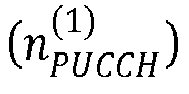
 zu bestimmen, dass eine AP-basierte Zuweisung einer Uplink-Ressource eines PUCCH für die HARQ-ACK-Übertragung für einen neuen Trägertyp (NCT) gegeben ist durch


- Benutzergerät nach Anspruch 1, wobei der mindestens eine zusätzliche versatzbezogene Parameter mindestens eines aus den folgenden ausgewählten Elementen umfasst: einen Wert für den Bestätigungs-/Nichtbestätigungs (ACK/NACK)-Ressourcenversatz (ARO), einen Versatz des Antennenanschlusses (AP), eine maximale Anzahl von eCCE-Indizes unter allen ePDCCH-Sätzen zu einem Benutzergerät in einem spezifizierten Teilrahmen (Nm), ein Versatz, der dem Benutzergerät durch Signalisierung auf höherer Ebene mitgeteilt wird, um eine Kollision mit dem Benutzergerät in koordinierenden Zellen
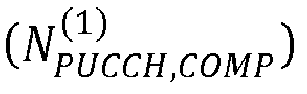
- Benutzergerät nach Anspruch 1, wobei der Empfänger ferner einen für ein Benutzergerät spezifischen Startversatz für einen erkannten ePDCCH-Satz empfängt, der durch eine Funkressourcensteuerungs (RRC)-Signalisierung

- Benutzergerät nach Anspruch 1, wobei der Prozessor ferner dazu vorgesehen ist, zu bestimmen, dass eine ARI-basierte Zuweisung einer Uplink-Ressource eines PUCCH für eine HARQ-ACK-Übertragung unter Verwendung eines abwärtskompatiblen Trägers


- Benutzergerät nach Anspruch 1, wobei der Prozessor ferner dazu vorgesehen ist, zu bestimmen, dass eine AP-basierte Zuweisung einer Uplink-Ressource eines PUCCH für eine HARQ-ACK-Übertragung für einen neuen Trägertyp (NCT) gegeben ist durch f(necce) + 2 • AP oder

- Benutzergerät nach Anspruch 1, wobei der Prozessor ferner dazu vorgesehen ist, zu bestimmen, dass die Zuweisung einer Uplink-Ressource des PUCCH für die HARQ-ACK-Bündelung für die Ressourcenzuweisung für den Teilrahmen n für eine verbesserte PDCCH-Übertragung gegeben ist durch:


- Benutzergerät nach Anspruch 1, wobei der Prozessor ferner angeordnet ist, um:zu bestimmen, dass eine ARI-basierte Zuweisung einer Uplink-Ressource eines PUCCH für eine HARQ-ACK-Übertragung gegeben ist durch Wert + neCCE,s +
 für einen verbesserten PDCCH, der in einem Teilrahmen verwendet wird und für das PUCCH-Format 3 konfiguriert ist, eine Zuweisung einer Uplink-Ressource eines PUCCH für die HARQ-ACK-Übertragung basierend auf dem ARI-Versatzwert zu bestimmen;für einen verbesserten PDCCH, der in einem Teilrahmen verwendet wird und für das PUCCH-Format 3 konfiguriert ist, eine Zuweisung einer Uplink-Ressource eines PUCCH für die HARQ-ACK-Übertragung unter Verwendung von Übertragungsleistungssteuerelementen (TPCs) zu bestimmen, mit Ausnahme eines Teilrahmens, dessen Downlink-Zuweisungsindex (DAI) gleich dem einer primären Zelle ist, um eine verwendete Ressource im PUCCH-Format 3 unter vier konfigurierten Ressourcen anzuzeigen;für einen verbesserten PDCCH, der in einem Teilrahmen verwendet wird und für eines von einem PUCCH-Format 3 und PUCCH-Format 1b mit Kanalauswahl für das für die Trägeraggregation konfigurierte Benutzergerät konfiguriert ist, eine Zuweisung einer Uplink-Ressource eines PUCCH für die HARQ-ACK-Übertragung zu bestimmen, die den ARI-Versatzwert für verbesserte PDCCHs enthält, die in einer primären Zelle übertragen werden; undzu bestimmen, dass die Zuweisung der Uplink-Ressource des PUCCH für die HARQ-ACK-Übertragung unter Verwendung eines für ein Benutzergerät spezifischen Startversatzes für den verbesserten PDCCH-Satz s durch die RRC-Signalisierung für einen Downlink (DL)-Teilrahmen für einen verbesserten PDCCH konfiguriert wird und unter Verwendung eines zellenspezifischen Startversatzes für einen verbesserten PDCCH-Satz s durch die bestehenden PDCCHs zugeordnete RRC-Signalisierung für DL-Teilrahmen konfiguriert wird.
- Benutzergerät nach Anspruch 1, wobei der Prozessor ferner dazu vorgesehen ist, einen HARQ-ACK-PUCCH-Ressourcenwert bei jeder PDCCH-Zuweisung in einer primären Zelle und in jeder sekundären Zelle zu übertragen, um den PUCCH-Ressourcenwert innerhalb eines Teilrahmens zu bestimmen und einen einzelnen physischen gemeinsam genutzten Downlink-Kanal (PDSCH) in einer primären Zelle zu empfangen, wobei der PDCCH einen DAI von eins aufweist, wobei der Prozessor das PUCCH-Format 1a/1b mit dynamischer Ressourcenzuweisung für die Zuweisung einer Uplink-Ressource des PUCCH für die HARQ-ACK-Übertragung verwendet.
- Benutzergerät nach Anspruch 1, wobei der Prozessor ferner dazu vorgesehen ist, nur einen von einem verbesserten physischen Downlink-Steuerkanal und einen bestehenden physischen Downlink-Steuerkanal für Downlink-Teilrahmen zu verwenden.
- Verfahren zur Bereitstellung einer dynamischen Übertragung mit hybrider automatischer Wiederholungsanforderungsbestätigung (HARQ-ACK) mit Ressourcenzuweisung für den verbesserten physischen Downlink-Steuerkanal, umfassend:Empfangen, auf einem verbesserten physischen Downlink-Steuerkanal (ePDCCH), eines niedrigsten Steuerkanalelementindex (ncce) und eines niedrigsten verbesserten Steuerkanalelementindex (neCCE);Empfangen, auf dem ePDCCH, eines für ein Benutzergerät spezifischen Startversatzes
 Empfangen, auf dem ePDCCH, von mindestens einem aus den folgenden ausgewählten Elementen: ein Wert für den Bestätigungs-/Nichtbestätigungs (ACK/NACK)-Ressourcenversatz (ARO), ein Versatz des Antennenanschlusses (AP), eine maximale Anzahl von eCCE-Indizes unter allen ePDCCH-Sätzen zu einem Benutzergerät in einem spezifizierten Teilrahmen (Nm), ein Versatz, der dem Benutzergerät durch Signalisierung auf höherer Ebene mitgeteilt wird, um eine Kollision mit dem Benutzergerät in koordinierenden Zellen
 Bestimmen der Zuweisung einer Uplink-Ressource eines physischen Uplink-Steuerkanals (PUCCH) für die Übertragung mit hybrider automatischer Wiederholungsanforderungsbestätigung (HARQ-ACK) basierend auf dem niedrigsten Steuerkanalelementindex (ncce) und dem niedrigsten verbesserten Steuerkanalelementindex (neCCE), dem für ein Benutzergerät spezifischen Startversatz

 wobei das Bestimmen der Zuweisung einer Uplink-Ressource eines physischen Uplink-Steuerkanals (PUCCH) für die HARQ-ACK-Übertragung umfasst:Bestimmen, dass eine hybride Zuweisung einer Uplink-Ressource eines PUCCH für die HARQ-ACK-Übertragung unter Verwendung eines abwärtskompatiblen Trägers

 Bestimmen, dass eine AP-basierte Zuweisung einer Uplink-Ressource eines PUCCH für die HARQ-ACK-Übertragung für einen neuen Trägertyp (NCT) gegeben ist durch


- Verfahren nach Anspruch 10, wobei das Empfangen eines für ein Benutzergerät spezifischen Startversatzes


- Verfahren nach Anspruch 10, wobei das Bestimmen, dass eine ARI-basierte Zuweisung einer Uplink-Ressource des PUCCH für eine HARQ-ACK-Übertragung unter Verwendung eines abwärtskompatiblen Trägers


- Verfahren nach Anspruch 10, ferner umfassend das Verwenden von nur einem von einem verbesserten physischen Downlink-Steuerkanal und einem bestehenden physischen Downlink-Steuerkanal für Downlink-Teilrahmen.
Applications Claiming Priority (2)
| Application Number | Priority Date | Filing Date | Title |
|---|---|---|---|
| US201261707784P | 2012-09-28 | 2012-09-28 | |
| PCT/US2013/062132 WO2014052730A1 (en) | 2012-09-28 | 2013-09-27 | Dynamic hybrid automatic repeat request-acknowledgement (harq-ack) transmission with enhanced physical downlink control channels |
Publications (3)
| Publication Number | Publication Date |
|---|---|
| EP2901603A1 EP2901603A1 (de) | 2015-08-05 |
| EP2901603A4 EP2901603A4 (de) | 2016-04-20 |
| EP2901603B1 true EP2901603B1 (de) | 2019-11-13 |
Family
ID=94381311
Family Applications (1)
| Application Number | Title | Priority Date | Filing Date |
|---|---|---|---|
| EP13841050.1A Active EP2901603B1 (de) | 2012-09-28 | 2013-09-27 | Dynamische harq-ack-übertragung mit verbesserten pdcch |
Country Status (6)
| Country | Link |
|---|---|
| US (2) | US9374806B2 (de) |
| EP (1) | EP2901603B1 (de) |
| JP (1) | JP5984277B2 (de) |
| KR (1) | KR101800707B1 (de) |
| CN (1) | CN104737485B (de) |
| WO (1) | WO2014052730A1 (de) |
Families Citing this family (51)
| Publication number | Priority date | Publication date | Assignee | Title |
|---|---|---|---|---|
| WO2013168341A1 (ja) | 2012-05-11 | 2013-11-14 | パナソニック株式会社 | 端末装置及び送信方法 |
| WO2014052905A1 (en) | 2012-09-28 | 2014-04-03 | Yiu Candy | Rsrp mobility state estimation for cellular device |
| US9578635B2 (en) | 2012-09-28 | 2017-02-21 | Intel Corporation | Method and apparatus for autonomous cluster head selection for machine-type-communications (MTC) |
| US9781638B2 (en) | 2012-09-28 | 2017-10-03 | Intel Corporation | Method of enhanced interference measurements for channel state information (CSI) feedback |
| EP2901603B1 (de) | 2012-09-28 | 2019-11-13 | Intel Corporation | Dynamische harq-ack-übertragung mit verbesserten pdcch |
| US9288756B2 (en) | 2012-09-28 | 2016-03-15 | Intel Corporation | Systems and methods for device-to-device communication in the absence of network coverage |
| CN110311714B (zh) | 2012-09-28 | 2022-09-30 | 苹果公司 | Lte系统中的不连续接收(drx)增强 |
| CN106028471B (zh) | 2012-09-28 | 2019-06-18 | 英特尔公司 | 用于在lte系统中的小数据传输的永久在线的承载 |
| KR20150090058A (ko) * | 2012-10-14 | 2015-08-05 | 엘지전자 주식회사 | 무선 통신 시스템에서 수신확인응답 전송 방법 및 장치 |
| US11245507B2 (en) * | 2012-11-02 | 2022-02-08 | Texas Instruments Incorporated | Efficient allocation of uplink HARQ-ACK resources for LTE enhanced control channel |
| US9515802B2 (en) * | 2012-11-14 | 2016-12-06 | Lg Electronics Inc. | Method for operating terminal in carrier aggregation system, and apparatus using said method |
| US9882697B2 (en) * | 2013-01-09 | 2018-01-30 | Lg Electronics Inc. | Method and apparatus for transmitting receipt confirmation reply in wireless communication system |
| WO2014109797A1 (en) * | 2013-01-14 | 2014-07-17 | Intel IP Corporation | Energy-harvesting devices in wireless networks |
| US9112662B2 (en) * | 2013-01-17 | 2015-08-18 | Samsung Electronics Co., Ltd. | Overhead reduction for transmission of acknowledgment signals |
| TWI615050B (zh) * | 2013-01-18 | 2018-02-11 | 諾基亞對策與網路公司 | 在實體下行鏈路控制通道資源分配中用於分時雙工的增強型實體下行鏈路控制通道之確認/負確認資源偏移値 |
| JP6289818B2 (ja) * | 2013-05-09 | 2018-03-07 | 株式会社Nttドコモ | ユーザ端末及び無線通信方法 |
| US9271279B2 (en) * | 2013-05-09 | 2016-02-23 | Sharp Laboratories Of America, Inc. | Channel state measurement and reporting |
| US9667386B2 (en) * | 2013-11-13 | 2017-05-30 | Samsung Electronics Co., Ltd | Transmission of control channel and data channels for coverage enhancements |
| US9973901B2 (en) * | 2014-03-28 | 2018-05-15 | Blackberry Limited | Enhancing group communication services |
| WO2015156521A1 (ko) | 2014-04-08 | 2015-10-15 | 엘지전자 주식회사 | 무선 자원의 용도 변경을 지원하는 무선 통신 시스템에서 상향링크 제어 정보 송신 방법 및 이를 위한 장치 |
| US20150334715A1 (en) * | 2014-05-14 | 2015-11-19 | Innovative Sonic Corporation | Method and apparatus for supporting for device-to-device (d2d) services in a wireless communication system |
| CN107996022B (zh) | 2015-05-22 | 2021-08-27 | Lg电子株式会社 | 用于接收下行链路控制信道的无线装置及方法 |
| US11637593B2 (en) | 2015-07-09 | 2023-04-25 | Qualcomm Incorporated | Machine type communication (MTC) configuration, interference management, and retuning time for uplink transmissions |
| US10219252B2 (en) * | 2016-01-15 | 2019-02-26 | Qualcomm Incorporated | Shortened control channel resource mapping |
| US10944515B2 (en) * | 2016-04-01 | 2021-03-09 | Nokia Solutions And Networks Oy | Low latency hybrid automatic repeat request (HARQ) feedback for wireless networks |
| WO2018004631A1 (en) * | 2016-06-30 | 2018-01-04 | Intel IP Corporation | Method for crc ambiguity avoidance in 5g dci decoding |
| WO2018010077A1 (zh) * | 2016-07-11 | 2018-01-18 | 广东欧珀移动通信有限公司 | 传输数据的方法和终端设备 |
| JP7027430B2 (ja) | 2017-01-08 | 2022-03-01 | エルジー エレクトロニクス インコーポレイティド | 無線通信システムにおいて端末と基地局との間の上りリンク信号の送受信方法及びそれを支援する装置 |
| US10772084B2 (en) * | 2017-01-09 | 2020-09-08 | Motorola Mobility Llc | Method and apparatus for scheduling information for a downlink data channel |
| WO2018126496A1 (en) | 2017-01-09 | 2018-07-12 | Qualcomm Incorporated | Bit allocation for encoding and decoding |
| WO2018169937A1 (en) * | 2017-03-15 | 2018-09-20 | Intel IP Corporation | Determination of new radio (nr) physical uplink control channel(pucch) resource for hybrid automatic repeat request acknowledgement (harq-ack) feedback |
| EP4312396B1 (de) | 2017-05-05 | 2025-10-01 | Telefonaktiebolaget LM Ericsson (publ) | Persistente anzeige von bestätigungsressourcen |
| CN111052693B (zh) * | 2017-08-29 | 2022-07-22 | 株式会社Ntt都科摩 | 用户终端以及无线通信方法 |
| CN116546548B (zh) * | 2017-09-11 | 2026-06-19 | 维沃移动通信有限公司 | 一种测量、测量配置方法、终端及基站 |
| US11617111B2 (en) | 2017-09-19 | 2023-03-28 | Beijing Xiaomi Mobile Software Co., Ltd. | Method and apparatus for overheat protection of user equipment, and base station |
| US10644765B2 (en) * | 2017-10-24 | 2020-05-05 | Intel Corporation | Enhanced acknowledgment and power saving for wireless communications |
| WO2019139330A1 (ko) | 2018-01-12 | 2019-07-18 | 한국전자통신연구원 | 상향링크 제어채널 송수신 방법 및 이를 위한 장치 |
| CN108768599B (zh) * | 2018-04-02 | 2022-08-19 | 中兴通讯股份有限公司 | 上行信号的发送、接收方法及装置、存储介质、电子设备 |
| US11290220B2 (en) * | 2018-04-06 | 2022-03-29 | Nokia Technologies Oy | Selection of physical uplink control channel resources |
| US12057945B2 (en) * | 2018-04-19 | 2024-08-06 | Qualcomm Incorporated | Repetition-based transmissions for uplink ultra-reliable low latency communication |
| US11368260B2 (en) * | 2018-05-03 | 2022-06-21 | Mediatek Singapore Pte. Ltd. | Method and apparatus for reporting hybrid automatic repeat request-acknowledge information in mobile communications |
| CN114785385B (zh) * | 2018-06-15 | 2023-11-03 | Oppo广东移动通信有限公司 | 无线通信方法、网络设备和终端设备 |
| CN110784925B (zh) * | 2018-07-31 | 2022-10-18 | 华为技术有限公司 | 通信方法及装置 |
| CN110932820B (zh) * | 2018-09-19 | 2022-01-14 | 华为技术有限公司 | 发送和接收上行控制信息的方法以及通信装置 |
| EP3949605B1 (de) * | 2019-03-28 | 2023-12-13 | Sharp Kabushiki Kaisha | Benutzergeräte, basisstationen und verfahren für ein konfigurierbares downlink-steuerungsinformationsformat |
| WO2020235452A1 (ja) * | 2019-05-17 | 2020-11-26 | 株式会社Nttドコモ | ユーザ端末及び無線通信方法 |
| WO2021026903A1 (zh) * | 2019-08-15 | 2021-02-18 | 富士通株式会社 | 信号发送方法和信号接收方法及其装置、通信系统 |
| US11595848B2 (en) * | 2020-04-03 | 2023-02-28 | Samsung Electronics Co., Ltd. | Method and apparatus for transmission and reception of data in communication system |
| EP4047854A4 (de) * | 2020-10-15 | 2023-01-25 | LG Electronics Inc. | Verfahren und vorrichtung zum senden/empfangen eines signals in einem drahtloskommunikationssystem |
| JP2024509826A (ja) * | 2021-03-02 | 2024-03-05 | インテル コーポレイション | Harq-ack送信 |
| US12127197B2 (en) * | 2021-07-19 | 2024-10-22 | Qualcomm Incorporated | Acknowledgement transmissions associated with physical downlink control channel demodulation reference signal bundling |
Family Cites Families (123)
| Publication number | Priority date | Publication date | Assignee | Title |
|---|---|---|---|---|
| US8594690B2 (en) | 2000-02-05 | 2013-11-26 | Telefonaktiebolaget L M Ericsson (Publ) | Subcell measurement procedures in a distributed antenna system |
| US6934756B2 (en) | 2000-11-01 | 2005-08-23 | International Business Machines Corporation | Conversational networking via transport, coding and control conversational protocols |
| US7068789B2 (en) | 2001-09-19 | 2006-06-27 | Microsoft Corporation | Peer-to-peer name resolution protocol (PNRP) group security infrastructure and method |
| JP3791464B2 (ja) | 2002-06-07 | 2006-06-28 | ソニー株式会社 | アクセス権限管理システム、中継サーバ、および方法、並びにコンピュータ・プログラム |
| EP1657854A1 (de) | 2003-08-19 | 2006-05-17 | Keio University | Funkkommunikationsgerät, ad-hoc-system und kommunikationssystem |
| US7743151B2 (en) | 2004-08-05 | 2010-06-22 | Cardiac Pacemakers, Inc. | System and method for providing digital data communications over a wireless intra-body network |
| US7602918B2 (en) | 2005-06-30 | 2009-10-13 | Alcatel-Lucent Usa Inc. | Method for distributing security keys during hand-off in a wireless communication system |
| US7301923B2 (en) | 2005-10-07 | 2007-11-27 | Motorola, Inc. | Method and apparatus for facilitating handoffs in a wireless communication network |
| US7688755B2 (en) | 2005-10-25 | 2010-03-30 | Motorola, Inc. | Method and apparatus for group leader selection in wireless multicast service |
| WO2007111710A2 (en) | 2005-11-22 | 2007-10-04 | Motorola Inc. | Method and apparatus for providing a key for secure communications |
| US7848524B2 (en) | 2006-06-30 | 2010-12-07 | Verint Americas Inc. | Systems and methods for a secure recording environment |
| US7899178B2 (en) | 2006-09-29 | 2011-03-01 | Verint Americas Inc. | Recording invocation of communication sessions |
| US7853417B2 (en) | 2007-01-30 | 2010-12-14 | Silver Spring Networks, Inc. | Methods and system for utility network outage detection |
| US9504083B2 (en) | 2008-01-10 | 2016-11-22 | Innovative Sonic Limited | Method and related communications device for improving discontinuous reception functionality |
| KR20090083269A (ko) | 2008-01-29 | 2009-08-03 | 엘지전자 주식회사 | 무선 통신 시스템에서 pdcch 검색 방법 |
| US8279803B2 (en) | 2008-02-06 | 2012-10-02 | Broadcom Corporation | Computing unit with femtocell AP functionality |
| US20090262684A1 (en) | 2008-04-18 | 2009-10-22 | Amit Khetawat | Method and Apparatus for Home Node B Registration using HNBAP |
| CN101286844B (zh) | 2008-05-29 | 2010-05-12 | 西安西电捷通无线网络通信有限公司 | 一种支持快速切换的实体双向鉴别方法 |
| CN102113241B (zh) | 2008-07-30 | 2014-08-13 | Lg电子株式会社 | 在无线通信系统中传送控制信息的方法和装置 |
| KR101571563B1 (ko) | 2008-09-24 | 2015-11-25 | 엘지전자 주식회사 | 다중셀 협력 무선통신시스템에서의 상향링크 전력의 제어 방법 및 이를 지원하는 단말 |
| KR100999046B1 (ko) | 2008-10-29 | 2010-12-09 | 한국과학기술원 | 클러스터 구조의 센서 네트워크의 간섭 회피 방법, 클러스터 재구성 방법 및 상기 방법이 적용된 센서 네트워크 통신장치 |
| US20100110896A1 (en) | 2008-11-06 | 2010-05-06 | Li-Chih Tseng | Method of improving discontinuous reception functionality and related communication device |
| KR101642309B1 (ko) | 2008-11-06 | 2016-07-25 | 엘지전자 주식회사 | 단말의 하향링크 제어채널 모니터링 방법 |
| CN101771586B (zh) | 2008-11-14 | 2013-10-09 | 华为终端有限公司 | Wi-Fi点对点网络实现添加设备的方法、系统和设备 |
| US20110002281A1 (en) | 2008-12-30 | 2011-01-06 | Interdigital Patent Holdings, Inc. | Discontinuous reception for carrier aggregation |
| CN101777941B (zh) | 2009-01-12 | 2014-10-08 | 华为技术有限公司 | 协作多点传输系统中的下行传输方法、网络设备和无线系统 |
| WO2011100673A1 (en) | 2010-02-12 | 2011-08-18 | Interdigital Patent Holdings, Inc. | Method and apparatus for enhancing cell-edge user performance and signaling radio link failure conditions via downlink cooperative component carriers |
| US8559374B2 (en) | 2009-02-20 | 2013-10-15 | Lg Electronics Inc. | Method and apparatus for data communication through a coordinated multi-point transmission |
| US8995923B2 (en) | 2009-03-03 | 2015-03-31 | Mobilitie, Llc | System and method for management of a dynamic network using wireless communication devices |
| KR101559799B1 (ko) | 2009-03-04 | 2015-10-26 | 엘지전자 주식회사 | 무선 통신 시스템에서 CoMP 동작 수행 및 피드백 정보 전송 방법 |
| KR101729548B1 (ko) | 2009-03-06 | 2017-05-02 | 엘지전자 주식회사 | CoMP 기법이 적용된 무선 통신 시스템에서 채널 품질 정보 송신 방법 및 이를 위한 장치 |
| US8873505B2 (en) | 2009-03-12 | 2014-10-28 | Interdigital Patent Holdings, Inc. | Method and apparatus for performing component carrier-specific reconfiguration |
| JP5205330B2 (ja) | 2009-04-27 | 2013-06-05 | 株式会社日立製作所 | 無線通信システムおよび無線通信方法ならびに基地局装置 |
| KR101478316B1 (ko) | 2009-04-28 | 2014-12-31 | 한국전자통신연구원 | 전용 레퍼런스 시그널 전송 방법 및 전용 레퍼런스 시그널 수신 방법 |
| US9002354B2 (en) | 2009-06-12 | 2015-04-07 | Google Technology Holdings, LLC | Interference control, SINR optimization and signaling enhancements to improve the performance of OTDOA measurements |
| US20110026504A1 (en) | 2009-07-31 | 2011-02-03 | Sony Corporation | Continuous group ownership in an ieee 802.11 wireless local area network |
| EP2465301B1 (de) | 2009-08-14 | 2017-03-22 | Hilco Patent Acquisition 55, LLC | Verfahren und vorrichtung zur unterstützung von sprachlösungen für datenzentrierte endgeräte |
| EP2477440A3 (de) | 2009-09-18 | 2012-12-26 | NEC Corporation | Kommunikationssystem und Kommunikationssteuerungsverfahren |
| US8693367B2 (en) | 2009-09-26 | 2014-04-08 | Cisco Technology, Inc. | Providing offloads in a communication network |
| CN102550088B (zh) | 2009-10-02 | 2015-06-17 | 日本电气株式会社 | 无线通信系统以及无线终端 |
| KR20110037420A (ko) | 2009-10-06 | 2011-04-13 | 주식회사 팬택 | 상향링크 다중수신을 위한 방법 및 그를 이용한 기지국 장치 |
| KR101577289B1 (ko) | 2009-10-09 | 2015-12-14 | 삼성전자주식회사 | 무선통신시스템에서 물리적 셀 식별자를 할당하는 방법 및 장치 |
| KR20110048422A (ko) | 2009-11-02 | 2011-05-11 | 주식회사 팬택 | 채널 정보 피드백 장치와 그를 이용하는 통신단말장치 및 기지국 장치 |
| KR20110049622A (ko) | 2009-11-04 | 2011-05-12 | 삼성전자주식회사 | 무선 통신 네트워크 시스템에서 데이터 전송 방법 및 장치 |
| WO2011055986A2 (en) | 2009-11-08 | 2011-05-12 | Lg Electronics Inc. | A method and a base station for transmitting a csi-rs, and a method and a user equipment for receiving the csi-rs |
| JP5573571B2 (ja) | 2009-11-13 | 2014-08-20 | ソニー株式会社 | 無線通信装置、無線通信システム、プログラム、および無線通信方法 |
| US8891423B2 (en) | 2009-12-22 | 2014-11-18 | Interdigital Patent Holdings, Inc. | Group-based machine to machine communication |
| US20110170427A1 (en) | 2010-01-11 | 2011-07-14 | Nokia Corporation | Best Companion PMI-Based Beamforming |
| US8599708B2 (en) | 2010-01-14 | 2013-12-03 | Qualcomm Incorporated | Channel feedback based on reference signal |
| CN102170667B (zh) | 2010-02-25 | 2013-02-27 | 中兴通讯股份有限公司 | 一种实现基站间切换的方法、系统及基站装置 |
| KR101674958B1 (ko) | 2010-03-05 | 2016-11-10 | 엘지전자 주식회사 | 셀 간 간섭을 제어하기 위한 장치 및 방법 |
| US8797999B2 (en) | 2010-03-10 | 2014-08-05 | Apple Inc. | Dynamically adjustable communications services and communications links |
| AU2011227860B2 (en) | 2010-03-17 | 2015-02-12 | Qualcomm Incorporated | Method and apparatus for providing channel state information-reference signal (CSI-RS) configuration information in a wireless communication system supporting multiple antennas |
| US8948085B2 (en) | 2010-03-17 | 2015-02-03 | Qualcomm Incorporated | Methods and apparatus for best-effort radio backhaul among cells on unlicensed or shared spectrum |
| US8908714B2 (en) | 2010-03-31 | 2014-12-09 | Lg Electronics Inc. | Selective discontinuous reception method and related system and device |
| KR20110111234A (ko) | 2010-04-02 | 2011-10-10 | 삼성전자주식회사 | 이동 통신 시스템에서의 이동성 셀 측정 방법 및 장치 |
| JP4985880B2 (ja) | 2010-04-27 | 2012-07-25 | 日本電気株式会社 | 通信方法とモバイルネットワークシステムと装置 |
| US9060374B2 (en) | 2010-04-27 | 2015-06-16 | Nec Corporation | Communication method, mobile network system and device |
| JP4960474B2 (ja) | 2010-04-30 | 2012-06-27 | 株式会社エヌ・ティ・ティ・ドコモ | 移動通信方法、移動局及び無線基地局 |
| US8868743B2 (en) | 2010-04-30 | 2014-10-21 | Sharp Kabushiki Kaisha | Modified access classes for machine type communication (MTC) devices during emergencies |
| US9749880B2 (en) | 2010-06-30 | 2017-08-29 | Verizon Patent And Licensing Inc. | Base station failover using neighboring base stations as relays |
| EP2605433B1 (de) | 2010-08-11 | 2019-02-27 | GoldPeak Innovations Inc. | Vorrichtung und verfahren zur übertragung von stummschaltungsinformationen sowie vorrichtung und verfahren zur erfassung eines kanalstatus damit |
| US8520526B2 (en) | 2010-08-18 | 2013-08-27 | Ubeeairwalk | Method and apparatus of load balancing femtocell cluster access |
| US8712459B2 (en) | 2010-09-13 | 2014-04-29 | Electronics And Telecommunications Research Institute | Group control method for machine type communication and mobile communication system using the method |
| US9622286B2 (en) | 2010-09-13 | 2017-04-11 | Nokia Solutions And Networks Oy | Reduced radio resource control connectivity |
| EP2620019B1 (de) | 2010-09-20 | 2018-01-17 | BlackBerry Limited | Verfahren und vorrichtung für paketvermittelte dienstkontinuität während eines leitungsvermittelten fallbacks |
| US9872272B2 (en) | 2010-10-01 | 2018-01-16 | Mitsubishi Electric Corporation | Communication system for reducing congestion |
| US8780880B2 (en) | 2010-10-01 | 2014-07-15 | Mediatek Singapore Pte, Ltd. | Method of TDM in-device coexistence interference avoidance |
| US9036532B2 (en) | 2010-10-27 | 2015-05-19 | Lg Electronics Inc. | Scheduling method for machine-to-machine communication |
| US8681651B2 (en) | 2010-11-05 | 2014-03-25 | Qualcomm Incorporated | Reference signal reception and channel state information determination for multiple nodes in a wireless communication network |
| JP4902778B1 (ja) | 2010-11-08 | 2012-03-21 | 株式会社エヌ・ティ・ティ・ドコモ | 移動端末装置、基地局装置及び通信制御方法 |
| EP2639986B1 (de) * | 2010-11-11 | 2023-05-10 | LG Electronics Inc. | Verfahren und vorrichtung zum senden und empfangen von uplink-steuerungsinformationen in einem drahtlosen kommunikationssystem |
| US8937876B2 (en) | 2010-11-15 | 2015-01-20 | Blackberry Limited | Managing communications across a wireless network |
| US8549358B2 (en) | 2010-12-01 | 2013-10-01 | At&T Intellectual Property I, L.P. | Method and apparatus for session establishment management |
| US8948382B2 (en) | 2010-12-16 | 2015-02-03 | Microsoft Corporation | Secure protocol for peer-to-peer network |
| US9002367B2 (en) | 2010-12-23 | 2015-04-07 | Telefonaktiebolaget L M Ericsson (Publ) | Downlink control for wireless heterogeneous telecommunications |
| CN103299556B (zh) | 2011-01-07 | 2017-05-17 | 交互数字专利控股公司 | 用于协作多点传输中下行链路共享信道接收的方法、系统和设备 |
| US8675558B2 (en) * | 2011-01-07 | 2014-03-18 | Intel Corporation | CQI definition for transmission mode 9 in LTE-advanced |
| KR101904945B1 (ko) | 2011-01-20 | 2018-10-08 | 엘지전자 주식회사 | 무선 통신 시스템 셀 간 간섭을 감소시키는 방법 및 이를 위한 장치 |
| ES2609076T3 (es) | 2011-02-11 | 2017-04-18 | Interdigital Patent Holdings, Inc. | Dispositivo y método para un canal de control mejorado (E-PDCCH) |
| US8537911B2 (en) | 2011-02-21 | 2013-09-17 | Motorola Mobility Llc | Method and apparatus for reference signal processing in an orthogonal frequency division multiplexing communication system |
| JP2012175641A (ja) | 2011-02-24 | 2012-09-10 | Nec Casio Mobile Communications Ltd | 信号受信電力推定装置および方法 |
| US8774111B2 (en) | 2011-05-06 | 2014-07-08 | Dynamic Invention Llc | Fair and efficient channel allocation and spectrum sensing for cognitive OFDMA networks |
| WO2012173623A1 (en) | 2011-06-16 | 2012-12-20 | Nokia Siemens Networks Oy | Methods, apparatus, a system, and a related computer program product for activation and deacitivation of bearers |
| US8843737B2 (en) | 2011-07-24 | 2014-09-23 | Telefonaktiebolaget L M Ericsson (Publ) | Enhanced approach for transmission control protocol authentication option (TCP-AO) with key management protocols (KMPS) |
| US9456372B2 (en) | 2011-08-12 | 2016-09-27 | Interdigital Patent Holdings, Inc. | Interference measurement in wireless networks |
| EP2557890B1 (de) | 2011-08-12 | 2019-07-17 | BlackBerry Limited | Vereinfachte ue- + enb-nachrichtenübermittlung |
| KR101935785B1 (ko) | 2011-08-16 | 2019-04-03 | 삼성전자 주식회사 | 무선통신시스템에서 멀티미디어 방송 서비스를 수신하는 방법 및 장치 |
| RU2606061C2 (ru) | 2011-08-25 | 2017-01-10 | Телефонактиеболагет Л М Эрикссон (Пабл) | Адаптация порога инициирования для измерений для повторного выбора соты |
| KR101584552B1 (ko) | 2011-09-25 | 2016-01-22 | 엘지전자 주식회사 | 상향링크 신호 전송방법 및 사용자기기와, 상향링크 신호 수신방법 및 기지국 |
| WO2013052163A1 (en) | 2011-10-03 | 2013-04-11 | Intel Corporation | Device to device (d2d) communication mechanisms |
| EP3800824B1 (de) | 2011-10-12 | 2024-11-27 | Samsung Electronics Co., Ltd. | Verfahren und vorrichtung zum senden und empfangen von feedbackinformationen in einem mobilen kommunikationssystem |
| US9894705B2 (en) | 2011-11-11 | 2018-02-13 | Nokia Technologies Oy | Self-adjusting discontinuous reception pattern |
| WO2013073917A1 (ko) | 2011-11-17 | 2013-05-23 | 엘지전자 주식회사 | 상향링크 신호 수신 방법 및 기지국과, 상향링크 신호 전송 방법 및 사용자기기 |
| US9071927B2 (en) | 2011-12-05 | 2015-06-30 | Verizon Patent And Licensing Inc. | Collapsed mobile architecture |
| US8923863B2 (en) | 2011-12-19 | 2014-12-30 | Cisco Technology, Inc. | Maintaining signaling reduction mode in communication networks |
| WO2013100834A1 (en) | 2011-12-30 | 2013-07-04 | Telefonaktiebolaget L M Ericsson (Publ) | Method and network node for handling beacon signal transmission |
| US8995347B2 (en) | 2012-01-19 | 2015-03-31 | Samsung Electronics Co., Ltd. | Apparatus and method for pilot scrambling for enhanced physical downlink control channels |
| EP2805545A4 (de) | 2012-01-20 | 2015-12-30 | Nokia Solutions & Networks Oy | Mobilitätssteuerung in einem kommunikationssystem |
| CN107257275B (zh) * | 2012-01-27 | 2021-03-16 | 交互数字专利控股公司 | 由WTRU执行的用于ePDCCH的方法、WTRU、搜索空间监视方法和UE |
| US9008585B2 (en) | 2012-01-30 | 2015-04-14 | Futurewei Technologies, Inc. | System and method for wireless communications measurements and CSI feedback |
| US9629028B2 (en) | 2012-03-16 | 2017-04-18 | Qualcomm Incorporated | System and method for heterogeneous carrier aggregation |
| GB2500382B (en) | 2012-03-19 | 2014-11-26 | Broadcom Corp | Methods, apparatus and computer programs for configuring user equipment |
| WO2013151404A1 (en) | 2012-04-06 | 2013-10-10 | Lg Electronics Inc. | An apparatus for receiving downlink signal in a wireless communication system and method thereof |
| KR102099637B1 (ko) | 2012-04-19 | 2020-04-10 | 삼성전자 주식회사 | 협력 멀티-포인트 통신 시스템들에 대한 기준 심볼 포트들의 준 공존 식별을 위한 방법 및 장치 |
| EP2849501B1 (de) | 2012-05-09 | 2020-09-30 | Samsung Electronics Co., Ltd. | Verfahren und vorrichtung zur steuerung des unregelmässigen empfangs in einem mobilen kommunikationssystem |
| US8743820B2 (en) | 2012-05-30 | 2014-06-03 | Intel Corporation | PUCCH resource allocation with enhanced PDCCH |
| US9185620B2 (en) | 2012-05-30 | 2015-11-10 | Intel Corporation | Adaptive UL-DL configurations in a TDD heterogeneous network |
| US9055569B2 (en) * | 2012-06-29 | 2015-06-09 | Samsung Electronics Co., Ltd. | Uplink hybrid acknowledgement signaling in wireless communications systems |
| EP3487246B1 (de) | 2012-07-03 | 2020-06-10 | LG Electronics Inc. | Verfahren und vorrichtung zur zuweisung einer ressource für uplink-steuerungskanal in drahtloskommunikationssystem |
| US20140022988A1 (en) | 2012-07-20 | 2014-01-23 | Alexei Davydov | User equipment and method for antenna port quasi co-location signaling in coordinated multi-point operations |
| EP3767870B1 (de) | 2012-08-02 | 2022-04-20 | BlackBerry Limited | Uplink-steuerkanalressourcenzuweisung für einen verbesserten downlink-steuerkanal eines mobilkommunikationssystems |
| US9106386B2 (en) | 2012-08-03 | 2015-08-11 | Intel Corporation | Reference signal configuration for coordinated multipoint |
| US9288756B2 (en) | 2012-09-28 | 2016-03-15 | Intel Corporation | Systems and methods for device-to-device communication in the absence of network coverage |
| EP2901603B1 (de) | 2012-09-28 | 2019-11-13 | Intel Corporation | Dynamische harq-ack-übertragung mit verbesserten pdcch |
| US9781638B2 (en) | 2012-09-28 | 2017-10-03 | Intel Corporation | Method of enhanced interference measurements for channel state information (CSI) feedback |
| US20140092828A1 (en) | 2012-09-28 | 2014-04-03 | Intel Corporation | Os level wlan/cellular aggregation for integrated femto and ap deployments |
| CN110311714B (zh) | 2012-09-28 | 2022-09-30 | 苹果公司 | Lte系统中的不连续接收(drx)增强 |
| WO2014052905A1 (en) | 2012-09-28 | 2014-04-03 | Yiu Candy | Rsrp mobility state estimation for cellular device |
| US9578635B2 (en) | 2012-09-28 | 2017-02-21 | Intel Corporation | Method and apparatus for autonomous cluster head selection for machine-type-communications (MTC) |
| CN106028471B (zh) | 2012-09-28 | 2019-06-18 | 英特尔公司 | 用于在lte系统中的小数据传输的永久在线的承载 |
| RU2611258C2 (ru) | 2012-09-28 | 2017-02-21 | Хуавей Текнолоджиз Ко., Лтд. | Способ обработки информации о состоянии канала, сетевое устройство и пользовательское оборудование |
| WO2014182211A1 (en) | 2013-05-06 | 2014-11-13 | Telefonaktiebolaget L M Ericsson (Publ) | Traffic steering from a first access network to a second access network |
-
2013
- 2013-09-27 EP EP13841050.1A patent/EP2901603B1/de active Active
- 2013-09-27 JP JP2015534731A patent/JP5984277B2/ja active Active
- 2013-09-27 KR KR1020157005066A patent/KR101800707B1/ko active Active
- 2013-09-27 US US14/125,706 patent/US9374806B2/en active Active
- 2013-09-27 CN CN201380045563.6A patent/CN104737485B/zh active Active
- 2013-09-27 WO PCT/US2013/062132 patent/WO2014052730A1/en not_active Ceased
-
2016
- 2016-06-15 US US15/182,892 patent/US9603132B2/en active Active
Non-Patent Citations (1)
| Title |
|---|
| None * |
Also Published As
| Publication number | Publication date |
|---|---|
| US9603132B2 (en) | 2017-03-21 |
| US9374806B2 (en) | 2016-06-21 |
| EP2901603A1 (de) | 2015-08-05 |
| JP2015534394A (ja) | 2015-11-26 |
| EP2901603A4 (de) | 2016-04-20 |
| US20150195822A1 (en) | 2015-07-09 |
| KR20150038423A (ko) | 2015-04-08 |
| CN104737485B (zh) | 2018-05-29 |
| CN104737485A (zh) | 2015-06-24 |
| HK1254332A1 (zh) | 2019-07-19 |
| US20160374097A1 (en) | 2016-12-22 |
| KR101800707B1 (ko) | 2017-11-23 |
| JP5984277B2 (ja) | 2016-09-06 |
| WO2014052730A1 (en) | 2014-04-03 |
Similar Documents
| Publication | Publication Date | Title |
|---|---|---|
| US9603132B2 (en) | Dynamic hybrid automatic repeat request-acknowledgement (HARQ-ACK) transmission with enhanced physical downlink control channels | |
| US9591635B2 (en) | Systems and methods for UE-specific search space and ePDCCH scrambling | |
| CN114584265B (zh) | 无线通信系统中发送/接收无线信号的方法及其装置 | |
| CN108566267B (zh) | 用于ePDCCH的用户装备、方法、介质及设备 | |
| US9191946B2 (en) | Method and apparatus for enhanced control channel-based operation in wireless communication system | |
| EP3036856B1 (de) | Knoten und verfahren zur aufwärtsverbindungsplanung und zum timing hybrider automatischer wiederholungsanfragen | |
| EP2779496B1 (de) | Verfahren zur überwachung eines steuerkanals und entsprechende drahtlose vorrichtung | |
| US11743868B2 (en) | Short physical uplink shared channel arrangement | |
| US20180027551A1 (en) | Uplink control channel resource allocation for an enhanced downlink control channel of a mobile communication system | |
| EP2728957A1 (de) | Verfahren und vorrichtung zur zuweisung von steuerkanalressourcen | |
| EP2826171A1 (de) | Ressourcenzuordnung für physikalischen uplink-steuerkanal (pucch) unter verwendung eines erweiterten physikalischen downlink-steuerkanals (epdcch) | |
| CN104885543A (zh) | 用于在无线通信系统中确定传输块大小的方法和设备 | |
| EP2894919B1 (de) | Verfahren und vorrichtung zur zuordnung von steuerkanalkandidaten | |
| US9107214B2 (en) | Method of handling hybrid automatic repeat request acknowledgement responses in wireless communication system | |
| KR20190072381A (ko) | 무선 통신 시스템에서 제어 정보 및 데이터 정보 송수신 방법 및 장치 | |
| EP3300282B1 (de) | Knoten und benutzergerät zur abwärtsverbindungsplanung und für automatisches hybridanfragen- wiederholungsanfragen-timing | |
| KR20140019718A (ko) | 송수신포인트의 제어정보 전송방법 및 그 송수신포인트, 단말의 상향링크 컨트롤 채널 자원 매핑방법, 그 단말 | |
| HK1254332B (en) | User equipment, method, medium and apparatus for epdcch |
Legal Events
| Date | Code | Title | Description |
|---|---|---|---|
| PUAI | Public reference made under article 153(3) epc to a published international application that has entered the european phase |
Free format text: ORIGINAL CODE: 0009012 |
|
| 17P | Request for examination filed |
Effective date: 20150224 |
|
| AK | Designated contracting states |
Kind code of ref document: A1 Designated state(s): AL AT BE BG CH CY CZ DE DK EE ES FI FR GB GR HR HU IE IS IT LI LT LU LV MC MK MT NL NO PL PT RO RS SE SI SK SM TR |
|
| AX | Request for extension of the european patent |
Extension state: BA ME |
|
| DAX | Request for extension of the european patent (deleted) | ||
| RA4 | Supplementary search report drawn up and despatched (corrected) |
Effective date: 20160323 |
|
| REG | Reference to a national code |
Ref country code: DE Ref legal event code: R079 Ref document number: 602013062961 Country of ref document: DE Free format text: PREVIOUS MAIN CLASS: H04L0001180000 Ipc: H04B0017318000 |
|
| RIC1 | Information provided on ipc code assigned before grant |
Ipc: H04B 17/382 20150101ALI20181024BHEP Ipc: H04W 72/00 20090101ALI20181024BHEP Ipc: H04W 40/24 20090101ALI20181024BHEP Ipc: H04W 24/10 20090101ALI20181024BHEP Ipc: H04W 28/02 20090101ALI20181024BHEP Ipc: H04W 76/00 20090101ALI20181024BHEP Ipc: H04W 52/14 20090101ALI20181024BHEP Ipc: H04W 72/12 20090101ALI20181024BHEP Ipc: H04B 17/318 20150101AFI20181024BHEP Ipc: H04W 74/00 20090101ALI20181024BHEP Ipc: H04W 72/04 20090101ALI20181024BHEP Ipc: H04L 5/00 20060101ALI20181024BHEP |
|
| GRAP | Despatch of communication of intention to grant a patent |
Free format text: ORIGINAL CODE: EPIDOSNIGR1 |
|
| STAA | Information on the status of an ep patent application or granted ep patent |
Free format text: STATUS: GRANT OF PATENT IS INTENDED |
|
| INTG | Intention to grant announced |
Effective date: 20190225 |
|
| GRAS | Grant fee paid |
Free format text: ORIGINAL CODE: EPIDOSNIGR3 |
|
| GRAJ | Information related to disapproval of communication of intention to grant by the applicant or resumption of examination proceedings by the epo deleted |
Free format text: ORIGINAL CODE: EPIDOSDIGR1 |
|
| GRAL | Information related to payment of fee for publishing/printing deleted |
Free format text: ORIGINAL CODE: EPIDOSDIGR3 |
|
| STAA | Information on the status of an ep patent application or granted ep patent |
Free format text: STATUS: REQUEST FOR EXAMINATION WAS MADE |
|
| GRAP | Despatch of communication of intention to grant a patent |
Free format text: ORIGINAL CODE: EPIDOSNIGR1 |
|
| STAA | Information on the status of an ep patent application or granted ep patent |
Free format text: STATUS: GRANT OF PATENT IS INTENDED |
|
| INTC | Intention to grant announced (deleted) | ||
| INTG | Intention to grant announced |
Effective date: 20190711 |
|
| GRAA | (expected) grant |
Free format text: ORIGINAL CODE: 0009210 |
|
| STAA | Information on the status of an ep patent application or granted ep patent |
Free format text: STATUS: THE PATENT HAS BEEN GRANTED |
|
| AK | Designated contracting states |
Kind code of ref document: B1 Designated state(s): AL AT BE BG CH CY CZ DE DK EE ES FI FR GB GR HR HU IE IS IT LI LT LU LV MC MK MT NL NO PL PT RO RS SE SI SK SM TR |
|
| REG | Reference to a national code |
Ref country code: CH Ref legal event code: EP Ref country code: AT Ref legal event code: REF Ref document number: 1202770 Country of ref document: AT Kind code of ref document: T Effective date: 20191115 |
|
| REG | Reference to a national code |
Ref country code: DE Ref legal event code: R096 Ref document number: 602013062961 Country of ref document: DE |
|
| REG | Reference to a national code |
Ref country code: IE Ref legal event code: FG4D |
|
| REG | Reference to a national code |
Ref country code: NL Ref legal event code: FP |
|
| REG | Reference to a national code |
Ref country code: LT Ref legal event code: MG4D |
|
| PG25 | Lapsed in a contracting state [announced via postgrant information from national office to epo] |
Ref country code: FI Free format text: LAPSE BECAUSE OF FAILURE TO SUBMIT A TRANSLATION OF THE DESCRIPTION OR TO PAY THE FEE WITHIN THE PRESCRIBED TIME-LIMIT Effective date: 20191113 Ref country code: BG Free format text: LAPSE BECAUSE OF FAILURE TO SUBMIT A TRANSLATION OF THE DESCRIPTION OR TO PAY THE FEE WITHIN THE PRESCRIBED TIME-LIMIT Effective date: 20200213 Ref country code: NO Free format text: LAPSE BECAUSE OF FAILURE TO SUBMIT A TRANSLATION OF THE DESCRIPTION OR TO PAY THE FEE WITHIN THE PRESCRIBED TIME-LIMIT Effective date: 20200213 Ref country code: GR Free format text: LAPSE BECAUSE OF FAILURE TO SUBMIT A TRANSLATION OF THE DESCRIPTION OR TO PAY THE FEE WITHIN THE PRESCRIBED TIME-LIMIT Effective date: 20200214 Ref country code: PT Free format text: LAPSE BECAUSE OF FAILURE TO SUBMIT A TRANSLATION OF THE DESCRIPTION OR TO PAY THE FEE WITHIN THE PRESCRIBED TIME-LIMIT Effective date: 20200313 Ref country code: PL Free format text: LAPSE BECAUSE OF FAILURE TO SUBMIT A TRANSLATION OF THE DESCRIPTION OR TO PAY THE FEE WITHIN THE PRESCRIBED TIME-LIMIT Effective date: 20191113 Ref country code: LV Free format text: LAPSE BECAUSE OF FAILURE TO SUBMIT A TRANSLATION OF THE DESCRIPTION OR TO PAY THE FEE WITHIN THE PRESCRIBED TIME-LIMIT Effective date: 20191113 Ref country code: SE Free format text: LAPSE BECAUSE OF FAILURE TO SUBMIT A TRANSLATION OF THE DESCRIPTION OR TO PAY THE FEE WITHIN THE PRESCRIBED TIME-LIMIT Effective date: 20191113 Ref country code: LT Free format text: LAPSE BECAUSE OF FAILURE TO SUBMIT A TRANSLATION OF THE DESCRIPTION OR TO PAY THE FEE WITHIN THE PRESCRIBED TIME-LIMIT Effective date: 20191113 |
|
| PG25 | Lapsed in a contracting state [announced via postgrant information from national office to epo] |
Ref country code: HR Free format text: LAPSE BECAUSE OF FAILURE TO SUBMIT A TRANSLATION OF THE DESCRIPTION OR TO PAY THE FEE WITHIN THE PRESCRIBED TIME-LIMIT Effective date: 20191113 Ref country code: RS Free format text: LAPSE BECAUSE OF FAILURE TO SUBMIT A TRANSLATION OF THE DESCRIPTION OR TO PAY THE FEE WITHIN THE PRESCRIBED TIME-LIMIT Effective date: 20191113 Ref country code: IS Free format text: LAPSE BECAUSE OF FAILURE TO SUBMIT A TRANSLATION OF THE DESCRIPTION OR TO PAY THE FEE WITHIN THE PRESCRIBED TIME-LIMIT Effective date: 20200313 |
|
| REG | Reference to a national code |
Ref country code: NL Ref legal event code: PD Owner name: APPLE INC.; US Free format text: DETAILS ASSIGNMENT: CHANGE OF OWNER(S), ASSIGNMENT; FORMER OWNER NAME: INTEL CORPORATION Effective date: 20200527 Ref country code: DE Ref legal event code: R081 Ref document number: 602013062961 Country of ref document: DE Owner name: APPLE INC., CUPERTINO, US Free format text: FORMER OWNER: INTEL CORPORATION, SANTA CLARA, CALIF., US |
|
| PG25 | Lapsed in a contracting state [announced via postgrant information from national office to epo] |
Ref country code: AL Free format text: LAPSE BECAUSE OF FAILURE TO SUBMIT A TRANSLATION OF THE DESCRIPTION OR TO PAY THE FEE WITHIN THE PRESCRIBED TIME-LIMIT Effective date: 20191113 |
|
| PG25 | Lapsed in a contracting state [announced via postgrant information from national office to epo] |
Ref country code: DK Free format text: LAPSE BECAUSE OF FAILURE TO SUBMIT A TRANSLATION OF THE DESCRIPTION OR TO PAY THE FEE WITHIN THE PRESCRIBED TIME-LIMIT Effective date: 20191113 Ref country code: EE Free format text: LAPSE BECAUSE OF FAILURE TO SUBMIT A TRANSLATION OF THE DESCRIPTION OR TO PAY THE FEE WITHIN THE PRESCRIBED TIME-LIMIT Effective date: 20191113 Ref country code: RO Free format text: LAPSE BECAUSE OF FAILURE TO SUBMIT A TRANSLATION OF THE DESCRIPTION OR TO PAY THE FEE WITHIN THE PRESCRIBED TIME-LIMIT Effective date: 20191113 Ref country code: CZ Free format text: LAPSE BECAUSE OF FAILURE TO SUBMIT A TRANSLATION OF THE DESCRIPTION OR TO PAY THE FEE WITHIN THE PRESCRIBED TIME-LIMIT Effective date: 20191113 Ref country code: ES Free format text: LAPSE BECAUSE OF FAILURE TO SUBMIT A TRANSLATION OF THE DESCRIPTION OR TO PAY THE FEE WITHIN THE PRESCRIBED TIME-LIMIT Effective date: 20191113 |
|
| REG | Reference to a national code |
Ref country code: DE Ref legal event code: R097 Ref document number: 602013062961 Country of ref document: DE |
|
| REG | Reference to a national code |
Ref country code: AT Ref legal event code: MK05 Ref document number: 1202770 Country of ref document: AT Kind code of ref document: T Effective date: 20191113 |
|
| PG25 | Lapsed in a contracting state [announced via postgrant information from national office to epo] |
Ref country code: SM Free format text: LAPSE BECAUSE OF FAILURE TO SUBMIT A TRANSLATION OF THE DESCRIPTION OR TO PAY THE FEE WITHIN THE PRESCRIBED TIME-LIMIT Effective date: 20191113 Ref country code: SK Free format text: LAPSE BECAUSE OF FAILURE TO SUBMIT A TRANSLATION OF THE DESCRIPTION OR TO PAY THE FEE WITHIN THE PRESCRIBED TIME-LIMIT Effective date: 20191113 |
|
| PLBE | No opposition filed within time limit |
Free format text: ORIGINAL CODE: 0009261 |
|
| STAA | Information on the status of an ep patent application or granted ep patent |
Free format text: STATUS: NO OPPOSITION FILED WITHIN TIME LIMIT |
|
| 26N | No opposition filed |
Effective date: 20200814 |
|
| PG25 | Lapsed in a contracting state [announced via postgrant information from national office to epo] |
Ref country code: AT Free format text: LAPSE BECAUSE OF FAILURE TO SUBMIT A TRANSLATION OF THE DESCRIPTION OR TO PAY THE FEE WITHIN THE PRESCRIBED TIME-LIMIT Effective date: 20191113 Ref country code: SI Free format text: LAPSE BECAUSE OF FAILURE TO SUBMIT A TRANSLATION OF THE DESCRIPTION OR TO PAY THE FEE WITHIN THE PRESCRIBED TIME-LIMIT Effective date: 20191113 |
|
| PG25 | Lapsed in a contracting state [announced via postgrant information from national office to epo] |
Ref country code: IT Free format text: LAPSE BECAUSE OF FAILURE TO SUBMIT A TRANSLATION OF THE DESCRIPTION OR TO PAY THE FEE WITHIN THE PRESCRIBED TIME-LIMIT Effective date: 20191113 |
|
| PG25 | Lapsed in a contracting state [announced via postgrant information from national office to epo] |
Ref country code: MC Free format text: LAPSE BECAUSE OF FAILURE TO SUBMIT A TRANSLATION OF THE DESCRIPTION OR TO PAY THE FEE WITHIN THE PRESCRIBED TIME-LIMIT Effective date: 20191113 |
|
| REG | Reference to a national code |
Ref country code: CH Ref legal event code: PL |
|
| REG | Reference to a national code |
Ref country code: BE Ref legal event code: MM Effective date: 20200930 |
|
| PG25 | Lapsed in a contracting state [announced via postgrant information from national office to epo] |
Ref country code: LU Free format text: LAPSE BECAUSE OF NON-PAYMENT OF DUE FEES Effective date: 20200927 |
|
| PG25 | Lapsed in a contracting state [announced via postgrant information from national office to epo] |
Ref country code: BE Free format text: LAPSE BECAUSE OF NON-PAYMENT OF DUE FEES Effective date: 20200930 Ref country code: CH Free format text: LAPSE BECAUSE OF NON-PAYMENT OF DUE FEES Effective date: 20200930 Ref country code: IE Free format text: LAPSE BECAUSE OF NON-PAYMENT OF DUE FEES Effective date: 20200927 Ref country code: LI Free format text: LAPSE BECAUSE OF NON-PAYMENT OF DUE FEES Effective date: 20200930 |
|
| PG25 | Lapsed in a contracting state [announced via postgrant information from national office to epo] |
Ref country code: TR Free format text: LAPSE BECAUSE OF FAILURE TO SUBMIT A TRANSLATION OF THE DESCRIPTION OR TO PAY THE FEE WITHIN THE PRESCRIBED TIME-LIMIT Effective date: 20191113 Ref country code: MT Free format text: LAPSE BECAUSE OF FAILURE TO SUBMIT A TRANSLATION OF THE DESCRIPTION OR TO PAY THE FEE WITHIN THE PRESCRIBED TIME-LIMIT Effective date: 20191113 Ref country code: CY Free format text: LAPSE BECAUSE OF FAILURE TO SUBMIT A TRANSLATION OF THE DESCRIPTION OR TO PAY THE FEE WITHIN THE PRESCRIBED TIME-LIMIT Effective date: 20191113 |
|
| PG25 | Lapsed in a contracting state [announced via postgrant information from national office to epo] |
Ref country code: MK Free format text: LAPSE BECAUSE OF FAILURE TO SUBMIT A TRANSLATION OF THE DESCRIPTION OR TO PAY THE FEE WITHIN THE PRESCRIBED TIME-LIMIT Effective date: 20191113 |
|
| P01 | Opt-out of the competence of the unified patent court (upc) registered |
Effective date: 20230526 |
|
| REG | Reference to a national code |
Ref country code: GB Ref legal event code: 732E Free format text: REGISTERED BETWEEN 20250306 AND 20250312 |
|
| PGFP | Annual fee paid to national office [announced via postgrant information from national office to epo] |
Ref country code: NL Payment date: 20250704 Year of fee payment: 13 |
|
| PGFP | Annual fee paid to national office [announced via postgrant information from national office to epo] |
Ref country code: DE Payment date: 20250702 Year of fee payment: 13 |
|
| PGFP | Annual fee paid to national office [announced via postgrant information from national office to epo] |
Ref country code: GB Payment date: 20250703 Year of fee payment: 13 |
|
| PGFP | Annual fee paid to national office [announced via postgrant information from national office to epo] |
Ref country code: FR Payment date: 20250808 Year of fee payment: 13 |