EP2901768B1 - Andsf-parameter zur wlan-auswahl - Google Patents
Andsf-parameter zur wlan-auswahl Download PDFInfo
- Publication number
- EP2901768B1 EP2901768B1 EP13842096.3A EP13842096A EP2901768B1 EP 2901768 B1 EP2901768 B1 EP 2901768B1 EP 13842096 A EP13842096 A EP 13842096A EP 2901768 B1 EP2901768 B1 EP 2901768B1
- Authority
- EP
- European Patent Office
- Prior art keywords
- andsf
- policy
- network
- access point
- wlan
- Prior art date
- Legal status (The legal status is an assumption and is not a legal conclusion. Google has not performed a legal analysis and makes no representation as to the accuracy of the status listed.)
- Active
Links
Images



Classifications
-
- H—ELECTRICITY
- H04—ELECTRIC COMMUNICATION TECHNIQUE
- H04W—WIRELESS COMMUNICATION NETWORKS
- H04W28/00—Network traffic management; Network resource management
- H04W28/02—Traffic management, e.g. flow control or congestion control
- H04W28/0215—Traffic management, e.g. flow control or congestion control based on user or device properties, e.g. MTC-capable devices
- H04W28/0221—Traffic management, e.g. flow control or congestion control based on user or device properties, e.g. MTC-capable devices power availability or consumption
-
- H—ELECTRICITY
- H04—ELECTRIC COMMUNICATION TECHNIQUE
- H04W—WIRELESS COMMUNICATION NETWORKS
- H04W48/00—Access restriction; Network selection; Access point selection
- H04W48/08—Access restriction or access information delivery, e.g. discovery data delivery
- H04W48/14—Access restriction or access information delivery, e.g. discovery data delivery using user query or user detection
-
- H—ELECTRICITY
- H04—ELECTRIC COMMUNICATION TECHNIQUE
- H04J—MULTIPLEX COMMUNICATION
- H04J11/00—Orthogonal multiplex systems, e.g. using WALSH codes
-
- H—ELECTRICITY
- H04—ELECTRIC COMMUNICATION TECHNIQUE
- H04J—MULTIPLEX COMMUNICATION
- H04J11/00—Orthogonal multiplex systems, e.g. using WALSH codes
- H04J11/0069—Cell search, i.e. determining cell identity [cell-ID]
- H04J11/0086—Search parameters, e.g. search strategy, accumulation length, range of search, thresholds
-
- H—ELECTRICITY
- H04—ELECTRIC COMMUNICATION TECHNIQUE
- H04J—MULTIPLEX COMMUNICATION
- H04J3/00—Time-division multiplex systems
- H04J3/16—Time-division multiplex systems in which the time allocation to individual channels within a transmission cycle is variable, e.g. to accommodate varying complexity of signals, to vary number of channels transmitted
- H04J3/1694—Allocation of channels in TDM/TDMA networks, e.g. distributed multiplexers
-
- H—ELECTRICITY
- H04—ELECTRIC COMMUNICATION TECHNIQUE
- H04L—TRANSMISSION OF DIGITAL INFORMATION, e.g. TELEGRAPHIC COMMUNICATION
- H04L1/00—Arrangements for detecting or preventing errors in the information received
- H04L1/0001—Systems modifying transmission characteristics according to link quality, e.g. power backoff
- H04L1/0036—Systems modifying transmission characteristics according to link quality, e.g. power backoff arrangements specific to the receiver
- H04L1/0038—Blind format detection
-
- H—ELECTRICITY
- H04—ELECTRIC COMMUNICATION TECHNIQUE
- H04L—TRANSMISSION OF DIGITAL INFORMATION, e.g. TELEGRAPHIC COMMUNICATION
- H04L1/00—Arrangements for detecting or preventing errors in the information received
- H04L1/12—Arrangements for detecting or preventing errors in the information received by using return channel
- H04L1/16—Arrangements for detecting or preventing errors in the information received by using return channel in which the return channel carries supervisory signals, e.g. repetition request signals
- H04L1/18—Automatic repetition systems, e.g. Van Duuren systems
- H04L1/1812—Hybrid protocols; Hybrid automatic repeat request [HARQ]
-
- H—ELECTRICITY
- H04—ELECTRIC COMMUNICATION TECHNIQUE
- H04L—TRANSMISSION OF DIGITAL INFORMATION, e.g. TELEGRAPHIC COMMUNICATION
- H04L1/00—Arrangements for detecting or preventing errors in the information received
- H04L1/12—Arrangements for detecting or preventing errors in the information received by using return channel
- H04L1/16—Arrangements for detecting or preventing errors in the information received by using return channel in which the return channel carries supervisory signals, e.g. repetition request signals
- H04L1/18—Automatic repetition systems, e.g. Van Duuren systems
- H04L1/1829—Arrangements specially adapted for the receiver end
- H04L1/1861—Physical mapping arrangements
-
- H—ELECTRICITY
- H04—ELECTRIC COMMUNICATION TECHNIQUE
- H04L—TRANSMISSION OF DIGITAL INFORMATION, e.g. TELEGRAPHIC COMMUNICATION
- H04L1/00—Arrangements for detecting or preventing errors in the information received
- H04L1/12—Arrangements for detecting or preventing errors in the information received by using return channel
- H04L1/16—Arrangements for detecting or preventing errors in the information received by using return channel in which the return channel carries supervisory signals, e.g. repetition request signals
- H04L1/18—Automatic repetition systems, e.g. Van Duuren systems
- H04L1/1829—Arrangements specially adapted for the receiver end
- H04L1/1864—ARQ related signaling
-
- H—ELECTRICITY
- H04—ELECTRIC COMMUNICATION TECHNIQUE
- H04L—TRANSMISSION OF DIGITAL INFORMATION, e.g. TELEGRAPHIC COMMUNICATION
- H04L1/00—Arrangements for detecting or preventing errors in the information received
- H04L1/12—Arrangements for detecting or preventing errors in the information received by using return channel
- H04L1/16—Arrangements for detecting or preventing errors in the information received by using return channel in which the return channel carries supervisory signals, e.g. repetition request signals
- H04L1/18—Automatic repetition systems, e.g. Van Duuren systems
- H04L1/1867—Arrangements specially adapted for the transmitter end
- H04L1/1893—Physical mapping arrangements
-
- H—ELECTRICITY
- H04—ELECTRIC COMMUNICATION TECHNIQUE
- H04L—TRANSMISSION OF DIGITAL INFORMATION, e.g. TELEGRAPHIC COMMUNICATION
- H04L41/00—Arrangements for maintenance, administration or management of data switching networks, e.g. of packet switching networks
- H04L41/06—Management of faults, events, alarms or notifications
- H04L41/069—Management of faults, events, alarms or notifications using logs of notifications; Post-processing of notifications
-
- H—ELECTRICITY
- H04—ELECTRIC COMMUNICATION TECHNIQUE
- H04L—TRANSMISSION OF DIGITAL INFORMATION, e.g. TELEGRAPHIC COMMUNICATION
- H04L41/00—Arrangements for maintenance, administration or management of data switching networks, e.g. of packet switching networks
- H04L41/50—Network service management, e.g. ensuring proper service fulfilment according to agreements
- H04L41/5032—Generating service level reports
-
- H—ELECTRICITY
- H04—ELECTRIC COMMUNICATION TECHNIQUE
- H04L—TRANSMISSION OF DIGITAL INFORMATION, e.g. TELEGRAPHIC COMMUNICATION
- H04L43/00—Arrangements for monitoring or testing data switching networks
- H04L43/16—Threshold monitoring
-
- H—ELECTRICITY
- H04—ELECTRIC COMMUNICATION TECHNIQUE
- H04L—TRANSMISSION OF DIGITAL INFORMATION, e.g. TELEGRAPHIC COMMUNICATION
- H04L5/00—Arrangements affording multiple use of the transmission path
- H04L5/003—Arrangements for allocating sub-channels of the transmission path
- H04L5/0032—Distributed allocation, i.e. involving a plurality of allocating devices, each making partial allocation
- H04L5/0035—Resource allocation in a cooperative multipoint environment
-
- H—ELECTRICITY
- H04—ELECTRIC COMMUNICATION TECHNIQUE
- H04L—TRANSMISSION OF DIGITAL INFORMATION, e.g. TELEGRAPHIC COMMUNICATION
- H04L5/00—Arrangements affording multiple use of the transmission path
- H04L5/003—Arrangements for allocating sub-channels of the transmission path
- H04L5/0053—Allocation of signalling, i.e. of overhead other than pilot signals
- H04L5/0055—Physical resource allocation for ACK/NACK
-
- H—ELECTRICITY
- H04—ELECTRIC COMMUNICATION TECHNIQUE
- H04L—TRANSMISSION OF DIGITAL INFORMATION, e.g. TELEGRAPHIC COMMUNICATION
- H04L5/00—Arrangements affording multiple use of the transmission path
- H04L5/003—Arrangements for allocating sub-channels of the transmission path
- H04L5/0053—Allocation of signalling, i.e. of overhead other than pilot signals
- H04L5/0057—Physical resource allocation for CQI
-
- H—ELECTRICITY
- H04—ELECTRIC COMMUNICATION TECHNIQUE
- H04L—TRANSMISSION OF DIGITAL INFORMATION, e.g. TELEGRAPHIC COMMUNICATION
- H04L5/00—Arrangements affording multiple use of the transmission path
- H04L5/003—Arrangements for allocating sub-channels of the transmission path
- H04L5/0058—Allocation criteria
- H04L5/0073—Allocation arrangements that take into account other cell interferences
-
- H—ELECTRICITY
- H04—ELECTRIC COMMUNICATION TECHNIQUE
- H04L—TRANSMISSION OF DIGITAL INFORMATION, e.g. TELEGRAPHIC COMMUNICATION
- H04L5/00—Arrangements affording multiple use of the transmission path
- H04L5/0091—Signalling for the administration of the divided path, e.g. signalling of configuration information
-
- H—ELECTRICITY
- H04—ELECTRIC COMMUNICATION TECHNIQUE
- H04L—TRANSMISSION OF DIGITAL INFORMATION, e.g. TELEGRAPHIC COMMUNICATION
- H04L5/00—Arrangements affording multiple use of the transmission path
- H04L5/14—Two-way operation using the same type of signal, i.e. duplex
-
- H—ELECTRICITY
- H04—ELECTRIC COMMUNICATION TECHNIQUE
- H04L—TRANSMISSION OF DIGITAL INFORMATION, e.g. TELEGRAPHIC COMMUNICATION
- H04L65/00—Network arrangements, protocols or services for supporting real-time applications in data packet communication
- H04L65/60—Network streaming of media packets
-
- H—ELECTRICITY
- H04—ELECTRIC COMMUNICATION TECHNIQUE
- H04L—TRANSMISSION OF DIGITAL INFORMATION, e.g. TELEGRAPHIC COMMUNICATION
- H04L65/00—Network arrangements, protocols or services for supporting real-time applications in data packet communication
- H04L65/60—Network streaming of media packets
- H04L65/61—Network streaming of media packets for supporting one-way streaming services, e.g. Internet radio
- H04L65/612—Network streaming of media packets for supporting one-way streaming services, e.g. Internet radio for unicast
-
- H—ELECTRICITY
- H04—ELECTRIC COMMUNICATION TECHNIQUE
- H04L—TRANSMISSION OF DIGITAL INFORMATION, e.g. TELEGRAPHIC COMMUNICATION
- H04L65/00—Network arrangements, protocols or services for supporting real-time applications in data packet communication
- H04L65/60—Network streaming of media packets
- H04L65/65—Network streaming protocols, e.g. real-time transport protocol [RTP] or real-time control protocol [RTCP]
-
- H—ELECTRICITY
- H04—ELECTRIC COMMUNICATION TECHNIQUE
- H04L—TRANSMISSION OF DIGITAL INFORMATION, e.g. TELEGRAPHIC COMMUNICATION
- H04L65/00—Network arrangements, protocols or services for supporting real-time applications in data packet communication
- H04L65/60—Network streaming of media packets
- H04L65/75—Media network packet handling
- H04L65/762—Media network packet handling at the source
-
- H—ELECTRICITY
- H04—ELECTRIC COMMUNICATION TECHNIQUE
- H04L—TRANSMISSION OF DIGITAL INFORMATION, e.g. TELEGRAPHIC COMMUNICATION
- H04L67/00—Network arrangements or protocols for supporting network services or applications
- H04L67/01—Protocols
- H04L67/10—Protocols in which an application is distributed across nodes in the network
-
- H—ELECTRICITY
- H04—ELECTRIC COMMUNICATION TECHNIQUE
- H04W—WIRELESS COMMUNICATION NETWORKS
- H04W24/00—Supervisory, monitoring or testing arrangements
- H04W24/02—Arrangements for optimising operational condition
-
- H—ELECTRICITY
- H04—ELECTRIC COMMUNICATION TECHNIQUE
- H04W—WIRELESS COMMUNICATION NETWORKS
- H04W24/00—Supervisory, monitoring or testing arrangements
- H04W24/08—Testing, supervising or monitoring using real traffic
-
- H—ELECTRICITY
- H04—ELECTRIC COMMUNICATION TECHNIQUE
- H04W—WIRELESS COMMUNICATION NETWORKS
- H04W24/00—Supervisory, monitoring or testing arrangements
- H04W24/10—Scheduling measurement reports ; Arrangements for measurement reports
-
- H—ELECTRICITY
- H04—ELECTRIC COMMUNICATION TECHNIQUE
- H04W—WIRELESS COMMUNICATION NETWORKS
- H04W28/00—Network traffic management; Network resource management
- H04W28/02—Traffic management, e.g. flow control or congestion control
- H04W28/0205—Traffic management, e.g. flow control or congestion control at the air interface
-
- H—ELECTRICITY
- H04—ELECTRIC COMMUNICATION TECHNIQUE
- H04W—WIRELESS COMMUNICATION NETWORKS
- H04W28/00—Network traffic management; Network resource management
- H04W28/02—Traffic management, e.g. flow control or congestion control
- H04W28/0215—Traffic management, e.g. flow control or congestion control based on user or device properties, e.g. MTC-capable devices
-
- H—ELECTRICITY
- H04—ELECTRIC COMMUNICATION TECHNIQUE
- H04W—WIRELESS COMMUNICATION NETWORKS
- H04W28/00—Network traffic management; Network resource management
- H04W28/02—Traffic management, e.g. flow control or congestion control
- H04W28/0252—Traffic management, e.g. flow control or congestion control per individual bearer or channel
-
- H—ELECTRICITY
- H04—ELECTRIC COMMUNICATION TECHNIQUE
- H04W—WIRELESS COMMUNICATION NETWORKS
- H04W28/00—Network traffic management; Network resource management
- H04W28/02—Traffic management, e.g. flow control or congestion control
- H04W28/0268—Traffic management, e.g. flow control or congestion control using specific QoS parameters for wireless networks, e.g. QoS class identifier [QCI] or guaranteed bit rate [GBR]
-
- H—ELECTRICITY
- H04—ELECTRIC COMMUNICATION TECHNIQUE
- H04W—WIRELESS COMMUNICATION NETWORKS
- H04W28/00—Network traffic management; Network resource management
- H04W28/02—Traffic management, e.g. flow control or congestion control
- H04W28/08—Load balancing or load distribution
- H04W28/09—Management thereof
- H04W28/0925—Management thereof using policies
- H04W28/0942—Management thereof using policies based on measured or predicted load of entities- or links
-
- H—ELECTRICITY
- H04—ELECTRIC COMMUNICATION TECHNIQUE
- H04W—WIRELESS COMMUNICATION NETWORKS
- H04W28/00—Network traffic management; Network resource management
- H04W28/16—Central resource management; Negotiation of resources or communication parameters, e.g. negotiating bandwidth or QoS [Quality of Service]
-
- H—ELECTRICITY
- H04—ELECTRIC COMMUNICATION TECHNIQUE
- H04W—WIRELESS COMMUNICATION NETWORKS
- H04W36/00—Hand-off or reselection arrangements
- H04W36/0005—Control or signalling for completing the hand-off
- H04W36/0055—Transmission or use of information for re-establishing the radio link
- H04W36/0061—Transmission or use of information for re-establishing the radio link of neighbour cell information
-
- H—ELECTRICITY
- H04—ELECTRIC COMMUNICATION TECHNIQUE
- H04W—WIRELESS COMMUNICATION NETWORKS
- H04W36/00—Hand-off or reselection arrangements
- H04W36/0005—Control or signalling for completing the hand-off
- H04W36/0055—Transmission or use of information for re-establishing the radio link
- H04W36/0066—Transmission or use of information for re-establishing the radio link of control information between different types of networks in order to establish a new radio link in the target network
-
- H—ELECTRICITY
- H04—ELECTRIC COMMUNICATION TECHNIQUE
- H04W—WIRELESS COMMUNICATION NETWORKS
- H04W36/00—Hand-off or reselection arrangements
- H04W36/0005—Control or signalling for completing the hand-off
- H04W36/0083—Determination of parameters used for hand-off, e.g. generation or modification of neighbour cell lists
- H04W36/0085—Hand-off measurements
-
- H—ELECTRICITY
- H04—ELECTRIC COMMUNICATION TECHNIQUE
- H04W—WIRELESS COMMUNICATION NETWORKS
- H04W36/00—Hand-off or reselection arrangements
- H04W36/0005—Control or signalling for completing the hand-off
- H04W36/0083—Determination of parameters used for hand-off, e.g. generation or modification of neighbour cell lists
- H04W36/0085—Hand-off measurements
- H04W36/0088—Scheduling hand-off measurements
-
- H—ELECTRICITY
- H04—ELECTRIC COMMUNICATION TECHNIQUE
- H04W—WIRELESS COMMUNICATION NETWORKS
- H04W36/00—Hand-off or reselection arrangements
- H04W36/16—Performing reselection for specific purposes
- H04W36/22—Performing reselection for specific purposes for handling the traffic
-
- H—ELECTRICITY
- H04—ELECTRIC COMMUNICATION TECHNIQUE
- H04W—WIRELESS COMMUNICATION NETWORKS
- H04W4/00—Services specially adapted for wireless communication networks; Facilities therefor
- H04W4/70—Services for machine-to-machine communication [M2M] or machine type communication [MTC]
-
- H—ELECTRICITY
- H04—ELECTRIC COMMUNICATION TECHNIQUE
- H04W—WIRELESS COMMUNICATION NETWORKS
- H04W40/00—Communication routing or communication path finding
- H04W40/005—Routing actions in the presence of nodes in sleep or doze mode
-
- H—ELECTRICITY
- H04—ELECTRIC COMMUNICATION TECHNIQUE
- H04W—WIRELESS COMMUNICATION NETWORKS
- H04W40/00—Communication routing or communication path finding
- H04W40/24—Connectivity information management, e.g. connectivity discovery or connectivity update
- H04W40/246—Connectivity information discovery
-
- H—ELECTRICITY
- H04—ELECTRIC COMMUNICATION TECHNIQUE
- H04W—WIRELESS COMMUNICATION NETWORKS
- H04W48/00—Access restriction; Network selection; Access point selection
- H04W48/16—Discovering, processing access restriction or access information
-
- H—ELECTRICITY
- H04—ELECTRIC COMMUNICATION TECHNIQUE
- H04W—WIRELESS COMMUNICATION NETWORKS
- H04W48/00—Access restriction; Network selection; Access point selection
- H04W48/20—Selecting an access point
-
- H—ELECTRICITY
- H04—ELECTRIC COMMUNICATION TECHNIQUE
- H04W—WIRELESS COMMUNICATION NETWORKS
- H04W52/00—Power management, e.g. Transmission Power Control [TPC] or power classes
- H04W52/02—Power saving arrangements
- H04W52/0209—Power saving arrangements in terminal devices
-
- H—ELECTRICITY
- H04—ELECTRIC COMMUNICATION TECHNIQUE
- H04W—WIRELESS COMMUNICATION NETWORKS
- H04W52/00—Power management, e.g. Transmission Power Control [TPC] or power classes
- H04W52/02—Power saving arrangements
- H04W52/0209—Power saving arrangements in terminal devices
- H04W52/0212—Power saving arrangements in terminal devices managed by the network, e.g. network or access point is leader and terminal is follower
-
- H—ELECTRICITY
- H04—ELECTRIC COMMUNICATION TECHNIQUE
- H04W—WIRELESS COMMUNICATION NETWORKS
- H04W52/00—Power management, e.g. Transmission Power Control [TPC] or power classes
- H04W52/02—Power saving arrangements
- H04W52/0209—Power saving arrangements in terminal devices
- H04W52/0225—Power saving arrangements in terminal devices using monitoring of external events, e.g. the presence of a signal
-
- H—ELECTRICITY
- H04—ELECTRIC COMMUNICATION TECHNIQUE
- H04W—WIRELESS COMMUNICATION NETWORKS
- H04W52/00—Power management, e.g. Transmission Power Control [TPC] or power classes
- H04W52/02—Power saving arrangements
- H04W52/0209—Power saving arrangements in terminal devices
- H04W52/0225—Power saving arrangements in terminal devices using monitoring of external events, e.g. the presence of a signal
- H04W52/0229—Power saving arrangements in terminal devices using monitoring of external events, e.g. the presence of a signal where the received signal is a wanted signal
- H04W52/0235—Power saving arrangements in terminal devices using monitoring of external events, e.g. the presence of a signal where the received signal is a wanted signal where the received signal is a power saving command
-
- H—ELECTRICITY
- H04—ELECTRIC COMMUNICATION TECHNIQUE
- H04W—WIRELESS COMMUNICATION NETWORKS
- H04W52/00—Power management, e.g. Transmission Power Control [TPC] or power classes
- H04W52/02—Power saving arrangements
- H04W52/0209—Power saving arrangements in terminal devices
- H04W52/0251—Power saving arrangements in terminal devices using monitoring of local events, e.g. events related to user activity
- H04W52/0258—Power saving arrangements in terminal devices using monitoring of local events, e.g. events related to user activity controlling an operation mode according to history or models of usage information, e.g. activity schedule or time of day
-
- H—ELECTRICITY
- H04—ELECTRIC COMMUNICATION TECHNIQUE
- H04W—WIRELESS COMMUNICATION NETWORKS
- H04W52/00—Power management, e.g. Transmission Power Control [TPC] or power classes
- H04W52/04—Transmission power control [TPC]
-
- H—ELECTRICITY
- H04—ELECTRIC COMMUNICATION TECHNIQUE
- H04W—WIRELESS COMMUNICATION NETWORKS
- H04W52/00—Power management, e.g. Transmission Power Control [TPC] or power classes
- H04W52/04—Transmission power control [TPC]
- H04W52/06—TPC algorithms
- H04W52/14—Separate analysis of uplink or downlink
-
- H—ELECTRICITY
- H04—ELECTRIC COMMUNICATION TECHNIQUE
- H04W—WIRELESS COMMUNICATION NETWORKS
- H04W72/00—Local resource management
- H04W72/02—Selection of wireless resources by user or terminal
-
- H—ELECTRICITY
- H04—ELECTRIC COMMUNICATION TECHNIQUE
- H04W—WIRELESS COMMUNICATION NETWORKS
- H04W72/00—Local resource management
- H04W72/04—Wireless resource allocation
- H04W72/044—Wireless resource allocation based on the type of the allocated resource
-
- H—ELECTRICITY
- H04—ELECTRIC COMMUNICATION TECHNIQUE
- H04W—WIRELESS COMMUNICATION NETWORKS
- H04W72/00—Local resource management
- H04W72/04—Wireless resource allocation
- H04W72/044—Wireless resource allocation based on the type of the allocated resource
- H04W72/0453—Resources in frequency domain, e.g. a carrier in FDMA
-
- H—ELECTRICITY
- H04—ELECTRIC COMMUNICATION TECHNIQUE
- H04W—WIRELESS COMMUNICATION NETWORKS
- H04W72/00—Local resource management
- H04W72/20—Control channels or signalling for resource management
-
- H—ELECTRICITY
- H04—ELECTRIC COMMUNICATION TECHNIQUE
- H04W—WIRELESS COMMUNICATION NETWORKS
- H04W72/00—Local resource management
- H04W72/20—Control channels or signalling for resource management
- H04W72/21—Control channels or signalling for resource management in the uplink direction of a wireless link, i.e. towards the network
-
- H—ELECTRICITY
- H04—ELECTRIC COMMUNICATION TECHNIQUE
- H04W—WIRELESS COMMUNICATION NETWORKS
- H04W72/00—Local resource management
- H04W72/20—Control channels or signalling for resource management
- H04W72/23—Control channels or signalling for resource management in the downlink direction of a wireless link, i.e. towards a terminal
-
- H—ELECTRICITY
- H04—ELECTRIC COMMUNICATION TECHNIQUE
- H04W—WIRELESS COMMUNICATION NETWORKS
- H04W72/00—Local resource management
- H04W72/50—Allocation or scheduling criteria for wireless resources
- H04W72/52—Allocation or scheduling criteria for wireless resources based on load
-
- H—ELECTRICITY
- H04—ELECTRIC COMMUNICATION TECHNIQUE
- H04W—WIRELESS COMMUNICATION NETWORKS
- H04W72/00—Local resource management
- H04W72/50—Allocation or scheduling criteria for wireless resources
- H04W72/54—Allocation or scheduling criteria for wireless resources based on quality criteria
- H04W72/541—Allocation or scheduling criteria for wireless resources based on quality criteria using the level of interference
-
- H—ELECTRICITY
- H04—ELECTRIC COMMUNICATION TECHNIQUE
- H04W—WIRELESS COMMUNICATION NETWORKS
- H04W74/00—Wireless channel access
- H04W74/002—Transmission of channel access control information
-
- H—ELECTRICITY
- H04—ELECTRIC COMMUNICATION TECHNIQUE
- H04W—WIRELESS COMMUNICATION NETWORKS
- H04W74/00—Wireless channel access
- H04W74/002—Transmission of channel access control information
- H04W74/004—Transmission of channel access control information in the uplink, i.e. towards network
-
- H—ELECTRICITY
- H04—ELECTRIC COMMUNICATION TECHNIQUE
- H04W—WIRELESS COMMUNICATION NETWORKS
- H04W76/00—Connection management
- H04W76/10—Connection setup
- H04W76/12—Setup of transport tunnels
-
- H—ELECTRICITY
- H04—ELECTRIC COMMUNICATION TECHNIQUE
- H04W—WIRELESS COMMUNICATION NETWORKS
- H04W76/00—Connection management
- H04W76/10—Connection setup
- H04W76/15—Setup of multiple wireless link connections
-
- H—ELECTRICITY
- H04—ELECTRIC COMMUNICATION TECHNIQUE
- H04W—WIRELESS COMMUNICATION NETWORKS
- H04W76/00—Connection management
- H04W76/10—Connection setup
- H04W76/15—Setup of multiple wireless link connections
- H04W76/16—Involving different core network technologies, e.g. a packet-switched [PS] bearer in combination with a circuit-switched [CS] bearer
-
- H—ELECTRICITY
- H04—ELECTRIC COMMUNICATION TECHNIQUE
- H04W—WIRELESS COMMUNICATION NETWORKS
- H04W76/00—Connection management
- H04W76/20—Manipulation of established connections
- H04W76/23—Manipulation of direct-mode connections
-
- H—ELECTRICITY
- H04—ELECTRIC COMMUNICATION TECHNIQUE
- H04W—WIRELESS COMMUNICATION NETWORKS
- H04W76/00—Connection management
- H04W76/20—Manipulation of established connections
- H04W76/27—Transitions between radio resource control [RRC] states
-
- H—ELECTRICITY
- H04—ELECTRIC COMMUNICATION TECHNIQUE
- H04W—WIRELESS COMMUNICATION NETWORKS
- H04W76/00—Connection management
- H04W76/20—Manipulation of established connections
- H04W76/28—Discontinuous transmission [DTX]; Discontinuous reception [DRX]
-
- H—ELECTRICITY
- H04—ELECTRIC COMMUNICATION TECHNIQUE
- H04W—WIRELESS COMMUNICATION NETWORKS
- H04W76/00—Connection management
- H04W76/30—Connection release
-
- H—ELECTRICITY
- H04—ELECTRIC COMMUNICATION TECHNIQUE
- H04W—WIRELESS COMMUNICATION NETWORKS
- H04W8/00—Network data management
- H04W8/02—Processing of mobility data, e.g. registration information at HLR [Home Location Register] or VLR [Visitor Location Register]; Transfer of mobility data, e.g. between HLR, VLR or external networks
- H04W8/08—Mobility data transfer
-
- H—ELECTRICITY
- H04—ELECTRIC COMMUNICATION TECHNIQUE
- H04W—WIRELESS COMMUNICATION NETWORKS
- H04W88/00—Devices specially adapted for wireless communication networks, e.g. terminals, base stations or access point devices
- H04W88/02—Terminal devices
-
- H—ELECTRICITY
- H04—ELECTRIC COMMUNICATION TECHNIQUE
- H04W—WIRELESS COMMUNICATION NETWORKS
- H04W92/00—Interfaces specially adapted for wireless communication networks
- H04W92/02—Inter-networking arrangements
-
- H—ELECTRICITY
- H04—ELECTRIC COMMUNICATION TECHNIQUE
- H04L—TRANSMISSION OF DIGITAL INFORMATION, e.g. TELEGRAPHIC COMMUNICATION
- H04L5/00—Arrangements affording multiple use of the transmission path
- H04L5/0001—Arrangements for dividing the transmission path
- H04L5/0003—Two-dimensional division
- H04L5/0005—Time-frequency
- H04L5/0007—Time-frequency the frequencies being orthogonal, e.g. OFDM(A) or DMT
- H04L5/001—Time-frequency the frequencies being orthogonal, e.g. OFDM(A) or DMT the frequencies being arranged in component carriers
-
- H—ELECTRICITY
- H04—ELECTRIC COMMUNICATION TECHNIQUE
- H04W—WIRELESS COMMUNICATION NETWORKS
- H04W48/00—Access restriction; Network selection; Access point selection
- H04W48/18—Selecting a network or a communication service
-
- H—ELECTRICITY
- H04—ELECTRIC COMMUNICATION TECHNIQUE
- H04W—WIRELESS COMMUNICATION NETWORKS
- H04W52/00—Power management, e.g. Transmission Power Control [TPC] or power classes
- H04W52/02—Power saving arrangements
- H04W52/0209—Power saving arrangements in terminal devices
- H04W52/0261—Power saving arrangements in terminal devices managing power supply demand, e.g. depending on battery level
-
- H—ELECTRICITY
- H04—ELECTRIC COMMUNICATION TECHNIQUE
- H04W—WIRELESS COMMUNICATION NETWORKS
- H04W72/00—Local resource management
- H04W72/30—Resource management for broadcast services
-
- H—ELECTRICITY
- H04—ELECTRIC COMMUNICATION TECHNIQUE
- H04W—WIRELESS COMMUNICATION NETWORKS
- H04W80/00—Wireless network protocols or protocol adaptations to wireless operation
- H04W80/08—Upper layer protocols
- H04W80/10—Upper layer protocols adapted for application session management, e.g. SIP [Session Initiation Protocol]
-
- H—ELECTRICITY
- H04—ELECTRIC COMMUNICATION TECHNIQUE
- H04W—WIRELESS COMMUNICATION NETWORKS
- H04W84/00—Network topologies
- H04W84/02—Hierarchically pre-organised networks, e.g. paging networks, cellular networks, WLAN [Wireless Local Area Network] or WLL [Wireless Local Loop]
- H04W84/04—Large scale networks; Deep hierarchical networks
- H04W84/042—Public Land Mobile systems, e.g. cellular systems
-
- H—ELECTRICITY
- H04—ELECTRIC COMMUNICATION TECHNIQUE
- H04W—WIRELESS COMMUNICATION NETWORKS
- H04W84/00—Network topologies
- H04W84/02—Hierarchically pre-organised networks, e.g. paging networks, cellular networks, WLAN [Wireless Local Area Network] or WLL [Wireless Local Loop]
- H04W84/10—Small scale networks; Flat hierarchical networks
- H04W84/12—WLAN [Wireless Local Area Networks]
-
- H—ELECTRICITY
- H04—ELECTRIC COMMUNICATION TECHNIQUE
- H04W—WIRELESS COMMUNICATION NETWORKS
- H04W88/00—Devices specially adapted for wireless communication networks, e.g. terminals, base stations or access point devices
- H04W88/02—Terminal devices
- H04W88/06—Terminal devices adapted for operation in multiple networks or having at least two operational modes, e.g. multi-mode terminals
-
- H—ELECTRICITY
- H04—ELECTRIC COMMUNICATION TECHNIQUE
- H04W—WIRELESS COMMUNICATION NETWORKS
- H04W88/00—Devices specially adapted for wireless communication networks, e.g. terminals, base stations or access point devices
- H04W88/08—Access point devices
-
- H—ELECTRICITY
- H04—ELECTRIC COMMUNICATION TECHNIQUE
- H04W—WIRELESS COMMUNICATION NETWORKS
- H04W88/00—Devices specially adapted for wireless communication networks, e.g. terminals, base stations or access point devices
- H04W88/12—Access point controller devices
-
- H—ELECTRICITY
- H04—ELECTRIC COMMUNICATION TECHNIQUE
- H04W—WIRELESS COMMUNICATION NETWORKS
- H04W88/00—Devices specially adapted for wireless communication networks, e.g. terminals, base stations or access point devices
- H04W88/14—Backbone network devices
-
- H—ELECTRICITY
- H04—ELECTRIC COMMUNICATION TECHNIQUE
- H04W—WIRELESS COMMUNICATION NETWORKS
- H04W88/00—Devices specially adapted for wireless communication networks, e.g. terminals, base stations or access point devices
- H04W88/16—Gateway arrangements
-
- H—ELECTRICITY
- H04—ELECTRIC COMMUNICATION TECHNIQUE
- H04W—WIRELESS COMMUNICATION NETWORKS
- H04W88/00—Devices specially adapted for wireless communication networks, e.g. terminals, base stations or access point devices
- H04W88/18—Service support devices; Network management devices
-
- Y—GENERAL TAGGING OF NEW TECHNOLOGICAL DEVELOPMENTS; GENERAL TAGGING OF CROSS-SECTIONAL TECHNOLOGIES SPANNING OVER SEVERAL SECTIONS OF THE IPC; TECHNICAL SUBJECTS COVERED BY FORMER USPC CROSS-REFERENCE ART COLLECTIONS [XRACs] AND DIGESTS
- Y02—TECHNOLOGIES OR APPLICATIONS FOR MITIGATION OR ADAPTATION AGAINST CLIMATE CHANGE
- Y02D—CLIMATE CHANGE MITIGATION TECHNOLOGIES IN INFORMATION AND COMMUNICATION TECHNOLOGIES [ICT], I.E. INFORMATION AND COMMUNICATION TECHNOLOGIES AIMING AT THE REDUCTION OF THEIR OWN ENERGY USE
- Y02D30/00—Reducing energy consumption in communication networks
- Y02D30/70—Reducing energy consumption in communication networks in wireless communication networks
Definitions
- Embodiments relate to apparatuses, methods and storage media for a third generation partnership project (3GPP) user equipment (UE) to leverage wireless local area network (WLAN) dynamic parameters when leaving a 3GPP network.
- 3GPP third generation partnership project
- UE user equipment
- WLAN wireless local area network
- cellular networks need to be able to handoff or offload user equipment (UEs) to wireless local area networks (WLANs).
- UEs user equipment
- WLANs wireless local area networks
- An example of a cellular network may include a 3G or 4G network such as those defined by third generation partnership project (3GPP) specifications.
- 3GPP third generation partnership project
- An example of a WLAN may include a Wi-Fi network such as those described by the Institute of Electrical and Electronics Engineers ( IEEE ) 802.11 specifications.
- the cellular network operator may set static policies for the UE to access the WLAN.
- WO2012/033774 discloses that depending on the conditions, e.g. congestions, the UE changes its request and continues to negotiate.
- Hai Zhou et al “Deprioritization of heavy users in wireless networks ", XP011385323, discloses that congestions over the air can be indirectly measured from the behaviour of the backhaul.
- Apparatuses, methods, and storage media are described herein for allowing a UE to use an ANDSF quality of service (QoS) policy to determine a preferred WLAN for the UE to connect to from a cellular network.
- QoS quality of service
- the UE may receive one or more of air-interface congestion parameters, backhaul congestion parameters, and/or WLAN location parameters related to the WLAN. The UE may then compare the received parameters to one or more ANDSF QoS policies to determine whether the WLAN has sufficient bandwidth for the UE to connect to the WLAN and still maintain sufficient QoS.
- phrases “A and/or B” and “A or B” mean (A), (B), or (A and B),
- phrase “A, B, and/or C” means (A), (B), (C), (A and B), (A and C), (B and C), or (A, B and C).
- FIG. 1 schematically illustrates a wireless communication network 100 in accordance with various embodiments.
- Wireless communication network 100 may be a cellular network, for example a 3GPP long term evolution (LTE) network such as an evolved universal terrestrial radio access network (E-UTRAN).
- LTE long term evolution
- E-UTRAN evolved universal terrestrial radio access network
- the network 100 may be a WLAN such as an IEEE 802.11 Wi-Fi network.
- the network 100 may include a base station 105, configured to wirelessly communicate with a UE 110.
- the base station 105 may be a "3GPP eNodeB (eNB) or a WLAN access point (AP).
- the UE 110 may be configured to communicate with one or more of a 3GPP eNB or a WLAN AP either one at a time or substantially in parallel with one another.
- the UE 110 may include a transceiver module 120.
- the transceiver module 120 may be further coupled with an antenna 125 of the UE 110 for communicating wirelessly with other components of the networks 100, e.g., base station 105.
- the antenna 125 may be powered by a power amplifier 130, which may be a component of the transceiver module 120, as shown in Figure 1 , or may be a separate component of the UE 110,
- the power amplifier 130 provides the power for all transmissions on the antenna 125.
- the UE 110 may include a network selection module 155 which may include one or more processors or controllers.
- the network selection module 155 may be part of the transceiver module 120 as shown, while in other embodiments the network selection module 155 may be separate from the transceiver module 120.
- the network selection module 155 may be configured to determine whether a UE 110 should connect to an eNB or an AP of a network. If the UE 110 has the option of connecting to multiple networks simultaneously, the network selection module 155 may be configured to determine which of the networks the UE 110 should connect to.
- the network selection module 155 may be hardware, software, firmware, or some other type of logic configured to perform the processes described herein.
- the base station 105 may include a transceiver module 135 coupled with an antenna 140 of the base station 105 for communicating wirelessly with a network component such as the UE 110.
- the base station 105 may further include a power amplifier 145 coupled with the transceiver module 135 and a power controller 150.
- the power amplifier 145 provides the power for all transmissions on the antenna 140. In other embodiments, there may be multiple power amplifiers or multiple antennas, or both, on the base station 105.
- Figure 2 depicts an example of a system including elements of both a cellular network and a WLAN.
- a UE 200 which may be similar to UE 110 described above, may be communicatively coupled with a 3GPP eNB 205 and a WLAN AP 210.
- the 3GPP eNB 205 may be the same as, or substantially similar to, the base station 105 described above.
- the WLAN AP 210 may be the same as, or substantially similar to, the base station 105 described above.
- one or both of the 3GPP eNB 205 and/or the WLAN AP 210 may be communicatively coupled with a local ANDSF (L-ANDSF) server 215.
- the L-ANDSF server 215 may be coupled with an ANDSF server 220.
- the ANDSF server 220 may be a server in the 3GPP network which may be controlled by the 3GPP network operator.
- the ANDSF server 220 may be communicatively coupled with one or more 3GPP eNBs 205 or WLAN APs 210, which in turn serve one or more UEs in the 3GPP network.
- the L-ANDSF server 215 may be communicatively positioned between the ANDSF.
- the L-ANDSF server 215 may serve a subset of the 3GPP eNBs 205 and/or the WLAN APs 210 and, as a result, the L-ANDSF server 215 may only be communicatively coupled with a subset of UEs 200 in the network.
- a hierarchy of ANDSF servers such as the ANDSF server 220 and a plurality of L-ANDSF servers 215 or 225 may provide advantages over using a single centralized ANDSF server 220.
- a networks operator such as the 3GPP network operator may allow the L-ANDSF server 215 to have control of ANDSF quality of service (QoS) policies for a subset of UEs, as explained later, instead of using a centralized ANDSF QoS policy controller.
- QoS ANDSF quality of service
- Controlling ANDSF QoS policies for a subset of UEs, rather than all UEs in a network, may allow the L-ANDSF server 215 to dynamically alter its ANDSF QoS policies to correspond to changing conditions, for example the arrival or departure of a large number of UEs simultaneously such as may occur at an airport.
- a 3GPP network operator may allow a different network operator, for example a roaming partner of the 3GPP network operator, to control the QoS policies for the L-ANDSF server 215 if L-ANDSF server 215 is part of the roaming network.
- the centralized ANDSF server 220 may provide one or more policies for use by L-ANDSF servers 215 or 225.
- the ANDSF server 220 may also delegate some QoS policy authority to a Wireless Internet Service Provider (WISP) partner. This authority may include parameters defining the scope of the delegation, how to avoid ping pong affects, or protocols for fine tuning load balancing and network selection decisions.
- WISP Wireless Internet Service Provider
- the L-ANDSF servers 215 or 225 may be the same as the ANDSF server 220. In some embodiments, the L-ANDSF servers 215 and 225 and/or the ANDSF server 220 may be implemented as different software modules being run on the same hardware, while in other embodiments the L-ANDSF servers 215 and 225 and/or the ANDSF server 220 may be different hardware elements.
- the ANDSF server 220 may be communicatively coupled with one or more databases 230.
- the database 230 may store statistics and policies related to the air-interface or backhaul congestion of one or more WLANs.
- the database 230 may store ANDSF. QoS policies. Additionally or alternatively, the database 230 may store data related to one or more cellular networks such as a 3G/4G network.
- the data base 230 may be part of the ANDSF server 220, or an L-ANDSF server 215 or 225.
- the database 230 may be communicatively coupled with the ANDSF server 220 and/or the L-ANDSF server 215 or 225, for example by direct connection, via a wireless link such as a WLAN or a 3G or 4G cellular network, through the Internet, or via some other manner of communicative coupling.
- a wireless link such as a WLAN or a 3G or 4G cellular network, through the Internet, or via some other manner of communicative coupling.
- the database 230 may use the data in the database 230 to create one or more ANDSF policies, for example policies based on data related to the cellular networks, air-interface load or congestion of the WLAN, backhaul congestion of the WLAN, or some other parameter.
- the database 230 may then transfer the QoS policy to the ANDSF server 220.
- the database of 230 may transfer the data, for example the cellular network data, air-interface data, backhaul data, or some other data to the ANDSF server 220, or the L-ANDSF servers 215 or 225, which in turn may create new ANDSF QoS policies.
- ANDSF server 220 may transmit one or more of the ANDSF QoS policies to the L-ANDSF servers 215 or 225, which may in turn transmit the policies to one or more of the UEs 200.
- ANDSF QoS policies may be transmitted from the ANDSF server 220 or the L-ANDSF server 215 to the UE 200 via short message service (SMS), using an internet protocol (IP) level protocol such as simple object access protocol extensible markup language (SOAP-XML), or open mobile alliance device management (OMA-DM).
- IP internet protocol
- SOAP-XML simple object access protocol extensible markup language
- OMA-DM open mobile alliance device management
- the ANDSF QoS policies may allow the UE 200, and specifically the network selection module 155 of the UE, to determine whether an AP, for example WLAN AP 210 may be an AP that the UE 200 should connect to.
- the UE 200 may want to disconnect from the 3GPP eNB 205 for a variety of reasons such as convenience, congestion of the 3GPP network, direction from a user of the UE 200, or some other reason.
- the UE 200 may use one or more ANDSF QoS policies to determine whether the WLAN AP 210 may be acceptable to connect to, or if there are plural WLAN APs, to which WLAN AP to connect.
- one or more of the ANDSF QoS policies may involve load or congestion parameters of the WLAN network, of which the WLAN AP 210 may be a part.
- one or more of the ANDSF QoS policies may involve load or congestion parameters of the air-interface of the WLAN network.
- one or more of the ANDSF QoS policies may involve venue or location related information of the WLAN AP 210.
- FIG 3 illustrates an example of a process that may be used by a UE such as UE 200, and more specifically the network selection module of the UE, to utilize one or more ANDSF QoS policies to determine whether it is acceptable for the UE to connect with a WLAN AP, such as WLAN AP 210.
- the UE 200 may receive an air-interface congestion parameter at 300.
- the WLAN AP 210 may be compliant with the Wi-Fi Alliance (WFA) Hotspot 2.0 Technical Specification v1.0.0 (published February 16, 2013). Compliance with the Hotspot 2.0 Technical Specification may allow the WLAN AP 210 to broadcast the basic service set (BSS) load element specified in, for example, the IEEE 802.11-2012 standards published in March 2012.
- the BSS load element may include one or more of the following.
- STA Count The STA count field may be interpreted as an integer (which may be unsigned) indicating the total number of UEs currently associated with the WLAN network.
- the channel utilization field may indicate the percentage of time that the WLAN AP sensed that the air interface was busy. This sensing may be based on a physical or virtual carrier sense mechanism.
- the available admission capacity field may indicate the remaining amount of time available via explicit admission control. The field may be helpful for roaming UEs to select a WLAN AP that may be likely to accept future admission control requests.
- the UE 200 may also receive one or more backhaul congestion parameters at 305.
- the backhaul congestion parameters may indicate information regarding congestion of the backhaul link connecting the WLAN AP 210 to the Internet.
- the congestion parameters may be elements of the Access Network Query Protocol (ANQP) Wireless Area Network (WAN) Metrics Element as described, for example, in the WFA Wi-Fi CERTIFIED Passpoint TM (Release 1) Deployment Guidelines, published in October 2012.
- the UE 200 may query the WLAN AP 210 using the ANQP WAN Metrics Element to retrieve information regarding the backhaul link that may be connecting the WLAN AP 210 to the Internet.
- the ANQP WAN Metrics Element may describe several properties of the backhaul link including one or more of the following.
- the downlink speed may describe the downlink speed of the WAN backhaul link in kilobits per second, though other measures may be used.
- the uplink speed may describe the uplink speed of the WAN backhaul link in kilobits per second, though other measures may be used.
- the downlink load may describe the percentage of loading of the downlink backhaul connection measured over a certain time period.
- the uplink load may describe the percentage loading of the uplink backhaul connection measured over a certain time interval.
- the UE 200 may also receive one or more WLAN location parameters at 310.
- the UE 200 may receive an Access Network Type Field as defined in the IEEE 802.11-2012 specification and the WFA Hotspot 2.0 Specification.
- the Access Network Type Field may be used to indicate information such as whether the WLAN may be a chargeable public network, a free public network, a private network, a private network with guest access, or some other type of network.
- the Access Network Type Field may be used by the UE 200 to identify the WLAN as a private, public, free personal, emergency, or some other type of network.
- the WLAN location parameters may also include the Venue Info Field ANQP Element and/or the Operator's Friendly Name Hotspot 2.0 ANQP Element as defined by the WFA Hotspot 2.0 specification. These elements may be broadcast by the WLAN AP 210, or they may be supplied by the WLAN AP 210 in response to a query by the UE 200.
- the Venue Info Field ANQP Element may help the UE 200 identify whether the WLAN network venue may be a residential, public, or business venue.
- the Venue Info Field ANQP Element may further identify where the WLAN may be deployed, for example a school, hospital, hotel, professional office, etc. This venue information may allow 3GPP network operators to apply different ANDSF QoS policies for different types of WLAN networks such as public, home, or enterprise based WLAN networks.
- the Operator's Friendly Name Hotspot 2.0 ANQP Element may be used to identify a specific name of the WLAN AP 210, and be used to identify, for example, a WLAN AP 210 belonging to a specific company.
- the venue information may also specify validity conditions/criteria in ANDSF and may be used by 3GPP operators to specify specific policies in different locations.
- a 3GPP operator may want to have ANDSF QoS policies whereby traffic can be offloaded to its roaming partners but only in a certain time window and at a particular geographic location, for example during rush hour in a busy downtown area.
- 3GPP operator A may have a relationship with WLAN operator #1 with a WLAN AP with SSID1 and WLAN operator #2 with a WLAN AP with SSID2.
- the ANDSF QoS policy may specify that if a UE, for example UE 200, is in location x and between time y and z, then the UE should prefer the WLAN AP with SSID1, but for other locations or times the UE should prefer the WLAN AP with SSID2. However, the PLMN priority list in the UE may have SSID2 higher in preference than SSID1. Using the above described ANDSF QoS policy, if the user is at location x between time y and z, the UE may select the WLAN AP with SSID1 that ANDSF has prioritized, rather than the WLAN AP with SSID2 as dictated by the PLMN priority list.
- the UE 200 may then receive an ANDSF QoS policy at 315 from the ANDSF server 220, the L-ANDSF server 215, or some other ANDSF server.
- the UE 200 may have received the ANDSF QoS policy prior to receiving one or more of the air-interface congestion parameter, the backhaul congestion parameter, or the WLAN location parameter described above.
- the UE 200 may have already been provisioned with the ANDSF QoS policy prior to receiving any information or parameters of the WLAN.
- the UE 200 may receive one or more of the above WLAN parameters and then request the ANDSF QoS policy from a policy server.
- the ANDSF QoS policy may establish criteria used by the UE 200 to evaluate dynamic WLAN APs and networks, and thereby the ANDSF QoS policy may establish a basis for WLAN selection.
- the ANDSF QoS policy may be an inter-system mobility policy (ISMP) which may provide network selection rules for a UE 200 with only a single active access network connection.
- ISMP inter-system mobility policy
- an ISMP policy may be appropriate for a UE 200 which may only be connected to one of the 3GPP eNB 205 or the WLAN AP 210.
- the ANDSF QoS policy may be an inter-system routing policy (ISRP) which may provide network selection rules for a UE 200 with more than one active access network connection.
- ISRP policy may be appropriate for a UE 200 which may be coupled with both the 3GPP eNB 205 and the WLAN AP 210.
- the ANDSF QoS policy may be some other form of access network discovery policy.
- one or more of the ISRP, ISMP, or access network discovery policies may be similar to 3GPP ISRP, ISMP, or access network discovery policies such as those described in the 3GPP Technical Specification 24.312 V11.5.0, published in December 2012.
- the UE 200 may then compare the received ANDSF QoS policy with one or more of the received air-interface congestion, backhaul congestion, or WLAN location parameters at 320.
- the comparison of the ANDSF QoS policy with the one or more received parameters may dictate whether the UE 200 connects to the WLAN AP 210.
- the ANDSF QoS policy may only contain a single parameter, while in some embodiments the ANDSF QoS policy may contain a plurality of the parameters.
- the one or more parameters may be considered over a certain time period.
- the UE may identify the WLAN AP 210 as a preferred WLAN AP 210 at 325. Based at least in part on the identification of the WLAN AP 210 as a preferred WLAN AP 210, the UE may then transmit an access request to the WLAN AP 210 at 330.
- the WLAN AP 210 may be identified at 325 as a preferred WLAN AP 210 for a specific type of traffic of the UE 200, for example data traffic. In other embodiments, the WLAN AP 210 may be identified at 325 as a preferred WLAN AP 210 for all traffic of the UE 200. In some embodiments, there may be more than one preferred WLAN AP based upon the ANDSF QoS policy, in which case the UE 200 may connect with a WLAN AP 200 based on random selection, or some additional ANDSF policy or metric.
- the UE 200 may already be connected to the WLAN AP 210 and be changing the nature of the connection at 330, for example by using the WLAN AP 210 for additional traffic flow, while in other embodiments the UE 200 may be initially connecting with the WLAN AP 210 at 330, for example after waking up from a sleep mode or as part of a handover procedure from a 3GPP eNB 205.
- an ANDSF QoS policy may direct the UE 200 to prefer WLAN network(s) from amongst the available WLAN networks that have a total number of UEs associated with the WLAN AP that may be less than a defined threshold (which may be an absolute or relative value). In some embodiments, the number may be considered over a time duration, for example as a summation, an average, or some other statistic.
- a defined threshold which may be an absolute or relative value
- an ANDSF QoS policy may direct the UE 200 to prefer a certain WLAN over the current cellular network of the UE 200 if the WLAN was busy for less than a specified threshold (which may be an absolute or relative value) and/or if the uplink or downlink connection of the WLAN was busy for less than a specified threshold (which may also be an absolute or relative value).
- the ANDSF QoS policy may direct the UE to move at least part of its traffic, for example its data traffic, from the UE's current cellular network to a WLAN network if the WLAN network has a remaining amount of medium time available via admission control greater than a specified threshold (which may be an absolute or relative value) for a given time duration.
- a specified threshold which may be an absolute or relative value
- an ANDSF QoS policy may utilize the WLAN location parameters received at 310 to determine a preferred WLAN AP 210. For example, in some locations an SSID may be used as a standard way of indicating public WLAN APs 210 which charge the user to connect to the WLAN AP 210, and WLAN APs 210 which may be free to use.
- the ANDSF QoS policy may be used by a network operator to direct a UE 200 to use a free-of-charge WLAN AP 210.
- ANDSF QoS policies may be Additionally or alternatively used that may utilize one or more of the air-interface congestion, backhaul congestion, or WLAN location parameters as described above.
- an ANDSF QoS policy may be defined using one or more of the following parameters.
- the NumberSTAs parameter may be used in the ANDSF QoS policy to identify a threshold or value of the total number of UEs connected with a WLAN AP or a network of WLAN APs.
- the MediumAvailTime parameter may be used in the ANDSF QoS policy to set a threshold or value related to the remaining amount of medium time, or air-interface capacity, available via explicit admission control for one or more WLAN APs.
- the UE 200 may receive one or more air congestion parameters at 300, for example the BSS Load element.
- the PercentageTimeAPBusy/Throughput element may be used in an ANDSF QoS policy to specify a threshold or value related to an overall value for the air congestion parameters.
- the Latency element may be used in an ANDSF QoS policy to specify a threshold or value related to latency (time delay) in the WLAN.
- the UE 200 may connect to the WLAN AP 210 for certain applications such as games or streaming video that are latency-sensitive if the latency of the WLAN AP 210 is below a certain threshold.
- the responsiveness/TTFB element may be used in an ANDSF QoS policy to specify a threshold or value related to the responsiveness of the WLAN.
- the TTFB may be used to set a threshold related to how quickly a web server in the WLAN may respond to a user request.
- TTFB may be considered the duration of time between a virtual user making a data request and receiving the first piece of data in response.
- the backhaul bandwidth may be used in an ANDSF QoS policy to specify a threshold or value related to usage of the WLAN.
- the backhaul Bandwidth may include one or more of downlink or uplink load over a certain period of time, or downlink or uplink speed, which in some embodiments may be measured in terms of kilobits per second or some other metric as described above with respect to the ANQP WAN Metrics Element.
- the QoS Map element may similar to the QoS Map element defined in the IEEE 802.11-2012 Wi-Fi standards published in March, 2012. Specifically, the QoS Map element may be used to specify how 3GPP QoS flags may be mapped to Wi-Fi QoS flags.
- the venue information may be used by ANDSF QoS policies to identify a venue group type such as whether the WLAN may be residential, business, enterprise etc. Additionally or alternatively, the venue information may be used to specify a venue type such as whether the venue may be a coffee shop, as school, a museum, a hospital, an airport, etc. Additionally or alternatively, the venue information may be used to specify a specific venue name such as "San Jose Airport," or an access network type such as whether the access network may be public, private, home, visited, etc.
- an ANDSF QoS policy may include one or more of the above described ANDSF QoS policy parameters.
- ANDSF QoS policies may be used by a network operator to specify the behavior of the UE 200:
- ANDSF QoS policies may combine one or more of the above examples, or add additional elements.
- ANDSF QoS policies my be based on dynamic elements such as air-interface congestion or backhaul congestion
- an ANDSF server 220 or an L-ANDSF server 215 may monitor current network conditions and then transmit an updated ANDSF QoS policy to a UE 200.
- ANDSF QoS policy related to load of a WLAN may need to be adjusted if all of the 3GPP and/or WLAN networks become very busy, such as in the case of a sudden influx of UEs at an airport.
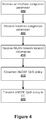
- Figure 4 depicts an example of a process that may be used, for example by an ANDSF server 220 or an L-ANDSF server 215 to monitor network conditions and transmit an updated ANDSF QoS policy.
- one or more air-interface congestion parameters such as the air-interface congestion parameters described above with respect to 300, may be received by the ANDSF server 220 or the L-ANDSF server 215 at 400.
- one or more backhaul congestion parameters such as the backhaul congestion parameters described above with respect to 305, may be received by the ANDSF server 220 or the L-ANDSF server 215 at 405.
- the ANDSF server 220 or the L-ANDSF server 215 may receive WLAN network location information at 410.
- the air-interface congestion parameter, backhaul congestion parameter, and/or the WLAN network location information may be received, while in other embodiments the ANDSF server 220 or the L-ANDSF server 215 may receive all three of the above described parameters.
- the ANDSF server 220 and/or the L-ANDSF server 215 may construct an ANDSF QoS policy at 415 such as the ANDSF QoS policies described above.
- an ANDSF QoS policy may be specified by an operator and delivered to one of the L-ANDSF server 215 or the ANDSF server 220.
- constructing the QoS policy at 415 may comprise altering an existing ANDSF QoS policy, for example an ANDSF QoS policy related to the number of UEs connected to the WLAN AP 210.
- the ANDSF QoS policy may be constructed as a new ANDSF QoS policy.
- data or statistics may be retrieved from the database of statistics and policies 230, web accessed database of statistics and management 235, and/or the database of the dynamic load of the 3G/4G network 240 and taken into account during construction of the ANDSF QoS policy.
- the ANDSF QoS policy may be transmitted to the UE 200 at 420.
- the transmission at 420 may be the result of a request from the UE 200.
- the transmission at 420 may be the result of a "push" action wherein the policy may be pushed to the UE 200.
- the ANDSF QoS policy may be transmitted to the UE 200 via a transmission protocol such as SMS, SOAP-XML, OMA-DM, or some other transmission protocol.
- FIG. 5 schematically illustrates an example system 500 that may be used to practice various embodiments described herein.
- Figure 5 illustrates, for one embodiment, an example system 500 having one or more processor(s) 505, system control module 510 coupled to at least one of the processor(s) 505, system memory 515 coupled to system control module 510, non-volatile memory (NVM)/storage 520 coupled to system control module 510, and one or more communications interface(s) 525 coupled to system control module 510.
- processor(s) 505 system control module 510 coupled to at least one of the processor(s) 505
- system memory 515 coupled to system control module 510
- NVM non-volatile memory
- communications interface(s) 525 coupled to system control module 510.
- the system 500 may be capable of functioning as the UE 110 as described herein. In other embodiments, the system 500 may be capable of functioning as the base station 105 depicted in the embodiment shown in Figure 1 or any one of the other described embodiments. In other embodiments, the system 500 may be capable of functioning as the ANDSF server 220 or the L-ANDSF server 215. In some embodiments, the system 500 may include one or more computer-readable media (e.g., system memory or NVM/storage 520) having instructions and one or more processors (e.g., processor(s) 505) coupled with the one or more computer-readable media and configured to execute the instructions to implement a module to perform actions described herein.
- processors e.g., processor(s) 505
- System control module 510 may include any suitable interface controllers to provide for any suitable interface to at least one of the processor(s) 505 and/or to any suitable device or component in communication with system control module 510.
- System control module 510 may include memory controller module 530 to provide an interface to system memory 515.
- the memory controller module 530 may be a hardware module, a software module, and/or a firmware module.
- System memory 515 may be used to load and store data and/or instructions, for example, for system 500.
- System memory 515 for one embodiment may include any suitable volatile memory, such as suitable DRAM, for example.
- the system memory 515 may include double data rate type four synchronous dynamic random-access memory (DDR4 SDRAM).
- DDR4 SDRAM double data rate type four synchronous dynamic random-access memory
- System control module 510 may include one or more input/output (I/O) controller(s) to provide an interface to NVM/storage 520 and communications interface(s) 525.
- I/O input/output
- the NVM/storage 520 may be used to store data and/or instructions, for example.
- NVM/storage 520 may include any suitable non-volatile memory, such as flash memory, for example, and/or may include any suitable non-volatile storage device(s), such as one or more hard disk drive(s) (HDD(s)), one or more compact disc (CD) drive(s), and/or one or more digital versatile disc (DVD) drive(s), for example.
- HDD hard disk drive
- CD compact disc
- DVD digital versatile disc
- the NVM/storage 520 may include a storage resource physically part of a device on which the system 500 may be installed or it may be accessible by, but not necessarily a part of, the device.
- the NVM/storage 520 may be accessed over a network via the communications interface(s) 525.
- Communications interface(s) 525 may provide an interface for system 500 to communicate over one or more network(s) and/or with any other suitable device.
- the system 500 may wirelessly communicate with the one or more components of the wireless network in accordance with any of one or more wireless network standards and/or protocols.
- At least one of the processor(s) 505 may be packaged together with logic for one or more controller(s) of system control module 510, e.g., memory controller module 530.
- at least one of the processor(s) 505 may be packaged together with logic for one or more controllers of system control module 510 to form a System in Package (SiP).
- SiP System in Package
- at least one of the processor(s) 505 may be integrated on the same die with logic for one or more controller(s) of system control module 510.
- at least one of the processor(s) 505 may be integrated on the same die with logic for one or more controller(s) of system control module 510 to form a System on Chip (SoC).
- SoC System on Chip
- the system 500 may be, but is not limited to, a server, a workstation, a desktop computing device, or a mobile computing device (e.g., a laptop computing device, a handheld computing device, a tablet, a netbook, a smart phone, a gaming console, etc.).
- the system 500 may have more or less components, and/or different architectures.
- the system 500 includes one or more of a camera, a keyboard, liquid crystal display (LCD) screen (including touch screen displays), non-volatile memory port, multiple antennas, graphics chip, application-specific integrated circuit (ASIC), and speakers.
- LCD liquid crystal display
- ASIC application-specific integrated circuit
Landscapes
- Engineering & Computer Science (AREA)
- Signal Processing (AREA)
- Computer Networks & Wireless Communication (AREA)
- Multimedia (AREA)
- Computer Security & Cryptography (AREA)
- Quality & Reliability (AREA)
- Databases & Information Systems (AREA)
- Mobile Radio Communication Systems (AREA)
- Physics & Mathematics (AREA)
- Electromagnetism (AREA)
Claims (15)
- Benutzereinrichtung (UE) zum Identifizieren von Zugangspunktparametern, wobei die UE umfasst:einen Empfänger zum:Empfangen eines Luftschnittstellen-Überlastparameters eines Zugangspunkts in einem drahtlosen lokalen Netzwerk (WLAN);Empfangen eines Backhaul-Überlastparameters des Zugangspunkts;ein Netzwerkauswahlmodul, das mit dem Empfänger gekoppelt ist, zum Identifizieren wenigstens zum Teil basierend auf einem Vergleich des Luftschnittstellen-Überlastparameters oder des Backhaul-Überlastparameters mit einer Richtlinie für die Dienstqualität (QoS) einer Funktion zur Erkennung und Auswahl von Zugangsnetzwerken (ANDSFN), dass der Zugangspunkt ein bevorzugter Zugangspunkt ist; undeinen Sender, der mit dem Netzwerkauswahlmodul gekoppelt ist, zum Senden einer Zugangsanforderung an den Zugangspunkt wenigstens zum Teil basierend auf einer Identifizierung des Zugangspunkts als einen bevorzugten Zugangspunkt.
- UE nach Anspruch 1, wobei der Empfänger ferner zum Empfangen der ANDSF-QoS-Richtlinie von einem ANDSF-Server ist.
- UE nach Anspruch 2, wobei der ANDSF-Server ein lokaler ANDSF-Server (L-ANDSF) ist, der mit einem Teilsatz von UEs in einem Netzwerk, das eine Mehrzahl von UEs umfasst, kommunikativ gekoppelt ist.
- UE nach einem der Ansprüche 1 bis 3, wobei der Luftschnittstellen-Überlastparameter ein Basisdienstsatz (BSS)-Lastparameter ist, der Stationszählung, Kanalnutzung oder verfügbare Annahmekapazität umfasst; oder
wobei gegebenenfalls der Backhaul-Überlastparameter ein Zugangsnetzwerk-Abfrageprotokoll (ANQP)-Parameter ist, der eine Downlink-Geschwindigkeit der WAN (drahtloses Zugangsnetzwerk)-Backhaul-Strecke, eine Uplink-Geschwindigkeit der WAN-Backhaul-Strecke, eine Downlink-Last der WAN-Verbindung oder eine Uplink-Last der WAN-Verbindung umfasst; oder
wobei gegebenenfalls die ANDSF-QoS-Richtlinie eine Basisdienstsatz (BSS)-Lastrichtlinie, eine Latenzrichtlinie, eine Zeit-bis-zu-erstem-Byte (TTFB)-Richtlinie, eine Downlink-Bandbreitenrichtlinie, eine Uplink-Bandbreitenrichtlinie oder eine Standortsrichtlinie umfasst. - UE nach einem der Ansprüche 1 bis 3, wobei das Netzwerkauswahlmodul ferner zum Identifizieren, dass der Zugangspunkt ein bevorzugter Zugangspunkt ist, wenigstens zum Teil basierend auf einem Namen oder einem Standort des Zugangspunkts ist.
- UE nach einem der Ansprüche 1 bis 3, ferner umfassend eine Leistungsversorgung, die mit der UE gekoppelt ist.
- Benutzereinrichtung (UE), umfassend:Mittel zum Empfangen eines Luftschnittstellen-Überlastparameters eines Zugangspunkts in einem drahtlosen lokalen Netzwerk (WLAN) oder eines Backhaul-Überlastparameters des Zugangspunkts;Mittel zum Empfangen einer Richtlinie für die Dienstqualität (QoS) einer Funktion zur Erkennung und Auswahl von Zugangsnetzwerken (ANDSF);Mittel zum Vergleichen des Luftschnittstellen-Überlastparameters oder des Backhaul-Überlastparameters mit der ANDSF-QoS-Richtlinie; undMittel zum Senden einer Zugangsanforderung an den Zugangspunkt wenigstens zum Teil basierend auf dem Vergleich des Luftschnittstellen-Überlastparameters oder des Backhaul-Überlastparameters mit der ANDSF-QoS-Richtlinie.
- UE nach Anspruch 7, ferner umfassend Mittel zum Empfangen der ANDSF-QoS-Richtlinie von einem ANDSF-Server.
- UE nach Anspruch 8, wobei die UE eine UE in einem Netzwerk ist, das eine Mehrzahl von UEs umfasst, und wobei der ANDSF-Server ein lokaler ANDSF-Server (L-ANDSF) ist, der mit einem Teilsatz von UEs im Netzwerk kommunikativ gekoppelt ist.
- UE nach einem der Ansprüche 7 bis 9, wobei der Luftschnittstellen-Überlastparameter ein Basisdienstsatz (BSS)-Lastparameter ist, der Stationszählung, Kanalnutzung oder verfügbare Annahmekapazität umfasst; oder
wobei gegebenenfalls der Backhaul-Überlastparameter ein Zugangsnetzwerk-Abfrageprotokoll (ANQP)-Parameter ist, der eine Downlink-Geschwindigkeit der WAN (drahtloses Zugangsnetzwerk)-Backhaul-Strecke, eine Uplink-Geschwindigkeit der WAN-Backhaul-Strecke, eine Downlink-Last der WAN-Verbindung oder eine Uplink-Last der WAN-Verbindung umfasst; oder
wobei gegebenenfalls die ANDSF-QoS-Richtlinie eine Basisdienstsatz (BSS)-Lastrichtlinie, eine Latenzrichtlinie, eine Zeit-bis-zu-erstem-Byte (TTFB)-Richtlinie, eine Downlink-Bandbreitenrichtlinie, eine Uplink-Bandbreitenrichtlinie oder eine Standortsrichtlinie umfasst. - UE nach einem der Ansprüche 7 bis 9, ferner umfassend Mittel zum Identifizieren wenigstens zum Teil basierend auf einem Namen oder einem Standort des Zugangspunkts, dass der Zugangspunkt ein bevorzugter Zugangspunkt ist.
- Server mit Funktion zur Erkennung und Auswahl von Zugangsnetzen (ANDSF) zum Senden einer Richtlinie für ANDSF-Dienstqualität (QoS), wobei der ANDSF-Server umfasst:einen Empfänger zum Empfangen eines Luftschnittstellen-Überlastparameters eines Zugangspunkts in einem drahtlosen lokalen Netzwerk (WLAN) und eines Backhaul-Überlastparameters des Zugangspunkts;ein ANDSF-Richtlinienmodul zum Bestimmen wenigstens zum Teil basierend auf dem Luftschnittstellen-Überlastparameter oder dem Backhaul-Überlastparameter einer ANDSF-QoS-Richtlinie zum Identifizieren eines Zugangspunkts als einen bevorzugten Zugangspunkt; undeinen Sender zum Senden der ANDSF-Richtlinie an eine Benutzereinrichtung (UE).
- ANDSF-Server nach Anspruch 12, wobei der ANDSF-Server ein lokaler ANDSF (L-ANDSF)-Server in einem Netzwerk ist, das eine Mehrzahl von UEs umfasst, wobei der L-ANDSF-Server mit weniger als allen der Mehrzahl von UEs kommunikativ gekoppelt ist; oder
wobei gegebenenfalls der ANDSF-Server ein ANDSF-Server eines Gastnetzwerks ist, das vom Heimatnetzwerk der UE verschieden ist. - ANDSF-Server nach einem der Ansprüche 12 oder 13,
wobei der Luftschnittstellen-Überlastparameter ein Basisdienstsatz (BSS)-Lastparameter ist, der Stationszählung, Kanalnutzung oder verfügbare Annahmekapazität umfasst; oder
wobei gegebenenfalls der Backhaul-Überlastparameter ein Zugangsnetzwerk-Abfrageprotokoll (ANQP)-Parameter ist, der eine Downlink-Geschwindigkeit der WAN (drahtloses Zugangsnetzwerk)-Backhaul-Strecke, eine Uplink-Geschwindigkeit der WAN-Backhaul-Strecke, eine Downlink-Last der WAN-Verbindung oder eine Uplink-Last der WAN-Verbindung umfasst; oder
wobei gegebenenfalls die ANDSF-QoS-Richtlinie eine Basisdienstsatz (BSS)-Lastrichtlinie, eine Latenzrichtlinie, eine Zeit-bis-zu-erstem-Byte (TTFB)-Richtlinie, eine Downlink-Bandbreitenrichtlinie, eine Uplink-Bandbreitenrichtlinie oder eine Standortsrichtlinie ist. - ANDSF-Server nach Anspruch 12 oder 13, wobei der Sender ferner zum Senden der ANDSF-QoS-Richtlinie über einen Kurnachrichtendienst (SMS), ein Protokoll auf Internetprotokoll (IP)-Ebene oder Open Mobile Alliance-Geräteverwaltung (OMA-DM) an die UE ist.
Priority Applications (1)
| Application Number | Priority Date | Filing Date | Title |
|---|---|---|---|
| EP17177576.0A EP3247050A1 (de) | 2012-09-28 | 2013-09-24 | Andsf-parameter zur wlan-auswahl |
Applications Claiming Priority (3)
| Application Number | Priority Date | Filing Date | Title |
|---|---|---|---|
| US201261707784P | 2012-09-28 | 2012-09-28 | |
| US13/830,465 US9497740B2 (en) | 2012-09-28 | 2013-03-14 | ANDSF parameters for WLAN network selection |
| PCT/US2013/061489 WO2014052339A1 (en) | 2012-09-28 | 2013-09-24 | Andsf parameters for wlan network selection |
Related Child Applications (2)
| Application Number | Title | Priority Date | Filing Date |
|---|---|---|---|
| EP17177576.0A Division-Into EP3247050A1 (de) | 2012-09-28 | 2013-09-24 | Andsf-parameter zur wlan-auswahl |
| EP17177576.0A Division EP3247050A1 (de) | 2012-09-28 | 2013-09-24 | Andsf-parameter zur wlan-auswahl |
Publications (3)
| Publication Number | Publication Date |
|---|---|
| EP2901768A1 EP2901768A1 (de) | 2015-08-05 |
| EP2901768A4 EP2901768A4 (de) | 2016-06-01 |
| EP2901768B1 true EP2901768B1 (de) | 2017-08-02 |
Family
ID=94381997
Family Applications (2)
| Application Number | Title | Priority Date | Filing Date |
|---|---|---|---|
| EP17177576.0A Withdrawn EP3247050A1 (de) | 2012-09-28 | 2013-09-24 | Andsf-parameter zur wlan-auswahl |
| EP13842096.3A Active EP2901768B1 (de) | 2012-09-28 | 2013-09-24 | Andsf-parameter zur wlan-auswahl |
Family Applications Before (1)
| Application Number | Title | Priority Date | Filing Date |
|---|---|---|---|
| EP17177576.0A Withdrawn EP3247050A1 (de) | 2012-09-28 | 2013-09-24 | Andsf-parameter zur wlan-auswahl |
Country Status (7)
| Country | Link |
|---|---|
| US (2) | US9497740B2 (de) |
| EP (2) | EP3247050A1 (de) |
| KR (1) | KR101643127B1 (de) |
| CN (1) | CN104620640B (de) |
| ES (1) | ES2640623T3 (de) |
| HU (1) | HUE034753T2 (de) |
| WO (1) | WO2014052339A1 (de) |
Families Citing this family (62)
| Publication number | Priority date | Publication date | Assignee | Title |
|---|---|---|---|---|
| KR101723214B1 (ko) | 2011-11-30 | 2017-04-06 | 주식회사 케이티 | 다중 채널과 다중 송출 전력을 갖는 액세스 포인트 및 셀 형성 방법 |
| US9635606B2 (en) * | 2012-11-04 | 2017-04-25 | Kt Corporation | Access point selection and management |
| US9900832B2 (en) * | 2012-11-07 | 2018-02-20 | Lg Electronics Inc. | Method and an apparatus for access network selection in a wireless communication system |
| JP2016504785A (ja) * | 2012-11-08 | 2016-02-12 | オプティス セルラー テクノロジー, エルエルシーOptis Cellular Technology,LLC | 無線ローカルエリアネットワークのエンティティを動作させる方法 |
| KR20140063334A (ko) * | 2012-11-16 | 2014-05-27 | 삼성전자주식회사 | 휴대 단말기에서 근거리 통신을 연결하는 장치 및 방법 |
| EP2946610B1 (de) * | 2013-01-17 | 2018-12-05 | Telefonaktiebolaget LM Ericsson (publ) | Endgerät, netzwerkknoten und verfahren darin zur ermöglichung des zugangs zu einem funkkommunikationsnetz |
| GB2509959B (en) * | 2013-01-18 | 2015-09-23 | Broadcom Corp | Offloading data communications between Radio Access Networks |
| TWI615050B (zh) | 2013-01-18 | 2018-02-11 | 諾基亞對策與網路公司 | 在實體下行鏈路控制通道資源分配中用於分時雙工的增強型實體下行鏈路控制通道之確認/負確認資源偏移値 |
| US9258764B2 (en) * | 2013-01-29 | 2016-02-09 | Broadcom Corporation | System and methods for anonymous crowdsourcing of network condition measurements |
| CN103209440B (zh) * | 2013-02-18 | 2016-03-02 | 华为终端有限公司 | 网络接入处理方法和用户设备 |
| US9432910B2 (en) * | 2013-03-11 | 2016-08-30 | Futurewei Technologies, Inc. | System and method for WiFi authentication and selection |
| US10349308B2 (en) * | 2013-05-10 | 2019-07-09 | Kyocera Corporation | Communication control method, user terminal, and processor |
| CN104995962A (zh) * | 2013-11-21 | 2015-10-21 | 华为技术有限公司 | 网络接入选择方法和终端 |
| EP3095275A1 (de) * | 2014-01-17 | 2016-11-23 | Telefonaktiebolaget LM Ericsson (publ) | Funktion zur entdeckung und auswahl eines zugangsnetzes (andsf) anhand von richtliniengeltungsbedingungen und anweisungen für gebietsaktualisierungsrichtlinien |
| US9980175B2 (en) * | 2014-01-28 | 2018-05-22 | Lg Electronics Inc. | Method and apparatus for performing traffic steering in wireless communication system |
| US10117159B2 (en) * | 2014-02-25 | 2018-10-30 | Telefonaktiebolaget Lm Ericsson (Publ) | Network address resolution for interworking between cellular network domain and wireless local area network domain |
| US9877256B2 (en) | 2014-03-24 | 2018-01-23 | Intel IP Corporation | Systems, devices, and methods for interworking between a universal mobile telecommunications system (UMTS) network and a wireless local area network (WLAN) |
| KR20170003558A (ko) * | 2014-05-08 | 2017-01-09 | 엘지전자 주식회사 | 무선랜에서 파워 세이브 모드 기반의 동작 방법 및 장치 |
| US9467921B2 (en) | 2014-05-08 | 2016-10-11 | Intel IP Corporation | Systems, devices, and methods for long term evolution and wireless local area interworking |
| US9621735B2 (en) * | 2014-06-25 | 2017-04-11 | Textnow, Inc. | Mobile electronic communications combining voice-over-IP and mobile network services |
| US9973542B2 (en) | 2014-06-26 | 2018-05-15 | At&T Intellectual Property I, L.P. | Method and apparatus for facilitating establishing and maintaining communication services |
| CN105850183B (zh) | 2014-08-21 | 2020-04-28 | 华为技术有限公司 | 无线网络接入控制方法及设备、系统 |
| US20160065480A1 (en) * | 2014-09-03 | 2016-03-03 | Qualcomm Incorporated | Controlling application traffic |
| WO2016041569A1 (en) * | 2014-09-15 | 2016-03-24 | Nokia Solutions And Networks Oy | Wi-fi signaling network insight delivery |
| US10779161B2 (en) | 2014-09-15 | 2020-09-15 | Nokia Solutions And Networks Oy | Delivery of cellular network insights to subscriber devices through SSID via cellular system information block |
| CN104581892B (zh) | 2014-12-05 | 2018-08-21 | 华为技术有限公司 | 一种终端的数据传输方法和装置 |
| US10397816B2 (en) * | 2014-12-09 | 2019-08-27 | Qualcomm Incorporated | Wireless local area network throughput estimation |
| US10206109B2 (en) * | 2014-12-24 | 2019-02-12 | Intel Corporation | Offline access network discovery and selection function (ANDSF) provisioning using near field communications (NFC) |
| US9155020B1 (en) | 2015-02-19 | 2015-10-06 | Oceus Networks, Inc. | Best backhaul available link quality |
| US20170026883A1 (en) * | 2015-07-23 | 2017-01-26 | Symbol Technologies, Llc | Method of, and arrangement for, enhancing roaming performance of a mobile client that is roaming between access points connected to a distribution system |
| US20170048790A1 (en) * | 2015-08-13 | 2017-02-16 | Qualcomm Incorporated | Methods and apparatuses for providing quality of service dependent services to mobile clients in multiple backhaul environments |
| US9986458B2 (en) * | 2015-08-27 | 2018-05-29 | Qualcomm Incorporated | Mitigating constrained backhaul availability between a radio access network (RAN) and core network |
| KR102407923B1 (ko) | 2015-09-04 | 2022-06-13 | 삼성전자주식회사 | 디코딩을 제어하기 위한 장치 및 방법 |
| US9986455B1 (en) * | 2015-10-30 | 2018-05-29 | CSC Holdings, LLC | Adaptive physical layer interface control for a wireless local area network |
| US10638391B2 (en) * | 2015-11-02 | 2020-04-28 | Telefonaktiebolaget Lm Ericsson (Publ) | Method and apparatus for controlling selection of the solution for WLAN and unlicensed spectrum usage |
| EP3389309A4 (de) | 2016-01-11 | 2018-10-31 | Samsung Electronics Co., Ltd. | Verfahren und vorrichtung zur verbesserung der mobilfunkabdeckung in einem drahtloskommunikationssystem |
| US11696216B2 (en) | 2016-02-18 | 2023-07-04 | Comcast Cable Communications, Llc | SSID broadcast management to support priority of broadcast |
| US10159101B2 (en) | 2016-05-20 | 2018-12-18 | Blackberry Limited | Using WLAN connectivity of a wireless device |
| US11012504B2 (en) * | 2016-06-28 | 2021-05-18 | Alcatel Lucent | Method and apparatus for query selection and admission (QSA) optimization for IoT and other applications |
| CA3064943A1 (en) * | 2016-08-29 | 2018-03-08 | Arris Enterprises Llc | Network support for locally offloaded traffic |
| US20180103413A1 (en) * | 2016-10-10 | 2018-04-12 | GM Global Technology Operations LLC | Dynamic assignment of regional network settings |
| KR102721506B1 (ko) | 2016-10-14 | 2024-10-24 | 삼성전자 주식회사 | 무선 셀룰라 통신 시스템에서 네트워크 지원 간섭 제거 및 억제 기술을 위한 간섭정보 전송 방법 및 장치 |
| US11290854B2 (en) | 2017-05-11 | 2022-03-29 | Samsung Electronics Co., Ltd. | Method and apparatus for providing a multimedia broadcast multicast service |
| CN115515122B (zh) | 2017-07-18 | 2025-03-07 | 三星电子株式会社 | 无线通信网络中检测漫游活动的反引导的方法和系统 |
| US11109290B2 (en) | 2017-08-04 | 2021-08-31 | Charter Communications Operating, Llc | Switching connections over frequency bands of a wireless network |
| US10306548B2 (en) | 2017-08-04 | 2019-05-28 | Charter Communications Operating, Llc | Voting to connect to a wireless network |
| US10506616B2 (en) * | 2017-08-04 | 2019-12-10 | Charter Communications Operating, Llc | Prioritizing preferred networks |
| US11160003B2 (en) | 2017-08-04 | 2021-10-26 | Charter Communications Operating, Llc | Connecting to a wireless network based on a device mobility state |
| US11212740B2 (en) | 2017-08-14 | 2021-12-28 | Telefonaktiebolaget Lm Ericsson (Publ) | Wireless access network selection |
| EP3692691B1 (de) * | 2017-10-26 | 2023-08-02 | Huawei Technologies Co., Ltd. | Vorrichtung und verfahren zur erkennung und verminderung von digitaler datennetzüberlastung |
| US11985587B2 (en) | 2017-12-18 | 2024-05-14 | Sony Corporation | Communications devices, infrastructure equipment, location servers and methods |
| US10609634B2 (en) * | 2017-12-24 | 2020-03-31 | Cisco Technology, Inc. | Access network selection |
| US10602437B2 (en) * | 2018-02-14 | 2020-03-24 | T-Mobile Usa, Inc. | Intelligent network selection |
| US12057945B2 (en) | 2018-04-19 | 2024-08-06 | Qualcomm Incorporated | Repetition-based transmissions for uplink ultra-reliable low latency communication |
| KR102648507B1 (ko) * | 2018-06-12 | 2024-03-18 | 삼성전자 주식회사 | 전자 장치 및 전자 장치의 무선랜 중계기능 제어 방법 |
| CN109120524B (zh) | 2018-08-23 | 2020-12-08 | Oppo广东移动通信有限公司 | 链路聚合方法及相关设备 |
| CN111615845B (zh) | 2018-10-26 | 2022-02-18 | 华为技术有限公司 | 一种通信系统的切换方法和终端设备 |
| US10834573B2 (en) | 2019-02-15 | 2020-11-10 | At&T Mobility Ii Llc | Systems, devices and methods for managing access point name information by operators and users on the SIM |
| US11463901B2 (en) * | 2020-05-07 | 2022-10-04 | At&T Intellectual Property I, L.P. | Apparatuses and methods to facilitate load-aware radio access network resource allocations |
| US11374685B2 (en) | 2020-07-24 | 2022-06-28 | Nxp B.V. | Address filtering in a radio frequency front end of a receiver |
| US11445421B2 (en) * | 2020-08-21 | 2022-09-13 | Sprint Communications Company L.P. | Load balancing wireless access node usage based on active users |
| US12200495B2 (en) | 2022-11-18 | 2025-01-14 | T-Mobile Usa, Inc. | Integrating security and routing policies in wireless telecommunication networks |
Family Cites Families (6)
| Publication number | Priority date | Publication date | Assignee | Title |
|---|---|---|---|---|
| US7688788B2 (en) | 2005-10-11 | 2010-03-30 | Microsoft Corporation | Congestion level and signal quality based estimator for bit-rate and automated load balancing for WLANS |
| US8565766B2 (en) * | 2007-02-05 | 2013-10-22 | Wefi Inc. | Dynamic network connection system and method |
| US9295089B2 (en) | 2010-09-07 | 2016-03-22 | Interdigital Patent Holdings, Inc. | Bandwidth management, aggregation and internet protocol flow mobility across multiple-access technologies |
| WO2012142437A1 (en) * | 2011-04-13 | 2012-10-18 | Interdigital Patent Holdings, Inc | Methods, systems and apparatus for managing and/or enforcing policies for managing internet protocol ("ip") traffic among multiple accesses of a network |
| US9749932B2 (en) * | 2011-07-07 | 2017-08-29 | Google Technology Holdings LLC | Wireless communication device, wireless communication system, and related methods |
| US9210645B2 (en) * | 2012-05-18 | 2015-12-08 | Industrial Technology Reseach Institute | Method for dynamically controlling data paths, MTC gateway and network device using the same |
-
2013
- 2013-03-14 US US13/830,465 patent/US9497740B2/en active Active
- 2013-09-24 WO PCT/US2013/061489 patent/WO2014052339A1/en not_active Ceased
- 2013-09-24 ES ES13842096.3T patent/ES2640623T3/es active Active
- 2013-09-24 CN CN201380045897.3A patent/CN104620640B/zh active Active
- 2013-09-24 EP EP17177576.0A patent/EP3247050A1/de not_active Withdrawn
- 2013-09-24 KR KR1020157005371A patent/KR101643127B1/ko active Active
- 2013-09-24 EP EP13842096.3A patent/EP2901768B1/de active Active
- 2013-09-24 HU HUE13842096A patent/HUE034753T2/en unknown
-
2016
- 2016-10-05 US US15/286,236 patent/US9924401B2/en active Active
Also Published As
| Publication number | Publication date |
|---|---|
| CN104620640B (zh) | 2019-01-15 |
| US20170026868A1 (en) | 2017-01-26 |
| US9924401B2 (en) | 2018-03-20 |
| KR20150038532A (ko) | 2015-04-08 |
| US9497740B2 (en) | 2016-11-15 |
| EP3247050A1 (de) | 2017-11-22 |
| HUE034753T2 (en) | 2018-02-28 |
| ES2640623T3 (es) | 2017-11-03 |
| CN104620640A (zh) | 2015-05-13 |
| EP2901768A1 (de) | 2015-08-05 |
| WO2014052339A1 (en) | 2014-04-03 |
| KR101643127B1 (ko) | 2016-07-28 |
| EP2901768A4 (de) | 2016-06-01 |
| US20140092731A1 (en) | 2014-04-03 |
Similar Documents
| Publication | Publication Date | Title |
|---|---|---|
| US9924401B2 (en) | ANDSF parameters for WLAN network selection | |
| US10667202B2 (en) | Access network discovery and selection | |
| US10212662B2 (en) | Systems, methods and devices for small cell activation and detection | |
| US9554403B2 (en) | Selecting a radio node for data traffic offloading | |
| TWI745851B (zh) | 藉由聯合網路及雲端資源管理之服務傳遞 | |
| US9854591B2 (en) | Device, system and method of cell specific probability load balancing | |
| US20200221380A1 (en) | Inter-rat coverage determination for energy saving management | |
| US10616817B2 (en) | Terminal, base station, cell access method, and data transmission method for reconfiguring a wireless connection to communicate with a secondary cell | |
| US9042901B2 (en) | Dynamic small cell provisioning and frequency tuning | |
| CN106664552A (zh) | 在无线通信网络中用于向通信设备通知该网络中采用了上下文存储的方法 | |
| US10187920B2 (en) | Method and device for increased bandwidth utilizing aggregation mode and channel selection mechanism | |
| US20170367035A1 (en) | Cellular and wlan aggregation | |
| US20190200289A1 (en) | Power-Saving Parameter Collection for Wi-Fi Networks | |
| US11570841B2 (en) | System and method of radio resource management for radio access networks | |
| EP3738246A1 (de) | Funkverbindungserhaltung mit mehreren uplink-trägern | |
| US11528651B2 (en) | Systems and methods for prioritizing user equipment access to fifth generation (5G) ultra-wideband networks and wireless networks | |
| US9742677B2 (en) | Methods and apparatus for managing communications network loading | |
| WO2014112922A2 (en) | Integration between wi-fi and mobile communication networks | |
| WO2025209722A1 (en) | Mobility procedures for on-demand sib1 cells |
Legal Events
| Date | Code | Title | Description |
|---|---|---|---|
| PUAI | Public reference made under article 153(3) epc to a published international application that has entered the european phase |
Free format text: ORIGINAL CODE: 0009012 |
|
| 17P | Request for examination filed |
Effective date: 20150219 |
|
| AK | Designated contracting states |
Kind code of ref document: A1 Designated state(s): AL AT BE BG CH CY CZ DE DK EE ES FI FR GB GR HR HU IE IS IT LI LT LU LV MC MK MT NL NO PL PT RO RS SE SI SK SM TR |
|
| AX | Request for extension of the european patent |
Extension state: BA ME |
|
| DAX | Request for extension of the european patent (deleted) | ||
| RA4 | Supplementary search report drawn up and despatched (corrected) |
Effective date: 20160504 |
|
| REG | Reference to a national code |
Ref country code: DE Ref legal event code: R079 Ref document number: 602013024564 Country of ref document: DE Free format text: PREVIOUS MAIN CLASS: H04W0048180000 Ipc: H04B0005000000 |
|
| RIC1 | Information provided on ipc code assigned before grant |
Ipc: H04W 48/20 20090101ALI20161219BHEP Ipc: H04W 36/08 20090101ALI20161219BHEP Ipc: H04W 28/16 20090101ALI20161219BHEP Ipc: H04W 48/16 20090101ALI20161219BHEP Ipc: H04W 88/08 20090101ALI20161219BHEP Ipc: H04J 3/16 20060101ALI20161219BHEP Ipc: H04W 72/04 20090101ALI20161219BHEP Ipc: H04W 48/14 20090101ALI20161219BHEP Ipc: H04B 5/00 20060101AFI20161219BHEP Ipc: H04W 72/02 20090101ALI20161219BHEP Ipc: H04W 24/08 20090101ALI20161219BHEP Ipc: H04W 88/06 20090101ALI20161219BHEP Ipc: H04B 17/318 20150101ALI20161219BHEP Ipc: H04W 24/02 20090101ALI20161219BHEP Ipc: H04W 88/02 20090101ALI20161219BHEP Ipc: H04W 88/18 20090101ALI20161219BHEP Ipc: H04W 72/12 20090101ALI20161219BHEP Ipc: H04W 48/18 20090101ALI20161219BHEP Ipc: H04L 29/08 20060101ALI20161219BHEP Ipc: H04W 40/24 20090101ALI20161219BHEP Ipc: H04W 28/02 20090101ALI20161219BHEP |
|
| GRAP | Despatch of communication of intention to grant a patent |
Free format text: ORIGINAL CODE: EPIDOSNIGR1 |
|
| INTG | Intention to grant announced |
Effective date: 20170213 |
|
| GRAS | Grant fee paid |
Free format text: ORIGINAL CODE: EPIDOSNIGR3 |
|
| GRAA | (expected) grant |
Free format text: ORIGINAL CODE: 0009210 |
|
| AK | Designated contracting states |
Kind code of ref document: B1 Designated state(s): AL AT BE BG CH CY CZ DE DK EE ES FI FR GB GR HR HU IE IS IT LI LT LU LV MC MK MT NL NO PL PT RO RS SE SI SK SM TR |
|
| REG | Reference to a national code |
Ref country code: CH Ref legal event code: EP Ref country code: AT Ref legal event code: REF Ref document number: 915505 Country of ref document: AT Kind code of ref document: T Effective date: 20170815 |
|
| REG | Reference to a national code |
Ref country code: IE Ref legal event code: FG4D |
|
| REG | Reference to a national code |
Ref country code: FR Ref legal event code: PLFP Year of fee payment: 5 |
|
| REG | Reference to a national code |
Ref country code: DE Ref legal event code: R096 Ref document number: 602013024564 Country of ref document: DE |
|
| PGFP | Annual fee paid to national office [announced via postgrant information from national office to epo] |
Ref country code: FR Payment date: 20170912 Year of fee payment: 5 Ref country code: CH Payment date: 20170912 Year of fee payment: 5 Ref country code: GB Payment date: 20170831 Year of fee payment: 5 |
|
| REG | Reference to a national code |
Ref country code: ES Ref legal event code: FG2A Ref document number: 2640623 Country of ref document: ES Kind code of ref document: T3 Effective date: 20171103 |
|
| REG | Reference to a national code |
Ref country code: NL Ref legal event code: FP |
|
| PGFP | Annual fee paid to national office [announced via postgrant information from national office to epo] |
Ref country code: IE Payment date: 20170914 Year of fee payment: 5 Ref country code: NL Payment date: 20170913 Year of fee payment: 5 Ref country code: BE Payment date: 20170912 Year of fee payment: 5 |
|
| REG | Reference to a national code |
Ref country code: EE Ref legal event code: FG4A Ref document number: E014524 Country of ref document: EE Effective date: 20171024 |
|
| REG | Reference to a national code |
Ref country code: LT Ref legal event code: MG4D |
|
| PG25 | Lapsed in a contracting state [announced via postgrant information from national office to epo] |
Ref country code: HR Free format text: LAPSE BECAUSE OF FAILURE TO SUBMIT A TRANSLATION OF THE DESCRIPTION OR TO PAY THE FEE WITHIN THE PRESCRIBED TIME-LIMIT Effective date: 20170802 Ref country code: SE Free format text: LAPSE BECAUSE OF FAILURE TO SUBMIT A TRANSLATION OF THE DESCRIPTION OR TO PAY THE FEE WITHIN THE PRESCRIBED TIME-LIMIT Effective date: 20170802 Ref country code: LT Free format text: LAPSE BECAUSE OF FAILURE TO SUBMIT A TRANSLATION OF THE DESCRIPTION OR TO PAY THE FEE WITHIN THE PRESCRIBED TIME-LIMIT Effective date: 20170802 Ref country code: NO Free format text: LAPSE BECAUSE OF FAILURE TO SUBMIT A TRANSLATION OF THE DESCRIPTION OR TO PAY THE FEE WITHIN THE PRESCRIBED TIME-LIMIT Effective date: 20171102 Ref country code: FI Free format text: LAPSE BECAUSE OF FAILURE TO SUBMIT A TRANSLATION OF THE DESCRIPTION OR TO PAY THE FEE WITHIN THE PRESCRIBED TIME-LIMIT Effective date: 20170802 |
|
| PGFP | Annual fee paid to national office [announced via postgrant information from national office to epo] |
Ref country code: EE Payment date: 20170913 Year of fee payment: 5 Ref country code: HU Payment date: 20170912 Year of fee payment: 5 |
|
| PG25 | Lapsed in a contracting state [announced via postgrant information from national office to epo] |
Ref country code: BG Free format text: LAPSE BECAUSE OF FAILURE TO SUBMIT A TRANSLATION OF THE DESCRIPTION OR TO PAY THE FEE WITHIN THE PRESCRIBED TIME-LIMIT Effective date: 20171102 Ref country code: LV Free format text: LAPSE BECAUSE OF FAILURE TO SUBMIT A TRANSLATION OF THE DESCRIPTION OR TO PAY THE FEE WITHIN THE PRESCRIBED TIME-LIMIT Effective date: 20170802 Ref country code: IS Free format text: LAPSE BECAUSE OF FAILURE TO SUBMIT A TRANSLATION OF THE DESCRIPTION OR TO PAY THE FEE WITHIN THE PRESCRIBED TIME-LIMIT Effective date: 20171202 Ref country code: PL Free format text: LAPSE BECAUSE OF FAILURE TO SUBMIT A TRANSLATION OF THE DESCRIPTION OR TO PAY THE FEE WITHIN THE PRESCRIBED TIME-LIMIT Effective date: 20170802 Ref country code: RS Free format text: LAPSE BECAUSE OF FAILURE TO SUBMIT A TRANSLATION OF THE DESCRIPTION OR TO PAY THE FEE WITHIN THE PRESCRIBED TIME-LIMIT Effective date: 20170802 |
|
| PGFP | Annual fee paid to national office [announced via postgrant information from national office to epo] |
Ref country code: ES Payment date: 20171003 Year of fee payment: 5 Ref country code: GR Payment date: 20171024 Year of fee payment: 5 |
|
| REG | Reference to a national code |
Ref country code: HU Ref legal event code: AG4A Ref document number: E034753 Country of ref document: HU |
|
| REG | Reference to a national code |
Ref country code: GR Ref legal event code: EP Ref document number: 20170402836 Country of ref document: GR Effective date: 20180330 |
|
| PG25 | Lapsed in a contracting state [announced via postgrant information from national office to epo] |
Ref country code: RO Free format text: LAPSE BECAUSE OF FAILURE TO SUBMIT A TRANSLATION OF THE DESCRIPTION OR TO PAY THE FEE WITHIN THE PRESCRIBED TIME-LIMIT Effective date: 20170802 Ref country code: DK Free format text: LAPSE BECAUSE OF FAILURE TO SUBMIT A TRANSLATION OF THE DESCRIPTION OR TO PAY THE FEE WITHIN THE PRESCRIBED TIME-LIMIT Effective date: 20170802 Ref country code: CZ Free format text: LAPSE BECAUSE OF FAILURE TO SUBMIT A TRANSLATION OF THE DESCRIPTION OR TO PAY THE FEE WITHIN THE PRESCRIBED TIME-LIMIT Effective date: 20170802 |
|
| REG | Reference to a national code |
Ref country code: DE Ref legal event code: R097 Ref document number: 602013024564 Country of ref document: DE |
|
| PG25 | Lapsed in a contracting state [announced via postgrant information from national office to epo] |
Ref country code: SM Free format text: LAPSE BECAUSE OF FAILURE TO SUBMIT A TRANSLATION OF THE DESCRIPTION OR TO PAY THE FEE WITHIN THE PRESCRIBED TIME-LIMIT Effective date: 20170802 Ref country code: IT Free format text: LAPSE BECAUSE OF FAILURE TO SUBMIT A TRANSLATION OF THE DESCRIPTION OR TO PAY THE FEE WITHIN THE PRESCRIBED TIME-LIMIT Effective date: 20170802 Ref country code: MC Free format text: LAPSE BECAUSE OF FAILURE TO SUBMIT A TRANSLATION OF THE DESCRIPTION OR TO PAY THE FEE WITHIN THE PRESCRIBED TIME-LIMIT Effective date: 20170802 |
|
| PGFP | Annual fee paid to national office [announced via postgrant information from national office to epo] |
Ref country code: SK Payment date: 20170919 Year of fee payment: 5 |
|
| PLBE | No opposition filed within time limit |
Free format text: ORIGINAL CODE: 0009261 |
|
| STAA | Information on the status of an ep patent application or granted ep patent |
Free format text: STATUS: NO OPPOSITION FILED WITHIN TIME LIMIT |
|
| PG25 | Lapsed in a contracting state [announced via postgrant information from national office to epo] |
Ref country code: LU Free format text: LAPSE BECAUSE OF NON-PAYMENT OF DUE FEES Effective date: 20170924 |
|
| 26N | No opposition filed |
Effective date: 20180503 |
|
| PG25 | Lapsed in a contracting state [announced via postgrant information from national office to epo] |
Ref country code: SI Free format text: LAPSE BECAUSE OF FAILURE TO SUBMIT A TRANSLATION OF THE DESCRIPTION OR TO PAY THE FEE WITHIN THE PRESCRIBED TIME-LIMIT Effective date: 20170802 |
|
| PG25 | Lapsed in a contracting state [announced via postgrant information from national office to epo] |
Ref country code: MT Free format text: LAPSE BECAUSE OF NON-PAYMENT OF DUE FEES Effective date: 20170924 |
|
| REG | Reference to a national code |
Ref country code: EE Ref legal event code: MM4A Ref document number: E014524 Country of ref document: EE Effective date: 20180930 |
|
| REG | Reference to a national code |
Ref country code: CH Ref legal event code: PL |
|
| REG | Reference to a national code |
Ref country code: NL Ref legal event code: MM Effective date: 20181001 |
|
| GBPC | Gb: european patent ceased through non-payment of renewal fee |
Effective date: 20180924 |
|
| REG | Reference to a national code |
Ref country code: SK Ref legal event code: MM4A Ref document number: E 25637 Country of ref document: SK Effective date: 20180924 |
|
| REG | Reference to a national code |
Ref country code: BE Ref legal event code: MM Effective date: 20180930 |
|
| REG | Reference to a national code |
Ref country code: IE Ref legal event code: MM4A |
|
| PG25 | Lapsed in a contracting state [announced via postgrant information from national office to epo] |
Ref country code: NL Free format text: LAPSE BECAUSE OF NON-PAYMENT OF DUE FEES Effective date: 20181001 |
|
| PG25 | Lapsed in a contracting state [announced via postgrant information from national office to epo] |
Ref country code: IE Free format text: LAPSE BECAUSE OF NON-PAYMENT OF DUE FEES Effective date: 20180924 |
|
| REG | Reference to a national code |
Ref country code: AT Ref legal event code: UEP Ref document number: 915505 Country of ref document: AT Kind code of ref document: T Effective date: 20170802 |
|
| PG25 | Lapsed in a contracting state [announced via postgrant information from national office to epo] |
Ref country code: EE Free format text: LAPSE BECAUSE OF NON-PAYMENT OF DUE FEES Effective date: 20180930 Ref country code: HU Free format text: LAPSE BECAUSE OF NON-PAYMENT OF DUE FEES Effective date: 20180925 Ref country code: LI Free format text: LAPSE BECAUSE OF NON-PAYMENT OF DUE FEES Effective date: 20180930 Ref country code: FR Free format text: LAPSE BECAUSE OF NON-PAYMENT OF DUE FEES Effective date: 20180930 Ref country code: CH Free format text: LAPSE BECAUSE OF NON-PAYMENT OF DUE FEES Effective date: 20180930 Ref country code: SK Free format text: LAPSE BECAUSE OF NON-PAYMENT OF DUE FEES Effective date: 20180924 Ref country code: GR Free format text: LAPSE BECAUSE OF NON-PAYMENT OF DUE FEES Effective date: 20190402 Ref country code: BE Free format text: LAPSE BECAUSE OF NON-PAYMENT OF DUE FEES Effective date: 20180930 |
|
| PG25 | Lapsed in a contracting state [announced via postgrant information from national office to epo] |
Ref country code: GB Free format text: LAPSE BECAUSE OF NON-PAYMENT OF DUE FEES Effective date: 20180924 Ref country code: CY Free format text: LAPSE BECAUSE OF FAILURE TO SUBMIT A TRANSLATION OF THE DESCRIPTION OR TO PAY THE FEE WITHIN THE PRESCRIBED TIME-LIMIT Effective date: 20170802 |
|
| REG | Reference to a national code |
Ref country code: ES Ref legal event code: FD2A Effective date: 20191031 |
|
| PG25 | Lapsed in a contracting state [announced via postgrant information from national office to epo] |
Ref country code: MK Free format text: LAPSE BECAUSE OF FAILURE TO SUBMIT A TRANSLATION OF THE DESCRIPTION OR TO PAY THE FEE WITHIN THE PRESCRIBED TIME-LIMIT Effective date: 20170802 |
|
| PG25 | Lapsed in a contracting state [announced via postgrant information from national office to epo] |
Ref country code: ES Free format text: LAPSE BECAUSE OF NON-PAYMENT OF DUE FEES Effective date: 20180925 |
|
| PG25 | Lapsed in a contracting state [announced via postgrant information from national office to epo] |
Ref country code: TR Free format text: LAPSE BECAUSE OF FAILURE TO SUBMIT A TRANSLATION OF THE DESCRIPTION OR TO PAY THE FEE WITHIN THE PRESCRIBED TIME-LIMIT Effective date: 20170802 |
|
| PG25 | Lapsed in a contracting state [announced via postgrant information from national office to epo] |
Ref country code: PT Free format text: LAPSE BECAUSE OF FAILURE TO SUBMIT A TRANSLATION OF THE DESCRIPTION OR TO PAY THE FEE WITHIN THE PRESCRIBED TIME-LIMIT Effective date: 20170802 |
|
| REG | Reference to a national code |
Ref country code: DE Ref legal event code: R081 Ref document number: 602013024564 Country of ref document: DE Owner name: APPLE INC., CUPERTINO, US Free format text: FORMER OWNER: INTEL CORPORATION, SANTA CLARA, CALIF., US |
|
| PG25 | Lapsed in a contracting state [announced via postgrant information from national office to epo] |
Ref country code: AL Free format text: LAPSE BECAUSE OF FAILURE TO SUBMIT A TRANSLATION OF THE DESCRIPTION OR TO PAY THE FEE WITHIN THE PRESCRIBED TIME-LIMIT Effective date: 20170802 |
|
| REG | Reference to a national code |
Ref country code: AT Ref legal event code: PC Ref document number: 915505 Country of ref document: AT Kind code of ref document: T Owner name: APPLE INC., US Effective date: 20201110 |
|
| PGFP | Annual fee paid to national office [announced via postgrant information from national office to epo] |
Ref country code: DE Payment date: 20250702 Year of fee payment: 13 |
|
| PGFP | Annual fee paid to national office [announced via postgrant information from national office to epo] |
Ref country code: AT Payment date: 20250827 Year of fee payment: 13 |