EP2901951A1 - Électrode d'adaptation de forme pour le transfert d'énergie électromagnétique - Google Patents
Électrode d'adaptation de forme pour le transfert d'énergie électromagnétique Download PDFInfo
- Publication number
- EP2901951A1 EP2901951A1 EP14153349.7A EP14153349A EP2901951A1 EP 2901951 A1 EP2901951 A1 EP 2901951A1 EP 14153349 A EP14153349 A EP 14153349A EP 2901951 A1 EP2901951 A1 EP 2901951A1
- Authority
- EP
- European Patent Office
- Prior art keywords
- electrode
- target
- inner cavity
- liquid
- solid particles
- Prior art date
- Legal status (The legal status is an assumption and is not a legal conclusion. Google has not performed a legal analysis and makes no representation as to the accuracy of the status listed.)
- Withdrawn
Links
- 238000012546 transfer Methods 0.000 title abstract description 11
- 239000007788 liquid Substances 0.000 claims abstract description 392
- 239000002245 particle Substances 0.000 claims abstract description 357
- 239000007787 solid Substances 0.000 claims abstract description 282
- 238000011282 treatment Methods 0.000 claims abstract description 84
- 206010020843 Hyperthermia Diseases 0.000 claims abstract description 69
- 230000036031 hyperthermia Effects 0.000 claims abstract description 69
- 239000002537 cosmetic Substances 0.000 claims abstract description 11
- XLYOFNOQVPJJNP-UHFFFAOYSA-N water Substances O XLYOFNOQVPJJNP-UHFFFAOYSA-N 0.000 claims description 45
- 206010028980 Neoplasm Diseases 0.000 claims description 42
- 238000000034 method Methods 0.000 claims description 35
- 239000003990 capacitor Substances 0.000 claims description 33
- 210000001519 tissue Anatomy 0.000 claims description 33
- 230000009467 reduction Effects 0.000 claims description 32
- 201000011510 cancer Diseases 0.000 claims description 27
- 239000000203 mixture Substances 0.000 claims description 26
- LFQSCWFLJHTTHZ-UHFFFAOYSA-N Ethanol Chemical compound CCO LFQSCWFLJHTTHZ-UHFFFAOYSA-N 0.000 claims description 24
- 238000005086 pumping Methods 0.000 claims description 14
- 238000000576 coating method Methods 0.000 claims description 11
- KFZMGEQAYNKOFK-UHFFFAOYSA-N Isopropanol Chemical compound CC(C)O KFZMGEQAYNKOFK-UHFFFAOYSA-N 0.000 claims description 10
- 239000011248 coating agent Substances 0.000 claims description 9
- 208000006673 asthma Diseases 0.000 claims description 8
- 201000009240 nasopharyngitis Diseases 0.000 claims description 8
- 230000010412 perfusion Effects 0.000 claims description 8
- 206010002556 Ankylosing Spondylitis Diseases 0.000 claims description 7
- 201000005569 Gout Diseases 0.000 claims description 7
- 208000007101 Muscle Cramp Diseases 0.000 claims description 7
- 208000029549 Muscle injury Diseases 0.000 claims description 7
- 206010039085 Rhinitis allergic Diseases 0.000 claims description 7
- 208000005392 Spasm Diseases 0.000 claims description 7
- 201000010105 allergic rhinitis Diseases 0.000 claims description 7
- 238000001784 detoxification Methods 0.000 claims description 7
- 206010016256 fatigue Diseases 0.000 claims description 7
- 206010025135 lupus erythematosus Diseases 0.000 claims description 7
- 229910052751 metal Inorganic materials 0.000 claims description 7
- 239000002184 metal Substances 0.000 claims description 7
- 230000002265 prevention Effects 0.000 claims description 7
- 206010039073 rheumatoid arthritis Diseases 0.000 claims description 7
- 208000035484 Cellulite Diseases 0.000 claims description 5
- 206010049752 Peau d'orange Diseases 0.000 claims description 5
- 230000036232 cellulite Effects 0.000 claims description 5
- 229960004592 isopropanol Drugs 0.000 claims description 5
- 239000007772 electrode material Substances 0.000 claims description 3
- 239000000463 material Substances 0.000 description 50
- -1 polyethylene Polymers 0.000 description 36
- 230000006978 adaptation Effects 0.000 description 32
- 241001465754 Metazoa Species 0.000 description 15
- 239000004576 sand Substances 0.000 description 15
- 229920001343 polytetrafluoroethylene Polymers 0.000 description 13
- 239000004810 polytetrafluoroethylene Substances 0.000 description 13
- 230000008569 process Effects 0.000 description 13
- 239000000126 substance Substances 0.000 description 13
- 230000000694 effects Effects 0.000 description 11
- 239000004753 textile Substances 0.000 description 11
- 239000004743 Polypropylene Substances 0.000 description 10
- 229920001155 polypropylene Polymers 0.000 description 10
- 239000004698 Polyethylene Substances 0.000 description 9
- 239000000835 fiber Substances 0.000 description 9
- 230000001965 increasing effect Effects 0.000 description 9
- 229920000573 polyethylene Polymers 0.000 description 9
- 230000006378 damage Effects 0.000 description 8
- 238000010438 heat treatment Methods 0.000 description 8
- 239000004952 Polyamide Substances 0.000 description 7
- 230000008859 change Effects 0.000 description 7
- 229920002647 polyamide Polymers 0.000 description 7
- 230000000087 stabilizing effect Effects 0.000 description 7
- 230000007704 transition Effects 0.000 description 7
- 239000004812 Fluorinated ethylene propylene Substances 0.000 description 6
- 206010027476 Metastases Diseases 0.000 description 6
- 229930040373 Paraformaldehyde Natural products 0.000 description 6
- 239000004809 Teflon Substances 0.000 description 6
- 229920006362 Teflon® Polymers 0.000 description 6
- 239000000654 additive Substances 0.000 description 6
- 230000037237 body shape Effects 0.000 description 6
- 210000000038 chest Anatomy 0.000 description 6
- 238000004806 packaging method and process Methods 0.000 description 6
- 229920009441 perflouroethylene propylene Polymers 0.000 description 6
- 229920003229 poly(methyl methacrylate) Polymers 0.000 description 6
- 239000004926 polymethyl methacrylate Substances 0.000 description 6
- 229920006324 polyoxymethylene Polymers 0.000 description 6
- 230000035807 sensation Effects 0.000 description 6
- 201000009030 Carcinoma Diseases 0.000 description 5
- 241000282412 Homo Species 0.000 description 5
- 210000001015 abdomen Anatomy 0.000 description 5
- 230000002349 favourable effect Effects 0.000 description 5
- 238000004519 manufacturing process Methods 0.000 description 5
- 239000004814 polyurethane Substances 0.000 description 5
- 125000001424 substituent group Chemical group 0.000 description 5
- 206010009944 Colon cancer Diseases 0.000 description 4
- 239000004793 Polystyrene Substances 0.000 description 4
- 206010057190 Respiratory tract infections Diseases 0.000 description 4
- BQCADISMDOOEFD-UHFFFAOYSA-N Silver Chemical compound [Ag] BQCADISMDOOEFD-UHFFFAOYSA-N 0.000 description 4
- 206010046306 Upper respiratory tract infection Diseases 0.000 description 4
- RJURFGZVJUQBHK-UHFFFAOYSA-N actinomycin D Natural products CC1OC(=O)C(C(C)C)N(C)C(=O)CN(C)C(=O)C2CCCN2C(=O)C(C(C)C)NC(=O)C1NC(=O)C1=C(N)C(=O)C(C)=C2OC(C(C)=CC=C3C(=O)NC4C(=O)NC(C(N5CCCC5C(=O)N(C)CC(=O)N(C)C(C(C)C)C(=O)OC4C)=O)C(C)C)=C3N=C21 RJURFGZVJUQBHK-UHFFFAOYSA-N 0.000 description 4
- 210000004027 cell Anatomy 0.000 description 4
- 239000000824 cytostatic agent Substances 0.000 description 4
- 230000001085 cytostatic effect Effects 0.000 description 4
- 230000003247 decreasing effect Effects 0.000 description 4
- 230000001419 dependent effect Effects 0.000 description 4
- 239000003814 drug Substances 0.000 description 4
- 210000002414 leg Anatomy 0.000 description 4
- 201000001441 melanoma Diseases 0.000 description 4
- CWQXQMHSOZUFJS-UHFFFAOYSA-N molybdenum disulfide Chemical compound S=[Mo]=S CWQXQMHSOZUFJS-UHFFFAOYSA-N 0.000 description 4
- 229910052982 molybdenum disulfide Inorganic materials 0.000 description 4
- 231100000252 nontoxic Toxicity 0.000 description 4
- 230000003000 nontoxic effect Effects 0.000 description 4
- 238000011275 oncology therapy Methods 0.000 description 4
- 239000004417 polycarbonate Substances 0.000 description 4
- 229920000515 polycarbonate Polymers 0.000 description 4
- 229920001296 polysiloxane Polymers 0.000 description 4
- 239000004800 polyvinyl chloride Substances 0.000 description 4
- 238000007674 radiofrequency ablation Methods 0.000 description 4
- 208000020029 respiratory tract infectious disease Diseases 0.000 description 4
- 229910052709 silver Inorganic materials 0.000 description 4
- 239000004332 silver Substances 0.000 description 4
- 239000000243 solution Substances 0.000 description 4
- 230000006641 stabilisation Effects 0.000 description 4
- 238000011105 stabilization Methods 0.000 description 4
- 206010006187 Breast cancer Diseases 0.000 description 3
- 208000026310 Breast neoplasm Diseases 0.000 description 3
- 208000001333 Colorectal Neoplasms Diseases 0.000 description 3
- 208000017604 Hodgkin disease Diseases 0.000 description 3
- 206010028851 Necrosis Diseases 0.000 description 3
- 206010030155 Oesophageal carcinoma Diseases 0.000 description 3
- 229920001774 Perfluoroether Polymers 0.000 description 3
- 208000005718 Stomach Neoplasms Diseases 0.000 description 3
- 241000700605 Viruses Species 0.000 description 3
- 238000004026 adhesive bonding Methods 0.000 description 3
- 239000000969 carrier Substances 0.000 description 3
- 238000002512 chemotherapy Methods 0.000 description 3
- 238000010276 construction Methods 0.000 description 3
- 230000008878 coupling Effects 0.000 description 3
- 238000010168 coupling process Methods 0.000 description 3
- 238000005859 coupling reaction Methods 0.000 description 3
- 230000001472 cytotoxic effect Effects 0.000 description 3
- 239000003989 dielectric material Substances 0.000 description 3
- 238000011038 discontinuous diafiltration by volume reduction Methods 0.000 description 3
- 201000010099 disease Diseases 0.000 description 3
- 208000037265 diseases, disorders, signs and symptoms Diseases 0.000 description 3
- HQQADJVZYDDRJT-UHFFFAOYSA-N ethene;prop-1-ene Chemical group C=C.CC=C HQQADJVZYDDRJT-UHFFFAOYSA-N 0.000 description 3
- 210000003414 extremity Anatomy 0.000 description 3
- 239000012530 fluid Substances 0.000 description 3
- 230000006870 function Effects 0.000 description 3
- 239000007789 gas Substances 0.000 description 3
- 206010017758 gastric cancer Diseases 0.000 description 3
- 230000012010 growth Effects 0.000 description 3
- 230000017074 necrotic cell death Effects 0.000 description 3
- 210000000056 organ Anatomy 0.000 description 3
- 208000008443 pancreatic carcinoma Diseases 0.000 description 3
- 229920000642 polymer Polymers 0.000 description 3
- 239000011116 polymethylpentene Substances 0.000 description 3
- 230000005855 radiation Effects 0.000 description 3
- 239000000523 sample Substances 0.000 description 3
- 201000011549 stomach cancer Diseases 0.000 description 3
- 210000004881 tumor cell Anatomy 0.000 description 3
- 238000003466 welding Methods 0.000 description 3
- IAKHMKGGTNLKSZ-INIZCTEOSA-N (S)-colchicine Chemical compound C1([C@@H](NC(C)=O)CC2)=CC(=O)C(OC)=CC=C1C1=C2C=C(OC)C(OC)=C1OC IAKHMKGGTNLKSZ-INIZCTEOSA-N 0.000 description 2
- KDCGOANMDULRCW-UHFFFAOYSA-N 7H-purine Chemical compound N1=CNC2=NC=NC2=C1 KDCGOANMDULRCW-UHFFFAOYSA-N 0.000 description 2
- RZVAJINKPMORJF-UHFFFAOYSA-N Acetaminophen Chemical compound CC(=O)NC1=CC=C(O)C=C1 RZVAJINKPMORJF-UHFFFAOYSA-N 0.000 description 2
- 206010002091 Anaesthesia Diseases 0.000 description 2
- 206010003571 Astrocytoma Diseases 0.000 description 2
- 241000894006 Bacteria Species 0.000 description 2
- 206010005003 Bladder cancer Diseases 0.000 description 2
- 208000003174 Brain Neoplasms Diseases 0.000 description 2
- OKTJSMMVPCPJKN-UHFFFAOYSA-N Carbon Chemical compound [C] OKTJSMMVPCPJKN-UHFFFAOYSA-N 0.000 description 2
- 206010008342 Cervix carcinoma Diseases 0.000 description 2
- 108010092160 Dactinomycin Proteins 0.000 description 2
- AOJJSUZBOXZQNB-TZSSRYMLSA-N Doxorubicin Chemical compound O([C@H]1C[C@@](O)(CC=2C(O)=C3C(=O)C=4C=CC=C(C=4C(=O)C3=C(O)C=21)OC)C(=O)CO)[C@H]1C[C@H](N)[C@H](O)[C@H](C)O1 AOJJSUZBOXZQNB-TZSSRYMLSA-N 0.000 description 2
- RHAXSHUQNIEUEY-UHFFFAOYSA-N Epirizole Chemical compound COC1=CC(C)=NN1C1=NC(C)=CC(OC)=N1 RHAXSHUQNIEUEY-UHFFFAOYSA-N 0.000 description 2
- 208000000461 Esophageal Neoplasms Diseases 0.000 description 2
- APQPGQGAWABJLN-UHFFFAOYSA-N Floctafenine Chemical compound OCC(O)COC(=O)C1=CC=CC=C1NC1=CC=NC2=C(C(F)(F)F)C=CC=C12 APQPGQGAWABJLN-UHFFFAOYSA-N 0.000 description 2
- 206010023825 Laryngeal cancer Diseases 0.000 description 2
- 206010033128 Ovarian cancer Diseases 0.000 description 2
- 206010061535 Ovarian neoplasm Diseases 0.000 description 2
- 206010061902 Pancreatic neoplasm Diseases 0.000 description 2
- 239000002202 Polyethylene glycol Substances 0.000 description 2
- 208000006265 Renal cell carcinoma Diseases 0.000 description 2
- 208000000102 Squamous Cell Carcinoma of Head and Neck Diseases 0.000 description 2
- NKANXQFJJICGDU-QPLCGJKRSA-N Tamoxifen Chemical compound C=1C=CC=CC=1C(/CC)=C(C=1C=CC(OCCN(C)C)=CC=1)/C1=CC=CC=C1 NKANXQFJJICGDU-QPLCGJKRSA-N 0.000 description 2
- 208000007097 Urinary Bladder Neoplasms Diseases 0.000 description 2
- 208000006105 Uterine Cervical Neoplasms Diseases 0.000 description 2
- 238000010521 absorption reaction Methods 0.000 description 2
- RJURFGZVJUQBHK-IIXSONLDSA-N actinomycin D Chemical compound C[C@H]1OC(=O)[C@H](C(C)C)N(C)C(=O)CN(C)C(=O)[C@@H]2CCCN2C(=O)[C@@H](C(C)C)NC(=O)[C@H]1NC(=O)C1=C(N)C(=O)C(C)=C2OC(C(C)=CC=C3C(=O)N[C@@H]4C(=O)N[C@@H](C(N5CCC[C@H]5C(=O)N(C)CC(=O)N(C)[C@@H](C(C)C)C(=O)O[C@@H]4C)=O)C(C)C)=C3N=C21 RJURFGZVJUQBHK-IIXSONLDSA-N 0.000 description 2
- 238000001949 anaesthesia Methods 0.000 description 2
- 230000037005 anaesthesia Effects 0.000 description 2
- 230000000844 anti-bacterial effect Effects 0.000 description 2
- 229940124599 anti-inflammatory drug Drugs 0.000 description 2
- 230000008901 benefit Effects 0.000 description 2
- CNBGNNVCVSKAQZ-UHFFFAOYSA-N benzydamine Chemical compound C12=CC=CC=C2C(OCCCN(C)C)=NN1CC1=CC=CC=C1 CNBGNNVCVSKAQZ-UHFFFAOYSA-N 0.000 description 2
- 210000000746 body region Anatomy 0.000 description 2
- 230000036760 body temperature Effects 0.000 description 2
- 201000010881 cervical cancer Diseases 0.000 description 2
- 238000011254 conventional chemotherapy Methods 0.000 description 2
- 238000001816 cooling Methods 0.000 description 2
- 208000035250 cutaneous malignant susceptibility to 1 melanoma Diseases 0.000 description 2
- 231100000433 cytotoxic Toxicity 0.000 description 2
- 229960000640 dactinomycin Drugs 0.000 description 2
- 230000007423 decrease Effects 0.000 description 2
- 229940079593 drug Drugs 0.000 description 2
- 230000005684 electric field Effects 0.000 description 2
- 229950003801 epirizole Drugs 0.000 description 2
- 201000004101 esophageal cancer Diseases 0.000 description 2
- 229960003240 floctafenine Drugs 0.000 description 2
- 201000010175 gallbladder cancer Diseases 0.000 description 2
- 208000005017 glioblastoma Diseases 0.000 description 2
- 229910002804 graphite Inorganic materials 0.000 description 2
- 239000010439 graphite Substances 0.000 description 2
- 201000000459 head and neck squamous cell carcinoma Diseases 0.000 description 2
- 230000036541 health Effects 0.000 description 2
- 239000011796 hollow space material Substances 0.000 description 2
- JYGXADMDTFJGBT-VWUMJDOOSA-N hydrocortisone Chemical compound O=C1CC[C@]2(C)[C@H]3[C@@H](O)C[C@](C)([C@@](CC4)(O)C(=O)CO)[C@@H]4[C@@H]3CCC2=C1 JYGXADMDTFJGBT-VWUMJDOOSA-N 0.000 description 2
- 230000001976 improved effect Effects 0.000 description 2
- CGIGDMFJXJATDK-UHFFFAOYSA-N indomethacin Chemical compound CC1=C(CC(O)=O)C2=CC(OC)=CC=C2N1C(=O)C1=CC=C(Cl)C=C1 CGIGDMFJXJATDK-UHFFFAOYSA-N 0.000 description 2
- 238000009413 insulation Methods 0.000 description 2
- 206010023841 laryngeal neoplasm Diseases 0.000 description 2
- 201000007270 liver cancer Diseases 0.000 description 2
- 208000014018 liver neoplasm Diseases 0.000 description 2
- 239000000314 lubricant Substances 0.000 description 2
- 208000015486 malignant pancreatic neoplasm Diseases 0.000 description 2
- 201000005962 mycosis fungoides Diseases 0.000 description 2
- 230000009826 neoplastic cell growth Effects 0.000 description 2
- 208000002154 non-small cell lung carcinoma Diseases 0.000 description 2
- 239000000041 non-steroidal anti-inflammatory agent Substances 0.000 description 2
- 229940021182 non-steroidal anti-inflammatory drug Drugs 0.000 description 2
- 201000002528 pancreatic cancer Diseases 0.000 description 2
- 230000008447 perception Effects 0.000 description 2
- CPJSUEIXXCENMM-UHFFFAOYSA-N phenacetin Chemical compound CCOC1=CC=C(NC(C)=O)C=C1 CPJSUEIXXCENMM-UHFFFAOYSA-N 0.000 description 2
- 229920001223 polyethylene glycol Polymers 0.000 description 2
- 238000001959 radiotherapy Methods 0.000 description 2
- 206010038038 rectal cancer Diseases 0.000 description 2
- YGSDEFSMJLZEOE-UHFFFAOYSA-N salicylic acid Chemical compound OC(=O)C1=CC=CC=C1O YGSDEFSMJLZEOE-UHFFFAOYSA-N 0.000 description 2
- 230000008093 supporting effect Effects 0.000 description 2
- 238000001356 surgical procedure Methods 0.000 description 2
- UCFGDBYHRUNTLO-QHCPKHFHSA-N topotecan Chemical compound C1=C(O)C(CN(C)C)=C2C=C(CN3C4=CC5=C(C3=O)COC(=O)[C@]5(O)CC)C4=NC2=C1 UCFGDBYHRUNTLO-QHCPKHFHSA-N 0.000 description 2
- 208000029729 tumor suppressor gene on chromosome 11 Diseases 0.000 description 2
- 201000005112 urinary bladder cancer Diseases 0.000 description 2
- PROQIPRRNZUXQM-UHFFFAOYSA-N (16alpha,17betaOH)-Estra-1,3,5(10)-triene-3,16,17-triol Natural products OC1=CC=C2C3CCC(C)(C(C(O)C4)O)C4C3CCC2=C1 PROQIPRRNZUXQM-UHFFFAOYSA-N 0.000 description 1
- RJMIEHBSYVWVIN-LLVKDONJSA-N (2r)-2-[4-(3-oxo-1h-isoindol-2-yl)phenyl]propanoic acid Chemical compound C1=CC([C@H](C(O)=O)C)=CC=C1N1C(=O)C2=CC=CC=C2C1 RJMIEHBSYVWVIN-LLVKDONJSA-N 0.000 description 1
- RDJGLLICXDHJDY-NSHDSACASA-N (2s)-2-(3-phenoxyphenyl)propanoic acid Chemical compound OC(=O)[C@@H](C)C1=CC=CC(OC=2C=CC=CC=2)=C1 RDJGLLICXDHJDY-NSHDSACASA-N 0.000 description 1
- MDKGKXOCJGEUJW-VIFPVBQESA-N (2s)-2-[4-(thiophene-2-carbonyl)phenyl]propanoic acid Chemical compound C1=CC([C@@H](C(O)=O)C)=CC=C1C(=O)C1=CC=CS1 MDKGKXOCJGEUJW-VIFPVBQESA-N 0.000 description 1
- MWWSFMDVAYGXBV-MYPASOLCSA-N (7r,9s)-7-[(2r,4s,5s,6s)-4-amino-5-hydroxy-6-methyloxan-2-yl]oxy-6,9,11-trihydroxy-9-(2-hydroxyacetyl)-4-methoxy-8,10-dihydro-7h-tetracene-5,12-dione;hydrochloride Chemical compound Cl.O([C@@H]1C[C@@](O)(CC=2C(O)=C3C(=O)C=4C=CC=C(C=4C(=O)C3=C(O)C=21)OC)C(=O)CO)[C@H]1C[C@H](N)[C@H](O)[C@H](C)O1 MWWSFMDVAYGXBV-MYPASOLCSA-N 0.000 description 1
- FPVKHBSQESCIEP-UHFFFAOYSA-N (8S)-3-(2-deoxy-beta-D-erythro-pentofuranosyl)-3,6,7,8-tetrahydroimidazo[4,5-d][1,3]diazepin-8-ol Natural products C1C(O)C(CO)OC1N1C(NC=NCC2O)=C2N=C1 FPVKHBSQESCIEP-UHFFFAOYSA-N 0.000 description 1
- ZHXUEUKVDMWSKV-UHFFFAOYSA-N 1-(3,5-ditert-butyl-4-hydroxyphenyl)hex-5-yn-1-one Chemical compound CC(C)(C)C1=CC(C(=O)CCCC#C)=CC(C(C)(C)C)=C1O ZHXUEUKVDMWSKV-UHFFFAOYSA-N 0.000 description 1
- VSNHCAURESNICA-NJFSPNSNSA-N 1-oxidanylurea Chemical compound N[14C](=O)NO VSNHCAURESNICA-NJFSPNSNSA-N 0.000 description 1
- YTRMTPPVNRALON-UHFFFAOYSA-N 2-phenyl-4-quinolinecarboxylic acid Chemical compound N=1C2=CC=CC=C2C(C(=O)O)=CC=1C1=CC=CC=C1 YTRMTPPVNRALON-UHFFFAOYSA-N 0.000 description 1
- NDMPLJNOPCLANR-UHFFFAOYSA-N 3,4-dihydroxy-15-(4-hydroxy-18-methoxycarbonyl-5,18-seco-ibogamin-18-yl)-16-methoxy-1-methyl-6,7-didehydro-aspidospermidine-3-carboxylic acid methyl ester Natural products C1C(CC)(O)CC(CC2(C(=O)OC)C=3C(=CC4=C(C56C(C(C(O)C7(CC)C=CCN(C67)CC5)(O)C(=O)OC)N4C)C=3)OC)CN1CCC1=C2NC2=CC=CC=C12 NDMPLJNOPCLANR-UHFFFAOYSA-N 0.000 description 1
- AOJJSUZBOXZQNB-VTZDEGQISA-N 4'-epidoxorubicin Chemical compound O([C@H]1C[C@@](O)(CC=2C(O)=C3C(=O)C=4C=CC=C(C=4C(=O)C3=C(O)C=21)OC)C(=O)CO)[C@H]1C[C@H](N)[C@@H](O)[C@H](C)O1 AOJJSUZBOXZQNB-VTZDEGQISA-N 0.000 description 1
- PBBGSZCBWVPOOL-HDICACEKSA-N 4-[(1r,2s)-1-ethyl-2-(4-hydroxyphenyl)butyl]phenol Chemical compound C1([C@H](CC)[C@H](CC)C=2C=CC(O)=CC=2)=CC=C(O)C=C1 PBBGSZCBWVPOOL-HDICACEKSA-N 0.000 description 1
- YKGYIDJEEQRWQH-UHFFFAOYSA-N 4-[6-(diaminomethylideneamino)-1-oxohexoxy]benzoic acid ethyl ester Chemical compound CCOC(=O)C1=CC=C(OC(=O)CCCCCN=C(N)N)C=C1 YKGYIDJEEQRWQH-UHFFFAOYSA-N 0.000 description 1
- DVEQCIBLXRSYPH-UHFFFAOYSA-N 5-butyl-1-cyclohexylbarbituric acid Chemical compound O=C1C(CCCC)C(=O)NC(=O)N1C1CCCCC1 DVEQCIBLXRSYPH-UHFFFAOYSA-N 0.000 description 1
- WYWHKKSPHMUBEB-UHFFFAOYSA-N 6-Mercaptoguanine Natural products N1C(N)=NC(=S)C2=C1N=CN2 WYWHKKSPHMUBEB-UHFFFAOYSA-N 0.000 description 1
- VHRSUDSXCMQTMA-PJHHCJLFSA-N 6alpha-methylprednisolone Chemical compound C([C@@]12C)=CC(=O)C=C1[C@@H](C)C[C@@H]1[C@@H]2[C@@H](O)C[C@]2(C)[C@@](O)(C(=O)CO)CC[C@H]21 VHRSUDSXCMQTMA-PJHHCJLFSA-N 0.000 description 1
- STQGQHZAVUOBTE-UHFFFAOYSA-N 7-Cyan-hept-2t-en-4,6-diinsaeure Natural products C1=2C(O)=C3C(=O)C=4C(OC)=CC=CC=4C(=O)C3=C(O)C=2CC(O)(C(C)=O)CC1OC1CC(N)C(O)C(C)O1 STQGQHZAVUOBTE-UHFFFAOYSA-N 0.000 description 1
- 229930000680 A04AD01 - Scopolamine Natural products 0.000 description 1
- 206010000830 Acute leukaemia Diseases 0.000 description 1
- 206010061424 Anal cancer Diseases 0.000 description 1
- 102000015790 Asparaginase Human genes 0.000 description 1
- 108010024976 Asparaginase Proteins 0.000 description 1
- 229930003347 Atropine Natural products 0.000 description 1
- 208000035143 Bacterial infection Diseases 0.000 description 1
- 206010004146 Basal cell carcinoma Diseases 0.000 description 1
- KUVIULQEHSCUHY-XYWKZLDCSA-N Beclometasone Chemical compound C1CC2=CC(=O)C=C[C@]2(C)[C@]2(Cl)[C@@H]1[C@@H]1C[C@H](C)[C@@](C(=O)COC(=O)CC)(OC(=O)CC)[C@@]1(C)C[C@@H]2O KUVIULQEHSCUHY-XYWKZLDCSA-N 0.000 description 1
- MNIPYSSQXLZQLJ-UHFFFAOYSA-N Biofenac Chemical compound OC(=O)COC(=O)CC1=CC=CC=C1NC1=C(Cl)C=CC=C1Cl MNIPYSSQXLZQLJ-UHFFFAOYSA-N 0.000 description 1
- 108010006654 Bleomycin Proteins 0.000 description 1
- 206010005949 Bone cancer Diseases 0.000 description 1
- 208000018084 Bone neoplasm Diseases 0.000 description 1
- 206010006417 Bronchial carcinoma Diseases 0.000 description 1
- 208000011691 Burkitt lymphomas Diseases 0.000 description 1
- COVZYZSDYWQREU-UHFFFAOYSA-N Busulfan Chemical compound CS(=O)(=O)OCCCCOS(C)(=O)=O COVZYZSDYWQREU-UHFFFAOYSA-N 0.000 description 1
- KLWPJMFMVPTNCC-UHFFFAOYSA-N Camptothecin Natural products CCC1(O)C(=O)OCC2=C1C=C3C4Nc5ccccc5C=C4CN3C2=O KLWPJMFMVPTNCC-UHFFFAOYSA-N 0.000 description 1
- GAGWJHPBXLXJQN-UORFTKCHSA-N Capecitabine Chemical compound C1=C(F)C(NC(=O)OCCCCC)=NC(=O)N1[C@H]1[C@H](O)[C@H](O)[C@@H](C)O1 GAGWJHPBXLXJQN-UORFTKCHSA-N 0.000 description 1
- 208000017897 Carcinoma of esophagus Diseases 0.000 description 1
- DLGOEMSEDOSKAD-UHFFFAOYSA-N Carmustine Chemical compound ClCCNC(=O)N(N=O)CCCl DLGOEMSEDOSKAD-UHFFFAOYSA-N 0.000 description 1
- 241001647372 Chlamydia pneumoniae Species 0.000 description 1
- 102000008186 Collagen Human genes 0.000 description 1
- 108010035532 Collagen Proteins 0.000 description 1
- 241000711573 Coronaviridae Species 0.000 description 1
- 241000186216 Corynebacterium Species 0.000 description 1
- 241000709687 Coxsackievirus Species 0.000 description 1
- 208000009798 Craniopharyngioma Diseases 0.000 description 1
- CMSMOCZEIVJLDB-UHFFFAOYSA-N Cyclophosphamide Chemical compound ClCCN(CCCl)P1(=O)NCCCO1 CMSMOCZEIVJLDB-UHFFFAOYSA-N 0.000 description 1
- UHDGCWIWMRVCDJ-CCXZUQQUSA-N Cytarabine Chemical compound O=C1N=C(N)C=CN1[C@H]1[C@@H](O)[C@H](O)[C@@H](CO)O1 UHDGCWIWMRVCDJ-CCXZUQQUSA-N 0.000 description 1
- 206010059352 Desmoid tumour Diseases 0.000 description 1
- 241001466953 Echovirus Species 0.000 description 1
- 206010014733 Endometrial cancer Diseases 0.000 description 1
- 206010014759 Endometrial neoplasm Diseases 0.000 description 1
- 241000709661 Enterovirus Species 0.000 description 1
- 206010014967 Ependymoma Diseases 0.000 description 1
- HTIJFSOGRVMCQR-UHFFFAOYSA-N Epirubicin Natural products COc1cccc2C(=O)c3c(O)c4CC(O)(CC(OC5CC(N)C(=O)C(C)O5)c4c(O)c3C(=O)c12)C(=O)CO HTIJFSOGRVMCQR-UHFFFAOYSA-N 0.000 description 1
- 208000006168 Ewing Sarcoma Diseases 0.000 description 1
- 206010050497 Eyelid tumour Diseases 0.000 description 1
- 102000009123 Fibrin Human genes 0.000 description 1
- 108010073385 Fibrin Proteins 0.000 description 1
- BWGVNKXGVNDBDI-UHFFFAOYSA-N Fibrin monomer Chemical compound CNC(=O)CNC(=O)CN BWGVNKXGVNDBDI-UHFFFAOYSA-N 0.000 description 1
- 108010049003 Fibrinogen Proteins 0.000 description 1
- 102000008946 Fibrinogen Human genes 0.000 description 1
- WJOHZNCJWYWUJD-IUGZLZTKSA-N Fluocinonide Chemical compound C1([C@@H](F)C2)=CC(=O)C=C[C@]1(C)[C@]1(F)[C@@H]2[C@@H]2C[C@H]3OC(C)(C)O[C@@]3(C(=O)COC(=O)C)[C@@]2(C)C[C@@H]1O WJOHZNCJWYWUJD-IUGZLZTKSA-N 0.000 description 1
- GHASVSINZRGABV-UHFFFAOYSA-N Fluorouracil Chemical compound FC1=CNC(=O)NC1=O GHASVSINZRGABV-UHFFFAOYSA-N 0.000 description 1
- POPFMWWJOGLOIF-XWCQMRHXSA-N Flurandrenolide Chemical compound C1([C@@H](F)C2)=CC(=O)CC[C@]1(C)[C@@H]1[C@@H]2[C@@H]2C[C@H]3OC(C)(C)O[C@@]3(C(=O)CO)[C@@]2(C)C[C@@H]1O POPFMWWJOGLOIF-XWCQMRHXSA-N 0.000 description 1
- 208000022072 Gallbladder Neoplasms Diseases 0.000 description 1
- 206010018338 Glioma Diseases 0.000 description 1
- 241000606768 Haemophilus influenzae Species 0.000 description 1
- MUQNGPZZQDCDFT-JNQJZLCISA-N Halcinonide Chemical compound C1CC2=CC(=O)CC[C@]2(C)[C@]2(F)[C@@H]1[C@@H]1C[C@H]3OC(C)(C)O[C@@]3(C(=O)CCl)[C@@]1(C)C[C@@H]2O MUQNGPZZQDCDFT-JNQJZLCISA-N 0.000 description 1
- 208000010747 Hodgkins lymphoma Diseases 0.000 description 1
- RKUNBYITZUJHSG-UHFFFAOYSA-N Hyosciamin-hydrochlorid Natural products CN1C(C2)CCC1CC2OC(=O)C(CO)C1=CC=CC=C1 RKUNBYITZUJHSG-UHFFFAOYSA-N 0.000 description 1
- STECJAGHUSJQJN-GAUPFVANSA-N Hyoscine Natural products C1([C@H](CO)C(=O)OC2C[C@@H]3N([C@H](C2)[C@@H]2[C@H]3O2)C)=CC=CC=C1 STECJAGHUSJQJN-GAUPFVANSA-N 0.000 description 1
- 206010062767 Hypophysitis Diseases 0.000 description 1
- HEFNNWSXXWATRW-UHFFFAOYSA-N Ibuprofen Chemical compound CC(C)CC1=CC=C(C(C)C(O)=O)C=C1 HEFNNWSXXWATRW-UHFFFAOYSA-N 0.000 description 1
- XDXDZDZNSLXDNA-TZNDIEGXSA-N Idarubicin Chemical compound C1[C@H](N)[C@H](O)[C@H](C)O[C@H]1O[C@@H]1C2=C(O)C(C(=O)C3=CC=CC=C3C3=O)=C3C(O)=C2C[C@@](O)(C(C)=O)C1 XDXDZDZNSLXDNA-TZNDIEGXSA-N 0.000 description 1
- XDXDZDZNSLXDNA-UHFFFAOYSA-N Idarubicin Natural products C1C(N)C(O)C(C)OC1OC1C2=C(O)C(C(=O)C3=CC=CC=C3C3=O)=C3C(O)=C2CC(O)(C(C)=O)C1 XDXDZDZNSLXDNA-UHFFFAOYSA-N 0.000 description 1
- 208000007766 Kaposi sarcoma Diseases 0.000 description 1
- 208000008839 Kidney Neoplasms Diseases 0.000 description 1
- FBOZXECLQNJBKD-ZDUSSCGKSA-N L-methotrexate Chemical compound C=1N=C2N=C(N)N=C(N)C2=NC=1CN(C)C1=CC=C(C(=O)N[C@@H](CCC(O)=O)C(O)=O)C=C1 FBOZXECLQNJBKD-ZDUSSCGKSA-N 0.000 description 1
- 239000005517 L01XE01 - Imatinib Substances 0.000 description 1
- 108010000817 Leuprolide Proteins 0.000 description 1
- JAQUASYNZVUNQP-USXIJHARSA-N Levorphanol Chemical compound C1C2=CC=C(O)C=C2[C@]23CCN(C)[C@H]1[C@@H]2CCCC3 JAQUASYNZVUNQP-USXIJHARSA-N 0.000 description 1
- GQYIWUVLTXOXAJ-UHFFFAOYSA-N Lomustine Chemical compound ClCCN(N=O)C(=O)NC1CCCCC1 GQYIWUVLTXOXAJ-UHFFFAOYSA-N 0.000 description 1
- 206010058467 Lung neoplasm malignant Diseases 0.000 description 1
- 206010025323 Lymphomas Diseases 0.000 description 1
- 206010073059 Malignant neoplasm of unknown primary site Diseases 0.000 description 1
- 208000032271 Malignant tumor of penis Diseases 0.000 description 1
- SBDNJUWAMKYJOX-UHFFFAOYSA-N Meclofenamic Acid Chemical compound CC1=CC=C(Cl)C(NC=2C(=CC=CC=2)C(O)=O)=C1Cl SBDNJUWAMKYJOX-UHFFFAOYSA-N 0.000 description 1
- 208000000172 Medulloblastoma Diseases 0.000 description 1
- ZRVUJXDFFKFLMG-UHFFFAOYSA-N Meloxicam Chemical compound OC=1C2=CC=CC=C2S(=O)(=O)N(C)C=1C(=O)NC1=NC=C(C)S1 ZRVUJXDFFKFLMG-UHFFFAOYSA-N 0.000 description 1
- 229920000914 Metallic fiber Polymers 0.000 description 1
- 206010059282 Metastases to central nervous system Diseases 0.000 description 1
- 206010027457 Metastases to liver Diseases 0.000 description 1
- 208000003445 Mouth Neoplasms Diseases 0.000 description 1
- 241000202934 Mycoplasma pneumoniae Species 0.000 description 1
- NWIBSHFKIJFRCO-WUDYKRTCSA-N Mytomycin Chemical compound C1N2C(C(C(C)=C(N)C3=O)=O)=C3[C@@H](COC(N)=O)[C@@]2(OC)[C@@H]2[C@H]1N2 NWIBSHFKIJFRCO-WUDYKRTCSA-N 0.000 description 1
- STECJAGHUSJQJN-UHFFFAOYSA-N N-Methyl-scopolamin Natural products C1C(C2C3O2)N(C)C3CC1OC(=O)C(CO)C1=CC=CC=C1 STECJAGHUSJQJN-UHFFFAOYSA-N 0.000 description 1
- ZDZOTLJHXYCWBA-VCVYQWHSSA-N N-debenzoyl-N-(tert-butoxycarbonyl)-10-deacetyltaxol Chemical compound O([C@H]1[C@H]2[C@@](C([C@H](O)C3=C(C)[C@@H](OC(=O)[C@H](O)[C@@H](NC(=O)OC(C)(C)C)C=4C=CC=CC=4)C[C@]1(O)C3(C)C)=O)(C)[C@@H](O)C[C@H]1OC[C@]12OC(=O)C)C(=O)C1=CC=CC=C1 ZDZOTLJHXYCWBA-VCVYQWHSSA-N 0.000 description 1
- BLXXJMDCKKHMKV-UHFFFAOYSA-N Nabumetone Chemical compound C1=C(CCC(C)=O)C=CC2=CC(OC)=CC=C21 BLXXJMDCKKHMKV-UHFFFAOYSA-N 0.000 description 1
- CMWTZPSULFXXJA-UHFFFAOYSA-N Naproxen Natural products C1=C(C(C)C(O)=O)C=CC2=CC(OC)=CC=C21 CMWTZPSULFXXJA-UHFFFAOYSA-N 0.000 description 1
- 206010029260 Neuroblastoma Diseases 0.000 description 1
- JZFPYUNJRRFVQU-UHFFFAOYSA-N Niflumic acid Chemical compound OC(=O)C1=CC=CN=C1NC1=CC=CC(C(F)(F)F)=C1 JZFPYUNJRRFVQU-UHFFFAOYSA-N 0.000 description 1
- 208000015914 Non-Hodgkin lymphomas Diseases 0.000 description 1
- 208000010505 Nose Neoplasms Diseases 0.000 description 1
- 239000004677 Nylon Substances 0.000 description 1
- 201000010133 Oligodendroglioma Diseases 0.000 description 1
- 229930012538 Paclitaxel Natural products 0.000 description 1
- 208000002606 Paramyxoviridae Infections Diseases 0.000 description 1
- 208000002471 Penile Neoplasms Diseases 0.000 description 1
- 206010034299 Penile cancer Diseases 0.000 description 1
- 208000009565 Pharyngeal Neoplasms Diseases 0.000 description 1
- 206010034811 Pharyngeal cancer Diseases 0.000 description 1
- 208000007452 Plasmacytoma Diseases 0.000 description 1
- 229920003171 Poly (ethylene oxide) Polymers 0.000 description 1
- 229920002732 Polyanhydride Polymers 0.000 description 1
- 239000004642 Polyimide Substances 0.000 description 1
- TVQZAMVBTVNYLA-UHFFFAOYSA-N Pranoprofen Chemical compound C1=CC=C2CC3=CC(C(C(O)=O)C)=CC=C3OC2=N1 TVQZAMVBTVNYLA-UHFFFAOYSA-N 0.000 description 1
- XBDQKXXYIPTUBI-UHFFFAOYSA-M Propionate Chemical compound CCC([O-])=O XBDQKXXYIPTUBI-UHFFFAOYSA-M 0.000 description 1
- 206010060862 Prostate cancer Diseases 0.000 description 1
- 208000000236 Prostatic Neoplasms Diseases 0.000 description 1
- CZPWVGJYEJSRLH-UHFFFAOYSA-N Pyrimidine Chemical compound C1=CN=CN=C1 CZPWVGJYEJSRLH-UHFFFAOYSA-N 0.000 description 1
- 229920000297 Rayon Polymers 0.000 description 1
- 208000015634 Rectal Neoplasms Diseases 0.000 description 1
- 206010038389 Renal cancer Diseases 0.000 description 1
- 241000725643 Respiratory syncytial virus Species 0.000 description 1
- 201000000582 Retinoblastoma Diseases 0.000 description 1
- 206010039491 Sarcoma Diseases 0.000 description 1
- 208000000453 Skin Neoplasms Diseases 0.000 description 1
- 208000021712 Soft tissue sarcoma Diseases 0.000 description 1
- 229920002472 Starch Polymers 0.000 description 1
- 241000193998 Streptococcus pneumoniae Species 0.000 description 1
- 206010042971 T-cell lymphoma Diseases 0.000 description 1
- 208000027585 T-cell non-Hodgkin lymphoma Diseases 0.000 description 1
- NAVMQTYZDKMPEU-UHFFFAOYSA-N Targretin Chemical compound CC1=CC(C(CCC2(C)C)(C)C)=C2C=C1C(=C)C1=CC=C(C(O)=O)C=C1 NAVMQTYZDKMPEU-UHFFFAOYSA-N 0.000 description 1
- 208000024313 Testicular Neoplasms Diseases 0.000 description 1
- 206010057644 Testis cancer Diseases 0.000 description 1
- FOCVUCIESVLUNU-UHFFFAOYSA-N Thiotepa Chemical compound C1CN1P(N1CC1)(=S)N1CC1 FOCVUCIESVLUNU-UHFFFAOYSA-N 0.000 description 1
- 208000033781 Thyroid carcinoma Diseases 0.000 description 1
- 208000024770 Thyroid neoplasm Diseases 0.000 description 1
- 206010062129 Tongue neoplasm Diseases 0.000 description 1
- YCPOZVAOBBQLRI-WDSKDSINSA-N Treosulfan Chemical compound CS(=O)(=O)OC[C@H](O)[C@@H](O)COS(C)(=O)=O YCPOZVAOBBQLRI-WDSKDSINSA-N 0.000 description 1
- 108010050144 Triptorelin Pamoate Proteins 0.000 description 1
- 206010046431 Urethral cancer Diseases 0.000 description 1
- 206010046458 Urethral neoplasms Diseases 0.000 description 1
- 208000002495 Uterine Neoplasms Diseases 0.000 description 1
- 208000014070 Vestibular schwannoma Diseases 0.000 description 1
- JXLYSJRDGCGARV-WWYNWVTFSA-N Vinblastine Natural products O=C(O[C@H]1[C@](O)(C(=O)OC)[C@@H]2N(C)c3c(cc(c(OC)c3)[C@]3(C(=O)OC)c4[nH]c5c(c4CCN4C[C@](O)(CC)C[C@H](C3)C4)cccc5)[C@@]32[C@H]2[C@@]1(CC)C=CCN2CC3)C JXLYSJRDGCGARV-WWYNWVTFSA-N 0.000 description 1
- 208000004354 Vulvar Neoplasms Diseases 0.000 description 1
- 208000000260 Warts Diseases 0.000 description 1
- MUXFZBHBYYYLTH-UHFFFAOYSA-N Zaltoprofen Chemical compound O=C1CC2=CC(C(C(O)=O)C)=CC=C2SC2=CC=CC=C21 MUXFZBHBYYYLTH-UHFFFAOYSA-N 0.000 description 1
- 229920002494 Zein Polymers 0.000 description 1
- 238000002679 ablation Methods 0.000 description 1
- 238000009825 accumulation Methods 0.000 description 1
- 229960004420 aceclofenac Drugs 0.000 description 1
- 239000002253 acid Substances 0.000 description 1
- 208000004064 acoustic neuroma Diseases 0.000 description 1
- 230000000996 additive effect Effects 0.000 description 1
- 208000009956 adenocarcinoma Diseases 0.000 description 1
- FJXOGVLKCZQRDN-PHCHRAKRSA-N alclometasone Chemical compound C([C@H]1Cl)C2=CC(=O)C=C[C@]2(C)[C@@H]2[C@@H]1[C@@H]1C[C@@H](C)[C@@](C(=O)CO)(O)[C@@]1(C)C[C@@H]2O FJXOGVLKCZQRDN-PHCHRAKRSA-N 0.000 description 1
- 230000002152 alkylating effect Effects 0.000 description 1
- SHGAZHPCJJPHSC-YCNIQYBTSA-N all-trans-retinoic acid Chemical compound OC(=O)\C=C(/C)\C=C\C=C(/C)\C=C\C1=C(C)CCCC1(C)C SHGAZHPCJJPHSC-YCNIQYBTSA-N 0.000 description 1
- OFCNXPDARWKPPY-UHFFFAOYSA-N allopurinol Chemical compound OC1=NC=NC2=C1C=NN2 OFCNXPDARWKPPY-UHFFFAOYSA-N 0.000 description 1
- 229960003459 allopurinol Drugs 0.000 description 1
- ROBVIMPUHSLWNV-UHFFFAOYSA-N aminoglutethimide Chemical compound C=1C=C(N)C=CC=1C1(CC)CCC(=O)NC1=O ROBVIMPUHSLWNV-UHFFFAOYSA-N 0.000 description 1
- 229960003437 aminoglutethimide Drugs 0.000 description 1
- 201000007434 ampulla of Vater carcinoma Diseases 0.000 description 1
- 201000007538 anal carcinoma Diseases 0.000 description 1
- YBBLVLTVTVSKRW-UHFFFAOYSA-N anastrozole Chemical compound N#CC(C)(C)C1=CC(C(C)(C#N)C)=CC(CN2N=CN=C2)=C1 YBBLVLTVTVSKRW-UHFFFAOYSA-N 0.000 description 1
- 239000005557 antagonist Substances 0.000 description 1
- 229940045799 anthracyclines and related substance Drugs 0.000 description 1
- 239000003242 anti bacterial agent Substances 0.000 description 1
- 230000001833 anti-estrogenic effect Effects 0.000 description 1
- 230000000843 anti-fungal effect Effects 0.000 description 1
- 239000002260 anti-inflammatory agent Substances 0.000 description 1
- 230000000840 anti-viral effect Effects 0.000 description 1
- 229940088710 antibiotic agent Drugs 0.000 description 1
- 238000013459 approach Methods 0.000 description 1
- 239000003886 aromatase inhibitor Substances 0.000 description 1
- 229940046844 aromatase inhibitors Drugs 0.000 description 1
- 239000012237 artificial material Substances 0.000 description 1
- 229960003272 asparaginase Drugs 0.000 description 1
- DCXYFEDJOCDNAF-UHFFFAOYSA-M asparaginate Chemical compound [O-]C(=O)C(N)CC(N)=O DCXYFEDJOCDNAF-UHFFFAOYSA-M 0.000 description 1
- 229960000396 atropine Drugs 0.000 description 1
- RKUNBYITZUJHSG-SPUOUPEWSA-N atropine Chemical compound O([C@H]1C[C@H]2CC[C@@H](C1)N2C)C(=O)C(CO)C1=CC=CC=C1 RKUNBYITZUJHSG-SPUOUPEWSA-N 0.000 description 1
- 229960001671 azapropazone Drugs 0.000 description 1
- WOIIIUDZSOLAIW-NSHDSACASA-N azapropazone Chemical compound C1=C(C)C=C2N3C(=O)[C@H](CC=C)C(=O)N3C(N(C)C)=NC2=C1 WOIIIUDZSOLAIW-NSHDSACASA-N 0.000 description 1
- 230000001580 bacterial effect Effects 0.000 description 1
- 208000022362 bacterial infectious disease Diseases 0.000 description 1
- 244000052616 bacterial pathogen Species 0.000 description 1
- 229950000210 beclometasone dipropionate Drugs 0.000 description 1
- 229960002529 benzbromarone Drugs 0.000 description 1
- WHQCHUCQKNIQEC-UHFFFAOYSA-N benzbromarone Chemical compound CCC=1OC2=CC=CC=C2C=1C(=O)C1=CC(Br)=C(O)C(Br)=C1 WHQCHUCQKNIQEC-UHFFFAOYSA-N 0.000 description 1
- 229960000333 benzydamine Drugs 0.000 description 1
- WHGYBXFWUBPSRW-FOUAGVGXSA-N beta-cyclodextrin Chemical class OC[C@H]([C@H]([C@@H]([C@H]1O)O)O[C@H]2O[C@@H]([C@@H](O[C@H]3O[C@H](CO)[C@H]([C@@H]([C@H]3O)O)O[C@H]3O[C@H](CO)[C@H]([C@@H]([C@H]3O)O)O[C@H]3O[C@H](CO)[C@H]([C@@H]([C@H]3O)O)O[C@H]3O[C@H](CO)[C@H]([C@@H]([C@H]3O)O)O3)[C@H](O)[C@H]2O)CO)O[C@@H]1O[C@H]1[C@H](O)[C@@H](O)[C@@H]3O[C@@H]1CO WHGYBXFWUBPSRW-FOUAGVGXSA-N 0.000 description 1
- 235000011175 beta-cyclodextrine Nutrition 0.000 description 1
- 229960002537 betamethasone Drugs 0.000 description 1
- UREBDLICKHMUKA-DVTGEIKXSA-N betamethasone Chemical compound C1CC2=CC(=O)C=C[C@]2(C)[C@]2(F)[C@@H]1[C@@H]1C[C@H](C)[C@@](C(=O)CO)(O)[C@@]1(C)C[C@@H]2O UREBDLICKHMUKA-DVTGEIKXSA-N 0.000 description 1
- 229960001561 bleomycin Drugs 0.000 description 1
- OYVAGSVQBOHSSS-UAPAGMARSA-O bleomycin A2 Chemical compound N([C@H](C(=O)N[C@H](C)[C@@H](O)[C@H](C)C(=O)N[C@@H]([C@H](O)C)C(=O)NCCC=1SC=C(N=1)C=1SC=C(N=1)C(=O)NCCC[S+](C)C)[C@@H](O[C@H]1[C@H]([C@@H](O)[C@H](O)[C@H](CO)O1)O[C@@H]1[C@H]([C@@H](OC(N)=O)[C@H](O)[C@@H](CO)O1)O)C=1N=CNC=1)C(=O)C1=NC([C@H](CC(N)=O)NC[C@H](N)C(N)=O)=NC(N)=C1C OYVAGSVQBOHSSS-UAPAGMARSA-O 0.000 description 1
- 230000000903 blocking effect Effects 0.000 description 1
- 239000008280 blood Substances 0.000 description 1
- 210000004369 blood Anatomy 0.000 description 1
- 230000017531 blood circulation Effects 0.000 description 1
- 210000000481 breast Anatomy 0.000 description 1
- 201000008275 breast carcinoma Diseases 0.000 description 1
- 208000003362 bronchogenic carcinoma Diseases 0.000 description 1
- 229950003872 bucolome Drugs 0.000 description 1
- 229960002092 busulfan Drugs 0.000 description 1
- 210000001217 buttock Anatomy 0.000 description 1
- 229960000772 camostat Drugs 0.000 description 1
- XASIMHXSUQUHLV-UHFFFAOYSA-N camostat Chemical compound C1=CC(CC(=O)OCC(=O)N(C)C)=CC=C1OC(=O)C1=CC=C(N=C(N)N)C=C1 XASIMHXSUQUHLV-UHFFFAOYSA-N 0.000 description 1
- 229940127093 camptothecin Drugs 0.000 description 1
- VSJKWCGYPAHWDS-FQEVSTJZSA-N camptothecin Chemical compound C1=CC=C2C=C(CN3C4=CC5=C(C3=O)COC(=O)[C@]5(O)CC)C4=NC2=C1 VSJKWCGYPAHWDS-FQEVSTJZSA-N 0.000 description 1
- 229960004562 carboplatin Drugs 0.000 description 1
- 190000008236 carboplatin Chemical compound 0.000 description 1
- 208000002458 carcinoid tumor Diseases 0.000 description 1
- 208000011825 carcinoma of the ampulla of vater Diseases 0.000 description 1
- 229960005243 carmustine Drugs 0.000 description 1
- 239000005018 casein Substances 0.000 description 1
- BECPQYXYKAMYBN-UHFFFAOYSA-N casein, tech. Chemical compound NCCCCC(C(O)=O)N=C(O)C(CC(O)=O)N=C(O)C(CCC(O)=N)N=C(O)C(CC(C)C)N=C(O)C(CCC(O)=O)N=C(O)C(CC(O)=O)N=C(O)C(CCC(O)=O)N=C(O)C(C(C)O)N=C(O)C(CCC(O)=N)N=C(O)C(CCC(O)=N)N=C(O)C(CCC(O)=N)N=C(O)C(CCC(O)=O)N=C(O)C(CCC(O)=O)N=C(O)C(COP(O)(O)=O)N=C(O)C(CCC(O)=N)N=C(O)C(N)CC1=CC=CC=C1 BECPQYXYKAMYBN-UHFFFAOYSA-N 0.000 description 1
- 235000021240 caseins Nutrition 0.000 description 1
- 201000007455 central nervous system cancer Diseases 0.000 description 1
- 208000019065 cervical carcinoma Diseases 0.000 description 1
- 238000006243 chemical reaction Methods 0.000 description 1
- 229960004630 chlorambucil Drugs 0.000 description 1
- JCKYGMPEJWAADB-UHFFFAOYSA-N chlorambucil Chemical compound OC(=O)CCCC1=CC=C(N(CCCl)CCCl)C=C1 JCKYGMPEJWAADB-UHFFFAOYSA-N 0.000 description 1
- 229960004316 cisplatin Drugs 0.000 description 1
- DQLATGHUWYMOKM-UHFFFAOYSA-L cisplatin Chemical compound N[Pt](N)(Cl)Cl DQLATGHUWYMOKM-UHFFFAOYSA-L 0.000 description 1
- 229960002842 clobetasol Drugs 0.000 description 1
- CBGUOGMQLZIXBE-XGQKBEPLSA-N clobetasol propionate Chemical compound C1CC2=CC(=O)C=C[C@]2(C)[C@]2(F)[C@@H]1[C@@H]1C[C@H](C)[C@@](C(=O)CCl)(OC(=O)CC)[C@@]1(C)C[C@@H]2O CBGUOGMQLZIXBE-XGQKBEPLSA-N 0.000 description 1
- 229960003140 clofezone Drugs 0.000 description 1
- CLOMYZFHNHFSIQ-UHFFFAOYSA-N clonixin Chemical compound CC1=C(Cl)C=CC=C1NC1=NC=CC=C1C(O)=O CLOMYZFHNHFSIQ-UHFFFAOYSA-N 0.000 description 1
- 229960001209 clonixin Drugs 0.000 description 1
- 229960001338 colchicine Drugs 0.000 description 1
- 229920001436 collagen Polymers 0.000 description 1
- 229960005188 collagen Drugs 0.000 description 1
- 201000010989 colorectal carcinoma Diseases 0.000 description 1
- 230000001447 compensatory effect Effects 0.000 description 1
- 229920001577 copolymer Polymers 0.000 description 1
- 230000036757 core body temperature Effects 0.000 description 1
- 238000012937 correction Methods 0.000 description 1
- 229960004397 cyclophosphamide Drugs 0.000 description 1
- 229960000684 cytarabine Drugs 0.000 description 1
- 229960000975 daunorubicin Drugs 0.000 description 1
- STQGQHZAVUOBTE-VGBVRHCVSA-N daunorubicin Chemical compound O([C@H]1C[C@@](O)(CC=2C(O)=C3C(=O)C=4C=CC=C(C=4C(=O)C3=C(O)C=21)OC)C(C)=O)[C@H]1C[C@H](N)[C@H](O)[C@H](C)O1 STQGQHZAVUOBTE-VGBVRHCVSA-N 0.000 description 1
- 230000008021 deposition Effects 0.000 description 1
- 229960003662 desonide Drugs 0.000 description 1
- WBGKWQHBNHJJPZ-LECWWXJVSA-N desonide Chemical compound C1CC2=CC(=O)C=C[C@]2(C)[C@@H]2[C@@H]1[C@@H]1C[C@H]3OC(C)(C)O[C@@]3(C(=O)CO)[C@@]1(C)C[C@@H]2O WBGKWQHBNHJJPZ-LECWWXJVSA-N 0.000 description 1
- 229960002593 desoximetasone Drugs 0.000 description 1
- VWVSBHGCDBMOOT-IIEHVVJPSA-N desoximetasone Chemical compound C1CC2=CC(=O)C=C[C@]2(C)[C@]2(F)[C@@H]1[C@@H]1C[C@@H](C)[C@H](C(=O)CO)[C@@]1(C)C[C@@H]2O VWVSBHGCDBMOOT-IIEHVVJPSA-N 0.000 description 1
- 230000006866 deterioration Effects 0.000 description 1
- 229960003957 dexamethasone Drugs 0.000 description 1
- UREBDLICKHMUKA-CXSFZGCWSA-N dexamethasone Chemical compound C1CC2=CC(=O)C=C[C@]2(C)[C@]2(F)[C@@H]1[C@@H]1C[C@@H](C)[C@@](C(=O)CO)(O)[C@@]1(C)C[C@@H]2O UREBDLICKHMUKA-CXSFZGCWSA-N 0.000 description 1
- 229960001193 diclofenac sodium Drugs 0.000 description 1
- 230000004069 differentiation Effects 0.000 description 1
- 229960002124 diflorasone diacetate Drugs 0.000 description 1
- BOBLHFUVNSFZPJ-JOYXJVLSSA-N diflorasone diacetate Chemical compound C1([C@@H](F)C2)=CC(=O)C=C[C@]1(C)[C@]1(F)[C@@H]2[C@@H]2C[C@H](C)[C@@](C(=O)COC(C)=O)(OC(C)=O)[C@@]2(C)C[C@@H]1O BOBLHFUVNSFZPJ-JOYXJVLSSA-N 0.000 description 1
- 229940120889 dipyrone Drugs 0.000 description 1
- VSJKWCGYPAHWDS-UHFFFAOYSA-N dl-camptothecin Natural products C1=CC=C2C=C(CN3C4=CC5=C(C3=O)COC(=O)C5(O)CC)C4=NC2=C1 VSJKWCGYPAHWDS-UHFFFAOYSA-N 0.000 description 1
- 239000003534 dna topoisomerase inhibitor Substances 0.000 description 1
- 229960003668 docetaxel Drugs 0.000 description 1
- 229960004679 doxorubicin Drugs 0.000 description 1
- 230000005685 electric field effect Effects 0.000 description 1
- 230000005672 electromagnetic field Effects 0.000 description 1
- 201000003914 endometrial carcinoma Diseases 0.000 description 1
- 229960001904 epirubicin Drugs 0.000 description 1
- 201000005619 esophageal carcinoma Diseases 0.000 description 1
- 229960001842 estramustine Drugs 0.000 description 1
- FRPJXPJMRWBBIH-RBRWEJTLSA-N estramustine Chemical compound ClCCN(CCCl)C(=O)OC1=CC=C2[C@H]3CC[C@](C)([C@H](CC4)O)[C@@H]4[C@@H]3CCC2=C1 FRPJXPJMRWBBIH-RBRWEJTLSA-N 0.000 description 1
- PROQIPRRNZUXQM-ZXXIGWHRSA-N estriol Chemical compound OC1=CC=C2[C@H]3CC[C@](C)([C@H]([C@H](O)C4)O)[C@@H]4[C@@H]3CCC2=C1 PROQIPRRNZUXQM-ZXXIGWHRSA-N 0.000 description 1
- 229960001348 estriol Drugs 0.000 description 1
- SBNKFTQSBPKMBZ-UHFFFAOYSA-N ethenzamide Chemical compound CCOC1=CC=CC=C1C(N)=O SBNKFTQSBPKMBZ-UHFFFAOYSA-N 0.000 description 1
- 229960000514 ethenzamide Drugs 0.000 description 1
- 229960005293 etodolac Drugs 0.000 description 1
- XFBVBWWRPKNWHW-UHFFFAOYSA-N etodolac Chemical compound C1COC(CC)(CC(O)=O)C2=N[C]3C(CC)=CC=CC3=C21 XFBVBWWRPKNWHW-UHFFFAOYSA-N 0.000 description 1
- 208000021045 exocrine pancreatic carcinoma Diseases 0.000 description 1
- 239000004744 fabric Substances 0.000 description 1
- 229960001395 fenbufen Drugs 0.000 description 1
- ZPAKPRAICRBAOD-UHFFFAOYSA-N fenbufen Chemical compound C1=CC(C(=O)CCC(=O)O)=CC=C1C1=CC=CC=C1 ZPAKPRAICRBAOD-UHFFFAOYSA-N 0.000 description 1
- 229960001419 fenoprofen Drugs 0.000 description 1
- 229950003499 fibrin Drugs 0.000 description 1
- 229940012952 fibrinogen Drugs 0.000 description 1
- 229960004511 fludroxycortide Drugs 0.000 description 1
- 229960004369 flufenamic acid Drugs 0.000 description 1
- LPEPZBJOKDYZAD-UHFFFAOYSA-N flufenamic acid Chemical compound OC(=O)C1=CC=CC=C1NC1=CC=CC(C(F)(F)F)=C1 LPEPZBJOKDYZAD-UHFFFAOYSA-N 0.000 description 1
- 229960000785 fluocinonide Drugs 0.000 description 1
- 229960001048 fluorometholone Drugs 0.000 description 1
- FAOZLTXFLGPHNG-KNAQIMQKSA-N fluorometholone Chemical compound C([C@@]12C)=CC(=O)C=C1[C@@H](C)C[C@@H]1[C@]2(F)[C@@H](O)C[C@]2(C)[C@@](O)(C(C)=O)CC[C@H]21 FAOZLTXFLGPHNG-KNAQIMQKSA-N 0.000 description 1
- 229960002949 fluorouracil Drugs 0.000 description 1
- 229960002390 flurbiprofen Drugs 0.000 description 1
- SYTBZMRGLBWNTM-UHFFFAOYSA-N flurbiprofen Chemical compound FC1=CC(C(C(O)=O)C)=CC=C1C1=CC=CC=C1 SYTBZMRGLBWNTM-UHFFFAOYSA-N 0.000 description 1
- 229960000289 fluticasone propionate Drugs 0.000 description 1
- WMWTYOKRWGGJOA-CENSZEJFSA-N fluticasone propionate Chemical compound C1([C@@H](F)C2)=CC(=O)C=C[C@]1(C)[C@]1(F)[C@@H]2[C@@H]2C[C@@H](C)[C@@](C(=O)SCF)(OC(=O)CC)[C@@]2(C)C[C@@H]1O WMWTYOKRWGGJOA-CENSZEJFSA-N 0.000 description 1
- 239000004052 folic acid antagonist Substances 0.000 description 1
- 230000002538 fungal effect Effects 0.000 description 1
- 229950000501 gabexate Drugs 0.000 description 1
- 201000007487 gallbladder carcinoma Diseases 0.000 description 1
- 230000002496 gastric effect Effects 0.000 description 1
- 210000001035 gastrointestinal tract Anatomy 0.000 description 1
- 238000001415 gene therapy Methods 0.000 description 1
- 210000004602 germ cell Anatomy 0.000 description 1
- 229960001650 glafenine Drugs 0.000 description 1
- GWOFUCIGLDBNKM-UHFFFAOYSA-N glafenine Chemical compound OCC(O)COC(=O)C1=CC=CC=C1NC1=CC=NC2=CC(Cl)=CC=C12 GWOFUCIGLDBNKM-UHFFFAOYSA-N 0.000 description 1
- 239000011521 glass Substances 0.000 description 1
- 229940047650 haemophilus influenzae Drugs 0.000 description 1
- 201000009277 hairy cell leukemia Diseases 0.000 description 1
- 229960002383 halcinonide Drugs 0.000 description 1
- 229910052736 halogen Inorganic materials 0.000 description 1
- 150000002367 halogens Chemical class 0.000 description 1
- 201000010536 head and neck cancer Diseases 0.000 description 1
- 230000035876 healing Effects 0.000 description 1
- 230000002489 hematologic effect Effects 0.000 description 1
- 229950001996 hexestrol Drugs 0.000 description 1
- 229940088597 hormone Drugs 0.000 description 1
- 239000005556 hormone Substances 0.000 description 1
- 239000003667 hormone antagonist Substances 0.000 description 1
- 229940088013 hycamtin Drugs 0.000 description 1
- 229960000890 hydrocortisone Drugs 0.000 description 1
- 238000009217 hyperthermia therapy Methods 0.000 description 1
- 229960001680 ibuprofen Drugs 0.000 description 1
- 229960000908 idarubicin Drugs 0.000 description 1
- HOMGKSMUEGBAAB-UHFFFAOYSA-N ifosfamide Chemical compound ClCCNP1(=O)OCCCN1CCCl HOMGKSMUEGBAAB-UHFFFAOYSA-N 0.000 description 1
- 229960001101 ifosfamide Drugs 0.000 description 1
- KTUFNOKKBVMGRW-UHFFFAOYSA-N imatinib Chemical compound C1CN(C)CCN1CC1=CC=C(C(=O)NC=2C=C(NC=3N=C(C=CN=3)C=3C=NC=CC=3)C(C)=CC=2)C=C1 KTUFNOKKBVMGRW-UHFFFAOYSA-N 0.000 description 1
- 229960002411 imatinib Drugs 0.000 description 1
- 238000007654 immersion Methods 0.000 description 1
- 238000007373 indentation Methods 0.000 description 1
- 229960000905 indomethacin Drugs 0.000 description 1
- 229960004187 indoprofen Drugs 0.000 description 1
- 230000001939 inductive effect Effects 0.000 description 1
- 208000015181 infectious disease Diseases 0.000 description 1
- 230000004968 inflammatory condition Effects 0.000 description 1
- 230000004941 influx Effects 0.000 description 1
- 239000003112 inhibitor Substances 0.000 description 1
- 239000012212 insulator Substances 0.000 description 1
- 230000010354 integration Effects 0.000 description 1
- 230000000968 intestinal effect Effects 0.000 description 1
- 229960004768 irinotecan Drugs 0.000 description 1
- UWKQSNNFCGGAFS-XIFFEERXSA-N irinotecan Chemical compound C1=C2C(CC)=C3CN(C(C4=C([C@@](C(=O)OC4)(O)CC)C=4)=O)C=4C3=NC2=CC=C1OC(=O)N(CC1)CCC1N1CCCCC1 UWKQSNNFCGGAFS-XIFFEERXSA-N 0.000 description 1
- 230000002427 irreversible effect Effects 0.000 description 1
- DKYWVDODHFEZIM-UHFFFAOYSA-N ketoprofen Chemical compound OC(=O)C(C)C1=CC=CC(C(=O)C=2C=CC=CC=2)=C1 DKYWVDODHFEZIM-UHFFFAOYSA-N 0.000 description 1
- 229960000991 ketoprofen Drugs 0.000 description 1
- 229960004752 ketorolac Drugs 0.000 description 1
- OZWKMVRBQXNZKK-UHFFFAOYSA-N ketorolac Chemical compound OC(=O)C1CCN2C1=CC=C2C(=O)C1=CC=CC=C1 OZWKMVRBQXNZKK-UHFFFAOYSA-N 0.000 description 1
- 201000010982 kidney cancer Diseases 0.000 description 1
- 230000003902 lesion Effects 0.000 description 1
- HPJKCIUCZWXJDR-UHFFFAOYSA-N letrozole Chemical compound C1=CC(C#N)=CC=C1C(N1N=CN=C1)C1=CC=C(C#N)C=C1 HPJKCIUCZWXJDR-UHFFFAOYSA-N 0.000 description 1
- 208000032839 leukemia Diseases 0.000 description 1
- GFIJNRVAKGFPGQ-LIJARHBVSA-N leuprolide Chemical compound CCNC(=O)[C@@H]1CCCN1C(=O)[C@H](CCCNC(N)=N)NC(=O)[C@H](CC(C)C)NC(=O)[C@@H](CC(C)C)NC(=O)[C@@H](NC(=O)[C@H](CO)NC(=O)[C@H](CC=1C2=CC=CC=C2NC=1)NC(=O)[C@H](CC=1N=CNC=1)NC(=O)[C@H]1NC(=O)CC1)CC1=CC=C(O)C=C1 GFIJNRVAKGFPGQ-LIJARHBVSA-N 0.000 description 1
- 229960004338 leuprorelin Drugs 0.000 description 1
- 229960003406 levorphanol Drugs 0.000 description 1
- 208000012987 lip and oral cavity carcinoma Diseases 0.000 description 1
- 229960002247 lomustine Drugs 0.000 description 1
- 229960002202 lornoxicam Drugs 0.000 description 1
- OXROWJKCGCOJDO-JLHYYAGUSA-N lornoxicam Chemical compound O=C1C=2SC(Cl)=CC=2S(=O)(=O)N(C)\C1=C(\O)NC1=CC=CC=N1 OXROWJKCGCOJDO-JLHYYAGUSA-N 0.000 description 1
- 229960002373 loxoprofen Drugs 0.000 description 1
- YMBXTVYHTMGZDW-UHFFFAOYSA-N loxoprofen Chemical compound C1=CC(C(C(O)=O)C)=CC=C1CC1C(=O)CCC1 YMBXTVYHTMGZDW-UHFFFAOYSA-N 0.000 description 1
- 210000004072 lung Anatomy 0.000 description 1
- 201000005202 lung cancer Diseases 0.000 description 1
- 208000020816 lung neoplasm Diseases 0.000 description 1
- 201000010453 lymph node cancer Diseases 0.000 description 1
- 230000003211 malignant effect Effects 0.000 description 1
- 229960003803 meclofenamic acid Drugs 0.000 description 1
- HYYBABOKPJLUIN-UHFFFAOYSA-N mefenamic acid Chemical compound CC1=CC=CC(NC=2C(=CC=CC=2)C(O)=O)=C1C HYYBABOKPJLUIN-UHFFFAOYSA-N 0.000 description 1
- 229960001929 meloxicam Drugs 0.000 description 1
- SGDBTWWWUNNDEQ-LBPRGKRZSA-N melphalan Chemical compound OC(=O)[C@@H](N)CC1=CC=C(N(CCCl)CCCl)C=C1 SGDBTWWWUNNDEQ-LBPRGKRZSA-N 0.000 description 1
- 229960001924 melphalan Drugs 0.000 description 1
- 206010027191 meningioma Diseases 0.000 description 1
- GLVAUDGFNGKCSF-UHFFFAOYSA-N mercaptopurine Chemical compound S=C1NC=NC2=C1NC=N2 GLVAUDGFNGKCSF-UHFFFAOYSA-N 0.000 description 1
- 229960001428 mercaptopurine Drugs 0.000 description 1
- DJGAAPFSPWAYTJ-UHFFFAOYSA-M metamizole sodium Chemical compound [Na+].O=C1C(N(CS([O-])(=O)=O)C)=C(C)N(C)N1C1=CC=CC=C1 DJGAAPFSPWAYTJ-UHFFFAOYSA-M 0.000 description 1
- PMRYVIKBURPHAH-UHFFFAOYSA-N methimazole Chemical compound CN1C=CNC1=S PMRYVIKBURPHAH-UHFFFAOYSA-N 0.000 description 1
- 229960000485 methotrexate Drugs 0.000 description 1
- 229960004584 methylprednisolone Drugs 0.000 description 1
- PQLXHQMOHUQAKB-UHFFFAOYSA-N miltefosine Chemical compound CCCCCCCCCCCCCCCCOP([O-])(=O)OCC[N+](C)(C)C PQLXHQMOHUQAKB-UHFFFAOYSA-N 0.000 description 1
- 230000011278 mitosis Effects 0.000 description 1
- KKZJGLLVHKMTCM-UHFFFAOYSA-N mitoxantrone Chemical compound O=C1C2=C(O)C=CC(O)=C2C(=O)C2=C1C(NCCNCCO)=CC=C2NCCNCCO KKZJGLLVHKMTCM-UHFFFAOYSA-N 0.000 description 1
- 229960002744 mometasone furoate Drugs 0.000 description 1
- WOFMFGQZHJDGCX-ZULDAHANSA-N mometasone furoate Chemical compound O([C@]1([C@@]2(C)C[C@H](O)[C@]3(Cl)[C@@]4(C)C=CC(=O)C=C4CC[C@H]3[C@@H]2C[C@H]1C)C(=O)CCl)C(=O)C1=CC=CO1 WOFMFGQZHJDGCX-ZULDAHANSA-N 0.000 description 1
- 238000000465 moulding Methods 0.000 description 1
- 210000004877 mucosa Anatomy 0.000 description 1
- 229960004270 nabumetone Drugs 0.000 description 1
- 229960002009 naproxen Drugs 0.000 description 1
- CMWTZPSULFXXJA-VIFPVBQESA-N naproxen Chemical compound C1=C([C@H](C)C(O)=O)C=CC2=CC(OC)=CC=C21 CMWTZPSULFXXJA-VIFPVBQESA-N 0.000 description 1
- 208000037830 nasal cancer Diseases 0.000 description 1
- 201000008026 nephroblastoma Diseases 0.000 description 1
- 208000007538 neurilemmoma Diseases 0.000 description 1
- 229960000916 niflumic acid Drugs 0.000 description 1
- 229960001420 nimustine Drugs 0.000 description 1
- VFEDRRNHLBGPNN-UHFFFAOYSA-N nimustine Chemical compound CC1=NC=C(CNC(=O)N(CCCl)N=O)C(N)=N1 VFEDRRNHLBGPNN-UHFFFAOYSA-N 0.000 description 1
- 229920001778 nylon Polymers 0.000 description 1
- 239000004533 oil dispersion Substances 0.000 description 1
- 230000000010 osteolytic effect Effects 0.000 description 1
- 201000008968 osteosarcoma Diseases 0.000 description 1
- 229960001756 oxaliplatin Drugs 0.000 description 1
- DWAFYCQODLXJNR-BNTLRKBRSA-L oxaliplatin Chemical compound O1C(=O)C(=O)O[Pt]11N[C@@H]2CCCC[C@H]2N1 DWAFYCQODLXJNR-BNTLRKBRSA-L 0.000 description 1
- 229960002739 oxaprozin Drugs 0.000 description 1
- OFPXSFXSNFPTHF-UHFFFAOYSA-N oxaprozin Chemical compound O1C(CCC(=O)O)=NC(C=2C=CC=CC=2)=C1C1=CC=CC=C1 OFPXSFXSNFPTHF-UHFFFAOYSA-N 0.000 description 1
- 229960000649 oxyphenbutazone Drugs 0.000 description 1
- HFHZKZSRXITVMK-UHFFFAOYSA-N oxyphenbutazone Chemical compound O=C1C(CCCC)C(=O)N(C=2C=CC=CC=2)N1C1=CC=C(O)C=C1 HFHZKZSRXITVMK-UHFFFAOYSA-N 0.000 description 1
- 229960001592 paclitaxel Drugs 0.000 description 1
- 230000036407 pain Effects 0.000 description 1
- FJKROLUGYXJWQN-UHFFFAOYSA-N papa-hydroxy-benzoic acid Natural products OC(=O)C1=CC=C(O)C=C1 FJKROLUGYXJWQN-UHFFFAOYSA-N 0.000 description 1
- 229960005489 paracetamol Drugs 0.000 description 1
- 229960002340 pentostatin Drugs 0.000 description 1
- FPVKHBSQESCIEP-JQCXWYLXSA-N pentostatin Chemical compound C1[C@H](O)[C@@H](CO)O[C@H]1N1C(N=CNC[C@H]2O)=C2N=C1 FPVKHBSQESCIEP-JQCXWYLXSA-N 0.000 description 1
- 210000003200 peritoneal cavity Anatomy 0.000 description 1
- 229960003893 phenacetin Drugs 0.000 description 1
- 229960002895 phenylbutazone Drugs 0.000 description 1
- VYMDGNCVAMGZFE-UHFFFAOYSA-N phenylbutazonum Chemical compound O=C1C(CCCC)C(=O)N(C=2C=CC=CC=2)N1C1=CC=CC=C1 VYMDGNCVAMGZFE-UHFFFAOYSA-N 0.000 description 1
- 239000002504 physiological saline solution Substances 0.000 description 1
- 229960002702 piroxicam Drugs 0.000 description 1
- QYSPLQLAKJAUJT-UHFFFAOYSA-N piroxicam Chemical compound OC=1C2=CC=CC=C2S(=O)(=O)N(C)C=1C(=O)NC1=CC=CC=N1 QYSPLQLAKJAUJT-UHFFFAOYSA-N 0.000 description 1
- 229920003023 plastic Polymers 0.000 description 1
- 239000004033 plastic Substances 0.000 description 1
- 229920000191 poly(N-vinyl pyrrolidone) Polymers 0.000 description 1
- 229920002492 poly(sulfone) Polymers 0.000 description 1
- 229920002401 polyacrylamide Polymers 0.000 description 1
- 229920000058 polyacrylate Polymers 0.000 description 1
- 229920001610 polycaprolactone Polymers 0.000 description 1
- 229920006149 polyester-amide block copolymer Polymers 0.000 description 1
- 229920001721 polyimide Polymers 0.000 description 1
- 229920001451 polypropylene glycol Polymers 0.000 description 1
- 229920002635 polyurethane Polymers 0.000 description 1
- 229920002451 polyvinyl alcohol Polymers 0.000 description 1
- 235000019422 polyvinyl alcohol Nutrition 0.000 description 1
- 239000005033 polyvinylidene chloride Substances 0.000 description 1
- 230000008092 positive effect Effects 0.000 description 1
- 229960003101 pranoprofen Drugs 0.000 description 1
- 229960005205 prednisolone Drugs 0.000 description 1
- OIGNJSKKLXVSLS-VWUMJDOOSA-N prednisolone Chemical compound O=C1C=C[C@]2(C)[C@H]3[C@@H](O)C[C@](C)([C@@](CC4)(O)C(=O)CO)[C@@H]4[C@@H]3CCC2=C1 OIGNJSKKLXVSLS-VWUMJDOOSA-N 0.000 description 1
- 229960003081 probenecid Drugs 0.000 description 1
- DBABZHXKTCFAPX-UHFFFAOYSA-N probenecid Chemical compound CCCN(CCC)S(=O)(=O)C1=CC=C(C(O)=O)C=C1 DBABZHXKTCFAPX-UHFFFAOYSA-N 0.000 description 1
- YREYEVIYCVEVJK-UHFFFAOYSA-N rabeprazole Chemical compound COCCCOC1=CC=NC(CS(=O)C=2NC3=CC=CC=C3N=2)=C1C YREYEVIYCVEVJK-UHFFFAOYSA-N 0.000 description 1
- 239000002964 rayon Substances 0.000 description 1
- 230000008707 rearrangement Effects 0.000 description 1
- 208000020615 rectal carcinoma Diseases 0.000 description 1
- 201000001275 rectum cancer Diseases 0.000 description 1
- 208000015347 renal cell adenocarcinoma Diseases 0.000 description 1
- 210000002345 respiratory system Anatomy 0.000 description 1
- 238000012552 review Methods 0.000 description 1
- 206010039083 rhinitis Diseases 0.000 description 1
- 229960004889 salicylic acid Drugs 0.000 description 1
- 206010039667 schwannoma Diseases 0.000 description 1
- 229960002646 scopolamine Drugs 0.000 description 1
- STECJAGHUSJQJN-FWXGHANASA-N scopolamine Chemical compound C1([C@@H](CO)C(=O)O[C@H]2C[C@@H]3N([C@H](C2)[C@@H]2[C@H]3O2)C)=CC=CC=C1 STECJAGHUSJQJN-FWXGHANASA-N 0.000 description 1
- 201000000849 skin cancer Diseases 0.000 description 1
- 201000010153 skin papilloma Diseases 0.000 description 1
- 201000002314 small intestine cancer Diseases 0.000 description 1
- JGMJQSFLQWGYMQ-UHFFFAOYSA-M sodium;2,6-dichloro-n-phenylaniline;acetate Chemical compound [Na+].CC([O-])=O.ClC1=CC=CC(Cl)=C1NC1=CC=CC=C1 JGMJQSFLQWGYMQ-UHFFFAOYSA-M 0.000 description 1
- 210000004872 soft tissue Anatomy 0.000 description 1
- 238000005476 soldering Methods 0.000 description 1
- 239000011343 solid material Substances 0.000 description 1
- 235000019698 starch Nutrition 0.000 description 1
- 239000008107 starch Substances 0.000 description 1
- 229940032147 starch Drugs 0.000 description 1
- 230000003637 steroidlike Effects 0.000 description 1
- 229940031000 streptococcus pneumoniae Drugs 0.000 description 1
- 229960003329 sulfinpyrazone Drugs 0.000 description 1
- MBGGBVCUIVRRBF-UHFFFAOYSA-N sulfinpyrazone Chemical compound O=C1N(C=2C=CC=CC=2)N(C=2C=CC=CC=2)C(=O)C1CCS(=O)C1=CC=CC=C1 MBGGBVCUIVRRBF-UHFFFAOYSA-N 0.000 description 1
- 229960000894 sulindac Drugs 0.000 description 1
- MLKXDPUZXIRXEP-MFOYZWKCSA-N sulindac Chemical compound CC1=C(CC(O)=O)C2=CC(F)=CC=C2\C1=C/C1=CC=C(S(C)=O)C=C1 MLKXDPUZXIRXEP-MFOYZWKCSA-N 0.000 description 1
- 229960004492 suprofen Drugs 0.000 description 1
- 230000004083 survival effect Effects 0.000 description 1
- 230000035900 sweating Effects 0.000 description 1
- 230000009182 swimming Effects 0.000 description 1
- 208000011580 syndromic disease Diseases 0.000 description 1
- 229960001603 tamoxifen Drugs 0.000 description 1
- 239000013077 target material Substances 0.000 description 1
- RCINICONZNJXQF-MZXODVADSA-N taxol Chemical compound O([C@@H]1[C@@]2(C[C@@H](C(C)=C(C2(C)C)[C@H](C([C@]2(C)[C@@H](O)C[C@H]3OC[C@]3([C@H]21)OC(C)=O)=O)OC(=O)C)OC(=O)[C@H](O)[C@@H](NC(=O)C=1C=CC=CC=1)C=1C=CC=CC=1)O)C(=O)C1=CC=CC=C1 RCINICONZNJXQF-MZXODVADSA-N 0.000 description 1
- 229950003441 tebufelone Drugs 0.000 description 1
- 229960003676 tenidap Drugs 0.000 description 1
- LXIKEPCNDFVJKC-QXMHVHEDSA-N tenidap Chemical compound C12=CC(Cl)=CC=C2N(C(=O)N)C(=O)\C1=C(/O)C1=CC=CS1 LXIKEPCNDFVJKC-QXMHVHEDSA-N 0.000 description 1
- 229960002871 tenoxicam Drugs 0.000 description 1
- WZWYJBNHTWCXIM-UHFFFAOYSA-N tenoxicam Chemical compound O=C1C=2SC=CC=2S(=O)(=O)N(C)C1=C(O)NC1=CC=CC=N1 WZWYJBNHTWCXIM-UHFFFAOYSA-N 0.000 description 1
- 201000003120 testicular cancer Diseases 0.000 description 1
- 210000001550 testis Anatomy 0.000 description 1
- 229960005353 testolactone Drugs 0.000 description 1
- BPEWUONYVDABNZ-DZBHQSCQSA-N testolactone Chemical compound O=C1C=C[C@]2(C)[C@H]3CC[C@](C)(OC(=O)CC4)[C@@H]4[C@@H]3CCC2=C1 BPEWUONYVDABNZ-DZBHQSCQSA-N 0.000 description 1
- 229960002178 thiamazole Drugs 0.000 description 1
- 229960001196 thiotepa Drugs 0.000 description 1
- 208000008732 thymoma Diseases 0.000 description 1
- 201000002510 thyroid cancer Diseases 0.000 description 1
- 208000013077 thyroid gland carcinoma Diseases 0.000 description 1
- 229950010302 tiaramide Drugs 0.000 description 1
- HTJXMOGUGMSZOG-UHFFFAOYSA-N tiaramide Chemical compound C1CN(CCO)CCN1C(=O)CN1C(=O)SC2=CC=C(Cl)C=C21 HTJXMOGUGMSZOG-UHFFFAOYSA-N 0.000 description 1
- 229960003087 tioguanine Drugs 0.000 description 1
- MNRILEROXIRVNJ-UHFFFAOYSA-N tioguanine Chemical compound N1C(N)=NC(=S)C2=NC=N[C]21 MNRILEROXIRVNJ-UHFFFAOYSA-N 0.000 description 1
- 229960001017 tolmetin Drugs 0.000 description 1
- UPSPUYADGBWSHF-UHFFFAOYSA-N tolmetin Chemical compound C1=CC(C)=CC=C1C(=O)C1=CC=C(CC(O)=O)N1C UPSPUYADGBWSHF-UHFFFAOYSA-N 0.000 description 1
- 201000006134 tongue cancer Diseases 0.000 description 1
- 229940044693 topoisomerase inhibitor Drugs 0.000 description 1
- 229960000303 topotecan Drugs 0.000 description 1
- 206010044412 transitional cell carcinoma Diseases 0.000 description 1
- 229960003181 treosulfan Drugs 0.000 description 1
- 229960001727 tretinoin Drugs 0.000 description 1
- 229960005294 triamcinolone Drugs 0.000 description 1
- GFNANZIMVAIWHM-OBYCQNJPSA-N triamcinolone Chemical compound O=C1C=C[C@]2(C)[C@@]3(F)[C@@H](O)C[C@](C)([C@@]([C@H](O)C4)(O)C(=O)CO)[C@@H]4[C@@H]3CCC2=C1 GFNANZIMVAIWHM-OBYCQNJPSA-N 0.000 description 1
- 229960004824 triptorelin Drugs 0.000 description 1
- VXKHXGOKWPXYNA-PGBVPBMZSA-N triptorelin Chemical compound C([C@@H](C(=O)N[C@H](CC=1C2=CC=CC=C2NC=1)C(=O)N[C@@H](CC(C)C)C(=O)N[C@@H](CCCNC(N)=N)C(=O)N1[C@@H](CCC1)C(=O)NCC(N)=O)NC(=O)[C@H](CO)NC(=O)[C@H](CC=1C2=CC=CC=C2NC=1)NC(=O)[C@H](CC=1N=CNC=1)NC(=O)[C@H]1NC(=O)CC1)C1=CC=C(O)C=C1 VXKHXGOKWPXYNA-PGBVPBMZSA-N 0.000 description 1
- UMKFEPPTGMDVMI-UHFFFAOYSA-N trofosfamide Chemical compound ClCCN(CCCl)P1(=O)OCCCN1CCCl UMKFEPPTGMDVMI-UHFFFAOYSA-N 0.000 description 1
- 229960000875 trofosfamide Drugs 0.000 description 1
- 229950008558 ulinastatin Drugs 0.000 description 1
- 238000002604 ultrasonography Methods 0.000 description 1
- 241000701161 unidentified adenovirus Species 0.000 description 1
- 241000712461 unidentified influenza virus Species 0.000 description 1
- 208000011479 upper respiratory tract disease Diseases 0.000 description 1
- ODVKSTFPQDVPJZ-UHFFFAOYSA-N urinastatin Chemical compound C1C=CCCC11COC(C=2OC=CC=2)OC1 ODVKSTFPQDVPJZ-UHFFFAOYSA-N 0.000 description 1
- 108010088854 urinastatin Proteins 0.000 description 1
- 208000023747 urothelial carcinoma Diseases 0.000 description 1
- 206010046766 uterine cancer Diseases 0.000 description 1
- 206010046885 vaginal cancer Diseases 0.000 description 1
- 208000013139 vaginal neoplasm Diseases 0.000 description 1
- 229960003048 vinblastine Drugs 0.000 description 1
- JXLYSJRDGCGARV-XQKSVPLYSA-N vincaleukoblastine Chemical compound C([C@@H](C[C@]1(C(=O)OC)C=2C(=CC3=C([C@]45[C@H]([C@@]([C@H](OC(C)=O)[C@]6(CC)C=CCN([C@H]56)CC4)(O)C(=O)OC)N3C)C=2)OC)C[C@@](C2)(O)CC)N2CCC2=C1NC1=CC=CC=C21 JXLYSJRDGCGARV-XQKSVPLYSA-N 0.000 description 1
- 229960004528 vincristine Drugs 0.000 description 1
- OGWKCGZFUXNPDA-XQKSVPLYSA-N vincristine Chemical compound C([N@]1C[C@@H](C[C@]2(C(=O)OC)C=3C(=CC4=C([C@]56[C@H]([C@@]([C@H](OC(C)=O)[C@]7(CC)C=CCN([C@H]67)CC5)(O)C(=O)OC)N4C=O)C=3)OC)C[C@@](C1)(O)CC)CC1=C2NC2=CC=CC=C12 OGWKCGZFUXNPDA-XQKSVPLYSA-N 0.000 description 1
- OGWKCGZFUXNPDA-UHFFFAOYSA-N vincristine Natural products C1C(CC)(O)CC(CC2(C(=O)OC)C=3C(=CC4=C(C56C(C(C(OC(C)=O)C7(CC)C=CCN(C67)CC5)(O)C(=O)OC)N4C=O)C=3)OC)CN1CCC1=C2NC2=CC=CC=C12 OGWKCGZFUXNPDA-UHFFFAOYSA-N 0.000 description 1
- 229960004355 vindesine Drugs 0.000 description 1
- UGGWPQSBPIFKDZ-KOTLKJBCSA-N vindesine Chemical compound C([C@@H](C[C@]1(C(=O)OC)C=2C(=CC3=C([C@]45[C@H]([C@@]([C@H](O)[C@]6(CC)C=CCN([C@H]56)CC4)(O)C(N)=O)N3C)C=2)OC)C[C@@](C2)(O)CC)N2CCC2=C1N=C1[C]2C=CC=C1 UGGWPQSBPIFKDZ-KOTLKJBCSA-N 0.000 description 1
- 229960002066 vinorelbine Drugs 0.000 description 1
- GBABOYUKABKIAF-GHYRFKGUSA-N vinorelbine Chemical compound C1N(CC=2C3=CC=CC=C3NC=22)CC(CC)=C[C@H]1C[C@]2(C(=O)OC)C1=CC([C@]23[C@H]([C@]([C@H](OC(C)=O)[C@]4(CC)C=CCN([C@H]34)CC2)(O)C(=O)OC)N2C)=C2C=C1OC GBABOYUKABKIAF-GHYRFKGUSA-N 0.000 description 1
- 229920002554 vinyl polymer Polymers 0.000 description 1
- 230000000007 visual effect Effects 0.000 description 1
- 201000005102 vulva cancer Diseases 0.000 description 1
- 230000036642 wellbeing Effects 0.000 description 1
- 229950004227 zaltoprofen Drugs 0.000 description 1
- 229940093612 zein Drugs 0.000 description 1
- 239000005019 zein Substances 0.000 description 1
Images

Classifications
-
- A—HUMAN NECESSITIES
- A61—MEDICAL OR VETERINARY SCIENCE; HYGIENE
- A61N—ELECTROTHERAPY; MAGNETOTHERAPY; RADIATION THERAPY; ULTRASOUND THERAPY
- A61N1/00—Electrotherapy; Circuits therefor
- A61N1/02—Details
- A61N1/04—Electrodes
- A61N1/06—Electrodes for high-frequency therapy
-
- A—HUMAN NECESSITIES
- A61—MEDICAL OR VETERINARY SCIENCE; HYGIENE
- A61B—DIAGNOSIS; SURGERY; IDENTIFICATION
- A61B18/00—Surgical instruments, devices or methods for transferring non-mechanical forms of energy to or from the body
- A61B18/04—Surgical instruments, devices or methods for transferring non-mechanical forms of energy to or from the body by heating
- A61B18/12—Surgical instruments, devices or methods for transferring non-mechanical forms of energy to or from the body by heating by passing a current through the tissue to be heated, e.g. high-frequency current
- A61B18/14—Probes or electrodes therefor
-
- A—HUMAN NECESSITIES
- A61—MEDICAL OR VETERINARY SCIENCE; HYGIENE
- A61N—ELECTROTHERAPY; MAGNETOTHERAPY; RADIATION THERAPY; ULTRASOUND THERAPY
- A61N1/00—Electrotherapy; Circuits therefor
- A61N1/40—Applying electric fields by inductive or capacitive coupling ; Applying radio-frequency signals
- A61N1/403—Applying electric fields by inductive or capacitive coupling ; Applying radio-frequency signals for thermotherapy, e.g. hyperthermia
-
- A—HUMAN NECESSITIES
- A61—MEDICAL OR VETERINARY SCIENCE; HYGIENE
- A61B—DIAGNOSIS; SURGERY; IDENTIFICATION
- A61B18/00—Surgical instruments, devices or methods for transferring non-mechanical forms of energy to or from the body
- A61B2018/00053—Mechanical features of the instrument of device
- A61B2018/00059—Material properties
- A61B2018/00071—Electrical conductivity
- A61B2018/00077—Electrical conductivity high, i.e. electrically conducting
-
- A—HUMAN NECESSITIES
- A61—MEDICAL OR VETERINARY SCIENCE; HYGIENE
- A61B—DIAGNOSIS; SURGERY; IDENTIFICATION
- A61B18/00—Surgical instruments, devices or methods for transferring non-mechanical forms of energy to or from the body
- A61B2018/00053—Mechanical features of the instrument of device
- A61B2018/00184—Moving parts
- A61B2018/0019—Moving parts vibrating
-
- A—HUMAN NECESSITIES
- A61—MEDICAL OR VETERINARY SCIENCE; HYGIENE
- A61B—DIAGNOSIS; SURGERY; IDENTIFICATION
- A61B18/00—Surgical instruments, devices or methods for transferring non-mechanical forms of energy to or from the body
- A61B2018/00315—Surgical instruments, devices or methods for transferring non-mechanical forms of energy to or from the body for treatment of particular body parts
- A61B2018/00452—Skin
-
- A—HUMAN NECESSITIES
- A61—MEDICAL OR VETERINARY SCIENCE; HYGIENE
- A61B—DIAGNOSIS; SURGERY; IDENTIFICATION
- A61B18/00—Surgical instruments, devices or methods for transferring non-mechanical forms of energy to or from the body
- A61B18/04—Surgical instruments, devices or methods for transferring non-mechanical forms of energy to or from the body by heating
- A61B18/12—Surgical instruments, devices or methods for transferring non-mechanical forms of energy to or from the body by heating by passing a current through the tissue to be heated, e.g. high-frequency current
- A61B18/14—Probes or electrodes therefor
- A61B2018/1405—Electrodes having a specific shape
- A61B2018/142—Electrodes having a specific shape at least partly surrounding the target, e.g. concave, curved or in the form of a cave
-
- A—HUMAN NECESSITIES
- A61—MEDICAL OR VETERINARY SCIENCE; HYGIENE
- A61B—DIAGNOSIS; SURGERY; IDENTIFICATION
- A61B18/00—Surgical instruments, devices or methods for transferring non-mechanical forms of energy to or from the body
- A61B18/04—Surgical instruments, devices or methods for transferring non-mechanical forms of energy to or from the body by heating
- A61B18/12—Surgical instruments, devices or methods for transferring non-mechanical forms of energy to or from the body by heating by passing a current through the tissue to be heated, e.g. high-frequency current
- A61B18/14—Probes or electrodes therefor
- A61B2018/1465—Deformable electrodes
Definitions
- the present invention is related to a radiofrequency electrode (RF electrode) for the use in hyperthermia that can be fitted to the shape of a target to be treated (e.g. a patient) and that is also able to reversibly retain the shape it has been fitted to.
- RF electrode radiofrequency electrode
- a reliable and close contact between the target to be treated (e.g. a patient) and the inventive RF electrode is established that enables an efficient and safe energy transfer to the target to be treated during a hyperthermia treatment of various medical conditions or for cosmetic purposes.
- Radiofrequency/microwave hyperthermia devices can be used to force energy absorption in tissues to cause damage to unwanted structures and/or increase the temperature of a targeted area above the normal body temperature.
- hyperthermia devices are the treatment of cancer.
- tumour cells are more sensitive to stresses, for example, heat and/or electromagnetic fields and chemical treatments, than the surrounding healthy cells. Therefore, the aim is to pump energy to the tumour tissue, which is sufficient to irreversibly damage the tumour cells, but which can be tolerated by healthy cells.
- Another use for hyperthermia devices is to increase temperature and blood circulation for cosmetic (fat-burning, lipid-distortion, shape-correction, etc), dermatological and pain relief treatments.
- a general requirement for hyperthermia treatment is a selectivity of the treatment as high as possible. That means it is desired to selectively heat the target tissue/cell in order to destroy or support the destruction of the target tissue/cell, while the deterioration of surrounding healthy tissue should be reduced to a minimum.
- Selectivity of the generation of heat mostly within the target tissue or the diseased tissue and not the healthy tissue is achieved by using conductivity differences of the healthy tissue in regard to the diseased or target tissue.
- the target tissue such as a malignant tumor tissue has a higher complex or overall conductivity (admittance) than healthy tissue and consequently has a higher absorption rate of the current going through it in comparison to healthy or normal tissue so that the Joule heat is mostly generated when the current passes the target tissue.
- the hyperthermia method used in the device of the present invention is thus also referred to as "conductive hyperthermia" in order to point to the important differences to radiative hyperthermia which uses an antenna arrangement and most often ablation and has a high risk of causing necrosis.
- conductive hyperthermia in order to point to the important differences to radiative hyperthermia which uses an antenna arrangement and most often ablation and has a high risk of causing necrosis.
- Using said conductivity differences of the respective tissues leads to an automatic selection of the focus. This has immediate consequences on expansible organs like the lung or the heart, or if the patient moves during a treatment session which may exceed one hour. While the focus in the conventional device remains at the spot on which it was focused
- One pre-requisite for an efficient and successful use of said conductive hyperthermia method is a good and close contact between the electrodes of the capacitor arrangement and the surface of the target to be treated (e.g. a patient's skin).
- a loose contact is not just a problem of efficiency but also poses a risk to the health of a patient (animal or human), since a local heat accumulation can occur in areas of loose contact leading to unpleasant or even harmful burns of the skin.
- the problem of contact is especially pronounced in conductive hyperthermia treatments, since here treatment sessions usually take at least half an hour and normally one hour and sometimes even longer.
- tumour-cell selective treatment of large body surfaces or body volumes is especially desired, since it would promote the treatment of more spread cancer manifestations such as cancer metastases, which still bear an enormous risk to patients due to their hazardousness in combination with their very limited visibility in diagnostics.
- a close contact of the RF electrode to the target surface, especially the skin of a patient is very important.
- the objective of the present invention is to provide a RF electrode especially useful for the treatment of large body parts or even the whole body of a target such as a patient, wherein the RF electrode fits to the body shape or is fittable to any body shape in a most optimal manner so that there is in the most optimal case no space between the target-facing side of the RF electrode and the surface of the target such as the skin of a patient.
- a RF electrode which has a mouldable target-facing side which is fittable or adjustable to any shape of a target such as a patient.
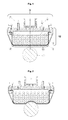
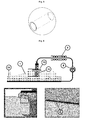
- the present invention is related to a RF electrode or to a bag-like RF electrode with a target-averted side and a mouldable target-facing side and an inner cavity in between, wherein the inner cavity is fillable and emptiable and perfusable with a liquid and / or a liquid substitute and the inner cavity contains solid particles arrangeable in the presence of a liquid and/or a liquid substitute within the inner cavity and at least a part of the surface of the target-facing side is electrically conductive and is connectable to a RF energy source, wherein the target-facing side is fittable to any shape of a target by arranging or moving the solid particles within the inner cavity.
- the surface of the electrode of the capacitor i.e. the surface of the upper electrode which is placed on top of the target, such as a patient, and the surface of the lower electrode (or counter electrode) which is placed below the target is in close and direct contact to the surface of the target, such as the skin of the patient, without any space there between. This allows the optimal electrically conductive energy transfer without the risk of necrosis or burning the skin of the patient.
- the target-facing side of the RF electrode and especially of the upper RF electrode which is placed onto the target should be shape adaptable to the body shape of the target (e.g. of a patient).
- the lower RF electrode (the counter electrode), which is placed below the target (e.g. a patient), is preferably a water bed having an electrically conductive surface. Due to the weight of the patient, the water bed will automatically follow the shape of the body of the patient who is lying on the bed. Thus the problem to have a surface of a RF electrode which follows the shape of the patient without any space between the skin of the patient and the conductive surface of the RF electrode is solved quite easily for the counter electrode which is below the target, i.e. below the patient.
- the leg has approximately the form of a cylinder with decreasing inner diameter from the buttocks to the foot.
- the back part of the leg sinks into the water bed (or a different form of lower electrode) which follows the shape of the cylinder.
- the upper RF electrode has also to follow the shape of the cylinder in order to cover the upper part of the leg.
- an upper RF electrode which should cover the chest of a woman and which has to follow the shape and to provide space for the breasts.
- the present invention provides RF electrodes which are adaptable or adjustable or fittable to any body shape.
- such RF electrodes once fitted or adapted to the body shape or to the shape of a body area to be treated are able to keep this shape so that the weight of the RF electrode can be captured by a stand or rack taking over the weight of the electrode so that the patient does not feel any weight on top of his/her body.
- the inventive RF electrode is fixed to such a rack or stand in a spring-compensated manner to allow a degree of movement and thus retain a higher degree of adaptability.
- the present invention is especially directed to the upper RF electrode of a capacitor (or condenser).
- Said upper RF electrode has a target-facing side which is the bottom side of the electrode and a non-target-facing side or target-averted side which is the upper side or top side of the electrode.
- the target-averted side is preferably rigid and/or inelastic and gives the general shape to that RF electrode.
- the target-averted side is preferably formed like a cap or cover or hood over the target-facing side.
- the target-facing side is preferably almost flat or slightly convex and is made of a flexible, deformable or shape-adaptable material, especially a plastic material.
- the RF electrode, and especially the upper RF electrode has preferably the form of a bag or a mattress with a stiff or rigid target-averted side and a deformable or shape-adaptable target-facing side.
- the target-facing side together with the target-averted side form a cavity.
- the cavity has preferably at least one inlet and at least one outlet for a liquid and/or a liquid substitute so that this cavity between the target-averted side and the target-facing side which contains the solid particles is fillable and emptiable and also perfusable with a liquid, such as water or a water alcohol mixture, and/or a liquid substitute.
- the solid particles inside the cavity cannot pass the inlet or the outlet for the liquid and/or the liquid substitute and thus remain within the cavity.
- the solid particles are not soluble or swellable in the liquid and do also not become sticky or gluey in the liquid.
- the solid particles are preferably inert in regard to the liquid.
- the liquid and/or the liquid substitute does also not alter or damage the material of the target-averted side and the target-facing side of the RF electrode.
- the material of the target-averted side and of the target-facing side is inert in regard to the liquid and/or the liquid substitute.
- the target-facing side of the RF electrode assumes the invert form (or shape, contour) of the target by engulfing the target with its flexible or deformable target-facing side.
- the position of the RF electrode which is preferably the upper RF electrode can now be fixed by a stand or rack so that the weight of the RF electrode lies no longer on the target. Since the target-facing side fits to the shape of the target, there is a tight connection between the target-facing side of the RF electrode and the target, e.g. the skin of a patient. Such tight connection provides the optimal conductive energy transfer from one RF electrode through the target (especially a patient or body part of a patient) to the counter electrode, avoiding burning the patient's skin.
- the position of the upper RF electrode is fixed by the use of a rack or stand on which the upper RF electrode is arranged or mounted so that there is no weight anymore of the upper RF electrode which lies or pushes on the target.
- the target is preferably in a horizontal position and in case of a patient, the patient is preferably lying on a water bed or on an inventive RF electrode.
- the target-facing side of the RF electrode will keep the shape assigned by the target to the target-facing side as long as no application of an outer force (i.e. a force that is not exerted by the RF electrode itself) applies which is able to deform the shape of the target-facing side of the RF electrode. This means, even if the upper RF electrode is removed from the target, the target-facing side will maintain its shape predetermined by the shape of the target onto which the target-facing side of the RF electrode was placed.
- an outer force i.e. a force that is not exerted by the RF electrode itself
- the movement is able to generate an outer force which when directed to the target-facing side of the RF electrode is able to deform the shape of the target-facing side so that the shape of the target-facing side is able to follow the amended shape of the patient.
- This flexibility or deformability of the target-facing side of the RF electrode ensures that also during and after a movement of the patient the close contact of the target-facing side of the RF electrode to the skin of the patient is maintained.
- the shape assigned to the target-facing side of the RF electrode can be stabilized by decreasing the amount of the liquid, such as water, and/or the amount of the liquid substitute present inside the cavity, i.e. present inside the hollow space between the target-averted side and the target-facing side.
- This stabilizing effect is also called "sand effect".
- the solid particles can move more easily so that the application of a lower force is already sufficient to deform the target-facing side by moving the solid particles inside the inner cavity.
- the solid particles require a larger force to be moved so that a larger force has to be applied against the target-facing side in order to move the solid particles inside the inner cavity.
- this effect can be used to stabilize the shape of the target-facing side by reducing the liquid content and/or the liquid substitute content inside the inner cavity or also to make the target-facing side easier deformable by increasing the amount of liquid and/or of liquid substitute inside the inner cavity.
- the "sand effect" is described in more detail below.
- the present invention is related to a RF electrode or to a bag-like RF electrode or to a mattress-like RF electrode with a stiff or rigid target-averted side and a mouldable or deformable target-facing side and an inner cavity in between, wherein the inner cavity is fillable and emptiable and perfusable with a liquid, such as water, and/or with a liquid substitute and the inner cavity contains solid particles which are inert in the liquid and/or in the liquid substitute and which are arrangeable or movable in the liquid and/or in the liquid substitute within the inner cavity and at least a part of the surface of the target-facing side is electrically conductive and is connectable to a RF energy source, wherein the target-facing side is fittable or adaptable to any shape of a target by arranging or moving the solid particles within the inner cavity.
- a liquid such as water
- the present invention is related to a RF electrode or to a bag-like RF electrode or to a mattress-like RF electrode with a target-averted side and a mouldable or deformable target-facing side and an inner cavity in between both sides, wherein the inner cavity is fillable and emptiable and perfusable with a liquid, such as water, and/or with a liquid substitute and the inner cavity contains solid particles which are inert in the liquid and/or in the liquid substitute and which are arrangeable or movable in the liquid and/or in the liquid substitute within the inner cavity and at least a part of the surface of the target-facing side is electrically conductive and is connectable to a RF energy source, wherein the target-facing side is fittable or adaptable to any shape of a target by arranging or moving the solid particles within the inner cavity.
- a liquid such as water
- the present invention is as also directed to a RF electrode or as a bag-like RF electrode or as a mattress-like RF electrode with a target-averted side and a mouldable or deformable target-facing side and an inner cavity in between both sides, wherein the inner cavity is fillable and emptiable and perfusable through at least one inlet and at least one outlet with a liquid, such as water, and/or with a liquid substitute and the inner cavity contains solid particles which are inert in the liquid and/or in the liquid substitute and which are arrangeable or movable in the liquid and/or in the liquid substitute within the inner cavity in order to give any shape to the target-facing side and at least a part of the surface of the target-facing side is electrically conductive and is connectable to a RF energy source, wherein the target-facing side is fittable or adaptable to any shape of a target by arranging or moving the solid particles within the inner cavity by the application of a force or outer force to the target-facing side.
- the present invention is also directed to a RF electrode or to a bag-like RF electrode or to a mattress-like RF electrode with a target-averted side and a mouldable or deformable target-facing side and an inner cavity in between both sides, wherein the inner cavity is fillable and emptiable and perfusable with a liquid, such as water, and/or with a liquid substitute and the inner cavity contains solid particles which are inert in the liquid and/or in the liquid substitute and which are arrangeable or movable in the liquid and/or in the liquid substitute within the inner cavity and at least a part of the surface of the target-facing side is electrically conductive and is connectable to a RF energy source, wherein the target-facing side is fittable or adaptable to any shape of a target by arranging or moving the solid particles in the presence of a liquid under application of a force or of an outer force to the target-facing side.
- a liquid such as water
- the RF electrode of the present invention is preferably a whole body RF electrode or a large area RF electrode covering the body of a patient or at least large body parts of a patient (e.g. the back, the chest, the entire torso, etc.).
- the term "whole body”, as used herein, is only used when the target to be treated is a living being (i.e. a patient).
- the term “whole body” does not refer to the entire surface area of a patient but refers only to the surface area of one side of the patient, those "sides of the patient” being for example the ventral (also referred to as side of the belly), dorsal (also referred to as side of the back), left and right side of the patient's body. Left and right side of the patient's body are understood from the perspective of the patient.
- an inventive RF electrode that covers ⁇ 80 % of the surface area of that side of a patient on or under which said RF electrode is placed is referred to as "whole body" RF electrode.
- the present invention is also related to a RF electrode or to a bag-like RF electrode with a target-averted side and a mouldable target-facing side and an inner cavity in between, wherein the inner cavity is fillable and emptiable and perfusable with a liquid and / or a liquid substitute and the inner cavity contains solid particles arrangeable in the presence of a liquid and/or a liquid substitute within the inner cavity and at least a part of the surface of the target-facing side is electrically conductive and is connectable to a RF energy source, wherein the target-facing side is fittable to any shape of a target by arranging or moving the solid particles within the inner cavity, and wherein the RF electrode is a whole body RF electrode.
- the present invention is related to a radiofrequency electrode (RF electrode), a bag-like radiofrequency electrode (RF electrode) or a bolus radiofrequency electrode with a target-averted side and a mouldable or deformable target-facing side and an inner cavity in between the target-facing side and the target-averted side, wherein the inner cavity is fillable and emptiable and perfusable with a liquid, such as water or a water alcohol mixture, and/or with a liquid substitute and the inner cavity contains solid particles arrangeable or movable in the presence of the liquid and/or the liquid substitute within the inner cavity in order to assume the invert shape of the target so that the target-facing side follows the shape of the target in order to obtain a close and direct contact of the target-facing side to the surface of the target and at least a part of the surface of the target-facing side is electrically conductive and is connectable to a radiofrequency (RF) energy source and the solid particles are arrangeable or movable in the liquid and/or the liquid substitute within the inner cavity by the application of
- the force applied to the target-facing side is on the one side generated by the target (representing a mechanical resistance) and on the other side given by the weight force of the electrode itself when the RF electrode is lowered onto the target, which is preferably in a horizontal position, so that the target and especially the prominent areas of the target sink(s) into the mouldable or deformable target-facing side thereby arranging or moving the solid particles in the liquid inside the cavity through which the shape assigned to the target-facing side is stabilized.
- This stabilization can be explained by the arrangement or movement of the solid particles when a force or outer force is applied against the target-facing side.
- the shape given to the target-facing side which is the invert shape of the target or target area which is in contact with the target-facing side is conserved even if the application of the force is abandoned. This would not be possible if only a liquid without solid particles is present in the inner cavity, because a liquid filled bag would follow with its target-facing side the shape of a target on which the bag is placed but when removing the bag from the target, the shape of the target-facing side will collapse.
- the degree of stabilization due to the presence of the solid particles within the inner cavity of the inventive RF electrode strongly depends on the ratio between the volume of the liquid and the volume of the solid particles within the inner cavity. In other words, it depends on the density of the solid particles within the inner cavity. This aspect will be elucidated in greater detail below.
- the assigned invert shape of the contacted target or contacted target area which is assigned to the target-facing side is not entirely frozen or rigid but can be deformed again by the application of a force to the target-facing side, however, the amount of force necessary for a deformation depends on the degree of stabilization of the inventive RF electrode. Such a deformation happens, for example, if the target moves under the RF electrode (in form of an upper electrode).
- the weight of the upper RF electrode is compensated by a rack or stand so that the target such as a patient does not feel the weight of the upper RF electrode anymore.
- the inventive RF electrode is fixed to such a rack or stand in a spring-compensated manner to allow a degree of movement and thus retain a higher degree of adaptability.
- the fixing of the upper RF electrode to the rack or stand implies the abandonment of a force against the target-facing side which however keeps its shape and does not collapse.
- the target-facing side of the RF electrode follows the shape of the target or target area which is in contact with the target-facing side also in case the target moves and changes its shape due to the movement.
- target refers to the body of the object to be treated, which can be a living being, such as a human or an animal, but it can also be a non-living structure, such as for instance a container filled with physiological saline.
- Target and “target body” are used synonymously in this application. In the case, that the "target” is a living being, it is also sometimes referred to the "target” as "patient”.
- liquid refers to a substance or mixture of substances that at standard ambient temperature and pressure (SATP) conditions (temperature 25 °C; pressure 1013 hPa) is in the liquid state of matter, which means that it can flow, is essentially non-compressible and has a defined volume but not a defined shape, i.e. it adapts to the shape of its container but does not expand to fill this container.
- SATP ambient temperature and pressure
- fluid which refers both to substances, which are in the liquid state of matter, as well as to substances, which are in the gaseous state of matter.
- solid refers to a body that at standard ambient temperature and pressure (SATP) conditions (temperature 25 °C; pressure 1013 hPa) is in the solid state of matter, thus the forces between the molecules forming the body are strong so that the particles preferably cannot move freely but can only vibrate. As a result, a solid has a stable, definite shape, and a definite volume at a given temperature and pressure.
- SATP ambient temperature and pressure
- solid particles refers to particles that are in the solid state of matter and that are not able to pass through the at least one inlet or the at least one outlet of said inventive RF electrode and are hence remaining within the inner cavity of the inventive RF electrode during the operation of the device. Thus, said “solid particles” are sometime also referred to as “caged particles”.
- liquid substitute refers to a liquid-like substance formed by a multitude of particles that are in the solid state of matter but that behave like a liquid. Hence, the particles forming the "liquid substitute” are sometimes also referred to as “liquid-like particles”. Due to their low friction they are easily sliding against each other and against other materials and are thus flowing quite similar to a real liquid.
- the "liquid substitute” (in contrast to the "solid particles") is able to pass through the at least one inlet and the at least one outlet of said inventive RF electrode.
- ouldable means that the respective device is flexible and can be deformed.
- target-facing side refers to the side of the inventive RF electrode that is in opposite to and directed towards the surface of the target.
- surface of the target-facing side refers to the surface of said target-facing side that is designed to be in direct physical contact to the surface of the target.
- the surface of said target-facing side can come into contact with the target while the "contact face of the target-facing surface” is the part of the surface of the target-facing side which is actually in contact with the target.
- the part of the surface of the target-facing side that is electrically conductive is sometimes also referred to as "conductive layer”.
- target non-facing side or “target-averted side”, used synonymously in the present application, refer to the side of the inventive RF electrode that is directed away from the surface of the target or separated from it at least by the target-facing side of the inventive RF electrode.
- the unit of target-facing side and target-averted side optionally together with a side part of the inventive RF electrode are forming a so called “envelope” (also called sheath) enclosing the inner cavity of the inventive RF electrode.
- envelope also called sheath
- Said “side part” is connecting the target-averted and the target-facing side of the inventive RF electrode to close the envelope that encases the inner cavity.
- the margins of the target-facing side and the target-averted side are directly merging and form alone the continuous envelope of the inner cavity, without a need of a side part.
- the present invention is also directed to a RF electrode with a target-averted side and a mouldable target-facing side and a side part connecting the target-averted side and the mouldable target-facing side to form an inner cavity in between, wherein the inner cavity is fillable and emptiable and perfusable with a liquid and/or a liquid substitute and the inner cavity contains solid particles arrangeable in the presence of a liquid and/or a liquid substitute within the inner cavity and at least a part of the surface of the target-facing side is electrically conductive and is connectable to a RF energy source, wherein the target-facing side is fittable to any shape of a target by arranging the solid particles within the inner cavity.
- fittable means that the respective device or a part thereof can be adapted to the shape (or contours) of a target, on which the device or a part thereof is placed. This term does not imply, however, whether the device or a part thereof retains the shape it has been adapted to or whether it regains its initial shape once being detached from the target.
- fittable and shape-adaptive are used synonymously in this application.
- the fitted device e.g. RF electrode
- the fitted device is able to preferably closely cover the surface of the target such as for instance in the field of handicraft a casted object fits perfectly into its corresponding mould.
- the inventive RF electrode is placed on top of the target to be treated, i.e. in form of an overlay that covers the target or at least parts thereof.
- the target is a patient (human or animal) it is desirable that the inventive RF electrode is as light-weight as possible in order to minimize the burden to the target (e.g. the patient).
- the present invention is also related to a RF electrode in form of an overlay with a target non-facing side and a mouldable target-facing side and an inner cavity in between, wherein the inner cavity is fillable and emptiable and perfusable with a liquid and/or a liquid substitute and the inner cavity contains solid particles arrangeable in the presence of a liquid and/or a liquid substitute within the inner cavity in order to give any shape to the target-facing side and at least a part of the surface of the target-facing side is electrically conductive and is connectable to a RF energy source, wherein the target-facing side is fittable to any shape of a target by arranging the solid particles in the presence of a liquid and/or a liquid substitute under application of a force.
- an overlay refers to an embodiment of the present invention, wherein the inventive RF electrode is designed to be placed on top of the target.
- the target-facing side of the inventive RF electrode is the bottom side of the RF electrode, i.e. the target-facing side of the RF electrode is oriented in direction of the gravitational force so that the gravitational force of the solid particles inside the inner cavity acts on the inner surface (i.e. inside the inner cavity) of the target-facing side.
- the present invention is also directed to an RF electrode with a target-averted side and a mouldable target-facing side and an inner cavity in between, wherein the inner cavity is fillable and emptiable and perfusable with a liquid and/or a liquid substitute and the inner cavity contains solid particles arrangeable in the presence of a liquid and/or of a liquid substitute within the inner cavity and at least a part of the surface of the target-facing side is electrically conductive and is connectable to an RF energy source, wherein the target-facing side is fittable to any shape of a target by arranging the solid particles within the inner cavity, and wherein the RF electrode is in form of an overlay placeable on top of the target.
- the present invention is also directed to an RF electrode with a target-averted side and a mouldable target-facing side and an inner cavity in between, wherein the inner cavity is fillable and emptiable and perfusable with a liquid and/or a liquid substitute and the inner cavity contains solid particles arrangeable in the presence of a liquid and/or of a liquid substitute within the inner cavity and at least a part of the surface of the target-facing side is electrically conductive and is connectable to a RF energy source, wherein the target-facing side is fittable to any shape of a target by arranging the solid particles within the inner cavity, wherein the RF electrode is in form of an overlay placeable on top of the target, characterized in that the target-facing side is the bottom side of the RF electrode and that the gravitational force of the solid particles inside the inner cavity acts on the inner surface (i.e. inside the inner cavity) of the target-facing side and is directed to the target.
- the spatial orientation of the inventive RF electrode is important.
- the target-facing side is the bottom side of the RF electrode as shown in Figure 1 and the surface of the target-facing side is in the initial and not deformed or not moulded state most preferably a horizontal plane as shown in Figure 1 .
- the initial state refers to the shape of the surface of the target-facing side before the electrode is placed on the target.
- the RF electrode is spatially oriented so that the gravitational force of the solid particles is directed to the inner surface of the target-facing side.
- the inner surface of the target-facing side is the surface of the target-facing side which is inside the inner cavity.
- the inner cavity of the inventive RF electrode contains a liquid and/or a liquid substitute at least in the operational state of the inventive device.
- the present invention is also related to a RF electrode with a target-averted side and a mouldable target-facing side and an inner cavity in between, wherein the inner cavity contains a liquid and/or a liquid substitute as well as solid particles arrangeable in the liquid and/or the liquid substitute within the inner cavity, wherein the inner cavity is perfusable with said liquid and/or liquid substitute, and wherein at least a part of the surface of the target-facing side is electrically conductive and is connectable to a RF energy source, wherein the target facing side is fittable to any shape of a target by arranging the solid particles in the liquid under application of a force.
- the liquid and the solid particles should have the properties as disclosed herein also for this embodiment like being inert, not soluble, not sticky and so on.
- the present invention is also related to an RF electrode with a target-averted side and a mouldable or deformable target-facing side and an inner cavity in between, wherein the inner cavity is fillable and emptiable and perfusable with a liquid and/or a liquid substitute and the inner cavity contains solid particles arrangeable or movable in the presence of a liquid and/or a liquid substitute within the inner cavity and at least a part of the surface of the target-facing side is electrically conductive and is connectable to a RF energy source, wherein the solid particles are loose particles which do not adhere or stick to each other, which are neither electrically conductive nor magnetic and if a liquid is present also not soluble in the liquid.
- the present invention is related to an RF electrode comprising a target-facing and a target-averted side enclosing an inner cavity filled with solid particles and at least in the operational state also with a liquid and/or a liquid substitute.
- the inner cavity is not completely filled with the solid particles.
- the inner cavity is preferably only partly filled with the solid particles.
- the totalized volume ( V P - see further below for definition) of all solid particles (also referred to as caged particles) within the inner cavity is less than 52.4%, more preferably less than 50.0%, more preferably less than 45.0%, more preferably less than 40.0%, more preferably less than 35.0%, more preferably less than 30.0%, more preferably less than 25.0%, more preferably 20.0% of the total inner volume of the inner cavity (V total - see further below for definition) in the state, in which the inventive RF electrode is not adapted to a target (e.g. a patient).
- a target e.g. a patient
- the totalized volume (V P ) of all solid particles (also referred to as caged particles) within the inner cavity is preferably between 20.0% and 52.4%, preferably between 25.0% and 50.0%, more preferably between 30% and 45% of the total inner volume of the inner cavity (V total ) in the state, in which the inventive RF electrode is not adapted to a target (e.g. a patient). It shall be mentioned here, that the total inner volume of the inner cavity (V total ) is not constant during the operation of the inventive RF electrode. During fitting of the RF electrode (cf. Fig. 1 to 3 ) to the shape of the target (e.g.
- the volume of the liquid and/or liquid substitute within the cavity can be reduced on purpose, this goes along with a reduction of the total inner volume of the inner cavity (V total ) and with an increasing density of the solid particles within the inner cavity.
- V total total inner volume of the inner cavity
- the percentage of the inner cavity's volume occupied by the solid particles may change from low percentage values to higher percentage values, given above.
- the volume of liquid and/or liquid substitute withdrawn from the inner cavity during the fitting to a target does preferably not exceed an extent, that not enough liquid (and/or liquid substitute) is left to fill the interstices between the solid particles.
- the total inner volume of the inner cavity (V total ) shall only be reduced to a maximal extent that the total inner volume of the inner cavity (V total ) is still at least 191% of the totalized volume of all solid particles (V P ) within the inner cavity.
- the number of the solid particles inside the inner cavity is sufficient to cover the surface of the target facing-side of the inventive RF electrode at least in a double layer, preferably at least a triple layer, even more preferably at least in 4 layers, more preferably at least in 5 layers, even more preferably at least in 8 layers and still more preferably at least in 10 layers.
- the size of the solid particles used it is also conceivable in certain embodiments of the present invention, especially when the solid particles are very small in size, that the number of solid particles used in the respective embodiment is sufficient to cover the target facing-side of the inventive RF electrode at least in 100 or 1000 or even more layers.
- the width of the inner cavity above the surface of the target-facing side has to be large enough to accommodate the at least double layer of the solid particles used, preferably the at least triple layer, or the at least 4 layers, or the at least 5 layers, or the at least 8 layers, or the at least 10 layers, or the at least 100 layers or the at least 1000 layers of the solid particles used.
- the entire dimensions of the inner cavity shall preferably not lead to a total inner volume of the inner cavity (V total ) in the initial state, where the inventive RF electrode is not adapted to a target, that it is out of the range 5.0 times - 2.0 times, preferably 4.5 times - 2.5 times of the totalized volume of all solid particles (V P ) used in the respective embodiment.
- the width of the inner cavity shall be explained with an idealized embodiment of an inventive RF electrode, which has a perfectly rectangular shape.
- the width of the inner cavity is the distance between the target-facing side and the target-averted side of the inventive RF electrode that are both oriented horizontally and perfectly parallel to each other.
- the RF electrode might not be a perfect rectangle but might for example have a convex target-facing side and, second, during the fitting process of the inventive device the target-facing side is adapted to the contours of a target and has thus a varying width.
- the width of the inner cavity used herein, usually refers to the average width of the inner cavity during the non-adapted state of the inventive RF electrode.
- the inventive electrode resembles a bag and is therefore also referred to as bag-like RF electrode.
- the target-facing side of the bag-like RF electrode shall be mouldable in order to be able to adapt to the surface of the target.
- This serves on the one hand to establish the essential close contact between the target-facing surface of the RF electrode and the surface of the target.
- the inventive RF electrode or bag-like RF electrode comprises a target-facing and a target-averted side, which together (and optionally with a side part) form an envelope enclosing the inner cavity of the inventive RF electrode.
- said inner cavity is filled with solid particles as well as a liquid and/or a liquid substitute.
- the material of the target-facing side of the RF electrode needs to be not only flexible but also leak-proof to the liquid (and/or the liquid substitute) used in the respective embodiment of the inventive device.
- Possible materials for the target-facing side of the inventive RF electrode comprise: soft polyvinyl chloride (PVC), polyvinylidene chloride (PVdC), polyethylene (PE), polypropylene (PP), polyurethane (PU), and silicone.
- the inner cavity of the RF electrode has at least one inlet and at least one outlet to permit the influx and efflux of the liquid and/or the liquid substitute used during RF hyperthermia treatment into and from said inner cavity.
- means are provided within the at least one inlet and/or the at least one outlet to prevent the solid particles contained in said inner cavity from passing through the at least one inlet and/or the at least one outlet.
- Such means can comprise nets, meshes, grids, filters and the like.
- the inner cavity of the RF electrode is divided into several separate cavities that are connected to each other forming a continuous volume.
- the inner cavity of the inventive RF electrode may be divided into several separate cavities that are not connected to each other, thus having each at least one inlet and at least one outlet.
- the inner cavity of the inventive RF electrode is divided into several separate cavities, wherein one fraction of said separate cavities is connected to each other having at least one common inlet and at least one common outlet; wherein the other fraction of said separate cavities is not connected to each other and each of these cavities having thus at least one inlet and at least one outlet.
- the inner cavity of the RF electrode can be divided into several separate cavities connected to each other or not connected to each other having separate inlets and outlets for the liquid and/or the liquid substitute.
- outlet and inlet refer to ports that connect the inner cavity of the inventive RF electrode to the outside, e.g. to a pumping circuit, and does not refer to connections between separate cavities within the envelope of the inventive RF electrode. Additionally, it shall be pointed out that the "outlet” and “inlet” do not necessarily have to meet the same criteria regarding flexibility of the material than the target-facing side of the inventive RF electrode, since they are usually located on the target-averted side of the inventive RF electrode.
- the target-averted side of the inventive RF electrode or bag-like RF electrode does not need to have the same physical and/or chemical properties than the target-facing side of the inventive bag-like RF electrode.
- the target-averted side of the inventive RF electrode or bag-like RF electrode can be rigid or stiff or not deformable in accordance to a preferred embodiment of the present invention.
- the target-facing and the target-averted side of the inventive RF electrode can be composed of different materials or mixtures of materials having different material properties but being tightly connected to each other at the junction of the target-facing and the target-averted side (or connected to each other via a connecting side part).
- the material or mixture of materials of both the target-facing and the target-averted side of the inventive bag-like electrode need to be leak-proof to the liquid and/or the liquid substitute used in accordance with the invention as filling of the inner cavity.
- the envelope encasing the inner cavity can be composed entirely of a material or mixture of materials having the properties desired for the target-facing side of the inventive bag-like RF electrode.
- the target-averted side of this envelope can be attached to and thereby supported by an overlying material layer (e.g. a cap) that is rigid and thus confers rigidity to the target-averted side of the envelope.
- an attachment can for example be made irreversible by means of gluing or welding or detachable by means of straps, snap buttons, hook and loop fasteners (Velcro ® fasteners), zip fasteners and the like.
- the target-averted side of the RF electrode is rigid and has the following properties:
- a preferred embodiment of the present invention is related to a RF electrode with a rigid or non-deformable or stiff target-averted side and a mouldable or deformable target-facing side and an inner cavity in between, wherein the inner cavity is fillable and emptiable and perfusable with a liquid and/or with a liquid substitute and the inner cavity contains solid particles arrangeable or moveable in the presence of a liquid and/or of a liquid substitute within the inner cavity in order to give any shape to the target-facing side and at least a part of the surface of the target-facing side is electrically conductive and is connectable to a RF energy source.
- the present invention can be realized with both a liquid and a liquid-like component (liquid substitute) as further filling material of the inner cavity in addition to the solid particles.
- a liquid substitute liquid-like component
- the following part of the description is divided into two main chapters for clarity reasons, dealing either with embodiments having solid particles and liquid within the inner cavity (next chapter) or with embodiments having solid particles and liquid substitute within the inner cavity of the inventive RF electrode (next but one chapter).
- the liquid can be a non-viscous liquid, a gel, oil or a mixture thereof.
- the liquid has several functions.
- the perfusion of the liquid through the inner cavity can be used for temperature-controlling purposes, i.e. cooling or heating the RF electrode and thus the target, such as the skin of the patient, and for supporting the arrangement or move of the solid particles as well as stabilizing the shape assigned to the target-facing side by stabilizing the position and arrangement of the solid particles depending on the volume of liquid present in the inner cavity (see also "sand effect"). Consequently the amount or volume of the liquid present in the inner cavity during the hyperthermia treatment session is normally not constant.
- the liquid filling the inner cavity of the inventive RF electrode is water or a mixture of water and ethanol or a mixture of water and isopropanol.
- the liquid filling partly the inner cavity may contain unavoidable amounts of gases (e.g. air), which are dissolved in the liquid.
- gases e.g. air
- the liquid suitable to be used in the inner cavity of the RF electrode can be selected from the group of water, ethanol, iso-propanol and mixtures thereof.
- a person skilled in the art will recognize other liquids suitable for the use in the inventive RF electrode.
- Another embodiment of the present invention is related to a RF electrode with a target-averted side and a mouldable target-facing side and an inner cavity in between, wherein the inner cavity is fillable and emptiable and perfusable with a liquid and the inner cavity contains solid particles arrangeable or movable in the presence of a liquid within the inner cavity and at least a part of the surface of the target-facing side is electrically conductive and is connectable to a RF energy source, and wherein the liquid is water, ethanol, iso-propanol or mixtures thereof.
- the liquid consists of at least 60 % by volume water, more preferred of at least 70 % by volume water, even more preferred of at least 80 % by volume water, and most preferred of at least 90 % by volume water.
- additive generally refers to substances that are added to the liquid filling the inner cavity of the inventive RF electrode in a volume fraction of less than 10 %, preferably less than 8%, more preferably less than 6%, more preferably less than 4%, and even more preferably less than 2%.
- liquid and preferably water or a mixture of water and ethanol or a mixture of water and iso-propanol further contains at least one anti-fungal, anti-bacterial, anti-viral and/or anti-algae additive.
- Yet another aspect of the present invention is to use gliding materials (e.g. oil dispersion, MoS 2 , etc.) as additives to the liquid to ensure an easy and sufficient gliding of the solid particles filling the inner cavity of the inventive RF electrode with respect to each other or with respect to the walls of the envelope.
- gliding materials e.g. oil dispersion, MoS 2 , etc.
- additives in case any additives are used, it is preferred to use additives in a concentration which is essentially non-toxic to humans or animals to avoid any harm to a patient in the event of an accidental spill.
- the solid particles filling the inner cavity of the inventive RF electrode can be composed of various materials and be present in various shapes and sizes. However, said solid particles (also caged particles) are not able to pass through the at least one inlet or the at least one outlet of the inner cavity of the inventive RF electrode. Thus the number of solid particles remains constant within the inner cavity during the operation of the inventive device.
- a filter it is preferred to place a filter to both pumping circuit ports (inlet, outlet) to avoid obstruction caused by the solid particles.
- the solid particles as a part of the filling of the inner cavity of the inventive RF electrode shall meet the following criteria regarding material properties:
- the solid particles have preferably a density below 2.4 g/cm 3 , preferably a density below 2.2 g/cm 3 , more preferably a density below 2.0 g/cm 3 , preferably a density below 1.5 g/cm 3 , preferably a density below 1.2 g/cm 3 , preferably a density below 1.1 g/cm 3 , preferably a density below 1.0 g/cm 3 , preferably a density below 0.9 g/cm 3 , preferably a density below 0.8 g/cm 3 , preferably a density below 0.7 g/cm 3 , preferably a density below 0.6 g/cm 3 , preferably a density below 0.5 g/cm 3 , and preferably a density below 0.4 g/cm 3 .
- the solid particles have a density in the range of the density of the liquid, i.e. that the solid particles have a density that deviates not more than ⁇ 10%, preferably not more than ⁇ 8%, more preferably not more than ⁇ 6%, still more preferably not more than ⁇ 4% and most preferably not more than ⁇ 2% from the density of the liquid.
- the density refers to the density of the mixture.
- the solid particles have a density between 0.4 g/cm 3 - 2.4 g/cm 3 , more preferably a density between 0.5 g/cm 3 - 2.0 g/cm 3 , more preferably a density between 0.6 g/cm 3 - 1.6 g/cm 3 , yet more preferably a density between 0.7 g/cm 3 -1.4 g/cm 3 , more preferably a density between 0.8 g/cm 3 - 1.2 g/cm 3 , even more preferably a density between 0.9 g/cm 3 -1.1 g/cm 3 .
- the present invention is also related to a RF electrode with a target-averted side and a mouldable or deformable target-facing side and an inner cavity in between, wherein the inner cavity is fillable and emptiable and perfusable with a liquid and the inner cavity contains solid particles arrangeable or movable in the presence of a liquid within the inner cavity and at least a part of the surface of the target-facing side is electrically conductive and is connectable to a RF energy source, and the solid particles are loose particles and not soluble in the liquid and neither electrically conductive nor magnetic.
- Potential materials the solid particles filling at least partly the inner cavity of the inventive RF electrode can be made of comprise: polyurethane (PU), polytetrafluoroethylene (PTFE, Teflon ® ), fluorinated ethylene propylene (FEP), perfluoroalkoxy polymer (PFA), poly(methyl methacrylate) (PMMA), polycarbonate (PC), polyamide (PA), polyvinyl chloride (PVC), polyoxymethylene (POM), polyethylene (PE), polypropylene (PP), polymethylpentene (PMP), polystyrene (PS) and mixtures thereof.
- PU polyurethane
- PTFE polytetrafluoroethylene
- FEP fluorinated ethylene propylene
- PFA perfluoroalkoxy polymer
- PMMA poly(methyl methacrylate)
- PC polycarbonate
- PA polyamide
- PVC polyvinyl chloride
- POM polyoxymethylene
- PE polyethylene
- PP polypropy
- the material of the solid particles at least partly filling the inner cavity of the inventive RF electrode allows a smooth gliding of said particles against each other (i.e. low friction) in order to promote the adaption to the shape of the target.
- the solid particles are made of a material that is also biocompatible, i.e. non-toxic to humans or animals, in order to avoid any harm to a patient in the event of an accidental spill.
- the solid particles at least partly filling the inner cavity of the inventive RF electrode are made from a material that has a lower physical density than the liquid filling the inner cavity of the inventive RF electrode. This helps in reducing the weight of the inventive device and is especially preferred, if the inventive RF electrode is used as an overlay, i.e. is placed on top of the target object.
- the solid particles at least partly filling the inner cavity of the inventive RF electrode can be present in various shapes and sizes.
- Possible shapes of the solid particles comprise spheres, rectangles, triangles, and polygons of symmetrical or asymmetrical conformation, but are not limited thereupon.
- the solid particles shall have no sharp edges that could pierce the envelope of the inner cavity or that could elicit an unpleasant sensation in a patient.
- a person skilled in the art is aware of additional shapes that are suitable in accordance with the invention.
- an important aspect of the present invention regarding the solid particles at least partly filling the inner cavity of the inventive RF electrode is that the solid particles permit a variable but continuous flow of the liquid through the inner cavity of the inventive device during the entire treatment time.
- shape adaption of the inventive RF electrode is facilitated by a purposeful reduction of the liquid's volume inside the inner cavity, while the totalized volume of all the solid particles inside the inner cavity remains constant.
- the packaging of the solid particles inside the inner cavity gets denser during shape adaptation.
- interstices between the solid particles persist even after the packaging of said particles gets denser.
- the solid particles have a shape that does not tightly interlock, such as for example a spherical shape which is preferred.
- the size of the solid particles depends, of course, on the size of the whole RF electrode and also on the volume of the inner cavity. However, for all embodiments it can be stated that the solid particles should preferably not have a diameter below 0.05 mm, preferably below 0.10 mm, preferably below 0.20 mm, more preferably below 0.50 mm, still more preferably below 1.00 mm, more preferably below 2.00 mm and preferably below 3.00 mm, more preferably below 4.00 mm and most preferably below 5.00 mm. In addition, the solid particles should not have a diameter exceeding 10.00 mm, preferably exceeding 12.00 mm, preferably exceeding 14.00 mm, preferably exceeding 16.00 mm, preferably exceeding 18.00 mm, preferably exceeding 20.00 mm. Of course, the values for the diameter of the solid particles, given above, preferably refer to solid particles with a spherical shape.
- the values for the sphere diameter are average diameters, since one cannot exclude minor irregularities in the shape of the spheres, i.e. one cannot exclude that the spheres are not perfectly round or not perfectly identical to each other.
- the standard deviation from this average value for the sphere diameter shall not exceed ⁇ 20.0%, preferably not ⁇ 10.0% and most preferably not ⁇ 5.0% of the average value.
- treatment time refers to the period of time, that follows after the correct placement of the inventive RF electrode and the shape adaptation and in which the target is subjected to the actual RF hyperthermia treatment.
- Such a spherical shape of the solid particles at least partly filling the inner cavity of the inventive RF electrode is also favourable with respect to another technical difficulty arising from the packaging of said particles getting denser in the course of shape adaptation: If the solid particles get into closer contact after reduction of the liquid's volume within the inner cavity and the concomitant reduction of the total inner volume of the inner cavity, they might cant depending on shape. Such a cant might lead to unwanted changes of overall shape of the target-facing side of inventive RF electrode.
- the solid particles at least partly filling the inner cavity of the inventive RF electrode have a spherical shape.
- holes can be drilled through the solid particles (cf. Fig. 5 ) to further facilitate the continuous flow of the liquid during the treatment time.
- Another aspect of the present invention is related to the size of the solid particles at least partly filling the inner cavity of the inventive RF electrode.
- the smaller the particles are the smoother is the adaptation to the contours of the target but also the smaller are the interstices between said particles. The latter might impair the flow of the liquid inside the inner cavity of the inventive RF electrode.
- the larger the particles are the rougher is the adaptation to the target but the larger are the interstices between the particles.
- the choice of particle size shall be made to ensure a sufficient adaptation of the target-facing side of the inventive RF electrode to the shape of the target, while at same time allowing a continuous flow of the liquid inside the inner cavity during the treatment time.
- an unpleasant sensation due to perception of the particles as such shall be prevented.
- the latter aspect strongly depends also on the material and thickness of the target-facing side of the RF electrode.
- the thickness of the target-facing side together with the diameter of the solid particles shall be chosen, so that the target-facing side of the inventive RF electrode can adapt smoothly to the surface of the target (e.g. the patient's skin), wherein smooth means that the individual solid particles do not produce indentations in the target-facing side that are perceivable by the patient.
- smooth means that the individual solid particles do not produce indentations in the target-facing side that are perceivable by the patient.
- the thickness of the target-facing side is preferably between 0.5 mm - 10.0 mm, still more preferably between 1.0 mm - 8.0 mm, more preferably between 1.5 mm - 7.0 mm, even more preferably between 2.0 mm - 6.0 mm, more preferably between 2.5 mm - 5.0 mm and especially preferred between 3.0 mm - 4.0 mm.
- the values given for the thickness of the target-facing side are average values, since one cannot exclude minor and unavoidable irregularities in the thickness of the material due to production processes.
- the standard deviation from this average value for the thickness of the target-facing side shall not exceed ⁇ 10.0%, preferably not ⁇ 5.0% and most preferably not ⁇ 2.5% of the average value.
- the solid particles filling the inner cavity of the inventive RF electrode have a spherical shape, wherein the individual particles have a diameter in the range between 0.05 mm and 20.00 mm, preferably between 0.10 mm and 18.00 mm, preferably between 0.20 mm and 15.00 mm, preferably between 0.50 mm and 12.00 mm, preferably between 1.00 mm and 10.00 mm, preferably between 2.00 mm and 8.00 mm and more preferably between 3.00 mm and 6.00 mm.
- the solid particles used have at least a 10 times, preferably at least a 20 times, more preferably at least a 30 times, even more preferably at least a 50 times, still more preferably at least a 100 times and most preferably at least a 1000 times larger diameter than the particles forming the liquid substitute.
- the solid particles are much bigger than the particles forming the liquid substitute. It shall be noted here, that it is preferred in accordance with the invention, if the diameter of the individual particles forming the liquid substitute is smaller than 50 ⁇ m in case the solid particles are larger than 0.5 mm. Thus a maximum size of the particles of the liquid substitute of 50 ⁇ m is preferred.
- the liquid substitute can be composed of any kind of particles that have similar properties than a real liquid, i.e. there are only low frictional forces between the liquid-like particles forming the liquid substitute which enables them to have similar flow properties than a real liquid. It is furthermore preferred if the liquid substitute has a good thermal conductivity to serve also for temperature-controlling purposes.
- the liquid substitute has in general the same functions as the liquid in the embodiments above. The perfusion of the liquid substitute through the inner cavity can be used for temperature-controlling purposes, i.e.
- the amount or volume of the liquid substitute present in the inner cavity during the hyperthermia treatment session is normally not constant.
- Another embodiment of the present invention is related to a RF electrode with a target-averted side and a mouldable target-facing side and an inner cavity in between, wherein the inner cavity is fillable and emptiable and perfusable with a liquid substitute and the inner cavity contains solid particles arrangeable or movable in the presence of a liquid substitute within the inner cavity and at least a part of the surface of the target-facing side is electrically conductive and is connectable to a RF energy source.
- Potential materials the particles forming the liquid substitute partly filling the inner cavity of the inventive RF electrode can be made of comprise: graphite, molybdenum disulfide, polyurethane (PU), polytetrafluoroethylene (PTFE, Teflon ® ), fluorinated ethylene propylene (FEP), perfluoroalkoxy polymer (PFA), poly(methyl methacrylate) (PMMA), polycarbonate (PC), polyamide (PA), polyvinyl chloride (PVC), polyoxymethylene (POM), polyethylene (PE), polypropylene (PP), polymethylpentene (PMP), polystyrene (PS) and mixtures thereof.
- PU polyurethane
- PTFE polytetrafluoroethylene
- FEP fluorinated ethylene propylene
- PFA perfluoroalkoxy polymer
- PMMA poly(methyl methacrylate)
- PC polycarbonate
- PA polyamide
- PVC polyvinyl chloride
- POM
- the particles forming the liquid substitute are graphite, molybdenum disulfide (MoS 2 ) and polytetrafluoroethylene (PTFE, Teflon ® ).
- MoS 2 molybdenum disulfide
- PTFE polytetrafluoroethylene
- Teflon ® polytetrafluoroethylene
- the individual particles representing the liquid substitute are roughly spherical in shape.
- the individual particles forming the liquid substitute are very small. This also enables them to be pumped through the inner cavity of the inventive RF electrode as it is necessary to enable a continuous flow of the liquid substitute during the hyperthermia treatment, i.e. during the treatment time. It is thus preferred in accordance with the invention, if the individual particles forming the liquid substitute should have a diameter preferably below 50 ⁇ m, preferably below 30 ⁇ m, preferably below 20 ⁇ m, more preferably below 10 ⁇ m, still more preferably below 5 ⁇ m, and still more preferably below 1 ⁇ m.
- solid particles and liquid substitute within the inner cavity is again related to the solid particles (also referred to as caged particles) filling at least partly the inner cavity of the inventive RF electrode.
- the solid particles at least partly filling the inner cavity of the inventive RF electrode can be composed of various materials and be present in various shapes and sizes. However, said solid particles (also caged particles) are not able to pass through the at least one inlet or the at least one outlet of the inner cavity of the inventive RF electrode.
- a filter it is preferred to place a filter to both pumping circuit ports (inlet, outlet) to avoid obstruction caused by the solid particles.
- the solid particles as a part of the filling of the inner cavity of the inventive RF electrode shall meet the following criteria regarding material properties:
- the solid particles have preferably a density below 2.4 g/cm 3 , preferably a density below 2.2 g/cm 3 , more preferably a density below 2.0 g/cm 3 , preferably a density below 1.5 g/cm 3 , preferably a density below 1.2 g/cm 3 , preferably a density below 1.1 g/cm 3 , preferably a density below 1.0 g/cm 3 , preferably a density below 0.9 g/cm 3 , preferably a density below 0.8 g/cm 3 , preferably a density below 0.7 g/cm 3 , preferably a density below 0.6 g/cm 3 , preferably a density below 0.5 g/cm 3 , and preferably a density below 0.4 g/cm 3 .
- the solid particles have a density between 0.4 g/cm 3 - 2.4 g/cm 3 , more preferably a density between 0.5 g/cm 3 - 2.0 g/cm 3 , more preferably a density between 0.6 g/cm 3 -1.6 g/cm 3 , yet more preferably a density between 0.7 g/cm 3 - 1.4 g/cm 3 , more preferably a density between 0.8 g/cm 3 -1.2 g/cm 3 , even more preferably a density between 0.9 g/cm 3 -1.1 g/cm 3 .
- the present invention is also related to a RF electrode with a target-averted side and a mouldable or deformable target-facing side and an inner cavity in between, wherein the inner cavity is fillable and emptiable and perfusable with a liquid substitute and the inner cavity contains solid particles arrangeable or movable in the presence of a liquid substitute within the inner cavity and at least a part of the surface of the target-facing side is electrically conductive and is connectable to a RF energy source, and the solid particles are loose particles and neither electrically conductive nor magnetic.
- Potential materials the solid particles at least partly filling the inner cavity of the inventive RF electrode can be made of comprise: glass, polyurethane (PU), polytetrafluoroethylene (PTFE, Teflon ® ), fluorinated ethylene propylene (FEP), perfluoroalkoxy polymer (PFA), poly(methyl methacrylate) (PMMA), polycarbonate (PC), polyamide (PA), polyvinyl chloride (PVC), polyoxymethylene (POM), polyethylene (PE), polypropylene (PP), polymethylpentene (PMP), polystyrene (PS) and mixtures thereof.
- PU polyurethane
- PTFE polytetrafluoroethylene
- FEP fluorinated ethylene propylene
- PFA perfluoroalkoxy polymer
- PMMA poly(methyl methacrylate)
- PC polycarbonate
- PA polyamide
- PVC polyvinyl chloride
- POM polyoxymethylene
- PE polyethylene
- PP poly
- the material of the solid particles filling at least partly the inner cavity of the inventive RF electrode allows a smooth gliding of said particles against each other (i.e. low friction) and against the liquid substitute in order to promote the adaption to the shape of the target.
- the solid particles are made of a material that is also biocompatible, i.e. non-toxic to humans or animals, in order to avoid any harm to a patient in the event of an accidental spill.
- the solid particles filling at least partly the inner cavity of the inventive RF electrode are made from a material that has a lower physical density than the liquid substitute filling the inner cavity of the inventive RF electrode. This helps in reducing the weight of the inventive device and is especially preferred, if the inventive RF electrode is used as an overlay, i.e. is placed on top of the target object.
- the solid particles filling at least partly the inner cavity of the inventive RF electrode can be present in various shapes and sizes.
- Possible shapes of the solid particles comprise spheres, rectangles, triangles, and polygons of symmetrical or asymmetrical conformation, but are not limited thereupon.
- the solid particles shall have no sharp edges that could pierce the envelope of the inner cavity or that could elicit an unpleasant sensation in a patient.
- a person skilled in the art is aware of additional shapes that are suitable in accordance with the invention.
- an important aspect of the present invention regarding the solid particles at least partly filling the inner cavity of the inventive RF electrode is that the solid particles permit a variable but continuous flow of the liquid substitute through the inner cavity of the inventive device during the entire treatment time.
- shape adaption of the inventive RF electrode is facilitated by a purposeful reduction of the liquid substitute's volume inside the inner cavity, while the total volume of the solid particles inside the inner cavity remains constant.
- the packaging of the solid particles inside the inner cavity gets denser during shape adaptation.
- interstices between the solid particles persist even after the packaging of said particles gets denser.
- the solid particles have a shape that does not tightly interlock, such as for example a spherical shape which is preferred.
- the size of the solid particles depends, of course, on the size of the whole RF electrode and also on the volume of the inner cavity. However for all embodiments it can be stated that the solid particles should not have a diameter below 0.05 mm, preferably below 0.10 mm, preferably below 0.20 mm, more preferably below 0.50 mm, still more preferably below 1.00 mm, more preferably below 2.00 mm and preferably below 3.00 mm, more preferably below 4.00 mm and most preferably below 5.00 mm. In addition, the solid particles should not have a diameter exceeding 10.00 mm, preferably exceeding 12.00 mm, preferably exceeding 14.00 mm, preferably exceeding 16.00 mm, preferably exceeding 18.00 mm, preferably exceeding 20.00 mm.
- the values for the sphere diameter are average diameters, since one can not exclude minor irregularities in the shape of the spheres, i.e. one cannot exclude that the spheres are not perfectly round or not perfectly identical to each other.
- the standard deviation from this average value for the sphere diameter shall not exceed ⁇ 20.0%, preferably not ⁇ 10.0% and most preferably not ⁇ 5.0% of the average value.
- the solid particles when used together with a liquid substitute, shall have a diameter that is at least 10 times, preferably at least 20 times, more preferably at least 30 times, even more preferably at least 50 times, still more preferably at least 100 times and most preferably at least 1000 times larger than the diameter of the individual particles forming the liquid substitute. It shall be noted here, that it is preferred in accordance with the invention, if the diameter of the individual particles forming the liquid substitute is smaller than 50 ⁇ m in case the solid particles are larger than 0.5 mm
- treatment time refers to the period of time, that follows after the correct placement of the inventive RF electrode and the shape adaptation and in which the target is subjected to the actual RF hyperthermia treatment.
- Such a spherical shape of the solid particles at least partly filling the inner cavity of the inventive RF electrode is also favourable with respect to another technical difficulty arising from the packaging of said particles getting denser in the course of shape adaptation: If the solid particles get into closer contact after reduction of the liquid substitute's volume within the inner cavity and the concomitant reduction of the total inner volume of the inner cavity, they might cant depending on shape. Such a cant might lead to unwanted changes of overall shape of the target-facing side of inventive RF electrode.
- the solid particles at least partly filling the inner cavity of the inventive RF electrode have a spherical shape.
- holes can be drilled through the solid particles (cf. Fig. 5 ) to further facilitate the continuous flow of the liquid substitute during the treatment time.
- Another aspect of the present invention is related to the size of the solid particles at least partly filling the inner cavity of the inventive RF electrode.
- the smaller the particles are the smoother is the adaptation to the contours of the target but also the smaller are the interstices between said particles. The latter might impair the flow of the liquid substitute inside the inner cavity of the inventive RF electrode.
- the larger the particles are the rougher is the adaptation to the target but the larger are the interstices between the particles.
- the choice of particle size shall be made to ensure a sufficient adaptation of the target-facing side of the inventive RF electrode to the shape of the target, while at same time allowing a continuous flow of the liquid substitute inside the inner cavity during the treatment time.
- an unpleasant sensation due to perception of the particles as such shall be prevented.
- the latter aspect strongly depends also on the material and thickness of the target-facing side of the RF electrode.
- the thickness of the target-facing side is preferably between 0.5 mm - 10.0 mm, still more preferably between 1.0 mm - 8.0 mm, more preferably between 1.5 mm - 7.0 mm, even more preferably between 2.0 mm-6.0 mm, more preferably between 2.5 mm - 5.0 mm and especially preferred between 3.0 mm - 4.0 mm.
- the values given for the thickness of the target-facing side are average values, since one can not exclude minor and unavoidable irregularities in the thickness of the material due to production processes.
- the standard deviation from this average value for the thickness of the target-facing side shall not exceed ⁇ 10.0%, preferably not ⁇ 5.0% and most preferably not ⁇ 2.5% of the average value.
- the solid particles at least partly filling the inner cavity of the inventive RF electrode have a spherical shape, wherein the individual particles have a diameter in the range between 0.05 mm and 20.00 mm, preferably between 0.10 mm and 18.00 mm, preferably between 0.20 mm and 15.00 mm, preferably between 0.50 mm and 12.00 mm, preferably between 1.00 mm and 10.00 mm, preferably between 2.00 mm and 8.00 mm and more preferably between 3.00 mm and 6.00 mm.
- a mixture of a liquid and a liquid substitute as a filling of the inner cavity of the inventive RF electrode.
- the liquid substitute can act as an additional lubricant allowing a smooth gliding of the solid particles within the inner cavity.
- the present invention is also related to a RF electrode with a target-averted side and a mouldable target-facing side and an inner cavity in between, wherein the inner cavity is fillable and emptiable and perfusable with a liquid and a liquid substitute and the inner cavity contains solid particles arrangeable in the presence of a liquid and a liquid substitute within the inner cavity and at least a part of the surface of the target-facing side is electrically conductive and is connectable to a RF energy source, wherein the target-facing side is fittable to any shape of a target by arranging the solid particles within the inner cavity.
- the solid particles used have at least a 10 times, preferably at least a 20 times, more preferably at least a 30 times, even more preferably at least a 50 times, still more preferably at least a 100 times and most preferably at least a 1000 times larger diameter than the particles forming the liquid substitute. In other words, the solid particles are much bigger than the particles forming the liquid substitute.
- the particles forming the liquid substitute shall not stick or adhere together, especially in a wet environment, and do not form aggregates, i.e. they are loose particles. This serves to prevent the liquid substitute from loosing its lubricant effect and also from blocking the inlet or the outlet of the inventive RF electrode. Moreover the particles forming the liquid substitute shall not be swellable in the liquid used. In other words the particles forming the liquid substitute shall be inert in the liquid used.
- the present invention is related to a RF electrode, which target-facing side is mouldable, i.e. which can adapt to the shape of the target's surface.
- a RF electrode which target-facing side is mouldable, i.e. which can adapt to the shape of the target's surface.
- the target is a patient (animal or human) and the inventive RF electrode is used as an overlay
- the entire RF electrode, including the target-facing surface is as light-weight as possible in order to decrease the burden to the patient (animal or human).
- said at least part of the target-facing surface being electrically conductive is formed from a conductive metal coated flexible material or a metallic network that can be folded or formed freely even into cylinder.
- said at least part of the target-facing surface being electrically conductive of the inventive RF electrode can conform to gradual and sharp curvatures.
- the electrically conductive part of the target-facing surface of the RF electrode consists of at least one conductive metal electrode material in form of a metallic net or of a coating on a flexible carrier.
- a textile is suitable as the flexible carrier, however, any material having flexibility similar to the flexibility of a woven or non-woven textile could also be used in the present invention.
- any kind of textile, woven textile, non-woven textile and even non-textile material is suitable as flexible carrier.
- Such a flexible carrier can also be named as a flexible solid material or flexible solid support.
- Such carriers, materials or supports are not limited by a specific shape and have the consistency and/or texture of a piece of textile or a piece of fabric or drapery.
- materials, carriers or supports such as these mentioned before which provide a good adhesion for the metallic coating.
- materials, carriers or supports which are manufactured of or which consist of a plurality of single fibers like a woven textile, wherein one set of the single fibers extends along the complete length of the textile more or less in a substantially parallel manner while the other set of fibers is arranged in a substantially parallel manner diagonal to the first set of fibers.
- fibers having a length which is similar to the length of the textile comprising said fibers are preferred.
- the single fibers of the material, carrier or support are coated like a tube that means not only a part of the surface of the fiber is coated but rather the coating is applied all around the fiber.
- the conductive metal coating is preferably a multilayer coating.
- one of the layers is silver which has a good antibacterial effect and provides for good radiofrequency (RF) conduction. Moreover, silver has an anti-odour effect together with moderate anti-perspiration activity. This makes silver preferred for cosmetic, medical and well-being applications.
- RF radiofrequency
- other conductive metal coatings can also be used.
- the electroless (autocatalytic) deposition of the conductive metal coating is used, which is one of the most frequently used methods for fabricating coatings for corrosion- and wear-resistant purposes.
- the flexible and conductive part of the target-facing surface of the inventive RF electrode's target-facing side is firmly integrated into the target-facing side of the inventive RF electrode and thus not detachable therefrom.
- a firm integration can be realized for example by directly coating the surface of the target-facing side of the inventive RF electrode with a conductive layer or by gluing, welding or molding said conductive layer into the target-facing side of the RF electrode.
- the conductive part of the target-facing surface of the RF electrode is present as a detachable layer attached to the target-facing side of the RF electrode.
- a detachable fixation of the conductive layer can be realized for example by means of straps, snap buttons, hook and loop fasteners (Velcro ® fasteners), zip fasteners and the like.
- the conductive part of the target-facing surface of the inventive RF electrode preferably has no insulation towards the surface of the target (e.g. a patent's skin), so the overall impedance of the system is lower than in a conventional bolus electrode.
- the conductive part of the target-facing surface of the inventive RF electrode preferably has a very low level of insulation towards the surface of the target (e.g. a patent's skin).
- the use of the same power produces a higher current, which is of course optimal for heating.
- the conductive part of the target-facing surface of the inventive RF electrode shall be insulated towards the liquid containing cavity of the inventive RF electrode..
- the conductive layer of the inventive RF electrode is capable to deliver energies of up to 1 kW (totalized over the entire surface of the inventive RF electrode) to a target body. Nevertheless, it is also conceivable that higher energies can be delivered by the conductive layer of the inventive RF electrode to a target body.
- the energy applied to the target via the conductive part of the target-facing surface of the inventive RF electrode is usually restricted during the operation of said RF electrode to a value of 0.45 W/cm 2 per hour.
- another embodiment of the present invention is related to an RF electrode with a target-averted side and a mouldable target-facing side and an inner cavity in between, wherein the inner cavity is fillable and emptiable and perfusable with a liquid and the inner cavity contains solid particles arrangeable or movable in the presence of a liquid within the inner cavity and at least a part of the surface of the target-facing side is electrically conductive and is connectable to an RF energy source, wherein the electrically conductive part of the surface of the target-facing side of the RF electrode consists of at least one conductive metal electrode material in form of a metallic net or a metallic coating.
- the present invention also relates to a hyperthermia device comprising the RF electrode according to the present invention and to a capacitor (or condenser) comprising the RF electrode according to the present invention.
- the inventive RF electrode is the upper electrode in the capacitor and in the hyperthermia device and is lying on the target or on the patient, who is in a horizontal position, while the counter electrode which is the RF electrode below the target or below the patient is a water bed or another inventive RF electrode (cf. Fig. 6 ).
- the present invention is also related to a RF electrode according to the invention, wherein said RF electrode is integrated into a hyperthermia device.
- hypothermia refers to heating up a target or certain parts of a target higher than the environment equilibrium temperature.
- the afore-mentioned device comprising the inventive RF electrode is not only suitable to treat humans or animals but also for the hyperthermia treatment of any living and non-living targets and can be used in RF welding, soldering and gluing or in keeping any kind of target material warm such as gases, solids, fluids, liquids, such as dielectric materials.
- the RF electrode according to invention can be an electric field coupled electrode (capacitive coupled electrode), a magnetic field coupled electrode (inductive coupled electrode), or a radiative electrode (radiative coupled or antenna array electrode).
- the RF electrode of the present invention is an electric field coupled electrode (capacitive coupled electrode).
- a capacitor arrangement which comprises in the simplest type two electrically conductive elements (e.g. electrodes, RF electrodes) positioned in opposite to each other (usually referred to a as capacitor plates), which are separated by a dielectric (an insulator).
- the pair of capacitor plates is also sometimes referred to as “electrode” and “counter-electrode”.
- a preferred embodiment of the present invention is related to the inventive RF electrode, wherein the electrically conductive part of the surface of the target-facing side of the RF electrode is positioned in opposite to at least one counter-electrode or one oppositely charged capacitive electrode.
- a preferred embodiment of the present invention is related to the inventive RF electrode, wherein the RF electrode is part of a capacitor.
- the inventive RF electrode is the upper electrode which is on top of the target such as a patient while the target is lying in a horizontal position.
- a counter RF electrode is present in opposite to the upper RF electrode while the target or patient is the dielectric material (dielectricum) in between the two RF electrodes.
- the upper RF electrode is arranged in a manner that the electrically conductive part of the surface of the target-facing side of the RF electrode is positioned in opposite to at least one counter-electrode or one oppositely charged capacitive electrode.
- a capacitor arrangement comprises two conductive elements (usually referred to a as capacitor plates, or as electrode and counter-electrode).
- an inventive RF electrode represents only the upper of the two capacitor plates and a different type of electrode represents the lower capacitor plate.
- both capacitor plates are represented each by an inventive RF electrode, wherein both inventive RF electrodes do not have to be entirely similar.
- Another aspect of the present invention is related to a RF electrode according to the invention, wherein only the upper of the two capacitor plates of a capacitor arrangement is made up by a RF electrode according to the invention or wherein both capacitor plates are made up each by a RF electrode according to the invention.
- the two capacitor plates are arranged or positioned in opposite to each other on the surface of the target (e.g. a patient's skin).
- the target e.g. a patient
- the target being positioned in between the at least two capacitor plates becomes part of the capacitor, when the current goes through the target (e.g. a patient) and thus also through the part of the target (e.g. a diseased tissue), which is designated for treatment and which is of course also located in between the two capacitor plates.
- the two capacitor plates (electrode and counter-electrode) should not be insulated or only insulated to a small degree against the surface of the target (e.g. a patient's skin), to which the capacitor plates (electrode and counter electrode) are attached or which is covered by the capacitor plates (electrode or counter electrode).
- the direct and close connection of the capacitor plates (electrode and counter electrode) to the surface of the target (e.g. a patient's skin) allows direct current flow through the target (e.g. a patient) which allows to keep the applied voltage lower than in any earlier solutions.
- the electrodes were highly isolated by water boluses (preferable maid from silicone). These highly isolating layers were part of the circuit like serial impedances.
- the impedance could be lowered drastically, so that the voltage square lowers and the current square increases proportionally, in order to improve the energy-transfer and suppress the radiation loss. This again is important for focussing the heat at the diseases tissue such as a tumour and to avoid burning of the healthy tissue.
- Another important aspect of the present invention is related to a RF electrode according to the invention, wherein the connection to a radiofrequency (RF) energy source is made through a single cable.
- RF radiofrequency
- any common radiofrequency (RF) energy source can be used as long as the radiofrequency energy source is able to provide radiofrequency fields in the range of preferably 10 kHz to 50 MHz, and could be safely controlled according to the treatment demands.
- the range of frequencies supplied can actually range from below the detectable limit (effectively measured as 0 MHz) to 500 MHz, preferably from 10 kHz to 100 MHz, more preferably from 10 kHz to 45 MHz and most preferably 13.56 MHz or any value obtained by multiplication or division by an integer, preferable division by 40.
- the following frequencies are most preferred: 13.56 MHz, or 1/100, 1/40, 1/20, 1/10, 1 ⁇ 2 times, 2 times or 3 times, etc. this value of 13.56 MHz (i.e. 6.78 MHz, 27.12 MHz or 40.68 MHz).
- the low frequencies are preferred to make definite conduction conditions instead of the radiation of the tissue which easily causes burns in the treated tissue and especially on the skin where the source of radiation is adhered or attached to.
- Another embodiment of the present invention is related to the inventive RF electrode, wherein the connection to a radiofrequency (RF) energy source is made via a single cable and wherein the frequency supplied by the radiofrequency (RF) energy source is between 10 kHz and 50 MHz, more preferably between 130 kHz and 42 MHz and most preferably the values 135.6 kHz ⁇ 5%, 339 kHz ⁇ 5%, 678 kHz ⁇ 5%, 1.356 MHz ⁇ 5%, 3.39 MHz ⁇ 5%, 6.78 MHz ⁇ 5%, 13.56 MHz ⁇ 5%, 27.12 MHz ⁇ 5%, and 40.68 MHz ⁇ 5%.
- RF radiofrequency
- Another embodiment of the present invention is related to the inventive RF electrode, wherein the connection to a radiofrequency (RF) energy source is made through a single cable and wherein the frequency supplied by the radiofrequency (RF) energy source is 13.56 MHz or any value obtained by multiplication or division of 13.56 MHz by an integer, preferable division by 40.
- RF radiofrequency
- Another special feature of the present invention is the mode of operation of the inventive RF electrode that facilitates the fitting to the shape (or contour) of a target's surface.
- the fluid-filled bolus is usually flexible and can principally adapt to a target up to a certain degree.
- the inner pressure of such a bolus represents a force that counteracts any adaptation in shape. This results in an increased susceptibility of the conventional bolus electrode to slip out of position, a phenomenon which is highly undesirable and poses serious risks to a patient, as already explained above.
- force is needed to enable an adaptation of the conventional bolus electrode to the shape of a target body.
- This force can for example be the weight force of the target (e.g. a patient) lying on top of the bolus electrode. If the bolus electrode is placed on top of the target (i.e.
- the force can be the weight force of the bolus itself and/or an additional force that is applied mechanically by the operating personnel.
- This force that enables the adaptation of shape against the counteracting inner pressure of the bolus electrode has to be maintained during the entire procedure. This can be a literally heavy burden to a patient, especially if larger areas are to be treated and thus larger and heavier bolus electrodes are needed. As soon as the conventional bolus electrode is detached from the target body it regains its initial shape.
- the principle underlying the present invention is quite different from that of the conventional bolus electrode (without solid particles) and optimizes the fitting of the target-facing side of the inventive RF electrode to a target.
- the underlying principle can be best illustrated figuratively by a comparison with sand at the beach and is thus also referred to as "sand effect", as described briefly earlier. If the water content of the sand is high compared to the total volume of the grains of sand (i.e. an excess of water) the grains of sand are literally swimming in the water. Hence, if one leaves a footprint in such sand, the footprint will rapidly vanish after the foot has been retracted. Something similar will happen if one leaves a footprint in totally dry sand.
- the ratio between the volume of the liquid (and/or liquid substitute) inside the inner cavity but outside the solid particles (V Lo ) and the totalized volume of the solid particles (V P ) inside the inner cavity is in the initial flexible state about 4:1.
- the solid particles at least filling the inner cavity of the inventive RF electrode have space to move freely and can therefore be easily shifted, i.e. by application of a low force.
- the transition between a flexible and a stabilized state of the inventive RF electrode is realized by largely reducing the volume of the liquid (and/or liquid substitute) within the inner cavity, while the totalized volume of all solid particles (V P ) within the inner cavity remains constant. As a consequence the total inner volume of the inner cavity (V total ) is reduced. If the inventive RF electrode is placed on top or under a target the reduction of the volume of the liquid (and/or liquid substitute) inside the inner cavity and the concomitant reduction of V total strongly promotes the fitting of the target-facing side of the inventive RF electrode to the shape of the target taking advantage of the weight force either of the RF electrode (in case the RF electrode is an overlay) or of the target (in case the RF electrode is placed under the target).
- the inventive RF electrode in a stabilized state, reversibly retains the inverted shape of the target it has been fitted to (cf. Fig. 1 to 4 ).
- the inventive RF electrode By transferring the inventive RF electrode from a flexible into a stabilized state, not only the fitting to a target is promoted but also the assigned shape is stabilized. Nevertheless, a certain degree of flexibility and adaptability remains even in the stabilized state.
- the force needed to change the shape of the target-facing side of the RF electrode in a stabilized state is much higher compared to a flexible state.
- the inventive RF electrode is transferred back into a flexible state and regains its initial shape.
- V total refers to the total inner volume of the inner cavity of the inventive RF electrode taking into account all components that are contained in said inner cavity.
- V P refers to the totalized volume of all the solid particles at least partly filling the inner cavity of the inventive RF electrode and does not refer to the volume of a single solid particle. However, V P does only regard the outer shape of the solid particles and ignores whether the solid particles are full particles (i.e. without drilled holes) or particles with holes drilled through them. That means 10 round solid particles with a diameter of 10 mm that are full have the same V P than 10 round solid particles with a diameter of 10 mm, in which a hole of 1 mm diameter is drilled straight through the middle of each solid particle. Delimited herefrom is “V Ps ", characterizing only the volume of the solid component of the solid particles and thus taking into account potential drilled holes.
- 10 round solid particles with a diameter of 10 mm that are full have a higher V Ps than 10 round solid particles with a diameter of 10 mm, in which a hole of 1 mm diameter is drilled straight through the middle of each solid particle.
- solid particles that are hollow, but wherein the hollow space is not accessible from the outside of the solid particle, i.e. cannot be filled with a liquid or liquid substitute is treated as a full particle like the solid particle without drilled hole.
- V Lo refers to the volume of the liquid (and/or liquid substitute) inside the inner cavity of the inventive RF electrode but outside the solid particles also filling said inner cavity.
- V LP the volume of the liquid (and/or liquid substitute) inside the solid particles, which is zero in case full particles are used as solid particles. In this understanding, the liquid (and/or liquid substitute) filling a hole drilled through a solid particle would be inside that solid particle. Adding up V Lo and V LP results in “V Ltot ", the total volume of the liquid (and/or liquid substitute) that is contained inside the inner cavity of the inventive RF electrode.
- V Lo and V LP The differentiation between V Lo and V LP and the restriction in the definition of V P ignoring holes drilled through the solid particles is an important aspect, since it allows comparability of preferred volume ratios between V Lo and V P and the resulting total inner volume of the inner cavity (V total ) irrespective of whether an embodiment of the present invention uses full particles or particles with drilled holes. This is important, because the total volume of V total and its change during the course of the fitting process is an important factor for the fitting process according to the invention. If one would choose V Ps and V Ltot as reference volumes to describe the fitting process and one compares the use of full particles with the use of particles with drilled holes, part of V Ltot occupies the holes of the solid particles.
- V total volume of the inner cavity
- V total is reduced during the transition from flexible to stabilized state by a factor of 1.67.
- V Ltot and V Ps are chosen as reference volumes the volume ratio (V Ltot : V Ps ) changes during the transition from flexible to stabilized state from 4:1 to 2:1 in case A, but from 9:1 to 5:1 in case B. If, instead, V Lo and V P are used as reference volumes the volume ratio (V Lo : V P ) changes are in both cases from 4:1 to 2:1 from flexible to stabilized state.
- the purposeful reduction of the volume of the liquid (and/or liquid substitute) inside the inner cavity and thus of V total also largely reduces the weight of the entire inventive RF electrode. This decreases on the one side the burden to the patient during the treatment and allows on the other side an easier since lighter detachment of the inventive RF electrode from the patient in case of an emergency situation.
- the decreased weight and the increased safety of the inventive RF electrode also permits the construction of larger RF electrodes that are suitable for the use on entire limbs or even the whole body of a patient.
- the RF electrode according to the invention is preferably transferable from a flexible state into a stabilized state thereby stabilizing the assigned shape of the target-facing side.
- the RF electrode according to the invention is preferably transferable from a flexible state into a stabilized state by reducing the amount of liquid and/or liquid substitute within the inner cavity.
- An alternative way to define the volume changes during the transition from a flexible to a stabilized state of the inventive RF electrode could be to specify that the total inner volume of the inner cavity (V total ) of the inventive RF electrode is reduced by a factor of 1.2, preferably 1.4, more preferably 1.6, still more preferably 1.8, even more preferably 2.0, more preferably 2.2, more preferably 2.5, and more preferably 2.6 during the transition from the flexible to the stabilized state, while the volume of the solid particles filling the inner cavity remains constant.
- the total inner volume of the inner cavity (V total ) shall not be reduced further than to 191% of the totalized volume of all solid particles (V P ) within the inner cavity to allow the interstices between the particles to be filled with liquid and/or liquid substitute.
- V total the total inner volume of the inner cavity
- V Lo the initial volume ratio between the solid particles (V P ) and the liquid and/or liquid substitute (V Lo ).
- another aspect of the present invention is that the RF electrode according to the invention is transferable from a flexible state into a stabilized state thereby stabilizing the assigned shape of the target-facing side, wherein the total inner volume of the inner cavity (V total ) of the inventive RF electrode is reduced by, for instance, a factor of 1.2, preferably 1.4, more preferably 1.6, still more preferably 1.8, even more preferably 2.0, more preferably 2.2, more preferably 2.5, and more preferably 2.6 during the transition from flexible to stabilized state, while the totalized volume of all solid particles (V P ) inside the inner cavity remains constant and wherein the total inner volume of the inner cavity (V total ) shall not be reduced further than to 191 % of the totalized volume of all solid particles (V P ) within the inner cavity.
- the volume of the liquid and/or the liquid substitute withdrawn during the adaptation process i.e.
- the volume of liquid and/or liquid substitute withdrawn from the inner cavity during the fitting procedure does preferably not exceed an extent, that not enough liquid (and/or liquid substitute) is left to fill the interstices between the solid particles. This is not only necessary, to ensure a continuous low flow of the liquid and/or the liquid substitute e.g. for temperature-control during the hyperthermia treatment, but also to allow a certain degree of adaptability during the hyperthermia treatment.
- the volume of the liquid and/or the liquid substitute (V Lo ) within the inner cavity shall preferably only be reduced to a maximal extent in which the volume of the liquid and/or the liquid substitute (V Lo ) within the inner cavity is still at least 91 % of the totalized volume of all solid particles (V P ) within the inner cavity.
- the volume of the liquid and/or the liquid substitute (V Lo ) within the inner cavity shall only be reduced to a maximal extent in which the total volume of the inner cavity (V total ) is still at least 191% of the totalized volume of all solid particles (V P ) within the inner cavity.
- V LP volume of the liquid or the liquid substituent necessary to fill these drilled holes
- liquid and/or the liquid substitute shall not be removed from the inner cavity completely.
- the term "flexible” or “flexible state”, as used herein, refers to a state of the inventive RF electrode, where the target-facing side of the inventive RF electrode is highly adaptable to a target but regains its initial shape once withdrawn from the target.
- the reasons for both properties is the high volume of the liquid (and/or liquid substitute) inside the inner cavity of the inventive RF electrode compared to the total volume of all solid particles. That high volume of the liquid enables the solid particles to move more freely inside the inner cavity so that they can be arranged easily.
- stabilized refers to a state of the inventive RF electrode, where the shape of the target-facing side of the inventive RF electrode is stabilized due to the reduced volume of the liquid (and/or liquid substitute) inside the inner cavity and the resulting reduced V total and the concomitant increase of the solid particle density inside the inner cavity.
- the target-facing side of the inventive RF electrode retains a degree of adaptability even in any "stabilized state", but since the solid particles cannot move as freely as in a "flexible state", the force needed to rearrange them is higher in a “stabilized state” compared to a "flexible state”.
- the solid particles cannot move as freely as in a "flexible state
- the force needed to rearrange them is higher in a "stabilized state” compared to a "flexible state”.
- the initial volume ratio between solid particles and liquid and/or liquid substitute or the degree of volume reduction during fitting strongly depends on the respective embodiment of the inventive RF electrode and as well on the target to be treated.
- the present invention is also related to a method for the fitting of the inventive RF electrode to a target's surface, comprising the following steps:
- a low pressure flow of the liquid (and/or liquid substitute) through the inner cavity of the inventive RF electrode is maintained during the entire treatment time.
- This flow of the liquid (and/or liquid substitute) and also the purposeful reduction of the liquid's volume (and/or the liquid substitute's volume) during the fitting procedure can be realized by connecting the at least one inlet and/or the at least one outlet of the inventive RF electrode to at least one adjustable pumping device.
- the at least one inlet and/or the at least one outlet of the inventive RF electrode is connected to a pumping circuit that does not only contain a pumping device but also an equalizer tank.
- This equalizer tank in the pumping circuit serves to take up the amount of liquid and/or liquid substitute withdrawn from the inventive RF electrode during the adaptation to a target.
- At least one electronic means is furthermore provided as a part of the inventive RF electrode that generates vibrations and conveys them to the inner cavity of the inventive RF electrode, wherein the power of those vibrations can be adjusted and said means for the generation of vibrations can be switched on and switched off by the operating personnel (e.g. the medical staff).
- the present invention is also related to a RF electrode with a target-averted side and a mouldable target-facing side and an inner cavity in between, wherein the inner cavity is fillable and emptiable and perfusable with a liquid and/or a liquid substitute and the inner cavity contains solid particles arrangeable in the presence of a liquid and/or of a liquid substitute within the inner cavity and at least a part of the surface of the target-facing side is electrically conductive and is connectable to a RF energy source, wherein the target-facing side is fittable to any shape of a target by arranging the solid particles within the inner cavity and wherein at least one electronic means is provided for the generation of vibrations in order to support arrangement of the solid particles.
- said electronic means for the generation of vibrations By switching on said electronic means for the generation of vibrations, thereby rattling the inventive RF electrode, during the adaptation process, i.e. when the inventive RF electrode is placed on or under the target, the rearrangement of the solid particles within the inner cavity of the inventive RF electrode and thereby the adaptation process is facilitated.
- said electronic means for the generation of vibrations is switched off after adaptation is completed (i.e. after step d) above) and before the hyperthermia treatment begins.
- another embodiment of the present invention is related to a method for the fitting of the inventive RF electrode to a target's surface, as described above by the steps a) to d) comprising the following additional step e):
- a step comprising the rattling of the inventive RF electrode in order to facilitate the arrangement of the solid particles within the inner cavity of the inventive RF electrode is not necessarily dependent on electronic means for the generation of vibrations, as described above, but can also be conducted by other means, e.g. manually by the operating personnel (e.g. medical personnel).
- a thermostat is placed somewhere in the supply line delivering the liquid (and/or liquid substitute) to the inlet of the inventive RF electrode. How this is exactly realized is state of the art and known to a person skilled in the art and thus not a part of the present invention. However, in this way, it is possible to control and adjust the temperature of the liquid (and/or liquid substitute) filling the inner cavity of the inventive RF electrode. Hence, it is possible to heat or to cool down the inventive RF electrode as needed. As an example, it might be favourable to slightly warm the inventive RF electrode in order to achieve a temperature that is pleasant to the patient. On the other side, it might be helpful to cool down the inventive device slightly to prevent the patient from sweating during the procedure.
- another embodiment of the present invention is related to an inventive RF electrode, wherein the RF electrode is temperature-controllable by perfusion of the inner cavity with said liquid.
- Yet another embodiment of the present invention is related to an inventive RF electrode, wherein the RF electrode is temperature-controllable by perfusion of the inner cavity with said liquid substitute.
- Still another embodiment of the present invention is related to an inventive RF electrode, wherein the RF electrode is temperature-controllable by perfusion of the inner cavity with said liquid and said liquid substitute.
- Still another embodiment of the present invention is related to an inventive RF electrode, wherein the RF electrode is temperature-controllable by perfusion of the inner cavity with the liquid and/or the liquid substitute.
- a further aspect of the present invention is the use of a radiofrequency (RF) hyperthermia device including the inventive RF electrode to provide an improved method for treating various medical conditions of a patient (human or animal) including for instance cancer, rheumatoid arthritis, rheumatism, gout, ankylosing spondylitis, lupus, asthma, allergic rhinitis, common cold, fatigue by detoxification of the treated area, muscle spasms and muscle injury.
- RF radiofrequency
- the cancer can be selected from adenocarcinoma, choroidal melanoma, acute leukemia, acoustic neurinoma, ampullary carcinoma, anal carcinoma, astrocytoma, basal cell carcinoma, pancreatic cancer, desmoid tumour, bladder cancer, bronchial carcinoma, non-small cell lung cancer (NSCLC), breast cancer, Burkitt's lymphoma, corpus cancer, CUP-syndrome (carcinoma of unknown primary), colorectal cancer, small intestine cancer, small intestinal tumours, ovarian cancer, endometrial carcinoma, ependymoma, epithelial cancer types, Ewing's tumours, gastrointestinal tumours, gastric cancer, gallbladder cancer, gall bladder carcinomas, uterine cancer, cervical cancer, glioblastomas, gynecologic tumours, ear, nose and throat tumours, hematologic neoplasias, hairy cell leukemia, ure
- Particularly suitable for treatment are, for example, astrocytomas, glioblastomas, pancreatic cancer, bronchial cancer, breast cancer, colorectal cancer, ovarian cancer, gastric cancer, laryngeal cancer, malignant melanoma, oesophageal cancer, cervical cancer, liver cancer, bladder cancer, and renal cell cancer.
- the RF electrode of the present invention can also be used in combination with other forms of cancer therapy, for example chemotherapy, radiotherapy and surgery.
- the inventive RF electrode incorporated into a hyperthermia device can be used in combination with chemotherapy treatment with cytostatic and/or cytotoxic drugs.
- cytostatic and/or cytotoxic drugs are actinomycin D, aminoglutethimide, amsacrin, anastrozol, antagonists of purine and pyrimidine bases, anthracycline, aromatase inhibitors, asparaginase, antiestrogenes, bexaroten, bleomycin, buselerin, busulfan, camptothecin derivates, capecitabin, carboplatin, carmustine, chlorambucil, cisplatin, cladribin, cyclophosphamide, cytarabin, cytosinarabinoside, alkylating cytostatics, dacarbacin, dactinomycin, daunorubicin, docetaxel, doxorubicin (adriamycin), doxorubicin lipo,
- the inventive RF electrode is in form of a RF electrode for large body parts or even the whole body
- the precise site to be treated is selectively chosen automatically from a large volume (e.g. patient's whole body) that could have been treated due to the auto-focussing capabilities of the applied hyperthermia method (described above).
- the inventive hyperthermia device in form of a whole body hyperthermia device is thus especially useful for the treatment of cancer and of cancer metastases.
- Another aspect of the present invention is the use of the inventive RF electrode incorporated into a hyperthermia device to provide an improved method of hyperthermia treatment for upper respiratory tract disease.
- Upper respiratory tract infections are caused by viruses and bacteria that have an optimum growth and survival temperature lower than the core body temperature. Therefore, these infections can also be treated using hyperthermia therapy.
- hyperthermia therapy For example, in bacterial infections of the upper part of the respiratory system (e.g. a common cold) the positive effect of heat application is well-known.
- the mucosa is highly conductive. Similar as in tumour tissue the heat effect is also concentrated (as in asthma treatment). Consequently, the inventive RF electrode incorporated into a hyperthermia device can be used with higher selectivity than other heating techniques.
- the inventive RF electrode incorporated into a hyperthermia device is also useful for the treatment of rhinitis and other upper respiratory tract infections.
- viruses that cause upper respiratory tract infections are rhinoviruses, coronaviruses, adenoviruses, myxoviruses, coxsackie viruses, echoviruses, parainfluenza viruses, respiratory syncytial virus and influenza viruses.
- bacteria that cause upper respiratory tract infections are Mycoplasma pneumoniae, Chlamydia pneumoniae, Streptococcus pneumoniae, Corynebacterium diptheriae, and Haemophilus influenzae.
- another aspect of the present invention is the use of the RF electrode according to the invention for the manufacture of a hyperthermia device for the prevention, treatment and after-treatment of cancer, rheumatoid arthritis, rheumatism, gout, ankylosing spondylitis, lupus, asthma, allergic rhinitis, common cold, fatigue by detoxification of the treated area, muscle spasms and/or muscle injury.
- Another aspect of the present invention is the use of the RF electrode according to the invention for the manufacture of a hyperthermia device for the prevention, treatment and after-treatment of cancer, rheumatoid arthritis, rheumatism, gout, ankylosing spondylitis, lupus, asthma, allergic rhinitis, common cold, fatigue by detoxification of the treated area, muscle spasms, muscle injury and for cosmetic purposes, for example, cellulite treatment, fat reduction and tissue lifting.
- the RF electrode according to the invention for the manufacture of a hyperthermia device for the prevention and treatment of cancer and cancer metastases.
- Another aspect of the present invention is the use of the RF electrode according to the invention in the prevention and treatment of cancer, rheumatoid arthritis, rheumatism, gout, ankylosing spondylitis, lupus, asthma, allergic rhinitis, common cold, fatigue by detoxification of the treated area, muscle spasms, muscle injury and for use cosmetic purposes, for example, cellulite treatment, fat reduction and tissue lifting.
- the whole body RF electrode according to the invention in the prevention and treatment of cancer and cancer metastases.
- another aspect of the present invention is directed to a method for treating cancer, rheumatoid arthritis, rheumatism, gout, ankylosing spondylitis, lupus, asthma, allergic rhinitis, common cold, fatigue by detoxification of the treated area, muscle spasms, muscle injury, cellulite treatment, or fat reduction of a patient by means of a hyperthermia device, wherein the upper RF electrode has a target-averted side and a mouldable target-facing side and an inner cavity in between, wherein the inner cavity is fillable and emptiable and perfusable with a liquid and/ or liquid substitute and the inner cavity contains solid particles arrangeable or movable in the presence of a liquid and/or liquid substitute within the inner cavity and at least a part of the surface of the target-facing side is electrically conductive and is connectable to a RF energy source, wherein the target-facing side is fittable to any shape of a target by arranging the solid particles within the inner cavity.
- the hyperthermia device of the present invention can be used in combination with an anti-inflammatory drug treatment such as a non-steroidal anti-inflammatory drug (NSAID), for example: alcofenac, aceclofenac, sulindac, tolmetin, etodolac, fenopren, thiaprofenic acid, meclofenamic acid, meloxicam, tenoxicam, lornoxicam, nabumetone, acetaminophen, phenacetin, ethenzamide, sulpyrine, mefanamic acid, flufenamic acid, diclofenac sodium, loxoprofen sodium, phenylbutazone, indomethacin, ibuprofen, ketoprofen, naproxen, oxaprozin, flurbiprofen, fenbufen, pranoprofen, floctafenine, piroxicam,
- NSAID non-ster
- Another aspect of the present invention is the use of the RF electrode according to the invention for cosmetic purposes, for fat reduction for cosmetic purposes and for tissue lifting.
- inventive RF electrode for cosmetic purposes, fat reduction, cellulite treatment and/or tissue lifting and/or for the prevention, treatment or after-treatment of cancer, rheumatoid arthritis, rheumatism, gout, ankylosing spondylitis, lupus, asthma, allergic rhinitis, common cold, fatigue by detoxification of the treated area, muscle spasms, and/or muscle injury.
- Advantages of the present invention are a close and direct contact of the target-facing side of the upper RF electrode to the skin of the patient in order to obtain an optimised capacitive coupled energy transfer by adapting the shape of the target-facing side to the shape of the target thereby avoiding burning the skin of the patient.
- the present invention allows therewith for the first time the capacitive coupled hyperthermia treatment of large body regions or even the whole body of a patient from the throat to the feet which is especially useful for the treatment of metastases.
- Example 1 Construction type of an inventive RF electrode in form of an overlay
- An inventive RF electrode is provided in form of an overlay that has the following technical features, referring to its flexible state:
- the RF electrode has a roughly cylindrical shape, wherein the target-facing side and the target-averted side represent the bottom face and the top face of the cylinder, respectively.
- An electrically conductive layer is attached to the target-facing side of the RF electrode and forms the electrically conductive part of the surface of the target-facing side with a diameter of 145 mm and thus a surface area of 165 cm 2 .
- This electrically conductive layer attached to the target-facing side has a thickness of 0.57 mm and is made of a flexible textile coated with a highly conductive metallic multilayer, wherein the outermost layer of this multilayer (the one that is in direct contact with the target) is silver.
- the inner cavity, enclosed by the target-facing-side and the target-averted side has a total inner volume (V tot ) of about 1,040 cm 3 .
- Said inner cavity has two ports (inlet, outlet) on the target-averted side with an inner diameter of 6 mm allowing the connection of the inner cavity to an external pumping circuit.
- Those ports have a polypropylene grid (grid distance of 2 mm) on the side of the inner cavity to prevent the solid particles from passing through the ports.
- Said inner cavity is filled with 6,500 spherical solid particles made of polytetrafluoroethylene (PTFE, Teflon ® ) and with a diameter of 5 mm.
- PTFE polytetrafluoroethylene
- the totalized volume of all solid particles (V P ) inside the inner cavity is 425 cm 3 and they are able to occupy the surface area of the electrically conductive layer of the target-facing side in more than 7 layers.
- the residual volume of the inner cavity not occupied by the solid particles is about 615 cm 3 and filled with water containing 25 % ethanol to avoid the growth of germs.
- the solid particle to liquid ratio is roughly 1 : 1.45 in the non-adapted state. So in this state, the volume of the inner cavity (V total ) is roughly 2.45 times the totalized volume of all solid particles (V P ).
- Example 2 Alternative construction type of an inventive RF electrode in form of an overlay
- An inventive RF electrode in form of an overlay according to example 1 is provided, except for the differences that in this embodiment of the invention only 4,000 spherical solid particles made of polytetrafluoroethylene (PTFE, Teflon ® ) are used. Those solid particles again have a diameter of 5 mm but a hole drilled through their diameter (compare Fig. 5 ) that occupies 10% of their volume.
- PTFE polytetrafluoroethylene
- the holes through the solid particles serve to improve the flow of the liquid through the inner cavity and thereby increase the capability for the exchange of thermal energy.
- Example 3 Operation of an inventive RF electrode in form of an overlay as a part of a hyperthermia device
- An inventive RF electrode in form of an overlay according to example 1 is provided for the use in hyperthermia treatment of esophagus cancer in combination with conventional chemotherapy in a human patient that is lying on a water bed representing the lower electrode (or counter electrode) of the entire hyperthermia device.
- the RF electrode in form of an overlay i.e. the upper electrode
- the RF electrode in form of an overlay is fixed via the rigid target-averted side to a stationary but adjustable lever in a spring-compensated manner.
- the inlet and outlet of the RF electrode are connected to a pumping circuit containing a thermostat.
- the pumping circuit is well exhausted from any air or other gases. By the thermostat in the pumping circuit the temperature of the water/ethanol mixture filling partly the inner cavity of the RF electrode is adjusted to 22 °C.
- the RF electrode is lowered onto the chest region of the patient so that the surface of the target-facing side of the inventive electrode is in contact with the bare skin of the patient.
- the volume of the water/ethanol mixture within the inner cavity is reduced from ca. 615 cm 3 to ca. 440 cm 3 , i.e. by a factor 1.4, to promote fitting of the RF electrode to the chest of the patient and to transfer the electrode from a flexible state into a stabilized state.
- the reduction of the liquid within the inner cavity by a factor of 1.4 goes along with a reduction of the volume of the inner cavity (V total ) by a factor of 1.2.
- the permanent flow speed of the water/ethanol mixture within the inner cavity is adjusted to 100 cm 3 /min.
- the surface of the target-facing side of the inventive RF electrode engulfs partly the chest region of the patient, as desired, and adopts the inverted shape of that region. In this way a close and reliable contact between the patient's skin and the electrically conductive surface of the electrode's target-facing side is realized.
- Both the inventive RF electrode in form of an overlay (upper electrode) and the water bed (lower electrode) are connected to a RF energy supply.
- the patient is heated by deep hyperthermia with 70 W (13.56 MHz, sinusoidal current, capacitive coupling, RF-current flows through the patient), providing 252 kJ energy (duration is one hour).
- the hyperthermia treatment is performed in combination with conventional chemotherapy to support the healing of the patient.
Landscapes
- Health & Medical Sciences (AREA)
- Engineering & Computer Science (AREA)
- Life Sciences & Earth Sciences (AREA)
- Biomedical Technology (AREA)
- Animal Behavior & Ethology (AREA)
- Nuclear Medicine, Radiotherapy & Molecular Imaging (AREA)
- Veterinary Medicine (AREA)
- Public Health (AREA)
- General Health & Medical Sciences (AREA)
- Surgery (AREA)
- Radiology & Medical Imaging (AREA)
- Plasma & Fusion (AREA)
- Molecular Biology (AREA)
- Medical Informatics (AREA)
- Heart & Thoracic Surgery (AREA)
- Physics & Mathematics (AREA)
- Otolaryngology (AREA)
- Electrotherapy Devices (AREA)
- Thermotherapy And Cooling Therapy Devices (AREA)
Priority Applications (11)
| Application Number | Priority Date | Filing Date | Title |
|---|---|---|---|
| EP14153349.7A EP2901951A1 (fr) | 2014-01-30 | 2014-01-30 | Électrode d'adaptation de forme pour le transfert d'énergie électromagnétique |
| RU2016135045A RU2016135045A (ru) | 2014-01-30 | 2015-01-29 | Адаптируемый к форме электрод для передачи электромагнитной энергии |
| US15/115,596 US20170157394A1 (en) | 2014-01-30 | 2015-01-29 | Shape-adapting electrode for electro-magnetic energy transfer |
| HUE15701784A HUE029404T2 (en) | 2014-01-30 | 2015-01-29 | Shaped electrode for electromagnetic energy transfer |
| CN201580006704.2A CN105939685A (zh) | 2014-01-30 | 2015-01-29 | 用于电磁能量传输的形状适应电极 |
| PCT/EP2015/051778 WO2015114038A1 (fr) | 2014-01-30 | 2015-01-29 | Électrode s'adaptant à la forme pour un transfert d'énergie électromagnétique |
| KR1020167023970A KR20160114712A (ko) | 2014-01-30 | 2015-01-29 | 전자기 에너지 이동을 위한 형태 적응 전극 |
| JP2016567148A JP2017504459A (ja) | 2014-01-30 | 2015-01-29 | 電磁エネルギー伝達用の形状順応電極 |
| CA2936297A CA2936297A1 (fr) | 2014-01-30 | 2015-01-29 | Electrode s'adaptant a la forme pour un transfert d'energie electromagnetique |
| EP15701784.9A EP2943138B1 (fr) | 2014-01-30 | 2015-01-29 | Électrode d'adaptation de forme pour le transfert d'énergie électromagnétique |
| ES15701784.9T ES2584314T3 (es) | 2014-01-30 | 2015-01-29 | Forma de adaptador de electrodo por electromagnéticos para transferencia de energía |
Applications Claiming Priority (1)
| Application Number | Priority Date | Filing Date | Title |
|---|---|---|---|
| EP14153349.7A EP2901951A1 (fr) | 2014-01-30 | 2014-01-30 | Électrode d'adaptation de forme pour le transfert d'énergie électromagnétique |
Publications (1)
| Publication Number | Publication Date |
|---|---|
| EP2901951A1 true EP2901951A1 (fr) | 2015-08-05 |
Family
ID=50028889
Family Applications (2)
| Application Number | Title | Priority Date | Filing Date |
|---|---|---|---|
| EP14153349.7A Withdrawn EP2901951A1 (fr) | 2014-01-30 | 2014-01-30 | Électrode d'adaptation de forme pour le transfert d'énergie électromagnétique |
| EP15701784.9A Not-in-force EP2943138B1 (fr) | 2014-01-30 | 2015-01-29 | Électrode d'adaptation de forme pour le transfert d'énergie électromagnétique |
Family Applications After (1)
| Application Number | Title | Priority Date | Filing Date |
|---|---|---|---|
| EP15701784.9A Not-in-force EP2943138B1 (fr) | 2014-01-30 | 2015-01-29 | Électrode d'adaptation de forme pour le transfert d'énergie électromagnétique |
Country Status (10)
| Country | Link |
|---|---|
| US (1) | US20170157394A1 (fr) |
| EP (2) | EP2901951A1 (fr) |
| JP (1) | JP2017504459A (fr) |
| KR (1) | KR20160114712A (fr) |
| CN (1) | CN105939685A (fr) |
| CA (1) | CA2936297A1 (fr) |
| ES (1) | ES2584314T3 (fr) |
| HU (1) | HUE029404T2 (fr) |
| RU (1) | RU2016135045A (fr) |
| WO (1) | WO2015114038A1 (fr) |
Families Citing this family (13)
| Publication number | Priority date | Publication date | Assignee | Title |
|---|---|---|---|---|
| WO2015048806A2 (fr) | 2013-09-30 | 2015-04-02 | Nidus Medical, Llc | Appareil et méthodes pour traiter la rhinite |
| US9763743B2 (en) | 2014-07-25 | 2017-09-19 | Arrinex, Inc. | Apparatus and method for treating rhinitis |
| WO2017139805A1 (fr) | 2016-02-11 | 2017-08-17 | Arrinex, Inc. | Procédé et dispositif de post-ablation de nerf nasal guidée par une image |
| CN113616277B (zh) | 2016-06-15 | 2024-10-29 | 阿里内克斯股份有限公司 | 用于治疗鼻腔侧表面的装置 |
| US10939965B1 (en) | 2016-07-20 | 2021-03-09 | Arrinex, Inc. | Devices and methods for treating a nerve of the nasal cavity using image guidance |
| US11253312B2 (en) | 2016-10-17 | 2022-02-22 | Arrinex, Inc. | Integrated nasal nerve detector ablation-apparatus, nasal nerve locator, and methods of use |
| US11278356B2 (en) | 2017-04-28 | 2022-03-22 | Arrinex, Inc. | Systems and methods for locating blood vessels in the treatment of rhinitis |
| US11457976B2 (en) * | 2018-01-10 | 2022-10-04 | Medtronic, Inc. | Directionally focused ablation device |
| CN110353677B (zh) * | 2018-04-11 | 2024-08-02 | 上海傲意信息科技有限公司 | 一种生物电传感器及假肢接受腔 |
| USD971415S1 (en) | 2019-12-30 | 2022-11-29 | Cynosure, Llc | Flexible applicator |
| CN115243758A (zh) * | 2020-04-03 | 2022-10-25 | 刘·利沐 | 用于提高免疫力和治疗呼吸道感染的光生物调节系统和方法 |
| CN113319886A (zh) * | 2021-07-16 | 2021-08-31 | 北京软体机器人科技有限公司 | 柔性夹具 |
| KR102759813B1 (ko) * | 2021-12-02 | 2025-01-24 | (주)클래시스 | 화상 방지용 피부 미용 치료용 rf 전극 카트리지 및 이를 포함한 피부 미용 치료용 핸드피스 |
Citations (4)
| Publication number | Priority date | Publication date | Assignee | Title |
|---|---|---|---|---|
| EP0713691A2 (fr) * | 1994-11-25 | 1996-05-29 | W.L. GORE & ASSOCIATES GmbH | Aide pour supporter des parties de corps de patients |
| WO1998005286A1 (fr) * | 1996-08-05 | 1998-02-12 | Knowlton Edward W | Appareil de remodelage d'un tissu |
| US5945827A (en) * | 1996-05-10 | 1999-08-31 | Gore Enterprise Holdings, Inc. | Electromagnetic body coil with vacuum cushions |
| US20040044341A1 (en) * | 2002-08-27 | 2004-03-04 | Csaba Truckai | Electrosurgical device and method of use |
-
2014
- 2014-01-30 EP EP14153349.7A patent/EP2901951A1/fr not_active Withdrawn
-
2015
- 2015-01-29 CA CA2936297A patent/CA2936297A1/fr not_active Abandoned
- 2015-01-29 KR KR1020167023970A patent/KR20160114712A/ko not_active Withdrawn
- 2015-01-29 HU HUE15701784A patent/HUE029404T2/en unknown
- 2015-01-29 WO PCT/EP2015/051778 patent/WO2015114038A1/fr not_active Ceased
- 2015-01-29 EP EP15701784.9A patent/EP2943138B1/fr not_active Not-in-force
- 2015-01-29 ES ES15701784.9T patent/ES2584314T3/es active Active
- 2015-01-29 RU RU2016135045A patent/RU2016135045A/ru not_active Application Discontinuation
- 2015-01-29 US US15/115,596 patent/US20170157394A1/en not_active Abandoned
- 2015-01-29 CN CN201580006704.2A patent/CN105939685A/zh active Pending
- 2015-01-29 JP JP2016567148A patent/JP2017504459A/ja active Pending
Patent Citations (4)
| Publication number | Priority date | Publication date | Assignee | Title |
|---|---|---|---|---|
| EP0713691A2 (fr) * | 1994-11-25 | 1996-05-29 | W.L. GORE & ASSOCIATES GmbH | Aide pour supporter des parties de corps de patients |
| US5945827A (en) * | 1996-05-10 | 1999-08-31 | Gore Enterprise Holdings, Inc. | Electromagnetic body coil with vacuum cushions |
| WO1998005286A1 (fr) * | 1996-08-05 | 1998-02-12 | Knowlton Edward W | Appareil de remodelage d'un tissu |
| US20040044341A1 (en) * | 2002-08-27 | 2004-03-04 | Csaba Truckai | Electrosurgical device and method of use |
Non-Patent Citations (1)
| Title |
|---|
| VAN DER ZEE, J.: "Heating the patient: a promising approach?", ANNALS OF ONCOLOGY, vol. 13, 2002, pages 1173 - 1184 |
Also Published As
| Publication number | Publication date |
|---|---|
| EP2943138B1 (fr) | 2016-05-25 |
| US20170157394A1 (en) | 2017-06-08 |
| ES2584314T3 (es) | 2016-09-27 |
| CA2936297A1 (fr) | 2015-08-06 |
| KR20160114712A (ko) | 2016-10-05 |
| WO2015114038A1 (fr) | 2015-08-06 |
| EP2943138A1 (fr) | 2015-11-18 |
| CN105939685A (zh) | 2016-09-14 |
| HUE029404T2 (en) | 2017-02-28 |
| RU2016135045A (ru) | 2018-03-05 |
| JP2017504459A (ja) | 2017-02-09 |
Similar Documents
| Publication | Publication Date | Title |
|---|---|---|
| EP2943138B1 (fr) | Électrode d'adaptation de forme pour le transfert d'énergie électromagnétique | |
| CN102119042B (zh) | 具有挠性治疗电极的便携式射频热疗装置 | |
| CN101925380B (zh) | 用于加热的柔性且多孔的大面积电极 | |
| EP2208506A1 (fr) | Cathéter d'oncothermie intraluminaire | |
| US10935174B2 (en) | Stress relief couplings for cryotherapy apparatuses | |
| US20250205079A1 (en) | Apparatus and method for thermal blockade of nerves | |
| US20130231611A1 (en) | Electrosurgical Methods and Devices Employing Phase-Controlled Radiofrequency Energy | |
| Gibbs Jr | Regional hyperthermia: a clinical appraisal of noninvasive deep-heating methods | |
| WO2008034607A1 (fr) | Prévention de la surchauffe d'un tissu à constante diélectrique faible | |
| EP4076632B1 (fr) | Appareil pour le blocage thermique de nerfs | |
| Egawa et al. | Hyperthermic therapy of deep seated tumors: Comparison of the heating efficiencies of an annular array applicator and a capacitively coupled radiofrequency system | |
| RU78659U1 (ru) | Установка и устройство для лечения опухолевых заболеваний | |
| Szasz | Conference Paper ‘‘Quo Vadis’’Oncologic Hyperthermia? | |
| Sane et al. | Cellular Obstruction Clearance in Proximal Ventricular Catheters Using Low-Voltage Joule Heating |
Legal Events
| Date | Code | Title | Description |
|---|---|---|---|
| PUAI | Public reference made under article 153(3) epc to a published international application that has entered the european phase |
Free format text: ORIGINAL CODE: 0009012 |
|
| 17P | Request for examination filed |
Effective date: 20140130 |
|
| AK | Designated contracting states |
Kind code of ref document: A1 Designated state(s): AL AT BE BG CH CY CZ DE DK EE ES FI FR GB GR HR HU IE IS IT LI LT LU LV MC MK MT NL NO PL PT RO RS SE SI SK SM TR |
|
| AX | Request for extension of the european patent |
Extension state: BA ME |
|
| STAA | Information on the status of an ep patent application or granted ep patent |
Free format text: STATUS: THE APPLICATION IS DEEMED TO BE WITHDRAWN |
|
| 18D | Application deemed to be withdrawn |
Effective date: 20160206 |