EP2903507B1 - Mesure électromécanique de l'activité des muscles/tendons stapédiens - Google Patents
Mesure électromécanique de l'activité des muscles/tendons stapédiens Download PDFInfo
- Publication number
- EP2903507B1 EP2903507B1 EP13843508.6A EP13843508A EP2903507B1 EP 2903507 B1 EP2903507 B1 EP 2903507B1 EP 13843508 A EP13843508 A EP 13843508A EP 2903507 B1 EP2903507 B1 EP 2903507B1
- Authority
- EP
- European Patent Office
- Prior art keywords
- transducer
- stapedius
- middle ear
- tissue
- strain gauge
- Prior art date
- Legal status (The legal status is an assumption and is not a legal conclusion. Google has not performed a legal analysis and makes no representation as to the accuracy of the status listed.)
- Active
Links
Images


Classifications
-
- A—HUMAN NECESSITIES
- A61—MEDICAL OR VETERINARY SCIENCE; HYGIENE
- A61B—DIAGNOSIS; SURGERY; IDENTIFICATION
- A61B5/00—Measuring for diagnostic purposes; Identification of persons
- A61B5/24—Detecting, measuring or recording bioelectric or biomagnetic signals of the body or parts thereof
- A61B5/25—Bioelectric electrodes therefor
- A61B5/279—Bioelectric electrodes therefor specially adapted for particular uses
- A61B5/296—Bioelectric electrodes therefor specially adapted for particular uses for electromyography [EMG]
-
- A—HUMAN NECESSITIES
- A61—MEDICAL OR VETERINARY SCIENCE; HYGIENE
- A61B—DIAGNOSIS; SURGERY; IDENTIFICATION
- A61B5/00—Measuring for diagnostic purposes; Identification of persons
- A61B5/12—Audiometering
- A61B5/121—Audiometering evaluating hearing capacity
- A61B5/125—Audiometering evaluating hearing capacity objective methods
-
- A—HUMAN NECESSITIES
- A61—MEDICAL OR VETERINARY SCIENCE; HYGIENE
- A61N—ELECTROTHERAPY; MAGNETOTHERAPY; RADIATION THERAPY; ULTRASOUND THERAPY
- A61N1/00—Electrotherapy; Circuits therefor
- A61N1/18—Applying electric currents by contact electrodes
- A61N1/32—Applying electric currents by contact electrodes alternating or intermittent currents
- A61N1/36—Applying electric currents by contact electrodes alternating or intermittent currents for stimulation
- A61N1/36036—Applying electric currents by contact electrodes alternating or intermittent currents for stimulation of the outer, middle or inner ear
-
- A—HUMAN NECESSITIES
- A61—MEDICAL OR VETERINARY SCIENCE; HYGIENE
- A61N—ELECTROTHERAPY; MAGNETOTHERAPY; RADIATION THERAPY; ULTRASOUND THERAPY
- A61N1/00—Electrotherapy; Circuits therefor
- A61N1/18—Applying electric currents by contact electrodes
- A61N1/32—Applying electric currents by contact electrodes alternating or intermittent currents
- A61N1/36—Applying electric currents by contact electrodes alternating or intermittent currents for stimulation
- A61N1/36036—Applying electric currents by contact electrodes alternating or intermittent currents for stimulation of the outer, middle or inner ear
- A61N1/36038—Cochlear stimulation
- A61N1/36039—Cochlear stimulation fitting procedures
-
- H—ELECTRICITY
- H04—ELECTRIC COMMUNICATION TECHNIQUE
- H04R—LOUDSPEAKERS, MICROPHONES, GRAMOPHONE PICK-UPS OR LIKE ACOUSTIC ELECTROMECHANICAL TRANSDUCERS; ELECTRIC HEARING AIDS; PUBLIC ADDRESS SYSTEMS
- H04R25/00—Electric hearing aids
- H04R25/60—Mounting or interconnection of hearing aid parts, e.g. inside tips, housings or to ossicles
- H04R25/604—Mounting or interconnection of hearing aid parts, e.g. inside tips, housings or to ossicles of acoustic or vibrational transducers
- H04R25/606—Mounting or interconnection of hearing aid parts, e.g. inside tips, housings or to ossicles of acoustic or vibrational transducers acting directly on the eardrum, the ossicles or the skull, e.g. mastoid, tooth, maxillary or mandibular bone, or mechanically stimulating the cochlea, e.g. at the oval window
-
- A—HUMAN NECESSITIES
- A61—MEDICAL OR VETERINARY SCIENCE; HYGIENE
- A61N—ELECTROTHERAPY; MAGNETOTHERAPY; RADIATION THERAPY; ULTRASOUND THERAPY
- A61N1/00—Electrotherapy; Circuits therefor
- A61N1/02—Details
- A61N1/04—Electrodes
- A61N1/05—Electrodes for implantation or insertion into the body, e.g. heart electrode
- A61N1/0526—Head electrodes
- A61N1/0541—Cochlear electrodes
-
- H—ELECTRICITY
- H04—ELECTRIC COMMUNICATION TECHNIQUE
- H04R—LOUDSPEAKERS, MICROPHONES, GRAMOPHONE PICK-UPS OR LIKE ACOUSTIC ELECTROMECHANICAL TRANSDUCERS; ELECTRIC HEARING AIDS; PUBLIC ADDRESS SYSTEMS
- H04R2225/00—Details of deaf aids covered by H04R25/00, not provided for in any of its subgroups
- H04R2225/67—Implantable hearing aids or parts thereof not covered by H04R25/606
Definitions
- the present invention relates to hearing prosthesis systems such as cochlear implant systems, and more specifically to measurement of stapedius tissue activity (i.e. contraction and/or stretching in the case of the stapedius muscle and movement in the case of the stapedius tendon) for such systems.
- stapedius tissue activity i.e. contraction and/or stretching in the case of the stapedius muscle and movement in the case of the stapedius tendon
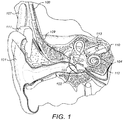
- the cochlea 104 is a long narrow duct wound spirally about its axis for approximately two and a half turns. It includes an upper channel known as the scala vestibuli and a lower channel known as the scala tympani, which are connected by the cochlear duct.
- the cochlea 104 forms an upright spiraling cone with a center called the modiolus where the spiral ganglion cells of the acoustic nerve 113 reside.
- the fluid-filled cochlea 104 functions as a transducer to generate electric pulses which are transmitted to the cochlear nerve 113, and ultimately to the brain.
- a cochlear implant with an implanted stimulation electrode can electrically stimulate auditory nerve tissue with small currents delivered by multiple electrode contacts distributed along the electrode.
- Figure 1 also shows some components of a typical cochlear implant system which includes an external microphone that provides an audio signal input to an external signal processor 111 where various signal processing schemes can be implemented.
- the processed signal is then converted into a digital data format, such as a sequence of data frames, for transmission into the implant 108.
- the implant 108 also performs additional signal processing such as error correction, pulse formation, etc., and produces a stimulation pattern (based on the extracted audio information) that is sent through an electrode lead 109 to an implanted electrode array 110.
- this electrode array 110 includes multiple electrodes on its surface that provide selective stimulation of the cochlea 104.
- the cochlear implant Following surgical implantation, the cochlear implant (CI) must be custom fit to optimize its operation with the specific patient user. For the fitting process, it is important to know if an audible percept is elicited and how loud the percept is. Normally this information is gained using behavioral measures. For example, for each electrode contact the CI user is asked at what stimulation level the first audible percept is perceived (hearing threshold (THR)) and at what stimulation level the percept is too loud (maximum comfort level (MCL)). For CI users with limited auditory experiences or insufficient communication abilities (e.g., small children), these fitting parameters can be determined using objective measures.
- THR heating threshold
- MCL maximum comfort level
- eCAP electrically evoked compound action potential
- US 2011/0137180 A1 discloses a system for fitting a cochlear prosthesis to an infant, comprising a sensor assembly (116) configured to measure a displacement of the stapedius that occurs in response to application of an electrical stimulation.
- Embodiments of the present invention are directed to a device for measuring stapedius tissue activity (i.e., stapedius muscle and/or stapedius tendon activity) that uses a mechanoelectrical transducer having two ends.
- a static end is configured for attachment to the bony pyramid in the middle ear
- a dynamic end is configured for attachment to the stapedius tissue in the middle ear.
- the transducer generates a corresponding electrical sensing signal output when the stapedius tissue moves the dynamic end relative to the static end.
- the transducer may include a mechanical strain gauge for generating the electrical sensing signal output., and there may be a substrate made of polyethylene terephthalate (PET) or polyaryletherketone (PAEK) for supporting the mechanical strain gauge.
- the transducer may use a piezoelectric foil for generating the electrical sensing signal output, and there may be a polyvinyl fluoride (PVF) foil substrate supporting the piezoelectric foil.
- PVF polyvinyl fluoride
- the transducer may form an elongated strip shape or a curved arch shape between the two ends. Or the transducer may form a curved loop shape with elongated parallel sections at the two ends that mechanically amplifies small movements of the stapedial tendon. In some embodiments at least one end may have a curved recess portion configured for attachment to the underlying anatomical structure. And some embodiments may include calibration means for isolating movement of the stapedius tissue from other movements in the middle ear of the patient.
- Embodiments of the present invention also include a hearing implant fitting system and/or a hearing implant system (e.g., a cochlear implant, auditory brainstem implant, or middle ear implant) having a device according to any of the foregoing.
- a hearing implant fitting system e.g., a cochlear implant, auditory brainstem implant, or middle ear implant
- a hearing implant system e.g., a cochlear implant, auditory brainstem implant, or middle ear implant
- Embodiments of the present invention are direct to a mechanoelectrical transducer device for measuring stapedius tissue activity (i.e., stapedius muscle activity and/or stapedius activity), specifically, contraction of the stapedial muscle in response to loud noise.
- a static end of the transducer is configured for attachment to the bony pyramid in the middle ear, and a dynamic end is configured for attachment to the stapedial tendon in the middle ear.
- the dynamic end may also be attached to the stapes directly, preferable to the stapes head.
- the transducer device generates a corresponding electrical sensing signal output when the stapedial tendon moves the dynamic end relative to the static end.
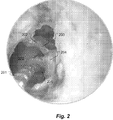
- Figure 2 shows various structural features in the middle ear 200 of a patient with a cochlear implant electrode 201 that passes through an electrode opening 205 in the round window membrane on the outer surface of the patient's cochlea.
- the stapedial tendon 203 is connected at one end to the stapedial muscle inside the bony pyramid 204 (pyramidal eminence) and at the other end to the stapes head 202.
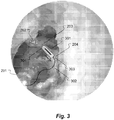
- Figure 3 shows that anatomical context with the addition of a mechanoelectrical transducer 301 formed in an elongated strip shape that has a static end 303 configured for attachment to the bony pyramid 204, and a dynamic end 304 configured for attachment to the stapedial tendon 203.
- the electrical lead 302 from the transducer 301 joins the cochlear implant electrode 201 back away from the electrode opening 205 to isolate the transducer 301 from the effects of micro-movements of the electrode 201.
- the static end 303 of the transducer 301 may be connected to the cochlear implant electrode 201.
- the transducer 301 generates a corresponding electrical sensing signal output when the stapedial tendon 203 moves the dynamic end 304 relative to the static end 303.
- the transducer 301 may specifically be a mechanical strain gauge that changes in electrical impedance when the stapedial muscle 203 contracts in response to loud noise (e.g., MCL threshold).
- the transducer 301 may also include a strain gauge substrate, e.g., made of polyethylene terephthalate (PET) or polyaryletherketone (PAEK), for supporting the mechanical strain gauge.
- PET polyethylene terephthalate
- PAEK polyaryletherketone
- some embodiments may use a transducer 301 based on a piezoelectric foil that generates an electrical signal when the dynamic end 304 moves relative to the static end 303 when the stapedial muscle 203 stretches.
- the transducer 301 have a foil substrate that supports the piezoelectric foil; for example, made of polyvinyl fluoride (PVF).
- Embodiments of the present invention are not specifically limited to an elongated strip shape s shown in Fig. 3 .
- Figure 4A shows a curved arch shape transduce 401 having a mechanical strain gauge 402 at the top of the arch between the dynamic end 403 and the static end 404.
- Figure 4B shows another embodiment of a transducer 401 having a curved loop shape with elongated parallel sections at the two ends 403 and 404.
- the mechanical strain gauge 402 is located on the most highly curved part of the loop that is most sensitive to bending in response to small movements of the stapedial tendon 203; in effect, acting as a mechanical amplifier.
- Figure 4C shows a similar embodiment with an additional strain gauge 405 on the opposite surface of the loop so that when the stapedial muscle 203 stretches in response to loud noise, one of the strain gauges 402/405 is compressed (producing increased impedance), while the other strain gauge 405/402 is stretched (producing decreased impedance).
- At least one end 403 and/or 404 may have a curved recess portion 406 configured for attachment to the underlying anatomical structure-the stapedial tendon 203 and/or the bony pyramid 204.
- the transducer 401 may use a shape memory material that is naturally biased to make the transducer 401 just slightly larger than the space where it is intended to be placed. The surgeon then compresses the ends of the transducer 401 towards each other to fit the transducer 401 in the desired location and position between the bony pyramid 204 and the stapedial tendon 203. When the surgeon releases his grip, the ends expand back out to securely fix the transducer 401 in place.
- Figure 5 shows the structural geometry of another embodiment of an electromechanical transducer 501 for the measurement of stapedius muscle activity with two perpendicular surfaces 502 and 503 with a pair of corresponding perpendicular strain gauges 504 which provide calibration means for isolating movement of the stapedial tendon from other movements in the middle ear of the patient.
- the ossicular chain in the middle ear including the stapes head moves in response.
- the stapedius muscle contracts and the stapedial tendon pulls on the ossicular chain to dampen the signal. That stapedius reflex response to very loud sounds is the only movement of interest for a fitting related measurement.
- an embodiment such as the one shown in Fig. 5 with multiple strain gauges that are perpendicular to each other can detect movements in different spatial dimensions, and the transducer 501 thereby can be calibrated to correlate the transducer output signal with contraction of the stapedial muscle and no other movements inside the middle ear.
Landscapes
- Health & Medical Sciences (AREA)
- Life Sciences & Earth Sciences (AREA)
- Engineering & Computer Science (AREA)
- General Health & Medical Sciences (AREA)
- Otolaryngology (AREA)
- Physics & Mathematics (AREA)
- Veterinary Medicine (AREA)
- Animal Behavior & Ethology (AREA)
- Biomedical Technology (AREA)
- Public Health (AREA)
- Medical Informatics (AREA)
- Surgery (AREA)
- Audiology, Speech & Language Pathology (AREA)
- Molecular Biology (AREA)
- Heart & Thoracic Surgery (AREA)
- Biophysics (AREA)
- Pathology (AREA)
- Acoustics & Sound (AREA)
- Multimedia (AREA)
- Radiology & Medical Imaging (AREA)
- Nuclear Medicine, Radiotherapy & Molecular Imaging (AREA)
- Neurosurgery (AREA)
- Signal Processing (AREA)
- Prostheses (AREA)
Claims (13)
- Dispositif pour mesurer l'activité du tissu stapédien de l'oreille moyenne comprenant :un transducteur mécano-électrique ayant deux extrémités :dans lequel le transducteur génère une sortie de signal de détection électrique correspondante lorsque le tissu stapédien déplace l'extrémité dynamique par rapport à l'extrémité statique.i. une extrémité statique configurée pour la fixation à la pyramide osseuse dans l'oreille moyenne d'un patient, etii. une extrémité dynamique configurée pour la fixation au tissu stapédien dans l'oreille moyenne du patient ;
- Dispositif selon la revendication 1, dans lequel le transducteur inclut un mesureur de tension mécanique pour générer la sortie de signal de détection électrique.
- Dispositif selon la revendication 2, dans lequel le transducteur inclut un substrat en téréphtalate de polyéthylène (PET) supportant le mesureur de tension mécanique.
- Dispositif selon la revendication 2, dans lequel le transducteur inclut un substrat en polyaryléthercétone (PAEK) supportant le mesureur de tension mécanique.
- Dispositif selon la revendication 1, dans lequel le transducteur inclut une feuille piézoélectrique pour générer la sortie de signal de détection électrique.
- Dispositif selon la revendication 5, dans lequel le transducteur inclut un substrat en feuille de poly(fluorure de vinyle) (PVF) supportant la feuille piézoélectrique.
- Dispositif selon la revendication 1, dans lequel le transducteur a une forme de bande allongée entre les deux extrémités.
- Dispositif selon la revendication 1, dans lequel le transducteur a une forme de voûte incurvée entre les deux extrémités.
- Dispositif selon la revendication 1, dans lequel le transducteur a une forme de boucle incurvée à sections parallèles allongées aux deux extrémités qui amplifie mécaniquement de faibles mouvements du tissu stapédien.
- Dispositif selon la revendication 1, dans lequel au moins une extrémité présente une partie de renfoncement incurvée configurée pour la fixation de l'au moins une extrémité.
- Dispositif selon la revendication 1, incluant en outre des moyens d'étalonnage pour isoler le mouvement du tissu stapédien d'autres mouvements dans l'oreille moyenne du patient.
- Système de mise en place d'implant auditif ayant un dispositif selon l'une quelconque des revendications 1 à 11.
- Système d'implant auditif ayant un dispositif selon l'une quelconque des revendications 1 à 11.
Applications Claiming Priority (2)
| Application Number | Priority Date | Filing Date | Title |
|---|---|---|---|
| DE102012218153 | 2012-10-04 | ||
| PCT/US2013/063383 WO2014055823A1 (fr) | 2012-10-04 | 2013-10-04 | Mesure électromécanique de l'activité des muscles/tendons stapédiens |
Publications (3)
| Publication Number | Publication Date |
|---|---|
| EP2903507A1 EP2903507A1 (fr) | 2015-08-12 |
| EP2903507A4 EP2903507A4 (fr) | 2016-07-27 |
| EP2903507B1 true EP2903507B1 (fr) | 2017-01-11 |
Family
ID=50433238
Family Applications (1)
| Application Number | Title | Priority Date | Filing Date |
|---|---|---|---|
| EP13843508.6A Active EP2903507B1 (fr) | 2012-10-04 | 2013-10-04 | Mesure électromécanique de l'activité des muscles/tendons stapédiens |
Country Status (5)
| Country | Link |
|---|---|
| US (1) | US20140100471A1 (fr) |
| EP (1) | EP2903507B1 (fr) |
| CN (1) | CN104755022B (fr) |
| AU (1) | AU2013326920B2 (fr) |
| WO (1) | WO2014055823A1 (fr) |
Families Citing this family (2)
| Publication number | Priority date | Publication date | Assignee | Title |
|---|---|---|---|---|
| US10772563B2 (en) * | 2016-02-26 | 2020-09-15 | Med-El Elektromedizinische Geraete Gmbh | Detection of electrically evoked stapedius reflex |
| US10357656B2 (en) | 2016-07-12 | 2019-07-23 | Cochlear Limited | Hearing prosthesis programming |
Family Cites Families (13)
| Publication number | Priority date | Publication date | Assignee | Title |
|---|---|---|---|---|
| DE4236985C1 (de) * | 1992-11-04 | 1994-02-24 | Hottinger Messtechnik Baldwin | Dehnungsmeßstreifen |
| CA2258008A1 (fr) * | 1996-06-20 | 1997-12-24 | Advanced Bionics Corporation | Systeme d'implant cochleaire autoajustable et procede d'adaptation |
| US5899847A (en) * | 1996-08-07 | 1999-05-04 | St. Croix Medical, Inc. | Implantable middle-ear hearing assist system using piezoelectric transducer film |
| US6208882B1 (en) * | 1998-06-03 | 2001-03-27 | Advanced Bionics Corporation | Stapedius reflex electrode and connector |
| NO20001333A (no) * | 2000-03-14 | 2001-03-05 | Sensotech As | Ereksjonshjelpemiddel |
| DE202004001008U1 (de) * | 2004-01-23 | 2004-04-01 | Heinz Kurz Gmbh Medizintechnik | Gehörknöchelchenprothese |
| EP1737533B1 (fr) * | 2004-03-15 | 2014-07-16 | Med-El Elektromedizinische Geräte GmbH | Electrode d'implant cochleaire a subdivision ajustable pour fonctions d'oreille moyenne |
| WO2006050385A2 (fr) * | 2004-11-01 | 2006-05-11 | Proteus Biomedical, Inc. | Caracterisation de mouvement cardiaque par mesure de tension |
| US7792587B2 (en) * | 2006-09-12 | 2010-09-07 | Med-El Elektromedizinische Geraete Gmbh | Middle ear fixation structure |
| GB2449114A (en) * | 2007-05-11 | 2008-11-12 | Sentient Medical Ltd | Middle ear implant with piezoelectric actuator acting on stapes footplate |
| US9014778B2 (en) * | 2008-06-24 | 2015-04-21 | Biosense Webster, Inc. | Disposable patch and reusable sensor assembly for use in medical device localization and mapping systems |
| US20110307042A1 (en) * | 2009-02-26 | 2011-12-15 | Opm Medical Acquisition, Llc | Electrode arrays based on polyetherketoneketone |
| EP2506923A1 (fr) * | 2009-12-04 | 2012-10-10 | Advanced Bionics AG | Systèmes et procédés pour poser un système d'implant cochléaire sur un patient sur la base du déplacement du muscle de l'étrier |
-
2013
- 2013-10-04 EP EP13843508.6A patent/EP2903507B1/fr active Active
- 2013-10-04 AU AU2013326920A patent/AU2013326920B2/en active Active
- 2013-10-04 CN CN201380052262.6A patent/CN104755022B/zh active Active
- 2013-10-04 WO PCT/US2013/063383 patent/WO2014055823A1/fr not_active Ceased
- 2013-10-04 US US14/045,913 patent/US20140100471A1/en not_active Abandoned
Non-Patent Citations (1)
| Title |
|---|
| None * |
Also Published As
| Publication number | Publication date |
|---|---|
| WO2014055823A1 (fr) | 2014-04-10 |
| AU2013326920B2 (en) | 2016-06-09 |
| US20140100471A1 (en) | 2014-04-10 |
| EP2903507A4 (fr) | 2016-07-27 |
| CN104755022A (zh) | 2015-07-01 |
| CN104755022B (zh) | 2017-01-18 |
| EP2903507A1 (fr) | 2015-08-12 |
| AU2013326920A1 (en) | 2015-04-02 |
Similar Documents
| Publication | Publication Date | Title |
|---|---|---|
| AU2017223495B2 (en) | Detection of electrically evoked stapedius reflex | |
| US8103354B2 (en) | Systems and methods for determining a threshold current level required to evoke a stapedial muscle reflex | |
| US7925355B2 (en) | Systems and methods for determining a threshold current level required to evoke a stapedial muscle reflex | |
| EP2688640B1 (fr) | Ajustement de prothèse auditive sur la base d'une réponse de muscle auriculaire postérieur | |
| US10413728B2 (en) | Electrocochleography testing in hearing prostheses | |
| US10357656B2 (en) | Hearing prosthesis programming | |
| US10905343B2 (en) | Perception change-based adjustments in hearing prostheses | |
| US20110137180A1 (en) | Systems and Methods for Fitting a Cochlear Implant System to a Patient Based on Stapedius Displacement | |
| US20090306743A1 (en) | Method and device for automated observation fitting | |
| US8265767B2 (en) | Stochastic stimulation in a hearing prosthesis | |
| EP2903507B1 (fr) | Mesure électromécanique de l'activité des muscles/tendons stapédiens | |
| Warkentin et al. | Hessler et al.(43) Pub. Date: Apr. 10, 2014 |
Legal Events
| Date | Code | Title | Description |
|---|---|---|---|
| PUAI | Public reference made under article 153(3) epc to a published international application that has entered the european phase |
Free format text: ORIGINAL CODE: 0009012 |
|
| 17P | Request for examination filed |
Effective date: 20150320 |
|
| AK | Designated contracting states |
Kind code of ref document: A1 Designated state(s): AL AT BE BG CH CY CZ DE DK EE ES FI FR GB GR HR HU IE IS IT LI LT LU LV MC MK MT NL NO PL PT RO RS SE SI SK SM TR |
|
| AX | Request for extension of the european patent |
Extension state: BA ME |
|
| RIN1 | Information on inventor provided before grant (corrected) |
Inventor name: SPECHT, OLAF Inventor name: HESSLER, ROLAND Inventor name: OVARI, ATTILA Inventor name: DHANASINGH, ANANDHAN Inventor name: SCHMIDT, WOLFRAM Inventor name: BEHREND, DETLEF Inventor name: PAU, HANS WILHELM Inventor name: WARKENTIN, MAREIKE Inventor name: DEL CARMEN FUENTES, MARIA |
|
| DAX | Request for extension of the european patent (deleted) | ||
| RA4 | Supplementary search report drawn up and despatched (corrected) |
Effective date: 20160623 |
|
| RIC1 | Information provided on ipc code assigned before grant |
Ipc: A61B 5/04 20060101AFI20160617BHEP Ipc: A61N 1/36 20060101ALI20160617BHEP Ipc: H04R 25/00 20060101ALI20160617BHEP Ipc: A61B 5/0492 20060101ALI20160617BHEP |
|
| RIC1 | Information provided on ipc code assigned before grant |
Ipc: A61B 5/04 20060101AFI20160811BHEP Ipc: A61N 1/36 20060101ALI20160811BHEP Ipc: A61B 5/12 20060101ALI20160811BHEP Ipc: A61B 5/0492 20060101ALI20160811BHEP Ipc: H04R 25/00 20060101ALI20160811BHEP |
|
| GRAP | Despatch of communication of intention to grant a patent |
Free format text: ORIGINAL CODE: EPIDOSNIGR1 |
|
| INTG | Intention to grant announced |
Effective date: 20160916 |
|
| GRAS | Grant fee paid |
Free format text: ORIGINAL CODE: EPIDOSNIGR3 |
|
| GRAA | (expected) grant |
Free format text: ORIGINAL CODE: 0009210 |
|
| AK | Designated contracting states |
Kind code of ref document: B1 Designated state(s): AL AT BE BG CH CY CZ DE DK EE ES FI FR GB GR HR HU IE IS IT LI LT LU LV MC MK MT NL NO PL PT RO RS SE SI SK SM TR |
|
| REG | Reference to a national code |
Ref country code: GB Ref legal event code: FG4D |
|
| REG | Reference to a national code |
Ref country code: CH Ref legal event code: EP |
|
| REG | Reference to a national code |
Ref country code: AT Ref legal event code: REF Ref document number: 860501 Country of ref document: AT Kind code of ref document: T Effective date: 20170115 |
|
| REG | Reference to a national code |
Ref country code: IE Ref legal event code: FG4D |
|
| REG | Reference to a national code |
Ref country code: DE Ref legal event code: R096 Ref document number: 602013016613 Country of ref document: DE |
|
| REG | Reference to a national code |
Ref country code: LT Ref legal event code: MG4D |
|
| REG | Reference to a national code |
Ref country code: NL Ref legal event code: MP Effective date: 20170111 |
|
| REG | Reference to a national code |
Ref country code: AT Ref legal event code: MK05 Ref document number: 860501 Country of ref document: AT Kind code of ref document: T Effective date: 20170111 |
|
| PG25 | Lapsed in a contracting state [announced via postgrant information from national office to epo] |
Ref country code: NL Free format text: LAPSE BECAUSE OF FAILURE TO SUBMIT A TRANSLATION OF THE DESCRIPTION OR TO PAY THE FEE WITHIN THE PRESCRIBED TIME-LIMIT Effective date: 20170111 |
|
| PG25 | Lapsed in a contracting state [announced via postgrant information from national office to epo] |
Ref country code: LT Free format text: LAPSE BECAUSE OF FAILURE TO SUBMIT A TRANSLATION OF THE DESCRIPTION OR TO PAY THE FEE WITHIN THE PRESCRIBED TIME-LIMIT Effective date: 20170111 Ref country code: FI Free format text: LAPSE BECAUSE OF FAILURE TO SUBMIT A TRANSLATION OF THE DESCRIPTION OR TO PAY THE FEE WITHIN THE PRESCRIBED TIME-LIMIT Effective date: 20170111 Ref country code: IS Free format text: LAPSE BECAUSE OF FAILURE TO SUBMIT A TRANSLATION OF THE DESCRIPTION OR TO PAY THE FEE WITHIN THE PRESCRIBED TIME-LIMIT Effective date: 20170511 Ref country code: GR Free format text: LAPSE BECAUSE OF FAILURE TO SUBMIT A TRANSLATION OF THE DESCRIPTION OR TO PAY THE FEE WITHIN THE PRESCRIBED TIME-LIMIT Effective date: 20170412 Ref country code: NO Free format text: LAPSE BECAUSE OF FAILURE TO SUBMIT A TRANSLATION OF THE DESCRIPTION OR TO PAY THE FEE WITHIN THE PRESCRIBED TIME-LIMIT Effective date: 20170411 Ref country code: HR Free format text: LAPSE BECAUSE OF FAILURE TO SUBMIT A TRANSLATION OF THE DESCRIPTION OR TO PAY THE FEE WITHIN THE PRESCRIBED TIME-LIMIT Effective date: 20170111 |
|
| PG25 | Lapsed in a contracting state [announced via postgrant information from national office to epo] |
Ref country code: BG Free format text: LAPSE BECAUSE OF FAILURE TO SUBMIT A TRANSLATION OF THE DESCRIPTION OR TO PAY THE FEE WITHIN THE PRESCRIBED TIME-LIMIT Effective date: 20170411 Ref country code: ES Free format text: LAPSE BECAUSE OF FAILURE TO SUBMIT A TRANSLATION OF THE DESCRIPTION OR TO PAY THE FEE WITHIN THE PRESCRIBED TIME-LIMIT Effective date: 20170111 Ref country code: AT Free format text: LAPSE BECAUSE OF FAILURE TO SUBMIT A TRANSLATION OF THE DESCRIPTION OR TO PAY THE FEE WITHIN THE PRESCRIBED TIME-LIMIT Effective date: 20170111 Ref country code: PT Free format text: LAPSE BECAUSE OF FAILURE TO SUBMIT A TRANSLATION OF THE DESCRIPTION OR TO PAY THE FEE WITHIN THE PRESCRIBED TIME-LIMIT Effective date: 20170511 Ref country code: RS Free format text: LAPSE BECAUSE OF FAILURE TO SUBMIT A TRANSLATION OF THE DESCRIPTION OR TO PAY THE FEE WITHIN THE PRESCRIBED TIME-LIMIT Effective date: 20170111 Ref country code: SE Free format text: LAPSE BECAUSE OF FAILURE TO SUBMIT A TRANSLATION OF THE DESCRIPTION OR TO PAY THE FEE WITHIN THE PRESCRIBED TIME-LIMIT Effective date: 20170111 Ref country code: LV Free format text: LAPSE BECAUSE OF FAILURE TO SUBMIT A TRANSLATION OF THE DESCRIPTION OR TO PAY THE FEE WITHIN THE PRESCRIBED TIME-LIMIT Effective date: 20170111 Ref country code: PL Free format text: LAPSE BECAUSE OF FAILURE TO SUBMIT A TRANSLATION OF THE DESCRIPTION OR TO PAY THE FEE WITHIN THE PRESCRIBED TIME-LIMIT Effective date: 20170111 |
|
| REG | Reference to a national code |
Ref country code: DE Ref legal event code: R097 Ref document number: 602013016613 Country of ref document: DE |
|
| PG25 | Lapsed in a contracting state [announced via postgrant information from national office to epo] |
Ref country code: EE Free format text: LAPSE BECAUSE OF FAILURE TO SUBMIT A TRANSLATION OF THE DESCRIPTION OR TO PAY THE FEE WITHIN THE PRESCRIBED TIME-LIMIT Effective date: 20170111 Ref country code: IT Free format text: LAPSE BECAUSE OF FAILURE TO SUBMIT A TRANSLATION OF THE DESCRIPTION OR TO PAY THE FEE WITHIN THE PRESCRIBED TIME-LIMIT Effective date: 20170111 Ref country code: SK Free format text: LAPSE BECAUSE OF FAILURE TO SUBMIT A TRANSLATION OF THE DESCRIPTION OR TO PAY THE FEE WITHIN THE PRESCRIBED TIME-LIMIT Effective date: 20170111 Ref country code: CZ Free format text: LAPSE BECAUSE OF FAILURE TO SUBMIT A TRANSLATION OF THE DESCRIPTION OR TO PAY THE FEE WITHIN THE PRESCRIBED TIME-LIMIT Effective date: 20170111 Ref country code: RO Free format text: LAPSE BECAUSE OF FAILURE TO SUBMIT A TRANSLATION OF THE DESCRIPTION OR TO PAY THE FEE WITHIN THE PRESCRIBED TIME-LIMIT Effective date: 20170111 |
|
| REG | Reference to a national code |
Ref country code: FR Ref legal event code: PLFP Year of fee payment: 5 |
|
| PLBE | No opposition filed within time limit |
Free format text: ORIGINAL CODE: 0009261 |
|
| STAA | Information on the status of an ep patent application or granted ep patent |
Free format text: STATUS: NO OPPOSITION FILED WITHIN TIME LIMIT |
|
| PG25 | Lapsed in a contracting state [announced via postgrant information from national office to epo] |
Ref country code: SM Free format text: LAPSE BECAUSE OF FAILURE TO SUBMIT A TRANSLATION OF THE DESCRIPTION OR TO PAY THE FEE WITHIN THE PRESCRIBED TIME-LIMIT Effective date: 20170111 Ref country code: DK Free format text: LAPSE BECAUSE OF FAILURE TO SUBMIT A TRANSLATION OF THE DESCRIPTION OR TO PAY THE FEE WITHIN THE PRESCRIBED TIME-LIMIT Effective date: 20170111 |
|
| 26N | No opposition filed |
Effective date: 20171012 |
|
| PG25 | Lapsed in a contracting state [announced via postgrant information from national office to epo] |
Ref country code: SI Free format text: LAPSE BECAUSE OF FAILURE TO SUBMIT A TRANSLATION OF THE DESCRIPTION OR TO PAY THE FEE WITHIN THE PRESCRIBED TIME-LIMIT Effective date: 20170111 |
|
| PG25 | Lapsed in a contracting state [announced via postgrant information from national office to epo] |
Ref country code: MC Free format text: LAPSE BECAUSE OF FAILURE TO SUBMIT A TRANSLATION OF THE DESCRIPTION OR TO PAY THE FEE WITHIN THE PRESCRIBED TIME-LIMIT Effective date: 20170111 |
|
| REG | Reference to a national code |
Ref country code: CH Ref legal event code: PL |
|
| REG | Reference to a national code |
Ref country code: IE Ref legal event code: MM4A |
|
| PG25 | Lapsed in a contracting state [announced via postgrant information from national office to epo] |
Ref country code: LU Free format text: LAPSE BECAUSE OF NON-PAYMENT OF DUE FEES Effective date: 20171004 Ref country code: LI Free format text: LAPSE BECAUSE OF NON-PAYMENT OF DUE FEES Effective date: 20171031 Ref country code: CH Free format text: LAPSE BECAUSE OF NON-PAYMENT OF DUE FEES Effective date: 20171031 |
|
| REG | Reference to a national code |
Ref country code: BE Ref legal event code: MM Effective date: 20171031 |
|
| PG25 | Lapsed in a contracting state [announced via postgrant information from national office to epo] |
Ref country code: BE Free format text: LAPSE BECAUSE OF NON-PAYMENT OF DUE FEES Effective date: 20171031 |
|
| PG25 | Lapsed in a contracting state [announced via postgrant information from national office to epo] |
Ref country code: MT Free format text: LAPSE BECAUSE OF NON-PAYMENT OF DUE FEES Effective date: 20171004 |
|
| REG | Reference to a national code |
Ref country code: FR Ref legal event code: PLFP Year of fee payment: 6 |
|
| PG25 | Lapsed in a contracting state [announced via postgrant information from national office to epo] |
Ref country code: IE Free format text: LAPSE BECAUSE OF NON-PAYMENT OF DUE FEES Effective date: 20171004 |
|
| PG25 | Lapsed in a contracting state [announced via postgrant information from national office to epo] |
Ref country code: HU Free format text: LAPSE BECAUSE OF FAILURE TO SUBMIT A TRANSLATION OF THE DESCRIPTION OR TO PAY THE FEE WITHIN THE PRESCRIBED TIME-LIMIT; INVALID AB INITIO Effective date: 20131004 |
|
| PG25 | Lapsed in a contracting state [announced via postgrant information from national office to epo] |
Ref country code: CY Free format text: LAPSE BECAUSE OF FAILURE TO SUBMIT A TRANSLATION OF THE DESCRIPTION OR TO PAY THE FEE WITHIN THE PRESCRIBED TIME-LIMIT Effective date: 20170111 |
|
| PG25 | Lapsed in a contracting state [announced via postgrant information from national office to epo] |
Ref country code: MK Free format text: LAPSE BECAUSE OF FAILURE TO SUBMIT A TRANSLATION OF THE DESCRIPTION OR TO PAY THE FEE WITHIN THE PRESCRIBED TIME-LIMIT Effective date: 20170111 |
|
| PG25 | Lapsed in a contracting state [announced via postgrant information from national office to epo] |
Ref country code: TR Free format text: LAPSE BECAUSE OF FAILURE TO SUBMIT A TRANSLATION OF THE DESCRIPTION OR TO PAY THE FEE WITHIN THE PRESCRIBED TIME-LIMIT Effective date: 20170111 |
|
| PG25 | Lapsed in a contracting state [announced via postgrant information from national office to epo] |
Ref country code: AL Free format text: LAPSE BECAUSE OF FAILURE TO SUBMIT A TRANSLATION OF THE DESCRIPTION OR TO PAY THE FEE WITHIN THE PRESCRIBED TIME-LIMIT Effective date: 20170111 |
|
| REG | Reference to a national code |
Ref country code: DE Ref legal event code: R079 Ref document number: 602013016613 Country of ref document: DE Free format text: PREVIOUS MAIN CLASS: A61B0005040000 Ipc: A61B0005240000 |
|
| PGFP | Annual fee paid to national office [announced via postgrant information from national office to epo] |
Ref country code: DE Payment date: 20251028 Year of fee payment: 13 |
|
| PGFP | Annual fee paid to national office [announced via postgrant information from national office to epo] |
Ref country code: GB Payment date: 20251023 Year of fee payment: 13 |
|
| PGFP | Annual fee paid to national office [announced via postgrant information from national office to epo] |
Ref country code: FR Payment date: 20251027 Year of fee payment: 13 |