EP2903697B1 - Procédé de synthèse de cyclohexènones ainsi que leur utilisation en parfumerie - Google Patents
Procédé de synthèse de cyclohexènones ainsi que leur utilisation en parfumerie Download PDFInfo
- Publication number
- EP2903697B1 EP2903697B1 EP13782748.1A EP13782748A EP2903697B1 EP 2903697 B1 EP2903697 B1 EP 2903697B1 EP 13782748 A EP13782748 A EP 13782748A EP 2903697 B1 EP2903697 B1 EP 2903697B1
- Authority
- EP
- European Patent Office
- Prior art keywords
- alkyl
- compound
- isomers
- alkenyl group
- hydrogen
- Prior art date
- Legal status (The legal status is an assumption and is not a legal conclusion. Google has not performed a legal analysis and makes no representation as to the accuracy of the status listed.)
- Active
Links
- 0 CC[C@@](C1C(C)C2)([C@]2I)C1=C(C)C[*+2]C Chemical compound CC[C@@](C1C(C)C2)([C@]2I)C1=C(C)C[*+2]C 0.000 description 5
Classifications
-
- C—CHEMISTRY; METALLURGY
- C07—ORGANIC CHEMISTRY
- C07C—ACYCLIC OR CARBOCYCLIC COMPOUNDS
- C07C45/00—Preparation of compounds having >C = O groups bound only to carbon or hydrogen atoms; Preparation of chelates of such compounds
- C07C45/61—Preparation of compounds having >C = O groups bound only to carbon or hydrogen atoms; Preparation of chelates of such compounds by reactions not involving the formation of >C = O groups
-
- C—CHEMISTRY; METALLURGY
- C07—ORGANIC CHEMISTRY
- C07C—ACYCLIC OR CARBOCYCLIC COMPOUNDS
- C07C29/00—Preparation of compounds having hydroxy or O-metal groups bound to a carbon atom not belonging to a six-membered aromatic ring
- C07C29/17—Preparation of compounds having hydroxy or O-metal groups bound to a carbon atom not belonging to a six-membered aromatic ring by hydrogenation of carbon-to-carbon double or triple bonds
- C07C29/19—Preparation of compounds having hydroxy or O-metal groups bound to a carbon atom not belonging to a six-membered aromatic ring by hydrogenation of carbon-to-carbon double or triple bonds in six-membered aromatic rings
- C07C29/20—Preparation of compounds having hydroxy or O-metal groups bound to a carbon atom not belonging to a six-membered aromatic ring by hydrogenation of carbon-to-carbon double or triple bonds in six-membered aromatic rings in a non-condensed rings substituted with hydroxy groups
-
- C—CHEMISTRY; METALLURGY
- C07—ORGANIC CHEMISTRY
- C07C—ACYCLIC OR CARBOCYCLIC COMPOUNDS
- C07C29/00—Preparation of compounds having hydroxy or O-metal groups bound to a carbon atom not belonging to a six-membered aromatic ring
- C07C29/132—Preparation of compounds having hydroxy or O-metal groups bound to a carbon atom not belonging to a six-membered aromatic ring by reduction of an oxygen containing functional group
- C07C29/136—Preparation of compounds having hydroxy or O-metal groups bound to a carbon atom not belonging to a six-membered aromatic ring by reduction of an oxygen containing functional group of >C=O containing groups, e.g. —COOH
- C07C29/143—Preparation of compounds having hydroxy or O-metal groups bound to a carbon atom not belonging to a six-membered aromatic ring by reduction of an oxygen containing functional group of >C=O containing groups, e.g. —COOH of ketones
-
- C—CHEMISTRY; METALLURGY
- C07—ORGANIC CHEMISTRY
- C07C—ACYCLIC OR CARBOCYCLIC COMPOUNDS
- C07C29/00—Preparation of compounds having hydroxy or O-metal groups bound to a carbon atom not belonging to a six-membered aromatic ring
- C07C29/36—Preparation of compounds having hydroxy or O-metal groups bound to a carbon atom not belonging to a six-membered aromatic ring increasing the number of carbon atoms by reactions with formation of hydroxy groups, which may occur via intermediates being derivatives of hydroxy, e.g. O-metal
- C07C29/38—Preparation of compounds having hydroxy or O-metal groups bound to a carbon atom not belonging to a six-membered aromatic ring increasing the number of carbon atoms by reactions with formation of hydroxy groups, which may occur via intermediates being derivatives of hydroxy, e.g. O-metal by reaction with aldehydes or ketones
- C07C29/40—Preparation of compounds having hydroxy or O-metal groups bound to a carbon atom not belonging to a six-membered aromatic ring increasing the number of carbon atoms by reactions with formation of hydroxy groups, which may occur via intermediates being derivatives of hydroxy, e.g. O-metal by reaction with aldehydes or ketones with compounds containing carbon-to-metal bonds
-
- C—CHEMISTRY; METALLURGY
- C07—ORGANIC CHEMISTRY
- C07C—ACYCLIC OR CARBOCYCLIC COMPOUNDS
- C07C35/00—Compounds having at least one hydroxy or O-metal group bound to a carbon atom of a ring other than a six-membered aromatic ring
- C07C35/02—Compounds having at least one hydroxy or O-metal group bound to a carbon atom of a ring other than a six-membered aromatic ring monocyclic
- C07C35/08—Compounds having at least one hydroxy or O-metal group bound to a carbon atom of a ring other than a six-membered aromatic ring monocyclic containing a six-membered rings
- C07C35/18—Compounds having at least one hydroxy or O-metal group bound to a carbon atom of a ring other than a six-membered aromatic ring monocyclic containing a six-membered rings with unsaturation at least in the ring
-
- C—CHEMISTRY; METALLURGY
- C07—ORGANIC CHEMISTRY
- C07C—ACYCLIC OR CARBOCYCLIC COMPOUNDS
- C07C35/00—Compounds having at least one hydroxy or O-metal group bound to a carbon atom of a ring other than a six-membered aromatic ring
- C07C35/21—Compounds having at least one hydroxy or O-metal group bound to a carbon atom of a ring other than a six-membered aromatic ring polycyclic, at least one hydroxy group bound to a non-condensed ring
-
- C—CHEMISTRY; METALLURGY
- C07—ORGANIC CHEMISTRY
- C07C—ACYCLIC OR CARBOCYCLIC COMPOUNDS
- C07C41/00—Preparation of ethers; Preparation of compounds having groups, groups or groups
- C07C41/01—Preparation of ethers
-
- C—CHEMISTRY; METALLURGY
- C07—ORGANIC CHEMISTRY
- C07C—ACYCLIC OR CARBOCYCLIC COMPOUNDS
- C07C41/00—Preparation of ethers; Preparation of compounds having groups, groups or groups
- C07C41/01—Preparation of ethers
- C07C41/16—Preparation of ethers by reaction of esters of mineral or organic acids with hydroxy or O-metal groups
-
- C—CHEMISTRY; METALLURGY
- C07—ORGANIC CHEMISTRY
- C07C—ACYCLIC OR CARBOCYCLIC COMPOUNDS
- C07C43/00—Ethers; Compounds having groups, groups or groups
- C07C43/02—Ethers
- C07C43/18—Ethers having an ether-oxygen atom bound to a carbon atom of a ring other than a six-membered aromatic ring
- C07C43/188—Unsaturated ethers
-
- C—CHEMISTRY; METALLURGY
- C07—ORGANIC CHEMISTRY
- C07C—ACYCLIC OR CARBOCYCLIC COMPOUNDS
- C07C45/00—Preparation of compounds having >C = O groups bound only to carbon or hydrogen atoms; Preparation of chelates of such compounds
- C07C45/61—Preparation of compounds having >C = O groups bound only to carbon or hydrogen atoms; Preparation of chelates of such compounds by reactions not involving the formation of >C = O groups
- C07C45/62—Preparation of compounds having >C = O groups bound only to carbon or hydrogen atoms; Preparation of chelates of such compounds by reactions not involving the formation of >C = O groups by hydrogenation of carbon-to-carbon double or triple bonds
-
- C—CHEMISTRY; METALLURGY
- C07—ORGANIC CHEMISTRY
- C07C—ACYCLIC OR CARBOCYCLIC COMPOUNDS
- C07C45/00—Preparation of compounds having >C = O groups bound only to carbon or hydrogen atoms; Preparation of chelates of such compounds
- C07C45/61—Preparation of compounds having >C = O groups bound only to carbon or hydrogen atoms; Preparation of chelates of such compounds by reactions not involving the formation of >C = O groups
- C07C45/67—Preparation of compounds having >C = O groups bound only to carbon or hydrogen atoms; Preparation of chelates of such compounds by reactions not involving the formation of >C = O groups by isomerisation; by change of size of the carbon skeleton
- C07C45/68—Preparation of compounds having >C = O groups bound only to carbon or hydrogen atoms; Preparation of chelates of such compounds by reactions not involving the formation of >C = O groups by isomerisation; by change of size of the carbon skeleton by increase in the number of carbon atoms
-
- C—CHEMISTRY; METALLURGY
- C07—ORGANIC CHEMISTRY
- C07C—ACYCLIC OR CARBOCYCLIC COMPOUNDS
- C07C45/00—Preparation of compounds having >C = O groups bound only to carbon or hydrogen atoms; Preparation of chelates of such compounds
- C07C45/61—Preparation of compounds having >C = O groups bound only to carbon or hydrogen atoms; Preparation of chelates of such compounds by reactions not involving the formation of >C = O groups
- C07C45/67—Preparation of compounds having >C = O groups bound only to carbon or hydrogen atoms; Preparation of chelates of such compounds by reactions not involving the formation of >C = O groups by isomerisation; by change of size of the carbon skeleton
- C07C45/68—Preparation of compounds having >C = O groups bound only to carbon or hydrogen atoms; Preparation of chelates of such compounds by reactions not involving the formation of >C = O groups by isomerisation; by change of size of the carbon skeleton by increase in the number of carbon atoms
- C07C45/72—Preparation of compounds having >C = O groups bound only to carbon or hydrogen atoms; Preparation of chelates of such compounds by reactions not involving the formation of >C = O groups by isomerisation; by change of size of the carbon skeleton by increase in the number of carbon atoms by reaction of compounds containing >C = O groups with the same or other compounds containing >C = O groups
- C07C45/74—Preparation of compounds having >C = O groups bound only to carbon or hydrogen atoms; Preparation of chelates of such compounds by reactions not involving the formation of >C = O groups by isomerisation; by change of size of the carbon skeleton by increase in the number of carbon atoms by reaction of compounds containing >C = O groups with the same or other compounds containing >C = O groups combined with dehydration
-
- C—CHEMISTRY; METALLURGY
- C07—ORGANIC CHEMISTRY
- C07C—ACYCLIC OR CARBOCYCLIC COMPOUNDS
- C07C49/00—Ketones; Ketenes; Dimeric ketenes; Ketonic chelates
- C07C49/385—Saturated compounds containing a keto group being part of a ring
- C07C49/403—Saturated compounds containing a keto group being part of a ring of a six-membered ring
-
- C—CHEMISTRY; METALLURGY
- C07—ORGANIC CHEMISTRY
- C07C—ACYCLIC OR CARBOCYCLIC COMPOUNDS
- C07C49/00—Ketones; Ketenes; Dimeric ketenes; Ketonic chelates
- C07C49/587—Unsaturated compounds containing a keto groups being part of a ring
- C07C49/603—Unsaturated compounds containing a keto groups being part of a ring of a six-membered ring, e.g. quinone methides
-
- C—CHEMISTRY; METALLURGY
- C07—ORGANIC CHEMISTRY
- C07C—ACYCLIC OR CARBOCYCLIC COMPOUNDS
- C07C49/00—Ketones; Ketenes; Dimeric ketenes; Ketonic chelates
- C07C49/587—Unsaturated compounds containing a keto groups being part of a ring
- C07C49/613—Unsaturated compounds containing a keto groups being part of a ring polycyclic
-
- C—CHEMISTRY; METALLURGY
- C07—ORGANIC CHEMISTRY
- C07C—ACYCLIC OR CARBOCYCLIC COMPOUNDS
- C07C49/00—Ketones; Ketenes; Dimeric ketenes; Ketonic chelates
- C07C49/587—Unsaturated compounds containing a keto groups being part of a ring
- C07C49/647—Unsaturated compounds containing a keto groups being part of a ring having unsaturation outside the ring
-
- C—CHEMISTRY; METALLURGY
- C07—ORGANIC CHEMISTRY
- C07C—ACYCLIC OR CARBOCYCLIC COMPOUNDS
- C07C49/00—Ketones; Ketenes; Dimeric ketenes; Ketonic chelates
- C07C49/587—Unsaturated compounds containing a keto groups being part of a ring
- C07C49/647—Unsaturated compounds containing a keto groups being part of a ring having unsaturation outside the ring
- C07C49/653—Unsaturated compounds containing a keto groups being part of a ring having unsaturation outside the ring polycyclic
-
- C—CHEMISTRY; METALLURGY
- C07—ORGANIC CHEMISTRY
- C07C—ACYCLIC OR CARBOCYCLIC COMPOUNDS
- C07C49/00—Ketones; Ketenes; Dimeric ketenes; Ketonic chelates
- C07C49/587—Unsaturated compounds containing a keto groups being part of a ring
- C07C49/657—Unsaturated compounds containing a keto groups being part of a ring containing six-membered aromatic rings
-
- C—CHEMISTRY; METALLURGY
- C07—ORGANIC CHEMISTRY
- C07C—ACYCLIC OR CARBOCYCLIC COMPOUNDS
- C07C67/00—Preparation of carboxylic acid esters
- C07C67/08—Preparation of carboxylic acid esters by reacting carboxylic acids or symmetrical anhydrides with the hydroxy or O-metal group of organic compounds
-
- C—CHEMISTRY; METALLURGY
- C07—ORGANIC CHEMISTRY
- C07C—ACYCLIC OR CARBOCYCLIC COMPOUNDS
- C07C69/00—Esters of carboxylic acids; Esters of carbonic or haloformic acids
- C07C69/02—Esters of acyclic saturated monocarboxylic acids having the carboxyl group bound to an acyclic carbon atom or to hydrogen
- C07C69/12—Acetic acid esters
- C07C69/14—Acetic acid esters of monohydroxylic compounds
-
- C—CHEMISTRY; METALLURGY
- C07—ORGANIC CHEMISTRY
- C07C—ACYCLIC OR CARBOCYCLIC COMPOUNDS
- C07C69/00—Esters of carboxylic acids; Esters of carbonic or haloformic acids
- C07C69/02—Esters of acyclic saturated monocarboxylic acids having the carboxyl group bound to an acyclic carbon atom or to hydrogen
- C07C69/12—Acetic acid esters
- C07C69/14—Acetic acid esters of monohydroxylic compounds
- C07C69/145—Acetic acid esters of monohydroxylic compounds of unsaturated alcohols
-
- C—CHEMISTRY; METALLURGY
- C07—ORGANIC CHEMISTRY
- C07C—ACYCLIC OR CARBOCYCLIC COMPOUNDS
- C07C69/00—Esters of carboxylic acids; Esters of carbonic or haloformic acids
- C07C69/02—Esters of acyclic saturated monocarboxylic acids having the carboxyl group bound to an acyclic carbon atom or to hydrogen
- C07C69/12—Acetic acid esters
- C07C69/14—Acetic acid esters of monohydroxylic compounds
- C07C69/145—Acetic acid esters of monohydroxylic compounds of unsaturated alcohols
- C07C69/157—Acetic acid esters of monohydroxylic compounds of unsaturated alcohols containing six-membered aromatic rings
-
- C—CHEMISTRY; METALLURGY
- C11—ANIMAL OR VEGETABLE OILS, FATS, FATTY SUBSTANCES OR WAXES; FATTY ACIDS THEREFROM; DETERGENTS; CANDLES
- C11B—PRODUCING, e.g. BY PRESSING RAW MATERIALS OR BY EXTRACTION FROM WASTE MATERIALS, REFINING OR PRESERVING FATS, FATTY SUBSTANCES, e.g. LANOLIN, FATTY OILS OR WAXES; ESSENTIAL OILS; PERFUMES
- C11B9/00—Essential oils; Perfumes
- C11B9/0026—Essential oils; Perfumes compounds containing an alicyclic ring not condensed with another ring
- C11B9/0034—Essential oils; Perfumes compounds containing an alicyclic ring not condensed with another ring the ring containing six carbon atoms
-
- C—CHEMISTRY; METALLURGY
- C07—ORGANIC CHEMISTRY
- C07C—ACYCLIC OR CARBOCYCLIC COMPOUNDS
- C07C2601/00—Systems containing only non-condensed rings
- C07C2601/06—Systems containing only non-condensed rings with a five-membered ring
- C07C2601/08—Systems containing only non-condensed rings with a five-membered ring the ring being saturated
-
- C—CHEMISTRY; METALLURGY
- C07—ORGANIC CHEMISTRY
- C07C—ACYCLIC OR CARBOCYCLIC COMPOUNDS
- C07C2601/00—Systems containing only non-condensed rings
- C07C2601/06—Systems containing only non-condensed rings with a five-membered ring
- C07C2601/10—Systems containing only non-condensed rings with a five-membered ring the ring being unsaturated
-
- C—CHEMISTRY; METALLURGY
- C07—ORGANIC CHEMISTRY
- C07C—ACYCLIC OR CARBOCYCLIC COMPOUNDS
- C07C2601/00—Systems containing only non-condensed rings
- C07C2601/12—Systems containing only non-condensed rings with a six-membered ring
- C07C2601/14—The ring being saturated
-
- C—CHEMISTRY; METALLURGY
- C07—ORGANIC CHEMISTRY
- C07C—ACYCLIC OR CARBOCYCLIC COMPOUNDS
- C07C2601/00—Systems containing only non-condensed rings
- C07C2601/12—Systems containing only non-condensed rings with a six-membered ring
- C07C2601/16—Systems containing only non-condensed rings with a six-membered ring the ring being unsaturated
Definitions
- the present invention relates to a new simple, inexpensive and safe process for the synthesis of cyclohexenone compounds and cyclohexenols, said compounds being able to be used in the perfumery, cosmetic and detergent industry in particular, said compounds having fragrances and special remanence properties.
- Cyclohexenones and cyclohexenols are families of important compounds in the perfume and aroma industry. Many compounds belonging to these families have been described and synthesized, such as, for example, Celery Ketone, or the compounds described in the patents.
- EP 0504592 (Firmenich) or JP 2008127333 (Kao Corp)
- JP 2008127333 (Kao Corp)
- one of the technical problems concerning this type of compounds lies in their synthesis process.
- the patent EP 0504592 describes a process for synthesizing cyclohexenones by condensation between an alkyl vinyl ketone and a carbonyl derivative.
- these compounds comprise, as an R 3 group, a seven-carbon bridged bi-cyclic alkyl group, namely an isobornyl group (seven-carbon bridged bi-cyclic alkyl group substituted with three methyl groups; publication referred to in (i) above) or norbonyle (differing from the above isobornyl group by the absence of the three methyl groups, see the publications mentioned under (ii) and (iii) above).
- LA Khejfik et al. discloses cyclohexenone compounds and cyclohexenols having, as R3 group, a saturated alkyl group having 6 carbon atoms. However, these compounds are described as having iris-ionone notes and not sandalwood, woody or green notes as is the case with the derivatives of the invention.
- a third subject of the present invention relates to compositions comprising compounds of formula (II).
- alkyl in the sense of the present invention denotes a linear or branched saturated hydrocarbon group, preferably having from 1 to 10 carbon atoms.
- alkyl there may be mentioned in particular methyl, ethyl, n-propyl, i -propyl, n -butyl, i -butyl, t -butyl, pentyl and hexyl.
- cyclic alkyl refers to a cyclic saturated hydrocarbon group, preferably having 3 to 10 carbon atoms. Preferably, the group comprises 5 to 6 carbon atoms, and even more preferably 5 carbon atoms. Examples of cyclic alkyl groups that may be mentioned include cyclopentyl.
- alkenyl denotes a linear or branched unsaturated hydrocarbon group containing at least one carbon-carbon double bond and preferably having from 2 to 10 carbon atoms.
- alkenyl groups that may be mentioned include vinyl, allyl, methallyl, 2-propenyl, isopropenyl, 2-butenyl, 3-butenyl, 2-pentenyl, 3-pentenyl, 4-pentenyl, 1-hexenyl and the like.
- cyclic alkenyl refers to a cyclic unsaturated hydrocarbon group, preferably having 3 to 10 carbon atoms.
- Examples of cyclic alkenyl groups include, in particular, cyclopentenyl.
- alkanoyl denotes a group - C (O) alkyl, derived from a carboxylic acid, in which the alkyl group is as defined above.
- alkanoyl groups include formyl, acetyl, propionyl and butyryl groups, and the like.
- alkenoyl denotes a group - C (O) -alkenyl, derived from a carboxylic acid, in which the alkenyl group is as defined above.
- alkenoyl examples include 2-propenoyl, 2-butenoyl, 2-methyl-2-propenoyl, and the like.
- aryl denotes a hydrocarbon functional group derived from an aromatic hydrocarbon having from 6 to 14 carbon atoms, preferably from 6 to 10 carbon atoms.
- aryl groups that may be mentioned include phenyl, tolyl, naphthyl and xylyl groups.
- step i) of the process as described above represents step i) of the process as described above. To the knowledge of the Applicant, this type of reaction has never been reported.
- Step i) between the ⁇ -methylene-aldehyde and a symmetrical ketone is in the presence of a base.
- the base that can be used can be chosen from inorganic bases (KOH, NaOH, LiOH, etc.) or organometallic bases ( t -Bu-OK, MeONa, etc.).
- the solvents that can be used in the present reaction are in particular water, ethanol, methanol, toluene, cyclohexane or THF, whether or not mixed. Preferably, a water / ethanol mixture will be used.
- This reaction step i) can be carried out at room temperature at reflux of the solvent, preferably between 50 and 70 ° C.
- an optional additional step ii) makes it possible to obtain compounds of formula (Ia) as described above, in which R2 is a C1-C5 alkyl or C2-C5 alkenyl group.
- a first step ii) of mono-alkylation makes it possible to obtain a compound of formula (Ia) having an alkylated or alkenyl group R2 in position 6 of the ring, the double bond 2-3 being present.
- R2 is alkyl or alkenyl at positions 2 and 6 of the ring; in this case the double bond of the ring is in position 3-4 (the groups R1 and R3 being defined as above).
- the method according to the invention optionally comprises a step iv) of reducing the double bond present on the 2-3 cycle or 3-4 of the compound obtained in the previous step, step iv) can be carried out after any one of steps i), ii) or iii).
- This step iii.b) is shown in the diagram below.
- the alkylation step iii.b) is done by addition of an alkyl halide such as MeI, EtI, allyl bromide, etc.
- an alkyl halide such as MeI, EtI, allyl bromide, etc.
- the esterification step iii.c) is carried out by addition of an anhydride or an acyl chloride R'C (O) Cl with R 'representing a hydrogen or a C1-C7 alkyl, or C2-C7 alkenyl.
- the process according to the invention may comprise a step iv) of reducing the 2-3-bond or 3-4-ring double bond. This step can be performed after step i), ii) or iii). It is preferably carried out after step i).
- This reduction step iv) can be done for example in the presence of complexes using copper or rhodium, or according to any other method well known to those skilled in the art.
- this reduction step iv) is carried out in the presence of hydrogen and a Pd / C catalyst.
- the compounds obtained carry no double bond, and any cyclic R1, R2, R3 alkenyl or alkenyl groups optionally present are hydrogenated to corresponding alkyl groups.
- R 3 is either a cyclopentyl group substituted with one or more alkyl groups, or a cyclopentenyl group substituted with one or more alkyl groups, especially a methyl.
- R3 is an alkyl or alkenyl group, optionally substituted with an aryl. Preferentially, R3 is substituted by a phenyl.
- a third subject of the present invention relates to a composition
- a composition comprising at least one compound of general formula (II) as defined above, in the form of a stereoisomer or a mixture of stereoisomers, or a racemic mixture.
- the composition is characterized in that it further comprises at least one other odoriferous substance.
- the effective amount of the compounds of formula (II) according to the invention incorporated in the composition will vary according to the nature of the composition, the desired odorant effect, and the nature of the other odorous or non-existent compounds possibly present, and may be easily determined by the person skilled in the art, knowing that it can vary over a very wide range, from 0.1 to 99% by weight, in particular from 0.1 to 50% by weight, in particular from 0.1 to 30% by weight relative to the total weight of the composition.
- the invention also relates in particular to a cosmetic composition, in particular cream for the face and the body, talcum powder, hair or body oil, shampoo, hair lotion, bath salt, bath oil, shower gel, gel bath, toilet soap, antiperspirant, body deodorant, lotions, shaving cream, shaving soap, cream, toothpaste, mouthwash, ointment comprising at least one compound of formula (II), or at least one composition comprising at least one compound of formula (II).
- a cosmetic composition in particular cream for the face and the body, talcum powder, hair or body oil, shampoo, hair lotion, bath salt, bath oil, shower gel, gel bath, toilet soap, antiperspirant, body deodorant, lotions, shaving cream, shaving soap, cream, toothpaste, mouthwash, ointment comprising at least one compound of formula (II), or at least one composition comprising at least one compound of formula (II).
- the invention also relates to a care product, especially a softener, detergent, laundry, room deodorant, comprising at least one compound of formula (II) or at least one composition comprising at least one compound of formula (II).
- the compound (s) according to the invention may be used, alone or in combination, as such or incorporated in or on an inert carrier material or which may contain other active ingredients of the finished composition.
- carrier materials can be employed including, for example, polar solvents, oils, greases, finely divided solids, cyclodextrins, maltodextrins, gums, resins and any other known carrier material for such compositions.
- the compounds of formula (III) can be used as odor masking agent or as odor neutralizing agent.
- fragment is used herein to refer to any organoleptic compound knowingly stimulating the sense of smell.
- mass agent or “masking” is meant to reduce or eliminate the perception of a bad odor generated by one or more molecules used in the composition of a product.
- odor neutralizing agent is meant to neutralize, destroy or absorb a bad odor fixed in the atmosphere or on a support (such as a fabric). In fact, at almost all smell there is another smell, which, mixed with the former in a certain proportion, cancels it.
- said compound may be used alone or in combination with at least one other flavoring or perfuming ingredient, and / or at least one solvent, and / or at least one adjuvant.
- additional odorant (s) may be compounds of formula (I) or other odorants known to a person skilled in the art who will be able to choose according to the desired effect.
- perfumery in the usual sense of the term, but also other areas in which the smell of products is important. It may be perfume compositions in the usual sense of the term, such as perfume bases and concentrates, colognes, toilet waters, perfumes and similar products; topical compositions - in particular cosmetics - such as creams for the face and body, talcum powder, hair oils, shampoos, hair lotions, bath salts and oils, shower and bath gels, toilet soaps, anti- body perspirants and deodorants, shaving lotions and creams, soaps, creams, dentifrices, mouthwashes, ointments, and the like; and cleaning products, such as as fabric softeners, detergents, detergents, air fresheners, and the like.
- a particular embodiment of the invention resides in the use of a compound of formula (III) for modifying or enhancing the organoleptic properties of a substance, composition or article.
- organoleptic properties means any property capable of modifying, improving or reinforcing the organoleptic perception of a substance, a composition or an article by a user.
- the organoleptic agent according to the invention may consist of a perfuming agent capable of conferring, modifying, improving or reinforcing the olfactory perception of a substance, a composition or an article.
- the general principle of the invention is based on the preparation of the compounds of formula (I), the novel compounds of formula (II), as well as the use in perfumery of the compounds of formula (III) described above.
- the following examples illustrate a particular way of preparing the compounds of the invention, as well as the olfactory profile of each of the exemplified compounds. These examples are for illustrative purposes only and should not be construed as limiting the general scope of the invention.
- Example 1 The following table shows all the chemical structures of the compounds synthesized according to the invention.
- Table 1 Structure of synthesized compounds ⁇ / b> Example No. Chemical structure Example No. Chemical structure Example 1
- Example 24 Example 2
- Example 25 Example 3
- Example 26 Example 4
- Example 27 Example 5
- Example 28 Example 6
- Example 29 Example 7
- Example 30 Example 8
- Example 31 Example 9
- Example 32 Example 10
- Example 33 Example 11
- Example 34 Example 12
- Example 35 Example 13
- Example 36 Example 14
- Example 15 Example 38
- Example 16 Example 39
- Example 19 Example 42
- Example 43 Example 21
- Example 44 Example 22
- Example 45 Example 23
- 3-pentanone (129 g, 1.5 mol, 1.5 eq), methylene-campholaldehyde (prepared from 153 g, 1 mol, 1 eq of Campholenaldehyde and 1.1 eq of formaldehyde) and potassium hydroxide (11.2 g, 0.2 mol, 0.2 eq) in a water / ethanol mixture (300 mL / 200 mL) was heated at 65 ° C overnight. After the reaction is complete, the reaction mixture is cooled and 0.2 eq. of acetic acid is added. The aqueous phase is extracted 3 times with methyl ether and t- butyl and the combined organic phases are washed with brine, dried over magnesium sulfate and filtered.
- TEB 105-107 ° C / 0.067 kPa (0.5 torr) Olfactory profile : Woody (cedar), amber, spicy (pepper) 1 H NMR (CDCl 3 , 200MHz): ⁇ (ppm) common protons 1.4-1.90 (m, 2H), 1.55-1.65 (m, 3H), 1.7-1.8 (m, 3H), 1.90-2.2 (m, 2H), 2.2-2.5 (m, 2H), 2.5-2.65 (m, 1H), 5.22 (m, 1H).
- Second major isomer 12.47; 15.67; 16.43; 19.93; 27.44; 33.64; 38.54; 39.28; 41.57; 47.22; 53.80; 121.24; 133.99; 134.94; 148.39; 202.29.
- First minority isomer 12.47; 15.67; 16.43; 20.08; 28.04; 33.95; 37.64; 38.85; 41.73; 46.99; 54.01; 121.19; 133.46; 134.51; 148.68; 202.32.
- Second minority isomer 12.52; 15.85; 16.35; 19.74; 27.24; 34.75; 35.50; 35.83; 37.69; 46.72; 53.18; 120.99; 134.51; 134.94; 148.73; 202.72.
- TEB. 100 ° C / 0.067 kPa (0.5 torr)
- Olfactory profile nuts, anise The analyzes are in accordance with those obtained in Example 1.
- TEB 101-102 ° C / 0.067 kPa (0.5 torr)
- Olfactory profile Roots, woody, vetiver, pepper The analyzes are in accordance with those obtained in Example 1.
- 2,6-Diethyl-4- (2,2,3-trimethylcyclopent-3-enyl) cyclohex-2-enone is obtained in a yield of 33%, according to Example 1, from 5-heptanone and from methylene-campholenaldehyde.
- 2,6-Dimethyl-4- (2,4,4-trimethylcyclopentyl) cyclohex-2-enone is obtained in a yield of 25%, according to Example 1, from 3-pentanone and 2- ( 2,4,4-trimethylcyclopentyl) acrylaldehyde (prepared from 2,4,4-trimethylcyclopentanone).
- 2,6-dimethyl-4- (1-phenyl-ethyl) cyclohex-2-enone is obtained with a yield of 54% during the 2 steps, according to Example 1, starting from 3-pentanone and 2 -methylene-3-phenylbutanal (prepared from 3-phenylbutanal).
- 2,6-Dimethyl-4- (6-methylhept-5-en-2-yl) cyclohex-2-enone is obtained in a yield of 51% during the 2 steps, according to Example 1, starting from 3-pentanone and 2-methylene-citronellar (prepared from citronnellal).
- 4- (4,4-Dimethylpentan-2-yl) -2,6-dimethylcyclohex-2-enone is obtained with a yield of 56% during the 2 steps, according to Example 1, from 3-pentanone and 2-methylene-3,5,5-trimethylhexanal (prepared from 3,5,5-trimethylhexanal).
- the 4-isopropyl-2,6-dimethylcyclohex-2-enone is obtained in a 54% yield during the 2 steps, according to Example 1, from 3-pentanone and 2-methylene-isovaleraldehyde (prepared in from isovaleraldehyde).
- 2,6-dimethyl-4-propylcyclohex-2-enone is obtained with a yield of 17% over the 2 steps, according to Example 1, from 3-pentanone and 2-methylene-valeraldehyde (prepared from of pentanal).
- TEB. 70 ° C / 0.067 kPa (0.5 torr)
- Olfactory profile Grapefruit, very green, cocoa chocolate.
- 1 H NMR (CDCl 3 , 200MHz): ⁇ (ppm) common protons 0.85-0.97 (m, 3H), 1.1 (d, J 7Hz, 3H), 1.20-1.50 (m, 4H), 1.70-1.75 (m, 3H), 1.75-2.08 (m, 2H), 2.20-2.60 (m, 2H).
- TEB. 65 ° C / 0.107 kPa (0.8 torr)
- Olfactory profile Green, rhubarb, powerful, a little lavender, mushroom.
- 1 H NMR (CDCl 3 , 200MHz): ⁇ (ppm) common protons 0.85-0.95 (m, 3H), 1.1 (d, J 7Hz, 3H), 1.18-1.62 (m, 6H), 1.70-1.75 (m, 3H), 1.76-2.08 (m, 2H), 2.20-2.60 (m, 2H).
- 4-hexyl-2,6-dimethylcyclohex-2-enone is obtained with a yield of 35% over the two steps, according to Example 1, from 3-pentanone and 2-methylene-octanal (prepared in from octanal).
- TEB. 105 ° C / 0.067 kPa (0.5 torr)
- Olfactory profile aldehyde, fresh and clean linen, Marseille soap, dried grass.
- TEB. 93 ° C / 0.067 kPa (0.5 torr)
- Olfactory profile Dusty, musty IR (film, cm -1 ): 564m, 581m, 797m, 857w, 997w, 1013w, 1047m, 1360m, 1381m, 1466m, 1706s, 2866w, 2927m, 2958m.
- 4-Isopropyl-2,6-dimethyl-2,6-dipropylcyclohex-3-enone is obtained in a yield of 39% according to Example 14 from 4-isopropyl-2,6-dimethylcyclohex-2-enone ( obtained in Example 10) and 1-bromopropane.
- TEB. 95 ° C / 0.080 kPa (0.6 torr)
- 2,6-diethyl-4-isopropyl-2,6-dimethylcyclohexanone is obtained in a yield of 40% over 2 stages (hydrogenation according to Example 19, followed by an alkylation with bromoethane according to Example 14), from the cyclohexenone obtained in Example 10.
- TEB. 100-102 ° C / 0.067 kPa (0.5 torr)
- Olfactory profile Santal, a little green
- the analyzes are in accordance with those obtained in Example 24.
- 2,6-Dimethyl-4 - ((S) -2,2,3-trimethylcyclopent-3-enyl) cyclohex-2-enol is obtained in a yield of 66%, according to Example 22, from the 2,6-dimethyl-4- (2,2,3-trimethylcyclopent-3-enyl) cyclohex-2-enone (obtained in Example 3). It consists of a mixture of 4 main observable isomers in a ratio of 10: 20: 33: 37 with an apolar CPG column, 7 observable isomers in a ratio of 18: 6: 2: 15: 27: 24: 8 with a CPG column polar GC.
- Teb . 100-102 ° C / 0.067 kPa (0.5 torr)
- Olfactory profile Sandal, creamy, greedy, nutty, a little spicy, leathery
- IR film, cm -1
- 1 H NMR (CDCl 3 , 200MHz): ⁇ (ppm) common protons 0.85-0.92 (m, 3H), 0.92-1.2 (m, 6H), 1.58 (m, 6H), 1.6-1.85 (m, 4H) , 1.85-2.1 (m, 1H), 2.1-2.4 (m, 2H), 5.21 (m, 1H).
- 2,6-Diethyl-4- (2,2,3-trimethylcyclopent-3-enyl) cyclohex-2-enol is obtained in a yield of 67%, according to Example 22, starting from 2,6- diethyl-4- (2,2,3-trimethylcyclopent-3-enyl) cyclohex-2-enone (obtained in Example 4).
- Teb . 120 ° C / 0.060 kPa (0.45 torr)
- Olfactory profile Sandalwood, weaker than Example 11
- 2,6-dimethyl-4- (2,4,4-trimethylcyclopentyl) cyclohex-2-enol is obtained in a yield of 40%, according to Example 22, from 2,6-dimethyl-4- (2,4,4-trimethylcyclopentyl) cyclohex-2-enone (obtained in Example 5).
- the crude product was purified by silica column chromatography, the expected alcohol consists of a mixture of 2 main isomers (83%) in a ratio of 19:81.
- 2,6-dimethyl-4- (6-methylhept-5-en-2-yl) cyclohex-2-enol is obtained in a yield of 56%, according to Example 22, starting from 2,6- dimethyl-4- (6-methylhept-5-en-2-yl) cyclohex-2-enone (obtained in Example 7).
- 4- (4,6-Dimethylhept-5-enyl) -2,6-dimethylcyclohex-2-enol is obtained in a yield of 70%, according to Example 22, starting from 4- (4- diméthylhept-5-enyl) -2,6-dimethylcyclohex-2-enone (Obtained, according to Example 1, with a yield of 16% during the 2 steps, starting from 3-pentanone and 5,7-dimethyl-2-methylene-oct-6-enal (prepared from 5 , 7-dimethyl-oct-6-enal)).
- the crude product is purified by chromatography on a silica column, the expected alcohol consists of a mixture of isomers of which 2 main (74%) in a ratio of 32:68.
- Teb . 90 ° C / 0.053 kPa (0.4 torr)
- Olfactory profile woody, sandalwood, amber, a little flower and musky.
- Major isomers (characteristic protons): 1.09 (d, J 6.31 Hz, 3H), 1.72-1.76 (m, 3H), 3.59-3.68 (m, 1H), 5.25-5.33 (m, 1H).
- the 4-isopropyl-2,6-dimethylcyclohex-2-enol is obtained in a yield of 73%, according to Example 22, from 4-isopropyl-2,6-dimethylcyclohex-2-enone (obtained in FIG. Example 10).
- Teb . 60 ° C / 0.064 kPa (0.48 torr)
- Olfactory profile floral, rosé, citronellol.
- 2,6-Diethyl-4-isopropylcyclohex-2-enol is obtained with a yield of 72%, according to Example 22, from 2,6-diethyl-4-isopropylcyclohex-2-enone (obtained with a yield of 27% over the 2 steps, according to Example 1, from 4-heptanone and 2-methylene-isovaleraldehyde (prepared from isovaleraldehyde)).
- 4-hexyl-2,6-dimethylcyclohex-2-enol is obtained in a yield of 55%, according to Example 22, from 4-hexyl-2,6-dimethylcyclohex-2-enone (obtained in FIG. Example 13).
- Teb . 100-103 ° C / 0.067 kPa (0.5 torr)
- Olfactory profile fruity, raspberry. Similar analyzes to those in Example 38.
- 4-Isopropyl-2,2,6,6-tetramethylcyclohex-3-enol is obtained with a yield of 47%, by treating an ethanolic solution of 4-isopropyl-2,2,6,6-tetramethylcyclohex-3-ene (obtained in Example 19), at 0 ° C, with NaBH 4 (0.5 eq).
- the ethanol is evaporated by half and the mixture diluted in methyl t-butyl ether.
- a solution of HCl 34% aq. is then added and the aqueous phase, decanted, extracted twice with MTBE.
- the combined organic phases are washed with a saturated aqueous solution of sodium bicarbonate, then with brine, dried over magnesium sulphate and the solvents are evaporated.
- the crude product is purified by distillation.
- Teb . 70 ° C / 0.053 kPa (0.4 torr)
- 2,2,6,6-tetramethyl-4- (2,3,3-trimethylcyclopent-1-enyl) cyclohex-3-enol is obtained by treating a 1M solution of 2,2,6,6-tetramethyl 4 - ((S) -2,2,3-trimethylcyclopent-3-enyl) cyclohex-3-enol (obtained in Example 25) with triflic acid at 50 ° C. Once the reaction is complete (GC monitoring), the mixture is poured into a saturated aqueous solution of sodium bicarbonate. The aqueous phase is extracted twice with toluene and the combined organic phases are washed with brine, dried over magnesium sulfate and the solvents are evaporated. The crude product is distilled to give 2,2,6,6-tetramethyl-4- (2,3,3-trimethylcyclopent-1-enyl) cyclohex-3-enol in 53% yield.
- Teb . 100 ° C / 0.067 kPa (0.5 torr)
- 2,6-dimethyl-4- (2,2,3-trimethylcyclopentyl) cyclohexanol is obtained according to Example 19 from 2,6-dimethyl-4- (2,2,3-trimethylcyclopent-3-enyl) cyclohex-2-enol (obtained in Example 22) at 60 ° C. under 30 bar of H 2 .
- Teb . 105 ° C / 0.067 kPa (0.5 torr)
- Olfactory profile Aldehyde, oily, a little dry woody.
- 1 H-NMR (CDCl 3 , 200MHz): ⁇ (ppm) 0.54 -69 (m, 3H), 0.7-0.85 (m, 3H), 0.85-1.04 (m, 9H), 1.04-1.8 (m, 12H), 1.8-2.12 (m, 2H), 3.19. (dd, J 10.24, 4.89 Hz, 1H) and 3.38-3.54 (m, 1H).
- 2,6-Dimethyl-4- (2,2,3-trimethylcyclopent-3-enyl) cyclohex-2-enyl acetate is obtained by treating 2,6-dimethyl-4- (2,2,3-trimethylcyclopentyl) 3-enyl) cyclohex-2-enol (obtained in Example 19) with 1.2 molar equivalents of acetic anhydride and a catalytic amount of N, N-dimethylaminopyridine. After 2 hours at room temperature, the excess of acetic anhydride and the acetic acid formed in during the reaction are removed under reduced pressure.
- the crude product is diluted with methyl ether and t- butyl and the organic phase is washed twice with water, then with a saturated aqueous solution of sodium bicarbonate and finally with brine. After drying over magnesium sulfate, the solvents are evaporated and the crude product is distilled to give 2,6-dimethyl-4- (2,2,3-trimethylcyclopent-3-enyl) cyclohex-2-enyl acetate with a yield of 73%, as a mixture of 3 main stereoisomers (85%) in a ratio of 25:60:15.
- 2,6-Dimethyl-4- (1-phenylethyl) cyclohex-2-enyl acetate is obtained in a yield of 75%, according to Example 41, from 2,6-dimethyl-4- (1 phenylethyl) cyclohex-2-en-1-ol (obtained with a yield of 72%, according to Example 22, from 2,6-dimethyl-4- (1-phenylethyl) cyclohex-2-enone, obtained in Example 6).
- Teb . 95 ° C /0.053 kPa (0.4 torr)
- Olfactory profile woody, a little cocoa, quite similar to the corresponding alcohol, but weaker.
- Olfactory profile: Woody, damp, slightly patchouli 1 H-NMR (CDCl 3 , 200MHz): ⁇ (ppm) 0.89 (s, 3H), 0.92 (s, 3H), 0.95 (s, 6H), 0.96 (s, 3H), 0.97 (s, 3H), 1.7-2.0 (m, 2H), 2.10 (s). , 3H), 2.14 (hept, J 6.82 Hz, 1H), 4.78 (s, 1H), 5.04 (m, 1H).
- the 4-isopropyl-2,6-dimethylcyclohexyl acetate is obtained in a yield of 60%, according to Example 41, from 4-isopropyl-2,6-dimethylcyclohexanol obtained with a yield of 44%, on 2 steps (hydrogenation according to Example 19, followed by a reduction of the ketone according to Example 37, from the cyclohexenone obtained in Example 10).
- Teb . 48 ° C /0.053 kPa (0.4 torr) Olfactory profile: citrus, grapefruit, a little rhubarb, then woody, citrus bark, dusty.
- the aqueous phase is extracted twice with MTBE and the combined organic phases are washed with a 10% aqueous solution of sodium thiosulfate, then with a saturated aqueous solution of sodium bicarbonate and with brine. After drying over magnesium sulphate, filtration on paper and evaporation of the solvents, the crude product is purified by distillation under reduced pressure to give 1- (4,4-dimethylpentan-2-yl) -1-methoxy-2,6- dimethylcyclohex-2-ene with a yield of 57%.
Landscapes
- Chemical & Material Sciences (AREA)
- Organic Chemistry (AREA)
- Chemical Kinetics & Catalysis (AREA)
- Life Sciences & Earth Sciences (AREA)
- Engineering & Computer Science (AREA)
- Oil, Petroleum & Natural Gas (AREA)
- Wood Science & Technology (AREA)
- Fats And Perfumes (AREA)
- Organic Low-Molecular-Weight Compounds And Preparation Thereof (AREA)
- Health & Medical Sciences (AREA)
- Cosmetics (AREA)
- Animal Behavior & Ethology (AREA)
- General Health & Medical Sciences (AREA)
- Public Health (AREA)
- Veterinary Medicine (AREA)
- Emergency Medicine (AREA)
- Birds (AREA)
- Epidemiology (AREA)
- Detergent Compositions (AREA)
Description
- La présente invention concerne un nouveau procédé simple, peu coûteux et sûr, de synthèse de composés cyclohexènones et cyclohexènols, lesdits composés pouvant être utilisés dans l'industrie de la parfumerie, de la cosmétique, et des détergents notamment, lesdits composés présentant des fragrances et des propriétés de rémanence particulières.
- Les cyclohexènones ainsi que les cyclohexènols sont des familles de composés importantes dans l'industrie du parfum et des arômes. De nombreux composés appartenant à ces familles ont été décrits et synthétisés, comme par exemple la Celery Ketone, ou encore les composés décrits dans les brevets
EP 0504592 (Firmenich) ou encoreJP 2008127333 EP 0504592 décrit un procédé de synthèse de cyclohexènones par condensation entre une alkyl vinyl cétone et un dérivé carbonylé. Ce procédé présente des inconvénients, notamment en ce qu'il est difficile à mettre en œuvre, que les réactions qui ont lieu sont instables et qu'il a un coût important (du fait du coût élevé des produits de départ). Mais le problème principal de ce procédé réside dans sa dangerosité lors de sa mise en pratique à cause de l'alkyl vinyl cétone. Une autre méthode qui a été mise en œuvre dans l'art antérieur consiste à faire réagir un β-cétoester avec un méthylène-aldéhyde. Ce type de procédé est notamment décrit dans la demande de brevetJP 2008127333 - A cet effet, afin de pouvoir obtenir aisément de nouveaux composés fragrants et/ou aromatiques, la Demanderesse a développé un nouveau procédé de synthèse de composés cyclohexènones et cyclohexènols. Non seulement le procédé en question est nouveau et inventif, mais il permet aussi d'obtenir un nombre important de composés eux-mêmes nouveaux et inventifs outre des composés déjà connus dans l'art antérieur. Le procédé selon la présente invention consiste en la condensation d'une cétone sur un α-méthylène-aldéhyde afin d'obtenir par une réaction domino, des composés cyclohexènones de formule (I) suivante :

- R1 représente un méthyle ou un éthyle ;
- R2 représente indépendamment un hydrogène ou un groupement C1-C5 alkyle ou C2-C5 alcényle;
- R3 représente un groupement alkyle ou alcényle, éventuellement substitué par un aryle, ou R3 représente un groupement alkyle cyclique ou alcényle cyclique, éventuellement substitué par un ou plusieurs groupements C1-C6 alkyle, étant entendu que R3 comporte au total 3 à 10 atomes de carbone;
- Z représente C(O) ou CR4(OR5), avec
- R4 représente un hydrogène ou un groupement C1-C8 alkyle ou C2-C8 alcényle ;
- R5 représente un hydrogène ou un groupement C1-C8 alkyle ou alcanoyle, ou C2-C8 alcényle ou alcénoyle ;
- soit en position 2-3 et R2 est absent en position 2,
- soit en position 3-4 et R2 est présent en position 2 et est tel que défini précédemment.
- A la connaissance de la Demanderesse, ce type de réaction n'a jamais été décrit auparavant. A l'issue de cette première étape de réaction, il est possible d'obtenir différents types de dérivés cyclohexènones, ainsi que des composés cyclohexènols. Le procédé selon la présente invention est nouveau et inventif par rapport, notamment à celui décrit dans le brevet
US4326997 dans lequel des composés présentant des structures proches sont décrits. En outre, le procédé décrit dans ledit brevet ne permet pas l'obtention de tous les composés de formule (I) alors que le présent procédé le permet. Enfin, le procédé selon la présente invention a l'avantage d'être simple, peu coûteux (par l'utilisation de substrats bon marché), sans risques, et d'être facilement industrialisable et de présenter un bon rendement. - La présente invention a également pour objet des composés ainsi que leur utilisation en parfumerie, caractérisé en ce que lesdits composés répondent à la formule générale (II) suivante :

- R1 représente un méthyle ou un éthyle ;
- R2 représente indépendamment un hydrogène ou un groupement C1-C5 alkyle ou C2-C5 alcényle ;
- R3 représente un groupement alkyle ou alcényle, éventuellement substitué par un aryle, ou R3 représente un groupement alkyle cyclique comprenant cinq à six atomes de carbone ou alcényle cyclique, éventuellement substitué par un ou plusieurs groupements C1-C6 alkyle, étant entendu que R3 comporte au total 7 à 10 atomes de carbone ;
- Z représente C(O) ou CR4(OR5), avec
- R4 représente un hydrogène ou un groupement C1-C8 alkyle ou C2-C8 alcényle ;
- R5 représente un hydrogène ou un groupement C1-C8 alkyle ou alcanoyle, ou C2-C8 alcényle ou alcénoyle ;
- soit en position 2-3 et R2 est absent en position 2,
- soit en position 3-4 et R2 est présent en position 2 et est tel que défini précédemment;
- Le brevet
US 4326997 décrit des composés fragrants proches de la formule générale (II), notamment des composés cyclohexènones et cyclohexènols comportant un groupement R3=(CH2)2-i-Pr et des descriptions olfactives suivantes : balsamique, boisé, doux, terreux, herbacé... descriptions qui sont différentes de celles des composés revendiqués présentement. - Des composés proches de ceux couverts par la susdite formule générale (II) sont également divulgués au sein des publications suivantes :
- i) KHEIFITS, L. A. ET AL. « Préparation of new perfumes from products of oxidation of camphene with 2,6-xylenol », Zhurnal Vsesoyuznogo Khimicheskogo Obshchestva im. D.I. Mendeleeva, (1962), 7, 234-5,
- ii) KHEIFITS, L. A. ET AL. « Relation between structure and odor in several norbornylcyclanones », Trudy Vsesoyuznogo Nauchno-Issledovatel'skogo Instituta Sinteticheskikh i Natural'nykh Dushistykh Veshchestv, (1965), No. 7, 63-9 (from: Ref. ZH. KHim. (1966), Pt. II, ABstr.No. 20R449 ), et
- iii) GURA, YU. ET AL. « Terpene phénols. XIX. Condensations of norbornane with xylenols and further conversions of the reaction products », Probl. Organ. Sinteza, Akad. Nauk SSSR, Otd. Obshch. i. Tekhn. Khim, (1965), 91-100 .
- Toutefois, ces composés comprennent, en tant que groupement R3, un groupement alkyle bi-cyclique ponté à sept atomes de carbone, à savoir un groupement isobornyle (groupement alkyle bi-cyclique ponté à sept atomes de carbone substitué par trois groupements méthyle ; cf. publication mentionnée au point i) supra) ou norbonyle (se distinguant du susdit groupement isobornyle par l'absence des trois groupements méthyle ; cf. publications mentionnées aux points ii) et iii) supra).
- Une publication scientifique de L.A. Khejfik et al. (Parf. Cosm. Sav. vol.8, N°8, août 1965) décrit des composés cyclohexènones et cyclohexènols comportant, en tant que groupement R3, un groupement alkyle saturé ayant 6 atomes de carbones. Cependant, ces composés sont décrits comme présentant des notes iris-ionone et pas des notes santalées, boisées ou vertes comme c'est le cas pour les dérivés de l'invention.
- Un troisième objet de la présente invention se rapporte à des compositions comprenant des composés de formule (II).
- Un dernier objet de la présente invention se rapporte à l'utilisation de composés de formule (III) suivante :

- R1 représente un méthyle ou un éthyle ;
- R2 représente indépendamment un hydrogène ou un groupement C1-C5 alkyle ou C2-C5 alcényle ;
- R3 représente un groupement alkyle ou alcényle, éventuellement substitué par un aryle, ou R3 représente un groupement alkyle cyclique comprenant cinq à six atomes de carbone ou alcényle cyclique, éventuellement substitué par un ou plusieurs groupements C1-C6 alkyle, étant
- Z représente C(O) ou CR4(OR5), avec
- R4 représente un hydrogène ou un groupement C1-C8 alkyle ou C2-C8 alcényle ;
- R5 représente un hydrogène ou un groupement C1-C8 alkyle ou alcanoyle, ou C2-C8 alcényle ou alcénoyle ;
- soit en position 2-3 et R2 est absent en position 2,
- soit en position 3-4 et R2 est présent en position 2 et est tel que défini précédemment.
- Le terme « alkyle » au sens de la présente invention désigne un groupe hydrocarboné saturé linéaire ou ramifié, ayant de préférence de 1 à 10 atomes de carbone. Comme exemples de groupe alkyle, on peut citer notamment les groupes méthyle, éthyle, n-propyle, i-propyle, n-butyle, i-butyle, t-butyle, pentyle et hexyle.
- L'expression « alkyle cyclique » désigne un groupe hydrocarboné saturé cyclique, ayant de préférence de 3 à 10 atomes de carbone. De préférence, le groupe comprend 5 à 6 atomes de carbone, et encore plus préférentiellement 5 atomes de carbone Comme exemples de groupes alkyle cyclique, on peut citer notamment le cyclopentyle.
- Le terme « alcényle », au sens de la présente invention, désigne un groupe hydrocarboné insaturé linéaire ou ramifié contenant au moins une double liaison carbone-carbone et ayant de préférence de 2 à 10 atomes de carbone. Comme exemples de groupe alcényle, on peut citer notamment les groupes vinyle, allyle, méthallyle, 2-propényle, isopropényle, 2-butényle, 3-butényle, 2-pentényle, 3-pentényle, 4-pentényle, 1-hexényle, etc.
- L'expression « alcényle cyclique » désigne un groupe hydrocarboné insaturé cyclique, ayant de préférence de 3 à 10 atomes de carbone. Comme exemples de groupes alcényle cyclique, on peut citer notamment le cyclopentényle.
- Le terme « alcanoyle », au sens de la présente invention, désigne un groupe - C(O)-alkyl, dérivé d'un acide carboxylique, dans lequel le groupe alkyle est tel que défini ci-dessus. Comme exemples de groupe alcanoyle, on peut citer notamment les groupements formyl, acétyl, propionyl, butyryl, etc.
- Le terme « alcènoyle », au sens de la présente invention, désigne un groupe - C(O)-alcényl, dérivé d'un acide carboxylique, dans lequel le groupe alcènyle est tel que défini ci-dessus. Comme exemples de groupe alcénoyle, on peut citer notamment 2-propènoyl, 2-butènoyl, 2-méthyl-2-propènoyl, etc.
- Le terme « aryle » désigne un groupe fonctionnel hydrocarboné dérivant d'un hydrocarbure aromatique ayant de 6 à 14 atomes de carbone, de préférence de 6 à 10 atomes de carbone. Comme exemples de groupe aryle, on peut citer notamment les groupements phényl, tolyl, naphtyl, xylyl.
- Un premier objet de la présente invention se rapporte donc à un procédé de préparation d'un composé de formule (I) tel que décrit précédemment comprenant les étapes suivantes :
- i) réaction d'un α-méthylène-aldéhyde, en présence d'une base, sur une cétone symétrique pour obtenir un composé de formule (la) dans laquelle R1, et R3 sont tels que définis précédemment, R2 est un hydrogène, et une double liaison en 2-3 ou 3-4 est présente sur le cycle et, cette réaction étant suivie éventuellement par les étapes ii), et/ou iii), et/ou iv),
- ii) réaction de mono- ou bis-alkylation afin d'obtenir un composé de formule (la) dans laquelle R2 est un groupement C1-C5 alkyle ou C2-C5 alcényle ;
- iii) conversion de la fonction Z = C(O) du composé obtenu à l'étape précédente en une fonction Z=CR4(OR5), R4 et R5 étant tels que définis précédemment;
- iv) réduction de la double liaison en 2-3 ou 3-4 présente sur le cycle du composé obtenu à l'étape précédente, l'étape iv) pouvant être réalisée après l'une quelconque des étapes i), ii), ou iii).
- Le schéma ci-dessous représente l'étape i) du procédé tel que décrit ci-dessus.

- Seules des réactions domino de type annélation de Robinson entre un dérivé carbonylé et la méthyl vinyl cétone (
EP 0504592 Firmenich) ou encore des réactions à l'aide d'un β-cétoester (JP 2008127333
L'étape i) entre l'a-méthylène-aldéhyde et une cétone symétrique se fait en présence d'une base. La base utilisable peut être choisie parmi les bases inorganiques (KOH, NaOH, LiOH ...) ou les bases organométalliques (t-Bu-OK, MeONa...). Les solvants utilisables dans la présente réaction sont notamment l'eau, l'éthanol, le méthanol, le toluène, le cyclohexane ou le THF... en mélange ou non. De préférence, on utilisera un mélange eau/éthanol. Cette étape i) de réaction peut être réalisée à température ambiante à reflux du solvant, de préférence entre 50 et 70°C. - Suite à la formation du composé de formule (Ia) à l'issue de l'étape i), une étape supplémentaire optionnelle ii), permet d'obtenir des composés de formule (Ia) tel que décrit précédemment, dans laquelle R2 est un groupement C1-C5 alkyle ou C2-C5 alcényle. Une première étape ii) de mono-alkylation permet d'obtenir un composé de formule (Ia) ayant un groupement R2 alkylé ou alcénylé en position 6 du cycle, la double liaison 2-3 étant présente. Les mêmes composés peuvent être alkylés une seconde fois afin de donner des composés de formule (Ia) où R2 est un alkyle ou un alcényle au niveau des positions 2 et 6 du cycle ; dans ce cas la double liaison du cycle est en position 3-4 (les groupements R1 et R3 étant définis comme précédemment).
- L'étape ii) est suivie éventuellement par une étape iii) de conversion d'un composé de formule (Ia) obtenu à l'issue des étapes i), ii) ou iv) en un composé de formule (I) dans laquelle R1, R2 et R3 sont tels que définis précédemment, et Z=CR4(OR5). Le procédé selon l'invention comprend éventuellement une étape iv) de réduction de la double liaison présente sur le cycle en 2-3 ou 3-4 du composé obtenu à l'étape précédente, l'étape iv) pouvant être réalisée après l'une quelconque des étapes i), ii) ou iii). Les paragraphes suivants détaillent les différentes étapes permettant l'obtention des composés de formule (I).
- Dans un premier mode de réalisation de l'invention, l'étape iii) comprend une étape iii.a) de réduction de la fonction cétone du composé de formule (Ia) obtenu aux étapes i), ii) ou iv) afin d'obtenir un composé de formule (Ib) tel que représenté dans le schéma ci-dessous, avec R1, R2, R3 tels que définis précédemment à l'étape i) et/ou iv) et Z=CR4(OR5) avec R4 représente un H ou un C1-C8 alkyle ou C2-C8 alcényle, R5 représente un H et la double liaison en 2-3 ou 3-4 étant absente dans le cas où l'étape iv) est réalisée avant l'étape iii.a).

- Outre l'étape iii.a), le procédé peut comprendre une étape iii.b) d'alkylation de la fonction alcool du composé (Ib) obtenu à l'étape iii.a), afin d'obtenir un composé de formule (Ic) avec R1, R2, R3 tels que définis précédemment à l'étape i) et/ou iv) et Z=CR4(OR5) avec R4 représente un H ou un C1-C8 alkyle ou C2-C8 alcényle, R5 représente un alkyle ou un alcényle (réaction de Williamson classique) et la double liaison en 2-3 ou 3-4 étant absente dans le cas où l'étape iv) est réalisée avant l'étape iii.b). Cette étape iii.b) est représentée dans le schéma ci-dessous.

- Préférentiellement, l'étape d'alkylation iii.b) se fait par addition d'un halogénure d'alkyle tel que MeI, EtI, bromure d'allyle etc.
- Dans un autre mode de réalisation de l'invention, l'étape iii) comprend, outre l'étape iii.a) telle que définie précédemment, une étape iii.c) d'estérification de la fonction alcool du composé (Ib) obtenu à l'étape iii.a), afin d'obtenir un composé (Id) ayant R1, R2, R3 tels que définis précédemment à l'étape i) et/ou iv) et Z=CR4(OR5) avec R4 représente un H ou un C1-C8 alkyle ou C2-C8 alcényle, et R5 représente un alcanoyle ou un alcénoyle, la double liaison en 2-3 ou 3-4 étant absente dans le cas où l'étape iv) est réalisée avant l'étape iii.c) (voir schéma ci-dessous).

- Le procédé selon l'invention peut comprendre une étape iv) de réduction de la double liaison en 2-3 ou en 3-4 sur le cycle. Cette étape peut être réalisée après l'étape i), ii) ou iii). Elle est de préférence réalisée après l'étape i).
- Dans un mode de réalisation particulier de l'invention, les composés de formule (la) avec Z=C(O) et comprenant une double liaison en 2-3 peuvent être transformés par une étape iv) de réduction sélective, en composés (Ie) où la double liaison sur le cycle est absente, la fonction Z=C(O) étant conservée (voir schéma ci-dessous). Cette étape de réduction iv) peut se faire par exemple en présence de complexes utilisant du cuivre ou du rhodium, ou selon toute autre méthode bien connue de l'homme de l'art.

- Dans un autre mode de réalisation particulier de l'invention, les composés de formule (la) ayant Z=C(O) et comprenant une double liaison en 2-3 ou en 3-4 peuvent être transformés par une étape iv) de réduction, en composés où la double liaison sur le cycle est absente et celle de la fonction Z=C(O) est conservée. Préférentiellement, cette étape de réduction iv) se fait en présence d'hydrogène et d'un catalyseur Pd/C. Dans ce cas, les composés obtenus ne portent aucune double liaison, et tous les groupements R1, R2, R3 alcényles ou alcényles cycliques éventuellement présents sont hydrogénés en groupements alkyles correspondants.
- L'étape de réduction peut aussi se faire sous pression d'hydrogène en présence de Nickel de Raney afin de donner des composés de formule (I) dans lesquels la double liaison sur le cycle est absente, tous les groupements R1, R2, R3 alcényles ou alcényles cycliques éventuellement présents sont hydrogénés en groupements alkyles correspondants, et Z=CH(OH).
- Ainsi, le procédé selon l'invention tel que décrit précédemment permet d'obtenir tous les composés répondant à la formule générale (I).
- Un second objet de la présente invention concerne un composé de formule générale (II) suivante :

- R1 représente un méthyle ou un éthyle ;
- R2 représente indépendamment un hydrogène ou un groupement C1-C5 alkyle ou C2-C5 alcényle, branché ou linéaire ;
- R3 représente un groupement alkyle ou alcényle éventuellement substitué par un aryle, ou R3 représente un groupement alkyle cyclique comprenant cinq à six atomes de carbone ou alcényle cyclique éventuellement substitué par un ou plusieurs groupements C1-C6 alkyle, étant entendu que R3 comporte au total 7 à 10 atomes de carbone;
- Z représente C(O) ou CR4(OR5), avec
- R4 représente un hydrogène ou un groupement C1-C8 alkyle ou C2-C8 alcényle ;
- R5 représente un hydrogène ou un groupement C1-C8 alkyle ou alcanoyle, ou C2-C8 alcényle ou alcénoyle ;
- soit en position 2-3 et R2 est absent en position 2,
- soit en position 3-4 et R2 est présent en position 2 et est tel que défini précédemment;
- Tous les composés de formule générale (II) peuvent être obtenus par l'intermédiaire du procédé décrit précédemment.
- Dans un mode de réalisation particulier de l'invention, R3 est soit un groupement cyclopentyle substitué par un ou plusieurs groupements alkyles, soit un groupement cyclopentényle substitué par un ou plusieurs groupements alkyles, notamment un méthyl.
- Dans un second mode de réalisation de l'invention, R3 est un groupement alkyle ou alcényle, éventuellement substitué par un aryle. Préférentiellement, R3 est substitué par un phényl.
- Préférentiellement, les composés de formule (II) sont des cyclohexènones et possèdent donc un Z=C(O).
- Plus préférentiellement encore, les composés de formule (II) possèdent un Z=CR4(OR5) avec R4 représente un hydrogène ou un groupement C1-C8 alkyle ou C2-C8 alcényle, et R5 représente un hydrogène.
- Un troisième objet de la présente invention se rapporte à une composition comprenant au moins un composé de formule générale (II) telle que définie précédemment, sous forme d'un stéréoisomère ou d'un mélange de stéréoisomères, ou d'un mélange racémique.
- Selon un mode de réalisation particulier, la composition est caractérisée en ce qu'elle comprend en outre au moins une autre substance odorante.
- La quantité efficace des composés de formule (II) selon l'invention incorporée dans la composition variera selon la nature de la composition, l'effet odorant souhaité, et la nature des autres composés odorants ou non éventuellement présents, et pourra être aisément déterminée par l'homme du métier, sachant qu'elle peut varier dans une plage très étendue, de 0,1 à 99% en poids, en particulier de 0,1 à 50% en poids, notamment de 0,1 à 30% en poids par rapport au poids total de la composition.
- L'invention concerne également en particulier une composition cosmétique, notamment crème pour le visage et le corps, poudre de talc, huile pour cheveux ou pour le corps, shampoing, lotion capillaire, sel de bain, huile de bain, gel de douche, gel de bain, savon de toilette, anti transpirant corporel, désodorisant corporel, lotions, crème de rasage, savon de rasage, crème, dentifrice, bain de bouche, pommade comprenant au moins un composé de formule (II), ou au moins une composition comprenant au moins un composé de formule (II).
- L'invention concerne encore un produit d'entretien, notamment assouplissant, détergent, lessive, désodorisant d'ambiance, comprenant au moins un composé de formule (II) ou au moins une composition comprenant au moins un composé de formule (II).
- Le ou les composés selon l'invention peuvent être utilisés, seuls ou en combinaison, tels quels ou être incorporés dans ou sur un matériau support inerte ou qui peut contenir d'autres ingrédients actifs de la composition finie. Une grande variété de matériaux supports peut être employée incluant, par exemple, les solvants polaires, les huiles, les graisses, les solides finement divisés, les cyclodextrines, les maltodextrines, les gommes, les résines et n'importe quel autre matériau support connu pour de telles compositions.
- Un dernier objet de la présente invention se rapporte à l'utilisation en tant qu'agent fragrant d'un composé de formule (III) suivante :

- R1 représente un méthyle ou un éthyle ;
- R2 représente indépendamment un hydrogène ou un groupement C1-C5 alkyle ou C2-C5 alcényle ;
- R3 représente alkyle ou alcényle, éventuellement substitué par un aryle, ou R3 représente un groupement alkyle cyclique comprenant cinq à six atomes de carbone ou alcényle cyclique éventuellement substitué par un ou plusieurs groupements C1-C6, étant entendu que R3 comporte au total 3 à 10 atomes de carbone et qu'il comporte au moins une insaturation lorsqu'il compte 5 à 6 atomes de carbone;
- Z représente C(O) ou CR4(OR5), avec
- R4 représente un hydrogène ou un groupement C1-C8 alkyle ou C2-C8 alcényle ;
- R5 représente un hydrogène ou un groupement C1-C8 alkyle ou alcanoyle, ou C2-C8 alcényle ou alcénoyle ;
- soit en position 2-3 et R2 est absent en position 2,
- soit en position 3-4 et R2 est présent en position 2 et est tel que défini précédemment.
- Les composés de formule (III) sont utilisables comme agent masquant d'odeur ou comme agent neutralisateur d'odeur. Le terme «fragrant», est utilisé ici pour désigner tout composé organoleptique stimulant de façon plaisante l'odorat. Par le terme «agent de masquage» ou «masquant» on entend réduire ou éliminer la perception d'une mauvaise odeur générée par une ou plusieurs molécules entrant dans la composition d'un produit. Par « agent neutralisateur d'odeur » on entend rendre neutre, détruire ou absorber une mauvaise odeur fixée dans l'atmosphère ou sur un support (tel qu'un tissu). En effet, à presque toute odeur correspond une autre odeur, qui, mélangée à la première dans une certaine proportion, l'annule.
- En outre, ledit composé peut être utilisé seul ou en combinaison avec au moins un autre ingrédient aromatisant ou parfumant, et/ou au moins un solvant, et/ou au moins un adjuvant. Le ou les agents odorants supplémentaires peuvent être des composés de formule (I) ou d'autres agents odorants connus de l'homme du métier qui sera à même de choisir en fonction de l'effet recherché.
- De manière générale, les composés selon l'invention seront utilisés dans le domaine de la parfumerie. On entend par « parfumerie » non seulement la parfumerie au sens habituel du terme, mais également les autres domaines dans lesquels l'odeur des produits est importante. Il peut s'agir de compositions de parfumerie au sens habituel du terme, telles que bases et concentrés parfumant, eaux de Cologne, eaux de toilette, parfums et produits similaires ; de compositions topiques - en particulier cosmétiques - telles que crèmes pour le visage et le corps, poudres de talc, huiles pour cheveux, shampoings, lotions capillaires, sels et huiles de bain, gels de douche et de bain, savons de toilette, anti-transpirants et désodorisants corporels, lotions et crèmes de rasage, savons, crèmes, dentifrices, bains de bouche, pommades, et produits similaires ; et de produits d'entretien, tels qu'assouplissants, détergents, lessives, désodorisants d'ambiance, et produits similaires.
- Un mode de réalisation particulier de l'invention réside en l'utilisation d'un composé de formule (III) pour modifier ou renforcer les propriétés organoleptiques d'une substance, d'une composition ou d'un article.
- On entend par «propriétés organoleptiques» toute propriété susceptible de modifier, améliorer ou renforcer la perception organoleptique d'une substance, d'une composition, d'un article par un utilisateur. Ainsi, à titre d'exemple préférentiel, l'agent organoleptique selon l'invention peut consister en un agent parfumant susceptible de conférer, modifier, améliorer ou renforcer la perception olfactive d'une substance, d'une composition ou d'un article.
- Le principe général de l'invention repose sur la préparation des composés de formule (I), les nouveaux composés de formule (II), ainsi que l'utilisation en parfumerie des composés de formule (III) décrits précédemment. Les exemples suivants illustrent une manière particulière de préparer les composés de l'invention, ainsi que le profil olfactif de chacun des composés exemplifiés. Ces exemples ne sont donnés que dans un but d'illustration et ne doivent pas être compris comme limitant la portée générale de l'invention.
- Le tableau suivant reprend l'ensemble des structures chimiques des composés synthétisés selon l'invention.
Tableau 1 : Structure des composés synthétisés N°d'exemple Structure chimique N°d'exemple Structure chimique Exemple 1 
Exemple 24 
Exemple 2 
Exemple 25 
Exemple 3 
Exemple 26 
Exemple 4 
Exemple 27 
Exemple 5 
Exemple 28 
Exemple 6 
Exemple 29 
Exemple 7 
Exemple 30 
Exemple 8 
Exemple 31 
Exemple 9 
Exemple 32 
Exemple 10 
Exemple 33 
Exemple 11 
Exemple 34 
Exemple 12 
Exemple 35 
Exemple 13 
Exemple 36 
Exemple 14 
Exemple 37 
Exemple 15 
Exemple 38 
Exemple 16 
Exemple 39 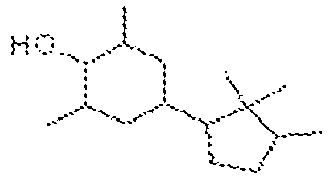
Exemple 17 
Exemple 40 
Exemple 18 
Exemple 41 
Exemple 19 
Exemple 42 
Exemple 20 
Exemple 43 
Exemple 21 
Exemple 44 
Exemple 22 
Exemple 45 
Exemple 23 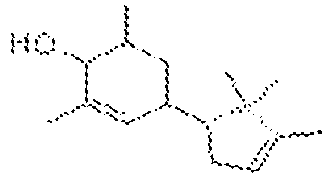
Exemple 46 
- De la 3-pentanone (129 g, 1,5 mol, 1,5 éq.), du méthylène-campholènaldéhyde (préparé à partir de 153 g, 1 mol, 1 éq. de Campholènaldéhyde et 1.1 éq. de formaldéhyde) et de l'hydroxyde de potassium (11,2 g, 0,2 mol, 0,2 éq.) dans un mélange eau/éthanol (300 ml/200 ml) sont chauffés à 65°C pendant une nuit. Une fois la réaction terminée, le mélange réactionnel est refroidi et 0,2 éq. d'acide acétique est ajouté. La phase aqueuse est extraite 3 fois avec de l'éther de méthyle et de t-butyle et les phases organiques réunies sont lavées avec de la saumure, séchées sur du sulfate de magnésium et filtrées. Les solvants sont évaporés et le produit brut est purifié par distillation pour donner la 2,6-diméthyl-4-(2,2,3-triméthylcyclopent-3-ényl)cyclohex-2-énone sous forme d'une huile incolore avec un rendement de 57% sur les 2 étapes. Il s'agit d'un mélange de 4 isomères observables dans un rapport 12:40:33:15.
- Téb. : 105-107 ° C / 0,067 kPa (0,5 torr)
Profil olfactif : Boisé (cèdre), ambré, épicé (poivre)
RMN-1H (CDCl3, 200MHz): δ(ppm) protons communs 1.4-1.90 (m, 2H), 1.55-1.65 (m, 3H), 1.7-1.8 (m, 3H), 1.90-2.2 (m, 2H), 2.2-2.5 (m, 2H), 2.5-2.65 (m, 1H), 5.22 (m, 1H).
Isomère majoritaire (protons caractéristiques): 0,96 (s, 3H), 1,09 (s, 3H), 1,13 (d, J = 7,04 Hz), 6,64 (s large, 1H)
Deuxième isomère majoritaire (protons caractéristiques): 0,92 (s, 3H), 1,06 (s, 3H), 1,12 (d, J = 6,67 Hz), 6,66 (s large, 1H)
Isomère minoritaire (protons caractéristiques): 0,92 (s, 3H), 1,04 (s, 3H), 1,14 (d, J = 5,68 Hz), 6,77 (s large, 1H)
Deuxième isomère minoritaire (protons caractéristiques): 0,96 (s, 3H), 1,06 (s, 3H), 1,14 (d, J = 5,68 Hz), 6,85 (br d, 1H)
RMN-13C (CDCl3, 50MHz): δ(ppm)
Isomère majoritaire: 12,52; 15,28; 16,43 ; 19,31; 27,03 ; 34,75; 35,43; 35,62; 38,23 ; 47,31 ; 52,0 ; 121,24 ; 133,99 ; 134,94 ; 148,82 ; 202,72.
Deuxième isomère majoritaire: 12,47; 15,67; 16,43; 19,93; 27,44; 33,64; 38,54; 39,28 ; 41,57 ; 47,22 ; 53,80 ; 121,24 ; 133,99 ; 134,94 ; 148,39 ; 202,29.
Premier isomère minoritaire: 12,47; 15,67; 16,43; 20,08; 28,04; 33,95 ; 37,64; 38,85 ; 41,73 ; 46,99 ; 54,01 ; 121,19 ; 133,46 ; 134,51 ; 148,68 ; 202,32.
Deuxième isomère minoritaire: 12,52 ; 15,85 ; 16,35 ; 19,74 ; 27,24 ; 34,75 ; 35,50 ; 35,83 ; 37,69 ; 46,72 ; 53,18 ; 120,99 ; 134,51 ; 134,94 ; 148,73 ; 202,72. - Comme décrit dans l'exemple 1, la 2,6-diméthyl-4-((R)-2,2,3-triméthylcyclopent-3-ényl)cyclohex-2-énone est préparée à partir de R-(+)-campholènaldéhyde avec un rendement de 49% sur les 2 étapes, il s'agit d'un mélange 12:36:35:17 d'isomères observables.
- Téb. : 100°C / 0,067 kPa (0,5 torr)
Profil olfactif : noix, anis
Les analyses sont conformes à celles obtenues dans l'exemple 1. - Comme décrit dans l'exemple 1, la 2,6-diméthyl-4-((S)-2,2,3-triméthylcyclopent-3-ényl)cyclohex-2-énone est préparée à partir de la S-(-)-campholenaldehyde avec un rendement de 43% sur les 2 étapes, il s'agit d'un mélange 12:43:30:15 d'isomères observables.
- Téb. : 101-102 ° C / 0,067 kPa (0,5 torr)
Profil olfactif : Racines, boisé, vétiver, poivre
Les analyses sont conformes à celles obtenues dans l'exemple 1. - La 2,6-diéthyl-4-(2,2,3-triméthylcyclopent-3-ényl)cyclohex-2-énone est obtenue avec un rendement de 33%, selon l'exemple 1, à partir de 5-heptanone et de méthylène-campholènaldéhyde.
- Il s'agit d'un mélange 32:40:28 de 3 isomères observables avec une colonne CPG apolaire.
- Téb. : 120 ° C / 0,067 kPa (0,5 torr)
Profil olfactif : Epicé, curry
RMN-1H (CDCl3, 200MHz): δ(ppm) protons communs 0.8-1.2 (m, 12H), 1.3-1.6 (m, 2H), 1.6 (m, 3H), 1.6-2.1 (m, 4H), 2.15 (q, J = 7.4 Hz, 2H), 2.25-2.4 (m, 2H), 2.5-2.65 (m, 1H), 5.21 (m, 1H).
Isomères majoritaires (protons caractéristiques - 70%): 6.57 (br s, 1H)
Isomère minoritaire (protons caractéristiques - 15%): 6.72 (br s, 1H)
Isomère minoritaire (protons caractéristiques - 15%): 6.76 (br d, 1H)
RMN-13C (CDCl3, 50MHz): δ(ppm)
2 Isomères majoritaires (70% 50:50): 11.23 & 11.75 (CH3), 12.43 & 12.49 (CH3), 13.01 & 13.09 (CH3), 19.44 & & 20.04 (CH3), 22.20 & 22.79 & 22.94 (2CH2), 27.10 & 27.52 (CH3), 32.48 & 33.48 (CH2), 34.54 & 35.52 (CH2), 34.92 & 38.37 (CH), 45.74 & 48.04 (CH), 47.27 (CIV), 52.67 & 53.98 (CH), 121.25 & 121.31 (CH), 139.67 & 140.85 (CIV), 146.44 & 148.73 (CH), 148.34 & 148.36 (CIV), 201.18 & 201.25 (C(O)).
2 isomères minoritaires (30% 50:50, pics spécifiques): 11.23 & 11.57 (CH3), 12.43 & 12.49 (CH3), 12.83 & 12.88 (CH3), 13.01 & 13.09 (CH3), 19.85 & & 20.13 (CH3), 22.23 & 22.61 & 22.71 & 22.79 (2CH2), 27.38 & 28.03 (CH3), 32.21 & 33.48 (CH2), 33.97 & 34.03 (CH2), 38.83 (CH), 45.02 & 48.18 (CH), 47.02 (CIV), 53.48 & 54.30 (CH), 121.22 & 121.03 (CH), 146.58 & 146.67 (CH). - La 2,6-diméthyl-4-(2,4,4-triméthylcyclopentyl)cyclohex-2-énone est obtenu avec un rendement de 25%, selon l'exemple 1, à partir de la 3-pentanone et de 2-(2,4,4-triméthylcyclopentyl)acrylaldéhyde (préparé à partir de 2,4,4-triméthylcyclopentanone).
- il s'agit d'un mélange de 5 isomères observables dans un rapport 16:31:34:9:5:5.
Téb. : 72°C / 0.040 kPa (0.3 torr)
Profil olfactif: Boisé sec, épicé, noix.
RMN-1H (CDCl3, 200MHz): 4 diastéréoisomères observés
δ(ppm) protons communs 0.8-1.4 (m, 15H), 1.4-1.75 (m, 3H), 1.75 (m, 3H), 1.75-2.10 (m, 2H), 2.2-2.4 (m, 1H), 2.4-2. 7 (m, 1H).
Isomères majoritaires (protons caractéristiques - 62%): 6.58 (m, 1H) - 1ers isomères minoritaires (protons caractéristiques - 18%): 6.49 (m, 1H)
- 2èmes isomères minoritaires (protons caractéristiques - 15%): 6.59 (m, 1H)
- 3èmes isomères minoritaires (protons caractéristiques - 5%): 6.67 (m, 1H)
- 1ers isomères minoritaires (pics caractéristiques - 16%): 203.09 (C(O)), 149.15 (CH), 133.28 (CIV)
- 2èmes isomères minoritaires (pics caractéristiques - 12%): 202.49 (C(O)), 148.87 (CH), 134.54 & 134.49 (CIV)
- 3èmes isomères minoritaires (pics caractéristiques - 6%): 202.79 (C(O)), 148.07 (CH), 133.59 (CIV)
- 4èmes isomères minoritaires (pics caractéristiques - 3%): 202.96 (C(O)), 147.98 (CH), 133.49 (CIV)
- La 2,6-diméthyl-4-(1-phényl-éthyl)cyclohex-2-énone est obtenue avec un rendement de 54% au cours des 2 étapes, selon l'exemple 1, à partir de 3-pentanone et de 2-méthylène-3-phénylbutanal (préparé à partir de 3-phénylbutanal).
- Il s'agit d'un mélange de 4 isomères observables dans un rapport 17:29:23:31.
- Téb. : 115°C/0.067 kPa (0.5 torr)
Profil olfactif : Floral, balsamique, miellé.
RMN-1H (CDCl3, 200MHz): 4 diastéréoisomères observés
δ(ppm) protons communs 0.95-1.15 (m, 3H), 1.22-1.35 (m, 3H), 1.25-2.10 (m, 2H), 1.62-1.80 (m, 3H), 2.15-2.90 (m, 3H), 7.12-7.35 (m, 5H).
Isomères majoritaires (protons caractéristiques - 31%): 6.65-6.70 (m, 1H)
Isomères majoritaires (protons caractéristiques - 29%): 6.75-6.80 (m, 1H)
Isomères minoritaires (protons caractéristiques - 23%): 6.37-6.42 (m, 1H)
Isomères minoritaires (protons caractéristiques - 17%): 6.27-6.35 (m, 1H)
RMN-13C (CDCl3, 75MHz): 4 diastéréoisomères observés
Isomères majoritaires (pics caractéristiques - 31%): 202.23 (C(O)), 146.42 (CH), 135.43 (CIV), 38.37, 36.88 (CH2), 17.84, 16.35, 15.15.
2èmes Isomères majoritaires (pics caractéristiques - 29%): 202.52 (C(O)), 146.69 (CH), 134.44 (CIV), 40.12, 34.33 (CH2), 19.50, 16.47, 15.61.
Isomères minoritaires (pics caractéristiques - 23%): 147.52 (CH), 134.95 (CIV), 39.40, 35.33 (CH2), 19.44, 16.22, 15.93.
2èmes isomères minoritaires (pics caractéristiques - 17%): 147.28 (CH), 133.73 (CIV), 38.90, 33.39 (CH2), 18.04, 15.15, 15.27. - La 2,6-diméthyl-4-(6-méthylhept-5-én-2-yl)cyclohex-2-énone est obtenue avec un rendement de 51% au cours des 2 étapes, selon l'exemple 1, à partir de 3-pentanone et de 2-méthylène-citronnellal (préparé à partir de citronnellal).
- Il s'agit d'un mélange de 4 isomères observables dans un rapport 25:21:28:25.
- Téb. : 109-110°C/0.093 kPa (0.7 Torr)
Profil olfactif : floral, vert, racine, citronnelle, propre
RMN-1H (CDCl3, 200MHz): 3 diastéréoisomères observés
δ(ppm) protons communs 1.11 (d, J = 6.78 Hz, 3H), 1.10-1.70 (m, 4H), 1.58 (s, 3H), 1.66 (s, 3H), 1.74 (s, 3H), 1.75-2.20 (m, 3H), 2.20-2.65 (m, 2H), 5.07 (br t, 1H), 6.45-6.60 (m, 1H).
Isomères majoritaires (protons caractéristiques - 28%): 0.91 (d, J = 6.06 Hz, 3H) Autres isomères (protons caractéristiques): 0.87 (d, J = 6.76 Hz, 3H, 2 isomers) & 0.82 (d, J = 6.86 Hz, 3H)
RMN-13C (CDCl3, 75MHz): 3 à 4 diastéréoisomères observés
203.21 & 203.15 & 202.47 (C(O)), 149.36 & 148.89 & 148.16 & 147.86 (CH), 135.38 & 135.11 & 134.09 & 133.83 (CIV), 131.54 (CIV), 124.26 & 124.23 & 124.15 (CH), 42.11 & 41.66 & 41.5 & 41.43 (CH), 39.55 & 39.48 & 37.61 & 37.0 (CH), 36.37 & 36.04 & 36.0 (CH), 34.94 & 34.21 & 34.19 & 33.95 (CH2), 33.63 & 33.03 & 32.58 & 30.87 (CH2), 25.95 & 25.88 & 25.80 & 25.74 (CH2), 25.65 (CH3), 17.61 & 16.29 (CH3), 16.74 & 16.36 (CH3), 16.27 & 16.16 & 15.73 (CH3), 15.97 & 15.91 & 15.32 & 15.29 (CH3). - La 4-(4,4-diméthylpentan-2-yl)-2,6-diméthylcyclohex-2-énone est obtenue avec un rendement de 56% au cours des 2 étapes, selon l'exemple 1, à partir de 3-pentanone et de 2-méthylène-3,5,5-Triméthylhexanal (préparé à partir de 3,5,5-Triméthylhexanal).
- Il s'agit d'un mélange de 4 isomères observables dans un rapport 23:17:30:30.
- Téb. : 88-92°C/0.053 kPa (0.4 torr)
Profil olfactif : boisé, ambré, un peu santalé, noisette.
RMN-1H (CDCl3, 200MHz): δ(ppm) 0.75-1.37 (m, 2H), 0.87-0.95 (m, 12H), 1.12 (d, J = 7.2 Hz, 3H), 1.37-2.0 (m, 3H), 1.76 (m, 3H), 2.20-2.62 (m, 2H), 6.45-6.57 (m, 1H). RMN-13C (CDCl3, 75MHz): données sélectionnées
196.52 (C(O)), 149.06 & 148.64 & 148.60 & 148.20 (CH), 135.75 & 135.37 & 134.33 (CIV), 48.46 & 47.97 & 47.92 & 47.74 (CH2), 34.80 & 34.17 (CH2), 32.40 & 31.67 & 31.02 (CIV), 29.89 (3 CH3). - La 4-isopropyl-2,6-diméthylcyclohex-2-énone est obtenue avec un rendement de 54% au cours des 2 étapes, selon l'exemple 1, à partir de 3-pentanone et de 2-méthylène-isovaléraldéhyde (préparé à partir d'isovaléraldéhyde).
- Il s'agit d'un mélange de 2 isomères observables dans un rapport 27:76.
- Téb. : 62°C/0.133 kPa (1 torr)
Profil olfactif : vert, citrus, écorce de pamplemousse.
RMN-1H (CDCl3, 200MHz): protons communs 1.30-1.55 (m, 1H), 1.62-1.82 (m, 1H), 1.76 (m, 3H), 1.82-2.0 (m, 1H), 2.20-2.41 (m, 1H).
Isomères majoritaires (protons caractéristiques): δ(ppm) 0.89 (d, J = 6.73 Hz, 3H), 0.92 (d, J = 6.66 Hz, 3H), 1.12 (d, J = 6.64 Hz, 3H), 2.20-2.41 (m, 1H), 6.55 (m, 1H). Isomères minoritaires: δ(ppm) 0.95 (d, J = 6.72 Hz, 3H), 0.95 (d, J = 6.72 Hz, 3H), 1.12 (d, J = 7.2 Hz, 3H), 2.45-2.60 (m, 1H), 6.61 (m, 1H).
RMN-13C (CDCl3, 75MHz):
Isomères majoritaires: 202.60 (C(O)), 148.33 (CH), 135.18 (CIV), 42.99 (CH), 41.50 (CH), 34.32 (CH2), 31.81 (CH), 19.40 (CH3), 19.01 (CH3), 16.24 (CH3), 15.32 (CH3). Isomères minoritaires, pics spécifiques: 148.05 (CH), 133.89 (CIV), 39.28 (CH), 39.01 (CH), 32.38 (CH2), 31.46 (CH), 20.11 (CH3), 20.06 (CH3), 16.35 (CH3), 15.94 (CH3). - La 4-butyl-2,6-diéthylcyclohex-2-énone est obtenue avec un rendement de 16% sur les 2 étapes, selon l'exemple 1, à partir de 4-heptanone et de 2-méthylène-hexanal (préparé à partir d'hexanal).
- Il s'agit d'un mélange de 2 isomères observables dans un rapport 51:49.
- Téb. : 115°C/0.067 kPa (0.5 torr)
Profil olfactif : boisé, noisette.
RMN-1H (CDCl3, 300MHz): δ(ppm) 0.85-1.0 (m, 9H), 1.1-1.55 (m, 8H), 1.58-1.78 (m, 1H), 1.84-1.98 (m, 1H), 2.0-2.3 (m, 3H), 2.32-2.44 (m, 1H), 6.42-6.47 (m, 1H).
RMN-13C (CDCl3, 75MHz): δ(ppm) 202.27 & 201.41 (C(O)), 147.62 & 147.0 (CH), 140.12 & 138.88 (CIV), 47.78 & 46.25 (CH), 36.70 & 32.76 (CH), 35.61 & 34.38 (CH2), 34.50 & 32.44 (CH2), 29.29 & 28.72 (CH2), 22.85 & 22.71 & 22.69 & 22.58 & 22.50 & 22.14 (3 CH2), 13.94 (CH3), 12.92 & 12.86 (CH3), 11.79 & 11.11 (CH3). - La 2,6-diméthyl-4-propylcyclohex-2-énone est obtenue avec un rendement de 17 % sur les 2 étapes, selon l'exemple 1, à partir de la 3-pentanone et 2-méthylène-valéraldéhyde (préparé à partir de pentanal).
- Il s'agit d'un mélange de 2 isomères observables dans un rapport 54:46.
- Téb. : 70°C/0.067 kPa (0.5 torr)
Profil olfactif : pamplemousse, très vert, chocolat cacao.
RMN-1H (CDCl3, 200MHz):
δ(ppm) protons communs 0.85-0.97 (m, 3H), 1.1 (d, J = 7Hz, 3H), 1.20-1.50 (m, 4H), 1.70-1.75 (m, 3H), 1.75-2.08 (m, 2H), 2.20-2.60(m, 2H).
Isomères majoritaires (proton caractéristique): 6.54-6.59 (m, 1H)
Isomères minoritaires (proton caractéristique): 6.48-6.54 (m, 1H)
RMN-13C (CDCl3, 50MHz):
Isomères majoritaires : 202.98 (C(O)), 148.92 (CH), 133.30 (CIV), 38.52, 38.28 (CH2), 35.58 (CH2), 32.99, 20.53 (CH2), 16.23, 15.72, 14.08.
Isomères minoritaires : 202.56 (C(O)), 149.56 (CH), 134.32 (CIV), 41.41, 37.92 (CH2), 36.57, 36.20 (CH2), 19.64 (CH2), 16.12, 15.22, 14.04. - La 4-butyl-2,6-diméthylcyclohex-2-ènone est obtenue avec un rendement de 40% sur les 2 étapes, selon l'exemple 1, à partir de la 3-pentanone et 2-méthylène-hexanal (préparé à partir d'hexanal).
- Il s'agit d'un mélange de 2 isomères observables dans un rapport 57:43.
- Téb. : 65°C/0.107 kPa (0.8 torr)
Profil olfactif : Vert, rhubarbe, puissant, un peu lavandé, champignon.
RMN-1H (CDCl3, 200MHz):
δ(ppm) protons communs 0.85-0.95 (m, 3H), 1.1 (d, J = 7Hz, 3H), 1.18-1.62 (m, 6H), 1.70-1.75 (m, 3H), 1.76-2.08 (m, 2H), 2.20-2.60(m, 2H).
Isomères majoritaires (proton caractéristique): 6.54-6.59 (m, 1H)
Isomères minoritaires (proton caractéristique): 6.48-6.54 (m, 1H)
RMN-13C (CDCl3, 50MHz):
Isomères majoritaires : 202.93 (C(O)), 148.91 (CH), 133.27 (CIV), 38.51, 35.61 (CH2), 33.72 (CH2), 33.23, 29.60 (CH2), 22.72 (CH2), 16.20, 15.71, 13.94. - Isomères minoritaires : 202.50 (C(O)), 149.56 (CH), 134.31 (CIV), 41.40, 38.30 (CH2), 36.79, 35.40 (CH2), 28.69 (CH2), 22.67 (CH2), 16.10, 15.20, 13.94.
- La 4-hexyl-2,6-diméthylcyclohex-2-ènone est obtenue avec un rendement de 35% sur les 2 étapes, selon l'exemple 1, à partir de la 3-pentanone et de 2-méthylène-octanal (préparé à partir d'octanal).
- Il s'agit d'un mélange de 2 isomères observables dans un rapport 48:52.
- Téb. : 105°C/ 0.067 kPa (0.5 torr)
Profil olfactif : aldéhydé, linge frais et propre, savon de Marseille, herbe séchée. - RMN-1H (CDCl3, 200MHz):
δ(ppm) protons communs 0.83-1.04 (m, 3H), 1.12 (d, J = 6.8Hz, 3H), 1.22-1.50 (m, 10H), 1.73-1.78 (m, 3H), 1.75-2.10 (m, 2H), 2.10-2.65(m, 2H).
Isomères minoritaires (proton caractéristique): 6.54-6.59 (m, 1H)
Isomères majoritaires (proton caractéristique): 6.50-6.55 (m, 1H)
RMN-13C (CDCl3, 50MHz):
Isomères minoritaires : 198.20 (C(O)), 148.95 (CH), 38.59, 38.36 (CH2), 35.68 (CH2), 33.31, 31.78 (CH2), 29.38 (CH2), 27.44 (CH2), 22.62 (CH2), 16.27, 15.78, 14.06.
Isomères majoritaires : 196.54 (C(O)), 149.60 (CH), 134.38 (CIV), 41.47, 36.88, 35.78 (CH2), 34.10 (CH2), 31.78 (CH2), 29.33 (CH2), 26.52 (CH2), 22.62 (CH2), 16.17, 15.29, 14.06. - À une solution dans le THF de 2,6-diméthyl-4-((R)-2,2,3-triméthylcyclopent-3-ényl)cyclohex-2-énone (obtenue selon l'exemple 2) sont ajoutés 1,1 équivalent molaire de t-butylate de potassium. Après 2 heures d'agitation à température ambiante, 1,1 équivalent molaire d'iodure de méthyle sont ajoutés au goutte à goutte au mélange réactionnel. 1,1 équivalent molaire de t-butylate de potassium sont encore ensuite ajoutés et le mélange réactionnel est chauffé à 40°C pendant 2 heures, puis un nouvel équivalent 1,1 molaire d'iodure de méthyle est ajouté. Après agitation à 40°C pendant une nuit, le mélange réactionnel est dilué avec de l'éther de méthyle et de t-butyle et versé dans une solution de HCl aqueux à 10%. La phase aqueuse est extraite deux fois avec de l'éther de méthyle et de t-butyle et les phases organiques réunies sont lavées avec une solution aqueuse saturée de bicarbonate de sodium. La phase organique est séchée sur sulfate de magnésium, filtrée et les solvants sont évaporés. Le produit brut ainsi obtenu est purifié par distillation pour donner la (R)-2,2,6,6-tétraméthyl-4-(2,2,3-triméthylcyclopent-3-ényl)cyclohex-3-ènone sous forme d'une huile incolore avec un rendement de 64%.
- Téb. : 93°C/0.067 kPa (0.5 torr)
Profil olfactif : Poussiéreux, moisi
IR (film, cm-1): 564m, 581m, 797m, 857w, 997w, 1013w, 1047m, 1360m, 1381m, 1466m, 1706s, 2866w, 2927m, 2958m.
RMN-1H (CDCl3, 200MHz): δ(ppm) 0.75 (s, 3H), 1.05 (s, 3H), 1.09 (s, 3H), 1.11 (s, 3H), 1.11 (s, 3H), 1.13 (s, 3H), 1.58 (m, 3H), 2.10-2.40 (m, 2H), 2.22 (q, J = 16.54 Hz, 2H), 2.50 (t, J = 8.22 Hz, 1H), 5.22-5.29 (m, 1H), 5.39-5.43 (m, 1H).
RMN-13C (CDCl3, 75MHz): δ(ppm) 12.67 (CH3), 21.10 (CH3), 25.40 (CH3), 25.61 (CH3), 26.77 (CH3), 27.19 (CH3), 27.21 (CH3), 33.01 (CH2), 41.96 (CH2), 43.08 (CIV), 43.76 (CIV), 48.17 (CIV), 57.83 (CH), 121.36 (CH), 131.70 (CH), 134.91 (CIV), 147.43 (CIV), 219.92 (C(O)). - La (S)-2,2,6,6-tétraméthyl-4-(2,2,3-triméthylcyclopent-3-ényl)cyclohex-3-énone est obtenue avec un rendement de 46% selon l'exemple 14 à partir de 2,6-diméthyl-4-((S)-2,2,3-triméthylcyclopent-3-ényl)cyclohex-2-énone (obtenu dans l'exemple 3).
- Téb. : 92°C/0.067 kPa (0.5 torr)
Profil olfactif: Boisé, frais, moisi
RMN-1H (CDCl3, 200MHz): δ(ppm) 0.76 (s, 3H), 1.05 (s, 3H), 1.10 (s, 3H), 1.12 (s, 6H), 1.14 (s, 3H), 1.59 (m, 3H), 2.10-2.40 (m, 2H), 2.22 (q, J = 16.53 Hz, 2H), 2.51 (t, J = 8.23 Hz, 1H), 5.23-5.30 (m, 1H), 5.40-5.44 (m, 1H).
RMN-13C (CDCl3, 50MHz): δ(ppm) 12.66 (CH3), 21.08 (CH3), 25.39 (CH3), 25.60 (CH3), 26.75 (CH3), 27.17 (CH3), 27.19 (CH3), 33.00 (CH2), 41.94 (CH2), 43.06 (CIV), 43.74 (CIV), 48.16 (CIV), 57.81 (CH), 121.35 (CH), 131.68 (CH), 134.89 (CIV), 147.41 (CIV), 219.90 (C(O)). - La 4-(4,4-diméthylpentan-2-yl)-2,2,6,6-tetraméthylcyclohex-3-ènone est obtenue avec un rendement de 30% selon l'exemple 14 à partir de la 4-(4,4-diméthylpentan-2-yl)-2,6-diméthylcyclohex-2-énone (obtenue dans l'exemple 9).
- Téb. : 75°C/0.053 kPa (0.4 torr)
Profil olfactif : Boisé, poivré, un peu fruité et ambré.
RMN-1H (CDCl3, 300MHz): δ(ppm) 0.89 (s, 9H), 0.9-1.35 (m, 1H), 1.01 (d, J = 6.93 Hz, 3 H), 1.07 (s, 3H), 1.08 (s, 3H), 1.10 (s, 3H), 1.12 (s, 3H), 1.36-1.46 (m, 1H), 2.04-2.2 (m, 2H), 2.23-2.38 (m, 1H), 5.30 (s, 1H).
RMN-13C (CDCl3, 75MHz): δ(ppm) 220.10 (C(O)), 140.23 (CIV), 128.24 (CH), 48.04 (CH2), 43.44 (CIV), 42.84 (CIV), 38.16 (CH2), 37.18 (CH), 31.22 (CIV), 29.88 (3 CH3), 27.24 (CH3), 26.46 (CH3), 25.52, 25.43, 22.43. - La 4-isopropyl-2,2,6,6-tetramethylcyclohex-3-enone est obtenue avec un rendement de 46% selon l'exemple 14 à partir de la 4-isopropyl-2,6-diméthylcyclohex-2-énone (obtenue dans l'exemple 10).
- Téb. : 86-87°C/1.200 kPa (9 torr)
Profil olfactif: camphré, terreux, boisé, animal.
RMN-1H (CDCl3, 200MHz): δ(ppm) 1.01 (d, J =6.81 Hz, 1H), 1.09-1.12 (m, 12H), 2.14 (s, 2H), 2.25 (hept, J = 13.80 Hz, 1H), 5.28 (s, 1H).
RMN-13C (CDCl3, 50MHz): δ(ppm) 215.8 (C(O)), 140.12 (CIV), 127.13 (CH), 43.41 (CIV), 42.89 (CIV), 39.11 (CH2), 34.72 (CH), 27.16 (2CH3), 25.42 (2CH3), 20.90 (2CH3). - La 4-isopropyl-2,6-diméthyl-2,6-dipropylcyclohex-3-ènone est obtenue avec un rendement de 39% selon l'exemple 14 à partir de 4-isopropyl-2,6-diméthylcyclohex-2-énone (obtenue dans l'exemple 10) et de 1-bromopropane.
- Téb. : 75°C/0.067 kPa (0.5 torr)
Profil olfactif : Tête faible, transpiration, poussiéreux, boisé sec, un peu cassis. RMN-1H (CDCl3, 200MHz): δ(ppm) 0.83 (t, J = 6.81 Hz, 6H), 0.97-1.07 (m, 12H), 1.07-1.37 (m, 5H), 1.37-1.55 (m, 2H), 1.65-2.15 (m, 3H), 2.28 (hept, J = 13.70 Hz, 1H), 5.20 (s, 1H).
RMN-13C (CDCl3, 50MHz): δ(ppm) 217.8 (C(O)), 141.33 (CIV), 125.40 (CH), 47.61 (CIV), 46.43 (CIV), 43.86 (CH2), 40.0 (CH2), 37.20 (CH2), 35.08 (CH), 26.81 (CH3), 22.55 (CH3), 21.14 (CH3), 21.03 (CH3), 18.52 (CH2), 17.31 (CH2), 14.60 (CH3), 14.53 (CH3). - Une solution 1M dans le toluène de (S)-2,2,6,6-tétraméthyl-4-(2,2,3-triméthylcyclopent-3-ényl)cyclohex-3-ènone (obtenue dans l'exemple 15) avec 5% en poids de palladium 5% sur charbon est hydrogénée (p(H2) = 20 bars) à température ambiante. Une fois la réaction terminée (suivi CPG), le mélange est filtré sur un gâteau de Célite® et les solvants sont évaporés. Le pétrole brut ainsi obtenu est distillé pour donner la 2,2,6,6-tétraméthyl-4-((1R)-2,2,3-triméthylcyclopentyl)cyclohex-3-énone et la 2,2,6,6-tétraméthyl-4-(2,3,3-triméthylcyclopent-1-ènyl)cyclohexanone (72:28) avec un rendement de 78%.
- Téb. : 95°C/0.080 kPa (0.6 torr)
Profil olfactif : Animal, crésol, phénol
2,2,6,6-tétraméthyl-4-((1R)-2,2,3 triméthylcyclopentyl)cyclohex-3-ènone
RMN-1H (CDCl3, 300MHz): δ(ppm)
0.54 (s, 3H), 0.83 (d, J = 6.78 Hz, 3H), 0.92 (s, 3H), 1.09 (s, 3H), 1.11 (s, 6H), 1.13 (s, 3H), 1.15-1.30 (m, 1H), 1.50-1.85 (m, 4H), 2.07-2.22 (m, 1H), 2.30 (d, J = 15.97 Hz, 1H), 2.12 (d, J = 16.45 Hz, 1H), 5.35 (m, 1H).
RMN-13C (CDCl3, 75MHz): δ(ppm) 220.14 (C(CO)), 134.45 (CIV), 131.87 (CH), 58.07 (CH), 45.17 (CH), 43.79 (2 CIV), 43.25 (CIV), 42.14 (CH2), 29.72 (CH2), 27.25 (CH3), 27.18 (CH3), 26.60 (CH3), 25.57 (CH3), 25.46 (CH2), 25.38 (CH3), 15.68 (CH3), 14.11 (CH3).
2,2,6,6-Tétraméthyl-4-(2,3,3-triméthylcyclopent-1-ènyl)cyclohexanone
RMN-1H (CDCl3, 300MHz): δ(ppm)
0.88 (d, J = 6.69 Hz, 3H), 0.90 (s, 3H), 1.06 (s, 3H), 1.08 (s, 3H), 1.09 (s, 3H), 1.11 (s, 3H), 1.19 (s, 3H), 1.55-1.85 (m, 2H), 2.07-2.29 (m, 2H), 2.22 (d, J = 16.67 Hz, 1H), 2.34 (d, J = 16.02 Hz, 1H), 2.58-2.64 (m, 2H), 5.35 (m, 1H).
RMN-13C (CDCl3, 75MHz): δ(ppm) 220.55 (C(CO)), 146.79 (CIV), 122.07 (CIV), 46.91 (CH), 44.16 (CIV), 43.91 (CIV), 43.49 (CIV), 42.90 (CH2), 39.82 (CH2), 30.77 (CH2), 30.67 (CH2), 27.09 (CH3), 26.99 (CH3), 26.91 (CH3), 26.85 (CH3), 26.77 (CH3), 20.53 (CH3), 13.48 (CH3). - La 4-(4,4-diméthylpentan-2-yl)-2,6-diméthylcyclohexanone est obtenue avec un rendement de 81% selon l'exemple 19 à partir de la 4-(4,4-diméthylpentan-2-yl)-2,6-diméthylcyclohex-2-énone (obtenue dans l'exemple 9).
- Il s'agit d'un mélange de 2 isomères principaux (91%) dans un rapport 29:71.
- Téb.= 76°C/ 0.053 kPa (0.4 torr)
Profil olfactif : Boisé, ambré, poussiéreux, un peu fleuri.
RMN-1H (CDCl3, 300MHz): protons communs δ(ppm) 0.85-0.94 (m, 12H), 0.94-1.03 (m, 6H), 1.04-1.41 (m, 4H), 1.41-1.55 (m, 1H), 1.6-2.15 (m, 3H).
Isomères majoritaires (pic caractéristique): 2.33-2.48 (m, 2H).
Isomères minoritaires (pic caractéristique): 2.48-2.62 (m, 2H).
RMN-13C (CDCl3, 75MHz):
Isomères majoritaires : δ(ppm) 214.81 (C(CO)), 48.54 (CH2), 44.41 (CH), 44.30 (CH), 43.70 (CH), 40.13 (CH2), 38.66 (CH2), 32.76 (CH), 30.95 (CIV), 29.84 (3 CH3), 19.09 (CH3), 14.63 (CH3), 14.59 (CH3). - La 2,6-diéthyl-4-isopropyl-2,6-diméthylcyclohexanone est obtenue avec un rendement de 40% sur 2 étapes (hydrogénation selon l'exemple 19, suivie d'une alkylation avec le bromoéthane selon l'exemple 14), à partir de la cyclohexènone obtenue dans l'exemple 10.
- Il s'agit d'un mélange de stéréoisomères observables dans un rapport 6:16:57:21.
- Téb.= 63-65°C/ 0.053 kPa (0.4 torr)
Profil olfactif : Boisé, un peu noix, noisette, plastique, un peu rosé.
RMN-1H (CDCl3, 300MHz): protons communs δ(ppm) 0.71-0.83 (m, 6H), 0.84-0.94 (m, 6H), 1.11-1.3 (m, 2H), 1.3-1.58 (m, 4H), 1.58-1.95 (m, 4H).
Isomères majoritaires (pic caractéristique): 0.97 (s, 6H).
Isomères minoritaires (pic caractéristique): 0.96 & 1.06 & 1.07 (s, 3H).
RMN-13C (CDCl3, 75MHz): 4 stéréoisomères observés dont 3 majoritaires
Isomères majoritaires : δ(ppm) 220.09 & 219.40 (C(CO)), 41.45 & 40.70 & 39.31 (CH2), 39.15 (CIV), 34.18 (2C) & 34.07 (CH), 33.16 & 32.17 & 31.25 (CH2), 32.35 (2C) & 32.21 (CH), 26.37 & 24.65 & 24.41 (CH3), 19.84 & 19.72 & 19.62 (CH3), 8.75 & 8.38 & 8.27 (CH3).
Isomères minoritaires (pics caractéristiques): δ(ppm) 38.62 (CH2), 34.28 (CH), 33.08 (CH2), 32.27 (CH), 27.57 (CH3), 19.72 (CH3), 8.71 (CH3). - A une suspension d'hydrure de lithium et d'aluminium (5,8 g, 0,151 mol, 1,3 éq. H-) dans 500 ml d'éther diéthylique, est ajouté au goutte à goutte à 20-25°C de la 2,6-diméthyl-4-(2,2,3-triméthylcyclopent-3-ényl)cyclohex-2-énone (108 g, 0,465 mol, 1 éq., obtenue dans l'exemple 1). Une fois la réaction terminée, une solution de HCl aqueux à 10% est ajoutée goutte à goutte pour précipiter l'alumine.
- Après filtration et séchage sur sulfate de magnésium, les solvants sont évaporés et le produit brut est purifié par distillation pour donner le 2,6-diméthyl-4-(2,2,3-triméthylcyclopent-3-ényl) cyclohex-2-énol sous forme d'une huile incolore avec un rendement de 76%. Elle consiste en un mélange de 5 isomères principaux observables dans un rapport 6:24:23:32:15 avec une colonne CPG apolaire.
- Téb. : 108-110°C / 0.061 kPa (0.46 torr)
Profil olfactif : Santal, doux, laiteux
RMN-1H (CDCl3, 200MHz): δ(ppm) protons communs 0.88-0.93 (m, 3H), 0.93-1.15 (m, 6H), 1.42-1.72 (m, 6H), 1.72-1.81 (m, 3H), 1.81-2.07 (m, 2H), 2.11-2.4 (m, 2H), 5.21 (m, 1H).
Isomères majoritaires (protons caractéristiques, 32%): 3.65 (m, 1H), 5.43 (m, 1H) 2èmes Isomères majoritaires (protons caractéristiques, 2x 20%): 3.55 (d, J = 4.59 Hz, 1H) & 3.78 (d, J = 3.57 Hz, 1H), 5.47-5.52 (m, 1H).
Isomères minoritaires (protons caractéristiques, 15%): 3.64 (m, 1H), 5.63 (m, 1H) Autres isomères minoritaires (protons caractéristiques, 6% & 7%): 3.72 & 3.90 (m, 1H), 5.66-5.74 (m, 1H)
RMN-13C (CDCl3, 75MHz): δ(ppm)
Isomères majoritaires (32%): 148.47 (CIV), 136.13 (CIV), 128.59 (CH), 121.42 (CH), 76.75 (CHOH), 54.76 (CH), 47.10 (CIV), 38.37 (CH), 38.09 (CH2), 37.72 (CH), 33.76 (CH2), 19.71 (CH3), 19.51 (CH3), 19.37 (CH3), 19.26 (CH3), 12.48 (CH3).
Isomères minoritaires (pics caractéristiques, 55%): 148.54 & 148.48 & 148.42 (CIV), 135.79 & 134.97 & 134.14 (CIV), 129.17 & 129.08 & 128.94 (CH), 121.42 (2C) & 121.25 (CH), 76.75 & 74.79 & 71.61 (CHOH), 54.97 & 53.71 & 52.55 (CH), 47.14 & 47.08 & 46.90 (CIV).
Autres isomères minoritaires (pics caractéristiques, 6% & 7%): 149.11 & 148.89 (CIV), 134.56 & 133.98 (CIV), 129.13 & 129.06 (CH), 121.10 & 121.0 (CH), 75.28 & 71.43 (CHOH), 54.48 & 53.53 (CH), 46.77 & 46.62 (CIV). - Le 2,6-diméthyl-4-((R)-2,2,3-triméthylcyclopent-3-ényl) cyclohex-2-énol est obtenu avec un rendement de 69%, selon l'exemple 22, à partir de la 2,6-diméthyl-4-(2,2,3-triméthylcyclopent-3-ényl)cyclohex-2-énone (obtenue dans l'exemple 2).
- Il s'agit d'un mélange de 4 isomères principaux observables dans un rapport 11:15:41:33 avec une colonne CPG apolaire.
- Téb. : 100-102°C / 0.067 kPa (0.5 torr)
Profil olfactif : Santal, un peu vert
Les analyses sont conformes à celles obtenues dans l'exemple 24. - Le 2,6-diméthyl-4-((S)-2,2,3-triméthylcyclopent-3-ényl)cyclohex-2-énol est obtenu avec un rendement de 66%, selon l'exemple 22, à partir de la 2,6-diméthyl-4-(2,2,3-triméthylcyclopent-3-ényl)cyclohex-2-énone (obtenue dans l'exemple 3). Il consiste en un mélange de 4 isomères principaux observables dans un rapport de 10:20:33:37 avec une colonne CPG apolaire, 7 isomères observables dans un rapport 18:6:2:15:27:24:8 avec une colonne CPG polaire GC.
- Téb.: 100-102°C / 0.067 kPa (0.5 torr)
Profil olfactif : Santal, crémeux, gourmand, noisette, un peu épicé, cuiré
IR (film, cm-1): 564w, 580w, 880m, 1046s, 1088m, 1378w, 2875w, 2971w, 3318w br.
RMN-1H (CDCl3, 200MHz): δ(ppm) protons communs 0.85-0.92 (m, 3H), 0.92-1.2 (m, 6H), 1.58 (m, 6H), 1.6-1.85 (m, 4H), 1.85-2.1 (m, 1H), 2.1-2.4 (m, 2H), 5.21 (m, 1H).
Isomère 27% (protons caractéristiques): 3.64 (d, J = 6.50 Hz, 1H), 5.39-5.45 (m, 1H)
Isomère 24% (protons caractéristiques): 3.55 (d, J = 4.83 Hz, 1H), 5.45-5.54 (m, 1H)
Isomère 18% (protons caractéristiques): 3.78 (d, J = 3.89 Hz, 1H), 5.45-5.54 (m, 1H)
Isomère 15% (protons caractéristiques): 3.64 (d, J = 6.50 Hz, 1H), 5.65-5.75 (m, 1H)
Isomère minoritaire (8%, protons caractéristiques): 3.74 (d, J = 3.98 Hz, 1H), 5.60-5.66 (m, 1H)
Isomère minoritaire (6%, protons caractéristiques): 3.91 (t, J = 6.67 Hz, 1H), 5.60-5.66 (m, 1H)
Isomère minoritaire 2% (protons caractéristiques): 3.78 (d, J = 3.89 Hz, 1H), 5.45-5.54 (m, 1H)
RMN-13C (CDCl3, 50MHz): δ(ppm)
Isomères majoritaires: 12.52, 15.28, 16.43, 19.31, 27.03, 34.75, 35.43, 35.62, 38.23, 47.31, 52.0, 121.24, 133.99, 134.94, 148.82, 202.72.
2èmes Isomères majoritaires: 12.47, 15.67, 16.43, 19.93, 27.44, 33.64, 38.54, 39.28, 41.57, 47.22, 53.80, 121.24, 133.99, 134.94, 148.39, 202.29.
Isomères minoritaires: 12.47, 15.67, 16.43, 20.08, 28.04, 33.95, 37.64, 38.85, 41.73, 46.99, 54.01, 121.19, 133.46, 134.51, 148.68, 202.32.
2èmes Isomères minoritaires: 12.52, 15.85, 16.35, 19.74, 27.24, 34.75, 35.50, 35.83, 37.69, 46.72, 53.18, 120.99, 134.51, 134.94, 148.73, 202.72. - Le 2,6-diéthyl-4-(2,2,3-triméthylcyclopent-3-ényl)cyclohex-2-énol est obtenu avec un rendement de 67%, selon l'exemple 22, à partir de la 2,6-diéthyl-4-(2,2,3-triméthylcyclopent-3-ényl)cyclohex-2-énone (obtenue dans l'exemple 4).
- Il s'agit d'un mélange de 4 isomères dans un rapport 4:17:32:47.
- Téb.: 120°C / 0.060 kPa (0.45 torr)
Profil olfactif: Santal, plus faible que l'exemple 11
RMN-1H (CDCl3, 200MHz): δ(ppm) protons communs 0.89-0.94 (m, 3H), 0.94-1.0 (m, 3H), 1.0-1.05 (m, 3H), 1.05-1.16 (m, 3H), 1.16-1.58 (m, 4H), 1.56-1.61 (m, 3H), 1.61-2.12 (m, 4H), 2.12-2.37 (m, 3H).
Isomères 47% (protons caractéristiques): 3.85 (d, J = 9.32 Hz, 1H), 5.41-5.45 (m, 1H, 39%) & 5.63 (d, J = 4.76 Hz, 1H, 8%)
Isomères 32% (protons caractéristiques): 3.8 (d, J = 9.4 Hz, 1H), 5.51 & 5.63 & 5.67 (m, 1H, 11% & 14% & 7%)
Isomères 17% (protons caractéristiques): 3.65-3.73 (m, 1H), 5.48 (m, 1H)
Isomères 4% (protons caractéristiques): 3.8 (d, J = 9.4 Hz, 1H), 5.48 (m, 1H)
RMN-13C (CDCl3, 50MHz): δ(ppm)
Isomères majoritaires: 148.39 (CIV), 141.89 (CIV), 126.81 (CH), 121.52 (CH), 68.61 (CHOH), 54.89 (CH), 47.20 (CIV), 44.99 (CH), 37.54 (CH), 33.98 (CH2), 33.55 (CH2), 27.49 (CH3), 25.75 (CH2), 25.52 (CH2), 19.91 (CH3), 12.78 (CH3), 12.47 (CH3), 11.12 (CH3).
2èmes Isomères majoritaires (pics spécifiques): 127.95 (CH), 121.47 (CH), 73.39 (CHOH)
Isomères minoritaires (pics spécifiques): 127.55 & 127.08 (CH), 121.31 & 121.03 (CH), 73.51 (CHOH) - Le 2,6-diméthyl-4-(2,4,4-triméthylcyclopentyl)cyclohex-2-énol est obtenu avec un rendement de 40%, selon l'exemple 22, à partir de la 2,6-diméthyl-4-(2,4,4-triméthylcyclopentyl) cyclohex-2-énone (obtenue dans l'exemple 5).
- Le produit brut a été purifié par chromatographie sur colonne de silice, l'alcool attendu consiste en un mélange de 2 isomères principaux (83%) dans un rapport de 19:81.
- Profil olfactif : Tabac, fumé
RMN-1H (CDCl3, 200MHz): 3 isomères observables (50:30:20)
δ(ppm) protons communs 0.80-0.97 (m, 6H), 0.97-1.02 (m, 6H), 1.02-1.20 (m, 4H), 1.20-1.75 (m, 8H), 1.72-1.8 (m, 3H), 1.8-2.0 (m, 1H), 2.0-2.35 (m, 1H). - 1ers Isomères (protons caractéristiques): 3.55-3.67 (m, 1H), 5.40-5.46 (m, 1H).
- 2èmes Isomères (protons caractéristiques): 3.77-3.82 (m, 1H), 5.33-5.34 (m, 1H).
- 3èmes Isomères (protons caractéristiques): 3.50-3.55 (m, 1H), 5.26-5.32 (m, 1H).
- 1ers Isomères (pics caractéristiques): 136.49 (CIV), 127.49 (CH), 71.90 (CHOH), 51.90 (CH), 50.64 (CH2), 44.08 (CH2), 38.19 (CH), 37.07 (CH2).
- 2èmes Isomères (pics caractéristiques): 135.45 (CIV), 129.76 (CH), 77.14 (CHOH), 51.78 (CH), 50.56 (CH2), 45.81 (CH2), 38.71 (CH), 30.57 (CH2).
- 3èmes Isomères (pics caractéristiques): 135.41 (CIV), 127.10 (CH), 76.94 (CHOH), 51.69 (CH), 50.56 (CH2), 43.52 (CH2), 38.25 (CH), 32.54 (CH2).
- Le 2,6-diméthyl-4-(6-méthylhept-5-èn-2-yl)cyclohex-2-ènol est obtenu avec un rendement de 56%, selon l'exemple 22, à partir de la 2,6-diméthyl-4-(6-méthylhept-5-èn-2-yl)cyclohex-2-ènone (obtenue dans l'exemple 7).
- Il s'agit d'un mélange d'isomères dont 1 principal (75%).
- Téb.: 104°C/0.107 kPa (0.8 torr)
Profil olfactif : Rosé, citronellol, un peu boisé, plastique.
RMN-1H (CDCl3, 200MHz): 2 isomères observables (70:30)
δ(ppm) protons communs 0.75-0.85 (m, 3H), 0.95-1.20 (m, 1H), 1.20-1.57 (m, 5H), 1.59 (s, 3H), 1.68 (s, 3H), 1.82-2.22 (m, 3H), 5.03-5.15 (m, 1H). - 1ers Isomères (protons caractéristiques): 1.08 (d, J = 6.38 Hz, 3H), 1.72-1.76 (m, 3H), 3.63 (d large, J = 8.55 Hz, 1H), 5.26-5.34 (m, 1H).
- 2èmes Isomères (protons caractéristiques): 0.97 (d, J = 6.88 Hz, 3H), 1.76-1.80 (m, 3H), 3.88 (t large, 1H), 5.36-5.44 (m, 1H).
- 1ers Isomères (pics caractéristiques): 136.39 & 136.04 (CIV), 129.35 & 128.15 (CH), 77.11 & 77.06 (CHOH), 41.33 & 40.78 (CH), 38.55 & 38.41 (CH), 36.71 & 36.69 (CH), 34.02 & 33.77 (CH2), 33.50 & 31.95 (CH2), 26.12 & 26.02 (CH2), 19.25 & 17.62 (CH3), 16.24 & 15.21 (CH3).
- 2èmes Isomères (pics caractéristiques): 135.41 & 135.10 (CIV), 128.25 & 127.32 (CH), 71.92 (2 CHOH), 38.27 & 37.80 (CH), 36.83 & 36.59 (CH), 34.53 & 34.44 (CH2), 31.79 & 31.73 (CH), 28.70 & 27.41 (CH2), 25.89 (2x CH2), 20.87 & 20.76 (CH3), 17.09 & 16.70 (CH3), 15.21 & 15.08 (CH3).
- Le 4-(4,6-diméthylhept-5-ènyl)-2,6-diméthylcyclohex-2-ènol est obtenu avec un rendement de 70%, selon l'exemple 22, à partir de la 4-(4,6-diméthylhept-5-ènyl)-2,6-diméthylcyclohex-2-ènone (obtenue, selon l'exemple 1, avec un rendement de 16% au cours des 2 étapes, à partir de 3-pentanone et de 5,7-diméthyl-2-méthylène-oct-6-énal (préparé à partir de 5,7-diméthyl-oct-6-énal)).
- Le produit brut est purifié par chromatographie sur colonne de silice, l'alcool attendu consiste en un mélange d'isomères dont 2 principaux (74%) dans un rapport de 32:68.
- Profil olfactif : Tête faible, un peu savonneux, fruité, puis boisé, poussiéreux.
RMN-1H (CDCl3, 300MHz): 3 isomères observables (60:27:13)
δ(ppm) protons communs 0.89 (d, J = 6.60 Hz, 3H), 0.89-0.97 (m, 1H), 1.14-1.47 (m, 6H), 1.60 (s, 3H), 1.68 (s, 3H), 1.72-1.79 (m, 3H), 1.94-2.14 (m, 1H)
0.75-0.85 (m, 3H), 0.95-1.20 (m, 1H), 1.20-1.57 (m, 5H), 1.59 (s, 3H), 1.68 (s, 3H), 1.82-2.22 (m, 3H), 5.03-5.15 (m, 1H).
Isomères majoritaires (protons caractéristiques): 1.08 (d, J = 6.48 Hz, 3H), 2.16-2.38 (m, 2H), 3.64 (d large, J = 7.8 Hz, 1H), 5.32 (m, 1H). - 1ers isomères minoritaires (protons caractéristiques): 1.12 (d, J = 6.78 Hz, 3H), 1.80-1.92 (m, 2H), 3.74 (d, J = 3.75 Hz, 1H), 5.45 (m, 1H).
- 2èmes isomères minoritaires (protons caractéristiques): 0.99 (d, J = 6.87 Hz, 3H), 2.38-2.61 (2H), 3.55 (d, J = 4.68 Hz, 1H), 5.42 (m, 1H).
- 1ers Isomères majoritaires: δ(ppm) 135.30 (CIV), 130.04 & 130.0 (CH), 129.59 (CIV), 76.96 (CHOH), 38.28 (CH), 37.92 & 37.85 (CH2), 37.42 & 37.37 (CH2), 36.84 & 36.79 (CH2), 36.09 (CH), 32.3, 32.26, 25.75 (CH3), 24.45 & 24.42 (CH2), 19.28 (CH3), 19.25 (CH3), 17.91 (CH3).
- 2èmes Isomères (pics caractéristiques): δ(ppm) 134.39 (CIV), 129.52 & 129.44 (CH), 129.58 (CIV), 71.77 (CHOH).
- Le 4-(4,4-diméthylpentan-2-yl)-2,6-diméthylcyclohex-2-ènol est obtenu avec un rendement de 63%, selon l'exemple 22, à partir de la 4-(4,4-diméthylpentan-2-yl)-2,6-diméthylcyclohex-2-ènone (obtenue dans l'exemple 9).
- Il consiste en un mélange de 6 isomères dont 3 principaux (80%) dans un rapport de 30:45:25.
- Téb.: 90°C/0.053 kPa (0.4 torr)
Profil olfactif : boisé, santalé, ambré, un peu fleuri et musqué.
RMN-1H (CDCl3, 200MHz): 3 isomères observables majoritairement
δ(ppm) protons communs 0.8-1.05 (m, 12H), 1.0-1.65 (m, 5H), 1.65-2.50 (m, 2H).
Isomères majoritaires (protons caractéristiques): 1.09 (d, J = 6.31 Hz, 3H), 1.72-1.76 (m, 3H), 3.59-3.68 (m, 1H), 5.25-5.33 (m, 1H).
Isomères minoritaires (protons caractéristiques): 0.9-1.0 (m, 3H), 1.76-1.80 (m, 3H), 3.86-3.91 et 3.91-3.97 (2m, 1H), 5.34-5.39 et 5.39-5.44 (2m, 1H).
RMN-13C (CDCl3, 50MHz): 4 isomères observables (2 majoritaires)
Isomères majoritaires (pics caractéristiques): 136.69 & 136.27 (CIV), 129.22 & 128.62 (CH), 77.17 & 77.11 (CHOH), 47.79 & 47.64 (CH2), 43.47 & 43.30 (CH), 38.50 & 38.47 (CH), 33.47 & 32.77 (CH2), 33.24 & 32.91 (CH), 29.97 (3 CH3), 28.79 & 27.91 (CIV).
Isomères minoritaires (pics caractéristiques): 128.29 & 127.58 (CH), 72.08 & 71.95 (CHOH), 48.80 & 48.52 (CH2), 40.16 & 39.49 (CH), 33.38 & 33.09 (CH), 32.11 & 31.66 (CH), 31.07 & 30.98 (CH2), 29.97 (3 CH3), 28.79 & 27.91 (CIV). - Le 4-isopropyl-2,6-dimethylcyclohex-2-enol est obtenu avec un rendement de 73%, selon l'exemple 22, à partir de la 4-isopropyl-2,6-diméthylcyclohex-2-ènone (obtenue dans l'exemple 10).
- Il consiste en un mélange de 4 isomères observables dont 2 principaux (86%) dans un rapport de 20:80.
- Téb.: 60°C/0.064 kPa (0.48 torr)
Profil olfactif : floral, rosé, citronellol.
RMN-1H (CDCl3, 300MHz): 3 isomères observables, 2 principaux (20:80)
δ(ppm) protons communs 1.3-1.63 (m, 3H), 1.8-2.13 (m, 2H).
Isomères majoritaires (protons caractéristiques): 0.81 (d, J = 6.84 Hz, 3H), 0.84 (d, J = 6.78 Hz, 3H), 1.07 (d, J = 6.33 Hz, 3H), 1.70-1.74 (m, 3H),
Isomères minoritaires (protons caractéristiques): 0.86 (d, J = 6.66 Hz, 3H), 0.88 (d, J = 6.69 Hz, 3H), 0.95 (d, J = 6.87 Hz, 3H), 1.75-1.78 (m, 3H)
RMN-13C (CDCl3, 75MHz): 2 isomères observables
Isomères majoritaires: δ(ppm) 136.29 (CIV), 128.21 (CH), 76.81 (CHOH), 42.27 (CH), 38.23 (CH), 33.24 (CH2), 32.07 (CH), 19.37 (CH3), 19.34 (CH3), 19.31(CH3), 18.47 (CH3).
Isomères majoritaires: δ(ppm) 135.12 (CIV), 127.63 (CH), 71.60 (CHOH), 39.86 (CH), 31.87 (CH), 31.36 (CH), 28.09 (CH2), 20.87 (CH3), 20.50 (CH3), 20.47 (CH3), 15.42 (CH3). - Le 2,6-diéthyl-4-isopropylcyclohex-2-ènol est obtenu avec un rendement de 72%, selon l'exemple 22, à partir de la 2,6-diéthyl-4-isopropylcyclohex-2-ènone (obtenue avec un rendement de 27% sur les 2 étapes, selon l'exemple 1, à partir de 4-heptanone et de 2-méthylène-isovaléraldéhyde (préparé à partir d'isovaléraldéhyde)).
- Il consiste en un mélange de 4 isomères observables dont 2 principaux (83%) dans un rapport de 46:54.
- Téb.: 72°C/0.060 kPa (0.45torr)
Profil olfactif : boisé, fruité.
RMN-1H (CDCl3, 300MHz): 3 isomères observables, 2 principaux (45:55)
δ(ppm) protons communs 0.81-0.98 (m, 9H), 0.98-1.07 (m, 3H), 1.12-1.43 (m, 2H), 1.43-1.63 (m, 3H), 1.63-1.75 & 1.91-2.04 (m, 1H), 1.76-1.90 (m, 1H), 2.04-2.26 (m, 1H).
Isomères majoritaires (protons caractéristiques): 3.78 (d large, J = 8.79 Hz, 1H), 5.35 (s, 1H). - 1ers Isomères minoritaires (protons caractéristiques): 3.88 (s, 1H), 5.51 (m, 1H).
- 2èmes Isomères minoritaires (protons caractéristiques): 3.69 (m, 1H), 5.42 (m, 1H).
- Le 4-butyl-2,6-diméthylcyclohex-2-ènol est obtenu avec un rendement de 71%, selon l'exemple 22, à partir de la 4-butyl-2,6-diméthylcyclohex-2-ènone (obtenue dans l'exemple 12).
- Il consiste en un mélange de 3 isomères observables dont 2 principaux (89%) dans un rapport de 18:82.
- Téb.: 90°C / 0.067 kPa (0.5 torr)
Profil olfactif : Citrus (peau de citrus confite), pamplemousse, soufré, rhubarbe. RMN-1H (CDCl3, 300MHz): 3 isomères observables (50:30:30)
δ(ppm) protons communs 0.83-0.92 (m, 3H), 1.1-1.36 (m, 6H), 1.36-1.70 (m, 2H), 1.77-1.99 (m, 1H), 1.99-2.77 (m, 1H).
Isomères majoritaires (protons caractéristiques): 1.06 (d, J = 6.51 Hz, 3H), 1.70-1.73 (m, 3H), 3.60 (d large, J = 8.4 Hz, 1H), 5.31 (m, 1H). - 1ers Isomères minoritaires (protons caractéristiques): 0.97 (d, J = 6.87 Hz, 3H), 1.75-1.77 (m, 3H), 3.72 (d large, J = 2.8 Hz, 1H), 5.51 (m, 1H).
- 2èmes Isomères minoritaires (protons caractéristiques): 0.93 (d, J = 6.96 Hz, 3H), 1.73-1.75 (m, 3H), 3.52 (d large, J = 3.9 Hz, 1H), 5.45 (d large, J = 4.11 Hz, 1H).
- Le 4-hexyl-2,6-diméthylcyclohex-2-ènol est obtenu avec un rendement de 55%, selon l'exemple 22, à partir de la 4-hexyl-2,6-dimethylcyclohex-2-ènone (obtenue dans l'exemple 13).
- Il consiste en un mélange de 3 isomères observables dont 2 principaux (88%) dans un rapport de 17:83.
- Téb.: 90°C/0.061 kPa (0.46 torr)
Profil olfactif : alcool gras, savonneux.
RMN-1H (CDCl3, 300MHz): 3 isomères observables (50:30:30)
δ(ppm) protons communs 0.8-0.88 (m, 3H), 1.06-1.36 (m, 10H), 1.36-1.86 (m, 2H), 1.88-2.12 (m, 1H), 2.12-2.69 (m, 1H).
Isomères majoritaires (protons caractéristiques): 1.03 (d, J = 6.48 Hz, 3H), 1.68-1.70 (m, 3H), 3.56 (d large, J = 8.56 Hz, 1H), 5.28 (m, 1H). - 1ers Isomères minoritaires (protons caractéristiques): 0.95 (d, J = 6.84 Hz, 3H), 1.73-1.75 (m, 3H), 3.68 (d, J = 3.78 Hz, 1H), 5.42 (d, J = 3.60 Hz, 1H).
- 2èmes Isomères minoritaires (protons caractéristiques): 0.91 (d, J = 6.93 Hz, 3H), 1.70-1.73 (m, 3H), 3.49 (d, J = 4.75 Hz, 1H), 5.38 (m, 1H).
- Le 2,2,6,6-tétraméthyl-4-((R)-2,2,3-triméthylcyclopent-3-ényl)cyclohex-3-énol est obtenu avec un rendement de 64%, selon l'exemple 22, à partir de la (R)-2,2,6,6-tétraméthyl-4-(2,2,3-triméthylcyclopent-3-ényl)cyclohex-3-ènone (obtenu dans l'exemple 14).
- Il s'agit d'un mélange de 2 isomères dans un rapport 44:56.
- Téb.: 100°C / 0.067 kPa (0.5 torr)
Profil olfactif: Boisé, faible.
RMN-1H (CDCl3, 200MHz, protons communs): δ(ppm) 1.43 (d, J = 5.38 Hz, 1H), 1.55-1.62 (m, 3H), 1.72-2.0 (m, 2H), 2.02-2.20 (m, 1H), 2.32-2.45 (m, 1H), 3.31 (d, J = 5.53 Hz, 1H), 5.21-5.28 (m, 1H).
Isomères majoritaires: 0.74 (s, 3H), 0.94 (s, 3H), 1.01 (s, 6H), 1.04 (s, 3H), 1.06 (s, 3H), 2.20-2.26 (m, 1H), 5.17 (s, 1H).
Isomères minoritaires: 0.77 (s, 3H), 0.93 (s, 3H), 1.0 (s, 6H), 1.01 (s, 3H), 1.07 (s, 3H), 2.26-2.32 (m, 1H), 5.18 (s, 1H).
RMN-13C (CDCl3, 50MHz): δ(ppm)
Isomères majoritaires: 12.74, 20.67, 20.71, 22.15, 26.70, 29.38, 31.79, 32.71, 35.38, 37.31, 44.30, 48.12, 57.55, 82.54, 121.54, 132.42, 132.81, 147.47.
Isomères minoritaires: 12.74, 20.92, 21.28, 22.33, 26.92, 29.23, 31.63, 33.57, 35.35, 37.26, 42.88, 48.08, 57.16, 82.56, 121.52, 132.98, 133.23, 148.09. - Le 2,2,6,6-tétraméthyl-4-((S)-2,2,3-triméthylcyclopent-3-ényl)cyclohex-3-énol est obtenu avec un rendement de 91% (97% de pureté), selon l'exemple 22, à partir de (S)-2,2,6,6-tétraméthyl-4-(2,2,3-triméthylcyclopent-3-ényl)cyclohex-3-ènone (obtenue dans l'exemple 15).
- Il s'agit d'un mélange de 2 isomères dans un rapport 43:57.
- Téb.: 100-103°C / 0.067 kPa (0.5 torr)
Profil olfactif : fruité, framboise.
Analyses similaires à celles de l'exemple 38. - Le 4-(4,4-diméthylpentan-2-yl)-2,2,6,6-tetraméthylcyclohex-3-ènol est obtenu avec un rendement de 28%, sur 2 étapes (alkylation selon l'exemple 14, suivie d'une réduction de la cétone selon l'exemple 22), à partir de la cyclohexènone obtenue dans l'exemple 9.
- Téb.: 75°C / 0.053 kPa (0.4 torr)
Profil olfactif: terreux, moisi
RMN-1H (CDCl3, 200MHz): δ(ppm) 0.88 (s, 9H), 0.88-.92 (d, 3H), 0.92-0.98 (m, 3H), 1.0-1.05 (m, 3H), 1.3-1.5 (m, 2H), 1.65-1.95 (m, 2H), 2.05-2.30 (m, 1H), 3.28 (d, J = 2.19 Hz, 1H), 5.07 (dd, J = 4.97, 2.26 Hz, 1H).
RMN-13C (CDCl3, 50MHz): δ(ppm)
138.75 & 138.41 (CIV), 129.93 & 128.98 (CH), 82.79 & 82.59 (CHOH), 48.76 & 47.94 (CH2), 40.03 & 39.22 (CH2), 37.55 & 37.07 (CH), 37.03 & 36.96 (CIV), 35.02 (CIV), 31.33 & 30.98 (CH), 31.25 (CIV), 30.02 & 29.88 (3 CH3), 29.24 & 21.99 (CH3), 22.63 (CH3), 20.82 & 20.26 (CH3). - Le 4-isopropyl-2,2,6,6-tetraméthylcyclohex-3-ènol est obtenu avec un rendement de 47%, en traitant une solution éthanolique de 4-isopropyl-2,2,6,6-tetraméthylcyclohex-3-ènone (obtenue dans l'exemple 19), à 0°C, par du NaBH4 (0.5 éq.). Une fois la transformation terminée (suivi CPG), l'éthanol est évaporé de moitié et le mélange dilué dans l'éther de méthyle et de t-butyle. Une solution d'HCl 34% aq. est alors ajoutée et la phase aqueuse, décantée, extraite 2 fois au MTBE. Les phases organiques réunies sont lavées avec une solution aqueuse saturée de bicarbonate de sodium, puis avec de la saumure, séchées sur sulfate de magnésium et les solvants sont évaporés. Le produit brut est purifié par distillation.
- Téb.: 70°C / 0.053 kPa (0.4 torr)
Profil olfactif: boisé, terreux, camphré, transpiration
RMN-1H (CDCl3, 300MHz): δ(ppm) 0.89 (s, 3H), 0.93-0.99 (m, 9H), 1.02 (s, 3H), 1.03 (s, 3H), 1.54 (s large, 1 OH), 1.80 (dd, J = 45.77 Hz, J = 16.72 Hz, J = 2.37 Hz, 2H), 2.12 (hept, J = 6.81 Hz, 1H), 3.29 (s, 1H), 5.05 (dd, J = 2.40 Hz, J = 0.84 Hz, 1H).
RMN-13C (CDCl3, 75MHz): δ(ppm)
138.24 (CIV), 128.29 (CH), 82.61 (CHOH), 40.35 (CH2), 36.91 (CIV), 34.98 (CIV), 34.71 (CH), 31.45 (CH3), 29.16 (CH3), 22.14 (CH3), 21.30 (CH3), 21.02 (CH3), 20.44 (CH3). - Le 2,2,6,6-tétraméthyl-4-(2,3,3-triméthylcyclopent-1-ényl) cyclohex-3-énol est obtenu par traitement d'une solution 1M de 2,2,6,6-tétraméthyl-4-((S)-2,2,3-triméthylcyclopent-3-ényl)cyclohex-3-énol (obtenu dans l'exemple 25) avec de l'acide triflique à 50°C. Une fois la réaction terminée (suivi CPG), le mélange est versé sur une solution aqueuse saturée de bicarbonate de sodium. La phase aqueuse est extraite deux fois avec du toluène et les phases organiques réunies sont lavées avec de la saumure, séchées sur du sulfate de magnésium et les solvants sont évaporés. Le produit brut est distillé pour donner le 2,2,6,6-tétraméthyl-4-(2,3,3-triméthylcyclopent-1-ényl)cyclohex-3-énol avec un rendement de 53%.
- Téb.: 100°C / 0.067 kPa (0.5 torr)
Profil olfactif : Poussiéreux, légumes crus, moisi
RMN-1H (CDCl3, 200MHz): δ(ppm) 1.09 (s, 3H), 1.04 (s, 6H), 1.02 (s, 3H), 0.97 (s, 3H), 0.94 (s, 3H), 1.53-1.64 (m, 2H), 1.58-1.60 (m, 3H), 1.80-2.12 (m, 2H), 2.20-2.32 (m, 2H), 3.34 (s, 1H), 5.17 (d, J = 2.29 Hz, 1H).
RMN-13C (CDCl3, 50MHz): δ(ppm)
140.08 (CIV), 135.11 (CIV), 133.62 (CH), 130.64 (CIV), 82.25 (CHOH), 47.26 (CIV), 42.51 (CH2), 38.61 (CH2), 37.38 (CIV), 35.16 (CIV), 32.48 (CH2), 31.46 (CH3), 29.15 (CH3), 26.27 (CH3), 26.14 (CH3), 22.19 (CH3), 20.72 (CH3), 10.93 (CH3). - Le 2,6-diméthyl-4-(2,2,3-triméthylcyclopentyl)cyclohexanol est obtenu selon l'exemple 19 à partir du 2,6-diméthyl-4-(2,2,3-triméthylcyclopent-3-ényl)cyclohex-2-énol (obtenu dans l'exemple 22) à 60°C sous 30 bars de H2.
- Il s'agit d'un mélange de 8 stéréoisomères dans un rapport 6:11:12:35:7:5:12:12.
- Téb.: 105°C / 0.067 kPa (0.5 torr)
Profil olfactif : Aldéhydé, gras, un peu boisé sec.
RMN-1H (CDCl3, 200MHz): δ(ppm) 0.54-.69 (m, 3H), 0.7-0.85 (m, 3H), 0.85-1.04 (m, 9H), 1.04-1.8 (m, 12H), 1.8-2.12 (m, 2H), 3.19 (dd, J = 10.24, 4.89 Hz, 1H) et 3.38-3.54 (m, 1H).
RMN-13C (CDCl3, 50MHz): spectre complexe correspondent à 6 stéréroisomères (Pics caractéristiques) δ(ppm) 82.87 & 81.80 (majoritaire) & 78.45 & 78.40 & 75.09 & 74.85 (CHOH). - A une solution dans le THF de 4-isopropyl-2,6-diméthylcyclohex-2-ènone (obtenue dans l'exemple 10) est ajoutée, à 0°C, une solution 1M de chlorure d'éthylmagnésien dans le THF (1.2 éq.). Une fois la réaction terminée (suivi CPG), le milieu réactionnel est versé lentement dans un mélange éther de méthyle et de t-butyle (MTBE) / HCl 10% aq. à 0°C. La phase aqueuse est extraite 2 fois au MTBE et les phases organiques réunies sont lavées avec une solution aqueuse saturée de bicarbonate de sodium, puis à la saumure. Après séchage sur sulfate de magnésium, filtration sur papier et évaporation des solvants, le produit brut est purifié par distillation sous pression réduite pour donner le 1-éthyl-4-isopropyl-2,6-diméthylcyclohex-2-èn-1-ol avec un rendement de 66%.
- Il s'agit d'un mélange de stéréoisomères dont 4 principaux (71%) dans un rapport 44:14:28:14.
- Téb.: 67°C /0.053 kPa (0.4 torr)
Profil olfactif : Boisé, camphré, un peu moisi
RMN-1H (CDCl3, 200MHz): δ(ppm) 0.60-1.15 (m, 12H), 1.15-1.65 (m, 4H), 1.65-1.80 (m, 3H), 1.80-2.25 (m, 2H), 2.25-3.0 (m, 1H), 5.35 & 5.42 & 5.49 (m, 1H).
RMN-13C (CDCl3, 50MHz): spectre complexe correspondent à 6 stéréroisomères (Pics caractéristiques) δ(ppm) 131.85 (CH, majo), 105.46 (CIV, majo). - Le 2,6-diméthyl-4-(2,2,3-triméthylcyclopent-3-ényl)cyclohex-2-ényle acétate est obtenu en traitant le 2,6-diméthyl-4-(2,2,3-triméthylcyclopent-3-ényl)cyclohex-2-énol (obtenu dans l'exemple 19) avec 1,2 équivalent molaire d'anhydride acétique et une quantité catalytique de N,N-diméthylaminopyridine. Après 2 heures à température ambiante, l'excès d'anhydride acétique et l'acide acétique formé au cours de la réaction sont éliminés sous pression réduite. Le produit brut est dilué avec de l'éther de méthyle et de t-butyle et la phase organique est lavée deux fois avec de l'eau, puis avec une solution aqueuse saturée de bicarbonate de sodium et enfin avec de la saumure. Après séchage sur sulfate de magnésium, les solvants sont évaporés et le produit brut est distillé pour donner l'acétate de 2,6-diméthyl-4-(2,2,3-triméthylcyclopent-3-ényl)cyclohex-2-ényle avec un rendement de 73%, sous forme d'un mélange de 3 stéréoisomères principaux (85%) dans un rapport de 25:60:15.
- Téb. : 96°C / 0.067 kPa (0.5 torr)
Profil olfactif : légèrement boisé, faible.
Analyses RMN correspondant au dérivé attendu (à comparer avec l'alcool correspondant de l'exemple 19). - L'acétate de 2,6-diméthyl-4-(1-phényléthyl)cyclohex-2-ènyle est obtenu avec un rendement de 75%, selon l'exemple 41, à partir du 2,6-diméthyl-4-(1-phényléthyl)cyclohex-2-èn-1-ol (obtenu avec un rendement de 72%, selon l'exemple 22, à partir de la 2,6-diméthyl-4-(1-phényléthyl)cyclohex-2-ènone, obtenue dans l'exemple 6).
- Il s'agit d'un mélange de 5 stéréoisomères (91%) observables dans un rapport 12:14:14:25:35.
- Téb.: 120°C /0.013 kPa (0.1 torr)
Profil olfactif : fleuri, miellé, pépin de citron écrasé.
RMN-1H (CDCl3, 300MHz):
δ(ppm) protons communs 0.95-1.22 (m, 1H), 1.37-2.07 (m, 2H), 2.14-2.49 (m, 1H), 2.49-2.73 (m, 1H), 4.87-5.31 (m, 1H), 7.16-7.26 (m, 3H), 7.28-7.37 (m, 2H). - lers Isomères majoritaires (protons caractéristiques): 0.89 (d, J = 6.54 Hz, 3H), 1.33 (d, J = 6.90 Hz, 3H), 1.63-1.67 (m, 3H), 5.31-5.37 (m, 1H).
- 2èmes Isomères majoritaires (protons caractéristiques): 0.98 (d, J = 6.45 Hz, 3H), 1.25 (d, J = 6.96 Hz, 3H), 1.55-1.59 (m, 3H), 5.65-5.69 (m, 1H).
- lers Isomères minoritaires (pics caractéristiques): 145.68 (CIV), 133.28 (CIV), 129.11 (CH), 77.84 (CHOAc), 33.73 (CH2).
- 2èmes Isomères minoritaires (pics caractéristiques): 146.37 (CIV), 132.39 (CIV), 129.15 (CH), 72.69 (CHOAc), 29.45 (CH2).
- L'acétate de 4-(4,4-diméthylpentan-2-yl)-2,6-diméthylcyclohex-2-ènyle est obtenu avec un rendement de 60%, selon l'exemple 41, à partir du 4-(4,4-diméthylpentan-2-yl)-2,6-diméthylcyclohex-2-èn-1-ol (obtenu dans l'exemple 29).
- Il s'agit d'un mélange de stéréoisomères (5 observés), dont 2 stéréoisomères principaux (80%) dans un rapport 71:29.
- Téb.: 95°C /0.053 kPa (0.4 torr)
Profil olfactif: boisé, un peu cacao, assez similaire à l'alcool correspondant, mais plus faible.
RMN-1H (CDCl3, 200MHz):
δ(ppm) protons communs 0.8-0.95 (m, 15H), 0.95-1.32 (m, 2H), 1.40-1.55 (m, 2H), 1.65-1.90 (m, 1H), 1.90-2.25 (m, 1H).
Isomères majoritaires (protons caractéristiques): 1.56-1.60 (m, 3H), 2.09 (s, 3H), 5.12-5.22 (m, 1H), 5.42-5.50 (m, 1H).
Isomères minoritaires (protons caractéristiques): 1.62-1.66 (m, 3H), 2.07 (s, 3H), 5.30-5.40 (m, 2H).
RMN-13C (CDCl3, 50MHz): 4 isomères observables
Isomères majoritaires (pics caractéristiques): 171.43 (C(O)), 133.78 & 133.39 (CIV), 130.55 & 130.14 (CH), 78.37 & 78.32 (CHOAc), 47.65 & 47.49 (CH2), 43.28 & 43.13 (CH), 32.83 & 32.43 (CH2), 31.03 & 30.97 (CIV), 29.94 (3 CH3).
Isomères minoritaires (pics caractéristiques): 171.05 (C(O)), 132.05 & 131.77 (CIV), 129.79 & 129.37 (CH), 74.09 & 73.83 (CHOAc), 48.51 & 48.19 (CH2), 39.56 & 38.90 (CH), 31.03 & 30.97 (CIV), 29.94 (3 CH3), 29.50 & 28.78 (CH2). - L'acétate de 4-isopropyl-2,2,6,6-tétraméthylcyclohex-3-ènyle est obtenu avec un rendement de 53% sur 2 étapes (réduction selon l'exemple 37, suivie d'une estérification selon l'exemple 41), à partir de la 4-isopropyl-2,2,6,6-tétraméthylcyclohex-3-èn-1-one (obtenu dans l'exemple 17).
- Téb.: 75°C /0.053 kPa (0.4 torr)
Profil olfactif : Boisé, humide, un peu patchouli
RMN-1H (CDCl3, 200MHz): δ(ppm) 0.89 (s, 3H), 0.92 (s, 3H), 0.95 (s, 6H), 0.96 (s, 3H), 0.97 (s, 3H), 1.7-2.0 (m, 2H), 2.10 (s, 3H), 2.14 (hept, J = 6.82 Hz, 1H), 4.78 (s, 1H), 5.04 (m, 1H).
RMN-13C (CDCl3, 50MHz): δ(ppm)
171.16 (C(O)), 138.52 (CIV), 127.64 (CH), 82.57 (CHOAc), 39.64 (CH2), 36.68 (CIV), 34.75 (CH), 34.62 (CIV), 30.89 (CH3), 28.33 (CH3), 23.76 (CH3), 22.38 (CH3), 21.25 (CH3), 21.03 (CH3), 20.93 (CH3). - L'acétate de 4-isopropyl-2,6-diméthylcyclohexyle est obtenu avec un rendement de 60%, selon l'exemple 41, à partir du 4-isopropyl-2,6-diméthylcyclohexanol obtenu avec un rendement de 44%, sur 2 étapes (hydrogénation selon l'exemple 19, suivie d'une réduction de la cétone selon l'exemple 37, à partir de la cyclohexènone obtenue dans l'exemple 10).
- Il s'agit d'un mélange de stéréoisomères (4 observés), dont 2 stéréoisomères principaux (82%) dans un rapport 65:35.
- Téb.: 48°C /0.053 kPa (0.4 torr)
Profil olfactif: citrus, pamplemousse, un peu rhubarbe, puis boisé, écorce d'agrume, poussiéreux.
RMN-1H (CDCl3, 200MHz): δ(ppm) protons communs 0.75-1.07 (m, 14H), 1.08-1.25 (m, 1H), 1.27-1.9 (m, 5H),
Isomères majoritaires (pics caractéristiques): δ(ppm) 2.05 (s, 3H), 4.98 (s, 1H). Isomères minoritaires (pics caractéristiques): δ(ppm) 2.06 (s, 3H), 4.26 (t, J = 10.30 Hz, 1H).
RMN-13C (CDCl3, 50MHz): δ(ppm)
Isomères majoritaires : δ(ppm) 171.14 (C(O)), 76.11 (CHOAc), 43.38 (CH), 36.0 (CH/CH3), 32.66 (CH), 31.91 (CH2), 19.78 (CH3), 18.19 (CH3).
Isomères minoritaires : δ(ppm) 171.14 (C(O)), 82.99 (CHOAc), 42.62 (CH), 37.30 (CH/CH3), 36.93 (CH2), 32.23 (CH), 19.76 (CH3), 18.50 (CH3). - A une suspension de NaH (1.2 éq.) dans le THF est ajouté le 4-(4,4-diméthylpentan-2-yl)-2,6-diméthylcyclohex-2-èn-1-ol. Après 4 heures à température ambiante (fin du dégagement gazeux), le mélange est refroidi à 0°C et l'iodure de méthyle (1.2 éq.) est ajouté lentement, au goutte à goutte, le milieu réactionnel est alors chauffé à 40°C durant une nuit. Une fois la réaction terminée (suivi CPG), le milieu réactionnel est versé dans un mélange éther de méthyle et de t-butyle (MTBE) / HCl 10% aq. La phase aqueuse est extraite 2 fois au MTBE et les phases organiques réunies sont lavées avec une solution aqueuse à 10% de thiosulfate de sodium, puis avec une solution aqueuse saturée de bicarbonate de sodium et à la saumure. Après séchage sur sulfate de magnésium, filtration sur papier et évaporation des solvants, le produit brut est purifié par distillation sous pression réduite pour donner le 1-(4,4-diméthylpentan-2-yl)-1-méthoxy-2,6-diméthylcyclohex-2-ène avec un rendement de 57%.
- Il s'agit d'un mélange de stéréoisomères (8 observés), dont 4 stéréoisomères principaux (88%) dans un rapport 18:17:33:32.
- Téb.: 74°C /0.053 kPa (0.4 torr)
Profil olfactif : boisé, chocolat
RMN-1H (CDCl3, 200MHz, protons communs): δ(ppm) 0.8-0.92 (m, 13H), 0.92-1.07 (m, 3H), 1.07-1.4 (m, 2H), 1.4-1.65 (m, 2H).
Isomères majoritaires (protons caractéristiques) : 1.68-1.72 (m, 3H), 3.28 & 3.29 (s, 3H), 3.37-3.42 & 3.42-3.47 (m, 1H), 5.24-5.3 & 5.3-5.34 (m, 1H).
Isomères minoritaires (protons caractéristiques) : 1.71-1.75 (m, 3H), 3.37 & 3.38 (s, 3H), 3.57-3.67 (m, 1H), 5.34-5.38 (m, 1H).
RMN-13C (CDCl3, 50MHz): δ(ppm)
Isomères majoritaires : 135.95 & 135.49 (CIV), 130.72 & 130.09 (CH), 85.42 & 85.39 (CHOMe), 55.40 & 55.27 (OCH3), 47.80 & 47.68 (CH2), 43.49 & 43.32 (CH), 33.84 & 33.79 (CH), 33.65 & 32.97 (CH2), 33.26 & 32.93 (CH), 30.99 (CIV), 29.97 (3CH3), 19.48 (2(CH3)), 19.33 (2(CH3)), 19.27 & 18.97 (CH3).
Isomères minoritaires : 134.59 & 134.27 (CIV), 127.41 & 126.91 (CH), 81.57 & 81.54 (CHOMe), 57.45 & 57.19 (OCH3), 48.19 & 48.01 (CH2), 39.01 & 38.50 (CH), 33.21 & 32.93 (CH), 30.99 & 29.36 (CH2), 30.99 (CIV), 29.97 (3CH3), 29.26 & 29.21 (CH), 20.29 & 20.22 (CH3), 19.82 & 19.27 (CH3), 13.06 & 12.80 (CH3).
Isomères majoritaires (pics caractéristiques- 41%): 202.59 (C(O)), 147.66 & 147.35 (CH), 135.33 & 134.24 (CIV)
2èmes Isomères majoritaires (pics caractéristiques - 21%): 203.15 (C(O)), 149.71 (CH), 134.54 (CIV)
δ(ppm) pics communs 131.18 (CIV), 124.82 & 124.77 (CH), 25.69 (CH3), 19.41 & 19.38 & 19.34.
Isomères majoritaires: δ(ppm) 141.11 (CIV), 126.73 (CH), 68.87 (CHOH), 42.12 (CH), 40.37 (CH), 32.34 (CH), 29.08 (CH2), 25.69 (CH2), 25.65 (CH2), 20.92 (CH3), 19.98 (CH3), 12.87 (CH3), 11.18 (CH3).
2èmes Isomères majoritaires: δ(ppm) 142.02 (CIV), 126.67 (CH), 73.63 (CHOH), 44.94 (CH), 38.26 (CH), 32.06 (CH), 27.57 (CH2), 25.15 (CH2), 23.73 (CH2), 20.92 (CH3), 19.93 (CH3), 12.89 (CH3), 11.84 (CH3).
Isomères minoritaires (pics caractéristiques): 139.88 (CIV), 126.97 (CH), 71.08 (CHOH).
Isomères majoritaires: δ(ppm) 135.48 (CIV), 129.84 (CH), 76.82 (CHOH), 38.19 (CH), 37.39 (CH2), 36.33 (CH2), 36.04 (CH), 33.99 (CH3), 28.77 (CH2), 22.81 (CH2), 19.26 (CH3), 14.02 (CH3).
2èmes Isomères majoritaires (pics caractéristiques): δ(ppm) 134.46 (CIV), 129.33 (CH), 71.66 (CHOH), 34.53 (CH2), 29.93 (CH2), 22.84 (CH2).
2èmes Isomères minoritaires (pics caractéristiques): 133.60 (CIV), 129.44 (CH), 74.72 (CHOH).
Isomères majoritaires: δ(ppm) 135.63 (CIV), 129.60 (CH), 76.64 (CHOH), 38.05 (CH), 37.42 (CH2), 36.64 (CH2), 36.05 (CH), 34.0 (CH3), 31.78 (CH2), 30.36 (CH3), 29.45 (CH2), 29.43 (CH2), 22.56 (CH2), 13.97 (CH3).
2èmes Isomères majoritaires (pics caractéristiques): δ(ppm) 134.46 (CIV), 129.16 (CH), 71.49 (CHOH).
2èmes Isomères minoritaires (pics caractéristiques): 133.69 (CIV), 130.49 (CH), 74.61 (CHOH).
RMN-13C (CDCl3, 75MHz): 4 isomères observables
Isomères majoritaires: 171.21 (C(O)), 145.46 (CIV), 133.87 (CIV), 129.52 (CH), 128.1 (CH), 127.44 (CH), 125.89 (CH), 77.84 (CHOAc), 44.44 (CH), 42.67 (CH), 35.41 (CH2), 35.08 (CH), 20.80 (CH3), 19.10 (CH3), 18.62 (CH3), 18.14 (CH3).
Claims (19)
- Procédé de préparation d'un composé de formule (I)
 - R1 représente un méthyle ou un éthyle ;- R2 représente indépendamment un hydrogène ou un groupement C1-C5 alkyle ou C2-C5 alcényle ;- R3 représente un groupement alkyle ou alcényle, éventuellement substitué par un aryle, ou R3 représente un groupement alkyle cyclique ou alcényle cyclique éventuellement substitué par un ou plusieurs groupements C1-C6 alkyle, étant entendu que R3 comporte au total 3 à 10 atomes de carbone ;- Z représente C(O) ou CR4(OR5), avec- R4 représentant un hydrogène ou un groupement C1-C8 alkyle ou C2-C8 alcényle ;- R5 représentant un hydrogène ou un groupement C1-C8 alkyle ou alcanoyle, ou C2-C8 alcényle ou alcénoyle ;sachant qu'une double liaison est présente ou absente, sur le cycle et que lorsqu'elle est présente, elle est- soit en position 2-3 et R2 est absent en position 2,- soit en position 3-4 et R2 est présent en position 2 et est tel que défini précédemment,caractérisé en ce que ledit procédé comprend les étapes suivantes :i) réaction d'un α-méthylène-aldéhyde, en présence d'une base, sur une cétone symétrique pour obtenir un composé de formule (la),
 ii) réaction de mono- ou bis-alkylation afin d'obtenir un composé de formule (la) dans laquelle R2 est un groupement C1-C5 alkyle ou C2-C5 alcényle ;iii) conversion de la fonction Z = C(O) du composé obtenu à l'étape précédente en une fonction Z=CR4(OR5), R4 et R5 étant tels que définis précédemment ;iv) réduction de la double liaison en 2-3 ou 3-4 présente sur le cycle du composé obtenu à l'étape précédente, l'étape iv) pouvant être réalisée après l'une quelconque des étapes i), ii), ou iii).
 - Procédé selon la revendication 1 caractérisé en ce que l'étape iii) comprend une étape iii.a) de réduction de la fonction cétone du composé obtenu aux étapes i), ii) ou iv) pour obtenir un composé de formule (Ib) :
 avec R1, R2, R3, tels que définis précédemment à l'étape i) et/ou ii) à la revendication 1,R4 représente un hydrogène ou un groupement C1-C8 alkyle ou C2-C8 alcényle, etla double liaison en 2-3 ou 3-4 étant absente dans le cas où l'étape iv) est réalisée avant l'étape iii.a).
 - Procédé selon la revendication précédente caractérisé en ce que la réaction de réduction se fait par addition d'un organomagnésien ou d'un hydrure métallique.
- Procédé selon la revendication 1 caractérisé en ce que l'étape iii) comprend, outre l'étape iii.a) de réduction telle que définie à la revendication 2, une étape iii.b) d'alkylation de la fonction alcool du composé (Ib) obtenu à l'étape iii.a), pour obtenir un composé de formule (Ic) :
 avec R1, R2, R3, R4 tels que définis à la revendication 2,R5 représente un alkyle ou un alcényle, etla double liaison en 2-3 ou 3-4 étant absente dans le cas où l'étape iv) est réalisée avant l'étape iii.b).
 - Procédé selon la revendication précédente caractérisé en ce que l'étape d'alkylation iii.b) se fait par addition d'un halogénure d'alkyle.
- Procédé selon la revendication 1, caractérisé en ce que l'étape iii) comprend, outre l'étape iii.a) telle que définie à la revendication 2, une étape iii.c) d'estérification de la fonction alcool du composé (Ib) obtenu à l'étape iii.a), pour obtenir un composé (Id)
 avec R1, R2, R3, R4 tels que définis à la revendication 2, R5 représente un alcanoyle ou un alcénoyle, etla double liaison en 2-3 ou 3-4 étant absente dans le cas où l'étape iv) est réalisée avant l'étape iii.c).
 - Procédé selon la revendication précédente caractérisé en ce que l'étape d'estérification iii.c) se fait par addition d'un chlorure d'acyle ou d'un anhydride.
- Composé de formule générale (II) suivante :
 - R1 représente un méthyle ou un éthyle ;- R2 représente indépendamment un hydrogène ou un groupement C1-C5 alkyle ou C2-C5 alcényle ;- R3 représente un groupement alkyle ou alcényle, éventuellement substitué par un aryle, ou R3 représente un groupement alkyle cyclique comprenant cinq à six atomes de carbone ou alcényle cyclique, éventuellement substitué par un ou plusieurs groupements C1-C6 alkyle, étant entendu que R3 comporte au total 7 à 10 atomes de carbone ;- Z représente C(O) ou CR4(OR5), avec- R4 représentant un hydrogène ou un groupement C1-C8 alkyle ou C2-C8 alcényle ;- R5 représentant un hydrogène ou un groupement C1-C8 alkyle ou alcanoyle, ou C2-C8 alcényle ou alcénoyle ;sachant qu'une double liaison est présente ou absente, sur le cycle et que lorsqu'elle est présente, elle est- soit en position 2-3 et R2 est absent en position 2,- soit en position 3-4 et R2 est présent en position 2 et est tel que défini précédemment;ledit composé étant sous forme d'un stéréoisomère ou d'un mélange de stéréoisomères, ou d'un mélange racémique.
 - Composé selon la revendication précédente caractérisé en ce que R3 est soit un groupement cyclopentyle substitué par un ou plusieurs groupements alkyles, soit un groupement cyclopentényle susbtitué par un ou plusieurs groupements alkyles.
- Composé selon la revendication 8 caractérisé en ce que R3 est un groupement alkyle ou alcényle, éventuellement substitué par un aryle.
- Composé selon l'une des revendications 8 à 10 caractérisé en ce que Z=C(O).
- Composé selon l'une des revendications 8 à 11 caractérisé en ce que Z=CR4(OR5) avec R4 représentant un hydrogène ou un groupement C1-C8 alkyle ou C2-C8 alcényle, et R5 représentant un hydrogène.
- Composition caractérisée en ce qu'elle comprend au moins un composé de formule générale (II) telle que définie dans l'une des revendications 8 à 12, sous forme d'un stéréoisomère ou d'un mélange de stéréoisomères, ou d'un mélange racémique.
- Composition selon la revendication précédente caractérisée en ce qu'elle comprend en outre au moins une autre substance odorante.
- Composition selon l'une des revendications 13 ou 14 caractérisé en ce que le composé de formule (II) est présent dans une concentration comprise entre 0.1 et 99 % en poids par rapport au poids total de la composition, notamment entre 0,1 et 30%.
- Utilisation en tant qu'agent fragrant d'un composé de formule générale (III)
suivante : - R1 représente un méthyle ou un éthyle ;- R2 représente indépendamment un hydrogène ou un groupement C1-C5 alkyle ou C2-C5 alcényle ;- R3 représente un groupement alkyle ou alcényle, éventuellement substitué par un aryle, ou R3 représente un groupement alkyle cyclique comprenant cinq à six atomes de carbone ou alcényle cyclique, éventuellement substitué par un ou plusieurs groupements C1-C6 alkyle, étant entendu que R3 comporte au total 3 à 10 atomes de carbone et qu'il comporte au moins une insaturation lorsqu'il compte 5 à 6 atomes de carbone ;- Z représente C(O) ou CR4(OR5), avec- R4 représentant un hydrogène ou un groupement C1-C8 alkyle ou C2-C8 alcényle ;- R5 représentant un hydrogène ou un groupement C1-C8 alkyle ou alcanoyle, ou C2-C8 alcényle ou alcénoyle ;sachant qu'une double liaison est présente ou absente, sur le cycle et que lorsqu'elle est présente, elle est- soit en position 2-3 et R2 est absent en position 2,- soit en position 3-4 et R2 est présent en position 2 et est tel que défini précédemment.
 - Utilisation d'un composé de formule (III) tel que défini en revendication 16, en tant qu'agent masquant d'une odeur ou en tant qu'agent neutralisateur d'une odeur.
- Utilisation selon l'une des revendications 16 ou 17 d'au moins un composé de formule (III) seul ou en combinaison avec au moins un autre ingrédient aromatisant ou parfumant, et/ou au moins un solvant, et/ou au moins un adjuvant.
- Utilisation selon l'une des revendications 16 à 18 pour conférer, modifier ou renforcer les propriétés organoleptiques d'une substance, d'une composition ou d'un article.
Priority Applications (1)
| Application Number | Priority Date | Filing Date | Title |
|---|---|---|---|
| PL13782748T PL2903697T3 (pl) | 2012-10-05 | 2013-09-24 | Sposób syntezy cykloheksenonów i ich zastosowanie w przemyśle perfumeryjnym |
Applications Claiming Priority (2)
| Application Number | Priority Date | Filing Date | Title |
|---|---|---|---|
| FR1259524A FR2996551B1 (fr) | 2012-10-05 | 2012-10-05 | Procede de synthese de cyclohexenones ainsi que leur utilisation en parfumerie |
| PCT/FR2013/052235 WO2014053744A1 (fr) | 2012-10-05 | 2013-09-24 | Procédé de synthèse de cyclohexènones ainsi que leur utilisation en parfumerie |
Publications (2)
| Publication Number | Publication Date |
|---|---|
| EP2903697A1 EP2903697A1 (fr) | 2015-08-12 |
| EP2903697B1 true EP2903697B1 (fr) | 2019-11-27 |
Family
ID=47505089
Family Applications (1)
| Application Number | Title | Priority Date | Filing Date |
|---|---|---|---|
| EP13782748.1A Active EP2903697B1 (fr) | 2012-10-05 | 2013-09-24 | Procédé de synthèse de cyclohexènones ainsi que leur utilisation en parfumerie |
Country Status (19)
| Country | Link |
|---|---|
| US (2) | US9701607B2 (fr) |
| EP (1) | EP2903697B1 (fr) |
| JP (2) | JP6314144B2 (fr) |
| KR (1) | KR102134493B1 (fr) |
| CN (1) | CN104822423B (fr) |
| BR (1) | BR112015007250B1 (fr) |
| CA (1) | CA2884353C (fr) |
| CL (1) | CL2015000822A1 (fr) |
| DK (1) | DK2903697T3 (fr) |
| ES (1) | ES2768273T3 (fr) |
| FR (1) | FR2996551B1 (fr) |
| MX (1) | MX359194B (fr) |
| PH (1) | PH12015500621A1 (fr) |
| PL (1) | PL2903697T3 (fr) |
| PT (1) | PT2903697T (fr) |
| RU (1) | RU2663619C2 (fr) |
| SA (1) | SA113340912B1 (fr) |
| WO (1) | WO2014053744A1 (fr) |
| ZA (1) | ZA201501780B (fr) |
Families Citing this family (5)
| Publication number | Priority date | Publication date | Assignee | Title |
|---|---|---|---|---|
| GB201613013D0 (en) | 2016-07-27 | 2016-09-07 | Givaudan Sa | Organic compound |
| CN106831802B (zh) * | 2017-04-12 | 2019-01-15 | 扬州大学 | 螺吲哚啉四苯并呋喃类化合物的一种合成方法 |
| EP3763352A1 (fr) * | 2019-07-09 | 2021-01-13 | Basf Se | 2-(2,4,5-triméthylcyclohex-2-en-1-yl)acétaldéhyde et dérivés et leur utilisation comme substances chimiques aromatiques |
| EP4093733A1 (fr) * | 2020-01-20 | 2022-11-30 | S H Kelkar and Company Limited | Substances odorantes et compositions comprenant des substances odorantes |
| CN118666658B (zh) * | 2024-08-26 | 2024-11-01 | 济南悟通生物科技有限公司 | 一种芬美檀香中间体的制备方法 |
Family Cites Families (8)
| Publication number | Priority date | Publication date | Assignee | Title |
|---|---|---|---|---|
| US3769330A (en) * | 1970-11-10 | 1973-10-30 | Givaudan Corp | 2-butyl-1-alkynyl-cycloalkan-1-ols and derivatives thereof |
| US4326997A (en) | 1980-10-08 | 1982-04-27 | Fritzsche Dodge & Olcott Inc. | Fragrance compositions of alicyclic ketone and alcohol derivatives |
| CA1213613A (fr) * | 1981-11-17 | 1986-11-04 | Brian J. Willis | Derives de cetone et d'alcool alicycliques |
| DK525982A (da) * | 1981-12-16 | 1983-06-17 | Shell Int Research | Fremgangsmaade til fremstilling af bicycloheptanderivater |
| DE69202372D1 (de) | 1991-03-22 | 1995-06-14 | Firmenich & Cie | Campholenstruktureinheit enthaltender Tertiäralkohol und dessen Anwendung als Duftstoff. |
| EP1213276A1 (fr) * | 2000-12-05 | 2002-06-12 | Givaudan SA | Cyclohexènes subsititutés |
| CN100402477C (zh) * | 2003-03-14 | 2008-07-16 | 湖南大学 | 催化空气氧化烷基环己烷为烷基环己醇和烷基环己酮的方法 |
| JP4950633B2 (ja) * | 2006-11-21 | 2012-06-13 | 花王株式会社 | カンフォレニルシクロヘキセノール化合物の製造方法 |
-
2012
- 2012-10-05 FR FR1259524A patent/FR2996551B1/fr active Active
-
2013
- 2013-09-24 PT PT137827481T patent/PT2903697T/pt unknown
- 2013-09-24 CN CN201380051615.0A patent/CN104822423B/zh active Active
- 2013-09-24 PL PL13782748T patent/PL2903697T3/pl unknown
- 2013-09-24 EP EP13782748.1A patent/EP2903697B1/fr active Active
- 2013-09-24 RU RU2015116505A patent/RU2663619C2/ru active
- 2013-09-24 JP JP2015535085A patent/JP6314144B2/ja active Active
- 2013-09-24 DK DK13782748.1T patent/DK2903697T3/da active
- 2013-09-24 MX MX2015003199A patent/MX359194B/es active IP Right Grant
- 2013-09-24 KR KR1020157008869A patent/KR102134493B1/ko active Active
- 2013-09-24 ES ES13782748T patent/ES2768273T3/es active Active
- 2013-09-24 US US14/432,549 patent/US9701607B2/en active Active
- 2013-09-24 WO PCT/FR2013/052235 patent/WO2014053744A1/fr not_active Ceased
- 2013-09-24 CA CA2884353A patent/CA2884353C/fr active Active
- 2013-09-24 BR BR112015007250A patent/BR112015007250B1/pt active IP Right Grant
- 2013-10-03 SA SA113340912A patent/SA113340912B1/ar unknown
-
2015
- 2015-03-16 ZA ZA2015/01780A patent/ZA201501780B/en unknown
- 2015-03-19 PH PH12015500621A patent/PH12015500621A1/en unknown
- 2015-04-01 CL CL2015000822A patent/CL2015000822A1/es unknown
-
2017
- 2017-03-08 US US15/453,597 patent/US9975838B2/en active Active
-
2018
- 2018-01-26 JP JP2018011888A patent/JP6423972B2/ja active Active
Non-Patent Citations (1)
| Title |
|---|
| KHEJFIK, PARFUMERIE, COSMETIQUE, SAVONS, SN, PARIS, FR, vol. 8, no. 8, 1 August 1965 (1965-08-01), pages 342 - 349, XP009505149, ISSN: 0369-9099 * |
Also Published As
Similar Documents
| Publication | Publication Date | Title |
|---|---|---|
| EP1838652B1 (fr) | Nouveaux composes odorants, procede de synthese et utilisations. | |
| JP6423972B2 (ja) | シクロヘキセノンの合成方法および香料製造におけるその使用 | |
| EP2766334B1 (fr) | Nouveaux aldehydes cycloalcaniques, leur procede de preparation ainsi que leur utilisation en parfumerie | |
| EP3233820B1 (fr) | Nouveaux acétals de la 1-(3,3-diméthylcyclohex-1-ènyl) éthanone, leur procédé de préparation ainsi que leur utilisation en parfumerie | |
| EP1838653B1 (fr) | Nouveaux derives de trimethylcyclododecatriene, leur utilisation et produits parfumes les contenant | |
| US7816566B2 (en) | p-Menthan-3-ol alkylated derivatives and their use as refreshing agents | |
| EP2477595B1 (fr) | Nouveaux aldehydes et nitriles issus de l'isophorone, ainsi que leur utilisation en parfumerie | |
| CH537352A (fr) | Procédé pour la préparation de cétones insaturées | |
| HK1209075B (en) | Method for synthesising cyclohexenones and the use of same in the perfume industry | |
| EP0882697A1 (fr) | Composés parfumants à odeur Boisée, fruitée | |
| CH651011A5 (fr) | Derives de l'acide cyclopropane carboxylique, leur procede de preparation et compositions parfumantes les renfermant. | |
| WO2008009841A1 (fr) | Nouveaux composes odorants, procede de synthese et utilisations | |
| CH513096A (fr) | Procédé pour la préparation de composés cyclooléfiniques carbonylés | |
| EP2785675A1 (fr) | 5,5-diméthyl-2-propyl-hexahydro-2,4a-méthano-naphthalèn-1-one en tant qu'agent fragrant |
Legal Events
| Date | Code | Title | Description |
|---|---|---|---|
| PUAI | Public reference made under article 153(3) epc to a published international application that has entered the european phase |
Free format text: ORIGINAL CODE: 0009012 |
|
| 17P | Request for examination filed |
Effective date: 20150409 |
|
| AK | Designated contracting states |
Kind code of ref document: A1 Designated state(s): AL AT BE BG CH CY CZ DE DK EE ES FI FR GB GR HR HU IE IS IT LI LT LU LV MC MK MT NL NO PL PT RO RS SE SI SK SM TR |
|
| AX | Request for extension of the european patent |
Extension state: BA ME |
|
| DAX | Request for extension of the european patent (deleted) | ||
| REG | Reference to a national code |
Ref country code: HK Ref legal event code: DE Ref document number: 1209075 Country of ref document: HK |
|
| STAA | Information on the status of an ep patent application or granted ep patent |
Free format text: STATUS: EXAMINATION IS IN PROGRESS |
|
| 17Q | First examination report despatched |
Effective date: 20180509 |
|
| REG | Reference to a national code |
Ref country code: DE Ref legal event code: R079 Ref document number: 602013063397 Country of ref document: DE Free format text: PREVIOUS MAIN CLASS: A61Q0013000000 Ipc: C07C0029400000 |
|
| RIC1 | Information provided on ipc code assigned before grant |
Ipc: C07C 35/18 20060101ALI20190325BHEP Ipc: C07C 49/653 20060101ALI20190325BHEP Ipc: C11B 9/00 20060101ALI20190325BHEP Ipc: C07C 49/603 20060101ALI20190325BHEP Ipc: C07C 49/613 20060101ALI20190325BHEP Ipc: C07C 43/188 20060101ALI20190325BHEP Ipc: C07C 35/21 20060101ALI20190325BHEP Ipc: C07C 69/157 20060101ALI20190325BHEP Ipc: C07C 45/74 20060101ALI20190325BHEP Ipc: C07C 29/40 20060101AFI20190325BHEP Ipc: C07C 49/403 20060101ALI20190325BHEP Ipc: C07C 67/08 20060101ALI20190325BHEP Ipc: C07C 45/61 20060101ALI20190325BHEP Ipc: C07C 45/62 20060101ALI20190325BHEP Ipc: C07C 41/16 20060101ALI20190325BHEP Ipc: C07C 29/143 20060101ALI20190325BHEP Ipc: C07C 69/145 20060101ALI20190325BHEP Ipc: C07C 45/68 20060101ALI20190325BHEP |
|
| GRAP | Despatch of communication of intention to grant a patent |
Free format text: ORIGINAL CODE: EPIDOSNIGR1 |
|
| STAA | Information on the status of an ep patent application or granted ep patent |
Free format text: STATUS: GRANT OF PATENT IS INTENDED |
|
| INTG | Intention to grant announced |
Effective date: 20190514 |
|
| GRAS | Grant fee paid |
Free format text: ORIGINAL CODE: EPIDOSNIGR3 |
|
| GRAJ | Information related to disapproval of communication of intention to grant by the applicant or resumption of examination proceedings by the epo deleted |
Free format text: ORIGINAL CODE: EPIDOSDIGR1 |
|
| GRAL | Information related to payment of fee for publishing/printing deleted |
Free format text: ORIGINAL CODE: EPIDOSDIGR3 |
|
| STAA | Information on the status of an ep patent application or granted ep patent |
Free format text: STATUS: EXAMINATION IS IN PROGRESS |
|
| GRAJ | Information related to disapproval of communication of intention to grant by the applicant or resumption of examination proceedings by the epo deleted |
Free format text: ORIGINAL CODE: EPIDOSDIGR1 |
|
| GRAR | Information related to intention to grant a patent recorded |
Free format text: ORIGINAL CODE: EPIDOSNIGR71 |
|
| STAA | Information on the status of an ep patent application or granted ep patent |
Free format text: STATUS: GRANT OF PATENT IS INTENDED |
|
| GRAA | (expected) grant |
Free format text: ORIGINAL CODE: 0009210 |
|
| STAA | Information on the status of an ep patent application or granted ep patent |
Free format text: STATUS: THE PATENT HAS BEEN GRANTED |
|
| INTC | Intention to grant announced (deleted) | ||
| RAP1 | Party data changed (applicant data changed or rights of an application transferred) |
Owner name: V. MANE FILS |
|
| AK | Designated contracting states |
Kind code of ref document: B1 Designated state(s): AL AT BE BG CH CY CZ DE DK EE ES FI FR GB GR HR HU IE IS IT LI LT LU LV MC MK MT NL NO PL PT RO RS SE SI SK SM TR |
|
| INTG | Intention to grant announced |
Effective date: 20191018 |
|
| REG | Reference to a national code |
Ref country code: GB Ref legal event code: FG4D Free format text: NOT ENGLISH |
|
| REG | Reference to a national code |
Ref country code: CH Ref legal event code: EP |
|
| REG | Reference to a national code |
Ref country code: DE Ref legal event code: R096 Ref document number: 602013063397 Country of ref document: DE |
|
| REG | Reference to a national code |
Ref country code: AT Ref legal event code: REF Ref document number: 1206514 Country of ref document: AT Kind code of ref document: T Effective date: 20191215 |
|
| REG | Reference to a national code |
Ref country code: PT Ref legal event code: SC4A Ref document number: 2903697 Country of ref document: PT Date of ref document: 20191217 Kind code of ref document: T Free format text: AVAILABILITY OF NATIONAL TRANSLATION Effective date: 20191206 |
|
| REG | Reference to a national code |
Ref country code: IE Ref legal event code: FG4D Free format text: LANGUAGE OF EP DOCUMENT: FRENCH |
|
| REG | Reference to a national code |
Ref country code: CH Ref legal event code: NV Representative=s name: MURGITROYD AND COMPANY, CH |
|
| REG | Reference to a national code |
Ref country code: RO Ref legal event code: EPE |
|
| REG | Reference to a national code |
Ref country code: DK Ref legal event code: T3 Effective date: 20200210 |
|
| REG | Reference to a national code |
Ref country code: SE Ref legal event code: TRGR |
|
| REG | Reference to a national code |
Ref country code: NL Ref legal event code: FP |
|
| REG | Reference to a national code |
Ref country code: LT Ref legal event code: MG4D |
|
| PG25 | Lapsed in a contracting state [announced via postgrant information from national office to epo] |
Ref country code: LT Free format text: LAPSE BECAUSE OF FAILURE TO SUBMIT A TRANSLATION OF THE DESCRIPTION OR TO PAY THE FEE WITHIN THE PRESCRIBED TIME-LIMIT Effective date: 20191127 Ref country code: LV Free format text: LAPSE BECAUSE OF FAILURE TO SUBMIT A TRANSLATION OF THE DESCRIPTION OR TO PAY THE FEE WITHIN THE PRESCRIBED TIME-LIMIT Effective date: 20191127 Ref country code: BG Free format text: LAPSE BECAUSE OF FAILURE TO SUBMIT A TRANSLATION OF THE DESCRIPTION OR TO PAY THE FEE WITHIN THE PRESCRIBED TIME-LIMIT Effective date: 20200227 Ref country code: FI Free format text: LAPSE BECAUSE OF FAILURE TO SUBMIT A TRANSLATION OF THE DESCRIPTION OR TO PAY THE FEE WITHIN THE PRESCRIBED TIME-LIMIT Effective date: 20191127 Ref country code: NO Free format text: LAPSE BECAUSE OF FAILURE TO SUBMIT A TRANSLATION OF THE DESCRIPTION OR TO PAY THE FEE WITHIN THE PRESCRIBED TIME-LIMIT Effective date: 20200227 Ref country code: GR Free format text: LAPSE BECAUSE OF FAILURE TO SUBMIT A TRANSLATION OF THE DESCRIPTION OR TO PAY THE FEE WITHIN THE PRESCRIBED TIME-LIMIT Effective date: 20200228 |
|
| PG25 | Lapsed in a contracting state [announced via postgrant information from national office to epo] |
Ref country code: RS Free format text: LAPSE BECAUSE OF FAILURE TO SUBMIT A TRANSLATION OF THE DESCRIPTION OR TO PAY THE FEE WITHIN THE PRESCRIBED TIME-LIMIT Effective date: 20191127 Ref country code: HR Free format text: LAPSE BECAUSE OF FAILURE TO SUBMIT A TRANSLATION OF THE DESCRIPTION OR TO PAY THE FEE WITHIN THE PRESCRIBED TIME-LIMIT Effective date: 20191127 Ref country code: IS Free format text: LAPSE BECAUSE OF FAILURE TO SUBMIT A TRANSLATION OF THE DESCRIPTION OR TO PAY THE FEE WITHIN THE PRESCRIBED TIME-LIMIT Effective date: 20200327 |
|
| REG | Reference to a national code |
Ref country code: ES Ref legal event code: FG2A Ref document number: 2768273 Country of ref document: ES Kind code of ref document: T3 Effective date: 20200622 |
|
| PG25 | Lapsed in a contracting state [announced via postgrant information from national office to epo] |
Ref country code: AL Free format text: LAPSE BECAUSE OF FAILURE TO SUBMIT A TRANSLATION OF THE DESCRIPTION OR TO PAY THE FEE WITHIN THE PRESCRIBED TIME-LIMIT Effective date: 20191127 |
|
| PG25 | Lapsed in a contracting state [announced via postgrant information from national office to epo] |
Ref country code: CZ Free format text: LAPSE BECAUSE OF FAILURE TO SUBMIT A TRANSLATION OF THE DESCRIPTION OR TO PAY THE FEE WITHIN THE PRESCRIBED TIME-LIMIT Effective date: 20191127 Ref country code: EE Free format text: LAPSE BECAUSE OF FAILURE TO SUBMIT A TRANSLATION OF THE DESCRIPTION OR TO PAY THE FEE WITHIN THE PRESCRIBED TIME-LIMIT Effective date: 20191127 |
|
| REG | Reference to a national code |
Ref country code: DE Ref legal event code: R097 Ref document number: 602013063397 Country of ref document: DE |
|
| PG25 | Lapsed in a contracting state [announced via postgrant information from national office to epo] |
Ref country code: SK Free format text: LAPSE BECAUSE OF FAILURE TO SUBMIT A TRANSLATION OF THE DESCRIPTION OR TO PAY THE FEE WITHIN THE PRESCRIBED TIME-LIMIT Effective date: 20191127 Ref country code: SM Free format text: LAPSE BECAUSE OF FAILURE TO SUBMIT A TRANSLATION OF THE DESCRIPTION OR TO PAY THE FEE WITHIN THE PRESCRIBED TIME-LIMIT Effective date: 20191127 |
|
| PLBE | No opposition filed within time limit |
Free format text: ORIGINAL CODE: 0009261 |
|
| STAA | Information on the status of an ep patent application or granted ep patent |
Free format text: STATUS: NO OPPOSITION FILED WITHIN TIME LIMIT |
|
| 26N | No opposition filed |
Effective date: 20200828 |
|
| PG25 | Lapsed in a contracting state [announced via postgrant information from national office to epo] |
Ref country code: SI Free format text: LAPSE BECAUSE OF FAILURE TO SUBMIT A TRANSLATION OF THE DESCRIPTION OR TO PAY THE FEE WITHIN THE PRESCRIBED TIME-LIMIT Effective date: 20191127 |
|
| REG | Reference to a national code |
Ref country code: AT Ref legal event code: UEP Ref document number: 1206514 Country of ref document: AT Kind code of ref document: T Effective date: 20191127 |
|
| PG25 | Lapsed in a contracting state [announced via postgrant information from national office to epo] |
Ref country code: MT Free format text: LAPSE BECAUSE OF FAILURE TO SUBMIT A TRANSLATION OF THE DESCRIPTION OR TO PAY THE FEE WITHIN THE PRESCRIBED TIME-LIMIT Effective date: 20191127 Ref country code: CY Free format text: LAPSE BECAUSE OF FAILURE TO SUBMIT A TRANSLATION OF THE DESCRIPTION OR TO PAY THE FEE WITHIN THE PRESCRIBED TIME-LIMIT Effective date: 20191127 |
|
| PG25 | Lapsed in a contracting state [announced via postgrant information from national office to epo] |
Ref country code: MK Free format text: LAPSE BECAUSE OF FAILURE TO SUBMIT A TRANSLATION OF THE DESCRIPTION OR TO PAY THE FEE WITHIN THE PRESCRIBED TIME-LIMIT Effective date: 20191127 |
|
| P01 | Opt-out of the competence of the unified patent court (upc) registered |
Effective date: 20230515 |
|
| PGFP | Annual fee paid to national office [announced via postgrant information from national office to epo] |
Ref country code: LU Payment date: 20250828 Year of fee payment: 13 |
|
| REG | Reference to a national code |
Ref country code: CH Ref legal event code: U11 Free format text: ST27 STATUS EVENT CODE: U-0-0-U10-U11 (AS PROVIDED BY THE NATIONAL OFFICE) Effective date: 20251001 |
|
| PGFP | Annual fee paid to national office [announced via postgrant information from national office to epo] |
Ref country code: PT Payment date: 20250822 Year of fee payment: 13 |
|
| PGFP | Annual fee paid to national office [announced via postgrant information from national office to epo] |
Ref country code: DK Payment date: 20250829 Year of fee payment: 13 Ref country code: DE Payment date: 20250916 Year of fee payment: 13 |
|
| PGFP | Annual fee paid to national office [announced via postgrant information from national office to epo] |
Ref country code: MC Payment date: 20250825 Year of fee payment: 13 |
|
| PGFP | Annual fee paid to national office [announced via postgrant information from national office to epo] |
Ref country code: PL Payment date: 20250825 Year of fee payment: 13 Ref country code: IT Payment date: 20250909 Year of fee payment: 13 Ref country code: NL Payment date: 20250909 Year of fee payment: 13 Ref country code: TR Payment date: 20250912 Year of fee payment: 13 |
|
| PGFP | Annual fee paid to national office [announced via postgrant information from national office to epo] |
Ref country code: BE Payment date: 20250919 Year of fee payment: 13 Ref country code: GB Payment date: 20250919 Year of fee payment: 13 |
|
| PGFP | Annual fee paid to national office [announced via postgrant information from national office to epo] |
Ref country code: AT Payment date: 20250822 Year of fee payment: 13 Ref country code: FR Payment date: 20250929 Year of fee payment: 13 |
|
| PGFP | Annual fee paid to national office [announced via postgrant information from national office to epo] |
Ref country code: SE Payment date: 20250925 Year of fee payment: 13 |
|
| PGFP | Annual fee paid to national office [announced via postgrant information from national office to epo] |
Ref country code: RO Payment date: 20250901 Year of fee payment: 13 |
|
| PGFP | Annual fee paid to national office [announced via postgrant information from national office to epo] |
Ref country code: CH Payment date: 20251001 Year of fee payment: 13 |
|
| PGFP | Annual fee paid to national office [announced via postgrant information from national office to epo] |
Ref country code: IE Payment date: 20251031 Year of fee payment: 13 |
|
| PGFP | Annual fee paid to national office [announced via postgrant information from national office to epo] |
Ref country code: ES Payment date: 20251015 Year of fee payment: 13 |