EP2905009A1 - Stopfenanordnung mit einer verbindung zum koppeln einer hypodermischen spritze und einer kappe zum verschliessen von flaschen für injizierbare pharamzeutika und arzneimittel - Google Patents
Stopfenanordnung mit einer verbindung zum koppeln einer hypodermischen spritze und einer kappe zum verschliessen von flaschen für injizierbare pharamzeutika und arzneimittel Download PDFInfo
- Publication number
- EP2905009A1 EP2905009A1 EP13825146.7A EP13825146A EP2905009A1 EP 2905009 A1 EP2905009 A1 EP 2905009A1 EP 13825146 A EP13825146 A EP 13825146A EP 2905009 A1 EP2905009 A1 EP 2905009A1
- Authority
- EP
- European Patent Office
- Prior art keywords
- cap
- assembly
- overcap
- connection
- luer
- Prior art date
- Legal status (The legal status is an assumption and is not a legal conclusion. Google has not performed a legal analysis and makes no representation as to the accuracy of the status listed.)
- Withdrawn
Links
- 230000008878 coupling Effects 0.000 title claims abstract description 65
- 238000010168 coupling process Methods 0.000 title claims abstract description 65
- 238000005859 coupling reaction Methods 0.000 title claims abstract description 65
- 239000003814 drug Substances 0.000 title claims description 32
- 238000007789 sealing Methods 0.000 claims abstract description 90
- 229940124508 injectable medicine Drugs 0.000 claims abstract description 56
- 239000004033 plastic Substances 0.000 claims abstract description 26
- 229920000642 polymer Polymers 0.000 claims abstract description 9
- 238000001746 injection moulding Methods 0.000 claims abstract 3
- 238000000034 method Methods 0.000 claims description 60
- 238000003466 welding Methods 0.000 claims description 24
- 238000004108 freeze drying Methods 0.000 claims description 20
- 239000007788 liquid Substances 0.000 claims description 16
- 230000008569 process Effects 0.000 claims description 16
- 238000004806 packaging method and process Methods 0.000 claims description 9
- 239000007791 liquid phase Substances 0.000 claims description 7
- 230000014759 maintenance of location Effects 0.000 claims description 7
- 239000012071 phase Substances 0.000 claims description 6
- 239000000843 powder Substances 0.000 claims description 6
- 238000000859 sublimation Methods 0.000 claims description 6
- 230000008022 sublimation Effects 0.000 claims description 6
- 238000011049 filling Methods 0.000 claims description 3
- 238000005304 joining Methods 0.000 claims description 3
- 230000006835 compression Effects 0.000 claims description 2
- 238000007906 compression Methods 0.000 claims description 2
- ZZUFCTLCJUWOSV-UHFFFAOYSA-N furosemide Chemical compound C1=C(Cl)C(S(=O)(=O)N)=CC(C(O)=O)=C1NCC1=CC=CO1 ZZUFCTLCJUWOSV-UHFFFAOYSA-N 0.000 claims description 2
- 230000009467 reduction Effects 0.000 claims description 2
- 238000000926 separation method Methods 0.000 claims description 2
- 229940079593 drug Drugs 0.000 claims 2
- 230000000694 effects Effects 0.000 claims 1
- 238000005259 measurement Methods 0.000 claims 1
- 230000002787 reinforcement Effects 0.000 claims 1
- 239000007858 starting material Substances 0.000 claims 1
- 239000000047 product Substances 0.000 description 82
- 239000002245 particle Substances 0.000 description 15
- 239000003085 diluting agent Substances 0.000 description 12
- 230000001154 acute effect Effects 0.000 description 8
- 238000010790 dilution Methods 0.000 description 8
- 239000012895 dilution Substances 0.000 description 8
- 238000004519 manufacturing process Methods 0.000 description 8
- 229920001971 elastomer Polymers 0.000 description 7
- 230000036512 infertility Effects 0.000 description 7
- 239000005060 rubber Substances 0.000 description 7
- 238000002347 injection Methods 0.000 description 6
- 239000007924 injection Substances 0.000 description 6
- 238000002360 preparation method Methods 0.000 description 5
- 230000000712 assembly Effects 0.000 description 4
- 238000000429 assembly Methods 0.000 description 4
- 239000011521 glass Substances 0.000 description 4
- 239000012263 liquid product Substances 0.000 description 4
- 238000011160 research Methods 0.000 description 4
- 239000000825 pharmaceutical preparation Substances 0.000 description 3
- 229940127557 pharmaceutical product Drugs 0.000 description 3
- 229910052782 aluminium Inorganic materials 0.000 description 2
- XAGFODPZIPBFFR-UHFFFAOYSA-N aluminium Chemical compound [Al] XAGFODPZIPBFFR-UHFFFAOYSA-N 0.000 description 2
- 238000011109 contamination Methods 0.000 description 2
- 238000001704 evaporation Methods 0.000 description 2
- 230000008020 evaporation Effects 0.000 description 2
- 239000007789 gas Substances 0.000 description 2
- 238000011194 good manufacturing practice Methods 0.000 description 2
- 239000012633 leachable Substances 0.000 description 2
- 238000012423 maintenance Methods 0.000 description 2
- 230000007246 mechanism Effects 0.000 description 2
- 238000000465 moulding Methods 0.000 description 2
- 238000012856 packing Methods 0.000 description 2
- 230000001681 protective effect Effects 0.000 description 2
- 239000000243 solution Substances 0.000 description 2
- 230000001954 sterilising effect Effects 0.000 description 2
- 238000004659 sterilization and disinfection Methods 0.000 description 2
- 238000005728 strengthening Methods 0.000 description 2
- LFQSCWFLJHTTHZ-UHFFFAOYSA-N Ethanol Chemical compound CCO LFQSCWFLJHTTHZ-UHFFFAOYSA-N 0.000 description 1
- 208000034809 Product contamination Diseases 0.000 description 1
- 230000006978 adaptation Effects 0.000 description 1
- 238000013459 approach Methods 0.000 description 1
- 230000003190 augmentative effect Effects 0.000 description 1
- 238000004140 cleaning Methods 0.000 description 1
- 239000000356 contaminant Substances 0.000 description 1
- 238000005429 filling process Methods 0.000 description 1
- 238000001914 filtration Methods 0.000 description 1
- 230000002631 hypothermal effect Effects 0.000 description 1
- 230000006872 improvement Effects 0.000 description 1
- 238000002372 labelling Methods 0.000 description 1
- 239000000463 material Substances 0.000 description 1
- 229910052751 metal Inorganic materials 0.000 description 1
- 239000002184 metal Substances 0.000 description 1
- 229920003052 natural elastomer Polymers 0.000 description 1
- 229920001194 natural rubber Polymers 0.000 description 1
- 230000000474 nursing effect Effects 0.000 description 1
- 230000000149 penetrating effect Effects 0.000 description 1
- 230000035515 penetration Effects 0.000 description 1
- 238000003825 pressing Methods 0.000 description 1
- 230000005855 radiation Effects 0.000 description 1
- 239000007787 solid Substances 0.000 description 1
- 238000012859 sterile filling Methods 0.000 description 1
- 239000000126 substance Substances 0.000 description 1
- 229920003051 synthetic elastomer Polymers 0.000 description 1
- 229920002994 synthetic fiber Polymers 0.000 description 1
- 239000005061 synthetic rubber Substances 0.000 description 1
- 238000012546 transfer Methods 0.000 description 1
- 230000007704 transition Effects 0.000 description 1
- 238000010200 validation analysis Methods 0.000 description 1
Images





Classifications
-
- A—HUMAN NECESSITIES
- A61—MEDICAL OR VETERINARY SCIENCE; HYGIENE
- A61J—CONTAINERS SPECIALLY ADAPTED FOR MEDICAL OR PHARMACEUTICAL PURPOSES; DEVICES OR METHODS SPECIALLY ADAPTED FOR BRINGING PHARMACEUTICAL PRODUCTS INTO PARTICULAR PHYSICAL OR ADMINISTERING FORMS; DEVICES FOR ADMINISTERING FOOD OR MEDICINES ORALLY; BABY COMFORTERS; DEVICES FOR RECEIVING SPITTLE
- A61J1/00—Containers specially adapted for medical or pharmaceutical purposes
- A61J1/14—Details; Accessories therefor
- A61J1/20—Arrangements for transferring or mixing fluids, e.g. from vial to syringe
-
- A—HUMAN NECESSITIES
- A61—MEDICAL OR VETERINARY SCIENCE; HYGIENE
- A61J—CONTAINERS SPECIALLY ADAPTED FOR MEDICAL OR PHARMACEUTICAL PURPOSES; DEVICES OR METHODS SPECIALLY ADAPTED FOR BRINGING PHARMACEUTICAL PRODUCTS INTO PARTICULAR PHYSICAL OR ADMINISTERING FORMS; DEVICES FOR ADMINISTERING FOOD OR MEDICINES ORALLY; BABY COMFORTERS; DEVICES FOR RECEIVING SPITTLE
- A61J1/00—Containers specially adapted for medical or pharmaceutical purposes
- A61J1/14—Details; Accessories therefor
- A61J1/1412—Containers with closing means, e.g. caps
- A61J1/1418—Threaded type
-
- A—HUMAN NECESSITIES
- A61—MEDICAL OR VETERINARY SCIENCE; HYGIENE
- A61J—CONTAINERS SPECIALLY ADAPTED FOR MEDICAL OR PHARMACEUTICAL PURPOSES; DEVICES OR METHODS SPECIALLY ADAPTED FOR BRINGING PHARMACEUTICAL PRODUCTS INTO PARTICULAR PHYSICAL OR ADMINISTERING FORMS; DEVICES FOR ADMINISTERING FOOD OR MEDICINES ORALLY; BABY COMFORTERS; DEVICES FOR RECEIVING SPITTLE
- A61J1/00—Containers specially adapted for medical or pharmaceutical purposes
- A61J1/14—Details; Accessories therefor
- A61J1/1412—Containers with closing means, e.g. caps
- A61J1/1425—Snap-fit type
-
- A—HUMAN NECESSITIES
- A61—MEDICAL OR VETERINARY SCIENCE; HYGIENE
- A61J—CONTAINERS SPECIALLY ADAPTED FOR MEDICAL OR PHARMACEUTICAL PURPOSES; DEVICES OR METHODS SPECIALLY ADAPTED FOR BRINGING PHARMACEUTICAL PRODUCTS INTO PARTICULAR PHYSICAL OR ADMINISTERING FORMS; DEVICES FOR ADMINISTERING FOOD OR MEDICINES ORALLY; BABY COMFORTERS; DEVICES FOR RECEIVING SPITTLE
- A61J1/00—Containers specially adapted for medical or pharmaceutical purposes
- A61J1/14—Details; Accessories therefor
- A61J1/1475—Inlet or outlet ports
- A61J1/1481—Inlet or outlet ports with connection retaining means, e.g. thread or snap-fit
-
- A—HUMAN NECESSITIES
- A61—MEDICAL OR VETERINARY SCIENCE; HYGIENE
- A61J—CONTAINERS SPECIALLY ADAPTED FOR MEDICAL OR PHARMACEUTICAL PURPOSES; DEVICES OR METHODS SPECIALLY ADAPTED FOR BRINGING PHARMACEUTICAL PRODUCTS INTO PARTICULAR PHYSICAL OR ADMINISTERING FORMS; DEVICES FOR ADMINISTERING FOOD OR MEDICINES ORALLY; BABY COMFORTERS; DEVICES FOR RECEIVING SPITTLE
- A61J1/00—Containers specially adapted for medical or pharmaceutical purposes
- A61J1/14—Details; Accessories therefor
- A61J1/20—Arrangements for transferring or mixing fluids, e.g. from vial to syringe
- A61J1/2096—Combination of a vial and a syringe for transferring or mixing their contents
Definitions
- This specification relates to an invention patent, which discloses a cap having a hypodermic syringe coupling connection, said cap including a corresponding overcap.
- the cap and overcap assembly herein presented aims to be a viable alternative to the stoppers normally employed for sealing bottles that serve as packaging for medicine products, notably bottles with filled pharmaceutical and injectable medicine products.
- the second patent application originated from the researches carried out by the present inventor is PI 1003460-9 , which refers to a new bag for diluents, or liquid injectable medicine products.
- the inventor turned his attention to another aspect related to pharmaceutical products and injectable medicine products, that is, the type of sealing method adopted for closing the bottles, which is normally defined as a stopper employed in closing the bottles used as packaging for injectable medicine products, seeking a project solution which allows the conception of a new and original sealing method, which, in opposition to the conventional stopper, may be defined as "No Coring Stopper” (in which "coring” means the generation of particles), thus the denomination of the new sealing method as "No Coring Stopper” (a sealing method in the form of a cap and its overcap, applicable on bottles for pharmaceutical and injectable medicine products for which this sealing method may be considered free of particle generation).
- No Coring Stopper a sealing method in the form of a cap and its overcap, applicable on bottles for pharmaceutical and injectable medicine products for which this sealing method may be considered free of particle generation.
- an ideal sealing method for injectable medicine product bottles should among other aspects ensure: Complete sealing of the bottle; maintenance of product sterility; easy and safe utilization, and no particle generation during reconstitution and removal of the product from the bottle.
- stoppers have an upper plastic protection called “flip off”, which leads to a false state of sterility. This "flip off” only prevents direct contact with external contaminants, but does not ensure external sterility of the stopper, therefore requiring cleaning of the surface of the stopper using a swab soaked in alcohol prior to penetrating it with a needle.
- the new sealing method presented by this invention patent application is accomplished in the form of an innovative cap and its respective overcap, both made of a plastic polymer (various polymers previously studied are compatible with injectable medicine products, as mentioned), incorporates a connection which constitutes a door for injection of diluents and removal of the product with no use of needles and, as it features an edge for external locking which mechanically attaches to the surrounding border normally incorporated to the top of the bottleneck, avoids the need of an aluminum re-sealing seal for the stopper.
- the initial and baseline concept to be learned is that a pharmaceutical product for parenteral use (injectable) in powder form, stored in a glass bottle, is not a finished product.
- a finished product for parenteral use must be in liquid form.
- this powder in a glass bottle is a product, which requires a final manufacturing phase in order to recover the form needed for injectable use, which is the liquid form.
- stoppers are traditionally made of natural or synthetic rubber, include leachable components (which may be released and contaminate products that come into contact with them), sterilisable only externally through autoclaving and/or radiation and, in spite of all these aspects (leachable and containing non-sterile inner particles), are to be penetrated by a metallic needle or by spikes (plastic needles) generating particles.
- This sealing method shall compel laboratories to rethink their responsibilities regarding the final manufacturing process of powder products for injection, a phase that is known nowadays as product reconstitution, when in fact it is still a finishing procedure of manufacturing that the laboratories delegate to hospitals. Moreover, since it must be this way, the proper tools for finishing this procedure must be provided.
- the new sealing method conveyed as a plastic cap (and its respective overcap) presented herein is attached to the bottle by threading from its upper external edge, with a central connection to the "negative luer” and the overcap to the "positive luer”.
- the overcap is fixed prior to the cap and sealed by a plastic seal (breakable welding line) which shall be broken only when the product is about to be used.
- This cap and overcap assembly may be mounted in three ways: a) for non-freeze-dried products, the protection cap (overcap) is previously sealed by a plastic seal to the cap, which shall only be broken in order to enable product usage; b) for freeze-dried products, the protection cap (overcap) is only welded to the cap after the freeze-drying process, because this process requires an open space on the cap for sublimation (exhaustion of the steam formed by the direct transition from solid to gaseous state), highlighting that this opening shall have a calculated diameter in order to ensure proper parameters for freeze-drying; c) a varying assembly for freeze-dried products conveys the same cap already with a fixed and sealed overcap, but with a central cone positioned towards the inner part of the bottle, close to the glass wall and with a series of round openings through which the steam from the freeze-drying process will be released, prior to the full sealing of the bottle.
- a "luer” device was placed on the center part of the cap for direct connection to the syringes or to a special bag model for diluents with a "luer” terminal and an open-close mechanism, such as established on the patent application PI 1003460-9 .
- the new cap (and its overcap) is inserted in the manufacturing process without requiring any complex changes to the sterile filling machines used nowadays (for example, the MD-300 Zanasi model), only requiring small adaptations to the feeding trays of filling machines (not affecting the main structure of the machine).
- a plastic welder for the protection cap shall only be used when the cap mentioned herein must be employed for closing bottles containing freeze-dried products. If, in this case, a cap assembly is preferred, in which the fixed and sealed overcap is already incorporated and has a center cone with openings for releasing steam, the plastic welder is eliminated from the filling process of freeze-dried products.
- the reconstitution of a product packed in a bottle sealed by this new cap shall be done through secure steps, with no risks of accident by puncturing, no particle generation and no product contamination:
- the seal of the protective cap is opened, directly attaching the syringe with a positive "luer" terminal (no needle use).
- the reconstitution is performed by keeping the syringe attached to the bottle through the "luer" terminals (the syringe attached to the bottle ensures extra protection in order to ensure the sterility of the procedure).
- the following step is: a) transferring a product to a dilution bag, or b) attaching a needle for direct injection (when direct injection is allowed and indicated).
- the bottle may also (provided the product allows direct contact with the diluents) be directly attached to the diluents bag (presented on the PI 1003460-9), also provided with a "luer" terminal and proper open-close mechanism, constituting a real closed system for reconstitution and dilution of medicine products.
- the new cap herein presented by dismissing the need for needles for reconstitution procedures (worth noting that a needle is used for reconstitution and another for administration), brings economy to the reconstitution process, by using less needles, reducing the necessary time for preparation of injectable medicine products and also by preventing accidents due to puncturing.
- the cap assembly 100 includes a proper cap which is indicated by numerical reference 1, complemented by an overcap 2, being a plastic polymer component obtained through molding by injection and formed by a disc-shaped section 3 which is complemented by a surrounding vertical wall 4, the latter being covered, on the lower internal region, by a thick inward curved border 5.
- the periphery of the circular face of the disc-shaped section 3 of the cap 1 features an outstanding upwards border 8 which ends in an acute edge 9, while the inner face 10 of the disc-shaped section 3 is supported by the bottleneck F1 of bottle F.
- the cap assembly in its main version 100 also features an overcap 2, which, such as verified regarding the cap 1, it is also manufactured in plastic polymer and through molding by injection.
- the overcap 2 presents a new disc format featuring a surrounding wall 11. dimensioned in order to have, preferably, the same diameter as the cap 1.
- the lower border of the surrounding wall 11 ends in an acute edge 12 identical to edge 9 incorporated to cap 1.
- the central and lower regions of the overcap 2 feature a tube projection 13, also according to the "luer” standard and with an internal thread wire 13', which complements and connects to the "luer” connection 6 through the thread wire 7, which is part of the cap 1.
- the tube projection 13 features a cylindrical projection 13A centrally and coaxially positioned, which enters the tube connection 6 of the cap 1.
- edges 9 and 12 of the cap 1 and overcap 2 are produced in order to face one another and be joined together by a weld S, such as verified on figure 2A , with this weld line S constituting the breakage region or line R to be effectively broken at the moment of separation of the overcap 2 regarding the cap 1.
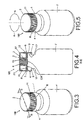
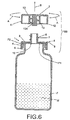
- the main model 100 of the cap and overcap assembly presented herein may be assembled in a generic bottle model F, as may be seen, initially, on figures 3 to 8 , with this assembly performed so that the botton face 10 of the cap 1 is in contact with the upper border of the bottleneck F1 of bottle F, while the thick border bent inwards 5 establishes a locking condition with surrounding borders F2 of said bottle F, such as depicted on figures 4 , 6 , 7 and 8 .
- the cap assembly 100 which constitutes the main cap model presented herein is conveyed in order to allow the assembly against the bottle F by compression, with the retention generated by the thick border bent inwards 5 of the cap 1 and the surrounding border F2 of bottle F.
- the "luer" connection 6 of cap 1 allows for the occurrence of the procedure shown on figure 7 , where a SH hypodermic syringe is used to introduce, directly to the bottle F, a given volume of liquid L for reconstitution of powdered medicine product M stored in the bottle F.
- Figure 7 shows the forward movement of the plunger SH1 of the syringe SH as the reconstitution liquid L inside the syringe may be transferred to the bottle F, such as indicated by the "E" arrows.
- connection between the syringe SH and the bottle F is possible precisely because the SH syringe also features, conventionally, a connection of the same "luer" standard, such as previewed on cap 1.
- Figure 7 schematically shows the possibility of direct attachment between the hypodermic syringe SH (not equipped with a needle) and the cap 1 of the assembly 100 mounted near the bottle F.
- Figure 8 shows the subsequent stage described by figure 7 and in which the reconstitution liquid L has already been properly homogenized to the medicine product M stored in the bottle F; this figure shows the product (reconstituted M medicine) being drawn into the hypodermic syringe SH, as may be seen by arrow "F” which represents the retraction movement of the plunger SH1 of the SH syringe, and also the "G” arrows indicating the flow direction of the reconstituted product (reconstituted M medicine) flowing inside the SH syringe;
- the hypodermic syringe SH Upon transfer of the reconstituted M medicine to the hypodermic syringe SH, it may then be manipulated as shown, for example, on figure 9 , where it is schematically demonstrated the possibility of direct attachment of the hypothermic syringe SH and a bag B, such as the proposal on patent application PI 1003460-9 of this same applicant.
- Figure 9 serves to demonstrate the preparation dynamics of pharmaceutical substances and/or injectable medicine products that were made viable, in previous stages, due to employment of a cap assembly 100 (cap and overcap), proposed previously.
- the "H” arrows represent the inlet flow of the reconstituted product (reconstituted medicine product M) which is administered to the bag B through its inlet door B1 which also features a "luer" terminal.
- the cap presented herein also allows the possibility of direct attachment to a bag B with "luer" standard in cases where the reconstitution and dilution of the medicine product may be performed with the same diluent, which is correct to say that in this case only one operation is performed, that is, reconstitution and dilution.
- Figure 9A shows exactly the condition according to which a bag B of the type described in the patent application PI 1003460-9 may be directly attached, through its inlet door B1 which features a respective connection in the "lue” standard, the "luer” connection of cap 1 mounted on a bottle F.
- the cap assembly shown is indicated by numerical reference 100, which does not exclude the condition in which the same type of direct connection may be established with any of the other versions of the cap assembly in question.
- Figures 10. 11 and 12 show the cap assembly 100 presented herein in a condition in which it is employed with bottles F that must store liquid medicine products, which must be submitted to a freeze-drying process.
- figure 10 shows an initial stage, where the medicine product M, still in its liquid phase, is already packed within bottle F and where said bottle F is now equipped with a cap 1 still separated from its overcap 2.
- Figure 11 schematically shows what occurs at the moment of the freeze-drying phase itself, where the medicine product M loses, through sublimation (evaporation), its liquid phase, such as indicated by arrows I, and the only the powdered form of the medicine product M remains within the bottle.
- Figure 12 shows the following stage regarding those demonstrated on figure 11 , where after the full evaporation of the liquid phase of the medicine product M inside the bottle F, the cap 1 that closes the bottle F received an overcap 2, which is threaded to the cap 1 through the "luer" terminals.
- the “J” arrows show the clockwise rotation direction needed for the assembly of the overcap 2 with the cap 1, while the “K” arrow indicates the direction of resulting approach between the overcap 2 and cap 1.
- Figures 10, 11 and 12 seek to schematically show the fact that the cap assembly 100, considering that the cap 1 and its overcap 2 might be initially separated, and subsequently joined permanently by the weld S, is usable for providing sealing to bottles with liquid medicine products M which must be submitted to freeze-drying processes.
- Figure 13 shows a first variation of the cap presented herein, which, as an assembly, is indicated by reference 110.
- the assembly 110 of the cap presented herein and shown on figures 13, 14 , 15, 16 and 17 is a version destined particularly for use in bottles F which shall be filled with liquid medicine products that will be submitted to freeze-drying processes.
- the assembly 110 does not require its overcap 2 to be separated from the cap 1 at the moment of the freeze-drying process.
- the cap 1 On the assembly 110, the cap 1 has a central projection 14, which presents a slightly conic lower end 15, while the upper portion of this central projection 14 incorporates outlet openings 16 positioned equidistantly.
- the overcap 2 does not differ from the model of assembly 100, and the same occurs in fact regarding cap 1, being the only exception the provision of the aforementioned central projection 14.
- the assembly 110 features the same basic details regarding its cap 1 and overcap 2, which are found on the assembly 100.
- the assembly 110 such as the one verified regarding assembly 100, has its cap 1 formed by a disc-shaped section 3, which is augmented by a surrounding vertical wall 4, the latter being covered, in its internal and lower region, by a thick edge bent inwards 5.
- the periphery of the circular face of the disc-shaped section 3 of the cap 1 features an outstanding upwards border 8 which ends in an acute edge 9, while the botton face 10 of the disc-shaped section 3 is supported by the bottleneck F1 of bottle.
- the aforementioned details are also indicated particularly on figure 14 .
- the overcap 2 of assembly 110 such as verified regarding assembly 100, has a disc format featuring a surrounding wall 11, dimensioned in order to have, preferably, the same diameter as the cap 1.
- the central and lower regions of the overcap 2 of assembly 110 feature a tube projection 13, also according to the "luer” standard 6 and with an internal thread wire 13", which complements and connects to the "luer” connection 6 through the thread wire 7, which is part of the cap 1.
- the tube projection 13 features a cylindrical projection 13A centrally and coaxially positioned, which enters the tube connection 6 of the cap 1.
- edges 9 and 12 of cap 1 and overcap 2 are expected, which are produced so that they may be joined by a weld S and, when united, define the breaking line R.
- the central projection 14 of the assembly 110 makes all the difference, since it enables said assembly to be preliminarily mounted on the bottle F, as shown on figure 15 , in a condition which matches the outlet openings 16 placed above the upper border of the bottleneck F1 of the bottle F.
- the medicine product M in powder state, may be definitely closed within the bottle F through the lowering of the assembly 110, as shown on figure 17 and as indicated by the "K" arrow.
- the assembly 110 When lowered, under pressure, the assembly 110 establishes with the bottle F a condition of retention regarding its cap 1, such as verified regarding the assembly 100, but in such condition the outlet openings 16 are then obstructed by the bottleneck wall F3 of the bottle F.
- the assembly 110 When the assembly 110 is lowered, the thick border 5 of the cap 1 is then locked against the surrounding border F2 of the bottle F.
- Figures 15, 16 and 17 demonstrate that the cap assembly 110 is complete since the initial stage shown on figure 15 , or in other words, the cap assembly 110 might have its cap 1 and respective overcap 2 previously joined together permanently through welding, being applied in this condition to the bottle F and maintaining such condition even after the conclusion of its attachment to the bottle F, as specifically shown on figure 17 .
- FIG 16 clearly and evidently shows the fact that the steam generated by sublimation of the liquid phase of the medicine product M finds on the outlet openings 16 a quick outlet option, such as indicated by the "I" arrows.
- Figure 18 shows a second variation of the cap presented herein, which, as an assembly, is indicated by reference 120 and presents a distinct setup regarding the overcap 2 and employs, as a strengthening resource for fixation of the cap 1 to the bottle F, a re-sealing seal 17.
- the overcap 2 of the cap assembly 120 differs from the overcap 2 used in assemblies 100 and 110 exclusively due to having a relatively lower diameter.
- the reduction of diameters for overcap 2 aims to enable that the re-sealing seal 17, which may be manufactured in plastic, advances with its upper border 18 over the upper wall of the disc-shaped section 3 of the cap 1.
- the cap 1 of the assembly 120 differs from the model adopted for assemblies 100 and 110 due to the fact that its edge 9 has a disposition with reduced diameter in the same diameter as the edge 12 of the overcap 2.
- the use of the re-sealing seal 17 on the cap assembly 120 seeks to improve the connection between cap 1 (and consequently also its overcap 2) with the bottle F (not showed on Figures and 19), mainly due to the fact that the re-sealing seal 17 reinforces, with its lower border 19, the role of the thick curved border 5 which integrates the structure of the cap 1 over the border F2 of the bottle F. Excluding the re-sealing seal 17, the assembly 120 features the same basic details regarding its cap 1 and overcap 2 and which are also found on the assembly 100.
- the cap 1 of the assembly 120 is formed by a disc-shaped section 3 which is complemented by a surrounding vertical wall 4, the latter being covered in the lower region by a thick curved edge 5, while from the center of the circular face of the disc-shaped section 3, a tube connection 6 elaborated in the "luer" standard goes vertically upwards, having in its outer wall an outer screw cap wire 7.
- the periphery of the circular face of the disc-shaped section 3 of the cap 1 features an outstanding upwards border 8 which ends in an acute edge 9, while the inner face 10 of the disc-shaped section 3 is upheld in the battlehead of the respective bottle.
- the overcap 2 of assembly 120 such as verified regarding assembly 100, has a disc format featuring a surrounding wall 11, dimensioned in order to have, as per already explained, a smaller diameter than the one verified on cap 1.
- the central and lower regions of the overcap 2 of assembly 120 feature a tube projection 13, also according to the "luer” standard 6 and with an internal outer screw cap wire 13', which complements and connects to the "luer” connection 6 through the outer screw cap wire 7, which is part of the cap 1.
- the tube projection 13 features a cylindrical projection 13A centrally and coaxially positioned, which enters the tube connection 6 of the cap 1.
- edges 9 and 12 when joined by welding S, define the rupture line R.
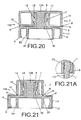
- Figure 20 shows a schematic sectional view of a third variation of the cap presented herein, which is indicated, as an assembly, by reference 130.
- the assembly 130 is basically a sub-variant of the assembly 100, differing from the latter due to including a central projection 20 on its lower region, with said central projection 20 having a slightly conic lower end 21, such as verified with the central projection 14 used on the assembly 110.
- the central projection 20 functions as a facilitating guide for fixation of the cap 1 to the top F1/bottleneck F2 of the bottle F (the bottle F is not specifically shown on figure 20 ).
- the assembly 130 features the same basic details regarding the cap 1 and overcap 2, which are found on the assembly 100.
- the cap 1 of the assembly 130 is formed by a disc-shaped section 3 which is complemented by a surrounding vertical wall 4, the latter being covered in the lower region by a thick inward curved border 5, while from the center of the circular face of the disc-shaped section 3, a tube connection 6 elaborated in the "luer" standard goes vertically upwards, having in its outer wall an outer screw cap wire 7.
- the periphery of the circular face of the disc-shaped section 3 of the cap 1 features an outstanding upwards border 8 which ends in an acute edge 9, while the inner face 10 of the disc-shaped section 3 is upheld in the bottlehead F1 of the bottle.
- the acute edge 9, when joined by welding S to the edge 12 of overcap 2, defines, together, the breaking line R.
- the overcap 2 of assembly 130 such as verified regarding assembly 100, has a disc format featuring a surrounding wall 11, dimensioned in order to have a diameter equal to the one verified on cap 1.
- the central and lower regions of the overcap 2 of assembly 130 feature a tube projection 13, also according to the "luer” standard and with an internal screw cap wire 13', which complements and connects to the "luer” connection 6 through a screw cap wire 7, which is part of the cap 1.
- the tube projection 13 features a cylindrical projection 13A centrally and coaxially positioned, which enters the tube connection 6 of the cap 1.
- FIG 21 shows a fourth variation of the cap presented herein, which, as an assembly, is indicated by reference 140.
- the cap assembly 140 includes a cap 1 and its respective overcap 2, with the overcap 2 having the same diameter setup adopted by the cap 2 employed on the assembly 120, also adopting the re-sealing seal 17.
- the cap 1 of the assembly 140 features a version of the central projection 20 adopted on the assembly 130, and differs from it due to fact that it yet includes a surrounding rib 22 placed on the outer region of the central projection 20 in order to provide a sealed connection with a surrounding lower section, normally provided on the inner region of the bottleneck F3 of the bottle F.
- the provision of a surrounding rib 22 on the central projection 20 has the function of increasing both the retaining conditions of the cap 1 regarding the bottle F, through the attachment of said rib 22 against one of the ring-shaped lower sections F4 provided on the inner wall of the bottleneck F3, as well as hermetic sealing conditions between both.
- Figure 21A which is an expanded detailed and schematic section taken from figure 21 includes the representation of the bottleneck section F3 of a typical bottle F and where the attachment between the rib 22 of the projection 20 and the lower section F4 of the bottleneck F3 of the bottle F may be viewed.
- the assembly 140 features the same basic details regarding the cap 1 and overcap 2, which are found on the assembly 100.
- the cap 1 of the assembly 140 is formed by a disc-shaped section 3 which is complemented by a surrounding vertical wall 4, the latter being covered in the lower region by a thick inward curved border 5, while from the center of the circular face of the discshaped section 3, a tube connection 6 elaborated in the "luer" standard goes vertically upwards, having in its outer wall an outer screw cap wire 7.
- the periphery of the circular face of the disc-shaped section 3 of the cap 1 features an outstanding upwards border 8 which ends in an acute edge 9, while the botton face 10 of the disc-shaped section 3 is upheld in the bottlehead F1 of the bottle.
- the overcap 2 of assembly 140 such as verified regarding assembly 100, has a disc format featuring a surrounding wall 11, dimensioned in order to have a smaller diameter in relation to the one verified on cap 1.
- the central and lower regions of the overcap 2 of assembly 140 feature a tube projection 13, also according to the "luer” standard and with an internal outer screw cap wire 13', which complements and connects to the "luer” connection 6 through the screw cap wire 7, which is part of the cap 1.
- the tube projection 13 features a cylindrical projection 13A centrally and coaxially positioned, which enters the tube connection 6 of the cap 1.
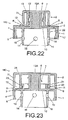
- the figure 22 shows a fifth variant of the cap, object of this invention patent application, which, as assembly, is indicated by the numeric reference 150.
- the assembly 150 derives from the assembly 140 cap model and includes one central projection in the molds of the one verified in the assembly 110 and that is indicated by the numeric reference 14, which is having one slightly conical bottom end 15, while the upper portion of this central projection 14 incorporates through-holes 16 arranged in an equidistant way.
- the central projection 14 still has one contouring rib 22, which has the function of raising the retention condition of the cap 1 regarding the bottle F by coupling the mentioned rib 22 against the ring recess F4 provided in the neck internal wall F3 of the bottles F normally used, such that already showed regarding what is pictured in the figure 21A .
- the assembly 150 shows the same basic details regarding its cap 1 and overcap 2 and the ones found in the assembly 100.
- the assembly 150 cap 1 is formed by one disc-shaped section 3 that is complemented by one vertical contouring wall 4, this latter being garnished downward by one thicken and turned inward border 5, so from the center of the circular face of the disc-shaped section 3, one tubular connection 6 elaborated in the "luer” standard goes vertically upwards, having in its outer wall one outer screw cap wire 7.
- the circular face periphery of the disc-shaped section 3 of the cap 1 shows one upwards prominent border 8 ending in one sharp edge 9, while the underside 10 of the disc-shaped section 3 is upheld in the bottlehead.
- the assembly 150 overcap 2 such as the one verified regarding the assembly 100, shows one disc shape having one contouring wall 11 sized to have one diameter measure smaller than the one verified in the cap 1.
- the central and bottom region of the assembly 150 overcap 2 shows one tubular projection 13 also in the "luer” standard and having one internal screw cap wire 13, which complements and connects to the "luer” connection 6 through the screw cap wire 7 that is part of the cap 1.
- the tubular projection 13 has one cylindrical projection 13A central and coaxially positioned, which enters into the tubular connection 6 of the cap 1.
- the assembly 150 é complemented by one re-sealing seal 17.
- the edges 9 and 12, when joined by welding define, together, the breakage line R.
- the figure 23 shows a sixth variant of the cap hereof, which, as assembly, is indicated by the reference 160 and derives from the assembly 150 model pictured in the figure 22 .
- the variant 160 includes one cap 1, which, around its "luer" connection 6, incorporates one low and contouring wall 23 with smaller diameter having one outer contouring rib 24, against which to match one inner contouring rib 25 from one contouring wall 26 with higher diameter beginning from the overcap 2 underside.
- the assembly 160 overcap 2 further maintains the cylindrical projection 13A beginning from its center and that is sized to be inserted inside the "luer" connection 6 of the cap 1.
- contouring walls 23 and 26 correspond to one alternative to ensure the overcap 2 assembling against the cap 1 without requiring using threads.
- the assembly 160 cap 1 has one central projection 14, which has one slightly conical bottom end 15, while the upper portion of this central projection 14 incorporates through-holes 16 arranged equidistantly.
- the assembly 160 shows the same basic details regarding its cap 1 and overcap 2 and that are found in the assembly 100.
- the assembly 160 cap 1 is formed by one disc-shaped section 3 that is complemented by one vertical contouring wall 4, this latter being garnished downward by one thicken and turned inward border 5.
- the circular face periphery of the disc-shaped section 3 of the cap 1 shows one upwards prominent border 8 ending in one sharp edge 9, while the underside 10 of the disc-shaped section 3 is upheld in the bottlehead.
- the assembly 160 overcap 2 such as the one verified regarding the assembly 100, shows one disc shape having one contouring wall 11 sized to have one diameter measure equal to the one verified in the cap 1.
- the edges 9 and 12 when joined by welding, define together, the breakage line R.
- the figure 24 shows a seventh variant of the cap, object of this invention patent application, which, as assembly, is indicated by the reference 170.
- the assembly 170 is one model variation of the assembly 160 cap, which differs from this last assembly by including the central projection 20, serving as facilitating guide to attach the cap, for use in bottles F for filled products that need to be subject to the freeze-drying process.
- the cap 1 has around its "luer" connection 6 one low and contouring wall 23 with smaller diameter having one outer contouring rib 24, against which is to match one inner contouring rib 25 from one contouring wall 26 with higher diameter and beginning from the underside of the overcap 2.
- the assembly 170 cap 1 further maintains the cylindrical projection 13A beginning from its center and that is sized to be inserted inside the "luer" connection 6 of the cap 1.
- contouring walls 23 and 26 embedded in the cap 1 and overcap 2 of the assembly 170 correspond to one alternative to ensure the overcap 2 assembling against the cap 1 without requiring the use of threads.
- the assembly 170 shows the same basic details regarding its cap 1 and overcap 2 and that are found in the assembly 100.
- the assembly 170 cap 1 is formed by one disc-shaped section 3 that is complemented by one vertical contouring wall 4, this latter being garnished downward by one thicken and turned inward border 5.
- the circular face periphery of the disc-shaped section 3 of the cap 1 shows one upwards prominent border 8 ending in one sharp edge 9, while the underside 10 of the disc-shaped section 3 is upheld in the bottlehead.
- the assembly 170 overcap 2 such as the one verified regarding the assembly 100, shows one disc shape having one contouring wall 11 sized to have one diameter measure equal to the one verified in the cap 1.
- the edges 9 and 12 when joined by welding, define together, the breakage line R.
- the figure 25 shows an eighth variant of the cap, object of this invention patent application, which, as assembly, is indicated by the numeric reference 180.
- the assembly 180 includes the cap 1 arrangement such as the one verified in the assembly 160, however it links this arrangement to employ one re-sealing seal 17, the reason why the overcap 2 shows one arrangement with reduced diameter, such as the one verified, for example, in the assembly 150.
- the cap assembly 180 also includes one central projection 20, analogous to the one verified in the assembly 140 pictured in the figure 21 , being this central projection 20 having one contouring rib 22 equally.
- the attachment system of the overcap 2 against the cap 1 follows the same solution adopted in the assemblies 160 and 170, where the cap 1 has around its "luer" connection 6 one low and contouring wall 23 with smaller diameter having one outer contouring rib 24, against which is to match one inner contouring rib 25 from one contouring wall 26 with higher diameter and that, in the present case, constitutes the outer wall 11 of the overcap 2.
- the assembly 180 cap 1 further maintains the cylindrical projection 13A beginning from its center and that is sized to be inserted inside the "luer" connection 6 of the cap 1.
- contouring walls 23 and 26 embedded in the cap 1 and overcap 2 of the assembly 180 correspond to one alternative to ensure the overcap 2 assembling against the cap 1 without requiring the use of threads.
- the assembly 180 shows the same basic details regarding its cap 1 and overcap 2 and that are found in the assembly 100.
- the assembly 180 cap 1 is formed by one disc-shaped section 3 that is complemented by one vertical contouring wall 4, this latter being garnished downward by one thicken and turned inward border 5.
- the circular face periphery of the disc-shaped section 3 of the cap 1 shows one upwards prominent border 8 ending in one sharp edge 9, while the underside 10 of the disc-shaped section 3 is upheld in the bottlehead.
- the assembly 180 overcap 2 such as the one verified regarding the assembly 100, shows one disc shape having the contouring wall 11 already mentioned, but sized to have one diameter measure smaller than the one verified in the cap 1.
- the edges 9 and 12 when joined by welding, define together, the breakage line R.
- the figures 26 and 27 show a ninth variant of the cap here proposed, which, as assembly, is indicated by the reference 190 and links the assembly 180 cap 1 to one modality of the overcap 2, which has one single discoid portion 27 that is held by the upper border 18 of the re-sealing seal 17.
- the assembly 190 overcap 2 shows one portion with smaller diameter 28, in the same molds of the one verified, for example, in the assembly 180 pictured in the figure 25 .
- the assembly 190 cap 1 further maintains the cylindrical projection 13A beginning from its center and that is sized to be inserted inside the "luer" connection 6 of the cap 1.
- the assembly 190 cap 1 is formed by one disc-shaped section 3 that is complemented by one vertical contouring wall 4.
- the assembly 190 overcap 2 such as the one verified regarding the assembly 100, shows one disc shape having the contouring wall 11 already mentioned, but sized to have one diameter measure smaller than the one verified in the cap 1.
- the vertical contouring wall 4 of the assembly 190 cap 1 is garnished downward by one thicken and turned inward border 5.
- the rupture line R may be established at the overcap assembling moment 2, such that the edges 9 and 12 are already produced in a totally linked way, which means that the mentioned rupture line R is exclusively positioned in the overcap 2.
- the assembly 190 dismisses to adopt the welding procedure of the region to join the edges 9 and 12 of the cap 1 and overcap 2, given that as upstanding component, the overcap 2 is fixed to the cap 1 by the re-sealing seal 17 acting, such overcap 2 must be positioned over the cap 1 before performing the re-sealing seal 17 application.
Landscapes
- Health & Medical Sciences (AREA)
- Pharmacology & Pharmacy (AREA)
- Life Sciences & Earth Sciences (AREA)
- Animal Behavior & Ethology (AREA)
- General Health & Medical Sciences (AREA)
- Public Health (AREA)
- Veterinary Medicine (AREA)
- Medical Preparation Storing Or Oral Administration Devices (AREA)
Applications Claiming Priority (2)
| Application Number | Priority Date | Filing Date | Title |
|---|---|---|---|
| BR102012193353 | 2012-08-02 | ||
| PCT/BR2013/000273 WO2014019042A1 (pt) | 2012-08-02 | 2013-07-26 | Conjunto de tampa dotada com conexão para acoplamento de seringa hipodérmica e sobretampa para emprego no fechamento de frascos destinados ao envase de produtos farmacêuticos e medicamentos injetáveis |
Publications (2)
| Publication Number | Publication Date |
|---|---|
| EP2905009A1 true EP2905009A1 (de) | 2015-08-12 |
| EP2905009A4 EP2905009A4 (de) | 2016-02-10 |
Family
ID=53500983
Family Applications (1)
| Application Number | Title | Priority Date | Filing Date |
|---|---|---|---|
| EP13825146.7A Withdrawn EP2905009A4 (de) | 2012-08-02 | 2013-07-26 | Stopfenanordnung mit einer verbindung zum koppeln einer hypodermischen spritze und einer kappe zum verschliessen von flaschen für injizierbare pharamzeutika und arzneimittel |
Country Status (1)
| Country | Link |
|---|---|
| EP (1) | EP2905009A4 (de) |
Family Cites Families (5)
| Publication number | Priority date | Publication date | Assignee | Title |
|---|---|---|---|---|
| US5509433A (en) * | 1993-10-13 | 1996-04-23 | Paradis; Joseph R. | Control of fluid flow |
| FR2800713B1 (fr) * | 1999-11-05 | 2002-01-04 | Biodome | Dispositif de connexion entre un recipient et un contenant et ensemble pret a l'emploi comprenant un tel dispositif |
| FR2836129B1 (fr) * | 2002-02-20 | 2004-04-02 | Biodome | Dispositif de connexion entre un recipient et un contenant et ensemble pret a l'emploi comprenant un tel dispositif |
| JP5456324B2 (ja) * | 2006-02-14 | 2014-03-26 | アーツナイミッテル・ゲーエムベーハー・アポテーカー・フェッター・ウント・コンパニー・ラフェンスブルク | シリンジ |
| JP5549048B2 (ja) * | 2007-08-16 | 2014-07-16 | 味の素株式会社 | 薬剤バイアルとプレフィルドシリンジの接続構造 |
-
2013
- 2013-07-26 EP EP13825146.7A patent/EP2905009A4/de not_active Withdrawn
Also Published As
| Publication number | Publication date |
|---|---|
| EP2905009A4 (de) | 2016-02-10 |
Similar Documents
| Publication | Publication Date | Title |
|---|---|---|
| US20150238387A1 (en) | Cap assembly having hypodermic syringe coupling connection and overcap for use in sealing of bottles filled with pharmaceutical and injectable medicine products | |
| JP6628152B2 (ja) | ボトルの密閉方法および関連する密閉されたボトル | |
| JP5965946B2 (ja) | バイアルと他の医療用容器の移送セット | |
| JP4381679B2 (ja) | 医薬用容器をプラスチック閉鎖体でシールする方法 | |
| CA2677286C (en) | Closure cap for a container for receiving medical liquids, and container for receiving medical liquids | |
| JP6310855B2 (ja) | パッケージ | |
| US6524295B2 (en) | Container cap assembly having an enclosed penetrator | |
| JP6251280B2 (ja) | シーリング装置及びこれに割り当てられた容器 | |
| JP6985013B2 (ja) | 容器 | |
| TR201909989T4 (tr) | İlaç şişesi başlığı. | |
| JP2007515228A (ja) | 無針アクセスバイアル | |
| MX2011006139A (es) | Tapa de cierre para recipientes para recepcion de liquidos medicinales y recipiente para recepcion de liquidos medicinales. | |
| JP2001513683A (ja) | 脆性シール及び流体移動デバイス用コネクタを有する容器クロージャー | |
| ZA200602538B (en) | Connector for medical liquid-containing packages and medical liquid-containing packages | |
| JP2011530377A (ja) | 薬剤容器システムにおいて使用される2つ以上の成分の混合のための容器用充てん済みインサート | |
| JP2021184862A (ja) | 組成物を集めることを可能にするための封止デバイス、そのような封止デバイスを含む包装アセンブリ、収集方法および包装方法 | |
| JP2017522235A5 (de) | ||
| UA128628C2 (uk) | Система ємностей і їх з'єднання | |
| KR102479664B1 (ko) | 회전에 의해 조작되는 컨테이너 마개 | |
| US20130180999A1 (en) | Pre-filled fluid cartridge and filling methods | |
| EP2905009A1 (de) | Stopfenanordnung mit einer verbindung zum koppeln einer hypodermischen spritze und einer kappe zum verschliessen von flaschen für injizierbare pharamzeutika und arzneimittel | |
| RU173333U1 (ru) | Крышка для укупорки полимерных флаконов с инфузионными медицинскими растворами | |
| US20240316279A1 (en) | Pre-filled syringe (PFS) with twist-breakable tip, ensuring that the syringe is tamper-resistant and can be reliably opened | |
| BR112019010889B1 (pt) | Produto de recipiente de plástico | |
| HK1133178A (en) | Closure cap for a container for receiving medical liquids, and container for receiving medical liquids |
Legal Events
| Date | Code | Title | Description |
|---|---|---|---|
| PUAI | Public reference made under article 153(3) epc to a published international application that has entered the european phase |
Free format text: ORIGINAL CODE: 0009012 |
|
| 17P | Request for examination filed |
Effective date: 20150302 |
|
| AK | Designated contracting states |
Kind code of ref document: A1 Designated state(s): AL AT BE BG CH CY CZ DE DK EE ES FI FR GB GR HR HU IE IS IT LI LT LU LV MC MK MT NL NO PL PT RO RS SE SI SK SM TR |
|
| AX | Request for extension of the european patent |
Extension state: BA ME |
|
| DAX | Request for extension of the european patent (deleted) | ||
| RA4 | Supplementary search report drawn up and despatched (corrected) |
Effective date: 20160112 |
|
| RIC1 | Information provided on ipc code assigned before grant |
Ipc: A61J 1/00 20060101ALI20160105BHEP Ipc: A61J 1/20 20060101AFI20160105BHEP |
|
| 17Q | First examination report despatched |
Effective date: 20160330 |
|
| STAA | Information on the status of an ep patent application or granted ep patent |
Free format text: STATUS: EXAMINATION IS IN PROGRESS |
|
| STAA | Information on the status of an ep patent application or granted ep patent |
Free format text: STATUS: THE APPLICATION IS DEEMED TO BE WITHDRAWN |
|
| 18D | Application deemed to be withdrawn |
Effective date: 20161110 |