EP2905218A1 - Vorrichtung zum Verstauen eines Segels - Google Patents
Vorrichtung zum Verstauen eines Segels Download PDFInfo
- Publication number
- EP2905218A1 EP2905218A1 EP14154061.7A EP14154061A EP2905218A1 EP 2905218 A1 EP2905218 A1 EP 2905218A1 EP 14154061 A EP14154061 A EP 14154061A EP 2905218 A1 EP2905218 A1 EP 2905218A1
- Authority
- EP
- European Patent Office
- Prior art keywords
- storage device
- boom
- lateral
- sail
- boat
- Prior art date
- Legal status (The legal status is an assumption and is not a legal conclusion. Google has not performed a legal analysis and makes no representation as to the accuracy of the status listed.)
- Withdrawn
Links
- 239000011324 bead Substances 0.000 claims description 10
- 239000004744 fabric Substances 0.000 claims description 7
- 238000012423 maintenance Methods 0.000 claims description 5
- 230000000694 effects Effects 0.000 description 4
- 239000000463 material Substances 0.000 description 3
- FAPWRFPIFSIZLT-UHFFFAOYSA-M Sodium chloride Chemical compound [Na+].[Cl-] FAPWRFPIFSIZLT-UHFFFAOYSA-M 0.000 description 2
- 229910000831 Steel Inorganic materials 0.000 description 2
- XAGFODPZIPBFFR-UHFFFAOYSA-N aluminium Chemical compound [Al] XAGFODPZIPBFFR-UHFFFAOYSA-N 0.000 description 2
- 229910052782 aluminium Inorganic materials 0.000 description 2
- 230000008901 benefit Effects 0.000 description 2
- 239000002131 composite material Substances 0.000 description 2
- 239000004033 plastic Substances 0.000 description 2
- 229920003023 plastic Polymers 0.000 description 2
- -1 polyethylene Polymers 0.000 description 2
- 238000007789 sealing Methods 0.000 description 2
- 238000000926 separation method Methods 0.000 description 2
- 235000002639 sodium chloride Nutrition 0.000 description 2
- 239000011780 sodium chloride Substances 0.000 description 2
- 239000010959 steel Substances 0.000 description 2
- XLYOFNOQVPJJNP-UHFFFAOYSA-N water Substances O XLYOFNOQVPJJNP-UHFFFAOYSA-N 0.000 description 2
- 239000004698 Polyethylene Substances 0.000 description 1
- 239000004743 Polypropylene Substances 0.000 description 1
- 230000004913 activation Effects 0.000 description 1
- 230000006978 adaptation Effects 0.000 description 1
- 230000008859 change Effects 0.000 description 1
- 230000005484 gravity Effects 0.000 description 1
- 230000004048 modification Effects 0.000 description 1
- 238000012986 modification Methods 0.000 description 1
- 238000000465 moulding Methods 0.000 description 1
- 229920000573 polyethylene Polymers 0.000 description 1
- 229920000642 polymer Polymers 0.000 description 1
- 229920001155 polypropylene Polymers 0.000 description 1
- 229920000915 polyvinyl chloride Polymers 0.000 description 1
- 239000004800 polyvinyl chloride Substances 0.000 description 1
- 238000004321 preservation Methods 0.000 description 1
- 230000002035 prolonged effect Effects 0.000 description 1
- 230000005855 radiation Effects 0.000 description 1
- 239000013535 sea water Substances 0.000 description 1
- 230000007480 spreading Effects 0.000 description 1
- 238000009423 ventilation Methods 0.000 description 1
- 239000002023 wood Substances 0.000 description 1
Images



Classifications
-
- B—PERFORMING OPERATIONS; TRANSPORTING
- B63—SHIPS OR OTHER WATERBORNE VESSELS; RELATED EQUIPMENT
- B63H—MARINE PROPULSION OR STEERING
- B63H9/00—Marine propulsion provided directly by wind power
- B63H9/04—Marine propulsion provided directly by wind power using sails or like wind-catching surfaces
- B63H9/08—Connections of sails to masts, spars, or the like
- B63H9/10—Running rigging, e.g. reefing equipment
- B63H9/1092—Means for stowing, or securing sails when not in use
Definitions
- the present invention relates to a boat comprising a boom attached to a mast and a device for storing a sail comprising a rigid structure having a first lateral flank and a second lateral flank each having an opposite end and a second end; one to the other, each lateral flank being at least partially connected to said boom by its first end, said storage device being arranged to have a first open position in which said sail can be hoisted or lowered and a second closed position according to which said sail can be stored inside said storage device, said storage device further comprising control means arranged to allow a passage from said open position to said closed position and vice versa.
- Such a boat comprising such a storage device is known from the document FR2969117 which describes a boat equipped with a mast, a boom and a mainsail storage device.
- This mainsail storage device includes a structure and a storage bag attached to the boom of the boat. More particularly, according to an embodiment disclosed in this document to the figure 1 , the storage device comprises an armature composed of a series of arches in the form of lamellae, these arches being fixed in the center and along the upper part of the boom. Moreover, these arches define side flanks which are connected at their upper free end to lazy-jacks for controlling the opening and closing of the arches by inverting their concavity.
- a flexible fabric is placed on the arches so as to form a storage bag which can, by actuating lazy-jacks, to move from an open position to a closed position and vice versa.
- the free ends of the lateral flanks that is to say the free ends of the hoops in the form of slats, are spaced from each other to define an opening so that the mainsail can to be hoisted or slumped.
- Activation of the lazy jacks then makes it possible, when the mainsail is slumped, to bring the free ends of the side flanks so that the hoops are closed around the mainsail which is thus stored inside the device. storage.
- the invention aims to overcome these drawbacks of the state of the art by providing a device for storing a sail which, even in sailing conditions and during the presence of strong winds, can hoist or down the sail with less hindrance not only at the side walls of the storage device connected to the boom but also at the level of lazy-jacks.
- a boat characterized in that said first ends of each lateral side of said storage device are each connected to a respective lateral side of said boom via at least one a point of articulation, in that each lateral flank of said storage device has a substantially concave shape and that an angle extending from said boom towards each of said second ends of said storage device has a higher value at 90 °, preferably a value greater than or equal to 120 °, preferably a value greater than or equal to 180 ° when said storage device is in the open position.
- an angle extending from the boom to each of the second ends has a greater than 90 ° when the device for storing the sail of the boat has an open position
- lazy-jacks are maintained at a predetermined distance from the axis defined by the mast of the boat. This predetermined distance makes it possible to prevent the movement of the sail when it is hoisted or when it is being leveled off by the presence of lazy jacks, even in the presence of wind, and therefore when the sail has random movements. .
- each of the second ends of the lateral flanks of the device for storing the sail of the boat holds the lazy-jacks at a predetermined distance from the axis formed by the mast, this predetermined distance being at least substantially greater than the width that can present the sail in navigation condition, that is to say when subjected to winds with a speed of the order from 1 to 10 Beaufort and therefore has random movements.
- each side flank of said storage device has a substantially concave shape
- the resulting opening forms a vessel, that is to say a receptacle, which allows to guide the sail during its affalement and to facilitate storage in the storage device.
- the concave shape of the lateral flanks the latter delimit a receptacle and act as guiding and holding elements allowing the sail, even in the presence of wind, to be inserted and to be adequately maintained. in the storage device without exiting inadvertently under the effect of wind.
- said first and second lateral sides of said storage device each define a rigid shell.
- a shell makes it possible, when the storage device is in the closed position, to isolate the sail in a completely rigid storage chamber, for example made of a polymer such as polyethylene, polypropylene or polyvinyl chloride.
- the shell can also be formed from aluminum, steel, wood or a composite material.
- Such materials have the advantage of being durable in their resistance to the weather, salinity of seawater and ultra-violet, which allows to ensure a prolonged storage of the sail, for example during wintering.
- said first and second lateral flanks of said storage device are each formed by a series of rigid arches spaced relative to each other by a predetermined distance, a cover fabric being fixed to the arches in such a way as to cover a space delimited by said arches.
- the arches form a kind of rigid skeleton on which can be placed a fabric, for example a fabric fabric waterproofed or not, a canvas made of a plastic material or a tarpaulin. This embodiment makes it easy to change and replace the cover fabric when it is worn.
- the rigidity of these structures prevents the storage device applies a force to the sail when the latter is in the closed position. This is advantageous when a pressure applied to the sail forms folds in the latter and promotes stagnation of water and the presence of moisture between layers of sail arranged and superimposed.
- said control means comprise lazy-jacks or ropes cooperating with a pulley system located at the mast of said boat.
- Such control systems are commonly used on boats to hoist or lower the sail at the boom. It is therefore particularly advantageous to be able to use these conventional control systems to control a storage device according to the invention, which makes it possible to avoid having to implement place specific control means and requiring substantial adaptations of the boat.
- said control means comprise ropes or ropes cooperating with a pulley system located inside said storage device.
- a pulley is attached to a first end of an arm whose second end is connected to said boom, an angle greater than 90 ° being defined between said arm and an axis defined by said boom.
- at least one additional pulley is added to such a control means at the point of articulation, for example under the point of articulation.
- Such a control means is an alternative to the presence of lazy-jacks to control said storage device, which avoids any hindrance that would constitute lazy-jacks.
- the angle between said arm supporting said pulley and the axis defined by said boom is greater than 90 °, the presence of said arm does not hinder the movement of the sail during its slendering or hoisting.
- said at least one pivot point is chosen from the group consisting of pivots, box hinges, piano hinges, flap hinges, hinges, and straps or ropes, for example in the form of rings connected to the boom.
- Such hinge points make it easy to implement articulation and movement of said lateral flanks of said storage device relative to said boom.
- said at least one hinge point for example of the piano hinge type, can extend all along the first end of each lateral side of the storage device to connect said storage device to the boom. It is also envisaged, according to the invention, that several points of articulation, spaced relative to each other, connect said storage device to the boom.
- the hinge points can be formed for example of aluminum, steel, plastic or a composite material.
- said lateral flanks of said storage device have a tapered shape towards one end of the boom opposite to one end of the boom connected to the mast of said boat. In this way, the wind resistance of the storage device, in navigation condition, is significantly reduced.
- the two bases of substantially cylindrical shape are at least partially open so as not to form an obstacle to the flow of wind.
- These openings at the bases of the storage device substantially cylindrical shape also provide ventilation of the sail when stored in the storage device. This makes it possible to avoid water stagnation at the level of the sail, the protection and preservation of which is thus improved.
- said second ends of each lateral flank of said storage device each comprise a bead, said beads being arranged to overlap each other when said storage device is in the closed position.
- Such a superposition of the beads ensures not only a maintenance of the storage device in the closed position but also a seal of the junction zone between the two lateral sides of the storage device in the closed position.
- the sail is protected from the elements (rain, sea salt, etc.) and sun rays (ultra-violet), which ensures better protection and durability.
- these beads which may be present all along the second ends of the lateral flanks or only present at spaced apart points at the second ends of the side flanks, allows to dispense with an additional manual step of closing the storage device to its upper part. Such a closure being difficult to achieve since it must be performed in height all along the boom.
- said second ends of each lateral flank of said storage device comprise connecting elements arranged to ensure a maintenance of each lateral flank with respect to each other.
- said connecting elements are chosen from the group consisting of magnets, male-female interlocking systems and self-gripping Velcro® type systems, but also straps or ropes.
- Such connecting elements allow a maintenance of each lateral side of said storage device relative to each other, which, like the beads described above, provides protection of the sail, both weather (rain , sea salt, ...) as radiation from the sun.
- the beads and the junction elements may be in the form of clipped, riveted, glued or screwed profiles at the second ends of the lateral flanks or may form an integral part of the lateral flanks, for example when formed in same time as the rigid shells during a molding made to form each of the lateral flanks.
- said lateral flanks of said storage device each comprise attachment zones of said control elements, for example eyelets or hooks.
- attachment zones allow for example lazy-jacks to attach to the side flanks which they must control the opening and closing.
- the present invention also relates to a storage device for a sail to be mounted on the boom of a boat, said storage device comprising a rigid structure having a first lateral flank and a second lateral flank each having a first end and a second end opposite to each other, each lateral flank being at least partially connected to said boom by its first end, said storage device being arranged to present a first open position according to which said sail can be hoisted or lowered and a second closed position in which said sail can be stored inside said storage device, said storage device further comprising control means arranged to allow a passage from said open position to said closed position and vice versa, said storage device being characterized in that said first ends of each lateral flank are each connected to a respective lateral side of said boom via at least one point d articulation, in that each lateral flank said storage device has a substantially concave shape and that an angle extending from said boom towards each of said second ends of said storage device has a value greater than 90 °, preferably a value greater than or equal to 120 °,
- such a device where a hinge point ensures each time the connection between the first ends of each lateral flank to a respective lateral side of the boom and in which an angle extending from said boom towards each of said second ends has a value greater than 90 ° when the device is in the open position, allows the sail, even when it has random movements due to the presence of strong winds, to be hoisted or lowered without hindrance, in avoiding any friction between the sail and lazy-jacks since such an angle whose value is greater than 90 ° ensures a wide opening of the storage device.
- the lazy-jacks are maintained at predetermined distance from the axis defined by the mast of the boat, this predetermined distance to prevent the movement of the sail, during its hoisting or during its affalement, to be hampered by the presence of lazy-jacks, this even in the presence of wind and therefore when the sail has random movements.
- each of the second ends of the lateral flanks of the device for storing the sail of the boat holds the lazy-jacks at a predetermined distance from the axis formed by the mast, this predetermined distance being at least substantially greater than the width that can present the sail in navigation condition, that is to say when it has, therefore, random movements.
- each lateral flank of said storage device has a substantially concave shape
- the resulting opening forms a vessel, that is to say a receptacle, which guides the sail during its affalement and to facilitate storage.
- the concave shape of the lateral flanks act as guiding and holding elements allowing the sail, even in the presence of wind, to fit and to be adequately maintained in the device. storage without coming out unexpectedly under the effect of wind.
- the invention also relates to a use of a storage device a boat.
- the figure 1 illustrates a boat 1 comprising a boom 2 attached to a mast 3, a sail 4 being hoisted from the boom 2 along the mast 4.
- the boat further comprises a storage device 5 of the sail 4, this storage device 5 comprising a rigid structure and having two lateral flanks 6a, 6b (see, for example, FIG. figure 2a ).
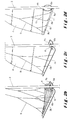
- the figure 2a illustrates more particularly a storage device 5 in the closed position having the two lateral flanks 6a, 6b.
- Each lateral flank 6a, 6b has a first end 7a and a second end 7b opposite one another, the first end 7a of each lateral flank being connected to a respective lateral side of the boom 2 via a series of hinge points 8a, 8b, 8c.
- Lazy-jacks 9 constitute control elements of the storage device 5 and make it possible to command an opening or closing when they are actuated by traction or released.
- Fastening zones 10 are provided on the lateral flanks 6a, 6b so that the lazy jacks 9 can be connected thereto.
- each lateral flank 6a, 6b When the lazy-jacks 9 are released (released), they allow each lateral flank 6a, 6b to deviate from the axis defined by the boom 2 (as illustrated in FIGS. Figures 2b and 2c ). Since each sidewall 6a, 6b is connected via hinge points 8a, 8b, 8c to a respective lateral side of the boom 2, an angle ⁇ extending from said boom 2 to each of said second ends 7b of the lateral flanks 6a, 6b and which has a value greater than 90 ° (as illustrated in FIGS. Figures 2b and 2c ) is obtained when the storage device 5 is in the open position.
- Such an opening of the storage device 5 has a suitable dimension that allows one hand to easily store the sail 4 during its affalement even in the presence of strong winds.
- such an angle ⁇ extending from said boom 2 to each of said second ends 7b of the lateral flanks 6a, 6b keeps the lazy jacks 9 at a good distance from the axis defined by the mast 3 so that the sail 4 does not come into contact and does not get entangled in them.
- the dimension of the opening of the storage device 5 in the open position is such that even when the sail 4 has strong random movements due to the presence of wind, it can be slumped and stored easily not only without being hampered in its descent movement by the side flanks 6a, 6b but also without being hindered in its movement by lazy-jacks 9.
- the lazy-jacks 9 When a traction force is exerted on the lazy-jacks 9, the latter cause the lateral flanks 6a, 6b towards the axis defined by the boom 2 so as to pass the storage device 5 from an open position to a closed position in which the second ends 7b of each lateral flank 6a, 6b are brought together and brought into contact.
- the figure 2b illustrates more particularly a storage device 5 in the open position, the sail 4 is therefore exposed to the open air.
- the passage from the closed position as shown in figure 2a to the open position as shown in figure 2b is obtained by loosening the lazy-jacks 9, which allows the lateral flanks 6a, 6b, under the effect of the force of gravity and under the effect of their own weight, to deviate from the axis defined by the boom 2.
- the open position allows the sail 4 to be in the hoisting position.
- An angle ⁇ extending from said boom 2 to each of said second ends 7b of the lateral flanks 6a, 6b of said storage device 5 has a value greater than 90 ° when said storage device 5 is in the open position.
- Such an angle opening is possible by the presence of hinge points 8a, 8b, 8c connecting each lateral flank 6a, 6b to a respective lateral side of said boom 2 and to obtain this opening of abatement.
- hinge points 8a, 8b, 8c connecting each lateral flank 6a, 6b to a respective lateral side of said boom 2 and to obtain this opening of abatement.
- the Figure 2c illustrates more particularly a storage device 5 in the open position, the sail 4 being hoisted along the mast 3.
- the figure 2d illustrates more particularly a storage device 5 positioned when the boat is sailing, the side flanks 6a, 6b being brought along the sail 4 (by pulling on the lazy-jacks 9) so as to minimize wind resistance of the device storage 5.
- FIGS. 3a and 3b illustrate, in a sectional view, a storage device 5 in the closed position, each of whose side flank 6a, 6b is connected to the boom 2 by means of a pivot point in the form of a pivot 8a, 8b .
- These articulation points 8a, 8b allow the lateral flanks 6a, 6b, connected to the boom 2 at their first end 7a to deviate from the axis defined by the boom 2.
- Each lateral flank 6a, 6b is provided with an attachment zone 10a, 10b to which is connected a lazy-jack 9.
- beads 11a, 11b which, when the storage device 5 is in the closed position overlap to ensure the maintenance of the side flanks 6a, 6b relative to each other but also a sealing of the device storage 5 in the junction area between the side flanks 6a, 6b.
- magnet-shaped connecting elements 12a, 12b are illustrated which, like the beads 11a, 11b illustrated in FIG. figure 3a , allow to maintain the side flanks 6a, 6b relative to each other but also a sealing of the storage device 5 in the junction area between the side flanks 6a, 6b.
- the figure 4 illustrates a storage device 5 in the closed position.
- This storage device 5 is identical to that illustrated in FIG. figure 3b , except for the control means.
- the control means no longer relies on the presence of lazy-jacks 9 and on a pulley system fixed at the mast 3.
- the control means is based on the presence of ropes 11, 11 '(rope) each connected to the inner wall of each of the lateral flanks 6a, 6b by means of gripping zones 12, 12 'and each cooperating with a pulley 13, 13' located inside the storage device 5.
- This pulley 13, 13 ' is connected to a first end 14, 14 'of an arm 15, 15' whose second end 16, 16 'is connected to the boom 2.
- an angle ⁇ , ⁇ ' greater than 90 ° is provided between the arm 15, 15 'and the axis defined by the boom 2, such that these arms 15, 15' do not hinder the movement of the sail 4 during its spreading or hoisting.
- an additional pulley 17, 17 ' is provided outside the storage device 5 for guiding the ropes 11, 11'.
- each lateral flank 6a, 6b When the ropes 11, 11 'are released, they allow each lateral flank 6a, 6b to deviate from the axis defined by the boom 2. Since each lateral flank 6a, 6b is connected via dots articulation 8a, 8b to a respective lateral side of the boom 2, an angle ⁇ (see Figures 2b and 2c ) extending from said boom 2 to each of said second ends 7b of the lateral flanks 6a, 6b and which has a value greater than 90 ° is obtained when the storage device 5 is in the open position.
- Such an opening of the storage device 5 has a suitable dimension that allows easy storage of the sail 4 during its affalement even in the presence of strong winds.
Landscapes
- Engineering & Computer Science (AREA)
- Life Sciences & Earth Sciences (AREA)
- Sustainable Development (AREA)
- Sustainable Energy (AREA)
- Chemical & Material Sciences (AREA)
- Combustion & Propulsion (AREA)
- Mechanical Engineering (AREA)
- Ocean & Marine Engineering (AREA)
- Ladders (AREA)
Priority Applications (1)
| Application Number | Priority Date | Filing Date | Title |
|---|---|---|---|
| EP14154061.7A EP2905218A1 (de) | 2014-02-06 | 2014-02-06 | Vorrichtung zum Verstauen eines Segels |
Applications Claiming Priority (1)
| Application Number | Priority Date | Filing Date | Title |
|---|---|---|---|
| EP14154061.7A EP2905218A1 (de) | 2014-02-06 | 2014-02-06 | Vorrichtung zum Verstauen eines Segels |
Publications (1)
| Publication Number | Publication Date |
|---|---|
| EP2905218A1 true EP2905218A1 (de) | 2015-08-12 |
Family
ID=50068846
Family Applications (1)
| Application Number | Title | Priority Date | Filing Date |
|---|---|---|---|
| EP14154061.7A Withdrawn EP2905218A1 (de) | 2014-02-06 | 2014-02-06 | Vorrichtung zum Verstauen eines Segels |
Country Status (1)
| Country | Link |
|---|---|
| EP (1) | EP2905218A1 (de) |
Cited By (4)
| Publication number | Priority date | Publication date | Assignee | Title |
|---|---|---|---|---|
| WO2019202147A1 (fr) | 2018-04-20 | 2019-10-24 | Bourderau Frederic | Dispositif de recuperation et de stockage d'une grand voile apres affalage |
| FR3103173A1 (fr) * | 2019-11-14 | 2021-05-21 | Romain LUCAT | Bôme a dispositif de reception d'une grand-voile, a geometrie variable et a usages divers |
| WO2021107887A1 (en) * | 2019-11-27 | 2021-06-03 | Irmak Tuncer | Sail collection system |
| FR3161409A1 (fr) | 2024-04-23 | 2025-10-24 | Compagnie Generale Des Etablissements Michelin | Dispositif de rangement d’une aile de navire |
Citations (2)
| Publication number | Priority date | Publication date | Assignee | Title |
|---|---|---|---|---|
| US639916A (en) * | 1899-03-04 | 1899-12-26 | Gustav Achterberg | Sail-reefing device. |
| FR2969117A1 (fr) | 2010-12-16 | 2012-06-22 | Romain Lucat | Dispositif de rangement de grand-voile comprenant un sac de rangement de grand-voile se fixant a la bome d'un voilier |
-
2014
- 2014-02-06 EP EP14154061.7A patent/EP2905218A1/de not_active Withdrawn
Patent Citations (2)
| Publication number | Priority date | Publication date | Assignee | Title |
|---|---|---|---|---|
| US639916A (en) * | 1899-03-04 | 1899-12-26 | Gustav Achterberg | Sail-reefing device. |
| FR2969117A1 (fr) | 2010-12-16 | 2012-06-22 | Romain Lucat | Dispositif de rangement de grand-voile comprenant un sac de rangement de grand-voile se fixant a la bome d'un voilier |
Cited By (6)
| Publication number | Priority date | Publication date | Assignee | Title |
|---|---|---|---|---|
| WO2019202147A1 (fr) | 2018-04-20 | 2019-10-24 | Bourderau Frederic | Dispositif de recuperation et de stockage d'une grand voile apres affalage |
| FR3080360A1 (fr) * | 2018-04-20 | 2019-10-25 | Frederic Bourderau | Dispositif de recuperation et de stockage d’une grand-voile apres affalage |
| FR3103173A1 (fr) * | 2019-11-14 | 2021-05-21 | Romain LUCAT | Bôme a dispositif de reception d'une grand-voile, a geometrie variable et a usages divers |
| WO2021107887A1 (en) * | 2019-11-27 | 2021-06-03 | Irmak Tuncer | Sail collection system |
| FR3161409A1 (fr) | 2024-04-23 | 2025-10-24 | Compagnie Generale Des Etablissements Michelin | Dispositif de rangement d’une aile de navire |
| WO2025224009A1 (fr) | 2024-04-23 | 2025-10-30 | Compagnie Generale Des Etablissements Michelin | Dispositif de rangement d'une aile de navire |
Similar Documents
| Publication | Publication Date | Title |
|---|---|---|
| CA2676738C (fr) | Dispositif a volet enroulable autour d'un tambour | |
| WO2010094770A1 (fr) | Dispositif mécanisé de manoeuvre d'une voile | |
| EP2905218A1 (de) | Vorrichtung zum Verstauen eines Segels | |
| FR3025176A1 (fr) | Aile portante escamotable | |
| EP2384963B1 (de) | Unterwasserverbindungsstück zur Verbindung einer Erdölanlage, das mit einer Trennschutzvorrichtung ausgestattet ist | |
| EP0078230B1 (de) | Einrichtung zum Aufrollen und Aufbewahren von Segeln | |
| EP3209546A1 (de) | System zum aussetzen und bergen von see- und unterseevorrichtungen mit unterstützung durch kippbare schutzkomponenten | |
| FR2702445A1 (fr) | Dispositif de guidage de ralingue de guindant notamment d'une voile enroulable sur bome. | |
| EP4347384B1 (de) | Segelantriebselement, segelangetriebenes fahrzeug | |
| FR2963924A1 (fr) | Dispositif pour la recuperation d'un engin marin ou sous-marin | |
| EP3394367B1 (de) | Teleskopische einheit zur lagerung eines abdeckelements in einem lagerraum | |
| WO2019202147A1 (fr) | Dispositif de recuperation et de stockage d'une grand voile apres affalage | |
| WO1999019205A1 (fr) | Dispositif pour stabiliser l'assiette d'un navire en situation de mouillage ou de derive | |
| FR3053720B1 (fr) | Store a lames orientables | |
| FR2949147A1 (fr) | Dispositif pour l'installation de capteurs solaires ou de panneaux photovoltaiques, avec une possibilite de pivotement, sur une structure porteuse | |
| FR2496589A1 (fr) | Mat telescopique | |
| FR3017852A1 (fr) | Dispositif de stabilisation antiroulis et/ou antitangage de bateaux | |
| FR2824530A1 (fr) | Planche a voile perfectionnee | |
| FR2639605A1 (fr) | Aile volante souple munie de cables tracteurs destinee notamment a tirer un bateau | |
| EP1213220B1 (de) | Führungsvorrichtung für ein Segel | |
| WO2016135337A1 (fr) | Dispositif de manutention et de remorquage d'un objet submersible | |
| FR3023259A1 (fr) | Dispositif de maintien d'une voile aile sur un vehicule tel qu'un navire | |
| WO1994005544A2 (fr) | Systeme pour l'enroulement d'un spinnaker | |
| FR3033765A1 (fr) | Voile aile a orientation automatique | |
| FR3120845A1 (fr) | Système de traction à aile captive avec pliage en manche à air |
Legal Events
| Date | Code | Title | Description |
|---|---|---|---|
| PUAI | Public reference made under article 153(3) epc to a published international application that has entered the european phase |
Free format text: ORIGINAL CODE: 0009012 |
|
| AK | Designated contracting states |
Kind code of ref document: A1 Designated state(s): AL AT BE BG CH CY CZ DE DK EE ES FI FR GB GR HR HU IE IS IT LI LT LU LV MC MK MT NL NO PL PT RO RS SE SI SK SM TR |
|
| AX | Request for extension of the european patent |
Extension state: BA ME |
|
| STAA | Information on the status of an ep patent application or granted ep patent |
Free format text: STATUS: THE APPLICATION IS DEEMED TO BE WITHDRAWN |
|
| 18D | Application deemed to be withdrawn |
Effective date: 20160213 |