EP2905943B1 - Verfahren zur Bereitstellung von externen Kontrolldiensten in einem Netzwerk - Google Patents
Verfahren zur Bereitstellung von externen Kontrolldiensten in einem Netzwerk Download PDFInfo
- Publication number
- EP2905943B1 EP2905943B1 EP14154541.8A EP14154541A EP2905943B1 EP 2905943 B1 EP2905943 B1 EP 2905943B1 EP 14154541 A EP14154541 A EP 14154541A EP 2905943 B1 EP2905943 B1 EP 2905943B1
- Authority
- EP
- European Patent Office
- Prior art keywords
- component
- control
- application
- request information
- switching
- Prior art date
- Legal status (The legal status is an assumption and is not a legal conclusion. Google has not performed a legal analysis and makes no representation as to the accuracy of the status listed.)
- Active
Links
Images

Classifications
-
- H—ELECTRICITY
- H04—ELECTRIC COMMUNICATION TECHNIQUE
- H04L—TRANSMISSION OF DIGITAL INFORMATION, e.g. TELEGRAPHIC COMMUNICATION
- H04L67/00—Network arrangements or protocols for supporting network services or applications
- H04L67/50—Network services
- H04L67/56—Provisioning of proxy services
- H04L67/566—Grouping or aggregating service requests, e.g. for unified processing
-
- H—ELECTRICITY
- H04—ELECTRIC COMMUNICATION TECHNIQUE
- H04L—TRANSMISSION OF DIGITAL INFORMATION, e.g. TELEGRAPHIC COMMUNICATION
- H04L67/00—Network arrangements or protocols for supporting network services or applications
- H04L67/50—Network services
- H04L67/56—Provisioning of proxy services
- H04L67/567—Integrating service provisioning from a plurality of service providers
-
- H—ELECTRICITY
- H04—ELECTRIC COMMUNICATION TECHNIQUE
- H04L—TRANSMISSION OF DIGITAL INFORMATION, e.g. TELEGRAPHIC COMMUNICATION
- H04L63/00—Network architectures or network communication protocols for network security
- H04L63/08—Network architectures or network communication protocols for network security for authentication of entities
- H04L63/0815—Network architectures or network communication protocols for network security for authentication of entities providing single-sign-on or federations
-
- H—ELECTRICITY
- H04—ELECTRIC COMMUNICATION TECHNIQUE
- H04L—TRANSMISSION OF DIGITAL INFORMATION, e.g. TELEGRAPHIC COMMUNICATION
- H04L67/00—Network arrangements or protocols for supporting network services or applications
- H04L67/01—Protocols
- H04L67/02—Protocols based on web technology, e.g. hypertext transfer protocol [HTTP]
Definitions
- the invention relates to a method for providing external control services in a network.
- web applications are provided on a web server of the network (for example the Internet) in order to enable a user of a terminal (mobile or fixed) connected to the network to use the web application.
- the web application is executed on the web server of the operator of the network and / or on the end device of the user (for example in the web browser).
- Such a web application is, for example, an online shop system provided over the Internet, whereby various control services (e.g. authentication services and / or authorization services for authentication or authorization of the user) are required for ordering goods and / or services for a reliable and secure ordering process.
- the invention is defined in the independent claims.
- the invention is based on the object of specifying a method for providing control services in a network, which is improved in such a way that the technical outlay for providing the control services is reduced, in particular if the control services are external control services (ie control services of a third-party operator) who is not the operator of the network).
- the inventive method it is advantageously possible for the inventive method to provide external control services in a network in such a way that the technical outlay - i.e. in particular, the effort to maintain the various interfaces for providing the control services for the application components is reduced.
- the switching component encapsulates (packs) the external control services over the internal or own services (i.e. the services that are under the control of the network operator). This advantageously makes it possible to simplify the use of the control services.
- the term "encapsulate" is to be understood here in the sense of data encapsulation - i.e. as a process that supplements the data or information to be sent in a header (and / or trailer) of the respective layers (corresponding to a reference model for network protocols).
- the corresponding interface of the switching component to the first control component is configured or maintained.
- the switching component is configured in such a case in particular such that access to the first control component (with the compromised one Interface) is no longer possible. This advantageously makes it possible to react relatively quickly to security problems.
- the application component is configured to provide an application service (for example an e-mail service or another application), the application service in particular (only) mediating (or logging in) (ie by logging in or logging in) or provided.
- an application service for example an e-mail service or another application
- the application service in particular (only) mediating (or logging in) (ie by logging in or logging in) or provided.
- an external control service is preferably an external service of an operator of an external network, which service has in particular the first and second control components.
- the first control component is preferably configured as an identity provider (IDP).
- IDP is configured such that control response information is made available as a function of control request information (ie transmitted to the requesting component by means of a response message), the control request information in particular having user-specific control data (such as login data), the control response information in particular Has authentication information.
- the second control component is preferably configured as a payment service provider (PSP).
- PSP payment service provider
- control response information is made available as a function of control request information (ie transmitted as a second response message to the respective requesting component), the control request information in particular user-specific control data (ie payment data, such as bank data and / or other account data and / or an amount of money).
- the control response information is preferably generated by the PSP as a function of the control request information, the control response information having authorization information for authorizing the control data (and optionally for enabling one or more payment methods).
- the authorization information is generated in particular by means of an authorization process, with an authorization of an EC or, for example, in the authorization process Credit card payment is made by the cardholder's credit institution.
- both the first and the second control component can be configured as an IDP, PSP or as a provider of another control service.
- the term “component” (ie in particular a client component, application component, switching component and / or control component) comprises a software component and / or hardware component which is used in particular for communication via the network with a corresponding other component (ie in particular a client component, application component, switching component and / or control component) is configured.
- a component is configured as a server component and / or client component, with a service being provided in particular by the server component of a client component (i.e. by exchanging messages - with request information and response information - between the client component and the server component).
- a web application for example an online shop
- the application component here as a server component
- the respective control service is provided, for example, by a control component (here as a server component) of the switching component (here as a client component), the control service being provided (mediated) in particular by the switching component (here as a server component) of the application component (here as a client component).
- an interface is that part of a component which is used for communication.
- Information is exchanged in particular in the form of physical (e.g. electrical voltage, current) or logical quantities (data) via the interface.
- the switching component has a control component (control logic or set of rules) and a database, the switching component (using the database) being configured for data storage with regard to information about the control component.
- the switching component is configured to carry out a control method, wherein in a first control step the Mediation component is determined at which control component (ie, for example, the first, a further first, second or a further second control component) the first control response information is queried, the first control response information being queried in a second control step from the control component determined in the first control step.
- control information is determined in the first control step, the control information relating, for example, to the usability of a control component and / or to access to a control component.
- the rule information comprises a rule component for each combination of application component and control component.
- the control component is determined from which the control response information is requested.
- the first application component comprises an erotic portal in connection with an anonymous payment service and the second application component an online shop in connection with another payment service.
- the anonymous payment service is provided by the first control component (first PSP) and the further payment service is provided by the second control component (second PSP).
- first PSP first control component
- second PSP second control component
- a revenue share absolute and / or relative amount
- the switching component is preferably configured such that the second control response information (with regard to the online shop) is queried - in particular only - from the second control component if the control response information is related to a control value (for example a price) that relates to a control threshold value (for example a price limit). exceeds.
- a control value for example a price
- control threshold value for example a price limit
- the first (or further first) control component comprises a first IDP in connection with a first security level and the second (or further second) control component a second IDP in connection with a second security level.
- the first security level security level
- the control information is configured such that in the first control step the first control component is determined if the first control request information is related to a request of the first security level and / or in the first control step the second control component is determined if the first control request information is related to a request of the second security level related.
- the communication between the switching component and the first and second application components takes place in each case via an interface of the switching component of a first interface type, the communication between the switching component and the first and second control components taking place in each case via a second interface of the switching component of a second interface type.
- the external control services are encapsulated in relation to the internal services in such a way that only the first interface type is used for communication with the application component and only the second interface type is used for communication with the control component.
- interface of a first interface type preferably means an interface of the switching component that is configured for communication between the application component and switching component such that one or more control services of one or more control components of the application component are provided (by encapsulation of the data transmitted via the second interface).
- interface of a second interface type means an interface of the switching component that is configured for communication between a control component and the switching component in such a way that a control service of the control component of the switching component is provided (by encapsulation of the data transmitted via the first interface).
- Such a first and / or second interface is preferably a data interface, hardware interface, network interface or software interface.
- the switching component is operated or configured such that the switching component acts like a control component towards the application component n via the interface of the first type, which encapsulates in particular the interface of the second type towards the external control services.
- the switching component uses a first transmission protocol for communication with the first and second application components and that a second transmission protocol different from the first transmission protocol is used for communication with the first and second control components.
- security guidelines are implemented on both sides of the communication of the switching component - ie on the one hand with the application components and on the other hand with the control components.
- the security guidelines are also referred to as so-called closed triangles (for example in the case of additional host-to-host communication between the switching component and application component and / or between the switching component and control component) or as so-called open triangles (for example if any information - i.e. both the control request information and that Control response information - via a client component - e.g. the customer's web browser - is encrypted and transferred in the so-called redirect URLs (Uniform Resource Locator).
- closed triangles for example in the case of additional host-to-host communication between the switching component and application component and / or between the switching component and control component
- open triangles for example if any information - i.e. both the control request information and that Control response information - via a client component - e.g. the customer's web browser - is encrypted and transferred in the so
- the additional host-to-host communication achieves a higher level of security because the control request information and / or control response information is thereby transmitted via the switching component directly (ie without using the user's web browser) between the application component and the control component such that, for example, manipulation of the Authentication information and / or authorization information by the user is not possible.
- the first control component is an authentication component and the second control component is an authorization component.
- the first and second application components are web applications, the client component being a web browser, the control data being queried by a user of the web browser or being determined automatically by the client component, user-specific login data or payment data being used in particular as control data become.
- Another object of the present invention is a switching component for providing external control services in a network
- the Switching component is configured for communication with a first application component, a second application component of a first control component and a second control component, the switching component for receiving a first control request information sent from the first application component to the switching component and for receiving a second one sent from the second application component to the switching component Control request information is configured, wherein the switching component is configured to query first control response information from the first or second control component as a function of the received first control request information, wherein the switching component is configured to query second control response information from the first or second control component as a function of the received second control request information, whereby the mediation component for the practice bear the queried first control response information to the first application component and configured to transmit the second control response information to the second application component.
- the switching component is hereby particularly advantageously possible according to the invention for the switching component to be configured such that the switching component acts like a control component with respect to the application components. In this way, an efficient, yet reliable and secure exchange and provision of the external services to the (multitude) of application components is realized.
- the switching component each has an interface of a first interface type for communication with the first and second application components and that each has an interface of a second interface type for communication with the first and second control components ,
- the switching component is configured in such a way that the switching component acts as a control component towards the application components by means of the interface of the first interface type, which in particular the interface of the second interface type (ie the data transmitted via the second interface) encapsulates the external control services.
- the switching component is configured such that the switching component is dependent on the received first and / or second Control request information specifies which control component of the first and second control components the control response information is requested from.
- the switching component has functionalities and / or logics (software or hardware) which determine which control component may or may be used for an application. The determination or selection takes place, for example, depending on the security level (or the security policy used) of the application component, the amount of a (user-specific) amount of money, a determined location (of the user) or other data.
- the present invention also relates to a computer program with program code means, with the aid of which all steps of the method according to the invention can be carried out if the computer program is executed on at least one programmable device of a network.
- the present invention furthermore relates to a computer program product with a computer-readable medium and a computer program stored on the computer-readable medium with program code means which are suitable for carrying out all the steps of the method according to the invention when the computer program is executed on at least one programmable device in a network.
- Figure 1 is a schematic view of a network.
- the network has a first application component 11, a second application component 12, a third application component 13 and / or a fourth application component 14.
- a first control component 21, a further first control component 21 ', a second control component 22 and a further second control component 22' are connected to the network.
- the first to fourth application components 11,..., 14 are web applications which are executed on one or more web servers and in particular for communication with a user - in particular via a web browser (see, for example, reference number 41 in Figure 3 ) are configured.
- first and further first control components 21, 21 ' are configured such that in each case one control service - for example provider services for login services (IDP) - through the first and further first control components 21, 21' to a requesting component (here to the first to fourth application component 11, ... ,, 14) is provided.
- one control service for example provider services for login services (IDP) - through the first and further first control components 21, 21' to a requesting component (here to the first to fourth application component 11, ... ,, 14) is provided.
- IDP provider services for login services
- the second and further second control components 22, 22 ' are configured in such a way that a control service - for example a provider service for payment services (PSP) - is sent through the second and further second control components 22, 22' to a requesting component (here to the first to fourth application components 11, ..., 14) is provided.
- a control service - for example a provider service for payment services (PSP) - is sent through the second and further second control components 22, 22' to a requesting component (here to the first to fourth application components 11, ..., 14) is provided.
- PSP provider service for payment services
- each application component 11, ..., 14 must be connected to the external services - that is, for communication with the plurality of control components (here the first, further first, second and further second control components 21, 21 ', 22, 22 ') be configured so that the control services of the control components 21, 21', 22, 22 'are provided to the application components 11, ..., 14. This creates a comparatively high effort to care for the individual Interfaces for communication between the large number of application components 11, ..., 14 and the large number of control components 21, 21 ', 22, 22'.
- IDP provider services for login services
- PSP payment services
- FIG. 2 is schematically shown a view of a network according to the invention.
- the network has a switching component 31 according to the invention, the switching component 31 being configured such that the external services - ie the external control services of the plurality of control components 21, 21 ', 22, 22' connected to the network - compared to the own services ( of the first to fourth application components 11,..., 14) are encapsulated by the switching component 31 such that only one first interface (a first interface type) with respect to the (internal or own) application components and only one second interface (a second interface type) ) to the (external or external) control services.
- a first interface type with respect to the (internal or own) application components
- second interface a second interface type
- the switching component 31 acts here with respect to the first to fourth application components 11, 12, 13, 14 - via the first interface (the switching component 31), which the interfaces with the plurality (third-party or external) control components 21, 21 ', 22, 22' encapsulates - like a first, further first, second and / or further second control component 21, 21 ', 22, 22' (ie for example like an IDP and / or PSP).
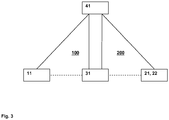
- FIG. 3 A view of a network according to the invention is shown schematically, here the communication of a switching component 31 according to the invention with a client component 41 (for example a browser associated with a user), a first application component 11 (for example a web application) and a first control component 21 (and / or second one Control component 22) is shown.
- the first application component 11 and the first control component 21 are described as representative of the multiplicity of application components 11,..., 14 and control components 21, 21 ', 22, 22', the communication of the switching component 31 with the multiplicity of application components 11,. ..., 14 and the large number of control components 21, 21 ', 22, 22' in particular in each case take place or can take place in the same way.
- the switching component 31 (which is also referred to here as a "broker") is configured in particular in such a way that communication of the switching component 31 with the first application component 11 (see reference number 100) - via the first interface of the switching component - and communication of the switching component 31 the first control component 21 (see reference numeral 200) - via the second interface of the switching component 31 - by means of different transmission protocols.
- SAML, OpenID, OAuth or other transmission protocols are used as transmission protocols.
- Different security guidelines ie so-called “security guidelines” are implemented on both communication sides (indicated here by reference numerals 100 and 200). For example, so-called closed triangles (i.e.
- the switching component has, in particular, a functionality and / or logic that is / are configured such that it is additionally determined which control component of the plurality of control components 21, 21 ', 22, 22' (ie ISP or PSP) for a (specific) Application component of the plurality of application components 11, ..., 14 may be used or is used. This determination or selection is made, for example, depending on a security level of the specific application component (i.e. the web application), an amount of a monetary amount and / or a determined location.
Landscapes
- Engineering & Computer Science (AREA)
- Computer Networks & Wireless Communication (AREA)
- Signal Processing (AREA)
- Computer And Data Communications (AREA)
Description
- Die Erfindung betrifft ein Verfahren zur Bereitstellung von externen Kontrolldiensten in einem Netzwerk.
- Beispielsweise werden Webapplikationen auf einem Webserver des Netzwerks (beispielsweise dem Internet) bereitgestellt, um einem Benutzer eines mit dem Netzwerk verbundenen (mobilen oder ortsgebundenen) Endgeräts die Verwendung der Webapplikation zu ermöglichen. Hierzu wird die Webapplikation auf dem Webserver des Betreibers des Netzwerks und/oder auf dem Endgerät des Benutzers (beispielsweise im Webbrowser) ausgeführt. Eine solche Webanwendung ist beispielsweise ein über das Internet bereitgestelltes Online-Shopsystem, wobei zur Bestellung von Waren und/oder Dienstleistungen verschiedene Kontrolldienste (z.B. Authentifizierungsdienste und/oder Autorisierungsdienste zur Authentifizierung bzw. Autorisierung des Benutzers) für einen möglichst zuverlässigen und sicheren Bestellvorgang erforderlich sind.
- Die Bereitstellung mehrerer Kontrolldienste in einem eine Vielzahl solcher Webapplikationen umfassenden Netzwerk ist für einen Betreiber des Netzwerks typischerweise mit einem hohen technischen Aufwand verbunden. Es besteht daher ein Bedarf, die Bereitstellung der Kontrolldienste in dem Netzwerk zu verbessern. In dem Artikel "Harmonizing services and network provisioning for federative access in a mobile environment" von Lutz D. J. et al. wird eine Gesamtarchitekt für den Zusammenschluss mehrerer Domänen offenbart. Das Dokument
EP2442528 offenbart ein System und eine Methode eines Sicherheitsmodells, welche Interoperabilität mit auswärtigen Domänen anbietet. - Die Erfindung wird in den unabhängigen Ansprüchen definiert. Der Erfindung liegt die Aufgabe zugrunde, ein Verfahren zur Bereitstellung von Kontrolldiensten in einem Netzwerk anzugeben, welches derart verbessert ist, dass der technische Aufwand zur Bereitstellung der Kontrolldienste reduziert wird, insbesondere wenn es sich bei den Kontrolldiensten um externe Kontrolldienste (d.h. Kontrolldienste eines fremden Betreibers, der nicht Betreiber des Netzwerkes ist) handelt.
- Diese Aufgabe wird erfindungsgemäß gelöst durch ein Verfahren zur Bereitstellung von externen Kontrolldiensten in einem Netzwerk, wobei das Netzwerk eine erste Anwendungskomponente, eine zweite Anwendungskomponente und eine Vermittlungskomponente umfasst, wobei eine erste und zweite Kontrollkomponente an dem Netzwerk angebunden ist, wobei das Verfahren folgende Verfahrensschritte umfasst:
- -- Empfangen einer von der ersten Anwendungskomponente an die Vermittlungskomponente gesendeten ersten Kontrollanfrageinformation,
- -- Empfangen einer von der zweiten Anwendungskomponente an die Vermittlungskomponente gesendeten zweiten Kontrollanfrageinformation,
- -- Abfragen einer ersten Kontrollantwortinformation bei der ersten oder zweiten Kontrollkomponente in Abhängigkeit der empfangenen ersten Kontrollanfrageinformation,
- -- Abfragen einer zweiten Kontrollantwortinformation bei der ersten oder zweiten Kontrollkomponente in Abhängigkeit der empfangenen zweiten Kontrollanfrageinformation,
- -- Übertragen der abgefragten ersten Kontrollantwortinformation an die erste Anwendungskomponente und der zweiten Kontrollantwortinformation an die zweite Anwendungskomponente.
- Es ist gemäß der vorliegenden Erfindung in vorteilhafter Weise möglich, dass durch das erfindungsgemäße Verfahren externe Kontrolldienste in einem Netzwerk so bereitgestellt werden, dass der technische Aufwand - d.h. insbesondere der Aufwand zur Pflege der verschiedenen Schnittstellen zur Bereitstellung der Kontrolldienste für die Anwendungskomponenten reduziert wird. Es ist dabei erfindungsgemäß besonders bevorzugt, dass die Vermittlungskomponente die externen Kontrolldienste gegenüber den internen oder eigenen Diensten (d.h. den Diensten, die unter Kontrolle des Betreibers des Netzwerks stehen) kapselt (verpackt). Hierdurch ist es vorteilhaft möglich, dass die Nutzung der Kontrolldienste vereinfacht wird. Insbesondere ist hier der Begriff "kapseln" im Sinne einer Datenkapselung zu verstehen - d.h. als ein Prozess, der die zu versendenden Daten oder Informationen in einem Header (und/oder Trailer) der jeweiligen Schichten (entsprechend eines Referenzmodells für Netzwerkprotokolle) ergänzt.
- Beispielsweise wird bei einer kompromittierten Schnittstelle zur ersten Kontrollkomponente (nur) die entsprechende Schnittstelle der Vermittlungskomponente zur ersten Kontrollkomponente konfiguriert bzw. gepflegt. Das bedeutet insbesondere, dass nicht die Schnittstellen aller Anwendungskomponenten konfiguriert bzw. gepflegt werden müssen. Weiterhin wird die Vermittlungskomponente in einem solchen Fall insbesondere derart konfiguriert, dass ein Zugriff auf die erste Kontrollkomponente (mit der kompromittierten Schnittstelle) nicht mehr möglich ist. Hierdurch ist es vorteilhaft möglich, auf Sicherheitsprobleme vergleichsweise schnell zu reagieren.
- Erfindungsgemäß bevorzugt umfasst eine Anwendungskomponente:
- -- ein Präsentationssystem zur Präsentation von Waren und/oder Dienstleistungen über das Netzwerk (insbesondere für ein Benutzer der auf die Anwendungskomponente zugreift),
- -- eine Anwendungsdatenbank mit Produktinformationen über die Waren und/oder Dienstleistungen,-- weitere Funktionalitäten bzw. Werkzeuge.
- Beispielsweise ist die Anwendungskomponente zur Bereitstellung eines Anwendungsdienstes (beispielsweise eines E-Mail-Dienstes oder einer anderen Applikation) konfiguriert, wobei insbesondere der Anwendungsdienst (nur) über einen Authentifizierungsvorgang bzw. Anmeldevorgang (d.h. durch einen Login bzw. durch einloggen) vermittelt (bzw. bereitgestellt) wird.
- Erfindungsgemäß bevorzugt ist ein externer Kontrolldienst ein fremder Dienst eines Betreibers eines fremden Netzwerks, welches insbesondere die erste und zweite Kontrollkomponente aufweist.
- Bevorzugt ist die erste Kontrollkomponente als ein Identitätsprovider (IDP) konfiguriert. Insbesondere ist der IDP derart konfiguriert ist, dass eine Kontrollantwortinformation in Abhängigkeit einer Kontrollanfrageinformation bereitgestellt (d.h. mittels einer Antwortnachricht an die jeweils anfragende Komponente übertragen) wird, wobei die Kontrollanfrageinformation insbesondere benutzerspezifische Kontrolldaten (wie beispielsweise Login-Daten) aufweist, wobei die Kontrollantwortinformation insbesondere eine Authentifizierungsinformation aufweist.
- Bevorzugt ist die zweite Kontrollkomponente als ein Bezahlserviceprovider (PSP) konfiguriert. Insbesondere ist der PSP derart konfiguriert, dass eine Kontrollantwortinformation in Abhängigkeit einer Kontrollanfrageinformation bereitgestellt (d.h. als mittels einer zweiten Antwortnachricht an die jeweils anfragende Komponente übertragen) wird, wobei die Kontrollanfrageinformation insbesondere benutzerspezifische Kontrolldaten (d.h. Bezahldaten, wie beispielsweise Bankdaten und/oder andere Kontodaten und/oder einen Geldbetrag) umfasst. Bevorzugt wird durch den PSP in Abhängigkeit der Kontrollanfrageinformation die Kontrollantwortinformation generiert, wobei die Kontrollantwortinformation eine Autorisierungsinformation zur Autorisierung der Kontrolldaten (und optional zur Freischaltung einer oder mehrerer Zahlarten) aufweist. Die Autorisierungsinformation wird insbesondere mittels eines Autorisierungsverfahrens generiert, wobei im Autorisierungsverfahren beispielsweise eine Genehmigung einer EC-oder Kreditkartenzahlung durch das Kreditinstitut des Karteninhabers durchgeführt wird. Bei erfolgreicher Autorisierung wird die Autorisierungsinformation insbesondere derart generiert, dass die Autorisierungsinformation eine Information darüber aufweist, dass ein Bank- bzw. Kreditkartenkonto des Benutzers mit einem (durch die Kontrolldaten an den PSP übermittelten) Geldbetrag belastet werden kann. Insbesondere kann sowohl die erste als auch die zweite Kontrollkomponente als IDP, PSP oder als Provider eines anderen Kontrolldienstes konfiguriert sein.
- Erfindungsgemäß bevorzugt umfasst der Begriff "Komponente" (d.h. insbesondere eine Clientkomponente, Anwendungskomponente, Vermittlungskomponente und/oder Kontrollkomponente) eine Softwarekomponente und/oder Hardwarekomponente, die insbesondere zur Kommunikation über das Netzwerk mit einer entsprechenden anderen Komponente (d.h. insbesondere eine Clientkomponente, Anwendungskomponente, Vermittlungskomponente und/oder Kontrollkomponente) konfiguriert ist. Das bedeutet insbesondere, dass eine solche Komponente als Serverkomponente und/oder Clientkomponente konfiguriert ist, wobei insbesondere durch die Serverkomponente einer Clientkomponente ein Dienst bereitgestellt wird (d.h. durch Austausch von Nachrichten - mit Anfrageinformationen und Antwortinformationen - zwischen Clientkomponente und Serverkomponente). Beispielsweise wird einem Webbrowser (Clientkomponente) eines Benutzers eine Webanwendung (beispielsweise ein Onlineshop) durch die Anwendungskomponente (hier als Serverkomponente) bereitgestellt. Weiterhin wird beispielsweise durch eine Kontrollkomponente (hier als Serverkomponente) der Vermittlungskomponente (hier als Clientkomponente) der jeweilige Kontrolldienst bereitgestellt, wobei insbesondere durch die Vermittlungskomponente (hier als Serverkomponente) der Anwendungskomponente (hier als Clientkomponente) der Kontrolldienst bereitgestellt (vermittelt) wird.
- Erfindungsgemäß bevorzugt ist eine Schnittstelle derjenige Teil einer Komponente, welcher der Kommunikation dient. Der Austausch von Informationen erfolgt insbesondere in Form von physikalischen (z. B. Elektrische Spannung, Stromstärke) oder logischen Größen (Daten) über die Schnittstelle.
- Erfindungsgemäß ist es bevorzugt, dass die Vermittlungskomponente eine Regelkomponente (Regellogik bzw. Regelwerk) und eine Datenbank aufweist, wobei die Vermittlungskomponente (unter Nutzung der Datenbank) zur Datenhaltung bezüglich einer Information über die Regelkomponente konfiguriert ist.
- Erfindungsgemäß ist es bevorzugt, dass die Vermittlungskomponente zur Durchführung eines Regelverfahrens konfiguriert ist, wobei in einem ersten Regelschritt durch die Vermittlungskomponente bestimmt wird, bei welcher Kontrollkomponente (d.h. beispielsweise der ersten, einer weiteren ersten, zweiten oder einer weiteren zweiten Kontrollkomponente) die erste Kontrollantwortinformation abgefragt wird, wobei in einem zweiten Regelschritt die erste Kontrollantwortinformation bei der im ersten Regelschritt bestimmten Kontrollkomponente abgefragt wird. Insbesondere wird im ersten Regelschritt eine Regelinformation bestimmt, wobei sich die Regelinformation beispielsweise auf eine Verwendbarkeit einer Kontrollkomponenten und/oder auf einen Zugriffs auf eine Kontrollkomponenten bezieht. Insbesondere umfasst die Regelinformation jeweils eine Regelkomponente für jede Kombination aus Anwendungskomponente und Kontrollkomponente. Insbesondere wird in Abhängigkeit der Regelinformation diejenige Kontrollkomponente bestimmt, bei welcher die Kontrollantwortinformation abgefragt wird.
- Beispielsweise umfasst die erste Anwendungskomponente ein Erotikportal im Zusammenhang mit einem anonymen Bezahldienst und die zweite Anwendungskomponente einen Onlineshop im Zusammenhang mit einem weiteren Bezahldienst. Insbesondere wird der anonyme Bezahldienst durch die erste Kontrollkomponente (erster PSP) und der weitere Bezahldienst durch die zweite Kontrollkomponente (zweiter PSP) bereitgestellt. Beispielsweise wird für den weiteren Bezahldienst eine Umsatzbeteiligung (Absolut- und/oder Relativbetrag) je Transaktion verlangt. Erfindungsgemäß bevorzugt ist die Vermittlungskomponente derart konfiguriert, dass die zweite Kontrollantwortinformation (bezüglich des Onlineshops) - insbesondere nur dann - bei der zweiten Kontrollkomponente abgefragt wird, wenn die Kontrollantwortinformation mit einem Kontrollwert (beispielsweise einem Preis) zusammenhängt, der einen Kontrollschwellwert (beispielsweise eine Preisgrenze) übersteigt. Das bedeutet beispielsweise, dass die Vermittlungskomponente den weiteren Bezahldienst des zweiten PSPs (der zweiten Anwendungskomponente) nur dann anbietet bzw. bereitstellt, wenn der Preis größer als ein (definierter) Mindestpreis ist.
- Alternativ (bzw. zusätzlich) umfasst beispielsweise die erste (bzw. weitere erste) Kontrollkomponente einen ersten IDP in Zusammenhang mit einer ersten Sicherheitsstufe und die zweite (bzw. weitere zweite) Kontrollkomponente einen zweiten IDP in Zusammenhang mit einer zweiten Sicherheitsstufe. Insbesondere ist die erste Sicherheitsstufe (Sicherheitslevel) höher als die zweite Sicherheitsstufe. Insbesondere ist die Regelinformation derart konfiguriert, dass im ersten Regelschritt die erste Kontrollkomponente bestimmt wird, wenn die erste Kontrollanfrageinformation mit einer Anfrage der ersten Sicherheitsstufe zusammenhängt und/oder im ersten Regelschritt die zweite Kontrollkomponente bestimmt wird, wenn die erste Kontrollanfrageinformation mit einer Anfrage der zweiten Sicherheitsstufe zusammenhängt.
- Erfindungsgemäß ist es bevorzugt, dass die Kommunikation der Vermittlungskomponente mit der ersten und zweiten Anwendungskomponente jeweils über eine Schnittstelle der Vermittlungskomponente einer ersten Schnittstellensorte erfolgt, wobei die Kommunikation der Vermittlungskomponente mit der ersten und zweiten Kontrollkomponente jeweils über eine zweite Schnittstelle der Vermittlungskomponente einer zweiten Schnittstellensorte erfolgt.
- Es ist hierdurch erfindungsgemäß besonders vorteilhaft möglich, dass die externen Kontrolldienste gegenüber den internen Diensten derart gekapselt werden, dass jeweils nur die erste Schnittstellensorte für die Kommunikation mit der Anwendungskomponente verwendet wird und nur die zweite Schnittstellensorte für die Kommunikation mit der Kontrollkomponente verwendet wird.
- Erfindungsgemäß bevorzugt bedeutet "Schnittstelle einer ersten Schnittstellensorte" eine Schnittstelle der Vermittlungskomponente die zur Kommunikation zwischen Anwendungskomponente und Vermittlungskomponente derart konfiguriert ist, dass ein oder mehrere Kontrolldienste einer oder mehrerer Kontrollkomponenten der Anwendungskomponente (durch Kapselung der über die zweite Schnittstelle übertragenen Daten) bereitgestellt wird. Insbesondere bedeutet "Schnittstelle einer zweiten Schnittstellensorte" eine Schnittstelle der Vermittlungskomponente die zur Kommunikation zwischen einer Kontrollkomponente und der Vermittlungskomponente derart konfiguriert ist, dass ein Kontrolldienst der Kontrollkomponente der Vermittlungskomponente (durch Kapselung der über die erste Schnittstelle übertragenen Daten) bereitgestellt wird. Bevorzugt ist eine solche erste und/oder zweite Schnittstelle eine Datenschnittstelle, Hardwareschnittstelle, Netzwerkschnittstelle oder Softwareschnittstelle.
- Erfindungsgemäß bevorzugt ist es weiterhin, dass die Vermittlungskomponente derart betrieben wird bzw. konfiguriert ist, dass die Vermittlungskomponente gegenüber den Anwendungskomponente n über die Schnittstelle der ersten Sorte wie eine Kontrollkomponente agiert, welche insbesondere die Schnittstelle der zweiten Sorte gegenüber den externen Kontrolldiensten kapselt.
- Erfindungsgemäß ist es ferner bevorzugt, dass durch die Vermittlungskomponente zur Kommunikation mit der ersten und zweiten Anwendungskomponente ein erstes Übertragungsprotokoll verwendet wird und zur Kommunikation mit der ersten und zweiten Kontrollkomponente ein von dem ersten Übertragungsprotokoll verschiedenes zweites Übertragungsprotokoll verwendet wird.
- Es ist hierdurch erfindungsgemäß besonders vorteilhaft möglich, dass die Vermittlungskomponente (hier auch als "Broker" bezeichnet) mit den Anwendungskomponenten mittels anderer Übertragungsprotokolle agiert als mit den externen Kontrollkomponenten. Beispielsweise werden als Übertragungsprotokoll für die Kommunikation zwischen Vermittlungskomponente und den Applikationskomponenten und/oder zwischen Vermittlungskomponente und den Kontrollkomponenten eines oder mehrere der folgenden Übertragungsprotokolle verwendet:
- -- Security Assertion Markup Language (SAML), d.h. ein XML-Framework zum Austausch von Authentifizierungsinformationen und/oder Autorisierungsinformationen; SAML stellt Funktionen bereit, um sicherheitsbezogene Informationen zu beschreiben und zu übertragen,
- -- OpenID (offene Identifikation), d.h. ein dezentrales Authentifizierungssystem für webbasierte Dienste; OpenID erlaubt einem Benutzer, sich ohne Benutzername und Passwort bei allen das System unterstützenden Websites anzumelden;
- -- OAuth ist ein offenes Protokoll, das eine standardisierte, sichere Schnittstellen-Autorisierung für Desktop-, Web- und Mobile-Applikationen erlaubt.
- Es ist hierdurch erfindungsgemäß besonders vorteilhaft möglich, dass auf beiden Seiten der Kommunikation der Vermittlungskomponente - d.h. einerseits mit den Anwendungskomponenten und andererseits mit den Kontrollkomponenten - unterschiedliche Sicherheitsrichtlinien (welche auch als Security-Richtlinien bezeichnet werden) realisiert werden. Die Sicherheitsrichtlinien werden auch als sogenannte geschlossene Dreiecke (beispielsweise im Falle einer zusätzlichen Host-to-Host Kommunikation zwischen Vermittlungskomponente und Anwendungskomponente und/oder zwischen Vermittlungskomponente und Kontrollkomponente) oder als sogenannte offene Dreiecke (beispielsweise wenn jegliche Information - d.h. sowohl die Kontrollanfrageinformation als auch die Kontrollantwortinformation - über eine Clientkomponente - z.B. den Webbrowser beim Kunden - verschlüsselt in den sogenannten Redirect-URLs (Uniform Ressource Locator) transferiert wird. Insbesondere durch die zusätzliche Host-to-Host Kommunikation wird ein höheres Maß an Sicherheit erzielt, da die Kontrollanfrageinformation und/oder Kontrollantwortinformation hierbei derart über die Vermittlungskomponente direkt (d.h. ohne den Weg über den Webbrowser des Nutzers) zwischen Anwendungskomponente und Kontrollkomponente übertragen werden, dass beispielsweise eine Manipulation der Authentifizierungsinformation und/oder Autorisierungsinformation durch den Benutzer nicht möglich ist.
- Erfindungsgemäß ist es bevorzugt, dass die erste Kontrollkomponente eine Authentifizierungskomponente und die zweite Kontrollkomponente eine Autorisierungskomponente ist.
- Es ist hierdurch erfindungsgemäß besonders vorteilhaft möglich, dass vergleichsweise sichere und zuverlässige externe Authentifizierungsdienste und/oder externe Autorisierungsdienste (als externe Kontrolldienste) für die Anwendungskomponenten bereitgestellt werden, wobei dennoch der Aufwand zur Bereitstellung und Pflege der Schnittstellen reduziert wird.
- Erfindungsgemäß bevorzugt umfasst eine Kontrollkomponente:
- -- eine Administrationsdatenbank zur Benutzerverwaltung (Authentifizierungskomponente) und/oder
- -- ein Bezahlsystem zur Abwicklung des Bezahlvorgangs (Autorisierungskomponente). Erfindungsgemäß ist es bevorzugt,
- -- dass die Vermittlungskomponente die erste und/oder zweite Kontrollantwortinformation bei der Authentifizierungskomponente abfragt, wenn die erste und/oder zweite Kontrollanfrageinformation eine Authentifizierungsanfrageinformation aufweist, wobei die abgefragte erste und/oder zweite Kontrollantwortinformation eine Authentifizierungsinformation aufweist, und/oder
- -- dass die Vermittlungskomponente die erste und/oder zweite Kontrollantwortinformation bei der Autorisierungskomponente abfragt, wenn die erste und/oder zweite Kontrollanfrageinformation eine Autorisierungsanfrageinformation aufweist, wobei die abgefragte erste und/oder zweite Kontrollantwortinformation eine Autorisierungsinformation aufweist.
- Erfindungsgemäß ist es bevorzugt, dass das Verfahren ferner folgende Verfahrensschritte umfasst:
- -- Empfangen von Kontrolldaten durch die erste Anwendungskomponente, wobei die Kontrolldaten von einer Clientkomponente an die erste Anwendungskomponente übertragen werden,
- -- Generieren der ersten Kontrollanfrageinformation, sodass die erste Kontrollanfrageinformation die Kontrolldaten zur Abfrage der ersten Kontrollantwortinformation aufweist.
- Erfindungsgemäß ist es bevorzugt, dass die erste und zweite Anwendungskomponente Webapplikationen sind, wobei die Clientkomponente ein Webbrowser ist, wobei die Kontrolldaten von einem Benutzer des Webbrowsers abgefragt werden oder von der Clientkomponente automatisch ermittelt werden, wobei insbesondere als Kontrolldaten benutzerspezifische Login-Daten oder Bezahldaten verwendet werden.
- Erfindungsgemäß ist es bevorzugt, dass das Verfahren ferner folgende Verfahrensschritte umfasst:
- -- Empfangen einer von der ersten Anwendungskomponente an die Vermittlungskomponente gesendeten weiteren ersten Kontrollanfrageinformation,
- -- Abfragen einer weiteren ersten Kontrollantwortinformation bei der ersten Kontrollkomponente, einer weiteren ersten Kontrollkomponente, der zweiten Kontrollkomponente oder einer weiteren zweiten Kontrollkomponente in Abhängigkeit der empfangenen weiteren ersten Kontrollanfrageinformation,
- -- Übertragen der abgefragten weiteren ersten Kontrollantwortinformation an die erste Anwendungskomponente.
- Erfindungsgemäß ist es bevorzugt, dass das Verfahren ferner folgende Verfahrensschritte umfasst:
- -- Empfangen, an der Vermittlungskomponente, einer Vielzahl von Kontrollanfrageinformationen von einer Vielzahl von Anwendungskomponenten, wobei jede Kontrollanfrageinformation eindeutig einer Anwendungskomponenten der Vielzahl von Anwendungskomponenten zugeordnet ist,
- -- Abfragen einer Vielzahl von Kontrollantwortinformationen bei einer Vielzahl von Kontrollkomponenten, wobei jede Kontrollantwortinformation der Vielzahl von Kontrollantwortinformationen jeweils bei genau einer Kontrollkomponente der Vielzahl von Kontrollkomponenten in Abhängigkeit genau einer Kontrollanfrageinformation der Vielzahl von Kontrollanfrageinformationen abgefragt wird,
- -- Übertragen der Vielzahl von abgefragten Kontrollantwortinformationen an die jeweils eindeutig zugeordnete Anwendungskomponente der Vielzahl von Anwendungskomponenten.
- Es ist hierdurch erfindungsgemäß besonders vorteilhaft möglich, dass - insbesondere im Hinblick auf eine Bereitstellung der Vielzahl von Kontrolldiensten für eine Vielzahl von Anwendungskomponenten - eine besonders effiziente und dennoch sichere und zuverlässige Bereitstellung der externen Kontrolldienste ermöglicht wird.
- Ein weiterer Gegenstand der vorliegenden Erfindung ist eine Vermittlungskomponente zur Bereitstellung von externen Kontrolldiensten in einem Netzwerk, wobei die Vermittlungskomponente zur Kommunikation mit einer ersten Anwendungskomponente, einer zweiten Anwendungskomponente einer ersten Kontrollkomponente und einer zweiten Kontrollkomponenten konfiguriert ist, wobei die Vermittlungskomponente zum Empfangen einer von der ersten Anwendungskomponente an die Vermittlungskomponente gesendeten ersten Kontrollanfrageinformation und zum Empfangen einer von der zweiten Anwendungskomponente an die Vermittlungskomponente gesendeten zweiten Kontrollanfrageinformation konfiguriert ist, wobei die Vermittlungskomponente zum Abfragen einer ersten Kontrollantwortinformation bei der ersten oder zweiten Kontrollkomponente in Abhängigkeit der empfangenen ersten Kontrollanfrageinformation konfiguriert ist, wobei die Vermittlungskomponente zum Abfragen einer zweiten Kontrollantwortinformation bei der ersten oder zweiten Kontrollkomponente in Abhängigkeit der empfangenen zweiten Kontrollanfrageinformation konfiguriert ist, wobei die Vermittlungskomponente zum Übertragen der abgefragten ersten Kontrollantwortinformation an die erste Anwendungskomponente und zum Übertragen der zweiten Kontrollantwortinformation an die zweite Anwendungskomponente konfiguriert ist.
- Es ist hierdurch erfindungsgemäß besonders vorteilhaft möglich, dass die Vermittlungskomponente derart konfiguriert ist, dass die Vermittlungskomponente gegenüber den Anwendungskomponenten wie eine Kontrollkomponente agiert. Auf diese Weise wird eine effiziente und dennoch zuverlässige und sichere Vermittlung und Bereitstellung der externen Dienste an die (Vielzahl von) Anwendungskomponenten realisiert.
- Ferner ist es - insbesondere im Hinblick auf die Vermittlungskomponente - erfindungsgemäß bevorzugt, dass die Vermittlungskomponente für die Kommunikation mit der ersten und zweiten Anwendungskomponente jeweils eine Schnittstelle einer ersten Schnittstellensorte aufweist und für die Kommunikation mit der ersten und zweiten Kontrollkomponente jeweils eine Schnittstelle einer zweiten Schnittstellensorte aufweist.
- Es ist hierdurch erfindungsgemäß besonders vorteilhaft möglich, dass die Vermittlungskomponente derart konfiguriert ist, dass die Vermittlungskomponente gegenüber den Anwendungskomponenten mittels der Schnittstelle der ersten Schnittstellensorte wie eine Kontrollkomponente agiert, welche insbesondere die Schnittstelle der zweiten Schnittstellensorte (d.h. die über die zweite Schnittstelle übertragenen Daten) gegenüber den externen Kontrolldiensten kapselt.
- Ferner ist es - insbesondere im Hinblick auf die Vermittlungskomponente - erfindungsgemäß bevorzugt, dass die Vermittlungskomponente derart konfiguriert ist, dass die Vermittlungskomponente in Abhängigkeit der empfangenen ersten und/oder zweiten Kontrollanfrageinformation festlegt, bei welcher Kontrollkomponente der ersten und zweiten Kontrollkomponente die Kontrollantwortinformation abgefragt wird.
- Es ist hierdurch - insbesondere im Hinblick auf die Vermittlungskomponente - erfindungsgemäß besonders vorteilhaft möglich, dass die Vermittlungskomponente Funktionalitäten und/oder Logiken (Software oder Hardware) aufweist, welche festlegen, welche Kontrollkomponente für eine Applikation verwendet werden darf (bzw. verwendet wird). Die Festlegung bzw. Auswahl erfolgt beispielsweise in Abhängigkeit der Sicherheitsstufe (bzw. der verwendeten Sicherheitsrichtlinie) der Anwendungskomponente, der Höhe eines (benutzerspezifischen) Geldbetrags, einer ermittelten Lokation (des Benutzer) oder anderer Daten.
- Ferner bezieht sich die vorliegende Erfindung auch auf ein Computerprogramm mit Programmcodemitteln, mit deren Hilfe alle Schritte des erfindungsgemäßen Verfahrens durchführbar sind, wenn das Computerprogramm auf wenigstens einer programmierbaren Einrichtung eines Netzwerkes ausgeführt wird.
- Weiterhin ist Gegenstand der vorliegenden Erfindung ein Computerprogrammprodukt mit einem computerlesbaren Medium und einem auf dem computerlesbaren Medium gespeicherten Computerprogramm mit Programmcodemitteln, die dazu geeignet sind, dass alle Schritte des erfindungsgemäßen Verfahrens durchführbar sind, wenn das Computerprogramm auf wenigstens einer programmierbaren Einrichtung eines Netzwerks ausgeführt wird.
- Weitere Einzelheiten, Merkmale und Vorteile der Erfindung ergeben sich aus den Zeichnungen, sowie aus der nachfolgenden Beschreibung von bevorzugten Ausführungsformen anhand der Zeichnungen. Die Zeichnungen illustrieren dabei lediglich beispielhafte Ausführungsformen der Erfindung, welche den wesentlichen Erfindungsgedanken nicht einschränken.
-
- Figuren 1 bis 3
- zeigen schematische Ansichten eines erfindungsgemäßen Verfahrens.
- In den verschiedenen Figuren sind gleiche Teile stets mit den gleichen Bezugszeichen versehen und werden daher in der Regel auch jeweils nur einmal benannt bzw. erwähnt.
- In
Figur 1 ist schematisch eine Ansicht eines Netzwerks dargestellt. Hier weist das Netzwerk eine erste Anwendungskomponente 11, eine zweite Anwendungskomponente 12, eine dritte Anwendungskomponente 13 und/oder eine vierte Anwendungskomponente 14 auf. Weiterhin sind eine erste Kontrollkomponente 21, eine weitere erste Kontrollkomponente 21', eine zweite Kontrollkomponente 22 und eine weitere zweite Kontrollkomponente 22' an das Netzwerk angebunden. - Insbesondere sind die erste bis vierte Anwendungskomponente 11, ..., 14 Webapplikationen, die auf einem oder mehreren Webservern ausgeführt werden und insbesondere zur Kommunikation mit einem Benutzer - insbesondere über einen Webbrowser (siehe z.B. Bezugszeichen 41 in
Figur 3 ) konfiguriert sind. - Insbesondere sind die die erste und weitere erste Kontrollkomponente 21, 21' derart konfiguriert, dass jeweils ein Kontrolldienst - beispielsweise Providerdienste für Login-Dienste (IDP) - durch die erste und weitere erste Kontrollkomponente 21, 21' an eine anfragende Komponente (hier an die erste bis vierte Anwendungskomponente 11, ...,, 14) bereitgestellt wird.
- Weiterhin ist hier die zweite und weitere zweite Kontrollkomponente 22, 22' insbesondere derart konfiguriert, dass jeweils ein Kontrolldienst - beispielsweise ein Providerdienst für Bezahl-Dienste (PSP) - durch die zweite und weitere zweite Kontrollkomponente 22, 22' an eine anfragende Komponente (hier an die erste bis vierte Anwendungskomponente 11, ...,, 14) bereitgestellt wird.
- Sofern ein Betreiber des Netzwerks eine Vielzahl solcher Anwendungskomponenten (hier die erste bis vierte Anwendungskomponente 11, ..., 14) mit mehreren fremden Diensten - d.h. mit externen Kontrolldiensten wie beispielsweise Providerdienste für Login-Dienste (IDP) oder Bezahl-Dienste (PSP) - verwendet, muss jede Anwendungskomponente 11, ..., 14 an die fremden Dienste angebunden werden - d.h. derart zur Kommunikation mit der Vielzahl von Kontrollkomponenten (hier die erste, weitere erste, zweite und weitere zweite Kontrollkomponente 21, 21', 22, 22') konfiguriert sein, dass die Kontrolldienste der Kontrollkomponenten 21, 21', 22, 22' den Anwendungskomponenten 11, ..., 14 bereitgestellt werden. Hierdurch entsteht ein vergleichsweise hoher Aufwand zur Pflege der einzelnen Schnittstellen zur Kommunikation zwischen der Vielzahl von Anwendungskomponenten 11, ..., 14 und der Vielzahl von Kontrollkomponenten 21, 21', 22, 22'.
- In
Figur 2 ist schematisch eine Ansicht eines erfindungsgemäßen Netzwerks dargestellt. Hier weist das Netzwerk eine erfindungsgemäße Vermittlungskomponente 31 auf, wobei die Vermittlungskomponente 31 derart konfiguriert ist, dass die fremden Dienste - d.h. die externen Kontrolldienste der an das Netzwerk angebundenen Vielzahl von Kontrollkomponenten 21, 21', 22, 22' - gegenüber den eigenen Diensten (der ersten bis vierten Anwendungskomponente 11, ..., 14) durch die Vermittlungskomponente 31 derart gekapselt werden, dass jeweils nur eine erste Schnittstelle (einer ersten Schnittstellensorte) gegenüber den (internen oder eigenen) Anwendungskomponenten und jeweils nur eine zweite Schnittstelle (einer zweiten Schnittstellensorte) zu den (externen oder fremden) Kontrolldiensten existiert. - Die Vermittlungskomponente 31 agiert hier gegenüber der ersten bis vierten Anwendungskomponente 11, 12, 13, 14 - über die erste Schnittstelle (der Vermittlungskomponente 31), welche die Schnittstellen gegenüber der Vielzahl (fremder oder externer) Kontrollkomponenten 21, 21', 22, 22' kapselt - wie eine erste, weitere erste, zweite und/oder weitere zweite Kontrollkomponente 21, 21', 22, 22' (d.h. beispielsweise wie ein IDP und/oder PSP).
- In
Figur 3 ist schematisch eine Ansicht eines erfindungsgemäßen Netzwerks dargestellt, wobei hier die Kommunikation einer erfindungsgemäßen Vermittlungskomponente 31 mit einer Clientkomponente 41 (beispielsweise ein mit einem Benutzer assoziierter Browser), einer ersten Anwendungskomponente 11 (beispielsweise eine Webapplikation) und einer ersten Kontrollkomponente 21 (und/oder zweiten Kontrollkomponente 22) gezeigt ist. Hier werden die erste Anwendungskomponente 11 und die erste Kontrollkomponente 21 repräsentativ für die Vielzahl von Anwendungskomponenten 11, ..., 14 und Kontrollkomponenten 21, 21', 22, 22' beschrieben, wobei die Kommunikation der Vermittlungskomponente 31 mit der Vielzahl von Anwendungskomponenten 11, ..., 14 und der Vielzahl von Kontrollkomponenten 21, 21', 22, 22' insbesondere jeweils in gleicher Weise erfolgt oder erfolgen kann. - Die Vermittlungskomponente 31 (welche hier auch als "Broker" bezeichnet wird) ist insbesondere derart konfiguriert, dass eine Kommunikation der Vermittlungskomponente 31 mit der ersten Anwendungskomponente 11 (siehe Bezugszeichen 100) - über die erste Schnittstelle der Vermittlungskomponente - und eine Kommunikation der Vermittlungskomponente 31 mit der ersten Kontrollkomponente 21 (siehe Bezugszeichen 200) - über die zweite Schnittstelle der Vermittlungskomponente 31 - mittels jeweils unterschiedlicher Übertragungsprotokolle erfolgt. Beispielsweise werden als Übertragungsprotokolle SAML, OpenID, OAuth oder andere Übertragungsprotokolle verwendet. Auf beiden Kommunikationsseiten (hier durch Bezugszeichen 100 und 200 angedeutet) werden insbesondere unterschiedliche Sicherheitsrichtlinien (d.h. sog. "Security-Richtlinien") realisiert. Beispielsweise werden hierdurch sogenannte geschlossene Dreiecke (d.h., dass - wie durch die gestrichelten Linien angedeutet - eine zusätzliche Host-zu-Host Kommunikation zwischen Anwendungskomponente 11 bzw. erster Kontrollkomponente 21 und Vermittlungskomponente 31 erfolgt) oder offene Dreiecke (d.h., dass - wie durch die durchgezogenen Linien angedeutet - alle Informationen über den Browser beim Benutzer verschlüsselt in den sogenannten Redirect-URLs transferiert werden) realisiert.
- Die Vermittlungskomponente weist insbesondere eine Funktionalität und/oder Logik auf, die derart konfiguriert ist/sind, dass zusätzlich festgelegt wird, welche Kontrollkomponente der Vielzahl von Kontrollkomponenten 21, 21', 22, 22' (d.h. ISP oder PSP) für eine (bestimmte) Anwendungskomponente der Vielzahl von Anwendungskomponenten 11, ..., 14 verwendet werden darf bzw. verwendet wird. Diese Festlegung bzw. Auswahl erfolgt beispielsweise in Abhängigkeit einer Sicherheitsstufe der bestimmten Anwendungskomponente (d.h. der Webapplikation), einer Höhe eines Geldbetrags und/oder einer ermittelten Lokation.
Claims (13)
- Verfahren zur Bereitstellung von externen Kontrolldiensten in einem Netzwerk, wobei das Netzwerk eine erste Anwendungskomponente (11), eine zweite Anwendungskomponente (12) und eine Vermittlungskomponente (31) umfasst, wobei eine erste und zweite Kontrollkomponente (21, 22) an dem Netzwerk angebunden ist, wobei das Verfahren folgende Verfahrensschritte umfasst:-- Empfangen einer von der ersten Anwendungskomponente (11) an die Vermittlungskomponente (31) gesendeten ersten Kontrollanfrageinformation,-- Empfangen einer von der zweiten Anwendungskomponente (12) an die Vermittlungskomponente (31) gesendeten zweiten Kontrollanfrageinformation,-- Abfragen einer ersten Kontrollantwortinformation bei der ersten oder zweiten Kontrollkomponente (21, 22) in Abhängigkeit der empfangenen ersten Kontrollanfrageinformation,-- Abfragen einer zweiten Kontrollantwortinformation bei der ersten oder zweiten Kontrollkomponente (21, 22) in Abhängigkeit der empfangenen zweiten Kontrollanfrageinformation,-- Übertragen der abgefragten ersten Kontrollantwortinformation an die erste Anwendungskomponente (11) und der zweiten Kontrollantwortinformation an die zweite Anwendungskomponente (11),
wobei die Kommunikation der Vermittlungskomponente (31) mit der ersten und zweiten Anwendungskomponente (11, 12) jeweils über eine Schnittstelle der Vermittlungskomponente (31) einer ersten Schnittstellensorte erfolgt, wobei die Kommunikation der Vermittlungskomponente (31) mit der ersten und zweiten Kontrollkomponente (21, 22) jeweils über eine zweite Schnittstelle der Vermittlungskomponente (31) einer zweiten Schnittstellensorte erfolgt. - Verfahren nach Anspruch 1, dadurch gekennzeichnet, dass durch die Vermittlungskomponente (31) zur Kommunikation mit der ersten und zweiten Anwendungskomponente (11, 12) ein erstes Übertragungsprotokoll verwendet wird und zur Kommunikation mit der ersten und zweiten Kontrollkomponente (21, 22) ein von dem ersten Übertragungsprotokoll verschiedenes zweites Übertragungsprotokoll verwendet wird.
- Verfahren nach einem der vorhergehenden Ansprüche, dadurch gekennzeichnet, dass für die Kommunikation der Vermittlungskomponente (31) mit der ersten und/oder zweiten Anwendungskomponente (11, 12) eine erste Sicherheitsrichtlinie verwendet wird und für die Kommunikation der Vermittlungskomponente (31) mit der ersten und/oder zweiten Kontrollkomponente (21, 22) eine zweite Sicherheitsrichtlinie verwendet wird.
- Verfahren nach einem der vorhergehenden Ansprüche, dadurch gekennzeichnet, dass die erste Kontrollkomponente (21) eine Authentifizierungskomponente (21, 21') und die zweite Kontrollkomponente (22) eine Autorisierungskomponente ist.
- Verfahren nach einem der vorhergehenden Ansprüche, dadurch gekennzeichnet,-- dass die Vermittlungskomponente (31) die erste und/oder zweite Kontrollantwortinformation bei der Authentifizierungskomponente (21) abfragt, wenn die erste und/oder zweite Kontrollanfrageinformation eine Authentifizierungsanfrageinformation aufweist, wobei die abgefragte erste und/oder zweite Kontrollantwortinformation eine Authentifizierungsinformation aufweist, und/oder-- dass die Vermittlungskomponente (31) die erste und/oder zweite Kontrollantwortinformation bei der Autorisierungskomponente (22) abfragt, wenn die erste und/oder zweite Kontrollanfrageinformation eine Autorisierungsanfrageinformation aufweist, wobei die abgefragte erste und/oder zweite Kontrollantwortinformation eine Autorisierungsinformation aufweist.
- Verfahren nach einem der vorhergehenden Ansprüche, dadurch gekennzeichnet, dass das Verfahren ferner folgende Verfahrensschritte umfasst:-- Empfangen von Kontrolldaten durch die erste Anwendungskomponente (11), wobei die Kontrolldaten von einer Clientkomponente (41) an die erste Anwendungskomponente (11) übertragen werden,-- Generieren der ersten Kontrollanfrageinformation, sodass die erste Kontrollanfrageinformation die Kontrolldaten zur Abfrage der ersten Kontrollantwortinformation aufweist.
- Verfahren nach einem der vorhergehenden Ansprüche, dadurch gekennzeichnet, dass die erste und zweite Anwendungskomponente (11, 12) Webapplikationen sind, wobei die Clientkomponente (41) ein Webbrowser ist, wobei die Kontrolldaten von einem Benutzer des Webbrowsers abgefragt werden oder von der Clientkomponente automatisch ermittelt werden, wobei insbesondere als Kontrolldaten benutzerspezifische Login-Daten oder Bezahldaten verwendet werden.
- Verfahren nach einem der vorhergehenden Ansprüche, dadurch gekennzeichnet, dass das Verfahren ferner folgende Verfahrensschritte umfasst:-- Empfangen einer von der ersten Anwendungskomponente (11) an die Vermittlungskomponente (31) gesendeten weiteren ersten Kontrollanfrageinformation,-- Abfragen einer weiteren ersten Kontrollantwortinformation bei der ersten Kontrollkomponente (21), einer weiteren ersten Kontrollkomponente (21'), der zweiten Kontrollkomponente (22) oder einer weiteren zweiten Kontrollkomponente (22') in Abhängigkeit der empfangenen weiteren ersten Kontrollanfrageinformation,-- Übertragen der abgefragten weiteren ersten Kontrollantwortinformation an die erste Anwendungskomponente (11).
- Verfahren nach einem der vorhergehenden Ansprüche, dadurch gekennzeichnet, dass das Verfahren ferner folgende Verfahrensschritte umfasst:-- Empfangen, an der Vermittlungskomponente (31), einer Vielzahl von Kontrollanfrageinformationen von einer Vielzahl von Anwendungskomponenten (11, 12, 13, 14), wobei jede Kontrollanfrageinformation eindeutig einer Anwendungskomponenten der Vielzahl von Anwendungskomponenten (11, 12, 13, 14) zugeordnet ist,-- Abfragen einer Vielzahl von Kontrollantwortinformationen bei einer Vielzahl von Kontrollkomponenten (21, 21', 22, 22'), wobei jede Kontrollantwortinformation der Vielzahl von Kontrollantwortinformationen jeweils bei genau einer Kontrollkomponente der Vielzahl von Kontrollkomponenten (21, 21', 22, 22') in Abhängigkeit genau einer Kontrollanfrageinformation der Vielzahl von Kontrollanfrageinformationen abgefragt wird,-- Übertragen der Vielzahl von abgefragten Kontrollantwortinformationen an die jeweils eindeutig zugeordnete Anwendungskomponente der Vielzahl von Anwendungskomponenten (11, 12, 13, 14).
- Vermittlungskomponente (31) zur Bereitstellung von externen Kontrolldiensten in einem Netzwerk, wobei die Vermittlungskomponente (31) zur Kommunikation mit einer ersten Anwendungskomponente (11), einer zweiten Anwendungskomponente (12) einer ersten Kontrollkomponente (21) und einer zweiten Kontrollkomponenten (22) konfiguriert ist, wobei die Vermittlungskomponente (31) zum Empfangen einer von der ersten Anwendungskomponente (11) an die Vermittlungskomponente (31) gesendeten ersten Kontrollanfrageinformation und zum Empfangen einer von der zweiten Anwendungskomponente (12) an die Vermittlungskomponente (31) gesendeten zweiten Kontrollanfrageinformation konfiguriert ist, wobei die Vermittlungskomponente (31) zum Abfragen einer ersten Kontrollantwortinformation bei der ersten oder zweiten Kontrollkomponente (21, 22) in Abhängigkeit der empfangenen ersten Kontrollanfrageinformation konfiguriert ist, wobei die Vermittlungskomponente (31) zum Abfragen einer zweiten Kontrollantwortinformation bei der ersten oder zweiten Kontrollkomponente (21, 22) in Abhängigkeit der empfangenen zweiten Kontrollanfrageinformation konfiguriert ist, wobei die Vermittlungskomponente (31) zum Übertragen der abgefragten ersten Kontrollantwortinformation an die erste Anwendungskomponente (11) und zum Übertragen der zweiten Kontrollantwortinformation an die zweite Anwendungskomponente (11) konfiguriert ist, wobei die Vermittlungskomponente (31) für die Kommunikation mit der ersten und zweiten Anwendungskomponente (11, 12) jeweils eine Schnittstelle einer ersten Schnittstellensorte aufweist und für die Kommunikation mit der ersten und zweiten Kontrollkomponente (21, 22) jeweils eine Schnittstelle einer zweiten Schnittstellensorte aufweist.
- Vermittlungskomponente (31) nach Anspruch 10, dadurch gekennzeichnet, dass die Vermittlungskomponente (31) derart konfiguriert ist, dass die Vermittlungskomponente in Abhängigkeit der empfangenen ersten und/oder zweiten Kontrollanfrageinformation festlegt, bei welcher Kontrollkomponente der ersten und zweiten Kontrollkomponente (21, 22) die Kontrollantwortinformation abgefragt wird.
- Computerprogramm mit Programmcodemitteln, mit deren Hilfe alle Schritte eines Verfahrens nach einem der Ansprüche 1 bis 9 durchführbar sind, wenn das Computerprogramm auf wenigstens einer programmierbaren Einrichtung eines Netzwerkes ausgeführt wird.
- Computerprogrammprodukt mit einem computerlesbaren Medium und einem auf dem computerlesbaren Medium gespeicherten Computerprogramm mit Programmcodemitteln, die dazu geeignet sind, dass alle Schritte eines Verfahrens nach einem der Ansprüche 1 bis 9 durchführbar sind, wenn das Computerprogramm auf wenigstens einer programmierbaren Einrichtung eines Netzwerks ausgeführt wird.
Priority Applications (2)
| Application Number | Priority Date | Filing Date | Title |
|---|---|---|---|
| ES14154541T ES2784137T3 (es) | 2014-02-10 | 2014-02-10 | Método para la prestación de servicios de control externos en una red |
| EP14154541.8A EP2905943B1 (de) | 2014-02-10 | 2014-02-10 | Verfahren zur Bereitstellung von externen Kontrolldiensten in einem Netzwerk |
Applications Claiming Priority (1)
| Application Number | Priority Date | Filing Date | Title |
|---|---|---|---|
| EP14154541.8A EP2905943B1 (de) | 2014-02-10 | 2014-02-10 | Verfahren zur Bereitstellung von externen Kontrolldiensten in einem Netzwerk |
Publications (2)
| Publication Number | Publication Date |
|---|---|
| EP2905943A1 EP2905943A1 (de) | 2015-08-12 |
| EP2905943B1 true EP2905943B1 (de) | 2020-01-08 |
Family
ID=50150552
Family Applications (1)
| Application Number | Title | Priority Date | Filing Date |
|---|---|---|---|
| EP14154541.8A Active EP2905943B1 (de) | 2014-02-10 | 2014-02-10 | Verfahren zur Bereitstellung von externen Kontrolldiensten in einem Netzwerk |
Country Status (2)
| Country | Link |
|---|---|
| EP (1) | EP2905943B1 (de) |
| ES (1) | ES2784137T3 (de) |
Family Cites Families (3)
| Publication number | Priority date | Publication date | Assignee | Title |
|---|---|---|---|---|
| US10313142B2 (en) * | 2008-08-29 | 2019-06-04 | Nec Corporation | Process for providing network access for a user via a network provider to a service provider |
| US9906838B2 (en) * | 2010-07-12 | 2018-02-27 | Time Warner Cable Enterprises Llc | Apparatus and methods for content delivery and message exchange across multiple content delivery networks |
| US8504837B2 (en) * | 2010-10-15 | 2013-08-06 | Rockwell Automation Technologies, Inc. | Security model for industrial devices |
-
2014
- 2014-02-10 ES ES14154541T patent/ES2784137T3/es active Active
- 2014-02-10 EP EP14154541.8A patent/EP2905943B1/de active Active
Non-Patent Citations (1)
| Title |
|---|
| None * |
Also Published As
| Publication number | Publication date |
|---|---|
| ES2784137T3 (es) | 2020-09-22 |
| EP2905943A1 (de) | 2015-08-12 |
Similar Documents
| Publication | Publication Date | Title |
|---|---|---|
| EP3125492B1 (de) | Verfahren und system zum erzeugen eines sicheren kommunikationskanals für endgeräte | |
| DE112011101729B4 (de) | Verwaltung von Ressourcenzugriff | |
| EP2769330B1 (de) | Verfahren zum aufruf eines client-programms | |
| DE602004012870T2 (de) | Verfahren und system zur benutzerauthentifizierung in einer benutzer-anbieterumgebung | |
| EP2856437B1 (de) | VERFAHREN UND VORRICHTUNG ZUR STEUERUNG EINES SCHLIEßMECHANISMUS MIT EINEM MOBILEN ENDGERÄT | |
| DE60222871T2 (de) | Anordnung und Verfahren zum Schutz von Endbenutzerdaten | |
| EP2250598B1 (de) | Client/server-system zur kommunikation gemäss dem standardprotokoll opc ua und mit single sign-on mechanismen zur authentifizierung sowie verfahren zur durchführung von single sign-on in einem solchen system | |
| EP1628184A1 (de) | Verfahren und Computersystem zur Durchführung eines netzwerkgestützten Geschäftsprozesses | |
| EP3764614B1 (de) | Verteiltes authentifizierungssystem | |
| DE602004012059T2 (de) | Techniken zum dynamischen Aufbauen und Handhaben von Authentisierung und Vertrauensverhältnissen | |
| EP3966723B1 (de) | Verfahren und anordnung zur bereitstellung von daten einer industriellen automatisierungsanordnung zu einer externen anordnung | |
| DE112011102224T5 (de) | Identitätsvermittlung zwischen Client- und Server-Anwendungen | |
| DE10258769B4 (de) | Kommunikation zwischen einem Bediengerät, einem Anbietermodul und einem Kundenmodul | |
| DE19939281A1 (de) | Verfahren und Vorrichtung zur Zugangskontrolle zu Inhalten von Web-Seiten unter Verwendung eines mobilen Sicherheitsmoduls | |
| EP3432539B1 (de) | Verfahren zum aufbau eines kommunikationskanals zwischen einer servereinrichtung und einer clienteinrichtung | |
| EP2905943B1 (de) | Verfahren zur Bereitstellung von externen Kontrolldiensten in einem Netzwerk | |
| EP2915304B1 (de) | Verfahren und system zum zugreifen auf daten in einem verteilten netzwerksystem | |
| EP2919145A1 (de) | Authentifizierungsvorrichtung, Authentifizierungssystem und Authentifizierungsverfahren | |
| EP2137943B1 (de) | Portable datenträger als web-server | |
| DE102018204447A1 (de) | Automatisiertes Verfahren zum Schutz von elektronischen Daten zum Zwecke der Datenverarbeitung durch Dritte unter Einbezug transparenter und unterbrechungssicherer Vergütung | |
| EP3206357A1 (de) | Einsatz eines nicht lokalen kryptographie-verfahrens nach authentifizierung | |
| WO2010063563A2 (de) | Verfahren und einrichtung zur autorisierung einer transaktion | |
| EP3442193B1 (de) | Verfahren zum aufbau eines sicheren kommunikationskanals zwischen einer ersten und einer zweiten netzwerkeinrichtung | |
| DE102012021318B4 (de) | Guthabenabfrage | |
| EP3739834A1 (de) | Verfahren, vorrichtung und anordnung zum verarbeiten von daten |
Legal Events
| Date | Code | Title | Description |
|---|---|---|---|
| PUAI | Public reference made under article 153(3) epc to a published international application that has entered the european phase |
Free format text: ORIGINAL CODE: 0009012 |
|
| AK | Designated contracting states |
Kind code of ref document: A1 Designated state(s): AL AT BE BG CH CY CZ DE DK EE ES FI FR GB GR HR HU IE IS IT LI LT LU LV MC MK MT NL NO PL PT RO RS SE SI SK SM TR |
|
| AX | Request for extension of the european patent |
Extension state: BA ME |
|
| 17P | Request for examination filed |
Effective date: 20160212 |
|
| RBV | Designated contracting states (corrected) |
Designated state(s): AL AT BE BG CH CY CZ DE DK EE ES FI FR GB GR HR HU IE IS IT LI LT LU LV MC MK MT NL NO PL PT RO RS SE SI SK SM TR |
|
| STAA | Information on the status of an ep patent application or granted ep patent |
Free format text: STATUS: EXAMINATION IS IN PROGRESS |
|
| 17Q | First examination report despatched |
Effective date: 20180711 |
|
| GRAP | Despatch of communication of intention to grant a patent |
Free format text: ORIGINAL CODE: EPIDOSNIGR1 |
|
| STAA | Information on the status of an ep patent application or granted ep patent |
Free format text: STATUS: GRANT OF PATENT IS INTENDED |
|
| RIC1 | Information provided on ipc code assigned before grant |
Ipc: H04L 29/06 20060101ALN20190711BHEP Ipc: G06Q 20/12 20120101ALI20190711BHEP Ipc: H04L 29/08 20060101AFI20190711BHEP |
|
| INTG | Intention to grant announced |
Effective date: 20190801 |
|
| GRAS | Grant fee paid |
Free format text: ORIGINAL CODE: EPIDOSNIGR3 |
|
| GRAA | (expected) grant |
Free format text: ORIGINAL CODE: 0009210 |
|
| STAA | Information on the status of an ep patent application or granted ep patent |
Free format text: STATUS: THE PATENT HAS BEEN GRANTED |
|
| AK | Designated contracting states |
Kind code of ref document: B1 Designated state(s): AL AT BE BG CH CY CZ DE DK EE ES FI FR GB GR HR HU IE IS IT LI LT LU LV MC MK MT NL NO PL PT RO RS SE SI SK SM TR |
|
| REG | Reference to a national code |
Ref country code: GB Ref legal event code: FG4D Free format text: NOT ENGLISH |
|
| REG | Reference to a national code |
Ref country code: CH Ref legal event code: EP |
|
| REG | Reference to a national code |
Ref country code: DE Ref legal event code: R096 Ref document number: 502014013411 Country of ref document: DE |
|
| REG | Reference to a national code |
Ref country code: IE Ref legal event code: FG4D Free format text: LANGUAGE OF EP DOCUMENT: GERMAN |
|
| REG | Reference to a national code |
Ref country code: AT Ref legal event code: REF Ref document number: 1224108 Country of ref document: AT Kind code of ref document: T Effective date: 20200215 |
|
| REG | Reference to a national code |
Ref country code: NL Ref legal event code: FP |
|
| REG | Reference to a national code |
Ref country code: LT Ref legal event code: MG4D |
|
| PG25 | Lapsed in a contracting state [announced via postgrant information from national office to epo] |
Ref country code: FI Free format text: LAPSE BECAUSE OF FAILURE TO SUBMIT A TRANSLATION OF THE DESCRIPTION OR TO PAY THE FEE WITHIN THE PRESCRIBED TIME-LIMIT Effective date: 20200108 Ref country code: NO Free format text: LAPSE BECAUSE OF FAILURE TO SUBMIT A TRANSLATION OF THE DESCRIPTION OR TO PAY THE FEE WITHIN THE PRESCRIBED TIME-LIMIT Effective date: 20200408 Ref country code: RS Free format text: LAPSE BECAUSE OF FAILURE TO SUBMIT A TRANSLATION OF THE DESCRIPTION OR TO PAY THE FEE WITHIN THE PRESCRIBED TIME-LIMIT Effective date: 20200108 Ref country code: PT Free format text: LAPSE BECAUSE OF FAILURE TO SUBMIT A TRANSLATION OF THE DESCRIPTION OR TO PAY THE FEE WITHIN THE PRESCRIBED TIME-LIMIT Effective date: 20200531 Ref country code: LT Free format text: LAPSE BECAUSE OF FAILURE TO SUBMIT A TRANSLATION OF THE DESCRIPTION OR TO PAY THE FEE WITHIN THE PRESCRIBED TIME-LIMIT Effective date: 20200108 |
|
| PG25 | Lapsed in a contracting state [announced via postgrant information from national office to epo] |
Ref country code: BG Free format text: LAPSE BECAUSE OF FAILURE TO SUBMIT A TRANSLATION OF THE DESCRIPTION OR TO PAY THE FEE WITHIN THE PRESCRIBED TIME-LIMIT Effective date: 20200408 Ref country code: GR Free format text: LAPSE BECAUSE OF FAILURE TO SUBMIT A TRANSLATION OF THE DESCRIPTION OR TO PAY THE FEE WITHIN THE PRESCRIBED TIME-LIMIT Effective date: 20200409 Ref country code: HR Free format text: LAPSE BECAUSE OF FAILURE TO SUBMIT A TRANSLATION OF THE DESCRIPTION OR TO PAY THE FEE WITHIN THE PRESCRIBED TIME-LIMIT Effective date: 20200108 Ref country code: IS Free format text: LAPSE BECAUSE OF FAILURE TO SUBMIT A TRANSLATION OF THE DESCRIPTION OR TO PAY THE FEE WITHIN THE PRESCRIBED TIME-LIMIT Effective date: 20200508 Ref country code: SE Free format text: LAPSE BECAUSE OF FAILURE TO SUBMIT A TRANSLATION OF THE DESCRIPTION OR TO PAY THE FEE WITHIN THE PRESCRIBED TIME-LIMIT Effective date: 20200108 Ref country code: LV Free format text: LAPSE BECAUSE OF FAILURE TO SUBMIT A TRANSLATION OF THE DESCRIPTION OR TO PAY THE FEE WITHIN THE PRESCRIBED TIME-LIMIT Effective date: 20200108 |
|
| REG | Reference to a national code |
Ref country code: ES Ref legal event code: FG2A Ref document number: 2784137 Country of ref document: ES Kind code of ref document: T3 Effective date: 20200922 |
|
| REG | Reference to a national code |
Ref country code: CH Ref legal event code: PL |
|
| REG | Reference to a national code |
Ref country code: DE Ref legal event code: R097 Ref document number: 502014013411 Country of ref document: DE |
|
| REG | Reference to a national code |
Ref country code: BE Ref legal event code: MM Effective date: 20200229 |
|
| PG25 | Lapsed in a contracting state [announced via postgrant information from national office to epo] |
Ref country code: MC Free format text: LAPSE BECAUSE OF FAILURE TO SUBMIT A TRANSLATION OF THE DESCRIPTION OR TO PAY THE FEE WITHIN THE PRESCRIBED TIME-LIMIT Effective date: 20200108 Ref country code: SK Free format text: LAPSE BECAUSE OF FAILURE TO SUBMIT A TRANSLATION OF THE DESCRIPTION OR TO PAY THE FEE WITHIN THE PRESCRIBED TIME-LIMIT Effective date: 20200108 Ref country code: RO Free format text: LAPSE BECAUSE OF FAILURE TO SUBMIT A TRANSLATION OF THE DESCRIPTION OR TO PAY THE FEE WITHIN THE PRESCRIBED TIME-LIMIT Effective date: 20200108 Ref country code: LU Free format text: LAPSE BECAUSE OF NON-PAYMENT OF DUE FEES Effective date: 20200210 Ref country code: CZ Free format text: LAPSE BECAUSE OF FAILURE TO SUBMIT A TRANSLATION OF THE DESCRIPTION OR TO PAY THE FEE WITHIN THE PRESCRIBED TIME-LIMIT Effective date: 20200108 Ref country code: DK Free format text: LAPSE BECAUSE OF FAILURE TO SUBMIT A TRANSLATION OF THE DESCRIPTION OR TO PAY THE FEE WITHIN THE PRESCRIBED TIME-LIMIT Effective date: 20200108 Ref country code: EE Free format text: LAPSE BECAUSE OF FAILURE TO SUBMIT A TRANSLATION OF THE DESCRIPTION OR TO PAY THE FEE WITHIN THE PRESCRIBED TIME-LIMIT Effective date: 20200108 Ref country code: SM Free format text: LAPSE BECAUSE OF FAILURE TO SUBMIT A TRANSLATION OF THE DESCRIPTION OR TO PAY THE FEE WITHIN THE PRESCRIBED TIME-LIMIT Effective date: 20200108 |
|
| PLBE | No opposition filed within time limit |
Free format text: ORIGINAL CODE: 0009261 |
|
| STAA | Information on the status of an ep patent application or granted ep patent |
Free format text: STATUS: NO OPPOSITION FILED WITHIN TIME LIMIT |
|
| PG25 | Lapsed in a contracting state [announced via postgrant information from national office to epo] |
Ref country code: LI Free format text: LAPSE BECAUSE OF NON-PAYMENT OF DUE FEES Effective date: 20200229 Ref country code: CH Free format text: LAPSE BECAUSE OF NON-PAYMENT OF DUE FEES Effective date: 20200229 |
|
| 26N | No opposition filed |
Effective date: 20201009 |
|
| PG25 | Lapsed in a contracting state [announced via postgrant information from national office to epo] |
Ref country code: IE Free format text: LAPSE BECAUSE OF NON-PAYMENT OF DUE FEES Effective date: 20200210 Ref country code: IT Free format text: LAPSE BECAUSE OF FAILURE TO SUBMIT A TRANSLATION OF THE DESCRIPTION OR TO PAY THE FEE WITHIN THE PRESCRIBED TIME-LIMIT Effective date: 20200108 |
|
| PG25 | Lapsed in a contracting state [announced via postgrant information from national office to epo] |
Ref country code: PL Free format text: LAPSE BECAUSE OF FAILURE TO SUBMIT A TRANSLATION OF THE DESCRIPTION OR TO PAY THE FEE WITHIN THE PRESCRIBED TIME-LIMIT Effective date: 20200108 Ref country code: SI Free format text: LAPSE BECAUSE OF FAILURE TO SUBMIT A TRANSLATION OF THE DESCRIPTION OR TO PAY THE FEE WITHIN THE PRESCRIBED TIME-LIMIT Effective date: 20200108 Ref country code: BE Free format text: LAPSE BECAUSE OF NON-PAYMENT OF DUE FEES Effective date: 20200229 |
|
| REG | Reference to a national code |
Ref country code: AT Ref legal event code: MM01 Ref document number: 1224108 Country of ref document: AT Kind code of ref document: T Effective date: 20200210 |
|
| PG25 | Lapsed in a contracting state [announced via postgrant information from national office to epo] |
Ref country code: AT Free format text: LAPSE BECAUSE OF NON-PAYMENT OF DUE FEES Effective date: 20200210 |
|
| REG | Reference to a national code |
Ref country code: DE Ref legal event code: R079 Ref document number: 502014013411 Country of ref document: DE Free format text: PREVIOUS MAIN CLASS: H04L0029080000 Ipc: H04L0065000000 |
|
| PG25 | Lapsed in a contracting state [announced via postgrant information from national office to epo] |
Ref country code: TR Free format text: LAPSE BECAUSE OF FAILURE TO SUBMIT A TRANSLATION OF THE DESCRIPTION OR TO PAY THE FEE WITHIN THE PRESCRIBED TIME-LIMIT Effective date: 20200108 Ref country code: MT Free format text: LAPSE BECAUSE OF FAILURE TO SUBMIT A TRANSLATION OF THE DESCRIPTION OR TO PAY THE FEE WITHIN THE PRESCRIBED TIME-LIMIT Effective date: 20200108 Ref country code: CY Free format text: LAPSE BECAUSE OF FAILURE TO SUBMIT A TRANSLATION OF THE DESCRIPTION OR TO PAY THE FEE WITHIN THE PRESCRIBED TIME-LIMIT Effective date: 20200108 |
|
| PG25 | Lapsed in a contracting state [announced via postgrant information from national office to epo] |
Ref country code: MK Free format text: LAPSE BECAUSE OF FAILURE TO SUBMIT A TRANSLATION OF THE DESCRIPTION OR TO PAY THE FEE WITHIN THE PRESCRIBED TIME-LIMIT Effective date: 20200108 Ref country code: AL Free format text: LAPSE BECAUSE OF FAILURE TO SUBMIT A TRANSLATION OF THE DESCRIPTION OR TO PAY THE FEE WITHIN THE PRESCRIBED TIME-LIMIT Effective date: 20200108 |
|
| PGFP | Annual fee paid to national office [announced via postgrant information from national office to epo] |
Ref country code: NL Payment date: 20260218 Year of fee payment: 13 |
|
| PGFP | Annual fee paid to national office [announced via postgrant information from national office to epo] |
Ref country code: GB Payment date: 20260219 Year of fee payment: 13 |
|
| PGFP | Annual fee paid to national office [announced via postgrant information from national office to epo] |
Ref country code: ES Payment date: 20260319 Year of fee payment: 13 |
|
| PGFP | Annual fee paid to national office [announced via postgrant information from national office to epo] |
Ref country code: DE Payment date: 20260217 Year of fee payment: 13 |
|
| PGFP | Annual fee paid to national office [announced via postgrant information from national office to epo] |
Ref country code: FR Payment date: 20260223 Year of fee payment: 13 |