EP2907310B1 - Prédiction autoregressive aux envirsons à proximité des bords d'une image - Google Patents
Prédiction autoregressive aux envirsons à proximité des bords d'une image Download PDFInfo
- Publication number
- EP2907310B1 EP2907310B1 EP13818732.3A EP13818732A EP2907310B1 EP 2907310 B1 EP2907310 B1 EP 2907310B1 EP 13818732 A EP13818732 A EP 13818732A EP 2907310 B1 EP2907310 B1 EP 2907310B1
- Authority
- EP
- European Patent Office
- Prior art keywords
- pixels
- region
- pixel
- modified
- neighborhood region
- Prior art date
- Legal status (The legal status is an assumption and is not a legal conclusion. Google has not performed a legal analysis and makes no representation as to the accuracy of the status listed.)
- Not-in-force
Links
Images


Classifications
-
- H—ELECTRICITY
- H04—ELECTRIC COMMUNICATION TECHNIQUE
- H04N—PICTORIAL COMMUNICATION, e.g. TELEVISION
- H04N19/00—Methods or arrangements for coding, decoding, compressing or decompressing digital video signals
- H04N19/10—Methods or arrangements for coding, decoding, compressing or decompressing digital video signals using adaptive coding
- H04N19/169—Methods or arrangements for coding, decoding, compressing or decompressing digital video signals using adaptive coding characterised by the coding unit, i.e. the structural portion or semantic portion of the video signal being the object or the subject of the adaptive coding
- H04N19/182—Methods or arrangements for coding, decoding, compressing or decompressing digital video signals using adaptive coding characterised by the coding unit, i.e. the structural portion or semantic portion of the video signal being the object or the subject of the adaptive coding the unit being a pixel
-
- H—ELECTRICITY
- H04—ELECTRIC COMMUNICATION TECHNIQUE
- H04N—PICTORIAL COMMUNICATION, e.g. TELEVISION
- H04N19/00—Methods or arrangements for coding, decoding, compressing or decompressing digital video signals
- H04N19/10—Methods or arrangements for coding, decoding, compressing or decompressing digital video signals using adaptive coding
- H04N19/102—Methods or arrangements for coding, decoding, compressing or decompressing digital video signals using adaptive coding characterised by the element, parameter or selection affected or controlled by the adaptive coding
- H04N19/103—Selection of coding mode or of prediction mode
- H04N19/11—Selection of coding mode or of prediction mode among a plurality of spatial predictive coding modes
-
- H—ELECTRICITY
- H04—ELECTRIC COMMUNICATION TECHNIQUE
- H04N—PICTORIAL COMMUNICATION, e.g. TELEVISION
- H04N19/00—Methods or arrangements for coding, decoding, compressing or decompressing digital video signals
- H04N19/10—Methods or arrangements for coding, decoding, compressing or decompressing digital video signals using adaptive coding
- H04N19/134—Methods or arrangements for coding, decoding, compressing or decompressing digital video signals using adaptive coding characterised by the element, parameter or criterion affecting or controlling the adaptive coding
- H04N19/136—Incoming video signal characteristics or properties
-
- H—ELECTRICITY
- H04—ELECTRIC COMMUNICATION TECHNIQUE
- H04N—PICTORIAL COMMUNICATION, e.g. TELEVISION
- H04N19/00—Methods or arrangements for coding, decoding, compressing or decompressing digital video signals
- H04N19/10—Methods or arrangements for coding, decoding, compressing or decompressing digital video signals using adaptive coding
- H04N19/169—Methods or arrangements for coding, decoding, compressing or decompressing digital video signals using adaptive coding characterised by the coding unit, i.e. the structural portion or semantic portion of the video signal being the object or the subject of the adaptive coding
-
- H—ELECTRICITY
- H04—ELECTRIC COMMUNICATION TECHNIQUE
- H04N—PICTORIAL COMMUNICATION, e.g. TELEVISION
- H04N19/00—Methods or arrangements for coding, decoding, compressing or decompressing digital video signals
- H04N19/44—Decoders specially adapted therefor, e.g. video decoders which are asymmetric with respect to the encoder
-
- H—ELECTRICITY
- H04—ELECTRIC COMMUNICATION TECHNIQUE
- H04N—PICTORIAL COMMUNICATION, e.g. TELEVISION
- H04N19/00—Methods or arrangements for coding, decoding, compressing or decompressing digital video signals
- H04N19/50—Methods or arrangements for coding, decoding, compressing or decompressing digital video signals using predictive coding
- H04N19/593—Methods or arrangements for coding, decoding, compressing or decompressing digital video signals using predictive coding involving spatial prediction techniques
-
- H—ELECTRICITY
- H04—ELECTRIC COMMUNICATION TECHNIQUE
- H04N—PICTORIAL COMMUNICATION, e.g. TELEVISION
- H04N19/00—Methods or arrangements for coding, decoding, compressing or decompressing digital video signals
- H04N19/70—Methods or arrangements for coding, decoding, compressing or decompressing digital video signals characterised by syntax aspects related to video coding, e.g. related to compression standards
-
- H—ELECTRICITY
- H04—ELECTRIC COMMUNICATION TECHNIQUE
- H04N—PICTORIAL COMMUNICATION, e.g. TELEVISION
- H04N19/00—Methods or arrangements for coding, decoding, compressing or decompressing digital video signals
- H04N19/90—Methods or arrangements for coding, decoding, compressing or decompressing digital video signals using coding techniques not provided for in groups H04N19/10-H04N19/85, e.g. fractals
-
- H—ELECTRICITY
- H04—ELECTRIC COMMUNICATION TECHNIQUE
- H04N—PICTORIAL COMMUNICATION, e.g. TELEVISION
- H04N19/00—Methods or arrangements for coding, decoding, compressing or decompressing digital video signals
- H04N19/90—Methods or arrangements for coding, decoding, compressing or decompressing digital video signals using coding techniques not provided for in groups H04N19/10-H04N19/85, e.g. fractals
- H04N19/91—Entropy coding, e.g. variable length coding [VLC] or arithmetic coding
Definitions
- the invention refers to a method for coding digital image data as well as to a corresponding decoding method. Furthermore, the invention refers to an apparatus for coding digital image data and an apparatus for decoding digital image data.
- piecewise autoregressive pixel-prediction methods require a large causal neighborhood region of known reconstructed pixels around the current pixel.
- a large neighborhood region is not available for all image positions, e.g. at image borders. This problem becomes worse if image regions must be coded independently from each other, as it is the case for a block-wise processing in parallel coding implementations.
- digital image data is coded comprising one or more arrays of pixels (i.e. 2-D, 3-D, or even N-dimensional data) with corresponding pixel values, where pixel values of the pixels to be coded in each array are predicted by a prediction in which the predicted value of a current pixel is determined based on a weighted sum of reconstructed pixel values of reconstructed, previously processed pixels in a specific neighborhood region adjacent to the current pixel.
- the reconstructed pixel values refer to pixel values having been compressed and decompressed in the method before or even to the original pixel values in case that a lossless coding method is used.
- the weights of the weighted sum of reconstructed pixel values are determined based on linear and/or non-linear equations for reconstructed pixels in a specific training region adjacent to the current pixel where the training region has at least the size of the neighborhood region and preferably (but not necessarily) includes the pixels of the neighborhood region.
- the method described so far refers to a piecewise autoregressive prediction method.
- the prediction error between predicted pixel values and the original pixel values is processed in the coding method for generating the coded image data as it is known from the prior art.
- linear and/or non-linear equations refers to equations which are linear and/or non-linear with respect to the weights as variables.
- the method of the invention is based on a new technique for determining the specific neighborhood region and the specific training region used in the prediction method. Those regions are determined as described in the following.
- a step a) those pixels in a preset neighborhood region adjacent to the current pixel are determined for which reconstructed pixel values in the array exist, resulting in a modified neighborhood region defined by the determined pixels. Furthermore, in a step b), those pixels in a preset training region adjacent to the current pixel are determined for which reconstructed pixel values in the array exist and for which the modified neighborhood region adjacent to the respective pixel exclusively includes pixels for which reconstructed pixel values in the array exist, resulting in a modified training region defined by the determined pixels.
- a validation value is determined being dependent on a parameter (e.g. being the parameter) which increases in dependency on an increasing number of pixels in the modified training region (with the number of pixels in the modified neighborhood region being fixed) and which increases in dependency on a decreasing number of pixels in the modified neighborhood region (with the number of pixels in the modified training region being fixed).
- the validation value is increasing or decreasing in dependency on an increasing parameter.
- the parameter and preferably the validation value is the ratio between the number of pixels in the modified training region and the number of pixels in the modified neighborhood region.
- a step d) of the method according to the invention an iteration is performed if the validation value corresponds to a parameter which is less than or less than or equal to a predetermined threshold value.
- the specific neighborhood region corresponds to the modified neighborhood region and the specific training region corresponds to the modified training region.
- the method of the invention proceeds with a step e) where at least one additional pixel is removed in each iteration step from the modified neighborhood region, resulting in an updated modified neighborhood region in each iteration step, where the iteration terminates when the validation value determined in the corresponding iteration step based on the number of pixels in the updated modified neighborhood region (e.g. based on the ratio of the number of pixels in the (updated) modified training region and the number of pixels in the updated modified neighborhood region) corresponds to a parameter which exceeds or reaches the predetermined threshold value.
- the number of pixels in the updated modified neighborhood region e.g. based on the ratio of the number of pixels in the (updated) modified training region and the number of pixels in the updated modified neighborhood region
- the specific neighborhood region is the updated modified neighborhood region and the specific training region is a region exclusively comprising pixels of the preset training region for which reconstructed pixel values exist and for which the updated modified neighborhood region at the termination of the iteration exclusively includes pixels for which reconstructed pixel values exist.
- the method of the invention is based on the finding that a low ratio between the number of pixels in the training region and the number of pixels in the neighborhood region leads to an inaccurate prediction due to an inaccurate determination of the weights based on the system of linear and/or non-linear equations.
- the ratio is increased by pruning pixels in the neighborhood region until a predetermined threshold value is reached.
- the predetermined threshold value is chosen to be at least 1.5.
- the threshold value is chosen to be about 5 leading to very good predictions.
- the above described specific training region determined in step e) is the modified training region.
- this region may also be an updated modified training region exclusively comprising all pixels of the preset training region for which reconstructed pixel values exist and for which the updated modified neighborhood region at the termination of the iteration exclusively includes pixels for which reconstructed pixel values exist.
- the updated modified training region may comprise more pixels than the modified training region due to the reduced number of pixels in the neighborhood region.
- the validation value in step e) is determined based on both the number of pixels in the updated modified neighborhood region and the number of pixels in the above defined updated modified training region.
- the validation value is determined based on the ratio between the number of pixels in the updated modified training region and the number of pixels in the updated modified neighborhood region. This results in a very good measure for the accuracy of the prediction.
- the at least one pixel being removed in each iteration step is the pixel which results in an updated modified neighborhood region leading to an updated modified training region with the most pixels.
- This embodiment provides a good adaptation of the training region leading to a large validation value and, thus, a good accuracy of the prediction.
- a Euclidean distance is defined in each array of pixels, where the at least one pixel being removed in each iteration step is the pixel with the largest Euclidian distance to the current pixel. Analogously to the embodiment described before, this leads to a good accuracy of the prediction.
- the pixel out of those several pixels is removed resulting in an updated modified neighborhood region having a centroid with the smallest distance to the current pixel. This results in a removal of pixels in the neighborhood region where many other pixels are present, leading to good prediction results.
- another type of prediction than the above-described piecewise autoregressive pixel-prediction is used for specific current pixels based on one or more criteria, particularly in case that the iteration cannot find an updated modified neighborhood region leading to a validation value which corresponds to a parameter which exceeds or reaches the predetermined value.
- An example of another type of prediction is a prediction based on the mean of the available pixels in the neighborhood region or a direct copy of the nearest pixel to the current pixel.
- the pixels of the digital image data are coded in a coding order based on a line-scan and/or a Z-order scan and/or a Hilbert scan.
- the prediction error determined in the coding method is subjected to an entropy coding.
- the prediction error may be subjected to a lossy compression method before applying entropy coding. If the prediction error is only entropy encoded, this leads to a lossless coding scheme.
- the entropy coding for each array of pixels is an adaptive arithmetic coding or an adaptive variable length coding which preferably starts with an initial probability distribution having one or more distribution parameters and preferably a variance.
- the probability distribution is a Laplacian or Gaussian probability distribution.
- the distribution parameters are included as a side information in the coded image data and, thus, enable the proper decoding of the coded image data.
- the above described steps a) to e) are performed before performing the prediction of pixel values, where the specific neighborhood regions and specific training regions for the pixels are prestored in a storage which is accessed during prediction of the pixel values.
- the determination of the neighborhood and training regions may be performed before the actual coding of the image data leading to a fast prediction and, thus, a fast coding of the image data.
- the coding method is a video coding method which codes a sequence of digital images, where each array of pixels refers to a block in the sequence.
- the term block is to be interpreted broadly and may also comprise the whole image.
- the method of the invention may also be used for coding image data comprising one or more images having three or more dimensions, particularly medical volume images, e.g. determined by a computed tomography system.
- the above mentioned blocks refer to N-dimensional cuboids which are cubes in case of three dimensions.
- the invention also refers to a method for decoding digital image data which is coded by the above described coding method.
- the prediction errors are reconstructed from the coded image data, the image data comprising one or more arrays of pixels with corresponding pixel values, where pixel values of the pixels to be decoded in each array are predicted by a prediction in which the predicted value of a current pixel is determined based on a weighted sum of reconstructed pixel values of reconstructed, previously decoded pixels in a specific neighborhood region adjacent to the current pixel, where the weights of the weighted sum are determined based on linear and/or non-linear equations for reconstructed pixels in a specific training region adjacent to the current pixel, where the predicted pixel value is corrected by the reconstructed prediction error, resulting in a decoded pixel value for the current pixel.
- the decoding method is characterized in that the specific neighborhood region and the specific training region for the current pixel are determined based in the same
- the above defined one or more distribution parameters of the probability distribution may be used for determining the start of a corresponding array of pixels.
- the invention also refers to a method for coding and decoding digital image data, where the digital image data is coded by the above described coding method and the coded digital image data is decoded by the above described decoding method.
- the invention also refers to a coding apparatus for digital image data comprising one or more arrays of pixels with corresponding pixel values, where the apparatus includes a prediction means for predicting the pixel values of the pixels to be coded in each array by a prediction in which the predicted value of a current pixel is determined based on a weighted sum of reconstructed pixel values of reconstructed, previously processed pixels in a specific neighborhood region adjacent to the current pixel, where the weights of the weighted sum are determined based on linear and/or non-linear equations for reconstructed pixels in a specific training region adjacent to the current pixel, where the apparatus includes a processing means in which a prediction error between predicted pixel values and the original pixel values is processed for generating the coded image data.
- the apparatus of the invention is characterized by a means for determining the specific neighborhood region and the specific training region for the current pixel, said means including for each of the above described steps a) to e) a means to perform the corresponding one of steps a) to e).
- the coding apparatus of the invention preferably includes one or more additional means for performing one or more preferred embodiments of the coding method according to the invention.
- the invention also refers to an apparatus for decoding digital image data which is coded by the above described coding method.
- the apparatus includes a reconstruction means for reconstructing the prediction errors from the coded image data, the image data comprising one or more arrays of pixels with corresponding pixel values, where the apparatus comprises a prediction means for predicting the pixel values of the pixels to be decoded in each array by a prediction in which the predicted value of a current pixel is determined based on a weighted sum of reconstructed pixel values of reconstructed, previously decoded pixels in a specific neighborhood region adjacent to the current pixel, where the weights of the weighted sum are determined based on linear and/or non-linear equations for reconstructed pixels in a specific training region adjacent to the current pixel.
- the apparatus comprises a correction means for correcting the predicted pixel value by the reconstructed prediction error, resulting in a decoded pixel value for the current pixel.
- the decoding apparatus further includes a means for determining the specific neighborhood region and the specific training region of the current pixel, said means including for each of the above described steps a) to e) a means to perform the corresponding one of steps a) to e).
- the invention also refers to a codec for coding and decoding digital image data, comprising a coding apparatus according to the invention and a decoding apparatus according to the invention.
- the method is based on intra coding where the values of pixels are predicted by pixels in the same image.
- the method uses a piecewise autoregressive pixel-prediction known from the prior art. However, the determination of corresponding neighborhood regions and training regions as described later on is not known from the prior art.
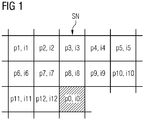
- Fig. 1 and Fig. 2 illustrate neighborhood and training regions of a piecewise autoregressive pixel-prediction method which may be used in the method of the invention.
- a section of an image is shown comprising pixels p0, p1, ..., p12 (i.e. corresponding two-dimensional pixel position in the image).
- Each pixel has a corresponding pixel value in the form of an intensity i0, i1, i2 and so on.
- the pixels are coded in a line-scan order where the image is traversed line by line beginning with the uppermost line in the image.
- a prediction value based on reconstructed pixel values of pixels which have been reconstructed from the coded pixels is determined.
- a reconstructed pixel value corresponds to the original pixel value.
- the prediction error between the predicted value and the original value of the pixel is subjected to further coding steps and thereafter transmitted to a decoder.
- the prediction error is usually subjected to a transform and/or quantization.
- the reconstructed pixel value is derived by applying to the prediction error an inverse quantization and an inverse transform and adding this reconstructed prediction error to the corresponding predicted pixel value.
- the same prediction as for the encoder is used where the prediction error reconstructed in the decoder is added to the predicted pixel value resulting in a decoded pixel value of the corresponding pixel.
- the pixel value of a current pixel is determined based on a number of pixels in the neighborhood of this pixel.
- the pixel value i0 of pixel p0 is to be predicted.
- the specific neighborhood region SN of already reconstructed pixels p1 to p12 is taken into account.
- This neighborhood region is the same for each pixel to be predicted and can be regarded as a template for prediction.
- these are all pixels with a maximum Manhattan distance of two pixels form the neighborhood region.
- i 0 w 1 ⁇ i 1 + w 2 ⁇ i 2 + w 3 ⁇ i 3 + w 4 ⁇ i 4 + w 5 ⁇ i 5 + w 6 ⁇ i 6 + w 7 ⁇ i 7 + w 8 ⁇ i 8 + w 9 ⁇ i 9 + w 10 ⁇ i 10 + w 11 ⁇ i 11 + w 12 ⁇ i 12.
- w1, w2, ..., w12 are weights which are adaptive, which means that the weights are adapted for each pixel to be predicted depending on a larger neighborhood of pixel values, which is called training region or training window.
- a specific training region ST is shown in Fig. 2 .
- the training region includes pixels p1 to p12 of the neighborhood region SN, where the neighborhood region SN is indicated by the border L. Furthermore, 100 other pixels indicated as squares outside the neighborhood region are part of the training region ST. For the sake of clarity, only pixels p13 and p112 of the training region outside the neighborhood region are designated by those reference numerals.
- the above prediction formula is used, except that the true value of these pixels is already known because the training region includes reconstructed pixels with reconstructed pixel values.
- the weights are unknown in those prediction formulas so that a system of 112 linear equations including the weights as unknown variables is formed. This system of equations is solved by known least-squares based methods, e.g. by using the Moore-Penrose pseudo-inverse. It is evident for a skilled person that the weights may also be determined based on non-linear equations, e.g. equations including squared weights.
- the above described prediction method works well for pixels which are not at the border of the corresponding image or image block.
- the neighborhood region and the training region may extend beyond the borders and, thus, may not have a reconstructed pixel value for each pixel in the corresponding region.
- a special treatment for such cases based on a border extension or a reduction of the training region size are used which require additional implementation effort or lead to inhomogeneous predictions.
- the invention described in the following provides an easy and straightforward method for defining neighborhood regions and training regions leading to a good prediction of the corresponding pixels.
- the method for defining corresponding neighborhood regions and training regions is explained in the following with respect to the flowchart of Fig. 3 .
- the method starts with a preset neighborhood region PN and a preset training region PT based on corresponding templates (starting point S1). Those regions may be the same as the neighborhood region and training region shown in Fig. 1 and Fig. 2 . As mentioned above, possible positions in the neighborhood region and the training region may be restricted, e.g. at image or block borders.
- the basic idea of the invention consists of a method to reduce the size of the preset neighborhood region and the preset training region. To do so, the preset neighborhood region PN is pruned if it contains pixels where the pixel values or intensities are unknown. I.e., a modified neighborhood region MN only including pixels with reconstructed pixel values is derived from the preset neighborhood region PN.
- step S2 all possible pixel positions in the preset training region PT are skipped where either the pixel value at this position is unknown or the pixel value at one of its own neighborhood positions based on the modified neighborhood region MN is unknown.
- step S2 no padding or extrapolation operations like constant border extension need to be performed which would impair the training or prediction performance since such data is not really known but rather only derived from observed data.
- step S2 results in a modified neighborhood region MN and a modified training region MT.
- the number of pixels or positions in the modified neighborhood region is designated as n and the number of pixels or positions in the modified training region is designated as m.
- n the number of pixels or positions in the modified neighborhood region
- m the number of pixels or positions in the modified training region
- a validation value VA is calculated which represents the ratio of the values m and n. If the validation value VA is smaller than a predefined threshold value (branch Y out of step S4), the above mentioned pruning will take place because a low validation value has a high probability of an ill-conditioned system of equations. In case that the validation value VA is greater than or equal to the threshold value TV (branch N out of step S4), the specific neighborhood region and the specific training region used in the prediction is set to the modified neighborhood region MN and the modified training region MT as indicated in step S5.
- an iteration IT will take place in step S6.
- a pixel in the modified neighborhood region MN having the largest Euclidian distance to the current pixel p0 is discarded.
- an updated modified training region UMT is calculated.
- This updated modified training region exclusively comprises all pixels of the preset training region PT for which reconstructed pixel values exist and for which the updated modified neighborhood region adjacent to the corresponding pixel exclusively includes pixels for which reconstructed pixel values exist.
- the above described validation value VA is calculated based on the number of pixels of the updated modified neighborhood region and the updated modified training region. I.e., the ratio between the number of pixels of the training region UMT and the number of pixels of the neighborhood region UMN is determined. The iteration is continued in case that the value VA is smaller than the threshold value TV. I.e., in a next iteration step, another pixel in the new updated modified neighborhood region having the largest Euclidian distance to the pixel to be predicted is discarded.
- the iteration terminates because it can be assumed that a precise prediction can be achieved in such a case.
- the threshold value TV shall be chosen to be at least 1.5. According to experiments of the inventors, a threshold value of about 5 is a good choice for a precise prediction.
- a corresponding iteration step of the iteration IT more than one pixel with the largest Euclidian distance is found.
- the following procedure will be used in order to select the pixel to be removed from the pixels with the same largest Euclidean distance: the pixel will be removed which leads to a pruned neighborhood region having a centroid with the smallest distance to the current pixel to be predicted.
- Fig. 4 shows an example of an order of removal of pixels based on this procedure.
- the neighborhood region for the current pixel p0 comprises the pixels p1, p2, ..., p10.
- a corresponding number represents the order in which the pixel is removed in subsequent iteration steps.
- pixel p1 is removed, followed by pixel p3, pixel p4, pixel p8, pixel p2, pixel p9, pixel p7, pixel p5, pixel p6 and pixel p10.
- Fig. 5 corresponds to a Z-order scan ZS
- Fig. 6 to a Hilbert scan HS where both scan orders are known from the prior art.
- Fig. 5 corresponds to a Z-order scan ZS
- Fig. 6 to a Hilbert scan HS where both scan orders are known from the prior art.
- reconstructed pixels with reconstructed pixel values which are located below the current pixel or at the right side of the current pixel may occur.
- the neighborhood region and the training region may extend to those areas.
- an appropriate pruned neighborhood region and pruned training region is determined for each pixel to be predicted.
- the process of determining those pruned regions is not performed during prediction but beforehand.
- the corresponding regions are in this case stored in a storage, which is accessed during coding. Hence, the regions only have to be determined once and may then be used during the whole prediction process of the coding method.
- a prediction error is determined based on the difference between the predicted and the original pixel value.
- This prediction error is optionally subjected to further lossy compression.
- the prediction error is entropy coded.
- an efficient arithmetic coder is employed for entropy coding where the previously coded prediction errors are used to adapt a probability distribution processed in the arithmetic coder.
- Arithmetic coding per se is known from the prior art and uses estimated probabilities for symbols of a symbol alphabet where each symbol has a probability based on a probability distribution where the sum of all probabilities is 1. In arithmetic coding, symbols with higher probabilities need less bits in the code stream than symbols with lower probabilities.
- the symbol alphabet consists of all possible values of prediction errors.
- the distribution is initialized to a suitable initial distribution like to Laplacian or Gaussian distribution where a few distribution parameters like a variance estimate are computed in the encoder and then transmitted to the decoder explicitly as side information.
- the invention as described above may be used in a parallel scheme where several blocks are coded in parallel independently from each other resulting in independent bit-streams for each block.
- each decoding thread for a block needs to know the position within the finally composed stream where the decoding of the corresponding block should start.
- the decoder can make a prediction for this position using the above described transmitted variances of each block.
- the invention as described in the foregoing may be used as a special prediction mode for each block (e.g. a macroblock in the standard H.264/AVC or a prediction unit in the draft standard HEVC).
- This special prediction mode indicates the usage of the intra prediction scheme for each block based on the pruned neighborhood and training regions as described above.
- Fig. 7 shows a scenario in which the prediction of the invention is implemented in a video coding method.
- a time sequence of digital images I is received by the encoder.
- the encoder transforms and/or quantizes the prediction error PE as indicated by blocks T and Q.
- the quantized prediction error is subjected to an inverse quantization IQ and an inverse transform IT.
- the predicted pixel is reconstructed, i.e. the prediction error obtained after the inverse transform IT is added to the corresponding predicted value and stored in a frame buffer FB.
- the predicted pixel value is constructed based on the already processed part of the current image (blocks or pixels) in the frame buffer FB.
- the prediction is based on a block of a previous image subjected to motion compensation MC.
- Motion compensation is controlled by motion vectors MV, which are the output of a motion estimation ME.
- a mode selection element MS is used which switches between the inter prediction and the intra prediction, e.g. based on rate-distortion optimization.
- the quantized transform coefficients obtained by the quantizer Q, the motion information (i.e. the motion vectors MV) and other signaling information is entropy coded in the entropy encoder EC to produce the coded bitstream CI.
- the intra prediction IP is based on a coding step where context reduction and piecewise autoregressive intra prediction based on pruned neighborhood and training regions is used as described above. Since the method is performed pixel-wise, the transform T is usually bypassed for these blocks. For lossless coding, also the quantization Q is bypassed.
- the diagram of Fig. 7 has to be interpreted as pixel-wise processing, while for inter prediction (mainly performed by motion compensation MC) the diagram can be interpreted as a block-wise or frame-wise processing.
- a coded sequence of images CI is obtained after the entropy coding EC.
- the method as shown in Fig. 8 is used.
- the coded sequence of images CI is at first subjected to an entropy decoding ED, an inverse quantization IQ and/or an inverse transform IT.
- the resulting prediction error PE is added to the prediction value which has been intra- or inter-predicted as it is done at the encoder.
- the mode selection MS of the decoder is usually controlled by the information contained in the bitstream.
- the inventive decoding step is incorporated in the intra prediction element IP which performs the same operation as at encoder side.
- motion compensation MC is performed by the transmitted motion vectors MV extracted from the coded bitstream.
- reconstructed pixel values are stored in a frame buffer FB.
- the information in the frame buffer is used by the intra prediction element IP and the motion compensation element MC.
- a decoded sequence of images DI is obtained.
- the autoregressive pixel-prediction as described above may be used independently for image arrays in the form of separate image blocks.
- the method is not restricted to block-based applications.
- the arrays of images processed separately can have arbitrary shapes, which may also be adapted to the image structures.
- the method of the invention may be applied to any type of visual data like videos, medical volumes or dynamic volumes, multi-view data, hyperspectral data and beyond.
- the neighborhood region and training region which are pruned for the prediction method may also have a multi-dimensional shape.
- the method of the invention may also be used for lossy pixel-predictive compression or even for sparse image restoration, denoising, and error concealment where the main goal is also an estimation of unknown values from known neighborhood pixels.
- the method describes an adapted reduction method of neighborhood regions and training regions for a pixel-wise prediction in order to sustain a well-conditioned system of linear equations for calculating predicted pixel values.
- This method better predictions and therefore smaller prediction errors can be achieved in regions like borders where the context information is restricted.
- the inventive method particularly has advantages in block-based coding for parallel processing where a lot of border regions occur.
- additional rate can be saved by the transmission of variance information for the initialization of probability distributions used for arithmetic coding as well as by its usage for predicting the code stream size.
- the determination of pruned neighborhood and training regions is done offline, i.e. before the prediction is performed.
- the pruned neighborhood and training regions for each pixel to be predicted may be stored in look-up tables or may be hardcoded in the coding software in order to prevent added computational complexity by performing the pruning method during prediction.
- SIMD single instruction multiple data
- the inventors have performed experiments in which the prediction errors obtained by a known prediction method using image padding are compared to the prediction errors obtained by the method according to the invention.
- the experiments showed that instable predictions in certain image areas could be improved, i.e. the prediction error in these areas could be reduced by the method of the invention.
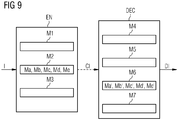
- Fig. 9 shows a schematic illustration of a codec comprising a coding apparatus and a decoding apparatus using a method according to the invention.
- a sequence of images I is fed to an encoder EN.
- the encoder includes a prediction means M1 for predicting the pixel values of the pixels to be decoded in each area of a plurality of image areas by an autoregressive pixel-wise prediction.
- the predicted value of a current pixel is determined based on a weighted sum of reconstructed pixel values of reconstructed, previously processed pixels in a specific neighborhood region adjacent to the current pixel, where the weights of the weighted sum are determined based on linear equations for reconstructed pixels in a specific training region adjacent to the current pixel.
- the encoder further includes a means M2 for determining the above mentioned specific neighborhood region and specific training region for the current pixel.
- This means M2 includes for each of the above steps a) to e) described with respect to the inventive coding a means Ma, Mb, Mc, Md and Me to perform the respective steps a) to e).
- the encoder comprises a processing means M3 where a prediction error between predicted pixel values and the original pixel values is processed for generating the coded image data CI.
- This processing usually comprises an entropy coding and optionally a transform and a quantization.
- the coded image data CI obtained by the encoder EN are transmitted to a decoder DEC which comprises a reconstruction means M4 for reconstructing the prediction errors from the coded image data.
- This reconstruction means usually comprises an entropy decoder and optionally an inverse transform element and an inverse quantization element.
- the decoder DEC comprises a prediction means M5 which works analogously to the prediction means M1 in the encoder EN. I.e., the prediction means predicts the pixel values of the pixels to be decoded in each of a plurality of arrays of pixels by an autoregressive pixel-wise prediction.
- the decoding apparatus DEC comprises a means M6 for determining the specific neighborhood region and the specific training region used in the predicting means M5.
- the means M6 includes for each of the above described decoding steps a) to e) a means Ma', Mb', Mc', Md' and Me' to perform the corresponding one of the steps a) to e). Furthermore, the decoder DEC includes a correction means M7 for correcting the predicted pixel values obtained by the prediction means M5 by the reconstructed prediction error obtained by the reconstruction means M4. As a result, a decoded sequence DI of images is obtained which corresponds to the original sequences of images I in case of a lossless coding and decoding.
Landscapes
- Engineering & Computer Science (AREA)
- Multimedia (AREA)
- Signal Processing (AREA)
- Compression Or Coding Systems Of Tv Signals (AREA)
- Compression Of Band Width Or Redundancy In Fax (AREA)
- Compression, Expansion, Code Conversion, And Decoders (AREA)
Claims (23)
- Un procédé de codage de données d'images numériques (I), les données comprenant une ou plusieurs matrices de pixels avec des valeurs de pixel correspondantes, les valeurs de pixel des pixels à coder dans chaque matrice étant prédites par une prédiction dans laquelle la valeur prédite d'un pixel courant est déterminée en fonction d'une somme pondérée de valeurs de pixels reconstruits de pixels reconstruits traités antérieurement dans une zone de voisinage spécifique (SN) adjacente au pixel courant, les poids de la somme pondérée étant déterminés en fonction d'équations linéaires et/ou non linéaires destinées à des pixels reconstruits dans une zone d'apprentissage spécifique (ST) adjacente au pixel courant, une erreur de prédiction (PE) entre des valeurs de pixel prédites et les valeurs de pixel d'origine étant traitée de façon à générer les données d'images codées (CI),
caractérisé en ce que
la zone de voisinage spécifique (SN) et la zone d'apprentissage spécifique (ST) destinées au pixel courant sont déterminées comme suit :a) lesdits pixels dans une zone de voisinage prédéfinie (PN) adjacente au pixel courant pour lesquels des valeurs de pixels reconstruits existent sont déterminés, résultant en une zone de voisinage modifiée (MN) définie par les pixels déterminés,b) lesdits pixels dans une zone d'apprentissage prédéfinie (PT) adjacente au pixel courant pour lesquels des valeurs de pixels reconstruits existent sont déterminés et pour lesquels la zone de voisinage modifié (MN) adjacente au pixel correspondant comprend exclusivement des pixels pour lesquels des valeurs de pixels reconstruits existent, résultant en une zone d'apprentissage modifiée (MT) définie par les pixels déterminés,c) la détermination d'une valeur de validation (VA) qui augmente en fonction d'un nombre croissant de pixels dans la zone d'apprentissage modifiée (MT) et qui augmente en fonction d'un nombre décroissant de pixels dans la zone de voisinage modifiée (MN),d) dans le cas où la valeur de validation (VA) est inférieure ou égale à une valeur seuil (TV) prédéterminée, une itération (IT) est exécutée, dans le cas contraire la zone de voisinage spécifique (SN) correspond à la zone de voisinage modifiée (MN) et la zone d'apprentissage spécifique (ST) correspond à la zone d'apprentissage modifiée (MT),e) dans le cas où l'itération (IT) est exécutée, au moins un pixel additionnel est supprimé à chaque étape d'itération de la zone de voisinage modifiée (MN), résultant en une zone de voisinage modifiée actualisée (UMN) à chaque étape d'itération, l'itération (IT) se terminant lorsque la valeur de validation (VA) déterminé à l'étape d'itération correspondante en fonction du nombre de pixels dans la zone de voisinage modifiée actualisée (UMN) dépasse ou atteint la valeur seuil (TV) prédéterminée, la zone de voisinage spécifique (SN) étant la zone de voisinage modifiée actualisée (UMN) au moment de la terminaison de l'itération (IT) et la zone d'apprentissage spécifique (ST) étant une zone comprenant exclusivement des pixels de la zone d'apprentissage prédéfinie (PT) pour lesquels des valeurs de pixels reconstruits existent et pour lesquels la zone de voisinage modifiée actualisée (UMN) adjacente au pixel correspondant au moment de la terminaison de l'itération (IT) comprend exclusivement des pixels pour lesquels des valeurs de pixels reconstruits existent. - Le procédé selon la revendication 1, dans lequel la valeur de validation (VA) est le rapport entre le nombre de pixels dans la zone d'apprentissage modifiée (MT) et le nombre de pixels dans la zone de voisinage modifiée (MN).
- Le procédé selon la revendication 1 ou 2, dans lequel, à l'étape e) une zone d'apprentissage modifiée actualisée (UMT) est déterminée à chaque étape d'itération, la zone d'apprentissage modifiée actualisée (UMT) étant la zone comprenant exclusivement la totalité des pixels de la zone d'apprentissage prédéfinie (PT) pour lesquels des valeurs de pixels reconstruits existent et pour lesquels la zone de voisinage modifiée actualisée (UMN) comprend exclusivement des pixels pour lesquels des valeurs de pixels reconstruits existent.
- Le procédé selon la revendication 3, dans lequel la zone d'apprentissage spécifique (ST) déterminée à l'étape e) est la zone d'apprentissage modifiée actualisée (UMT) et/ou la valeur de validation (VA) à l'étape e) est déterminée en fonction à la fois du nombre de pixels dans la zone de voisinage modifiée actualisée (UMN) et du nombre de pixels dans la zone d'apprentissage modifiée actualisée (UMT).
- Le procédé selon la revendication 3 ou 4, dans lequel le au moins un pixel qui est supprimé à chaque étape d'itération est le pixel qui résulte en une zone de voisinage modifiée actualisée (UMN) conduisant à une zone d'apprentissage modifiée actualisée (UMT) avec le plus grand nombre de pixels.
- Le procédé selon l'une quelconque des revendications précédentes, dans lequel une distance euclidienne est définie dans chaque matrice de pixels, le au moins un pixel qui est supprimé à chaque étape d'itération étant le pixel avec la distance euclidienne la plus grande au pixel courant.
- Le procédé selon la revendication 5 et/ou 6, dans lequel, dans le cas où il existe plusieurs pixels dont la suppression conduit à une zone d'apprentissage modifiée actualisée (UMT) avec le plus grand nombre de pixels et/ou plusieurs pixels avec la distance euclidienne la plus grande, le pixel est supprimé, résultant en une zone de voisinage modifiée actualisée (UMN) possédant un centroïde avec la distance la plus petite au pixel courant.
- Le procédé selon l'une quelconque des revendications précédentes, dans lequel un autre type de prédiction est utilisé pour des pixels courants spécifiques en fonction d'un ou de plusieurs critères, plus particulièrement dans le cas où l'itération (IT) ne peut pas trouver une zone de voisinage modifiée actualisée (UMN) conduisant à une valeur de validation (VA) qui dépasse ou atteint la valeur seuil (TV) prédéterminée.
- Le procédé selon l'une quelconque des revendications précédentes, dans lequel les pixels des données d'images numériques (I) sont codés dans un ordre de codage basé sur un balayage linéaire et/ou un balayage d'ordre Z et/ou un balayage de Hilbert.
- Le procédé selon l'une quelconque des revendications précédentes, dans lequel l'erreur de prédiction (PE) est soumise à un codage entropique (EC).
- Le procédé selon la revendication 10, dans lequel le codage entropique pour chaque matrice de pixels est un codage arithmétique adaptatif ou un codage à longueur variable adaptatif qui de préférence débute par une distribution de probabilités initiale possédant un ou plusieurs paramètres de distribution et plus particulièrement une variance, lesdits un ou plusieurs paramètres de distribution étant inclus sous la forme d'informations annexes dans les données d'images codées (CI).
- Le procédé selon l'une quelconque des revendications précédentes, dans lequel plusieurs et de préférence la totalité des matrices de pixels sont codées simultanément.
- Le procédé selon l'une quelconque des revendications précédentes dans lequel les étapes a) à e) sont exécutées avant l'exécution de la prédiction de valeurs de pixel, les zones de voisinage spécifiques (SN) et les zones d'apprentissage spécifiques (ST) pour les pixels étant préconservées en mémoire dans un espace mémoire qui est accédé au cours de la prédiction des valeurs de pixel.
- Le procédé selon l'une quelconque des revendications précédentes, dans lequel le procédé est un procédé de codage vidéo qui code une séquence d'images numériques, chaque matrice de pixels faisant référence à des blocs dans la séquence.
- Le procédé selon la revendication 14, dans lequel le codage vidéo est basé sur la norme H.264/AVC ou HEVC.
- Le procédé selon l'une quelconque des revendications précédentes, dans lequel les données d'images (I) comprennent une ou plusieurs images possédant trois ou plus dimensions, plus particulièrement des images volumiques médicales.
- Un procédé de décodage de données d'images numériques (CI) qui sont codées par un procédé selon l'une quelconque des revendications précédentes, les erreurs de prédiction (PE) étant reconstruites à partir des données d'images codées (CI), les données d'images comprenant une ou plusieurs matrices de pixels avec des valeurs de pixel correspondantes, les valeurs de pixel des pixels à décoder dans chaque matrice étant prédites par une prédiction dans laquelle la valeur prédite d'un pixel courant est déterminée en fonction d'une somme pondérée de valeurs de pixels reconstruits de pixels reconstruits décodés antérieurement dans une zone de voisinage spécifique (SN) adjacente au pixel courant, les poids de la somme pondérée étant déterminés en fonction d'équations linéaires et/ou non linéaires destinées à des pixels reconstruits dans une zone d'apprentissage spécifique (ST) adjacente au pixel courant, la valeur de pixel prédite étant corrigée par l'erreur de prédiction (PE) reconstruite, résultant en une valeur de pixel décodée pour le pixel courant,
caractérisé en ce que
la zone de voisinage spécifique (SN) et la zone d'apprentissage spécifique (ST) destinées au pixel courant sont déterminées comme suit :a) lesdits pixels dans une zone de voisinage prédéfinie (PN) adjacente au pixel courant pour lesquels des valeurs de pixels reconstruits existent sont déterminés, résultant en une zone de voisinage modifiée (MN) définie par les pixels déterminés,b) lesdits pixels dans une zone d'apprentissage prédéfinie (PT) adjacente au pixel courant pour lesquels des valeurs de pixels reconstruits existent sont déterminés et pour lesquels la zone de voisinage modifié (MN) adjacente au pixel correspondant comprend exclusivement des pixels pour lesquels des valeurs de pixels reconstruits existent, résultant en une zone d'apprentissage modifiée (MT) définie par les pixels déterminés,c) la détermination d'une valeur de validation (VA) qui augmente en fonction d'un nombre croissant de pixels dans la zone d'apprentissage modifiée (MT) et qui augmente en fonction d'un nombre décroissant de pixels dans la zone de voisinage modifiée (MN),d) dans le cas où la valeur de validation (VA) est inférieure à ou inférieure ou égale à une valeur seuil (TV) prédéterminée, une itération (IT) est exécutée, dans le cas contraire la zone de voisinage spécifique (SN) correspond à la zone de voisinage modifiée (MN) et la zone d'apprentissage spécifique (ST) correspond à la zone d'apprentissage modifiée (MT),e) dans le cas où l'itération (IT) est exécutée, au moins un pixel additionnel est supprimé à chaque étape d'itération de la zone de voisinage modifiée (MN), résultant en une zone de voisinage modifiée actualisée (UMN) à chaque étape d'itération, l'itération (IT) se terminant lorsque la valeur de validation (VA) déterminée à l'étape d'itération correspondante en fonction du nombre de pixels dans la zone de voisinage modifiée actualisée (UMN) dépasse ou atteint la valeur seuil (TV) prédéterminée, la zone de voisinage spécifique (SN) étant la zone de voisinage modifiée actualisée (UMN) au moment de la terminaison de l'itération (IT) et la zone d'apprentissage spécifique (ST) étant une zone comprenant exclusivement des pixels de la zone d'apprentissage prédéfinie (PT) pour lesquels des valeurs de pixels reconstruits existent et pour lesquels la zone de voisinage modifiée actualisée (UMN) adjacente au pixel correspondant au moment de la terminaison de l'itération (IT) comprend exclusivement des pixels pour lesquels des valeurs de pixels reconstruits existent. - Le procédé selon la revendication 17, dans lequel des données d'images numériques (CI) qui sont codées par un procédé selon les revendications 11 et 12 sont décodées, lesdits un ou plusieurs paramètres de distribution de la distribution de probabilités étant utilisés de façon à déterminer le début d'une matrice de pixels correspondante.
- Un procédé de codage et de décodage de données d'images numériques (I), dans lequel- les données d'images numériques (I) sont codées par un procédé selon l'une quelconque des revendications 1 à 16,- les données d'images numériques codées (CI) sont décodées par un procédé selon la revendication 17 ou 18.
- Un appareil de codage de données d'images numériques (I), les données comprenant une ou plusieurs matrices de pixels avec des valeurs de pixel correspondantes, l'appareil comprenant un moyen de prédiction (M1) destiné à la prédiction des valeurs de pixel des pixels à coder dans chaque matrice par une prédiction dans laquelle la valeur prédite d'un pixel courant est déterminée en fonction d'une somme pondérée de valeurs de pixels reconstruits de pixels reconstruits traités antérieurement dans un zone de voisinage spécifique (SN) adjacente au pixel courant, les poids de la somme pondérée étant déterminés en fonction d'équations linéaires et/ou non linéaires destinées à des pixels reconstruits dans une zone d'apprentissage spécifique (ST) adjacente au pixel courant, l'appareil comprenant un moyen de traitement (M3) dans lequel une erreur de prédiction (PE) entre des valeurs de pixel prédites et les valeurs de pixel d'origine est traitée de façon à générer les données d'images codées (CI),
caractérisé en ce que
l'appareil comprend un moyen (M2) de détermination de la zone de voisinage spécifique (SN) et de la zone d'apprentissage spécifique (ST) pour le pixel courant qui comprend pour chacune des étapes suivantes de a) à e) un moyen (Ma, ..., Me) d'exécution de l'étape correspondante des étapes a) à e),a) lesdits pixels dans une zone de voisinage prédéfinie (PN) adjacente au pixel courant pour lesquels des valeurs de pixels reconstruits existent sont déterminés, résultant en une zone de voisinage modifiée (MN) définie par les pixels déterminés,b) lesdits pixels dans une zone d'apprentissage prédéfinie (PT) adjacente au pixel courant pour lesquels des valeurs de pixels reconstruits existent sont déterminés et pour lesquels la zone de voisinage modifiée (MN) adjacente au pixel correspondant comprend exclusivement des pixels pour lesquels des valeurs de pixels reconstruits existent, résultant en une zone d'apprentissage modifiée (MT) définie par les pixels déterminés,c) la détermination d'une valeur de validation (VA) qui augmente en fonction d'un nombre croissant de pixels dans la zone d'apprentissage modifiée (MT) et qui augmente en fonction d'un nombre décroissant de pixels dans la zone de voisinage modifiée (MN),d) dans le cas où la valeur de validation (VA) est inférieure à ou inférieure ou égale à une valeur seuil (TV) prédéterminée, une itération (IT) est exécutée, dans le cas contraire la zone de voisinage spécifique (SN) correspond à la zone de voisinage modifiée (MN) et la zone d'apprentissage spécifique (ST) correspond à la zone d'apprentissage modifiée (MT),e) dans le cas où l'itération (IT) est exécutée, au moins un pixel additionnel est supprimé à chaque étape d'itération de la zone de voisinage modifiée (MN), résultant en une zone de voisinage modifiée actualisée (UMN) à chaque étape d'itération, l'itération (IT) se terminant lorsque la valeur de validation (VA) déterminée à l'étape d'itération correspondante en fonction du nombre de pixels dans la zone de voisinage modifiée actualisée (UMN) dépasse ou atteint la valeur seuil (TV) prédéterminée, la zone de voisinage spécifique (SN) étant la zone de voisinage modifiée actualisée (UMN) au moment de la terminaison de l'itération (IT) et la zone d'apprentissage spécifique (ST) étant une zone comprenant exclusivement des pixels de la zone d'apprentissage prédéfinie (PT) pour lesquels des valeurs de pixels reconstruits existent et pour lesquels la zone de voisinage modifiée actualisée (UMN) adjacente au pixel correspondant au moment de la terminaison de l'itération (IT) comprend exclusivement des pixels pour lesquels des valeurs de pixels reconstruits existent. - L'appareil selon la revendication 20, dans lequel l'appareil comprend un ou plusieurs moyens additionnels d'exécution d'un procédé selon l'une quelconque des revendications 2 à 16.
- Un appareil de décodage de données d'images numériques (CI) qui sont codées par un procédé selon l'une quelconque des revendications 1 à 16, l'appareil comprenant un moyen de reconstruction (M4) destiné à la reconstruction des erreurs de prédiction (PE) à partir des données d'images codées (CI), les données d'images comprenant une ou plusieurs matrices de pixels avec des valeurs de pixel correspondantes, l'appareil comprenant un moyen de prédiction (M5) destiné à la prédiction des valeurs de pixel des pixels à décoder dans chaque matrice par une prédiction dans laquelle la valeur prédite d'un pixel courant est déterminée en fonction d'une somme pondérée de valeurs de pixels reconstruits de pixels reconstruits décodés antérieurement dans une zone de voisinage spécifique (SN) adjacente au pixel courant, les poids de la somme pondérée étant déterminés en fonction d'équations linéaires et/ou non linéaires destinées à des pixels reconstruits dans une zone d'apprentissage spécifique (ST) adjacente au pixel courant, l'appareil comprenant un moyen de correction (M7) destiné à la correction de la valeur de pixel prédite par l'erreur de prédiction (PE) reconstruite, résultant en une valeur de pixel décodée pour le pixel courant,
caractérisé en ce que
l'appareil comprend un moyen (M6) de détermination de la zone de voisinage spécifique (SN) et de la zone d'apprentissage spécifique (ST) pour le pixel courant qui comprend pour chacune des étapes suivantes a) à e) un moyen (Ma', ..., Me') d'exécution de l'étape correspondante des étapes a) à e),a) lesdits pixels dans une zone de voisinage prédéfinie (PN) adjacente au pixel courant pour lesquels des valeurs de pixels reconstruits existent sont déterminés, résultant en une zone de voisinage modifiée (MN) définie par les pixels déterminés,b) lesdits pixels dans une zone d'apprentissage prédéfinie (PT) adjacente au pixel courant pour lesquels des valeurs de pixels reconstruits existent sont déterminés et pour lesquels la zone de voisinage modifiée (MN) adjacente au pixel correspondant comprend exclusivement des pixels pour lesquels des valeurs de pixels reconstruits existent, résultant en une zone d'apprentissage modifiée (MT) définie par les pixels déterminés,c) la détermination d'une valeur de validation (VA) qui augmente en fonction d'un nombre croissant de pixels dans la zone d'apprentissage modifiée (MT) et qui augmente en fonction d'un nombre décroissant de pixels dans la zone de voisinage modifiée (MN),d) dans le cas où la valeur de validation (VA) est inférieure ou inférieure ou égale à une valeur seuil (TV) prédéterminée, une itération (1T) est exécutée, dans le cas contraire la zone de voisinage spécifique (SN) correspond à la zone de voisinage modifiée (MN) et la zone d'apprentissage spécifique (ST) correspond à la zone d'apprentissage modifiée (MT),e) dans le cas où l'itération (IT) est exécutée, au moins un pixel additionnel est supprimé à chaque étape d'itération de la zone de voisinage modifiée (MN), résultant en une zone de voisinage modifiée actualisée (UMN) à chaque étape d'itération, l'itération (IT) se terminant lorsque la valeur de validation (VA) déterminée à l'étape d'itération correspondante en fonction du nombre de pixels dans la zone de voisinage modifiée actualisée (UMN) dépasse ou atteint la valeur seuil (TV) prédéterminée, la zone de voisinage spécifique (SN) étant la zone de voisinage modifiée actualisée (UMN) au moment de la terminaison de l'itération (IT) et la zone d'apprentissage spécifique (ST) étant une zone comprenant exclusivement des pixels de la zone d'apprentissage prédéfinie (PT) pour lesquels des valeurs de pixels reconstruits existent et pour lesquels la zone de voisinage modifiée actualisée (UMN) adjacente au pixel correspondant au moment de la terminaison de l'itération (IT) comprend exclusivement des pixels pour lesquels des valeurs de pixels reconstruits existent. - Un codec destiné au codage et au décodage de données d'images numériques (I), comprenant un appareil de codage selon la revendication 20 ou 21 et un appareil de décodage selon la revendication 22.
Priority Applications (1)
| Application Number | Priority Date | Filing Date | Title |
|---|---|---|---|
| EP13818732.3A EP2907310B1 (fr) | 2013-01-23 | 2013-12-19 | Prédiction autoregressive aux envirsons à proximité des bords d'une image |
Applications Claiming Priority (3)
| Application Number | Priority Date | Filing Date | Title |
|---|---|---|---|
| EP20130152388 EP2768227A1 (fr) | 2013-01-23 | 2013-01-23 | Prédiction autoregressive aux envirsons à proximité des bords d'une image |
| PCT/EP2013/077277 WO2014114413A1 (fr) | 2013-01-23 | 2013-12-19 | Prédiction de pixels autorégressive au voisinage des frontières d'image |
| EP13818732.3A EP2907310B1 (fr) | 2013-01-23 | 2013-12-19 | Prédiction autoregressive aux envirsons à proximité des bords d'une image |
Publications (2)
| Publication Number | Publication Date |
|---|---|
| EP2907310A1 EP2907310A1 (fr) | 2015-08-19 |
| EP2907310B1 true EP2907310B1 (fr) | 2018-09-19 |
Family
ID=47603425
Family Applications (2)
| Application Number | Title | Priority Date | Filing Date |
|---|---|---|---|
| EP20130152388 Withdrawn EP2768227A1 (fr) | 2013-01-23 | 2013-01-23 | Prédiction autoregressive aux envirsons à proximité des bords d'une image |
| EP13818732.3A Not-in-force EP2907310B1 (fr) | 2013-01-23 | 2013-12-19 | Prédiction autoregressive aux envirsons à proximité des bords d'une image |
Family Applications Before (1)
| Application Number | Title | Priority Date | Filing Date |
|---|---|---|---|
| EP20130152388 Withdrawn EP2768227A1 (fr) | 2013-01-23 | 2013-01-23 | Prédiction autoregressive aux envirsons à proximité des bords d'une image |
Country Status (4)
| Country | Link |
|---|---|
| US (1) | US9872032B2 (fr) |
| EP (2) | EP2768227A1 (fr) |
| CN (1) | CN104937934B (fr) |
| WO (1) | WO2014114413A1 (fr) |
Families Citing this family (9)
| Publication number | Priority date | Publication date | Assignee | Title |
|---|---|---|---|---|
| KR102332782B1 (ko) * | 2014-12-15 | 2021-11-30 | 삼성전자주식회사 | 시각 특성을 고려한 영상 데이터 압축 |
| KR102381376B1 (ko) | 2016-05-16 | 2022-03-31 | 삼성전자주식회사 | 비디오 부호화 방법 및 장치, 그 복호화 방법 및 장치 |
| US11442910B2 (en) * | 2017-09-28 | 2022-09-13 | Intel Corporation | Multiple order delta compression |
| WO2019107927A1 (fr) | 2017-11-28 | 2019-06-06 | 한국전자통신연구원 | Procédé et appareil de prédiction intra bidirectionnelle |
| WO2019192744A1 (fr) * | 2018-04-06 | 2019-10-10 | Siemens Aktiengesellschaft | Reconnaissance d'objet dans des images utilisant au préalable des modèles cao |
| CN109815926B (zh) * | 2019-01-30 | 2022-08-23 | 南京邮电大学 | 一种基于欧式距离-差分编码的改进lbp算法 |
| CN113012076B (zh) * | 2021-04-27 | 2023-06-23 | 广东工业大学 | 一种基于邻近像素点和自编码器的敦煌壁画修复方法 |
| WO2023196163A1 (fr) * | 2022-04-04 | 2023-10-12 | Onxmaps, Inc. | Procédés et systèmes de compression de données de modèle d'élévation numérique |
| CN115278251B (zh) * | 2022-07-14 | 2025-07-29 | 上海傲显科技有限公司 | 基于移动预测编码的编码方法、显示模组和存储介质 |
Family Cites Families (5)
| Publication number | Priority date | Publication date | Assignee | Title |
|---|---|---|---|---|
| US7643038B2 (en) * | 2005-06-29 | 2010-01-05 | Qualcomm Incorporated | Virtual device buffer for embedded device |
| US8315308B2 (en) * | 2006-01-11 | 2012-11-20 | Qualcomm Incorporated | Video coding with fine granularity spatial scalability |
| US20100232506A1 (en) | 2006-02-17 | 2010-09-16 | Peng Yin | Method for handling local brightness variations in video |
| FR2949637B1 (fr) * | 2009-08-28 | 2011-09-23 | Commissariat Energie Atomique | Dispositif de calcul reconfigurable sur voisinage flexible de pixels |
| CN101977323B (zh) * | 2010-11-16 | 2012-04-25 | 上海交通大学 | 基于视频时空相关性约束的分布式视频编码重构方法 |
-
2013
- 2013-01-23 EP EP20130152388 patent/EP2768227A1/fr not_active Withdrawn
- 2013-12-19 EP EP13818732.3A patent/EP2907310B1/fr not_active Not-in-force
- 2013-12-19 US US14/763,082 patent/US9872032B2/en not_active Expired - Fee Related
- 2013-12-19 WO PCT/EP2013/077277 patent/WO2014114413A1/fr not_active Ceased
- 2013-12-19 CN CN201380071242.3A patent/CN104937934B/zh not_active Expired - Fee Related
Non-Patent Citations (1)
| Title |
|---|
| None * |
Also Published As
| Publication number | Publication date |
|---|---|
| EP2907310A1 (fr) | 2015-08-19 |
| CN104937934A (zh) | 2015-09-23 |
| EP2768227A1 (fr) | 2014-08-20 |
| WO2014114413A1 (fr) | 2014-07-31 |
| US20150365682A1 (en) | 2015-12-17 |
| CN104937934B (zh) | 2019-06-04 |
| US9872032B2 (en) | 2018-01-16 |
Similar Documents
| Publication | Publication Date | Title |
|---|---|---|
| EP2907310B1 (fr) | Prédiction autoregressive aux envirsons à proximité des bords d'une image | |
| CA2935336C (fr) | Decodeur video, encodeur video, procede de decodage video et procede d'encodage video | |
| CN114793282B (zh) | 带有比特分配的基于神经网络的视频压缩 | |
| US9554145B2 (en) | Re-encoding image sets using frequency-domain differences | |
| US20190082179A1 (en) | Video coding method and apparatus | |
| CN110383331A (zh) | 非局部适应性环路滤波器处理 | |
| US12143628B2 (en) | Prediction image correcting device, image encoding device, image decoding device, and program | |
| EP3345397B1 (fr) | Codage vidéo avec reconstruction retardée | |
| US9549193B2 (en) | Video encoding method and video encoding device | |
| CN119728981A (zh) | 图像调整模型的训练方法、视频编码方法、装置、电子设备、存储介质和程序产品 |
Legal Events
| Date | Code | Title | Description |
|---|---|---|---|
| PUAI | Public reference made under article 153(3) epc to a published international application that has entered the european phase |
Free format text: ORIGINAL CODE: 0009012 |
|
| 17P | Request for examination filed |
Effective date: 20150515 |
|
| AK | Designated contracting states |
Kind code of ref document: A1 Designated state(s): AL AT BE BG CH CY CZ DE DK EE ES FI FR GB GR HR HU IE IS IT LI LT LU LV MC MK MT NL NO PL PT RO RS SE SI SK SM TR |
|
| AX | Request for extension of the european patent |
Extension state: BA ME |
|
| DAX | Request for extension of the european patent (deleted) | ||
| 17Q | First examination report despatched |
Effective date: 20160502 |
|
| RAP1 | Party data changed (applicant data changed or rights of an application transferred) |
Owner name: SIEMENS AKTIENGESELLSCHAFT |
|
| GRAP | Despatch of communication of intention to grant a patent |
Free format text: ORIGINAL CODE: EPIDOSNIGR1 |
|
| INTG | Intention to grant announced |
Effective date: 20180426 |
|
| GRAS | Grant fee paid |
Free format text: ORIGINAL CODE: EPIDOSNIGR3 |
|
| GRAA | (expected) grant |
Free format text: ORIGINAL CODE: 0009210 |
|
| AK | Designated contracting states |
Kind code of ref document: B1 Designated state(s): AL AT BE BG CH CY CZ DE DK EE ES FI FR GB GR HR HU IE IS IT LI LT LU LV MC MK MT NL NO PL PT RO RS SE SI SK SM TR |
|
| REG | Reference to a national code |
Ref country code: GB Ref legal event code: FG4D |
|
| REG | Reference to a national code |
Ref country code: CH Ref legal event code: EP |
|
| REG | Reference to a national code |
Ref country code: AT Ref legal event code: REF Ref document number: 1044678 Country of ref document: AT Kind code of ref document: T Effective date: 20181015 |
|
| REG | Reference to a national code |
Ref country code: IE Ref legal event code: FG4D |
|
| REG | Reference to a national code |
Ref country code: DE Ref legal event code: R096 Ref document number: 602013043983 Country of ref document: DE |
|
| REG | Reference to a national code |
Ref country code: NL Ref legal event code: MP Effective date: 20180919 |
|
| PG25 | Lapsed in a contracting state [announced via postgrant information from national office to epo] |
Ref country code: SE Free format text: LAPSE BECAUSE OF FAILURE TO SUBMIT A TRANSLATION OF THE DESCRIPTION OR TO PAY THE FEE WITHIN THE PRESCRIBED TIME-LIMIT Effective date: 20180919 Ref country code: BG Free format text: LAPSE BECAUSE OF FAILURE TO SUBMIT A TRANSLATION OF THE DESCRIPTION OR TO PAY THE FEE WITHIN THE PRESCRIBED TIME-LIMIT Effective date: 20181219 Ref country code: RS Free format text: LAPSE BECAUSE OF FAILURE TO SUBMIT A TRANSLATION OF THE DESCRIPTION OR TO PAY THE FEE WITHIN THE PRESCRIBED TIME-LIMIT Effective date: 20180919 Ref country code: FI Free format text: LAPSE BECAUSE OF FAILURE TO SUBMIT A TRANSLATION OF THE DESCRIPTION OR TO PAY THE FEE WITHIN THE PRESCRIBED TIME-LIMIT Effective date: 20180919 Ref country code: NO Free format text: LAPSE BECAUSE OF FAILURE TO SUBMIT A TRANSLATION OF THE DESCRIPTION OR TO PAY THE FEE WITHIN THE PRESCRIBED TIME-LIMIT Effective date: 20181219 Ref country code: GR Free format text: LAPSE BECAUSE OF FAILURE TO SUBMIT A TRANSLATION OF THE DESCRIPTION OR TO PAY THE FEE WITHIN THE PRESCRIBED TIME-LIMIT Effective date: 20181220 Ref country code: LT Free format text: LAPSE BECAUSE OF FAILURE TO SUBMIT A TRANSLATION OF THE DESCRIPTION OR TO PAY THE FEE WITHIN THE PRESCRIBED TIME-LIMIT Effective date: 20180919 |
|
| REG | Reference to a national code |
Ref country code: LT Ref legal event code: MG4D |
|
| PG25 | Lapsed in a contracting state [announced via postgrant information from national office to epo] |
Ref country code: LV Free format text: LAPSE BECAUSE OF FAILURE TO SUBMIT A TRANSLATION OF THE DESCRIPTION OR TO PAY THE FEE WITHIN THE PRESCRIBED TIME-LIMIT Effective date: 20180919 Ref country code: HR Free format text: LAPSE BECAUSE OF FAILURE TO SUBMIT A TRANSLATION OF THE DESCRIPTION OR TO PAY THE FEE WITHIN THE PRESCRIBED TIME-LIMIT Effective date: 20180919 Ref country code: AL Free format text: LAPSE BECAUSE OF FAILURE TO SUBMIT A TRANSLATION OF THE DESCRIPTION OR TO PAY THE FEE WITHIN THE PRESCRIBED TIME-LIMIT Effective date: 20180919 |
|
| REG | Reference to a national code |
Ref country code: AT Ref legal event code: MK05 Ref document number: 1044678 Country of ref document: AT Kind code of ref document: T Effective date: 20180919 |
|
| PG25 | Lapsed in a contracting state [announced via postgrant information from national office to epo] |
Ref country code: CZ Free format text: LAPSE BECAUSE OF FAILURE TO SUBMIT A TRANSLATION OF THE DESCRIPTION OR TO PAY THE FEE WITHIN THE PRESCRIBED TIME-LIMIT Effective date: 20180919 Ref country code: RO Free format text: LAPSE BECAUSE OF FAILURE TO SUBMIT A TRANSLATION OF THE DESCRIPTION OR TO PAY THE FEE WITHIN THE PRESCRIBED TIME-LIMIT Effective date: 20180919 Ref country code: IS Free format text: LAPSE BECAUSE OF FAILURE TO SUBMIT A TRANSLATION OF THE DESCRIPTION OR TO PAY THE FEE WITHIN THE PRESCRIBED TIME-LIMIT Effective date: 20190119 Ref country code: PL Free format text: LAPSE BECAUSE OF FAILURE TO SUBMIT A TRANSLATION OF THE DESCRIPTION OR TO PAY THE FEE WITHIN THE PRESCRIBED TIME-LIMIT Effective date: 20180919 Ref country code: ES Free format text: LAPSE BECAUSE OF FAILURE TO SUBMIT A TRANSLATION OF THE DESCRIPTION OR TO PAY THE FEE WITHIN THE PRESCRIBED TIME-LIMIT Effective date: 20180919 Ref country code: NL Free format text: LAPSE BECAUSE OF FAILURE TO SUBMIT A TRANSLATION OF THE DESCRIPTION OR TO PAY THE FEE WITHIN THE PRESCRIBED TIME-LIMIT Effective date: 20180919 Ref country code: AT Free format text: LAPSE BECAUSE OF FAILURE TO SUBMIT A TRANSLATION OF THE DESCRIPTION OR TO PAY THE FEE WITHIN THE PRESCRIBED TIME-LIMIT Effective date: 20180919 Ref country code: EE Free format text: LAPSE BECAUSE OF FAILURE TO SUBMIT A TRANSLATION OF THE DESCRIPTION OR TO PAY THE FEE WITHIN THE PRESCRIBED TIME-LIMIT Effective date: 20180919 Ref country code: IT Free format text: LAPSE BECAUSE OF FAILURE TO SUBMIT A TRANSLATION OF THE DESCRIPTION OR TO PAY THE FEE WITHIN THE PRESCRIBED TIME-LIMIT Effective date: 20180919 |
|
| PG25 | Lapsed in a contracting state [announced via postgrant information from national office to epo] |
Ref country code: SK Free format text: LAPSE BECAUSE OF FAILURE TO SUBMIT A TRANSLATION OF THE DESCRIPTION OR TO PAY THE FEE WITHIN THE PRESCRIBED TIME-LIMIT Effective date: 20180919 Ref country code: SM Free format text: LAPSE BECAUSE OF FAILURE TO SUBMIT A TRANSLATION OF THE DESCRIPTION OR TO PAY THE FEE WITHIN THE PRESCRIBED TIME-LIMIT Effective date: 20180919 Ref country code: PT Free format text: LAPSE BECAUSE OF FAILURE TO SUBMIT A TRANSLATION OF THE DESCRIPTION OR TO PAY THE FEE WITHIN THE PRESCRIBED TIME-LIMIT Effective date: 20190119 |
|
| REG | Reference to a national code |
Ref country code: DE Ref legal event code: R097 Ref document number: 602013043983 Country of ref document: DE |
|
| PLBE | No opposition filed within time limit |
Free format text: ORIGINAL CODE: 0009261 |
|
| STAA | Information on the status of an ep patent application or granted ep patent |
Free format text: STATUS: NO OPPOSITION FILED WITHIN TIME LIMIT |
|
| PG25 | Lapsed in a contracting state [announced via postgrant information from national office to epo] |
Ref country code: DK Free format text: LAPSE BECAUSE OF FAILURE TO SUBMIT A TRANSLATION OF THE DESCRIPTION OR TO PAY THE FEE WITHIN THE PRESCRIBED TIME-LIMIT Effective date: 20180919 |
|
| REG | Reference to a national code |
Ref country code: CH Ref legal event code: PL |
|
| 26N | No opposition filed |
Effective date: 20190620 |
|
| PG25 | Lapsed in a contracting state [announced via postgrant information from national office to epo] |
Ref country code: LU Free format text: LAPSE BECAUSE OF NON-PAYMENT OF DUE FEES Effective date: 20181219 Ref country code: MC Free format text: LAPSE BECAUSE OF FAILURE TO SUBMIT A TRANSLATION OF THE DESCRIPTION OR TO PAY THE FEE WITHIN THE PRESCRIBED TIME-LIMIT Effective date: 20180919 |
|
| REG | Reference to a national code |
Ref country code: IE Ref legal event code: MM4A |
|
| REG | Reference to a national code |
Ref country code: BE Ref legal event code: MM Effective date: 20181231 |
|
| PG25 | Lapsed in a contracting state [announced via postgrant information from national office to epo] |
Ref country code: SI Free format text: LAPSE BECAUSE OF FAILURE TO SUBMIT A TRANSLATION OF THE DESCRIPTION OR TO PAY THE FEE WITHIN THE PRESCRIBED TIME-LIMIT Effective date: 20180919 Ref country code: IE Free format text: LAPSE BECAUSE OF NON-PAYMENT OF DUE FEES Effective date: 20181219 |
|
| PG25 | Lapsed in a contracting state [announced via postgrant information from national office to epo] |
Ref country code: BE Free format text: LAPSE BECAUSE OF NON-PAYMENT OF DUE FEES Effective date: 20181231 |
|
| PG25 | Lapsed in a contracting state [announced via postgrant information from national office to epo] |
Ref country code: LI Free format text: LAPSE BECAUSE OF NON-PAYMENT OF DUE FEES Effective date: 20181231 Ref country code: CH Free format text: LAPSE BECAUSE OF NON-PAYMENT OF DUE FEES Effective date: 20181231 |
|
| PG25 | Lapsed in a contracting state [announced via postgrant information from national office to epo] |
Ref country code: MT Free format text: LAPSE BECAUSE OF NON-PAYMENT OF DUE FEES Effective date: 20181219 |
|
| PG25 | Lapsed in a contracting state [announced via postgrant information from national office to epo] |
Ref country code: TR Free format text: LAPSE BECAUSE OF FAILURE TO SUBMIT A TRANSLATION OF THE DESCRIPTION OR TO PAY THE FEE WITHIN THE PRESCRIBED TIME-LIMIT Effective date: 20180919 |
|
| PG25 | Lapsed in a contracting state [announced via postgrant information from national office to epo] |
Ref country code: HU Free format text: LAPSE BECAUSE OF FAILURE TO SUBMIT A TRANSLATION OF THE DESCRIPTION OR TO PAY THE FEE WITHIN THE PRESCRIBED TIME-LIMIT; INVALID AB INITIO Effective date: 20131219 Ref country code: CY Free format text: LAPSE BECAUSE OF FAILURE TO SUBMIT A TRANSLATION OF THE DESCRIPTION OR TO PAY THE FEE WITHIN THE PRESCRIBED TIME-LIMIT Effective date: 20180919 Ref country code: MK Free format text: LAPSE BECAUSE OF NON-PAYMENT OF DUE FEES Effective date: 20180919 |
|
| PGFP | Annual fee paid to national office [announced via postgrant information from national office to epo] |
Ref country code: FR Payment date: 20201217 Year of fee payment: 8 |
|
| PGFP | Annual fee paid to national office [announced via postgrant information from national office to epo] |
Ref country code: DE Payment date: 20210218 Year of fee payment: 8 Ref country code: GB Payment date: 20210104 Year of fee payment: 8 |
|
| REG | Reference to a national code |
Ref country code: DE Ref legal event code: R119 Ref document number: 602013043983 Country of ref document: DE |
|
| GBPC | Gb: european patent ceased through non-payment of renewal fee |
Effective date: 20211219 |
|
| PG25 | Lapsed in a contracting state [announced via postgrant information from national office to epo] |
Ref country code: GB Free format text: LAPSE BECAUSE OF NON-PAYMENT OF DUE FEES Effective date: 20211219 Ref country code: DE Free format text: LAPSE BECAUSE OF NON-PAYMENT OF DUE FEES Effective date: 20220701 |
|
| PG25 | Lapsed in a contracting state [announced via postgrant information from national office to epo] |
Ref country code: FR Free format text: LAPSE BECAUSE OF NON-PAYMENT OF DUE FEES Effective date: 20211231 |