EP2907829A1 - Polyéthylène à poids moléculaire élevé ou ultra élevé démêlé préparé avec un catalyseur de Ziegler-Natta - Google Patents
Polyéthylène à poids moléculaire élevé ou ultra élevé démêlé préparé avec un catalyseur de Ziegler-Natta Download PDFInfo
- Publication number
- EP2907829A1 EP2907829A1 EP14154934.5A EP14154934A EP2907829A1 EP 2907829 A1 EP2907829 A1 EP 2907829A1 EP 14154934 A EP14154934 A EP 14154934A EP 2907829 A1 EP2907829 A1 EP 2907829A1
- Authority
- EP
- European Patent Office
- Prior art keywords
- molecular weight
- ultrahigh molecular
- weight polyethylene
- disentangled
- mol
- Prior art date
- Legal status (The legal status is an assumption and is not a legal conclusion. Google has not performed a legal analysis and makes no representation as to the accuracy of the status listed.)
- Granted
Links
Images



Classifications
-
- C—CHEMISTRY; METALLURGY
- C08—ORGANIC MACROMOLECULAR COMPOUNDS; THEIR PREPARATION OR CHEMICAL WORKING-UP; COMPOSITIONS BASED THEREON
- C08F—MACROMOLECULAR COMPOUNDS OBTAINED BY REACTIONS ONLY INVOLVING CARBON-TO-CARBON UNSATURATED BONDS
- C08F10/00—Homopolymers and copolymers of unsaturated aliphatic hydrocarbons having only one carbon-to-carbon double bond
- C08F10/02—Ethene
-
- C—CHEMISTRY; METALLURGY
- C08—ORGANIC MACROMOLECULAR COMPOUNDS; THEIR PREPARATION OR CHEMICAL WORKING-UP; COMPOSITIONS BASED THEREON
- C08L—COMPOSITIONS OF MACROMOLECULAR COMPOUNDS
- C08L23/00—Compositions of homopolymers or copolymers of unsaturated aliphatic hydrocarbons having only one carbon-to-carbon double bond; Compositions of derivatives of such polymers
- C08L23/02—Compositions of homopolymers or copolymers of unsaturated aliphatic hydrocarbons having only one carbon-to-carbon double bond; Compositions of derivatives of such polymers not modified by chemical after-treatment
- C08L23/04—Homopolymers or copolymers of ethene
- C08L23/06—Polyethylene
-
- C—CHEMISTRY; METALLURGY
- C08—ORGANIC MACROMOLECULAR COMPOUNDS; THEIR PREPARATION OR CHEMICAL WORKING-UP; COMPOSITIONS BASED THEREON
- C08F—MACROMOLECULAR COMPOUNDS OBTAINED BY REACTIONS ONLY INVOLVING CARBON-TO-CARBON UNSATURATED BONDS
- C08F2500/00—Characteristics or properties of obtained polyolefins; Use thereof
- C08F2500/01—High molecular weight, e.g. >800,000 Da.
-
- C—CHEMISTRY; METALLURGY
- C08—ORGANIC MACROMOLECULAR COMPOUNDS; THEIR PREPARATION OR CHEMICAL WORKING-UP; COMPOSITIONS BASED THEREON
- C08F—MACROMOLECULAR COMPOUNDS OBTAINED BY REACTIONS ONLY INVOLVING CARBON-TO-CARBON UNSATURATED BONDS
- C08F2500/00—Characteristics or properties of obtained polyolefins; Use thereof
- C08F2500/17—Viscosity
-
- C—CHEMISTRY; METALLURGY
- C08—ORGANIC MACROMOLECULAR COMPOUNDS; THEIR PREPARATION OR CHEMICAL WORKING-UP; COMPOSITIONS BASED THEREON
- C08L—COMPOSITIONS OF MACROMOLECULAR COMPOUNDS
- C08L2203/00—Applications
- C08L2203/18—Applications used for pipes
-
- C—CHEMISTRY; METALLURGY
- C08—ORGANIC MACROMOLECULAR COMPOUNDS; THEIR PREPARATION OR CHEMICAL WORKING-UP; COMPOSITIONS BASED THEREON
- C08L—COMPOSITIONS OF MACROMOLECULAR COMPOUNDS
- C08L2205/00—Polymer mixtures characterised by other features
- C08L2205/02—Polymer mixtures characterised by other features containing two or more polymers of the same C08L -group
- C08L2205/025—Polymer mixtures characterised by other features containing two or more polymers of the same C08L -group containing two or more polymers of the same hierarchy C08L, and differing only in parameters such as density, comonomer content, molecular weight, structure
-
- C—CHEMISTRY; METALLURGY
- C08—ORGANIC MACROMOLECULAR COMPOUNDS; THEIR PREPARATION OR CHEMICAL WORKING-UP; COMPOSITIONS BASED THEREON
- C08L—COMPOSITIONS OF MACROMOLECULAR COMPOUNDS
- C08L2207/00—Properties characterising the ingredient of the composition
- C08L2207/06—Properties of polyethylene
- C08L2207/062—HDPE
-
- C—CHEMISTRY; METALLURGY
- C08—ORGANIC MACROMOLECULAR COMPOUNDS; THEIR PREPARATION OR CHEMICAL WORKING-UP; COMPOSITIONS BASED THEREON
- C08L—COMPOSITIONS OF MACROMOLECULAR COMPOUNDS
- C08L2207/00—Properties characterising the ingredient of the composition
- C08L2207/06—Properties of polyethylene
- C08L2207/068—Ultra high molecular weight polyethylene
-
- C—CHEMISTRY; METALLURGY
- C08—ORGANIC MACROMOLECULAR COMPOUNDS; THEIR PREPARATION OR CHEMICAL WORKING-UP; COMPOSITIONS BASED THEREON
- C08L—COMPOSITIONS OF MACROMOLECULAR COMPOUNDS
- C08L2314/00—Polymer mixtures characterised by way of preparation
- C08L2314/02—Ziegler natta catalyst
Definitions
- the present invention is related to a disentangled high or ultrahigh molecular weight polyethylene ((U)HMWPE) which is prepared by using a Ziegler Natta catalyst, to its preparation and its use.
- (U)HMWPE disentangled high or ultrahigh molecular weight polyethylene
- (U)HMWPE is a very special class of polyethylene, which is due to its high molecular weight characterized by a unique combination of properties making it suitable for applications where lower molecular weight grades fail.
- (U)HMWPE has outstanding physical and mechanical properties such as high abrasion resistance, high impact toughness, good corrosion and chemical resistance, resistance to cyclic fatigue, and resistance to radiation.
- Example WO 2013/076733 describes that the synthesis of UHMWPE using conventional Ziegler Natta catalysts results in high entanglement of the chains because of the drastic reaction conditions used in such reactions. To achieve disentanglement of the polymer chains WO 2013/076733 states that it is imperative that single site catalysts are needed which are highly active and exhibit living nature under milder process conditions.
- WO 2013/034582 states that normally in the commercially synthesized polymers, where a heterogeneous Ziegler Natta (Z-N) catalyst is used, the crystallization rate is slower than the polymerization rate. Moreover, in a heterogeneous catalytic system the active sites are tethered on a support and are close to each other, leading to a higher probability of finding the neighboring growing chains. This results in the entanglement formation during synthesis.
- Z-N Ziegler Natta
- UHMW-PE of very low entanglement density is for example obtained if a single-site catalyst is used, like for example a metallocene catalyst.
- the so produced (U)HMWPE is very suitable as e.g. blend partner for HDPE, giving blends of excellent mechanical properties despite the very high molecular weights involved.
- the blends possess excellent tensile strength, strain at tensile strength, stress at break and strain at break without losses of tensile modulus, making them furthermore ideal for pipe formation.
- the invention provides a disentangled high or ultrahigh molecular weight polyethylene ((U)HMWPE) being produced with a Ziegler-Natta catalyst, characterized by
- the disentangled high or ultrahigh molecular weight polyethylene ((U)HMWPE) according to the invention is further characterized by
- disentangled high or ultrahigh molecular weight polyethylene ((U)HMWPE) according to the invention is, in case of being a homopolymer, further characterized by a melting temperature Tm 1 , measured according to ISO 11357-3 after the first heating run, of > 140.0°C.
- the invention provides a process for the preparation of the disentangled high or ultrahigh molecular weight polyethylene ((U)HMWPE) as herein before defined comprising polymerization of ethylene, optionally in the presence of a C 3 -C 20 alpha olefin comonomer, in a slurry phase reactor in an inert hydrocarbon diluent at a temperature of 10 to 100°C in the presence of a Ziegler-Natta catalyst and a cocatalyst, but in the absence of hydrogen.
- (U)HMWPE) disentangled high or ultrahigh molecular weight polyethylene
- the invention is related to the use of the disentangled high or ultrahigh molecular weight polyethylene ((U)HMWPE) as hereinbefore defined, especially in blends with HDPE, being suitable for producing pipes.
- (U)HMWPE disentangled high or ultrahigh molecular weight polyethylene
- molecular weight Mw the weight average molecular weight is meant.
- molecular weight Mv the nominal viscosity molecular weight is meant.
- the present invention is related to a high or ultrahigh molecular weight polyethylene ((U)HMWPE), which is disentangled, although produced by using a Ziegler-Natta catalyst.
- (U)HMWPE ultrahigh molecular weight polyethylene
- the disentangled high or ultrahigh molecular weight polyethylene (U)HMWPE) is characterized by a factor for the normalized elastic modulus G' 0 /G' p of less than 0.95 determined in a dynamic time sweep measurement at 180°C with constant strain of 0.5% at fixed frequency of 10 rad/s for at least 3600s, whereby G' 0 is the elastic shear modulus measured at to directly after melting the sample and G'p is the maximum plateau modulus.
- the factor G' 0 /G' p is less than 0.90, more preferably less than 0.85 and even more preferably less than 0.80.
- the disentangled high or ultrahigh molecular weight polyethylene (U)HMWPE) is further characterized by the following parameters:
- disentangled high or ultrahigh molecular weight polyethylene ((U)HMWPE) according to the invention is, in case of being a homopolymer, further characterized by a melting temperature Tm 1 , measured according to ISO 11357-3 after the first heating run, of > 140.0°C.
- Tm 1 of the homo (U)HMWPE is > 140.5°C, more preferably > 141.0°C and most preferably > 141.5°C.
- the disentangled high or ultrahigh molecular weight polyethylene (U)HMWPE) furthermore has a complex viscosity, which is an indirect measure of the molecular weight, at a shear stress of 0.05 rad/s at 190°C ( ⁇ * 0.05 rad/s) in a range of 1,000,000 Pa.s up to 30,000,000 Pa.s, preferably in the range of 2,000,000 Pa.s up to 28,000,000 Pa.s and more preferably in the range of 3,000,000 Pa.s up to 25,000,000 Pa.s
- the (U)HMWPE according to the invention has in addition a very low MFR, such as an MFR 21 of less than 0.5 g/10min, especially MFR 21 of less than 0.1 g/10min, more especially less than 0.05 g/10min.
- the (U)HMW polyethylene of the invention is either an ethylene homopolymer or an ethylene copolymer.
- the comonomer present is at least one C 3-20 olefin.
- Preferred comonomers are alpha-olefins, especially with 3-10 carbon atoms.
- the comonomer is selected from the group consisting of propene, 1-butene, 1-hexene, 4-methyl-1-pentene, 1-octene, 1,7-octadiene and 7-methyl- 1,6-octadiene.
- the use of 1-hexene or 1-butene is most preferred. Ideally only one comonomer is present. The use of hexene is especially preferred.
- the comonomer content is up to 2.0 mol%, preferably up to 1.0 mol%, more preferably up to 0.8 mol% and most preferably up to 0.6 mol%.
- the amount of comonomer is generally tailored so as to achieve the intrinsic viscosity as required in the invention.
- the (U)HMW polyethylene is preferably unimodal. This means that it has a single peak on GPC. Ideally it is formed from a single component and is therefore produced in a single manufacturing step.
- the (U)HMW polyethylene according to the invention is prepared by a slurry polymerization process using a Ziegler-Natta-catalyst.
- Suitable Ziegler- Natta catalysts preferably contain a magnesium compound, an aluminium compound and a titanium compound supported on a particulate support.
- the particulate support can be an inorganic oxide support, such as silica, alumina, titania, silica-alumina and silica-titania.
- the support is silica or MgCl 2 .
- the average particle size (D50) of the silica support can be typically from 10 to 100 ⁇ m. However, it has turned out that special advantages can be obtained if the support has an average particle size (D50) from 5 to 20 ⁇ m, preferably from 5 to 15 ⁇ m.
- the magnesium compound is a reaction product of a magnesium dialkyl and an alcohol.
- the alcohol is a linear or branched aliphatic monoalcohol. Preferably, the alcohol has from 6 to 16 carbon atoms. Branched alcohols are especially preferred, and 2-ethyl-1-hexanol is one example of the preferred alcohols.
- the magnesium dialkyl may be any compound of magnesium bonding to two alkyl groups, which may be the same or different. Butyl-octyl magnesium is one example of the preferred magnesium dialkyls.
- the aluminium compound is chlorine containing aluminium alkyl.
- Especially preferred compounds are aluminium alkyl dichlorides and aluminium alkyl sesquichlorides.
- the titanium compound is a halogen containing titanium compound, preferably chlorine containing titanium compound.
- Especially preferred titanium compound is titanium tetrachloride.
- the catalyst can be prepared by sequentially contacting the carrier with the above mentioned compounds, as described in EP-A-688794 or WO-A-99/51646 .
- it can be prepared by first preparing a solution from the components and then contacting the solution with a carrier, as described in WO-A-01/55230 .
- Another group of suitable Ziegler - Natta catalysts contain a titanium compound together with a magnesium halide compound acting as a support.
- the catalyst contains a titanium compound on a magnesium dihalide, like magnesium dichloride.
- Such catalysts are disclosed, for instance, in WO-A-2005/118655 and EP-A-810235 .
- Still a further type of Ziegler-Natta catalysts are catalysts prepared by a method, wherein an emulsion is formed, wherein the active components form a dispersed, i.e. a discontinuous phase in the emulsion of at least two liquid phases.
- the dispersed phase in the form of droplets, is solidified from the emulsion, wherein catalyst in the form of solid particles is formed.
- the principles of preparation of these types of catalysts are given in WO-A-2003/106510 of Borealis.
- the Ziegler - Natta catalyst is used together with an cocatalyst respectively activator.
- Suitable activators are metal alkyl compounds and especially aluminium alkyl compounds. These compounds include alkyl aluminium halides, such as ethylaluminium dichloride, diethylaluminium chloride, ethylaluminium sesquichloride, dimethylaluminium chloride and the like. They also include trialkylaluminium compounds, such as trimethylaluminium, triethylaluminium, tri-isobutylaluminium, trihexylaluminium and tri-n-octylaluminium.
- alkylaluminium oxy-compounds such as methylaluminiumoxane (MAO), hexaisobutylaluminiumoxane (HIBAO) and tetraisobutylaluminiumoxane (TIBAO).
- other aluminium alkyl compounds such as isoprenylaluminium, may be used.
- Especially preferred activators are trialkylaluminiums, of which triethylaluminium, trimethylaluminium and tri-isobutylaluminium are particularly used and alkyl aluminium halides of which ethylaluminium dichloride and diethylaluminium chloride are particularly used.
- the amount in which the activator is used depends on the specific catalyst and activator. Typically triethylaluminium is used in such an amount that the molar ratio of aluminium to the transition metal, like Al/Ti, is from 1 to 1000, preferably from 3 to 100 and in particular from about 5 to about 30 mol/mol.
- the slurry polymerization takes place in an inert diluent, typically a hydrocarbon diluent such as methane, ethane, propane, n-butane, isobutane, pentanes, hexanes, heptanes, octanes etc., or their mixtures.
- a hydrocarbon diluent such as methane, ethane, propane, n-butane, isobutane, pentanes, hexanes, heptanes, octanes etc., or their mixtures.
- the diluent is a low-boiling hydrocarbon having from 1 to 4 carbon atoms or a mixture of such hydrocarbons.
- An especially preferred diluent is propane, possibly containing minor amount of methane, ethane and/or butane.
- the temperature in the slurry polymerization is from 10°C to 100°C, preferably from 20°C to 90 °C, more preferably from 30°C to 85°C and most preferably from 40°C to 75°C.
- the pressure is from 1 to 150 bar, preferably from 10 to 100 bar.
- the ethylene content in the fluid phase of the slurry may be from 2 to about 50 % by mole, preferably from about 3 to about 20 % by mole and in particular from about 5 to about 15 % by mole.
- the benefit of having a high ethylene concentration is that the productivity of the catalyst is increased but the drawback is that more ethylene then needs to be recycled than if the concentration was lower.
- the slurry polymerization may be conducted in any known reactor used for slurry polymerization.
- reactors include a continuous stirred tank reactor and a loop reactor. It is especially preferred to conduct the polymerization in loop reactor.
- the slurry is circulated with a high velocity along a closed pipe by using a circulation pump.
- Loop reactors are generally known in the art and examples are given, for instance, in US-A-4582816 , US-A-3405109 , US-A-3324093 , EP-A-479186 and US-A-5391654 .
- the temperature is typically from 85 to 110 °C, preferably from 90 to 105 °C and the pressure is from 40 to 150 bar, preferably from 50 to 100 bar.
- the slurry may be withdrawn from the reactor either continuously or intermittently.
- a preferred way of intermittent withdrawal is the use of settling legs where slurry is allowed to concentrate before withdrawing a batch of the concentrated slurry from the reactor.
- the use of settling legs is disclosed, among others, in US-A-3374211 , US-A-3242150 and EP-A-1310295 .
- Continuous withdrawal is disclosed, among others, in EP-A-891990 , EP-A-1415999 , EP-A-1591460 and WO-A-2007/025640 .
- the continuous withdrawal is advantageously combined with a suitable concentration method, as disclosed in EP-A-1310295 and EP-A-1591460 .
- hydrogen may be fed into the reactor to control the molecular weight of the polymer as known in the art.
- the slurry polymerization process used to prepare the disentangled (U)HMW polyethylene of the present invention is characterized by the absence of hydrogen, thus no hydrogen is fed into the reactor.
- the disentangled (U)HMW polyethylenes of the present invention are very suitable as blend partner for HDPE.
- Such blends can be used to make all manner of articles such as cable sheathings, fibres, films and moulded articles. They are of primary interest in the formation of pipes.
- Pipes can be manufactured using various techniques such as RAM extrusion or screw extrusion.
- the melt flow rate is determined according to ISO 1133 and is indicated in g/10 min.
- the MFR is an indication of the melt viscosity of the polymer.
- the MFR is determined at 190°C for polyethylene.
- the load under which the melt flow rate is determined is usually indicated as a subscript, for instance MFR 2 is measured under 2.16 kg load, MFR 5 is measured under 5 kg load or MFR 21 is measured under 21.6 kg load.
- NMR nuclear-magnetic resonance
- Standard single-pulse excitation was employed utilizing the transient NOE at short recycle delays of 3 s ⁇ [1], [3]) and the RSHEPT decoupling scheme ⁇ [4], [5] ⁇ .
- a total of 1024 (1 k) transients were acquired per spectrum. This setup was chosen due to its high sensitivity towards low comonomer contents.
- Quantitative 13 C ⁇ 1 H NMR spectra were processed, integrated and quantitative properties determined using custom spectral analysis automation programs. All chemical shifts are internally referenced to the bulk methylene signal ( ⁇ +) at 30.00 ppm ⁇ [9] ⁇ .
- E total E + 5 / 2 * B + 3 / 2 * S
- H wt . % 100 * fH * 84.16 / fH * 84.16 + 1 - fH * 28.05
- the melting temperature Tm 1 is measured according to ISO 11357-3:2011 with a TA Instrument Q200 differential scanning calorimetry device (DSC) on 4-10 mg samples. Tm 1 was obtained during the first heating scan of the nascent (U)HMWPE powder between 30 °C and 170 °C at a heating rate of 10 °C/min.
- synthesized (U)HMWPE powders were first stabilized with 0.25wt% of IRGANOX B225.
- the stabilized powders were compression moulded at 200°C for no more than 20s into discs having diameter of 26mm and thickness of ⁇ 1.8mm.
- Time sweep measurements were carried out on a stress/strain controlled Anton Paar MCR501 rheometer with 25mm diameter parallel plates under nitrogen (inert) atmosphere. The plates were conditioned at 180°C for at least 30 minutes before inserting the compression moulded samples to ensure thermally stable environment. After a sample was inserted, the plates were closed with a positive normal force to ensure good contact. About 1 minute later, the plates were compressed till the gap is decreased to 1.7 to 2.1 mm. After another 1 minute the time sweep measurement was conducted at 180°C, with an angular frequency of 10 rad/s, a constant strain of 0.5% for about 3600s or longer.
- the change in the modulus was plotted as a function of time as described in Macromolecules 2006, 39, 8882-8885 .
- the starting G' is recorded as G' 0 while the ending G' is recorded as G'p.
- G' 0 /G' p is used to characterize the degree of entanglement. The lower value indicates higher degree of disentanglement. In some cases the modulus plateau does not appear within the test time frame and the real degree of entanglement in such cases is therefore higher than that evaluated by G' 0 /G' p .
- Mw, Mn and MWD are measured by Gel Permeation Chromatography (GPC) according to the following method:
- V i For a constant elution volume interval ⁇ V i , where A i , and M i are the chromatographic peak slice area and polyolefin molecular weight (MW), respectively associated with the elution volume, V i , where N is equal to the number of data points obtained from the chromatogram between the integration limits.
- a high temperature GPC instrument equipped with either infrared (IR) detector (IR4 or IR5 from PolymerChar (Valencia, Spain) or differential refractometer (RI) from Agilent Technologies, equipped with 3 x Agilent-PLgel Olexis and 1x Agilent-PLgel Olexis Guard columns was used.
- IR infrared
- RI differential refractometer
- TAB 1,2,4-trichlorobenzene
- the chromatographic system was operated at 160 °C and at a constant flow rate of 1 mL/min. 200 ⁇ L of sample solution was injected per analysis. Data collection was performed using either Agilent Cirrus software version 3.3 or PolymerChar GPC-IR control software.
- the column set was calibrated using universal calibration (according to ISO 16014-2:2003) with 19 narrow MWD polystyrene (PS) standards in the range of 0,5 kg/mol to 11 500 kg/mol.
- PS polystyrene
- the PS standards were dissolved at room temperature over several hours.
- a third order polynomial fit was used to fit the calibration data. All samples were prepared in the concentration range of 0.15-0.3 mg/ml and dissolved at 160 °C for 3 hours for PE under continuous gentle shaking.
- Intrinsic viscosity is measured according to DIN EN ISO 1628 (1998) in Decalin at 135 °C.
- the reduced viscosity (also known as viscosity number), ⁇ red , and intrinsic viscosity, [ ⁇ ], of polyethylenes and polypropylenes are determined according to the ISO 1628-3: "Determination of the viscosity of polymers in dilute solution using capillary viscometers".
- Relative viscosities of a diluted polymer solution ( ⁇ 1mg/ml) and of a pure solvent (decahydronaphthalene) are determined in an automated capillary viscometer (Lauda PVS1) equipped with 4 Ubbelohde capillaries placed in a thermostatic bath filled with silicone oil. The bath temperature is maintained at 135 °C. Each measuring stand is equipped with electronics to control pump, valve function, time measurement, meniscus detection and has a magnetic stirrer. The sample is weighed out and directly placed into the capillary. The capillary is filled with the exact volume of solvent by use of an automatic pipette. The sample is dissolved with constant stirring until complete dissolution is achieved (typically within 60-90min).
- the efflux time of the polymer solution as well as of the pure solvent are measured several times until three consecutive readings do not differ for more than 0.1s (standard deviation).
- the characterization of polymer melts by dynamic shear measurements complies with ISO standards 6721-1 and 6721-10.
- the measurements were performed on an Anton Paar MCR501 stress controlled rotational rheometer, equipped with a25 mm parallel plate geometry. Measurements were undertaken on compression moulded plates using nitrogen atmosphere and setting a strain within the linear viscoelastic regime. The oscillatory shear tests were done at 190°C applying a frequency range between 0.01 and 600 rad/s and setting a gap of 1.3 mm. Five measurement points per decade are made.
- ⁇ * 0.05rad/s (eta* 0.05rad/s ) is used as abbreviation for the complex viscosity at the frequency of 0.05 rad/s.
- the values are determined by means of a single point interpolation procedure, as defined by Rheoplus software. In situations for which a given G* value is not experimentally reached, the value is determined by means of an extrapolation, using the same procedure as before. In both cases (interpolation or extrapolation), the option from Rheoplus "Interpolate y-values to x-values from parameter" and the "logarithmic interpolation type"were applied.
- silica (calcined silica, Sylopol ® 2100) and pentane (0,12 kg/kg carrier) were charged into a catalyst preparation reactor. Then EADC (Ethylaluminium dichloride) (2.66 mol/kg silica) was added into the reactor at a temperature below 40 °C during two hours and mixing was continued for one hour. The temperature during mixing was 40 -50 °C. Then Mg complex prepared as described above was added (2,56 mol Mg/kg silica) at 50 °C during two hours and mixing was continued at 40 -50 °C for one hour. 0,84 kg pentane/kg silica was added into the reactor and the slurry was stirred for 4 hours at the temperature of 40 -50 °C.
- EADC Ethylaluminium dichloride
- TiCl 4 (1,47 mol/kg silica) was added during at least 1 hour at 55 °C to the reactor.
- the slurry was stirred at 50 - 60 °C for five hours.
- the catalyst was then dried by purging with nitrogen.
- the polymerization was interrupted by venting the hydrocarbons from the reactor.
- the so prepared (U)HMWPE had the following properties as shown in Table 2: IE IV (dl/g) Mv (g/mol) Mw (g/mol) ⁇ * 0.05 (Pa.s) C6 (mol %) G'o/G'p Tm 1 (°C) 1 17.8 2,700,000 1,430,000 11,000,000 0 0,79 142.5 2 n.m. n.m. 1,180,000 5,600,000 0 0,92 141.6 3 24.4 4,280,000 2,120,000 22,700,000 0 0,65 142.3 4 12.7 1,750,000 1,086,000 4,920,000 0 0.91 140.8 5 18.9 3,010,000 1,587,000 8,538,000 0 0.88 142.9 6 n.m. n.m.
- Figure 3 shows the build up of modulus in the disentangled polymer melt with time for IE11 and IE15. (Copolymer, polymerization temperature 60°C)
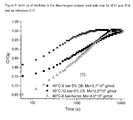
- Figure 4 shows the build up of modulus in the disentangled polymer melt with time for IE13 and IE14 (Copolymer, polymerization temperature 85°C) and as reference IE17.
- the starting G' 0 /G' p of the sample prepared with adding of 2.5 wt% C 6 is still below 0.85 which indicates even more disentanglement than that of the sample prepared under same temperature without feeding C 6 , or similar disentanglement as that of the sample prepared under 60°C with adding of 5 wt% C 6 .
Landscapes
- Chemical & Material Sciences (AREA)
- Health & Medical Sciences (AREA)
- Chemical Kinetics & Catalysis (AREA)
- Medicinal Chemistry (AREA)
- Polymers & Plastics (AREA)
- Organic Chemistry (AREA)
- Addition Polymer Or Copolymer, Post-Treatments, Or Chemical Modifications (AREA)
- Transition And Organic Metals Composition Catalysts For Addition Polymerization (AREA)
- Engineering & Computer Science (AREA)
- Materials Engineering (AREA)
- Compositions Of Macromolecular Compounds (AREA)
- Polymerisation Methods In General (AREA)
Priority Applications (7)
| Application Number | Priority Date | Filing Date | Title |
|---|---|---|---|
| EP14154934.5A EP2907829B1 (fr) | 2014-02-13 | 2014-02-13 | Polyéthylène à poids moléculaire élevé ou ultra élevé démêlé préparé avec un catalyseur de Ziegler-Natta |
| KR1020167012285A KR20160070112A (ko) | 2014-02-13 | 2015-02-06 | 지글러-나타 촉매에 의해 제조되는 얽히지 않은 고분자량 또는 초고분자량의 폴리에틸렌 |
| AU2015217828A AU2015217828B2 (en) | 2014-02-13 | 2015-02-06 | Disentangled high or ultrahigh molecular weight polyethylene prepared with Ziegler-Natta catalyst |
| JP2016551265A JP2017508837A (ja) | 2014-02-13 | 2015-02-06 | チーグラーナッタ触媒を用いて製造される、非絡み合いの高分子量又は超高分子量ポリエチレン |
| PCT/EP2015/052482 WO2015121162A1 (fr) | 2014-02-13 | 2015-02-06 | Polyéthylène de masse moléculaire élevée ou ultra-élevée démêlé synthétisé avec un catalyseur de ziegler-natta |
| CN201580002184.8A CN105658684B (zh) | 2014-02-13 | 2015-02-06 | 用齐格勒-纳塔催化剂制备的解缠结的高或超高分子量聚乙烯 |
| US15/021,113 US9676877B2 (en) | 2014-02-13 | 2015-02-06 | Disentangled high or ultrahigh molecular weight polyethylene prepared with Ziegler-Natta catalyst |
Applications Claiming Priority (1)
| Application Number | Priority Date | Filing Date | Title |
|---|---|---|---|
| EP14154934.5A EP2907829B1 (fr) | 2014-02-13 | 2014-02-13 | Polyéthylène à poids moléculaire élevé ou ultra élevé démêlé préparé avec un catalyseur de Ziegler-Natta |
Publications (2)
| Publication Number | Publication Date |
|---|---|
| EP2907829A1 true EP2907829A1 (fr) | 2015-08-19 |
| EP2907829B1 EP2907829B1 (fr) | 2020-08-19 |
Family
ID=50073025
Family Applications (1)
| Application Number | Title | Priority Date | Filing Date |
|---|---|---|---|
| EP14154934.5A Active EP2907829B1 (fr) | 2014-02-13 | 2014-02-13 | Polyéthylène à poids moléculaire élevé ou ultra élevé démêlé préparé avec un catalyseur de Ziegler-Natta |
Country Status (7)
| Country | Link |
|---|---|
| US (1) | US9676877B2 (fr) |
| EP (1) | EP2907829B1 (fr) |
| JP (1) | JP2017508837A (fr) |
| KR (1) | KR20160070112A (fr) |
| CN (1) | CN105658684B (fr) |
| AU (1) | AU2015217828B2 (fr) |
| WO (1) | WO2015121162A1 (fr) |
Cited By (3)
| Publication number | Priority date | Publication date | Assignee | Title |
|---|---|---|---|---|
| EP2986622B1 (fr) | 2013-04-17 | 2017-08-02 | Reliance Industries Limited | Nouveau pro-catalyseur à base de métal de transition et son procédé de préparation |
| WO2018057107A1 (fr) * | 2016-09-22 | 2018-03-29 | Dow Global Technologies Llc | Compositions de polyéthylène et articles fabriqués à partir de celles-ci |
| EP4159774A4 (fr) * | 2020-05-29 | 2023-11-22 | Asahi Kasei Kabushiki Kaisha | Poudre de polyéthylène et son corps moulé |
Families Citing this family (7)
| Publication number | Priority date | Publication date | Assignee | Title |
|---|---|---|---|---|
| EP3692080A4 (fr) * | 2017-10-06 | 2021-10-13 | Council of Scientific and Industrial Research | Précatalyseur hétérogène destiné à la préparation de polyéthylène à masse moléculaire extrêmement élevée, désenchevêtré, très cristallin (uhmwpe) et procédé de préparation de celui-ci |
| KR102304973B1 (ko) | 2017-11-29 | 2021-09-24 | 롯데케미칼 주식회사 | 폴리에틸렌, 그 제조 방법 및 이를 이용한 분리막 |
| KR20210033017A (ko) | 2018-07-19 | 2021-03-25 | 보레알리스 아게 | 초고분자량 폴리에틸렌 동종중합체의 제조 방법 |
| US20240301101A1 (en) | 2021-06-28 | 2024-09-12 | King Abdullah University Of Science And Technology | Disentangled ultra-high molecular weight polyethylene, methods of making and using |
| JPWO2025013683A1 (fr) * | 2023-07-11 | 2025-01-16 | ||
| KR20250071570A (ko) * | 2023-11-15 | 2025-05-22 | 롯데케미칼 주식회사 | 가공성 및 내충격성이 우수한 초고분자량 폴리에틸렌 |
| WO2025172965A1 (fr) | 2024-02-15 | 2025-08-21 | King Abdullah University Of Science And Technology, | Mélanges de polymères de polyéthylène et leurs procédés de fabrication et d'utilisation |
Citations (26)
| Publication number | Priority date | Publication date | Assignee | Title |
|---|---|---|---|---|
| US3242150A (en) | 1960-03-31 | 1966-03-22 | Phillips Petroleum Co | Method and apparatus for the recovery of solid olefin polymer from a continuous path reaction zone |
| US3324093A (en) | 1963-10-21 | 1967-06-06 | Phillips Petroleum Co | Loop reactor |
| US3374211A (en) | 1964-07-27 | 1968-03-19 | Phillips Petroleum Co | Solids recovery from a flowing stream |
| US3405109A (en) | 1960-10-03 | 1968-10-08 | Phillips Petroleum Co | Polymerization process |
| US4582816A (en) | 1985-02-21 | 1986-04-15 | Phillips Petroleum Company | Catalysts, method of preparation and polymerization processes therewith |
| US4769433A (en) | 1985-11-25 | 1988-09-06 | E. I. Du Pont De Nemours And Company | High strength polyolefins |
| EP0479186A2 (fr) | 1990-10-01 | 1992-04-08 | Phillips Petroleum Company | Appareil et méthode de préparation de polymères d'éthylène |
| US5391654A (en) | 1990-12-28 | 1995-02-21 | Neste Oy | Method for homo- or copolymerizing ethene |
| EP0688794A1 (fr) | 1994-06-20 | 1995-12-27 | Borealis Polymers Oy | Procatalyseur pour la production de polymère d'éthylène, méthode pour sa préparation et utilisation |
| EP0810235A2 (fr) | 1996-05-31 | 1997-12-03 | Intevep SA | Catalyseur de polymérisation |
| US5773547A (en) | 1992-01-28 | 1998-06-30 | Dsm N.V. | Ethylene polymer having an intrinsic viscosity of at least 4 DL/G and a method for the preparation thereof |
| EP0891990A2 (fr) | 1997-07-15 | 1999-01-20 | Phillips Petroleum Company | Polymérisation en suspension à haute teneur en solide |
| WO1999051646A1 (fr) | 1998-04-06 | 1999-10-14 | Borealis Technology Oy | Composant catalyseur de polymerisation d'olefines, sa preparation et son utilisation |
| WO2001055230A1 (fr) | 2000-01-27 | 2001-08-02 | Borealis Technology Oy | Catalyseur |
| EP1310295A1 (fr) | 2001-10-30 | 2003-05-14 | Borealis Technology Oy | Réacteur de polymérisation |
| WO2003106510A1 (fr) | 2002-06-18 | 2003-12-24 | Borealis Polymers Oy | Procede de preparation de catalyseurs pour la polymerisation d'olefines |
| EP1415999A1 (fr) | 2002-10-30 | 2004-05-06 | Borealis Technology Oy | Procédé et dispositif pour la production de polymères d' oléfines |
| EP1441886A1 (fr) | 2001-10-30 | 2004-08-04 | DSM IP Assets B.V. | Procede de production d'une piece moulee de polyethylene a haut poids moleculaire |
| WO2004113057A1 (fr) * | 2003-06-26 | 2004-12-29 | Stichting Dutch Polymer Institute | Procede pour preparer une piece façonnee constituee d'un polyethylene a poids moleculaire ultra eleve |
| EP1591460A1 (fr) | 2004-04-29 | 2005-11-02 | Borealis Technology Oy | Procédé de production de polyéthylène |
| WO2005118655A1 (fr) | 2004-06-02 | 2005-12-15 | Borealis Technology Oy | Procédé pour la préparation d'un catalyseur de polymérisation d'une oléfine |
| WO2007025640A1 (fr) | 2005-09-02 | 2007-03-08 | Borealis Technology Oy | Procédé de polymérisation d’oléfines en présence d'un catalyseur de polymérisation d'oléfines |
| WO2009007045A1 (fr) * | 2007-07-09 | 2009-01-15 | Teijin Aramid B.V. | Film de polyéthylène de haute résistance à la traction et à énergie de rupture élevée par traction |
| WO2013034582A1 (fr) | 2011-09-05 | 2013-03-14 | Stichting Dutch Polymer Institute | Procédé pour l'extrusion de polyéthylène à très haute masse moléculaire à l'état fondu |
| WO2013060736A1 (fr) * | 2011-10-26 | 2013-05-02 | Borealis Ag | Procédé |
| WO2013076733A2 (fr) | 2011-10-10 | 2013-05-30 | Reliance Industries Ltd. | Procédé de synthèse de polymères d'éthylène |
Family Cites Families (7)
| Publication number | Priority date | Publication date | Assignee | Title |
|---|---|---|---|---|
| US6329476B1 (en) * | 1997-10-14 | 2001-12-11 | Phillips Petroleum Company | Olefin polymerization processes and products thereof |
| EP1772485A1 (fr) * | 2005-10-07 | 2007-04-11 | Borealis Technology Oy | Composition à base de polyéthylène pour moulage par soufflage avec une relation résistance améliorée contre fracture / rigidité et de résistance aux impacts |
| EP2011822A1 (fr) * | 2007-07-04 | 2009-01-07 | Borealis Technology Oy | Composition en résine co-polymère de polyéthylène multimodal, processus de préparation correspondant et produit polymérique le comportant |
| US20130012375A1 (en) | 2011-07-04 | 2013-01-10 | Liuzhong Li | Ultra high molecular weight polyethylene catalysts and processes for the preparation thereof |
| CN102863563B (zh) * | 2011-07-04 | 2014-12-10 | 中国石油化工股份有限公司 | 超高分子量聚乙烯催化剂及其制备方法 |
| EA027323B1 (ru) * | 2011-08-05 | 2017-07-31 | Тотал Ресерч & Технолоджи Фелай | Катализаторы для получения сверхвысокомолекулярных полиэтиленов (свмпэ) |
| KR101936456B1 (ko) * | 2012-10-05 | 2019-01-08 | 릴라이언스 인더스트리즈 리미티드 | 중합체 조성물과 이의 제조방법 |
-
2014
- 2014-02-13 EP EP14154934.5A patent/EP2907829B1/fr active Active
-
2015
- 2015-02-06 AU AU2015217828A patent/AU2015217828B2/en not_active Ceased
- 2015-02-06 KR KR1020167012285A patent/KR20160070112A/ko not_active Abandoned
- 2015-02-06 WO PCT/EP2015/052482 patent/WO2015121162A1/fr not_active Ceased
- 2015-02-06 US US15/021,113 patent/US9676877B2/en active Active
- 2015-02-06 CN CN201580002184.8A patent/CN105658684B/zh active Active
- 2015-02-06 JP JP2016551265A patent/JP2017508837A/ja active Pending
Patent Citations (26)
| Publication number | Priority date | Publication date | Assignee | Title |
|---|---|---|---|---|
| US3242150A (en) | 1960-03-31 | 1966-03-22 | Phillips Petroleum Co | Method and apparatus for the recovery of solid olefin polymer from a continuous path reaction zone |
| US3405109A (en) | 1960-10-03 | 1968-10-08 | Phillips Petroleum Co | Polymerization process |
| US3324093A (en) | 1963-10-21 | 1967-06-06 | Phillips Petroleum Co | Loop reactor |
| US3374211A (en) | 1964-07-27 | 1968-03-19 | Phillips Petroleum Co | Solids recovery from a flowing stream |
| US4582816A (en) | 1985-02-21 | 1986-04-15 | Phillips Petroleum Company | Catalysts, method of preparation and polymerization processes therewith |
| US4769433A (en) | 1985-11-25 | 1988-09-06 | E. I. Du Pont De Nemours And Company | High strength polyolefins |
| EP0479186A2 (fr) | 1990-10-01 | 1992-04-08 | Phillips Petroleum Company | Appareil et méthode de préparation de polymères d'éthylène |
| US5391654A (en) | 1990-12-28 | 1995-02-21 | Neste Oy | Method for homo- or copolymerizing ethene |
| US5773547A (en) | 1992-01-28 | 1998-06-30 | Dsm N.V. | Ethylene polymer having an intrinsic viscosity of at least 4 DL/G and a method for the preparation thereof |
| EP0688794A1 (fr) | 1994-06-20 | 1995-12-27 | Borealis Polymers Oy | Procatalyseur pour la production de polymère d'éthylène, méthode pour sa préparation et utilisation |
| EP0810235A2 (fr) | 1996-05-31 | 1997-12-03 | Intevep SA | Catalyseur de polymérisation |
| EP0891990A2 (fr) | 1997-07-15 | 1999-01-20 | Phillips Petroleum Company | Polymérisation en suspension à haute teneur en solide |
| WO1999051646A1 (fr) | 1998-04-06 | 1999-10-14 | Borealis Technology Oy | Composant catalyseur de polymerisation d'olefines, sa preparation et son utilisation |
| WO2001055230A1 (fr) | 2000-01-27 | 2001-08-02 | Borealis Technology Oy | Catalyseur |
| EP1310295A1 (fr) | 2001-10-30 | 2003-05-14 | Borealis Technology Oy | Réacteur de polymérisation |
| EP1441886A1 (fr) | 2001-10-30 | 2004-08-04 | DSM IP Assets B.V. | Procede de production d'une piece moulee de polyethylene a haut poids moleculaire |
| WO2003106510A1 (fr) | 2002-06-18 | 2003-12-24 | Borealis Polymers Oy | Procede de preparation de catalyseurs pour la polymerisation d'olefines |
| EP1415999A1 (fr) | 2002-10-30 | 2004-05-06 | Borealis Technology Oy | Procédé et dispositif pour la production de polymères d' oléfines |
| WO2004113057A1 (fr) * | 2003-06-26 | 2004-12-29 | Stichting Dutch Polymer Institute | Procede pour preparer une piece façonnee constituee d'un polyethylene a poids moleculaire ultra eleve |
| EP1591460A1 (fr) | 2004-04-29 | 2005-11-02 | Borealis Technology Oy | Procédé de production de polyéthylène |
| WO2005118655A1 (fr) | 2004-06-02 | 2005-12-15 | Borealis Technology Oy | Procédé pour la préparation d'un catalyseur de polymérisation d'une oléfine |
| WO2007025640A1 (fr) | 2005-09-02 | 2007-03-08 | Borealis Technology Oy | Procédé de polymérisation d’oléfines en présence d'un catalyseur de polymérisation d'oléfines |
| WO2009007045A1 (fr) * | 2007-07-09 | 2009-01-15 | Teijin Aramid B.V. | Film de polyéthylène de haute résistance à la traction et à énergie de rupture élevée par traction |
| WO2013034582A1 (fr) | 2011-09-05 | 2013-03-14 | Stichting Dutch Polymer Institute | Procédé pour l'extrusion de polyéthylène à très haute masse moléculaire à l'état fondu |
| WO2013076733A2 (fr) | 2011-10-10 | 2013-05-30 | Reliance Industries Ltd. | Procédé de synthèse de polymères d'éthylène |
| WO2013060736A1 (fr) * | 2011-10-26 | 2013-05-02 | Borealis Ag | Procédé |
Non-Patent Citations (19)
| Title |
|---|
| "Definition of terms relating to the non-ultimate mechanical properties of polymers", PURE & APPL. CHEM., vol. 70, no. 3, 1998, pages 701 - 754 |
| A. PANDEY, MACROMOLECULES, vol. 44, 2011, pages 4952 - 4960 |
| ANURAG PANDEY ET AL: "Heterogeneity in the Distribution of Entanglement Density during Polymerization in Disentangled Ultrahigh Molecular Weight Polyethylene", MACROMOLECULES, vol. 44, no. 12, 2011, pages 4952 - 4960, XP001563812 |
| BUSICO, V.; CARBONNIERE, P.; CIPULLO, R.; PELLECCHIA, R.; SEVERN, J.; TALARICO, G., MACROMOL. RAPID COMMUN., vol. 28, 2007, pages 1128 |
| CASTIGNOLLES, P.; GRAF, R.; PARKINSON, M.; WILHELM, M.; GABORIEAU, M., POLYMER, vol. 50, 2009, pages 2373 |
| D. LIPPITS ET AL., MACROMOLECULES, vol. 39, 2006, pages 8882 - 8885 |
| FILIP, X.; TRIPON, C.; FILIP, C., J. MAG. RESON., vol. 176, 2005, pages 239 |
| FRANCIS P. S. ET AL: "Fractionation of Polyethylene", J POLYMER SCIENCE, vol. 31, 1958, pages 453 - 466, XP009173889 |
| GRIFFIN, J.M.; TRIPON, C.; SAMOSON, A.; FILIP, C.; BROWN, S.P., MAG. RES. IN CHEM., vol. 45, no. S1, 2007, pages S198 |
| HEINO, E.L.: "The influence of molecular structure on some rheological properties of polyethylene", BOREALIS POLYMERS OY, PORVOO, FINLAND, ANNUAL TRANSACTIONS OF THE NORDIC RHEOLOGY SOCIETY, 1995 |
| HEINO, E.L.; LEHTINEN, A.; TANNER J.; SEPPALA, J.; NESTE OY; PORVOO, FINLAND: "Rheological characterization of polyethylene fractions", THEOR. APPL. RHEOL., PROC. INT. CONGR. RHEOL, vol. 11TH, no. 1, 1992, pages 360 - 362, XP008137571 |
| J. RANDALL, MACROMOL. SCI., REV. MACROMOL. CHEM. PHYS., vol. C29, 1989, pages 201 |
| KLIMKE, K.; PARKINSON, M.; PIEL, C.; KAMINSKY, W.; SPIESS, H.W.; WILHELM, M., MACROMOL. CHEM. PHYS., vol. 207, 2006, pages 382 |
| MACROMOLECULES, vol. 39, 2006, pages 8882 - 8885 |
| PARKINSON, M.; KLIMKE, K.; SPIESS, H.W.; WILHELM, M., MACROMOL. CHEM. PHYS., vol. 208, no. 2128, 2007 |
| POLLARD, M.; KLIMKE, K.; GRAF, R.; SPIESS, H.W.; WILHELM, M.; SPERBER, O.; PIEL, C.; KAMINSKY, W., MACROMOLECULES, vol. 37, 2004, pages 813 |
| RASTOGI SANJAY ET AL: "Disentangled State in Polymer Melts; a Route to Ultimate Physical and Mechanical Properties", MACROMOL MATER ENG, vol. 288, no. 12, 2003, pages 964 - 970, XP055376482 |
| SMITH P. ET AL: "Drawing of virgin ultrahigh molecular weight polyethylene: an alternative route to high strength/high modulus materials", JOURNAL OF MATERIALS SCIENCE, vol. 22, no. 2, February 1987 (1987-02-01), pages 523 - 531, XP003022879 |
| ZHOU, Z.; MUEMMERLE, R.; QIU, X.; REDWINE, D.; CONG, R.; TAHA, A.; BAUGH, D.; WINNIFORD, B., J. MAG. RESON., vol. 187, 2007, pages 225 |
Cited By (5)
| Publication number | Priority date | Publication date | Assignee | Title |
|---|---|---|---|---|
| EP2986622B1 (fr) | 2013-04-17 | 2017-08-02 | Reliance Industries Limited | Nouveau pro-catalyseur à base de métal de transition et son procédé de préparation |
| WO2018057107A1 (fr) * | 2016-09-22 | 2018-03-29 | Dow Global Technologies Llc | Compositions de polyéthylène et articles fabriqués à partir de celles-ci |
| US10844203B2 (en) | 2016-09-22 | 2020-11-24 | Dow Global Technologies Llc | Polyethylene compositions, and articles made therefrom |
| EP4159774A4 (fr) * | 2020-05-29 | 2023-11-22 | Asahi Kasei Kabushiki Kaisha | Poudre de polyéthylène et son corps moulé |
| US12528937B2 (en) | 2020-05-29 | 2026-01-20 | Asahi Kasei Kabushiki Kaisha | Polyethylene powder and shaped body thereof |
Also Published As
| Publication number | Publication date |
|---|---|
| AU2015217828B2 (en) | 2017-01-05 |
| CN105658684B (zh) | 2019-06-11 |
| US9676877B2 (en) | 2017-06-13 |
| WO2015121162A1 (fr) | 2015-08-20 |
| US20160340449A1 (en) | 2016-11-24 |
| CN105658684A (zh) | 2016-06-08 |
| EP2907829B1 (fr) | 2020-08-19 |
| KR20160070112A (ko) | 2016-06-17 |
| AU2015217828A1 (en) | 2016-04-21 |
| JP2017508837A (ja) | 2017-03-30 |
Similar Documents
| Publication | Publication Date | Title |
|---|---|---|
| EP2907843B1 (fr) | Mélange d'un polyéthylène bimodal avec un polyéthylène unimodal à poids moléculaire ultra élevé présentant des propriétés mécaniques améliorées | |
| EP2907829B1 (fr) | Polyéthylène à poids moléculaire élevé ou ultra élevé démêlé préparé avec un catalyseur de Ziegler-Natta | |
| EP2799487B1 (fr) | Composition | |
| EP2785785B1 (fr) | Composition de polyéthylène multimodale pour la production de tuyaux présentant une résistance à la propagation lente de fissures améliorée | |
| EP3109275B1 (fr) | Composition de polyethylene pour applications de canalisations presentant des proprietes d'affaissement et d'extrusion ameliorees | |
| EP3647356B1 (fr) | Composition de polyoléfine présentant un meilleur équilibre de propriétés | |
| US20210147660A1 (en) | Process for the preparation of multimodal high density polyethylene | |
| EP2860202A1 (fr) | Polyéthylène résistant aux températures élevées et son procédé de production | |
| EP2894174B1 (fr) | Composition de polyéthylène avec une grande flexibilité et une résistance à haute température convenant à des applications de tuyau | |
| EP3037436B1 (fr) | Procédé de production de mélanges in situ de polyéthylène multimodal comprenant les fractions de masse moléculaire ultra élevée | |
| US20250145809A1 (en) | Polyethylene pipe resin with improved long term hydrostatic strength | |
| EP4453049A1 (fr) | Composition polymère pour tuyaux possédant de très bonnes propriétés d'impact et une résistance à la croissance lente des fissures |
Legal Events
| Date | Code | Title | Description |
|---|---|---|---|
| PUAI | Public reference made under article 153(3) epc to a published international application that has entered the european phase |
Free format text: ORIGINAL CODE: 0009012 |
|
| AK | Designated contracting states |
Kind code of ref document: A1 Designated state(s): AL AT BE BG CH CY CZ DE DK EE ES FI FR GB GR HR HU IE IS IT LI LT LU LV MC MK MT NL NO PL PT RO RS SE SI SK SM TR |
|
| AX | Request for extension of the european patent |
Extension state: BA ME |
|
| 17P | Request for examination filed |
Effective date: 20160217 |
|
| RBV | Designated contracting states (corrected) |
Designated state(s): AL AT BE BG CH CY CZ DE DK EE ES FI FR GB GR HR HU IE IS IT LI LT LU LV MC MK MT NL NO PL PT RO RS SE SI SK SM TR |
|
| RIN1 | Information on inventor provided before grant (corrected) |
Inventor name: DOU, QIZHENG Inventor name: LIU, YI Inventor name: HJERTBERG, THOMAS Inventor name: ALBUNIA, ALEXANDRA ROMINA |
|
| TPAC | Observations filed by third parties |
Free format text: ORIGINAL CODE: EPIDOSNTIPA |
|
| STAA | Information on the status of an ep patent application or granted ep patent |
Free format text: STATUS: EXAMINATION IS IN PROGRESS |
|
| 17Q | First examination report despatched |
Effective date: 20180410 |
|
| GRAP | Despatch of communication of intention to grant a patent |
Free format text: ORIGINAL CODE: EPIDOSNIGR1 |
|
| STAA | Information on the status of an ep patent application or granted ep patent |
Free format text: STATUS: GRANT OF PATENT IS INTENDED |
|
| INTG | Intention to grant announced |
Effective date: 20200511 |
|
| GRAS | Grant fee paid |
Free format text: ORIGINAL CODE: EPIDOSNIGR3 |
|
| GRAA | (expected) grant |
Free format text: ORIGINAL CODE: 0009210 |
|
| STAA | Information on the status of an ep patent application or granted ep patent |
Free format text: STATUS: THE PATENT HAS BEEN GRANTED |
|
| AK | Designated contracting states |
Kind code of ref document: B1 Designated state(s): AL AT BE BG CH CY CZ DE DK EE ES FI FR GB GR HR HU IE IS IT LI LT LU LV MC MK MT NL NO PL PT RO RS SE SI SK SM TR |
|
| REG | Reference to a national code |
Ref country code: CH Ref legal event code: EP |
|
| REG | Reference to a national code |
Ref country code: DE Ref legal event code: R096 Ref document number: 602014069054 Country of ref document: DE |
|
| REG | Reference to a national code |
Ref country code: AT Ref legal event code: REF Ref document number: 1303849 Country of ref document: AT Kind code of ref document: T Effective date: 20200915 |
|
| REG | Reference to a national code |
Ref country code: IE Ref legal event code: FG4D |
|
| REG | Reference to a national code |
Ref country code: LT Ref legal event code: MG4D |
|
| REG | Reference to a national code |
Ref country code: NL Ref legal event code: MP Effective date: 20200819 |
|
| PG25 | Lapsed in a contracting state [announced via postgrant information from national office to epo] |
Ref country code: BG Free format text: LAPSE BECAUSE OF FAILURE TO SUBMIT A TRANSLATION OF THE DESCRIPTION OR TO PAY THE FEE WITHIN THE PRESCRIBED TIME-LIMIT Effective date: 20201119 Ref country code: GR Free format text: LAPSE BECAUSE OF FAILURE TO SUBMIT A TRANSLATION OF THE DESCRIPTION OR TO PAY THE FEE WITHIN THE PRESCRIBED TIME-LIMIT Effective date: 20201120 Ref country code: SE Free format text: LAPSE BECAUSE OF FAILURE TO SUBMIT A TRANSLATION OF THE DESCRIPTION OR TO PAY THE FEE WITHIN THE PRESCRIBED TIME-LIMIT Effective date: 20200819 Ref country code: FI Free format text: LAPSE BECAUSE OF FAILURE TO SUBMIT A TRANSLATION OF THE DESCRIPTION OR TO PAY THE FEE WITHIN THE PRESCRIBED TIME-LIMIT Effective date: 20200819 Ref country code: NO Free format text: LAPSE BECAUSE OF FAILURE TO SUBMIT A TRANSLATION OF THE DESCRIPTION OR TO PAY THE FEE WITHIN THE PRESCRIBED TIME-LIMIT Effective date: 20201119 Ref country code: PT Free format text: LAPSE BECAUSE OF FAILURE TO SUBMIT A TRANSLATION OF THE DESCRIPTION OR TO PAY THE FEE WITHIN THE PRESCRIBED TIME-LIMIT Effective date: 20201221 Ref country code: LT Free format text: LAPSE BECAUSE OF FAILURE TO SUBMIT A TRANSLATION OF THE DESCRIPTION OR TO PAY THE FEE WITHIN THE PRESCRIBED TIME-LIMIT Effective date: 20200819 Ref country code: HR Free format text: LAPSE BECAUSE OF FAILURE TO SUBMIT A TRANSLATION OF THE DESCRIPTION OR TO PAY THE FEE WITHIN THE PRESCRIBED TIME-LIMIT Effective date: 20200819 |
|
| REG | Reference to a national code |
Ref country code: AT Ref legal event code: MK05 Ref document number: 1303849 Country of ref document: AT Kind code of ref document: T Effective date: 20200819 |
|
| PG25 | Lapsed in a contracting state [announced via postgrant information from national office to epo] |
Ref country code: IS Free format text: LAPSE BECAUSE OF FAILURE TO SUBMIT A TRANSLATION OF THE DESCRIPTION OR TO PAY THE FEE WITHIN THE PRESCRIBED TIME-LIMIT Effective date: 20201219 Ref country code: RS Free format text: LAPSE BECAUSE OF FAILURE TO SUBMIT A TRANSLATION OF THE DESCRIPTION OR TO PAY THE FEE WITHIN THE PRESCRIBED TIME-LIMIT Effective date: 20200819 Ref country code: PL Free format text: LAPSE BECAUSE OF FAILURE TO SUBMIT A TRANSLATION OF THE DESCRIPTION OR TO PAY THE FEE WITHIN THE PRESCRIBED TIME-LIMIT Effective date: 20200819 Ref country code: LV Free format text: LAPSE BECAUSE OF FAILURE TO SUBMIT A TRANSLATION OF THE DESCRIPTION OR TO PAY THE FEE WITHIN THE PRESCRIBED TIME-LIMIT Effective date: 20200819 Ref country code: NL Free format text: LAPSE BECAUSE OF FAILURE TO SUBMIT A TRANSLATION OF THE DESCRIPTION OR TO PAY THE FEE WITHIN THE PRESCRIBED TIME-LIMIT Effective date: 20200819 |
|
| PG25 | Lapsed in a contracting state [announced via postgrant information from national office to epo] |
Ref country code: EE Free format text: LAPSE BECAUSE OF FAILURE TO SUBMIT A TRANSLATION OF THE DESCRIPTION OR TO PAY THE FEE WITHIN THE PRESCRIBED TIME-LIMIT Effective date: 20200819 Ref country code: CZ Free format text: LAPSE BECAUSE OF FAILURE TO SUBMIT A TRANSLATION OF THE DESCRIPTION OR TO PAY THE FEE WITHIN THE PRESCRIBED TIME-LIMIT Effective date: 20200819 Ref country code: DK Free format text: LAPSE BECAUSE OF FAILURE TO SUBMIT A TRANSLATION OF THE DESCRIPTION OR TO PAY THE FEE WITHIN THE PRESCRIBED TIME-LIMIT Effective date: 20200819 Ref country code: SM Free format text: LAPSE BECAUSE OF FAILURE TO SUBMIT A TRANSLATION OF THE DESCRIPTION OR TO PAY THE FEE WITHIN THE PRESCRIBED TIME-LIMIT Effective date: 20200819 Ref country code: RO Free format text: LAPSE BECAUSE OF FAILURE TO SUBMIT A TRANSLATION OF THE DESCRIPTION OR TO PAY THE FEE WITHIN THE PRESCRIBED TIME-LIMIT Effective date: 20200819 |
|
| REG | Reference to a national code |
Ref country code: DE Ref legal event code: R097 Ref document number: 602014069054 Country of ref document: DE |
|
| PG25 | Lapsed in a contracting state [announced via postgrant information from national office to epo] |
Ref country code: ES Free format text: LAPSE BECAUSE OF FAILURE TO SUBMIT A TRANSLATION OF THE DESCRIPTION OR TO PAY THE FEE WITHIN THE PRESCRIBED TIME-LIMIT Effective date: 20200819 Ref country code: AT Free format text: LAPSE BECAUSE OF FAILURE TO SUBMIT A TRANSLATION OF THE DESCRIPTION OR TO PAY THE FEE WITHIN THE PRESCRIBED TIME-LIMIT Effective date: 20200819 Ref country code: AL Free format text: LAPSE BECAUSE OF FAILURE TO SUBMIT A TRANSLATION OF THE DESCRIPTION OR TO PAY THE FEE WITHIN THE PRESCRIBED TIME-LIMIT Effective date: 20200819 |
|
| PLBE | No opposition filed within time limit |
Free format text: ORIGINAL CODE: 0009261 |
|
| STAA | Information on the status of an ep patent application or granted ep patent |
Free format text: STATUS: NO OPPOSITION FILED WITHIN TIME LIMIT |
|
| PG25 | Lapsed in a contracting state [announced via postgrant information from national office to epo] |
Ref country code: SK Free format text: LAPSE BECAUSE OF FAILURE TO SUBMIT A TRANSLATION OF THE DESCRIPTION OR TO PAY THE FEE WITHIN THE PRESCRIBED TIME-LIMIT Effective date: 20200819 |
|
| 26N | No opposition filed |
Effective date: 20210520 |
|
| PG25 | Lapsed in a contracting state [announced via postgrant information from national office to epo] |
Ref country code: IT Free format text: LAPSE BECAUSE OF FAILURE TO SUBMIT A TRANSLATION OF THE DESCRIPTION OR TO PAY THE FEE WITHIN THE PRESCRIBED TIME-LIMIT Effective date: 20200819 |
|
| PG25 | Lapsed in a contracting state [announced via postgrant information from national office to epo] |
Ref country code: SI Free format text: LAPSE BECAUSE OF FAILURE TO SUBMIT A TRANSLATION OF THE DESCRIPTION OR TO PAY THE FEE WITHIN THE PRESCRIBED TIME-LIMIT Effective date: 20200819 |
|
| PG25 | Lapsed in a contracting state [announced via postgrant information from national office to epo] |
Ref country code: MC Free format text: LAPSE BECAUSE OF FAILURE TO SUBMIT A TRANSLATION OF THE DESCRIPTION OR TO PAY THE FEE WITHIN THE PRESCRIBED TIME-LIMIT Effective date: 20200819 |
|
| GBPC | Gb: european patent ceased through non-payment of renewal fee |
Effective date: 20210213 |
|
| REG | Reference to a national code |
Ref country code: BE Ref legal event code: MM Effective date: 20210228 |
|
| PG25 | Lapsed in a contracting state [announced via postgrant information from national office to epo] |
Ref country code: CH Free format text: LAPSE BECAUSE OF NON-PAYMENT OF DUE FEES Effective date: 20210228 Ref country code: LU Free format text: LAPSE BECAUSE OF NON-PAYMENT OF DUE FEES Effective date: 20210213 Ref country code: LI Free format text: LAPSE BECAUSE OF NON-PAYMENT OF DUE FEES Effective date: 20210228 |
|
| PG25 | Lapsed in a contracting state [announced via postgrant information from national office to epo] |
Ref country code: GB Free format text: LAPSE BECAUSE OF NON-PAYMENT OF DUE FEES Effective date: 20210213 Ref country code: IE Free format text: LAPSE BECAUSE OF NON-PAYMENT OF DUE FEES Effective date: 20210213 |
|
| PG25 | Lapsed in a contracting state [announced via postgrant information from national office to epo] |
Ref country code: BE Free format text: LAPSE BECAUSE OF NON-PAYMENT OF DUE FEES Effective date: 20210228 |
|
| PG25 | Lapsed in a contracting state [announced via postgrant information from national office to epo] |
Ref country code: HU Free format text: LAPSE BECAUSE OF FAILURE TO SUBMIT A TRANSLATION OF THE DESCRIPTION OR TO PAY THE FEE WITHIN THE PRESCRIBED TIME-LIMIT; INVALID AB INITIO Effective date: 20140213 |
|
| PG25 | Lapsed in a contracting state [announced via postgrant information from national office to epo] |
Ref country code: CY Free format text: LAPSE BECAUSE OF FAILURE TO SUBMIT A TRANSLATION OF THE DESCRIPTION OR TO PAY THE FEE WITHIN THE PRESCRIBED TIME-LIMIT Effective date: 20200819 |
|
| P01 | Opt-out of the competence of the unified patent court (upc) registered |
Effective date: 20230602 |
|
| PG25 | Lapsed in a contracting state [announced via postgrant information from national office to epo] |
Ref country code: MK Free format text: LAPSE BECAUSE OF FAILURE TO SUBMIT A TRANSLATION OF THE DESCRIPTION OR TO PAY THE FEE WITHIN THE PRESCRIBED TIME-LIMIT Effective date: 20200819 |
|
| PG25 | Lapsed in a contracting state [announced via postgrant information from national office to epo] |
Ref country code: MT Free format text: LAPSE BECAUSE OF FAILURE TO SUBMIT A TRANSLATION OF THE DESCRIPTION OR TO PAY THE FEE WITHIN THE PRESCRIBED TIME-LIMIT Effective date: 20200819 |
|
| PG25 | Lapsed in a contracting state [announced via postgrant information from national office to epo] |
Ref country code: TR Free format text: LAPSE BECAUSE OF FAILURE TO SUBMIT A TRANSLATION OF THE DESCRIPTION OR TO PAY THE FEE WITHIN THE PRESCRIBED TIME-LIMIT Effective date: 20200819 |
|
| PGFP | Annual fee paid to national office [announced via postgrant information from national office to epo] |
Ref country code: DE Payment date: 20260218 Year of fee payment: 13 |
|
| PGFP | Annual fee paid to national office [announced via postgrant information from national office to epo] |
Ref country code: FR Payment date: 20260218 Year of fee payment: 13 |