EP2908582B1 - Traitement de radioappel par un serveur gérant de mobilité afin d'éviter, en cas d'erreur de radioappel, la perte de données de liaison descendante mises en mémoire tampon dans une passerelle servante - Google Patents
Traitement de radioappel par un serveur gérant de mobilité afin d'éviter, en cas d'erreur de radioappel, la perte de données de liaison descendante mises en mémoire tampon dans une passerelle servante Download PDFInfo
- Publication number
- EP2908582B1 EP2908582B1 EP13845547.2A EP13845547A EP2908582B1 EP 2908582 B1 EP2908582 B1 EP 2908582B1 EP 13845547 A EP13845547 A EP 13845547A EP 2908582 B1 EP2908582 B1 EP 2908582B1
- Authority
- EP
- European Patent Office
- Prior art keywords
- paging
- mme
- message
- information
- tau
- Prior art date
- Legal status (The legal status is an assumption and is not a legal conclusion. Google has not performed a legal analysis and makes no representation as to the accuracy of the status listed.)
- Active
Links
Images





Classifications
-
- H—ELECTRICITY
- H04—ELECTRIC COMMUNICATION TECHNIQUE
- H04W—WIRELESS COMMUNICATION NETWORKS
- H04W60/00—Affiliation to network, e.g. registration; Terminating affiliation with the network, e.g. de-registration
- H04W60/04—Affiliation to network, e.g. registration; Terminating affiliation with the network, e.g. de-registration using triggered events
-
- H—ELECTRICITY
- H04—ELECTRIC COMMUNICATION TECHNIQUE
- H04W—WIRELESS COMMUNICATION NETWORKS
- H04W8/00—Network data management
- H04W8/02—Processing of mobility data, e.g. registration information at HLR [Home Location Register] or VLR [Visitor Location Register]; Transfer of mobility data, e.g. between HLR, VLR or external networks
- H04W8/08—Mobility data transfer
-
- H—ELECTRICITY
- H04—ELECTRIC COMMUNICATION TECHNIQUE
- H04W—WIRELESS COMMUNICATION NETWORKS
- H04W36/00—Hand-off or reselection arrangements
- H04W36/0005—Control or signalling for completing the hand-off
- H04W36/0011—Control or signalling for completing the hand-off for data sessions of end-to-end connection
-
- H—ELECTRICITY
- H04—ELECTRIC COMMUNICATION TECHNIQUE
- H04W—WIRELESS COMMUNICATION NETWORKS
- H04W68/00—User notification, e.g. alerting and paging, for incoming communication, change of service or the like
- H04W68/005—Transmission of information for alerting of incoming communication
-
- H—ELECTRICITY
- H04—ELECTRIC COMMUNICATION TECHNIQUE
- H04W—WIRELESS COMMUNICATION NETWORKS
- H04W68/00—User notification, e.g. alerting and paging, for incoming communication, change of service or the like
- H04W68/02—Arrangements for increasing efficiency of notification or paging channel
-
- H—ELECTRICITY
- H04—ELECTRIC COMMUNICATION TECHNIQUE
- H04W—WIRELESS COMMUNICATION NETWORKS
- H04W72/00—Local resource management
- H04W72/20—Control channels or signalling for resource management
- H04W72/23—Control channels or signalling for resource management in the downlink direction of a wireless link, i.e. towards a terminal
-
- H—ELECTRICITY
- H04—ELECTRIC COMMUNICATION TECHNIQUE
- H04W—WIRELESS COMMUNICATION NETWORKS
- H04W76/00—Connection management
- H04W76/10—Connection setup
- H04W76/11—Allocation or use of connection identifiers
-
- H—ELECTRICITY
- H04—ELECTRIC COMMUNICATION TECHNIQUE
- H04W—WIRELESS COMMUNICATION NETWORKS
- H04W88/00—Devices specially adapted for wireless communication networks, e.g. terminals, base stations or access point devices
- H04W88/08—Access point devices
Definitions
- the present invention relates to a paging procedure and a tracking area update procedure.
- LTE/SAE Long Term Evolution/System Architecture Evolution
- SAE that has been performed based on 3GPP SA WG2 is research regarding network technology that aims to determine the structure of a network and to support mobility between heterogeneous networks in line with an LTE task of a 3GPP TSG RAN and is one of recent important standardization issues of 3GPP.
- SAE is a task for developing a 3GPP system into a system that supports various radio access technologies based on an IP, and the task has been carried out for the purpose of an optimized packet-based system which minimizes transmission delay with a more improved data transmission capability.
- An Evolved Packet System (EPS) higher level reference model defined in 3GPP SA WG2 includes a non-roaming case and roaming cases having various scenarios, and for details therefor, reference can be made to 3GPP standard documents TS 23.401 and TS 23.402.
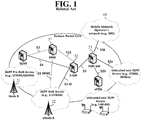
- a network configuration of FIG. 1 has been briefly reconfigured from the EPS higher level reference model.
- FIG. 1 shows the configuration of an evolved mobile communication network.
- FIG. 1 illustrates a Serving Gateway (S-GW) 52, a Packet Data Network Gateway (PDN GW) 53, a Mobility Management Entity (MME) 51, a Serving General Packet Radio Service (GPRS) Supporting Node (SGSN), and an enhanced Packet Data Gateway (ePDG) that correspond to some of the various elements.
- S-GW Serving Gateway
- PDN GW Packet Data Network Gateway
- MME Mobility Management Entity
- GPRS General Packet Radio Service
- SGSN Serving General Packet Radio Service
- ePDG enhanced Packet Data Gateway
- the S-GW 52 is an element that operates at a boundary point between a Radio Access Network (RAN) and a core network and has a function of maintaining a data path between an eNodeB 22 and the PDN GW 53. Furthermore, if a terminal (or User Equipment (UE) moves in a region in which service is provided by the eNodeB 22, the S-GW 52 plays a role of a local mobility anchor point. That is, for mobility within an E-UTRAN (i.e., a Universal Mobile Telecommunications System (Evolved-UMTS) Terrestrial Radio Access Network defined after 3GPP release-8), packets can be routed through the S-GW 52.
- E-UTRAN i.e., a Universal Mobile Telecommunications System (Evolved-UMTS) Terrestrial Radio Access Network defined after 3GPP release-8
- the S-GW 52 may play a role of an anchor point for mobility with another 3GPP network (i.e., a RAN defined prior to 3GPP release-8, for example, a UTRAN or Global System for Mobile communication (GSM) (GERAN)/Enhanced Data rates for Global Evolution (EDGE) Radio Access Network).
- a RAN defined prior to 3GPP release-8, for example, a UTRAN or Global System for Mobile communication (GSM) (GERAN)/Enhanced Data rates for Global Evolution (EDGE) Radio Access Network).
- GSM Global System for Mobile communication
- GERAN GERAN
- EDGE Enhanced Data rates for Global Evolution
- the PDN GW (or P-GW) 53 corresponds to the termination point of a data interface toward a packet data network.
- the PDN GW 53 can support policy enforcement features, packet filtering, charging support, etc.
- the PDN GW (or P-GW) 53 can play a role of an anchor point for mobility management with a 3GPP network and a non-3GPP network (e.g., an unreliable network, such as an Interworking Wireless Local Area Network (I-WLAN), a Code Division Multiple Access (CDMA) network, or a reliable network, such as WiMax).
- I-WLAN Interworking Wireless Local Area Network
- CDMA Code Division Multiple Access
- the S-GW 52 and the PDN GW 53 have been illustrated as being separate gateways, but the two gateways may be implemented in accordance with a single gateway configuration option.
- the MME 51 is an element for performing the access of a terminal to a network connection and signaling and control functions for supporting the allocation, tracking, paging, roaming, handover, etc. of network resources.
- the MME 51 controls control plane functions related to subscribers and session management.
- the MME 51 manages numerous eNodeBs 22 and performs conventional signaling for selecting a gateway for handover to another 2G/3G networks.
- the MME 51 performs functions, such as security procedures, terminal-to-network session handling, and idle terminal location management.
- the SGSN handles all packet data, such as a user's mobility management and authentication for different access 3GPP networks (e.g., a GPRS network and an UTRAN/GERAN).
- 3GPP networks e.g., a GPRS network and an UTRAN/GERAN.
- the ePDG plays a role of a security node for an unreliable non-3GPP network (e.g., an I-WLAN and a Wi-Fi hotspot).
- an unreliable non-3GPP network e.g., an I-WLAN and a Wi-Fi hotspot.
- a terminal having an IP capability can access an IP service network (e.g., IMS), provided by a service provider (i.e., an operator), via various elements within an EPC based on non-3GPP access as well as based on 3GPP access.
- IMS IP service network
- a service provider i.e., an operator
- FIG. 1 shows various reference points (e.g., S1-U and S1-MME).
- reference points e.g., S1-U and S1-MME.
- Table 1 defines reference points shown in FIG. 1 .
- various reference points may be present depending on a network configuration.
- REFERENCE POINT DESCRIPTION S1-MME A reference point for a control plane protocol between the E-UTRAN and the MME S1-U
- a reference point between the MME and the SGSN that provides the exchange of pieces of user and bearer information for mobility between 3GPP access networks in idle and/or activation state.
- This reference point can be used intra-PLMN or inter-PLMN (e.g. in the case of Inter-PLMN HO).
- S4 A reference point between the SGW and the SGSN that provides related control and mobility support between the 3GPP anchor functions of a GPRS core and the S-GW. Furthermore, if a direct tunnel is not established, the reference point provides user plane tunneling.
- S5 A reference point that provides user plane tunneling and tunnel management between the S-GW and the PDN GW. The reference point is used for S-GW relocation due to UE mobility and if the S-GW needs to connect to a non-collocated PDN GW for required PDN connectivity
- S11 A reference point between the MME and the S-GW SGi A reference point between the PDN GW and the PDN.
- the PDN may be a public or private PDN external to an operator or may be an intra-operator PDN, e.g., for the providing of IMS services. This reference point corresponds to Gi for 3GPP access.
- S2a and S2b correspond to non-3GPP interfaces.
- S2a is a reference point providing the user plane with related control and mobility support between a PDN GW and a reliable non-3GPP access.
- S2b is a reference point providing the user plane with mobility support and related control between a PDN GW and an ePDG.
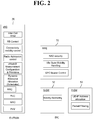
- FIG. 2 is an exemplary diagram showing the architecture of a common E-UTRAN and a common EPC.
- the eNodeB 20 can perform functions, such as routing to a gateway while RRC connection is activated, the scheduling and transmission of a paging message, the scheduling and transmission of a broadcast channel (BCH), the dynamic allocation of resources to UE in uplink and downlink, a configuration and providing for the measurement of the eNodeB 20, control of a radio bearer, radio admission control, and connection mobility control.
- the EPC can perform functions, such as the generation of paging, the management of an LTE_IDLE state, the ciphering of a user plane, control of an EPS bearer, the ciphering of NAS signaling, and integrity protection.
- FIG. 3 is an exemplary diagram showing the structure of a radio interface protocol in a control plane between UE and an eNodeB
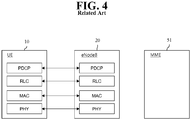
- FIG. 4 is another exemplary diagram showing the structure of a radio interface protocol in a control plane between UE and an eNodeB.
- the radio interface protocol is based on a 3GPP radio access network standard.
- the radio interface protocol includes a physical layer, a data link layer, and a network layer horizontally, and it is divided into a user plane for the transmission of information and a control plane for the transfer of a control signal (or signaling).
- the protocol layers may be classified into a first layer (L1), a second layer (L2), and a third layer (L3) based on three lower layers of the Open System Interconnection (OSI) reference model that is widely known in communication systems.
- OSI Open System Interconnection
- the physical layer PHY that is, the first layer, provides information transfer service using physical channels.
- the PHY layer is connected to a Medium Access Control (MAC) layer placed in a higher layer through a transport channel, and data is transferred between the MAC layer and the PHY layer through the transport channel. Furthermore, data is transferred between different PHY layers, that is, PHY layers on the sender side and the receiver side, through the PHY layer.
- MAC Medium Access Control
- a physical channel is made up of multiple subframes on a time axis and multiple subcarriers on a frequency axis.
- one sub frame is made up of a plurality of symbols and a plurality of subcarriers on the time axis.
- One subframe is made up of a plurality of resource blocks, and one resource block is made up of a plurality of symbols and a plurality of subcarriers.
- TTI Transmission Time Interval
- physical channels that are present in the physical layer of the sender side and the receiver side can be divided into a Physical Downlink Shared Channel (PDSCH) and a Physical Uplink Shared Channel (PUSCH), that is, data channels, and a Physical Downlink Control Channel (PDCCH), a Physical Control Format Indicator Channel (PCFICH), a Physical Hybrid-ARQ Indicator Channel (PHICH), and a Physical Uplink Control Channel (PUCCH), that is, control channels.
- PDSCH Physical Downlink Shared Channel
- PUSCH Physical Uplink Shared Channel
- PDCCH Physical Downlink Control Channel
- PCFICH Physical Control Format Indicator Channel
- PHICH Physical Hybrid-ARQ Indicator Channel
- PUCCH Physical Uplink Control Channel
- a PCFICH that is transmitted in the first OFDM symbol of a subframe carries a Control Format Indicator (CFI) regarding the number of OFDM symbols (i.e., the size of a control region) used to send control channels within the subframe.
- CFI Control Format Indicator
- a wireless device first receives a CFI on a PCFICH and then monitors PDCCHs.
- a PCFICH is transmitted through the fixed PCFICH resources of a subframe without using blind decoding.
- a PHICH carries positive-acknowledgement (ACK)/negative-acknowledgement (NACK) signals for an uplink (UL) Hybrid Automatic Repeat reQuest (HARQ).
- ACK/NACK signals for UL data on a PUSCH that is transmitted by a wireless device are transmitted on a PHICH.
- a Physical Broadcast Channel (PBCH) is transmitted in four former OFDM symbols of the second slot of the first subframe of a radio frame.
- the PBCH carries system information that is essential for a wireless device to communicate with an eNodeB, and system information transmitted through a PBCH is called a Master Information Block (MIB).
- MIB Master Information Block
- SIB System Information Block
- SIB System Information Block
- a PDCCH can carry the resource allocation and transport format of a downlink-shared channel (DL-SCH), information about the resource allocation of an uplink shared channel (UL-SCH), paging information for a PCH, system information for a DL-SCH, the resource allocation of an upper layer control message transmitted on a PDSCH, such as a random access response, a set of transmit power control commands for pieces of UE within a specific UE group, and the activation of a Voice over Internet Protocol (VoIP).
- a plurality of PDCCHs can be transmitted within the control region, and UE can monitor a plurality of PDCCHs.
- a PDCCH is transmitted on one Control Channel Element (CCE) or an aggregation of multiple contiguous CCEs.
- CCE Control Channel Element
- a CCE is a logical allocation unit used to provide a PDCCH with a coding rate according to the state of a radio channel.
- a CCE corresponds to a plurality of resource element groups.
- the format of a PDCCH and the number of bits of a possible PDCCH are determined by a relationship between the number of CCEs and a coding rate provided by CCEs.
- DCI Downlink Control Information
- DCI can include the resource allocation of a PDSCH (also called a downlink (DL) grant)), the resource allocation of a PUSCH (also called an uplink (UL) grant), a set of transmit power control commands for pieces of UE within a specific UE group, and/or the activation of a Voice over Internet Protocol (VoIP).
- a PDSCH also called a downlink (DL) grant
- PUSCH also called an uplink (UL) grant
- VoIP Voice over Internet Protocol
- MAC Medium Access Control
- RLC Radio Link Control
- the logical channel is basically divided into a control channel through which information of the control plane is transmitted and a traffic channel through which information of the user plane is transmitted depending on the type of transmitted information.
- the RLC layer of the second layer functions to control a data size that is suitable for sending, by a lower layer, data received from a higher layer in a radio section by segmenting and concatenating the data. Furthermore, in order to guarantee various types of QoS required by radio bearers, the RLC layer provides three types of operation modes: a Transparent Mode (TM), an Un-acknowledged Mode (UM), and an Acknowledged Mode (AM). In particular, AM RLC performs a retransmission function through an Automatic Repeat and Request (ARQ) function for reliable data transmission.
- TM Transparent Mode
- UM Un-acknowledged Mode
- AM Acknowledged Mode
- AM RLC performs a retransmission function through an Automatic Repeat and Request (ARQ) function for reliable data transmission.
- ARQ Automatic Repeat and Request
- the Packet Data Convergence Protocol (PDCP) layer of the second layer performs a header compression function for reducing the size of an IP packet header containing control information that is relatively large in size and unnecessary in order to efficiently send an IP packet, such as IPv4 or IPv6, in a radio section having a small bandwidth when sending the IP packet. Accordingly, transmission efficiency of the radio section can be increased because only essential information is transmitted in the header part of data.
- the PDCP layer also performs a security function.
- the security function includes ciphering for preventing the interception of data by a third party and integrity protection for preventing the manipulation of data by a third party.
- a Radio Resource Control (RRC) layer at the highest place of the third layer is defined only in the control plane and is responsible for control of logical channels, transport channels, and physical channels in relation to the configuration, re-configuration, and release of Radio Bearers (RBs).
- RRC Radio Resource Control
- the RB means service provided by the second layer in order to transfer data between UE and an E-UTRAN.
- the UE If an RRC connection is present between the RRC layer of UE and the RRC layer of a wireless network, the UE is in an RRC_CONNECTED state. If not, the UE is in an RRC_IDLE state.
- the RRC state means whether or not the RRC layer of UE has been logically connected to the RRC layer of an E-UTRAN. If the RRC layer of UE is logically connected to the RRC layer of an E-UTRAN, it is called the RRC_CONNECTED state. If the RRC layer of UE is not logically connected to the RRC layer of an E-UTRAN, it is called the RRC_IDLE state. Since UE in the RRC_CONNECTED state has an RRC connection, an E-UTRAN can check the existence of the UE in a cell unit, and thus control the UE effectively.
- TA Tracking Area
- UE In contrast, if UE is in the RRC_IDLE state, an E-UTRAN cannot check the existence of the UE, and a core network is managed in a Tracking Area (TA) unit, that is, an area unit greater than a cell. That is, only the existence of UE in the RRC_IDLE state is checked in an area unit greater than a cell. In such a case, the UE needs to shift to the RRC_CONNECTED state in order to be provided with common mobile communication service, such as voice or data.
- Each TA is classified through Tracking Area Identity (TAI).
- UE can configure TAI through Tracking Area Code (TAC), that is, information broadcasted by a cell.
- TAI Tracking Area Code
- the UE When a user first turns on the power of UE, the UE first searches for a proper cell, establishes an RRC connection in the corresponding cell, and registers information about the UE with a core network. Thereafter, the UE stays in the RRC_IDLE state. The UE in the RRC_IDLE state (re)selects a cell if necessary and checks system information or paging information. This process is called camp on. When the UE in the RRC_IDLE state needs to establish an RRC connection, the UE establishes an RRC connection with the RRC layer of an E-UTRAN through an RRC connection procedure and shifts to the RRC_CONNECTED state.
- a case where the UE in the RRC_IDLE state needs to establish with an RRC connection includes multiple cases.
- the multiple cases may include, for example, a case where UL data needs to be transmitted for a reason, such as a call attempt made by a user and a case where a response message needs to be transmitted in response to a paging message received from an E-UTRAN.
- a Non-Access Stratum (NAS) layer placed over the RRC layer performs functions, such as session management and mobility management.
- functions such as session management and mobility management.
- the NAS layer shown in FIG. 3 is described in detail below.
- Evolved Session Management belonging to the NAS layer performs functions, such as the management of default bearers and the management of dedicated bearers, and ESM is responsible for control that is necessary for UE to use PS service from a network.
- Default bearer resources are characterized in that they are allocated by a network when UE first accesses a specific Packet Data Network (PDN) or accesses a network.
- PDN Packet Data Network
- the network allocates an IP address available for UE so that the UE can use data service and the QoS of a default bearer.
- LTE supports two types of bearers: a bearer having Guaranteed Bit Rate (GBR) QoS characteristic that guarantees a specific bandwidth for the transmission and reception of data and a non-GBR bearer having the best effort QoS characteristic without guaranteeing a bandwidth.
- GBR Guaranteed Bit Rate
- a default bearer is assigned a non-GBR bearer, and a dedicated bearer may be assigned a bearer having a GBR or non-GBR QoS characteristic.
- EPS bearer In a network, a bearer assigned to UE is called an Evolved Packet Service (EPS) bearer.
- EPS bearer ID When assigning an EPS bearer, a network assigns one ID. This is called an EPS bearer ID.
- One EPS bearer has QoS characteristics of a Maximum Bit Rate (MBR) and a Guaranteed Bit Rate (GBR) or an Aggregated Maximum Bit Rate (AMBR).
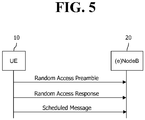
- FIG. 5 is a flowchart illustrating a random access process in 3GPP LTE.
- the random access process is used for UE 10 to obtain UL synchronization with a base station, that is, an eNodeB 20, or to be assigned UL radio resources.
- the UE 10 receives a root index and a physical random access channel (PRACH) configuration index from the eNodeB 20. 64 candidate random access preambles defined by a Zadoff-Chu (ZC) sequence are present in each cell.
- the root index is a logical index that is used for the UE to generate the 64 candidate random access preambles.
- the transmission of a random access preamble is limited to specific time and frequency resources in each cell.
- the PRACH configuration index indicates a specific subframe on which a random access preamble can be transmitted and a preamble format.
- the UE 10 sends a randomly selected random access preamble to the eNodeB 20.
- the UE 10 selects one of the 64 candidate random access preambles.
- the UE selects a subframe corresponding to the PRACH configuration index.
- the UE 10 sends the selected random access preamble in the selected subframe.
- the eNodeB 20 that has received the random access preamble sends a Random Access Response (RAR) to the UE 10.
- RAR Random Access Response
- the random access response is detected in two steps. First, the UE 10 detects a PDCCH masked with a random access-RNTI (RA-RNTI). The UE 10 receives a random access response within a Medium Access Control (MAC) Protocol Data Unit (PDU) on a PDSCH that is indicated by the detected PDCCH.
- MAC Medium Access Control
- PDU Protocol Data Unit
- Fig. 6 illustrates a connection process in a radio resource control (RRC) layer.
- RRC radio resource control
- Fig. 6 shows an RRC state depending on whether there is an RRC connection.
- the RRC state denotes whether the entity of the RRC layer of UE 10 is in logical connection with the entity of the RRC layer of eNodeB 20, and if yes, it is referred to as RRC connected state, and if no as RRC idle state.
- UE 10 In the connected state, UE 10 has an RRC connection, and thus, the E-UTRAN may grasp the presence of the UE on a cell basis and may thus effectively control UE 10.
- UE 10 in the idle state cannot grasp eNodeB 20 and is managed by a core network on the basis of a tracking area that is larger than a cell.
- the tracking area is a set of cells. That is, UE 10 in the idle state is grasped for its presence only on a larger area basis, and the UE should switch to the connected state to receive a typical mobile communication service such as voice or data service.
- UE 10 When the user turns on UE 10, UE 10 searches for a proper cell and stays in idle state in the cell. UE 10, when required, establishes an RRC connection with the RRC layer of eNodeB 20 through an RRC connection procedure and transits to the RRC connected state.
- the RRC connection procedure generally comes with the process in which UE 10 transmits an RRC connection request message to eNodeB 20, the process in which eNodeB 20 transmits an RRC connection setup message to UE 10, and the process in which UE 10 transmits an RRC connection setup complete message to eNodeB 20.
- the processes are described in further detail with reference to Fig. 6 .
- Fig. 7 shows an example in which a UE geographically moves
- Fig. 8 shows a problem that may arise in the example shown in Fig. 7 .
- a first eNodeB 20a is connected with a first MME 51a, and a second eNodeB 20b with a second MME 51b.
- UE 10 remains in RRC idle state in the coverage of the first eNodeB 20a. While UE 10 shifts from the coverage of the first eNodeB 20a to the coverage of the second eNodeB 20b, first MME 51a which has data to transmit to the UE sends a paging signal to the first eNodeB 20a as shown in Fig. 8 .
- the UE 10 Since the UE 10 which has been in RRC idle state in the coverage of the first eNodeB 20a moves into the coverage of the second eNodeB 20b, the UE 10 transmits a tracking area update (TAU) request to the second MME 52b through the second eNodeB 20b.
- TAU tracking area update
- the first eNodeB 20a fails to receive a response to the paging signal from the UE 10. Assume that the paging signal is a call. In this case, the UE 10 fails to receive a paging signal responsive to call reception, the UE 10 does not produce a bell sound or vibration, so that the user is not alerted. Further, the calling side suffers from call failure without any special reason.
- EP 1 937 013 A1 discloses a method for routing an incoming call down to a mobile terminal.
- a first network device receives a first message representative of an incoming call, reads the identifier of a second network device which manages the area in which the mobile terminal is supposed to be located, transfers a second message representative of the incoming call to the second network device, memorises information representative of the transferred message, receives, from a third network device, a third message representative of the presence of the mobile terminal in another area, and transfers to the third network device, a fourth message indicating that the message representative of the incoming call has been transferred.
- WO 2012/014342 A1 discloses a paging method which involves paging a UE when packets for an idle UE are received by a P-GW.
- An S-GW sets the incoming category information for the packets received by the P-GW to "Downlink Data Notification", and transmits the "Downlink Data Notification" to an MME and an SGSN.
- the MME and the SGSN determine whether to page the UE on the basis of the incoming category information included in the "Downlink Data Notification" from the S-GW.
- WO 2008/132163 A1 discloses a radio system comprising base stations of a public mobile network, mobile terminals communicating with the base stations, and a local breakout service network providing Internet protocol gateway services.
- a serving base station of a mobile terminal provides the local breakout service to the Internet protocol gateway while retaining user access control and a remote Internet protocol gateway of a packet core network of the public mobile network for the mobile terminal. It provides information on neighboring cells in which the local breakout service can continue. It makes a handover decision based on measurement reports received from the mobile terminal. It transfers user context data including local breakout service related information to a target base station during handover for providing mobility within the local breakout service area for the mobile terminal.
- WO 2012/128355 A1 discloses a mobile communication method which includes: causing a S-GW#2 to send "Downlink Data Pending" to a MME in a procedure for the S-GW#2 to establish a user data bearer for the UE with a P-GW; causing the MME to send an "Initial Context Setup Request" for requesting establishment of an S1 bearer/E-RAB for the UE between the S-GW#2 and an eNB under the control of the S-GW#2 while holding a NAS signaling connection established with the UE without releasing the NAS signaling connection, when the MME receives the "Downlink Data Pending"; and causing the S-GW#2 to send Router Advertisement to the UE via the S1 bearer/E-RAB for the UE.
- the present disclosure aims to propose a method for addressing the above issues.
- the present disclosure may enhance service quality while preventing waste of paging cancellation network resources with a reduced call reception delay and an increased call reception success rate.
- the source MME 510a may be aware, by the TAU procedure, that the UE has been relocated earlier than the S-GW, and thus, the source MME 510a may recognize that paging will fail earlier than anything else. More specifically, the source MME may be aware through context exchange of the TAU procedure that the UE has moved his position, and the S-GW may happen to know that through a subsequent procedure, bearer modification process. As a result, the source MME 510a may be aware that paging will fail earlier than anything else. Accordingly, according to an embodiment of the present invention, the procedure performed by the source MME 510a may come effective.
- the target MME may choose the optimal one among several schemes. For example, although transmitting a downlink notification is best for the S-GW, the target MME may select the most appropriate scheme among directly triggering/performing triggering, re-requesting the S-GW, and directly requesting the UE or eNB to set up a user plane bearer.
- UEs user equipments
- the UE may also be denoted a terminal or mobile equipment (ME).
- ME mobile equipment
- the UE may be a laptop computer, a mobile phone, a PDA, a smartphone, a multimedia device, or other portable device, or may be a stationary device such as a PC or a car mounted device.
- Fig. 9 shows an exemplary TAU (Tracking Area Update) procedure.
- the TAU request message may contain one or more pieces of information as shown in Table 2.
- Table 2 Protocol discriminator Security header type Tracking area update request message identity EPS update type NAS key set identifier Old GUTI Non-current native NAS key set identifier GPRS ciphering key sequence number Old P-TMSI signature Additional GUTI NonceUE UE network capability Last visited registered TAI DRX parameter UE radio capability information update needed EPS bearer context status MS network capability Old location area identification TMSI status Mobile station classmark 2 Mobile station classmark 3 Supported Codecs Additional update type Voice domain preference and UE's usage setting Old GUTI type Device properties MS network feature support TMSI based NRI container
- the above-described context request message may contain the information elements shown in the following Table 4.
- Table 4 Information elements Conditions/descriptions IMSI should be included in case UE successfully authenticated GUTI
- a new target MME should include over S10 interface may be included if SRVCC procedure from UTRAN/GERN to E-UTRAN is available
- Complete TAU request message a new target MME may include if previous source MME needs it for acknowledgement of no decision RAT Type indicates what radio access technology is in use
- Target PLMN ID if available, may be included for previous MME to determine whether unused authentication vector is to be distributed MME node name is transferred by a new target MME if the new target MME and associated S-GW both support SR
- the context response message may contain the information elements shown in the following Table 5.
- Table 5 Information element Conditions/descriptions IMSI IMSI necessarily included except emergency even when UE does not have UICC MME/SGSN UE EPS PDN Connections Included in case at least one PDN connection is present for UE.
- SGW node name Indicates the identifier that has been used to identify S-GW by previous source MME Trace Information may be included in case session tracking is activated Subscribed RFSP Index May be included during mobility procedure between MMEs UE Time Zone Included by source MME MME node name Transmitted by previous source MME in case previous MME and associated S-GW both support ISR
- the information on the PDN connection in the context response message may contain the information elements shown in the following Table 6.
- APN Restriction Indicates limitations on combinations of APN types for APNs related to bearer context.
- Target MME or SGSN may determine the largest APN limitation using the APN limitations.
- Linked EPS Bearer ID Indicates basic bearer of PDN connection PGW node name may be included in case source MME has the overall name (e.g., FQDN) of PDN GW Bearer Contexts a number of pieces of information of such type may be included Charging characteristics May be included in case billing information is offered by HSS to MME Change Reporting Action May be included whenever available by source MME
- the bearer context information included in the PDN connection information in the context response may contain the information shown in the following Table 7.
- Table 7 Information elements Conditions/descriptions PGW S5/S8 IP Address and TEID for user plane May be included for GTP-based S5/S8 Bearer Level QoS BSS Container MME may include packet flow ID, radio priority, SAPI, PS handover XID parameter in TAU/RAU/handover procedure-related message Transaction Identifier may be transmitted over S3/S10/S16 in case UE supports A/Gb and/or Iu mode
- TAU accept message may contain the information shown in the following Table 8.
- Table 8 Information Description TAU accept message identifier message identifier TAU result indicate result of update, e.g. success or fail T3412 value timer value for periodic TAU T3402 value timer starting upon TAU failure T3412 extended value extended value of T3412 for further lengthening periodic TAU
- the T3412 value is a value for allowing the UE 100 to conduct periodic TAU.
- the T3412 extended value is present which allows TAU to be conducted at a longer period.
- the T3412 extended value may be set up in the MME or may be retained as subscriber information in the HSS 540.
- the source MME 510a has data to transmit to the UE 10, it may transmit a paging signal to the source eNodeB 200a.
- the UE 100 has moved to the inside of the coverage of the target eNodeB 200b, and thus, it cannot receive a paging signal from the source eNodeB 200a.
- the source MME 510a unless receiving from the source eNodeB 200a a response to the paging signal until before a paging-related time value, e.g., the T3413 timer expires, the source MME 510a re-transmits the paging signal.
- the paging-related time value e.g., the T3413 timer, may be a timer for re-transmission of the paging signal.
- the paging signal is re-transmitted a predetermined number of times, and the caller is encountered with the situation where it keeps receiving the ring back tone.
- the source MME 510a reports paging failure to the S-GW.
- the calling side has inconvenience of call failure without any special reason, and the user of the UE 100 does not produce a bell sound or vibration because he has not received the paging for call reception, and thus, the user cannot receive any notification.
- the target MME 510b after receiving a context response from the source MME 510a during a TAU procedure, i) identifies whether there is a specific indication as suggested herein.
- the specific indication indicates that the source MME 510a has done an activity for conducting paging on the UE or that the target MME 510b has received a downlink data notification on the UE from the S-GW.
- the target MME 510b ii) includes the specific indication in a TAU accept message and transmits the same to the UE 100.
- the specific indication may be contained in the TAU accept message to indicate that there is an operation that should be conducted when receiving a paging message or to inform the UE of presence of downlink data.
- the target MME 510b iii) conducts an operation for separately configuring a user plane bearer.
- the target MME 510b transmits an initial context setup message to the target eNodeB 200b or may conduct a process for activating the user plane bearer of radio section for downlink data transmission.
- the target MME 510b when receiving a context response from the source MME 510a during a TAU procedure, i) identifies whether there is a specific indication as suggested herein.
- the specific indication indicates that the source MME 510a has done an activity for conducting paging on the UE or that the target MME 510b has received a downlink data notification on the UE from the S-GW.
- the target MME 510b may transmit to the source MME 510a a message for stopping paging.
- the target MME 510b may inform the S-GW that the previous downlink data notification should be canceled by separately sending to the S-GW information indicating that the UE has moved. The information allows the S-GW to stop waiting for a response to the paging transmitted previously. More actively, the target MME 510b may send to the source MME 510a a message for requesting to stop paging.
- Fig. 10 is a view illustrating an exemplary TAU (Tracking Area Update) procedure as proposed herein.
- a condition is added to trigger the setup of a user plane bearer to put the setup of the user plane bearer in an earlier time.
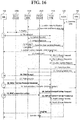
- Fig. 11 is a view illustrating an exemplary TAU (Tracking Area Update) procedure according to a first embodiment of the present invention.
- Fig. 11 illustrates a scheme that may be conducted by the source MME 510a according to the first embodiment of the present invention.
- the target MME 510b transmits a context request message to the source MME 510a to obtain EPS bearer context information of the UE.
- the source MME 510a if receiving the context request in the state where it has transmitted a paging signal after receiving a downlink data notification message as described above, happens to recognize that the paging may fail. Accordingly, the source MME 510a includes one of the following information pieces in the context response message to be sent to the target MME 510b and transmits the same.
- Source MME 510a requests target MME 510b not to perform S-GW reselection (or relocation).
- S-GW swapping may occur during TAU procedure, e.g., due to load balancing. As such, in case ME with downlink data relocates to a new MME during paging, if S-GW swapping happens, a reception call has a high chance of failure. This is to prevent possible S-GW swapping.
- the source MME 510a even when not receiving a response from the UE until the paging timer, e.g., the T3423 timer, expires, 1 does not re-transmit a paging signal, 2 nor does the source MME 510a send a message for the paging failure (see TS 29.274, Downlink Data Notification Failure Indication) to the S-GW 520.
- the source MME 510a is able to conduct a paging re-transmission policy, and in case the S-GW 520 receives a message for paging failure, it deletes the downlink data buffered for the UE. The above is to prevent this.
- the source MME 510a may transmit a downlink data handling request including one of the following information pieces to the S-GW 520.
- [Table 10] - Request to maintain buffering the downlink data - request to re-transmit downlink data notification after recognizing target MME 510b Process 8) above may be performed in conjunction with other processes without bothered by the order as shown. 9) similar to the process shown in Fig. 10 .
- the target MME 510b transmits a context acknowledgement message to the source MME 510a.
- the target MME 510b may include in the context acknowledgement message information relating to paging handling such as information to request the source MME 510a to cancel or stop the existing paging.
- the source MME 510a may send a downlink data handling request message to the S-GW 520 as in process 8) above. 11-17) similar to the process shown in Fig. 10 .
- Fig. 12 is a view illustrating an exemplary TAU (Tracking Area Update) procedure according to a second embodiment of the present invention.
- Fig. 12 illustrates a scheme that may be conducted by the target MME 510b according to the second embodiment of the present invention. That is, according to the second embodiment, the target MME 510b may immediately transmit a paging signal.
- Fig. 13 is a view illustrating an exemplary TAU (Tracking Area Update) procedure according to a third embodiment of the present invention.
- Fig. 13 illustrates a scheme that may be performed by the target MME 510b according to the third embodiment of the present invention.
- the target MME 510b may send a request for downlink data notification to the S-GW 520.
- Fig. 14 is a view illustrating an exemplary TAU (Tracking Area Update) procedure according to a fourth embodiment of the present invention.
- Fig. 14 illustrates a scheme that may be conducted by the target MME 510b according to the fourth embodiment of the present invention.
- the target MME 510b may transmit an indication of transmission of a service request to the UE.
- the target MME 510b may recognize a problematic situation (where the source MME 510a has been sending a paging signal to the UE or there is downlink data for the UE). 9b) then, the source MME 510a may send to the UE 100 an indication including one of the following information pieces independently or in conjunction with several combinations of the embodiments of the present disclosure.
- the indication is in the form of a new NAS (Non-Access Stratum) message
- the indication may be included and transmitted in a TAU accept message.
- CSFB Circuit Switch-Fallback
- the TAU accept message may include an indication as provided in process 9b as described above.
- the indication included in the TAU accept message may be, e.g., Active flag as described above.
- the active flag is the one that used to be included in the TAU request message. According to an embodiment of the present invention, the same may be included in a TAU accept message.
- the target MME 510b includes the active flag in the TAU accept message and transmits the same, so that the UE may immediately perform a user plane bearer setup procedure.
- Fig. 15 is a view illustrating an exemplary TAU (Tracking Area Update) procedure according to a fifth embodiment of the present invention.
- Fig. 15 illustrates a scheme that may be performed by the target MME 510b according to the fifth embodiment of the present invention.
- the target MME 510b may request the target eNodeB 200b to set up a user plane bearer.
- Fig. 16 is a view illustrating an exemplary TAU (Tracking Area Update) procedure according to a sixth embodiment of the present invention.
- Fig. 16 illustrates a scheme that may be performed by the UE 100 according to the sixth embodiment of the present invention.
- the downlink data buffered in the S-GW 520 may be transferred to the UE 100 via the target eNodeB 200b.
- Fig. 17 is a view illustrating a TAU (Tracking Area Update) procedure according to a seventh embodiment of the present invention.
- Fig. 17 illustrates a scheme that may be performed by the S-GW 520 according to the seventh embodiment of the present invention.
- varied or added information may be obtained by adding new parameters/fields/information, by expanding existing parameters/fields/information or by combining various parameters/fields/information, or may come with a newly defined message that has not been existent in the prior art.
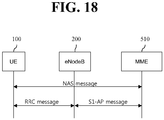
- Fig. 18 is a view illustrating an exemplary protocol and interfaces between a UE, an eNodeB, and an MME.
- the messages communicated between the UE 100 and the eNodeB 200 are based on an RRC (Radio Resource Control) protocol.
- the messages communicated between the eNodeB 200 and the MME 510 are based on an S1-AP (S1 Application Protocol).
- the messages communicated between the UE 100 and the MME 510 are based on an NAS (Non-Access Stratum) protocol.
- the NAS protocol-based messages are capsulated into RRC protocol-based messages and S1-AP-based messages and transmitted.
- Fig. 19 is a block diagram illustrating the configuration of an MTC device 100, an MME 510, and an SGSN 520 according to an embodiment of the present invention.
- the UE 100 includes a storage means 101, a controller 102, and a communication unit 103.
- the MME 510 includes a storage means 511, a controller 512, and a communication unit 513.
- the S-GW 520 includes a storage means 521, a controller 522, and a communication unit 523.
- the storage means 101, 511, and 521 store the methods described above in connection with Figs. 9 to 18 .
- the controllers 102, 512, and 522 control the storage means 101, 511, and 521, and the communication units 103, 513, and 523. Specifically, the controllers 102, 512, and 522 respectively execute the methods stored in the storage means 101, 511, and 521. The controllers 102, 512, and 522 transmit the above-described signals through the communication units 103, 513, and 523.
Landscapes
- Engineering & Computer Science (AREA)
- Computer Networks & Wireless Communication (AREA)
- Signal Processing (AREA)
- Databases & Information Systems (AREA)
- Mobile Radio Communication Systems (AREA)
Claims (5)
- Procédé de traitement de téléavertissement, le procédé étant mis en oeuvre par un serveur (510a) gérant la mobilité dans un réseau de communication mobile, le procédé comprenant :recevoir, depuis une passerelle de desserte (520), une notification concernant des données de liaison descendante à remettre à un terminal (100) ; etémettre, vers une ou plusieurs stations de base (200a), d'un signal de téléavertissement pour le terminal (100),caractérisé par :reconnaître que le téléavertissement échouera si une requête de contexte est reçue pour le terminal (100) en provenance d'un autre serveur (510b) dans une procédure de mise à jour de zone de suivi, TAU (« tracking area update »), après avoir émis le signal de téléavertissement vers les une ou plusieurs stations de base (200a) et avant d'avoir reçu du terminal (100) d'une réponse au téléavertissement ; etsuite à la reconnaissance, ne pas informer la passerelle de desserte (520) d'un échec de téléavertissement.
- Procédé selon la revendication 1, comprenant en outre :
suite à la reconnaissance, ne pas réémettre le signal de téléavertissement même si un temporisateur lié au téléavertissement expire. - Procédé selon l'une quelconque des revendications précédentes, dans lequel la passerelle de desserte (520) stocke les données de liaison descendante dans une mémoire tampon.
- Serveur (510a) pour gérer la mobilité dans un réseau de communication mobile, le serveur (510, 510a) comprenant :un émetteur-récepteur (513) configuré pour recevoir, depuis une passerelle de desserte (520), une notification concernant des données de liaison descendante à remettre à un terminal (100) et émettre un signal de téléavertissement pour le terminal vers une ou plusieurs stations de base (200a) ; etun contrôleur (512),caractérisé en ce que le contrôleur (512) est configuré pour :reconnaître que le téléavertissement échouera si une demande de contexte est reçue pour le terminal (100) en provenance d'un autre serveur (510b) dans une procédure de mise à jour de zone de suivi, TAU (« tracking area update »), après émission du signal de téléavertissement vers les une ou plusieurs stations de base (200a) et avant réception en provenance du terminal (100) d'une réponse au téléavertissement ; etsuite à la reconnaissance, commander l'émetteur-récepteur (513) pour ne pas envoyer, à la passerelle de desserte (520), un message informant d'un échec de téléavertissement.
- Serveur selon la revendication 4, dans lequel le contrôleur (512) est configuré, suite à la reconnaissance, pour commander l'émetteur-récepteur (513) pour ne pas réémettre le signal de téléavertissement même si un temporisateur lié au téléavertissement expire.
Applications Claiming Priority (5)
| Application Number | Priority Date | Filing Date | Title |
|---|---|---|---|
| US201261711747P | 2012-10-10 | 2012-10-10 | |
| US201361862091P | 2013-08-05 | 2013-08-05 | |
| US201361869069P | 2013-08-23 | 2013-08-23 | |
| US201361869761P | 2013-08-25 | 2013-08-25 | |
| PCT/KR2013/009063 WO2014058244A1 (fr) | 2012-10-10 | 2013-10-10 | Procédé de traitement de message de recherche et procédé de relais de données de liaison descendante |
Publications (3)
| Publication Number | Publication Date |
|---|---|
| EP2908582A1 EP2908582A1 (fr) | 2015-08-19 |
| EP2908582A4 EP2908582A4 (fr) | 2016-06-15 |
| EP2908582B1 true EP2908582B1 (fr) | 2019-06-19 |
Family
ID=50477641
Family Applications (2)
| Application Number | Title | Priority Date | Filing Date |
|---|---|---|---|
| EP13845547.2A Active EP2908582B1 (fr) | 2012-10-10 | 2013-10-10 | Traitement de radioappel par un serveur gérant de mobilité afin d'éviter, en cas d'erreur de radioappel, la perte de données de liaison descendante mises en mémoire tampon dans une passerelle servante |
| EP13845858.3A Not-in-force EP2908583B1 (fr) | 2012-10-10 | 2013-10-10 | Procédé de traitement de recherche de mobile et procédé permettant de relayer des données de liaison descendante |
Family Applications After (1)
| Application Number | Title | Priority Date | Filing Date |
|---|---|---|---|
| EP13845858.3A Not-in-force EP2908583B1 (fr) | 2012-10-10 | 2013-10-10 | Procédé de traitement de recherche de mobile et procédé permettant de relayer des données de liaison descendante |
Country Status (6)
| Country | Link |
|---|---|
| US (3) | US20150237592A1 (fr) |
| EP (2) | EP2908582B1 (fr) |
| KR (1) | KR101612683B1 (fr) |
| CN (3) | CN104737603A (fr) |
| ES (1) | ES2735625T3 (fr) |
| WO (3) | WO2014058244A1 (fr) |
Families Citing this family (62)
| Publication number | Priority date | Publication date | Assignee | Title |
|---|---|---|---|---|
| KR102015804B1 (ko) * | 2013-03-11 | 2019-08-29 | 삼성전자주식회사 | 이동 통신 시스템에서 착신 호 페이징 방법 및 장치 |
| US9814037B2 (en) | 2013-06-28 | 2017-11-07 | Intel Corporation | Method for efficient channel estimation and beamforming in FDD system by exploiting uplink-downlink correspondence |
| US9794870B2 (en) | 2013-06-28 | 2017-10-17 | Intel Corporation | User equipment and method for user equipment feedback of flow-to-rat mapping preferences |
| ES2761608T3 (es) * | 2014-04-15 | 2020-05-20 | Nokia Solutions & Networks Oy | Interfuncionamiento con un sistema basado en una portadora |
| US9942013B2 (en) * | 2014-05-07 | 2018-04-10 | Qualcomm Incorporated | Non-orthogonal multiple access and interference cancellation |
| JP6304753B2 (ja) * | 2014-05-12 | 2018-04-04 | 日本電気株式会社 | 移動通信システムのための方法、移動通信システム、及び通信端末のための通信方法 |
| CN106471846B (zh) | 2014-06-24 | 2020-01-07 | 日本电气株式会社 | 控制节点、网络节点和在其中执行的方法 |
| CN106465214B (zh) | 2014-06-24 | 2019-11-05 | 日本电气株式会社 | 网络节点、移动终端、基站和在其中执行的方法 |
| US10420029B2 (en) | 2014-08-11 | 2019-09-17 | Lg Electronics Inc. | Method for transmitting downlink data in a wireless communication system, and device for same |
| US10117219B2 (en) | 2014-08-22 | 2018-10-30 | Qualcomm Incorporated | Wireless network page transmission and response |
| US20170374644A1 (en) * | 2014-12-15 | 2017-12-28 | Lg Electronics Inc. | Method for transmitting paging in wireless communication system, and apparatus therefor |
| KR20180030241A (ko) * | 2014-12-22 | 2018-03-21 | 닛본 덴끼 가부시끼가이샤 | 이동 통신 시스템, sgw, 단말기, 이동 통신 시스템의 수신 방법, sgw 의 수신 방법, 및 단말기의 수신 방법 |
| KR101684762B1 (ko) * | 2015-01-06 | 2016-12-09 | 주식회사 엘지유플러스 | Lte 시스템, 이동성 관리장치 및 그 신호 제어방법 |
| TWI615052B (zh) * | 2015-01-08 | 2018-02-11 | Lg電子股份有限公司 | 在無線通訊系統中用於傳輸傳呼的方法及用於支援該方法的裝置(二) |
| US10129850B2 (en) * | 2015-01-22 | 2018-11-13 | Ntt Docomo, Inc. | Paging control method, communication control apparatus and base station |
| CN105142193B (zh) * | 2015-07-24 | 2019-06-07 | 大唐移动通信设备有限公司 | 一种小区重选及其控制方法及装置 |
| CN107005969B (zh) * | 2015-08-31 | 2020-04-14 | 华为技术有限公司 | 一种用于分布式网关的寻呼方法及装置 |
| WO2017079074A1 (fr) * | 2015-11-06 | 2017-05-11 | Interdigital Patent Holdings, Inc. | Procédés, entité de réseau central et unité d'émission/de réception sans fil (wtru) utilisant une sélection de réseau central dédié (dcn) améliorée |
| US10602380B2 (en) | 2015-11-11 | 2020-03-24 | Lg Electronics Inc. | Method for selecting data transmission mode in wireless communication system and apparatus therefor |
| WO2017126922A1 (fr) * | 2016-01-19 | 2017-07-27 | 엘지전자(주) | Procédé de reprise de connexion dans un système de communication sans fil et dispositif à cet effet |
| WO2017126928A1 (fr) * | 2016-01-20 | 2017-07-27 | 엘지전자 주식회사 | Procédé de changement de mode de connexion et entité de gestion de mobilité |
| US10681538B2 (en) | 2016-02-11 | 2020-06-09 | Lg Electronics Inc. | Method and apparatus for transmitting and receiving data by terminal in wireless communication system |
| CN113056002B (zh) * | 2016-03-01 | 2024-05-24 | 瑞典爱立信有限公司 | 在蜂窝网络中传送数据的方法和设备 |
| WO2017147779A1 (fr) * | 2016-03-01 | 2017-09-08 | 华为技术有限公司 | Procédé, dispositif et système de transmission de données |
| US9924456B2 (en) | 2016-05-13 | 2018-03-20 | Mediatek Inc. | Uplink routing for enhanced LWA |
| WO2018000127A1 (fr) * | 2016-06-27 | 2018-01-04 | Qualcomm Incorporated | Techniques et appareils destinés à la synchronisation de zones de suivi |
| CN107666683B (zh) | 2016-07-29 | 2019-08-30 | 电信科学技术研究院 | 一种无线系统区域管理的方法、终端及基站 |
| US10764863B2 (en) | 2016-09-01 | 2020-09-01 | Parallel Wireless, Inc. | Multi-radio access technology paging |
| JP6783387B2 (ja) | 2016-10-11 | 2020-11-11 | 京セラ株式会社 | ユーザ機器装置が基地局からのmacメッセージを要求するための方法 |
| JP2018074522A (ja) * | 2016-11-02 | 2018-05-10 | 日本電気株式会社 | ゲートウェイ装置、移動管理装置、基地局、通信方法、制御方法、ページング方法、及びプログラム |
| GB2555784A (en) * | 2016-11-04 | 2018-05-16 | Nec Corp | Communication system |
| US11096053B2 (en) | 2016-11-07 | 2021-08-17 | Lg Electronics Inc. | Method for managing session |
| CN108200571B (zh) * | 2016-12-08 | 2021-03-05 | 中国移动通信集团四川有限公司 | 一种跟踪区更新方法、装置及移动管理实体 |
| US11277816B2 (en) * | 2016-12-23 | 2022-03-15 | Sony Corporation | Telecommunications apparatus and methods for paging of a mobile device |
| US10021586B1 (en) * | 2016-12-23 | 2018-07-10 | Intel IP Corporation | Pushing back packet not acknowledged by base station |
| JP6996727B2 (ja) * | 2016-12-28 | 2022-01-17 | 日本電気株式会社 | 端末、制御装置、及び通信方法 |
| KR102582554B1 (ko) * | 2017-01-03 | 2023-09-25 | 삼성전자 주식회사 | 차세대 이동 통신 시스템에서 light connection을 지원하는 방법 및 장치 |
| WO2018127597A1 (fr) | 2017-01-09 | 2018-07-12 | Telefonaktiebolaget Lm Ericsson (Publ) | Gestion de demande de service |
| US10117223B1 (en) * | 2017-01-31 | 2018-10-30 | Sprint Spectrum L.P. | Control of paging based on whether most recent serving base station is a relay base station |
| WO2018147698A1 (fr) * | 2017-02-10 | 2018-08-16 | 엘지전자(주) | Procédé de transmission/réception d'un message nas dans un système de communication sans fil, et appareil associé |
| CN109863767B (zh) * | 2017-02-14 | 2020-10-09 | 华为技术有限公司 | 下行数据的传输方法及装置 |
| CN108696861A (zh) * | 2017-02-17 | 2018-10-23 | 中国移动通信集团河南有限公司 | 一种呼叫处理方法、移动管理实体设备和服务网关 |
| EP3379870A1 (fr) * | 2017-03-24 | 2018-09-26 | Panasonic Intellectual Property Corporation of America | Équipement utilisateur et station de base participant à une procédure de mise à jour de réseau d'accès radio |
| CN108882364A (zh) * | 2017-05-08 | 2018-11-23 | 电信科学技术研究院 | 一种ue空闲态amf改变的处理方法及装置 |
| CN109246816A (zh) * | 2017-05-26 | 2019-01-18 | 电信科学技术研究院 | 一种传输下行数据的方法及设备 |
| EP3673710B1 (fr) * | 2017-08-23 | 2024-10-02 | Telefonaktiebolaget LM Ericsson (PUBL) | Procédé de fourniture d'une indication d'état d'ue lors d'une défaillance de distribution, et noeud de réseau associé |
| EP3692757B1 (fr) | 2017-10-06 | 2026-07-01 | Telefonaktiebolaget LM Ericsson (Publ) | Noeuds et procédés de gestion de radiomessagerie |
| US10212690B1 (en) | 2017-10-16 | 2019-02-19 | Verizon Patenting and Licensing Inc. | Mobility management entity support of user equipment using extended discontinuous reception and power saving mode |
| EP3753323A1 (fr) * | 2018-02-15 | 2020-12-23 | Sony Corporation | Mécanisme de radiorecherche dans un réseau radio avec fonctionnement à faisceaux multiples |
| WO2019161790A1 (fr) * | 2018-02-22 | 2019-08-29 | Mediatek Singapore Pte. Ltd. | Procédure améliorée de mise à jour de zone de suivi pour changement intersystème dans des communications mobiles |
| US12452833B2 (en) * | 2019-07-23 | 2025-10-21 | Beijing Xiaomi Mobile Software Co., Ltd. | Paging method and apparatus, and travel route reporting method and apparatus |
| CN112788739B (zh) * | 2019-11-04 | 2023-03-10 | 中国移动通信集团广东有限公司 | 一种处理寻呼请求的方法和服务器 |
| EP4543109A3 (fr) * | 2019-11-06 | 2025-06-18 | LG Electronics Inc. | Procédé et appareil d'émission et de réception de signaux d'équipement utilisateur et de station de base dans un système de communication sans fil |
| CN114071715A (zh) * | 2020-08-06 | 2022-02-18 | 北京三星通信技术研究有限公司 | 用于寻呼的方法和设备 |
| WO2022082536A1 (fr) * | 2020-10-21 | 2022-04-28 | 北京小米移动软件有限公司 | Procédé et appareil d'envoi d'informations, et support de stockage |
| CN114449463B (zh) * | 2020-11-05 | 2025-04-11 | 中移智行网络科技有限公司 | 一种通信方法、装置、系统和电子设备 |
| EP4315906B1 (fr) * | 2021-04-01 | 2026-08-12 | Telefonaktiebolaget LM Ericsson (publ) | Procédés, noeuds de réseau et supports lisibles par ordinateur destinés à une re-sélection de noeud de réseau |
| EP4316000A4 (fr) * | 2021-05-04 | 2025-02-26 | Sharp Kabushiki Kaisha | Procédé associé à un service d'urgence et équipement d'utilisateur |
| CN113923613B (zh) * | 2021-10-14 | 2022-09-16 | 维沃移动通信有限公司 | 通话处理方法、装置、电子设备及存储介质 |
| WO2023065127A1 (fr) * | 2021-10-19 | 2023-04-27 | 北京小米移动软件有限公司 | Procédé et appareil de transmission de message de radiomessagerie, et support de stockage |
| US12445993B2 (en) * | 2022-03-25 | 2025-10-14 | Electronics And Telecommunications Research Institute | Method and apparatus for managing mobility in communication system |
| CN119450683A (zh) * | 2023-07-31 | 2025-02-14 | 华为技术有限公司 | 一种位置管理方法及装置 |
Family Cites Families (42)
| Publication number | Priority date | Publication date | Assignee | Title |
|---|---|---|---|---|
| KR19980043203A (ko) | 1996-12-02 | 1998-09-05 | 김영환 | 착신 이동국으로의 멀티 페이징(Multi Paging)방법 |
| KR19980043203U (ko) * | 1996-12-24 | 1998-09-25 | 양재신 | 자동차용 도어 장착구조 |
| KR100893862B1 (ko) | 2004-06-08 | 2009-04-20 | 엘지전자 주식회사 | 광대역 무선 접속 시스템에 적용되는 유휴모드 제어 방법 |
| US7894831B2 (en) * | 2004-06-08 | 2011-02-22 | Lg Electronics Inc. | Controlling idle mode of mobile subscriber station in wireless access system |
| EP1881720A1 (fr) * | 2006-07-19 | 2008-01-23 | Alcatel Lucent | Procédé de controle de transfert, station de base et station mobile dans un réseau de communication mobile |
| EP1937013A1 (fr) | 2006-12-20 | 2008-06-25 | Mitsubishi Electric Information Technology Centre Europe B.V. | Procédé et dispositif de routage d'un appel entrant vers un terminal mobile dans un réseau de télécommunications cellulaires sans fil |
| JP4853362B2 (ja) * | 2007-04-04 | 2012-01-11 | 日本電気株式会社 | 通信エリアの受信品質測定方法及びその装置並びにプログラム |
| FI20075297A0 (fi) * | 2007-04-27 | 2007-04-27 | Nokia Siemens Networks Oy | Menetelmä, radiojärjestelmä ja tukiasema |
| JP5104260B2 (ja) * | 2007-12-04 | 2012-12-19 | 富士通株式会社 | 移動通信システム |
| EP2079253A1 (fr) * | 2008-01-09 | 2009-07-15 | Panasonic Corporation | Optimisations de transfert de réseau non-3GPP vers 3GPP |
| CN101448249B (zh) * | 2008-01-25 | 2011-03-16 | 中兴通讯股份有限公司 | 一种释放服务网关缓存数据的方法 |
| CN101730176B (zh) * | 2008-10-28 | 2012-12-19 | 华为技术有限公司 | 网络重选中的寻呼控制方法、实体及系统 |
| JP5538802B2 (ja) * | 2008-11-04 | 2014-07-02 | 三菱電機株式会社 | 通信方法、移動体通信システム、移動端末および基地局制御装置 |
| JP4625123B2 (ja) * | 2008-12-11 | 2011-02-02 | 株式会社エヌ・ティ・ティ・ドコモ | 移動通信方法及び無線基地局 |
| CN101778371B (zh) | 2009-01-09 | 2012-08-29 | 电信科学技术研究院 | 寻呼方法及装置 |
| US8547969B2 (en) * | 2009-03-31 | 2013-10-01 | Interdigital Patent Holdings, Inc. | Method and apparatus for providing non-packet switched service in a target radio access technology network |
| CN102239723A (zh) * | 2009-04-21 | 2011-11-09 | 华为技术有限公司 | 用于切换问题识别的方法 |
| KR101633331B1 (ko) * | 2009-05-04 | 2016-07-08 | 엘지전자 주식회사 | Home(e)NodeB 시스템에서 연결 타입 정보의 제공 방법 및 무선 자원 제어 방법 |
| CN101938787B (zh) * | 2009-07-01 | 2014-01-01 | 华为技术有限公司 | 切换控制的方法和设备 |
| CN101945429B (zh) | 2009-07-08 | 2014-09-17 | 华为技术有限公司 | 移动网络用户面数据路由的方法、装置和系统 |
| DE102009036538A1 (de) | 2009-08-07 | 2011-02-10 | Resopal Gmbh | Paneel mit mindestens einer Nut |
| WO2011026663A2 (fr) | 2009-09-02 | 2011-03-10 | Telefonaktiebolaget L M Ericsson (Publ) | Solution pour la différentiation de radiorecherche dans un réseau de communications |
| EP2478720A1 (fr) * | 2009-10-30 | 2012-07-25 | Panasonic Corporation | Système et appareil de communication pour services mobiles dépendant du statut |
| KR101448316B1 (ko) * | 2009-12-07 | 2014-10-08 | 삼성전자주식회사 | 모바일 망에서 매크로 망과 펨토 망 연계 지역에서의 페이징 방법 및 그를 위한 시스템 |
| KR101761419B1 (ko) * | 2010-01-13 | 2017-07-26 | 엘지전자 주식회사 | 단말의 위치 정보 갱신 방법 및 장치 |
| CN102196402B (zh) * | 2010-03-08 | 2016-06-15 | 中兴通讯股份有限公司 | 无线通信系统中终端切换的方法及系统 |
| JP4985880B2 (ja) * | 2010-04-27 | 2012-07-25 | 日本電気株式会社 | 通信方法とモバイルネットワークシステムと装置 |
| US9179288B2 (en) * | 2010-04-29 | 2015-11-03 | Lg Electronics Inc. | Server in charge of control plane within mobile communication network and method for controlling service in server |
| US20130083650A1 (en) | 2010-05-11 | 2013-04-04 | Nec Europe Ltd. | Method for handling failure of a mme in a lte/epc network |
| CN101969634B (zh) | 2010-06-12 | 2014-09-10 | 中兴通讯股份有限公司 | 一种用户数据的同步方法和系统 |
| JP4767357B1 (ja) | 2010-07-30 | 2011-09-07 | 株式会社エヌ・ティ・ティ・ドコモ | 呼び出し方法、コアネットワーク装置、無線アクセスネットワーク装置及びゲートウェイ装置 |
| KR101582015B1 (ko) * | 2011-01-21 | 2015-12-31 | 블랙베리 리미티드 | (로컬) 오프로딩에 이용되는 접속에 대한 접속 컨텍스트를 결정하기 위한 네트워크 장치 및 프로세스 |
| KR101339044B1 (ko) * | 2011-03-14 | 2013-12-09 | 에이치티씨 코퍼레이션 | 서빙 코어 네트워크 노드가 변경될 때의 모바일 장치의 접근성의 처리 |
| JP5357913B2 (ja) | 2011-03-24 | 2013-12-04 | 株式会社エヌ・ティ・ティ・ドコモ | 移動通信方法 |
| WO2013009892A1 (fr) * | 2011-07-11 | 2013-01-17 | Interdigital Patent Holdings, Inc. | Systèmes et procédés permettant d'établir et de maintenir de multiples connexions et/ou interfaces cellulaires |
| US8923816B2 (en) * | 2011-07-28 | 2014-12-30 | Samsung Electronics Co., Ltd. | Apparatus and method for providing seamless service between a cellular network and wireless local area network for a mobile user |
| EP2557889B1 (fr) * | 2011-08-12 | 2019-07-17 | BlackBerry Limited | Messagerie simplifiée d'ue+enb |
| CN102438330A (zh) * | 2011-12-06 | 2012-05-02 | 大唐移动通信设备有限公司 | 一种附着到e-tran的方法及移动性管理实体 |
| US8700002B2 (en) | 2012-01-20 | 2014-04-15 | Verizon Patent And Licensing Inc. | Optimizing user device context for mobility management entity (MME) resiliency |
| CN104081808B (zh) | 2012-01-24 | 2019-07-26 | 瑞典爱立信有限公司 | Mme恢复 |
| US9247575B2 (en) | 2012-03-27 | 2016-01-26 | Blackberry Limited | eNB storing RRC configuration information at another network component |
| US9247528B2 (en) * | 2012-10-12 | 2016-01-26 | Cisco Technology, Inc. | System and method for reducing paging in UTRAN/GERAN/E-UTRAN networks when idle signaling reduction is active |
-
2013
- 2013-10-10 EP EP13845547.2A patent/EP2908582B1/fr active Active
- 2013-10-10 US US14/426,908 patent/US20150237592A1/en not_active Abandoned
- 2013-10-10 WO PCT/KR2013/009063 patent/WO2014058244A1/fr not_active Ceased
- 2013-10-10 WO PCT/KR2013/009061 patent/WO2014058242A1/fr not_active Ceased
- 2013-10-10 CN CN201380052776.1A patent/CN104737603A/zh active Pending
- 2013-10-10 US US14/426,900 patent/US20150223196A1/en not_active Abandoned
- 2013-10-10 CN CN201380053028.5A patent/CN104823498B/zh active Active
- 2013-10-10 WO PCT/KR2013/009064 patent/WO2014058245A1/fr not_active Ceased
- 2013-10-10 US US14/429,015 patent/US9838998B2/en active Active
- 2013-10-10 KR KR1020157005967A patent/KR101612683B1/ko active Active
- 2013-10-10 CN CN201380052899.5A patent/CN104718788A/zh active Pending
- 2013-10-10 ES ES13845547T patent/ES2735625T3/es active Active
- 2013-10-10 EP EP13845858.3A patent/EP2908583B1/fr not_active Not-in-force
Non-Patent Citations (1)
| Title |
|---|
| None * |
Also Published As
| Publication number | Publication date |
|---|---|
| WO2014058245A1 (fr) | 2014-04-17 |
| CN104737603A (zh) | 2015-06-24 |
| WO2014058244A1 (fr) | 2014-04-17 |
| CN104718788A (zh) | 2015-06-17 |
| US20150223197A1 (en) | 2015-08-06 |
| EP2908583B1 (fr) | 2019-02-27 |
| KR101612683B1 (ko) | 2016-04-26 |
| WO2014058242A1 (fr) | 2014-04-17 |
| EP2908582A4 (fr) | 2016-06-15 |
| US20150237592A1 (en) | 2015-08-20 |
| US9838998B2 (en) | 2017-12-05 |
| EP2908583A4 (fr) | 2016-06-22 |
| EP2908582A1 (fr) | 2015-08-19 |
| EP2908583A1 (fr) | 2015-08-19 |
| CN104823498B (zh) | 2019-03-08 |
| CN104823498A (zh) | 2015-08-05 |
| KR20150058187A (ko) | 2015-05-28 |
| ES2735625T3 (es) | 2019-12-19 |
| US20150223196A1 (en) | 2015-08-06 |
Similar Documents
| Publication | Publication Date | Title |
|---|---|---|
| EP2908583B1 (fr) | Procédé de traitement de recherche de mobile et procédé permettant de relayer des données de liaison descendante | |
| US10382925B2 (en) | Method of providing MTC monitoring related information | |
| US10694447B2 (en) | Method for attempting network access from NB-IoT RAT | |
| JP6333994B2 (ja) | Acdcによるネットワークアクセス遮断方法及びユーザ装置 | |
| US10827536B2 (en) | Method and terminal for creating, modifying, releasing session in next-generation mobile communication | |
| US20160219503A1 (en) | Method for reselecting network node in charge of control plane | |
| US10219149B2 (en) | Method for managing subscriber information to respond to network failure, and subscriber information server | |
| US11044776B2 (en) | Method for attempting network access from NB-IoT RAT | |
| US12058763B2 (en) | Signal transmission and reception method by SMF in wireless communication system and device therefor | |
| US10764937B2 (en) | Method and wireless device for transmitting RRC message when using CP CIOT EPS optimization | |
| US12489521B2 (en) | Method for operating a user equipment while running a timer T3451 | |
| US12426001B1 (en) | Method for performing tracking area update procedure upon coming out of an unavailability period | |
| US12389361B1 (en) | Method and user equipment for activating access stratum layer upon coming out of the unavailability period | |
| US12483324B2 (en) | Method for stopping timer if store and forward satellite operation is supported and user equipment thereof | |
| US12471051B1 (en) | Method and user equipment for deleting radio access technology utilization control information | |
| US12506697B2 (en) | Operation method when S and F satellite operation is supported | |
| US12556267B2 (en) | Method for receiving store and forward satellite operation parameter and user equipment thereof | |
| US12532373B2 (en) | Method for receiving store and forward satellite operation parameter | |
| US12335897B1 (en) | Method and user equipment for storing radio access technology utilization control information | |
| CN120676462A (zh) | 用户设备及其操作方法、半导体芯片组 |
Legal Events
| Date | Code | Title | Description |
|---|---|---|---|
| PUAI | Public reference made under article 153(3) epc to a published international application that has entered the european phase |
Free format text: ORIGINAL CODE: 0009012 |
|
| 17P | Request for examination filed |
Effective date: 20150408 |
|
| AK | Designated contracting states |
Kind code of ref document: A1 Designated state(s): AL AT BE BG CH CY CZ DE DK EE ES FI FR GB GR HR HU IE IS IT LI LT LU LV MC MK MT NL NO PL PT RO RS SE SI SK SM TR |
|
| AX | Request for extension of the european patent |
Extension state: BA ME |
|
| DAX | Request for extension of the european patent (deleted) | ||
| RA4 | Supplementary search report drawn up and despatched (corrected) |
Effective date: 20160519 |
|
| RIC1 | Information provided on ipc code assigned before grant |
Ipc: H04W 68/02 20090101AFI20160512BHEP Ipc: H04W 8/08 20090101ALI20160512BHEP Ipc: H04W 88/08 20090101ALN20160512BHEP |
|
| STAA | Information on the status of an ep patent application or granted ep patent |
Free format text: STATUS: EXAMINATION IS IN PROGRESS |
|
| 17Q | First examination report despatched |
Effective date: 20180903 |
|
| GRAP | Despatch of communication of intention to grant a patent |
Free format text: ORIGINAL CODE: EPIDOSNIGR1 |
|
| RAP1 | Party data changed (applicant data changed or rights of an application transferred) |
Owner name: LG ELECTRONICS INC. |
|
| RIC1 | Information provided on ipc code assigned before grant |
Ipc: H04W 8/08 20090101ALI20190110BHEP Ipc: H04W 68/02 20090101AFI20190110BHEP Ipc: H04W 88/08 20090101ALN20190110BHEP |
|
| STAA | Information on the status of an ep patent application or granted ep patent |
Free format text: STATUS: GRANT OF PATENT IS INTENDED |
|
| INTG | Intention to grant announced |
Effective date: 20190214 |
|
| RIC1 | Information provided on ipc code assigned before grant |
Ipc: H04W 88/08 20090101ALN20190206BHEP Ipc: H04W 68/02 20090101AFI20190206BHEP Ipc: H04W 8/08 20090101ALI20190206BHEP |
|
| GRAS | Grant fee paid |
Free format text: ORIGINAL CODE: EPIDOSNIGR3 |
|
| GRAA | (expected) grant |
Free format text: ORIGINAL CODE: 0009210 |
|
| STAA | Information on the status of an ep patent application or granted ep patent |
Free format text: STATUS: THE PATENT HAS BEEN GRANTED |
|
| AK | Designated contracting states |
Kind code of ref document: B1 Designated state(s): AL AT BE BG CH CY CZ DE DK EE ES FI FR GB GR HR HU IE IS IT LI LT LU LV MC MK MT NL NO PL PT RO RS SE SI SK SM TR |
|
| REG | Reference to a national code |
Ref country code: GB Ref legal event code: FG4D |
|
| REG | Reference to a national code |
Ref country code: CH Ref legal event code: EP |
|
| REG | Reference to a national code |
Ref country code: IE Ref legal event code: FG4D |
|
| REG | Reference to a national code |
Ref country code: DE Ref legal event code: R096 Ref document number: 602013056920 Country of ref document: DE |
|
| REG | Reference to a national code |
Ref country code: AT Ref legal event code: REF Ref document number: 1147135 Country of ref document: AT Kind code of ref document: T Effective date: 20190715 |
|
| REG | Reference to a national code |
Ref country code: NL Ref legal event code: MP Effective date: 20190619 |
|
| PG25 | Lapsed in a contracting state [announced via postgrant information from national office to epo] |
Ref country code: AL Free format text: LAPSE BECAUSE OF FAILURE TO SUBMIT A TRANSLATION OF THE DESCRIPTION OR TO PAY THE FEE WITHIN THE PRESCRIBED TIME-LIMIT Effective date: 20190619 Ref country code: HR Free format text: LAPSE BECAUSE OF FAILURE TO SUBMIT A TRANSLATION OF THE DESCRIPTION OR TO PAY THE FEE WITHIN THE PRESCRIBED TIME-LIMIT Effective date: 20190619 Ref country code: LT Free format text: LAPSE BECAUSE OF FAILURE TO SUBMIT A TRANSLATION OF THE DESCRIPTION OR TO PAY THE FEE WITHIN THE PRESCRIBED TIME-LIMIT Effective date: 20190619 Ref country code: FI Free format text: LAPSE BECAUSE OF FAILURE TO SUBMIT A TRANSLATION OF THE DESCRIPTION OR TO PAY THE FEE WITHIN THE PRESCRIBED TIME-LIMIT Effective date: 20190619 Ref country code: NO Free format text: LAPSE BECAUSE OF FAILURE TO SUBMIT A TRANSLATION OF THE DESCRIPTION OR TO PAY THE FEE WITHIN THE PRESCRIBED TIME-LIMIT Effective date: 20190919 Ref country code: SE Free format text: LAPSE BECAUSE OF FAILURE TO SUBMIT A TRANSLATION OF THE DESCRIPTION OR TO PAY THE FEE WITHIN THE PRESCRIBED TIME-LIMIT Effective date: 20190619 |
|
| REG | Reference to a national code |
Ref country code: LT Ref legal event code: MG4D |
|
| PG25 | Lapsed in a contracting state [announced via postgrant information from national office to epo] |
Ref country code: RS Free format text: LAPSE BECAUSE OF FAILURE TO SUBMIT A TRANSLATION OF THE DESCRIPTION OR TO PAY THE FEE WITHIN THE PRESCRIBED TIME-LIMIT Effective date: 20190619 Ref country code: LV Free format text: LAPSE BECAUSE OF FAILURE TO SUBMIT A TRANSLATION OF THE DESCRIPTION OR TO PAY THE FEE WITHIN THE PRESCRIBED TIME-LIMIT Effective date: 20190619 Ref country code: BG Free format text: LAPSE BECAUSE OF FAILURE TO SUBMIT A TRANSLATION OF THE DESCRIPTION OR TO PAY THE FEE WITHIN THE PRESCRIBED TIME-LIMIT Effective date: 20190919 Ref country code: GR Free format text: LAPSE BECAUSE OF FAILURE TO SUBMIT A TRANSLATION OF THE DESCRIPTION OR TO PAY THE FEE WITHIN THE PRESCRIBED TIME-LIMIT Effective date: 20190920 |
|
| REG | Reference to a national code |
Ref country code: ES Ref legal event code: FG2A Ref document number: 2735625 Country of ref document: ES Kind code of ref document: T3 Effective date: 20191219 |
|
| REG | Reference to a national code |
Ref country code: AT Ref legal event code: MK05 Ref document number: 1147135 Country of ref document: AT Kind code of ref document: T Effective date: 20190619 |
|
| PG25 | Lapsed in a contracting state [announced via postgrant information from national office to epo] |
Ref country code: SK Free format text: LAPSE BECAUSE OF FAILURE TO SUBMIT A TRANSLATION OF THE DESCRIPTION OR TO PAY THE FEE WITHIN THE PRESCRIBED TIME-LIMIT Effective date: 20190619 Ref country code: RO Free format text: LAPSE BECAUSE OF FAILURE TO SUBMIT A TRANSLATION OF THE DESCRIPTION OR TO PAY THE FEE WITHIN THE PRESCRIBED TIME-LIMIT Effective date: 20190619 Ref country code: CZ Free format text: LAPSE BECAUSE OF FAILURE TO SUBMIT A TRANSLATION OF THE DESCRIPTION OR TO PAY THE FEE WITHIN THE PRESCRIBED TIME-LIMIT Effective date: 20190619 Ref country code: NL Free format text: LAPSE BECAUSE OF FAILURE TO SUBMIT A TRANSLATION OF THE DESCRIPTION OR TO PAY THE FEE WITHIN THE PRESCRIBED TIME-LIMIT Effective date: 20190619 Ref country code: PT Free format text: LAPSE BECAUSE OF FAILURE TO SUBMIT A TRANSLATION OF THE DESCRIPTION OR TO PAY THE FEE WITHIN THE PRESCRIBED TIME-LIMIT Effective date: 20191021 Ref country code: EE Free format text: LAPSE BECAUSE OF FAILURE TO SUBMIT A TRANSLATION OF THE DESCRIPTION OR TO PAY THE FEE WITHIN THE PRESCRIBED TIME-LIMIT Effective date: 20190619 Ref country code: AT Free format text: LAPSE BECAUSE OF FAILURE TO SUBMIT A TRANSLATION OF THE DESCRIPTION OR TO PAY THE FEE WITHIN THE PRESCRIBED TIME-LIMIT Effective date: 20190619 |
|
| PG25 | Lapsed in a contracting state [announced via postgrant information from national office to epo] |
Ref country code: SM Free format text: LAPSE BECAUSE OF FAILURE TO SUBMIT A TRANSLATION OF THE DESCRIPTION OR TO PAY THE FEE WITHIN THE PRESCRIBED TIME-LIMIT Effective date: 20190619 Ref country code: IS Free format text: LAPSE BECAUSE OF FAILURE TO SUBMIT A TRANSLATION OF THE DESCRIPTION OR TO PAY THE FEE WITHIN THE PRESCRIBED TIME-LIMIT Effective date: 20191019 |
|
| PG25 | Lapsed in a contracting state [announced via postgrant information from national office to epo] |
Ref country code: TR Free format text: LAPSE BECAUSE OF FAILURE TO SUBMIT A TRANSLATION OF THE DESCRIPTION OR TO PAY THE FEE WITHIN THE PRESCRIBED TIME-LIMIT Effective date: 20190619 |
|
| PG25 | Lapsed in a contracting state [announced via postgrant information from national office to epo] |
Ref country code: PL Free format text: LAPSE BECAUSE OF FAILURE TO SUBMIT A TRANSLATION OF THE DESCRIPTION OR TO PAY THE FEE WITHIN THE PRESCRIBED TIME-LIMIT Effective date: 20190619 Ref country code: DK Free format text: LAPSE BECAUSE OF FAILURE TO SUBMIT A TRANSLATION OF THE DESCRIPTION OR TO PAY THE FEE WITHIN THE PRESCRIBED TIME-LIMIT Effective date: 20190619 |
|
| PG25 | Lapsed in a contracting state [announced via postgrant information from national office to epo] |
Ref country code: MC Free format text: LAPSE BECAUSE OF FAILURE TO SUBMIT A TRANSLATION OF THE DESCRIPTION OR TO PAY THE FEE WITHIN THE PRESCRIBED TIME-LIMIT Effective date: 20190619 Ref country code: IS Free format text: LAPSE BECAUSE OF FAILURE TO SUBMIT A TRANSLATION OF THE DESCRIPTION OR TO PAY THE FEE WITHIN THE PRESCRIBED TIME-LIMIT Effective date: 20200224 |
|
| REG | Reference to a national code |
Ref country code: CH Ref legal event code: PL |
|
| REG | Reference to a national code |
Ref country code: DE Ref legal event code: R097 Ref document number: 602013056920 Country of ref document: DE |
|
| PLBE | No opposition filed within time limit |
Free format text: ORIGINAL CODE: 0009261 |
|
| STAA | Information on the status of an ep patent application or granted ep patent |
Free format text: STATUS: NO OPPOSITION FILED WITHIN TIME LIMIT |
|
| PG2D | Information on lapse in contracting state deleted |
Ref country code: IS |
|
| PG25 | Lapsed in a contracting state [announced via postgrant information from national office to epo] |
Ref country code: LI Free format text: LAPSE BECAUSE OF NON-PAYMENT OF DUE FEES Effective date: 20191031 Ref country code: LU Free format text: LAPSE BECAUSE OF NON-PAYMENT OF DUE FEES Effective date: 20191010 Ref country code: CH Free format text: LAPSE BECAUSE OF NON-PAYMENT OF DUE FEES Effective date: 20191031 |
|
| 26N | No opposition filed |
Effective date: 20200603 |
|
| REG | Reference to a national code |
Ref country code: BE Ref legal event code: MM Effective date: 20191031 |
|
| PG25 | Lapsed in a contracting state [announced via postgrant information from national office to epo] |
Ref country code: SI Free format text: LAPSE BECAUSE OF FAILURE TO SUBMIT A TRANSLATION OF THE DESCRIPTION OR TO PAY THE FEE WITHIN THE PRESCRIBED TIME-LIMIT Effective date: 20190619 Ref country code: BE Free format text: LAPSE BECAUSE OF NON-PAYMENT OF DUE FEES Effective date: 20191031 |
|
| GBPC | Gb: european patent ceased through non-payment of renewal fee |
Effective date: 20191010 |
|
| PG25 | Lapsed in a contracting state [announced via postgrant information from national office to epo] |
Ref country code: GB Free format text: LAPSE BECAUSE OF NON-PAYMENT OF DUE FEES Effective date: 20191010 Ref country code: IE Free format text: LAPSE BECAUSE OF NON-PAYMENT OF DUE FEES Effective date: 20191010 |
|
| PG25 | Lapsed in a contracting state [announced via postgrant information from national office to epo] |
Ref country code: CY Free format text: LAPSE BECAUSE OF FAILURE TO SUBMIT A TRANSLATION OF THE DESCRIPTION OR TO PAY THE FEE WITHIN THE PRESCRIBED TIME-LIMIT Effective date: 20190619 |
|
| PG25 | Lapsed in a contracting state [announced via postgrant information from national office to epo] |
Ref country code: MT Free format text: LAPSE BECAUSE OF FAILURE TO SUBMIT A TRANSLATION OF THE DESCRIPTION OR TO PAY THE FEE WITHIN THE PRESCRIBED TIME-LIMIT Effective date: 20190619 Ref country code: HU Free format text: LAPSE BECAUSE OF FAILURE TO SUBMIT A TRANSLATION OF THE DESCRIPTION OR TO PAY THE FEE WITHIN THE PRESCRIBED TIME-LIMIT; INVALID AB INITIO Effective date: 20131010 |
|
| PG25 | Lapsed in a contracting state [announced via postgrant information from national office to epo] |
Ref country code: MK Free format text: LAPSE BECAUSE OF FAILURE TO SUBMIT A TRANSLATION OF THE DESCRIPTION OR TO PAY THE FEE WITHIN THE PRESCRIBED TIME-LIMIT Effective date: 20190619 |
|
| P01 | Opt-out of the competence of the unified patent court (upc) registered |
Effective date: 20230524 |
|
| PGFP | Annual fee paid to national office [announced via postgrant information from national office to epo] |
Ref country code: IT Payment date: 20250909 Year of fee payment: 13 |
|
| PGFP | Annual fee paid to national office [announced via postgrant information from national office to epo] |
Ref country code: FR Payment date: 20250909 Year of fee payment: 13 |
|
| PGFP | Annual fee paid to national office [announced via postgrant information from national office to epo] |
Ref country code: DE Payment date: 20250908 Year of fee payment: 13 |
|
| PGFP | Annual fee paid to national office [announced via postgrant information from national office to epo] |
Ref country code: ES Payment date: 20251117 Year of fee payment: 13 |