EP2908607A2 - Lampe à DEL - Google Patents
Lampe à DEL Download PDFInfo
- Publication number
- EP2908607A2 EP2908607A2 EP15155288.2A EP15155288A EP2908607A2 EP 2908607 A2 EP2908607 A2 EP 2908607A2 EP 15155288 A EP15155288 A EP 15155288A EP 2908607 A2 EP2908607 A2 EP 2908607A2
- Authority
- EP
- European Patent Office
- Prior art keywords
- light
- led
- red
- blue
- white
- Prior art date
- Legal status (The legal status is an assumption and is not a legal conclusion. Google has not performed a legal analysis and makes no representation as to the accuracy of the status listed.)
- Ceased
Links
Images


Classifications
-
- H—ELECTRICITY
- H05—ELECTRIC TECHNIQUES NOT OTHERWISE PROVIDED FOR
- H05B—ELECTRIC HEATING; ELECTRIC LIGHT SOURCES NOT OTHERWISE PROVIDED FOR; CIRCUIT ARRANGEMENTS FOR ELECTRIC LIGHT SOURCES, IN GENERAL
- H05B45/00—Circuit arrangements for operating light-emitting diodes [LED]
- H05B45/20—Controlling the colour of the light
Definitions
- the present invention relates to an LED luminaire having a lighting unit, which has a plurality of colored light-emitting diodes which emit light in the primary colors red, green and blue of a color system, and a white-light light-emitting diode which emits light in the white spectral range, and a control unit, which is coupled to the illumination unit and configured to drive the light-emitting diodes in such a way that they produce a white light which amplifies a desired light color.
- LED lights of the known type are for example from the EP 2 541 362 A2 are known and used in particular to illuminate usable areas and especially goods presentation areas with objects lying thereon.
- the objective here is to emphasize the body color of the object to be illuminated and thus to illuminate the object with appropriately designed white light, in which the color component of the body color to be emphasized is enhanced.
- the previously known luminaire has a sensor that detects the light spectrum reflected by the useful surface or objects lying on the useful surface. The light spectrum is then evaluated to determine a dominant color from the reflected light spectrum detected by the sensor. Subsequently, the light emitting diodes are driven to emphasize the at least one dominant color such that they emit a light spectrum of predetermined color temperature or color intensity, in which the proportion of the at least one dominant color is enhanced.
- a problem with the known luminaires is that the light color of the white light generated by the luminaire changes greatly overall, so that an optionally white environment is undesiredly colored. This is because the emphasis shifts the white spot to the highlighted color. This shift also makes it difficult to achieve a high overall color rendering index.
- a high general color index of the generated light> 90 is desired.
- the lighting unit two red light LEDs emitting light in different red spectral regions, two blue light LEDs that emit light in different blue spectral ranges, a green light LED , which emits light in the green spectral range, and has a white light LED, wherein the six LEDs of the lighting unit are individually controllable by the control unit via separate control channels.
- a further red light LED and a further blue light LED are used in addition to the conventional 4-channel RGBW LED boards in addition.
- This is based on the finding that it uses two red light LEDs, which emit light in mutually differing red spectral ranges, in addition to a green light LED and a white light LED, and two blue light LEDs, the light emit in different blue spectral regions, it is possible to compensate for shifts in the white light, which are associated with the emphasis of a color, by correspondingly supersaturating or emphasizing the corresponding complementary colors. In the result corrects a white light shift and thus achieves a white light with a high general color rendering index.
- the white-light LED is designed to produce white light with a color temperature in the range between 2900 K and 4200 K.
- the white light emitting diode is designed to emit white light with a color temperature of about 3000 K, 3500 K or 4000 K.
- a first red light emitting diode is designed to emit a deep red spectral range with an intensity peak in the wavelength range between 600 and 640 nm, in particular between 620 and 630 nm, and the other, second red light emitting diode, light in to emit an overlying, deep red spectral range.
- This is preferably in a red spectral range with an intensity peak in the wavelength range between 650 and 680 nm, in particular at 670 nm.
- the first blue light LED is preferably designed to generate light in a deep blue spectral range with an intensity peak in the wavelength range between 440 and 465 nm, in particular at 450 nm, and the other, second blue light LED, light in an overlying spectral range produce.
- This preferably has an intensity peak in the wavelength range between 450 and 480 nm, in particular at 470 nm.
- the green light emitting diode is conventionally configured to generate green light with an intensity peak in the wavelength range between 510 and 530 nm, in particular in the wavelength range between 515 and 525 nm.
- the two red light LEDs are driven to obtain a maximum intensity peak in the red spectral range, and the green light and blue light LEDs are driven to further peaks in the green and blue spectral range to create.
- the light-emitting diodes are actuated with the following percentages of the maximum drive values: first red light LED: 90-100%, especially 100%, second red light LED: 9-11%, especially 9.96%, Green light-emitting diode: 25-35%, especially 30% first blue light LED: 3-7%, especially 5% second blue light LED: 3-7%, especially 5% White light-emitting diode: 40-50%, in particular about 46-47%.
- a white light emitting diode configured to emit white light having a color temperature of 3000 K is used to produce a red light-color enhancing white light having a color temperature of 3000 K, and become the light-emitting diodes with following percentages of the maximum drive values driven: first red light LED (R 1 ): 90-100%, especially 100%, second red light emitting diode (R 2 ): 90-100%, especially 100%, Green light LED (G): 25-35%, especially 30% first blue light LED (B 1 ): 3-7%, especially 10% second blue light LED (B 2 ): 3-7%, especially 5% White light LED (WW): 90-10%, especially about 100%; and in particular according to the following table LED of Wels blue blue green red red WW B1 B2 G R1 R2 strand 3000K 450 nm 470 nm 520 nm 630 nm 660 nm PWM in% 100 10 5 30 100 100 100 Target current (mA) 700 100 100 300 100 200
- the white light LED is preferably designed to emit white light with a color temperature of 3000 K, and the light emitting diodes are actuated with the following percentages of the maximum activation values: first red light LED (R 1 ): 30-32%, especially 31.1%, second red light emitting diode (R 2 ): 72-74%, especially 73.3%, Green light LED (G): 63-65%, in particular 63.7% second blue light LED (B 2 ): 28-30%, especially 29.4% second blue light LED (B 2 ): 28-30%, especially 29.4% White light LED (WW): 82-85%, in particular about 83.3%; and in particular according to the following table LED of Wels blue blue green red red WW B1 B2 G R1 R2 strand 3000K 450 nm 470 nm 520 nm 630 nm 660 nm PWM in% 83.3 28.6 29.4
- the white light LED is preferably formed, White light with a color temperature of 3000 K to emit, and the LEDs are controlled with the following percentages of the maximum drive values: first red light LED (R 1 ): 90-100%, especially 100%, second red light emitting diode (R 2 ): 90-100%, especially 100%, Green light LED (G): 55-65%, especially 60% first blue light LED (B 1 ): 7-12%, especially 10.5% second blue light LED (B 2 ): 3-7%, especially 50% White light LED (WW): 82-85%, in particular about 83.3%; and in particular according to the following table LED of Wels blue blue green red red WW B1 B2 G R1 R2 strand 3000K 450 nm 470 nm 520 nm 630 nm 660 nm PWM in% 83.3 10 5 60 100 100 100 Target current (mA) 600 100 100 100 300 100 300
- the green light emitting diode is driven to bring the green light portion to a desired value, and the blue light and red light LEDs are driven to to shift the hue of the white tone back to the visually acceptable white tone range.
- the light emitting diodes that emit light in the above-specified spectral ranges are controlled as follows: first red light LED: 9-11%, especially 10% second red light LED: 25-35%, especially 30-32% Green light-emitting diode: 50-60%, especially 54% first blue light LED: 3-7%, especially 5% second blue light LED: 3-7%, especially 5% White light-emitting diode: 90-100%, especially 100%.
- the white light emitting diode formed to generate white light with a color temperature of 3000 K, and the LEDs are controlled with the following percentages of the maximum drive values: first red light LED (R 1 ): 90-100%, especially 100% second red light emitting diode (R 2 ): 90-100%, especially 100% Green light LED (G): 55-55%, especially 50% first blue light LED (B 1 ): 0-3%, especially 0% second blue light LED (B 2 ): 3-7%, especially 5% White light LED (WW): 90-100%, especially 100%; and in particular according to the following table LED of Wels blue blue green red red WW B1 B2 G R1 R2 strand 3000K 450 nm 470 nm 520 nm 630 nm 660 nm PWM in% 100 0 5 50 100 100 100 Target current (mA) 700 0 350 200 150 100
- a white light emitting diode with a color temperature of 3000 K is used, and the light-emitting diodes are actuated with the following percentages of the maximum activation values: first red light LED (R 1 ): 9-11%, especially 100% second red light emitting diode (R 2 ): 25-35%, especially 50% Green light LED (G): 50-60%, especially 50% first blue light LED (B 1 ): 3-7%, especially 5% second blue light LED (B 2 ): 3-7%, especially 5% White light LED (WW): 90-100%, especially 85%.
- the light-emitting diodes with the abovementioned specifications are actuated with the following percentages of the maximum activation values: first red light LED: 3-7%, especially 5% second red light LED: 30-40%, especially about 35% Green light-emitting diode: 35-42%, especially 38-39% first blue light LED: 3-7%, especially 5% second blue light LED: 3-7%, especially 5% White light-emitting diode: 90-100%, especially 100%.
- a white light LED is used to generate white light, with a color temperature of 3000 K, which amplifies a yellow light color and saturates yellow object colors, which generates white light with a color temperature of 3000 K, and become the light emitting diodes with the following percentages of the maximum activation values: first red light LED (R 1 ): 65-65%, especially 70% second red light emitting diode (R 2 ): 50-60%, especially about 55% Green light-emitting diode (G): 45-55%, especially 50% first blue light LED (B 1 ): 15-25%, especially 20% second blue light LED (B 2 ): 15-25%, especially 20% White light LED (WW): 80-90%, especially 83.3%.
- the white light emitting diode is designed to emit white light with a color temperature of 3000 K, and the light emitting diodes are actuated with the following percentages of the maximum activation values: first red light LED (R 1 ): 50-60%, especially 55% second red light emitting diode (R 2 ): 65-75%, especially about 70% Green light-emitting diode (G): 65-75%, especially 70% first blue light LED (B 1 ): 20-30%, especially 25% second blue light LED (B 2 ): 20-30%, especially 25% White light LED (WW): 80-90%, especially 83.3%.
- the white light LED is designed to produce white light with a color temperature of 3000K, and become the light emitting diodes with the following percentages the maximum activation values are controlled: first red light LED (R 1 ): 35-45%, especially 40% second red light emitting diode (R 2 ): 65-75%, especially about 70% Green light-emitting diode (G): 25-30%, especially 28% first blue light LED (B 1 ): 20-30%, especially 25% second blue light LED (B 2 ): 7-12%, especially 10% White light LED (WW): 80-90%, especially 85%.
- the white light LED according to another embodiment of the invention is adapted to produce white light with a color temperature of 3000K, and become the light emitting diode with the following percentages the maximum activation values are controlled: first red light LED (R 1 ): 35-45%, especially 40% second red light emitting diode (R 2 ): 65-75%, especially about 70% Green light-emitting diode (G): 30-40%, especially 36% first blue light LED (B 1 ): 55-65%, especially 60% second blue light LED (B 2 ): 60-70%, especially 45% White light LED (WW): 80-90%, especially 85%.
- the white light LED is designed to generate white light with a color temperature of 3000 K and the LEDs driven with the following percentages of the maximum drive values become: first red light LED (R 1 ): 25-35%, especially 30% second red light emitting diode (R 2 ): 60-70%, in particular about 66% Green light-emitting diode (G): 60-65%, in particular 63.7% first blue light LED (B 1 ): 90-100%, especially 100% second blue light LED (B 2 ): 75-85%, especially 80% White light LED (WW): 90-100%, especially 100%.
- An LED lamp according to the present invention is implemented in 6-channel technology and comprises LED boards with two red light LEDs, two blue light LEDs, a green light LED and a white light LED.
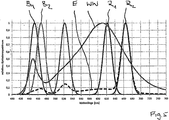
- the light spectra of the individual light-emitting diodes are in the FIGS. 1 to 5 each shown.
- a first blue light LED B 1 generates light in a deep blue spectral range with an intensity peak in the wavelength range of about 450 nm
- the green light emitting diode G generates light in the green spectral range with an intensity peak in the wavelength range of about 525 nm
- a first red light LED R 1 generates light in a red spectral range, here in the wavelength range of about 625 nm
- the second Red light LED R 2 generates light in a deep red spectral range with an intensity peak in the wavelength range of about 670 nm.
- the white-light LED WW generates white light with a color temperature of about 3000 K.
- a light emission spectrum E is shown, which is generated by driving the six light-emitting diodes to produce a white light that amplifies a red light color.
- Table 1 the weighting of the emission spectra of the 6 channels (ie drive signals of the LED channels) is shown to be in the example of the FIG. 1 mentioned properties to achieve according to the invention.
- a weight of 1.000 corresponds to the maximum control of the respective channel, other values are scaled linearly proportionally.
- Table 2 contains the colorimetric properties which correspond to the weighting factors from Table 1 for the example of FIG. 1 result.
- Table 2 Colorimetric properties of the example of FIG. 1.
- CCT 3050 K Most similar color temperature, in this case: warm white ⁇ uv: 0,002 Distance from Planck's curve, which describes the quality of the white, in this case, perceived well, because the value is in the range 0.001 - 0.002.
- CRI R a 90.0
- General color rendering index the value of 90 corresponds to "good to very good"
- this value corresponds to the accentuation of red object colors. This value is maximized by this LED lamp, under the constraints that the white tone remains high quality and R a > 90 is maintained. This value means that the red or reddish object colors are very saturated.
- FIG. 2 is an emission spectrum E for the production of white light with an increased proportion of green represented.
- Table 3 shows the weighting of the emission spectra of the 6 channels (ie drive signals of the LED channels) to those in the example of FIG. 2 mentioned properties to achieve according to the invention.
- a weight of 1.000 corresponds to the maximum control of the respective channel, other values are scaled linearly proportionally.
- Table 3 LED channel LED channel LED channel LED channel LED channel LED channel B1 B2 G R1 R2 WW 0.05 0.05 0.54 .3158 0.0969 1,000
- Table 4 contains the colorimetric properties that are consistent with the weighting factors of Table 7 for the example of FIG. 2 result.
- Table 4 Colorimetric properties of the example of FIG. 2.
- CCT 3124 K Most similar color temperature, in this case: warm white ⁇ uv: 0.0019 Distance from Planck's curve, which describes the quality of the white, in this case, perceived well, because the value is in the range 0.001 - 0.002.
- CRI R a 95.4
- the value of 95.4 corresponds to "very good - good"
- CIELAB chroma a term similar to saturation
- this value corresponds to the accentuation of green object colors. This value is maximized by this LED lamp, under the constraints that the white tone remains high quality and R a > 90 is maintained. This value means increased saturation for green object colors.
- the FIG. 3 shows an emission spectrum E for generating white light, which emphasizes an orange body color and thus saturates orange object colors.
- Table 5 shows the weighting of the emission spectra of the 6 channels (ie drive signals of the LED channels), in the example of FIG. 3 mentioned properties to achieve according to the invention. A weight of 1.000 corresponds to the maximum control of the respective channel, other values are scaled linearly proportionally. Table 5: LED channel LED channel LED channel LED channel LED channel LED channel LED channel B1 B2 G R1 R2 WW 0.0500 0.0500 0.38522 .3525 0,050 1,000
- Table 6 contains the colorimetric properties that are consistent with the weighting factors from Table 5 for the example of FIG. 3 result.
- Table 6 Colorimetric properties of the example of FIG. 3.
- CCT 2950 K Most similar color temperature, in this case: warm white ⁇ uv: 0,002 Distance from Planck's curve, which describes the quality of the white, in this case, perceptually good.
- CRI R a 94.7 General color rendering index, the value of 94.7 corresponds to "very good - good"
- C * ab_Orange 75.8 CIELAB chroma (a term similar to saturation), this value corresponds to the accentuation of orange objects. This value is maximized by this LED lamp, under the constraints that the white tone remains high quality and R a > 90 is maintained. This value means increased saturation for orange objects.
- Table 7 shows the weighting of the emission spectra of the 6 channels (ie drive signals of the LED channels), in the example of FIG. 4 to achieve the emission spectrum shown.
- a weight of 1.000 corresponds to the maximum control of the respective channel, other values are scaled linearly proportionally.
- Table 8 Colorimetric properties of the example of FIG. 4 (without red supersaturation) parameter value statement
- CCT 3050 K Most similar color temperature, in this case: warm white ⁇ uv: 0.0018 Distance from Planck's curve, which describes the quality of the white, in this case, perceived well, because the value is in the range 0.001 - 0.002.
- CRI Ra 90.0 General color rendering index, the value of 90 corresponds to "good to very good"
- CIELAB chroma (a term similar to saturation). At this value (62.2 instead of 70.5 in Tab. 2) the red object colors are not oversaturated.
- FIG. 5 an emission spectrum E for white light, in which the red color component saturated but a bad white point is reached.
- Table 9 shows the weighting of the emission spectra of the 6 channels (ie drive signals of the LED channels), in the example of FIG Fig. 3 , to achieve the emission spectrum shown.
- a weight of 1.000 corresponds to the maximum control of the respective channel, other values are scaled linearly proportionally.
- Color setting Blue 4000K Table 21 LED White blue blue green red red WW B1 B2 G R1 R1 strand 3000K 450 nm 470 nm 520 nm 630 nm 660 nm PWM in% 100 100 80 63.7 30 66 Target current (mA) 600 100 100 100 100 100 100 100 light color K E / lx X Y ⁇ uv CRI R12 BLUE Blue 4,000 K High CRI 3990 4214 .3769 .3504 -0.192 97.70 73.7
- Color setting Green, color temperature 3000 K Table 23 LED White blue blue green red red WW B1 B2 G R1 R2 strand 3000K 450 nm 470 nm 520 nm 630 nm 660 nm PWM in% 100 0 5 50 100 100 Target current (mA) 700 0 350 200 150 100 light color K E / lx X Y ⁇ uv CRI R11 GREEN Green 3,000 K High CRI 2936 4851 .4457 .4138 -0.006 95.46 93.1
- Color setting Green, color temperature 3500K Table 25 LED White blue blue green red red WW B1 B2 G R1 R2 strand 3000K 450 nm 470 nm 520 nm 630 nm 660 nm PWM in% 85 5 5 50 100 50 Target current (mA) 700 50 50 300 100 100 light color K E / lx X Y ⁇ uv CRI R11 GREEN Green 3.500 K High CRI 3347 4362 .4294 .4323 -0.042 93.25 92.9
Landscapes
- Led Device Packages (AREA)
Applications Claiming Priority (1)
| Application Number | Priority Date | Filing Date | Title |
|---|---|---|---|
| DE202014100673 | 2014-02-14 |
Publications (1)
| Publication Number | Publication Date |
|---|---|
| EP2908607A2 true EP2908607A2 (fr) | 2015-08-19 |
Family
ID=52468952
Family Applications (1)
| Application Number | Title | Priority Date | Filing Date |
|---|---|---|---|
| EP15155288.2A Ceased EP2908607A2 (fr) | 2014-02-14 | 2015-02-16 | Lampe à DEL |
Country Status (1)
| Country | Link |
|---|---|
| EP (1) | EP2908607A2 (fr) |
Cited By (1)
| Publication number | Priority date | Publication date | Assignee | Title |
|---|---|---|---|---|
| DE102018130596A1 (de) * | 2018-11-30 | 2020-06-04 | Ledxon Modular Gmbh | Objektbeleuchtung |
Citations (1)
| Publication number | Priority date | Publication date | Assignee | Title |
|---|---|---|---|---|
| EP2541362A2 (fr) | 2011-06-27 | 2013-01-02 | BÄ*RO GmbH & Co. KG | DEL intelligente |
-
2015
- 2015-02-16 EP EP15155288.2A patent/EP2908607A2/fr not_active Ceased
Patent Citations (1)
| Publication number | Priority date | Publication date | Assignee | Title |
|---|---|---|---|---|
| EP2541362A2 (fr) | 2011-06-27 | 2013-01-02 | BÄ*RO GmbH & Co. KG | DEL intelligente |
Cited By (1)
| Publication number | Priority date | Publication date | Assignee | Title |
|---|---|---|---|---|
| DE102018130596A1 (de) * | 2018-11-30 | 2020-06-04 | Ledxon Modular Gmbh | Objektbeleuchtung |
Similar Documents
| Publication | Publication Date | Title |
|---|---|---|
| DE10335077A1 (de) | LED-Modul | |
| AT11329U1 (de) | Led-modul mit anwendungsspezifischer farbeinstellung | |
| DE112018006831T5 (de) | Vielkanalsysteme zum bereitstellen von einstellbarem licht mit hoher farbwiedergabe und biologischen wirkungen | |
| EP2433472B1 (fr) | Procédé de réglage d'un point de couleur | |
| DE102009010265A1 (de) | Halbleiter-Leuchtvorrichtung | |
| DE112014002897B4 (de) | Anordnung und Verfahren zur Erzeugung von Mischlicht | |
| DE102012200711A1 (de) | LED Dimmer-Modul | |
| DE112011102994T5 (de) | Lichtquelle auf LED-Basis mit dekorativer und Beleuchtungsfunktion | |
| DE102008050643A1 (de) | Leuchtmittel | |
| DE102012107706A1 (de) | Vorrichtung und Verfahren zur Erzeugung von Licht eines vorgegebenen Spektrums mit mindestens vier verschiedenfarbigen Lichtquellen | |
| WO2019029849A1 (fr) | Source lumineuse à intensité variable | |
| EP2639499A2 (fr) | Module à DEL avec plaque guide de lumière | |
| DE102015202159A1 (de) | Halbleiter-Beleuchtungsvorrichtung | |
| DE112015004032T5 (de) | Led-dentallichtquelle mit veränderlicher chromatizität und verfahren | |
| DE102014117892A1 (de) | Optoelektronisches Bauelement sowie optoelektronisches Bauteil | |
| EP2908607A2 (fr) | Lampe à DEL | |
| DE112019003822T5 (de) | Schaltbare Systeme für weisses Licht mit hoher Farbtreue und biologischen Wirkungen | |
| DE102012217731B4 (de) | Einrichtung zur Auslage von Waren | |
| EP1985912B1 (fr) | Lampe chirurgicale | |
| DE3930214A1 (de) | Signalleuchtenpaar | |
| WO2025003296A1 (fr) | Dispositif électroluminescent et lampe | |
| WO2005012785A1 (fr) | Lampe comprenant au moins deux sources de lumiere | |
| EP3121513A1 (fr) | Lampe a del | |
| DE202008018269U1 (de) | LED Modul für die Allgemeinbeleuchtung | |
| EP3289618B1 (fr) | Module de del pour émission de lumière blanche |
Legal Events
| Date | Code | Title | Description |
|---|---|---|---|
| PUAI | Public reference made under article 153(3) epc to a published international application that has entered the european phase |
Free format text: ORIGINAL CODE: 0009012 |
|
| AK | Designated contracting states |
Kind code of ref document: A2 Designated state(s): AL AT BE BG CH CY CZ DE DK EE ES FI FR GB GR HR HU IE IS IT LI LT LU LV MC MK MT NL NO PL PT RO RS SE SI SK SM TR |
|
| AX | Request for extension of the european patent |
Extension state: BA ME |
|
| STAA | Information on the status of an ep patent application or granted ep patent |
Free format text: STATUS: THE APPLICATION HAS BEEN REFUSED |
|
| 18R | Application refused |
Effective date: 20150913 |