EP2909154B1 - Gärrest-behandlungsverfahren, aus diesem verfahren gewonnenes düngemittel und entsprechende behandlungseinheit - Google Patents
Gärrest-behandlungsverfahren, aus diesem verfahren gewonnenes düngemittel und entsprechende behandlungseinheit Download PDFInfo
- Publication number
- EP2909154B1 EP2909154B1 EP13803093.7A EP13803093A EP2909154B1 EP 2909154 B1 EP2909154 B1 EP 2909154B1 EP 13803093 A EP13803093 A EP 13803093A EP 2909154 B1 EP2909154 B1 EP 2909154B1
- Authority
- EP
- European Patent Office
- Prior art keywords
- digestate
- mixture
- liquid fraction
- mixing
- fraction
- Prior art date
- Legal status (The legal status is an assumption and is not a legal conclusion. Google has not performed a legal analysis and makes no representation as to the accuracy of the status listed.)
- Active
Links
Images

Classifications
-
- C—CHEMISTRY; METALLURGY
- C05—FERTILISERS; MANUFACTURE THEREOF
- C05D—INORGANIC FERTILISERS NOT COVERED BY SUBCLASSES C05B, C05C; FERTILISERS PRODUCING CARBON DIOXIDE
- C05D9/00—Other inorganic fertilisers
-
- C—CHEMISTRY; METALLURGY
- C05—FERTILISERS; MANUFACTURE THEREOF
- C05F—ORGANIC FERTILISERS NOT COVERED BY SUBCLASSES C05B, C05C, e.g. FERTILISERS FROM WASTE OR REFUSE
- C05F17/00—Preparation of fertilisers characterised by biological or biochemical treatment steps, e.g. composting or fermentation
- C05F17/10—Addition or removal of substances other than water or air to or from the material during the treatment
-
- C—CHEMISTRY; METALLURGY
- C05—FERTILISERS; MANUFACTURE THEREOF
- C05F—ORGANIC FERTILISERS NOT COVERED BY SUBCLASSES C05B, C05C, e.g. FERTILISERS FROM WASTE OR REFUSE
- C05F17/00—Preparation of fertilisers characterised by biological or biochemical treatment steps, e.g. composting or fermentation
- C05F17/50—Treatments combining two or more different biological or biochemical treatments, e.g. anaerobic and aerobic treatment or vermicomposting and aerobic treatment
-
- C—CHEMISTRY; METALLURGY
- C05—FERTILISERS; MANUFACTURE THEREOF
- C05F—ORGANIC FERTILISERS NOT COVERED BY SUBCLASSES C05B, C05C, e.g. FERTILISERS FROM WASTE OR REFUSE
- C05F3/00—Fertilisers from human or animal excrements, e.g. manure
-
- C—CHEMISTRY; METALLURGY
- C05—FERTILISERS; MANUFACTURE THEREOF
- C05F—ORGANIC FERTILISERS NOT COVERED BY SUBCLASSES C05B, C05C, e.g. FERTILISERS FROM WASTE OR REFUSE
- C05F7/00—Fertilisers from waste water, sewage sludge, sea slime, ooze or similar masses
-
- Y—GENERAL TAGGING OF NEW TECHNOLOGICAL DEVELOPMENTS; GENERAL TAGGING OF CROSS-SECTIONAL TECHNOLOGIES SPANNING OVER SEVERAL SECTIONS OF THE IPC; TECHNICAL SUBJECTS COVERED BY FORMER USPC CROSS-REFERENCE ART COLLECTIONS [XRACs] AND DIGESTS
- Y02—TECHNOLOGIES OR APPLICATIONS FOR MITIGATION OR ADAPTATION AGAINST CLIMATE CHANGE
- Y02A—TECHNOLOGIES FOR ADAPTATION TO CLIMATE CHANGE
- Y02A40/00—Adaptation technologies in agriculture, forestry, livestock or agroalimentary production
- Y02A40/10—Adaptation technologies in agriculture, forestry, livestock or agroalimentary production in agriculture
- Y02A40/20—Fertilizers of biological origin, e.g. guano or fertilizers made from animal corpses
-
- Y—GENERAL TAGGING OF NEW TECHNOLOGICAL DEVELOPMENTS; GENERAL TAGGING OF CROSS-SECTIONAL TECHNOLOGIES SPANNING OVER SEVERAL SECTIONS OF THE IPC; TECHNICAL SUBJECTS COVERED BY FORMER USPC CROSS-REFERENCE ART COLLECTIONS [XRACs] AND DIGESTS
- Y02—TECHNOLOGIES OR APPLICATIONS FOR MITIGATION OR ADAPTATION AGAINST CLIMATE CHANGE
- Y02E—REDUCTION OF GREENHOUSE GAS [GHG] EMISSIONS, RELATED TO ENERGY GENERATION, TRANSMISSION OR DISTRIBUTION
- Y02E50/00—Technologies for the production of fuel of non-fossil origin
- Y02E50/30—Fuel from waste, e.g. synthetic alcohol or diesel
-
- Y—GENERAL TAGGING OF NEW TECHNOLOGICAL DEVELOPMENTS; GENERAL TAGGING OF CROSS-SECTIONAL TECHNOLOGIES SPANNING OVER SEVERAL SECTIONS OF THE IPC; TECHNICAL SUBJECTS COVERED BY FORMER USPC CROSS-REFERENCE ART COLLECTIONS [XRACs] AND DIGESTS
- Y02—TECHNOLOGIES OR APPLICATIONS FOR MITIGATION OR ADAPTATION AGAINST CLIMATE CHANGE
- Y02P—CLIMATE CHANGE MITIGATION TECHNOLOGIES IN THE PRODUCTION OR PROCESSING OF GOODS
- Y02P20/00—Technologies relating to chemical industry
- Y02P20/141—Feedstock
- Y02P20/145—Feedstock the feedstock being materials of biological origin
-
- Y—GENERAL TAGGING OF NEW TECHNOLOGICAL DEVELOPMENTS; GENERAL TAGGING OF CROSS-SECTIONAL TECHNOLOGIES SPANNING OVER SEVERAL SECTIONS OF THE IPC; TECHNICAL SUBJECTS COVERED BY FORMER USPC CROSS-REFERENCE ART COLLECTIONS [XRACs] AND DIGESTS
- Y02—TECHNOLOGIES OR APPLICATIONS FOR MITIGATION OR ADAPTATION AGAINST CLIMATE CHANGE
- Y02W—CLIMATE CHANGE MITIGATION TECHNOLOGIES RELATED TO WASTEWATER TREATMENT OR WASTE MANAGEMENT
- Y02W30/00—Technologies for solid waste management
- Y02W30/40—Bio-organic fraction processing; Production of fertilisers from the organic fraction of waste or refuse
Definitions
- the field of the invention is that of treatment and recovery of residues from the methanation process.
- a field related to the invention is that of the manufacture of fertilizers.
- the invention relates to a method and a unit for processing the digestates extracted from a digester of an anaerobic digestion installation.
- Anaerobic digestion is currently a booming technology in Europe. In 2011, there were forty-six anaerobic digestion units under construction in France and several hundred in Germany.
- anaerobic digestion units make it possible to produce biogas from the anaerobic fermentation of agricultural, industrial or collective waste of an organic nature, such as for example livestock effluents, animal excrement, organic waste from an agrifood industry, sewage treatment plant sludge or a fermentable fraction of household waste, which can then be used to heat buildings, to supply a cogeneration plant for the purpose of producing electricity or in the form of biofuel.
- an organic nature such as for example livestock effluents, animal excrement, organic waste from an agrifood industry, sewage treatment plant sludge or a fermentable fraction of household waste, which can then be used to heat buildings, to supply a cogeneration plant for the purpose of producing electricity or in the form of biofuel.
- the methanation process thus makes it possible to recover the carbonaceous matter contained in this waste.
- organic waste also contains nitrogen in organic form which will essentially be transformed into a mineral or gaseous form during the methanisation process, and for example into ammoniacal nitrogen in ionized form (ammonium ion) or in ammonia.
- the destocking of digestates is however problematic.
- the simplest and most economical solution would be to spread the digestate on agricultural land.
- the spreading of digestates on agricultural land proves to be a polluting solution which modifies terrestrial ecosystems, leads to eutrophication of aquatic environments and participates in atmospheric pollution because it promotes the volatilization of nitrogenous derivatives in the form of gases. ammonia.
- the spreading of digestates as they are is controlled and subjected to a spreading plan, which greatly limits the quantities of digestates that can be eliminated by this route.
- a drawback of this composting technique is that it only treats the solid fraction of the digestates, without acting on the liquid fraction of the digestates which is the most concentrated in nitrogen in ammoniacal form.
- a disadvantage of this biological treatment technique is that it consumes electricity to aerate the reactor.
- This technique also has the disadvantage of transforming nitrogen in ammoniacal form into nitrates, which are leached into the soil by rainwater and thus contribute to the pollution of groundwater or watercourses and promote the proliferation of species. endemic algae on the coasts.
- Another drawback of this technique is that it produces residual ammonia and nitrous oxide.
- This technique has many drawbacks: it is expensive to implement, in particular because of the quantity of sulfuric acid consumed and its storage, and requires the use of chemicals to clean the filtration or reverse osmosis membranes. or to strongly heat the digestates to evaporate the residual water.
- a technique called "stripping" consisting of spraying the liquid fraction of the digestate on a substrate in a column against the flow of hot air at 60-70 ° C or steam to promote the volatilization of nitrogenous ammonia derivatives.
- ammonia leaving the column is then transformed into ammonium sulfate following a washing with sulfuric acid, into ammonium nitrate after washing with nitric acid, condensed in ammoniacal water, or eliminated by biological nitrification-denitrification in the gas phase or by high temperature catalytic combustion.
- a drawback of this stripping technique is that the cost and maintenance of the installations is high.
- this stripping technique consumes a lot of energy and requires the use of large quantities of acids to transform the volatilized ammonia.
- a disadvantage of this precipitation technique is that it is necessary to use large amounts of magnesium oxide, sodium hydroxide and phosphoric acid to implement it, which is expensive.
- Requirement DE 10 2008 062299 A1 discloses a process for recovering sewage sludge with a high nitrogen content.
- the invention therefore aims in particular to overcome the drawbacks of the state of the art cited above.
- the invention aims to provide a digestate treatment technique which is simple to implement and at a reduced cost price.
- An objective of the invention is also to provide such a digestate treatment technique which makes it possible to enhance the digestates treated in the form of fertilizers.
- Another object of the invention is to provide such a treatment technique which is effective.
- the invention also aims to provide a digestate treatment technique which is harmless to the environment.
- Another objective of the invention is to provide such a digestate treatment technique which is reliable.
- the invention therefore proposes to treat the digestates at the outlet of the digester so as not to disturb the enzymatic, microbial and / or bacterial action within the digester. Furthermore, there is therefore no need to modify the design of the digesters.
- the proposed treatment can relate only to the liquid fraction of a digestate or directly to a crude digestate in which a liquid fraction and a solid fraction are present.
- the invention proposes to fix at least a portion of the ammonium and potassium ions present in the liquid fraction or the solid fraction of the digestate by trapping on an essentially mineral material mixed with the digestate or only with its liquid fraction. or with the liquid fraction of the digestate and part of the solid fraction of the digestate, in order to avoid transformation of the ammonium ions into ammonia form.
- the term "trapping” is understood in its general meaning and is aimed at the retention of ammonium ions in essentially mineral matter following an ion exchange. It can for example be a trapping by adsorption.
- ammonium ions do not undergo transformation due to the process which is the subject of the invention, they contribute to the recovery of the mineral material used. After treatment, the essentially mineral matter is thus enriched with ammonium ions easily assimilated by plants and can be used in the composition of a fertilizer.
- the expression “of essentially mineral origin” means that the material mixed with the liquid fraction of the digestate, or directly with the digestate, is composed mainly of mineral substances of a single mineral species, group or family or arranged in a mixture.
- the material of essentially mineral origin contains in a lower proportion organic elements, and in particular water-soluble polysaccharides originating from macroalgae.
- the essentially mineral material used to treat the digestates is in the form of a powder or a heap of granules, so as to increase the contact surface between this material and the digestate.
- such a method for treating a digestate comprises a step of separating the liquid fraction from said digestate, prior to said mixing step.
- This separation step can in particular be implemented by applying separation techniques known per se, such as filtration, centrifugation or pressing using a screw press, for example. It allows nitrogen to be concentrated in ammoniacal form within the liquid fraction of the digestate.
- the separation stage has little influence on the potassium concentration which remains substantially equal in the solid fraction and in the liquid fraction of the digestate after phase separation.
- the method for treating a digestate described above further comprises an additional step of mixing said solid fraction of the digestate with said solid fraction of said mixture.
- said digestate is mixed with said material of essentially mineral origin.
- the inventors of the present application have also observed, surprisingly, that the rate of retention of ammonium and potassium ions by the material of substantially mineral origin increases by at least 10% when the digestate is mixed directly with the latter. .
- the duration of said mixing step is at least equal to 1 hour, and preferably is greater than or equal to 7 hours.
- the digestate or its liquid fraction are mixed successively with several materials of substantially mineral origin, it may be envisaged to reduce the duration of each successive mixing stage between 10 minutes and 4 hours.
- such a treatment method comprises a step of adjusting the pH of said mixture of at least said liquid fraction of said digestate with said material of essentially mineral origin between 4.5 and 7, comprising a step of adding to said mixture of '' an acidifying agent, a basic agent or a buffer solution.
- the acidifying agent can for example be an acid such as HCl, HNO 3 , H 2 SO 4 , or CH 3 COOH, or an acid salt such as FeSO 4 , NH 4 HF 2 , KHF 2 , NaHSO 4 , or KHSO 4 or a mixture of an acid and an acid salt.
- an acid such as HCl, HNO 3 , H 2 SO 4 , or CH 3 COOH
- an acid salt such as FeSO 4 , NH 4 HF 2 , KHF 2 , NaHSO 4 , or KHSO 4 or a mixture of an acid and an acid salt.
- the acidifying agent comprises iron sulphate obtained from the treatment of ilmenite.
- the basic agent is a base, such as NaHCO 3 , Na 2 CO 3 , CH 3 COONa, Na 2 S, NaHS, a basic salt or a mixture of a base and a basic salt.
- the buffer solution that can be incorporated into the mixture to bring its pH to a predetermined value can be for example (CH 3 COONa, CH 3 COOH) or (NH 4 OH, NH 4 Cl)
- the mixture is heated to a temperature between 30 ° C and 50 ° C during said mixing step.
- the inventors have in fact found that heating the mixture to approximately 40 ° C. can make it possible to significantly accelerate the trapping of ammonium and potassium ions by the substantially mineral matter.
- the process for treating a digestate described above comprises a step of mixing the liquid fraction of said mixture obtained after separation with a second material of essentially mineral origin comprising a substantial amount of clay, zeolite and / or earth of diatoms, capable of trapping at least a portion of a residual nitrogenous species present in said liquid fraction of said mixture after separation.
- This second mixing step notably makes it possible to reduce the total duration of the treatment.
- a process for treating a digestate as described above comprises a plurality of successive mixing steps consisting in mixing the liquid fraction obtained after separation of the previous mixture with material of essentially mineral origin capable of trapping the minus a portion of a residual nitrogenous species present in the liquid fraction of the preceding mixture and comprising a substantial amount of clay, zeolite and / or diatomaceous earth.
- provision may be made to select the material of essentially mineral origin for each successive mixture so that the retention capacity of the ammonium and potassium ions of each mixture is higher than that of the mixture which precedes it in the sequence of successive mixtures.
- said material comprises natural zeolite, preferably clinoptilolite and / or chabazite, or any other known natural zeolite having a suitable cation exchange capacity.
- the inventors have in fact observed that a particularly effective substitution of the cations occluded in the porosity of a natural zeolite takes place with ammonium or potassium ions.
- said material of essentially mineral origin comprises exfoliated clay and / or inserted with an extract of algae and / or macroalgae.
- clay means a phyllosilicate of natural or synthetic origin having a structure in appropriate sheets, allowing cation trapping in the interfoliar space. It may in particular be smectites, such as montmorillonites for example, and in particular montmorillonites of sodium, potassium and / or calcium, nontronites, bedelleites, volkonskoites, hectorites, saponites, sauconites, sobockites, stevensites, svinfordites and vermiculites.
- clay also covers, more generally, a mixture of different clays.
- the invention also relates to the use of the solid fraction of the mixture obtained according to any one of the processes for treating a digestate described above in the composition of a fertilizer.
- the treatment process is implemented in a digestate processing unit located on the methanisation site, near a digester.
- the liquid fraction of the digestate is separated from its solid fraction by filtration.
- the solid fraction of the mixture obtained following step 12 is then separated from the liquid fraction of the mixture in step 13.
- the liquid fraction of the mixture is reused to dilute the waste entering the anaerobic digestion site. Provision may also be made to spread the liquid fraction of the mixture due to its low nitrogen concentration on certain agricultural land, within a limit of approximately 100 tonnes per hectare.
- a step 14 270 kg of solid fraction of the digestate are mixed with mechanical stirring with the solid fraction of the mixture obtained after separation, so as to form a base of NP fertilizers whose nitrogen compounds are stable.
- 1 ton of digestate obtained directly from the methanization of a liquid manure is mixed directly in a first step with 200 kg of chabazite-type zeolite for 7 hours at a temperature of 40 ° C. , after adding iron sulfate to adjust the pH value of the mixture to 6.
- the solid fraction and the liquid fraction are then separated in a second step from the mixture obtained.
- a chemical analysis of the liquid fraction of the mixture shows that the retention rates by zeolite in overall nitrogen and potassium are of the order of 82 and 74% respectively.
- the liquid fraction is mixed in each of these examples respectively with a montmorillonite-type clay, an exfoliated clay or intercalated with algae extracts acting as intercalating components, distributed under the trade name "Amadeite” (registered trademark), and a clay intercalated or exfoliated obtained by mixing with macroalgae for 4 hours.
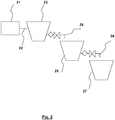
- FIG. 2 another exemplary embodiment of the invention has been illustrated in which the liquid fraction of the digestate is mixed successively in 3 vats mounted in cascade, containing diatomaceous earth or exfoliated clay or intercalated with extracts of 'algae.
- the liquid fraction of the digestate 22 obtained after separation in a filtration unit 21 is poured into a first tank 23 and mixed for 1 hour with the earth of diatoms contained in the tank, partially saturated with ammonium and potassium ions during a previous mixture with digestate.
- the liquid fraction 24 of this first mixture after mixing is drawn off through a filter and introduced into a second tank 25 in which it is mixed with natural diatomaceous earth for 1 hour.
- liquid fraction 26 of the second mixture is in turn withdrawn to pour into a third tank 27 containing Amadéite and mixed with the latter for 1 hour, in order to perfect the treatment of the liquid fraction digestate.
- the ammonium ion and potassium ion content is greater than 95%.
- this particular embodiment of the invention has the advantage of being able to obtain, in each of the tanks, diatomaceous earth or Amadéite having a substantially identical nitrogen retention rate, due to having successively mixed a liquid fraction increasingly poor in ammonium with substantially mineral matter having an increasing ammonium ion retention capacity.
Landscapes
- Chemical & Material Sciences (AREA)
- Organic Chemistry (AREA)
- Chemical Kinetics & Catalysis (AREA)
- Engineering & Computer Science (AREA)
- Health & Medical Sciences (AREA)
- Molecular Biology (AREA)
- Life Sciences & Earth Sciences (AREA)
- Biochemistry (AREA)
- Biotechnology (AREA)
- General Chemical & Material Sciences (AREA)
- Microbiology (AREA)
- Inorganic Chemistry (AREA)
- Environmental & Geological Engineering (AREA)
- Fertilizers (AREA)
Claims (11)
- Behandlungsverfahren eines aus einem Faulbehälter einer Methanisierungsanlage extrahierten Gärrests, dadurch gekennzeichnet, dass es umfasst:- einen Schritt des Mischens mindestens der flüssigen Fraktion des Gärrests mit einem Stoff, der im wesentlichen mineralischen Ursprungs ist, umfassend eine substantielle Menge Ton, Zeolith und/oder Kieselgur in Anteilen von gleich 100 bis 300 g des Stoffs, der im Wesentlichen mineralischen Ursprungs ist, je Liter der flüssigen Fraktion des Gärrests während einer Dauer von mindestens 1 Stunde, was ausreicht, um ein mindestens teilweises Einfangen, durch den Stoff, von in dem Gärrest enthaltenen Ammoniakstickstoff in ionisierter Form zu erlauben;- einen Schritt des Trennens der festen Fraktion und der flüssigen Fraktion des Gemischs;- einen Schritt des Mischens der nach Trennung erhaltenen flüssigen Fraktion des Gemischs mit einem zweiten Stoff, der im Wesentlichen mineralischen Ursprungs ist, umfassend eine substantielle Menge Ton, Zeolith und/oder Kieselgur, der imstande ist, mindestens eine Portion einer stickstoffhaltigen Restspezies einzufangen, die in der flüssigen Fraktion des Gemischs nach dem Trennen vorhanden ist.
- Gärrest-Behandlungsverfahren nach Anspruch 1, dadurch gekennzeichnet, dass es einen Schritt des Trennens der flüssigen Fraktion des Gärrests vor dem Mischschritt umfasst.
- Gärrest-Behandlungsverfahren nach Anspruch 2, dadurch gekennzeichnet, dass es ferner einen zusätzlichen Schritt des Mischens der festen Fraktion des Gärrests mit der festen Fraktion des Gemischs umfasst.
- Gärrest-Behandlungsverfahren nach Anspruch 1, dadurch gekennzeichnet, dass beim Mischschritt der Gärrest mit dem Stoff gemischt wird, der im Wesentlichen mineralischen Ursprungs ist.
- Gärrest-Behandlungsverfahren nach Anspruch 4, dadurch gekennzeichnet, dass beim Mischschritt 80 bis 270 g des Stoffs mit 1 Kilogramm des Gärrests in Anteilen gemischt werden.
- Gärrest-Behandlungsverfahren nach einem der Ansprüche 1 bis 5, dadurch gekennzeichnet, dass die Dauer des Mischschritts über oder gleich 7 Stunden beträgt.
- Gärrest-Behandlungsverfahren nach einem der Ansprüche 1 bis 6, dadurch gekennzeichnet, dass es einen Schritt des Einstellens des pH des Gemischs von mindestens der flüssigen Fraktion des Gärrests mit dem Stoff, der im Wesentlichen mineralischen Ursprungs ist, zwischen 4,5 und 7 umfasst, umfassend einen Schritt des Hinzufügens eines Säuerungsmittels oder eines basischen Mittels zu dem Gemisch.
- Behandlungsverfahren nach Anspruch 1, dadurch gekennzeichnet, dass es eine Vielzahl aufeinanderfolgender Mischschritte umfasst, die darin bestehen, die nach Trennung des vorangegangenen Gemischs erhaltene flüssige Fraktion mit dem Stoff, der im Wesentlichen mineralischen Ursprungs ist, der imstande ist, mindestens eine Portion einer stickstoffhaltigen Restspezies einzufangen, die in der flüssigen Fraktion des vorangegangenen Gemischs nach dem Trennen vorhanden ist und eine substantielle Menge Ton, Zeolith und/oder Kieselgur umfasst, zu mischen.
- Behandlungsverfahren nach einem der Ansprüche 1 bis 8, dadurch gekennzeichnet, dass der Stoff natürlichen Zeolith, vorzugsweise Clinoptilolith und/oder Chabazit, umfasst.
- Behandlungsverfahren nach einem der Ansprüche 1 bis 9, dadurch gekennzeichnet, dass der Stoff, der im Wesentlichen mineralischen Ursprungs ist, exfolierten und/oder mit einem Algenextrakt und/oder Makroalgen eingelagerten Ton umfasst.
- Verwendung der festen Fraktion des gemäß dem Behandlungsverfahren nach einem der Ansprüche 1 bis 10 erhaltenen Gemischs in der Zusammensetzung eines Düngers.
Applications Claiming Priority (2)
| Application Number | Priority Date | Filing Date | Title |
|---|---|---|---|
| FR1259931A FR2997078B1 (fr) | 2012-10-18 | 2012-10-18 | Procede de traitement des digestats, engrais obtenu par ce procede et unite de traitement correspondante |
| PCT/FR2013/052425 WO2014060687A2 (fr) | 2012-10-18 | 2013-10-10 | Procede de traitement des digestats, engrais obtenu par ce procede et unite de traitement correspondante |
Publications (2)
| Publication Number | Publication Date |
|---|---|
| EP2909154A2 EP2909154A2 (de) | 2015-08-26 |
| EP2909154B1 true EP2909154B1 (de) | 2020-03-11 |
Family
ID=47425112
Family Applications (1)
| Application Number | Title | Priority Date | Filing Date |
|---|---|---|---|
| EP13803093.7A Active EP2909154B1 (de) | 2012-10-18 | 2013-10-10 | Gärrest-behandlungsverfahren, aus diesem verfahren gewonnenes düngemittel und entsprechende behandlungseinheit |
Country Status (3)
| Country | Link |
|---|---|
| EP (1) | EP2909154B1 (de) |
| FR (1) | FR2997078B1 (de) |
| WO (1) | WO2014060687A2 (de) |
Families Citing this family (2)
| Publication number | Priority date | Publication date | Assignee | Title |
|---|---|---|---|---|
| EP4290219A1 (de) | 2022-06-09 | 2023-12-13 | Lietuvos Agrariniu Ir Misku Mokslu Centras | Bestimmung der zusammensetzung eines nebenprodukts der biogaserzeugung mit einem nahinfrarotspektroskopieverfahren |
| WO2025127945A1 (en) | 2023-12-13 | 2025-06-19 | Petr Bartalos | Method of processing biomass digestate into organic-mineral fertilizer, and organic - mineral fertilizer produced by this method. |
Family Cites Families (9)
| Publication number | Priority date | Publication date | Assignee | Title |
|---|---|---|---|---|
| DE3712383A1 (de) * | 1987-04-11 | 1988-10-27 | Piepho Abwassertech Ralf F | Verfahren zur aufbereitung von abwaessern landwirtschaftlicher betriebe, insbesondere guelle |
| DK11191D0 (da) * | 1991-01-23 | 1991-01-23 | Flocco Tec Aps | Fremgangsmaade og apparat til separering af gylle i en tykslamfase med hoejt toerstofindhold og en vandig fase med oensket - hoejt, moderat eller lavt - n-indhold |
| DE4138670A1 (de) * | 1991-11-25 | 1993-05-27 | Sued Chemie Ag | Verfahren zur gewinnung von landwirtschaftlich verwertbarem klaerschlamm |
| DK94292D0 (da) * | 1992-07-22 | 1992-07-22 | Flocco Tec Aps | Fremgangsmaade og apparat til rensning af spildevand |
| AU2003302602A1 (en) * | 2002-11-25 | 2004-06-23 | Sr. Richard G. Sheets | Animal waste effluent treatment |
| FR2874912B1 (fr) | 2004-09-09 | 2007-01-26 | Olmix Sarl | Argiles intercalees |
| FR2882997B1 (fr) | 2005-03-10 | 2008-04-18 | Olmix Sarl | Procede d'exfoliation d'argiles intercalees |
| DE102008062299A1 (de) * | 2008-12-15 | 2010-06-17 | Süd-Chemie AG | Verfahren zur Aufarbeitung stickstoffbelasteter Abwässer |
| FR2991978B1 (fr) | 2012-06-15 | 2015-07-17 | Olmix | Procede de preparation d'une argile organophile intercalee et/ou exfoliee a partir d'argile et de macroalgues, produit fertilisant, complement alimentaire pour animaux, aliment pour poisson et charge pour ceramique correspondants. |
-
2012
- 2012-10-18 FR FR1259931A patent/FR2997078B1/fr not_active Expired - Fee Related
-
2013
- 2013-10-10 WO PCT/FR2013/052425 patent/WO2014060687A2/fr not_active Ceased
- 2013-10-10 EP EP13803093.7A patent/EP2909154B1/de active Active
Non-Patent Citations (1)
| Title |
|---|
| None * |
Also Published As
| Publication number | Publication date |
|---|---|
| WO2014060687A3 (fr) | 2014-09-04 |
| FR2997078A1 (fr) | 2014-04-25 |
| FR2997078B1 (fr) | 2015-10-23 |
| EP2909154A2 (de) | 2015-08-26 |
| WO2014060687A2 (fr) | 2014-04-24 |
Similar Documents
| Publication | Publication Date | Title |
|---|---|---|
| EP3084301B2 (de) | Verfahren zur behandlung der aus der abfallverbrennung hervorgehenden aschen | |
| EP2998277B1 (de) | Verfahren zur behandlung von schlämmen aus der wasseraufbereitung | |
| Vanotti et al. | Removing and recovering nitrogen and phosphorus from animal manure | |
| CN102010104B (zh) | 一种核黄素发酵废水处理方法 | |
| FR2484390A1 (fr) | Procede et dispositif pour le traitement d'eaux residuaires | |
| CN101503262B (zh) | 一种复杂体系污水预处理的方法 | |
| SE1950636A1 (en) | Chemical processing of struvite | |
| CN103224304B (zh) | 一种去除污泥发酵液中氮磷以提高有机酸回用效果的方法 | |
| EP1575880B1 (de) | Verfahren und vorrichtung zur behandlung von gülle | |
| EP2909154A2 (de) | Gärrest-behandlungsverfahren, aus diesem verfahren gewonnenes düngemittel und entsprechende behandlungseinheit | |
| CN104355387A (zh) | 一种含磷废水处理方法 | |
| AU2010364515A1 (en) | Method for obtaining a solid fertilizing and biocombustible product from sugar-cane vinasse and solid fertilizing and biocombustible product obtained by means of said method | |
| Shraddha et al. | Green and eco-friendly materials for the removal of phosphorus from wastewater | |
| Khai et al. | Chemical Precipitation of Ammonia and Phosphatefrom Nam Son Landfill Leachate, Hanoi | |
| FR3072666A1 (fr) | Procede et dispositif de traitement d'effluents d'unite de methanisation et unite de methanisation comportant un tel dispositif | |
| Kuglarz et al. | Chemical precipitation and ammonia air stripping as effective pre-treatment methods before membrane filtration of co-digestion effluents | |
| CN118343722A (zh) | 一种提高垃圾渗滤液处理过程中鸟粪石结晶纯度的方法 | |
| KR100822378B1 (ko) | 축산분뇨의 소화 처리에 따른 부산물의 비료화 처리 방법 및 이를 위한 처리 장치 | |
| CN112919731B (zh) | 污水处理方法 | |
| JP2022164142A (ja) | メタン発酵消化液の処理方法 | |
| CN114713191A (zh) | 一种磷石膏水体除磷剂及其制备方法与应用 | |
| Bove et al. | Valorisation of digestate through nitrogen and phosphorus recovery via chemical-physical precipitation and microbubble insufflation to reduce COD in the liquid | |
| US20120260707A1 (en) | Using Nitrogen Containing Fertilizers Recovered from Contaminated Water for Feeding Plants and Algae | |
| BE1018196A3 (nl) | Methode en inrichting voor het verwerken van ammoniumrijke afvalwaters. | |
| CN103664245A (zh) | 一种沼液液体有机肥的制备方法 |
Legal Events
| Date | Code | Title | Description |
|---|---|---|---|
| PUAI | Public reference made under article 153(3) epc to a published international application that has entered the european phase |
Free format text: ORIGINAL CODE: 0009012 |
|
| 17P | Request for examination filed |
Effective date: 20150415 |
|
| AK | Designated contracting states |
Kind code of ref document: A2 Designated state(s): AL AT BE BG CH CY CZ DE DK EE ES FI FR GB GR HR HU IE IS IT LI LT LU LV MC MK MT NL NO PL PT RO RS SE SI SK SM TR |
|
| AX | Request for extension of the european patent |
Extension state: BA ME |
|
| DAX | Request for extension of the european patent (deleted) | ||
| STAA | Information on the status of an ep patent application or granted ep patent |
Free format text: STATUS: EXAMINATION IS IN PROGRESS |
|
| 17Q | First examination report despatched |
Effective date: 20161108 |
|
| GRAP | Despatch of communication of intention to grant a patent |
Free format text: ORIGINAL CODE: EPIDOSNIGR1 |
|
| STAA | Information on the status of an ep patent application or granted ep patent |
Free format text: STATUS: GRANT OF PATENT IS INTENDED |
|
| INTG | Intention to grant announced |
Effective date: 20191213 |
|
| GRAS | Grant fee paid |
Free format text: ORIGINAL CODE: EPIDOSNIGR3 |
|
| GRAA | (expected) grant |
Free format text: ORIGINAL CODE: 0009210 |
|
| STAA | Information on the status of an ep patent application or granted ep patent |
Free format text: STATUS: THE PATENT HAS BEEN GRANTED |
|
| AK | Designated contracting states |
Kind code of ref document: B1 Designated state(s): AL AT BE BG CH CY CZ DE DK EE ES FI FR GB GR HR HU IE IS IT LI LT LU LV MC MK MT NL NO PL PT RO RS SE SI SK SM TR |
|
| REG | Reference to a national code |
Ref country code: GB Ref legal event code: FG4D Free format text: NOT ENGLISH |
|
| REG | Reference to a national code |
Ref country code: CH Ref legal event code: EP |
|
| REG | Reference to a national code |
Ref country code: AT Ref legal event code: REF Ref document number: 1242967 Country of ref document: AT Kind code of ref document: T Effective date: 20200315 |
|
| REG | Reference to a national code |
Ref country code: IE Ref legal event code: FG4D Free format text: LANGUAGE OF EP DOCUMENT: FRENCH |
|
| REG | Reference to a national code |
Ref country code: DE Ref legal event code: R096 Ref document number: 602013066753 Country of ref document: DE |
|
| PG25 | Lapsed in a contracting state [announced via postgrant information from national office to epo] |
Ref country code: NO Free format text: LAPSE BECAUSE OF FAILURE TO SUBMIT A TRANSLATION OF THE DESCRIPTION OR TO PAY THE FEE WITHIN THE PRESCRIBED TIME-LIMIT Effective date: 20200611 Ref country code: FI Free format text: LAPSE BECAUSE OF FAILURE TO SUBMIT A TRANSLATION OF THE DESCRIPTION OR TO PAY THE FEE WITHIN THE PRESCRIBED TIME-LIMIT Effective date: 20200311 Ref country code: RS Free format text: LAPSE BECAUSE OF FAILURE TO SUBMIT A TRANSLATION OF THE DESCRIPTION OR TO PAY THE FEE WITHIN THE PRESCRIBED TIME-LIMIT Effective date: 20200311 |
|
| REG | Reference to a national code |
Ref country code: NL Ref legal event code: MP Effective date: 20200311 |
|
| PG25 | Lapsed in a contracting state [announced via postgrant information from national office to epo] |
Ref country code: LV Free format text: LAPSE BECAUSE OF FAILURE TO SUBMIT A TRANSLATION OF THE DESCRIPTION OR TO PAY THE FEE WITHIN THE PRESCRIBED TIME-LIMIT Effective date: 20200311 Ref country code: SE Free format text: LAPSE BECAUSE OF FAILURE TO SUBMIT A TRANSLATION OF THE DESCRIPTION OR TO PAY THE FEE WITHIN THE PRESCRIBED TIME-LIMIT Effective date: 20200311 Ref country code: HR Free format text: LAPSE BECAUSE OF FAILURE TO SUBMIT A TRANSLATION OF THE DESCRIPTION OR TO PAY THE FEE WITHIN THE PRESCRIBED TIME-LIMIT Effective date: 20200311 Ref country code: BG Free format text: LAPSE BECAUSE OF FAILURE TO SUBMIT A TRANSLATION OF THE DESCRIPTION OR TO PAY THE FEE WITHIN THE PRESCRIBED TIME-LIMIT Effective date: 20200611 Ref country code: GR Free format text: LAPSE BECAUSE OF FAILURE TO SUBMIT A TRANSLATION OF THE DESCRIPTION OR TO PAY THE FEE WITHIN THE PRESCRIBED TIME-LIMIT Effective date: 20200612 |
|
| REG | Reference to a national code |
Ref country code: LT Ref legal event code: MG4D |
|
| PG25 | Lapsed in a contracting state [announced via postgrant information from national office to epo] |
Ref country code: NL Free format text: LAPSE BECAUSE OF FAILURE TO SUBMIT A TRANSLATION OF THE DESCRIPTION OR TO PAY THE FEE WITHIN THE PRESCRIBED TIME-LIMIT Effective date: 20200311 |
|
| PG25 | Lapsed in a contracting state [announced via postgrant information from national office to epo] |
Ref country code: CZ Free format text: LAPSE BECAUSE OF FAILURE TO SUBMIT A TRANSLATION OF THE DESCRIPTION OR TO PAY THE FEE WITHIN THE PRESCRIBED TIME-LIMIT Effective date: 20200311 Ref country code: RO Free format text: LAPSE BECAUSE OF FAILURE TO SUBMIT A TRANSLATION OF THE DESCRIPTION OR TO PAY THE FEE WITHIN THE PRESCRIBED TIME-LIMIT Effective date: 20200311 Ref country code: IS Free format text: LAPSE BECAUSE OF FAILURE TO SUBMIT A TRANSLATION OF THE DESCRIPTION OR TO PAY THE FEE WITHIN THE PRESCRIBED TIME-LIMIT Effective date: 20200711 Ref country code: PT Free format text: LAPSE BECAUSE OF FAILURE TO SUBMIT A TRANSLATION OF THE DESCRIPTION OR TO PAY THE FEE WITHIN THE PRESCRIBED TIME-LIMIT Effective date: 20200805 Ref country code: SK Free format text: LAPSE BECAUSE OF FAILURE TO SUBMIT A TRANSLATION OF THE DESCRIPTION OR TO PAY THE FEE WITHIN THE PRESCRIBED TIME-LIMIT Effective date: 20200311 Ref country code: LT Free format text: LAPSE BECAUSE OF FAILURE TO SUBMIT A TRANSLATION OF THE DESCRIPTION OR TO PAY THE FEE WITHIN THE PRESCRIBED TIME-LIMIT Effective date: 20200311 Ref country code: EE Free format text: LAPSE BECAUSE OF FAILURE TO SUBMIT A TRANSLATION OF THE DESCRIPTION OR TO PAY THE FEE WITHIN THE PRESCRIBED TIME-LIMIT Effective date: 20200311 Ref country code: SM Free format text: LAPSE BECAUSE OF FAILURE TO SUBMIT A TRANSLATION OF THE DESCRIPTION OR TO PAY THE FEE WITHIN THE PRESCRIBED TIME-LIMIT Effective date: 20200311 |
|
| REG | Reference to a national code |
Ref country code: AT Ref legal event code: MK05 Ref document number: 1242967 Country of ref document: AT Kind code of ref document: T Effective date: 20200311 |
|
| REG | Reference to a national code |
Ref country code: DE Ref legal event code: R097 Ref document number: 602013066753 Country of ref document: DE |
|
| PLBE | No opposition filed within time limit |
Free format text: ORIGINAL CODE: 0009261 |
|
| STAA | Information on the status of an ep patent application or granted ep patent |
Free format text: STATUS: NO OPPOSITION FILED WITHIN TIME LIMIT |
|
| PG25 | Lapsed in a contracting state [announced via postgrant information from national office to epo] |
Ref country code: DK Free format text: LAPSE BECAUSE OF FAILURE TO SUBMIT A TRANSLATION OF THE DESCRIPTION OR TO PAY THE FEE WITHIN THE PRESCRIBED TIME-LIMIT Effective date: 20200311 Ref country code: IT Free format text: LAPSE BECAUSE OF FAILURE TO SUBMIT A TRANSLATION OF THE DESCRIPTION OR TO PAY THE FEE WITHIN THE PRESCRIBED TIME-LIMIT Effective date: 20200311 Ref country code: AT Free format text: LAPSE BECAUSE OF FAILURE TO SUBMIT A TRANSLATION OF THE DESCRIPTION OR TO PAY THE FEE WITHIN THE PRESCRIBED TIME-LIMIT Effective date: 20200311 Ref country code: ES Free format text: LAPSE BECAUSE OF FAILURE TO SUBMIT A TRANSLATION OF THE DESCRIPTION OR TO PAY THE FEE WITHIN THE PRESCRIBED TIME-LIMIT Effective date: 20200311 |
|
| 26N | No opposition filed |
Effective date: 20201214 |
|
| PG25 | Lapsed in a contracting state [announced via postgrant information from national office to epo] |
Ref country code: PL Free format text: LAPSE BECAUSE OF FAILURE TO SUBMIT A TRANSLATION OF THE DESCRIPTION OR TO PAY THE FEE WITHIN THE PRESCRIBED TIME-LIMIT Effective date: 20200311 Ref country code: SI Free format text: LAPSE BECAUSE OF FAILURE TO SUBMIT A TRANSLATION OF THE DESCRIPTION OR TO PAY THE FEE WITHIN THE PRESCRIBED TIME-LIMIT Effective date: 20200311 |
|
| REG | Reference to a national code |
Ref country code: DE Ref legal event code: R119 Ref document number: 602013066753 Country of ref document: DE |
|
| REG | Reference to a national code |
Ref country code: CH Ref legal event code: PL |
|
| GBPC | Gb: european patent ceased through non-payment of renewal fee |
Effective date: 20201010 |
|
| PG25 | Lapsed in a contracting state [announced via postgrant information from national office to epo] |
Ref country code: LU Free format text: LAPSE BECAUSE OF NON-PAYMENT OF DUE FEES Effective date: 20201010 Ref country code: MC Free format text: LAPSE BECAUSE OF FAILURE TO SUBMIT A TRANSLATION OF THE DESCRIPTION OR TO PAY THE FEE WITHIN THE PRESCRIBED TIME-LIMIT Effective date: 20200311 |
|
| REG | Reference to a national code |
Ref country code: BE Ref legal event code: MM Effective date: 20201031 |
|
| PG25 | Lapsed in a contracting state [announced via postgrant information from national office to epo] |
Ref country code: DE Free format text: LAPSE BECAUSE OF NON-PAYMENT OF DUE FEES Effective date: 20210501 |
|
| PG25 | Lapsed in a contracting state [announced via postgrant information from national office to epo] |
Ref country code: CH Free format text: LAPSE BECAUSE OF NON-PAYMENT OF DUE FEES Effective date: 20201031 Ref country code: BE Free format text: LAPSE BECAUSE OF NON-PAYMENT OF DUE FEES Effective date: 20201031 Ref country code: GB Free format text: LAPSE BECAUSE OF NON-PAYMENT OF DUE FEES Effective date: 20201010 Ref country code: LI Free format text: LAPSE BECAUSE OF NON-PAYMENT OF DUE FEES Effective date: 20201031 |
|
| PG25 | Lapsed in a contracting state [announced via postgrant information from national office to epo] |
Ref country code: IE Free format text: LAPSE BECAUSE OF NON-PAYMENT OF DUE FEES Effective date: 20201010 |
|
| PG25 | Lapsed in a contracting state [announced via postgrant information from national office to epo] |
Ref country code: TR Free format text: LAPSE BECAUSE OF FAILURE TO SUBMIT A TRANSLATION OF THE DESCRIPTION OR TO PAY THE FEE WITHIN THE PRESCRIBED TIME-LIMIT Effective date: 20200311 Ref country code: MT Free format text: LAPSE BECAUSE OF FAILURE TO SUBMIT A TRANSLATION OF THE DESCRIPTION OR TO PAY THE FEE WITHIN THE PRESCRIBED TIME-LIMIT Effective date: 20200311 Ref country code: CY Free format text: LAPSE BECAUSE OF FAILURE TO SUBMIT A TRANSLATION OF THE DESCRIPTION OR TO PAY THE FEE WITHIN THE PRESCRIBED TIME-LIMIT Effective date: 20200311 |
|
| PG25 | Lapsed in a contracting state [announced via postgrant information from national office to epo] |
Ref country code: MK Free format text: LAPSE BECAUSE OF FAILURE TO SUBMIT A TRANSLATION OF THE DESCRIPTION OR TO PAY THE FEE WITHIN THE PRESCRIBED TIME-LIMIT Effective date: 20200311 Ref country code: AL Free format text: LAPSE BECAUSE OF FAILURE TO SUBMIT A TRANSLATION OF THE DESCRIPTION OR TO PAY THE FEE WITHIN THE PRESCRIBED TIME-LIMIT Effective date: 20200311 |
|
| PGFP | Annual fee paid to national office [announced via postgrant information from national office to epo] |
Ref country code: FR Payment date: 20231011 Year of fee payment: 11 |
|
| PG25 | Lapsed in a contracting state [announced via postgrant information from national office to epo] |
Ref country code: FR Free format text: LAPSE BECAUSE OF NON-PAYMENT OF DUE FEES Effective date: 20241031 |