EP2909303B1 - Système de bioréacteur et procédés de culture cellulaire alternant entre un état statique et un état dynamique - Google Patents
Système de bioréacteur et procédés de culture cellulaire alternant entre un état statique et un état dynamique Download PDFInfo
- Publication number
- EP2909303B1 EP2909303B1 EP13876387.5A EP13876387A EP2909303B1 EP 2909303 B1 EP2909303 B1 EP 2909303B1 EP 13876387 A EP13876387 A EP 13876387A EP 2909303 B1 EP2909303 B1 EP 2909303B1
- Authority
- EP
- European Patent Office
- Prior art keywords
- cells
- cell culture
- static
- dynamic
- culture
- Prior art date
- Legal status (The legal status is an assumption and is not a legal conclusion. Google has not performed a legal analysis and makes no representation as to the accuracy of the status listed.)
- Active
Links
- 238000004113 cell culture Methods 0.000 title claims description 74
- 230000003068 static effect Effects 0.000 title claims description 62
- 238000000034 method Methods 0.000 title description 6
- 239000000463 material Substances 0.000 claims description 28
- 230000010261 cell growth Effects 0.000 claims description 13
- 239000000725 suspension Substances 0.000 claims description 12
- 238000013019 agitation Methods 0.000 claims description 10
- 230000001464 adherent effect Effects 0.000 claims description 9
- 230000008859 change Effects 0.000 claims description 8
- 239000006143 cell culture medium Substances 0.000 claims description 7
- 239000000969 carrier Substances 0.000 claims description 6
- 239000002609 medium Substances 0.000 claims description 4
- 238000003306 harvesting Methods 0.000 claims 1
- 210000004027 cell Anatomy 0.000 description 110
- 239000011324 bead Substances 0.000 description 50
- 206010001497 Agitation Diseases 0.000 description 9
- 230000008698 shear stress Effects 0.000 description 8
- 239000000872 buffer Substances 0.000 description 5
- 239000003153 chemical reaction reagent Substances 0.000 description 5
- 230000012010 growth Effects 0.000 description 5
- 102000004169 proteins and genes Human genes 0.000 description 4
- 108090000623 proteins and genes Proteins 0.000 description 4
- 239000002699 waste material Substances 0.000 description 4
- 230000004069 differentiation Effects 0.000 description 3
- 210000000130 stem cell Anatomy 0.000 description 3
- 230000006907 apoptotic process Effects 0.000 description 2
- 230000000694 effects Effects 0.000 description 2
- SZVJSHCCFOBDDC-UHFFFAOYSA-N ferrosoferric oxide Chemical compound O=[Fe]O[Fe]O[Fe]=O SZVJSHCCFOBDDC-UHFFFAOYSA-N 0.000 description 2
- 239000001963 growth medium Substances 0.000 description 2
- 230000005389 magnetism Effects 0.000 description 2
- 238000005259 measurement Methods 0.000 description 2
- 230000002503 metabolic effect Effects 0.000 description 2
- 238000011160 research Methods 0.000 description 2
- 238000003756 stirring Methods 0.000 description 2
- JKMHFZQWWAIEOD-UHFFFAOYSA-N 2-[4-(2-hydroxyethyl)piperazin-1-yl]ethanesulfonic acid Chemical compound OCC[NH+]1CCN(CCS([O-])(=O)=O)CC1 JKMHFZQWWAIEOD-UHFFFAOYSA-N 0.000 description 1
- 102000004121 Annexin A5 Human genes 0.000 description 1
- 108090000672 Annexin A5 Proteins 0.000 description 1
- OYPRJOBELJOOCE-UHFFFAOYSA-N Calcium Chemical compound [Ca] OYPRJOBELJOOCE-UHFFFAOYSA-N 0.000 description 1
- CURLTUGMZLYLDI-UHFFFAOYSA-N Carbon dioxide Chemical compound O=C=O CURLTUGMZLYLDI-UHFFFAOYSA-N 0.000 description 1
- 102000004127 Cytokines Human genes 0.000 description 1
- 108090000695 Cytokines Proteins 0.000 description 1
- 229910000976 Electrical steel Inorganic materials 0.000 description 1
- WQZGKKKJIJFFOK-GASJEMHNSA-N Glucose Natural products OC[C@H]1OC(O)[C@H](O)[C@@H](O)[C@@H]1O WQZGKKKJIJFFOK-GASJEMHNSA-N 0.000 description 1
- 239000007995 HEPES buffer Substances 0.000 description 1
- DGAQECJNVWCQMB-PUAWFVPOSA-M Ilexoside XXIX Chemical compound C[C@@H]1CC[C@@]2(CC[C@@]3(C(=CC[C@H]4[C@]3(CC[C@@H]5[C@@]4(CC[C@@H](C5(C)C)OS(=O)(=O)[O-])C)C)[C@@H]2[C@]1(C)O)C)C(=O)O[C@H]6[C@@H]([C@H]([C@@H]([C@H](O6)CO)O)O)O.[Na+] DGAQECJNVWCQMB-PUAWFVPOSA-M 0.000 description 1
- 239000004793 Polystyrene Substances 0.000 description 1
- ZLMJMSJWJFRBEC-UHFFFAOYSA-N Potassium Chemical compound [K] ZLMJMSJWJFRBEC-UHFFFAOYSA-N 0.000 description 1
- 238000009825 accumulation Methods 0.000 description 1
- 239000000654 additive Substances 0.000 description 1
- 230000002776 aggregation Effects 0.000 description 1
- 238000004220 aggregation Methods 0.000 description 1
- 230000000712 assembly Effects 0.000 description 1
- 238000000429 assembly Methods 0.000 description 1
- WQZGKKKJIJFFOK-VFUOTHLCSA-N beta-D-glucose Chemical compound OC[C@H]1O[C@@H](O)[C@H](O)[C@@H](O)[C@@H]1O WQZGKKKJIJFFOK-VFUOTHLCSA-N 0.000 description 1
- 239000011575 calcium Substances 0.000 description 1
- 229910052791 calcium Inorganic materials 0.000 description 1
- 230000005779 cell damage Effects 0.000 description 1
- 230000030833 cell death Effects 0.000 description 1
- 230000024245 cell differentiation Effects 0.000 description 1
- 230000006727 cell loss Effects 0.000 description 1
- 239000006285 cell suspension Substances 0.000 description 1
- 239000011248 coating agent Substances 0.000 description 1
- 238000000576 coating method Methods 0.000 description 1
- 238000004891 communication Methods 0.000 description 1
- 210000004748 cultured cell Anatomy 0.000 description 1
- 238000013461 design Methods 0.000 description 1
- 238000001514 detection method Methods 0.000 description 1
- 238000000502 dialysis Methods 0.000 description 1
- 230000002349 favourable effect Effects 0.000 description 1
- 239000012530 fluid Substances 0.000 description 1
- 239000006260 foam Substances 0.000 description 1
- 239000008103 glucose Substances 0.000 description 1
- 230000005484 gravity Effects 0.000 description 1
- 230000003394 haemopoietic effect Effects 0.000 description 1
- 238000011534 incubation Methods 0.000 description 1
- 230000007246 mechanism Effects 0.000 description 1
- -1 media Substances 0.000 description 1
- 239000012528 membrane Substances 0.000 description 1
- 230000035764 nutrition Effects 0.000 description 1
- 235000016709 nutrition Nutrition 0.000 description 1
- 230000000149 penetrating effect Effects 0.000 description 1
- 239000004033 plastic Substances 0.000 description 1
- 229920002223 polystyrene Polymers 0.000 description 1
- 239000011591 potassium Substances 0.000 description 1
- 229910052700 potassium Inorganic materials 0.000 description 1
- 230000008569 process Effects 0.000 description 1
- 238000001742 protein purification Methods 0.000 description 1
- 239000011734 sodium Substances 0.000 description 1
- 229910052708 sodium Inorganic materials 0.000 description 1
- 239000000243 solution Substances 0.000 description 1
- 230000035882 stress Effects 0.000 description 1
- 239000000126 substance Substances 0.000 description 1
- 238000004114 suspension culture Methods 0.000 description 1
- 229920001169 thermoplastic Polymers 0.000 description 1
- 229920001187 thermosetting polymer Polymers 0.000 description 1
- 239000004416 thermosoftening plastic Substances 0.000 description 1
Images


Classifications
-
- C—CHEMISTRY; METALLURGY
- C12—BIOCHEMISTRY; BEER; SPIRITS; WINE; VINEGAR; MICROBIOLOGY; ENZYMOLOGY; MUTATION OR GENETIC ENGINEERING
- C12M—APPARATUS FOR ENZYMOLOGY OR MICROBIOLOGY; APPARATUS FOR CULTURING MICROORGANISMS FOR PRODUCING BIOMASS, FOR GROWING CELLS OR FOR OBTAINING FERMENTATION OR METABOLIC PRODUCTS, i.e. BIOREACTORS OR FERMENTERS
- C12M27/00—Means for mixing, agitating or circulating fluids in the vessel
- C12M27/10—Rotating vessel
-
- C—CHEMISTRY; METALLURGY
- C12—BIOCHEMISTRY; BEER; SPIRITS; WINE; VINEGAR; MICROBIOLOGY; ENZYMOLOGY; MUTATION OR GENETIC ENGINEERING
- C12M—APPARATUS FOR ENZYMOLOGY OR MICROBIOLOGY; APPARATUS FOR CULTURING MICROORGANISMS FOR PRODUCING BIOMASS, FOR GROWING CELLS OR FOR OBTAINING FERMENTATION OR METABOLIC PRODUCTS, i.e. BIOREACTORS OR FERMENTERS
- C12M25/00—Means for supporting, enclosing or fixing the microorganisms, e.g. immunocoatings
- C12M25/16—Particles; Beads; Granular material; Encapsulation
-
- C—CHEMISTRY; METALLURGY
- C12—BIOCHEMISTRY; BEER; SPIRITS; WINE; VINEGAR; MICROBIOLOGY; ENZYMOLOGY; MUTATION OR GENETIC ENGINEERING
- C12M—APPARATUS FOR ENZYMOLOGY OR MICROBIOLOGY; APPARATUS FOR CULTURING MICROORGANISMS FOR PRODUCING BIOMASS, FOR GROWING CELLS OR FOR OBTAINING FERMENTATION OR METABOLIC PRODUCTS, i.e. BIOREACTORS OR FERMENTERS
- C12M35/00—Means for application of stress for stimulating the growth of microorganisms or the generation of fermentation or metabolic products; Means for electroporation or cell fusion
Definitions
- 2006/0092761 May 2006 Terentiev 2006/0131765 June 2006 Terentiev et al. 2006/0270036 November 2006 Goodwin et al. 2007/0030759 February 2007 Terentiev 2007/0201993 August 2007 Terentiev et al. 2007/0220956 September 2007 Terentiev 2007/0252290 November 2007 Terentiev et al. 2007/0263484 November 2007 Terentiev 2008/0008028 January 2008 Terentiev et al.
- the invention relates to a bioreactor for cultivating cells in three possible states: static, dynamic, or alternating between static and dynamic states as defined in claim 1.
- This application relates generally to bioreactors and more particularly bioreactors for growing cells in three possible states: static, dynamic, or alternating between static and dynamic states as defined in claim 1.
- shear-stress can cause the non-specific differentiation and the increased apoptosis in the stem cell culture, which significantly reduces the efficiency of the stem cell expansion and directed differentiation.
- the higher shear-stress also causes the more release of non-specific proteins in protein expression, in which the protein of interest takes less proportion in the culture and so result in the increased difficulties of protein purification.
- the static culture has the least shear stress but the cells in static culture normally sit at the bottom of the culture containers, some cells cannot get enough nutrition when cells are at higher density and so not suitable for large stale cell expansion.
- Some bioreactors such as NASA's rotation wall vessel (RWV) bioreactor, were designed for reducing the shear-stress.
- RWV rotation wall vessel
- these bioreactors have to keep cells in suspension by continuously moving, stirring or/and agitating cells. Once the bioreactor stop running, cells will accumulate or aggregate somewhere of the bottom of or other locations within the cell culture container but are not evenly distributed, which is harmful for most cell growth or at least is not conducive to efficient cell growth. Therefore, though the shear-stress has been reduced in these bioreactors, such a reduced shear-stress has to continuously exert on the cultured cells when these bioreactors are running.
- the static and dynamic states of the cell cultures are respectively performed in two or more different cell culture containers and the changes between the two states of the cell culture are carried out by transferring cell from one type of cell culture container to the other type of cell culture container.
- the cell losses and damages are inevitable.
- both static and dynamic cell cultures are carried out in the same cell culture container(s), no cell-transferring between cell culture container is needed during the alternating between the two culture states, and when the cell culture is changed from the dynamic to the static status, cells can be evenly distributed at the bottom of the culture chamber (container) or on the surface of the stirring or supporting materials.
- our invention provides cells the best growth condition in both suspension states and static states, and these two states can repeatedly alternate.
- Some bioreactors use magnet element (specifically blades or vans) controlled by magnet impeller to agitate culture media to keep cells in suspension status.
- This kind of bioreactor purposely enhances the shear-stress for the culture requirements of a certain cells and the cells are distributed following the direction of media flow agitated by the impellers when the agitation stops.
- the higher shear-stress and uneven distribution of the cells in static state following agitation make it significant different from our current invented bioreactor system.
- the bioreactor in our invention does not use blades or canes to be the magnet element, and the magnet beads in our invention actually has no magnetism if they are not in magnet field and they can only gain magnetism when they are placed in magnet field.
- the magnet beads in our invention are not controlled by impeller but by the changes of magnetic field strength affecting the beads' moving.
- the agitators' movement between two ends of the interior cell culture container in combination with the corresponsive inversion of the cell culture container are applied in our current invented system.
- other bioreactors either use agitators or use moving container to keep the cells suspended, and either of them does not allow the cells evenly distributed in the bioreactor following agitation and always exerts higher sheer-stress on cells in the culture.
- the inversion of the cell culture container in our system is not for the cell suspension.
- the inversion of cell culture container in our system mainly provides a suitable condition for the agitators to move from one end to the other end of the interior cell culture container.
- the changes of cell culture states between static and dynamic are carried out by the changes between vertical rotating culture and horizontal static culture.
- the speed of the cell culture container rotation and the deceleration of the of the cell culture container from rotating to static state are two critical factors affecting cell distribution in static state.
- the higher or lower speed and deceleration of the cell culture container rotation can result in uneven distribution of the cells following rotation.
- the suitable speed and deceleration were founded.
- the invention relates to a bioreactor system as defined in claim 1.
- the combined application of the magnetically controlled agitation and the cell culture container inversion as well as the combined application of the vertical rotating culture and horizontal static culture are the two strategies in building the ideal bioreactors for the cell culture alternating between static and dynamic states in the same cell culture container, which can minimize the sheer-stress and provide cells an ideal metabolic environment.
- bioreactor system allows growth in all three culture states, especially in the alternation between static and dynamic, it can also used for either static cell culture or dynamic cell culture.
- the even distribution of the cells in static culture said in the claim 2 can be on the bottom of the cell culture container or on any materials on the bottom of the cell culture container, or any part of the interior cell culture container.
- the cells cultivated by the currently invented bioreactor system include all types of suspension cells, adherent cells and partial adherent cells. When the adherent cells are cultured, they can be attached to a certain carriers.
- the dynamic state of the bioreactor system of claim 1 includes conditions in which cells move within the medium, the medium moves around the cells, the culture container moves or any combination thereof.
- adherent cells moves with the agitators or carriers on which these cells attach.
- the applications of vertical movement of agitators and vertical rotation of cell culture containers are two of the options, and other methods may also be used in this bioreactor system for the intermittent cell suspension culture.
- the static state of this bioreactor system includes any conditions in which cells do not move relative to the cell culture container, cell culture medium, the bioreactor or the environment in which the cell culture is being performed.
- the cells attached to some carriers and these carriers may be located at the side walls of the container and do not move relative to the cell culture container, it could be considered as static culture though these cells are not at the bottom as in usual static culture.
- the cell culture states in this bioreactor system can freely alternate between the dynamic state of claim 4 and the static state of claim 5, in which the alternations can occur at any time, speed, and frequency, which may be operated by the program.
- the current invented bioreactor system may comprise a combination of a cell culture container inversion and magnet agitation.
- cells are re-suspended by some agitators which were controlled by electric magnet field.
- agitators When agitators are moving up, cells are brought up by these agitators.
- the agitators reach the top of the cell culture container, they are held by the electric magnet at that end.
- cell container will be inverted about 180° to position the agitators at the lower part (bottom) of the container following the inversion.
- These agitations of cells in this case may start before the inversion of the cell culture container.
- the cell container inversion mainly provides suitable position for the agitators to move up and down.
- the current invented bioreactor system may also comprise a combination of cell culture container orientation for rotating culture and another culture container orientation mainly for static culture.
- the cell container rotates vertically and keeps its static culture horizontally.
- the speed of the rotation, the deceleration of the cell culture container rotation and the speed of its position change from vertical to horizontal as well as their relationships have their optimal ranges.
- the range for the optimal speed of the rotation is 2 rpm to 60 rpm
- the range for the deceleration of the cell culture container is -5rpm 2 to -120 rpm 2
- the range for the ratio of the rotation speed /deceleration of the celt culture container rotation is 1 to 160
- the range for the speed of container position change is 0.1 to 60 rpm.
- cells can be or have significantly higher chance to be evenly distributed in the cell culture container in the static culture following a dynamic culture. In contrast, cells have significantly less chance to be or completely cannot be evenly distributed if the bioreactor setting is out of these ranges.
- bioreactors are controlled by computing system
- our current disclosed bioreactor system is capable to cultivate cells in all three states (static, dynamic, or alternating between static and dynamic states the static culture) in the same cell culture container(s), especially it can keep cells evenly distributed in static culture following a dynamic culture
- the computing system controlling on this system for the three states adjustment is unique and important.
- the said computing control system includes all kinds of computers and similar automation devices which can be used to program the three states, especially used to program the alternation between static and dynamic states.
- Cell culture container in this invention can be made with any materials that are not harmful for the cell growth. It is preferable that at least one part of the cell culture container wall is made of the gas permeable material or dialysis membrane.
- the container has one or more ports serving as entrances or/and exits for cells, media, buffer, agitators and other materials, such as protein, cytokines, and other reagents, for cell growth and differentiation.
- the agitator can be in any shape, although a sphere in a suitable size is favorable. It could but not limited to be made of paramagnet (magnetizable) materials covered by some materials that are inert and good for cell growth and in some cases for cell attachment.
- the bioreactor system has its power sets, which include but not limited to the engines, step motors, servo motors and so on. These power sets are used for most mechanical movement of any part of the bioreactor, including but not limited to the inversion and rotation of cell culture container, the adjustment of the vertical and horizontal level for the cell culture states.
- the system 10 includes a cell culture chamber 15, an agitator 20 and a control system 30.
- the cell culture chamber 15 includes an interior 35 for receiving and growing target cells in a cell culture media disposed therein, a first end 40 and a second end 45.
- target cells refers to cells disposed within the chamber 15 and which are grown within the chamber 15. While the present disclosure is given the context of growing target cells, it will be appreciated that the system may be employed to mix chemicals or any other suitable solution or material. Also, while the first end 40 and second end 45 are shown as being at the top and bottom of the chamber 15 respectively, it will be appreciated that the ends 40 and 45 may be in any suitable orientation relative to one another (e.g., in a horizontal plane) and remain within the scope of the present disclosure. As will be discussed below, the chamber 15 may include one or more interior compartments.
- the chamber 15 may be formed from any suitable material, including a rigid material, a flexible material, a combination of rigid and flexible materials, a gas permeable material or any other suitable material.
- the chamber 15 may further include one or more ports for providing fluid communication between the chamber interior 35 and one or more reservoirs.
- Illustrative reservoirs include, without limitation, a cell culture media reservoir, a waste reservoir, a buffer reservoir, a CO 2 reservoir, or any other suitable reservoir.
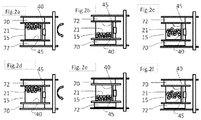
- Target cells and cell culture media are delivered to the interior 35 of the chamber 15.
- the beads 21 are buoyant and float near the top of the cell culture media within the chamber 15.
- the first magnetic field generator 70 is energized and the beads 21 are held near the first end 40 of the chamber 15.
- the chamber 15 is then rotated approximately 180° to a position as shown in FIG. 2b wherein the first magnetic field generator 70 maintains the beads 21 near the chamber first end 40.
- cells are in suspension and gradually falling down to the surface of the beads 21 and the interspaces among the beads21 to start static culture.
- the first magnetic field generator 70 may be de-energized whereby the beads 21 begin to float towards the second end 45 of the chamber 15 to re-suspend the cells as shown in FIG. 2c .
- the beads 21 include a coating which target cells will adhere to, movement of the beads 21 from one end to the other will collect newly grown target cells.
- the target cells may adhere to the beads 21 while waste is flushed from the chamber 15 and/or when new media is introduced to the chamber 15 such that a substantial number of the target cells, original and newly grown, remain within the chamber.
- magnetizable antibodies specific to the target cells may be added to the interior of chamber 15 whereby the antibodies will bind themselves to the target cells, and when a magnetic field is introduced to the chamber, the antibody bound target cells will be releasably coupled to the magnetizable beads 21 and/or the chamber wall(s) adjacent to the magnetic field generator(s).
- one or both of the magnetic field generators 70, 72 may remain energized while unbound cells and/or waste are flushed from the chamber and/or while new media is introduced to the chamber such that a substantial number of the target cells, original and newly grown, remain within the chamber 15.
- magnetic reagents such as Annexin V or other suitable reagent, may be employed to couple to damaged or dead cells to the beads and the healthy target cells flushed from the system 10.
- magnetizable antibodies and/or reagents may be employed in a chamber 15 without the use of an agitator whereby the target cells or damaged/dead cells may be held against the chamber when the chamber is flushed.
- the second magnetic field generator 72 may be energized whereby the beads 21 are held near the chamber second end 45 ( FIG 2d ) and the chamber inverted to the position shown in FIG. 2e .
- the second magnetic field generator 72 may then be de-energized whereby the beads 21 will float towards the chamber first end 40 as shown in FIG. 2f .
- additives, media, buffers, CO 2 and the like may be selectively added to the chamber at any desired point during this process and/or waste selectively removed in order to promote or enhance new cell growth based on measurements taken by the control system as previously discussed.
- the movement of beads 21 keeps the cells in suspension (dynamic) state, and when the beads 21 stop moving and keeps stay somewhere in the cell culture container (chamber), such as on the bottom of the chamber, cells slowly fall down and are evenly distributed on the surface of the beads 21 and the voids among the beads 21, from where the static cell culture starts.
- non-buoyant beads may be employed such that the beads are moved within the chamber by rotation of the chamber and without also being subjected to magnetic fields.
- gravity and centrifugal force are employed to move the beads between two or more points within the chamber 15.
- the first and second magnetic field generators 70 and 72 may be alternately energized so as to move the beads between two or more points within the chamber and without any rotation of the chamber 15. While the forgoing example employs beads 21 as the agitator, it will be appreciated that suitable device may be employed as the agitator and remain within the scope of the present disclosure. Moreover, it will be appreciated that any means or technique for moving the agitator within the chamber may be employed and remain within the scope of the present disclosure.
- the system may be disposed within a CO 2 incubator or CO 2 room. Without a CO 2 incubator or CO 2 room or without any gas permeable portion of the chamber, reagents, such as HEPES may be employed or, alternatively, CO 2 may be injected directly into the chamber from a CO 2 reservoir.
- reagents such as HEPES may be employed or, alternatively, CO 2 may be injected directly into the chamber from a CO 2 reservoir.
- the agitator 20 is disposed within the chamber interior 35 and is capable of moving between the chamberfirst end 40 and chamber second end 45. Alternatively, the agitator 20 may be configured to be moved between any two or more points, or between any two or more portions, within the chamber interior 35.
- the agitator comprises a plurality of beads 21. It will be appreciated that any illustrative embodiment showing beads 21 may use any alternative agitator configuration and remain with the scope of the present disclosure and that any particular illustrative embodiment is not limited to using beads exclusively as the agitator.
- the beads 21 are be formed from a magnetizable material, such as silicon steel, Fe 3 O 4 , or any other suitable magnetizable material.
- magnetizable means that the agitator, such as the beads, will hold a magnetic charge when subjected to a magnetic field but will not otherwise hold a magnetic charge once removed from the magnetic field, or the magnetic field removed from the vicinity of the agitator, for example, when a magnetic field generator is de-energized.
- the magnetizable material typically comprises the core of each bead 21.
- the magnetizable core may then be coated with any suitable material.
- the magnetizable core is coated with polystyrene; however, it will be appreciated that the magnetizable core may be coated with any suitable material and remain within the scope of the present disclosure.
- the magnetizable core may be coated with any suitable thermoplastic or thermoset polymer.
- the beads 21 are shown as being formed from a magnetizable material, it will be appreciated that the beads may be formed from any suitable material, magnetizable or non-magnetizable, and remain within the scope of the present disclosure. Additionally, it will be appreciated that the beads 21 may each be coated with any suitable material such that the target cells will adhere to the beads as the cells grow within the chamber 15, yet it will be appreciated that beads not coated with a particular material to which target cells will adhere also remain within the scope of the present disclosure. In some embodiments, it may be desirable to have beads 21 that are buoyant within the cell culture media; therefore, the core of the beads may include air pockets or bubbles, a lightweight foam or plastic or any other suitable material for permitting the beads 21 to be buoyant within the media.
- the beads 21 may be formed such that one or more niches, or micoenvironments, may be formed or created in the voids between the beads 21 when the beads are stacked together. In some embodiments, these niches may promote growth of additional target cells therein. In one embodiment, where the beads are substantially spherical, the diameter of each bead 21 may be between 1mm and 10mm for the creation of suitable niches. However, it will be appreciated that the beads 21 may have any suitable size and/or shape such that one or more suitable niches may be formed when the beads 21 are stacked together. Also, it will be appreciated that at least some niches may be formed between some beads and one or more walls of the chamber interior.
- control system 30 may include one or both of a controller 55 and computer 60 for controlling operation of the system 10.
- the system 10 may be run manually.
- the control system 30 is configured to be releasably coupled to the chamber 15.
- the control system 30 may include a cassette 50 for receiving the chamber 15 but it will be appreciated that the chamber 15 may be coupled to the control system 50 via a ny suitable means or configuration (e.g., clips, hooks, magnets, hook-and-loop assemblies, friction fit, etc.) and remain within the scope of the present disclosure.
- the control system 30 may also include a light source 2 and a cell detector 9 for detecting the number of cells within the chamber 15, detecting the change in the number of cells within the chamber 15 or the like and reporting the results back to the control system 30. Additionally, the control system 30, via any suitable detection device, mechanism or method, may monitor the any suitable parameter involved in the growth of the target cells, for example and without limitation, the change in the number of target cells, pH, CO 2 , glucose, calcium, potassium, sodium, temperature, humidity or any other suitable factor and adjust the frequency and/or speed of the movement of the agitator within the chamber and/or adjust the amount of media, the type of media, the amount of buffer, the type of buffer, the amount of CO 2 , or make any other suitable adjustment based on any control system measurement so as to enhance or promote the growth of the target cells within the chamber 15.
- the control system 30 via any suitable detection device, mechanism or method, may monitor the any suitable parameter involved in the growth of the target cells, for example and without limitation, the change in the number of target cells, pH, CO 2
- the control system 30 is operable to cause the agitator to move within the interior 35 of the chamber 15. This may be accomplished a variety of ways.
- the control system includes a motor 65 operable to rotate the chamber 15 between a first position and second position.
- the first position and second position are approximately 180° apart but it will be appreciated that first and second positions may have any suitable angular relationship relative to one another and remain within the scope of the present disclosure.
- the chamber 15 may be rotated in a horizontal plane, rotated in a vertical plane or rotated, shifted, slid or otherwise moved in any suitable manner to cause the agitator 20 to move within the chamber 15.
- control system 30 may include first and second magnetic field generators 70, 72 for exciting the beads 21, or other agitator 20, so as to move the beads 21 within the chamber 15 to mix the target cells and culture media.
- each magnetic field generator is an electromagnet that generates a magnetic field when energized and ceases to create a magnetic field when de-energized. When energized, each magnetic field generator draws the agitator 20, e.g. the beads 21, toward the energized magnetic field generator.
- a permanent magnet may be used wherein the control system 30 is operable to remove the magnet from the vicinity of the chamber 15 or otherwise block the magnetic field from the magnet from penetrating into the chamber 15.
- chamber rotation may be used alone or that electromagnets may be used alone.
- electromagnets may be used alone.
- any technique for moving the agitator within the chamber may be employed and remain within the scope of the present disclosure.
- FIG. 3 another embodiment of bioreactor for growing cells is shown. It includes a cell culture chamber (container) 19, a chamber rotation motor 21, a connector (axis) 18 between the cell culture chamber 19 and the chamber rotation motor 21, an axis 22 for the chamber position changes between vertical and horizontal.
- the entire bioreactor system also includes the remaining parts 2, 9, 8, 30, 55, 60 and 65 as shown in FIG. 1 .
- the chamber rotation motor 21 drives the chamber rotating in a certain speed (normally at 2-60 rpm) through connector 18 to keep cells in suspension state ( FIG. 3a ).
- the motor (could be a servo 65 as shown in FIG.1 .) drives the chamber to change its position from vertical to horizontal through the axis 22.
- its rotating speed gradually reduces to 0 rpm to minimize the inertial effects of the cells' moving on the cell distribution.
- FIG. 3b the horizontal level
Landscapes
- Health & Medical Sciences (AREA)
- Life Sciences & Earth Sciences (AREA)
- Engineering & Computer Science (AREA)
- Wood Science & Technology (AREA)
- Organic Chemistry (AREA)
- Chemical & Material Sciences (AREA)
- Bioinformatics & Cheminformatics (AREA)
- Zoology (AREA)
- Genetics & Genomics (AREA)
- Biotechnology (AREA)
- Sustainable Development (AREA)
- Microbiology (AREA)
- Biomedical Technology (AREA)
- Biochemistry (AREA)
- General Engineering & Computer Science (AREA)
- General Health & Medical Sciences (AREA)
- Cell Biology (AREA)
- Immunology (AREA)
- Apparatus Associated With Microorganisms And Enzymes (AREA)
- Micro-Organisms Or Cultivation Processes Thereof (AREA)
Claims (14)
- Système de bioréacteur pour cultiver des cellules dans tous les trois états possibles : statique, dynamique, ou alterné entre les états statique et dynamique, dans lequel aucun transfert de cellules entre des récipients de culture cellulaire n'est nécessaire durant l'alternance entre les deux états de culture, et tous les types de cellules en suspension, de cellules adhérentes et de cellules partiellement adhérentes sont uniformément distribués dans la culture cellulaire statique après une culture dynamique, comprenant
une chambre de culture cellulaire en tant que récipient de culture cellulaire pour la croissance de cellules ;
un groupe d'alimentation configuré pour faire tourner le récipient de culture cellulaire, la plage pour la décélération du récipient de culture cellulaire étant de -5 t/min2 à -120 t/min2 ; et
un groupe d'alimentation configuré pour ajuster la position du récipient de culture à partir de la verticale durant l'état dynamique et de l'horizontale durant l'état statique. - Système de bioréacteur selon la revendication 1, dans lequel l'alternance entre les deux états de culture cellulaire comprend l'alternance de l'état statique à l'état dynamique et de l'état dynamique à l'état statique, dans lequel les cellules peuvent être distribuées uniformément au fond du récipient de culture cellulaire et/ou sur n'importe quels matériaux au fond du récipient de culture cellulaire, dans lequel la plage pour le rapport vitesse de rotation/décélération de la rotation du récipient de culture cellulaire est de 1 à 160.
- Système de bioréacteur selon la revendication 1, dans lequel lesdites cellules cultivées par le système de bioréacteur comprennent tous les types de cellules en suspension, de cellules adhérentes et de cellules partiellement adhérentes, dans lequel les cellules adhérentes peuvent être attachées à certains supports.
- Système de bioréacteur selon la revendication 1, dans lequel l'état dynamique comprend des conditions dans lesquelles les cellules se déplacent dans le milieu, le milieu se déplace autour des cellules, le récipient de culture bouge, ou l'une quelconque de leurs combinaisons.
- Système de bioréacteur selon la revendication 1, dans lequel l'état statique comprend n'importe quelles conditions dans lesquelles les cellules ne se déplacent pas par rapport au récipient de culture cellulaire, au milieu de culture cellulaire, au bioréacteur ou à l'environnement dans lequel la culture cellulaire est effectuée.
- Système de bioréacteur selon la revendication 1, qui peut alterner librement entre l'état dynamique de la revendication 4 et l'état statique de la revendication 5, dans lequel toutes les alternances peuvent se produire à n'importe quels moment, vitesse et fréquence.
- Système de bioréacteur selon la revendication 1, qui comprend un système comprenant une combinaison d'une inversion de récipient de culture cellulaire et d'une agitation magnétique.
- Système de bioréacteur selon la revendication 1, qui comprend un système comprenant une orientation du récipient de culture cellulaire pour la culture en rotation et une autre orientation principalement pour la culture statique.
- Système de bioréacteur selon la revendication 1, dans lequel les trois états, qui sont statique, dynamique, et alterné entre les états statique et dynamique, sont programmable pour et commandés par un système informatique ou un autre système d'automatisation, ou sont opérés manuellement.
- Système de bioréacteur selon la revendication 6, dans lequel le temps, la vitesse et la fréquence des alternances entre les états du bioréacteur sont programmés et commandés par un système informatique, par un autre système d'automatisation, ou manuellement.
- Système de bioréacteur selon la revendication 1, lequel système de bioréacteur comprend des moyens pour préparer, incuber et récolter les cellules, ainsi que pour programmer la culture statique, la culture dynamique et l'alternance entre la culture statique et la culture dynamique.
- Système de bioréacteur selon la revendication 1, lequel système de bioréacteur comprend des moyens pour maintenir les cellules uniformément distribuées dans la culture statique après une culture dynamique.
- Système de bioréacteur selon la revendication 1, qui comprend une source de lumière et un détecteur de cellules pour détecter le nombre de cellules.
- Système de bioréacteur selon la revendication 1, qui comprend des moyens pour ajuster la vitesse de rotation dans la plage comprise entre 2 t/min et 60 t/min, la décélération du récipient de culture cellulaire dans la plage comprise entre - 5 t/min2 et -120 t/min2, le rapport vitesse de rotation/décélération de la rotation du récipient de culture cellulaire dans la plage comprise entre 1 et 160 et la vitesse du changement de position du récipient dans la plage comprise entre 0,1 t/min et 60 t/min.
Applications Claiming Priority (2)
| Application Number | Priority Date | Filing Date | Title |
|---|---|---|---|
| US201261715555P | 2012-10-18 | 2012-10-18 | |
| PCT/IB2013/003260 WO2014132101A2 (fr) | 2012-10-18 | 2013-09-29 | Système de bioréacteur et procédés de culture cellulaire alternant entre un état statique et un état dynamique |
Publications (3)
| Publication Number | Publication Date |
|---|---|
| EP2909303A2 EP2909303A2 (fr) | 2015-08-26 |
| EP2909303A4 EP2909303A4 (fr) | 2017-01-18 |
| EP2909303B1 true EP2909303B1 (fr) | 2020-04-15 |
Family
ID=51428906
Family Applications (1)
| Application Number | Title | Priority Date | Filing Date |
|---|---|---|---|
| EP13876387.5A Active EP2909303B1 (fr) | 2012-10-18 | 2013-09-29 | Système de bioréacteur et procédés de culture cellulaire alternant entre un état statique et un état dynamique |
Country Status (3)
| Country | Link |
|---|---|
| EP (1) | EP2909303B1 (fr) |
| CN (1) | CN105121621B (fr) |
| WO (1) | WO2014132101A2 (fr) |
Families Citing this family (8)
| Publication number | Priority date | Publication date | Assignee | Title |
|---|---|---|---|---|
| MA41459A (fr) | 2015-02-03 | 2017-12-12 | Als Therapy Development Inst | Anticorps anti-cd40l et méthodes pour traiter des maladies ou des troubles liés aux cd40l |
| CN104694474B (zh) * | 2015-03-31 | 2017-09-05 | 南京新诺丹生物技术有限公司 | 一种细胞培养方法 |
| CN105754854B (zh) * | 2016-03-30 | 2017-11-24 | 舟山医院 | 一种胃癌细胞培养仪 |
| CN106701577A (zh) * | 2017-03-07 | 2017-05-24 | 南京新诺丹生物技术有限公司 | 一种用于细胞培养和细胞分选的多功能生物反应器 |
| CN110662768B (zh) | 2017-05-24 | 2024-01-30 | Als治疗发展学会 | 治疗性抗cd40配体抗体 |
| PT3802775T (pt) * | 2018-06-06 | 2022-05-27 | Limula Sa | Aparelho e processo para o fabrico automatizado de células geneticamente modificadas a partir de fluidos biológicos |
| CN110423676B (zh) * | 2019-08-13 | 2023-04-14 | 华东理工大学 | 用于细胞体外培养的磁控生物反应器系统 |
| AU2023371530A1 (en) * | 2022-10-31 | 2025-05-01 | Abec, Inc. | Cell culture bioreactor with rotational mixing |
Family Cites Families (9)
| Publication number | Priority date | Publication date | Assignee | Title |
|---|---|---|---|---|
| US7604987B2 (en) * | 2003-02-06 | 2009-10-20 | National University Of Singapore | Bioreactor for growing cell or tissue cultures |
| WO2005003332A2 (fr) * | 2003-06-30 | 2005-01-13 | University Of South Florida | Appareil et procede de culture cellulaire tridimensionnelle magnetique |
| AU2004260106C1 (en) * | 2003-07-17 | 2010-12-09 | Global Cell Solutions, Llc. | Automated cell culture system and process |
| DE10349484A1 (de) * | 2003-10-21 | 2005-05-25 | Universität Leipzig | Verfahren und Bioreaktor zum Kultivieren und Stimulieren von dreidimensionalen, vitalen und mechanisch widerstandsfähigen Zelltransplantaten |
| US7745209B2 (en) * | 2005-07-26 | 2010-06-29 | Corning Incorporated | Multilayered cell culture apparatus |
| KR100915605B1 (ko) * | 2007-02-20 | 2009-09-07 | 피비에스 바이오텍 인코퍼레이티드 | 세포 배양장치 및 이를 포함한 세포 배양 시스템 |
| CN102199535A (zh) * | 2010-03-23 | 2011-09-28 | 上海坤巨科技发展有限公司 | 一种非侵入式连续监测动态细胞数量或浓度的装置与方法 |
| US8846331B2 (en) * | 2010-08-27 | 2014-09-30 | The Regents Of The University Of Michigan | Asynchronous magnetic bead rotation sensing systems and methods |
| CN102174395B (zh) * | 2011-01-30 | 2013-08-21 | 中国科学院广州生物医药与健康研究院 | 诱导多能干细胞自动化扩增与培养系统 |
-
2013
- 2013-09-29 WO PCT/IB2013/003260 patent/WO2014132101A2/fr not_active Ceased
- 2013-09-29 CN CN201380049294.0A patent/CN105121621B/zh active Active
- 2013-09-29 EP EP13876387.5A patent/EP2909303B1/fr active Active
Non-Patent Citations (1)
| Title |
|---|
| None * |
Also Published As
| Publication number | Publication date |
|---|---|
| CN105121621B (zh) | 2019-08-02 |
| CN105121621A (zh) | 2015-12-02 |
| EP2909303A2 (fr) | 2015-08-26 |
| EP2909303A4 (fr) | 2017-01-18 |
| WO2014132101A3 (fr) | 2015-01-29 |
| WO2014132101A2 (fr) | 2014-09-04 |
Similar Documents
| Publication | Publication Date | Title |
|---|---|---|
| EP2909303B1 (fr) | Système de bioréacteur et procédés de culture cellulaire alternant entre un état statique et un état dynamique | |
| EP2665807B1 (fr) | Système de bioréacteur multifonctionnel et procédés pour le triage et la culture cellulaires | |
| US9365813B2 (en) | Bioreactor system and methods for alternative cell culture between static and dynamic | |
| US5153133A (en) | Method for culturing mammalian cells in a horizontally rotated bioreactor | |
| US20050054101A1 (en) | Automated cell culture system and process | |
| JPH0640816B2 (ja) | 発酵および組織培養容器用に適した撹拌器 | |
| US20230100306A1 (en) | Scalable bioreactor systems and related methods of use | |
| US20130260364A1 (en) | Multifunctional Bioreactor system and methods for cell sorting and culturing | |
| CN104694474B (zh) | 一种细胞培养方法 | |
| JP5834096B2 (ja) | 細胞培養容器、それを用いた細胞自動継代培養装置および細胞継代培養方法 | |
| US11717795B2 (en) | Cell bag rotator | |
| Horiguchi et al. | An orbital shaking culture of mammalian cells in O-shaped vessels to produce uniform aggregates | |
| CN110423676B (zh) | 用于细胞体外培养的磁控生物反应器系统 | |
| US20230227765A1 (en) | Thermal separator apparatus for flask stirrer and method of use | |
| HK1189026B (en) | Multifunctional bioreactor system and methods for cell sorting and culturing | |
| JPS60224486A (ja) | 細胞培養槽 | |
| KR20250132459A (ko) | 회전 혼합을 이용한 세포 배양 생물반응기 | |
| WO2006127619A2 (fr) | Culture cellulaire | |
| Goodwin et al. | Three-Dimensional Co-Culture Process |
Legal Events
| Date | Code | Title | Description |
|---|---|---|---|
| PUAI | Public reference made under article 153(3) epc to a published international application that has entered the european phase |
Free format text: ORIGINAL CODE: 0009012 |
|
| AK | Designated contracting states |
Kind code of ref document: A2 Designated state(s): AL AT BE BG CH CY CZ DE DK EE ES FI FR GB GR HR HU IE IS IT LI LT LU LV MC MK MT NL NO PL PT RO RS SE SI SK SM TR |
|
| AX | Request for extension of the european patent |
Extension state: BA ME |
|
| 17P | Request for examination filed |
Effective date: 20151106 |
|
| DAX | Request for extension of the european patent (deleted) | ||
| RBV | Designated contracting states (corrected) |
Designated state(s): AL AT BE BG CH CY CZ DE DK EE ES FI FR GB GR HR HU IE IS IT LI LT LU LV MC MK MT NL NO PL PT RO RS SE SI SK SM TR |
|
| A4 | Supplementary search report drawn up and despatched |
Effective date: 20161220 |
|
| RIC1 | Information provided on ipc code assigned before grant |
Ipc: C12M 1/36 20060101ALI20161214BHEP Ipc: C12M 1/06 20060101ALI20161214BHEP Ipc: C12M 3/00 20060101AFI20161214BHEP |
|
| STAA | Information on the status of an ep patent application or granted ep patent |
Free format text: STATUS: EXAMINATION IS IN PROGRESS |
|
| 17Q | First examination report despatched |
Effective date: 20180903 |
|
| GRAP | Despatch of communication of intention to grant a patent |
Free format text: ORIGINAL CODE: EPIDOSNIGR1 |
|
| STAA | Information on the status of an ep patent application or granted ep patent |
Free format text: STATUS: GRANT OF PATENT IS INTENDED |
|
| INTG | Intention to grant announced |
Effective date: 20191028 |
|
| GRAS | Grant fee paid |
Free format text: ORIGINAL CODE: EPIDOSNIGR3 |
|
| GRAA | (expected) grant |
Free format text: ORIGINAL CODE: 0009210 |
|
| STAA | Information on the status of an ep patent application or granted ep patent |
Free format text: STATUS: THE PATENT HAS BEEN GRANTED |
|
| AK | Designated contracting states |
Kind code of ref document: B1 Designated state(s): AL AT BE BG CH CY CZ DE DK EE ES FI FR GB GR HR HU IE IS IT LI LT LU LV MC MK MT NL NO PL PT RO RS SE SI SK SM TR |
|
| REG | Reference to a national code |
Ref country code: CH Ref legal event code: EP |
|
| REG | Reference to a national code |
Ref country code: DE Ref legal event code: R096 Ref document number: 602013068052 Country of ref document: DE |
|
| REG | Reference to a national code |
Ref country code: IE Ref legal event code: FG4D |
|
| REG | Reference to a national code |
Ref country code: AT Ref legal event code: REF Ref document number: 1257310 Country of ref document: AT Kind code of ref document: T Effective date: 20200515 |
|
| REG | Reference to a national code |
Ref country code: NL Ref legal event code: MP Effective date: 20200415 |
|
| REG | Reference to a national code |
Ref country code: LT Ref legal event code: MG4D |
|
| PG25 | Lapsed in a contracting state [announced via postgrant information from national office to epo] |
Ref country code: SE Free format text: LAPSE BECAUSE OF FAILURE TO SUBMIT A TRANSLATION OF THE DESCRIPTION OR TO PAY THE FEE WITHIN THE PRESCRIBED TIME-LIMIT Effective date: 20200415 Ref country code: NL Free format text: LAPSE BECAUSE OF FAILURE TO SUBMIT A TRANSLATION OF THE DESCRIPTION OR TO PAY THE FEE WITHIN THE PRESCRIBED TIME-LIMIT Effective date: 20200415 Ref country code: PT Free format text: LAPSE BECAUSE OF FAILURE TO SUBMIT A TRANSLATION OF THE DESCRIPTION OR TO PAY THE FEE WITHIN THE PRESCRIBED TIME-LIMIT Effective date: 20200817 Ref country code: IS Free format text: LAPSE BECAUSE OF FAILURE TO SUBMIT A TRANSLATION OF THE DESCRIPTION OR TO PAY THE FEE WITHIN THE PRESCRIBED TIME-LIMIT Effective date: 20200815 Ref country code: FI Free format text: LAPSE BECAUSE OF FAILURE TO SUBMIT A TRANSLATION OF THE DESCRIPTION OR TO PAY THE FEE WITHIN THE PRESCRIBED TIME-LIMIT Effective date: 20200415 Ref country code: GR Free format text: LAPSE BECAUSE OF FAILURE TO SUBMIT A TRANSLATION OF THE DESCRIPTION OR TO PAY THE FEE WITHIN THE PRESCRIBED TIME-LIMIT Effective date: 20200716 Ref country code: NO Free format text: LAPSE BECAUSE OF FAILURE TO SUBMIT A TRANSLATION OF THE DESCRIPTION OR TO PAY THE FEE WITHIN THE PRESCRIBED TIME-LIMIT Effective date: 20200715 Ref country code: LT Free format text: LAPSE BECAUSE OF FAILURE TO SUBMIT A TRANSLATION OF THE DESCRIPTION OR TO PAY THE FEE WITHIN THE PRESCRIBED TIME-LIMIT Effective date: 20200415 |
|
| REG | Reference to a national code |
Ref country code: AT Ref legal event code: MK05 Ref document number: 1257310 Country of ref document: AT Kind code of ref document: T Effective date: 20200415 |
|
| PG25 | Lapsed in a contracting state [announced via postgrant information from national office to epo] |
Ref country code: LV Free format text: LAPSE BECAUSE OF FAILURE TO SUBMIT A TRANSLATION OF THE DESCRIPTION OR TO PAY THE FEE WITHIN THE PRESCRIBED TIME-LIMIT Effective date: 20200415 Ref country code: RS Free format text: LAPSE BECAUSE OF FAILURE TO SUBMIT A TRANSLATION OF THE DESCRIPTION OR TO PAY THE FEE WITHIN THE PRESCRIBED TIME-LIMIT Effective date: 20200415 Ref country code: BG Free format text: LAPSE BECAUSE OF FAILURE TO SUBMIT A TRANSLATION OF THE DESCRIPTION OR TO PAY THE FEE WITHIN THE PRESCRIBED TIME-LIMIT Effective date: 20200715 Ref country code: HR Free format text: LAPSE BECAUSE OF FAILURE TO SUBMIT A TRANSLATION OF THE DESCRIPTION OR TO PAY THE FEE WITHIN THE PRESCRIBED TIME-LIMIT Effective date: 20200415 |
|
| PG25 | Lapsed in a contracting state [announced via postgrant information from national office to epo] |
Ref country code: AL Free format text: LAPSE BECAUSE OF FAILURE TO SUBMIT A TRANSLATION OF THE DESCRIPTION OR TO PAY THE FEE WITHIN THE PRESCRIBED TIME-LIMIT Effective date: 20200415 |
|
| REG | Reference to a national code |
Ref country code: DE Ref legal event code: R097 Ref document number: 602013068052 Country of ref document: DE |
|
| PG25 | Lapsed in a contracting state [announced via postgrant information from national office to epo] |
Ref country code: RO Free format text: LAPSE BECAUSE OF FAILURE TO SUBMIT A TRANSLATION OF THE DESCRIPTION OR TO PAY THE FEE WITHIN THE PRESCRIBED TIME-LIMIT Effective date: 20200415 Ref country code: IT Free format text: LAPSE BECAUSE OF FAILURE TO SUBMIT A TRANSLATION OF THE DESCRIPTION OR TO PAY THE FEE WITHIN THE PRESCRIBED TIME-LIMIT Effective date: 20200415 Ref country code: CZ Free format text: LAPSE BECAUSE OF FAILURE TO SUBMIT A TRANSLATION OF THE DESCRIPTION OR TO PAY THE FEE WITHIN THE PRESCRIBED TIME-LIMIT Effective date: 20200415 Ref country code: SM Free format text: LAPSE BECAUSE OF FAILURE TO SUBMIT A TRANSLATION OF THE DESCRIPTION OR TO PAY THE FEE WITHIN THE PRESCRIBED TIME-LIMIT Effective date: 20200415 Ref country code: EE Free format text: LAPSE BECAUSE OF FAILURE TO SUBMIT A TRANSLATION OF THE DESCRIPTION OR TO PAY THE FEE WITHIN THE PRESCRIBED TIME-LIMIT Effective date: 20200415 Ref country code: AT Free format text: LAPSE BECAUSE OF FAILURE TO SUBMIT A TRANSLATION OF THE DESCRIPTION OR TO PAY THE FEE WITHIN THE PRESCRIBED TIME-LIMIT Effective date: 20200415 Ref country code: DK Free format text: LAPSE BECAUSE OF FAILURE TO SUBMIT A TRANSLATION OF THE DESCRIPTION OR TO PAY THE FEE WITHIN THE PRESCRIBED TIME-LIMIT Effective date: 20200415 Ref country code: ES Free format text: LAPSE BECAUSE OF FAILURE TO SUBMIT A TRANSLATION OF THE DESCRIPTION OR TO PAY THE FEE WITHIN THE PRESCRIBED TIME-LIMIT Effective date: 20200415 |
|
| PLBE | No opposition filed within time limit |
Free format text: ORIGINAL CODE: 0009261 |
|
| STAA | Information on the status of an ep patent application or granted ep patent |
Free format text: STATUS: NO OPPOSITION FILED WITHIN TIME LIMIT |
|
| PG25 | Lapsed in a contracting state [announced via postgrant information from national office to epo] |
Ref country code: SK Free format text: LAPSE BECAUSE OF FAILURE TO SUBMIT A TRANSLATION OF THE DESCRIPTION OR TO PAY THE FEE WITHIN THE PRESCRIBED TIME-LIMIT Effective date: 20200415 Ref country code: PL Free format text: LAPSE BECAUSE OF FAILURE TO SUBMIT A TRANSLATION OF THE DESCRIPTION OR TO PAY THE FEE WITHIN THE PRESCRIBED TIME-LIMIT Effective date: 20200415 |
|
| 26N | No opposition filed |
Effective date: 20210118 |
|
| PG25 | Lapsed in a contracting state [announced via postgrant information from national office to epo] |
Ref country code: MC Free format text: LAPSE BECAUSE OF FAILURE TO SUBMIT A TRANSLATION OF THE DESCRIPTION OR TO PAY THE FEE WITHIN THE PRESCRIBED TIME-LIMIT Effective date: 20200415 |
|
| REG | Reference to a national code |
Ref country code: CH Ref legal event code: PL |
|
| PG25 | Lapsed in a contracting state [announced via postgrant information from national office to epo] |
Ref country code: SI Free format text: LAPSE BECAUSE OF FAILURE TO SUBMIT A TRANSLATION OF THE DESCRIPTION OR TO PAY THE FEE WITHIN THE PRESCRIBED TIME-LIMIT Effective date: 20200415 |
|
| REG | Reference to a national code |
Ref country code: BE Ref legal event code: MM Effective date: 20200930 |
|
| PG25 | Lapsed in a contracting state [announced via postgrant information from national office to epo] |
Ref country code: LU Free format text: LAPSE BECAUSE OF NON-PAYMENT OF DUE FEES Effective date: 20200929 |
|
| PG25 | Lapsed in a contracting state [announced via postgrant information from national office to epo] |
Ref country code: IE Free format text: LAPSE BECAUSE OF NON-PAYMENT OF DUE FEES Effective date: 20200929 Ref country code: LI Free format text: LAPSE BECAUSE OF NON-PAYMENT OF DUE FEES Effective date: 20200930 Ref country code: CH Free format text: LAPSE BECAUSE OF NON-PAYMENT OF DUE FEES Effective date: 20200930 Ref country code: BE Free format text: LAPSE BECAUSE OF NON-PAYMENT OF DUE FEES Effective date: 20200930 |
|
| PGFP | Annual fee paid to national office [announced via postgrant information from national office to epo] |
Ref country code: FR Payment date: 20210927 Year of fee payment: 9 |
|
| PGFP | Annual fee paid to national office [announced via postgrant information from national office to epo] |
Ref country code: DE Payment date: 20210925 Year of fee payment: 9 Ref country code: GB Payment date: 20210923 Year of fee payment: 9 |
|
| PG25 | Lapsed in a contracting state [announced via postgrant information from national office to epo] |
Ref country code: TR Free format text: LAPSE BECAUSE OF FAILURE TO SUBMIT A TRANSLATION OF THE DESCRIPTION OR TO PAY THE FEE WITHIN THE PRESCRIBED TIME-LIMIT Effective date: 20200415 Ref country code: MT Free format text: LAPSE BECAUSE OF FAILURE TO SUBMIT A TRANSLATION OF THE DESCRIPTION OR TO PAY THE FEE WITHIN THE PRESCRIBED TIME-LIMIT Effective date: 20200415 Ref country code: CY Free format text: LAPSE BECAUSE OF FAILURE TO SUBMIT A TRANSLATION OF THE DESCRIPTION OR TO PAY THE FEE WITHIN THE PRESCRIBED TIME-LIMIT Effective date: 20200415 |
|
| PG25 | Lapsed in a contracting state [announced via postgrant information from national office to epo] |
Ref country code: MK Free format text: LAPSE BECAUSE OF FAILURE TO SUBMIT A TRANSLATION OF THE DESCRIPTION OR TO PAY THE FEE WITHIN THE PRESCRIBED TIME-LIMIT Effective date: 20200415 |
|
| REG | Reference to a national code |
Ref country code: DE Ref legal event code: R119 Ref document number: 602013068052 Country of ref document: DE |
|
| GBPC | Gb: european patent ceased through non-payment of renewal fee |
Effective date: 20220929 |
|
| PG25 | Lapsed in a contracting state [announced via postgrant information from national office to epo] |
Ref country code: FR Free format text: LAPSE BECAUSE OF NON-PAYMENT OF DUE FEES Effective date: 20220930 Ref country code: DE Free format text: LAPSE BECAUSE OF NON-PAYMENT OF DUE FEES Effective date: 20230401 |
|
| PG25 | Lapsed in a contracting state [announced via postgrant information from national office to epo] |
Ref country code: GB Free format text: LAPSE BECAUSE OF NON-PAYMENT OF DUE FEES Effective date: 20220929 |