EP2909354B1 - Wärmestrahlungselement und verfahren zur herstellung davon - Google Patents
Wärmestrahlungselement und verfahren zur herstellung davon Download PDFInfo
- Publication number
- EP2909354B1 EP2909354B1 EP14702300.6A EP14702300A EP2909354B1 EP 2909354 B1 EP2909354 B1 EP 2909354B1 EP 14702300 A EP14702300 A EP 14702300A EP 2909354 B1 EP2909354 B1 EP 2909354B1
- Authority
- EP
- European Patent Office
- Prior art keywords
- metal
- heat radiation
- base material
- metal base
- particles
- Prior art date
- Legal status (The legal status is an assumption and is not a legal conclusion. Google has not performed a legal analysis and makes no representation as to the accuracy of the status listed.)
- Not-in-force
Links
Images




Classifications
-
- F—MECHANICAL ENGINEERING; LIGHTING; HEATING; WEAPONS; BLASTING
- F28—HEAT EXCHANGE IN GENERAL
- F28F—DETAILS OF HEAT-EXCHANGE AND HEAT-TRANSFER APPARATUS, OF GENERAL APPLICATION
- F28F13/00—Arrangements for modifying heat-transfer, e.g. increasing, decreasing
- F28F13/18—Arrangements for modifying heat-transfer, e.g. increasing, decreasing by applying coatings, e.g. radiation-absorbing, radiation-reflecting; by surface treatment, e.g. polishing
- F28F13/185—Heat-exchange surfaces provided with microstructures or with porous coatings
-
- C—CHEMISTRY; METALLURGY
- C23—COATING METALLIC MATERIAL; COATING MATERIAL WITH METALLIC MATERIAL; CHEMICAL SURFACE TREATMENT; DIFFUSION TREATMENT OF METALLIC MATERIAL; COATING BY VACUUM EVAPORATION, BY SPUTTERING, BY ION IMPLANTATION OR BY CHEMICAL VAPOUR DEPOSITION, IN GENERAL; INHIBITING CORROSION OF METALLIC MATERIAL OR INCRUSTATION IN GENERAL
- C23C—COATING METALLIC MATERIAL; COATING MATERIAL WITH METALLIC MATERIAL; SURFACE TREATMENT OF METALLIC MATERIAL BY DIFFUSION INTO THE SURFACE, BY CHEMICAL CONVERSION OR SUBSTITUTION; COATING BY VACUUM EVAPORATION, BY SPUTTERING, BY ION IMPLANTATION OR BY CHEMICAL VAPOUR DEPOSITION, IN GENERAL
- C23C4/00—Coating by spraying the coating material in the molten state, e.g. by flame, plasma or electric discharge
- C23C4/04—Coating by spraying the coating material in the molten state, e.g. by flame, plasma or electric discharge characterised by the coating material
-
- C—CHEMISTRY; METALLURGY
- C23—COATING METALLIC MATERIAL; COATING MATERIAL WITH METALLIC MATERIAL; CHEMICAL SURFACE TREATMENT; DIFFUSION TREATMENT OF METALLIC MATERIAL; COATING BY VACUUM EVAPORATION, BY SPUTTERING, BY ION IMPLANTATION OR BY CHEMICAL VAPOUR DEPOSITION, IN GENERAL; INHIBITING CORROSION OF METALLIC MATERIAL OR INCRUSTATION IN GENERAL
- C23C—COATING METALLIC MATERIAL; COATING MATERIAL WITH METALLIC MATERIAL; SURFACE TREATMENT OF METALLIC MATERIAL BY DIFFUSION INTO THE SURFACE, BY CHEMICAL CONVERSION OR SUBSTITUTION; COATING BY VACUUM EVAPORATION, BY SPUTTERING, BY ION IMPLANTATION OR BY CHEMICAL VAPOUR DEPOSITION, IN GENERAL
- C23C14/00—Coating by vacuum evaporation, by sputtering or by ion implantation of the coating forming material
- C23C14/06—Coating by vacuum evaporation, by sputtering or by ion implantation of the coating forming material characterised by the coating material
- C23C14/14—Metallic material, boron or silicon
- C23C14/16—Metallic material, boron or silicon on metallic substrates or on substrates of boron or silicon
-
- C—CHEMISTRY; METALLURGY
- C23—COATING METALLIC MATERIAL; COATING MATERIAL WITH METALLIC MATERIAL; CHEMICAL SURFACE TREATMENT; DIFFUSION TREATMENT OF METALLIC MATERIAL; COATING BY VACUUM EVAPORATION, BY SPUTTERING, BY ION IMPLANTATION OR BY CHEMICAL VAPOUR DEPOSITION, IN GENERAL; INHIBITING CORROSION OF METALLIC MATERIAL OR INCRUSTATION IN GENERAL
- C23C—COATING METALLIC MATERIAL; COATING MATERIAL WITH METALLIC MATERIAL; SURFACE TREATMENT OF METALLIC MATERIAL BY DIFFUSION INTO THE SURFACE, BY CHEMICAL CONVERSION OR SUBSTITUTION; COATING BY VACUUM EVAPORATION, BY SPUTTERING, BY ION IMPLANTATION OR BY CHEMICAL VAPOUR DEPOSITION, IN GENERAL
- C23C14/00—Coating by vacuum evaporation, by sputtering or by ion implantation of the coating forming material
- C23C14/22—Coating by vacuum evaporation, by sputtering or by ion implantation of the coating forming material characterised by the process of coating
- C23C14/24—Vacuum evaporation
- C23C14/32—Vacuum evaporation by explosion; by evaporation and subsequent ionisation of the vapours, e.g. ion-plating
- C23C14/325—Electric arc evaporation
-
- C—CHEMISTRY; METALLURGY
- C23—COATING METALLIC MATERIAL; COATING MATERIAL WITH METALLIC MATERIAL; CHEMICAL SURFACE TREATMENT; DIFFUSION TREATMENT OF METALLIC MATERIAL; COATING BY VACUUM EVAPORATION, BY SPUTTERING, BY ION IMPLANTATION OR BY CHEMICAL VAPOUR DEPOSITION, IN GENERAL; INHIBITING CORROSION OF METALLIC MATERIAL OR INCRUSTATION IN GENERAL
- C23C—COATING METALLIC MATERIAL; COATING MATERIAL WITH METALLIC MATERIAL; SURFACE TREATMENT OF METALLIC MATERIAL BY DIFFUSION INTO THE SURFACE, BY CHEMICAL CONVERSION OR SUBSTITUTION; COATING BY VACUUM EVAPORATION, BY SPUTTERING, BY ION IMPLANTATION OR BY CHEMICAL VAPOUR DEPOSITION, IN GENERAL
- C23C14/00—Coating by vacuum evaporation, by sputtering or by ion implantation of the coating forming material
- C23C14/22—Coating by vacuum evaporation, by sputtering or by ion implantation of the coating forming material characterised by the process of coating
- C23C14/34—Sputtering
- C23C14/46—Sputtering by ion beam produced by an external ion source
-
- C—CHEMISTRY; METALLURGY
- C23—COATING METALLIC MATERIAL; COATING MATERIAL WITH METALLIC MATERIAL; CHEMICAL SURFACE TREATMENT; DIFFUSION TREATMENT OF METALLIC MATERIAL; COATING BY VACUUM EVAPORATION, BY SPUTTERING, BY ION IMPLANTATION OR BY CHEMICAL VAPOUR DEPOSITION, IN GENERAL; INHIBITING CORROSION OF METALLIC MATERIAL OR INCRUSTATION IN GENERAL
- C23C—COATING METALLIC MATERIAL; COATING MATERIAL WITH METALLIC MATERIAL; SURFACE TREATMENT OF METALLIC MATERIAL BY DIFFUSION INTO THE SURFACE, BY CHEMICAL CONVERSION OR SUBSTITUTION; COATING BY VACUUM EVAPORATION, BY SPUTTERING, BY ION IMPLANTATION OR BY CHEMICAL VAPOUR DEPOSITION, IN GENERAL
- C23C14/00—Coating by vacuum evaporation, by sputtering or by ion implantation of the coating forming material
- C23C14/58—After-treatment
- C23C14/5846—Reactive treatment
- C23C14/5853—Oxidation
-
- C—CHEMISTRY; METALLURGY
- C23—COATING METALLIC MATERIAL; COATING MATERIAL WITH METALLIC MATERIAL; CHEMICAL SURFACE TREATMENT; DIFFUSION TREATMENT OF METALLIC MATERIAL; COATING BY VACUUM EVAPORATION, BY SPUTTERING, BY ION IMPLANTATION OR BY CHEMICAL VAPOUR DEPOSITION, IN GENERAL; INHIBITING CORROSION OF METALLIC MATERIAL OR INCRUSTATION IN GENERAL
- C23C—COATING METALLIC MATERIAL; COATING MATERIAL WITH METALLIC MATERIAL; SURFACE TREATMENT OF METALLIC MATERIAL BY DIFFUSION INTO THE SURFACE, BY CHEMICAL CONVERSION OR SUBSTITUTION; COATING BY VACUUM EVAPORATION, BY SPUTTERING, BY ION IMPLANTATION OR BY CHEMICAL VAPOUR DEPOSITION, IN GENERAL
- C23C4/00—Coating by spraying the coating material in the molten state, e.g. by flame, plasma or electric discharge
- C23C4/01—Selective coating, e.g. pattern coating, without pre-treatment of the material to be coated
-
- C—CHEMISTRY; METALLURGY
- C23—COATING METALLIC MATERIAL; COATING MATERIAL WITH METALLIC MATERIAL; CHEMICAL SURFACE TREATMENT; DIFFUSION TREATMENT OF METALLIC MATERIAL; COATING BY VACUUM EVAPORATION, BY SPUTTERING, BY ION IMPLANTATION OR BY CHEMICAL VAPOUR DEPOSITION, IN GENERAL; INHIBITING CORROSION OF METALLIC MATERIAL OR INCRUSTATION IN GENERAL
- C23C—COATING METALLIC MATERIAL; COATING MATERIAL WITH METALLIC MATERIAL; SURFACE TREATMENT OF METALLIC MATERIAL BY DIFFUSION INTO THE SURFACE, BY CHEMICAL CONVERSION OR SUBSTITUTION; COATING BY VACUUM EVAPORATION, BY SPUTTERING, BY ION IMPLANTATION OR BY CHEMICAL VAPOUR DEPOSITION, IN GENERAL
- C23C4/00—Coating by spraying the coating material in the molten state, e.g. by flame, plasma or electric discharge
- C23C4/04—Coating by spraying the coating material in the molten state, e.g. by flame, plasma or electric discharge characterised by the coating material
- C23C4/06—Metallic material
-
- C—CHEMISTRY; METALLURGY
- C23—COATING METALLIC MATERIAL; COATING MATERIAL WITH METALLIC MATERIAL; CHEMICAL SURFACE TREATMENT; DIFFUSION TREATMENT OF METALLIC MATERIAL; COATING BY VACUUM EVAPORATION, BY SPUTTERING, BY ION IMPLANTATION OR BY CHEMICAL VAPOUR DEPOSITION, IN GENERAL; INHIBITING CORROSION OF METALLIC MATERIAL OR INCRUSTATION IN GENERAL
- C23C—COATING METALLIC MATERIAL; COATING MATERIAL WITH METALLIC MATERIAL; SURFACE TREATMENT OF METALLIC MATERIAL BY DIFFUSION INTO THE SURFACE, BY CHEMICAL CONVERSION OR SUBSTITUTION; COATING BY VACUUM EVAPORATION, BY SPUTTERING, BY ION IMPLANTATION OR BY CHEMICAL VAPOUR DEPOSITION, IN GENERAL
- C23C4/00—Coating by spraying the coating material in the molten state, e.g. by flame, plasma or electric discharge
- C23C4/04—Coating by spraying the coating material in the molten state, e.g. by flame, plasma or electric discharge characterised by the coating material
- C23C4/06—Metallic material
- C23C4/08—Metallic material containing only metal elements
-
- C—CHEMISTRY; METALLURGY
- C23—COATING METALLIC MATERIAL; COATING MATERIAL WITH METALLIC MATERIAL; CHEMICAL SURFACE TREATMENT; DIFFUSION TREATMENT OF METALLIC MATERIAL; COATING BY VACUUM EVAPORATION, BY SPUTTERING, BY ION IMPLANTATION OR BY CHEMICAL VAPOUR DEPOSITION, IN GENERAL; INHIBITING CORROSION OF METALLIC MATERIAL OR INCRUSTATION IN GENERAL
- C23C—COATING METALLIC MATERIAL; COATING MATERIAL WITH METALLIC MATERIAL; SURFACE TREATMENT OF METALLIC MATERIAL BY DIFFUSION INTO THE SURFACE, BY CHEMICAL CONVERSION OR SUBSTITUTION; COATING BY VACUUM EVAPORATION, BY SPUTTERING, BY ION IMPLANTATION OR BY CHEMICAL VAPOUR DEPOSITION, IN GENERAL
- C23C4/00—Coating by spraying the coating material in the molten state, e.g. by flame, plasma or electric discharge
- C23C4/18—After-treatment
Definitions
- the invention relates to methods for manufacturing a heat radiation member.
- a technique in which, in order to efficiently radiate heat transmitted to a base material to the outside, irregularities are formed or high reflectance inorganic particles are disposed to a shape of a surface of the base material is known.
- the inorganic particles are disposed, a coat is formed on a surface of the base material, and the inorganic particles are dispersed in the coat.
- heat radiation members such as shown below have been proposed.
- JP 2010-168998 A a heat radiation member that includes a base material made of stainless, a nickel alloy or the like and a heat radiation coat coated on a surface of the base material is proposed.
- an inorganic binder such as a glass binder or the like as a binder
- inorganic particles constituted of an oxide made of at least one kind of manganese, iron, copper, cobalt and chromium are dispersed.
- JP 2004-43612 A a heat radiation member in which a heat radiation coat is formed on a surface of a base material such as aluminum or the like is proposed.
- a heat radiation coat that constitutes the heat radiation member with a polymer resin as a binder, inorganic particles of an oxide of tin and antimony are dispersed.
- inorganic particles made of a material (oxide) having reflectance higher than that of a material of the base material are dispersed in the heat radiation coat coated on a surface of the base material; therefore, heat transmitted to the base material can efficiently be radiated to the outside.
- the heat radiation member described in JP 2010-168998 A uses a glass binder as an inorganic binder. Therefore, during deposition, a temperature of the glass softening temperature or more has to be used to deposit a heat radiation coat. As a result, when a metal material such as aluminum and the like having a melting point lower than the glass softening temperature for the base material, the base material may be melted. Further, when the heat radiation member is used in a temperature range of a temperature of the glass softening temperature or more, the heat radiation coat itself may deform due to softening of the glass binder.
- the heat radiation member described in JP 2004-43612 A uses a polymer resin as the binder.
- the polymer resin may degrade.
- thermal expansion difference between the polymer resin as the binder and a metal such as aluminum or the like that constitutes the base material it is likely that thermal stress is generated in an interface of the base material and the heat radiation coat, and the heat radiation coat is peeled.
- the present invention provides a heat radiation member that can be manufactured for a broad range of metallic base materials and secure reliability and endurance in a broad temperature region, and a method for manufacturing the same.
- a heat radiation member includes: a metal base material made of a first metal material; and a plurality of heat radiation sections that are separately attached so as to disperse on a surface of the metal base material and contain a second metal material that is different from the first metal material and an oxide of the second metal material exposed on a surface of each of the respective heat radiation sections.
- heat radiation sections contributing to heat radiation are separately attached so as to disperse on a surface of a metal base material made of the first metal material, thermal stress due to difference in linear expansion coefficients of a metal that constitutes the metal base material and a metal that constitutes the heat radiation section can be reduced.
- thermal expansion difference between the metal base material and the coat as a whole acts as a thermal stress to an interface thereof.
- the heat radiation section since a plurality of heat radiation sections separately attached on a surface of the metal base material so as to disperse are disposed, the heat radiation section has a structure where the coat is separated in plural in plane. As a result, the thermal expansion difference between the metal base material and each of the heat radiation sections is smaller in comparison with the case where the coat is disposed. Thermal stress generated in an interface between the metal base material and each of the heat radiation sections can be reduced. Thus, in a broad temperature range, reliability and endurance of the heat radiation member can be secured.
- a metal oxide has emissivity higher than that of a metal non-oxide. Therefore, due to an oxide of the second metal material exposed on a surface of each of heat radiation sections, from a surface of the heat radiation section, heat inputted to the metal base material can efficiently be radiated (heat radiation) to the outside.
- the second metal material of each of the heat radiation sections may be made of a plurality of kinds of metals.
- One heat radiation section includes a plurality of kinds of metals, and oxides obtained by oxidizing the plurality of kinds of metals are exposed from the heat radiation section. As a result, the heat radiation section has high emissivity over a broad wavelength region compared with the case where one kind of metal material is used.
- the second metal material of each of the respective heat radiation sections may be formed of a metal mainly made of a single metal material and the plurality of heat radiation sections may contain a plurality of kinds of the single metal materials. In comparison with the case where one kind of metal material is used, high emissivity can be obtained in a broad wavelength region.
- the first metal material is an aluminum-based material or stainless steel
- the second metal material may be a metal material mainly made of manganese.
- Manganese basically has high emissivity, and also in a temperature region (200°C to 300°C) where an aluminum-based material is mainly used, has excellent emissivity.
- the aluminum-based material or stainless steel is used as the first metal material, the materials used in the invention can be applied to sites where heat dissipation properties are required such as an engine of a vehicle, a motor casing and the like.
- a method for manufacturing a heat radiation member according to a first aspect of the invention includes disposing a mesh on a metal base material made of a first metal material; and forming a heat radiation section made of granulated particles on a surface of the metal base material by spraying granulated particles granulated from particles made of a second metal material different from the first metal material and particles made of an oxide thereof on a surface of the metal base material provided with the mesh.
- each of attached heat radiation sections contains an oxide obtained by oxidizing the second metal material, and on a surface of each of the heat radiation sections, an oxide obtained by oxidizing the second metal material can be exposed as a heat radiation material.
- a method for manufacturing a heat radiation member includes disposing a mesh on a metal base material made of a first metal material; spraying metal particles made of a second metal material different from the first metal material on a surface of a metal base material provided with the mesh; and forming a heat radiation section where a surface of the sprayed metal particles is oxidized on a surface of the metal base material by oxidizing the sprayed metal particles.
- the metal particles made of the second metal material are sprayed through the mesh on a surface of the metal base material, a plurality of metal particle groups that are separated so as to disperse on a surface of the metal base material can be attached on a surface of the metal base material. Further, since each of attached particle groups is oxidized, an oxide layer in which the second metal material is oxidized in a superficial layer can be formed on a superficial layer of the heat radiation section as a heat radiation material.
- a method for manufacturing a heat radiation member includes attaching metal particles discharged from a target made of a second metal material different from a first metal material by applying a bias voltage to a metal base material made of a first metal material to a surface of the metal base material so as to disperse on a surface of the metal base material; and forming a heat radiation section in which a surface of the attached metal particles is oxidized on a surface of the metal base material by oxidizing attached metal particles.
- metal particles made of the second metal material are attached on a surface of the metal base material. Therefore, a plurality of metal particle groups that are separated so as to disperse on a surface of the metal base material can readily be attached on a surface of the metal base material. Further, each of the attached metal particle groups is oxidized. Therefore, an oxide layer in which the second metal material is oxidized in a superficial layer can be formed on a superficial layer of the heat radiation section as a heat radiation material.
- the heat radiation member can be manufactured for a broad range of metal base materials and can secure reliability and endurance in a broad temperature range.
- FIG. 1A and FIG. 1B are schematic conceptual diagrams that show a heat radiation member according to an embodiment of the invention, FIG. 1A is a top view, and FIG. 1B is a cross-sectional diagram along an A-A line arrow mark of FIG. 1A .
- a heat radiation member (infrared radiation member) 1 is a member for efficiently radiating heat inputted to a metal base material 2 from a surface to the outside.
- the heat radiation member 1 includes a metal base material 2 made of a first metal material and a plurality of heat radiation sections 3 that are separately attached so as to disperse on a surface of the metal base material 2 and contain a second metal material different from the first metal material.
- an oxide obtained by oxidizing the second metal material is exposed on a surface of each of the heat radiation sections 3, an oxide obtained by oxidizing the second metal material is exposed.
- an oxide layer 31 formed by oxidizing the second metal material is formed, and according to the oxide layer 31 heat radiation properties can be improved.
- the oxide obtained by oxidizing the second metal material preferably has reflectance higher than those of the first metal material, its oxide and the second metal material, that is, reflectance of 70% or more. Further, a thickness of the heat radiation section is preferably 1 ⁇ m or more. Therefore, heat inputted to the metal base material 2 can more preferably be radiated from the oxide obtained by oxidizing the second metal material. According to the embodiment, over an entire surface of the heat radiation section 3, the oxide obtained by oxidizing the second metal material is exposed. However, it is not necessarily required to form the oxide layer 31 for improving the heat radiation (infrared radiation). That is, the oxide may partially be exposed with respect to a surface of the heat radiation section 3, and it is preferable that the oxide layer of 50% or more with respect to a surface area of the heat radiation section 3 is exposed.
- a contact area through which the heat radiation section 3 comes into contact with the metal base material 2 is preferably 1 mm 2 or less.
- the first metal material that constitutes the metal base material 2 and the second metal material that is made of an aluminum-based material such as aluminum or aluminum alloys, or a metal material such as stainless steel and constitutes the heat radiation section contain at least one kind selected from the group consisting of manganese, iron, chromium, copper, titanium, aluminum, silicon, calcium, add magnesium as a main component.
- the second metal material may be formed of a single and same metal material.
- the second metal material of the heat radiation section 3 according to the embodiment is formed of a metal mainly made of a single metal material, and a plurality of heat radiation sections 3 have two or more kinds of single metal materials.
- the case of the present embodiment has two kinds of single metal materials, for example, among the heat radiation sections 3, the second metal material according to a first heat radiation section 3A is a metal material mainly made of manganese, and the second metal material according to a second heat radiation section 3B is a metal mainly made of the metal other than manganese.
- the heat radiation member 1 since the heat radiation sections 3 that contribute to heat radiation are separately attached so as to disperse on a surface of the metal base material 2 made of the first metal material, thermal stress due to difference in linear expansion coefficients between the metal that constitutes the metal base material 2 and the metal that constitutes the heat radiation section 3 can be reduced.
- the thermal expansion difference between the metal base material 2 and each of the heat radiation sections 3 becomes smaller than the case where the coat is disposed, and the thermal stress generated in an interface between the metal base material 2 and each of the heat radiation sections 3 can be reduced.
- reliability and endurance of the heat radiation member 1 can be secured in a broad temperature range.
- a metal oxide has emissivity (thermal conductivity) larger than that of a metal that is a non-oxide, from a surface of a heat radiation section, due to an oxide of the second metal material exposed on a surface of each of the heat radiation sections, heat inputted to the metal base material can efficiently be radiated (thermal radiation) through the heat radiation section to the outside.
- the heat radiation sections 3 have two or more kinds of single metal materials, the heat radiation sections 3 have high emissivity in a broader wavelength region (infrared ray wavelength region) compared with the case where one kind of metal material is used.
- the second metal material of each of the heat radiation sections may contain a plurality of kinds of the second metal materials (for example, containing manganese and other metal). Also in this case, similarly, the heat radiation section has higher emissivity in a broad wavelength region than the case where one kind of metal material is used.
- FIG. 2 is a diagram that shows an analysis model of a heat radiation member
- FIG. 3 is a diagram that shows analysis results obtained using the analysis model of FIG. 2 .
- the analysis model shown in FIG. 2 is a model where a state in which a substantially disc-like heat radiation section is attached to a metal base material is supposed, and an analysis condition 1 supposed a metal base material made of stainless steel (JIS Standard: SUS 425) as the first metal material, and an analysis condition 2 as the first metal material supposed a metal base material made of aluminum alloy (JIS Standard: AC2C) as the first metal material. Further, as the heat radiation section, manganese was supposed.
- a main stress acting on the metal base material was analyzed by varying a radius of the heat radiation section of a portion where the heat radiation section came into contact with the metal base material. Results are shown in FIG. 3 .
- an interface adhesion strength (base material main stress) due to anchor effect is 30 MPa or less.
- a radius of the heat radiation section is preferably 600 ⁇ m or less, and a contact area with which the heat radiation section 3 comes into contact with the metal base material 2 is preferably 1 mm 2 or less.
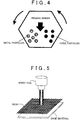
- granulated particles obtained by granulating particles made of the second metal material and particles made of the oxide thereof are first manufactured. Specifically, as shown in FIG. 4 , metal particles M and particles made of its oxide (M oxide) are granulated by kneading granulation method using an organic binder.
- a mesh is placed on the metal base material, in a contact state or non-contact state.
- a heat radiation section made of granulated particles is formed on a surface of the metal base material.
- the heat radiation section obtained as described above is obtained by spraying the granulated particles through the mesh on a surface of the metal base material. Therefore, a plurality of heat radiation sections that are separated so as to disperse on a surface of the metal base material can be attached on a surface of the metal base material. Further, each of the attached heat radiation sections contains an oxide obtained by oxidizing the second metal material, and, on a surface of each of the heat radiation sections, an oxide obtained by oxidizing the second metal material can be exposed.
- a mesh is placed on the metal base material in contact or non-contact state.
- metal particles made of the second metal material different from the first metal material are sprayed.
- a plurality of metal particle groups that are separated so as to disperse on a surface of the metal base material can be attached to a surface of the metal base material.
- a heat radiation section in which a surface of the sprayed metal particles (metal particle groups) is oxidized is formed on a surface of the metal base material.
- an oxide layer in which in a surface layer the second metal material is oxidized can be formed on a superficial layer of the heat radiation section as a radiation material.
- a heat radiation member is manufactured by using a deposition device by arc ion plating (AIP). Specifically, first, the metal base material made of the first metal material and a target (cathode) made of the second metal are arranged in the deposition device. In this case, a plurality of targets made of different metals may be arranged.
- AIP arc ion plating
- a carrier gas such as nitrogen or the like is introduced, and when a bias voltage is applied to the metal base material, a voltage is applied between an anode and a cathode to cause arc discharge.
- the arc is irradiated on the target, the target discharges metal particles, and the discharged metal particles are attached so as to disperse on a surface of the metal base material.
- metal particles made of the second metal material are attached on a surface of the metal base material, a plurality of metal particle groups that are separated so as to disperse on a surface of the metal base material can readily be attached on a surface of the metal base material.
- the heat radiation member is manufactured using arc ion plating. However, by using a sputtering method, the heat radiation member may be manufactured.
- Example 1 According to the above-described first manufacturing method, a heat radiation member was prepared. Specifically, to ferromanganese (metal M) shown in the following Table 2 and having an average particle size of 27.2 ⁇ m, 25% by mass of oxide (M oxide) that was generated when ferromanganese shown in the following Table 3 and having an average particle size of 27.3 ⁇ m was manufactured, and 2% by mass of pasty polyvinyl alcohol obtained by dissolving in water as an organic binder were mixed and, by kneading granulating method, granulated particles having a average particle size of 76.9 ⁇ m were prepared.
- metal M ferromanganese
- M oxide oxide
- 2% by mass of pasty polyvinyl alcohol obtained by dissolving in water as an organic binder were mixed and, by kneading granulating method, granulated particles having a average particle size of 76.9 ⁇ m were prepared.
- FIG. 7A An electron micrograph of the granulated particles is shown in FIG. 7A .
- Table 2 Mn C Si P S 73 to 78% by mass ⁇ 7% by mass ⁇ 1% by mass ⁇ 0.2% by mass 0.02% by mass (Table 3) MnO 2 Fe 2 O 3 SiO 2 CaO MgO Al 2 O 3 67 to 71% by mass ⁇ 1 to 3% by mass ⁇ 1% by mass 0.1% by mass ⁇ 1% by mass ⁇ 0.3% by mass
- a mesh JIS Standard: SUS 304: ⁇ 0.25 ⁇ 100 ⁇ 100 mm, 30 mesh/inch
- the granulated powder was attached so that a film thickness was 100 ⁇ m by plasma spraying (condition: current value 450 A, argon gas flow rate 30 L/minute, hydrogen flow rate 5 L/minute, spraying distance 150 mm).
- the mesh was removed from the metal base material, and a heat radiation member was prepared.
- a heat radiation member was prepared.
- a point different from example 1 was in that without disposing the mesh on the metal base material, the granulated powder was attached such that a film thickness was 100 ⁇ m or less by plasma spraying.
- FIG. 7B is a photograph of a surface of the heat radiation member according to example 1
- FIG. 7C is a sectional photograph of the heat radiation member according to example 1.
- Infrared emissivity of each of the heat radiation members according to example 1 and comparative example was measured according to an "indirect measurement method that uses an integrating sphere due to FT-IR" in accordance with JIS R 1801. Specifically, as shown in FIG. 6A , at an opening having a diameter of 24 mm of an integrating sphere having a radius of 76 mm, a heat radiation member was placed as a sample. Then, a disc-like switching mirror having a diameter of 10 mm was rotated, infrared ray was illuminated from a slit having a diameter of 16 mm, and infrared emissivity of the heat radiation member was measured from infrared ray detected by a detector. Results thereof are shown in FIG. 6B .
- the heat radiation member according to example 1 a plurality of heat radiation sections made of ferromanganese and oxide thereof were separately attached on a surface of the metal base material while dispersing on a surface of the metal base material. Further, as shown in FIG. 8B , the heat radiation member according to example 1 has the emissivity the same as that of comparative example in spite of low rate of ferromanganese and the oxide thereof with respect to a surface of the metal base material.
- a heat radiation member was prepared. Specifically, on a metal base material (JIS Standard: SUS 444: 40 mm ⁇ 40 mm, thickness: 2 mm) of which surface was roughened by shot blasting, a mesh (JIS Standard: SUS 304: ⁇ 0.25 ⁇ 100 ⁇ 100 mm, 30 mesh/inch) was fixed. Thereon, the ferromanganese particles used in example 1 shown in Table 2 were attached so that a film thickness was 100 ⁇ m by plasma spraying. Thereafter, the mesh was removed from the metal base material.
- a metal base material JIS Standard: SUS 444: 40 mm ⁇ 40 mm, thickness: 2 mm
- a mesh JIS Standard: SUS 304: ⁇ 0.25 ⁇ 100 ⁇ 100 mm, 30 mesh/inch
- FIG. 9A and FIG. 9B are diagrams that show sectional photographs of the heat radiation members according to example 2, FIG. 9A being a sectional photograph of a heat radiation member before oxidizing treatment, and FIG. 9B being a sectional photograph of a heat radiation member after the oxidizing treatment.
- a heat radiation member was prepared. Specifically, a metal base material (JIS Standard: SUS 444: 40 mm ⁇ 40 mm, thickness: 2 mm) of which surface was roughened by shot blasting was placed in an arc ion plating apparatus, and ferromanganese having the composition the same as example 1 was disposed. Then, under condition of vacuum in a chamber of 2 ⁇ 10 -3 Pa, base material temperature of 200°C (heater temperature), current value of an arc power source of 150 A, and a bias voltage of 500 V, ferromanganese particles were attached so that ferromanganese particles (droplets) of the metal base material were dispersed.
- a metal base material JIS Standard: SUS 444: 40 mm ⁇ 40 mm, thickness: 2 mm
- FIG. 10 is a photograph of a surface of a heat radiation member according to example 3.
- a plurality of heat radiation sections made of ferromanganese and its oxide were separately attached on a surface of the metal base material while dispersing on a surface of the metal base material. Further, in a superficial layer of the heat radiation section, an oxide layer was formed.
- disc-like heat radiation sections are uniformly dispersed.
- a shape thereof is not particularly limited and may not be uniformly dispersed.
Landscapes
- Chemical & Material Sciences (AREA)
- Engineering & Computer Science (AREA)
- Mechanical Engineering (AREA)
- Chemical Kinetics & Catalysis (AREA)
- Materials Engineering (AREA)
- Metallurgy (AREA)
- Organic Chemistry (AREA)
- Physics & Mathematics (AREA)
- Plasma & Fusion (AREA)
- General Engineering & Computer Science (AREA)
- Crystallography & Structural Chemistry (AREA)
- Thermal Sciences (AREA)
- Other Surface Treatments For Metallic Materials (AREA)
- Laminated Bodies (AREA)
- Powder Metallurgy (AREA)
- Physical Vapour Deposition (AREA)
- Coating By Spraying Or Casting (AREA)
- Combustion & Propulsion (AREA)
- Cooling Or The Like Of Semiconductors Or Solid State Devices (AREA)
Claims (3)
- Verfahren zum Herstellen eines Wärmestrahlungselements, dadurch gekennzeichnet, dass es aufweist:Aufbringen eines Gitters auf ein Metallbasismaterial (2), das aus einem ersten Metallmaterial besteht; undBilden eines Wärmestrahlungsabschnitts (3), der aus granulierten Partikeln besteht, auf einer Oberfläche des Metallbasismaterials, durch Sprühen von granulierten Partikeln, die aus Partikeln granuliert sind, die aus einem zweiten Metallmaterial,das sich von dem ersten Metallmaterial unterscheidet, und Partikeln, die aus einem Oxid des zweiten Metallmaterials bestehen, bestehen, auf eine Oberfläche des Metallbasismaterials, auf der das Gitter aufgebracht wurde.
- Verfahren zum Herstellen eines Wärmestrahlungselements, dadurch gekennzeichnet, dass es aufweist:Aufbringen eines Gitters auf ein Metallbasismaterial (2), das aus einem ersten Metallmaterial besteht; undSprühen von Metallpartikeln, die aus einem zweiten Metallmaterial bestehen, das sich von dem ersten Metallmaterial unterscheidet, auf eine Oberfläche des Metallbasismaterials, auf die das Gitter aufgebracht wurde; undBilden eines Wärmestrahlungsabschnitts (3), in dem eine Oberfläche der gesprühten Metallpartikel auf einer Oberfläche des Metallbasismaterials durch Oxidieren der gesprühten Metallpartikel oxidiert wurde.
- Verfahren zum Herstellen eines Wärmestrahlungselements, dadurch gekennzeichnet, dass es aufweist:Befestigen von Metallpartikeln, die von einem Ziel ausgestoßen wurden, das aus einem zweiten Metallmaterial besteht, das sich von einem ersten Metallmaterial unterscheidet, so dass sie durch Anlegen einer Vorspannung an das Metallbasismaterial, das aus dem ersten Metallmaterial besteht, auseinandergetrieben werden; undBilden eines Wärmestrahlungsabschnitts (3), in dem eine Oberfläche der befestigten Metallpartikel auf einer Oberfläche des Metallbasismaterials durch Oxidieren der befestigten Metallpartikel oxidiert wurde.
Applications Claiming Priority (2)
| Application Number | Priority Date | Filing Date | Title |
|---|---|---|---|
| JP2013014600A JP5835241B2 (ja) | 2013-01-29 | 2013-01-29 | 熱放射部材および熱放射部材の製造方法 |
| PCT/IB2014/000010 WO2014118609A1 (en) | 2013-01-29 | 2014-01-08 | Heat radiation member and method for manufacturing the same |
Publications (2)
| Publication Number | Publication Date |
|---|---|
| EP2909354A1 EP2909354A1 (de) | 2015-08-26 |
| EP2909354B1 true EP2909354B1 (de) | 2017-03-29 |
Family
ID=50031390
Family Applications (1)
| Application Number | Title | Priority Date | Filing Date |
|---|---|---|---|
| EP14702300.6A Not-in-force EP2909354B1 (de) | 2013-01-29 | 2014-01-08 | Wärmestrahlungselement und verfahren zur herstellung davon |
Country Status (12)
| Country | Link |
|---|---|
| US (1) | US10563933B2 (de) |
| EP (1) | EP2909354B1 (de) |
| JP (1) | JP5835241B2 (de) |
| KR (1) | KR101690897B1 (de) |
| CN (1) | CN104812924B (de) |
| AU (1) | AU2014210918B2 (de) |
| BR (1) | BR112015012503B1 (de) |
| CA (1) | CA2892276C (de) |
| ES (1) | ES2625431T3 (de) |
| MY (1) | MY173972A (de) |
| RU (1) | RU2612469C1 (de) |
| WO (1) | WO2014118609A1 (de) |
Families Citing this family (4)
| Publication number | Priority date | Publication date | Assignee | Title |
|---|---|---|---|---|
| CN105821366B (zh) * | 2016-04-25 | 2018-11-09 | 昆明理工大学 | 一种释放采用热喷涂制备涂层的内应力的方法 |
| CN105821368A (zh) * | 2016-04-25 | 2016-08-03 | 昆明理工大学 | 一种电磁感应加热复合涂层的制备方法 |
| CN107099780A (zh) * | 2017-04-11 | 2017-08-29 | 浙江洋铭工贸有限公司 | 一种用于压铸铝采暖散热片表面处理工艺 |
| US20240003014A1 (en) * | 2022-07-01 | 2024-01-04 | General Electric Company | Method and system for thermal spraying braze alloy materials onto a nickel-based component to facilitate high density brazed joint with low discontinuities |
Family Cites Families (25)
| Publication number | Priority date | Publication date | Assignee | Title |
|---|---|---|---|---|
| JPS5836820B2 (ja) * | 1977-07-26 | 1983-08-11 | 株式会社日立ホームテック | 遠赤外線放射素子の製造法 |
| JPS62224682A (ja) * | 1986-03-27 | 1987-10-02 | Tokai Kinzoku Kk | 遠赤外線放射アルミ箔 |
| US5356724A (en) * | 1992-01-16 | 1994-10-18 | Sumitomo Metal Industries, Ltd. | Excellent far-infrared radiating material |
| US5353865A (en) * | 1992-03-30 | 1994-10-11 | General Electric Company | Enhanced impingement cooled components |
| JPH08206241A (ja) | 1994-02-28 | 1996-08-13 | M G Kogyo Kk | 遠赤外線磁石 |
| JP3360954B2 (ja) * | 1994-09-19 | 2003-01-07 | 日本電熱株式会社 | 遠赤外線放射材料及びその製造方法 |
| JP3076768B2 (ja) * | 1997-01-17 | 2000-08-14 | トーカロ株式会社 | 薄膜形成装置用部材の製造方法 |
| JPH116049A (ja) * | 1997-06-12 | 1999-01-12 | Nippon Sheet Glass Co Ltd | 真空成膜装置 |
| US6468669B1 (en) * | 1999-05-03 | 2002-10-22 | General Electric Company | Article having turbulation and method of providing turbulation on an article |
| JP4352539B2 (ja) * | 1999-11-19 | 2009-10-28 | 株式会社新菱 | 表面処理された成膜装置用部品および成膜装置用部品の表面処理方法 |
| JP2001262334A (ja) * | 2000-03-21 | 2001-09-26 | Sharp Corp | スパッタリング装置用シャッタおよびスパッタリング装置 |
| US7276293B1 (en) * | 2000-05-24 | 2007-10-02 | Fujikura Ltd. | Far-infrared radiator and method for producing method |
| US6528118B2 (en) * | 2001-02-06 | 2003-03-04 | General Electric Company | Process for creating structured porosity in thermal barrier coating |
| JP2004043612A (ja) * | 2002-07-11 | 2004-02-12 | Okitsumo Kk | 熱放射塗料 |
| US6924002B2 (en) * | 2003-02-24 | 2005-08-02 | General Electric Company | Coating and coating process incorporating raised surface features for an air-cooled surface |
| US20050123686A1 (en) * | 2003-09-19 | 2005-06-09 | Myrick James J. | Amorphous metal deposition and new aluminum-based amorphous metals |
| JP4304297B2 (ja) | 2004-05-31 | 2009-07-29 | Jfeメカニカル株式会社 | スリップ防止板の製造方法 |
| US8356658B2 (en) * | 2006-07-27 | 2013-01-22 | General Electric Company | Heat transfer enhancing system and method for fabricating heat transfer device |
| JP5158410B2 (ja) | 2007-10-12 | 2013-03-06 | トヨタ自動車株式会社 | 二次電池用電極材料粉末およびその製造方法 |
| US20090108134A1 (en) * | 2007-10-25 | 2009-04-30 | General Electric Company | Icing protection system and method for enhancing heat transfer |
| CN101429644B (zh) * | 2008-03-21 | 2012-01-25 | 中国科学院上海硅酸盐研究所 | 金属或金属氧化物纳米颗粒的薄膜制备方法 |
| UA100571C2 (uk) * | 2008-06-24 | 2013-01-10 | Энэрджи Корея Инк. | Композиція для нанесення покриття, яка містить фотокаталізатор, покритий апатитом, і система радіаційного нагрівання, яка містить зазначену композицію |
| JP2010018831A (ja) * | 2008-07-09 | 2010-01-28 | Ibiden Co Ltd | 受熱部材、及び、排気管放熱システム |
| JP5081173B2 (ja) | 2009-01-22 | 2012-11-21 | イビデン株式会社 | 排気管用塗料、排気管用塗料の使用方法及び排気管 |
| GB2504302A (en) * | 2012-07-24 | 2014-01-29 | Brayton Energy Canada Inc | Heat exchanger fins made by cold spraying |
-
2013
- 2013-01-29 JP JP2013014600A patent/JP5835241B2/ja not_active Expired - Fee Related
-
2014
- 2014-01-08 CN CN201480003195.3A patent/CN104812924B/zh not_active Expired - Fee Related
- 2014-01-08 ES ES14702300.6T patent/ES2625431T3/es active Active
- 2014-01-08 RU RU2015119765A patent/RU2612469C1/ru active
- 2014-01-08 WO PCT/IB2014/000010 patent/WO2014118609A1/en not_active Ceased
- 2014-01-08 BR BR112015012503-4A patent/BR112015012503B1/pt not_active IP Right Cessation
- 2014-01-08 EP EP14702300.6A patent/EP2909354B1/de not_active Not-in-force
- 2014-01-08 AU AU2014210918A patent/AU2014210918B2/en not_active Ceased
- 2014-01-08 US US14/646,931 patent/US10563933B2/en not_active Expired - Fee Related
- 2014-01-08 KR KR1020157014186A patent/KR101690897B1/ko not_active Expired - Fee Related
- 2014-01-08 CA CA2892276A patent/CA2892276C/en active Active
- 2014-01-08 MY MYPI2015701650A patent/MY173972A/en unknown
Non-Patent Citations (1)
| Title |
|---|
| None * |
Also Published As
| Publication number | Publication date |
|---|---|
| US10563933B2 (en) | 2020-02-18 |
| KR20150074188A (ko) | 2015-07-01 |
| CA2892276C (en) | 2016-11-15 |
| RU2612469C1 (ru) | 2017-03-09 |
| US20150315699A1 (en) | 2015-11-05 |
| BR112015012503B1 (pt) | 2020-12-01 |
| AU2014210918B2 (en) | 2017-03-16 |
| CN104812924B (zh) | 2016-09-28 |
| RU2015119765A (ru) | 2017-03-10 |
| AU2014210918A1 (en) | 2015-06-11 |
| EP2909354A1 (de) | 2015-08-26 |
| MY173972A (en) | 2020-03-02 |
| ES2625431T3 (es) | 2017-07-19 |
| JP2014145113A (ja) | 2014-08-14 |
| JP5835241B2 (ja) | 2015-12-24 |
| BR112015012503A2 (pt) | 2017-07-11 |
| CA2892276A1 (en) | 2014-08-07 |
| KR101690897B1 (ko) | 2016-12-28 |
| CN104812924A (zh) | 2015-07-29 |
| WO2014118609A1 (en) | 2014-08-07 |
Similar Documents
| Publication | Publication Date | Title |
|---|---|---|
| EP2909354B1 (de) | Wärmestrahlungselement und verfahren zur herstellung davon | |
| EP2071049A1 (de) | Y2O3-sprühbeschichtetes Element und Herstellungsverfahren dafür | |
| JP4051351B2 (ja) | 熱放射性および耐損傷性に優れるy2o3溶射皮膜被覆部材およびその製造方法 | |
| JP5627872B2 (ja) | 高温のガスに曝される弁体のガス封止部の構造 | |
| EP3375606B1 (de) | Laminat und laminatherstellungsverfahren | |
| KR20160099556A (ko) | W-Ni 스퍼터링 타깃 | |
| JP4372748B2 (ja) | 半導体製造装置用部材 | |
| US12120852B2 (en) | Composite material and heat dissipation part | |
| US20220139663A1 (en) | Insulator with conductive dissipative coating | |
| JP2013245375A (ja) | ツバ付きターゲットの製造方法 | |
| JP3724346B2 (ja) | スパッタリングターゲットおよびその製造方法 | |
| EP3587621B1 (de) | Verfahren zur herstellung einer aluminiumleiterplatte | |
| CN111465713B (zh) | 溅镀靶材和溅镀靶 | |
| CN108698944A (zh) | 铜-陶瓷复合物 | |
| KR101645585B1 (ko) | 앵커부를 가진 열전레그를 포함하는 열전모듈 및 그 제조방법 | |
| CN101461293B (zh) | 电路载体及其制造方法 | |
| US20180030587A1 (en) | Heating Assembly | |
| EP4043203B1 (de) | Verbundsubstrat und verfahren zu seiner herstellung und schaltungssubstrat und verfahren zu seiner herstellung | |
| JP2000277021A (ja) | ガス放電型表示パネル用隔壁及びその製造方法 | |
| KR20070087219A (ko) | 산화이트륨 용사 피막 피복 부재 및 그 제조 방법 | |
| JP2008091764A (ja) | 電子部品及びフィルムコンデンサー | |
| KR20070030718A (ko) | Y2o3 용사 피막 피복 부재 및 그 제조 방법 | |
| JP2001006559A (ja) | ガス放電型表示パネル用隔壁及びその製造方法 |
Legal Events
| Date | Code | Title | Description |
|---|---|---|---|
| PUAI | Public reference made under article 153(3) epc to a published international application that has entered the european phase |
Free format text: ORIGINAL CODE: 0009012 |
|
| 17P | Request for examination filed |
Effective date: 20150521 |
|
| AK | Designated contracting states |
Kind code of ref document: A1 Designated state(s): AL AT BE BG CH CY CZ DE DK EE ES FI FR GB GR HR HU IE IS IT LI LT LU LV MC MK MT NL NO PL PT RO RS SE SI SK SM TR |
|
| AX | Request for extension of the european patent |
Extension state: BA ME |
|
| DAX | Request for extension of the european patent (deleted) | ||
| GRAP | Despatch of communication of intention to grant a patent |
Free format text: ORIGINAL CODE: EPIDOSNIGR1 |
|
| INTG | Intention to grant announced |
Effective date: 20160921 |
|
| GRAS | Grant fee paid |
Free format text: ORIGINAL CODE: EPIDOSNIGR3 |
|
| GRAJ | Information related to disapproval of communication of intention to grant by the applicant or resumption of examination proceedings by the epo deleted |
Free format text: ORIGINAL CODE: EPIDOSDIGR1 |
|
| GRAL | Information related to payment of fee for publishing/printing deleted |
Free format text: ORIGINAL CODE: EPIDOSDIGR3 |
|
| REG | Reference to a national code |
Ref country code: DE Ref legal event code: R079 Ref document number: 602014008062 Country of ref document: DE Free format text: PREVIOUS MAIN CLASS: C23C0004000000 Ipc: C23C0004010000 |
|
| GRAR | Information related to intention to grant a patent recorded |
Free format text: ORIGINAL CODE: EPIDOSNIGR71 |
|
| GRAA | (expected) grant |
Free format text: ORIGINAL CODE: 0009210 |
|
| INTC | Intention to grant announced (deleted) | ||
| RIC1 | Information provided on ipc code assigned before grant |
Ipc: C23C 14/32 20060101ALI20170130BHEP Ipc: C23C 4/06 20160101ALI20170130BHEP Ipc: C23C 4/08 20160101ALI20170130BHEP Ipc: F28F 13/18 20060101ALI20170130BHEP Ipc: C23C 4/01 20160101AFI20170130BHEP Ipc: F01N 13/16 20100101ALI20170130BHEP Ipc: C23C 14/58 20060101ALI20170130BHEP Ipc: C23C 14/16 20060101ALI20170130BHEP Ipc: C23C 4/18 20060101ALI20170130BHEP |
|
| INTG | Intention to grant announced |
Effective date: 20170216 |
|
| AK | Designated contracting states |
Kind code of ref document: B1 Designated state(s): AL AT BE BG CH CY CZ DE DK EE ES FI FR GB GR HR HU IE IS IT LI LT LU LV MC MK MT NL NO PL PT RO RS SE SI SK SM TR |
|
| REG | Reference to a national code |
Ref country code: GB Ref legal event code: FG4D |
|
| REG | Reference to a national code |
Ref country code: CH Ref legal event code: EP |
|
| REG | Reference to a national code |
Ref country code: AT Ref legal event code: REF Ref document number: 879839 Country of ref document: AT Kind code of ref document: T Effective date: 20170415 |
|
| REG | Reference to a national code |
Ref country code: IE Ref legal event code: FG4D |
|
| REG | Reference to a national code |
Ref country code: DE Ref legal event code: R096 Ref document number: 602014008062 Country of ref document: DE |
|
| REG | Reference to a national code |
Ref country code: ES Ref legal event code: FG2A Ref document number: 2625431 Country of ref document: ES Kind code of ref document: T3 Effective date: 20170719 |
|
| PG25 | Lapsed in a contracting state [announced via postgrant information from national office to epo] |
Ref country code: NO Free format text: LAPSE BECAUSE OF FAILURE TO SUBMIT A TRANSLATION OF THE DESCRIPTION OR TO PAY THE FEE WITHIN THE PRESCRIBED TIME-LIMIT Effective date: 20170629 Ref country code: HR Free format text: LAPSE BECAUSE OF FAILURE TO SUBMIT A TRANSLATION OF THE DESCRIPTION OR TO PAY THE FEE WITHIN THE PRESCRIBED TIME-LIMIT Effective date: 20170329 Ref country code: LT Free format text: LAPSE BECAUSE OF FAILURE TO SUBMIT A TRANSLATION OF THE DESCRIPTION OR TO PAY THE FEE WITHIN THE PRESCRIBED TIME-LIMIT Effective date: 20170329 Ref country code: GR Free format text: LAPSE BECAUSE OF FAILURE TO SUBMIT A TRANSLATION OF THE DESCRIPTION OR TO PAY THE FEE WITHIN THE PRESCRIBED TIME-LIMIT Effective date: 20170630 Ref country code: FI Free format text: LAPSE BECAUSE OF FAILURE TO SUBMIT A TRANSLATION OF THE DESCRIPTION OR TO PAY THE FEE WITHIN THE PRESCRIBED TIME-LIMIT Effective date: 20170329 |
|
| REG | Reference to a national code |
Ref country code: NL Ref legal event code: MP Effective date: 20170329 |
|
| REG | Reference to a national code |
Ref country code: AT Ref legal event code: MK05 Ref document number: 879839 Country of ref document: AT Kind code of ref document: T Effective date: 20170329 |
|
| PG25 | Lapsed in a contracting state [announced via postgrant information from national office to epo] |
Ref country code: RS Free format text: LAPSE BECAUSE OF FAILURE TO SUBMIT A TRANSLATION OF THE DESCRIPTION OR TO PAY THE FEE WITHIN THE PRESCRIBED TIME-LIMIT Effective date: 20170329 Ref country code: BG Free format text: LAPSE BECAUSE OF FAILURE TO SUBMIT A TRANSLATION OF THE DESCRIPTION OR TO PAY THE FEE WITHIN THE PRESCRIBED TIME-LIMIT Effective date: 20170629 Ref country code: LV Free format text: LAPSE BECAUSE OF FAILURE TO SUBMIT A TRANSLATION OF THE DESCRIPTION OR TO PAY THE FEE WITHIN THE PRESCRIBED TIME-LIMIT Effective date: 20170329 Ref country code: SE Free format text: LAPSE BECAUSE OF FAILURE TO SUBMIT A TRANSLATION OF THE DESCRIPTION OR TO PAY THE FEE WITHIN THE PRESCRIBED TIME-LIMIT Effective date: 20170329 |
|
| PG25 | Lapsed in a contracting state [announced via postgrant information from national office to epo] |
Ref country code: NL Free format text: LAPSE BECAUSE OF FAILURE TO SUBMIT A TRANSLATION OF THE DESCRIPTION OR TO PAY THE FEE WITHIN THE PRESCRIBED TIME-LIMIT Effective date: 20170329 |
|
| REG | Reference to a national code |
Ref country code: DE Ref legal event code: R084 Ref document number: 602014008062 Country of ref document: DE |
|
| PG25 | Lapsed in a contracting state [announced via postgrant information from national office to epo] |
Ref country code: RO Free format text: LAPSE BECAUSE OF FAILURE TO SUBMIT A TRANSLATION OF THE DESCRIPTION OR TO PAY THE FEE WITHIN THE PRESCRIBED TIME-LIMIT Effective date: 20170329 Ref country code: AT Free format text: LAPSE BECAUSE OF FAILURE TO SUBMIT A TRANSLATION OF THE DESCRIPTION OR TO PAY THE FEE WITHIN THE PRESCRIBED TIME-LIMIT Effective date: 20170329 Ref country code: CZ Free format text: LAPSE BECAUSE OF FAILURE TO SUBMIT A TRANSLATION OF THE DESCRIPTION OR TO PAY THE FEE WITHIN THE PRESCRIBED TIME-LIMIT Effective date: 20170329 Ref country code: EE Free format text: LAPSE BECAUSE OF FAILURE TO SUBMIT A TRANSLATION OF THE DESCRIPTION OR TO PAY THE FEE WITHIN THE PRESCRIBED TIME-LIMIT Effective date: 20170329 Ref country code: SK Free format text: LAPSE BECAUSE OF FAILURE TO SUBMIT A TRANSLATION OF THE DESCRIPTION OR TO PAY THE FEE WITHIN THE PRESCRIBED TIME-LIMIT Effective date: 20170329 |
|
| PG25 | Lapsed in a contracting state [announced via postgrant information from national office to epo] |
Ref country code: PT Free format text: LAPSE BECAUSE OF FAILURE TO SUBMIT A TRANSLATION OF THE DESCRIPTION OR TO PAY THE FEE WITHIN THE PRESCRIBED TIME-LIMIT Effective date: 20170731 Ref country code: SM Free format text: LAPSE BECAUSE OF FAILURE TO SUBMIT A TRANSLATION OF THE DESCRIPTION OR TO PAY THE FEE WITHIN THE PRESCRIBED TIME-LIMIT Effective date: 20170329 Ref country code: PL Free format text: LAPSE BECAUSE OF FAILURE TO SUBMIT A TRANSLATION OF THE DESCRIPTION OR TO PAY THE FEE WITHIN THE PRESCRIBED TIME-LIMIT Effective date: 20170329 Ref country code: IS Free format text: LAPSE BECAUSE OF FAILURE TO SUBMIT A TRANSLATION OF THE DESCRIPTION OR TO PAY THE FEE WITHIN THE PRESCRIBED TIME-LIMIT Effective date: 20170729 |
|
| REG | Reference to a national code |
Ref country code: DE Ref legal event code: R097 Ref document number: 602014008062 Country of ref document: DE |
|
| PG25 | Lapsed in a contracting state [announced via postgrant information from national office to epo] |
Ref country code: DK Free format text: LAPSE BECAUSE OF FAILURE TO SUBMIT A TRANSLATION OF THE DESCRIPTION OR TO PAY THE FEE WITHIN THE PRESCRIBED TIME-LIMIT Effective date: 20170329 |
|
| PLBE | No opposition filed within time limit |
Free format text: ORIGINAL CODE: 0009261 |
|
| STAA | Information on the status of an ep patent application or granted ep patent |
Free format text: STATUS: NO OPPOSITION FILED WITHIN TIME LIMIT |
|
| PG25 | Lapsed in a contracting state [announced via postgrant information from national office to epo] |
Ref country code: IT Free format text: LAPSE BECAUSE OF FAILURE TO SUBMIT A TRANSLATION OF THE DESCRIPTION OR TO PAY THE FEE WITHIN THE PRESCRIBED TIME-LIMIT Effective date: 20170329 |
|
| 26N | No opposition filed |
Effective date: 20180103 |
|
| PG25 | Lapsed in a contracting state [announced via postgrant information from national office to epo] |
Ref country code: SI Free format text: LAPSE BECAUSE OF FAILURE TO SUBMIT A TRANSLATION OF THE DESCRIPTION OR TO PAY THE FEE WITHIN THE PRESCRIBED TIME-LIMIT Effective date: 20170329 |
|
| REG | Reference to a national code |
Ref country code: CH Ref legal event code: PL |
|
| GBPC | Gb: european patent ceased through non-payment of renewal fee |
Effective date: 20180108 |
|
| PG25 | Lapsed in a contracting state [announced via postgrant information from national office to epo] |
Ref country code: LU Free format text: LAPSE BECAUSE OF NON-PAYMENT OF DUE FEES Effective date: 20180108 Ref country code: FR Free format text: LAPSE BECAUSE OF NON-PAYMENT OF DUE FEES Effective date: 20180131 |
|
| REG | Reference to a national code |
Ref country code: IE Ref legal event code: MM4A |
|
| REG | Reference to a national code |
Ref country code: FR Ref legal event code: ST Effective date: 20180928 |
|
| REG | Reference to a national code |
Ref country code: BE Ref legal event code: MM Effective date: 20180131 |
|
| PG25 | Lapsed in a contracting state [announced via postgrant information from national office to epo] |
Ref country code: LI Free format text: LAPSE BECAUSE OF NON-PAYMENT OF DUE FEES Effective date: 20180131 Ref country code: GB Free format text: LAPSE BECAUSE OF NON-PAYMENT OF DUE FEES Effective date: 20180108 Ref country code: BE Free format text: LAPSE BECAUSE OF NON-PAYMENT OF DUE FEES Effective date: 20180131 Ref country code: CH Free format text: LAPSE BECAUSE OF NON-PAYMENT OF DUE FEES Effective date: 20180131 |
|
| PG25 | Lapsed in a contracting state [announced via postgrant information from national office to epo] |
Ref country code: IE Free format text: LAPSE BECAUSE OF NON-PAYMENT OF DUE FEES Effective date: 20180108 |
|
| PG25 | Lapsed in a contracting state [announced via postgrant information from national office to epo] |
Ref country code: MC Free format text: LAPSE BECAUSE OF FAILURE TO SUBMIT A TRANSLATION OF THE DESCRIPTION OR TO PAY THE FEE WITHIN THE PRESCRIBED TIME-LIMIT Effective date: 20170329 |
|
| PG25 | Lapsed in a contracting state [announced via postgrant information from national office to epo] |
Ref country code: MT Free format text: LAPSE BECAUSE OF NON-PAYMENT OF DUE FEES Effective date: 20180108 |
|
| PG25 | Lapsed in a contracting state [announced via postgrant information from national office to epo] |
Ref country code: TR Free format text: LAPSE BECAUSE OF FAILURE TO SUBMIT A TRANSLATION OF THE DESCRIPTION OR TO PAY THE FEE WITHIN THE PRESCRIBED TIME-LIMIT Effective date: 20170329 |
|
| PG25 | Lapsed in a contracting state [announced via postgrant information from national office to epo] |
Ref country code: HU Free format text: LAPSE BECAUSE OF FAILURE TO SUBMIT A TRANSLATION OF THE DESCRIPTION OR TO PAY THE FEE WITHIN THE PRESCRIBED TIME-LIMIT; INVALID AB INITIO Effective date: 20140108 Ref country code: MK Free format text: LAPSE BECAUSE OF NON-PAYMENT OF DUE FEES Effective date: 20170329 Ref country code: CY Free format text: LAPSE BECAUSE OF FAILURE TO SUBMIT A TRANSLATION OF THE DESCRIPTION OR TO PAY THE FEE WITHIN THE PRESCRIBED TIME-LIMIT Effective date: 20170329 |
|
| PG25 | Lapsed in a contracting state [announced via postgrant information from national office to epo] |
Ref country code: AL Free format text: LAPSE BECAUSE OF FAILURE TO SUBMIT A TRANSLATION OF THE DESCRIPTION OR TO PAY THE FEE WITHIN THE PRESCRIBED TIME-LIMIT Effective date: 20170329 |
|
| PGFP | Annual fee paid to national office [announced via postgrant information from national office to epo] |
Ref country code: DE Payment date: 20211130 Year of fee payment: 9 |
|
| PGFP | Annual fee paid to national office [announced via postgrant information from national office to epo] |
Ref country code: ES Payment date: 20220201 Year of fee payment: 9 |
|
| REG | Reference to a national code |
Ref country code: DE Ref legal event code: R119 Ref document number: 602014008062 Country of ref document: DE |
|
| PG25 | Lapsed in a contracting state [announced via postgrant information from national office to epo] |
Ref country code: DE Free format text: LAPSE BECAUSE OF NON-PAYMENT OF DUE FEES Effective date: 20230801 |
|
| REG | Reference to a national code |
Ref country code: ES Ref legal event code: FD2A Effective date: 20240229 |
|
| PG25 | Lapsed in a contracting state [announced via postgrant information from national office to epo] |
Ref country code: ES Free format text: LAPSE BECAUSE OF NON-PAYMENT OF DUE FEES Effective date: 20230109 |
|
| PG25 | Lapsed in a contracting state [announced via postgrant information from national office to epo] |
Ref country code: ES Free format text: LAPSE BECAUSE OF NON-PAYMENT OF DUE FEES Effective date: 20230109 |