EP2910547B1 - Verbindung, tautomer und geometrisches isomer davon, salz der verbindung, des tautomers oder des geometrischen isomers, verfahren zur herstellung dieser verbindung, des tautomers, des isomers oder des salzes, antimikrobielles mittel sowie arzneimittel gegen infektionen - Google Patents
Verbindung, tautomer und geometrisches isomer davon, salz der verbindung, des tautomers oder des geometrischen isomers, verfahren zur herstellung dieser verbindung, des tautomers, des isomers oder des salzes, antimikrobielles mittel sowie arzneimittel gegen infektionen Download PDFInfo
- Publication number
- EP2910547B1 EP2910547B1 EP13847221.2A EP13847221A EP2910547B1 EP 2910547 B1 EP2910547 B1 EP 2910547B1 EP 13847221 A EP13847221 A EP 13847221A EP 2910547 B1 EP2910547 B1 EP 2910547B1
- Authority
- EP
- European Patent Office
- Prior art keywords
- oxyindole
- carbon atoms
- group
- halogen atom
- compound
- Prior art date
- Legal status (The legal status is an assumption and is not a legal conclusion. Google has not performed a legal analysis and makes no representation as to the accuracy of the status listed.)
- Active
Links
- 0 CCN**(C1=CC=CC[C@]1C1=**)C1=O Chemical compound CCN**(C1=CC=CC[C@]1C1=**)C1=O 0.000 description 6
Classifications
-
- C—CHEMISTRY; METALLURGY
- C07—ORGANIC CHEMISTRY
- C07D—HETEROCYCLIC COMPOUNDS
- C07D209/00—Heterocyclic compounds containing five-membered rings, condensed with other rings, with one nitrogen atom as the only ring hetero atom
- C07D209/02—Heterocyclic compounds containing five-membered rings, condensed with other rings, with one nitrogen atom as the only ring hetero atom condensed with one carbocyclic ring
- C07D209/04—Indoles; Hydrogenated indoles
- C07D209/30—Indoles; Hydrogenated indoles with hetero atoms or with carbon atoms having three bonds to hetero atoms with at the most one bond to halogen, directly attached to carbon atoms of the hetero ring
- C07D209/32—Oxygen atoms
- C07D209/34—Oxygen atoms in position 2
-
- A—HUMAN NECESSITIES
- A61—MEDICAL OR VETERINARY SCIENCE; HYGIENE
- A61P—SPECIFIC THERAPEUTIC ACTIVITY OF CHEMICAL COMPOUNDS OR MEDICINAL PREPARATIONS
- A61P31/00—Antiinfectives, i.e. antibiotics, antiseptics, chemotherapeutics
- A61P31/04—Antibacterial agents
-
- C—CHEMISTRY; METALLURGY
- C07—ORGANIC CHEMISTRY
- C07D—HETEROCYCLIC COMPOUNDS
- C07D311/00—Heterocyclic compounds containing six-membered rings having one oxygen atom as the only hetero atom, condensed with other rings
- C07D311/02—Heterocyclic compounds containing six-membered rings having one oxygen atom as the only hetero atom, condensed with other rings ortho- or peri-condensed with carbocyclic rings or ring systems
- C07D311/04—Benzo[b]pyrans, not hydrogenated in the carbocyclic ring
- C07D311/42—Benzo[b]pyrans, not hydrogenated in the carbocyclic ring with oxygen or sulfur atoms in positions 2 and 4
- C07D311/56—Benzo[b]pyrans, not hydrogenated in the carbocyclic ring with oxygen or sulfur atoms in positions 2 and 4 without hydrogen atoms in position 3
Definitions
- the present invention relates to a compound belonging to 3-acyloxyindole compounds, a tautomer or geometric isomer thereof, or a salt thereof; a method for producing the same; an antibacterial agent; and an infectious disease therapeutic drug.
- the present invention also relates to an antibacterial compound having antibacterial effects and belonging to 3-acyloxyindole compounds, or a salt thereof; a method for producing the same; an antibacterial agent; and an infectious disease therapeutic drug.
- MRSA methicillin-resistant S. aureus
- Vancomycin was an only antibacterial agent that maintained its effectiveness to multiply antibiotic-resistant bacteria.
- VRE vancomycin-resistant Enterococcus
- WO 2004/074282 also discloses antibacterial indolone oxazolidinones. Therefore, keen demand has arisen for the provision of a novel compound which exhibits a low antibacterial activity against bacteria acquiring no drug resistance and thus does not permit them to become drug resistant and which exhibits an excellent antibacterial activity against drug-resistant bacteria resistant to at least one drug such as vancomycin (see NPL 3).
- Bacteria belonging to the genus Clostridium have characteristics hat they are positive in Gram staining, obligately anaerobic, and form spores. Some of the bacteria belonging to the genus Clostridium are present as normal bacterial flora within the intestine of a human and animals, and pathogenic bacteria are also present there. Among them, there have been problems with infectious diseases such as colitis caused by Clostridium difficile and Clostridium perfringens .
- More than 400 kinds of enterobacteria reside in the intestine of a healthy human in a well-balanced manner.
- an antibacterial agent is administered against the intestinal flora (intestinal normal bacterial flora) formed by these enterobacteria, the balance of the intestinal flora is broken, so that Clostridium difficile originally existing in the intestine proliferate abnormally due to microbial substitution to produce toxin in the large intestine.
- Clostridium difficile is propagated from the developed patients directly or via medical staff in hospitals. Abnormal proliferation of Clostridium difficile not only causes severe diarrhea in patients but also often causes them to die.
- Clostridium difficile can also be said to be one of the multiply antibiotic-resistant bacteria.
- vancomycin and metronidazole used today as therapeutic drugs against infectious diseases caused by Clostridium difficile , and there has been a serious problem with reoccurrence upon withdrawal of the drugs. Drug resistance thereto will become a problem eventually, and at present it has strongly been desired to develop a novel compound having novel antibacterial activity against Clostridium difficile .
- another object of the present invention is to provide: an antibacterial compound having antibacterial effects and belonging to 3-acyloxyindole compounds, or a salt thereof; a method for efficiently producing the same; an excellent antibacterial agent containing the antibacterial compound or salt thereof; and an infectious disease therapeutic drug containing the antibacterial agent.
- the present inventors conducted extensive studies in order to solve the above problems and have obtained the following findings. That is, they have found that compounds belonging to 3-acyloxyindole compounds of the present invention have antibacterial activity and have further found that these compounds include many compounds having antibacterial activity against MRSA, VRE, or Clostridium difficile , or any combination thereof, which are multiply antibiotic-resistant bacteria.
- the present invention has been accomplished on the basis of these findings.
- the present invention is based on the above findings obtained by the present invention, and means for solving the above problems are as follows.
- the compound, the tautomer or geometric isomer thereof, or the salt thereof of the present invention can solve the above existing problems. It is possible to provide the compound belonging to 3-acyloxyindole compounds of the present invention or 3-acyl-4-hydroxycoumarin compounds disclosed herein, the tautomer or geometric isomer thereof, or the salt thereof.
- the antibacterial compound or the salt thereof of the present invention can solve the above existing problems. It is possible to provide the antibacterial compound having antibacterial effects and belonging to 3-acyloxyindole compounds of the present invention or 3-acyl-4-hydroxycoumarin compounds disclosed herein, or the salt thereof.
- the method for producing the compound or the antibacterial compound of the present invention can solve the above existing problems, and it is possible to provide the method for efficiently producing the compound, the tautomer or geometric isomer thereof, or the salt thereof; or the antibacterial compound or the salt thereof.
- the antibacterial agent of the present invention can solve the above existing problems, and it is possible to provide the excellent antibacterial agent containing the compound, the tautomer or geometric isomer thereof, or the salt thereof; or the antibacterial compound or the salt thereof.
- the infectious disease therapeutic drug of the present invention can solve the above existing problems, and it is possible to provide the excellent infectious disease therapeutic drug containing the antibacterial agent.
- the compound of the present invention is a novel compound represented by any one of General Formulas (1) to (2) below. Also disclosed herein is a compound represented by General Formula (3) below and an antibacterial compound represented by General Formula (4) or (5) below.
- the novel compound represented by any one of General Formulas (1) to (3) below and the antibacterial compound represented by General Formula (4) or (5) below each compounds belonging to 3-acyloxyindole compounds and 3-acyl-4-hydroxycoumarin compounds.
- the compound represented by General Formula (1) may be referred to as compound AI
- the compound represented by General Formula (2) may be referred to as compound AII
- the compound represented by General Formula (3) may be referred to as compound B
- the compound represented by General Formula (4) may be referred to as compound BI
- the compound represented by General Formula (5) may be referred to as compound BII.
- any of the below-described aspects (i) to (iii) is preferable.
- the compound represented by the General Formulas (3) any of the below-described aspects (i) to (iii) is disclosed herein.
- the aspect (i) is an aspect where, in the General Formulas (1) to (3), X 1 and X 4 each are a methylene group, X 2 is -CO- or -CONH-, X 3 is a single bond, Y 1 and Y 3 each are -O-, Y 2 is a methyl group, or a phenyl group which may have, as a substituent, an alkoxy group, a trifluoromethyl group, a halogen atom, or any combination thereof, Z is a hydrogen atom, a methyl group, or a halogen atom, and Z 1 and Z 2 each are a cyclic, linear, or branched alkyl group having 8 to 12 carbon atoms.
- Z is preferably a hydrogen atom or a halogen atom.
- the halogen atom is not particularly limited and may be appropriately selected depending on the intended purpose. Examples thereof include a fluorine atom, a chlorine atom, and a bromine atom.
- the aspect (ii) is an aspect where, in the General Formulas (1) to (3), X 1 and X 4 each are a methylene group, X 2 is -CO- or -CONH-, X 3 is a single bond, Y 1 and Y 3 each are -S-, Y 2 is a methyl group, or a phenyl group which may have, as a substituent, an alkoxy group, a trifluoromethyl group, a halogen atom, or any combination thereof, Z is a hydrogen atom, a methyl group, or a halogen atom, and Z 1 and Z 2 each are a cyclic, linear, or branched alkyl group having 8 to 12 carbon atoms.
- Z is preferably a hydrogen atom or a halogen atom.
- the halogen atom is not particularly limited and may be appropriately selected depending on the intended purpose. Examples thereof include a fluorine atom, a chlorine atom, and a bromine atom.
- the aspect (iii) is an aspect where, in the General Formulas (1) to (3), X 1 , X 3 , and Y 1 each are a single bond, X 2 is -CO- or -CONH-, X 4 is a methylene group, Y 3 is -O- or -S-, Y 2 is a methyl group, or a phenyl group which may have, as a substituent, an alkoxy group, a trifluoromethyl group, a halogen atom, or any combination thereof, Z is a hydrogen atom, a methyl group, or a halogen atom, and Z 1 and Z 2 each are a cyclic, linear, or branched alkyl group having 8 to 12 carbon atoms.
- Z is preferably a hydrogen atom or a halogen atom.
- the halogen atom is not particularly limited and may be appropriately selected depending on the intended purpose. Examples thereof include a fluorine atom, a chlorine atom, and a bromine atom.
- R 1 is preferably a methyl group, an alkoxymethyl group, or a phenyl group which may have, as a substituent, a hydroxyl group, a fluorine atom, a chlorine atom, a bromine atom, or any combination thereof.
- the cyclic alkyl group having 8 to 12 carbon atoms or the linear or branched alkyl group for Z 1 and Z 2 in any of the aspects (i) to (iii) is not particularly limited and may be appropriately selected depending on the intended purpose. It is preferably a n-octyl group, a n-nonyl group, a n-decyl group, a n-undecyl group, a n-dodecyl group, or a 4-butylcyclohexyl group.
- Y 2 in any of the aspects (i) to (iii) is not particularly limited and may be appropriately selected depending on the intended purpose.
- examples thereof include a methyl group, a phenyl group, a 4-methoxyphenyl group, a 4-chlorophenyl group, a 4-fluorophenyl group, a 4-bromophenyl group, a (4-trifluoromethyl)phenyl group, and a 4-trifluoromethoxyphenyl group.
- R 1 in any of the aspects (i) to (iii) is not particularly limited and may be appropriately selected depending on the intended purpose. Examples thereof include a methyl group, a methoxymethyl group, a phenyl group, a 4-methoxyphenyl group, a 4-chlorophenyl group, a 4-fluorophenyl group, a 4-bromophenyl group, and a 2-hydroxyphenyl group.
- Z in the compounds represented by the General Formulas (4) and (5) include a hydrogen atom, a methyl group, a fluorine atom, a chlorine atom, and a bromine atom.
- the hydrocarbon group which has 5 to 30 carbon atoms and may have a halogen atom for Z 2 in the compounds represented by the General Formulas (4) and (5), it is preferably a cyclic alkyl group having 8 to 12 carbon atoms, and a linear or branched alkyl group, more preferably a n-octyl group, a n-nonyl group, a n-decyl group, a n-undecyl group, a n-dodecyl group, or a 4-butylcyclohexyl group.
- Z 3 in the compounds represented by the General Formulas (4) and (5) include a methyl group, a fluorine atom, a chlorine atom, and a bromine atom.
- the compounds AI, AII and B and the antibacterial compounds BI and BII have the structures represented by the General Formulas (1) to (5) can be confirmed by various analysis methods appropriately selected. For example, it can be confirmed by performing analysis with nuclear magnetic resonance spectroscopy.
- the compounds AI and AII have tautomers and geometric isomers thereof, and thus such tautomers and geometric isomers are also included in the compounds AI and AII.
- Examples of the tautomers and geometric isomers include those having structures represented by Chemical Formula (1) below.
- the compounds AI and AII can have several kinds of structural patterns as shown and exist in a state where they are not fixed as a certain state.
- R 2 and R 3 each are any substituent.
- the compounds AI, AII and B and the antibacterial compounds BI and BII, and the tautomers and the geometric isomers of the compounds AI and AII may be in the form of salt.
- the salt is not particularly limited and may be appropriately selected depending on the intended purpose. Examples thereof include: alkali metal salts formed with, for example, sodium and potassium; alkaline earth metal salts formed with, for example, calcium and magnesium; and organic amine salts formed with, for example, methylamine, ethylamine, and diethanolamine.
- Methods for producing the compounds AI, AII and B and the antibacterial compounds BI and BII, and the tautomers and the geometric isomers of the compounds AI and AII, or the salts thereof are not particularly limited and can be performed by routine methods.
- the compounds AI and AII, and the tautomers and the geometric isomers of the compounds AI and AII, or the salts thereof are preferably obtained by the below-described methods of the present invention for producing a compound, a tautomer or geometric isomer thereof, or a salt thereof or an antibacterial compound or a salt thereof.
- the compound B and the antibacterial compounds BI and BIII, or the salts thereof are preferably obtained by the below-described methods for producing a compound, or a salt thereof or an antibacterial compound or a salt thereof.
- the compounds AI, AII and B and the antibacterial compounds BI and BII, and the tautomers and the geometric isomers of the compounds AI and AII, or the salts thereof have excellent antibactierial activity as described below. Therefore, the compounds AI and AII, and the tautomers and the geometric isomers of the compounds AI and AII, or the salts thereof can suitably be used as active ingredients of the below-described antibacterial agent of the present invention.
- the compound B and the antibacterial compounds BI and BII, or the salts thereof can suitably be used as active ingredients of the below-described antibacterial agent.
- the compounds AI and AII are 3-acyloxyindole compounds and are represented by the General Formulas (1) and (2), respectively.
- Examples of the compounds AI and AII include 3-acyloxyindole compounds expressed by Structural Formulas (1) to (60) below.
- Boc represents a tert-butoxycarbonyl group (the same applies hereinafter).
- the compound B is a 3-acyl-4-hydroxycoumarin compound represented by the General Formula (3).
- Examples of the compound B include 3-acyl-4-hydroxycoumarin compounds expressed by Structural Formulas (61) to (75) below.
- the antibacterial compounds BI and BII are 3-acyl-4-hydroxycoumarin compopunds and are represented by the General Formulas (4) and (5), respectively.
- antibacterial compounds BI and BII examples include 3-acyl-4-hydroxycoumarin compounds expressed by Structural Formulas (76) to (83) below.
- a method for producing the compound, the tautomer or geometric isomer thereof, or the salt thereof of the present invention, and a method for producing the antibacterial compound or the salt thereof of the present invention are any one of synthesis methods 1 to 5 below.
- the compound and the antibacterial compound are compounds belonging to the 3-acyloxyindole compounds and the 3-acyl-4-hydroxycoumarin compounds represented by the General Formulas (1) to (5) (compounds AI, AII, B, BI, and BII).
- the tautomer and geometric isomer thereof include tautomers and geometric isomers of the compound AI and AII since the compound AI represented by the General Formula (1) and the compound AII represented by the General Formula (2) have tautomers and geometric isomers thereof.
- the compounds A and C can have several kinds of structural patterns represented by the above Chemical Formula (1), for example, and are considered to exist in a state where they are not fixed as a certain state.
- the salt is not particularly limited and may be appropriately selected depending on the intended purpose. Examples thereof include: alkali metal salts formed with, for example, sodium and potassium; alkaline earth metal salts formed with, for example, calcium and magnesium; and organic amine salts formed with, for example, methylamine, ethylamine, and diethanolamine.
- the synthesis method 1 is a method for producing the compound represented by any one of the General Formula (1) to the General Formula (2), a tautomer or geometric isomer thereof, or a salt thereof, the method including: a reaction step of mixing and reacting a substrate that is an oxyindole compound represented by General Formula (6) or General Formula (7) (hereinafter may be referred to as "oxyindole (Aa)” or “oxyindole (Ab)”) with a carboxylic acid in an organic solvent in the presence of a condensation agent and an amine base; and, if necessary, further includes other steps.
- Also disclosed herein is a method for producing the compound represented by the General Formula (3), a tautomer or geometric isomer thereof, or a salt thereof, the method including: a reaction step of mixing and reacting a substrate that is a 4-hydroxycoumarin compound represented by General Formula (8) (hereinafter may be referred to as "4-hydroxycoumarin (Ba)”) with a carboxylic acid in an organic solvent in the presence of a condensation agent and an amine base; and, if necessary, further includes other steps.
- a reaction step of mixing and reacting a substrate that is a 4-hydroxycoumarin compound represented by General Formula (8) (hereinafter may be referred to as "4-hydroxycoumarin (Ba)”) with a carboxylic acid in an organic solvent in the presence of a condensation agent and an amine base and, if necessary, further includes other steps.
- Z represents a hydrogen atom, a halogen atom, an alkoxy group having 1 to 6 carbon atoms, or a hydrocarbon group having 1 to 20 carbon atoms.
- the oxyindole compounds are not particularly limited and may be appropriately selected depending on the intended purpose so long as they are represented by the General Formula (6) or (7).
- the oxyindole compounds may be commercially available products or newly synthesized synthetic products. Examples of the oxyindole compounds include oxyindole compounds expressed by Structural Formulas (85) to (106) below.
- the oxyindoles (A-b-1 to A-b-7) expressed by the Structural Formulas (85) to (91) can be synthesized by allowing a carboxylic anhydride or a carboxylic halide to act on oxyindole (A-e) represented by General Formula (9) below in an organic solvent and mixing a resultant mixture at a temperature range of 50°C to 120°C for 12 hours to 24 hours.
- Z represents a hydrogen atom, a halogen atom, an alkoxy group having 1 to 6 carbon atoms, or a hydrocarbon group having 1 to 20 carbon atoms.
- the oxyindole (A-c-1 to A-c-12) expressed by the Structural Formula (92) to (103) can be synthesized by allowing an isocyanate to act on oxyindole (A-e) represented by the General Formula (9) in an organic solvent and mixing a resultant mixture at a temperature range of 50°C to 120°C for 12 hours to 24 hours.
- the oxyindoles (A-d-1 to A-d-3) expressed by the Structural Formulas (104) to (106) can be synthesized by allowing a carbonic acid ester anhydride to act on oxyindole (A-e) represented by the General Formula (9) in an organic solvent and mixing a resultant mixture at a temperature range of 50°C to 120°C for 12 hours to 24 hours.
- the oxyindole (A-e) is not particularly limited and may be appropriately selected depending on the intended purpose so long as it is represented by the General Formula (9).
- the oxyindole (A-e) may be a commercially available product or a newly synthesized synthetic product, but is preferably a commercially available product.
- Examples of the oxyindole (A-e) include 2-oxyindole, 6-chloro-2-oxyindole, 5-bromo-2-oxyindole, and 5-fluoro-2-oxyindole.
- the 4-hydroxycoumarin compound (4-hydroxycoumarin (Ba)) is not particularly limited and may be appropriately selected depending on the intended purpose so long as it is represented by General Formula (8). It may be a commercially available product or a newly synthesized synthetic product. Examples of the 4-hydroxycoumarin (Ba) include 6-chloro-4-hydroxycoumarin, 7-methoxy-4-hydroxycoumarin, 6-fluoro-4-hydroxycoumarin, 4-hydroxycoumarin, and 6-methyl-4-hydroxycoumarin.
- the organic solvent is not particularly limited and may be appropriately selected depending on the intended purpose.
- examples thereof include: chlorinated alkanes such as dichloromethane and dichloroethane; nitriles such as acetonitrile and propionitrile; sulfoxides such as dimethylsulfoxide; amides such as dimethylformamide; esters such as ethyl acetate; and ethers such as tetrahydrofuran and dioxane.
- chlorinated alkanes such as dichloromethane and dichloroethane
- nitriles such as acetonitrile and propionitrile
- sulfoxides such as dimethylsulfoxide
- amides such as dimethylformamide
- esters such as ethyl acetate
- ethers such as tetrahydrofuran and dioxane.
- dichloromethane and acetonitrile are preferable.
- the condensation agent is not particularly limited and may be appropriately selected depending on the intended purpose.
- Examples thereof include substituted carbodiimides such as N,N'-dicyclohexylcarbodiimide. Among them, N-[3-(dimethylamino)]propyl-N'-ethylcarbodiimide or a hydrochloride thereof is preferable.
- the amine base is not particularly limited and may be appropriately selected depending on the intended purpose.
- examples thereof include tertiary amines such as triethylamine and diisopropylethylamine, and pyridines such as pyridine and 4-(dimethylamino)pyridine.
- pyridines such as pyridine and 4-(dimethylamino)pyridine.
- 4-(dimethylamino)pyridine is preferable.
- the carboxylic acid is not particularly limited and may be appropriately selected depending on the intended purpose. It may be a commercially available product or a newly synthesized synthetic product. Examples of the carboxylic acid include compounds expressed by Structural Formulas (107) to (114) below (D-a-01 to D-a-5, D-b-01, D-c-01, and D-c-02).
- examples of the carboxylic acid include nonanoic acid, decanoic acid, undecanoic acid, dodecanoic acid, methoxyacetic acid, 4-butylcyclohexanecarboxylic acid, N-benzoylglycine, N-Boc-alanine, N-benzoylalanine, N-Boc-glycine, 4-chlorobenzoic acid, 4-fluorobenzoic acid, 4-methoxybenzoic acid, 2-acetoxybenzoic acid, and 10-bromodecanoic acid.
- the other steps are not particularly limited and may be appropriately selected depending on the intended purpose so long as the effects of the present invention are not impeded.
- Examples thereof include a step of adding a salt to the compounds belonging to the 3-acyloxyindole compounds or the 3-acyl-4-hydroxycoumarin compounds, tautomers thereof, geometric isomers of the compounds, and the antibacterial compounds; a step of further modifying them; and a step of purifying the compounds belonging to the 3-acyloxyindole compounds or the 3-acyl-4-hydroxycoumarin compounds, tautomers thereof, geometric isomers of the compounds, and the antibacterial compound, or salts thereof.
- the reaction temperature in the reaction step of the synthesis method 1 is not particularly limited and may be appropriately selected depending on the intended purpose, but is preferably 0°C to 120°C, more preferably 0°C to 50°C, further preferably 20°C to 30°C.
- the reaction time in the reaction step of the synthesis method 1 is not particularly limited and may be appropriately selected depending on the intended purpose, but is preferably 12 hours to 24 hours.
- the synthesis method 2 is a method for producing the compound represented by any one of the General Formulas (1) to (2), a tautomer or geometric isomer thereof, or a salt thereof, the method including: a reaction step of mixing and reacting a substrate that is an oxyindole compound represented by General Formula (6) or (7) with a carboxylic acid chloride in an organic solvent in the presence of an amine base without using a condensation agent; and, if necessary, further includes other steps.
- Also disclosed herein is a method for producing the compound represented by General Formula (3), a tautomer or geometric isomer thereof, or a salt thereof, the method including: a reaction step of mixing and reacting a substrate that a 4-hydroxycoumarin compound represented by the General Formula (8) with a carboxylic acid chloride in an organic solvent in the presence of an amine base without using a condensation agent; and, if necessary, further includes other steps.
- the oxyindole compound is similar to those described in the ⁇ Synthesis method 1>.
- the 4-hydroxycoumarin compound is similar to those described in the
- the organic solvent is similar to those described in the ⁇ Synthesis method 1>.
- the amine base is similar to those described in the ⁇ Synthesis method 1>.
- the carboxylic acid chloride is not particularly limited and may be appropriately selected depending on the intended purpose. It may be a commercially available product or a newly synthesized synthetic product. Examples of the carboxylic acid chloride include decanoic acid chloride and benzoyl chloride.
- the reaction temperature in the reaction step of the synthesis method 2 is not particularly limited and may be appropriately selected depending on the intended purpose, but is preferably 0°C to 120°C, more preferably 0°C to 50°C, further preferably 20°C to 30°C.
- the reaction time in the reaction step of the synthesis method 2 is not particularly limited and may be appropriately selected depending on the intended purpose, but is preferably 12 hours to 24 hours.
- the synthesis method 3 is a method for producing the compound represented by any one of the General Formulas (1) to (2), a tautomer or geometric isomer thereof, or a salt thereof, the method including: a reaction step of mixing and reacting a substrate that is an oxyindole compound represented by General Formula (6) or (7) with a carboxylic anhydride in an organic solvent in the presence of an amine base without using a condensation agent; and, if necessary, further includes other steps.
- Also disclosed herein is a method for producing the compound represented by General Formulas (3), a tautomer or geometric isomer thereof, or a salt thereof, the method including: a reaction step of mixing and reacting a substrate that is a 4-hydroxycoumarin compound represented by the General Formula (8) with a carboxylic anhydride in an organic solvent in the presence of an amine base without using a condensation agent; and, if necessary, further includes other steps.
- the oxyindole compound is similar to those described in the ⁇ Synthesis method 1>.
- the 4-hydroxycoumarin compound is similar to those described in the ⁇ Synthesis method 1>.
- the organic solvent is similar to those described in the ⁇ Synthesis method 1>.
- the amine base is similar to those described in the ⁇ Synthesis method 1>.
- the carboxylic anhydride is not particularly limited and may be appropriately selected depending on the intended purpose. It may be a commercially available product or a newly synthesized synthetic product. Examples of the carboxylic anhydride include decanoic anhydride, acetic anhydride, and benzoic anhydride.
- the reaction temperature in the reaction step of the synthesis method 3 is not particularly limited and may be appropriately selected depending on the intended purpose, but is preferably 0°C to 120°C, more preferably 0°C to 50°C, further preferably 20°C to 30°C.
- the reaction time in the reaction step of the synthesis method 3 is not particularly limited and may be appropriately selected depending on the intended purpose, but is preferably 12 hours to 24 hours.
- the synthesis method 4 which is a method for producing the antibacterial compound represented by the General Formula (5) or a salt thereof, the method including: a reaction step of mixing and reacting a substrate that is a 4-hydroxycoumarin compound represented by the General Formula (8) with a carboxylic acid in an organic solvent in the presence of a condensation agent and an amine base; and, if necessary, further includes other steps.
- the 4-hydroxycoumarin compound is similar to those described in the ⁇ Synthesis method 1>.
- the organic solvent is similar to those described in the ⁇ Synthesis method 1>.
- the condensation agent is similar to those described in the ⁇ Synthesis method 1>.
- the amine base is similar to those described in the ⁇ Synthesis method 1>.
- the carboxylic acid is similar to those described in the ⁇ Synthesis method 1>.
- the reaction temperature in the reaction step of the synthesis method 4 is not particularly limited and may be appropriately selected depending on the intended purpose, but is preferably 0°C to 120°C, more preferably 0°C to 50°C, further preferably 20°C to 30°C.
- the reaction time in the reaction step of the synthesis method 4 is not particularly limited and may be appropriately selected depending on the intended purpose, but is preferably 12 hours to 24 hours.
- the synthesis method 5 which is a method for producing the antibacterial compound represented by the General Formula (4) or a salt thereof, the method including: a reaction step of mixing and reacting a substrate that is a 4-hydroxycoumarin compound represented by the General Formula (8) with an isocyanate in an organic solvent in the presence of an amine base without using a condensation agent and; and, if necessary, further includes other steps.
- the 4-hydroxycoumarin compound is similar to those described in the
- the organic solvent is not particularly limited and may be appropriately selected depending on the intended purpose.
- examples thereof include: chlorinated alkanes such as dichloromethane and dichloroethane; nitriles such as acetonitrile and propionitrile; sulfoxides such as dimethylsulfoxide; amides such as dimethylformamide; esters such as ethyl acetate; and ethers such as tetrahydrofuran and dioxane.
- chlorinated alkanes such as dichloromethane and dichloroethane
- nitriles such as acetonitrile and propionitrile
- sulfoxides such as dimethylsulfoxide
- amides such as dimethylformamide
- esters such as ethyl acetate
- ethers such as tetrahydrofuran and dioxane.
- dichloromethane and toluene are preferable.
- the amine base is similar to those described in the ⁇ Synthesis method 1>.
- the isocyanate is not particularly limited and may be appropriately selected depending on the intended purpose. It may be a commercially available product or a newly synthesized synthetic product. Examples of the isocyanate include octyl isocyanate, decyl isocyanate, and dodecyl isocyanate.
- Examples of the other steps include a step of adding a salt to the compounds belonging to the 3-acyl-4-hydroxycoumarin compounds; a step of further modifying them; and a step of purifying the compounds belonging to the 3-acyl-4-hydroxycoumarin compounds, or salts thereof.
- the reaction temperature in the reaction step of the synthesis method 5 is not particularly limited and may be appropriately selected depending on the intended purpose, but is preferably 0°C to 120°C, more preferably 0°C to 50°C, further preferably 20°C to 30°C.
- the reaction time in the reaction step of the synthesis method 5 is not particularly limited and may be appropriately selected depending on the intended purpose, but is preferably 12 hours to 24 hours.
- An antibacterial agent of the present invention contains the compound, the tautomer or geometric isomer thereof, or the salt thereof of the present invention. Also disclosed herein is an antibacterial agent which contains the antibacterial compound or the salt thereof; or both the compound , the tautomer or geometric isomer thereof, or the salt thereof of the present invention and the antibacterial compound or the salt thereof.
- the antibacterial agent of the present invention further contains other ingredients, if necessary.
- an amount of the compound, the tautomer or geometric isomer thereof, or the salt thereof of the present invention; or the antibacterial compound or the salt thereof; or both thereof contained in the antibacterial agent is not particularly limited and may be appropriately selected depending on the intended purpose.
- the antibacterial agent may be the compound, the tautomer or geometric isomer thereof, or the salt thereof of the present invention itself, or may be the antibacterial compound or the salt thereof disclosed herein, or may consist of both thereof.
- ingredients are not particularly limited and may be appropriately selected depending on the intended purpose so long as the effects of the present invention are not impeded.
- examples thereof include pharmacologically acceptable carriers such as ethanol, water, and starch.
- An amount of the other ingredients contained in the antibacterial agent is not particularly limited and may be appropriately selected depending on the intended purpose so long as the effects of the compound and the antibacterial compound are not impeded.
- a target to which the antibacterial agent exhibits antibacterial activity is not particularly limited and may be appropriately selected depending on the intended purpose. It is preferably drug-resistant bacteria, more preferably multiply antibiotic-resistant bacteria, further preferably MRSA, VRE, or C. difficile , or any combination thereof.
- the dosage form of the antibacterial agent is not particularly limited and may be appropriately selected depending on the intended purpose.
- Examples of the dosage form include an oral solid preparation, an oral liquid preparation, an injection and an inhalation, powder.
- the oral solid preparation is not particularly limited and may be appropriately selected depending on the intended purpose.
- examples of the oral solid preparation include a tablet, a coated tablet, granules, powder and a capsule.
- the method for producing the oral solid preparation is not particularly limited and may be a routine method.
- the oral solid preparation can be produced by adding an excipient and, if necessary, the above other ingredients and various additives to the above compound.
- the excipient is not particularly limited and may be appropriately selected depending on the intended purpose.
- the excipient include lactose, sucrose, sodium chloride, glucose, starch, calcium carbonate, kaolin, microcrystalline cellulose and silicic acid.
- the additives are not particularly limited and may be appropriately selected depending on the intended purpose. Examples of the additives include a binding agent, a disintegrating agent, a lubricating agent, a coloring agent and a sweetening/flavoring agent.
- the binding agent is not particularly limited and may be appropriately selected depending on the intended purpose.
- the binding agent include water, ethanol, propanol, simple syrup, glucose liquid, starch liquid, gelatine liquid, carboxymethylcellulose, hydroxypropylcellulose, hydroxypropylstarch, methylcellulose, ethylcellulose, shellac, calcium phosphate and polyvinylpyrrolidone.
- the disintegrating agent is not particularly limited and may be appropriately selected depending on the intended purpose.
- examples of the disintegrating agent include dry starch, sodium alginate, powdered agar, sodium hydrogencarbonate, calcium carbonate, sodium lauryl sulfate, monoglyceride stearate and lactose.
- the lubricating agent is not particularly limited and may be appropriately selected depending on the intended purpose.
- examples of the lubricating agent include purified talc, stearic acid salts, borax and polyethylene glycol.
- the coloring agent is not particularly limited and may be appropriately selected depending on the intended purpose.
- Examples of the coloring agent include titanium oxide and iron oxide.
- the sweetening/flavoring agent is not particularly limited and may be appropriately selected depending on the intended purpose.
- Examples of the sweetening/flavoring agent include sucrose, orange peel, citric acid and tartaric acid.
- the oral liquid preparation is not particularly limited and may be appropriately selected depending on the intended purpose.
- Examples of the oral liquid preparation include an internal liquid, syrup and elixir.
- the method for producing the oral liquid preparation is not particularly limited and may be a routine method.
- the oral liquid preparation can be produced by adding additives to the above compound and optionally used other ingredients described above.
- the additives are not particularly limited and may be appropriately selected depending on the intended purpose. Examples of the additives include a sweetening/flavoring agent, a buffer and a stabilizing agent.
- the sweetening/flavoring agent is not particularly limited and may be appropriately selected depending on the intended purpose.
- Examples of the sweetening/flavoring agent include sucrose, orange peel, citric acid and tartaric acid.
- the buffer is not particularly limited and may be appropriately selected depending on the intended purpose.
- Examples of the buffer include sodium citrate.
- the stabilizing agent is not particularly limited and may be appropriately selected depending on the intended purpose.
- examples of the stabilizing agent include tragacanth, gum arabic and gelatin.
- the injection is not particularly limited and may be appropriately selected depending on the intended purpose.
- Examples of the injection include a solution, a suspension and a solid preparation reconstituted upon use.
- the method for producing the injection is not particularly limited and may be a routine method.
- the injection can be produced by adding a pH adjuster, a buffer, a stabilizing agent, a tonicity agent, a local anesthetic, etc. to the above compound and optionally used other ingredients described above.
- the pH adjuster or buffer is not particularly limited and may be appropriately selected depending on the intended purpose.
- the pH adjuster or buffer include sodium citrate, sodium acetate and sodium phosphate.
- the stabilizing agent is not particularly limited and may be appropriately selected depending on the intended purpose. Examples of the stabilizing agent include sodium pyrosulfite, EDTA, thioglycolic acid and thiolactic acid.
- the tonicity agent is not particularly limited and may be appropriately selected depending on the intended purpose.
- Examples of the tonicity agent include sodium chloride and glucose.
- the local anesthetic is not particularly limited and may be appropriately selected depending on the intended purpose. Examples of the local anesthetic include procaine hydrochloride and lidocaine hydrochloride.
- the administration method, the administration dose, the timing of administration and the subject to be administered are not particularly limited and may be appropriately selected depending on the intended purpose.
- the administration method is not particularly limited and may be appropriately selected depending on the intended purpose.
- Examples of the administration method include oral administration, injection and inhalation.
- the administration dose is not particularly limited and may be appropriately selected considering various factors of a subject to be administered, such as the age, body weight, constitution, symptom and the presence or absence of administration of a drug containing other active ingredients.
- the animal species serving as the subject to be administered is not particularly limited and may be appropriately selected depending on the intended purpose.
- Examples of the animal species include human, monkey, pig, bovine, sheep, goat, dog, cat, mouse, rat and bird.
- the antibacterial agent is suitably administered to human.
- the target to which the antibacterial agent exhibits antibacterial activity is, as described above, not particularly limited and may be appropriately selected depending on the intended purpose. It is preferably drug-resistant bacteria, more preferably multiply antibiotic-resistant bacteria, further preferably MRSA, VRE, or C. difficile , or any combination thereof. However, when the target is bacteria resistant to a specific drug (e.g., vancomycin-resistant bacteria), the antibacterial agent is preferably ineffective to bacteria susceptible to the drug (e.g., vancomycin-susceptible bacteria).
- a specific drug e.g., vancomycin-resistant bacteria
- the antibacterial agent is preferably ineffective to bacteria susceptible to the drug (e.g., vancomycin-susceptible bacteria).
- the method for measuring the antibacterial activity is not particularly limited and may be appropriately selected depending on the intended purpose. Examples thereof include a method in which the minimum inhibitory concentration (hereinafter may be referred to as "MIC") is measured.
- MIC minimum inhibitory concentration
- the method for measuring the MIC is not particularly limited and may be appropriately selected from known methods.
- the MIC of the antibacterial agent against the drug-resistant bacteria, especially the multiply antibiotic-resistant bacteria is not particularly limited and may be appropriately selected depending on, for example, the type of the bacteria to be targeted.
- the MIC is preferably lower than 8 mg/L, more preferably lower than 4 mg/L, still more preferably lower than 2 mg/L, particularly preferably lower than 1 mg/L. When the MIC is 8 mg/L or higher, the antibacterial agent cannot inhibit the growth of the bacteria in some cases, since the antibacterial activity is low.
- the description "the antibacterial agent of the present invention is ineffective to drug-susceptible bacteria" also encompasses the case where the antibacterial activity against the drug-susceptible bacteria is low.
- the MIC of the antibacterial agent against the drug-susceptible bacteria is not particularly limited and may be appropriately selected depending on the intended purpose depending on, for example, the type of the bacteria. It is preferably 8 mg/L or higher.
- the antibacterial agent may be used alone or in combination with a drug containing other active ingredients. Also, the antibacterial agent may be formulated into a drug containing other active ingredients before use.
- the antibacterial agent preferably exhibits no antibacterial activity against drug-susceptible bacteria in order to prevent the drug-susceptible bacteria from becoming resistant.
- the antibacterial agent is used in combination with or is formulated into a drug containing other active ingredients that exhibits an antibacterial activity against drug-susceptible bacteria only.
- the antibacterial agent contains at least one of the compounds belonging to the 3-acyloxyindole compounds represented by the General Formulas (1) to (2) and has antibacterial activity, and thus can suitably be used for an infectious disease therapeutic drug of the present invention.
- a further antibacterial agent disclosed herein contains at least one of the compounds belonging to the 3-acyl-4-hydroxycoumarin compounds represented by the General Formulas (3) to (5) and has antibacterial activity, and thus can suitably be used for an infectious disease therapeutic drug as described herein.
- An infectious disease therapeutic drug of the present invention contains the antibacterial agent of the present invention; and, if necessary, further contains other ingredients.
- An amount of the antibacterial agent of the present invention contained in the infectious disease therapeutic drug is not particularly limited and may be appropriately selected depending on the intended purpose. Also, the infectious disease therapeutic drug may be the antibacterial agent of the present invention itself.
- ingredients are not particularly limited and may be appropriately selected depending on the intended purpose so long as the effects of the present invention are not impeded.
- examples thereof include pharmacologically acceptable carriers such as ethanol, water and starch.
- An amount of the other ingredients contained in the infectious disease therapeutic drug is not particularly limited and may be appropriately selected depending on the intended purpose from a range within which the effects of the compounds belonging to the 3-acyloxyindole compounds of the invention represented by the General Formulas (1) to (2) are not impeded or within which the effects of the compounds belonging to the the 3-acyl-4-hydroxycoumarin compounds disclosed herein represented by the General Formulas (3) to (5) are not impeded.
- infectious disease therapeutic drug may be used alone or in combination with a drug containing other active ingredients. Also, the infectious disease therapeutic drug may be formulated into a drug containing other active ingredients before use.
- the infectious disease therapeutic drug preferably exhibits no antibacterial activity against drug-susceptible bacteria in order to prevent the drug-susceptible bacteria from becoming resistant.
- the infectious disease therapeutic drug is used in combination with or is formulated into a drug containing other active ingredients that exhibits antibacterial activity against drug-susceptible bacteria only.
- Bromodecane (commercially available product, 3.00 g, 13.6 mmol) and methyl glycolate (commercially available product, 1.34 g, 15.0 mmol, 1.1 equiv.) were dissolved in a solvent mixture of dimethylformamide (5 mL)-tetrahydrofuran (commercially available product, 5 mL), and sodium hydride (0.60 g, 1.1 equiv.) was added to the resultant solution at room temperature.
- the resultant mixture was stirred at 60°C for 12 hours and then the solvent was evaporated under reduced pressure.
- the obtained oily substance was dissolved in ethanol (15 mL). Next, an aqueous solution of sodium hydroxide (1.1 g, 2.7 mmol, 2 equiv.) in water (5 mL) was added to the resultant solution at room temperature.
- D-a-02 (pentyloxyacetic acid) expressed by Structural Formula (108) was obtained in the same manner as in Preparation Example 1 except that bromodecane in Preparation Example 1 was changed to bromopentane (commercially available product).
- D-a-03 (decyloxypropionic acid) expressed by Structural Formula (109) was obtained in the same manner as in Preparation Example 1 except that methyl glycolate in Preparation Example 1 was changed to ethyl lactate (commercially available product).
- D-a-04 (4-butylphenylmethoxyacetic acid) expressed by Structural Formula (110) was obtained in the same manner as in Preparation Example 1 except that bromodecane in Preparation Example 1 was changed to 4-butylbenzyl chloride (commercially available product).
- D-a-05 (octyloxyacetic acid) expressed by Structural Formula (111) was obtained in the same manner as in Preparation Example 1 except that bromodecane in Preparation Example 1 was changed to bromooctane (commercially available product).
- Bromodecane (commercially available product, 1.00 g, 4.5 mmol) and methyl thioglycolate (commercially available product, 0.53 g, 5.0 mmol, 1.1 equiv.) were dissolved in a solvent mixture of dimethylformamide (3 mL)-tetrahydrofuran (3 mL), and sodium hydride (0.20 g, 1.1 equiv.) was added to the resultant solution at room temperature.
- the resultant mixture was stirred at 60°C for 12 hours and then the solvent was evaporated under reduced pressure.
- the obtained oily substance was dissolved in ethanol (5 mL). Next, an aqueous solution of sodium hydroxide (0.36 g, 0.9 mmol, 2 equiv.) in water (2 mL) was added to the resultant solution at room temperature.
- Glycine ethyl hydrochloride (commercially available product, 1.40 g, 10.0 mmol) was mixed with tetrahydrofuran (commercially available product, 10 mL), and sodium hydrogen carbonate (1.68 g, 20.0 mmol, 2 equiv.) was added to the resultant mixture at room temperature.
- Decanoic acid chloride (commercially available product, 2.30 mL, 11.0 mmol, 1.1 equiv.) was added dropwise to this mixture at room temperature. After the resultant mixture had been stirred at room temperature for 3 hours, the solvent was removed under reduced pressure.
- the obtained oily substance was dissolved in ethanol (10 mL). Next, an aqueous solution of sodium hydroxide (0.80 g, 20.0 mmol, 2 equiv.) in water (3 mL) was added to the resultant solution at room temperature.
- D-c-02 (N-decanoylalanine) expressed by Structural Formula (114) was obtained in the same manner as in Preparation Example 7 except that glycine ethyl hydrochloride in Preparation Example 6 was changed to alanine methyl ester hydrochloride (commercially available product).
- Oxyindole (commercially available product, 270 mg, 2.0 mmol) and decanoic anhydride (commercially available product, 0.82 mL, 2.2 mmol, 1.1 equiv.) were mixed with toluene (4 mL) at room temperature.
- A-b-01 (N-acetyl-2-oxyindole) expressed by Structural Formula (85) was obtained in the same manner as in Preparation Example 9 except that decanoic anhydride in Preparation Example 9 was changed to acetic anhydride.
- A-b-02 expressed by Structural Formula (86) was obtained in the same manner as in Preparation Example 9 except that decanoic anhydride and oxyindole in Preparation Example 9 were changed to acetic anhydride and 6-chloro-2-oxyindole (commercially available product), respectively.
- A-b-03 (N-acetyl-5-fluoro-2-oxyindole) expressed by Structural Formula (87) was obtained in the same manner as in Preparation Example 9 except that decanoic anhydride and oxyindole in Preparation Example 9 were changed to acetic anhydride and 5-fluoro-2-oxyindole (commercially available product), respectively.
- A-b-04 (N-acetyl-5-bromo-2-oxyindole) expressed by Structural Formula (88) was obtained in the same manner as in Preparation Example 9 except that decanoic anhydride and oxyindole in Preparation Example 9 were changed to acetic anhydride and 5-bromo-2-oxyindole (commercially available product), respectively.
- A-b-05 (N-benzoyl-2-oxyindole) expressed by Structural Formula (89) was obtained in the same manner as in Preparation Example 9 except that decanoic anhydride in Preparation Example 9 was changed to benzoic anhydride (commercially available product).
- A-b-07 (N-decanoyl-5-fluoro-2-oxyindole) expressed by Structural Formula (91) was obtained in the same manner as in Preparation Example 9 except that oxyindole in Preparation Example 9 was changed to 5-fluoro-2-oxyindole (commercially available product).
- A-d-01(N-Boc-2-oxyindole) expressed by Structural Formula (104) was obtained in the same manner as in Preparation Example 9 except that decanoic anhydride in Preparation Example 9 was changed to di-tert-butyl dicarbonate (commercially available product).
- A-d-02 expressed by Structural Formula (105) was obtained in the same manner as in Preparation Example 9 except that decanoic anhydride and oxyindole in Preparation Example 9 were changed to di-tert-butyl dicarbonate (commercially available product) and 6-chloro-2-oxyindole (commercially available product), respectively.
- A-d-03 (N-Boc-5-fluoro-2-oxyindole) expressed by Structural Formula (106) was obtained in the same manner as in Preparation Example 9 except that decanoic anhydride and oxyindole in Preparation Example 9 were changed to di-tert-butyl dicarbonate (commercially available product) and 5-fluoro-2-oxyindole (commercially available product), respectively.
- Oxyindole (commercially available product, 270 mg, 2.0 mmol) and phenyl isocyanate (commercially available product, 0.24 mL, 2.2 mmol, 1.1 equiv.) were mixed with toluene (4 mL) at room temperature.
- A-c-02 expressed by Structural Formula (93) was obtained in the same manner as in Preparation Example 19 except that oxyindole in Preparation Example 19 was changed to 6-chloro-2-oxyindole (commercially available product).
- A-c-03 (N-(phenylaminocarbonyl)-5-bromo-2-oxyindole) expressed by Structural Formula (94) was obtained in the same manner as in Preparation Example 19 except that oxyindole in Preparation Example 19 was changed to 5-bromo-2-oxyindole (commercially available product).
- A-c-04 (N-(phenylaminocarbonyl)-5-fluoro-2-oxyindole) expressed by Structural Formula (95) was obtained in the same manner as in Preparation Example 19 except that oxyindole in Preparation Example 19 was changed to 5-fluoro-2-oxyindole (commercially available product).
- A-c-05 (N-(octylaminocarbonyl)-2-oxyindole) expressed by Structural Formula (96) was obtained in the same manner as in Preparation Example 19 except that phenyl isocyanate in Preparation Example 19 was changed to octyl isocyanate (commercially available product).
- A-c-06 (N-(butylaminocarbonyl)-2-oxyindole) expressed by Structural Formula (97) was obtained in the same manner as in Preparation Example 19 except that phenyl isocyanate in Preparation Example 19 was changed to butyl isocyanate (commercially available product).
- A-c-07 (N-(4-bromophenylaminocarbonyl)-2-oxyindole) expressed by Structural Formula (98) was obtained in the same manner as in Preparation Example 19 except that phenyl isocyanate in Preparation Example 19 was changed to 4-bromophenyl isocyanate (commercially available product).
- A-c-08 (N-(4-fluorophenylaminocarbonyl)-2-oxyindole) expressed by Structural Formula (99) was obtained in the same manner as in Preparation Example 19 except that phenyl isocyanate in Preparation Example 19 was changed to 4-fluorophenyl isocyanate (commercially available product).
- A-c-09 (N-(4-methoxyphenylaminocarbonyl)-5-fluoro-2-oxyindole) expressed by Structural Formula (100) was obtained in the same manner as in Preparation Example 19 except that oxyindole and phenyl isocyanate in Preparation Example 19 were changed to 5-fluoro-2-oxyindole (commercially available product) and 4-methoxyphenyl isocyanate (commercially available product), respectively.
- A-c-10 (N-(4-methoxyphenylaminocarbonyl)-2-oxyindole) expressed by Structural Formula (101) was obtained in the same manner as in Preparation Example 19 except that phenyl isocyanate in Preparation Example 19 was changed to 4-methoxyphenyl isocyanate (commercially available product).
- A-c-11 (N-(4-trifluoromethoxyphenylaminocarbonyl)-2-oxyindole) expressed by Structural Formula (102) was obtained in the same manner as in Preparation Example 19 except that phenyl isocyanate in Preparation Example 19 was changed to 4-trifluoromethoxyphenyl isocyanate (commercially available product).
- A-c-12 (N-(2-trifluoromethylphenylaminocarbonyl)-2-oxyindole) expressed by Structural Formula (103) was obtained in the same manner as in Preparation Example 19 except that phenyl isocyanate in Preparation Example 19 was changed to 2-trifluoromethylphenyl isocyanate (commercially available product).
- N-acetyloxyindole (A-b-01) 100 mg, 0.57 mmol
- decyloxyacetic acid (D-a-01) 123 mg, 0.57 mmol, 1.0 equiv.
- 4-(dimethylamino)pyridine commercially available product, 105 mg, 0.85 mmol, 1.5 equiv.
- dichloromethane 4 mL
- N-[3-(dimethylamino)]propyl-N'-ethylcarbodiimide hydrochloride commercially available product, 165 mg, 0.85 mmol, 1.5 equiv.
- the obtained organic layer was separated and dried over sodium sulfate anhydrate.
- the solution was concentrated and then purified through silica gel column chromatography using an ethyl acetate-hexane solvent mixture, to thereby obtain A013 (N-acetyl-3-decyloxyacetyl-2-oxyindole) (160 mg, 76%).
- 6-Chloro-4-hydroxycoumarin (commercially available product, 100 mg, 0.51 mmol) and 4-(dimethylamino)pyridine (commercially available product, 93 mg, 0.76 mmol, 1.5 equiv.) were dissolved in dichloromethane (4 mL), and decanoic acid chloride (0.12 mL, 0.56 mmol, 1.1 equiv.) was added to the resultant solution at room temperature.
- A-c-03 (N-(phenylaminocarbonyl)-5-bromo-2-oxyindole) (100 mg, 0.30 mmol) and 4-(dimethylamino)pyridine (commercially available product, 55 mg, 0.45 mmol, 1.5 equiv.) were dissolved in dichloromethane (4 mL), and decanoic anhydride (108 mg, 0.33 mmol, 1.1 equiv.) was added to the resultant solution at room temperature.
- A001 was obtained in the same manner as in Example 3 except that A-c-03 in Example 3 was changed to commercially available 2-oxyindole.
- A002 was obtained in the same manner as in Example 3 except that A-c-03 in Example 3 was changed to commercially available 6-chloro-2-oxyindole.
- A003 was obtained in the same manner as in Example 3 except that A-c-03 in Example 3 was changed to A-d-02 (N-Boc-6-chloro-2-oxyindole).
- A004 was obtained in the same manner as in Example 3 except that A-c-03 in Example 3 was changed to commercially available 5-fluoro-2-oxyindole.
- A005 was obtained in the same manner as in Example 3 except that A-c-03 in Example 3 was changed to A-b-06 (N-decanoyl-2-oxyindole).
- A007 was obtained in the same manner as in Example 3 except that A-c-03 in Example 3 was changed to commercially available N-methyl-2-oxyindole.
- A008 was obtained in the same manner as in Example 1 except that A-b-01 and D-a-01 in Example 1 were changed to A-d-01 (N-Boc-2-oxyindole) and commercially available 4-butylcyclohexanecarboxylic acid, respectively.
- A009 was obtained in the same manner as in Example 1 except that A-b-01 and D-a-01 in Example 1 were changed to A-d-02 (N-Boc-6-chloro-2-oxyindole) and commercially available 4-butylcyclohexanecarboxylic acid, respectively.
- A010 was obtained in the same manner as in Example 1 except that D-a-01 in Example 1 was changed to commercially available 4-butylcyclohexanecarboxylic acid.
- A011 was obtained in the same manner as in Example 1 except that A-b-01 and D-a-01 in Example 1 were changed to A-d-01 (N-Boc-2-oxyindole) and D-c-01 (N-decanoylglycine), respectively.
- A012 was obtained in the same manner as in Example 1 except that A-b-01 in Example 1 was changed to A-d-02 (N-Boc-6-chloro-2-oxyindole).
- A014 was obtained in the same manner as in Example 1 except that A-b-01 and D-a-01 in Example 1 were changed to A-b-05 (N-benzoyl-2-oxyindole) and commercially available 4-butylcyclohexanecarboxylic acid, respectively.
- A015 was obtained in the same manner as in Example 1 except that A-b-01 and D-a-01 in Example 1 were changed to A-c-06 (N-(butylaminocarbonyl)-2-oxyindole) and commercially available 4-butylcyclohexanecarboxylic acid, respectively.
- A016 was obtained in the same manner as in Example 1 except that A-b-01 and D-a-01 in Example 1 were changed to A-c-01 (N-(phenylaminocarbonyl)-2-oxyindole) and commercially available 4-butylcyclohexanecarboxylic acid, respectively.
- A017 was obtained in the same manner as in Example 1 except that A-b-01 in Example 1 was changed to A-b-02 (N-acetyl-6-chloro-2-oxyindole).
- A018 was obtained in the same manner as in Example 1 except that D-a-01 in Example 1 was changed to D-a-03 (decyloxypropionic acid).
- A019 was obtained in the same manner as in Example 1 except that A-b-01 in Example 1 was changed to N-(phenylaminocarbonyl)-2-oxyindole (A-c-01).
- A020 was obtained in the same manner as in Example 1 except that A-b-01 and D-a-01 in Example 1 were changed to A-c-06 (N-(butylaminocarbonyl)-2-oxyindole) and D-a-03 (decyloxypropionic acid), respectively.
- A021 was obtained in the same manner as in Example 3 except that A-c-03 and decanoic anhydride in Example 1 were changed to A-c-01 (N-(phenylaminocarbonyl)-2-oxyindole) and D-a-03 (decyloxypropionic acid), respectively.
- A022 was obtained in the same manner as in Example 1 except that A-b-01 and D-a-01 in Example 1 were changed to A-b-06 (N-decanoyl-2-oxyindole) and acetic anhydride, respectively.
- A023 was obtained in the same manner as in Example 1 except that A-b-01 in Example 1 was changed to A-b-03 (N-acetyl-5-fluoro-2-oxyindole).
- A024 was obtained in the same manner as in Example 1 except that D-a-01 in Example 1 was changed to commercially available 10-bromodecanoic acid.
- A025 was obtained in the same manner as in Example 1 except that A-b-01 and D-a-01 in Example 1 were changed ot A-c-01 (N-(phenylaminocarbonyl)-2-oxyindole) and commercially available 10-bromodecanoic acid, respectively.
- A026 was obtained in the same manner as in Example 3 except that A-c-03 in Example 3 was changed to A-b-04 (N-acetyl-5-bromo-2-oxyindole).
- A027 was obtained in the same manner as in Example 1 except that A-b-01 and D-a-01 in Example 1 were changed to A-d-03 (N-Boc-5-fluoro-2-oxyindole) and commercially available 4-butylcyclohexanecarboxylic acid, respectively.
- A029 was obtained in the same manner as in Example 1 except that A-b-01 in Example 1 was changed to A-b-04 (N-acetyl-5-bromo-2-oxyindole).
- A030 was obtained in the same manner as in Example 1 except that A-b-01 and D-a-01 in Example 1 were changed to A-b-04 (N-acetyl-5-bromo-2-oxyindole) and D-b-01 (decylthioacetic acid), respectively.
- A031 was obtained in the same manner as in Example 2 except that 6-chloro-4-hydroxycoumarin and decanoic acid chloride in Example 2 were changed to A-c-05 (N-(octylaminocarbonyl)-2-oxyindole) and commercially available benzoyl chloride, respectively.
- A034 was obtained in the same manner as in Example 1 except that A-b-01 and D-a-01 in Example 1 were changed to A-c-03 (N-(phenylaminocarbonyl)-5-bromo-2-oxyindole) and commercially available 4-butylcyclohexanecarboxylic acid, respectively.
- A035 was obtained in the same manner as in Example 1 except that A-b-01 in Example 1 was changed to A-c-03 (N-(phenylaminocarbonyl)-5-bromo-2-oxyindole).
- A036 was obtained in the same manner as in Example 1 except that A-b-01 in Example 1 was changed to N-(phenylaminocarbonyl)-5-fluoro-2-oxyindole (A-c-04).
- A037 was obtained in the same manner as in Example 1 except that A-b-01 and D-a-01 in Example 1 were changed to A-c-04 (N-(phenylaminocarbonyl)-5-fluoro-2-oxyindole) and D-b-01 (decylthioacetic acid), respectively.
- A038 was obtained in the same manner as in Example 1 except that A-b-01 in Example 1 was changed to A-c-07 (N-(4-bromophenylaminocarbonyl)-2-oxyindole).
- A039 was obtained in the same manner as in Example 3 except that A-c-03 in Example 3 was changed to A-c-07 (N-(4-bromophenylaminocarbonyl)-2-oxyindole).
- A040 was obtained in the same manner as in Example 1 except that A-b-01 and D-a-01 in Example 1 were changed to A-c-07 (N-(4-bromophenylaminocarbonyl)-2-oxyindole) and commercially available 4-butylcyclohexanecarboxylic acid, respectively.
- A041 was obtained in the same manner as in Example 1 except that A-b-01 in Example 1 was changed to N-(4-fluorophenylaminocarbonyl)-2-oxyindole (A-c-08).
- A042 was obtained in the same manner as in Example 3 except that A-c-03 in Example 3 was changed to A-c-08 (N-(4-fluorophenylaminocarbonyl)-2-oxyindole).
- A043 was obtained in the same manner as in Example 1 except that A-b-01 and D-a-01 in Example 1 were changed to A-c-08 (N-(4-fluorophenylaminocarbonyl)-2-oxyindole) and commercially available 4-butylcyclohexanecarboxylic acid, respectively.
- A044 was obtained in the same manner as in Example 3 except that A-c-03 in Example 3 was changed to N-(phenylaminocarbonyl)-5-fluoro-2-oxyindole (A-c-04).
- A045 was obtained in the same manner as in Example 1 except that A-b-01 in Example 1 was changed to A-c-10 (N-(4-methoxyphenylaminocarbonyl)-2-oxyindole).
- A046 was obtained in the same manner as in Example 3 except that A-c-03 in Example 3 was changed to A-c-10 (N-(4-methoxyphenylaminocarbonyl)-2-oxyindole).
- A047 was obtained in the same manner as in Example 1 except that A-b-01 in Example 1 was changed to A-c-09 (N-(4-methoxyphenylaminocarbonyl)-5-fluoro-2-oxyindole).
- A048 was obtained in the same manner as in Example 3 except that A-c-03 in Example 3 was changed to A-c-09 (N-(4-methoxyphenylaminocarbonyl)-5-fluoro-2-oxyindole).
- A049 was obtained in the same manner as in Example 1 except that A-b-01 and D-a-01 in Example 1 were changed to N-decanoyl-2-oxyindole (A-b-06) and commercially available methoxyacetic acid, respectively.
- A050 was obtained in the same manner as in Example 1 except that A-b-01 and D-a-01 in Example 1 were changed to A-b-07 (N-decanoyl-5-fluoro-2-oxyindole) and commercially available methoxyacetic acid, respectively.
- A051 was obtained in the same manner as in Example 3 except that A-c-03 and decanoic anhydride in Example 3 were changed to A-b-07 (N-decanoyl-5-fluoro-2-oxyindole) and acetic anhydride, respectively.
- A052 was obtained in the same manner as in Example 3 except that A-c-03 and decanoic anhydride in Example 3 were changed to A-b-07 (N-decanoyl-5-fluoro-2-oxyindole) and benzoic anhydride, respectively.
- A053 was obtained in the same manner as in Example 1 except that A-b-01 and D-a-01 in Example 1 were changed to A-c-11 (N-(4-trifluoromethoxyphenylaminocarbonyl)-2-oxyindole) and commercially available decanoic acid, respectively.
- A054 was obtained in the same manner as in Example 1 except that A-b-01 and D-a-01 in Example 1 were changed to A-c-12 (N-(2-trifluoromethylphenylaminocarbonyl)-2-oxyindole) and commercially available decanoic acid, respectively.
- A055 was obtained in the same manner as in Example 1 except that A-b-01 in Example 1 was changed to A-d-03 (N-Boc-5-fluoro-2-oxyindole).
- A056 was obtained in the same manner as in Example 1 except that A-b-01 in Example 1 was changed to A-d-02 (N-Boc-6-chloro-2-oxyindole).
- A057 was obtained in the same manner as in Example 1 except that D-a-01 in Example 1 was changed to D-a-05 (octyloxyacetic acid).
- A058 was obtained in the same manner as in Example 1 except that A-b-01 and D-a-01 in Example 1 were changed to A-c-01 (N-(phenylaminocarbonyl)-2-oxyindole) and D-a-05 (octyloxyacetic acid), respectively.
- A059 was obtained in the same manner as in Example 1 except that A-b-01 and D-a-01 in Example 1 were changed to A-c-04 (N-(phenylaminocarbonyl)-5-fluoro-2-oxyindole) and commercially available nonanoic acid, respectively.
- A060 was obtained in the same manner as in Example 1 except that A-b-01 and D-a-01 in Example 1 were changed to A-b-06 (N-decanoyl-2-oxyindole) and commercially available 4-chlorobenzoic acid, respectively.
- A061 was obtained in the same manner as in Example 1 except that A-b-01 and D-a-01 in Example 1 were changed to A-b-06 (N-decanoyl-2-oxyindole) and commercially available 4-fluorobenzoic acid, respectively.
- A062 was obtained in the same manner as in Example 1 except that A-b-01 and D-a-01 in Example 1 were changed to A-b-06 (N-decanoyl-2-oxyindole) and commercially available 4-methoxybenzoic acid, respectively.
- A063 was obtained in the same manner as in Example 1 except that A-b-01 and D-a-01 in Example 1 were changed to A-b-06 (N-decanoyl-2-oxyindole) and commercially available 2-acetoxybenzoic acid.
- B001 was obtained in the same manner as in Example 2 except that 6-chloro-4-hydroxycoumarin in Example 2 was changed to commercially available 7-methoxy-4-hydroxycoumarin.
- B004 was obtained in the same manner as in Example 2 except that 6-chloro-4-hydroxycoumarin in Example 2 was changed to commercially available 6-fluoro-4-hydroxycoumarin.
- B006 was obtained in the same manner as in Example 1 except that A-b-01 and D-a-01 in Example 1 were changed to commercially available 4-hydroxycoumarin and commercially available menthoxy acetic acid, respectively.
- B009 was obtained in the same manner as in Example 1 except that A-b-01 and D-a-01 in Example 1 were changed to commercially available 6-fluoro-4-hydroxycoumarin and commercially available 4-butylcyclohexanecarboxylic acid, respectively.
- B011 was obtained in the same manner as in Example 1 except that A-b-01 and D-a-01 in Example 1 were changed to commercially available 4-hydroxycoumarin and D-c-02 (N-decanoylalanine), respectively.
- B012 was obtained in the same manner as in Example 2 except that 6-chloro-4-hydroxycoumarin in Example 2 was changed to commercially available 6-methyl-4-hydroxycoumarin.
- B013 was obtained in the same manner as in Example 1 except that A-b-01 and D-a-01 in Example 1 were changed to commercially available 4-hydroxycoumarin and commercially available N-benzoylglycine, respectively.
- B015 was obtained in the same manner as in Example 1 except that A-b-01 in Example 1 was changed to commercially available 4-hydroxycoumarin.
- B016 was obtained in the same manner as in Example 1 except that A-b-01 and D-a-01 in Example 1 were changed to commercially available 4-hydroxycoumarin and D-c-01 (N-decanoylglycine), respectively.
- B017 was obtained in the same manner as in Example 1 except that A-b-01 and D-a-01 in Example 1 were changed to commercially available 4-hydroxycoumarin and D-a-03 (decyloxypropionic acid), respectively.
- B019 was obtained in the same manner as in Example 1 except that A-b-01 in Example 1 was changed to commercially available 6-fluoro-4-hydroxycoumarin.
- B021 was obtained in the same manner as in Example 1 except that A-b-01 and D-a-01 in Example 1 were changed to commercially available 4-hydroxycoumarin and D-a-02 (pentyloxyacetic acid).
- B022 was obtained in the same manner as in Example 4 except that 4-hydroxycoumarin in Example 4 was changed to commercially available 6-fluoro-4-hydroxycoumarin.
- B023 was obtained in the same manner as in Example 1 except that A-b-01 and D-a-01 in Example 1 were changed to commercially available 4-hydroxycoumarin and D-b-01 (decylthioacetic acid), respectively.
- B024 was obtained in the same manner as in Example 1 except that A-b-01 and D-a-01 in Example 1 were changed to commercially available 4-hydroxycoumarin and D-a-04 (4-butylphenylmethoxyacetic acid).
- Example 4 was obtained in the same manner as in Example 4 except that octyl isonyanate in Example 4 was changed to commercially available dodecyl isonyanate.
- B026 was synthesized by allowing B023 to react with m-chloroperbenzoic acid in dichloromethane.
- B027 was obtained in the same manner as in Example 1 except that A-b-01 and D-a-01 in Example 1 were changed to commercially available 6-fluoro-4-hydroxycoumarin and D-b-01 (decylthioacetic acid), respectively.
- B028 was obtained in the same manner as in Example 1 except that A-b-01 in Example 1 was changed to commercially available 6-chloro-4-hydroxycoumarin.
- B029 was obtained in the same manner as in Example 1 except that A-b-01 in Example 1 was changed ot commercially available 6-methyl-4-hydroxycoumarin.
- B030 was obtained in the same manner as in Example 1 except that A-b-01 and D-a-01 in Example 1 were changed to commercially available 4-hydroxycoumarin and D-a-05 (octyloxyacetic acid), respectively.
- Each of the compounds obtained in Examples 1 to 84 was measured for minimum inhibitory concentration (MIC) for Staphylococcus aureus and Escherichia coli .
- Bacterial cells of Staphylococcus aureus Smith strain, Staphylococcus aureus 209P strain, Staphylococcus aureus MRSA No. 17 (methicillin-resistant Staphylococcus aureus : MRSA), Escherichia coli K-12 strain, and Escherichia coli BE1121 strain were respectively cultured with shaking at 37°C overnight in a regular bouillon medium (polypeptone (product of NIHON PHARMACEUTICAL CO., LTD.) 1% by weight, fish extract for bacteria (product of KYOKUTO PHARMACEUTICAL INDUSTRIAL CO., LTD.) 1% by weight, and sodium chloride 0.2% by weight). After completion of the culturing, the cultures were diluted with the regular bouillon medium so that the concentration of the bacterial cells was 2 x 10 4 CFU/mL to 9 ⁇ 10 4 CFU/mL.
- Test samples were prepared to have a concentration of 256 mg/L with the regular bouillon medium. From this concentration, each of the test samples was 2-fold diluted in 11 steps to 0.125 mg/L.
- Each of the above-diluted bacterial cultures was added at 50 ⁇ L/well to the wells each containing 50 ⁇ L of the regular bouillon media containing the test samples at the above series of concentrations, followed by static culturing at 37°C overnight.
- Each of the compounds obtained in Examples 1 to 84 was measured for minimum inhibitory concentration (MIC) for Enterococcus .
- Bacterial cells of Enterococcus faecalis 5038 strain and Enterococcus faecalis NCTC12201 strain were respectively cultured with shaking at 37°C overnight in a Heart Infusion Broth medium (product of Becton, Dickinson and Company). After completion of the culturing, the cultures were diluted with the Heart Infusion Broth medium so that the concentration of the bacterial cells was 2 ⁇ 10 4 CFU/mL to 9 ⁇ 10 4 CFU/mL.
- Test samples were prepared to have a concentration of 256 mg/L with the Heart Infusion Broth medium. From this concentration, each of the test samples was 2-fold diluted in 11 steps to 0.125 mg/L.
- Each of the above-diluted bacterial cultures was added at 50 ⁇ L/well to the wells each containing 50 ⁇ L of the Heart Infusion Broth media containing the test samples at the above series of concentrations, followed by static culturing at 37°C overnight.
- Each of the compounds obtained in Examples 1 to 84 was measured for minimum inhibitory concentration (MIC) for Clostridium difficile and perfringens .
- bacterial cells of Clostridium difficile JCM1296 strain and Clostridium perfringens PB6K strain were respectively statically cultured at 37°C for 48 hours in a CD medium (proteose peptone (Becton, Becton, Dickinson and Company) 4% by weight, disodium hydrogenphosphate 0.5% by weight, potassium dihydrogenphosphate 0.1% by weight, magnesium sulfate 0.01% by weight, sodium chloride 0.2% by weight, and fructose 0.6% by weight, pH 7.4).
- CD medium proteose peptone (Becton, Becton, Dickinson and Company) 4% by weight, disodium hydrogenphosphate 0.5% by weight, potassium dihydrogenphosphate 0.1% by weight, magnesium sulfate 0.01% by weight, sodium chloride 0.2% by weight, and fructose 0.6% by weight, pH 7.4
- the cultures were suspended in and diluted with the CD medium so that the concentration of the bacterial cells was 2 ⁇ 10 4 CFU/
- Test samples were prepared to have a concentration of 256 mg/L with the CD medium. From this concentration, each of the test samples was 2-fold diluted in 11 steps to 0.125 mg/L.
- Each of the above-diluted bacterial cultures was added at 50 ⁇ L/well to the wells each containing 50 ⁇ L of the CD media containing the test samples at the above series of concentrations, followed by static culturing at 37°C overnight under 10% CO 2 -containing anaerobic culturing conditions.
- the compounds of the present invention belonging to the 3-acyloxyindole compounds represented by any one of General Formulas (1) to (2) or the 3-acyl-4-hydroxycoumarin compounds disclosed herein represented by any one of General Formulas (3) to (5) have antibacterial activity, and moreover many of them are found to have specific antibacterial activity against multidrug-resistant bacteria such as MRSA, VRE, Clostridium difficile .
- the compound of the present invention has excellent antibacterial activity and can be produced in a simple manner, and thus can suitably be used for prevention or treatment of infectious diseases, in particular those caused by multiply antibiotic-resistant bacteria such as MRSA, VRE, and Clostridium difficile.
Landscapes
- Chemical & Material Sciences (AREA)
- Organic Chemistry (AREA)
- Health & Medical Sciences (AREA)
- Chemical Kinetics & Catalysis (AREA)
- Life Sciences & Earth Sciences (AREA)
- General Chemical & Material Sciences (AREA)
- Medicinal Chemistry (AREA)
- Nuclear Medicine, Radiotherapy & Molecular Imaging (AREA)
- Communicable Diseases (AREA)
- Pharmacology & Pharmacy (AREA)
- Oncology (AREA)
- Animal Behavior & Ethology (AREA)
- General Health & Medical Sciences (AREA)
- Public Health (AREA)
- Veterinary Medicine (AREA)
- Pharmaceuticals Containing Other Organic And Inorganic Compounds (AREA)
- Indole Compounds (AREA)
- Pyrane Compounds (AREA)
Claims (9)
- Verbindung, wie durch eine der Allgemeinen Formeln (1) und (2) unten dargestellt, ein Tautomer oder geometrisches Isomer davon, oder ein Salz davon:
 wobei in den Allgemeinen Formeln (1) und (2),X1 eine Einzelbindung oder eine Alkylen-Gruppe mit 1 bis 8 Kohlenstoff-Atomen darstellt,Y1 eine Einzelbindung, -O-, -NHCO-, -NHCOO-, -S-, -SO-, oder -SO2-darstellt,Z1 eine zyklische, geradkettige oder verzweigte Alkyl-Gruppe, welche 8 bis 30 Kohlenstoff-Atome hat und ein Halogen-Atom aufweisen kann, darstellt,X2 eine Einzelbindung, -CO-, -CONH-, oder -COO- darstellt,Y2 eine Kohlenwasserstoff-Gruppe, welche 1 bis 30 Kohlenstoffatome aufweist und -CN, -NOz, eine Alkoxy-Gruppe, ein Halogen-Atom oder eine Kombination davon aufweisen kann; oder ein Wasserstoffatom darstellt,X3 eine Einzelbindung oder -NH- darstellt,Z ein Wasserstoffatom, ein Halogen-Atom, eine Alkoxy-Gruppe mit 1 bis 6 Kohlenstoff-Atomen oder eine Kohlenwasserstoff-Gruppe mit 1 bis 20 Kohlenstoffatomen darstellt, undR1 eine Kohlenwasserstoff-Gruppe, welche 1 bis 30 Kohlenstoff-Atome aufweist und eine Alkoxy-Gruppe, -OH, -CN, -NO2, ein Halogen-Atom, oder eine Kombination davon aufweisen kann, darstellt.
 - Die Verbindung, das Tautomer oder geometrische Isomer davon, oder das Salz davon nach Anspruch 1, wobei X1 eine Methylen-Gruppe ist, X2 -CO- oder -CONH- ist, X3 eine Einzelbindung ist, Y1 -O- ist, Y2 eine Methyl-Gruppe oder eine Phenyl-Gruppe ist, welche als Substituenten eine Alkoxy-Gruppe, eine Trifluormethyl-Gruppe, ein Halogen-Atom oder irgendeine Kombination aufweisen kann, Z ein Wasserstoff-Atom oder ein Halogen-Atom ist und Z1 eine zyklische, geradkettige oder verzweigte Alkyl-Gruppe mit 8 bis 12 Kohlenstoff-Atomen ist.
- Die Verbindung, das Tautomer oder geometrische Isomer davon, oder das Salz davon nach Anspruch 1, wobei X1 eine Methylen-Gruppe ist, X2 -CO- oder -CONH- ist, X3 eine Einzelbindung ist, Y1 -S- ist, Y2 eine Methyl-Gruppe oder eine Phenyl-Gruppe, welche als Substituenten eine Alkoxy-Gruppe, eine Trifluormethyl-Gruppe, ein Halogen-Atom oder irgendeine Kombination davon aufweisen kann, ist, Z ein Wasserstoff-Atom oder ein Halogen-Atom ist, und Z1 eine zyklische, geradkettige oder verzweigte Alkyl-Gruppe mit 8 bis 12 Kohlenstoff-Atomen ist.
- Die Verbindung, das Tautomer oder geometrische Isomer davon, oder das Salz davon nach Anspruch 1, wobei X1, X3 und Y1 jeweils eine Einzelbindung sind, X2 -CO- oder -CONH- ist, Y2 eine Methyl-Gruppe oder eine Phenyl-Gruppe, welche als Substituenten eine Alkoxy-Gruppe, eine Trifluormethyl-Gruppe, ein Halogen-Atom oder irgendeine Kombination davon aufweisen kann, ist, Z ein Wasserstoff-Atom oder ein Halogen-Atom ist, und Z1 eine zyklische, geradkettige oder verzweigte Alkyl-Gruppe mit 8 bis 12 Kohlenstoff-Atomen ist.
- Ein Verfahren zur Herstellung der Verbindung, wie durch irgendeine der Allgemeinen Formeln (1) to (2) dargestellt, eines Tautomers oder geometrischen Isomers davon, oder des Salzes davon nach Anspruch 1, wobei das Verfahren umfasst:Mischen und Reagierenlassen einer Oxyindol-Verbindung, wie durch die Allgemeine Formel (6) oder (7) unten dargestellt, mit einer Carboxyl-Säure in einem organischen Lösungsmittel in der Gegenwart eines Kondensationsagens und einer Amin-Base,
 wobei in den Allgemeinen Formeln (6) bis (7),Z1 eine zyklische, geradkettige oder verzweigte Alkyl-Gruppe, welche 8 bis 30 Kohlenstoff-Atome aufweist und ein Halogen-Atom aufweisen kann, darstellt,X2 eine Einzelbindung, -CO-, -CONH- oder -COO- darstellt,Y2 eine Kohlenwasserstoff-Gruppe, welche 1 bis 30 Kohlenstoff-Atome aufweist und -CN, -NO2, eine Alkoxy-Gruppe, ein Halogen-Atom oder irgendeine Kombination davon aufweisen kann; oder ein Wasserstoff-Atom darstellt,X3 eine Einzelbindung oder -NH- darstellt, undZ ein Wasserstoff-Atom, ein Halogen-Atom, eine Alkoxy-Gruppe mit 1 bis 6 Kohlenstoff-Atomen, oder eine Kohlenwasserstoff-Gruppe mit 1 bis 20 Kohlenstoff-Atomen darstellt.
 - Ein Verfahren zur Herstellung der Verbindung, wie durch eine der Allgemeinen Formeln (1) und (2) darstellt, des Tautomers oder geometrischen Isomers davon, oder des Salzes davon nach Anspruch 1, wobei das Verfahren umfasst:Mischen und Reagierenlassen einer Oxyindol-Verbindung, wie durch die Allgemeine Formel (6) oder (7) unten dargestellt, mit einem Carboxylsäurechlorid in einem organischen Lösungsmittel in der Gegenwart einer Amin-Base,
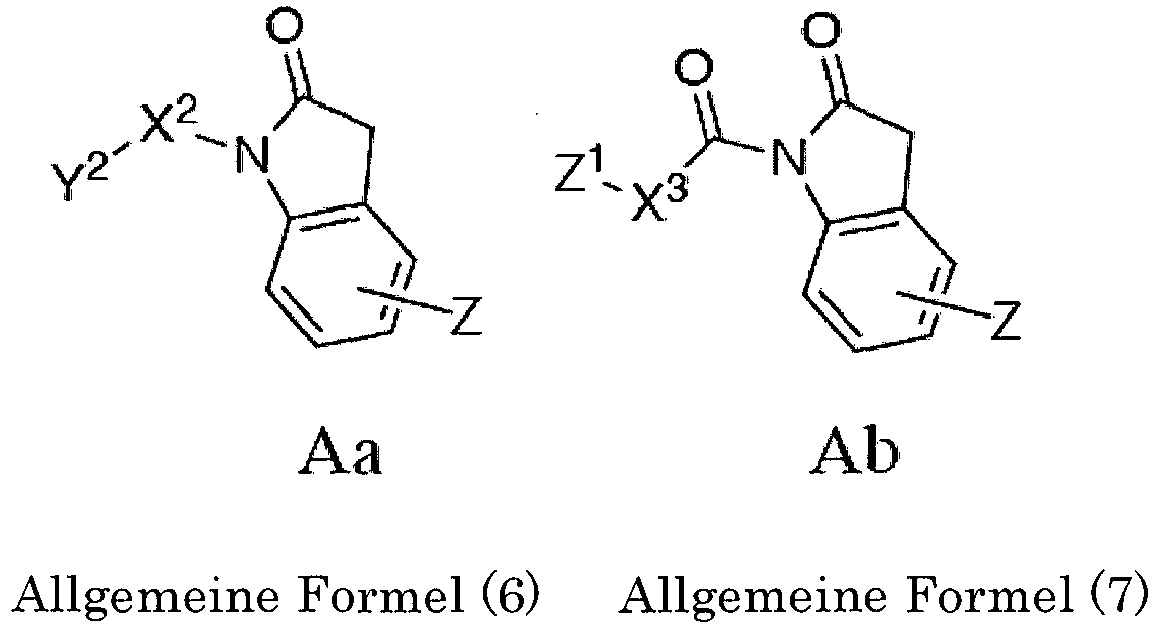 wobei in den Allgemeinen Formeln (6) bis (7),Z1 eine zyklische, geradkettige oder verzweigte Alkyl-Gruppe, welche 8 bis 30 Kohlenstoff-Atome aufweist und ein Halogen-Atom aufweisen kann, darstellt,X2 eine Einzelbindung, -CO-, -CONH-, oder -COO- darstellt,Y2 eine Kohlenwasserstoff-Gruppe, welche 1 bis 30 Kohlenstoff-Atome aufweist und -CN, -NO2, eine Alkoxy-Gruppe, ein Halogen-Atom oder irgendeine Kombination davon aufweisen kann; oder ein Wasserstoff-Atom darstellt,X3 eine Einzelbindung oder -NH- darstellt, undZ ein Wasserstoff-Atom, ein Halogen-Atom, eine Alkoxy-Gruppe mit 1 bis 6 Kohlenstoff-Atomen, oder eine Kohlenwasserstoff-Gruppe mit 1 bis 20 Kohlenstoff-Atomen darstellt.
 - Ein Verfahren zur Herstellung der Verbindung, wie durch eine der Allgemeinen Formeln (1) und (2) dargestellt, des Tautomers oder geometrischen Isomers davon, oder des Salzes davon nach Anspruch 1, wobei das Verfahren umfasst:Mischen und Reagierenlassen einer Oxyindol-Verbindung, wie durch die Allgemeine Formel (6) oder (7) unten dargestellt, mit einem Carboxylsäure-Anhydrid in einem organischen Lösungsmittel in der Gegenwart einer Amin-Base,
 wobei in den Allgemeinen Formeln (6) bis (7),Z1 eine zyklische, geradkettige oder verzweigte Alkyl-Gruppe, welche 8 bis 30 Kohlenstoff-Atome aufweist und ein Halogen-Atom aufweisen kann, darstellt,X2 eine Einzelbindung, -CO-, -CONH-, oder -COO- darstellt,Y2 eine Kohlenwasserstoff-Gruppe, welche 1 bis 30 Kohlenstoff-Atome aufweist und -CN, -NO2, eine Alkoxy-Gruppe, ein Halogen-Atom oder irgendeine Kombination davon aufweisen kann; oder ein Wasserstoff-Atom darstellt,X3 eine Einzelbindung oder -NH- darstellt, undZ ein Wasserstoff-Atom, ein Halogen-Atom, eine Alkoxy-Gruppe mit 1 bis 6 Kohlenstoff-Atomen oder eine Kohlenwasserstoff-Gruppe mit 1 bis 20 Kohlenstoff-Atomen darstellt.
 - An antibakterielles Agens, umfassend:die Verbindung, das Tautomer oder das geometrische Isomer davon, oder das Salz davon nach einem der Ansprüche 1 to 4.
- Ein therapeutischer Wirkstoff gegen eine Infektionserkrankung, umfassend:das antibakterielle Agens nach Anspruch 8.
Applications Claiming Priority (2)
| Application Number | Priority Date | Filing Date | Title |
|---|---|---|---|
| JP2012230270 | 2012-10-17 | ||
| PCT/JP2013/078233 WO2014061752A1 (ja) | 2012-10-17 | 2013-10-17 | 化合物、その互変異性体、幾何異性体、乃至それらの塩、及びそれらの製造方法、抗菌剤、並びに感染症治療薬 |
Publications (3)
| Publication Number | Publication Date |
|---|---|
| EP2910547A1 EP2910547A1 (de) | 2015-08-26 |
| EP2910547A4 EP2910547A4 (de) | 2016-04-06 |
| EP2910547B1 true EP2910547B1 (de) | 2017-06-14 |
Family
ID=50488312
Family Applications (1)
| Application Number | Title | Priority Date | Filing Date |
|---|---|---|---|
| EP13847221.2A Active EP2910547B1 (de) | 2012-10-17 | 2013-10-17 | Verbindung, tautomer und geometrisches isomer davon, salz der verbindung, des tautomers oder des geometrischen isomers, verfahren zur herstellung dieser verbindung, des tautomers, des isomers oder des salzes, antimikrobielles mittel sowie arzneimittel gegen infektionen |
Country Status (5)
| Country | Link |
|---|---|
| US (1) | US9512075B2 (de) |
| EP (1) | EP2910547B1 (de) |
| JP (1) | JP6263124B2 (de) |
| HU (1) | HUE034106T2 (de) |
| WO (1) | WO2014061752A1 (de) |
Families Citing this family (6)
| Publication number | Priority date | Publication date | Assignee | Title |
|---|---|---|---|---|
| AU2018354090B2 (en) | 2017-10-23 | 2024-10-24 | Epitracker, Inc. | Fatty acid analogs and their use in the treatment of conditions related to metabolic syndrome |
| WO2019226572A1 (en) | 2018-05-23 | 2019-11-28 | Epitracker, Inc. | Compositions and methods for diagnosis and treatment of conditions related to the quality of aging and longevity |
| EP3908374A4 (de) | 2019-01-09 | 2022-12-28 | Epitracker, Inc. | Zusammensetzungen und verfahren zur diagnose und behandlung von neurodegenerativen erkrankungen |
| EP3934639A4 (de) | 2019-03-04 | 2023-01-11 | Epitracker, Inc. | Fettsäureanaloge und deren verwendung zur behandlung von kognitiven beeinträchtigungen, verhaltenszuständen und chronischen schmerzen |
| CN113773306B (zh) * | 2021-10-29 | 2023-11-10 | 四川农业大学 | 3,3-二取代吲哚酮类化合物及其制备方法和应用 |
| WO2023080939A1 (en) | 2021-11-03 | 2023-05-11 | Epitracker, Inc. | Pentadecanoylcarnitine for treatment of conditions related to the quality of aging and longevity |
Family Cites Families (13)
| Publication number | Priority date | Publication date | Assignee | Title |
|---|---|---|---|---|
| NL243879A (de) * | 1958-10-01 | |||
| FR2325650A1 (fr) * | 1975-09-29 | 1977-04-22 | Ciba Geigy Ag | Agents de lutte contre les parasites |
| FI80270C (fi) * | 1984-09-19 | 1990-05-10 | Pfizer | Foerfarande foer framstaellning av analgetiska och anti-inflammatoriska 1,3-diacyl-2-oxoindol-foereningar och mellanprodukter. |
| DK0550493T3 (da) * | 1990-09-28 | 1996-03-11 | Upjohn Co | Anthelmintiske og anticoccidiske 3-carbamoyl-4-hydroxycoumariner, fremgangsmåde til deres anvendelse og sammensætninger |
| WO1994005649A1 (en) * | 1992-09-01 | 1994-03-17 | Pfizer Inc. | 4-hydroxy coumarin derivatives with antibacterial activity |
| JPH06340649A (ja) * | 1993-05-31 | 1994-12-13 | Lab Farmaceut Rovi Sa | クマリンから誘導される新規な抗血栓剤及びその製造法 |
| DK0869785T3 (da) * | 1995-11-17 | 2002-12-16 | Upjohn Co | 4-Hydroxycoumarin-3-carboxyamider til behandling af ikke-insulinafhængig diabetes mellitus |
| JPH11349568A (ja) * | 1998-06-08 | 1999-12-21 | Maruho Co Ltd | ラクタム誘導体及びその医薬用途 |
| PE20040701A1 (es) * | 2002-07-23 | 2004-11-30 | Boehringer Ingelheim Pharma | Derivados de indolinona sustituidos en posicion 6 y su preparacion como medicamentos |
| US7169936B2 (en) | 2002-07-23 | 2007-01-30 | Boehringer Ingelheim Pharma Gmbh & Co. Kg | Indolinone derivatives substituted in the 6-position, their preparation and their use as medicaments |
| US7012088B2 (en) * | 2003-02-24 | 2006-03-14 | Pharmacia & Upjohn Company | Indolone oxazolidinones and derivatives thereof |
| CN102224252A (zh) | 2008-08-26 | 2011-10-19 | 学校法人近畿大学 | 新型化合物西格纳霉素、其制造方法以及其用途 |
| CN102217597A (zh) * | 2011-04-21 | 2011-10-19 | 南开大学 | 3-苯甲酰基-4-羟基香豆素衍生物在农用杀菌方面的应用 |
-
2013
- 2013-10-17 EP EP13847221.2A patent/EP2910547B1/de active Active
- 2013-10-17 WO PCT/JP2013/078233 patent/WO2014061752A1/ja not_active Ceased
- 2013-10-17 US US14/436,316 patent/US9512075B2/en active Active
- 2013-10-17 HU HUE13847221A patent/HUE034106T2/en unknown
- 2013-10-17 JP JP2014542179A patent/JP6263124B2/ja active Active
Also Published As
| Publication number | Publication date |
|---|---|
| EP2910547A1 (de) | 2015-08-26 |
| US9512075B2 (en) | 2016-12-06 |
| HUE034106T2 (en) | 2018-01-29 |
| JPWO2014061752A1 (ja) | 2016-09-05 |
| JP6263124B2 (ja) | 2018-01-17 |
| EP2910547A4 (de) | 2016-04-06 |
| US20150291523A1 (en) | 2015-10-15 |
| WO2014061752A1 (ja) | 2014-04-24 |
Similar Documents
| Publication | Publication Date | Title |
|---|---|---|
| EP2910547A1 (de) | Verbindung, tautomer und geometrisches isomer davon, salz der verbindung, des tautomers oder des geometrischen isomers, verfahren zur herstellung dieser verbindung, des tautomers, des isomers oder des salzes, antimikrobielles mittel sowie arzneimittel gegen infektionen | |
| US10370341B2 (en) | Compounds and methods of treating infections | |
| CN105142642B (zh) | 癌症治疗方法 | |
| US9447134B2 (en) | Compounds and methods for treating mammalian gastrointestinal microbial infections | |
| EP1109805B1 (de) | Inhibitoren der bakteriellen nad synthetase | |
| JP2017533187A (ja) | 非β−ラクタム系抗生物質 | |
| WO2013142812A1 (en) | Antibacterial agents: sidechain-fluorinated myxopyronin derivatives | |
| Bi et al. | Design, synthesis and structure-based optimization of novel isoxazole-containing benzamide derivatives as FtsZ modulators | |
| CZ200443A3 (cs) | Heterocyklické sloučeniny a jejich použití jakožto inhibitorů D@Ala@D@ala ligasy | |
| CN101232884A (zh) | 作为抗菌剂的喹啉衍生物 | |
| EP2491009A1 (de) | Cyclopentancarboxamidderivate, arzneimittel mit derartigen verbindungen und ihre verwendung | |
| WO2009145829A1 (en) | Type iii secretion inhibitors, analogs and uses thereof | |
| CN111777570A (zh) | 一种广谱抗菌的苯甲酰胺化合物、制备方法和用途 | |
| AU2009352134B2 (en) | Novel antibacterial hydroxyphenyl compound | |
| CN101351204B (zh) | 芳脒衍生物及其盐、以及含有它们的抗真菌药 | |
| CN108117502A (zh) | 一类2-取代-(s)-(3-巯基-2-甲基丙酰基)-甘氨酸衍生物的制备及用途 | |
| US20230406831A1 (en) | Compounds and methods of inhibiting bacterial chaperonin systems | |
| CN116102478B (zh) | 1,4-二羰基氨基硫脲类化合物的制备方法和抗感染的用途 | |
| US12552782B2 (en) | Analogs of nitrofuran antibiotics to combat resistance | |
| Assimon et al. | Concise synthesis of spergualin-inspired molecules with broad-spectrum antibiotic activity | |
| EP0761215A1 (de) | Antibakterieller wirkstoff | |
| EP1845779A1 (de) | Antibakterielle verbindungen | |
| WO2003087127A2 (en) | Antimicrobial compounds against staphylococci, mycobacteria, and other infectious agents | |
| HK1173136B (en) | Novel antibacterial hydroxyphenyl compound | |
| HK1213771B (en) | Methods of treating cancer |
Legal Events
| Date | Code | Title | Description |
|---|---|---|---|
| PUAI | Public reference made under article 153(3) epc to a published international application that has entered the european phase |
Free format text: ORIGINAL CODE: 0009012 |
|
| 17P | Request for examination filed |
Effective date: 20150430 |
|
| AK | Designated contracting states |
Kind code of ref document: A1 Designated state(s): AL AT BE BG CH CY CZ DE DK EE ES FI FR GB GR HR HU IE IS IT LI LT LU LV MC MK MT NL NO PL PT RO RS SE SI SK SM TR |
|
| AX | Request for extension of the european patent |
Extension state: BA ME |
|
| RAP1 | Party data changed (applicant data changed or rights of an application transferred) |
Owner name: KINKI UNIVERSITY Owner name: OKAYAMA UNIVERSITY Owner name: MICROBIAL CHEMISTRY RESEARCH FOUNDATION |
|
| DAX | Request for extension of the european patent (deleted) | ||
| RA4 | Supplementary search report drawn up and despatched (corrected) |
Effective date: 20160308 |
|
| RIC1 | Information provided on ipc code assigned before grant |
Ipc: A61P 31/04 20060101ALI20160302BHEP Ipc: C07D 209/34 20060101AFI20160302BHEP Ipc: A61K 31/404 20060101ALI20160302BHEP Ipc: C07D 311/56 20060101ALI20160302BHEP Ipc: A61K 31/353 20060101ALI20160302BHEP |
|
| GRAP | Despatch of communication of intention to grant a patent |
Free format text: ORIGINAL CODE: EPIDOSNIGR1 |
|
| STAA | Information on the status of an ep patent application or granted ep patent |
Free format text: STATUS: GRANT OF PATENT IS INTENDED |
|
| INTG | Intention to grant announced |
Effective date: 20161213 |
|
| GRAS | Grant fee paid |
Free format text: ORIGINAL CODE: EPIDOSNIGR3 |
|
| GRAA | (expected) grant |
Free format text: ORIGINAL CODE: 0009210 |
|
| STAA | Information on the status of an ep patent application or granted ep patent |
Free format text: STATUS: THE PATENT HAS BEEN GRANTED |
|
| RAP1 | Party data changed (applicant data changed or rights of an application transferred) |
Owner name: KINKI UNIVERSITY Owner name: OKAYAMA UNIVERSITY Owner name: MICROBIAL CHEMISTRY RESEARCH FOUNDATION |
|
| AK | Designated contracting states |
Kind code of ref document: B1 Designated state(s): AL AT BE BG CH CY CZ DE DK EE ES FI FR GB GR HR HU IE IS IT LI LT LU LV MC MK MT NL NO PL PT RO RS SE SI SK SM TR |
|
| REG | Reference to a national code |
Ref country code: GB Ref legal event code: FG4D |
|
| REG | Reference to a national code |
Ref country code: CH Ref legal event code: EP Ref country code: AT Ref legal event code: REF Ref document number: 900814 Country of ref document: AT Kind code of ref document: T Effective date: 20170615 |
|
| REG | Reference to a national code |
Ref country code: IE Ref legal event code: FG4D |
|
| REG | Reference to a national code |
Ref country code: DE Ref legal event code: R096 Ref document number: 602013022412 Country of ref document: DE |
|
| RAP2 | Party data changed (patent owner data changed or rights of a patent transferred) |
Owner name: OKAYAMA UNIVERSITY Owner name: MICROBIAL CHEMISTRY RESEARCH FOUNDATION Owner name: KINKI UNIVERSITY |
|
| REG | Reference to a national code |
Ref country code: NL Ref legal event code: MP Effective date: 20170614 |
|
| REG | Reference to a national code |
Ref country code: FR Ref legal event code: PLFP Year of fee payment: 5 |
|
| REG | Reference to a national code |
Ref country code: LT Ref legal event code: MG4D |
|
| PG25 | Lapsed in a contracting state [announced via postgrant information from national office to epo] |
Ref country code: LT Free format text: LAPSE BECAUSE OF FAILURE TO SUBMIT A TRANSLATION OF THE DESCRIPTION OR TO PAY THE FEE WITHIN THE PRESCRIBED TIME-LIMIT Effective date: 20170614 Ref country code: GR Free format text: LAPSE BECAUSE OF FAILURE TO SUBMIT A TRANSLATION OF THE DESCRIPTION OR TO PAY THE FEE WITHIN THE PRESCRIBED TIME-LIMIT Effective date: 20170915 Ref country code: FI Free format text: LAPSE BECAUSE OF FAILURE TO SUBMIT A TRANSLATION OF THE DESCRIPTION OR TO PAY THE FEE WITHIN THE PRESCRIBED TIME-LIMIT Effective date: 20170614 Ref country code: NO Free format text: LAPSE BECAUSE OF FAILURE TO SUBMIT A TRANSLATION OF THE DESCRIPTION OR TO PAY THE FEE WITHIN THE PRESCRIBED TIME-LIMIT Effective date: 20170914 Ref country code: HR Free format text: LAPSE BECAUSE OF FAILURE TO SUBMIT A TRANSLATION OF THE DESCRIPTION OR TO PAY THE FEE WITHIN THE PRESCRIBED TIME-LIMIT Effective date: 20170614 |
|
| REG | Reference to a national code |
Ref country code: AT Ref legal event code: MK05 Ref document number: 900814 Country of ref document: AT Kind code of ref document: T Effective date: 20170614 |
|
| PG25 | Lapsed in a contracting state [announced via postgrant information from national office to epo] |
Ref country code: NL Free format text: LAPSE BECAUSE OF FAILURE TO SUBMIT A TRANSLATION OF THE DESCRIPTION OR TO PAY THE FEE WITHIN THE PRESCRIBED TIME-LIMIT Effective date: 20170614 Ref country code: BG Free format text: LAPSE BECAUSE OF FAILURE TO SUBMIT A TRANSLATION OF THE DESCRIPTION OR TO PAY THE FEE WITHIN THE PRESCRIBED TIME-LIMIT Effective date: 20170914 Ref country code: RS Free format text: LAPSE BECAUSE OF FAILURE TO SUBMIT A TRANSLATION OF THE DESCRIPTION OR TO PAY THE FEE WITHIN THE PRESCRIBED TIME-LIMIT Effective date: 20170614 Ref country code: LV Free format text: LAPSE BECAUSE OF FAILURE TO SUBMIT A TRANSLATION OF THE DESCRIPTION OR TO PAY THE FEE WITHIN THE PRESCRIBED TIME-LIMIT Effective date: 20170614 Ref country code: SE Free format text: LAPSE BECAUSE OF FAILURE TO SUBMIT A TRANSLATION OF THE DESCRIPTION OR TO PAY THE FEE WITHIN THE PRESCRIBED TIME-LIMIT Effective date: 20170614 |
|
| REG | Reference to a national code |
Ref country code: HU Ref legal event code: AG4A Ref document number: E034106 Country of ref document: HU |
|
| PG25 | Lapsed in a contracting state [announced via postgrant information from national office to epo] |
Ref country code: AT Free format text: LAPSE BECAUSE OF FAILURE TO SUBMIT A TRANSLATION OF THE DESCRIPTION OR TO PAY THE FEE WITHIN THE PRESCRIBED TIME-LIMIT Effective date: 20170614 Ref country code: CZ Free format text: LAPSE BECAUSE OF FAILURE TO SUBMIT A TRANSLATION OF THE DESCRIPTION OR TO PAY THE FEE WITHIN THE PRESCRIBED TIME-LIMIT Effective date: 20170614 Ref country code: SK Free format text: LAPSE BECAUSE OF FAILURE TO SUBMIT A TRANSLATION OF THE DESCRIPTION OR TO PAY THE FEE WITHIN THE PRESCRIBED TIME-LIMIT Effective date: 20170614 Ref country code: EE Free format text: LAPSE BECAUSE OF FAILURE TO SUBMIT A TRANSLATION OF THE DESCRIPTION OR TO PAY THE FEE WITHIN THE PRESCRIBED TIME-LIMIT Effective date: 20170614 Ref country code: RO Free format text: LAPSE BECAUSE OF FAILURE TO SUBMIT A TRANSLATION OF THE DESCRIPTION OR TO PAY THE FEE WITHIN THE PRESCRIBED TIME-LIMIT Effective date: 20170614 |
|
| PG25 | Lapsed in a contracting state [announced via postgrant information from national office to epo] |
Ref country code: PL Free format text: LAPSE BECAUSE OF FAILURE TO SUBMIT A TRANSLATION OF THE DESCRIPTION OR TO PAY THE FEE WITHIN THE PRESCRIBED TIME-LIMIT Effective date: 20170614 Ref country code: ES Free format text: LAPSE BECAUSE OF FAILURE TO SUBMIT A TRANSLATION OF THE DESCRIPTION OR TO PAY THE FEE WITHIN THE PRESCRIBED TIME-LIMIT Effective date: 20170614 Ref country code: SM Free format text: LAPSE BECAUSE OF FAILURE TO SUBMIT A TRANSLATION OF THE DESCRIPTION OR TO PAY THE FEE WITHIN THE PRESCRIBED TIME-LIMIT Effective date: 20170614 Ref country code: IT Free format text: LAPSE BECAUSE OF FAILURE TO SUBMIT A TRANSLATION OF THE DESCRIPTION OR TO PAY THE FEE WITHIN THE PRESCRIBED TIME-LIMIT Effective date: 20170614 Ref country code: IS Free format text: LAPSE BECAUSE OF FAILURE TO SUBMIT A TRANSLATION OF THE DESCRIPTION OR TO PAY THE FEE WITHIN THE PRESCRIBED TIME-LIMIT Effective date: 20171014 |
|
| REG | Reference to a national code |
Ref country code: DE Ref legal event code: R097 Ref document number: 602013022412 Country of ref document: DE |
|
| PLBE | No opposition filed within time limit |
Free format text: ORIGINAL CODE: 0009261 |
|
| STAA | Information on the status of an ep patent application or granted ep patent |
Free format text: STATUS: NO OPPOSITION FILED WITHIN TIME LIMIT |
|
| PG25 | Lapsed in a contracting state [announced via postgrant information from national office to epo] |
Ref country code: DK Free format text: LAPSE BECAUSE OF FAILURE TO SUBMIT A TRANSLATION OF THE DESCRIPTION OR TO PAY THE FEE WITHIN THE PRESCRIBED TIME-LIMIT Effective date: 20170614 |
|
| 26N | No opposition filed |
Effective date: 20180315 |
|
| PG25 | Lapsed in a contracting state [announced via postgrant information from national office to epo] |
Ref country code: MC Free format text: LAPSE BECAUSE OF FAILURE TO SUBMIT A TRANSLATION OF THE DESCRIPTION OR TO PAY THE FEE WITHIN THE PRESCRIBED TIME-LIMIT Effective date: 20170614 |
|
| REG | Reference to a national code |
Ref country code: CH Ref legal event code: PL |
|
| REG | Reference to a national code |
Ref country code: IE Ref legal event code: MM4A |
|
| PG25 | Lapsed in a contracting state [announced via postgrant information from national office to epo] |
Ref country code: LU Free format text: LAPSE BECAUSE OF NON-PAYMENT OF DUE FEES Effective date: 20171017 Ref country code: LI Free format text: LAPSE BECAUSE OF NON-PAYMENT OF DUE FEES Effective date: 20171031 Ref country code: CH Free format text: LAPSE BECAUSE OF NON-PAYMENT OF DUE FEES Effective date: 20171031 |
|
| REG | Reference to a national code |
Ref country code: BE Ref legal event code: MM Effective date: 20171031 |
|
| PG25 | Lapsed in a contracting state [announced via postgrant information from national office to epo] |
Ref country code: BE Free format text: LAPSE BECAUSE OF NON-PAYMENT OF DUE FEES Effective date: 20171031 Ref country code: SI Free format text: LAPSE BECAUSE OF FAILURE TO SUBMIT A TRANSLATION OF THE DESCRIPTION OR TO PAY THE FEE WITHIN THE PRESCRIBED TIME-LIMIT Effective date: 20170614 |
|
| PG25 | Lapsed in a contracting state [announced via postgrant information from national office to epo] |
Ref country code: MT Free format text: LAPSE BECAUSE OF NON-PAYMENT OF DUE FEES Effective date: 20171017 |
|
| REG | Reference to a national code |
Ref country code: FR Ref legal event code: PLFP Year of fee payment: 6 |
|
| PG25 | Lapsed in a contracting state [announced via postgrant information from national office to epo] |
Ref country code: IE Free format text: LAPSE BECAUSE OF NON-PAYMENT OF DUE FEES Effective date: 20171017 |
|
| PG25 | Lapsed in a contracting state [announced via postgrant information from national office to epo] |
Ref country code: CY Free format text: LAPSE BECAUSE OF FAILURE TO SUBMIT A TRANSLATION OF THE DESCRIPTION OR TO PAY THE FEE WITHIN THE PRESCRIBED TIME-LIMIT Effective date: 20170614 |
|
| PG25 | Lapsed in a contracting state [announced via postgrant information from national office to epo] |
Ref country code: MK Free format text: LAPSE BECAUSE OF FAILURE TO SUBMIT A TRANSLATION OF THE DESCRIPTION OR TO PAY THE FEE WITHIN THE PRESCRIBED TIME-LIMIT Effective date: 20170614 |
|
| PG25 | Lapsed in a contracting state [announced via postgrant information from national office to epo] |
Ref country code: TR Free format text: LAPSE BECAUSE OF FAILURE TO SUBMIT A TRANSLATION OF THE DESCRIPTION OR TO PAY THE FEE WITHIN THE PRESCRIBED TIME-LIMIT Effective date: 20170614 |
|
| PG25 | Lapsed in a contracting state [announced via postgrant information from national office to epo] |
Ref country code: PT Free format text: LAPSE BECAUSE OF FAILURE TO SUBMIT A TRANSLATION OF THE DESCRIPTION OR TO PAY THE FEE WITHIN THE PRESCRIBED TIME-LIMIT Effective date: 20170614 |
|
| PG25 | Lapsed in a contracting state [announced via postgrant information from national office to epo] |
Ref country code: AL Free format text: LAPSE BECAUSE OF FAILURE TO SUBMIT A TRANSLATION OF THE DESCRIPTION OR TO PAY THE FEE WITHIN THE PRESCRIBED TIME-LIMIT Effective date: 20170614 |
|
| REG | Reference to a national code |
Ref country code: GB Ref legal event code: 732E Free format text: REGISTERED BETWEEN 20231005 AND 20231011 |
|
| REG | Reference to a national code |
Ref country code: DE Ref legal event code: R081 Ref document number: 602013022412 Country of ref document: DE Owner name: MICROBIAL CHEMISTRY RESEARCH FOUNDATION, JP Free format text: FORMER OWNERS: KINKI UNIVERSITY, HIGASHIOSAKA-SHI, OSAKA, JP; MICROBIAL CHEMISTRY RESEARCH FOUNDATION, TOKIO/TOKYO, JP; OKAYAMA UNIVERSITY, OKAYAMA, JP Ref country code: DE Ref legal event code: R081 Ref document number: 602013022412 Country of ref document: DE Owner name: KINKI UNIVERSITY, HIGASHIOSAKA-SHI, JP Free format text: FORMER OWNERS: KINKI UNIVERSITY, HIGASHIOSAKA-SHI, OSAKA, JP; MICROBIAL CHEMISTRY RESEARCH FOUNDATION, TOKIO/TOKYO, JP; OKAYAMA UNIVERSITY, OKAYAMA, JP |
|
| PGFP | Annual fee paid to national office [announced via postgrant information from national office to epo] |
Ref country code: HU Payment date: 20241011 Year of fee payment: 12 |
|
| PGFP | Annual fee paid to national office [announced via postgrant information from national office to epo] |
Ref country code: DE Payment date: 20240927 Year of fee payment: 12 |
|
| PGFP | Annual fee paid to national office [announced via postgrant information from national office to epo] |
Ref country code: GB Payment date: 20241024 Year of fee payment: 12 |
|
| PGFP | Annual fee paid to national office [announced via postgrant information from national office to epo] |
Ref country code: FR Payment date: 20241025 Year of fee payment: 12 |