EP2910916A1 - Gesamtlufttemperatursonde mit niedriger stirnseitiger Projektionsfläche - Google Patents
Gesamtlufttemperatursonde mit niedriger stirnseitiger Projektionsfläche Download PDFInfo
- Publication number
- EP2910916A1 EP2910916A1 EP15154698.3A EP15154698A EP2910916A1 EP 2910916 A1 EP2910916 A1 EP 2910916A1 EP 15154698 A EP15154698 A EP 15154698A EP 2910916 A1 EP2910916 A1 EP 2910916A1
- Authority
- EP
- European Patent Office
- Prior art keywords
- tat
- airflow
- probe
- tat probe
- flow passage
- Prior art date
- Legal status (The legal status is an assumption and is not a legal conclusion. Google has not performed a legal analysis and makes no representation as to the accuracy of the status listed.)
- Ceased
Links
Images




Classifications
-
- G—PHYSICS
- G01—MEASURING; TESTING
- G01K—MEASURING TEMPERATURE; MEASURING QUANTITY OF HEAT; THERMALLY-SENSITIVE ELEMENTS NOT OTHERWISE PROVIDED FOR
- G01K13/00—Thermometers specially adapted for specific purposes
- G01K13/02—Thermometers specially adapted for specific purposes for measuring temperature of moving fluids or granular materials capable of flow
- G01K13/028—Thermometers specially adapted for specific purposes for measuring temperature of moving fluids or granular materials capable of flow for use in total air temperature [TAT] probes
Definitions
- the present disclosure relates to total air temperature probes, and more particularly, to reducing the frontal projected area of the total air temperature probe for improving performance in precipitation environments.
- TAT Total Air Temperature
- Conventional Total Air Temperature (TAT) probes although often remarkably efficient as a TAT sensor, sometimes face the difficulty of working in icing conditions.
- water droplets, and/or ice crystals are ingested into the TAT probe where, under moderate to severe conditions, they can accrete on the TAT probe surfaces. If operation in the severe weather persists, internal accretion may lead to congestion and clogging around the internal sensing element. Further, internal TAT congestion may lead to a temporary erroneous TAT reading.
- conventional TAT probes may be electrically heated and also incorporate an elbow, or bend, to inertially separate particles in airflow before reaching the sensing element.
- Figure 1 illustrates a typical TAT probe design with an inclined surface upstream of the element passage commonly referred to as an air bump.
- the air bump aids inertial filtering and also provides a means of boundary layer bleed control.
- the air bump provides a significant projected area that will be exposed to particle impacts. Particle impacts on the heated air bump may produce surface liquid that may limit satisfactory performance in rain, ice and ice crystal environments.
- the internal temperature element is typically thermally isolated from the main heated probe so that DHE is minimized. Under certain icing conditions internal accretion may form and grow on the thermally isolated temperature element. Rapid, and sometimes complete, blockage of the probe may occur, thereby leading to erroneous temperature measurements. Introduction of more severe aerospace icing requirements are increasingly problematic for conventional TAT probes.
- a TAT probe may comprise an airflow inlet having a first surface substantially parallel to an incoming airflow, a primary airflow passage through the TAT probe from the airflow inlet to a primary airflow outlet, and a total air temperature sensor assembly disposed within a sensor flow passage.
- the sensor flow passage may be oriented perpendicular to a mounting surface of the TAT probe.
- the first surface may be perpendicular to the sensor flow passage.
- the airflow inlet may have a second surface that is inclined relative to the first surface to help facilitate a desirable pressure gradient and boundary bleed passage function.
- Air temperature is better defined by the following four temperatures: (1) Static air temperature (SAT) or (Ts), (2) total air temperature (TAT) or (Tt), (3) recovery temperature (Tr), and (4) measured temperature (Tm).
- Static air temperature (SAT) or (Ts) is the temperature of the undisturbed air through which the aircraft is about to fly.
- Total air temperature (TAT) or (Tt) is the maximum air temperature that can be attained by 100% conversion of the kinetic energy of the flight.
- TAT The measurement of TAT is derived from the recovery temperature (Tr), which is the adiabatic value of local air temperature on each portion of the aircraft surface due to incomplete recovery of the kinetic energy. Temperature (Tr) is in turn obtained from the measured temperature (Tm), which is the actual temperature as measured, and which differs from recovery temperature because of heat transfer effects due to imposed environments.
- TAT probes may be used for measuring the TAT.
- FIGS 2A-2C illustrate an exemplary total air temperature (TAT) probe in which a lower surface of an airflow inlet is substantially parallel to an airflow.
- substantially parallel may include the lower surface of the airflow inlet being within 4° or less of parallel of the airflow.
- substantially parallel may include the lower surface of the airflow inlet being within 2° or less of parallel of the airflow.
- the lower surface of the airflow inlet could be below parallel to the airflow, such as -10° or less of parallel.
- a TAT probe 200 comprises an airflow inlet 210 having a first surface 211 substantially parallel to an incoming airflow, a primary airflow passage 215 through the TAT probe 200 from the airflow inlet 210 to a primary airflow outlet 220, a sensor flow passage 230 in fluid communication with the primary airflow passage 215 and oriented perpendicular to a mounting surface 201 of the TAT probe 200.
- a TAT sensor assembly 231 may be disposed within the sensor flow passage 230.
- the first surface 211 may be perpendicular to the sensor flow passage 230.
- the first surface 211 may be adjacent to the sensor flow passage 230 and transitions between the airflow inlet and the sensor passage in an arcing manner.
- the airflow inlet 210 has a second surface 212 that may be inclined relative to the first surface 211.
- the first surface 211 and the second surface 212 of the airflow inlet 210 may be converging towards the primary airflow outlet 220.
- the first surface 211 of the airflow inlet 210 may be heated. Any precipitation or icing present on the first surface 211 may be heated into surface liquid and then directed away from the sensor assembly through bleed vents.
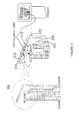
- Figure 3 illustrates a sectional view of a TAT probe 300 and the airflow and particle flow into a primary airflow inlet 310. A portion of the flow exits through a primary airflow outlet 320. However, some airflow is diverted down a sensor flow passage 330, where a TAT sensor assembly 331 measures the temperature.
- Figure 3 also illustrates how particles, such as rain and ice crystals, flowing through the primary airflow inlet 310 impacts the upper surface 312 and exit through the primary airflow outlet 320.
- Figure 3 also illustrates how particles may flow substantially parallel to the lower surface when flowing through the TAT probe 300. In accordance with various embodiments, particle impacts on the lower surface may be minimal and generate less liquid being present on the lower surface.
- FIGS 4A-4C illustrate various embodiments of TAT probes designed such that a primary airflow outlet 420 is below a plane 400 of the first surface 411 of the airflow inlet 410, creating an offset 401.
- an offset may result in less particles flowing into a sensor flow passage.
- TAT probes having larger offset heights may be designed with additional curvature at the aft 421 of a second surface 412.
- bleed vents may be used to divert surface liquid away from the impact area of the airflow inlet.
- a TAT probe may further comprise corner bleed vents 501 at the corner of the first surface 511 of the airflow inlet in addition to surface bleed vents 502.
- Surface bleed vents 502 may be located on an interior portion of the first surface 51 l.
- a corner may be defined as the transition between the first surface 511 to a vertical surface 513.
- the transition may be different radii 520, 521, depending on the TAT probe design and as illustrated in Figures 5A and 5B .
- An exemplary radius may range between a 0 inch (0 cm) radius to a .25 inch (0.635 cm) radius.
- the bleed vents may be located at a transition area between the first surface and the sensor flow passage.
- references to "one embodiment”, “an embodiment”, “various embodiments”, etc. indicate that the embodiment described may include a particular feature, structure, or characteristic, but every embodiment may not necessarily include the particular feature, structure, or characteristic. Moreover, such phrases are not necessarily referring to the same embodiment. Further, when a particular feature, structure, or characteristic is described in connection with an embodiment, it is submitted that it is within the knowledge of one skilled in the art to affect such feature, structure, or characteristic in connection with other embodiments whether or not explicitly described. After reading the description, it will be apparent to one skilled in the relevant art(s) how to implement the disclosure in alternative embodiments.
Landscapes
- Physics & Mathematics (AREA)
- General Physics & Mathematics (AREA)
- Measuring Temperature Or Quantity Of Heat (AREA)
Applications Claiming Priority (1)
| Application Number | Priority Date | Filing Date | Title |
|---|---|---|---|
| US14/186,728 US9429482B2 (en) | 2014-02-21 | 2014-02-21 | Total air temperature probe with low frontal projected area |
Publications (1)
| Publication Number | Publication Date |
|---|---|
| EP2910916A1 true EP2910916A1 (de) | 2015-08-26 |
Family
ID=52462870
Family Applications (1)
| Application Number | Title | Priority Date | Filing Date |
|---|---|---|---|
| EP15154698.3A Ceased EP2910916A1 (de) | 2014-02-21 | 2015-02-11 | Gesamtlufttemperatursonde mit niedriger stirnseitiger Projektionsfläche |
Country Status (5)
| Country | Link |
|---|---|
| US (1) | US9429482B2 (de) |
| EP (1) | EP2910916A1 (de) |
| CN (1) | CN105157878B (de) |
| BR (1) | BR102015002343B1 (de) |
| CA (1) | CA2878632A1 (de) |
Families Citing this family (9)
| Publication number | Priority date | Publication date | Assignee | Title |
|---|---|---|---|---|
| US9829395B2 (en) * | 2012-12-13 | 2017-11-28 | Rosemount Aerospace Inc. | Air temperature sensor arrangement for a vehicle and method of measuring air temperature |
| US9963242B1 (en) * | 2014-04-29 | 2018-05-08 | Blue Storm Associates, Inc. | Mountable sensor for an aircraft |
| US20160238456A1 (en) * | 2015-02-12 | 2016-08-18 | Rosemount Aerospace Inc. | Air temperature sensor and fabrication |
| US10371586B2 (en) | 2017-06-05 | 2019-08-06 | General Electric Company | Heated temperature sensor assembly |
| USD976138S1 (en) * | 2018-06-15 | 2023-01-24 | Rosemount Aerospace, Inc. | Aircraft temperature probe |
| USD976139S1 (en) * | 2018-06-15 | 2023-01-24 | Rosemount Aerospace, Inc. | Aircraft temperature probe |
| US11879345B2 (en) | 2020-02-28 | 2024-01-23 | Rosemount Aerospace Inc. | Pressure and temperature sensors and methods of removing ice from pressure and temperature sensors |
| US11655726B2 (en) * | 2020-02-28 | 2023-05-23 | Rosemount Aerospace Inc. | Pressure and temperature sensors and related methods |
| US11773745B2 (en) | 2020-02-28 | 2023-10-03 | Rosemount Aerospace Inc. | Pressure and temperature sensors and methods of controlling ice accretion on pressure and temperature sensors |
Citations (3)
| Publication number | Priority date | Publication date | Assignee | Title |
|---|---|---|---|---|
| EP1457765A1 (de) * | 2003-03-13 | 2004-09-15 | Rosemount Aerospace Inc. | Gesamtlufttemperatursonde mit einem zwiten Sensormesskammer |
| US20040237641A1 (en) * | 2001-12-11 | 2004-12-02 | Nicolas Hanson | Multipurpose sensor for aircraft |
| US20060056489A1 (en) * | 2002-06-14 | 2006-03-16 | Marc Bernard | De-iced total air temperature sensor |
Family Cites Families (10)
| Publication number | Priority date | Publication date | Assignee | Title |
|---|---|---|---|---|
| US2970475A (en) * | 1956-10-08 | 1961-02-07 | Rosemount Eng Co Ltd | Gas temperature probe |
| FR2802647B1 (fr) * | 1999-12-17 | 2002-03-01 | Thomson Csf Sextant | Sonde pour aeronef |
| US6609825B2 (en) * | 2001-09-21 | 2003-08-26 | Rosemount Aerospace Inc. | Total air temperature probe providing improved anti-icing performance and reduced deicing heater error |
| US7370526B1 (en) * | 2003-03-13 | 2008-05-13 | Rosemount Aerospace Inc. | Total air temperature probe providing a secondary sensor measurement chamber |
| FR2859787B1 (fr) * | 2003-09-16 | 2006-01-20 | Thales Sa | Dispositif et procede de determination de la temperature totale pour aeronef |
| US6974250B2 (en) * | 2004-04-15 | 2005-12-13 | Rosemount Aerospace Inc. | Temperature sensor with controlled thermal offset for determining static temperature |
| US7357572B2 (en) * | 2005-09-20 | 2008-04-15 | Rosemount Aerospace Inc. | Total air temperature probe having improved deicing heater error performance |
| US7861968B2 (en) * | 2006-10-26 | 2011-01-04 | The Boeing Company | Air inlet and method for a highspeed mobile platform |
| GB2455728A (en) * | 2007-12-18 | 2009-06-24 | Weston Aerospace Ltd | Air temperature sensing on aircraft |
| DE102008029793A1 (de) * | 2008-03-19 | 2009-10-01 | Epcos Ag | Messvorrichtung |
-
2014
- 2014-02-21 US US14/186,728 patent/US9429482B2/en active Active
-
2015
- 2015-01-13 CA CA2878632A patent/CA2878632A1/en not_active Abandoned
- 2015-02-02 BR BR102015002343-0A patent/BR102015002343B1/pt active IP Right Grant
- 2015-02-11 EP EP15154698.3A patent/EP2910916A1/de not_active Ceased
- 2015-02-25 CN CN201510086685.0A patent/CN105157878B/zh active Active
Patent Citations (3)
| Publication number | Priority date | Publication date | Assignee | Title |
|---|---|---|---|---|
| US20040237641A1 (en) * | 2001-12-11 | 2004-12-02 | Nicolas Hanson | Multipurpose sensor for aircraft |
| US20060056489A1 (en) * | 2002-06-14 | 2006-03-16 | Marc Bernard | De-iced total air temperature sensor |
| EP1457765A1 (de) * | 2003-03-13 | 2004-09-15 | Rosemount Aerospace Inc. | Gesamtlufttemperatursonde mit einem zwiten Sensormesskammer |
Also Published As
| Publication number | Publication date |
|---|---|
| CA2878632A1 (en) | 2015-08-21 |
| CN105157878A (zh) | 2015-12-16 |
| CN105157878B (zh) | 2020-02-07 |
| BR102015002343A2 (pt) | 2015-12-22 |
| US20150241286A1 (en) | 2015-08-27 |
| BR102015002343B1 (pt) | 2021-04-20 |
| US9429482B2 (en) | 2016-08-30 |
Similar Documents
| Publication | Publication Date | Title |
|---|---|---|
| US9429482B2 (en) | Total air temperature probe with low frontal projected area | |
| US10151641B2 (en) | Total air temperature probes for reducing deicing heater error | |
| CA2867782C (en) | Total air temperature sensors | |
| EP1436581B1 (de) | Gesamtlufttemperatursonde mit verbesserter ant-icing-leistungsfähigkeit und verringertem enteisungsheizelementfehler | |
| US8104955B2 (en) | Aspirated enhanced total air temperature probe | |
| EP3763622B1 (de) | Eisdetektorgerät, -verfahren und flugzeug | |
| CN1936526B (zh) | 具有改进的防冻加热器误差性能的全气温探头 | |
| EP2848904B1 (de) | Überkritische Gesamtlufttemperatursensoren | |
| EP2866011B1 (de) | Temperatursensoren | |
| CN107543649B (zh) | 热气除冰总压受感器 | |
| US20160032757A1 (en) | Engine Inlet Total Air Temperature Sensor | |
| CN105136341B (zh) | 总空气温度传感器 | |
| Al-Masri | Experimental investigation on the icing physics and anti-/de-Icing technology of an aircraft pitot probe | |
| EP3885265A1 (de) | Heizerleistungsmodulation auf basis der aussenlufttemperatur und flugzeuggeschwindigkeit |
Legal Events
| Date | Code | Title | Description |
|---|---|---|---|
| PUAI | Public reference made under article 153(3) epc to a published international application that has entered the european phase |
Free format text: ORIGINAL CODE: 0009012 |
|
| AK | Designated contracting states |
Kind code of ref document: A1 Designated state(s): AL AT BE BG CH CY CZ DE DK EE ES FI FR GB GR HR HU IE IS IT LI LT LU LV MC MK MT NL NO PL PT RO RS SE SI SK SM TR |
|
| AX | Request for extension of the european patent |
Extension state: BA ME |
|
| 17P | Request for examination filed |
Effective date: 20160226 |
|
| RBV | Designated contracting states (corrected) |
Designated state(s): AL AT BE BG CH CY CZ DE DK EE ES FI FR GB GR HR HU IE IS IT LI LT LU LV MC MK MT NL NO PL PT RO RS SE SI SK SM TR |
|
| 17Q | First examination report despatched |
Effective date: 20160819 |
|
| 18R | Application refused |
Effective date: 20171130 |