EP2913477A2 - Gebirgsanker - Google Patents
Gebirgsanker Download PDFInfo
- Publication number
- EP2913477A2 EP2913477A2 EP15155614.9A EP15155614A EP2913477A2 EP 2913477 A2 EP2913477 A2 EP 2913477A2 EP 15155614 A EP15155614 A EP 15155614A EP 2913477 A2 EP2913477 A2 EP 2913477A2
- Authority
- EP
- European Patent Office
- Prior art keywords
- shank
- rock bolt
- blade
- planar surface
- bolt according
- Prior art date
- Legal status (The legal status is an assumption and is not a legal conclusion. Google has not performed a legal analysis and makes no representation as to the accuracy of the status listed.)
- Withdrawn
Links
- 239000011435 rock Substances 0.000 title claims abstract description 41
- 230000015572 biosynthetic process Effects 0.000 abstract description 2
- 238000005755 formation reaction Methods 0.000 abstract description 2
- 239000000203 mixture Substances 0.000 description 18
- 238000004873 anchoring Methods 0.000 description 14
- 239000000463 material Substances 0.000 description 8
- 238000000034 method Methods 0.000 description 3
- 239000004744 fabric Substances 0.000 description 2
- 238000003780 insertion Methods 0.000 description 2
- 230000037431 insertion Effects 0.000 description 2
- 229910000831 Steel Inorganic materials 0.000 description 1
- 230000004323 axial length Effects 0.000 description 1
- 239000007767 bonding agent Substances 0.000 description 1
- 238000005242 forging Methods 0.000 description 1
- 238000011065 in-situ storage Methods 0.000 description 1
- 239000004615 ingredient Substances 0.000 description 1
- 239000010959 steel Substances 0.000 description 1
Images

Classifications
-
- E—FIXED CONSTRUCTIONS
- E21—EARTH OR ROCK DRILLING; MINING
- E21D—SHAFTS; TUNNELS; GALLERIES; LARGE UNDERGROUND CHAMBERS
- E21D21/00—Anchoring-bolts for roof, floor in galleries or longwall working, or shaft-lining protection
- E21D21/0026—Anchoring-bolts for roof, floor in galleries or longwall working, or shaft-lining protection characterised by constructional features of the bolts
-
- E—FIXED CONSTRUCTIONS
- E02—HYDRAULIC ENGINEERING; FOUNDATIONS; SOIL SHIFTING
- E02D—FOUNDATIONS; EXCAVATIONS; EMBANKMENTS; UNDERGROUND OR UNDERWATER STRUCTURES
- E02D5/00—Bulkheads, piles, or other structural elements specially adapted to foundation engineering
- E02D5/74—Means for anchoring structural elements or bulkheads
- E02D5/80—Ground anchors
- E02D5/801—Ground anchors driven by screwing
-
- E—FIXED CONSTRUCTIONS
- E21—EARTH OR ROCK DRILLING; MINING
- E21D—SHAFTS; TUNNELS; GALLERIES; LARGE UNDERGROUND CHAMBERS
- E21D20/00—Setting anchoring-bolts
- E21D20/02—Setting anchoring-bolts with provisions for grouting
- E21D20/021—Grouting with inorganic components, e.g. cement
-
- E—FIXED CONSTRUCTIONS
- E21—EARTH OR ROCK DRILLING; MINING
- E21D—SHAFTS; TUNNELS; GALLERIES; LARGE UNDERGROUND CHAMBERS
- E21D20/00—Setting anchoring-bolts
- E21D20/02—Setting anchoring-bolts with provisions for grouting
- E21D20/025—Grouting with organic components, e.g. resin
Definitions
- anchoring composition is herein used to refer to a resinous mixture, a cementitious mixture or an equivalent mixture which is usable, as is known in the art, to secure a rock bolt in a borehole.
- An anchoring composition is normally provided in two parts enclosed in separate frangible containers which can be broken by mechanical action of a rock bolt.
- the contents of the containers are mixed, in situ, by rotation of the rock bolt whereafter a setting process takes place.
- the rock bolt is then adhered in position to a surface of a borehole in which the composition and rock bolt are located.
- the container made from an appropriate flexible material, is pushed into the borehole and this is followed by insertion of the rock bolt into the borehole.
- the flexible material can normally be penetrated with ease by a leading end of the rock bolt.
- the material should be adequately shredded so that a maximum release of its contents occurs.
- Some materials which are used are, however, resistant to shredding.
- a fabric-type material is used and it can occur that as the rock bolt is inserted into the borehole the fabric is pushed by the rock bolt to a blind end of the hole. A build-up of the fabric at this end of the borehole can prevent complete insertion of the rock bolt into the borehole.
- the anchoring composition is not fully released from the flexible material.
- Another problem which can arise is that the flexible material is pierced by the rock bolt but then wraps around a shank of the rock bolt and prevents the anchoring composition from bonding directly to the rock bolt.
- An object of the present invention is to provide a rock bolt which attempts to address the aforementioned factors.
- the invention provides a rock bolt which includes an elongate shank with a leading end and a trailing end, a shear device fixed to the trailing end, the shank including a frusto-conical section at the leading end, and a shredding and mixing structure which extends from the frusto-conical section.
- the shear device at the trailing end of the shank may be of any appropriate kind.
- the shear device should shear when it is used to impart torque at a predetermined level to the shank so that the shear device is then releasable from the shank.
- the ability to transmit torque to the shank is required to rotate the shank so that mixing of an anchoring composition can take place effectively.
- the device may include a nut which is theadedly engaged e.g. with a left-hand thread with the shank and which is then fixed to the shank using a shear pin which traverses at least part of the shank and the nut.
- the frusto-conical section is formed integrally with the shank, for example in a forging process.
- the frusto-conical section may terminate in a substantially planar surface which is transverse to a longitudinal axis of the shank.
- the shredding and mixing structure may project from this surface in a direction which is more or less parallel to the longitudinal axis.
- the shredding and mixing structure may include a blade which, preferably, is centrally positioned on the planar surface.
- the blade in outline (from one side), may be square or rectangular.
- a desirable aspect here is that each corner of the blade, remote from the planar surface, should form a right angle and, inherently, the corner should be sharp.
- the corners are suited for piercing a flexible container which contains ingredients for an anchoring composition.
- the shank is formed from round bar with a diameter of 16 mm.
- the round bar is made from steel with a minimum yield strength of 580 mpa.
- the frusto-conical section may have a maximum diameter of the order of 22 mm.
- the length of the blade measured in an axial direction of the shank may be of the order of 30 mm.
- the shank may be coated with a release medium, as is known in the art so that it can debond from an anchoring composition (once set) and can then yield under load.
- the frusto-conical section at the leading end of the shank then acts as an anchor for the shank.
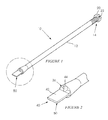
- Figure 1 of the accompanying drawings is a perspective view of a rock bolt 10 according to the invention.
- the rock bolt includes an elongate shank 12 which has a trailing end 14 and a leading end 16.
- the leading end is shown from one side in Figure 4 and an end view of the leading end is shown in Figure 5 .
- Figure 2 shows the leading end in perspective.
- the shank is made from round bar with a diameter of about 16 mm and has a predetermined length.
- the shank preferably has a minimum yield strength of 580 mpa.
- the trailing end 14 has a left-hand thread and a nut 20 is threadedly engaged therewith.
- a shear pin 22 extends through a passage bored radially into the nut and enters an in-register passage, not shown, at the trailing end 14. In this way the nut and shear pin form a shear structure which, initially, is fixed immovably to the shank.
- the leading end 16 has an integrally forged frusto-conical section 30.
- This section which typically has an axial length 32 of the order of 30 mm, has a maximum diameter 34 at one end which is of the order of 22 mm.
- An end of the frusto-conical section presents a substantially planar surface 36 which is at a right angle to a longitudinal axis 38 of the shank.
- Shredding and mixing structure 40 forged integrally with the section 30, extends from the planar surface 36.
- This structure includes a shedding blade 42 and mixing members 44 which project outwardly from and transversely to a base 46 of the blade.
- the blade and mixing members viewed end-on present a cruciform shape.
- the blade has a length 48, taken from the planar surface 36, which is of the order of 30 mm. Outer corners 50 of the blade are sharp and each corner defines a right angle. This is a feature which allows the blade to pierce a flexible housing, which contains an anchoring composition, with ease.
- the mixing members 44 viewed from one side (see Figure 4 ) have a relatively short length 52, of the order of 3 mm or 4 mm i.e. less than about 14% of the length of the blade. Sides 54 of the mixing members, and sides 56 of the base of the blade are chamfered (see Figure 5 ).
- an anchoring composition in a flexible container is inserted into a borehole formed in a body of rock.
- the leading end 16 of the rock bolt is then inserted into the borehole and the rock bolt is pushed fully into the hole.
- the shear structure at the trailing end 14 is engaged with a device which rotates the shank.
- the blade 42 easily penetrates the flexible container. Due to its size and the sharp corners 50 the blade, upon rotation of the rock bolt, rapidly shreds the container irrespective of the material from which it is made.
- the anchoring composition inside the container is released and is mixed by ongoing rotation of the blade.
- the mixing members 44 which are simultaneously rotated help substantially in this regard.
- the mixing members are relatively small compared to the blade and the likelihood that these members, which has chamfered sides 54, will entrain parts of the flexible container is remote.
- the blade on the other hand shreds the container and, as noted, continues with the mixing process.
- the anchoring composition sets fairly rapidly and starts bonding to the shank and the leading end.
- the rotational force required to rotate the shank increases and ultimately a point is reached at which the shear pin 22 shears. It is then no longer possible to impart torque to the shank.
- the nut 20 is automatically unscrewed from the shank.
- the nut is manually released from the shank.
- a load-spreading washer if required, can then be engaged with the shank whereupon the nut is re-engaged with the shank.
- the structure at the leading end 16 of the shank has been found, in practice, to be highly effective in shredding a flexible container and, then, in mixing an anchoring composition released from the container, while addressing the problems referred to in the preamble hereof.
- At least part of the shank can have a de-bonding agent applied to it.
- part of the shank can be coated with a thin plastic layer.
- the anchoring composition then does not bond directly to the shank but acts primarily against the frusto-conical section 30. This feature allows the rock bolt to yield under load.
Landscapes
- Engineering & Computer Science (AREA)
- Mining & Mineral Resources (AREA)
- Structural Engineering (AREA)
- Life Sciences & Earth Sciences (AREA)
- General Life Sciences & Earth Sciences (AREA)
- Geology (AREA)
- Geochemistry & Mineralogy (AREA)
- Chemical & Material Sciences (AREA)
- Inorganic Chemistry (AREA)
- Paleontology (AREA)
- Civil Engineering (AREA)
- General Engineering & Computer Science (AREA)
- Piles And Underground Anchors (AREA)
- Earth Drilling (AREA)
- Crushing And Pulverization Processes (AREA)
Applications Claiming Priority (1)
| Application Number | Priority Date | Filing Date | Title |
|---|---|---|---|
| ZA201401189 | 2014-02-18 |
Publications (2)
| Publication Number | Publication Date |
|---|---|
| EP2913477A2 true EP2913477A2 (de) | 2015-09-02 |
| EP2913477A3 EP2913477A3 (de) | 2016-07-13 |
Family
ID=52544322
Family Applications (1)
| Application Number | Title | Priority Date | Filing Date |
|---|---|---|---|
| EP15155614.9A Withdrawn EP2913477A3 (de) | 2014-02-18 | 2015-02-18 | Gebirgsanker |
Country Status (4)
| Country | Link |
|---|---|
| US (1) | US20150233244A1 (de) |
| EP (1) | EP2913477A3 (de) |
| AU (1) | AU2015200799A1 (de) |
| ZA (1) | ZA201501103B (de) |
Family Cites Families (9)
| Publication number | Priority date | Publication date | Assignee | Title |
|---|---|---|---|---|
| US4305687A (en) * | 1979-01-26 | 1981-12-15 | Jack Parker | Anchoring system for rock bolts |
| DE3823163A1 (de) * | 1988-07-08 | 1990-02-01 | Hilti Ag | Ankerstange |
| US6390735B1 (en) * | 2000-06-30 | 2002-05-21 | Noranda Inc. | Apparatus and method for a yieldable tendon mine support |
| DE10106695B4 (de) * | 2001-02-14 | 2010-11-25 | Friedr. Ischebeck Gmbh | Bohrkrone für einen Bohr- oder Injektionsanker |
| CA2439397A1 (en) * | 2003-08-11 | 2005-02-11 | Mansour Mining Inc. | Mine roof bolt assembly |
| CA2506342A1 (en) * | 2005-05-04 | 2006-11-04 | Mansour, Milad | Yieldable cone bolt for use in small diameter bolt holes and method of installing the same |
| WO2008106737A1 (en) * | 2007-03-06 | 2008-09-12 | Industrial Roll Formers Pty Limited | Rock bolt and its fabrication and installation |
| AU2008202943A1 (en) * | 2007-07-27 | 2009-02-12 | Dywidag-Systems International Pty Limited | Shear bolt assembly |
| CA2712293A1 (en) * | 2008-01-31 | 2009-08-06 | Fci Holdings Delaware, Inc. | Rock bolt assembly |
-
2015
- 2015-02-18 ZA ZA2015/01103A patent/ZA201501103B/en unknown
- 2015-02-18 US US14/624,828 patent/US20150233244A1/en not_active Abandoned
- 2015-02-18 AU AU2015200799A patent/AU2015200799A1/en not_active Abandoned
- 2015-02-18 EP EP15155614.9A patent/EP2913477A3/de not_active Withdrawn
Non-Patent Citations (1)
| Title |
|---|
| None |
Also Published As
| Publication number | Publication date |
|---|---|
| ZA201501103B (en) | 2016-11-30 |
| US20150233244A1 (en) | 2015-08-20 |
| AU2015200799A1 (en) | 2015-09-03 |
| EP2913477A3 (de) | 2016-07-13 |
Similar Documents
| Publication | Publication Date | Title |
|---|---|---|
| CN102414396B (zh) | 摩擦锚杆 | |
| CA2091662C (en) | Mine roof bolt | |
| US7070376B1 (en) | Self-drilling, self-anchoring fastener for concrete | |
| US10473137B2 (en) | Winged threaded fastener | |
| US11078946B2 (en) | Toolless screw type fastener | |
| JPS607120B2 (ja) | アンカボルト | |
| US6986623B2 (en) | Method and apparatus for anchoring a mine roof bolt | |
| US12180989B2 (en) | Threaded fastener | |
| AT13162U1 (de) | Verfahren zum Bohren von Löchern in Boden- bzw. Gesteinsmaterial und zum Festlegen eines Ankers in einem Bohrloch sowie Vorrichtung hierfür | |
| CA2543755C (en) | Detachable anchor bolt mixing head for use in mine roof support systems and method of using same | |
| AU2015383070A1 (en) | Tensionable cable anchor assembly and a tensioning device for tensioning same | |
| US4386882A (en) | Self-drilling anchor dowel | |
| US7179020B2 (en) | Mine roof bolt anchoring system and method | |
| CA2576116A1 (en) | Rock bolt with grout flow geometry | |
| EP2481938A2 (de) | Betonschraube und Verfahren zur Verankerung einer Betonschraube in einem Untergrund | |
| US6598499B1 (en) | Universal setting tool for adhesively bonded rebar and threaded rod anchors | |
| EP2913477A2 (de) | Gebirgsanker | |
| CA2767209C (en) | A yielding spiral bolt appendage for a rock bolt | |
| JP6247183B2 (ja) | ネジ部材の固定構造、ネジ部材の固定方法、及び、ネジ部材の定着強度管理方法 | |
| EP3126681B1 (de) | Befestigungsverfahren | |
| WO2019153045A1 (en) | Rock bolt | |
| US8801336B2 (en) | Rock bolt | |
| AT410579B (de) | Bohrschraube und werkzeug zum einbohren | |
| DE19634912A1 (de) | Ankerstange für Verbundanker | |
| CH702886A2 (de) | Anschlussmuffe für Bambus-Holme. |
Legal Events
| Date | Code | Title | Description |
|---|---|---|---|
| PUAI | Public reference made under article 153(3) epc to a published international application that has entered the european phase |
Free format text: ORIGINAL CODE: 0009012 |
|
| AK | Designated contracting states |
Kind code of ref document: A2 Designated state(s): AL AT BE BG CH CY CZ DE DK EE ES FI FR GB GR HR HU IE IS IT LI LT LU LV MC MK MT NL NO PL PT RO RS SE SI SK SM TR |
|
| AX | Request for extension of the european patent |
Extension state: BA ME |
|
| PUAL | Search report despatched |
Free format text: ORIGINAL CODE: 0009013 |
|
| AK | Designated contracting states |
Kind code of ref document: A3 Designated state(s): AL AT BE BG CH CY CZ DE DK EE ES FI FR GB GR HR HU IE IS IT LI LT LU LV MC MK MT NL NO PL PT RO RS SE SI SK SM TR |
|
| AX | Request for extension of the european patent |
Extension state: BA ME |
|
| RIC1 | Information provided on ipc code assigned before grant |
Ipc: E21D 20/02 20060101AFI20160607BHEP Ipc: E21D 21/00 20060101ALI20160607BHEP |
|
| STAA | Information on the status of an ep patent application or granted ep patent |
Free format text: STATUS: THE APPLICATION IS DEEMED TO BE WITHDRAWN |
|
| 18D | Application deemed to be withdrawn |
Effective date: 20170114 |