EP2913773A1 - Laufzeit kontinuerliche Address Space Layout Randomisierung von einem abgeflachten Kontrollflussgraphen - Google Patents
Laufzeit kontinuerliche Address Space Layout Randomisierung von einem abgeflachten Kontrollflussgraphen Download PDFInfo
- Publication number
- EP2913773A1 EP2913773A1 EP14305278.5A EP14305278A EP2913773A1 EP 2913773 A1 EP2913773 A1 EP 2913773A1 EP 14305278 A EP14305278 A EP 14305278A EP 2913773 A1 EP2913773 A1 EP 2913773A1
- Authority
- EP
- European Patent Office
- Prior art keywords
- basic block
- slot
- selecting
- start offset
- steps
- Prior art date
- Legal status (The legal status is an assumption and is not a legal conclusion. Google has not performed a legal analysis and makes no representation as to the accuracy of the status listed.)
- Withdrawn
Links
Images


Classifications
-
- G—PHYSICS
- G06—COMPUTING OR CALCULATING; COUNTING
- G06F—ELECTRIC DIGITAL DATA PROCESSING
- G06F8/00—Arrangements for software engineering
- G06F8/40—Transformation of program code
- G06F8/41—Compilation
- G06F8/44—Encoding
- G06F8/443—Optimisation
-
- G—PHYSICS
- G06—COMPUTING OR CALCULATING; COUNTING
- G06F—ELECTRIC DIGITAL DATA PROCESSING
- G06F21/00—Security arrangements for protecting computers, components thereof, programs or data against unauthorised activity
- G06F21/10—Protecting distributed programs or content, e.g. vending or licensing of copyrighted material ; Digital rights management [DRM]
- G06F21/12—Protecting executable software
- G06F21/14—Protecting executable software against software analysis or reverse engineering, e.g. by obfuscation
-
- G—PHYSICS
- G06—COMPUTING OR CALCULATING; COUNTING
- G06F—ELECTRIC DIGITAL DATA PROCESSING
- G06F21/00—Security arrangements for protecting computers, components thereof, programs or data against unauthorised activity
- G06F21/50—Monitoring users, programs or devices to maintain the integrity of platforms, e.g. of processors, firmware or operating systems
- G06F21/52—Monitoring users, programs or devices to maintain the integrity of platforms, e.g. of processors, firmware or operating systems during program execution, e.g. stack integrity ; Preventing unwanted data erasure; Buffer overflow
- G06F21/54—Monitoring users, programs or devices to maintain the integrity of platforms, e.g. of processors, firmware or operating systems during program execution, e.g. stack integrity ; Preventing unwanted data erasure; Buffer overflow by adding security routines or objects to programs
-
- G—PHYSICS
- G06—COMPUTING OR CALCULATING; COUNTING
- G06F—ELECTRIC DIGITAL DATA PROCESSING
- G06F2221/00—Indexing scheme relating to security arrangements for protecting computers, components thereof, programs or data against unauthorised activity
- G06F2221/21—Indexing scheme relating to G06F21/00 and subgroups addressing additional information or applications relating to security arrangements for protecting computers, components thereof, programs or data against unauthorised activity
- G06F2221/2125—Just-in-time application of countermeasures, e.g., on-the-fly decryption, just-in-time obfuscation or de-obfuscation
Definitions
- the present invention relates to a software protection improvement, and more particularly related to a method and a system for hardening of control flow graph flattening.
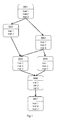
- a Control Flow Graph representing software
- the nodes are some pieces of code called basic blocks; and edges correspond to jumps between basic blocks.
- a basic block (BB) has only one entry point and one exit point. There is no jump instruction to a destination anywhere in the program within a basic block; and only the last instruction can jump to another basic block. This representation is very useful to understand a program.
- Fig. 1 presents a CFG example.
- CFG flattening is an obfuscation transformation to increase the complexity of the code.
- the goal of CFG flattening is to hide the original layout of the CFG.
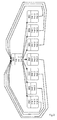
- the program is modified in a way that each basic block jumps to a single function that computes the address of the next basic block.
- Fig. 2 presents the CFG of Fig. 1 after the CFG flattening. This technique has been presented by Wang, C., Davidson, J., Hill, J., & Knight, J. (2001, July), Protection of software-based survivability mechanisms, In Dependable Systems and Networks, 2001. DSN 2001, International Conference on (pp. 193-202). IEEE .
- Another problem to solve is to resist to more advanced pattern matching attacks. Usually attackers use the start address of a basic block to mark them. Experimented hackers may find other techniques, like the signature of the basic block (ex: sha1). A problem to solve then is to use basic blocks that dynamically change in position and in content to resist to all kind of pattern matching.
- a method for hardening of control flow graph flattening wherein the control flow graph is flattened, and each Basic Block is stored on a slot, comprising the steps of: selecting an available slot each after executing a Basic Block; selecting a random start offset inside the slot; copying the Basic Block at the start offset in the slot; inserting at least one junk code at least one of before, after and inside the Basic Block on the basis of a reference image of the Basic Block; and updating a database including an current address and image of each Basic Block.
- the available slot and the random start offset are selected randomly.
- each of the two steps of selecting is implemented on the basis of the database further including a list of possible successors.
- the reference image of the Basic Block is included in the database or computed on the basis of the current image of the Basic Block.
- a dispatcher which is connected to all other Basic Blocks, jumps to any address between 0 and the start offset of a target slot when a Basic Block is executed.
- a computer program product downloadable from a communication network and/or recorded on a medium readable by computer and/or executable by a processor, comprising program code instructions for implementing the steps of foregoing method.
- non-transitory computer-readable medium comprising a computer program product recorded thereon and capable of being run by a processor, including program code instructions for implementing the steps of foregoing method.
- a system for hardening of control flow graph flattening wherein the control flow graph is flattened, and each Basic Block is stored on a slot, comprising a processor to implement the steps of: selecting an available slot each after executing a Basic Block; selecting a random start offset inside the slot; copying the Basic Block at the start offset in the slot; inserting at least one junk code at least one of before, after and inside the Basic Block on the basis of a reference image of the Basic Block; and updating a database including a current address and image of each Basic Block.
- the available slot and the random start offset are selected randomly.
- each of the two steps of selecting is implemented on the basis of the database further including a list of possible successors.
- the reference image of the Basic Block is included in the database or computed on the basis of the current image of the Basic Block.
- a dispatcher which is connected to all other Basic Blocks, jumps to any address between 0 and the start offset of a target slot when a Basic Block is executed.
- Fig. 1 illustrates classic Control Flow Graph (CFG);
- Fig. 2 presents the CFG of Figure. 1 after the CFG flattening.
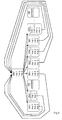
- the main idea of the invention is to copy each Basic Block (BB) to another address after its execution as described in Fig. 3 .
- some small memory slots are allocated. The size of these slots does not need to be larger than that of the largest BB of the program.
- each time a BB is copied to a slot the slot destination and the BB start address inside the slot are changed; and some junk codes are inserted inside the BB.
- each copy of a BB produces a new BB, whose position, length and content vary over time.
- BB3 has been executed and moved after BB7 and some junk codes have been added in it.
- the process of a BB relocation involves several steps:
- the available slot and the random start offset, the junk code, and the position of the junk code may be selected on the basis of a database. They are also determined by computing according to a function or an algorithm stored on the database.
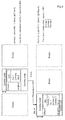
- some junk codes are also inserted inside the BB, in order to change its signature and detectability as shown in Fig. 4 .
- block BB1 is in the Slot k with Offset k.
- One dummy instruction "dummy 1" is inserted between instructions 1 and 2 in BB1.
- the block BB1 is copied to Slot k' with Offset k'.
- the Slot k' and Offset k' are selected on the basis of the database or computed as described above.
- three dummy instructions "dummy 1'", “dummy 2"', and “dummy 3"' are inserted before and inside the BB1.
- the positions and contents of these dummy instructions are determined on the basis of a reference image of the BB.
- the reference image of the BB is included in the database or computed on the basis of the current image of the BB.
- the central actor must store the address of each BB, e.g. its slot number and its offset inside the slot.
- a simple way to implement this protection is to use a data base containing for each BB its current address and the list of possible successors.
- the database also contains a reference image of the BB for next transformations, or a function or an algorithm to compute a reference image from the current BB image.
- One solution is to store in the database the address of dummy code insertions done on the reference image.
- the top level BB that is connected to all others BBs is called a Dispatcher.
- the database is updated and the Dispatcher is called.
- the dispatcher needs to execute the same BB, it can retrieve from the database its new address.
- a Dispatcher jumps to a relocated BB, it can jump to any address in the first dummy code area, before the start of the BB. To implement that, it picks a random value between [0, Offset k] where Offset k is the relative offset of the BB in the target slot.
- Fig. 5 illustrates an exemplary system ("computer") 500 on which the invention may be implemented.
- the computer 500 can be any kind of suitable computer or device capable of performing calculations, such as a standard Personal Computer (PC).
- the computer 500 comprises at least one processor 510, RAM memory 520, a user interface 530 for interacting with a user, and a second interface 540 for reading a software program for performing the method of the invention from a digital data support 550.
- the skilled person will appreciate that the illustrated computer is very simplified for reasons of clarity and that a real computer in addition would comprise features such as network connections and persistent storage devices.
- Fig. 6 illustrates an exemplary flow chart implemented by the present invention.
- the method is performed by the processor 510 and the different parts (functions and modules) of code are stored in the memory 520.
- one of BBs except a dispatcher is executed.
- an available slot for the BB is selected to relocate the position of the BB. It is implemented on the basis of a database including current address of each BB and possible successors. Alternatively, the slot is determined by computing in a way stored in the database.
- a random start offset inside the slot is selected on the basis of a reference image of the BB.
- the reference image of the BB is included the database or computed on the basis of the current image of the BB.
- the BB is copied at the start offset in the slot. By this copy, the position of BB is dynamically changed.
- at least one junk code is inserted at least one of before, after, and inside the BB. By this insertion the length and content of the BB are dynamically changed. Since the data relating to the BB has changed, the database is updated accordingly.
- the steps of S1 to S6 are executed for each execution of a BB except for the dispacher, and therefore the position, length, and content of each BB vary over time. It should be noted that any kind of well-known method will be apply to the way to determine an available slot, a random start offset, a junk code, and a position of the juck code.
Landscapes
- Engineering & Computer Science (AREA)
- Software Systems (AREA)
- Theoretical Computer Science (AREA)
- Computer Security & Cryptography (AREA)
- General Engineering & Computer Science (AREA)
- Physics & Mathematics (AREA)
- General Physics & Mathematics (AREA)
- Computer Hardware Design (AREA)
- Technology Law (AREA)
- Multimedia (AREA)
- Information Retrieval, Db Structures And Fs Structures Therefor (AREA)
- Health & Medical Sciences (AREA)
- Bioethics (AREA)
- General Health & Medical Sciences (AREA)
- Storage Device Security (AREA)
Priority Applications (3)
| Application Number | Priority Date | Filing Date | Title |
|---|---|---|---|
| EP14305278.5A EP2913773A1 (de) | 2014-02-27 | 2014-02-27 | Laufzeit kontinuerliche Address Space Layout Randomisierung von einem abgeflachten Kontrollflussgraphen |
| EP15156737.7A EP2913774A1 (de) | 2014-02-27 | 2015-02-26 | Laufzeit kontinuerliche Address Space Layout Randomisierung von einem abgeflachten Kontrollflussgraphen |
| US14/632,325 US20150242192A1 (en) | 2014-02-27 | 2015-02-26 | Method and system for hardening of cfg flattening |
Applications Claiming Priority (1)
| Application Number | Priority Date | Filing Date | Title |
|---|---|---|---|
| EP14305278.5A EP2913773A1 (de) | 2014-02-27 | 2014-02-27 | Laufzeit kontinuerliche Address Space Layout Randomisierung von einem abgeflachten Kontrollflussgraphen |
Publications (1)
| Publication Number | Publication Date |
|---|---|
| EP2913773A1 true EP2913773A1 (de) | 2015-09-02 |
Family
ID=50289604
Family Applications (2)
| Application Number | Title | Priority Date | Filing Date |
|---|---|---|---|
| EP14305278.5A Withdrawn EP2913773A1 (de) | 2014-02-27 | 2014-02-27 | Laufzeit kontinuerliche Address Space Layout Randomisierung von einem abgeflachten Kontrollflussgraphen |
| EP15156737.7A Withdrawn EP2913774A1 (de) | 2014-02-27 | 2015-02-26 | Laufzeit kontinuerliche Address Space Layout Randomisierung von einem abgeflachten Kontrollflussgraphen |
Family Applications After (1)
| Application Number | Title | Priority Date | Filing Date |
|---|---|---|---|
| EP15156737.7A Withdrawn EP2913774A1 (de) | 2014-02-27 | 2015-02-26 | Laufzeit kontinuerliche Address Space Layout Randomisierung von einem abgeflachten Kontrollflussgraphen |
Country Status (2)
| Country | Link |
|---|---|
| US (1) | US20150242192A1 (de) |
| EP (2) | EP2913773A1 (de) |
Cited By (2)
| Publication number | Priority date | Publication date | Assignee | Title |
|---|---|---|---|---|
| EP3104292B1 (de) * | 2015-06-09 | 2018-04-18 | Thomson Licensing | Vorrichtung und verfahren zum schutz von ios-softwaremodulen |
| CN111711794A (zh) * | 2020-06-22 | 2020-09-25 | 上海辰珅科技有限公司 | 防偷拍图像处理方法、装置、终端及存储介质 |
Citations (4)
| Publication number | Priority date | Publication date | Assignee | Title |
|---|---|---|---|---|
| US7000119B1 (en) * | 2000-04-20 | 2006-02-14 | Realnetworks, Inc. | Instruction/data protection employing derived obscuring instruction/data |
| US20070234070A1 (en) * | 1999-07-29 | 2007-10-04 | Intertrust Technologies Corp. | Software self-defense systems and methods |
| WO2009108245A2 (en) * | 2007-12-21 | 2009-09-03 | University Of Virginia Patent Foundation | System, method and computer program product for protecting software via continuous anti-t ampering and obfuscation transforms |
| EP2378452A1 (de) * | 2010-04-16 | 2011-10-19 | Thomson Licensing | Verfahren, Vorrichtung und Computerprogrammprodukt zur Verifizierung von Prüfsummen für selbstmodifizierten Computercode |
Family Cites Families (11)
| Publication number | Priority date | Publication date | Assignee | Title |
|---|---|---|---|---|
| US6966002B1 (en) * | 1999-04-30 | 2005-11-15 | Trymedia Systems, Inc. | Methods and apparatus for secure distribution of software |
| US7620987B2 (en) * | 2005-08-12 | 2009-11-17 | Microsoft Corporation | Obfuscating computer code to prevent an attack |
| EP1850260A1 (de) * | 2006-04-26 | 2007-10-31 | Macrovision Corporation | Verfahren und System zum Binden von einem ausführbaren Code zur Verwaltung von Digitalen Rechten an eine Softwareanwendung |
| US8458673B2 (en) * | 2006-04-26 | 2013-06-04 | Flexera Software Llc | Computer-implemented method and system for binding digital rights management executable code to a software application |
| US8422668B1 (en) * | 2006-12-15 | 2013-04-16 | Spansion Llc | Table lookup operation on masked data |
| US8176337B2 (en) * | 2008-03-12 | 2012-05-08 | Apple Inc. | Computer object code obfuscation using boot installation |
| US20130140807A1 (en) * | 2011-12-06 | 2013-06-06 | Gerald Milroy Van Dusen | Clamp with spring loaded bolt to repair broken exhaust manifold flange bolts |
| US9934374B2 (en) * | 2012-02-10 | 2018-04-03 | Irdeto B.V. | Method and apparatus for program flow in software operation |
| US8756435B2 (en) * | 2012-03-02 | 2014-06-17 | Apple Inc. | Obfuscation of control flow of software |
| US8918768B2 (en) * | 2012-12-06 | 2014-12-23 | Apple Inc. | Methods and apparatus for correlation protected processing of data operations |
| US10599820B2 (en) * | 2014-04-23 | 2020-03-24 | Nxp B.V. | Control flow flattening for code obfuscation where the next block calculation needs run-time information |
-
2014
- 2014-02-27 EP EP14305278.5A patent/EP2913773A1/de not_active Withdrawn
-
2015
- 2015-02-26 EP EP15156737.7A patent/EP2913774A1/de not_active Withdrawn
- 2015-02-26 US US14/632,325 patent/US20150242192A1/en not_active Abandoned
Patent Citations (4)
| Publication number | Priority date | Publication date | Assignee | Title |
|---|---|---|---|---|
| US20070234070A1 (en) * | 1999-07-29 | 2007-10-04 | Intertrust Technologies Corp. | Software self-defense systems and methods |
| US7000119B1 (en) * | 2000-04-20 | 2006-02-14 | Realnetworks, Inc. | Instruction/data protection employing derived obscuring instruction/data |
| WO2009108245A2 (en) * | 2007-12-21 | 2009-09-03 | University Of Virginia Patent Foundation | System, method and computer program product for protecting software via continuous anti-t ampering and obfuscation transforms |
| EP2378452A1 (de) * | 2010-04-16 | 2011-10-19 | Thomson Licensing | Verfahren, Vorrichtung und Computerprogrammprodukt zur Verifizierung von Prüfsummen für selbstmodifizierten Computercode |
Non-Patent Citations (1)
| Title |
|---|
| WANG, C.; DAVIDSON, J.; HILL, J.; KNIGHT, J.: "Protection of software-based survivability mechanisms", DEPENDABLE SYSTEMS AND NETWORKS, July 2001 (2001-07-01), pages 193 - 202 |
Cited By (2)
| Publication number | Priority date | Publication date | Assignee | Title |
|---|---|---|---|---|
| EP3104292B1 (de) * | 2015-06-09 | 2018-04-18 | Thomson Licensing | Vorrichtung und verfahren zum schutz von ios-softwaremodulen |
| CN111711794A (zh) * | 2020-06-22 | 2020-09-25 | 上海辰珅科技有限公司 | 防偷拍图像处理方法、装置、终端及存储介质 |
Also Published As
| Publication number | Publication date |
|---|---|
| EP2913774A1 (de) | 2015-09-02 |
| US20150242192A1 (en) | 2015-08-27 |
Similar Documents
| Publication | Publication Date | Title |
|---|---|---|
| CN102132289B (zh) | 用于代码迷惑的方法及设备 | |
| EP2828745B1 (de) | Aktualisierung von softwarekomponenten | |
| CN104680039B (zh) | 一种应用程序安装包的数据保护方法及装置 | |
| US8756435B2 (en) | Obfuscation of control flow of software | |
| US10599820B2 (en) | Control flow flattening for code obfuscation where the next block calculation needs run-time information | |
| US11349816B2 (en) | Obfuscating source code sent, from a server computer, to a browser on a client computer | |
| EP2937803B1 (de) | Steuerflussglättung zur codeverschleierung, wo die nächste blockberechnung laufzeitinformationen benötigt | |
| CN105706099A (zh) | 软件更新装置及软件更新程序 | |
| US10417412B2 (en) | Protecting computer code against ROP attacks | |
| US9405936B2 (en) | Code integrity protection by computing target addresses from checksums | |
| RU2680761C1 (ru) | Безопасные преобразования данных | |
| EP2913774A1 (de) | Laufzeit kontinuerliche Address Space Layout Randomisierung von einem abgeflachten Kontrollflussgraphen | |
| EP2674892A1 (de) | Verfahren, Vorrichtung und Computerprogrammunterstützung zur Ausführung eines verschlüsselten Computercodes | |
| CN105204883B (zh) | 一种插件加载处理方法及装置 | |
| JP2020195680A5 (de) | ||
| WO2017016087A1 (zh) | 一种生成随机布局程序的方法及装置 | |
| EP3289511B1 (de) | Verfahren und system zur verteidigung gegen angriffe auf der basis von rückkehrorientierter programmierung (rop) | |
| CN105095698B (zh) | 基于最近执行的程序代码的程序代码模糊处理 | |
| US9965621B2 (en) | Program protection device | |
| CN117407115B (zh) | 一种基于动态加载插件的界面显示方法及装置 | |
| WO2017212467A1 (en) | Security methods and systems by code mutation | |
| WO2017102392A1 (en) | Calculating device and method | |
| KR101852140B1 (ko) | 온라인 게임의 특정 함수 탐지를 방어하는 서버, 시스템 및 방법 | |
| JP5799319B2 (ja) | 電子書籍データ処理方法、電子書籍サーバ、クライアント端末、及び電子書籍配信システム | |
| WO2016056120A1 (ja) | 情報処理装置、及び情報処理方法 |
Legal Events
| Date | Code | Title | Description |
|---|---|---|---|
| PUAI | Public reference made under article 153(3) epc to a published international application that has entered the european phase |
Free format text: ORIGINAL CODE: 0009012 |
|
| AK | Designated contracting states |
Kind code of ref document: A1 Designated state(s): AL AT BE BG CH CY CZ DE DK EE ES FI FR GB GR HR HU IE IS IT LI LT LU LV MC MK MT NL NO PL PT RO RS SE SI SK SM TR |
|
| AX | Request for extension of the european patent |
Extension state: BA ME |
|
| STAA | Information on the status of an ep patent application or granted ep patent |
Free format text: STATUS: THE APPLICATION IS DEEMED TO BE WITHDRAWN |
|
| 18D | Application deemed to be withdrawn |
Effective date: 20160303 |