EP2914331B1 - Codage temporel pour implants auditifs - Google Patents
Codage temporel pour implants auditifs Download PDFInfo
- Publication number
- EP2914331B1 EP2914331B1 EP13850938.5A EP13850938A EP2914331B1 EP 2914331 B1 EP2914331 B1 EP 2914331B1 EP 13850938 A EP13850938 A EP 13850938A EP 2914331 B1 EP2914331 B1 EP 2914331B1
- Authority
- EP
- European Patent Office
- Prior art keywords
- pulses
- pulse
- electrodes
- stimulating
- electrode
- Prior art date
- Legal status (The legal status is an assumption and is not a legal conclusion. Google has not performed a legal analysis and makes no representation as to the accuracy of the status listed.)
- Active
Links
Images



Classifications
-
- A—HUMAN NECESSITIES
- A61—MEDICAL OR VETERINARY SCIENCE; HYGIENE
- A61N—ELECTROTHERAPY; MAGNETOTHERAPY; RADIATION THERAPY; ULTRASOUND THERAPY
- A61N1/00—Electrotherapy; Circuits therefor
- A61N1/18—Applying electric currents by contact electrodes
- A61N1/32—Applying electric currents by contact electrodes alternating or intermittent currents
- A61N1/36—Applying electric currents by contact electrodes alternating or intermittent currents for stimulation
- A61N1/36036—Applying electric currents by contact electrodes alternating or intermittent currents for stimulation of the outer, middle or inner ear
-
- A—HUMAN NECESSITIES
- A61—MEDICAL OR VETERINARY SCIENCE; HYGIENE
- A61N—ELECTROTHERAPY; MAGNETOTHERAPY; RADIATION THERAPY; ULTRASOUND THERAPY
- A61N1/00—Electrotherapy; Circuits therefor
- A61N1/02—Details
- A61N1/04—Electrodes
- A61N1/05—Electrodes for implantation or insertion into the body, e.g. heart electrode
- A61N1/0526—Head electrodes
- A61N1/0541—Cochlear electrodes
-
- A—HUMAN NECESSITIES
- A61—MEDICAL OR VETERINARY SCIENCE; HYGIENE
- A61N—ELECTROTHERAPY; MAGNETOTHERAPY; RADIATION THERAPY; ULTRASOUND THERAPY
- A61N1/00—Electrotherapy; Circuits therefor
- A61N1/18—Applying electric currents by contact electrodes
- A61N1/32—Applying electric currents by contact electrodes alternating or intermittent currents
- A61N1/36—Applying electric currents by contact electrodes alternating or intermittent currents for stimulation
- A61N1/36036—Applying electric currents by contact electrodes alternating or intermittent currents for stimulation of the outer, middle or inner ear
- A61N1/36038—Cochlear stimulation
-
- A—HUMAN NECESSITIES
- A61—MEDICAL OR VETERINARY SCIENCE; HYGIENE
- A61N—ELECTROTHERAPY; MAGNETOTHERAPY; RADIATION THERAPY; ULTRASOUND THERAPY
- A61N1/00—Electrotherapy; Circuits therefor
- A61N1/18—Applying electric currents by contact electrodes
- A61N1/32—Applying electric currents by contact electrodes alternating or intermittent currents
- A61N1/36—Applying electric currents by contact electrodes alternating or intermittent currents for stimulation
- A61N1/372—Arrangements in connection with the implantation of stimulators
- A61N1/37211—Means for communicating with stimulators
- A61N1/37235—Aspects of the external programmer
- A61N1/37241—Aspects of the external programmer providing test stimulations
Definitions
- the present invention relates to temporal coding for hearing implants, and more particularly to evaluation and methodology of temporal coding for a cochlear implant.
- a human ear normally transmits sounds such as speech sounds as shown in Figure 1 through the outer ear 101 to the tympanic membrane (eardrum) 102, which moves the bones of the middle ear 103 (malleus, incus, and stapes) that vibrate the oval window membrane of the cochlea 104.
- the cochlea 104 is a long narrow duct wound spirally about its axis for approximately two and three quarters turns. It includes three chambers along its length: an upper chamber known as the scala vestibuli, a middle chamber known as the scala media, and a lower chamber known as the scala tympani.
- the cochlea 104 forms an upright spiraling cone with a center called the modiolus where the axons of the auditory nerve 113 reside. These axons project in one direction to the cochlear nucleus in the brainstem and they project in the other direction to the spiral ganglion cells and neural processes peripheral to the cells (hereinafter called peripheral processes) in the cochlea.
- peripheral processes neural processes peripheral to the cells (hereinafter called peripheral processes) in the cochlea.
- FIG. 1 shows some components of a typical cochlear implant system where an external microphone provides an audio signal input to an external signal processing stage 111 which implements one of various known signal processing schemes. The processed signal is converted by the external signal processing stage 111 into a digital data format, such as a sequence of data frames, for transmission into a receiver processor in an implant housing 108.
- an auditory prosthesis system such as a cochlear implant that electrically stimulates auditory nerve tissue with small currents delivered by multiple electrode contacts distributed along an implant electrode.
- Figure 1 shows some components of a typical cochlear implant system where an external microphone provides an audio signal input to an external signal processing stage 111 which implements one of various known signal processing schemes. The processed signal is converted by the external signal processing stage 111 into a digital data format, such as a sequence of data frames, for transmission into a receiver processor in an implant housing 108.
- the receiver processor in the implant housing 108 may perform additional signal processing, and produces a stimulation pattern (based on the extracted audio information) that is sent through an electrode lead 109 to an implanted electrode array 112 which penetrates into the cochlea 104 through a surgical opening called a cochleostomy.
- this electrode array 112 includes multiple electrode contacts 110 on its surface that deliver the stimulation signals to adjacent neural tissue of the cochlea 104 which the brain of the patient interprets as sound.
- the individual electrode contacts 110 may be activated using various stimulation strategies that include, for example, sequential or simultaneous stimulation in one or more contact groups.
- temporal information in an auditory system by use of cochlea implants is imperfect compared to a normal functioning hearing organ.
- temporal information is recorded by the hair cells and their corresponding nerve fibers before the information is translated to the brain.
- the hair cells can follow the externally generated acoustic information in phase with the corresponding oscillation of the basilar membrane.
- the nerve fibers have a certain refractory period which allows only a limited temporal coding.
- there are sufficient nerve fibers present having different refractory states after stimulation. Consequently, acting as an ensemble, these nerve fibers together are typically able to represent temporal information up to 5 kHz (see, for example, Wever and Bray's "volley theory," 1937 ).
- the temporal information is provided via the electrodes by, for example, biphasic electrical pulses which directly elicit action potentials in the nerve fibers.
- US 2011/004274 A1 discloses an auditory prosthesis system that includes a preprocessor filter bank that filters an input acoustic audio signal into bandpass signals corresponding to different frequency bands, an information extractor that generates stimulation signals from the bandpass signals by extracting specific stimulation information and a pulse selector that weights the stimulation signals with a weighted matrix of stimulation amplitudes that reflect patient-specific perceptual characteristics to produce a set of electrode stimulation signals that provide an optimal electric tonotopic representation of the acoustic signal.
- US 2005/107843 A1 describes a cochlear implant sound processing method and device for selectively stimulating electrodes within an auditory prosthesis electrode array comprising generating a temporal pattern of stimulation pulses to selected electrodes within the electrode array and adjusting the stimulation pulses in accordance with an estimated fundamental frequency.
- US 2008/300652 A1 discloses a brain implant prosthesis device in which a sound processor decomposes a sound waveform into a stimulation sequence, which is received by a current stimulator and decoded into a differential stimulation sequence for electrodes disposed in the inferior colliculus of a mammal brain.
- the electrodes each comprise two or more shanks, and each shank comprises one or more stimulation sites.
- US 2007/270949 A1 describes a method of generating electrical stimuli by an auditory prosthesis including an array of stimulation electrodes that applies a temporal adjustment to the activation of said electrodes such that activation of electrodes representing lower amplitude components of an incoming acoustic signal is delayed relative to activation of electrodes representing higher amplitude components of the acoustic signal.
- a method for activating electrodes in a multi-channel electrode array having electrodes that are spatially divided includes determining at least one pulse for stimulating a single electrode of the electrode array. Each of the pulses is converted into a plurality of pulses for stimulating a plurality of electrodes in the electrode array.
- converting may include adding temporal separation between at least two pulses associated with different electrodes.
- the pulses for stimulating a plurality of electrodes may be at a supra-threshold pulse or a sub-threshold pulse.
- the energy of the plurality of pulses may be substantially equal to the energy of the pulse for stimulating the first electrode.
- the temporal and/or spatial center of mass for the plurality of pulses may be substantially equivalent to that of the determined pulse.
- the plurality of pulses may vary in amplitude, pulse length, and/or temporal separation. The variation may be based on a Gaussian distribution, a Poisson distribution, and/or a uniform Distribution.
- the at least one pulse for stimulating a single electrode of the electrode array may be a plurality of pulses that form a sequential pulse sequence, such as a Continuous Interleaved Sampling (CIS) speech signal processing strategy.
- CIS Continuous Interleaved Sampling
- the method may further include stimulating the plurality of electrodes based, at least in part, on the converted pulses.
- the electrode array may be part of an auditory prosthesis that is implanted in a user, the method further including performing at least one neurophysiologic measurement upon stimulating the electrodes, and evaluating the neurophysiologic measurements so as to determine the quality of temporal coding for enhanced pitch discrimination.
- the at least one neurophysiologic measurement may include electrically evoked auditory steady state responses (EASSR), electrically evoked brainstem response audiometry (EBERA), near field measurements, and/or electrically evoked compound action potentials (ECAP). Evaluating the neurophysiologic measurements may include statistical testing and/or use of a genetic algorithm.
- the pulse rate may be adjusted based on the evaluation.
- the multi-channel electrode may be associated with an implant.
- the multi-channel electrode array may be associated with a cochlear implant, a brain stem implant, or deep brain stimulation.
- an auditory prosthesis system includes a stimulator adapted to be implantable, the stimulator including a plurality of electrodes forming a multi-channel electrode array.
- a processor is configured to determine at least one pulse for stimulating a single electrode of the electrode array.
- the processor is further configured to convert each of the pulses into a plurality of pulses for stimulating a plurality of electrodes in the electrode array.
- the processor may be configured to add temporal separation between at least two converted pulses associated with different electrodes.
- the pulses for stimulating the plurality of electrodes may be a supra-threshold pulse or a sub-threshold pulse.
- the energy of the plurality of pulses may be substantially equal to the energy of the determined pulse for stimulating the first electrode.
- the temporal and/or spatial center of mass for the plurality of pulses may be substantially equivalent to that of the determined pulse.
- the plurality of pulses may vary in amplitude, pulse length, and/or temporal separation. The variation may be based on a Gaussian distribution, a Poisson distribution, and/or a uniform Distribution.
- the at least one pulse for stimulating a single electrode of the electrode array may be a plurality of pulses that form a sequential pulse sequence.
- the sequential pulse sequence may be based on a Continuous Interleaved Sampling (CIS) speech signal processing strategy.25.
- the stimulator may be configured to stimulate the plurality of electrodes based, at least in part, on the converted pulses.
- the test module may be configured to perform at least one neurophysiologic measurement on a user of the prosthesis to the electrode stimulation.
- the test module may be further configured to evaluate the neurophysiologic measurements so as to determine the quality of temporal coding for enhanced pitch discrimination. Evaluating the neurophysiologic measurements may include statistical testing and/or use of a genetic algorithm.
- the neurophysiologic measurement may include electrically evoked auditory steady state responses (EASSR), electrically evoked brainstem response audiometry (EBERA), near field measurements, and/or electrically evoked compound action potentials (ECAP).
- EASSR electrically evoked auditory steady state responses
- EBERA electrically evoked brainstem response audiometry
- ECAP electrically evoked compound action potentials
- a method of evaluating the quality of temporal coding for enhanced pitch discrimination associated with a auditory prosthesis includes a plurality of electrodes in a multi-channel electrode array.
- the method includes stimulating the electrodes at a pulse rate.
- At least one neurophysiologic measurement is performed on a user of the prosthesis to the electrode stimulation.
- the neurophysiologic measurements are evaluated so as to determine the quality of temporal coding for enhanced pitch discrimination.
- the pulse pattern and/or rate is adjusted based on the evaluation.
- the neurophysiologic measurement may include electrically evoked auditory steady state responses (EASSR), electrically evoked brainstem response audiometry (EBERA), near field measurements, and/or electrically evoked compound action potentials (ECAP). Evaluating the neurophysiologic measurements may include statistical testing and/or using a genetic algorithm. Performing the at least one neurophysiologic measurement may be done without subjective feedback from the user.
- EASSR electrically evoked auditory steady state responses
- EBERA electrically evoked brainstem response audiometry
- ECAP electrically evoked compound action potentials
- an auditory prosthesis system includes a plurality of electrodes in a multi-channel electrode array.
- a stimulator is configured to stimulate the electrodes at a pulse rate.
- the system further includes means for performing at least one neurophysiologic measurement on a user of the prosthesis to the electrode stimulation, means for evaluating the neurophysiologic measurements so as to determine the quality of temporal coding for enhanced pitch discrimination; and means for adjusting the pulse pattern and/or rate based on the evaluation.
- the neurophysiologic measurement may include electrically evoked auditory steady state responses (EASSR), electrically evoked brainstem response audiometry (EBERA), near field measurements, and/or electrically evoked compound action potentials (ECAP).
- EASSR electrically evoked auditory steady state responses
- EBERA electrically evoked brainstem response audiometry
- ECAP electrically evoked compound action potentials
- the means for evaluating the neurophysiologic measurements may include statistical testing and/or use of a genetic algorithm.
- the means for performing the at least one neurophysiologic measurement may be done without subjective feedback from the user.
- enhanced pulse stimulation sequences are identified that accurately represent temporal information to hearing implant users.
- the modified pulse sequences may be patient specific, such that they differ from user to user.
- neurophysiologic measurements for a hearing implant are used as the basis for evaluating the quality of temporal coding for enhanced pitch discrimination. The neurophysiologic measurements may be taken without, or used in combination with, subjective feedback from the user of the implant. Details are discussed below.
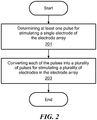
- FIG. 2 shows a flow chart illustrating a method of activating electrodes in a multi-channel electrode array, in accordance with an embodiment of the invention.
- the multi-channel electrode array may be associated with an implant.
- the implant may be any implant known in the art that includes pulsed stimulation.
- the multi-channel electrode array may be associated with a hearing implant, such as a cochlear implant, in which the electrodes of the electrode are positioned such that they are spatially divided within the cochlea.
- the cochlear implant may be partially implanted, and include, without limitation, an external speech processor, microphone and/or coil, with an implanted stimulator and/or electrode array.
- the cochlear implant may be a totally implanted cochlear implant.
- the multi-channel electrode may be associated with deep brain stimulation (DBS) or a brainstem implant, such as an auditory brainstem implant.
- DBS deep brain stimulation
- a brainstem implant such as an auditory brainstem implant.
- At least one pulse is determined for stimulating a single electrode of the electrode array, step 201.
- the implant employs a stimulation strategy that provides pulsatile stimuli in a multi-channel electrode array.
- the at least one pulse may be, without limitation, a plurality of pulses that form a sequential pulse sequence for a given electrode.
- One specific example of a stimulation strategy is the "Continuous Interleaved Sampling (CIS)"- strategy , as described by Wilson et al., Better Speech Recognition With Cochlear Implants, Nature, vol. 352:236-238 (1991 ).
- CIS Continuous Interleaved Sampling
- CIS symmetrical biphasic current pulses are used, which are strictly non-overlapping in time across the plurality of electrodes.
- the rate per channel typically is higher than 800 pulses/sec. It is to be understood that the invention is not limited to CIS strategies, and is applicable with other stimulation strategies known in the art, such as, but not limited to, simultaneous activation/overlapping of electrode currents. For example, and without limitation, one such simultaneous stimulation is described in U.S. No. 6,594,525 .
- Each of the pulses is converted into a plurality of pulses for stimulating a plurality of electrodes in the electrode array, step 203.
- each of the n individual pulses associated with the pulse sequence may be transformed into a composite of pulses.
- Each of those composites of pulses may comprise pulses distributed over several electrode channels (main and neighboring channels; spatial separation) and, in addition, temporal jitter between each pulses of the composite (temporal separation) may be introduced.
- the pulses in the composite of pulses may be supra- and/or subthreshold. Acting as an ensemble, the composite of pulses advantageously allows enhanced representation/interpretation of the temporal information. Involving several channels instead of just one, the use of composite pulses leads to a spread of temporal information to a larger and more distributed number of nerve fibers, thus reducing the problem of eliciting the corresponding nerve fibers synchronously.
- Fig. 3 illustratively shows a single pulse on electrode channel E2 that has been converted to a composite of three pulses on channels E1, E2 and E3, in accordance with an embodiment of the invention.
- Temporal jitter between the pulses on channels E1, E2 and E3 has been introduced.
- the number of electrode channels upon which the composite of pulses is introduced is not limited to three; any number of channels may be utilized.
- the composite of pulses may utilize, to varying degrees, sequential and/or simultaneous stimulation.
- the energy of each pulse composite may be substantially equal to the energy of the corresponding individual pulse out of the pulse sequence. Further, the center-of-mass of the composite pulses (spatial and/or temporal) may be presented where the individual pulse would have been presented in order to preserve the tonotopic order.
- Parameters of the composite pulses that may be varied include, without limitation, amplitude distributions of the pulses within the pulse composites, the number of electrode channels used for the pulse composites, and pulse lengths of pulses within the pulse composites.
- Another parameter which may be varied is the temporal distributions between the pulses within the pulse composites.
- the jitter/time differentiation between the composite pulses may be of any duration.
- the time differentiation may be, without limitation, on the order of ⁇ s or ms.
- the above-described distributions may be, without limitation, according to a Gaussian distribution, Poisson distribution and/or uniform distribution. All of the above-described parameters may also be varied between corresponding pulses of subsequent pulse composites.
- the jitter/time differentiation between the composite pulses may be based on one or more rules.
- the minimum time difference between the composite pulses may be determined by the intensity of the original pulse (i.e., the corresponding individual pulse out of the pulse sequence).
- the minimum jitter/time differentiation may vary, so as to be, without limitation, dependent on the levels between the composite pulses to avoid masking effects. For example, if the original pulse is split into three pulses, the second of which has high intensity then the third may be masked if it is presented at a neighboring channel unless there is sufficient time between these two pulses.
- the representation of a single pulse out of the composite of pulses may further be represented by a sub-composite of pulses which includes sub- and/or supra-threshold pulses, preferable sub-threshold pulses only. All the variations of stimulation parameters explained above may be applied to this sub-composite as well.
- the rate of the n individual pulses of the pulse sequence which is transformed into a composite of pulses may be the basis for a frequency/rate analysis that may be used to evaluate the quality of temporal coding for enhanced pitch discrimination.
- the jitter of the composite pulses is solely used for better representation of this rate.
- Fig. 4 shows a flow chart illustrating a method of evaluating the quality of temporal coding for enhanced pitch discrimination associated with an auditory prosthesis, in accordance with an embodiment of the invention.
- the auditory prosthesis may include a plurality of electrodes in a multi-channel electrode array, and utilize, without limitation, the above-described pulse composite stimulation strategy; however other stimulation strategies (including, for example, CIS and/or simultaneous stimulation strategies) are within the scope of the present invention.
- the electrodes of the prosthesis are stimulated at a pulse rate, step 401.
- At least one neurophysiologic measurement is then performed on a user of the prosthesis to the electrode stimulation, step 403.
- the neurophysiological measurement may not require any subjective user feedback.
- the neurophysiological test may include electrically evoked auditory steady state responses (EASSR) (see also: “ Recording and online analysis of auditory steady state responses (ASSR) in Matlab”, Andreas Bahmer, Uwe Baumann; Journal of Neuroscience Methods 187 (2010), 105-113 , which is hereby incorporated herein by reference in its entirety; and " Temporal information transfer with cochlear implants: Improvements and Measurements", Habilitationsschrift, Andreas Bahmer, Frankfurt am Main, 2012 . EASSR responses to low-rate pulse trains can be readily recorded by electrodes placed on the scalp of a cochlear implant user and separated from the artifacts generated by the electrical stimulation.
- EASSR responses to low-rate pulse trains can be readily recorded by electrodes placed on the scalp of a cochlear implant user and separated from the artifacts generated by the electrical stimulation.
- the neurophysiological test may include electrically evoked brainstem response audiometry (EBERA) or near field measurement methods like electrically evoked compound action potentials (ECAP).
- EBERA electrically evoked brainstem response audiometry
- ECAP electrically evoked compound action potentials
- the neurophysiologic measurements are evaluated so as to determine the quality of temporal coding for enhanced pitch discrimination, step 405.
- the pulse pattern and/or rate may then be adjusted based on the evaluation, step 407, so as to provide optimal pitch discrimination for the user.
- Steps 405 and 407 may be repeated until a certain optimum is achieved (for example, convergence of a genetic algorithm).
- the results of the neurophysiologic measurement may be evaluated by statistical tests.
- the results of the neurophysiologic measurement may be evaluated using the following two statistical test paradigms. Both allow signal detection for a given significance threshold.
- a first test analyzes and compares Fourier components of several subsequent measurements at the frequency of the signal modulation (see, for example, " A new statistic for steady-state evoked potentials", Victor and Mast, Electroencephalography and Clinical Neurophysiology, 1991, 78:378-388, 1991 , which is hereby incorporated herein by reference in its entirety).
- the second test evaluates Fourier components that are adjacent to the modulation frequency; these adjacent components are used to estimate the noise level (see, for example: " Human auditory steady-state responses to amplitude-modulated tones: phase and latency measurements" John and Picton, Hearing Research 141:57-79, 2000 ; and " MASTER: a Windows program for recording multiple", John and Picton, Computer Methods and Programs in Biomedicine 61 125-150, 2000 .
- averaged data may be analyzed. Both test methods apply the F-test to estimate the probability that two subsets originate from the same probability distribution.
- the result of the neurophysiologic measurement may be evaluated by the conformation of Jewett peaks (height and width).
- the result of the neurophysiologic measurement (particularly ECAP) may be evaluated by the conformation of Pl-Nl peaks (height and width).
- a genetic algorithm may use the evaluation results for rating the quality of temporal information transfer (so-called "cost-function") for generation of a new set of parameters based on the previous sets of parameter (see, for example, " Parameters for a model of an oscillating neuronal network in the cochlear nucleus defined by genetic algorithms", Andreas Bahmer, Gerald Langner; Bio. Cybernetics (2010), 102:81-93 .
- Embodiments of the invention may be implemented in whole or in part in any conventional computer programming language.
- preferred embodiments may be implemented in a procedural programming language (e.g ., "C") or an object oriented programming language (e.g ., "C++", Python).
- Alternative embodiments of the invention may be implemented as pre-programmed hardware elements, other related components, or as a combination of hardware and software components.
- Embodiments can be implemented in whole or in part as a computer program product for use with a computer system.
- Such implementation may include a series of computer instructions fixed either on a tangible medium, such as a computer readable medium (e.g ., a diskette, CD-ROM, ROM, or fixed disk) or transmittable to a computer system, via a modem or other interface device, such as a communications adapter connected to a network over a medium.
- the medium may be either a tangible medium (e.g ., optical or analog communications lines) or a medium implemented with wireless techniques (e.g ., microwave, infrared or other transmission techniques).
- the series of computer instructions embodies all or part of the functionality previously described herein with respect to the system.
- Such computer instructions can be written in a number of programming languages for use with many computer architectures or operating systems. Furthermore, such instructions may be stored in any memory device, such as semiconductor, magnetic, optical or other memory devices, and may be transmitted using any communications technology, such as optical, infrared, microwave, or other transmission technologies. It is expected that such a computer program product may be distributed as a removable medium with accompanying printed or electronic documentation (e.g ., shrink wrapped software), preloaded with a computer system (e.g ., on system ROM or fixed disk), or distributed from a server or electronic bulletin board over the network (e.g ., the Internet or World Wide Web).
- printed or electronic documentation e.g ., shrink wrapped software
- preloaded with a computer system e.g ., on system ROM or fixed disk
- server or electronic bulletin board e.g ., the Internet or World Wide Web
- embodiments of the invention may be implemented as a combination of both software (e.g ., a computer program product) and hardware. Still other embodiments of the invention are implemented as entirely hardware, or entirely software (e.g., a computer program product).
Landscapes
- Health & Medical Sciences (AREA)
- Life Sciences & Earth Sciences (AREA)
- Engineering & Computer Science (AREA)
- Biomedical Technology (AREA)
- Nuclear Medicine, Radiotherapy & Molecular Imaging (AREA)
- Radiology & Medical Imaging (AREA)
- Animal Behavior & Ethology (AREA)
- General Health & Medical Sciences (AREA)
- Public Health (AREA)
- Veterinary Medicine (AREA)
- Otolaryngology (AREA)
- Cardiology (AREA)
- Heart & Thoracic Surgery (AREA)
- Prostheses (AREA)
Claims (15)
- Procédé de production d'un motif de stimulation pour activer des électrodes dans un réseau d'électrodes multicanaux d'une prothèse auditive, dans lequel les électrodes du réseau d'électrodes multicanaux sont divisées spatialement, en utilisant un processeur, le procédé comprenant :la détermination d'au moins une impulsion appropriée pour stimuler une électrode unique du réseau d'électrodes ;la conversion de chacune des impulsions en une pluralité d'impulsions appropriées pour stimuler une pluralité d'électrodes dans le réseau d'électrodes, caractérisé en ce que le centre de masse temporel et/ou spatial pour la pluralité d'impulsions est sensiblement équivalent à celui de l'impulsion déterminée.
- Procédé selon la revendication 1, dans lequel la conversion comprend l'ajout d'une séparation temporelle entre au moins deux impulsions associées à différentes électrodes.
- Procédé selon la revendication 2, dans lequel les impulsions pour stimuler une pluralité d'électrodes sont au moins l'une d'une impulsion supra-seuil et d'une impulsion sous-seuil.
- Procédé selon la revendication 1, dans lequel l'énergie de la pluralité d'impulsions est sensiblement égale à l'énergie de l'impulsion pour stimuler l'électrode unique, ou dans lequel l'électrode multicanal est associée à un implant.
- Procédé selon la revendication 1, dans lequel la pluralité d'impulsions varient en amplitude, en durée d'impulsion, et/ou en séparation temporelle,
dans lequel la variation est de préférence basée sur une distribution gaussienne, une distribution de Poisson, et/ou une distribution uniforme. - Procédé selon la revendication 1, dans lequel ladite au moins une impulsion pour stimuler une électrode unique du réseau d'électrodes consiste en une pluralité d'impulsions qui forment une séquence d'impulsions séquentielles.
- Procédé selon la revendication 6, dans lequel la séquence d'impulsions séquentielles est basée sur une stratégie de traitement de signal de parole par échantillonnage entrelacé continu (CIS).
- Système de prothèse auditive comprenant :un stimulateur conçu pour pouvoir être implanté, le stimulateur comprenant une pluralité d'électrodes formant un réseau d'électrodes multicanaux ; etun processeur configuré pour :déterminer au moins une impulsion pour stimuler une électrode unique du réseau d'électrodes ; etconvertir chacune des impulsions en une pluralité d'impulsions pour stimuler une pluralité d'électrodes dans le réseau d'électrodes, caractérisé en ce que le centre de masse temporel et/ou spatial pour la pluralité d'impulsions est sensiblement équivalent à celui de l'impulsion déterminée.
- Système selon la revendication 8, dans lequel le processeur est configuré pour ajouter une séparation temporelle entre au moins deux impulsions converties associées à différentes électrodes, ou
dans lequel le système comprend en outre un module de test configuré pour effectuer au moins une mesure neurophysiologique sur un utilisateur de la prothèse pour la stimulation d'électrode, le module de test étant en outre configuré pour évaluer les mesures neurophysiologiques de manière à déterminer la qualité de codage temporel pour une discrimination de pas améliorée. - Système selon la revendication 8, dans lequel les impulsions pour stimuler une pluralité d'électrodes sont au moins l'une d'une impulsion supra-seuil et d'une impulsion sous-seuil.
- Système selon la revendication 8, dans lequel l'énergie de la pluralité d'impulsions est sensiblement égale à l'énergie de l'impulsion pour stimuler l'électrode unique.
- Système selon la revendication 8, dans lequel la pluralité d'impulsions varient en amplitude, en durée d'impulsion, et/ou en séparation temporelle.
- Système selon la revendication 12, dans lequel la variation est basée sur une distribution gaussienne, une distribution de Poisson, et/ou une distribution uniforme.
- Système selon la revendication 8, dans lequel ladite au moins une impulsion pour stimuler une électrode unique du réseau d'électrodes consiste en une pluralité d'impulsions qui forment une séquence d'impulsions séquentielles.
- Système selon la revendication 14, dans lequel la séquence d'impulsions séquentielles est basée sur une stratégie de traitement de signal de parole par échantillonnage entrelacé continu (CIS).
Applications Claiming Priority (2)
| Application Number | Priority Date | Filing Date | Title |
|---|---|---|---|
| US201261720600P | 2012-10-31 | 2012-10-31 | |
| PCT/US2013/066375 WO2014070553A1 (fr) | 2012-10-31 | 2013-10-23 | Codage temporel pour implants auditifs |
Publications (3)
| Publication Number | Publication Date |
|---|---|
| EP2914331A1 EP2914331A1 (fr) | 2015-09-09 |
| EP2914331A4 EP2914331A4 (fr) | 2016-10-26 |
| EP2914331B1 true EP2914331B1 (fr) | 2020-07-22 |
Family
ID=50548004
Family Applications (1)
| Application Number | Title | Priority Date | Filing Date |
|---|---|---|---|
| EP13850938.5A Active EP2914331B1 (fr) | 2012-10-31 | 2013-10-23 | Codage temporel pour implants auditifs |
Country Status (5)
| Country | Link |
|---|---|
| US (2) | US9042994B2 (fr) |
| EP (1) | EP2914331B1 (fr) |
| CN (1) | CN104902955B (fr) |
| AU (2) | AU2013338341B2 (fr) |
| WO (1) | WO2014070553A1 (fr) |
Families Citing this family (5)
| Publication number | Priority date | Publication date | Assignee | Title |
|---|---|---|---|---|
| EP2914331B1 (fr) | 2012-10-31 | 2020-07-22 | MED-EL Elektromedizinische Geraete GmbH | Codage temporel pour implants auditifs |
| EP3160577B1 (fr) | 2014-06-25 | 2019-02-20 | Med-El Elektromedizinische Geraete GmbH | Signal de stimulus pour la mesure simultanée de réponses auditives à caractère constante et une discrimination de pas psychophysique |
| US10716934B2 (en) * | 2016-11-18 | 2020-07-21 | Cochlear Limited | Recipient-directed electrode set selection |
| CN107982632A (zh) * | 2017-10-13 | 2018-05-04 | 复旦大学附属眼耳鼻喉科医院 | 动物人工耳蜗电极植入体及其用途 |
| WO2026088034A1 (fr) * | 2024-10-21 | 2026-04-30 | Cochlear Limited | Interface neuronale adaptative pour un dispositif médical implantable |
Family Cites Families (15)
| Publication number | Priority date | Publication date | Assignee | Title |
|---|---|---|---|---|
| US7917224B2 (en) | 1999-07-21 | 2011-03-29 | Med-El Elektromedizinische Geraete Gmbh | Simultaneous stimulation for low power consumption |
| EP1854504B1 (fr) | 1999-08-26 | 2012-09-19 | Med-El Elektromedizinische Geräte GmbH | Stimulation nerveuse électrique basée sur des séquences d'échantillonnage spécifiques de canaux |
| US8285382B2 (en) * | 2000-08-21 | 2012-10-09 | Cochlear Limited | Determining stimulation signals for neural stimulation |
| US7130694B1 (en) * | 2001-12-26 | 2006-10-31 | Advanced Bionics Corporation | Pulse skipping strategy |
| AU2003901025A0 (en) * | 2003-02-28 | 2003-03-20 | The University Of Melbourne | Cochlear implant found processing method and system |
| US7149583B1 (en) * | 2003-04-09 | 2006-12-12 | Advanced Bionics Corporation | Method of using non-simultaneous stimulation to represent the within-channel fine structure |
| CA2548485C (fr) * | 2003-12-10 | 2013-02-26 | The Bionic Ear Institute | Stimulation retardee dans des protheses auditives |
| US8577473B2 (en) * | 2004-03-08 | 2013-11-05 | Med-El Elektromedizinische Geraete Gmbh | Cochlear implant stimulation with low frequency channel privilege |
| US20080300652A1 (en) * | 2004-03-17 | 2008-12-04 | Lim Hubert H | Systems and Methods for Inducing Intelligible Hearing |
| US7004906B1 (en) | 2004-07-26 | 2006-02-28 | Siemens Medical Solutions Usa, Inc. | Contrast agent imaging with agent specific ultrasound detection |
| US8457754B2 (en) | 2006-06-16 | 2013-06-04 | Second Sight Medical Products, Inc. | Apparatus and method for electrical stimulation of human neurons |
| US8019430B2 (en) * | 2007-03-21 | 2011-09-13 | Cochlear Limited | Stimulating auditory nerve fibers to provide pitch representation |
| WO2009143553A1 (fr) * | 2008-05-30 | 2009-12-03 | Cochlear Limited | Procédé et système de traitement sonore |
| EP2670479A1 (fr) | 2011-02-04 | 2013-12-11 | Advanced Bionics AG | Système de prothèse auditive pourvu d'un moyen de compensation d'un court-circuit par génération d'une deuxième impulsion de stimulation |
| EP2914331B1 (fr) | 2012-10-31 | 2020-07-22 | MED-EL Elektromedizinische Geraete GmbH | Codage temporel pour implants auditifs |
-
2013
- 2013-10-23 EP EP13850938.5A patent/EP2914331B1/fr active Active
- 2013-10-23 US US14/061,245 patent/US9042994B2/en active Active
- 2013-10-23 AU AU2013338341A patent/AU2013338341B2/en active Active
- 2013-10-23 WO PCT/US2013/066375 patent/WO2014070553A1/fr not_active Ceased
- 2013-10-23 CN CN201380057357.7A patent/CN104902955B/zh active Active
-
2015
- 2015-05-13 US US14/710,961 patent/US9278213B2/en active Active
-
2017
- 2017-11-22 AU AU2017265053A patent/AU2017265053B2/en active Active
Non-Patent Citations (1)
| Title |
|---|
| None * |
Also Published As
| Publication number | Publication date |
|---|---|
| AU2017265053B2 (en) | 2018-11-15 |
| US9278213B2 (en) | 2016-03-08 |
| CN104902955B (zh) | 2016-12-07 |
| US20140121725A1 (en) | 2014-05-01 |
| EP2914331A1 (fr) | 2015-09-09 |
| US9042994B2 (en) | 2015-05-26 |
| US20150238760A1 (en) | 2015-08-27 |
| AU2013338341B2 (en) | 2017-08-24 |
| AU2013338341A1 (en) | 2015-05-14 |
| AU2017265053A1 (en) | 2017-12-14 |
| EP2914331A4 (fr) | 2016-10-26 |
| WO2014070553A1 (fr) | 2014-05-08 |
| CN104902955A (zh) | 2015-09-09 |
Similar Documents
| Publication | Publication Date | Title |
|---|---|---|
| AU2011295869B2 (en) | Cochlear implant stimulation with low frequency channel privilege | |
| EP2167185B1 (fr) | Utilisation d'une interaction pour mesurer une excitation neurale | |
| EP2688640B1 (fr) | Ajustement de prothèse auditive sur la base d'une réponse de muscle auriculaire postérieur | |
| EP2887997B1 (fr) | Réduction de sons transitoires dans des implants auditifs | |
| EP3539610B1 (fr) | Ajustement d'implant cochléaire par l'intermédiaire de fibres nerveuses efférentes | |
| AU2017265053B2 (en) | Temporal coding for hearing implants | |
| US9731129B2 (en) | Deep electrode insertion fitting in cochlear implant patients with residual hearing | |
| EP2125102B1 (fr) | Stimulation de fibres de nerfs auditifs pour donner une représentation de hauteur des sons | |
| AU2016317770B2 (en) | Deep electrode insertion fitting in cochlear implant patients with residual hearing | |
| EP4021564B1 (fr) | Adaptation d'un implant cochléaire sur la base de l'état neuronal | |
| AU2022265692B2 (en) | Objective measurements for determining channel interaction of a cochlear implant |
Legal Events
| Date | Code | Title | Description |
|---|---|---|---|
| PUAI | Public reference made under article 153(3) epc to a published international application that has entered the european phase |
Free format text: ORIGINAL CODE: 0009012 |
|
| 17P | Request for examination filed |
Effective date: 20150515 |
|
| AK | Designated contracting states |
Kind code of ref document: A1 Designated state(s): AL AT BE BG CH CY CZ DE DK EE ES FI FR GB GR HR HU IE IS IT LI LT LU LV MC MK MT NL NO PL PT RO RS SE SI SK SM TR |
|
| AX | Request for extension of the european patent |
Extension state: BA ME |
|
| DAX | Request for extension of the european patent (deleted) | ||
| RIC1 | Information provided on ipc code assigned before grant |
Ipc: A61N 1/36 20060101ALI20160520BHEP Ipc: A61N 1/05 20060101ALI20160520BHEP Ipc: A61N 1/372 20060101ALI20160520BHEP Ipc: A61N 1/00 20060101AFI20160520BHEP |
|
| RA4 | Supplementary search report drawn up and despatched (corrected) |
Effective date: 20160923 |
|
| RIC1 | Information provided on ipc code assigned before grant |
Ipc: A61N 1/372 20060101ALI20160919BHEP Ipc: A61N 1/00 20060101AFI20160919BHEP Ipc: A61N 1/36 20060101ALI20160919BHEP Ipc: A61N 1/05 20060101ALI20160919BHEP |
|
| GRAP | Despatch of communication of intention to grant a patent |
Free format text: ORIGINAL CODE: EPIDOSNIGR1 |
|
| STAA | Information on the status of an ep patent application or granted ep patent |
Free format text: STATUS: GRANT OF PATENT IS INTENDED |
|
| INTG | Intention to grant announced |
Effective date: 20191213 |
|
| GRAJ | Information related to disapproval of communication of intention to grant by the applicant or resumption of examination proceedings by the epo deleted |
Free format text: ORIGINAL CODE: EPIDOSDIGR1 |
|
| STAA | Information on the status of an ep patent application or granted ep patent |
Free format text: STATUS: REQUEST FOR EXAMINATION WAS MADE |
|
| INTC | Intention to grant announced (deleted) | ||
| GRAP | Despatch of communication of intention to grant a patent |
Free format text: ORIGINAL CODE: EPIDOSNIGR1 |
|
| STAA | Information on the status of an ep patent application or granted ep patent |
Free format text: STATUS: GRANT OF PATENT IS INTENDED |
|
| GRAS | Grant fee paid |
Free format text: ORIGINAL CODE: EPIDOSNIGR3 |
|
| GRAA | (expected) grant |
Free format text: ORIGINAL CODE: 0009210 |
|
| STAA | Information on the status of an ep patent application or granted ep patent |
Free format text: STATUS: THE PATENT HAS BEEN GRANTED |
|
| INTG | Intention to grant announced |
Effective date: 20200605 |
|
| AK | Designated contracting states |
Kind code of ref document: B1 Designated state(s): AL AT BE BG CH CY CZ DE DK EE ES FI FR GB GR HR HU IE IS IT LI LT LU LV MC MK MT NL NO PL PT RO RS SE SI SK SM TR |
|
| REG | Reference to a national code |
Ref country code: GB Ref legal event code: FG4D |
|
| REG | Reference to a national code |
Ref country code: CH Ref legal event code: EP |
|
| REG | Reference to a national code |
Ref country code: DE Ref legal event code: R096 Ref document number: 602013070992 Country of ref document: DE |
|
| REG | Reference to a national code |
Ref country code: AT Ref legal event code: REF Ref document number: 1292842 Country of ref document: AT Kind code of ref document: T Effective date: 20200815 |
|
| REG | Reference to a national code |
Ref country code: IE Ref legal event code: FG4D |
|
| REG | Reference to a national code |
Ref country code: LT Ref legal event code: MG4D |
|
| REG | Reference to a national code |
Ref country code: AT Ref legal event code: MK05 Ref document number: 1292842 Country of ref document: AT Kind code of ref document: T Effective date: 20200722 |
|
| PG25 | Lapsed in a contracting state [announced via postgrant information from national office to epo] |
Ref country code: BG Free format text: LAPSE BECAUSE OF FAILURE TO SUBMIT A TRANSLATION OF THE DESCRIPTION OR TO PAY THE FEE WITHIN THE PRESCRIBED TIME-LIMIT Effective date: 20201022 Ref country code: LT Free format text: LAPSE BECAUSE OF FAILURE TO SUBMIT A TRANSLATION OF THE DESCRIPTION OR TO PAY THE FEE WITHIN THE PRESCRIBED TIME-LIMIT Effective date: 20200722 Ref country code: AT Free format text: LAPSE BECAUSE OF FAILURE TO SUBMIT A TRANSLATION OF THE DESCRIPTION OR TO PAY THE FEE WITHIN THE PRESCRIBED TIME-LIMIT Effective date: 20200722 Ref country code: PT Free format text: LAPSE BECAUSE OF FAILURE TO SUBMIT A TRANSLATION OF THE DESCRIPTION OR TO PAY THE FEE WITHIN THE PRESCRIBED TIME-LIMIT Effective date: 20201123 Ref country code: FI Free format text: LAPSE BECAUSE OF FAILURE TO SUBMIT A TRANSLATION OF THE DESCRIPTION OR TO PAY THE FEE WITHIN THE PRESCRIBED TIME-LIMIT Effective date: 20200722 Ref country code: SE Free format text: LAPSE BECAUSE OF FAILURE TO SUBMIT A TRANSLATION OF THE DESCRIPTION OR TO PAY THE FEE WITHIN THE PRESCRIBED TIME-LIMIT Effective date: 20200722 Ref country code: HR Free format text: LAPSE BECAUSE OF FAILURE TO SUBMIT A TRANSLATION OF THE DESCRIPTION OR TO PAY THE FEE WITHIN THE PRESCRIBED TIME-LIMIT Effective date: 20200722 Ref country code: NO Free format text: LAPSE BECAUSE OF FAILURE TO SUBMIT A TRANSLATION OF THE DESCRIPTION OR TO PAY THE FEE WITHIN THE PRESCRIBED TIME-LIMIT Effective date: 20201022 Ref country code: GR Free format text: LAPSE BECAUSE OF FAILURE TO SUBMIT A TRANSLATION OF THE DESCRIPTION OR TO PAY THE FEE WITHIN THE PRESCRIBED TIME-LIMIT Effective date: 20201023 Ref country code: ES Free format text: LAPSE BECAUSE OF FAILURE TO SUBMIT A TRANSLATION OF THE DESCRIPTION OR TO PAY THE FEE WITHIN THE PRESCRIBED TIME-LIMIT Effective date: 20200722 |
|
| PG25 | Lapsed in a contracting state [announced via postgrant information from national office to epo] |
Ref country code: IS Free format text: LAPSE BECAUSE OF FAILURE TO SUBMIT A TRANSLATION OF THE DESCRIPTION OR TO PAY THE FEE WITHIN THE PRESCRIBED TIME-LIMIT Effective date: 20201122 Ref country code: RS Free format text: LAPSE BECAUSE OF FAILURE TO SUBMIT A TRANSLATION OF THE DESCRIPTION OR TO PAY THE FEE WITHIN THE PRESCRIBED TIME-LIMIT Effective date: 20200722 Ref country code: LV Free format text: LAPSE BECAUSE OF FAILURE TO SUBMIT A TRANSLATION OF THE DESCRIPTION OR TO PAY THE FEE WITHIN THE PRESCRIBED TIME-LIMIT Effective date: 20200722 Ref country code: PL Free format text: LAPSE BECAUSE OF FAILURE TO SUBMIT A TRANSLATION OF THE DESCRIPTION OR TO PAY THE FEE WITHIN THE PRESCRIBED TIME-LIMIT Effective date: 20200722 |
|
| PG25 | Lapsed in a contracting state [announced via postgrant information from national office to epo] |
Ref country code: NL Free format text: LAPSE BECAUSE OF FAILURE TO SUBMIT A TRANSLATION OF THE DESCRIPTION OR TO PAY THE FEE WITHIN THE PRESCRIBED TIME-LIMIT Effective date: 20200722 |
|
| REG | Reference to a national code |
Ref country code: DE Ref legal event code: R097 Ref document number: 602013070992 Country of ref document: DE |
|
| PG25 | Lapsed in a contracting state [announced via postgrant information from national office to epo] |
Ref country code: RO Free format text: LAPSE BECAUSE OF FAILURE TO SUBMIT A TRANSLATION OF THE DESCRIPTION OR TO PAY THE FEE WITHIN THE PRESCRIBED TIME-LIMIT Effective date: 20200722 Ref country code: SM Free format text: LAPSE BECAUSE OF FAILURE TO SUBMIT A TRANSLATION OF THE DESCRIPTION OR TO PAY THE FEE WITHIN THE PRESCRIBED TIME-LIMIT Effective date: 20200722 Ref country code: IT Free format text: LAPSE BECAUSE OF FAILURE TO SUBMIT A TRANSLATION OF THE DESCRIPTION OR TO PAY THE FEE WITHIN THE PRESCRIBED TIME-LIMIT Effective date: 20200722 Ref country code: DK Free format text: LAPSE BECAUSE OF FAILURE TO SUBMIT A TRANSLATION OF THE DESCRIPTION OR TO PAY THE FEE WITHIN THE PRESCRIBED TIME-LIMIT Effective date: 20200722 Ref country code: EE Free format text: LAPSE BECAUSE OF FAILURE TO SUBMIT A TRANSLATION OF THE DESCRIPTION OR TO PAY THE FEE WITHIN THE PRESCRIBED TIME-LIMIT Effective date: 20200722 Ref country code: CZ Free format text: LAPSE BECAUSE OF FAILURE TO SUBMIT A TRANSLATION OF THE DESCRIPTION OR TO PAY THE FEE WITHIN THE PRESCRIBED TIME-LIMIT Effective date: 20200722 |
|
| PLBE | No opposition filed within time limit |
Free format text: ORIGINAL CODE: 0009261 |
|
| STAA | Information on the status of an ep patent application or granted ep patent |
Free format text: STATUS: NO OPPOSITION FILED WITHIN TIME LIMIT |
|
| PG25 | Lapsed in a contracting state [announced via postgrant information from national office to epo] |
Ref country code: AL Free format text: LAPSE BECAUSE OF FAILURE TO SUBMIT A TRANSLATION OF THE DESCRIPTION OR TO PAY THE FEE WITHIN THE PRESCRIBED TIME-LIMIT Effective date: 20200722 |
|
| REG | Reference to a national code |
Ref country code: CH Ref legal event code: PL |
|
| 26N | No opposition filed |
Effective date: 20210423 |
|
| PG25 | Lapsed in a contracting state [announced via postgrant information from national office to epo] |
Ref country code: MC Free format text: LAPSE BECAUSE OF FAILURE TO SUBMIT A TRANSLATION OF THE DESCRIPTION OR TO PAY THE FEE WITHIN THE PRESCRIBED TIME-LIMIT Effective date: 20200722 Ref country code: SK Free format text: LAPSE BECAUSE OF FAILURE TO SUBMIT A TRANSLATION OF THE DESCRIPTION OR TO PAY THE FEE WITHIN THE PRESCRIBED TIME-LIMIT Effective date: 20200722 Ref country code: LU Free format text: LAPSE BECAUSE OF NON-PAYMENT OF DUE FEES Effective date: 20201023 |
|
| REG | Reference to a national code |
Ref country code: BE Ref legal event code: MM Effective date: 20201031 |
|
| PG25 | Lapsed in a contracting state [announced via postgrant information from national office to epo] |
Ref country code: SI Free format text: LAPSE BECAUSE OF FAILURE TO SUBMIT A TRANSLATION OF THE DESCRIPTION OR TO PAY THE FEE WITHIN THE PRESCRIBED TIME-LIMIT Effective date: 20200722 Ref country code: LI Free format text: LAPSE BECAUSE OF NON-PAYMENT OF DUE FEES Effective date: 20201031 Ref country code: CH Free format text: LAPSE BECAUSE OF NON-PAYMENT OF DUE FEES Effective date: 20201031 Ref country code: BE Free format text: LAPSE BECAUSE OF NON-PAYMENT OF DUE FEES Effective date: 20201031 |
|
| REG | Reference to a national code |
Ref country code: NL Ref legal event code: MP Effective date: 20200722 |
|
| PG25 | Lapsed in a contracting state [announced via postgrant information from national office to epo] |
Ref country code: IE Free format text: LAPSE BECAUSE OF NON-PAYMENT OF DUE FEES Effective date: 20201023 |
|
| PG25 | Lapsed in a contracting state [announced via postgrant information from national office to epo] |
Ref country code: TR Free format text: LAPSE BECAUSE OF FAILURE TO SUBMIT A TRANSLATION OF THE DESCRIPTION OR TO PAY THE FEE WITHIN THE PRESCRIBED TIME-LIMIT Effective date: 20200722 Ref country code: MT Free format text: LAPSE BECAUSE OF FAILURE TO SUBMIT A TRANSLATION OF THE DESCRIPTION OR TO PAY THE FEE WITHIN THE PRESCRIBED TIME-LIMIT Effective date: 20200722 Ref country code: CY Free format text: LAPSE BECAUSE OF FAILURE TO SUBMIT A TRANSLATION OF THE DESCRIPTION OR TO PAY THE FEE WITHIN THE PRESCRIBED TIME-LIMIT Effective date: 20200722 |
|
| PG25 | Lapsed in a contracting state [announced via postgrant information from national office to epo] |
Ref country code: MK Free format text: LAPSE BECAUSE OF FAILURE TO SUBMIT A TRANSLATION OF THE DESCRIPTION OR TO PAY THE FEE WITHIN THE PRESCRIBED TIME-LIMIT Effective date: 20200722 |
|
| PGFP | Annual fee paid to national office [announced via postgrant information from national office to epo] |
Ref country code: DE Payment date: 20251028 Year of fee payment: 13 |
|
| PGFP | Annual fee paid to national office [announced via postgrant information from national office to epo] |
Ref country code: GB Payment date: 20251023 Year of fee payment: 13 |
|
| PGFP | Annual fee paid to national office [announced via postgrant information from national office to epo] |
Ref country code: FR Payment date: 20251027 Year of fee payment: 13 |