EP2915262B1 - Effiziente benutzererkennung und kanalschätzung für ul-comp - Google Patents
Effiziente benutzererkennung und kanalschätzung für ul-comp Download PDFInfo
- Publication number
- EP2915262B1 EP2915262B1 EP13824173.2A EP13824173A EP2915262B1 EP 2915262 B1 EP2915262 B1 EP 2915262B1 EP 13824173 A EP13824173 A EP 13824173A EP 2915262 B1 EP2915262 B1 EP 2915262B1
- Authority
- EP
- European Patent Office
- Prior art keywords
- signal
- local
- user
- signals
- estimate
- Prior art date
- Legal status (The legal status is an assumption and is not a legal conclusion. Google has not performed a legal analysis and makes no representation as to the accuracy of the status listed.)
- Not-in-force
Links
- 238000001514 detection method Methods 0.000 title claims description 25
- 239000002131 composite material Substances 0.000 claims description 75
- 238000000034 method Methods 0.000 claims description 45
- 230000005540 biological transmission Effects 0.000 claims description 14
- 230000008569 process Effects 0.000 claims description 14
- 238000012545 processing Methods 0.000 claims description 7
- 238000012935 Averaging Methods 0.000 claims description 4
- 230000000875 corresponding effect Effects 0.000 description 32
- 239000011159 matrix material Substances 0.000 description 6
- 238000010586 diagram Methods 0.000 description 5
- 238000012216 screening Methods 0.000 description 5
- 238000004891 communication Methods 0.000 description 4
- 230000004044 response Effects 0.000 description 4
- 230000008901 benefit Effects 0.000 description 2
- 230000011664 signaling Effects 0.000 description 2
- 230000001010 compromised effect Effects 0.000 description 1
- 238000007796 conventional method Methods 0.000 description 1
- 230000002596 correlated effect Effects 0.000 description 1
- 238000013461 design Methods 0.000 description 1
- 230000000694 effects Effects 0.000 description 1
- 230000003993 interaction Effects 0.000 description 1
- 238000004088 simulation Methods 0.000 description 1
- 238000012360 testing method Methods 0.000 description 1
- LNPDTQAFDNKSHK-UHFFFAOYSA-N valdecoxib Chemical compound CC=1ON=C(C=2C=CC=CC=2)C=1C1=CC=C(S(N)(=O)=O)C=C1 LNPDTQAFDNKSHK-UHFFFAOYSA-N 0.000 description 1
Images




Classifications
-
- H—ELECTRICITY
- H04—ELECTRIC COMMUNICATION TECHNIQUE
- H04W—WIRELESS COMMUNICATION NETWORKS
- H04W72/00—Local resource management
- H04W72/20—Control channels or signalling for resource management
- H04W72/27—Control channels or signalling for resource management between access points
-
- H—ELECTRICITY
- H04—ELECTRIC COMMUNICATION TECHNIQUE
- H04B—TRANSMISSION
- H04B7/00—Radio transmission systems, i.e. using radiation field
- H04B7/02—Diversity systems; Multi-antenna system, i.e. transmission or reception using multiple antennas
- H04B7/022—Site diversity; Macro-diversity
- H04B7/024—Co-operative use of antennas of several sites, e.g. in co-ordinated multipoint or co-operative multiple-input multiple-output [MIMO] systems
-
- H—ELECTRICITY
- H04—ELECTRIC COMMUNICATION TECHNIQUE
- H04L—TRANSMISSION OF DIGITAL INFORMATION, e.g. TELEGRAPHIC COMMUNICATION
- H04L25/00—Baseband systems
- H04L25/02—Details ; arrangements for supplying electrical power along data transmission lines
- H04L25/0202—Channel estimation
- H04L25/0204—Channel estimation of multiple channels
-
- H—ELECTRICITY
- H04—ELECTRIC COMMUNICATION TECHNIQUE
- H04L—TRANSMISSION OF DIGITAL INFORMATION, e.g. TELEGRAPHIC COMMUNICATION
- H04L5/00—Arrangements affording multiple use of the transmission path
- H04L5/003—Arrangements for allocating sub-channels of the transmission path
- H04L5/0032—Distributed allocation, i.e. involving a plurality of allocating devices, each making partial allocation
- H04L5/0035—Resource allocation in a cooperative multipoint environment
-
- H—ELECTRICITY
- H04—ELECTRIC COMMUNICATION TECHNIQUE
- H04L—TRANSMISSION OF DIGITAL INFORMATION, e.g. TELEGRAPHIC COMMUNICATION
- H04L5/00—Arrangements affording multiple use of the transmission path
- H04L5/0091—Signalling for the administration of the divided path, e.g. signalling of configuration information
- H04L5/0094—Indication of how sub-channels of the path are allocated
-
- H—ELECTRICITY
- H04—ELECTRIC COMMUNICATION TECHNIQUE
- H04W—WIRELESS COMMUNICATION NETWORKS
- H04W72/00—Local resource management
- H04W72/50—Allocation or scheduling criteria for wireless resources
- H04W72/54—Allocation or scheduling criteria for wireless resources based on quality criteria
- H04W72/543—Allocation or scheduling criteria for wireless resources based on quality criteria based on requested quality, e.g. QoS
-
- H—ELECTRICITY
- H04—ELECTRIC COMMUNICATION TECHNIQUE
- H04L—TRANSMISSION OF DIGITAL INFORMATION, e.g. TELEGRAPHIC COMMUNICATION
- H04L25/00—Baseband systems
- H04L25/02—Details ; arrangements for supplying electrical power along data transmission lines
- H04L25/0202—Channel estimation
- H04L25/022—Channel estimation of frequency response
-
- H—ELECTRICITY
- H04—ELECTRIC COMMUNICATION TECHNIQUE
- H04L—TRANSMISSION OF DIGITAL INFORMATION, e.g. TELEGRAPHIC COMMUNICATION
- H04L25/00—Baseband systems
- H04L25/02—Details ; arrangements for supplying electrical power along data transmission lines
- H04L25/0202—Channel estimation
- H04L25/0224—Channel estimation using sounding signals
- H04L25/0228—Channel estimation using sounding signals with direct estimation from sounding signals
-
- H—ELECTRICITY
- H04—ELECTRIC COMMUNICATION TECHNIQUE
- H04L—TRANSMISSION OF DIGITAL INFORMATION, e.g. TELEGRAPHIC COMMUNICATION
- H04L5/00—Arrangements affording multiple use of the transmission path
- H04L5/003—Arrangements for allocating sub-channels of the transmission path
- H04L5/0048—Allocation of pilot signals, i.e. of signals known to the receiver
Definitions
- Coordinated Multipoint (CoMP) transmission/reception is used in 3 rd Generation Partnership Project (3GPP) networks to improve coverage, cell throughput, and/or system efficiency.
- a mobile device referred to herein as a UE
- 3GPP 3 rd Generation Partnership Project
- a mobile device referred to herein as a UE
- MIMO multiple-input, multiple-output
- performance may be improved if the cell sites coordinate signaling transmissions and/or scheduling decisions.
- downlink (DL) CoMP may coordinate signaling transmissions from multiple cell sites to a UE to improve interference avoidance.
- uplink (UL) CoMP may coordinate scheduling from different cell sites to take advantage of the multiple signals received at the multiple cell sites from a single UE, and therefore to significantly improve the link performance.
- a serving cell schedules the UL transmissions for all UEs reporting to that serving cell.
- the serving cell may request that these neighboring cells operate as cooperator cells that cooperate with the serving cell.
- a single cooperator cell may receive multiple distinct requests from multiple different serving cells, where the potential cooperator cell must efficiently decide which serving cells to cooperate with.
- these decisions should be made so as to maximize the benefits achieved with CoMP pair-wise (serving-cooperator) interactions, and to minimize the probability of error.
- a particular cell e.g., a cooperator cell
- receives signals from both its own UEs e.g., locally scheduled UEs
- the cooperator cell has no control over the resources granted to the desired UEs
- the Demodulation Reference Signal (DMRS) sequences of the locally scheduled and desired UEs are not guaranteed to be orthogonal and are not aligned in frequency in any special or predictable way.
- the desired UEs' signals are highly likely to interfere with signals from the cooperator cell's locally scheduled UEs.
- the channel estimation system disclosed herein addresses these issues by jointly estimating the channels for users transmitting signals allocated overlapping frequency resources in a received composite wideband signal.
- the channel estimation system further addresses these issues by limiting the joint channel estimation process to only locally scheduled UEs and those desired users transmitting detectable desired signals using frequency resources at least partially overlapping the locally scheduled UE's frequency resources.
- the local base station processes the received composite wideband signal to determine which of the potential desired user(s) reporting to neighboring base station(s) have transmitted user signals allocated frequency resources that at least partially overlap the frequency resources allocated to locally scheduled users and having a sufficient signal strength and quality to be detectable as present in a received signal.
- the local base station subsequently processes the local and detected desired user signals in the composite wideband signal to jointly calculate channel estimates for the corresponding users based on the corresponding reference sequences. More particularly, a system of M equations having N unknowns, M ⁇ N, may be solved for each of N user signals using the same frequency resource to jointly calculate the channel estimates.
- a method of processing a composite wideband signal received at a local base station is disclosed herein, where the composite wideband signal includes, over one or more frequency groups or clusters of resource blocks, at least one local signal associated with a locally scheduled user and at least one desired signal associated with a desired user scheduled by a neighboring base station, where the local base station receives scheduling information for the at least one desired user from the corresponding neighboring base stations.
- the method comprises estimating a combined local signal comprising all local signals in the composite wideband signal based on local scheduling information, wherein the local scheduling information allocates a unique set of local frequencies to each of the locally scheduled users, the received scheduling information allocates a set of desired frequencies to each of the desired users, and at least one of the sets of desired frequencies allocated to one desired user at least partially overlaps at least one of the sets of local frequencies allocated to one locally scheduled user.
- the method further comprises subtracting the combined local signal from the composite wideband signal to generate a combined desired signal, and determining one or more of the desired signals in the combined desired signal which have sufficient signal strength and signal quality to be detectable as present in the composite wideband signal, based on desired reference sequences allocated to the one or more desired users as indicated by the received scheduling information.
- Determining the one or more desired signals comprises correlating the combined desired signal with each desired reference sequence to generate a desired signal estimate and a quality estimate for each desired user, comparing each desired signal estimate to a threshold and detecting one or more of the desired signals based on the corresponding quality estimate for each desired signal estimated that satisfies the threshold condition. Detecting the desired signals based on the corresponding quality estimate comprises identifying each desired signal whose desired signal estimate meets or exceeds the threshold and whose quality estimate satisfies a quality requirement as a detected desired signal.
- a desired user detector in a local base station comprises a combined local signal estimator, a subtractor, and a detection processor.
- the combined local signal estimator is configured to estimate a combined local signal comprising all local signals in the composite wideband signal based on local scheduling information, wherein the local scheduling information allocates a unique set of local frequencies to each of the locally scheduled users, the received scheduling information allocates a set of desired frequencies to each of the desired users, and at least one of the sets of desired frequencies allocated to one desired user at least partially overlaps at least one of the sets of local frequencies allocated to one locally scheduled user.
- the subtractor is configured to subtract the combined local signal from the composite wideband signal to generate a combined desired signal.
- the detection processor is configured to determine one or more of the desired signals in the combined desired signal which have sufficient signal strength and signal quality to be detectable as present in the composite wideband signal, based on desired reference sequences allocated to the one or more desired users as indicated by the received scheduling information.
- the detection processor comprises a plurality of correlators, each configured to correlate the combined desired signal with a different one of the desired reference sequences to generate a desired signal estimate and a quality estimate for each desired user, a plurality of threshold units, each configured to compare the corresponding desired signal estimate to a threshold, and a screener configured to, for each desired signal estimated that satisfies the threshold condition, detect one or more of the desired signals based on the corresponding quality estimate.
- the screener is further configured to detect the desired signals based on the corresponding quality estimate by identifying each desired signal whose desired signal estimate meets or exceeds the threshold and whose quality estimate satisfies a quality requirement as a detected desired signal.
- Another exemplary method of processing a composite wideband signal received at a local base station is described herein, where the composite wideband signal includes a plurality of user signals, each spanning a frequency group or cluster of resource blocks, where the frequency groups allocated to a desired user at least partially overlap the frequency groups allocated to a locally scheduled user, and where the local base station has scheduling information for each of the user signals.
- the method comprises, based on the scheduling information, identifying a first frequency bin of the composite wideband signal and determining a number of user signals present in the composite wideband signal in the first frequency bin.
- the method further comprises identifying at least one additional, contiguous frequency bin in which the same user signals are present in the composite wideband signal such that the total number of identified frequency bins is greater than or equal to the number of user signals in the first frequency bin.
- the method includes jointly calculating channel estimates for each of the user signals in the first frequency bin based on reference sequences allocated to a plurality of users corresponding to the user signals in the first frequency bin.
- the frequency bin identification processor is configured to, based on the scheduling information identify a first frequency bin of the composite wideband signal and determining a number of user signals present in the composite wideband signal in the first frequency bin.
- the frequency bin identification processor is further configured to identify at least one additional, contiguous frequency bin in which the same user signals are present in the composite wideband signal such that the total number of identified frequency bins is greater than or equal to the number of user signals in the first frequency bin.
- the scanning estimator is configured to, over the identified contiguous frequency bins, jointly calculate channel estimates for each of the user signals in the first frequency bin based on reference sequences allocated to a plurality of users corresponding to the user signals in the first frequency bin.
- Another method of processing a composite wideband signal received at a local base station is disclosed herein, where the composite wideband signal including, over one or more frequency groups, at least one local signal associated with a locally scheduled user and at least one desired signal associated with a desired user scheduled by a neighboring base station, where the local base station receives scheduling information for the at least one desired user from the corresponding neighboring base stations, and where the frequency groups allocated to the desired user at least partially overlap the frequency groups allocated to the locally scheduled user.
- the method comprises generating smoothed channel estimates for each of the locally scheduled users having a local signal in the composite wideband signal based on local reference sequences respectively allocated to each locally scheduled user by the local scheduling information.
- Determining the one or more desired signals based on the combined desired signal and the desired reference sequences comprises correlating the combined desired signal with a corresponding desired reference sequence to generate a desired signal estimate and a quality estimate for each desired user, comparing each desired signal estimate to a threshold, detecting one or more of the desired signals based on the corresponding quality estimate for each desired signal estimate that satisfies the threshold condition, and detecting the desired signals based on the corresponding quality estimate by identifying each desired signal whose desired signal estimate meets or exceeds the threshold and whose quality estimate satisfies a quality requirement as a detected desired signal.
- the method includes jointly calculating channel estimates for each of the user signals in the frequency region based on the corresponding allocated reference sequences.
- the desired user detector is configured to generate smoothed channel estimates for each of the locally scheduled users having a local signal in the composite wideband signal based on local reference sequences respectively allocated to each locally scheduled user by the local scheduling information.
- the desired user detector is further configured to determine one or more of the desired signals which have sufficient signal strength and signal quality to be detectable as present in the composite wideband signal, based on the smoothed channel estimates and on desired reference sequences respectively allocated to each desired user.
- the joint channel estimator is configured to, over each frequency region having one or more overlapping frequency groups containing signals transmitted by a unique set of users, jointly calculate channel estimates for each of the user signals in the frequency region based on the corresponding allocated reference sequences.
- the desired user detector comprises a correlator configured to estimate each of the local signals in the composite wideband signal based on the corresponding smoothed channel estimates and the corresponding allocated local reference sequence, a combiner configured to combine the estimated local signals to estimate a combined local signal, a subtractor configured to subtract the combined local signal from the composite wideband signal to generate a combined desired signal, and a detection processor configured to determine one or more of the desired signals which have sufficient signal strength and signal quality to be detectable as present in the composite wideband signal, based on the combined desired signal and the desired reference sequences.
- the detection processor comprises a plurality of correlators, each configured to correlate the combined desired signal with a corresponding desired reference sequence to generate a desired signal estimate and a quality estimate for each desired user, a plurality of threshold units configured to compare each desired signal estimate to a threshold, and a screener configured to, for each desired signal estimate that satisfies the threshold condition, detect one or more of the desired signals based on the corresponding quality estimate, and wherein the screener is configured to detect the desired signals based on the corresponding quality estimate by identifying each desired signal whose desired signal estimate meets or exceeds the threshold and whose quality estimate satisfies a quality requirement as a detected desired signal.
- An exemplary method of allocating reference sequences to each of a plurality of users in a wireless communication network is also described herein, where each of the plurality of users allocated one or more resource blocks within a transmission block by scheduling information corresponding to each user, and where one or more of the allocated resource blocks for different users overlap.
- the method comprises defining a plurality of intervals within the transmission block, wherein different intervals comprise different combinations of two or more users granted overlapping resource blocks, and wherein each interval has an interval length equal to the number of contiguous resource blocks in the interval, wherein one or more resource blocks granted to a desired user at least partially overlap one or more resource blocks granted to a locally scheduled user.
- the method For each interval, the method includes allocating a different subsequence to each user in the interval, each subsequence comprising a part of the corresponding reference sequence, and each allocated subsequence having a subsequence length equal to the interval length.
- the method also comprises generating a reference sequence for each user based on the allocated subsequence(s).
- the reference sequence allocator comprises a processor configured to define a plurality of intervals within the transmission block, wherein different intervals comprise different combinations of two or more users granted overlapping resource blocks, and wherein each interval has an interval length equal to the number of contiguous resource blocks in the interval, wherein one or more resource blocks granted to a desired user at least partially overlap one or more resource blocks granted to a locally scheduled user.
- the processor For each interval, the processor is configured to allocate a different subsequence to each user in the interval, each subsequence comprising a part of the corresponding reference sequence, and each allocated subsequence having a subsequence length equal to the interval length.
- the processor is further configured to generate a reference sequence for each user based on the allocated subsequence(s).
- FIG. 1 shows an exemplary UL CoMP wireless communication system 5 comprising multiple "serving" cells 20 and one "cooperator” cell 30 neighboring the serving cells 20.
- each serving cell 20 includes multiple UEs 24 reporting to a serving base station 22, where each UE 24 transmits uplink signals to the serving base station 22.
- the signals transmitted by the UEs 24 may also be received by a neighboring base station 32 in a neighboring cell 30.
- the neighboring base station/neighboring cell may operate as a cooperator base station 32/cooperator cell 30.
- a potential cooperator base station may receive requests for help from one or more "serving" base station for assistance helping some UEs reporting to the serving base station(s), even if the cooperator base station is not actually receiving signals from some number of those UEs.
- the cooperator cell/base station must decide which requests it can actually help with, e.g., by determining which UE signals it actually can detect. While the system 5 of Figure 1 only shows seven cells, it will be appreciated that system 5 may include any number of serving cells 20, cooperator cells 30, etc. Further, it will be appreciated that any of the "serving cells” 20 in Figure 1 may operate as cooperator cells, and that the "cooperator cell” 30 is a serving cell for its locally scheduled UES.
- the channel estimation system disclosed herein is implemented in the cooperator base station 32 of the cooperator cell 30 to determine channel estimates for locally scheduled UEs 34 reporting to the cooperator base station 32, as well as for desired UEs 24 reporting to a base station 22 in a cell neighboring the cooperator cell 30.
- Figure 2 shows how a composite wideband signal received at the cooperator base station 32 comprises multiple signals received from different UEs, e.g., the locally scheduled UEs 34 and the desired UEs 24.
- cooperator cell 30 includes three locally scheduled UEs 34: LSU 1 , LSU 2 , and LSU 3 , each of which are allocated a local reference sequence and some number of resource blocks (RBs) by base station 32, where each resource block includes some number of frequency bins, e.g., twelve frequency bins per subframe.
- base station 32 receives signals from some number of UEs 24 reporting to base stations 22, including desired UEs 24: DU 1 , DU 2 , DU 3 , and DU 4 , each of which are allocated a desired reference sequence and some number of resource blocks by its serving base station 22.
- desired UEs 24 may use the same resources as one or more of the locally scheduled UEs 34.
- the locally scheduled UEs 34 and the desired UEs 24 are not necessarily orthogonal and/or aligned in frequency in any special or predictable way. As a result, the signals transmitted by the desired UEs 24 will interfere with signals transmitted by the cooperator cell's locally scheduled UEs 34. Such overlapping resources and interference may compromise the accuracy of any channel estimates determined using conventional techniques.
- the channel estimation system disclosed herein seeks to overcome these issues to determine accurate channel estimates for the locally scheduled UEs 34 and the desired UEs 24 according, e.g., to the method 50 shown in Figure 3 as implemented by the channel estimation system 10 of Figure 4 . Accordingly, the channel estimation system generates smoothed channel estimates for each of the locally scheduled user signals in the received composite wideband signal based on the local reference sequences allocated to the locally scheduled UEs 34 by base station 32 (block 52). Based on the smoothed channel estimates and the desired reference sequences allocated to the potential desired UEs 24 by base station(s) 22, the channel estimation system 10 detects one or more of the desired user signals (block 54).
- the channel estimation system 10 subsequently jointly calculates channel estimates for each of the local and detected desired user signals in the frequency region based on the corresponding reference sequences (block 56).
- Figure 4 shows one exemplary channel estimation system 10 for UL CoMP implemented in a cooperator cell base station 32 or other network component associated with the cooperator cell 30.
- System 10 comprises a desired UE detector 100, a joint channel estimator 200, and an optional averaging unit 300 collectively configured to execute the method 50 of Figure 3 .
- Desired UE detector 100 receives a composite wideband signal ( S rcvd ) containing signals from M locally scheduled UEs 34 and P potential desired UEs 24.
- S rcvd composite wideband signal
- base station 32 knows the resource blocks and reference sequences (e.g., the demodulation reference signal (DMRS) sequences) it allocated to the locally scheduled UEs 34.
- DMRS demodulation reference signal
- the base station 32 receives scheduling information from the serving base stations 22 requesting cooperator assistance, where the received scheduling information identifies the resource blocks and reference sequences allocated to the P potential desired UEs 24.
- the received scheduling information identifies the resource blocks and reference sequences allocated to the P potential desired UEs 24.
- detector 100 detects which of the P potential desired UEs 10 have sufficient signal strength and signal quality to be detectable/present in a received signal based on smoothed channel estimates derived from the reference sequences allocated to the desired UEs 24 ( R d,p ) and the locally scheduled UEs 34 ( R ls,m )
- the detector 100 outputs the reference sequences for the N ( N ⁇ P ) detected desired UEs, R dd,n .
- Joint channel estimator 200 jointly estimates the channels ( H dd,n ,H ls,m ) between the base station 32 and the detected desired and locally scheduled UEs 24, 34 by jointly processing the signals allocated to overlapping frequencies based on the reference sequences for the locally scheduled UEs 34 and the detected desired UEs 24.
- Optional averaging unit 300 comprises individual averagers, one for each user signal, that each average the channel estimates output by the joint channel estimator 200 for a particular UE to determine a smoothed channel estimate for each of the M locally scheduled UEs ( H ls,m ) and each of the N detected desired UEs ( H dda,n ). While not required, the averaging unit 300 improves the overall performance of the channel estimation system 10.
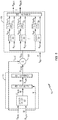
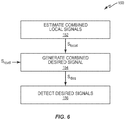
- Figure 5 shows one exemplary block diagram for the desired UE detector 100 of Figure 4 , which is configured to execute the process 150 of Figure 6 . More particularly, the detector 100 is configured to estimate a combined local signal comprising all of the local signals in the composite wideband signal based on the local scheduling information (block 152). By subtracting the combined local signal from the received signal, detector 100 generates a combined desired signal (block 154). The detector 100 detects one or more of the desired signals based on the combined desired signal and the desired reference sequences (block 156).
- detector 100 comprises a combined local signal estimator 110, a subtractor 120, and a detection processor 130.
- Combined local signal estimator 110 estimates a combined local signal S local by combining all locally scheduled UE signals in the received signal S rcvd that potentially overlap in frequency with a desired UE signal present.
- estimator 110 comprises a smooth channel estimator 112, multiplier 114, and combiner 116.
- Smooth channel estimator 112 generates smooth channel estimates H ⁇ ls,m for each of the M locally scheduled UEs 34 over the domain of all of the locally scheduled UE signals based on the local reference sequences allocated to the locally scheduled UEs 24 allocated frequency resources overlapping the frequency resources allocated to at least one potential desired UE 34.
- smooth channel estimator 112 may determine channel estimates for each tone of a resource block, transform these estimates into the time domain to estimate the channel impulse response, truncate this impulse response in some appropriate way, and then transform the truncated response back into the frequency domain. The resulting channel estimates are thus smoothed, and reflect the expectation of a timed channel impulse response.
- Multiplier 114 multiplies each smoothed channel estimate by the corresponding local reference sequence R ls,m to compute an estimate of the received signal for each of the M locally scheduled UE( S ls,m ) .
- Combiner 116 combines the estimated received signals for the locally scheduled UEs 34 to generate the combined local signal S local .
- Subtractor 120 subtracts the combined local signal S local from the received signal S rcvd to generate a combined desired signal S des free of the locally scheduled user signals.
- Detection processor 130 processes the combined desired signal to detect which of the P potential desired UEs 24, e.g., the desired UEs 24 allocated frequency resources that overlap the allocated frequency resources of the locally scheduled UEs 34, have a signal sufficiently present in the received signal.
- detection processor 130 comprises a plurality of correlators 132, a plurality of threshold processors 134, and a screening unit 136.
- Each correlator 132 generates a desired UE signal ( S d,p ) and a corresponding quality estimate ( Q p ) by cross-correlating S des with a different one of the P desired reference sequences R d,p .
- Each threshold processor 134 applies a threshold condition to the input desired UE signal. If the input desired UE signal passes the threshold test, e.g., if an amplitude of the input desired UE signal S d,p exceeds the threshold T p , threshold processor 134 provides a "pass" signal ( P p ) to the screening unit 136. Otherwise the threshold processor 134 provides a "fail” signal ( F p ) to the screening unit 136.
- screening unit 136 Based on the pass/fail signals from the threshold processors 134 and the quality estimates from the correlators 132, screening unit 136 detects the N ⁇ P desired UEs 24 having a signal present in the received signal that also overlaps at least one frequency resource of at least one of the locally scheduled UE signals, and outputs the reference sequences ( R dd,n ) for these detected desired UEs 24. More particularly, screening unit 136 outputs the reference sequences for those desired user signals that pass the threshold condition and have a quality estimate satisfying a quality condition.
- FIG 7 shows a block diagram of an exemplary joint channel estimator 200 configured to jointly estimate the channels ( H dd,n ,H rs,m ) between the base station 32 and the detected desired and locally scheduled UEs 24, 34 according to the method 250 of Figure 8 .
- joint channel estimator 200 identifies a first frequency bin of the composite wideband signal and determines the number of user signals present in the first frequency bin (block 252).
- the joint channel estimator 200 also identifies at least one more contiguous frequency bin in which the same user signals are present, such that the total number of identified frequency bins is at least as large as the number of user signals in the first frequency bin (block 254).
- Joint channel estimator 200 then jointly calculates channel estimates, over the identified frequency bins, for each of the user signals in the first frequency bin based on the reference sequences allocated to the UEs having signals in the first frequency bin (block 256).
- the joint channel estimator 200 comprises a signal extractor 210, a two-dimensional signal map generator 220, a processor 230, and a scanning estimator 240.
- Signal extractor 210 generates a composite signal vector y (relative to frequency) over the domain of all of the received cooperator requests received by the cooperator base station 32.
- the composite signal vector y represents the received signal over the frequency group of interest, and includes the composite received data of all UEs in that frequency group.
- Two-dimensional signal map generator 220 generates a matrix of reference sequence samples ( R ) containing each of the reference sequences' samples allocated to the M locally scheduled UEs 34 and the N detected desired UEs 24 relative to each of the resource blocks allocated to the locally scheduled and detected desired UEs.
- Each resource block comprises a predetermined number of frequency bins, including but not limited to twelve frequency bins.
- the two-dimensional signal map generator 220 generates R based on the scheduling information known for the locally scheduled UEs 34 and the detected desired UEs 24.
- Processor 230 scans through the frequency bins of the input signal corresponding to the frequency bins of the reference sequence matrix to identify the frequency bins/resource blocks having a unique set of user signals. More particularly, processor 230 identifies, for a first frequency bin of a first resource block of the reference sequence matrix, how many user signals are present in the first frequency bin. Processor 230 further identifies a number of additional contiguous frequency bins in which the same user signals are present. Thus, processor 230 identifies B contiguous frequency bins, including the first frequency bin, where B equals the determined number of user signals in the first frequency bin.
- Scanning estimator 240 then processes the composite wideband signal vector over B frequency bins, e.g., the first frequency bin and the subsequent B- 1 contiguous frequency bins, to generate and solve B equations for the B unknown channel estimates of the B users using any known technique, e.g., minimum mean squared error (MMSE) techniques.
- two UEs are present in the first frequency bin.
- four UEs are using the same frequency resources in the 15 th resource block of Figure 9 .
- scanning estimator 240 generates at least four equations with four unknowns, and solves the four equations for the four unknown channel estimates of a particular frequency bin for LU 2 , DDU 2 , DDU 3 , and DDU 4 .
- the scanning estimator 240 therefore generates a channel estimate for each frequency bin of the reference sequence matrix.
- the scanning estimator 240 repeats this process for each frequency bin of the composite signal vector to determine channel estimates for the signals in each frequency bin. In another embodiment, the scanning estimator 240 may repeat this process for each bin containing a UE signal for which a channel estimate has not been calculated.
- the scanning estimator 240 processes the composite wideband signal over contiguous frequency bins, which may comprise the first frequency bin plus the B -1 additional frequency bins.
- the scanning estimator 230 may identify B + B extra frequency bins to over-dimension the number of equations, and therefore, to increase the probability that the system of equations is solvable.
- the channel estimate(s) for the boundary frequency bins may be set equal to a channel estimate previously determined for signals in an adjacent frequency bin.
- the scanning estimator 240 will be unable to generate two equations for the two unknowns associated with the last frequency bin of the 5 th resource block.
- the scanning estimator 240 may set the channel estimates for the last frequency bin of the 5 th resource block equal to the channel estimates determined for the penultimate frequency bin of the 5 th resource block.
- the scanning estimator 240 may set the channel estimates for the last two frequency bins of the 8 th resource block equal to the channel estimates determined for the 10 th frequency bin.
- the joint channel estimator 200 of the channel estimation system 10 operates on the locally scheduled UEs 34 and the detected desired UEs 24. It will be appreciated, however, that the joint channel estimator 200 may alternatively operate on a received signal containing signals for any UEs allocated overlapping resource blocks. Thus, the disclosed joint channel estimator 200 may operate independently from the desired user detector 100.
- the channel estimation system 10 disclosed herein improves the accuracy of channel estimates determined for locally scheduled UEs 34 and desired UEs 24. Further, because the channel estimation system 10 may focus on determining channel estimates for locally scheduled UEs 34 and detected desired UEs 24, the disclosed channel estimation system 10 eliminates the wasteful use of processing resources required of some prior art solutions.
- Simulation results indicate using the desired user detector and/or joint channel estimator disclosed herein provides significant performance improvements over conventional solutions. For example, consider the scenario where the desired user signal is 20 dB below the locally scheduled user signal.
- the probability of missed detection and the probability of false alarm are 80% and 1%, respectively, when using conventional detection techniques, e.g., using the reference sequences, to detect user signals in the composite wideband signal.
- the detection technique disclosed herein e.g., based on locally scheduled UE cancellation
- the probability of missed detection and the probability of false alarm are 5% and 1%, respectively.
- the probability of missed detection and the probability of false alarm are estimated to be 0.25% and 2%, respectively.
- the 50 th percentile channel estimation error is improved by 20 dB.
- the channel estimation process relies on reference sequences allocated to the locally scheduled UEs 34 and the detected desired UEs 24.
- Conventional systems typically allocate reference sequences that span the resource blocks allocated to a particular UE, as shown in Figure 9 .
- Zadoff-Chu sequences e.g., are commonly used for this purpose.
- the allocated Zadoff-Chu sequences are chosen from sets of Zadoff-Chu sequences to achieve good auto-correlation properties for detection of the desired users' reference sequences (e.g., for good probability of detection), as well as to achieve good cross-correlation properties to avoid falsely detecting a reference sequence from another user (e.g., low probability of false alarm).
- ZC ZC
- the auto-correlation and cross-correlation properties are generally good when calculated over the entire length of the sequence.
- the correlation properties particularly the cross-correlation properties, tend to degrade when Zadoff-Chu sequences are correlated over shorter sections of a full sequence.
- one embodiment may allocate reference sequences comprising multiple shorter reference sequences, e.g., virtual DMRS sequences, to each locally scheduled UE and/or detected desired UE.
- FIG 10 shows an exemplary method 600 for allocating reference sequences comprising multiple concatenated reference subsequences, as shown in Figure 11 .
- each subsequence length is defined based on the number of resource blocks being allocated to the same UEs.
- a virtual DMRS allocator 400 in the local base station 32 defines intervals in a transmission block, e.g., a transmission time interval, where each interval has an interval length equal to the number of contiguous resource blocks in the interval (block 610). Different intervals comprise different combinations of two or more users granted overlapping resource blocks.
- allocator 400 For each interval, allocator 400 allocates a different subsequence to each user in the interval, where each allocated subsequence has a subsequence length equal to the interval length (block 620). The allocator 400 subsequently generates the reference sequence for each user based on the allocated subsequences (block 630).
- resource blocks 2-5 are allocated to LSU 1 and DDU 1
- resource blocks 6-7 are only allocated to DDU 1
- resource block 8 is allocated to LSU 1 , DDU 1 , and DDU 2 .
- the reference sequence for LSU 1 will have a length of four resource blocks
- the reference sequence for DDU 1 will comprise three subsequences, where the first subsequence has a length of four resource blocks, the second subsequence has a length of two resource blocks, and the third subsequence has a length of one resource block.
- the joint channel estimator 200 is able to correlate signals over the full subsequences, and therefore, is able to maintain the desired correlation properties of the reference sequences.
Landscapes
- Engineering & Computer Science (AREA)
- Signal Processing (AREA)
- Computer Networks & Wireless Communication (AREA)
- Power Engineering (AREA)
- Quality & Reliability (AREA)
- Mobile Radio Communication Systems (AREA)
Claims (9)
- Verfahren (150) zum Verarbeiten eines an einer lokalen Basisstation (32) empfangenen Composite-Breitbandsignals, wobei das Composite-Breitbandsignal über eine oder mehrere Frequenzgruppen mindestens ein lokales Signal einschließt, das einem lokal eingeplanten Nutzer (34) zugeordnet ist, sowie mindestens ein gewünschtes Signal, das einem gewünschten Nutzer (24) zugeordnet ist, der durch eine benachbarte Basisstation (22) eingeplant ist, wobei die lokale Basisstation (32) Planungsinformationen für den mindestens einen gewünschten Nutzer (24) von den entsprechenden benachbarten Basisstationen (22) empfängt, wobei das Verfahren Folgendes umfasst:Schätzen (152) eines kombinierten lokalen Signals, umfassend alle lokalen Signale im Composite-Breitbandsignal basierend auf lokalen Planungsinformationen, wobei Folgendes gilt:die lokalen Planungsinformationen ordnen jedem der lokal eingeplanten Nutzer (34) eine eindeutige Gruppe lokaler Frequenzen zu;die empfangenen Planungsinformationen ordnen jedem der gewünschten Nutzer (24) eine Gruppe gewünschter Frequenzen zu; undmindestens eine der einem gewünschten Nutzer zugeordneten Gruppen gewünschter Frequenzen überschneidet sich zumindest teilweise mit mindestens einer der Gruppen der einem lokal eingeplanten Nutzer zugeordneten lokalen Frequenzen;Subtrahieren (154) des kombinierten lokalen Signals vom Composite-Breitbandsignal zum Erzeugen eines gewünschten kombinierten Composite-Signals; undBestimmen (156) von einem oder mehreren der gewünschten Signale im gewünschten Composite-Signal, die eine ausreichende Signalstärke und Signalqualität aufweisen, um als im Composite-Breitbandsignal vorliegend erkennbar zu sein, basierend auf gewünschten Referenzsequenzen, die dem einen oder den mehreren gewünschten Nutzern (24) entsprechend der Angabe durch die empfangenen Planungsinformationen zugeordnet sind;wobei das Bestimmen des einen oder der mehreren gewünschten Signale Folgendes umfasst:Korrelieren des kombinierten gewünschten Signals mit jeder gewünschten Referenzsequenz, um eine Schätzung des gewünschten Signals und eine Schätzung der Qualität für jeden gewünschten Nutzer (24) zu erzeugen;Vergleichen jeder Schätzung eines gewünschten Signals mit einem Schwellenwert; undfür jedes geschätzte gewünschte Signal, das die Schwellenwertbedingung erfüllt, Detektieren von einem oder mehreren der gewünschten Signale basierend auf der dazugehörigen Schätzung der Qualität;wobei das Detektieren der gewünschten Signale basierend auf der dazugehörigen Schätzung der Qualität das Identifizieren jedes gewünschten Signals umfasst, dessen Schätzung des gewünschten Signals den Schwellenwert erfüllt oder übertrifft und dessen Qualitätsschätzung einer Qualitätsanforderung als detektiertes gewünschtes Signal genügt.
- Verfahren nach Anspruch 1, wobei das Schätzen des kombinierten lokalen Signals Folgendes umfasst:Erzeugen geglätteter Kanalschätzungen für jeden der lokal eingeplanten Nutzer (34) basierend auf dem Composite-Breitbandsignal und einer lokalen Referenzsequenz, die jedem lokal eingeplanten Nutzer (34) durch die lokalen Planungsinformationen zugeordnet wird;Schätzen von jedem der lokalen Signale im Composite-Breitbandsignal basierend auf den entsprechenden geglätteten Kanalschätzungen und der dazugehörigen lokalen Referenzsequenz; undKombinieren der geschätzten lokalen Signale zum Schätzen des kombinierten lokalen Signals.
- Detektor (100) gewünschter Nutzer in einer lokalen Basisstation (32), konfiguriert zum Verarbeiten eines an der lokalen Basisstation (32) empfangenen Composite-Breitbandsignals, wobei das Composite-Breitbandsignal in einer oder mehreren Frequenzgruppen mindestens ein, einem lokal eingeplanten Nutzer (34) zugeordnetes lokales Signal einschließt und mindestens ein einem gewünschten Nutzer (24), der von einer benachbarten Basisstation (22) eingeplant ist, zugeordnetes gewünschtes Signal einschließt, wobei die lokale Basisstation (32) Planungsinformationen für den mindestens einen gewünschten Nutzer (24) von den dazugehörigen benachbarten Basisstationen (22) empfängt, wobei der Detektor (100) gewünschter Nutzer Folgendes umfasst:einen Schätzer (110) eines kombinierten lokalen Signals, konfiguriert zum Schätzen eines kombinierten lokalen Signals, umfassend alle lokalen Signale im Composite-Breitbandsignal basierend auf lokalen Planungsinformationen, wobeidie lokalen Planungsinformationen jedem der lokal eingeplanten Nutzer (34) eine eindeutige Gruppe lokaler Frequenzen zuordnen;die empfangenen Planungsinformationen jedem der gewünschten Nutzer (24) eine Gruppe gewünschter Frequenzen zuordnen; undmindestens eine der einem gewünschten Nutzer zugeordneten Gruppen gewünschter Frequenzen sich zumindest teilweise mit mindestens einer der Gruppen der einem lokal eingeplanten Nutzer zugeordneten lokalen Frequenzen überschneidet;einen Subtrahierer (120), konfiguriert, um das kombinierte lokale Signal vom Composite-Breitbandsignal zu subtrahieren, um ein kombiniertes gewünschtes Signal zu erzeugen; undeinen Erkennungsprozessor (130), konfiguriert, um eines oder mehrere der gewünschten Signale im kombinierten gewünschten Signal zu bestimmen, die eine ausreichende Signalstärke und Signalqualität aufweisen, um im Composite-Breitbandsignal als vorliegend erkennbar zu sein, basierend auf gewünschten Referenzsequenzen, die dem einen oder den mehreren gewünschten Nutzern (24) entsprechend der Angabe durch die empfangenen Planungsinformationen zugeordnet werden;wobei der Erkennungsprozessor (130) Folgendes umfasst:eine Vielzahl von Korrelatoren (132), jeweils konfiguriert zum Korrelieren des kombinierten gewünschten Signals mit einer unterschiedlichen der gewünschten Referenzsequenzen, um eine Schätzung eines gewünschten Signals und eine Qualitätsschätzung für jeden gewünschten Nutzer (24) zu erzeugen;eine Vielzahl von Schwellenwerteinheiten (134), jeweils konfiguriert, um die dazugehörige Schätzung des gewünschten Signals mit einem Schwellenwert zu vergleichen; undeinen Screener (136), konfiguriert, um für jedes geschätzte gewünschte Signal, das die Schwellenwertbedingung erfüllt, basierend auf der dazugehörigen Qualitätsschätzung eines oder mehrere der gewünschten Signale zu erkennen, und wobei der Screener (136) konfiguriert ist, um basierend auf der dazugehörigen Qualitätsschätzung die gewünschten Signale zu erkennen, indem jedes gewünschte Signal identifiziert wird, dessen Schätzung des gewünschten Signals den Schwellenwert erreicht oder übertrifft und dessen Qualitätsschätzung eine Qualitätsanforderung als ein erkanntes gewünschtes Signal erfüllt.
- Detektor (100) gewünschter Nutzer nach Anspruch 3, wobei der Schätzer (110) des kombinierten lokalen Signals Folgendes umfasst:einen Schätzer (112) eines geglätteten Kanals, konfiguriert, um Schätzungen geglätteter Kanäle für jeden der lokal eingeplanten Nutzer (34) zu erzeugen, basierend auf einer lokalen Referenzsequenz, die jedem lokal eingeplanten Nutzer (34) durch die lokalen Planungsinformationen zugeordnet wird;einen Multiplikator (114), konfiguriert zum Schätzen jedes der lokalen Signale im Composite-Breitbandsignal, basierend auf den dazugehörigen Schätzungen geglätteter Kanäle und der entsprechenden lokalen Referenzsequenz; undeinen Kombinierer (116), konfiguriert zum Kombinieren der geschätzten lokalen Signale zum Schätzen des kombinierten lokalen Signals.
- Verfahren (50) zum Verarbeiten eines an einer lokalen Basisstation (32) empfangenen Composite-Breitbandsignals, wobei das Composite-Breitbandsignal über eine oder mehrere Frequenzgruppen mindestens ein lokales Signal einschließt, das einem lokal eingeplanten Nutzer (34) zugeordnet ist, und mindestens ein gewünschtes Signal, das einem gewünschten, von einer benachbarten Basisstation (22) eingeplanten Nutzer (24) zugeordnet ist, wobei die lokale Basisstation (32) Planungsinformationen für den mindestens einen gewünschten Nutzer (24) von den dazugehörigen benachbarten Basisstationen (22) empfängt und wobei die dem gewünschten Nutzer zugewiesenen Frequenzgruppen sich zumindest teilweise mit den dem lokal eingeplanten Nutzer zugeordneten Frequenzgruppen überschneiden, wobei das Verfahren Folgendes umfasst:Erzeugen (52) geglätteter Kanalschätzungen für jeden der lokal eingeplanten Nutzer (34), die basierend auf durch die lokalen Planungsinformationen jedem lokal eingeplanten Nutzer (34) zugewiesenen lokalen Referenzsequenzen ein lokales Signal im Composite-Breitbandsignal aufweisen;Bestimmen (54) von einem oder mehreren der gewünschten Signale, die ausreichende Signalstärke und Signalqualität aufweisen, um als im Composite-Breitbandsignal vorliegend erkennbar zu sein, basierend auf den geglätteten Kanalschätzungen und auf gewünschten Referenzsequenzen, die jedem gewünschten Nutzer (24) jeweils zugeordnet sind,wobei das Bestimmen des einen oder der mehreren gewünschten Signale Folgendes umfasst:Schätzen von jedem der lokalen Signale im Composite-Breitbandsignal basierend auf den entsprechenden geglätteten Kanalschätzungen und der dazugehörigen lokalen Referenzsequenz;Zusammenführen der geschätzten lokalen Signale zum Schätzen eines kombinierten lokalen Signals;Subtrahieren des kombinierten lokalen Signals vom Composite-Breitbandsignal zum Erzeugen eines kombinierten gewünschten Signals; undBestimmen von einem oder mehreren der gewünschten Signale, die ausreichende Signalstärke und Signalqualität aufweisen, um als im Composite-Breitbandsignal vorliegend erkennbar zu sein, basierend auf dem kombinierten gewünschten Signal und auf den gewünschten Referenzsequenzen;wobei das Bestimmen des einen oder der mehreren gewünschten Signale basierend auf dem kombinierten gewünschten Signal und den gewünschten Referenzsequenzen Folgendes umfasst:Korrelieren des kombinierten gewünschten Signals mit einer entsprechenden gewünschten Referenzsequenz, um eine Schätzung eines gewünschten Signals und eine Qualitätsschätzung für jeden gewünschten Nutzer (24) zu erzeugen;Vergleichen jeder Schätzung eines gewünschten Signals mit einem Schwellenwert;für jede Schätzung eines gewünschten Signals, die die Schwellenwertbedingung erfüllt, Detektieren von einem oder mehreren der gewünschten Signale basierend auf der dazugehörigen Schätzung der Qualität; undDetektieren der gewünschten Signale basierend auf der dazugehörigen Schätzung der Qualität durch das Identifizieren jedes gewünschten Signals, dessen Schätzung des gewünschten Signals den Schwellenwert erfüllt oder übertrifft und dessen Qualitätsschätzung einer Qualitätsanforderung als detektiertes gewünschtes Signal genügt; undüber jede Frequenzregion mit einer oder mehreren sich überlappenden Frequenzgruppen, die durch eine eindeutige Gruppe von Nutzern übertragene Signale enthalten, basierend auf den dazugehörigen zugewiesenen Referenzsequenzen erfolgendes gemeinsames Berechnen (56) von Kanalschätzungen für jedes der Nutzersignale in der Frequenzregion.
- Kanalschätzungssystem (10), konfiguriert zum Verarbeiten eines an einer lokalen Basisstation (32) empfangenen Composite-Breitbandsignals, wobei das Composite-Breitbandsignal über eine oder mehrere Frequenzgruppen mindestens ein lokales Signal einschließt, das einem lokal eingeplanten Nutzer (34) zugeordnet ist, und mindestens ein gewünschtes Signal, das einem gewünschten, von einer benachbarten Basisstation (22) eingeplanten Nutzer (24) zugeordnet ist, wobei die lokale Basisstation (32) Planungsinformationen für den mindestens einen gewünschten Nutzer (24) von den dazugehörigen benachbarten Basisstationen (22) empfängt und wobei die dem gewünschten Nutzer zugewiesenen Frequenzgruppen sich zumindest teilweise mit den dem lokal eingeplanten Nutzer zugeordneten Frequenzgruppen überschneiden, wobei das Kanalschätzungssystem (10) Folgendes umfasst:einen Detektor (100) eines gewünschten Nutzers, konfiguriert für Folgendes:Erzeugen geglätteter Kanalschätzungen für jeden der lokal eingeplanten Nutzer (34), die basierend auf durch die lokalen Planungsinformationen jeweils jedem lokal eingeplanten Nutzer (34) zugewiesenen lokalen Referenzsequenzen ein lokales Signal im Composite-Breitbandsignal aufweisen; undBestimmen von einem oder mehreren der gewünschten Signale, die ausreichende Signalstärke und Signalqualität aufweisen, um als im Composite-Breitbandsignal vorliegend erkennbar zu sein, basierend auf den geglätteten Kanalschätzungen und auf gewünschten Referenzsequenzen, die jedem gewünschten Nutzer (24) jeweils zugeordnet sind, undeinen gemeinsamen Kanalschätzer (200), konfiguriert, um über jede Frequenzregion mit einer oder mehreren sich überlappenden Frequenzgruppen, die durch eine eindeutige Gruppe von Nutzern übertragene Signale enthalten, gemeinsam Kanalschätzungen für jedes der Nutzersignale in der Frequenzregion zu berechnen, basierend auf den dazugehörigen zugewiesenen Referenzsequenzen;wobei der Detektor (100) der gewünschten Nutzer Folgendes umfasst:einen Korrelator (112), konfiguriert zum Schätzen von jedem der lokalen Signale im Composite-Breitbandsignal basierend auf den entsprechenden geglätteten Kanalschätzungen und der dazugehörigen zugewiesenen lokalen Referenzsequenz;einen Kombinator (116) konfiguriert, um die geschätzten lokalen Signale zum Schätzen eines kombinierten lokalen Signals zu kombinieren;ein Subtrahierer (120), konfiguriert, um das kombinierte lokale Signal vom Composite-Breitbandsignal zu subtrahieren, um ein kombiniertes gewünschtes Signal zu erzeugen; undeinen Erkennungsprozessor (130), konfiguriert, um eines oder mehrere der gewünschten Signale zu bestimmen, die ausreichende Signalstärke und Signalqualität aufweisen, um als im Composite-Breitbandsignal vorliegend erkennbar zu sein, basierend auf dem kombinierten gewünschten Signal und auf den gewünschten Referenzsequenzen;wobei der Erkennungsprozessor (130) Folgendes umfasst:eine Vielzahl von Korrelatoren (132), jeweils konfiguriert zum Korrelieren des kombinierten gewünschten Signals mit einer dazugehörigen gewünschten Referenzsequenz, um eine Schätzung eines gewünschten Signals und eine Qualitätsschätzung für jeden gewünschten Nutzer (24) zu erzeugen;eine Vielzahl von Schwellenwerteinheiten (134), jeweils konfiguriert, um jede Schätzung eines gewünschten Signals mit einem Schwellenwert zu vergleichen; undeinen Screener (136), konfiguriert, um für jede Schätzung eines gewünschten Signals, das die Schwellenwertbedingung erfüllt, basierend auf der dazugehörigen Qualitätsschätzung eines oder mehrere der gewünschten Signale zu erkennen, und wobei der Screener (136) konfiguriert ist, um basierend auf der dazugehörigen Qualitätsschätzung die gewünschten Signale zu erkennen, indem jedes gewünschte Signal identifiziert wird, dessen Schätzung des gewünschten Signals den Schwellenwert erreicht oder übertrifft und dessen Qualitätsschätzung eine Qualitätsanforderung als ein erkanntes gewünschtes Signal erfüllt.
- Kanalschätzungssystem (10) nach Anspruch 6, weiter umfassend eine Durchschnittsberechnungseinheit (300), konfiguriert zum Ermitteln des Durchschnitts aller gemeinsam berechneten Kanalschätzungen.
- Kanalschätzungssystem (10) nach Anspruch 6 oder 7, wobei der gemeinsame Kanalschätzer (200) Folgendes umfasst:einen Prozessor (230), konfiguriert für Folgendes:basierend auf den Planungsinformationen, Identifizieren einer ersten Frequenzlinie des Composite-Breitbandsignals und Bestimmen einer Anzahl von im Composite-Breitbandsignal in der ersten Frequenzlinie vorliegenden Nutzersignalen; undIdentifizieren mindestens einer zusätzlichen, zusammenhängenden Frequenzlinie, in welcher die gleichen Benutzersignale im Composite-Breitbandsignal vorliegen, sodass die Gesamtzahl der identifizierten Frequenzlinien größer als die oder gleich der Anzahl der Nutzersignale in der ersten Frequenzlinie ist; undeinen Scan-Schätzer (240), konfiguriert, um über die identifizierten zusammenhängenden Frequenzlinien gemeinsam Kanalschätzungen für jedes der Nutzersignale in der ersten Frequenzlinie zu berechnen, basierend auf den Nutzern zugewiesenen Referenzsequenzen, die den Nutzersignalen in der ersten Frequenzlinie entsprechen; undwobei wahlweise der Scan-Schätzer (240) gemeinsam Kanalschätzungen für jedes der Nutzersignale in der ersten Frequenzlinie berechnet, basierend auf den Nutzern für N Nutzersignale in der ersten Frequenzlinie und M identifizierte Frequenzlinien zugewiesenen Referenzsequenzen, durch gemeinsames Lösen eines Systems von M Gleichungen und N Unbekannten mit M≥N, wobei die N Unbekannten Kanalschätzungen für die N Nutzersignale in der ersten Frequenzlinie umfassen.
- Kanalschätzungssystem (10) nach einem der Ansprüche 6 bis 8, weiter umfassend einen Referenzsequenz-Zuweiser (400), konfiguriert, um jedem der lokal eingeplanten Nutzer (34) Referenzsequenzen zuzuweisen, wobei jedem der lokal eingeplanten und gewünschten Nutzer (34, 24) von den dazugehörigen Planungsinformationen ein oder mehrere Ressourcenblocks in einem Übertragungsblock wie folgt zugewiesen werden, wobei sich einer oder mehrere der zugeteilten Ressourcenblocks für unterschiedliche Nutzer überschneiden:an der lokalen Basisstation (32) durch das Definieren einer Vielzahl von Intervallen im Übertragungsblock, wobei unterschiedliche Intervalle unterschiedliche Kombinationen von zwei oder mehr Nutzern (24, 34) umfassen, denen überlappende Ressourcenblöcke zugeteilt werden, und wobei jedes Intervall eine Intervalllänge aufweist, die gleich der Anzahl zusammenhängender Ressourcenblöcke im Intervall ist;für jedes Intervall durch das Zuteilen einer unterschiedlichen Untersequenz für jeden lokal eingeplanten Benutzer (34) im Intervall, wobei jede Untersequenz einen Teil der entsprechenden Referenzsequenz umfasst und jede zugewiesene Untersequenz eine Untersequenz-Länge gleich der Intervalllänge aufweist; unddurch das Erzeugen der lokalen Referenzsequenz für jeden lokal eingeplanten Nutzer (34) basierend auf der/den zugewiesenen Untersequenz(en); undwobei das Verfahren wahlweise ferner einen Sender/Empfänger (500) umfasst, konfiguriert zum Senden eines Steuersignals zu jeder benachbarten Basisstation (22), die einen gewünschten Nutzer (24) steuert, wobei das Steuersignal die benachbarte Basisstation (22) anweist, jedem der gewünschten Nutzer (24) die gewünschten Referenzsequenzen wie folgt zuzuweisen:durch das Definieren einer Vielzahl von Intervallen im Übertragungsblock, wobei unterschiedliche Intervalle unterschiedliche Kombinationen von zwei oder mehr Nutzern (24, 34) umfassen, denen überlappende Ressourcenblöcke zugeteilt werden, und wobei jedes Intervall eine Intervalllänge aufweist, die gleich der Anzahl zusammenhängender Ressourcenblöcke im Intervall ist;für jedes Intervall, durch das Zuteilen einer unterschiedlichen Untersequenz für jeden gewünschten Benutzer (24) im Intervall, wobei jede Untersequenz einen Teil der entsprechenden Referenzsequenz umfasst und jede zugewiesene Untersequenz eine Untersequenz-Länge gleich der Intervalllänge aufweist; unddurch das Erzeugen der gewünschten Referenzsequenz für jeden gewünschten Nutzer (24) basierend auf der/den zugewiesenen Untersequenz(en).
Applications Claiming Priority (2)
| Application Number | Priority Date | Filing Date | Title |
|---|---|---|---|
| US13/667,053 US8917688B2 (en) | 2012-11-02 | 2012-11-02 | Efficient user detection and channel estimation for UL CoMP |
| PCT/IB2013/059831 WO2014068522A1 (en) | 2012-11-02 | 2013-10-31 | Efficient user detection and channel estimation for ul comp |
Publications (2)
| Publication Number | Publication Date |
|---|---|
| EP2915262A1 EP2915262A1 (de) | 2015-09-09 |
| EP2915262B1 true EP2915262B1 (de) | 2017-09-20 |
Family
ID=50001047
Family Applications (1)
| Application Number | Title | Priority Date | Filing Date |
|---|---|---|---|
| EP13824173.2A Not-in-force EP2915262B1 (de) | 2012-11-02 | 2013-10-31 | Effiziente benutzererkennung und kanalschätzung für ul-comp |
Country Status (3)
| Country | Link |
|---|---|
| US (1) | US8917688B2 (de) |
| EP (1) | EP2915262B1 (de) |
| WO (1) | WO2014068522A1 (de) |
Families Citing this family (5)
| Publication number | Priority date | Publication date | Assignee | Title |
|---|---|---|---|---|
| WO2016013387A1 (ja) * | 2014-07-23 | 2016-01-28 | 株式会社Nttドコモ | 無線基地局、ユーザ端末及び無線通信方法 |
| CN105516030B (zh) * | 2014-09-22 | 2018-07-13 | 普天信息技术有限公司 | 协作多点传输系统中多用户联合检测方法及基站 |
| US10298417B2 (en) * | 2015-10-28 | 2019-05-21 | Collison Communications, Inc. | Polynomial mixture for frequency domain multiuser channel estimation and tracking in a wireless communication network |
| EP3443700B1 (de) * | 2016-04-12 | 2021-12-22 | Apple Inc. | Verbesserung eines uplink-demodulationsreferenzsignals in full-dimension-mimo-systemen |
| EP3707866B1 (de) * | 2017-11-06 | 2023-08-23 | Telefonaktiebolaget LM Ericsson (publ) | Kanalschätzung |
Citations (1)
| Publication number | Priority date | Publication date | Assignee | Title |
|---|---|---|---|---|
| US20110293028A1 (en) * | 2008-11-13 | 2011-12-01 | Nortel Networks Limited | Method and system for reduced complexity channel estimation and interference cancellation for v-mimo demodulation |
Family Cites Families (9)
| Publication number | Priority date | Publication date | Assignee | Title |
|---|---|---|---|---|
| US5499243A (en) | 1993-01-22 | 1996-03-12 | Hall; Dennis R. | Method and apparatus for coordinating transfer of information between a base station and a plurality of radios |
| FR2821517B1 (fr) | 2001-02-23 | 2004-03-19 | Nortel Networks Ltd | Procede de communication, controleur de reseau radio et noeud de base pour mettre en oeuvre ce procede |
| EP1700396A1 (de) | 2003-12-23 | 2006-09-13 | Telefonaktiebolaget LM Ericsson (publ) | Verfahren und system zum informationstransfer |
| DE602004022932D1 (de) | 2004-07-13 | 2009-10-15 | Alcatel Lucent | Verfahren zur endgeräteunterstützen Interferenzkontrolle in einem Mehrträger-Mobilkommunikationssystem |
| US8644397B2 (en) * | 2008-09-23 | 2014-02-04 | Qualcomm Incorporated | Efficient multiplexing of reference signal and data in a wireless communication system |
| JP5608656B2 (ja) | 2008-09-26 | 2014-10-15 | テレフオンアクチーボラゲット エル エム エリクソン(パブル) | アクセス・ノードの上りリンク協力のための技法 |
| CN101854199B (zh) | 2009-03-31 | 2015-01-14 | 株式会社Ntt都科摩 | 一种无线通信中自适应协作传输的方法、系统和发射机 |
| WO2010118557A1 (zh) | 2009-04-16 | 2010-10-21 | 上海贝尔股份有限公司 | 多基站mimo系统中选择对象终端的方法和装置 |
| US20120184218A1 (en) | 2011-01-13 | 2012-07-19 | Telefonaktiebolaget L M Ericsson (Publ) | Reduced Bandwidth Backhaul for Coordinated Multi-Point Reception |
-
2012
- 2012-11-02 US US13/667,053 patent/US8917688B2/en active Active
-
2013
- 2013-10-31 WO PCT/IB2013/059831 patent/WO2014068522A1/en not_active Ceased
- 2013-10-31 EP EP13824173.2A patent/EP2915262B1/de not_active Not-in-force
Patent Citations (1)
| Publication number | Priority date | Publication date | Assignee | Title |
|---|---|---|---|---|
| US20110293028A1 (en) * | 2008-11-13 | 2011-12-01 | Nortel Networks Limited | Method and system for reduced complexity channel estimation and interference cancellation for v-mimo demodulation |
Non-Patent Citations (1)
| Title |
|---|
| RITT ET AL: "Signalling for uplink inter-cell interference cancellation", 3GPP DRAFT; R1-060893, 3RD GENERATION PARTNERSHIP PROJECT (3GPP), MOBILE COMPETENCE CENTRE ; 650, ROUTE DES LUCIOLES ; F-06921 SOPHIA-ANTIPOLIS CEDEX ; FRANCE, vol. RAN WG1, no. Athens, Greece; 20060320, 20 March 2006 (2006-03-20), XP050101799 * |
Also Published As
| Publication number | Publication date |
|---|---|
| US20140126480A1 (en) | 2014-05-08 |
| US8917688B2 (en) | 2014-12-23 |
| EP2915262A1 (de) | 2015-09-09 |
| WO2014068522A1 (en) | 2014-05-08 |
Similar Documents
| Publication | Publication Date | Title |
|---|---|---|
| EP1889371B1 (de) | Verfahren und system zur interferenzreduktion | |
| EP2076087B1 (de) | Kommunikationsverfahren, Nutzerausrüstung und Funkbasisstation in einem Funkkommunikationsnetzwerk | |
| JP5819306B2 (ja) | 下りリンクデータ送信をサポートするためのタイミング情報の報知 | |
| Jeong et al. | Beamforming design for joint localization and data transmission in distributed antenna system | |
| KR20210134979A (ko) | 5g 신무선 상향링크 위치결정 참조 신호를 구성하는 방법 및 장치 | |
| KR102418862B1 (ko) | 기준 신호의 송수신 및 스케줄링을 위한 방법 및 장치 | |
| US20150023329A1 (en) | Wireless network signal to interference plus noise ratio estimation for a random access channel | |
| JP2024508680A (ja) | アクセス方法、装置、通信機器及び可読記憶媒体 | |
| US10230489B2 (en) | Adaptive modulation and coding method and apparatus | |
| EP2915262B1 (de) | Effiziente benutzererkennung und kanalschätzung für ul-comp | |
| EP2157717B1 (de) | Verfahren, System und Vorrichtung zur Unterdrückung von Störungen bei der CQI-Schätzung | |
| TW201729629A (zh) | 非正交多址接入系統中的上行檢測方法及裝置 | |
| EP3229523A1 (de) | Verfahren zur verringerung von uplink-interferenzen und basisstation | |
| CN107733480A (zh) | 一种信息处理方法和装置 | |
| US20140010080A1 (en) | Method for operating a wireless network, a wireless network and a device | |
| WO2018223891A1 (zh) | 参考信号的传输方法、装置和设备 | |
| EP3342219A1 (de) | Uplink-pilotreferenzsignale | |
| US10736142B2 (en) | Method and apparatus for detecting channel in mobile communication system operating in unlicensed band | |
| CN104488201B (zh) | 用于在无线通信系统中发送和接收信号的方法和装置 | |
| WO2017054618A1 (zh) | 一种干扰处理方法、基站及网络设备 | |
| JP5488616B2 (ja) | Ofdma用送信アンテナポートの数の非コヒーレント検出方法、通信装置 | |
| US20110275392A1 (en) | Method for Channel Estimation, Base Station and Mobile Node | |
| CN110324118B (zh) | 信号传输方法、基站及存储介质 | |
| Liu et al. | Wireless gesture recognition by commercial LTE signal with inter-cell interference mitigation | |
| CN104113496A (zh) | 一种利用序贯导频序列进行信道估计的方法 |
Legal Events
| Date | Code | Title | Description |
|---|---|---|---|
| PUAI | Public reference made under article 153(3) epc to a published international application that has entered the european phase |
Free format text: ORIGINAL CODE: 0009012 |
|
| 17P | Request for examination filed |
Effective date: 20150423 |
|
| AK | Designated contracting states |
Kind code of ref document: A1 Designated state(s): AL AT BE BG CH CY CZ DE DK EE ES FI FR GB GR HR HU IE IS IT LI LT LU LV MC MK MT NL NO PL PT RO RS SE SI SK SM TR |
|
| AX | Request for extension of the european patent |
Extension state: BA ME |
|
| DAX | Request for extension of the european patent (deleted) | ||
| 17Q | First examination report despatched |
Effective date: 20160624 |
|
| GRAP | Despatch of communication of intention to grant a patent |
Free format text: ORIGINAL CODE: EPIDOSNIGR1 |
|
| STAA | Information on the status of an ep patent application or granted ep patent |
Free format text: STATUS: GRANT OF PATENT IS INTENDED |
|
| INTG | Intention to grant announced |
Effective date: 20170509 |
|
| GRAS | Grant fee paid |
Free format text: ORIGINAL CODE: EPIDOSNIGR3 |
|
| GRAA | (expected) grant |
Free format text: ORIGINAL CODE: 0009210 |
|
| STAA | Information on the status of an ep patent application or granted ep patent |
Free format text: STATUS: THE PATENT HAS BEEN GRANTED |
|
| AK | Designated contracting states |
Kind code of ref document: B1 Designated state(s): AL AT BE BG CH CY CZ DE DK EE ES FI FR GB GR HR HU IE IS IT LI LT LU LV MC MK MT NL NO PL PT RO RS SE SI SK SM TR |
|
| REG | Reference to a national code |
Ref country code: GB Ref legal event code: FG4D |
|
| REG | Reference to a national code |
Ref country code: CH Ref legal event code: EP |
|
| REG | Reference to a national code |
Ref country code: AT Ref legal event code: REF Ref document number: 930865 Country of ref document: AT Kind code of ref document: T Effective date: 20171015 |
|
| REG | Reference to a national code |
Ref country code: IE Ref legal event code: FG4D |
|
| REG | Reference to a national code |
Ref country code: DE Ref legal event code: R096 Ref document number: 602013026955 Country of ref document: DE |
|
| REG | Reference to a national code |
Ref country code: NL Ref legal event code: FP |
|
| PG25 | Lapsed in a contracting state [announced via postgrant information from national office to epo] |
Ref country code: HR Free format text: LAPSE BECAUSE OF FAILURE TO SUBMIT A TRANSLATION OF THE DESCRIPTION OR TO PAY THE FEE WITHIN THE PRESCRIBED TIME-LIMIT Effective date: 20170920 Ref country code: SE Free format text: LAPSE BECAUSE OF FAILURE TO SUBMIT A TRANSLATION OF THE DESCRIPTION OR TO PAY THE FEE WITHIN THE PRESCRIBED TIME-LIMIT Effective date: 20170920 Ref country code: NO Free format text: LAPSE BECAUSE OF FAILURE TO SUBMIT A TRANSLATION OF THE DESCRIPTION OR TO PAY THE FEE WITHIN THE PRESCRIBED TIME-LIMIT Effective date: 20171220 Ref country code: FI Free format text: LAPSE BECAUSE OF FAILURE TO SUBMIT A TRANSLATION OF THE DESCRIPTION OR TO PAY THE FEE WITHIN THE PRESCRIBED TIME-LIMIT Effective date: 20170920 Ref country code: LT Free format text: LAPSE BECAUSE OF FAILURE TO SUBMIT A TRANSLATION OF THE DESCRIPTION OR TO PAY THE FEE WITHIN THE PRESCRIBED TIME-LIMIT Effective date: 20170920 |
|
| REG | Reference to a national code |
Ref country code: LT Ref legal event code: MG4D |
|
| REG | Reference to a national code |
Ref country code: AT Ref legal event code: MK05 Ref document number: 930865 Country of ref document: AT Kind code of ref document: T Effective date: 20170920 |
|
| PG25 | Lapsed in a contracting state [announced via postgrant information from national office to epo] |
Ref country code: LV Free format text: LAPSE BECAUSE OF FAILURE TO SUBMIT A TRANSLATION OF THE DESCRIPTION OR TO PAY THE FEE WITHIN THE PRESCRIBED TIME-LIMIT Effective date: 20170920 Ref country code: GR Free format text: LAPSE BECAUSE OF FAILURE TO SUBMIT A TRANSLATION OF THE DESCRIPTION OR TO PAY THE FEE WITHIN THE PRESCRIBED TIME-LIMIT Effective date: 20171221 Ref country code: BG Free format text: LAPSE BECAUSE OF FAILURE TO SUBMIT A TRANSLATION OF THE DESCRIPTION OR TO PAY THE FEE WITHIN THE PRESCRIBED TIME-LIMIT Effective date: 20171220 Ref country code: RS Free format text: LAPSE BECAUSE OF FAILURE TO SUBMIT A TRANSLATION OF THE DESCRIPTION OR TO PAY THE FEE WITHIN THE PRESCRIBED TIME-LIMIT Effective date: 20170920 |
|
| PG25 | Lapsed in a contracting state [announced via postgrant information from national office to epo] |
Ref country code: CZ Free format text: LAPSE BECAUSE OF FAILURE TO SUBMIT A TRANSLATION OF THE DESCRIPTION OR TO PAY THE FEE WITHIN THE PRESCRIBED TIME-LIMIT Effective date: 20170920 Ref country code: PL Free format text: LAPSE BECAUSE OF FAILURE TO SUBMIT A TRANSLATION OF THE DESCRIPTION OR TO PAY THE FEE WITHIN THE PRESCRIBED TIME-LIMIT Effective date: 20170920 Ref country code: RO Free format text: LAPSE BECAUSE OF FAILURE TO SUBMIT A TRANSLATION OF THE DESCRIPTION OR TO PAY THE FEE WITHIN THE PRESCRIBED TIME-LIMIT Effective date: 20170920 Ref country code: ES Free format text: LAPSE BECAUSE OF FAILURE TO SUBMIT A TRANSLATION OF THE DESCRIPTION OR TO PAY THE FEE WITHIN THE PRESCRIBED TIME-LIMIT Effective date: 20170920 |
|
| PG25 | Lapsed in a contracting state [announced via postgrant information from national office to epo] |
Ref country code: AT Free format text: LAPSE BECAUSE OF FAILURE TO SUBMIT A TRANSLATION OF THE DESCRIPTION OR TO PAY THE FEE WITHIN THE PRESCRIBED TIME-LIMIT Effective date: 20170920 Ref country code: SM Free format text: LAPSE BECAUSE OF FAILURE TO SUBMIT A TRANSLATION OF THE DESCRIPTION OR TO PAY THE FEE WITHIN THE PRESCRIBED TIME-LIMIT Effective date: 20170920 Ref country code: IT Free format text: LAPSE BECAUSE OF FAILURE TO SUBMIT A TRANSLATION OF THE DESCRIPTION OR TO PAY THE FEE WITHIN THE PRESCRIBED TIME-LIMIT Effective date: 20170920 Ref country code: IS Free format text: LAPSE BECAUSE OF FAILURE TO SUBMIT A TRANSLATION OF THE DESCRIPTION OR TO PAY THE FEE WITHIN THE PRESCRIBED TIME-LIMIT Effective date: 20180120 Ref country code: SK Free format text: LAPSE BECAUSE OF FAILURE TO SUBMIT A TRANSLATION OF THE DESCRIPTION OR TO PAY THE FEE WITHIN THE PRESCRIBED TIME-LIMIT Effective date: 20170920 Ref country code: EE Free format text: LAPSE BECAUSE OF FAILURE TO SUBMIT A TRANSLATION OF THE DESCRIPTION OR TO PAY THE FEE WITHIN THE PRESCRIBED TIME-LIMIT Effective date: 20170920 |
|
| REG | Reference to a national code |
Ref country code: CH Ref legal event code: PL |
|
| REG | Reference to a national code |
Ref country code: DE Ref legal event code: R097 Ref document number: 602013026955 Country of ref document: DE |
|
| PG25 | Lapsed in a contracting state [announced via postgrant information from national office to epo] |
Ref country code: MC Free format text: LAPSE BECAUSE OF FAILURE TO SUBMIT A TRANSLATION OF THE DESCRIPTION OR TO PAY THE FEE WITHIN THE PRESCRIBED TIME-LIMIT Effective date: 20170920 |
|
| REG | Reference to a national code |
Ref country code: IE Ref legal event code: MM4A |
|
| PLBE | No opposition filed within time limit |
Free format text: ORIGINAL CODE: 0009261 |
|
| REG | Reference to a national code |
Ref country code: FR Ref legal event code: ST Effective date: 20180629 |
|
| STAA | Information on the status of an ep patent application or granted ep patent |
Free format text: STATUS: NO OPPOSITION FILED WITHIN TIME LIMIT |
|
| PG25 | Lapsed in a contracting state [announced via postgrant information from national office to epo] |
Ref country code: CH Free format text: LAPSE BECAUSE OF NON-PAYMENT OF DUE FEES Effective date: 20171031 Ref country code: DK Free format text: LAPSE BECAUSE OF FAILURE TO SUBMIT A TRANSLATION OF THE DESCRIPTION OR TO PAY THE FEE WITHIN THE PRESCRIBED TIME-LIMIT Effective date: 20170920 Ref country code: LU Free format text: LAPSE BECAUSE OF NON-PAYMENT OF DUE FEES Effective date: 20171031 Ref country code: LI Free format text: LAPSE BECAUSE OF NON-PAYMENT OF DUE FEES Effective date: 20171031 |
|
| REG | Reference to a national code |
Ref country code: BE Ref legal event code: MM Effective date: 20171031 |
|
| 26N | No opposition filed |
Effective date: 20180621 |
|
| PG25 | Lapsed in a contracting state [announced via postgrant information from national office to epo] |
Ref country code: BE Free format text: LAPSE BECAUSE OF NON-PAYMENT OF DUE FEES Effective date: 20171031 Ref country code: FR Free format text: LAPSE BECAUSE OF NON-PAYMENT OF DUE FEES Effective date: 20171120 |
|
| PG25 | Lapsed in a contracting state [announced via postgrant information from national office to epo] |
Ref country code: MT Free format text: LAPSE BECAUSE OF NON-PAYMENT OF DUE FEES Effective date: 20171031 |
|
| PG25 | Lapsed in a contracting state [announced via postgrant information from national office to epo] |
Ref country code: IE Free format text: LAPSE BECAUSE OF NON-PAYMENT OF DUE FEES Effective date: 20171031 |
|
| PG25 | Lapsed in a contracting state [announced via postgrant information from national office to epo] |
Ref country code: SI Free format text: LAPSE BECAUSE OF FAILURE TO SUBMIT A TRANSLATION OF THE DESCRIPTION OR TO PAY THE FEE WITHIN THE PRESCRIBED TIME-LIMIT Effective date: 20170920 |
|
| PG25 | Lapsed in a contracting state [announced via postgrant information from national office to epo] |
Ref country code: HU Free format text: LAPSE BECAUSE OF FAILURE TO SUBMIT A TRANSLATION OF THE DESCRIPTION OR TO PAY THE FEE WITHIN THE PRESCRIBED TIME-LIMIT; INVALID AB INITIO Effective date: 20131031 |
|
| PG25 | Lapsed in a contracting state [announced via postgrant information from national office to epo] |
Ref country code: CY Free format text: LAPSE BECAUSE OF FAILURE TO SUBMIT A TRANSLATION OF THE DESCRIPTION OR TO PAY THE FEE WITHIN THE PRESCRIBED TIME-LIMIT Effective date: 20170920 |
|
| PG25 | Lapsed in a contracting state [announced via postgrant information from national office to epo] |
Ref country code: MK Free format text: LAPSE BECAUSE OF FAILURE TO SUBMIT A TRANSLATION OF THE DESCRIPTION OR TO PAY THE FEE WITHIN THE PRESCRIBED TIME-LIMIT Effective date: 20170920 |
|
| PG25 | Lapsed in a contracting state [announced via postgrant information from national office to epo] |
Ref country code: TR Free format text: LAPSE BECAUSE OF FAILURE TO SUBMIT A TRANSLATION OF THE DESCRIPTION OR TO PAY THE FEE WITHIN THE PRESCRIBED TIME-LIMIT Effective date: 20170920 |
|
| PG25 | Lapsed in a contracting state [announced via postgrant information from national office to epo] |
Ref country code: PT Free format text: LAPSE BECAUSE OF FAILURE TO SUBMIT A TRANSLATION OF THE DESCRIPTION OR TO PAY THE FEE WITHIN THE PRESCRIBED TIME-LIMIT Effective date: 20170920 |
|
| PG25 | Lapsed in a contracting state [announced via postgrant information from national office to epo] |
Ref country code: AL Free format text: LAPSE BECAUSE OF FAILURE TO SUBMIT A TRANSLATION OF THE DESCRIPTION OR TO PAY THE FEE WITHIN THE PRESCRIBED TIME-LIMIT Effective date: 20170920 |
|
| PGFP | Annual fee paid to national office [announced via postgrant information from national office to epo] |
Ref country code: NL Payment date: 20221026 Year of fee payment: 10 |
|
| PGFP | Annual fee paid to national office [announced via postgrant information from national office to epo] |
Ref country code: GB Payment date: 20221027 Year of fee payment: 10 Ref country code: DE Payment date: 20221027 Year of fee payment: 10 |
|
| REG | Reference to a national code |
Ref country code: DE Ref legal event code: R119 Ref document number: 602013026955 Country of ref document: DE |
|
| REG | Reference to a national code |
Ref country code: NL Ref legal event code: MM Effective date: 20231101 |
|
| GBPC | Gb: european patent ceased through non-payment of renewal fee |
Effective date: 20231031 |
|
| PG25 | Lapsed in a contracting state [announced via postgrant information from national office to epo] |
Ref country code: GB Free format text: LAPSE BECAUSE OF NON-PAYMENT OF DUE FEES Effective date: 20231031 |
|
| PG25 | Lapsed in a contracting state [announced via postgrant information from national office to epo] |
Ref country code: NL Free format text: LAPSE BECAUSE OF NON-PAYMENT OF DUE FEES Effective date: 20231101 |
|
| PG25 | Lapsed in a contracting state [announced via postgrant information from national office to epo] |
Ref country code: NL Free format text: LAPSE BECAUSE OF NON-PAYMENT OF DUE FEES Effective date: 20231101 Ref country code: GB Free format text: LAPSE BECAUSE OF NON-PAYMENT OF DUE FEES Effective date: 20231031 Ref country code: DE Free format text: LAPSE BECAUSE OF NON-PAYMENT OF DUE FEES Effective date: 20240501 |